EP1423322B1 - Bande adhesive detectable par machine - Google Patents
Bande adhesive detectable par machine Download PDFInfo
- Publication number
- EP1423322B1 EP1423322B1 EP01982221A EP01982221A EP1423322B1 EP 1423322 B1 EP1423322 B1 EP 1423322B1 EP 01982221 A EP01982221 A EP 01982221A EP 01982221 A EP01982221 A EP 01982221A EP 1423322 B1 EP1423322 B1 EP 1423322B1
- Authority
- EP
- European Patent Office
- Prior art keywords
- adhesive tape
- adhesive
- self
- paper
- double
- Prior art date
- Legal status (The legal status is an assumption and is not a legal conclusion. Google has not performed a legal analysis and makes no representation as to the accuracy of the status listed.)
- Expired - Lifetime
Links
- 239000002390 adhesive tape Substances 0.000 title claims abstract description 69
- 239000000853 adhesive Substances 0.000 claims abstract description 44
- 239000000463 material Substances 0.000 claims abstract description 16
- 238000000034 method Methods 0.000 claims description 30
- 230000001070 adhesive effect Effects 0.000 claims description 19
- XAGFODPZIPBFFR-UHFFFAOYSA-N aluminium Chemical compound [Al] XAGFODPZIPBFFR-UHFFFAOYSA-N 0.000 claims description 11
- 229910052782 aluminium Inorganic materials 0.000 claims description 10
- 229910052751 metal Inorganic materials 0.000 claims description 9
- 239000002184 metal Substances 0.000 claims description 9
- 150000001875 compounds Chemical class 0.000 claims description 6
- PCHJSUWPFVWCPO-UHFFFAOYSA-N gold Chemical compound [Au] PCHJSUWPFVWCPO-UHFFFAOYSA-N 0.000 claims description 3
- 239000010931 gold Substances 0.000 claims description 3
- 229910052737 gold Inorganic materials 0.000 claims description 3
- RYGMFSIKBFXOCR-UHFFFAOYSA-N Copper Chemical compound [Cu] RYGMFSIKBFXOCR-UHFFFAOYSA-N 0.000 claims description 2
- BQCADISMDOOEFD-UHFFFAOYSA-N Silver Chemical compound [Ag] BQCADISMDOOEFD-UHFFFAOYSA-N 0.000 claims description 2
- 239000004411 aluminium Substances 0.000 claims description 2
- 239000010949 copper Substances 0.000 claims description 2
- 229910052802 copper Inorganic materials 0.000 claims description 2
- 229910052709 silver Inorganic materials 0.000 claims description 2
- 239000004332 silver Substances 0.000 claims description 2
- 239000000203 mixture Substances 0.000 abstract description 11
- 230000003287 optical effect Effects 0.000 abstract 1
- 239000000123 paper Substances 0.000 description 74
- 239000002131 composite material Substances 0.000 description 6
- 230000006870 function Effects 0.000 description 5
- 238000000576 coating method Methods 0.000 description 4
- 239000004820 Pressure-sensitive adhesive Substances 0.000 description 3
- 238000001514 detection method Methods 0.000 description 3
- 230000007257 malfunction Effects 0.000 description 3
- 239000002699 waste material Substances 0.000 description 3
- 241001136792 Alle Species 0.000 description 2
- 229920002472 Starch Polymers 0.000 description 2
- 239000000654 additive Substances 0.000 description 2
- 230000000996 additive effect Effects 0.000 description 2
- 239000003795 chemical substances by application Substances 0.000 description 2
- 238000005520 cutting process Methods 0.000 description 2
- 239000008187 granular material Substances 0.000 description 2
- 229920000609 methyl cellulose Polymers 0.000 description 2
- 239000001923 methylcellulose Substances 0.000 description 2
- 230000009131 signaling function Effects 0.000 description 2
- 235000019698 starch Nutrition 0.000 description 2
- 239000008107 starch Substances 0.000 description 2
- NIXOWILDQLNWCW-UHFFFAOYSA-M Acrylate Chemical compound [O-]C(=O)C=C NIXOWILDQLNWCW-UHFFFAOYSA-M 0.000 description 1
- 239000004372 Polyvinyl alcohol Substances 0.000 description 1
- 230000001133 acceleration Effects 0.000 description 1
- 150000001252 acrylic acid derivatives Chemical class 0.000 description 1
- 230000001154 acute effect Effects 0.000 description 1
- 150000001298 alcohols Chemical class 0.000 description 1
- 230000001680 brushing effect Effects 0.000 description 1
- 239000000969 carrier Substances 0.000 description 1
- 239000012876 carrier material Substances 0.000 description 1
- 238000005056 compaction Methods 0.000 description 1
- 230000001276 controlling effect Effects 0.000 description 1
- 230000001419 dependent effect Effects 0.000 description 1
- 239000006185 dispersion Substances 0.000 description 1
- 239000000428 dust Substances 0.000 description 1
- 239000011888 foil Substances 0.000 description 1
- 238000005304 joining Methods 0.000 description 1
- 239000002655 kraft paper Substances 0.000 description 1
- 238000005259 measurement Methods 0.000 description 1
- 150000002739 metals Chemical class 0.000 description 1
- 229920003052 natural elastomer Polymers 0.000 description 1
- 229920001194 natural rubber Polymers 0.000 description 1
- 239000010893 paper waste Substances 0.000 description 1
- 229920002451 polyvinyl alcohol Polymers 0.000 description 1
- 239000000843 powder Substances 0.000 description 1
- 238000002360 preparation method Methods 0.000 description 1
- 230000001105 regulatory effect Effects 0.000 description 1
- 238000004513 sizing Methods 0.000 description 1
- 238000005507 spraying Methods 0.000 description 1
- 238000004544 sputter deposition Methods 0.000 description 1
- 230000001360 synchronised effect Effects 0.000 description 1
- 229920003051 synthetic elastomer Polymers 0.000 description 1
- 239000005061 synthetic rubber Substances 0.000 description 1
- 230000001960 triggered effect Effects 0.000 description 1
- 238000007740 vapor deposition Methods 0.000 description 1
Images



Classifications
-
- B—PERFORMING OPERATIONS; TRANSPORTING
- B65—CONVEYING; PACKING; STORING; HANDLING THIN OR FILAMENTARY MATERIAL
- B65H—HANDLING THIN OR FILAMENTARY MATERIAL, e.g. SHEETS, WEBS, CABLES
- B65H19/00—Changing the web roll
- B65H19/10—Changing the web roll in unwinding mechanisms or in connection with unwinding operations
-
- B—PERFORMING OPERATIONS; TRANSPORTING
- B65—CONVEYING; PACKING; STORING; HANDLING THIN OR FILAMENTARY MATERIAL
- B65H—HANDLING THIN OR FILAMENTARY MATERIAL, e.g. SHEETS, WEBS, CABLES
- B65H19/00—Changing the web roll
- B65H19/10—Changing the web roll in unwinding mechanisms or in connection with unwinding operations
- B65H19/105—Opening of web rolls; Removing damaged outer layers; Detecting the leading end of a closed web roll
-
- B—PERFORMING OPERATIONS; TRANSPORTING
- B65—CONVEYING; PACKING; STORING; HANDLING THIN OR FILAMENTARY MATERIAL
- B65H—HANDLING THIN OR FILAMENTARY MATERIAL, e.g. SHEETS, WEBS, CABLES
- B65H19/00—Changing the web roll
- B65H19/10—Changing the web roll in unwinding mechanisms or in connection with unwinding operations
- B65H19/102—Preparing the leading end of the replacement web before splicing operation; Adhesive arrangements on leading end of replacement web; Tabs and adhesive tapes for splicing
-
- C—CHEMISTRY; METALLURGY
- C09—DYES; PAINTS; POLISHES; NATURAL RESINS; ADHESIVES; COMPOSITIONS NOT OTHERWISE PROVIDED FOR; APPLICATIONS OF MATERIALS NOT OTHERWISE PROVIDED FOR
- C09J—ADHESIVES; NON-MECHANICAL ASPECTS OF ADHESIVE PROCESSES IN GENERAL; ADHESIVE PROCESSES NOT PROVIDED FOR ELSEWHERE; USE OF MATERIALS AS ADHESIVES
- C09J7/00—Adhesives in the form of films or foils
- C09J7/20—Adhesives in the form of films or foils characterised by their carriers
- C09J7/29—Laminated material
-
- B—PERFORMING OPERATIONS; TRANSPORTING
- B65—CONVEYING; PACKING; STORING; HANDLING THIN OR FILAMENTARY MATERIAL
- B65H—HANDLING THIN OR FILAMENTARY MATERIAL, e.g. SHEETS, WEBS, CABLES
- B65H2301/00—Handling processes for sheets or webs
- B65H2301/40—Type of handling process
- B65H2301/46—Splicing
- B65H2301/4606—Preparing leading edge for splicing
- B65H2301/4607—Preparing leading edge for splicing by adhesive tape
-
- B—PERFORMING OPERATIONS; TRANSPORTING
- B65—CONVEYING; PACKING; STORING; HANDLING THIN OR FILAMENTARY MATERIAL
- B65H—HANDLING THIN OR FILAMENTARY MATERIAL, e.g. SHEETS, WEBS, CABLES
- B65H2301/00—Handling processes for sheets or webs
- B65H2301/40—Type of handling process
- B65H2301/46—Splicing
- B65H2301/4606—Preparing leading edge for splicing
- B65H2301/46078—Preparing leading edge for splicing the adhesive tab or tab having a cleavable or delaminating layer
-
- B—PERFORMING OPERATIONS; TRANSPORTING
- B65—CONVEYING; PACKING; STORING; HANDLING THIN OR FILAMENTARY MATERIAL
- B65H—HANDLING THIN OR FILAMENTARY MATERIAL, e.g. SHEETS, WEBS, CABLES
- B65H2511/00—Dimensions; Position; Numbers; Identification; Occurrences
- B65H2511/50—Occurence
- B65H2511/51—Presence
- B65H2511/514—Particular portion of element
-
- B—PERFORMING OPERATIONS; TRANSPORTING
- B65—CONVEYING; PACKING; STORING; HANDLING THIN OR FILAMENTARY MATERIAL
- B65H—HANDLING THIN OR FILAMENTARY MATERIAL, e.g. SHEETS, WEBS, CABLES
- B65H2557/00—Means for control not provided for in groups B65H2551/00 - B65H2555/00
- B65H2557/10—Means for control not provided for in groups B65H2551/00 - B65H2555/00 for signal transmission
- B65H2557/13—Data carrier, e.g. chip, transponder, magnetic strip
-
- B—PERFORMING OPERATIONS; TRANSPORTING
- B65—CONVEYING; PACKING; STORING; HANDLING THIN OR FILAMENTARY MATERIAL
- B65H—HANDLING THIN OR FILAMENTARY MATERIAL, e.g. SHEETS, WEBS, CABLES
- B65H2701/00—Handled material; Storage means
- B65H2701/10—Handled articles or webs
- B65H2701/13—Parts concerned of the handled material
- B65H2701/131—Edges
- B65H2701/1311—Edges leading edge
-
- C—CHEMISTRY; METALLURGY
- C09—DYES; PAINTS; POLISHES; NATURAL RESINS; ADHESIVES; COMPOSITIONS NOT OTHERWISE PROVIDED FOR; APPLICATIONS OF MATERIALS NOT OTHERWISE PROVIDED FOR
- C09J—ADHESIVES; NON-MECHANICAL ASPECTS OF ADHESIVE PROCESSES IN GENERAL; ADHESIVE PROCESSES NOT PROVIDED FOR ELSEWHERE; USE OF MATERIALS AS ADHESIVES
- C09J2203/00—Applications of adhesives in processes or use of adhesives in the form of films or foils
- C09J2203/342—Applications of adhesives in processes or use of adhesives in the form of films or foils for flying splice applications
Definitions
- the invention relates to an adhesive tape for the flying reel change of wound on rolls flat web material, equipped with at least one adhesive fissile system, and a splicing method for the flying reel change of wound on rolls flat web material.
- the flying reel change is a common method in paper mills or the like to replace an old, almost unwound roll of paper with a new, without having to stop the fast-running machines.
- the end of the old paper web is glued to the beginning of the new paper web to ensure the most continuous operation possible.
- double-sided adhesive self-adhesive tapes, so-called fixes are used, which are on the one hand highly tacky and tacky, but on the other hand do not interfere with the reuse of paper waste in the paper machine due to their water-soluble self-adhesives and paper carriers.
- EP 418 527 A2 discloses a method for preparing a printing material web roll in a reel splicer of a rotary printing press, in which adhesive strips are used which are subdivided into three zones (Sp. 3, Z. 12 ff. And FIGS. 1 and 2), wherein the central zone 6 is perforated. At this perforation then takes place the tearing.
- adhesive tapes have serious disadvantages, in particular due to adhesive surfaces present after the splice.
- DE 198 30 673 shows an adhesive tape for the flying reel change in paper finishing machines or the like, which has a paper carrier coated on both sides with a water-soluble self-adhesive. An edge region of the rear side of the adhesive tape is equipped with a single-sided adhesive tape, which in turn has a splittable paper backing. Another variant is described in DE 198 30 674. Here is an adhesive tape with two split strips shown.
- DE 199 02 179 A1 also shows an adhesive tape for a splicing method.
- This adhesive tape has a double-sided adhesive tape on its non-adhesive back side, which has a splittable paper carrier which splits during the splicing process and covers the respective adhesive.
- the laminated adhesive tape is arranged indented with a paper support made of split paper, namely at a certain distance from the longitudinal edge of the adhesive tape
- EP 1 041 025 A shows an adhesive tape according to the preamble of claim 1 and a splicing method according to the preamble of claim 3.
- the object of the invention is to provide an adhesive tape and a splicing method which does not have the disadvantages of the prior art or only in a reduced manner and which allows an automated control of the splicing method.
- Metal detectors can be used as detectors.
- metal powder or granules are admixed to the actual support material, or the support framework is provided with one or more metal layers.
- the integrated signal function is realized in such a way that the main carrier is provided on the top and / or on the bottom with an aluminum layer, and indeed all over.
- the inventive adhesive tape is detected during the acceleration of the paper roll and thus the splicing process is triggered at the right time. Furthermore, the aluminum layer is detected in the so-called waste gate, in which the amount of paper containing the splice is sorted out.
- the inventive adhesive tape thus assumes functions which were previously ensured by additional labels or markings. Due to the labels used so far, sources of error are caused because the signal generator and the splice adhesive tape must be precisely adjusted to one another. In previous methods, detection is guaranteed by an aluminized label as standard. There is a risk that the label is positioned incorrectly, this can cause several problems. On the one hand, the label can be glued outside the detection field of the detector.
- the roll changer then does not recognize the splice and it does not come to roll change, that is, it must be stopped, the paper must be manually fed into the printing press.
- the distance between the splice and the aluminized label must be precisely defined and adhered to exactly. If these distances are not correct, the old paper web is either cut too early or too late. When cutting too early, it may happen that the bond between new roll and running web has not yet taken place sufficiently, then it comes to a break, which also has machine downtime result. If the old train is cut too late, the excess paper remains, the so-called flag.
- Too long a flag may protrude in the further processing process, such as printing from the paper web and get stuck on pulleys or in the printing unit and thus lead to disturbances or tears.
- the signal label drops or "slips" on the role.
- an additional bonding is given by the signal label, in which at partial detachment of the label adhesive surfaces can uncontrollably exposed and interfere with the paper processing process, for example, the paper stick together uncontrollably.
- An additional advantage of the invention is that contactless information can be transmitted to the process controlling via the splice adhesive tape, for example information about the current rotational speed of the new roll.
- the invention therefore also makes it possible to initiate an emergency stop in the event of malfunctions of the apparatus, for example a new roller that does not run correctly (incorrect speed, imbalance or the like), or to initiate other measures for correcting the error.
- the main carrier is preferably a tear-resistant paper or film carrier is used.
- support materials may be mentioned here, for example: slightly creped papers, smooth board raw papers, coated on one side smooth base papers, coated on both sides, compacted, printable Decorepapiere, double-coated, wood-free, high-gloss Kraft papers, without wanting to restrict themselves unnecessarily by these examples in the choice of support materials ,
- the gap strength of the gap system is 5 to 70 cN / cm, in particular 12 to 60 cN / cm.
- the gap strength and their measurement reference is made to DE 199 02 179 A1.
- the distance (V) of the double-sided adhesive tape (6) to the leading edge (longitudinal edge 14) of the main carrier is up to 15 mm, in particular 0.5 to 15 mm, preferably 1 to 7 mm, very preferably 1.5 up to 3.5 mm.
- the distance of the cleavable systems to each other is advantageously 3 to 50 mm. Distances of 25 to 45 mm, especially distances of 30 to 40 mm, are preferably selected.
- the main carrier is wider than the fissile systems.
- the width of the cleavable system is preferably 3 to 40 mm, in particular 6 to 12 mm.
- splittable systems on the adhesive tape these may consist of the same material and thus have the same splitting forces, but it may also be advantageous to provide the splittable systems of different material so that they have different splitting forces.
- an acrylate PSA is used as the self-adhesive (in the sense of the self-adhesive according to item numbers 3, 8 and / or 9 of the figures). It is advantageous to use both water-soluble and water-insoluble acrylates. Furthermore, it is also possible to use natural and synthetic rubber compositions and also dispersions of the compounds described above. It should be noted that in principle all basic types of PSAs which meet the inventive criteria, can be used.
- the self-adhesive composition is provided with a cover, which is optionally provided with a perforation or a slot in the longitudinal direction.
- the slot may preferably be provided at a distance A of 20 to 40 mm from the longitudinal edge 15 of the adhesive tape, which lies opposite the front longitudinal edge 14, in the vicinity of which the splittable system 6 is arranged.
- the adhesive tape is used in reel splicers and waste macros, where the splice detection is performed inductively or without contact.
- the adhesive tape is preferably used in processes as described in more detail below.
- the invention further relates to a splicing method according to claim 3.
- the adhesive tape is glued at right angles to the running paper web.
- the bonding of the adhesive tape can also take place at an acute angle of up to 30 ° to the running paper web, in particular of up to 10 °.
- an adhesive tape is glued in a straight line under the top sheet to a new paper roll, so that a portion of the adhesive remains free, while the underside of the adhesive tape adheres to the underlying web and thus secures the topmost web, optionally first only a part of optionally on the self-adhesive composition cover has been removed, so that the need for Splicehabilit part of the self-adhesive composition is still covered with the cover and the role in this state has no free adhesive surface, whereupon for the final preparation of the splicing the possibly remaining residual cover is removed , whereupon the thus-equipped new roll is placed next to an old, almost completely unwrapped, old roll and accelerated to the same rotational speed as this, then pressed against the old web, leaving the exposed self-adhesive of the adhesive tape with the old web at substantially adhered to the same speeds of the webs, while at the same time splits the splitting of cleavable material and both self-adhesives that were coated on
- an inventive adhesive tape that is to say one which has a particularly shear-resistant adhesive for joining the paper webs.
- the main carrier 2 consists of a Composite of slightly creped paper and aluminum. In the embodiment, there is an aluminum layer A on the underside of the main carrier 2.
- the total thickness of the main carrier 2 with self-adhesive 3 is 0.088 mm, the width 150 mm.
- Covered is the self-adhesive 3 with a siliconized release paper 4, which is provided at a distance of 30 mm from the left edge with a slot 5, so that initially the left part 4a of the release paper 4 can be removed, then the right part 4b.
- a strip of double-sided adhesive tape 6 is pasted, consisting of a paper support 7 made of split paper, coated on both sides with water-soluble self-adhesive composition 8 or 9.
- the adhesive tape has a width of 9 mm.
- Fig. 2 shows a corresponding inventive adhesive tape in which a detectable addition of the main carrier layer 2 is added; in the figure, this layer is referred to as 2 / A.
- the additive may be, for example, metal dust or granules, in particular aluminum granules.
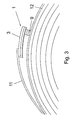
- Fig. 3 it is shown how such an adhesive tape 1 is glued under a paper web 11 of a new paper roll, with the left part, after the part 4 a of the release paper 4 has been deducted from this.
- the adhesive tape with the exposed self-adhesive composition 9 was bonded to the paper web 12 of the paper roll lying beneath the paper web 11.
- the right part 4b of the release paper 4 has been peeled off, so that the thus equipped paper roll is ready for a flying roll change, wherein the bonding of the adhesive tape 1 runs at right angles over the roller.
- the self-adhesive 3 is now open and represents the contact surface to the running webs for the flying change.
- the contact surface has a width of 120 mm and extends over the entire width of the paper roll.
- the (new) paper roll thus equipped is brought next to the unwound (old) paper roll to which the new one is to be applied.
- the new roll of paper is accelerated to a rotational speed close to the speed of the trajectory. If both speeds are sufficiently synchronized, the change can be completed.
- the splice is detected by means of a detector, which is located on the reel changer, and the position is located exactly.
- the running web 13 is brought into contact with the circumference of the new roll by means of a pressure wave (not shown) and the self-adhesive composition 3 according to FIG. 4 is glued to the running paper web 13.
- the exact time is determined at which the running paper web is pressed against the new roll of paper, and regulated the cutting of the old paper web.
- the splittable paper support 7 split the splittable paper support 7 such that a part 7a remains on the tape 1 and there covers the self-adhesive 8, while the other part 7b remains on the self-adhesive 9, which sticks to the paper web 12.
- both self-adhesive 8 and 9 are effectively neutralized, no longer stick and thus do not interfere with the further process in the paper processing machines.
- the area of the paper is sorted out with the splice so that it does not interfere in the further function of the paper (for example, in printing presses prevents newspapers with adhesive points from being sold).
- the sorting takes place at the so-called waste gate.
- the splice is detected contactless via the integrated switching function and sorted out the corresponding piece of paper by machine.
Landscapes
- Chemical & Material Sciences (AREA)
- Organic Chemistry (AREA)
- Replacement Of Web Rolls (AREA)
- Adhesive Tapes (AREA)
- Storage Of Web-Like Or Filamentary Materials (AREA)
- Adhesives Or Adhesive Processes (AREA)
Abstract
Claims (3)
- Bande adhésive (1) pour le remplacement automatique de rouleaux de matériau en bande plane enroulé, pourvue d'un support principal (2), d'une masse auto-adhésive (3) sur la face supérieure et d'au moins un ruban de bande adhésive (6) double face sur la face arrière, qui présente pour sa part un support dissociable (7), qui est équipé des deux côtés de la masse auto-adhésive (8, 9), la bande adhésive (1) étant équipée d'au moins un dispositif X pouvant être détecté par machine au moyen d'un détecteur, caractérisée en ce que le support principal est plus large que la bande adhésive (6) double face et est pourvu sur toute sa surface d'une couche métallique au sens du dispositif X sur la face supérieure et/ou inférieure.
- Bande adhésive selon la revendication 1, caractérisée en ce que le métal est l'aluminium, le cuivre, l'argent ou l'or.
- Procédé de raccordement pour le remplacement automatique de rouleaux de matériau en bande plane enroulé, dans lequel la bande (11) supérieure de papier d'un nouveau rouleau est fixée avec une bande adhésive (1), qui est pourvue d'au moins un support principal (2), d'au moins une couche d'une masse auto-adhésive (3) sur la face antérieure et d'au moins une bande adhésive (6) double face, qui présente pour sa part un support dissociable (7), sur la face inférieure, la bande adhésive (1) étant en outre munie d'au moins un dispositif (X) pouvant être détecté avec un détecteur, étant fixée sur la bande (12) sous-jacente et une partie de la masse auto-adhésive (3) nécessaire pour le procédé de raccordement étant accessible, suite à quoi le nouveau rouleau ainsi apprêté est placé à côté d'un rouleau à remplacer, quasiment totalement déroulé et est accéléré essentiellement à la même vitesse de rotation que celui-ci, puis est comprimé contre l'ancienne bande, la masse auto-adhésive (3) accessible de la bande adhésive (1) étant collée avec l'ancienne bande (13) à des vitesses essentiellement identiques des bandes alors que le support (7) dissociable de la bande adhésive double face (6) se dissocie simultanément de telle manière qu'il ne reste plus, après le processus de dissociation, de zones adhésives accessibles et le moment du processus de raccordement étant déterminé par un détecteur, caractérisé en ce que dans la bande adhésive (1), le support principal est plus large que la bande adhésive (6) double face et est pourvu sur toute sa surface d'une couche métallique au sens du dispositif X sur la face supérieure et/ou inférieure.
Applications Claiming Priority (1)
| Application Number | Priority Date | Filing Date | Title |
|---|---|---|---|
| PCT/EP2001/009964 WO2003018454A1 (fr) | 2001-08-29 | 2001-08-29 | Bande adhesive detectable par machine |
Publications (2)
| Publication Number | Publication Date |
|---|---|
| EP1423322A1 EP1423322A1 (fr) | 2004-06-02 |
| EP1423322B1 true EP1423322B1 (fr) | 2006-07-12 |
Family
ID=8164572
Family Applications (1)
| Application Number | Title | Priority Date | Filing Date |
|---|---|---|---|
| EP01982221A Expired - Lifetime EP1423322B1 (fr) | 2001-08-29 | 2001-08-29 | Bande adhesive detectable par machine |
Country Status (8)
| Country | Link |
|---|---|
| US (1) | US7264194B2 (fr) |
| EP (1) | EP1423322B1 (fr) |
| JP (1) | JP2005500960A (fr) |
| KR (1) | KR100809136B1 (fr) |
| CA (1) | CA2454692C (fr) |
| DE (2) | DE50110466D1 (fr) |
| ES (1) | ES2267832T3 (fr) |
| WO (1) | WO2003018454A1 (fr) |
Families Citing this family (22)
| Publication number | Priority date | Publication date | Assignee | Title |
|---|---|---|---|---|
| DE60325489D1 (de) * | 2003-12-21 | 2009-02-05 | 3M Innovative Properties Co | Maschinell erkennbares Band zum Stossverbinden |
| DE102004046499A1 (de) * | 2004-09-23 | 2006-04-06 | Tesa Ag | Klebeband zur Herstellung einer Verbindung beim fliegenden Rollenwechsel mit einem spaltbaren System |
| DE102005006327A1 (de) * | 2005-02-11 | 2006-08-17 | K.M.B. Klebetechnik Gmbh | Verfahren zur Herstellung eines selbstklebenden, gekreppten Aluminium-Folienbandes |
| JP5175337B2 (ja) * | 2007-05-02 | 2013-04-03 | フレクスコ・インダストリーズ・インコーポレーテッド | 固体構造物等の構造部材における変形監視センサ装置 |
| DE102007048280A1 (de) * | 2007-10-08 | 2009-04-09 | Tesa Ag | Klebeband für den fliegenden Rollenwechsel |
| ES2629803T3 (es) * | 2007-10-22 | 2017-08-14 | San Jamar, Inc. | Dispensador de material en banda con función de diferenciación |
| DE102007053432A1 (de) | 2007-11-07 | 2009-05-14 | Tesa Ag | Haftklebebänder für den Rollenwechsel von Flachbahnmaterialien |
| DE102008021247A1 (de) | 2008-04-28 | 2009-10-29 | Tesa Se | Klebeband für den Rollenwechsel von Flachbahnmaterialien |
| DE102008059384A1 (de) * | 2008-06-03 | 2009-12-17 | Tesa Se | Klebeband und seine Verwendung |
| DE102008060181A1 (de) * | 2008-06-03 | 2009-12-10 | Tesa Se | Klebeband und seine Verwendung |
| DE102008059385A1 (de) * | 2008-06-03 | 2009-12-10 | Tesa Se | Klebeband und seine Verwendung |
| WO2011133157A1 (fr) | 2010-04-22 | 2011-10-27 | The Colman Group, Inc. | Insert à utiliser avec un rouleau de tissu et conférant un identifiant unique pour le rouleau de tissu |
| FR2963224B1 (fr) * | 2010-07-29 | 2012-08-17 | Georgia Pacific France | Systeme de distribution d'une bande de produit absorbant enroulee en un rouleau conforme |
| USD802326S1 (en) | 2011-09-14 | 2017-11-14 | San Jamar, Inc. | Insert for a web material dispenser |
| US9092714B1 (en) | 2014-05-15 | 2015-07-28 | Northup Grumman Systems Corporation | Smart energized tapes for FOD-free aircraft applications |
| KR200483135Y1 (ko) | 2015-10-13 | 2017-04-06 | 금성에이스산업(주) | 봉 및 펜스 연결구 |
| DE102015222282A1 (de) | 2015-11-12 | 2017-05-18 | Tesa Se | Klebeband und seine Verwendung |
| CN107298330B (zh) * | 2016-04-14 | 2020-06-12 | 康菲德斯合股公司 | 在芯上布置材料幅的方法 |
| US10457512B2 (en) | 2016-09-19 | 2019-10-29 | New Era Converting Machinery, Inc. | Automatic lapless butt material splice |
| US10166738B2 (en) * | 2017-05-08 | 2019-01-01 | Tesa Se | Flying splice tape with residue-free fastener for woven and nonwoven fibrous materials |
| USD860674S1 (en) | 2018-02-06 | 2019-09-24 | San Jamar, Inc. | Towel dispenser |
| USD904066S1 (en) | 2019-09-19 | 2020-12-08 | Georgia-Pacific LLC | Core plug |
Family Cites Families (18)
| Publication number | Priority date | Publication date | Assignee | Title |
|---|---|---|---|---|
| US3967994A (en) * | 1974-10-09 | 1976-07-06 | Langberg Associates, Inc. | Method of inspection for splices used for joining webs in a manufacturing process |
| US4588344A (en) * | 1984-06-04 | 1986-05-13 | Essex Group, Inc. | Roll transfer robot |
| JPH0755750B2 (ja) * | 1988-04-01 | 1995-06-14 | 花王株式会社 | 帯状物巻回原反の巻回方向を揃える装置 |
| EP0418527A3 (en) | 1989-09-19 | 1992-01-22 | Man Roland Druckmaschinen Ag | Method to prepare a roll of breadths of print cloth for an automatic reel changer |
| JPH0412953A (ja) * | 1990-04-27 | 1992-01-17 | Ishikawajima Harima Heavy Ind Co Ltd | 巻戻機 |
| JP3666883B2 (ja) * | 1992-04-27 | 2005-06-29 | 株式会社サトー | 印字装置のロール状被印字媒体判別機構 |
| JPH0594250U (ja) * | 1992-05-26 | 1993-12-24 | 摂津工業株式会社 | ウエブ継ぎ足し用テープ |
| DE4413663A1 (de) | 1994-04-20 | 1995-10-26 | Wifag Maschf | Klebemittel zum Verbinden von auf angetriebenen Rollen gewickelten Materialbahnen |
| EP0757657B1 (fr) | 1994-04-26 | 1998-01-07 | Minnesota Mining And Manufacturing Company | Bande de raccord, procede de raccord et raccord a l'aide de cette bande |
| US5646794A (en) * | 1995-09-27 | 1997-07-08 | Eastman Kodak Company | Metal detection apparatus for detecting metal objects in a web of photographic material |
| DE19628317A1 (de) * | 1996-07-13 | 1998-01-15 | Beiersdorf Ag | Klebeband und Verfahren zu seiner Verwendung |
| DE19632689A1 (de) | 1996-08-14 | 1998-02-19 | Beiersdorf Ag | Klebeband und Verfahren zu seiner Verwendung |
| JPH1072151A (ja) * | 1996-08-30 | 1998-03-17 | Sony Corp | 長尺の可撓性帯状物の供給装置 |
| JP2929376B2 (ja) * | 1997-09-26 | 1999-08-03 | 株式会社東京機械製作所 | 紙継ぎ装置 |
| DE19830674A1 (de) | 1998-07-09 | 2000-01-13 | Beiersdorf Ag | Klebeband und seine Verwendung |
| DE19830673A1 (de) | 1998-07-09 | 2000-01-13 | Beiersdorf Ag | Klebeband und seine Verwendung |
| DE19902179B4 (de) | 1999-01-21 | 2005-04-28 | Tesa Ag | Klebeband und Spliceverfahren |
| JP2002012349A (ja) * | 2000-04-27 | 2002-01-15 | Mitsubishi Heavy Ind Ltd | 紙継装置及びコルゲートマシン |
-
2001
- 2001-08-29 CA CA002454692A patent/CA2454692C/fr not_active Expired - Lifetime
- 2001-08-29 US US10/488,151 patent/US7264194B2/en not_active Expired - Lifetime
- 2001-08-29 JP JP2003523127A patent/JP2005500960A/ja active Pending
- 2001-08-29 KR KR1020047002995A patent/KR100809136B1/ko not_active Expired - Fee Related
- 2001-08-29 DE DE50110466T patent/DE50110466D1/de not_active Expired - Lifetime
- 2001-08-29 DE DE10196788T patent/DE10196788D2/de not_active Withdrawn - After Issue
- 2001-08-29 ES ES01982221T patent/ES2267832T3/es not_active Expired - Lifetime
- 2001-08-29 WO PCT/EP2001/009964 patent/WO2003018454A1/fr not_active Ceased
- 2001-08-29 EP EP01982221A patent/EP1423322B1/fr not_active Expired - Lifetime
Also Published As
| Publication number | Publication date |
|---|---|
| WO2003018454A8 (fr) | 2004-05-13 |
| US7264194B2 (en) | 2007-09-04 |
| WO2003018454A1 (fr) | 2003-03-06 |
| ES2267832T3 (es) | 2007-03-16 |
| JP2005500960A (ja) | 2005-01-13 |
| KR100809136B1 (ko) | 2008-02-29 |
| US20040256517A1 (en) | 2004-12-23 |
| CA2454692C (fr) | 2008-12-02 |
| KR20040063894A (ko) | 2004-07-14 |
| DE10196788D2 (de) | 2004-07-22 |
| CA2454692A1 (fr) | 2003-03-06 |
| EP1423322A1 (fr) | 2004-06-02 |
| DE50110466D1 (de) | 2006-08-24 |
Similar Documents
| Publication | Publication Date | Title |
|---|---|---|
| EP1423322B1 (fr) | Bande adhesive detectable par machine | |
| EP1432631B1 (fr) | Bande adhesive detectable par machine | |
| EP1423320B1 (fr) | Bande adhesive detectable par machine | |
| EP0970904B1 (fr) | Bande adhésive et son utilisation | |
| EP1355843B1 (fr) | Bande adhesive destinee au remplacement de rouleau automatique | |
| EP1423321B1 (fr) | Bande adhesive detectable par machine | |
| EP1258441B1 (fr) | Bande adhésive | |
| EP2130887B1 (fr) | Ruban adhésif de raccordement volant | |
| DE10210192A1 (de) | Klebeband für fliegenden Rollenwechsel | |
| DE102008003337A1 (de) | Handgerät zum Abrollen von einem Klebeband mit einem doppelseitig klebend ausgerüsteten Träger, wobei zumindest eine der beiden klebenden Seiten des Trägers mit einem Trennmaterial eingedeckt ist | |
| DE69900817T2 (de) | Verbindungsstreifen, verbindungsverfahren und einheit, die diesen verbindungs-streifen beinhaltet | |
| EP2130889B1 (fr) | Ruban adhésif de raccordement volant | |
| EP2113543B1 (fr) | Ruban adhésif de raccordement volant | |
| EP1429984B1 (fr) | Ruban adhesif con u pour le remplacement automatique de rouleaux | |
| EP2130888A2 (fr) | Bande adhésive et son utilisationRuban adhésif de raccordement volant | |
| EP2048212B1 (fr) | Bande adhésive pour le changement de rouleau mobile | |
| EP1436220B1 (fr) | Bande adhesive pour adherence continue sur une calandre | |
| EP0683122B1 (fr) | Moyen adhésif pour raccorder des bandes de matériau embobinées en rouleaux entraínés | |
| EP1630116B1 (fr) | Ruban adhésif pour joint de raccordement | |
| EP1640301B1 (fr) | Ruban adhésif pour la réalisation d'un raccordement à la volée avec un système clivable pendant le changement d'un rouleau. | |
| EP1604927A1 (fr) | Bande adhésive et son utilisation | |
| EP1340703B1 (fr) | Procédé de fabrication d'un rouleau de bande plate | |
| EP0728823A2 (fr) | Ruban adhésif composite pour la jonction sans vide de rubans d'étiquettes | |
| EP1645533A1 (fr) | Ruban adhésif pour relier les rouleaux lors d'un échange |
Legal Events
| Date | Code | Title | Description |
|---|---|---|---|
| PUAI | Public reference made under article 153(3) epc to a published international application that has entered the european phase |
Free format text: ORIGINAL CODE: 0009012 |
|
| 17P | Request for examination filed |
Effective date: 20040329 |
|
| AK | Designated contracting states |
Kind code of ref document: A1 Designated state(s): AT BE CH CY DE DK ES FI FR GB GR IE IT LI LU MC NL PT SE TR |
|
| 17Q | First examination report despatched |
Effective date: 20040702 |
|
| RIN1 | Information on inventor provided before grant (corrected) |
Inventor name: NAGEL, CHRISTOPH Inventor name: GASSNER, THOMAS Inventor name: GEBBEKEN, BERNHARD Inventor name: EIKMEIER, MARKUS |
|
| RAP1 | Party data changed (applicant data changed or rights of an application transferred) |
Owner name: TESA AG |
|
| GRAP | Despatch of communication of intention to grant a patent |
Free format text: ORIGINAL CODE: EPIDOSNIGR1 |
|
| RIN1 | Information on inventor provided before grant (corrected) |
Inventor name: NAGEL, CHRISTOPH Inventor name: GASSNER, THOMAS Inventor name: GEBBEKEN, BERNHARD Inventor name: EIKMEIER, MARKUS |
|
| GRAS | Grant fee paid |
Free format text: ORIGINAL CODE: EPIDOSNIGR3 |
|
| GRAA | (expected) grant |
Free format text: ORIGINAL CODE: 0009210 |
|
| RIN1 | Information on inventor provided before grant (corrected) |
Inventor name: NAGEL, CHRISTOPH Inventor name: GASSNER, THOMAS Inventor name: GEBBEKEN, BERNHARD, DR. Inventor name: EIKMEIER, MARKUS |
|
| AK | Designated contracting states |
Kind code of ref document: B1 Designated state(s): DE ES FR GB IT |
|
| REG | Reference to a national code |
Ref country code: GB Ref legal event code: FG4D Free format text: NOT ENGLISH |
|
| REF | Corresponds to: |
Ref document number: 50110466 Country of ref document: DE Date of ref document: 20060824 Kind code of ref document: P |
|
| GBT | Gb: translation of ep patent filed (gb section 77(6)(a)/1977) |
Effective date: 20060822 |
|
| ET | Fr: translation filed | ||
| REG | Reference to a national code |
Ref country code: ES Ref legal event code: FG2A Ref document number: 2267832 Country of ref document: ES Kind code of ref document: T3 |
|
| PLBE | No opposition filed within time limit |
Free format text: ORIGINAL CODE: 0009261 |
|
| STAA | Information on the status of an ep patent application or granted ep patent |
Free format text: STATUS: NO OPPOSITION FILED WITHIN TIME LIMIT |
|
| 26N | No opposition filed |
Effective date: 20070413 |
|
| REG | Reference to a national code |
Ref country code: FR Ref legal event code: CJ Ref country code: FR Ref legal event code: CD |
|
| REG | Reference to a national code |
Ref country code: ES Ref legal event code: PC2A Owner name: TESA SE Effective date: 20110415 |
|
| REG | Reference to a national code |
Ref country code: DE Ref legal event code: R081 Ref document number: 50110466 Country of ref document: DE Owner name: TESA SE, DE Free format text: FORMER OWNER: TESA SE, 20253 HAMBURG, DE |
|
| REG | Reference to a national code |
Ref country code: FR Ref legal event code: PLFP Year of fee payment: 16 |
|
| REG | Reference to a national code |
Ref country code: FR Ref legal event code: CA Effective date: 20170201 |
|
| REG | Reference to a national code |
Ref country code: FR Ref legal event code: PLFP Year of fee payment: 17 |
|
| REG | Reference to a national code |
Ref country code: FR Ref legal event code: PLFP Year of fee payment: 18 |
|
| PGFP | Annual fee paid to national office [announced via postgrant information from national office to epo] |
Ref country code: IT Payment date: 20180830 Year of fee payment: 18 |
|
| PG25 | Lapsed in a contracting state [announced via postgrant information from national office to epo] |
Ref country code: IT Free format text: LAPSE BECAUSE OF NON-PAYMENT OF DUE FEES Effective date: 20190829 |
|
| PGFP | Annual fee paid to national office [announced via postgrant information from national office to epo] |
Ref country code: FR Payment date: 20200821 Year of fee payment: 20 Ref country code: GB Payment date: 20200826 Year of fee payment: 20 Ref country code: DE Payment date: 20200819 Year of fee payment: 20 |
|
| PGFP | Annual fee paid to national office [announced via postgrant information from national office to epo] |
Ref country code: ES Payment date: 20201023 Year of fee payment: 20 |
|
| REG | Reference to a national code |
Ref country code: DE Ref legal event code: R071 Ref document number: 50110466 Country of ref document: DE |
|
| REG | Reference to a national code |
Ref country code: GB Ref legal event code: PE20 Expiry date: 20210828 |
|
| PG25 | Lapsed in a contracting state [announced via postgrant information from national office to epo] |
Ref country code: GB Free format text: LAPSE BECAUSE OF EXPIRATION OF PROTECTION Effective date: 20210828 |
|
| REG | Reference to a national code |
Ref country code: ES Ref legal event code: FD2A Effective date: 20211207 |
|
| PG25 | Lapsed in a contracting state [announced via postgrant information from national office to epo] |
Ref country code: ES Free format text: LAPSE BECAUSE OF EXPIRATION OF PROTECTION Effective date: 20210830 |