EP1426196A2 - Couche supérieure pouvant être rendue étanche pour un support poreux - Google Patents
Couche supérieure pouvant être rendue étanche pour un support poreux Download PDFInfo
- Publication number
- EP1426196A2 EP1426196A2 EP03257386A EP03257386A EP1426196A2 EP 1426196 A2 EP1426196 A2 EP 1426196A2 EP 03257386 A EP03257386 A EP 03257386A EP 03257386 A EP03257386 A EP 03257386A EP 1426196 A2 EP1426196 A2 EP 1426196A2
- Authority
- EP
- European Patent Office
- Prior art keywords
- topcoat
- ink
- receptive coating
- porous
- range
- Prior art date
- Legal status (The legal status is an assumption and is not a legal conclusion. Google has not performed a legal analysis and makes no representation as to the accuracy of the status listed.)
- Granted
Links
Images
Classifications
-
- B—PERFORMING OPERATIONS; TRANSPORTING
- B41—PRINTING; LINING MACHINES; TYPEWRITERS; STAMPS
- B41M—PRINTING, DUPLICATING, MARKING, OR COPYING PROCESSES; COLOUR PRINTING
- B41M5/00—Duplicating or marking methods; Sheet materials for use therein
- B41M5/50—Recording sheets characterised by the coating used to improve ink, dye or pigment receptivity, e.g. for ink-jet or thermal dye transfer recording
- B41M5/502—Recording sheets characterised by the coating used to improve ink, dye or pigment receptivity, e.g. for ink-jet or thermal dye transfer recording characterised by structural details, e.g. multilayer materials
-
- B—PERFORMING OPERATIONS; TRANSPORTING
- B41—PRINTING; LINING MACHINES; TYPEWRITERS; STAMPS
- B41M—PRINTING, DUPLICATING, MARKING, OR COPYING PROCESSES; COLOUR PRINTING
- B41M2205/00—Printing methods or features related to printing methods; Location or type of the layers
- B41M2205/40—Cover layers; Layers separated from substrate by imaging layer; Protective layers; Layers applied before imaging
-
- B—PERFORMING OPERATIONS; TRANSPORTING
- B41—PRINTING; LINING MACHINES; TYPEWRITERS; STAMPS
- B41M—PRINTING, DUPLICATING, MARKING, OR COPYING PROCESSES; COLOUR PRINTING
- B41M7/00—After-treatment of prints, e.g. heating, irradiating, setting of the ink, protection of the printed stock
- B41M7/0027—After-treatment of prints, e.g. heating, irradiating, setting of the ink, protection of the printed stock using protective coatings or layers by lamination or by fusion of the coatings or layers
-
- B—PERFORMING OPERATIONS; TRANSPORTING
- B41—PRINTING; LINING MACHINES; TYPEWRITERS; STAMPS
- B41M—PRINTING, DUPLICATING, MARKING, OR COPYING PROCESSES; COLOUR PRINTING
- B41M7/00—After-treatment of prints, e.g. heating, irradiating, setting of the ink, protection of the printed stock
- B41M7/0054—After-treatment of prints, e.g. heating, irradiating, setting of the ink, protection of the printed stock using protective coatings or film forming compositions cured by thermal means, e.g. infrared radiation, heat
Definitions
- the present invention relates generally to ink-jet printing, and, more particularly, to improving the properties of an ink-receiving layer applied to a non-absorbent substrate.
- Inorganic microporous ilnk-jet recording media is in wide use today for producing high quality images with fast print speed and rapid dry time.
- general exposure of inorganic microporous media based images to atmospheric contaminants can result in air fade, which physically alters the media and changes or degrades the image quality. It is desirable to enhance the permanence and quality of the images.
- Prior solutions for addressing the problem of air fade include laminating a plastic sheet or transferring a polymer film over a printed image using thermal overcoat transfer. Lamination adds a second step to the printing process and the thermal overcoat transfer requires the use of a second web with the thermal overcoat material coated on it. Both of these approaches add complexity and cost.
- a process that allows the production of an ink-jet recording media in which a sealable topcoat is applied to a porous ink-receptive coating on a substrate to improve image permanence and quality.
- the process comprises:
- the polymer particles employed in the present embodiments are such that they are small and provide a good image quality even before sealing by heating in step (e).
- a two-layer system is employed, comprising the porous ink-receptive coating (inorganic imaging layer) and topcoat (optically clear sealable layer).
- the approach provided here provides a method for enhancing image quality and permanence of photo quality inorganic microporous link receiving layers without giving up the benefits of fast print speed and dry time. Moreover, the approach describes the generation of an image that is of good quality prior to and fusing and the fusing step provides enhanced image quality and superior air fade protection.
- a porous topcoat having a T g with a range of 60° to 100°C and particles with a size of less than 250 nanometers.
- the topcoat is initially in an un-coalesced state that facilitates ink-jet printing of an image on the topcoat and immediate drying. Then the image is sealed using a source of heat.
- the sealed topcoat layer acts as an air barrier preventing attack of the image by atmospheric contaminants and resisting air fade.
- the particle size of the topcoat is selected to be large enough to allow dye penetration from the ink and favorably contribute to the image quality and gloss after sealing. Ink flow into the top porous layer is facilitated by the capillary action of the underlying ink-receiving layer. Additional air fade additives can be incorporated to improve image permanence.
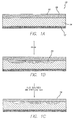
- FIG. 1A is a schematic view, in section, of an embodiment of an ink-jet recording media prior to printing an image and the application of an ink;
- FIG. 1B is a schematic view, in section, of the ink-jet recording media after printing an image
- FIG. 1C is a schematic view, in section, of the ink-jet recording media after the heat seal/heat and pressure seal depicting the topcoat seal.
- FIG. 1A depicts a schematic view of the ink-jet recording media 10 of the present invention.
- a porous basecoat (ink-receptive coating) 14 with a plurality of pores is applied to the surface of a non-permeable or permeable substrate 12.
- T g glass-transition temperature
- the upper range of 250 nanometers is constrained by the desire to keep the polymer particles 16 transparent; at the upper range, the coating starts to become translucent.
- the topcoat 18 is dried at a temperature in the range of 40° to 50°C.
- An image 20 is printed on the topcoat 18 of ink-jet recording media 10 and heat is applied to the fused topcoat.
- the substrate 12 comprises a non-permeable or permeable film-coated papers or paperbase (e.g., photobase paper).
- the ink-receptive coating 14 comprises one or more pigments and one or more binders
- the topcoat 18 comprises one or more pigments and one or more binders.
- the ink-receptive coating 14 contains one or more pigments independently selected from the group consisting of silica, alumina, hydrates of alumina, titania, carbonates, glass beads, and organic pigments selected from the group consisting of cross-linked SBR latexes, micronized polyethylene wax, micronized polypropylene wax, acrylic beads, and methacrylic beads.
- the ink-receptive coating 14 contains one or more binders independently selected from the group consisting of polyvinyl alcohol and its derivatives, polyvinyl pyrrolidone/polyvinyl acetate copolymer, cellulose derivatives, acrylics, and polyurethanes.
- the topcoat 18 contains one or more pigments selected from the group consisting of acrylic latexes, styrene acrylic latexes, and styrene-butadiene.
- the topcoat 18 contains one or more binders independently selected from the group consisting of polyvinyl alcohol, polyvinyl acetate, polyvinyl acetal, poly acrylic acid, cellulosics, polyvinyl pyrrolidone, and polyurethanes.
- the glass transition temperature of the topcoat 18 is at least 60°C and no more than 100°C.
- the preferred range of T g is 70° to 80°C, and the particles have a preferred size in the range of 60 to 120 nanometers, which offers the best transparency of the polymer particles 16, and most preferably in the range of 100 to 120 nanometers.
- a heating device such as a laminator or a heat gun is used to apply heat to the topcoat 18 of the ink-jet recording media 10 at a preferred temperature range of 85° to 95°C and a duration of 60 to 90 seconds, during which time the topcoat is fused.
- a sealable topcoat 18 is applied to an ink-receptive coating on a substrate 12.
- a nano-porous ink-receptive coating 14 comprising one or more pigments, one or more binders, and a plurality of pores is applied to a surface of the substrate 12.
- a porous topcoat 18 comprising polymer particles 16, having a T g in the preferred range of 70° to 80°C and a size in the preferred range of 60 to 100 nanometers, is applied on the nano-porous ink-receptive coating 14.
- the topcoat 18 is dried at a temperature in the range of 40° to 50°C.
- An image 20 is printed on the topcoat 18 of the ink-jet recording media 10 and heat is applied to the topcoat 18 until it becomes clear or transparent.
- the process disclosed herein allows the production of an ink-jet recording media in which a sealable topcoat can be applied to a porous ink-receptive coating to improve image permanence and print quality.
- the present embodiments are directed to polymer particles and the polymer particles in the topcoat are a subset of pigments.
- the polymer particles of the present invention have a size less than 250 nanometers and a preferred size within a range of 50 to 250 nanometers, as mentioned above.
- the prior art has utilized particles having significantly larger sizes and/or different processes and substrates.
- the embodiments disclosed herein provide the advantages of improved air fade resistance, good image quality and high gloss.
- a porous topcoat having a T g with a range of 60° to 100°C and particles with a size of 50 to 250 nanometers
- the topcoat is initially in an un-coalesced state that facilitates ink-jet printing of an image on the topcoat and immediate drying.
- the image is sealed using a contact type, infra-red type heater or a heating gun (convective heating).
- the sealed topcoat layer acts as an air barrier, preventing attack of the image by atmospheric contaminants and resisting air fade.
- the particle size of the topcoat is selected to be large enough to allow dye penetration from the ink and favorably contribute to the image quality and gloss after sealing. Additional air fade additives can be incorporated to improve image permanence.
- a laminator is used to seal the topcoat 18, using a combination of temperature and pressure.
- the pressure is conventional in such laminators, typically on the order of 15 to 20 psi.
- An ink-jet recording media was prepared on either a film-based substrate (Mylar) or a resin-coated paper substrate (photobase paper).
- An ink-receptive coating was prepared using a conventional microporous basecoat primarily consisting of large surface area inorganic pigment (alumina - pseudo- boehmite), and binder (polyvinyl alcohol).
- a topcoat consisting of 0.5 to 2 grams per square meter coating of acrylic latex (anionic styrene/acrylic) having a T g of 70° to 80°C and a particle size of 60 to 250 nanometers in polyvinyl alcohol (PVA) was prepared, in which the concentration of the acrylic latex was 85 to 95 parts by weight and the balance (15 to 5 parts by weight) was PVA.
- the topcoat was coated on the ink-receptive coating.
- the topcoat was dried in an oven at 40°C.
- An image was printed on the topcoat of the ink-jet recording media using a Hewlett-Packard DeskJet 970C printer.
- a heat gun located approximately 6 to 7 inches from the ink-jet recording media was used to apply convective heat to the image at a temperature of approximately 95°C for a duration of 60 to 75 seconds.
- the following Table IA lists the results for four different topcoat sealing conditions (Examples 2 and 4-6), compared with samples without sealing (Examples 1, 3, and 7).
- the thickness of the topcoat is given in grams per square meter (gsm).
- the acrylic latex topcoat comprised a mixture of a first composition (25 wt%) having an average particle size of 221 nm and a glass transition temperature of 95°C and a second composition (75 wt%) having an average particle size of 106 nm and a glass transition temperature of 50°C.
- the basecoat (ink receptive layer) in all four examples comprised microporous inorganic alumina.
- Example 1 no sealing was used, while in Example 2, sealing was done at 85° using a IR heat source, and in Examples 4-7, sealing was done at 90°C, using a contact type heater.
- Example 7 is the non top coated media heated using the contact heater. Also listed are the color gamut, the distinctiveness of image (how sharp the image is from light reflected off the print surface), the 20 degree gloss average, the L*a*b* (how colored the media is), the black optical density (in kilo-optical density units), the humid bleed (after 4 days at 30°C and 80% relative humidity), and the humid color fastness (same conditions).
- Table IB lists the results of an air fade experiment, in which the printed images were kept in an air fade chamber for three weeks, with air flowing over the images at a rate of 300 to 400 ft/min.
- Example 1 is the control not subjected to sealing conditions and Example 7 is a control subjected to sealing conditions.
- the properties of the top coated and sealed material is compared to that of a control subjected to sealing conditions to separate the effect of the sealing conditions from that of the sealing material itself. Therefore all the properties of the sealed material (Examples 2 and 4-6) are compared to Example 7. It can be seen that Examples 5 and 6 are superior to the control (Example 7). With regard to DOI, it is seen that all three topcoatings are superior to the control.
- topcoating process disclosed and claimed herein is expected to find use in providing ink-receiving coatings on non-absorbent substrates.
Landscapes
- Ink Jet Recording Methods And Recording Media Thereof (AREA)
- Ink Jet (AREA)
- Application Of Or Painting With Fluid Materials (AREA)
Applications Claiming Priority (2)
| Application Number | Priority Date | Filing Date | Title |
|---|---|---|---|
| US313689 | 1989-02-21 | ||
| US10/313,689 US7150522B2 (en) | 2002-12-04 | 2002-12-04 | Sealable topcoat for porous media |
Publications (3)
| Publication Number | Publication Date |
|---|---|
| EP1426196A2 true EP1426196A2 (fr) | 2004-06-09 |
| EP1426196A3 EP1426196A3 (fr) | 2004-11-03 |
| EP1426196B1 EP1426196B1 (fr) | 2008-08-27 |
Family
ID=32312294
Family Applications (1)
| Application Number | Title | Priority Date | Filing Date |
|---|---|---|---|
| EP20030257386 Expired - Lifetime EP1426196B1 (fr) | 2002-12-04 | 2003-11-24 | Couche supérieure pouvant être rendue étanche pour un support poreux |
Country Status (5)
| Country | Link |
|---|---|
| US (2) | US7150522B2 (fr) |
| EP (1) | EP1426196B1 (fr) |
| JP (1) | JP2004181957A (fr) |
| CH (1) | CH697028A5 (fr) |
| DE (1) | DE60323199D1 (fr) |
Families Citing this family (14)
| Publication number | Priority date | Publication date | Assignee | Title |
|---|---|---|---|---|
| US6869649B2 (en) * | 2003-03-12 | 2005-03-22 | Hewlett-Packard Development Company, L.P. | Print medium including a heat-sealable layer |
| US20060003116A1 (en) * | 2004-06-30 | 2006-01-05 | Eastman Kodak Company | Inkjet elements comprising calcium metasilicate needles |
| US20060172094A1 (en) * | 2005-01-28 | 2006-08-03 | Ming-Kun Shi | Image transfer media and methods of using the same |
| DE602007003908D1 (de) * | 2006-08-22 | 2010-02-04 | Oce Tech Bv | Bilderzeugungsverfahren, das eine Phasenaustauschtinte auf einem selbstlaminierenden Aufzeichnungsmedium verwendet |
| WO2008055244A2 (fr) | 2006-10-31 | 2008-05-08 | Sensient Colors Inc. | Pigments modifiés et leurs procédés de fabrication et d'utilisation |
| EP3483222A3 (fr) | 2007-08-23 | 2019-08-07 | Sensient Colors LLC | Pigments auto-dispersés et procédés de préparation et d'utilisation de ceux-ci |
| EP2417202A2 (fr) | 2009-04-07 | 2012-02-15 | Sensient Colors LLC | Particules auto-dispersées et procédés de fabrication et d'utilisation de celles-ci |
| US9580866B2 (en) * | 2009-06-03 | 2017-02-28 | Solenis Technologies, L.P. | Cationic wet strength resin modified pigments in water-based latex coating applications |
| EP2804761B1 (fr) | 2012-01-17 | 2019-03-06 | Hewlett-Packard Development Company, L.P. | Support d'enregistrement pourvu d'une couche protectrice |
| WO2014021840A1 (fr) | 2012-07-31 | 2014-02-06 | Hewlett-Packard Development Company, L.P. | Composition de fluide optiquement transparente |
| CN106170728B (zh) | 2014-03-04 | 2019-07-12 | 飞利浦灯具控股公司 | 光束成形系统和使用其的光照系统 |
| US10388190B2 (en) | 2014-05-02 | 2019-08-20 | National Marker Company | Encapsulated signage and method of production |
| JP7521176B2 (ja) * | 2019-03-25 | 2024-07-24 | Toppanホールディングス株式会社 | 印刷物、印刷物の製造方法 |
| US11096288B2 (en) * | 2019-12-20 | 2021-08-17 | Xerox Corporation | Flexible conductive printed circuits with printed overcoats |
Family Cites Families (19)
| Publication number | Priority date | Publication date | Assignee | Title |
|---|---|---|---|---|
| JPH03257386A (ja) | 1990-03-07 | 1991-11-15 | Toshiba Corp | 発電機脱調予測の誤判定防止方法 |
| JPH09104164A (ja) * | 1995-10-12 | 1997-04-22 | Asahi Glass Co Ltd | ラベルライター用テープおよびラベル |
| DE19628341C2 (de) * | 1996-07-13 | 1998-09-17 | Sihl Gmbh | Aufzeichnungsmaterial für Tintenstrahlverfahren mit wäßriger Tinte und Verwendung zum Herstellen wasserfester und lichtbeständiger Aufzeichnungen auf diesem Material |
| US6200670B1 (en) * | 1997-02-18 | 2001-03-13 | Canon Kabushiki Kaisha | Recording medium and recording method for using the same |
| ATE228439T1 (de) * | 1997-02-18 | 2002-12-15 | Canon Kk | Aufzeichnungsmaterial, verfahren zu dessen herstellung und tintenstrahlgedruckten bildern unter verwendung dieses materials |
| JPH115362A (ja) * | 1997-02-18 | 1999-01-12 | Canon Inc | 記録媒体、この記録媒体を用いたインクジェット記録方法及びこの記録媒体の製造方法 |
| US6550909B2 (en) * | 1997-10-13 | 2003-04-22 | Canon Kabushiki Kaisha | Ink-jet recording method and print |
| JP4143187B2 (ja) * | 1997-10-13 | 2008-09-03 | キヤノン株式会社 | インクジェット記録方法 |
| US6140390A (en) * | 1998-08-31 | 2000-10-31 | Eastman Kodak Company | Melt-fusible inkjet recording elements and inks with improved durability |
| US6426167B2 (en) * | 1999-07-15 | 2002-07-30 | Eastman Kodak Company | Water-resistant protective overcoat for image recording materials |
| GB2352681A (en) | 1999-08-04 | 2001-02-07 | Ilford Imaging Uk Ltd | Ink jet printing method |
| JP2001103393A (ja) | 1999-09-28 | 2001-04-13 | Sony Corp | 受信装置および方法、並びに記録媒体 |
| JP4296691B2 (ja) * | 2000-06-01 | 2009-07-15 | コニカミノルタホールディングス株式会社 | 画像形成方法 |
| JP2002052805A (ja) * | 2000-08-10 | 2002-02-19 | Daicel Chem Ind Ltd | インクジェット記録方法及びその方法による記録物 |
| JP2002321451A (ja) * | 2001-02-06 | 2002-11-05 | Konica Corp | インクジェット記録媒体、その製造方法、インクジェット画像の形成方法及びその形成画像 |
| US7238399B2 (en) | 2001-02-06 | 2007-07-03 | Konica Corporation | Ink jet recording medium, its manufacturing method, ink jet image forming method and image formed thereby |
| JP2002234246A (ja) * | 2001-02-08 | 2002-08-20 | Konica Corp | インクジェット記録媒体 |
| JP2003048366A (ja) * | 2001-08-08 | 2003-02-18 | Konica Corp | インクジェット画像の定着方法 |
| US6869649B2 (en) * | 2003-03-12 | 2005-03-22 | Hewlett-Packard Development Company, L.P. | Print medium including a heat-sealable layer |
-
2002
- 2002-12-04 US US10/313,689 patent/US7150522B2/en not_active Expired - Fee Related
-
2003
- 2003-11-24 DE DE60323199T patent/DE60323199D1/de not_active Expired - Lifetime
- 2003-11-24 EP EP20030257386 patent/EP1426196B1/fr not_active Expired - Lifetime
- 2003-11-26 JP JP2003395072A patent/JP2004181957A/ja active Pending
- 2003-12-04 CH CH02074/03A patent/CH697028A5/de not_active IP Right Cessation
-
2004
- 2004-11-05 US US10/982,568 patent/US20050118359A1/en not_active Abandoned
Also Published As
| Publication number | Publication date |
|---|---|
| JP2004181957A (ja) | 2004-07-02 |
| DE60323199D1 (de) | 2008-10-09 |
| US20040109957A1 (en) | 2004-06-10 |
| CH697028A5 (de) | 2008-03-31 |
| EP1426196B1 (fr) | 2008-08-27 |
| EP1426196A3 (fr) | 2004-11-03 |
| US20050118359A1 (en) | 2005-06-02 |
| US7150522B2 (en) | 2006-12-19 |
Similar Documents
| Publication | Publication Date | Title |
|---|---|---|
| US6550909B2 (en) | Ink-jet recording method and print | |
| US7150522B2 (en) | Sealable topcoat for porous media | |
| JP4376146B2 (ja) | 溶融性コア−シェル着色剤受容層を有する多孔質の溶融性インクジェット媒体 | |
| CN101641221A (zh) | 用于改善的输出堆叠性能的涂布介质 | |
| EP1629988B1 (fr) | Moyens fusibles pour l'impression à jet d'encre comprenant des particules de plastifiant et leurs procédés de formation et d'utilisation. | |
| US6869649B2 (en) | Print medium including a heat-sealable layer | |
| JP2004314350A (ja) | インクジェット記録方法及び記録物 | |
| EP1486346B1 (fr) | Revêtement scellable pour un matériau pour l'impression par jet d'encre | |
| JP3768017B2 (ja) | インクジェット画像形成方法 | |
| JP3784186B2 (ja) | インクジェット記録用シート | |
| JP3802117B2 (ja) | 熱転写受像シート | |
| JP3818421B2 (ja) | インクジェット記録方式に用いる記録媒体、記録物及び記録物の記録方法 | |
| EP1193079B1 (fr) | Amélioration de la stabilité à la lumière de média pour le jet d'encre par addition de photoinitiateurs | |
| KR20050003754A (ko) | 염료승화형 열전사 기록용 잉크수용지 및 그의 제조방법 | |
| JPH09104164A (ja) | ラベルライター用テープおよびラベル | |
| JP2000233474A (ja) | 画像面のラミネート用部材、それを用いた画像形成方法及び該方法により得られた印画物 | |
| JPH09109544A (ja) | インクジェット用記録シート | |
| JP2003276323A (ja) | インクジェット記録物及びその製造方法 | |
| JP2009143183A (ja) | 熱転写受容シート及びその製造方法 | |
| JP2009196278A (ja) | 熱転写受像シート | |
| JP2000033766A (ja) | 画像記録シートおよび画像記録シートの被覆層形成素材 | |
| JPH1095159A (ja) | 光沢層を有する記録媒体 |
Legal Events
| Date | Code | Title | Description |
|---|---|---|---|
| PUAI | Public reference made under article 153(3) epc to a published international application that has entered the european phase |
Free format text: ORIGINAL CODE: 0009012 |
|
| AK | Designated contracting states |
Kind code of ref document: A2 Designated state(s): AT BE BG CH CY CZ DE DK EE ES FI FR GB GR HU IE IT LI LU MC NL PT RO SE SI SK TR |
|
| AX | Request for extension of the european patent |
Extension state: AL LT LV MK |
|
| PUAL | Search report despatched |
Free format text: ORIGINAL CODE: 0009013 |
|
| AK | Designated contracting states |
Kind code of ref document: A3 Designated state(s): AT BE BG CH CY CZ DE DK EE ES FI FR GB GR HU IE IT LI LU MC NL PT RO SE SI SK TR |
|
| AX | Request for extension of the european patent |
Extension state: AL LT LV MK |
|
| 17P | Request for examination filed |
Effective date: 20050414 |
|
| AKX | Designation fees paid |
Designated state(s): DE FR GB NL |
|
| 17Q | First examination report despatched |
Effective date: 20060111 |
|
| GRAP | Despatch of communication of intention to grant a patent |
Free format text: ORIGINAL CODE: EPIDOSNIGR1 |
|
| RIC1 | Information provided on ipc code assigned before grant |
Ipc: B41M 7/00 20060101AFI20080228BHEP Ipc: B41M 5/50 20060101ALI20080228BHEP |
|
| GRAS | Grant fee paid |
Free format text: ORIGINAL CODE: EPIDOSNIGR3 |
|
| GRAA | (expected) grant |
Free format text: ORIGINAL CODE: 0009210 |
|
| AK | Designated contracting states |
Kind code of ref document: B1 Designated state(s): DE FR GB NL |
|
| REG | Reference to a national code |
Ref country code: GB Ref legal event code: FG4D |
|
| REF | Corresponds to: |
Ref document number: 60323199 Country of ref document: DE Date of ref document: 20081009 Kind code of ref document: P |
|
| PLBE | No opposition filed within time limit |
Free format text: ORIGINAL CODE: 0009261 |
|
| STAA | Information on the status of an ep patent application or granted ep patent |
Free format text: STATUS: NO OPPOSITION FILED WITHIN TIME LIMIT |
|
| 26N | No opposition filed |
Effective date: 20090528 |
|
| PGFP | Annual fee paid to national office [announced via postgrant information from national office to epo] |
Ref country code: DE Payment date: 20101126 Year of fee payment: 8 |
|
| PGFP | Annual fee paid to national office [announced via postgrant information from national office to epo] |
Ref country code: GB Payment date: 20101124 Year of fee payment: 8 |
|
| PGFP | Annual fee paid to national office [announced via postgrant information from national office to epo] |
Ref country code: FR Payment date: 20111128 Year of fee payment: 9 Ref country code: NL Payment date: 20111129 Year of fee payment: 9 |
|
| REG | Reference to a national code |
Ref country code: NL Ref legal event code: V1 Effective date: 20130601 |
|
| GBPC | Gb: european patent ceased through non-payment of renewal fee |
Effective date: 20121124 |
|
| REG | Reference to a national code |
Ref country code: FR Ref legal event code: ST Effective date: 20130731 |
|
| PG25 | Lapsed in a contracting state [announced via postgrant information from national office to epo] |
Ref country code: NL Free format text: LAPSE BECAUSE OF NON-PAYMENT OF DUE FEES Effective date: 20130601 |
|
| REG | Reference to a national code |
Ref country code: DE Ref legal event code: R119 Ref document number: 60323199 Country of ref document: DE Effective date: 20130601 |
|
| PG25 | Lapsed in a contracting state [announced via postgrant information from national office to epo] |
Ref country code: DE Free format text: LAPSE BECAUSE OF NON-PAYMENT OF DUE FEES Effective date: 20130601 |
|
| PG25 | Lapsed in a contracting state [announced via postgrant information from national office to epo] |
Ref country code: FR Free format text: LAPSE BECAUSE OF NON-PAYMENT OF DUE FEES Effective date: 20121130 Ref country code: GB Free format text: LAPSE BECAUSE OF NON-PAYMENT OF DUE FEES Effective date: 20121124 |