EP1429432B1 - Oscillateur laser à décharge dans un gaz - Google Patents
Oscillateur laser à décharge dans un gaz Download PDFInfo
- Publication number
- EP1429432B1 EP1429432B1 EP03257749A EP03257749A EP1429432B1 EP 1429432 B1 EP1429432 B1 EP 1429432B1 EP 03257749 A EP03257749 A EP 03257749A EP 03257749 A EP03257749 A EP 03257749A EP 1429432 B1 EP1429432 B1 EP 1429432B1
- Authority
- EP
- European Patent Office
- Prior art keywords
- discharge
- sections
- mode
- power
- discharge sections
- Prior art date
- Legal status (The legal status is an assumption and is not a legal conclusion. Google has not performed a legal analysis and makes no representation as to the accuracy of the status listed.)
- Expired - Lifetime
Links
- 230000010355 oscillation Effects 0.000 title claims description 20
- 230000005284 excitation Effects 0.000 claims description 28
- 238000010276 construction Methods 0.000 claims description 8
- 230000003287 optical effect Effects 0.000 description 16
- 238000000034 method Methods 0.000 description 7
- 230000003044 adaptive effect Effects 0.000 description 2
- 238000004891 communication Methods 0.000 description 2
- 230000006835 compression Effects 0.000 description 2
- 238000007906 compression Methods 0.000 description 2
- 238000005286 illumination Methods 0.000 description 2
- 238000011282 treatment Methods 0.000 description 2
- 238000012423 maintenance Methods 0.000 description 1
Images




Classifications
-
- H—ELECTRICITY
- H01—ELECTRIC ELEMENTS
- H01S—DEVICES USING THE PROCESS OF LIGHT AMPLIFICATION BY STIMULATED EMISSION OF RADIATION [LASER] TO AMPLIFY OR GENERATE LIGHT; DEVICES USING STIMULATED EMISSION OF ELECTROMAGNETIC RADIATION IN WAVE RANGES OTHER THAN OPTICAL
- H01S3/00—Lasers, i.e. devices using stimulated emission of electromagnetic radiation in the infrared, visible or ultraviolet wave range
- H01S3/02—Constructional details
- H01S3/03—Constructional details of gas laser discharge tubes
- H01S3/036—Means for obtaining or maintaining the desired gas pressure within the tube, e.g. by gettering, replenishing; Means for circulating the gas, e.g. for equalising the pressure within the tube
-
- H—ELECTRICITY
- H01—ELECTRIC ELEMENTS
- H01S—DEVICES USING THE PROCESS OF LIGHT AMPLIFICATION BY STIMULATED EMISSION OF RADIATION [LASER] TO AMPLIFY OR GENERATE LIGHT; DEVICES USING STIMULATED EMISSION OF ELECTROMAGNETIC RADIATION IN WAVE RANGES OTHER THAN OPTICAL
- H01S3/00—Lasers, i.e. devices using stimulated emission of electromagnetic radiation in the infrared, visible or ultraviolet wave range
- H01S3/05—Construction or shape of optical resonators; Accommodation of active medium therein; Shape of active medium
- H01S3/06—Construction or shape of active medium
- H01S3/07—Construction or shape of active medium consisting of a plurality of parts, e.g. segments
- H01S3/073—Gas lasers comprising separate discharge sections in one cavity, e.g. hybrid lasers
-
- H—ELECTRICITY
- H01—ELECTRIC ELEMENTS
- H01S—DEVICES USING THE PROCESS OF LIGHT AMPLIFICATION BY STIMULATED EMISSION OF RADIATION [LASER] TO AMPLIFY OR GENERATE LIGHT; DEVICES USING STIMULATED EMISSION OF ELECTROMAGNETIC RADIATION IN WAVE RANGES OTHER THAN OPTICAL
- H01S3/00—Lasers, i.e. devices using stimulated emission of electromagnetic radiation in the infrared, visible or ultraviolet wave range
- H01S3/02—Constructional details
- H01S3/03—Constructional details of gas laser discharge tubes
- H01S3/038—Electrodes, e.g. special shape, configuration or composition
- H01S3/0385—Shape
-
- H—ELECTRICITY
- H01—ELECTRIC ELEMENTS
- H01S—DEVICES USING THE PROCESS OF LIGHT AMPLIFICATION BY STIMULATED EMISSION OF RADIATION [LASER] TO AMPLIFY OR GENERATE LIGHT; DEVICES USING STIMULATED EMISSION OF ELECTROMAGNETIC RADIATION IN WAVE RANGES OTHER THAN OPTICAL
- H01S3/00—Lasers, i.e. devices using stimulated emission of electromagnetic radiation in the infrared, visible or ultraviolet wave range
- H01S3/05—Construction or shape of optical resonators; Accommodation of active medium therein; Shape of active medium
- H01S3/08—Construction or shape of optical resonators or components thereof
- H01S3/08086—Multiple-wavelength emission
Definitions
- the present invention relates to a laser oscillation device of the discharge excitation type employing a gas as the laser medium, that is used in for example laser processing, medical treatment, illumination or communication and in particular relates to a gas laser oscillation device having a function of controlling the transverse mode of the laser output (hereinbelow referred to as "beam mode” or simply as “mode”).
- beam mode the transverse mode of the laser output
- Gas laser oscillation devices are widely employed in for example laser processing, medical treatment, illumination or communication and gas laser oscillation devices are known having a plurality of discharge sections, respective power sources for discharge excitation being connected to electrodes provided in each discharge section.
- Figure 8 is a view showing the layout of major parts of a typical example thereof.
- reference symbols 4a and 4b represent respectively a rear mirror that does not have partial transparency, and an output mirror that has partial transparency.
- An optical resonance space is formed between these two mirrors 4a and 4b. In this optical resonance space, there are provided two discharge sections 3a and 3b.
- the discharge sections 3a and 3b respectively comprise electrodes 22a and 22b.
- the electrode 22a is connected with a power source 1a for discharge excitation and the electrode 22b is connected with a power source 1b for discharge excitation.
- the discharge sections 3a and 3b are of the same size and the same shape and, likewise, for the electrodes 22a and 22b, electrodes of the same size and same shape and same electrode construction are employed.
- the power sources 1a, 1b for discharge excitation are of the commonly known type that can be respectively independently operated and wherein the power that is supplied to the discharge sections 3a, 3b can be freely adjusted.
- the laser medium gas is circulated through a circulatory path passing through the optical resonator using a fan 6.
- the medium gas that is fed from the fan is supplied to the discharge sections 3a, 3b after passing through a heat exchanger 5a to remove the heat of compression.
- the laser medium gas is excited by discharge in the discharge sections 3a, 3b to generate laser light.
- the laser light that is thus generated is amplified within the optical resonator by well-known principles and the output laser beam is extracted from the output mirror 4b.
- the gas medium which has reached a high temperature due to the discharge, is cooled in a heat exchanger 5b and again returned to the fan 6.
- the two discharge sections 3a and 3b are constituted by two discharge tubes and are driven by the two power sources 1a, 1b for discharge excitation, which are operated independently.
- the power sources 1a, 1b for discharge excitation are AC power sources, so the discharge that is created in the discharge sections 3a, 3b is an AC discharge.
- a beam mode is formed that is determined by the construction and dimensions of the optical resonator. That is, various different beam modes can be formed, depending on the length of the optical resonator (length of the optical path between the mirrors 4a and 4b) and the cross-sectional shape and dimensions or the like of the discharge sections. Also, when the discharge section is constituted by a discharge tube, the beam mode that is formed is determined by its internal diameter, the shape of the electrode and, in addition, although not shown in the drawing, the internal diameter of the aperture that is arranged on the optical path. Disclosure concerning this is made in for example Japanese Patent Application Laid-open No. 64-42187.
- mode changeover is effected between the TEM00 mode (gaussian mode) or low-order mode and TEM01* (ring mode) or higher-order modes when an aperture is arranged on the optical axis or when the aperture is removed from the optical axis.
- TEM00 mode Gaussian mode
- TEM01* ring mode
- mode changeover is effected between the TEM00 mode (gaussian mode) or low-order mode and TEM01* (ring mode) or higher-order modes when an aperture is arranged on the optical axis or when the aperture is removed from the optical axis.
- TEM00 mode Gaussian mode
- TEM01* ring mode
- a further example of disclosure of prior art is Japanese Patent Application Laid-open No. 2002-118312. This relates to improvements in a method of controlling beam mode.
- an adaptive mirror (mirror whose curvature can be changed) is employed for mode control and a technique is illustrated of changing over the mode by setting two mechanically changeable mirror curvatures.
- problems relating to response, controllability, difficulty of optical axis adjustment and cost still arise.
- a detailed description of the function and construction of an adaptive mirror is to be found in Japanese Patent Number 3072519.
- the invention is defined with claim 1.
- a gas laser oscillation device comprising a plurality of discharge sections that are respectively provided with electrodes for discharge and a plurality of power sources for discharge excitation that supply discharge power to the discharge sections and are respectively connected with the electrodes of the plurality of discharge sections, characterised in that: said plurality of discharge sections include at least two discharge sections which are such that mutually different beam modes will be excited therein when respective independent discharges are produced therein; and of said plurality of power sources for discharge excitation, the power sources for discharge excitation that supply discharge power to said at least two discharge sections are such as to be able to adjust the distribution of the amount of discharge power supplied to these at least two discharge sections.
- power sources for discharge excitation that operate mutually independently, of the same number as "said at least two discharge sections" may be employed.
- the transverse mode of the laser output may be controlled by changing the distribution of the discharge of power in respect of the respective discharge sections, by controlling the discharge power supplied to the discharge sections.
- a combination of electrodes that excite mutually different modes when respective independent discharges are produced in the discharge sections
- a combination of electrodes may be adopted wherein at least one of the dimensions, shape and construction of these electrodes is different.
- a device according to the present invention in a wide range of applications can be achieved by realizing in a simple manner beam modes that are optimum for various different types of application simply by adjusting the distribution of power supplied to the discharge sections by the power sources for discharge excitation. Also, if the device is applied to a laser processing device that performs for example processing of materials, control of the beam mode becomes possible by specifying any desired position or section or time in respect of the processing head, thereby making it possible to provide a laser oscillation device of high performance.
- High-speed operation in a device according to the present invention can easily be achieved by electrical control without depending on control of mechanical conditions such as aperture movement or change of mirror curvature, so that a gas laser oscillation device can be provided having a laser beam mode control function that is excellent in respect of controllability, convenience of handling, ease of maintenance, and economy.
- FIG 1 is a view showing the layout of major parts of a laser oscillation device according to one embodiment of the present invention, shown with the same mode of representation as in Figure 8.
- the same reference numerals are employed as appropriate for elements that are common with the layout shown in Figure 8.
- an optical resonance space is formed between the rear mirror 4a, which does not have partial transparency, and the output mirror 4b, which has partial transparency, and two discharge sections 2a, 2b are provided therebetween.
- the discharge sections 2a, 2b are respectively provided with electrodes 12a, 12b.
- the electrode 12a is connected with a power source 1a for discharge excitation and the electrode 12b is connected with a power source 1b for discharge excitation.
- These power sources 1a, 1b for discharge excitation are respectively independently operated AC power sources and are arranged to be capable of being individually adjusted to set the power that is supplied to the respective discharge sections 2a, 2b. Since such AC power sources for discharge excitation are themselves well known, a detailed description of for example their circuit layouts for adjustment of the supplied power is dispensed with.
- the laser medium gas is circulated through a circulatory path passing through the optical resonator, by means of a fan 6.
- the medium gas that is delivered by the fan passes through a heat exchanger 5a for removing the heat of compression and is supplied to the discharge sections 2a, 2b.
- Laser light is emitted by excitation of the laser medium gas by discharge in the discharge sections 2a, 2b.
- the laser light that is generated is amplified in the laser resonator in accordance with well-known principles and the output laser beam is extracted from the output mirror 4b.
- the two discharge sections 2a, 2b in this example are constituted by two discharge tubes and, as described above, are driven by two power sources 1a, 1b for discharge excitation, that are independently operated.
- the shape of the electrodes of the discharge tubes constituting the discharge sections 2a, 2b is different. Specifically, in the discharge tube of the discharge section 2a, as shown in Figure 2A, there is provided an electrode 12a having a narrow electrode width whereas in the discharge tube of the discharge section 2b, as shown in Figure 3A, there is provided an electrode 12b having a broader electrode width.
- the mode that is excited changes depending on the width of the electrode of the discharge tube.
- the discharge section 2a which is of narrow electrode width
- the power source 1b for discharge excitation is OFF
- a mode similar to the gaussian mode as shown in Figure 2B is obtained while, when discharge is effected solely in the discharge section 2b, which is of broader electrode width, (i.e. the power source 1a for discharge excitation is OFF), as shown in Figure 3B, the ring mode is obtained.
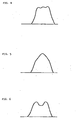
- a mode as shown in Figure 5 is obtained while if the power supply to the discharge section 2b is made larger and the power supply to the discharge section 2a is made smaller, a mode as shown in Figure 6 is obtained. In this way, a mode suited to the application can be set by adjusting the distribution of power supplied to the discharge sections 2a and 2b.
- mode A the mode that is obtained when discharge is performed independently in the discharge section 2a
- mode B the mode that is obtained when discharge is performed independently in the discharge section 2b
- Figure 7A is a view with the same mode of representation as in Figure 1 of an embodiment in which two discharge sections having mutually different diameters are combined.
- the laser oscillation device shown in Figure 7A has the same construction as that shown in Figure 1 apart from the use of discharge sections 2c, 2d of mutually different diameter instead of the two discharge sections 2a, 2b ( Figure 1) (repetition of the detailed description is dispensed with).
- Figure 7B shows a substantially trapezoidal mode that is obtained if power is supplied only to the discharge section 2d
- Figure 7D shows a mode of double-peak shape obtained if power is supplied only to the discharge section 2c.
- various modes obtained by mixing Figure 7C and Figure 7D can be obtained by various choices of the ratio of power supply by the variable power sources 1a, 1b for discharge excitation. A mode suited to a particular application can therefore easily be set.
- helical electrodes may be employed for the two discharge sections, the pitch of the helices being different.
- Another effective method is to provide a slit in the middle of one of the electrode widths (example of different construction).
- the number of discharge sections provided in the optical resonator is three or more, so long as it is possible to control distribution of the supply of discharge power to each discharge section in respect of at least two discharge sections of these discharge sections and the electrodes are selected such that "different modes are excited when discharge is effected independently", a gas laser oscillation device whose mode can be controlled can of course be obtained just as in the case of the embodiments described above.
- two discharge sections (using identical electrodes) whereby mode A is obtained in the case of independent discharge" having identical electrodes may be provided, these discharge sections being driven with a single power source for discharge excitation, and, in addition, there may be provided a single “discharge section whereby mode B is obtained in the case of independent discharge” having a separate electrode, between these two discharge sections, this single discharge section being driven with a single separate power source for discharge excitation.
- Variable control of the mode that is obtained from the laser oscillation device as a whole can then be achieved by adjusting the amount of discharge power that is supplied from the independently operated power sources for discharge excitation.
- the type of gas laser oscillation device to which the present invention is applicable includes low-speed axial flow type lasers, biaxial orthogonal type lasers, triaxial orthogonal type lasers, or TEA lasers and the like, apart from the high-speed axial flow type lasers of the embodiments described above.
- the present invention can be applied to DC discharge, pulse discharge or SD discharge type lasers, apart from the AC discharge type lasers described above. It is clear that the same benefits can be obtained by applying the present invention to gas lasers of these types also.
- a beam mode control function can be realized that is convenient and straightforward and of excellent controllability, so that the optimum beam mode for various applications can be set in a simple fashion, making it possible to apply the present invention to a wide range of applications. Also, when applied to a laser processing device, beam mode control can be achieved at any desired position or time during processing, thereby providing a laser processing device of excellent functionality.
Landscapes
- Physics & Mathematics (AREA)
- Electromagnetism (AREA)
- Engineering & Computer Science (AREA)
- Plasma & Fusion (AREA)
- Optics & Photonics (AREA)
- Lasers (AREA)
Claims (1)
- Un oscillateur laser à gaz, comprenant une pluralité de sections de décharge qui sont respectivement munies d'électrodes pour décharge et d'une pluralité de sources d'énergie électrique pour excitation de décharge qui fournissent l'énergie électrique de décharge aux sections de décharge et sont respectivement reliées aux électrodes de la pluralité de sections de décharge,
caractérisé en ce que :ladite pluralité de sections de décharge comprend au moins deux sections de décharge (2a, 2b ou 2c, 2d) qui diffèrent de telle manière que des modes de faisceaux mutuellement différents y seront excités lorsque des décharges indépendantes respectives y sont produites, la différence étant que les électrodes (12a, 12b) qui sont prévues dans des sections respectives parmi ces sections de décharge (2a, 2b) diffèrent en ce qui concerne au moins une des dimensions, forme et construction de manière à exciter lesdits modes de faisceaux mutuellement différents, ou que les sections de décharge diffèrent en ce qui concerne au moins une des dimensions et forme de manière à exciter lesdits modes de faisceaux mutuellement différents ; etparmi ladite pluralité de sources d'énergie électrique pour excitation de décharge, les sources d'énergie électrique (1a, 1b) pour excitation de décharge qui fournissent l'énergie électrique de décharge auxdites au moins deux sections de décharge (2a, 2b ou 2c, 2d) sont actionnables individuellement pour régler la répartition de la quantité d'énergie électrique de décharge fournie à ces au moins deux sections de décharge (2a, 2b ou 2c, 2d).
Priority Applications (1)
| Application Number | Priority Date | Filing Date | Title |
|---|---|---|---|
| DE60305136T DE60305136T3 (de) | 2002-12-10 | 2003-12-10 | Gasentladungs-Laseroszillationsgerät |
Applications Claiming Priority (2)
| Application Number | Priority Date | Filing Date | Title |
|---|---|---|---|
| JP2002358027A JP3787120B2 (ja) | 2002-12-10 | 2002-12-10 | ガスレーザ発振装置 |
| JP2002358027 | 2002-12-10 |
Publications (3)
| Publication Number | Publication Date |
|---|---|
| EP1429432A1 EP1429432A1 (fr) | 2004-06-16 |
| EP1429432B1 true EP1429432B1 (fr) | 2006-05-10 |
| EP1429432B2 EP1429432B2 (fr) | 2012-11-28 |
Family
ID=32322075
Family Applications (1)
| Application Number | Title | Priority Date | Filing Date |
|---|---|---|---|
| EP03257749A Expired - Lifetime EP1429432B2 (fr) | 2002-12-10 | 2003-12-10 | Oscillateur laser à décharge dans un gaz |
Country Status (4)
| Country | Link |
|---|---|
| US (1) | US7173954B2 (fr) |
| EP (1) | EP1429432B2 (fr) |
| JP (1) | JP3787120B2 (fr) |
| DE (1) | DE60305136T3 (fr) |
Families Citing this family (4)
| Publication number | Priority date | Publication date | Assignee | Title |
|---|---|---|---|---|
| JP4012216B2 (ja) * | 2005-06-08 | 2007-11-21 | ファナック株式会社 | レーザ発振器 |
| US20080285613A1 (en) * | 2007-05-17 | 2008-11-20 | Synrad, Inc. | Colpitts rf power oscillator for a gas discharge laser |
| WO2012035953A1 (fr) * | 2010-09-17 | 2012-03-22 | 三菱電機株式会社 | Appareil à laser à gaz et dispositif de traitement au laser |
| WO2024240412A1 (fr) * | 2023-05-22 | 2024-11-28 | Asml Netherlands B.V. | Amplificateur optique et appareil associé |
Family Cites Families (13)
| Publication number | Priority date | Publication date | Assignee | Title |
|---|---|---|---|---|
| DE3044023C2 (de) | 1980-11-22 | 1984-11-22 | Eltro GmbH, Gesellschaft für Strahlungstechnik, 6900 Heidelberg | Transversal angeregter Gaslaser-Oszillator oder -Verstärker |
| US4622675A (en) | 1983-07-29 | 1986-11-11 | P.R.C., Ltd. | Forced transport molecular gas laser and method |
| EP0183023B1 (fr) | 1984-11-24 | 1991-02-20 | Trumpf GmbH & Co | Laser à gaz avec accouplement transversal d'énergie à haute fréquence |
| JPS61280689A (ja) * | 1985-06-05 | 1986-12-11 | Mitsubishi Electric Corp | ガスレ−ザ装置 |
| JPS6442187U (fr) | 1987-09-09 | 1989-03-14 | ||
| JPH02281670A (ja) * | 1989-04-21 | 1990-11-19 | Matsushita Electric Ind Co Ltd | 高周波励起ガスレーザ発振装置 |
| JPH02281669A (ja) | 1989-04-21 | 1990-11-19 | Matsushita Electric Ind Co Ltd | 直流励起ガスレーザ発振装置 |
| DE4041815A1 (de) | 1990-12-24 | 1992-06-25 | Trumpf Lasertechnik Gmbh | Gaslaser mit einer verstellvorrichtung fuer ein maschinenteil |
| JPH06164042A (ja) | 1992-09-14 | 1994-06-10 | Matsushita Electric Ind Co Ltd | ガスレーザ発振装置 |
| JP2725569B2 (ja) | 1992-11-18 | 1998-03-11 | 松下電器産業株式会社 | レーザ発振器 |
| JP3022016B2 (ja) | 1992-12-28 | 2000-03-15 | 松下電器産業株式会社 | 軸流形レーザ発振器 |
| EP1066666B1 (fr) † | 1999-02-03 | 2008-08-06 | TRUMPF LASERTECHNIK GmbH | Laser muni d'un dispositif pour modifier la repartition de l'intensite de la lumiere laser sur la section transversale du faisceau laser |
| EP1184946B1 (fr) | 2000-08-31 | 2010-08-18 | Trumpf Laser- und Systemtechnik GmbH | Laser à gaz |
-
2002
- 2002-12-10 JP JP2002358027A patent/JP3787120B2/ja not_active Expired - Lifetime
-
2003
- 2003-12-09 US US10/730,264 patent/US7173954B2/en not_active Expired - Lifetime
- 2003-12-10 EP EP03257749A patent/EP1429432B2/fr not_active Expired - Lifetime
- 2003-12-10 DE DE60305136T patent/DE60305136T3/de not_active Expired - Lifetime
Also Published As
| Publication number | Publication date |
|---|---|
| JP3787120B2 (ja) | 2006-06-21 |
| US7173954B2 (en) | 2007-02-06 |
| US20040125847A1 (en) | 2004-07-01 |
| DE60305136D1 (de) | 2006-06-14 |
| DE60305136T3 (de) | 2013-01-31 |
| EP1429432B2 (fr) | 2012-11-28 |
| EP1429432A1 (fr) | 2004-06-16 |
| JP2004193255A (ja) | 2004-07-08 |
| DE60305136T2 (de) | 2007-04-12 |
Similar Documents
| Publication | Publication Date | Title |
|---|---|---|
| US5684822A (en) | Laser system with anamorphic confocal unstable resonator | |
| US5661738A (en) | Solid-state laser amplifying apparatus and solid-state laser apparatus capable of oscillating high-power laser beam under stable condition | |
| EP1429432B1 (fr) | Oscillateur laser à décharge dans un gaz | |
| KR100884512B1 (ko) | 고-전력 Er:YAG 레이저 | |
| US5757842A (en) | Method and apparatus for compensating thermal lensing effects in a laser cavity | |
| EP0748530B1 (fr) | Laser a solide fonctionnant a haute brillance par "salves froides" | |
| US9077140B2 (en) | Laser device and method for generating laser light | |
| EP1732185B1 (fr) | Oscillateur laser | |
| US7154925B2 (en) | Gas laser oscillator | |
| EP3284148A1 (fr) | Laser au dioxyde de carbone refroidi par air | |
| JP2000269576A (ja) | 固体レーザ装置 | |
| JP2015138791A (ja) | レーザ装置およびレーザ光強度調整方法 | |
| US4977575A (en) | Adjustable aperture comprising a shape memory alloy and laser using same | |
| JP4206814B2 (ja) | レーザ発振器 | |
| US5500866A (en) | Laser resonator balancing | |
| JPH02281670A (ja) | 高周波励起ガスレーザ発振装置 | |
| JP2626566B2 (ja) | 固体レーザ発振器 | |
| JPS63228688A (ja) | ガスレ−ザ発振方法および装置 | |
| JPH11238929A (ja) | Yagレーザ発振方法およびその装置 | |
| JPH11105317A (ja) | 処理装置およびサーマルプリントヘッド | |
| JPH1070328A (ja) | ガスレーザ発振器 | |
| JPH06204588A (ja) | 軸流形レーザ発振器 | |
| JP2000269570A (ja) | 放電励起ガスレーザ発振器およびこの放電励起ガスレーザ発振器を用いたレーザ発振方法 | |
| JPWO1999065122A1 (ja) | レーザ装置の光共振器 | |
| JPH1117247A (ja) | マイクロ波励起ガスレーザ発振装置及びその制御方法 |
Legal Events
| Date | Code | Title | Description |
|---|---|---|---|
| PUAI | Public reference made under article 153(3) epc to a published international application that has entered the european phase |
Free format text: ORIGINAL CODE: 0009012 |
|
| AK | Designated contracting states |
Kind code of ref document: A1 Designated state(s): AT BE BG CH CY CZ DE DK EE ES FI FR GB GR HU IE IT LI LU MC NL PT RO SE SI SK TR |
|
| AX | Request for extension of the european patent |
Extension state: AL LT LV MK |
|
| 17P | Request for examination filed |
Effective date: 20041208 |
|
| 17Q | First examination report despatched |
Effective date: 20050121 |
|
| AKX | Designation fees paid |
Designated state(s): DE |
|
| GRAP | Despatch of communication of intention to grant a patent |
Free format text: ORIGINAL CODE: EPIDOSNIGR1 |
|
| GRAS | Grant fee paid |
Free format text: ORIGINAL CODE: EPIDOSNIGR3 |
|
| GRAA | (expected) grant |
Free format text: ORIGINAL CODE: 0009210 |
|
| AK | Designated contracting states |
Kind code of ref document: B1 Designated state(s): DE |
|
| REF | Corresponds to: |
Ref document number: 60305136 Country of ref document: DE Date of ref document: 20060614 Kind code of ref document: P |
|
| PLBI | Opposition filed |
Free format text: ORIGINAL CODE: 0009260 |
|
| PLAX | Notice of opposition and request to file observation + time limit sent |
Free format text: ORIGINAL CODE: EPIDOSNOBS2 |
|
| 26 | Opposition filed |
Opponent name: TRUMPF WERKZEUGMASCHINEN GMBH + CO. KG Effective date: 20070212 |
|
| PLBB | Reply of patent proprietor to notice(s) of opposition received |
Free format text: ORIGINAL CODE: EPIDOSNOBS3 |
|
| RAP2 | Party data changed (patent owner data changed or rights of a patent transferred) |
Owner name: FANUC CORPORATION |
|
| RIC2 | Information provided on ipc code assigned after grant |
Ipc: H01S 3/038 20060101AFI20120208BHEP Ipc: H01S 3/07 20060101ALI20120208BHEP |
|
| PUAH | Patent maintained in amended form |
Free format text: ORIGINAL CODE: 0009272 |
|
| STAA | Information on the status of an ep patent application or granted ep patent |
Free format text: STATUS: PATENT MAINTAINED AS AMENDED |
|
| 27A | Patent maintained in amended form |
Effective date: 20121128 |
|
| AK | Designated contracting states |
Kind code of ref document: B2 Designated state(s): DE |
|
| REG | Reference to a national code |
Ref country code: DE Ref legal event code: R102 Ref document number: 60305136 Country of ref document: DE Effective date: 20121128 |
|
| PGFP | Annual fee paid to national office [announced via postgrant information from national office to epo] |
Ref country code: DE Payment date: 20191126 Year of fee payment: 17 |
|
| REG | Reference to a national code |
Ref country code: DE Ref legal event code: R082 Ref document number: 60305136 Country of ref document: DE Representative=s name: HL KEMPNER PATENTANWALT, RECHTSANWALT, SOLICIT, DE |
|
| REG | Reference to a national code |
Ref country code: DE Ref legal event code: R119 Ref document number: 60305136 Country of ref document: DE |
|
| PG25 | Lapsed in a contracting state [announced via postgrant information from national office to epo] |
Ref country code: DE Free format text: LAPSE BECAUSE OF NON-PAYMENT OF DUE FEES Effective date: 20210701 |