EP1430875B1 - Wasserfreie Paste zum gleichzeitigen Bleichen und Färben von menschlichen Keratinfasern - Google Patents
Wasserfreie Paste zum gleichzeitigen Bleichen und Färben von menschlichen Keratinfasern Download PDFInfo
- Publication number
- EP1430875B1 EP1430875B1 EP03293211A EP03293211A EP1430875B1 EP 1430875 B1 EP1430875 B1 EP 1430875B1 EP 03293211 A EP03293211 A EP 03293211A EP 03293211 A EP03293211 A EP 03293211A EP 1430875 B1 EP1430875 B1 EP 1430875B1
- Authority
- EP
- European Patent Office
- Prior art keywords
- radical
- alkyl
- composition
- les
- chosen
- Prior art date
- Legal status (The legal status is an assumption and is not a legal conclusion. Google has not performed a legal analysis and makes no representation as to the accuracy of the status listed.)
- Expired - Lifetime
Links
- 0 CC1=C(C=CC=C2)C2=C(**=O)CC=C1 Chemical compound CC1=C(C=CC=C2)C2=C(**=O)CC=C1 0.000 description 10
- RVPYRPAEQTXIHO-UHFFFAOYSA-N CCC(C)(C(C)C)NC Chemical compound CCC(C)(C(C)C)NC RVPYRPAEQTXIHO-UHFFFAOYSA-N 0.000 description 1
Classifications
-
- A—HUMAN NECESSITIES
- A61—MEDICAL OR VETERINARY SCIENCE; HYGIENE
- A61K—PREPARATIONS FOR MEDICAL, DENTAL OR TOILETRY PURPOSES
- A61K8/00—Cosmetics or similar toiletry preparations
- A61K8/18—Cosmetics or similar toiletry preparations characterised by the composition
- A61K8/30—Cosmetics or similar toiletry preparations characterised by the composition containing organic compounds
- A61K8/31—Hydrocarbons
-
- A—HUMAN NECESSITIES
- A61—MEDICAL OR VETERINARY SCIENCE; HYGIENE
- A61K—PREPARATIONS FOR MEDICAL, DENTAL OR TOILETRY PURPOSES
- A61K8/00—Cosmetics or similar toiletry preparations
- A61K8/18—Cosmetics or similar toiletry preparations characterised by the composition
- A61K8/30—Cosmetics or similar toiletry preparations characterised by the composition containing organic compounds
- A61K8/49—Cosmetics or similar toiletry preparations characterised by the composition containing organic compounds containing heterocyclic compounds
-
- A—HUMAN NECESSITIES
- A61—MEDICAL OR VETERINARY SCIENCE; HYGIENE
- A61K—PREPARATIONS FOR MEDICAL, DENTAL OR TOILETRY PURPOSES
- A61K8/00—Cosmetics or similar toiletry preparations
- A61K8/02—Cosmetics or similar toiletry preparations characterised by special physical form
- A61K8/04—Dispersions; Emulsions
-
- A—HUMAN NECESSITIES
- A61—MEDICAL OR VETERINARY SCIENCE; HYGIENE
- A61K—PREPARATIONS FOR MEDICAL, DENTAL OR TOILETRY PURPOSES
- A61K8/00—Cosmetics or similar toiletry preparations
- A61K8/18—Cosmetics or similar toiletry preparations characterised by the composition
- A61K8/19—Cosmetics or similar toiletry preparations characterised by the composition containing inorganic ingredients
-
- A—HUMAN NECESSITIES
- A61—MEDICAL OR VETERINARY SCIENCE; HYGIENE
- A61K—PREPARATIONS FOR MEDICAL, DENTAL OR TOILETRY PURPOSES
- A61K8/00—Cosmetics or similar toiletry preparations
- A61K8/18—Cosmetics or similar toiletry preparations characterised by the composition
- A61K8/19—Cosmetics or similar toiletry preparations characterised by the composition containing inorganic ingredients
- A61K8/22—Peroxides; Oxygen; Ozone
-
- A—HUMAN NECESSITIES
- A61—MEDICAL OR VETERINARY SCIENCE; HYGIENE
- A61K—PREPARATIONS FOR MEDICAL, DENTAL OR TOILETRY PURPOSES
- A61K8/00—Cosmetics or similar toiletry preparations
- A61K8/18—Cosmetics or similar toiletry preparations characterised by the composition
- A61K8/30—Cosmetics or similar toiletry preparations characterised by the composition containing organic compounds
- A61K8/33—Cosmetics or similar toiletry preparations characterised by the composition containing organic compounds containing oxygen
-
- A—HUMAN NECESSITIES
- A61—MEDICAL OR VETERINARY SCIENCE; HYGIENE
- A61K—PREPARATIONS FOR MEDICAL, DENTAL OR TOILETRY PURPOSES
- A61K8/00—Cosmetics or similar toiletry preparations
- A61K8/18—Cosmetics or similar toiletry preparations characterised by the composition
- A61K8/30—Cosmetics or similar toiletry preparations characterised by the composition containing organic compounds
- A61K8/33—Cosmetics or similar toiletry preparations characterised by the composition containing organic compounds containing oxygen
- A61K8/37—Esters of carboxylic acids
-
- A—HUMAN NECESSITIES
- A61—MEDICAL OR VETERINARY SCIENCE; HYGIENE
- A61Q—SPECIFIC USE OF COSMETICS OR SIMILAR TOILETRY PREPARATIONS
- A61Q5/00—Preparations for care of the hair
- A61Q5/08—Preparations for bleaching the hair
-
- A—HUMAN NECESSITIES
- A61—MEDICAL OR VETERINARY SCIENCE; HYGIENE
- A61Q—SPECIFIC USE OF COSMETICS OR SIMILAR TOILETRY PREPARATIONS
- A61Q5/00—Preparations for care of the hair
- A61Q5/10—Preparations for permanently dyeing the hair
-
- A—HUMAN NECESSITIES
- A61—MEDICAL OR VETERINARY SCIENCE; HYGIENE
- A61K—PREPARATIONS FOR MEDICAL, DENTAL OR TOILETRY PURPOSES
- A61K2800/00—Properties of cosmetic compositions or active ingredients thereof or formulation aids used therein and process related aspects
- A61K2800/20—Chemical, physico-chemical or functional or structural properties of the composition as a whole
- A61K2800/30—Characterized by the absence of a particular group of ingredients
- A61K2800/31—Anhydrous
-
- A—HUMAN NECESSITIES
- A61—MEDICAL OR VETERINARY SCIENCE; HYGIENE
- A61K—PREPARATIONS FOR MEDICAL, DENTAL OR TOILETRY PURPOSES
- A61K2800/00—Properties of cosmetic compositions or active ingredients thereof or formulation aids used therein and process related aspects
- A61K2800/40—Chemical, physico-chemical or functional or structural properties of particular ingredients
- A61K2800/42—Colour properties
- A61K2800/43—Pigments; Dyes
Definitions
- the subject of the invention is an anhydrous dough-like composition for the bleaching and the simultaneous dyeing of human keratinous fibers, and in particular the hair, comprising at least one peroxygenated salt, at least one alkaline agent, at least one inert organic liquid. and at least one cationic direct dye, as well as a process for bleaching and simultaneous dyeing.
- the first is permanent coloring or oxidation dyeing which uses oxidation dyes that develop their dyeing power in the presence of oxidizing agents.
- the second is the semi-permanent or temporary coloring, or direct dyeing, which uses dyes capable of providing the natural color of the hair, a more or less marked color change possibly resistant to several shampoos.
- These dyes are called direct dyes; they can be used with or without an oxidizing agent. In the presence of oxidizing agent, the coloring is said to be lightening; without an oxidizing agent, it is the classic non-lightening direct dyeing.
- the present invention relates to direct lightening dyeing, it is therefore carried out in the presence of an oxidizing agent.
- compositions result most often from mixing before use of an aqueous composition of hydrogen peroxide and an alkaline composition based on at least one direct dye.
- the one-step process consists in applying, to the zone of hair that it is desired to treat, a pulverulent composition for bleaching and simultaneous coloration of the hair ready for use containing at least one hydrogen peroxide, at least one salt peroxygen (preferably persulfate), at least one alkaline agent and at least one direct dye.
- a pulverulent composition for bleaching and simultaneous coloration of the hair ready for use containing at least one hydrogen peroxide, at least one salt peroxygen (preferably persulfate), at least one alkaline agent and at least one direct dye.
- compositions for bleaching and simultaneous hair dyeing ready-to-use consisting of mixing before use, an anhydrous powdery bleaching composition containing at least one peroxygenated salt, at least one alkaline agent and in addition at least one dye direct; and an aqueous composition of hydrogen peroxide.
- compositions have the disadvantage of being difficult to implement in particular because of the volatility of the powdery discoloration composition.
- the hair bleaching compositions most commonly used to date are in the form of powders (mixtures) of small particle size, that is to say with particles whose size is generally less than one millimeter, preferably less than a few hundreds of microns, which allows a quick and easy dissolution and / or dispersion in hydrogen peroxide.
- the bleaching and simultaneous coloration compositions generally do not give very chromatic colorations, because of the destruction of the dyes by the very powerful peroxygenated salts. This raises the problem of stability and storage of direct dyes within the composition.
- anhydrous pasty composition for the discoloration and simultaneous staining of human keratin fibers, and in particular the hair, comprising in a medium suitable for dyeing at least one peroxygenated salt, at least one alkaline agent, at least one inert organic liquid, and at least one cationic direct dye .
- This paste makes it possible to obtain a storage-stable composition and makes it possible to obtain more chromatic and brighter colors.
- the colors obtained are bright and have powerful shades.
- the invention relates to a pasty anhydrous composition for the bleaching and the simultaneous coloration of human keratinous fibers, and in particular the hair, at least one peroxygenated salt, at least one alkaline agent, an inert organic liquid, and at least one direct dye. cationic.
- Another subject of the invention is a ready-to-use composition intended for the bleaching and simultaneous coloration of human keratinous fibers, and in particular of the hair.
- the invention also relates to a process for bleaching and simultaneous staining of human keratinous fibers, and in particular hair, as well as devices with several compartments or "kits”.
- pasty anhydrous composition means a paste whose water content is less than 1%, preferably less than 0.5% by weight.
- inert organic liquid means a liquid that does not interact chemically with the peroxygenated salts or with the other constituents of the composition.
- cationic direct dye means a dye bearing at least one quaternized nitrogen atom.
- the peroxygenated salts are chosen from persulfates, perborates, percarbonates, alkali metal and alkaline earth peroxides.
- persulfates and more preferably persulfates of sodium and potassium, will be used.
- the peroxygenated salts used according to the invention preferably represent from 10 to 70%, and preferably from 20 to 60% by total weight of the composition.
- the alkaline agents are selected from urea, ammonium salts such as ammonium chloride, ammonium sulfate, ammonium phosphate or ammonium nitrate, silicates, phosphates or carbonates of metals alkaline or alkaline-earth metals, such as lithium, sodium, potassium, magnesium, calcium, barium.
- ammonium salts such as ammonium chloride, ammonium sulfate, ammonium phosphate or ammonium nitrate, silicates, phosphates or carbonates of metals alkaline or alkaline-earth metals, such as lithium, sodium, potassium, magnesium, calcium, barium.
- the alkaline agents used according to the invention preferably represent from 0.01 to 40%, and preferably from 0.1 to 30% by total weight of the composition.
- polydecenes of formula C 10nH [(20n) + 2] with n ranging from 3 to 9, esters of fatty alcohols or of fatty acids, esters or di-esters of C 12 -C 24 fatty acid sugars, cyclic ethers or cyclic esters, silicone oils, mineral oils or vegetable oils.
- the product sold under the name SILKFLO® 366 NF POLYDECENE by the company AMOCO CHEMICAL sold under the name NEXBASE® 2002 FG, 2004 FG, 2006 FG and 2008 FG by the company FORTUM.
- the polydecene (s) are preferably present in a proportion by weight ranging from about 15 to 35% and more particularly from about 15 to 25% relative to the total weight of dough.
- Esters of fatty alcohols or fatty acids are esters of fatty alcohols or fatty acids.
- esters and diesters of C 12 C 24 fatty acid sugars are esters and diesters of C 12 C 24 fatty acid sugars .
- sugar is meant compounds which have several alcohol functions, with or without an aldehyde or ketone function, and which comprise at least 4 carbon atoms. These sugars can be monosaccharides, oligosaccharides or polysaccharides.
- sucrose or sucrose
- glucose or galactose
- ribose or fucose
- maltose fructose
- mannose mannose
- arabinose xylose
- lactose and their alkylated derivatives, such as methylated derivatives such as methylglucose.
- esters of sugars and of fatty acids that can be used according to the invention can be chosen in particular from the group comprising the esters or mixtures of sugar esters described above and of linear or branched C 12 -C 24 fatty acids. , saturated or unsaturated.
- esters may be chosen from mono-, di-, tri- and tetraesters, polyesters and mixtures thereof.
- Said esters may be chosen in particular from oleates, laurates, palmitates, myristates, behenates, cocoates, stearates, linoleates, linolenates, caprates, arachidonates, or mixtures thereof, such as in particular mixed oleo-palmitate, oleostearate and palmitostearate esters, etc ...
- the mono- and diesters and especially the mono- or dioleates, stearates, behenates, oleopalmitates, linoleates, linolenates, oleostearates, sucrose, glucose or methylglucose.
- they may especially be chosen from ⁇ -butyrolactone, dimethyl isosorbide, or diisopropyl isosorbide.
- the silicone oils are liquid and non-volatile silicone fluids with a viscosity of less than or equal to 10,000 mPa.s at 25 ° C., the viscosity of the silicones being measured according to ASTM Standard 445 Appendix C.
- Silicone oils are defined in more detail in Walter NOLL's book “ Chemistry and Technology of Silicones "(1968) - Academic Press .
- paraffin oil Among the mineral oils, mention may in particular be made of paraffin oil.
- vegetable oils mention may be made of avocado oil, olive oil or liquid jojoba wax.
- the inert organic liquid is chosen from polydecenes and esters of fatty alcohols or of fatty acids.
- the inert organic liquid is preferably present at a concentration ranging from about 15 to 35% by weight relative to the total weight of the dough.
- compositions for obtaining the most stable colors are obtained by preferably using cationic direct dyes chosen from xanthene, azo, azomethine and methine dyes.
- heterocyclic cationic direct dyes will be used, and more particularly this dye has at least one cationic charge on a heterocycle.
- azo, methine or azomethine dyes bearing at least one cationic charge on a heterocycle will be used.
- the Basic Red 51 dyes of formula (IX) will be used: the Basic Yellow 87 of formula (X): as well as the Basic Orange 31 of formula (XI):
- the cationic direct dye (s) used according to the invention preferably represent from 0.001 to 20%, and preferably from 0.01 to 10%, and more preferably from 0.1 to 5% by total weight of the composition.
- compositions may contain at least one amphiphilic polymer that is preferably nonionic and / or anionic comprising at least one fatty chain.
- these traditional thickeners causing a drop in the viscosity of the bleaching compositions over time, the Applicant has more recently proposed, in the French patent 2 788 974 to use a thickening system capable of maintaining a high viscosity for the time necessary to obtain the desired discoloration, and of combining the conventional water-soluble thickener with a non-ionic amphiphilic polymer comprising at least one fatty chain.
- Nonionic amphiphilic polymers having at least one fatty chain
- the polyether polyurethanes comprise at least two hydrocarbon-based lipophilic chains having from 6 to 30 carbon atoms, separated by a hydrophilic sequence, the hydrocarbon chains possibly being pendant chains or chains at the end of the hydrophilic sequence.
- the polymer may comprise a hydrocarbon chain at one end or at both ends of a hydrophilic block.
- the polyether polyurethanes may be multiblocked, in particular in the form of a triblock.
- the hydrophobic sequences may be at each end of the chain (for example: hydrophilic central block triblock copolymer) or distributed at both the ends and in the chain (multiblock copolymer for example). These same polymers may also be graft or star.
- the nonionic polyurethane polyethers with a fatty chain may be triblock copolymers whose hydrophilic sequence is a polyoxyethylenated chain containing from 50 to 1000 oxyethylenated groups.
- Nonionic polyurethane polyethers have a urethane bond between the hydrophilic blocks, hence the origin of the name.
- nonionic fatty-chain polyurethane polyethers those whose hydrophilic sequences are linked to the lipophilic blocks by other chemical bonds.
- nonionic fatty-chain polyurethane polyethers that can be used in the invention, mention may be made of Ser-ad FX 1100® from the company Servo Delden, which is a copolymer called I.N.C.I. European and American "Steareth-100 / PEG-136 / H.M.D.I Copolymer".
- Rheolate.RTM 205 urea function sold by the company Rheox Rhéolates® the 208, 204 or 212, and also Acrysol RM 184 @.
- polyether polyurethanes that can be used according to the invention are in particular those described in the article of G. Fonnum, J. Bakke and Fk. Hansen - Colloid Polym. Sci 271, 380-389 (1993) .
- polyether polyurethanes having at least one C 10 to C 20 fatty chain, and hydroxypropyl guars modified with groups having at least one C 8 to C 22 fatty chain.
- the nonionic and / or anionic amphiphilic polymer (s) comprising at least one fatty chain may be present in a proportion by weight ranging from 0.01 to 30% and preferably about 0.01 to 15% based on the total weight of the bleaching powder.
- the anhydrous pasty composition according to the invention may contain anhydrous cationic or amphoteric conditioning polymers well known to those skilled in the art and described in the French Patents N ° -2788974 and 2788976 and as described below.
- cationic polymer denotes any polymer containing cationic groups and / or ionizable groups in cationic groups.
- the cationic polymers that may be used in accordance with the present invention may be chosen from all those already known per se as improving the cosmetic properties of the hair, namely in particular those described in the patent application.
- the preferred cationic polymers are chosen from those containing units containing primary, secondary, tertiary and / or quaternary amine groups which may either be part of the main polymer chain or may be borne by a lateral substituent directly connected thereto.
- the cationic polymers used generally have a number-average molecular weight of between about 500 and 5 ⁇ 10 6 , and preferably between about 10 3 and 3 ⁇ 10 6 .
- cationic polymers mention may be made more particularly of the polyamine, polyaminoamide and quaternary polyammonium type polymers.
- cationic polymers that may be used in the context of the invention are polyalkyleneimines, in particular polyethyleneimines, polymers containing vinylpyridine or vinylpyridinium units, condensates of polyamines and of epichlorohydrin, quaternary polyureylenes and chitin derivatives.
- cationic polymers that may be used in the context of the present invention, it is preferred to use the polymers of the families (1), (9), (10) (11) and (14) and even more preferentially the recurring pattern polymers of the following formulas (W) and (U): and in particular those whose molecular weight, determined by gel permeation chromatography, is between 9500 and 9900; and especially those whose molecular weight, determined by gel permeation chromatography, is about 1200.
- K and M may also denote a cationic polymer chain comprising primary, secondary, tertiary or quaternary amine groups, in which at least one of the amine groups carries a carboxylic or sulphonic group connected via a hydrocarbon radical, or well K and M are part of a chain of a ⁇ , ⁇ -dicarboxylic ethylene unit polymer having one of the carboxylic groups reacted with a polyamine having one or more primary or secondary amine groups.
- the cationic and / or amphoteric polymers are present in a weight proportion of less than or equal to 20% relative to the total weight of said paste and of preferably less than or equal to 8%.
- the anhydrous pasty compositions for bleaching and simultaneous coloration according to the invention may further comprise at least one gelling agent chosen from the group formed by pyrogenic silicas of hydrophilic or hydrophobic nature and block polymers comprising at least one alkylene or oxide unit alkylene.
- a gelling agent chosen from the group formed by pyrogenic silicas of hydrophilic or hydrophobic nature and block polymers comprising at least one alkylene or oxide unit alkylene.
- hydrophilic silicas of hydrophilic nature that can be used according to the present invention, mention may be made especially of those sold by Degussa Hüls under the trade names AEROSIL® 90, 130, 150, 200, 300 and 380.
- pyrogenic silicas of hydrophobic nature that can be used according to the present invention, mention may be made in particular of those sold by Degussa Huls under the trade names AEROSIL® R202, R805, R812, R972 and R974.
- block polymers comprising at least one alkylene or alkylene oxide unit mention may be made especially of di-, tri-, multi- or radial block copolymers composed of monomeric styrene-type segments and thermoplastic monomer or comonomer-type segments described. in the U.S. Patent No. 5,221,534 .
- block copolymers it is particularly preferable to use those for which the monomer or thermoplastic comonomer designates ethylene / C 3 -C 4 alkylene, and more particularly a hydrogenated copolymer with styrene blocks and with ethylene / C 3 -C 4 alkylene blocks. .
- Still more advantageously used according to the invention is a mixture of hydrogenated butylene / ethylene block copolymer with styrene blocks and hydrogenated copolymer with ethylene / propylene blocks and styrene blocks in mineral oil, and especially a mixture of 1 to 20% by weight of hydrogenated butylene / ethylene block copolymer and styrene block copolymer and hydrogenated ethylene / propylene block copolymer and styrene block copolymer in 80 to 99% by weight of mineral oil.
- Such mixtures are for example sold by PENRECO under the trade names VERSAGEL® M200 and GEAHLENE® 200 and VERSAGEL® M750 and GEAHLENE® 750, or by the company AIGLON under the tradenames TRANSGEL® or SYNGEL® (90%).
- paraffin oil 5% hydrogenated butylene / ethylene / styrene copolymer, 5% hydrogenated ethylene / propylene / styrene copolymer).
- styrene / ethylene-butylene / styrene triblock polymers (name I.NC.I. "Hydrogenated styrene / butadiene copolymer") sold by the company Shell Chemical under the trade names Kraton® G-1650, G- 1652 and G-1657.
- the gelling agent (s) are preferably present in a concentration ranging from approximately 0.01 to 10%, preferably from approximately 0.01 to 5% and more particularly from approximately 0. , 1 to 2.5% by weight relative to the total weight of the composition.
- the pasty anhydrous compositions for bleaching and simultaneous coloring according to the invention may further comprise at least one water-soluble thickening polymer.
- they include all synthetic or naturally occurring water-soluble polymers conventionally used in the cosmetic field and different from the nonionic and / or anionic amphiphilic polymers comprising at least one fatty chain of the present invention described above.
- Examples of synthetic polymers that may be mentioned include polyvinylpyrrolidone, polyacrylic acid, polyacrylamide and non-crosslinked poly-2-acrylamidopropanesulfonic acid, for example the product sold under the name SIMUGEL EG by the company SEPPIC, the acid crosslinked poly-2-acrylamido-2-methylpropanesulfonic acid, the cross-linked poly-2-acrylamido-2-methylpropane sulfonic acid, partially neutralized with ammonia sold under the trade name HOSTACERIN AMPS by the company CLARIANT, effect mixtures synergistic thickener of poly-2-acrylamido-2-methylpropanesulphonic acid not crosslinked with hydroxyalkylcellulose ethers or with poly (ethylene oxide) as described in US Pat.
- the thickening polymers of natural origin that can be used according to the present invention are preferably polymers comprising at least one sugar unit, namely: nonionic guar gums; biopolysaccharide gums of microbial origin such as Scleroglucan or Xanthan gums; gums derived from plant exudates such as Arabica, Ghatti, Karaya, Tragacanth, Carrageenan, Agar and Carob gums; pectins; alginates; starches; hydroxyalkyl (C 1 -C 6 ) celluloses and carboxyalkyl (C 1 -C 6 ) celluloses.
- nonionic guar gums biopolysaccharide gums of microbial origin such as Scleroglucan or Xanthan gums
- gums derived from plant exudates such as Arabica, Ghatti, Karaya, Tragacanth, Carrageenan, Agar and Carob gums
- pectins alginates
- saccharide unit is meant within the meaning of the present invention, a monosaccharide portion (ie monosaccharide or oside or simple sugar) or an oligosaccharide portion (short chains formed from the sequence of monosaccharide units, possibly different) or a portion polysaccharide [long chains consisting of monosaccharide units, possibly different, ie polyholosides or polysaccharides (homopolyosides or heteropolyosides)].
- the saccharide units may be further substituted by alkyl radicals, or hydroxyalkyl, or alkoxy, or acyloxy, or carboxyl, alkyl radicals having from 1 to 4 carbon atoms.
- Nonionic guar gums may be modified or unmodified.
- the unmodified guar gums are for example the products sold under the name GUARGEL D / 15 by the company GOODRICH, VIDOGUM GH 175 by the company UNIPECTINE, and under the names MEYPRO-GUAR 50 and JAGUAR C by MEYHALL.
- the modified nonionic guar gums are especially modified with C 1 -C 6 hydroxyalkyl groups.
- the hydroxyalkyl groups there may be mentioned by way of example, the hydroxymethyl, hydroxyethyl, hydroxypropyl and hydroxybutyl groups.
- guar gums are well known in the state of the art and may, for example, be prepared by reacting corresponding alkene oxides, such as, for example, propylene oxides, with guar gum so as to obtain guar gum modified with hydroxypropyl groups.
- alkene oxides such as, for example, propylene oxides
- the level of hydroxyalkylation which corresponds to the number of alkylene oxide molecules consumed by the number of free hydroxyl functions present on the guar gum, preferably varies from 0.4 to 1.2.
- nonionic guar gums optionally modified with hydroxyalkyl groups are for example sold under the trade names Jaguar HP8, Jaguar HP60 and Jaguar HP120, Jaguar DC 293 and Jaguar HP 105 by the company Rhone-Poulenc (MEYHALL) or under the name GALACTASOL 4H4FD2 by the company AQUALON.
- Biopolysaccharide gums of microbial origin such as scleroglucan or xanthan gums, gums derived from plant exudates such as Aabique gum, Ghatti gum, Karaya gum, Tragacanthe, Carrageenan, Agar and Caroube gum, hydroxyalkylcelluloses and carboxymethylcelluloses pectins, alginates and starches are well known to those skilled in the art and described in particular in the book Robert L. DAVIDSON entitled "Handbook of Water Soluble Gums and Resins" edited by Mc Graw Hill Book Company (1980) ).
- scleroglucans are represented by the products sold under the name ACTIGUM CS by Sanofi Bio Industries and in particular ACTIGUM CS 11 and under the name AMIGEL by ALBAN MULLER INTERNATIONAL.
- Other scleroglucans such as that treated with glyoxal in the application for French Patent No. 2633940 can also be used.
- the xanthans are represented by the products sold under the names Keltrol, Keltrol, Keltrol TF, Keltrol BT, Keltrol RD, Keltrol CG by the company Nutrasweet Kelco, or under the names RHODICARE S, RHODICARE H by the company Rhodia Chimie.
- the starch derivatives mention may be made, for example, of the product sold under the name PRIMOGEL by the company AVEBE.
- the hydroxyalkyl (C 1 -C 6 ) celluloses are more particularly hydroxyethylcelluloses such as those sold under the names CELLOSIZE QP3L, CELLOSIZE QP4400H, CELLOSIZE QP30000H, CELLOSIZE HEC30000A, CELLOSIZE POLYMER PCG10, by the company AMERCHOL, or NATROSOL 250HHR, NATROSOL 250MR, NATROSOL 250M, NATROSOL 250HHXR, NATROSOL 250HHX, NATROSOL 250HR, NATROSOL HX, by HERCULES, or TYLOSE H1000 by HOECHST.
- the hydroxyalkyl (C 1 -C 6 ) celluloses are also more particularly hydroxypropylcelluloses, such as the products sold under the names KLUCEL EF, KLUCEL H, KLUCEL LHF, KLUCEL MF, KLUCEL G, by the company AQUALON.
- carboxyalkyl (C 1 -C 6 ) celluloses use is preferably made of carboxymethylcellulose, for example the products sold under the names BLANOSE 7M8 / SF, 7MF REFINED BLANOSE, 7LF BLANOSE, 7MF BLANOSE, 9M31F BLANOSE, 12M31XP BLANOSE, BLANOSE 12M31P, BLANOSE 9M31XF, BLANOSE 7H, BLANOSE 7M31, BLANOSE 7H3SXF, by the company AQUALON, or AQUASORB A500 and AMBERGUM 1221 by the company HERCULES, or CELLOGEN HP810A and CELLOGEN HP6HS9, by the company MONTELLO, or else PRIMELLOSE by the company AVEBE.
- the water-soluble thickening polymers are present in a weight ratio of from about 0.01 to 30% and preferably from about 0.01 to 15% by weight. to the total weight of the dough.
- the anhydrous pasty composition for bleaching and simultaneous coloration according to the invention may further contain hydrocarbon, fluorinated or silicone waxes or mixtures thereof.
- the silicone waxes may be waxes comprising a silicone structure and units with one or more alkyl or pendant alkoxy chains and / or at the end of the silicone structure, these chains being linear or branched and comprising from 10 to 45 carbon atoms. These waxes are called alkyl dimethicones and alkoxydimethicones, respectively. Moreover, these alkyl chains can comprise one or more ester functions.
- waxes that can be used in the invention include waxes of animal origin, such as lanolin and beeswax; waxes of plant origin such as carnauba wax or candelilla wax,; waxes of mineral origin, for example paraffin, lignite or microcrystalline waxes, ceresin or ozokerite; synthetic waxes such as polyethylene waxes; their mixtures.
- animal origin such as lanolin and beeswax
- waxes of plant origin such as carnauba wax or candelilla wax
- waxes of mineral origin for example paraffin, lignite or microcrystalline waxes, ceresin or ozokerite
- synthetic waxes such as polyethylene waxes
- compositions according to the invention may contain beeswax.
- the anhydrous pasty composition according to the invention may also contain fillers such as clays or amorphous silica, binders such as vinylpyrrolidone, lubricants such as polyol stearates or stearates of alkali or alkaline-earth metals, and Oxygen release control agents such as magnesium carbonate or oxide, coloring agents or matting agents such as titanium oxides or anionic, nonionic, cationic or amphoteric surfactants.
- fillers such as clays or amorphous silica
- binders such as vinylpyrrolidone
- lubricants such as polyol stearates or stearates of alkali or alkaline-earth metals
- Oxygen release control agents such as magnesium carbonate or oxide
- coloring agents or matting agents such as titanium oxides or anionic, nonionic, cationic or amphoteric surfactants.
- the following table comprises the compositions of anhydrous pastes according to the invention. Quantities (in g% of raw materials) AT B VS D E F Potassium persulfate 30 40 40 40 40 40 40 Sodium persulfate 12 / / / / / Sodium disilicate 7.5 7.5 7.5 7.5 7.5 Sodium metasilicate 6.9 6.9 6.9 6.9 6.9 6.9 6.9 Magnesium carbonate 1.6 3.6 5.4 3.6 3.6 3.6 3.6 Ammonium chloride 4.2 4.2 4.2 4.2 4.2 4.2 4.2 4.2 EDTA 1 1 1 1 1 1 1 1 1 1 1 1 End-capped hexamethyldiisocyanate / polyethylene glycol copolymer and stearylpolyoxyethylene, sold under the name SER-AD FX 1100 by the company Servo Delden 2 2 2 2 2 2 2 2 Carboxymethyl Potato Starch / Low Crosslinked Sodium Salt 2 2 2 2 2 2 2 2 2 2 2 Sodium lauryl
- composition B according to the invention, composition Bbis, identical to composition B, but containing no direct dye, composition G, a pulverulent composition according to the prior art, - The composition Gbis, a pulverulent composition according to the prior art, but not containing direct dye.
- compositions B, Bbis, G and Gbis are mixed in a ratio of 1 + 1.5 with a 12% aqueous hydrogen peroxide composition and the ready-to-use compositions thus formed are then applied to 3 locks of brown hair with a bath ratio of 10, for a residence time of 30 minutes, at a temperature of 40 ° C ⁇ 2 ° C.
- the locks after treatment were then rinsed with water, shampooed and dried. The applicant has carried out colorimetric measurements on the 3 locks of hair.
- compositions Bbis and Gbis were measured.
- the lightening was read with a MINOLTA CM 2002 colorimeter in the international CIE L * a * b * system.
- Each lightening test was carried out 3 times in order to evaluate the average color difference ⁇ E and the standard deviation from the uncoloured brown check lock.
- ⁇ E represents the color difference between the faded wick and the control wick
- L *, a * and b * respectively represent the measurements of the faded wick
- L o *, a o * and b o * respectively representing the measurements of the brown check lock.
- the larger the value of ⁇ E the greater the difference in color between the two wicks, and the greater the brightening.
- compositions B and G were measured.
- the chromaticity was read with a MINOLTA CM 2002 colorimeter in the international CIE L * a * b * system and in the HSL (Hue, Saturation, Luminosity) or L * C * h system.
- the ready-to-use composition obtained from composition B, according to the invention gives red, very chromatic locks.
- the ready-to-use composition resulting from composition G in accordance with the prior art, gives mahogany red, less chromatic wicks.
- composition B offers coloring performances much higher than those of the prior art.
Landscapes
- Health & Medical Sciences (AREA)
- Life Sciences & Earth Sciences (AREA)
- Veterinary Medicine (AREA)
- Animal Behavior & Ethology (AREA)
- General Health & Medical Sciences (AREA)
- Public Health (AREA)
- Birds (AREA)
- Epidemiology (AREA)
- Chemical & Material Sciences (AREA)
- Emergency Medicine (AREA)
- Inorganic Chemistry (AREA)
- Dispersion Chemistry (AREA)
- Cosmetics (AREA)
Claims (22)
- Zusammensetzung, die pastös und wasserfrei ist und bis zu 1 Gew.-% Wasser enthalten kann, zum Entfärben und gleichzeitigen Färben von menschlichen Keratinfasern, insbesondere Haaren, die in einem zum Färben geeigneten Medium enthält:- mindestens ein Peroxysalz,- mindestens einen alkalischen Stoff,- bezogen auf das Gesamtgewicht der Zusammensetzung 15 bis 35 Gew.-% mindestens einer inerten organischen Flüssigkeit, die unter den Polydecenen der Formel C 10nH[(20n)+2], worin n im Bereich von 3 bis 9 liegt, Estern von Fettalkoholen oder Fettsäuren, Zuckerestern oder Zuckerdiestern von C 12-24-Fettsäuren, cyclischen Ethern oder cyclischen Estern, Siliconölen, Mineralölen oder pflanzlichen Ölen ausgewählt ist, und- mindestens einen kationischen Direktfarbstoff.
- Zusammensetzung nach Anspruch 1, dadurch gekennzeichnet, dass der kationische Direktfarbstoff unter den Xanthen-Farbstoffen, Azofarbstoffen, Azomethin-Farbstoffen und Methin-Farbstoffen ausgewählt ist.
- Zusammensetzung nach Anspruch 1 oder 2, dadurch gekennzeichnet, dass der kationische Direktfarbstoff ein heterocyclischer Direktfarbstoff ist.
- Zusammensetzung nach Anspruch 3, dadurch gekennzeichnet, dass der Direktfarbstoff mindestens eine kationische Ladung an einem Heterocyclus aufweist.
- Zusammensetzung nach Anspruch 4, dadurch gekennzeichnet, dass der Direktfarbstoff ein direktziehender Azofarbstoff, Azomethin-Farbstoff oder Methin-Farbstoff ist, der mindestens eine kationische Ladung an einem Heterocyclus aufweist.
- Zusammensetzung nach einem der Ansprüche 2 bis 5, dadurch gekennzeichnet, dass der kationische Direktfarbstoff unter den folgenden Farbstoffen ausgewählt ist: Acid Red 52, Basic Blue 41, Basic Blue 67, Basic Brown 1, Basic Brown 4, Basic Red 18, Basic Red 22, Basic Red 46, Basic Red 104, Basic Violet 35, Basic Yellow 45, Basic Yellow 57, Basic Yellow 67, Basic Red 14, Basic Yellow 13 und Basic Yellow 29 sowie den folgenden Farbstoffen:- Farbstoffen der Formel (I):
G-N=N-J (I)
worin bedeuten:das Symbol G eine Gruppe, die unter den folgenden Strukturen G1 bis G3 ausgewählt ist:
 R24 eine C1-4-Alkylgruppe, eine Phenylgruppe, die mit einer C1-4-Alkylgruppe oder einem Halogenatom substituiert sein kann, das unter Chlor, Brom, Iod und Fluor ausgewählt ist;R25 eine C1-4-Alkylgruppe oder eine Phenylgruppe;R26 und R27, die gleich oder verschieden sind, C1-4-Alkyl, Phenyl, oder sie bilden in G1 gemeinsam einen Benzolring, der mit einer oder mehreren C1-4-Alkylgruppen, C1-4-Alkoxygruppen oder NO2 substituiert ist, oder sie bilden in G2 gemeinsam einen Benzolring, der gegebenenfalls mit einer oder mehreren C1-4-Alkylgruppen, C1-4-Alkoxygruppen oder NO2 substituiert ist;R26 kann ferner ein Wasserstoffatom bedeuten;Z ein Sauerstoffatom, ein Schwefelatom oder eine Gruppe -NR25; M eine Gruppe -CH, -CR (wobei R C1-4-Alkyl bedeutet) oder -NR28(X-)r;K eine Gruppe -CH, -CR (wobei R C1-4-Alkyl bedeutet) oder -NR28(X-)r;P eine Gruppe -CH, -CR (wobei R C1-4-Alkyl bedeutet) oder -NR28(X-)r;r Null oder 1;R28 ein Atom O-, C1-4-Alkoxy oder C1-4-Alkyl;R29 und R30, die gleich oder verschieden sind, ein Wasserstoffatom oder ein Halogenatom, das unter Chlor, Brom, Iod und Fluor ausgewählt ist, C1-4-Alkyl, C1-4-Alkoxy oder -NO2;X- ein Anion, das vorzugsweise unter Chlorid, Iodid, Methylsulfat, Ethylsulfat, Acetat und Perchlorat ausgewählt ist;das Symbol J:- (a) eine Gruppe der folgenden Struktur J1:
 R31 ein Wasserstoffatom, ein Halogenatom, das unter Chlor, Brom, Iod und Fluor ausgewählt ist, C1-4-Alkyl, C1-4-Alkoxy, eine Gruppe -OH, -NO2, -NHR34, -NR35R36, -NHCO-alkyl(C1-4), oder R31 bildet mit R32 einen 5- oder 6-gliedrigen Ring, der gegebenenfalls ein oder mehrere Heteroatome aufweist, die unter Stickstoff, Sauerstoff oder Schwefel ausgewählt sind;R32 ein Wasserstoffatom, ein Halogenatom, das unter Chlor, Brom, Iod und Fluor ausgewählt ist, C1-4-Alkyl, C1-4-Alkoxy, oder R32 bildet mit R33 oder R34 einen 5- oder 6-gliedrigen Ring, der gegebenenfalls ein oder mehrere Heteroatome enthält, die unter Stickstoff, Sauerstoff oder Schwefel ausgewählt sind;R33 ein Wasserstoffatom, eine Gruppe -OH, eine Gruppe -NHR34, eine Gruppe -NR35R36;R34 ein Wasserstoffatom, C1-4-Alkyl, C1-4-Monohydroxyalkyl, C2-4-Polyhydroxyalkyl, Phenyl;R35 und R36, die gleich oder verschieden sind, C1-4-Alkyl, C1-4-Monohydroxyalkyl, C2-4-Polyhydroxyalkyl;- (b) eine stickstoffhaltige, 5- oder 6-gliedrige heterocyclische Gruppe, die weitere Heteroatome und/oder carbonylhaltige Gruppen enthalten kann und mit einer oder mehreren C1-4-Alkylgruppen, Aminogruppen oder Phenylgruppen substituiert sein kann,
und insbesondere eine Gruppe der folgenden Struktur J2: R37 und R38, die gleich oder verschieden sind, ein Wasserstoffatom, C3-10-Alkyl, Phenyl;Y die Gruppe -CO- oder die Gruppe -C(CH3)=;n 0 oder 1, wobei, wenn n 1 ist, U die Gruppe -CO- bedeutet;- Verbindungen der folgenden Formel (II):
 R12 ein Wasserstoffatom oder C1-4-Alkyl,R13 ein Wasserstoffatom, eine Alkylgruppe, die mit einer Gruppe -CN oder einer Aminogruppe substituiert sein kann, 4'-Aminophenyl, oder R13 bildet mit R12 einen gegebenenfalls sauerstoffhaltigen und/oder stickstoffhaltigen Heterocyclus, der mit einer Gruppe C1-4-Alkyl substituiert sein kann,R14 und R15, die gleich oder verschieden sind, ein Wasserstoffatom, ein Halogenatom, wie Brom, Chlor, Iod oder Fluor, C1-4-Alkyl oder C1-4-Alkoxy, eine Gruppe -CN;X- ein Anion, das vorzugsweise unter Chlorid, Methylsulfat
und Acetat ausgewählt ist;B eine Gruppe, die unter den folgenden Strukturen B 1 bis B6 ausgewählt ist:
 - Verbindungen der folgenden Formeln (III) und (IV):
 R19 ein Wasserstoffatom, C1-4-Alkoxy, ein Halogenatom, wie Brom, Chlor, Iod oder Fluor, oder eine Aminogruppe,R20 ein Wasserstoffatom, C1-4-Alkyl, oder R20 bildet mit einem Kohlenstoffatom des Benzolrings einen gegebenenfalls sauerstoffhaltigen und/oder mit einer oder mehreren C1-4-Alkylgruppen substituierten Heterocyclus,R21 ein Wasserstoffatom oder ein Halogenatom, wie Brom, Chlor, Iod oder Fluor,R22 und R23, die gleich oder verschieden sind, ein Wasserstoffatom oder C1-4-Alkyl,D1 und D2, die gleich oder verschieden sind, ein Stickstoffatom oder die Gruppe -CH,m 0 oder 1,mit der Maßgabe, dass D1 und D2 gleichzeitig eine Gruppe -CH bedeuten und m = 0, wenn R19 eine unsubstituierte Aminogruppe bedeutet,X- ein Anion, das vorzugsweise unter Chlorid, Methylsulfat und Acetat ausgewählt ist,E eine Gruppe, die unter den folgenden Strukturen E1 bis E8 ausgewählt ist:

 wenn m 0 bedeutet und D1 ein Stickstoffatom ist, kann E auch eine Gruppe der folgenden Struktur E9 sein:
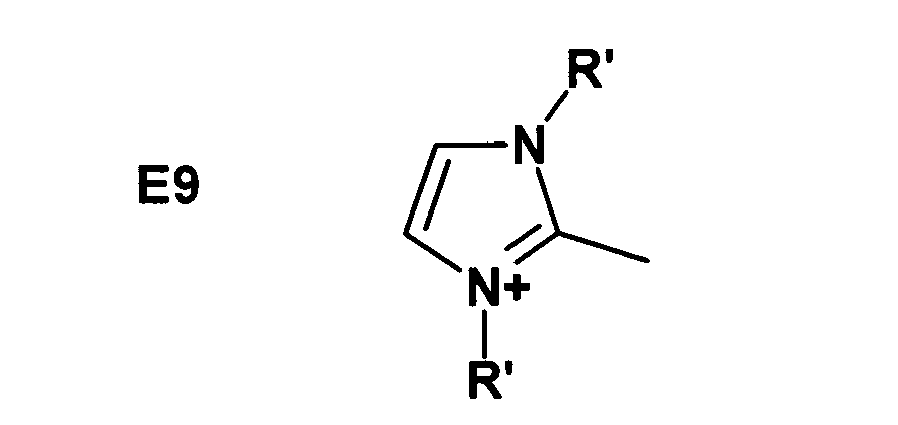 - Farbstoffen der Formel (V);
 Z und D, die gleich oder verschieden sind, ein Stickstoffatom oder die Gruppe -CH-,R7 und R8, die gleich oder verschieden sind, ein Wasserstoffatom; eine C1-4-Alkylgruppe, die mit einer Gruppe -CN, -OH oder -NH2 substituiert sein kann, oder sie bilden mit einem Kohlenstoffatom des Benzolrings einen gegebenenfalls sauerstoffhaltigen oder stickstoffhaltigen Heterocyclus, der mit einer oder mehreren C1-4-Alkylgruppen substituiert sein kann; 4'-Aminophenyl,R9 und R'9, die gleich oder verschieden sind, ein Wasserstoffatom, ein Halogenatom, das unter Chlor, Brom, Iod und Fluor ausgewählt ist, Cyano, C1-4-Alkyl, C1-4-Alkoxy oder Acetyloxy,X- ein Anion, das vorzugsweise unter Chlorid, Methylsulfat und Acetat ausgewählt ist,A eine Gruppe, die unter den folgenden Strukturen A1 bis A 19 ausgewählt ist:


 - Verbindungen der Formeln (VI), (VII) und (VIII):
 A und A1 unabhängig voneinander Reste der folgenden Formel:
 Z ein Rest einer aliphatischen oder aromatischen Diamingruppe,R1 und R2 unabhängig voneinander ein Wasserstoffatom, C1-4-Alkyl, oder sie können gemeinsam mit zwei Stickstoffatomen, an die sie gebunden sind, oder mit Z und Z2 einen 5-, 6- oder 7-gliedrigen Ring bilden,X den Rest einer eine Brücke bildenden Verknüpfung,n eine ganze Zahl 2, 3 oder 4,Z1 einen aromatischen Diaminrest,Z2 einen aliphatischen Diaminrest,KK eine Kupplergruppe,R3 und R4 unabhängig voneinander ein Wasserstoffatom oder C1-4-Alkyl,R5 und R6 unabhängig voneinander ein Wasserstoffatom, C1-4-Alkyl oder C1-4-Alkoxy,An ein farbloses Anion.
 - Zusammensetzung nach einem der Ansprüche 1 bis 6, dadurch gekennzeichnet, dass der kationische Direktfarbstoff unter Basic Red 51, Basic Yellow 87 und Basic Orange 31 ausgewählt ist.
- Zusammensetzung nach einem der vorhergehenden Ansprüche, dadurch gekennzeichnet, dass die Konzentration des kationischen Direktfarbstoffes im Bereich von 0,001 bis 20 %, vorzugsweise 0,01 bis 10 % und noch bevorzugter 0,1 bis 5 % des Gesamtgewichts der Zusammensetzung liegt.
- Zusammensetzung nach einem der vorhergehenden Ansprüche, dadurch gekennzeichnet, dass das Peroxysalz unter den Persulfaten, Perboraten, Percarbonaten und Peroxiden von Alkalimetallen oder Erdalkalimetallen ausgewählt ist.
- Zusammensetzung nach Anspruch 9, dadurch gekennzeichnet, dass es sich bei dem Peroxysalz um Natriumpersulfat oder Kaliumpersulfat handelt.
- Zusammensetzung nach einem der vorhergehenden Ansprüche, dadurch gekennzeichnet, dass die Konzentration der Peroxysalze im Bereich von 10 bis 70 % und vorzugsweise 20 bis 60 % des Gesamtgewichts der Zusammensetzung liegt.
- Zusammensetzung nach einem der vorhergehenden Ansprüche, dadurch gekennzeichnet, dass der alkalische Stoff unter Harnstoff, Ammoniumchlorid, Ammoniumsulfat, Ammoniumphosphat oder Ammoniumnitrat, Silicaten, Phosphaten oder Carbonaten von Alkalimetallen oder Erdalkalimetallen ausgewählt ist.
- Zusammensetzung nach einem der vorhergehenden Ansprüche, dadurch gekennzeichnet, dass die Konzentration des alkalischen Stoffes im Bereich von 0,01 bis 40 % und vorzugsweise 0,1 bis 30 % des Gesamtgewichts der Zusammensetzung liegt.
- Zusammensetzung nach einem der vorhergehenden Ansprüche, dadurch gekennzeichnet, dass die organische(n) inerte(n) Flüssigkeit(en) unter den Polydecenen der Formel C 10nH[(20n)+2], worin n im Bereich von 3 bis 9 und vorzugsweise 3 bis 7 liegt, und Estern von Fettalkoholen oder Fetts äuren ausgewählt ist.
- Zusammensetzung nach einem der vorhergehenden Ansprüche, dadurch gekennzeichnet, dass sie mindestens ein nichtionisches und/oder anionisches amphiphiles Polymer enthält, das mindestens eine Fettkette aufweist.
- Zusammensetzung nach einem der vorhergehenden Ansprüche, dadurch gekennzeichnet, dass die Konzentration des nichtionischen und/ oder anionischen amphiphilen Polymers, das mindestens eine Fettkette aufweist, im Bereich von 0,01 bis 30 % und vorzugsweise 0,01 bis 15 % des Gesamtgewichts der Zusammensetzung liegt.
- Zusammensetzung nach einem der vorhergehenden Ansprüche, dadurch gekennzeichnet, dass sie als Adjuvans Bienenwachs enthält.
- Gebrauchsfertige Zusammensetzung zum Entfärben und gleichzeitigen Färben von menschlichen Keratinfasern und insbesondere Haaren, dadurch gekennzeichnet, dass sie durch bedarfsgemäßes Mischen einer pastösen wasserfreien Zusammensetzung, wie sie in einem der Ansprüche 1 bis 17 definiert ist, und einer Zusammensetzung, die Wasserstoffperoxid enthält, gebildet wird.
- Gebrauchsfertige Zusammensetzung nach Anspruch 18, dadurch gekennzeichnet, dass die pastöse wasserfreie Zusammensetzung ein Gemisch aus einer wasserfreien Zusammensetzung A zum Entfärben in Pastenform, die mindestens ein Peroxysalz, mindestens einen alkalischen Stoff und mindestens eine organ i-sche inerte Flüssigkeit enthält, und einer Zusammensetzung B, die mindestens einen kationischen Direktfarbstoff enthält, enthält.
- Verfahren zum Entfärben und gleichzeitigen Färben von menschlichen Keratinfasern und insbesondere Haaren, das die folgenden Schritte umfasst:- Mischen einer wasserfreien Zusammensetzung zum Entfärben und Färben in Pastenform nach einem der Ansprüche 1 bis 17 vor der Anwendung mit einer wässrigen Wasserstoffperoxidzusammensetzung,- Aufbringen des erhaltenen Gemisches auf den zu behandel n-den Faserbereich,- Einwirkenlassen während einer Zeitspanne im Allgemeinen von 3 bis 60 Minuten und vorzugsweise 5 bis 40 Minuten,- Entfernen des Gemisches durch Spülen mit Wasser und anschließende Wäsche mit einem Haarwaschmittel, worauf gegebenenfalls getrocknet wird.
- Vorrichtung mit zwei Abteilungen, oder Kit, zum Entfärben und Färben von menschlichen Keratinfasern und insbesondere Haaren, dadurch gekennzeichnet, dass die erste Abteilung eine wasserfreie pastöse Zusammensetzung, wie sie in einem der Ansprüche 1 bis 17 definiert ist, und die zweite Abteilung eine wässrige Wasserstoffperoxidzusammensetzung enthält.
- Vorrichtung mit mehreren Abteilungen, oder Kit, zum Entfärben und Färben von menschlichen Keratinfasern und insbesondere Haaren, dadurch gekennzeichnet, dass die erste Abteilung eine wasserfreie und pastöse Zusammensetzung A zum Entfärben, die bis zu 1 Gew.-% Wasser enthalten kann und mindestens ein Peroxysalz, mindestens einen alkalischen Stoff und mindestens eine organische inerte Flüssigkeit enthält, die zweite Abteilung eine Zusammensetzung B, die mindestens einen kationischen Direktfarbstoff enthält, und die dritte Abteilung eine wässrige Wasserstoffperoxidzusammensetzung enthält.
Applications Claiming Priority (2)
| Application Number | Priority Date | Filing Date | Title |
|---|---|---|---|
| FR0216404 | 2002-12-20 | ||
| FR0216404A FR2848843B1 (fr) | 2002-12-20 | 2002-12-20 | Composition anhydre pateuse pour la decoloration et la coloration simultanee des fibres keratiniques humaines. |
Publications (2)
| Publication Number | Publication Date |
|---|---|
| EP1430875A1 EP1430875A1 (de) | 2004-06-23 |
| EP1430875B1 true EP1430875B1 (de) | 2007-10-03 |
Family
ID=32338999
Family Applications (1)
| Application Number | Title | Priority Date | Filing Date |
|---|---|---|---|
| EP03293211A Expired - Lifetime EP1430875B1 (de) | 2002-12-20 | 2003-12-18 | Wasserfreie Paste zum gleichzeitigen Bleichen und Färben von menschlichen Keratinfasern |
Country Status (11)
| Country | Link |
|---|---|
| EP (1) | EP1430875B1 (de) |
| JP (1) | JP4187641B2 (de) |
| KR (1) | KR100731598B1 (de) |
| CN (1) | CN100588386C (de) |
| AT (1) | ATE374596T1 (de) |
| BR (1) | BR0306257A (de) |
| DE (1) | DE60316654T2 (de) |
| ES (1) | ES2294256T3 (de) |
| FR (1) | FR2848843B1 (de) |
| MX (1) | MX251721B (de) |
| PT (1) | PT1430875E (de) |
Families Citing this family (27)
| Publication number | Priority date | Publication date | Assignee | Title |
|---|---|---|---|---|
| DE102004049600A1 (de) * | 2004-10-12 | 2006-04-20 | Wella Ag | Kationische Indazolinthiazolazofarbstoffe enthaltende Färbemittel |
| FR2876576B1 (fr) * | 2004-10-14 | 2006-12-08 | Oreal | Composition de teinture comprenant un colorant disulfure particulier et procede de coloration des fibres keratiniques humaines a partir de ce colorant |
| MX2007006400A (es) * | 2004-12-02 | 2007-06-22 | Procter & Gamble | Composiciones blanqueadoras y colorantes para el cabello espedadas con polimeros. |
| CA2588546A1 (en) * | 2004-12-02 | 2006-06-08 | The Procter & Gamble Company | Hair colouring compositions |
| US7875269B2 (en) | 2004-12-02 | 2011-01-25 | The Procter & Gamble Company | Thickened hair colourant and bleaching compositions |
| FR2878741B1 (fr) * | 2004-12-03 | 2007-03-09 | Oreal | Composition pour la decoloration et la coloration simultanee des fibres keratiniques comprenant une ortho nitro-aniline meta substituee |
| FR2878742B1 (fr) * | 2004-12-03 | 2007-03-09 | Oreal | Composition pour la decoloration et la coloration simultanee des fibres keratiniques comprenant la quinoline ou un derive quinolinique |
| US7452386B2 (en) | 2004-12-03 | 2008-11-18 | L'oreal S.A. | Composition for bleaching and simultaneously dyeing keratin fibers, comprising meta-substituted ortho-nitroaniline |
| FR2878743B1 (fr) * | 2004-12-03 | 2007-03-09 | Oreal | Composition pour la decoloration et la coloration simultanee des fibres keratiniques comprenant du 7-(6'-methylphenylazo)-1-acetamino-3,6-disulfo-8hydroxy- naphtalene |
| FR2885046B1 (fr) * | 2005-04-29 | 2007-06-08 | Oreal | Emulsion directe comprenant une solution aqueuse de peroxyde d'hydrogene et une phase inerte de solubilite dans l'eau inferieure a 1% |
| US7494513B2 (en) | 2005-04-29 | 2009-02-24 | L'oreal | Direct emulsion for bleaching hair |
| FR2885045B1 (fr) * | 2005-04-29 | 2007-06-08 | Oreal | Emulsion inverse comprenant une solution de peroxyde d'hydrogene et une phase inerte de solubilite dans l'eau inferieure a 1% |
| ES2351611T3 (es) | 2006-07-12 | 2011-02-08 | The Procter And Gamble Company | Sistemas espesantes basados en tensioactivo de red de gel para composiciones de decoloración y coloración del cabello. |
| FR2911268B1 (fr) * | 2007-01-15 | 2012-06-15 | Oreal | Composition pour la decoloration comprenant un ester liquide ramifie non volatile d'acide carboxylique a point de solification inferieur a 4°c |
| FR2917972B1 (fr) * | 2007-06-29 | 2009-10-16 | Oreal | Composition anhydre sous forme de pate pour la decoloration des fibres keratiniques |
| FR2940077B1 (fr) * | 2008-12-19 | 2012-07-20 | Oreal | Procede de coloration eclaircissante de matieres keratiniques mettant en oeuvre une composition anhydre colorante comprenant un agent alcalin et une composition oxydante. |
| FR2954127B1 (fr) * | 2009-12-22 | 2015-10-30 | Oreal | Agent de coloration et/ou de decoloration des fibres keratiniques en deux parties, comprenant un corps gras et un agent sequestrant. |
| CN102485201A (zh) * | 2010-12-01 | 2012-06-06 | 庄国昇 | 含一或多种食用色素或化妆品色素的染发剂及其染发方法 |
| DE102011088254A1 (de) * | 2011-12-12 | 2013-06-13 | Henkel Ag & Co. Kgaa | Haarschonende Haarfärbe- und Dauerwellmittel |
| JP5606590B1 (ja) * | 2013-05-27 | 2014-10-15 | 株式会社Ictbグローバル | ヘアカラー剤及び染毛方法 |
| DE102013217206A1 (de) * | 2013-08-28 | 2015-03-05 | Henkel Ag & Co. Kgaa | "Blondiermittel mit Polymeren" |
| DE102013217207A1 (de) | 2013-08-28 | 2015-03-05 | Henkel Ag & Co. Kgaa | "Schäumende Blondiermittel" |
| DE102013217204A1 (de) | 2013-08-28 | 2015-03-05 | Henkel Ag & Co. Kgaa | "Blondiermittel mit Fettalkoholen" |
| WO2015160841A1 (en) * | 2014-04-14 | 2015-10-22 | Bright International Corp. | Non-aqueous hair bleaching and coloring compositions, methods of manufacturing same and methods of use |
| SG11201701893UA (en) * | 2014-09-11 | 2017-04-27 | Ictb Global Co Ltd | Hair coloring agent and hair dyeing method |
| FR3083100B1 (fr) * | 2018-06-27 | 2021-01-15 | Oreal | Composition de coloration comprenant un colorant direct, un sel peroxygene et une cyclodextrine, et procede mettant en oeuvre cette composition |
| FR3157124A1 (fr) * | 2023-12-20 | 2025-06-27 | L'oreal | Composition comprenant un sel peroxygéné, un hydrocarbure de point de fusion supérieur à 25°C, un corps gras et un colorant direct |
Family Cites Families (8)
| Publication number | Priority date | Publication date | Assignee | Title |
|---|---|---|---|---|
| US4170637A (en) * | 1977-05-16 | 1979-10-09 | Redken Laboratories, Inc. | Frosting bleach composition |
| DE3844956C2 (de) * | 1988-04-28 | 1996-03-21 | Schwarzkopf Gmbh Hans | Zweikomponenten-Zubereitung bzw. auftragefähige, breiartige Zubereitung zum Bleichen von Humanhaaren |
| DE3814685A1 (de) * | 1988-04-30 | 1988-09-01 | Schwarzkopf Gmbh Hans | Zweikomponenten-zubereitung zur anfertigung einer breiartigen, auftragefaehigen zubereitung zur behandlung von humanhaar |
| JPH0669941B2 (ja) * | 1989-04-24 | 1994-09-07 | 花王株式会社 | 毛髪処理剤組成物、脱色剤組成物及び毛髪色調修正剤組成物 |
| DE19723538C1 (de) * | 1997-06-05 | 1998-09-17 | Wella Ag | Pastenförmiges Mittel zum Bleichen von Haaren |
| FR2782452B1 (fr) * | 1998-08-24 | 2001-11-16 | Oreal | Composition de teinture pour fibres keratiniques avec un colorant direct cationique et un agent teniso-actif non-ionique |
| DE60139730D1 (de) * | 2000-12-28 | 2009-10-08 | Kao Corp | Haarbleichungszusammensetzung und Haarfärbezusammensetzung |
| FR2820312B1 (fr) * | 2001-02-02 | 2003-05-02 | Oreal | Composition pulverulente pour la decoloration des fibres keratiniques humaines |
-
2002
- 2002-12-20 FR FR0216404A patent/FR2848843B1/fr not_active Expired - Fee Related
-
2003
- 2003-12-18 ES ES03293211T patent/ES2294256T3/es not_active Expired - Lifetime
- 2003-12-18 DE DE60316654T patent/DE60316654T2/de not_active Expired - Lifetime
- 2003-12-18 AT AT03293211T patent/ATE374596T1/de not_active IP Right Cessation
- 2003-12-18 EP EP03293211A patent/EP1430875B1/de not_active Expired - Lifetime
- 2003-12-18 PT PT03293211T patent/PT1430875E/pt unknown
- 2003-12-18 KR KR1020030093163A patent/KR100731598B1/ko not_active Expired - Fee Related
- 2003-12-18 MX MXPA03011965 patent/MX251721B/es active IP Right Grant
- 2003-12-19 BR BR0306257-0A patent/BR0306257A/pt not_active Application Discontinuation
- 2003-12-22 CN CN200310113132A patent/CN100588386C/zh not_active Expired - Fee Related
- 2003-12-22 JP JP2003436768A patent/JP4187641B2/ja not_active Expired - Fee Related
Non-Patent Citations (1)
| Title |
|---|
| None * |
Also Published As
| Publication number | Publication date |
|---|---|
| EP1430875A1 (de) | 2004-06-23 |
| MXPA03011965A (es) | 2005-04-11 |
| CN1509701A (zh) | 2004-07-07 |
| BR0306257A (pt) | 2004-08-31 |
| MX251721B (es) | 2007-11-22 |
| KR20040055654A (ko) | 2004-06-26 |
| FR2848843B1 (fr) | 2005-07-01 |
| ES2294256T3 (es) | 2008-04-01 |
| DE60316654T2 (de) | 2008-07-17 |
| JP4187641B2 (ja) | 2008-11-26 |
| JP2004224792A (ja) | 2004-08-12 |
| KR100731598B1 (ko) | 2007-06-22 |
| PT1430875E (pt) | 2007-12-28 |
| CN100588386C (zh) | 2010-02-10 |
| FR2848843A1 (fr) | 2004-06-25 |
| ATE374596T1 (de) | 2007-10-15 |
| DE60316654D1 (de) | 2007-11-15 |
Similar Documents
| Publication | Publication Date | Title |
|---|---|---|
| EP1430875B1 (de) | Wasserfreie Paste zum gleichzeitigen Bleichen und Färben von menschlichen Keratinfasern | |
| EP1380287B1 (de) | Wasserfreie Paste zum Entfärben von menschlichen Keratinfasern | |
| EP1228751B1 (de) | Pulverförmiges Haarblondiermittel | |
| EP1399116B1 (de) | Verwendung dikationischer verbindungen zur färbung keratinischer fasern und diese enthaltende zusammensetzungen | |
| FR2842101A1 (fr) | Pate anhydre pour la decoloration des fibres keratiniques humaines | |
| US20040181883A1 (en) | Pasty anhydrous composition for simultaneously bleaching and dyeing human keratin fibers comprising at least one peroxygenated salt, at least one alkaline agent, at least one inert organic liquid and at least one cationic direct dye; process using such a compound; and kit comprising such a compound | |
| FR2917972A1 (fr) | Composition anhydre sous forme de pate pour la decoloration des fibres keratiniques | |
| FR2803195A1 (fr) | Composition pour la teinture d'oxydation des fibres keratiniques comprenant un polymere epaississant comportant au moins une chaine grasse et un alcool gras mono-ou poly-glycerole | |
| FR2850020A1 (fr) | Compositions de decoloration pretes a l'emploi, procede de preparation et procede de decoloration | |
| FR2803197A1 (fr) | Composition pour la teinture d'oxydation des fibres keratiniques comprenant un polymere epaississant comportant au moins une chaine grasse et un alcool gras ayant plus de vingt atomes de carbone | |
| FR2814948A1 (fr) | Composition cosmetique contenant des derives d'acide sulfinique | |
| FR2824734A1 (fr) | Composition pulverulente pour la decoloration des fibres keratiniques humaines | |
| FR2813016A1 (fr) | Composition de decoloration des fibres keratiniques teintes | |
| EP1341504B1 (de) | Zusammensetzung für die oxidative färbung von keratinischen fasern enthaltend ein assoziatives polymer und ein perlglanzmittel | |
| FR2848104A1 (fr) | Composition de teinture d'oxydation pour fibres keratiniques comprenant un alcool gras, un colorant d'oxydation, un polymere associatif, un ester d'acide gras et/ou un oxyde metallique. | |
| US7267696B2 (en) | Composition for dyeing keratinous fibers, comprising a hydroxycarboxylic acid or a salt, ready-to-use composition comprising it, implementation process and device | |
| FR2824735A1 (fr) | Composition pulverulente pour la decoloration des fibres keratiniques humaines | |
| EP1438950B1 (de) | Haarbleichmittel | |
| FR2852834A1 (fr) | Composition oxydante comprenant des acides hydroxycarboxyliques et leurs sels comme agents complexants pour la coloration, la decoloration ou la deformation permanente des fibres keratiniques | |
| FR2852838A1 (fr) | Utilisation d'acides polycarboxyliques et leurs sels comme agents complexants dans des compositions oxydantes pour la coloration, la decoloration ou la deformation permanente de fibres keratiniques | |
| EP1738800A1 (de) | Mittel zum gleichteitigen Bleichen oder Färben von Keratinfasern enthaltend einen anionischen oder nichtionischen Farbstoff und ein assoziatives Polymer | |
| FR2842099A1 (fr) | Pate anhydre pour la decoloration des fibres keratiniques humaines | |
| FR2852835A1 (fr) | Utilisation d'acides polycarboxyliques et de leurs sels comme agents complexants dans les compositions oxydantes pour la coloration, la decoloration ou la deformation permanente de fibres keratiniques | |
| EP1357890B1 (de) | Oxydierende zusammensetzung zur behandlung von keratinfasern, die ein kationisches polyvinyllactam enthalten |
Legal Events
| Date | Code | Title | Description |
|---|---|---|---|
| PUAI | Public reference made under article 153(3) epc to a published international application that has entered the european phase |
Free format text: ORIGINAL CODE: 0009012 |
|
| 17P | Request for examination filed |
Effective date: 20031230 |
|
| AK | Designated contracting states |
Kind code of ref document: A1 Designated state(s): AT BE BG CH CY CZ DE DK EE ES FI FR GB GR HU IE IT LI LU MC NL PT RO SE SI SK TR |
|
| AX | Request for extension of the european patent |
Extension state: AL LT LV MK |
|
| RIN1 | Information on inventor provided before grant (corrected) |
Inventor name: DE LA METTRIE, ROLLAND Inventor name: LEGRAND, FREDERIC Inventor name: MILLEQUANT, JEAN-MARIE |
|
| 17Q | First examination report despatched |
Effective date: 20041004 |
|
| AKX | Designation fees paid |
Designated state(s): AT BE BG CH CY CZ DE DK EE ES FI FR GB GR HU IE IT LI LU MC NL PT RO SE SI SK TR |
|
| 17Q | First examination report despatched |
Effective date: 20041004 |
|
| GRAP | Despatch of communication of intention to grant a patent |
Free format text: ORIGINAL CODE: EPIDOSNIGR1 |
|
| RIC1 | Information provided on ipc code assigned before grant |
Ipc: A61K 8/37 20060101ALI20070216BHEP Ipc: A61K 8/92 20060101ALI20070216BHEP Ipc: A61Q 5/10 20060101ALI20070216BHEP Ipc: A61K 8/81 20060101AFI20070216BHEP Ipc: A61Q 5/08 20060101ALI20070216BHEP |
|
| GRAS | Grant fee paid |
Free format text: ORIGINAL CODE: EPIDOSNIGR3 |
|
| GRAA | (expected) grant |
Free format text: ORIGINAL CODE: 0009210 |
|
| AK | Designated contracting states |
Kind code of ref document: B1 Designated state(s): AT BE BG CH CY CZ DE DK EE ES FI FR GB GR HU IE IT LI LU MC NL PT RO SE SI SK TR |
|
| REG | Reference to a national code |
Ref country code: GB Ref legal event code: FG4D Free format text: NOT ENGLISH |
|
| REG | Reference to a national code |
Ref country code: CH Ref legal event code: EP |
|
| REG | Reference to a national code |
Ref country code: IE Ref legal event code: FG4D Free format text: LANGUAGE OF EP DOCUMENT: FRENCH |
|
| REF | Corresponds to: |
Ref document number: 60316654 Country of ref document: DE Date of ref document: 20071115 Kind code of ref document: P |
|
| REG | Reference to a national code |
Ref country code: PT Ref legal event code: SC4A Free format text: AVAILABILITY OF NATIONAL TRANSLATION Effective date: 20071218 |
|
| REG | Reference to a national code |
Ref country code: SE Ref legal event code: TRGR |
|
| GBT | Gb: translation of ep patent filed (gb section 77(6)(a)/1977) |
Effective date: 20080104 |
|
| PGFP | Annual fee paid to national office [announced via postgrant information from national office to epo] |
Ref country code: NL Payment date: 20071203 Year of fee payment: 5 |
|
| REG | Reference to a national code |
Ref country code: GR Ref legal event code: EP Ref document number: 20070403832 Country of ref document: GR |
|
| PGFP | Annual fee paid to national office [announced via postgrant information from national office to epo] |
Ref country code: AT Payment date: 20071212 Year of fee payment: 5 Ref country code: CH Payment date: 20071213 Year of fee payment: 5 |
|
| PGFP | Annual fee paid to national office [announced via postgrant information from national office to epo] |
Ref country code: SE Payment date: 20071205 Year of fee payment: 5 |
|
| REG | Reference to a national code |
Ref country code: ES Ref legal event code: FG2A Ref document number: 2294256 Country of ref document: ES Kind code of ref document: T3 |
|
| PG25 | Lapsed in a contracting state [announced via postgrant information from national office to epo] |
Ref country code: BG Free format text: LAPSE BECAUSE OF FAILURE TO SUBMIT A TRANSLATION OF THE DESCRIPTION OR TO PAY THE FEE WITHIN THE PRESCRIBED TIME-LIMIT Effective date: 20080103 |
|
| PGFP | Annual fee paid to national office [announced via postgrant information from national office to epo] |
Ref country code: GR Payment date: 20071116 Year of fee payment: 5 Ref country code: PT Payment date: 20071227 Year of fee payment: 5 |
|
| REG | Reference to a national code |
Ref country code: IE Ref legal event code: FD4D |
|
| PG25 | Lapsed in a contracting state [announced via postgrant information from national office to epo] |
Ref country code: CZ Free format text: LAPSE BECAUSE OF FAILURE TO SUBMIT A TRANSLATION OF THE DESCRIPTION OR TO PAY THE FEE WITHIN THE PRESCRIBED TIME-LIMIT Effective date: 20071003 Ref country code: MC Free format text: LAPSE BECAUSE OF NON-PAYMENT OF DUE FEES Effective date: 20071231 Ref country code: DK Free format text: LAPSE BECAUSE OF FAILURE TO SUBMIT A TRANSLATION OF THE DESCRIPTION OR TO PAY THE FEE WITHIN THE PRESCRIBED TIME-LIMIT Effective date: 20071003 |
|
| PLBE | No opposition filed within time limit |
Free format text: ORIGINAL CODE: 0009261 |
|
| STAA | Information on the status of an ep patent application or granted ep patent |
Free format text: STATUS: NO OPPOSITION FILED WITHIN TIME LIMIT |
|
| PG25 | Lapsed in a contracting state [announced via postgrant information from national office to epo] |
Ref country code: SK Free format text: LAPSE BECAUSE OF FAILURE TO SUBMIT A TRANSLATION OF THE DESCRIPTION OR TO PAY THE FEE WITHIN THE PRESCRIBED TIME-LIMIT Effective date: 20071003 Ref country code: RO Free format text: LAPSE BECAUSE OF FAILURE TO SUBMIT A TRANSLATION OF THE DESCRIPTION OR TO PAY THE FEE WITHIN THE PRESCRIBED TIME-LIMIT Effective date: 20071003 |
|
| PGFP | Annual fee paid to national office [announced via postgrant information from national office to epo] |
Ref country code: BE Payment date: 20080325 Year of fee payment: 5 |
|
| 26N | No opposition filed |
Effective date: 20080704 |
|
| PG25 | Lapsed in a contracting state [announced via postgrant information from national office to epo] |
Ref country code: IE Free format text: LAPSE BECAUSE OF FAILURE TO SUBMIT A TRANSLATION OF THE DESCRIPTION OR TO PAY THE FEE WITHIN THE PRESCRIBED TIME-LIMIT Effective date: 20071003 |
|
| PG25 | Lapsed in a contracting state [announced via postgrant information from national office to epo] |
Ref country code: EE Free format text: LAPSE BECAUSE OF FAILURE TO SUBMIT A TRANSLATION OF THE DESCRIPTION OR TO PAY THE FEE WITHIN THE PRESCRIBED TIME-LIMIT Effective date: 20071003 |
|
| PG25 | Lapsed in a contracting state [announced via postgrant information from national office to epo] |
Ref country code: FI Free format text: LAPSE BECAUSE OF FAILURE TO SUBMIT A TRANSLATION OF THE DESCRIPTION OR TO PAY THE FEE WITHIN THE PRESCRIBED TIME-LIMIT Effective date: 20071003 |
|
| BERE | Be: lapsed |
Owner name: L'OREAL Effective date: 20081231 |
|
| PG25 | Lapsed in a contracting state [announced via postgrant information from national office to epo] |
Ref country code: SI Free format text: LAPSE BECAUSE OF FAILURE TO SUBMIT A TRANSLATION OF THE DESCRIPTION OR TO PAY THE FEE WITHIN THE PRESCRIBED TIME-LIMIT Effective date: 20071003 |
|
| PG25 | Lapsed in a contracting state [announced via postgrant information from national office to epo] |
Ref country code: CY Free format text: LAPSE BECAUSE OF FAILURE TO SUBMIT A TRANSLATION OF THE DESCRIPTION OR TO PAY THE FEE WITHIN THE PRESCRIBED TIME-LIMIT Effective date: 20071003 |
|
| REG | Reference to a national code |
Ref country code: CH Ref legal event code: PL |
|
| EUG | Se: european patent has lapsed | ||
| PG25 | Lapsed in a contracting state [announced via postgrant information from national office to epo] |
Ref country code: AT Free format text: LAPSE BECAUSE OF NON-PAYMENT OF DUE FEES Effective date: 20081218 Ref country code: LU Free format text: LAPSE BECAUSE OF NON-PAYMENT OF DUE FEES Effective date: 20071218 |
|
| NLV4 | Nl: lapsed or anulled due to non-payment of the annual fee |
Effective date: 20090701 |
|
| PG25 | Lapsed in a contracting state [announced via postgrant information from national office to epo] |
Ref country code: HU Free format text: LAPSE BECAUSE OF FAILURE TO SUBMIT A TRANSLATION OF THE DESCRIPTION OR TO PAY THE FEE WITHIN THE PRESCRIBED TIME-LIMIT Effective date: 20080404 Ref country code: BE Free format text: LAPSE BECAUSE OF NON-PAYMENT OF DUE FEES Effective date: 20081231 Ref country code: TR Free format text: LAPSE BECAUSE OF FAILURE TO SUBMIT A TRANSLATION OF THE DESCRIPTION OR TO PAY THE FEE WITHIN THE PRESCRIBED TIME-LIMIT Effective date: 20071003 |
|
| PG25 | Lapsed in a contracting state [announced via postgrant information from national office to epo] |
Ref country code: LI Free format text: LAPSE BECAUSE OF NON-PAYMENT OF DUE FEES Effective date: 20081231 Ref country code: CH Free format text: LAPSE BECAUSE OF NON-PAYMENT OF DUE FEES Effective date: 20081231 |
|
| PG25 | Lapsed in a contracting state [announced via postgrant information from national office to epo] |
Ref country code: NL Free format text: LAPSE BECAUSE OF NON-PAYMENT OF DUE FEES Effective date: 20090701 |
|
| PG25 | Lapsed in a contracting state [announced via postgrant information from national office to epo] |
Ref country code: GR Free format text: LAPSE BECAUSE OF NON-PAYMENT OF DUE FEES Effective date: 20090703 |
|
| REG | Reference to a national code |
Ref country code: PT Ref legal event code: MM4A Free format text: LAPSE DUE TO NON-PAYMENT OF FEES Effective date: 20100618 |
|
| PG25 | Lapsed in a contracting state [announced via postgrant information from national office to epo] |
Ref country code: PT Free format text: LAPSE BECAUSE OF NON-PAYMENT OF DUE FEES Effective date: 20100618 Ref country code: SE Free format text: LAPSE BECAUSE OF NON-PAYMENT OF DUE FEES Effective date: 20081219 |
|
| PGFP | Annual fee paid to national office [announced via postgrant information from national office to epo] |
Ref country code: FR Payment date: 20101224 Year of fee payment: 8 |
|
| PGFP | Annual fee paid to national office [announced via postgrant information from national office to epo] |
Ref country code: IT Payment date: 20101224 Year of fee payment: 8 Ref country code: GB Payment date: 20101215 Year of fee payment: 8 |
|
| PGFP | Annual fee paid to national office [announced via postgrant information from national office to epo] |
Ref country code: DE Payment date: 20101215 Year of fee payment: 8 |
|
| PGFP | Annual fee paid to national office [announced via postgrant information from national office to epo] |
Ref country code: ES Payment date: 20110120 Year of fee payment: 8 |
|
| GBPC | Gb: european patent ceased through non-payment of renewal fee |
Effective date: 20111218 |
|
| REG | Reference to a national code |
Ref country code: FR Ref legal event code: ST Effective date: 20120831 |
|
| REG | Reference to a national code |
Ref country code: DE Ref legal event code: R119 Ref document number: 60316654 Country of ref document: DE Effective date: 20120703 |
|
| PG25 | Lapsed in a contracting state [announced via postgrant information from national office to epo] |
Ref country code: GB Free format text: LAPSE BECAUSE OF NON-PAYMENT OF DUE FEES Effective date: 20111218 Ref country code: DE Free format text: LAPSE BECAUSE OF NON-PAYMENT OF DUE FEES Effective date: 20120703 |
|
| PG25 | Lapsed in a contracting state [announced via postgrant information from national office to epo] |
Ref country code: IT Free format text: LAPSE BECAUSE OF NON-PAYMENT OF DUE FEES Effective date: 20111218 |
|
| PG25 | Lapsed in a contracting state [announced via postgrant information from national office to epo] |
Ref country code: FR Free format text: LAPSE BECAUSE OF NON-PAYMENT OF DUE FEES Effective date: 20120102 |
|
| REG | Reference to a national code |
Ref country code: ES Ref legal event code: FD2A Effective date: 20130703 |
|
| PG25 | Lapsed in a contracting state [announced via postgrant information from national office to epo] |
Ref country code: ES Free format text: LAPSE BECAUSE OF NON-PAYMENT OF DUE FEES Effective date: 20111219 |