EP1437149B1 - Zusammengesetztes material für die geweberegeneration - Google Patents
Zusammengesetztes material für die geweberegeneration Download PDFInfo
- Publication number
- EP1437149B1 EP1437149B1 EP20020800014 EP02800014A EP1437149B1 EP 1437149 B1 EP1437149 B1 EP 1437149B1 EP 20020800014 EP20020800014 EP 20020800014 EP 02800014 A EP02800014 A EP 02800014A EP 1437149 B1 EP1437149 B1 EP 1437149B1
- Authority
- EP
- European Patent Office
- Prior art keywords
- biodegradation
- poly
- synthetic polymer
- cells
- collagen
- Prior art date
- Legal status (The legal status is an assumption and is not a legal conclusion. Google has not performed a legal analysis and makes no representation as to the accuracy of the status listed.)
- Expired - Lifetime
Links
- 230000017423 tissue regeneration Effects 0.000 title description 3
- 239000002131 composite material Substances 0.000 title 1
- 239000000463 material Substances 0.000 claims description 146
- -1 poly(glycolic acid) Polymers 0.000 claims description 113
- 239000000835 fiber Substances 0.000 claims description 73
- 229920001059 synthetic polymer Polymers 0.000 claims description 59
- 229920000954 Polyglycolide Polymers 0.000 claims description 39
- 229920000642 polymer Polymers 0.000 claims description 30
- 230000008929 regeneration Effects 0.000 claims description 28
- 238000011069 regeneration method Methods 0.000 claims description 28
- 229920000747 poly(lactic acid) Polymers 0.000 claims description 16
- 229920001577 copolymer Polymers 0.000 claims description 8
- 238000002844 melting Methods 0.000 claims description 5
- 230000008018 melting Effects 0.000 claims description 5
- 229920001610 polycaprolactone Polymers 0.000 claims description 4
- 229920001710 Polyorthoester Polymers 0.000 claims description 2
- 230000003311 flocculating effect Effects 0.000 claims description 2
- 239000001630 malic acid Substances 0.000 claims description 2
- 229920002463 poly(p-dioxanone) polymer Polymers 0.000 claims description 2
- 239000000622 polydioxanone Substances 0.000 claims description 2
- 210000004027 cell Anatomy 0.000 description 70
- 102000008186 Collagen Human genes 0.000 description 59
- 108010035532 Collagen Proteins 0.000 description 59
- 229920001436 collagen Polymers 0.000 description 59
- 238000012360 testing method Methods 0.000 description 58
- 230000000052 comparative effect Effects 0.000 description 40
- 210000001519 tissue Anatomy 0.000 description 34
- 239000007943 implant Substances 0.000 description 31
- 241000699666 Mus <mouse, genus> Species 0.000 description 30
- 239000000243 solution Substances 0.000 description 25
- 238000000034 method Methods 0.000 description 20
- 239000001963 growth medium Substances 0.000 description 17
- HEDRZPFGACZZDS-UHFFFAOYSA-N Chloroform Chemical compound ClC(Cl)Cl HEDRZPFGACZZDS-UHFFFAOYSA-N 0.000 description 16
- 239000003925 fat Substances 0.000 description 14
- 239000000515 collagen sponge Substances 0.000 description 13
- 238000004132 cross linking Methods 0.000 description 11
- WZUVPPKBWHMQCE-UHFFFAOYSA-N Haematoxylin Chemical compound C12=CC(O)=C(O)C=C2CC2(O)C1C1=CC=C(O)C(O)=C1OC2 WZUVPPKBWHMQCE-UHFFFAOYSA-N 0.000 description 10
- 239000000047 product Substances 0.000 description 10
- 108010010803 Gelatin Proteins 0.000 description 9
- 229920000159 gelatin Polymers 0.000 description 9
- 239000008273 gelatin Substances 0.000 description 9
- 235000019322 gelatine Nutrition 0.000 description 9
- 235000011852 gelatine desserts Nutrition 0.000 description 9
- 238000004108 freeze drying Methods 0.000 description 8
- 102000003974 Fibroblast growth factor 2 Human genes 0.000 description 7
- 108090000379 Fibroblast growth factor 2 Proteins 0.000 description 7
- 230000008602 contraction Effects 0.000 description 7
- 239000004745 nonwoven fabric Substances 0.000 description 7
- 239000011369 resultant mixture Substances 0.000 description 7
- XEKOWRVHYACXOJ-UHFFFAOYSA-N Ethyl acetate Chemical compound CCOC(C)=O XEKOWRVHYACXOJ-UHFFFAOYSA-N 0.000 description 6
- 238000006065 biodegradation reaction Methods 0.000 description 6
- 238000011156 evaluation Methods 0.000 description 6
- 239000002245 particle Substances 0.000 description 6
- 102000012422 Collagen Type I Human genes 0.000 description 5
- 108010022452 Collagen Type I Proteins 0.000 description 5
- XAGFODPZIPBFFR-UHFFFAOYSA-N aluminium Chemical compound [Al] XAGFODPZIPBFFR-UHFFFAOYSA-N 0.000 description 5
- 229910052782 aluminium Inorganic materials 0.000 description 5
- 230000015556 catabolic process Effects 0.000 description 5
- 239000011248 coating agent Substances 0.000 description 5
- 238000000576 coating method Methods 0.000 description 5
- 238000006731 degradation reaction Methods 0.000 description 5
- 210000002950 fibroblast Anatomy 0.000 description 5
- 238000007654 immersion Methods 0.000 description 5
- 238000000338 in vitro Methods 0.000 description 5
- 239000003960 organic solvent Substances 0.000 description 5
- 239000002243 precursor Substances 0.000 description 5
- LFQSCWFLJHTTHZ-UHFFFAOYSA-N Ethanol Chemical compound CCO LFQSCWFLJHTTHZ-UHFFFAOYSA-N 0.000 description 4
- NBIIXXVUZAFLBC-UHFFFAOYSA-N Phosphoric acid Chemical compound OP(O)(O)=O NBIIXXVUZAFLBC-UHFFFAOYSA-N 0.000 description 4
- 238000006297 dehydration reaction Methods 0.000 description 4
- 230000008034 disappearance Effects 0.000 description 4
- 238000010438 heat treatment Methods 0.000 description 4
- JVTAAEKCZFNVCJ-UHFFFAOYSA-N lactic acid Chemical compound CC(O)C(O)=O JVTAAEKCZFNVCJ-UHFFFAOYSA-N 0.000 description 4
- UHOVQNZJYSORNB-UHFFFAOYSA-N Benzene Chemical compound C1=CC=CC=C1 UHOVQNZJYSORNB-UHFFFAOYSA-N 0.000 description 3
- YMWUJEATGCHHMB-UHFFFAOYSA-N Dichloromethane Chemical compound ClCCl YMWUJEATGCHHMB-UHFFFAOYSA-N 0.000 description 3
- RTZKZFJDLAIYFH-UHFFFAOYSA-N Diethyl ether Chemical compound CCOCC RTZKZFJDLAIYFH-UHFFFAOYSA-N 0.000 description 3
- YXFVVABEGXRONW-UHFFFAOYSA-N Toluene Chemical compound CC1=CC=CC=C1 YXFVVABEGXRONW-UHFFFAOYSA-N 0.000 description 3
- 230000024245 cell differentiation Effects 0.000 description 3
- 230000004663 cell proliferation Effects 0.000 description 3
- 238000012669 compression test Methods 0.000 description 3
- 230000002349 favourable effect Effects 0.000 description 3
- 238000001727 in vivo Methods 0.000 description 3
- 238000005259 measurement Methods 0.000 description 3
- VLKZOEOYAKHREP-UHFFFAOYSA-N n-Hexane Chemical compound CCCCCC VLKZOEOYAKHREP-UHFFFAOYSA-N 0.000 description 3
- WSFSSNUMVMOOMR-UHFFFAOYSA-N Formaldehyde Chemical compound O=C WSFSSNUMVMOOMR-UHFFFAOYSA-N 0.000 description 2
- AEMRFAOFKBGASW-UHFFFAOYSA-N Glycolic acid Chemical compound OCC(O)=O AEMRFAOFKBGASW-UHFFFAOYSA-N 0.000 description 2
- 239000000654 additive Substances 0.000 description 2
- 229910000147 aluminium phosphate Inorganic materials 0.000 description 2
- 210000000988 bone and bone Anatomy 0.000 description 2
- 239000007853 buffer solution Substances 0.000 description 2
- 239000006285 cell suspension Substances 0.000 description 2
- 238000010382 chemical cross-linking Methods 0.000 description 2
- 239000011243 crosslinked material Substances 0.000 description 2
- 230000000694 effects Effects 0.000 description 2
- FKRCODPIKNYEAC-UHFFFAOYSA-N ethyl propionate Chemical compound CCOC(=O)CC FKRCODPIKNYEAC-UHFFFAOYSA-N 0.000 description 2
- 230000001605 fetal effect Effects 0.000 description 2
- 239000000945 filler Substances 0.000 description 2
- 239000004310 lactic acid Substances 0.000 description 2
- 235000014655 lactic acid Nutrition 0.000 description 2
- 229920001296 polysiloxane Polymers 0.000 description 2
- 239000011148 porous material Substances 0.000 description 2
- 235000018102 proteins Nutrition 0.000 description 2
- 102000004169 proteins and genes Human genes 0.000 description 2
- 108090000623 proteins and genes Proteins 0.000 description 2
- 239000004627 regenerated cellulose Substances 0.000 description 2
- 230000000717 retained effect Effects 0.000 description 2
- 210000002966 serum Anatomy 0.000 description 2
- 239000002904 solvent Substances 0.000 description 2
- 239000000126 substance Substances 0.000 description 2
- 239000000725 suspension Substances 0.000 description 2
- 210000002435 tendon Anatomy 0.000 description 2
- VZGDMQKNWNREIO-UHFFFAOYSA-N tetrachloromethane Chemical compound ClC(Cl)(Cl)Cl VZGDMQKNWNREIO-UHFFFAOYSA-N 0.000 description 2
- PAPBSGBWRJIAAV-UHFFFAOYSA-N ε-Caprolactone Chemical compound O=C1CCCCCO1 PAPBSGBWRJIAAV-UHFFFAOYSA-N 0.000 description 2
- KIUKXJAPPMFGSW-DNGZLQJQSA-N (2S,3S,4S,5R,6R)-6-[(2S,3R,4R,5S,6R)-3-Acetamido-2-[(2S,3S,4R,5R,6R)-6-[(2R,3R,4R,5S,6R)-3-acetamido-2,5-dihydroxy-6-(hydroxymethyl)oxan-4-yl]oxy-2-carboxy-4,5-dihydroxyoxan-3-yl]oxy-5-hydroxy-6-(hydroxymethyl)oxan-4-yl]oxy-3,4,5-trihydroxyoxane-2-carboxylic acid Chemical compound CC(=O)N[C@H]1[C@H](O)O[C@H](CO)[C@@H](O)[C@@H]1O[C@H]1[C@H](O)[C@@H](O)[C@H](O[C@H]2[C@@H]([C@@H](O[C@H]3[C@@H]([C@@H](O)[C@H](O)[C@H](O3)C(O)=O)O)[C@H](O)[C@@H](CO)O2)NC(C)=O)[C@@H](C(O)=O)O1 KIUKXJAPPMFGSW-DNGZLQJQSA-N 0.000 description 1
- RYHBNJHYFVUHQT-UHFFFAOYSA-N 1,4-Dioxane Chemical compound C1COCCO1 RYHBNJHYFVUHQT-UHFFFAOYSA-N 0.000 description 1
- NHBKXEKEPDILRR-UHFFFAOYSA-N 2,3-bis(butanoylsulfanyl)propyl butanoate Chemical compound CCCC(=O)OCC(SC(=O)CCC)CSC(=O)CCC NHBKXEKEPDILRR-UHFFFAOYSA-N 0.000 description 1
- 241000283690 Bos taurus Species 0.000 description 1
- 206010006187 Breast cancer Diseases 0.000 description 1
- 208000026310 Breast neoplasm Diseases 0.000 description 1
- 229920002101 Chitin Polymers 0.000 description 1
- 229920001661 Chitosan Polymers 0.000 description 1
- 102000029816 Collagenase Human genes 0.000 description 1
- 108060005980 Collagenase Proteins 0.000 description 1
- XDTMQSROBMDMFD-UHFFFAOYSA-N Cyclohexane Chemical compound C1CCCCC1 XDTMQSROBMDMFD-UHFFFAOYSA-N 0.000 description 1
- 229920002307 Dextran Polymers 0.000 description 1
- ZAFNJMIOTHYJRJ-UHFFFAOYSA-N Diisopropyl ether Chemical compound CC(C)OC(C)C ZAFNJMIOTHYJRJ-UHFFFAOYSA-N 0.000 description 1
- 108010073385 Fibrin Proteins 0.000 description 1
- 102000009123 Fibrin Human genes 0.000 description 1
- BWGVNKXGVNDBDI-UHFFFAOYSA-N Fibrin monomer Chemical compound CNC(=O)CNC(=O)CN BWGVNKXGVNDBDI-UHFFFAOYSA-N 0.000 description 1
- 108010022355 Fibroins Proteins 0.000 description 1
- SXRSQZLOMIGNAQ-UHFFFAOYSA-N Glutaraldehyde Chemical compound O=CCCCC=O SXRSQZLOMIGNAQ-UHFFFAOYSA-N 0.000 description 1
- 108010068370 Glutens Proteins 0.000 description 1
- 229920002683 Glycosaminoglycan Polymers 0.000 description 1
- 241001082241 Lythrum hyssopifolia Species 0.000 description 1
- 241001465754 Metazoa Species 0.000 description 1
- 241000699660 Mus musculus Species 0.000 description 1
- BQCADISMDOOEFD-UHFFFAOYSA-N Silver Chemical compound [Ag] BQCADISMDOOEFD-UHFFFAOYSA-N 0.000 description 1
- 229920002472 Starch Polymers 0.000 description 1
- 238000010521 absorption reaction Methods 0.000 description 1
- 210000000577 adipose tissue Anatomy 0.000 description 1
- 239000000783 alginic acid Substances 0.000 description 1
- 229920000615 alginic acid Polymers 0.000 description 1
- 235000010443 alginic acid Nutrition 0.000 description 1
- 229960001126 alginic acid Drugs 0.000 description 1
- 150000004781 alginic acids Chemical class 0.000 description 1
- 150000001338 aliphatic hydrocarbons Chemical class 0.000 description 1
- 150000004945 aromatic hydrocarbons Chemical class 0.000 description 1
- 238000003556 assay Methods 0.000 description 1
- QVGXLLKOCUKJST-UHFFFAOYSA-N atomic oxygen Chemical compound [O] QVGXLLKOCUKJST-UHFFFAOYSA-N 0.000 description 1
- 229920000704 biodegradable plastic Polymers 0.000 description 1
- 210000004204 blood vessel Anatomy 0.000 description 1
- 108010015046 cell aggregation factors Proteins 0.000 description 1
- 238000004113 cell culture Methods 0.000 description 1
- 230000010261 cell growth Effects 0.000 description 1
- 229940045110 chitosan Drugs 0.000 description 1
- 229960002424 collagenase Drugs 0.000 description 1
- 230000006835 compression Effects 0.000 description 1
- 238000007906 compression Methods 0.000 description 1
- 238000007796 conventional method Methods 0.000 description 1
- 239000003431 cross linking reagent Substances 0.000 description 1
- UQHKFADEQIVWID-UHFFFAOYSA-N cytokinin Natural products C1=NC=2C(NCC=C(CO)C)=NC=NC=2N1C1CC(O)C(CO)O1 UQHKFADEQIVWID-UHFFFAOYSA-N 0.000 description 1
- 239000004062 cytokinin Substances 0.000 description 1
- 230000003247 decreasing effect Effects 0.000 description 1
- 230000002950 deficient Effects 0.000 description 1
- 229960002086 dextran Drugs 0.000 description 1
- 230000004069 differentiation Effects 0.000 description 1
- 239000000839 emulsion Substances 0.000 description 1
- 150000002148 esters Chemical class 0.000 description 1
- 150000002170 ethers Chemical class 0.000 description 1
- 229950003499 fibrin Drugs 0.000 description 1
- 238000005187 foaming Methods 0.000 description 1
- 235000021312 gluten Nutrition 0.000 description 1
- 239000003102 growth factor Substances 0.000 description 1
- 150000008282 halocarbons Chemical class 0.000 description 1
- 229920002674 hyaluronan Polymers 0.000 description 1
- 229960003160 hyaluronic acid Drugs 0.000 description 1
- 238000011081 inoculation Methods 0.000 description 1
- 210000000936 intestine Anatomy 0.000 description 1
- 238000002955 isolation Methods 0.000 description 1
- 210000003734 kidney Anatomy 0.000 description 1
- 210000003041 ligament Anatomy 0.000 description 1
- 210000004185 liver Anatomy 0.000 description 1
- 238000004519 manufacturing process Methods 0.000 description 1
- 239000002609 medium Substances 0.000 description 1
- 239000000203 mixture Substances 0.000 description 1
- 210000003205 muscle Anatomy 0.000 description 1
- 210000000944 nerve tissue Anatomy 0.000 description 1
- 238000011580 nude mouse model Methods 0.000 description 1
- 235000016709 nutrition Nutrition 0.000 description 1
- 230000035764 nutrition Effects 0.000 description 1
- 210000000056 organ Anatomy 0.000 description 1
- 210000004798 organs belonging to the digestive system Anatomy 0.000 description 1
- 229910052760 oxygen Inorganic materials 0.000 description 1
- 239000001301 oxygen Substances 0.000 description 1
- 230000001766 physiological effect Effects 0.000 description 1
- 229920001308 poly(aminoacid) Polymers 0.000 description 1
- 229920001282 polysaccharide Polymers 0.000 description 1
- 239000005017 polysaccharide Substances 0.000 description 1
- 150000004804 polysaccharides Chemical class 0.000 description 1
- 102000004196 processed proteins & peptides Human genes 0.000 description 1
- 108090000765 processed proteins & peptides Proteins 0.000 description 1
- 230000035755 proliferation Effects 0.000 description 1
- 239000002994 raw material Substances 0.000 description 1
- 230000001172 regenerating effect Effects 0.000 description 1
- 229910052709 silver Inorganic materials 0.000 description 1
- 239000004332 silver Substances 0.000 description 1
- 210000004872 soft tissue Anatomy 0.000 description 1
- 238000005507 spraying Methods 0.000 description 1
- 239000008107 starch Substances 0.000 description 1
- 235000019698 starch Nutrition 0.000 description 1
- 229940032147 starch Drugs 0.000 description 1
- 210000000130 stem cell Anatomy 0.000 description 1
- 210000002784 stomach Anatomy 0.000 description 1
- 239000006228 supernatant Substances 0.000 description 1
- 210000003437 trachea Anatomy 0.000 description 1
- 210000000626 ureter Anatomy 0.000 description 1
- 210000003708 urethra Anatomy 0.000 description 1
- 210000003932 urinary bladder Anatomy 0.000 description 1
- 230000002485 urinary effect Effects 0.000 description 1
- 210000001835 viscera Anatomy 0.000 description 1
- XLYOFNOQVPJJNP-UHFFFAOYSA-N water Substances O XLYOFNOQVPJJNP-UHFFFAOYSA-N 0.000 description 1
Images






Classifications
-
- A—HUMAN NECESSITIES
- A61—MEDICAL OR VETERINARY SCIENCE; HYGIENE
- A61L—METHODS OR APPARATUS FOR STERILISING MATERIALS OR OBJECTS IN GENERAL; DISINFECTION, STERILISATION OR DEODORISATION OF AIR; CHEMICAL ASPECTS OF BANDAGES, DRESSINGS, ABSORBENT PADS OR SURGICAL ARTICLES; MATERIALS FOR BANDAGES, DRESSINGS, ABSORBENT PADS OR SURGICAL ARTICLES
- A61L27/00—Materials for grafts or prostheses or for coating grafts or prostheses
- A61L27/50—Materials characterised by their function or physical properties, e.g. injectable or lubricating compositions, shape-memory materials, surface modified materials
- A61L27/56—Porous materials, e.g. foams or sponges
-
- A—HUMAN NECESSITIES
- A61—MEDICAL OR VETERINARY SCIENCE; HYGIENE
- A61L—METHODS OR APPARATUS FOR STERILISING MATERIALS OR OBJECTS IN GENERAL; DISINFECTION, STERILISATION OR DEODORISATION OF AIR; CHEMICAL ASPECTS OF BANDAGES, DRESSINGS, ABSORBENT PADS OR SURGICAL ARTICLES; MATERIALS FOR BANDAGES, DRESSINGS, ABSORBENT PADS OR SURGICAL ARTICLES
- A61L27/00—Materials for grafts or prostheses or for coating grafts or prostheses
- A61L27/14—Macromolecular materials
- A61L27/26—Mixtures of macromolecular compounds
-
- A—HUMAN NECESSITIES
- A61—MEDICAL OR VETERINARY SCIENCE; HYGIENE
- A61L—METHODS OR APPARATUS FOR STERILISING MATERIALS OR OBJECTS IN GENERAL; DISINFECTION, STERILISATION OR DEODORISATION OF AIR; CHEMICAL ASPECTS OF BANDAGES, DRESSINGS, ABSORBENT PADS OR SURGICAL ARTICLES; MATERIALS FOR BANDAGES, DRESSINGS, ABSORBENT PADS OR SURGICAL ARTICLES
- A61L27/00—Materials for grafts or prostheses or for coating grafts or prostheses
- A61L27/40—Composite materials, i.e. containing one material dispersed in a matrix of the same or different material
- A61L27/44—Composite materials, i.e. containing one material dispersed in a matrix of the same or different material having a macromolecular matrix
- A61L27/48—Composite materials, i.e. containing one material dispersed in a matrix of the same or different material having a macromolecular matrix with macromolecular fillers
-
- Y—GENERAL TAGGING OF NEW TECHNOLOGICAL DEVELOPMENTS; GENERAL TAGGING OF CROSS-SECTIONAL TECHNOLOGIES SPANNING OVER SEVERAL SECTIONS OF THE IPC; TECHNICAL SUBJECTS COVERED BY FORMER USPC CROSS-REFERENCE ART COLLECTIONS [XRACs] AND DIGESTS
- Y10—TECHNICAL SUBJECTS COVERED BY FORMER USPC
- Y10T—TECHNICAL SUBJECTS COVERED BY FORMER US CLASSIFICATION
- Y10T442/00—Fabric [woven, knitted, or nonwoven textile or cloth, etc.]
- Y10T442/20—Coated or impregnated woven, knit, or nonwoven fabric which is not [a] associated with another preformed layer or fiber layer or, [b] with respect to woven and knit, characterized, respectively, by a particular or differential weave or knit, wherein the coating or impregnation is neither a foamed material nor a free metal or alloy layer
- Y10T442/2525—Coating or impregnation functions biologically [e.g., insect repellent, antiseptic, insecticide, bactericide, etc.]
Definitions
- the present invention relates to a hybrid material for regeneration of living body tissue, which is, for example, used as a scaffold material of cells for regeneration of living body tissue.
- the scaffold material of cells usable for regeneration of living body tissue requested are the following: 1) having affinity with cells; 2) being able to retain sufficient mechanical strength for a term needed to regenerate the tissue; 3) having biodegradation absorbability, and in order not to hinder the passage of the regeneration of the tissue, enabling degradation and disappearance rapidly in proportion with its progress; 4) being porous in order to make cells easily enter and to enable supply of oxygen and nutrition to the resultant entered cells.
- a spongy molded product including collagen that is a naturally-occurring polymer has been hitherto known.
- the material including only the biodegradable synthetic polymer has problems such that it is inferior in affinity with cells to collagen, and that at the same time its decomposing and disappearing term is also too long from the viewpoint of the regeneration of the tissue.
- the material solely including the collagen or the biodegradable synthetic polymers has difficulty in satisfying the above 1) to 3) at the same time.
- a hybrid material including collagen and a biodegradable synthetic polymer is developed in recent years.
- a hybrid material in which at least one portion of a sponge material including collagen is covered with a biodegradable plastic.
- the synthetic polymer exists on a surface of the above hybrid material, and therefore the hybrid material is excellent in the mechanical strength, but its biocompatibility is yet still low, and there is room for improvement thereof.
- “ Artificial Internal Organs” vol.
- the hybrid material obtained by a process including the steps of: immersing a sponge in a collagen solution, wherein the sponge is produced from a lactic acid-glycolic acid copolymer; and thereafter freeze-drying the resultant sponge.
- the hybrid material as obtained in this way has a high ratio of the synthetic polymer to the collagen, and the satisfactory performance is not obtained sufficiently with respect to affinity with cells, either.
- the hybrid material has problems such that the term as needed for degradation and absorption of the material in a living body is also too long from the viewpoint of the regeneration of the tissue.
- JP-A-03023864 discloses tissue filler fillers comprising crosslinked collagen sponges and synthetic bioresorbable polymer fibres.
- WO-A-9800180 discloses complexes comprising crosslinked collagen sponges and fibrous oxidized regenerated cellulose.
- EP-A-1153622 discloses sponges comprising crosslinked collagen and fibrous oxidized regenerated cellulose.
- an object of the present invention is to provide: a hybrid material for regeneration of living body tissue, which is excellent in affinity with cells, and which can retain sufficient mechanical strength for a term needed to regenerate the tissue, and which simultaneously has moderate biodegradation absorbability which, in order not to hinder the process of tissue regeneration, enables degradation and disappearance rapidly in proportion with the process of tissue regeneration.
- a hybrid material comprising a naturally-occurring polymer (e.g. collagen) and a biodegradation-absorbable synthetic polymer
- the present inventors diligently studied in order to control the content of the synthetic polymer low and further to effectively make the hybrid material retain mechanical strength.
- the biodegradation-absorbable synthetic polymer exist in a fibrous form and making the naturally-occurring polymer crosslinked, and then they attained the present invention.
- a hybrid material for regeneration of living body tissue is
- the hybrid material for regeneration of living body tissue can be obtained by a process including the steps of: immersing a fibrous biodegradation-absorbable synthetic polymer in a naturally-occurring polymer solution; freeze-drying the resultant mixture in the above immersing state; and thereafter subjecting the resultant dried product to crosslinking treatment.
- Naturally-occurring polymer in the present invention, and examples thereof include: proteins (e.g. collagen, gelatin, fibrin, gluten, and fibroin) and derivatives of these; poly(amino acids) and derivatives of these; polysaccharides (e.g. chitin, chitosan, hyaluronic acid, alginic acid, starch, and dextran) and derivatives of these; and mixtures including at least two kinds of these, and their hybrids produced by chemical bonding.
- proteins e.g. collagen, gelatin, fibrin, gluten, and fibroin
- poly(amino acids) and derivatives of these polysaccharides
- polysaccharides e.g. chitin, chitosan, hyaluronic acid, alginic acid, starch, and dextran
- the naturally-occurring polymers may be used either alone respectively or in combinations with each other.
- the naturally-occurring polymer is favorably a collagen.
- the collagen There is no especial limitation on the collagen.
- collagen solutions of such as: publicly hitherto known acid-soluble collagens, enzyme-soluble collagen, base-soluble collagens, as obtained from a raw material such as animal bones and skins; or chemically modified collagens of these soluble collagens; or regenerated collagens as obtained by regenerating collagen fibers from the soluble collagens.
- Specific examples thereof include type-I collagens derived from pig skins, type-I collagens derived from pig tendons, type-II collagens derived from cattle nose gristles, and type-I collagens extracted from fishes.
- the concentration of the collagen solution is favorably set in the range of 0.1 to 4 weight %, more favorably 0.3 to 2 weight %.
- organic solvents having immiscibility with water can also be added to the aforementioned collagen solution in order that the pore size of the collagen sponge as obtained by effectively foaming the collagen solution will be set in an optimal range.
- organic solvents examples include: halogenated hydrocarbons, such as chloroform, carbon tetrachloride, and methylene chloride; esters, such as ethyl acetate and ethyl propionate; aromatic hydrocarbons, such as benzene and toluene; aliphatic hydrocarbons, such as hexane and cyclohexane; and ethers, such as diethyl ether and diisopropyl ether. These may be used either alone respectively or in combinations with each other. Incidentally, when these organic solvents are added thereto, the organic solvent concentration after addition is favorably set not less than 2 weight % in order to display the effect sufficiently.
- halogenated hydrocarbons such as chloroform, carbon tetrachloride, and methylene chloride
- esters such as ethyl acetate and ethyl propionate
- aromatic hydrocarbons such as benzene and toluene
- various additives as hitherto used in the production of collagen sponges may be added to the aforementioned collagen solution, if necessary, in such a range as not to hinder the effects of the present invention.
- the biocompatibility can be enhanced more by adding such as: mucopolysaccharides, cell adhesion factors, cell growth factors, cytokinins, and chemokinins; or proteins or peptides having physiological activity that these substances have.
- biodegradation-absorbable synthetic polymer in the present invention examples include poly(glycolic acid), poly(lactic acid), poly- ⁇ -caprolactone, polydioxanone, poly( ⁇ -malic acid), poly(ortho esters), polydiaminophosphazene, and copolymers of these.
- the poly(glycolic acid), poly(lactic acid), poly( ⁇ -caprolactone), or copolymers of these are favorable, particularly in view of having biodegradation absorbability that is suitable for a term for general regeneration of tissue.
- the biodegradation-absorbable synthetic polymers may be used either alone respectively or in combinations with each other.
- the aforementioned biodegradation-absorbable synthetic polymer is fibrous.
- the presence of the biodegradation-absorbable synthetic polymers in a fibrous form can retain the mechanical strength sufficiently with a small content.
- the above fiber may be a long fiber or a short fiber.
- the fiber is favorably entangled sufficiently in such as a state of unfastening nonwoven fabrics.
- the diameter of the fiber there is no especial limitation on the diameter of the fiber, either.
- the fiber of the aforementioned biodegradation-absorbable synthetic polymer has sites to bond its adjacent fibers together. Thereby, the strength of the biodegradation-absorbable synthetic polymer fiber is reinforced, the more excellent mechanical strength can be given to the resultant hybrid material. In addition, thereby, the mechanical strength can sufficiently be given to the hybrid material as obtained by using the biodegradation-absorbable synthetic polymer fiber with a smaller quantity.
- the method is carried out by a process including the steps of: coating the aforementioned fibrous biodegradation-absorbable synthetic polymer with a biodegradation-absorbable synthetic polymer having a lower melting point than a polymer used as the aforementioned fibrous biodegradation-absorbable synthetic polymer (hereinafter, referred to as a low-melting-point polymer), such as poly(lactic acid), copolymers of lactic acid and glycolic acid, poly- ⁇ -caprolactone, copolymers of lactic acid and ⁇ -caprolactone; and thereafter heat-treating the resultant coated product under conditions such that only the above coated low-melting-point polymer is melt.
- a low-melting-point polymer such as poly(lactic acid), copolymers of lactic acid and glycolic acid, poly- ⁇ -caprolactone, copolymers of lactic acid and ⁇ -caprolactone
- the fibrous biodegradation-absorbable synthetic polymer is subjected to such treatment, and thereby only the low-melting-point polymer as coated on the fiber is melted, and this melted low-melting-point polymer is flocculated at an intersecting point with the result that the sites to bond its adjacent fibers together are formed.
- the coating of the aforementioned low-melting-point polymer may be carried out, for example, by a process including the steps of: preparing a solution by dissolving the above low-melting-point polymer in a solvent such as chloroform, ethyl acetate, and dioxane; spraying the above solution onto a surface of the fiber with such as a sprayer; and thereafter removing the aforementioned solvent by such as freeze-drying.
- the coating amount of the aforementioned low-melting-point polymer is favorable set in the range of 0.1 to 50 weight % relative to the fibrous biodegradation-absorbable synthetic polymer.
- condition during the heat treatment is not especially limited if it is such as a condition such that only the aforementioned low-melting-point polymer is melt.
- the heat treatment may be carried out under a vacuum pressure of lower than 0.1 to 0.5 torr at 160 to 250 °C for 5 to 60 minutes.
- the content of the biodegradation-absorbable synthetic polymer is set so that the ratio of biodegradation-absorbable synthetic polymer/naturally-occurring polymer (weight ratio) will be in the range of 0.2 to 10.0. Since the biodegradation-absorbable synthetic polymer displays the fibrous form in the present invention, the mechanical strength can be retained sufficiently even if the content of the biodegradation-absorbable synthetic polymer is such a small amount as the aforementioned range. Then, the small content of the biodegradation-absorbable synthetic polymer causes the excellent affinity with cells, and at the same time it can be caused to rapidly decompose and disappear after the regeneration of the tissue.
- the amount of the biodegradation-absorbable synthetic polymer is really set favorably in the range of 0.01 to 10 weight %, more favorably 0.4 to 1 weight %, relative to the aforementioned collagen solution (in a state before adding the aforementioned organic solvent and various additives).
- the freeze-drying may be carried out, for example, in a state where the biodegradation-absorbable synthetic polymer fibers are impregnated with a solution of the aforementioned naturally-occurring polymer by adding this solution into a receptacle containing the aforementioned fibrous biodegradation-absorbable synthetic polymer. Then, it is favorable that the naturally-occurring polymer solution as added to the receptacle is sufficiently foamed with such as a conventional homogenizer.
- the freeze-drying method may be carried out according to a conventional method.
- the temperature during the freeze-drying may be set in the range of -4 to -196°C.
- crosslinking-treating method there is no especial limitation on the crosslinking-treating method, and adopted may be such as publicly hitherto known chemical crosslinking methods, heat-dehydration crosslinking methods under vacuum, crosslinking methods by ultraviolet irradiation.
- chemical crosslinking methods when the chemical crosslinking methods are carried out, crosslinking agents such as glutaraldehyde may be used.
- heat-dehydration crosslinking methods when the heat-dehydration crosslinking methods are carried out under vacuum, the methods may be carried out under conditions: 100 to 150°C and about 2 to about 120 hours.
- the crosslinking methods are carried out by ultraviolet irradiation, the irradiation of ultraviolet ray of such as 254 nm may be carried out for about 1 minute to about 24 hours.
- the present invention hybrid material for regeneration of living body tissue as obtained in this way has a structure such that the fibrous biodegradation-absorbable synthetic polymer is randomly buried in the crosslinked microporous sponge including the naturally-occurring polymer.
- the hybrid material for regeneration of living body tissue is excellent in affinity with cells, and can retain sufficient mechanical strength for a term needed to regenerate the tissue, and simultaneously has moderate biodegradation absorbability which enables degradation and disappearance rapidly after the regeneration of the tissue. Therefore, the hybrid material is useful as a scaffold material when the cell proliferation and differentiation are carried out in order to regenerate deficient portions of such as soft tissue (e.g. skins, muscles, and fats), nerve tissue, gristle tissue, bone tissue, substantial tissue (e.g. livers and kidneys), digestive organs (e.g. gullets, and stomach and intestines), tracheas, urinary organs (e.g.
- the hybrid material for regeneration of living body tissue is also usable as a culture-scaffold material for in-vitro proliferation and differentiation of various cells such as stem cells.
- the content of the above aluminum cap was frozen at -80°C for 12 hours, and thereafter freeze-dried under vacuum of lower than 0.1 torr for 24 hours. Thereafter, the resultant dried product was heat-dehydration-crosslinked at 140°C under vacuum of lower than 0.1 torr for 12 hours, thus obtaining a hybrid material, in which the ratio of poly(glycolic acid)/collagen was 0.67 (weight ratio).
- Chloroform was added to 1.5 g of 0.3 weight % type-I collagen solution derived from pig skins so that the chloroform concentration would be about 5 weight %, and the resultant solution was stirred with a homogenizer equipped with a generator shaft at 12,000 rpm for 3 minutes, and thereafter the above solution was put in an aluminum cap (20 mm ⁇ , 34 mmH) coated with silicone ("Sigmacoat" produced by SIGMA). Subsequently, the content of the above aluminum cap was frozen at -80°C for 12 hours, and thereafter freeze-dried under vacuum of lower than 0.1 torr for 24 hours. Thereafter, the resultant dried product was heat-dehydration-crosslinked at 140°C under vacuum of lower than 0.1 torr for 12 hours, thus obtaining a comparative simple material consisting of collagen.
- a comparative hybrid material was obtained in the same way as of Example 2 except that the heat-dehydration crosslinking was not carried out.
- a comparative simple material consisting of collagen was obtained in the same way as of Comparative Example 1 except that the heat-dehydration crosslinking was not carried out.
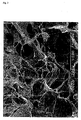
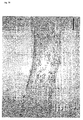
- Example 1 The section of materials as obtained in Example 1 and Comparative Example 1 was observed with a scanning electron microscope.
- the section of Example 1 and that of Comparative Example 1 are shown in Figs. 1 and 2 , respectively.
- the fibrous biodegradation-absorbable synthetic polymer is found in the present invention hybrid material, and it is understood that there is no difference in pore size whether the biodegradation-absorbable synthetic polymer fiber exists or not
- the material as obtained was cut to obtain a column having a diameter of 18 mm and a height of 3 mm, and the stress-distortion curve was obtained when the column was compressed to 50 % of the height with a compression test machine ("Autograph AGS-10kND" produced by Shimadzu Seisakusho) at a speed of 1 mm/minute. Then, the modulus of compressional elasticity was determined from the above curve.
- Example 4 had a modulus of compressional elasticity of 39.4 MPa, but that of Comparative Example 1 had a modulus of compressional elasticity of 6.6 MPa. From this fact, it would be suggested that the hybrid material comprising the biodegradation-absorbable synthetic polymer fiber can display more resistance to higher compression than the simple material consisting of collagen even when the implant is carried out.
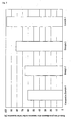
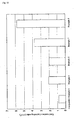
- Example 1 The materials as obtained in Examples 1 to 3 and Comparative Example 1 were each processed to obtain a columnar test piece having a diameter of 15 mm and a height of 3 mm, and this was immersed in 70 % ethanol for 3 minutes, and thereafter immersed in an Eagle's MEM culture medium (containing 10 % of FCS) three times. After the culture medium was removed, the test piece was put in a plate, and 1 ml of Eagle's MEM culture medium (containing 10 % of FCS) including L929 fibroblast (2 ⁇ 10 6 cells/ml) was added thereto, and the resultant mixture was incubated at 37 °C. Then, the diameter of the test piece was measured after 6 hours, and the ratio of the test-piece diameter after immersion to that before immersion was calculated. The result is shown in Fig. 3 . Incidentally, the result was represented by an average value as obtained when the test for each material was carried out three by three.
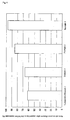
- the diameter of the test piece was measured after 6 hours in the same way as of the above, except that an Eagle's MEM culture medium (containing 10 % of FCS) not including L929 fibroblast (2 ⁇ 10 6 cells/ml) was used instead of that including L929 fibroblast (2 ⁇ 10 6 cells/ml), and then the ratio of the test-piece diameter after immersion to that before immersion was calculated.
- the result is shown in Fig. 4 .
- the result was represented by an average value as obtained when the test for each material was carried out three by three.
- Example 2 and Comparative Example 1 were each processed to obtain a columnar test piece having a diameter of 15 mm and a height of 3 mm, and this was immersed in 70 % ethanol for 3 minutes, and thereafter immersed in an Eagle's MEM culture medium (containing 10 % of FCS) three times. After the culture medium was removed, the test piece was put in a plate, and 0.5 ml of Eagle's MEM culture medium (containing 10 % of FCS) including L929 fibroblast (2 ⁇ 10 6 cells/ml) was added thereto, and the resultant mixture was incubated at 37 °C. Then, the number of the cells as adhered after 6 hours was measured by determining DNA of the cells.
- an Eagle's MEM culture medium containing 10 % of FCS
- Example 1 The materials as obtained in Examples 1 to 4 and Comparative Example 1 were EOG-sterilized, and thereafter they were each cut to obtain a test piece having a size of 5 mm x 5 mm.
- a mouse (ddy, ⁇ , supplied from Shimizu Jikken Zairyo) was cut at its back portion partially, and therefrom two test pieces aforementioned were buried under the back skin of a mouse, and thereafter the portion was sutured. Then, the test pieces were taken out after 3 and 7 days, and the mechanical strength and affinity with cells were evaluated in the following way.
- Example 2 The materials as obtained in Example 2 and Comparative Example 2 were used, and test pieces were produced and implanted to under the back skin of a mouse in the same way as of the above implant test 1. Then, the test piece was taken out after 14 days, and the mechanical strength and affinity with cells were evaluated in the following way.
- the resultant dried product was heat-dehydration-crosslinked at 140 °C under vacuum of lower than 0.1 torr for 12 hours, thus obtaining a hybrid material, in which the ratio of poly(glycolic acid)/collagen was 0.67 (weight ratio).
- a hybrid material was obtained in the same way as of Example 5 except that the weight of the nonwoven fabric including the poly(glycolic acid) was each changed to 3 mg in Example 6, 6 mg in Example 7, and 12 mg in Example 8.
- test pieces were produced and implanted to under the back skin of a mouse in the same way as of the above implant test 1. Then, the test piece was taken out after 24 hours, and the total number of cells intruding into the material and the distance of the intruding cells from a surface of the material were evaluated as indexes for judgment of the affinity with cells in the following way.
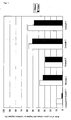
- the number of cells was 2,084,938 for the material of Example 5, 2,000,960 for the material of Example 6, 3,777,916 for the material of Example 7, 5,825,916 for the material of Example 8, and 849,226 for the material of Comparative Example 4. These results are graphed in Fig. 13 . From these results, it was apparent that: the number of cells intruding into the material was increased by including the biodegradation-absorbable synthetic polymer fiber, and was increasing in proportion to the increase of the fiber content.
- the chloroform was removed by freeze-drying, thus obtaining a poly(glycolic acid) fiber (B) coated with 20 weight % of the poly(lactic acid) relative to the poly(glycolic acid).
- the above poly(glycolic acid) fiber (B) was heat-treated under vacuum of lower than 0.1 torr at 195 °C for 30 minutes, thus obtaining a poly(glycolic acid) fiber (C) coated with the poly(lactic acid) and thereafter heat-treated.
- This poly(glycolic acid) fiber (C) was put in a 24-well plate (coaster 3526, corning, NY). Next, 0.75 g of 0.3 weight % type-I collagen solution derived from pig skins was added to the aforementioned 24-well plate. Subsequently, the content of the above 24-well plate was frozen at -80°C for 12 hours, and thereafter freeze-dried under vacuum of lower than 0.1 torr for 24 hours. Thereafter, the resultant dried product was heat-dehydration-crosslinked at 140 °C under vacuum of lower than 0.1 torr for 12 hours, thus obtaining a hybrid material according to the present invention, in which the ratio of poly(glycolic acid)/collagen was 1.33 (weight ratio).
- Fig. 15 the views A, B and C show the poly(glycolic acid) fiber (A), the poly(glycolic acid) fiber (B), and the poly(glycolic acid) fiber (C), respectively. From the result of Fig.
- Example 9 and Example 6 The materials as obtained in Example 9 and Example 6 (in the same way as of Example 9 except that the heat treatment procedure was not carried out after coating the poly(glycolic acid) fiber with the poly(lactic acid)) were used, and test pieces were produced and implanted to under the back skin of a mouse in the same way as of the above implant test 1. Then, the test pieces were taken out after 3 and 7 days, and the mechanical strength was evaluated in the same way as of the implant test 1 to under the back skin of a mouse. The result is shown in Fig. 16 .
- Example 6 The materials as obtained in Example 6 and the simple material consisting of collagen (collagen sponge "Pelunac” produced by Gunze Co., Ltd.) were used as scaffold materials, and each cut to obtain a test piece having a size of 10 mm ⁇ 10 mm ⁇ 3 mm. Then, the respective scaffold materials were combined with fat precursor cells derived from man and gelatin particles soaked with a basic fibroblast growth factor, in order to regenerate the fat under the back skin of a mouse.
- collagen sponge "Pelunac” produced by Gunze Co., Ltd.
- the fat precursor cells derived from man were obtained by isolation from fat tissue sampled during excising a breast cancer from a patient obtaining informed consent in Kyoto University in the following way. Specifically, the aforementioned fat tissue was washed with PBS (phosphoric acid buffer solution) and treated with collagenase (produced by Nitta Gelatin) at 37 °C for 20 minutes.
- PBS phosphoric acid buffer solution
- collagenase produced by Nitta Gelatin
- a culture medium (Medium 199) containing a 10 weight % fetal bovina serum was added thereto, and the resultant mixture was separated with a centrifugal separator (for 5 minutes per 200 g) to remove the resultant supernatant, and the same procedure of adding the culture medium containing the fetal bovina serum and separating with the centrifugal separator was further repeated twice.
- a culture medium as obtained by adding a 0.1 ⁇ g/ml basic fibroblast growth factor was added thereto, and the resultant mixture was cultured in a cell-culture flask (75 cm 2 , CORNING43072, 1 ⁇ 10 3 cells/cm 2 ) in the presence of 5 % CO 2 at 37 °C for 7 days, thus obtaining the fat precursor cells derived from man.
- the gelatin particles soaked with the basic fibroblast growth factor were obtained by adding 1 ⁇ g (50 ⁇ l) of the basic fibroblast growth factor to 2 mg of gelatin particles which were produced by subjecting a gelatin solution in the form of an emulsion to glutaraldehyde-crosslinking, and thereafter leaving the resultant mixture at room temperature for 1 hour to bind the gelatin particles with the basic fibroblast growth factor.
- the fat precursor cells derived from man with a cell density of 1 ⁇ 10 5 cells/culture medium (50 ⁇ l) were mixed with the above gelatin particles soaked with the basic fibroblast growth factor in order to obtain a suspension. Then, the above suspension was added to a scaffold material, and the resultant mixture was incubated for 3 hours.
- the respective scaffold materials (the material of Example 6 and the simple material consisting of collagen) were combined with the fat precursor cells derived from man and the gelatin particles soaked with the basic fibroblast growth factor, as obtained in this way, and the resultant combined materials were used as samples.
- Nude mice (BALB/c, 6w, ⁇ ) were separately cut at a back portion partially. Therefrom, both of these samples were each buried under the back skin of a mouse, and thereafter the portion was sutured. Then, they were sacrificially killed after 42 days, and thereafter the back portion was cut and opened to observe the sample.
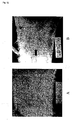
- FIG. 17A and 17B A view obtained by digital camera photography of the sample including the simple material consisting of collagen and a view obtained by digital camera photography of the sample including the material of Example 6 were shown in Figs. 17A and 17B , respectively. From the result of Fig. 17 , as to both samples, it could be confirmed that blood vessels intruded into the samples and fatty tissue was formed.
- the poly(glycolic acid) fiber improved the material strength without damaging the cell affinity of the collagen, and the residual fiber did not hinder the regeneration of fat tissue because its amount as used was small.
- the material operated as a scaffold for regeneration of tissue having much larger volume and significantly increased the volume of the regenerated fat tissue.
- the biodegradation absorbability of the collagen itself is identical whether the poly(glycolic acid) fiber exists or not.
- the present invention can provide a hybrid material for regeneration of living body tissue, which is excellent in affinity with cells, and which can retain sufficient mechanical strength for a term needed to regenerate the tissue, and which simultaneously has moderate biodegradation absorbability which enables degradation and disappearance rapidly after the regeneration of the tissue.
Landscapes
- Health & Medical Sciences (AREA)
- Chemical & Material Sciences (AREA)
- Dermatology (AREA)
- Medicinal Chemistry (AREA)
- Oral & Maxillofacial Surgery (AREA)
- Transplantation (AREA)
- Epidemiology (AREA)
- Life Sciences & Earth Sciences (AREA)
- Animal Behavior & Ethology (AREA)
- General Health & Medical Sciences (AREA)
- Public Health (AREA)
- Veterinary Medicine (AREA)
- Engineering & Computer Science (AREA)
- Composite Materials (AREA)
- Materials Engineering (AREA)
- Dispersion Chemistry (AREA)
- Materials For Medical Uses (AREA)
Claims (2)
- Hybridmaterial zur Regeneration von lebendem Körpergewebe, das (A) einen Schwamm, der ein vernetztes, natürlich auftretendes Polymer einschließt, und (B) Bioabbau-absorbierbare synthetische Polymerfasern umfasst, wobei das Hybridmaterial dadurch gekennzeichnet ist,
dass die Bioabbau-absorbierbaren synthetischen Polymerfasern in dem Schwamm vorhanden sind,
dass die Bioabbau-absorbierbaren synthetischen Polymerfasern mit einem Bioabbau-absorbierbaren synthetischen Polymer beschichtet sind, das einen Schmelzpunkt aufweist, der niedriger als der Schmelzpunkt der Bioabbau-absorbierbaren synthetischen Polymerfasern, zur Flockung an einem Überschneidungspunkt, ist und
dass das Gewichtsverhältnis von Bioabbau-absorbierbarem synthetischen Polymer/natürlich auftretendem Polymer im Bereich von 0,2 bis 10,0 liegt. - Hybridmaterial zur Regeneration von lebendem Körpergewebe gemäß Anspruch 1, wobei die Bioabbau-absorbierbare synthetische Polymerfaser ausgewählt ist aus der Gruppe bestehend aus Polyglycolsäure, Polymilchsäure, Poly-ε-caprolacton, Polydioxanon, Poly-β-äpfelsäure, Polyorthoester, Polydiaminophosphazen und deren Copolymeren.
Applications Claiming Priority (3)
| Application Number | Priority Date | Filing Date | Title |
|---|---|---|---|
| JP2001297888 | 2001-09-27 | ||
| JP2001297888 | 2001-09-27 | ||
| PCT/JP2002/009893 WO2003028782A1 (en) | 2001-09-27 | 2002-09-25 | Composite material for tissue regeneration |
Publications (3)
| Publication Number | Publication Date |
|---|---|
| EP1437149A1 EP1437149A1 (de) | 2004-07-14 |
| EP1437149A4 EP1437149A4 (de) | 2009-11-11 |
| EP1437149B1 true EP1437149B1 (de) | 2013-08-14 |
Family
ID=19118883
Family Applications (1)
| Application Number | Title | Priority Date | Filing Date |
|---|---|---|---|
| EP20020800014 Expired - Lifetime EP1437149B1 (de) | 2001-09-27 | 2002-09-25 | Zusammengesetztes material für die geweberegeneration |
Country Status (4)
| Country | Link |
|---|---|
| US (1) | US20030059460A1 (de) |
| EP (1) | EP1437149B1 (de) |
| JP (1) | JP3806426B2 (de) |
| WO (1) | WO2003028782A1 (de) |
Families Citing this family (22)
| Publication number | Priority date | Publication date | Assignee | Title |
|---|---|---|---|---|
| JP4646487B2 (ja) * | 2002-12-19 | 2011-03-09 | グンゼ株式会社 | 軟骨培養用基材及びその製造法 |
| GB0307011D0 (en) * | 2003-03-27 | 2003-04-30 | Regentec Ltd | Porous matrix |
| JP4620952B2 (ja) * | 2004-01-26 | 2011-01-26 | グンゼ株式会社 | 尿道組織再生用基材及び尿道組織再生方法 |
| JP4864303B2 (ja) * | 2004-09-07 | 2012-02-01 | 株式会社メドジェル | 細胞の足場材料の補強に用いる繊維材料の製造方法 |
| CN100382772C (zh) * | 2005-09-28 | 2008-04-23 | 南通大学 | 含蚕丝丝素的医用神经移植物的制备方法 |
| US20100190254A1 (en) | 2006-12-05 | 2010-07-29 | Nanyang Technological University | Three-dimensional porous hybrid scaffold and manufacture thereof |
| WO2008069761A1 (en) * | 2006-12-05 | 2008-06-12 | Nanyang Technological University | Manufacturing three-dimensional scaffolds using cryogenic prototyping |
| JPWO2010110286A1 (ja) * | 2009-03-25 | 2012-09-27 | 国立大学法人京都大学 | 瘻管治療材料 |
| NZ599399A (en) | 2009-10-07 | 2014-05-30 | Kerecis Ehf | A scaffold material for wound care and/or other tissue healing applications |
| JP5679684B2 (ja) * | 2010-03-17 | 2015-03-04 | グンゼ株式会社 | Danceタンパク質含有組織再生用基材 |
| WO2013144727A2 (en) | 2012-03-30 | 2013-10-03 | Kerecis Ehf | A scaffold material graft for wound care and/or other tissue healing applications |
| WO2014110590A1 (en) | 2013-01-14 | 2014-07-17 | Scripps Health | Tissue array printing |
| CN103285424B (zh) * | 2013-05-27 | 2016-06-22 | 东华大学 | 一种三维纤维基气凝胶组织工程支架及其制备方法 |
| EP3116557B1 (de) | 2014-03-14 | 2020-03-11 | Scripps Health | Elektrospinning von knorpel- und meniskusmatrixpolymeren |
| JP6305357B2 (ja) * | 2015-01-30 | 2018-04-04 | グンゼ株式会社 | 脂肪組織再建用部材 |
| CA3153310A1 (en) * | 2019-10-03 | 2021-04-08 | William M. HEIM | Polymer-permeated grafts and methods of making and using the same |
| US20230212508A1 (en) * | 2020-05-29 | 2023-07-06 | Gunze Limited | Adipose tissue regeneration base material |
| IL306013A (en) | 2021-03-24 | 2023-11-01 | Kerecis Hf | Colored biological wound care that provides monitoring of healing progress |
| CN113670005B (zh) * | 2021-09-03 | 2022-06-21 | 海西纺织新材料工业技术晋江研究院 | 人造皮肤用聚乙交酯经编支撑网的干燥方法 |
| US20260000427A1 (en) | 2022-09-16 | 2026-01-01 | Coloplast A/S | Systems for making a fat-inclusive skin graft treatment composition, fat-inclusive skin graft treatment composition, and methods of making same |
| WO2025069002A1 (en) | 2023-09-29 | 2025-04-03 | Kerecis Limited | Wound dressing |
| WO2025069003A1 (en) | 2023-09-29 | 2025-04-03 | Kerecis Limited | Wound treatment devices, kits, systems, and methods |
Family Cites Families (101)
| Publication number | Priority date | Publication date | Assignee | Title |
|---|---|---|---|---|
| US1178927A (en) * | 1913-08-14 | 1916-04-11 | Beacon Miniature Electric Co Inc | Galvanic cell. |
| US1275666A (en) * | 1916-12-06 | 1918-08-13 | Nat Carbon Co Inc | Preparation of higher oxid-of-manganese depolarizing material. |
| US1293461A (en) * | 1917-05-11 | 1919-02-04 | Morduch L Kaplan | Process of preparing manganese peroxid. |
| US1851312A (en) * | 1929-05-24 | 1932-03-29 | Wilbert J Huff | Process of purifying gas |
| US2123250A (en) * | 1934-12-24 | 1938-07-12 | Ig Farbenindustrie Ag | Process for the production of depolarizing compositions from native manganese dioxide, e.g., pyrolusite |
| US2608466A (en) * | 1948-12-15 | 1952-08-26 | Reginald S Dean | Process for preparing active from of manganese dioxide |
| US2956860A (en) * | 1957-04-11 | 1960-10-18 | Manganese Chemicals Corp | Process for producing manganese dioxide |
| US2984545A (en) * | 1958-02-27 | 1961-05-16 | Tennessee Valley Authority | Manganese oxide process for the recovery of sulfur dioxide from waste gases |
| US3150923A (en) * | 1962-01-18 | 1964-09-29 | Bienstock Daniel | Process for removing sulfur dioxide from gases |
| US3251649A (en) * | 1962-02-28 | 1966-05-17 | Mitsubishi Shipbuilding & Eng | Process of producing sulfuric acid |
| DE1189960B (de) * | 1962-10-27 | 1965-04-01 | Varta Pertrix Union Ges Mit Be | Verfahren zur Herstellung von Ramsdellit |
| US3330096A (en) * | 1965-02-19 | 1967-07-11 | Kennecott Copper Corp | Use of deep-sea nodules for removing sulfur compounds from gases |
| GB1078596A (en) * | 1965-03-24 | 1967-08-09 | Mitsubishi Heavy Ind Ltd | Process for the treatment of sulfur oxide-containing gases |
| US3898320A (en) * | 1965-03-24 | 1975-08-05 | Mitsubishi Heavy Ind Ltd | Dry absorbent composition and process for making the same |
| US3723598A (en) * | 1970-11-05 | 1973-03-27 | Kennecott Copper Corp | Dry cyclic process utilizing a manganous oxide absorbent for removal of dilute sulfur values from gas streams |
| US3956189A (en) * | 1972-02-14 | 1976-05-11 | Chemical Construction Corporation | Catalyst for treating combustion exhaust gas |
| US3948608A (en) * | 1972-03-24 | 1976-04-06 | Weir Jr Alexander | Apparatus for treating stack gases |
| US4369167A (en) * | 1972-03-24 | 1983-01-18 | Weir Jr Alexander | Process for treating stack gases |
| US4012487A (en) * | 1973-04-02 | 1977-03-15 | Merkl George | Process for the removal of SO2 from a stack gas |
| JPS49126566A (de) * | 1973-04-10 | 1974-12-04 | ||
| US4029752A (en) * | 1973-05-29 | 1977-06-14 | Exxon Research And Engineering Company | Method of producing sulfur from sulfur dioxide |
| JPS5062856A (de) * | 1973-09-13 | 1975-05-29 | ||
| US4008169A (en) * | 1973-10-05 | 1977-02-15 | Mcgauley Patrick John | Preparation of iron oxide sorbent for sulfur oxides |
| GB1482643A (en) * | 1973-10-31 | 1977-08-10 | Kureha Chemical Ind Co Ltd | Method for removing oxides of nitrogen from a gas |
| JPS5643771B2 (de) * | 1973-12-18 | 1981-10-15 | ||
| US3951765A (en) * | 1973-12-20 | 1976-04-20 | Peter Kenneth Everett | Production of electrolytic battery active manganese dioxide |
| DE2419490C3 (de) * | 1974-04-23 | 1978-03-09 | Rheinisch-Westfaelisches Elektrizitaetswerk Ag, 4300 Essen | Verfahren zur Herstellung von Mangandioxid |
| US3933128A (en) * | 1974-10-07 | 1976-01-20 | Clean Energy Corporation | Steam generation with coal |
| US4033113A (en) * | 1974-10-07 | 1977-07-05 | Clean Energy Corporation | Steam generation with coal |
| US4070441A (en) * | 1975-01-31 | 1978-01-24 | American Electronic Laboratories, Inc. | Method of removing sulfur dioxide from flue gases |
| JPS51112786A (en) * | 1975-03-31 | 1976-10-05 | Hitachi Ltd | Process for the removal of nitrogen oxide by absorption from exhaust g as |
| US4153429A (en) * | 1975-05-21 | 1979-05-08 | Union Carbide Corporation | Selective adsorption of NOx from gas streams |
| US4014982A (en) * | 1975-06-30 | 1977-03-29 | Texaco Development Corporation | Combined process for upgrading spent alkylation acid and reducing noxious gas content of waste gaseous streams |
| CA1077914A (en) * | 1975-07-22 | 1980-05-20 | George G. Merkl | Process for the removal of so2 from a stack gas absorptive medium for use in process and process for preparing the absorptive medium |
| US4017586A (en) * | 1975-08-06 | 1977-04-12 | Reeves Adam A | Stack gas treatment |
| US4123507A (en) * | 1976-11-02 | 1978-10-31 | Union Oil Company Of California | Process for removing sulfur and NOx components from a gas stream |
| US4112053A (en) * | 1977-01-04 | 1978-09-05 | Kureha Kagaku Kogyo Kabushiki Kaisha | Dry method for the denitrification of exhaust gas containing nitrogen oxides |
| US4123499A (en) * | 1977-05-20 | 1978-10-31 | Chemetals Corporation | Recovering metal values from marine manganese nodules |
| US4162207A (en) * | 1978-09-05 | 1979-07-24 | Boyer Stephen K | Process for the conversion of sulfur dioxide |
| US4164545A (en) * | 1978-10-03 | 1979-08-14 | Phillips Petroleum Company | Use of manganese dioxide absorbent in treating waste gases |
| US4277360A (en) * | 1979-03-28 | 1981-07-07 | Union Carbide Corporation | Manganese dioxide |
| US4369108A (en) * | 1979-04-11 | 1983-01-18 | Standard Oil Company (Indiana) | Process for removing sulfur oxides from a gas |
| US4497902A (en) * | 1979-04-11 | 1985-02-05 | Standard Oil Company (Indiana) | Composition for removing sulfur oxides from a gas |
| US4381991A (en) * | 1979-04-11 | 1983-05-03 | Standard Oil Company (Indiana) | Process for removing sulfur oxides from a gas |
| US4369130A (en) * | 1979-04-11 | 1983-01-18 | Standard Oil Company | Composition for removing sulfur oxides from a gas |
| US4309386A (en) * | 1979-04-30 | 1982-01-05 | The Babcock & Wilcox Company | Filter house having catalytic filter bags for simultaneously removing NOx and particulate matter from a gas stream |
| US4250149A (en) * | 1979-05-15 | 1981-02-10 | Chemetals Corporation | Manganese nitrate decomposition |
| US4310494A (en) * | 1979-05-15 | 1982-01-12 | Chemetals Corporation | Manganese nitrate spray decomposition |
| JPS581050B2 (ja) * | 1979-10-04 | 1983-01-10 | 田辺 伊佐雄 | 二酸化マンガンの製造法 |
| US4276268A (en) * | 1979-10-09 | 1981-06-30 | Chemetals Corporation | Process for preparing manganese nitrate solution |
| US4309392A (en) * | 1980-08-05 | 1982-01-05 | Standard Oil Company | Process for removing nitrogen oxides from a gas stream |
| US4376103A (en) * | 1981-10-26 | 1983-03-08 | Standard Oil Company (Indiana) | Removing sulfur oxides from a gas |
| US4400362A (en) * | 1981-11-04 | 1983-08-23 | Lerner Bernard J | Removal of nitrogen oxides from gas |
| US4542116A (en) * | 1982-03-29 | 1985-09-17 | The Standard Oil Company | Catalyst for removing sulfur oxides from a gas |
| US4500281A (en) * | 1982-08-02 | 1985-02-19 | Phillips Petroleum Company | Burning of fuels |
| US4411878A (en) * | 1982-09-30 | 1983-10-25 | Chemetals Incorporated | Preparation of Mn3 O4 |
| US4450148A (en) * | 1982-09-30 | 1984-05-22 | Chemetals Incorporated | Preparation of manganite, MnOOH |
| US4448760A (en) * | 1982-09-30 | 1984-05-15 | Chemetals Incorporated | Continuous process for the preparation of manganite, MnOOH |
| US4476104A (en) * | 1982-12-21 | 1984-10-09 | Union Carbide Corporation | Manganese dioxide and process for the production thereof |
| DE3312890A1 (de) * | 1983-04-11 | 1984-10-11 | Zbigniew Dr. 6078 Neu-Isenburg Boguslawski | Verfahren und vorrichtung zur reinigung von verbrennungsgasen aus beispielsweise haushaltsheizungen, verbrennungsmotoren oder dergl. feuerungen |
| JPS605215A (ja) * | 1983-06-22 | 1985-01-11 | Mitsui Mining & Smelting Co Ltd | 浄水用濾材 |
| US4479877A (en) * | 1983-07-28 | 1984-10-30 | The United States Of America As Represented By The Administrator Environmental Protection Agency | Removal of nitrate from water supplies using a tributyl amine strong base anion exchange resin |
| US4836993A (en) * | 1983-09-27 | 1989-06-06 | Amoco Corporation | Process for removing sulfur oxides from a gas |
| US5112796A (en) * | 1984-02-26 | 1992-05-12 | Aquafine Corporation | Manganese dioxide impregnated filter |
| US4940569A (en) * | 1984-10-12 | 1990-07-10 | Noxso Corporation | Sorbent and processes for removing nitrogen oxides, sulfur oxides and hydrogen sulfide from gas streams |
| US4798711A (en) * | 1984-10-12 | 1989-01-17 | Noxso Corporation | Processes for removing nitrogen oxides, sulfur oxides and hydrogen sulfide from gas streams |
| US4755499A (en) * | 1984-10-12 | 1988-07-05 | Noxso Corporation | Sorbent for removing nitrogen oxides, sulfur oxides and hydrogen sulfide from gas streams |
| US4581210A (en) * | 1984-11-09 | 1986-04-08 | Teller Environmental Systems, Inc. | Method for the removal of sulphur oxides from a flue gas with a baghouse used as a secondary reactor |
| US4923688A (en) * | 1985-11-19 | 1990-05-08 | Joseph Iannicelli | Wet scrubber process for removing total reduced sulfur compounds from industrial gases |
| CA1279861C (en) * | 1986-05-12 | 1991-02-05 | Karl T. Chuang | Catalyst assembly |
| DE3716334A1 (de) * | 1987-05-15 | 1988-12-01 | Kernforschungsanlage Juelich | Verfahren zur no(pfeil abwaerts)x(pfeil abwaerts)-abscheidung aus abgasstroemen in kontakt mit einer regenerierbaren feststoffschicht |
| DE3801426A1 (de) * | 1988-01-20 | 1989-08-03 | Ethicon Gmbh | Filzartiges implantat |
| US4954324A (en) * | 1988-03-29 | 1990-09-04 | Natec Resources, Inc. | Method of baghouse brown plume pollution control |
| US4843980A (en) * | 1988-04-26 | 1989-07-04 | Lucille Markham | Composition for use in reducing air contaminants from combustion effluents |
| US4921689A (en) * | 1988-06-24 | 1990-05-01 | Duracell Inc. | Process for producing beta manganese dioxide |
| US4925633A (en) * | 1988-07-25 | 1990-05-15 | The Babcock & Wilcox Company | Combined catalytic baghouse and heat pipe air heater |
| JP2805086B2 (ja) * | 1989-06-20 | 1998-09-30 | グンゼ株式会社 | 生体組織用充填材 |
| US4944878A (en) * | 1989-11-16 | 1990-07-31 | Iowa State University Research Foundation, Inc. | Decontamination of water using nitrate selective ion exchange resin |
| US5176888A (en) * | 1990-03-26 | 1993-01-05 | University Of Delaware | Acid rain abatement |
| US5023063A (en) * | 1990-03-26 | 1991-06-11 | The University Of Delaware | Acid rain abatement |
| US5658544A (en) * | 1990-08-03 | 1997-08-19 | Comalco Aluminium Limited | Gas-solid contacting method |
| US5192515A (en) * | 1990-09-20 | 1993-03-09 | Molecular Technology Corporation | Reduction of nitrogen oxide and carbon monoxide in effluent gases |
| US5246554A (en) * | 1991-03-18 | 1993-09-21 | Cha Chang Y | Process for selected gas oxide removal by radiofrequency catalysts |
| US5199263A (en) * | 1991-08-12 | 1993-04-06 | Texas Utilities Electric Co. | Combustion system with reduced sulfur oxide emissions |
| US5200160A (en) * | 1991-08-29 | 1993-04-06 | Dravo Lime Company | Process for removing sulfur dioxide and nitrogen oxides from flue gases |
| US5384301A (en) * | 1991-11-12 | 1995-01-24 | Massachusetts Institute Of Technology | Catalyst for elemental sulfur recovery process |
| US5277890A (en) * | 1992-09-28 | 1994-01-11 | Duracell Inc. | Process for producing manganese dioxide |
| US5798088A (en) * | 1993-03-30 | 1998-08-25 | Research Triangle Institute | Method for producing elemental sulfur from sulfur-containing gases |
| US5439658A (en) * | 1993-09-03 | 1995-08-08 | The Babcock & Wilcox Company | Regenerable magnesium dry scrubbing |
| US5607496A (en) * | 1994-06-01 | 1997-03-04 | Brooks Rand, Ltd. | Removal of mercury from a combustion gas stream and apparatus |
| US5505766A (en) * | 1994-07-12 | 1996-04-09 | Electric Power Research, Inc. | Method for removing pollutants from a combustor flue gas and system for same |
| US5672323A (en) * | 1995-01-26 | 1997-09-30 | The Babcock & Wilcox Company | Activated carbon flue gas desulfurization systems for mercury removal |
| US6010666A (en) * | 1995-03-23 | 2000-01-04 | Toto, Ltd. | Deodorizing method, deodorizer, method of manufacturing deodorizer, and deodorizing apparatus |
| US5888926A (en) * | 1995-08-28 | 1999-03-30 | University Of Cincinnati | Process for forming a sorbent-metal complex by employing a sorbent precursor |
| JP3924322B2 (ja) * | 1995-09-26 | 2007-06-06 | 株式会社 神戸製鋼所 | 有害ガス除去剤 |
| GB2314842B (en) * | 1996-06-28 | 2001-01-17 | Johnson & Johnson Medical | Collagen-oxidized regenerated cellulose complexes |
| US5780000A (en) * | 1996-09-09 | 1998-07-14 | Gas Research Institute | Use of Z-Sorb process as catalytic incinerator for tail gas from sulfur plants |
| US6214304B1 (en) * | 1996-12-02 | 2001-04-10 | L & C STEINMüLLER GMBH | Method of removing mercury from a mercury-containing flue gas |
| US6039783A (en) * | 1996-12-03 | 2000-03-21 | The United States Of America As Represented By The Administrator Of The National Aeronautics And Space Administration | Process and equipment for nitrogen oxide waste conversion to fertilizer |
| JP4968976B2 (ja) * | 1998-03-06 | 2012-07-04 | 慶彦 清水 | コラーゲン材及びその製法 |
| US6309454B1 (en) * | 2000-05-12 | 2001-10-30 | Johnson & Johnson Medical Limited | Freeze-dried composite materials and processes for the production thereof |
-
2002
- 2002-09-24 US US10/252,437 patent/US20030059460A1/en not_active Abandoned
- 2002-09-25 WO PCT/JP2002/009893 patent/WO2003028782A1/ja not_active Ceased
- 2002-09-25 EP EP20020800014 patent/EP1437149B1/de not_active Expired - Lifetime
- 2002-09-25 JP JP2003532109A patent/JP3806426B2/ja not_active Expired - Lifetime
Also Published As
| Publication number | Publication date |
|---|---|
| EP1437149A4 (de) | 2009-11-11 |
| JPWO2003028782A1 (ja) | 2005-01-13 |
| WO2003028782A1 (en) | 2003-04-10 |
| EP1437149A1 (de) | 2004-07-14 |
| JP3806426B2 (ja) | 2006-08-09 |
| US20030059460A1 (en) | 2003-03-27 |
Similar Documents
| Publication | Publication Date | Title |
|---|---|---|
| EP1437149B1 (de) | Zusammengesetztes material für die geweberegeneration | |
| Fornasari et al. | Natural-based biomaterials for peripheral nerve injury repair | |
| Chowdhury et al. | Collagen type I: A versatile biomaterial | |
| Ma et al. | Collagen/chitosan porous scaffolds with improved biostability for skin tissue engineering | |
| Guan et al. | Biodegradable elastomeric scaffolds with basic fibroblast growth factor release | |
| TWI264301B (en) | Multi-channel bioresorbable nerve regeneration conduit and preparation method for the same | |
| Cirillo et al. | A comparison of the performance of mono-and bi-component electrospun conduits in a rat sciatic model | |
| JP6118905B2 (ja) | 心臓修復パッチの新しいスキャフォールド | |
| KR100621569B1 (ko) | 조직 재생을 유도하기 위한 생체 모방형태의 나노섬유와마이크로 섬유의 복합지지체 및 그의 제조방법 | |
| EP2793962B1 (de) | Verfahren zur modifizierung der oberflächenmorphologie einer medizinischen vorrichtung | |
| CZ20001295A3 (cs) | Vícevrstevná membrána | |
| WO2004062697A2 (en) | Silk fibroin materials and use thereof | |
| WO2015074176A1 (zh) | 用于组织再生的亲水性静电纺生物复合支架材料及其制法与应用 | |
| JP2002506691A (ja) | 組織修復及び再建に用いる生体高分子マット | |
| KR100571478B1 (ko) | 생분해성 고분자로 이루어진 섬유형 다공성 지지체 및그의 제조방법 | |
| Wongputtaraksa et al. | Surface modification of Thai silk fibroin scaffolds with gelatin and chitooligosaccharide for enhanced osteogenic differentiation of bone marrow‐derived mesenchymal stem cells | |
| JP2009513207A (ja) | Ecm材料を伴う生分解性足場 | |
| US12173048B2 (en) | Collagen fiber-based ink and methods of use for bioprinting | |
| US12521469B2 (en) | Composite product for the osteoarticular regeneration of cartilage lesion | |
| JP2005213449A (ja) | ゼラチンスポンジ | |
| KR100482651B1 (ko) | 조직공학용 천연/합성 하이브리드 담체 및 이의 제조방법 | |
| Wang et al. | Utility of air bladder-derived nanostructured ECM for tissue regeneration | |
| JP4393888B2 (ja) | 足場材料 | |
| EP1305059B1 (de) | Bioartifizielles verbundmaterial und verfahren zu seiner herstellung | |
| JP4464056B2 (ja) | 発毛促進用複合材料 |
Legal Events
| Date | Code | Title | Description |
|---|---|---|---|
| PUAI | Public reference made under article 153(3) epc to a published international application that has entered the european phase |
Free format text: ORIGINAL CODE: 0009012 |
|
| 17P | Request for examination filed |
Effective date: 20040405 |
|
| AK | Designated contracting states |
Kind code of ref document: A1 Designated state(s): AT BE BG CH CY CZ DE DK EE ES FI FR GB GR IE IT LI LU MC NL PT SE SK TR |
|
| AX | Request for extension of the european patent |
Extension state: AL LT LV MK RO SI |
|
| RIC1 | Information provided on ipc code assigned before grant |
Ipc: A61L 27/48 20060101ALI20090903BHEP Ipc: A61L 27/56 20060101AFI20090903BHEP |
|
| A4 | Supplementary search report drawn up and despatched |
Effective date: 20090915 |
|
| 17Q | First examination report despatched |
Effective date: 20100114 |
|
| GRAP | Despatch of communication of intention to grant a patent |
Free format text: ORIGINAL CODE: EPIDOSNIGR1 |
|
| RIN1 | Information on inventor provided before grant (corrected) |
Inventor name: HIRAOKA, YOSUKE Inventor name: TABATA, YASUHIKO Inventor name: MANDAI, YOSHINOBU |
|
| GRAS | Grant fee paid |
Free format text: ORIGINAL CODE: EPIDOSNIGR3 |
|
| GRAA | (expected) grant |
Free format text: ORIGINAL CODE: 0009210 |
|
| AK | Designated contracting states |
Kind code of ref document: B1 Designated state(s): DE FR GB IT |
|
| REG | Reference to a national code |
Ref country code: GB Ref legal event code: FG4D |
|
| REG | Reference to a national code |
Ref country code: DE Ref legal event code: R096 Ref document number: 60245386 Country of ref document: DE Effective date: 20131010 |
|
| PGFP | Annual fee paid to national office [announced via postgrant information from national office to epo] |
Ref country code: DE Payment date: 20131122 Year of fee payment: 12 Ref country code: FR Payment date: 20130918 Year of fee payment: 12 |
|
| PGFP | Annual fee paid to national office [announced via postgrant information from national office to epo] |
Ref country code: IT Payment date: 20130926 Year of fee payment: 12 |
|
| PLBE | No opposition filed within time limit |
Free format text: ORIGINAL CODE: 0009261 |
|
| STAA | Information on the status of an ep patent application or granted ep patent |
Free format text: STATUS: NO OPPOSITION FILED WITHIN TIME LIMIT |
|
| REG | Reference to a national code |
Ref country code: DE Ref legal event code: R082 Ref document number: 60245386 Country of ref document: DE |
|
| 26N | No opposition filed |
Effective date: 20140515 |
|
| REG | Reference to a national code |
Ref country code: DE Ref legal event code: R097 Ref document number: 60245386 Country of ref document: DE Effective date: 20140515 |
|
| REG | Reference to a national code |
Ref country code: DE Ref legal event code: R119 Ref document number: 60245386 Country of ref document: DE |
|
| REG | Reference to a national code |
Ref country code: DE Ref legal event code: R119 Ref document number: 60245386 Country of ref document: DE Effective date: 20150401 |
|
| REG | Reference to a national code |
Ref country code: FR Ref legal event code: ST Effective date: 20150529 |
|
| PG25 | Lapsed in a contracting state [announced via postgrant information from national office to epo] |
Ref country code: DE Free format text: LAPSE BECAUSE OF NON-PAYMENT OF DUE FEES Effective date: 20150401 |
|
| PG25 | Lapsed in a contracting state [announced via postgrant information from national office to epo] |
Ref country code: FR Free format text: LAPSE BECAUSE OF NON-PAYMENT OF DUE FEES Effective date: 20140930 Ref country code: IT Free format text: LAPSE BECAUSE OF NON-PAYMENT OF DUE FEES Effective date: 20140925 |
|
| PGFP | Annual fee paid to national office [announced via postgrant information from national office to epo] |
Ref country code: GB Payment date: 20190924 Year of fee payment: 18 |
|
| GBPC | Gb: european patent ceased through non-payment of renewal fee |
Effective date: 20200925 |
|
| PG25 | Lapsed in a contracting state [announced via postgrant information from national office to epo] |
Ref country code: GB Free format text: LAPSE BECAUSE OF NON-PAYMENT OF DUE FEES Effective date: 20200925 |