EP1440046B1 - Hydrogenolyse de sucres, de sucre alcools et de glycerol - Google Patents
Hydrogenolyse de sucres, de sucre alcools et de glycerol Download PDFInfo
- Publication number
- EP1440046B1 EP1440046B1 EP02784244.2A EP02784244A EP1440046B1 EP 1440046 B1 EP1440046 B1 EP 1440046B1 EP 02784244 A EP02784244 A EP 02784244A EP 1440046 B1 EP1440046 B1 EP 1440046B1
- Authority
- EP
- European Patent Office
- Prior art keywords
- catalyst
- hydrogenolysis
- carbon
- glycerol
- selectivity
- Prior art date
- Legal status (The legal status is an assumption and is not a legal conclusion. Google has not performed a legal analysis and makes no representation as to the accuracy of the status listed.)
- Expired - Lifetime
Links
- PEDCQBHIVMGVHV-UHFFFAOYSA-N Glycerine Chemical compound OCC(O)CO PEDCQBHIVMGVHV-UHFFFAOYSA-N 0.000 title claims description 183
- 238000007327 hydrogenolysis reaction Methods 0.000 title claims description 57
- 235000000346 sugar Nutrition 0.000 title claims description 38
- 150000005846 sugar alcohols Chemical class 0.000 title claims description 26
- 150000008163 sugars Chemical class 0.000 title claims description 15
- PXHVJJICTQNCMI-UHFFFAOYSA-N Nickel Chemical compound [Ni] PXHVJJICTQNCMI-UHFFFAOYSA-N 0.000 claims description 107
- 229910052702 rhenium Inorganic materials 0.000 claims description 104
- 229910052799 carbon Inorganic materials 0.000 claims description 85
- 238000006243 chemical reaction Methods 0.000 claims description 63
- 238000000034 method Methods 0.000 claims description 61
- OKTJSMMVPCPJKN-UHFFFAOYSA-N Carbon Chemical compound [C] OKTJSMMVPCPJKN-UHFFFAOYSA-N 0.000 claims description 58
- 239000001257 hydrogen Substances 0.000 claims description 47
- 229910052739 hydrogen Inorganic materials 0.000 claims description 47
- UFHFLCQGNIYNRP-UHFFFAOYSA-N Hydrogen Chemical compound [H][H] UFHFLCQGNIYNRP-UHFFFAOYSA-N 0.000 claims description 44
- WUAPFZMCVAUBPE-UHFFFAOYSA-N rhenium atom Chemical compound [Re] WUAPFZMCVAUBPE-UHFFFAOYSA-N 0.000 claims description 40
- 239000000203 mixture Substances 0.000 claims description 24
- XLYOFNOQVPJJNP-UHFFFAOYSA-N water Substances O XLYOFNOQVPJJNP-UHFFFAOYSA-N 0.000 claims description 16
- -1 carbon sugar alcohol Chemical class 0.000 claims description 12
- 239000007787 solid Substances 0.000 claims description 9
- 230000007935 neutral effect Effects 0.000 claims description 6
- 239000011949 solid catalyst Substances 0.000 claims description 6
- DNIAPMSPPWPWGF-VKHMYHEASA-N (+)-propylene glycol Chemical compound C[C@H](O)CO DNIAPMSPPWPWGF-VKHMYHEASA-N 0.000 claims description 5
- YPFDHNVEDLHUCE-UHFFFAOYSA-N 1,3-propanediol Substances OCCCO YPFDHNVEDLHUCE-UHFFFAOYSA-N 0.000 claims description 5
- QVGXLLKOCUKJST-UHFFFAOYSA-N atomic oxygen Chemical compound [O] QVGXLLKOCUKJST-UHFFFAOYSA-N 0.000 claims description 5
- 150000002894 organic compounds Chemical class 0.000 claims description 5
- 239000001301 oxygen Substances 0.000 claims description 5
- 229910052760 oxygen Inorganic materials 0.000 claims description 5
- 229920000166 polytrimethylene carbonate Polymers 0.000 claims description 5
- 230000002378 acidificating effect Effects 0.000 claims description 4
- 239000007864 aqueous solution Substances 0.000 claims description 4
- 238000004519 manufacturing process Methods 0.000 claims description 4
- 239000003054 catalyst Substances 0.000 description 119
- JVTAAEKCZFNVCJ-UHFFFAOYSA-N lactic acid Chemical compound CC(O)C(O)=O JVTAAEKCZFNVCJ-UHFFFAOYSA-N 0.000 description 58
- 229910052759 nickel Inorganic materials 0.000 description 52
- GCLGEJMYGQKIIW-UHFFFAOYSA-H sodium hexametaphosphate Chemical compound [Na]OP1(=O)OP(=O)(O[Na])OP(=O)(O[Na])OP(=O)(O[Na])OP(=O)(O[Na])OP(=O)(O[Na])O1 GCLGEJMYGQKIIW-UHFFFAOYSA-H 0.000 description 49
- DNIAPMSPPWPWGF-UHFFFAOYSA-N Propylene glycol Chemical compound CC(O)CO DNIAPMSPPWPWGF-UHFFFAOYSA-N 0.000 description 36
- 229910052751 metal Inorganic materials 0.000 description 36
- 239000002184 metal Substances 0.000 description 36
- 229910052707 ruthenium Inorganic materials 0.000 description 35
- 239000004310 lactic acid Substances 0.000 description 31
- 238000005984 hydrogenation reaction Methods 0.000 description 29
- 235000014655 lactic acid Nutrition 0.000 description 29
- 239000000047 product Substances 0.000 description 27
- 239000000243 solution Substances 0.000 description 26
- FBPFZTCFMRRESA-FSIIMWSLSA-N D-Glucitol Natural products OC[C@H](O)[C@H](O)[C@@H](O)[C@H](O)CO FBPFZTCFMRRESA-FSIIMWSLSA-N 0.000 description 25
- FBPFZTCFMRRESA-JGWLITMVSA-N D-glucitol Chemical compound OC[C@H](O)[C@@H](O)[C@H](O)[C@H](O)CO FBPFZTCFMRRESA-JGWLITMVSA-N 0.000 description 25
- 239000000600 sorbitol Substances 0.000 description 25
- KJTLSVCANCCWHF-UHFFFAOYSA-N Ruthenium Chemical compound [Ru] KJTLSVCANCCWHF-UHFFFAOYSA-N 0.000 description 22
- 229910052726 zirconium Inorganic materials 0.000 description 22
- HEBKCHPVOIAQTA-UHFFFAOYSA-N meso ribitol Natural products OCC(O)C(O)C(O)CO HEBKCHPVOIAQTA-UHFFFAOYSA-N 0.000 description 18
- LYCAIKOWRPUZTN-UHFFFAOYSA-N Ethylene glycol Chemical compound OCCO LYCAIKOWRPUZTN-UHFFFAOYSA-N 0.000 description 15
- TVXBFESIOXBWNM-UHFFFAOYSA-N Xylitol Natural products OCCC(O)C(O)C(O)CCO TVXBFESIOXBWNM-UHFFFAOYSA-N 0.000 description 15
- 239000002585 base Substances 0.000 description 15
- 230000003197 catalytic effect Effects 0.000 description 15
- 239000000463 material Substances 0.000 description 15
- 239000000811 xylitol Substances 0.000 description 15
- HEBKCHPVOIAQTA-SCDXWVJYSA-N xylitol Chemical compound OC[C@H](O)[C@@H](O)[C@H](O)CO HEBKCHPVOIAQTA-SCDXWVJYSA-N 0.000 description 15
- 235000010447 xylitol Nutrition 0.000 description 15
- 229960002675 xylitol Drugs 0.000 description 15
- 239000002243 precursor Substances 0.000 description 13
- HEMHJVSKTPXQMS-UHFFFAOYSA-M Sodium hydroxide Chemical compound [OH-].[Na+] HEMHJVSKTPXQMS-UHFFFAOYSA-M 0.000 description 12
- MCMNRKCIXSYSNV-UHFFFAOYSA-N Zirconium dioxide Chemical compound O=[Zr]=O MCMNRKCIXSYSNV-UHFFFAOYSA-N 0.000 description 12
- 238000012360 testing method Methods 0.000 description 12
- 230000008569 process Effects 0.000 description 10
- KWYUFKZDYYNOTN-UHFFFAOYSA-M Potassium hydroxide Chemical compound [OH-].[K+] KWYUFKZDYYNOTN-UHFFFAOYSA-M 0.000 description 9
- KBJMLQFLOWQJNF-UHFFFAOYSA-N nickel(ii) nitrate Chemical compound [Ni+2].[O-][N+]([O-])=O.[O-][N+]([O-])=O KBJMLQFLOWQJNF-UHFFFAOYSA-N 0.000 description 9
- 229910052763 palladium Inorganic materials 0.000 description 9
- QSHYGLAZPRJAEZ-UHFFFAOYSA-N 4-(chloromethyl)-2-(2-methylphenyl)-1,3-thiazole Chemical compound CC1=CC=CC=C1C1=NC(CCl)=CS1 QSHYGLAZPRJAEZ-UHFFFAOYSA-N 0.000 description 8
- LFQSCWFLJHTTHZ-UHFFFAOYSA-N Ethanol Chemical compound CCO LFQSCWFLJHTTHZ-UHFFFAOYSA-N 0.000 description 8
- JVTAAEKCZFNVCJ-UHFFFAOYSA-M Lactate Chemical compound CC(O)C([O-])=O JVTAAEKCZFNVCJ-UHFFFAOYSA-M 0.000 description 8
- 150000002739 metals Chemical class 0.000 description 7
- 239000002904 solvent Substances 0.000 description 7
- IJGRMHOSHXDMSA-UHFFFAOYSA-N Atomic nitrogen Chemical compound N#N IJGRMHOSHXDMSA-UHFFFAOYSA-N 0.000 description 6
- 238000007792 addition Methods 0.000 description 6
- 238000005470 impregnation Methods 0.000 description 5
- 239000007788 liquid Substances 0.000 description 5
- 230000035484 reaction time Effects 0.000 description 5
- 239000000126 substance Substances 0.000 description 5
- 229940035437 1,3-propanediol Drugs 0.000 description 4
- 244000060011 Cocos nucifera Species 0.000 description 4
- 235000013162 Cocos nucifera Nutrition 0.000 description 4
- 238000000855 fermentation Methods 0.000 description 4
- 230000004151 fermentation Effects 0.000 description 4
- 150000002431 hydrogen Chemical class 0.000 description 4
- 150000003893 lactate salts Chemical class 0.000 description 4
- HHXNVASVVVNNDG-UHFFFAOYSA-N 1,2,3,4,5-pentachloro-6-(2,3,6-trichlorophenyl)benzene Chemical compound ClC1=CC=C(Cl)C(C=2C(=C(Cl)C(Cl)=C(Cl)C=2Cl)Cl)=C1Cl HHXNVASVVVNNDG-UHFFFAOYSA-N 0.000 description 3
- HEBKCHPVOIAQTA-QWWZWVQMSA-N D-arabinitol Chemical compound OC[C@@H](O)C(O)[C@H](O)CO HEBKCHPVOIAQTA-QWWZWVQMSA-N 0.000 description 3
- OKKJLVBELUTLKV-UHFFFAOYSA-N Methanol Chemical compound OC OKKJLVBELUTLKV-UHFFFAOYSA-N 0.000 description 3
- CZMRCDWAGMRECN-UGDNZRGBSA-N Sucrose Chemical compound O[C@H]1[C@H](O)[C@@H](CO)O[C@@]1(CO)O[C@@H]1[C@H](O)[C@@H](O)[C@H](O)[C@@H](CO)O1 CZMRCDWAGMRECN-UGDNZRGBSA-N 0.000 description 3
- 229930006000 Sucrose Natural products 0.000 description 3
- GWEVSGVZZGPLCZ-UHFFFAOYSA-N Titan oxide Chemical compound O=[Ti]=O GWEVSGVZZGPLCZ-UHFFFAOYSA-N 0.000 description 3
- 239000002253 acid Substances 0.000 description 3
- 150000001450 anions Chemical class 0.000 description 3
- 150000001768 cations Chemical class 0.000 description 3
- 150000001875 compounds Chemical class 0.000 description 3
- 229910052802 copper Inorganic materials 0.000 description 3
- 230000007423 decrease Effects 0.000 description 3
- 239000008367 deionised water Substances 0.000 description 3
- 229910021641 deionized water Inorganic materials 0.000 description 3
- 238000009826 distribution Methods 0.000 description 3
- 230000000694 effects Effects 0.000 description 3
- 239000007789 gas Substances 0.000 description 3
- 238000004128 high performance liquid chromatography Methods 0.000 description 3
- 229910052757 nitrogen Inorganic materials 0.000 description 3
- 239000003208 petroleum Substances 0.000 description 3
- 229920005862 polyol Polymers 0.000 description 3
- 150000003077 polyols Chemical class 0.000 description 3
- 238000002360 preparation method Methods 0.000 description 3
- 238000012545 processing Methods 0.000 description 3
- BDERNNFJNOPAEC-UHFFFAOYSA-N propan-1-ol Chemical compound CCCO BDERNNFJNOPAEC-UHFFFAOYSA-N 0.000 description 3
- 239000000376 reactant Substances 0.000 description 3
- 229910052703 rhodium Inorganic materials 0.000 description 3
- 229910052709 silver Inorganic materials 0.000 description 3
- 229960004793 sucrose Drugs 0.000 description 3
- SRBFZHDQGSBBOR-IOVATXLUSA-N D-xylopyranose Chemical compound O[C@@H]1COC(O)[C@H](O)[C@H]1O SRBFZHDQGSBBOR-IOVATXLUSA-N 0.000 description 2
- UNXHWFMMPAWVPI-UHFFFAOYSA-N Erythritol Natural products OCC(O)C(O)CO UNXHWFMMPAWVPI-UHFFFAOYSA-N 0.000 description 2
- 239000003513 alkali Substances 0.000 description 2
- PYMYPHUHKUWMLA-UHFFFAOYSA-N arabinose Natural products OCC(O)C(O)C(O)C=O PYMYPHUHKUWMLA-UHFFFAOYSA-N 0.000 description 2
- 230000008901 benefit Effects 0.000 description 2
- SRBFZHDQGSBBOR-UHFFFAOYSA-N beta-D-Pyranose-Lyxose Natural products OC1COC(O)C(O)C1O SRBFZHDQGSBBOR-UHFFFAOYSA-N 0.000 description 2
- 239000006227 byproduct Substances 0.000 description 2
- 238000005341 cation exchange Methods 0.000 description 2
- 230000000052 comparative effect Effects 0.000 description 2
- 238000000151 deposition Methods 0.000 description 2
- 235000013681 dietary sucrose Nutrition 0.000 description 2
- 239000011521 glass Substances 0.000 description 2
- 230000007062 hydrolysis Effects 0.000 description 2
- 238000006460 hydrolysis reaction Methods 0.000 description 2
- 230000006872 improvement Effects 0.000 description 2
- 239000011148 porous material Substances 0.000 description 2
- 230000009467 reduction Effects 0.000 description 2
- 241000894007 species Species 0.000 description 2
- 239000007858 starting material Substances 0.000 description 2
- 230000002195 synergetic effect Effects 0.000 description 2
- OWEGMIWEEQEYGQ-UHFFFAOYSA-N 100676-05-9 Natural products OC1C(O)C(O)C(CO)OC1OCC1C(O)C(O)C(O)C(OC2C(OC(O)C(O)C2O)CO)O1 OWEGMIWEEQEYGQ-UHFFFAOYSA-N 0.000 description 1
- VIWIWXKTPWZMEW-UHFFFAOYSA-N 2-hydroxypropanoic acid;propane-1,2,3-triol Chemical compound CC(O)C(O)=O.OCC(O)CO VIWIWXKTPWZMEW-UHFFFAOYSA-N 0.000 description 1
- RZVAJINKPMORJF-UHFFFAOYSA-N Acetaminophen Chemical compound CC(=O)NC1=CC=C(O)C=C1 RZVAJINKPMORJF-UHFFFAOYSA-N 0.000 description 1
- GUBGYTABKSRVRQ-XLOQQCSPSA-N Alpha-Lactose Chemical compound O[C@@H]1[C@@H](O)[C@@H](O)[C@@H](CO)O[C@H]1O[C@@H]1[C@@H](CO)O[C@H](O)[C@H](O)[C@H]1O GUBGYTABKSRVRQ-XLOQQCSPSA-N 0.000 description 1
- 108010053481 Antifreeze Proteins Proteins 0.000 description 1
- WQZGKKKJIJFFOK-CBPJZXOFSA-N D-Gulose Chemical compound OC[C@H]1OC(O)[C@H](O)[C@H](O)[C@H]1O WQZGKKKJIJFFOK-CBPJZXOFSA-N 0.000 description 1
- WQZGKKKJIJFFOK-WHZQZERISA-N D-aldose Chemical compound OC[C@H]1OC(O)[C@@H](O)[C@@H](O)[C@H]1O WQZGKKKJIJFFOK-WHZQZERISA-N 0.000 description 1
- WQZGKKKJIJFFOK-IVMDWMLBSA-N D-allopyranose Chemical compound OC[C@H]1OC(O)[C@H](O)[C@H](O)[C@@H]1O WQZGKKKJIJFFOK-IVMDWMLBSA-N 0.000 description 1
- WQZGKKKJIJFFOK-QTVWNMPRSA-N D-mannopyranose Chemical compound OC[C@H]1OC(O)[C@@H](O)[C@@H](O)[C@@H]1O WQZGKKKJIJFFOK-QTVWNMPRSA-N 0.000 description 1
- HMFHBZSHGGEWLO-SOOFDHNKSA-N D-ribofuranose Chemical compound OC[C@H]1OC(O)[C@H](O)[C@@H]1O HMFHBZSHGGEWLO-SOOFDHNKSA-N 0.000 description 1
- UNXHWFMMPAWVPI-QWWZWVQMSA-N D-threitol Chemical compound OC[C@@H](O)[C@H](O)CO UNXHWFMMPAWVPI-QWWZWVQMSA-N 0.000 description 1
- 241000196324 Embryophyta Species 0.000 description 1
- 239000004386 Erythritol Substances 0.000 description 1
- WQZGKKKJIJFFOK-GASJEMHNSA-N Glucose Natural products OC[C@H]1OC(O)[C@H](O)[C@@H](O)[C@@H]1O WQZGKKKJIJFFOK-GASJEMHNSA-N 0.000 description 1
- KFZMGEQAYNKOFK-UHFFFAOYSA-N Isopropanol Chemical compound CC(C)O KFZMGEQAYNKOFK-UHFFFAOYSA-N 0.000 description 1
- WQZGKKKJIJFFOK-VSOAQEOCSA-N L-altropyranose Chemical compound OC[C@@H]1OC(O)[C@H](O)[C@@H](O)[C@H]1O WQZGKKKJIJFFOK-VSOAQEOCSA-N 0.000 description 1
- GUBGYTABKSRVRQ-QKKXKWKRSA-N Lactose Natural products OC[C@H]1O[C@@H](O[C@H]2[C@H](O)[C@@H](O)C(O)O[C@@H]2CO)[C@H](O)[C@@H](O)[C@H]1O GUBGYTABKSRVRQ-QKKXKWKRSA-N 0.000 description 1
- GUBGYTABKSRVRQ-PICCSMPSSA-N Maltose Natural products O[C@@H]1[C@@H](O)[C@H](O)[C@@H](CO)O[C@@H]1O[C@@H]1[C@@H](CO)OC(O)[C@H](O)[C@H]1O GUBGYTABKSRVRQ-PICCSMPSSA-N 0.000 description 1
- WBHQEUPUMONIKF-UHFFFAOYSA-N PCB180 Chemical compound C1=C(Cl)C(Cl)=CC(Cl)=C1C1=CC(Cl)=C(Cl)C(Cl)=C1Cl WBHQEUPUMONIKF-UHFFFAOYSA-N 0.000 description 1
- PYMYPHUHKUWMLA-LMVFSUKVSA-N Ribose Natural products OC[C@@H](O)[C@@H](O)[C@@H](O)C=O PYMYPHUHKUWMLA-LMVFSUKVSA-N 0.000 description 1
- 240000008042 Zea mays Species 0.000 description 1
- 235000005824 Zea mays ssp. parviglumis Nutrition 0.000 description 1
- 235000002017 Zea mays subsp mays Nutrition 0.000 description 1
- 239000003929 acidic solution Substances 0.000 description 1
- 150000007513 acids Chemical class 0.000 description 1
- HMFHBZSHGGEWLO-UHFFFAOYSA-N alpha-D-Furanose-Ribose Natural products OCC1OC(O)C(O)C1O HMFHBZSHGGEWLO-UHFFFAOYSA-N 0.000 description 1
- WQZGKKKJIJFFOK-PHYPRBDBSA-N alpha-D-galactose Chemical compound OC[C@H]1O[C@H](O)[C@H](O)[C@@H](O)[C@H]1O WQZGKKKJIJFFOK-PHYPRBDBSA-N 0.000 description 1
- SRBFZHDQGSBBOR-STGXQOJASA-N alpha-D-lyxopyranose Chemical compound O[C@@H]1CO[C@H](O)[C@@H](O)[C@H]1O SRBFZHDQGSBBOR-STGXQOJASA-N 0.000 description 1
- 229910052782 aluminium Inorganic materials 0.000 description 1
- XAGFODPZIPBFFR-UHFFFAOYSA-N aluminium Chemical compound [Al] XAGFODPZIPBFFR-UHFFFAOYSA-N 0.000 description 1
- PNEYBMLMFCGWSK-UHFFFAOYSA-N aluminium oxide Inorganic materials [O-2].[O-2].[O-2].[Al+3].[Al+3] PNEYBMLMFCGWSK-UHFFFAOYSA-N 0.000 description 1
- 230000002528 anti-freeze Effects 0.000 description 1
- 238000013459 approach Methods 0.000 description 1
- PYMYPHUHKUWMLA-WDCZJNDASA-N arabinose Chemical compound OC[C@@H](O)[C@@H](O)[C@H](O)C=O PYMYPHUHKUWMLA-WDCZJNDASA-N 0.000 description 1
- WQZGKKKJIJFFOK-VFUOTHLCSA-N beta-D-glucose Chemical compound OC[C@H]1O[C@@H](O)[C@H](O)[C@@H](O)[C@@H]1O WQZGKKKJIJFFOK-VFUOTHLCSA-N 0.000 description 1
- GUBGYTABKSRVRQ-QUYVBRFLSA-N beta-maltose Chemical compound OC[C@H]1O[C@H](O[C@H]2[C@H](O)[C@@H](O)[C@H](O)O[C@@H]2CO)[C@H](O)[C@@H](O)[C@@H]1O GUBGYTABKSRVRQ-QUYVBRFLSA-N 0.000 description 1
- 230000031018 biological processes and functions Effects 0.000 description 1
- 230000015572 biosynthetic process Effects 0.000 description 1
- 150000001721 carbon Chemical class 0.000 description 1
- 125000004432 carbon atom Chemical group C* 0.000 description 1
- 230000015556 catabolic process Effects 0.000 description 1
- 238000001816 cooling Methods 0.000 description 1
- 235000005822 corn Nutrition 0.000 description 1
- 230000003247 decreasing effect Effects 0.000 description 1
- 238000006731 degradation reaction Methods 0.000 description 1
- 230000008021 deposition Effects 0.000 description 1
- 238000009795 derivation Methods 0.000 description 1
- 239000006185 dispersion Substances 0.000 description 1
- 238000004821 distillation Methods 0.000 description 1
- 238000005516 engineering process Methods 0.000 description 1
- 230000007613 environmental effect Effects 0.000 description 1
- UNXHWFMMPAWVPI-ZXZARUISSA-N erythritol Chemical compound OC[C@H](O)[C@H](O)CO UNXHWFMMPAWVPI-ZXZARUISSA-N 0.000 description 1
- 235000019414 erythritol Nutrition 0.000 description 1
- 229940009714 erythritol Drugs 0.000 description 1
- 238000002474 experimental method Methods 0.000 description 1
- 238000000605 extraction Methods 0.000 description 1
- 229930182830 galactose Natural products 0.000 description 1
- 239000008103 glucose Substances 0.000 description 1
- 150000002334 glycols Chemical class 0.000 description 1
- 150000004820 halides Chemical class 0.000 description 1
- 125000002951 idosyl group Chemical class C1([C@@H](O)[C@H](O)[C@@H](O)[C@H](O1)CO)* 0.000 description 1
- 230000003993 interaction Effects 0.000 description 1
- 239000000543 intermediate Substances 0.000 description 1
- 238000005342 ion exchange Methods 0.000 description 1
- 229910052741 iridium Inorganic materials 0.000 description 1
- 239000008101 lactose Substances 0.000 description 1
- 239000010410 layer Substances 0.000 description 1
- 238000002386 leaching Methods 0.000 description 1
- 239000003446 ligand Substances 0.000 description 1
- 239000000395 magnesium oxide Substances 0.000 description 1
- CPLXHLVBOLITMK-UHFFFAOYSA-N magnesium oxide Inorganic materials [Mg]=O CPLXHLVBOLITMK-UHFFFAOYSA-N 0.000 description 1
- AXZKOIWUVFPNLO-UHFFFAOYSA-N magnesium;oxygen(2-) Chemical compound [O-2].[Mg+2] AXZKOIWUVFPNLO-UHFFFAOYSA-N 0.000 description 1
- 150000002736 metal compounds Chemical class 0.000 description 1
- 229910044991 metal oxide Inorganic materials 0.000 description 1
- 150000004706 metal oxides Chemical class 0.000 description 1
- 230000003472 neutralizing effect Effects 0.000 description 1
- 231100000956 nontoxicity Toxicity 0.000 description 1
- 239000003960 organic solvent Substances 0.000 description 1
- 230000003647 oxidation Effects 0.000 description 1
- 238000007254 oxidation reaction Methods 0.000 description 1
- 239000002245 particle Substances 0.000 description 1
- 230000037361 pathway Effects 0.000 description 1
- 229910052697 platinum Inorganic materials 0.000 description 1
- 239000000843 powder Substances 0.000 description 1
- 238000004886 process control Methods 0.000 description 1
- QQONPFPTGQHPMA-UHFFFAOYSA-N propylene Natural products CC=C QQONPFPTGQHPMA-UHFFFAOYSA-N 0.000 description 1
- 125000004805 propylene group Chemical group [H]C([H])([H])C([H])([*:1])C([H])([H])[*:2] 0.000 description 1
- 108090000623 proteins and genes Proteins 0.000 description 1
- 102000004169 proteins and genes Human genes 0.000 description 1
- 239000005297 pyrex Substances 0.000 description 1
- 239000002994 raw material Substances 0.000 description 1
- 238000007670 refining Methods 0.000 description 1
- 230000001105 regulatory effect Effects 0.000 description 1
- YBCAZPLXEGKKFM-UHFFFAOYSA-K ruthenium(iii) chloride Chemical compound [Cl-].[Cl-].[Cl-].[Ru+3] YBCAZPLXEGKKFM-UHFFFAOYSA-K 0.000 description 1
- 238000005070 sampling Methods 0.000 description 1
- 150000003384 small molecules Chemical class 0.000 description 1
- 239000005720 sucrose Substances 0.000 description 1
- 239000002344 surface layer Substances 0.000 description 1
- 239000000725 suspension Substances 0.000 description 1
- 229910052723 transition metal Inorganic materials 0.000 description 1
- 238000007740 vapor deposition Methods 0.000 description 1
- 239000002699 waste material Substances 0.000 description 1
- 238000009736 wetting Methods 0.000 description 1
Images




Classifications
-
- C—CHEMISTRY; METALLURGY
- C07—ORGANIC CHEMISTRY
- C07C—ACYCLIC OR CARBOCYCLIC COMPOUNDS
- C07C29/00—Preparation of compounds having hydroxy or O-metal groups bound to a carbon atom not belonging to a six-membered aromatic ring
-
- B—PERFORMING OPERATIONS; TRANSPORTING
- B01—PHYSICAL OR CHEMICAL PROCESSES OR APPARATUS IN GENERAL
- B01J—CHEMICAL OR PHYSICAL PROCESSES, e.g. CATALYSIS OR COLLOID CHEMISTRY; THEIR RELEVANT APPARATUS
- B01J21/00—Catalysts comprising the elements, oxides, or hydroxides of magnesium, boron, aluminium, carbon, silicon, titanium, zirconium, or hafnium
- B01J21/18—Carbon
-
- B—PERFORMING OPERATIONS; TRANSPORTING
- B01—PHYSICAL OR CHEMICAL PROCESSES OR APPARATUS IN GENERAL
- B01J—CHEMICAL OR PHYSICAL PROCESSES, e.g. CATALYSIS OR COLLOID CHEMISTRY; THEIR RELEVANT APPARATUS
- B01J23/00—Catalysts comprising metals or metal oxides or hydroxides, not provided for in group B01J21/00
- B01J23/70—Catalysts comprising metals or metal oxides or hydroxides, not provided for in group B01J21/00 of the iron group metals or copper
- B01J23/76—Catalysts comprising metals or metal oxides or hydroxides, not provided for in group B01J21/00 of the iron group metals or copper combined with metals, oxides or hydroxides provided for in groups B01J23/02 - B01J23/36
- B01J23/84—Catalysts comprising metals or metal oxides or hydroxides, not provided for in group B01J21/00 of the iron group metals or copper combined with metals, oxides or hydroxides provided for in groups B01J23/02 - B01J23/36 with arsenic, antimony, bismuth, vanadium, niobium, tantalum, polonium, chromium, molybdenum, tungsten, manganese, technetium or rhenium
- B01J23/889—Manganese, technetium or rhenium
- B01J23/8896—Rhenium
-
- B—PERFORMING OPERATIONS; TRANSPORTING
- B01—PHYSICAL OR CHEMICAL PROCESSES OR APPARATUS IN GENERAL
- B01J—CHEMICAL OR PHYSICAL PROCESSES, e.g. CATALYSIS OR COLLOID CHEMISTRY; THEIR RELEVANT APPARATUS
- B01J37/00—Processes, in general, for preparing catalysts; Processes, in general, for activation of catalysts
- B01J37/02—Impregnation, coating or precipitation
- B01J37/0201—Impregnation
-
- B—PERFORMING OPERATIONS; TRANSPORTING
- B01—PHYSICAL OR CHEMICAL PROCESSES OR APPARATUS IN GENERAL
- B01J—CHEMICAL OR PHYSICAL PROCESSES, e.g. CATALYSIS OR COLLOID CHEMISTRY; THEIR RELEVANT APPARATUS
- B01J37/00—Processes, in general, for preparing catalysts; Processes, in general, for activation of catalysts
- B01J37/02—Impregnation, coating or precipitation
- B01J37/0201—Impregnation
- B01J37/0205—Impregnation in several steps
-
- B—PERFORMING OPERATIONS; TRANSPORTING
- B01—PHYSICAL OR CHEMICAL PROCESSES OR APPARATUS IN GENERAL
- B01J—CHEMICAL OR PHYSICAL PROCESSES, e.g. CATALYSIS OR COLLOID CHEMISTRY; THEIR RELEVANT APPARATUS
- B01J37/00—Processes, in general, for preparing catalysts; Processes, in general, for activation of catalysts
- B01J37/02—Impregnation, coating or precipitation
- B01J37/0201—Impregnation
- B01J37/0209—Impregnation involving a reaction between the support and a fluid
-
- B—PERFORMING OPERATIONS; TRANSPORTING
- B01—PHYSICAL OR CHEMICAL PROCESSES OR APPARATUS IN GENERAL
- B01J—CHEMICAL OR PHYSICAL PROCESSES, e.g. CATALYSIS OR COLLOID CHEMISTRY; THEIR RELEVANT APPARATUS
- B01J37/00—Processes, in general, for preparing catalysts; Processes, in general, for activation of catalysts
- B01J37/16—Reducing
- B01J37/18—Reducing with gases containing free hydrogen
-
- C—CHEMISTRY; METALLURGY
- C07—ORGANIC CHEMISTRY
- C07C—ACYCLIC OR CARBOCYCLIC COMPOUNDS
- C07C29/00—Preparation of compounds having hydroxy or O-metal groups bound to a carbon atom not belonging to a six-membered aromatic ring
- C07C29/132—Preparation of compounds having hydroxy or O-metal groups bound to a carbon atom not belonging to a six-membered aromatic ring by reduction of an oxygen containing functional group
- C07C29/136—Preparation of compounds having hydroxy or O-metal groups bound to a carbon atom not belonging to a six-membered aromatic ring by reduction of an oxygen containing functional group of >C=O containing groups, e.g. —COOH
- C07C29/147—Preparation of compounds having hydroxy or O-metal groups bound to a carbon atom not belonging to a six-membered aromatic ring by reduction of an oxygen containing functional group of >C=O containing groups, e.g. —COOH of carboxylic acids or derivatives thereof
- C07C29/149—Preparation of compounds having hydroxy or O-metal groups bound to a carbon atom not belonging to a six-membered aromatic ring by reduction of an oxygen containing functional group of >C=O containing groups, e.g. —COOH of carboxylic acids or derivatives thereof with hydrogen or hydrogen-containing gases
-
- C—CHEMISTRY; METALLURGY
- C07—ORGANIC CHEMISTRY
- C07C—ACYCLIC OR CARBOCYCLIC COMPOUNDS
- C07C29/00—Preparation of compounds having hydroxy or O-metal groups bound to a carbon atom not belonging to a six-membered aromatic ring
- C07C29/60—Preparation of compounds having hydroxy or O-metal groups bound to a carbon atom not belonging to a six-membered aromatic ring by elimination of -OH groups, e.g. by dehydration
-
- Y—GENERAL TAGGING OF NEW TECHNOLOGICAL DEVELOPMENTS; GENERAL TAGGING OF CROSS-SECTIONAL TECHNOLOGIES SPANNING OVER SEVERAL SECTIONS OF THE IPC; TECHNICAL SUBJECTS COVERED BY FORMER USPC CROSS-REFERENCE ART COLLECTIONS [XRACs] AND DIGESTS
- Y02—TECHNOLOGIES OR APPLICATIONS FOR MITIGATION OR ADAPTATION AGAINST CLIMATE CHANGE
- Y02P—CLIMATE CHANGE MITIGATION TECHNOLOGIES IN THE PRODUCTION OR PROCESSING OF GOODS
- Y02P20/00—Technologies relating to chemical industry
- Y02P20/50—Improvements relating to the production of bulk chemicals
- Y02P20/52—Improvements relating to the production of bulk chemicals using catalysts, e.g. selective catalysts
Definitions
- the present invention invention relates to hydrogenolysis of aqueous organic compounds, selected from sugars, sugar alcohols and glycerol.
- Bio-based feedstocks can be obtained from plants and can be processed by biological processes such as fermentation. To more fully utilize bio-based materials, it is often necessary to convert the fermentation products or other bio-based feedstocks into other chemicals that can be used in a variety of processes and products. Thus, it is an object of the present invention to provide new methods of converting sugars, sugar alcohols and other small molecules into a variety of desired chemical products.
- Tanikella in U.S. Patent No. 4,404,411 (filed in 1983 ) described the hydrolysis of sorbitol and xylitol in nonaqueous solvents containing at least 10 mole % base.
- the catalyst used in the examples was nickel on silica/alumina. Distribution of ethylene glycol, propylene glycol and glycerol were reported.
- Gubitosa et al. in U.S. Patent No. 5,600,028 discussed the hydrogenolysis of polyhydric alcohols, such as sorbitol, over a ruthenium-on-carbon catalyst.
- polyhydric alcohols such as sorbitol
- ruthenium-on-carbon catalyst discussed the hydrogenolysis of polyhydric alcohols, such as sorbitol, over a ruthenium-on-carbon catalyst.
- Gubitosa et al. reported that 100% of the sorbitol can be converted, with 41 to 51 % of the product carbon atoms in propylene glycol.
- WO01/66499 describes a process for the preparation of low molecular weight polyols from high molecular weight polyols in a hydrogenolysis reaction under elevated temperature and hydrogen pressure, comprising reacting the polyols, a base and a metal catalyst prepared by depositing a transition metal salt on an inert support.
- the invention provides a method of hydrogenolysis of an oxygen-containing organic compound, selected from the group consisting of sugars, sugar alcohols and glycerol, comprising: reacting an aqueous oxygen-containing organic compound with hydrogen at a temperature of at least 120 °C, and in the presence of a solid catalyst; where the solid catalyst comprises Re and nickel, and where there is at least 25% as much C-O hydrogenolysis occurs as C-C hydrogenolysis. In some preferred embodiments, at least 100% as much C-O hydrogenolysis occurs as C-C hydrogenolysis.
- these percentages refer to the total amount of hydrogenolysis, in other embodiments, they refer to rates, for example, the rate of C-O hydrogenolysis is at least 25% as fast as the rate of C-C hydrogenolysis. It has been surprisingly discovered that a Ni/Re catalyst is superior to other catalysts.
- the present invention also provides a hydrogenolysis method in which a 6 carbon sugar, a 6 carbon sugar alcohol, or glycerol is reacted with hydrogen, at a temperature of at least 120 °C, and in the presence of a solid Ni/Re catalyst.
- the invention provides a composition of matter comprising: a solid Ni/Re; water, hydrogen; and a 6 carbon sugar, a 6 carbon sugar alcohol or glycerol.
- the invention provides a method of improving the catalytic activity or selectivity of a supported metal catalyst for the reaction of hydrogen with a 6-carbon sugar, a 6-carbon sugar alcohol, or glycerol.
- rhenium is incorporated in a nickel catalyst to form a Ni/Re catalyst.
- the Ni/Re catalyst is reduced prior to, or simultaneous with a hydrogenolysis reaction.
- the reduction is carried out by exposing the catalyst to hydrogen gas.
- the 6-carbon sugar or a 6-carbon sugar alcohol is exposed to hydrogen and a Ni/Re catalyst under conditions sufficient to convert at least 40% of the sugar or sugar alcohol to propylene glycol, glycerol, ethylene glycol or any combination thereof.
- “Improving” means that when tested with a 20 weight % glycerol in aqueous solution with 2 weight % sodium hydroxide, 1200 psi (8.2 MPa) hydrogen in a batch reactor for four hours, the yield of PG is improved by at least 5%, as compared with running the same reaction under the same conditions over each of: the same catalyst without rhenium, the same catalyst without rhenium but containing added weight of metal equal to the weight of rhenium in the improved method, and the same catalyst without rhenium but containing added moles of metal equal to the moles of rhenium in the improved method.
- the invention provides a method of improving the reaction of hydrogen with a 6 carbon sugar or a 6 carbon sugar alcohol.
- the 6 carbon sugar, or a 6 carbon sugar alcohol is exposed to hydrogen and a Ni/Re catalyst under conditions sufficient to convert at least 40% of the sugar or sugar alcohol to propylene glycol, glycerol, ethylene glycol or any combination thereof.
- “Improving” means that at the same conditions where the Ni/Re catalyst results in 80% conversion, the yield of PG is improved by at least 5%, as compared with running the same reaction over each of: the same catalyst without rhenium, the same catalyst without rhenium but containing added weight of metal equal to the weight of rhenium in the improved method, and the same catalyst without rhenium but containing added moles of metal equal to the moles of rhenium in the improved method.
- the invention provides a hydrogenolysis method in which a 5 carbon sugar, a 5 carbon sugar alcohol, lactate or lactic acid is reacted with hydrogen, at a temperature of at least 120 °C, and in the presence of a solid Ni/Re catalyst.
- the invention provides a composition of matter comprising: a solid Ni/Re catalyst, water, hydrogen, and a 5 carbon sugar, a 5 carbon sugar alcohol.
- the invention provides a method of improving the reaction of hydrogen with a 5 carbon sugar, a 5 carbon sugar alcohol.
- a 5 carbon sugar, a 5 carbon sugar alcohol is reacted with hydrogen in the presence of a solid, Ni/Re catalyst.
- "improving" means that at the same conditions where the Ni/Re catalyst results in 80% conversion, the yield of PG is improved by at least 5%, as compared with running the same reaction over any of: the same catalyst without rhenium, the same catalyst without rhenium but containing added weight of metal equal to the weight of rhenium in the improved method, and the same catalyst without rhenium but containing added moles of metal equal to the moles of rhenium in the improved method.
- the invention provides method of improving the catalytic activity or selectivity of a supported metal catalyst for the reaction of hydrogen with a 5-carbon sugar, or 5-carbon sugar alcohol.
- the catalytic activity or selectivity of the supported nickel catalyst is improved by incorporating rhenium in said metal catalyst to form a Ni/Re catalyst.
- the catalyst is typically reduced prior to or simultaneous with the reaction of hydrogen with a 5-carbon sugar, or 5-carbon sugar alcohol, or lactic acid.
- the method also includes the step of exposing the sugar, sugar alcohol, or lactic acid to the Ni/Re catalyst under conditions sufficient to convert at least 40% of the sugar, sugar alcohol to propylene, glycerol, ethylene glycol or any combination thereof.
- "improving" means that, at the same conditions where the Ni/Re catalyst results in 80% conversion, the yield of PG is improved by at least 5%, as compared with running the same reaction over any of: the same catalyst without rhenium, the same catalyst without rhenium but containing added weight of metal equal to the weight of rhenium in the improved method, and the same catalyst without rhenium but containing added moles of metal equal to the moles of rhenium in the improved method.
- the invention also includes methods of making 1, 3 propanediol by reaction of the starting materials described herein with hydrogen over Ni/Re catalysts. More specifically, this method involves reacting a composition comprising glycerol with hydrogen at a temperature of at least 120 °C, and in the presence of a solid Ni/Re catalyst in neutral or acidic conditions.
- inventive methods have been found to provide numerous unexpected results that are superior over prior technologies, including: stability of the catalytic system, high conversions at relatively mild conditions, desired selectivities, high value product distributions such as high concentrations of propylene glycol, high PG selectivity at elevated temperature, production of 1, 3 propanediol, and process control to produce desired products.
- the product mixtures that can be derived from the inventive methods offer advantages such as economy and environmentally-friendly derivation from fermented materials. These product mixtures can be used in various applications, for example, as anti-freeze.
- Rhium-containing means that a solid catalyst contains at least 0.5 weight % Re, or that the catalyst contains a sufficient amount of rhenium such that when tested by hydrogenating a solution of 20 wt% sorbitol so that about 80% of the sorbitol is converted to shorter carbon chain products, the selectivity of the catalyst toward producing propylene glycol increases by at least 5 % (where increases by 5% refers to absolute improvement, for example the propylene glycol selectivity increases from 20 to 25%.
- Multimetallic means that the catalyst contains at least two metals (not including metals in the oxide support such as aluminum in alumina). In preferred embodiments, these metals function together to exhibit synergistic effects.
- Carbon Molar Selectivity means the percent of carbon in a converted starting material (such as a converted sugar alcohol) that is the form of the selected species. For example, where a solution originally contains 1 mole sorbitol (i.e., 6 mole carbon as sorbitol), and the product contains 0.5 mole sorbitol and 0.25 mole PG (i.e., 0.75 mole carbon as PG), the PG carbon molar selectivity is 25%. In this case, the yield of PG is 12.5%. Unless indicated otherwise, the term "selectivity" in the present descriptions refers to carbon molar selectivity.
- Feedstocks useful in the present invention contain at least one of a sugar, sugar alcohol or glycerol.
- Preferred sugars include the sugars containing 6 carbon chains, such as glucose, galactose, maltose, lactose, sucrose, allose, altrose, mannose, gulose, idose, and talose (referred to herein as "6-carbon sugars”).
- Another preferred group of sugars are the sugars containing 5 carbon chains, such as ribose, arabinose, xylose, and lyxose (referred to herein as "5-carbon sugars").
- ribose arabinose
- xylose xylose
- lyxose referred to herein as "5-carbon sugars”
- the feedstocks may be pure materials, purified mixtures or raw materials such as fermentation broth. Some feedstocks are commercially available. Some feedstocks could be obtained as side-products of other processes such as corn processing. Indeed, another advantage of the present invention is that, in some embodiments, the process can use materials that would otherwise be disposed as waste.
- the feedstocks can also be intermediates that are formed as part of a larger process or in the same process (such as sugar alcohols produced in the initial stage of hydrogenating a sugar). For some bio-based materials, it may be desirable to filter the materials and/or pass them through an ion exchange column or columns.
- the feedstocks include water or a nonaqueous solvent.
- Preferred nonaqueous solvents include methanol, ethanol, ethylene glycol, propylene glycol, n-propanol and i-propanol. Water is especially preferred because of its nontoxicity and prevalence in fermentation processes.
- the inventive processes have broad applicability, and, in some less-preferred embodiments, the feedstock may include proteins and other materials.
- feedstocks contain 20 to 50 wt% of reactants with the balance substantially composed of solvent.
- Catalysts for hydrogenolysis processes are metal-containing solid catalysts.
- the catalysts include a high surface area support material that is selected to resist degradation under the intended reaction conditions.
- Such support materials are known in the art and may include high surface area oxide supports.
- Carbon, zirconia and titania are especially preferred because of their stability in hydrothermal conditions (aqueous solutions at above 100 °C and 1 atmosphere pressure).
- Supports can also be formed of mixed or layered materials, for example, in some preferred embodiments the support is carbon with a surface layer of zirconia or zirconia mixed with catalyst metals.
- the catalyst contains rhenium. Based on its improvement with all metals tested thus far, it is believed that addition of rhenium will improve the hydrogenolysis performance of any suitable hydrogenation catalyst.
- the catalyst also contains nickel. Other metal catalysts are described herein, but are not of the present invention.
- the catalyst contains 0.1 to 5 weight % Re, more preferably 0.5 to 2.5 weight % Re, and still more preferably 0.5 to 1 weight % Re. Also preferably, the catalyst contains 1 to 10 weight % of nickel, more preferably 2 to 7 weight % nickel, and still more preferably 2.5 to 5 weight % nickel. These ranges preferably occur together, for example, 0.5 to 1 weight % Re and 2.5 to 5 weight % nickel.
- the foregoing ranges of nickel are based on experience with Ni.However, other metals described herein may have different preferred ranges.
- the rhenium acts as an oxygen acceptor.
- the rhenium may also facilitate dispersion and stablilization of the additional metal. It is an important discovery of the present invention that the rhenium and additional metal exhibit synergistic effects. That is, the effects on the catalytic activity and reaction performance are more than could be expected based on the performance of either metal acting alone.
- Catalysts are preferably made by incipient wetness impregnation techniques.
- a porous support may be purchased or prepared by known methods.
- a catalytic metal precursor is prepared or obtained.
- the precursor may be prepared, for example, by dissolving a metal compound in water or acid or purchasing a precursor in solution.
- the precursor may be in the form of a cation or an anion.
- a typical precursor for nickel may be nickel nitrate dissolved in water.
- a typical precursor for ruthenium may be ruthenium chloride.
- a typical precursor for rhenium may be perrhenic acid.
- Each of the precursor materials may be in liquid or solid form; these particles may also contain other components such as halides, cations, anions etc.
- the precursor impregnation solution is prepared only in water.
- Conditions for preparing precursor solution will depend on the type of metal and available ligands.
- the support and precursor composition can be mixed in a suspension.
- the porous support is preferably not coated by a vapor-deposited layer, more preferably the method of making the catalyst does not have any vapor deposition step.
- a catalyst metal can be deposited subsequent to, or simultaneous with, the deposition of a metal oxide.
- Catalyst metal components can be impregnated into the support in a single-step, or by multi-step impregnation processes.
- the precursor for the catalyst component is prepared in a single solution that is equivalent in volume to the measured amount of solvent that the porous support will uptake to exactly fill all of the pore volume.
- This solution is added to the dry support such that it is absorbed by the support and fills all of the available pore volume.
- the support can then be vacuum dried in order to remove the solvent and leave the catalytic metal precursor to coat the surface of the support. Subsequent reduction will reduce the catalytic material to its metallic state or another oxidation state and will often disassociate the metal from its anion or cation used to make the metal soluble. In most cases, the catalyst is reduced prior to use.
- hydrogenolysis of sugars and sugar alcohols preferably occurs in a temperature range of 140 to 250 °C, more preferably 170 to 220 °C.
- the hydrogenolysis reaction should be conducted under basic conditions, preferably at a pH of 8 to 13, more preferably 10 to 12. Acids, particularly lactic acid, may form during hydrogenolysis and neutralize some of the base. As the reaction progresses, pH approaches neutral and PG selectivity decreases. To ameliorate this problem, additional base can be added to increase pH.
- the hydrogenolysis reaction is preferably conducted at a weight hourly space velocity (WHSV) of 0.3 to 3 kg reactant per kg catalyst per hour.
- WHSV weight hourly space velocity
- hydrogenolysis reaction times preferably range from 0.3 to 10 hours.
- the yield of PG can be improved by neutralizing or acidifying the product mixture resulting from hydrogenolysis and hydrogenating the product mixture under neutral or acidic conditions. Because the hydrogenolysis is typically conducted in basic conditions, the product mixture contains lactate salts. In some preferred embodiments, solution containing lactate salts is passed through a cation exchange column to produce lactic acid which is subsequently hydrogenated. While reaction with lactates and/or lactic acid has been described with regard to products of hydrogenolysis reactions, it should be appreciated that the descriptions are equally applicable to lactates or lactic acid from any source. As described herein, the lactic acid hydrogenation reaction can be conducted utilizing any suitable hydrogenation catalyst, but preferably contains at least one of Ru, Pt, Pd, Ir, and Rh. In the present invention, the lactic acid hydrogenation catalyst is Ni/Re.
- Hydrogenation of lactic acid preferably occurs in a temperature range of 110 to 200 °C, more preferably 140 to 170 °C.
- the hydrogenation of lactic acid should be conducted under neutral or acid conditions, preferably at a pH of 1 to 6, more preferably 3 to 5.
- the lactic acid hydrogenation reaction is preferably conducted at a weight hourly space velocity (WHSV) of 0.3 to 3 kg reactant per kg catalyst per hour.
- WHSV weight hourly space velocity
- lactic acid hydrogenation reaction times preferably range from 0.3 to 10 hours.
- glycerol is hydrogenated to PG.
- glycerol is separated (or PG and/or other hydrogenolysis products are removed) from a product mixture such as from sugar alcohol hydrogenolysis, and the resulting glycerol-enhanced (i.e., glycerol in a higher relative proportion than in the initial product mixture) composition subjected to hydrogenation in the presence of a rhenium-containing catalyst as described above.
- Preferred reaction conditions are the same as those described for sugars or sugar alcohols, although the glycerol to PG reaction can be operated over a higher temperature range while still maintaining good selectivity.
- the hydrogenation/hydrogenolysis reactions can occur in any reactor suitable for use under the desired conditions of temperature, pressure, and solvent.
- suitable apparatus include: trickle bed, bubble column reactors, and continuous stirred tank.
- additional components such as cation exchange columns, distillation columns, etc. are known to skilled workers and can be used in various embodiments of the present invention.
- the inventive compositions and catalytic methods can also be characterized by their properties.
- sugars and sugar alcohols are greater than 50% converted, more preferably greater than 80% converted, and still more preferably greater than 90% converted.
- these conversion rates co-occur with other characteristics of the inventive compositions and catalytic methods.
- Preferred carbon molar selectivity ("selectivity") of sugar or sugar alcohols to PG is at least 20%, more preferably at least 30%, and in some embodiments in the range of 25 to about 40%.
- Selectivity of sugar or sugar alcohols to glycerol is at least 20%, more preferably at least 25%, and in some embodiments in the range of 20 to about 32%.
- Selectivity of the sum of PG, EG and glycerol is preferably at least 60%, more preferably at least 75%, and in some embodiments in the range of 70 to about 90%.
- Various embodiments of the present invention are characterized by numerous surprisingly superior results including: enhanced selectivity to PG from sugar alcohols or glycerol.
- the carbon used for this preparation was a Calgon 120% CTC coconut carbon. Incipient wetness for the carbon was measured at 0.85 cc of liquid per gram of carbon. Moisture content was determined to be 1.3%.
- the impregnation volume was calculated using the incipient wetness of 0.85 cc/g.
- the weight of each of the catalytic metals (W Ni and W Re ) is determined by multiplying the total weight of catalytic metal by the fraction that each particular metal represents in the total catalytic metal weight.
- W Ni W mtl * P Ni / P Ni + P Re
- W Re W mtl * P Re / P Ni + P Re
- P Ni and P Re are the weight percents of nickel and rhenium respectively in the reduced catalyst.
- the P Ni and P Re value are both 0.025.
- the vessel should be capped and let sit (with intermittent shaking) for a minimum of 15 minutes for smaller batches (5g) and at least 30 minutes for larger batches. After sitting, the vessel was placed uncapped into a vacuum oven and heated to 80C and held at about 20inHg (510 mmHg) vacuum. The catalyst should be held at these conditions for 18 hours, or until dry.
- the carbon Upon addition of the entire 15.0ml of solution, the carbon was sticky and slightly clumped, partially adhering to the inside of the jar. The loaded carbon was allowed to sit for 20 minutes, with intermittent shaking. The jar was placed, uncapped, in a vacuum oven set to 100°C and - 20inHg and left to dry overnight. The jar was then capped and cooled.
- the conversion of glycerol to PG is conducted as a separate step from the hydrogenolysis of a sugar alcohol.
- glycerol resulting from the hydrogenolysis of a sugar alcohol is isolated or its relative concentration increased (for example by removing at least a portion of the PG, or other product, produced).
- glycerol is present at a higher concentration than the sum of PG, EG and sugar alcohol.
- the catalyst was designated as a 2.5% nickel / 2.5% rhenium catalyst.
- the reactor was then raised to 1200psi and 160°C, and a large set of reaction conditions were tested for converting a glycerol feedstock to propylene glycol. This was accomplished by processing a 10% glycerol (by weight) feedstock at a hydrogen excess of 5 to 1 at full reaction, while varying temperatures from 160°C to 240°C, pressures between 800psi and 1600psi, base concentrations between 0 and 1% (by weight of feedstock), and flowrates between 15 and 200ml/hr.
- the reaction is run at a pressure in the range of 600 to 1800 psi (4 to 12 MPa) hydrogen.
- Temperature of the glycerol hydrogenation is preferably in the range of 170 to 250 °C, more preferably 200 to 230 °C.
- Glycerol conversion is preferably at least 80%, more preferably at least 90%, and in some embodiments 80-97%.
- PG selectivity is preferably at least 50%, more preferably at least 60%, and in some embodiments 60 to about 80%.
- Ni/Re catalyst exhibited good selectivity to PG while at the same time providing superior conversion rates as compared to a Ru catalyst.
- the catalyst used for these examples was a 2.5% Ni/2.5% Re on 120%CTC CCC support, prepared as described above.
- the flow reactor was operated as discussed above with a xylitol feed concentration of 20 wt. % and a hydrogen pressure of 12.4 MPa (1200 psi).
- Base % is the wt% of KOH present in the feedstock.
- Xylitol flow and batch data is reported in terms of weight % selectivity which is defined as the weight of a particular product compound recovered (such as PG produced in this case) divided by the weight of the feedstock compound actually converted (such as xylitol converted in this case). For example, if 100 grams of xylitol was fed into a reactor as the feedstock, and 50 g of xylitol was converted to 30 g of PG and 20 g of EG, then the weight % selectivity for PG would be 30 g/50 g or 60 weight % selectivity. Likewise, the weight % selectivity for the EG product would be 20 g/50 g or 40 weight % selectivity.
- Table 7 Xylitol Flow Reactor Summary Temp (C) 140 160 160 160 160 160 170 170 180 180 180 200 200 200 200 feed rate (ml/mn) 25 100 100 50 50 50 50 25 100 50 25 200 150 100 50 Contact (hr) 1.4 0.35 0.35 0.7 0.7 0.7 0.7 1.4 0.35 0.7 1.4 0.175 0.233 0.35 0.7 Base % 1 1 0.25 1 0.25 0.1 1 1 1 1 1 1 1 1 1 1 1 1 1 1 1 1 1 1 1 Conversion 19.7 27.2 8.1 44.9 15.2 10.2 74.5 92.7 79.7 94.5 98.4 85.1 93.7 99.8 98.3 Weight Selectivity PG 10.2 13.5 8.5 16.8 8.8 6.7 21.9 26.1 25.9 28.1 30.3 29.8 30.8 29.5 30.8 Glycerol 22.3 21.0 22.5 23.2 21.6 20.2 16.9 13.6 17.1 11.3 8.6 9.7 8.2 8.7 7.4 EG 24.5 27.3 21.3 26.7 23.3 19.8 28.0 28
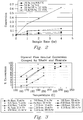
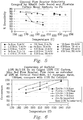
- Xylitol batch hydrogenolysis was conducted under conditions as described above for sorbitol. Results are shown in Figs. 9 and 10 .
- Xylitol conversion was measured at 4 hours over the catalysts (left to right in Fig. 9 ) 2.5 wt.% Ni / 2.5 wt.% Re / C, 2.5%Ru/C, 2.5%Rh/2.5%Re/C, 2.5%Pd/2.5%Re/C, and 2.5%Ru/0.5%Re/C.
- the Ni/Re catalyst resulted in surprisingly superior conversion.
- the Ni/Re catalyst demonstrated surprisingly superior selectivity to PG, EG and glycerol.
- Arabinitol was subjected to hydrogenolysis under conditions similar to the xylitol batch hydrolysis. Results are shown in Table 8 below in weight % selectivities.
- Lactic Acid Batch Hydrogenation Catalyst testing was conducted in a semi-batch mode under constant hydrogen pressure using a 300 cc, 316 SS Parr autoclave reactor system fitted with a Magnadrive stirrer and stirrer tachometer.2.50 g of the 55794-107 pre-reduced catalyst sample was weighed into a clean Pyrex glass liner, then the liner and the contained catalyst were sealed inside the autoclave body. After pressure testing the assembled reactor system, 250 psi of pure hydrogen is charged to the reactor, the stirrer motor started and set to approximately 150 rpm then the reactor is heated up to 280°C in order to re-reduce the catalyst prior to introduction of the feeds.
- the temperature is maintained at 280°C for 4 hours, then is quickly cooled back to room temperature.
- the reactor was flushed with nitrogen, then 103.8 g of a 19.7% lactate feedstock solution (19.89% lactic acid in D.I.water) was added to the reactor liner, containing the catalyst, through the liquid sampling port.
- the vessel was then purged several times with pure hydrogen, then re-pressurized to 1500 psi with hydrogen.
- the stirrer motor was turned on and the stirrer speed adjusted to ⁇ 500 rpm.
- the reactor was rapidly heated to 150°C and the gas inlet opened to maintain the hydrogen pressure within the vessel at a constant 2500 psi pressure. Liquid samples are withdrawn from the vessel after 1, 2, and 4 hour intervals.
Landscapes
- Chemical & Material Sciences (AREA)
- Organic Chemistry (AREA)
- Engineering & Computer Science (AREA)
- Materials Engineering (AREA)
- Chemical Kinetics & Catalysis (AREA)
- Organic Low-Molecular-Weight Compounds And Preparation Thereof (AREA)
Claims (14)
- Procédé d'hydrogénolyse d'un composé organique contenant de l'oxygène choisi dans le groupe constitué par les sucres, les alcools de sucre et le glycérol, comprenant :la mise en réaction d'une composition aqueuse avec de l'hydrogène à une température d'au moins 120 °C, et en présence d'un catalyseur rhénium/nickel solide ;dans lequel la composition aqueuse comprend de l'eau et le composé organique contenant de l'oxygène ; etdans lequel au moins 25 % de l'hydrogénolyse C-O se produit sous forme d'hydrogénolyse C-C.
- Procédé selon la revendication 1, dans lequel la composition comprend un composant choisi dans le groupe constitué par un sucre à 6 atomes de carbone, un alcool de sucre à 6 atomes de carbone ; et le glycérol.
- Procédé selon la revendication 1, lequel procédé comprend une conversion continue d'un alcool de sucre à 6 atomes de carbone.
- Procédé selon la revendication 1, dans lequel la réaction est effectuée à une température comprise entre 120 et 190 °C.
- Procédé selon la revendication 4, lequel procédé comprend une conversion continue d'un alcool de sucre à 6 atomes de carbone.
- Procédé selon la revendication 5, dans lequel l'alcool de sucre à 6 atomes de carbone est sous forme de solution aqueuse et le catalyseur solide comprend un support carboné.
- Procédé selon la revendication 6, dans lequel l'alcool de sucre à 6 atomes de carbone est sous forme de solution aqueuse dans des conditions basiques.
- Procédé selon la revendication 1, dans lequel l'hydrogénolyse C-O et l'hydrogénolyse C-C ont lieu simultanément.
- Procédé selon la revendication 1, dans lequel l'hydrogénolyse C-C a lieu en premier, la base est ajoutée et l'hydrogénolyse C-O est ensuite effectuée.
- Procédé selon la revendication 1, dans lequel la composition comprend un alcool de sucre à 6 atomes de carbone.
- Procédé selon la revendication 10, lequel procédé comprend une conversion continue d'un alcool de sucre à 6 atomes de carbone.
- Procédé selon la revendication 10, dans lequel la réaction a lieu dans une gamme de température comprise entre 120 et 190 °C.
- Procédé selon la revendication 1, dans lequel le catalyseur solide comprend un support carboné.
- Procédé de production de 1,3-propanediol selon la revendication 1 comprenant :la mise en réaction d'une composition comprenant du glycérol avec de l'hydrogène à une température d'au moins 120 °C, et en présence d'un catalyseur rhénium/nickel solide dans des conditions neutres ou acides.
Applications Claiming Priority (3)
| Application Number | Priority Date | Filing Date | Title |
|---|---|---|---|
| US10/000,836 US6841085B2 (en) | 2001-10-23 | 2001-10-23 | Hydrogenolysis of 6-carbon sugars and other organic compounds |
| US836 | 2001-10-23 | ||
| PCT/US2002/033982 WO2003035582A1 (fr) | 2001-10-23 | 2002-10-23 | Hydrogenolyse de sucres a 6 atomes de carbone et d'autres composes organiques |
Publications (2)
| Publication Number | Publication Date |
|---|---|
| EP1440046A1 EP1440046A1 (fr) | 2004-07-28 |
| EP1440046B1 true EP1440046B1 (fr) | 2017-05-03 |
Family
ID=21693210
Family Applications (1)
| Application Number | Title | Priority Date | Filing Date |
|---|---|---|---|
| EP02784244.2A Expired - Lifetime EP1440046B1 (fr) | 2001-10-23 | 2002-10-23 | Hydrogenolyse de sucres, de sucre alcools et de glycerol |
Country Status (3)
| Country | Link |
|---|---|
| US (1) | US6841085B2 (fr) |
| EP (1) | EP1440046B1 (fr) |
| WO (1) | WO2003035582A1 (fr) |
Families Citing this family (120)
| Publication number | Priority date | Publication date | Assignee | Title |
|---|---|---|---|---|
| BR0214560A (pt) * | 2001-11-29 | 2004-11-09 | Wisconsin Alumni Res Found | Produção de hidrogênio à baixa temperatura a partir de hidrocarbonetos oxigenados |
| US7131446B2 (en) * | 2004-03-25 | 2006-11-07 | Tang Kenneth Y | Light-triggered tattoo process |
| GB0514593D0 (en) * | 2005-07-15 | 2005-08-24 | Davy Process Techn Ltd | Process |
| WO2007027832A2 (fr) * | 2005-08-30 | 2007-03-08 | Cargill, Incorporated | Procede de production de propylene glycol |
| CN101346302B (zh) | 2005-12-21 | 2013-07-10 | 维仁特公司 | 用于重整含氧化合物的催化剂及方法 |
| RU2455338C2 (ru) | 2006-03-24 | 2012-07-10 | Висконсин Эламнай Рисерч Фаундейшн | Способ получения биотоплива, где теплоту от реакций образования углерод-углеродных связей используют для проведения реакций газификации биомассы |
| CN103360205A (zh) * | 2006-05-08 | 2013-10-23 | 维仁特公司 | 用于生成多元醇的方法和系统 |
| US7619119B2 (en) * | 2006-06-07 | 2009-11-17 | The Procter & Gamble Company | Processes for converting glycerol to amino alcohols |
| US7619118B2 (en) | 2006-06-07 | 2009-11-17 | The Procter & Gamble Company | Process for the conversion of glycerol to propylene glycol and amino alcohols |
| EP2024320A1 (fr) * | 2006-06-07 | 2009-02-18 | The Procter and Gamble Company | Procédé pour la conversion alternative de glycérol en propylèneglycol ou en aminoalcools |
| WO2008051540A2 (fr) * | 2006-10-23 | 2008-05-02 | Archer-Daniels-Midland Company | Hydrogenolyse de glycerol et produits dérivés |
| US20080103340A1 (en) * | 2006-10-27 | 2008-05-01 | Archer-Daniels-Midland Company | Applications of biobased glycol compositions |
| JP5231786B2 (ja) * | 2006-12-05 | 2013-07-10 | 花王株式会社 | 多価アルコールの水素化分解物の製造方法 |
| CA2671730A1 (fr) | 2006-12-20 | 2008-11-20 | Virent Energy Systems, Inc. | Reacteur servant a produire des produits gazeux |
| CN100432034C (zh) * | 2007-02-07 | 2008-11-12 | 南京工业大学 | 甘油催化加氢连续制备1,2-丙二醇的方法 |
| US7977517B2 (en) | 2007-03-08 | 2011-07-12 | Virent Energy Systems, Inc. | Synthesis of liquid fuels and chemicals from oxygenated hydrocarbons |
| ES2446542T3 (es) * | 2007-03-08 | 2014-03-10 | Virent, Inc. | Síntesis de combustibles líquidos y compuestos químicos a partir de hidrocarburos oxigenados |
| ES2742688T3 (es) | 2007-04-17 | 2020-02-17 | Kao Corp | Procedimiento para producir productos de hidrogenólisis de alcoholes polihídricos |
| US7514587B1 (en) | 2007-05-15 | 2009-04-07 | Iowa State University Research Foundation, Inc. | Selective reduction of glycerol by porous silicon |
| CN101372444B (zh) * | 2007-08-24 | 2011-04-20 | 中国科学院大连化学物理研究所 | 一种丙三醇加氢裂解的方法 |
| CN101381280B (zh) * | 2007-09-05 | 2011-12-21 | 中国科学院大连化学物理研究所 | 一种Ni基负载型催化剂在丙三醇氢解过程中的应用 |
| US20090088317A1 (en) * | 2007-09-28 | 2009-04-02 | Frye Jr John G | Multi-metal reduction catalysts and methods of producing reduction catalysts |
| JP5305669B2 (ja) | 2008-01-21 | 2013-10-02 | 花王株式会社 | 多価アルコールの水素化分解物の製造方法 |
| AR072446A1 (es) * | 2008-03-02 | 2010-09-01 | Dow Global Technologies Inc | Proceso de hidrogenacion mejorado |
| US20090246430A1 (en) | 2008-03-28 | 2009-10-01 | The Coca-Cola Company | Bio-based polyethylene terephthalate polymer and method of making same |
| US20090264686A1 (en) * | 2008-04-16 | 2009-10-22 | Holladay Johnathan E | Hydrogenolysis processes and hydrogenolysis catalyst preparation methods |
| US20090264687A1 (en) * | 2008-04-16 | 2009-10-22 | Battelle Memorial Institute | Chemical Production Processes and Systems |
| NZ591808A (en) * | 2008-08-27 | 2012-12-21 | Virent Inc | Synthesis of C6+ alkanes from saccharides utilising multistage catalytic processes |
| US8697924B2 (en) * | 2008-09-05 | 2014-04-15 | Shell Oil Company | Liquid fuel compositions |
| US8101807B2 (en) * | 2008-12-23 | 2012-01-24 | Uop Llc | Methods for converting glycerol to propanol |
| WO2010080733A1 (fr) | 2009-01-09 | 2010-07-15 | Cool Planet Biofuels, Llc | Système et procédé pour la séquestration de carbone atmosphérique |
| AU2010206956B2 (en) | 2009-01-21 | 2016-07-14 | Cool Planet Biofuels, Inc. | System and method for biomass fractioning |
| US9909067B2 (en) | 2009-01-21 | 2018-03-06 | Cool Planet Energy Systems, Inc. | Staged biomass fractionator |
| EP2403894B1 (fr) | 2009-03-03 | 2016-06-01 | The Coca-Cola Company | Emballage en poly(téréphtalate d'éthylène) d'origine biologique et son procédé de fabrication |
| BRPI1006653A2 (pt) | 2009-04-16 | 2017-06-06 | Chemtex Italia Spa | composição de catalisador e um metodo para a hidrogenolise de alcoois de açucar |
| CN101550350B (zh) * | 2009-05-21 | 2013-01-02 | 中国科学院广州能源研究所 | 催化山梨醇合成生物汽油的方法 |
| WO2010144448A2 (fr) * | 2009-06-08 | 2010-12-16 | University Of Kansas | Hydrogénolyse de polyols par l'hydrogène produit in-situ |
| MX2011013988A (es) * | 2009-06-30 | 2012-09-07 | Virent Inc | Proceso y sistemas de reactores para convertir azucares y alcoholes sacarosos. |
| WO2011025632A1 (fr) | 2009-08-24 | 2011-03-03 | Conocophillips Company | Hydrotraitement de glucides |
| US8404909B2 (en) * | 2009-12-09 | 2013-03-26 | Chevron U.S.A. Inc. | Method for capturing carbon dioxide from biomass pyrolysis process |
| AU2010333904B2 (en) * | 2009-12-22 | 2015-05-07 | Phillips 66 Company | Conversion of carbohydrates to hydrocarbons |
| CN101768050B (zh) * | 2009-12-25 | 2012-12-05 | 北京大学 | 一种生产乙二醇和1,2-丙二醇的方法 |
| WO2011082222A2 (fr) | 2009-12-30 | 2011-07-07 | Virent Energy Systems, Inc. | Catalyseurs améliorés pour l'hydrodésoxygénation (hdo) des polyols |
| US9303226B2 (en) * | 2009-12-31 | 2016-04-05 | Shell Oil Company | Direct aqueous phase reforming of bio-based feedstocks |
| US9447347B2 (en) * | 2009-12-31 | 2016-09-20 | Shell Oil Company | Biofuels via hydrogenolysis-condensation |
| FR2956114B1 (fr) | 2010-02-11 | 2012-03-23 | Inst Francais Du Petrole | Procede de transformation de biomasse lignocellulosique ou de cellulose par des acides solides de lewis a base de tungstene |
| US20110207972A1 (en) * | 2010-02-23 | 2011-08-25 | Battelle Memorial Institute | Catalysts and processes for the hydrogenolysis of glycerol and other organic compounds for producing polyols and propylene glycol |
| US8937202B2 (en) * | 2010-02-23 | 2015-01-20 | Battelle Memorial Institute | Processes and systems for the production of propylene glycol from glycerol |
| BRPI1000430A2 (pt) | 2010-02-24 | 2011-10-25 | Petroleo Brasileiro Sa | produção de propilenoglicol a partir de glicerina |
| WO2011141546A2 (fr) | 2010-05-12 | 2011-11-17 | Shell Internationale Research Maatschappij B.V. | Procédé pour liquéfier une matière cellulosique |
| CN102933525A (zh) | 2010-05-12 | 2013-02-13 | 国际壳牌研究有限公司 | 包括生物质氢解及随后脱氢和醇醛缩合以生产链烷烃的方法 |
| BR112012028663A2 (pt) | 2010-05-12 | 2016-08-16 | Shell Int Research | método, e, sistema |
| US20150175896A1 (en) * | 2010-07-26 | 2015-06-25 | Uop Llc | Methods for deoxygenating biomass-derived pyrolysis oils |
| US20120017495A1 (en) * | 2010-07-26 | 2012-01-26 | Uop Llc | Methods for deoxygenating biomass-derived pyrolysis oils |
| FR2963346B1 (fr) | 2010-07-29 | 2013-03-15 | IFP Energies Nouvelles | Procede de transformation de biomasse lignocellulosique ou de cellulose par des catalyseurs acides solides de lewis a base d'oxyde de tungstene et d'un metal choisi dans les groupes 8 a 11 |
| WO2012030215A1 (fr) | 2010-08-30 | 2012-03-08 | Btg Biomass Technology Group B.V. | Procédé pour l'hydrotraitement de matières végétales |
| IL207945A0 (en) | 2010-09-02 | 2010-12-30 | Robert Jansen | Method for the production of carbohydrates |
| US8809607B2 (en) | 2010-10-07 | 2014-08-19 | Phillips 66 Company | Co-production of renewable diesel and renewable gasoline |
| FR2969602B1 (fr) | 2010-12-22 | 2013-03-29 | IFP Energies Nouvelles | Procede de transformation de biomasse lignocellulosique ou de cellulose par des catalyseurs a base d'oxyde d'etain et/ou d'oxyde d'antimoine et d'un metal choisi dans les groupes 8 a 11 |
| FR2969603B1 (fr) | 2010-12-22 | 2012-12-28 | IFP Energies Nouvelles | Procede de transformation de biomasse lignocellulosique ou de cellulose par des acides solides de lewis non zeolithique stables a base d'etain ou d'antimoine seul ou en melange |
| WO2012101550A1 (fr) * | 2011-01-24 | 2012-08-02 | Basf Se | Catalyseur d'hydrogénation à base de nickel sur carbone |
| US8137628B2 (en) * | 2011-03-24 | 2012-03-20 | Cool Planet Biofuels, Inc. | System for making renewable fuels |
| US8951476B2 (en) | 2011-03-24 | 2015-02-10 | Cool Planet Energy Systems, Inc. | System for making renewable fuels |
| US8143464B2 (en) | 2011-03-24 | 2012-03-27 | Cool Planet Biofuels, Inc. | Method for making renewable fuels |
| US8431757B2 (en) | 2011-03-24 | 2013-04-30 | Cool Planet Biofuels, Inc. | Method for making renewable fuels |
| US8173044B1 (en) | 2011-05-09 | 2012-05-08 | Cool Planet Biofuels, Inc. | Process for biomass conversion to synthesis gas |
| US8367881B2 (en) | 2011-05-09 | 2013-02-05 | Cool Planet Biofuels, Inc. | Method for biomass fractioning by enhancing biomass thermal conductivity |
| US20120305836A1 (en) * | 2011-06-01 | 2012-12-06 | Uop Llc | Methods and catalysts for deoxygenating biomass-derived pyrolysis oil |
| US12054440B2 (en) | 2011-06-06 | 2024-08-06 | Carbon Technology Holdings, LLC | Method for application of biochar in turf grass and landscaping environments |
| US10550044B2 (en) | 2011-06-06 | 2020-02-04 | Cool Planet Energy Systems, Inc. | Biochar coated seeds |
| US12421176B2 (en) | 2011-06-06 | 2025-09-23 | Carbon Technology Holdings, LLC | Biochar as a microbial carrier |
| US10252951B2 (en) | 2011-06-06 | 2019-04-09 | Cool Planet Energy Systems, Inc. | Biochars and biochar treatment processes |
| US9809502B2 (en) | 2011-06-06 | 2017-11-07 | Cool Planet Energy Systems, Inc. | Enhanced Biochar |
| US9493380B2 (en) | 2011-06-06 | 2016-11-15 | Cool Planet Energy Systems, Inc. | Method for enhancing soil growth using bio-char |
| US10322389B2 (en) | 2014-10-01 | 2019-06-18 | Cool Planet Energy Systems, Inc. | Biochar aggregate particles |
| US10173937B2 (en) | 2011-06-06 | 2019-01-08 | Cool Planet Energy Systems, Inc. | Biochar as a microbial carrier |
| US10640429B2 (en) | 2011-06-06 | 2020-05-05 | Cool Planet Energy System, Inc. | Methods for application of biochar |
| US10059634B2 (en) | 2011-06-06 | 2018-08-28 | Cool Planet Energy Systems, Inc. | Biochar suspended solution |
| US10233129B2 (en) | 2011-06-06 | 2019-03-19 | Cool Planet Energy Systems, Inc. | Methods for application of biochar |
| US8568493B2 (en) | 2011-07-25 | 2013-10-29 | Cool Planet Energy Systems, Inc. | Method for producing negative carbon fuel |
| US11214528B2 (en) | 2011-06-06 | 2022-01-04 | Carbon Technology Holdings, LLC | Treated biochar for use in water treatment systems |
| US10696603B2 (en) | 2011-06-06 | 2020-06-30 | Carbon Technology Holdings, LLC | Mineral solubilizing microorganism infused biochars |
| US9493379B2 (en) | 2011-07-25 | 2016-11-15 | Cool Planet Energy Systems, Inc. | Method for the bioactivation of biochar for use as a soil amendment |
| US12084392B2 (en) | 2011-06-06 | 2024-09-10 | Carbon Technology Holdings, LLC | Treated biochar for use in water treatment systems |
| US11279662B2 (en) | 2011-06-06 | 2022-03-22 | Carbon Technology Holdings, LLC | Method for application of biochar in turf grass and landscaping environments |
| US8317891B1 (en) | 2011-06-06 | 2012-11-27 | Cool Planet Biofuels, Inc. | Method for enhancing soil growth using bio-char |
| US10118870B2 (en) | 2011-06-06 | 2018-11-06 | Cool Planet Energy Systems, Inc. | Additive infused biochar |
| US9216916B2 (en) | 2013-10-25 | 2015-12-22 | Cool Planet Energy Systems, Inc. | System and method for purifying process water produced from biomass conversion to fuels |
| US9260666B2 (en) | 2011-07-25 | 2016-02-16 | Cool Planet Energy Systems, Inc. | Method for reducing the carbon footprint of a conversion process |
| EP2565175B1 (fr) | 2011-08-31 | 2021-04-21 | Aristotle University of Thessaloniki | Procédé catalytique pour la production de 1,2-propanediol à partir de flux de glycérol brut |
| WO2013055785A1 (fr) | 2011-10-10 | 2013-04-18 | Virdia Ltd | Compositions de sucre |
| WO2013130972A1 (fr) | 2012-03-02 | 2013-09-06 | University Of Washington Through Its Center For Commercialization | Procédés de conversion de polyols |
| US9205412B2 (en) | 2013-03-01 | 2015-12-08 | Clariant Corporation | Catalyst for polyol hydrogenolysis |
| US20140275638A1 (en) * | 2013-03-15 | 2014-09-18 | Wisconsin Alumni Research Foundation | Method for preparing triols and diols from biomass-derived reactants |
| US9434659B2 (en) | 2014-02-03 | 2016-09-06 | Battelle Memorial Institute | Conversion of 2,3-butanediol to butadiene |
| EP3110541B1 (fr) | 2014-02-10 | 2020-11-18 | Archer-Daniels-Midland Company | Procédés améliorés de mélange multi-phase faible |
| EP3134377B1 (fr) * | 2014-04-22 | 2022-03-16 | Archer Daniels Midland Company | Procédé amélioré de production de propylèneglycol biodérivé |
| US12599151B2 (en) | 2014-10-01 | 2026-04-14 | Talipot Cool Extract (Ip), Llc | Biochars, biochar extracts and biochar extracts having soluble signaling compounds and method for capturing material extracted from biochar |
| US11053171B2 (en) | 2014-10-01 | 2021-07-06 | Carbon Technology Holdings, LLC | Biochars for use with animals |
| US10870608B1 (en) | 2014-10-01 | 2020-12-22 | Carbon Technology Holdings, LLC | Biochar encased in a biodegradable material |
| EP3200915A4 (fr) | 2014-10-01 | 2018-06-20 | Cool Planet Energy Systems, Inc. | Biocharbons et processus de traitement de biocharbon |
| US11426350B1 (en) | 2014-10-01 | 2022-08-30 | Carbon Technology Holdings, LLC | Reducing the environmental impact of farming using biochar |
| US11097241B2 (en) | 2014-10-01 | 2021-08-24 | Talipot Cool Extract (Ip), Llc | Biochars, biochar extracts and biochar extracts having soluble signaling compounds and method for capturing material extracted from biochar |
| PL3221285T3 (pl) | 2014-11-18 | 2022-06-06 | Archer Daniels Midland Company | Sposób wytwarzania glikolu propylenowego na bazie materiałów biologicznych z estrów kwasu mlekowego |
| WO2016112134A1 (fr) | 2015-01-07 | 2016-07-14 | Virdia, Inc. | Méthodes d'extraction et de conversion de sucres hémicellulosiques |
| US20160368861A1 (en) | 2015-06-19 | 2016-12-22 | Southern Research Institute | Compositions and methods related to the production of acrylonitrile |
| WO2017011615A1 (fr) | 2015-07-15 | 2017-01-19 | Archer Daniels Midland Company | Catalyseurs multimétalliques contenant du cuivre améliorés et procédé d'utilisation de ceux-ci pour produire du 1,2-propane-diol d'origine biologique |
| US9708249B1 (en) | 2016-08-24 | 2017-07-18 | Southern Research Institute | Compositions and methods related to the production of acrylonitrile |
| DE102017204322A1 (de) * | 2017-03-15 | 2018-09-20 | Rheinisch-Westfälische Technische Hochschule (Rwth) Aachen | Verfahren zur chemischen Umsetzung von Zuckern oder Zuckeralkoholen zu Glykolen |
| US10266467B2 (en) | 2017-08-02 | 2019-04-23 | Eastman Chemical Company | Synthesis of glycols via transfer hydrogenation of alpha-functional esters with alcohols |
| US10266466B2 (en) | 2017-08-02 | 2019-04-23 | Eastman Chemical Company | Iron-catalyzed transfer hydrogenation of esters to alcohols |
| US10544077B2 (en) | 2017-08-02 | 2020-01-28 | Eastman Chemical Company | Process for making formic acid utilizing higher-boiling formate esters |
| US10570081B2 (en) | 2017-08-02 | 2020-02-25 | Eastman Chemical Company | Process for making formic acid utilizing lower-boiling formate esters |
| US10435349B2 (en) | 2017-08-02 | 2019-10-08 | Eastman Chemical Company | Iron-catalyzed cross-coupling of methanol with secondary or tertiary alcohols to produce formate esters |
| MX2020006266A (es) | 2017-12-15 | 2021-01-20 | Talipot Cool Extract Ip Llc | Biocarbones y extractos de biocarbón que tienen compuestos de señalización solubles y método de captura de material extracto de biocarbón. |
| DE102019113135A1 (de) * | 2019-05-17 | 2020-11-19 | Rheinisch-Westfälische Technische Hochschule (Rwth) Aachen | Verfahren zur Herstellung von Glycolen aus Zuckern und Zuckeralkoholen |
| JP7617086B2 (ja) | 2019-09-24 | 2025-01-17 | ティー.イーエヌ プロセス テクノロジー, インク. | 炭水化物からエチレングリコールへの連続的なプロセス |
| US11680031B2 (en) | 2020-09-24 | 2023-06-20 | T. EN Process Technology, Inc. | Continuous processes for the selective conversion of aldohexose-yielding carbohydrate to ethylene glycol using low concentrations of retro-aldol catalyst |
| US11319269B2 (en) | 2020-09-24 | 2022-05-03 | Iowa Corn Promotion Board | Continuous processes for the selective conversion of aldohexose-yielding carbohydrate to ethylene glycol using low concentrations of retro-aldol catalyst |
| CN114713236B (zh) * | 2022-03-30 | 2023-07-25 | 郑州大学 | Ni-ReOx/TiO2双金属催化剂及其制备方法、在生物质醛选择性加氢中的应用 |
Family Cites Families (14)
| Publication number | Priority date | Publication date | Assignee | Title |
|---|---|---|---|---|
| US2852570A (en) | 1958-09-16 | Process for preparing polyhydric | ||
| US3030429A (en) | 1962-04-17 | Process for the direct hydrogenation splitting of | ||
| US4476311A (en) * | 1980-03-12 | 1984-10-09 | The Purdue Frederick Company | Analgesic 4-carboxy-pyrrolidin-2-one compound |
| US4366332A (en) | 1981-01-21 | 1982-12-28 | Hydrocarbon Research, Inc. | Catalytic hydrogenolysis of alditols to product glycerol and polyols |
| US4338472A (en) | 1981-01-21 | 1982-07-06 | Hydrocarbon Research, Inc. | Catalytic hydrogenolysis of alditols to produce polyols |
| US4401823A (en) | 1981-05-18 | 1983-08-30 | Uop Inc. | Hydrogenolysis of polyhydroxylated compounds |
| US4404411A (en) | 1982-02-01 | 1983-09-13 | E. I. Du Pont De Nemours And Company | Hydrogenolysis of polyols to ethylene glycol in nonaqueous solvents |
| US4476331A (en) | 1982-02-11 | 1984-10-09 | Ethyl Corporation | Two stage hydrogenolysis of carbohydrate to glycols using sulfide modified ruthenium catalyst in second stage |
| US4496780A (en) * | 1983-06-22 | 1985-01-29 | Uop Inc. | Hydrocracking of polyols |
| IT1256801B (it) * | 1992-01-31 | 1995-12-15 | Novamont Spa | Catalizzatore di idrogenazione, procedimento per la sua preparazione ed impiego, particolarmente per l'idrogenazione e/o idrogenolisi di carboidrati e polioli. |
| IT1256800B (it) | 1992-01-31 | 1995-12-15 | Novamont Spa | Procedimento per la produzione di polioli inferiori e nuovo catalizzatore a base di rutenio utilizzato in tale procedimento. |
| IT1256802B (it) | 1992-01-31 | 1995-12-15 | Novamont Spa | Catalizzatore di idrogenazione, procedimento per la sua preparazione ed impiego, particolarmente per l'drogenazione e/o idrogenolisi di carboidrati e polioli. |
| US6291725B1 (en) | 2000-03-03 | 2001-09-18 | Board Of Trustees Operating Michigan State University | Catalysts and process for hydrogenolysis of sugar alcohols to polyols |
| US6479713B1 (en) * | 2001-10-23 | 2002-11-12 | Battelle Memorial Institute | Hydrogenolysis of 5-carbon sugars, sugar alcohols, and other methods and compositions for reactions involving hydrogen |
-
2001
- 2001-10-23 US US10/000,836 patent/US6841085B2/en not_active Expired - Lifetime
-
2002
- 2002-10-23 WO PCT/US2002/033982 patent/WO2003035582A1/fr not_active Ceased
- 2002-10-23 EP EP02784244.2A patent/EP1440046B1/fr not_active Expired - Lifetime
Non-Patent Citations (1)
| Title |
|---|
| None * |
Also Published As
| Publication number | Publication date |
|---|---|
| EP1440046A1 (fr) | 2004-07-28 |
| US20030119952A1 (en) | 2003-06-26 |
| WO2003035582B1 (fr) | 2003-12-11 |
| US6841085B2 (en) | 2005-01-11 |
| WO2003035582A1 (fr) | 2003-05-01 |
Similar Documents
| Publication | Publication Date | Title |
|---|---|---|
| US6841085B2 (en) | Hydrogenolysis of 6-carbon sugars and other organic compounds | |
| US6479713B1 (en) | Hydrogenolysis of 5-carbon sugars, sugar alcohols, and other methods and compositions for reactions involving hydrogen | |
| US7232934B2 (en) | Hydrogenation of oxo aldehydes to oxo alcohols in the presence of a nickel-molybdenum catalyst | |
| US6570043B2 (en) | Converting sugars to sugar alcohols by aqueous phase catalytic hydrogenation | |
| US4380680A (en) | Method for hydrogenating aqueous solutions of carbohydrates | |
| US20080207953A1 (en) | Catalyst and Method for Hyrogenating Carbonyl Compounds | |
| CN108025292B (zh) | 改进的含铜的多金属催化剂及使用其制备生物基1,2-丙二醇的方法 | |
| JPH0557251B2 (fr) | ||
| RU2722837C1 (ru) | Способ приготовления катализатора гидрирования фурфурола и фурфурилового спирта до 2-метилфурана | |
| EP2100868B1 (fr) | Procédé de fabrication d'un produit d'hydrogénolyse d'un alcool polyvalent | |
| JP2015509088A (ja) | 1,6−ヘキサンジオールを調製する方法 | |
| JPS5827642A (ja) | 新規なルテニウム/炭素−水素化用触媒 | |
| KR20080112373A (ko) | 알데하이드의 수소화 방법 | |
| US9012699B2 (en) | Chemical production processes and systems | |
| US4471144A (en) | Theta-alumina as a hydrothermally stable support in hydrogenation | |
| JPS624174B2 (fr) | ||
| RU2147298C1 (ru) | Способ получения 1,4-бутандиола | |
| JPH07223983A (ja) | アセチレン化合物の水素化 | |
| JPS5829768B2 (ja) | フホウワアルコ−ルノ セイゾウホウ |
Legal Events
| Date | Code | Title | Description |
|---|---|---|---|
| PUAI | Public reference made under article 153(3) epc to a published international application that has entered the european phase |
Free format text: ORIGINAL CODE: 0009012 |
|
| 17P | Request for examination filed |
Effective date: 20040521 |
|
| AK | Designated contracting states |
Kind code of ref document: A1 Designated state(s): AT BE BG CH CY CZ DE DK EE ES FI FR GB GR IE IT LI LU MC NL PT SE SK TR |
|
| AX | Request for extension of the european patent |
Extension state: AL LT LV MK RO SI |
|
| 17Q | First examination report despatched |
Effective date: 20070823 |
|
| GRAP | Despatch of communication of intention to grant a patent |
Free format text: ORIGINAL CODE: EPIDOSNIGR1 |
|
| INTG | Intention to grant announced |
Effective date: 20161014 |
|
| GRAJ | Information related to disapproval of communication of intention to grant by the applicant or resumption of examination proceedings by the epo deleted |
Free format text: ORIGINAL CODE: EPIDOSDIGR1 |
|
| STAA | Information on the status of an ep patent application or granted ep patent |
Free format text: STATUS: EXAMINATION IS IN PROGRESS |
|
| GRAR | Information related to intention to grant a patent recorded |
Free format text: ORIGINAL CODE: EPIDOSNIGR71 |
|
| GRAS | Grant fee paid |
Free format text: ORIGINAL CODE: EPIDOSNIGR3 |
|
| STAA | Information on the status of an ep patent application or granted ep patent |
Free format text: STATUS: GRANT OF PATENT IS INTENDED |
|
| INTC | Intention to grant announced (deleted) | ||
| GRAA | (expected) grant |
Free format text: ORIGINAL CODE: 0009210 |
|
| STAA | Information on the status of an ep patent application or granted ep patent |
Free format text: STATUS: THE PATENT HAS BEEN GRANTED |
|
| INTG | Intention to grant announced |
Effective date: 20170316 |
|
| RAP1 | Party data changed (applicant data changed or rights of an application transferred) |
Owner name: BATTELLE MEMORIAL INSTITUTE Owner name: MICHIGAN STATE UNIVERSITY |
|
| AK | Designated contracting states |
Kind code of ref document: B1 Designated state(s): AT BE BG CH CY CZ DE DK EE ES FI FR GB GR IE IT LI LU MC NL PT SE SK TR |
|
| REG | Reference to a national code |
Ref country code: GB Ref legal event code: FG4D |
|
| REG | Reference to a national code |
Ref country code: AT Ref legal event code: REF Ref document number: 889788 Country of ref document: AT Kind code of ref document: T Effective date: 20170515 Ref country code: CH Ref legal event code: EP |
|
| REG | Reference to a national code |
Ref country code: IE Ref legal event code: FG4D |
|
| REG | Reference to a national code |
Ref country code: DE Ref legal event code: R096 Ref document number: 60248858 Country of ref document: DE |
|
| REG | Reference to a national code |
Ref country code: NL Ref legal event code: FP |
|
| REG | Reference to a national code |
Ref country code: AT Ref legal event code: MK05 Ref document number: 889788 Country of ref document: AT Kind code of ref document: T Effective date: 20170503 |
|
| REG | Reference to a national code |
Ref country code: FR Ref legal event code: PLFP Year of fee payment: 16 |
|
| PG25 | Lapsed in a contracting state [announced via postgrant information from national office to epo] |
Ref country code: GR Free format text: LAPSE BECAUSE OF FAILURE TO SUBMIT A TRANSLATION OF THE DESCRIPTION OR TO PAY THE FEE WITHIN THE PRESCRIBED TIME-LIMIT Effective date: 20170804 Ref country code: ES Free format text: LAPSE BECAUSE OF FAILURE TO SUBMIT A TRANSLATION OF THE DESCRIPTION OR TO PAY THE FEE WITHIN THE PRESCRIBED TIME-LIMIT Effective date: 20170503 Ref country code: AT Free format text: LAPSE BECAUSE OF FAILURE TO SUBMIT A TRANSLATION OF THE DESCRIPTION OR TO PAY THE FEE WITHIN THE PRESCRIBED TIME-LIMIT Effective date: 20170503 Ref country code: FI Free format text: LAPSE BECAUSE OF FAILURE TO SUBMIT A TRANSLATION OF THE DESCRIPTION OR TO PAY THE FEE WITHIN THE PRESCRIBED TIME-LIMIT Effective date: 20170503 |
|
| PG25 | Lapsed in a contracting state [announced via postgrant information from national office to epo] |
Ref country code: BG Free format text: LAPSE BECAUSE OF FAILURE TO SUBMIT A TRANSLATION OF THE DESCRIPTION OR TO PAY THE FEE WITHIN THE PRESCRIBED TIME-LIMIT Effective date: 20170803 Ref country code: SE Free format text: LAPSE BECAUSE OF FAILURE TO SUBMIT A TRANSLATION OF THE DESCRIPTION OR TO PAY THE FEE WITHIN THE PRESCRIBED TIME-LIMIT Effective date: 20170503 |
|
| PG25 | Lapsed in a contracting state [announced via postgrant information from national office to epo] |
Ref country code: EE Free format text: LAPSE BECAUSE OF FAILURE TO SUBMIT A TRANSLATION OF THE DESCRIPTION OR TO PAY THE FEE WITHIN THE PRESCRIBED TIME-LIMIT Effective date: 20170503 Ref country code: CZ Free format text: LAPSE BECAUSE OF FAILURE TO SUBMIT A TRANSLATION OF THE DESCRIPTION OR TO PAY THE FEE WITHIN THE PRESCRIBED TIME-LIMIT Effective date: 20170503 Ref country code: DK Free format text: LAPSE BECAUSE OF FAILURE TO SUBMIT A TRANSLATION OF THE DESCRIPTION OR TO PAY THE FEE WITHIN THE PRESCRIBED TIME-LIMIT Effective date: 20170503 Ref country code: SK Free format text: LAPSE BECAUSE OF FAILURE TO SUBMIT A TRANSLATION OF THE DESCRIPTION OR TO PAY THE FEE WITHIN THE PRESCRIBED TIME-LIMIT Effective date: 20170503 |
|
| REG | Reference to a national code |
Ref country code: DE Ref legal event code: R097 Ref document number: 60248858 Country of ref document: DE |
|
| PG25 | Lapsed in a contracting state [announced via postgrant information from national office to epo] |
Ref country code: IT Free format text: LAPSE BECAUSE OF FAILURE TO SUBMIT A TRANSLATION OF THE DESCRIPTION OR TO PAY THE FEE WITHIN THE PRESCRIBED TIME-LIMIT Effective date: 20170503 |
|
| PLBE | No opposition filed within time limit |
Free format text: ORIGINAL CODE: 0009261 |
|
| STAA | Information on the status of an ep patent application or granted ep patent |
Free format text: STATUS: NO OPPOSITION FILED WITHIN TIME LIMIT |
|
| 26N | No opposition filed |
Effective date: 20180206 |
|
| PG25 | Lapsed in a contracting state [announced via postgrant information from national office to epo] |
Ref country code: MC Free format text: LAPSE BECAUSE OF FAILURE TO SUBMIT A TRANSLATION OF THE DESCRIPTION OR TO PAY THE FEE WITHIN THE PRESCRIBED TIME-LIMIT Effective date: 20170503 |
|
| REG | Reference to a national code |
Ref country code: CH Ref legal event code: PL |
|
| REG | Reference to a national code |
Ref country code: DE Ref legal event code: R082 Ref document number: 60248858 Country of ref document: DE Representative=s name: FLACH BAUER & PARTNER PATENTANWAELTE MBB, DE Ref country code: DE Ref legal event code: R082 Ref document number: 60248858 Country of ref document: DE Representative=s name: FLACH BAUER STAHL PATENTANWAELTE PARTNERSCHAFT, DE |
|
| REG | Reference to a national code |
Ref country code: IE Ref legal event code: MM4A |
|
| PG25 | Lapsed in a contracting state [announced via postgrant information from national office to epo] |
Ref country code: LU Free format text: LAPSE BECAUSE OF NON-PAYMENT OF DUE FEES Effective date: 20171023 Ref country code: LI Free format text: LAPSE BECAUSE OF NON-PAYMENT OF DUE FEES Effective date: 20171031 Ref country code: CH Free format text: LAPSE BECAUSE OF NON-PAYMENT OF DUE FEES Effective date: 20171031 |
|
| REG | Reference to a national code |
Ref country code: BE Ref legal event code: MM Effective date: 20171031 |
|
| PG25 | Lapsed in a contracting state [announced via postgrant information from national office to epo] |
Ref country code: BE Free format text: LAPSE BECAUSE OF NON-PAYMENT OF DUE FEES Effective date: 20171031 |
|
| REG | Reference to a national code |
Ref country code: FR Ref legal event code: PLFP Year of fee payment: 17 |
|
| PG25 | Lapsed in a contracting state [announced via postgrant information from national office to epo] |
Ref country code: IE Free format text: LAPSE BECAUSE OF NON-PAYMENT OF DUE FEES Effective date: 20171023 |
|
| PG25 | Lapsed in a contracting state [announced via postgrant information from national office to epo] |
Ref country code: CY Free format text: LAPSE BECAUSE OF NON-PAYMENT OF DUE FEES Effective date: 20170503 |
|
| PG25 | Lapsed in a contracting state [announced via postgrant information from national office to epo] |
Ref country code: TR Free format text: LAPSE BECAUSE OF FAILURE TO SUBMIT A TRANSLATION OF THE DESCRIPTION OR TO PAY THE FEE WITHIN THE PRESCRIBED TIME-LIMIT Effective date: 20170503 |
|
| PG25 | Lapsed in a contracting state [announced via postgrant information from national office to epo] |
Ref country code: PT Free format text: LAPSE BECAUSE OF FAILURE TO SUBMIT A TRANSLATION OF THE DESCRIPTION OR TO PAY THE FEE WITHIN THE PRESCRIBED TIME-LIMIT Effective date: 20170503 |
|
| PGFP | Annual fee paid to national office [announced via postgrant information from national office to epo] |
Ref country code: FR Payment date: 20210921 Year of fee payment: 20 Ref country code: NL Payment date: 20210920 Year of fee payment: 20 |
|
| PGFP | Annual fee paid to national office [announced via postgrant information from national office to epo] |
Ref country code: GB Payment date: 20210929 Year of fee payment: 20 |
|
| PGFP | Annual fee paid to national office [announced via postgrant information from national office to epo] |
Ref country code: DE Payment date: 20210916 Year of fee payment: 20 |
|
| REG | Reference to a national code |
Ref country code: DE Ref legal event code: R071 Ref document number: 60248858 Country of ref document: DE |
|
| REG | Reference to a national code |
Ref country code: NL Ref legal event code: MK Effective date: 20221022 |
|
| REG | Reference to a national code |
Ref country code: GB Ref legal event code: PE20 Expiry date: 20221022 |
|
| PG25 | Lapsed in a contracting state [announced via postgrant information from national office to epo] |
Ref country code: GB Free format text: LAPSE BECAUSE OF EXPIRATION OF PROTECTION Effective date: 20221022 |