EP1440977B1 - Verbessertes Verfahren zur Herstellung von diamidischen Derivaten vom Tripeptid KPV - Google Patents
Verbessertes Verfahren zur Herstellung von diamidischen Derivaten vom Tripeptid KPV Download PDFInfo
- Publication number
- EP1440977B1 EP1440977B1 EP04300039A EP04300039A EP1440977B1 EP 1440977 B1 EP1440977 B1 EP 1440977B1 EP 04300039 A EP04300039 A EP 04300039A EP 04300039 A EP04300039 A EP 04300039A EP 1440977 B1 EP1440977 B1 EP 1440977B1
- Authority
- EP
- European Patent Office
- Prior art keywords
- formula
- compound
- acid
- group
- possibly
- Prior art date
- Legal status (The legal status is an assumption and is not a legal conclusion. Google has not performed a legal analysis and makes no representation as to the accuracy of the status listed.)
- Expired - Lifetime
Links
- 0 *C(C(Cl)=O)(I)I Chemical compound *C(C(Cl)=O)(I)I 0.000 description 13
Images


Classifications
-
- A—HUMAN NECESSITIES
- A61—MEDICAL OR VETERINARY SCIENCE; HYGIENE
- A61K—PREPARATIONS FOR MEDICAL, DENTAL OR TOILETRY PURPOSES
- A61K8/00—Cosmetics or similar toiletry preparations
- A61K8/18—Cosmetics or similar toiletry preparations characterised by the composition
- A61K8/30—Cosmetics or similar toiletry preparations characterised by the composition containing organic compounds
- A61K8/64—Proteins; Peptides; Derivatives or degradation products thereof
-
- A—HUMAN NECESSITIES
- A61—MEDICAL OR VETERINARY SCIENCE; HYGIENE
- A61P—SPECIFIC THERAPEUTIC ACTIVITY OF CHEMICAL COMPOUNDS OR MEDICINAL PREPARATIONS
- A61P17/00—Drugs for dermatological disorders
-
- A—HUMAN NECESSITIES
- A61—MEDICAL OR VETERINARY SCIENCE; HYGIENE
- A61Q—SPECIFIC USE OF COSMETICS OR SIMILAR TOILETRY PREPARATIONS
- A61Q19/00—Preparations for care of the skin
-
- A—HUMAN NECESSITIES
- A61—MEDICAL OR VETERINARY SCIENCE; HYGIENE
- A61Q—SPECIFIC USE OF COSMETICS OR SIMILAR TOILETRY PREPARATIONS
- A61Q19/00—Preparations for care of the skin
- A61Q19/005—Preparations for sensitive skin
-
- A—HUMAN NECESSITIES
- A61—MEDICAL OR VETERINARY SCIENCE; HYGIENE
- A61Q—SPECIFIC USE OF COSMETICS OR SIMILAR TOILETRY PREPARATIONS
- A61Q19/00—Preparations for care of the skin
- A61Q19/007—Preparations for dry skin
-
- C—CHEMISTRY; METALLURGY
- C07—ORGANIC CHEMISTRY
- C07K—PEPTIDES
- C07K5/00—Peptides containing up to four amino acids in a fully defined sequence; Derivatives thereof
- C07K5/04—Peptides containing up to four amino acids in a fully defined sequence; Derivatives thereof containing only normal peptide links
- C07K5/08—Tripeptides
- C07K5/0815—Tripeptides with the first amino acid being basic
-
- Y—GENERAL TAGGING OF NEW TECHNOLOGICAL DEVELOPMENTS; GENERAL TAGGING OF CROSS-SECTIONAL TECHNOLOGIES SPANNING OVER SEVERAL SECTIONS OF THE IPC; TECHNICAL SUBJECTS COVERED BY FORMER USPC CROSS-REFERENCE ART COLLECTIONS [XRACs] AND DIGESTS
- Y02—TECHNOLOGIES OR APPLICATIONS FOR MITIGATION OR ADAPTATION AGAINST CLIMATE CHANGE
- Y02P—CLIMATE CHANGE MITIGATION TECHNOLOGIES IN THE PRODUCTION OR PROCESSING OF GOODS
- Y02P20/00—Technologies relating to chemical industry
- Y02P20/50—Improvements relating to the production of bulk chemicals
- Y02P20/55—Design of synthesis routes, e.g. reducing the use of auxiliary or protecting groups
Definitions
- the present invention relates to an improved process for the synthesis of Lysine-Proline-Valine (JPV) tripeptide diamide derivatives.
- Solid phase synthesis has the advantage of great flexibility and already existing automation.
- the products are generally synthesized at laboratory scales ranging in the majority of cases from a few milligrams to a hundred milligrams. Its principle is based on that of the supported chemistry with its known advantages especially in terms of purification which allows the implementation of excess reagents to promote the yield. This route is generally used for the synthesis of a large number of compounds for the purpose of screening their activity.
- the synthesis in solution has the advantage of being able to prepare large quantities of product in a single batch. All reactions are carried out in solution without the use of reagent supported on a resin as in the previous case. It is, in peptide synthesis, the method of choice for an industrial synthesis.
- the resin is a p-methylbenzhydrylamine type resin which allows the direct production in good yields of the carboxamide (CO-NH 2 ) form after cleavage of the peptide from the resin by hydrofluoric acid HF.
- the amino acids are introduced in their N-protected Boc form and coupled by the conventional DCC / HOBt technique.
- lysine it is introduced in the form of N ( ⁇ ) Boc, N ( ⁇ ) -2,4-Cl2-Z-Lys-OH.
- the key intermediate for obtaining KPV tripeptide diamides is Boc-Lys (MSOC) -Pro-Val-NH 2 , the two protecting groups being released under different operating conditions.
- the two protecting groups being released under different operating conditions.
- the Free amine function is amidated then the amine N ( ⁇ ) function of lysine is in turn released.
- derivatives of type (I) can be envisaged from tripeptide synthesis intermediates H-Lys-Pro-Val-OH (or derivatives) since the two amino functions N ( ⁇ ) and N ( ⁇ ) of the lysine are protected by labile protecting groups under different operating conditions.
- US Pat. No. 5,580,855 (Ferreira) describes the solid-phase synthesis of the H-Lys-Pro-Val-OH tripeptide using FMOC as a protecting group for the ⁇ -amine function and as a solid phase a polymethacrylamide polymer synthesized from three different monomers.
- the introduction of amino acids is via their activation in the form of symmetrical anhydride.
- the amine function N ( ⁇ ) is protected by a Boc.
- the tripeptide is released from the solid support by using trifluoroacetic acid (which also deprotects the Boc groups), the FMOC being previously released by piperidine at 20% in DMF.
- H-Lys (formyl) -Pro-Val-NH 2
- HCl prepared from Z-Lys (formyl) -Pro-Val-NH 2
- H-Lys (Z) -Pro-Val-NH 2 (or its salts) (Yasutake and Powers, 1981)
- H-Lys Tosyl) -Pro-Val-NH 2 (Hofmann et al. , 1960).
- Such a method for synthesizing a diamide derivative of the tripeptide KPV is provided according to the invention.
- the synthesis method according to the invention can be carried out with any of the stereoisomers of each of the amino acid residues Lysine (K), Proline (P) or Valine (V).
- the group R 1 (R ' 1 ) (R " 1 ) CO can not represent an amino acid residue or a peptide chain.
- the group N (R 2 ) (R 3 ) can not constitute an amino acid or a peptide chain.
- Alkyl means a linear or branched aliphatic hydrocarbon group optionally interrupted by a heteroatom, the alkyl may be unsubstituted or substituted on the carbon atoms by one or more identical or different substituents, the substituents being chosen from: aryl, hydroxy, alkoxy, aryloxy, alkyloxy, aralkyloxy.
- branched alkyl is meant lower alkyl such as methyl, ethyl or propyl which is bonded to an alkyl linear chain.
- Preferred alkyl groups include "lower alkyl” groups having 1 to 8 carbon atoms. Examples of alkyl groups are methyl, ethyl, i- propyl, t- butyl, heptyl, decyl or cyclohexylmethyl.
- cycloalkyl is meant a nonaromatic ring comprising from 4 to 10 carbon atoms, the cyclic alkyl being partially unsaturated.
- Preferred cycloalkyls include cyclopentyl, cyclohexyl, cycloheptyl, adamantyl, octahydronaphthyl and perhydronaphthyl.
- aryl is meant an aromatic carbocyclic radical containing from 5 to 10 carbon atoms.
- Aryl groups include unsubstituted phenyl or naphthyl or phenyl or naphthyl substituted with one or more substituents which may be the same or different, including alkyl, aryl, aralkyl, hydroxy, alkoxy, aryloxy, aralkoxy, carboxy, aroyl substituents. halo, nitro, trihalomethyl, cyano, alkoxycarbonyl, aryloxycarbonyl, aralkoxycarbonyl, carbamoyl, alkylcarbamoyl, dialkylcarbamoyl.
- alkoxy is meant an alkyl-O- group in which the alkyl group is as previously defined.
- Alkoxy groups include methoxy, ethoxy, n- propoxy, i- propoxy, n- butoxy and heptoxy.
- aryloxy is meant an aryl-O group in which the aryl group is as previously defined.
- Aryloxy groups include phenoxy and naphthoxy.
- aralkyl is meant an alkyl group substituted with one or more aryl groups.
- aralkyloxy is meant an aralkyl-O- group in which the aralkyl group is as previously defined.
- Aralkyloxy groups include benzyloxy.
- alkoxycarbonyl is meant -O-CO-, such as methoxy- and ethoxy-carbonyl.
- aryloxycarbonyl is meant aryl-O-CO-, such as phenoxy- and naphthoxycarbonyl.
- halo is meant a fluorine, chlorine or bromine atom.
- the process according to the invention makes it possible in particular to obtain these derivatives in salified form.
- the salts of the compounds according to the invention are chosen from the salts of a mineral or organic acid such as, for example, hydrochlorides, hydrobromides, sulphate, acetate, citrate, tartrate, lactate, phosphate, hydrogen phosphate, propionate or succinate.
- the process according to the invention also has the advantage of being applicable on an industrial scale, for the production of batches of diamide derivatives of tripeptide KPV of several kilograms, irrespective of the stereochemistry of the amino acids used. .
- the invention also relates to the KPV tripeptide diamide derivatives of formula (I) defined above with the additional condition that R 1 , R ' 1 , R " 1 , R 2 and R 3 do not simultaneously represent a hydrogen atom (formula IA).
- the synthesis method of the invention is applicable on an industrial scale.
- the isolation of the final product is simple and does not require any purification by chromatography or ion exchange column. These heavy techniques are not implemented at any stage of the synthesis.
- the diamide derivative of the tripeptide KPV is obtained directly with a very high purity.
- the purity of the crystallized isolated product may be greater than 95%, as determined by high performance liquid chromatography (HPLC).
- step c) the removal of the P 2 protecting group is carried out by hydrogenolysis.
- the hydrogenolysis is carried out with an acid contained in the reaction medium, said acid acts as a salifying agent for the amine function of the lysine thus released.
- the final salt is preferably chosen from hydrochlorides, hydrobromides, sulphates, acetates, citrates, tartrates, lactates, phosphates, hydrogen phosphates, propionates and succinates.
- the process as defined above can be carried out with any of the stereoisomers of each of the amino acid residues Lysine, Proline or Valine.
- the salt is obtained during step c) by introducing the corresponding acid.
- the acid used is selected from acetic acid, hydrochloric acid, hydrobromic acid, sulfuric acid, citric acid, tartaric acid, lactic acid, phosphoric acid, hydrogen phosphoric acid, propionic acid or succinic acid.
- the acid is acetic acid or hydrochloric acid.
- the peptide part is constructed from the N-terminus to the C-terminus or conversely, from the C-terminus to the N-terminus.
- the peptide chain is constructed from the N-terminus to the C-terminus.
- the protecting groups P 1 and P 2 are chosen such that they are removed respectively under different operating conditions.
- the compound of formula (II) may in certain cases be salified with a base, preferably an organic base, and more, still more preferably an organic amine such as dicyclohexylamine or ethyldiisopropylamine.
- a base preferably an organic base, and more, still more preferably an organic amine such as dicyclohexylamine or ethyldiisopropylamine.
- the compound of structure (II) is Boc-Lys (Z) -OH, (P 1 and P 2 having respectively Boc and Z values).
- the peptide coupling allowing the introduction of the second amino acid is carried out either with a C-protected proline derivative of structure (IIIA) (FIG. 1A) or with structural proline (IIIB) (FIG. 1B), the compounds ( IIIA) and (IIIB) are both compounds of formula (III).
- the compounds of formula (III) are optionally salified with an inorganic or organic acid.
- the compounds of formula (III) are chosen from H-Pro-AMC, H-Pro-p-nitrobenzyl ester, H-Pro-OtBu, H-Pro-OBz1, H-Pro-OMe, H-Pro-OEt preferentially H-Pro-OBz1 or H-Pro-OMe or H-Pro-OEt.
- the peptide coupling is carried out with carbodiimides, with or without 1-hydoxybenzotriazole added.
- the coupling is carried out with N-hydroxysuccinimide.
- the preferred solvents are aprotic dipolar solvents, preferentially dimethylformamide (DMF), N-methylpyrrolidone (NMP), or aprotic solvents such as 1,2-dimethoxyethane (DME), tetrahydrofuran (THF) , dioxane, pure or in mixture.
- DMF dimethylformamide
- NMP N-methylpyrrolidone
- DME 1,2-dimethoxyethane
- THF tetrahydrofuran
- the intermediate (IV) can be coupled to the intermediate (V) according to the diagram of Figure 2 or the diagram of Figure 3.
- the intermediate (VII) may be coupled to (V) according to the scheme of Figure 3, the compound (VII) having the following formula:
- the dipeptide KP (IV) has a proline residue whose carboxylic group is protected by a P3 protecting group and the coupling of the dipeptide KP (IV) with a valine derivative (IIIA) is produced after removal of the protective group P1 and amidification of the free amine function thus released NH2 ( ⁇ ) of the lysine residue.
- This first preferred embodiment is illustrated in FIG.
- the amine N ( ⁇ ) function of the lysine is released under the necessary conditions determined by the nature of the protective group P 1 used.
- the amine N ( ⁇ ) function of the lysine can be released by treating the corresponding compound (IV) with a mineral acid such as aqueous hydrochloric acid in an aprotic solvent such as dioxane or THF or in a mixture of solvents such as THF-CH 2 Cl 2 or dioxane-CH 2 Cl 2 .
- the reaction is then carried out between -10 ° C. and 40 ° C., preferably between 4 ° C. and 30 ° C.
- the amine N ( ⁇ ) function of the lysine of the compound (IX) is then amidated under the usual conditions, for example by reaction with a structural acid chloride (VIA), or a symmetrical anhydride of structure (VI-B). , or an asymmetric anhydride, this list is not exhaustive.
- the reaction is carried out with an acid chloride (VI-A) or an anhydride (VI-B).
- the solvent is preferably an aprotic dipolar solvent such as DMF or NMP, or an aprotic solvent such as THF, dioxane, these solvents being used pure or as a mixture, or a mixture of solvents such as CH 2 Cl 2 / water for example.
- the reaction medium is supplemented with a sufficient amount of organic base such as triethylamine, ethyldiisopropylamine, butylamine for example, or mineral such as NaOH, KOH, Na 2 CO 3 , K 2 CO 3 , KHCO 3 , NaHCO 3 for example.
- organic base such as triethylamine, ethyldiisopropylamine, butylamine for example, or mineral such as NaOH, KOH, Na 2 CO 3 , K 2 CO 3 , KHCO 3 , NaHCO 3 for example.
- the C-terminal acid function of the compound (X) thus obtained is then released under the necessary operating conditions determined by the nature of the protective group P 3 .
- P 3 denotes the benzyl ester OBzI
- the acid function can be released by adding to the compound (X) a mineral or organic base, preferably a mineral base such as NaOH for example.
- this deprotection is carried out in an alcoholic medium such as ethanol or methanol or in an aqueous-alcoholic medium at a temperature of -5 ° C. under reflux, preferably from + 4 ° C. to + 40 ° C.
- the compound (XI) is then obtained after acidification of the medium, preferably with a mineral acid such as hydrochloric acid.
- the last coupling is then carried out between the compound (XI) and the compound (V), the latter optionally being salified with a mineral or organic acid.
- the coupling methods are chosen from those previously mentioned.
- the coupling is carried out with the BOP or with the HBTU.
- This coupling is carried out in an aprotic dipolar solvent such as DMF or NMP, or in an aprotic solvent such as THF or dioxane.
- the reaction is carried out in a basic medium, the base preferably being an organic base such as triethylamine, ethyldiisopropylamine or butylamine for example, the temperature being preferably set at between -10 ° C. and 40 ° C.
- Compound (XII) is thus obtained.
- the dipeptide KP possesses the carboxylic function of the proline residue which is protected by a P3 protecting group, and then the P 3 protecting group is removed before coupling of the proline. with the valine compound (V), then the P1 protecting group is removed and the free NH2 ( ⁇ ) function of the lysine residue is amidated.
- the second preferred embodiment of the method is illustrated in Figure 3.
- the protected dipeptide (IV) is first saponified with a mineral base such as sodium hydroxide in order to obtain the derivative (VII).
- Peptide coupling between (VII) and the valine derivative (V) (or a salt thereof) is carried out by one of the previously described methods, preferably using a method using carbodiimides. More preferably, the carbodiimide used is EDC.
- the reaction is then carried out in an aprotic dipolar solvent such as DMF or NMP or an aprotic solvent such as THF or dioxane, in a basic medium, for example by adding an organic base such as triethylamine or ethyldiisopropylamine.
- the amine function N ( ⁇ ) of the tripeptide (XIII) thus obtained can then be released in acidic medium, for example with hydrochloric acid. This deprotection is carried out for example with aqueous HCl in a dioxane-dichloromethane mixture.
- the compound (XIV) is then obtained in the form of hydrochloride.
- the saline N ( ⁇ ) amine function can be amidated, for example by reaction with a symmetrical anhydride (VI-B) in a basic medium such as in the presence of ethyldiisopropylamine or triethylamine, in an aprotic dipolar solvent such as DMF or NMP, preferentially DMF, to lead to the tripeptide (XII).
- This third embodiment of the method of the invention is illustrated in FIG. 4.
- the amine function N ( ⁇ ) of the derivative (VII) is released in acidic medium, for example by hydrochloric acid. This deprotection is carried out for example with aqueous HCl in a dioxane-dichloromethane mixture to yield the salified compound (XV). The amine function N ( ⁇ ) can then be amidated as in FIG. 3 to give the derivative (XI).
- the peptide coupling of (XI) with the valine derivative (V) (or a salt thereof) is carried out by one of the previously described methods, preferably using a method using phosphonium salts. More preferably, the phosphonium salt chosen is BOP.
- the reaction is carried out in an aprotic dipolar solvent such as DMF or NMP or in an aprotic solvent such as THF or dioxane, in a basic medium, for example by adding an organic base such as triethylamine or ethyl-diisopropylamine.
- step c) of the process the P2 protecting group of the compound of formula (XII) is removed in order to obtain the diamide derivative derived from the tripeptide KPV of formula (I), optionally in the form of a salt.
- Step c) of the process is illustrated in Figure 5.
- the compound (XII) obtained according to one or other of the embodiments illustrated in FIGS. 2, 3 or 4 can then be easily converted into a step to lead to the corresponding compound (I), this step being the deprotection of the amine N ( ⁇ ) function of lysine, as shown in Figure 5.
- the amine function N ( ⁇ ) is protected by a benzyloxycarbonyl (Z) group and the deprotection is carried out by palladium-carbon-catalyzed hydrogenation. More preferably the reaction is carried out under a hydrogen pressure of 1 to 3 bars in an alcoholic medium such as ethanol and in the presence of 1 to 5 equivalents of an organic or inorganic acid such as hydrochloric acid, the acid hydrobromic acid, sulfuric acid, acetic acid, citric acid, tartaric acid, lactic acid, phosphoric acid, hydrogen phosphoric acid, propionic acid or succinic acid.
- an organic or inorganic acid such as hydrochloric acid, the acid hydrobromic acid, sulfuric acid, acetic acid, citric acid, tartaric acid, lactic acid, phosphoric acid, hydrogen phosphoric acid, propionic acid or succinic acid.
- the hydrogenation is preferably carried out between 5 ° C. and 50 ° C., more preferably between 10 ° C. and 30 ° C.
- Compound (I) is then obtained directly in salified form.
- the process according to the invention is characterized in that in the compound of formula (II), the protective group P 1 is t-butyloxycarbonyl (Boc) and the P 2 protecting group is benzyloxycarbonyl (Z).
- the protective group P 1 is t-butyloxycarbonyl (Boc)
- the P 2 protecting group is benzyloxycarbonyl (Z).
- the process according to the invention is characterized in that in the compound of formula (III), the protective group P 3 is the benzyl ester group OBzI.
- the process according to the invention is characterized in that in the compound of formula (I), the groups R 1 , R ' 1 and R " 1 each represent a hydrogen atom.
- the process according to the invention is characterized in that in the compound of formula (I), the groups R 2 and R 3 each represent a hydrogen atom.
- the process according to the invention is characterized in that the protective group P 1 is t-butyloxycarbonyl (Boc), the protective group P 2 is benzyloxycarbonyl (Z) and the protective group P 3 is the benzyl ester OBzl.
- the protective group P 1 is t-butyloxycarbonyl (Boc)
- the protective group P 2 is benzyloxycarbonyl (Z)
- the protective group P 3 is the benzyl ester OBzl.
- the diamines derived from the tripeptide KPV of formula (I) are preferably obtained from compound (II) for which P 1 denotes the t-butyloxycarbonyl (Boc) group, and P 2 denotes the benzyloxycarbonyl group ( Z) and from the compound (III-A) for which the acid function is protected by a benzyl ester, the corresponding compound (III-A) being salified preferentially with p-toluenesulphonic acid.
- the sequence of preferred routes may allow an implementation that does not require the isolation and / or purification of the intermediates.
- R 1 , R 1 ', R 1 ", R 2 and R 3 H, the process more particularly preferred uses the reagents and the operating conditions described in FIG.
- the intermediate compounds (III), (IV) and (IX) are not purified and are engaged as such in the following steps.
- This process does not involve any purification by chromatographic column or ion exchange. It is applicable to all claimed salts.
- the purity of the final product is measured by HPLC.
- the salt or diamide derivative of the KPV tripeptide above is chosen from hydrochlorides, hydrobromides, sulphates, acetates and citrates. tartrates, lactates, phosphates, hydrogen phosphates, propionates and succinates.
- the diamide derivative salt of the KPV tripeptide above is characterized in that the amino acid residues Lysine, Proline or Valine can be any of the stereoisomers of each of these residues.
- the invention also relates to compositions containing, in a physiologically acceptable medium, a diamide derivative of the KPV tripeptide of formula (IA) as defined above.
- the above compositions are characterized in that the medium is a cosmetic medium and the derivative (IA) is present in a content of 10 -8 to 10 -3 g / 100g.
- compositions are characterized in that the medium is a pharmaceutical medium and the derivative (IA) is present in a content of greater than 5.10 -4 g / 100 g.
- the present invention also relates to the use of a derivative (IA) as defined above in a cosmetic composition or for the manufacture of a dermatological composition for / or intended to treat dry skin and / or sensitive skin.
- a derivative (IA) as defined above in a cosmetic composition or for the manufacture of a dermatological composition for / or intended to treat dry skin and / or sensitive skin.
- the residue of the preceding step is taken up in 83 ml of DMF, supplemented with 87 g of Boc-D-Lys (Z) -OH (1 eq) and then with 35 g of HOBt, 1 H 2 O (1 eq. ).
- the mixture is cooled to 10 ° C. and 54.77 g of EDC (286 mmol, 1.25 eq) and then 59 ml of ethyldiisopropylamine (342.96 mmol, 1.5 eq) are added while maintaining at this temperature.
- the mixture is then allowed to return to 20 ° C. and stirred for 2 to 20 hours.
- the end of the reaction is controlled by TLC.
- the reaction medium is poured into 110 ml of dichloromethane and 220 ml of water, stirred for 15 minutes, decanted and the organic phase is washed again with 2 ⁇ 20 ml of saturated aqueous NaHCO 3 solution.
- the aqueous phases are re-extracted in cascade with 83 ml of dichloromethane .
- the organic phases are combined, dried over Na 2 SO 4 and adjusted to 460 ml (by concentration or dilution).
- the end of the reaction is controlled by TLC.
- reaction medium is then poured with stirring into a mixture of 270 ml of water and 270 g of ice.
- the mixture is decanted and the organic phase is used as it is for the next stage.
- the medium is stirred at room temperature for 2.5 hours to 3 hours, and the end of the reaction is monitored by TLC.
- the medium is decanted, the organic phase is washed with water and then with a saturated aqueous solution of NaCl (110 ml, 4 vol each time).
- the organic phase is dried over Na 2 SO 4 and concentrated under vacuum (max 40 ° C., 50 mbar max.).
- the residue is used as it is in the subsequent step.
- the Ac-D-Lys (Z) -D-Pro-OBzl compound obtained in the preceding step (theory: 230 mmol) is mixed with 313 ml of methanol, with addition of 313 ml of 1N NaOH (313 mmol, 1.36 eq. ) and stirred overnight at room temperature. The end of the reaction is controlled by TLC.
- the end of the reaction is controlled by TLC.
- the reaction medium is then poured into 2350 ml of AcOEt, stirred for 15 minutes, filtered and washed successively with 470 ml of AcOEt and 470 ml of diisopropyl ether.
- the derivative (XII) is dried under vacuum at 25 ° C. 107.2 g (92%) of Ac-D-Lys (Z) -D-Pro-D-Val-NH 2 are thus obtained.
- the last step consists in the hydrogenolysis of the benzyloxycarbonyl Z protecting group of lysine.
- the acid used in the reaction medium will end up salifying the amine function released.
- the expected product crystallizes.
- the medium is cooled to 20 ° C and stirred for 1 h.
- the solid is filtered and washed with 500 ml of diisopropyl ether before being dried under vacuum at 25 ° C. to give 78.3 g of Ac-D-Lys-D-Pro-D-Val-NH 2 in the form of a sodium salt. acetate (Yield 85.4%).
- the purity of the product thus obtained is monitored by HPLC.
- the product is "recrystallized", with filtration 0.5 ⁇ , under the same conditions to provide 71 g of AcOH.
- Ac-D-Lys-D-Pro-D-Val-NH 2 purification yield 91%, overall yield 74% relative to Boc-D-Lys (Z) -OH).
- the tartrate is obtained by carrying out the hydrogenolysis of the benzyloxycarbonyl Z group in the presence of tartaric acid.
- L and D-tartaric acid provide a comparable salt.
- 5 g of Ac-D-Lys (Z) -D-Pro-D-Val-NH 2 are suspended in 25 ml of EtOH and treated with 1.48 g of L - (+) - tartaric acid (1.02 eq. ) and 0.5 g Pd / C at 10% to 50% water.
- the hydrogenation is carried out at 20 ° C., under a hydrogen pressure of 1 bar, for 16 hours.
- the product obtained is dissolved in 2 volumes of ethanol and 1 volume of water, filtered and added with 4 volumes of isopropanol. The solution is filtered and then added with 14 volumes of filtered diisopropyl ether. After wringing off the crystals formed and drying at 20 ° C. in vacuo, 90% of recrystallized and filtered product is obtained.
- the protocol described with tartaric acid can be reproduced with succinic acid or citric acid.
- the product can be purified with 0.5 ⁇ filtration by dissolving the respective salts in 2 volumes of ethanol added with a volume of water, filtration and addition of 4 volumes of isopropanol filtered and 14 volumes of diisopropyl ether. filtered.
Landscapes
- Health & Medical Sciences (AREA)
- Life Sciences & Earth Sciences (AREA)
- General Health & Medical Sciences (AREA)
- Veterinary Medicine (AREA)
- Public Health (AREA)
- Animal Behavior & Ethology (AREA)
- Dermatology (AREA)
- Chemical & Material Sciences (AREA)
- Organic Chemistry (AREA)
- Medicinal Chemistry (AREA)
- Genetics & Genomics (AREA)
- Proteomics, Peptides & Aminoacids (AREA)
- General Chemical & Material Sciences (AREA)
- Chemical Kinetics & Catalysis (AREA)
- Bioinformatics & Cheminformatics (AREA)
- Engineering & Computer Science (AREA)
- Biochemistry (AREA)
- Biophysics (AREA)
- Nuclear Medicine, Radiotherapy & Molecular Imaging (AREA)
- Pharmacology & Pharmacy (AREA)
- Molecular Biology (AREA)
- Birds (AREA)
- Epidemiology (AREA)
- Peptides Or Proteins (AREA)
- Medicines That Contain Protein Lipid Enzymes And Other Medicines (AREA)
- Cosmetics (AREA)
- Nitrogen And Oxygen Or Sulfur-Condensed Heterocyclic Ring Systems (AREA)
- Saccharide Compounds (AREA)
Claims (26)
- Verfahren zur Synthese in Lösung eines Diamidderivats des Tripeptids KPV der folgenden Formel (I) oder eines Salzes der Verbindung der Formel (I):
 a) R1, R'1 und R"1 unabhängig voneinander ein Wasserstoffatom oder- lineares oder verzweigtes C1-C22-Alkyl, das gegebenenfalls durch ein Heteroatom wie O oder N oder S oder Si unterbrochen ist,- C4-C10-Cycloalkyl,- lineares oder verzweigtes C1-C22-Polyfluoralkyl oder- Perfluoralkyl,- Aryl, gegebenenfalls substituiert mit einem oder mehreren Halogenatomen wie Cl, F, Br oder I oder einer oder mehreren linearen oder verzweigten C1-C4-Alkylgruppen,- Aralkyl darstellen- oder R1 und R'1 mit C(R"1) einen gesättigten Ring mit 3 bis 7 Atomen, der gegebenenfalls mit einem oder mehreren linearen oder verzweigten C1-C4-Alkylresten substituiert ist und/oder gegebenenfalls ein Heteroatom wie O, S oder N umfasst, bilden können,unter der Maßgabe, dass die Gruppe R1(R'1) (R"1)CO keinen Aminosäurerest oder Peptidrest darstellt;b) R2 und R3 unabhängig voneinander ein Wasserstoffatom darstellen oderwobei das Verfahren dadurch gekennzeichnet ist, dass es die folgenden Stufen umfasst:- lineares oder verzweigtes C1-C24-Alkyl, das gegebenenfalls durch ein Heteroatom wie O oder N oder S oder Si unterbrochen ist,- C9-C10-Cycloalkyl,- lineares oder verzweigtes C1-C22-Polyfluoralkyl oder- Perfluoralkyl,- Aryl, gegebenenfalls substituiert mit einem oder mehreren Halogenatomen wie Cl, F, Br oder I oder einer oder mehreren linearen oder verzweigten C1-C4-Alkylgruppen,- Aralkyl darstellen,- oder R2 und R3 mit dem Stickstoffatom einen gesättigten Ring mit 5 oder 6 Atomen, der gegebenenfalls mit einem oder mehreren linearen oder verzweigten C1-C4-Alkylresten substituiert ist, bilden können, wobei ein gesättigter Ring gegebenenfalls ein Heteroatom wie O, S oder auch ein zusätzliches Stickstoffatom umfasst,mit der Maßgabe, dass die Gruppe N(R2) (R3) keine Aminosäure oder keinen Peptidrest darstellt;a) Reaktion eines zweifach geschützten Lysinrestes der folgenden Formel (II):
wobei P1 und P2, die voneinander verschieden sind, jeweils unabhängig voneinander eine Schutzgruppe darstellen,
mit einem Prolinrest der folgenden Formel (III):
wobei P3 eine andere Schutzgruppe als eine der Schutzgruppen P1 und P2 darstellt oder wobei P3 eine Hydroxylgruppe darstellt,
in Gegenwart eines Aktivierungsreagenzes oder eines Kupplungsreagenzes in einem Lösungsmittel unter Erhalt der Verbindung der folgenden Formel (IV): b)1) Kupplung an der C-terminalen Funktion des Prolinrestes der Verbindung der Formel (IV), in der P3 für OH steht, einer Valinverbindung der folgenden Formel (V), gegebenenfalls als Salz mit einer mineralischen oder organischen Säure:
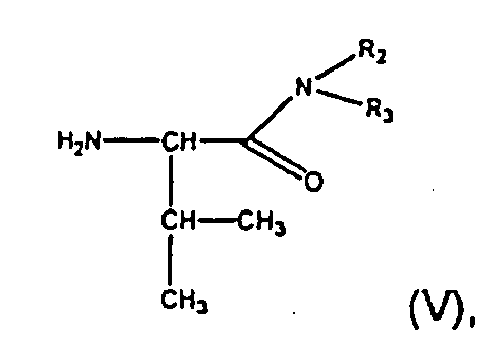 2) Amidierung der NH2(α)-Gruppe in N-terminaler Position des Lysinrestes durch eine Verbindung der folgenden Formel (VI-A) oder (VI-B)wobei die Reihenfolge der Stufen 1) und 2) beliebig ist;
 c) Eliminieren der Schutzgruppe P2 der Verbindung der Formel (XII) unter Erhalt der Verbindung der Formel (I), gegebenenfalls in Form eines Mineralsalzes oder eines organischen Salzes.
 - Verfahren nach Anspruch 1, dadurch gekennzeichnet, dass das Salz aus den Chlorhydraten, Bromhydraten, Sulfaten, Acetaten, Citraten, Tartraten, Lactaten, Phosphaten, Hydrogenphosphaten, Propionaten und Succinaten ausgewählt wird.
- Verfahren nach Anspruch 1 oder 2, dadurch gekennzeichnet, dass die Reste der Aminosäuren Lysin, Prolin oder Valin beliebige Stereoisomere jedes dieser Reste sein können.
- Verfahren nach einem der Ansprüche 1 bis 3, dadurch gekennzeichnet, dass das Salz im Verlauf der Stufe c) durch Einführung der entsprechenden Säure erhalten wird.
- Verfahren nach Anspruch 4, dadurch gekennzeichnet, dass die Säure Essigsäure oder Chlorwasserstoffsäure oder Bromwasserstoffsäure oder Schwefelsäure oder Citronensäure oder Weinsäure oder Milchsäure oder Phosphorsäure oder Hydrogenphosphorsäure oder Propionsäure oder Bernsteinsäure ist.
- Verfahren nach Anspruch 5, dadurch gekennzeichnet, dass die Säure Essigsäure oder Chlorwasserstoffsäure ist.
- Verfahren nach einem der vorangehenden Ansprüche, dadurch gekennzeichnet, dass die Schutzgruppen P1 und P2 unabhängig voneinander für Adoc (= 1-Adamantyloxycarbonyl), BOC (= t-Butyloxycarbonyl), 2-Brom-Z (= 2-Brombenzyloxycarbonyl) oder 2-Chlor-Z (= 2-Chlorbenzyloxycarbonyl) oder Fmoc (= 9-Fluorenylmethoxycarbonyl) oder Formyl oder Nicotinoyl oder 4-Nitro-Z (= 4-Nitrobenzyloxycarbonyl) oder Tfa (= Trifluoracetyl) oder Tos (= p-Toluolsulfonyl) oder Z (= Benzyloxycarbonyl) oder Adpoc (= 1-(Adamantyl)-1-methylethoxycarbonyl) stehen.
- Verfahren nach Anspruch 7, dadurch gekennzeichnet, dass die Schutzgruppen P1 und P2 so gewählt sind, dass sie bei unterschiedlichen Arbeitsbedingungen eliminiert werden.
- Verfahren nach einem der vorangehenden Ansprüche, dadurch gekennzeichnet, dass die Verbindung der Formel (II) als Salz mit einer organischen Base, vorzugsweise einem organischen Amin, vorliegt.
- Verfahren nach einem der vorangehenden Ansprüche, dadurch gekennzeichnet, dass die Verbindung der Formel (III) als Salz mit einer Mineralsäure oder organischen Säure vorliegt.
- Verfahren nach einem der vorangehenden Ansprüche, dadurch gekennzeichnet, dass in Stufe a) die Kupplungsreaktion in Gegenwart eines Kupplungsreagenzes oder Aktivierungsreagenzes, ausgewählt unter den Carbodiimiden wie zum Beispiel DCC (= Dicyclohexylcarbodiimid) oder den wasserlöslichen Formen von Carbodiimiden wie EDC (= N-Ethyl-N'-(3-dimethylaminopropyl)carbodiimidchlorhydrat), Phosphoniumsalzen wie BOP (= Benzotriazol-1-yloxy)-tris(dimethylamino)phosphoniumhexafluorphosphat), PyBOP (= (Benzotriazol-1-yloxy)-tripyrrolidinophosphoniumhexafluorphosphat), PyBROP (= Bromtripyrrolidinophosphoniumhexafluorphosphat), PyCloP (= Chlortripyrrolidinophosphoniumhexafluorphosphat), oder auch mit Hilfe von Reagenzien wie PyClU (= Chlor-N,N,N',N'-bis(tetramethylen)formamidiniumhexafluorphosphat), N-Hydroxysuccinimid, EEDQ (= 1-Ethoxycarbonyl-2-ethoxy-1,2-dihydrochinolin), CDI (= Carbonyldiimidazol) oder auch Chlorformiaten wie Ethylchlorformiat oder Isobutylchlorformiat, durchgeführt wird.
- Verfahren nach einem der vorangehenden Ansprüche, dadurch gekennzeichnet, dass die Stufe b) die folgenden Stufen umfasst:b1) Eliminierung der Schutzgruppe P1 aus der Verbindung der Formel (IV), in der P3 eine Schutzgruppe darstellt, derart, dass die Verbindung der Formel (IX) erhalten wird:
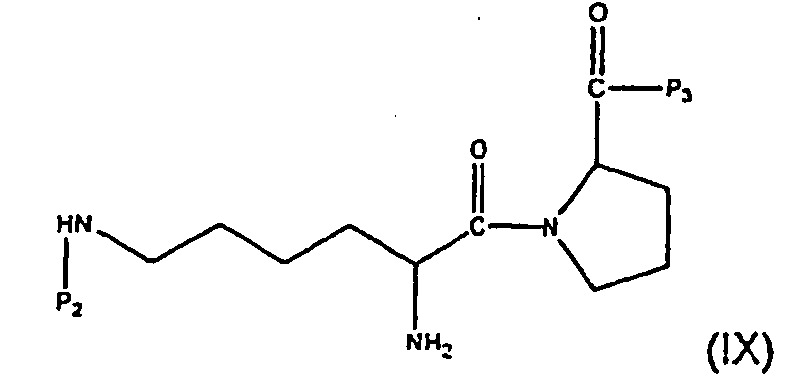 b2) Amidierung der Gruppe NH2(α) des Lysinrestes der Verbindung der Formel (IX) mit der Verbindung der Formel (VI-A) oder der Verbindung der folgenden Formel (VI-B):
um die Verbindung der folgenden Formel (X) zu erhalten: b3) Eliminierung der Schutzgruppe P3 der Verbindung der Formel (X) unter Erhalt der Verbindung der Formel (XI):
 b4) Kuppeln der Verbindung der Formel (XI) mit der Valinverbindung der folgenden Formel (V), gegebenenfalls als Salz mit einer Mineralsäure oder organischen Säure:

- Verfahren nach einem der Ansprüche 1 bis 11, dadurch gekennzeichnet, dass die Stufe b) die folgenden Stufen umfasst:b5) Eliminieren der Gruppe P3 der Verbindung der Formel (IV), in der die Gruppe P3 eine Schutzgruppe darstellt, um die Verbindung der folgenden Formel (VII) zu erhalten:
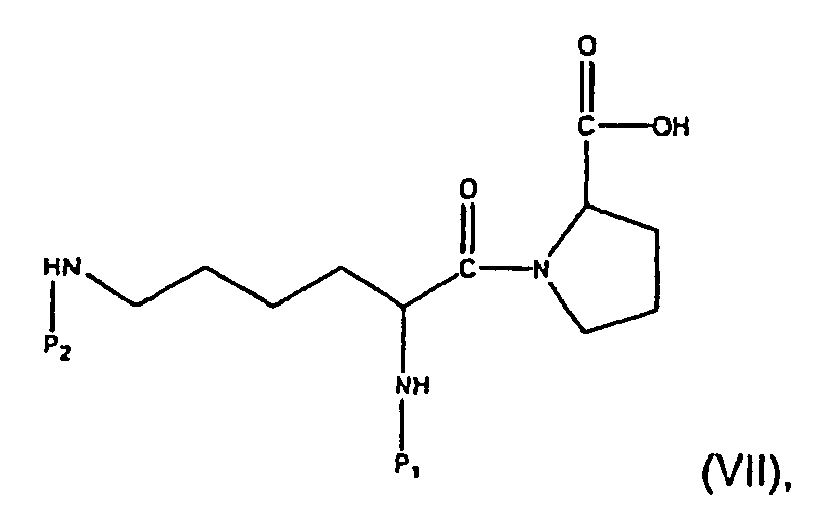 b6) Kupplung der Verbindung der Formel (VII) mit der Valinverbindung der Formel (V), gegebenenfalls als Salz mit einer mineralischen oder organischen Säure:
 b7) Eliminieren der Schutzgruppe P1 aus der Verbindung der Formel (XIII), um die Verbindung der folgenden Formel (XIV), gegebenenfalls als Salz mit einer mineralischen Säure oder organischen Säure, zu erhalten:
 b8) Amidierung der NH2(α)-Gruppe des Lysinrests der Verbindung der Formel (XIV) mit der Verbindung der Formel (VI-A) oder der Verbindung der folgenden Formel (VI-B), gegebenenfalls als Salz mit einer Mineralsäure oder organischen Säure:
um die Verbindung der folgenden Formel (XII) zu erhalten:
- Verfahren nach einem der Ansprüche 1 bis 11, dadurch gekennzeichnet, dass die Stufe b) die folgenden Stufen umfasst:b9) Eliminieren der Schutzgruppe P1 der Verbindung der Formel (VII), in der die Gruppe P3 eine Hydroxylgruppe darstellt, um die Verbindung der folgenden Formel (XV) zu erhalten:
 b10) Amidbildung der NH2(α)-Gruppe des Lysinrestes der Verbindung der Formel (XV) mit der Verbindung der Formel (VI-A) oder der Verbindung der folgenden Formel (VI-B):
um die Verbindung der folgenden Formel (XI), gegebenenfalls als Salz mit einer organischen Base oder einer mineralischen Base, zu erhalten: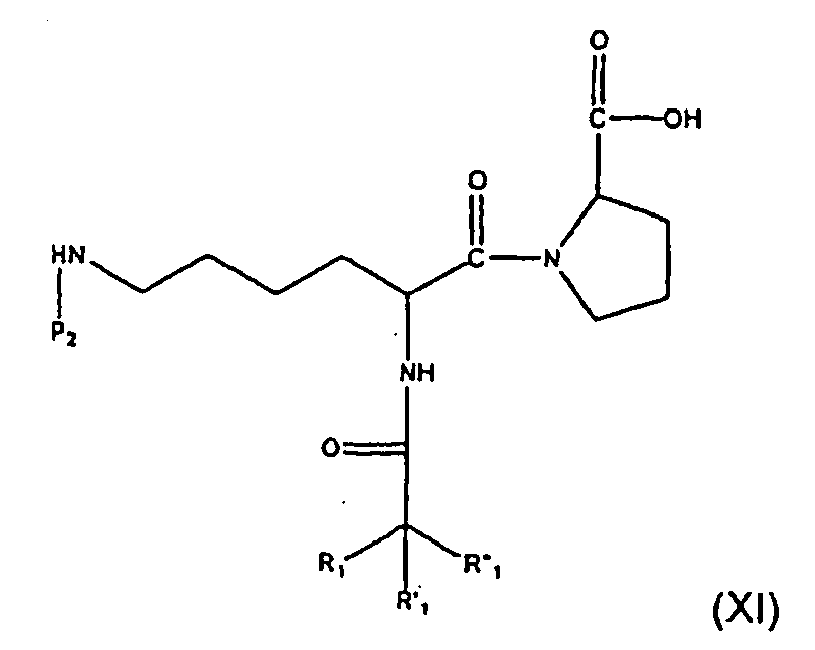 b11) Kupplung der Verbindung der Formel (XI) mit der Valinverbindung der folgenden Formel (V), gegebenenfalls als Salz mit einer Mineralsäure oder organischen Säure:
um die Verbindung der Formel (XII) zu erhalten:
- Verfahren nach einem der Ansprüche 1 bis 14, dadurch gekennzeichnet, dass in der Verbindung der Formel (II) die Schutzgruppe P1 t-Butyloxycarbonyl (BOC) ist und die Schutzgruppe P2 Benzyloxycarbonyl (Z) ist.
- Verfahren nach einem der Ansprüche 1 bis 15, dadurch gekennzeichnet, dass in der Verbindung der Formel (III) die Schutzgruppe P3 die Benzylestergruppe OBzl ist.
- Verfahren nach einem der Ansprüche 1 bis 16, dadurch gekennzeichnet, dass in der Verbindung der Formel (I) die Gruppen R1, R'1 und R"1 jeweils ein Wasserstoffatom darstellen.
- Verfahren nach einem der Ansprüche 1 bis 14, dadurch gekennzeichnet, dass in der Verbindung der Formel (I) die Gruppen R2 und R3 jeweils ein Wasserstoffatom darstellen.
- Verfahren nach einem der Ansprüche 1 bis 14, dadurch gekennzeichnet, dass die Schutzgruppe P1 t-Butyloxycarbonyl (BOC) ist, die Schutzgruppe P2 Benzyloxycarbonyl (Z) ist und die Schutzgruppe P3 der Benzylester OBzl ist.
- Diamidderivat oder Salz des Diamidderivats des Tripeptids KPV der folgenden Formel (IA):
 a) R1, R'1 und R"1 unabhängig voneinander darstellen:- lineares oder verzweigtes C1-C22-Alkyl, gegebenenfalls unterbrochen durch ein Heteroatom wie O oder N oder S oder Si,- C4-C10-Cycloalkyl,- lineares oder verzweigtes C1-C22-Polyfluoralkyl oder- Perfluoralkyl,- Aryl, gegebenenfalls substituiert mit einem oder mehreren Halogenatomen wie Cl, F, Br oder I oder einer oder mehreren linearen oder verzweigten C1-C4-Alkylgruppen,- Aralkyl- oder R1 und R'1 mit C(R"1) einen gesättigten Ring mit 3 bis 7 Atomen, der gegebenenfalls mit einem oder mehreren linearen oder verzweigten C1-C4-Alkylresten substituiert ist und/oder gegebenenfalls ein Heteroatom wie O, S oder N umfasst, bilden können,- Wasserstoff,unter der Maßgabe, dass die Gruppe R1(R'1) (R"1)CO keinen Aminosäurerest oder Peptidrest darstellt, wobei wenigstens eines der R1, R'1, R" 1 von Wasserstoff verschieden ist;b) R2 und R3 unabhängig voneinander ein Wasserstoffatom darstellen oderwobei wenigstens einer der Reste R2 oder R3 von Wasserstoff verschieden ist, mit der Maßgabe, dass die Gruppe N(R2)(R3) keinen Aminosäurerest oder Peptidrest darstellt.- lineares oder verzweigtes C1-C24-Alkyl, das gegebenenfalls durch ein Heteroatom wie O oder N oder S oder Si unterbrochen ist,- C4-C10-Cycloalkyl,- lineares oder verzweigtes C1-C22-Polyfluoralkyl oder- Perfluoralkyl,- Aryl, gegebenenfalls substituiert mit einem oder mehreren Halogenatomen wie Cl, F, Br oder I oder einer oder mehreren linearen oder verzweigten C1-C4-Alkylgruppen,- Aralkyl darstellen,- oder R2 und R3 mit dem Stickstoffatom einen gesättigten Ring mit 5 oder 6 Atomen, der gegebenenfalls mit einem oder mehreren linearen oder verzweigten C1-C4-Alkylresten substituiert ist, bilden können, wobei ein gesättigter Ring gegebenenfalls ein Heteroatom wie O, S oder auch ein zusätzliches Stickstoffatom umfasst,
 - Salz eines Diamidderivats des Tripeptids KPV gemäß Anspruch 20, dadurch gekennzeichnet, dass das Salz unter den Chlorhydraten, Bromhydraten, Sulfaten, Acetaten, Citraten, Tartraten, Lactaten, Phosphaten, Hydrogenphosphaten, Propionaten und Succinaten ausgewählt ist.
- Diamidderivat oder Salz des Diamidderivats des Tripeptids KPV gemäß Anspruch 20 oder 21, dadurch gekennzeichnet, dass die Reste der Aminosäuren Lysin, Prolin oder Valin ein beliebiges der Stereoisomeren jeder dieser Reste sein können.
- Zusammensetzungen, die in einem physiologisch annehmbaren Medium ein Derivat (IA) nach einem der Ansprüche 20 bis 22 enthalten.
- Zusammensetzungen nach Anspruch 23, dadurch gekennzeichnet, dass das Milieu ein kosmetisches Milieu ist und das Derivat (IA) mit einem Gehalt von 10-8 bis 10-3 g/100 g vorliegt.
- Zusammensetzung nach Anspruch 23, dadurch gekennzeichnet, dass das Milieu ein pharmazeutisches Milieu ist und dass das Derivat (IA) in einem Gehalt von über 5·10-4 g/100 g vorliegt.
- Verwendung eines Derivats (IA) nach einem der Ansprüche 20 bis 22 in einer kosmetischen Zusammensetzung oder zur Herstellung einer dermatologischen Zusammensetzung für/oder bestimmt zur Behandlung von trockener Haut und/oder empfindlicher Haut.
Priority Applications (1)
| Application Number | Priority Date | Filing Date | Title |
|---|---|---|---|
| SI200430088T SI1440977T1 (sl) | 2003-01-24 | 2004-01-22 | Postopek za izboljsano pripravo diamidnih derivatov tripeptida KPV |
Applications Claiming Priority (2)
| Application Number | Priority Date | Filing Date | Title |
|---|---|---|---|
| FR0300808 | 2003-01-24 | ||
| FR0300808A FR2850383B1 (fr) | 2003-01-24 | 2003-01-24 | Procede de synthese ameliore de derives diamides du tripeptide kpv |
Publications (2)
| Publication Number | Publication Date |
|---|---|
| EP1440977A1 EP1440977A1 (de) | 2004-07-28 |
| EP1440977B1 true EP1440977B1 (de) | 2006-07-26 |
Family
ID=32525006
Family Applications (1)
| Application Number | Title | Priority Date | Filing Date |
|---|---|---|---|
| EP04300039A Expired - Lifetime EP1440977B1 (de) | 2003-01-24 | 2004-01-22 | Verbessertes Verfahren zur Herstellung von diamidischen Derivaten vom Tripeptid KPV |
Country Status (10)
| Country | Link |
|---|---|
| EP (1) | EP1440977B1 (de) |
| JP (1) | JP4050238B2 (de) |
| AT (1) | ATE334142T1 (de) |
| CY (1) | CY1105713T1 (de) |
| DE (1) | DE602004001590T2 (de) |
| DK (1) | DK1440977T3 (de) |
| ES (1) | ES2270318T3 (de) |
| FR (1) | FR2850383B1 (de) |
| PT (1) | PT1440977E (de) |
| SI (1) | SI1440977T1 (de) |
Family Cites Families (2)
| Publication number | Priority date | Publication date | Assignee | Title |
|---|---|---|---|---|
| EP0317573B1 (de) * | 1986-08-08 | 1992-04-22 | Board Of Regents, The University Of Texas System | Fieber- und entzündungshemmende peptide |
| AU2001297591A1 (en) * | 2000-11-01 | 2002-09-19 | Zengen, Inc. | A sunburn treatment and sunburn prevention method |
-
2003
- 2003-01-24 FR FR0300808A patent/FR2850383B1/fr not_active Expired - Fee Related
-
2004
- 2004-01-22 DK DK04300039T patent/DK1440977T3/da active
- 2004-01-22 EP EP04300039A patent/EP1440977B1/de not_active Expired - Lifetime
- 2004-01-22 DE DE602004001590T patent/DE602004001590T2/de not_active Expired - Lifetime
- 2004-01-22 ES ES04300039T patent/ES2270318T3/es not_active Expired - Lifetime
- 2004-01-22 PT PT04300039T patent/PT1440977E/pt unknown
- 2004-01-22 AT AT04300039T patent/ATE334142T1/de not_active IP Right Cessation
- 2004-01-22 SI SI200430088T patent/SI1440977T1/sl unknown
- 2004-01-26 JP JP2004017359A patent/JP4050238B2/ja not_active Expired - Fee Related
-
2006
- 2006-10-19 CY CY20061101497T patent/CY1105713T1/el unknown
Also Published As
| Publication number | Publication date |
|---|---|
| FR2850383A1 (fr) | 2004-07-30 |
| DE602004001590D1 (de) | 2006-09-07 |
| DK1440977T3 (da) | 2006-11-20 |
| SI1440977T1 (sl) | 2006-12-31 |
| ES2270318T3 (es) | 2007-04-01 |
| CY1105713T1 (el) | 2010-12-22 |
| PT1440977E (pt) | 2006-12-29 |
| DE602004001590T2 (de) | 2007-07-19 |
| ATE334142T1 (de) | 2006-08-15 |
| FR2850383B1 (fr) | 2005-04-15 |
| JP2004231653A (ja) | 2004-08-19 |
| JP4050238B2 (ja) | 2008-02-20 |
| EP1440977A1 (de) | 2004-07-28 |
Similar Documents
| Publication | Publication Date | Title |
|---|---|---|
| EP0517589B1 (de) | Tachykininderivate, deren Herstellung und diese enthaltende pharmazeutische Zusammensetzungen | |
| JP2540534B2 (ja) | オリゴペプチジルニトリル誘導体 | |
| IE60128B1 (en) | Hydroxylamine derivatives,their preparation and use as medicaments | |
| MC1881A1 (fr) | Derives de l'acide phosphinique | |
| JPH09512806A (ja) | 新規なアミノ酸誘導体、その製造方法及びこれらの化合物を含む医薬組成物(ii) | |
| EP0082088A1 (de) | Aminosäurederivate und ihre therapeutischen Verwendungen | |
| NO169543B (no) | Analogifremgangsmaate ved fremstilling av terapeutisk aktive peptidaseinhibitorer | |
| SE448461B (sv) | Nya peptidyl-argininaldehydderivat jemte sett for deras framstellning och farmaceutiska beredningar innehallande dem | |
| ES2890676T3 (es) | Procedimiento para la producción de D-arginil-2,6-dimetil-L-tirosil-L-lisil-L-fenilalaninamida | |
| AU600704B2 (en) | Renin inhibitors, their preparation and use, and aminoacid derivatives and aminoaldehyde derivatives | |
| FR2460291A1 (fr) | Nouveaux tripeptides agissant sur le systeme nerveux central et leur procede de preparation | |
| EP0316218B1 (de) | L-Prolin-Derivate, deren Herstellung und deren biologische Anwendungen | |
| JP2002534501A (ja) | カルバミン酸の安定な新規活性化誘導体、その調製方法及び尿素調製のためのその利用 | |
| JPH0357118B2 (de) | ||
| FI95272B (fi) | Menetelmä terapeuttisesti käyttökelpoisen sykloheksyylidifluoroepeptidin valmistamiseksi | |
| JP2017523956A (ja) | D−アルギニル−2,6−ジメチル−l−チロシル−l−リシル−l−フェニルアラニンアミドの調製方法 | |
| SE452318B (sv) | Aminosyror till anvendning som mellanprodukter vid framstellning av bestatiner | |
| JPH10500123A (ja) | アミノスルホン酸の誘導体、プソイドペプチドの合成における同誘導体の利用、およびその製造法 | |
| EP1440977B1 (de) | Verbessertes Verfahren zur Herstellung von diamidischen Derivaten vom Tripeptid KPV | |
| EP0354108B1 (de) | Aminosäuren und Peptide mit einem modifizierten Tyrosin, ihre Herstellung und ihre Verwendung als Medikamente | |
| PL211506B1 (pl) | Sposób otrzymywania związków kwasu (2S, 3aS, 7aS)-1-[(S)-alanilo]-oktahydro-1H-indolo-2-karboksylowego i ich zastosowanie w syntezie perindoprilu oraz związek przejściowy | |
| EP1628956B1 (de) | Verfahren zur herstellung von ace hemmern | |
| US7683026B2 (en) | Method for synthesizing KPV tripeptide diamide derivatives | |
| FR2864830A1 (fr) | Procede de synthese sur support solide de composes peptidiques, notamment de composes peptidiques comportant un residu arginine | |
| CA1247086A (en) | Renally active tetrapeptides |
Legal Events
| Date | Code | Title | Description |
|---|---|---|---|
| PUAI | Public reference made under article 153(3) epc to a published international application that has entered the european phase |
Free format text: ORIGINAL CODE: 0009012 |
|
| AK | Designated contracting states |
Kind code of ref document: A1 Designated state(s): AT BE BG CH CY CZ DE DK EE ES FI FR GB GR HU IE IT LI LU MC NL PT RO SE SI SK TR |
|
| AX | Request for extension of the european patent |
Extension state: AL LT LV MK |
|
| 17P | Request for examination filed |
Effective date: 20050128 |
|
| AKX | Designation fees paid |
Designated state(s): AT BE BG CH CY CZ DE DK EE ES FI FR GB GR HU IE IT LI LU MC NL PT RO SE SI SK TR |
|
| 17Q | First examination report despatched |
Effective date: 20050623 |
|
| GRAP | Despatch of communication of intention to grant a patent |
Free format text: ORIGINAL CODE: EPIDOSNIGR1 |
|
| GRAS | Grant fee paid |
Free format text: ORIGINAL CODE: EPIDOSNIGR3 |
|
| GRAA | (expected) grant |
Free format text: ORIGINAL CODE: 0009210 |
|
| AK | Designated contracting states |
Kind code of ref document: B1 Designated state(s): AT BE BG CH CY CZ DE DK EE ES FI FR GB GR HU IE IT LI LU MC NL PT RO SE SI SK TR |
|
| PG25 | Lapsed in a contracting state [announced via postgrant information from national office to epo] |
Ref country code: IT Free format text: LAPSE BECAUSE OF FAILURE TO SUBMIT A TRANSLATION OF THE DESCRIPTION OR TO PAY THE FEE WITHIN THE PRESCRIBED TIME-LIMIT;WARNING: LAPSES OF ITALIAN PATENTS WITH EFFECTIVE DATE BEFORE 2007 MAY HAVE OCCURRED AT ANY TIME BEFORE 2007. THE CORRECT EFFECTIVE DATE MAY BE DIFFERENT FROM THE ONE RECORDED. Effective date: 20060726 |
|
| REG | Reference to a national code |
Ref country code: GB Ref legal event code: FG4D Free format text: NOT ENGLISH |
|
| RIC1 | Information provided on ipc code assigned before grant |
Ipc: A61K 8/64 20060101ALI20060616BHEP Ipc: C07K 5/08 20060101AFI20060616BHEP |
|
| REG | Reference to a national code |
Ref country code: CH Ref legal event code: EP |
|
| REG | Reference to a national code |
Ref country code: IE Ref legal event code: FG4D Free format text: LANGUAGE OF EP DOCUMENT: FRENCH |
|
| REF | Corresponds to: |
Ref document number: 602004001590 Country of ref document: DE Date of ref document: 20060907 Kind code of ref document: P |
|
| REG | Reference to a national code |
Ref country code: RO Ref legal event code: EPE |
|
| REG | Reference to a national code |
Ref country code: CH Ref legal event code: NV Representative=s name: KIRKER & CIE SA |
|
| REG | Reference to a national code |
Ref country code: SE Ref legal event code: TRGR |
|
| REG | Reference to a national code |
Ref country code: DK Ref legal event code: T3 |
|
| GBT | Gb: translation of ep patent filed (gb section 77(6)(a)/1977) |
Effective date: 20061030 |
|
| REG | Reference to a national code |
Ref country code: GR Ref legal event code: EP Ref document number: 20060403555 Country of ref document: GR |
|
| REG | Reference to a national code |
Ref country code: EE Ref legal event code: FG4A Ref document number: E000679 Country of ref document: EE Effective date: 20061011 |
|
| PGFP | Annual fee paid to national office [announced via postgrant information from national office to epo] |
Ref country code: CY Payment date: 20061220 Year of fee payment: 4 |
|
| REG | Reference to a national code |
Ref country code: HU Ref legal event code: AG4A Ref document number: E000851 Country of ref document: HU |
|
| REG | Reference to a national code |
Ref country code: PT Ref legal event code: SC4A Free format text: AVAILABILITY OF NATIONAL TRANSLATION Effective date: 20061025 |
|
| REG | Reference to a national code |
Ref country code: ES Ref legal event code: FG2A Ref document number: 2270318 Country of ref document: ES Kind code of ref document: T3 |
|
| PLBE | No opposition filed within time limit |
Free format text: ORIGINAL CODE: 0009261 |
|
| STAA | Information on the status of an ep patent application or granted ep patent |
Free format text: STATUS: NO OPPOSITION FILED WITHIN TIME LIMIT |
|
| 26N | No opposition filed |
Effective date: 20070427 |
|
| PGFP | Annual fee paid to national office [announced via postgrant information from national office to epo] |
Ref country code: MC Payment date: 20071224 Year of fee payment: 5 Ref country code: CZ Payment date: 20071218 Year of fee payment: 5 |
|
| PGFP | Annual fee paid to national office [announced via postgrant information from national office to epo] |
Ref country code: SK Payment date: 20071207 Year of fee payment: 5 |
|
| PGFP | Annual fee paid to national office [announced via postgrant information from national office to epo] |
Ref country code: DK Payment date: 20080115 Year of fee payment: 5 Ref country code: CH Payment date: 20080116 Year of fee payment: 5 |
|
| PGFP | Annual fee paid to national office [announced via postgrant information from national office to epo] |
Ref country code: SI Payment date: 20080121 Year of fee payment: 5 Ref country code: SE Payment date: 20080104 Year of fee payment: 5 Ref country code: PT Payment date: 20080108 Year of fee payment: 5 Ref country code: NL Payment date: 20080103 Year of fee payment: 5 Ref country code: LU Payment date: 20080129 Year of fee payment: 5 Ref country code: IE Payment date: 20080111 Year of fee payment: 5 Ref country code: HU Payment date: 20080114 Year of fee payment: 5 Ref country code: GR Payment date: 20071213 Year of fee payment: 5 Ref country code: FI Payment date: 20080115 Year of fee payment: 5 Ref country code: EE Payment date: 20080107 Year of fee payment: 5 Ref country code: BG Payment date: 20080130 Year of fee payment: 5 |
|
| PGFP | Annual fee paid to national office [announced via postgrant information from national office to epo] |
Ref country code: RO Payment date: 20071224 Year of fee payment: 5 Ref country code: AT Payment date: 20080114 Year of fee payment: 5 |
|
| PGFP | Annual fee paid to national office [announced via postgrant information from national office to epo] |
Ref country code: TR Payment date: 20080104 Year of fee payment: 5 Ref country code: BE Payment date: 20080403 Year of fee payment: 5 |
|
| PG25 | Lapsed in a contracting state [announced via postgrant information from national office to epo] |
Ref country code: CY Free format text: LAPSE BECAUSE OF NON-PAYMENT OF DUE FEES Effective date: 20080122 |
|
| REG | Reference to a national code |
Ref country code: PT Ref legal event code: MM4A Free format text: LAPSE DUE TO NON-PAYMENT OF FEES Effective date: 20090722 |
|
| PG25 | Lapsed in a contracting state [announced via postgrant information from national office to epo] |
Ref country code: MC Free format text: LAPSE BECAUSE OF NON-PAYMENT OF DUE FEES Effective date: 20090131 |
|
| REG | Reference to a national code |
Ref country code: CH Ref legal event code: PL |
|
| EUG | Se: european patent has lapsed | ||
| NLV4 | Nl: lapsed or anulled due to non-payment of the annual fee |
Effective date: 20090801 |
|
| REG | Reference to a national code |
Ref country code: EE Ref legal event code: MM4A Ref document number: E000679 Country of ref document: EE Effective date: 20090131 |
|
| REG | Reference to a national code |
Ref country code: DK Ref legal event code: EBP |
|
| PG25 | Lapsed in a contracting state [announced via postgrant information from national office to epo] |
Ref country code: PT Free format text: LAPSE BECAUSE OF NON-PAYMENT OF DUE FEES Effective date: 20090722 Ref country code: LI Free format text: LAPSE BECAUSE OF NON-PAYMENT OF DUE FEES Effective date: 20090131 Ref country code: FI Free format text: LAPSE BECAUSE OF NON-PAYMENT OF DUE FEES Effective date: 20090122 Ref country code: EE Free format text: LAPSE BECAUSE OF NON-PAYMENT OF DUE FEES Effective date: 20090131 Ref country code: CZ Free format text: LAPSE BECAUSE OF NON-PAYMENT OF DUE FEES Effective date: 20090122 Ref country code: CH Free format text: LAPSE BECAUSE OF NON-PAYMENT OF DUE FEES Effective date: 20090131 Ref country code: AT Free format text: LAPSE BECAUSE OF NON-PAYMENT OF DUE FEES Effective date: 20090122 |
|
| PG25 | Lapsed in a contracting state [announced via postgrant information from national office to epo] |
Ref country code: SK Free format text: LAPSE BECAUSE OF NON-PAYMENT OF DUE FEES Effective date: 20090122 Ref country code: SI Free format text: LAPSE BECAUSE OF NON-PAYMENT OF DUE FEES Effective date: 20090123 Ref country code: NL Free format text: LAPSE BECAUSE OF NON-PAYMENT OF DUE FEES Effective date: 20090801 Ref country code: HU Free format text: LAPSE BECAUSE OF NON-PAYMENT OF DUE FEES Effective date: 20090123 |
|
| REG | Reference to a national code |
Ref country code: SI Ref legal event code: KO00 Effective date: 20090909 |
|
| PG25 | Lapsed in a contracting state [announced via postgrant information from national office to epo] |
Ref country code: RO Free format text: LAPSE BECAUSE OF NON-PAYMENT OF DUE FEES Effective date: 20090122 Ref country code: IE Free format text: LAPSE BECAUSE OF NON-PAYMENT OF DUE FEES Effective date: 20090122 |
|
| PG25 | Lapsed in a contracting state [announced via postgrant information from national office to epo] |
Ref country code: GR Free format text: LAPSE BECAUSE OF NON-PAYMENT OF DUE FEES Effective date: 20090804 Ref country code: BE Free format text: LAPSE BECAUSE OF NON-PAYMENT OF DUE FEES Effective date: 20090131 |
|
| PG25 | Lapsed in a contracting state [announced via postgrant information from national office to epo] |
Ref country code: DK Free format text: LAPSE BECAUSE OF NON-PAYMENT OF DUE FEES Effective date: 20090731 |
|
| PG25 | Lapsed in a contracting state [announced via postgrant information from national office to epo] |
Ref country code: BG Free format text: LAPSE BECAUSE OF FAILURE TO SUBMIT A TRANSLATION OF THE DESCRIPTION OR TO PAY THE FEE WITHIN THE PRESCRIBED TIME-LIMIT Effective date: 20090131 |
|
| PG25 | Lapsed in a contracting state [announced via postgrant information from national office to epo] |
Ref country code: LU Free format text: LAPSE BECAUSE OF NON-PAYMENT OF DUE FEES Effective date: 20090122 |
|
| PG25 | Lapsed in a contracting state [announced via postgrant information from national office to epo] |
Ref country code: SE Free format text: LAPSE BECAUSE OF NON-PAYMENT OF DUE FEES Effective date: 20090123 |
|
| PG25 | Lapsed in a contracting state [announced via postgrant information from national office to epo] |
Ref country code: TR Free format text: LAPSE BECAUSE OF NON-PAYMENT OF DUE FEES Effective date: 20090122 |
|
| REG | Reference to a national code |
Ref country code: FR Ref legal event code: PLFP Year of fee payment: 13 |
|
| REG | Reference to a national code |
Ref country code: FR Ref legal event code: PLFP Year of fee payment: 14 |
|
| REG | Reference to a national code |
Ref country code: FR Ref legal event code: PLFP Year of fee payment: 15 |
|
| PGFP | Annual fee paid to national office [announced via postgrant information from national office to epo] |
Ref country code: FR Payment date: 20191216 Year of fee payment: 17 |
|
| PGFP | Annual fee paid to national office [announced via postgrant information from national office to epo] |
Ref country code: DE Payment date: 20200107 Year of fee payment: 17 Ref country code: IT Payment date: 20200114 Year of fee payment: 17 Ref country code: GB Payment date: 20200115 Year of fee payment: 17 Ref country code: ES Payment date: 20200203 Year of fee payment: 17 |
|
| REG | Reference to a national code |
Ref country code: DE Ref legal event code: R119 Ref document number: 602004001590 Country of ref document: DE |
|
| GBPC | Gb: european patent ceased through non-payment of renewal fee |
Effective date: 20210122 |
|
| PG25 | Lapsed in a contracting state [announced via postgrant information from national office to epo] |
Ref country code: FR Free format text: LAPSE BECAUSE OF NON-PAYMENT OF DUE FEES Effective date: 20210131 |
|
| PG25 | Lapsed in a contracting state [announced via postgrant information from national office to epo] |
Ref country code: GB Free format text: LAPSE BECAUSE OF NON-PAYMENT OF DUE FEES Effective date: 20210122 Ref country code: DE Free format text: LAPSE BECAUSE OF NON-PAYMENT OF DUE FEES Effective date: 20210803 |
|
| REG | Reference to a national code |
Ref country code: ES Ref legal event code: FD2A Effective date: 20220426 |
|
| PG25 | Lapsed in a contracting state [announced via postgrant information from national office to epo] |
Ref country code: IT Free format text: LAPSE BECAUSE OF NON-PAYMENT OF DUE FEES Effective date: 20210122 |
|
| PG25 | Lapsed in a contracting state [announced via postgrant information from national office to epo] |
Ref country code: ES Free format text: LAPSE BECAUSE OF NON-PAYMENT OF DUE FEES Effective date: 20210123 |