EP1445262B1 - Peptidderivat, pharmazeutisch unbedenkliches salz davon, verfahren zu dessen herstellung und dessen verwendung - Google Patents
Peptidderivat, pharmazeutisch unbedenkliches salz davon, verfahren zu dessen herstellung und dessen verwendung Download PDFInfo
- Publication number
- EP1445262B1 EP1445262B1 EP02780081A EP02780081A EP1445262B1 EP 1445262 B1 EP1445262 B1 EP 1445262B1 EP 02780081 A EP02780081 A EP 02780081A EP 02780081 A EP02780081 A EP 02780081A EP 1445262 B1 EP1445262 B1 EP 1445262B1
- Authority
- EP
- European Patent Office
- Prior art keywords
- group
- formula
- pharmaceutically acceptable
- acceptable salt
- peptide derivative
- Prior art date
- Legal status (The legal status is an assumption and is not a legal conclusion. Google has not performed a legal analysis and makes no representation as to the accuracy of the status listed.)
- Expired - Lifetime
Links
Classifications
-
- C—CHEMISTRY; METALLURGY
- C07—ORGANIC CHEMISTRY
- C07K—PEPTIDES
- C07K5/00—Peptides containing up to four amino acids in a fully defined sequence; Derivatives thereof
- C07K5/02—Peptides containing up to four amino acids in a fully defined sequence; Derivatives thereof containing at least one abnormal peptide link
-
- C—CHEMISTRY; METALLURGY
- C07—ORGANIC CHEMISTRY
- C07C—ACYCLIC OR CARBOCYCLIC COMPOUNDS
- C07C279/00—Derivatives of guanidine, i.e. compounds containing the group, the singly-bound nitrogen atoms not being part of nitro or nitroso groups
- C07C279/30—Derivatives of guanidine, i.e. compounds containing the group, the singly-bound nitrogen atoms not being part of nitro or nitroso groups having nitrogen atoms of guanidine groups bound to nitro or nitroso groups
- C07C279/32—N-nitroguanidines
- C07C279/36—Substituted N-nitroguanidines
-
- A—HUMAN NECESSITIES
- A61—MEDICAL OR VETERINARY SCIENCE; HYGIENE
- A61P—SPECIFIC THERAPEUTIC ACTIVITY OF CHEMICAL COMPOUNDS OR MEDICINAL PREPARATIONS
- A61P1/00—Drugs for disorders of the alimentary tract or the digestive system
- A61P1/02—Stomatological preparations, e.g. drugs for caries, aphtae, periodontitis
-
- A—HUMAN NECESSITIES
- A61—MEDICAL OR VETERINARY SCIENCE; HYGIENE
- A61P—SPECIFIC THERAPEUTIC ACTIVITY OF CHEMICAL COMPOUNDS OR MEDICINAL PREPARATIONS
- A61P43/00—Drugs for specific purposes, not provided for in groups A61P1/00-A61P41/00
-
- Y—GENERAL TAGGING OF NEW TECHNOLOGICAL DEVELOPMENTS; GENERAL TAGGING OF CROSS-SECTIONAL TECHNOLOGIES SPANNING OVER SEVERAL SECTIONS OF THE IPC; TECHNICAL SUBJECTS COVERED BY FORMER USPC CROSS-REFERENCE ART COLLECTIONS [XRACs] AND DIGESTS
- Y02—TECHNOLOGIES OR APPLICATIONS FOR MITIGATION OR ADAPTATION AGAINST CLIMATE CHANGE
- Y02P—CLIMATE CHANGE MITIGATION TECHNOLOGIES IN THE PRODUCTION OR PROCESSING OF GOODS
- Y02P20/00—Technologies relating to chemical industry
- Y02P20/50—Improvements relating to the production of bulk chemicals
- Y02P20/55—Design of synthesis routes, e.g. reducing the use of auxiliary or protecting groups
Definitions
- the present invention relates to a novel peptide derivative and pharmaceutically acceptable salts thereof, and a production process and use thereof.
- P. gingivalis Porphyromonas gingivalis
- gingivalis decompose periodontal tissue components such as collagen and blood serum proteins involved in the body's natural defense system and the proteases have revealed to be closely related to the pathogenicity of P. gingivalis (Greiner D., Mayrand D.: Biology of the Species Porphyromonas Gingivalis, Edited by Shah H. N., Mayrrand D. and Genco R. J., pp.227-243, CRC Press, Boca Raton, Ann Arbor, London, Tokyo, 1993).
- Lys-gingipain (hereinafter sometimes abbreviated as "KGP") and Arg-gingipain (hereinafter sometimes abbreviated as “RGP”) are the principal proteolytic enzymes.
- KGP Lys-gingipain
- RGP Arg-gingipain
- drugs for inhibiting the growth of bacteria are used to prevent and treat periodontal disease.
- examples of such drugs include antibiotics such as tetracycline and minocycline; natural products such as chamomile tincture and rhatany tincture; cyclohexadine, tranexamic acid and the like.
- antibiotics such as tetracycline and minocycline
- natural products such as chamomile tincture and rhatany tincture
- cyclohexadine, tranexamic acid and the like include antibiotics such as tetracycline and minocycline; natural products such as chamomile tincture and rhatany tincture; cyclohexadine, tranexamic acid and the like.
- these drugs have safety problems or other various problems such as unpleasant smell.
- Japanese Unexamined Patent Publication No. 1993-97708 discloses periodontal therapeutic agents comprising an ATPase inhibitor, a cysteine protease inhibitor
- inhibitors for selectively inhibiting RGP are malabaricon C described in Japanese Unexamined Patent Publication No. 1999-335274 and an arginine derivative described in Japanese Unexamined Patent Publication No. 1999-228526.
- a lysine derivative described in Tissue Culture Engineering, 27 (9), 343-347, 2001 is known as an inhibitor capable of selectively inhibiting KGP.
- Histatin 5 has been skown to inhibit the activity of Arg-gingipain and LYS-gingipain (Infection and Immunity; 69(3). p1402-1408, 2001).
- An object of the invention is to provide a novel compound that has potent inhibitory activity against both enzymes, KGP and RGP, thus being useful as a periodontal preventive or therapeutic agent, and provide a production process thereof.
- Another object of the invention is to provide a novel inhibitor capable of inhibiting both KGP and RGP, a pharmaceutical preparation for periodontal disease and a composition for use in the oral cavity.
- a further object of the invention is to provide a novel method for preventing or treating periodontal disease.
- the present inventors carried out intensive research focusing on the following points: P. gingivalis plays a significant role in the onset and progress of periodontal disease; and the proteolytic enzymes KGP and RGP both contribute to periodontal diseases caused by P. gingivalis .
- the inventors found a novel peptide derivative capable of potently inhibiting the enzymatic activities of both proteases, KGP and RGP. The inventors carried out further research based on the above finding and accomplished the present invention.
- the present invention provides the following novel peptide derivatives having inhibitory activity against both KGP and RGP, pharmaceutically acceptable salts thereof, and production processes and uses thereof.
- the present application also relates to:
- the amino protecting group represented by R 1 is not specifically limited as long as it does not adversely affect living organisms and synthetic reactions.
- Commonly used amino protecting groups such as those described in T.W.Greene, "Protective groups in Organic Synthesis", A Wiley-Interscience Publication, John-Wiley & Sons, New York, 1981, pp.218-287, are suitable.
- Specific examples include optionally substituted aralkyloxycarbonyl, optionally substituted lower alkyloxycarbonyl, substituted sulfonyl, acetyl, benzyl, 1-adamantyloxycarbonyl, cyclopentyloxycarbonyl and the like.
- optionally substituted aralkyloxycarbonyl groups include benzyloxycarbonyl (Cbz); benzyloxycarbonyl substituted with 1 to 3 C 1-4 lower alkoxy groups, such as p-methoxybenzyloxycarbonyl and p-ethoxybenzyloxycarbonyl; benzyloxycarbonyl substituted with a nitro group, such as p-nitrobenzyloxycarbonyl; benzyloxycarbonyl substituted with 1 to 3 halogen atoms, such as p-bromobenzyloxycarbonyl and 2,4-dichlorobenzyloxycarbonyl; diphenylmethoxycarbonyl and the like.
- benzyloxycarbonyl Cbz
- benzyloxycarbonyl substituted with 1 to 3 C 1-4 lower alkoxy groups such as p-methoxybenzyloxycarbonyl and p-ethoxybenzyloxycarbonyl
- optionally substituted lower alkyloxycarbonyl groups include C 2-7 straight or branched chain lower alkyloxycarbonyl optionally substituted with 1 to 3 halogen atoms, such as methoxycarbonyl, ethoxycarbonyl, t-butoxycarbonyl (Boc), 9-fluorenylmethyloxycarbonyl and 2,2,2-trichloroethyloxycarbonyl.
- substituted sulfonyl group examples include sulfonyl having one substituent such as a C 1-6 straight or branched chain lower alkyl group or a phenyl group optionally substituted with 1 to 3 C 1-6 straight or branched chain lower alkyl groups, such as benzenesulfonyl, p-toluenesulfonyl and methanesulfonyl.
- the amino protecting group represented by R 1 is an optionally substituted aralkyloxycarbonyl group or an optionally substituted lower alkyloxycarbonyl group.
- the amino protecting group represented by R 1 is an optionally substituted aralkyloxycarbonyl group or an optionally substituted lower alkyloxycarbonyl group.
- Especially preferable is optionally lower alkoxy-, nitro- or halogen-substituted benzyloxycarbonyl, or optionally halogen-substituted C 2-7 straight or branched chain lower alkyloxycarbonyl.
- Particularly preferable is benzyloxycarbonyl or 2,2,2-trichloroethyloxycarbonyl.
- lower alkoxy groups represented by R 2 include C 1-6 straight or branched chain lower alkoxy groups such as methoxy, ethoxy, n-propoxy, isopropoxy, n-butoxy, isobutoxy and t-butoxy. Preferable is t-butoxy.
- the side chain (R group) of lysine represented by R 3 or R 4 means the side chain or residue bonded to the ⁇ -carbon atom of lysine, i.e., 4-aminobutyl.
- the amino group of the side chain (R group) may be protected with a protecting group.
- useful amino protecting groups are the above-mentioned amino protecting groups.
- the amino protecting group is a C 2-7 straight or branched chain lower alkyloxycarbonyl group optionally substituted with 1 to 3 halogen atoms.
- Especially preferable are unsubstituted C 2-7 straight or branched chain lower alkyloxycarbonyl groups.
- Particularly preferable is t-butoxycarbonyl.
- the side chain (R group) of arginine means the side chain or residue bonded to the ⁇ -carbon atom of arginine, i.e., 3-guanidinopropyl.
- the guanidino group of the side chain (R group) may be protected with a protecting group.
- nitro examples include nitro; sulfonyl substituted with one substituent such as phenyl optionally substituted with 1 to 3 C 1-6 straight or branched chain lower alkyl groups, or chromane optionally substituted with 1 to 6 C 1-6 straight or branched chain lower alkyl groups, such as p-toluenesulfonyl and 2,2,5,7,8-pentamethylchromane-6-sulfonyl; and oxycarbonyl groups substituted with one substituent such as aralkyl or adamantyl, such as benzyloxycarbonyl, phenethyloxycarbonyl and 1-adamantyloxycarbonyl.
- sulfonyl substituted with one substituent such as phenyl optionally substituted with 1 to 3 C 1-6 straight or branched chain lower alkyl groups, or chromane optionally substituted with 1 to 6 C 1-6 straight or branched chain lower alkyl groups, such as p
- lower alkyl groups represented by R 5 and R 6 are C 1-6 straight or branched chain lower alkyl groups such as methyl, ethyl, n-propyl, isopropyl, n-butyl, isobutyl, s-butyl, t-butyl, n-pentyl, isopentyl, 1-ethylpropyl, n-hexyl, isohexyl, 1-ethylbutyl and the like.
- Preferable are methyl and ethyl.
- aralkyl groups include phenyl-C 1 -C 6 alkyl, particularly benzyl and phenethyl.
- X is -CO-.
- R 1 is hydrogen or optionally substituted aralkyloxycarbonyl
- R 2 is hydroxyl or C 1-6 straight or branched chain lower alkoxy
- one of R 3 and R 4 is the side chain (R group) of lysine and the other of R 3 and R 4 is the side chain (R group) of arginine the guanidino group of which may be protected with a nitro group
- R 5 and R 6 may be the same or different and are hydrogen or aralkyl.
- Particularly preferable compounds are those wherein X is -CO-, R 1 is benzyloxycarbonyl, R 2 is hydroxyl or t-butoxy, R 3 is the side chain (R group) of lysine, R 4 is the side chain (R group) of arginine the guanidino group of which is protected with a nitro group, R 5 is hydrogen and R 6 is phenethyl.
- the pharmaceutically acceptable salts of the compounds of the invention are not particularly limited. Examples thereof include acid addition salts formed by reacting the compounds of the invention with pharmaceutically acceptable acids. Specific examples include inorganic acid salts such as hydrochlorides and sulfates; and organic acid salts such as formates, trifluoroacetates, acetates, tartrates, maleates, fumarates, succinates and methanesulfonates.
- the compounds of the invention or pharmaceutically acceptable salts thereof may be in the form of solvates such as hydrates.
- the compounds of the invention may exist as enantiomers or diastereoisomers depending on the asymmetric carbons in the molecular structure. All such enantiomers and diastereoisomers are included in the scope of the invention. Such compounds can be used as is as isomeric mixtures or can be optically resolved by conventional techniques.
- the compounds of formula (I) can be prepared according to the following reaction schemes. wherein R 1 , R 3 , R 4 , R 5 and R 6 are as defined above; and R 2a is lower alkoxy.
- lower alkoxy groups represented by R 2a include C 1-6 straight or branched chain lower alkoxy groups, preferably methoxy, ethoxy and t-butoxy.
- Step (i): The compound of formula (I-a) of the invention can be synthesized by condensing a compound of formula (II) with a known compound of formula (III) prepared according to the method described in Japanese Unexamined Patent Publication No. 1999-228526 in a suitable solvent.
- the condensation reaction can be carried out by conventional methods.
- Useful methods include, for example, methods using a condensing agent such as N,N-dicyclohexylcarbodiimide, 1-ethyl-3-(3-dimethylaminopropyl)carbodiimide hydrochloride or the like; methods using additives (e.g., 1-hydroxybenzotriazole, N-hydroxy-5-norbornene-2,3-dicarboxyimide, etc.) in addition to the condensing agent; mixed acid anhydride methods using isobutyl chloroformate, etc.; azide methods; active ester methods; and the like.
- a condensing agent such as N,N-dicyclohexylcarbodiimide, 1-ethyl-3-(3-dimethylaminopropyl)carbodiimide hydrochloride or the like
- additives e.g., 1-hydroxybenzotriazole, N-hydroxy-5-norbornen
- Any solvent can be used in the condensation reaction so long as it is inert to the reaction.
- Useful solvents include, for example, N,N-dimethylformamide, tetrahydrofuran, methylene chloride, dioxane, ethyl acetate, N-methylpyrrolidone and the like. These solvents can be used singly or in combination of two or more.
- the amount of compound of formula (III) is about 0.5 to about 10 moles, and preferably about 1 to about 5 moles, per mole of the compound of formula (II).
- the amount of condensing agent is about 0.5 to about 10 moles, preferably about 1 to about 5 moles, per mole of compound of formula (II).
- the reaction time is about 0.3 to about 100 hours, and preferably about 0.5 to about 20 hours.
- the compound obtained in this step can be used in the following reaction step, with or without being isolated. wherein R 1 , R 2a , R 3 , R 4 , R 5 and R 6 are as defined above.
- Step (ii): The compound of formula (I-b) of the invention can be synthesized by oxidizing the compound of formula (I-a) obtained in Reaction Scheme 1 in a suitable solvent.
- the oxidation reaction can be carried out by conventional methods.
- Useful methods include, for example, Dess-Martin oxidation using Dess-Martin reagents; improved Moffat oxidation using dimethyl sulfoxide/1-ethyl-3-(3-dimethylaminopropyl)carbodiimide hydrochloride/dichloroacetic acid; and oxidation using N-tert-butylphenylsulfinimidoyl chloride.
- Any solvent can be used in the oxidation reaction so long as it is inert to the reaction.
- Useful solvents include, for example, N,N-dimethylformamide, tetrahydrofuran, methylene chloride, dioxane, ethyl acetate, acetonitrile, N-methylpyrrolidone and the like. These solvents can be used singly or in combination of two or more.
- the amount of oxidizing reagent is about 0.3 to about 100 moles, preferably about 1 to about 10 moles, per mole of compound of formula (I-a).
- the reaction time is about 0.1 to about 100 hours, preferably about 0.5 to about 50 hours.
- the reaction temperature is about -78°C to about 100°C, and preferably about 0°C to about 40°C.
- the compound obtained in this step can be used in the following reaction step, with or without being isolated.
- X, R 1 , R 3 , R 4 , R 5 and R 6 are as defined above.
- Step (iii): The compound of formula (I-c) of the invention can be obtained by treating a compound of formula (I-a) or (I-b) obtained in Reaction Scheme 1 or 2 with an acid, in a suitable solvent or in the absence of solvents.
- Any solvent can be used in the reaction as long as it is inert to the reaction.
- Useful solvents include, for example, chloroform, methylene chloride, dioxane, tetrahydrofuran and ethyl acetate.
- Useful acids include, for example, mineral acids such as hydrochloric acid and sulfuric acid; and organic acids such as trifluoroacetic acid and p-toluenesulfonic acid.
- the amount of acid used in the reaction is about 1 to about 1,000 moles, and preferably about 1 to about 100 moles, per mole of the compound of formula (I-a) or (I-b).
- the reaction time is about 0.5 to about 50 hours.
- the reaction temperature is about 0°C to about 100°C, and preferably about 0°C to about 30°C.
- the compound of formula (II) can be produced, for example, according to the following Reaction Scheme 4: wherein R 1 , R 2a and R 3 are as defined above and R 7 is lower alkoxy.
- Examples of lower alkoxy groups represented by R 7 include the above-mentioned C 1-6 straight or branched chain lower alkoxy groups. Preferable are methoxy, ethoxy and t-butoxy.
- Step (iv): The compound of formula (VI) of the invention can be produced by condensing a compound of formula (IV) with a known compound of formula (V) in a suitable solvent.
- the condensation reaction can be carried out by conventional methods.
- Useful methods include, for example, methods using a condensing agent such as N,N-dicyclohexylcarbodiimide, 1-ethyl-3-(3-dimethylaminopropyl)carbodiimide hydrochloride or the like; methods using additives (e.g., 1-hydroxybenzotriazole, N-hydroxy-5-norbornene-2,3-dicarboxyimide, etc.) in addition to the condensing agent; mixed acid anhydride methods using isobutyl chloroformate, etc.; azide methods; and active ester methods.
- a condensing agent such as N,N-dicyclohexylcarbodiimide, 1-ethyl-3-(3-dimethylaminopropyl)carbodiimide hydrochloride or the like
- additives e.g., 1-hydroxybenzotriazole, N-hydroxy-5-norbornene-2,
- Any solvent can be used in the condensation reaction so long as it is inert to the reaction.
- Useful solvents include, for example, N,N-dimethylformamide, tetrahydrofuran, methylene chloride, dioxane, ethyl acetate, N-methylpyrrolidone and the like. These solvents can be used singly or in combinations of two or more.
- the amount of compound of formula (V) is about 0.5 to about 10 moles, preferably about 1 to about 5 moles, per mole of compound of formula (IV).
- the amount of condensing agent is about 0.5 to about 10 moles, preferably about 1 to about 5 moles, per mole of compound of formula (IV).
- the reaction time is about 0.3 to about 100 hours, and preferably about 0.5 to about 20 hours.
- the reaction temperature is about -10°C to about 100°C, and preferably about 0°C to about 40°C.
- the compound obtained in this step can be used in the following reaction step (v), with or without being isolated.
- the compound of formula (IV) can be obtained by subjecting a known compound described in WIPO Publication No. WO 98/50420, Japanese Unexamined Patent Publication No. 1999-228526, etc. to a conventional amino group deprotection reaction.
- Useful deprotection reactions include, for example, catalytic hydrogenation, methods using trimethylsilyliodide or triethylsilane, and the like.
- Catalysts usable in catalytic reduction methods include, for example, palladium-carbon, palladium chloride and the like. Since deprotection conditions vary depending on the type of protecting group of the precursor compound, the compound of formula (IV) may be obtained in the free state or as a salt.
- Such salts are not particularly limited so long as they do not participate in the condensation reaction.
- Specific examples thereof include mineral acid salts such as hydrochlorides and sulfates; and organic acid salts such as p-toluenesulfonates and methanesulfonates.
- Step (v): The compound of formula (II) can be obtained by hydrolysis of the compound (VI) obtained in the above step (iv) with a base in a suitable solvent.
- a suitable solvent Any solvent can be used in the reaction so long as it is inert to the reaction.
- water, methanol, ethanol, 1-propanol, 2-propanol, tetrahydrofuran and the like can be used singly or in combination of two or more.
- useful bases include lithium hydroxide, sodium hydroxide, potassium hydroxide and the like.
- the amount of base is about 1 to about 10 moles, and preferably about 1 to about 2 moles, per mole of the compound of formula (VI).
- the reaction time is about 0.3 to about 100 hours, and preferably about 0.5 to about 20 hours.
- the reaction temperature is about 0 to about 100°C, and preferably about 0 to about 40°C.
- the compound obtained in this step can be used in Reaction Scheme 1, with or without being isolated.
- the compounds of the invention obtained by the above processes and the other above-mentioned compounds can be purified by the separation and purification techniques typically used in the field of chemical synthesis, such as recrystallization, distillation and various column chromatographic techniques.
- the peptide derivative of formula (I) of the invention and pharmaceutically acceptable salts thereof potently inhibit KGP and RGP, proteolytic enzymes produced by P. gingivalis closely associated with the onset and progress of periodontal disease.
- the peptide derivative of the invention is composed of highly safe natural amino acids or derivatives thereof. Therefore, the peptide derivative and its metabolites produced in vivo are assumed to be highly safe.
- the peptide derivative of formula (I) and pharmaceutically acceptable salts thereof are useful as an active ingredient of Lys-gingipain and Arg-gingipain inhibitors and pharmaceutical preparations for periodontal disease.
- Lys-gingipain and Arg-gingipain inhibitors and pharmaceutical preparations for periodontal disease can be used as periodontal preventive agents and therapeutic agents.
- the peptide derivative of formula (I) and pharmaceutically acceptable salts thereof can also be used, together with a pharmaceutically acceptable carrier, to prepare compositions for use in the oral cavity.
- the peptide derivative of the invention or pharmaceutically acceptable salts thereof can be mixed with a pharmaceutically acceptable carrier and administered as preparations for use in the oral cavity, such as gel preparations for use in the oral cavity, oral ointments for adhesive application to mucous membranes, oral pastes, periodontal-pocket intercalating agents, and preparations for adhesive application to gingivae; and oral hygiene agents such as dentifrices, mouthwashes, chewing gums, tablets, candies, troches and the like.
- the compositions for oral cavity can be used as periodontal preventive agents or therapeutic agents.
- Useful pharmaceutically acceptable carriers include appropriate carriers commonly used in accordance with the dosage form. Specific examples include methylcellulose, hydroxymethylcellulose, hydroxyethylcellulose, carboxymethylcellulose sodium, hydroxypropylmethylcellulose liquid paraffin, white petrolatum, platinum base, Eudragit L, sodium alginate, propylene glycol alginate, pullulan, tragacanth, xanthan gum, chitosan, polyvinylpyrrolidone, polyvinyl alcohol, polyacrylic acid, sodium polyacrylate, polymethacrylic acid, ethyl methacrylate, dimethylamino acetate, cellulose acetate, collagen, atherocollagen, gelatin, glycerol, triacetin, Macrogol 400, Polysorbate 60, polyoxyl stearate 40, butyl p-hydroxybenzoate, ethanol, cetyl alcohol, glyceryl monostearate, calcium carbonate, magnesium carbonate, calcium secondary phosphate, carrageenan, sodium di
- compositions for use in oral cavity each containing the peptide derivative of the invention or a pharmaceutically acceptable salt thereof as an active ingredient, is administered to a mammal, including a human
- usable administration methods are such that the preparation is inserted, applied or used for washing in a suitable amount at least once a day with an active ingredient content of about 0.001 wt.% or more, and preferably about 0.01 to about 20 wt.%.
- the dosage can be suitably selected according to the mode of administration, the age, gender and other conditions of the patient, and the severity of disease.
- the dosage of the active ingredient compound of the invention is usually about 0.001 to about 100 mg per kg body weight per day, and preferably about 0.005 to about 10 mg/kg/day.
- the dosage can be suitably selected according to the mode of administration, the age, gender and other conditions of the human or other mammal.
- the dosage of the active ingredient compound of the invention is usually about 0.001 to about 100 mg per kg body weight per day, preferably about 0.005 to about 10 mg/kg/day.
- Example 1 Compound 1 of the invention obtained in Example 1 1.0 White petrolatum 10.0 Sodium polyacrylate 3.0 Liquid paraffin Balance Total 100.0 (wt.%)
- An oral ointment was prepared in a conventional manner according to the above formulation.
- a dentifrice was prepared in a conventional manner according to the above formulation.
- Troches were prepared in a conventional manner according to the above formulation.
- Chewing gum was prepared in a conventional manner according to the above formulation.
- a gargle was prepared in a conventional manner according to the above formulation.
- Ethanol 30.0 Polyoxyethylene(20) sorbitan laurate 1.0 Polyoxyethylene (40) hydrogenated castor oil 0.5 Sodium hydroxide 0.05 Sodium saccharin 0.05 Compound of the invention obtained in Example 3 0.5 Flavor 0.5 Water Balance Total 100.0 (wt.%)
- a mouthwash was prepared in a conventional manner according to the above formulation.
- Test Example 1 Determination of inhibitory activities against KGP and RGP
- the inhibitory activity against Lys-gingipain was measured by the method of Abe et al. (Journal Biochemistry, 1998, Vol. 123, 305-312) using Cbz-His-Glu-Lys-MCA as a substrate.
- the inhibitory activity against Arg-gingipain was measured by the method of Kadowaki et al. (Journal Biological Chemistry, 1994, Vol. 269, 21371-2138) using Cbz-Phe-Arg-MCA as a substrate.
- the measurements were carried out in the following manner: 100 ⁇ l of 50 mM L-cystein, 200 ⁇ l of a 0.1 M sodium phosphate buffer solution (pH 7.5), 20 ⁇ l of 12.3 nM KGP or RGP solution containing 0.05% "Brij35” (a tradename, product of Aldrich, polyoxyethylene(23) lauryl ether), 80 ⁇ l of distilled water and 100 ⁇ l of a dimethyl sulfoxide solution of a compound according to the invention were mixed and preincubated at 37°C for 5 minutes.
- Table 1 shows the test results.
- Table 1 Compound (Example No.) Concentration (mol/l) Enzyme inhibitory activity (%) KGP RGP 3 10 -4 100.0 99.4 10 -5 99.9 96.8 10 -6 99.9 81.1
- Table 1 shows that the compound of the invention has excellent inhibitory activities against both enzymes, KGP and RGP.
- the compound of the invention inhibits both Lys-gingipain (KGP) and Arg-gingipain (RGP) produced by a gram-negative anaerobic bacterium, Porphyromonas gingivalis , and is therefore useful, for example, as a preventive or therapeutic agent for periodontal disease.
- KGP Lys-gingipain
- RGP Arg-gingipain
Landscapes
- Chemical & Material Sciences (AREA)
- Organic Chemistry (AREA)
- Health & Medical Sciences (AREA)
- General Health & Medical Sciences (AREA)
- Medicinal Chemistry (AREA)
- Life Sciences & Earth Sciences (AREA)
- Veterinary Medicine (AREA)
- Nuclear Medicine, Radiotherapy & Molecular Imaging (AREA)
- Bioinformatics & Cheminformatics (AREA)
- Pharmacology & Pharmacy (AREA)
- General Chemical & Material Sciences (AREA)
- Animal Behavior & Ethology (AREA)
- Engineering & Computer Science (AREA)
- Public Health (AREA)
- Chemical Kinetics & Catalysis (AREA)
- Biochemistry (AREA)
- Biophysics (AREA)
- Genetics & Genomics (AREA)
- Molecular Biology (AREA)
- Proteomics, Peptides & Aminoacids (AREA)
- Medicines That Contain Protein Lipid Enzymes And Other Medicines (AREA)
- Pharmaceuticals Containing Other Organic And Inorganic Compounds (AREA)
- Peptides Or Proteins (AREA)
- Cosmetics (AREA)
Claims (19)
- Peptidderivat der Formel (1) oder ein pharmazeutisch verträgliches Salz davon

- Peptidderivat der Formel (I) oder ein pharmazeutisch verträgliches Salz davon nach Anspruch 1, wobei X -CO- ist.
- Peptidderivat der Formel (I) oder ein pharmazeutisch verträgliches Salz davon nach Anspruch 2, wobei X -CO- ist, R1 Wasserstoff oder gegebenenfalls substituiertes Aralkyloxycarbonyl ist, R2 Hydroxyl oder Niederalkoxy ist, eines von R3 und R4 die Seitenkette (R-Gruppe) von Lysin ist, und das andere von R3 und R4 die Seitenkette (R-Gruppe) von Arginin ist, wobei dessen Guanidingruppe mit einer Nitrogruppe geschützt sein kann, und R5 und R6 gleich oder verschieden sein können und Wasserstoff oder Aralkyl sind.
- Peptidderivat der Formel (I) oder ein pharmazeutisch verträgliches Salz davon nach Anspruch 3, wobei X -CO- ist, R1 Benzyloxycarbonyl ist, R2 Hydroxyl oder t-Butoxy ist, R3 die Seitenkette (R-Gruppe) von Lysin ist, R4 die Seitenkette (R-Gruppe) von Arginin ist, wobei dessen Guanidingruppe mit einer Nitrogruppe geschützt ist, R5 Wasserstoff ist und R6 Phenethyl ist.
- Verfahren zum Herstellen eines Peptidderivates der Formel (I) oder eines pharmazeutisch verträglichen Salzes davon

wobei das Verfahren den folgenden Schritt (i) umfasst:(i) das Kondensieren einer Verbindung der Formel (II)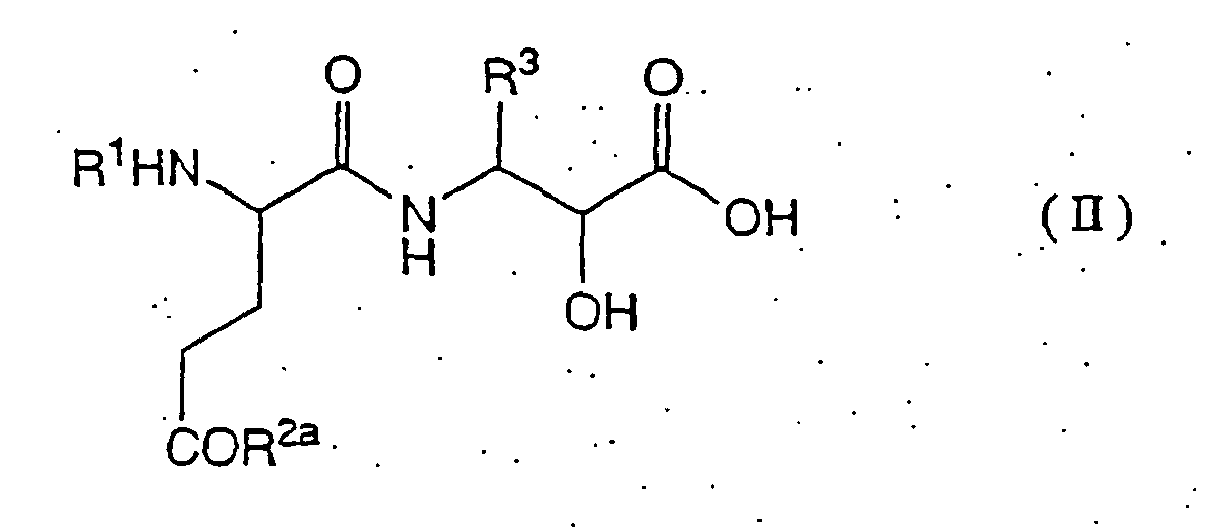

um ein Peptidderivat der Formel (1-a) oder ein pharmazeutisch verträgliches Salz davon herzustellen
- Verfahren zum Herstellen eines Peptidderivates der Formel (I) oder eines pharmazeutisch verträglichen Salzes davon, welches den folgenden Schritt (ii) umfasst:(ii) das Oxidieren einer Verbindung der Formel (I-a), um ein Peptidderivat der Formel (I-b) oder ein pharmazeutisch verträgliches Salz davon herzustellen

- Verfahren zum Herstellen eines Peptidderivates der Formel (I) oder eines pharmazeutisch verträglichen Salzes davon, welches den folgenden Schritt (iii) umfasst:(iii) das Behandeln einer Verbindung der Formel (I-a) oder (I-b) mit einer Säure, um ein Peptidderivat der Formel (I-c) oder ein pharmazeutisch verträgliches Salz davon herzustellenwobei X, R1, R3, R4, R5 und R6 wie vorstehend definiert sind.

- Arg-Gingipain- und Lys-Gingipain-Inhibitor, umfassend als einen aktiven Inhaltsstoff mindestens einen Vertreter, ausgewählt aus der Gruppe, bestehend aus einem Peptidderivat der Formel (I) nach Anspruch 1 und einem pharmazeutisch verträglichen Salz davon.
- Pharmazeutische Zusammensetzung für periodontale Erkrankung, umfassend als einen aktiven Inhaltsstoff mindestens einen Vertreter, ausgewählt aus der Gruppe, bestehend aus einem Peptidderivat der Formel (I) nach Anspruch 1 und einem pharmazeutisch verträglichen Salz davon.
- Zusammensetzung zur Verwendung in der Mundhöhle, umfassend einen pharmazeutisch verträglichen Träger und mindestens einen Vertreter, ausgewählt aus der Gruppe, bestehend aus einem Peptidderivat der Formel (I) nach Anspruch 1 und einem pharmazeutisch verträglichen Salz davon.
- Verwendung einer wirksamen Menge des Arg-Gingipain- und Lys-Gingipain-Inhibitors nach Anspruch 8 zur Herstellung eines Medikaments zum Verhindern von periodontaler Erkrankung bei einem Säugetier, einschließlich einem Menschen.
- Verwendung einer wirksamen Menge der pharmazeutischen Zusammensetzung für periodontale Erkrankung nach Anspruch 9 zur Herstellung eines Medikaments zum Verhindern von periodontaler Erkrankung bei einem Säugetier, einschließlich einem Menschen.
- Verwendung einer wirksamen Menge der Zusammensetzung zur Verwendung in der Mundhöhle nach Anspruch 10 zur Herstellung eines Medikaments zum Verhindern von periodontaler Erkrankung bei einem Säugetier, einschließlich einem Menschen.
- Verwendung einer wirksamen Menge des Arg-Gingipain- und Lys-Gingipain-Inhibitors nach Anspruch 8 zur Herstellung eines Medikaments zum Behandeln von periodontaler Erkrankung bei einem Säugetier, einschließlich einem Menschen mit periodontaler Erkrankung.
- Verwendung einer wirksamen Menge der pharmazeutischen Zusammensetzung für periodontale Erkrankung nach Anspruch 9 zur Herstellung eines Medikaments zum Behandeln von periodontaler Erkrankung bei einem Säugetier, einschließlich einem Menschen mit periodontaler Erkrankung.
- Verwendung einer wirksamen Menge der Zusammensetzung zur Verwendung in der Mundhöhle nach Anspruch 10 zur Herstellung eines Medikaments zum Behandeln von periodontaler Erkrankung bei einem Säugetier, einschließlich einem Menschen mit periodontaler Erkrankung.
- Verwendung des Peptidderivates nach Anspruch 1 oder eines pharmazeutisch verträglichen Salzes davon zum Herstellen des Arg-Gingipain- und Lys-Gingipain-Inhibitors nach Anspruch 8.
- Verwendung des Peptidderivates nach Anspruch 1 oder eines pharmazeutisch verträglichen Salzes davon zum Herstellen der pharmazeutischen Zusammensetzung für periodontale Erkrankung nach Anspruch 9.
- Verwendung des Peptidderivates nach Anspruch 1 oder eines pharmazeutisch verträglichen Salzes davon zum Herstellen der Zusammensetzung zur Verwendung in der Mundhöhle nach Anspruch 10.
Applications Claiming Priority (3)
| Application Number | Priority Date | Filing Date | Title |
|---|---|---|---|
| JP2001352012 | 2001-11-16 | ||
| JP2001352012 | 2001-11-16 | ||
| PCT/JP2002/011860 WO2003042237A1 (en) | 2001-11-16 | 2002-11-14 | Peptide derivative, pharmaceutically acceptable salt thereof, process for producing the same, and use thereof |
Publications (4)
| Publication Number | Publication Date |
|---|---|
| EP1445262A1 EP1445262A1 (de) | 2004-08-11 |
| EP1445262A8 EP1445262A8 (de) | 2004-10-27 |
| EP1445262A4 EP1445262A4 (de) | 2005-06-15 |
| EP1445262B1 true EP1445262B1 (de) | 2006-08-30 |
Family
ID=19164244
Family Applications (1)
| Application Number | Title | Priority Date | Filing Date |
|---|---|---|---|
| EP02780081A Expired - Lifetime EP1445262B1 (de) | 2001-11-16 | 2002-11-14 | Peptidderivat, pharmazeutisch unbedenkliches salz davon, verfahren zu dessen herstellung und dessen verwendung |
Country Status (10)
| Country | Link |
|---|---|
| US (1) | US7067476B2 (de) |
| EP (1) | EP1445262B1 (de) |
| JP (1) | JP4006598B2 (de) |
| KR (1) | KR100603948B1 (de) |
| CN (1) | CN1274712C (de) |
| AT (1) | ATE338057T1 (de) |
| AU (1) | AU2002343783B2 (de) |
| CA (1) | CA2465080A1 (de) |
| DE (1) | DE60214414T2 (de) |
| WO (1) | WO2003042237A1 (de) |
Families Citing this family (4)
| Publication number | Priority date | Publication date | Assignee | Title |
|---|---|---|---|---|
| CN101260086B (zh) * | 2007-03-06 | 2011-08-10 | 中国科学院上海药物研究所 | 蛋白酪氨酸磷酸酯酶1b抑制剂及其制备方法和用途 |
| CN101960253B (zh) | 2008-02-26 | 2013-05-01 | 株式会社高永科技 | 三维形状测量装置及测量方法 |
| JP5397851B2 (ja) * | 2009-05-21 | 2014-01-22 | Nsマテリアルズ株式会社 | ペプチド誘導体又はその塩の製造方法 |
| WO2017201322A1 (en) * | 2016-05-19 | 2017-11-23 | Cortexyme, Inc. | Treatment of osteoarthritis with gingipain blocking agents |
Family Cites Families (6)
| Publication number | Priority date | Publication date | Assignee | Title |
|---|---|---|---|---|
| JPH0597708A (ja) | 1991-10-02 | 1993-04-20 | Lion Corp | 歯周病治療剤 |
| JPH11139947A (ja) | 1997-11-11 | 1999-05-25 | Sunstar Inc | マトリックスメタロプロテアーゼ阻害剤含有口腔用組成物 |
| JP3873429B2 (ja) * | 1998-02-20 | 2007-01-24 | 大鵬薬品工業株式会社 | ペプチド誘導体及びその薬学的に許容される塩、その製造方法及びその用途 |
| JPH11335274A (ja) | 1998-03-20 | 1999-12-07 | Sagami Chem Res Center | アルギンギパイン阻害剤、歯周病菌生育阻害剤および抗歯周病剤 |
| JP2000191487A (ja) | 1998-12-29 | 2000-07-11 | Sunstar Inc | マトリクスメタロプロテア―ゼ阻害用口腔剤組成物及び飲食品組成物 |
| DE60137352D1 (de) * | 2000-11-06 | 2009-02-26 | Univ Kyushu Nat Univ Corp | Nsalze, verfahren zur herstellung von beiden und ihre verwendung |
-
2002
- 2002-11-14 AU AU2002343783A patent/AU2002343783B2/en not_active Ceased
- 2002-11-14 KR KR1020047007284A patent/KR100603948B1/ko not_active Expired - Fee Related
- 2002-11-14 CN CNB02822647XA patent/CN1274712C/zh not_active Expired - Fee Related
- 2002-11-14 WO PCT/JP2002/011860 patent/WO2003042237A1/ja not_active Ceased
- 2002-11-14 DE DE60214414T patent/DE60214414T2/de not_active Expired - Lifetime
- 2002-11-14 CA CA002465080A patent/CA2465080A1/en not_active Abandoned
- 2002-11-14 JP JP2003544072A patent/JP4006598B2/ja not_active Expired - Fee Related
- 2002-11-14 EP EP02780081A patent/EP1445262B1/de not_active Expired - Lifetime
- 2002-11-14 US US10/493,060 patent/US7067476B2/en not_active Expired - Fee Related
- 2002-11-14 AT AT02780081T patent/ATE338057T1/de not_active IP Right Cessation
Also Published As
| Publication number | Publication date |
|---|---|
| KR100603948B1 (ko) | 2006-07-24 |
| KR20050044448A (ko) | 2005-05-12 |
| DE60214414T2 (de) | 2007-02-22 |
| EP1445262A4 (de) | 2005-06-15 |
| JP4006598B2 (ja) | 2007-11-14 |
| ATE338057T1 (de) | 2006-09-15 |
| EP1445262A8 (de) | 2004-10-27 |
| CN1274712C (zh) | 2006-09-13 |
| EP1445262A1 (de) | 2004-08-11 |
| CA2465080A1 (en) | 2003-05-22 |
| JPWO2003042237A1 (ja) | 2005-03-10 |
| WO2003042237A1 (en) | 2003-05-22 |
| US7067476B2 (en) | 2006-06-27 |
| AU2002343783B2 (en) | 2007-01-18 |
| DE60214414D1 (de) | 2006-10-12 |
| US20040214780A1 (en) | 2004-10-28 |
| CN1622953A (zh) | 2005-06-01 |
Similar Documents
| Publication | Publication Date | Title |
|---|---|---|
| HUT68200A (en) | Process for producing peptides inhibiting il-1-beta release and pharmaceutical compositions containing them as active component | |
| DE69832268T2 (de) | Peptidyl2-amino-1hydroxyalkansulfonsäuren als zysteinprotease-inhibitoren | |
| HU211287A9 (en) | Hydroxamic acid derivatives as metalloproteinase inhibitors | |
| EP0274453A2 (de) | Collagenasehemmende Verbindungen, Herstellungsverfahren und Arzneimittel | |
| FR2491463A1 (de) | ||
| SK63194A3 (en) | Peptide derivatives | |
| HU209413B (en) | Method for producing 2-azabicyclo [3.1.0] hexane-3-carboxylic acid derivatives as well as their physiologically acceptable salts | |
| JPH01113353A (ja) | 抗高血圧剤としてのα−アミノアシルβ−アミノアシルアミノジオール | |
| HU220767B1 (hu) | Fenil-imidazolidin-származékok, ilyen vegyületeket hatóanyagként tartalmazó gyógyszerkészítmények, valamint eljárás előállításukra | |
| KR20020002396A (ko) | 복소환식 화합물, 그의 중간체 및 엘라스타제 저해제 | |
| AU2002343783B2 (en) | Peptide derivative, pharmaceutically acceptable salt thereof, process for producing the same, and use thereof | |
| EP1333024B1 (de) | Peptid-derivate und ihre pharmazeutisch akzeptablensalze, verfahren zur herstellung von beiden und ihre verwendung | |
| US3888840A (en) | Novel hydrazinocarboxamide derivatives and preparation thereof | |
| JP3873429B2 (ja) | ペプチド誘導体及びその薬学的に許容される塩、その製造方法及びその用途 | |
| JPWO1995009160A1 (ja) | ベンゾラクタム誘導体 | |
| JPS6012347B2 (ja) | 新規アミノ酸誘導体の製法 | |
| KR20060021900A (ko) | 심혈관질환의 치료를 위한 ace 저해제로서의에날라프릴-니트로옥시유도체 유도체들 및 관련화합물 | |
| US4297372A (en) | Ureide inhibitors of connective tissue destruction | |
| JP2024008547A (ja) | 抗菌性ジペプチド化合物 | |
| CN109503569A (zh) | 噻唑类衍生物及其制备方法和应用 | |
| JPH01110695A (ja) | アミノ酸誘導体その製造方法及び血圧降下剤 | |
| JPS62149658A (ja) | ピペリジン誘導体 | |
| FR2493321A1 (fr) | Hydrazides disubstitues d'heteroyohimbanes, leur preparation et leurs applications en tant que medicaments | |
| WO1982003550A1 (en) | Substituted naphthoic acids | |
| JPH07173061A (ja) | β−ケト酸誘導体およびそれを有効成分とするエラスターゼ阻害剤 |
Legal Events
| Date | Code | Title | Description |
|---|---|---|---|
| PUAI | Public reference made under article 153(3) epc to a published international application that has entered the european phase |
Free format text: ORIGINAL CODE: 0009012 |
|
| 17P | Request for examination filed |
Effective date: 20040429 |
|
| AK | Designated contracting states |
Kind code of ref document: A1 Designated state(s): AT BE BG CH CY CZ DE DK EE ES FI FR GB GR IE IT LI LU MC NL PT SE SK TR |
|
| AX | Request for extension of the european patent |
Extension state: AL LT LV MK RO SI |
|
| RTI1 | Title (correction) |
Free format text: PEPTIDE DERIVATIVE, PHARMACEUTICALLY ACCEPTABLE SALT THEREOF, PROCESS FOR PRODUCING THE SAME, AND USE THEREOF |
|
| RIC1 | Information provided on ipc code assigned before grant |
Ipc: 7C 07K 5/02 A Ipc: 7A 61K 38/55 B Ipc: 7C 12N 9/99 B Ipc: 7A 61P 1/02 B |
|
| A4 | Supplementary search report drawn up and despatched |
Effective date: 20050502 |
|
| 17Q | First examination report despatched |
Effective date: 20050622 |
|
| GRAP | Despatch of communication of intention to grant a patent |
Free format text: ORIGINAL CODE: EPIDOSNIGR1 |
|
| GRAS | Grant fee paid |
Free format text: ORIGINAL CODE: EPIDOSNIGR3 |
|
| GRAA | (expected) grant |
Free format text: ORIGINAL CODE: 0009210 |
|
| AK | Designated contracting states |
Kind code of ref document: B1 Designated state(s): AT BE BG CH CY CZ DE DK EE ES FI FR GB GR IE IT LI LU MC NL PT SE SK TR |
|
| PG25 | Lapsed in a contracting state [announced via postgrant information from national office to epo] |
Ref country code: IT Free format text: LAPSE BECAUSE OF FAILURE TO SUBMIT A TRANSLATION OF THE DESCRIPTION OR TO PAY THE FEE WITHIN THE PRESCRIBED TIME-LIMIT;WARNING: LAPSES OF ITALIAN PATENTS WITH EFFECTIVE DATE BEFORE 2007 MAY HAVE OCCURRED AT ANY TIME BEFORE 2007. THE CORRECT EFFECTIVE DATE MAY BE DIFFERENT FROM THE ONE RECORDED. Effective date: 20060830 Ref country code: BE Free format text: LAPSE BECAUSE OF FAILURE TO SUBMIT A TRANSLATION OF THE DESCRIPTION OR TO PAY THE FEE WITHIN THE PRESCRIBED TIME-LIMIT Effective date: 20060830 Ref country code: SK Free format text: LAPSE BECAUSE OF FAILURE TO SUBMIT A TRANSLATION OF THE DESCRIPTION OR TO PAY THE FEE WITHIN THE PRESCRIBED TIME-LIMIT Effective date: 20060830 Ref country code: CZ Free format text: LAPSE BECAUSE OF FAILURE TO SUBMIT A TRANSLATION OF THE DESCRIPTION OR TO PAY THE FEE WITHIN THE PRESCRIBED TIME-LIMIT Effective date: 20060830 Ref country code: FI Free format text: LAPSE BECAUSE OF FAILURE TO SUBMIT A TRANSLATION OF THE DESCRIPTION OR TO PAY THE FEE WITHIN THE PRESCRIBED TIME-LIMIT Effective date: 20060830 Ref country code: AT Free format text: LAPSE BECAUSE OF FAILURE TO SUBMIT A TRANSLATION OF THE DESCRIPTION OR TO PAY THE FEE WITHIN THE PRESCRIBED TIME-LIMIT Effective date: 20060830 |
|
| REG | Reference to a national code |
Ref country code: GB Ref legal event code: FG4D |
|
| REG | Reference to a national code |
Ref country code: CH Ref legal event code: EP Ref country code: CH Ref legal event code: NV Representative=s name: SERVOPATENT GMBH |
|
| REG | Reference to a national code |
Ref country code: IE Ref legal event code: FG4D |
|
| REF | Corresponds to: |
Ref document number: 60214414 Country of ref document: DE Date of ref document: 20061012 Kind code of ref document: P |
|
| PG25 | Lapsed in a contracting state [announced via postgrant information from national office to epo] |
Ref country code: IE Free format text: LAPSE BECAUSE OF NON-PAYMENT OF DUE FEES Effective date: 20061114 |
|
| PG25 | Lapsed in a contracting state [announced via postgrant information from national office to epo] |
Ref country code: MC Free format text: LAPSE BECAUSE OF NON-PAYMENT OF DUE FEES Effective date: 20061130 Ref country code: SE Free format text: LAPSE BECAUSE OF FAILURE TO SUBMIT A TRANSLATION OF THE DESCRIPTION OR TO PAY THE FEE WITHIN THE PRESCRIBED TIME-LIMIT Effective date: 20061130 Ref country code: BG Free format text: LAPSE BECAUSE OF FAILURE TO SUBMIT A TRANSLATION OF THE DESCRIPTION OR TO PAY THE FEE WITHIN THE PRESCRIBED TIME-LIMIT Effective date: 20061130 Ref country code: DK Free format text: LAPSE BECAUSE OF FAILURE TO SUBMIT A TRANSLATION OF THE DESCRIPTION OR TO PAY THE FEE WITHIN THE PRESCRIBED TIME-LIMIT Effective date: 20061130 |
|
| PG25 | Lapsed in a contracting state [announced via postgrant information from national office to epo] |
Ref country code: ES Free format text: LAPSE BECAUSE OF FAILURE TO SUBMIT A TRANSLATION OF THE DESCRIPTION OR TO PAY THE FEE WITHIN THE PRESCRIBED TIME-LIMIT Effective date: 20061211 |
|
| PG25 | Lapsed in a contracting state [announced via postgrant information from national office to epo] |
Ref country code: PT Free format text: LAPSE BECAUSE OF FAILURE TO SUBMIT A TRANSLATION OF THE DESCRIPTION OR TO PAY THE FEE WITHIN THE PRESCRIBED TIME-LIMIT Effective date: 20070212 |
|
| ET | Fr: translation filed | ||
| PLBE | No opposition filed within time limit |
Free format text: ORIGINAL CODE: 0009261 |
|
| STAA | Information on the status of an ep patent application or granted ep patent |
Free format text: STATUS: NO OPPOSITION FILED WITHIN TIME LIMIT |
|
| 26N | No opposition filed |
Effective date: 20070531 |
|
| REG | Reference to a national code |
Ref country code: CH Ref legal event code: PFA Owner name: TAIHO PHARMACEUTICAL CO., LTD. Free format text: TAIHO PHARMACEUTICAL CO., LTD.#1-27, KANDANISHIKI-CHO, CHIYODA-KU#TOKYO 101-0054 (JP) -TRANSFER TO- TAIHO PHARMACEUTICAL CO., LTD.#1-27, KANDANISHIKI-CHO, CHIYODA-KU#TOKYO 101-0054 (JP) |
|
| PG25 | Lapsed in a contracting state [announced via postgrant information from national office to epo] |
Ref country code: GR Free format text: LAPSE BECAUSE OF FAILURE TO SUBMIT A TRANSLATION OF THE DESCRIPTION OR TO PAY THE FEE WITHIN THE PRESCRIBED TIME-LIMIT Effective date: 20061201 |
|
| PG25 | Lapsed in a contracting state [announced via postgrant information from national office to epo] |
Ref country code: EE Free format text: LAPSE BECAUSE OF FAILURE TO SUBMIT A TRANSLATION OF THE DESCRIPTION OR TO PAY THE FEE WITHIN THE PRESCRIBED TIME-LIMIT Effective date: 20060830 |
|
| PG25 | Lapsed in a contracting state [announced via postgrant information from national office to epo] |
Ref country code: LU Free format text: LAPSE BECAUSE OF NON-PAYMENT OF DUE FEES Effective date: 20061114 Ref country code: TR Free format text: LAPSE BECAUSE OF FAILURE TO SUBMIT A TRANSLATION OF THE DESCRIPTION OR TO PAY THE FEE WITHIN THE PRESCRIBED TIME-LIMIT Effective date: 20060830 |
|
| REG | Reference to a national code |
Ref country code: CH Ref legal event code: PUE Owner name: KYUSHU UNIVERSITY NATIONAL UNIVERSITY CORPORATION Free format text: TAIHO PHARMACEUTICAL CO., LTD.#1-27, KANDANISHIKI-CHO, CHIYODA-KU#TOKYO 101-0054 (JP) -TRANSFER TO- KYUSHU UNIVERSITY NATIONAL UNIVERSITY CORPORATION#6-10-1, HAKOZAKI, HIGASHI-KU#FUKUOKA 812-8581 (JP) |
|
| REG | Reference to a national code |
Ref country code: GB Ref legal event code: 732E |
|
| NLS | Nl: assignments of ep-patents |
Owner name: KYUSHU UNIVERSITY Effective date: 20080707 |
|
| PG25 | Lapsed in a contracting state [announced via postgrant information from national office to epo] |
Ref country code: CY Free format text: LAPSE BECAUSE OF FAILURE TO SUBMIT A TRANSLATION OF THE DESCRIPTION OR TO PAY THE FEE WITHIN THE PRESCRIBED TIME-LIMIT Effective date: 20060830 |
|
| REG | Reference to a national code |
Ref country code: FR Ref legal event code: TP |
|
| PGFP | Annual fee paid to national office [announced via postgrant information from national office to epo] |
Ref country code: NL Payment date: 20101116 Year of fee payment: 9 |
|
| PGFP | Annual fee paid to national office [announced via postgrant information from national office to epo] |
Ref country code: CH Payment date: 20101112 Year of fee payment: 9 |
|
| PGFP | Annual fee paid to national office [announced via postgrant information from national office to epo] |
Ref country code: IT Payment date: 20101115 Year of fee payment: 9 |
|
| REG | Reference to a national code |
Ref country code: NL Ref legal event code: V1 Effective date: 20120601 |
|
| REG | Reference to a national code |
Ref country code: CH Ref legal event code: PL |
|
| PG25 | Lapsed in a contracting state [announced via postgrant information from national office to epo] |
Ref country code: CH Free format text: LAPSE BECAUSE OF NON-PAYMENT OF DUE FEES Effective date: 20111130 Ref country code: LI Free format text: LAPSE BECAUSE OF NON-PAYMENT OF DUE FEES Effective date: 20111130 Ref country code: NL Free format text: LAPSE BECAUSE OF NON-PAYMENT OF DUE FEES Effective date: 20120601 |
|
| PG25 | Lapsed in a contracting state [announced via postgrant information from national office to epo] |
Ref country code: IT Free format text: LAPSE BECAUSE OF NON-PAYMENT OF DUE FEES Effective date: 20111114 |
|
| PGFP | Annual fee paid to national office [announced via postgrant information from national office to epo] |
Ref country code: FR Payment date: 20121130 Year of fee payment: 11 Ref country code: DE Payment date: 20121107 Year of fee payment: 11 |
|
| PGFP | Annual fee paid to national office [announced via postgrant information from national office to epo] |
Ref country code: GB Payment date: 20121114 Year of fee payment: 11 |
|
| GBPC | Gb: european patent ceased through non-payment of renewal fee |
Effective date: 20131114 |
|
| REG | Reference to a national code |
Ref country code: FR Ref legal event code: ST Effective date: 20140731 |
|
| REG | Reference to a national code |
Ref country code: DE Ref legal event code: R119 Ref document number: 60214414 Country of ref document: DE Effective date: 20140603 |
|
| PG25 | Lapsed in a contracting state [announced via postgrant information from national office to epo] |
Ref country code: DE Free format text: LAPSE BECAUSE OF NON-PAYMENT OF DUE FEES Effective date: 20140603 |
|
| PG25 | Lapsed in a contracting state [announced via postgrant information from national office to epo] |
Ref country code: FR Free format text: LAPSE BECAUSE OF NON-PAYMENT OF DUE FEES Effective date: 20131202 Ref country code: GB Free format text: LAPSE BECAUSE OF NON-PAYMENT OF DUE FEES Effective date: 20131114 |