EP1449262B1 - Generateur photovoltaique - Google Patents
Generateur photovoltaique Download PDFInfo
- Publication number
- EP1449262B1 EP1449262B1 EP02789682A EP02789682A EP1449262B1 EP 1449262 B1 EP1449262 B1 EP 1449262B1 EP 02789682 A EP02789682 A EP 02789682A EP 02789682 A EP02789682 A EP 02789682A EP 1449262 B1 EP1449262 B1 EP 1449262B1
- Authority
- EP
- European Patent Office
- Prior art keywords
- lower base
- photovoltaic array
- rails
- photovoltaic
- elongated
- Prior art date
- Legal status (The legal status is an assumption and is not a legal conclusion. Google has not performed a legal analysis and makes no representation as to the accuracy of the status listed.)
- Expired - Lifetime
Links
- 210000001364 upper extremity Anatomy 0.000 claims description 39
- 239000011347 resin Substances 0.000 claims description 29
- 229920005989 resin Polymers 0.000 claims description 29
- 239000012528 membrane Substances 0.000 claims description 27
- 238000010276 construction Methods 0.000 claims description 21
- 239000000463 material Substances 0.000 claims description 18
- 238000009429 electrical wiring Methods 0.000 claims description 10
- 230000015572 biosynthetic process Effects 0.000 claims description 8
- 238000005755 formation reaction Methods 0.000 claims description 8
- 241000237503 Pectinidae Species 0.000 claims description 3
- 235000020637 scallop Nutrition 0.000 claims description 3
- 230000008878 coupling Effects 0.000 description 8
- 238000010168 coupling process Methods 0.000 description 8
- 238000005859 coupling reaction Methods 0.000 description 8
- 238000003491 array Methods 0.000 description 4
- 239000004800 polyvinyl chloride Substances 0.000 description 4
- 229920000915 polyvinyl chloride Polymers 0.000 description 4
- 230000008901 benefit Effects 0.000 description 3
- 239000011521 glass Substances 0.000 description 3
- 125000006850 spacer group Chemical group 0.000 description 3
- 229920001971 elastomer Polymers 0.000 description 2
- 238000004519 manufacturing process Methods 0.000 description 2
- 238000012856 packing Methods 0.000 description 2
- 238000010079 rubber tapping Methods 0.000 description 2
- 239000004709 Chlorinated polyethylene Substances 0.000 description 1
- 229920002943 EPDM rubber Polymers 0.000 description 1
- 239000000853 adhesive Substances 0.000 description 1
- 230000001070 adhesive effect Effects 0.000 description 1
- 229910052782 aluminium Inorganic materials 0.000 description 1
- XAGFODPZIPBFFR-UHFFFAOYSA-N aluminium Chemical compound [Al] XAGFODPZIPBFFR-UHFFFAOYSA-N 0.000 description 1
- 239000010426 asphalt Substances 0.000 description 1
- 239000011294 coal tar pitch Substances 0.000 description 1
- 230000005611 electricity Effects 0.000 description 1
- 210000003414 extremity Anatomy 0.000 description 1
- 229910052751 metal Inorganic materials 0.000 description 1
- 239000002184 metal Substances 0.000 description 1
- 150000002739 metals Chemical class 0.000 description 1
- 238000000034 method Methods 0.000 description 1
- 229920003023 plastic Polymers 0.000 description 1
- 239000004033 plastic Substances 0.000 description 1
- 239000007787 solid Substances 0.000 description 1
- 238000009423 ventilation Methods 0.000 description 1
- 238000003466 welding Methods 0.000 description 1
Images




Classifications
-
- H—ELECTRICITY
- H02—GENERATION; CONVERSION OR DISTRIBUTION OF ELECTRIC POWER
- H02S—GENERATION OF ELECTRIC POWER BY CONVERSION OF INFRARED RADIATION, VISIBLE LIGHT OR ULTRAVIOLET LIGHT, e.g. USING PHOTOVOLTAIC [PV] MODULES
- H02S20/00—Supporting structures for PV modules
- H02S20/20—Supporting structures directly fixed to an immovable object
- H02S20/22—Supporting structures directly fixed to an immovable object specially adapted for buildings
- H02S20/23—Supporting structures directly fixed to an immovable object specially adapted for buildings specially adapted for roof structures
-
- F—MECHANICAL ENGINEERING; LIGHTING; HEATING; WEAPONS; BLASTING
- F24—HEATING; RANGES; VENTILATING
- F24S—SOLAR HEAT COLLECTORS; SOLAR HEAT SYSTEMS
- F24S25/00—Arrangement of stationary mountings or supports for solar heat collector modules
- F24S25/30—Arrangement of stationary mountings or supports for solar heat collector modules using elongate rigid mounting elements extending substantially along the supporting surface, e.g. for covering buildings with solar heat collectors
- F24S25/33—Arrangement of stationary mountings or supports for solar heat collector modules using elongate rigid mounting elements extending substantially along the supporting surface, e.g. for covering buildings with solar heat collectors forming substantially planar assemblies, e.g. of coplanar or stacked profiles
- F24S25/35—Arrangement of stationary mountings or supports for solar heat collector modules using elongate rigid mounting elements extending substantially along the supporting surface, e.g. for covering buildings with solar heat collectors forming substantially planar assemblies, e.g. of coplanar or stacked profiles by means of profiles with a cross-section defining separate supporting portions for adjacent modules
-
- F—MECHANICAL ENGINEERING; LIGHTING; HEATING; WEAPONS; BLASTING
- F24—HEATING; RANGES; VENTILATING
- F24S—SOLAR HEAT COLLECTORS; SOLAR HEAT SYSTEMS
- F24S25/00—Arrangement of stationary mountings or supports for solar heat collector modules
- F24S25/30—Arrangement of stationary mountings or supports for solar heat collector modules using elongate rigid mounting elements extending substantially along the supporting surface, e.g. for covering buildings with solar heat collectors
- F24S25/33—Arrangement of stationary mountings or supports for solar heat collector modules using elongate rigid mounting elements extending substantially along the supporting surface, e.g. for covering buildings with solar heat collectors forming substantially planar assemblies, e.g. of coplanar or stacked profiles
- F24S25/37—Arrangement of stationary mountings or supports for solar heat collector modules using elongate rigid mounting elements extending substantially along the supporting surface, e.g. for covering buildings with solar heat collectors forming substantially planar assemblies, e.g. of coplanar or stacked profiles forming coplanar grids comprising longitudinal and transversal profiles
-
- F—MECHANICAL ENGINEERING; LIGHTING; HEATING; WEAPONS; BLASTING
- F24—HEATING; RANGES; VENTILATING
- F24S—SOLAR HEAT COLLECTORS; SOLAR HEAT SYSTEMS
- F24S25/00—Arrangement of stationary mountings or supports for solar heat collector modules
- F24S25/50—Arrangement of stationary mountings or supports for solar heat collector modules comprising elongate non-rigid elements, e.g. straps, wires or ropes
-
- F—MECHANICAL ENGINEERING; LIGHTING; HEATING; WEAPONS; BLASTING
- F24—HEATING; RANGES; VENTILATING
- F24S—SOLAR HEAT COLLECTORS; SOLAR HEAT SYSTEMS
- F24S25/00—Arrangement of stationary mountings or supports for solar heat collector modules
- F24S25/60—Fixation means, e.g. fasteners, specially adapted for supporting solar heat collector modules
- F24S25/63—Fixation means, e.g. fasteners, specially adapted for supporting solar heat collector modules for fixing modules or their peripheral frames to supporting elements
- F24S25/634—Clamps; Clips
- F24S25/636—Clamps; Clips clamping by screw-threaded elements
-
- H—ELECTRICITY
- H02—GENERATION; CONVERSION OR DISTRIBUTION OF ELECTRIC POWER
- H02S—GENERATION OF ELECTRIC POWER BY CONVERSION OF INFRARED RADIATION, VISIBLE LIGHT OR ULTRAVIOLET LIGHT, e.g. USING PHOTOVOLTAIC [PV] MODULES
- H02S20/00—Supporting structures for PV modules
- H02S20/10—Supporting structures directly fixed to the ground
-
- F—MECHANICAL ENGINEERING; LIGHTING; HEATING; WEAPONS; BLASTING
- F24—HEATING; RANGES; VENTILATING
- F24S—SOLAR HEAT COLLECTORS; SOLAR HEAT SYSTEMS
- F24S20/00—Solar heat collectors specially adapted for particular uses or environments
- F24S2020/10—Solar modules layout; Modular arrangements
- F24S2020/11—Solar modules layout; Modular arrangements in the form of multiple rows and multiple columns, all solar modules being coplanar
-
- F—MECHANICAL ENGINEERING; LIGHTING; HEATING; WEAPONS; BLASTING
- F24—HEATING; RANGES; VENTILATING
- F24S—SOLAR HEAT COLLECTORS; SOLAR HEAT SYSTEMS
- F24S25/00—Arrangement of stationary mountings or supports for solar heat collector modules
- F24S2025/01—Special support components; Methods of use
- F24S2025/018—Means for preventing movements, e.g. stops
-
- F—MECHANICAL ENGINEERING; LIGHTING; HEATING; WEAPONS; BLASTING
- F24—HEATING; RANGES; VENTILATING
- F24S—SOLAR HEAT COLLECTORS; SOLAR HEAT SYSTEMS
- F24S25/00—Arrangement of stationary mountings or supports for solar heat collector modules
- F24S25/60—Fixation means, e.g. fasteners, specially adapted for supporting solar heat collector modules
- F24S2025/6004—Fixation means, e.g. fasteners, specially adapted for supporting solar heat collector modules by clipping, e.g. by using snap connectors
-
- F—MECHANICAL ENGINEERING; LIGHTING; HEATING; WEAPONS; BLASTING
- F24—HEATING; RANGES; VENTILATING
- F24S—SOLAR HEAT COLLECTORS; SOLAR HEAT SYSTEMS
- F24S25/00—Arrangement of stationary mountings or supports for solar heat collector modules
- F24S2025/80—Special profiles
- F24S2025/803—Special profiles having a central web, e.g. I-shaped, inverted T- shaped
-
- Y—GENERAL TAGGING OF NEW TECHNOLOGICAL DEVELOPMENTS; GENERAL TAGGING OF CROSS-SECTIONAL TECHNOLOGIES SPANNING OVER SEVERAL SECTIONS OF THE IPC; TECHNICAL SUBJECTS COVERED BY FORMER USPC CROSS-REFERENCE ART COLLECTIONS [XRACs] AND DIGESTS
- Y02—TECHNOLOGIES OR APPLICATIONS FOR MITIGATION OR ADAPTATION AGAINST CLIMATE CHANGE
- Y02B—CLIMATE CHANGE MITIGATION TECHNOLOGIES RELATED TO BUILDINGS, e.g. HOUSING, HOUSE APPLIANCES OR RELATED END-USER APPLICATIONS
- Y02B10/00—Integration of renewable energy sources in buildings
- Y02B10/10—Photovoltaic [PV]
-
- Y—GENERAL TAGGING OF NEW TECHNOLOGICAL DEVELOPMENTS; GENERAL TAGGING OF CROSS-SECTIONAL TECHNOLOGIES SPANNING OVER SEVERAL SECTIONS OF THE IPC; TECHNICAL SUBJECTS COVERED BY FORMER USPC CROSS-REFERENCE ART COLLECTIONS [XRACs] AND DIGESTS
- Y02—TECHNOLOGIES OR APPLICATIONS FOR MITIGATION OR ADAPTATION AGAINST CLIMATE CHANGE
- Y02B—CLIMATE CHANGE MITIGATION TECHNOLOGIES RELATED TO BUILDINGS, e.g. HOUSING, HOUSE APPLIANCES OR RELATED END-USER APPLICATIONS
- Y02B10/00—Integration of renewable energy sources in buildings
- Y02B10/20—Solar thermal
-
- Y—GENERAL TAGGING OF NEW TECHNOLOGICAL DEVELOPMENTS; GENERAL TAGGING OF CROSS-SECTIONAL TECHNOLOGIES SPANNING OVER SEVERAL SECTIONS OF THE IPC; TECHNICAL SUBJECTS COVERED BY FORMER USPC CROSS-REFERENCE ART COLLECTIONS [XRACs] AND DIGESTS
- Y02—TECHNOLOGIES OR APPLICATIONS FOR MITIGATION OR ADAPTATION AGAINST CLIMATE CHANGE
- Y02E—REDUCTION OF GREENHOUSE GAS [GHG] EMISSIONS, RELATED TO ENERGY GENERATION, TRANSMISSION OR DISTRIBUTION
- Y02E10/00—Energy generation through renewable energy sources
- Y02E10/40—Solar thermal energy, e.g. solar towers
- Y02E10/47—Mountings or tracking
-
- Y—GENERAL TAGGING OF NEW TECHNOLOGICAL DEVELOPMENTS; GENERAL TAGGING OF CROSS-SECTIONAL TECHNOLOGIES SPANNING OVER SEVERAL SECTIONS OF THE IPC; TECHNICAL SUBJECTS COVERED BY FORMER USPC CROSS-REFERENCE ART COLLECTIONS [XRACs] AND DIGESTS
- Y02—TECHNOLOGIES OR APPLICATIONS FOR MITIGATION OR ADAPTATION AGAINST CLIMATE CHANGE
- Y02E—REDUCTION OF GREENHOUSE GAS [GHG] EMISSIONS, RELATED TO ENERGY GENERATION, TRANSMISSION OR DISTRIBUTION
- Y02E10/00—Energy generation through renewable energy sources
- Y02E10/50—Photovoltaic [PV] energy
Definitions
- This invention relates to a photovoltaic array including a plurality of photovoltaic modules that are mounted on a support surface such as the ground, a ground pad, or a roof, etc. for receiving sunlight to generate electricity.
- photovoltaic arrays An important aspect of manufacturing photovoltaic arrays is the manner in which the photovoltaic modules utilized are manufactured such as disclosed by United States Patents 5,248, 349 Foote et al. , 5,372, 646 Foote et al. , 5,470, 397 Foote et al. , 5,536, 333 Foote et al. , 5,945, 163 Powell et al. , and 6,037, 241 Powell et al.
- the mounting and assembly of the modules into an array which is referred to in the photovoltaic art as"balance of systems" is important.
- Prior art patents involving the balance of systems in the photovoltaic art include: 4,189, 881 Hawley , 4,760, 680 Myers , 4,966, 631 Matlin et al. , 5,092, 939 Nath et al. , 5,143, 556 Matlin , 5,316, 592 Dinwoodie , 5,505, 788 Dinwoodie , 5,746, 839 Dinwoodie , 6,061, 978 Dinwoodie et al. , 6,065, 255 Stem et al. and German Patent Document DE 3611542 Melchoir.
- the aforementioned 5,746, 839 Dinwoodie patent discloses a photovoltaic assembly having a photovoltaic module with a spacer secured to a lower surface of the module and sized and configured to define an open region beneath the lower surface and access openings formed therein for fluidly coupling the open region to the upper surface with the access openings extending along at least two sides of the photovoltaic module.
- the aforementioned German Patent Document DE 3611542 Melchoir discloses a photovoltaic array that is mounted on a roof and has photovoltaic modules mounted adjacent each other spaced upwardly from the roof to allow air flow below the modules.
- US 6,254,397 describes an attachment device for a glass pane presenting voltaic cells, at a mounting fixed to a structure, whereby the glass pane is held between two clamping elements.
- a coupling bell is supported with adjustable initial tension at the inside clamping element, while a permanently elastic spring member is placed between the coupling bell and the inside clamping element tolerating a relative motion of the coupling bell with regard to the clamping element.
- JP 11-311002 describes a fixture for laying solar panel roofing.
- the fixture comprises rail members having integral leg members. Each rail member is fastened to a roof board by a nail or screw driven through a hole in the leg member.
- the edges of two solar panels are covered in rubber packing material and placed on support parts of the rail member.
- a locking piece of a joint cover is fitted into a groove in the rail member to fix the joint cover to the rail member and thereby hold the packing material and the solar panels between the joint cover and the support parts of the rail member.
- this document discloses a photovoltaic array
- a photovoltaic array comprising: a plurality of elongated rails for being mounted on a support surface projecting upwardly therefrom and extending in a spaced and parallel relationship to each other; each rail having a construction including a lower base and an upper cap that cooperate to define a pair of grooves opening in opposite directions from each other; and rectangular photovoltaic modules having edges that are received by the grooves of the rails so as to be mounted above the support surface in a spaced relationship from the support surface.
- the present invention is directed to a photovoltaic array as set out in appended claim 1.
- An improved photovoltaic array includes a plurality of photovoltaic modules for being mounted on a support surface such as the ground, a ground pad, a roof, etc.
- the photovoltaic array can include a plurality of elongated rails for being mounted on the support surface projecting upwardly therefrom and extending in a spaced and parallel relationship to each other.
- Each rail has an extruded resin construction including a lower base and an upper cap that are secured to each other and cooperate to define a pair of grooves that open in opposite lateral directions from each other.
- the photovoltaic array can also includes rectangular photovoltaic modules having edges that are received by the grooves of the rails so as to be mounted above the support surface in a spaced relationship from the support surface.
- each rail The lower base and upper cap of each rail are preferably extruded as separate pieces and secured to each other to define the oppositely opening pair of grooves.
- the photovoltaic modules are arranged in pairs with the modules of each pair abutting each other, and each pair of photovoltaic modules is spaced along the elongated lengths of the rails from each adjacent pair of modules to provide openings therebetween.
- the photovoltaic modules disclosed have elongated rectangular shapes that have lengths about twice as long as widths thereof, and each pair of photovoltaic modules has elongated edges along lengths thereof abutted with each other. Each pair of modules thus has a generally square shape extending between an associated pair of the elongated rails.
- the photovoltaic array can include cross members that extend between the lower bases of the rails to space the rails from each other. These cross members are located within openings between the photovoltaic modules. Electrical wiring of the photovoltaic array is supported by the cross members which have upwardly openings shapes that receive the electrical wiring. More specifically, the cross members have a lower floor and a pair of sides that extend upwardly from the lower floor in a converging shape toward each other and have upper edges that are spaced from each other.
- each lower base includes a lower flange for mounting on the support surface, a stem that projects upwardly from the lower flange, and an upper extremity of a T shape that defines an upwardly opening slot extending along the elongated length of the elongated rail.
- Each upper cap has a T shape including a stem that projects downwardly and is received by the slot in the T-shaped upper extremity of the lower base.
- Each upper cap also has an upper cross bar that extends in opposite directions from the stem thereof to cooperate with the T-shaped upper extremity of the lower base in defining the pair of grooves that open in opposite directions from each other to receive edges of the photovoltaic modules that are mounted by the rails on the support surface.
- the upper extremity of the lower base of each rail has a pair of upwardly projecting stops respectively located on opposite sides of the slot to position the modules horizontally with respect to the rails.
- the elongated rails have the lower flange of the lower base provided with a greater lateral width along the elongated length thereof than the T-shaped upper extremity of the lower base and the upper cross bar of the upper cap. Also, the stem of the lower base has scallops for reducing the resin utilized.
- the lower base has a lower.end for mounting on the support surface, a stem that projects upwardly from the lower end, an upper extremity of a T shape that defines an upwardly opening slot extending along the length of the elongated rail, and the upper extremity of the lower base includes downwardly extending flanges for securing flashing.
- Fasteners secure the upper cap of the two piece rail construction to the lower base of the rail, and the upper cap includes an elongated extruded formation that facilitates centering alignment of drilled holes for receiving the fasteners.
- the photovoltaic array has the lower bases and the upper caps of the two piece elongated rails extruded from a first resin and has the grooves of the rails provided with pads of a second material that is softer than the first resin to accommodate for thickness variations. More specifically, the lower base is extruded entirely from the first resin and the upper cap is coextruded from the first resin and a second resin which constitutes the second material that provides the pads which are located on the upper cross bar within the grooves.
- the upwardly opening slot of the lower base and the downwardly projecting stem of the upper cap have connection formations for providing securement of the upper cap to the lower base.
- the cross members of the photovoltaic array are supported by and extend between the T-shaped upper extremities of the lower bases of the rails within openings between the photovoltaic modules to space the rails from each other.
- These cross members have elongated shapes extruded from resin within an upwardly opening shape and, as previously mentioned, electrical wiring is received by the upwardly opening cross members.
- the photovoltaic array has its support surface embodied by a roof having a membrane on which the rails are mounted. It is also possible to utilize connections that secure the lower bases of the rails to the membrane of the roof. These connections can be embodied by bonds between the lower bases of the rails and the membrane on the roof, and the bonds between the lower bases of the rails and the membrane on the roof can be autogenous.
- the connections can also include connector sleeves that slidably receive the lower bases of the rails, and this construction of the connections also includes bonds that secure the connector sleeves to the membrane on the roof.
- the connector sleeves are made of the same material as the membrane on the roof, and the bonds between the connector sleeves and the membrane on the roof are autogenous,
- the connections include elongated connector strips, the lower bases of the rails have openings through which the connector strips extend, and the connector strips have ends secured to the membrane on the roof.
- the connector strips are made of the same material as the membrane on the roof and the ends of the connector strips have autogenous bonds that provide the securement to the membrane on the roof.
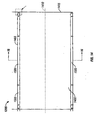
- FIG. 1 With references to Figures 1 and 2 , two different embodiments of a photovoltaic array constructed in accordance with the invention are respectively indicated by 20 and 20' and are the same as each other except for the number of rectangular photovoltaic modules 22 included in each array. More specifically, the photovoltaic array 20 illustrated in Figure 1 has a six by four module size so as to include twenty four photovoltaic modules 22, while the photovoltaic array 20' of Figure 2 has a six by ten size so as to include sixty photovoltaic modules 22.
- the photovoltaic array 20 is mounted on a support surface 24 which is embodied by a roof 26.
- the photovoltaic array 20' is mounted on a support surface 24' which may be a roof, the ground, a ground pad, or any other support surface.
- each embodiment of the photovoltaic arrays 20, 20' includes a plurality of elongated rails 28 that are mounted on the associated support surface 24, 24' projecting upwardly therefrom and extending in a spaced and parallel relationship to each other.
- Each of the rails 28 as illustrated in Figure 4 has an extruded resin construction including a lower base 30 and an upper cap 32 that cooperate to define a pair of grooves 34 opening in opposite directions from each other.
- the rectangular photovoltaic modules 22 have edges 36 that are received by the grooves 34 of the rails 28 so as to be mounted above the support surface 24 in a spaced relationship therefrom, which will nominally be about 10cm (four inches), although the spacing can vary but normally will be in the range of about 5 to 15 cm (two to six inches).
- the elongated rails 28 have a two piece construction with the lower base 30 and the upper cap 32 being extruded separately from each other and secured to each other to define the oppositely opening grooves 34.
- This two piece construction facilitates the assembly of the photovoltaic arrays by allowing the base 30 to be initially positioned on the support surface so as to receive the edges 36 of the photovoltaic modules 22 prior to securement of the caps 32 to their associated bases. While it is also possible to extrude the base 30 and cap 32 as a unitary construction, the assembly of the photovoltaic array is then somewhat more difficult to achieve since the photovoltaic modules edges must be inserted into the grooves sideways rather than being able to be placed downwardly in the manner that can be done with the two piece construction.
- the photovoltaic modules 22 as shown in Figures 1 and 2 are arranged in pairs 38 with the modules of each pair abutting each other, and with each pair 38 of photovoltaic modules being spaced along the elongated lengths of the rail from each adjacent pair to provide openings 40 therebetween. More specifically, the photovoltaic modules 22 illustrated in Figures 1 and 2 have elongated rectangular shapes with lengths about twice as long as their widths, nominally about 1.2m by 0.6m (four feet by two feet). Each pair 38 of the photovoltaic modules 22 has elongated edges 36 along their lengths thereof abutted with each other as illustrated so that each pair of modules has a generally square shape that will nominally be about 1.2m by 1.2m (four feet by four feet) as illustrated.
- the short edges 36 of the module widths are received and supported by the elongated rails 28. While this is the preferred construction in providing increased size of the openings 40 for any given size of module area in order to facilitate ventilation, it should be appreciated that the photovoltaic modules can also have their shorter widths abutted and their longer lengths received by the elongated rails 28 to provide support of the modules on the support surface.
- each embodiment of the photovoltaic array includes cross members 42 that extend between the lower bases 30 of the rails 28 to space the rails from each other.
- the cross members 42 as best illustrated in Figure 3 are located within the openings 40 between the photovoltaic modules 22 and are secured to the lower bases 30 by fasteners 43 such as self tapping screws as is hereinafter more fully described.
- Electrical wiring 44 best illustrated in Figure 6 is supported by the cross members 42 which have upwardly opening shapes that receive the electrical wiring.
- the cross members 42 as shown in Figure 6 have a lower floor 46 and a pair of sides 48 that extend upwardly from the lower floor with an inclination in a converging shape toward each other and have upper edges 50 that are spaced from each other to permit the wiring to pass into and out of the cross members as illustrated so that all of the photovoltaic modules of the array can be connected into an appropriate circuit for collection of the electrical power generated.
- the inclined construction of the cross member sides 48 causes wind to provide a hold down force to the photovoltaic array.
- the elongated rails 28 each has the lower base 30 of its two piece construction provided with a lower flange 52 for mounting on the support surface 24, a stem 54 that projects upwardly from the lower flange 52, and an upper extremity 56 of a T shape that defines an upwardly opening slot 58 extending along the elongated length of the elongated rail.
- the elongated rails 28 each also has the upper cap 32 of its two piece construction provided with a T shape including a stem 60 that projects downwardly and is received by the slot 58 in the T-shaped upper extremity 56 of the lower base 30.
- the upper cap 32 also has an upper cross bar 62 that extends in opposite directions from the stem 54 thereof to cooperate with the T-shaped upper extremity of the lower base in defining the pair of grooves 34 that open in opposite directions from each other to receive the edges 36 of the photovoltaic modules 22 that are mounted by the rails 28 on the support surface 24.
- the lower base 30 of each rail 28 has a pair of upwardly projecting stops 64 located on opposite sides of the slot 58 to position the photovoltaic modules horizontally upon assembly of the photovoltaic array. More specifically, the lower base 30 is initially secured to the support surface such that the photovoltaic modules 22 can be placed downwardly thereon with the stops 64 providing horizontal positioning in a lateral direction with respect to the elongated direction of the rails. The caps 32 can then be secured to the lower bases 30 as is hereinafter more fully described to complete the assembly of the photovoltaic array in an efficient manner.
- the stem 54 of the lower base 30 has scallops 65 extruded along its length to reduce the amount of resin utilized.
- the elongated rails 28 have the lower flange 52 of the lower base 30 provided with a greater lateral width along the length thereof than the T-shaped upper extremity 56 of the lower base and than the upper cross bar 62 of the upper cap 32, which provides stability in the mounting.
- a modified embodiment of the elongated rail 28' has a construction with particular utility for use on steep roofs. More specifically, the lower base 30' of this rail embodiment has a generally steeple shape cross section including a lower end 52 that is mounted on the support surface 24 and extends upwardly therefrom with a converging shape to the upper extremity 56'. At its upper extremity 56', the lower base 30' has the same upwardly opening slot 58 as the previously described embodiment as well as having the stops 64 previously described.
- the lower base upper extremity 56' also has a pair of downwardly extending flanges 66 for securing flashing 67 that extends downwardly to the support surface 24 and then laterally to the adjacent rails and upwardly to thus provide an elongated weather tight seal between the rails. Screws within associated counterbored holes can be utilized to secure the lower base 30' to the support surface.
- the extruded cap 32 utilized with this embodiment is the same as the previously described embodiment.
- fasteners 68 secure the upper cap 32 to the lower base 30 and will normally be embodied by suitable self tapping screws.
- the upper cap 32 includes an elongated extruded formation 70 along its centerline between the opposite ends of the cross bar 62. This extruded formation 70 facilitates centering alignment of drilled holes 72 ( Figure 4 ) for receiving the fasteners 68 which are spaced at suitable intervals along the length of the rail.
- both the lower base 30 and the upper cap 32 of the elongated rail are extruded from a first resin such as a rigid polyvinyl chloride, and the grooves 34 of the rail include pads 74 of a second material that is softer than the first resin to accommodate for thickness variations in the photovoltaic module edges 36 received by the grooves.
- the lower base 30 is extruded entirely from the first resin and the upper cap 32 is coextruded from the first resin and a second resin such as a flexible polyvinyl chloride which constitutes the second material and provides the pads 74 which are located on the upper cross bar 62 within the grooves 34.
- the rails 28 have the upwardly opening slot 58 of the lower base 30 and the downwardly projecting stem 60 of the upper cap 32 provided with connection formations 76 and 78 for providing securement of the upper cap to the lower base by a snap action.
- the cross members 42 are supported by and extend between the upper T-shaped extremities 56 of the lower bases 30 of the rails 28 and are located as shown in Figure 3 within the openings 40 between the adjacent pairs of the photovoltaic modules 22.
- These cross members 42 have elongated shapes extruded from resin, such as about a rigid polyvinyl chloride, with an upwardly opening shape as previously described, and the electrical wiring 44 is received by the upwardly opening cross members as illustrated and as was previously described in connection with Figure 6 .
- the cross members 42 have their ends supported on and secured to the T-shaped upper extremity 56 of the lower base 30 by the fasteners 43. These cross members 42 facilitate the proper spacing of the rails 28 from each other during the assembly as well as supporting the rails in their mounted locations after the assembly.
- spacers within the grooves 36 of the elongated rails 28 can be used to ensure that the pairs 38 of photovoltaic modules are properly spaced from each other. These spacers can remain as permanent components of the photovoltaic array or can be removed prior to the final securement of the upper cap 32 to the lower base 30.
- the photovoltaic array in many applications may have its elongated rails 28 mounted by the associated support surface 24 without any securement or ballast required to provide a hold down function.
- the rail 28 illustrated in Figure 4 may merely sit upon the support surface 24 illustrated to provide the mounting of the photovoltaic array. Connections can also be provided to secure the lower bases to the support surface.
- the support surface 24 as previously mentioned may be a roof and the roof may have a membrane 80 that can be of different materials such as polyvinyl chloride, ethylene propylene diene monomer, chlorinated polyethylene; rubber or a built-up roof (BUR) of asphalt or coal tar pitch and felt.
- a membrane 80 that can be of different materials such as polyvinyl chloride, ethylene propylene diene monomer, chlorinated polyethylene; rubber or a built-up roof (BUR) of asphalt or coal tar pitch and felt.
- the photovoltaic arrays can also have connections between the lower bases 30 of the rails and the membrane 80 of the roof. These connections can be bonds 82 between the flanges 52 of the lower bases of the rails and the membrane, with the bonds being autogenous as can be provided by heat bonding that is most easily performed when the membrane 80 is of the same material as the base. As illustrated in Figure 8 , it is also possible for the connections to be provided by connector sleeves that slidably receive the lower bases 30 of the rails such as at the lower flange 52 thereof as illustrated, and the connections include bonds 86 that secure the connector sleeves to the membrane 80 of the roof. Such bonds 86 between the connector sleeves 84 and the membrane 80 can be autogenous and provided by heat bonding that is most easily performed with the same material providing both the roof membrane and the connector sleeve.
- the connections between the rails and the roof membrane can also include connector strips 88, with the lower bases 30 of the rails 28 having openings 90 through which the connector strips extend, and the connector strips have ends 92 secured to the membrane 80 on the roof.
- the connector strips 88 are made of the same material as the membrane 80 on the roof and the ends 92 of the connector strips have autogenous bonds 94 that provide the securement thereof to the roof membrane such as by heat welding.
- a photovoltaic array 1200 includes 60 photovoltaic modules 1205 arranged in a 6 x 10 array.
- Each module 1205 includes a panel 1400 having an elongated edge 1405 that extends along an elongated axis 1410 of the panel 1400 and a transverse edge 1415 that extends substantially perpendicular to the elongated axis 1410.
- the transverse edge 1415 has a length that is shorter than the length of the elongated edge 1405.
- the array 1200 includes support segments 1215 positioned on a support surface (such as surface 24 in Figure 1 ).
- the support segments 1215 like the elongated rails 28, can be made of an extruded resin construction.
- the module 1205 has an attachment member 1500 extending along the elongated edge 1405 of the panel 1400.
- the attachment member 1500 is formed with a surface 1505 that projects away from the elongated edge 1405 and is substantially parallel with the surface of the panel 1400.
- the substantially parallel positioning can be within 20°, within 15°, within 5°, or within 1° of being absolutely parallel.
- This arrangement can facilitate coupling between the attachment member 1500 and the support segment 1215, as detailed below.
- the attachment member 1500 is formed to have a hollow area 1510 that extends along the elongated edge 1405.
- the attachment member 1500 may be made of any suitable material, such as, for example, aluminum. Other materials include other metals, plastics, and glasses.
- the material of the attachment member 1500 may be selected based on the mechanical or electrical properties of the panel 1400 and/or the support segment 1215. Thus, for example, the material of the attachment member 1500 may be selected to match the coefficient of thermal expansion of the panel 1400.
- the attachment member 1500 is attached to the elongated edge 1405 of the module 1205 to provide for coupling of the module 1205 to the support segment 1215, as discussed below.
- the attachment member 1500 may be attached to the elongated edge 1405 using adhesive or any suitable technique.
- the attachment member 1500 extends the length of the elongated edge of a single panel 1400. Thus, each module 1205 has two attachment members 1500.
- Deployment of the photovoltaic array 1200 includes coupling the support segments 1215 to the support surface such that the support segments 1215 extend along a direction that is substantially perpendicular to the elongated axis 1410. Furthermore, each of the support segments 1215 is in a spaced and substantially parallel relationship with the other support segments 1215. Then, each of the attachment members 1500 is positioned on an associated support segment 1215. In this way, the modules 1205 are arranged in the photovoltaic array 1200 such that the transverse edges 1415 abut each other and the elongated edges 1405 are separated from each other by openings 1300 or 1305.
- An attachment member 1500 may be positioned on an associated support segment 1215 by abutting the transverse edge 1415 of the module 1205 to an abutment surface 1900 of the support segment 1215. Then, to provide additional support, the attachment member 1500 may be attached the support segment 1215 using a screw 1905 that is sized to fit into a threaded hole 1910 of the support segment 1215.
- the arrangement of the array 1200 has several advantages. For example, because the photovoltaic modules are formed with attachment members 1500, the deployment of the array 1200 is simplified.
- the photovoltaic modules may be manufactured ahead of time. Then, upon shipment of a deployment system that includes the photovoltaic modules and the support segments, the installer can simply position the support segments on the support surface and then positioned the photovoltaic modules on the support segments. The installer can install one module at a time without needing to lift or position the other modules. Moreover, the installer need not slide the module into a long track or rail but simply positions or places the modules on the support segments.
- the attachment member 1500 contacts a relatively small area of the support segment 1215 and is isolated from (that is, not touching) the support surface.
- the modules are arranged with openings between elongated edges. Air flow is also facilitated because the panel is isolated from the support segments, which are in turn isolated from each other, and the module is isolated from the support surface.
- the attachment members 1500 also provide structural integrity to the photovoltaic modules while permitting the free flow of air because the exposed elongated edges of the modules are supported by the attachment members 1500.
- the transverse edges do not benefit from additional structural support because these edges abut each other once the array is deployed.
- the attachment member may be formed as a solid bar 2100.
- the support segments may be formed like a segment of an elongated rail, such as the lower base 30 of the elongated rail 28.
- the support segments may be coupled to the support surface in the same manner as detailed with respect to coupling of the elongated rail 28 to the support surface.
- the openings 1300 and 1305 may have different widths or one of the openings may have a width that is larger than the width of the other opening.
- the photovoltaic array may be formed of any suitable number of photovoltaic modules and support members depending on the size of the support surface and the require energy output of the array.
- the photovoltaic array may be formed as an inclined array, with one end of a module slightly overlapping the end of an adjacent module.
- Such a system is shown, for example, in U. S. Patent No. 5,746, 839 .
- the array can include an airfoil on at least one end of the array.
- the airfoil can be a bar having a face angled relative to the support structure.
- the airfoil can extend along the surface of the support structure and can project above the plane of the panel. The airfoil alters airflow in the region of the array to create a force holding the array on the support structure.
Landscapes
- Engineering & Computer Science (AREA)
- Chemical & Material Sciences (AREA)
- Mechanical Engineering (AREA)
- Sustainable Development (AREA)
- Sustainable Energy (AREA)
- Thermal Sciences (AREA)
- Physics & Mathematics (AREA)
- Combustion & Propulsion (AREA)
- Life Sciences & Earth Sciences (AREA)
- General Engineering & Computer Science (AREA)
- Architecture (AREA)
- Civil Engineering (AREA)
- Structural Engineering (AREA)
- Photovoltaic Devices (AREA)
- Roof Covering Using Slabs Or Stiff Sheets (AREA)
Claims (26)
- Générateur photovoltaïque (20) comprenant :une pluralité de rails allongés (28) destinés à être montés sur une surface de support (24), saillant vers le haut depuis celle-ci et s'étendant en relation espacée et parallèle les uns par rapport aux autres ;chaque rail ayant une construction en résine extrudée incluant une base inférieure (30) et une coiffe supérieure (32) qui coopèrent de manière à définir une paire de rainures (34) ouvertes dans des directions opposées l'une par rapport à l'autre ; etdes modules photovoltaïques rectangulaires (22) ayant des bords (36) qui sont reçus dans les rainures des rails de manière à être montés au-dessus de la surface de support en relation espacée par rapport à la surface de support, les modules photovoltaïques étant agencés par paires (38), les modules de chaque paire étant en butée les uns contre les autres et chaque paire de modules photovoltaïques étant espacée le long des longueurs allongées des rails par rapport à chaque paire adjacente de modules, afin de fournir des ouvertures (40) entre elles.
- Générateur photovoltaïque selon la revendication 1, dans lequel la base inférieure et la coiffe supérieure de chaque rail sont extrudées sous forme de pièces séparées et fixées l'une à l'autre pour définir la paire de rainures ouvertes dans des directions opposées.
- Générateur photovoltaïque selon la revendication 1, dans lequel les modules photovoltaïques ont des formes rectangulaires allongées qui ont des longueurs environ deux fois plus longues que leurs largeurs, et chaque paire de modules photovoltaïques ayant des bords allongés le long de leurs longueurs, en butée les uns contre les autres de sorte que chaque paire de modules ait une forme généralement carrée.
- Générateur photovoltaïque selon la revendication 1, comportant en outre des traverses (42) qui s'étendent entre les bases inférieures des rails pour espacer les rails les uns des autres.
- Générateur photovoltaïque selon la revendication 4, dans lequel les traverses sont situées dans des ouvertures entre les modules photovoltaïques.
- Générateur photovoltaïque selon la revendication 4, comportant en outre un câblage électrique (44) qui est supporté par les traverses.
- Générateur photovoltaïque selon la revendication 6, dans lequel les traverses ont des formes ouvertes vers le haut qui reçoivent le câblage électrique.
- Générateur photovoltaïque selon la revendication 7, dans lequel les traverses ont un plancher inférieur (46) et une paire de côtés (48) qui s'étendent vers le haut depuis le plancher inférieur suivant une forme convergeante l'un vers l'autre et ont des bords supérieurs qui sont espacés l'un de l'autre.
- Générateur photovoltaïque selon la revendication 1, dans lequel la base inférieure et la coiffe supérieure de chaque rail sont extrudées sous forme de pièces séparées et fixées l'une à l'autre de manière à définir la paire de rainures ouvertes dans des directions opposées ; chaque base inférieure comportant une bride inférieure (52) pour le montage sur la surface, une tige (54) faisant saillie vers le haut depuis la bride inférieure, et une extrémité supérieure (56) en forme de T qui définit une fente (58) ouverte vers le haut, s'étendant le long de la longueur allongée du rail allongé, chaque coiffe supérieure ayant une forme en T comportant une tige (60) qui fait saillie vers le bas et qui est reçue par la fente dans l'extrémité supérieure en forme de T de la base inférieure, et chaque coiffe supérieure ayant une barre transversale supérieure (62) qui s'étend dans des directions opposées depuis sa tige de manière à coopérer avec l'extrémité supérieure en forme de T de la base inférieure en définissant la paire de rainures ouvertes dans des directions opposées l'une à l'autre pour recevoir les bords des modules photovoltaïques qui sont supportés par les rails sur la surface de support.
- Générateur photovoltaïque selon la revendication 9, dans lequel l'extrémité supérieure de la base inférieure de chaque rail a une paire de butées (64) faisant saillie vers le haut, situées respectivement sur des côtés opposés de la fente de manière à positionner les modules horizontalement par rapport aux rails.
- Générateur photovoltaïque selon la revendication 7, dans lequel la bride inférieure de la base inférieure des rails allongés est pourvue d'une largeur latérale le long de la longueur allongée desdits rails plus grande que l'extrémité supérieure en forme de T de la base inférieure et que la barre transversale supérieure de la coiffe supérieure.
- Générateur photovoltaïque selon la revendication 7, dans lequel la tige de la base inférieure a des échancrures (65) pour réduire la résine utilisée.
- Générateur photovoltaïque selon la revendication 1, dans lequel la base inférieure et la coiffe supérieure de chaque rail sont extrudées sous forme de pièces séparées et fixées l'une à l'autre pour définir la paire de rainures ouvertes dans des directions opposées, chaque base comportant une extrémité inférieure (52) destinée à être montée sur la surface de support, une tige qui fait saillie vers le haut depuis l'extrémité inférieure, une extrémité supérieure (56') en forme de T qui définit une fente (58') ouverte vers le haut, s'étendant le long de la longueur allongée du rail allongé et l'extrémité supérieure de la base inférieure comportant des brides (64) s'étendant vers le bas pour fixer une bande de couverture ; et chaque coiffe supérieure ayant une forme en T comportant une tige qui fait saillie vers le bas et qui est reçue par la fente dans l'extrémité supérieure en forme de T de la base inférieure, et chaque coiffe supérieure ayant une barre transversale supérieure (62) qui s'étend dans des directions opposées depuis sa tige de manière à coopérer avec l'extrémité supérieure en forme de T de la base inférieure en définissant la paire de rainures ouvertes dans des directions opposées l'une à l'autre pour recevoir les bords des modules photovoltaïques qui sont supportés par les rails sur la surface de support.
- Générateur photovoltaïque selon la revendication 9 ou 13, comportant en outre des attaches (68) pour fixer la coiffe supérieure à la base inférieure.
- Générateur photovoltaïque selon la revendication 14, dans lequel la coiffe supérieure comporte une formation extrudée allongée (70) qui facilite l'alignement de centrage de trous percés pour recevoir les attaches.
- Générateur photovoltaïque selon la revendication 9 ou 13, dans lequel les bases inférieures et les coiffes supérieures des rails allongés sont extrudées à partir d'une première résine et dans lequel les rainures des rails comportent des plages (74) en un second matériau qui est plus tendre que la première résine de manière à permettre des variations d'épaisseur dans les bords des modules photovoltaïques reçus par les rainures.
- Générateur photovoltaïque selon la revendication 16, dans lequel la base inférieure est extrudée entièrement à partir de la première résine et dans lequel la coiffe supérieure est co-extrudée à partir de la première résine et d'une seconde résine qui constitue le second matériau et qui constitue les plages qui sont situées sur la barre transversale supérieure dans les rainures.
- Générateur photovoltaïque selon la revendication 9, dans lequel la fente ouverte vers le haut de la base inférieure et la tige faisant saillie vers le bas de la coiffe supérieure ont des formations de connexion (76, 78) pour assurer la fixation de la coiffe supérieure à la base inférieure.
- Générateur photovoltaïque selon la revendication 9 ou 13, comportant en outre des traverses (42) qui sont supportées par, et s'étendent entre, les extrémités supérieures en forme de T des bases inférieures des rails dans des ouvertures entre les modules photovoltaïques, de manière à espacer les rails les uns des autres.
- Générateur photovoltaïque selon la revendication 19, dans lequel les traverses ont des formes allongées extrudées à partir de résine avec une forme ouverte vers le haut, et un câblage électrique (44) reçu par les traverses ouvertes vers le haut.
- Générateur photovoltaïque selon la revendication 1, dans lequel la surface de support est un toit (26) ayant une membrane (80) sur laquelle sont montés les rails.
- Générateur photovoltaïque de toit selon la revendication 21, comportant en outre des connexions (82 ; 86) qui fixent les bases inférieures des rails à la membrane sur le toit.
- Générateur photovoltaïque de toit selon la revendication 22, dans lequel les connexions comportent des bandes de connecteur allongées (88), les bases inférieures des rails ayant des ouvertures (90) à travers lesquelles s'étendent les bandes de connecteur, et les bandes de connecteur ayant des extrémités (92) fixées à la membrane sur le toit.
- Générateur photovoltaïque selon la revendication 1, dans lequel
la base inférieure et la coiffe supérieure sont fixées l'une à l'autre ;
la base inférieure comporte une bride inférieure (52) pour le montage sur la surface de support, une tige (54) qui fait saillie vers le haut depuis la bride inférieure et une extrémité supérieure (56) en forme de T qui coopère avec la tige pour définir une fente (58) ouverte vers le haut s'étendant le long de la longueur allongée du rail allongé ;
la coiffe supérieure a une forme en T comportant une tige (60) qui fait saillie vers le bas et qui est reçue par la fente dans l'extrémité supérieure de la base inférieure, et la coiffe supérieure ayant une barre transversale supérieure (62) qui s'étend dans des directions opposées depuis sa tige de manière à coopérer avec l'extrémité supérieure en forme de T de la base inférieure en définissant la paire de rainures ouvertes dans des directions opposées l'une par rapport à l'autre ; et
le générateur photovoltaïque comprenant en outre des traverses (42) qui s'étendent entre les bases inférieures des modules photovoltaïques pour espacer les rails les uns des autres, et les traverses étant situées dans les ouvertures entre des paires adjacentes des modules. - Générateur photovoltaïque selon la revendication 1,
dans lequel
la base inférieure et la coiffe supérieure sont fixées l'une à l'autre ;
la base inférieure comporte une bride inférieure (52) pour le montage sur la surface de support, une tige (54) qui fait saillie vers le haut depuis la bride inférieure, et une extrémité supérieure (56) en forme de T qui coopère avec la tige pour définir une fente (58) ouverte vers le haut s'étendant le long de la longueur allongée du rail allongé, et l'extrémité supérieure en forme de T ayant une paire de butées (64) faisant saillie vers le haut situées respectivement sur des côtés opposés de la fente ;
la coiffe supérieure a une forme en T incluant une tige (60) qui fait saillie vers le bas et qui est reçue par la fente dans l'extrémité supérieure de la base inférieure, la coiffe supérieure ayant une barre transversale supérieure (62) qui s'étend dans des directions opposées depuis sa tige pour coopérer avec l'extrémité supérieure en forme de T de la base inférieure en définissant la paire de rainures ouvertes dans des directions opposées l'une par rapport à l'autre ; et
le générateur photovoltaïque comprenant en outre des traverses (42) qui sont supportées par, et s'étendent entre, les extrémités supérieures en forme de T des bases inférieures des modules photovoltaïques pour espacer les rails les uns des autres, et les traverses étant situées à l'intérieur des ouvertures entre des paires adjacentes des modules. - Générateur photovoltaïque selon la revendication 1, dans lequel
la base inférieure et la coiffe supérieure sont fixées l'une à l'autre ;
la base inférieure est extrudée entièrement à partir d'une première résine et comporte une bride inférieure (52) pour le montage sur la surface de support, une tige (54) faisant saillie vers le haut depuis la bride inférieure, et une extrémité supérieure (56) en forme de T qui coopère avec la tige pour définir une fente (58) ouverte vers le haut s'étendant le long de la longueur allongée du rail allongé, et l'extrémité supérieure en forme de T ayant une paire de butées (64) faisant saillie vers le haut, situées respectivement sur des côtés opposés de la fente ;
la coiffe supérieure a une forme en T incluant une tige (60) qui fait saillie vers le bas et qui est reçue par la fente dans l'extrémité supérieure de la base inférieure, la coiffe supérieure ayant une barre transversale supérieure (62) qui s'étend dans des directions opposées depuis sa tige de manière à coopérer avec l'extrémité supérieure en forme de T de la base inférieure en définissant la paire de rainures ouvertes dans des directions opposées l'une à l'autre, et la coiffe supérieure étant co-extrudée à partir de la première résine et d'une seconde résine qui est plus tendre que la première résine et constituant des plages (74) sur la barre transversale supérieure dans les rainures ; et
le module photovoltaïque comprenant en outre des traverses (42) qui sont supportées par, et s'étendent entre, les extrémités supérieures en forme de T des bases inférieures des modules photovoltaïques de manière à espacer les rails les uns des autres, les traverses étant situées dans les ouvertures entre des paires adjacentes des modules, les traverses ayant des formes ouvertes vers le haut, et un câblage électrique (44) reçu par les traverses.
Priority Applications (1)
| Application Number | Priority Date | Filing Date | Title |
|---|---|---|---|
| EP10167066A EP2230694A3 (fr) | 2001-11-16 | 2002-11-15 | Reseau photovoltaique |
Applications Claiming Priority (5)
| Application Number | Priority Date | Filing Date | Title |
|---|---|---|---|
| US09/993,875 US6617507B2 (en) | 2001-11-16 | 2001-11-16 | Photovoltaic array |
| US993875 | 2001-11-16 | ||
| US38086202P | 2002-05-17 | 2002-05-17 | |
| US380862P | 2002-05-17 | ||
| PCT/US2002/036743 WO2003044299A2 (fr) | 2001-11-16 | 2002-11-15 | Generateur photovoltaique |
Related Child Applications (1)
| Application Number | Title | Priority Date | Filing Date |
|---|---|---|---|
| EP10167066A Division-Into EP2230694A3 (fr) | 2001-11-16 | 2002-11-15 | Reseau photovoltaique |
Publications (2)
| Publication Number | Publication Date |
|---|---|
| EP1449262A2 EP1449262A2 (fr) | 2004-08-25 |
| EP1449262B1 true EP1449262B1 (fr) | 2012-10-03 |
Family
ID=27009138
Family Applications (1)
| Application Number | Title | Priority Date | Filing Date |
|---|---|---|---|
| EP02789682A Expired - Lifetime EP1449262B1 (fr) | 2001-11-16 | 2002-11-15 | Generateur photovoltaique |
Country Status (5)
| Country | Link |
|---|---|
| US (2) | US7307209B2 (fr) |
| EP (1) | EP1449262B1 (fr) |
| JP (3) | JP4429016B2 (fr) |
| AU (1) | AU2002352732A1 (fr) |
| WO (1) | WO2003044299A2 (fr) |
Families Citing this family (125)
| Publication number | Priority date | Publication date | Assignee | Title |
|---|---|---|---|---|
| US7507903B2 (en) | 1999-03-30 | 2009-03-24 | Daniel Luch | Substrate and collector grid structures for integrated series connected photovoltaic arrays and process of manufacture of such arrays |
| US8664030B2 (en) | 1999-03-30 | 2014-03-04 | Daniel Luch | Collector grid and interconnect structures for photovoltaic arrays and modules |
| US8076568B2 (en) | 2006-04-13 | 2011-12-13 | Daniel Luch | Collector grid and interconnect structures for photovoltaic arrays and modules |
| US20090111206A1 (en) | 1999-03-30 | 2009-04-30 | Daniel Luch | Collector grid, electrode structures and interrconnect structures for photovoltaic arrays and methods of manufacture |
| US8138413B2 (en) | 2006-04-13 | 2012-03-20 | Daniel Luch | Collector grid and interconnect structures for photovoltaic arrays and modules |
| US8222513B2 (en) | 2006-04-13 | 2012-07-17 | Daniel Luch | Collector grid, electrode structures and interconnect structures for photovoltaic arrays and methods of manufacture |
| US7898053B2 (en) | 2000-02-04 | 2011-03-01 | Daniel Luch | Substrate structures for integrated series connected photovoltaic arrays and process of manufacture of such arrays |
| US8198696B2 (en) | 2000-02-04 | 2012-06-12 | Daniel Luch | Substrate structures for integrated series connected photovoltaic arrays and process of manufacture of such arrays |
| US7898054B2 (en) | 2000-02-04 | 2011-03-01 | Daniel Luch | Substrate structures for integrated series connected photovoltaic arrays and process of manufacture of such arrays |
| WO2005081325A1 (fr) * | 2004-02-25 | 2005-09-01 | Kyocera Corporation | Méthode de fabrication d’un module de cellule solaire et montage de fabrication |
| US20060266352A1 (en) * | 2005-05-31 | 2006-11-30 | Finley Shapiro Consulting, Inc. | Self-ballasting solar array mount |
| WO2007079382A2 (fr) | 2005-12-28 | 2007-07-12 | Sunpower Corporation, Systems | Ensemble module photovoltaïque (pv) supporté |
| US9006563B2 (en) | 2006-04-13 | 2015-04-14 | Solannex, Inc. | Collector grid and interconnect structures for photovoltaic arrays and modules |
| US9865758B2 (en) | 2006-04-13 | 2018-01-09 | Daniel Luch | Collector grid and interconnect structures for photovoltaic arrays and modules |
| US9236512B2 (en) | 2006-04-13 | 2016-01-12 | Daniel Luch | Collector grid and interconnect structures for photovoltaic arrays and modules |
| US8729385B2 (en) | 2006-04-13 | 2014-05-20 | Daniel Luch | Collector grid and interconnect structures for photovoltaic arrays and modules |
| US8822810B2 (en) | 2006-04-13 | 2014-09-02 | Daniel Luch | Collector grid and interconnect structures for photovoltaic arrays and modules |
| US8884155B2 (en) | 2006-04-13 | 2014-11-11 | Daniel Luch | Collector grid and interconnect structures for photovoltaic arrays and modules |
| US20080035140A1 (en) * | 2006-05-26 | 2008-02-14 | Bp Corporation North America Inc. | Solar Roof Tile |
| US20080170700A1 (en) * | 2007-01-17 | 2008-07-17 | Prashanth Darba | System for controlling access to digital information |
| US20100269428A1 (en) * | 2007-05-23 | 2010-10-28 | Robert Stancel | Cost Effective, Elongate Member Mounting System For Photovoltaic Devices |
| US20080314434A1 (en) * | 2007-06-21 | 2008-12-25 | Khouri Bruce M | Photovoltaic panel |
| WO2009006230A2 (fr) * | 2007-06-30 | 2009-01-08 | Solannex, Inc. | Grille collectrice et structures d'interconnexion pour réseaux et modules photovoltaïques |
| WO2009086241A2 (fr) * | 2007-12-21 | 2009-07-09 | E. I. Du Pont De Nemours And Company | Réseau de piles photovoltaïques, structure et procédés d'installation et d'utilisation |
| US8212139B2 (en) | 2008-01-18 | 2012-07-03 | Tenksolar, Inc. | Thin-film photovoltaic module |
| US8933320B2 (en) | 2008-01-18 | 2015-01-13 | Tenksolar, Inc. | Redundant electrical architecture for photovoltaic modules |
| US8748727B2 (en) | 2008-01-18 | 2014-06-10 | Tenksolar, Inc. | Flat-plate photovoltaic module |
| AU2009244548B2 (en) | 2008-05-05 | 2012-05-03 | Dow Global Technologies Llc | System for installation of photovoltaic devices on a structure |
| US8176693B2 (en) * | 2008-05-19 | 2012-05-15 | Robert W. Mitchell | Photovoltaic mounting system with locking connectors, adjustable rail height and hinge lock |
| US8061091B2 (en) | 2008-06-27 | 2011-11-22 | Sunpower Corporation | Photovoltaic module kit including connector assembly for non-penetrating array installation |
| US8220210B2 (en) * | 2008-06-27 | 2012-07-17 | Sunpower Corporation | Photovoltaic module and module arrays |
| US8234824B2 (en) * | 2008-06-27 | 2012-08-07 | Sunpower Corporation | Photovoltaic module with removable wind deflector |
| US20100071282A1 (en) * | 2008-09-23 | 2010-03-25 | Mark Tofflemire | Unitized Building Integrated Photovoltaic Conversion Module Adapted With Electrical Conduits |
| US20100126087A1 (en) * | 2008-11-13 | 2010-05-27 | Joe Brescia | Plank Based Photovoltaic Conversion System |
| WO2010063018A2 (fr) * | 2008-11-26 | 2010-06-03 | Robert Stancel | Système de montage de module résistant au soulèvement sous l'action du vent |
| US8739478B1 (en) | 2008-12-30 | 2014-06-03 | Pvt Solar, Inc. | Integrated thermal module and back plate structure and related methods |
| US9103563B1 (en) | 2008-12-30 | 2015-08-11 | Sunedison, Inc. | Integrated thermal module and back plate structure and related methods |
| US8240109B2 (en) * | 2009-03-20 | 2012-08-14 | Northern States Metals Company | Support system for solar panels |
| US8256169B2 (en) * | 2009-03-20 | 2012-09-04 | Northern States Metals Company | Support system for solar panels |
| US8316590B2 (en) | 2009-03-20 | 2012-11-27 | Northern States Metals Company | Support system for solar panels |
| US20110220596A1 (en) * | 2009-03-20 | 2011-09-15 | Northern States Metals Company | Support system for solar panels |
| CA2756664A1 (fr) | 2009-03-24 | 2010-09-30 | Certainteed Corporation | Systemes photovoltaiques, procedes pour installer des systemes photovoltaiques, et kits pour installer des systemes photovoltaiques |
| WO2010108288A2 (fr) * | 2009-03-27 | 2010-09-30 | Energiebüro AG | Système de fixation de plusieurs modules solaires sur un toit de bâtiment ou une façade de bâtiment et clip pour former un élément de butée sur une surface |
| WO2010118236A1 (fr) * | 2009-04-08 | 2010-10-14 | Ap Alternatives, Llc | Supports de panneau solaire et procédé |
| WO2010126699A2 (fr) | 2009-04-29 | 2010-11-04 | Hunter Douglas Industries B.V. | Panneaux architecturaux à intercouches photovoltaïques organiques et leurs procédés de formation |
| FR2945561A1 (fr) * | 2009-05-12 | 2010-11-19 | Denis Braud | Systeme de fixation de modules photovoltaiques sur une surface de couverture et surface de couverture correspondante |
| US8209926B2 (en) * | 2009-06-09 | 2012-07-03 | Mccowen Richard Leon | Assembly for reducing ice damming on roof |
| US20110209742A1 (en) * | 2009-06-10 | 2011-09-01 | Pvt Solar, Inc. | Method and Structure for a Cool Roof by Using a Plenum Structure |
| US20120024343A1 (en) * | 2009-06-10 | 2012-02-02 | Pvt Solar, Inc. | Method and Structure for a Cool Roof by Using a Plenum Structure |
| DE102009024738A1 (de) * | 2009-06-12 | 2010-12-16 | Adensis Gmbh | Traggerüst für eine Photovoltaikfreiflächenanlage |
| EP2911263A3 (fr) | 2009-06-15 | 2015-10-14 | Tenksolar, Inc. | Panneau solaire agnostique d'éclairage |
| US8919053B2 (en) | 2009-07-02 | 2014-12-30 | Zep Solar, Llc | Leveling foot apparatus, system, and method for photovoltaic arrays |
| EP2284454A1 (fr) * | 2009-07-31 | 2011-02-16 | Centrosolar AG | Système d'assemblage pour panneaux solaires, élément de support pour celui-ci et procédés associés |
| US8387318B2 (en) | 2009-08-06 | 2013-03-05 | Watts LLC | Open-air parking shelter with photovoltaic elements and improved airflow characteristics |
| US20110036028A1 (en) * | 2009-08-17 | 2011-02-17 | Adensis Gmbh | Roof mounting support for photovoltaic modules on uneven roofs |
| US20110108088A1 (en) * | 2009-11-09 | 2011-05-12 | Xunlight Corporation | Photovoltaic structure and method of use |
| US8829330B2 (en) * | 2010-02-23 | 2014-09-09 | Tenksolar, Inc. | Highly efficient solar arrays |
| US9773933B2 (en) | 2010-02-23 | 2017-09-26 | Tenksolar, Inc. | Space and energy efficient photovoltaic array |
| US10054336B2 (en) * | 2010-03-03 | 2018-08-21 | Robert M. M. Haddock | Photovoltaic module mounting assembly |
| US8424256B2 (en) * | 2010-04-01 | 2013-04-23 | Thomas Lawson Cook | Asphalt roof integrated photovoltaic |
| WO2011139660A1 (fr) * | 2010-04-26 | 2011-11-10 | Todd Roberts | Configurations de panneau solaire |
| US9462734B2 (en) * | 2010-04-27 | 2016-10-04 | Alion Energy, Inc. | Rail systems and methods for installation and operation of photovoltaic arrays |
| JP5570292B2 (ja) * | 2010-05-11 | 2014-08-13 | 三菱電機株式会社 | レール部材、太陽電池モジュール架台及び太陽電池モジュールの設置方法 |
| US9299861B2 (en) | 2010-06-15 | 2016-03-29 | Tenksolar, Inc. | Cell-to-grid redundandt photovoltaic system |
| US20110314751A1 (en) * | 2010-06-29 | 2011-12-29 | Roger Jette | Solar panel mounting rack system |
| FR2962465B1 (fr) * | 2010-07-09 | 2013-05-10 | Soprema | Dispositif de support et de fixation de panneaux ou analogues et systeme de toiture comportant un tel dispositif |
| US20120111393A1 (en) * | 2010-07-29 | 2012-05-10 | Joshua Conley | Integrated cartridge for adhesive-mounted photovoltaic modules |
| US8418983B2 (en) * | 2010-07-29 | 2013-04-16 | First Solar, Inc. | Slider clip and photovoltaic structure mounting system |
| US9343592B2 (en) | 2010-08-03 | 2016-05-17 | Alion Energy, Inc. | Electrical interconnects for photovoltaic modules and methods thereof |
| US8522491B2 (en) | 2010-08-12 | 2013-09-03 | Centrosolar AG | Support device for mounting a solar panel and mounting system incorporating same |
| GB2483487B (en) * | 2010-09-09 | 2015-05-13 | Cel F Solar Systems Ltd | Mounting device and method of installing of a solar panel |
| US9316416B2 (en) * | 2010-10-27 | 2016-04-19 | Gottlieb Binder Gmbh & Co. Kg | Panel arrangement with clamping clip |
| US20120167492A1 (en) * | 2010-12-29 | 2012-07-05 | Solarchange Llc | Solar Panel Modules Having Structural Properties |
| US8839573B2 (en) | 2011-02-11 | 2014-09-23 | Northern States Metals Company | Spring clip |
| US9611652B2 (en) | 2011-02-25 | 2017-04-04 | Dustin M. M. Haddock | Mounting device for building surfaces having elongated mounting slot |
| US8870139B1 (en) * | 2011-03-01 | 2014-10-28 | Jonathan Port | Strap mount for solar panels |
| US9157665B2 (en) | 2011-03-15 | 2015-10-13 | Richard William Erickson | Unitized photovoltaic assembly |
| US9641123B2 (en) | 2011-03-18 | 2017-05-02 | Alion Energy, Inc. | Systems for mounting photovoltaic modules |
| US10008974B2 (en) | 2011-09-02 | 2018-06-26 | Pv Solutions, Llc | Mounting system for photovoltaic arrays |
| US11022343B2 (en) | 2011-09-02 | 2021-06-01 | Pv Solutions, Llc | Mounting system for photovoltaic arrays |
| WO2013033670A1 (fr) * | 2011-09-02 | 2013-03-07 | Rterra Holdings, Llc | Système de montage pour réseaux photovoltaïques |
| WO2013033687A1 (fr) | 2011-09-02 | 2013-03-07 | Rtetta Holdings, Llc | Système de suivi et d'attribution de contributions d'énergie renouvelable à un système d'énergie renouvelable modulaire |
| US20130119211A1 (en) * | 2011-10-07 | 2013-05-16 | Scott Franklin | Photovoltaic module mounting system |
| US8726587B2 (en) | 2011-12-02 | 2014-05-20 | Cooper Technologies Company | Module rail for photovoltaic system |
| US8701372B2 (en) | 2011-12-02 | 2014-04-22 | Cooper Technologies Company | Clip fastener for photovoltaic system |
| US20130139870A1 (en) | 2011-12-02 | 2013-06-06 | Cooper Technologies Company | Pier connection sytem for pier caps of photovoltaic system |
| WO2013096962A1 (fr) * | 2011-12-23 | 2013-06-27 | Solarworld Usa | Panneau de toiture destiné à supporter des modules photovoltaïques |
| US20130168525A1 (en) | 2011-12-29 | 2013-07-04 | Dustin M.M. Haddock | Mounting device for nail strip panels |
| US8567154B2 (en) * | 2012-02-28 | 2013-10-29 | Johns Manville | Apparatus and methods for mounting a photovoltaic module on a roof |
| US9352941B2 (en) | 2012-03-20 | 2016-05-31 | Alion Energy, Inc. | Gantry crane vehicles and methods for photovoltaic arrays |
| AU2013263123B2 (en) | 2012-05-16 | 2017-06-08 | Alion Energy, Inc. | Rotatable support systems for photovoltaic modules and methods thereof |
| US8347565B2 (en) * | 2012-06-29 | 2013-01-08 | Min Carroll | Solar panels fixtures and installations |
| US8910433B2 (en) | 2013-01-10 | 2014-12-16 | Thomas J. Kacandes | System and method of assembling structural solar panels |
| US9068764B2 (en) * | 2013-04-10 | 2015-06-30 | Stion Corporation | Method and apparatus for clamping frameless thin-film solar module |
| US9303663B2 (en) | 2013-04-11 | 2016-04-05 | Northern States Metals Company | Locking rail alignment system |
| JP6302190B2 (ja) * | 2013-08-30 | 2018-03-28 | 株式会社Nttファシリティーズ | 太陽電池装置、太陽電池装置の施工方法及び太陽光発電システム |
| AU2014315407B2 (en) | 2013-09-05 | 2018-12-13 | Alion Energy, Inc. | Systems, vehicles, and methods for maintaining rail-based arrays of photovoltaic modules |
| US9453660B2 (en) | 2013-09-11 | 2016-09-27 | Alion Energy, Inc. | Vehicles and methods for magnetically managing legs of rail-based photovoltaic modules during installation |
| US8938932B1 (en) * | 2013-12-13 | 2015-01-27 | Quality Product Llc | Rail-less roof mounting system |
| CN105322869B (zh) * | 2014-08-05 | 2017-07-07 | 薛连丰 | 整合太阳能板的防水屋顶组装结构 |
| WO2016123357A2 (fr) | 2015-01-28 | 2016-08-04 | Pv Solutions, Llc | Système de raccordement de réseau photovoltaïque mécanique et électrique intégré |
| WO2017044566A1 (fr) | 2015-09-11 | 2017-03-16 | Alion Energy, Inc. | Écrans anti-vent pour réseaux photovoltaïques et procédés correspondants |
| US10547270B2 (en) | 2016-02-12 | 2020-01-28 | Solarcity Corporation | Building integrated photovoltaic roofing assemblies and associated systems and methods |
| US10443896B2 (en) | 2016-07-29 | 2019-10-15 | Rmh Tech Llc | Trapezoidal rib mounting bracket with flexible legs |
| WO2018081722A1 (fr) | 2016-10-31 | 2018-05-03 | Haddock Dustin M M | Pince de liaison électrique de panneaux métalliques |
| WO2019074956A1 (fr) | 2017-10-09 | 2019-04-18 | Rmh Tech Llc | Ensemble de rail pourvu d'un adaptateur à montage latéral réversible pour des applications de montage direct et indirect |
| CN207442741U (zh) * | 2017-10-13 | 2018-06-01 | 北京铂阳顶荣光伏科技有限公司 | 地面光伏发电模块单元及地面光伏发电模块 |
| SG11202009126TA (en) | 2018-03-21 | 2020-10-29 | Rmh Tech Llc | Pv module mounting assembly with clamp/standoff arrangement |
| CN111138112B (zh) * | 2018-11-02 | 2022-02-18 | 光之科技(北京)有限公司 | 一种仿天然石材层、光伏建材及其制备方法 |
| AU2019397167B2 (en) | 2018-12-14 | 2023-04-06 | Rmh Tech Llc | Mounting device for nail strip panels |
| CN109579331B (zh) * | 2018-12-26 | 2025-09-09 | 青岛经济技术开发区海尔热水器有限公司 | 太阳能集热器 |
| US11456695B2 (en) | 2020-01-20 | 2022-09-27 | Erthos, Inc. | Leading edge units device and methods |
| US12074560B2 (en) | 2020-01-20 | 2024-08-27 | Erthos IP LLC | Edge units device and methods |
| DE112021001674T5 (de) | 2020-03-16 | 2023-06-01 | Rmh Tech Llc | Befestigungsvorrichtung für ein Metalldach |
| US11041310B1 (en) | 2020-03-17 | 2021-06-22 | Rmh Tech Llc | Mounting device for controlling uplift of a metal roof |
| BR112023000401A2 (pt) | 2020-07-09 | 2023-01-31 | Rmh Tech Llc | Sistema, dispositivo e método de montagem |
| WO2022120434A1 (fr) * | 2020-12-10 | 2022-06-16 | Systems Pty Ltd | Système de montage d'un ou de plusieurs panneaux solaires |
| EP4295483B1 (fr) | 2021-02-18 | 2026-01-14 | Systems Pty Ltd | Système de montage d'un ou de plusieurs panneaux solaires |
| US12483185B2 (en) | 2021-09-09 | 2025-11-25 | Rmh Tech Llc | Torque actuated rail assembly |
| US12519418B2 (en) | 2022-07-06 | 2026-01-06 | Rmh Tech Llc | PV module mounting assembly with clamp / standoff arrangement |
| USD1075493S1 (en) | 2022-07-06 | 2025-05-20 | Rmh Tech Llc | Clamp for a photovoltaic module mounting assembly |
| EP4695564A2 (fr) | 2023-04-14 | 2026-02-18 | RMH Tech LLC | Dispositif de montage pour un panneau métallique |
| USD1113406S1 (en) | 2023-04-14 | 2026-02-17 | Rmh Tech Llc | Mounting device |
| USD1109686S1 (en) | 2023-08-10 | 2026-01-20 | Rmh Tech Llc | Mount for a component of a photovoltaic assembly |
| DK181876B1 (da) * | 2023-11-13 | 2025-02-28 | Mul10 Metal Aps | Montagesystem til montage på pap- eller foliebelagte tage samt anvendelse af sådan montagesystem |
Family Cites Families (29)
| Publication number | Priority date | Publication date | Assignee | Title |
|---|---|---|---|---|
| US4189881A (en) | 1979-03-12 | 1980-02-26 | Atlantic Richfield Company | Photovoltaic roof construction |
| US4760680A (en) | 1987-04-27 | 1988-08-02 | Myers Robert E | Fiberglass grating formed of interlocked pultruded fiberglass grating bars |
| US4966631A (en) | 1989-03-13 | 1990-10-30 | Chronar Corp. | Support for photovoltaic arrays |
| US5143556A (en) | 1989-03-13 | 1992-09-01 | Matlin Ronald W | Support for photovoltaic arrays |
| US5092939A (en) | 1990-11-30 | 1992-03-03 | United Solar Systems Corporation | Photovoltaic roof and method of making same |
| US5228924A (en) | 1991-11-04 | 1993-07-20 | Mobil Solar Energy Corporation | Photovoltaic panel support assembly |
| US5248349A (en) | 1992-05-12 | 1993-09-28 | Solar Cells, Inc. | Process for making photovoltaic devices and resultant product |
| US5316592A (en) | 1992-08-31 | 1994-05-31 | Dinwoodie Thomas L | Solar cell roofing assembly |
| JP2974513B2 (ja) * | 1992-09-03 | 1999-11-10 | キヤノン株式会社 | 屋根材一体型太陽電池モジュール |
| JPH07202239A (ja) * | 1993-12-28 | 1995-08-04 | Sanyo Electric Co Ltd | 屋根設置型太陽電池装置の設置方法 |
| JP2779134B2 (ja) * | 1994-02-22 | 1998-07-23 | 住友電設株式会社 | 屋根設置型太陽電池装置 |
| US5505788A (en) | 1994-06-29 | 1996-04-09 | Dinwoodie; Thomas L. | Thermally regulated photovoltaic roofing assembly |
| JPH0849377A (ja) * | 1994-08-05 | 1996-02-20 | Fuji Kogyo:Kk | 太陽電池モジュールの取付方法および取付構造 |
| JPH0891001A (ja) * | 1994-09-27 | 1996-04-09 | Bridgestone Corp | トラック・バス用ホイール |
| US5678383A (en) * | 1996-01-16 | 1997-10-21 | Danielewicz; Ben | Construction assembly for supporting thin panels |
| JPH09195473A (ja) * | 1996-01-23 | 1997-07-29 | Sanyo Electric Co Ltd | 太陽電池パネル及び太陽電池装置 |
| US5746839A (en) | 1996-04-08 | 1998-05-05 | Powerlight Corporation | Lightweight, self-ballasting photovoltaic roofing assembly |
| JP3084003B2 (ja) * | 1997-06-19 | 2000-09-04 | ワイケイケイアーキテクチュラルプロダクツ株式会社 | 太陽電池モジュール用架台 |
| US6105317A (en) * | 1997-09-24 | 2000-08-22 | Matsushita Electric Works, Ltd. | Mounting system for installing an array of solar battery modules of a panel-like configuration on a roof |
| JP3395597B2 (ja) * | 1997-09-24 | 2003-04-14 | 松下電工株式会社 | 太陽電池フレーム |
| US6037241A (en) | 1998-02-19 | 2000-03-14 | First Solar, Llc | Apparatus and method for depositing a semiconductor material |
| US5945163A (en) | 1998-02-19 | 1999-08-31 | First Solar, Llc | Apparatus and method for depositing a material on a substrate |
| JPH11311002A (ja) * | 1998-04-30 | 1999-11-09 | Toyo Plywood Kk | 太陽電池一体型屋根材敷設用取付具 |
| AP9901701A0 (en) * | 1998-06-04 | 2000-11-28 | Dorma Gmbh & Co Kg | Attachment device for a glass pane at a mounting fixed to a structure. |
| US6111189A (en) * | 1998-07-28 | 2000-08-29 | Bp Solarex | Photovoltaic module framing system with integral electrical raceways |
| JP4414569B2 (ja) * | 1999-07-30 | 2010-02-10 | 株式会社カネカ | 太陽光発電装置 |
| US6276108B1 (en) * | 1999-10-19 | 2001-08-21 | Gopa Enterprises | Device for supporting and connecting reinforcing elements for concrete structures |
| US6672018B2 (en) * | 2001-10-12 | 2004-01-06 | Jefferson Shingleton | Solar module mounting method and clip |
| US6617507B2 (en) * | 2001-11-16 | 2003-09-09 | First Solar, Llc | Photovoltaic array |
-
2002
- 2002-11-15 EP EP02789682A patent/EP1449262B1/fr not_active Expired - Lifetime
- 2002-11-15 AU AU2002352732A patent/AU2002352732A1/en not_active Abandoned
- 2002-11-15 JP JP2003545905A patent/JP4429016B2/ja not_active Expired - Fee Related
- 2002-11-15 WO PCT/US2002/036743 patent/WO2003044299A2/fr not_active Ceased
-
2003
- 2003-09-09 US US10/657,755 patent/US7307209B2/en not_active Expired - Fee Related
-
2007
- 2007-12-11 US US11/953,924 patent/US8124866B2/en not_active Expired - Fee Related
-
2009
- 2009-05-28 JP JP2009128757A patent/JP2009185604A/ja active Pending
-
2014
- 2014-11-25 JP JP2014237541A patent/JP2015071937A/ja active Pending
Also Published As
| Publication number | Publication date |
|---|---|
| JP2015071937A (ja) | 2015-04-16 |
| JP4429016B2 (ja) | 2010-03-10 |
| WO2003044299A9 (fr) | 2004-02-12 |
| US20060174931A1 (en) | 2006-08-10 |
| JP2005510074A (ja) | 2005-04-14 |
| US8124866B2 (en) | 2012-02-28 |
| WO2003044299A2 (fr) | 2003-05-30 |
| AU2002352732A8 (en) | 2003-06-10 |
| US20080087320A1 (en) | 2008-04-17 |
| AU2002352732A1 (en) | 2003-06-10 |
| US7307209B2 (en) | 2007-12-11 |
| JP2009185604A (ja) | 2009-08-20 |
| WO2003044299A3 (fr) | 2003-10-16 |
| EP1449262A2 (fr) | 2004-08-25 |
Similar Documents
| Publication | Publication Date | Title |
|---|---|---|
| EP1449262B1 (fr) | Generateur photovoltaique | |
| EP2230694A2 (fr) | Reseau photovoltaique | |
| US7260918B2 (en) | Apparatus and method for positioning a module on an object | |
| EP1104029B1 (fr) | Unite de batterie solaire | |
| AU2002313696A1 (en) | A system for removably and adjustably mounting a device on a surface | |
| BRPI0809747A2 (pt) | ''estrutura para montagem em uma parede de uma edificação e parede de edificação'' | |
| EP2461120A2 (fr) | Pièce de menuisier pour la liaison d'une extrémité d'un rail supérieur, à l'extrémité d'un rail inférieur | |
| JPH10231600A (ja) | 建築物への太陽電池取付構造 | |
| CN102084498A (zh) | 用于产生太阳能电流的装置 | |
| JPH11324259A (ja) | 太陽電池モジュールの取付構造 | |
| JP2001152619A (ja) | 太陽電池パネルの支持構造 | |
| US20120216465A1 (en) | Fastener free assembly system for solar panel arrays | |
| AU2008200493B2 (en) | A system for removably and adjustably mounting a device on a surface | |
| KR102929104B1 (ko) | 건물 일체형 태양광 발전 지붕 | |
| JP2559186B2 (ja) | 太陽電池付き屋根パネル | |
| JP3685880B2 (ja) | 太陽電池パネル取付具および屋根構造体 | |
| JPH07229258A (ja) | 屋根パネル、及び屋根構造、及び屋根の施工法 |
Legal Events
| Date | Code | Title | Description |
|---|---|---|---|
| PUAI | Public reference made under article 153(3) epc to a published international application that has entered the european phase |
Free format text: ORIGINAL CODE: 0009012 |
|
| 17P | Request for examination filed |
Effective date: 20040527 |
|
| AK | Designated contracting states |
Kind code of ref document: A2 Designated state(s): AT BE BG CH CY CZ DE DK EE ES FI FR GB GR IE IT LI LU MC NL PT SE SK TR |
|
| AX | Request for extension of the european patent |
Extension state: AL LT LV MK RO SI |
|
| RIN1 | Information on inventor provided before grant (corrected) |
Inventor name: CROSSER, LARRY, G. Inventor name: AITCHISON, DAVID, J. Inventor name: MAPES, DONALD, R. Inventor name: RICHIE, BENJAMIN, L., JR. Inventor name: FOOTE, JAMES, B. |
|
| RAP1 | Party data changed (applicant data changed or rights of an application transferred) |
Owner name: FIRST SOLAR US MANUFACTURING, LLC |
|
| RAP1 | Party data changed (applicant data changed or rights of an application transferred) |
Owner name: FIRST SOLAR, INC |
|
| 17Q | First examination report despatched |
Effective date: 20091229 |
|
| GRAP | Despatch of communication of intention to grant a patent |
Free format text: ORIGINAL CODE: EPIDOSNIGR1 |
|
| GRAS | Grant fee paid |
Free format text: ORIGINAL CODE: EPIDOSNIGR3 |
|
| GRAA | (expected) grant |
Free format text: ORIGINAL CODE: 0009210 |
|
| AK | Designated contracting states |
Kind code of ref document: B1 Designated state(s): DE ES GB NL |
|
| REG | Reference to a national code |
Ref country code: GB Ref legal event code: FG4D |
|
| REG | Reference to a national code |
Ref country code: DE Ref legal event code: R096 Ref document number: 60243812 Country of ref document: DE Effective date: 20121129 |
|
| REG | Reference to a national code |
Ref country code: NL Ref legal event code: VDEP Effective date: 20121003 |
|
| PG25 | Lapsed in a contracting state [announced via postgrant information from national office to epo] |
Ref country code: NL Free format text: LAPSE BECAUSE OF FAILURE TO SUBMIT A TRANSLATION OF THE DESCRIPTION OR TO PAY THE FEE WITHIN THE PRESCRIBED TIME-LIMIT Effective date: 20121003 Ref country code: ES Free format text: LAPSE BECAUSE OF FAILURE TO SUBMIT A TRANSLATION OF THE DESCRIPTION OR TO PAY THE FEE WITHIN THE PRESCRIBED TIME-LIMIT Effective date: 20130114 |
|
| PLBE | No opposition filed within time limit |
Free format text: ORIGINAL CODE: 0009261 |
|
| STAA | Information on the status of an ep patent application or granted ep patent |
Free format text: STATUS: NO OPPOSITION FILED WITHIN TIME LIMIT |
|
| 26N | No opposition filed |
Effective date: 20130704 |
|
| REG | Reference to a national code |
Ref country code: DE Ref legal event code: R097 Ref document number: 60243812 Country of ref document: DE Effective date: 20130704 |
|
| PGFP | Annual fee paid to national office [announced via postgrant information from national office to epo] |
Ref country code: GB Payment date: 20161128 Year of fee payment: 15 Ref country code: DE Payment date: 20161123 Year of fee payment: 15 |
|
| REG | Reference to a national code |
Ref country code: DE Ref legal event code: R119 Ref document number: 60243812 Country of ref document: DE |
|
| GBPC | Gb: european patent ceased through non-payment of renewal fee |
Effective date: 20171115 |
|
| PG25 | Lapsed in a contracting state [announced via postgrant information from national office to epo] |
Ref country code: DE Free format text: LAPSE BECAUSE OF NON-PAYMENT OF DUE FEES Effective date: 20180602 |
|
| PG25 | Lapsed in a contracting state [announced via postgrant information from national office to epo] |
Ref country code: GB Free format text: LAPSE BECAUSE OF NON-PAYMENT OF DUE FEES Effective date: 20171115 |