EP1451223B1 - Exprimierungskontrolle unter verwendung von variabelen intergenischen sequenzen - Google Patents
Exprimierungskontrolle unter verwendung von variabelen intergenischen sequenzen Download PDFInfo
- Publication number
- EP1451223B1 EP1451223B1 EP02785614A EP02785614A EP1451223B1 EP 1451223 B1 EP1451223 B1 EP 1451223B1 EP 02785614 A EP02785614 A EP 02785614A EP 02785614 A EP02785614 A EP 02785614A EP 1451223 B1 EP1451223 B1 EP 1451223B1
- Authority
- EP
- European Patent Office
- Prior art keywords
- igs
- antibody
- expression
- fab
- ptto
- Prior art date
- Legal status (The legal status is an assumption and is not a legal conclusion. Google has not performed a legal analysis and makes no representation as to the accuracy of the status listed.)
- Expired - Lifetime
Links
Images





Classifications
-
- C—CHEMISTRY; METALLURGY
- C07—ORGANIC CHEMISTRY
- C07K—PEPTIDES
- C07K16/00—Immunoglobulins [IG], e.g. monoclonal or polyclonal antibodies
- C07K16/18—Immunoglobulins [IG], e.g. monoclonal or polyclonal antibodies against material from animals or humans
- C07K16/28—Immunoglobulins [IG], e.g. monoclonal or polyclonal antibodies against material from animals or humans against receptors, cell surface antigens or cell surface determinants
- C07K16/2875—Immunoglobulins [IG], e.g. monoclonal or polyclonal antibodies against material from animals or humans against receptors, cell surface antigens or cell surface determinants against the NGF/TNF superfamily, e.g. CD70, CD95L, CD153, CD154
-
- C—CHEMISTRY; METALLURGY
- C07—ORGANIC CHEMISTRY
- C07K—PEPTIDES
- C07K16/00—Immunoglobulins [IG], e.g. monoclonal or polyclonal antibodies
-
- C—CHEMISTRY; METALLURGY
- C12—BIOCHEMISTRY; BEER; SPIRITS; WINE; VINEGAR; MICROBIOLOGY; ENZYMOLOGY; MUTATION OR GENETIC ENGINEERING
- C12N—MICROORGANISMS OR ENZYMES; COMPOSITIONS THEREOF; PROPAGATING, PRESERVING, OR MAINTAINING MICROORGANISMS; MUTATION OR GENETIC ENGINEERING; CULTURE MEDIA
- C12N15/00—Mutation or genetic engineering; DNA or RNA concerning genetic engineering, vectors, e.g. plasmids, or their isolation, preparation or purification; Use of hosts therefor
- C12N15/09—Recombinant DNA-technology
- C12N15/63—Introduction of foreign genetic material using vectors; Vectors; Use of hosts therefor; Regulation of expression
- C12N15/70—Vectors or expression systems specially adapted for E. coli
- C12N15/72—Expression systems using regulatory sequences derived from the lac-operon
-
- C—CHEMISTRY; METALLURGY
- C07—ORGANIC CHEMISTRY
- C07K—PEPTIDES
- C07K2317/00—Immunoglobulins specific features
- C07K2317/50—Immunoglobulins specific features characterized by immunoglobulin fragments
- C07K2317/55—Fab or Fab'
Definitions
- the present invention relates to a method of production of antibodies wherein the heavy and light chains of a particular antibody molecule are encoded by the DNA present in a dicistronic message in which the two cistrons are linked by an optimised intergenic sequence.
- antibodies to recognise specific antigens has made them highly useful and effective tools in medicine and biotechnology.
- Antibodies specific for antigens on selected types of cell have been used to target these antibodies to the selected cell.
- the binding of antibodies to receptors on cells has been found in some cases to affect the function of the cell.
- Therapeutic and diagnostic agents have also been conjugated to antibodies to specifically target these agents to selected cells. This technique has been used particularly in the targeting of cancer cells.
- Antibodies have also been used to target antigens on virally- or bacterially-infected cells, to target other molecules, such as TNF ⁇ , or for use in assays. In biotechnology, antibodies have many uses such as probes, in purification and in catalysis.
- All whole antibody molecules consist of four polypeptide chains - two identical heavy chains and two identical light chains. Each chain comprises both variable and constant domains.
- Light chains comprise two domains: V L and C L
- heavy chains comprise at least five domains: V H , C H 1, hinge, C H 2 and C H 3 and an optional C H 4.
- the four chains are always organised in the same general fashion: the two heavy chains are linked together by at least one disulphide bond and each heavy chain is also linked to one of the light chains by a disulphide bond such that both light chains are linked to a separate heavy chain.
- the first functional part is responsible for the recognition of specific antigens and is formed by the upper part of the arms of the Y.
- the antigen binding region in each part comprises one V H domain and one V L domain.
- Each variable domain contains three hypervariable regions which, together with the three hypervariable regions in the other chain, form the antigen-binding site. These hypervariable regions are known as complementarity determining regions (CDR1, CDR2 and CDR3).
- CDR1, CDR2 and CDR3 complementarity determining regions
- the CDRs which form loops, are supported on framework regions. Due to its variability between antibodies, the regions comprising V H and V L are known as the 'V' regions.
- the second functional part is responsible for triggering the effector functions of other cells that will dispose of the antigen recognised by the antibody and is formed by the lower parts of the arms and the stem of the Y.
- This region is known as the constant 'C' region due to its relative constancy. It comprises the C L domains and all the heavy chain C domains.
- the class of the antibody is determined by the type of heavy chain it has: IgA, IgD, IgE, IgG and IgM respectively.
- Antibody fragments which have had part of their constant region removed by enzymatic cleavage, are also used in medicine and biotechnology. These include Fab, Fab', F(ab') 2 and Fv fragments.
- WO-A-86/01533 describes the preparation of a chimeric antibody in which murine V regions are joined to human constant regions.
- the large proportion of residues in chimeric non-human/human antibodies which are derived from the non-human donor result in the possibility of the antibody eliciting a potentially harmful immunological response, particularly if administered over a prolonged period ( Begent et al., Br. J. Cancer, 62,487 (1990 )).
- Antibody 'humanisation' is a technique which makes non-human/human chimeric antibodies appear more like human antibodies to the human immune system and has been developed in an attempt to overcome the unwanted immunological response mentioned above.
- EP-A-0239400 (Winter ) describes how, instead of using a complete murine variable region, the CDRs of a murine monoclonal antibody are grafted onto the framework regions of the variable domains of a human antibody. Thus, it is only the CDRs forming the antigen-binding domain itself that are murine and the other residues are human.
- Reichmann et al. ("Reshaping human anitbodies for therapy", Nature, 332, 323-324, 1988 ) found it to be advantageous to convert other human residues in the variable domain to their non-human donor counterparts to improve antigen-binding activity.
- Such a residue was found at position 27 of the human heavy chain, which, when converted from the human serine to the corresponding rat residue (phenylalanine), resulted in improved antigen-binding ability.
- Another such residue was found at position 30.
- Heavy chain residues 27 and 30 are within the structural loop adjacent to CDR1. Queen et al., (WO 90/07861 ) conjectured that other residues which interact with the CDRs are also important in determining antigen-binding affinity. With this in mind, Queen et al., proposed four criteria for determining which residues should come from the donor and which from the acceptor when designing humanised antibodies. In a more definitive analysis, Adair et al., (WO 91/09967 ) disclosed a hierarchy of residue numbers that will enable a humanised antibody to be designed.
- Antibody conjugates in which the constant region has been fused to effector or reporter molecules which may act as therapeutic or diagnostic agents, have also been described ( WO 95/01155 , US 3927193 , US 4331647 , US 4348376 , US 4361544 , US 468457 , US 4444744 , US 4460459 and US 4460561 and reviews by Waldmann, T.A., Science, 252, 1657, (1991 ); Koppel, G.A., Bioconjug. Chem., 1, 13, (1990 ); Oeltmann, T.N. and Frankel, A.E., FASEB J., 5, 2334, (1991 ); and van den Bergh, H.E., Chemistry in England, May 1986, 430-439 ).
- a dicistronic message was used by Better et al., to produce a chimeric mouse L6 Fab antibody directed towards a ganglioside antigen expressed on the surface of many human carcinomas.
- a dicistronic message was chosen in this case in an attempt to ensure that both the truncated heavy chains (Fd) and the ⁇ light chains were translated in close physical proximity so that they would assemble correctly and be secreted.
- Dicistronic messages are only able to function in bacteria whereas the 'one gene, one promoter' concept functions in both mammals and bacteria.
- a promoter is associated only with the first cistron.
- the second cistron is transcribed by the polymerase 'reading through' to the second cistron such that both cistrons are represented by a single RNA molecule.
- the two coding DNA cistrons are separated by a stretch of DNA known as an 'intergenic sequence' or 'IGS'. This IGS region is also present in the RNA molecule that is transcribed from the DNA.
- WO 01/94585 discloses intergenic sequences IGS1 to IGS4 for E. coli Fab' expression.
- coli periplasm is likely to be 'tolerated' at a high level and rapid translation can be accommodated to achieve high-level accumulation.
- a Fab' which folds more poorly is likely to be tolerated less well by the host bacterium if rapidly translated, potentially saturating host folding / secretion machinery and having a deleterious effect on host cell physiology.
- a high level of expression of a particular antibody may be tolerated, but for a different antibody, a high level of expression might prove toxic to the cell, perhaps because of different efficiencies of secretion or folding.
- the level of expression of a particular antibody is determined by the amount of heavy and light chains present. For maximal production, the ratio of heavy chains to light chains should be balanced, such as equal quantities of both. However, if either the heavy or the light chain is present in a lesser amount, this will limit the amount of antibody produced. Accumulation of excess heavy chain is likely to be particularly poorly tolerated.
- the upstream cistron may contain either the DNA coding for the heavy chain or the light chain of an antibody with a particular antigen specificity.
- the downstream cistron would then encode the respective light chain or heavy chain partner. It would be advantageous if the level of expression of the antibody chain corresponding to the coding DNA in the downstream cistron of a dicistronic message could be regulated to produce the desired level of expression for a particular antibody.
- the present invention provides a dicistronic message for producing an antibody molecule with a particular antigen-binding specificity, in which the upstream cistron contains DNA coding for either the heavy chain or the light chain of the antibody and the downstream cistron contains DNA coding for the corresponding light chain or heavy chain respectively, characterised in that the two cistrons are linked by an optimised intergenic sequence (IGS) and wherein the antibody produced is not an anti-TNF ⁇ antibody (for example, see PCT/GB01/02477 ) or an anti-human kinase insert domain-containing receptor (anti-KDR) antibody (for example, see PCT/GB02/004619 ).
- IGS optimised intergenic sequence
- the upstream cistron codes for the light chain of the antibody and the downstream cistron codes for the corresponding heavy chain.
- the IGS has been optimised to regulate the expression level of the antibody chain corresponding to the downstream cistron in the dicistronic message in order to achieve the desired expression level for the particular antibody.
- the length of the IGS is defined as the number of nucleotides between the stop codon of the upstream cistron and start codon of the downstream cistron (non-inclusive).
- the length of the IGS is involved in determining the rate of translation of the part of the RNA which corresponds to the downstream cistron.
- a short intergenic sequence may result in very tight translational coupling between the heavy and the light chains, in that the translating ribosome may not fully dissociate from the mRNA after completing synthesis of the antibody chain encoded by the upstream cistron before initiating synthesis of the antibody chain encoded by the downstream cistron ( Adhin, M. and van Duin, J. J. Mol.
- the ribosome will dissociate after completion of synthesis of the upstream cistron, requiring a new ribosome to initiate translation of the downstream cistron. In general, this will reduce the efficiency of translational initiation.
- SD Shine Dalgarno
- the sequence of the region between the SD sequence and the start codon is another important determinant of the rate of translation of the downstream cistron.
- the distance and sequence affect the potential secondary structure of mRNA around the start codon (reviewed in Makrides, S. Microbiol. Revs., 60, 512-538 (1996 )).
- the start codon should be in a 'loop' and not constrained within a 'stem', while the reverse applies to the SD sequence.
- the IGS of the dicistronic message of the present invention has been modified with respect to length, sequence and secondary structure such that optimal translational coupling of the two cistrons is achieved.
- the optimal IGS sequence for use in the present invention can be empirically determined using the following method.
- the method comprises constructing a series of suitable expression vectors containing a series of IGS variants into which antibody molecules can be inserted for testing. Empirical testing of each IGS sequence for each antibody can be achieved by transforming the expression vector into a suitable host and analysing antibody expression and yield.
- the suite of IGS sequences described in the present application which vary in length and sequence, can be used to construct such vectors from which the optimal IGS sequence for a particular antibody molecule can be selected. Said sequences include IGS sequences 1-4.
- the IGS has been optimised such that maximum expression of the antibody chain encoded by the downstream cistron is achieved. This results in a maximal level of expression of the particular antibody as the amount of the antibody chain encoded by the downstream cistron is not limiting.
- the IGS has been optimised such that the rate of translational initiation for translation of the downstream cistron is as high as possible.
- the IGS has been optimised such that the rate of translational initiation for translation of the downstream cistron is not at the greatest possible achievable rate.
- the IGS has been optimised such that the rate of translational initiation for translation of the downstream cistron is at a low rate.
- the dicistronic message of the present invention codes for the heavy chain and the light chain of a particular antibody molecule.
- the antibody may be a whole antibody or in particular a fragment thereof, such as a Fab or a Fab' fragment.
- the antibody may also be a chimeric or a humanised antibody.
- the dicistronic message of the present invention may comprise synthetic DNA, cDNA or genomic DNA, or any combination thereof.
- the coding DNA sequence for a particular antibody can be obtained by methods well known to those skilled in the art.
- DNA sequences coding for part or all of the antibody heavy and light chains may be synthesised as desired from the determined DNA sequences or on the basis of the corresponding amino acid sequences.
- Standard techniques of molecular biology may be used to prepare DNA sequences coding for the heavy and light chains of specific antibody molecules to be linked by the IGS in a dicistronic message of the present invention.
- Desired DNA sequences may be synthesised completely or in part using oligonucleotide synthesis techniques. Site-directed mutagenesis and polymerase chain reaction (PCR) techniques may be used as appropriate.
- the dicistronic message of the present invention may contain a DNA sequence encoding an effector or reporter protein that is fused to the DNA sequence encoding one of the antibody chains.
- the dicistronic message of the present invention may also contain a DNA sequence encoding a peptide linkage which is fused to the DNA sequence encoding one of the antibody chains such that it will allow the subsequent attachment of an effector or reporter protein or molecule to the antibody expressed from the discistronic message.
- the dicistronic message of the present invention may also contain a secretory signal sequence that is fused upstream of the DNA sequence encoding one or both of the antibody chains in order to allow targeting of the antibody chains to the periplasm or to outside the cell.
- the secretory signal sequence is an OmpA peptide sequence.
- the invention provides an expression vector containing a dicistronic message according to the first aspect of the present invention.
- the expression vector backbone is pTTO.
- the pTTO expression vector is designed to give rise to soluble, periplasmic accumulation of recombinant proteins in E. coli. This vector has the following main features:
- the invention provides a cloning vector containing a dicistronic message according to the first aspect of the present invention.
- the present invention also provides a process for the production of a particular antibody molecule comprising culturing a bacterial host cell that has been transformed with an expression vector of the present invention under conditions suitable for leading to expression of DNA encoding said antibody molecule, and isolating said antibody molecule, wherein the expression level of said antibody has been optimised.
- Any suitable bacterial host cell may be used for expression of the heavy and light chains of the particular antibody molecule encoded by a dicistronic message according to the present invention.
- E . coli host cells are used.
- Other microbial systems may also be used.
- the antibody molecule may be secreted from the cell or targeted to the periplasm by suitable signal sequences. Alternatively, the antibody molecules may accumulate within the cell's cytoplasm. Depending on the antibody being produced and the process used, it may be desirable to allow the antibody molecule to refold and form a functional conformation. Procedures for allowing the antibody molecule to refold are well known to those skilled in the art.
- the antibody molecules produced by a dicistronic message according to the present invention may be used to make a therapeutic or diagnostic composition comprising a particular antibody in combination with a pharmaceutically acceptable excipient, diluent or carrier.
- the antibody molecule may be the sole active ingredient in the therapeutic or diagnostic composition or may be accompanied by one or more other active ingredients including other antibody ingredients, for example, anti-T cell, anti-IFN ⁇ or anti-LPS antibodies, or non-antibody ingredients such as xanthines.
- the particular antibody molecule produced by the present invention may be administered in any appropriate form and amount according to the therapy in which it is employed.
- Suitable forms for administration include forms suitable for parenteral administration, e.g. by injection or infusion, for example, by bolus injection or continuous infusion.
- the product may take the form of a suspension, solution or emulsion in an oily or aqueous vehicle and it may contain formulatory agents, such as suspending, preservative, stabilising and/or dispersing agents.
- the antibody molecule may be in dry form, for reconstitution before use with an appropriate sterile liquid.
- the formulation may contain, in addition to the active ingredient, suitable additives used in the formulation of orally administered compositions.
- the therapeutic and diagnostic compositions may be in unit dosage form, in which case each unit dose comprises an effective amount of the particular antibody molecule.
- the dose will also be selected according to the age and condition of the patient.
- the antibody molecule has a short half life (e.g. 2 to 10 hours) it may be necessary to give one or more doses per day. Alternatively, if the antibody molecule has a long half life (e.g. 2 to 15 days) it may only be necessary to give a dosage once per day, once per week or even once every 1 or 2 months.
- a short half life e.g. 2 to 10 hours
- a long half life e.g. 2 to 15 days
- a dicistronic message of the present invention was used to achieve high level expression of anti-TNF ⁇ Fab' fragments.
- a DNA sequence encoding the OmpA signal peptide was fused to the 5' end of the DNA coding for each of the light chain and the heavy chain to allow efficient secretion to the periplasm.
- oligonucleotide cassettes coding for a range of different IGSs were used in the dicistronic message in order to vary the level of expression of the heavy chain.
- the use of different cassettes altered the rate of translational initiation of the heavy chain, resulting in a range of rates of accumulation of the translated heavy chain product.
- IGSs were designed, permitting the experimental determination of the optimum sequence.
- the IGS variant that gave rise to the accumulation of the greatest amount of soluble Fab' was selected experimentally using shake flask expression as a guide or fermenter expression as a definitive means.
- different IGSs were selected for different Fab's, indicating that empirical selection will be required for each new Fab' fragment to be expressed.
- E. coli strain INV ⁇ F' (Invitrogen, De Schelp, Netherlands) was used for transformation and routine culture growth; E . coli strain W3110 (ATCC # 27325) was used for expression studies.
- DNA restriction and modification enzymes were obtained from Boehringer Mannheim (Lewes, East Hampshire, UK) and New England Biolabs (Hitchen, Herts, UK). Plasmid preparations were performed using plasmid purification kits (QIAGEN, Crawley, West Wales, UK). DNA fragment purification was performed using QIAGEN spin columns. DNA fragments were purified from agarose using the GeneClean protocol (BIO 101).
- Oligonucleotides were supplied by Oswel Oligonucleotide Service and were synthesised at the 40nM scale. PCR was performed using Perkin Elmer 'Amplitaq' as recommended. DNA sequencing reactions were performed using the ABI Prism Dye-Deoxy chain termination kit and run on an ABI 373A automated sequencer (PE Applied Biosystems, Warrington, Cheshire, UK). Data were analysed using the program AutoAssembler (PE Applied Biosystems).
- Fab' concentrations were determined by ELISA. Plates were coated at 4°C overnight with anti-human Fd 6045 (2 ⁇ g/ml in coating buffer, physiological saline, 100 ⁇ l per well) (see EP 491031 ). After washing, 100 ⁇ l of sample was loaded per well; purified A5B7 gamma-1 Fab' (see EP 491031 ), initially at 2 ⁇ g/ml, was used as a standard. Samples were serially diluted 2-fold across the plate in sample conjugate buffer (per litre: 6.05g tris aminomethane; 2.92g NaCl; 0.1ml Tween-20; 1ml casein (0.2%)); plates were incubated for 1 hour at room temperature, with agitation.
- the initial glycerol concentration was 3% w/v; glycerol was fed on one further occasion during fermentation, such that it would cease to be available once the culture reached OD 600 ⁇ 60.
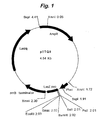
- Plasmid pTTQ9 was obtained from Amersham and is shown in Figure 1 .
- An aliquot (2 ⁇ g) was digested with restriction enzymes SalI and EcoRI, the digest was run on a 1% agarose gel and the large DNA fragment (4520 bp) was purified.
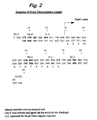
- Two oligonucleotides were synthesized which, when annealed together, encode the OmpA polylinker region shown in Figure 2 . This sequence has cohesive ends which are compatible with the SalI and EcoRI ends generated by restriction of pTTQ9. By cloning this oligonucleotide 'cassette' into the pTTQ9 vector, the SalI site is not regenerated, but the EcoRI site is maintained.
- the cassette encodes the first 13 amino acids of the signal sequence of the E . coli outer-membrane protein Omp-A, preceded by the Shine Dalgarno ribosome binding site of the OmpA gene.
- restriction sites for enzymes XbaI, MunI, StyI and SplI are present.
- the MunI and StyI sites are within the coding region of the OmpA signal sequence and are intended as the 5' cloning sites for insertion of genes.
- the two oligonucleotides which make up this cassette were annealed together by mixing at a concentration of 5 pmoles/ ⁇ l, heating in a waterbath to 95°C for 3 minutes, then slow cooling to room temperature. The annealed sequence was then ligated into the SalI / EcoRI cut pTTQ9.
- the resulting plasmid intermediate, termed pTQOmp was verified by DNA sequencing.
- pTTO-1 This fragment was treated with alkaline phosphatase to remove 5' terminal phosphates (to prevent self ligation) and was ligated to the other purified fragments.
- the resulting plasmid was termed pTTO-1 and is shown in the map in Figure 4 .
- Figure 5 shows the complete DNA sequence of pTTO-1. Insertion of the human Ig light chain kappa constant domain, as a SplI-EcoRI fragment from plasmid pH132, created pTTO-2 ( Figure 6 ).
- variable region genes of Fab' TNF ⁇ were generated by PCR amplification from vectors for mammalian cell expression of whole antibody which contain sequence from SEQ ID8 of PCT/GB01/02477 .
- the purified V L gene (MunI/SplI) was then inserted into the MunI / SplI site of pTTO-2 to create the light chain intermediate pTTO(TNF ⁇ L).
- the heavy chain V H gene was cloned via the intermediate vector pDNAbEng-G1 ( figure 7 ), between the MunI-ApaI sites, creating pDNAbEng(TNF ⁇ H). Cloning of the heavy chain gene from this plasmid as an EcoRI fragment into the EcoRI site of pTTO(TNF ⁇ L) created the E . coli expression plasmid pTTO(TNF ⁇ ) ( Figure 8 ).
- IGS intergenic sequence
- IGS1 and IGS2 have very short intergenic sequences (-1 and +1 respectively) and might be expected to give closely coupled translation; the SD sequences (underlined) are subtly different. These two sequences will most likely confer a high level of translational initiation.
- IGS3 and IGS4 have a longer distance between stop and start codons (+13) and differ in their sequence composition. The SD sequence of IGS3 is stronger than that of IGS1, 2 or 4. All sequences were studied for secondary structure (using m/fold program ( Jaeger, J.A. et al.
- the IGS variants were constructed by ligation of two fragments into a vector prepared by SacI - NotI digestion of pTTO(TNF ⁇ ).
- An insert fragment prepared by MunI-NotI digestion of pDNAbEng(TNF ⁇ ) was purified and ligated along with each IGS cassette (SacI-MunI) into the vector, creating the 4 expression plasmids pTTO(TNF ⁇ IGS-1), pTTO(TNF ⁇ IGS-2), pTTO(TNF ⁇ IGS-3) and pTTO(TNF ⁇ IGS-4).
- the four IGS variant vectors and the original expression vector pTTO(TNF ⁇ ) were each used to transform E . coli strain W3110.
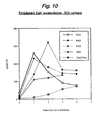
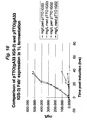
- the transformed E . coli were then analysed for Fab' expression in shake flasks as described. The results of a typical experiment are shown in Figure 10 .
- IGS1 and IGS2 accumulated periplasmic Fab' rapidly with a peak at 1 hour post induction, after which the level recovered fell. The peak was greater and the fall sharper for IGS1. These results were consistent with a high level of synthesis, as expected for close translational coupling for these constructs. IGS1 apparently conferred a higher level of heavy chain expression than did IGS2. In this instance, it appeared that this high level of expression was poorly tolerated, since periplasmic expression levels fell after the 1 hour peak. This was seen on the growth profile of the IGS1 culture (not shown), which peaked at 1 hour post induction before falling, suggesting cell death and lysis.
- IGS3 accumulated Fab' more slowly but peaked at 2 hours post induction with a higher peak value (325 ng/ml/OD), before levels fell. The growth of this culture continued to 3 hours post induction and reached a higher peak biomass (not shown). This is consistent with a lower level of heavy chain synthesis.
- IGS4 accumulated material at a slower rate still and failed to reach the high peak of productivity of the other three constructs.
- the IGS3 construct was selected as the highest yielding.
- a dicistronic message encoding a different Fab' antibody creation of g163 Fab' IGS variants
- the pTTO/IGS vector suite described above was then used for expression analysis of further Fab's.
- humanised Fab' g163 was used.
- a 4-way ligation was used to generate the 4 IGS variants of Fab' g163 ( Figure 11 ).
- a heavy chain intermediate was generated by insertion of a MunI - ApaI fragment of the g163 V H gene (obtained by PCR rescue from mammalian expression vector pGamma-4) into plasmid pDNAbEngG1. This intermediate was cleaved with PvuII and NotI to generate a g163 V H + C H 1 fragment.
- the plasmid pTTO(TNF ⁇ ) was cleaved with MunI and NotI and the large fragment was purified to give a vector fragment.
- a MunI - SplI V L fragment was generated by PCR rescue from the mammalian expression vector pMR10.1(g163).
- C ⁇ -IGS fragments were generated by SplI - PvuII digestion of the 4 pTTO(TNF ⁇ ) IGS variants described above.
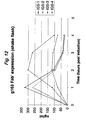
- Four separate ligations then generated the constructs pTTO(g163 IGS-1), pTTO(g163 IGS-2), pTTO(g163 IGS-3) and pTTO(g163 IGS-4). The results of shake flask analysis of these constructs are shown in Figure 12 .
- the expression profile was quite similar to that seen with Fab' TNF ⁇ , in that IGS-1 and -2 resulted in very rapid Fab' accumulation, peaking at 1 hour post induction before reducing sharply.
- IGS-3 resulted in a slower initial rate of accumulation, peaking at a later time point (2-3 hours post induction) before reducing at a slower rate.
- the IGS-4 construct rose slowly throughout the induction timecourse and again never reached the high yields of the other constructs. Because of the expression profiles, and the growth profiles showing that, for IGS-1 and -2, the biomass also peaked only 1 hour post induction (not shown), IGS-3 was chosen and expressed in the fermenter to high yields (not shown).
- plasmid pTTOD was derived from plasmid pTTO-1 by removal of backbone restriction sites for PvuII (3 sites), EcoRV (2 sites) and ApaI (1 site).
- PvuII 3 sites
- EcoRV EcoRV
- ApaI 1 site
- the protein coding sequences of the lacIq gene and tetracycline resistance gene were not altered, although 'silent' changes were made at the DNA level.
- a PCR strategy was used, in which primers bearing 'silent' changes, which removed these restriction sites, were designed and used to amplify sections of the parent plasmid (pTTO-1). Flanking restriction sites (unaltered) were then used to replace sequences in the parent plasmid with these modified sequences.
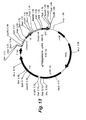
- Plasmid pTTOD was created by this multi-stage process. Transfer of existing g163 Fab' genes within vector pTTO into pTTOD was achieved using the unique PstI and EcoRI sites which flank the genes, creating pTTOD(g163) IGS variants 1-4. Figure 13 shows the restriction map of pTTOD(g163 IGS-3).
- FIG. 14 shows pTTOD(g165) IGS-1 to -3 compared in the shake flask. In contrast to TNF ⁇ and g163, IGS-2 and IGS-1 out-perform IGS-3. Expression of this Fab' seems to be well tolerated by the host cell even at a rapid rate, and the culture expressing IGS-2 continued to grow throughout the induction period (not shown).
- Figure 15 shows a fermenter comparison of IGS-1 to -4 with this Fab', and this essentially reproduces the observation made in the shake flask. IGS-2 was confirmed as the highest yielding variant.
Landscapes
- Health & Medical Sciences (AREA)
- Chemical & Material Sciences (AREA)
- Organic Chemistry (AREA)
- Genetics & Genomics (AREA)
- Life Sciences & Earth Sciences (AREA)
- Immunology (AREA)
- Biochemistry (AREA)
- Biophysics (AREA)
- General Health & Medical Sciences (AREA)
- Molecular Biology (AREA)
- Engineering & Computer Science (AREA)
- Biomedical Technology (AREA)
- Wood Science & Technology (AREA)
- Proteomics, Peptides & Aminoacids (AREA)
- Medicinal Chemistry (AREA)
- Biotechnology (AREA)
- General Engineering & Computer Science (AREA)
- Zoology (AREA)
- Bioinformatics & Cheminformatics (AREA)
- Microbiology (AREA)
- Physics & Mathematics (AREA)
- Plant Pathology (AREA)
- Preparation Of Compounds By Using Micro-Organisms (AREA)
- Micro-Organisms Or Cultivation Processes Thereof (AREA)
- Peptides Or Proteins (AREA)
- Electrophonic Musical Instruments (AREA)
- Mushroom Cultivation (AREA)
- Measuring Or Testing Involving Enzymes Or Micro-Organisms (AREA)
- Electrotherapy Devices (AREA)
Claims (7)
- Dicistronische Nachricht zur Produktion eines Antikörpermoleküls mit einer besonderen Antigenbindungsspezifität, worin das Upstream-Cistron DNA enthält, die entweder für die schwere Kette oder die leichte Kette des Antikörpers kodiert, und das Downstream-Cistron DNA enthält, die für die entsprechende leichte Kette bzw. schwere Kette kodiert, dadurch gekennzeichnet, dass die beiden Cistrons durch eine optimierte intergenische Sequenz (IGS) verknüpft sind, wobei die IGS IGS1 (SEQ ID Nr.: 4), IGS2 (SEQ ID Nr.: 7), IGS3 (SEQ ID Nr.: 10) oder IGS4 (SEQ ID Nr.: 13) ist und wobei der produzierte Antikörper kein Anti-TNFα-Antikörper oder Anti-KDR-Antikörper ist.
- Expressionsvektor, enthaltend eine dicistronische Nachricht nach Anspruch 1.
- Expressionsvektor nach Anspruch 2, wobei der Expressionsvektor pTT0-1 (SEQ ID Nr.: 3) ist.
- Mikrobielle Wirtszelle, die mit einem Expressionsvektor nach Anspruch 2 oder Anspruch 3 transformiert worden ist.
- Mikrobielle Wirtszelle nach Anspruch 4, wobei die Wirtszelle E. coli ist.
- Verfahren zur Produktion eines Antikörpermoleküls, umfassend das Kultivieren der mikrobiellen Wirtszelle nach Anspruch 4 oder Anspruch 5.
- Antikörpermolekül, erzeugt durch das Verfahren von Anspruch 6.
Applications Claiming Priority (3)
| Application Number | Priority Date | Filing Date | Title |
|---|---|---|---|
| GBGB0129105.3A GB0129105D0 (en) | 2001-12-05 | 2001-12-05 | Expression control using variable intergenic sequences |
| GB0129105 | 2001-12-05 | ||
| PCT/GB2002/005466 WO2003048208A2 (en) | 2001-12-05 | 2002-12-05 | Expression control using variable intergenic sequences |
Publications (2)
| Publication Number | Publication Date |
|---|---|
| EP1451223A2 EP1451223A2 (de) | 2004-09-01 |
| EP1451223B1 true EP1451223B1 (de) | 2011-04-20 |
Family
ID=9927042
Family Applications (1)
| Application Number | Title | Priority Date | Filing Date |
|---|---|---|---|
| EP02785614A Expired - Lifetime EP1451223B1 (de) | 2001-12-05 | 2002-12-05 | Exprimierungskontrolle unter verwendung von variabelen intergenischen sequenzen |
Country Status (10)
| Country | Link |
|---|---|
| US (1) | US7419659B2 (de) |
| EP (1) | EP1451223B1 (de) |
| JP (2) | JP2005522993A (de) |
| AT (1) | ATE506374T1 (de) |
| AU (1) | AU2002350901B2 (de) |
| CA (1) | CA2466629C (de) |
| DE (1) | DE60239823D1 (de) |
| ES (1) | ES2365540T3 (de) |
| GB (1) | GB0129105D0 (de) |
| WO (1) | WO2003048208A2 (de) |
Families Citing this family (44)
| Publication number | Priority date | Publication date | Assignee | Title |
|---|---|---|---|---|
| WO2005014649A2 (en) * | 2003-08-08 | 2005-02-17 | Pharmacia Corporation | Method for the preparation of molecules having antibody activity |
| US20050181479A1 (en) * | 2005-03-04 | 2005-08-18 | Medimmune, Inc. | Periplasmic expression of antibodies using a single signal sequence |
| ATE515566T1 (de) * | 2005-05-26 | 2011-07-15 | Cytos Biotechnology Ag | Skalierbares fermentationsverfahren |
| GB0520169D0 (en) * | 2005-10-04 | 2005-11-09 | Celltech R&D Ltd | Biological products |
| SG196697A1 (en) | 2007-03-22 | 2014-02-13 | Biogen Idec Inc | Binding proteins, including antibodies, antibody derivatives and antibody fragments, that specifically bind cd154 and uses thereof |
| BRPI1008692B8 (pt) | 2009-02-17 | 2021-05-25 | Ucb Biopharma Sprl | anticorpo antagonista tendo especificidade para ox40 humano, sequência de dna isolado, vetor de clonagem ou de expressão, célula hospedeira, processo para a produção do referido anticorpo, composição farmacêutica, uso do 5 referido anticorpo e proteína de fusão |
| IN2012DN02401A (de) | 2009-09-24 | 2015-08-21 | Ucb Pharma Sa | |
| US9234037B2 (en) | 2009-10-27 | 2016-01-12 | Ucb Biopharma Sprl | Method to generate antibodies to ion channels |
| GB0922434D0 (en) | 2009-12-22 | 2010-02-03 | Ucb Pharma Sa | antibodies and fragments thereof |
| GB0922435D0 (en) | 2009-12-22 | 2010-02-03 | Ucb Pharma Sa | Method |
| CA2778673A1 (en) | 2009-10-27 | 2011-05-05 | Karen Margrete Miller | Function modifying nav 1.7 antibodies |
| GB201000591D0 (en) | 2010-01-14 | 2010-03-03 | Ucb Pharma Sa | Bacterial hoist strain |
| GB201000588D0 (en) | 2010-01-14 | 2010-03-03 | Ucb Pharma Sa | Bacterial host strain |
| GB201000590D0 (en) | 2010-01-14 | 2010-03-03 | Ucb Pharma Sa | Bacterial host strain |
| GB201000587D0 (en) | 2010-01-14 | 2010-03-03 | Ucb Pharma Sa | Bacterial hoist strain |
| EP2542258A4 (de) | 2010-03-04 | 2013-08-21 | Vet Therapeutics Inc | Auf cd52 gerichtete monoklonale antikörper |
| US9616120B2 (en) | 2010-03-04 | 2017-04-11 | Vet Therapeutics, Inc. | Monoclonal antibodies directed to CD20 |
| EP2545078A1 (de) | 2010-03-11 | 2013-01-16 | UCB Pharma, S.A. | Pd-1-antikörper |
| TW201134488A (en) | 2010-03-11 | 2011-10-16 | Ucb Pharma Sa | PD-1 antibodies |
| GB201012599D0 (en) | 2010-07-27 | 2010-09-08 | Ucb Pharma Sa | Process for purifying proteins |
| JP5865002B2 (ja) * | 2010-12-28 | 2016-02-17 | 東ソー株式会社 | 組換えプラスミドベクターおよびそれを用いたタンパク質の製造方法 |
| HUE035674T2 (en) | 2011-07-13 | 2018-05-28 | Ucb Biopharma Sprl | Bacterial host strain expressing recombinant dsbc |
| EP2546267A1 (de) | 2011-07-13 | 2013-01-16 | UCB Pharma S.A. | Bakterienwirtsstamm mit rekombinanter DsbC-Expression |
| GB201208370D0 (en) | 2012-05-14 | 2012-06-27 | Ucb Pharma Sa | Antibodies |
| GB201208367D0 (en) | 2012-05-14 | 2012-06-27 | Ucb Pharma Sa | Biological product |
| GB201315487D0 (en) | 2013-08-30 | 2013-10-16 | Ucb Pharma Sa | Antibodies |
| GB201320066D0 (en) | 2013-11-13 | 2013-12-25 | Ucb Pharma Sa | Biological products |
| US9914769B2 (en) | 2014-07-15 | 2018-03-13 | Kymab Limited | Precision medicine for cholesterol treatment |
| US8992927B1 (en) | 2014-07-15 | 2015-03-31 | Kymab Limited | Targeting human NAV1.7 variants for treatment of pain |
| US9067998B1 (en) | 2014-07-15 | 2015-06-30 | Kymab Limited | Targeting PD-1 variants for treatment of cancer |
| US9045545B1 (en) | 2014-07-15 | 2015-06-02 | Kymab Limited | Precision medicine by targeting PD-L1 variants for treatment of cancer |
| US8986694B1 (en) | 2014-07-15 | 2015-03-24 | Kymab Limited | Targeting human nav1.7 variants for treatment of pain |
| GB201403775D0 (en) | 2014-03-04 | 2014-04-16 | Kymab Ltd | Antibodies, uses & methods |
| US9139648B1 (en) | 2014-07-15 | 2015-09-22 | Kymab Limited | Precision medicine by targeting human NAV1.9 variants for treatment of pain |
| US9139653B1 (en) | 2015-04-30 | 2015-09-22 | Kymab Limited | Anti-human OX40L antibodies and methods of treatment |
| EP3288584A2 (de) | 2015-04-30 | 2018-03-07 | President and Fellows of Harvard College | Anti-ap2-antikörper und antigenbindemittel zur behandlung von stoffwechselerkrankungen |
| GB201508180D0 (en) | 2015-05-13 | 2015-06-24 | Ucb Biopharma Sprl | Antibodies |
| GB201522394D0 (en) | 2015-12-18 | 2016-02-03 | Ucb Biopharma Sprl | Antibodies |
| GB201610198D0 (en) | 2016-06-10 | 2016-07-27 | Ucb Biopharma Sprl | Anti-ige antibodies |
| JP7461741B2 (ja) | 2016-06-20 | 2024-04-04 | カイマブ・リミテッド | 抗pd-l1およびil-2サイトカイン |
| US11779604B2 (en) | 2016-11-03 | 2023-10-10 | Kymab Limited | Antibodies, combinations comprising antibodies, biomarkers, uses and methods |
| US20200087390A1 (en) | 2016-12-21 | 2020-03-19 | Amgen Inc. | Anti-tnf alpha antibody formulations |
| JP7083124B2 (ja) * | 2017-04-25 | 2022-06-10 | 国立大学法人弘前大学 | ムコン酸産生形質転換微生物及びその利用 |
| MA53903A (fr) | 2018-10-16 | 2021-08-25 | UCB Biopharma SRL | Méthode de traitement de la myasthénie grave |
Family Cites Families (21)
| Publication number | Priority date | Publication date | Assignee | Title |
|---|---|---|---|---|
| GB1243179A (en) * | 1967-10-03 | 1971-08-18 | Unimec Designs Ltd | Improvements relating to mirror devices for motor vehicles |
| US3927193A (en) | 1973-05-18 | 1975-12-16 | Hoffmann La Roche | Localization of tumors by radiolabelled antibodies |
| US4444744A (en) | 1980-03-03 | 1984-04-24 | Goldenberg Milton David | Tumor localization and therapy with labeled antibodies to cell surface antigens |
| US4348376A (en) | 1980-03-03 | 1982-09-07 | Goldenberg Milton David | Tumor localization and therapy with labeled anti-CEA antibody |
| US4361544A (en) | 1980-03-03 | 1982-11-30 | Goldenberg Milton David | Tumor localization and therapy with labeled antibodies specific to intracellular tumor-associated markers |
| US4460561A (en) | 1980-03-03 | 1984-07-17 | Goldenberg M David | Tumor localization and therapy with labeled antibodies specific to intracellular tumor-associated markers |
| US4331647A (en) | 1980-03-03 | 1982-05-25 | Goldenberg Milton David | Tumor localization and therapy with labeled antibody fragments specific to tumor-associated markers |
| GB8308235D0 (en) | 1983-03-25 | 1983-05-05 | Celltech Ltd | Polypeptides |
| US4816567A (en) | 1983-04-08 | 1989-03-28 | Genentech, Inc. | Recombinant immunoglobin preparations |
| JPS6147500A (ja) | 1984-08-15 | 1986-03-07 | Res Dev Corp Of Japan | キメラモノクロ−ナル抗体及びその製造法 |
| EP0173494A3 (de) | 1984-08-27 | 1987-11-25 | The Board Of Trustees Of The Leland Stanford Junior University | Chimäre Rezeptoren durch Verbindung und Expression von DNS |
| GB8422238D0 (en) | 1984-09-03 | 1984-10-10 | Neuberger M S | Chimeric proteins |
| US5618920A (en) * | 1985-11-01 | 1997-04-08 | Xoma Corporation | Modular assembly of antibody genes, antibodies prepared thereby and use |
| GB8607679D0 (en) | 1986-03-27 | 1986-04-30 | Winter G P | Recombinant dna product |
| IL162181A (en) | 1988-12-28 | 2006-04-10 | Pdl Biopharma Inc | A method of producing humanized immunoglubulin, and polynucleotides encoding the same |
| GB8928874D0 (en) | 1989-12-21 | 1990-02-28 | Celltech Ltd | Humanised antibodies |
| CA2116774C (en) * | 1991-09-19 | 2003-11-11 | Paul J. Carter | Expression in e. coli antibody fragments having at least a cysteine present as a free thiol. use for the production of bifunctional f(ab') 2 antibodies |
| WO1995001155A1 (en) | 1993-07-01 | 1995-01-12 | Unilever N.V. | Oral compositions |
| GB0013810D0 (en) * | 2000-06-06 | 2000-07-26 | Celltech Chiroscience Ltd | Biological products |
| GB0124317D0 (en) * | 2001-10-10 | 2001-11-28 | Celltech R&D Ltd | Biological products |
| US20050042219A1 (en) * | 2002-12-05 | 2005-02-24 | Woulfe Susan L. | Engineered Fab' fragment anti-tumor necrosis factor alpha in combination with disease modifying anti-rheumatic drugs |
-
2001
- 2001-12-05 GB GBGB0129105.3A patent/GB0129105D0/en not_active Ceased
-
2002
- 2002-12-05 ES ES02785614T patent/ES2365540T3/es not_active Expired - Lifetime
- 2002-12-05 DE DE60239823T patent/DE60239823D1/de not_active Expired - Lifetime
- 2002-12-05 JP JP2003549395A patent/JP2005522993A/ja active Pending
- 2002-12-05 AT AT02785614T patent/ATE506374T1/de active
- 2002-12-05 WO PCT/GB2002/005466 patent/WO2003048208A2/en not_active Ceased
- 2002-12-05 EP EP02785614A patent/EP1451223B1/de not_active Expired - Lifetime
- 2002-12-05 US US10/498,273 patent/US7419659B2/en not_active Expired - Lifetime
- 2002-12-05 AU AU2002350901A patent/AU2002350901B2/en not_active Expired
- 2002-12-05 CA CA2466629A patent/CA2466629C/en not_active Expired - Lifetime
-
2010
- 2010-05-20 JP JP2010116444A patent/JP2010207241A/ja active Pending
Also Published As
| Publication number | Publication date |
|---|---|
| US7419659B2 (en) | 2008-09-02 |
| CA2466629C (en) | 2011-07-05 |
| EP1451223A2 (de) | 2004-09-01 |
| AU2002350901A1 (en) | 2003-06-17 |
| ES2365540T3 (es) | 2011-10-06 |
| GB0129105D0 (en) | 2002-01-23 |
| DE60239823D1 (de) | 2011-06-01 |
| WO2003048208A2 (en) | 2003-06-12 |
| JP2005522993A (ja) | 2005-08-04 |
| AU2002350901B2 (en) | 2008-11-06 |
| US20060104949A1 (en) | 2006-05-18 |
| WO2003048208A3 (en) | 2003-12-31 |
| ATE506374T1 (de) | 2011-05-15 |
| CA2466629A1 (en) | 2003-06-12 |
| JP2010207241A (ja) | 2010-09-24 |
Similar Documents
| Publication | Publication Date | Title |
|---|---|---|
| US7419659B2 (en) | Expression control using variable intergenic sequences | |
| KR102023786B1 (ko) | 재조합 dsbc를 발현하는 세균 숙주 균주 | |
| KR100186823B1 (ko) | 사람 말초성 비이-림프구 로부터의 모노클로날 항체 유전자 뱅크의 제조방법 | |
| JP4323312B2 (ja) | 生物学的製品 | |
| US20020037558A1 (en) | E.coli produced immunoglobulin constructs | |
| KR102036399B1 (ko) | 단백질 발현용 재조합 박테리아 숙주 세포 | |
| WO1997001580A1 (en) | Multispecific and multivalent antigen-binding polypeptide molecules | |
| US9315578B2 (en) | High functional bispecific antibody | |
| TW201815825A (zh) | 經修飾之抗原結合fab片段及包含其之抗原結合分子 | |
| EP2993231B1 (de) | Bakterienwirtsstamm | |
| Rippmann et al. | Procaryotic expression of single-chain variable-fragment (scFv) antibodies: secretion in L-form cells of Proteus mirabilis leads to active product and overcomes the limitations of periplasmic expression in Escherichia coli | |
| CA2969889A1 (en) | Protein manufacture | |
| AU2002334135A1 (en) | Antibodies against KDR, their production and uses | |
| JP2011514161A (ja) | 免疫グロブリン組成物およびその製造方法 | |
| JP2009504136A (ja) | 慢性リンパ性白血病治療のためのcd52に対するモノクローナル抗体産生のための組み換え法 | |
| CN116114657B (zh) | 一种红斑狼疮样小鼠模型的构建方法 | |
| EP0759976A1 (de) | Die isolierung und herstellung von katalytischen antikörpern mittels phagentechnologie | |
| DK1824961T3 (en) | SYSTEM FOR EXPRESSION OF MELIBIOSEOPERON | |
| Shibui et al. | Antibody produced by using Escherichia coli expression systems | |
| Bowering | Microbial systems for the manufacture of therapeutic antibody fragments | |
| Dorn-Beineke et al. | Technology and production of murine monoclonal and recombinant antibodies and antibody fragments | |
| US20050048056A1 (en) | Method for the preparation of molecules having antibody activity | |
| Lo et al. | Expression and secretion of an assembled tetrameric CH2-deleted antibody in E. coli | |
| Zettlitz | Generation of Heavy and Light Chains (Chimeric Antibodies) | |
| HK1176942A1 (zh) | 包含突变spr基因以及野生型tsp基因的细菌宿主菌株 |
Legal Events
| Date | Code | Title | Description |
|---|---|---|---|
| PUAI | Public reference made under article 153(3) epc to a published international application that has entered the european phase |
Free format text: ORIGINAL CODE: 0009012 |
|
| 17P | Request for examination filed |
Effective date: 20040618 |
|
| AK | Designated contracting states |
Kind code of ref document: A2 Designated state(s): AT BE BG CH CY CZ DE DK EE ES FI FR GB GR IE IT LI LU MC NL PT SE SI SK TR |
|
| AX | Request for extension of the european patent |
Extension state: AL LT LV MK RO |
|
| RAP1 | Party data changed (applicant data changed or rights of an application transferred) |
Owner name: UCB PHARMA, S.A. |
|
| 17Q | First examination report despatched |
Effective date: 20071012 |
|
| GRAP | Despatch of communication of intention to grant a patent |
Free format text: ORIGINAL CODE: EPIDOSNIGR1 |
|
| RIC1 | Information provided on ipc code assigned before grant |
Ipc: C12N 1/21 20060101ALI20101026BHEP Ipc: C12N 15/70 20060101ALI20101026BHEP Ipc: C07K 16/00 20060101AFI20101026BHEP |
|
| GRAS | Grant fee paid |
Free format text: ORIGINAL CODE: EPIDOSNIGR3 |
|
| GRAA | (expected) grant |
Free format text: ORIGINAL CODE: 0009210 |
|
| AK | Designated contracting states |
Kind code of ref document: B1 Designated state(s): AT BE BG CH CY CZ DE DK EE ES FI FR GB GR IE IT LI LU MC NL PT SE SI SK TR |
|
| AX | Request for extension of the european patent |
Extension state: AL LT LV MK RO |
|
| REG | Reference to a national code |
Ref country code: GB Ref legal event code: FG4D |
|
| REG | Reference to a national code |
Ref country code: CH Ref legal event code: EP Ref country code: CH Ref legal event code: NV Representative=s name: HEPP WENGER RYFFEL AG |
|
| REG | Reference to a national code |
Ref country code: IE Ref legal event code: FG4D |
|
| REF | Corresponds to: |
Ref document number: 60239823 Country of ref document: DE Date of ref document: 20110601 Kind code of ref document: P |
|
| REG | Reference to a national code |
Ref country code: DE Ref legal event code: R096 Ref document number: 60239823 Country of ref document: DE Effective date: 20110601 |
|
| REG | Reference to a national code |
Ref country code: NL Ref legal event code: VDEP Effective date: 20110420 |
|
| LTIE | Lt: invalidation of european patent or patent extension |
Effective date: 20110420 |
|
| REG | Reference to a national code |
Ref country code: ES Ref legal event code: FG2A Ref document number: 2365540 Country of ref document: ES Kind code of ref document: T3 Effective date: 20111006 |
|
| PG25 | Lapsed in a contracting state [announced via postgrant information from national office to epo] |
Ref country code: PT Free format text: LAPSE BECAUSE OF FAILURE TO SUBMIT A TRANSLATION OF THE DESCRIPTION OR TO PAY THE FEE WITHIN THE PRESCRIBED TIME-LIMIT Effective date: 20110822 Ref country code: SE Free format text: LAPSE BECAUSE OF FAILURE TO SUBMIT A TRANSLATION OF THE DESCRIPTION OR TO PAY THE FEE WITHIN THE PRESCRIBED TIME-LIMIT Effective date: 20110420 |
|
| PG25 | Lapsed in a contracting state [announced via postgrant information from national office to epo] |
Ref country code: GR Free format text: LAPSE BECAUSE OF FAILURE TO SUBMIT A TRANSLATION OF THE DESCRIPTION OR TO PAY THE FEE WITHIN THE PRESCRIBED TIME-LIMIT Effective date: 20110721 Ref country code: SI Free format text: LAPSE BECAUSE OF FAILURE TO SUBMIT A TRANSLATION OF THE DESCRIPTION OR TO PAY THE FEE WITHIN THE PRESCRIBED TIME-LIMIT Effective date: 20110420 Ref country code: CY Free format text: LAPSE BECAUSE OF FAILURE TO SUBMIT A TRANSLATION OF THE DESCRIPTION OR TO PAY THE FEE WITHIN THE PRESCRIBED TIME-LIMIT Effective date: 20110420 Ref country code: FI Free format text: LAPSE BECAUSE OF FAILURE TO SUBMIT A TRANSLATION OF THE DESCRIPTION OR TO PAY THE FEE WITHIN THE PRESCRIBED TIME-LIMIT Effective date: 20110420 Ref country code: BE Free format text: LAPSE BECAUSE OF FAILURE TO SUBMIT A TRANSLATION OF THE DESCRIPTION OR TO PAY THE FEE WITHIN THE PRESCRIBED TIME-LIMIT Effective date: 20110420 |
|
| PG25 | Lapsed in a contracting state [announced via postgrant information from national office to epo] |
Ref country code: NL Free format text: LAPSE BECAUSE OF FAILURE TO SUBMIT A TRANSLATION OF THE DESCRIPTION OR TO PAY THE FEE WITHIN THE PRESCRIBED TIME-LIMIT Effective date: 20110420 |
|
| PG25 | Lapsed in a contracting state [announced via postgrant information from national office to epo] |
Ref country code: EE Free format text: LAPSE BECAUSE OF FAILURE TO SUBMIT A TRANSLATION OF THE DESCRIPTION OR TO PAY THE FEE WITHIN THE PRESCRIBED TIME-LIMIT Effective date: 20110420 Ref country code: CZ Free format text: LAPSE BECAUSE OF FAILURE TO SUBMIT A TRANSLATION OF THE DESCRIPTION OR TO PAY THE FEE WITHIN THE PRESCRIBED TIME-LIMIT Effective date: 20110420 |
|
| PLBE | No opposition filed within time limit |
Free format text: ORIGINAL CODE: 0009261 |
|
| STAA | Information on the status of an ep patent application or granted ep patent |
Free format text: STATUS: NO OPPOSITION FILED WITHIN TIME LIMIT |
|
| PG25 | Lapsed in a contracting state [announced via postgrant information from national office to epo] |
Ref country code: SK Free format text: LAPSE BECAUSE OF FAILURE TO SUBMIT A TRANSLATION OF THE DESCRIPTION OR TO PAY THE FEE WITHIN THE PRESCRIBED TIME-LIMIT Effective date: 20110420 Ref country code: DK Free format text: LAPSE BECAUSE OF FAILURE TO SUBMIT A TRANSLATION OF THE DESCRIPTION OR TO PAY THE FEE WITHIN THE PRESCRIBED TIME-LIMIT Effective date: 20110420 |
|
| 26N | No opposition filed |
Effective date: 20120123 |
|
| REG | Reference to a national code |
Ref country code: DE Ref legal event code: R097 Ref document number: 60239823 Country of ref document: DE Effective date: 20120123 |
|
| PG25 | Lapsed in a contracting state [announced via postgrant information from national office to epo] |
Ref country code: MC Free format text: LAPSE BECAUSE OF NON-PAYMENT OF DUE FEES Effective date: 20111231 |
|
| REG | Reference to a national code |
Ref country code: IE Ref legal event code: MM4A |
|
| PG25 | Lapsed in a contracting state [announced via postgrant information from national office to epo] |
Ref country code: IE Free format text: LAPSE BECAUSE OF NON-PAYMENT OF DUE FEES Effective date: 20111205 |
|
| PG25 | Lapsed in a contracting state [announced via postgrant information from national office to epo] |
Ref country code: LU Free format text: LAPSE BECAUSE OF NON-PAYMENT OF DUE FEES Effective date: 20111205 |
|
| PG25 | Lapsed in a contracting state [announced via postgrant information from national office to epo] |
Ref country code: BG Free format text: LAPSE BECAUSE OF FAILURE TO SUBMIT A TRANSLATION OF THE DESCRIPTION OR TO PAY THE FEE WITHIN THE PRESCRIBED TIME-LIMIT Effective date: 20110720 |
|
| PG25 | Lapsed in a contracting state [announced via postgrant information from national office to epo] |
Ref country code: TR Free format text: LAPSE BECAUSE OF FAILURE TO SUBMIT A TRANSLATION OF THE DESCRIPTION OR TO PAY THE FEE WITHIN THE PRESCRIBED TIME-LIMIT Effective date: 20110420 |
|
| REG | Reference to a national code |
Ref country code: FR Ref legal event code: PLFP Year of fee payment: 14 |
|
| REG | Reference to a national code |
Ref country code: FR Ref legal event code: PLFP Year of fee payment: 15 |
|
| REG | Reference to a national code |
Ref country code: FR Ref legal event code: PLFP Year of fee payment: 16 |
|
| PGFP | Annual fee paid to national office [announced via postgrant information from national office to epo] |
Ref country code: DE Payment date: 20211102 Year of fee payment: 20 Ref country code: AT Payment date: 20211129 Year of fee payment: 20 Ref country code: GB Payment date: 20211104 Year of fee payment: 20 Ref country code: FR Payment date: 20211115 Year of fee payment: 20 |
|
| PGFP | Annual fee paid to national office [announced via postgrant information from national office to epo] |
Ref country code: IT Payment date: 20211110 Year of fee payment: 20 Ref country code: CH Payment date: 20211116 Year of fee payment: 20 |
|
| PGFP | Annual fee paid to national office [announced via postgrant information from national office to epo] |
Ref country code: ES Payment date: 20220105 Year of fee payment: 20 |
|
| REG | Reference to a national code |
Ref country code: DE Ref legal event code: R071 Ref document number: 60239823 Country of ref document: DE |
|
| REG | Reference to a national code |
Ref country code: CH Ref legal event code: PL |
|
| REG | Reference to a national code |
Ref country code: GB Ref legal event code: PE20 Expiry date: 20221204 |
|
| REG | Reference to a national code |
Ref country code: AT Ref legal event code: MK07 Ref document number: 506374 Country of ref document: AT Kind code of ref document: T Effective date: 20221205 |
|
| PG25 | Lapsed in a contracting state [announced via postgrant information from national office to epo] |
Ref country code: GB Free format text: LAPSE BECAUSE OF EXPIRATION OF PROTECTION Effective date: 20221204 |
|
| REG | Reference to a national code |
Ref country code: ES Ref legal event code: FD2A Effective date: 20230428 |
|
| PG25 | Lapsed in a contracting state [announced via postgrant information from national office to epo] |
Ref country code: ES Free format text: LAPSE BECAUSE OF EXPIRATION OF PROTECTION Effective date: 20221206 |