EP1454594A1 - Dünnwandiger Handschuh welcher Chlordioxid freisetzt - Google Patents
Dünnwandiger Handschuh welcher Chlordioxid freisetzt Download PDFInfo
- Publication number
- EP1454594A1 EP1454594A1 EP04004970A EP04004970A EP1454594A1 EP 1454594 A1 EP1454594 A1 EP 1454594A1 EP 04004970 A EP04004970 A EP 04004970A EP 04004970 A EP04004970 A EP 04004970A EP 1454594 A1 EP1454594 A1 EP 1454594A1
- Authority
- EP
- European Patent Office
- Prior art keywords
- styrene
- glove
- thin walled
- sodium chlorite
- polyurethane
- Prior art date
- Legal status (The legal status is an assumption and is not a legal conclusion. Google has not performed a legal analysis and makes no representation as to the accuracy of the status listed.)
- Withdrawn
Links
Images



Classifications
-
- A—HUMAN NECESSITIES
- A61—MEDICAL OR VETERINARY SCIENCE; HYGIENE
- A61L—METHODS OR APPARATUS FOR STERILISING MATERIALS OR OBJECTS IN GENERAL; DISINFECTION, STERILISATION OR DEODORISATION OF AIR; CHEMICAL ASPECTS OF BANDAGES, DRESSINGS, ABSORBENT PADS OR SURGICAL ARTICLES; MATERIALS FOR BANDAGES, DRESSINGS, ABSORBENT PADS OR SURGICAL ARTICLES
- A61L31/00—Materials for other surgical articles, e.g. stents, stent-grafts, shunts, surgical drapes, guide wires, materials for adhesion prevention, occluding devices, surgical gloves, tissue fixation devices
- A61L31/14—Materials characterised by their function or physical properties, e.g. injectable or lubricating compositions, shape-memory materials, surface modified materials
- A61L31/16—Biologically active materials, e.g. therapeutic substances
-
- A—HUMAN NECESSITIES
- A01—AGRICULTURE; FORESTRY; ANIMAL HUSBANDRY; HUNTING; TRAPPING; FISHING
- A01N—PRESERVATION OF BODIES OF HUMANS OR ANIMALS OR PLANTS OR PARTS THEREOF; BIOCIDES, e.g. AS DISINFECTANTS, AS PESTICIDES OR AS HERBICIDES; PEST REPELLANTS OR ATTRACTANTS; PLANT GROWTH REGULATORS
- A01N59/00—Biocides, pest repellants or attractants, or plant growth regulators containing elements or inorganic compounds
-
- A—HUMAN NECESSITIES
- A61—MEDICAL OR VETERINARY SCIENCE; HYGIENE
- A61B—DIAGNOSIS; SURGERY; IDENTIFICATION
- A61B42/00—Surgical gloves; Finger-stalls specially adapted for surgery; Devices for handling or treatment thereof
-
- A—HUMAN NECESSITIES
- A41—WEARING APPAREL
- A41D—OUTERWEAR; PROTECTIVE GARMENTS; ACCESSORIES
- A41D19/00—Gloves
- A41D19/0055—Plastic or rubber gloves
-
- A—HUMAN NECESSITIES
- A61—MEDICAL OR VETERINARY SCIENCE; HYGIENE
- A61L—METHODS OR APPARATUS FOR STERILISING MATERIALS OR OBJECTS IN GENERAL; DISINFECTION, STERILISATION OR DEODORISATION OF AIR; CHEMICAL ASPECTS OF BANDAGES, DRESSINGS, ABSORBENT PADS OR SURGICAL ARTICLES; MATERIALS FOR BANDAGES, DRESSINGS, ABSORBENT PADS OR SURGICAL ARTICLES
- A61L2300/00—Biologically active materials used in bandages, wound dressings, absorbent pads or medical devices
- A61L2300/10—Biologically active materials used in bandages, wound dressings, absorbent pads or medical devices containing or releasing inorganic materials
- A61L2300/106—Halogens or compounds thereof, e.g. iodine, chlorite
-
- A—HUMAN NECESSITIES
- A61—MEDICAL OR VETERINARY SCIENCE; HYGIENE
- A61L—METHODS OR APPARATUS FOR STERILISING MATERIALS OR OBJECTS IN GENERAL; DISINFECTION, STERILISATION OR DEODORISATION OF AIR; CHEMICAL ASPECTS OF BANDAGES, DRESSINGS, ABSORBENT PADS OR SURGICAL ARTICLES; MATERIALS FOR BANDAGES, DRESSINGS, ABSORBENT PADS OR SURGICAL ARTICLES
- A61L2300/00—Biologically active materials used in bandages, wound dressings, absorbent pads or medical devices
- A61L2300/40—Biologically active materials used in bandages, wound dressings, absorbent pads or medical devices characterised by a specific therapeutic activity or mode of action
- A61L2300/404—Biocides, antimicrobial agents, antiseptic agents
Definitions
- the present invention relates to thin wall gloves that release bacteria killing chlorine dioxide.
- the thin wall gloves, embodying the present invention are produced with excellent barrier integrity.
- the thin wall gloves prevent cross-contamination, while preserving all the desired mechanical and physical properties of conventional gloves.
- Gloves have been the most common protective equipment for hand protection.
- gloves have been made from variety of materials, plastics (polyvinyl chloride, polyethylene), rubbers (natural rubber latex, carboxylated polyacrylonitrile butadiene, polyurethane, polybutyl rubber, polyisoprene, polychloroprene), and thermal plastic elastomers (styrene-isoprene-styrene, styrene-ethylene-butadiene-styrene).
- gloves made from a combination of these materials, as well as blends or copolymers thereof. They all have different properties and therefore are suitable for different applications. Other than polyethylene (extrusion is needed), pretty much all the materials can be made into a dippable compound (aqueous or organic). The gloves are made via a dipping procedure.
- Chlorine dioxide is an extremely active oxidant. It almost will react immediately with anything it is in touch with. Therefore, it is a highly dangerous gas if the concentration is high. But below a certain limit, as specified by OSHA and the EPA, it is an excellent disinfectant. As a matter of fact, it can be used to decontaminate the environment. It is also widely used in general cleaning products such as mouthwash liquid.
- the present invention contemplates a new and improved glove which overcomes the above-referenced problems and others.
- a thin wall glove is provided that is capable of releasing chlorine dioxide.
- the thin wall glove has substantial bacteria killing efficacy.
- the thin wall glove can be made of polyurethane, carboxylated polyacrylonitrile butadiene, commonly known as nitrile, and or polyvinyl chloride. Methodologies for making a thin wall glove are also disclosed. The demonstrated procedures can be easily transferred to almost all the materials that can be used as glove making materials via an aqueous dipping process: including, but not limited to, natural rubber latex, polychloroprene, polyisoprene, polybutadiene, polybutyl rubber, and their copolymers and blends.
- the gloves are made of an organic solvent-based material such as a thermal plastic elastomer, or the gloves can have these materials as coatings on gloves.
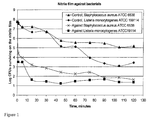
- FIGURE 1 is a graphical representation of Bacteria killing efficacy as a measure of bacteria remaining vs. time (nitrile film);
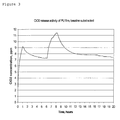
- FIGURE 2 is a graphical representation of chlorine dioxide releasing activity upon light exposure (nitrile film);
- FIGURE 3 is a graphical representation of chlorine dioxide releasing activity upon light exposure (polyurethane film).
- FIGURE 4 is a graphical representation of chlorine dioxide releasing activity upon light exposure (polyvinyl chloride film);
- FIGURE 5 is a graphical representation of ASTM required physical properties, with and without disinfectant (nitrile film) ;
- FIGURE 6 is a graphical representation of ASTM required physical properties, with and without disinfectant (polyurethane film).
- FIGURE 7 is a graphical representation of ASTM required physical properties, with and without disinfectant (polyvinyl chloride film).
- Sodium chlorite is commonly used as a source of chlorine dioxide. When exposed to heat, light, moisture, and acid, sodium chlorite will release chlorine dioxide. Naturally, the releasing activity depends on environmental conditions.
- Sodium chlorite is incorporated into the gloves, and then, the gloves will release the desired chlorine dioxide.
- the disinfectant is released while the gloves are being used. Otherwise, the designed purpose will not be served.
- a light activation mechanism is utilized. When sodium chlorite and titanium dioxide are mixed together, sufficient light exposure will cause sodium chlorite to decompose to release chlorine dioxide efficiently. In other words, titanium dioxide can act as the catalyst under light exposure.
- sodium chlorite Under the normal production and storage conditions, sodium chlorite is fairly stable. Most of the loaded sodium chlorite will be preserved. Upon its usage, the gloves are pulled out of storage box and exposed to light, the loaded sodium chlorite will start to decompose and release chlorine dioxide.
- releasing of disinfectant must be able to sustain at an efficacious level for a period of time to cover the typical usage span of a glove.
- the released amount of disinfectant must not exceed the safety limit set by regulatory organizations such as OSHA.
- the aqueous medium selected for producing the thin wall glove include most rubbery materials: i.e. , natural rubber latex, carboxylated polyacrylonitrile butadiene, polyurethane, polybutyl rubber, polyisoprene, polychloroprene, polybutadiene.
- the organic media covers the plastic and the thermal plastic elastomer family as well, namely, polyvinyl chloride, styrene-isoprene-styrene, styrene-ethylene-butadiene-styrene, styrene-propylene-styrene, styrene-butadiene-styrene, etc.
- Sodium chlorite is added in an amount so that it will not interfere with or be disabled in the final formulation.
- films were made via both an aqueous medium (polyurethane and carboxylated polyacrylonitrile butadiene) and an organic medium (polyvinyl chloride).
- polyurethane used as elastic material is so called aliphatic polyurethane. It possesses excellent physical properties: high tensile strength and elongation, low modulus, exceptional puncture strength, etc .
- the emulsion form of aliphatic polyurethane is commercially available. It is almost ideal for thin wall glove via a dipping procedure. However, it has not yet been widely used in disposable gloves because its high cost. Recently, an aromatic polyurethane emulsion was developed and a medical examination glove was commercialized. Although the performance is not as good as that of aliphatic polyurethane, its cost has been reduced to a reasonable level.
- Polyurethane Due to the nature of polyurethane (very stable emulsion, no curing package needed, saturated polymer backbone), most complications in glove formation will not occur.
- Polyurethane is aqueous based and the sodium chlorite incorporated therein is water-soluble. Sodium chlorite is dissolved into a polyurethane dipping compound. Both compounding and dipping are straightforward.
- Carboxylated polyacrylonitrile butadiene or known commonly as nitrile, is the most widely used synthetic rubbery material in the thin wall glove industry as an alternative to natural rubber latex.
- a nitrile dipping compound is an aqueous system that is much more delicate than polyurethane.
- a multiple components curing package must be used. Subtle changes in pH, solid content, temperature, viscosity, ionic strength, and so on, will result in destabilization of the emulsion system.
- Sodium chlorite was incorporated into nitrile films in following ways:
- Some or all of these developed methodologies and in compounding and dipping can be easily transferred to other materials in aqueous systems, these include but are not limited to natural rubber latex, polybutyl rubber, polyisoprene, polychloroprene, polybutadiene, etc .
- the potassium hydroxide solution is a standard solution routinely used in latex dipping compound mixing for pH adjustment. Under basic conditions, the sodium chlorite is stable. The resulted solution has to be added slowly under stirring. Otherwise, one can still have local regions with high ionic strength and/or pH to shock the emulsion.
- Coagulant (calcium nitrate), latex compound, pre leaching, vulcanization, post leaching
- Coagulant (calcium nitrate), latex compound, coagulant (calcium nitrate), latex again, pre leaching, vulcanization, post leaching
- Sodium chlorite can be added into the second coagulant.
- the disclosed sequence is the disclosed sequence:
- Coagulant (calcium nitrate), latex compound, coagulant (calcium nitrate + sodium chlorite), latex again, pre leaching, vulcanization, post leaching
- the major advantage of this approach is that the danger of destabilizing the emulsion system is essentially eliminated and that the added sodium chlorite can be preserved better in the leaching stages.
- Polyurethane is commonly used in thin wall glove dipping manufacturing as a former releasing agent (mixed with coagulant) and coating material (one more additional dipping) to improve donning.
- polyurethane As previously discussed, the mixing of sodium chlorite and polyurethane is fairly straightforward; it is logical to adopt polyurethane as a carrier of disinfectant.
- Other carriers for the oxidant are contemplated such as: nitrile, natural rubber latex, polyisoprene, polychloroprene, polybutyl rubber, polybutadiene, polyurethane, polyvinyl chloride; carboxylated polyacrylonitrile butadiene; styrene-isoprene-styrene; styrene-ethylene-butadiene-styrene; styrene-propylene-styrene; and styrene-butadiene-styrene.
- thermal plastic elastomers and polyvinyl chloride are chemically more stable than previous discussed systems. There is no need for chemical vulcanization packages. Thermal plastic elastomers are crosslinked via physical manners, so called micro phase separation. Polyvinyl chloride is a plastic. It shows mechanical strength that is acceptable without crosslinking. Therefore, one does not have to worry about destabilization of the dipping compounds.
- a sandwich method does not work here because the film formation mechanism is entirely different from that of aqueous systems previously discussed.
- sodium chlorite solution can act as coagulant to form the film.
- polyvinyl chloride is formed via heat in contrast to chemically destabilized emulsification. The first layer of polyvinyl chloride and the sodium chlorite will change the heat conduction form former to plastisol dramatically. Therefore, multiple dipping of polyvinyl chloride plastisol is not an option.
- Direct mixing sodium chlorite into polyvinyl chloride dipping plastisol works because sodium chlorite is not soluble in plasticizers, but it can be dispersed into it. The finer the inorganic particle size, results in a higher releasing efficiency of chlorine dioxide.
Landscapes
- Health & Medical Sciences (AREA)
- Life Sciences & Earth Sciences (AREA)
- Surgery (AREA)
- Engineering & Computer Science (AREA)
- General Health & Medical Sciences (AREA)
- Chemical & Material Sciences (AREA)
- Biomedical Technology (AREA)
- Heart & Thoracic Surgery (AREA)
- Molecular Biology (AREA)
- Animal Behavior & Ethology (AREA)
- Public Health (AREA)
- Veterinary Medicine (AREA)
- Medical Informatics (AREA)
- Medicinal Chemistry (AREA)
- Vascular Medicine (AREA)
- Epidemiology (AREA)
- Agronomy & Crop Science (AREA)
- Inorganic Chemistry (AREA)
- Pest Control & Pesticides (AREA)
- Plant Pathology (AREA)
- Dentistry (AREA)
- Wood Science & Technology (AREA)
- Zoology (AREA)
- Environmental Sciences (AREA)
- Gloves (AREA)
- Compositions Of Macromolecular Compounds (AREA)
Applications Claiming Priority (6)
| Application Number | Priority Date | Filing Date | Title |
|---|---|---|---|
| US45166303P | 2003-03-05 | 2003-03-05 | |
| US45166203P | 2003-03-05 | 2003-03-05 | |
| US451662P | 2003-03-05 | ||
| US451663P | 2003-03-05 | ||
| US733366 | 2003-12-12 | ||
| US10/733,366 US20040170671A1 (en) | 2003-03-05 | 2003-12-12 | Thin wall gloves that release chlorine dioxide |
Publications (1)
| Publication Number | Publication Date |
|---|---|
| EP1454594A1 true EP1454594A1 (de) | 2004-09-08 |
Family
ID=32830886
Family Applications (1)
| Application Number | Title | Priority Date | Filing Date |
|---|---|---|---|
| EP04004970A Withdrawn EP1454594A1 (de) | 2003-03-05 | 2004-03-03 | Dünnwandiger Handschuh welcher Chlordioxid freisetzt |
Country Status (4)
| Country | Link |
|---|---|
| US (1) | US20040170671A1 (de) |
| EP (1) | EP1454594A1 (de) |
| JP (1) | JP2004270128A (de) |
| CA (1) | CA2460357A1 (de) |
Cited By (3)
| Publication number | Priority date | Publication date | Assignee | Title |
|---|---|---|---|---|
| WO2006078786A1 (en) * | 2005-01-18 | 2006-07-27 | Selective Micro Technologies, Llc | Antimicrobial gas desorbing articles |
| RU2492779C2 (ru) * | 2007-09-04 | 2013-09-20 | АНСЕЛЛ ХЕЛСКЭА ПРОДАКТС ЭлЭлСи | Легкая прочная тонкая эластичная перчатка с полимерным покрытием |
| US10253170B2 (en) | 2014-03-25 | 2019-04-09 | Ansell Limited | Polyisoprene/polychloroprene compositions |
Families Citing this family (2)
| Publication number | Priority date | Publication date | Assignee | Title |
|---|---|---|---|---|
| US20060178445A1 (en) * | 2004-12-16 | 2006-08-10 | Mcintyre Patrick F | Composition for controlled sustained release of a gas |
| USD677030S1 (en) | 2010-12-10 | 2013-02-26 | Carolyn C. Wessels | Cleaning glove |
Citations (5)
| Publication number | Priority date | Publication date | Assignee | Title |
|---|---|---|---|---|
| US4533691A (en) * | 1983-12-12 | 1985-08-06 | Polysar Limited | Chlorine dioxide antimicrobial agent for latex |
| US5357636A (en) * | 1992-06-30 | 1994-10-25 | Dresdner Jr Karl P | Flexible protective medical gloves and methods for their use |
| WO1999065538A1 (en) * | 1998-06-19 | 1999-12-23 | Oxibio, Inc. | Medical device having anti-infective and contraceptive properties |
| WO2003056951A2 (en) * | 2002-01-08 | 2003-07-17 | Bernard Techologies, Inc. | Antimicrobial body covering articles |
| US20030157150A1 (en) * | 2002-02-19 | 2003-08-21 | Che-Hao Lee | Formulation and process for manufacturing antimicrobial vinyl gloves |
Family Cites Families (17)
| Publication number | Priority date | Publication date | Assignee | Title |
|---|---|---|---|---|
| NL6503238A (de) * | 1964-03-18 | 1965-09-20 | ||
| US3286011A (en) * | 1964-03-18 | 1966-11-15 | Us Rubber Co | Method of making gloves |
| GB1579431A (en) * | 1976-03-23 | 1980-11-19 | Minnesota Mining & Mfg | Disinfecting and/or sterilising |
| US5407685A (en) * | 1986-02-06 | 1995-04-18 | Steris Corporation | Controlled oxygen/anti-microbial release films |
| US4851266A (en) * | 1988-05-31 | 1989-07-25 | Akira Momose | Surface treatment of powderfree surgical gloves |
| GB9222292D0 (en) * | 1992-10-23 | 1992-12-09 | Malaysian Rubber Producers | Treatment of rubber articles |
| US5705092A (en) * | 1995-06-05 | 1998-01-06 | Southwest Research Institute | Multilayered biocidal film compositions |
| US5906823A (en) * | 1994-05-09 | 1999-05-25 | Mixon; Grover C. | Antimicrobial gloves and a method of manufacture thereof |
| GB9416251D0 (en) * | 1994-08-11 | 1994-10-05 | Wembley Rubber Products M Sdn | Coating composition, method of using it and article coated with same |
| CA2224013C (en) * | 1995-06-07 | 2007-09-25 | Allegiance Corporation | Surgeon's gloves from neoprene copolymers |
| US5792531A (en) * | 1996-02-20 | 1998-08-11 | Tactyl Technologies, Inc. | Readily donned, powder free elastomeric article |
| US5780112A (en) * | 1996-05-15 | 1998-07-14 | Lrc Products, Ltd. | Power-free latex articles and methods of making the same |
| US5798570A (en) * | 1996-06-28 | 1998-08-25 | Kabushiki Kaisha Gotoh Seisakusho | Plastic molded semiconductor package with thermal dissipation means |
| AT409819B (de) * | 1996-09-12 | 2002-11-25 | Semperit Ag Holding | Gegenstand aus einem flexiblen gummi und/oder kunststoff |
| US6195805B1 (en) * | 1998-02-27 | 2001-03-06 | Allegiance Corporation | Powder free neoprene surgical gloves |
| US6391409B1 (en) * | 1999-02-12 | 2002-05-21 | Allegiance Corporation | Powder-free nitrile-coated gloves with an intermediate rubber-nitrile layer between the glove and the coating and method of making same |
| JP2001207314A (ja) * | 2000-01-31 | 2001-08-03 | Honny Chem Ind Co Ltd | ゴム製手袋及びその製造方法 |
-
2003
- 2003-12-12 US US10/733,366 patent/US20040170671A1/en not_active Abandoned
-
2004
- 2004-03-03 EP EP04004970A patent/EP1454594A1/de not_active Withdrawn
- 2004-03-04 CA CA002460357A patent/CA2460357A1/en not_active Abandoned
- 2004-03-05 JP JP2004062338A patent/JP2004270128A/ja active Pending
Patent Citations (5)
| Publication number | Priority date | Publication date | Assignee | Title |
|---|---|---|---|---|
| US4533691A (en) * | 1983-12-12 | 1985-08-06 | Polysar Limited | Chlorine dioxide antimicrobial agent for latex |
| US5357636A (en) * | 1992-06-30 | 1994-10-25 | Dresdner Jr Karl P | Flexible protective medical gloves and methods for their use |
| WO1999065538A1 (en) * | 1998-06-19 | 1999-12-23 | Oxibio, Inc. | Medical device having anti-infective and contraceptive properties |
| WO2003056951A2 (en) * | 2002-01-08 | 2003-07-17 | Bernard Techologies, Inc. | Antimicrobial body covering articles |
| US20030157150A1 (en) * | 2002-02-19 | 2003-08-21 | Che-Hao Lee | Formulation and process for manufacturing antimicrobial vinyl gloves |
Cited By (3)
| Publication number | Priority date | Publication date | Assignee | Title |
|---|---|---|---|---|
| WO2006078786A1 (en) * | 2005-01-18 | 2006-07-27 | Selective Micro Technologies, Llc | Antimicrobial gas desorbing articles |
| RU2492779C2 (ru) * | 2007-09-04 | 2013-09-20 | АНСЕЛЛ ХЕЛСКЭА ПРОДАКТС ЭлЭлСи | Легкая прочная тонкая эластичная перчатка с полимерным покрытием |
| US10253170B2 (en) | 2014-03-25 | 2019-04-09 | Ansell Limited | Polyisoprene/polychloroprene compositions |
Also Published As
| Publication number | Publication date |
|---|---|
| US20040170671A1 (en) | 2004-09-02 |
| JP2004270128A (ja) | 2004-09-30 |
| CA2460357A1 (en) | 2004-09-05 |
Similar Documents
| Publication | Publication Date | Title |
|---|---|---|
| EP1542556B1 (de) | Antimikrobielle körperbedeckungsartikel | |
| KR102263539B1 (ko) | 엘라스토머성 물품의 패키징 및 멸균 방법과 그에 의해 생산된 패키징된 엘라스토머성 물품 | |
| KR100851085B1 (ko) | 초흡수성-소수성 중합체 2 상 조성물 | |
| KR100364928B1 (ko) | 엘라스토머필름,그의제조방법및용도 | |
| CA2794358C (en) | Sterilisation of polymerisable monomer | |
| EP2980127B1 (de) | Verfahren zur herstellung von synthetischem isopren-polymerlatex | |
| EP1454594A1 (de) | Dünnwandiger Handschuh welcher Chlordioxid freisetzt | |
| US6391326B1 (en) | Stable emulsions, preparation methods and applications | |
| AU659886B2 (en) | Latex rubber product and method for manufacturing the same | |
| CA1176800A (en) | Packaged reclaim rubber and compounded rubber prepared therefrom | |
| US20220061944A1 (en) | Self-repairing multilayer elastomer compositions | |
| Briggs et al. | Water absorption of elastomers | |
| WO2020129765A1 (ja) | ラテックスの製造方法および該製造方法で得られたラテックスを用いた膜成形体、ディップ成形体および接着剤層形成基材の製造方法 | |
| JP4106452B2 (ja) | ゴム組成物の製造方法及びゴム組成物 | |
| EP2204334B1 (de) | Wasserlösliches versiegelungsmaterial | |
| Crépy et al. | Gloves: Types, Materials, and Manufacturing | |
| JP3492037B2 (ja) | 油性ゲル状組成物および成形体 | |
| JPH08231317A (ja) | 熱可塑性樹脂用抗菌防かび剤組成物 | |
| WO1997013805A1 (en) | Rubber latex films having improved tear resistance | |
| JP2003183305A (ja) | 粘着性ゴムのブロッキング防止方法 | |
| JPH10237227A (ja) | 熱可塑性エラストマー組成物 | |
| JP2004149994A (ja) | 放射性汚染防護用手袋 | |
| JPH101555A (ja) | 多孔質フィルム | |
| JPS6253361A (ja) | 薬品防護ゴム薄膜製品製造用組成物 | |
| Dogadkin | Physical Chemical Factors in Bond Strength in Multiply Vulcanized Articles |
Legal Events
| Date | Code | Title | Description |
|---|---|---|---|
| PUAI | Public reference made under article 153(3) epc to a published international application that has entered the european phase |
Free format text: ORIGINAL CODE: 0009012 |
|
| AK | Designated contracting states |
Kind code of ref document: A1 Designated state(s): AT BE BG CH CY CZ DE DK EE ES FI FR GB GR HU IE IT LI LU MC NL PL PT RO SE SI SK TR |
|
| AX | Request for extension of the european patent |
Extension state: AL LT LV MK |
|
| 17P | Request for examination filed |
Effective date: 20040909 |
|
| AKX | Designation fees paid |
Designated state(s): AT BE BG CH CY CZ DE DK EE ES FI FR GB GR HU IE IT LI LU MC NL PL PT RO SE SI SK TR |
|
| RIN1 | Information on inventor provided before grant (corrected) |
Inventor name: PENG, SHUO Inventor name: TAO, JIAN |
|
| 17Q | First examination report despatched |
Effective date: 20090323 |
|
| STAA | Information on the status of an ep patent application or granted ep patent |
Free format text: STATUS: THE APPLICATION IS DEEMED TO BE WITHDRAWN |
|
| 18D | Application deemed to be withdrawn |
Effective date: 20090804 |