EP1455934B1 - Verfahren zur isomerisierung von allylalkoholen - Google Patents
Verfahren zur isomerisierung von allylalkoholen Download PDFInfo
- Publication number
- EP1455934B1 EP1455934B1 EP02792877A EP02792877A EP1455934B1 EP 1455934 B1 EP1455934 B1 EP 1455934B1 EP 02792877 A EP02792877 A EP 02792877A EP 02792877 A EP02792877 A EP 02792877A EP 1455934 B1 EP1455934 B1 EP 1455934B1
- Authority
- EP
- European Patent Office
- Prior art keywords
- complex
- alcohols
- dioxotungsten
- process according
- formula
- Prior art date
- Legal status (The legal status is an assumption and is not a legal conclusion. Google has not performed a legal analysis and makes no representation as to the accuracy of the status listed.)
- Expired - Lifetime
Links
Classifications
-
- B—PERFORMING OPERATIONS; TRANSPORTING
- B01—PHYSICAL OR CHEMICAL PROCESSES OR APPARATUS IN GENERAL
- B01J—CHEMICAL OR PHYSICAL PROCESSES, e.g. CATALYSIS OR COLLOID CHEMISTRY; THEIR RELEVANT APPARATUS
- B01J31/00—Catalysts comprising hydrides, coordination complexes or organic compounds
- B01J31/16—Catalysts comprising hydrides, coordination complexes or organic compounds containing coordination complexes
- B01J31/18—Catalysts comprising hydrides, coordination complexes or organic compounds containing coordination complexes containing nitrogen, phosphorus, arsenic or antimony as complexing atoms, e.g. in pyridine ligands, or in resonance therewith, e.g. in isocyanide ligands C=N-R or as complexed central atoms
- B01J31/1805—Catalysts comprising hydrides, coordination complexes or organic compounds containing coordination complexes containing nitrogen, phosphorus, arsenic or antimony as complexing atoms, e.g. in pyridine ligands, or in resonance therewith, e.g. in isocyanide ligands C=N-R or as complexed central atoms the ligands containing nitrogen
-
- B—PERFORMING OPERATIONS; TRANSPORTING
- B01—PHYSICAL OR CHEMICAL PROCESSES OR APPARATUS IN GENERAL
- B01J—CHEMICAL OR PHYSICAL PROCESSES, e.g. CATALYSIS OR COLLOID CHEMISTRY; THEIR RELEVANT APPARATUS
- B01J31/00—Catalysts comprising hydrides, coordination complexes or organic compounds
- B01J31/16—Catalysts comprising hydrides, coordination complexes or organic compounds containing coordination complexes
- B01J31/18—Catalysts comprising hydrides, coordination complexes or organic compounds containing coordination complexes containing nitrogen, phosphorus, arsenic or antimony as complexing atoms, e.g. in pyridine ligands, or in resonance therewith, e.g. in isocyanide ligands C=N-R or as complexed central atoms
- B01J31/1805—Catalysts comprising hydrides, coordination complexes or organic compounds containing coordination complexes containing nitrogen, phosphorus, arsenic or antimony as complexing atoms, e.g. in pyridine ligands, or in resonance therewith, e.g. in isocyanide ligands C=N-R or as complexed central atoms the ligands containing nitrogen
- B01J31/181—Cyclic ligands, including e.g. non-condensed polycyclic ligands, comprising at least one complexing nitrogen atom as ring member, e.g. pyridine
- B01J31/1825—Ligands comprising condensed ring systems, e.g. acridine, carbazole
- B01J31/183—Ligands comprising condensed ring systems, e.g. acridine, carbazole with more than one complexing nitrogen atom, e.g. phenanthroline
-
- B—PERFORMING OPERATIONS; TRANSPORTING
- B01—PHYSICAL OR CHEMICAL PROCESSES OR APPARATUS IN GENERAL
- B01J—CHEMICAL OR PHYSICAL PROCESSES, e.g. CATALYSIS OR COLLOID CHEMISTRY; THEIR RELEVANT APPARATUS
- B01J31/00—Catalysts comprising hydrides, coordination complexes or organic compounds
- B01J31/16—Catalysts comprising hydrides, coordination complexes or organic compounds containing coordination complexes
- B01J31/22—Organic complexes
- B01J31/2204—Organic complexes the ligands containing oxygen or sulfur as complexing atoms
- B01J31/2208—Oxygen, e.g. acetylacetonates
- B01J31/2226—Anionic ligands, i.e. the overall ligand carries at least one formal negative charge
- B01J31/2243—At least one oxygen and one nitrogen atom present as complexing atoms in an at least bidentate or bridging ligand
-
- B—PERFORMING OPERATIONS; TRANSPORTING
- B01—PHYSICAL OR CHEMICAL PROCESSES OR APPARATUS IN GENERAL
- B01J—CHEMICAL OR PHYSICAL PROCESSES, e.g. CATALYSIS OR COLLOID CHEMISTRY; THEIR RELEVANT APPARATUS
- B01J31/00—Catalysts comprising hydrides, coordination complexes or organic compounds
- B01J31/26—Catalysts comprising hydrides, coordination complexes or organic compounds containing in addition, inorganic metal compounds not provided for in groups B01J31/02 - B01J31/24
- B01J31/34—Catalysts comprising hydrides, coordination complexes or organic compounds containing in addition, inorganic metal compounds not provided for in groups B01J31/02 - B01J31/24 of chromium, molybdenum or tungsten
-
- C—CHEMISTRY; METALLURGY
- C07—ORGANIC CHEMISTRY
- C07C—ACYCLIC OR CARBOCYCLIC COMPOUNDS
- C07C29/00—Preparation of compounds having hydroxy or O-metal groups bound to a carbon atom not belonging to a six-membered aromatic ring
- C07C29/56—Preparation of compounds having hydroxy or O-metal groups bound to a carbon atom not belonging to a six-membered aromatic ring by isomerisation
-
- B—PERFORMING OPERATIONS; TRANSPORTING
- B01—PHYSICAL OR CHEMICAL PROCESSES OR APPARATUS IN GENERAL
- B01J—CHEMICAL OR PHYSICAL PROCESSES, e.g. CATALYSIS OR COLLOID CHEMISTRY; THEIR RELEVANT APPARATUS
- B01J2231/00—Catalytic reactions performed with catalysts classified in B01J31/00
- B01J2231/50—Redistribution or isomerisation reactions of C-C, C=C or C-C triple bonds
- B01J2231/52—Isomerisation reactions
-
- B—PERFORMING OPERATIONS; TRANSPORTING
- B01—PHYSICAL OR CHEMICAL PROCESSES OR APPARATUS IN GENERAL
- B01J—CHEMICAL OR PHYSICAL PROCESSES, e.g. CATALYSIS OR COLLOID CHEMISTRY; THEIR RELEVANT APPARATUS
- B01J2531/00—Additional information regarding catalytic systems classified in B01J31/00
- B01J2531/60—Complexes comprising metals of Group VI (VIA or VIB) as the central metal
- B01J2531/66—Tungsten
Definitions
- the present invention relates to a process for the isomerization of educt allylic alcohols to product allylic alcohols in both directions of equilibrium, characterized in that the reaction takes place in the presence of a dioxotungsten (VI) complex and new dioxotungsten (VI) complexes and their use.
- a dioxotungsten (VI) complex and new dioxotungsten (VI) complexes and their use.
- Allyl alcohols are important intermediates in industrial organic product synthesis.
- Tertiary allyl alcohols in particular serve, for example, as intermediates in the production of fragrances or else as additives in soaps and detergents.
- the process is particularly suitable for the preparation of tertiary product allylic alcohols, e.g. 2-linalool, by isomerizing primary or secondary allylic alcohols, such as geraniol or nerol.
- allylic alcohols e.g. 2-linalool
- primary or secondary allylic alcohols such as geraniol or nerol.
- Geraniol (2-trans-3,7-dimethyl-2,6-octadien-8-ol), nerol (2-cis-3,7-dimethyl-2,6-octadien-8-ol) and 2-linalool ( 3,7-dimethyl-1,6-octadien-3-ol) are important compounds in the fragrance industry. They are used both directly as fragrances or reacted by reaction with other compounds to higher molecular fragrances. Meaning possess these Terpenalkohole also as C 10 building blocks in the synthesis of vitamins, such as vitamin E and vitamin A.
- Catalysts which are described in this process are tungsten oxo (VI) complexes containing alkoxy radicals and / or oxygen-bonded trialkylsilyl radicals which, in addition to coordinating the selectivity, additionally contain ligands bonded to the tungsten, which comprise an element selected from the elements N, P, As and Bi, especially ligands selected from the class of primary, secondary and tertiary monoamines containing polyamines, Schiff's bases, imines, nitriles and isonitriles.
- VI tungsten oxo
- primary monoamines such as methylamine, ethylamine, propylamine, ⁇ -ethoxy-ethylamine, butylamine, cyclohexylamine, aniline and naphthylamine
- secondary monoamines such as dimethylamine, diethylamine, dibutylamine, dicyclohexylamine, methylaniline, methylcyclohexylamine, piperidine, morpholine and pyrrolidine
- tertiary monoamines such as trimethylamine, triethylamine, ethyldibutylamine, tricyclohexylamine, dimethylaniline, pyridine, picoline, quinoline, isoquinoline, N-methylpyrrolidine and N-methylmorpholine
- Ethylenediamine, pyrazine, piperazine, pyrimidine triethylenediamine, 1,8-diaza-bicyclo [5,4,0] undec
- tungsten oxotetrachloride must first be prepared by known methods with tungstic acid and thionyl chloride in an upstream reaction, so that the synthesis of tungsten alcoholates must be carried out at great expense in a multi-step process.
- Tungstic alcoholates are known to be sensitive to hydrolysis and react with water to give alcohol and tungsten oxide. Since dehydration always takes place as a side reaction of the allyl alcohol isomerization, under the conditions of allyl alcohol isomerization, tungsten oxides increasingly precipitate out of the reaction mixture with difficulty. These increase the cost of the catalyst and further promote the formation of by-products as well as water from allylic alcohols and lead to further deterioration of selectivity.
- the patent WO 0142177 describes a process for the isomerization of allylic alcohols in the presence of tungsten oxo (VI) complexes containing aminoalcohol ligands.
- the object of the invention to further improve the process for the isomerization of allyl alcohols in such a way that the tungsten oxocatalyst can be prepared in a halogen-free manner and in simple, inexpensive steps in order to prevent contamination of the allyl alcohol with halogen and, moreover, corrosion problems in the plant avoid. Furthermore, catalyst losses due to hydrolysis should be reduced or avoided altogether and the product selectivity improved. Also, there is still a need to accelerate the rate of equilibration and to increase space-time yields without further increasing the isomerization temperature.
- the improved catalysts should achieve higher conversions of the reactant allyl alcohol employed, i. speed up the speed of equilibration.
- the new catalysts should be easier to produce than the previous ones.
- the object has been achieved with new homogeneously dissolved dioxotungsten (VI) complexes of the general formula (III), with simultaneously improved selectivity and higher activity for the isomerization of geraniol and nerol to linalool.
- Examples of advantageous isomerizable allyl alcohols of the general formula (I) or (II) which may be mentioned by way of example with the process according to the invention are: 2-methyl-3-buten-2-ol, prenol (3-methyl-2-buten-1-ol), Linalool, nerol and geraniol, as well as farnesol (3,7,11-trimethyl-dodeca-2,6,10-trien-1-ol) and nerolidol (3,7,11-trimethyl-dodeca-1,6,10-trien-3-ol), especially linalool, nerol and geraniol.
- the ligands L1 and / or L2 may be both ligands such as amino alcohols, aminophenols or mixtures thereof.
- amino alcohols which can be used are: triethanolamine, diethanolamine, monoethanolamine, tripropanolamine, dipropanolamine, 3-amino-1-propanol, 1-amino-2-propanol, 2-amino-1-propanol, butyldiethanolamine, methyldiisopropanolamine, N- (2- Hydroxybenzyl) amine or N, N'-bis (2-hydroxybenzyl) -1,2-diaminoethane, ⁇ , ⁇ -diphenyl-L-prolinol, L-tryptophanol, L-alaninol, L-isoleucinol , L-leucineol, L-methioninol, L-phenylalaninil, L-valinol, 2- (2-pyridyl) propan-2-ol
- aminophenols which can be used are: o-aminophenol, m-aminophenol, p-aminophenol, or 8-hydroxyquinoline, 3-amino-2-naphthol, optionally substituted by halogen, alkyl, amino, hydroxy, alkoxy, thio, sulfonyl or nitro , N-methyl-2-aminophenol, N, N-dimethyl-2-aminophenol, 2-piperidinophenol, 2-hydroxypyridine, N-methyl-2,2'-imino-bis (8-hydroxyquinoline), more preferably 8-hydroxyquinoline ,
- the phenols may optionally be substituted by halogen, alkyl, amino, hydroxy, alkoxy, thio, sulfonyl or nitro.
- ammonia or amines to the starting material allyl alcohol or else to the catalyst solution also has an advantageous effect.
- amines are mono-, di- or trimethylamine, ethylamine, mono-, di- or triethylamine, mono-, di- or tributylamine, preferably diethylamine.
- An alcohol means an alcohol ROH, where R is a mono- or polyunsaturated or saturated C 1 -C 15 -alkyl radical which is monosubstituted or polysubstituted by halogen, C 1 -C 6 -alkyl, amino or hydroxyl may be, for example, methanol, ethanol, propanol, isopropanol, butanol, tert-butanol, pentanol, geraniol, nerol, nerolidol, prenol, linalool or farnesol.
- the invention also relates to novel dioxotungsten (VI) complexes of the general formula (III) wherein L 1 , L 2 , n and m have the abovementioned meaning, with the proviso that for L 1 , L 2 (1R, 2R, 4R) -1,7,7-trimethyl-2- (2'-pyridinyl) bicyclo [ 2,2,1] heptan-2-ol, (1S, 2S, 4S) -1,7,7-trimethyl-2- (2'-pyridinyl) bicyclo- [2,2,1] heptan-2-ol, (1R, 2R, 4S) -1,3,3-trimethyl-2- (2'-pyridinyl) bicyelo [2.2.1] heptan-2-ol or (1S, 2S, 5R) -5-methyl-2-isopropyl -1- (2'-pyridinyl) cyclohexan-1-ol are excluded.
- the molar ratio of tungsten to 8-hydroxyquinoline is in the range from 1: 1 to 1: 5, preferably 1: 1 and 1: 2, more preferably 1: 2.
- the molar ratio of tungsten to 8-hydroxyquinoline in the solution of the complex is at least 1: 1. Molar ratios greater than 1: 7 are also possible, but bring no advantage.
- the dioxotungsten (VI) complexes can be prepared via the intermediate of the corresponding oxoperoxotungsten (VI) complex. According to the in DE 195 33 331 described method is first prepared from tungstic acid with aqueous hydrogen peroxide solution and optionally subsequent addition of the ligand or the oxoperoxotungsten (VI) complex. This is then reduced to the tungsten-oxo compound.
- the reducing agent used is either educt allyl alcohol itself or a reducing agent, for example sodium thiosulfate or iron (II) salt, but in particular geraniol and / or nerol.
- the dioxotungsten (VI) complex can also be prepared without the addition of a reducing compound of tungsten (VI) dioxo-dichloride.
- the dioxotungsten (VI) complex can be prepared either separately before the actual reaction or else directly in situ in the educt allyl alcohol.
- the dioxotungsten (VI) complex is used in the educt allyl alcohol in a concentration of from 0.001 to about 5% by weight.
- the additional ligand is generally used in an amount of from 1 mol% to 1000 mol%, preferably from 100 mol% to 700 mol%, based on the amount of tungsten. Larger amounts of ligand are also possible, but do not yield any Advantage more.
- the absolute concentrations of ligand and tungsten complex in the reaction mixture are not critical in the process according to the invention and can be increased, for example, such that the rate of equilibration is increased in the desired manner.
- An increase in the rate of equilibration in the process according to the invention can also be achieved by removing water formed by side reactions from the mixture, for example by passing an inert gas stream, adding known dehydrating agent or stripping with the product allyl alcohol gas stream during the distillation ,
- the process of the invention is generally carried out at temperatures of 50 to 300 ° C, preferably at 150 to 250 ° C.
- organic solvents such as toluene, tetrahydrofuran, benzene, cyclohexane, xylene, methylene chloride or mesitylene can be used, but preferably the starting material allyl alcohols themselves are used as the solvent.
- the process according to the invention can advantageously be carried out if the starting material allyl alcohols are present in the reaction mixture in a concentration of about 10% by weight up to 100% by weight.
- the process according to the invention is particularly advantageous when geraniol and nerol are used as starting-allyl alcohols and 2-linalool is produced as product allyl alcohol.
- 2-linalool is separated from the product mixture as a lower-boiling component by distillation.
- reactant allyl alcohols and side compounds will be present in the product allyl alcohol. Purely distillation of the product allyl alcohol can be carried out by known methods.
- the isomerization represents an equilibrium reaction and the equilibrium position depends on the thermodynamic properties of the educt and product allyl alcohols and on the reaction conditions.
- a discontinuous or continuous removal of linalool, the mixture in the lowest boiling allyl alcohol from the reaction mixture allows even in unfavorable equilibrium due to the shift of the equilibrium a favorable space-time yield, the bottom of the distillation column serves as a reaction space.
- tungstic acid is suspended at 40 ° C in a 3.5-fold excess of aqueous hydrogen peroxide. After stirring for 6 hours, the solution is filtered. To this prepared oxoperoxotungsten (VI) solution is added 8-hydroxyquinoline. The 8-hydroxyquinoline is added as a solid or as a melt or dissolved in an organic solvent, for example alcohol, added dropwise. 8-hydroxyquinoline is used in a preferred amount of 1 to 3.5 molar equivalents with respect to the tungsten. The resulting solution or suspension is used directly for isomerization with a reactant allyl alcohol by adding it to geraniol and / or nerol.
- VI oxoperoxotungsten
- the oxoperoxotungsten (VI) complex compound reacts with the precursor allyl alcohol to form the cis-dioxotungsten (VI) complex compound and geraniol and / or nerol epoxide.
- the mixture obtained can be used directly for the further isomerization or else precipitated by cooling or concentration of the cis-dioxotungsten (VI) complex compound with 8-hydroxyquinoline as ligands.
- the precipitated catalyst powder is filtered off and dried after washing.
- water present in the catalyst solution may be removed by distillation or by the addition of desiccant.
- the new tungsten complex prepared as described above contains two oxo groups and 8-hydroxyquinoline as another ligand and is characterized that hydroxyquinoline is deprotonated on the phenol-OH group and that the ratio of tungsten to 8-hydroxyquinoline is 1: 2.
- This catalyst can be dissolved at temperatures of 20 to 300 ° C dissolved in any solvent or as a solid to the educt allyl alcohol.
- Cis dioxotungsten (VI) bis (oxinate) can also be prepared without the addition of a reducing compound
- tungsten (VI) dioxo-dichloride 2.0 g are mixed with 10 g of methanol and 2.1 g of 8-hydroxyquinoline in a 50 ml autoclave under 2 bar ammonia gas and heated to 90 ° C for 24 hours. After cooling, the solid is filtered off with suction and washed with methanol. The filter cake is boiled twice in 50 g of 50 wt .-% aqueous methanol and filtered after cooling again and washed with methanol. The remaining powder of cis-dioxotungsten (VI) bis (oxinate) is dried in the air stream of the water jet vacuum.
- the catalyst powder prepared according to Example 1 is used directly for the isomerization of geraniol.
- 50 g of geraniol in a 100 ml three-necked flask with attached distillation bridge are heated to 180 ° C under argon. Subsequently, 0.14 g of the dried catalyst powder are added and stirred at 180 ° C for 1 hour. During the isomerization no product is distilled off. After cooling, a GC analysis is carried out from the bottom. GC analysis in GC-F1 .-%: Geraniol: 57.35%; Nerol: 4.45%; Linalool: 35.20%; Low boilers: 0.55%; Citral: 0.18%; High boilers: 2.37%
Landscapes
- Chemical & Material Sciences (AREA)
- Organic Chemistry (AREA)
- Inorganic Chemistry (AREA)
- Engineering & Computer Science (AREA)
- Materials Engineering (AREA)
- Chemical Kinetics & Catalysis (AREA)
- Organic Low-Molecular-Weight Compounds And Preparation Thereof (AREA)
- Low-Molecular Organic Synthesis Reactions Using Catalysts (AREA)
- Catalysts (AREA)
- Quinoline Compounds (AREA)
Description
- Die vorliegende Erfindung betrifft ein Verfahren zur Isomerisierung von Edukt-Allylalkoholen zu Produkt-Allylalkoholen in beiden Richtungen des Gleichgewichtes, dadurch gekennzeichnet, dass die Umsetzung in Gegenwart eines Dioxowolfram(VI)-Komplexes stattfindet sowie neue Dioxowolfram(VI)-Komplexe und deren Verwendung.
- Allylalkohole stellen wichtige Zwischenprodukte in der industriellen organischen Produktsynthese dar. Tertiäre Allylalkohole insbesondere dienen zum Beispiel als Zwischenverbindungen bei der Herstellung von Riechstoffen oder auch als Additive in Seifen und Detergentien.
- Allylalkohole isomerisieren unter Säurekatalyse. Diese Isomerisierung entspricht einer 1,3-Wanderung der Hydroxylgruppe und einer internen Verschiebung der Doppelbindung, wie in der folgenden Gleichung mit den allgemeinen Formeln I und II dargestellt:

- Das Verfahren ist besonders geeignet für die Herstellung von tertiären Produkt-Allylalkoholen, wie z.B. 2-Linalool, durch Isomerisieren von primären oder sekundären Allylalkoholen, wie beispielsweise Geraniol oder Nerol.
- Geraniol (2-trans-3,7-Dimethyl-2,6-octadien-8-ol), Nerol (2-cis-3,7-Dimethyl-2,6-octadien-8-ol) und 2-Linalool (3,7-Dimethyl-1,6-octadien-3-ol) sind wichtige Verbindungen in der Riechstoffindustrie. Sie werden sowohl direkt als Riechstoffe eingesetzt oder durch Umsetzung mit anderen Verbindungen zu höher molekularen Riechstoffen umgesetzt. Bedeutung besitzen diese Terpenalkohole auch als C10-Bausteine in der Synthese von Vitaminen, wie dem Vitamin E und dem Vitamin A.
- In der Literatur wurden in der Vergangenheit bevorzugt Verfahren zur Isomerisierung von Linalool zu Geraniol beschrieben. Da es sich bei den Isomerisierungen um Gleichgewichtsreaktionen handelt, sind die entwickelten Verfahren prinzipiell auch für die umgekehrte Reaktion der Isomerisierung von Geraniol oder Nerol zu Linalool anwendbar.
- Zunächst wurden die Isomerisierungsreaktionen von Allylalkoholen mit Säuren als Katalysatoren durchgeführt. Diese Verfahren waren jedoch nur von eingeschränkter Bedeutung, da bei ihnen Nebenreaktionen, wie z.B. Dehydratisierungen oder Cyclisierungen dominierten.
- Später wurden Molybdän-, Vanadium- und Wolfram-Verbindungen als Katalysatoren für die Umlagerung von substituierten Allylalkoholen identifiziert und untersucht (vgl. P. Chabardes et al. in Tetrahedron 33 (1977), Seiten 1775-1783.).
- Während die in
GB 125 6184 - Weiterhin ist aus
DE 25 16 698 die Herstellung von neuen Katalysatoren auf der Basis von Wolfram, sowie deren Verwendung für die katalytische Umlagerung von tertiären zu primären Allylalkoholen bekannt. Als Katalysatoren werden bei diesem Verfahren Wolframoxo(VI)-Komplexe enthaltend Alkoxy-Reste und/oder über Sauerstoff gebundene Trialkylsilyl-Reste beschrieben, die zur Verbesserung der Selektivität zusätzlich koordinativ an das Wolfram gebundene Liganden enthalten, welche ein Element ausgewählt aus den Elementen N, P, As und Bi, insbesondere Liganden ausgewählt aus der Klasse der primären, sekundären und tertiären Monoamine, der Polyamine, der Schiff'schen Basen, der Imine, Nitrile und Isonitrile enthalten. Als besonders geeignete Liganden werden hierin genannt primäre Monoamine, wie Methylamin, Ethylamin, Propylamin, β-Ethoxy-ethylamin, Butylamin, Cyclohexylamin, Anilin und Naphthylamin; sekundäre Monoamine, wie Dimethylamin, Diethylamin, Dibutylamin, Dicyclohexylamin, Methylanilin, Methylcyclohexylamin, Piperidin, Morpholin und Pyrrolidin; tertiäre Monoamine, wie Trimethylamin, Triethylamin, Ethyldibutylamin, Tricyclohexylamin, Dimethylanilin, Pyridin, Pikolin, Chinolin, Isochinolin, N-Methylpyrrolidin und N-Methyl-morpholin; Ethylendiamin, Pyrazin, Piperazin, Pyrimidin, Triethylendiamin, 1,8-Diaza-bicyclo[5,4,0]undec-7-en, Polyethylenimine sowie Ionenaustauscherharze mit einer Vielzahl von Aminogruppen innerhalb der Moleküle, insbesondere Pyridin, Triethylamin, Cyclohexylamin, Diethylamin und Tricyclohexylphosphin. Aminoalkohole werden hierin nicht genannt. - Eigene Untersuchungen zur Isomerisierung von Geraniol mit einer 0,05 mol-%-igen Lösung von Wolframoxo(VI)-tetrakisgeranylat analog zum dem in
DE 25 16 698 beschriebenen Verfahren zeigten, dass die Umlagerung zu Linalool in Gegenwart einer Stickstoff-Base bei 200°C (Reaktionszeit etwa 1 Stunde) deutlich selektiver verläuft als ohne Mitverwendung einer Stickstoff-Base. Als Stickstoffbasen wurden hierbei Diethylamin, Pyridin, Imidazol und Poly-(4-vinylpyridin) eingesetzt. Verbesserungen wurden durch den Zusatz von Aminoalkoholen zur Katalysatorlösung erreicht (siehe Vergleichsversuche, Beispiele 2 bis 6). Die mit diesem Verfahren erzielten Selektivitäten an Linalool sind recht gut, doch lassen die dabei erzielten Umsätze noch zu wünschen übrig. - Nachteilig wirkten sich bei diesen Versuchen also die vergleichsweise geringeren Umsätze bei gleichzeitig hohen Temperaturen von über 150°C aus, welche die Bildung von Nebenprodukten beschleunigten.
-
DE 25 16 698 beschreibt ebenfalls die Synthese von Wolframalkoholaten, durch Alkoholyse von Wolframoxotetrachlorid mit Alkoholen oder in Alkoholen gelösten Alkoholaten. Die Abtrennung des Chlorids in Form von Ammoniumchlorid mit Ammoniak oder als Natriumchlorid mit Natriummethylat ist zwar möglich aber stets unvollständig. In dem destillierten Produkt-Allylalkohol ist fast immer auch Chlor vorhanden, was dessen Qualität und Akzeptanz für Riechstoffe und Vitamine stark beeinträchtigt. Zusätzlich bewirkt das Chlorid im Wolframalkoholat selbst in ppm-Mengen nachteilig Korrosion in Metall-Kolonnen und -reaktoren. Eine nachträgliche Abtrennung von Chlorid-Spuren über Aktivkohle-Filter oder Silber(I)oxid ist möglich, aber aufwendig und macht das Gesamtverfahren komplex und teurer. - Zudem muss Wolframoxotetrachlorid nach bekannten Methoden mit Wolframsäure und Thionylchlorid in einer vorgelagerten Reaktion erst bereitgestellt werden, so dass die Synthese von Wolframalkoholaten mit hohem Aufwand in einem mehrstufigen Verfahren erfolgen muss.
- Das ebenfalls in
DE 25 16 698 beschriebene Verfahren für Wolframoxo(VI)-alkoholat-Komplexe, ausgehend von Wolframtrioxid mit Hydroxyverbindungen, ist aufgrund der schlechten Ausbeuten für großtechnische Anwendungen nicht brauchbar. - Wolframalkoholate sind bekanntermaßen hydrolyseempfindlich und reagieren mit Wasser zu Alkohol und Wolframoxid. Da als Nebenreaktion der Allylalkohol-Isomerisierung stets auch Dehydratisierung erfolgt, fallen unter den Bedingungen der Allylalkohol-Isomerisierung zunehmend Wolframoxide schwerlöslich aus der Reaktionsmischung aus. Diese erhöhen die Katalysatorkosten und begünstigen weiter die Bildung von Nebenprodukten sowie Wasser aus Allylalkoholen und führen zur weiteren Verschlechterung der Selektivität.
- Das Patent
WO 0142177 - Es war daher die Aufgabe der Erfindung, das Verfahren zur Isomerisierung von Allylalkoholen weiter so zu verbessern, dass der Wolframoxokatalysator Halogen-frei und in einfachen, kostengünstigen Schritten hergestellt werden kann, um eine Kontamination des Allylalkohols mit Halogen und darüber hinaus Korrosionsprobleme in der Anlage zu vermeiden. Weiterhin sollten durch Hydrolyse bedingte Katalysatorverluste verringert oder ganz vermieden und die Produktselektivität verbessert werden. Auch besteht weiterhin der Bedarf, die Geschwindigkeit der Gleichgewichtseinstellung zu beschleunigen und die Raumzeitausbeuten zu steigern, ohne dabei die Isomerisierungs-Temperatur weiter anheben zu müssen.
- Weiterhin sollten die verbesserten Katalysatoren bei der Isomerisierung von primären oder sekundären Allylalkoholen, wie Geraniol und Nerol, zu tertiären Allylalkoholen, wie Linalool, höhere Umsätze des eingesetzten Edukt-Allylalkohols erzielen, d.h. die Geschwindigkeit der Gleichgewichtseinstellung beschleunigen. Außerdem sollten die neuen Katalysatoren einfacher herstellbar sein als die bisherigen.
- Erfindungsgemäß wurde die Aufgabe mit neuen homogen gelösten Dioxowolfram(VI)-Komplexen der allgemeinen Formel (III) gelöst, bei gleichzeitig verbesserter Selektivität und höherer Aktivität für die Isomerisierung von Geraniol und Nerol zu Linalool.
- Es können erfindungsgemäß sowohl homogene Lösungen von Dioxowolfram(VI) in Wasser, Alkohol oder einem anderen Lösungsmittel verwendet werden.
- Gegenstand der Erfindung ist ein Verfahren zur Isomerisierung von Edukt-Allylalkoholen der allgemeinen Formel (I) zu Produkt-Allylalkoholen der allgemeinen Formel (II)

in beiden Richtungen des Gleichgewichts, dadurch gekennzeichnet, dass die Umsetzung in Gegenwart eines Dioxowolfram(VI)-Komplexes der allgemeinen Formel (III) stattfindet,
- L1, L2
- jeweils unabhängig voneinander einen Liganden ausgewählt aus der Gruppe der Aminoalkohole, der Aminophenole, oder Gemischen davon bedeuten,
- m, n
- die Zahl 1 oder 2 bedeutet.
- Als mit Hilfe des erfindungsgemäßen Verfahrens vorteilhaft isomerisierbare Allylalkohole der allgemeinen Formel (I) oder (II) seien beispielsweise genannt: 2-Methyl-3-buten-2-ol, Prenol (3-Methyl-2-buten-1-ol), Linalool, Nerol und Geraniol sowie Farnesol (3,7,11-Trimethyl-dodeca-2,6,10-trien-1-ol) und Nerolidol (3,7,11-Trimethyl-dodeca-1,6,10-trien-3-ol), insbesondere Linalool, Nerol und Geraniol.
- Die Liganden L1 und/oder L2 können sowohl Liganden wie Aminoalkohole, Aminophenole oder Gemische davon bedeuten.
- Als Aminoalkohole können beispielsweise verwendet werden: Triethanolamin, Diethanolamin, Monoethanolamin, Tripropanolamin, Dipropanolamin, 3-Amino-1-propanol, 1-Amino-2-propanol, 2-Amino-1-propanol, Butyldiethanolamin, Methyldiisopropanolamin, N-(2-Hydroxy-benzyl)-amin oder N,N'-Bis-(2-hydroxy-benzyl)-1,2-diaminoethan, α,α.-Diphenyl-L-Prolinol, L-Tryptophanol, L-Alaninol, L-Isoleucinol, L-Leucinol, L-Methioninol, L-Phenylalaninil, L-Valinol, 2-(2-Pyridyl)propan-2-ol
- Als Aminophenole können beispielsweise verwendet werden: o-Aminophenol, m-Aminophenol, p-Aminophenol, oder gegebenenfalls durch Halogen, Alkyl, Amino, Hydroxy, Alkoxy, Thio, Sulfonyl, oder Nitro substituiertes 8-Hydroxychinolin, 3-Amino-2-naphtol, N-Methyl-2-aminophenol, N,N-Dimethyl-2-aminophenol, 2-Piperidinophenol, 2-Hydroxypyridin, N-Methyl-2,2'-imino-bis(8-hydroxychinolin), besonders bevorzugt 8-Hydroxychinolin.
- Die Phenole können gegebenenfalls durch Halogen, Alkyl, Amino, Hydroxy, Alkoxy, Thio, Sulfonyl oder Nitro substituiert sein.
- Vorteilhaft wirkt sich auch die Zugabe von Ammoniak oder auch Aminen zum Edukt Allylalkohol oder auch zur Katalysatorlösung aus.
- Unter den Aminen versteht man beispielsweise Mono-, Di- oder Trimethylamin, Ethylamin, Mono-, Di- oder Triethylamin, Mono-, Di-oder Tributylamin, vorzugsweise Diethylamin.
- Unter einem Alkohol versteht man, wenn nicht anders angegeben einen Alkohol ROH, wobei R einen ein oder mehrfach ungesättigten oder gesättigten C1-C15-Alkylrest, der ein oder mehrfach durch Halogen, C1-C6-Alkyl, Amino oder Hydroxy substituiert sein kann, beispielsweise Methanol, Ethanol, Propanol, Isopropanol, Butanol, tert.-Butanol, Pentanol, Geraniol, Nerol, Nerolidol, Prenol, Linalool oder Farnesol.
- Gegenstand der Erfindung sind auch neue Dioxowolfram(VI)-Komlexe der allgemeinen Formel (III),

- Insbesonders bevorzugt sind solche Komplexe, wobei die Liganden L1 und/oder L2 8-Hydroxychinolin bedeuten.
- Das Molverhältnis Wolfram zu 8-Hydroxychinolin liegt im Bereich von 1 : 1 bis 1 : 5, vorzugsweise 1 : 1 und 1 : 2, insbesonders bevorzugt 1 : 2.
- Das Molverhältnis Wolfram zu 8-Hydroxychinolin in der Lösung des Komplexes liegt bei mindestens 1 : 1. Molverhältnisse größer als 1 : 7 sind auch möglich, bringen aber keinen Vorteil mehr.
- Die Dioxowolfram(VI)-Komplexe können über die Zwischenstufe des entsprechenden Oxoperoxowolfram(VI)-Komplexes hergestellt werden. Gemäß den in
DE 195 33 331 beschriebenen Verfahren wird aus Wolframsäure mit wäßriger Wasserstoffperoxidlösung und gegebenenfalls anschließender Zugabe des oder der Liganden zunächst der Oxoperoxowolfram(VI)-Komplex hergestellt. Dieser wird anschließend zur Wolfram-Oxo-Verbindung reduziert. - Als Reduktionsmittel wird entweder Edukt-Allylalkohol selbst oder ein Reduktionsmittel_beispielsweise Natriumthiosulfat oder Eisen(II)-salze-, insbesondere aber Geraniol und/oder Nerol verwendet.
- Der Dioxowolfram(VI)-Komplex kann aber auch ohne die Zugabe einer reduzierend wirkenden Verbindung aus Wolfram(VI)-dioxo-dichlorid hergestellt werden.
- Der Dioxowolfram(VI)-Komplex kann sowohl vor der eigentlichen Reaktion separat oder aber auch gleich in situ im Edukt-Allylalkohol hergestellt werden.
- Im allgemeinen setzt man den Dioxowolfram(VI)-Komplex im Edukt-Allylalkohol gelöst in einer Konzentration von 0,001 bis etwa 5 Gew.-% ein.
- Als besonders vorteilhaft hat es sich erwiesen, den Liganden L1 bzw. L2 mit oder ohne ein zusätzliches organisches Lösungsmittel, zunächst mit der wäßrigen oder organischen Lösung des Dioxowolfram(VI)-Komplexes zu vereinigen und erst dann die derart bereitete Lösung oder Suspension des fertigen Katalysators zum Edukt-Allylalkohol zu geben. Man verwendet den zusätzlichen Liganden im allgemeinen in einer Menge von 1 Mol-% bis 1000 Mol-%, vorzugsweise von 100 Mol-% bis 700 Mol-%, bezogen auf die Wolfram-Menge Größere Mengen Ligand sind zwar auch möglich, bringen aber keinen Vorteil mehr.
- Die Absolutkonzentrationen von Ligand und Wolfram-Komplex in der Reaktionsmischung sind im erfindungsgemäßen Verfahren unkritisch und können beispielsweise derart erhöht werden, daß die Geschwindigkeit der Gleichgewichtseinstellung in gewünschter Weise gesteigert wird.
- Eine Steigerung der Geschwindigkeit der Gleichgewichtseinstellung kann in dem erfindungsgemäßen Verfahren auch dadurch erzielt werden, daß durch Nebenreaktionen gebildetes Wasser aus der Mischung entfernt wird, beispielsweise durch Überleiten eines Inertgasstromes, Zusatz bekannter Wasser entziehender Mittel oder Strippen mit dem Produkt-Allylalkohol-Gasstrom während der Destillation.
- Das erfindungsgemäße Verfahren wird im allgemeinen bei Temperaturen von 50 bis 300°C, vorzugsweise bei 150 bis 250°C, durchgeführt.
- Es kann mit und ohne Verwendung eines Lösungsmittels, diskontinuierlich, aber auch kontinuierlich durchgeführt werden. Als Lösungsmittel können organische Lösungsmittel wie Toluol, Tetrahydrofuran, Benzol, Cyclohexan, Xylol, Methylenchlorid oder Mesitylen eingesetzt werden, bevorzugt aber werden die Edukt-Allylalkohole selbst als Lösungsmittel verwendet.
- Das erfindungsgemäße Verfahren kann vorteilhaft durchgeführt werden, wenn man die Edukt-Allylalkohole im Reaktionsgemisch in einer Konzentration von etwa 10- Gew.-% bis zu 100 Gew.-% vorliegen hat.
- Besonders vorteilhaft gestaltet sich das erfindungsgemäße Verfahren, wenn man als Edukt-Allylalkohole Geraniol und Nerol verwendet und als Produkt-Allylalkohol 2-Linalool herstellt.
- Zur Aufarbeitung wird hierbei 2-Linalool als niedriger siedende Komponente durch Destillation vom Produktgemisch abgetrennt. Im allgemeinen werden Edukt-Allylalkohole und Nebenverbindungen im Produkt-Allylalkohol enthalten sein. Eine Reindestillation des Produkt-Allylalkohols kann nach bekannten Verfahren erfolgen.
- Die Isomerisierung stellt eine Gleichgewichtsreaktion dar und die Gleichgewichtslage hängt von den thermodynamischen Eigenschaften der Edukt- und Produkt-Allylalkohole sowie von den Reaktionsbedingungen ab. Eine diskontinuierliche oder kontinuierliche Entfernung von Linalool, dem im Gemisch am niedrigsten siedenden Allylalkohol aus dem Reaktionsansatz erlaubt auch bei ungünstiger Gleichgewichtseinstellung aufgrund der Verschiebung des Gleichgewichtes eine günstige Raum-Zeit-Ausbeute, wobei der Sumpf der Destillationskolonne als Reaktionsraum dient.
- Die folgenden Beispiele sollen das erfindungsgemäße Verfahren näher beschreiben ohne es jedoch darauf einzuschränken:
Herstellung eines cis-Dioxowolfram(VI)-Komplexes am Beispiel des cis-Dioxowolfram(VI)-bis(oxinat) - Beispielsweise wird Wolframsäure bei 40 °C in einem 3,5-fachen Überschuss wäßrigem Wasserstoffperoxid suspendiert. Nach 6-stündigem Rühren wird die Lösung filtriert. Zu dieser bereiteten Oxoperoxowolfram(VI)-Lösung wird 8-Hydroxychinolin gegeben. Das 8-Hydroxychinolin wird als Feststoff oder als Schmelze zugesetzt oder gelöst in einem organischen Lösungsmittel, z.B. Alkohol, zugetropft. 8-Hydroxychinolin wird in einer bevorzugten Menge von 1 bis 3,5 Mol-Äquivalenten in Bezug auf das Wolfram eingesetzt. Die erhaltene Lösung oder Suspension wird direkt für die Isomerisierung mit einem Edukt-Allylalkohol eingesetzt, indem diese zu Geraniol und/oder Nerol gegeben wird. Die Oxoperoxowolfram(VI)-Komplex-Verbindung reagiert mit dem Edukt-Allylalkohol zur cis-Dioxowolfram(VI)-Komplex-Verbindung und Geraniol- und/oder Nerolepoxid. Die erhaltene Mischung kann direkt für die weitere Isomerisierung eingesetzt werden oder aber auch durch Abkühlen oder Einengen der cis-Dioxowolfram (VI)-Komplex-Verbindung mit 8-Hydroxychinolin als Liganden gefällt werden. Das gefällte Katalysatorpulver wird abfiltriert und nach dem Waschen getrocknet. Gegebenenfalls in der Katalysatorlösung vorhandenes Wasser kann durch Destillation oder durch Zugabe von Trocknungsmittel entfernt werden. Der nach oben beschriebenen Verfahren vorbereitete neue Wolfram-Komplex enthält zwei Oxo-Gruppen und 8-Hydroxychinolin als weiteren Liganden und ist dadurch gekennzeichnet, dass Hydroxychinolin an der Phenol-OH-Gruppe deprotoniert vorliegt und dass das Verhältnis Wolfram zu 8-Hydroxychinolin 1:2 beträgt.
- Dieser Katalysator kann bei Temperaturen von 20 bis 300°C gelöst in einem beliebigen Lösungsmittel oder als Feststoff zum Edukt-Allylalkohol gegeben werden.
- Cis-Dioxowolfram(VI)-bis(oxinat) kann aber auch ohne die Zugabe einer reduzierend wirkenden Verbindung hergestellt werden
- Hierzu werden in einem 50 ml Autoklaven unter 2 bar Ammoniak-Gas 2,0 g Wolfram(VI)-dioxo-dichlorid mit 10 g Methanol und 2,1 g 8-Hydroxychinolin vermischt und 24 Stunden auf 90°C hochgeheizt. Nach dem Abkühlen wird der Feststoff abgesaugt und mit Methanol gewaschen. Der Filterkuchen wird zweimal in je 50 g 50 Gew.-%igem wäßrigen Methanol aufgekocht und nach dem Abkühlen erneut filtriert und mit Methanol gewaschen. Das zurückbleibende Pulver aus Cis-Dioxowolfram(VI)-bis-(oxinat) wird im Luftstrom des Wasserstrahlvakuums getrocknet.
- Die Ausbeute beträgt 89 %.
Mikroanalyse: C: 42,3 %; O: 12,7 %; N: 5,4 %; H: 1,9 %; W: 38 %; Cl org.: 0,056 %; C1 anorg.: 0,038 % - Das nach Beispiel 1 hergestellte Katalysatorpulver wird direkt für die Isomerisierung von Geraniol eingesetzt. Hierzu werden unter Argon 50 g Geraniol in einem 100 ml Dreihalskolben mit aufgesetzter Destillationsbrücke auf 180°C erhitzt. Anschließend werden 0,14 g des getrockneten Katalysatorpulvers zugegeben und 1 Stunde bei 180°C gerührt. Während der Isomerisierung wird kein Produkt abdestilliert. Nach dem Abkühlen wird vom Sumpf eine GC-Analyse durchgeführt.
GC-Analyse in GC-F1.-%: Geraniol: 57,35 %; Nerol: 4,45 %; Linalool: 35,20 %; Leichtsieder: 0,55 %; Citral: 0,18 %; Hochsieder: 2,37 %
Claims (11)
- Verfahren zur Isomerisierung von Edukt-Allylalkoholen der Formel (I) zu Produkt-Allylalkoholen der allgemeinen Formel (II)

in beiden Richtungen des Gleichgewichts, dadurch gekennzeichnet, dass die Umsetzung in Gegenwart eines Dioxowolfram(VI)-Komplexes der allgemeinen Formel (III) stattfindet,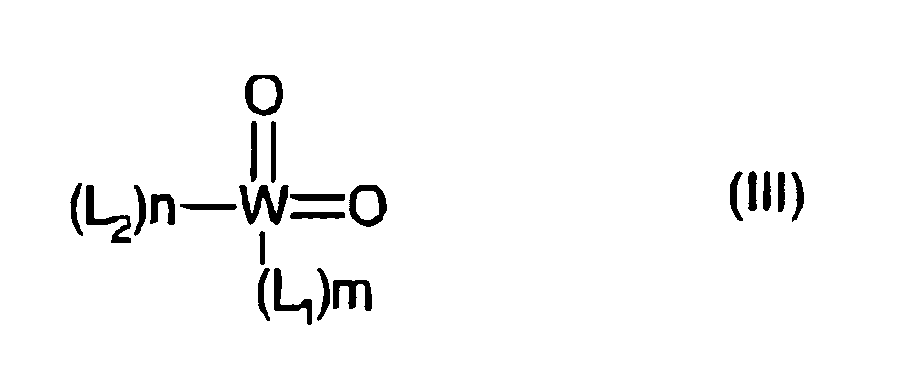 L1, L2 jeweils unabhängig voneinander einen Liganden ausgewählt aus der Gruppe der Aminoalkohole, der Aminophenole oder Gemischen davon bedeutetm, n die Zahl 1 oder 2 bedeutet.
 - Verfahren gemäß einem der Ansprüche 1 oder 2, dadurch gekennzeichnet, dass L1 und L2 8-Hydroxychinolin bedeuten.
- Verfahren gemäß einem der Ansprüche 1 oder 2, dadurch gekennzeichnet, dass das Verhältnis Wolfram zu 8-Hydroxychinolin im Komplex zwischen 1 : 1 und 1 : 5 liegt.
- Verfahren gemäß einem der Ansprüche 1 bis 3, dadurch gekennzeichnet, dass das Verhältnis Wolfram zu 8-Hydroxychinolin in der Lösung des Komplexes bei mindestens 1 : 1 liegt.
- Verfahren gemäß einem der Ansprüche 1 bis 4, dadurch gekennzeichnet, dass die Allylalkohole ausgewählt sind aus der Gruppe 2-Methyl-3-buten-2-ol, Prenol (3-Methyl-2-buten-1-ol), Linalool, Nerol, Geraniol, Farnesol (3,7,11-Trimethyl-do-deca-2,6,10-trien-1-ol) oder Nerolidol (3,7,11-Trimethyl-dodeca-1,6,10-trien-3-ol).
- Verfahren gemäß einem der Ansprüche 1 bis 5, dadurch gekennzeichnet, dass die Edukt-Allylalkohole ausgewählt sind aus der Gruppe Geraniol oder Nerol.
- Verfahren gemäß einem der Ansprüche 1 bis 6, dadurch gekennzeichnet, dass der Dioxowolfram(VI)-Komplex der allgemeinen Formel (III) vor der Reaktion oder in situ im Edukt-Allylalkohol hergestellt wird.
- Verfahren gemäß einem der Ansprüche 1 bis 7, dadurch gekennzeichnet, daß zum Edukt-Allylalkohol, zum Katalysator oder Zu einer Mischung aus Edukt-Allylalkohol und Katalysator Ammoniak oder Amin gegeben wird.
- Dioxowvlfram(VI)-Komplexe der allgemeinen Formel (III),
 L1, L2 jeweils unabhängig voneinander einen Liganden ausgewählt aus der Gruppe der Aminoalkohole, der Aminophenole oder Gemischen davon bedeutet,m, n die Zahl 1 oder 2 bedeutet,mit der Maßgabe, dass für L1, L2 (1R,2R,4R)-1,7,7-Trimethyl-2-(2'-pyridinyl) bicyclo[2,2,1] heptan-2-ol, (1S,2S,4S)-1,7,7-Trimethyl-2-(2'pyridinyl)bicyclo-[2,2,1]heptan-2-ol, (1R,2R,4S)-1,3,3-Trimethyl-2-(2'pyridinyl)bicyclo[2.2.1]heptan-2-ol oder (1S,2S,5R)-5-methyl-2-isopropyl-1-(2'-pyridinyl)cyclohexan-1-ol ausgenommen sind.
 - Dioxowolfram(VI)-Komplexe gemäß Anspruch 9, dadurch gekennzeichnet, dass L1 und/oder L2 8-Hydroxychinolin bedeuten.
- Verwendung der Verbindungen der allgemeinen Formel (III) gemäß Anspruch 1 als Katalysatoren bei der Isomerisierung von Allylalkohole.
Applications Claiming Priority (3)
| Application Number | Priority Date | Filing Date | Title |
|---|---|---|---|
| DE10160147 | 2001-12-07 | ||
| DE10160147A DE10160147A1 (de) | 2001-12-07 | 2001-12-07 | Verfahren zur Isomerisierung von Allylalkoholen |
| PCT/EP2002/013690 WO2003047749A1 (de) | 2001-12-07 | 2002-12-04 | Verfahren zur isomerisierung von allylalkoholen |
Publications (2)
| Publication Number | Publication Date |
|---|---|
| EP1455934A1 EP1455934A1 (de) | 2004-09-15 |
| EP1455934B1 true EP1455934B1 (de) | 2008-11-19 |
Family
ID=7708369
Family Applications (1)
| Application Number | Title | Priority Date | Filing Date |
|---|---|---|---|
| EP02792877A Expired - Lifetime EP1455934B1 (de) | 2001-12-07 | 2002-12-04 | Verfahren zur isomerisierung von allylalkoholen |
Country Status (10)
| Country | Link |
|---|---|
| US (1) | US7132576B2 (de) |
| EP (1) | EP1455934B1 (de) |
| JP (1) | JP4377233B2 (de) |
| CN (1) | CN1304108C (de) |
| AT (1) | ATE414568T1 (de) |
| AU (1) | AU2002358593A1 (de) |
| DE (2) | DE10160147A1 (de) |
| ES (1) | ES2315422T3 (de) |
| MX (1) | MXPA04004992A (de) |
| WO (1) | WO2003047749A1 (de) |
Families Citing this family (10)
| Publication number | Priority date | Publication date | Assignee | Title |
|---|---|---|---|---|
| US20070023291A1 (en) * | 2005-07-15 | 2007-02-01 | Sai Bhavaraju | Metal Trap |
| MX2015008354A (es) * | 2013-01-23 | 2015-11-09 | Firmenich & Cie | Proceso para la preparacion de derivados de 4-metilpent-3-en-1-ol. |
| CN105218312B (zh) * | 2015-11-03 | 2017-04-26 | 山东新和成药业有限公司 | 一种烯丙基醇经异构化法连续制备芳樟醇的方法 |
| CN111087343B (zh) * | 2019-11-29 | 2022-02-18 | 万华化学集团股份有限公司 | 一种羟基吡啶配体及其制备方法和催化应用 |
| CN111978151B (zh) * | 2020-09-18 | 2022-05-17 | 山东新和成药业有限公司 | 一种3-甲基-2-丁烯醇的制备方法 |
| CN120936586A (zh) | 2023-05-10 | 2025-11-11 | 巴斯夫欧洲公司 | 用于制备2,3-不饱和醇的方法 |
| WO2024235791A1 (en) | 2023-05-12 | 2024-11-21 | Basf Se | Process for the preparation of polyisobutene from olefins from isobutanol obtained from mixed guerbet reaction of ethanol and methanol |
| CN121443573A (zh) | 2023-07-07 | 2026-01-30 | 巴斯夫欧洲公司 | 香叶醛和橙花醛的光异构化 |
| WO2025078316A1 (en) | 2023-10-13 | 2025-04-17 | Basf Se | Process for the preparation of prenal and isovaleraldehyde |
| WO2025108852A1 (en) | 2023-11-20 | 2025-05-30 | Basf Se | Process for the preparation of unsaturated esters |
Family Cites Families (6)
| Publication number | Priority date | Publication date | Assignee | Title |
|---|---|---|---|---|
| FR1599581A (de) | 1968-12-30 | 1970-07-15 | ||
| DE2516698A1 (de) * | 1974-04-22 | 1975-10-30 | Kuraray Co | Neue wolframverbindungen |
| DE19533331A1 (de) | 1995-09-11 | 1997-03-13 | Basf Ag | Peroxogruppenhaltige Metallkomplexe mit Aminoxid- oder Phosphanoxid-Liganden als Epoxidierungskatalysatoren |
| DE19958603A1 (de) * | 1999-12-06 | 2001-06-07 | Basf Ag | Verfahren zur Isomerisierung von Allylalkoholen |
| DE10046865A1 (de) * | 2000-09-20 | 2002-03-28 | Basf Ag | Verfahren zur Isomerisierung von Allylalkoholen |
| DE10160146A1 (de) * | 2001-12-07 | 2003-06-18 | Basf Ag | Verfahren zur Isomerisierung von Allylalkoholen |
-
2001
- 2001-12-07 DE DE10160147A patent/DE10160147A1/de not_active Withdrawn
-
2002
- 2002-12-04 CN CNB028244079A patent/CN1304108C/zh not_active Expired - Lifetime
- 2002-12-04 AT AT02792877T patent/ATE414568T1/de not_active IP Right Cessation
- 2002-12-04 US US10/497,523 patent/US7132576B2/en not_active Expired - Lifetime
- 2002-12-04 WO PCT/EP2002/013690 patent/WO2003047749A1/de not_active Ceased
- 2002-12-04 JP JP2003548994A patent/JP4377233B2/ja not_active Expired - Lifetime
- 2002-12-04 ES ES02792877T patent/ES2315422T3/es not_active Expired - Lifetime
- 2002-12-04 AU AU2002358593A patent/AU2002358593A1/en not_active Abandoned
- 2002-12-04 EP EP02792877A patent/EP1455934B1/de not_active Expired - Lifetime
- 2002-12-04 MX MXPA04004992A patent/MXPA04004992A/es active IP Right Grant
- 2002-12-04 DE DE50213036T patent/DE50213036D1/de not_active Expired - Lifetime
Also Published As
| Publication number | Publication date |
|---|---|
| CN1304108C (zh) | 2007-03-14 |
| ATE414568T1 (de) | 2008-12-15 |
| MXPA04004992A (es) | 2005-04-08 |
| JP2005511664A (ja) | 2005-04-28 |
| DE50213036D1 (de) | 2009-01-02 |
| EP1455934A1 (de) | 2004-09-15 |
| DE10160147A1 (de) | 2003-06-18 |
| JP4377233B2 (ja) | 2009-12-02 |
| US20050101807A1 (en) | 2005-05-12 |
| US7132576B2 (en) | 2006-11-07 |
| ES2315422T3 (es) | 2009-04-01 |
| WO2003047749A1 (de) | 2003-06-12 |
| CN1599644A (zh) | 2005-03-23 |
| AU2002358593A1 (en) | 2003-06-17 |
Similar Documents
| Publication | Publication Date | Title |
|---|---|---|
| EP1414783B1 (de) | Verfahren zur herstellung von aminen durch reduktive aminierung von carbonylverbindungen unter transfer-hydrierungsbedingungen | |
| DE69128528T2 (de) | Chirale katalysatoren und dadurch katalysierte epoxydierungsreaktionen | |
| EP1455934B1 (de) | Verfahren zur isomerisierung von allylalkoholen | |
| EP1322583B1 (de) | Verfahren zur isomerisierung von allylalkoholen | |
| EP1235775B1 (de) | Verfahren zur isomerisierung von allylalkoholen | |
| EP0218970B1 (de) | Chirale Rhodium-diphosphinkomplexe für asymmetrische Hydrierungen | |
| DE4431528A1 (de) | Verfahren zur Herstellung von n-Butyraldehyd und/oder n-Butanol | |
| DE60129211T2 (de) | Imidazolidinonen-saureadditionssalze als reaktionskatalysatoren | |
| EP4359372B1 (de) | Hydrierung von estern zu alkoholen in gegenwart eines mn-pnn-komplexes | |
| WO2014202436A1 (de) | Verfahren zur herstellung von 2-chlordialkylbenzylaminen durch hydrierung | |
| EP3066070B1 (de) | Katalytische hydrierung zur herstellung von aminen aus amidacetalen, keten-n, o-acetalen oder esterimiden | |
| DE60002523T2 (de) | Racemisierung von optisch aktiven Alkoxyaminen | |
| WO2014118121A1 (de) | 2,6-bis-(aminomethyl)piperidin-derivate | |
| EP0093892B1 (de) | Verfahren zur Herstellung von aromatischen Aminen | |
| WO2009153272A2 (de) | Verfahren zur iodierung von aromatischen und/oder heteroaromatischen verbindungen | |
| EP1683791B1 (de) | Verfahren zur Ruthenium-katalysierten Epoxidierung von Olefinen mit Wasserstoffperoxid | |
| DE19920039A1 (de) | Verfahren zur asymmetrischen Dihydroxylierung von Olefinen mittels Osmium-Katalysatoren | |
| DE4334809A1 (de) | Verfahren zur Herstellung sekundärer oder tertiärer Amine | |
| DE10134160A1 (de) | Verfahren zur Herstellung von Mono-Propargylaminen | |
| DE2152192A1 (de) | Verfahren zur herstellung von alkadienolen |
Legal Events
| Date | Code | Title | Description |
|---|---|---|---|
| PUAI | Public reference made under article 153(3) epc to a published international application that has entered the european phase |
Free format text: ORIGINAL CODE: 0009012 |
|
| 17P | Request for examination filed |
Effective date: 20040707 |
|
| AK | Designated contracting states |
Kind code of ref document: A1 Designated state(s): AT BE BG CH CY CZ DE DK EE ES FI FR GB GR IE IT LI LU MC NL PT SE SI SK TR |
|
| AX | Request for extension of the european patent |
Extension state: AL LT LV MK RO |
|
| RIN1 | Information on inventor provided before grant (corrected) |
Inventor name: EBEL, KLAUS Inventor name: HAESE, FRANK |
|
| RAP1 | Party data changed (applicant data changed or rights of an application transferred) |
Owner name: BASF SE |
|
| GRAP | Despatch of communication of intention to grant a patent |
Free format text: ORIGINAL CODE: EPIDOSNIGR1 |
|
| GRAS | Grant fee paid |
Free format text: ORIGINAL CODE: EPIDOSNIGR3 |
|
| GRAA | (expected) grant |
Free format text: ORIGINAL CODE: 0009210 |
|
| AK | Designated contracting states |
Kind code of ref document: B1 Designated state(s): AT BE BG CH CY CZ DE DK EE ES FI FR GB GR IE IT LI LU MC NL PT SE SI SK TR |
|
| REG | Reference to a national code |
Ref country code: GB Ref legal event code: FG4D Free format text: NOT ENGLISH |
|
| REG | Reference to a national code |
Ref country code: CH Ref legal event code: EP |
|
| REG | Reference to a national code |
Ref country code: IE Ref legal event code: FG4D Free format text: LANGUAGE OF EP DOCUMENT: GERMAN |
|
| REF | Corresponds to: |
Ref document number: 50213036 Country of ref document: DE Date of ref document: 20090102 Kind code of ref document: P |
|
| REG | Reference to a national code |
Ref country code: ES Ref legal event code: FG2A Ref document number: 2315422 Country of ref document: ES Kind code of ref document: T3 |
|
| PG25 | Lapsed in a contracting state [announced via postgrant information from national office to epo] |
Ref country code: SI Free format text: LAPSE BECAUSE OF FAILURE TO SUBMIT A TRANSLATION OF THE DESCRIPTION OR TO PAY THE FEE WITHIN THE PRESCRIBED TIME-LIMIT Effective date: 20081119 Ref country code: FI Free format text: LAPSE BECAUSE OF FAILURE TO SUBMIT A TRANSLATION OF THE DESCRIPTION OR TO PAY THE FEE WITHIN THE PRESCRIBED TIME-LIMIT Effective date: 20081119 |
|
| BERE | Be: lapsed |
Owner name: BASF SE Effective date: 20081231 |
|
| REG | Reference to a national code |
Ref country code: IE Ref legal event code: FD4D |
|
| PG25 | Lapsed in a contracting state [announced via postgrant information from national office to epo] |
Ref country code: DK Free format text: LAPSE BECAUSE OF FAILURE TO SUBMIT A TRANSLATION OF THE DESCRIPTION OR TO PAY THE FEE WITHIN THE PRESCRIBED TIME-LIMIT Effective date: 20081119 Ref country code: BG Free format text: LAPSE BECAUSE OF FAILURE TO SUBMIT A TRANSLATION OF THE DESCRIPTION OR TO PAY THE FEE WITHIN THE PRESCRIBED TIME-LIMIT Effective date: 20090219 Ref country code: IE Free format text: LAPSE BECAUSE OF FAILURE TO SUBMIT A TRANSLATION OF THE DESCRIPTION OR TO PAY THE FEE WITHIN THE PRESCRIBED TIME-LIMIT Effective date: 20081119 Ref country code: EE Free format text: LAPSE BECAUSE OF FAILURE TO SUBMIT A TRANSLATION OF THE DESCRIPTION OR TO PAY THE FEE WITHIN THE PRESCRIBED TIME-LIMIT Effective date: 20081119 Ref country code: MC Free format text: LAPSE BECAUSE OF NON-PAYMENT OF DUE FEES Effective date: 20081231 |
|
| PG25 | Lapsed in a contracting state [announced via postgrant information from national office to epo] |
Ref country code: CZ Free format text: LAPSE BECAUSE OF FAILURE TO SUBMIT A TRANSLATION OF THE DESCRIPTION OR TO PAY THE FEE WITHIN THE PRESCRIBED TIME-LIMIT Effective date: 20081119 Ref country code: SE Free format text: LAPSE BECAUSE OF FAILURE TO SUBMIT A TRANSLATION OF THE DESCRIPTION OR TO PAY THE FEE WITHIN THE PRESCRIBED TIME-LIMIT Effective date: 20090219 Ref country code: PT Free format text: LAPSE BECAUSE OF FAILURE TO SUBMIT A TRANSLATION OF THE DESCRIPTION OR TO PAY THE FEE WITHIN THE PRESCRIBED TIME-LIMIT Effective date: 20090420 |
|
| PLBE | No opposition filed within time limit |
Free format text: ORIGINAL CODE: 0009261 |
|
| STAA | Information on the status of an ep patent application or granted ep patent |
Free format text: STATUS: NO OPPOSITION FILED WITHIN TIME LIMIT |
|
| PG25 | Lapsed in a contracting state [announced via postgrant information from national office to epo] |
Ref country code: BE Free format text: LAPSE BECAUSE OF NON-PAYMENT OF DUE FEES Effective date: 20081231 Ref country code: SK Free format text: LAPSE BECAUSE OF FAILURE TO SUBMIT A TRANSLATION OF THE DESCRIPTION OR TO PAY THE FEE WITHIN THE PRESCRIBED TIME-LIMIT Effective date: 20081119 |
|
| 26N | No opposition filed |
Effective date: 20090820 |
|
| PG25 | Lapsed in a contracting state [announced via postgrant information from national office to epo] |
Ref country code: AT Free format text: LAPSE BECAUSE OF NON-PAYMENT OF DUE FEES Effective date: 20081204 |
|
| PG25 | Lapsed in a contracting state [announced via postgrant information from national office to epo] |
Ref country code: LU Free format text: LAPSE BECAUSE OF NON-PAYMENT OF DUE FEES Effective date: 20081204 Ref country code: CY Free format text: LAPSE BECAUSE OF FAILURE TO SUBMIT A TRANSLATION OF THE DESCRIPTION OR TO PAY THE FEE WITHIN THE PRESCRIBED TIME-LIMIT Effective date: 20081119 |
|
| PG25 | Lapsed in a contracting state [announced via postgrant information from national office to epo] |
Ref country code: TR Free format text: LAPSE BECAUSE OF FAILURE TO SUBMIT A TRANSLATION OF THE DESCRIPTION OR TO PAY THE FEE WITHIN THE PRESCRIBED TIME-LIMIT Effective date: 20081119 |
|
| PG25 | Lapsed in a contracting state [announced via postgrant information from national office to epo] |
Ref country code: GR Free format text: LAPSE BECAUSE OF FAILURE TO SUBMIT A TRANSLATION OF THE DESCRIPTION OR TO PAY THE FEE WITHIN THE PRESCRIBED TIME-LIMIT Effective date: 20090220 |
|
| PG25 | Lapsed in a contracting state [announced via postgrant information from national office to epo] |
Ref country code: IT Free format text: LAPSE BECAUSE OF FAILURE TO SUBMIT A TRANSLATION OF THE DESCRIPTION OR TO PAY THE FEE WITHIN THE PRESCRIBED TIME-LIMIT Effective date: 20081119 |
|
| REG | Reference to a national code |
Ref country code: FR Ref legal event code: PLFP Year of fee payment: 14 |
|
| REG | Reference to a national code |
Ref country code: FR Ref legal event code: PLFP Year of fee payment: 15 |
|
| REG | Reference to a national code |
Ref country code: FR Ref legal event code: PLFP Year of fee payment: 16 |
|
| PGFP | Annual fee paid to national office [announced via postgrant information from national office to epo] |
Ref country code: FR Payment date: 20211227 Year of fee payment: 20 Ref country code: GB Payment date: 20211221 Year of fee payment: 20 |
|
| PGFP | Annual fee paid to national office [announced via postgrant information from national office to epo] |
Ref country code: NL Payment date: 20211229 Year of fee payment: 20 Ref country code: CH Payment date: 20211222 Year of fee payment: 20 |
|
| PGFP | Annual fee paid to national office [announced via postgrant information from national office to epo] |
Ref country code: DE Payment date: 20211228 Year of fee payment: 20 |
|
| PGFP | Annual fee paid to national office [announced via postgrant information from national office to epo] |
Ref country code: ES Payment date: 20220110 Year of fee payment: 20 |
|
| REG | Reference to a national code |
Ref country code: DE Ref legal event code: R071 Ref document number: 50213036 Country of ref document: DE |
|
| REG | Reference to a national code |
Ref country code: NL Ref legal event code: MK Effective date: 20221203 |
|
| REG | Reference to a national code |
Ref country code: CH Ref legal event code: PL |
|
| REG | Reference to a national code |
Ref country code: GB Ref legal event code: PE20 Expiry date: 20221203 |
|
| PG25 | Lapsed in a contracting state [announced via postgrant information from national office to epo] |
Ref country code: GB Free format text: LAPSE BECAUSE OF EXPIRATION OF PROTECTION Effective date: 20221203 |
|
| REG | Reference to a national code |
Ref country code: ES Ref legal event code: FD2A Effective date: 20230428 |
|
| PG25 | Lapsed in a contracting state [announced via postgrant information from national office to epo] |
Ref country code: ES Free format text: LAPSE BECAUSE OF EXPIRATION OF PROTECTION Effective date: 20221205 |