EP1459971B1 - Amortisseur de direction pour vehicule - Google Patents
Amortisseur de direction pour vehicule Download PDFInfo
- Publication number
- EP1459971B1 EP1459971B1 EP04006414A EP04006414A EP1459971B1 EP 1459971 B1 EP1459971 B1 EP 1459971B1 EP 04006414 A EP04006414 A EP 04006414A EP 04006414 A EP04006414 A EP 04006414A EP 1459971 B1 EP1459971 B1 EP 1459971B1
- Authority
- EP
- European Patent Office
- Prior art keywords
- damper
- housing
- steering
- motorcycle
- attached
- Prior art date
- Legal status (The legal status is an assumption and is not a legal conclusion. Google has not performed a legal analysis and makes no representation as to the accuracy of the status listed.)
- Expired - Lifetime
Links
- 239000012530 fluid Substances 0.000 claims description 31
- 238000005192 partition Methods 0.000 claims description 4
- 230000009977 dual effect Effects 0.000 claims 2
- 239000006185 dispersion Substances 0.000 description 22
- 239000002828 fuel tank Substances 0.000 description 14
- 230000001133 acceleration Effects 0.000 description 6
- 238000007789 sealing Methods 0.000 description 5
- 230000003466 anti-cipated effect Effects 0.000 description 4
- 230000015572 biosynthetic process Effects 0.000 description 3
- 238000010586 diagram Methods 0.000 description 3
- 230000002093 peripheral effect Effects 0.000 description 3
- 238000003786 synthesis reaction Methods 0.000 description 3
- 241001274197 Scatophagus argus Species 0.000 description 2
- 230000002452 interceptive effect Effects 0.000 description 2
- 230000004048 modification Effects 0.000 description 2
- 238000012986 modification Methods 0.000 description 2
- 230000009471 action Effects 0.000 description 1
- 230000008859 change Effects 0.000 description 1
- 230000008602 contraction Effects 0.000 description 1
- 230000007812 deficiency Effects 0.000 description 1
- 230000003111 delayed effect Effects 0.000 description 1
- 238000009434 installation Methods 0.000 description 1
- 230000007246 mechanism Effects 0.000 description 1
- 230000004044 response Effects 0.000 description 1
- 238000011144 upstream manufacturing Methods 0.000 description 1
Images





Classifications
-
- F—MECHANICAL ENGINEERING; LIGHTING; HEATING; WEAPONS; BLASTING
- F16—ENGINEERING ELEMENTS AND UNITS; GENERAL MEASURES FOR PRODUCING AND MAINTAINING EFFECTIVE FUNCTIONING OF MACHINES OR INSTALLATIONS; THERMAL INSULATION IN GENERAL
- F16F—SPRINGS; SHOCK-ABSORBERS; MEANS FOR DAMPING VIBRATION
- F16F9/00—Springs, vibration-dampers, shock-absorbers, or similarly-constructed movement-dampers using a fluid or the equivalent as damping medium
- F16F9/10—Springs, vibration-dampers, shock-absorbers, or similarly-constructed movement-dampers using a fluid or the equivalent as damping medium using liquid only; using a fluid of which the nature is immaterial
- F16F9/14—Devices with one or more members, e.g. pistons, vanes, moving to and fro in chambers and using throttling effect
- F16F9/145—Devices with one or more members, e.g. pistons, vanes, moving to and fro in chambers and using throttling effect involving only rotary movement of the effective parts
-
- B—PERFORMING OPERATIONS; TRANSPORTING
- B62—LAND VEHICLES FOR TRAVELLING OTHERWISE THAN ON RAILS
- B62K—CYCLES; CYCLE FRAMES; CYCLE STEERING DEVICES; RIDER-OPERATED TERMINAL CONTROLS SPECIALLY ADAPTED FOR CYCLES; CYCLE AXLE SUSPENSIONS; CYCLE SIDE-CARS, FORECARS, OR THE LIKE
- B62K21/00—Steering devices
- B62K21/08—Steering dampers
Definitions
- the present invention relates to vehicular steering dampers and related hardware. More particularly, the present invention relates to a motorcycle and to a steering damper kit for use with a motorcycle.
- a steering damper attaching structure which includes a rotary-type steering damper wherein, upon rocking motion of a vane which partitions an oil chamber in a housing into two oil chambers, working fluid flows between the two oil chambers to generate attenuating force.
- the steering damper includes a shaft having a base portion of the vane connected thereto in a fixed state, and supporting the vane for rocking motion with respect to the housing.
- the known steering damper described in the reference further includes a hydraulic pressure control valve, for varying the attenuating force of the steering damper.
- the housing is attached to a steering system side while the shaft is attached to a vehicle body frame side.
- the conventional attaching structure for a steering damper in a motorcycle described above has the following characteristics.
- the steering damper of the known rotary type is attached above a top bridge of the motorcycle.
- an actuator or driving means such as a solenoid, in order to drive and control the hydraulic pressure control valve provided in the connecting path between the two oil chambers in the damper housing, as a hydraulic pressure control valve for adjusting the attenuating force.
- the actuator requires a comparatively large mounting space, however, the position above the top bridge, where the steering damper of the rotary type described above is disposed, only has a very small space available, in which a fuel tank is disposed rearwardly in a crowded relationship and an ignition switch is disposed forwardly. Besides, the position above the top bridge is a place where various components of the steering system are disposed, such as the top bridge, front fork and so forth. Thus, it is difficult to find space for the actuator, which generally takes up a large mounting space, in such a place which is narrow and small and in which various movable parts are disposed.
- a rotary steering damper for the generic motorcycle comprises a damper housing having an oil chamber and a damper shaft connected to a vane that partitions the oil chamber into left and right oil chambers.
- the two oil chambers are communicated by means of several oil channels and a hydraulic pressure control valve.
- the damper housing is disposed above a top bridge of a steering system of the motorcycle and is mounted to the vehicle body frame at a position rearward of the head pipe.
- An actuator for the hydraulic pressure control valve is attached to the damper housing and extends further rearward of the mounting position of the damper housing.
- EP-A-1 375 328 publication date: 2.1.2004.
- the present invention has been made in view of such circumstances as described above, and it is an object of the present invention to provide an attaching structure for a steering damper in a motorcycle wherein actuator can be beneficially situated, even where the actuator requires a comparatively large arrangement space for driving and controlling a hydraulic pressure control valve for adjusting attenuating force.
- a gap is formed between a top bridge and a fuel tank disposed rearwardly of the top bridge.
- the housing is disposed such that it extends rearwardly beyond the top bridge, and besides, the actuator for the hydraulic pressure control valve is disposed below the extension of the housing which extends rearwardly farther than the top bridge. Consequently, effective utilization of the gap between the top bridge and the fuel tank can be anticipated. Further, the actuator does not project upwardly from the housing, and interference between the actuator and a movable member in the proximity of the top bridge can be prevented.
- the housing is attached to the vehicle body frame side while the shaft is attached to the steering system side, this is equivalent to the fact that the housing and the actuator are secured to the vehicle body frame side.
- the relief of the vehicle body side can be reduced when compared with that in an alternative case wherein the housing is attached to the steering system side which is a movable side.
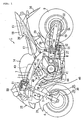
- Figure 1 is a side elevational view of a motorcycle, incorporating a selected illustrative embodiment of the present invention.
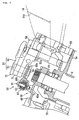
- Figure 2 is a side elevational view, partly in section, showing an attaching structure for a steering damper in the motorcycle of FIG 1.
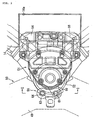
- Figure 3 is a plan view showing the attaching structure for a steering damper in the motorcycle of FIG 1.
- Figure 4(a) is a top plan view of a first bracket for attaching the steering damper
- Figure 4(b) is a side elevational view of the first bracket for attaching the steering damper
- Figure 4(c) is a sectional view of the first bracket for attaching the steering damper, taken along line A-A of Figure 4(a).
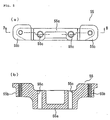
- Figure 5(a) is a plan view of a second bracket for attaching the steering damper; and Figure 5(b) is a sectional view of the second bracket for attaching the steering damper, taken along line B-B of Figure 5(a).
- Figure 6 is a sectional view of the motorcycle attaching structure of Figure 3, taken along line C-C of FIG. 3.
- Figure 7 is a top plan view of the steering damper.
- Figure 8 is a detail view of the steering damper of Figure 7, as viewed in the direction indicated by an arrow mark D of FIG 7.
- Figure 9 is a bottom plan view of the steering damper.
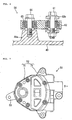
- Figure 10 is a sectional view of the steering damper.
- Figure 11 is a plan view, partly in section, of a housing body of the steering damper.
- Figure 12 is a sectional view of the steering damper, taken along line E-E of FIG 10.
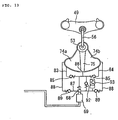
- Figure 13 is a schematic view showing a configuration of the steering damper.
- Figure 14 is a maximum attenuation characteristic diagram of a steering damper system.
- Figure 15 is a maximum attenuation characteristic diagram of the steering damper system when the product dispersion of an electric pressure control valve is at an upper limit and the product dispersion of a relief valve is at a lower limit.
- Figure 16 is a maximum attenuation characteristic diagram of the steering damper system when the product dispersion of an electric pressure control valve is at a lower limit and the product dispersion of a relief valve is at an upper limit.
- a motorcycle 1 includes a vehicle body frame 2 substantially at the center thereof, as shown in FIG 1.
- a head pipe 3 is provided at a front end of the vehicle body frame 2, and a front fork 5 is supported on the head pipe 3 through a steering stem 6.
- the front fork 5 rotatably supports a front wheel 4 at the lower end thereof.
- the vehicle body frame 2 also includes a main frame 7, which extends obliquely rearwardly and downwardly from the head pipe 3.
- the main frame 7 is bifurcated and forks to the left and right as it extends behind the head pipe 3.
- the main frame 7 further extends rearwardly through a bent portion thereof, as shown.
- a pivot connection 8 is provided at a front end portion of a substantially central portion of the portion of the main frame 7 which extends downwardly, and a rear fork 10 is supported by the pivot connection 8 for rocking motion.
- a rear wheel 9 is supported on the back of the rear fork 10. Further, an intermediate portion of the rear fork 10 is connected to the main frame 7 through a rear cushion 11 and a link portion 12.
- a seat frame 13 is connected rearwardly of the main frame 7.
- a fuel tank 14 is disposed above the main frame 7, and an engine body 15 of a water-cooled parallel four-cylinder engine is disposed below the main frame 7.
- An engine hanger 16 extends downwardly from a front portion of the main frame 7. The engine hanger 16 cooperates with the other engine body supporting attaching portions provided on the main frame 7 to support the engine body 15.
- a seat 17 for a driver and a pillion 18 for a passenger are supported on the seat frame 13 rearwardly of the fuel tank 14.
- a step 19 for a driver is attached to a rear portion of the pivot portion 8 of the vehicle body frame 2
- a step 20 for a passenger is attached to a lower portion of the seat frame 13.
- a pair of left and right handlebars 21, 21 are attached to an upper end portion of the front fork 5 through a top bridge 49.
- a front portion of the vehicle body of the motorcycle 1 is covered with a front cowl 25, and the periphery of the seat frame 13 is covered with a rear cowl 26. Further, a retractable side stand 27 is disposed at a lower portion of the left side of the vehicle body frame 2, such that the vehicle body of the motorcycle 1 is supported in a leftwardly inclined upright state by the side stand 27.
- a brake caliper 28 is attached to a lower end portion of the front fork 5 and a brake rotor 29 corresponding to the brake caliper 28 is attached to the front wheel 4, thereby forming a front brake apparatus 30. Further, a front fender 31 is attached to a lower end portion of the front fork 5 and covers an upper portion of the front wheel 4.
- a rear sprocket wheel 32 is attached to the left wide of the rear wheel 9 for integral rotation with the rear wheel 9.
- a drive chain 34 extends between and around the rear sprocket wheel 32 and a driving sprocket wheel 33 disposed on the left side of a rcar portion of the engine body 15 so that driving force of the engine body 15 is transmitted to the rear wheel 9.
- a front side rear fender 35 is attached to an upper portion of the rear fork 10 and covers the front side of an upper portion of the rear wheel 9.
- a rear fender 36 is attached to a lower portion of the rear cowl 26 and covers the rear side of an upper portion of the rear wheel 9. It is to be noted that a rear brake apparatus having a configuration similar to that of the front brake apparatus 30 for the front wheel 4 is provided on the rear fork 10.
- a cylinder body 40 of the engine body 15 is disposed in a rather forwardly inclined state on a crankcase 41.
- Throttle bodies 42 corresponding to the individual cylinders, are connected to a rear portion of the cylinder body 40, and arc further connected to an air cleaner case 43 disposed between the main frame 7 and the fuel tank 14.
- exhaust pipes 44 corresponding to the cylinders are connected to a front portion of the cylinder body 40.
- the exhaust pipes 44 extend forwardly from a front wall 45 of the cylinder body 40 and are curved downwardly, and then extend rearwardly of the engine body 15 passing the front and the bottom of the crankcase 41.
- a steering damper 51 is interposed between the steering system 50 and the vehicle body frame 2 (refer to FIGS. 2 and 3).
- steering damper 51 Two types of steering damper 51 including the rod type and the rotary type are usually available, and the steering damper 51 used here is of the rotary type, which is superior in terms of compact size.
- the steering damper 51 includes a damper housing 52 and a damper shaft 53, which extends through a lower face portion of the damper housing 52, and projects outwardly therefrom.
- the damper housing 52 is attached to an integral attaching flange 3a on the head pipe 3, via first and second brackets 54 and 55.
- the attaching flange 3a is integrally provided on, and extends rearwardly from the head pipe 3, and is substantially transverse to a longitudinal axis of the head pipe.
- the damper shaft 53 is attached to the top bridge 49 through a linkage 56, which will be described in further detail below.
- the first bracket 54 has a substantially box-like shape and is hollow in the inside thereof.
- the first bracket 54 includes left and right side wall portions 54a, 54a, a bottom plate portion 54b, and a substantially Y-shaped leg portion 54c.
- the leg portion 54c is connected to rear end portions of the side wall portions 54a and bottom plate portion 54b. Attaching holes 54d, 54d, 54d are formed at upper face portions of the left and right side plate portions 54a, 54a and an upper face portion of the leg portion 54c, and the steering damper 51 is bolted through the attaching holes 54d.
- attaching object holes 54e, 54c are formed in the bottom plate portion 54b while attaching object holes 54f, 54f are formed in the leg portion 54c.
- the first bracket 54 is bolted to the attaching portion 3a of the head pipe 3 through the attaching object holes 54e.
- the second bracket 55 has a base portion 55a formed in a substantially parallelepiped block shape, and left and right wing portions 55b, 55b extending upwardly from the opposite sides of the base portion.
- Attaching object holes 55c, 55c are formed in the base portion 55a so as to be coaxial with the attaching object holes 54f, 54f of the first bracket 54.
- the second bracket 55 is placed above the first bracket 54, and a single bolt is inserted into each of corresponding ones of the attaching object holes 54f and the attaching object holes 55c, aligned coaxially with each other.
- the second bracket 55 is thereby attached to the attaching portion 3a of the head pipe 3, together with the first bracket 54.
- a steering torque transfer arm 60 is fixedly attached, at an end portion 60a thereof, to the damper shaft 53, which projects downwardly from the steering damper 51.
- a spectacle-shaped link member 63 ( Figure 3) is supported spherically, at one end portion thereof, on the bifurcated other end portion 60b of the steering torque transfer arm 60 through a bolt 61, a ball member 62 fitted on an outer periphery of the bolt 61 and so forth. Further, the link member 63 is supported spherically at the other end portion thereof on an attaching portion 49a formed on the top bridge 49 through a bolt 64 and a ball member 65 fitted on an outer periphery of the bolt 64.
- the linkage 56 for transmitting a motion of the top bridge to the damper shaft 53, is formed from the steering torque transfer arm 60, bolts 61 and 64, ball members 62 and 65 and link member 63. Through this linkage 56, pivotal movement of the steering column, caused by movement of the handlebars 21 which moves the top bridge 49, is transferred to pivotal movement of the damper shaft 53.
- the damper shaft 53 of the steering damper 51 is indirectly attached to the top bridge 49 through the linkage 56 including the steering torque transfer arm 60.
- the housing 52 of the steering damper 51 extends rearwardly of the top bridge 49, as shown.
- a linear solenoid 69 which is an example of an actuator for driving and controlling a hydraulic pressure control valve 68, is attached to and disposed below the housing extension 52a which extends rearwardly on the damper housing 52, behind the top bridge 49.
- a recess 14a is formed at a front portion of the fuel tank 14, in order to prevent interference of the fuel tank 14 with the steering damper 51 and/or the first and second brackets 54 and 55. It is to be noted that, in FIG 2, reference numeral 70 denotes an ignition switch disposed forwardly of the head pipe 3.
- the damper housing 52 of the steering damper 51 includes a body 71 and a cap 72 removably attached to the top of the body.
- a recess 73 (Fig. 11) is formed in an upper face portion of the body 71, and is covered with the cap 72 to form an oil chamber 74.
- the oil chamber 74 is partitioned into left and right oil chambers 74a and 74b by a vane 75.
- a base portion 75 a of the vane 75 is formed in a cylindrical shape, and the damper shaft 53 is connected in a fixed state to the cylindrical portion 75a through a fixing mechanism such as splines, so that the vane 75 rotates integrally and concurrently together with the damper shaft 53. Further, the vane 75 is supported for rocking motion with respect to the damper housing 52 by the damper shaft 53.
- Grooves 75b are formed continuously along an upper end portion, a lower end portion and a rear end portion of the vane 75, and these grooves generally face toward an inner peripheral face of the oil chamber 74.
- a seal member 76 is fitted in the grooves 75b, and has a channcl shape conforming to the shape of the grooves 75b.
- the grooves 75b and the seal member 76 do not extend to the damper shaft 53, but are formed to extend or be fitted to a position with a gap left from the damper shaft 53.
- sealing washers 77a and 77b arc fitted on an outer periphery of the damper shaft 53, such that they contact upper and lower faces of the base portion 75a of the vane 75.
- the outer peripheries of the upper and lower sealing washers 77a and 77b are held in contact the seal member 76.
- the two oil chambers 74a and 74b partitioned in the damper housing 52 are held liquid-tight from each other by the seal member 76 and the sealing washers 77a and 77b and further held liquid-tight from the damper shaft 53.
- a bushing 78 is fitted at a portion of the damper shaft 53 on the upper side thereof, with respect to the location of the damper shaft 53 at which the sealing washer 77a is fitted. Further, a circlip 79 is fitted at another portion of the damper shaft 53, below the bushing 78 and above the vane 75. Meanwhile, a bushing 80 and an oil seal 81 are fitted at a portion of the damper shaft 53 below the lower side sealing washer 77b.
- oil paths 83 and 84 are formed in the body 71 of the damper housing 52, and these oil paths communicate with the left and right oil chambers 74a and 74b, respectively.
- the oil paths 83 and 84 extend further rcarwardly from rear ends of the inner peripheral faces of the oil chambers 74a and 74b, substantially parallel to each other.
- Check valves 85, 85 arc interposed in the oil paths 83 and 84.
- an oil connecting path 86 is formed at and substantially perpendicularly to rear end portions of the oil paths 83 and 84 such that it communicates the oil paths 83 and 84 with each other.
- the oil connecting path 86 is connected to a lower stage side oil path 87 through the hydraulic pressure control valve 68 disposed in a vertical direction, and the oil path 87 extends substantially perpendicularly to the oil path 86 (refer to FIG 12).
- the oi I path 87 extends forwardly from the location of the hydraulic pressure control valve 68 to a location below the oil chamber 74, and is communicated at a front end thereof with another oil path 88, which extends substantially perpendicularly to the oil path 87.
- Check valves 89, 89 are interposed in the opposite left and right end portions of the oil path 88.
- the opposite left and right ends of the oil path 88 further extend to the side edges of the housing body 71, and then extend upwardly until they are communicated with the left and right oil chambers 74a and 74b, respectively.
- the oil paths 83, 84, 86, 87 and 88 are formed in two upper and lower stages in the body 71 of the damper housing 52.
- the check valves 85 and 89 have similar configurations to each other. Description is given taking the check valve 85 as an example.
- a valve seat 85b is provided in a valve body 85a, and a ball 85c is accommodated in the valve body 85a.
- the ball 85c is biased with suitable biasing force by a spring 85d such that it contacts the valve seat 85b.
- the check valve 85 permits the fluid to flow in a direction in which the ball 85c is spaced away from the valve seat 85b against the biasing force of the spring 85d, but blocks the working fluid to flow in the reverse direction.
- the check valves 85 permit the working fluid to flow from the oil chambers 74a and 74b to the oil path 86 side through the oil paths 83 and 84, but block the working fluid to flow in the reverse direction.
- the check valves 89 permit the working fluid to flow to the oil chambers 74a and 74b side through the oil path 88, but block the working fluid to flow in the reverse direction.
- the hydraulic pressure control valve 68 varies the attenuating force of the steering damper 51.
- the hydraulic pressure control valve 68 includes a valve seat 68b provided in a valve body 68a and has a poppet 68c accommodated therein in an opposing relationship to the valve seat 68b.
- the poppet 68c is biased suitably with biasing force by a spring 68d interposed between a bottom spring seat of the poppet 68c and the valve seat 68b so that it is spaced away from the valve seat 68b.
- An upper end of a push rod 68e is inserted in a lower end of the poppet 68c, and a lower end of the push rod 68e is connected to the linear solenoid 69.
- the pushing force of the poppet 68c is adjusted by an exciting operation of the linear solenoid 69, such that a head portion of the poppet 68c contacts the valve seat 68b, against the biasing force of the spring 68d.
- the position of the poppet 68c is determined by the pressure difference between the left and right oil chambers 74a and 74b in the damper housing 52, communicating with the spaces in the head portion and the bottom portion of the poppet 68c, and also by the biasing force of the spring 68d and the force of the linear solenoid 69, acting through the push rod 68e.
- linear solenoid 69 is controlled by a control section (not shown), so that higher exciting force is exhibited as the vehicle speed or the acceleration of the vehicle body increases.
- a bypass oil path 91 is formed between the oil path 86 and the oil path 87, and a pressure relief valve 92 is interposed in the bypass oil path 91.
- the pressure relief valve 92 is structured such that it includes a valve seat 92b, provided in a valve body 92a and having a ball 92c accommodated therein, and the ball 92c is biased toward the valve scat 92b side with suitable biasing force by a spring 92d.
- the ball 92c While the ball 92c normally contacts the valve scat 92b, if the pressure difference between the oil path 86 and the oil path 87 becomes higher than a predetermined value, then the ball 92c is moved so as to be spaced away from the valve seat against the biasing force of the spring 92d, by pressing force based on the pressure difference, to open the relief valve 92 and to thereby moderate the pressure difference between the oil path 86 and the oil path 87.
- a pressure control valve 100 for substantially varying the attenuating force upon operation of the steering system 50 is formed from the electric pressure control valve 68 and the relief valve 92, as a mechanical pressure control valve, disposed in parallel to each other between the entrance side oil path and the exit side oil path.
- the maximum opening pressure of the electric pressure control valve 68 is set such that the lower limit value ((b) in FIG. 14) to the dispersion of the maximum releasing pressure is higher than the lower limit value ((d) in FIG 14) to the dispersion of the valve opening pressure of the relief valve 92. More preferably, the maximum opening pressure of the electric pressure control valve 68 is additionally set such that the lower limit value ((b) in FIG 14) to the dispersion of the maximum releasing pressure of the electric pressure control valve 68 is lower than the upper limit value ((c) in FIG. 14) to the dispersion of the valve opening pressure of the relief valve 92. In short, the maximum opening pressure of the electric pressure control valve 68 is set such that the lower limit value ((b) in FIG.
- a free piston 93 is communicated with the oil path 88.
- the free piston 93 is structured such that it includes a cylinder 93a formed integrally with the body 71, a piston 93c for defining a reservation portion 93b for reserving the working fluid forwardly of the cylinder 93a, and a spring 93d for biasing the piston 93c to the reservation portion side.
- the piston 93c moves to change the volume of the reservation portion 93b to thereby absorb the thermal expansion and so forth of the working fluid.
- the top bridge 49 is turned in the same direction integrally with the handlebars 21, and this motion of the top bridge 49 is transmitted to the damper shaft 53 of the steering damper 51 through the linkage 56. Then, the damper shaft 53 is also turned in the counterclockwise direction in FIG 11, and thereupon the vane 75 is turned in the same direction ((a) in FIG 11). Thereupon, the oil chamber 74b is narrowed to increase the pressure of the working fluid filled therein, and the working oil in the oil chamber 74b moves directly into the oil chamber 74a on the other side through the gap between the vane 75 and the inner peripheral face which defines the oil chamber 74 and so forth.
- the hydraulic pressure control valve 68 normally is in a closed state because the poppet 68c contacts the valve seat 68b under the force of the linear solenoid 69, and for example, even if some pressure of the working fluid is applied from the oil chamber 74b side, the closed state is kept. However, if the resultant force of the pressing force based on the pressure difference between the left and right oil chambers 74a and 74b and the biasing force of the spring 68d exceeds the exciting force of thc linear solenoid 69, then the poppet 68c is spaced away from the valve seat 68b to open the hydraulic pressure control valve 68.
- the working fluid in the oil path 86 passes through the gap between the valve seat 68b and the poppet 68c of the hydraulic pressure control valve 68 to the oil path 87, and further moves from the oil path 87 to the left side oil chamber 74a through the oil path 88 and the check valve 89.
- the resistance when the working fluid passes through the hydraulic pressure control valve 68 and so forth generates attenuating force in this manner and acts upon the handlebars 21.
- the attenuating force acts as resisting force when the handlebars 21 are turned, and further acts as resisting force against instantaneous turning force acting upon the handlebars.
- the linear solenoid 69 is controlled in accordance with the vehicle speed or the acceleration of the vehicle body and is controlled by a control section (not shown) so that, for example, the exciting force increases as the vehicle speed increases or as the acceleration of the vehicle body increases. Accordingly, at this time, the opening timing of the hydraulic pressure control valve 68 is delayed, and besides, even after the hydraulic pressure control valve 68 is opened, the valve opening is smaller by an amount corresponding to the increase of the exciting force and increased attenuating force is exhibited. In short, as the vehicle speed increases or as the acceleration increases, increased attenuating force is exhibited.
- the piston 93c in the free piston 93 moves within the cylinder 93a, in response to the expansion or contraction of the working fluid, to thereby absorb the volume variation of the working fluid.
- the damper housing 52 of the steering damper 51 extends rearwardly farther than the top bridge 49, and the linear solenoid 69 which composes the actuator for the hydraulic pressure control valve 68 is advantageously located below the extension 52a of the damper housing 52. Therefore, effective utilization of the gap between the top bridge 49 and the fuel tank 14 disposed rearwardly of the top bridge 49 can be anticipated, and the linear solenoid 69 can be advantageously located while the overall height of the steering damper 51 is suppressed.
- the linear solenoid 69 does not project upwardly from the damper housing 52, the linear solenoid 69 can be prevented from interfering with a movable member in the proximity of the top bridge 49 which moves together with the handlebars or the like. Furthermore, the overall length of the steering damper 51 can be reduced, when compared with an alternative case wherein the linear solenoid is attached such that it projects rearwardly, and the degree of freedom in layout of the fuel tank 14 and so forth increases as much.
- the steering damper 51 such that the damper shaft 53 may be coaxial with the axial line of the head pipe 3 or the steering stem 6.
- the damper shaft 53 is assembled in a displaced relationship from the axial line of the steering stem 6 or the like because of failure of the accuracy of parts, the assembly error of the parts and so forth.
- the damper housing 52 of the steering damper 51 is attached to the vehicle body frame 2 side, while the damper shaft 53 is attached to the steering system 50.
- the damper housing 52 of the steering damper 51 may be attached to the steering system 50 while the damper shaft 53 is attached to the vehicle body frame 2 side conversely.
- the damper housing 52 of the steering damper 51 is attached to the head pipe 3, it may otherwise be attached directly or through a stay to a rearward extension of the vehicle body frame 2 which extends rearwardly from the head pipe 3.
- the linear solenoid 69 is used as the actuator for the hydraulic pressure control valve 68
- the actuator is not limited to this, but another alternative actuator may be used instead, which utilizes a hydraulic pressure or the like.
- the actuator does not project upwardly from the housing, and therefore, the actuator can be prevented from interfering with a movable member in the proximity of the top bridge which moves together with a handlebar or the like. Furthermore, the overall length of the steering damper can be reduced, and this increases the degree of freedom in layout of the fuel tank and other parts.
- the lower limit value ((b) in FIG 14) to the dispersion of the maximum opening pressure of the electric pressure control valve 68 is set so as to be positioned between the upper limit value ((c) in FIG 14) and the lower limit value ((d) in FIG. 14) to the dispersion of the valve opening pressure of the relief valve 92.
- the lower limit value to the dispersion of the maximum attenuating force generated in the system and exhibited by synthesis of the relief valve 92 and the electric pressure control valve 68 depends upon the lower limit value to the dispersion width of the relief valve 92 as seen in FIG. 15 while the upper limit value to the dispersion depends upon the upper limit value of the relief valve 92 as seen in FIG 16.
- the dispersion width of the maximum attenuating force generated in the system and exhibited by synthesis of the relief valve 92 and the electric pressure control valve 68 is reduced.
- the dispersion width of the maximum attenuating force is "X" which depends upon the dispersion of the electric pressure control valve 68.
- the dispersion width of the maximum attenuating force is "Y" which depends upon the dispersion of the relief valve 92, and the value of "Y" is much smaller than the value of "X".
Landscapes
- Engineering & Computer Science (AREA)
- General Engineering & Computer Science (AREA)
- Mechanical Engineering (AREA)
- Fluid-Damping Devices (AREA)
Claims (11)
- Motocyclette (1) ayant un amortisseur de direction rotatif (51), ledit amortisseur de direction (51) comprenant :un boîtier d'amortisseur (52) dans lequel une chambre à huile (74) est formée et ayant une pluralité de canaux d'écoulement de fluide (83, 84, 86, 87, 88) en communication fluidique avec ladite chambre à huile (74) ;un arbre d'amortisseur (53) fixé à et s'étendant vers le bas depuis ledit boîtier d'amortisseur (52) ;une palette (75) disposée dans la chambre à huile (74) du boîtier (52) et fixée à l'arbre (53) pour effectuer un mouvement pivotant simultané avec celui-ci, ladite palette (75) fonctionnant pour séparer efficacement la chambre à huile (74) du boîtier en des chambres à huile gauche et droite (74a, 74b) ; etune soupape de commande de pression hydraulique (68) pour faire varier une force d'atténuation dudit amortisseur de direction (51) ;dans laquelle, lors du mouvement de balancement pivotant de ladite palette (75) dans ledit boîtier (52), le fluide de travail s'écoule entre les chambres à huile gauche et droite (74a, 74b) pour générer une force d'atténuation,
dans laquelle ledit boîtier (52) est adapté pour être fixé à l'un d'un côté cadre de caisse de véhicule (2) et d'un côté système de direction (50) alors que ledit arbre (53) est adapté pour être fixé à l'autre dudit côté cadre de caisse de véhicule (2) et dudit côté système de direction (50), et ledit boîtier (52) est disposé au-dessus d'un pont supérieur (49),
dans laquelle ledit boîtier d'amortisseur (52) comprend en outre un actionneur (69) pour ladite soupape de commande de pression hydraulique (68), et
dans laquelle ledit boîtier d'amortisseur (52) comprend une extension de boîtier (52a) qui s'étend vers l'arrière derrière ledit pont supérieur (49) et ledit actionneur (69) est disposé sous ladite extension de boîtier (52a). - Motocyclette (1) selon la revendication 1, dans laquelle ledit boîtier (52) est adapté pour être fixé audit côté cadre de caisse de véhicule (2), et ledit arbre (53) est adapté pour être fixé audit côté système de direction (50).
- Motocyclette (1) selon la revendication 1, dans laquelle ledit actionneur (69) comprend un solénoïde électrique.
- Motocyclette (1) selon la revendication 1, dans laquelle ledit boîtier (52) comprend une base (71) et un couvercle (72) fixé de façon amovible à la base (71).
- Ensemble d'amortisseur de direction à utiliser avec une motocyclette, ledit ensemble comprenant l'amortisseur de direction rotatif de la motocyclette (1) selon la revendication 1, un élément de timonerie (56) comprenant des connexions à pivot doubles, et un bras de transfert à couple de direction bifurqué (60) à des fins de connexion entre ledit élément de timonerie (56) et ledit arbre d'amortisseur (53) dudit amortisseur de direction (51).
- Motocyclette (1), comprenant un cadre (2) ayant une tubulure de refoulement (3) avec une bride intégrée (3a) s'étendant vers l'arrière depuis une partie supérieure de celui-ci, et une colonne de direction (6) fixée de façon pivotante à ladite tubulure de refoulement (3), ladite motocyclette (1) comprenant en outre un amortisseur de direction rotatif (51) comprenant :un boîtier d'amortisseur (52) dans laquelle une chambre à huile (74) est formée et ayant une pluralité de canaux d'écoulement de fluide (83, 84, 86, 87, 88) en communication fluidique avec ladite chambre à huile (74) ;un arbre d'amortisseur (53) fixé à et s'étendant vers le bas depuis ledit boîtier d'amortisseur (52) ;une palette (75) disposée dans la chambre à huile (74) du boîtier (52) et fixée à l'arbre (53) pour effectuer un mouvement pivotant simultané avec celui-ci, ladite palette (75) fonctionnant pour séparer efficacement la chambre à huile (74) du boîtier en des chambres à huile gauche et droite (74a, 74b) ; etune soupape de commande de pression hydraulique (68) pour varier une force d'atténuation dudit amortisseur de direction (51) ;dans laquelle, lors du mouvement de balancement pivotant de ladite palette (75) dans ledit boîtier (52), le fluide de travail s'écoule entre les chambres à huile gauche et droite (74a, 74b) pour générer une force d'atténuation,
dans laquelle ledit boîtier (52) est fixé à l'un d'un côté cadre de caisse de véhicule (2) et d'un côté système de direction (50) alors que ledit arbre (53) est fixé à l'autre dudit côté cadre de caisse de véhicule (2) et dudit côté système de direction (50), et ledit boîtier (52) est disposé au-dessus d'un pont supérieur (49) de ladite motocyclette (1),
dans laquelle ledit amortisseur de direction (51) comprend en outre un actionneur (69) pour ladite soupape de commande de pression hydraulique (68), et
dans laquelle ledit boîtier d'amortisseur (52) comprend une extension de boîtier (52a) qui s'étend vers l'arrière derrière ledit pont supérieur (49) et ledit actionneur (69) est disposé sous ladite extension de boîtier (52a). - Motocyclette (1) selon la revendication 6, dans laquelle ledit boîtier d'amortisseur (52) est fixé audit côté cadre de caisse de véhicule (2), et ledit arbre (53) est fixé audit côté système de direction (50).
- Motocyclette (1) selon la revendication 6, dans laquelle l'actionneur (69) comprend un solénoïde électrique.
- Motocyclette (1) selon la revendication 6, dans laquelle ledit boîtier (52) comprend une base (71) et un couvercle (72) fixé de façon amovible à la base (71).
- Motocyclette (1) selon la revendication 6, comprenant en outre un élément de timonerie (56) comprenant des connexions à pivot doubles, et un bras de transfert à couple de direction bifurqué (60) à des fins de connexion entre ledit élément de timonerie (56) et ledit arbre d'amortisseur (53) dudit amortisseur de direction (51).
- Motocyclette (1) selon la revendication 6, comprenant en outre une pluralité de supports (54, 55) situés entre l'amortisseur de direction (51) et la bride (3a) sur la tubulure de refoulement (3).
Applications Claiming Priority (4)
| Application Number | Priority Date | Filing Date | Title |
|---|---|---|---|
| JP2003079158 | 2003-03-20 | ||
| JP2003079156A JP4342820B2 (ja) | 2003-03-20 | 2003-03-20 | 車両用ステアリングダンパ |
| JP2003079156 | 2003-03-20 | ||
| JP2003079158A JP4198497B2 (ja) | 2003-03-20 | 2003-03-20 | 自動二輪車におけるステアリングダンパの取付構造 |
Publications (3)
| Publication Number | Publication Date |
|---|---|
| EP1459971A2 EP1459971A2 (fr) | 2004-09-22 |
| EP1459971A3 EP1459971A3 (fr) | 2004-11-17 |
| EP1459971B1 true EP1459971B1 (fr) | 2006-05-24 |
Family
ID=32829024
Family Applications (1)
| Application Number | Title | Priority Date | Filing Date |
|---|---|---|---|
| EP04006414A Expired - Lifetime EP1459971B1 (fr) | 2003-03-20 | 2004-03-17 | Amortisseur de direction pour vehicule |
Country Status (3)
| Country | Link |
|---|---|
| US (1) | US7021433B2 (fr) |
| EP (1) | EP1459971B1 (fr) |
| DE (1) | DE602004000932T2 (fr) |
Families Citing this family (24)
| Publication number | Priority date | Publication date | Assignee | Title |
|---|---|---|---|---|
| US7510063B2 (en) * | 2002-06-10 | 2009-03-31 | Norman Ralph S | Fluidic stabilizer with remote control |
| US7789207B2 (en) * | 2002-06-10 | 2010-09-07 | Norman Ralph S | Stabilizer |
| JP4271468B2 (ja) * | 2003-03-20 | 2009-06-03 | 本田技研工業株式会社 | ロータリーダンパ |
| JP4545392B2 (ja) | 2003-05-28 | 2010-09-15 | 本田技研工業株式会社 | ステアリングダンパ |
| US7258356B2 (en) * | 2003-09-09 | 2007-08-21 | Honda Motor Co., Ltd. | Vehicle steering damper apparatus, and vehicle incorporating same |
| JP4493074B2 (ja) * | 2004-02-05 | 2010-06-30 | 本田技研工業株式会社 | 自動2輪車のステアリングダンパ装置 |
| JP4555750B2 (ja) * | 2004-09-28 | 2010-10-06 | 本田技研工業株式会社 | ステアリングダンパ装置 |
| JP4726041B2 (ja) * | 2005-02-16 | 2011-07-20 | カヤバ工業株式会社 | ロータリダンパ |
| EP1851421B8 (fr) * | 2005-02-24 | 2020-06-17 | Fitzgerald, Kevin A. | Moteur a combustion interne, a pistons libres alternatifs, quatre cylindres, quatre temps,, a course variable, a allumage par compression de charge premelangee |
| JP4545624B2 (ja) * | 2005-03-31 | 2010-09-15 | 本田技研工業株式会社 | ステアリングダンパ取り付け構造 |
| JP2007062524A (ja) * | 2005-08-30 | 2007-03-15 | Showa Corp | ステアリングダンパ装置 |
| US7631735B1 (en) * | 2006-05-03 | 2009-12-15 | Vanvalkenburgh Charlie N | Mounting system for rotary damper |
| JP4909763B2 (ja) * | 2007-02-23 | 2012-04-04 | カヤバ工業株式会社 | ステアリングダンパ |
| US7891681B2 (en) * | 2007-03-05 | 2011-02-22 | Ohlins Racing Ab | Steering damper and device for mounting a steering damper |
| SE532539C2 (sv) * | 2007-06-14 | 2010-02-16 | Oehlins Racing Ab | Vingdämpare med justerbar dämpkraft |
| US7970511B2 (en) * | 2008-02-06 | 2011-06-28 | Honda Motor Company, Ltd. | Electronic steering damper systems and vehicles including same |
| DE102008011858B4 (de) | 2008-02-29 | 2009-12-24 | Gebrüder Frei GmbH & Co. KG | Vorrichtung zur Dämpfung einer Drehbewegung |
| JP5255329B2 (ja) | 2008-06-04 | 2013-08-07 | ヤマハ発動機株式会社 | ステアリングダンパシステム及びそれを備えた鞍乗り型車両 |
| DE102008002629A1 (de) * | 2008-06-25 | 2009-12-31 | Zf Friedrichshafen Ag | Drehschwingungsdämpfer für ein Kraftfahrzeugfahrwerk |
| AR079383A1 (es) | 2010-12-27 | 2012-01-25 | Fischer Hugo Alfredo | Dispositivo estabilizador de direccion para vehiculos con columna y manillar. |
| US9409588B2 (en) * | 2011-05-05 | 2016-08-09 | Ohlins Racing Ab | Steering damper with active adjustment of damping characteristics |
| US9863450B1 (en) * | 2014-04-16 | 2018-01-09 | Rockwell Collins, Inc. | Hydro-mechanical device with preloaded flow regulating assembly |
| US10301792B2 (en) * | 2015-04-30 | 2019-05-28 | Micromatic Llc | Hydraulic dampener for use on mine shovels |
| CN112896401B (zh) * | 2021-03-17 | 2022-07-26 | 浙江春风动力股份有限公司 | 一种摩托车转向系统 |
Family Cites Families (10)
| Publication number | Priority date | Publication date | Assignee | Title |
|---|---|---|---|---|
| US2814362A (en) * | 1954-12-06 | 1957-11-26 | Jr Morgan L Sweeney | Vibration damping apparatus |
| US3419114A (en) * | 1967-09-18 | 1968-12-31 | Houdaille Industries Inc | Hydraulic action devices with inertia insensitive snubbing circuit |
| JP4640905B2 (ja) | 2001-04-06 | 2011-03-02 | 本田技研工業株式会社 | ステアリングダンパ装置 |
| JP4493068B2 (ja) * | 2001-09-07 | 2010-06-30 | 本田技研工業株式会社 | 鞍乗り型車両用ステアリングダンパ装置 |
| JP4197591B2 (ja) * | 2001-12-28 | 2008-12-17 | 本田技研工業株式会社 | ステアリングダンパ装置 |
| JP4197592B2 (ja) * | 2001-12-28 | 2008-12-17 | 本田技研工業株式会社 | ステアリングダンパ装置 |
| US6824153B2 (en) * | 2002-06-21 | 2004-11-30 | Kayaba Industry Co., Ltd. | Steering device |
| US6802519B2 (en) * | 2002-09-09 | 2004-10-12 | Rtt Motorsports, Llc | Steering damper |
| JP4271468B2 (ja) * | 2003-03-20 | 2009-06-03 | 本田技研工業株式会社 | ロータリーダンパ |
| JP4545392B2 (ja) * | 2003-05-28 | 2010-09-15 | 本田技研工業株式会社 | ステアリングダンパ |
-
2004
- 2004-03-09 US US10/796,572 patent/US7021433B2/en not_active Expired - Fee Related
- 2004-03-17 EP EP04006414A patent/EP1459971B1/fr not_active Expired - Lifetime
- 2004-03-17 DE DE602004000932T patent/DE602004000932T2/de not_active Expired - Lifetime
Also Published As
| Publication number | Publication date |
|---|---|
| EP1459971A3 (fr) | 2004-11-17 |
| DE602004000932T2 (de) | 2006-11-02 |
| US20040200680A1 (en) | 2004-10-14 |
| EP1459971A2 (fr) | 2004-09-22 |
| US7021433B2 (en) | 2006-04-04 |
| DE602004000932D1 (de) | 2006-06-29 |
Similar Documents
| Publication | Publication Date | Title |
|---|---|---|
| EP1459971B1 (fr) | Amortisseur de direction pour vehicule | |
| EP1481882A2 (fr) | Amortisseur de direction | |
| US7258211B2 (en) | Rotary damper | |
| US7712756B2 (en) | Steering damper mounting structure | |
| EP1514787B1 (fr) | Suspension à bras oscillant | |
| EP1580110B1 (fr) | Amortisseur de direction | |
| MXPA04007696A (es) | Dispostiivo amortiguador de direccion. | |
| JP2004268888A (ja) | 車両懸架装置 | |
| JP4342820B2 (ja) | 車両用ステアリングダンパ | |
| US6415885B2 (en) | Steering damper | |
| JP4810490B2 (ja) | 車両用v型エンジン | |
| JP4342981B2 (ja) | ロータリーダンパ | |
| JP2006022946A (ja) | ロータリダンパ | |
| JP4463489B2 (ja) | 自動二輪車におけるステアリングダンパの取付構造 | |
| JP4198497B2 (ja) | 自動二輪車におけるステアリングダンパの取付構造 | |
| JP6097995B2 (ja) | 鞍乗り型車両用内燃機関の可変動弁装置 | |
| JP4112053B2 (ja) | パワーステアリングの油圧コントロールバルブ装置 | |
| JP4153390B2 (ja) | 車両用ステアリングダンパ手段 | |
| JP4428806B2 (ja) | 車両の操舵装置 | |
| JP6494682B2 (ja) | 鞍乗り型車両用ステアリングダンパ装置 | |
| JP2008143355A (ja) | ステアリングダンパ | |
| JPH1182597A (ja) | 車両用緩衝装置 | |
| JP3765017B2 (ja) | 油圧緩衝器 | |
| JPH0345487A (ja) | 車両用車輪懸架装置 | |
| JP2008045645A (ja) | ハウジング構造 |
Legal Events
| Date | Code | Title | Description |
|---|---|---|---|
| PUAI | Public reference made under article 153(3) epc to a published international application that has entered the european phase |
Free format text: ORIGINAL CODE: 0009012 |
|
| AK | Designated contracting states |
Kind code of ref document: A2 Designated state(s): AT BE BG CH CY CZ DE DK EE ES FI FR GB GR HU IE IT LI LU MC NL PL PT RO SE SI SK TR |
|
| AX | Request for extension of the european patent |
Extension state: AL LT LV MK |
|
| PUAL | Search report despatched |
Free format text: ORIGINAL CODE: 0009013 |
|
| 17P | Request for examination filed |
Effective date: 20040810 |
|
| RIC1 | Information provided on ipc code assigned before grant |
Ipc: 7F 16F 9/14 B Ipc: 7B 62K 21/08 A |
|
| AK | Designated contracting states |
Kind code of ref document: A3 Designated state(s): AT BE BG CH CY CZ DE DK EE ES FI FR GB GR HU IE IT LI LU MC NL PL PT RO SE SI SK TR |
|
| AX | Request for extension of the european patent |
Extension state: AL LT LV MK |
|
| 17Q | First examination report despatched |
Effective date: 20050203 |
|
| AKX | Designation fees paid |
Designated state(s): DE GB IT |
|
| GRAP | Despatch of communication of intention to grant a patent |
Free format text: ORIGINAL CODE: EPIDOSNIGR1 |
|
| GRAS | Grant fee paid |
Free format text: ORIGINAL CODE: EPIDOSNIGR3 |
|
| GRAA | (expected) grant |
Free format text: ORIGINAL CODE: 0009210 |
|
| AK | Designated contracting states |
Kind code of ref document: B1 Designated state(s): DE GB IT |
|
| PG25 | Lapsed in a contracting state [announced via postgrant information from national office to epo] |
Ref country code: IT Free format text: LAPSE BECAUSE OF FAILURE TO SUBMIT A TRANSLATION OF THE DESCRIPTION OR TO PAY THE FEE WITHIN THE PRESCRIBED TIME-LIMIT;WARNING: LAPSES OF ITALIAN PATENTS WITH EFFECTIVE DATE BEFORE 2007 MAY HAVE OCCURRED AT ANY TIME BEFORE 2007. THE CORRECT EFFECTIVE DATE MAY BE DIFFERENT FROM THE ONE RECORDED. Effective date: 20060524 |
|
| REG | Reference to a national code |
Ref country code: GB Ref legal event code: FG4D |
|
| REF | Corresponds to: |
Ref document number: 602004000932 Country of ref document: DE Date of ref document: 20060629 Kind code of ref document: P |
|
| PLBE | No opposition filed within time limit |
Free format text: ORIGINAL CODE: 0009261 |
|
| STAA | Information on the status of an ep patent application or granted ep patent |
Free format text: STATUS: NO OPPOSITION FILED WITHIN TIME LIMIT |
|
| 26N | No opposition filed |
Effective date: 20070227 |
|
| REG | Reference to a national code |
Ref country code: GB Ref legal event code: 746 Effective date: 20121113 |
|
| REG | Reference to a national code |
Ref country code: DE Ref legal event code: R084 Ref document number: 602004000932 Country of ref document: DE Effective date: 20121113 |
|
| PGFP | Annual fee paid to national office [announced via postgrant information from national office to epo] |
Ref country code: GB Payment date: 20170315 Year of fee payment: 14 |
|
| PGFP | Annual fee paid to national office [announced via postgrant information from national office to epo] |
Ref country code: IT Payment date: 20170320 Year of fee payment: 14 |
|
| GBPC | Gb: european patent ceased through non-payment of renewal fee |
Effective date: 20180317 |
|
| PG25 | Lapsed in a contracting state [announced via postgrant information from national office to epo] |
Ref country code: IT Free format text: LAPSE BECAUSE OF NON-PAYMENT OF DUE FEES Effective date: 20180317 Ref country code: GB Free format text: LAPSE BECAUSE OF NON-PAYMENT OF DUE FEES Effective date: 20180317 |
|
| PGFP | Annual fee paid to national office [announced via postgrant information from national office to epo] |
Ref country code: DE Payment date: 20190305 Year of fee payment: 16 |
|
| REG | Reference to a national code |
Ref country code: DE Ref legal event code: R119 Ref document number: 602004000932 Country of ref document: DE |
|
| PG25 | Lapsed in a contracting state [announced via postgrant information from national office to epo] |
Ref country code: DE Free format text: LAPSE BECAUSE OF NON-PAYMENT OF DUE FEES Effective date: 20201001 |