EP1466614A1 - Polypeptid, dessen konjugat doxorubicin enthält, und auf diesem basierende pharmazeutische zusammensetzung - Google Patents
Polypeptid, dessen konjugat doxorubicin enthält, und auf diesem basierende pharmazeutische zusammensetzung Download PDFInfo
- Publication number
- EP1466614A1 EP1466614A1 EP02796999A EP02796999A EP1466614A1 EP 1466614 A1 EP1466614 A1 EP 1466614A1 EP 02796999 A EP02796999 A EP 02796999A EP 02796999 A EP02796999 A EP 02796999A EP 1466614 A1 EP1466614 A1 EP 1466614A1
- Authority
- EP
- European Patent Office
- Prior art keywords
- polypeptide
- adriamycin
- composition
- cells
- antiblastomatous
- Prior art date
- Legal status (The legal status is an assumption and is not a legal conclusion. Google has not performed a legal analysis and makes no representation as to the accuracy of the status listed.)
- Granted
Links
Images


Classifications
-
- A—HUMAN NECESSITIES
- A61—MEDICAL OR VETERINARY SCIENCE; HYGIENE
- A61K—PREPARATIONS FOR MEDICAL, DENTAL OR TOILETRY PURPOSES
- A61K31/00—Medicinal preparations containing organic active ingredients
- A61K31/70—Carbohydrates; Sugars; Derivatives thereof
- A61K31/7028—Compounds having saccharide radicals attached to non-saccharide compounds by glycosidic linkages
- A61K31/7034—Compounds having saccharide radicals attached to non-saccharide compounds by glycosidic linkages attached to a carbocyclic compound, e.g. phloridzin
- A61K31/704—Compounds having saccharide radicals attached to non-saccharide compounds by glycosidic linkages attached to a carbocyclic compound, e.g. phloridzin attached to a condensed carbocyclic ring system, e.g. sennosides, thiocolchicosides, escin, daunorubicin
-
- A—HUMAN NECESSITIES
- A61—MEDICAL OR VETERINARY SCIENCE; HYGIENE
- A61K—PREPARATIONS FOR MEDICAL, DENTAL OR TOILETRY PURPOSES
- A61K47/00—Medicinal preparations characterised by the non-active ingredients used, e.g. carriers or inert additives; Targeting or modifying agents chemically bound to the active ingredient
- A61K47/50—Medicinal preparations characterised by the non-active ingredients used, e.g. carriers or inert additives; Targeting or modifying agents chemically bound to the active ingredient the non-active ingredient being chemically bound to the active ingredient, e.g. polymer-drug conjugates
- A61K47/51—Medicinal preparations characterised by the non-active ingredients used, e.g. carriers or inert additives; Targeting or modifying agents chemically bound to the active ingredient the non-active ingredient being chemically bound to the active ingredient, e.g. polymer-drug conjugates the non-active ingredient being a modifying agent
- A61K47/62—Medicinal preparations characterised by the non-active ingredients used, e.g. carriers or inert additives; Targeting or modifying agents chemically bound to the active ingredient the non-active ingredient being chemically bound to the active ingredient, e.g. polymer-drug conjugates the non-active ingredient being a modifying agent the modifying agent being a protein, peptide or polyamino acid
- A61K47/64—Drug-peptide, drug-protein or drug-polyamino acid conjugates, i.e. the modifying agent being a peptide, protein or polyamino acid which is covalently bonded or complexed to a therapeutically active agent
- A61K47/642—Drug-peptide, drug-protein or drug-polyamino acid conjugates, i.e. the modifying agent being a peptide, protein or polyamino acid which is covalently bonded or complexed to a therapeutically active agent the peptide or protein in the drug conjugate being a cytokine, e.g. IL2, chemokine, growth factors or interferons being the inactive part of the conjugate
-
- A—HUMAN NECESSITIES
- A61—MEDICAL OR VETERINARY SCIENCE; HYGIENE
- A61P—SPECIFIC THERAPEUTIC ACTIVITY OF CHEMICAL COMPOUNDS OR MEDICINAL PREPARATIONS
- A61P35/00—Antineoplastic agents
-
- A—HUMAN NECESSITIES
- A61—MEDICAL OR VETERINARY SCIENCE; HYGIENE
- A61P—SPECIFIC THERAPEUTIC ACTIVITY OF CHEMICAL COMPOUNDS OR MEDICINAL PREPARATIONS
- A61P43/00—Drugs for specific purposes, not provided for in groups A61P1/00-A61P41/00
-
- C—CHEMISTRY; METALLURGY
- C07—ORGANIC CHEMISTRY
- C07K—PEPTIDES
- C07K14/00—Peptides having more than 20 amino acids; Gastrins; Somatostatins; Melanotropins; Derivatives thereof
- C07K14/435—Peptides having more than 20 amino acids; Gastrins; Somatostatins; Melanotropins; Derivatives thereof from animals; from humans
- C07K14/475—Growth factors; Growth regulators
- C07K14/485—Epidermal growth factor [EGF], i.e. urogastrone
-
- C—CHEMISTRY; METALLURGY
- C07—ORGANIC CHEMISTRY
- C07K—PEPTIDES
- C07K7/00—Peptides having 5 to 20 amino acids in a fully defined sequence; Derivatives thereof
- C07K7/04—Linear peptides containing only normal peptide links
- C07K7/06—Linear peptides containing only normal peptide links having 5 to 11 amino acids
-
- A—HUMAN NECESSITIES
- A61—MEDICAL OR VETERINARY SCIENCE; HYGIENE
- A61K—PREPARATIONS FOR MEDICAL, DENTAL OR TOILETRY PURPOSES
- A61K38/00—Medicinal preparations containing peptides
Definitions
- the invention relates to the field of chemistry of natural products Pharmacology and medicine and can be used in medicine for the treatment of Cancer patients are used.
- the selectivity of the chemical agents can be increased by their Targeted transport to the target cells using different protein vectors can be achieved.
- the chemical agents get into the cell due to the receptor-mediated endocytosis of the composition that the covalent Combines protein and chemical agents.
- the selectivity of the effect of Compositions is determined either by the presence of specific Receptors on the surface of the tumor cells, the receptors from Vector protein or "recognized” by the immune body, or by a higher one Level of vector protein receptors on the surface of cancer cells compared reached to normal cells.
- EGF epidermal growth factor
- Adriamycin a well-known antiblastomatous antibiotic
- the usage of Adriamycin could be therapeutic in its composition Significantly improve properties.
- EGF peptide fragments are of particular interest as vector molecules for the transport of adriamycin and others antiblastomatous agents in the tumor target cells. Because the technology of their Extraction is relatively simple and economical and the use of the biological raw material for their production, they can be standardize their created compositions more easily.
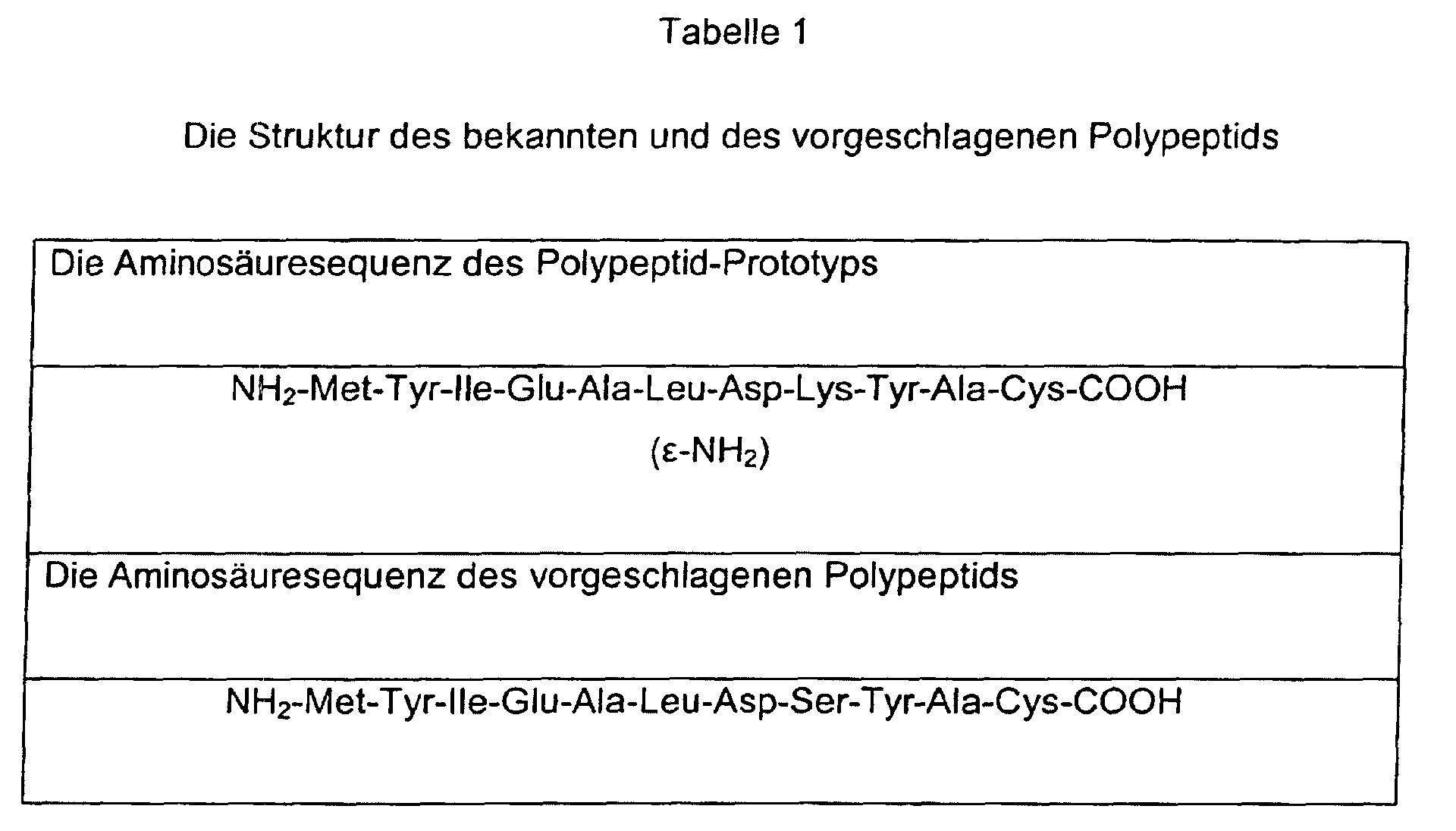
- a polypeptide which is a fragment of the epidermal growth factor of the 21st to 31st amino acids of the formula H 2 N-MYIEALDKYAC-COOH is that can effectively bind to the EGF receptor and cause cell reproduction; Its composition with adriamycin takes place in a ratio of 1: 1, the assembled parts being connected with acid-labile azomethane with the aid of glutardialdehyde as a connecting agent (see the Russian Oncology Magazine, No. 3, 2001, pages 33-37, "The increase in cytotoxic Activity of adriamycin during its transport into the tumor cells by protein vectors "). Any compositions which are described in US Pat. Nos. 5349066, 5087616, 5122368 and which contain adriamycin compositions with EGF in an effective amount and a pharmaceutical carrier suitable for intravenous injection can be specified as pharmaceutical compositions.
- the object of the present invention is to provide the range of polypeptides their composition with Adriamycin and their pharmaceutical composition to expand and increase their effectiveness.
- polypeptide which is an analogy of the epidermal growth factor fragment from the 21st to the 31st amino acid, which is able to effectively bind to the epidermal growth factor receptor, cell reproduction and to perform the function of the vector for the targeted transport of antiblastomatous agents into the cancer cells.
- the polypeptide has the following structure: H 2 N-MYIEALDSYAC-COOH
- the Lys amino acid found in the active center of the receptor-connecting Human EGF's fragment is replaced by the Ser amino acid forms the connection center in the mouse EGF. It was unexpectedly found that replacing Lys with Ser allows undesired conjugation of Lysine with ⁇ -amino groups in the active center of the receptor-connecting Avoid fragments, which in turn inhibits the connection of the Polypeptide with the EGF receptor is prevented.
- the effectiveness of the new polypeptide is through the use of the known Antibiotic Adriamycin is justified, but there may be other antiblastomatous Antibiotics are used, such as Vinkristin, cisplatin, daunomycin, methotrexate as well as other known antiblastomatous agents: toxins such as diphtheria toxin or Ricin, cyclophosphamide, etc.
- Another object of the present invention is to provide a To create polypeptide composition with Adriamycin in the Adriamycin is covalently bound to the polypeptide by azomethane, the polypeptide being the Has formula MYIEALDSYAC.
- This polypeptide composition has one selective effect with regard to the cancerous growth and can increase the resistance of the Significantly reduce tumor cells against the antiblastomatous agents.
- the subject of this invention is also a pharmaceutical composition, the one antiblastomatous effect based on the proposed composition of the receptor connecting fragment of the epidermal growth factor Adriamycin in an effective amount (0.05-0.1%) and an acceptable amount Has carriers for intravenous injection.
- a physiological solution can be used as the carrier or a pain reliever occurs.
- the composition can also be additional Contain microbicidal, virucidal and anti-parasitic agents as well as other agents that are suitable for the treatment of cancer patients, to the extent of not more than 50% of the total weight of the composition.
- the polypeptide was obtained by a method of phase-hard peptide chemistry Obtained using the Fmoc synthesis strategy.
- the resin Wang-resin selected.
- At every step of the peptide condensation was the carboxyl group of Fmoc amino acids by converting it into Hydroxybenzene azimide esters using HOBt and N.N-diisopropylcarbodiimide Fmoc amino acid activated.
- HOBt and N.N-diisopropylcarbodiimide were 10-fold molar excesses with respect to the amino groups of the polymer in Brought reaction.
- the gradient elution of the polypeptide from the column was carried out in a system from Solvents carried out: acetonitrile at 0.1% of trifluoroacetic acid / water.
- Example 2 Obtaining the polypeptide composition with adriamycin
- the synthesis of the composition was carried out according to scheme 1.
- the synthesized composition was based on the starting materials on the column PD-10 Sephadex G-25 (Pharmacia, Sweden) separated. The composition was in the HPLC method with phase reversal on the Nucleosil C18 250 * 4.6 analyzed. The gradient elution of the composition from the column was carried out in one System of solvents carried out: acetonitrile to 0.1% of trifluoroacetic acid / water.
- the molar ratio of polypeptide: adriamycin in the composition was 1: 1.
- Example 3 The biological activity of the polypeptide
- the determination of the reproductive activity of the polypeptide was carried out on the mouse fibroblast cells of the NIH 3T3 line.
- the intensity of the DNA biosynthesis was determined by the incorporation of 3 H-timides in the acid-soluble cell fraction.
- the NIH 3T3 mouse fibroblast cells were cultivated in plastic bottles (Costar) in RPMI (Sigma) medium containing 10% embryonic bovine serum (Sigma), 100 U / ml penicillin and 100 ⁇ g / ml streptomycin in the wet air with 5% CO 2 at 37 ° C.
- the propagation of the synchronized fibroblasts of the NIH 3T3 line was induced with the addition of polypeptide in various concentrations (0.1-1000ng / ml) to the suspension of the cells.
- the fibroblasts were cultured on 96-well microtiter plates in a 200 ml medium of 200-800 thousand / well in full medium.
- Fig. 1 are the comparison data regarding the influence of the proposed Polypeptide of Formula 1 (EGF) on the reproduction of mouse fibroblast cells the NIH 3T3 line.
- EGF Polypeptide of Formula 1
- This information demonstrates a more pronounced one dose-dependent, reproductive effect of the polypeptide in comparison Cell line to the known polypeptide; this effect can result in a higher effect the interaction of the polypeptide with the receptor. Since the Expressiveness of the receptors in relation to the epidermal growth factor by several orders of magnitude in normal body cells, the fact confirms the possibility of using the proposed Polypeptide as a more effective vector molecule for the transport of antiblastomatous Means in the tumor cells.
- the effect of the composition was examined on the following cell lines: breast cancer of the MCF-7 Wt line and the resistance line of human breast cancer MCF-7 AdrR ; SKOV3 line ovarian carcinoma and the resistance line of SKVLB ovarian carcinoma; Mouse melanoma of the B16 line.
- the test protocol was general for all tests carried out and was as follows: the cells were cultivated in plastic bottles (Costar) in the medium RPMI (Sigma) which contains 10% embryonic bovine serum (Sigma), 100 U / ml penicillin and 100 ⁇ g / ml streptomycin, Cultivated in wet air 5% CO 2 at 37 ° C. The cells were distributed on 96-well microtiter plates (Costar), each with 10,000 cells / well, by adding the agents to be examined in different concentrations and incubating them for 72 hours.
- the data on the survivability of the cells after their incubation with the polypeptide-adriamycin composition, free adriamycin and with the composition EGF-adriamycin are listed in Table 2:
- the proposed polypeptide composition with adriamycin has a significantly higher toxic effect with regard to the human tumor cells of the MCF-7 Wt and SKOV3 lines, which are sensitive to adriamycin, and with regard to the cells of the mouse melanoma B16 as free adriamycin and its composition with EGF (prototype).
- the polypeptide-adriamycin composition has also demonstrated higher cytotoxic activity with respect to the MCF-7 AdrR and SKVLB cells, which are resistant to the anthracycline antibiotics.
- the antiblastomatous agent (Adriamycin) is its Composition with the proposed polypeptide a significant has cytotoxic effects on tumor cells that both are sensitive as well as resistant to adriamycin, causing the Effectiveness of the proposed polypeptide as a vector molecule for transport the antiblastomatous agent has been proven in vitro under conditions.
- compositions for the injections are obtained through the Dissolving the composition in a physiological solution or in a Phosphate salt solution.
- the pH of the solutions was approximately 7.4.
- the concentration the composition in the solution was 0.05-0.1%.
- Example 6 The antitumor activity of the composition of the composition polypeptide-adriamycin with the physiological solution according to Example 5 on the model of the transferable tumors of the mice.
- Example 5 For comparative assessment of the therapeutic efficacy of the composition Polypeptide adriamycin for solid tumors caused by the Subcutaneous injection of the cancer cells of the B16 line can be obtained in mice, the intravenous method of introduction of the compositions was used are described in Example 5. The values achieved are in FIG. 2 and in FIG Table 3 shown. The preparations were at a dose of 0.2 mg / kg adriamycin introduced according to the scheme once every 4 days, a total of 3 injections, starting from the 3rd day after vaccination of the tumor.
- composition according to the invention can achieve a therapeutic effect in the intravenous method of injection of the preparation, which was evaluated after the increase in the lifespan of the animals.
- the application of the composition led to a 46% increase in the lifespan of the animals; this increase cannot be achieved in the case of free adriamycin.
- Increasing the average lifespan of animals by intravenous injection of adriamycin-containing compositions Group of animals Average life of animals, days Increase in the average lifespan of the animals% control 31.4 + 4.8 - adriamycin 23.6 + 4.0 - 24.8 composition 46.6 + 5.7 48.5
- Examples 4 and 6 show that the composition of the polypeptide according to the invention together with the antibiotic of the anthracycline series adriamycin (Polypeptide adriamycin) on therapeutic efficacy with regard to solid Has tumors during the intravenous injection procedure.
- the antibiotic of the anthracycline series adriamycin Polypeptide adriamycin
Landscapes
- Health & Medical Sciences (AREA)
- Life Sciences & Earth Sciences (AREA)
- Chemical & Material Sciences (AREA)
- General Health & Medical Sciences (AREA)
- Medicinal Chemistry (AREA)
- Organic Chemistry (AREA)
- Proteomics, Peptides & Aminoacids (AREA)
- Molecular Biology (AREA)
- Bioinformatics & Cheminformatics (AREA)
- Engineering & Computer Science (AREA)
- Public Health (AREA)
- Veterinary Medicine (AREA)
- Animal Behavior & Ethology (AREA)
- Pharmacology & Pharmacy (AREA)
- Biophysics (AREA)
- Epidemiology (AREA)
- Gastroenterology & Hepatology (AREA)
- Genetics & Genomics (AREA)
- Biochemistry (AREA)
- General Chemical & Material Sciences (AREA)
- Zoology (AREA)
- Toxicology (AREA)
- Nuclear Medicine, Radiotherapy & Molecular Imaging (AREA)
- Chemical Kinetics & Catalysis (AREA)
- Medicines That Contain Protein Lipid Enzymes And Other Medicines (AREA)
- Pharmaceuticals Containing Other Organic And Inorganic Compounds (AREA)
- Medicinal Preparation (AREA)
- Peptides Or Proteins (AREA)
Abstract
Description
- Fig. 1
- Vergleichsdaten in Bezug auf den Einfluss des vorgeschlagenen und bekannten Polypeptids der Formel (1) auf die Fortpflanzung der Fibroblastzellen der Maus der Linie NIH 3T3 und
- Fig.2
- Angaben über die Verzögerung der Erscheinungszeit von Geschwülsten und über die Geschwindigkeit des Geschwulstwachstums unter dem Einfluss von adriamycinhaltigen Zusammensetzungen am Modell der übertragbaren Mausgeschwülste.


| Die Überlebensfähigkeit der Geschwulstzellen nach ihrer Inkubation mit freiem oder mit zusammengesetztem Adriamycin | |||
| Zellenlinie | |||
| Adriamycin | Zusammensetzung EGF-Adriamycin | Zusammensetzung Polypeptid-Adriamycin | |
| MCF-7Wt | 58,6 nM | 2,5 nM | 1,3 nM |
| MCF-7AdrR | 3,7 mkM | 0,3 mkM | 0,15 mkM |
| SKOV3 | 209 nM | 35 nM | 22 nM |
| SKVLBAdrR | 2,01 mkM | 0,2 mkM | 0,07 mkM |
| B16 | 35 nM | 1,5 nM | 1,1 nM |
| Steigerung der durchschnittlichen Lebensdauer von Tieren bei der intravenösen Injektion von adriamycinhaltigen Kompositionen | ||
| Gruppe der Tiere | Durchschnittliche Lebensdauer der Tiere, Tage | Erhöhung der durchschnittlichen Lebensdauer der Tiere % |
| Kontrolle | 31,4 + 4,8 | - |
| Adriamycin | 23,6 + 4,0 | - 24,8 |
| Zusammensetzung | 46,6 + 5,7 | 48,5 |
Claims (4)
- Biologisch aktives Polypeptid mit der Formel: MYIEALDSYAC zur Verbindung mit dem Rezeptor des epidermalen Wachstumsfaktors, zur Fortpflanzung der Zellen und zur Ausübung der Funktion eines Vektormoleküls für den zielgerichteten Transport der antiblastomatösen Mittel zur Geschwulstzelle.
- Polypeptid-Zusammensetzung mit Adriamycin, in der Adriamycin kovalent mit säurelabiler Azomethan-Bindung an das Polypeptid angeschlossen ist, enthält als Polypeptid das Polyptid der Formel MYIEALDSYAC.
- Polypeptid-Zusammensetzung mit Adriamycin nach Anspruch 2, wobei Adriamycin kovalent an das Polypeptid unter Verwendung von Glutaraldehyd als Verbindungsmittel angeschlossen ist.
- Pharmazeutische Komposition, die eine antiblastomatöse Wirkung und die Adriamycinzusammensetzung mit einem Vektormolekül in wirksamer Menge sowie einen für die intravenöse Injektion geeigneten, pharmazeutischen Träger aufweist,
dadurch gekennzeichnet, dass sie als Adriamycin-Zusammensetzung eine Zusammensetzung mit Polypeptid der Formel MYIEALDSYAC enthält.
Applications Claiming Priority (3)
| Application Number | Priority Date | Filing Date | Title |
|---|---|---|---|
| RU2001134536/14A RU2196604C1 (ru) | 2001-12-21 | 2001-12-21 | Полипептид, являющийся аналогом рецепторсвязывающего фрагмента эпидермального фактора роста с 21-й по 31-ю аминокислоту, его конъюгат с доксорубицином и фармацевтическая композиция на его основе |
| RU2001134536 | 2001-12-21 | ||
| PCT/RU2002/000544 WO2003053457A1 (fr) | 2001-12-21 | 2002-12-20 | Polypeptide, son conjugue avec doxorubicine et composition pharmaceutique sur cette base |
Publications (3)
| Publication Number | Publication Date |
|---|---|
| EP1466614A1 true EP1466614A1 (de) | 2004-10-13 |
| EP1466614A4 EP1466614A4 (de) | 2006-05-24 |
| EP1466614B1 EP1466614B1 (de) | 2008-10-15 |
Family
ID=20254793
Family Applications (1)
| Application Number | Title | Priority Date | Filing Date |
|---|---|---|---|
| EP02796999A Expired - Lifetime EP1466614B1 (de) | 2001-12-21 | 2002-12-20 | Polypeptid, dessen konjugat doxorubicin enthält, und auf diesem basierende pharmazeutische zusammensetzung |
Country Status (12)
| Country | Link |
|---|---|
| US (1) | US7368431B2 (de) |
| EP (1) | EP1466614B1 (de) |
| JP (1) | JP2005513108A (de) |
| CN (1) | CN1281270C (de) |
| AT (1) | ATE411051T1 (de) |
| AU (1) | AU2002362210B9 (de) |
| CA (1) | CA2451993A1 (de) |
| DE (1) | DE50212918D1 (de) |
| EA (1) | EA005865B1 (de) |
| NZ (1) | NZ533849A (de) |
| RU (1) | RU2196604C1 (de) |
| WO (1) | WO2003053457A1 (de) |
Families Citing this family (10)
| Publication number | Priority date | Publication date | Assignee | Title |
|---|---|---|---|---|
| RU2277930C1 (ru) * | 2004-12-02 | 2006-06-20 | Общество с ограниченной ответственностью "Сириус" (ООО "Сириус") | Векторный полипептид - аналог фрагмента трансформирующего фактора роста альфа (тфральфа), его противоопухолевый конъюгат и фармацевтическая композиция на основе конъюгата |
| ES2744225T3 (es) * | 2005-07-15 | 2020-02-24 | Angiochem Inc | Uso de polipéptidos de aprotinina como portadores en conjugados farmacéuticos |
| RU2303997C2 (ru) * | 2005-09-27 | 2007-08-10 | Автономная некоммерческая организация Научно-технический центр "Фармбиопресс" | Конъюгат, обладающий избирательным действием по отношению к раковым опухолям |
| KR100824396B1 (ko) * | 2006-10-10 | 2008-04-22 | (주)케어젠 | 상피세포 성장인자의 활성을 가지는 펩타이드 및 그의 용도 |
| WO2009059450A1 (en) * | 2007-11-05 | 2009-05-14 | Shanghai Jiaotong University | Peptide ligand directed drug delivery |
| CN101274100B (zh) * | 2008-02-20 | 2010-11-24 | 中山大学 | 一种阿霉素-二肽复合物的制备方法和应用 |
| DE102008050347B4 (de) * | 2008-10-02 | 2011-01-20 | Siemens Aktiengesellschaft | Verfahren, Magnetresonanzanlage und Datenträger zur Bestimmung eines Nierenfunktionsparameters |
| CN102905762B (zh) | 2010-04-29 | 2017-02-15 | 陶氏环球技术有限责任公司 | 用于诱导饱腹感的方法和组合物 |
| CN110386962A (zh) * | 2019-07-04 | 2019-10-29 | 苏州强耀生物科技有限公司 | 一种阿霉素偶联靶向多肽的合成方法 |
| CN116570723A (zh) * | 2023-05-19 | 2023-08-11 | 武汉大学 | 一种植物多肽载药体系及其制备方法 |
Family Cites Families (16)
| Publication number | Priority date | Publication date | Assignee | Title |
|---|---|---|---|---|
| IL69719A0 (en) * | 1983-09-14 | 1983-12-30 | Yeda Res & Dev | Synthetic peptides with egf like activity |
| CA1275922C (en) * | 1985-11-28 | 1990-11-06 | Harunobu Amagase | Treatment of cancer |
| IN165717B (de) * | 1986-08-07 | 1989-12-23 | Battelle Memorial Institute | |
| IL106992A (en) * | 1988-02-11 | 1994-06-24 | Bristol Myers Squibb Co | Acylhydrazone derivatives of anthracycline and methods for their preparation |
| DE4002888A1 (de) * | 1990-02-01 | 1991-08-08 | Behringwerke Ag | Anthracyclin-glycosyl-prodrugs, verfahren zu ihrer herstellung und ihre verwendung in kombination mit funktionalisierten tumorspezifischen enzymkonjugaten |
| US5137877B1 (en) * | 1990-05-14 | 1996-01-30 | Bristol Myers Squibb Co | Bifunctional linking compounds conjugates and methods for their production |
| US5183805A (en) * | 1990-08-13 | 1993-02-02 | Board Of Regents, The University Of Texas System | Bioactive egf peptides for promotion of tissue regeneration and cancer therapy |
| US5776458A (en) * | 1990-12-05 | 1998-07-07 | Pharmacia & Upjohn S.P.A. | Anthracycline-conjugates |
| GB9026491D0 (en) * | 1990-12-05 | 1991-01-23 | Erba Carlo Spa | Anthracycline-conjugates |
| US5622929A (en) * | 1992-01-23 | 1997-04-22 | Bristol-Myers Squibb Company | Thioether conjugates |
| US5505931A (en) * | 1993-03-04 | 1996-04-09 | The Dow Chemical Company | Acid cleavable compounds, their preparation and use as bifunctional acid-labile crosslinking agents |
| US5393737A (en) * | 1992-08-20 | 1995-02-28 | Health Research, Inc. | Cytotoxic drug conjugates for treatment of neoplastic diseases |
| DE69428764T2 (de) * | 1993-12-24 | 2002-06-20 | Merck Patent Gmbh | Immunokonjugate |
| GB9500660D0 (en) * | 1995-01-13 | 1995-03-08 | Secr Defence | Growth factor anologs |
| US6204054B1 (en) * | 1995-09-21 | 2001-03-20 | Andaris Limited | Transcytosis vehicles and enchancers for drug delivery |
| DK0871490T3 (da) * | 1995-12-22 | 2003-07-07 | Bristol Myers Squibb Co | Forgrenede hydrazonlinkere |
-
2001
- 2001-12-21 RU RU2001134536/14A patent/RU2196604C1/ru not_active IP Right Cessation
-
2002
- 2002-12-20 EA EA200301295A patent/EA005865B1/ru not_active IP Right Cessation
- 2002-12-20 CA CA002451993A patent/CA2451993A1/en not_active Abandoned
- 2002-12-20 NZ NZ533849A patent/NZ533849A/en unknown
- 2002-12-20 WO PCT/RU2002/000544 patent/WO2003053457A1/ru not_active Ceased
- 2002-12-20 DE DE50212918T patent/DE50212918D1/de not_active Expired - Fee Related
- 2002-12-20 AU AU2002362210A patent/AU2002362210B9/en not_active Ceased
- 2002-12-20 CN CNB028256557A patent/CN1281270C/zh not_active Expired - Fee Related
- 2002-12-20 AT AT02796999T patent/ATE411051T1/de not_active IP Right Cessation
- 2002-12-20 JP JP2003554214A patent/JP2005513108A/ja not_active Ceased
- 2002-12-20 EP EP02796999A patent/EP1466614B1/de not_active Expired - Lifetime
-
2004
- 2004-06-21 US US10/872,827 patent/US7368431B2/en not_active Expired - Fee Related
Also Published As
| Publication number | Publication date |
|---|---|
| CA2451993A1 (en) | 2003-07-03 |
| AU2002362210B8 (en) | 2008-04-24 |
| CN1281270C (zh) | 2006-10-25 |
| US7368431B2 (en) | 2008-05-06 |
| ATE411051T1 (de) | 2008-10-15 |
| AU2002362210B9 (en) | 2008-08-21 |
| EA005865B1 (ru) | 2005-06-30 |
| EA200301295A1 (ru) | 2004-10-28 |
| DE50212918D1 (de) | 2008-11-27 |
| WO2003053457A1 (fr) | 2003-07-03 |
| CN1606450A (zh) | 2005-04-13 |
| AU2002362210B2 (en) | 2008-04-03 |
| HK1076601A1 (en) | 2006-01-20 |
| WO2003053457A8 (fr) | 2004-09-16 |
| JP2005513108A (ja) | 2005-05-12 |
| RU2196604C1 (ru) | 2003-01-20 |
| EP1466614B1 (de) | 2008-10-15 |
| US20050070465A1 (en) | 2005-03-31 |
| EP1466614A4 (de) | 2006-05-24 |
| NZ533849A (en) | 2006-09-29 |
| AU2002362210A1 (en) | 2003-07-09 |
Similar Documents
| Publication | Publication Date | Title |
|---|---|---|
| DE69028739T2 (de) | Modifizierte PF4-Zusammensetzung und Methoden zu deren Verwendung | |
| DE69431185T2 (de) | Erweiterung des vitamin b 12 - aufnahmesystems unter verwendung von polymeren | |
| DE69836222T2 (de) | Modifizierter tumor-nekrosefaktor | |
| DE69921138T2 (de) | Arzneimittel freisetzendes system enthaltend ein homeobox-peptid und ein zytotoxisches oder antineoplastisches mittel | |
| DE68912232T2 (de) | Konjugate zytotoxischer Arzneimittel. | |
| DE69924870T2 (de) | Peptidvektoren von Stoffen, die durch die Blut-Hirn-Schranke dringen | |
| DE69535665T2 (de) | Konjugate enthaltend ein antitumorales mittel und deren verwendung | |
| DE3685625T2 (de) | Antikoerperkomplexe von haptenmodifizierten diagnostischen oder therapeutischen mitteln. | |
| EP1704864B1 (de) | Injizierbare Arzneimittelzubereitung bestehend aus einem Zytostatikum und einer durch einen Spacer gebundenen Maleinimidgruppe. | |
| EP1198254B1 (de) | Träger-pharmaka-konjugate | |
| DE69730352T2 (de) | Verfahren zur herstellung eines arzneimittelkomplexes | |
| DE69528523T2 (de) | Rezeptor modulierendes mitteln und entsprechendes verfahren | |
| DE69029184T2 (de) | Hydrophile Derivate, diagnostische und therapeutische Anwendungen, diagnostische oder therapeutische Reagenziensätze und immunologische Reagenzien | |
| DE69411342T2 (de) | Polypeptid bombesin antagonisten | |
| EP2137207A2 (de) | Isoflavon-peptid konjugate und deren verwendung | |
| DE2507901C2 (de) | ||
| EP1466614B1 (de) | Polypeptid, dessen konjugat doxorubicin enthält, und auf diesem basierende pharmazeutische zusammensetzung | |
| DE69630583T2 (de) | Peptide, bronchodilator und den blutstrom verbesserndes mittel | |
| DE3851226T2 (de) | Wachstumsfaktor-rezeptor. | |
| DE60305940T2 (de) | Modifizierte therapeutische mittel | |
| DE69012950T2 (de) | Antikrebsmittel. | |
| DE60301891T2 (de) | Peptid für die Diagnose und Therapie von Tumoren | |
| DE19919148A1 (de) | Von Interleukin 12 abgeleitete Peptid-Homodimere und Peptid-Heterodimere | |
| DE19919149A1 (de) | Von Interferon alpha-2 abgeleitete Peptid-Homodimere und Peptid-Heterodimere | |
| EP1394180B1 (de) | Synthetische Mimetika von physiologischen Bindungsmolekülen |
Legal Events
| Date | Code | Title | Description |
|---|---|---|---|
| PUAI | Public reference made under article 153(3) epc to a published international application that has entered the european phase |
Free format text: ORIGINAL CODE: 0009012 |
|
| 17P | Request for examination filed |
Effective date: 20040721 |
|
| AK | Designated contracting states |
Kind code of ref document: A1 Designated state(s): AT BE BG CH CY CZ DE DK EE ES FI FR GB GR IE IT LI LU MC NL PT SE SI SK TR |
|
| AX | Request for extension of the european patent |
Extension state: AL LT LV MK RO |
|
| RAP1 | Party data changed (applicant data changed or rights of an application transferred) |
Owner name: ZAKRYTOE AKTSIONERNOE OBSCHESTVO "RUSSKIE BIOTECHN |
|
| A4 | Supplementary search report drawn up and despatched |
Effective date: 20060406 |
|
| RIC1 | Information provided on ipc code assigned before grant |
Ipc: A61K 47/48 20060101ALI20060401BHEP Ipc: A61K 38/18 20060101ALI20060401BHEP Ipc: A61K 38/08 20060101AFI20030708BHEP Ipc: A61P 35/00 20060101ALI20060401BHEP Ipc: C07K 7/06 20060101ALI20060401BHEP Ipc: A61K 31/704 20060101ALI20060401BHEP |
|
| 17Q | First examination report despatched |
Effective date: 20061211 |
|
| 17Q | First examination report despatched |
Effective date: 20061211 |
|
| GRAP | Despatch of communication of intention to grant a patent |
Free format text: ORIGINAL CODE: EPIDOSNIGR1 |
|
| RIC1 | Information provided on ipc code assigned before grant |
Ipc: A61K 47/48 20060101AFI20080311BHEP Ipc: C07K 7/06 20060101ALI20080311BHEP Ipc: A61K 31/704 20060101ALI20080311BHEP Ipc: A61P 35/00 20060101ALI20080311BHEP Ipc: A61K 38/08 20060101ALI20080311BHEP |
|
| GRAS | Grant fee paid |
Free format text: ORIGINAL CODE: EPIDOSNIGR3 |
|
| GRAA | (expected) grant |
Free format text: ORIGINAL CODE: 0009210 |
|
| AK | Designated contracting states |
Kind code of ref document: B1 Designated state(s): AT BE BG CH CY CZ DE DK EE ES FI FR GB GR IE IT LI LU MC NL PT SE SI SK TR |
|
| REG | Reference to a national code |
Ref country code: CH Ref legal event code: EP Ref country code: GB Ref legal event code: FG4D Free format text: NOT ENGLISH |
|
| REG | Reference to a national code |
Ref country code: IE Ref legal event code: FG4D Free format text: LANGUAGE OF EP DOCUMENT: GERMAN |
|
| REF | Corresponds to: |
Ref document number: 50212918 Country of ref document: DE Date of ref document: 20081127 Kind code of ref document: P |
|
| NLV1 | Nl: lapsed or annulled due to failure to fulfill the requirements of art. 29p and 29m of the patents act | ||
| PG25 | Lapsed in a contracting state [announced via postgrant information from national office to epo] |
Ref country code: BG Free format text: LAPSE BECAUSE OF FAILURE TO SUBMIT A TRANSLATION OF THE DESCRIPTION OR TO PAY THE FEE WITHIN THE PRESCRIBED TIME-LIMIT Effective date: 20090115 Ref country code: ES Free format text: LAPSE BECAUSE OF FAILURE TO SUBMIT A TRANSLATION OF THE DESCRIPTION OR TO PAY THE FEE WITHIN THE PRESCRIBED TIME-LIMIT Effective date: 20090126 |
|
| PG25 | Lapsed in a contracting state [announced via postgrant information from national office to epo] |
Ref country code: SI Free format text: LAPSE BECAUSE OF FAILURE TO SUBMIT A TRANSLATION OF THE DESCRIPTION OR TO PAY THE FEE WITHIN THE PRESCRIBED TIME-LIMIT Effective date: 20081015 Ref country code: PT Free format text: LAPSE BECAUSE OF FAILURE TO SUBMIT A TRANSLATION OF THE DESCRIPTION OR TO PAY THE FEE WITHIN THE PRESCRIBED TIME-LIMIT Effective date: 20090316 Ref country code: FI Free format text: LAPSE BECAUSE OF FAILURE TO SUBMIT A TRANSLATION OF THE DESCRIPTION OR TO PAY THE FEE WITHIN THE PRESCRIBED TIME-LIMIT Effective date: 20081015 Ref country code: NL Free format text: LAPSE BECAUSE OF FAILURE TO SUBMIT A TRANSLATION OF THE DESCRIPTION OR TO PAY THE FEE WITHIN THE PRESCRIBED TIME-LIMIT Effective date: 20081015 |
|
| BERE | Be: lapsed |
Owner name: ZAKRYTOE AKTSIONERNOE OBSCHESTVO "RUSSKIE BIOTECH Effective date: 20081231 |
|
| REG | Reference to a national code |
Ref country code: IE Ref legal event code: FD4D |
|
| PG25 | Lapsed in a contracting state [announced via postgrant information from national office to epo] |
Ref country code: DK Free format text: LAPSE BECAUSE OF FAILURE TO SUBMIT A TRANSLATION OF THE DESCRIPTION OR TO PAY THE FEE WITHIN THE PRESCRIBED TIME-LIMIT Effective date: 20081015 Ref country code: IE Free format text: LAPSE BECAUSE OF FAILURE TO SUBMIT A TRANSLATION OF THE DESCRIPTION OR TO PAY THE FEE WITHIN THE PRESCRIBED TIME-LIMIT Effective date: 20081015 Ref country code: MC Free format text: LAPSE BECAUSE OF NON-PAYMENT OF DUE FEES Effective date: 20081231 Ref country code: EE Free format text: LAPSE BECAUSE OF FAILURE TO SUBMIT A TRANSLATION OF THE DESCRIPTION OR TO PAY THE FEE WITHIN THE PRESCRIBED TIME-LIMIT Effective date: 20081015 |
|
| REG | Reference to a national code |
Ref country code: CH Ref legal event code: PL |
|
| PLBE | No opposition filed within time limit |
Free format text: ORIGINAL CODE: 0009261 |
|
| STAA | Information on the status of an ep patent application or granted ep patent |
Free format text: STATUS: NO OPPOSITION FILED WITHIN TIME LIMIT |
|
| PG25 | Lapsed in a contracting state [announced via postgrant information from national office to epo] |
Ref country code: IT Free format text: LAPSE BECAUSE OF FAILURE TO SUBMIT A TRANSLATION OF THE DESCRIPTION OR TO PAY THE FEE WITHIN THE PRESCRIBED TIME-LIMIT Effective date: 20081015 Ref country code: SE Free format text: LAPSE BECAUSE OF FAILURE TO SUBMIT A TRANSLATION OF THE DESCRIPTION OR TO PAY THE FEE WITHIN THE PRESCRIBED TIME-LIMIT Effective date: 20090115 Ref country code: CZ Free format text: LAPSE BECAUSE OF FAILURE TO SUBMIT A TRANSLATION OF THE DESCRIPTION OR TO PAY THE FEE WITHIN THE PRESCRIBED TIME-LIMIT Effective date: 20081015 |
|
| 26N | No opposition filed |
Effective date: 20090716 |
|
| GBPC | Gb: european patent ceased through non-payment of renewal fee |
Effective date: 20090115 |
|
| PG25 | Lapsed in a contracting state [announced via postgrant information from national office to epo] |
Ref country code: SK Free format text: LAPSE BECAUSE OF FAILURE TO SUBMIT A TRANSLATION OF THE DESCRIPTION OR TO PAY THE FEE WITHIN THE PRESCRIBED TIME-LIMIT Effective date: 20081015 Ref country code: BE Free format text: LAPSE BECAUSE OF NON-PAYMENT OF DUE FEES Effective date: 20081231 |
|
| REG | Reference to a national code |
Ref country code: FR Ref legal event code: ST Effective date: 20090831 |
|
| PG25 | Lapsed in a contracting state [announced via postgrant information from national office to epo] |
Ref country code: LI Free format text: LAPSE BECAUSE OF NON-PAYMENT OF DUE FEES Effective date: 20081231 Ref country code: CH Free format text: LAPSE BECAUSE OF NON-PAYMENT OF DUE FEES Effective date: 20081231 Ref country code: DE Free format text: LAPSE BECAUSE OF NON-PAYMENT OF DUE FEES Effective date: 20090701 |
|
| PG25 | Lapsed in a contracting state [announced via postgrant information from national office to epo] |
Ref country code: GB Free format text: LAPSE BECAUSE OF NON-PAYMENT OF DUE FEES Effective date: 20090115 |
|
| PG25 | Lapsed in a contracting state [announced via postgrant information from national office to epo] |
Ref country code: FR Free format text: LAPSE BECAUSE OF NON-PAYMENT OF DUE FEES Effective date: 20081231 |
|
| PG25 | Lapsed in a contracting state [announced via postgrant information from national office to epo] |
Ref country code: AT Free format text: LAPSE BECAUSE OF NON-PAYMENT OF DUE FEES Effective date: 20081220 |
|
| PG25 | Lapsed in a contracting state [announced via postgrant information from national office to epo] |
Ref country code: LU Free format text: LAPSE BECAUSE OF NON-PAYMENT OF DUE FEES Effective date: 20081220 Ref country code: CY Free format text: LAPSE BECAUSE OF FAILURE TO SUBMIT A TRANSLATION OF THE DESCRIPTION OR TO PAY THE FEE WITHIN THE PRESCRIBED TIME-LIMIT Effective date: 20081015 |
|
| PG25 | Lapsed in a contracting state [announced via postgrant information from national office to epo] |
Ref country code: TR Free format text: LAPSE BECAUSE OF FAILURE TO SUBMIT A TRANSLATION OF THE DESCRIPTION OR TO PAY THE FEE WITHIN THE PRESCRIBED TIME-LIMIT Effective date: 20081015 |
|
| PG25 | Lapsed in a contracting state [announced via postgrant information from national office to epo] |
Ref country code: GR Free format text: LAPSE BECAUSE OF FAILURE TO SUBMIT A TRANSLATION OF THE DESCRIPTION OR TO PAY THE FEE WITHIN THE PRESCRIBED TIME-LIMIT Effective date: 20090116 |