EP1470879B1 - Element d'outil de coupe a surface munie d'un revetement comportant une couche de revetement dur manifestant une excellente resistance a l'abrasion dans le decoupage haute vitesse, et procede pour former ladite couche de revetement dur sur la surface d'un outil de coupe - Google Patents
Element d'outil de coupe a surface munie d'un revetement comportant une couche de revetement dur manifestant une excellente resistance a l'abrasion dans le decoupage haute vitesse, et procede pour former ladite couche de revetement dur sur la surface d'un outil de coupe Download PDFInfo
- Publication number
- EP1470879B1 EP1470879B1 EP03701078A EP03701078A EP1470879B1 EP 1470879 B1 EP1470879 B1 EP 1470879B1 EP 03701078 A EP03701078 A EP 03701078A EP 03701078 A EP03701078 A EP 03701078A EP 1470879 B1 EP1470879 B1 EP 1470879B1
- Authority
- EP
- European Patent Office
- Prior art keywords
- containing points
- aluminum containing
- coating layer
- minimum
- hard coating
- Prior art date
- Legal status (The legal status is an assumption and is not a legal conclusion. Google has not performed a legal analysis and makes no representation as to the accuracy of the status listed.)
- Expired - Lifetime
Links
- 238000005520 cutting process Methods 0.000 title claims abstract description 122
- 239000011247 coating layer Substances 0.000 title claims abstract description 56
- 238000000034 method Methods 0.000 title claims description 26
- 230000001747 exhibiting effect Effects 0.000 title claims description 6
- 238000005299 abrasion Methods 0.000 title 1
- 229910052782 aluminium Inorganic materials 0.000 claims abstract description 134
- XAGFODPZIPBFFR-UHFFFAOYSA-N aluminium Chemical compound [Al] XAGFODPZIPBFFR-UHFFFAOYSA-N 0.000 claims abstract description 118
- 239000010936 titanium Substances 0.000 claims abstract description 64
- 239000000758 substrate Substances 0.000 claims abstract description 62
- 229910052719 titanium Inorganic materials 0.000 claims abstract description 56
- RTAQQCXQSZGOHL-UHFFFAOYSA-N Titanium Chemical compound [Ti] RTAQQCXQSZGOHL-UHFFFAOYSA-N 0.000 claims abstract description 39
- 239000011195 cermet Substances 0.000 claims abstract description 5
- 229910052582 BN Inorganic materials 0.000 claims abstract description 4
- PZNSFCLAULLKQX-UHFFFAOYSA-N Boron nitride Chemical compound N#B PZNSFCLAULLKQX-UHFFFAOYSA-N 0.000 claims abstract description 4
- 239000000463 material Substances 0.000 claims abstract description 4
- UONOETXJSWQNOL-UHFFFAOYSA-N tungsten carbide Chemical compound [W+]#[C-] UONOETXJSWQNOL-UHFFFAOYSA-N 0.000 claims abstract description 4
- 239000000203 mixture Substances 0.000 claims description 51
- 238000007733 ion plating Methods 0.000 claims description 20
- 229910045601 alloy Inorganic materials 0.000 claims description 18
- 239000000956 alloy Substances 0.000 claims description 18
- 229910018575 Al—Ti Inorganic materials 0.000 claims description 10
- 239000012298 atmosphere Substances 0.000 claims description 8
- 229910004349 Ti-Al Inorganic materials 0.000 claims description 7
- 229910004692 Ti—Al Inorganic materials 0.000 claims description 7
- 238000010891 electric arc Methods 0.000 claims description 7
- IJGRMHOSHXDMSA-UHFFFAOYSA-N Atomic nitrogen Chemical compound N#N IJGRMHOSHXDMSA-UHFFFAOYSA-N 0.000 claims description 5
- 229910001873 dinitrogen Inorganic materials 0.000 claims description 5
- 238000005240 physical vapour deposition Methods 0.000 claims description 3
- 229910052751 metal Inorganic materials 0.000 abstract description 98
- 239000002184 metal Substances 0.000 abstract description 98
- 239000010410 layer Substances 0.000 abstract description 48
- 150000004767 nitrides Chemical class 0.000 abstract description 3
- 239000002131 composite material Substances 0.000 abstract 2
- 238000005289 physical deposition Methods 0.000 abstract 1
- 239000000843 powder Substances 0.000 description 21
- CSCPPACGZOOCGX-UHFFFAOYSA-N Acetone Chemical compound CC(C)=O CSCPPACGZOOCGX-UHFFFAOYSA-N 0.000 description 16
- 230000008020 evaporation Effects 0.000 description 10
- 238000001704 evaporation Methods 0.000 description 10
- 229910000851 Alloy steel Inorganic materials 0.000 description 9
- 229910001018 Cast iron Inorganic materials 0.000 description 9
- 238000007740 vapor deposition Methods 0.000 description 9
- 229910000975 Carbon steel Inorganic materials 0.000 description 8
- 239000010962 carbon steel Substances 0.000 description 8
- 239000004615 ingredient Substances 0.000 description 8
- 238000002156 mixing Methods 0.000 description 8
- 238000004506 ultrasonic cleaning Methods 0.000 description 7
- ATJFFYVFTNAWJD-UHFFFAOYSA-N Tin Chemical compound [Sn] ATJFFYVFTNAWJD-UHFFFAOYSA-N 0.000 description 6
- 238000005245 sintering Methods 0.000 description 6
- 229910000831 Steel Inorganic materials 0.000 description 5
- 238000005553 drilling Methods 0.000 description 5
- 235000000396 iron Nutrition 0.000 description 5
- -1 nitride compound Chemical class 0.000 description 5
- 239000012299 nitrogen atmosphere Substances 0.000 description 5
- 239000010959 steel Substances 0.000 description 5
- XKRFYHLGVUSROY-UHFFFAOYSA-N Argon Chemical compound [Ar] XKRFYHLGVUSROY-UHFFFAOYSA-N 0.000 description 4
- 229910001315 Tool steel Inorganic materials 0.000 description 4
- 230000015572 biosynthetic process Effects 0.000 description 4
- 229910052799 carbon Inorganic materials 0.000 description 4
- 238000007796 conventional method Methods 0.000 description 4
- 238000000227 grinding Methods 0.000 description 4
- 229910003470 tongbaite Inorganic materials 0.000 description 4
- 238000004140 cleaning Methods 0.000 description 3
- 239000011248 coating agent Substances 0.000 description 3
- 238000000576 coating method Methods 0.000 description 3
- 150000001875 compounds Chemical class 0.000 description 3
- 238000003801 milling Methods 0.000 description 3
- 229910052759 nickel Inorganic materials 0.000 description 3
- 239000012495 reaction gas Substances 0.000 description 3
- 229910052721 tungsten Inorganic materials 0.000 description 3
- 229910016459 AlB2 Inorganic materials 0.000 description 2
- QYEXBYZXHDUPRC-UHFFFAOYSA-N B#[Ti]#B Chemical compound B#[Ti]#B QYEXBYZXHDUPRC-UHFFFAOYSA-N 0.000 description 2
- 229910009594 Ti2AlN Inorganic materials 0.000 description 2
- 229910021330 Ti3Al Inorganic materials 0.000 description 2
- 229910010038 TiAl Inorganic materials 0.000 description 2
- 229910010039 TiAl3 Inorganic materials 0.000 description 2
- 229910033181 TiB2 Inorganic materials 0.000 description 2
- 229910052786 argon Inorganic materials 0.000 description 2
- 238000005219 brazing Methods 0.000 description 2
- 239000007789 gas Substances 0.000 description 2
- 239000007787 solid Substances 0.000 description 2
- 239000002344 surface layer Substances 0.000 description 2
- 229910001316 Ag alloy Inorganic materials 0.000 description 1
- 229910020630 Co Ni Inorganic materials 0.000 description 1
- 229910001141 Ductile iron Inorganic materials 0.000 description 1
- 229910003178 Mo2C Inorganic materials 0.000 description 1
- PNEYBMLMFCGWSK-UHFFFAOYSA-N aluminium oxide Inorganic materials [O-2].[O-2].[O-2].[Al+3].[Al+3] PNEYBMLMFCGWSK-UHFFFAOYSA-N 0.000 description 1
- 239000012300 argon atmosphere Substances 0.000 description 1
- 239000003795 chemical substances by application Substances 0.000 description 1
- 229910052593 corundum Inorganic materials 0.000 description 1
- 239000002173 cutting fluid Substances 0.000 description 1
- 230000003247 decreasing effect Effects 0.000 description 1
- 238000010586 diagram Methods 0.000 description 1
- 229910003460 diamond Inorganic materials 0.000 description 1
- 239000010432 diamond Substances 0.000 description 1
- 238000001035 drying Methods 0.000 description 1
- 229910000765 intermetallic Inorganic materials 0.000 description 1
- 230000007774 longterm Effects 0.000 description 1
- 230000014759 maintenance of location Effects 0.000 description 1
- 229910052750 molybdenum Inorganic materials 0.000 description 1
- 229910052758 niobium Inorganic materials 0.000 description 1
- 102220005308 rs33960931 Human genes 0.000 description 1
- 102200082816 rs34868397 Human genes 0.000 description 1
- 229910052709 silver Inorganic materials 0.000 description 1
- 239000002904 solvent Substances 0.000 description 1
- 239000010935 stainless steel Substances 0.000 description 1
- 229910001220 stainless steel Inorganic materials 0.000 description 1
- 229910052715 tantalum Inorganic materials 0.000 description 1
- 229910001845 yogo sapphire Inorganic materials 0.000 description 1
- 229910052726 zirconium Inorganic materials 0.000 description 1
Images



Classifications
-
- B—PERFORMING OPERATIONS; TRANSPORTING
- B23—MACHINE TOOLS; METAL-WORKING NOT OTHERWISE PROVIDED FOR
- B23B—TURNING; BORING
- B23B27/00—Tools for turning or boring machines; Tools of a similar kind in general; Accessories therefor
- B23B27/14—Cutting tools of which the bits or tips or cutting inserts are of special material
-
- C—CHEMISTRY; METALLURGY
- C23—COATING METALLIC MATERIAL; COATING MATERIAL WITH METALLIC MATERIAL; CHEMICAL SURFACE TREATMENT; DIFFUSION TREATMENT OF METALLIC MATERIAL; COATING BY VACUUM EVAPORATION, BY SPUTTERING, BY ION IMPLANTATION OR BY CHEMICAL VAPOUR DEPOSITION, IN GENERAL; INHIBITING CORROSION OF METALLIC MATERIAL OR INCRUSTATION IN GENERAL
- C23C—COATING METALLIC MATERIAL; COATING MATERIAL WITH METALLIC MATERIAL; SURFACE TREATMENT OF METALLIC MATERIAL BY DIFFUSION INTO THE SURFACE, BY CHEMICAL CONVERSION OR SUBSTITUTION; COATING BY VACUUM EVAPORATION, BY SPUTTERING, BY ION IMPLANTATION OR BY CHEMICAL VAPOUR DEPOSITION, IN GENERAL
- C23C30/00—Coating with metallic material characterised only by the composition of the metallic material, i.e. not characterised by the coating process
- C23C30/005—Coating with metallic material characterised only by the composition of the metallic material, i.e. not characterised by the coating process on hard metal substrates
-
- C—CHEMISTRY; METALLURGY
- C23—COATING METALLIC MATERIAL; COATING MATERIAL WITH METALLIC MATERIAL; CHEMICAL SURFACE TREATMENT; DIFFUSION TREATMENT OF METALLIC MATERIAL; COATING BY VACUUM EVAPORATION, BY SPUTTERING, BY ION IMPLANTATION OR BY CHEMICAL VAPOUR DEPOSITION, IN GENERAL; INHIBITING CORROSION OF METALLIC MATERIAL OR INCRUSTATION IN GENERAL
- C23C—COATING METALLIC MATERIAL; COATING MATERIAL WITH METALLIC MATERIAL; SURFACE TREATMENT OF METALLIC MATERIAL BY DIFFUSION INTO THE SURFACE, BY CHEMICAL CONVERSION OR SUBSTITUTION; COATING BY VACUUM EVAPORATION, BY SPUTTERING, BY ION IMPLANTATION OR BY CHEMICAL VAPOUR DEPOSITION, IN GENERAL
- C23C14/00—Coating by vacuum evaporation, by sputtering or by ion implantation of the coating forming material
- C23C14/06—Coating by vacuum evaporation, by sputtering or by ion implantation of the coating forming material characterised by the coating material
-
- C—CHEMISTRY; METALLURGY
- C23—COATING METALLIC MATERIAL; COATING MATERIAL WITH METALLIC MATERIAL; CHEMICAL SURFACE TREATMENT; DIFFUSION TREATMENT OF METALLIC MATERIAL; COATING BY VACUUM EVAPORATION, BY SPUTTERING, BY ION IMPLANTATION OR BY CHEMICAL VAPOUR DEPOSITION, IN GENERAL; INHIBITING CORROSION OF METALLIC MATERIAL OR INCRUSTATION IN GENERAL
- C23C—COATING METALLIC MATERIAL; COATING MATERIAL WITH METALLIC MATERIAL; SURFACE TREATMENT OF METALLIC MATERIAL BY DIFFUSION INTO THE SURFACE, BY CHEMICAL CONVERSION OR SUBSTITUTION; COATING BY VACUUM EVAPORATION, BY SPUTTERING, BY ION IMPLANTATION OR BY CHEMICAL VAPOUR DEPOSITION, IN GENERAL
- C23C14/00—Coating by vacuum evaporation, by sputtering or by ion implantation of the coating forming material
- C23C14/06—Coating by vacuum evaporation, by sputtering or by ion implantation of the coating forming material characterised by the coating material
- C23C14/0641—Nitrides
-
- Y—GENERAL TAGGING OF NEW TECHNOLOGICAL DEVELOPMENTS; GENERAL TAGGING OF CROSS-SECTIONAL TECHNOLOGIES SPANNING OVER SEVERAL SECTIONS OF THE IPC; TECHNICAL SUBJECTS COVERED BY FORMER USPC CROSS-REFERENCE ART COLLECTIONS [XRACs] AND DIGESTS
- Y10—TECHNICAL SUBJECTS COVERED BY FORMER USPC
- Y10T—TECHNICAL SUBJECTS COVERED BY FORMER US CLASSIFICATION
- Y10T428/00—Stock material or miscellaneous articles
- Y10T428/24—Structurally defined web or sheet [e.g., overall dimension, etc.]
- Y10T428/24942—Structurally defined web or sheet [e.g., overall dimension, etc.] including components having same physical characteristic in differing degree
-
- Y—GENERAL TAGGING OF NEW TECHNOLOGICAL DEVELOPMENTS; GENERAL TAGGING OF CROSS-SECTIONAL TECHNOLOGIES SPANNING OVER SEVERAL SECTIONS OF THE IPC; TECHNICAL SUBJECTS COVERED BY FORMER USPC CROSS-REFERENCE ART COLLECTIONS [XRACs] AND DIGESTS
- Y10—TECHNICAL SUBJECTS COVERED BY FORMER USPC
- Y10T—TECHNICAL SUBJECTS COVERED BY FORMER US CLASSIFICATION
- Y10T428/00—Stock material or miscellaneous articles
- Y10T428/24—Structurally defined web or sheet [e.g., overall dimension, etc.]
- Y10T428/24942—Structurally defined web or sheet [e.g., overall dimension, etc.] including components having same physical characteristic in differing degree
- Y10T428/2495—Thickness [relative or absolute]
- Y10T428/24967—Absolute thicknesses specified
- Y10T428/24975—No layer or component greater than 5 mils thick
-
- Y—GENERAL TAGGING OF NEW TECHNOLOGICAL DEVELOPMENTS; GENERAL TAGGING OF CROSS-SECTIONAL TECHNOLOGIES SPANNING OVER SEVERAL SECTIONS OF THE IPC; TECHNICAL SUBJECTS COVERED BY FORMER USPC CROSS-REFERENCE ART COLLECTIONS [XRACs] AND DIGESTS
- Y10—TECHNICAL SUBJECTS COVERED BY FORMER USPC
- Y10T—TECHNICAL SUBJECTS COVERED BY FORMER US CLASSIFICATION
- Y10T428/00—Stock material or miscellaneous articles
- Y10T428/26—Web or sheet containing structurally defined element or component, the element or component having a specified physical dimension
- Y10T428/263—Coating layer not in excess of 5 mils thick or equivalent
- Y10T428/264—Up to 3 mils
- Y10T428/265—1 mil or less
Definitions
- the present invention relates to a surface-coated cutting tool member (hereinafter referred to as a coated cutting tool) having a hard coating layer exhibiting superior high temperature properties, and thereby exhibiting a superior wear resistance during a high speed cutting operation for various kinds of steels and cast irons in which a significant amount of heat is generated.
- a coated cutting tool having a hard coating layer exhibiting superior high temperature properties, and thereby exhibiting a superior wear resistance during a high speed cutting operation for various kinds of steels and cast irons in which a significant amount of heat is generated.
- the present invention relates to a method for forming the above-mentioned hard coating layer on a surface of a cutting tool.
- cutting tools include an indexable insert which is detachably attached to a tip portion of a cutting tool in order to perform a turning or planing operation for a workpiece such as made of various steels or cast irons, a drill or a miniature drill which is used for performing a drilling operation for a workpiece as mentioned above, and a solid type end mill which is used for performing a face milling operation, a groove milling operation, or a shoulder milling operation for a workpiece as mentioned above.
- an indexable type end mill is also known, to which an indexable insert is detachably attached for performing a cutting operation as in the case of the solid type end mill.
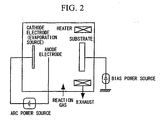
- a method in which a cutting tool made of a tungsten carbide (hereinafter termed WC) based cemented carbide, a titanium carbonitride (hereinafter termed TiCN) based cermet, or a cubic boron nitride (hereinafter termed c-BN) based sintered material, is accommodated in, for example, an arc ion plating apparatus schematically shown in FIG.
- WC tungsten carbide
- TiCN titanium carbonitride
- c-BN cubic boron nitride
- an electric current of, for example, 90A is made to flow as an arc discharge between an anode electrode and a cathode electrode (an evaporation source) to which an Al-Ti alloy having a predetermined composition is attached under the conditions in which the inside of the apparatus is heated to a temperature of, for example, 500°C using a heater, a nitrogen gas as a reaction gas is introduced into the apparatus so as to prepare a reaction atmosphere at, for example, 2 Pa, and a bias voltage of -100 V is applied to the cutting tool, so that a hard coating layer, which has an average thickness of 1 to 15 ⁇ m and is made of a nitride compound (hereinafter termed (Al, Ti)N) layer that includes aluminum and titanium and satisfies a composition formula of (AlzTi 1-z )N (where Z indicates an atomic ratio of 0.4 to 0.65), is formed on the surface of the cutting tool
- Al, TiN nitride compound
- JP 7-97679 A shows a wear resistant coating in which alternating layers of Ti x Al 1-x N (where 0 ⁇ X ⁇ 0.5) and Ti y Al 1-y N (where 0.5 ⁇ Y ⁇ 1 ) are deposited.
- JP 7-205362 A shows a wear resistant coating with alternating layers of TiN and AlN in which the composition is described as continuously changing.
- US 5 208 102 A shows a wear resistant coating comprising a mixture TiN and AlN in which the composition continuously varies between maximum Al content and minimum Al content.
- cutting operation apparatuses tend to have significantly high performance, and on the other hand, it is strongly demanded that cutting operations be performed with less power, less energy, and less cost; therefore, cutting operations tend to be performed at high speed.
- conventional cutting tool no significant problem is encountered when such a tool is used under normal cutting conditions; however, when such a tool is used under high speed cutting conditions in which a significant amount of heat is generated, wear of the hard coating layer of the tool is significantly progressed, which leads to a relatively short operation life.
- the present invention was conceived in view of the aforementioned research results, and provides a surface-coated cutting tool member according to claim 1.
- the present invention also provides a method for forming a hard coating layer exhibiting a superior wear resistance during a high speed cutting operation on a surface of a cutting tool according to claim 2 .
- Aluminum is included in the (Al, Ti)N layer of the hard coating layer in order to improve high temperature hardness and heat resistance (i.e., high temperature properties) of the TiN layer having high toughness; therefore, when the ratio (atomic ratio: X) of aluminum with respect to a total amount of aluminum and titanium is less than 0.70, desired superior high temperature properties cannot be obtained, and on the other hand, when the ratio is greater than 0.95, toughness is significantly reduced due to low ratio of titanium, and a cutting edge tends to easily be chipped (small fracturing). The ratio was set from 0.75 to 0.95.
- the maximum aluminum containing points exhibit superior high temperature properties; however, in contrast, exhibit inferior toughness; therefore, in order to improve toughness of the maximum aluminum containing points, the minimum aluminum containing points, which include titanium at a high ratio and exhibit high toughness, are alternatingly interposed in the thickness direction.
- the ratio (atomic ratio: Y) of titanium with respect to a total amount of aluminum and titanium is greater than 0.65, a desired superior toughness cannot be obtained, and on the other hand, when the ratio is less than 0.40, the minimum aluminum containing points cannot have desired superior high temperature properties because a relative ratio of titanium is too high. Accordingly, the ratio was set from 0.40 to 0.65.
- the distance between the maximum aluminum containing point and the minimum aluminum containing point was set from 0.03 to 0.1 ⁇ m because when the distance is less that 0.01 ⁇ m, it is difficult to form each of the points so as to have the aforementioned composition, and when the distance is greater than 0.1 ⁇ m, weaknesses at each of the points, i.e., insufficient toughness in the case of the maximum aluminum containing point, and insufficient high temperature properties in the case of the minimum aluminum containing point, will locally appear in the layer, which may lead to chipping in the cutting edge or excessive wear.
- the average thickness was set from 1 to 15 ⁇ m because when the thickness of the layer is less than 1 ⁇ m, a desired wear resistance cannot be ensured, and in contrast, when the average thickness is greater than 15 ⁇ m, the cutting edge tends to be chipped.
- ingredient powders i.e., powders of WC, TiC, ZrC, VC, TaC, NbC, Cr 3 C 2 , TiN, TaN, and Co, all of which have an average grain size in a range from 1 to 3 ⁇ m, were prepared and mixed in accordance with blending ratios shown in TABLE 1.
- the ingredient powders were mixed under wet conditions using a ball mill for 72 hours, were dried, and were compacted under pressure of 100 MPa so as to form green compacts.
- the green compacts were held in a vacuum of 6Pa at a temperature of 1400°C for 1 hour so as to be sintered.
- a honing process in which a radius is set to be 0.03, is applied to cutting edge portions of each of the sintered compacts so as to obtain hard metal substrates A-1 to A-10 of WC based hard metal, each of which had an insert shape defined as CNMG120408 in the ISO standard.
- the ingredient powders were mixed under wet conditions using a ball mill for 24 hours, were dried, and were compacted under pressure of 100 MPa so as to form green compacts.
- the green compacts for forming hard metal substrates B-1 to B-6 were held in a nitrogen atmosphere of 2 kPa, and at a temperature of 1500°C for 1 hour, and were cooled in an oven so as to be sintered.
- the green compacts for forming hard metal substrates B-7 to B-9 were held in a vacuum of 1 Pa while increasing temperature from room temperature to 1300°C, in a nitrogen atmosphere of 1 kPa while increasing temperature from 1300°C to 1350°C, in a vacuum of 1 Pa while increasing temperature from 1350°C to 1400°C, in a nitrogen atmosphere of 2 kPa while increasing temperature from 1400°C to 1450°C, and in a vacuum of 1 Pa while increasing temperature from 1450°C to 1500°C.
- the green compacts were held in a nitrogen atmosphere of 3 kPa for 1 hour, and were cooled in the oven so as to be sintered.
- a honing process in which a radius is set to be 0.03, is applied to cutting edge portions of each of the sintered compacts so as to obtain hard metal substrates B-1 to B-9 of TiCN cermet, each of which had an insert shape defined as CNMG120408 in the ISO standard.
- each of the hard metal substrates B-1 to B-9 was observed using a scanning electron microscope.
- the hard metal substrates B-1 to B-6 exhibited a two-phase structure including a hard phase, which is uniform from the surface to the interior, and which made of carbonitride compounds including titanium and at least one of Zr, Ta, Nb, Mo, and W, and a bonded phase having Co and Ni as primary components.
- the hard metal substrates B-7 to B-9 exhibited the same structure as the aforementioned two-phase structure in the interior; however, a surface layer in which the bonded phase did not exist over a depth of 1 to 3 ⁇ m from the surface, i.e., a surface layer consisting of the carbonitride compound, was observed in a superficial portion.
- the aforementioned hard metal substrates A-1 to A-10 and B-1 to B-9 were subjected to ultrasonic cleaning in an acetone solvent, were dried, and were mounted on a turntable housed in an arc ion plating apparatus shown in FIGS. 1A and 1B at positions radially away from a center axis of the turntable in a manner rotatable about respective axes of the hard metal substrates.
- a Ti-Al alloy having various components for forming minimum aluminum containing points was set as a cathode electrode (evaporation source)
- an Al-Ti alloy having various components for forming maximum aluminum containing points was set as another cathode electrode (evaporation source) so as to oppose to the cathode electrode of a Ti-Al alloy while having the turntable therebetween, and metallic titanium for bombardment cleaning is also set.
- the inside of the apparatus was evacuated and maintained at a vacuum at a pressure of 0.5 Pa or less, and the inside of the apparatus was heated to a temperature of 500°C using a heater.
- a DC bias voltage of -1000 V was applied to the hard metal substrates which are turned while rotating on the turntable about the respective axes thereof, and an electric current of 100A was made flow as an arc discharge between the cathode electrode, i.e., metallic titanium, and an anode electrode, so that the surfaces of the hard metal substrates were subjected to Ti bombardment cleaning.
- a nitrogen gas as a reaction gas, was introduced into the apparatus so as to prepare a reaction atmosphere at a pressure of 2 Pa, a DC bias voltage of -100 V was applied to the hard metal substrates which are turned while rotating on the turntable about the respective axes thereof, and an electric current of 100A was made to flow as an arc discharge between the cathode electrodes (the Ti-Al alloy for forming the minimum aluminum containing points and the Al-Ti alloy for forming the maximum aluminum containing points) and the anode electrodes, respectively, so that the method of the present invention was carried out by which a hard coating layer, which had component concentration profile in which the minimum aluminum containing points and the maximum aluminum containing points having a designated composition shown in TABLES 3 and 4 appear alternatingly and repeatedly at a designated interval also shown in TABLES 3 and 4 in the thickness direction, and the amount of contained aluminum (or titanium) is continuously changed from the maximum aluminum containing points to the minimum aluminum containing points and from the minimum aluminum containing points to the maximum aluminum containing points
- the hard metal substrates A-1 to A-10 and B-1 to B-9 were subjected to ultrasonic cleaning in acetone, were dried, and were accommodated in a conventional arc ion plating apparatus shown in FIG 2 .
- an Al-Ti alloy having various components was set as a cathode electrode (evaporation source), the inside of the apparatus was evacuated and maintained at a vacuum at a pressure of 0.5 Pa or less, the inside of the apparatus was heated to a temperature of 500°C using a heater, and an argon gas was introduced into the apparatus so as to prepare an argon atmosphere at a pressure of 10 Pa.
- a bias voltage of -800 V was applied to the hard metal substrates so that the surfaces of the hard metal substrates were subjected to argon gas bombardment cleaning.
- a nitrogen gas, as a reaction gas was introduced into the apparatus so as to prepare a reaction atmosphere at a pressure of 2 Pa, the bias voltage applied to the hard metal substrates was decreased to -100 V, and an electric current was made to flow as an arc discharge between the cathode electrode and the anode electrode so that a conventional method was carried out by which a hard coating layer, which had a designated composition and a designated layer thickness shown in TABLES 5 and 6, and which included an (Al, Ti)N layer in which composition was substantially constant in the direction of the layer thickness, was formed, by a vapor deposition method, on the surface of each of the hard metal substrates A-1 to A-10 and B-1 to B-9, and thereby conventional surface-coated hard metal indexable inserts 1 to 19 (hereinafter referred to as conventional coated hard metal inserts) also having a
- coated hard metal inserts 1 to 19 of the present invention and the conventional coated hard metal inserts 1 to 19 were subjected to cutting tests by attaching each of them to a tip portion of a cutting tool made of tool steel using a fixing bridge and a screw.
- the detailed test conditions were set as follows:
- ingredient powders i.e., medium coarse powder of WC having an average grain size of 5.5 ⁇ m, fine powder of WC having an average grain size of 0.8 ⁇ m, powder of TaC having an average grain size of 1.3 ⁇ m, powder of NbC having an average grain size of 1.2 ⁇ m, powder of ZrC having an average grain size of 1.2 ⁇ m, powder of Cr 3 C 2 having an average grain size of 2.3 ⁇ m, powder of VC having an average grain size of 1.5 ⁇ m, powder of (Ti, W)C having an average grain size of 1.0 ⁇ m, and powder of Co having an average grain size of 1.8 ⁇ m, were prepared.
- medium coarse powder of WC having an average grain size of 5.5 ⁇ m
- fine powder of WC having an average grain size of 0.8 ⁇ m
- powder of TaC having an average grain size of 1.3 ⁇ m
- powder of NbC having an average grain size of 1.2 ⁇ m
- powder of ZrC having an average grain size of 1.2
- the ingredient powders were blended according to the blending ratios shown in TABLE 7, were mixed in acetone after adding wax for 24 hours using a ball mill, were subj ected to depressurized drying, and were compacted under a pressure of 100 MPa so as to obtain various green compacts having predetermined shapes.
- the green compacts were held in a vacuum of 6 Pa while increasing temperature from 1370°C to 1470°C at a temperature increasing rate of 7°C /min, were further held at this temperature for 1 hour, and were cooled in the an oven so as to be sintered and so as to obtain sintered circular bars for forming three types of hard metal substrates, each type having one of diameters of 8 mm, 13 mm, and 26 mm.
- hard metal substrates end mill
- C-1 to C-8 each of which has cutting edges dimensionally defined by one of combinations of diameter and length (diameter ⁇ length), i.e., one of 6 mm, 13 mm, 10 mm ⁇ 22 mm, and 20 mm ⁇ 45 mm, as shown in TABLE 7.
- Embodiment 1 a hard coating layer, which had component concentration profile in which the minimum aluminum containing points and the maximum aluminum containing points having a designated composition shown in TABLE 8 appear alternatingly and repeatedly at a designated interval also shown in TABLE 8 in the thickness direction, and the amount of contained aluminum (or titanium) is continuously changed from the maximum aluminum containing points to the minimum aluminum containing points and from the minimum aluminum containing points to the maximum aluminum containing points, and which had a designated overall layer thickness also shown in TABLE 8, was formed by a vapor deposition method, and thereby surface-coated hard metal end mills 1 to 8 of the present invention (hereinafter referred to as coated hard metal end mills of the present invention) having a shape whose schematic front view is shown in FIG. 4A , and whose schematic transverse cross-sectional view, specifically at the cutting edge, is shown in FIG. 4B , as the coated cutting tools of the present invention, were fabricated.
- coated hard metal end mills of the present invention having a shape whose schematic front view is shown in FIG
- the surfaces of the hard metal substrates (end mills) C-1 to C-8 were subjected to ultrasonic cleaning in acetone, and then the hard metal substrates C-1 to C-8 were dried, and were accommodated in a conventional arc ion plating apparatus shown in FIG. 2 .
- the conventional method was carried out under the same conditions as in the Embodiment 1 by which a hard coating layer, which had a designated composition and a designated layer thickness shown in TABLE 9, and which included an (Al, Ti)N layer in which composition was substantially constant in the direction of the layer thickness, was formed by a vapor deposition method, and thereby conventional surface-coated hard metal end mills 1 to 8 (hereinafter referred to as conventional coated hard metal end mills), as conventional coated cutting tools, were fabricated.
- a hard coating layer which had a designated composition and a designated layer thickness shown in TABLE 9, and which included an (Al, Ti)N layer in which composition was substantially constant in the direction of the layer thickness
- the coated hard metal end mills 1 to 8 of the present invention and the conventional coated hard metal end mills 1 to 8 were subjected to dry, high-speed, and groove formation cutting tests in which workpieces of tool steel were machined under the following conditions, workpiece: a plate of SKD61 defined in the JIS having a plane size of 100 mm ⁇ 250 mm, and a thickness of 50 mm, cutting speed: 180 m/min, depth of groove (depth of cut): 2 mm, and table feed: 850 mm/min.
- coated hard metal end mills 4 to 6 of the present invention and the conventional coated hard metal end mills 4 to 6 were subjected to dry, high-speed, and groove formation cutting tests in which workpieces of stainless steel were machined under the following conditions, workpiece: a plate of SUS316 defined in the JIS having a plane size of 100 mm ⁇ 250 mm, and a thickness of 50 mm, cutting speed: 160 m/min, depth of groove (depth of cut): 3 mm, and table feed: 800 mm/min.
- coated hard metal end mills 7 and 8 of the present invention and the conventional coated hard metal end mills 7 and 8 were subjected to dry, high-speed, and groove formation cutting tests in which workpieces of alloy steel were machined under the following conditions, workpiece: a plate of SCM440 defined in the JIS having a plane size of 100 mm ⁇ 250 mm, and a thickness of 50 mm, cutting speed: 300 m/min, depth of groove (depth of cut): 6 mm, and table feed: 850 mm/min.
- the three types of sintered bars i.e., the bars having a diameter of 8 mm (hard metal substrates C-1 to C-3), the bars having a diameter of 13 mm (hard metal substrates C-4 to C-6), and the bars having a diameter of 26 mm (hard metal substrates C-7 and C-8), fabricated in Embodiment 2 were subjected to grinding so as to obtain hard metal substrates (drills) D-1 to D-8, and more specifically, to obtain hard metal substrates D-1 to D-3 having a fluted portion size of 4 mm ⁇ 13 mm (diameter ⁇ length), hard metal substrates D-4 to D-6 having a fluted portion size of 8 mm ⁇ 22 mm, and hard metal substrates D-7 and D-8 having a fluted portion size of 16 mmx45 mm.
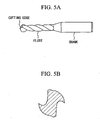
- a hard coating layer which had component concentration profile in which the minimum aluminum containing points and the maximum aluminum containing points having a designated composition shown in TABLE 10 appear alternatingly and repeatedly at a designated interval also shown in TABLE 10 in the thickness direction, and the amount of contained aluminum (or titanium) is continuously changed from the maximum aluminum containing points to the minimum aluminum containing points and from the minimum aluminum containing points to the maximum aluminum containing points, and which had a designated overall layer thickness also shown in TABLE 10, was formed by a vapor deposition method, and thereby surface-coated hard metal drills 1 to 8 of the present invention (hereinafter referred to as coated hard metal drills of the present invention) having a shape whose schematic front view is shown in FIG. 5A , and whose schematic transverse cross-sectional view, specifically at the fluted portion, is shown in FIG 5B , as the coated cutting tools of the present invention, were fabricated.
- coated hard metal drills of the present invention having a shape whose schematic front view is shown in FIG. 5A , and whose schematic
- honing processes were applied to the surfaces of the hard metal substrates (drills) D-1 to D-8, the hard metal substrates D-1 to D-8 were subjected to ultrasonic cleaning in acetone, and then the hard metal substrates D-1 to D-8 were dried, and were accommodated in a conventional arc ion plating apparatus shown in FIG 2 .
- the conventional method was carried out under the same conditions as in the Embodiment 1 by which a hard coating layer, which had a designated composition and a designated layer thickness shown in TABLE 11, and which included an (Al, Ti)N layer in which composition was substantially constant in the direction of the layer thickness, was formed by a vapor deposition method, and thereby conventional surface-coated hard metal drills 1 to 8 (hereinafter referred to as conventional coated hard metal drills), as conventional coated cutting tools, were fabricated.
- a hard coating layer which had a designated composition and a designated layer thickness shown in TABLE 11, and which included an (Al, Ti)N layer in which composition was substantially constant in the direction of the layer thickness
- the coated hard metal drills 1 to 8 of the present invention and the conventional coated hard metal drills 1 to 8 were subjected to lubricated and high-speed drilling tests in which workpieces of tool steel were machined under the following conditions, workpiece: a plate of SKD61 defined in the JIS having a plane size of 100 mm ⁇ 250 mm, and a thickness of 50 mm, cutting speed: 70 m/min, feed: 0.15 mm/rev, and depth of hole: 8 mm.
- coated hard metal drills 4 to 6 of the present invention and the conventional coated hard metal drills 4 to 6 were subjected to lubricated and high-speed drilling tests in which workpieces of ductile cast iron were machined under the following conditions, workpiece: a plate of FCD450 defined in the JIS having a plane size of 100 mm ⁇ 250 mm, and a thickness of 50 mm, cutting speed: 120 m/min, feed: 0.25 mm/rev, and depth of hole: 16 mm.
- coated hard metal drills 7 and 8 of the present invention and the conventional coated hard metal drills 7 and 8 were subjected to lubricated and high-speed drilling tests in which workpieces of cast iron were machined under the following conditions, workpiece: a plate of FC250 defined in the JIS having a plane size of 100 mm ⁇ 250 mm, and a thickness of 50 mm, cutting speed: 180 m/min, feed: 0.35 mm/rev, and depth of hole: 24 mm.
- Ingredient powders i.e., powders of c-BN, TiC, TiN, TiCN, WC, Al, Ti 3 Al, TiAl, and TiAl 3 , which are powders of intermetallic compounds of Ti and Al, compound metallic nitride having a composition formula of Ti 2 AlN, TiB 2 , AIN, AlB 2 , and Al 2 O 3 , all of which have an average grain size in a range from 0.5 to 4 ⁇ m, were prepared and mixed in accordance with blending ratios shown in TABLE 12.
- the ingredient powders were mixed under wet conditions using a ball mill for 72 hours, were dried, and were compacted under pressure of 100 MPa so as to form a green compact having a diameter of 50 mm and a thickness of 1.5 mm.
- the green compact was held in a vacuum at a pressure of 1 Pa at a predetermined temperature in a range from 900 to 1300°C for 30 minutes so as to obtain a pre-sintered compact for forming a cutting piece.
- the pre-sintered compact was superposed on a supporting piece of a WC based hard metal plate which was separately prepared and had a diameter of 50 mm and a thickness of 2 mm, and which has a composition in which 8 wt% of Co and WC as the balance were included, and then the pre-sintered compact with the supporting piece was inserted into a conventional ultra-high pressure sintering apparatus, and was held under normal sintering conditions, i.e., a pressure of 5 GPa, a temperature in a range from 1200 to 1400°C, and a retention time of 0.5 hours, so as to be sintered under ultra-high pressure conditions.
- normal sintering conditions i.e., a pressure of 5 GPa, a temperature in a range from 1200 to 1400°C, and a retention time of 0.5 hours, so as to be sintered under ultra-high pressure conditions.
- a brazing portion (a corner portion) of a WC based hard metal insert body, which has a shape defined in the CIS standard-TNGA160408 (an equilateral triangle having 16 mm sides and a thickness of 4.76 mm) and has a composition in which 8 wt% of Co, 5 wt% of TaC, and WC as the balance were included, using a brazing agent of an Ag alloy having a composition in which 30 wt% of Cu, 28 wt% of Zn, 2 wt% of Ni, and Ag as the balance were included, and finish grinding was applied so as to obtain c-BN based insert substrates A to R.
- the c-BN based insert substrates A to R were subjected to ultrasonic cleaning in acetone, were dried, and were accommodated in the arc ion plating apparatus shown in FIGS. 1A and 1B , and then the method of the present invention was carried out under the same conditions as in Embodiment I by which a hard coating layer, which had component concentration profile in which the minimum aluminum containing points and the maximum aluminum containing points having a designated composition shown in TABLE 13 appear alternatingly and repeatedly at a designated interval also shown in TABLE 13 in the thickness direction, and the amount of contained aluminum (or titanium) is continuously changed from the maximum aluminum containing points to the minimum aluminum containing points and from the minimum aluminum containing points to the maximum aluminum containing points, and which had a designated overall layer thickness also shown in TABLE 13, was formed by a vapor deposition method, and thereby coated c-BN based tools 1 to 18 of the present invention were fabricated.
- Samples 3,5,8 and 16 are not according to the claimed invention.
- conventional coated c-BN based tools 1 to 18 were fabricated under the same conditions as for the coated c-BN based tools 1 to 18 of the present invention except that a hard coating layer was formed on each of the c-BN based insert substrates A to R by accommodating the c-BN based insert substrates A to R in the conventional arc ion plating apparatus shown in FIG 2 , by carrying out the conventional method under the same conditions as in the Embodiment 1 by which the hard coating layer, which had a designated composition and a designated layer thickness shown in TABLE 14, and which included an (Al, Ti)N layer in which composition was substantially constant in the direction of the layer thickness, was formed by a vapor deposition method.
- the coated c-BN based tools 1 to 18 of the present invention and the conventional coated c-BN based tools 1 to 18 were subjected to cutting tests by attaching each of them to a tip portion of a cutting tool made of tool steel using a fixing bridge and a screw.
- the detailed test conditions were set as follows:
- compositions of the minimum aluminum containing points and the minimum aluminum containing points of the hard coating layers which were included in the coated cutting tools of the present invention i.e., in the coated hard metal inserts 1 to 8 of the present invention, in the coated hard metal end mills 1 to 8 of the present invention, in the coated c-BN based tools 1 to 18 of the present invention, and the compositions of the hard coating layers which were included in the conventional coated cutting tools, i.e., in the conventional coated hard metal inserts 1 to 8, in the conventional coated hard metal end mills 1 to 8, in the conventional coated c-BN based tools 1 to 18, were measured using an Auger spectroscopic analyzer, and it was confirmed that the compositions were substantially the same as the designated compositions, respectively.
- the distances between the minimum aluminum containing points and the minimum aluminum containing points, and the overall thicknesses of the hard coating layers of the coated cutting tools of the present invention, and the thicknesses of the hard coating layers of the conventional coated cutting tools were measured using a scanning electron microscope, and it was confirmed that the distances and thicknesses were substantially the same as the designated ones, respectively.
- the coated cutting tools of the present invention which include the hard coating layer having a component concentration profile in which the maximum aluminum containing points and the minimum aluminum containing points appear alternatingly and repeatedly at a predetermined interval in a direction of thickness of the hard coating layer, and the amount of contained aluminum (or titanium) is continuously changed from the maximum aluminum containing points to the minimum aluminum containing points and from the minimum aluminum containing points to the maximum aluminum containing points, exhibit a superior wear resistance during a high speed cutting operation for steels and cast irons in which a significant amount of heat is generated, and in contrast, the conventional coated cutting tools, in which the hard coating layer is of the (Al, Ti)N layer in which composition is substantially constant in the direction of the layer thickness, exhibit excessive wear of the cutting edge and relatively short tool life due to insufficient high temperature properties during high speed cutting operations under high temperature conditions.
- the coated cutting tools of the present invention exhibit a superior wear resistance during a high speed cutting operation for various kinds of steels and cast irons, and exhibit a superior cutting performance for a long term, the coated cutting tools of the present invention can sufficiently meet the demand of high performance of the cutting operation apparatus, and demands of less power, less energy, and lower cost in cutting operations.
Landscapes
- Chemical & Material Sciences (AREA)
- Engineering & Computer Science (AREA)
- Mechanical Engineering (AREA)
- Chemical Kinetics & Catalysis (AREA)
- Materials Engineering (AREA)
- Metallurgy (AREA)
- Organic Chemistry (AREA)
- Cutting Tools, Boring Holders, And Turrets (AREA)
- Physical Vapour Deposition (AREA)
- Chemical Vapour Deposition (AREA)
- Drilling Tools (AREA)
Claims (2)
- Elément d'outil de coupe revêtu d'une couche de revêtement dont la couche de revêtement dur présente une résistance à l'usure supérieure pendant un processus de coupage à haute vitesse, l'élément d'outil de coupe revêtu d'une couche de revêtement pouvant être obtenu par un procédé comprenant les étapes suivantes :préparer un substrat de carbide cémenté à base de carbide de tungstène, de cermet à base de carbonitrure de titane ou d'un matériau fritté à base de nitrure de bore cubique ;monter le substrat sur une table tournante logée dans un appareil pour placage ionique à l'arc dans une position radialement déplacée d'une axe centrale de la table tournante dans une manière rotative autour d'une axe du substrat ;produire une atmosphère de gaz d'azote en tant que l'atmosphère dans l'appareil pour le placage ionique à l'arc ; etgénérer une décharge entre une électrode cathodique en alliage de Al-Ti pour former des points contentant le maximum en aluminium (des point contenant le minimum en titane) et une électrode anodique, et entre une autre électrode cathodique en alliage de Ti-Al pour former des points contentant le minimum en aluminium (des point contenant le maximum en titane) qui est disposée d'une manière à être opposée à la cathode en alliage Al-Ti relatif à la table tournant,et une autre électrode, pour que une couche de revêtement dur ayant une épaisseur globale de 1 à 15 µm soit formée, par une méthode de dépôt physique en phase vapeur, sur la surface du substrat qui est tourné pendant la rotation sur la table tournante autour d'une axe du substrat, dans lequella couche de revêtement dur a un profile de concentration des composants dans lequel les points contenant le maximum en aluminium (des point contenant le minimum en titane) et les points contenant le minimum en aluminium (des point contenant le maximum en titane) apparaissent en alternance et à plusieurs reprises à un intervalle prédéterminé dans une direction de l'épaisseur de la couche de revêtement dur, et la quantité de l'aluminium (ou du titane) y contenue est changée continuellement à partir des points contenant le maximum en aluminium aux points contenant le minimum en aluminium et à partir des points contenant le minimum en aluminium aux points contenant le maximum en aluminium,les points contenant le maximum en aluminium satisfont une formule de composition de (AlxTi1-x)N (dans laquelle X représente un rapport atomique de 0,75 à 0,95), les points contenant le minimum en aluminium satisfont une formule de composition de (AlyTi1-y)N (dans laquelle Y représente un rapport atomique de 0,40 à 0,65), etune distance entre l'un des points contenant le maximum en aluminium et avoisinant l'un des points contenant le mimimum en aluminium est de 0,03 à 0,1 µm).
- Procédé de former une couche de revêtement dur présentant une résistance à l'usure supérieure pendant un processus de coupage à haute vitesse sur une surface d'un outil de coupe, le procédé comprenant les étapes suivantes :monter l'outil de coupe de carbide cémenté à base de carbide de tungstène, de cermet à base de carbonitrure de titane ou d'un matériau fritté à base de nitrure de bore cubique sur une table tournante logée dans un appareil pour placage ionique à l'arc dans une position radialement déplacée d'une axe centrale de la table tournante dans une manière rotative autour d'une axe du substrat ;produire une atmosphère de gaz d'azote en tant que l'atmosphère dans l'appareil pour le placage ionique à l'arc ; etgénérer une décharge entre une électrode cathodique en alliage de Al-Ti pour former des points contentant le maximum en aluminium (des point contenant le minimum en titane) et une électrode anodique, et entre une autre électrode cathodique en alliage de Ti-Al pour former des points contentant le minimum en aluminium (des point contenant le maximum en titane) qui est disposée d'une manière à être opposée à la cathode en alliage Al-Ti relatif à la table tournant ,et une autre électrode, pour que une couche de revêtement dur ayant une épaisseur globale de 1 à 15 µm est formée par une méthode de dépôt physique en phase vapeur sur la surface du substrat qui est tourné pendant la rotation sur la table tournante autour d'une axe du substrat, dans lequella couche de revêtement dur a un profile de concentration des composants dans lequel les points contenant le maximum en aluminium (des point contenant le minimum en titane) et les points contenant le minimum en aluminium (des point contenant le maximum en titane) apparaissent alternativement et à plusieurs reprises à un intervalle prédéterminé dans une direction de l'épaisseur de la couche de revêtement dur, et la quantité d'aluminium (ou de titane) y contenue est changée continuellement à partir des points contenant le maximum en aluminium aux points contenant le minimum en aluminium et à partir des points contenant le minimum en aluminium aux points contenant le maximum en aluminium,les points contenant le maximum en aluminium satisfont une formule de composition de (AlxTi1-x)N (dans laquelle X représente un rapport atomique de 0,75 à 0,95), les points contenant le minimum en aluminium satisfont une formule de composition de (AlyTi1-y)N (dans laquelle Y représente un rapport atomique de 0,40 à 0,65), etune distance entre l'un des points contenant le maximum en aluminium et avoisinant l'un des points contenant le minimum en aluminium est de 0,03 à 0,1 µm).
Applications Claiming Priority (7)
| Application Number | Priority Date | Filing Date | Title |
|---|---|---|---|
| JP2002011478A JP3669334B2 (ja) | 2002-01-21 | 2002-01-21 | 高速切削加工で硬質被覆層がすぐれた耐摩耗性を発揮する表面被覆超硬合金製切削工具 |
| JP2002011478 | 2002-01-21 | ||
| JP2002049893 | 2002-02-26 | ||
| JP2002049893 | 2002-02-26 | ||
| JP2002060208 | 2002-03-06 | ||
| JP2002060208A JP3991262B2 (ja) | 2002-02-26 | 2002-03-06 | 高速切削加工ですぐれた耐摩耗性を発揮する硬質被覆層を切削工具表面に形成する方法 |
| PCT/JP2003/000220 WO2003061884A1 (fr) | 2002-01-21 | 2003-01-14 | Element d'outil de coupe a surface munie d'un revetement comportant une couche de revetement dur manifestant une excellente resistance a l'abrasion dans le decoupage haute vitesse, et procede pour former ladite couche de revetement dur sur la surface d'un outil de coupe |
Publications (4)
| Publication Number | Publication Date |
|---|---|
| EP1470879A1 EP1470879A1 (fr) | 2004-10-27 |
| EP1470879A8 EP1470879A8 (fr) | 2005-02-23 |
| EP1470879A4 EP1470879A4 (fr) | 2008-01-02 |
| EP1470879B1 true EP1470879B1 (fr) | 2011-03-23 |
Family
ID=27617296
Family Applications (1)
| Application Number | Title | Priority Date | Filing Date |
|---|---|---|---|
| EP03701078A Expired - Lifetime EP1470879B1 (fr) | 2002-01-21 | 2003-01-14 | Element d'outil de coupe a surface munie d'un revetement comportant une couche de revetement dur manifestant une excellente resistance a l'abrasion dans le decoupage haute vitesse, et procede pour former ladite couche de revetement dur sur la surface d'un outil de coupe |
Country Status (7)
| Country | Link |
|---|---|
| US (1) | US7094479B2 (fr) |
| EP (1) | EP1470879B1 (fr) |
| KR (1) | KR100707755B1 (fr) |
| CN (1) | CN100408237C (fr) |
| AT (1) | ATE502710T1 (fr) |
| DE (1) | DE60336453D1 (fr) |
| WO (1) | WO2003061884A1 (fr) |
Families Citing this family (60)
| Publication number | Priority date | Publication date | Assignee | Title |
|---|---|---|---|---|
| US7250196B1 (en) * | 1999-10-26 | 2007-07-31 | Basic Resources, Inc. | System and method for plasma plating |
| US7144639B2 (en) * | 2002-01-31 | 2006-12-05 | Mitsubishi Materials Corporation | Surface-coated cutting tool member having hard coating layer and method for forming the hard coating layer on surface of cutting tool |
| US20030180450A1 (en) * | 2002-03-22 | 2003-09-25 | Kidd Jerry D. | System and method for preventing breaker failure |
| AU2003244324A1 (en) * | 2002-06-25 | 2004-01-06 | Mitsubishi Materials Corporation | Coated cutting tool member |
| SE526336C2 (sv) * | 2002-07-01 | 2005-08-23 | Seco Tools Ab | Skär med slitstark refraktär beläggning av MAX-fas |
| US20050126497A1 (en) * | 2003-09-30 | 2005-06-16 | Kidd Jerry D. | Platform assembly and method |
| EP2308621B1 (fr) * | 2004-01-30 | 2015-07-08 | Mitsubishi Materials Corporation | Outil de découpe enrobé par projection fabriqué à partir d'un métal dur |
| JP2006116831A (ja) * | 2004-10-22 | 2006-05-11 | Sony Corp | プリンタ及びプリンタの制御方法 |
| CN100528430C (zh) * | 2004-06-18 | 2009-08-19 | 三菱麻铁里亚尔株式会社 | 表面被覆切削刀具及其制造方法 |
| DE102005032860B4 (de) * | 2005-07-04 | 2007-08-09 | Fraunhofer-Gesellschaft zur Förderung der angewandten Forschung e.V. | Hartstoffbeschichtete Körper und Verfahren zu deren Herstellung |
| SE529015C2 (sv) * | 2005-09-09 | 2007-04-10 | Sandvik Intellectual Property | PVD-belagt skärverktygsskär tillverkat av hårdmetall |
| US7670674B2 (en) * | 2005-09-09 | 2010-03-02 | Sandvik Intellectual Property Ab | PVD coated cutting tool |
| SE530253C2 (sv) * | 2005-12-14 | 2008-04-08 | Sandvik Intellectual Property | Hårdmetallskär, dess framställning samt användning för förslitningskrävande avstickning och spårstickning i varmhållfasta superlegeringar och rostfria stål |
| SE529431C2 (sv) * | 2005-12-14 | 2007-08-07 | Sandvik Intellectual Property | Belagt hårdmetallskär, sätt att framställa detta samt dess användning för svarvning |
| JP4985919B2 (ja) | 2005-12-22 | 2012-07-25 | 三菱マテリアル株式会社 | 高硬度鋼の高速切削加工で優れた仕上げ面精度を長期にわたって発揮する表面被覆立方晶窒化ほう素基超高圧焼結材料製切削工具 |
| JPWO2007111301A1 (ja) * | 2006-03-28 | 2009-08-13 | 京セラ株式会社 | 表面被覆工具 |
| JP5005262B2 (ja) | 2006-05-26 | 2012-08-22 | 三菱マテリアル株式会社 | 高硬度鋼の高速切削加工できわめて優れた仕上げ面精度を長期にわたって発揮する表面被覆立方晶窒化ほう素基超高圧焼結材料製切削工具 |
| SE530516C2 (sv) * | 2006-06-15 | 2008-06-24 | Sandvik Intellectual Property | Belagt hårdmetallskär, metod att tillverka detta samt dess användning vid fräsning av gjutjärn |
| SE530517C2 (sv) * | 2006-08-28 | 2008-06-24 | Sandvik Intellectual Property | Belagt hårdmetallskär, sätt att tillverka detta samt dess användning för fräsning av hårda Fe-baserade legeringar > 45 HRC |
| JP5096715B2 (ja) | 2006-09-21 | 2012-12-12 | 株式会社神戸製鋼所 | 硬質皮膜および硬質皮膜被覆工具 |
| JP5125435B2 (ja) * | 2006-12-13 | 2013-01-23 | 三菱マテリアル株式会社 | 接触抵抗の小さい多孔質チタン |
| SE530944C2 (sv) * | 2007-04-27 | 2008-10-28 | Sandvik Intellectual Property | Skär |
| US8455116B2 (en) | 2007-06-01 | 2013-06-04 | Sandvik Intellectual Property Ab | Coated cemented carbide cutting tool insert |
| SE0701449L (sv) * | 2007-06-01 | 2008-12-02 | Sandvik Intellectual Property | Finkornig hårdmetall med förfinad struktur |
| SE0701320L (sv) | 2007-06-01 | 2008-12-02 | Sandvik Intellectual Property | Belagd hårdmetall för formverktygsapplikationer |
| SE0701761L (sv) | 2007-06-01 | 2008-12-02 | Sandvik Intellectual Property | Finkornig hårdmetall för svarvning i varmhållfasta superlegeringar (HRSA) och rostfria stål |
| SE531946C2 (sv) | 2007-08-24 | 2009-09-15 | Seco Tools Ab | Skär för fräsning i gjutjärn |
| EP2201153B1 (fr) * | 2007-08-24 | 2014-10-08 | Seco Tools AB | Plaquette pour le fraisage de la fonte |
| DE102008013965A1 (de) | 2008-03-12 | 2009-09-17 | Kennametal Inc. | Hartstoffbeschichteter Körper |
| KR100876366B1 (ko) * | 2008-04-24 | 2008-12-31 | 한국야금 주식회사 | 절삭공구용 다층경질 박막 |
| WO2010150335A1 (fr) * | 2009-06-22 | 2010-12-29 | 株式会社タンガロイ | Outil comportant un corps fritté en nitrure de bore cubique revêtu |
| US8277958B2 (en) * | 2009-10-02 | 2012-10-02 | Kennametal Inc. | Aluminum titanium nitride coating and method of making same |
| RU2415198C1 (ru) * | 2009-11-09 | 2011-03-27 | Федеральное государственное учреждение Российский научный центр "Курчатовский институт" | Многослойное покрытие на твердосплавный инструмент для обработки титановых сплавов и способ его получения |
| JP4753143B2 (ja) | 2009-12-21 | 2011-08-24 | 住友電工ハードメタル株式会社 | 表面被覆切削工具 |
| KR101190324B1 (ko) | 2010-02-11 | 2012-10-11 | 대구텍 유한회사 | 절삭공구 |
| JP5574277B2 (ja) * | 2010-10-29 | 2014-08-20 | 三菱マテリアル株式会社 | 耐剥離性に優れる表面被覆立方晶窒化ほう素基超高圧焼結材料製切削工具 |
| US8409702B2 (en) | 2011-02-07 | 2013-04-02 | Kennametal Inc. | Cubic aluminum titanium nitride coating and method of making same |
| JP5126702B1 (ja) * | 2011-09-12 | 2013-01-23 | 三菱マテリアル株式会社 | 立方晶窒化ほう素基焼結材料製切削工具 |
| DE102012107129A1 (de) * | 2012-08-03 | 2014-02-06 | Walter Ag | TiAIN-beschichtetes Werkzeug |
| US9476114B2 (en) | 2012-08-03 | 2016-10-25 | Walter Ag | TiAlN-coated tool |
| US9126273B2 (en) * | 2012-12-17 | 2015-09-08 | Kennametal Inc | Tool for the cutting machining of workpieces and process for coating substrate bodies |
| US9103036B2 (en) | 2013-03-15 | 2015-08-11 | Kennametal Inc. | Hard coatings comprising cubic phase forming compositions |
| WO2014148488A1 (fr) | 2013-03-22 | 2014-09-25 | 三菱マテリアル株式会社 | Outil de coupe à surface enduite |
| US9168664B2 (en) | 2013-08-16 | 2015-10-27 | Kennametal Inc. | Low stress hard coatings and applications thereof |
| US9896767B2 (en) | 2013-08-16 | 2018-02-20 | Kennametal Inc | Low stress hard coatings and applications thereof |
| JP6376466B2 (ja) | 2014-11-13 | 2018-08-22 | 三菱マテリアル株式会社 | 表面被覆切削工具 |
| JP6590255B2 (ja) * | 2015-03-13 | 2019-10-16 | 三菱マテリアル株式会社 | 硬質被覆層がすぐれた耐チッピング性を発揮する表面被覆切削工具 |
| JP2016199793A (ja) * | 2015-04-13 | 2016-12-01 | 株式会社神戸製鋼所 | 硬質皮膜 |
| WO2017061328A1 (fr) * | 2015-10-07 | 2017-04-13 | 株式会社タンガロイ | Outil de coupe revêtu |
| JP6045010B1 (ja) * | 2016-04-14 | 2016-12-14 | 住友電工ハードメタル株式会社 | 表面被覆切削工具およびその製造方法 |
| JP7083448B2 (ja) * | 2017-01-07 | 2022-06-13 | 株式会社タンガロイ | 被覆切削工具 |
| US11524339B2 (en) * | 2018-08-24 | 2022-12-13 | Sumitomo Electric Hardmetal Corp. | Cutting tool |
| JP6825778B1 (ja) | 2019-10-10 | 2021-02-03 | 住友電工ハードメタル株式会社 | 切削工具 |
| US11241745B2 (en) | 2019-10-10 | 2022-02-08 | Sumitomo Electric Hardmetal Corp. | Cutting tool including substrate and coating layer |
| US11358226B2 (en) | 2019-10-10 | 2022-06-14 | Sumitomo Electric Hardmetal Corp. | Cutting tool |
| EP3991888B1 (fr) | 2019-10-10 | 2023-09-06 | Sumitomo Electric Hardmetal Corp. | Outil de coupe |
| CN114173974B (zh) | 2019-10-10 | 2024-03-15 | 住友电工硬质合金株式会社 | 切削工具 |
| CN111690800B (zh) * | 2020-06-16 | 2022-02-18 | 北京首钢吉泰安新材料有限公司 | 拉丝机塔轮用钢及其制备方法、拉丝机塔轮及应用 |
| JP7319600B6 (ja) * | 2021-12-10 | 2023-08-18 | 株式会社タンガロイ | 被覆切削工具 |
| CN116083847B (zh) * | 2023-01-16 | 2025-03-25 | 厦门金鹭特种合金有限公司 | 一种二硼化钛硬质涂层、涂层刀具及制备方法 |
Citations (1)
| Publication number | Priority date | Publication date | Assignee | Title |
|---|---|---|---|---|
| US5208102A (en) * | 1991-01-21 | 1993-05-04 | Balzers Aktiengesellschaft | Coated highly wear-resistant tool and physical coating process therefor |
Family Cites Families (12)
| Publication number | Priority date | Publication date | Assignee | Title |
|---|---|---|---|---|
| JPS6362875A (ja) * | 1986-09-01 | 1988-03-19 | Kobe Steel Ltd | 真空成膜装置 |
| JP2861113B2 (ja) * | 1989-09-29 | 1999-02-24 | 住友電気工業株式会社 | 切削・耐摩工具用表面被覆超硬部材 |
| EP0592986B1 (fr) * | 1992-10-12 | 1998-07-08 | Sumitomo Electric Industries, Limited | Film stratifié ultra-fin |
| JP2979921B2 (ja) * | 1993-09-30 | 1999-11-22 | 住友電気工業株式会社 | 超薄膜積層体 |
| JP3460288B2 (ja) * | 1994-01-21 | 2003-10-27 | 住友電気工業株式会社 | 耐摩耗性に優れた表面被覆部材 |
| US5700551A (en) * | 1994-09-16 | 1997-12-23 | Sumitomo Electric Industries, Ltd. | Layered film made of ultrafine particles and a hard composite material for tools possessing the film |
| JP3333081B2 (ja) * | 1995-12-18 | 2002-10-07 | 東芝タンガロイ株式会社 | 結晶配向性高強度被覆部材 |
| ES2192690T3 (es) * | 1996-09-03 | 2003-10-16 | Unaxis Balzers Ag | Pieza con recubrimiento protector frente al desgaste. |
| JPH10317123A (ja) * | 1997-05-16 | 1998-12-02 | Toshiba Tungaloy Co Ltd | 結晶配向性硬質被覆部材 |
| JPH1161380A (ja) * | 1997-08-20 | 1999-03-05 | Kobe Steel Ltd | 耐磨耗性多層型硬質皮膜 |
| WO1999040233A1 (fr) * | 1998-02-04 | 1999-08-12 | Osg Corporation | Outil revetu multicouches |
| SE9903089D0 (sv) * | 1999-09-01 | 1999-09-01 | Sandvik Ab | Coated grooving or parting insert |
-
2003
- 2003-01-14 WO PCT/JP2003/000220 patent/WO2003061884A1/fr not_active Ceased
- 2003-01-14 EP EP03701078A patent/EP1470879B1/fr not_active Expired - Lifetime
- 2003-01-14 DE DE60336453T patent/DE60336453D1/de not_active Expired - Lifetime
- 2003-01-14 AT AT03701078T patent/ATE502710T1/de not_active IP Right Cessation
- 2003-01-14 US US10/501,805 patent/US7094479B2/en not_active Expired - Lifetime
- 2003-01-14 CN CNB038066130A patent/CN100408237C/zh not_active Expired - Lifetime
- 2003-01-14 KR KR1020047011137A patent/KR100707755B1/ko not_active Expired - Fee Related
Patent Citations (1)
| Publication number | Priority date | Publication date | Assignee | Title |
|---|---|---|---|---|
| US5208102A (en) * | 1991-01-21 | 1993-05-04 | Balzers Aktiengesellschaft | Coated highly wear-resistant tool and physical coating process therefor |
Non-Patent Citations (1)
| Title |
|---|
| ROITAN F. BUNSHAH: "Handbook of Hard Coatings", 2001, NOYES, Park Ridge N.J., USA, ISBN: 0-8155-1438-7 * |
Also Published As
| Publication number | Publication date |
|---|---|
| CN100408237C (zh) | 2008-08-06 |
| US20050129986A1 (en) | 2005-06-16 |
| CN1642682A (zh) | 2005-07-20 |
| EP1470879A8 (fr) | 2005-02-23 |
| KR20040094673A (ko) | 2004-11-10 |
| DE60336453D1 (de) | 2011-05-05 |
| WO2003061884A8 (fr) | 2004-11-25 |
| EP1470879A1 (fr) | 2004-10-27 |
| ATE502710T1 (de) | 2011-04-15 |
| KR100707755B1 (ko) | 2007-04-17 |
| EP1470879A4 (fr) | 2008-01-02 |
| WO2003061884A1 (fr) | 2003-07-31 |
| US7094479B2 (en) | 2006-08-22 |
Similar Documents
| Publication | Publication Date | Title |
|---|---|---|
| US7094479B2 (en) | Surface-coated cutting tool member having hard coating layer exhibiting superior wear resistance during high speed cutting operation and method for forming hard coating layer on surface of cutting tool | |
| EP1535680B1 (fr) | Element pour outil de coupe revetu | |
| JP3928481B2 (ja) | 高速重切削条件で硬質被覆層がすぐれた耐摩耗性を発揮する表面被覆超硬合金製切削工具 | |
| JP3928480B2 (ja) | 高速切削加工で硬質被覆層がすぐれた耐摩耗性を発揮する表面被覆超硬合金製切削工具 | |
| EP1470880B1 (fr) | Element d'outil de coupe revetu a couche de revetement dure et procede de formation de la couche de revetement dure sur l'outil de coupe | |
| JP3844285B2 (ja) | 高速切削加工で硬質被覆層がすぐれた耐摩耗性を発揮する表面被覆超硬合金製切削工具 | |
| JP4007102B2 (ja) | 高速重切削条件で硬質被覆層がすぐれた耐チッピング性を発揮する表面被覆超硬合金製切削工具 | |
| JP3985227B2 (ja) | 高速重切削条件で硬質被覆層がすぐれた耐チッピング性を発揮する表面被覆超硬合金製切削工具 | |
| JP3982301B2 (ja) | 高速重切削条件で硬質被覆層がすぐれた耐チッピング性を発揮する表面被覆超硬合金製切削工具 | |
| JP5099587B2 (ja) | 硬質被覆層がすぐれた耐欠損性を発揮する表面被覆切削工具 | |
| JP4366987B2 (ja) | 高速重切削条件で硬質被覆層がすぐれた耐チッピング性を発揮する表面被覆超硬合金製切削工具 | |
| JP4485146B2 (ja) | 高速切削加工で硬質被覆層がすぐれた耐摩耗性を発揮する表面被覆サーメット製切削工具 | |
| JP2005022044A (ja) | 高速切削加工で表面被覆層がすぐれた耐摩耗性を発揮する表面被覆超硬合金製切削工具 | |
| JP3962910B2 (ja) | 重切削加工で硬質被覆層がすぐれた耐チッピング性を発揮する表面被覆超硬合金製切削工具 | |
| JP3580271B2 (ja) | 切粉滑り性にすぐれた表面被覆超硬合金製切削工具 | |
| HK1070612A (en) | Surface coated cutting tool member having hard coating layer exhibiting excellent abrasion resistance in high-speed cutting, and method for forming said hard coating layer on surface of cutting tool | |
| JP4206826B2 (ja) | 高速切削加工で硬質被覆層がすぐれた耐摩耗性を発揮する表面被覆サーメット製切削工具 | |
| JP4320707B2 (ja) | 高速重切削加工条件で硬質被覆層がすぐれた耐チッピング性を発揮する表面被覆超硬合金製切削工具 | |
| JP3972293B2 (ja) | 高速重切削条件で硬質被覆層がすぐれた耐摩耗性を発揮する表面被覆超硬合金製切削工具 | |
| JP4320706B2 (ja) | 高速重切削加工条件で硬質被覆層がすぐれた耐チッピング性を発揮する表面被覆超硬合金製切削工具 | |
| JP4029323B2 (ja) | 高速重切削条件で硬質被覆層がすぐれた耐チッピング性を発揮する表面被覆超硬合金製切削工具 | |
| JP3928434B2 (ja) | 断続重切削加工で硬質被覆層がすぐれた耐チッピング性を発揮する表面被覆超硬合金製切削工具 | |
| JP2004130495A (ja) | 高速重切削条件で硬質被覆層がすぐれた耐チッピング性を発揮する表面被覆サーメット製切削工具 | |
| JP3928498B2 (ja) | 高速重切削条件で硬質被覆層がすぐれた耐摩耗性を発揮する表面被覆超硬合金製切削工具 | |
| JP4029329B2 (ja) | 高速切削加工で硬質被覆層がすぐれた耐摩耗性を発揮する表面被覆サーメット製切削工具 |
Legal Events
| Date | Code | Title | Description |
|---|---|---|---|
| PUAI | Public reference made under article 153(3) epc to a published international application that has entered the european phase |
Free format text: ORIGINAL CODE: 0009012 |
|
| 17P | Request for examination filed |
Effective date: 20040717 |
|
| AK | Designated contracting states |
Kind code of ref document: A1 Designated state(s): AT BE BG CH CY CZ DE DK EE ES FI FR GB GR IE IT LI LU MC NL PT SE SI SK TR |
|
| D17D | Deferred search report published (deleted) | ||
| RAP1 | Party data changed (applicant data changed or rights of an application transferred) |
Owner name: MITSUBISHI MATERIALS KOBE TOOLS CORPORATION Owner name: MITSUBISHI MATERIALS CORPORATION |
|
| RIN1 | Information on inventor provided before grant (corrected) |
Inventor name: KONDO, AKIHIRO,MITSUBISHI MAT. KOBE TOOLS CORP. Inventor name: SATO, KAZUNORI,MITSUBISHI MAT. KOBE TOOLS CORP. Inventor name: TANAKA, YUSUKE,MITSUBISHI MAT. KOBE TOOLS CORP. |
|
| REG | Reference to a national code |
Ref country code: HK Ref legal event code: DE Ref document number: 1070612 Country of ref document: HK |
|
| A4 | Supplementary search report drawn up and despatched |
Effective date: 20071204 |
|
| RAP1 | Party data changed (applicant data changed or rights of an application transferred) |
Owner name: MITSUBISHI MATERIALS CORPORATION |
|
| 17Q | First examination report despatched |
Effective date: 20080409 |
|
| GRAP | Despatch of communication of intention to grant a patent |
Free format text: ORIGINAL CODE: EPIDOSNIGR1 |
|
| GRAS | Grant fee paid |
Free format text: ORIGINAL CODE: EPIDOSNIGR3 |
|
| RBV | Designated contracting states (corrected) |
Designated state(s): AT BE BG CH CY CZ DE DK EE ES FI FR GB GR HU IE IT LI LU MC NL PT SE SI SK TR |
|
| GRAA | (expected) grant |
Free format text: ORIGINAL CODE: 0009210 |
|
| AK | Designated contracting states |
Kind code of ref document: B1 Designated state(s): AT BE BG CH CY CZ DE DK EE ES FI FR GB GR HU IE IT LI LU MC NL PT SE SI SK TR |
|
| REG | Reference to a national code |
Ref country code: GB Ref legal event code: FG4D |
|
| REG | Reference to a national code |
Ref country code: CH Ref legal event code: EP |
|
| REG | Reference to a national code |
Ref country code: IE Ref legal event code: FG4D |
|
| REF | Corresponds to: |
Ref document number: 60336453 Country of ref document: DE Date of ref document: 20110505 Kind code of ref document: P |
|
| REG | Reference to a national code |
Ref country code: DE Ref legal event code: R096 Ref document number: 60336453 Country of ref document: DE Effective date: 20110505 |
|
| REG | Reference to a national code |
Ref country code: SE Ref legal event code: TRGR |
|
| REG | Reference to a national code |
Ref country code: NL Ref legal event code: VDEP Effective date: 20110323 |
|
| PG25 | Lapsed in a contracting state [announced via postgrant information from national office to epo] |
Ref country code: GR Free format text: LAPSE BECAUSE OF FAILURE TO SUBMIT A TRANSLATION OF THE DESCRIPTION OR TO PAY THE FEE WITHIN THE PRESCRIBED TIME-LIMIT Effective date: 20110624 |
|
| REG | Reference to a national code |
Ref country code: HK Ref legal event code: WD Ref document number: 1070612 Country of ref document: HK |
|
| PG25 | Lapsed in a contracting state [announced via postgrant information from national office to epo] |
Ref country code: SI Free format text: LAPSE BECAUSE OF FAILURE TO SUBMIT A TRANSLATION OF THE DESCRIPTION OR TO PAY THE FEE WITHIN THE PRESCRIBED TIME-LIMIT Effective date: 20110323 Ref country code: FI Free format text: LAPSE BECAUSE OF FAILURE TO SUBMIT A TRANSLATION OF THE DESCRIPTION OR TO PAY THE FEE WITHIN THE PRESCRIBED TIME-LIMIT Effective date: 20110323 Ref country code: BG Free format text: LAPSE BECAUSE OF FAILURE TO SUBMIT A TRANSLATION OF THE DESCRIPTION OR TO PAY THE FEE WITHIN THE PRESCRIBED TIME-LIMIT Effective date: 20110623 Ref country code: CY Free format text: LAPSE BECAUSE OF FAILURE TO SUBMIT A TRANSLATION OF THE DESCRIPTION OR TO PAY THE FEE WITHIN THE PRESCRIBED TIME-LIMIT Effective date: 20110323 Ref country code: AT Free format text: LAPSE BECAUSE OF FAILURE TO SUBMIT A TRANSLATION OF THE DESCRIPTION OR TO PAY THE FEE WITHIN THE PRESCRIBED TIME-LIMIT Effective date: 20110323 |
|
| PG25 | Lapsed in a contracting state [announced via postgrant information from national office to epo] |
Ref country code: BE Free format text: LAPSE BECAUSE OF FAILURE TO SUBMIT A TRANSLATION OF THE DESCRIPTION OR TO PAY THE FEE WITHIN THE PRESCRIBED TIME-LIMIT Effective date: 20110323 |
|
| PG25 | Lapsed in a contracting state [announced via postgrant information from national office to epo] |
Ref country code: PT Free format text: LAPSE BECAUSE OF FAILURE TO SUBMIT A TRANSLATION OF THE DESCRIPTION OR TO PAY THE FEE WITHIN THE PRESCRIBED TIME-LIMIT Effective date: 20110725 Ref country code: EE Free format text: LAPSE BECAUSE OF FAILURE TO SUBMIT A TRANSLATION OF THE DESCRIPTION OR TO PAY THE FEE WITHIN THE PRESCRIBED TIME-LIMIT Effective date: 20110323 |
|
| PG25 | Lapsed in a contracting state [announced via postgrant information from national office to epo] |
Ref country code: SK Free format text: LAPSE BECAUSE OF FAILURE TO SUBMIT A TRANSLATION OF THE DESCRIPTION OR TO PAY THE FEE WITHIN THE PRESCRIBED TIME-LIMIT Effective date: 20110323 Ref country code: CZ Free format text: LAPSE BECAUSE OF FAILURE TO SUBMIT A TRANSLATION OF THE DESCRIPTION OR TO PAY THE FEE WITHIN THE PRESCRIBED TIME-LIMIT Effective date: 20110323 Ref country code: ES Free format text: LAPSE BECAUSE OF FAILURE TO SUBMIT A TRANSLATION OF THE DESCRIPTION OR TO PAY THE FEE WITHIN THE PRESCRIBED TIME-LIMIT Effective date: 20110704 |
|
| PG25 | Lapsed in a contracting state [announced via postgrant information from national office to epo] |
Ref country code: NL Free format text: LAPSE BECAUSE OF FAILURE TO SUBMIT A TRANSLATION OF THE DESCRIPTION OR TO PAY THE FEE WITHIN THE PRESCRIBED TIME-LIMIT Effective date: 20110323 |
|
| PLBE | No opposition filed within time limit |
Free format text: ORIGINAL CODE: 0009261 |
|
| STAA | Information on the status of an ep patent application or granted ep patent |
Free format text: STATUS: NO OPPOSITION FILED WITHIN TIME LIMIT |
|
| 26N | No opposition filed |
Effective date: 20111227 |
|
| PG25 | Lapsed in a contracting state [announced via postgrant information from national office to epo] |
Ref country code: DK Free format text: LAPSE BECAUSE OF FAILURE TO SUBMIT A TRANSLATION OF THE DESCRIPTION OR TO PAY THE FEE WITHIN THE PRESCRIBED TIME-LIMIT Effective date: 20110323 |
|
| REG | Reference to a national code |
Ref country code: DE Ref legal event code: R097 Ref document number: 60336453 Country of ref document: DE Effective date: 20111227 |
|
| PG25 | Lapsed in a contracting state [announced via postgrant information from national office to epo] |
Ref country code: IT Free format text: LAPSE BECAUSE OF FAILURE TO SUBMIT A TRANSLATION OF THE DESCRIPTION OR TO PAY THE FEE WITHIN THE PRESCRIBED TIME-LIMIT Effective date: 20110323 |
|
| PG25 | Lapsed in a contracting state [announced via postgrant information from national office to epo] |
Ref country code: MC Free format text: LAPSE BECAUSE OF NON-PAYMENT OF DUE FEES Effective date: 20120131 |
|
| REG | Reference to a national code |
Ref country code: CH Ref legal event code: PL |
|
| REG | Reference to a national code |
Ref country code: IE Ref legal event code: MM4A |
|
| PG25 | Lapsed in a contracting state [announced via postgrant information from national office to epo] |
Ref country code: LI Free format text: LAPSE BECAUSE OF NON-PAYMENT OF DUE FEES Effective date: 20120131 Ref country code: CH Free format text: LAPSE BECAUSE OF NON-PAYMENT OF DUE FEES Effective date: 20120131 |
|
| PG25 | Lapsed in a contracting state [announced via postgrant information from national office to epo] |
Ref country code: IE Free format text: LAPSE BECAUSE OF NON-PAYMENT OF DUE FEES Effective date: 20120114 |
|
| PG25 | Lapsed in a contracting state [announced via postgrant information from national office to epo] |
Ref country code: TR Free format text: LAPSE BECAUSE OF FAILURE TO SUBMIT A TRANSLATION OF THE DESCRIPTION OR TO PAY THE FEE WITHIN THE PRESCRIBED TIME-LIMIT Effective date: 20110323 |
|
| PG25 | Lapsed in a contracting state [announced via postgrant information from national office to epo] |
Ref country code: LU Free format text: LAPSE BECAUSE OF NON-PAYMENT OF DUE FEES Effective date: 20120114 |
|
| PG25 | Lapsed in a contracting state [announced via postgrant information from national office to epo] |
Ref country code: HU Free format text: LAPSE BECAUSE OF FAILURE TO SUBMIT A TRANSLATION OF THE DESCRIPTION OR TO PAY THE FEE WITHIN THE PRESCRIBED TIME-LIMIT Effective date: 20030114 |
|
| REG | Reference to a national code |
Ref country code: FR Ref legal event code: PLFP Year of fee payment: 14 |
|
| REG | Reference to a national code |
Ref country code: FR Ref legal event code: PLFP Year of fee payment: 15 |
|
| REG | Reference to a national code |
Ref country code: FR Ref legal event code: PLFP Year of fee payment: 16 |
|
| PGFP | Annual fee paid to national office [announced via postgrant information from national office to epo] |
Ref country code: GB Payment date: 20180119 Year of fee payment: 16 |
|
| PGFP | Annual fee paid to national office [announced via postgrant information from national office to epo] |
Ref country code: SE Payment date: 20180119 Year of fee payment: 16 Ref country code: FR Payment date: 20180119 Year of fee payment: 16 |
|
| GBPC | Gb: european patent ceased through non-payment of renewal fee |
Effective date: 20190114 |
|
| PG25 | Lapsed in a contracting state [announced via postgrant information from national office to epo] |
Ref country code: FR Free format text: LAPSE BECAUSE OF NON-PAYMENT OF DUE FEES Effective date: 20190131 Ref country code: SE Free format text: LAPSE BECAUSE OF NON-PAYMENT OF DUE FEES Effective date: 20190115 |
|
| PG25 | Lapsed in a contracting state [announced via postgrant information from national office to epo] |
Ref country code: GB Free format text: LAPSE BECAUSE OF NON-PAYMENT OF DUE FEES Effective date: 20190114 |
|
| PGFP | Annual fee paid to national office [announced via postgrant information from national office to epo] |
Ref country code: DE Payment date: 20220119 Year of fee payment: 20 |
|
| REG | Reference to a national code |
Ref country code: DE Ref legal event code: R071 Ref document number: 60336453 Country of ref document: DE |