EP1478490B1 - Procede de finition et de polissage de surfaces de forme libre, notamment de lentilles optiques aspheriques a symetrie de revolution - Google Patents
Procede de finition et de polissage de surfaces de forme libre, notamment de lentilles optiques aspheriques a symetrie de revolution Download PDFInfo
- Publication number
- EP1478490B1 EP1478490B1 EP03742562A EP03742562A EP1478490B1 EP 1478490 B1 EP1478490 B1 EP 1478490B1 EP 03742562 A EP03742562 A EP 03742562A EP 03742562 A EP03742562 A EP 03742562A EP 1478490 B1 EP1478490 B1 EP 1478490B1
- Authority
- EP
- European Patent Office
- Prior art keywords
- tools
- tool
- polishing
- removal
- grinding
- Prior art date
- Legal status (The legal status is an assumption and is not a legal conclusion. Google has not performed a legal analysis and makes no representation as to the accuracy of the status listed.)
- Expired - Lifetime
Links
- 238000000034 method Methods 0.000 title claims abstract description 48
- 238000005498 polishing Methods 0.000 title claims abstract description 32
- 230000003287 optical effect Effects 0.000 title claims abstract description 17
- 230000003993 interaction Effects 0.000 claims abstract description 8
- 238000005259 measurement Methods 0.000 claims abstract description 3
- 238000012545 processing Methods 0.000 claims description 20
- 238000012937 correction Methods 0.000 claims description 8
- 238000012951 Remeasurement Methods 0.000 claims 2
- 229940036051 sojourn Drugs 0.000 abstract 2
- 238000009826 distribution Methods 0.000 description 13
- 238000003754 machining Methods 0.000 description 13
- 239000000463 material Substances 0.000 description 9
- 238000004519 manufacturing process Methods 0.000 description 8
- 239000002826 coolant Substances 0.000 description 6
- 230000007547 defect Effects 0.000 description 6
- 239000002131 composite material Substances 0.000 description 5
- 230000008569 process Effects 0.000 description 5
- 238000013461 design Methods 0.000 description 2
- 230000009467 reduction Effects 0.000 description 2
- 238000002679 ablation Methods 0.000 description 1
- 230000004075 alteration Effects 0.000 description 1
- 230000008901 benefit Effects 0.000 description 1
- 230000003628 erosive effect Effects 0.000 description 1
- 239000011888 foil Substances 0.000 description 1
- 239000011521 glass Substances 0.000 description 1
- 238000007373 indentation Methods 0.000 description 1
- 230000001788 irregular Effects 0.000 description 1
- 239000000203 mixture Substances 0.000 description 1
- 229920002635 polyurethane Polymers 0.000 description 1
- 239000004814 polyurethane Substances 0.000 description 1
- 230000000284 resting effect Effects 0.000 description 1
- 238000004904 shortening Methods 0.000 description 1
- 230000009466 transformation Effects 0.000 description 1
Images




Classifications
-
- B—PERFORMING OPERATIONS; TRANSPORTING
- B24—GRINDING; POLISHING
- B24B—MACHINES, DEVICES, OR PROCESSES FOR GRINDING OR POLISHING; DRESSING OR CONDITIONING OF ABRADING SURFACES; FEEDING OF GRINDING, POLISHING, OR LAPPING AGENTS
- B24B51/00—Arrangements for automatic control of a series of individual steps in grinding a workpiece
-
- B—PERFORMING OPERATIONS; TRANSPORTING
- B24—GRINDING; POLISHING
- B24B—MACHINES, DEVICES, OR PROCESSES FOR GRINDING OR POLISHING; DRESSING OR CONDITIONING OF ABRADING SURFACES; FEEDING OF GRINDING, POLISHING, OR LAPPING AGENTS
- B24B13/00—Machines or devices designed for grinding or polishing optical surfaces on lenses or surfaces of similar shape on other work; Accessories therefor
- B24B13/06—Machines or devices designed for grinding or polishing optical surfaces on lenses or surfaces of similar shape on other work; Accessories therefor grinding of lenses, the tool or work being controlled by information-carrying means, e.g. patterns, punched tapes, magnetic tapes
-
- B—PERFORMING OPERATIONS; TRANSPORTING
- B24—GRINDING; POLISHING
- B24B—MACHINES, DEVICES, OR PROCESSES FOR GRINDING OR POLISHING; DRESSING OR CONDITIONING OF ABRADING SURFACES; FEEDING OF GRINDING, POLISHING, OR LAPPING AGENTS
- B24B49/00—Measuring or gauging equipment for controlling the feed movement of the grinding tool or work; Arrangements of indicating or measuring equipment, e.g. for indicating the start of the grinding operation
Definitions
- the invention relates to a method for grinding and polishing free-form surfaces, in particular of rotationally symmetrical aspherical optical lenses.
- these aspherical lenses have special optical properties that theoretically represent the physical optimum. This means in practice that the images realized with these aspherical lenses are much brighter and sharper. They avoid mistakes like the spherical aberration.
- a method for processing optical elements according to the preamble of claim 1, is known, in which the surfaces of the optical surface is machined with a tool whose diameter is substantially smaller than the diameter of the to be processed optical part.
- contact pressure and residence time of the tool are taken as variable parameters.
- Another disadvantage is that the method is very time consuming because of the small tools and that the method is only suitable for rotationally symmetric optical parts.
- the object of the invention is to avoid these disadvantages.
- the freeform surface (1 or 4) is divided into regions (FIG. 1 and FIG. 2), for example, corresponding to the size of the tool. Each of these areas still contains a large number of places that are included in the calculation and is solved individually with a separate linear system of equations. Since the areas influence each other as a result of the width of the machining tool, you have to consider their interaction. For this purpose, a zero approximation, which estimates this interaction, flows into the respective linear system of equations. This interaction also shows the tool (2) positioned on the surface (4) in the area B8, which nevertheless processes and thus influences B7.
- rotationally symmetric free-form surfaces In contrast to arbitrary free-form surfaces, rotationally symmetric free-form surfaces have a regularity in the form of their rotational symmetry. It does not matter how the lens is twisted within its axis of symmetry, the cross-section of the surface shape such as in Fig. 4 surface (1) remains the same. If the same surfaces are processed by methods which exploit the rotational symmetry (see also FIG. 4), then the errors of the surface are also distributed rotationally symmetrically. Then it is possible to carry out the control of the Abtrag only radially. For the control of such processing, the presented method is converted into a one-dimensional form. The virtual removal and the distribution of the areas is limited to the one-dimensional, radial area (see FIG. 5). The machining then happens under rotation of tool and workpiece.
- a controller for subsequent machining can be calculated with this smaller tool.
- the total processing is much shorter than if it had been processed from the beginning only with the last used, smaller tool.
- the saving of the readings enables further cost reductions.
- overlapping areas are also permitted in addition to non-overlapping areas.
- the areas B1, B2, B3... B9 shown in FIG. 10 overlap in pairs by 50%. For example, B3 half overlaps with B4, and half with B5. There are 16 common nodes or calculation points each. Extending the overlap of the areas to the extreme case that adjacent areas differ only by one value results in the better controls for the correction of the surface. For the example in Fig. 10, this would result in up to 132 areas (B1, B2, ..., B132). With regard to the overlapping of the areas, the corresponding also applies to the two-dimensional case. The number of areas here increases quadratically, since the overlapping of the areas in two dimensions is possible.
- concave lenses place very high demands on the control during processing. It is possible for the first time to use this method, concave lenses with a best fit radius of curvature of less than 50 mm within 40 min. grinding and polishing with a pv-accuracy better than 600 mm.
- this method allows the use of tools (2) with diameters of one-eighth to one-quarter of the diameter of the workpiece (Fig. 11) and yet is able to correct the surface (1) (see also in the embodiment ).
- this tool In comparison with previous tools with the size of about one-tenth only by the use of this tool a more than sixfold increase of the Abtrages and a corresponding shortening of the processing time is possible.
- the polishing or abrasive film (14 of FIG. 13), the material of the tool (2) contacting the processing surface should have a homogeneous structure free from bubbles, cracks or the like.
- the composition of the material itself should be macroscopically uniform.
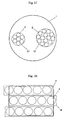
- FIG. 16 illustrates an arrangement of several tools, all of which rest tangentially on the surface.
- machining the surface is also possible and useful if the tools do not move.
- the tools are arranged so that the entire free-form surface is processed, which is the case in the example of FIG. 14.
- the individual tools can be mechanically bundled in a rod-shaped composite (18).
- round composites (17) are a way to combine individual tools (2). They are in the sense of tangential support of the tool especially on a round rotationally symmetric freeform surface (1) of advantage.
- the embodiment relates to an aspherical optical lens to be corrected by correction.
- the lens is measured interferometrically.
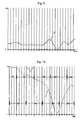
- FIG. 3 shows the error distribution measured before processing. Since the preceding polishing out of the lens, as can be seen very clearly in FIG. 3, already took place in a rotationally symmetrical manner, the errors present on the surface are distributed rotationally symmetrically. During which both the lens and the tool rotate, the tool travels from the edge of the lens radially along its perpendicular orientation to its surface towards the lens center ( Figure 4). The correction of the errors should be controlled along this path by the residence time.
- the error of the total measured area is first averaged to the radial average.
- the result is shown in Fig. 5 in curve 7.
- the inside 0, the beginning of the abscissa axis, the lens center, the right-most end of the lens edge. Only the surface defect with a peak to valley (pv) of approx. 1700 nm is shown.
- the entire method works on 130 interpolation points, which are expected to be used. For each point the virtual removal is known. Based on this, a dwell time is generated and used to control the Abtrages during processing. Each of these support points was generated with measured values of FIG. These 130 interpolation points in this example correspond to a distance of 20 mm.
- the virtual removal of the tool is calculated on the basis of a footprint for the entire surface.
- the radial working distance of 20 mm is divided into areas (Fig. 5).
- the tool has a width of 33 points, about 5 mm.
- the areas should have the width of the tool.
- a system of equations is now set up and solved, which reduces the error of the surface in this area by the influence estimated by the zero approximation of the adjacent areas (for B1: B2 / for B2: B1, B3 / for B3: B2, B4 / and for B4: B3) and the virtual removal at each of the 33 locations belonging to the area.
- the machining of the surface with this residence time control required 5.48 min.
- the radially averaged distribution of the surface after the correction is shown in FIG. 9 in curve 12. Between the points 0 and 70 an accuracy of better than 150 nm was achieved. From point 70 to the edge of the lens, a pv accuracy of pv 400 nm could be achieved.
- the predicted error distribution corresponds to small deviations in the amount of error distribution actually incurred after processing.
- the example shows that the method is capable of correcting difficult surface defects in an extremely short time when using large tools.
- a significant factor in the reduction of production time is the ability of the process to remove just enough of the material that only the actual defect is removed. With the methods used so far, much more removal was usually realized, so that the processing took much more time.
- Fig. 6 shows a curve 13, which illustrates how much removal is removed too much in such cases. The processing time would increase to 20 minutes in this case. It is also crucial that this result was achieved in just one processing run without repeated measuring and reworking.
- polishing or abrasive film material It is also possible to use tools with a polishing or abrasive film of, in particular, polyurethane, without bubbles and without indentations or other inhomogeneities, using polishing or abrasive film material.
- This tool can be provided with intentionally incorporated scratches with steep to vertical edges for better polishing and coolant supply, the scratches are large enough that they are not clogged with polishing or coolant.
- a tool arrangement which has a plurality of the freeform surface, with the exception of a planar surface, simultaneously working tools can be used such that the simultaneously machined surface is more than five percent of the freeform surface except the planar surface and the spherical surface.
- the existing accuracy can be maintained or improved during pre-polishing or polishing out of the free-form surface after grinding.
Landscapes
- Engineering & Computer Science (AREA)
- Mechanical Engineering (AREA)
- Grinding And Polishing Of Tertiary Curved Surfaces And Surfaces With Complex Shapes (AREA)
- Finish Polishing, Edge Sharpening, And Grinding By Specific Grinding Devices (AREA)
Claims (12)
- Procédé pour la rectification et le polissage de surfaces à forme libre (1, 4), notamment de surfaces optiques asphériques à symétrie de rotation telles que lentilles ou miroirs, au moyen d'un outil (2) ou de plusieurs outils (2), un enlèvement virtuel de matière d'une surface optique préalablement travaillée, de préférence dégrossie à la meule, étant préférentiellement calculé par mesure interférométrique et comparaison de la forme effective constatée avec la forme de consigne, la pression, les vitesses de rotation et la durée d'application ou la poursuite du mouvement de l'outil (2) ou des outils (2) étant commandées sur la base de l'enlèvement virtuel de matière et la superficie de la surface optique étant subdivisée en zones partielles à cet effet, caractérisé en ce qu'une approximation à l'ordre zéro est calculée pour la commande de l'outil (2) ou des outils (2), en ce que l'interaction des zones partielles entre elles est estimée à partir de l'approximation à l'ordre zéro, en ce qu'une courbe de temps d'application de l'outil (2) ou des outils (2) est calculée en tenant compte de l'interaction estimée pour chaque zone partielle, prenant en considération la pression, la vitesse de rotation et le comportement de polissage de l'outil (2) ou des outils (2) pour chaque zone partielle par système d'équations linéaires, et en ce que l'outil (2) ou les outils (2) sont commandés en conséquence.
- Procédé selon la revendication 1, caractérisé en ce que les zones partielles correspondent à la grandeur de l'outil (2) ou de l'un des outils (2).
- Procédé selon la revendication 1, caractérisé en ce que les zones partielles correspondent à deux fois la grandeur de l'outil (2) ou de l'un des outils (2).
- Procédé selon l'une des revendications 1 à 3, caractérisé en ce que la durée d'application de l'outil (2) ou de l'un des outils (2) est variable pour la commande d'enlèvement de matière.
- Procédé selon l'une des revendications 1 à 3, caractérisé en ce que la vitesse de rotation de l'outil ou d'un outil (2) est variable pour la commande d'enlèvement de matière.
- Procédé selon l'une des revendications 1 à 3, caractérisé en ce que la vitesse de rotation la pièce est variable pour la commande d'enlèvement de matière.
- Procédé selon l'une des revendications 1 à 3, caractérisé en ce que la pression de serrage de l'outil (2) ou de l'un des outils (2) est variable pour la commande d'enlèvement de matière.
- Procédé selon l'une des revendications 1 à 7, caractérisé en ce que seul l'enlèvement minimal de matière est déduit pour une correction de la surface.
- Procédé selon l'une des revendications 1 à 8 pour des surfaces à forme libre (1) à symétrie de rotation, en particulier lentilles ou miroirs asphériques, caractérisé en ce que l'enlèvement virtuel de matière est réduit à une forme unidimensionnelle, et ce que la lentille dégrossie à la meule, p. ex., est soumise à une rotation lors de la rectification et du polissage.
- Procédé selon l'une des revendications 1 à 9, caractérisé en ce que pour obtenir une précision souhaitée de forme de surface, il n'est procédé qu'une seule fois à la rectification et au polissage, ce qui ne nécessite qu'un temps d'usinage court, de quelque 10 minutes ou moins.
- Procédé selon l'une des revendications 1 à 9, caractérisé en ce qu'avec ou sans mesure postérieure préférentiellement interférométrique ou toute autre mesure postérieure, un nombre réduit de passes de rectification ou de polissage sont exécutées par des outils (2) à chaque fois plus petits, ce qui se traduit par une précision maximale et une économie de temps par rapport à une seule passe de rectification ou de polissage avec les outils (2) les plus petits.
- Procédé selon l'une des revendications 1 à 11, caractérisé en ce que les zones partielles ne se chevauchent pas ou se chevauchent au moins partiellement.
Applications Claiming Priority (3)
| Application Number | Priority Date | Filing Date | Title |
|---|---|---|---|
| DE10207379 | 2002-02-21 | ||
| DE10207379A DE10207379A1 (de) | 2002-02-21 | 2002-02-21 | Verfahren zum Schleifen und Polieren von Freiformflächen, insbesondere von rotationssymmetrischen asphärischen optischen Linsen |
| PCT/EP2003/001749 WO2003070427A2 (fr) | 2002-02-21 | 2003-02-20 | Procede de finition et de polissage de surfaces de forme libre, notamment de lentilles optiques aspheriques a symetrie de revolution |
Publications (2)
| Publication Number | Publication Date |
|---|---|
| EP1478490A2 EP1478490A2 (fr) | 2004-11-24 |
| EP1478490B1 true EP1478490B1 (fr) | 2006-10-25 |
Family
ID=27674822
Family Applications (1)
| Application Number | Title | Priority Date | Filing Date |
|---|---|---|---|
| EP03742562A Expired - Lifetime EP1478490B1 (fr) | 2002-02-21 | 2003-02-20 | Procede de finition et de polissage de surfaces de forme libre, notamment de lentilles optiques aspheriques a symetrie de revolution |
Country Status (6)
| Country | Link |
|---|---|
| US (1) | US20050215175A1 (fr) |
| EP (1) | EP1478490B1 (fr) |
| AT (1) | ATE343454T1 (fr) |
| AU (1) | AU2003215573A1 (fr) |
| DE (2) | DE10207379A1 (fr) |
| WO (1) | WO2003070427A2 (fr) |
Families Citing this family (9)
| Publication number | Priority date | Publication date | Assignee | Title |
|---|---|---|---|---|
| DE102004028470A1 (de) | 2004-06-11 | 2005-12-29 | Leica Microsystems (Schweiz) Ag | Augen-, insbesondere Retinaschutzvorrichtung und optisches Element mit einer Freiformfläche für einen Beleuchtungsstrahlengang, sowie Verwendung eines optischen Elements mit Freiformfläche |
| DE102007040395B4 (de) * | 2007-08-27 | 2010-03-11 | Optotech Optikmaschinen Gmbh | Vorrichtung zur blockfreien Fertigung von Ein- und Mehrstärkengläsern in der Rezeptfertigung |
| DE102009004787A1 (de) * | 2009-01-13 | 2010-07-15 | Schneider Gmbh & Co. Kg | Vorrichtung und Verfahren zum Polieren von Linsen |
| US20120301242A1 (en) * | 2011-05-24 | 2012-11-29 | Canon Kabushiki Kaisha | Method of manufacturing workpiece |
| US20140113525A1 (en) * | 2012-10-22 | 2014-04-24 | Apple Inc. | Methods for finishing surfaces using tool center point shift techniques |
| JP2016132077A (ja) * | 2015-01-21 | 2016-07-25 | 株式会社ナガセインテグレックス | 曲面研磨加工装置 |
| CN110352115A (zh) * | 2017-03-06 | 2019-10-18 | 应用材料公司 | 为cmp位置特定研磨(lsp)设计的螺旋及同心圆移动 |
| DE102017130797B4 (de) * | 2017-12-20 | 2022-06-09 | Leibniz-Institut für Oberflächenmodifizierung e.V. | Verfahren zur Erzeugung eines gewünschten Oberflächenprofils |
| CN111376142B (zh) * | 2019-12-25 | 2021-09-10 | 苏州大学 | 一种大口径非球面镜数控铣磨成形抛光方法及装置 |
Family Cites Families (5)
| Publication number | Priority date | Publication date | Assignee | Title |
|---|---|---|---|---|
| SU878530A1 (ru) * | 1979-02-09 | 1981-11-07 | Институт космических исследований АН СССР | Способ формообразовани оптических поверхностей |
| DE3430499C2 (de) * | 1984-08-18 | 1986-08-14 | Fa. Carl Zeiss, 7920 Heidenheim | Verfahren und Einrichtung zum Läppen oder Polieren von optischen Werkstücken |
| US4958463A (en) * | 1988-06-06 | 1990-09-25 | United Technologies Corporation | Optical surface quality improving arrangement |
| JP3587908B2 (ja) * | 1995-09-01 | 2004-11-10 | 株式会社トプコン | 研磨方法及び研磨装置 |
| AU1399600A (en) * | 1998-12-01 | 2000-06-19 | Optical Generics Limited | A polishing machine and method |
-
2002
- 2002-02-21 DE DE10207379A patent/DE10207379A1/de not_active Withdrawn
-
2003
- 2003-02-20 WO PCT/EP2003/001749 patent/WO2003070427A2/fr not_active Ceased
- 2003-02-20 AT AT03742562T patent/ATE343454T1/de not_active IP Right Cessation
- 2003-02-20 DE DE50305484T patent/DE50305484D1/de not_active Expired - Lifetime
- 2003-02-20 US US10/505,195 patent/US20050215175A1/en not_active Abandoned
- 2003-02-20 AU AU2003215573A patent/AU2003215573A1/en not_active Abandoned
- 2003-02-20 EP EP03742562A patent/EP1478490B1/fr not_active Expired - Lifetime
Also Published As
| Publication number | Publication date |
|---|---|
| WO2003070427A2 (fr) | 2003-08-28 |
| AU2003215573A1 (en) | 2003-09-09 |
| DE50305484D1 (de) | 2006-12-07 |
| ATE343454T1 (de) | 2006-11-15 |
| DE10207379A1 (de) | 2003-09-04 |
| US20050215175A1 (en) | 2005-09-29 |
| EP1478490A2 (fr) | 2004-11-24 |
| WO2003070427A3 (fr) | 2004-03-04 |
Similar Documents
| Publication | Publication Date | Title |
|---|---|---|
| DE102014204807B4 (de) | Verfahren und Vorrichtung zum Schleifen von Großkurbelwellen | |
| DE3881234T2 (de) | Verfahren und Vorrichtung zur Herstellung von verordneten Brillengläsern. | |
| WO2009023979A1 (fr) | Procédé et dispositif d'usinage de pièces | |
| EP2117774B1 (fr) | Procédé pour produire un verre de lunettes | |
| EP1478490B1 (fr) | Procede de finition et de polissage de surfaces de forme libre, notamment de lentilles optiques aspheriques a symetrie de revolution | |
| DE102014204528A1 (de) | Verfahren und Vorrichtung zum selektiven Laserschmelzen | |
| DE69624678T2 (de) | Formsteuerungsverfahren und numerisch gesteuerte maschine zur anwendung dieses verfahrens | |
| EP1409199B1 (fr) | Utilisation d'un dispositif pour l'usinage par abrasion de surfaces d'elements et notamment d'elements ou de pieces optiques | |
| DE3407615A1 (de) | Werkstueckspindel fuer eine maschine zur oberflaechenbehandlung | |
| WO2017093020A1 (fr) | Procédé de polissage d'une surface optique et élément optique | |
| DE4012660C2 (fr) | ||
| DE69715464T2 (de) | Verfahren und Vorrichtung zum konzentrischen Schleifen von zylindrischen Werkstückbereichen | |
| DE102016105717A1 (de) | Verfahren zur Herstellung rotationssymmetrischer, nicht zylindrischer Bohrungen mit einem Honwerkzeug | |
| DE19738818B4 (de) | Verfahren und Vorrichtung zur formgeregelten Feinstbearbeitung eines Werkstücks | |
| DE102023110601B3 (de) | Bearbeitungsvorrichtung und Verfahren zur formgebenden Bearbeitung von optischen Linsen durch Materialabtrag mit einer Vorbearbeitungsmaschine und einer Feinbearbeitungsmaschine | |
| DE69719459T2 (de) | Verfahren zur splitterlosen Bearbeitung des Randbereiches eines keramischen Vorformkörpers | |
| DE19756960B4 (de) | Verfahren zum Bearbeiten von rotationssymmetrischen Funktionsflächen | |
| DE69218530T2 (de) | Verfahren und Putzschleifmaschine | |
| DE102015120853B3 (de) | Verfahren und Vorrichtung zur Herstellung eines optischen Bauteils mit mindestens drei monolithisch angeordneten optischen Funktionsflächen und optisches Bauteil | |
| DE69704165T2 (de) | Verbesserungen in/oder bezüglich werkstückschleifen | |
| WO1989005711A1 (fr) | Procede de taillage de meules | |
| DE10306741B3 (de) | Verfahren und Vorrichtung zum maschinellen Abrauhen von abgenutzten Reifen | |
| DE2447490C2 (de) | Verfahren und Vorrichtung zum Herstellen von weichen Kontaktlinsen | |
| EP0563412A1 (fr) | Machine-outil à commande numérique avec interruption et reprise d'usinage | |
| EP4158589B1 (fr) | Procédé et système de production d'une pièce à partir d'une pièce coulée |
Legal Events
| Date | Code | Title | Description |
|---|---|---|---|
| PUAI | Public reference made under article 153(3) epc to a published international application that has entered the european phase |
Free format text: ORIGINAL CODE: 0009012 |
|
| 17P | Request for examination filed |
Effective date: 20040917 |
|
| AK | Designated contracting states |
Kind code of ref document: A2 Designated state(s): AT BE BG CH CY CZ DE DK EE ES FI FR GB GR HU IE IT LI LU MC NL PT SE SI SK TR |
|
| AX | Request for extension of the european patent |
Extension state: AL LT LV MK RO |
|
| GRAP | Despatch of communication of intention to grant a patent |
Free format text: ORIGINAL CODE: EPIDOSNIGR1 |
|
| GRAS | Grant fee paid |
Free format text: ORIGINAL CODE: EPIDOSNIGR3 |
|
| GRAA | (expected) grant |
Free format text: ORIGINAL CODE: 0009210 |
|
| AK | Designated contracting states |
Kind code of ref document: B1 Designated state(s): AT BE BG CH CY CZ DE DK EE ES FI FR GB GR HU IE IT LI LU MC NL PT SE SI SK TR |
|
| PG25 | Lapsed in a contracting state [announced via postgrant information from national office to epo] |
Ref country code: IT Free format text: LAPSE BECAUSE OF FAILURE TO SUBMIT A TRANSLATION OF THE DESCRIPTION OR TO PAY THE FEE WITHIN THE PRESCRIBED TIME-LIMIT;WARNING: LAPSES OF ITALIAN PATENTS WITH EFFECTIVE DATE BEFORE 2007 MAY HAVE OCCURRED AT ANY TIME BEFORE 2007. THE CORRECT EFFECTIVE DATE MAY BE DIFFERENT FROM THE ONE RECORDED. Effective date: 20061025 Ref country code: FI Free format text: LAPSE BECAUSE OF FAILURE TO SUBMIT A TRANSLATION OF THE DESCRIPTION OR TO PAY THE FEE WITHIN THE PRESCRIBED TIME-LIMIT Effective date: 20061025 Ref country code: NL Free format text: LAPSE BECAUSE OF FAILURE TO SUBMIT A TRANSLATION OF THE DESCRIPTION OR TO PAY THE FEE WITHIN THE PRESCRIBED TIME-LIMIT Effective date: 20061025 Ref country code: IE Free format text: LAPSE BECAUSE OF FAILURE TO SUBMIT A TRANSLATION OF THE DESCRIPTION OR TO PAY THE FEE WITHIN THE PRESCRIBED TIME-LIMIT Effective date: 20061025 Ref country code: SK Free format text: LAPSE BECAUSE OF FAILURE TO SUBMIT A TRANSLATION OF THE DESCRIPTION OR TO PAY THE FEE WITHIN THE PRESCRIBED TIME-LIMIT Effective date: 20061025 Ref country code: SI Free format text: LAPSE BECAUSE OF FAILURE TO SUBMIT A TRANSLATION OF THE DESCRIPTION OR TO PAY THE FEE WITHIN THE PRESCRIBED TIME-LIMIT Effective date: 20061025 Ref country code: CZ Free format text: LAPSE BECAUSE OF FAILURE TO SUBMIT A TRANSLATION OF THE DESCRIPTION OR TO PAY THE FEE WITHIN THE PRESCRIBED TIME-LIMIT Effective date: 20061025 |
|
| REG | Reference to a national code |
Ref country code: GB Ref legal event code: FG4D Free format text: NOT ENGLISH |
|
| REG | Reference to a national code |
Ref country code: CH Ref legal event code: EP |
|
| REG | Reference to a national code |
Ref country code: IE Ref legal event code: FG4D Free format text: LANGUAGE OF EP DOCUMENT: GERMAN |
|
| REF | Corresponds to: |
Ref document number: 50305484 Country of ref document: DE Date of ref document: 20061207 Kind code of ref document: P |
|
| PG25 | Lapsed in a contracting state [announced via postgrant information from national office to epo] |
Ref country code: BG Free format text: LAPSE BECAUSE OF FAILURE TO SUBMIT A TRANSLATION OF THE DESCRIPTION OR TO PAY THE FEE WITHIN THE PRESCRIBED TIME-LIMIT Effective date: 20070125 Ref country code: DK Free format text: LAPSE BECAUSE OF FAILURE TO SUBMIT A TRANSLATION OF THE DESCRIPTION OR TO PAY THE FEE WITHIN THE PRESCRIBED TIME-LIMIT Effective date: 20070125 Ref country code: SE Free format text: LAPSE BECAUSE OF FAILURE TO SUBMIT A TRANSLATION OF THE DESCRIPTION OR TO PAY THE FEE WITHIN THE PRESCRIBED TIME-LIMIT Effective date: 20070125 |
|
| PG25 | Lapsed in a contracting state [announced via postgrant information from national office to epo] |
Ref country code: ES Free format text: LAPSE BECAUSE OF FAILURE TO SUBMIT A TRANSLATION OF THE DESCRIPTION OR TO PAY THE FEE WITHIN THE PRESCRIBED TIME-LIMIT Effective date: 20070205 |
|
| PG25 | Lapsed in a contracting state [announced via postgrant information from national office to epo] |
Ref country code: MC Free format text: LAPSE BECAUSE OF NON-PAYMENT OF DUE FEES Effective date: 20070228 |
|
| PG25 | Lapsed in a contracting state [announced via postgrant information from national office to epo] |
Ref country code: PT Free format text: LAPSE BECAUSE OF FAILURE TO SUBMIT A TRANSLATION OF THE DESCRIPTION OR TO PAY THE FEE WITHIN THE PRESCRIBED TIME-LIMIT Effective date: 20070326 |
|
| NLV1 | Nl: lapsed or annulled due to failure to fulfill the requirements of art. 29p and 29m of the patents act | ||
| GBV | Gb: ep patent (uk) treated as always having been void in accordance with gb section 77(7)/1977 [no translation filed] |
Effective date: 20061025 |
|
| EN | Fr: translation not filed | ||
| REG | Reference to a national code |
Ref country code: IE Ref legal event code: FD4D |
|
| PLBE | No opposition filed within time limit |
Free format text: ORIGINAL CODE: 0009261 |
|
| STAA | Information on the status of an ep patent application or granted ep patent |
Free format text: STATUS: NO OPPOSITION FILED WITHIN TIME LIMIT |
|
| 26N | No opposition filed |
Effective date: 20070726 |
|
| PG25 | Lapsed in a contracting state [announced via postgrant information from national office to epo] |
Ref country code: GB Free format text: LAPSE BECAUSE OF FAILURE TO SUBMIT A TRANSLATION OF THE DESCRIPTION OR TO PAY THE FEE WITHIN THE PRESCRIBED TIME-LIMIT Effective date: 20061025 |
|
| BERE | Be: lapsed |
Owner name: ASPHERICON G.M.B.H. Effective date: 20070228 |
|
| PG25 | Lapsed in a contracting state [announced via postgrant information from national office to epo] |
Ref country code: BE Free format text: LAPSE BECAUSE OF NON-PAYMENT OF DUE FEES Effective date: 20070228 |
|
| PG25 | Lapsed in a contracting state [announced via postgrant information from national office to epo] |
Ref country code: FR Free format text: LAPSE BECAUSE OF FAILURE TO SUBMIT A TRANSLATION OF THE DESCRIPTION OR TO PAY THE FEE WITHIN THE PRESCRIBED TIME-LIMIT Effective date: 20070608 Ref country code: GR Free format text: LAPSE BECAUSE OF FAILURE TO SUBMIT A TRANSLATION OF THE DESCRIPTION OR TO PAY THE FEE WITHIN THE PRESCRIBED TIME-LIMIT Effective date: 20070126 |
|
| PG25 | Lapsed in a contracting state [announced via postgrant information from national office to epo] |
Ref country code: AT Free format text: LAPSE BECAUSE OF NON-PAYMENT OF DUE FEES Effective date: 20070220 |
|
| PG25 | Lapsed in a contracting state [announced via postgrant information from national office to epo] |
Ref country code: FR Free format text: LAPSE BECAUSE OF FAILURE TO SUBMIT A TRANSLATION OF THE DESCRIPTION OR TO PAY THE FEE WITHIN THE PRESCRIBED TIME-LIMIT Effective date: 20061025 |
|
| PG25 | Lapsed in a contracting state [announced via postgrant information from national office to epo] |
Ref country code: EE Free format text: LAPSE BECAUSE OF FAILURE TO SUBMIT A TRANSLATION OF THE DESCRIPTION OR TO PAY THE FEE WITHIN THE PRESCRIBED TIME-LIMIT Effective date: 20061025 |
|
| PG25 | Lapsed in a contracting state [announced via postgrant information from national office to epo] |
Ref country code: CY Free format text: LAPSE BECAUSE OF FAILURE TO SUBMIT A TRANSLATION OF THE DESCRIPTION OR TO PAY THE FEE WITHIN THE PRESCRIBED TIME-LIMIT Effective date: 20061025 Ref country code: LU Free format text: LAPSE BECAUSE OF NON-PAYMENT OF DUE FEES Effective date: 20070220 |
|
| PG25 | Lapsed in a contracting state [announced via postgrant information from national office to epo] |
Ref country code: HU Free format text: LAPSE BECAUSE OF FAILURE TO SUBMIT A TRANSLATION OF THE DESCRIPTION OR TO PAY THE FEE WITHIN THE PRESCRIBED TIME-LIMIT Effective date: 20070426 Ref country code: TR Free format text: LAPSE BECAUSE OF FAILURE TO SUBMIT A TRANSLATION OF THE DESCRIPTION OR TO PAY THE FEE WITHIN THE PRESCRIBED TIME-LIMIT Effective date: 20061025 |
|
| PGFP | Annual fee paid to national office [announced via postgrant information from national office to epo] |
Ref country code: CH Payment date: 20180221 Year of fee payment: 16 Ref country code: DE Payment date: 20171221 Year of fee payment: 16 |
|
| REG | Reference to a national code |
Ref country code: DE Ref legal event code: R119 Ref document number: 50305484 Country of ref document: DE |
|
| REG | Reference to a national code |
Ref country code: CH Ref legal event code: PL |
|
| PG25 | Lapsed in a contracting state [announced via postgrant information from national office to epo] |
Ref country code: LI Free format text: LAPSE BECAUSE OF NON-PAYMENT OF DUE FEES Effective date: 20190228 Ref country code: CH Free format text: LAPSE BECAUSE OF NON-PAYMENT OF DUE FEES Effective date: 20190228 |
|
| PG25 | Lapsed in a contracting state [announced via postgrant information from national office to epo] |
Ref country code: DE Free format text: LAPSE BECAUSE OF NON-PAYMENT OF DUE FEES Effective date: 20190903 |