EP1480603B1 - Verwendung von zuckerestern in kosmetischen zubereitungen - Google Patents
Verwendung von zuckerestern in kosmetischen zubereitungen Download PDFInfo
- Publication number
- EP1480603B1 EP1480603B1 EP03743314A EP03743314A EP1480603B1 EP 1480603 B1 EP1480603 B1 EP 1480603B1 EP 03743314 A EP03743314 A EP 03743314A EP 03743314 A EP03743314 A EP 03743314A EP 1480603 B1 EP1480603 B1 EP 1480603B1
- Authority
- EP
- European Patent Office
- Prior art keywords
- acid
- esters
- oil
- fatty
- sugar esters
- Prior art date
- Legal status (The legal status is an assumption and is not a legal conclusion. Google has not performed a legal analysis and makes no representation as to the accuracy of the status listed.)
- Expired - Lifetime
Links
Classifications
-
- A—HUMAN NECESSITIES
- A61—MEDICAL OR VETERINARY SCIENCE; HYGIENE
- A61Q—SPECIFIC USE OF COSMETICS OR SIMILAR TOILETRY PREPARATIONS
- A61Q19/00—Preparations for care of the skin
- A61Q19/08—Anti-ageing preparations
-
- A—HUMAN NECESSITIES
- A61—MEDICAL OR VETERINARY SCIENCE; HYGIENE
- A61K—PREPARATIONS FOR MEDICAL, DENTAL OR TOILETRY PURPOSES
- A61K31/00—Medicinal preparations containing organic active ingredients
- A61K31/70—Carbohydrates; Sugars; Derivatives thereof
- A61K31/7024—Esters of saccharides
-
- A—HUMAN NECESSITIES
- A61—MEDICAL OR VETERINARY SCIENCE; HYGIENE
- A61K—PREPARATIONS FOR MEDICAL, DENTAL OR TOILETRY PURPOSES
- A61K8/00—Cosmetics or similar toiletry preparations
- A61K8/18—Cosmetics or similar toiletry preparations characterised by the composition
- A61K8/30—Cosmetics or similar toiletry preparations characterised by the composition containing organic compounds
- A61K8/33—Cosmetics or similar toiletry preparations characterised by the composition containing organic compounds containing oxygen
- A61K8/37—Esters of carboxylic acids
-
- A—HUMAN NECESSITIES
- A61—MEDICAL OR VETERINARY SCIENCE; HYGIENE
- A61K—PREPARATIONS FOR MEDICAL, DENTAL OR TOILETRY PURPOSES
- A61K8/00—Cosmetics or similar toiletry preparations
- A61K8/18—Cosmetics or similar toiletry preparations characterised by the composition
- A61K8/30—Cosmetics or similar toiletry preparations characterised by the composition containing organic compounds
- A61K8/60—Sugars; Derivatives thereof
-
- A—HUMAN NECESSITIES
- A61—MEDICAL OR VETERINARY SCIENCE; HYGIENE
- A61P—SPECIFIC THERAPEUTIC ACTIVITY OF CHEMICAL COMPOUNDS OR MEDICINAL PREPARATIONS
- A61P17/00—Drugs for dermatological disorders
- A61P17/10—Anti-acne agents
-
- A—HUMAN NECESSITIES
- A61—MEDICAL OR VETERINARY SCIENCE; HYGIENE
- A61P—SPECIFIC THERAPEUTIC ACTIVITY OF CHEMICAL COMPOUNDS OR MEDICINAL PREPARATIONS
- A61P29/00—Non-central analgesic, antipyretic or antiinflammatory agents, e.g. antirheumatic agents; Non-steroidal antiinflammatory drugs [NSAID]
-
- A—HUMAN NECESSITIES
- A61—MEDICAL OR VETERINARY SCIENCE; HYGIENE
- A61Q—SPECIFIC USE OF COSMETICS OR SIMILAR TOILETRY PREPARATIONS
- A61Q17/00—Barrier preparations; Preparations brought into direct contact with the skin for affording protection against external influences, e.g. sunlight, X-rays or other harmful rays, corrosive materials, bacteria or insect stings
- A61Q17/005—Antimicrobial preparations
-
- A—HUMAN NECESSITIES
- A61—MEDICAL OR VETERINARY SCIENCE; HYGIENE
- A61Q—SPECIFIC USE OF COSMETICS OR SIMILAR TOILETRY PREPARATIONS
- A61Q17/00—Barrier preparations; Preparations brought into direct contact with the skin for affording protection against external influences, e.g. sunlight, X-rays or other harmful rays, corrosive materials, bacteria or insect stings
- A61Q17/04—Topical preparations for affording protection against sunlight or other radiation; Topical sun tanning preparations
-
- A—HUMAN NECESSITIES
- A61—MEDICAL OR VETERINARY SCIENCE; HYGIENE
- A61Q—SPECIFIC USE OF COSMETICS OR SIMILAR TOILETRY PREPARATIONS
- A61Q19/00—Preparations for care of the skin
-
- A—HUMAN NECESSITIES
- A61—MEDICAL OR VETERINARY SCIENCE; HYGIENE
- A61Q—SPECIFIC USE OF COSMETICS OR SIMILAR TOILETRY PREPARATIONS
- A61Q19/00—Preparations for care of the skin
- A61Q19/02—Preparations for care of the skin for chemically bleaching or whitening the skin
-
- A—HUMAN NECESSITIES
- A61—MEDICAL OR VETERINARY SCIENCE; HYGIENE
- A61Q—SPECIFIC USE OF COSMETICS OR SIMILAR TOILETRY PREPARATIONS
- A61Q7/00—Preparations for affecting hair growth
- A61Q7/02—Preparations for inhibiting or slowing hair growth
-
- A—HUMAN NECESSITIES
- A61—MEDICAL OR VETERINARY SCIENCE; HYGIENE
- A61K—PREPARATIONS FOR MEDICAL, DENTAL OR TOILETRY PURPOSES
- A61K2800/00—Properties of cosmetic compositions or active ingredients thereof or formulation aids used therein and process related aspects
- A61K2800/74—Biological properties of particular ingredients
- A61K2800/78—Enzyme modulators, e.g. Enzyme agonists
- A61K2800/782—Enzyme inhibitors; Enzyme antagonists
Definitions
- the invention is in the field of cosmetics and relates to the use of sugar esters as active ingredients for the production of skin and hair care products.
- active ingredients that are characterized by a complex profile of requirements: they are specifically designed to protect the skin, but also the hair protection against environmental toxins, oxidative stress and UV radiation, prevent wrinkles, anti-wrinkle inflammatory effective, but at the same time be particularly mild on the skin. Since the development and approval of such "multi-purpose cosmetic weapons" is always associated with a high expenditure of time and money, there is a particular interest in those active substances which are already known and authorized for use in cosmetics and pharmacy or for which a production method is described. however, their potential for active substances has not been known or has not been adequately researched so far.
- nonionic surfactants of the type of glycoside fatty acid esters in particular fatty acid esters with sucrose, commonly referred to as sugar esters, have particular importance for numerous applications, such as the production of emulsions for cosmetics, personal care products, because of their special skin compatibility, biodegradability and high emulsifying ability shampoos, hair sprays, toothpastes, lipsticks, mascaras and the like. Particularly extensive production and application of fatty acid esters of sucrose are described. There are also descriptions of the preparation and use of methyl glucose, fructose and trehalose. Their special mildness, their contribution to the moisture regulation of the skin and their use to reduce the irritation potential of anionic surfactants or AHA is described for example by Desai in Cosm. 105, p99-107 (1990 ), as well as in the JP 960224502 . EP 95904334 and JP 93168 described.
- WO 02/053121 describes cosmetic skin whitening agents which include glucose 3-5 acyl derivatives and / or sucrose 6-8 acyl derivatives having acyl groups of 3 to 6 carbon atoms.
- the skin whitening properties are particularly noteworthy for glucose penta-isovalerate.
- the object of the present invention has therefore been to identify those glycoside fatty acid esters which are suitable as active ingredients for non-therapeutic, cosmetic use for inhibiting melanin synthesis in hair and hentzellen.
- the invention is the claim 1 insert
- sugar esters which have been known for many years as emulsifiers for foods, cosmetics and pharmaceutical preparations, have an extensive profile as an active ingredient even in the smallest concentrations.
- the subject of the invention therefore relates to their use.
- sugar esters can be used outstandingly for inhibiting hair growth. They reduce the cell proliferation of human keratinocytes and reduce the growth and development of hair follicles.
- depilatory agents particularly on the legs, armpits or face, makes the use of agents that reduce the rate of hair growth attractive, since the intervals of partially painful mechanical depilation can thus be increased.
- Glycoside fatty acid esters enhance the potential of the cells against oxidative stress and environmental toxins.
- the measurement of cell protective (against oxidation or heavy metals such as lead) glutathione (GSH) in human fibroblasts contaminated with UV-A radiation showed a marked improvement in the GSH level after treatment with monosaccharide or disaccharide fatty acid esters.
- the sugar esters also protect human keratinocytes from the damaging influence of UV-B radiation - measurable in reducing LDH release and have an anti-inflammatory effect, which is expressed in a reduction of excreted PGE2.
- monosaccharide fatty acid esters show significant inhibition of the respiratory burst effect, a release of reactive oxygen radicals involved in the inflammatory response.
- sugar esters cause inhibition of protease activity, in particular collagenase activity. It is known that the activity of collagenase increases with increasing age.
- Sugar esters can therefore be used to advantage against skin aging. The use against cell aging by UV radiation, oxidative stress or environmental toxins, which lead to an increased collagenase activity, thus offers itself.
- sugar esters can therefore be advantageous for the protection of skin and hair follicles against inflammation, sunburn, radiation damage, oxidative stress, Environmental toxins and skin aging are used especially in sensitive skin and scalp.
- Lant invention has been shown that sugar esters reduce the melanin synthesis in B16 melanocytes, so that the application as a skin whitening agent is obvious.
- Propionibacterium acnes and Staphylococcus epidermidis lead to the known skin changes in acne.
- Propionibacterium acnes causes increased Komedonenbldung and supports inflammatory reactions.
- glycoside fatty acid esters are not only effective against Staphylococcus epidermidis, but also suppress gram-negative bacteria such as Propionibacterium acnes and thus contribute significantly to the anti-inflammatory effect in acne.
- Sugar esters are known nonionic surfactants which are obtainable by the relevant methods of preparative organic chemistry, for example by transesterification of fatty acid methyl esters with the corresponding sugars or by enzymatic means, as described, for example, in the international patent application WO 99/02722 (Laboratoires Sérobiologiques). Sugar esters with various glycoside and acyl components are commercially available, for example from Sisterna or Ryoto. Typical examples of suitable sugar esters are shown in the following figure: In principle, sugar esters are suitable which are derived from mono- or disaccharides.
- aldohexoses eg glucose, methyl glucose, mannose, galactose
- Deoxyaldoses eg, rhamnose, fucose, deoxyribose
- Aldopentoses eg ribose, arabinose, xylose
- Ketoses eg, fructose in pyranosyl or furanosyl form
- disaccharide eg trehalose, sucrose, maltose, isomaltose, cellobiose, melibiose, gentobiose, lactose
- fructose-glucose, trehalose and / or sucrose esters are used, of which in particular fructose esters are preferred.
- the acyl moiety of the esters may be derived from fatty acids of formula (I) , R 1 CO-OH (I) in which R 1 CO is a linear or branched, saturated or unsaturated acyl or hydroxyacyl radical having 6 to 22, preferably 8 to 16 carbon atoms and 0 and / or 1 to 3 double bonds.
- Typical examples are sugar esters of caproic acid, 2-hydroxycaproic acid, 6-hydroxycaproic acid, caprylic acid, 2-ethylhexanoic acid, capric acid, 10-hydroxycapric acid, lauric acid, 12-hydroxylauric acid, isotridecanoic acid, myristic acid, palmitic acid, palmitoleic acid, 16-hydroxypalmitic acid, stearic acid, isostearic acid, oleic acid , Elaidic acid, petroselinic acid, linoleic acid, linolenic acid, elaeostearic acid, 12-hydroxystearic acid, ricinoleic acid, arachidic acid, gadoleic acid, behenic acid and erucic acid and their technical mixtures.
- the esters can have from 1 to 8 ester groups; However, preferably those products are used which have a degree of esterification of on average 1 to 6 and in particular 1.5 to 2.5.
- the sugar esters are used according to the invention for the production of cosmetic and / or pharmaceutical preparations such as hair shampoos, hair lotions, bubble baths, shower baths, creams, gels, lotions, alcoholic and aqueous / alcoholic solutions, emulsions, wax / fat compounds, stick preparations, powders or ointments in which they are present in amounts of 0.0001 to 10, preferably 0.001 to 5 and in particular 0.01 to 1 wt .-% - based on the means - are included.
- cosmetic and / or pharmaceutical preparations such as hair shampoos, hair lotions, bubble baths, shower baths, creams, gels, lotions, alcoholic and aqueous / alcoholic solutions, emulsions, wax / fat compounds, stick preparations, powders or ointments in which they are present in amounts of 0.0001 to 10, preferably 0.001 to 5 and in particular 0.01 to 1 wt .-% - based on the means - are included.
- agents can also be used as further auxiliaries and mild surfactants, oil bodies, emulsifiers, pearlescent waxes, bodying agents, thickeners, superfatting agents, stabilizers, polymers, silicone compounds, fats, waxes, Lecithins, phospholipids, biogenic agents, UV protection factors, antioxidants, deodorants, antiperspirants, antidandruff agents, film formers, swelling agents, insect repellents, self-tanning agents, tyrosine inhibitors (depigmenting agents), hydrotropes, solubilizers, preservatives, perfume oils, dyes and the like.
- mild surfactants oil bodies, emulsifiers, pearlescent waxes, bodying agents, thickeners, superfatting agents, stabilizers, polymers, silicone compounds, fats, waxes, Lecithins, phospholipids, biogenic agents, UV protection factors, antioxidants, deodorants, antiperspirants, antidandruff agents, film formers, swelling agents
- sugar esters themselves have emulsifying, surface-active and moisturizing properties, they can also be used in part without additives of other surface-active surfactants or emulsifiers.
- Surfactants which may be present are anionic, nonionic, cationic and / or amphoteric or zwitterionic surfactants, the proportion of which in the compositions is usually from about 1 to 70, preferably from 5 to 50, and in particular from 10 to 30,% by weight.
- anionic surfactants are soaps, alkylbenzenesulfonates, alkanesulfonates, olefinsulfonates, alkyl ether sulfonates, glycerol ether sulfonates, ⁇ -methyl ester sulfonates, sulfo fatty acids, alkyl sulfates, fatty alcohol ether sulfates, glycerol ether sulfates, fatty acid ether sulfates, hydroxy mixed ether sulfates, monoglyceride (ether) sulfates, fatty acid amide (ether) sulfates, mono- and dialkyl sulfosuccinates , Mono- and dialkylsulfosuccinamates, sulfotriglycerides, amide soaps, ether carboxylic acids and their salts, fatty acid isethionates, fatty acid sarcosinates,
- anionic surfactants contain polyglycol ether chains, these may have a conventional, but preferably a narrow homolog distribution.
- Typical examples of nonionic surfactants are fatty alcohol polyglycol ethers, alkylphenol polyglycol ethers, fatty acid polyglycol ethers, fatty acid amide polyglycol ethers, fatty amine polyglycol ethers, alkoxylated triglycerides, mixed ethers, optionally partially oxidized alk (en) yloligoglycosides or glucuronic acid derivatives, fatty acid N-alkylglucamides, protein hydrolysates (especially wheat-based vegetable products).
- Nonionic surfactants contain polyglycol ether chains, these may have a conventional, but preferably a narrow homolog distribution.
- Typical examples of cationic surfactants are quaternary ammonium compounds such as dimethyl distearyl ammonium chloride, and ester quats, especially quaternized fatty acid trialkanolamine ester salts.
- Typical examples of amphoteric or zwitterionic surfactants are alkylbetaines, alkylamidobetaines, aminopropionates, aminoglycinates, imidazolinium betaines and sulfobetaines.
- Typical examples of particularly suitable mild, ie particularly skin-friendly surfactants are fatty alcohol polyglycol ether sulfates, monoglyceride sulfates, mono- and / or dialkyl sulfosuccinates, fatty acid isethionates, fatty acid sarcosinates, fatty acid taurides, fatty acid glutamates, ⁇ -olefinsulfonates, ethercarboxylic acids, alkyloligoglucosides, fatty acid glucamides, alkylamidobetaines, amphoacetals and / or protein fatty acid condensates, the latter preferably based on wheat proteins.
- oil bodies are Guerbet alcohols based on fatty alcohols having 6 to 18, preferably 8 to 10 carbon atoms, esters of linear C 6 -C 22 fatty acids with linear or branched C 6 -C 22 fatty alcohols or esters of branched C 6 -C 13 -carboxylic acids with linear or branched C 6 -C 22 -fatty alcohols, such as myristyl myristate, myristyl palmitate, myristyl stearate, Myristylisostearat, myristyl, Myristylbehenat, Myristylerucat, cetyl myristate, cetyl palmitate, cetyl stearate, Cetylisostearat, cetyl oleate, cetyl behenate, Cetylerucat, Stearylmyristat, stearyl palmitate, stearyl stearate , Stearylisostearat, stearyl oleate, ste
- esters of linear C 6 -C 22 -fatty acids with branched alcohols in particular 2-ethylhexanol, esters of C 18 -C 38 -alkylhydroxycarboxylic acids with linear or branched C 6 -C 22 fatty alcohols, in particular dioctyl malates, esters of linear and / or branched fatty acids with polyhydric alcohols (such as propylene glycol, dimerdiol or trimer triol) and / or Guerbet alcohols, triglycerides based on C 6 -C 10 fatty acids, liquid mono- / di- / triglyceride mixtures based on C 6 -C 18 - Fatty acids, esters of C 6 -C 22 fatty alcohols and / or Guerbet alcohols with aromatic carboxylic acids, in particular benzoic acid, esters of C 2 -C 12 dicarboxylic acids with linear or branched alcohols having 1 to 22 carbon atom
- the addition products of ethylene oxide and / or of propylene oxide to fatty alcohols, fatty acids, alkylphenols or castor oil are known, commercially available products. These are mixtures of homologues whose mean degree of alkoxylation corresponds to the ratio of the amounts of ethylene oxide and / or propylene oxide and substrate, with which the addition reaction is carried out corresponds. C 12/18 fatty acid monoesters and diesters of addition products of ethylene oxide onto glycerol are known as refatting agents for cosmetic preparations.
- Alkyl and / or alkenyl oligoglycosides their preparation and their use are known from the prior art. They are prepared in particular by reacting glucose or oligosaccharides with primary alcohols having 8 to 18 carbon atoms.
- the glycoside radical both monoglycosides in which a cyclic sugar residue is glycosidically linked to the fatty alcohol and oligomeric glycosides having a degree of oligomerization of preferably approximately 8 are suitable.
- the degree of oligomerization is a statistical mean, which is based on a homolog distribution typical for such technical products.
- Suitable partial glycerides are hydroxystearic hydroxystearic acid diglyceride, isostearic acid, Isostearinklarediglycerid monoglyceride, oleic acid diglyceride, Ricinolklaremoglycerid, Ricinolklarediglycerid, Linolklaremonoglycerid, Linolklarediglycerid, Linolenchuremonoglycerid, Linolenchurediglycerid, Erucaklaklamonoglycerid, Erucakladrediglycerid, Weinchuremonoglycerid, Weinklarediglycerid, Citronenklamonoglycerid, Citronendiglycerid, ⁇ pfelklamonoglycerid, malic acid diglyceride and technical mixtures thereof, which may contain minor amounts of triglyceride from the manufacturing process. Also suitable addition products of 1 to 30, preferably 5 to 10 moles of ethylene oxide to said Partialglyceride
- sorbitan sorbitan As sorbitan sorbitan, sorbitan sesquiisostearate, Sorbitan, sorbitan triisostearate, sorbitan monooleate, sorbitan, sorbitan, Sorbitanmonoerucat, Sorbitansesquierucat, Sorbitandierucat, Sorbitantrierucat, Sorbitanmonoricinoleat, Sorbitansesquiricinoleat, Sorbitandiricinoleat, Sorbitantriricinoleat, Sorbitanmonohydroxystearat, Sorbitansesquihydroxystearat, Sorbitandihydroxystearat, Sorbitantrihydroxystearat, Sorbitanmonotartrat, Sorbitansesquitartrat, Sorbitanditartrat, Sorbitantritartrat come , Sorbitan monocitrate, sorbitan siccitrate, sorbitan di-citrate, sorbit
- polyglycerol esters are polyglyceryl-2 dipolyhydroxystearates (Dehymuls® PGPH), polyglycerol-3-diisostearates (Lameform® TGI), polyglyceryl-4 isostearates (Isolan® GI 34), polyglyceryl-3 oleates, diisostearoyl polyglyceryl-3 diisostearates (Isolan ® PDI), Polyglyceryl-3 Methylglucose Distearate (Tego Care® 450), Polyglyceryl-3 Beeswax (Cera Bellina®), Polyglyceryl-4 Caprate (Polyglycerol Caprate T2010 / 90), Polyglyceryl-3 Cetyl Ether (Chimexane® NL), Polyglyceryl -3 distearates (Cremophor® GS 32) and polyglyceryl polyricinoleates (Admul® WOL 1403) polyglyceryl dim
- polystyrene resin examples include the mono-, di- and triesters of trimethylolpropane or pentaerythritol with lauric acid, coconut fatty acid, tallow fatty acid, palmitic acid, stearic acid, oleic acid, behenic acid and the like, which are optionally reacted with from 1 to 30 mol of ethylene oxide.
- Typical anionic emulsifiers are aliphatic fatty acids having 12 to 22 carbon atoms, such as palmitic acid, stearic acid or behenic acid, and dicarboxylic acids with 12 to 22 carbon atoms, such as azelaic acid or sebacic acid.
- Particularly suitable zwitterionic surfactants are the so-called betaines such as the N-alkyl-N, N-dimethylammoniumglycinate, for example Kokosalkyldimethylammoniumglycinat, N-acylaminopropyl-N, N-dimethylammoniumglycinate, for example Kokosacylaminopropyldimethyl-ammoniumglycinat, and 2-alkyl-3-carboxylmethyl-3 -hydroxyethylimidazolines each having 8 to 18 carbon atoms in the alkyl or acyl group and cocoacylaminoethylhydroxyethylcarboxymethylglycinate.
- betaines such as the N-alkyl-N, N-dimethylammoniumglycinate, for example Kokosalkyldimethylammoniumglycinat, N-acylaminopropyl-N, N-dimethylammoniumglycinate, for example Kokosacyla
- fatty acid amide derivative known under the CTFA name Cocamidopropyl Betaine .
- ampholytic surfactants are understood as meaning those surface-active compounds which, apart from a C 8/18 -alkyl or acyl group in the molecule, contain at least one free amino group and at least one -COOH or -SO 3 H group and are capable of forming internal salts.
- ampholytic surfactants are N-alkylglycines, N-alkylpropionic acids, N-alkylaminobutyric acids, N-alkyliminodipropionic acids, N-hydroxyethyl-N-alkylamidopropylglycines, N-alkyltaurines, N-alkylsarcosines, 2-alkylaminopropionic acids and alkylaminoacetic acids each having about 8 to 18 C-atoms in the alkyl group.
- Particularly preferred ampholytic surfactants are N-cocoalkylaminopropionate, cocoacylaminoethylaminopropionate and C 12/18 -acylsarcosine.
- cationic surfactants are also suitable as emulsifiers, those of the esterquat type, preferably methyl-quaternized difatty acid triethanolamine ester salts, being particularly preferred.
- Typical examples of fats are glycerides, ie solid or liquid vegetable or animal products consisting essentially of mixed glycerol esters of higher fatty acids
- waxes include natural waxes such as candelilla wax, carnauba wax, Japan wax, esparto wax, cork wax, guaruma wax, rice germ oil wax, sugarcane wax , Ouricury wax, montan wax, beeswax, shellac wax, spermaceti, lanolin (wool wax), Raffia fat, ceresin, ozokerite (earth wax), petrolatum, paraffin waxes, microwaxes; chemically modified waxes (hard waxes), such as montan ester waxes, Sasol waxes, hydrogenated jojoba waxes and synthetic waxes, such as polyalkylene waxes and polyethylene glycol waxes in question.
- natural waxes such as candelilla wax, carnauba wax, Japan wax,
- phospholipids are usually understood as meaning mono- and preferably diesters of phosphoric acid with glycerol (glycerol phosphates), which are generally regarded as fats.
- glycerol phosphates glycerol phosphates
- sphingosines or sphingolipids are also suitable.
- Suitable pearlescing waxes are, for example: alkylene glycol esters, especially ethylene glycol distearate; Fatty acid alkanolamides, especially coconut fatty acid diethanolamide; Partial glycerides, especially stearic acid monoglyceride; Esters of polybasic, optionally hydroxy-substituted carboxylic acids with fatty alcohols having 6 to 22 carbon atoms, especially long-chain esters of tartaric acid; Fatty substances, such as fatty alcohols, fatty ketones, fatty aldehydes, fatty ethers and fatty carbonates, which in total have at least 24 carbon atoms, especially lauron and distearyl ether; Fatty acids such as stearic acid, hydroxystearic acid or behenic acid, ring-opening products of olefin epoxides having 12 to 22 carbon atoms with fatty alcohols having 12 to 22 carbon atoms and / or polyols having 2 to 15 carbon atoms
- fatty alcohols or hydroxy fatty alcohols having 12 to 22 and preferably 16 to 18 carbon atoms and in addition partial glycerides, fatty acids or hydroxy fatty acids into consideration. Preference is given to a combination of these substances with alkyl oligoglucosides and / or fatty acid N-methylglucamides of the same chain length and / or polyglycerol poly-12-hydroxystearates.
- Suitable thickening agents are, for example, Aerosil types (hydrophilic silicic acids), polysaccharides, in particular xanthan gum, guar guar, agar agar, alginates and tyloses, carboxymethyl cellulose and hydroxyethyl and hydroxypropyl cellulose, also higher molecular weight polyethylene glycol mono- and diesters of fatty acids, polyacrylates, (eg Carbopole® and Pemulen types from Goodrich; Synthalene® from Sigma; Keltrol types from Kelco; Sepigel types from Seppic; Salcare types from Allied Colloids), polyacrylamides, Polymers, polyvinyl alcohol and polyvinylpyrrolidone.
- Aerosil types hydrophilic silicic acids
- polysaccharides in particular xanthan gum, guar guar, agar agar, alginates and tyloses, carboxymethyl cellulose and hydroxyethyl and hydroxypropyl cellulose
- Bentonites such as Bentone® Gel VS-5PC (Rheox), which is a mixture of cyclopentasiloxane, disteardimonium hectorite and propylene carbonate, have also proven to be particularly effective.
- surfactants such as, for example, ethoxylated fatty acid glycerides, esters of fatty acids with polyols, for example pentaerythritol or trimethylolpropane, fatty alcohol ethoxylates with narrow homolog distribution or alkyl oligoglucosides and also electrolytes, such as common salt and ammonium chloride.
- substances such as lanolin and lecithin as well as polyethoxylated or acylated lanolin and lecithin derivatives, polyol fatty acid esters, monoglycerides and fatty acid alkanolamides can be used, the latter also serving as foam stabilizers.
- metal salts of fatty acids e.g. Magnesium, aluminum and / or zinc stearate or ricinoleate can be used.
- Suitable cationic polymers are, for example, cationic cellulose derivatives, such as, for example, a quaternized hydroxyethylcellulose which is obtainable under the name Polymer JR 400® from Amerchol, cationic starch, copolymers of diallylammonium salts and acrylamides, quaternized vinylpyrrolidone / vinylimidazole polymers, such as, for example, Luviquat® (BASF) , Condensation products of polyglycols and amines, quaternized collagen polypeptides such as lauryldimonium hydroxypropyl hydrolyzed collagen (Lamequat®L / Grünau), quaternized wheat polypeptides, polyethylenimine, cationic silicone polymers such as amodimethicones, copolymers of adipic acid and dimethylaminohydroxypropyldiethylenetriamine (Cartaretine® / Sandoz), copolymers of Acrylic acid
- anionic, zwitterionic, amphoteric and nonionic polymers are vinyl acetate / crotonic acid copolymers, vinylpyrrolidone / vinyl acrylate copolymers, vinyl acetate / butyl maleate / isobornyl acrylate copolymers, methyl vinyl ether / maleic anhydride copolymers and their esters, uncrosslinked polyols crosslinked with polyols, acrylamidopropyltrimethylammonium chloride / acrylate -Copolymers, octylacrylamide / methyl methacrylate / tert.Butylaminoethylmethacrylat / 2-hydroxypropyl methacrylate copolymers, polyvinylpyrrolidone, vinylpyrrolidone / vinyl acetate copolymers, vinylpyrrolidone / dimethylaminoethyl methacrylate / vinylcaprolactam terpolymers
- Suitable silicone compounds are, for example, dimethylpolysiloxanes, methylphenylpolysiloxanes, cyclic silicones and amino, fatty acid, alcohol, polyether, epoxy, fluorine, glycoside and / or alkyl-modified silicone compounds which may be both liquid and resin-form at room temperature.
- simethicones which are mixtures of dimethicones having an average chain length of from 200 to 300 dimethylsiloxane units and hydrogenated silicates.
- UV sunscreen and antioxidants UV sunscreen and antioxidants
- UV-A filter in particular derivatives of benzoylmethane are suitable, such as 1- (4'-tert-butylphenyl) -3- (4'-methoxyphenyl) propane-1,3-dione, 4-tert-butyl 4'-methoxydibenzoylmethane (Parsol® 1789), 1-phenyl-3- (4'-isopropylphenyl) -propane-1,3-dione and enamine compounds.
- the UV-A and UV-B filters can also be used in mixtures.
- Particularly favorable combinations consist of the derivatives of benzoylmethane "eg 4-tert-butyl-4'-methoxydibenzoylmethane (Parsol® 1789) and 2-cyano-3,3-phenylcinnamic acid 2-ethylhexyl ester (octocrylene) in combination with ester cinnamic acid, preferably 4-methoxycinnamic acid 2-ethylhexyl ester and / or 4-methoxycinnamic acid propyl ester and / or 4-methoxycinnamic acid isoamyl ester,
- water-soluble filters such as, for example, 2-phenylbenzimidazole-5-sulfonic acid and its alkali metal, alkaline earth metal, ammonium , Alkylammonium, alkanolammonium and glucammonium salts combined.
- insoluble photoprotective pigments namely finely dispersed metal oxides or salts
- suitable metal oxides are in particular zinc oxide and titanium dioxide and, in addition, oxides of iron, zirconium, silicon, manganese, aluminum and cerium and mixtures thereof.
- salts silicates (talc), barium sulfate or zinc stearate can be used.
- the oxides and salts are used in the form of the pigments for skin-care and skin-protecting emulsions and decorative cosmetics.
- the particles should have an average diameter of less than 100 nm, preferably between 5 and 50 nm and in particular between 15 and 30 nm.
- the pigments may have a spherical shape, but it is also possible to use those particles which have an ellipsoidal or otherwise deviating shape from the spherical shape.
- the pigments can also be surface treated, i. hydrophilized or hydrophobized. Typical examples are coated titanium dioxides, e.g. Titanium dioxide T 805 (Degussa) or Eusolex® T2000 (Merck). Suitable hydrophobic coating agents are in particular silicones and in particular trialkoxyoctylsilanes or simethicones. In sunscreens, so-called micro- or nanopigments are preferably used. Preferably, micronized zinc oxide is used.
- secondary light stabilizers of the antioxidant type which interrupt the photochemical reaction chain which is triggered when UV radiation penetrates into the skin.
- Typical examples are amino acids (eg glycine, histidine, tyrosine, tryptophan) and their derivatives, imidazoles (eg urocaninic acid) and their derivatives, peptides such as D, L-carnosine, D-carnosine, L-carnosine and their derivatives (eg anserine) , Carotenoids, carotenes (eg ⁇ -carotene, ⁇ -carotene, lycopene) and their derivatives, chlorogenic acid and its derivatives, lipoic acid and its derivatives (eg dihydrolipoic acid), aurothioglucose, propylthiouracil and other thiols (eg thioredoxin, glutathione, cysteine, cystine, Cy
- biogenic active substances include tocopherol, tocopherol acetate, tocopherol palmitate, ascorbic acid, (deoxy) ribonucleic acid and their fragmentation products, ⁇ -glucans, retinol, bisabolol, allantoin, phytantriol, panthenol, AHA acids, amino acids, ceramides, pseudoceramides, essential oils, plant extracts, such as Prunus extract, Bambaranussex Install and vitamin complexes to understand.
- deodorants counteract, cover or eliminate body odors. Body odors are caused by the action of skin bacteria on apocrine sweat, forming unpleasant-smelling degradation products. Accordingly, deodorants contain active ingredients which act as anti-sprouting agents, enzyme inhibitors, odor absorbers or odor maskers.
- germ-inhibiting agents are basically all effective against Gram-positive bacteria substances such. 4-hydroxybenzoic acid and its salts and esters, N- (4-chlorophenyl) -N '- (3,4-dichlorophenyl) urea, 2,4,4'-trichloro-2'-hydroxy-diphenyl ether (triclosan), 4 Chloro-3,5-dimethyl-phenol, 2,2'-methylene-bis (6-bromo-4-chlorophenol), 3-methyl-4- (1-methylethyl) -phenol, 2-benzyl-4-chlorophenol , 3- (4-chlorophenoxy) -1,2-propanediol, 3-iodo-2-propynyl butylcarbamate, chlorhexidine, 3,4,4'-trichlorocarbanilide (TTC), antibacterial fragrances, thymol, thyme oil, eugenol, clove oil, menthol, Mint oil, farnesol,
- esterase inhibitors are suitable as enzyme inhibitors.
- These are preferably trialkyl citrates such as trimethyl citrate, tripropyl citrate, triisopropyl citrate, tributyl citrate and in particular triethyl citrate (Hydagen® CAT).
- the substances inhibit the enzyme activity and thereby reduce odors.
- Suitable odor absorbers are substances that absorb and largely retain odor-forming compounds. They reduce the partial pressure of the individual components and thus also reduce their propagation speed. It is important that perfumes must remain undisturbed. Odor absorbers have no activity against bacteria. They contain, for example, as a main component of a complex zinc salt of ricinoleic acid or special, largely odorless fragrances, which are known in the art as "fixatives", such. B. Extracts of Labdanum or Styrax or certain Abietinklarivate. Odor maskers are fragrances or perfume oils which, in addition to their function as odor maskers, give the deodorants their respective scent. Examples of perfume oils are mixtures of natural and synthetic fragrances.
- Natural fragrances are extracts of flowers, stems and leaves, fruits, fruit peel, roots, woods, herbs and grasses, needles and twigs, as well as resins and balsams. Furthermore, animal raw materials come into question, such as civet and Castoreum.
- Typical synthetic fragrance compounds are ester type products, ethers, aldehydes, ketones, alcohols and hydrocarbons.
- Fragrance compounds of the ester type are, for example, benzyl acetate, p-tert-butylcyclohexyl acetate, linalyl acetate, phenylethyl acetate, linalyl benzoate, Benzyl formate, allyl cyclohexyl propionate, styrallyl propionate and benzyl salicylate.
- the ethers include, for example, benzyl ethyl ether, to the aldehydes, for example, the linear alkanals having 8 to 18 carbon atoms, citral, citronellal, citronellyloxyacetaldehyde, cyclamen aldehyde, hydroxycitronellal, lilial and bourgeonal, to the ketones such as the ionone and methylatedryl ketone to the alcohols anethole, citronellol, Eugenol, isoeugenol, geraniol, linalool, phenylethyl alcohol and terpineol, the hydrocarbons mainly include the terpenes and balsams.
- fragrance oils are suitable as perfume oils, eg sage oil, chamomile oil, clove oil, lemon balm oil, mint oil, cinnamon oil, lime blossom oil, juniper berry oil, vetiver oil, oliban oil, galbanum oil, labdanum oil and lavandin oil.
- bergamot oil dihydromyrcenol, lilial, lyral, citronellol, phenylethyl alcohol, ⁇ -hexylcinnamaldehyde, geraniol, benzylacetone, cyclamen aldehyde, linalool, Boisambrene Forte, Ambroxan, indole, hedione, Sandelice, citron oil, tangerine oil, orange oil, Allylamylglycolat, Cyclovertal, Lavandinöl, Muskateller Sage oil, ⁇ -damascone, geranium oil Bourbon, cyclohexyl salicylate, Vertofix Coeur, Iso-E-Super, fixolide NP, evernyl, iraldeine gamma, phenylacetic acid, geranyl acetate, benzyl acetate, rose oxide, romilate, iroty
- Usual water-soluble additives are e.g. Preservatives, water-soluble fragrances, pH adjusters, e.g. Buffer mixtures, water-soluble thickeners, e.g. water-soluble natural or synthetic polymers such as e.g. Xanthan gum, hydroxyethyl cellulose, polyvinyl pyrrolidone or high molecular weight polyethylene oxides.
- Typical film formers are, for example, chitosan, microcrystalline chitosan, quaternized chitosan, polyvinylpyrrolidone, vinylpyrrolidone-vinyl acetate copolymers, polymers of the acrylic acid series, quaternary cellulose derivatives, collagen, hyaluronic acid or salts thereof and similar compounds.
- Suitable swelling agents for aqueous phases are montmorillonites, clay minerals, pemulen and alkyl-modified carbopol types (Goodrich).
- Suitable insect repellents are N, N-diethyl-m-toluamide, 1,2-pentanediol or ethyl butylacetylaminopropionate
- Suitable preservatives are, for example, phenoxyethanol, formaldehyde solution, parabens, pentanediol or sorbic acid and the silver complexes known under the name Surfacine® and the further classes of compounds listed in Appendix 6, Parts A and B of the Cosmetics Regulation.
- Natural fragrances are extracts of flowers (lily, lavender, roses, jasmine, neroli, ylang-ylang), stems and leaves (geranium, patchouli, petitgrain), fruits (aniseed, coriander, caraway, juniper), fruit peel (bergamot, lemon, Oranges), roots (macis, angelica, celery, cardamom, costus, iris, calmus), wood (pine, sandal, guaiac, cedar, rosewood), herbs and grasses (tarragon, lemongrass, sage, thyme), Needles and twigs (spruce, fir, pine, pines), resins and balsams (galbanum, elemi, benzoin, myrrh, olibanum, opoponax).
- Typical synthetic fragrance compounds are ester type products, ethers, aldehydes, ketones, alcohols and hydrocarbons. Fragrance compounds of the ester type are, for example, benzyl acetate, phenoxyethyl isobutyrate, p-tert-butylcyclohexyl acetate, linalyl acetate, dimethylbenzylcarbinyl acetate, phenylethyl acetate, linalyl benzoate, benzylformate, ethylmethylphenylglycinate, allylcyclohexylpropionate, styrallylpropionate and benzylsalicylate.
- the ethers include, for example, benzyl ethyl ether, to the aldehydes, for example, the linear alkanals having 8 to 18 carbon atoms, citral, citronellal, citronellyloxyacetaldehyde, cyclamen aldehyde, hydroxycitronellal, lilial and bourgeonal, to the ketones such as the ionone, ⁇ -isomethylionone and methylatedryl ketone to the alcohols Anethole, citronellol, eugenol, isoeugenol, geraniol, linalool, phenylethyl alcohol and terpineol, the hydrocarbons mainly include the terpenes and balsams.
- fragrance oils are suitable as perfume oils, eg sage oil, chamomile oil, clove oil, lemon balm oil, mint oil, cinnamon oil, lime blossom oil, juniper berry oil, vetiver oil, Oliban oil, galbanum oil, labolanum oil and lavandin oil.
- bergamot oil dihydromyrcenol, lilial, lyral, citronellol, phenylethyl alcohol, ⁇ -hexylcinnamaldehyde, geraniol, benzylacetone, cyclamen aldehyde, linalool, Boisambrene Forte, Ambroxan, indole, hedione, Sandelice, citron oil, tangerine oil, orange oil, Allylamylglycolat, Cyclovertal, Lavandinöl, Muskateller Sage oil, ⁇ -damascone, geranium oil Bourbon, cyclohexyl salicylate, Vertofix Coeur, Iso-E-Super, fixolide NP, evernyl, iraldeine gamma, phenylacetic acid, geranyl acetate, benzyl acetate, rose oxide, romilllat, irot
- Suitable flavors are, for example, peppermint oil, spearmint oil, aniseed oil, star aniseed oil, caraway oil, eucalyptus oil, fennel oil, citron oil, wintergreen oil, clove oil, menthol and the like.
- Dyes which may be used are those which are suitable and approved for cosmetic purposes. Examples are Kochillerot A (CI 16255), Patent Blue V (CI42051), Indigotin (C.1.73015), Chlorophyllin (CI75810), Quinoline Yellow (CI47005), Titanium Dioxide (CI77891), Indanthrene Blue RS (CI 69800) and Krapplack ( CI58000).
- a luminescent dye and luminol may be included. These dyes are usually used in concentrations of 0.001 to 0.1 wt .-%, based on the total mixture.
- the total amount of auxiliaries and additives may be 1 to 50, preferably 5 to 40 wt .-% - based on the means - amount.
- the preparation of the agent can be carried out by conventional cold or hot processes; It is preferable to work according to the phase inversion temperature method.
- composition of the esters is given in Table 1: ⁇ b> ⁇ u> Table 1: ⁇ / u> ⁇ /b> Composition of the sugar esters used Zuckerester Mono / diester ratio Residual sugar % by weight Residual content fatty acid wt .-% Fructosecaprat 58: 42 5 ⁇ 5 Fructosedicaprat 9:91 ⁇ 3 ⁇ 5 Fructosepalmitat 49: 51 ⁇ 3 ⁇ 5 Fructosestearat 49: 51 ⁇ 3 ⁇ 3 Fructosemonostearat > 98: ⁇ 2 ⁇ 3 ⁇ 3 Glucosecaprylat > 98: ⁇ 2 ⁇ 5 11 Glucoselaurat > 98: ⁇ 2 ⁇ 5 8th Glucosepalmitat > 98: ⁇ 2 ⁇ 5 ⁇ 5 Trehalosecaprat 57: 43 ⁇ 5 ⁇ 5 Trehaloselaurat 33:77 ⁇ 5 ⁇ 5 Trehalosepal
- Glutathione is a special protein produced by cells for protection against oxidative stress and environmental toxins, especially against heavy metals.
- the three amino acids involved in the reduced form of GSH are linked to specific cytoplasmic enzymes that require ATP for activation.
- An increase in GSH concentration leads to an increase in glutathione S-transferase activity, a detoxification enzyme.
- the stimulation for detoxification by the test substances were on human Fibroblasts studied by measurement of GSH. For this purpose fibroblasts were first incubated in a test series for 3 days at 37 ° C. in a nutrient solution and then for 3 days at the same temperature in a test solution.
- test substances stimulate the metabolism in terms of growth and protection in the form of the detoxification potential of the fibroblasts.
- UV-A radiation in the range of 320 to 400 nm induces oxidative stress, which is mainly caused by the activation of photosensitive biological components, which in turn catalyzes the formation of ROS-like superoxide anions, hydrogen peroxide and singlet oxygen atoms.
- the anti-UV-A effect has been studied on fibroblasts as the UV-A radiation passes through the dermis where it causes oxidative damage through lipoperoxidation of the cell membrane as well as a decrease in the level of reduced glutathione (GHS).
- GHS reduced glutathione
- the content of GSH in the fibroblasts was protected against the UV-A radiation.
- UVB was selected as a stressor because the rays induce cutaneous inflammation (erythema, edema) by activating arachidonic acid releasing enzymes, such as phospholipase A2 (PLA2).
- PHA2 phospholipase A2
- This not only leads to damage to the membranes, but also to the formation of substances having an inflammatory effect, such as, for example, prostaglandins of the PGE2 type.
- the influence of UVB radiation on the keratinocytes was determined in vitro by the release of cytoplasmic enzymes, such as LDH (lactate dehydrogenase), which run parallel to cell damage and the formation of PGE2.
- a fibroblast culture with fetal calf serum was prepared and inoculated 2 days later with the test substances. After incubation for 36 h at 37 ° C. and a CO 2 level of 5% by volume, the nutrient medium was replaced by an electrolyte solution and the fibroblasts were damaged with a defined amount of UVB radiation (50 mJ / cm 2 ). The amount of keratinocytes after trypsination was determined by means of a cell counter, which determines the LDH concentration enzymatically. The results are summarized in Table 4. The activity in% -rel against a standard is given as the mean of two double-test series.
- test substances significantly reduce the damaging effects of UVB radiation and in particular reduce the release of LDH and PGE2.
- leucocytes such as the polymorphonuclear neutrophilic granulocytes (PMN)
- PMN polymorphonuclear neutrophilic granulocytes
- peptides such as cytokines
- messenger agents such as leukotrienes
- ROS superoxide and hypochlorite anions
- proteases such as collagenase
- the proteases also referred to as matrix metallo-proteases (MMPs) because of their content of central zinc ions - catalyze the fragmentation of connective tissue proteins, as already mentioned.
- MMPs matrix metallo-proteases
- the test substances have a significant inhibitory effect as a function of the concentration.
- the examined Gycosidfettklander can be used successfully against skin aging, because the collagenase activity increases significantly during the aging process. Furthermore, they are to be used against skin aging, which is specifically accelerated by oxidative stress, UV radiation or environmental toxins, because it is known that these factors cause the release of active collagenase.
- melanosomes which are found in the melanocytes of the basal layer of the human epidermis.
- DOPA Dihydroxyphenylalanin
- the examined sugar esters significantly reduced the cell proliferation of human keratinocytes cultured with EGF in vitro. They thus demonstrated a high potential for inhibiting hair growth.
- the hair growth inhibiting effect of the sugar esters a method was used with in vitro cultured human hair follicles in a growth medium.
- the growth of hair follicles in the presence and absence of fructose caprate was investigated.
- the length of cultured hair follicles was recorded after 3 and 7 days of culture.
- the growth medium additionally contained 30 ng / ml insulin-like growth factor (IGF-1), a cytokine that stimulates hair follicle growth.
- IGF-1 insulin-like growth factor
- the inoculum was prepared using a fresh culture in a stationary growth phase (after approximately 18-24 h) in a BHI solution (Brain Heart Infusion I).
- the bacterial suspension was adjusted to 0.5 MacFarland units, corresponding to 1.5 10 8 colony forming units (cfu) / ml; then, the suspension was diluted 1/100 with a saline solution to set a value of 1.5 ⁇ 10 6 cfu / ml.
- Mueller-Hinton agar Staphylococcus epidermis, Staphylococcus aureus
- Wilkins-Chalgrens agar were sterilized with 5% by weight of sheep's blood ( Propionobacterium acnes ) at 121 ° C for 15 minutes and then placed in Petri dishes.
- the Petri dishes were mixed with 2 to 4 ml of the bacterial suspensions and dried at room temperature.
- the filter papers were soaked with 20 ⁇ l of the test substances and applied to the surface of the agar plates.
- the inoculated Petri dishes were incubated at 37 ° C for 18 to 24 (the Petri dishes with Propionibacterium acnes under anaerobic conditions) and the antimicrobial activity subsequently determined by determination of the growth inhibition zone.
- the results are summarized in Table 10. Indicated are in each case the diameter of the inhibiting surfaces in mm.
- Agar dilution method As described above, various agars were prepared, mixed with different concentrations of test substances, homogenized and then dried. Subsequently, the inoculation of the Petri dishes was carried out with 2 .mu.l of the bacterial suspensions. After re-drying, the Petri dishes were incubated at 37 ° C for 18 to 24 hours. In Table 11, MIC are given in mg / ml, ie the lowest concentrations that still allow complete inhibition of bacterial growth. These are each the mean of duplicate determinations.
- the phase 1 was introduced at 75 ° C and heated to the same temperature phase 2 added with vigorous stirring. After cooling to room temperature, the phase 3 was stirred.
- the emulsions had a pH of 6.2 to 7.8 at 5% by weight dilution and a Brookfield viscosity of 120 to 600 ps.
- phase 1 was introduced at 75 ° C and heated to the same temperature phase 2 added with vigorous stirring.
- the emulsions had a pH of 6.2 to 7.2 at 5% by weight dilution and a Brookfield viscosity of 200 to 600 ps.
- phase 1 was initially introduced at 75 ° C., first the sodium laureth sulfate was stirred in and then, after cooling to room temperature, the remaining constituents of phase II were added.
- the emulsions had a pH of 6 to 7 in 5% by weight dilution and a Brookfield viscosity of 200 to 2500 cps.
Landscapes
- Health & Medical Sciences (AREA)
- Life Sciences & Earth Sciences (AREA)
- Veterinary Medicine (AREA)
- Public Health (AREA)
- General Health & Medical Sciences (AREA)
- Animal Behavior & Ethology (AREA)
- Dermatology (AREA)
- Epidemiology (AREA)
- Chemical & Material Sciences (AREA)
- Pharmacology & Pharmacy (AREA)
- Medicinal Chemistry (AREA)
- Birds (AREA)
- General Chemical & Material Sciences (AREA)
- Chemical Kinetics & Catalysis (AREA)
- Nuclear Medicine, Radiotherapy & Molecular Imaging (AREA)
- Organic Chemistry (AREA)
- Emergency Medicine (AREA)
- Gerontology & Geriatric Medicine (AREA)
- Molecular Biology (AREA)
- Rheumatology (AREA)
- Pain & Pain Management (AREA)
- Engineering & Computer Science (AREA)
- Bioinformatics & Cheminformatics (AREA)
- Cosmetics (AREA)
Abstract
Description
- Die Erfindung befindet sich auf dem Gebiet der Kosmetik und betrifft die Verwendung von Zuckerestern als Wirkstoffe für die Herstellung von Haut- und Haarpflegemitteln.
- Für die Herstellung von kosmetischen Zubereitungen, speziell Hautpflegemittel werden Wirkstoffe benötigt, die sich über ein komplexes Anforderungsprofil auszeichnen : sie sollen speziell der Haut, aber auch den Haaren Schutz gegen über Umweltgiften, oxidativen Stress und UV-Strahlung verleihen, der Faltenbildung vorbeugen, anti-inflammatorisch wirksam, aber gleichzeitig auch besonders hautmild sein. Da mit der Entwicklung und Zulassung solcher "kosmetischen Vielzweckwaffen" stets ein hoher Kosten- und Zeitaufwand verbunden ist, besteht ein besonderes Interesse an solchen Wirkstoffen, die bereits für den Einsatz in Kosmetik und Pharmazie bekannt und zugelassen sind oder für die eine Herstellungsmethode beschrieben ist, deren Wirkstoffpotential bisher jedoch nicht bekannt oder nicht hinreichend erforscht ist.
- Seit vielen Jahren haben nichtionische Tenside vom Typ der Glycosidfettsäureester, insbesondere Fettsäureester mit Saccharose, gemeinhin als Zuckerester bezeichnet, wegen ihrer besonderen Hautverträglichkeit, biologischen Abbaubarkeit und hohen Emulgierfähigkeit besondere Bedeutung für zahlreiche Anwendungen gefunden, wie beispielsweise die Herstellung von Emulsionen für die Kosmetik, Körperpflegemittel, Shampoos, Haarsprays, Zahnpasten, Lippstiften, Mascaras und dergleichen. Besonders umfangreich sind Herstellung und Anwendung von Fettsäureestern der Saccharose beschrieben. Ebenso finden sich Beschreibungen der Herstellung und Verwendung von Methylglucose, Fructose und Trehalose. Ihre besondere Milde, ihr Beitrag zur Feuchtigkeitsregulierung der Haut sowie ihre Verwendung zur Verringerung des Irritationspotentials von Aniontensiden oder AHA wird beispielsweise von Desai in Cosm.Toil. 105, p99-107 (1990 ), sowie in der
JP 960224502 EP 95904334 JP 93168 - In diesem Zusammenhang sei auf die französischen Patentanmeldung
FR-A1 9211770 JP-A1 03/261711 JP 03/197414 JP-A1 09/241404 EP-A1 0875239 undEP-A1 0985408 (BDF) wird der Einsatz von Estern von Fettsäuren mit Di- oder Oligosacchariden gegen die Haftung von Mikroorganismen auf harten Oberflächen vorgeschlagen. - In der Internationalen Anmeldung
WO 02/053121 - Die Aufgabe der vorliegenden Erfindung hat demnach darin bestanden, solche Glycosidfettsäureester zu identifizieren, die sich als Wirkstoffe zur nicht-therapeutischen, kosmetischen Verwendung zur Inhibierung der Melaninsynthese in Haar-und hentzellen eignen.
- Gegenstand der Erfindung ist die Anspruch 1 einfügen
- Überraschenderweise wurde gefunden, dass Zuckerester, die schon seit vielen Jahren als Emulgatoren für Nahrungsmittel, Kosmetika und pharmazeutische Zubereitungen bekannt sind, schon in kleinsten Konzentrationen über ein umfangreiches Profil als Wirkstoff verfügen. Der Gegenstände der Erfindung betrifft daher ihre Verwendung.
- Es hat sich gezeigt, dass Zuckerester (syn. Glycosidfettsäureester) hervorragend zur Inhibierung des Haarwachstums eingesetzt werden können. Sie verringern die Zellproliferation von humanen Keratinocyten und reduzieren das Wachstum und die Entwicklung von Haarfollikeln.
Die in den letzten Jahren zunehmende Tendenz Enthaarungsmittel einzusetzen, insbesondere an Beinen, in den Achselhöhlen oder im Gesicht , macht den Einsatz von Mitteln, die die Geschwindigkeit des Haarwachstums verringern attraktiv, da auch die Intervalle einer teilweise schmerzhaften mechanischen Enthaarung somit vergrößert werden können. - Glycosidfettsäureester verbessern das Potential der Zellen gegen oxidativen Stress und Umweltgifte. Die Messung der zellschützenden (gegen Oxidation oder Schwermetalle wie Blei) Glutathion (GSH) in humanen mit UV-A Strahlung belasteten Fibroblasten zeigte eine deutliche Verbesserung des GSH-Levels nach der Behandlung mit Monosaccharid-oder Disaccharidfettsäureestern.
- Die Zuckerester schützen humane Keratinocyten außerdem vor dem schädigenden Einfluss durch UV-B-Strahlung - messbar an einer Verringerung der LDH-Freisetzung und weisen eine anti-entzündliche Wirkung auf, die sich in einer Reduktion von ausgeschiedenem PGE2 ausdrückt.
In polymorph-nuklearen neutrophilen Granulocyten zeigen Monosaccharidfettsäureester eine signifikante Inhibierung des respiratory burst-effects, einer Freisetzung reaktiver Sauerstoffradikale, die an der entzündlichen Reaktion beteiligt sind.
Zusätzlich bewirken Zuckerester eine Inhibierung der Protease-Aktivität, insbesondere der Collagenase Aktivität. Es ist bekannt, dass die Aktivität der Collagenase mit zunehmender Alterung wächst. Zuckerester können daher gegen Hautalterung vorteilhaft eingesetzt werden. Auch der Einsatz gegen Zellalterung durch UV-Strahlung, oxidativen Stress oder Umweltgifte, die zu einer erhöhten Collagenaseaktivität führen, bietet sich somit an. - Zusammenfassend können Zuckerester daher vorteilhaft zum Schutz von Haut und Haarfollikeln gegen Entzündung, Sonnenbrand, Schädigungen durch Strahlung, oxidativen Stress, Umweltgifte und Hautalterung insbesondere bei empfindlicher Haut und Kopfhaut eingesetzt werden.
- Lant Erfindung konnte gezeigt werden, dass Zuckerester die Melanin Synthese in B16 Melanocyten verringern, so dass die Anwendung als Hautweißungsmittel auf der Hand liegt.
- Die Anwesenheit von Propionibacterium acnes und Staphylococcus epidermidis führen zu den bekannten Hautveränderungen bei Akne. Insbesondere Propionibacterium acnes bewirkt eine verstärkte Komedonenbldung und unterstützt entzündliche Reaktionen. Es wurde nun gefunden, dass Glycosidfettsäureester nicht nur gegen Staphylococcus epidermidis wirksam sind, sondern auch gram-negative Bakterien wie Propionibacterium acnes unterdrücken und auf diesem Wege zur anti-entzündlichen Wirkung bei Akne erheblich beitragen.
- Zuckerester stellen bekannte nichtionische Tenside dar, die nach den einschlägigen Methoden der präparativen organischen Chemie erhältlich sind, beispielsweise durch Umesterung von Fettsäuremethylestern mit den entsprechenden Zuckern oder auf enzymatischem Wege, wie dies beispielsweise in der internationalen Patentanmeldung
WO 99/02722 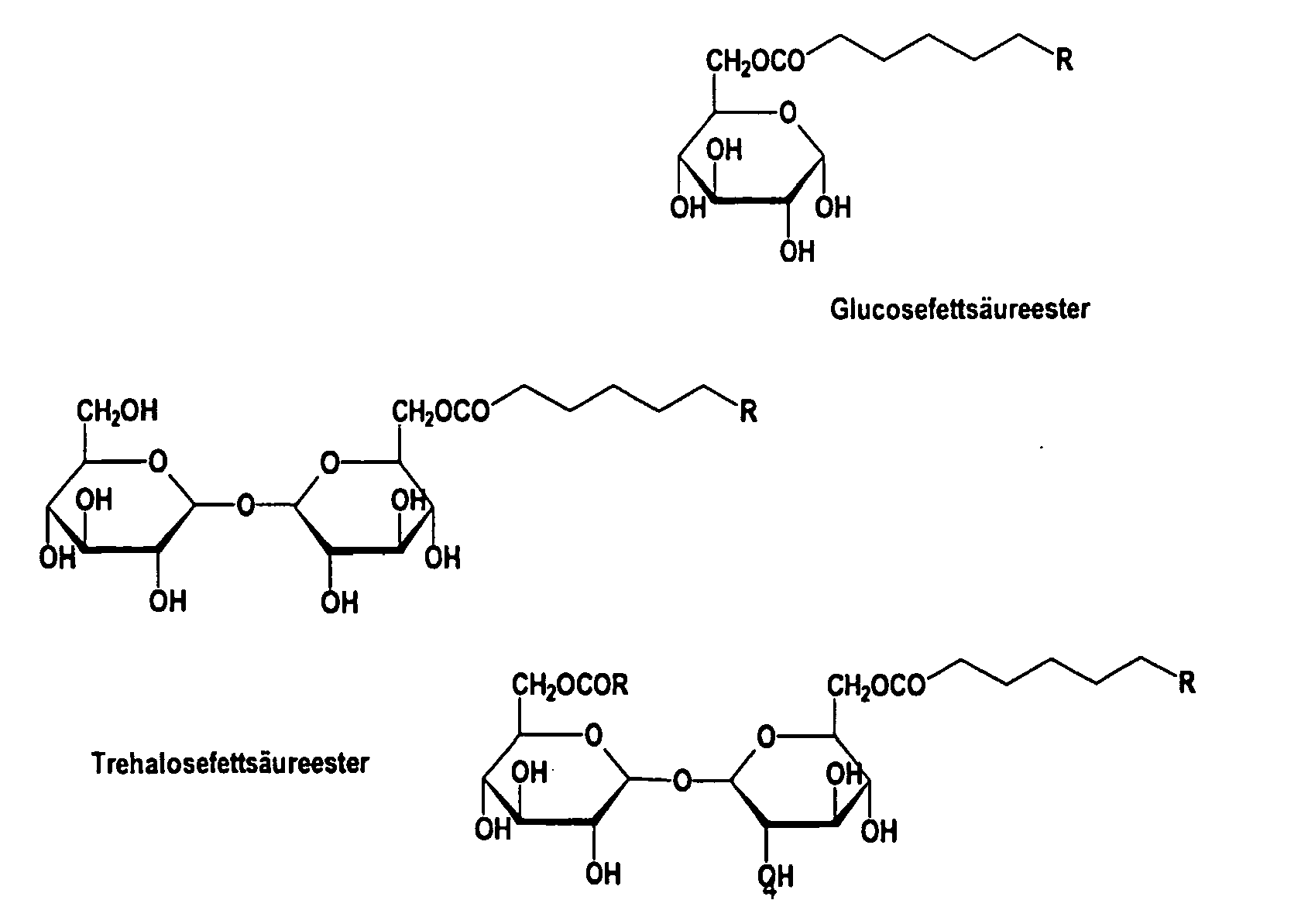
R1CO-OH (I)
in der R1CO für einen linearen oder verzweigten, gesättigten oder ungesättigten Acyl- oder Hydroxyacylest mit 6 bis 22, vorzugsweise 8 bis 16 Kohlenstoffatomen und 0 und/oder 1 bis 3 Doppelbindungen steht. Typische Beispiele sind Zuckerester der Capronsäure, 2-Hydroxycapronsäure, 6-Hydroxycapronsäure, Caprylsäure, 2-Ethylhexansäure, Caprinsäure, 10-Hydroxycaprinsäure, Laurinsäure, 12-Hydroxylaurinsäure, Isotridecansäure, Myristinsäure, Palmitinsäure, Palmoleinsäure, 16-Hydroxypalmitinsäure, Stearinsäure, Isostearinsäure, Ölsäure, Elaidinsäure, Petroselinsäure, Linolsäure, Linolensäure, Elaeostearinsäure, 12-Hydroxystearinsäure, Ricinolsäure, Arachinsäure, Gadoleinsäure, Behensäure und Erucasäure sowie deren technische Mischungen. Die Ester können je nach zur Verfügung stehender Hydroxylgruppen 1 bis 8 Estergruppen aufweisen; vorzugsweise werden jedoch solche Produkte eingesetzt, die einen Veresterungsgrad von durchschnittlich 1 bis 6 und insbesondere 1,5 bis 2,5 aufweisen. - Die Zuckerester werden erfindungsgemäß zur Herstellung von kosmetischen und/oder pharmazeutischen Zubereitungen wie beispielsweise Haarshampoos, Haarlotionen, Schaumbäder, Duschbäder, Cremes, Gele, Lotionen, alkoholische und wässrig/alkoholische Lösungen, Emulsionen, Wachs/ Fett-Massen, Stiftpräparaten, Pudern oder Salben verwendet, in denen sie in Mengen von 0,0001 bis 10, vorzugsweise 0,001 bis 5 und insbesondere 0,01 bis 1 Gew.-% - bezogen auf die Mittel - enthalten sind. Diese Mittel können ferner als weitere Hilfs- und Zusatzstoffe milde Tenside, Ölkörper, Emulgatoren, Perlglanzwachse, Konsistenzgeber, Verdickungsmittel, Überfettungsmittel, Stabilisatoren, Polymere, Siliconverbindungen, Fette, Wachse, Lecithine, Phospholipide, biogene Wirkstoffe, UV-Lichtschutzfaktoren, Antioxidantien, Deodorantien, Antitranspirantien, Antischuppenmittel, Filmbildner, Quellmittel, Insektenrepellentien, Selbstbräuner, Tyrosininhibitoren (Depigmentierungsmittel), Hydrotrope, Solubilisatoren, Konservierungsmittel, Parfümöle, Farbstoffe und dergleichen enthalten.
- Da Zuckerester selber emulgierende, oberflächenaktive und feuchtigkeitsspendende Eigenschaften aufweisen, können sie jedoch auch teilweise ohne Zusätze weiterer oberflächenaktiver Tenside oder Emulgatoren eingesetzt werden.
- Als oberflächenaktive Stoffe können anionische, nichtionische, kationische und/oder amphotere bzw. zwitterionische Tenside enthalten sein, deren Anteil an den Mitteln üblicherweise bei etwa 1 bis 70, vorzugsweise 5 bis 50 und insbesondere 10 bis 30 Gew.-% beträgt. Typische Beispiele für anionische Tenside sind Seifen, Alkylbenzolsulfonate, Alkansulfonate, Olefinsulfonate, Alkylethersulfonate, Glycerinethersulfonate, α-Methylestersulfonate, Sulfofettsäuren, Alkylsulfate, Fettalkoholethersulfate, Glycerinethersulfate, Fettsäureethersulfate, Hydroxymischethersulfate, Monoglycerid(ether)sulfate, Fettsäureamid(ether)sulfate, Mono- und Dialkylsulfosuccinate, Mono- und Dialkylsulfosuccinamate, Sulfotriglyceride, Amidseifen, Ethercarbonsäuren und deren Salze, Fettsäureisethionate, Fettsäuresarcosinate, Fettsäuretauride, N-Acylaminosäuren, wie beispielsweise Acyllactylate, Acyltartrate, Acylglutamate und Acylaspartate, Alkyloligoglucosidsulfate, Proteinfettsäurekondensate (insbesondere pflanzliche Produkte auf Weizenbasis) und Alkyl(ether)phosphate. Sofern die anionischen Tenside Polyglycoletherketten enthalten, können diese eine konventionelle, vorzugsweise jedoch eine eingeengte Homologenverteilung aufweisen. Typische Beispiele für nichtionische Tenside sind Fettalkoholpolyglycolether, Alkylphenolpolyglycolether, Fettsäurepolyglycolester, Fettsäureamidpolyglycolether, Fettaminpolyglycolether, alkoxylierte Triglyceride, Mischether bzw. Mischformale, gegebenenfalls partiell oxidierte Alk(en)yloligoglykoside bzw. Glucoronsäurederivate, Fettsäure-N-alkylglucamide, Proteinhydrolysate (insbesondere pflanzliche Produkte auf Weizenbasis), Polyolfettsäureester, Zuckerester, Sorbitanester, Polysorbate und Aminoxide. Sofern die nichtionischen Tenside Polyglycoletherketten enthalten, können diese eine konventionelle, vorzugsweise jedoch eine eingeengte Homologenverteilung aufweisen. Typische Beispiele für kationische Tenside sind quartäre Ammoniumverbindungen, wie beispielsweise das Dimethyldistearylammoniumchlorid, und Esterquats, insbesondere quaternierte Fettsäuretrialkanolaminestersalze. Typische Beispiele für amphotere bzw. zwitterionische Tenside sind Alkylbetaine, Alkylamidobetaine, Aminopropionate, Aminoglycinate, Imidazoliniumbetaine und Sulfobetaine. Bei den genannten Tensiden handelt es sich ausschließlich um bekannte Verbindungen. Typische Beispiele für besonders geeignete milde, d.h. besonders hautverträgliche Tenside sind Fettalkoholpolyglycolethersulfate, Monoglyceridsulfate, Mono- und/oder Dialkylsulfosuccinate, Fettsäureisethionate, Fettsäuresarcosinate, Fettsäuretauride, Fettsäureglutamate, α-Olefinsulfonate, Ethercarbonsäuren, Alkyloligoglucoside, Fettsäureglucamide, Alkylamidobetaine, Amphoacetale und/oder Proteinfettsäurekondensate, letztere vorzugsweise auf Basis von Weizenproteinen.
- Als Ölkörper kommen beispielsweise Guerbetalkohole auf Basis von Fettalkoholen mit 6 bis 18, vorzugsweise 8 bis 10 Kohlenstoffatomen, Ester von linearen C6-C22-Fettsäuren mit linearen oder verzweigten C6-C22-Fettalkoholen bzw. Ester von verzweigten C6-C13-Carbonsäuren mit linearen oder verzweigten C6-C22-Fettalkoholen, wie z.B. Myristylmyristat, Myristylpalmitat, Myristylstearat, Myristylisostearat, Myristyloleat, Myristylbehenat, Myristylerucat, Cetylmyristat, Cetylpalmitat, Cetylstearat, Cetylisostearat, Cetyloleat, Cetylbehenat, Cetylerucat, Stearylmyristat, Stearylpalmitat, Stearylstearat, Stearylisostearat, Stearyloleat, Stearylbehenat, Stearylerucat, Isostearylmyristat, Isostearylpalmitat, Isostearylstearat, I-sostearylisostearat, Isostearyloleat, Isostearylbehenat, Isostearyloleat, Oleylmyristat, Oleylpalmitat, Oleylstearat, Oleylisostearat, Oleyloleat, Oleylbehenat, Oleylerucat, Behenylmyristat, Behenylpalmitat, Behenylstearat, Behenylisostearat, Behenyloleat, Behenylbehenat, Behenylerucat, Erucylmyristat, Erucylpalmitat, Erucylstearat, Erucylisostearat, Erucyloleat, Erucylbehenat und Erucylerucat. Daneben eignen sich Ester von linearen C6-C22-Fettsäuren mit verzweigten Alkoholen, insbesondere 2-Ethylhexanol, Ester von C18-C38-Alkylhydroxycarbonsäuren mit linearen oder verzweigten C6-C22-Fettalkoholen, insbesondere Dioctyl Malate, Ester von linearen und/oder verzweigten Fettsäuren mit mehrwertigen Alkoholen (wie z.B. Propylenglycol, Dimerdiol oder Trimertriol) und/oder Guerbetalkoholen, Triglyceride auf Basis C6-C10-Fettsäuren, flüssige Mono-/Di-/Triglyceridmischungen auf Basis von C6-C18-Fettsäuren, Ester von C6-C22-Fettalkoholen und/oder Guerbetalkoholen mit aromatischen Carbonsäuren, insbesondere Benzoesäure, Ester von C2-C12-Dicarbonsäuren mit linearen oder verzweigten Alkoholen mit 1 bis 22 Kohlenstoffatomen oder Polyolen mit 2 bis 10 Kohlenstoffatomen und 2 bis 6 Hydroxylgruppen, pflanzliche Öle, verzweigte primäre Alkohole, substituierte Cyclohexane, lineare und verzweigte C6-C22-Fettalkoholcarbonate, wie z.B. Dicaprylyl Carbonate (Cetiol® CC), Guerbetcarbonate auf Basis von Fettalkoholen mit 6 bis 18, vorzugsweise 8 bis 10 C Atomen, Ester der Benzoesäure mit linearen und/oder verzweigten C6-C22-Alkoholen (z.B. Finsolv® TN), lineare oder verzweigte, symmetrische oder unsymmetrische Dialkylether mit 6 bis 22 Kohlenstoffatomen pro Alkylgruppe, wie z.B. Dicaprylyl Ether (Cetiol® OE), Ringöffnungsprodukte von epoxidierten Fettsäureestern mit Polyolen, Siliconöle (Cyclomethicone, Siliciummethicontypen u.a.) und/oder aliphatische bzw. naphthenische Kohlenwasserstoffe, wie z.B. wie Squalan, Squalen oder Dialkylcyclohexane in Betracht.
- Als Emulgatoren kommen beispielsweise nichtionogene Tenside aus mindestens einer der folgenden Gruppen in Frage:
- ➢ Anlagerungsprodukte von 2 bis 30 Mol Ethylenoxid und/ oder 0 bis 5 Mol Propylenoxid an lineare Fettalkohole mit 8 bis 22 C-Atomen, an Fettsäuren mit 12 bis 22 C-Atomen, an Alkylphenole mit 8 bis 15 C-Atomen in der Alkylgruppe sowie Alkylamine mit 8 bis 22 Kohlenstoffatomen im Alkylrest;
- ➢ Alkyl- und/oder Alkenyloligoglykoside mit 8 bis 22 Kohlenstoffatomen im Alk(en)ylrest und deren ethoxylierte Analoga;
- ➢ Anlagerungsprodukte von 1 bis 15 Mol Ethylenoxid an Ricinusöl und/oder gehärtetes Ricinusöl;
- ➢ Anlagerungsprodukte von 15 bis 60 Mol Ethylenoxid an Ricinusöl und/oder gehärtetes Ricinusöl;
- ➢ Partialester von Glycerin und/oder Sorbitan mit ungesättigten, linearen oder gesättigten, verzweigten Fettsäuren mit 12 bis 22 Kohlenstoffatomen und/oder Hydroxycarbonsäuren mit 3 bis 18 Kohlenstoffatomen sowie deren Addukte mit 1 bis 30 Mol Ethylenoxid;
- ➢ Partialester von Polyglycerin (durchschnittlicher Eigenkondensationsgrad 2 bis 8), Polyethylenglycol (Molekulargewicht 400 bis 5000), Trimethylolpropan, Pentaerythrit, Zuckeralkoholen (z.B. Sorbit), Alkylglucosiden (z.B. Methylglucosid, Butylglucosid, Laurylglucosid) sowie Polyglucosiden (z.B. Cellulose) mit gesättigten und/oder ungesättigten, linearen oder verzweigten Fettsäuren mit 12 bis 22 Kohlenstoffatomen und/oder Hydroxycarbonsäuren mit 3 bis 18 Kohlenstoffatomen sowie deren Addukte mit 1 bis 30 Mol Ethylenoxid;
- ➢ Mischester aus Pentaerythrit, Fettsäuren, Citronensäure und Fettalkohol und/oder Mischester von Fettsäuren mit 6 bis 22 Kohlenstoffatomen, Methylglucose und Polyolen, vorzugsweise Glycerin oder Polyglycerin.
- ➢ Mono-, Di- und Trialkylphosphate sowie Mono-, Di- und/oder Tri-PEG-alkylphosphate und deren Salze;
- ➢ Wollwachsalkohole;
- ➢ Polysiloxan-Polyalkyl-Polyether-Copolymere bzw. entsprechende Derivate;
- ➢ Block-Copolymere z.B. Polyethylenglycol-30 Dipolyhydroxystearate;
- ➢ Polymeremulgatoren, z.B. Pemulen-Typen (TR-1,TR-2) von Goodrich;
- ➢ Polyalkylenglycole sowie
- ➢ Glycerincarbonat.
- Die Anlagerungsprodukte von Ethylenoxid und/oder von Propylenoxid an Fettalkohole, Fettsäuren, Alkylphenole oder an Ricinusöl stellen bekannte, im Handel erhältliche Produkte dar. Es handelt sich dabei um Homologengemische, deren mittlerer Alkoxylierungsgrad dem Verhältnis der Stoffmengen von Ethylenoxid und/ oder Propylenoxid und Substrat, mit denen die Anlagerungsreaktion durchgeführt wird, entspricht. C12/18-Fettsäuremono- und -diester von Anlagerungsprodukten von Ethylenoxid an Glycerin sind als Rückfettungsmittel für kosmetische Zubereitungen bekannt.
- Alkyl- und/oder Alkenyloligoglycoside, ihre Herstellung und ihre Verwendung sind aus dem Stand der Technik bekannt. Ihre Herstellung erfolgt insbesondere durch Umsetzung von Glucose oder Oligosacchariden mit primären Alkoholen mit 8 bis 18 Kohlenstoffatomen. Bezüglich des Glycosidrestes gilt, daß sowohl Monoglycoside, bei denen ein cyclischer Zuckerrest glycosidisch an den Fettalkohol gebunden ist, als auch oligomere Glycoside mit einem Oligomerisationsgrad bis vorzugsweise etwa 8 geeignet sind. Der Oligomerisierungsgrad ist dabei ein statistischer Mittelwert, dem eine für solche technischen Produkte übliche Homologenverteilung zugrunde liegt.
- Typische Beispiele für geeignete Partialglyceride sind Hydroxystearinsäuremonoglycerid, Hydroxystearinsäurediglycerid, Isostearinsäuremonoglycerid, Isostearinsäurediglycerid, Ölsäuremonoglycerid, Ölsäurediglycerid, Ricinolsäuremoglycerid, Ricinolsäurediglycerid, Linolsäuremonoglycerid, Linolsäurediglycerid, Linolensäuremonoglycerid, Linolensäurediglycerid, Erucasäuremonoglycerid, Erucasäurediglycerid, Weinsäuremonoglycerid, Weinsäurediglycerid, Citronensäuremonoglycerid, Citronendiglycerid, Äpfelsäuremonoglycerid, Äpfelsäurediglycerid sowie deren technische Gemische, die untergeordnet aus dem Herstellungsprozeß noch geringe Mengen an Triglycerid enthalten können. Ebenfalls geeignet sind Anlagerungsprodukte von 1 bis 30, vorzugsweise 5 bis 10 Mol Ethylenoxid an die genannten Partialglyceride.
- Als Sorbitanester kommen Sorbitanmonoisostearat, Sorbitansesquiisostearat, Sorbitandiisostearat, Sorbitantriisostearat, Sorbitanmonooleat, Sorbitansesquioleat, Sorbitandioleat, Sorbitantrioleat, Sorbitanmonoerucat, Sorbitansesquierucat, Sorbitandierucat, Sorbitantrierucat, Sorbitanmonoricinoleat, Sorbitansesquiricinoleat, Sorbitandiricinoleat, Sorbitantriricinoleat, Sorbitanmonohydroxystearat, Sorbitansesquihydroxystearat, Sorbitandihydroxystearat, Sorbitantrihydroxystearat, Sorbitanmonotartrat, Sorbitansesquitartrat, Sorbitanditartrat, Sorbitantritartrat, Sorbitanmonocitrat, Sorbitansesquicitrat, Sorbitandicitrat, Sorbitantricitrat, Sorbitanmonomaleat, Sorbitansesquimaleat, Sorbitandimaleat, Sorbitantrimaleat sowie deren technische Gemische. Ebenfalls geeignet sind Anlagerungsprodukte von 1 bis 30, vorzugsweise 5 bis 10 Mol Ethylenoxid an die genannten Sorbitanester.
- Typische Beispiele für geeignete Polyglycerinester sind Polyglyceryl-2 Dipolyhydroxystearate (Dehymuls® PGPH), Polyglycerin-3-Diisostearate (Lameform® TGI), Polyglyceryl-4 Isostearate (Isolan® GI 34), Polyglyceryl-3 Oleate, Diisostearoyl Polyglyceryl-3 Diisostearate (Isolan® PDI), Polyglyceryl-3 Methylglucose Distearate (Tego Care® 450), Polyglyceryl-3 Beeswax (Cera Bellina®), Polyglyceryl-4 Caprate (Polyglycerol Caprate T2010/90), Polyglyceryl-3 Cetyl Ether (Chimexane® NL), Polyglyceryl-3 Distearate (Cremophor® GS 32) und Polyglyceryl Polyricinoleate (Admul® WOL 1403) Polyglyceryl Dimerate Isostearate sowie deren Gemische. Beispiele für weitere geeignete Polyolester sind die gegebenenfalls mit 1 bis 30 Mol Ethylenoxid umgesetzten Mono-, Di- und Triester von Trimethylolpropan oder Pentaerythrit mit Laurinsäure, Kokosfettsäure, Talgfettsäure, Palmitinsäure, Stearinsäure, Ölsäure, Behensäure und dergleichen.
- Typische anionische Emulgatoren sind aliphatische Fettsäuren mit 12 bis 22 Kohlenstoffatomen, wie beispielsweise Palmitinsäure, Stearinsäure oder Behensäure, sowie Dicarbonsäuren mit 12 bis 22 Kohlenstoffatomen, wie beispielsweise Azelainsäure oder Sebacinsäure.
- Weiterhin können als Emulgatoren zwitterionische Tenside verwendet werden. Als zwitterionische Tenside werden solche oberflächenaktiven Verbindungen bezeichnet, die im Molekül mindestens eine quartäre Ammoniumgruppe und mindestens eine Carboxylatund eine Sulfonatgruppe tragen. Besonders geeignete zwitterionische Tenside sind die sogenannten Betaine wie die N-Alkyl-N,N-dimethylammoniumglycinate, beispielsweise das Kokosalkyldimethylammoniumglycinat, N-Acylaminopropyl-N,N-dimethylammoniumglycinate, beispielsweise das Kokosacylaminopropyldimethyl-ammoniumglycinat, und 2-Alkyl-3-carboxylmethyl-3-hydroxyethylimidazoline mit jeweils 8 bis 18 C-Atomen in der Alkyl- oder Acylgruppe sowie das Kokosacylaminoethylhydroxyethylcarboxymethylglycinat. Besonders bevorzugt ist das unter der CTFA-Bezeichnung Cocamidopropyl Betaine bekannte Fettsäureamid-Derivat. Ebenfalls geeignete Emulgatoren sind ampholytische Tenside. Unter ampholytischen Tensiden werden solche oberflächenaktiven Verbindungen verstanden, die außer einer C8/18-Alkyl- oder Acylgruppe im Molekül mindestens eine freie Aminogruppe und mindestens eine -COOH- oder -SO3H-Gruppe enthalten und zur Ausbildung innerer Salze befähigt sind. Beispiele für geeignete ampholytische Tenside sind N-Alkylglycine, N-Alkylpropion-säuren, N-Alkylaminobuttersäuren, N-Alkyliminodipropionsäuren, N-Hydroxyethyl-N-alkylamidopropylglycine, N-Alkyltaurine, N-Alkylsarcosine, 2-Alkylaminopropionsäuren und Alkylaminoessigsäuren mit jeweils etwa 8 bis 18 C-Atomen in der Alkylgruppe.. Besonders bevorzugte ampholytische Tenside sind das N-Kokosalkylaminopropionat, das Kokosacylaminoethylaminopropionat und das C12/18-Acylsarcosin. Schließlich kommen auch Kationtenside als Emulgatoren in Betracht, wobei solche vom Typ der Esterquats, vorzugsweise methylquaternierte Difettsäuretriethanolaminester-Salze, besonders bevorzugt sind.
- Typische Beispiele für Fette sind Glyceride, d.h. feste oder flüssige pflanzliche oder tierische Produkte, die im wesentlichen aus gemischten Glycerinestern höherer Fettsäuren bestehen, als Wachse kommen u.a. natürliche Wachse, wie z.B. Candelillawachs, Carnaubawachs, Japanwachs, Espartograswachs, Korkwachs, Guarumawachs, Reiskeimölwachs, Zuckerrohrwachs, Ouricurywachs, Montanwachs, Bienenwachs, Schellackwachs, Walrat, Lanolin (Wollwachs), Bürzelfett, Ceresin, Ozokerit (Erdwachs), Petrolatum, Paraffinwachse, Mikrowachse; chemisch modifizierte Wachse (Hartwachse), wie z.B. Montanesterwachse, Sasolwachse, hydrierte Jojobawachse sowie synthetische Wachse, wie z.B. Polyalkylenwachse und Polyethylenglycolwachse in Frage. Neben den Fetten kommen als Zusatzstoffe auch fettähnliche Substanzen, wie Lecithine und Phospholipide in Frage. Unter der Bezeichnung Lecithine versteht der Fachmann diejenigen Glycero-Phospholipide, die sich aus Fettsäuren, Glycerin, Phosphorsäure und Cholin durch Veresterung bilden. Lecithine werden in der Fachwelt daher auch häufig als Phosphatidylcholine (PC). Als Beispiele für natürliche Lecithine seien die Kephaline genannt, die auch als Phosphatidsäuren bezeichnet werden und Derivate der 1,2-Diacyl-sn-glycerin-3-phosphorsäuren darstellen. Dem gegenüber versteht man unter Phospholipiden gewöhnlich Mono- und vorzugsweise Diester der Phosphorsäure mit Glycerin (Glycerinphosphate), die allgemein zu den Fetten gerechnet werden. Daneben kommen auch Sphingosine bzw. Sphingolipide in Frage.
- Als Perlglanzwachse kommen beispielsweise in Frage: Alkylenglycolester, speziell Ethylenglycoldistearat; Fettsäurealkanolamide, speziell Kokosfettsäurediethanolamid; Partialglyceride, speziell Stearinsäuremonoglycerid; Ester von mehrwertigen, gegebenenfalls hydroxysubstituierte Carbonsäuren mit Fettalkoholen mit 6 bis 22 Kohlenstoffatomen, speziell langkettige Ester der Weinsäure; Fettstoffe, wie beispielsweise Fettalkohole, Fettketone, Fettaldehyde, Fettether und Fettcarbonate, die in Summe mindestens 24 Kohlenstoffatome aufweisen, speziell Lauron und Distearylether; Fettsäuren wie Stearinsäure, Hydroxystearinsäure oder Behensäure, Ringöffnungsprodukte von Olefinepoxiden mit 12 bis 22 Kohlenstoffatomen mit Fettalkoholen mit 12 bis 22 Kohlenstoffatomen und/oder Polyolen mit 2 bis 15 Kohlenstoffatomen und 2 bis 10 Hydroxylgruppen sowie deren Mischungen.
- Als Konsistenzgeber kommen in erster Linie Fettalkohole oder Hydroxyfettalkohole mit 12 bis 22 und vorzugsweise 16 bis 18 Kohlenstoffatomen und daneben Partialglyceride, Fettsäuren oder Hydroxyfettsäuren in Betracht. Bevorzugt ist eine Kombination dieser Stoffe mit Alkyloligoglucosiden und/oder Fettsäure-N-methylglucamiden gleicher Kettenlänge und/oder Polyglycerinpoly-12-hydroxystearaten. Geeignete Verdickungsmittel sind beispielsweise Aerosil-Typen (hydrophile Kieselsäuren), Polysaccharide, insbesondere Xanthan-Gum, Guar-Guar, Agar-Agar, Alginate und Tylosen, Carboxymethylcellulose und Hydroxyethyl- und Hydroxypropylcellulose, ferner höhermolekulare Polyethylenglycolmono- und -diester von Fettsäuren, Polyacrylate, (z.B. Carbopole® und Pemulen-Typen von Goodrich; Synthalene® von Sigma; Keltrol-Typen von Kelco; Sepigel-Typen von Seppic; Salcare-Typen von Allied Colloids), Polyacrylamide, Polymere, Polyvinylalkohol und Polyvinylpyrrolidon. Als besonders wirkungsvoll haben sich auch Bentonite, wie z.B. Bentone® Gel VS-5PC (Rheox) erwiesen, bei dem es sich um eine Mischung aus Cyclopentasiloxan, Disteardimonium Hectorit und Propylencarbonat handelt. Weiter in Frage kommen Tenside, wie beispielsweise ethoxylierte Fettsäureglyceride, Ester von Fettsäuren mit Polyolen wie beispielsweise Pentaerythrit oder Trimethylolpropan, Fettalkoholethoxylate mit eingeengter Homologenverteilung oder Alkyloligoglucoside sowie Elektrolyte wie Kochsalz und Ammoniumchlorid.
- Als Überfettungsmittel können Substanzen wie beispielsweise Lanolin und Lecithin sowie polyethoxylierte oder acylierte Lanolin- und Lecithinderivate, Polyolfettsäureester, Monoglyceride und Fettsäurealkanolamide verwendet werden, wobei die letzteren gleichzeitig als Schaumstabilisatoren dienen.
- Als Stabilisatoren können Metallsalze von Fettsäuren, wie z.B. Magnesium-, Aluminium-und/oder Zinkstearat bzw. -ricinoleat eingesetzt werden.
- Geeignete kationische Polymere sind beispielsweise kationische Cellulosederivate, wie z.B. eine quaternierte Hydroxyethylcellulose, die unter der Bezeichnung Polymer JR 400® von Amerchol erhältlich ist, kationische Stärke, Copolymere von Diallylammoniumsalzen und Acrylamiden, quaternierte Vinylpyrrolidon/Vinylimidazol-Polymere, wie z.B. Luviquat® (BASF), Kondensationsprodukte von Polyglycolen und Aminen, quaternierte Kollagenpolypeptide, wie beispielsweise Lauryldimonium Hydroxypropyl Hydrolyzed Collagen (Lamequat®L/Grünau), quaternierte Weizenpolypeptide, Polyethylenimin, kationische Siliconpolymere, wie z.B. Amodimethicone, Copolymere der Adipinsäure und Dimethylaminohydroxypropyldiethylentriamin (Cartaretine®/Sandoz), Copolymere der Acrylsäure mit Dimethyl-diallylammoniumchlorid (Merquat® 550/Chemviron), Polyaminopolyamide, sowie deren vernetzte wasserlöslichen Polymere, kationische Chitinderivate wie beispielsweise quaterniertes Chitosan, gegebenenfalls mikrokristallin verteilt, Kondensationsprodukte aus Dihalogenalkylen, wie z.B. Dibrombutan mit Bisdialkylaminen, wie z.B. Bis-Dimethylamino-1,3-propan, kationischer Guar-Gum, wie z.B. Jaguar® CBS, Jaguar® C-17, Jaguar® C-16 der Firma Celanese, quaternierte Ammoniumsalz-Polymere, wie z.B. Mirapol® A-15, Mirapol® AD-1, Mirapol® AZ-1 der Firma Miranol.
- Als anionische, zwitterionische, amphotere und nichtionische Polymere kommen beispielsweise Vinylacetat/Crotonsäure-Copolymere, Vinylpyrrolidon/Vinylacrylat-Copolymere, Vinylacetat/Butylmaleat/ Isobornylacrylat-Copolymere, Methylvinylether/Maleinsäureanhydrid-Copolymere und deren Ester, unvernetzte und mit Polyolen vernetzte Polyacrylsäuren, Acrylamidopropyltrimethylammoniumchlorid/ Acrylat-Copolymere, Octylacrylamid/Methylmeth-acrylat/tert.Butylaminoethylmethacrylat/2-Hydroxypropylmethacrylat-Copolymere, Polyvinylpyrrolidon, Vinylpyrrolidon/Vinylacetat-Copolymere, Vinylpyrrolidon/ Dimethylaminoethylmethacrylat/Vinylcaprolactam-Terpolymere sowie gegebenenfalls derivatisierte Celluloseether und Silicone in Frage.
- Geeignete Siliconverbindungen sind beispielsweise Dimethylpolysiloxane, Methylphenylpolysiloxane, cyclische Silicone sowie amino-, fettsäure-, alkohol-, polyether-, epoxy-, fluor-, glykosid- und/oder alkylmodifizierte Siliconverbindungen, die bei Raumtemperatur sowohl flüssig als auch harzförmig vorliegen können. Weiterhin geeignet sind Simethicone, bei denen es sich um Mischungen aus Dimethiconen mit einer durchschnittlichen Kettenlänge von 200 bis 300 Dimethylsiloxan-Einheiten und hydrierten Silicaten handelt.
- Unter UV-Lichtschutzfaktoren sind beispielsweise bei Raumtemperatur flüssig oder kristallin vorliegende organische Substanzen (Lichtschutzfilter) zu verstehen, die in der Lage sind, ultraviolette Strahlen zu absorbieren und die aufgenommene Energie in Form längerwelliger Strahlung, z.B. Wärme wieder abzugeben. UVB-Filter können öllöslich oder wasserlöslich sein. Als öllösliche Substanzen sind z.B. zu nennen:
- ➢ 3-Benzylidencampher bzw. 3-Benzylidennorcampher und dessen Derivate, z.B. 3-(4-Methylbenzyliden)campher;
- ➢ 4-Aminobenzoesäurederivate, vorzugsweise 4-(Dimethylamino)benzoesäure-2-ethylhexylester, 4-(Dimethylamino)benzoesäure-2-octylester und 4-(Dimethylamino)benzoesäureamylester;
- ➢ Ester der Zimtsäure, vorzugsweise 4-Methoxyzimtsäure-2-ethylhexylester, 4-Methoxyzimtsäurepropylester, 4-Methoxyzimtsäureisoamylester 2-Cyano-3,3-phenylzimtsäure-2-ethylhexylester (Octocrylene);
- ➢ Ester der Salicylsäure, vorzugsweise Salicylsäure-2-ethylhexylester, Salicylsäure-4-isopropylbenzylester, Salicylsäurehomomenthylester;
- ➢ Derivate des Benzophenons, vorzugsweise 2-Hydroxy-4-methoxybenzophenon, 2-Hydroxy-4-methoxy-4'-methylbenzophenon, 2,2'-Dihydroxy-4-methoxybenzophenon;
- ➢ Ester der Benzalmalonsäure, vorzugsweise 4-Methoxybenzmalonsäuredi-2-ethylhexylester;
- ➢ Triazinderivate, wie z.B. 2,4,6-Trianilino-(p-carbo-2'ethyl-1'-hexyloxy)-1,3,5-triazin und Octyl Triazon, oder Dioctyl Butamido Triazone (Uvasorb® HEB);
- ➢ Propan-1,3-dione, wie z.B. 1-(4-tert.Butylphenyl)-3-(4'methoxyphenyl)propan-1,3-dion;
- ➢ Ketotricyclo(5.2.1.0)decan-Derivate.
- Als wasserlösliche Substanzen kommen in Frage:
- ➢ 2-Phenylbenzimidazol-5-sulfonsäure und deren Alkali-, Erdalkali-, Ammonium-, Alkylammonium-, Alkanolammonium- und Glucammoniumsalze;
- ➢ Sulfonsäurederivate von Benzophenonen, vorzugsweise 2-Hydroxy-4-methoxybenzophenon-5-sulfonsäure und ihre Salze;
- ➢ Sulfonsäurederivate des 3-Benzylidencamphers, wie z.B. 4-(2-Oxo-3-bornylidenmethyl)benzolsulfonsäure und 2-Methyl-5-(2-oxo-3-bornyliden)sulfonsäure und deren Salze.
- Als typische UV-A-Filter kommen insbesondere Derivate des Benzoylmethans in Frage, wie beispielsweise 1-(4'-tert.Butylphenyl)-3-(4'-methoxyphenyl)propan-1,3-dion, 4-tert.-Butyl-4'-methoxydibenzoylmethan (Parsol® 1789), 1-Phenyl-3-(4'-isopropylphenyl)-propan-1,3-dion sowie Enaminverbindungen. Die UV-A und UV-B-Filter können selbstverständlich auch in Mischungen eingesetzt werden. Besonders günstige Kombinationen bestehen aus den Derivate des Benzoylmethans" z.B. 4-tert.-Butyl-4'-methoxydibenzoylmethan (Parsol® 1789) und 2-Cyano-3,3-phenylzimtsäure-2-ethyl-hexylester (Octocrylene) in Kombination mit Ester der Zimtsäure, vorzugsweise 4-Methoxyzimtsäure-2-ethylhexylester und/oder 4-Methoxyzimtsäurepropylester und/oder 4-Methoxyzimtsäureisoamylester. Vorteilhaft werden deartige Kombinationen mit wasserlöslichen Filtern wie z.B. 2-Phenylbenzimidazol-5-sulfonsäure und deren Alkali-, Erdalkali-, Ammonium-, Alkylammonium-, Alkanolammonium-und Glucammoniumsalze kombiniert.
- Neben den genannten löslichen Stoffen kommen für diesen Zweck auch unlösliche Lichtschutzpigmente, nämlich feindisperse Metalloxide bzw. Salze in Frage. Beispiele für geeignete Metalloxide sind insbesondere Zinkoxid und Titandioxid und daneben Oxide des Eisens, Zirkoniums, Siliciums, Mangans, Aluminiums und Cers sowie deren Gemische. Als Salze können Silicate (Talk), Bariumsulfat oder Zinkstearat eingesetzt werden. Die Oxide und Salze werden in Form der Pigmente für hautpflegende und hautschützende Emulsionen und dekorative Kosmetik verwendet. Die Partikel sollten dabei einen mittleren Durchmesser von weniger als 100 nm, vorzugsweise zwischen 5 und 50 nm und insbesondere zwischen 15 und 30 nm aufweisen. Sie können eine sphärische Form aufweisen, es können jedoch auch solche Partikel zum Einsatz kommen, die eine ellipsoide oder in sonstiger Weise von der sphärischen Gestalt abweichende Form besitzen. Die Pigmente können auch oberflächenbehandelt, d.h. hydrophilisiert oder hydrophobiert vorliegen. Typische Beispiele sind gecoatete Titandioxide, wie z.B. Titandioxid T 805 (Degussa) oder Eusolex® T2000 (Merck). Als hydrophobe Coatingmittel kommen dabei vor allem Silicone und dabei speziell Trialkoxyoctylsilane oder Simethicone in Frage. In Sonnenschutzmitteln werden bevorzugt sogenannte Mikro- oder Nanopigmente eingesetzt. Vorzugsweise wird mikronisiertes Zinkoxid verwendet.
- Neben den beiden vorgenannten Gruppen primärer Lichtschutzstoffe können auch sekundäre Lichtschutzmittel vom Typ der Antioxidantien eingesetzt werden, die die photochemische Reaktionskette unterbrechen, welche ausgelöst wird, wenn UV-Strahlung in die Haut eindringt. Typische Beispiele hierfür sind Aminosäuren (z.B. Glycin, Histidin, Tyrosin, Tryptophan) und deren Derivate, Imidazole (z.B. Urocaninsäure) und deren Derivate, Peptide wie D,L-Carnosin, D-Carnosin, L-Carnosin und deren Derivate (z.B. Anserin), Carotinoide, Carotine (z.B. α-Carotin, β-Carotin, Lycopin) und deren Derivate, Chlorogensäure und deren Derivate, Liponsäure und deren Derivate (z.B. Dihydroliponsäure), Aurothioglucose, Propylthiouracil und andere Thiole (z.B. Thioredoxin, Glutathion, Cystein, Cystin, Cystamin und deren Glycosyl-, N-Acetyl-, Methyl-, Ethyl-, Propyl-, Amyl-, Butyl- und Lauryl-, Palmitoyl-, Oleyl-, γ-Linoleyl-, Cholesteryl- und Glycerylester) sowie deren Salze, Dilaurylthiodipropionat, Distearylthiodipropionat, Thiodipropionsäure und deren Derivate (Ester, Ether, Peptide, Lipide, Nukleotide, Nukleoside und Salze) sowie Sulfoximinverbindungen (z.B. Buthioninsulfoximine, Homocysteinsulfoximin, Butioninsulfone, Penta-, Hexa-, Heptathioninsulfoximin) in sehr geringen verträglichen Dosierungen (z.B. pmol bis µmol/kg), ferner (Metall)-Chelatoren (z.B. α-Hydroxyfettsäuren, Palmitinsäure, Phytinsäure, Lactoferrin), α-Hydroxysäuren (z.B. Citronensäure, Milchsäure, Äpfelsäure), Huminsäure, Gallensäure, Gallenextrakte, Bilirubin, Biliverdin, EDTA, EGTA und deren Derivate, ungesättigte Fettsäuren und deren Derivate (z.B. γ-Linolensäure, Linolsäure, Ölsäure), Folsäure und deren Derivate, Ubichinon und Ubichinol und deren Derivate, Vitamin C und Derivate (z.B. Ascorbylpalmitat, Mg-Ascorbylphosphat, Ascorbylacetat), Tocopherole und Derivate (z.B. Vitamin-E-acetat), Vitamin A und Derivate (Vitamin-A-palmitat) sowie Koniferylbenzoat des Benzoeharzes, Rutinsäure und deren Derivate, α-Glycosylrutin, Ferulasäure, Furfurylidenglucitol, Carnosin, Butylhydroxytoluol, Butylhydroxyanisol, Nordihydroguajakharzsäure, Nordihydroguajaretsäure, Trihydroxybutyrophenon, Harnsäure und deren Derivate, Mannose und deren Derivate, Superoxid-Dismutase, Zink und dessen Derivate (z.B. ZnO, ZnSO4) Selen und dessen Derivate (z.B. Selen-Methionin), Stilbene und deren Derivate (z.B. Stilbenoxid, trans-Stilbenoxid) und die erfindungsgemäß geeigneten Derivate (Salze, Ester, Ether, Zucker, Nukleotide, Nukleoside, Peptide und Lipide) dieser genannten Wirkstoffe.
- Unter biogenen Wirkstoffen sind beispielsweise Tocopherol, Tocopherolacetat, Tocopherolpalmitat, Ascorbinsäure, (Desoxy)Ribonucleinsäure und deren Fragmentierungsprodukte, β-Glucane, Retinol, Bisabolol, Allantoin, Phytantriol, Panthenol, AHA-Säuren, Aminosäuren, Ceramide, Pseudoceramide, essentielle Öle, Pflanzenextrakte, wie z.B. Prunusextrakt, Bambaranussextrakt und Vitaminkomplexe zu verstehen.
- Kosmetische Deodorantien (Desodorantien) wirken Körpergerüchen entgegen, überdecken oder beseitigen sie. Körpergerüche entstehen durch die Einwirkung von Hautbakterien auf apokrinen Schweiß, wobei unangenehm riechende Abbauprodukte gebildet werden. Dementsprechend enthalten Deodorantien Wirkstoffe, die als keimhemmende Mittel, Enzyminhibitoren, Geruchsabsorber oder Geruchsüberdecker fungieren.
- Als keimhemmende Mittel sind grundsätzlich alle gegen grampositive Bakterien wirksamen Stoffe geeignet, wie z. B. 4-Hydroxybenzoesäure und ihre Salze und Ester, N-(4-Chlorphenyl)-N' -(3,4 dichlorphenyl)harnstoff, 2,4,4'-Trichlor-2'-hydroxy-diphenytether (Triclosan), 4-Chlor-3,5-dimethyl-phenol, 2,2'-Methylen-bis(6-brom-4-chlorphenol), 3-Methyl-4-(1-methylethyl)-phenol, 2-Benzyl-4-chlorphenol, 3-(4-Chlorphenoxy)-1,2-propandiol, 3-Iod-2-propinylbutylcarbamat, Chlorhexidin, 3,4,4'-Trichlorcarbanilid (TTC), antibakterielle Riechstoffe, Thymol, Thymianöl, Eugenol, Nelkenöl, Menthol, Minzöl, Farnesol, Phenoxyethanol, Glycerinmonocaprinat, Glycerinmonocaprylat, Glycerinmonolaurat (GML), Diglycerinmonocaprinat (DMC), Salicylsäure-N-alkylamide wie z. B. Salicylsäure-n-octylamid oder Salicylsäure-n-decylamid.
- Als Enzyminhibitoren sind beispielsweise Esteraseinhibitoren geeignet. Hierbei handelt es sich vorzugsweise um Trialkylcitrate wie Trimethylcitrat, Tripropylcitrat, Triisopropylcitrat, Tributylcitrat und insbesondere Triethylcitrat (Hydagen® CAT). Die Stoffe inhibieren die Enzymaktivität und reduzieren dadurch die Geruchsbildung. Weitere Stoffe, die als Esteraseinhibitoren in Betracht kommen, sind Sterolsulfate oder -phosphate, wie beispielsweise Lanosterin-, Cholesterin-, Campesterin-, Stigmasterin- und Sitosterinsulfat bzw -phosphat, Dicarbonsäuren und deren Ester, wie beispielsweise Glutarsäure, Glutarsäuremonoethylester, Glutarsäurediethylester, Adipinsäure, Adipinsäuremonoethylester, Adipinsäurediethylester, Malonsäure und Malonsäurediethylester, Hydroxycarbonsäuren und deren Ester wie beispielsweise Citronensäure, Äpfelsäure, Weinsäure oder Weinsäurediethylester, sowie Zinkglycinat.
- Als Geruchsabsorber eignen sich Stoffe, die geruchsbildende Verbindungen aufnehmen und weitgehend festhalten können. Sie senken den Partialdruck der einzelnen Komponenten und verringern so auch ihre Ausbreitungsgeschwindigkeit. Wichtig ist, daß dabei Parfums unbeeinträchtigt bleiben müssen. Geruchsabsorber haben keine Wirksamkeit gegen Bakterien. Sie enthalten beispielsweise als Hauptbestandteil ein komplexes Zinksalz der Ricinolsäure oder spezielle, weitgehend geruchsneutrale Duftstoffe, die dem Fachmann als "Fixateure" bekannt sind, wie z. B. Extrakte von Labdanum bzw. Styrax oder bestimmte Abietinsäurederivate. Als Geruchsüberdecker fungieren Riechstoffe oder Parfümöle, die zusätzlich zu ihrer Funktion als Geruchsüberdecker den Deodorantien ihre jeweilige Duftnote verleihen. Als Parfümöle seien beispielsweise genannt Gemische aus natürlichen und synthetischen Riechstoffen. Natürliche Riechstoffe sind Extrakte von Blüten, Stengeln und Blättern, Früchten, Fruchtschalen, Wurzeln, Hölzern, Kräutern und Gräsern, Nadeln und Zweigen sowie Harzen und Balsamen. Weiterhin kommen tierische Rohstoffe in Frage, wie beispielsweise Zibet und Castoreum. Typische synthetische Riechstoffverbindungen sind Produkte vom Typ der Ester, Ether, Aldehyde, Ketone, Alkohole und Kohlenwasserstoffe. Riechstoffverbindungen vom Typ der Ester sind z.B. Benzylacetat, p-tert.-Butylcyclohexylacetat, Linalylacetat, Phenylethylacetat, Linalylbenzoat, Benzylformiat, Allylcyclohexylpropionat, Styrallylpropionat und Benzylsalicylat. Zu den Ethern zählen beispielsweise Benzylethylether, zu den Aldehyden z.B. die linearen Alkanale mit 8 bis 18 Kohlenstoffatomen, Citral, Citronellal, Citronellyloxyacetaldehyd, Cyclamenaldehyd, Hydroxycitronellal, Lilial und Bourgeonal, zu den Ketonen z.B. die Jonone und Methylcedrylketon, zu den Alkoholen Anethol, Citronellol, Eugenol, Isoeugenol, Geraniol, Linalool, Phenylethylalkohol und Terpineol, zu den Kohlenwasserstoffen gehören hauptsächlich die Terpene und Balsame. Bevorzugt werden jedoch Mischungen verschiedener Riechstoffe verwendet, die gemeinsam eine ansprechende Duftnote erzeugen. Auch ätherische Öle geringerer Flüchtigkeit, die meist als Aromakomponenten verwendet werden, eignen sich als Parfümöle, z.B. Salbeiöl, Kamillenöl, Nelkenöl, Melissenöl, Minzenöl, Zimtblätteröl, Lindenblütenöl, Wacholderbeerenöl, Vetiveröl, Olibanöl, Galbanumöl, Labdanumöl und Lavandinöl. Vorzugsweise werden Bergamotteöl, Dihydromyrcenol, Lilial, Lyral, Citronellol, Phenylethylalkohol, α-Hexylzimtaldehyd, Geraniol, Benzylaceton, Cyclamenaldehyd, Linalool, Boisambrene Forte, Ambroxan, Indol, Hedione, Sandelice, Citronenöl, Mandarinenöl, Orangenöl, Allylamylglycolat, Cyclovertal, Lavandinöl, Muskateller Salbeiöl, β-Damascone, Geraniumöl Bourbon, Cyclohexylsalicylat, Vertofix Coeur, Iso-E-Super, Fixolide NP, Evernyl, Iraldein gamma, Phenylessigsäure, Geranylacetat, Benzylacetat, Rosenoxid, Romilat, Irotyl und Floramat allein oder in Mischungen, eingesetzt.
- Antitranspirantien (Antiperspirantien) reduzieren durch Beeinflussung der Aktivität der ekkrinen Schweißdrüsen die Schweißbildung, und wirken somit Achselnässe und Körpergeruch entgegen. Wässrige oder wasserfreie Formulierungen von Antitranspirantien enthalten typischerweise folgende Inhaltsstoffe:
- ➢ adstringierende Wirkstoffe,
- ➢ Ölkomponenten,
- ➢ nichtionische Emulgatoren,
- ➢ Coemulgatoren,
- ➢ Konsistenzgeber,
- ➢ Hilfsstoffe wie z. B. Verdicker oder Komplexierungsmittel und/oder
- ➢ nichtwässrige Lösungsmittel wie z. B. Ethanol, Propylenglykol und/oder Glycerin.
- Als adstringierende Antitranspirant-Wirkstoffe eignen sich vor allem Salze des Aluminiums, Zirkoniums oder des Zinks. Solche geeigneten antihydrotisch wirksamen Wirkstoffe sind z.B. Aluminiumchlorid, Aluminiumchlorhydrat, Aluminiumdichlorhydrat, Aluminiumsesquichlorhydrat und deren Komplexverbindungen z. B. mit Propylenglycol-1,2. Aluminiumhydroxyallantoinat, Aluminiumchloridtartrat, Aluminium-Zirkonium-Trichlorohydrat, Aluminium-Zirko-nium-tetrachlorohydrat, Aluminium-Zirkonium-pentachlorohydrat und deren Komplexverbindungen z. B. mit Aminosäuren wie Glycin. Daneben können in Antitranspirantien übliche öllösliche und wasserlösliche Hilfsmittel in geringeren Mengen enthalten sein. Solche öllöslichen Hilfsmittel können z.B. sein:
- ➢ entzündungshemmende, hautschützende oder wohlriechende ätherische Öle,
- ➢ synthetische hautschützende Wirkstoffe und/oder
- ➢ öllösliche Parfümöle.
- Übliche wasserlösliche Zusätze sind z.B. Konservierungsmittel, wasserlösliche Duftstoffe, pH-Wert-Stellmittel, z.B. Puffergemische, wasserlösliche Verdickungsmittel, z.B. wasserlösliche natürliche oder synthetische Polymere wie z.B. Xanthan-Gum, Hydroxyethylcellulose, Polyvinylpyrrolidon oder hochmolekulare Polyethylenoxide.
- Gebräuchliche Filmbildner sind beispielsweise Chitosan, mikrokristallines Chitosan, quaterniertes Chitosan, Polyvinylpyrrolidon, Vinylpyrrolidon-Vinylacetat-Copolymerisate, Polymere der Acrylsäurereihe, quaternäre Cellulose-Derivate, Kollagen, Hyaluronsäure bzw. deren Salze und ähnliche Verbindungen.
- Als Antischuppenwirkstoffe kommen Pirocton Olamin (1-Hydroxy-4-methyl-6-(2,4,4-trimythylpentyl)-2-(1H)-pyridinonmonoethanolaminsalz), Baypival® (Climbazole), Ketoconazol®, (4-Acetyl-1-{-4-[2-(2.4-dichlorphenyl) r-2-(1H-imidazol-1-ylmethyl)-1,3-dioxylan-c-4-ylmethoxyphenyl}piperazin, Ketoconazol, Elubiol, Selendisulfid, Schwefel kolloidal, Schwefelpolyehtylenglykolsorbitanmonooleat, Schwefelrizinolpolyehtoxylat, Schwfel-teer Destillate, Salicylsäure (bzw. in Kombination mit Hexachlorophen), Undexylensäure Monoethanolamid Sulfosuccinat Na-Salz, Lamepon® UD (Protein-Undecylensäurekondensat), Zinkpyrithion, Aluminiumpyrithion und Magnesiumpyrithion / Dipyrithion-Magnesiumsulfat in Frage.
- Als Quellmittel für wäßrige Phasen können Montmorillonite, Clay Mineralstoffe, Pemulen sowie alkylmodifizierte Carbopoltypen (Goodrich) dienen.
- Als Insekten-Repellentien kommen N,N-Diethyl-m-toluamid, 1,2-Pentandiol oder Ethyl Butylacetylaminopropionate in Frage
- Als Selbstbräuner eignet sich Dihydroxyaceton. Als Tyrosinhinbitoren, die die Bildung von Melanin verhindern und Anwendung in Depigmentierungsmitteln finden, kommen beispielsweise Arbutin, Ferulasäure, Kojisäure, Cumarinsäure und Ascorbinsäure (Vitamin C) in Frage.
- Zur Verbesserung des Fließverhaltens können ferner Hydrotrope, wie beispielsweise Ethanol, Isopropylalkohol, oder Polyole eingesetzt werden. Polyole, die hier in Betracht kommen, besitzen vorzugsweise 2 bis 15 Kohlenstoffatome und mindestens zwei Hydroxylgruppen. Die Polyole können noch weitere funktionelle Gruppen, insbesondere Aminogruppen, enthalten bzw. mit Stickstoff modifiziert sein. Typische Beispiele sind
- ➢ Glycerin;
- ➢ Alkylenglycole, wie beispielsweise Ethylenglycol, Diethylenglycol, Propylenglycol, Butylenglycol, Hexylenglycol sowie Polyethylenglycole mit einem durchschnittlichen Molekulargewicht von 100 bis 1.000 Dalton;
- ➢ technische Oligoglyceringemische mit einem Eigenkondensationsgrad von 1,5 bis 10 wie etwa technische Diglyceringemische mit einem Diglyceringehalt von 40 bis 50 Gew.-%;
- ➢ Methyolverbindungen, wie insbesondere Trimethylolethan, Trimethylolpropan, Trimethylolbutan, Pentaerythrit und Dipentaerythrit;
- ➢ Niedrigalkylglucoside, insbesondere solche mit 1 bis 8 Kohlenstoffen im Alkylrest, wie beispielsweise Methyl- und Butylglucosid;
- ➢ Zuckeralkohole mit 5 bis 12 Kohlenstoffatomen, wie beispielsweise Sorbit oder Mannit,
- ➢ Zucker mit 5 bis 12 Kohlenstoffatomen, wie beispielsweise Glucose oder Saccharose;
- ➢ Aminozucker, wie beispielsweise Glucamin;
- ➢ Dialkoholamine, wie Diethanolamin oder 2-Amino-1,3-propandiol.
- Als Konservierungsmittel eignen sich beispielsweise Phenoxyethanol, Formaldehydlösung, Parabene, Pentandiol oder Sorbinsäure sowie die unter der Bezeichnung Surfacine® bekannten Silberkomplexe und die in Anlage 6, Teil A und B der Kosmetikverordnung aufgeführten weiteren Stoffklassen.
- Als Parfümöle seien genannt Gemische aus natürlichen und synthetischen Riechstoffen. Natürliche Riechstoffe sind Extrakte von Blüten (Lilie, Lavendel, Rosen, Jasmin, Neroli, Ylang-Ylang), Stengeln und Blättern (Geranium, Patchouli, Petitgrain), Früchten (Anis, Koriander, Kümmel, Wacholder), Fruchtschalen (Bergamotte, Zitrone, Orangen), Wurzeln (Macis, Angelica, Sellerie, Kardamon, Costus, Iris, Calmus), Hölzern (Pinien-, Sandel-, Guajak-, Zedern-, Rosenholz), Kräutern und Gräsern (Estragon, Lemongras, Salbei, Thymian), Nadeln und Zweigen (Fichte, Tanne, Kiefer, Latschen), Harzen und Balsamen (Galbanum, Elemi, Benzoe, Myrrhe, Olibanum, Opoponax). Weiterhin kommen tierische Rohstoffe in Frage, wie beispielsweise Zibet und Castoreum. Typische synthetische Riechstoffverbindungen sind Produkte vom Typ der Ester, Ether, Aldehyde, Ketone, Alkohole und Kohlenwasserstoffe. Riechstoffverbindungen vom Typ der Ester sind z.B. Benzylacetat, Phenoxyethylisobutyrat, p-tert.-Butylcyclohexylacetat, Linalylacetat, Dimethylbenzylcarbinylacetat, Phenylethylacetat, Linalylbenzoat, Benzylformiat, Ethylmethylphenylglycinat, Allylcyclohexylpropionat, Styrallylpropionat und Benzylsalicylat. Zu den Ethern zählen beispielsweise Benzylethylether, zu den Aldehyden z.B. die linearen Alkanale mit 8 bis 18 Kohlenstoffatomen, Citral, Citronellal, Citronellyloxyacetaldehyd, Cyclamenaldehyd, Hydroxycitronellal, Lilial und Bourgeonal, zu den Ketonen z.B. die Jonone, α-Isomethylionon und Methylcedrylketon, zu den Alkoholen Anethol, Citronellol, Eugenol, Isoeugenol, Geraniol, Linalool, Phenylethylalkohol und Terpineol, zu den Kohlenwasserstoffen gehören hauptsächlich die Terpene und Balsame. Bevorzugt werden jedoch Mischungen verschiedener Riechstoffe verwendet, die gemeinsam eine ansprechende Duftnote erzeugen. Auch ätherische Öle geringerer Flüchtigkeit, die meist als Aromakomponenten verwendet werden, eignen sich als Parfümöle, z.B. Salbeiöl, Kamillenöl, Nelkenöl, Melissenöl, Minzenöl, Zimtblätteröl, Lindenblütenöl, Wacholderbeerenöl, Vetiveröl, Olibanöl, Galbanumöl, Labolanumöl und Lavandinöl. Vorzugsweise werden Bergamotteöl, Dihydromyrcenol, Lilial, Lyral, Citronellol, Phenylethylalkohol, α-Hexylzimtaldehyd, Geraniol, Benzylaceton, Cyclamenaldehyd, Linalool, Boisambrene Forte, Ambroxan, Indol, Hedione, Sandelice, Citronenöl, Mandarinenöl, Orangenöl, Allylamylglycolat, Cyclovertal, Lavandinöl, Muskateller Salbeiöl, β-Damascone, Geraniumöl Bourbon, Cyclohexylsalicylat, Vertofix Coeur, Iso-E-Super, Fixolide NP, Evernyl, Iraldein gamma, Phenylessigsäure, Geranylacetat, Benzylacetat, Rosenoxid, Romilllat, Irotyl und Floramat allein oder in Mischungen, eingesetzt.
- Als Aromen kommen beispielsweise Pfefferminzöl, Krauseminzöl, Anisöl, Sternanisöl, Kümmelöl, Eukalyptusöl, Fenchelöl, Citronenöl, Wintergrünöl, Nelkenöl, Menthol und dergleichen in Frage.
- Als Farbstoffe können die für kosmetische Zwecke geeigneten und zugelassenen Substanzen verwendet werden. Beispiele sind Kochenillerot A (C.I. 16255), Patentblau V (C.I.42051), Indigotin (C.1.73015), Chlorophyllin (C.I.75810), Chinolingelb (C.I.47005), Titandioxid (C.I.77891), Indanthrenblau RS (C.I. 69800) und Krapplack (C.I.58000). Als Lumineszenzfarbstoff kann auch Luminol enthalten sein. Diese Farbstoffe werden üblicherweise in Konzentrationen von 0,001 bis 0,1 Gew.-%, bezogen auf die gesamte Mischung, eingesetzt.
- Der Gesamtanteil der Hilfs- und Zusatzstoffe kann 1 bis 50, vorzugsweise 5 bis 40 Gew.-% - bezogen auf die Mittel - betragen. Die Herstellung der Mittel kann durch übliche Kalt - oder Heißprozesse erfolgen; vorzugsweise arbeitet man nach der Phaseninversionstemperatur-Methode.
- In den nachfolgenden Beispielen wurden enzymatisch hergestellte Zuckerester der Fructose, Glucose und Trehalose eingesetzt, welche gemäß der Vorschrift der Internationalen Patentanmeldung
WO 99/02722 Tabelle 1: Zusammensetzung der eingesetzten Zuckerester Zuckerester Mono/Diester-Verhältnis Restgehalt Zucker Gew.-% Restgehalt Fettsäure Gew.-% Fructosecaprat 58 :42 5 < 5 Fructosedicaprat 9:91 < 3 < 5 Fructosepalmitat 49 : 51 < 3 < 5 Fructosestearat 49 : 51 < 3 < 3 Fructosemonostearat > 98 : < 2 < 3 < 3 Glucosecaprylat > 98 : < 2 < 5 11 Glucoselaurat > 98 : < 2 < 5 8 Glucosepalmitat > 98 : < 2 < 5 < 5 Trehalosecaprat 57 : 43 < 5 < 5 Trehaloselaurat 33 : 77 < 5 < 5 Trehalosepalmitat 52 : 48 < 5 < 5 Trehalosestearat 48 : 52 < 5 < 5 - Glutathion (GSH) ist ein spezielles Protein, welches von den Zellen zum Schutz gegen oxidativen Stress und Umweltgifte, insbesondere gegen Schwermetalle produziert wird. Die an der reduzierten Form des GSH beteiligten drei Aminosäuren sind mit speziellen cytoplasmatischen Enzymen verknüpft, die zur Aktivierung ATP benötigen. Ein Anstieg der GSH-Konzentration führt zu einem Anstieg der Glutathion-S-transferase-Aktivität, eines Entgiftungsenzyms. Die Stimulation zur Entgiftung durch die Testsubstanzen wurden an menschlichen Fibroblasten durch Messung des GSH untersucht. Zu diesem Zweck wurden in einer Testreihe Fibroblasten zunächst 3 Tage bei 37 °C in einer Nährlösung und dann 3 Tage bei gleicher Temperatur in einer Testlösung inkubiert. Anschließend wurde der Proteingehalt in den Zellen nach der Bradford-Methode sowie die GSH-Konzentration nach der Hissin-Methode [siehe Analytical Biochem. 74, 214-226, 1977] bestimmt. Die Ergebnisse sind in Tabelle 2 zusammengefasst. Angege-ben sind die Ergebnisse von jeweils 3 Messreihen mit Dreifachbestimmung in %-rel gegen-über einer Blindprobe.
Tabelle 2 Wachstums- und überlebensstimulierende Wirkung (Angabe in %-rel.) Zuckerester Konz. %w/v GSH/proteine Blindprobe 0 100 Trehalosepalmitat 0,001 125 Trehalosestearat 0,001 141 - Die Beispiele zeigen, dass die Testsubstanzen den Metabolismus im Hinblick auf das Wachstum und den Schutz in Form des Entgiftungspotentials der Fibroblasten stimulieren.
- UV-A-Strahlung im Bereich von 320 bis 400 nm induziert einen oxidativen Stress der hauptsächlich durch die Aktivierung von photosensitiven biologischen Komponenten hervorgerufen wird, welche ihrerseits die Bildung von ROS-ähnlichen Superoxidanionen, Wasserstoffperoxid und Singulettsauerstoffatomen katalysieren. Die Anti-UV-A-Wirkung wurde an Fibroblasten untersucht, da die UV-A-Strahlung durch die Dermis tritt, wo sie eine oxidative Schädigung durch Lipoperoxidation der Zellmembran sowie einer Abnahme des Gehaltes an reduzierten Glutathions (GHS) bewirkt. In diesem Sinne wurden menschliche Fibroblasten wie unter A) bereits beschrieben kultiviert, mit UV-A-Strahlen (20 J/Cm2) behandelt und dann die Zellzahlen sowie der GSH-Gehalt bestimmt. Die Ergebnisse sind in Tabelle 3 zusammengefasst. Angegeben sind die Ergebnisse von jeweils 3 Messreihen mit Dreifachbestimmung in %-rel gegenüber einer Blindprobe.
Tabelle 3 Anti-Stresswirkung (Angabe in %-rel.) Zuckerester Konz. % w/v Zellproteine GSH/Proteine Blindprobe 0 100 100 Blindprobe + UV-A 0 105 65 Fructosepalmitat + UV-A 0,003 91 81 Fructosestearat + UV-A 0,003 83 79 Glucosecaprat + UV-A 0,003 109 144 Glucoselaurat + UV-A 0,0001 95 91 Glucosepalmitat + UV-A 0,003 119 114 Trehalosecaprat + UV-A 0,00003 120 87 Trehaloselaurat + UV-A 0,0003 119 90 Trehalosepalmitat + UV-A 0,001 124 87 Trehalosestearat + UV-A 0,001 124 84 - Durch den Einsatz der Zuckerester wurde der Gehalt an GSH in den Fibroblasten gegenüber der UV-A-Einstrahlung geschützt.
- Aufgabe dieses Tests war es zu zeigen, dass die Testsubstanzen anti-inflammatorische Eigenschaften gegenüber menschlichen Keratinocyten besitzen. UVB wurde als Stressfaktor ausgewählt, weil die Strahlen durch Aktivierung von Arachidonsäure freisetzenden Enzymen, wie beispielsweise Phospholipase A2 (PLA2) eine cutane Inflammation (Erytheme, Ödeme) hervorrufen. Dies führt in der Folge nicht nur zu einer Schädigung der Membranen, sondern auch zur Bildung von inflammatorisch wirkenden Stoffen, wie beispielsweise Prostaglandinen vom Typ PGE2. Der Einfluss der UVB-Strahlen auf die Keratinocyten wurde in-vitro über die Freisetzung von cytoplasmatischen Enzymen, wie z.B. LDH (Lactat Dehydrogenase) bestimmt, die parallel zur Zellschädigung und der Bildung von PGE2 verläuft. Zur Versuchsdurchführung wurde eine Fibroblastenkultur mit fötalem Kalbsserum angesetzt und 2 Tage später mit den Testsubstanzen geimpft. Nach einer Inkubation von 36 h bei 37 °C und einem CO2-Level von 5 Vol.-% wurde das Nährmedium durch eine Elektrolytlösung ersetzt und die Fibroblasten mit einer definierten UVB-Strahlungsmenge geschädigt (50 mJ/cm2). Die Keratinocytenmenge wurde nach Trypsination über einen Zellzähler ermittelt, die LDH-Konzentration enzymatisch bestimmt. Die Ergebnisse sind in Tabelle 4 zusammengefasst. Angegeben ist die Aktivität in %-rel gegen einen Standard als Mittelwert von zwei Testreihen mit Doppelbestimmung.
Tabelle 4 Wirkung gegen UVB-Strahlen (Angabe in %-rel.) Zuckerester Konz. %:w/v Cellulare DNA Freigesetztes LDH Freigesetztes PGE2 Blindprobe 0 100 0 0 Blindprobe + UV-B 0 33 100 100 Fructosecaprat + UV-B 0,001 32 68 35 0,003 140 0 0 Glucosecaprat + UV-B 0,003 28 72 50 0,01 36 48 28 Glucoselaurat + UV-B 0,001 17 105 107 0,003 54 49 23 Glucosepalmitat + UV-B 0,001 32 68 63 0,003 32 68 65 - Die Ergebnisse zeigen, dass die Testsubstanzen die schädigenden Einflüsse von UVB-Strahlen signifikant reduzieren und insbesondere die Freisetzung von LDH und PGE2 vermindern.
- Im Verlauf einer cutanen Inflammation werden Leucocyten, wie beispielsweise die polymorphonuclearen neutrophilen Granulocyten (PMN) durch Peptide wie etwa Cytokine stimuliert, Botschafterstoffe wie z.B. Leukotrien auszusenden, die von aktivierten oder nekrotischen Zellen in der Dermis freigesetzt werden. Diese aktivierte PMN setzen nicht nur proinflammatorische Cytokine, Leukotriene und Proteasen, sondern auch ROS, wie z.B. Superoxide und Hypochloritanionen frei, welche die Aufgabe haben, eingedrungene pathogene Keime oder Pilze zu vernichten. Diese Aktivität der PMN während der Inflammation ist als sogenannter Atmungsausbruch ("respiratory burst") bekannt. Zur Untersuchung, inwiefern die Testsubstanzen den Atmungsausbruch verhindern oder mindern können, wurde eine Zelllinie von menschlichen leukemischen Granulocyten dieser PMN zusammen mit den Testsubstanzen bei 37 °C von 5 Vol.-% CO2 inkubiert. Nach Auslösung des Atmungsausbruchs durch Zugabe eines Hefeextraktes (Zymosan) zur Zelllösung, wurde die Freisetzung von Superoxidanionen über deren Reaktion mit Luminol bestimmt. Die Ergebnisse sind in Tabelle 5 zusammengefasst. Angegeben sind die Zellzahlen sowie die Menge an freigesetzten ROS in %-rel zum Standard als Mittelwert einer Messreihe mit Dreifachbestimmung.
Tabelle 5 Anti-inflammatorische Wirkung (Angabe in %-rel.) Zuckerester Konz. %w/v Zellzahlen Freigesetzte ROS Blindprobe + Stimulation 0 100 100 Fructosecaprat + Stimulation 0,003 97 87 0,01 60 5 Fructosepalmitat + Stimulation 0,001 97 81 0,01 98 42 Fructosestearat + Stimulation 0,001 100 88 0,01 155 26 Glucosepalmitat + Stimulation 0,001 102 99 0,01 91 58 - Die Ergebnisse zeigen, dass die Testsubstanzen einen starken inhibierenden Einfluss auf den Atmungsausbruch menschlicher Granulocyten besitzen, ohne die Granulocyten zu schädigen.
- Während einer Inflammation, werden aus den polymorphonuclearen neutrophilen Granulocyten oder Makrophagen Hautproteasen, wie beispielsweise Collagenase freigesetzt. Ein ähnlicher Vorgang spielt sich gerade in der Haut älterer Menschen bei Einfluss von UV-Strahlen ab. Die Proteasen - wegen ihres Gehaltes an zentralen Zinkionen auch als Matrix-Metallo-Proteasen (MMP) bezeichnet - katalysieren wie schon erwähnt die Fragmentierung von Bindegewebsproteinen. Zur Untersuchung der Testsubstanzen auf Collagenaseinhibierung wurde bakterielle Collagenase (clostridium histolyticum) auf Gelatine als natürlichem Nährboden verwendet, welche mit Fluorochrom (FITC, Calbiochem) markiert war. Die Inkubationszeit betrug 60 min bei 20 °C, die Hydrolyse des Substrates wurde über die Fluoreszenz bei 393 nm (Anregung bei 328 nm) verfolgt. Die Ergebnisse sind in Tabelle 6 zusammengefasst. Angegeben ist die Collagenase-Inhibierung in %.
Tabelle 6 Collagenase-Inhibierung (Angabe in %-rel.) Zuckerester Konz. [w/v] Collagenase-Inhibierung Blindprobe 0 0 Fructosepalmitat 0,03 4 0,1 41 0,3 78 Fructosestearat 0,3 45 Glucoselaurat 0,1 28 Trehalosecaprat 0,3 52 Trehaloselaurat 0,1 21 Trehalosepalmitat 0,3 9 - Die Ergebnisse zeigen, dass die Testsubstanzen in Abhängigkeit der Konzentration über eine signifikante Inhibierungswirkung verfügen.
Insofern können die untersuchten Gycosidfettsäureester erfolgreich eingesetzt werden gegen Hautalterung, denn die Collagenaseaktivität nimmt während des Alterungsprozesses deutlich zu.
Des Weiteren sind sie gegen Hautalterung anzuwenden, die speziell durch oxidativen Stress, UV-Strahlung oder Umweltgifte beschleunigt wird, denn es ist bekannt, dass gerade diese Faktoren die Freisetzung aktiver Collagenase bewirken. - Melanin ist für die Pigmentierung von Haut und Haaren verantwortlich. Die Synthese dieses Pigmentes findet in speziellen Organellen, den sogenannten Melanosomen statt, welche in den Melanocyten der Basalschicht der menschlichen Epidermis zu finden sind. Die Biosynthese geht von der Aminosäure Tyrosin aus, die in Gegenwart von Tyrosinase zu DOPA (Dihydroxyphenylalanin) oxidiert wird, welches dann seinerseits zu Melanin polymerisiert. Zum Nachweis der Inhibierung der Melanininhibierung wurden Melanocyten (B16 Zelllinie) in einem Standardmedium inoculiert. Nach einer Inkubationszeit von 3 Tagen bei 37 °C und 5 Vol.-% CO2 wurde das Nährmedium gegen eine Lösung gewechselt, welche die Testsubstanzen in unterschiedlichen Konzentrationen enthielt. Nach einer erneuten Inkubationszeit von 3 Tagen wurde der Gehalt an Zellproteinen (Bradford-Methode) und gebildetem Melanin über die optische Dichte des Homogenisates bei 475 nm bestimmt. Die Ergebnisse sind angegeben in %-rel gegenüber einem Blindwert und in Tabelle 7 zusammengefasst.
Tabelle 7: Melaninsynthese in B16 Melanocyten [%-rel.] Zuckerester Konz. w/v. Zellproteine Zellmelanin Blindwert 0 100 100 Fructosecaprat 0,003 108 54 0,006 80 30 Fructosedicaprat 0,003 105 88 0,01 91 41 Fructosestearat 0,006 105 49 0,01 76 21 Fructosemonostearat 0,001 104 85 0,003 91 34 Trehalosecaprat 0,001 100 53 0,003 75 23 Trehalosestearat 0,001 97 81 0,003 93 41 Saccharosestearat 1) 0,001 89 75 0,003 70 18 1) Ryoto S1670 - Die Ergebnisse zeigen, dass die Testsubstanzen die Melaninsynthese in den B16-Melanocyten signifikant inhibieren.
- Eine gesteigerte Proliferation und Differenzierung von Keratinocyten der Haarmatrix führt zu einem verbesserten längeren Haarwachstum. Die nachfolgende Untersuchung wurde durchgeführt, um das Potential der Zuckerester zur Inhibierung des Haarwachstums zu bestimmen, das durch eine Reduzierung der Proliferation der menschlichen Keratinocytenkultur in vitro sichtbar wird.
Zu diesem Zweck wurden humane Keratinocyten in einem Standardzellkulturmedium mit foetalem Kälberserum (FCS) angezüchtet. Nach der Inkubation über einen Tag bei 37°C und CO2= 5% wurde das Wachstumsmedium durch Standardmedium mit 10 ng/ml Epidermalem Wachstumsfaktor (EGF) und mit unterschiedlichen Konzentrationen von Zuckerestern, gelöst in Ethanol (1 Vol.%), ausgetauscht.
Nach einer dreitägigen Inkubation wurde die Anzahl der lebenden Zellen über die Bestimmung des zellulären Proteingehaltes nach Bradford [Bradford M.M. A rapid and sensitive method for the quantitation of microgram quantities of protein utilizing the principle of protein-dye binding. Anal. Biochem. (1977) vol 72, pp 248-254] ermittelt.
Die Ergebnisse der Tabelle 8 stellen die Werte von Dreifachbestimmungen an zwei Ansätzen dar, ausgedrückt in % gegen eine Kontrolle aus Zellkulturmedium ohne Zuckerester.Tabelle 8: Wachstumshemmung an Human-Keratinocyten (in % gegen Kontrolle) Zuckerester Konz. % w/v Zellproteingehalt in % Kontrolle* 0 100 Kontrolle mit EGF * 0 167 Fructosecaprat mit EGF 0,001 163 0,003 130 0,01 45 Fructosepalmitat mit EGF 0,001 166 0,003 143 0,01 105 * Kontrollexperimente wurden ausgeführt, indem 1 Vol.% Ethanol ohne Zuckerester eingesetzt wurde. Sie zeigten auch, dass Ethanol keinen signifikanten Effekt auf das Wachstumsverhalten der Keratinocyten hatte. - Die untersuchten Zuckerester verringerten die Zellproliferation von Human-Keratinocyten, die mit EGF in vitro kultiviert wurden signifikant. Sie bewiesen damit ein hohes Potential zur Inhibierung des Haarwachstums.
- Zur Bestimmung des haarwuchshemmenden Effektes der Zuckerester wurde eine Methode mit in vitro kultivierten humanen Haarfollikeln in einem Wachstumsmedium angewandt.
Es wurde das Wachstum der Haarfollikel in An- und Abwesenheit von Fructosecaprat untersucht. Dazu wurden die Haarfollikel über 7 Tage bei 37°C und CO2= 5% inkubiert. Die Länge der kultivierten Haarfollikel wurde nach 3 und nach 7 Tagen der Kultivierung aufgenommen. In einem Vergleichsbeispiel enthielt das Wachstumsmedium zusätzlich 30 ng/ml IGF-1 (Insulin like growth factor), ein Cytokin, das Haarfollikelwachstum stimuliert. - Jeder der Versuche wurde mit 10 Haarfollikeln eines Spenders (insgesamt 5 Spender) durchgeführt.
Die Ergebnisse in Tabelle 9 stellen Durchschnittswerte der 50 Haarfollikel dar.TABLE 9 Haarfollikelwachstum - Zunahme des Haarwachstums nach 3 und 7 Tagen Inkubation - bezogen auf die Anfangslänge (Tag 0) Follikelbehandlung Konz. %w/v Tag 3/ Tag 0 Tag 7/ Tag 0 Kontrolle 0 +15% +32% Fructosecaprat 0,01 +12% +21% Kontrolle 0 +21% +45% Fructosecaprat + IGF 0,01 +15% +25% - Die Ergebnisse zeigen bei Abwesenheit von IGF eine deutliche Abnahme des Haarwachstums nach Behandlung mit den untersuchten Zuckerestern bereits in einer Konzentration von 0,01 Gew.%. Der Unterschied wird noch deutlicher bei Anwendung der IGF haltigen Lösung.
- Die antibakterielle Wirksamkeit der Testsubstanzen wurde mit Hilfe der Diffusionsmethode auf Agar-Platten bzw. der Agar-Verdünnungsmethode untersucht. Dabei wird zunächst ein rundes Filterpapier definierten Durchmessers mit der Testlösung getränkt und dieses dann auf die Oberfläche einer Agarplatte aufgebracht, welche zuvor mit den Testmikroorganismen inokuliert worden war. Anschließend wird nach definierten Zeiten die Größe der Inhibierungszonen bestimmt. Diese Technik erlaubt es insbesondere die MIC (Minimum Inhibitory Concentration) als die niedrigste Testsubstanzkonzentration zu bestimmen, mit der noch eine vollständige Inhibierung der Mikroorganismen erzielt werden kann.
- Agar-Diffusionsmethode. Das Inokulum wurde unter Verwendung einer frischen Kultur in einer stationären Wachstumsphase (nach ca. 18-24 h) in einer BHI-Lösung (Brain-Heart-InfusionI) hergestellt. Die Bakteriensuspension wurde auf 0,5 MacFarland-Einheiten eingestellt, entsprechend 1,5 108 Kolonienbildende Einheiten (cfu)/ml; anschließend wurde die Suspension mit einer Kochsalzlösung 1/100 verdünnt, um einen Wert von 1,5 106 cfu/ml einzustellen. Anschließend wurde Mueller-Hinton Agar (Staphylococcus epidermis, Staphylococcus aureus) und Wilkins-Chalgrens Agar mit 5 Gew.-% Schafsblut (Propionobakterium acnes) 15 min bei 121 °C sterilisiert und dann in Petrischalen gegeben. Die Petrischalen wurden mit 2 bis 4 ml der Bakteriensuspensionen versetzt und bei Raumtemperatur getrocknet. Die Filterpapiere wurden mit 20 µl der Testsubstanzen getränkt und auf die Oberfläche der Agarplatten aufgebracht. Die inokulierten Petrischalen wurden 18 bis 24 bei 37 °C inkubiert (die Petrischalen mit Propionibacterium acnes unter anaeroben Bedingungen) und die antimikrobielle Wirksamkeit anschließend durch Bestimmung der Wachstumsinhibierungszone ermittelt. Die Ergebnisse sind in Tabelle 10 zusammengefasst. Angegeben sind ist jeweils der Durchmesser der Inhibierungsflächen in mm.
- Agar Verdünnungsmethode (MIC-Bestimmung). Wie oben beschrieben wurden verschiedene Agars vorbereitet, mit unterschiedlichen Konzentrationen an Testsubstanzen versetzt, homogenisiert und dann getrocknet. Anschließend erfolgte die Inokulation der Petrischalen mit jeweils 2 µl der Bakteriensuspensionen. Nach dem erneuten Trocknen wurden die Petrischalen bei 37 °C 18 bis 24 h inkubiert. In Tabelle 11 sind die MIC in mg/ml angegeben, d.h. die geringsten Konzentrationen, mit denen noch eine vollständige Inhibierung des Bakterienwachstums erreicht werden kann. Es handelt sich jeweils um den Mittelwert von Doppelbestimmungen.
Tabelle 10: Inhibierungszonen [mm] Zuckerester Staphylococcus aureus Staphylococcus epidermidis Propionibacterium acnes Fructosecaprat 10 9 14 Glucosecaprylat 11 0 12 Glucoselaurat 14 16 10 Trehalosecaprat 10 0 10 Trehalosepalmitat 14 11 0 Trehalosestearat 12 11 0 Tabelle 11: MIC [mg/ml] Zuckerester Staphylococcus epidermidis Staphylococcus aureus Propionibacterium acnes Fructosecaprat 1,25 1,25 0,625 Trehalosestearat 0,625 >10 1,25 - Die Ergebnisse zeigen, dass die Testsubstanzen über ausgezeichnete antimikrobielle Eigenschaften speziell gegenüber solchen Keimen verfügen, die in die Entstehung von Akne involviert sind.
In der nachfolgenden Tabelle finden sich eine Reihe von Formulierungsbeispielen.Tabelle 12 Weiße Emulsionen mit Zuckerestern als Emulgatoren (Mengenangaben als Gew.-%) Phase Inhaltsstoff A1 A2 A3 A4 Phase I Cetearyl Alcohol 3 3 3 3 Cetearyl Isononanoate 15 15 15 15 Caprylic Capric Triglycerides 6 6 6 6 Fructosepalmitat 3 - - - Trehalosepalmitat - 3 - - Trehalosestearat - - 3 - Sucrosestearat 1) - - - 3 Phase 2 Wasser ad 100 Elestab® 388 2,5 2,5 2,5 2,5 Keltrol® T 0,2 0,2 0,2 0,2 NaOH 1N 0,2 0,2 0,2 - Phase 3 Citric acid (10 % b.w.) - 0,1 0,1 - 1) Sisterna SP50C - Zur Herstellung der Emulsionen wurde die Phase 1 bei 75 °C vorgelegt und die auf die gleiche Temperatur erhitzte Phase 2 unter starkem Rühren hinzugegeben. Nach Abkühlen auf Raumtemperatur wurde die Phase 3 eingerührt. Die Emulsionen wiesen in 5 Gew.-%iger Verdünnung einen pH-Wert von 6,2 bis 7,8 sowie eine Viskosität nach Brookfield von 120 bis 600 ps auf.
Tabelle 13 Weiße Emulsionen mit Zuckerestern als Co-Emulgatoren (Mengenangaben als Gew.-%) Phase Inhaltsstoff B1 B2 B3 B4 B5 B6 Phase 1 Cetearyl Alcohol (and) Ceteareth 20 5 5 5 5 5 5 Cetearyl Alcohol 3 3 3 3 3 3 Cetearyl Isononanoate 15 15 15 15 15 15 Caprylic Capric Triglycerides 3 3 3 3 3 3 Fructosecaprat 3 - - - - - Glucosecaprylat - 3 - - - - Glucoselaurat - - 3 - - - Trehalosecaprat - - - 3 - - Trehaloselaurat - - - - 3 - Sucroselaurat 1) - - - - - 3 Phase 2 Wasser ad 100 Elestab® 388 2,5 2,5 2,5 2,5 2,5 2,5 Keltrol® T 0,2 0,2 0,2 0,2 0,2 0,2 NaOH 1N - 0,2 0,2 0,1 0,1 - 1) Ryoto L595 - Zur Herstellung der Emulsionen wurde die Phase 1 bei 75 °C vorgelegt und die auf die gleiche Temperatur erhitzte Phase 2 unter starkem Rühren hinzugegeben. Die Emulsionen wiesen in 5 Gew.-%iger Verdünnung einen pH-Wert von 6,2 bis 7,2 sowie eine Viskosität nach Brookfield von 200 bis 600 ps auf.
Tabelle 14 Schäumende Zubereitungen (Mengenangaben als Gew.-%) Inhaltsstoff C1 C2 C3 C4 C5 C6 Phase 1 Fructosecaprat 2,5 - - - - - Glucosecaprylate 2,5 - - - - Glucoselaurat - - 2,5 - - - Trehalosecaprat - - - 2,5 - - Trehaloselaurat - - - - 2,5 - Sucroselaurat 1) - - - - - 6.25 Elestab® 388 2,5 2,5 2,5 2,5 2,5 2,5 Wasser ad 100 Phase 2 Sodium Laureth Sulfate 30 30 30 30 30 30 Cocamidopropyl Betaine 6 6 6 6 6 6 Sodium chloride 0,5 0,5 0,5 0,5 0,5 0,5 1) Sisterna L 70C - Zur Herstellung der Zubereitungen wurde die Phase 1 bei 75 °C vorgelegt, zunächst das Sodium Laureth Sulfate eingerührt und dann nach Abkühlen auf Raumtemperatur die übrigen Bestandteile der Phase II hinzugegeben. Die Emulsionen wiesen in 5 Gew.-%iger Verdünnung einen pH-Wert von 6 bis 7 sowie eine Viskosität nach Brookfield von 200 bis 2500 cps auf.
Claims (4)
- Nicht-therapeutische, kosmetische Verwendung von Zuckerestern als Wirkstoffe zur Inhibierung der Melaninsynthese in Haar- und Hautzellen, wobei man Zuckerester einsetzte die sich von Fettsäuren der Formel (I) ableiten,
R1CO-OH (I)
in der R1CO für einen linearen oder verzweigten, gesättigten oder ungesättigten Acyl oder Hydroxyacylrest mit 6 bis 22 Kohlenstoffatomen und 0 und/oder 1 bis 3 Doppelbindungen steht , wobei man Zuckerester einsetzt, die sich von Mono- oder Disachariden ableiten. - Verwendung nach Anspruch 1 dadurch gekennzeichnet, dass man Saccharide einsetzt, die ausgewählt sind aus der Gruppe, die gebildet wird von Glucose, Methylglucose, Mannose, Galactose, Rhamnose, Fucose, Fructose, Ribose, Desoxyribose, Arabinose, Xylose, Sucrose, Maltose, Isomaltose, Cellobiose, Melibiose, Gentobiose, Lactose und Trehalose.
- Verwendung nach einem der Ansprüche 1 bis 2, dadurch gekennzeichnet, dass man Zuckerester einsetzt, die einen Veresterungsgrad von durchschnittlich 1 bis 6 aufweisen.
- Verwendung nach einem der Ansprüche 1 bis 3, dadurch gekennzeichnet, dass man die Zuckerester in Mengen von 0,0001 bis 10 Gew.-% - bezogen auf die Mittel - einsetzt.
Priority Applications (1)
| Application Number | Priority Date | Filing Date | Title |
|---|---|---|---|
| EP03743314A EP1480603B1 (de) | 2002-03-01 | 2003-02-20 | Verwendung von zuckerestern in kosmetischen zubereitungen |
Applications Claiming Priority (4)
| Application Number | Priority Date | Filing Date | Title |
|---|---|---|---|
| EP02290508 | 2002-03-01 | ||
| EP20020290508 EP1340486A1 (de) | 2002-03-01 | 2002-03-01 | Verwendung von Zuckerestern |
| PCT/EP2003/001731 WO2003074013A1 (de) | 2002-03-01 | 2003-02-20 | Verwendung von zuckeresternin kosmetischen und/oder pharmazeutischen zubereitungen |
| EP03743314A EP1480603B1 (de) | 2002-03-01 | 2003-02-20 | Verwendung von zuckerestern in kosmetischen zubereitungen |
Publications (2)
| Publication Number | Publication Date |
|---|---|
| EP1480603A1 EP1480603A1 (de) | 2004-12-01 |
| EP1480603B1 true EP1480603B1 (de) | 2011-08-24 |
Family
ID=27675779
Family Applications (2)
| Application Number | Title | Priority Date | Filing Date |
|---|---|---|---|
| EP20020290508 Withdrawn EP1340486A1 (de) | 2002-03-01 | 2002-03-01 | Verwendung von Zuckerestern |
| EP03743314A Expired - Lifetime EP1480603B1 (de) | 2002-03-01 | 2003-02-20 | Verwendung von zuckerestern in kosmetischen zubereitungen |
Family Applications Before (1)
| Application Number | Title | Priority Date | Filing Date |
|---|---|---|---|
| EP20020290508 Withdrawn EP1340486A1 (de) | 2002-03-01 | 2002-03-01 | Verwendung von Zuckerestern |
Country Status (5)
| Country | Link |
|---|---|
| US (1) | US20050220726A1 (de) |
| EP (2) | EP1340486A1 (de) |
| AU (1) | AU2003210321A1 (de) |
| ES (1) | ES2373378T3 (de) |
| WO (1) | WO2003074013A1 (de) |
Families Citing this family (41)
| Publication number | Priority date | Publication date | Assignee | Title |
|---|---|---|---|---|
| US6517532B1 (en) | 1997-05-15 | 2003-02-11 | Palomar Medical Technologies, Inc. | Light energy delivery head |
| US8182473B2 (en) | 1999-01-08 | 2012-05-22 | Palomar Medical Technologies | Cooling system for a photocosmetic device |
| EP0991372B1 (de) | 1997-05-15 | 2004-08-04 | Palomar Medical Technologies, Inc. | Gerät zur dermatologischen behandlung |
| DE69926348T2 (de) | 1998-03-12 | 2006-06-01 | Palomar Medical Technologies, Inc., Burlington | System zur elektromagnetischen bestrahlung der haut |
| WO2004037287A2 (en) | 2002-05-23 | 2004-05-06 | Palomar Medical Technologies, Inc. | Phototreatment device for use with coolants and topical substances |
| KR20050026404A (ko) | 2002-06-19 | 2005-03-15 | 팔로마 메디칼 테크놀로지스, 인코포레이티드 | 깊이로 조직을 광열 치료하기 위한 방법 및 장치 |
| DE10301505A1 (de) * | 2003-01-17 | 2004-07-29 | Cognis Deutschland Gmbh & Co. Kg | Flüssigkristalline wässrige Tensidgele |
| JP5070434B2 (ja) | 2004-01-16 | 2012-11-14 | ビーエーエスエフ、ビューティー、ケア、ソルーションズ、フランス、エスエーエス | ガガイモ科植物の抽出物の使用 |
| ES2410587T3 (es) | 2004-01-22 | 2013-07-02 | University Of Miami | Formulaciones tópicas de coenzima Q10 y métodos de uso |
| US7754775B2 (en) * | 2004-04-23 | 2010-07-13 | Mercier Michel F | Multi-lamellar liquid crystal emulsion system |
| US7856985B2 (en) | 2005-04-22 | 2010-12-28 | Cynosure, Inc. | Method of treatment body tissue using a non-uniform laser beam |
| WO2007035444A2 (en) * | 2005-09-15 | 2007-03-29 | Palomar Medical Technologies, Inc. | Skin optical characterization device |
| EP1842530A1 (de) * | 2006-03-23 | 2007-10-10 | Cognis IP Management GmbH | Kosmetische Zubereitung enthaltend einen Zuckerfettsäureester und einen Pflanzenextrakt aus Waltheria indica oder Pisum sativum zum Bleichen der Haut |
| US7586957B2 (en) | 2006-08-02 | 2009-09-08 | Cynosure, Inc | Picosecond laser apparatus and methods for its operation and use |
| MX337408B (es) | 2007-03-22 | 2016-03-03 | Berg Llc | Formulaciones topicas que tienen biodisponibilidad aumentada. |
| JP4891207B2 (ja) * | 2007-11-27 | 2012-03-07 | 大洋香料株式会社 | 抗菌剤及びそれを含有する皮膚外用剤 |
| WO2009126764A1 (en) | 2008-04-11 | 2009-10-15 | Cytotech Labs, Llc | Methods and use of inducing apoptosis in cancer cells |
| US20090317341A1 (en) * | 2008-06-18 | 2009-12-24 | Conopco, Inc., D/B/A Unilever | Compositions for Lightening Skin Color |
| US9676696B2 (en) | 2009-01-29 | 2017-06-13 | The Procter & Gamble Company | Regulation of mammalian keratinous tissue using skin and/or hair care actives |
| WO2010115209A2 (en) * | 2009-04-03 | 2010-10-07 | Palomar Medical Technologies, Inc. | Method and apparatus for treatment of tissue |
| EA023913B1 (ru) | 2009-05-11 | 2016-07-29 | БЕРГ ФАРМА ЭлЭлСи | Способы лечения метаболических нарушений, использующие эпиметаболические переключатели, многоаспектные внутриклеточные молекулы или факторы влияния |
| US9919168B2 (en) | 2009-07-23 | 2018-03-20 | Palomar Medical Technologies, Inc. | Method for improvement of cellulite appearance |
| KR101907411B1 (ko) | 2010-03-12 | 2018-10-12 | 베르그 엘엘씨 | 코엔자임 Q10(CoQ10)의 정맥내 제형 및 이의 사용 방법 |
| JP2013538866A (ja) * | 2010-10-06 | 2013-10-17 | バイオ スキンケア リミテッド | 皮膚治療のための組成物 |
| CN103608323B (zh) | 2011-04-04 | 2016-08-17 | 博格有限责任公司 | 治疗中枢神经系统肿瘤的方法 |
| CN107095863A (zh) | 2011-06-17 | 2017-08-29 | 博格有限责任公司 | 可吸入药物组合物 |
| KR102342629B1 (ko) | 2012-04-18 | 2021-12-22 | 싸이노슈어, 엘엘씨 | 피코초 레이저 장치 및 그를 사용한 표적 조직의 치료 방법 |
| FR2994386B1 (fr) * | 2012-08-07 | 2016-06-24 | Thorel Jean-Noel | Inhibition de l'adhesion de micro-organismes pathogenes par un ester de saccharose et/ou de sorbitan dans le traitement cosmetique de l'atopie cutanee |
| WO2014145707A2 (en) | 2013-03-15 | 2014-09-18 | Cynosure, Inc. | Picosecond optical radiation systems and methods of use |
| EP2983654B1 (de) | 2013-04-08 | 2025-11-12 | BPGbio, Inc. | Behandlung von krebs mit coenzym-q10-kombinationstherapien |
| WO2015035094A1 (en) | 2013-09-04 | 2015-03-12 | Berg Llc | Methods of treatment of cancer by continuous infusion of coenzyme q10 |
| US20170189350A1 (en) | 2015-11-16 | 2017-07-06 | Berg Llc | Methods of treatment of temozolomide-resistant glioma using coenzyme q10 |
| JP7286908B2 (ja) * | 2017-07-06 | 2023-06-06 | ディーエスエム アイピー アセッツ ビー.ブイ. | 局所用組成物 |
| CN112042066A (zh) | 2018-02-26 | 2020-12-04 | 赛诺秀股份有限公司 | 调q倾腔亚纳秒激光器 |
| WO2021150807A1 (en) | 2020-01-24 | 2021-07-29 | The Procter & Gamble Company | Skin care composition |
| MX2023000423A (es) * | 2020-07-10 | 2023-02-09 | Unilever Ip Holdings B V | Uso de trehalosa como prebiotico para inhibir los microorganismos inductores de enfermedades. |
| CN116981439A (zh) * | 2020-12-14 | 2023-10-31 | 宝洁公司 | 处理皮肤中氧化应激的方法及其组合物 |
| WO2022132519A1 (en) | 2020-12-14 | 2022-06-23 | The Procter & Gamble Company | Cosmetic compositions comprising sucrose esters and solvents |
| JP7620104B2 (ja) * | 2020-12-14 | 2025-01-22 | ザ プロクター アンド ギャンブル カンパニー | スクロースエステル及び溶媒を含む化粧品組成物の製造方法 |
| EP4259084A1 (de) | 2020-12-14 | 2023-10-18 | The Procter & Gamble Company | Stabile hautpflegeemulsion und verfahren zur verwendung davon |
| US20250186325A1 (en) | 2023-12-11 | 2025-06-12 | Shiseido Company, Ltd. | Compositions of ascorbic acid salts |
Family Cites Families (25)
| Publication number | Priority date | Publication date | Assignee | Title |
|---|---|---|---|---|
| US4172887A (en) * | 1973-11-30 | 1979-10-30 | L'oreal | Hair conditioning compositions containing crosslinked polyaminopolyamides |
| GB1468473A (en) * | 1974-08-14 | 1977-03-30 | Nippon Shinyaku Co Ltd | Method for the preparation of steryl beta-d-glucoside palmitates |
| JPS5967215A (ja) * | 1982-10-12 | 1984-04-16 | Kazuo Suga | 化粧品組成物 |
| US4822601A (en) * | 1987-03-13 | 1989-04-18 | R.I.T.A. Corporation | Cosmetic base composition with therapeutic properties |
| JP2618256B2 (ja) * | 1988-03-31 | 1997-06-11 | ポーラ化成工業株式会社 | 消炎鎮痛外用剤 |
| JPH01299233A (ja) * | 1988-05-27 | 1989-12-04 | Dai Ichi Kogyo Seiyaku Co Ltd | 皮膚創傷治療剤 |
| GB8830019D0 (en) * | 1988-12-22 | 1989-02-15 | Unilever Plc | Cosmetic composition |
| FR2696467B1 (fr) * | 1992-10-05 | 1994-11-04 | Oreal | Procédé de préparation de monoesters d'acides gras du D-fructose et leur utilisation dans les domaines cosmétique, bucco-dentaire, pharmaceutique et alimentaire. |
| JP3596622B2 (ja) * | 1993-11-08 | 2004-12-02 | 株式会社ノエビア | 皮膚老化防止用外用剤 |
| DE4426215A1 (de) * | 1994-07-23 | 1996-01-25 | Merck Patent Gmbh | Ketotricyclo [5.2.1.0] decan-Derivate |
| DE4426216A1 (de) * | 1994-07-23 | 1996-01-25 | Merck Patent Gmbh | Benzyliden-Norcampher-Derivate |
| JP3202135B2 (ja) * | 1994-08-10 | 2001-08-27 | カネボウ株式会社 | 頭髪化粧料 |
| JP3202136B2 (ja) * | 1994-08-10 | 2001-08-27 | カネボウ株式会社 | 皮膚外用剤 |
| FR2733148B1 (fr) * | 1995-04-20 | 1997-05-30 | Oreal | Composition pour lutter contre les taches et/ou le vieillissement de la peau, ses utilisations |
| JPH0930953A (ja) * | 1995-07-21 | 1997-02-04 | Noevir Co Ltd | 皮膚外用剤 |
| JPH09175946A (ja) * | 1995-12-22 | 1997-07-08 | Lion Corp | 養毛剤 |
| JPH09252746A (ja) * | 1996-03-22 | 1997-09-30 | Nippon Kankyo Yakuhin Kk | 栄養補助食品 |
| JPH09295927A (ja) * | 1996-05-01 | 1997-11-18 | Akira Yagi | チロジナーゼ阻害剤 |
| EP1293504A3 (de) * | 1996-07-08 | 2003-11-05 | Ciba SC Holding AG | Triazinderivate als UV-Filter in kosmetischen Mitteln |
| ES2246501T3 (es) * | 1996-11-29 | 2006-02-16 | Basf Aktiengesellschaft | Preparados cosmeticos y farmaceuticos que contienen filtros uv-a fotoestables. |
| DE19718777A1 (de) * | 1997-05-03 | 1998-11-05 | Beiersdorf Ag | Verwendung von Estern aus Fettsäuren und Di- und Oligosacchariden gegen die Adhäsion von Mikroorganismen |
| FR2765888B1 (fr) * | 1997-07-09 | 1999-10-15 | Serobiologiques Lab Sa | Procede de synthese enzymatique de sucroesters |
| DE10019752A1 (de) * | 2000-04-20 | 2001-10-25 | Henkel Kgaa | Körperdeodorant |
| GB0026923D0 (en) * | 2000-11-03 | 2000-12-20 | H 10 Ltd | Veterinary composition for the topical treatment of traumatized or inflamed skin |
| EP1842530A1 (de) * | 2006-03-23 | 2007-10-10 | Cognis IP Management GmbH | Kosmetische Zubereitung enthaltend einen Zuckerfettsäureester und einen Pflanzenextrakt aus Waltheria indica oder Pisum sativum zum Bleichen der Haut |
-
2002
- 2002-03-01 EP EP20020290508 patent/EP1340486A1/de not_active Withdrawn
-
2003
- 2003-02-20 EP EP03743314A patent/EP1480603B1/de not_active Expired - Lifetime
- 2003-02-20 WO PCT/EP2003/001731 patent/WO2003074013A1/de not_active Ceased
- 2003-02-20 US US10/506,315 patent/US20050220726A1/en not_active Abandoned
- 2003-02-20 ES ES03743314T patent/ES2373378T3/es not_active Expired - Lifetime
- 2003-02-20 AU AU2003210321A patent/AU2003210321A1/en not_active Abandoned
Also Published As
| Publication number | Publication date |
|---|---|
| EP1480603A1 (de) | 2004-12-01 |
| AU2003210321A1 (en) | 2003-09-16 |
| US20050220726A1 (en) | 2005-10-06 |
| EP1340486A1 (de) | 2003-09-03 |
| WO2003074013A1 (de) | 2003-09-12 |
| ES2373378T3 (es) | 2012-02-02 |
Similar Documents
| Publication | Publication Date | Title |
|---|---|---|
| EP1392237B1 (de) | Kosmetische zubereitungen enthaltend einen extrakt vom keimenden roggen | |
| EP1284133B1 (de) | Wirkstoffmischungen | |
| EP1340486A1 (de) | Verwendung von Zuckerestern | |
| EP1296701B1 (de) | Verwendung von extrakten des pilzes grifola frondosa | |
| EP2012741B1 (de) | Verdickungsmittel | |
| EP1487400A2 (de) | Kosmetische mittel | |
| EP1441747B1 (de) | Verwendung eines extraktes der vigna aconitifolia-pflanze in einer kosmetischen und/oder dermopharmazeutischen zusammensetzung | |
| EP1524029B1 (de) | Selbstemulgierende Zubereitungen | |
| EP1174118A1 (de) | Verwendung von Inulinen und Inulinderivaten | |
| EP1522303B1 (de) | Verwendung von Dioldimerfettsäureestern | |
| EP1276460B1 (de) | Verwendung von zubereitungen enthaltend einen extrakt der pflanze argania spinosa in kosmetischen pflegemitteln für haare und haut | |
| DE10232774B4 (de) | Kosmetische Zubereitungen mit antibakteriellen Eigenschaften | |
| EP1138313A1 (de) | Pro-liposomen | |
| EP1121926A9 (de) | Kosmetische Zubereitungen mit Waltheria Indica Extrakte | |
| EP1239814B1 (de) | Kosmetische verwendung von ruckstanden aus der weinherstellung | |
| EP1440683A1 (de) | Verwendung von Oligoglucosaminen in kosmetischen oder dermatologischen Zubereitungen | |
| DE10226018A1 (de) | Zubereitungen mit konjugiertem Linolalkohol | |
| WO2001074302A1 (de) | Pro-liposomal verkapselte zubereitungen | |
| EP1437117A1 (de) | Verwendung von Sinapinsäure und/oder Sinapinsäurederivaten | |
| EP2769708A1 (de) | Inhibition der durch IR-Strahlung induzierten Hautalterung | |
| EP1292277A1 (de) | Verfahren zum schutz der menschlichen haut | |
| EP1314420A1 (de) | Anti-Ageing Mittel | |
| EP1138311A1 (de) | Pro-liposomen | |
| EP1264633B1 (de) | Verwendung von Alkyl(ether)phosphaten(I) | |
| DE10206353A1 (de) | Verwendung von niedermolekularen Proteinhydralysaten |
Legal Events
| Date | Code | Title | Description |
|---|---|---|---|
| PUAI | Public reference made under article 153(3) epc to a published international application that has entered the european phase |
Free format text: ORIGINAL CODE: 0009012 |
|
| 17P | Request for examination filed |
Effective date: 20040821 |
|
| AK | Designated contracting states |
Kind code of ref document: A1 Designated state(s): AT BE BG CH CY CZ DE DK EE ES FI FR GB GR HU IE IT LI LU MC NL PT SE SI SK TR |
|
| RIN1 | Information on inventor provided before grant (corrected) |
Inventor name: FREIS, OLGA Inventor name: DANOUX, LOUIS Inventor name: MOUSSOU, PHILIPPE Inventor name: PAULY, GILLES Inventor name: GRISONI, PHILIPPE Inventor name: GILLON, VERONIQUE |
|
| RBV | Designated contracting states (corrected) |
Designated state(s): DE ES FR GB IT |
|
| RAP1 | Party data changed (applicant data changed or rights of an application transferred) |
Owner name: COGNIS FRANCE, S.A.S. |
|
| 17Q | First examination report despatched |
Effective date: 20070614 |
|
| RAP1 | Party data changed (applicant data changed or rights of an application transferred) |
Owner name: COGNIS FRANCE, S.A.S. |
|
| RTI1 | Title (correction) |
Free format text: USE OF SUGAR ESTERS IN COSMETIC PREPARATIONS |
|
| GRAP | Despatch of communication of intention to grant a patent |
Free format text: ORIGINAL CODE: EPIDOSNIGR1 |
|
| REG | Reference to a national code |
Ref country code: DE Ref legal event code: R079 Ref document number: 50313921 Country of ref document: DE Free format text: PREVIOUS MAIN CLASS: A61K0007060000 Ipc: A61Q0019080000 |
|
| REG | Reference to a national code |
Ref country code: DE Ref legal event code: R079 Ref document number: 50313921 Country of ref document: DE Free format text: PREVIOUS MAIN CLASS: A61Q0019080000 Ipc: A61K0008370000 |
|
| RIC1 | Information provided on ipc code assigned before grant |
Ipc: A61K 31/7024 20060101ALI20110503BHEP Ipc: A61Q 19/02 20060101ALI20110503BHEP Ipc: A61K 8/37 20060101ALI20110503BHEP Ipc: A61P 29/00 20060101ALI20110503BHEP Ipc: A61Q 17/00 20060101ALI20110503BHEP Ipc: A61P 17/10 20060101ALI20110503BHEP Ipc: A61K 8/60 20060101ALI20110503BHEP Ipc: A61Q 19/08 20060101AFI20110503BHEP Ipc: A61Q 17/04 20060101ALI20110503BHEP Ipc: A61Q 19/00 20060101ALI20110503BHEP |
|
| RIC1 | Information provided on ipc code assigned before grant |
Ipc: A61K 8/60 20060101ALI20110530BHEP Ipc: A61K 8/37 20060101AFI20110530BHEP Ipc: A61Q 19/00 20060101ALI20110530BHEP Ipc: A61Q 7/02 20060101ALI20110530BHEP Ipc: A61K 31/7024 20060101ALI20110530BHEP Ipc: A61Q 19/08 20060101ALI20110530BHEP Ipc: A61Q 17/04 20060101ALI20110530BHEP Ipc: A61Q 19/02 20060101ALI20110530BHEP Ipc: A61Q 17/00 20060101ALI20110530BHEP |
|
| GRAS | Grant fee paid |
Free format text: ORIGINAL CODE: EPIDOSNIGR3 |
|
| GRAA | (expected) grant |
Free format text: ORIGINAL CODE: 0009210 |
|
| AK | Designated contracting states |
Kind code of ref document: B1 Designated state(s): DE ES FR GB IT |
|
| REG | Reference to a national code |
Ref country code: GB Ref legal event code: FG4D Free format text: NOT ENGLISH |
|
| REG | Reference to a national code |
Ref country code: DE Ref legal event code: R096 Ref document number: 50313921 Country of ref document: DE Effective date: 20111117 |
|
| RAP2 | Party data changed (patent owner data changed or rights of a patent transferred) |
Owner name: BASF BEAUTY CARE SOLUTIONS FRANCE SAS |
|
| REG | Reference to a national code |
Ref country code: ES Ref legal event code: FG2A Ref document number: 2373378 Country of ref document: ES Kind code of ref document: T3 Effective date: 20120202 |
|
| PLBE | No opposition filed within time limit |
Free format text: ORIGINAL CODE: 0009261 |
|
| STAA | Information on the status of an ep patent application or granted ep patent |
Free format text: STATUS: NO OPPOSITION FILED WITHIN TIME LIMIT |
|
| 26N | No opposition filed |
Effective date: 20120525 |
|
| REG | Reference to a national code |
Ref country code: DE Ref legal event code: R097 Ref document number: 50313921 Country of ref document: DE Effective date: 20120525 |
|
| REG | Reference to a national code |
Ref country code: FR Ref legal event code: PLFP Year of fee payment: 14 |
|
| REG | Reference to a national code |
Ref country code: FR Ref legal event code: PLFP Year of fee payment: 15 |
|
| REG | Reference to a national code |
Ref country code: FR Ref legal event code: PLFP Year of fee payment: 16 |
|
| PGFP | Annual fee paid to national office [announced via postgrant information from national office to epo] |
Ref country code: GB Payment date: 20220222 Year of fee payment: 20 Ref country code: DE Payment date: 20220225 Year of fee payment: 20 |
|
| PGFP | Annual fee paid to national office [announced via postgrant information from national office to epo] |
Ref country code: IT Payment date: 20220221 Year of fee payment: 20 Ref country code: FR Payment date: 20220224 Year of fee payment: 20 Ref country code: ES Payment date: 20220311 Year of fee payment: 20 |
|
| REG | Reference to a national code |
Ref country code: DE Ref legal event code: R071 Ref document number: 50313921 Country of ref document: DE |
|
| REG | Reference to a national code |
Ref country code: GB Ref legal event code: PE20 Expiry date: 20230219 |
|
| REG | Reference to a national code |
Ref country code: ES Ref legal event code: FD2A Effective date: 20230410 |
|
| PG25 | Lapsed in a contracting state [announced via postgrant information from national office to epo] |
Ref country code: ES Free format text: LAPSE BECAUSE OF EXPIRATION OF PROTECTION Effective date: 20230221 |
|
| PG25 | Lapsed in a contracting state [announced via postgrant information from national office to epo] |
Ref country code: GB Free format text: LAPSE BECAUSE OF EXPIRATION OF PROTECTION Effective date: 20230219 |