EP1484341B1 - Herstellung von Saccharidestern - Google Patents
Herstellung von Saccharidestern Download PDFInfo
- Publication number
- EP1484341B1 EP1484341B1 EP04012051A EP04012051A EP1484341B1 EP 1484341 B1 EP1484341 B1 EP 1484341B1 EP 04012051 A EP04012051 A EP 04012051A EP 04012051 A EP04012051 A EP 04012051A EP 1484341 B1 EP1484341 B1 EP 1484341B1
- Authority
- EP
- European Patent Office
- Prior art keywords
- acid
- dextrin
- activated carboxylic
- cellobiose
- carboxylic acids
- Prior art date
- Legal status (The legal status is an assumption and is not a legal conclusion. Google has not performed a legal analysis and makes no representation as to the accuracy of the status listed.)
- Expired - Lifetime
Links
- -1 saccharide esters Chemical class 0.000 title claims description 18
- 238000002360 preparation method Methods 0.000 title claims description 11
- 239000004375 Dextrin Substances 0.000 claims description 44
- 229920001353 Dextrin Polymers 0.000 claims description 44
- 235000019425 dextrin Nutrition 0.000 claims description 44
- 238000000034 method Methods 0.000 claims description 27
- 239000002253 acid Substances 0.000 claims description 24
- IPCSVZSSVZVIGE-UHFFFAOYSA-N hexadecanoic acid Chemical compound CCCCCCCCCCCCCCCC(O)=O IPCSVZSSVZVIGE-UHFFFAOYSA-N 0.000 claims description 19
- 150000001735 carboxylic acids Chemical class 0.000 claims description 16
- GUBGYTABKSRVRQ-CUHNMECISA-N D-Cellobiose Chemical compound O[C@@H]1[C@@H](O)[C@H](O)[C@@H](CO)O[C@H]1O[C@@H]1[C@@H](CO)OC(O)[C@H](O)[C@H]1O GUBGYTABKSRVRQ-CUHNMECISA-N 0.000 claims description 12
- 150000004676 glycans Chemical class 0.000 claims description 11
- 150000002482 oligosaccharides Polymers 0.000 claims description 11
- 229920001282 polysaccharide Polymers 0.000 claims description 11
- 239000005017 polysaccharide Substances 0.000 claims description 11
- 150000001720 carbohydrates Chemical class 0.000 claims description 10
- 150000002016 disaccharides Chemical class 0.000 claims description 9
- 238000006116 polymerization reaction Methods 0.000 claims description 9
- WQEPLUUGTLDZJY-UHFFFAOYSA-N n-Pentadecanoic acid Natural products CCCCCCCCCCCCCCC(O)=O WQEPLUUGTLDZJY-UHFFFAOYSA-N 0.000 claims description 8
- 235000021314 Palmitic acid Nutrition 0.000 claims description 6
- 239000000010 aprotic solvent Substances 0.000 claims description 5
- 239000002904 solvent Substances 0.000 claims description 5
- 150000003951 lactams Chemical class 0.000 claims description 4
- YGYAWVDWMABLBF-UHFFFAOYSA-N Phosgene Chemical class ClC(Cl)=O YGYAWVDWMABLBF-UHFFFAOYSA-N 0.000 claims 1
- 150000002148 esters Chemical class 0.000 description 32
- WWZKQHOCKIZLMA-UHFFFAOYSA-N octanoic acid Chemical compound CCCCCCCC(O)=O WWZKQHOCKIZLMA-UHFFFAOYSA-N 0.000 description 13
- SECXISVLQFMRJM-UHFFFAOYSA-N N-Methylpyrrolidone Chemical compound CN1CCCC1=O SECXISVLQFMRJM-UHFFFAOYSA-N 0.000 description 12
- JUJWROOIHBZHMG-UHFFFAOYSA-N Pyridine Chemical compound C1=CC=NC=C1 JUJWROOIHBZHMG-UHFFFAOYSA-N 0.000 description 12
- RTZKZFJDLAIYFH-UHFFFAOYSA-N Diethyl ether Chemical compound CCOCC RTZKZFJDLAIYFH-UHFFFAOYSA-N 0.000 description 10
- XLYOFNOQVPJJNP-UHFFFAOYSA-N water Substances O XLYOFNOQVPJJNP-UHFFFAOYSA-N 0.000 description 10
- QTBSBXVTEAMEQO-UHFFFAOYSA-N Acetic acid Chemical compound CC(O)=O QTBSBXVTEAMEQO-UHFFFAOYSA-N 0.000 description 9
- XDOFQFKRPWOURC-UHFFFAOYSA-N 16-methylheptadecanoic acid Chemical compound CC(C)CCCCCCCCCCCCCCC(O)=O XDOFQFKRPWOURC-UHFFFAOYSA-N 0.000 description 8
- 239000000203 mixture Substances 0.000 description 8
- 150000007513 acids Chemical class 0.000 description 7
- 230000032050 esterification Effects 0.000 description 7
- 238000005886 esterification reaction Methods 0.000 description 7
- 239000000047 product Substances 0.000 description 7
- LQJBNNIYVWPHFW-UHFFFAOYSA-N 20:1omega9c fatty acid Natural products CCCCCCCCCCC=CCCCCCCCC(O)=O LQJBNNIYVWPHFW-UHFFFAOYSA-N 0.000 description 6
- ZQPPMHVWECSIRJ-UHFFFAOYSA-N Oleic acid Natural products CCCCCCCCC=CCCCCCCCC(O)=O ZQPPMHVWECSIRJ-UHFFFAOYSA-N 0.000 description 6
- HEMHJVSKTPXQMS-UHFFFAOYSA-M Sodium hydroxide Chemical compound [OH-].[Na+] HEMHJVSKTPXQMS-UHFFFAOYSA-M 0.000 description 6
- 125000004432 carbon atom Chemical group C* 0.000 description 6
- ZQPPMHVWECSIRJ-MDZDMXLPSA-N elaidic acid Chemical compound CCCCCCCC\C=C\CCCCCCCC(O)=O ZQPPMHVWECSIRJ-MDZDMXLPSA-N 0.000 description 6
- IPCSVZSSVZVIGE-UHFFFAOYSA-M hexadecanoate Chemical compound CCCCCCCCCCCCCCCC([O-])=O IPCSVZSSVZVIGE-UHFFFAOYSA-M 0.000 description 6
- UMJSCPRVCHMLSP-UHFFFAOYSA-N pyridine Natural products COC1=CC=CN=C1 UMJSCPRVCHMLSP-UHFFFAOYSA-N 0.000 description 6
- WRIDQFICGBMAFQ-UHFFFAOYSA-N (E)-8-Octadecenoic acid Natural products CCCCCCCCCC=CCCCCCCC(O)=O WRIDQFICGBMAFQ-UHFFFAOYSA-N 0.000 description 5
- QSBYPNXLFMSGKH-UHFFFAOYSA-N 9-Heptadecensaeure Natural products CCCCCCCC=CCCCCCCCC(O)=O QSBYPNXLFMSGKH-UHFFFAOYSA-N 0.000 description 5
- 239000005642 Oleic acid Substances 0.000 description 5
- 238000006243 chemical reaction Methods 0.000 description 5
- QXJSBBXBKPUZAA-UHFFFAOYSA-N isooleic acid Natural products CCCCCCCC=CCCCCCCCCC(O)=O QXJSBBXBKPUZAA-UHFFFAOYSA-N 0.000 description 5
- QIQXTHQIDYTFRH-UHFFFAOYSA-N octadecanoic acid Chemical compound CCCCCCCCCCCCCCCCCC(O)=O QIQXTHQIDYTFRH-UHFFFAOYSA-N 0.000 description 5
- 235000021313 oleic acid Nutrition 0.000 description 5
- 239000003208 petroleum Substances 0.000 description 5
- 239000002244 precipitate Substances 0.000 description 5
- 229920006395 saturated elastomer Polymers 0.000 description 5
- VEXZGXHMUGYJMC-UHFFFAOYSA-N Hydrochloric acid Chemical compound Cl VEXZGXHMUGYJMC-UHFFFAOYSA-N 0.000 description 4
- KFZMGEQAYNKOFK-UHFFFAOYSA-N Isopropanol Chemical compound CC(C)O KFZMGEQAYNKOFK-UHFFFAOYSA-N 0.000 description 4
- 150000001412 amines Chemical class 0.000 description 4
- YZXBAPSDXZZRGB-DOFZRALJSA-N arachidonic acid Chemical compound CCCCC\C=C/C\C=C/C\C=C/C\C=C/CCCC(O)=O YZXBAPSDXZZRGB-DOFZRALJSA-N 0.000 description 4
- GHVNFZFCNZKVNT-UHFFFAOYSA-N decanoic acid Chemical compound CCCCCCCCCC(O)=O GHVNFZFCNZKVNT-UHFFFAOYSA-N 0.000 description 4
- 235000014113 dietary fatty acids Nutrition 0.000 description 4
- XBDQKXXYIPTUBI-UHFFFAOYSA-N dimethylselenoniopropionate Natural products CCC(O)=O XBDQKXXYIPTUBI-UHFFFAOYSA-N 0.000 description 4
- UKMSUNONTOPOIO-UHFFFAOYSA-N docosanoic acid Chemical compound CCCCCCCCCCCCCCCCCCCCCC(O)=O UKMSUNONTOPOIO-UHFFFAOYSA-N 0.000 description 4
- 229930195729 fatty acid Natural products 0.000 description 4
- 239000000194 fatty acid Substances 0.000 description 4
- FUZZWVXGSFPDMH-UHFFFAOYSA-N hexanoic acid Chemical compound CCCCCC(O)=O FUZZWVXGSFPDMH-UHFFFAOYSA-N 0.000 description 4
- KQNPFQTWMSNSAP-UHFFFAOYSA-N isobutyric acid Chemical compound CC(C)C(O)=O KQNPFQTWMSNSAP-UHFFFAOYSA-N 0.000 description 4
- OQCDKBAXFALNLD-UHFFFAOYSA-N octadecanoic acid Natural products CCCCCCCC(C)CCCCCCCCC(O)=O OQCDKBAXFALNLD-UHFFFAOYSA-N 0.000 description 4
- 229920001542 oligosaccharide Polymers 0.000 description 4
- MHPUGCYGQWGLJL-UHFFFAOYSA-N 5-methyl-hexanoic acid Chemical compound CC(C)CCCC(O)=O MHPUGCYGQWGLJL-UHFFFAOYSA-N 0.000 description 3
- WFDIJRYMOXRFFG-UHFFFAOYSA-N Acetic anhydride Chemical compound CC(=O)OC(C)=O WFDIJRYMOXRFFG-UHFFFAOYSA-N 0.000 description 3
- UHOVQNZJYSORNB-UHFFFAOYSA-N Benzene Chemical compound C1=CC=CC=C1 UHOVQNZJYSORNB-UHFFFAOYSA-N 0.000 description 3
- XEKOWRVHYACXOJ-UHFFFAOYSA-N Ethyl acetate Chemical compound CCOC(C)=O XEKOWRVHYACXOJ-UHFFFAOYSA-N 0.000 description 3
- ZMXDDKWLCZADIW-UHFFFAOYSA-N N,N-Dimethylformamide Chemical compound CN(C)C=O ZMXDDKWLCZADIW-UHFFFAOYSA-N 0.000 description 3
- CZMRCDWAGMRECN-UGDNZRGBSA-N Sucrose Chemical compound O[C@H]1[C@H](O)[C@@H](CO)O[C@@]1(CO)O[C@@H]1[C@H](O)[C@@H](O)[C@H](O)[C@@H](CO)O1 CZMRCDWAGMRECN-UGDNZRGBSA-N 0.000 description 3
- 229930006000 Sucrose Natural products 0.000 description 3
- YXFVVABEGXRONW-UHFFFAOYSA-N Toluene Chemical compound CC1=CC=CC=C1 YXFVVABEGXRONW-UHFFFAOYSA-N 0.000 description 3
- ZMANZCXQSJIPKH-UHFFFAOYSA-N Triethylamine Chemical compound CCN(CC)CC ZMANZCXQSJIPKH-UHFFFAOYSA-N 0.000 description 3
- 125000002252 acyl group Chemical group 0.000 description 3
- 150000001732 carboxylic acid derivatives Chemical class 0.000 description 3
- 150000001773 cellobioses Chemical class 0.000 description 3
- 239000002537 cosmetic Substances 0.000 description 3
- 125000003438 dodecyl group Chemical group [H]C([H])([H])C([H])([H])C([H])([H])C([H])([H])C([H])([H])C([H])([H])C([H])([H])C([H])([H])C([H])([H])C([H])([H])C([H])([H])C([H])([H])* 0.000 description 3
- 125000001421 myristyl group Chemical group [H]C([*])([H])C([H])([H])C([H])([H])C([H])([H])C([H])([H])C([H])([H])C([H])([H])C([H])([H])C([H])([H])C([H])([H])C([H])([H])C([H])([H])C([H])([H])C([H])([H])[H] 0.000 description 3
- 229960002446 octanoic acid Drugs 0.000 description 3
- 229960004793 sucrose Drugs 0.000 description 3
- 239000002562 thickening agent Substances 0.000 description 3
- OBETXYAYXDNJHR-SSDOTTSWSA-M (2r)-2-ethylhexanoate Chemical compound CCCC[C@@H](CC)C([O-])=O OBETXYAYXDNJHR-SSDOTTSWSA-M 0.000 description 2
- XYHKNCXZYYTLRG-UHFFFAOYSA-N 1h-imidazole-2-carbaldehyde Chemical compound O=CC1=NC=CN1 XYHKNCXZYYTLRG-UHFFFAOYSA-N 0.000 description 2
- OXQGTIUCKGYOAA-UHFFFAOYSA-N 2-Ethylbutanoic acid Chemical compound CCC(CC)C(O)=O OXQGTIUCKGYOAA-UHFFFAOYSA-N 0.000 description 2
- WLAMNBDJUVNPJU-UHFFFAOYSA-N 2-methylbutyric acid Chemical compound CCC(C)C(O)=O WLAMNBDJUVNPJU-UHFFFAOYSA-N 0.000 description 2
- GWYFCOCPABKNJV-UHFFFAOYSA-M 3-Methylbutanoic acid Natural products CC(C)CC([O-])=O GWYFCOCPABKNJV-UHFFFAOYSA-M 0.000 description 2
- OAOABCKPVCUNKO-UHFFFAOYSA-N 8-methyl Nonanoic acid Chemical compound CC(C)CCCCCCC(O)=O OAOABCKPVCUNKO-UHFFFAOYSA-N 0.000 description 2
- GUBGYTABKSRVRQ-XLOQQCSPSA-N Alpha-Lactose Chemical compound O[C@@H]1[C@@H](O)[C@@H](O)[C@@H](CO)O[C@H]1O[C@@H]1[C@@H](CO)O[C@H](O)[C@H](O)[C@H]1O GUBGYTABKSRVRQ-XLOQQCSPSA-N 0.000 description 2
- 229920000945 Amylopectin Polymers 0.000 description 2
- 229920000856 Amylose Polymers 0.000 description 2
- FERIUCNNQQJTOY-UHFFFAOYSA-N Butyric acid Chemical compound CCCC(O)=O FERIUCNNQQJTOY-UHFFFAOYSA-N 0.000 description 2
- 239000005632 Capric acid (CAS 334-48-5) Substances 0.000 description 2
- 239000005635 Caprylic acid (CAS 124-07-2) Substances 0.000 description 2
- ZHNUHDYFZUAESO-UHFFFAOYSA-N Formamide Chemical compound NC=O ZHNUHDYFZUAESO-UHFFFAOYSA-N 0.000 description 2
- GUBGYTABKSRVRQ-QKKXKWKRSA-N Lactose Natural products OC[C@H]1O[C@@H](O[C@H]2[C@H](O)[C@@H](O)C(O)O[C@@H]2CO)[C@H](O)[C@@H](O)[C@H]1O GUBGYTABKSRVRQ-QKKXKWKRSA-N 0.000 description 2
- IMNFDUFMRHMDMM-UHFFFAOYSA-N N-Heptane Chemical compound CCCCCCC IMNFDUFMRHMDMM-UHFFFAOYSA-N 0.000 description 2
- 229920002472 Starch Polymers 0.000 description 2
- 235000021355 Stearic acid Nutrition 0.000 description 2
- KKEYFWRCBNTPAC-UHFFFAOYSA-N Terephthalic acid Chemical compound OC(=O)C1=CC=C(C(O)=O)C=C1 KKEYFWRCBNTPAC-UHFFFAOYSA-N 0.000 description 2
- 150000001242 acetic acid derivatives Chemical class 0.000 description 2
- OBETXYAYXDNJHR-UHFFFAOYSA-N alpha-ethylcaproic acid Natural products CCCCC(CC)C(O)=O OBETXYAYXDNJHR-UHFFFAOYSA-N 0.000 description 2
- 235000020661 alpha-linolenic acid Nutrition 0.000 description 2
- RWZYAGGXGHYGMB-UHFFFAOYSA-N anthranilic acid Chemical compound NC1=CC=CC=C1C(O)=O RWZYAGGXGHYGMB-UHFFFAOYSA-N 0.000 description 2
- 229940114079 arachidonic acid Drugs 0.000 description 2
- 235000021342 arachidonic acid Nutrition 0.000 description 2
- 125000002029 aromatic hydrocarbon group Chemical group 0.000 description 2
- WPYMKLBDIGXBTP-UHFFFAOYSA-N benzoic acid Chemical compound OC(=O)C1=CC=CC=C1 WPYMKLBDIGXBTP-UHFFFAOYSA-N 0.000 description 2
- GWYFCOCPABKNJV-UHFFFAOYSA-N beta-methyl-butyric acid Natural products CC(C)CC(O)=O GWYFCOCPABKNJV-UHFFFAOYSA-N 0.000 description 2
- 238000009835 boiling Methods 0.000 description 2
- 239000007795 chemical reaction product Substances 0.000 description 2
- 239000003795 chemical substances by application Substances 0.000 description 2
- SECPZKHBENQXJG-UHFFFAOYSA-N cis-palmitoleic acid Natural products CCCCCCC=CCCCCCCCC(O)=O SECPZKHBENQXJG-UHFFFAOYSA-N 0.000 description 2
- 230000000052 comparative effect Effects 0.000 description 2
- 125000004122 cyclic group Chemical group 0.000 description 2
- KHAVLLBUVKBTBG-UHFFFAOYSA-N dec-9-enoic acid Chemical compound OC(=O)CCCCCCCC=C KHAVLLBUVKBTBG-UHFFFAOYSA-N 0.000 description 2
- POULHZVOKOAJMA-UHFFFAOYSA-N dodecanoic acid Chemical compound CCCCCCCCCCCC(O)=O POULHZVOKOAJMA-UHFFFAOYSA-N 0.000 description 2
- 150000004665 fatty acids Chemical class 0.000 description 2
- ARBOVOVUTSQWSS-UHFFFAOYSA-N hexadecanoyl chloride Chemical compound CCCCCCCCCCCCCCCC(Cl)=O ARBOVOVUTSQWSS-UHFFFAOYSA-N 0.000 description 2
- 150000002430 hydrocarbons Chemical group 0.000 description 2
- QQVIHTHCMHWDBS-UHFFFAOYSA-N isophthalic acid Chemical compound OC(=O)C1=CC=CC(C(O)=O)=C1 QQVIHTHCMHWDBS-UHFFFAOYSA-N 0.000 description 2
- SIOLDWZBFABPJU-UHFFFAOYSA-N isotridecanoic acid Chemical compound CC(C)CCCCCCCCCC(O)=O SIOLDWZBFABPJU-UHFFFAOYSA-N 0.000 description 2
- 239000008101 lactose Substances 0.000 description 2
- 229960004488 linolenic acid Drugs 0.000 description 2
- KQQKGWQCNNTQJW-UHFFFAOYSA-N linolenic acid Natural products CC=CCCC=CCC=CCCCCCCCC(O)=O KQQKGWQCNNTQJW-UHFFFAOYSA-N 0.000 description 2
- 238000004519 manufacturing process Methods 0.000 description 2
- 238000002844 melting Methods 0.000 description 2
- 230000008018 melting Effects 0.000 description 2
- 150000002772 monosaccharides Chemical class 0.000 description 2
- FBUKVWPVBMHYJY-UHFFFAOYSA-N nonanoic acid Chemical compound CCCCCCCCC(O)=O FBUKVWPVBMHYJY-UHFFFAOYSA-N 0.000 description 2
- 239000012074 organic phase Substances 0.000 description 2
- XNGIFLGASWRNHJ-UHFFFAOYSA-N phthalic acid Chemical compound OC(=O)C1=CC=CC=C1C(O)=O XNGIFLGASWRNHJ-UHFFFAOYSA-N 0.000 description 2
- 235000019260 propionic acid Nutrition 0.000 description 2
- IUVKMZGDUIUOCP-BTNSXGMBSA-N quinbolone Chemical compound O([C@H]1CC[C@H]2[C@H]3[C@@H]([C@]4(C=CC(=O)C=C4CC3)C)CC[C@@]21C)C1=CCCC1 IUVKMZGDUIUOCP-BTNSXGMBSA-N 0.000 description 2
- 239000011541 reaction mixture Substances 0.000 description 2
- YGSDEFSMJLZEOE-UHFFFAOYSA-N salicylic acid Chemical compound OC(=O)C1=CC=CC=C1O YGSDEFSMJLZEOE-UHFFFAOYSA-N 0.000 description 2
- 229930195734 saturated hydrocarbon Natural products 0.000 description 2
- 239000011877 solvent mixture Substances 0.000 description 2
- 239000008107 starch Substances 0.000 description 2
- 235000019698 starch Nutrition 0.000 description 2
- 239000008117 stearic acid Substances 0.000 description 2
- 239000000126 substance Substances 0.000 description 2
- 239000005720 sucrose Substances 0.000 description 2
- 150000003512 tertiary amines Chemical class 0.000 description 2
- 229930195735 unsaturated hydrocarbon Natural products 0.000 description 2
- HDTRYLNUVZCQOY-UHFFFAOYSA-N α-D-glucopyranosyl-α-D-glucopyranoside Natural products OC1C(O)C(O)C(CO)OC1OC1C(O)C(O)C(O)C(CO)O1 HDTRYLNUVZCQOY-UHFFFAOYSA-N 0.000 description 1
- RQIDQEBURXNDKG-KTKRTIGZSA-N (17Z)-hexacosenoic acid Chemical compound CCCCCCCC\C=C/CCCCCCCCCCCCCCCC(O)=O RQIDQEBURXNDKG-KTKRTIGZSA-N 0.000 description 1
- QBYIENPQHBMVBV-HFEGYEGKSA-N (2R)-2-hydroxy-2-phenylacetic acid Chemical compound O[C@@H](C(O)=O)c1ccccc1.O[C@@H](C(O)=O)c1ccccc1 QBYIENPQHBMVBV-HFEGYEGKSA-N 0.000 description 1
- XUFXOAAUWZOOIT-SXARVLRPSA-N (2R,3R,4R,5S,6R)-5-[[(2R,3R,4R,5S,6R)-5-[[(2R,3R,4S,5S,6R)-3,4-dihydroxy-6-methyl-5-[[(1S,4R,5S,6S)-4,5,6-trihydroxy-3-(hydroxymethyl)-1-cyclohex-2-enyl]amino]-2-oxanyl]oxy]-3,4-dihydroxy-6-(hydroxymethyl)-2-oxanyl]oxy]-6-(hydroxymethyl)oxane-2,3,4-triol Chemical compound O([C@H]1O[C@H](CO)[C@H]([C@@H]([C@H]1O)O)O[C@H]1O[C@@H]([C@H]([C@H](O)[C@H]1O)N[C@@H]1[C@@H]([C@@H](O)[C@H](O)C(CO)=C1)O)C)[C@@H]1[C@@H](CO)O[C@@H](O)[C@H](O)[C@H]1O XUFXOAAUWZOOIT-SXARVLRPSA-N 0.000 description 1
- UYQJCPNSAVWAFU-ZEUIETHYSA-N (2r,3r,4r,5r)-4-[(2s,3r,4r,5s,6r)-5-[(2s,3r,4r,5s,6r)-3,4-dihydroxy-6-(hydroxymethyl)-5-[(2s,3r,4s,5s,6r)-3,4,5-trihydroxy-6-(hydroxymethyl)oxan-2-yl]oxyoxan-2-yl]oxy-3,4-dihydroxy-6-(hydroxymethyl)oxan-2-yl]oxy-2,3,5,6-tetrahydroxyhexanal Chemical compound O[C@@H]1[C@@H](O)[C@H](O[C@H]([C@H](O)CO)[C@H](O)[C@@H](O)C=O)O[C@H](CO)[C@H]1O[C@H]1[C@H](O)[C@@H](O)[C@H](O[C@H]2[C@@H]([C@@H](O)[C@H](O)[C@@H](CO)O2)O)[C@@H](CO)O1 UYQJCPNSAVWAFU-ZEUIETHYSA-N 0.000 description 1
- QVSVMNXRLWSNGS-UHFFFAOYSA-N (3-fluorophenyl)methanamine Chemical compound NCC1=CC=CC(F)=C1 QVSVMNXRLWSNGS-UHFFFAOYSA-N 0.000 description 1
- OYHQOLUKZRVURQ-NTGFUMLPSA-N (9Z,12Z)-9,10,12,13-tetratritiooctadeca-9,12-dienoic acid Chemical compound C(CCCCCCC\C(=C(/C\C(=C(/CCCCC)\[3H])\[3H])\[3H])\[3H])(=O)O OYHQOLUKZRVURQ-NTGFUMLPSA-N 0.000 description 1
- WBYWAXJHAXSJNI-VOTSOKGWSA-M .beta-Phenylacrylic acid Natural products [O-]C(=O)\C=C\C1=CC=CC=C1 WBYWAXJHAXSJNI-VOTSOKGWSA-M 0.000 description 1
- RYHBNJHYFVUHQT-UHFFFAOYSA-N 1,4-Dioxane Chemical compound C1COCCO1 RYHBNJHYFVUHQT-UHFFFAOYSA-N 0.000 description 1
- OWEGMIWEEQEYGQ-UHFFFAOYSA-N 100676-05-9 Natural products OC1C(O)C(O)C(CO)OC1OCC1C(O)C(O)C(O)C(OC2C(OC(O)C(O)C2O)CO)O1 OWEGMIWEEQEYGQ-UHFFFAOYSA-N 0.000 description 1
- BSKHPKMHTQYZBB-UHFFFAOYSA-N 2-methylpyridine Chemical compound CC1=CC=CC=N1 BSKHPKMHTQYZBB-UHFFFAOYSA-N 0.000 description 1
- VGANCIUXOAKSHS-UHFFFAOYSA-N 24-methylpentacosanoic acid Chemical compound CC(C)CCCCCCCCCCCCCCCCCCCCCCC(O)=O VGANCIUXOAKSHS-UHFFFAOYSA-N 0.000 description 1
- PIFPCDRPHCQLSJ-WYIJOVFWSA-N 4,8,12,15,19-Docosapentaenoic acid Chemical compound CC\C=C\CC\C=C\C\C=C\CC\C=C\CC\C=C\CCC(O)=O PIFPCDRPHCQLSJ-WYIJOVFWSA-N 0.000 description 1
- NNNVXFKZMRGJPM-UHFFFAOYSA-N 6-Hexadecenoic acid Natural products CCCCCCCCCC=CCCCCC(O)=O NNNVXFKZMRGJPM-UHFFFAOYSA-N 0.000 description 1
- XZOYHFBNQHPJRQ-UHFFFAOYSA-N 7-methyloctanoic acid Chemical compound CC(C)CCCCCC(O)=O XZOYHFBNQHPJRQ-UHFFFAOYSA-N 0.000 description 1
- YWWVWXASSLXJHU-UHFFFAOYSA-N 9E-tetradecenoic acid Natural products CCCCC=CCCCCCCCC(O)=O YWWVWXASSLXJHU-UHFFFAOYSA-N 0.000 description 1
- 235000021357 Behenic acid Nutrition 0.000 description 1
- 239000005711 Benzoic acid Substances 0.000 description 1
- DPUOLQHDNGRHBS-UHFFFAOYSA-N Brassidinsaeure Natural products CCCCCCCCC=CCCCCCCCCCCCC(O)=O DPUOLQHDNGRHBS-UHFFFAOYSA-N 0.000 description 1
- VEXZGXHMUGYJMC-UHFFFAOYSA-M Chloride anion Chemical compound [Cl-] VEXZGXHMUGYJMC-UHFFFAOYSA-M 0.000 description 1
- WBYWAXJHAXSJNI-SREVYHEPSA-N Cinnamic acid Chemical compound OC(=O)\C=C/C1=CC=CC=C1 WBYWAXJHAXSJNI-SREVYHEPSA-N 0.000 description 1
- PIFPCDRPHCQLSJ-UHFFFAOYSA-N Clupanodonic acid Natural products CCC=CCCC=CCC=CCCC=CCCC=CCCC(O)=O PIFPCDRPHCQLSJ-UHFFFAOYSA-N 0.000 description 1
- 229920002307 Dextran Polymers 0.000 description 1
- URXZXNYJPAJJOQ-UHFFFAOYSA-N Erucic acid Natural products CCCCCCC=CCCCCCCCCCCCC(O)=O URXZXNYJPAJJOQ-UHFFFAOYSA-N 0.000 description 1
- OPGOLNDOMSBSCW-CLNHMMGSSA-N Fursultiamine hydrochloride Chemical compound Cl.C1CCOC1CSSC(\CCO)=C(/C)N(C=O)CC1=CN=C(C)N=C1N OPGOLNDOMSBSCW-CLNHMMGSSA-N 0.000 description 1
- 239000005639 Lauric acid Substances 0.000 description 1
- GCORITRBZMICMI-HJWRWDBZSA-N Linderic acid Chemical compound CCCCCCC\C=C/CCC(O)=O GCORITRBZMICMI-HJWRWDBZSA-N 0.000 description 1
- GCORITRBZMICMI-UHFFFAOYSA-N Linderic acid Natural products CCCCCCCC=CCCC(O)=O GCORITRBZMICMI-UHFFFAOYSA-N 0.000 description 1
- OYHQOLUKZRVURQ-HZJYTTRNSA-N Linoleic acid Chemical compound CCCCC\C=C/C\C=C/CCCCCCCC(O)=O OYHQOLUKZRVURQ-HZJYTTRNSA-N 0.000 description 1
- GUBGYTABKSRVRQ-PICCSMPSSA-N Maltose Natural products O[C@@H]1[C@@H](O)[C@H](O)[C@@H](CO)O[C@@H]1O[C@@H]1[C@@H](CO)OC(O)[C@H](O)[C@H]1O GUBGYTABKSRVRQ-PICCSMPSSA-N 0.000 description 1
- CTQNGGLPUBDAKN-UHFFFAOYSA-N O-Xylene Chemical compound CC1=CC=CC=C1C CTQNGGLPUBDAKN-UHFFFAOYSA-N 0.000 description 1
- AYRXSINWFIIFAE-UHFFFAOYSA-N O6-alpha-D-Galactopyranosyl-D-galactose Natural products OCC1OC(OCC(O)C(O)C(O)C(O)C=O)C(O)C(O)C1O AYRXSINWFIIFAE-UHFFFAOYSA-N 0.000 description 1
- 239000005643 Pelargonic acid Substances 0.000 description 1
- IWYDHOAUDWTVEP-UHFFFAOYSA-N R-2-phenyl-2-hydroxyacetic acid Natural products OC(=O)C(O)C1=CC=CC=C1 IWYDHOAUDWTVEP-UHFFFAOYSA-N 0.000 description 1
- MUPFEKGTMRGPLJ-RMMQSMQOSA-N Raffinose Natural products O(C[C@H]1[C@@H](O)[C@H](O)[C@@H](O)[C@@H](O[C@@]2(CO)[C@H](O)[C@@H](O)[C@@H](CO)O2)O1)[C@@H]1[C@H](O)[C@@H](O)[C@@H](O)[C@@H](CO)O1 MUPFEKGTMRGPLJ-RMMQSMQOSA-N 0.000 description 1
- HDTRYLNUVZCQOY-WSWWMNSNSA-N Trehalose Natural products O[C@@H]1[C@@H](O)[C@@H](O)[C@@H](CO)O[C@@H]1O[C@@H]1[C@H](O)[C@@H](O)[C@@H](O)[C@@H](CO)O1 HDTRYLNUVZCQOY-WSWWMNSNSA-N 0.000 description 1
- CUVLOCDGQCUQSI-KHPPLWFESA-N Tsuzuic acid Chemical compound CCCCCCCCC\C=C/CCC(O)=O CUVLOCDGQCUQSI-KHPPLWFESA-N 0.000 description 1
- CUVLOCDGQCUQSI-UHFFFAOYSA-N Tsuzusaeure Natural products CCCCCCCCCC=CCCC(O)=O CUVLOCDGQCUQSI-UHFFFAOYSA-N 0.000 description 1
- MUPFEKGTMRGPLJ-UHFFFAOYSA-N UNPD196149 Natural products OC1C(O)C(CO)OC1(CO)OC1C(O)C(O)C(O)C(COC2C(C(O)C(O)C(CO)O2)O)O1 MUPFEKGTMRGPLJ-UHFFFAOYSA-N 0.000 description 1
- UWHZIFQPPBDJPM-FPLPWBNLSA-M Vaccenic acid Natural products CCCCCC\C=C/CCCCCCCCCC([O-])=O UWHZIFQPPBDJPM-FPLPWBNLSA-M 0.000 description 1
- HSZLKTCKAYXVBX-VPIGJTHDSA-N [(4R,5S,6S,7R,9R,10R,16R)-6-[(2S,3R,4R,5S,6R)-5-[(2S,4R,5S,6S)-4,5-dihydroxy-4,6-dimethyloxan-2-yl]oxy-4-(dimethylamino)-3-hydroxy-6-methyloxan-2-yl]oxy-10-[(2R,5S,6R)-5-(dimethylamino)-6-methyloxan-2-yl]oxy-5-methoxy-9,16-dimethyl-2-oxo-7-(2-oxoethyl)-1-oxacyclohexadeca-11,13-dien-4-yl] propanoate Chemical compound CCC(=O)O[C@@H]1CC(=O)O[C@H](C)CC=CC=C[C@H](O[C@H]2CC[C@@H]([C@@H](C)O2)N(C)C)[C@H](C)C[C@H](CC=O)[C@H](O[C@@H]3O[C@H](C)[C@@H](O[C@H]4C[C@@](C)(O)[C@@H](O)[C@H](C)O4)[C@@H]([C@H]3O)N(C)C)[C@H]1OC HSZLKTCKAYXVBX-VPIGJTHDSA-N 0.000 description 1
- 229960002632 acarbose Drugs 0.000 description 1
- XUFXOAAUWZOOIT-UHFFFAOYSA-N acarviostatin I01 Natural products OC1C(O)C(NC2C(C(O)C(O)C(CO)=C2)O)C(C)OC1OC(C(C1O)O)C(CO)OC1OC1C(CO)OC(O)C(O)C1O XUFXOAAUWZOOIT-UHFFFAOYSA-N 0.000 description 1
- 150000003869 acetamides Chemical class 0.000 description 1
- 150000008065 acid anhydrides Chemical class 0.000 description 1
- 239000004480 active ingredient Substances 0.000 description 1
- 230000001476 alcoholic effect Effects 0.000 description 1
- 150000001298 alcohols Chemical class 0.000 description 1
- 125000001931 aliphatic group Chemical group 0.000 description 1
- HDTRYLNUVZCQOY-LIZSDCNHSA-N alpha,alpha-trehalose Chemical compound O[C@@H]1[C@@H](O)[C@H](O)[C@@H](CO)O[C@@H]1O[C@@H]1[C@H](O)[C@@H](O)[C@H](O)[C@@H](CO)O1 HDTRYLNUVZCQOY-LIZSDCNHSA-N 0.000 description 1
- DTOSIQBPPRVQHS-PDBXOOCHSA-N alpha-linolenic acid Chemical compound CC\C=C/C\C=C/C\C=C/CCCCCCCC(O)=O DTOSIQBPPRVQHS-PDBXOOCHSA-N 0.000 description 1
- 150000008064 anhydrides Chemical class 0.000 description 1
- 239000008346 aqueous phase Substances 0.000 description 1
- 229940116226 behenic acid Drugs 0.000 description 1
- 235000010233 benzoic acid Nutrition 0.000 description 1
- GUBGYTABKSRVRQ-QUYVBRFLSA-N beta-maltose Chemical compound OC[C@H]1O[C@H](O[C@H]2[C@H](O)[C@@H](O)[C@H](O)O[C@@H]2CO)[C@H](O)[C@@H](O)[C@@H]1O GUBGYTABKSRVRQ-QUYVBRFLSA-N 0.000 description 1
- DLRVVLDZNNYCBX-ZZFZYMBESA-N beta-melibiose Chemical compound O[C@@H]1[C@@H](O)[C@@H](O)[C@@H](CO)O[C@@H]1OC[C@@H]1[C@@H](O)[C@H](O)[C@@H](O)[C@H](O)O1 DLRVVLDZNNYCBX-ZZFZYMBESA-N 0.000 description 1
- 150000001244 carboxylic acid anhydrides Chemical class 0.000 description 1
- FYGDTMLNYKFZSV-ZWSAEMDYSA-N cellotriose Chemical compound O[C@@H]1[C@@H](O)[C@H](O)[C@@H](CO)O[C@H]1O[C@@H]1[C@@H](CO)O[C@@H](O[C@@H]2[C@H](OC(O)[C@H](O)[C@H]2O)CO)[C@H](O)[C@H]1O FYGDTMLNYKFZSV-ZWSAEMDYSA-N 0.000 description 1
- 239000001913 cellulose Substances 0.000 description 1
- 229920002678 cellulose Polymers 0.000 description 1
- 229930016911 cinnamic acid Natural products 0.000 description 1
- 235000013985 cinnamic acid Nutrition 0.000 description 1
- AFGUVBVUFZMJMX-KTKRTIGZSA-N cis-tetradec-5-enoic acid Chemical compound CCCCCCCC\C=C/CCCC(O)=O AFGUVBVUFZMJMX-KTKRTIGZSA-N 0.000 description 1
- UWHZIFQPPBDJPM-FPLPWBNLSA-N cis-vaccenic acid Chemical compound CCCCCC\C=C/CCCCCCCCCC(O)=O UWHZIFQPPBDJPM-FPLPWBNLSA-N 0.000 description 1
- 150000001875 compounds Chemical class 0.000 description 1
- 239000000470 constituent Substances 0.000 description 1
- 239000006071 cream Substances 0.000 description 1
- 230000018044 dehydration Effects 0.000 description 1
- 238000006297 dehydration reaction Methods 0.000 description 1
- 239000008367 deionised water Substances 0.000 description 1
- 229910021641 deionized water Inorganic materials 0.000 description 1
- 239000002781 deodorant agent Substances 0.000 description 1
- 239000002270 dispersing agent Substances 0.000 description 1
- DPUOLQHDNGRHBS-KTKRTIGZSA-N erucic acid Chemical compound CCCCCCCC\C=C/CCCCCCCCCCCC(O)=O DPUOLQHDNGRHBS-KTKRTIGZSA-N 0.000 description 1
- BEFDCLMNVWHSGT-UHFFFAOYSA-N ethenylcyclopentane Chemical compound C=CC1CCCC1 BEFDCLMNVWHSGT-UHFFFAOYSA-N 0.000 description 1
- 235000021323 fish oil Nutrition 0.000 description 1
- 238000009472 formulation Methods 0.000 description 1
- LQJBNNIYVWPHFW-QXMHVHEDSA-N gadoleic acid Chemical compound CCCCCCCCCC\C=C/CCCCCCCC(O)=O LQJBNNIYVWPHFW-QXMHVHEDSA-N 0.000 description 1
- VZCCETWTMQHEPK-QNEBEIHSSA-N gamma-linolenic acid Chemical compound CCCCC\C=C/C\C=C/C\C=C/CCCCC(O)=O VZCCETWTMQHEPK-QNEBEIHSSA-N 0.000 description 1
- 239000003349 gelling agent Substances 0.000 description 1
- DLRVVLDZNNYCBX-CQUJWQHSSA-N gentiobiose Chemical compound O[C@@H]1[C@@H](O)[C@H](O)[C@@H](CO)O[C@H]1OC[C@@H]1[C@@H](O)[C@H](O)[C@@H](O)C(O)O1 DLRVVLDZNNYCBX-CQUJWQHSSA-N 0.000 description 1
- 125000001183 hydrocarbyl group Chemical group 0.000 description 1
- 125000002887 hydroxy group Chemical group [H]O* 0.000 description 1
- VKOBVWXKNCXXDE-UHFFFAOYSA-N icosanoic acid Chemical compound CCCCCCCCCCCCCCCCCCCC(O)=O VKOBVWXKNCXXDE-UHFFFAOYSA-N 0.000 description 1
- FGKJLKRYENPLQH-UHFFFAOYSA-N isocaproic acid Chemical compound CC(C)CCC(O)=O FGKJLKRYENPLQH-UHFFFAOYSA-N 0.000 description 1
- 235000020778 linoleic acid Nutrition 0.000 description 1
- OYHQOLUKZRVURQ-IXWMQOLASA-N linoleic acid Natural products CCCCC\C=C/C\C=C\CCCCCCCC(O)=O OYHQOLUKZRVURQ-IXWMQOLASA-N 0.000 description 1
- 239000006210 lotion Substances 0.000 description 1
- 229960002510 mandelic acid Drugs 0.000 description 1
- WBYWAXJHAXSJNI-UHFFFAOYSA-N methyl p-hydroxycinnamate Natural products OC(=O)C=CC1=CC=CC=C1 WBYWAXJHAXSJNI-UHFFFAOYSA-N 0.000 description 1
- 150000002763 monocarboxylic acids Chemical class 0.000 description 1
- YWWVWXASSLXJHU-WAYWQWQTSA-N myristoleic acid Chemical compound CCCC\C=C/CCCCCCCC(O)=O YWWVWXASSLXJHU-WAYWQWQTSA-N 0.000 description 1
- 235000021290 n-3 DPA Nutrition 0.000 description 1
- 238000006386 neutralization reaction Methods 0.000 description 1
- 239000003921 oil Substances 0.000 description 1
- 235000019198 oils Nutrition 0.000 description 1
- 150000002889 oleic acids Chemical class 0.000 description 1
- SECPZKHBENQXJG-FPLPWBNLSA-N palmitoleic acid Chemical compound CCCCCC\C=C/CCCCCCCC(O)=O SECPZKHBENQXJG-FPLPWBNLSA-N 0.000 description 1
- FJKROLUGYXJWQN-UHFFFAOYSA-N papa-hydroxy-benzoic acid Natural products OC(=O)C1=CC=C(O)C=C1 FJKROLUGYXJWQN-UHFFFAOYSA-N 0.000 description 1
- 239000012071 phase Substances 0.000 description 1
- 239000003880 polar aprotic solvent Substances 0.000 description 1
- 229920005862 polyol Polymers 0.000 description 1
- 239000000843 powder Substances 0.000 description 1
- 238000001556 precipitation Methods 0.000 description 1
- 238000000746 purification Methods 0.000 description 1
- MUPFEKGTMRGPLJ-ZQSKZDJDSA-N raffinose Chemical compound O[C@H]1[C@H](O)[C@@H](CO)O[C@@]1(CO)O[C@@H]1[C@H](O)[C@@H](O)[C@H](O)[C@@H](CO[C@@H]2[C@@H]([C@@H](O)[C@@H](O)[C@@H](CO)O2)O)O1 MUPFEKGTMRGPLJ-ZQSKZDJDSA-N 0.000 description 1
- 238000001953 recrystallisation Methods 0.000 description 1
- 238000000518 rheometry Methods 0.000 description 1
- 229960004889 salicylic acid Drugs 0.000 description 1
- NNNVXFKZMRGJPM-KHPPLWFESA-N sapienic acid Chemical compound CCCCCCCCC\C=C/CCCCC(O)=O NNNVXFKZMRGJPM-KHPPLWFESA-N 0.000 description 1
- 235000003441 saturated fatty acids Nutrition 0.000 description 1
- 150000004671 saturated fatty acids Chemical class 0.000 description 1
- 230000001953 sensory effect Effects 0.000 description 1
- 239000007787 solid Substances 0.000 description 1
- 239000004334 sorbic acid Substances 0.000 description 1
- 235000010199 sorbic acid Nutrition 0.000 description 1
- 229940075582 sorbic acid Drugs 0.000 description 1
- 235000012424 soybean oil Nutrition 0.000 description 1
- 239000003549 soybean oil Substances 0.000 description 1
- JIWBIWFOSCKQMA-UHFFFAOYSA-N stearidonic acid Natural products CCC=CCC=CCC=CCC=CCCCCC(O)=O JIWBIWFOSCKQMA-UHFFFAOYSA-N 0.000 description 1
- 238000003756 stirring Methods 0.000 description 1
- 238000003860 storage Methods 0.000 description 1
- 238000006467 substitution reaction Methods 0.000 description 1
- 150000005846 sugar alcohols Polymers 0.000 description 1
- 230000000475 sunscreen effect Effects 0.000 description 1
- 239000000516 sunscreening agent Substances 0.000 description 1
- TUNFSRHWOTWDNC-HKGQFRNVSA-N tetradecanoic acid Chemical compound CCCCCCCCCCCCC[14C](O)=O TUNFSRHWOTWDNC-HKGQFRNVSA-N 0.000 description 1
- 230000008719 thickening Effects 0.000 description 1
- 230000009974 thixotropic effect Effects 0.000 description 1
- 231100000331 toxic Toxicity 0.000 description 1
- 230000002588 toxic effect Effects 0.000 description 1
- XKZKQTCECFWKBN-UHFFFAOYSA-N trans-4-decenoic acid Natural products CCCCCC=CCCC(O)=O XKZKQTCECFWKBN-UHFFFAOYSA-N 0.000 description 1
- 235000021122 unsaturated fatty acids Nutrition 0.000 description 1
- 150000004670 unsaturated fatty acids Chemical class 0.000 description 1
- 230000000007 visual effect Effects 0.000 description 1
- 238000010792 warming Methods 0.000 description 1
- 239000002699 waste material Substances 0.000 description 1
- 229920001285 xanthan gum Polymers 0.000 description 1
- 239000008096 xylene Substances 0.000 description 1
- DTOSIQBPPRVQHS-UHFFFAOYSA-N α-Linolenic acid Chemical compound CCC=CCC=CCC=CCCCCCCCC(O)=O DTOSIQBPPRVQHS-UHFFFAOYSA-N 0.000 description 1
Classifications
-
- C—CHEMISTRY; METALLURGY
- C07—ORGANIC CHEMISTRY
- C07H—SUGARS; DERIVATIVES THEREOF; NUCLEOSIDES; NUCLEOTIDES; NUCLEIC ACIDS
- C07H13/00—Compounds containing saccharide radicals esterified by carbonic acid or derivatives thereof, or by organic acids, e.g. phosphonic acids
- C07H13/02—Compounds containing saccharide radicals esterified by carbonic acid or derivatives thereof, or by organic acids, e.g. phosphonic acids by carboxylic acids
-
- C—CHEMISTRY; METALLURGY
- C08—ORGANIC MACROMOLECULAR COMPOUNDS; THEIR PREPARATION OR CHEMICAL WORKING-UP; COMPOSITIONS BASED THEREON
- C08B—POLYSACCHARIDES; DERIVATIVES THEREOF
- C08B31/00—Preparation of derivatives of starch
- C08B31/02—Esters
- C08B31/04—Esters of organic acids, e.g. alkenyl-succinated starch
Definitions
- the present invention relates to a process for the preparation of saccharide esters in aprotic solvents without the addition of an amine base.
- the reaction of dextrin with a fatty acid halide or anhydride is carried out in dimethylformamide or formamide, acetamide compounds, ketone compounds, aromatics, for example benzene, toluene, xylene, dioxane as a solvent or dispersant in the presence of a tertiary amine, for example pyridine, triethylamine or picoline.
- Tertiary amines are toxic, affect the smell of the agents and require a lot of effort in terms of purification of the dextrin esters and processing of the manufacturing waste.
- WO 00/61079 and US 2002/0072506 describe the preparation of cellobiose esters by reacting cellobiose and acid anhydride in bulk, although unsatisfactory yields are achieved.
- No. 5,470,969 describes the monoacylation of sucrose in the 6-position by reacting sucrose with a carboxylic anhydride in a reaction mixture comprising a polar aprotic solvent and 1,3-diacyloxy-1,1,3,3-tetra (hydrocarbyl) distannoxane ,
- DE 44 23 681 relates to a process for the preparation of acetates of starch or its main components amylose and amylopectin and makes it possible to reproducibly synthesize these acetates with any average degree of substitution (DS) of> 0.5 using equimolar amounts of acetic anhydride as the acylating agent ,
- saccharide esters can be obtained in very good yields when saccharides with activated carboxylic acids selected from carboxylic acid chlorides in the absence of an amine base such as e.g. Pyridine, are reacted, and the esterification of saccharides in a dipolar aprotic solvent selected from the group of lactams takes place.
- an amine base such as e.g. Pyridine
- the invention relates to a process for preparing saccharide esters by reacting saccharides with activated carboxylic acids selected from carboxylic acid chlorides in a dipolar aprotic solvent selected from the group of lactams and in the absence of a basic amine compound.
- the solvent used is 2-methylpyrrolidone (NMP).
- the process according to the invention for the esterification of saccharides comprises the esterification of monosaccharides as well as of oligo- and polysaccharides, e.g. of disaccharides.
- oligo- and polysaccharides including disaccharides are esterified by the process according to the invention.
- cane sugar lactose trehalose, lactose, maltose, gentiobiose, melibiose and cellobiose are preferably used in the process of the present invention.
- cellotriose cellotetrose
- raffinose acarbose
- saccharides selected from dextrin and cellobiose are used in the process, i.
- Compounds selected from dextrin esters and cellobiose esters are prepared.
- the dextrins preferably have a degree of polymerization of from 3 to 200, more preferably from 5 to 100, and most preferably from 10 to 50.
- activated saturated or unsaturated aliphatic, cyclic aliphatic or aromatic carboxylic acids having 2 to 30 carbon atoms are used.
- acids which form the basis of the activated carboxylic acids are caprylic acid, capric acid, pelargonic acid, lauric acid, myristic acid, palmitic acid, palmitylic acid, stearic acid, arachic acid, behenic acid, oleic acid, erucic acid, gadoleic acid, linocerylic acid, fish oil acid and soybean oil fatty acid and derivatives thereof.
- Examples of further acids on which the activated carboxylic acids are based are short-chain acids, for example acetic acid, propionic acid and butyric acid, and derivatives thereof.
- acids underlying the activated carboxylic acids are, for example, branched, saturated carboxylic acids, e.g. Isobutyric acid, isovaleric acid, 2-ethylbutyric acid, ethylmethylacetic acid, isoheptylic acid, 2-ethylhexylic acid, isononanoic acid, isodecanoic acid, isotridecanoic acid, isomyristylic acid, isopalmitylic acid, isostearic acid, isoarachic acid and isohexacosanoic acid and derivatives thereof.
- carboxylic acids e.g. Isobutyric acid, isovaleric acid, 2-ethylbutyric acid, ethylmethylacetic acid, isoheptylic acid, 2-ethylhexylic acid, isononanoic acid, isodecanoic acid, isotridecanoic acid, isomyristylic acid, iso
- acids underlying the activated carboxylic acids there may be mentioned, for example, unsaturated carboxylic acids, e.g. cis-4-decenoic acid, 9-decenoic acid, cis-4-dodecenoic acid, cis-4-tetradecenoic acid, cis-5-tetradecenoic acid, cis-9-tetradecenoic acid, cis-6-hexadecenoic acid, cis-9-hexadecenoic acid, cis-9- Octadecenoic acid, trans-9-octadecenoic acid, cis-11-octadecenoic acid, cis-11-eicosenoic acid, cis-17-hexacosenoic acid and cis-21-triconoic acid, but also sorbic acid, linoleic acid, linolenic acid, .gamma.-linolenic acid, stearidonic
- acids underlying the activated carboxylic acids there may be mentioned, for example, aromatic carboxylic acids, e.g. Benzoic acid, anthranilic acid, salicylic acid, phthalic acid, terephthalic acid, isophthalic acid and their derivatives and araliphatic monocarboxylic acids, e.g. Cinnamic acid and mandelic acid and their derivatives.
- aromatic carboxylic acids e.g. Benzoic acid, anthranilic acid, salicylic acid, phthalic acid, terephthalic acid, isophthalic acid and their derivatives
- araliphatic monocarboxylic acids e.g. Cinnamic acid and mandelic acid and their derivatives.
- Particularly preferred acids which are based on the activated carboxylic acids used in the process according to the invention are straight-chain or branched, saturated or unsaturated fatty acids having 8 to 22 carbon atoms.
- saccharides preferably selected from disaccharides, including preferably cellobiose, and oligo- and polysaccharides having degrees of polymerization of from 3 to 200, preferably dextrins, are esterified with a combination of several activated carboxylic acids.
- reaction products obtainable by this reaction are the following dextrin ester mixtures: dextrin ester of caprylic / isobutyric acid, dextrin ester caprylic / 2-ethylhexyl acid, caprylic / isoarachic acid dextrin ester, caprylic / linoleic acid dextrin ester, caprylic / acetic acid dextrin ester, dextrin ester of caprylic / isopalmitylbutyric acid, dextrin ester of caprylic / palmitylic / oleic acid, dextrin ester of caprylic / oleic / acetic acid, dextrin ester of lauryl / ethylmethylacetic acid, dextrin ester of lauryl / 2-ethylhexylic acid, dextrin ester of laurylic / capric acid, dextrin ester of laurylic
- dextrin ester mixtures may advantageously be used e.g. also based on disaccharides, in particular cellobiose.
- cellobiose esters according to formula I are prepared in which the radicals R 1 to R 8 are each independently of one another H or an acyl radical and the groups of the acyl radicals bonded to the CO group are selected from linear or branched saturated and unsaturated hydrocarbon groups having 1 to 29, preferably 7 to 21 carbon atoms or from cyclic or aromatic hydrocarbon groups having 4 to 29 carbon atoms, with the proviso that the number of acyl groups is greater than 0.
- oligosaccharides or polysaccharides according to formula II are prepared wherein the radicals R 1 to R 5 are each independently H or an acyl radical and the groups of the acyl groups bound to the CO group are selected from linear or branched saturated and unsaturated hydrocarbon groups having 1 to 29, preferably 7 to 21 carbon atoms or from cyclic or aromatic hydrocarbon groups having 4 to 29 carbon atoms and the degree of polymerization n is preferably 3 to 200, more preferably 5 to 100 and exceptionally preferably 10 to 50 with the proviso that the number of acyl groups is greater than 0.
- activated carboxylic acids whose underlying acid is palmitic acid are used in the process according to the invention.
- Substances selected from dextrin palmitate and cellobiose palmitate are most preferably prepared by the process according to the invention.
- the dextrins preferably have a degree of polymerization of from 3 to 200, particularly preferably from 5 to 100 and particularly preferably from 10 to 50.
- the degree of esterification per sugar unit in the case of disaccharides is preferably from 0.1 to 4, and more preferably from 2 to 4.
- the degree of esterification per sugar unit is the Degree of esterification per sugar unit more preferably from 0.1 to 3 and most preferably from 2 to 3.
- the molar ratio of activated carboxylic acid to sugar unit when using disaccharides is preferably from 0.1: 1 to 4: 1 and more preferably from 2: 1 to 4: 1.
- the molar ratio of activated carboxylic acid to sugar unit when using oligosaccharides and polysaccharides with degrees of polymerization of 3 to 200 is preferably at least 0.1: 1.
- cellobiose octanonanoate is prepared.
- the inventive method is preferably carried out at a temperature of 45 to 80 ° C, more preferably at a temperature of 65 to 75 ° C.
- the process is carried out such that the solvent or solvent mixture is recycled.
- the dehydration of the sugar component can be carried out both with and without entrainer (petroleum ether), as shown in the examples.
- entrainer petroleum ether
- this isopropanolic mixture is adjusted to pH 10 (10% tq aqueous) with NaOH (50% strength by weight).
- the precipitate is then filtered off with suction and washed with demineralized water (adjusted to pH 10) and pure DI water for 30 minutes at 40-45 ° C.
- the washed precipitate is dried overnight at 50 ° C in a vacuum (20 - 50 mbar).
- the yield of finely crystalline product is 70% (melting point about 120 ° C).
- Water-containing dextrin (17.8 g) and petroleum ether (boiling range 70-90 ° C.) are introduced into a stirred flask with a water separator and removed from water at 74 ° -78 ° C. for 4 hours. Subsequently, about 75% of the petroleum ether used are distilled off again. There are added 100 g of 2-methylpyrrolidone (NMP) and distilled off to a bottom temperature of 130 ° C, the residual petroleum ether. Thereafter, the batch is cooled to 70 ° C and dosed within 60 minutes at 70 - 75 ° C palmitic acid chloride (82.5 g).
- NMP 2-methylpyrrolidone
- the batch is dosed within 45-60 minutes to 150 g of isopropanol, with simultaneous addition of isopropanolic KOH (15 wt .-%) at pH 2-4.
- the resulting precipitate is then adjusted to pH 10 (10% tq aqueous) with isopropanolic KOH and filtered with suction.
- the precipitate is washed with demineralised water (adjusted to pH 10) and pure deionized water for 30 minutes at 40-45 ° C. Thereafter, the washed precipitate is dried overnight at 50 ° C and 20-50 mbar.
- the yield of dextrin palmitate is 79.5%.
- the batch is mixed with 300 g of 1% hydrochloric acid and stirred at 40 ° C for 0.5 hours. Thereafter, this mixture is transferred to a 2-liter separating funnel, the organic phase separated from the aqueous phase and the organic phase on a rotary evaporator at a slight vacuum at 30 - 40 ° C rotated. Subsequently, the solid residue is taken up in 300 g of ethyl acetate (anhydrous) and recrystallized. The recrystallization is optionally repeated.
Landscapes
- Chemical & Material Sciences (AREA)
- Organic Chemistry (AREA)
- Health & Medical Sciences (AREA)
- Life Sciences & Earth Sciences (AREA)
- Engineering & Computer Science (AREA)
- Biochemistry (AREA)
- Molecular Biology (AREA)
- Genetics & Genomics (AREA)
- General Health & Medical Sciences (AREA)
- Biotechnology (AREA)
- Materials Engineering (AREA)
- Chemical Kinetics & Catalysis (AREA)
- Medicinal Chemistry (AREA)
- Polymers & Plastics (AREA)
- Polysaccharides And Polysaccharide Derivatives (AREA)
- Saccharide Compounds (AREA)
Description
- Die vorliegende Erfindung betrifft ein Verfahren zur Herstellung von Saccharidestern in aprotischen Lösungsmitteln ohne Zusatz einer Aminbase.
- Verbraucherwünsche und Rheologie kosmetischer Produkte sind eng miteinander verknüpft. So wird z.B. das visuelle Erscheinungsbild einer Creme oder Lotion durch die Viskosität beeinflusst. Die sensorischen Eigenschaften, wie Konsistenz oder Verteilbarkeit bestimmen das individuelle Profil eines Kosmetikproduktes. Auch die Effektivität von Wirksubstanzen (z.B. Deodorantien, Sonnenschutzfilter) und auch die Lagerstabilität der Formulierung steht in enger Abhängigkeit zu den rheologischen Eigenschaften des Produktes. Im kosmetischen Bereich kommt daher den Verdickungsmitteln und Gelbildnern eine tragende Rolle zu.
- Eine Reihe von Patentschriften beschreiben den Einsatz von Polyolestern als Verdickungsmittel. In DE 37 26 015 werden Umsetzungsprodukte von Polyalkoholen mit Fettsäuren, beispielsweise Pentaerythritolfettsäureester und deren verdickende Wirkung, beschrieben. Hochthixotrope Mittel zur Verdickung von Ölphasen können durch Verwendung von Dextrinestern hergestellt werden, deren Herstellung in US 5,840,883 beschrieben wird. Die Umsetzung von Dextrin mit einem Fettsäurehalogenid oder -anhydrid erfolgt in Dimethylformamid oder Formamid, Acetamidverbindungen, Ketonverbindungen, Aromaten, beispielsweise Benzol, Toluol, Xylol, Dioxan als Lösungs- oder Dispergiermittel in Gegenwart eines tertiären Amins, beispielsweise Pyridin, Triethylamin oder Picolin. Tertiäre Amine sind toxisch, beeinträchtigen den Geruch der Mittel und erfordern einen hohen Aufwand bezüglich Reinigung der Dextrinester und Aufarbeitung der herstellbedingten Abfallstoffe. In WO 00/61079 und US 2002/0072506 wird die Herstellung von Cellobioseestern durch Umsetzung von Cellobiose und Säureanhydrid in Substanz beschrieben, wobei jedoch unbefriedigende Ausbeuten erzielt werden.
- In US 5,470, 969 wird die Monoacylierung von Saccharose in 6-Position durch Umsetzung von Saccharose mit einem Carbonsäureanhydrid in einer Reaktionsmischung enthaltend ein polar aprotisches Lösungsmittel und 1,3-Diacyloxy-1,1,3,3-tetra(hydrocarbyl)distannoxan beschrieben.
- DE 44 23 681 betrifft ein Verfahren zur Herstellung von Acetaten von Stärke oder ihren Hauptkomponenten Amylose und Amylopektin und ermöglicht es, diese Acetate mit einem beliebigen Durchschnitts-Substitutionsgrad (DS) von > 0,5 unter Verwendung äquimolarer Mengen von Acetanhydrid als Acylierungsmittel reproduzierbar zu synthetisieren.
- Es bestand daher die Aufgabe, ein neues Verfahren zur Herstellung von Saccharidestern zu finden, welches hohe Produktausbeuten und gute Qualitäten liefert.
- Überraschenderweise können Saccharidester in sehr guten Ausbeuten erhalten werden, wenn Saccharide mit aktivierten Carbonsäuren ausgewählt aus Carbonsäurechloriden in Abwesenheit einer Aminbase wie z.B. Pyridin, umgesetzt werden, und die Veresterung der Saccharide in einem dipolar aprotischen Lösungsmittel ausgewählt aus der Gruppe der Lactame stattfindet.
- Gegenstand der Erfindung ist ein Verfahren zur Herstellung von Saccharidestern durch Umsetzung von Sacchariden mit aktivierten Carbonsäuren ausgewählt aus Carbonsäurechloriden in einem dipolar aprotischen Lösungsmittel ausgewählt aus der Gruppe der Lactame und in Abwesenheit einer basischen Aminverbindung.
- Neben den hohen Ausbeuten, die nach dem erfindungsgemäßen Verfahren erzielt werden können, ist es ebenso von Vorteil, dass Lösungsmittelgemische aus dipolar aprotischem Lösungsmittel und Substanzen wie z.B. Alkoholen oder Wasser gut recyclebar sind und dadurch nur wenig Lösungsmittel für die Herstellung der Ester notwendig ist. Ein weiterer Vorteil des erfindungsgemäßen Verfahrens ist, dass auf den Einsatz von geruchlich und toxikologisch problematischen Aminen verzichtet werden kann.
- Vorzugsweise wird als Lösungsmittel 2-Methylpyrrolidon (NMP) verwendet.
- Das erfindungsgemäße Verfahren zur Veresterung von Sacchariden umfasst die Veresterung von Monosacchariden sowie von Oligo- und Polysacchariden wie z.B. von Disacchariden.
- Vorzugsweise werden nach dem erfindungsgemäßen Verfahren Oligo- und Polysaccharide einschließlich Disacchariden verestert.
- Unter den Disacchariden werden vorzugsweise Rohrzucker, Milchzucker Trehalose, Lactose, Maltose, Gentiobiose, Melibiose und Cellobiose in dem erfindungsgemäßen Verfahren verwendet.
- Neben den Disacchariden werden unter den Oligo- und Polysacchariden vorzugsweise Cellotriose, Cellotetrose, Raffinose, Acarbose, aber auch Stärke und deren Bestandteile Amylose, Amylopektin, sowie Dextrine, Dextrane, Xanthane oder auch Cellulose in dem erfindungsgemäßen Verfahren verwendet.
- In einer bevorzugten Ausführungsform der Erfindung werden Saccharide ausgewählt aus Dextrin und Cellobiose in dem Verfahren verwendet, d.h. es werden Verbindungen ausgewählt aus Dextrinestern und Cellobioseestern hergestellt. Die Dextrine haben vorzugsweise einen Polymerisationsgrad von 3 bis 200, besonders bevorzugt von 5 bis 100 und insbesondere bevorzugt von 10 bis 50.
- Zur Veresterung der Mono-, Oligo- und Polysaccharide werden in einer bevorzugten Ausführungsform der Erfindung aktivierte gesättigte oder ungesättigte aliphatische, cyclisch aliphatische oder aromatische Carbonsäuren mit 2 bis 30 Kohlenstoffatomen eingesetzt.
- Als den aktivierten Carbonsäuren zugrunde liegende Säuren seien beispielsweise genannt Caprylsäure, Caprinsäure, Pelargonsäure, Laurylsäure, Laurinsäure, Myristinsäure, Myristylsäure, Palmitinsäure, Palmitylsäure, Stearinsäure, Arachinsäure, Behensäure, Ölsäure, Erucasäure, Gadoleinsäure, Linocerylsäure, Fischölsäure und Sojaölfettsäure sowie deren Derivate.
- Als weitere den aktivierten Carbonsäuren zugrunde liegende Säuren seien beispielsweise genannt kurzkettige Säuren, z.B. Essigsäure, Propionsäure und Buttersäure sowie deren Derivate.
- Als weitere den aktivierten Carbonsäuren zugrunde liegende Säuren seien beispielsweise gennant verzweigte, gesättigte Carbonsäuren, z.B. Isobuttersäure, Isovaleriansäure, 2-Ethylbuttersäure, Ethylmethylessigsäure, Isoheptylsäure, 2-Ethylhexylsäure, Isononansäure, Isodecansäure, Isotridecansäure, Isomyristylsäure, Isopalmitylsäure, Isostearinsäure, Isoarachinsäure und Isohexacosansäure sowie deren Derivate.
- Als weitere den aktivierten Carbonsäuren zugrunde liegende Säuren seien beispielsweise genannt ungesättigte Carbonsäuren, z.B. cis-4-Decensäure, 9-Decensäure, cis-4-Dodecensäure, cis-4-Tetradecensäure, cis-5-Tetradecensäure, cis-9-Tetradecensäure, cis-6-Hexadecensäure, cis-9-Hexadecensäure, cis-9-Octadecensäure, trans-9-Octadecensäure, cis-11-Octadecensäure, cis-11-Eicosensäure, cis-17-Hexacosensäure und cis-21-Tricontensäure, aber auch Sorbinsäure, Linolsäure, Linolensäure, .gamma.-Linolensäure, Stearidonsäure, Arachidonsäure und Clupanodonsäure sowie deren Derivate.
- Als weitere den aktivierten Carbonsäuren zugrunde liegende Säuren seien beispielsweise genannt aromatische Carbonsäuren, z.B. Benzoesäure, Anthranilsäure, Salicylsäure, Phthalsäure, Terephthalsäure, Isophthalsäure sowie deren Derivate und araliphatische Monocarbonsäuren, z.B. Zimtsäure und Mandelsäure sowie deren Derivate.
- Besonders bevorzugte Säuren, die den im erfindungsgemäßen Verfahren verwendeten aktivierten Carbonsäuren zugrunde liegen, sind geradkettige oder verzweigte, gesättigte oder ungesättigte Fettsäuren mit 8 bis 22 Kohlenstoffatomen.
- In einer weiteren bevorzugten Ausführungsform der Erfindung werden Saccharide, vorzugsweise ausgewählt aus Disacchariden, darunter bevorzugt Cellobiose, sowie Oligo- und Polysacchariden mit Polymerisationsgraden von 3 bis 200, darunter bevorzugt Dextrine, mit einer Kombination von mehreren aktivierten Carbonsäuren verestert.
- Als hierdurch erhältliche Reaktionsprodukte seien beispielhaft folgende Dextrinestergemische genannt: Dextrinester der Capryl-/Isobuttersäure, Dextrinester der Capryl-/2-Ethylhexylsäure, Dextrinester der Capryl-/Isoarachinsäure, Dextrinester der Capryl-/Linolsäure, Dextrinester der Capryl-/Essigsäure, Dextrinester der Capryl-/Isopalmityl-/Buttersäure, Dextrinester der Capryl-/Palmityl-/Ölsäure, Dextrinester der Capryl-/Öl-/Essigsäure, Dextrinester der Lauryl-/Ethylmethylessigsäure, Dextrinester der Lauryl-/2-Ethylhexylsäure, Dextrinester der Lauryl-/Caprinsäure, Dextrinester der Lauryl-/Linolen-/Propionsäure, Dextrinester der Lauryl-/Behen-/Isoheptansäure, Dextrinester der Myristyl-/Isostearinsäure, Dextrinester der Myristyl-/Isohexansäure, Dextrinester der Myristyl-/Arachidonsäure, Dextrinester der Palmitin-/2-Ethylhexansäure, Dextrinester der Palmitin-/Isostearinsäure, Dextrinester der Palmitin-/Ölsäure, Dextrinester der Palmitin-/Isovalerian-/Isostearinsäure, Dextrinester der Palmitin-/Isononan-/Capronsäure, Dextrinester der Palmitin-/Stearin/2-Ethylhexansäure, Dextrinester der Palmitin-/Stearin-/Capronsäure, Dextrinester der Stearin-/Isopalmitinsäure, Dextrinester der Stearin-/Ölsäure, Dextrinester der Behen-/2-Ethylbuttersäure und Dextrinester der Behen-/Capron-Naleriansäure.
- Sämtliche soeben genannten Dextrinestergemische können vorteilhafterweise z.B. auch auf Basis von Disacchariden, insbesondere von Cellobiose, hergestellt werden.
- In einer weiteren bevorzugten Ausführungsform der Erfindung werden Cellobioseester gemäß Formel I hergestellt

- In einer weiteren bevorzugten Ausführungsform der Erfindung werden Oligo- oder Polysaccharide gemäss Formel II hergestellt
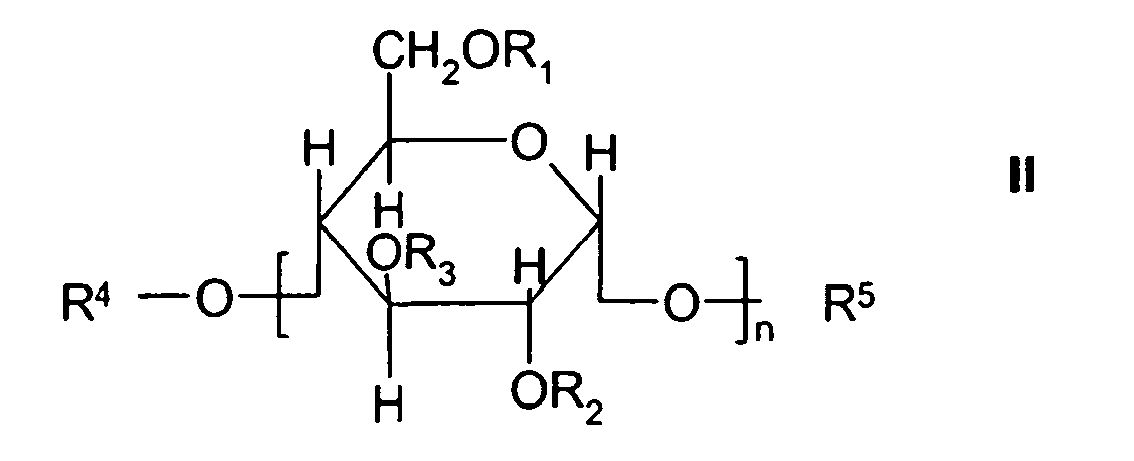
In einer besonders bevorzugten Ausführungsform der Erfindung werden aktivierte Carbonsäuren, deren zugrunde liegende Säure Palmitinsäure ist, in dem erfindungsgemäßen Verfahren verwendet. Außerordentlich bevorzugt werden nach dem erfindungsgemäßen Verfahren Substanzen ausgewählt aus Dextrinpalmitat und Cellobiosepalmitat hergestellt. Hierbei haben die Dextrine vorzugsweise einen Polymerisationsgrad von 3 bis 200, besonders bevorzugt von 5 bis 100 und insbesondere bevorzugt von 10 bis 50. - Der Veresterungsgrad pro Zuckereinheit ist bei Disacchariden vorzugsweise von 0,1 bis 4 und besonders bevorzugt von 2 bis 4.
- Bei Oligo- und Polysacchariden mit Polymerisationsgraden von 3 bis 200 ist der Veresterungsgrad pro Zuckereinheit vorzugsweise mindestens 0,1, d.h. von 0,1 bis 3,67 bei Sacchariden mit n = 3, von 0,1 bis 3,5 bei Sacchariden mit n = 4, etc. Bei Oligo- und Polysacchariden mit Polymerisationsgraden von 3 bis 200 ist der Veresterungsgrad pro Zuckereinheit besonders bevorzugt von 0,1 bis 3 und außerordentlich bevorzugt von 2 bis 3.
- In dem erfindungsgemäßen Verfahren beträgt das molare Verhältnis von aktivierter Carbonsäure zu Zuckereinheit bei der Verwendung von Disacchariden vorzugsweise von 0,1 : 1 bis 4 : 1 und besonders bevorzugt von 2 : 1 bis 4 : 1.
- In dem erfindungsgemäßen Verfahren ist das molare Verhältnis von aktivierter Carbonsäure zu Zuckereinheit bei der Verwendung von Oligo- und Polysacchariden mit Polymerisationsgraden von 3 bis 200 vorzugsweise mindestens 0,1 : 1. In dem erfindungsgemäßen Verfahren ist das molare Verhältnis von aktivierter Carbonsäure zu Zuckereinheit bei der Verwendung von Oligo- und Polysacchariden mit Polymerisationsgraden von 3 bis 200 besonders bevorzugt von 0,1 : 1 bis 3 : 1 und außerordentlich bevorzugt von 2 : 1 bis 3 : 1.
- In einer weiteren bevorzugten Ausführungsform der Erfindung wird Cellobioseoctanonanoat hergestellt.
- Das erfindungsgemäße Verfahren wird vorzugsweise bei einer Temperatur von 45 bis 80°C, besonders bevorzugt bei einer Temperatur von 65 bis 75°C, durchgeführt.
- In einer weiteren bevorzugten Ausführungsform wird das Verfahren derart ausgeführt, dass das Lösungsmittel bzw. Lösungsmittelgemisch recycliert wird.
- Die nachfolgenden Beispiele sollen den Gegenstand der Erfindung näher erläutern, ohne ihn jedoch darauf einzuschränken.
- Die Entwässerung der Zuckerkomponente kann sowohl mit und ohne Schleppmittel (Petrolether) erfolgen, wie in den Beispielen dargestellt. Auch für die Neutralisation der Reaktionsmischung kann sowohl eine wässrige Base, als auch eine alkoholische Base eingesetzt werden. Dies soll in den Beispielen demonstriert werden.
- In einen Rührkolben mit Vakuumwechselvorstoß werden 12,5 g wasserhaltige Cellobiose und 120 g 2-Methylpyrrolidon (NMP) vorgelegt und bei maximal 110°C und 50 mbar 20 % des eingesetzten NMP wieder abdestilliert. Anschließend wird der Ansatz auf 70°C abgekühlt und innerhalb von 60 Minuten bei 70 - 75°C 1 mol Palmitinsäurechlorid pro Hydroxylgruppe der Cellobiose zudosiert. Nach 4 Stunden Nachreaktion bei 70 - 75°C wird der Ansatz unter gleichzeitiger Dosierung von 23 g NaOH (50 gew.-%ig) in 200 g vorgelegtes Isopropanol getropft (Dauer: 45 - 60 Minuten). Der pH-Wert liegt zwischen 2 und 4. Am Ende dieser Fällungsreaktion wird dieses isopropanolische Gemisch mit NaOH (50 gew.-%ig) auf pH 10 (10 % tq wässrig) eingestellt. Anschließend wird der Niederschlag abgesaugt und mit VE-Wasser (eingestellt auf pH 10) und reinem VE-Wasser jeweils 30 Minuten bei 40 - 45°C gewaschen. Der gewaschene Niederschlag wird über Nacht bei 50°C im Vakuum (20 - 50 mbar) getrocknet. Die Ausbeute an feinkristallinem Produkt beträgt 70 % (Schmelzpunkt ca. 120°C).
- In einen Rührkolben mit Wasserabscheider werden wasserhaltiges Dextrin (17,8 g) und Petrolether (Siedebereich 70 - 90°C) vorgelegt und 4 Stunden bei 74 - 78°C Wasser ausgekreist. Anschließend werden ca. 75 % des eingesetzten Petrolethers wieder abdestilliert. Es werden 100 g 2-Methylpyrrolidon (NMP) zugegeben und bis zu einer Sumpftemperatur von 130°C der restliche Petrolether abdestilliert. Danach wird der Ansatz auf 70°C abgekühlt und innerhalb von 60 Minuten bei 70 - 75°C Palmitinsäurechlorid (82,5 g) zudosiert. Nach 4 Stunden Nachreaktion bei 70 - 75°C wird der Ansatz innerhalb von 45 - 60 Minuten auf 150 g Isopropanol dosiert, bei gleichzeitiger Dosierung von isopropanolischer KOH (15 gew.-%ig) bei pH 2 - 4. Der dabei entstehende Niederschlag wird anschließend mit isopropanolischer KOH auf pH 10 (10 % tq wässrig) eingestellt und abgesaugt. Der Niederschlag wird mit VE-Wasser (eingestellt auf pH 10) und reinem VE-Wasser 30 Minuten bei 40 - 45°C gewaschen. Danach wird der gewaschene Niederschlag über Nacht bei 50°C und 20 - 50 mbar getrocknet. Die Ausbeute an Dextrinpalmitat beträgt 79,5 %.
- Vergleichsbeispiel - Herstellung von Dextrinpalmitat in Gegenwart von Pyridin 16,2 g getrocknetes Dextrin und 94,9 g wasserfreies Pyridin werden in einem 500 ml-Rührkolben vorgelegt. Anschließend wird unter Rühren langsam 82,5 g Palmitinsäurechlorid zugetropft. Es tritt eine leichte Erwärmung auf 40 - 50°C ein. Die Mischung wird 4 Stunden bei 60°C gerührt. Danach wird der Ansatz auf 350 g Wasser gegossen und mit 85 g konz. Salzsäure auf pH 1,6 - 2,0 eingestellt. Es wird einige Minuten nachgerührt, anschließend abgesaugt und das feuchte Produkt in 300 g Petrolether (Siedebereich 60 - 70°C) gelöst. Nun wird der Ansatz mit 300 g 1 %iger Salzsäure versetzt und 0,5 Stunden bei 40°C gerührt. Danach wird diese Mischung in einen 2-Liter-Scheidetrichter überführt, die organische Phase von der wässrigen Phase getrennt und die organische Phase am Rotationsverdampfer bei leichtem Vakuum bei 30 - 40°C einrotiert. Anschließend wird der feste Rückstand in 300 g Essigsäureethylester (wasserfrei) aufgenommen und umkristallisiert. Die Umkristallisation wird gegebenenfalls wiederholt.
- Gegenüberstellung der Produkte und Ausbeuten aus der Pyridin-Variante und der 2-Methylpyrrolidon (NMP)-Variante:
Pyridin-Variante (Vergleichsbeispiel) NMP-Variante (Beispiel 2) Aussehen bei Raumtemperatur hellgelbes Pulver weiß, pulvrig bis körnig Ausbeute 37,0 % 79,5 % Säurezahl 3,4 mgKOH/g 0,92 mgKOH/g Chloridgehalt nicht bestimmt 0,10 % Schmelzpunkt ca. 99°C ca. 97°C
Claims (9)
- Verfahren zur Herstellung von Saccharidestern durch Umsetzung von Sacchariden mit aktivierten Carbonsäuren ausgewählt aus Carbonsäurechloriden in einem dipolar aprotischen Lösungsmittel ausgewählt aus der Gruppe der Lactame und in Abwesenheit einer basischen Aminverbindung.
- Verfahren nach Anspruch 1, dadurch gekennzeichnet, dass das Lactam 2-Methylpyrrolidon ist.
- Verfahren nach Anspruch 1 oder 2, dadurch gekennzeichnet, dass die Saccharide ausgewählt sind aus Dextrin und Cellobiose.
- Verfahren nach einem oder mehreren der Ansprüche 1 bis 3, dadurch gekennzeichnet, dass die den aktivierten Carbonsäuren zugrunde liegende Säure Palmitinsäure ist.
- Verfahren nach einem oder mehreren der Ansprüche 1 bis 4, dadurch gekennzeichnet, dass das molare Verhältnis von aktivierter Carbonsäure zu Zuckereinheit bei der Verwendung von Disacchariden von 0,1 : 1 bis 4 : 1 beträgt.
- Verfahren nach einem oder mehreren der Ansprüche 1 bis 4, dadurch gekennzeichnet, dass das molare Verhältnis von aktivierter Carbonsäure zu Zuckereinheit bei der Verwendung von Oligo- oder Polysacchariden mit Polymerisationsgraden von 3 bis 200 mindestens 0,1 : 1 ist.
- Verfahren nach einem oder mehreren der Ansprüche 1 bis 6, dadurch gekennzeichnet, dass es bei einer Temperatur von 45 bis 80°C durchgeführt wird.
- Verfahren nach einem oder mehreren der Ansprüche 1 bis 7, dadurch gekennzeichnet, dass das Lösungsmittel recycliert wird.
- Verfahren nach einem oder mehreren der Ansprüche 1 bis 3, 5, 7 und 8, dadurch gekennzeichnet, dass Cellobioseoctanonanoat hergestellt wird.
Applications Claiming Priority (2)
| Application Number | Priority Date | Filing Date | Title |
|---|---|---|---|
| DE10325200A DE10325200A1 (de) | 2003-06-04 | 2003-06-04 | Herstellung von Saccharidestern |
| DE10325200 | 2003-06-04 |
Publications (2)
| Publication Number | Publication Date |
|---|---|
| EP1484341A1 EP1484341A1 (de) | 2004-12-08 |
| EP1484341B1 true EP1484341B1 (de) | 2006-11-08 |
Family
ID=33154538
Family Applications (1)
| Application Number | Title | Priority Date | Filing Date |
|---|---|---|---|
| EP04012051A Expired - Lifetime EP1484341B1 (de) | 2003-06-04 | 2004-05-21 | Herstellung von Saccharidestern |
Country Status (4)
| Country | Link |
|---|---|
| US (1) | US20050019296A1 (de) |
| EP (1) | EP1484341B1 (de) |
| JP (1) | JP2004359682A (de) |
| DE (2) | DE10325200A1 (de) |
Families Citing this family (4)
| Publication number | Priority date | Publication date | Assignee | Title |
|---|---|---|---|---|
| WO2011102123A1 (ja) * | 2010-02-19 | 2011-08-25 | 千葉製粉株式会社 | 液状油のゲル化能を有しない新規デキストリン脂肪酸エステル及びその用途 |
| JP5616091B2 (ja) * | 2010-03-31 | 2014-10-29 | 株式会社コーセー | 毛髪化粧料 |
| JP5616093B2 (ja) * | 2010-03-31 | 2014-10-29 | 株式会社コーセー | エアゾール型毛髪化粧料 |
| KR20230085970A (ko) * | 2021-12-07 | 2023-06-15 | 주식회사 비제이바이오켐 | 덱스트린 다당류 폴리머 유도체의 제조방법 |
Family Cites Families (7)
| Publication number | Priority date | Publication date | Assignee | Title |
|---|---|---|---|---|
| DE3726015A1 (de) * | 1986-08-05 | 1988-02-11 | Ricoh Kk | Reversibel waermeempfindliche aufzeichnungsmaterialien |
| IT1219587B (it) * | 1988-05-13 | 1990-05-18 | Fidia Farmaceutici | Polisaccaridi carbossiilici autoreticolati |
| US5470969A (en) * | 1990-08-27 | 1995-11-28 | Mcneil-Ppc, Inc. | Catalyzed sucrose-6-ester process |
| DE4423681A1 (de) * | 1994-06-23 | 1996-01-04 | A U F Analytik Umwelttechnik F | Verfahren zur Herstellung partiell substituierter Stärkeacetate |
| JP3019191B2 (ja) * | 1995-04-05 | 2000-03-13 | 千葉製粉株式会社 | 新規デキストリン脂肪酸エステル及びその用途 |
| GB9908202D0 (en) * | 1999-04-12 | 1999-06-02 | Unilever Plc | Cosmetic compositions |
| GB0025437D0 (en) * | 2000-10-17 | 2000-11-29 | Unilever Plc | Esters |
-
2003
- 2003-06-04 DE DE10325200A patent/DE10325200A1/de not_active Withdrawn
-
2004
- 2004-05-21 DE DE502004001936T patent/DE502004001936D1/de not_active Expired - Fee Related
- 2004-05-21 EP EP04012051A patent/EP1484341B1/de not_active Expired - Lifetime
- 2004-06-01 JP JP2004163154A patent/JP2004359682A/ja not_active Withdrawn
- 2004-06-03 US US10/859,928 patent/US20050019296A1/en not_active Abandoned
Also Published As
| Publication number | Publication date |
|---|---|
| EP1484341A1 (de) | 2004-12-08 |
| US20050019296A1 (en) | 2005-01-27 |
| DE10325200A1 (de) | 2004-12-30 |
| JP2004359682A (ja) | 2004-12-24 |
| DE502004001936D1 (de) | 2006-12-21 |
Similar Documents
| Publication | Publication Date | Title |
|---|---|---|
| DE69102484T2 (de) | Verfahren zur Herstellung von Sucrose-6-ester. | |
| DE68919566T2 (de) | Verfahren zur Synthese von Rohrzuckerderivaten durch eine regiokselektive Reaktion. | |
| DE69113106T2 (de) | Verfahren zur Wiedergewinnung von Organozinnestern aus diese enthaltenden Reaktionsgemischen und Wiederverwendung der wiedergewonnenen Organozinnverbindungen. | |
| DE69614119T2 (de) | Kontinuierliches transesterifikationsverfahren zur herstellung von polyol-polyestern | |
| DE69104312T2 (de) | Verfahren zur Herstellung von Hydroxyamiden. | |
| DE69408599T2 (de) | Verfahren zur Herstellung von Taurocholansäure | |
| DE69113731T2 (de) | Herstellungsverfahren für katalysierte Sucrose-6-Ester. | |
| EP0197053A1 (de) | Grenzflächenaktive kohlenhydrat-derivate und verfahren zu deren herstellung | |
| DE60012366T2 (de) | Verfahren zur herstellung einer milchsäureester-zusammensetzung und deren gebrauch als lösungsmittel | |
| DE102009032235B4 (de) | Verfahren zur Herstellung von 1-Alkylglycerinethern | |
| DE60101056T2 (de) | Verfahren zur Herstellung von Ribavirin | |
| EP1484341A1 (de) | Herstellung von Saccharidestern | |
| WO1992022627A1 (de) | Fettsäureglycerinester mit verbesserten rheologischen eigenschaften | |
| DE1152416B (de) | Verfahren zur Herstellung von Carbonsaeurealkylestern | |
| EP0268974B1 (de) | Verfahren zur Herstellung von Gemischen aus mono- und oligomeren Kohlenhydratestern, die so erhältlichen Kohlenhydratestergemische und ihre Verwendung | |
| DE2734059C3 (de) | Verfahren zur Herstellung von teilweise neutralisierten Mischestern aus Milchsäure, Zitronensäure und partiellen Glycerinfettsäureestern | |
| EP0086324A2 (de) | Verfahren zur Herstellung von Ascorbinsäure | |
| EP1558558A1 (de) | Verfahren zur herstellung eines esters | |
| DE2356122A1 (de) | Verbessertes verfahren zur isolierung von cephalosporin c | |
| DE69914560T2 (de) | Verfahren zur acylierung von aminoalcoholen | |
| CH646706A5 (de) | Verfahren zur herstellung von natrium-cefuroxim und das tetrahydrofuran-solvat davon. | |
| DE3150288A1 (de) | Verfahren zur herstellung von n-acylcarnosin | |
| DD156263A1 (de) | Verfahren zur herstellung von kohlenhydrat-fettsaeureestern | |
| DE60304484T2 (de) | Verfahren zur herstellung von einem ribofuranose | |
| US20040192906A1 (en) | Novel process for the preparation of O-acylated glucose derivatives |
Legal Events
| Date | Code | Title | Description |
|---|---|---|---|
| PUAI | Public reference made under article 153(3) epc to a published international application that has entered the european phase |
Free format text: ORIGINAL CODE: 0009012 |
|
| AK | Designated contracting states |
Kind code of ref document: A1 Designated state(s): AT BE BG CH CY CZ DE DK EE ES FI FR GB GR HU IE IT LI LU MC NL PL PT RO SE SI SK TR |
|
| AX | Request for extension of the european patent |
Extension state: AL HR LT LV MK |
|
| 17P | Request for examination filed |
Effective date: 20050608 |
|
| AKX | Designation fees paid |
Designated state(s): DE FR GB IT |
|
| RAP1 | Party data changed (applicant data changed or rights of an application transferred) |
Owner name: CLARIANT PRODUKTE (DEUTSCHLAND) GMBH |
|
| GRAP | Despatch of communication of intention to grant a patent |
Free format text: ORIGINAL CODE: EPIDOSNIGR1 |
|
| GRAS | Grant fee paid |
Free format text: ORIGINAL CODE: EPIDOSNIGR3 |
|
| GRAA | (expected) grant |
Free format text: ORIGINAL CODE: 0009210 |
|
| AK | Designated contracting states |
Kind code of ref document: B1 Designated state(s): DE FR GB IT |
|
| REG | Reference to a national code |
Ref country code: GB Ref legal event code: FG4D Free format text: NOT ENGLISH |
|
| REF | Corresponds to: |
Ref document number: 502004001936 Country of ref document: DE Date of ref document: 20061221 Kind code of ref document: P |
|
| GBT | Gb: translation of ep patent filed (gb section 77(6)(a)/1977) |
Effective date: 20070212 |
|
| ET | Fr: translation filed | ||
| PLBE | No opposition filed within time limit |
Free format text: ORIGINAL CODE: 0009261 |
|
| STAA | Information on the status of an ep patent application or granted ep patent |
Free format text: STATUS: NO OPPOSITION FILED WITHIN TIME LIMIT |
|
| 26N | No opposition filed |
Effective date: 20070809 |
|
| PGFP | Annual fee paid to national office [announced via postgrant information from national office to epo] |
Ref country code: DE Payment date: 20090530 Year of fee payment: 6 Ref country code: FR Payment date: 20090427 Year of fee payment: 6 |
|
| PGFP | Annual fee paid to national office [announced via postgrant information from national office to epo] |
Ref country code: GB Payment date: 20090514 Year of fee payment: 6 |
|
| GBPC | Gb: european patent ceased through non-payment of renewal fee |
Effective date: 20100521 |
|
| REG | Reference to a national code |
Ref country code: FR Ref legal event code: ST Effective date: 20110131 |
|
| PG25 | Lapsed in a contracting state [announced via postgrant information from national office to epo] |
Ref country code: DE Free format text: LAPSE BECAUSE OF NON-PAYMENT OF DUE FEES Effective date: 20101201 |
|
| PG25 | Lapsed in a contracting state [announced via postgrant information from national office to epo] |
Ref country code: FR Free format text: LAPSE BECAUSE OF NON-PAYMENT OF DUE FEES Effective date: 20100531 |
|
| PG25 | Lapsed in a contracting state [announced via postgrant information from national office to epo] |
Ref country code: GB Free format text: LAPSE BECAUSE OF NON-PAYMENT OF DUE FEES Effective date: 20100521 |
|
| PGFP | Annual fee paid to national office [announced via postgrant information from national office to epo] |
Ref country code: IT Payment date: 20070531 Year of fee payment: 4 |