EP1484384A1 - Verfahren zur herstellung von biokraftstoff - Google Patents
Verfahren zur herstellung von biokraftstoff Download PDFInfo
- Publication number
- EP1484384A1 EP1484384A1 EP03743989A EP03743989A EP1484384A1 EP 1484384 A1 EP1484384 A1 EP 1484384A1 EP 03743989 A EP03743989 A EP 03743989A EP 03743989 A EP03743989 A EP 03743989A EP 1484384 A1 EP1484384 A1 EP 1484384A1
- Authority
- EP
- European Patent Office
- Prior art keywords
- oil
- clay
- reaction
- fatty acid
- waste clay
- Prior art date
- Legal status (The legal status is an assumption and is not a legal conclusion. Google has not performed a legal analysis and makes no representation as to the accuracy of the status listed.)
- Withdrawn
Links
Images

Classifications
-
- C—CHEMISTRY; METALLURGY
- C10—PETROLEUM, GAS OR COKE INDUSTRIES; TECHNICAL GASES CONTAINING CARBON MONOXIDE; FUELS; LUBRICANTS; PEAT
- C10L—FUELS NOT OTHERWISE PROVIDED FOR; NATURAL GAS; SYNTHETIC NATURAL GAS OBTAINED BY PROCESSES NOT COVERED BY SUBCLASSES C10G OR C10K; LIQUIFIED PETROLEUM GAS; USE OF ADDITIVES TO FUELS OR FIRES; FIRE-LIGHTERS
- C10L1/00—Liquid carbonaceous fuels
- C10L1/02—Liquid carbonaceous fuels essentially based on components consisting of carbon, hydrogen, and oxygen only
-
- C—CHEMISTRY; METALLURGY
- C11—ANIMAL OR VEGETABLE OILS, FATS, FATTY SUBSTANCES OR WAXES; FATTY ACIDS THEREFROM; DETERGENTS; CANDLES
- C11B—PRODUCING, e.g. BY PRESSING RAW MATERIALS OR BY EXTRACTION FROM WASTE MATERIALS, REFINING OR PRESERVING FATS, FATTY SUBSTANCES, e.g. LANOLIN, FATTY OILS OR WAXES; ESSENTIAL OILS; PERFUMES
- C11B13/00—Recovery of fats, fatty oils or fatty acids from waste materials
- C11B13/04—Recovery of fats, fatty oils or fatty acids from waste materials from spent adsorption materials
-
- C—CHEMISTRY; METALLURGY
- C11—ANIMAL OR VEGETABLE OILS, FATS, FATTY SUBSTANCES OR WAXES; FATTY ACIDS THEREFROM; DETERGENTS; CANDLES
- C11C—FATTY ACIDS FROM FATS, OILS OR WAXES; CANDLES; FATS, OILS OR FATTY ACIDS BY CHEMICAL MODIFICATION OF FATS, OILS, OR FATTY ACIDS OBTAINED THEREFROM
- C11C1/00—Preparation of fatty acids from fats, fatty oils, or waxes; Refining the fatty acids
- C11C1/02—Preparation of fatty acids from fats, fatty oils, or waxes; Refining the fatty acids from fats or fatty oils
- C11C1/04—Preparation of fatty acids from fats, fatty oils, or waxes; Refining the fatty acids from fats or fatty oils by hydrolysis
- C11C1/045—Preparation of fatty acids from fats, fatty oils, or waxes; Refining the fatty acids from fats or fatty oils by hydrolysis using enzymes or microorganisms, living or dead
-
- C—CHEMISTRY; METALLURGY
- C11—ANIMAL OR VEGETABLE OILS, FATS, FATTY SUBSTANCES OR WAXES; FATTY ACIDS THEREFROM; DETERGENTS; CANDLES
- C11C—FATTY ACIDS FROM FATS, OILS OR WAXES; CANDLES; FATS, OILS OR FATTY ACIDS BY CHEMICAL MODIFICATION OF FATS, OILS, OR FATTY ACIDS OBTAINED THEREFROM
- C11C3/00—Fats, oils, or fatty acids by chemical modification of fats, oils, or fatty acids obtained therefrom
- C11C3/003—Fats, oils, or fatty acids by chemical modification of fats, oils, or fatty acids obtained therefrom by esterification of fatty acids with alcohols
-
- Y—GENERAL TAGGING OF NEW TECHNOLOGICAL DEVELOPMENTS; GENERAL TAGGING OF CROSS-SECTIONAL TECHNOLOGIES SPANNING OVER SEVERAL SECTIONS OF THE IPC; TECHNICAL SUBJECTS COVERED BY FORMER USPC CROSS-REFERENCE ART COLLECTIONS [XRACs] AND DIGESTS
- Y02—TECHNOLOGIES OR APPLICATIONS FOR MITIGATION OR ADAPTATION AGAINST CLIMATE CHANGE
- Y02W—CLIMATE CHANGE MITIGATION TECHNOLOGIES RELATED TO WASTEWATER TREATMENT OR WASTE MANAGEMENT
- Y02W30/00—Technologies for solid waste management
- Y02W30/50—Reuse, recycling or recovery technologies
- Y02W30/74—Recovery of fats, fatty oils, fatty acids or other fatty substances, e.g. lanolin or waxes
Definitions
- the present invention relates to a method of producing bio-fuels. More specifically, the invention relates to a method of producing bio-fuels by utilizing oils and fats in the waste clay.
- a representative example of the bio-diesels may be obtained by causing a caustic soda and a methyl alcohol to act upon the used fry oil to esterify it with methyl.
- Japanese Unexamined Patent Publication (Kokai) No. 138796/1983 teaches obtaining a fuel oil that can be used for diesel engines at a low cost and in a high yield by adding an alkali aqueous solution to the starting plant oil, heating the mixture, washing the mixture with water after it has been stirred, followed by the removing-acid treatment.
- waste clay occluding large amounts of oils and fats are produced as by-products without, however, any effective treatment therefor but simply blending and firing them together for producing the portland cement. It has further been attempted to extract and remove oil components contained in the waste clay with an organic solvent such as hexane. However, it is difficult to remove the oil components present in the pores of white clay (fuller's earth), and no effective processing means has yet been found.
- a method of producing bio-fuels by causing an enzyme to act upon the oils and fats in a waste clay to decompose them into a fatty acid, and reacting the formed fatty acid with a lower alcohol to form an ester thereof that can be used as a bio-fuel.
- the acid clay (acidic white clay) or the activated clay obtained by chemically treating the acid clay is widely used for the decoloration and refining of oils and fats.
- the waste clay contains about 20 to about 60% by weight of oils and fats that are difficult to separate.
- the waste clay is in the form of a sticky paste and can be handled with very difficulty.
- the waste clay is produced in amounts of as large as 50,000 tons a year.
- the waste clay is utilized for the production of bio-fuels to effectively utilize the plant oils in the waste clay as resources and, further, to reuse the waste clay from which the plant oils have been removed.
- the invention effectively utilizes the resources again while effectively preventing contamination in the natural environment.
- an enzyme acts upon the oils and fats in the waste clay to decompose them into a fatty acid, and the thus formed fatty acid is then reacted with a lower alcohol to form an ester thereof.
- the enzyme acts upon the oils and fats in the waste clay, whereby the oils and fats are effectively decomposed into the fatty acid.
- the enzyme reaction proceeds even at relatively low temperatures and the reaction can be easily controlled.
- the fatty acid formed by the decomposition is reacted with the lower alcohol so as to be esterified, and can be easily separated and recovered without requiring any cumbersome operation.
- the waste clay used in the method of the present invention is separated as a by-product in the step of decoloring or refining oils and fats by using the white clay (fuller's earth) for decoloring or refining.
- the waste clay used in the present invention contains oil components and is not allowed to be discarded from the standpoint preventing contamination of the environment. It has therefore been eagerly desired to effectively utilize the waste clay.
- a clay mineral of the Group of montmorillonite such as acid clay or activated clay that is obtained by treating the above clay mineral with an acid and/or an alkali in the form of a powdery agent for decoloring or refining, and the two are homogeneously stirred together such that the color components and impurity components contained in the oils and fats are adsorbed by the waste clay particles.
- the waste clay separated after the decoloring or refining contains oils and fats in amounts equivalent to oil-absorbing amounts of the white clay that is used.
- the oils and fats are decolored under known conditions by, for example, adding 0.1 to 5% of white clay as a decoloring or refining agent based on the weight of the oils and fats, and stirring the two compositions at a temperature of from 90 to 150°C for 5 to 30 minutes to thereby complete the processing for decoloring or refining.
- the mixture after decolored or refined is supplied to any filter such as a filter press, a belt filter, the Oliver filter, the American filter or to a pressure-reducing or a pressurizing filter such as a centrifugal filter, to obtain refined oils and fats and the so-called waste clay which is the used decoloring or refining agent.
- the waste clay usually contains from about 20 to about 60% by weight of oil components held by the particles though it may vary depending upon the kind of the starting oil that is to be refined.
- the waste clay used in the present invention uses, as the decoloring or refining white clay, the smectite clay minerals such as acid clay (montmorillonite), bentonite, saponite, hectorite and stevensite as well as the chained clay mineral such as attapulgite, or acid-treated products thereof.
- the smectite clay minerals such as acid clay (montmorillonite), bentonite, saponite, hectorite and stevensite as well as the chained clay mineral such as attapulgite, or acid-treated products thereof.
- clay minerals the clay minerals of montmorillonite and the acid-treated products thereof are widely used for decoloring and refining oils and fats.
- the clay mineral of montmorillonite such as the acid clay is an aluminosilicate having, as a basic unit, a three-layer structure in which an AlO 6 octahedral layer is sandwiched between the two SiO 4 tetrahedral layers, the three-layer structures of this basic unit being further laminated in many number in the C-axis direction to constitute a laminar crystalline structure.
- This laminar crystalline structure is common in the clay minerals of montmorillonite.
- the acid clay widely produced in Japan are weathered and Al atoms in the AlO 6 octahedral layer in the three-layer structure which is the basic unit of the montmorillonite are partly substituted by an alkaline earth metal such as magnesium or calcium, and hydrogen ions are bonded thereto to compensate for an atomic value. Therefore, if the acid clay is suspended in an aqueous solution of table salt to measure its pH value, the acidic property is exhibited since the hydrogen ions are replaced by the sodium (Na) ions.
- the bentonite exhibits a pH which is neutral to very weakly alkaline since the exchangeable cations are mostly those of sodium (Na) and further exhibits a large water-swelling property.
- the acid clay' is very advantageous from the standpoint of adsorption since the sodium ions have been substituted by an alkaline earth metal, the amount of the alkali metal component is small, the water-swelling property is small, and the silicic acid is contained in large amounts.
- the montmorillonite therefore, any acid clay produced in Japan is widely used.
- a clay mineral of montmorillonite called sub-bentonite (Ca-type bentonite).
- Table 1 shows a general chemical composition of acid clay (dried at 100°C). SiO 2 61.0 to 74.0 (% by weight) Al 2 O 3 12.0 to 23.0 Fe 2 O 3 2.0 to 3.5 MgO 3.0 to 7.0 CaO 1.0 to 4.0 K 2 O 0.3 to 2.0 Na 2 O 0.3 to 2.0 Ig.loss 5.0 to 10.0
- the rocks such as cristobalite, quartz and feldspar contained therein can be easily separated by a separation method utilizing the difference in the specific gravity (such classification means as hydraulic elutriation, air elutriation, etc.).
- the cristobalite of crystalline silicic acid easily reacts with an alkali and can be converted into an alkali silicate, and can, hence, be removed even by this method.
- the purity of the laminar crystalline structure can be improved by the above methods.
- the acid-treated product of acid clay has been known as activated clay which can be used as an agent for refining oils and fats.
- the acid-treated product can be easily prepared by treating the acid clay with a mineral acid solution such as of sulfuric acid or hydrochloric acid, partly eluting the basic component contained therein and washing it. Due to this treatment with acid, the laminar crystalline structure possessed by the acid clay is partly destroyed, but the content of silicic acid (SiO 2 ) increases contributing to increasing the specific surface area and improving properties such as adsorption properties.
- the acid-treated product of acid clay and activated clay that is generally placed in the market and intermediate products thereof, serve as refining agents exhibiting excellent properties.
- the acid-treated product usually possesses the composition shown in Table 2 below though it may vary depending upon the kind of the starting acid clay or the conditions for the treatment with acid.
- the chained clay mineral such as attapulgite has a three-dimensional chained structure like alternately stacking talc bricks.
- the holes formed in the chained gaps have a large surface area. Therefore, these chained clay minerals, too, exhibit adsorbing action and absorbing action to occlude oils and fats, and can, hence, be used in the invention.
- clay minerals and the acid-treated products thereof are used in the invention in the form of so-called waste clay occluding plant oils.
- the plant oils contained in the waste clay of the invention are those which widely exist in the natural plant world and chiefly comprise esters of fatty acid and glycerin.
- Examples include safflower oil, soybean oil, rape oil, palm oil, palm kernel oil, cotton seed oil, coconut oil, rice bran oil, sesame oil, castor oil, linseed oil, olive oil, tung oil, tsubaki oil, peanut oil, kapok oil, cacao oil, Japan wax, sunflower oil and corn oil. It is desired that the plant oil used in the present invention at least partly comprises chiefly an ester of an unsaturated fatty acid and glycerin.
- any enzyme can be used provided it is capable of hydrolyzing oils and fats, and forms a fatty acid.
- a lipase can be used.
- the lipase that is used may be secured to a suitable carrier.
- an enzyme acts upon the oils and fats in the waste clay to decompose them into a fatty acid which is, then, reacted with a lower alcohol so as to be esterified.
- the enzyme reaction of oils and fats can be conducted under the known conditions.
- the reaction can be conducted in the presence of water or an organic solvent.
- an organic solvent such as hexane, petroleum ether, acetone or heptane and, particularly, hexane or petroleum ether.
- water is supplied in the form of an aqueous solution or an aqueous dispersion of an enzyme. It is, of course, allowable to add the water separately from the enzyme.
- the enzyme is used in an amount that has heretofore been used for the decomposition with enzyme depending upon the amounts of oils and fats contained in the waste clay, and specifically in an amount of from 30 to 85 IU and, particularly, from 50 to 65 IU per gram of oils and fats in the waste clay.
- the amount of water or organic solvent present in the reaction system is from 25 to 250 parts by weight per 100 parts by weight of oils and fats in the waste clay.
- water is preferably used in an amount of from 25 to 75 parts by weight.
- the organic solvent is preferably used in an amount of from 80 to 210 parts by weight.
- the yield of fatty acid tends to decrease.
- the enzyme acts upon the waste clay to carry out the enzyme reaction in the copresence of the used clay and the oils and fats, it is desired to use the water in a relatively large amounts within the above range.
- the organic solvent may be present in an amount which is large enough for fluidizing the waste clay. An excess use of the organic solvent results in a decrease in the yield. It is, therefore, most desired that the organic solvent is used in such an amount that the ratio of the amount of organic solvent/waste clay (weight ratio) is in a range of from 0.45 to 0.82 and, particularly, from 0.55 to 0.70.
- the decomposition reaction into the fatty acid may be conducted in a temperature range in which the enzyme maintains activity and, usually, in a range of from 20 to 50°C and, particularly, from 30 to 40°C.
- a preferred pH value may differ depending upon the kind of the enzyme and the kind of the waste clay. In general, however, it is desired that the pH lies in a range of from 5.0 to 8.0. For this purpose, it is desired to use a buffer solution.
- the time of the enzyme reaction may be such that a desired decomposition ratio is accomplished, for example, from about 40 to about 72 hours.
- the lower alcohol used for the esterification of the fatty acid there can be exemplified those alcohols having not more than 8 carbon atoms, such as methanol, ethanol, propyl alcohol, isopropyl alcohol, butyl alcohol, isobutyl alcohol, sec-butyl alcohol, tert-butyl alcohol, n-amyl alcohol, isoamyl alcohol, hexyl alcohol, heptyl alcohol and octyl alcohol.
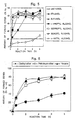
- the lower alcohol is used in an amount of not smaller than an equivalent with respect to the fatty acid and particularly in such an amount that fatty acid:alcohol (mole ratio) is from 1:3 to 1:6 and, preferably, from 1:3 to 1:4 (see Fig. 6).
- the fatty acid is esterified in the presence of water or an organic solvent from the standpoint of increasing the yield of ester like when the oils and fats are decomposed into the fatty acid with the enzyme.
- the water or the organic solvent is used in an amount of from 25 to 250 parts by weight per 100 parts by weight of the oils and fats like in the step of decomposing the oils and fats into fatty acid.
- the water is used in an amount of from 25 to 75 parts by weight.
- the organic solvent is used in an amount of from 80 to 210 parts by weight.
- the esterification reaction of the fatty acid may be conducted in a temperature range suited for the esterification reaction, e.g., in a range of from 20 to 50°C and, particularly, from 30 to 40°C.
- the time of the esterification reaction may be such that a desired yield of ester is accomplished, e.g., from about 48 to about 72 hours.
- the enzyme reaction and the esterification reaction can be carried out as a one-pot reaction continuously in the same reaction system or as a two-stage reaction.
- the one-pot reaction is conducted by feeding the waste clay, an aqueous solution or a dispersion of an enzyme and a lower alcohol to the reaction system, or by feeding the waste clay, an organic solvent, an enzyme and a lower alcohol to the reaction system, and recovering the formed ester from the reaction system.
- the two-stage reaction is conducted by feeding the waste clay, an enzyme and an organic solvent to the reaction system or by feeding the waste clay and an aqueous solution or a dispersion of an enzyme to the reaction system to conduct the enzyme reaction and, then, by feeding a lower alcohol to the reaction system to carry out the esterification reaction and, recovering the formed ester from the reaction system.
- the enzyme reaction in the water system may be carried out by kneading the waste clay and the aqueous solution or dispersion of the enzyme in a paste-like or mud-like state. Or, the enzyme reaction in the water system may be carried out in the state of a dispersion thereof by using a diluting solvent.
- the resulting ester of fatty acid can be separated and recovered by a known means such as distillation, extraction, oil/water separation or the like method.
- the unreacted glyceride may remain in the residue of waste clay from which the fatty acid has been separated, or the enzyme may remain in the residue of the waste clay.
- the glyceride contained in the residue may be extracted and circulated into the step of decomposition into fatty acid or into the step of esterification. As required, further, the enzyme contained in the residue of the waste clay may be used again.
- the waste clay and the n-hexane were mixed together at a weight ratio of 1:1, and were extracted at 30°C for 10 minutes.
- the obtained hexane phase was separated, and the oil was extracted by using a vacuum rotary evaporator. This operation was conducted twice to recover the obtained oil component which was then dried in a drier heated at 60°C until the weight became constant. The weight was measured and was regarded to be the amount of oil.
- the gas chromatography was GC-14B of Shimazu Co., and was constituted by a 3 mm x 2 mm glass column filled with 5% Advans DS on 80/100 meshes Chromosorb W and a hydrogen ionization detector.
- the temperatures of the column, injection portion and oven were controlled to be 190, 240 and 250°C.
- the fatty acid was identified by using a commercially available standard fatty acid purchased from Sigma Co.
- a lipase powder (F-AP15, manufactured by Amano Seiyaku Co.) stemming from Rhizopus oryzae was dissolved in 10 ml of distilled water over 30 minutes with stirring, subjected to the centrifugal separation at 3500 rpm for 10 minutes, and the supernatant solution was used as the enzyme solution (Sample R-1).
- the enzymatic'activity (IU/L) was analyzed by using a lipase kit S manufactured by Dainippon Seiyaku Co.
- the mixture was shaken at 37°C in a rotary shaking machine rotating at 170 rpm for 48 hours or 72 hours (methanol was added in an amount of 274 ⁇ l after 24 hours and 48 hours have passed, respectively).
- 10 ml of distilled water was added into the flask to wash the interior of the flask and was, then, transferred into a Falcon tube. Thereafter, the Falcon tube was subjected to the centrifugal separation for 15 minutes at 10,000 rpm to take out the supernatant solution. Then, hexane was added to the supernatant solution to dissolve the methyl ester that has been formed. Next, the hexane was completely blown off to analyze the methyl ester with a gas chromatography.
- Numerical values without parentheses represent the amounts (g) of the formed methyl ester and the conversion ratio (%) of when reacted for 48 hours and numerical values in parentheses represent the amounts (g) of the formed methyl ester and the conversion ratio (%) of when reacted for 72 hours.
- the reaction solution was transferred into a Falcon tube. Thereafter, the Falcon tube was subjected to the centrifugal separation for 15 minutes at 10,000 rpm to take out the supernatant solution. Then, hexane was added to the supernatant solution to dissolve the methyl ester that has been formed. Next, the hexane was completely blown off, a chloroform was added to the obtained methyl ester to dissolve it which was then analyzed with a gas chromatography. The results were as shown in Table 7 and in Fig. 5.
- the mixture was shaken at 37°C in a reciprocal shaking machine rotating at 120 rpm for 0.5 hours, 2 hours, 4 hours, 6 hours and 8 hours.
- the reaction solution was transferred into a Falcon tube. Thereafter, the Falcon tube was subjected to the centrifugal separation for 15 minutes at 10,000 rpm to take out the supernatant solution.
- hexane was added to the supernatant solution to dissolve the ethyl ester that has been formed.
- the hexane was completely blown off, a chloroform was added to the obtained ethyl ester to dissolve it which was then analyzed with a gas chromatography.
- the results were as shown in Table 7 and in Fig. 5.
- the mixture was shaken at 37°C in a reciprocal shaking machine rotating at 120 rpm for 0.5 hours, 2 hours, 4 hours, 6 hours and 8 hours.
- the reaction solution was transferred into a Falcon tube. Thereafter, the Falcon tube was subjected to the centrifugal separation for 15 minutes at 10,000 rpm to take out the supernatant solution.
- hexane was added to the supernatant solution to dissolve the butyl ester that has been formed.
- the hexane was completely blown off, a chloroform was added to the obtained butyl ester to dissolve it which was then analyzed with a gas chromatography.
- the results were as shown in Table 7 and in Fig. 5.
- the mixture was shaken at 37°C in a reciprocal shaking machine rotating at 120 rpm for 0.5 hours, 2 hours, 4 hours, 6 hours and 8 hours.
- the reaction solution was transferred into a Falcon tube. Thereafter, the Falcon tube was subjected to the centrifugal separation for 15 minutes at 10,000 rpm to take out the supernatant solution.
- hexane was added to the supernatant solution to dissolve the n-propyl ester that has been formed.
- the hexane was completely blown off, a chloroform was added to the obtained n-propyl ester to dissolve it which was then analyzed with a gas chromatography.
- the results were as shown in Table 7 and in Fig. 5.
- the mixture was shaken at 37°C in a reciprocal shaking machine rotating at 120 rpm for 0.5 hours, 2 hours, 4 hours, 6 hours and 8 hours.
- the reaction solution was transferred into a Falcon tube. Thereafter, the Falcon tube was subjected to the centrifugal separation for 15 minutes at 10,000 rpm to take out the supernatant solution.
- hexane was added to the supernatant solution to dissolve the isopropyl ester that has been formed.
- the hexane was completely blown off, a chloroform was added to the obtained isopropyl ester to dissolve it which was then analyzed with a gas chromatography.
- the results were as shown in Table 7 and in Fig. 5.
- the mixture was shaken at 37°C in a reciprocal shaking machine rotating at 120 rpm for 0.5 hours, 2 hours, 4 hours, 6 hours and 8 hours.
- the reaction solution was transferred into a Falcon tube. Thereafter, the Falcon tube was subjected to the centrifugal separation for 15 minutes at 10,000 rpm to take out the supernatant solution.
- hexane was added to the supernatant solution to dissolve the isoamyl ester that has been formed.
- the hexane was completely blown off, a chloroform was added to the obtained isoamyl ester to dissolve it which was then analyzed with a gas chromatography.
- the results were as shown in Table 7 and in Fig. 5.
- the mixture was shaken at 37°C in a reciprocal shaking machine rotating at 120 rpm for 0.5 hours, 2 hours, 4 hours, 6 hours and 8 hours.
- the reaction solution was transferred into a Falcon tube. Thereafter, the Falcon tube was subjected to the centrifugal separation for 15 minutes at 10,000 rpm to take out the supernatant solution.
- hexane was added to the supernatant solution to dissolve the n-octyl ester that has been formed.
- the hexane was completely blown off, a chloroform was added to the obtained n-octyl ester to dissolve it which was then analyzed with a gas chromatography.
- the results were as shown in Table 7 and in Fig. 5.
- Examples 5, 7, 10 and 11 were evaluated for their ignitability, degree of black smoke when burned and odor. The results were as shown in Table 8. Ignitability Degree of black smoke Odor Ex. 5 ⁇ ⁇ ⁇ Ex. 7 ⁇ ⁇ ⁇ Ex. 10 ⁇ ⁇ ⁇ Ex. 11 ⁇ ⁇ ⁇ Ignitability ⁇ : good X: poor Degree of black smoke ⁇ : none X: yes Odor ⁇ : none X: yes
- an enzyme is caused to act on the oils and fats in the waste clay to decompose them into a fatty acid which is then reacted with a lower alcohol to form a monoester thereof.
Landscapes
- Chemical & Material Sciences (AREA)
- Life Sciences & Earth Sciences (AREA)
- Oil, Petroleum & Natural Gas (AREA)
- Engineering & Computer Science (AREA)
- Chemical Kinetics & Catalysis (AREA)
- Organic Chemistry (AREA)
- General Chemical & Material Sciences (AREA)
- Wood Science & Technology (AREA)
- Microbiology (AREA)
- Biochemistry (AREA)
- Fats And Perfumes (AREA)
- Preparation Of Compounds By Using Micro-Organisms (AREA)
- Liquid Carbonaceous Fuels (AREA)
- Production Of Liquid Hydrocarbon Mixture For Refining Petroleum (AREA)
Applications Claiming Priority (5)
| Application Number | Priority Date | Filing Date | Title |
|---|---|---|---|
| JP2002065309 | 2002-03-11 | ||
| JP2002065309 | 2002-03-11 | ||
| JP2002278086A JP4095392B2 (ja) | 2002-03-11 | 2002-09-24 | バイオ燃料の製造方法 |
| JP2002278086 | 2002-09-24 | ||
| PCT/JP2003/002384 WO2003076553A1 (fr) | 2002-03-11 | 2003-02-28 | Procede de production de biocarburant |
Publications (2)
| Publication Number | Publication Date |
|---|---|
| EP1484384A1 true EP1484384A1 (de) | 2004-12-08 |
| EP1484384A4 EP1484384A4 (de) | 2005-12-07 |
Family
ID=27806958
Family Applications (1)
| Application Number | Title | Priority Date | Filing Date |
|---|---|---|---|
| EP03743989A Withdrawn EP1484384A4 (de) | 2002-03-11 | 2003-02-28 | Verfahren zur herstellung von biokraftstoff |
Country Status (8)
| Country | Link |
|---|---|
| US (1) | US20050084941A1 (de) |
| EP (1) | EP1484384A4 (de) |
| JP (1) | JP4095392B2 (de) |
| CN (1) | CN1328357C (de) |
| AU (1) | AU2003211577A1 (de) |
| BR (1) | BR0303369A (de) |
| MY (1) | MY143824A (de) |
| WO (1) | WO2003076553A1 (de) |
Cited By (2)
| Publication number | Priority date | Publication date | Assignee | Title |
|---|---|---|---|---|
| GB2452975A (en) * | 2007-09-21 | 2009-03-25 | Statoil Asa | Process for the formation of biodiesel |
| WO2022036117A1 (en) * | 2020-08-12 | 2022-02-17 | Zick Matthias | Versatile oil recovery process from spent oily solid material |
Families Citing this family (24)
| Publication number | Priority date | Publication date | Assignee | Title |
|---|---|---|---|---|
| WO2008092207A1 (en) * | 2007-02-02 | 2008-08-07 | Dalriada Meat Pty Ltd | Biodiesel production |
| US20090004715A1 (en) | 2007-06-01 | 2009-01-01 | Solazyme, Inc. | Glycerol Feedstock Utilization for Oil-Based Fuel Manufacturing |
| JP5545695B2 (ja) * | 2007-11-16 | 2014-07-09 | 水澤化学工業株式会社 | バイオ燃料の製造方法 |
| US20100170144A1 (en) * | 2008-04-09 | 2010-07-08 | Solazyme, Inc. | Hydroprocessing Microalgal Oils |
| CA2720828C (en) * | 2008-04-09 | 2017-03-21 | Solazyme, Inc. | Direct chemical modification of microbial biomass and microbial oils |
| CN102144035B (zh) * | 2008-07-08 | 2014-10-08 | 科技研究局 | 通过酶促水解及随后的化学/酶促酯化生产生物柴油 |
| CN105063116A (zh) * | 2008-08-27 | 2015-11-18 | 易登尼有限公司 | 用于将生物质转化为生物燃料的材料和方法 |
| AU2009285815A1 (en) * | 2008-08-27 | 2010-03-04 | Edeniq, Inc. | Materials and methods for converting biomass to biofuel |
| CN101733132B (zh) * | 2008-11-12 | 2012-01-25 | 北京清研利华石油化学技术有限公司 | 用于生产柴油的催化剂体系及利用该体系生产柴油的方法 |
| AU2009319722B2 (en) * | 2008-11-28 | 2016-08-04 | Corbion Biotech, Inc. | Production of tailored oils in heterotrophic microorganisms |
| JP5405193B2 (ja) * | 2009-05-15 | 2014-02-05 | 水澤化学工業株式会社 | バイオ燃料の製造方法 |
| JP4397432B1 (ja) * | 2009-06-19 | 2010-01-13 | 有限会社中部エンザイム | 燃料製造方法および燃料製造装置 |
| US8592188B2 (en) | 2010-05-28 | 2013-11-26 | Solazyme, Inc. | Tailored oils produced from recombinant heterotrophic microorganisms |
| BR112012032172A2 (pt) * | 2010-06-18 | 2015-11-24 | Butamax Tm Advanced Biofuels | método para produzir um álcool e composição |
| WO2012066860A1 (ja) | 2010-11-15 | 2012-05-24 | 日清オイリオグループ株式会社 | 再生白土の製造方法、再生白土、及び精製油脂の製造方法 |
| US8759044B2 (en) | 2011-03-23 | 2014-06-24 | Butamax Advanced Biofuels Llc | In situ expression of lipase for enzymatic production of alcohol esters during fermentation |
| US8765425B2 (en) | 2011-03-23 | 2014-07-01 | Butamax Advanced Biofuels Llc | In situ expression of lipase for enzymatic production of alcohol esters during fermentation |
| MX339607B (es) | 2011-05-06 | 2016-05-31 | Solazyme Inc | Microorganismos geneticamente modificados que metabolizan xilosa. |
| WO2013081446A1 (en) * | 2011-12-02 | 2013-06-06 | Universiti Malaya | A process for producing biodiesel from natural oil and a system thereof |
| JP6069722B2 (ja) * | 2012-04-04 | 2017-02-01 | 日清オイリオグループ株式会社 | エステル交換油脂の製造方法 |
| US8945908B2 (en) | 2012-04-18 | 2015-02-03 | Solazyme, Inc. | Tailored oils |
| JP6098019B2 (ja) | 2012-05-10 | 2017-03-22 | 日清オイリオグループ株式会社 | 再生白土の製造方法、再生白土、及び精製油脂の製造方法 |
| US20210395628A1 (en) * | 2018-11-01 | 2021-12-23 | Ariel Scientific Innovations Ltd. | Production of biodiesel |
| CA3167348A1 (en) * | 2020-02-10 | 2021-08-19 | Vladimir YONG-GONZALEZ | Microbially produced palm oil substitutes |
Family Cites Families (9)
| Publication number | Priority date | Publication date | Assignee | Title |
|---|---|---|---|---|
| JPH08275A (ja) * | 1994-06-23 | 1996-01-09 | Fuji Oil Co Ltd | リパーゼ剤による油脂の改質法 |
| US5525126A (en) * | 1994-10-31 | 1996-06-11 | Agricultural Utilization Research Institute | Process for production of esters for use as a diesel fuel substitute using a non-alkaline catalyst |
| US5578090A (en) * | 1995-06-07 | 1996-11-26 | Bri | Biodiesel fuel |
| US5713965A (en) * | 1996-04-12 | 1998-02-03 | The United States Of America As Represented By The Secretary Of Agriculture | Production of biodiesel, lubricants and fuel and lubricant additives |
| JPH11263780A (ja) * | 1998-03-17 | 1999-09-28 | Showa Highpolymer Co Ltd | ジヒドロベンズオキサジン化合物の製造方法 |
| JP3581018B2 (ja) * | 1998-05-26 | 2004-10-27 | 旭電化工業株式会社 | 白土含有脂肪酸組成物等の製造方法 |
| WO2000012743A1 (en) * | 1998-09-01 | 2000-03-09 | Kansai Chemical Engineering Co., Ltd. | Process for producing lower alcohol ester |
| JP2000139489A (ja) * | 1998-11-10 | 2000-05-23 | Asahi Denka Kogyo Kk | 白土含有脂肪酸金属塩の製造方法 |
| JP2000270886A (ja) * | 1999-03-29 | 2000-10-03 | Nagase & Co Ltd | エステル交換方法 |
-
2002
- 2002-09-24 JP JP2002278086A patent/JP4095392B2/ja not_active Expired - Fee Related
-
2003
- 2003-02-28 BR BR0303369A patent/BR0303369A/pt not_active IP Right Cessation
- 2003-02-28 AU AU2003211577A patent/AU2003211577A1/en not_active Abandoned
- 2003-02-28 CN CNB038005611A patent/CN1328357C/zh not_active Expired - Fee Related
- 2003-02-28 US US10/477,230 patent/US20050084941A1/en not_active Abandoned
- 2003-02-28 EP EP03743989A patent/EP1484384A4/de not_active Withdrawn
- 2003-02-28 WO PCT/JP2003/002384 patent/WO2003076553A1/ja not_active Ceased
- 2003-03-08 MY MYPI20030817 patent/MY143824A/en unknown
Non-Patent Citations (2)
| Title |
|---|
| No further relevant documents disclosed * |
| See also references of WO03076553A1 * |
Cited By (3)
| Publication number | Priority date | Publication date | Assignee | Title |
|---|---|---|---|---|
| GB2452975A (en) * | 2007-09-21 | 2009-03-25 | Statoil Asa | Process for the formation of biodiesel |
| GB2452975B (en) * | 2007-09-21 | 2013-01-16 | Statoilhydro Asa | Formation of biodiesel using microorganisms |
| WO2022036117A1 (en) * | 2020-08-12 | 2022-02-17 | Zick Matthias | Versatile oil recovery process from spent oily solid material |
Also Published As
| Publication number | Publication date |
|---|---|
| MY143824A (en) | 2011-07-15 |
| AU2003211577A1 (en) | 2003-09-22 |
| JP4095392B2 (ja) | 2008-06-04 |
| CN1522293A (zh) | 2004-08-18 |
| WO2003076553A1 (fr) | 2003-09-18 |
| BR0303369A (pt) | 2004-03-23 |
| EP1484384A4 (de) | 2005-12-07 |
| US20050084941A1 (en) | 2005-04-21 |
| JP2003336082A (ja) | 2003-11-28 |
| CN1328357C (zh) | 2007-07-25 |
Similar Documents
| Publication | Publication Date | Title |
|---|---|---|
| EP1484384A1 (de) | Verfahren zur herstellung von biokraftstoff | |
| Pizarro et al. | Lipase-catalyzed production of biodiesel fuel from vegetable oils contained in waste activated bleaching earth | |
| EP0126416B1 (de) | Reaktionsverfahren für die Umesterung von Fetten und Ölen | |
| Hsu et al. | Production of alkyl esters from tallow and grease using lipase immobilized in a phyllosilicate sol-gel | |
| US8357814B2 (en) | Method of purifying interesterified oils | |
| EP0237092B1 (de) | Verfahren zur Transveresterung von Triglyceriden | |
| NL7909143A (nl) | Werkwijze voor het omesteren van glyceriden. | |
| Sonnet et al. | Evaluation of lipase selectivity for hydrolysis | |
| EP0624202B1 (de) | Verfahren zur herstellung eines gamma-linolensäure enthaltenden einzell-öls | |
| WO1991006661A1 (en) | Lipase-catalyzed in situ generation of mono- and di-glycerides | |
| US7923224B2 (en) | Method of recovering lipase activity | |
| JP4426272B2 (ja) | バイオ燃料の製造方法 | |
| JP5545695B2 (ja) | バイオ燃料の製造方法 | |
| JP3847445B2 (ja) | ジグリセリドの製造法 | |
| GB2188057A (en) | Transesterification of fats and oils | |
| JPH0730352B2 (ja) | 酵素による油脂の精製法 | |
| JP5048957B2 (ja) | エステル合成触媒及びその製造方法並びに該触媒を用いたバイオ燃料の製造方法 | |
| CA1118376A (en) | Process for producing steroidal alcohols | |
| US20110224451A1 (en) | Process for production of biodiesel | |
| Abada | Production and Purification of lipase from Pseudomonas sp. AB2 with potential application in biodiesel production | |
| US7767426B2 (en) | Method of producing riboflavin | |
| JP2010265417A (ja) | バイオ燃料の製造方法 | |
| JP2972856B2 (ja) | 脂肪酸の製法 | |
| JPS58165795A (ja) | 油脂から長鎖ジカルボン酸を製造する方法 | |
| Djossou et al. | Catalysis by Candida antarctica B (CALB) immobilized on natural pure silica by adsorption: comparison with the free enzyme |
Legal Events
| Date | Code | Title | Description |
|---|---|---|---|
| PUAI | Public reference made under article 153(3) epc to a published international application that has entered the european phase |
Free format text: ORIGINAL CODE: 0009012 |
|
| 17P | Request for examination filed |
Effective date: 20031203 |
|
| AK | Designated contracting states |
Kind code of ref document: A1 Designated state(s): AT BE BG CH CY CZ DE DK EE ES FI FR GB GR HU IE IT LI LU MC NL PT SE SI SK TR |
|
| AX | Request for extension of the european patent |
Extension state: AL LT LV MK RO |
|
| A4 | Supplementary search report drawn up and despatched |
Effective date: 20051025 |
|
| STAA | Information on the status of an ep patent application or granted ep patent |
Free format text: STATUS: THE APPLICATION IS DEEMED TO BE WITHDRAWN |
|
| 18D | Application deemed to be withdrawn |
Effective date: 20100901 |