EP1484613A2 - Früherkennung von assay resultaten - Google Patents
Früherkennung von assay resultaten Download PDFInfo
- Publication number
- EP1484613A2 EP1484613A2 EP04253076A EP04253076A EP1484613A2 EP 1484613 A2 EP1484613 A2 EP 1484613A2 EP 04253076 A EP04253076 A EP 04253076A EP 04253076 A EP04253076 A EP 04253076A EP 1484613 A2 EP1484613 A2 EP 1484613A2
- Authority
- EP
- European Patent Office
- Prior art keywords
- signal
- assay
- result
- amount
- threshold
- Prior art date
- Legal status (The legal status is an assumption and is not a legal conclusion. Google has not performed a legal analysis and makes no representation as to the accuracy of the status listed.)
- Withdrawn
Links
- 238000003556 assay Methods 0.000 title claims abstract description 101
- 239000012491 analyte Substances 0.000 claims abstract description 53
- 238000009825 accumulation Methods 0.000 claims abstract description 39
- 238000012360 testing method Methods 0.000 claims description 57
- 238000001514 detection method Methods 0.000 claims description 16
- 238000000034 method Methods 0.000 claims description 14
- 238000006243 chemical reaction Methods 0.000 claims description 12
- 230000003287 optical effect Effects 0.000 claims description 10
- 238000003780 insertion Methods 0.000 claims description 6
- 230000037431 insertion Effects 0.000 claims description 6
- 108091008695 photoreceptors Proteins 0.000 claims 4
- 230000036962 time dependent Effects 0.000 claims 2
- 238000005259 measurement Methods 0.000 description 26
- 239000003153 chemical reaction reagent Substances 0.000 description 15
- 238000009739 binding Methods 0.000 description 10
- 230000009870 specific binding Effects 0.000 description 10
- 239000007788 liquid Substances 0.000 description 8
- 102000009151 Luteinizing Hormone Human genes 0.000 description 7
- 108010073521 Luteinizing Hormone Proteins 0.000 description 7
- 230000027455 binding Effects 0.000 description 7
- 229940040129 luteinizing hormone Drugs 0.000 description 7
- 230000008859 change Effects 0.000 description 5
- 102000011022 Chorionic Gonadotropin Human genes 0.000 description 4
- 108010062540 Chorionic Gonadotropin Proteins 0.000 description 4
- 230000004913 activation Effects 0.000 description 4
- 238000013096 assay test Methods 0.000 description 4
- 239000012530 fluid Substances 0.000 description 4
- 229940084986 human chorionic gonadotropin Drugs 0.000 description 4
- 230000016087 ovulation Effects 0.000 description 4
- 229920002223 polystyrene Polymers 0.000 description 4
- 210000002700 urine Anatomy 0.000 description 4
- 239000000463 material Substances 0.000 description 3
- 239000004033 plastic Substances 0.000 description 3
- 229920003023 plastic Polymers 0.000 description 3
- 102000004190 Enzymes Human genes 0.000 description 2
- 108090000790 Enzymes Proteins 0.000 description 2
- 239000004743 Polypropylene Substances 0.000 description 2
- 239000004793 Polystyrene Substances 0.000 description 2
- 229920000122 acrylonitrile butadiene styrene Polymers 0.000 description 2
- 239000004676 acrylonitrile butadiene styrene Substances 0.000 description 2
- 230000015572 biosynthetic process Effects 0.000 description 2
- 238000006911 enzymatic reaction Methods 0.000 description 2
- PCHJSUWPFVWCPO-UHFFFAOYSA-N gold Chemical compound [Au] PCHJSUWPFVWCPO-UHFFFAOYSA-N 0.000 description 2
- 239000010931 gold Substances 0.000 description 2
- 229910052737 gold Inorganic materials 0.000 description 2
- 229920001903 high density polyethylene Polymers 0.000 description 2
- 239000004700 high-density polyethylene Substances 0.000 description 2
- 238000003018 immunoassay Methods 0.000 description 2
- 238000012125 lateral flow test Methods 0.000 description 2
- 239000004816 latex Substances 0.000 description 2
- 229920000126 latex Polymers 0.000 description 2
- 230000007246 mechanism Effects 0.000 description 2
- 239000002245 particle Substances 0.000 description 2
- 239000000049 pigment Substances 0.000 description 2
- 229920000515 polycarbonate Polymers 0.000 description 2
- 239000004417 polycarbonate Substances 0.000 description 2
- 229920000642 polymer Polymers 0.000 description 2
- -1 polypropylene Polymers 0.000 description 2
- 229920001155 polypropylene Polymers 0.000 description 2
- 230000035935 pregnancy Effects 0.000 description 2
- 238000005070 sampling Methods 0.000 description 2
- 230000002123 temporal effect Effects 0.000 description 2
- 230000000007 visual effect Effects 0.000 description 2
- 229920002799 BoPET Polymers 0.000 description 1
- OKTJSMMVPCPJKN-UHFFFAOYSA-N Carbon Chemical compound [C] OKTJSMMVPCPJKN-UHFFFAOYSA-N 0.000 description 1
- 239000000020 Nitrocellulose Substances 0.000 description 1
- 230000003213 activating effect Effects 0.000 description 1
- 230000032683 aging Effects 0.000 description 1
- 239000000427 antigen Substances 0.000 description 1
- 102000036639 antigens Human genes 0.000 description 1
- 108091007433 antigens Proteins 0.000 description 1
- 238000003149 assay kit Methods 0.000 description 1
- 230000008901 benefit Effects 0.000 description 1
- 230000005540 biological transmission Effects 0.000 description 1
- 238000004364 calculation method Methods 0.000 description 1
- 229910052799 carbon Inorganic materials 0.000 description 1
- 230000003683 cardiac damage Effects 0.000 description 1
- 239000003054 catalyst Substances 0.000 description 1
- 150000005829 chemical entities Chemical class 0.000 description 1
- 239000007795 chemical reaction product Substances 0.000 description 1
- 230000008021 deposition Effects 0.000 description 1
- BFMYDTVEBKDAKJ-UHFFFAOYSA-L disodium;(2',7'-dibromo-3',6'-dioxido-3-oxospiro[2-benzofuran-1,9'-xanthene]-4'-yl)mercury;hydrate Chemical compound O.[Na+].[Na+].O1C(=O)C2=CC=CC=C2C21C1=CC(Br)=C([O-])C([Hg])=C1OC1=C2C=C(Br)C([O-])=C1 BFMYDTVEBKDAKJ-UHFFFAOYSA-L 0.000 description 1
- 238000006073 displacement reaction Methods 0.000 description 1
- 239000003814 drug Substances 0.000 description 1
- 229940079593 drug Drugs 0.000 description 1
- 230000000694 effects Effects 0.000 description 1
- 238000005265 energy consumption Methods 0.000 description 1
- 238000011156 evaluation Methods 0.000 description 1
- 230000001747 exhibiting effect Effects 0.000 description 1
- 229940088597 hormone Drugs 0.000 description 1
- 239000005556 hormone Substances 0.000 description 1
- 238000005286 illumination Methods 0.000 description 1
- 238000002955 isolation Methods 0.000 description 1
- 239000003446 ligand Substances 0.000 description 1
- 239000004973 liquid crystal related substance Substances 0.000 description 1
- 239000002207 metabolite Substances 0.000 description 1
- 229920001220 nitrocellulos Polymers 0.000 description 1
- 230000009871 nonspecific binding Effects 0.000 description 1
- 244000052769 pathogen Species 0.000 description 1
- 230000001717 pathogenic effect Effects 0.000 description 1
- 230000000737 periodic effect Effects 0.000 description 1
- 229920002635 polyurethane Polymers 0.000 description 1
- 239000004814 polyurethane Substances 0.000 description 1
- 238000009597 pregnancy test Methods 0.000 description 1
- 238000012545 processing Methods 0.000 description 1
- 230000004044 response Effects 0.000 description 1
- 230000035945 sensitivity Effects 0.000 description 1
- 238000000926 separation method Methods 0.000 description 1
- 239000000126 substance Substances 0.000 description 1
- 239000000758 substrate Substances 0.000 description 1
Images
Classifications
-
- G—PHYSICS
- G01—MEASURING; TESTING
- G01N—INVESTIGATING OR ANALYSING MATERIALS BY DETERMINING THEIR CHEMICAL OR PHYSICAL PROPERTIES
- G01N21/00—Investigating or analysing materials by the use of optical means, i.e. using sub-millimetre waves, infrared, visible or ultraviolet light
- G01N21/17—Systems in which incident light is modified in accordance with the properties of the material investigated
- G01N21/55—Specular reflectivity
-
- G—PHYSICS
- G01—MEASURING; TESTING
- G01N—INVESTIGATING OR ANALYSING MATERIALS BY DETERMINING THEIR CHEMICAL OR PHYSICAL PROPERTIES
- G01N21/00—Investigating or analysing materials by the use of optical means, i.e. using sub-millimetre waves, infrared, visible or ultraviolet light
-
- G—PHYSICS
- G01—MEASURING; TESTING
- G01N—INVESTIGATING OR ANALYSING MATERIALS BY DETERMINING THEIR CHEMICAL OR PHYSICAL PROPERTIES
- G01N21/00—Investigating or analysing materials by the use of optical means, i.e. using sub-millimetre waves, infrared, visible or ultraviolet light
- G01N21/01—Arrangements or apparatus for facilitating the optical investigation
- G01N21/03—Cuvette constructions
- G01N21/05—Flow-through cuvettes
-
- G—PHYSICS
- G01—MEASURING; TESTING
- G01N—INVESTIGATING OR ANALYSING MATERIALS BY DETERMINING THEIR CHEMICAL OR PHYSICAL PROPERTIES
- G01N21/00—Investigating or analysing materials by the use of optical means, i.e. using sub-millimetre waves, infrared, visible or ultraviolet light
- G01N21/17—Systems in which incident light is modified in accordance with the properties of the material investigated
- G01N21/25—Colour; Spectral properties, i.e. comparison of effect of material on the light at two or more different wavelengths or wavelength bands
- G01N21/27—Colour; Spectral properties, i.e. comparison of effect of material on the light at two or more different wavelengths or wavelength bands using photo-electric detection ; circuits for computing concentration
- G01N21/274—Calibration, base line adjustment, drift correction
-
- G—PHYSICS
- G01—MEASURING; TESTING
- G01N—INVESTIGATING OR ANALYSING MATERIALS BY DETERMINING THEIR CHEMICAL OR PHYSICAL PROPERTIES
- G01N21/00—Investigating or analysing materials by the use of optical means, i.e. using sub-millimetre waves, infrared, visible or ultraviolet light
- G01N21/17—Systems in which incident light is modified in accordance with the properties of the material investigated
- G01N21/47—Scattering, i.e. diffuse reflection
- G01N21/4738—Diffuse reflection, e.g. also for testing fluids, fibrous materials
-
- G—PHYSICS
- G01—MEASURING; TESTING
- G01N—INVESTIGATING OR ANALYSING MATERIALS BY DETERMINING THEIR CHEMICAL OR PHYSICAL PROPERTIES
- G01N21/00—Investigating or analysing materials by the use of optical means, i.e. using sub-millimetre waves, infrared, visible or ultraviolet light
- G01N21/75—Systems in which material is subjected to a chemical reaction, the progress or the result of the reaction being investigated
- G01N21/77—Systems in which material is subjected to a chemical reaction, the progress or the result of the reaction being investigated by observing the effect on a chemical indicator
- G01N21/78—Systems in which material is subjected to a chemical reaction, the progress or the result of the reaction being investigated by observing the effect on a chemical indicator producing a change of colour
-
- G—PHYSICS
- G01—MEASURING; TESTING
- G01N—INVESTIGATING OR ANALYSING MATERIALS BY DETERMINING THEIR CHEMICAL OR PHYSICAL PROPERTIES
- G01N21/00—Investigating or analysing materials by the use of optical means, i.e. using sub-millimetre waves, infrared, visible or ultraviolet light
- G01N21/84—Systems specially adapted for particular applications
- G01N21/8483—Investigating reagent band
-
- G—PHYSICS
- G01—MEASURING; TESTING
- G01N—INVESTIGATING OR ANALYSING MATERIALS BY DETERMINING THEIR CHEMICAL OR PHYSICAL PROPERTIES
- G01N21/00—Investigating or analysing materials by the use of optical means, i.e. using sub-millimetre waves, infrared, visible or ultraviolet light
- G01N21/75—Systems in which material is subjected to a chemical reaction, the progress or the result of the reaction being investigated
- G01N21/77—Systems in which material is subjected to a chemical reaction, the progress or the result of the reaction being investigated by observing the effect on a chemical indicator
- G01N2021/7756—Sensor type
- G01N2021/7759—Dipstick; Test strip
-
- G—PHYSICS
- G01—MEASURING; TESTING
- G01N—INVESTIGATING OR ANALYSING MATERIALS BY DETERMINING THEIR CHEMICAL OR PHYSICAL PROPERTIES
- G01N21/00—Investigating or analysing materials by the use of optical means, i.e. using sub-millimetre waves, infrared, visible or ultraviolet light
- G01N21/75—Systems in which material is subjected to a chemical reaction, the progress or the result of the reaction being investigated
- G01N21/77—Systems in which material is subjected to a chemical reaction, the progress or the result of the reaction being investigated by observing the effect on a chemical indicator
- G01N2021/7769—Measurement method of reaction-produced change in sensor
- G01N2021/7773—Reflection
-
- G—PHYSICS
- G01—MEASURING; TESTING
- G01N—INVESTIGATING OR ANALYSING MATERIALS BY DETERMINING THEIR CHEMICAL OR PHYSICAL PROPERTIES
- G01N21/00—Investigating or analysing materials by the use of optical means, i.e. using sub-millimetre waves, infrared, visible or ultraviolet light
- G01N21/84—Systems specially adapted for particular applications
- G01N21/8483—Investigating reagent band
- G01N2021/8488—Investigating reagent band the band presenting reference patches
-
- G—PHYSICS
- G01—MEASURING; TESTING
- G01N—INVESTIGATING OR ANALYSING MATERIALS BY DETERMINING THEIR CHEMICAL OR PHYSICAL PROPERTIES
- G01N21/00—Investigating or analysing materials by the use of optical means, i.e. using sub-millimetre waves, infrared, visible or ultraviolet light
- G01N21/84—Systems specially adapted for particular applications
- G01N21/8483—Investigating reagent band
- G01N2021/8494—Measuring or storing parameters of the band
-
- G—PHYSICS
- G01—MEASURING; TESTING
- G01N—INVESTIGATING OR ANALYSING MATERIALS BY DETERMINING THEIR CHEMICAL OR PHYSICAL PROPERTIES
- G01N2201/00—Features of devices classified in G01N21/00
- G01N2201/06—Illumination; Optics
- G01N2201/061—Sources
- G01N2201/06106—Plural sources used for calibration
-
- G—PHYSICS
- G01—MEASURING; TESTING
- G01N—INVESTIGATING OR ANALYSING MATERIALS BY DETERMINING THEIR CHEMICAL OR PHYSICAL PROPERTIES
- G01N2201/00—Features of devices classified in G01N21/00
- G01N2201/06—Illumination; Optics
- G01N2201/062—LED's
-
- G—PHYSICS
- G01—MEASURING; TESTING
- G01N—INVESTIGATING OR ANALYSING MATERIALS BY DETERMINING THEIR CHEMICAL OR PHYSICAL PROPERTIES
- G01N31/00—Investigating or analysing non-biological materials by the use of the chemical methods specified in the subgroup; Apparatus specially adapted for such methods
- G01N31/22—Investigating or analysing non-biological materials by the use of the chemical methods specified in the subgroup; Apparatus specially adapted for such methods using chemical indicators
Definitions
- the present invention relates to assay reading devices for the measurement of analytes.
- it relates to electronic readers for use with assay test-strips which use optical methods of measurement.
- EP291194 discloses an immunoassay device comprising a porous carrier containing a particulate labelled specific binding reagent for an analyte, which reagent is freely mobile when in the moist state; and an unlabelled specific binding reagent for the same analyte, which reagent is immobilised in a detection zone or test zone downstream from the unlabelled specific binding reagent.
- Liquid sample suspected of containing analyte is applied to the porous carrier whereupon it interacts with the particulate labelled binding to form an analyte-binding partner complex.
- the particulate label is coloured and is typically gold or a dyed polymer, for example latex or polyurethane.
- the complex thereafter migrates into a detection zone whereupon it forms a further complex with the immobilised unlabelled specific binding reagent enabling the extent of analyte present to be detected or observed. Due to the nature of the binding reactions taking place it is necessary to wait for a particular period of time to elapse after the test has commenced in order to read the result. This is particularly important for a visual semi-quantitative type of test whereby the result develops over time as the fluid sample, which is typically in excess, continually flows past the detection zone resulting in the build-up of captured analyte complex
- Such devices are simple to use, and the result may be determined visually, without the need for an electronic reader. They are also semi-quantitative, giving rise to either a positive or negative result. Due to the nature of the test, it is necessary to wait for a certain period of time such that a sufficient amount of the labelled analyte complex is captured in the detection zone. If a result were read too early, it might be interpreted as being negative, even though analyte were in fact present in the sample. In view of this, instructions requiring the user to wait for a prescribed period of time after the sample has been applied in order to view the result often accompany the test. Other methods include a signal that is generated after a particular period of time has elapsed which indicates to the user that a sufficient period of time has elapsed in order to read the test, as disclosed in our copending application no PCT/EP03/00274.
- EP653625 discloses a lateral flow assay test-strip for use in combination with an assay reader the whereby the extent of binding of particulate label is determined optically (i.e. by assay reader).
- the reader further incorporates a timing mechanism such that the result is displayed after a preset period, thus removing the need for the user to time the test.
- US5837546 discloses an integrated reader and test-strip wherein the test-strip is provided with additional electrodes which sense the presence of fluid on the test-strip which generates a signal to switch on the sensing electronics.
- the present disclosure provides assay devices comprising a reader for use with, or in integral combination with, an assay test strip.
- the reader can, under certain circumstances, determine a positive or negative result (i.e., the presence and/or amount of an analyte in a test sample) before an assay has completed.
- an assay result reading device may include a computation circuit responsive to a signal representing the amount of an analyte or the rate of accumulation of an analyte.
- the circuit compares the signal to a first threshold and compares the signal to a second threshold, the second threshold being less than the first threshold.
- the circuit generates an output signal indicative of a first result and terminates the assay if the signal exceeds the first threshold.
- the circuit generates an output signal indicative of a second result and terminates the assay if the signal is less than the second threshold.
- a method for determining the outcome of an assay includes performing the assay to generate a signal representing the amount of an analyte or the rate of accumulation of an analyte; comparing the signal with first and second threshold values; and declaring the result of the assay if the determined rate or amount of signal accumulation exceeds the upper threshold value or is below the lower threshold value.
- the assay is a lateral flow type assay, in which a liquid sample, possibly comprising the analyte of interest, is applied to a liquid transport means (typically comprising a porous carrier, such as nitrocellulose) and migrates therealong.
- a liquid transport means typically comprising a porous carrier, such as nitrocellulose
- the signal which accumulates during performance of the assay may be anything suitable for the purpose.
- the signal accumulation comprises formation or accumulation of a readily detectable substance (e.g. a coloured reaction product).
- the assay preferably comprises accumulation of a labelled reagent, typically deposition or accumulation of the labelled reagent in the test zone or detection zone of a lateral flow assay stick.
- the label may be, for instance, an enzyme, a radiolabel, a fluorochrome, a coloured particle or the like.
- the assay conveniently involves the accumulation of a specific binding reagent in the detection zone of a lateral flow assay stick, the specific binding reagent being labelled with a particle of gold or a coloured polymer, such as latex.
- the upper threshold value is set such that signal levels below this value are regarded as negative (i.e. the analyte is not present) and levels above are regarded as positive.
- a result can be promptly displayed if the rate or amount of signal accumulation crosses the upper threshold limit.
- the reading will cross the upper threshold limit at an earlier time and therefore an earlier than usual result may be displayed.
- the reader will wait until the reading crosses the upper threshold before displaying a positive result. If the reading does not pass the upper threshold before a further second period of time has elapsed, a negative result is displayed.
- the device is able to display the results as soon as conveniently possible rather than necessarily wait for a preset time to elapse.
- a device in accordance with the present disclosure can therefore generally indicate an assay result more quickly, especially where the analyte concentration is very high or very low.
- the reaction which leads to signal accumulation may be any suitable reaction e.g. a conventional chemical reaction between two chemical entities, or an enzyme-catalysed reaction or reaction requiring some other catalyst, or may be a binding reaction.
- Preferred binding reactions will involve the binding of at least one biological molecule. More especially, the reaction will preferably involve the binding of members of a specific binding pair ("sbp").
- Sbps are well known to those skilled in the art and include, inter alia, enzyme/substrate, antibody/antigen, and ligand/receptor pairs.
- a preferred reaction involves the binding of a labelled analyte/reagent complex to specific binding reagent immobilised in a detection zone of a lateral flow assay stick, the signal being accumulation of the label in the detection zone.
- the assay result reader will typically comprise an optical detection system to detect accumulation of the label.
- the reader device will comprise means of generating a signal (typically a digital signal) which is proportional to the amount of label accumulated.
- the optical detection system may measure an optical property, such as the amount of light reflected and/or transmitted from a detection zone in which the label accumulates. Suitable optical systems are known to those skilled in the art and are disclosed, for example, in EP 0653625.
- the preferred optical detection system will comprise at least one light source and at least one photodetector (such as a photodiode).
- Preferred light sources are light emitting diodes or LED's. Reflected light and /or transmitted light may be measured by the photodetector. For the purposes of this disclosure, reflected light is taken to mean that light from the light source is reflected from the porous carrier or other liquid transport means onto the photodetector. In this situation, the detector is typically provided on the same side of the carrier as the light source. Transmitted light refers to light that passes through the carrier and typically the detector is provided on the opposite side of the carrier to the light source.
- the carrier may be provided with a backing such as a white reflective MYLAR® plastic layer.
- a white reflective MYLAR® plastic layer may be provided with a backing such as a white reflective MYLAR® plastic layer.
- the assay result reading device comprises a housing formed from a light-impermeable material, conveniently a synthetic plastics material such as polycarbonate, ABS, polystyrene, high density polyethylene, or polypropylene or polystyrol containing a suitable light-blocking pigment.
- a synthetic plastics material such as polycarbonate, ABS, polystyrene, high density polyethylene, or polypropylene or polystyrol containing a suitable light-blocking pigment.
- the housing of the assay result reader typically comprises an aperture such that a test strip may be releasably inserted into and (preferably) engaged with the housing.
- the housing is designed such that ambient light entering the interior of the reader is kept to an absolute minimum.
- Desirably suitable alignment and fixing means are provided within the housing such that the test strip remains in a fixed position when inserted.
- the light sources are arranged in the housing such that, when the test strip has been correctly inserted, they are correctly aligned with the respective zone to be measured.
- the assay test strip may be any conventional lateral flow assay test strip such as those disclosed in EP291194 or US6352862.
- the test strip preferably comprises a porous carrier containing a particulate labelled specific binding reagent and an unlabelled specific binding reagent.
- the light sources and corresponding photodetectors are preferably so aligned such that during use, light from the light sources falls upon the respective zones on the porous carrier and is reflected or transmitted to the respective photodetectors.
- the photodetectors generate a current proportional to the amount of light falling upon it which is then fed through a resistor to generate a voltage.
- the amount of light reaching the photodetector depends upon the amount of coloured particulate label present and therefore the amount of analyte. Thus the amount of analyte present in the sample may be determined. This method of optically determining the analyte concentration is described more fully in EP653625.
- the assay result reading device will comprise one or more of the following: a central processing unit (CPU) or microcontroller; one or more LED's; one or more photodetectors; a power source; and associated electrical circuitry.
- the power source may be a battery or any other suitable power source (e.g. a photovoltaic cell).
- the CPU or microcontroller will be programmed so as determine, from the output of the photodetectors, the rate or amount of signal accumulation and to compare this with the upper and lower threshold values.
- the reader will generally possess some manner of indicating or communicating the result of the assay to a user.
- This may take the form, for example, of an audible or visible signal.
- the device will comprise a visual display to display the assay result. This may simply take the form of one or more LED's or other light sources, such that illumination of a particular light source or combination of light sources conveys the necessary information to the user.
- the device may be provided with an alphanumeric or other display, such as an LCD.
- the device may also display or indicate in some other way to the user whether or not the result of the particular assay should be disregarded e.g. because a control result has failed. If the reading device determines that a particular assay result should be disregarded it may prompt the user to repeat the assay. Displays suitable for displaying this sort of information are known to those skilled in the art and disclosed, for example, in WO 99/51989.
- the reader device will have some means of determining elapsed time, such as an integral clock device.
- the reading device is activated when an assay device is inserted into the reader device.
- This may be achieved by the user pressing a switch or button but, more preferably, is effected automatically, such that insertion of an assay device in the correct orientation and into the correct position within the reader causes activation thereof.
- the reader and the assay device are shaped and dimensioned so as to provide a precise three dimensional fit. This concept is disclosed and described in EP 0833145. In particular activation of the reader and/or insertion of an assay device into the reader may trigger the reader to commence timing.
- the reader is so programmed as to make a first determination of the rate or amount of signal accumulation after a predetermined time interval. (Say, for example, 10 seconds after activation). If the rate or amount of signal accumulation exceeds the upper threshold or is below the lower threshold, and the control values (if any) are within acceptable limits, the assay can be safely terminated and the results (positive, negative, or a semi-quantitative result) indicated to the user. If however the determined rate or amount of signal accumulation is above the lower threshold but below the upper threshold, the assay must be continued.
- the signal in this instance may be said to be an intermediate signal.
- t e there is an end-point, t e , at which the reader device considers the assay complete. If the signal is still below the upper threshold value at t e the result of the assay is negative (in those formats in which it is the presence of the analyte of interest which leads to formation of the signal).
- the end-point of the assay may not necessarily be at completion of the reaction. Indeed, the end-point t e will normally be considered to have been reached before the reaction is complete.
- the t e end point may conveniently be determined by the reader by reference to a particular time point (i.e. t e may be considered to occur a particular amount of time after commencement of the assay e.g. a particular interval after activation of the reader and/or insertion of an assay stick into the reader and/or application of the sample to the test stick).
- t e will typically occur between 1 and 10 minutes, preferably between 1 and 5 minutes after commencement of the assay.
- the assay result reader will be programmed so as to repeat the test measurement if an intermediate signal is obtained.
- the measurement is repeated at t e .
- the measurement is repeated one or more times before the end point.
- the reader device is programmed to repeat the measurement at regular intervals (say, for instance 1 second or 5 second intervals) until the signal exceeds the upper threshold or until t e , which ever occurs first.
- the reader may be programmed to take measurements at an initial time point t o and, if necessary to make repeated measurements at any desired interval thereafter until the signal exceeds the upper threshold or t e is reached, as described above.
- a clock or other timing device facilitates the reading device in determining the rate of signal accumulation. If measurements of the amount of signal are taken at two or more time points (with a known temporal separation), then the rate of signal accumulation may readily be calculated.
- rate or amount of signal accumulation could be measured either in absolute terms or as a relative valve (e.g. compared to a control or other comparison value, optionally obtained from a substantially contemporaneous reaction).
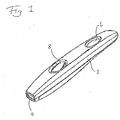
- the reading device is about 12cm long and about 2cm wide and is generally finger or cigar-shaped.
- the housing is no larger than about 12 cm long, about 2.5 cm wide, and about 2.2 cm tall.
- any convenient shape may be employed, such as a credit card shaped reader.
- the device comprises a housing 2 formed from a light-impermeable synthetic plastics material (e.g. polycarbonate, ABS, polystyrene, high density polyethylene, or polypropylene or polystyrol containing an appropriate light-blocking pigment, such as carbon).
- a narrow slot or aperture 4 by which a test strip (not shown) can be inserted into the reader.
- the reader On its upper face the reader comprises two oval-shaped apertures.
- One aperture accommodates the screen of a liquid crystal display 6 which displays information to a user e.g. the results of an assay, in qualitative or quantitative terms.
- the other aperture accommodates an eject mechanism 8 which, when actuated, forcibly ejects an inserted assay device from the assay result reading device.
- the assay device for use with the reading device is a generally conventional lateral flow test stick e.g. of the sort disclosed in US 6,156,271, US 5,504,013, EP 728309 or EP 782707.
- the assay device and a surface or surfaces of the slot in the reader, into which the assay device is inserted are so shaped and dimensioned that (1) the assay device can only be successfully inserted into the reader in the appropriate orientation; and (2) there is a precise three dimensional alignment of the reader and an inserted assay device, which ensures that the assay result can be read correctly the reader.
- a switch When an assay device is correctly inserted into the reader, a switch is closed which activates the reader from a "dormant" mode, which is the normal state adopted by the reader, thereby reducing energy consumption.
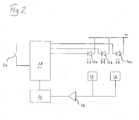
- the reader comprises three LED's 10a,b, and c.
- each LED 10 is aligned with a respective zone of the test stick.
- LED 10a is aligned with the test zone
- LED 10b is aligned with the reference zone
- LED 10c is aligned with the control zone.
- Respective photodiodes 12 detect light reflected from the various zones and generate a current, the magnitude of which is proportional to the amount of light incident upon the photodiodes 12.
- the current is converted into a voltage, buffered by buffer 14 and fed into an analogue to digital converter (ADC, 16).
- ADC analogue to digital converter
- a separate photodiode is provided to detect from each zone (i.e. the number of photodiodes equals the number of zones from which reflected light measurements are made).
- the arrangement illustrated in Figure 2 is more sophisticated, and preferred.
- Two photodiodes 12 are provided. One photodiode detects light reflected from the test zone and some of the light reflected from the reference zone. The other photodiode 12 detects some of the light reflected from the reference zone and the light reflected from the control zone.
- the microcontroller 18 switches on the LED's 10 one at a time, so that only one of the three zones is illuminated at any given time - in this way the signals generated by light reflected from the respective zones can be discriminated on a temporal basis.
- Figure 2 further shows, schematically, the switch 20 which is closed by insertion of an assay device into the reader, and which activates the microcontroller 18.
- the device further comprises a power source (typically one or two button cells), and an LCD device responsive to output from the microcontroller 18.
- a dry test stick i.e. prior to contacting the sample
- the intensity of light output from different LED's is rarely identical.
- the respective photodetectors are unlikely to have identical sensitivities. Since such variation could affect the assay reading an initial calibration is effected, in which the microcontroller adjusts the length of time that each of the three LED's is illuminated, so that the measured signal from each of the three zones (test, reference and control) is approximately equal and at a suitable operating position in a linear region of the response profile of the system (such that a change in intensity of light reflected from the various zones produces a directly proportional change in signal).
- a sample receiving portion of the test stick is contacted with the liquid sample.
- the sample receiving portion may be held in a urine stream, or a urine sample collected in a receptacle and the sample receiving portion briefly (for about 5-10 seconds) immersed in the sample. Sampling may be performed whilst the test stick is inserted in the reader or, less preferably, the stick can be briefly removed from the reader for sampling and then reintroduced into the reader.
- Measurements of reflected light intensity from one or more (preferably all three) of the zones are then commenced, typically after a specific timed interval following insertion of the test stick into the reader. Desirably the measurements are taken at regular intervals (e.g. at between 1-10 second intervals, preferably at between 1-5 second intervals). The measurements are made as a sequence of many readings over short (10 milliseconds or less) periods of time, interleaved zone by zone, thereby minimising any effects due to variation of ambient light intensity which may penetrate into the interior of the reader housing.
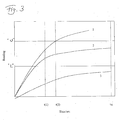
- Figure 3 shows typical results for three different samples, in terms of amount of signal ("Reading", in arbitrary units) against time (in seconds).
- the amount of signal is a measure of the light absorbed, or the decrease in light reflected, from the test zone of a lateral flow test stick as might be determined using the assay result reader described in the preceding example.
- a coloured particulate labelled binding reagent accumulates in the test zone.
- the coloured particulate label absorbs some of the light incident upon the test zone, and this reduces the amount of light reflected therefrom which is available for detection by a suitably positioned photodetector.
- the higher the concentration of analyte the more rapid the rate of accumulation of label in the test zone and the stronger the "signal".
- Plot 1 illustrates a typical graph which might be obtained for a liquid sample which contains a high concentration of analyte.
- Plot 3 illustrates a typical graph which might be obtained for a liquid sample which contains a very low concentration of analyte.
- Plot 2 illustrates a typical graph which might be obtained for a liquid sample which contains an intermediate concentration of analyte.
- the reader is programmed to make an initial reading at t(1), a certain predetermined length of time after commencement of the assay.
- the reading obtained is below the value of "U”, so an early positive result cannot be declared at t(1).
- the reader is programmed to repeat the measurement after a further, predetermined period of time has elapsed, at t(2). At t(2) the reading for plot 1 has just exceeded the value of U, so the reader can promptly indicate that the result is positive, via the LCD device.
- the initial reading at time t(1) is, similar to that for plot 1, below the value of U but above the value of L, so an early positive or negative result cannot be declared. The same is true at t(2). If desired, the reader can be programmed to make any number of further readings at t(3), t(4) etc. until the final reading is taken at t e . For plot 2, the final reading at t e is still below the value of U, so the assay result would be negative.
- values may be calculated with respect to the rate of change of reading with respect to time, or d(reading)/d(time).
- the rate of change of slope with respect to time may be measured or d 2 (reading/d)time) 2 or the integral ⁇ d(reading) with respect to two or more time values, namely the area defined by the curve. This has the advantage that reading is averaged over time, which smooths any anomalies.
- the rate of change of slope with respect to time may be measured or d 2 (reading/d)time) 2 .
- all or some of the above measurements may be made in combination to yield a result.
- the reader may make this evaluation based upon calculation of a first or second differential, an integral or combination of one or more thereof. Furthermore, an early result may be promptly declared after the reading has exceeded the lower threshold but the reader determines that the result will not exceed the upper threshold value before the reading has reached equilibrium
- the values of the at least upper and lower threshold limits may be adjusted during the course of the assay reading. This may occur on the basis of the readings obtained earlier in the course of the assay. It is preferable however that these values remain constant during the course of an individual assay.
- the reader may wait for a certain defined period before declaring a result. This provides an extra control feature, such that for example a result is not declared before various control checks have been made on either the assay strip, the reader or both. Such a situation might occur for a sample having an exceedingly high or low analyte concentration.
- test strip includes anti-hCG antibody coupled to a chromophore.
- the upper threshold was set at 10% attenuation gain (AG) (signal vs reference), and the lower threshold was set at 6% attenuation gain (control vs ref).
- 10% AG corresponds to approximately 15mIU hCG for a new test-strip and 25mIU for an aged test-strip (aging is believed to cause decay of the antibody, resulting in an apparent increase of signal) and 6% AG corresponds to approx. 5mIU.
- the upper threshold can be set between about 10 and about 90% AG, and the lower threshold between about 1% and about 9 % , although in principle other value ranges could be chosen.
- the timer is then started.
- the analyte signal is compared to the threshold values as described previously.
- the earliest time point for a positive (pregnant) result is set at 20 seconds, and the earliest point for a negative result is set at 60 seconds. In other embodiments, of course, other time periods may be set.
- the disclosed devices and methods may, naturally, be adapted for use with a wide variety of analytes.
- the disclosed devices and methods may be used in situations in which a negative result is expected only in the absence of analyte, and also in situations where a negative result is appropriate even when the analyte is present in some amount.
- An example of the first situation is a test for a pathogen, such as HIV or strep A.
- a lower threshold is still set and threshold test employed, because non-specific binding may otherwise result in a false-positive background reading.
- An example of the second situation is an assay result reader for ovulation that measures luteinizing hormone (LH), because LH is normally present at a basal level and surges shortly before ovulation; a positive result is desired during the surge, and a negative result during the basal level.
- LH luteinizing hormone
- the above-described examples refer to assay result reading devices that work as one-time tests; i.e., a single test strip is assayed for a single test result.
- the threshold values typically remain fixed from test to test for reliability and reproducibility.
- some embodiments may employ a series of test strips in order to track the amount of an analyte over time, and to adjust the threshold values from strip to strip in the series order to provide precise results.
- LH luteinizing hormone
- a first measurement is made. If it is above a certain upper threshold (for example, greater than 16% AG), a positive result indicating "LH surge” is returned. If the measurement is below this threshold, then the upper threshold for the next test is adjusted, depending on the level measured. For example, if the signal is lower than 7% AG, the upper threshold is lowered to 13%. If the measurement for the first test-strip is lower than respectively 5% or 3%, values of respectively 12 % and 11 % are chosen.
- a certain upper threshold for example, greater than 16% AG
- the algorithm chooses the threshold on the basis of the previous day's measurement, but it could also be an average of the previous days measurements.
- the thresholds need not neccessarily be fixed.
- the assay result reading device includes a memory system that stores prior test results accumulated over a period of time.
- the device may be configured for testing for the presence of a drug of abuse or a metabolite thereof, and the memory system can store periodic test results.
- the device also includes a system for viewing or retrieving test results, such as by a display, and electronic connection, or the like.
- the assay result reading device includes a memory system that stores test profiles for a variety of analytes.
- a profile can include, for example, the upper threshold and the lower threshold.
- the profile can further include time periods for performing threshold comparisons. In this manner, a single assay result reading device may be used to perform a variety of analyte assays.
- the device further includes a selection system that selects the appropriate profile for the desired analyte.
- the selection system can be a switch that a user sets to the desired test.
- the selection system detects a feature on an assay test strip indicative of the analyte to be measured.
- the test strip may have a bar code or other optical pattern.
- a test strip may be configured so that it remits light of a certain frequency or in a frequency range that is characteristic for a particular analyte.
- the memory system has a look-up table that the selection system may access to identify an analyte based on the remitted light frequency.
Landscapes
- Physics & Mathematics (AREA)
- Health & Medical Sciences (AREA)
- Life Sciences & Earth Sciences (AREA)
- Chemical & Material Sciences (AREA)
- Analytical Chemistry (AREA)
- Biochemistry (AREA)
- General Health & Medical Sciences (AREA)
- General Physics & Mathematics (AREA)
- Immunology (AREA)
- Pathology (AREA)
- Engineering & Computer Science (AREA)
- Molecular Biology (AREA)
- Mathematical Physics (AREA)
- Theoretical Computer Science (AREA)
- Spectroscopy & Molecular Physics (AREA)
- Chemical Kinetics & Catalysis (AREA)
- Plasma & Fusion (AREA)
- Investigating Or Analysing Materials By The Use Of Chemical Reactions (AREA)
- Investigating Or Analysing Biological Materials (AREA)
- Investigating Or Analysing Materials By Optical Means (AREA)
- Measuring Or Testing Involving Enzymes Or Micro-Organisms (AREA)
Priority Applications (1)
| Application Number | Priority Date | Filing Date | Title |
|---|---|---|---|
| EP10183291.3A EP2282204B1 (de) | 2003-06-04 | 2004-05-25 | Früherkennung von assay resultaten |
Applications Claiming Priority (4)
| Application Number | Priority Date | Filing Date | Title |
|---|---|---|---|
| GB0312815A GB2402475A (en) | 2003-06-04 | 2003-06-04 | Analyte assay reading providing prompt result declaration |
| GB0321815 | 2003-06-04 | ||
| US741416 | 2003-12-19 | ||
| US10/741,416 US7239394B2 (en) | 2003-06-04 | 2003-12-19 | Early determination of assay results |
Related Child Applications (2)
| Application Number | Title | Priority Date | Filing Date |
|---|---|---|---|
| EP10183291.3A Division EP2282204B1 (de) | 2003-06-04 | 2004-05-25 | Früherkennung von assay resultaten |
| EP10183291.3A Previously-Filed-Application EP2282204B1 (de) | 2003-06-04 | 2004-05-25 | Früherkennung von assay resultaten |
Publications (2)
| Publication Number | Publication Date |
|---|---|
| EP1484613A2 true EP1484613A2 (de) | 2004-12-08 |
| EP1484613A3 EP1484613A3 (de) | 2006-08-09 |
Family
ID=32992603
Family Applications (1)
| Application Number | Title | Priority Date | Filing Date |
|---|---|---|---|
| EP20040253076 Withdrawn EP1484613A3 (de) | 2003-06-04 | 2004-05-25 | Früherkennung von assay resultaten |
Country Status (8)
| Country | Link |
|---|---|
| US (8) | US7239394B2 (de) |
| EP (1) | EP1484613A3 (de) |
| JP (1) | JP5079972B2 (de) |
| CN (2) | CN1573314B (de) |
| AU (1) | AU2004202376B2 (de) |
| CA (1) | CA2468009C (de) |
| DE (2) | DE202004008811U1 (de) |
| FR (1) | FR2855877B1 (de) |
Cited By (5)
| Publication number | Priority date | Publication date | Assignee | Title |
|---|---|---|---|---|
| WO2008017819A1 (en) * | 2006-08-08 | 2008-02-14 | Ivmd (Uk) Limited | Assay apparatus, assay reading apparatus and method |
| WO2009144507A1 (en) * | 2008-05-31 | 2009-12-03 | Spd Swiss Precision Diagnostics Gmbh | Assay device |
| WO2015049508A1 (en) | 2013-10-02 | 2015-04-09 | Spd Swiss Precision Diagnostics Gmbh | Improved pregnancy test device and method |
| EP3203212A4 (de) * | 2014-09-30 | 2017-10-04 | JVC Kenwood Corporation | Analysevorrichtung und analyseverfahren |
| GB201905090D0 (en) | 2019-04-10 | 2019-05-22 | Spd Swiss Prec Diagnostics Gmbh | Assay device |
Families Citing this family (100)
| Publication number | Priority date | Publication date | Assignee | Title |
|---|---|---|---|---|
| US7192778B2 (en) * | 1999-10-06 | 2007-03-20 | Natan Michael J | Surface enhanced spectroscopy-active composite nanoparticles |
| US8497131B2 (en) * | 1999-10-06 | 2013-07-30 | Becton, Dickinson And Company | Surface enhanced spectroscopy-active composite nanoparticles comprising Raman-active reporter molecules |
| WO2002079764A1 (en) * | 2001-01-26 | 2002-10-10 | Nanoplex Technologies, Inc. | Surface-enhanced spectroscopy-active sandwich nanoparticles |
| USD509901S1 (en) * | 2003-05-13 | 2005-09-20 | Inverness Medical Switzerland Gmbh | Handheld medical test device |
| US7239394B2 (en) | 2003-06-04 | 2007-07-03 | Inverness Medical Switzerland Gmbh | Early determination of assay results |
| US20070185679A1 (en) * | 2004-04-01 | 2007-08-09 | Petruno Patrick T | Indicating status of a diagnostic test system |
| US8128871B2 (en) | 2005-04-22 | 2012-03-06 | Alverix, Inc. | Lateral flow assay systems and methods |
| US7763454B2 (en) | 2004-07-09 | 2010-07-27 | Church & Dwight Co., Inc. | Electronic analyte assaying device |
| US7939342B2 (en) | 2005-03-30 | 2011-05-10 | Kimberly-Clark Worldwide, Inc. | Diagnostic test kits employing an internal calibration system |
| US10041941B2 (en) | 2005-04-22 | 2018-08-07 | Alverix, Inc. | Assay test strips with multiple labels and reading same |
| US7858384B2 (en) * | 2005-04-29 | 2010-12-28 | Kimberly-Clark Worldwide, Inc. | Flow control technique for assay devices |
| US7439079B2 (en) | 2005-04-29 | 2008-10-21 | Kimberly-Clark Worldwide, Inc. | Assay devices having detection capabilities within the hook effect region |
| US7803319B2 (en) * | 2005-04-29 | 2010-09-28 | Kimberly-Clark Worldwide, Inc. | Metering technique for lateral flow assay devices |
| EP1742039A1 (de) * | 2005-07-07 | 2007-01-10 | F. Hoffmann-La Roche Ltd. | Verfahren zur Ermittlung der Konzentration einer nichtflüchtigen Analyt. |
| US8003399B2 (en) * | 2005-08-31 | 2011-08-23 | Kimberly-Clark Worldwide, Inc. | Nitrite detection technique |
| US7829347B2 (en) * | 2005-08-31 | 2010-11-09 | Kimberly-Clark Worldwide, Inc. | Diagnostic test kits with improved detection accuracy |
| US7504235B2 (en) * | 2005-08-31 | 2009-03-17 | Kimberly-Clark Worldwide, Inc. | Enzyme detection technique |
| WO2007059514A2 (en) * | 2005-11-15 | 2007-05-24 | Oxonica, Inc. | Sers-based methods for detection of bioagents |
| US7279136B2 (en) | 2005-12-13 | 2007-10-09 | Takeuchi James M | Metering technique for lateral flow assay devices |
| US8409863B2 (en) | 2005-12-14 | 2013-04-02 | Becton, Dickinson And Company | Nanoparticulate chemical sensors using SERS |
| US7618810B2 (en) * | 2005-12-14 | 2009-11-17 | Kimberly-Clark Worldwide, Inc. | Metering strip and method for lateral flow assay devices |
| US7723100B2 (en) | 2006-01-13 | 2010-05-25 | Becton, Dickinson And Company | Polymer coated SERS nanotag |
| ES2601391T3 (es) * | 2006-01-27 | 2017-02-15 | Becton Dickinson And Company | Inmunoensayo de flujo lateral con modalidad de detección encapsulada |
| US20070202561A1 (en) * | 2006-02-10 | 2007-08-30 | Becton Dickinson And Company | Electronic Detection Immunoassays that Utilize a Binder Support Medium |
| PL2244086T3 (pl) * | 2006-04-08 | 2021-11-22 | F. Hoffmann-La Roche Ag | Analiza danych optycznych za pomocą histogramów |
| EP2044402B2 (de) * | 2006-07-24 | 2016-11-30 | Becton Dickinson and Company | Vorrichtung und Verfahren zur Durchführung eines Assays mittels magnetischer Partikeln. |
| US7532128B2 (en) * | 2006-10-25 | 2009-05-12 | Alverix, Inc. | Position sensitive indicator detection |
| US8012761B2 (en) * | 2006-12-14 | 2011-09-06 | Kimberly-Clark Worldwide, Inc. | Detection of formaldehyde in urine samples |
| US7935538B2 (en) * | 2006-12-15 | 2011-05-03 | Kimberly-Clark Worldwide, Inc. | Indicator immobilization on assay devices |
| US7846383B2 (en) * | 2006-12-15 | 2010-12-07 | Kimberly-Clark Worldwide, Inc. | Lateral flow assay device and absorbent article containing same |
| US8377379B2 (en) | 2006-12-15 | 2013-02-19 | Kimberly-Clark Worldwide, Inc. | Lateral flow assay device |
| GB0706906D0 (en) * | 2007-04-10 | 2007-05-16 | Inverness Medical Switzerland | Assay device |
| GB0717043D0 (en) * | 2007-04-10 | 2007-10-10 | Inverness Medical Switzerland | Assay device |
| GB2450351B (en) | 2007-06-20 | 2012-01-18 | Cozart Bioscience Ltd | Monitoring an Immunoassay |
| AU2008207371B2 (en) * | 2007-09-01 | 2014-05-22 | Abbott Rapid Diagnostics International Unlimited Company | Assay device with shared zones |
| WO2009034563A2 (en) * | 2007-09-14 | 2009-03-19 | Nanocomms Patents Limited | An analysis system |
| JP5184962B2 (ja) * | 2007-10-31 | 2013-04-17 | アークレイ株式会社 | イムノクロマトグラフィ装置 |
| DE102008011578A1 (de) * | 2008-02-28 | 2009-09-03 | Endress + Hauser Conducta Gesellschaft für Mess- und Regeltechnik mbH + Co. KG | Photolumineszenz-Sensor |
| GB2460660B (en) * | 2008-06-04 | 2013-05-22 | Alere Switzerland Gmbh | Assay reader device & method for measuring hCG |
| CN101609098B (zh) * | 2008-06-16 | 2013-09-25 | 艾博生物医药(杭州)有限公司 | 一种检测生物样本中是否存在被分析物的方法 |
| NL2002196C2 (en) * | 2008-11-11 | 2010-05-17 | Avantium Int Bv | SAMPLE ANALYZES APPARATUS AND A METHOD OR ANALYZING A SAMPLE. |
| GB0820999D0 (en) | 2008-11-17 | 2008-12-24 | Menon Johansson Anatole S | Pregnancy testing |
| US8422740B2 (en) | 2009-01-15 | 2013-04-16 | Scott Dylewski | Methods for determining a liquid front position on a test strip |
| DE102009010563A1 (de) | 2009-02-16 | 2010-08-26 | Matthias W. Engel | Vorrichtung zum Nachweis von Analyten in Körperflüssigkeiten |
| US20100290948A1 (en) * | 2009-05-15 | 2010-11-18 | Xuedong Song | Absorbent articles capable of indicating the presence of urinary tract infections |
| US8346496B1 (en) | 2009-08-27 | 2013-01-01 | Wildcat Disocovery Technologies, Inc | Apparatus and method for multi-channel materials assaying |
| US20110184651A1 (en) * | 2010-01-26 | 2011-07-28 | Shih-Yi Weng | Electronic assay apparatus and method thereof |
| US9877672B2 (en) | 2010-01-28 | 2018-01-30 | Ellume Pty Ltd | Sampling and testing device for the human or animal body |
| CN103025431B (zh) | 2010-04-07 | 2015-03-25 | 比奥森西亚专利有限公司 | 用于化验的流动控制装置 |
| USD657703S1 (en) * | 2010-06-18 | 2012-04-17 | The Procter & Gamble Company | Hair analyzer |
| US9739788B2 (en) * | 2010-07-20 | 2017-08-22 | Biomerieux, Inc. | Detector arrangement for blood culture bottles with colorimetric sensors |
| US8828329B2 (en) | 2010-10-01 | 2014-09-09 | Church & Dwight, Co., Inc. | Electronic analyte assaying device |
| US8486717B2 (en) | 2011-01-18 | 2013-07-16 | Symbolics, Llc | Lateral flow assays using two dimensional features |
| DE102011050389B4 (de) | 2011-05-16 | 2021-09-02 | Presens - Precision Sensing Gmbh | Sensoreinheit und Messverfahren |
| CN102384890B (zh) * | 2011-08-05 | 2014-04-30 | 广州万孚生物技术股份有限公司 | 化验检测判定设备及方法 |
| US9939385B2 (en) | 2011-09-09 | 2018-04-10 | Church & Dwight Co., Inc. | Systems, methods, and test kits for analyte variation detection |
| US9588113B2 (en) * | 2012-02-22 | 2017-03-07 | Church & Dwight Co., Inc. | Methods for electronic analyte assaying |
| US9874556B2 (en) | 2012-07-18 | 2018-01-23 | Symbolics, Llc | Lateral flow assays using two dimensional features |
| US20140072959A1 (en) | 2012-09-12 | 2014-03-13 | Force Diagnostics, Inc. | Rapid tests for insurance underwriting |
| NZ707263A (en) * | 2012-09-27 | 2018-01-26 | Ellume Pty Ltd | A test device and method for identifying pregnancy based on hcg and lh levels in a sample |
| US10890590B2 (en) | 2012-09-27 | 2021-01-12 | Ellume Limited | Diagnostic devices and methods |
| CN110579435B (zh) | 2012-10-15 | 2023-09-26 | 纳诺赛莱克特生物医药股份有限公司 | 颗粒分选的系统、设备和方法 |
| TWI485391B (zh) * | 2012-11-12 | 2015-05-21 | Taidoc Technology Corp | 電子式分析裝置、測試分析方法以及套組 |
| CN105102980B (zh) | 2013-02-26 | 2017-11-03 | 阿斯图特医药公司 | 具有试条保持件的横向流动测定法 |
| DE102013006543B4 (de) | 2013-04-16 | 2017-03-23 | Dräger Safety AG & Co. KGaA | Messvorrichtung, Reaktionsträger und Messverfahren |
| DE102013006545B4 (de) * | 2013-04-16 | 2020-02-27 | Dräger Safety AG & Co. KGaA | Messvorrichtung und Messverfahren für einen Reaktionsträger |
| KR101562946B1 (ko) * | 2013-04-23 | 2015-10-26 | 주식회사 수젠텍 | 검체 내 분석물을 검출하기 위한 디바이스 및 방법 |
| EP3021874B1 (de) * | 2013-07-18 | 2022-04-27 | The University of Hong Kong | Verfahren zur klassifizierung von pleuraerguss |
| JP6273107B2 (ja) | 2013-08-02 | 2018-01-31 | デンカ生研株式会社 | イムノクロマト法における光反射材を用いた検出光の増強方法 |
| ITMI20131354A1 (it) * | 2013-08-07 | 2015-02-08 | Copan Italia Spa | Supporto per la conservazione di campioni di materiale biologico e relativo metodo di produzione |
| CN108051590B (zh) | 2013-09-13 | 2020-12-11 | Symbolics有限责任公司 | 运用二维试验和对照信号读出模式的侧向层析检测 |
| GB201321430D0 (en) | 2013-12-04 | 2014-01-15 | Spd Swiss Prec Diagnostics Gmbh | Assay device |
| USD735883S1 (en) * | 2013-12-30 | 2015-08-04 | Illumina, Inc. | Sample preparation instrument |
| US9651532B2 (en) * | 2014-02-27 | 2017-05-16 | Honeywell International, Inc. | Multi-point gas detector |
| US9423534B2 (en) * | 2014-06-18 | 2016-08-23 | Vishay Capella Microsystems (Taiwan) Limited | Optical module |
| CN104062449B (zh) | 2014-07-02 | 2016-05-11 | 广州万孚生物技术股份有限公司 | 电子检测判读方法及电子检测判读装置 |
| CN107110883B (zh) * | 2014-12-22 | 2020-01-31 | 英泰克生物有限公司 | 流体速度测定装置 |
| US9759651B2 (en) * | 2014-12-23 | 2017-09-12 | Magellan Diagnostics, Inc. | Combination optical hemoglobin and electrochemical lead assay |
| US10786229B2 (en) | 2015-01-22 | 2020-09-29 | Ellume Limited | Diagnostic devices and methods for mitigating hook effect and use thereof |
| WO2016156981A1 (en) * | 2015-04-02 | 2016-10-06 | Swiss Precision Diagnostics Gmbh | Improved pregnancy test device & method |
| BR112017021305A2 (pt) | 2015-04-06 | 2018-06-26 | Bludiagnostics Inc | dispositivo de teste de fluxo lateral, e, método e kit para detecção quantitativa de um analito em uma amostra de saliva |
| WO2016190820A1 (en) * | 2015-05-28 | 2016-12-01 | Agency For Science, Technology And Research | Sensing device for measuring a level of an analyte, method of fabrication thereof |
| US10302555B2 (en) | 2015-05-29 | 2019-05-28 | Agency For Science, Technology And Research | Sensor for and method of sensing an analyte, and method of fabricating a sensor |
| USD764069S1 (en) * | 2015-07-13 | 2016-08-16 | Fourstar Group Inc. | Pregnancy test stick |
| USD765264S1 (en) * | 2015-07-20 | 2016-08-30 | GestVision, Inc. | Diagnostic apparatus |
| KR102241756B1 (ko) | 2015-10-09 | 2021-04-16 | 하마마츠 포토닉스 가부시키가이샤 | 광학 측정 장치 |
| EP3427054B1 (de) * | 2016-03-07 | 2025-01-08 | Quidel Cardiovascular Inc. | Immunoassay-kontrollen und verwendung davon |
| WO2018039047A1 (en) | 2016-08-23 | 2018-03-01 | Qoolabs, Inc. | Lateral flow assay for assessing recombinant protein expression or reporter gene expression |
| JP2021511525A (ja) * | 2018-01-27 | 2021-05-06 | ベクトン・ディキンソン・アンド・カンパニーBecton, Dickinson And Company | ウイルス感染と細菌感染を区別するためのマルチプレックスラテラルフローアッセイ |
| EP3743719A4 (de) * | 2018-01-27 | 2021-11-03 | Becton, Dickinson and Company | Multiplex-lateral-flow-test zur differenzierung von bakteriellen infektionen von viralen infektionen |
| CA3107645A1 (en) * | 2018-07-27 | 2020-01-30 | Lumos Diagnostics IP Pty Ltd | Lateral flow assay devices and method of use |
| KR102766141B1 (ko) * | 2018-09-27 | 2025-02-12 | 세키스이 메디칼 가부시키가이샤 | 면역 크로마토그래피용 시험편 |
| WO2021014216A1 (en) * | 2019-07-23 | 2021-01-28 | Hitachi Chemical Diagnostics Systems Co., Ltd. | Immunochromatography reader, immunochromatography system and hemoglobin detection method |
| MX2022013899A (es) * | 2020-05-06 | 2023-02-22 | Church & Dwight Co Inc | Deteccion de imagen para la confirmacion del resultado del dispositivo de diagnostico con varilla de prueba. |
| US11376588B2 (en) | 2020-06-10 | 2022-07-05 | Checkable Medical Incorporated | In vitro diagnostic device |
| JP7796113B2 (ja) * | 2020-08-28 | 2026-01-08 | アロノウィッツ、ミレーヤ、シー. | ラテラルフロー免疫試験のトライコーダ反射率計 |
| WO2022254364A1 (en) * | 2021-06-01 | 2022-12-08 | Ryshens Ltd. | Diagnostic platform device and method |
| JPWO2023002842A1 (de) * | 2021-07-21 | 2023-01-26 | ||
| WO2023056837A1 (zh) * | 2021-10-09 | 2023-04-13 | 广东粤港澳大湾区国家纳米科技创新研究院 | 快速毒检方法、一分钟快速毒检装置及分布式毒检系统 |
| WO2024227554A1 (en) * | 2023-05-03 | 2024-11-07 | Ams-Osram Ag | Method and apparatus for reading lateral flow tests |
Family Cites Families (72)
| Publication number | Priority date | Publication date | Assignee | Title |
|---|---|---|---|---|
| US3941477A (en) | 1974-10-17 | 1976-03-02 | Deutsche Forschungs-Und Versuchsanstalt Fur Luft-Und Raumfahrt E.V. | Measuring device for the measurement of fluid flow rates |
| US4399362A (en) * | 1981-02-27 | 1983-08-16 | Instrumentation Laboratory Inc. | Liquid handling apparatus |
| US4420566A (en) * | 1982-06-10 | 1983-12-13 | Eastman Kodak Company | Method and apparatus for detecting sample fluid on an analysis slide |
| DE3138878A1 (de) * | 1981-09-30 | 1983-04-14 | Boehringer Mannheim Gmbh, 6800 Mannheim | Messeinrichtung, insbesondere ulbricht'sche kugel |
| DE3407754A1 (de) * | 1984-03-02 | 1985-09-12 | Boehringer Mannheim Gmbh, 6800 Mannheim | Geraet zur bestimmung des diffusen reflexionsvermoegens einer probenflaeche kleiner abmessungen |
| JPS6125483A (ja) | 1984-07-17 | 1986-02-04 | Hitachi Ltd | 細胞の培養方法および装置 |
| JPS61254836A (ja) * | 1985-05-07 | 1986-11-12 | Omron Tateisi Electronics Co | 生化学測定装置 |
| US4653565A (en) * | 1985-07-25 | 1987-03-31 | Chamberlain Manufacturing Corporation | Garage door opener |
| US4935346A (en) * | 1986-08-13 | 1990-06-19 | Lifescan, Inc. | Minimum procedure system for the determination of analytes |
| US5049487A (en) * | 1986-08-13 | 1991-09-17 | Lifescan, Inc. | Automated initiation of timing of reflectance readings |
| JPH0672845B2 (ja) * | 1986-09-01 | 1994-09-14 | 富士写真フイルム株式会社 | 分析方法 |
| DE3856421T2 (de) | 1987-04-27 | 2000-12-14 | Unilever Nv | Spezifische Bindungstestverfahren |
| IT1227293B (it) | 1988-10-06 | 1991-04-05 | Boehringer Biochemia Srl | Dispositivo e metodo per la diagnosi di gravidanza |
| US5108889A (en) * | 1988-10-12 | 1992-04-28 | Thorne, Smith, Astill Technologies, Inc. | Assay for determining analyte using mercury release followed by detection via interaction with aluminum |
| US6352862B1 (en) * | 1989-02-17 | 2002-03-05 | Unilever Patent Holdings B.V. | Analytical test device for imuno assays and methods of using same |
| US5114350A (en) * | 1989-03-08 | 1992-05-19 | Cholestech Corporation | Controlled-volume assay apparatus |
| US6395227B1 (en) | 1989-08-28 | 2002-05-28 | Lifescan, Inc. | Test strip for measuring analyte concentration over a broad range of sample volume |
| AU635314B2 (en) * | 1989-09-08 | 1993-03-18 | Terumo Kabushiki Kaisha | Measuring apparatus |
| US5010688A (en) * | 1990-04-30 | 1991-04-30 | The Chamberlain Group, Inc. | Garage door operator with plastic drive belt |
| US5179288A (en) * | 1991-09-30 | 1993-01-12 | Ortho Pharmaceutical Corporation | Apparatus and method for measuring a bodily constituent |
| GB9217865D0 (en) | 1992-08-21 | 1992-10-07 | Unilever Plc | Monitoring method |
| US5344754A (en) * | 1993-01-13 | 1994-09-06 | Avocet Medical, Inc. | Assay timed by electrical resistance change and test strip |
| EP0722563A4 (de) * | 1993-08-24 | 1998-03-04 | Metrika Lab Inc | Neues elektronisches einweg-assaygerät |
| US5837546A (en) * | 1993-08-24 | 1998-11-17 | Metrika, Inc. | Electronic assay device and method |
| US5522255A (en) * | 1993-08-31 | 1996-06-04 | Boehringer Mannheim Corporation | Fluid dose, flow and coagulation sensor for medical instrument |
| DE69405116T2 (de) | 1993-11-12 | 1998-03-05 | Unipath Ltd | Nachweis vorrichtung und herstellungsverfahren dafür |
| ES2145034T3 (es) * | 1993-11-12 | 2000-07-01 | Unilever Nv | Dispositivos analiticos y procedimientos para el uso de los mismos. |
| ATE224053T1 (de) * | 1993-11-12 | 2002-09-15 | Inverness Medical Switzerland | Vorrichtung zum ablesen von teststreifen |
| US5936842A (en) * | 1993-12-17 | 1999-08-10 | Robert Bosch Gmbh | Housing for electric-drive units |
| FR2720830B1 (fr) | 1994-06-06 | 1998-04-10 | Meidensha Electric Mfg Co Ltd | Dispositif et méthode pour estimer trois substances ioniques incluant de l'azote dans de l'eau. |
| GB9419267D0 (en) | 1994-09-23 | 1994-11-09 | Unilever Plc | Assay devices |
| US5728352A (en) * | 1994-11-14 | 1998-03-17 | Advanced Care Products | Disposable electronic diagnostic instrument |
| US5719034A (en) | 1995-03-27 | 1998-02-17 | Lifescan, Inc. | Chemical timer for a visual test strip |
| US5786220A (en) * | 1995-04-28 | 1998-07-28 | Quidel Corporation | Assays and devices for distinguishing between normal and abnormal pregnancy |
| US5679584A (en) * | 1995-05-03 | 1997-10-21 | Mileaf; Daryl Sunny | Method for chemical detection |
| JPH097998A (ja) | 1995-06-20 | 1997-01-10 | Hitachi Ltd | プラズマアッシング処理装置 |
| JP3522406B2 (ja) * | 1995-09-12 | 2004-04-26 | 高電工業株式会社 | 粒子反応パターン判定方法およびその装置 |
| US5968839A (en) | 1996-05-13 | 1999-10-19 | Metrika, Inc. | Method and device producing a predetermined distribution of detectable change in assays |
| DE19628562A1 (de) | 1996-07-16 | 1998-01-22 | Boehringer Mannheim Gmbh | Analysesystem mit Mitteln zur Erkennung von Unterdosierungen |
| IL121279A (en) * | 1996-07-16 | 2001-05-20 | Roche Diagnostics Gmbh | An analytical system with means for testing samples with too small volumes |
| DE19630160A1 (de) * | 1996-07-26 | 1998-01-29 | Boehringer Mannheim Gmbh | Analysesystem mit Mitteln zur Erkennung von Unterdosierungen |
| US5719667A (en) * | 1996-07-30 | 1998-02-17 | Bayer Corporation | Apparatus for filtering a laser beam in an analytical instrument |
| DE19639227B4 (de) | 1996-09-24 | 2006-11-23 | Lre Technology Partner Gmbh | Verfahren und Vorrichtung zur Blutzuckermessung |
| EP0833145B1 (de) * | 1996-09-27 | 2003-01-29 | Inverness Medical Switzerland GmbH | Test-Kit und Vorrichtungen |
| AU5054198A (en) | 1996-12-03 | 1998-06-29 | Erkki Soini | Biospecific, two photon excitation, fluorescence detection and device |
| GB2322192B (en) * | 1997-02-14 | 2001-01-31 | Unilever Plc | Assay devices |
| US5885839A (en) * | 1997-04-15 | 1999-03-23 | Lxn Corporation | Methods of determining initiation and variable end points for measuring a chemical reaction |
| WO1999010742A1 (en) * | 1997-08-29 | 1999-03-04 | Fertility Acoustics Inc. | Method and apparatus for rapid analysis of analytes in biological samples |
| US6222619B1 (en) * | 1997-09-18 | 2001-04-24 | University Of Utah Research Foundation | Diagnostic device and method |
| HU222809B1 (hu) * | 1997-10-03 | 2003-10-28 | 77 Elektronika Műszeripari Kft. | Eljárás és készülék kémiai összetevőnek anyagmintából, különösen vér glükóztartalmának vérmintából történő meghatározásához |
| US6194222B1 (en) | 1998-01-05 | 2001-02-27 | Biosite Diagnostics, Inc. | Methods for monitoring the status of assays and immunoassays |
| US6830731B1 (en) * | 1998-01-05 | 2004-12-14 | Biosite, Inc. | Immunoassay fluorometer |
| GB9807134D0 (en) * | 1998-04-02 | 1998-06-03 | Unilever Plc | Test methods devices and test kits |
| DE19844500A1 (de) * | 1998-09-29 | 2000-03-30 | Roche Diagnostics Gmbh | Verfahren zur photometrischen Auswertung von Testelementen |
| US6147859A (en) * | 1999-08-18 | 2000-11-14 | Ops, Inc. | Modular external peripheral housing |
| US7018847B2 (en) * | 2000-05-05 | 2006-03-28 | Pharmacia Diagnostics Ab | Assay device with timer function |
| US6597438B1 (en) | 2000-08-02 | 2003-07-22 | Honeywell International Inc. | Portable flow cytometry |
| GB2365526B (en) | 2000-07-31 | 2003-12-03 | Cambridge Life Sciences | Assay apparatus for measuring the amount of an analyte in a biological or environmental sample |
| HK1052219A1 (zh) * | 2000-07-31 | 2003-09-05 | Lifescan, Inc. | 用於检测测试带上有无流体的方法和装置 |
| US7195923B2 (en) * | 2001-01-31 | 2007-03-27 | Scripps Laboratories, Inc. | Ratiometric determination of glycated protein |
| JP2002310903A (ja) * | 2001-04-12 | 2002-10-23 | Fuji Photo Film Co Ltd | 全反射減衰を利用したセンサー |
| JP2003003567A (ja) | 2001-06-20 | 2003-01-08 | Nkk Corp | コンクリート充填鋼管柱の施工方法 |
| JP2003035673A (ja) * | 2001-07-23 | 2003-02-07 | Kikkoman Corp | 清浄度測定装置および清浄度改善システム |
| US6855561B2 (en) * | 2001-09-10 | 2005-02-15 | Quidel Corporation | Method for adding an apparent non-signal line to a lateral flow assay |
| DE10156809B4 (de) * | 2001-11-20 | 2011-06-16 | Lre Technology Partner Gmbh | Verfahren und Vorrichtung zur Blutzuckermessung |
| US8367013B2 (en) * | 2001-12-24 | 2013-02-05 | Kimberly-Clark Worldwide, Inc. | Reading device, method, and system for conducting lateral flow assays |
| US6847451B2 (en) * | 2002-05-01 | 2005-01-25 | Lifescan, Inc. | Apparatuses and methods for analyte concentration determination |
| US7214542B2 (en) * | 2003-01-30 | 2007-05-08 | Michael Hutchinson | Method of processing assay test results |
| US7220597B2 (en) * | 2003-01-30 | 2007-05-22 | Zin Benedict L | Assay test device and method of making same |
| CA2515001C (en) | 2003-01-30 | 2015-08-11 | Mizuho Usa Inc. | Method and apparatus for processing assay test results |
| US7315378B2 (en) * | 2003-06-04 | 2008-01-01 | Inverness Medical Switzerland Gmbh | Optical arrangement for assay reading device |
| US7239394B2 (en) * | 2003-06-04 | 2007-07-03 | Inverness Medical Switzerland Gmbh | Early determination of assay results |
-
2003
- 2003-12-19 US US10/741,416 patent/US7239394B2/en not_active Expired - Lifetime
-
2004
- 2004-05-21 CA CA2468009A patent/CA2468009C/en not_active Expired - Lifetime
- 2004-05-25 EP EP20040253076 patent/EP1484613A3/de not_active Withdrawn
- 2004-05-28 AU AU2004202376A patent/AU2004202376B2/en not_active Expired
- 2004-06-03 DE DE202004008811U patent/DE202004008811U1/de not_active Expired - Lifetime
- 2004-06-03 DE DE102004027132.1A patent/DE102004027132B4/de not_active Expired - Lifetime
- 2004-06-04 CN CN2004100452734A patent/CN1573314B/zh not_active Expired - Lifetime
- 2004-06-04 CN CN200910126684.9A patent/CN101639451B/zh not_active Expired - Fee Related
- 2004-06-04 JP JP2004167296A patent/JP5079972B2/ja not_active Expired - Lifetime
- 2004-06-04 FR FR0406067A patent/FR2855877B1/fr not_active Expired - Lifetime
-
2007
- 2007-07-03 US US11/773,325 patent/US7616315B2/en not_active Expired - Lifetime
-
2009
- 2009-11-10 US US12/615,723 patent/US20100172802A1/en not_active Abandoned
-
2010
- 2010-12-14 US US12/967,780 patent/US20110178723A1/en not_active Abandoned
-
2012
- 2012-06-29 US US13/537,987 patent/US20130149776A1/en not_active Abandoned
-
2014
- 2014-06-30 US US14/319,344 patent/US9933362B2/en not_active Expired - Lifetime
-
2018
- 2018-02-27 US US15/906,489 patent/US10309899B2/en not_active Expired - Lifetime
-
2019
- 2019-04-30 US US16/399,036 patent/US10830699B2/en not_active Expired - Fee Related
Cited By (9)
| Publication number | Priority date | Publication date | Assignee | Title |
|---|---|---|---|---|
| WO2008017819A1 (en) * | 2006-08-08 | 2008-02-14 | Ivmd (Uk) Limited | Assay apparatus, assay reading apparatus and method |
| WO2009144507A1 (en) * | 2008-05-31 | 2009-12-03 | Spd Swiss Precision Diagnostics Gmbh | Assay device |
| CN102099678A (zh) * | 2008-05-31 | 2011-06-15 | 瑞士斯保德精密诊断有限公司 | 化验装置 |
| US8606528B2 (en) | 2008-05-31 | 2013-12-10 | Spd Swiss Precision Diagnostics Gmbh | Assay device |
| CN102099678B (zh) * | 2008-05-31 | 2014-12-17 | 瑞士斯保德精密诊断有限公司 | 化验装置 |
| WO2015049508A1 (en) | 2013-10-02 | 2015-04-09 | Spd Swiss Precision Diagnostics Gmbh | Improved pregnancy test device and method |
| EP3203212A4 (de) * | 2014-09-30 | 2017-10-04 | JVC Kenwood Corporation | Analysevorrichtung und analyseverfahren |
| GB201905090D0 (en) | 2019-04-10 | 2019-05-22 | Spd Swiss Prec Diagnostics Gmbh | Assay device |
| WO2020208141A1 (en) | 2019-04-10 | 2020-10-15 | Spd Swiss Precision Diagnostics Gmbh | Assay device |
Also Published As
| Publication number | Publication date |
|---|---|
| CN1573314A (zh) | 2005-02-02 |
| FR2855877B1 (fr) | 2007-08-24 |
| US20180188170A1 (en) | 2018-07-05 |
| CA2468009A1 (en) | 2004-12-04 |
| US20130149776A1 (en) | 2013-06-13 |
| US20080213875A1 (en) | 2008-09-04 |
| US20140377879A1 (en) | 2014-12-25 |
| CN101639451B (zh) | 2016-01-20 |
| JP5079972B2 (ja) | 2012-11-21 |
| CN101639451A (zh) | 2010-02-03 |
| US7239394B2 (en) | 2007-07-03 |
| DE202004008811U1 (de) | 2004-09-09 |
| FR2855877A1 (fr) | 2004-12-10 |
| DE102004027132B4 (de) | 2016-01-28 |
| HK1139731A1 (zh) | 2010-09-24 |
| US10830699B2 (en) | 2020-11-10 |
| AU2004202376A1 (en) | 2004-12-23 |
| US7616315B2 (en) | 2009-11-10 |
| US9933362B2 (en) | 2018-04-03 |
| US20050037510A1 (en) | 2005-02-17 |
| JP2004361410A (ja) | 2004-12-24 |
| US10309899B2 (en) | 2019-06-04 |
| CA2468009C (en) | 2016-01-26 |
| AU2004202376B2 (en) | 2010-01-21 |
| US20110178723A1 (en) | 2011-07-21 |
| CN1573314B (zh) | 2010-04-28 |
| EP1484613A3 (de) | 2006-08-09 |
| US20100172802A1 (en) | 2010-07-08 |
| US20190323961A1 (en) | 2019-10-24 |
| DE102004027132A1 (de) | 2005-01-27 |
Similar Documents
| Publication | Publication Date | Title |
|---|---|---|
| CA2468009C (en) | Early determination of assay results | |
| AU2010200434B2 (en) | Early determination of assay results | |
| US7317532B2 (en) | Flow sensing for determination of assay results | |
| AU2010200451B2 (en) | Optical arrangement for assay reading device | |
| EP1484611B1 (de) | Durchflussmessung zur bestimmung von assay resultaten | |
| HK1070691A (en) | Early determination of assay results | |
| HK1139731B (en) | Early determination of assay results | |
| GB2402473A (en) | Analyte assay reading device involving sample flow rate measurement | |
| HK1070690B (en) | Flow sensing for determination of assay results |
Legal Events
| Date | Code | Title | Description |
|---|---|---|---|
| PUAI | Public reference made under article 153(3) epc to a published international application that has entered the european phase |
Free format text: ORIGINAL CODE: 0009012 |
|
| AK | Designated contracting states |
Kind code of ref document: A2 Designated state(s): AT BE BG CH CY CZ DE DK EE ES FI FR GB GR HU IE IT LI LU MC NL PL PT RO SE SI SK TR |
|
| AX | Request for extension of the european patent |
Extension state: AL HR LT LV MK |
|
| REG | Reference to a national code |
Ref country code: HK Ref legal event code: DE Ref document number: 1070691 Country of ref document: HK |
|
| PUAL | Search report despatched |
Free format text: ORIGINAL CODE: 0009013 |
|
| AK | Designated contracting states |
Kind code of ref document: A3 Designated state(s): AT BE BG CH CY CZ DE DK EE ES FI FR GB GR HU IE IT LI LU MC NL PL PT RO SE SI SK TR |
|
| AX | Request for extension of the european patent |
Extension state: AL HR LT LV MK |
|
| RIC1 | Information provided on ipc code assigned before grant |
Ipc: G01N 33/76 20060101ALI20060703BHEP Ipc: G01N 33/543 20060101ALI20060703BHEP Ipc: G01N 21/86 20060101ALI20060703BHEP Ipc: G01N 33/487 20060101AFI20041008BHEP |
|
| 17P | Request for examination filed |
Effective date: 20060918 |
|
| 17Q | First examination report despatched |
Effective date: 20061121 |
|
| AKX | Designation fees paid |
Designated state(s): AT BE BG CH CY CZ DE DK EE ES FI FR GB GR HU IE IT LI LU MC NL PL PT RO SE SI SK TR |
|
| RAP1 | Party data changed (applicant data changed or rights of an application transferred) |
Owner name: INVERNESS MEDICAL SWITZERLAND GMBH |
|
| RAP1 | Party data changed (applicant data changed or rights of an application transferred) |
Owner name: ALERE SWITZERLAND GMBH |
|
| STAA | Information on the status of an ep patent application or granted ep patent |
Free format text: STATUS: THE APPLICATION HAS BEEN WITHDRAWN |
|
| 18W | Application withdrawn |
Effective date: 20170309 |
|
| REG | Reference to a national code |
Ref country code: HK Ref legal event code: WD Ref document number: 1070691 Country of ref document: HK |