EP1487571B1 - Particules porteuses pour la chromatographie a base de microcapsules, procede de production et utilisation associes - Google Patents
Particules porteuses pour la chromatographie a base de microcapsules, procede de production et utilisation associes Download PDFInfo
- Publication number
- EP1487571B1 EP1487571B1 EP03717154A EP03717154A EP1487571B1 EP 1487571 B1 EP1487571 B1 EP 1487571B1 EP 03717154 A EP03717154 A EP 03717154A EP 03717154 A EP03717154 A EP 03717154A EP 1487571 B1 EP1487571 B1 EP 1487571B1
- Authority
- EP
- European Patent Office
- Prior art keywords
- particles
- microcapsules
- bed
- separation
- support particles
- Prior art date
- Legal status (The legal status is an assumption and is not a legal conclusion. Google has not performed a legal analysis and makes no representation as to the accuracy of the status listed.)
- Expired - Lifetime
Links
- 239000002245 particle Substances 0.000 title claims abstract description 57
- 239000003094 microcapsule Substances 0.000 title claims abstract description 29
- 238000000034 method Methods 0.000 title claims abstract description 23
- 238000004587 chromatography analysis Methods 0.000 title claims abstract description 15
- 238000004519 manufacturing process Methods 0.000 title claims description 5
- 239000002775 capsule Substances 0.000 claims abstract description 31
- 238000000926 separation method Methods 0.000 claims abstract description 24
- 239000011148 porous material Substances 0.000 claims abstract description 20
- XLYOFNOQVPJJNP-UHFFFAOYSA-N water Substances O XLYOFNOQVPJJNP-UHFFFAOYSA-N 0.000 claims abstract description 6
- 241000218631 Coniferophyta Species 0.000 claims abstract 4
- 108090000623 proteins and genes Proteins 0.000 claims description 21
- 102000004169 proteins and genes Human genes 0.000 claims description 21
- 229920000642 polymer Polymers 0.000 claims description 19
- 230000007717 exclusion Effects 0.000 claims description 13
- 239000007788 liquid Substances 0.000 claims description 13
- 238000010828 elution Methods 0.000 claims description 12
- 239000000126 substance Substances 0.000 claims description 11
- 239000000084 colloidal system Substances 0.000 claims description 8
- 239000000463 material Substances 0.000 claims description 8
- ATRRKUHOCOJYRX-UHFFFAOYSA-N Ammonium bicarbonate Chemical compound [NH4+].OC([O-])=O ATRRKUHOCOJYRX-UHFFFAOYSA-N 0.000 claims description 5
- 229910000013 Ammonium bicarbonate Inorganic materials 0.000 claims description 5
- 235000012538 ammonium bicarbonate Nutrition 0.000 claims description 5
- 239000001099 ammonium carbonate Substances 0.000 claims description 5
- 229920001222 biopolymer Polymers 0.000 claims description 4
- 239000000287 crude extract Substances 0.000 claims description 4
- 239000003795 chemical substances by application Substances 0.000 claims description 3
- 238000001035 drying Methods 0.000 claims description 3
- 230000035784 germination Effects 0.000 claims description 3
- 229920002959 polymer blend Polymers 0.000 claims description 3
- 238000006116 polymerization reaction Methods 0.000 claims description 3
- 229920006395 saturated elastomer Polymers 0.000 claims description 3
- 239000007864 aqueous solution Substances 0.000 claims description 2
- 238000011097 chromatography purification Methods 0.000 claims description 2
- 150000003839 salts Chemical class 0.000 claims description 2
- 239000007787 solid Substances 0.000 claims description 2
- 108020004414 DNA Proteins 0.000 description 14
- 238000009792 diffusion process Methods 0.000 description 11
- 229920002521 macromolecule Polymers 0.000 description 11
- 210000004712 air sac Anatomy 0.000 description 9
- 230000035699 permeability Effects 0.000 description 7
- 239000000523 sample Substances 0.000 description 7
- 238000013375 chromatographic separation Methods 0.000 description 6
- 230000008569 process Effects 0.000 description 6
- 239000003480 eluent Substances 0.000 description 5
- CSCPPACGZOOCGX-UHFFFAOYSA-N Acetone Chemical compound CC(C)=O CSCPPACGZOOCGX-UHFFFAOYSA-N 0.000 description 4
- 235000008331 Pinus X rigitaeda Nutrition 0.000 description 4
- 235000011613 Pinus brutia Nutrition 0.000 description 4
- 241000018646 Pinus brutia Species 0.000 description 4
- 239000000969 carrier Substances 0.000 description 4
- 210000004027 cell Anatomy 0.000 description 4
- 239000000470 constituent Substances 0.000 description 4
- 238000002270 exclusion chromatography Methods 0.000 description 4
- 239000012528 membrane Substances 0.000 description 4
- 238000002360 preparation method Methods 0.000 description 4
- 108091032973 (ribonucleotides)n+m Proteins 0.000 description 3
- 229920002307 Dextran Polymers 0.000 description 3
- PEDCQBHIVMGVHV-UHFFFAOYSA-N Glycerine Chemical compound OCC(O)CO PEDCQBHIVMGVHV-UHFFFAOYSA-N 0.000 description 3
- DBMJMQXJHONAFJ-UHFFFAOYSA-M Sodium laurylsulphate Chemical compound [Na+].CCCCCCCCCCCCOS([O-])(=O)=O DBMJMQXJHONAFJ-UHFFFAOYSA-M 0.000 description 3
- 230000002349 favourable effect Effects 0.000 description 3
- 229920006158 high molecular weight polymer Polymers 0.000 description 3
- 239000007791 liquid phase Substances 0.000 description 3
- 239000012139 lysis buffer Substances 0.000 description 3
- -1 salt ions Chemical class 0.000 description 3
- KIUKXJAPPMFGSW-DNGZLQJQSA-N (2S,3S,4S,5R,6R)-6-[(2S,3R,4R,5S,6R)-3-Acetamido-2-[(2S,3S,4R,5R,6R)-6-[(2R,3R,4R,5S,6R)-3-acetamido-2,5-dihydroxy-6-(hydroxymethyl)oxan-4-yl]oxy-2-carboxy-4,5-dihydroxyoxan-3-yl]oxy-5-hydroxy-6-(hydroxymethyl)oxan-4-yl]oxy-3,4,5-trihydroxyoxane-2-carboxylic acid Chemical compound CC(=O)N[C@H]1[C@H](O)O[C@H](CO)[C@@H](O)[C@@H]1O[C@H]1[C@H](O)[C@@H](O)[C@H](O[C@H]2[C@@H]([C@@H](O[C@H]3[C@@H]([C@@H](O)[C@H](O)[C@H](O3)C(O)=O)O)[C@H](O)[C@@H](CO)O2)NC(C)=O)[C@@H](C(O)=O)O1 KIUKXJAPPMFGSW-DNGZLQJQSA-N 0.000 description 2
- IJGRMHOSHXDMSA-UHFFFAOYSA-N Atomic nitrogen Chemical compound N#N IJGRMHOSHXDMSA-UHFFFAOYSA-N 0.000 description 2
- 102000004190 Enzymes Human genes 0.000 description 2
- 108090000790 Enzymes Proteins 0.000 description 2
- LFQSCWFLJHTTHZ-UHFFFAOYSA-N Ethanol Chemical compound CCO LFQSCWFLJHTTHZ-UHFFFAOYSA-N 0.000 description 2
- 229920002527 Glycogen Polymers 0.000 description 2
- 241000264877 Hippospongia communis Species 0.000 description 2
- 235000008582 Pinus sylvestris Nutrition 0.000 description 2
- 241000218626 Pinus sylvestris Species 0.000 description 2
- FAPWRFPIFSIZLT-UHFFFAOYSA-M Sodium chloride Chemical compound [Na+].[Cl-] FAPWRFPIFSIZLT-UHFFFAOYSA-M 0.000 description 2
- 239000012876 carrier material Substances 0.000 description 2
- 210000000349 chromosome Anatomy 0.000 description 2
- 238000001962 electrophoresis Methods 0.000 description 2
- 238000002474 experimental method Methods 0.000 description 2
- 150000004676 glycans Chemical class 0.000 description 2
- 229940096919 glycogen Drugs 0.000 description 2
- 238000004128 high performance liquid chromatography Methods 0.000 description 2
- 229920002674 hyaluronan Polymers 0.000 description 2
- 229960003160 hyaluronic acid Drugs 0.000 description 2
- 150000002605 large molecules Chemical class 0.000 description 2
- 238000002156 mixing Methods 0.000 description 2
- 239000000203 mixture Substances 0.000 description 2
- 239000012071 phase Substances 0.000 description 2
- 229920001282 polysaccharide Polymers 0.000 description 2
- 239000005017 polysaccharide Substances 0.000 description 2
- 239000000843 powder Substances 0.000 description 2
- 238000000746 purification Methods 0.000 description 2
- 150000003384 small molecules Chemical class 0.000 description 2
- 241000537222 Betabaculovirus Species 0.000 description 1
- 235000018185 Betula X alpestris Nutrition 0.000 description 1
- 235000018212 Betula X uliginosa Nutrition 0.000 description 1
- 241000219495 Betulaceae Species 0.000 description 1
- COXVTLYNGOIATD-HVMBLDELSA-N CC1=C(C=CC(=C1)C1=CC(C)=C(C=C1)\N=N\C1=C(O)C2=C(N)C(=CC(=C2C=C1)S(O)(=O)=O)S(O)(=O)=O)\N=N\C1=CC=C2C(=CC(=C(N)C2=C1O)S(O)(=O)=O)S(O)(=O)=O Chemical compound CC1=C(C=CC(=C1)C1=CC(C)=C(C=C1)\N=N\C1=C(O)C2=C(N)C(=CC(=C2C=C1)S(O)(=O)=O)S(O)(=O)=O)\N=N\C1=CC=C2C(=CC(=C(N)C2=C1O)S(O)(=O)=O)S(O)(=O)=O COXVTLYNGOIATD-HVMBLDELSA-N 0.000 description 1
- 241000723382 Corylus Species 0.000 description 1
- 235000001543 Corylus americana Nutrition 0.000 description 1
- 235000007466 Corylus avellana Nutrition 0.000 description 1
- 241000196324 Embryophyta Species 0.000 description 1
- 108700024394 Exon Proteins 0.000 description 1
- 108060003951 Immunoglobulin Proteins 0.000 description 1
- 241000195947 Lycopodium Species 0.000 description 1
- 241000218922 Magnoliophyta Species 0.000 description 1
- 102000007562 Serum Albumin Human genes 0.000 description 1
- 108010071390 Serum Albumin Proteins 0.000 description 1
- 229920002125 Sokalan® Polymers 0.000 description 1
- 241000700605 Viruses Species 0.000 description 1
- 230000001133 acceleration Effects 0.000 description 1
- 239000002253 acid Substances 0.000 description 1
- 150000007513 acids Chemical class 0.000 description 1
- 238000005377 adsorption chromatography Methods 0.000 description 1
- 238000001042 affinity chromatography Methods 0.000 description 1
- 238000004458 analytical method Methods 0.000 description 1
- 238000013459 approach Methods 0.000 description 1
- 230000009286 beneficial effect Effects 0.000 description 1
- 230000008901 benefit Effects 0.000 description 1
- 239000011942 biocatalyst Substances 0.000 description 1
- 239000012472 biological sample Substances 0.000 description 1
- 230000015572 biosynthetic process Effects 0.000 description 1
- 230000009172 bursting Effects 0.000 description 1
- 244000309466 calf Species 0.000 description 1
- 238000005119 centrifugation Methods 0.000 description 1
- 238000003776 cleavage reaction Methods 0.000 description 1
- 238000010276 construction Methods 0.000 description 1
- 210000000805 cytoplasm Anatomy 0.000 description 1
- 230000003111 delayed effect Effects 0.000 description 1
- 238000004925 denaturation Methods 0.000 description 1
- 230000036425 denaturation Effects 0.000 description 1
- 230000001419 dependent effect Effects 0.000 description 1
- 238000000151 deposition Methods 0.000 description 1
- 238000011033 desalting Methods 0.000 description 1
- 238000000502 dialysis Methods 0.000 description 1
- 238000009826 distribution Methods 0.000 description 1
- 238000005538 encapsulation Methods 0.000 description 1
- 229960003699 evans blue Drugs 0.000 description 1
- 238000001704 evaporation Methods 0.000 description 1
- 230000008020 evaporation Effects 0.000 description 1
- 230000003721 exogen phase Effects 0.000 description 1
- 239000000284 extract Substances 0.000 description 1
- 238000004108 freeze drying Methods 0.000 description 1
- 239000003502 gasoline Substances 0.000 description 1
- 238000005227 gel permeation chromatography Methods 0.000 description 1
- 238000000227 grinding Methods 0.000 description 1
- 239000010903 husk Substances 0.000 description 1
- 239000000416 hydrocolloid Substances 0.000 description 1
- 230000003301 hydrolyzing effect Effects 0.000 description 1
- 229920001477 hydrophilic polymer Polymers 0.000 description 1
- 102000018358 immunoglobulin Human genes 0.000 description 1
- 238000011534 incubation Methods 0.000 description 1
- 239000008384 inner phase Substances 0.000 description 1
- 230000003993 interaction Effects 0.000 description 1
- 238000001155 isoelectric focusing Methods 0.000 description 1
- 238000002955 isolation Methods 0.000 description 1
- 239000003446 ligand Substances 0.000 description 1
- 108020004999 messenger RNA Proteins 0.000 description 1
- 238000011206 morphological examination Methods 0.000 description 1
- 229910052757 nitrogen Inorganic materials 0.000 description 1
- 230000003204 osmotic effect Effects 0.000 description 1
- 239000008385 outer phase Substances 0.000 description 1
- 238000012856 packing Methods 0.000 description 1
- 238000004810 partition chromatography Methods 0.000 description 1
- 230000037361 pathway Effects 0.000 description 1
- 238000010647 peptide synthesis reaction Methods 0.000 description 1
- 239000004584 polyacrylic acid Substances 0.000 description 1
- 108090000765 processed proteins & peptides Proteins 0.000 description 1
- 239000002994 raw material Substances 0.000 description 1
- 238000011084 recovery Methods 0.000 description 1
- 238000001878 scanning electron micrograph Methods 0.000 description 1
- 230000007017 scission Effects 0.000 description 1
- 238000004062 sedimentation Methods 0.000 description 1
- 239000011780 sodium chloride Substances 0.000 description 1
- 239000007790 solid phase Substances 0.000 description 1
- 239000000243 solution Substances 0.000 description 1
- 239000002904 solvent Substances 0.000 description 1
- 241000894007 species Species 0.000 description 1
- 238000001228 spectrum Methods 0.000 description 1
- 235000000346 sugar Nutrition 0.000 description 1
- 150000008163 sugars Chemical class 0.000 description 1
- 238000004114 suspension culture Methods 0.000 description 1
- 230000002195 synergetic effect Effects 0.000 description 1
- 238000003786 synthesis reaction Methods 0.000 description 1
- 210000001541 thymus gland Anatomy 0.000 description 1
- 230000004304 visual acuity Effects 0.000 description 1
Images

Classifications
-
- B—PERFORMING OPERATIONS; TRANSPORTING
- B01—PHYSICAL OR CHEMICAL PROCESSES OR APPARATUS IN GENERAL
- B01J—CHEMICAL OR PHYSICAL PROCESSES, e.g. CATALYSIS OR COLLOID CHEMISTRY; THEIR RELEVANT APPARATUS
- B01J20/00—Solid sorbent compositions or filter aid compositions; Sorbents for chromatography; Processes for preparing, regenerating or reactivating thereof
- B01J20/28—Solid sorbent compositions or filter aid compositions; Sorbents for chromatography; Processes for preparing, regenerating or reactivating thereof characterised by their form or physical properties
- B01J20/28054—Solid sorbent compositions or filter aid compositions; Sorbents for chromatography; Processes for preparing, regenerating or reactivating thereof characterised by their form or physical properties characterised by their surface properties or porosity
- B01J20/28078—Pore diameter
-
- B—PERFORMING OPERATIONS; TRANSPORTING
- B01—PHYSICAL OR CHEMICAL PROCESSES OR APPARATUS IN GENERAL
- B01D—SEPARATION
- B01D15/00—Separating processes involving the treatment of liquids with solid sorbents; Apparatus therefor
- B01D15/08—Selective adsorption, e.g. chromatography
-
- B—PERFORMING OPERATIONS; TRANSPORTING
- B01—PHYSICAL OR CHEMICAL PROCESSES OR APPARATUS IN GENERAL
- B01J—CHEMICAL OR PHYSICAL PROCESSES, e.g. CATALYSIS OR COLLOID CHEMISTRY; THEIR RELEVANT APPARATUS
- B01J20/00—Solid sorbent compositions or filter aid compositions; Sorbents for chromatography; Processes for preparing, regenerating or reactivating thereof
- B01J20/28—Solid sorbent compositions or filter aid compositions; Sorbents for chromatography; Processes for preparing, regenerating or reactivating thereof characterised by their form or physical properties
- B01J20/28002—Solid sorbent compositions or filter aid compositions; Sorbents for chromatography; Processes for preparing, regenerating or reactivating thereof characterised by their form or physical properties characterised by their physical properties
- B01J20/28004—Sorbent size or size distribution, e.g. particle size
-
- B—PERFORMING OPERATIONS; TRANSPORTING
- B01—PHYSICAL OR CHEMICAL PROCESSES OR APPARATUS IN GENERAL
- B01J—CHEMICAL OR PHYSICAL PROCESSES, e.g. CATALYSIS OR COLLOID CHEMISTRY; THEIR RELEVANT APPARATUS
- B01J20/00—Solid sorbent compositions or filter aid compositions; Sorbents for chromatography; Processes for preparing, regenerating or reactivating thereof
- B01J20/28—Solid sorbent compositions or filter aid compositions; Sorbents for chromatography; Processes for preparing, regenerating or reactivating thereof characterised by their form or physical properties
- B01J20/28014—Solid sorbent compositions or filter aid compositions; Sorbents for chromatography; Processes for preparing, regenerating or reactivating thereof characterised by their form or physical properties characterised by their form
- B01J20/28016—Particle form
-
- B—PERFORMING OPERATIONS; TRANSPORTING
- B01—PHYSICAL OR CHEMICAL PROCESSES OR APPARATUS IN GENERAL
- B01J—CHEMICAL OR PHYSICAL PROCESSES, e.g. CATALYSIS OR COLLOID CHEMISTRY; THEIR RELEVANT APPARATUS
- B01J20/00—Solid sorbent compositions or filter aid compositions; Sorbents for chromatography; Processes for preparing, regenerating or reactivating thereof
- B01J20/28—Solid sorbent compositions or filter aid compositions; Sorbents for chromatography; Processes for preparing, regenerating or reactivating thereof characterised by their form or physical properties
- B01J20/28014—Solid sorbent compositions or filter aid compositions; Sorbents for chromatography; Processes for preparing, regenerating or reactivating thereof characterised by their form or physical properties characterised by their form
- B01J20/28016—Particle form
- B01J20/28021—Hollow particles, e.g. hollow spheres, microspheres or cenospheres
-
- B—PERFORMING OPERATIONS; TRANSPORTING
- B01—PHYSICAL OR CHEMICAL PROCESSES OR APPARATUS IN GENERAL
- B01J—CHEMICAL OR PHYSICAL PROCESSES, e.g. CATALYSIS OR COLLOID CHEMISTRY; THEIR RELEVANT APPARATUS
- B01J20/00—Solid sorbent compositions or filter aid compositions; Sorbents for chromatography; Processes for preparing, regenerating or reactivating thereof
- B01J20/281—Sorbents specially adapted for preparative, analytical or investigative chromatography
-
- B—PERFORMING OPERATIONS; TRANSPORTING
- B01—PHYSICAL OR CHEMICAL PROCESSES OR APPARATUS IN GENERAL
- B01J—CHEMICAL OR PHYSICAL PROCESSES, e.g. CATALYSIS OR COLLOID CHEMISTRY; THEIR RELEVANT APPARATUS
- B01J20/00—Solid sorbent compositions or filter aid compositions; Sorbents for chromatography; Processes for preparing, regenerating or reactivating thereof
- B01J20/30—Processes for preparing, regenerating, or reactivating
- B01J20/32—Impregnating or coating ; Solid sorbent compositions obtained from processes involving impregnating or coating
- B01J20/3291—Characterised by the shape of the carrier, the coating or the obtained coated product
- B01J20/3293—Coatings on a core, the core being particle or fiber shaped, e.g. encapsulated particles, coated fibers
-
- B—PERFORMING OPERATIONS; TRANSPORTING
- B01—PHYSICAL OR CHEMICAL PROCESSES OR APPARATUS IN GENERAL
- B01J—CHEMICAL OR PHYSICAL PROCESSES, e.g. CATALYSIS OR COLLOID CHEMISTRY; THEIR RELEVANT APPARATUS
- B01J2220/00—Aspects relating to sorbent materials
- B01J2220/50—Aspects relating to the use of sorbent or filter aid materials
- B01J2220/54—Sorbents specially adapted for analytical or investigative chromatography
Definitions
- the invention relates to carrier particles for chromatography based on Porous wall microcapsules, process for their preparation and use, and Process for the separation of chromatographic separation between extreme high molecular weight polymers or finely dispersed particles and all other constituents a mixed sample.
- the carrier particles of the invention provide microcapsules with a pressure-resistant and at the same time highly permeable to macromolecules wall or contain such microcapsules.
- This carrier material is for chromatographic applications particularly suitable where it depends on the rapid exchange of polymer molecules of size Proteins and polymer molecules up to a certain particle size, the two hundred nm may be, arrives with the stationary liquid phase.
- RNA Ribonucleic acid
- RNA Ribonucleic acid
- certain polysaccharides like glycogen, Dextran hyaluronic acid and high molecular weight polyacrylic acid
- solvated State molecular sizes of several hundred nm.
- the exploitation of the size difference for the separation of such extremely large polymer molecules but also of particles with a Submicron size, e.g. Viruses or chromosomes of a complex Mixture of smaller polymers is not possible in many cases.
- Ultrafilter membranes are easily blocked by clogging the pores or depositing one Gel layer impermeable to the volume flow. Dialysis membranes usually show no sufficient permeability for macromolecules.
- the procedures of electrophoresis and Electrofocusing is not only about the molecular or particle size but of the ionic properties of the molecules or particle species and the medium dependent.
- the Sedimentation speed in the ultracentrifuge is not only on the particle size but also determined by the density difference to the solution.
- the object of the invention is to provide a new type of Carrier materials for chromatography, characterized by a high volume fraction of the stationary liquid phase and a very rapid exchange of proteins and others hydrophilic polymers with Stokes radii of at least 20 nm.
- the object of the invention is to provide methods for producing such Support materials and hitherto not possible applications of the new support materials in to provide the chromatography.
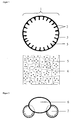
- the problem is solved by the provision of carrier particles whose structure is shown in FIG.
- the carrier particles according to the invention are characterized in that the carrier particles are microcapsules (1) of a size between 5 and 50 represent or contain the wall of the microcapsules (2) a continuous but hydrophilic selective and porous separating layer (3) having a thickness of less than 500 nm, the Pores (4) in the separation layer between 50 and 500 nm are far, the average pore distance Below 3 microns and the wall is a mechanically rigid and in water not or little swelling-capable support structure (5), the proportion of the capsule volume is less than 10%.
- the short pore length and small pore spacing ensure high permeability for macromolecules even with a small area fraction of the pores.
- the permeable molecules have an elution volume equal to the total volume of the capsule volume and in the Intergrain volume corresponds to existing eluent, and will be with good Resolving power in the form of a sharp peak from the excluded molecules or particles separated. This is true even if their size is only slightly below that Pore width is.
- the small thickness of the separation layer and the small pore spacing are for the invention essential.
- the inventive size of the microcapsules ensures sufficient low diffusion time in the stationary liquid in the lumen of the microcapsules even at very large molecules and allows a grain size that contributes to a fast flow low pressure allows. This is essential to the shear-related ripping sensitive molecular aggregates or highly swollen polymer molecules to avoid.
- There the support structure in water is only slightly swellable, it ensures even at low Volume fraction of their solid one for the chromatography with fine-grained material adequate pressure stability of the microcapsules.
- the permeable support structure ensures that these are not additional to any particles permeable by the release layer Diffusion resistance generated.
- the carrier particles according to the invention can either be consist of a microcapsule or particles containing one or more microcapsules with contain the features of the invention.
- Microcapsules with an optimum size for the chromatography of polymers and good compressive strength are known in the form of sporopollenin microcapsules.
- Sporopollenin is in particulate form and of a favorable size in the form of spores and pollen, where it naturally occurs, an interesting raw material source for manufacturing of new chromatographic carrier particles. It is known that sporopollenin particles, which are obtained from Bärlappsporen, very favorable mechanical strengths and a extremely high chemical resistance in a variety of solvents, i.a. strengthen Have acids and bases (Mackenzie and Shaw, 1980, Int. J. Peptide Protein Res. 15, 298-300).
- the Sporodollen sporoderm consists of no macropores and a has low permeability even for low molecular weight substances, the removal of the Protoplasm complicated. Lycopodium sporopollenin particles are used as solid phase for special applications (peptide synthesis) are used, and they are also used to Immobilization of specific ligands used (Pehlivan and Yildiz, 1994, Sep. Sci. Technol. 29, 887-895). Only the outer surface can be used. own Experiments have shown that in these particles because of the low permeability of the Sporoderms use of the inner phase for the chromatography is not possible or very is difficult.
- the exine of the coniferous pollen ( Figures 2 and 3) form a central capsule (6) surrounding the male gametophyte and having an exchangeable lumen in the purified exine, and two air sacs (7) adjacent thereto which are separated from the outer layer of the exine so-called Sexine (8), to be limited.
- the sexine is composed of sporopollenin and has a continuous cover layer about 100 nm thick, the tectum (9), and a ca.
- the high permeability of the exine for high molecular weight substances and the sharp exclusion limit results in exclusion chromatography not yet realized possibility for efficient chromatographic separation of excluded finely dispersed particles or very high molecular weight colloids of permeable macromolecules up to a Stokes radius 100 nm.
- very large colloids or particles eg high molecular weight hyaluronic acid, glycogen, uncleaved DNA, viruses, chromosomes
- biopolymers proteins, polysaccharides with conventional degree of polymerization, cleavage products of high molecular weight DNA
- the semipermeable exinational structure of the central capsule has a very low exclusion limit. Proteins and other colloids with a Stokes radius greater than 1.5 nm are completely excluded, while salt ions are permeable. For an efficient exclusion chromatographic use of the central capsule for the desalting of proteins with high flow rate, the permeation rate of the salt ions into the central capsule is not sufficient.
- coniferous exins can be separated into groups of three size classes that are cleanly separated: 1. the excluded fraction of colloids or particles having a Stokes radius above 100 nm; 2. colloids and polymers having a Stokes radius less than 100 nm and 3. salt ions and low molecular weight particles.
- the major advantage of the sporopollenin capsules of the present invention for exclusion chromatography is the fact that a large part of the intraparticle distribution space, the lumen of the air sacs, can be utilized for extremely large separation limit exclusion chromatographic separation.
- the invention further relates to a method for exclusion chromatography Separation of materials between extremely high molecular weight polymers or finely dispersed ones Particles and all other components of a mixed sample, including all proteins and of comparably large particles, which consists in mixing samples to a liquid-saturated Bed applied from the carrier particles according to the invention and its Components are eluted from this bed.
- the sample becomes a permeable dye mixed and the isolation of the excluded polymers or particles, the eluate, the with a relative elution volume between about 20% of the bed volume and the Leaving the dye leaves the bed, collected.
- the eluent is an aqueous Solution of ammonium bicarbonate or another volatile salt used.
- the eluent is applied to the dry bed.
- the inventive method can also be used for chromatographic purification of high molecular weight substances.
- novel carrier particles according to the invention also exist in that they are for the separation or purification of DNA or high molecular weight RNA from the other constituents of a protein-rich crude extract and for separation or Purification of high molecular weight fractions from a polydisperse polymer mixture are suitable.
- Microcapsules from the Sporopollenin the coniferous pollen can be withoutshrinking the air sacs from certain organic liquids, e.g. Acetone, dry.
- the resulting powder leaves the application in chromatographic drying beds according to the patent DD 278482 A3 to. This allows biopolymers and colloids with extremely high degree of polymerization separated from those of smaller size and be concentrated at the same time.
- the elution volume of proteins was 60% of the bed volume and thus significantly above the intercorneal volume.
- the proteins and other polymer molecules left the bed as a sharp peak, whose variance surprisingly did not depend on the flow rate.
- a dextran with a molecular weight of 5 to 40 million daltons was eluted through the bed, most of this polymer left the column with the intermediate grain volume (about 35%) as a sharp peak.
- Dextran with an average molecular weight of 2 million daltons was split into two fractions, one eluting with the intercorneal volume and the other with the exclusion volume.
- the latter are formed by the outer layer of the exine, the so-called sexine, which is differentiated into an outer continuous covering layer, the tectum and an alveolar supporting layer.
- the sporopollenin is arranged in the form of honeycombs, which are open inwards.
- the cover layer is about 200 nm thick and has about 200 nm wide pores with a small area fraction but a large density. The mean distance between the pores is 1 to 2 ⁇ m. Due to the small distance between the pores and the small thickness of the tectum, the diffusion of the macromolecules into the depth of the capsules is only slightly delayed.
- the analysis of the influence of the flow rate on the peak variance by means of the Giddings equation surprisingly revealed that the diffusion resistance of the air sacs is not significantly higher than the theoretical diffusion resistance of an unstirred liquid zone with the size of the air sacs.
- the bed was saturated with the eluent in a short time and became the closest Day for the exclusion-chromatographic separation between serum albumin and a high molecular weight commercial preparation of DNA (calf thymus) used.
- DNA calf thymus
- the length of the column was calculated so that most of the DNA is eluted before the proteins.
- the eluate were collected directly at the column exit.
- a suitable for this Procedure is to sample prior to application to the miniaturized column with a small amount of Evans-Blue, a dye eluted with the protein fraction offset.
- the elution liquid 0.1 M ammonium bicarbonate
- the eluate is collected until the dye emerges.
- the dye-free Fractions (about 200 ⁇ l) contains most of the DNA in protein-free form, as you can prove on the spectrum. Since the elution liquid except the DNA only contains volatile constituents, highly purified DNA is formed during lyophilization.
- a chromatographic bed of Sporopollenin capsules with a length of 6 cm and a volume of 12 ml was added to a HPLC apparatus with a UV detector connected.
- the eluent used was 100 mM ammonium bicarbonate.
- the crude extracts were made from plant cells of a Suspension culture by grinding in liquid nitrogen and mixing with a so-called lysis buffer, for the recovery of genomic DNA from biological samples usually used, won.
- the lysis buffer contained for denaturation hydrolytic enzymes sodium dodecyl sulfate.
- the Elugramm showed an exclusion peak, whose elution time corresponded to the intermediate grain volume. This peak was big Separated from the protein fraction and contained the genomic DNA, as by Electrophoresis could be shown. Between the protein fraction and the Exclusion peak, the baseline was not reached.
- the crushed cells were taken up in a modified lysis buffer which did not Sodium dodecyl sulfate, but contained RNAase. Sodium dodecyl sulfate was only after the Separation of cell debris and an incubation time of 10 min added. The Chromatography of this extract resulted in the DNA fraction in the elbow sharp peak appeared, which was separated from the protein fraction by the baseline.
- the Elugramm is accordingly preceded by the appearance of the protein fraction by the DNA, and, if present, determined by high molecular weight RNA (mRNA and rRNA).
Landscapes
- Chemical & Material Sciences (AREA)
- Analytical Chemistry (AREA)
- Chemical Kinetics & Catalysis (AREA)
- Organic Chemistry (AREA)
- Treatment Of Liquids With Adsorbents In General (AREA)
- Manufacturing Of Micro-Capsules (AREA)
- Solid-Sorbent Or Filter-Aiding Compositions (AREA)
Claims (14)
- Particules vecteurs servant à la chromatographie sur base de microcapsules ayant une paroi poreuse caractérisées en ce queles particules vecteurs se composent de microcapsules (1) ayant un diamètre compris entre 5 et 50 µm ou contiennent de telles microcapsules,la paroi (2) de la microcapsule possède une couche de séparation (3) continue mais sélective, hydrophile et poreuse dont l'épaisseur est inférieure à 500 nm,les pores (4) présents dans la couche de séparation mesurent entre 50 et 500 nm de large,l'espacement moyen entre les pores est inférieur à 3 µmla paroi présente également une structure de base (5) mécaniquement rigide, gonflant peu ou pas du tout dans l'eau ; cette paroi représente moins de 10 % du volume de la capsule.
- Particules vecteurs selon la revendication 1, caractérisées en ce que la structure du corps solide des particules se compose de sporopollenine et est constituée par l'exine purifiée de pollen de conifères ; cette exine constitue la paroi d'une capsule centrale (6) avec une faible limite d'exclusion de taille et deux poches d'air adjacentes (7) ; ces poches d'air représentent des microcapsules (1) possédant les caractéristiques mentionnées dans la revendication 1.
- Particules vecteurs selon la revendication 2, dont la capsule centrale est entièrement ou en partie collabée.
- Particules selon les revendications 2 ou 3, caractérisées en ce que l'ouverture de la capsule centrale est provoquée par le déchirement de l'exine.
- Processus de fabrication de particules vecteurs selon la revendication 3 par assèchement des exines de conifère d'un liquide.
- Processus de fabrication de particules vecteurs selon la revendication 4 par germination ou perforation osmotique des exines de conifère sur la capsule centrale.
- Processus de séparation des matières sur base de la chromatographie d'exclusion moyennant l'utilisation de particules vecteurs selon les revendications 1 à 4 ; ce processus vise à séparer les polymères de masse moléculaire extrêmement élevée ou les particules finement dispersées de tous les autres composants d'un échantillon de mélange, en ce compris toutes les protéines et autres particules de taille équivalente et est caractérisée en ce que les échantillons de mélange sont appliqués sur un lit saturé en fluide composé de particules vecteurs et en ce que ses composants sont élués par ce lit.
- Processus selon la revendication 7, caractérisé en ce que un colorant perméable est ajouté à l'échantillon et en ce que l'éluat est récolté afin d'isoler les polymères et autres particules exclus, cet éluat étant extrait du lit avec un volume d'élution relatif entre env. 20 % du volume du lit et l'élimination du colorant.
- Processus selon la revendication 7 ou 8, caractérisé en ce qu'une solution aqueuse de carbonate d'acide d'ammonium ou un autre sel volatil est utilisé comme agent d'élution.
- Processus selon l'une quelconque des revendications 7 à 9, dans lequel l'agent d'élution est appliqué sur le lit asséché.
- Processus selon la revendication 7 visant à la purification chromatographique des matières à la masse moléculaire élevée, caractérisé en ce que l'élément vecteur est utilisé selon la revendication 1.
- Utilisation d'un élément vecteur selon l'une des revendications 1 à 6 ou un processus de l'une des revendications 7 à 9 visant à séparer l'ADN ou l'ARN de masse moléculaire élevée des autres composants d'un extrait brut riche en protéines.
- Utilisation d'un élément vecteur selon l'une des revendications 1 à 6 ou d'un processus selon l'une des revendications 7 à 9 visant à séparer la fraction de masse moléculaire élevée d'un mélange polymère polydispersé.
- Utilisation selon les revendications 12 et 13 visant à séparer des biopolymères et colloïdes avec un taux de polymérisation extrêmement élevé des biopolymères et colloïdes de plus petite taille et visant, simultanément, à concentrer ces biopolymères et colloïdes.
Applications Claiming Priority (3)
| Application Number | Priority Date | Filing Date | Title |
|---|---|---|---|
| DE10211300 | 2002-03-14 | ||
| DE10211300 | 2002-03-14 | ||
| PCT/DE2003/000891 WO2003078048A2 (fr) | 2002-03-14 | 2003-03-13 | Particules porteuses pour la chromatographie a base de microcapsules, procede de production et utilisation associes |
Publications (2)
| Publication Number | Publication Date |
|---|---|
| EP1487571A2 EP1487571A2 (fr) | 2004-12-22 |
| EP1487571B1 true EP1487571B1 (fr) | 2005-11-23 |
Family
ID=27815643
Family Applications (1)
| Application Number | Title | Priority Date | Filing Date |
|---|---|---|---|
| EP03717154A Expired - Lifetime EP1487571B1 (fr) | 2002-03-14 | 2003-03-13 | Particules porteuses pour la chromatographie a base de microcapsules, procede de production et utilisation associes |
Country Status (5)
| Country | Link |
|---|---|
| EP (1) | EP1487571B1 (fr) |
| AT (1) | ATE310577T1 (fr) |
| AU (1) | AU2003221605A1 (fr) |
| DE (3) | DE50301747D1 (fr) |
| WO (1) | WO2003078048A2 (fr) |
Families Citing this family (4)
| Publication number | Priority date | Publication date | Assignee | Title |
|---|---|---|---|---|
| US7608270B2 (en) | 2003-06-27 | 2009-10-27 | University Of Hull | Dosage form |
| AU2006273841B2 (en) | 2005-07-28 | 2012-03-08 | University Of Hull | Uses of sporopollenin |
| GB0812513D0 (en) | 2008-07-09 | 2008-08-13 | Univ Hull | Delivery vehicle |
| CN110433741B (zh) * | 2019-07-08 | 2022-01-14 | 浙江工业大学 | 一种具有碳骨架的芳香抗菌微胶囊及其制备方法 |
Family Cites Families (6)
| Publication number | Priority date | Publication date | Assignee | Title |
|---|---|---|---|---|
| US4257884A (en) * | 1979-04-17 | 1981-03-24 | Damon Corporation | Chromatography |
| DD247570A3 (de) * | 1983-01-14 | 1987-07-15 | Univ Berlin Humboldt | Vesikulaeres trenn-, fuell- und traegermaterial |
| DE160267T1 (de) * | 1984-04-24 | 1986-05-22 | Kanto Kagaku | Poroese keramische cordientkoerper, ihre herstellung und ihre verwendung. |
| DD262808A1 (de) * | 1987-08-11 | 1988-12-14 | Univ Berlin Humboldt | Vesikulaere fuellkoerper fuer die chromatographie aus denaturierten mikroorganismen und verfahren zur herstellung |
| US5770416A (en) * | 1989-05-26 | 1998-06-23 | Upfront Chromatography A/S | Permeable hollow particles having an outer shell of mechanically rigid porous material |
| DE19902724A1 (de) * | 1999-01-19 | 2000-07-27 | Dietmar Lerche | Mikrokapseln aus Sporopollenin, Verfahren zu ihrer Herstellung und Anwendung |
-
2003
- 2003-03-13 DE DE50301747T patent/DE50301747D1/de not_active Expired - Lifetime
- 2003-03-13 AU AU2003221605A patent/AU2003221605A1/en not_active Abandoned
- 2003-03-13 DE DE20304380U patent/DE20304380U1/de not_active Expired - Lifetime
- 2003-03-13 DE DE10312128A patent/DE10312128A1/de not_active Withdrawn
- 2003-03-13 AT AT03717154T patent/ATE310577T1/de not_active IP Right Cessation
- 2003-03-13 WO PCT/DE2003/000891 patent/WO2003078048A2/fr not_active Ceased
- 2003-03-13 EP EP03717154A patent/EP1487571B1/fr not_active Expired - Lifetime
Also Published As
| Publication number | Publication date |
|---|---|
| AU2003221605A8 (en) | 2003-09-29 |
| DE20304380U1 (de) | 2003-09-11 |
| EP1487571A2 (fr) | 2004-12-22 |
| WO2003078048A2 (fr) | 2003-09-25 |
| AU2003221605A1 (en) | 2003-09-29 |
| ATE310577T1 (de) | 2005-12-15 |
| DE50301747D1 (de) | 2005-12-29 |
| DE10312128A1 (de) | 2003-10-30 |
| WO2003078048A3 (fr) | 2003-12-18 |
Similar Documents
| Publication | Publication Date | Title |
|---|---|---|
| EP2694527B1 (fr) | Procédé de séparation/purification de biomolécules | |
| EP0733099B1 (fr) | Procede de fragmentation de structures de poids moleculaire eleve | |
| DE69325266T2 (de) | Superporöse polysaccharidgele | |
| EP0616639B1 (fr) | Dispositif et procede pour l'isolation et la purification d'acides nucleiques | |
| DE69209109T2 (de) | Feste-Phase-Extraktionsmedium | |
| DE69100213T2 (de) | Kompositartikel aus Polytetrafluorethylen mit kontrollierten Poren und dessen Herstellungsmethode. | |
| DE60108950T2 (de) | Verfahren und vorrichtung zur plasmidgewinnung mit hilfe von ultrafiltration | |
| DE10236664A1 (de) | Verfahren und Vorrichtung zur adsorptiven Stofftrennung | |
| DE10344819B4 (de) | Adsorptionsmembranen, Verfahren zur Herstellung derselben und Vorrichtungen, welche die Adsorptionsmembranen umfassen | |
| DE3221212A1 (de) | Filter und verfahren zu seiner herstellung | |
| EP1575703A1 (fr) | Procede et dispositif pour modifier des microparticules | |
| EP0815927A2 (fr) | Dispositif de séparation de cellules et de purification de produits intégrés | |
| DE10106199A1 (de) | Verfahren zur Isolierung von Nukleinsäuren aus einer nukleinsäurehaltigen flüssigen Probe | |
| DE10312128A1 (de) | Trägerpartikeln für die Chromatographie auf der Grundlage von Mikrokapseln, Verfahren zu ihrer Herstellung und ihre Anwendung | |
| EP1242816B1 (fr) | Materiau chromatographique et procedes d'utilisation d'un tel materiau | |
| DE29803712U1 (de) | Vorrichtung zur Behandlung von Biomolekülen | |
| DE19902724A1 (de) | Mikrokapseln aus Sporopollenin, Verfahren zu ihrer Herstellung und Anwendung | |
| DE102007005655A1 (de) | Vorrichtung und Verfahren zur Aufreinigung von Nukleinsäuren | |
| DE19529332B4 (de) | Anorganische Filtrierstrukturen und ihre Herstellung | |
| DD247570A3 (de) | Vesikulaeres trenn-, fuell- und traegermaterial | |
| DE3821619A1 (de) | Vesikulaere fuellkoerper fuer die chromatographie aus denaturierten mikroorganismen und verfahren zur herstellung | |
| WO2000044492A1 (fr) | Polysaccharides lineaires insolubles dans l'eau, utilises pour realiser une filtration | |
| DE2601930A1 (de) | Verfahren und mittel zum abtrennen von molekuelen | |
| DE202005010007U1 (de) | Trenneinrichtung für die Trennung von unlöslichen Inhaltsstoffen aus einer biologischen Probenflüssigkeit | |
| DE102006020463B4 (de) | Verfahren zum Entfernen von Nukleinsäuren aus einer Flüssigkeit, Verfahren zur Herstellung von Adsorberelementen und Verwendung von Membranadsorbermaterial-Verschnitt |
Legal Events
| Date | Code | Title | Description |
|---|---|---|---|
| PUAI | Public reference made under article 153(3) epc to a published international application that has entered the european phase |
Free format text: ORIGINAL CODE: 0009012 |
|
| 17P | Request for examination filed |
Effective date: 20041013 |
|
| AK | Designated contracting states |
Kind code of ref document: A2 Designated state(s): AT BE BG CH CY CZ DE DK EE ES FI FR GB GR HU IE IT LI LU MC NL PT RO SE SI SK TR |
|
| AX | Request for extension of the european patent |
Extension state: AL LT LV MK |
|
| GRAP | Despatch of communication of intention to grant a patent |
Free format text: ORIGINAL CODE: EPIDOSNIGR1 |
|
| GRAS | Grant fee paid |
Free format text: ORIGINAL CODE: EPIDOSNIGR3 |
|
| GRAA | (expected) grant |
Free format text: ORIGINAL CODE: 0009210 |
|
| RAP1 | Party data changed (applicant data changed or rights of an application transferred) |
Owner name: L.U.M. GMBH |
|
| AK | Designated contracting states |
Kind code of ref document: B1 Designated state(s): AT BE BG CH CY CZ DE DK EE ES FI FR GB GR HU IE IT LI LU MC NL PT RO SE SI SK TR |
|
| PG25 | Lapsed in a contracting state [announced via postgrant information from national office to epo] |
Ref country code: IE Free format text: LAPSE BECAUSE OF FAILURE TO SUBMIT A TRANSLATION OF THE DESCRIPTION OR TO PAY THE FEE WITHIN THE PRESCRIBED TIME-LIMIT Effective date: 20051123 Ref country code: FI Free format text: LAPSE BECAUSE OF FAILURE TO SUBMIT A TRANSLATION OF THE DESCRIPTION OR TO PAY THE FEE WITHIN THE PRESCRIBED TIME-LIMIT Effective date: 20051123 Ref country code: SI Free format text: LAPSE BECAUSE OF FAILURE TO SUBMIT A TRANSLATION OF THE DESCRIPTION OR TO PAY THE FEE WITHIN THE PRESCRIBED TIME-LIMIT Effective date: 20051123 Ref country code: RO Free format text: LAPSE BECAUSE OF FAILURE TO SUBMIT A TRANSLATION OF THE DESCRIPTION OR TO PAY THE FEE WITHIN THE PRESCRIBED TIME-LIMIT Effective date: 20051123 Ref country code: SK Free format text: LAPSE BECAUSE OF FAILURE TO SUBMIT A TRANSLATION OF THE DESCRIPTION OR TO PAY THE FEE WITHIN THE PRESCRIBED TIME-LIMIT Effective date: 20051123 Ref country code: NL Free format text: LAPSE BECAUSE OF FAILURE TO SUBMIT A TRANSLATION OF THE DESCRIPTION OR TO PAY THE FEE WITHIN THE PRESCRIBED TIME-LIMIT Effective date: 20051123 Ref country code: CZ Free format text: LAPSE BECAUSE OF FAILURE TO SUBMIT A TRANSLATION OF THE DESCRIPTION OR TO PAY THE FEE WITHIN THE PRESCRIBED TIME-LIMIT Effective date: 20051123 |
|
| REG | Reference to a national code |
Ref country code: GB Ref legal event code: FG4D Free format text: NOT ENGLISH |
|
| REG | Reference to a national code |
Ref country code: CH Ref legal event code: EP |
|
| REF | Corresponds to: |
Ref document number: 50301747 Country of ref document: DE Date of ref document: 20051229 Kind code of ref document: P |
|
| REG | Reference to a national code |
Ref country code: IE Ref legal event code: FG4D Free format text: LANGUAGE OF EP DOCUMENT: GERMAN |
|
| GBT | Gb: translation of ep patent filed (gb section 77(6)(a)/1977) |
Effective date: 20060110 |
|
| PG25 | Lapsed in a contracting state [announced via postgrant information from national office to epo] |
Ref country code: GR Free format text: LAPSE BECAUSE OF FAILURE TO SUBMIT A TRANSLATION OF THE DESCRIPTION OR TO PAY THE FEE WITHIN THE PRESCRIBED TIME-LIMIT Effective date: 20060223 Ref country code: SE Free format text: LAPSE BECAUSE OF FAILURE TO SUBMIT A TRANSLATION OF THE DESCRIPTION OR TO PAY THE FEE WITHIN THE PRESCRIBED TIME-LIMIT Effective date: 20060223 Ref country code: BG Free format text: LAPSE BECAUSE OF FAILURE TO SUBMIT A TRANSLATION OF THE DESCRIPTION OR TO PAY THE FEE WITHIN THE PRESCRIBED TIME-LIMIT Effective date: 20060223 Ref country code: DK Free format text: LAPSE BECAUSE OF FAILURE TO SUBMIT A TRANSLATION OF THE DESCRIPTION OR TO PAY THE FEE WITHIN THE PRESCRIBED TIME-LIMIT Effective date: 20060223 |
|
| PG25 | Lapsed in a contracting state [announced via postgrant information from national office to epo] |
Ref country code: ES Free format text: LAPSE BECAUSE OF FAILURE TO SUBMIT A TRANSLATION OF THE DESCRIPTION OR TO PAY THE FEE WITHIN THE PRESCRIBED TIME-LIMIT Effective date: 20060306 |
|
| PG25 | Lapsed in a contracting state [announced via postgrant information from national office to epo] |
Ref country code: AT Free format text: LAPSE BECAUSE OF NON-PAYMENT OF DUE FEES Effective date: 20060313 |
|
| PG25 | Lapsed in a contracting state [announced via postgrant information from national office to epo] |
Ref country code: MC Free format text: LAPSE BECAUSE OF NON-PAYMENT OF DUE FEES Effective date: 20060331 Ref country code: LU Free format text: LAPSE BECAUSE OF NON-PAYMENT OF DUE FEES Effective date: 20060331 Ref country code: BE Free format text: LAPSE BECAUSE OF NON-PAYMENT OF DUE FEES Effective date: 20060331 |
|
| PG25 | Lapsed in a contracting state [announced via postgrant information from national office to epo] |
Ref country code: PT Free format text: LAPSE BECAUSE OF FAILURE TO SUBMIT A TRANSLATION OF THE DESCRIPTION OR TO PAY THE FEE WITHIN THE PRESCRIBED TIME-LIMIT Effective date: 20060424 |
|
| NLV1 | Nl: lapsed or annulled due to failure to fulfill the requirements of art. 29p and 29m of the patents act | ||
| PG25 | Lapsed in a contracting state [announced via postgrant information from national office to epo] |
Ref country code: HU Free format text: LAPSE BECAUSE OF FAILURE TO SUBMIT A TRANSLATION OF THE DESCRIPTION OR TO PAY THE FEE WITHIN THE PRESCRIBED TIME-LIMIT Effective date: 20060524 |
|
| REG | Reference to a national code |
Ref country code: IE Ref legal event code: FD4D |
|
| ET | Fr: translation filed | ||
| PLBE | No opposition filed within time limit |
Free format text: ORIGINAL CODE: 0009261 |
|
| STAA | Information on the status of an ep patent application or granted ep patent |
Free format text: STATUS: NO OPPOSITION FILED WITHIN TIME LIMIT |
|
| 26N | No opposition filed |
Effective date: 20060824 |
|
| REG | Reference to a national code |
Ref country code: CH Ref legal event code: PL |
|
| BERE | Be: lapsed |
Owner name: L.U.M. G.M.B.H. Effective date: 20060331 |
|
| PG25 | Lapsed in a contracting state [announced via postgrant information from national office to epo] |
Ref country code: CH Free format text: LAPSE BECAUSE OF NON-PAYMENT OF DUE FEES Effective date: 20070331 Ref country code: LI Free format text: LAPSE BECAUSE OF NON-PAYMENT OF DUE FEES Effective date: 20070331 |
|
| PG25 | Lapsed in a contracting state [announced via postgrant information from national office to epo] |
Ref country code: EE Free format text: LAPSE BECAUSE OF FAILURE TO SUBMIT A TRANSLATION OF THE DESCRIPTION OR TO PAY THE FEE WITHIN THE PRESCRIBED TIME-LIMIT Effective date: 20051123 |
|
| PG25 | Lapsed in a contracting state [announced via postgrant information from national office to epo] |
Ref country code: TR Free format text: LAPSE BECAUSE OF FAILURE TO SUBMIT A TRANSLATION OF THE DESCRIPTION OR TO PAY THE FEE WITHIN THE PRESCRIBED TIME-LIMIT Effective date: 20051123 |
|
| PG25 | Lapsed in a contracting state [announced via postgrant information from national office to epo] |
Ref country code: CY Free format text: LAPSE BECAUSE OF FAILURE TO SUBMIT A TRANSLATION OF THE DESCRIPTION OR TO PAY THE FEE WITHIN THE PRESCRIBED TIME-LIMIT Effective date: 20051123 |
|
| REG | Reference to a national code |
Ref country code: FR Ref legal event code: PLFP Year of fee payment: 14 |
|
| REG | Reference to a national code |
Ref country code: FR Ref legal event code: PLFP Year of fee payment: 15 |
|
| REG | Reference to a national code |
Ref country code: FR Ref legal event code: PLFP Year of fee payment: 16 |
|
| PGFP | Annual fee paid to national office [announced via postgrant information from national office to epo] |
Ref country code: GB Payment date: 20200325 Year of fee payment: 18 Ref country code: IT Payment date: 20200327 Year of fee payment: 18 |
|
| PGFP | Annual fee paid to national office [announced via postgrant information from national office to epo] |
Ref country code: FR Payment date: 20200326 Year of fee payment: 18 |
|
| GBPC | Gb: european patent ceased through non-payment of renewal fee |
Effective date: 20210313 |
|
| PG25 | Lapsed in a contracting state [announced via postgrant information from national office to epo] |
Ref country code: FR Free format text: LAPSE BECAUSE OF NON-PAYMENT OF DUE FEES Effective date: 20210331 Ref country code: GB Free format text: LAPSE BECAUSE OF NON-PAYMENT OF DUE FEES Effective date: 20210313 |
|
| PG25 | Lapsed in a contracting state [announced via postgrant information from national office to epo] |
Ref country code: IT Free format text: LAPSE BECAUSE OF NON-PAYMENT OF DUE FEES Effective date: 20210313 |
|
| PGFP | Annual fee paid to national office [announced via postgrant information from national office to epo] |
Ref country code: DE Payment date: 20220331 Year of fee payment: 20 |
|
| REG | Reference to a national code |
Ref country code: DE Ref legal event code: R071 Ref document number: 50301747 Country of ref document: DE |