EP1491643A2 - Wärmebehandlung für Werkstücke - Google Patents
Wärmebehandlung für Werkstücke Download PDFInfo
- Publication number
- EP1491643A2 EP1491643A2 EP20040253678 EP04253678A EP1491643A2 EP 1491643 A2 EP1491643 A2 EP 1491643A2 EP 20040253678 EP20040253678 EP 20040253678 EP 04253678 A EP04253678 A EP 04253678A EP 1491643 A2 EP1491643 A2 EP 1491643A2
- Authority
- EP
- European Patent Office
- Prior art keywords
- gas
- workpiece
- injecting
- furnace
- center location
- Prior art date
- Legal status (The legal status is an assumption and is not a legal conclusion. Google has not performed a legal analysis and makes no representation as to the accuracy of the status listed.)
- Granted
Links
- 238000010438 heat treatment Methods 0.000 title claims abstract description 26
- 238000000034 method Methods 0.000 claims abstract description 44
- 238000009792 diffusion process Methods 0.000 claims abstract description 30
- 238000004140 cleaning Methods 0.000 claims abstract description 14
- 238000000576 coating method Methods 0.000 claims description 73
- 239000011248 coating agent Substances 0.000 claims description 63
- 239000007789 gas Substances 0.000 claims description 54
- XKRFYHLGVUSROY-UHFFFAOYSA-N Argon Chemical compound [Ar] XKRFYHLGVUSROY-UHFFFAOYSA-N 0.000 claims description 16
- 239000011261 inert gas Substances 0.000 claims description 10
- 229910052786 argon Inorganic materials 0.000 claims description 8
- 239000000356 contaminant Substances 0.000 claims description 8
- 238000011109 contamination Methods 0.000 description 5
- 230000003647 oxidation Effects 0.000 description 4
- 238000007254 oxidation reaction Methods 0.000 description 4
- 239000001257 hydrogen Substances 0.000 description 3
- 229910052739 hydrogen Inorganic materials 0.000 description 3
- 125000004435 hydrogen atom Chemical class [H]* 0.000 description 3
- 239000000203 mixture Substances 0.000 description 3
- 239000007921 spray Substances 0.000 description 3
- 239000000956 alloy Substances 0.000 description 2
- 229910045601 alloy Inorganic materials 0.000 description 2
- QVGXLLKOCUKJST-UHFFFAOYSA-N atomic oxygen Chemical compound [O] QVGXLLKOCUKJST-UHFFFAOYSA-N 0.000 description 2
- 230000003247 decreasing effect Effects 0.000 description 2
- 238000007730 finishing process Methods 0.000 description 2
- 238000012986 modification Methods 0.000 description 2
- 230000004048 modification Effects 0.000 description 2
- 239000001301 oxygen Substances 0.000 description 2
- 229910052760 oxygen Inorganic materials 0.000 description 2
- 239000000758 substrate Substances 0.000 description 2
- 230000009286 beneficial effect Effects 0.000 description 1
- 230000003749 cleanliness Effects 0.000 description 1
- 238000005056 compaction Methods 0.000 description 1
- 238000000151 deposition Methods 0.000 description 1
- 230000008021 deposition Effects 0.000 description 1
- 238000005328 electron beam physical vapour deposition Methods 0.000 description 1
- 238000005516 engineering process Methods 0.000 description 1
- 238000004519 manufacturing process Methods 0.000 description 1
- 239000011148 porous material Substances 0.000 description 1
- 238000013404 process transfer Methods 0.000 description 1
- 230000001681 protective effect Effects 0.000 description 1
- 238000005480 shot peening Methods 0.000 description 1
- 238000010408 sweeping Methods 0.000 description 1
- 238000005019 vapor deposition process Methods 0.000 description 1
Images
Classifications
-
- C—CHEMISTRY; METALLURGY
- C23—COATING METALLIC MATERIAL; COATING MATERIAL WITH METALLIC MATERIAL; CHEMICAL SURFACE TREATMENT; DIFFUSION TREATMENT OF METALLIC MATERIAL; COATING BY VACUUM EVAPORATION, BY SPUTTERING, BY ION IMPLANTATION OR BY CHEMICAL VAPOUR DEPOSITION, IN GENERAL; INHIBITING CORROSION OF METALLIC MATERIAL OR INCRUSTATION IN GENERAL
- C23C—COATING METALLIC MATERIAL; COATING MATERIAL WITH METALLIC MATERIAL; SURFACE TREATMENT OF METALLIC MATERIAL BY DIFFUSION INTO THE SURFACE, BY CHEMICAL CONVERSION OR SUBSTITUTION; COATING BY VACUUM EVAPORATION, BY SPUTTERING, BY ION IMPLANTATION OR BY CHEMICAL VAPOUR DEPOSITION, IN GENERAL
- C23C8/00—Solid state diffusion of only non-metal elements into metallic material surfaces; Chemical surface treatment of metallic material by reaction of the surface with a reactive gas, leaving reaction products of surface material in the coating, e.g. conversion coatings, passivation of metals
- C23C8/80—After-treatment
-
- C—CHEMISTRY; METALLURGY
- C21—METALLURGY OF IRON
- C21D—MODIFYING THE PHYSICAL STRUCTURE OF FERROUS METALS; GENERAL DEVICES FOR HEAT TREATMENT OF FERROUS OR NON-FERROUS METALS OR ALLOYS; MAKING METAL MALLEABLE, e.g. BY DECARBURISATION OR TEMPERING
- C21D1/00—General methods or devices for heat treatment, e.g. annealing, hardening, quenching or tempering
- C21D1/74—Methods of treatment in inert gas, controlled atmosphere, vacuum or pulverulent material
-
- C—CHEMISTRY; METALLURGY
- C23—COATING METALLIC MATERIAL; COATING MATERIAL WITH METALLIC MATERIAL; CHEMICAL SURFACE TREATMENT; DIFFUSION TREATMENT OF METALLIC MATERIAL; COATING BY VACUUM EVAPORATION, BY SPUTTERING, BY ION IMPLANTATION OR BY CHEMICAL VAPOUR DEPOSITION, IN GENERAL; INHIBITING CORROSION OF METALLIC MATERIAL OR INCRUSTATION IN GENERAL
- C23C—COATING METALLIC MATERIAL; COATING MATERIAL WITH METALLIC MATERIAL; SURFACE TREATMENT OF METALLIC MATERIAL BY DIFFUSION INTO THE SURFACE, BY CHEMICAL CONVERSION OR SUBSTITUTION; COATING BY VACUUM EVAPORATION, BY SPUTTERING, BY ION IMPLANTATION OR BY CHEMICAL VAPOUR DEPOSITION, IN GENERAL
- C23C8/00—Solid state diffusion of only non-metal elements into metallic material surfaces; Chemical surface treatment of metallic material by reaction of the surface with a reactive gas, leaving reaction products of surface material in the coating, e.g. conversion coatings, passivation of metals
- C23C8/06—Solid state diffusion of only non-metal elements into metallic material surfaces; Chemical surface treatment of metallic material by reaction of the surface with a reactive gas, leaving reaction products of surface material in the coating, e.g. conversion coatings, passivation of metals using gases
-
- C—CHEMISTRY; METALLURGY
- C21—METALLURGY OF IRON
- C21D—MODIFYING THE PHYSICAL STRUCTURE OF FERROUS METALS; GENERAL DEVICES FOR HEAT TREATMENT OF FERROUS OR NON-FERROUS METALS OR ALLOYS; MAKING METAL MALLEABLE, e.g. BY DECARBURISATION OR TEMPERING
- C21D1/00—General methods or devices for heat treatment, e.g. annealing, hardening, quenching or tempering
- C21D1/74—Methods of treatment in inert gas, controlled atmosphere, vacuum or pulverulent material
- C21D1/76—Adjusting the composition of the atmosphere
-
- C—CHEMISTRY; METALLURGY
- C21—METALLURGY OF IRON
- C21D—MODIFYING THE PHYSICAL STRUCTURE OF FERROUS METALS; GENERAL DEVICES FOR HEAT TREATMENT OF FERROUS OR NON-FERROUS METALS OR ALLOYS; MAKING METAL MALLEABLE, e.g. BY DECARBURISATION OR TEMPERING
- C21D2241/00—Treatments in a special environment
- C21D2241/01—Treatments in a special environment under pressure
Definitions
- the present invention relates to a method for heat treating workpieces, such as coated turbine components, and to an improved system for performing the heat treat method of the present invention.
- Overlay type metallic coatings i.e. NiCoCrAlY, CoCrAlY, etc.
- These overlay metallic coatings may be applied to substrate surfaces by thermal spray processes, such as low pressure plasma spray and atmosphere pressure plasma spray, or by vapor deposition processes such as electron beam physical vapor deposition or cathodic arc.
- the density of the coating plays an important role in the oxidation resistance characteristics as well as the life span at which the coating will protect the substrate from the corrosive environment in which it operates.
- a coating free of open pockets, voids, fissures, cracks, or leaders provides significantly longer oxidation life protection than a coating containing such aforementioned characteristics.
- the state-of-the art technology used today to ensure that such coatings are close to 100% dense as possible is to apply the coating as dense as possible, then diffusion heat treat the coating, followed by subjecting the overlay coating to energy from processes such as peening.
- the peening process transfers enough kinetic energy at impact from the peen media velocity into the coating surface to increase the coating density by compaction and to improve the coating surface finish.
- the extent to which the peening process can improve the coating density and surface finish is related to the amount of kinetic energy that can be transferred from the peening media impact event onto and into the coating surface (often measured with almen strip intensity) in conjunction with the coating's ductility.
- a method for heat treating workpieces broadly comprises the steps of cleaning a furnace to be used during the heat treating method, the cleaning method comprising injecting an inert gas, such as argon, or a reducing gas, such as hydrogen, at a workpiece center location and applying heat, and thereafter diffusion heat treating the at least one coated workpiece in a gas atmosphere, such as an inert gas or a reducing gas atmosphere, with the gas again being injected at the workpiece center location.
- a gas atmosphere such as an inert gas or a reducing gas atmosphere
- a system for heat treating a coated workpiece broadly comprising a furnace and means for injecting a gas into an interior of the furnace at a workpiece center location.
- Overlay coatings are subjected to a diffusion heat treatment process followed by high energy impact events from processes such as peening to improve the coating density.
- the extent that a coating can be made 100% dense is related to the coating ductility as well as the surface finishing energy that can be obtained.
- the solution to improving coatings so they can be better transformed by surface finishing processes to a desirable density/quality level/surface finish begins with cleaning a furnace to be used in the diffusion heat treatment using a high temperature burnout heat-treat cycle with a gas, such as inert gas, preferably argon, and/or a reducing gas, such as hydrogen, being injected at the center of the work piece location area at a partial pressure preferably of 0.8 Torr or greater. It has been found that this creates a significantly cleaner furnace than the standard burn-out heat treat cycle used throughout the industry.
- a gas such as inert gas, preferably argon
- a reducing gas such as hydrogen
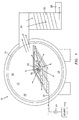
- FIG. 1 illustrates a modified heat treatment system 10 in accordance with the present invention.
- the system 10 includes a gas source 12, a furnace 13 having a chamber 14 in which workpieces (not shown), such as coated turbine engine components, to be treated are placed, a manifold 18 for delivering the gas to the center 20 of the work piece location area, a feed line 22 between the manifold 18 and the gas source 12, and a valve 24 for controlling the flow rate of the gas.
- the inventive furnace 13 is different from prior art furnaces where a gas is injected into the furnace through nozzles positioned about the exterior surface of the chamber 14. It has been found that nozzles positioned in such locations actually increase the contamination which appears in the workpieces and the coatings.
- any contaminants which are present on or in the furnace walls are mostly turned into a vapor state once the furnace reaches adequate temperature. These contaminants are deposited onto the workpieces and the coating, changing the coating ductility by tying up grain boundaries within the coating. Once the ductility of the coating is decreased, the coating and workpiece cannot be surface finished with enough energy to adequately improve coating density to an acceptable level without damaging the work piece.
- any vacuum leaks which are present within the furnace leak in air which contains oxygen. The oxygen often oxidizes the workpieces as well as contaminates them, which changes the coating ductility by tying up grain boundaries within the coating. Once the ductility of the coating is decreased, the coating and the workpieces cannot be surface finished with enough energy to adequately improve coating density to an acceptable level without damaging the workpieces.
- the system 10 of the present invention with the improved furnace design avoids such contamination of the workpieces and the coatings.
- the furnace chamber 14 is first cleaned by heating the furnace to a temperature which is 200-300°F (111-167°C) greater than the diffusion heat treatment temperature, typically greater than 2000°F (1093°C) , for a time period of 30 minutes or more.
- the gas is introduced at a flow rate which creates movement of contaminants from the center 20 of the workpiece location towards low pressure areas 26 about the furnace chamber 14 created by one or more vacuum pumps 30 and the exit area 28. Suitable gas flow rates are within the range of those sufficient to carry the contaminants away from the center 20 to those which would cause the door of the furnace chamber 14 to open.
- a preferred flow rate for the gas is in the range of 30 liters per minute to 70 liters per minute.
- the gas is introduced at a partial pressure sufficient to create a pressure differential which carries the contaminants away from the center 20.
- a particularly useful gas partial pressure is 0.8 Torr or greater.
- the diffusion heat treatment of the coated workpieces is carried out in the same gas environment under the same gas flow rate and partial pressure conditions.
- an inert gas with argon being a preferred gas, and/or a reducing gas, such as hydrogen, is injected into the chamber 14 at the center 20 of the workpiece location at the flow rate and partial pressures mentioned hereinabove. It has been found that by flowing the gas at a rate of 30 liters per minute to 70 liters per minute, the vacuum level during the diffusion heat treatment is in the range of 800 microns to 2000 microns.
- partial pressures of 0.8 Torr or greater are useful, the beneficial range of partial pressure depends on the configuration of the heat treat furnace as well as the quantity and condition of the coated workpieces being heat treated.
- the diffusion heat treatment may be carried out at a temperature in the range of 1900 degrees Fahrenheit (1038°C) to 2500 degrees Fahrenheit (1371°C) for a time period in the range of 1 to 24 hours. It has been found that workpieces subjected to the diffusion heat treatment described herein were able to be surface finished to produce an acceptable density and quality part.
- the workpieces with the coatings can be subjected to any surface finishing operation known in the art, such as a peening operation, to form a coating having an acceptable coating density and quality level.
- the physics of producing an acceptable coating density and quality level through heat treating and surface finishing using the method of the present invention is as follows.
- any vacuum leaks or elemental contamination which are present during the heat treat process will effectually reach the parts resulting in a decrease in coating ductility which cannot be further surface finished adequately to produce an acceptable density level coating.
- the method of first cleaning the furnace by performing a partial pressure heat treat with the gas, preferably argon, injected at the workpiece center location (typically the furnace center) results in the gas sweeping from the center of the furnace outward carrying (by means of random molecule collisions) all contaminates away from the furnace center which are removed by the vacuum pump(s) 30.
- the second step of actually performing the diffusion heat treatment of the coating and workpieces within the partial pressure gas atmosphere with the gas, preferably argon, being injected at the work pieces' center location results in a high pressure clean area within the vacuum furnace where the parts are located. All contaminates, whether from inside the furnace or as a result of vacuum leaks, are forced away from the high-pressure protective area (where the parts are located) by means of random molecule collisions where the high pressure area always seeks low pressure areas. This method results in a clean diffusion heat treatment that allows the coatings to adequately diffuse into the base alloy without changing the coating ductility.
- the gas preferably argon
- the method of the present invention has been found to have particular utility in the diffusion heat treatment of turbine engine components having an overlay coating applied thereto.
- the method of the present invention can be used with any workpiece coated with any overlay coating known in the art.
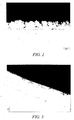
- FIG. 2 illustrates a workpiece with an as deposited and diffused coating.
- FIG. 3 illustrates a coating which has been formed using the method described herein and which was surface finished by shot peening. As can be seen from FIG. 3, the coating is free of pores, voids, and other bad features. In fact, the coating is homogeneous and has very good ductility.
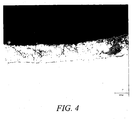
- FIG. 4 illustrates a coating which was not formed using the heat diffusion treatment of the present invention. After surface finishing, a poor quality coating was produced. As can be seen from FIG. 4, the coating has voids and fissures which makes it quite brittle.
Landscapes
- Chemical & Material Sciences (AREA)
- Engineering & Computer Science (AREA)
- Materials Engineering (AREA)
- Mechanical Engineering (AREA)
- Metallurgy (AREA)
- Organic Chemistry (AREA)
- Chemical Kinetics & Catalysis (AREA)
- Thermal Sciences (AREA)
- Crystallography & Structural Chemistry (AREA)
- Physics & Mathematics (AREA)
- Turbine Rotor Nozzle Sealing (AREA)
- Coating By Spraying Or Casting (AREA)
- Heat Treatment Of Articles (AREA)
- Furnace Details (AREA)
- Solid-Phase Diffusion Into Metallic Material Surfaces (AREA)
Applications Claiming Priority (2)
| Application Number | Priority Date | Filing Date | Title |
|---|---|---|---|
| US10/606,436 US20040261923A1 (en) | 2003-06-25 | 2003-06-25 | Clean atmosphere heat treat for coated turbine components |
| US606436 | 2003-06-25 |
Publications (3)
| Publication Number | Publication Date |
|---|---|
| EP1491643A2 true EP1491643A2 (de) | 2004-12-29 |
| EP1491643A3 EP1491643A3 (de) | 2005-11-23 |
| EP1491643B1 EP1491643B1 (de) | 2013-03-27 |
Family
ID=33418688
Family Applications (1)
| Application Number | Title | Priority Date | Filing Date |
|---|---|---|---|
| EP04253678A Expired - Lifetime EP1491643B1 (de) | 2003-06-25 | 2004-06-18 | Wärmebehandlung für Werkstücke |
Country Status (3)
| Country | Link |
|---|---|
| US (2) | US20040261923A1 (de) |
| EP (1) | EP1491643B1 (de) |
| JP (1) | JP4038196B2 (de) |
Cited By (3)
| Publication number | Priority date | Publication date | Assignee | Title |
|---|---|---|---|---|
| US7361233B2 (en) * | 2003-12-10 | 2008-04-22 | General Electric Company | Methods of hydrogen cleaning of metallic surfaces |
| US20220055772A1 (en) * | 2020-08-18 | 2022-02-24 | Applied Materials, Inc. | Methods for cleaning aerospace components |
| US20230330716A1 (en) * | 2022-04-13 | 2023-10-19 | General Electric Company | System and method for cleaning turbine components |
Families Citing this family (3)
| Publication number | Priority date | Publication date | Assignee | Title |
|---|---|---|---|---|
| US8906181B2 (en) | 2011-06-30 | 2014-12-09 | United Technologies Corporation | Fan blade finishing |
| CN114060834B (zh) * | 2021-10-11 | 2023-12-26 | 佛山市三水凤铝铝业有限公司 | 一种喷涂挂具清理装置及其清理方法 |
| CN116899979A (zh) * | 2022-04-13 | 2023-10-20 | 通用电气公司 | 用于清洁涡轮部件的系统和方法 |
Family Cites Families (19)
| Publication number | Priority date | Publication date | Assignee | Title |
|---|---|---|---|---|
| US4570053A (en) * | 1983-05-04 | 1986-02-11 | General Electric Company | Apparatus for heating a turbine wheel |
| JPS62139810A (ja) * | 1985-12-16 | 1987-06-23 | Ishikawajima Harima Heavy Ind Co Ltd | 焼戻炉の炉内清浄方法および装置 |
| JPH01205085A (ja) * | 1988-02-12 | 1989-08-17 | Mazda Motor Corp | 金属の清浄化方法 |
| US5628829A (en) * | 1994-06-03 | 1997-05-13 | Materials Research Corporation | Method and apparatus for low temperature deposition of CVD and PECVD films |
| JPH0945624A (ja) * | 1995-07-27 | 1997-02-14 | Tokyo Electron Ltd | 枚葉式の熱処理装置 |
| JP3687698B2 (ja) | 1996-02-13 | 2005-08-24 | 株式会社コベルコ マテリアル銅管 | 金属管コイルの熱処理方法及び装置 |
| US5993916A (en) * | 1996-07-12 | 1999-11-30 | Applied Materials, Inc. | Method for substrate processing with improved throughput and yield |
| US6171982B1 (en) * | 1997-12-26 | 2001-01-09 | Canon Kabushiki Kaisha | Method and apparatus for heat-treating an SOI substrate and method of preparing an SOI substrate by using the same |
| US6042898A (en) * | 1998-12-15 | 2000-03-28 | United Technologies Corporation | Method for applying improved durability thermal barrier coatings |
| JP2001152294A (ja) | 1999-11-26 | 2001-06-05 | Daido Steel Co Ltd | 耐食性及び被削性に優れたプラスチック成形金型用鋼 |
| KR100507753B1 (ko) * | 2000-03-17 | 2005-08-10 | 가부시키가이샤 히타치세이사쿠쇼 | 반도체 제조방법 및 제조장치 |
| US6706325B2 (en) * | 2000-04-11 | 2004-03-16 | General Electric Company | Article protected by a thermal barrier coating system and its fabrication |
| JP3594235B2 (ja) * | 2000-05-22 | 2004-11-24 | インターナショナル・ビジネス・マシーンズ・コーポレーション | ガス漏れ防止機能を有する熱処理炉 |
| GB2365117B (en) * | 2000-07-28 | 2005-02-16 | Planer Products Ltd | Method of and apparatus for heating a substrate |
| US6488986B2 (en) * | 2001-01-29 | 2002-12-03 | General Electric Company | Combined coat, heat treat, quench method for gas turbine engine components |
| US6656838B2 (en) * | 2001-03-16 | 2003-12-02 | Hitachi, Ltd. | Process for producing semiconductor and apparatus for production |
| JP2002305190A (ja) * | 2001-04-09 | 2002-10-18 | Tokyo Electron Ltd | 熱処理装置及びその清浄方法 |
| JP2003027209A (ja) * | 2001-06-28 | 2003-01-29 | Tatung Co | 真空炉における部品深孔の表面硬化処理方法 |
| WO2004095555A1 (ja) * | 2003-04-22 | 2004-11-04 | Tokyo Electron Limited | 熱処理装置のクリーニング方法 |
-
2003
- 2003-06-25 US US10/606,436 patent/US20040261923A1/en not_active Abandoned
-
2004
- 2004-06-18 EP EP04253678A patent/EP1491643B1/de not_active Expired - Lifetime
- 2004-06-25 JP JP2004187208A patent/JP4038196B2/ja not_active Expired - Fee Related
-
2005
- 2005-12-07 US US11/296,980 patent/US7429174B2/en not_active Expired - Lifetime
Non-Patent Citations (1)
| Title |
|---|
| None |
Cited By (4)
| Publication number | Priority date | Publication date | Assignee | Title |
|---|---|---|---|---|
| US7361233B2 (en) * | 2003-12-10 | 2008-04-22 | General Electric Company | Methods of hydrogen cleaning of metallic surfaces |
| US20220055772A1 (en) * | 2020-08-18 | 2022-02-24 | Applied Materials, Inc. | Methods for cleaning aerospace components |
| US20230330716A1 (en) * | 2022-04-13 | 2023-10-19 | General Electric Company | System and method for cleaning turbine components |
| US12269074B2 (en) * | 2022-04-13 | 2025-04-08 | General Electric Company | System and method for cleaning turbine components |
Also Published As
| Publication number | Publication date |
|---|---|
| US20040261923A1 (en) | 2004-12-30 |
| JP2005015920A (ja) | 2005-01-20 |
| JP4038196B2 (ja) | 2008-01-23 |
| US7429174B2 (en) | 2008-09-30 |
| EP1491643B1 (de) | 2013-03-27 |
| US20060086439A1 (en) | 2006-04-27 |
| EP1491643A3 (de) | 2005-11-23 |
Similar Documents
| Publication | Publication Date | Title |
|---|---|---|
| US8597724B2 (en) | Corrosion protective coating through cold spray | |
| US7259350B2 (en) | Turbine component crack repair using cathodic arc and/or low pressure plasma spraying and HIP | |
| US6403165B1 (en) | Method for modifying stoichiometric NiAl coatings applied to turbine airfoils by thermal processes | |
| US5614054A (en) | Process for removing a thermal barrier coating | |
| KR101519709B1 (ko) | 고속화염용사 코팅법과 플라즈마 이온 질화법를 이용한 금형의 보정 및 재생 방법 | |
| US6471881B1 (en) | Thermal barrier coating having improved durability and method of providing the coating | |
| EP1321625B1 (de) | Verfahren zum Abtragen einer Metallschicht | |
| US20080178907A1 (en) | Method for treating a thermally loaded component | |
| KR101171682B1 (ko) | 저온 분사 방법을 이용한 알루미늄 또는 알루미늄 합금 표면의 질화처리방법 | |
| US20050059321A1 (en) | Method and device for polishing the surface of a gas turbine blade | |
| JPH07292458A (ja) | 摺動部材及びその製造方法 | |
| JP5426088B2 (ja) | ニッケル基超合金を安定化させるための浸炭プロセス | |
| US7429174B2 (en) | Clean atmosphere heat treat for coated turbine components | |
| US5780106A (en) | Method for low temperature aluminum coating of an article | |
| Roliński et al. | Negative effects of reactive sputtering in an industrial plasma nitriding | |
| RU2308537C1 (ru) | Способ обработки поверхности металлического изделия | |
| CN101238236B (zh) | 离子渗氮方法 | |
| US20260015736A1 (en) | Laser clean after diffusion heat treat and prior to shot peen | |
| US11549371B2 (en) | Method for pickling a turbomachine component | |
| EP1076108B1 (de) | Verfahren zur Behandlung einer zu beschichtenden Oberfläche einer Komponente aus einer Nickelbasissuperlegierung | |
| JP2009007594A (ja) | チタンアルミニウム合金等の耐酸化性皮膜の形成方法 | |
| CN121555966A (zh) | 一种抗氧化涂层表面结构改性控制氧化膜生长的方法 | |
| CN121555947A (zh) | 一种具有内部流道的镍基合金零件及其加工方法 | |
| CN120485694A (zh) | 一种精密零部件表面高硬度渗铬涂层工艺 | |
| JPS61245978A (ja) | セラミツク被覆ト−チノズルおよびその製造方法 |
Legal Events
| Date | Code | Title | Description |
|---|---|---|---|
| PUAI | Public reference made under article 153(3) epc to a published international application that has entered the european phase |
Free format text: ORIGINAL CODE: 0009012 |
|
| AK | Designated contracting states |
Kind code of ref document: A2 Designated state(s): AT BE BG CH CY CZ DE DK EE ES FI FR GB GR HU IE IT LI LU MC NL PL PT RO SE SI SK TR |
|
| AX | Request for extension of the european patent |
Extension state: AL HR LT LV MK |
|
| PUAL | Search report despatched |
Free format text: ORIGINAL CODE: 0009013 |
|
| AK | Designated contracting states |
Kind code of ref document: A3 Designated state(s): AT BE BG CH CY CZ DE DK EE ES FI FR GB GR HU IE IT LI LU MC NL PL PT RO SE SI SK TR |
|
| AX | Request for extension of the european patent |
Extension state: AL HR LT LV MK |
|
| RIC1 | Information provided on ipc code assigned before grant |
Ipc: 7C 23C 8/06 B Ipc: 7C 21D 1/74 A Ipc: 7C 23C 8/80 B |
|
| 17P | Request for examination filed |
Effective date: 20060329 |
|
| AKX | Designation fees paid |
Designated state(s): CH DE FR GB LI NL |
|
| 17Q | First examination report despatched |
Effective date: 20060726 |
|
| GRAP | Despatch of communication of intention to grant a patent |
Free format text: ORIGINAL CODE: EPIDOSNIGR1 |
|
| GRAS | Grant fee paid |
Free format text: ORIGINAL CODE: EPIDOSNIGR3 |
|
| GRAA | (expected) grant |
Free format text: ORIGINAL CODE: 0009210 |
|
| AK | Designated contracting states |
Kind code of ref document: B1 Designated state(s): CH DE FR GB LI NL |
|
| REG | Reference to a national code |
Ref country code: GB Ref legal event code: FG4D Ref country code: DE Ref legal event code: R081 Ref document number: 602004041464 Country of ref document: DE Owner name: UNITED TECHNOLOGIES CORP. (N.D.GES.D. STAATES , US Free format text: FORMER OWNER: UNITED TECHNOLOGIES CORP. (N.D.GES.D. STAATES DELAWARE), HARTFORD, CONN., US |
|
| REG | Reference to a national code |
Ref country code: CH Ref legal event code: EP |
|
| REG | Reference to a national code |
Ref country code: DE Ref legal event code: R096 Ref document number: 602004041464 Country of ref document: DE Effective date: 20130529 |
|
| REG | Reference to a national code |
Ref country code: NL Ref legal event code: VDEP Effective date: 20130327 |
|
| PG25 | Lapsed in a contracting state [announced via postgrant information from national office to epo] |
Ref country code: NL Free format text: LAPSE BECAUSE OF FAILURE TO SUBMIT A TRANSLATION OF THE DESCRIPTION OR TO PAY THE FEE WITHIN THE PRESCRIBED TIME-LIMIT Effective date: 20130327 |
|
| PLBE | No opposition filed within time limit |
Free format text: ORIGINAL CODE: 0009261 |
|
| REG | Reference to a national code |
Ref country code: CH Ref legal event code: PL |
|
| STAA | Information on the status of an ep patent application or granted ep patent |
Free format text: STATUS: NO OPPOSITION FILED WITHIN TIME LIMIT |
|
| 26N | No opposition filed |
Effective date: 20140103 |
|
| REG | Reference to a national code |
Ref country code: FR Ref legal event code: ST Effective date: 20140228 |
|
| REG | Reference to a national code |
Ref country code: DE Ref legal event code: R097 Ref document number: 602004041464 Country of ref document: DE Effective date: 20140103 |
|
| PG25 | Lapsed in a contracting state [announced via postgrant information from national office to epo] |
Ref country code: CH Free format text: LAPSE BECAUSE OF NON-PAYMENT OF DUE FEES Effective date: 20130630 Ref country code: LI Free format text: LAPSE BECAUSE OF NON-PAYMENT OF DUE FEES Effective date: 20130630 |
|
| PG25 | Lapsed in a contracting state [announced via postgrant information from national office to epo] |
Ref country code: FR Free format text: LAPSE BECAUSE OF NON-PAYMENT OF DUE FEES Effective date: 20130701 |
|
| REG | Reference to a national code |
Ref country code: DE Ref legal event code: R082 Ref document number: 602004041464 Country of ref document: DE Representative=s name: SCHMITT-NILSON SCHRAUD WAIBEL WOHLFROM PATENTA, DE |
|
| REG | Reference to a national code |
Ref country code: DE Ref legal event code: R082 Ref document number: 602004041464 Country of ref document: DE Representative=s name: SCHMITT-NILSON SCHRAUD WAIBEL WOHLFROM PATENTA, DE Ref country code: DE Ref legal event code: R081 Ref document number: 602004041464 Country of ref document: DE Owner name: UNITED TECHNOLOGIES CORP. (N.D.GES.D. STAATES , US Free format text: FORMER OWNER: UNITED TECHNOLOGIES CORPORATION, HARTFORD, CONN., US |
|
| PGFP | Annual fee paid to national office [announced via postgrant information from national office to epo] |
Ref country code: DE Payment date: 20190521 Year of fee payment: 16 |
|
| REG | Reference to a national code |
Ref country code: DE Ref legal event code: R119 Ref document number: 602004041464 Country of ref document: DE |
|
| PG25 | Lapsed in a contracting state [announced via postgrant information from national office to epo] |
Ref country code: DE Free format text: LAPSE BECAUSE OF NON-PAYMENT OF DUE FEES Effective date: 20210101 |
|
| PGFP | Annual fee paid to national office [announced via postgrant information from national office to epo] |
Ref country code: GB Payment date: 20230523 Year of fee payment: 20 |
|
| PG25 | Lapsed in a contracting state [announced via postgrant information from national office to epo] |
Ref country code: GB Free format text: LAPSE BECAUSE OF EXPIRATION OF PROTECTION Effective date: 20240617 |
|
| PG25 | Lapsed in a contracting state [announced via postgrant information from national office to epo] |
Ref country code: GB Free format text: LAPSE BECAUSE OF EXPIRATION OF PROTECTION Effective date: 20240617 |