EP1508384A2 - Système et procédé d'application de vernis sur une bobine électrique - Google Patents
Système et procédé d'application de vernis sur une bobine électrique Download PDFInfo
- Publication number
- EP1508384A2 EP1508384A2 EP04254985A EP04254985A EP1508384A2 EP 1508384 A2 EP1508384 A2 EP 1508384A2 EP 04254985 A EP04254985 A EP 04254985A EP 04254985 A EP04254985 A EP 04254985A EP 1508384 A2 EP1508384 A2 EP 1508384A2
- Authority
- EP
- European Patent Office
- Prior art keywords
- varnish
- temperature
- article
- nozzle
- coil
- Prior art date
- Legal status (The legal status is an assumption and is not a legal conclusion. Google has not performed a legal analysis and makes no representation as to the accuracy of the status listed.)
- Withdrawn
Links
Images

Classifications
-
- H—ELECTRICITY
- H01—ELECTRIC ELEMENTS
- H01F—MAGNETS; INDUCTANCES; TRANSFORMERS; SELECTION OF MATERIALS FOR THEIR MAGNETIC PROPERTIES
- H01F41/00—Apparatus or processes specially adapted for manufacturing or assembling magnets, inductances or transformers; Apparatus or processes specially adapted for manufacturing materials characterised by their magnetic properties
- H01F41/02—Apparatus or processes specially adapted for manufacturing or assembling magnets, inductances or transformers; Apparatus or processes specially adapted for manufacturing materials characterised by their magnetic properties for manufacturing cores, coils, or magnets
- H01F41/04—Apparatus or processes specially adapted for manufacturing or assembling magnets, inductances or transformers; Apparatus or processes specially adapted for manufacturing materials characterised by their magnetic properties for manufacturing cores, coils, or magnets for manufacturing coils
- H01F41/12—Insulating of windings
- H01F41/127—Encapsulating or impregnating
-
- B—PERFORMING OPERATIONS; TRANSPORTING
- B01—PHYSICAL OR CHEMICAL PROCESSES OR APPARATUS IN GENERAL
- B01F—MIXING, e.g. DISSOLVING, EMULSIFYING OR DISPERSING
- B01F27/00—Mixers with rotary stirring devices in fixed receptacles; Kneaders
- B01F27/80—Mixers with rotary stirring devices in fixed receptacles; Kneaders with stirrers rotating about a substantially vertical axis
- B01F27/92—Mixers with rotary stirring devices in fixed receptacles; Kneaders with stirrers rotating about a substantially vertical axis with helices or screws
- B01F27/923—Mixers with rotary stirring devices in fixed receptacles; Kneaders with stirrers rotating about a substantially vertical axis with helices or screws the material flowing continuously through the receptacle
-
- B—PERFORMING OPERATIONS; TRANSPORTING
- B05—SPRAYING OR ATOMISING IN GENERAL; APPLYING FLUENT MATERIALS TO SURFACES, IN GENERAL
- B05B—SPRAYING APPARATUS; ATOMISING APPARATUS; NOZZLES
- B05B7/00—Spraying apparatus for discharge of liquids or other fluent materials from two or more sources, e.g. of liquid and air, of powder and gas
- B05B7/02—Spray pistols; Apparatus for discharge
- B05B7/04—Spray pistols; Apparatus for discharge with arrangements for mixing liquids or other fluent materials before discharge
- B05B7/0408—Spray pistols; Apparatus for discharge with arrangements for mixing liquids or other fluent materials before discharge with arrangements for mixing two or more liquids
-
- B—PERFORMING OPERATIONS; TRANSPORTING
- B05—SPRAYING OR ATOMISING IN GENERAL; APPLYING FLUENT MATERIALS TO SURFACES, IN GENERAL
- B05D—PROCESSES FOR APPLYING FLUENT MATERIALS TO SURFACES, IN GENERAL
- B05D1/00—Processes for applying liquids or other fluent materials
- B05D1/002—Processes for applying liquids or other fluent materials the substrate being rotated
-
- B—PERFORMING OPERATIONS; TRANSPORTING
- B05—SPRAYING OR ATOMISING IN GENERAL; APPLYING FLUENT MATERIALS TO SURFACES, IN GENERAL
- B05D—PROCESSES FOR APPLYING FLUENT MATERIALS TO SURFACES, IN GENERAL
- B05D7/00—Processes, other than flocking, specially adapted for applying liquids or other fluent materials to particular surfaces or for applying particular liquids or other fluent materials
- B05D7/14—Processes, other than flocking, specially adapted for applying liquids or other fluent materials to particular surfaces or for applying particular liquids or other fluent materials to metal, e.g. car bodies
- B05D7/16—Processes, other than flocking, specially adapted for applying liquids or other fluent materials to particular surfaces or for applying particular liquids or other fluent materials to metal, e.g. car bodies using synthetic lacquers or varnishes
-
- H—ELECTRICITY
- H02—GENERATION; CONVERSION OR DISTRIBUTION OF ELECTRIC POWER
- H02K—DYNAMO-ELECTRIC MACHINES
- H02K15/00—Processes or apparatus specially adapted for manufacturing, assembling, maintaining or repairing of dynamo-electric machines
- H02K15/12—Impregnating, moulding insulation, heating or drying of windings, stators, rotors or machines
-
- B—PERFORMING OPERATIONS; TRANSPORTING
- B01—PHYSICAL OR CHEMICAL PROCESSES OR APPARATUS IN GENERAL
- B01F—MIXING, e.g. DISSOLVING, EMULSIFYING OR DISPERSING
- B01F2101/00—Mixing characterised by the nature of the mixed materials or by the application field
- B01F2101/2305—Mixers of the two-component package type, i.e. where at least two components are separately stored, and are mixed in the moment of application
-
- B—PERFORMING OPERATIONS; TRANSPORTING
- B01—PHYSICAL OR CHEMICAL PROCESSES OR APPARATUS IN GENERAL
- B01F—MIXING, e.g. DISSOLVING, EMULSIFYING OR DISPERSING
- B01F2101/00—Mixing characterised by the nature of the mixed materials or by the application field
- B01F2101/30—Mixing paints or paint ingredients, e.g. pigments, dyes, colours, lacquers or enamel
-
- B—PERFORMING OPERATIONS; TRANSPORTING
- B05—SPRAYING OR ATOMISING IN GENERAL; APPLYING FLUENT MATERIALS TO SURFACES, IN GENERAL
- B05D—PROCESSES FOR APPLYING FLUENT MATERIALS TO SURFACES, IN GENERAL
- B05D1/00—Processes for applying liquids or other fluent materials
- B05D1/26—Processes for applying liquids or other fluent materials performed by applying the liquid or other fluent material from an outlet device in contact with, or almost in contact with, the surface
-
- B—PERFORMING OPERATIONS; TRANSPORTING
- B05—SPRAYING OR ATOMISING IN GENERAL; APPLYING FLUENT MATERIALS TO SURFACES, IN GENERAL
- B05D—PROCESSES FOR APPLYING FLUENT MATERIALS TO SURFACES, IN GENERAL
- B05D1/00—Processes for applying liquids or other fluent materials
- B05D1/34—Applying different liquids or other fluent materials simultaneously
-
- B—PERFORMING OPERATIONS; TRANSPORTING
- B05—SPRAYING OR ATOMISING IN GENERAL; APPLYING FLUENT MATERIALS TO SURFACES, IN GENERAL
- B05D—PROCESSES FOR APPLYING FLUENT MATERIALS TO SURFACES, IN GENERAL
- B05D2503/00—Polyurethanes
-
- B—PERFORMING OPERATIONS; TRANSPORTING
- B05—SPRAYING OR ATOMISING IN GENERAL; APPLYING FLUENT MATERIALS TO SURFACES, IN GENERAL
- B05D—PROCESSES FOR APPLYING FLUENT MATERIALS TO SURFACES, IN GENERAL
- B05D3/00—Pretreatment of surfaces to which liquids or other fluent materials are to be applied; After-treatment of applied coatings, e.g. intermediate treating of an applied coating preparatory to subsequent applications of liquids or other fluent materials
- B05D3/02—Pretreatment of surfaces to which liquids or other fluent materials are to be applied; After-treatment of applied coatings, e.g. intermediate treating of an applied coating preparatory to subsequent applications of liquids or other fluent materials by baking
- B05D3/0218—Pretreatment, e.g. heating the substrate
-
- B—PERFORMING OPERATIONS; TRANSPORTING
- B05—SPRAYING OR ATOMISING IN GENERAL; APPLYING FLUENT MATERIALS TO SURFACES, IN GENERAL
- B05D—PROCESSES FOR APPLYING FLUENT MATERIALS TO SURFACES, IN GENERAL
- B05D7/00—Processes, other than flocking, specially adapted for applying liquids or other fluent materials to particular surfaces or for applying particular liquids or other fluent materials
- B05D7/20—Processes, other than flocking, specially adapted for applying liquids or other fluent materials to particular surfaces or for applying particular liquids or other fluent materials to wires
Definitions
- the present invention relates to a system and method for applying varnish to an electrical coil. More particularly, the present invention relates to a system and method for impregnating a coil with a polyurethane varnish followed by a curing treatment.
- a stator coil of a resolver is typically wound around the magnetic pole teeth of the resolver stator, coated with a varnish containing an epoxy resin, impregnated with the varnish, and cured by drying to fix the stator coil in the stator. Furthermore, the terminals connected to the stator coil are coated in their entirety with a molten resin and then cured. An epoxy resin is used as a varnish for fixing the stator coil.
- a liquid or molten resin material was then applied in the form of a resin mold (by potting treatment, for example) to the surface of the peripheral edges and the magnetic pole teeth of the stator, thereby impregnating the stator coil to fix it to the magnetic pole teeth, and also fixing the terminals to the peripheral edge.
- varnishes with such good characteristics as electric insulating properties and adhesive properties were preferred when fixing coils of rotary electric machines and angle detectors, such as resolvers.
- angle detectors such as resolvers.
- epoxy resins namely that epoxy resins have a low elasticity after curing due to their high hardness.
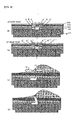
- FIG. 5 is a diagram illustrating the mechanism of wire fracture in an electric cable.
- FIG. 5(a) is a cross-sectional view illustrating the location close to a crossover wire that was impregnated with a varnish at a low temperature.
- FIG. 5(b) is a cross-sectional view illustrating the location close to a crossover wire that was impregnated with a varnish at a high temperature.
- FIG. 5(c) is a cross-sectional view illustrating the location close to a crossover wire that was impregnated with a varnish, this figure relating to a state in which cracks begin to appear in the varnish.
- FIG. 5(d) is a cross-sectional view illustrating the location close to a crossover wire that was impregnated with a varnish at a low temperature; this figure illustrates a state in which the wire has ruptured.
- FIGS. 5(a)-(d) are the cross-sectional views illustrating the location close to a crossover wire in the structure obtained by coating an insulator 102 on a stator 101 of a silicon steel sheet constituting magnetic electrodes, winding an electric cable 103 on the insulator 102, impregnating the electric cable 103 with the varnish, and drying the varnish 104, thereby fixing the electric cable 103 to the insulator 102.
- the respective stresses act in the directions shown by arrows in the figures.
- shrinkage forces (C, C') act from the center toward both sides.
- shrinkage forces (B, B') act mainly from both sides toward the center.
- shrinkage forces (A, A') act from both sides to the center. If the temperature is increased from this state, as shown in FIG. 5(b), stresses directed opposite to the arrows shown in FIG. 5(a) act upon all the components.
- stretching forces (C", C"') act from both sides toward the center.
- stretching forces (B", B"') act from the center toward both sides.
- stretching forces (A", A"') act from both sides toward the center.
- the varnish is cracked due to the appearance of stresses caused by: (a) the difference in thermal expansion coefficient between the materials; (b) the temperature difference inside the varnish; (c) stress concentration caused by varnish shape; (d) residual stresses at the time of varnish curing; (e) the decrease in varnish strength caused by thermal degradation; and (f) the difference in the direction of thermal expansion and shrinkage.
- the method includes a preliminary heating step, wherein an article having a coil is heated to a preliminary heating temperature at which the viscosity of a polyurethane varnish decreases and is above a drying temperature.
- the method also includes a varnish application step, wherein the polyurethane varnish is continuously applied to the coil while rotating the heated article at a constant speed.
- the method further includes a high-temperature rotary drying step in which the polyurethane varnish is dried while heating the polyurethane varnish at a drying temperature that is higher than the varnish temperature during the varnish application step.
- the system includes a preliminary heating device for heating an article having a coil to a preliminary heating temperature at which the viscosity of a polyurethane varnish decreases and is above a drying temperature.
- the system also includes a varnish application device for continuously applying said polyurethane varnish to said coil while rotating said heated article at a constant speed.
- the system further includes a high-temperature rotary drying device for drying said polyurethane varnish while heating said polyurethane varnish at a drying temperature that is higher than the varnish temperature in said varnish application device.
- a further aspect of the invention is an impregnation and curing treatment apparatus.
- the apparatus includes a preliminary heating unit for heating an article having a coil to a preliminary heating temperature which the viscosity of a polyurethane varnish decreases and is above the drying temperature.
- the apparatus also includes a varnish application unit for continuously applying said polyurethane varnish to said coil while rotating said heated article at a constant speed.
- the apparatus further includes a high-temperature rotary drying unit for drying said polyurethane varnish while heating said polyurethane varnish at a drying temperature which is higher than the varnish temperature in said varnish application unit.
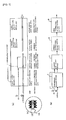
- FIG. 1 is a drawing illustrating basic steps of the present invention, an impregnation and curing system, and an impregnation and curing treatment apparatus incorporating the basic steps;
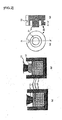
- FIG. 2 illustrates a method and a jig used for applying a varnish to a narrow coil bobbin in accordance with a preferred embodiment of the present invention
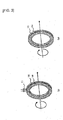
- FIG. 3 is a drawing illustrating the rotation state of the article in accordance with a preferred embodiment of the present invention.
- FIG. 3(a) illustrates the inertial rotation state when the varnish discharge has ceased.
- FIG. 3(b) illustrates the rotation state in the rotary drying process;
- FIG. 4 illustrates the structure of the varnish application apparatus in accordance with a preferred embodiment of the present invention
- FIG. 5 illustrates the mechanism of wire fracture in an electric cable
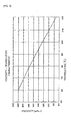
- FIG. 6 is a graph illustrating the viscosity - temperature characteristic representing changes in the viscosity of polyurethane varnish with temperature.
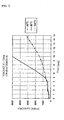
- FIG. 7 is a graph representing the viscosity - time characteristic, illustrating how the viscosity of a polyurethane varnish changes with time.
- article as referred to herein stands for a structure obtained by winding an electric cable around a core, such as a coil obtained by winding an electric cable around a bobbin, a rotor or a stator in which an electric cable is wound around a magnetic pole.
- the coil is an article obtained by multiple winding of an electric cable.
- the term "impregnated and cured coil” stands for an coil obtained by impregnating a coil and produced by winding an electric cable so as to obtain the prescribed shape, such as a coil bobbin or a magnetic pole, with a varnish and then curing the varnish.
- a polyurethane varnish is a material that may satisfy those requirements.
- a preferred embodiment of the present invention uses a polyurethane varnish as the varnish for impregnating the coil and the curing process.
- Polyurethane varnishes have been conventionally used as electrically insulating coatings applied to, and baked on, the surface of electric cables. However, such varnishes are presently not used as a filler for impregnating and fixing the coils. Polyurethane varnishes, as shown in Table 1 hereinbelow, have a large elongation providing for high resistance to fracture, a small Young's modulus allowing the varnishes to follow changes in the surrounding components, and a very low glass transition temperature providing for good softness. As a result, such varnishes demonstrate high flexibility. For this reason, even if the article is subjected to expansion and compression, the polyurethane varnish follows changes in the surrounding structure, and the generated stresses can be suppressed within the allowed tensile strength range of the polyurethane varnish.
- Polyurethane resins that are the varnish materials can be generally classified into two types. Resins of the first type are called polymer resins. They are obtained by dissolving a polyurethane in a volatile solvent and are used for applications requiring fast drying, for example, in line coating or printing. The resins of the other type are called reaction resins. They may be impregnated in a hybrid mode, and the cured molded bodies have a very high strength and toughness. Such resins, however, require a long time for curing.
- the reaction-type polyurethane resins are mainly of a two-liquid type which are prepared by mixing the main component, consisting of a polyol with a high molecular weight and an auxiliary component consisting of a polyisocyanate compound immediately prior to usage, with a single-liquid type (humid gas curing type) component, which consists of an isocyanate-terminated prepolymer.
- organic solvents such as hydrocarbons with a high boiling point, e.g. cresol, phenol, xylene, and solvent naphtha, may be used as the organic solvent.
- the two-liquid polyurethane varnishes typically have a high viscosity after mixing the main component and a curing agent. For this reason, they have been used as casting agents or sealing agents. In order to fill completely the space in the coil with the aforesaid two-liquid polyurethane varnish, the viscosity is decreased after mixing the main component and the curing agent.
- the polyurethane varnishes have the following specific features devoted (1) and (2):
- Polyurethane varnishes generally have a temperature - viscosity characteristic such that the viscosity is high at normal temperature and decreases at a high temperature.
- FIG. 6 is a graph illustrating the viscosity - temperature characteristic representing changes in the viscosity of polyurethane varnishes with temperature.
- a varnish with the trade name MU-115A/B, manufactured by Nippon Pelnox Corporation is used as a polyurethane varnish.
- the graph shows the viscosity - temperature characteristic immediately after the two liquids are mixed. The graph is based on the measurement data presented in Table 2 below.
- the characteristic represented by the graph suggests that when the varnish is cured at a low temperature, the viscosity is high and there is a risk of insufficient local permeation of the varnish into the coil. When the varnish is cured at a high temperature, the permeation into the coil is sufficient, but viscosity decreases and the varnish can sag or be distributed unevenly.
- Viscosity - temperature characteristic Temperature 60 80 100 120 Mixture viscosity 220 175 125 70
- FIG. 7 is a graph representing the viscosity - time characteristic, which illustrates how the viscosity of a polyurethane varnish changes with time.
- the graph shows the viscosity - temperature characteristic where 0 second (min) is set immediately after the two liquids are mixed. The graph is based on the measurement data presented in Table 3 below.
- a preferred resolution is as follows. Uniformly permeating the polyurethane varnish into the electric cable may be achieved by the following three steps:
- the four steps (4), (5), (6), and (7) described below may be used for applying very small amounts of a resin having a high viscosity, such as polyurethane varnishes, in a varnish application device when application is conducted on a narrow coil bobbin.
- a method is provided for setting up a varnish application device and setting the nozzle position in a simple manner, that is a method suitable for simply setting the position and height of the nozzle.
- FIG. 2 illustrates a preferred method and a jig for applying a varnish to a narrow coil bobbin.
- FIG. 2(a) is an drawing illustrating a preferred method for applying a drop remaining on the distal end of the nozzle to the applied layer.
- FIG. 2(b) is a drawing illustrating another preferred method for applying a drop remaining on the distal end of the nozzle to the applied layer.
- FIG. 2(c) is a front view of a preferred structure of a jig for aligning the distal end of the nozzle.
- FIG. 2(d) is a sectional view along AA' shown in FIG. 2(c).
- the first step (4) is as follows:
- the height of the nozzle at the time the varnish discharge was stopped is set in advance with a jig or, based on the data relating to the settings that have already been made, to a nozzle height such that:
- the distal end of the nozzle may be positioned so as to be in contact with the surface of the varnish applied layer 15 that was applied to the coil 14 of the article 13, as shown in FIG. 2(a).
- the varnish remaining at the distal end of the nozzle may be uniformly applied to the surface of the varnish applied layer 15 on the article 13, while the article 13 is being rotated at a constant speed.
- the very last drop 12 at the distal end of the nozzle may be positioned so as to be in contact with the surface of the varnish applied layer 15 that was applied to the coil 14 of the article 13, and the nozzle height is set so that the varnish remaining at the distal end of the nozzle is uniformly applied to the surface of the varnish applied layer 15 on the article 13, while the article 13 is being rotated at a constant speed, as shown in FIG. 2(b).
- the nozzle When the coil 14, obtained by winding around a narrow coil bobbin, is filled with a varnish, the nozzle is positioned as in section (a) above and the varnish is discharged. When the discharge is completed, the distal end of the long thin nozzle is brought into contact with the surface of the varnish applied layer 15 of the article 13, as shown in FIG. 2(a). The varnish remaining at the distal end of the nozzle is applied to the surface of the varnish applied layer 15 from this state by rotating the article 13.
- section (b) hereinabove positioning of the nozzle is conducted as described in section (b) hereinabove, and the varnish is discharged.
- the article 13 is rotated, while the drop 12 of the varnish remaining at the distal end of the long thin nozzle is in contact with the surface of the varnish applied layer 15, thereby applying the varnish drop 12 remaining at the distal end of the nozzle to the surface of the varnish applied layer 15.
- the very last drop that appears at the distal end of the nozzle when the varnish discharge is completed is applied uniformly to the surface of the applied layer.
- the insulating layer of the coil may be damaged and a rare short circuit can occur
- the distal end of the nozzle is set to the height of the surface of the varnish applied layer, thereby bringing the distal end of the nozzle into contact with the varnish coated surface.
- the distal end of the nozzle is set to a height at which a drop remaining at the distal end of the nozzle is brought into contact with the source of the varnish applied layer, thereby bringing the drop into contact with the varnish coated surface.
- FIG. 3 is a drawing illustrating a preferred rotation state of the part 13.
- FIG. 3(a) illustrates the inertial rotation state when the varnish discharge has been stopped.
- FIG. 3(b) illustrates the rotation state in the rotary drying process.
- the second step (5) is as follows:
- the total amount of the applied varnish may become constant.
- the varnish may be uniformly applied to the application surface by rotating the coil bobbin while the very last drop remaining at the distal end of the nozzle, after the varnish discharge operation stops, is brought into contact with the coated surface.
- a resin with high flexibility or high elasticity such as Teflon (trade name), is used as a nozzle material to prevent the electric cable from damage when the distance between the nozzle and the electric cable is decreased.
- a standard jig shown in FIG. 2(c) and FIG. 2(d) that can simultaneously set the position and height of the nozzle is used to shorten the time required for setting (programming) the position and height of the nozzle.
- the special jig 20 for a narrow bobbin is constructed by using a thin cylindrical tube provided with a shaft 21 in the center and providing a ring-like groove 22 regulating the nozzle position and also regulating the nozzle height.
- this jig 20 is mounted on the varnish application device, the distal end of the nozzle is aligned with the groove 22 and the nozzle position setting data at the time of mounting the article 13 are determined.
- the jig 20 is then removed, the article 13 is set, and the position of the nozzle is set based on the aforesaid determined data.
- the nozzle position data are recorded and may also be read out as necessary.
- FIG. 1 is a drawing illustrating a preferred embodiment of the impregnation and curing system and apparatus.
- FIG. 1(a) illustrates the configuration of the impregnation and curing treatment apparatus for the implementation of a preferred method for continuous processing inside a housing.
- FIG. 1(b) illustrates a preferred configuration of the impregnation and curing treatment system in which steps of the preferred method are implemented by separate devices.
- FIG. 1(c) illustrates an example of a treated article.
- Preferred steps include in the order of implementation: (1) a preliminary heating step, (2) a varnish application step, (3) an optional step of rotary drying at normal temperature, and (4) a rotary drying step at a high temperature. These steps will be described below in greater detail.
- the impregnation and curing treatment apparatus for the implementation of the aforesaid preferred steps is configured such that a sequence of processes with individual treatment units shown in FIG. 1(a) is performed inside a housing.
- the preferred impregnation and curing treatment system shown in FIG. 1(b) employs a configuration in which the aforesaid treatment units shown in FIG. 1(a) serve as respective separate devices.
- the impregnation and curing treatment apparatus shown in FIG. 1(a) comprises a preliminary heating unit 3, a varnish application unit 2, a normal temperature rotary drying unit 4, and a high-temperature rotary drying unit 5 arranged in the order of steps to be implemented inside a housing (covers the entire process apparatus) 1.
- a treatment object or treated article in which any number of articles 13 are passed through an article mounting shaft 44 is supplied to the treatment line.
- This step is a varnish treatment step.
- the articles may also be supplied to the treatment line one by one, without using the article mounting shaft 44.
- Article mounting shafts of various shapes may be employed according to the shape of the articles.
- the treatment object moves inside the housing 1.
- the below-described treatment of the preliminary heating step is implemented.
- the varnish application unit 2 the below described treatment of the varnish application (rotary application) step is implemented.
- the normal temperature rotary drying unit 4 the below described treatment of the normal temperature rotary drying step is implemented.
- the high-temperature rotary drying unit 5 the below described treatment of the high-temperature rotary drying step is implemented.
- the preferred impregnation and curing treatment system shown in FIG. 1(b) comprises a preliminary heating device 6, a varnish application device 7, a normal temperature rotary drying device 8, and a high-temperature rotary drying device 9, arranged in the order of steps to be implemented.
- a treatment object in which any number of articles 13 are passed through an article mounting shaft 44 is supplied to the treatment line, this step being a varnish treatment step.
- the articles may also be supplied to the treatment line one by one, without using the article mounting shaft 44.
- Article mounting shafts of various shapes can be employed according to the shape of the articles.
- the treatment object is subjected to the following treatment.
- the below-described treatment of the preliminary heating step is implemented.
- the varnish application unit 7 the below described treatment of the varnish application (rotary application) step is implemented.
- the normal temperature rotary drying device 8 the below described treatment of the normal temperature rotary drying step is implemented.
- the high-temperature rotary drying device 9 the below described treatment of the high-temperature rotary drying step is implemented. Individual steps will be described hereinbelow by using an example shown in FIG. 1(b).
- the article having an electric cable wound therearound is heated to a temperature above the drying temperature of the below-described drying step, for example, to a temperature of 120°C.
- the heating temperature is set so that the viscosity decreases based on the viscosity - temperature characteristic shown in FIG. 6. If the heating temperature is set to 120°C, the viscosity of the varnish can be lower by comparison with that at a temperature of 100°C in the high-temperature rotary drying step and the varnish can fully permeate into the coil at the initial stage.
- the temperature of 100°C of the high-temperature rotary drying step satisfies the practical requirement of obtaining the appropriate viscosity during re-permeation.
- Varnish application (rotary application) step The position and height of the distal end of the nozzle of the application device have been set in advance in the above-described adjustment step. The article is then installed in the application device and the varnish is continuously discharged while the article is rotated at a constant speed. Once the prescribed quantity of the varnish has been discharged, the distal end of the nozzle or a varnish drop at the distal end of the nozzle is brought into contact with the surface of the applied varnish layer. Because the viscosity is high, the very last varnish drop remaining at the distal end of the nozzle is uniformly applied by causing the article to rotate by inertia through multiple turns, as shown in FIG.
- the varnish may be uniformly applied to the coil of the article. Furthermore, because the very last drop of the varnish can be uniformly applied to the coil of the article, the spread in the amount of applied varnish may be reduced.
- a time limit is set, including the interval to the subsequent high-temperature rotary drying step.
- the time prior to the subsequent high-temperature rotary drying step is included in the time interval from the application to the instant at which a rapid curing is started.
- the subsequent high-temperature rotary drying step is actually the process implemented in the oven, and it is necessary to stock the treatment objects so that the treatment objects could be accommodated and treated in large quantities.
- Stocking the treatment objects in the normal temperature rotary drying step effectively accelerates the treatment. Such stocking can be omitted if the subsequent high-temperature rotary drying step is carried out in succession.
- the varnish viscosity prior to this step lies on the characteristic curve of the viscosity - time characteristic shown in FIG. 7.
- the viscosity of the varnish again decreases and the varnish can be caused to permeate into the zones where the permeation was insufficient in the previous cycle.
- the article is rotated to prevent the viscosity from dropping and the varnish from sagging and being distributed nonuniformly.
- the viscosity of the varnish in this step does not lie on the characteristic curve of the viscosity - time characteristic shown in FIG. 7, but drops below this curve.
- FIG. 4 illustrates the structure of the varnish application apparatus in accordance with the other preferred embodiment.
- a charging device 31 comprises pipes 32, 33 for supplying a liquid at both sides, has a nozzle 11 at a distal end thereof, and accommodates a screw (stirring member; not shown in the figures) for stirring the inside thereof.
- the screw is linked to a stirring motor (stirring member drive means) 41.
- the stirring motor 41 is connected to a controller 40.
- Gear pumps 34, 35 for feeding liquids are connected to the two pipes 32, 33, respectively.
- Respective control motors (pump drive means) 36, 37 are linked to the two gear pumps 34, 35.
- the two control motors 36, 37 are connected to the controller 40.
- a main component tank 39 is linked to the gear pump 35, and a curing agent tank 38 is linked to the gear pump 34.
- the controller 40 comprises a microcomputer (not shown in the figures), comprises the prescribed control software, and executes the prescribed operations with this software.
- the discharge device 31 is linked to a positioning device 42 for determining the height and position of the distal end of the nozzle 11.
- the positioning device 42 comprises a motor (not shown in the figures) as a drive source.
- a control motor (article mounting shaft drive means) 43 is also provided, this motor comprising an article mounting shaft 44 for mounting the article having the coil 14 wound thereon, for example, on the coil bobbin 13.
- the aforesaid positioning device 42 is equipped with a motor (not shown in the figures) of the article mounting shaft drive means.
- the stirring motor 41 serves as the stirring member drive means
- the control motor 43 serves as the article mounting shaft drive means
- the control motors 36, 37 serving as the gear pump drive means have a structure such that the controller 40 can conduct the control of the prescribed nozzle positioning, nozzle height determination, rotation of the coil bobbin, and beginning and end of varnish discharge.
- the main component tank 39 is filled with the main components of the two-liquid polyurethane varnishes
- the curing agent tank 38 is filled with the curing agent.
- the main component and curing agent located in the two tanks 38, 39 are supplied under pressure from pipes 32, 33 into the discharge device 31 via the respective gear pumps 34, 35.
- the two components that have been supplied into the discharge device 31 are stirred by the screw (not shown in the figures) and ejected from the nozzle 11 under the pressure applied by the gear pumps 34, 35.
- the varnish application device executes the following operation under the control of the controller 40:
- the positioning device is controlled so that the nozzle assumes the appropriate height and position with respect to the coil of the article that has been heated in advance to a temperature sufficient to decrease the viscosity of the varnish.
- Data relating to the position and height of the distal end of the nozzle are picked up in advance with a jig.
- the gear pumps 34, 35 are then driven by the two control motors 36, 37, and the main component and curing agent located in the two tanks 38, 39 are supplied into the discharge device 31.
- the screw (not shown in the figures) is rotary driven by the stirring motor 41, mixing the two components, and the mixture is applied to the coil 14 from the nozzle 11 under the pressure applied by the gear pumps 34, 35.
- the positioning device is controlled so that the distal end of the nozzle 11 or the varnish drop at the distal end of the nozzle 11 is brought into contact with the surface of the applied layer 15.
- the control motor 43 for the article mounting shaft 44 is caused to rotate by inertia, without changing the position and height of the distal end of the nozzle 11 or the varnish drop at the distal end of the nozzle 11 of the positioning device 42.
- Normal temperature rotary drying step The control motor 43 having the article 13 mounted thereon is rotated at a constant low speed so as to prevent the varnish from sagging and being distributed nonuniformly.
- High-temperature rotary drying step The article 13 is rotated with the controller 40 till the varnish is gelled or for a longer time. The rotation is conducted at a constant low speed so as to prevent the varnish from sagging and being distributed nonuniformly.
- Yet another preferred embodiment is a jig which is used for the application on a coil bobbin having the coil wound therearound, in particular a coil bobbin with a narrow groove.
- the jig 20 shown in FIG. 2(c) and FIG. 2(d) is installed on the article mounting shaft 44, and the controller 40 controls the positioning device 42 so that the distal end of the nozzle 11 of the discharge device 31 is positioned in the ring-shaped groove 22 provided on the outer periphery of the jig 20.
- the positioning data relating to the positioning device 42 at this time are stored in the controller 40.
- the jig 20 is thereafter removed from the article mounting shaft 44, the article 13 is mounted instead of the jig, the prior positioning data are read out, the positioning device 42 is controlled, and the position and height of the distal end of nozzle 11 are set with the controller 40.
- the shape of the ring-shaped groove 22 is formed to have the width of the coil groove in the coil bobbin that has a small width.
- the height of the groove 22 is set to a height at which the distal end of the nozzle 11 or a drop at the distal end of the nozzle 11 is brought into contact with the varnish surface at the time of varnish application completion.
- the impregnated and cured coil is obtained by impregnating and curing a polyurethane varnish in a coil obtained by winding an electric cable to obtain the prescribed shape. Therefore, the difference in the thermal expansion coefficient at least between the cable and the varnish may be decreased, cracking of the varnish may be suppressed, and therefore the cable may be prevented from rupturing.
- an electric cable may be wound to obtain the prescribed shape and a polyurethane varnish is impregnated and cured in the coil thus wound. Therefore, the polyurethane varnish which, at least, has a decreased difference in thermal expansion coefficient with the electric cable, and in which cracking may be suppressed, may be impregnated and cured as a filler in the cable.
- the varnish may be prevented from sagging and being distributed nonuniformly by rotating the article immediately after varnish application at normal temperature or a high temperature and rotating the article till the varnish is gelled.
- the varnish that was once impregnated is reheated to decrease its viscosity. As a result, the varnish may be caused to permeate further into the cable.
- the preliminary heating temperature is set to 120°C
- the viscosity of the polyurethane varnish may be reduced sufficiently and the varnish may sufficiently permeate into the cable.
- the drying temperature is set to 100°C
- the varnish that has permeated and assumed a slightly solidified shape would not have its viscosity reduced significantly; in such a case the entire varnish might sag and drip down. Therefore, any small space that was left during preliminary heating may be completely filled with the varnish.
- the nozzle is positioned so as to be at a height such that the distal end of the nozzle or a drop at the distal end of the nozzle is brought into contact with the surface of the varnish applied layer that was applied to the coil of the article and the article is rotated at a constant speed. Therefore, the varnish remaining at the distal end of the nozzle may be uniformly applied to the surface of the varnish applied layer on the article.
- the article After the varnish discharge operation of the varnish application mechanism has been stopped, the article is caused to rotate by inertia, without changing the nozzle position until the internal pressure of the nozzle and the external pressure of the nozzle reach a state of equilibrium. Therefore, the varnish remaining at the distal end of the nozzle may be uniformly applied to the varnish applied layer.
- the time required for setting the nozzle position and height may be shortened by setting the nozzle position and the nozzle height at the same time by using a standard jig capable of such simultaneous setting.
- the preliminary heating step is carried out with the preliminary heating device
- the varnish application step is carried out with the varnish application device
- the high-temperature rotary drying step is carried out with the high-temperature rotary drying device
- the normal temperature drying step is carried out with the normal temperature drying device. Furthermore, those devices are combined into a system. Therefore, all the expected steps may be executed.
- the preliminary heating step is carried out with the preliminary heating unit
- the varnish application step is carried out with the varnish application unit
- the high-temperature rotary drying step is carried out with the high-temperature rotary drying unit
- the normal temperature drying step is carried out with the normal temperature drying unit. Furthermore, those units are accommodated inside a housing. Therefore, all the expected steps may be effectively and continuously executed inside the housing.
- the varnish application device has a structure described in claim 15. Therefore, the expected nozzle positioning control, varnish discharge control, and article rotation control may be conducted.
Landscapes
- Engineering & Computer Science (AREA)
- Power Engineering (AREA)
- Manufacturing & Machinery (AREA)
- Chemical & Material Sciences (AREA)
- Chemical Kinetics & Catalysis (AREA)
- Life Sciences & Earth Sciences (AREA)
- Wood Science & Technology (AREA)
- Manufacture Of Motors, Generators (AREA)
- Insulating Of Coils (AREA)
- Insulation, Fastening Of Motor, Generator Windings (AREA)
Applications Claiming Priority (2)
| Application Number | Priority Date | Filing Date | Title |
|---|---|---|---|
| JP2003207833A JP3998612B2 (ja) | 2003-08-19 | 2003-08-19 | 含浸硬化巻線、そのための含浸硬化処理方法、含浸硬化処理システム、含浸硬化処理装置、ワニス塗布装置 |
| JP2003207833 | 2003-08-19 |
Publications (2)
| Publication Number | Publication Date |
|---|---|
| EP1508384A2 true EP1508384A2 (fr) | 2005-02-23 |
| EP1508384A3 EP1508384A3 (fr) | 2005-04-06 |
Family
ID=34055944
Family Applications (1)
| Application Number | Title | Priority Date | Filing Date |
|---|---|---|---|
| EP04254985A Withdrawn EP1508384A3 (fr) | 2003-08-19 | 2004-08-19 | Système et procédé d'application de vernis sur une bobine électrique |
Country Status (3)
| Country | Link |
|---|---|
| US (1) | US20050074553A1 (fr) |
| EP (1) | EP1508384A3 (fr) |
| JP (1) | JP3998612B2 (fr) |
Cited By (6)
| Publication number | Priority date | Publication date | Assignee | Title |
|---|---|---|---|---|
| WO2013020977A1 (fr) * | 2011-08-09 | 2013-02-14 | Aumann Gmbh | Dispositif de revêtement de fils électroconducteurs |
| FR3015315A1 (fr) * | 2013-12-19 | 2015-06-26 | Bostik Sa | Procede d'application a chaud d'une composition adhesive silylee |
| EP3051668A1 (fr) * | 2015-01-27 | 2016-08-03 | Siemens Aktiengesellschaft | Segment de rotor et rotor d'une machine électrique |
| RU2597892C1 (ru) * | 2015-03-11 | 2016-09-20 | Федеральное государственное бюджетное образовательное учреждение высшего профессионального образования "Томский государственный университет систем управления и радиоэлектроники" | Способ пропитки и сушки обмоток электрических машин |
| RU2597890C1 (ru) * | 2015-03-11 | 2016-09-20 | Федеральное государственное бюджетное образовательное учреждение высшего профессионального образования "Томский государственный университет систем управления и радиоэлектроники" | Способ пропитки обмоток электрических машин |
| KR102796468B1 (ko) * | 2024-03-06 | 2025-04-18 | 주식회사 비엠씨 | 스테이터 코일의 바니쉬 함침 장치 |
Families Citing this family (13)
| Publication number | Priority date | Publication date | Assignee | Title |
|---|---|---|---|---|
| CN100532098C (zh) * | 2004-07-16 | 2009-08-26 | 海德堡印刷机械股份公司 | 温度调节方法 |
| JP4904250B2 (ja) * | 2007-11-26 | 2012-03-28 | 株式会社山田製作所 | 電動ウォータポンプ |
| JP5132669B2 (ja) * | 2009-12-24 | 2013-01-30 | 三菱電機株式会社 | レゾルバステータ |
| JP5929618B2 (ja) * | 2012-08-10 | 2016-06-08 | トヨタ自動車株式会社 | レゾルバステータ |
| KR101477622B1 (ko) * | 2013-09-12 | 2014-12-30 | 송암시스콤 주식회사 | 인버터 변압기 |
| TWI641640B (zh) * | 2016-02-04 | 2018-11-21 | 亨茲曼國際公司 | 於物體上製造聚合物材料層之三維沈積方法 |
| JP7084126B2 (ja) * | 2017-11-17 | 2022-06-14 | トヨタ自動車株式会社 | ステータの製造方法およびステータ |
| CN110719005A (zh) * | 2019-10-24 | 2020-01-21 | 宁德特波电机有限公司 | 不锈钢电机灌封工艺 |
| KR20220035592A (ko) * | 2020-09-14 | 2022-03-22 | 현대자동차주식회사 | 고정자 어셈블리의 제조 시스템 및 제조 방법 |
| IT202100005159A1 (it) | 2021-03-05 | 2022-09-05 | Te Connectivity Italia Distribution Srl | Sistema e metodo per produrre guarnizioni in materiale espanso per cablaggi |
| CN113223814B (zh) * | 2021-05-07 | 2023-03-24 | 浙江江山变压器股份有限公司 | 一种采用聚氨酯树脂浇注成型的干式变压器及其加工方法 |
| CN113210224A (zh) * | 2021-05-07 | 2021-08-06 | 潘登 | 一种用于电机生产的电机线圈烘干装置 |
| CN118156007B (zh) * | 2023-09-05 | 2025-07-25 | 山东北电电气有限公司 | 一种电气成套设备用变压器绕组浸漆装置 |
Family Cites Families (6)
| Publication number | Priority date | Publication date | Assignee | Title |
|---|---|---|---|---|
| DE1789032B2 (de) * | 1968-09-26 | 1972-07-27 | Siemens AG, 1000 Berlin u. 8000 München | Verfahren zum aeusserlichen abdecken der auf einen flanschspulenkoerper aufgebrachten wicklungen einer spulenanordnung |
| GB2037087A (en) * | 1978-12-11 | 1980-07-02 | Kumagawa O | A transformer covered with thermoplastic resin and a method for covering it |
| DE3325943C1 (de) * | 1983-07-19 | 1985-02-21 | Herberts Gmbh, 5600 Wuppertal | Traenkharzmassen und deren Verwendung zum Isolieren von elektrischen Wicklungen |
| US4554730A (en) * | 1984-01-09 | 1985-11-26 | Westinghouse Electric Corp. | Method of making a void-free non-cellulose electrical winding |
| JPS60254718A (ja) * | 1984-05-31 | 1985-12-16 | Toshiba Chem Corp | トランスコア−のワニス処理方法 |
| AT402243B (de) * | 1992-08-20 | 1997-03-25 | Isovolta | Verfahren zum verfestigen und beschichten einer luftdrossel sowie vorrichtung zur durchführung dieses verfahrens |
-
2003
- 2003-08-19 JP JP2003207833A patent/JP3998612B2/ja not_active Expired - Fee Related
-
2004
- 2004-08-18 US US10/921,248 patent/US20050074553A1/en not_active Abandoned
- 2004-08-19 EP EP04254985A patent/EP1508384A3/fr not_active Withdrawn
Cited By (10)
| Publication number | Priority date | Publication date | Assignee | Title |
|---|---|---|---|---|
| WO2013020977A1 (fr) * | 2011-08-09 | 2013-02-14 | Aumann Gmbh | Dispositif de revêtement de fils électroconducteurs |
| FR3015315A1 (fr) * | 2013-12-19 | 2015-06-26 | Bostik Sa | Procede d'application a chaud d'une composition adhesive silylee |
| EP3590608A1 (fr) * | 2013-12-19 | 2020-01-08 | Bostik Sa | Procédé d'application à chaud d'une composition adhésive silylée |
| US11174416B2 (en) | 2013-12-19 | 2021-11-16 | Bostik Sa | Process for hot application of a silylated adhesive composition |
| US12378440B2 (en) | 2013-12-19 | 2025-08-05 | Bostik Sa | Process for hot application of a silylated adhesive composition |
| EP3051668A1 (fr) * | 2015-01-27 | 2016-08-03 | Siemens Aktiengesellschaft | Segment de rotor et rotor d'une machine électrique |
| US10224773B2 (en) | 2015-01-27 | 2019-03-05 | Siemens Aktiengesellschaft | Rotor segment and rotor of an electric machine |
| RU2597892C1 (ru) * | 2015-03-11 | 2016-09-20 | Федеральное государственное бюджетное образовательное учреждение высшего профессионального образования "Томский государственный университет систем управления и радиоэлектроники" | Способ пропитки и сушки обмоток электрических машин |
| RU2597890C1 (ru) * | 2015-03-11 | 2016-09-20 | Федеральное государственное бюджетное образовательное учреждение высшего профессионального образования "Томский государственный университет систем управления и радиоэлектроники" | Способ пропитки обмоток электрических машин |
| KR102796468B1 (ko) * | 2024-03-06 | 2025-04-18 | 주식회사 비엠씨 | 스테이터 코일의 바니쉬 함침 장치 |
Also Published As
| Publication number | Publication date |
|---|---|
| JP2005065366A (ja) | 2005-03-10 |
| EP1508384A3 (fr) | 2005-04-06 |
| JP3998612B2 (ja) | 2007-10-31 |
| US20050074553A1 (en) | 2005-04-07 |
Similar Documents
| Publication | Publication Date | Title |
|---|---|---|
| EP1508384A2 (fr) | Système et procédé d'application de vernis sur une bobine électrique | |
| US11707760B2 (en) | Impregnation plant and method for components of electric motors | |
| CN105359394B (zh) | 定子加热装置以及定子加热方法 | |
| EP0294050B1 (fr) | Système d'isolation pour bobines à plusieurs spires de machines électriques rotatives à haute tension | |
| US3071496A (en) | Epoxy resin impregnation of electrical members | |
| US5639044A (en) | Methods and apparatus for producing dynamo-electric machine armatures with improved balance | |
| WO2022128632A1 (fr) | Procédé d'imprégnation de bobines de rotor | |
| US4485126A (en) | Method of treating winding means of dynamoelectric machine core | |
| US2814744A (en) | Assembly of electro-mechanical apparatus | |
| JP2019170105A (ja) | 電機子の製造方法および電機子の製造装置 | |
| HK1074184A (en) | System and method for applying varnish to an electrical coil | |
| US3737987A (en) | Method of making an insulated armature | |
| JP2015126645A (ja) | 電動機械の固定子の加熱方法、及び加熱装置 | |
| EP3608923B1 (fr) | Appareil et procédé pour appliquer un matériau d'isolation sur un conducteur | |
| US3629024A (en) | Method of insulating armature coils | |
| US6395330B1 (en) | Method for producing impregnable fine mica tapes with an incorporated accelerator | |
| KR20200133479A (ko) | 회전자 제조방법 및 회전자 제조용 자석 고정 시스템 | |
| US5024857A (en) | Method for coating the armature of a rotary electric apparatus | |
| JPH11213757A (ja) | マイカテープ | |
| US3117900A (en) | Insulating electrical conductors | |
| GB2046642A (en) | Manufacture of an Armature for an Electric Motor | |
| JPS6142244A (ja) | 回転電機のコイル絶縁方法 | |
| Thurman | Trickle impregnation of small motors | |
| US11621619B2 (en) | Insulating a coil winding of an active part of an electrical machine | |
| CN112260441B (zh) | 一种低压电机绝缘机构及其制备方法 |
Legal Events
| Date | Code | Title | Description |
|---|---|---|---|
| PUAI | Public reference made under article 153(3) epc to a published international application that has entered the european phase |
Free format text: ORIGINAL CODE: 0009012 |
|
| PUAL | Search report despatched |
Free format text: ORIGINAL CODE: 0009013 |
|
| AK | Designated contracting states |
Kind code of ref document: A2 Designated state(s): AT BE BG CH CY CZ DE DK EE ES FI FR GB GR HU IE IT LI LU MC NL PL PT RO SE SI SK TR |
|
| AX | Request for extension of the european patent |
Extension state: AL HR LT LV MK |
|
| AK | Designated contracting states |
Kind code of ref document: A3 Designated state(s): AT BE BG CH CY CZ DE DK EE ES FI FR GB GR HU IE IT LI LU MC NL PL PT RO SE SI SK TR |
|
| AX | Request for extension of the european patent |
Extension state: AL HR LT LV MK |
|
| RIN1 | Information on inventor provided before grant (corrected) |
Inventor name: YAGYU, TAKAHIROC/O MINEBEA CO., LTD. Inventor name: OSANAI, YOSHIHITO Inventor name: TAKAHASHI, MASAHIRO |
|
| REG | Reference to a national code |
Ref country code: HK Ref legal event code: DE Ref document number: 1074184 Country of ref document: HK |
|
| 17P | Request for examination filed |
Effective date: 20051004 |
|
| AKX | Designation fees paid |
Designated state(s): AT BE BG CH CY CZ DE DK EE ES FI FR GB GR HU IE IT LI LU MC NL PL PT RO SE SI SK TR |
|
| STAA | Information on the status of an ep patent application or granted ep patent |
Free format text: STATUS: THE APPLICATION HAS BEEN WITHDRAWN |
|
| 18W | Application withdrawn |
Effective date: 20080715 |
|
| REG | Reference to a national code |
Ref country code: HK Ref legal event code: WD Ref document number: 1074184 Country of ref document: HK |