EP1521753B1 - Prozess zur herstellung von pioglitazon via verschiedene zwischenstufen - Google Patents
Prozess zur herstellung von pioglitazon via verschiedene zwischenstufen Download PDFInfo
- Publication number
- EP1521753B1 EP1521753B1 EP03753913A EP03753913A EP1521753B1 EP 1521753 B1 EP1521753 B1 EP 1521753B1 EP 03753913 A EP03753913 A EP 03753913A EP 03753913 A EP03753913 A EP 03753913A EP 1521753 B1 EP1521753 B1 EP 1521753B1
- Authority
- EP
- European Patent Office
- Prior art keywords
- formula
- compound
- ethyl
- mol
- converting
- Prior art date
- Legal status (The legal status is an assumption and is not a legal conclusion. Google has not performed a legal analysis and makes no representation as to the accuracy of the status listed.)
- Expired - Lifetime
Links
- 238000000034 method Methods 0.000 title claims abstract description 71
- HYAFETHFCAUJAY-UHFFFAOYSA-N pioglitazone Chemical compound N1=CC(CC)=CC=C1CCOC(C=C1)=CC=C1CC1C(=O)NC(=O)S1 HYAFETHFCAUJAY-UHFFFAOYSA-N 0.000 title claims abstract description 50
- 230000008569 process Effects 0.000 title claims abstract description 34
- 229960005095 pioglitazone Drugs 0.000 title claims abstract description 12
- 239000000543 intermediate Substances 0.000 title abstract description 23
- 238000002360 preparation method Methods 0.000 claims abstract description 13
- 238000004519 manufacturing process Methods 0.000 claims abstract description 11
- 150000001467 thiazolidinediones Chemical class 0.000 claims abstract description 9
- 229940123464 Thiazolidinedione Drugs 0.000 claims abstract description 8
- QTBSBXVTEAMEQO-UHFFFAOYSA-N Acetic acid Chemical compound CC(O)=O QTBSBXVTEAMEQO-UHFFFAOYSA-N 0.000 claims description 129
- OKKJLVBELUTLKV-UHFFFAOYSA-N Methanol Chemical compound OC OKKJLVBELUTLKV-UHFFFAOYSA-N 0.000 claims description 120
- 150000001875 compounds Chemical class 0.000 claims description 107
- ZMXDDKWLCZADIW-UHFFFAOYSA-N N,N-Dimethylformamide Chemical compound CN(C)C=O ZMXDDKWLCZADIW-UHFFFAOYSA-N 0.000 claims description 101
- XLYOFNOQVPJJNP-UHFFFAOYSA-N water Substances O XLYOFNOQVPJJNP-UHFFFAOYSA-N 0.000 claims description 83
- XEKOWRVHYACXOJ-UHFFFAOYSA-N Ethyl acetate Chemical compound CCOC(C)=O XEKOWRVHYACXOJ-UHFFFAOYSA-N 0.000 claims description 72
- YXFVVABEGXRONW-UHFFFAOYSA-N Toluene Chemical compound CC1=CC=CC=C1 YXFVVABEGXRONW-UHFFFAOYSA-N 0.000 claims description 66
- LFQSCWFLJHTTHZ-UHFFFAOYSA-N Ethanol Chemical compound CCO LFQSCWFLJHTTHZ-UHFFFAOYSA-N 0.000 claims description 64
- KFZMGEQAYNKOFK-UHFFFAOYSA-N Isopropanol Chemical compound CC(C)O KFZMGEQAYNKOFK-UHFFFAOYSA-N 0.000 claims description 48
- 239000002904 solvent Substances 0.000 claims description 44
- HEMHJVSKTPXQMS-UHFFFAOYSA-M Sodium hydroxide Chemical compound [OH-].[Na+] HEMHJVSKTPXQMS-UHFFFAOYSA-M 0.000 claims description 42
- ZMANZCXQSJIPKH-UHFFFAOYSA-N Triethylamine Chemical compound CCN(CC)CC ZMANZCXQSJIPKH-UHFFFAOYSA-N 0.000 claims description 39
- RGHHSNMVTDWUBI-UHFFFAOYSA-N 4-hydroxybenzaldehyde Chemical compound OC1=CC=C(C=O)C=C1 RGHHSNMVTDWUBI-UHFFFAOYSA-N 0.000 claims description 38
- 239000000203 mixture Substances 0.000 claims description 34
- WYURNTSHIVDZCO-UHFFFAOYSA-N Tetrahydrofuran Chemical compound C1CCOC1 WYURNTSHIVDZCO-UHFFFAOYSA-N 0.000 claims description 30
- VEXZGXHMUGYJMC-UHFFFAOYSA-N Hydrochloric acid Chemical compound Cl VEXZGXHMUGYJMC-UHFFFAOYSA-N 0.000 claims description 29
- IAZDPXIOMUYVGZ-UHFFFAOYSA-N Dimethylsulphoxide Chemical compound CS(C)=O IAZDPXIOMUYVGZ-UHFFFAOYSA-N 0.000 claims description 26
- PCLIMKBDDGJMGD-UHFFFAOYSA-N N-bromosuccinimide Chemical compound BrN1C(=O)CCC1=O PCLIMKBDDGJMGD-UHFFFAOYSA-N 0.000 claims description 26
- DKGAVHZHDRPRBM-UHFFFAOYSA-N Tert-Butanol Chemical compound CC(C)(C)O DKGAVHZHDRPRBM-UHFFFAOYSA-N 0.000 claims description 26
- 150000003839 salts Chemical class 0.000 claims description 26
- 229910052794 bromium Inorganic materials 0.000 claims description 25
- JUJWROOIHBZHMG-UHFFFAOYSA-N Pyridine Chemical compound C1=CC=NC=C1 JUJWROOIHBZHMG-UHFFFAOYSA-N 0.000 claims description 24
- FYSNRJHAOHDILO-UHFFFAOYSA-N thionyl chloride Chemical compound ClS(Cl)=O FYSNRJHAOHDILO-UHFFFAOYSA-N 0.000 claims description 24
- NQRYJNQNLNOLGT-UHFFFAOYSA-N Piperidine Chemical compound C1CCNCC1 NQRYJNQNLNOLGT-UHFFFAOYSA-N 0.000 claims description 22
- CDBYLPFSWZWCQE-UHFFFAOYSA-L Sodium Carbonate Chemical compound [Na+].[Na+].[O-]C([O-])=O CDBYLPFSWZWCQE-UHFFFAOYSA-L 0.000 claims description 22
- BWHMMNNQKKPAPP-UHFFFAOYSA-L potassium carbonate Chemical compound [K+].[K+].[O-]C([O-])=O BWHMMNNQKKPAPP-UHFFFAOYSA-L 0.000 claims description 22
- ZOBPZXTWZATXDG-UHFFFAOYSA-N 1,3-thiazolidine-2,4-dione Chemical compound O=C1CSC(=O)N1 ZOBPZXTWZATXDG-UHFFFAOYSA-N 0.000 claims description 21
- WEVYAHXRMPXWCK-UHFFFAOYSA-N Acetonitrile Chemical compound CC#N WEVYAHXRMPXWCK-UHFFFAOYSA-N 0.000 claims description 21
- RWRDLPDLKQPQOW-UHFFFAOYSA-N Pyrrolidine Chemical compound C1CCNC1 RWRDLPDLKQPQOW-UHFFFAOYSA-N 0.000 claims description 21
- GKIPXFAANLTWBM-UHFFFAOYSA-N epibromohydrin Chemical compound BrCC1CO1 GKIPXFAANLTWBM-UHFFFAOYSA-N 0.000 claims description 19
- 229960004592 isopropanol Drugs 0.000 claims description 19
- KDLHZDBZIXYQEI-UHFFFAOYSA-N Palladium on carbon Substances [Pd] KDLHZDBZIXYQEI-UHFFFAOYSA-N 0.000 claims description 18
- 239000012279 sodium borohydride Substances 0.000 claims description 18
- 229910000033 sodium borohydride Inorganic materials 0.000 claims description 18
- CSCPPACGZOOCGX-UHFFFAOYSA-N Acetone Chemical compound CC(C)=O CSCPPACGZOOCGX-UHFFFAOYSA-N 0.000 claims description 15
- KWYUFKZDYYNOTN-UHFFFAOYSA-M Potassium hydroxide Chemical compound [OH-].[K+] KWYUFKZDYYNOTN-UHFFFAOYSA-M 0.000 claims description 15
- HCHKCACWOHOZIP-UHFFFAOYSA-N Zinc Chemical compound [Zn] HCHKCACWOHOZIP-UHFFFAOYSA-N 0.000 claims description 15
- 125000000217 alkyl group Chemical group 0.000 claims description 15
- 125000004432 carbon atom Chemical group C* 0.000 claims description 14
- 239000011701 zinc Substances 0.000 claims description 14
- 229910052725 zinc Inorganic materials 0.000 claims description 14
- 229940086542 triethylamine Drugs 0.000 claims description 13
- JGUQDUKBUKFFRO-CIIODKQPSA-N dimethylglyoxime Chemical compound O/N=C(/C)\C(\C)=N\O JGUQDUKBUKFFRO-CIIODKQPSA-N 0.000 claims description 12
- 150000002924 oxiranes Chemical class 0.000 claims description 12
- 229910000027 potassium carbonate Inorganic materials 0.000 claims description 11
- UMJSCPRVCHMLSP-UHFFFAOYSA-N pyridine Natural products COC1=CC=CN=C1 UMJSCPRVCHMLSP-UHFFFAOYSA-N 0.000 claims description 11
- 238000010992 reflux Methods 0.000 claims description 11
- 229910000029 sodium carbonate Inorganic materials 0.000 claims description 11
- YLQBMQCUIZJEEH-UHFFFAOYSA-N tetrahydrofuran Natural products C=1C=COC=1 YLQBMQCUIZJEEH-UHFFFAOYSA-N 0.000 claims description 11
- XTHFKEDIFFGKHM-UHFFFAOYSA-N Dimethoxyethane Chemical compound COCCOC XTHFKEDIFFGKHM-UHFFFAOYSA-N 0.000 claims description 10
- 238000009833 condensation Methods 0.000 claims description 10
- 230000005494 condensation Effects 0.000 claims description 10
- IXCSERBJSXMMFS-UHFFFAOYSA-N hydrogen chloride Substances Cl.Cl IXCSERBJSXMMFS-UHFFFAOYSA-N 0.000 claims description 9
- 230000009467 reduction Effects 0.000 claims description 9
- 238000006722 reduction reaction Methods 0.000 claims description 9
- QGZKDVFQNNGYKY-UHFFFAOYSA-N Ammonia Chemical compound N QGZKDVFQNNGYKY-UHFFFAOYSA-N 0.000 claims description 8
- QUSNBJAOOMFDIB-UHFFFAOYSA-N Ethylamine Chemical compound CCN QUSNBJAOOMFDIB-UHFFFAOYSA-N 0.000 claims description 8
- AFVFQIVMOAPDHO-UHFFFAOYSA-N Methanesulfonic acid Chemical compound CS(O)(=O)=O AFVFQIVMOAPDHO-UHFFFAOYSA-N 0.000 claims description 8
- BAVYZALUXZFZLV-UHFFFAOYSA-N Methylamine Chemical compound NC BAVYZALUXZFZLV-UHFFFAOYSA-N 0.000 claims description 8
- YNAVUWVOSKDBBP-UHFFFAOYSA-N Morpholine Chemical compound C1COCCN1 YNAVUWVOSKDBBP-UHFFFAOYSA-N 0.000 claims description 8
- GLUUGHFHXGJENI-UHFFFAOYSA-N Piperazine Chemical compound C1CNCCN1 GLUUGHFHXGJENI-UHFFFAOYSA-N 0.000 claims description 8
- 238000011944 chemoselective reduction Methods 0.000 claims description 8
- NPXOKRUENSOPAO-UHFFFAOYSA-N Raney nickel Chemical compound [Al].[Ni] NPXOKRUENSOPAO-UHFFFAOYSA-N 0.000 claims description 7
- KEAYESYHFKHZAL-UHFFFAOYSA-N Sodium Chemical compound [Na] KEAYESYHFKHZAL-UHFFFAOYSA-N 0.000 claims description 7
- 125000000484 butyl group Chemical group [H]C([*])([H])C([H])([H])C([H])([H])C([H])([H])[H] 0.000 claims description 7
- -1 dioxalane Chemical compound 0.000 claims description 7
- 125000001495 ethyl group Chemical group [H]C([H])([H])C([H])([H])* 0.000 claims description 7
- 125000004051 hexyl group Chemical group [H]C([H])([H])C([H])([H])C([H])([H])C([H])([H])C([H])([H])C([H])([H])* 0.000 claims description 7
- 150000003840 hydrochlorides Chemical class 0.000 claims description 7
- 125000000959 isobutyl group Chemical group [H]C([H])([H])C([H])(C([H])([H])[H])C([H])([H])* 0.000 claims description 7
- 125000001972 isopentyl group Chemical group [H]C([H])([H])C([H])(C([H])([H])[H])C([H])([H])C([H])([H])* 0.000 claims description 7
- 125000001449 isopropyl group Chemical group [H]C([H])([H])C([H])(*)C([H])([H])[H] 0.000 claims description 7
- 125000002496 methyl group Chemical group [H]C([H])([H])* 0.000 claims description 7
- 125000001971 neopentyl group Chemical group [H]C([*])([H])C(C([H])([H])[H])(C([H])([H])[H])C([H])([H])[H] 0.000 claims description 7
- 125000001147 pentyl group Chemical group C(CCCC)* 0.000 claims description 7
- 125000001436 propyl group Chemical group [H]C([*])([H])C([H])([H])C([H])([H])[H] 0.000 claims description 7
- 125000002914 sec-butyl group Chemical group [H]C([H])([H])C([H])([H])C([H])(*)C([H])([H])[H] 0.000 claims description 7
- 239000012312 sodium hydride Substances 0.000 claims description 7
- 229910000104 sodium hydride Inorganic materials 0.000 claims description 7
- 125000000999 tert-butyl group Chemical group [H]C([H])([H])C(*)(C([H])([H])[H])C([H])([H])[H] 0.000 claims description 7
- JOXIMZWYDAKGHI-UHFFFAOYSA-N toluene-4-sulfonic acid Chemical compound CC1=CC=C(S(O)(=O)=O)C=C1 JOXIMZWYDAKGHI-UHFFFAOYSA-N 0.000 claims description 7
- WFDIJRYMOXRFFG-UHFFFAOYSA-N Acetic anhydride Chemical compound CC(=O)OC(C)=O WFDIJRYMOXRFFG-UHFFFAOYSA-N 0.000 claims description 6
- LRHPLDYGYMQRHN-UHFFFAOYSA-N N-Butanol Chemical compound CCCCO LRHPLDYGYMQRHN-UHFFFAOYSA-N 0.000 claims description 6
- QAOWNCQODCNURD-UHFFFAOYSA-L Sulfate Chemical compound [O-]S([O-])(=O)=O QAOWNCQODCNURD-UHFFFAOYSA-L 0.000 claims description 6
- 239000002253 acid Substances 0.000 claims description 6
- 239000003054 catalyst Substances 0.000 claims description 6
- ZXEKIIBDNHEJCQ-UHFFFAOYSA-N isobutanol Chemical compound CC(C)CO ZXEKIIBDNHEJCQ-UHFFFAOYSA-N 0.000 claims description 6
- 150000007530 organic bases Chemical class 0.000 claims description 6
- 150000007529 inorganic bases Chemical class 0.000 claims description 5
- BDERNNFJNOPAEC-UHFFFAOYSA-N propan-1-ol Chemical compound CCCO BDERNNFJNOPAEC-UHFFFAOYSA-N 0.000 claims description 5
- RYHBNJHYFVUHQT-UHFFFAOYSA-N 1,4-Dioxane Chemical compound C1COCCO1 RYHBNJHYFVUHQT-UHFFFAOYSA-N 0.000 claims description 4
- BMYNFMYTOJXKLE-UHFFFAOYSA-N 3-azaniumyl-2-hydroxypropanoate Chemical compound NCC(O)C(O)=O BMYNFMYTOJXKLE-UHFFFAOYSA-N 0.000 claims description 4
- MHAJPDPJQMAIIY-UHFFFAOYSA-N Hydrogen peroxide Chemical compound OO MHAJPDPJQMAIIY-UHFFFAOYSA-N 0.000 claims description 4
- 239000007868 Raney catalyst Substances 0.000 claims description 4
- 229910000564 Raney nickel Inorganic materials 0.000 claims description 4
- UIIMBOGNXHQVGW-UHFFFAOYSA-M Sodium bicarbonate Chemical compound [Na+].OC([O-])=O UIIMBOGNXHQVGW-UHFFFAOYSA-M 0.000 claims description 4
- 229910021529 ammonia Inorganic materials 0.000 claims description 4
- HQABUPZFAYXKJW-UHFFFAOYSA-N butan-1-amine Chemical compound CCCCN HQABUPZFAYXKJW-UHFFFAOYSA-N 0.000 claims description 4
- 230000003197 catalytic effect Effects 0.000 claims description 4
- HPNMFZURTQLUMO-UHFFFAOYSA-N diethylamine Chemical compound CCNCC HPNMFZURTQLUMO-UHFFFAOYSA-N 0.000 claims description 4
- UAOMVDZJSHZZME-UHFFFAOYSA-N diisopropylamine Chemical compound CC(C)NC(C)C UAOMVDZJSHZZME-UHFFFAOYSA-N 0.000 claims description 4
- 239000003446 ligand Substances 0.000 claims description 4
- 239000007858 starting material Substances 0.000 claims description 4
- XNWFRZJHXBZDAG-UHFFFAOYSA-N 2-METHOXYETHANOL Chemical compound COCCO XNWFRZJHXBZDAG-UHFFFAOYSA-N 0.000 claims description 3
- LSNNMFCWUKXFEE-UHFFFAOYSA-M Bisulfite Chemical compound OS([O-])=O LSNNMFCWUKXFEE-UHFFFAOYSA-M 0.000 claims description 3
- 229910021581 Cobalt(III) chloride Inorganic materials 0.000 claims description 3
- FJDQFPXHSGXQBY-UHFFFAOYSA-L caesium carbonate Chemical compound [Cs+].[Cs+].[O-]C([O-])=O FJDQFPXHSGXQBY-UHFFFAOYSA-L 0.000 claims description 3
- 229910000024 caesium carbonate Inorganic materials 0.000 claims description 3
- 229910017052 cobalt Inorganic materials 0.000 claims description 3
- 239000010941 cobalt Substances 0.000 claims description 3
- GUTLYIVDDKVIGB-UHFFFAOYSA-N cobalt atom Chemical compound [Co] GUTLYIVDDKVIGB-UHFFFAOYSA-N 0.000 claims description 3
- GVPFVAHMJGGAJG-UHFFFAOYSA-L cobalt dichloride Chemical compound [Cl-].[Cl-].[Co+2] GVPFVAHMJGGAJG-UHFFFAOYSA-L 0.000 claims description 3
- 229940097267 cobaltous chloride Drugs 0.000 claims description 3
- 229910052751 metal Inorganic materials 0.000 claims description 3
- 239000002184 metal Substances 0.000 claims description 3
- 150000007524 organic acids Chemical class 0.000 claims description 3
- HXJUTPCZVOIRIF-UHFFFAOYSA-N sulfolane Chemical compound O=S1(=O)CCCC1 HXJUTPCZVOIRIF-UHFFFAOYSA-N 0.000 claims description 3
- AVFZOVWCLRSYKC-UHFFFAOYSA-N 1-methylpyrrolidine Chemical compound CN1CCCC1 AVFZOVWCLRSYKC-UHFFFAOYSA-N 0.000 claims description 2
- ROFVEXUMMXZLPA-UHFFFAOYSA-N Bipyridyl Chemical group N1=CC=CC=C1C1=CC=CC=N1 ROFVEXUMMXZLPA-UHFFFAOYSA-N 0.000 claims description 2
- 239000012448 Lithium borohydride Substances 0.000 claims description 2
- AHVYPIQETPWLSZ-UHFFFAOYSA-N N-methyl-pyrrolidine Natural products CN1CC=CC1 AHVYPIQETPWLSZ-UHFFFAOYSA-N 0.000 claims description 2
- ZLMJMSJWJFRBEC-UHFFFAOYSA-N Potassium Chemical compound [K] ZLMJMSJWJFRBEC-UHFFFAOYSA-N 0.000 claims description 2
- DGEZNRSVGBDHLK-UHFFFAOYSA-N [1,10]phenanthroline Chemical compound C1=CN=C2C3=NC=CC=C3C=CC2=C1 DGEZNRSVGBDHLK-UHFFFAOYSA-N 0.000 claims description 2
- 238000009903 catalytic hydrogenation reaction Methods 0.000 claims description 2
- 238000010531 catalytic reduction reaction Methods 0.000 claims description 2
- QAHREYKOYSIQPH-UHFFFAOYSA-L cobalt(II) acetate Chemical compound [Co+2].CC([O-])=O.CC([O-])=O QAHREYKOYSIQPH-UHFFFAOYSA-L 0.000 claims description 2
- BASFCYQUMIYNBI-UHFFFAOYSA-N platinum Chemical compound [Pt] BASFCYQUMIYNBI-UHFFFAOYSA-N 0.000 claims description 2
- 229910052700 potassium Inorganic materials 0.000 claims description 2
- 239000011591 potassium Substances 0.000 claims description 2
- 229910000030 sodium bicarbonate Inorganic materials 0.000 claims description 2
- 125000001309 chloro group Chemical group Cl* 0.000 claims 5
- 150000001649 bromium compounds Chemical class 0.000 claims 4
- 230000001476 alcoholic effect Effects 0.000 claims 3
- PVFOHMXILQEIHX-UHFFFAOYSA-N 8-[(6-bromo-1,3-benzodioxol-5-yl)sulfanyl]-9-[2-(2-bromophenyl)ethyl]purin-6-amine Chemical compound C=1C=2OCOC=2C=C(Br)C=1SC1=NC=2C(N)=NC=NC=2N1CCC1=CC=CC=C1Br PVFOHMXILQEIHX-UHFFFAOYSA-N 0.000 claims 2
- TZCXTZWJZNENPQ-UHFFFAOYSA-L barium sulfate Chemical compound [Ba+2].[O-]S([O-])(=O)=O TZCXTZWJZNENPQ-UHFFFAOYSA-L 0.000 claims 2
- GSNUFIFRDBKVIE-UHFFFAOYSA-N DMF Natural products CC1=CC=C(C)O1 GSNUFIFRDBKVIE-UHFFFAOYSA-N 0.000 claims 1
- YKIOKAURTKXMSB-UHFFFAOYSA-N adams's catalyst Chemical compound O=[Pt]=O YKIOKAURTKXMSB-UHFFFAOYSA-N 0.000 claims 1
- AYJRCSIUFZENHW-DEQYMQKBSA-L barium(2+);oxomethanediolate Chemical compound [Ba+2].[O-][14C]([O-])=O AYJRCSIUFZENHW-DEQYMQKBSA-L 0.000 claims 1
- 230000007062 hydrolysis Effects 0.000 claims 1
- 238000006460 hydrolysis reaction Methods 0.000 claims 1
- 229910052763 palladium Inorganic materials 0.000 claims 1
- LWHYKTAISUZRAD-UHFFFAOYSA-L palladium(2+);carbonate Chemical compound [Pd+2].[O-]C([O-])=O LWHYKTAISUZRAD-UHFFFAOYSA-L 0.000 claims 1
- 230000015572 biosynthetic process Effects 0.000 abstract description 11
- 239000003814 drug Substances 0.000 abstract description 2
- 238000003786 synthesis reaction Methods 0.000 abstract description 2
- 239000000047 product Substances 0.000 description 290
- 238000005160 1H NMR spectroscopy Methods 0.000 description 102
- 239000011541 reaction mixture Substances 0.000 description 91
- 238000001644 13C nuclear magnetic resonance spectroscopy Methods 0.000 description 84
- IAZDPXIOMUYVGZ-WFGJKAKNSA-N Dimethyl sulfoxide Chemical compound [2H]C([2H])([2H])S(=O)C([2H])([2H])[2H] IAZDPXIOMUYVGZ-WFGJKAKNSA-N 0.000 description 58
- YMWUJEATGCHHMB-UHFFFAOYSA-N Dichloromethane Chemical compound ClCCl YMWUJEATGCHHMB-UHFFFAOYSA-N 0.000 description 55
- 238000006243 chemical reaction Methods 0.000 description 54
- 239000000243 solution Substances 0.000 description 49
- HEDRZPFGACZZDS-UHFFFAOYSA-N Chloroform Chemical compound ClC(Cl)Cl HEDRZPFGACZZDS-UHFFFAOYSA-N 0.000 description 40
- 229960000583 acetic acid Drugs 0.000 description 36
- 235000011054 acetic acid Nutrition 0.000 description 34
- 238000010626 work up procedure Methods 0.000 description 33
- YQUDMNIUBTXLSX-UHFFFAOYSA-N 2-ethenyl-5-ethylpyridine Chemical compound CCC1=CC=C(C=C)N=C1 YQUDMNIUBTXLSX-UHFFFAOYSA-N 0.000 description 31
- PLYJFAOAGHARMX-UHFFFAOYSA-N 4-[2-(5-ethylpyridin-2-yl)-2-hydroxyethoxy]benzaldehyde Chemical compound N1=CC(CC)=CC=C1C(O)COC1=CC=C(C=O)C=C1 PLYJFAOAGHARMX-UHFFFAOYSA-N 0.000 description 29
- IETPZJCIUXNJTI-UHFFFAOYSA-N 5-ethyl-2-(oxiran-2-yl)pyridine Chemical compound N1=CC(CC)=CC=C1C1OC1 IETPZJCIUXNJTI-UHFFFAOYSA-N 0.000 description 29
- 239000012535 impurity Substances 0.000 description 25
- 238000001819 mass spectrum Methods 0.000 description 24
- 239000012467 final product Substances 0.000 description 23
- ZSYKSPYVQYUBFL-UHFFFAOYSA-N 2-bromo-1-(5-ethylpyridin-2-yl)ethanol Chemical compound CCC1=CC=C(C(O)CBr)N=C1 ZSYKSPYVQYUBFL-UHFFFAOYSA-N 0.000 description 22
- HEDRZPFGACZZDS-MICDWDOJSA-N Trichloro(2H)methane Chemical compound [2H]C(Cl)(Cl)Cl HEDRZPFGACZZDS-MICDWDOJSA-N 0.000 description 20
- 238000003756 stirring Methods 0.000 description 19
- RTZKZFJDLAIYFH-UHFFFAOYSA-N Diethyl ether Chemical compound CCOCC RTZKZFJDLAIYFH-UHFFFAOYSA-N 0.000 description 18
- 239000012044 organic layer Substances 0.000 description 17
- CSNNHWWHGAXBCP-UHFFFAOYSA-L Magnesium sulfate Chemical compound [Mg+2].[O-][S+2]([O-])([O-])[O-] CSNNHWWHGAXBCP-UHFFFAOYSA-L 0.000 description 16
- 238000002329 infrared spectrum Methods 0.000 description 16
- 238000000746 purification Methods 0.000 description 16
- 0 *C(COc1ccc(C=O)cc1)C1=CC=CI=N1 Chemical compound *C(COc1ccc(C=O)cc1)C1=CC=CI=N1 0.000 description 13
- BZLVMXJERCGZMT-UHFFFAOYSA-N Methyl tert-butyl ether Chemical compound COC(C)(C)C BZLVMXJERCGZMT-UHFFFAOYSA-N 0.000 description 12
- 239000012043 crude product Substances 0.000 description 12
- 230000009466 transformation Effects 0.000 description 11
- QCQCHGYLTSGIGX-GHXANHINSA-N 4-[[(3ar,5ar,5br,7ar,9s,11ar,11br,13as)-5a,5b,8,8,11a-pentamethyl-3a-[(5-methylpyridine-3-carbonyl)amino]-2-oxo-1-propan-2-yl-4,5,6,7,7a,9,10,11,11b,12,13,13a-dodecahydro-3h-cyclopenta[a]chrysen-9-yl]oxy]-2,2-dimethyl-4-oxobutanoic acid Chemical compound N([C@@]12CC[C@@]3(C)[C@]4(C)CC[C@H]5C(C)(C)[C@@H](OC(=O)CC(C)(C)C(O)=O)CC[C@]5(C)[C@H]4CC[C@@H]3C1=C(C(C2)=O)C(C)C)C(=O)C1=CN=CC(C)=C1 QCQCHGYLTSGIGX-GHXANHINSA-N 0.000 description 10
- YYROPELSRYBVMQ-UHFFFAOYSA-N 4-toluenesulfonyl chloride Chemical compound CC1=CC=C(S(Cl)(=O)=O)C=C1 YYROPELSRYBVMQ-UHFFFAOYSA-N 0.000 description 10
- 238000002844 melting Methods 0.000 description 10
- 230000008018 melting Effects 0.000 description 10
- 239000007787 solid Substances 0.000 description 9
- 229910052943 magnesium sulfate Inorganic materials 0.000 description 8
- 235000019341 magnesium sulphate Nutrition 0.000 description 8
- VZGDMQKNWNREIO-UHFFFAOYSA-N tetrachloromethane Chemical compound ClC(Cl)(Cl)Cl VZGDMQKNWNREIO-UHFFFAOYSA-N 0.000 description 8
- ZJVGMMAPYXDZNE-UHFFFAOYSA-N 1-(5-ethylpyridin-2-yl)ethane-1,2-diol Chemical compound CCC1=CC=C(C(O)CO)N=C1 ZJVGMMAPYXDZNE-UHFFFAOYSA-N 0.000 description 7
- 230000003178 anti-diabetic effect Effects 0.000 description 7
- 239000002585 base Substances 0.000 description 7
- JIMXJAFZPUUCAD-UHFFFAOYSA-N 3-benzyl-1,3-thiazolidine-2,4-dione Chemical class O=C1CSC(=O)N1CC1=CC=CC=C1 JIMXJAFZPUUCAD-UHFFFAOYSA-N 0.000 description 6
- CPELXLSAUQHCOX-UHFFFAOYSA-M Bromide Chemical compound [Br-] CPELXLSAUQHCOX-UHFFFAOYSA-M 0.000 description 6
- GHUUBYQTCDQWRA-UHFFFAOYSA-N Pioglitazone hydrochloride Chemical compound Cl.N1=CC(CC)=CC=C1CCOC(C=C1)=CC=C1CC1C(=O)NC(=O)S1 GHUUBYQTCDQWRA-UHFFFAOYSA-N 0.000 description 6
- WPYMKLBDIGXBTP-UHFFFAOYSA-N benzoic acid Chemical compound OC(=O)C1=CC=CC=C1 WPYMKLBDIGXBTP-UHFFFAOYSA-N 0.000 description 6
- XBDQKXXYIPTUBI-UHFFFAOYSA-N dimethylselenoniopropionate Natural products CCC(O)=O XBDQKXXYIPTUBI-UHFFFAOYSA-N 0.000 description 6
- 125000001301 ethoxy group Chemical group [H]C([H])([H])C([H])([H])O* 0.000 description 6
- NOESYZHRGYRDHS-UHFFFAOYSA-N insulin Chemical compound N1C(=O)C(NC(=O)C(CCC(N)=O)NC(=O)C(CCC(O)=O)NC(=O)C(C(C)C)NC(=O)C(NC(=O)CN)C(C)CC)CSSCC(C(NC(CO)C(=O)NC(CC(C)C)C(=O)NC(CC=2C=CC(O)=CC=2)C(=O)NC(CCC(N)=O)C(=O)NC(CC(C)C)C(=O)NC(CCC(O)=O)C(=O)NC(CC(N)=O)C(=O)NC(CC=2C=CC(O)=CC=2)C(=O)NC(CSSCC(NC(=O)C(C(C)C)NC(=O)C(CC(C)C)NC(=O)C(CC=2C=CC(O)=CC=2)NC(=O)C(CC(C)C)NC(=O)C(C)NC(=O)C(CCC(O)=O)NC(=O)C(C(C)C)NC(=O)C(CC(C)C)NC(=O)C(CC=2NC=NC=2)NC(=O)C(CO)NC(=O)CNC2=O)C(=O)NCC(=O)NC(CCC(O)=O)C(=O)NC(CCCNC(N)=N)C(=O)NCC(=O)NC(CC=3C=CC=CC=3)C(=O)NC(CC=3C=CC=CC=3)C(=O)NC(CC=3C=CC(O)=CC=3)C(=O)NC(C(C)O)C(=O)N3C(CCC3)C(=O)NC(CCCCN)C(=O)NC(C)C(O)=O)C(=O)NC(CC(N)=O)C(O)=O)=O)NC(=O)C(C(C)CC)NC(=O)C(CO)NC(=O)C(C(C)O)NC(=O)C1CSSCC2NC(=O)C(CC(C)C)NC(=O)C(NC(=O)C(CCC(N)=O)NC(=O)C(CC(N)=O)NC(=O)C(NC(=O)C(N)CC=1C=CC=CC=1)C(C)C)CC1=CN=CN1 NOESYZHRGYRDHS-UHFFFAOYSA-N 0.000 description 6
- UHZYTMXLRWXGPK-UHFFFAOYSA-N phosphorus pentachloride Chemical compound ClP(Cl)(Cl)(Cl)Cl UHZYTMXLRWXGPK-UHFFFAOYSA-N 0.000 description 6
- 239000012258 stirred mixture Substances 0.000 description 6
- 239000012359 Methanesulfonyl chloride Substances 0.000 description 5
- 125000004122 cyclic group Chemical group 0.000 description 5
- 206010012601 diabetes mellitus Diseases 0.000 description 5
- 238000000605 extraction Methods 0.000 description 5
- 239000007789 gas Substances 0.000 description 5
- QARBMVPHQWIHKH-UHFFFAOYSA-N methanesulfonyl chloride Chemical compound CS(Cl)(=O)=O QARBMVPHQWIHKH-UHFFFAOYSA-N 0.000 description 5
- 229960002827 pioglitazone hydrochloride Drugs 0.000 description 5
- 125000004076 pyridyl group Chemical group 0.000 description 5
- 238000000844 transformation Methods 0.000 description 5
- RLUBECZRQNXWLE-UHFFFAOYSA-N 4-(5-ethylpyridin-2-yl)-1,3,2-dioxathiolane 2-oxide Chemical compound N1=CC(CC)=CC=C1C1OS(=O)OC1 RLUBECZRQNXWLE-UHFFFAOYSA-N 0.000 description 4
- JRHHJNMASOIRDS-UHFFFAOYSA-N 4-ethoxybenzaldehyde Chemical compound CCOC1=CC=C(C=O)C=C1 JRHHJNMASOIRDS-UHFFFAOYSA-N 0.000 description 4
- UXVMQQNJUSDDNG-UHFFFAOYSA-L Calcium chloride Chemical compound [Cl-].[Cl-].[Ca+2] UXVMQQNJUSDDNG-UHFFFAOYSA-L 0.000 description 4
- VEXZGXHMUGYJMC-UHFFFAOYSA-M Chloride anion Chemical compound [Cl-] VEXZGXHMUGYJMC-UHFFFAOYSA-M 0.000 description 4
- OKKJLVBELUTLKV-MZCSYVLQSA-N Deuterated methanol Chemical compound [2H]OC([2H])([2H])[2H] OKKJLVBELUTLKV-MZCSYVLQSA-N 0.000 description 4
- QAOWNCQODCNURD-UHFFFAOYSA-N Sulfuric acid Chemical compound OS(O)(=O)=O QAOWNCQODCNURD-UHFFFAOYSA-N 0.000 description 4
- 150000007513 acids Chemical class 0.000 description 4
- 239000012267 brine Substances 0.000 description 4
- 239000001110 calcium chloride Substances 0.000 description 4
- 229910001628 calcium chloride Inorganic materials 0.000 description 4
- 238000005984 hydrogenation reaction Methods 0.000 description 4
- 239000010410 layer Substances 0.000 description 4
- 239000003960 organic solvent Substances 0.000 description 4
- HPALAKNZSZLMCH-UHFFFAOYSA-M sodium;chloride;hydrate Chemical compound O.[Na+].[Cl-] HPALAKNZSZLMCH-UHFFFAOYSA-M 0.000 description 4
- 125000001424 substituent group Chemical group 0.000 description 4
- 208000001072 type 2 diabetes mellitus Diseases 0.000 description 4
- UQGODFDLOPSSFQ-UHFFFAOYSA-N 1-(5-ethylpyridin-2-yl)ethanone Chemical compound CCC1=CC=C(C(C)=O)N=C1 UQGODFDLOPSSFQ-UHFFFAOYSA-N 0.000 description 3
- OUJMXIPHUCDRAS-UHFFFAOYSA-N 2-(5-ethylpyridin-2-yl)ethanol Chemical compound CCC1=CC=C(CCO)N=C1 OUJMXIPHUCDRAS-UHFFFAOYSA-N 0.000 description 3
- NLXLAEXVIDQMFP-UHFFFAOYSA-N Ammonia chloride Chemical compound [NH4+].[Cl-] NLXLAEXVIDQMFP-UHFFFAOYSA-N 0.000 description 3
- 239000005711 Benzoic acid Substances 0.000 description 3
- WKBOTKDWSSQWDR-UHFFFAOYSA-N Bromine atom Chemical compound [Br] WKBOTKDWSSQWDR-UHFFFAOYSA-N 0.000 description 3
- 102000004877 Insulin Human genes 0.000 description 3
- 108090001061 Insulin Proteins 0.000 description 3
- 206010022489 Insulin Resistance Diseases 0.000 description 3
- LSNNMFCWUKXFEE-UHFFFAOYSA-N Sulfurous acid Chemical compound OS(O)=O LSNNMFCWUKXFEE-UHFFFAOYSA-N 0.000 description 3
- 235000010233 benzoic acid Nutrition 0.000 description 3
- GDTBXPJZTBHREO-UHFFFAOYSA-N bromine Substances BrBr GDTBXPJZTBHREO-UHFFFAOYSA-N 0.000 description 3
- 239000006227 byproduct Substances 0.000 description 3
- KRKNYBCHXYNGOX-UHFFFAOYSA-N citric acid Chemical compound OC(=O)CC(O)(C(O)=O)CC(O)=O KRKNYBCHXYNGOX-UHFFFAOYSA-N 0.000 description 3
- 150000002009 diols Chemical class 0.000 description 3
- 201000010099 disease Diseases 0.000 description 3
- 208000037265 diseases, disorders, signs and symptoms Diseases 0.000 description 3
- 230000000055 hyoplipidemic effect Effects 0.000 description 3
- 229940125396 insulin Drugs 0.000 description 3
- 235000019260 propionic acid Nutrition 0.000 description 3
- IUVKMZGDUIUOCP-BTNSXGMBSA-N quinbolone Chemical compound O([C@H]1CC[C@H]2[C@H]3[C@@H]([C@]4(C=CC(=O)C=C4CC3)C)CC[C@@]21C)C1=CCCC1 IUVKMZGDUIUOCP-BTNSXGMBSA-N 0.000 description 3
- XEZNGIUYQVAUSS-UHFFFAOYSA-N 18-crown-6 Chemical compound C1COCCOCCOCCOCCOCCO1 XEZNGIUYQVAUSS-UHFFFAOYSA-N 0.000 description 2
- HFNZHPPIFLNJDY-UHFFFAOYSA-N 2-(1,2-dibromoethyl)-5-ethylpyridine Chemical compound CCC1=CC=C(C(Br)CBr)N=C1 HFNZHPPIFLNJDY-UHFFFAOYSA-N 0.000 description 2
- KGIGUEBEKRSTEW-UHFFFAOYSA-N 2-vinylpyridine Chemical compound C=CC1=CC=CC=N1 KGIGUEBEKRSTEW-UHFFFAOYSA-N 0.000 description 2
- CIWBSHSKHKDKBQ-JLAZNSOCSA-N Ascorbic acid Chemical compound OC[C@H](O)[C@H]1OC(=O)C(O)=C1O CIWBSHSKHKDKBQ-JLAZNSOCSA-N 0.000 description 2
- VTYYLEPIZMXCLO-UHFFFAOYSA-L Calcium carbonate Chemical compound [Ca+2].[O-]C([O-])=O VTYYLEPIZMXCLO-UHFFFAOYSA-L 0.000 description 2
- 229910021580 Cobalt(II) chloride Inorganic materials 0.000 description 2
- ZAFNJMIOTHYJRJ-UHFFFAOYSA-N Diisopropyl ether Chemical compound CC(C)OC(C)C ZAFNJMIOTHYJRJ-UHFFFAOYSA-N 0.000 description 2
- VZCYOOQTPOCHFL-OWOJBTEDSA-N Fumaric acid Chemical compound OC(=O)\C=C\C(O)=O VZCYOOQTPOCHFL-OWOJBTEDSA-N 0.000 description 2
- 208000031226 Hyperlipidaemia Diseases 0.000 description 2
- 238000007192 Meerwein reaction reaction Methods 0.000 description 2
- KWYHDKDOAIKMQN-UHFFFAOYSA-N N,N,N',N'-tetramethylethylenediamine Chemical compound CN(C)CCN(C)C KWYHDKDOAIKMQN-UHFFFAOYSA-N 0.000 description 2
- 238000005481 NMR spectroscopy Methods 0.000 description 2
- 208000008589 Obesity Diseases 0.000 description 2
- 229910020667 PBr3 Inorganic materials 0.000 description 2
- 229920001030 Polyethylene Glycol 4000 Polymers 0.000 description 2
- DTQVDTLACAAQTR-UHFFFAOYSA-N Trifluoroacetic acid Chemical compound OC(=O)C(F)(F)F DTQVDTLACAAQTR-UHFFFAOYSA-N 0.000 description 2
- 150000001336 alkenes Chemical class 0.000 description 2
- VSCWAEJMTAWNJL-UHFFFAOYSA-K aluminium trichloride Chemical compound Cl[Al](Cl)Cl VSCWAEJMTAWNJL-UHFFFAOYSA-K 0.000 description 2
- 239000003472 antidiabetic agent Substances 0.000 description 2
- 150000003934 aromatic aldehydes Chemical class 0.000 description 2
- 125000002091 cationic group Chemical group 0.000 description 2
- 239000003153 chemical reaction reagent Substances 0.000 description 2
- 239000003638 chemical reducing agent Substances 0.000 description 2
- 239000003795 chemical substances by application Substances 0.000 description 2
- 229940068911 chloride hexahydrate Drugs 0.000 description 2
- 238000001816 cooling Methods 0.000 description 2
- HGCIXCUEYOPUTN-UHFFFAOYSA-N cyclohexene Chemical compound C1CCC=CC1 HGCIXCUEYOPUTN-UHFFFAOYSA-N 0.000 description 2
- 238000006392 deoxygenation reaction Methods 0.000 description 2
- 150000002170 ethers Chemical class 0.000 description 2
- 239000012362 glacial acetic acid Substances 0.000 description 2
- IPCSVZSSVZVIGE-UHFFFAOYSA-N hexadecanoic acid Chemical compound CCCCCCCCCCCCCCCC(O)=O IPCSVZSSVZVIGE-UHFFFAOYSA-N 0.000 description 2
- VOAPTKOANCCNFV-UHFFFAOYSA-N hexahydrate;hydrochloride Chemical compound O.O.O.O.O.O.Cl VOAPTKOANCCNFV-UHFFFAOYSA-N 0.000 description 2
- 239000012442 inert solvent Substances 0.000 description 2
- JVTAAEKCZFNVCJ-UHFFFAOYSA-N lactic acid Chemical compound CC(O)C(O)=O JVTAAEKCZFNVCJ-UHFFFAOYSA-N 0.000 description 2
- 230000007935 neutral effect Effects 0.000 description 2
- 235000020824 obesity Nutrition 0.000 description 2
- JRZJOMJEPLMPRA-UHFFFAOYSA-N olefin Natural products CCCCCCCC=C JRZJOMJEPLMPRA-UHFFFAOYSA-N 0.000 description 2
- 230000003647 oxidation Effects 0.000 description 2
- 238000007254 oxidation reaction Methods 0.000 description 2
- IPNPIHIZVLFAFP-UHFFFAOYSA-N phosphorus tribromide Chemical compound BrP(Br)Br IPNPIHIZVLFAFP-UHFFFAOYSA-N 0.000 description 2
- XAEFZNCEHLXOMS-UHFFFAOYSA-M potassium benzoate Chemical compound [K+].[O-]C(=O)C1=CC=CC=C1 XAEFZNCEHLXOMS-UHFFFAOYSA-M 0.000 description 2
- YGSDEFSMJLZEOE-UHFFFAOYSA-N salicylic acid Chemical compound OC(=O)C1=CC=CC=C1O YGSDEFSMJLZEOE-UHFFFAOYSA-N 0.000 description 2
- 230000001235 sensitizing effect Effects 0.000 description 2
- 239000000725 suspension Substances 0.000 description 2
- UMGDCJDMYOKAJW-UHFFFAOYSA-N thiourea Chemical compound NC(N)=S UMGDCJDMYOKAJW-UHFFFAOYSA-N 0.000 description 2
- VZCYOOQTPOCHFL-UHFFFAOYSA-N trans-butenedioic acid Natural products OC(=O)C=CC(O)=O VZCYOOQTPOCHFL-UHFFFAOYSA-N 0.000 description 2
- AQRLNPVMDITEJU-UHFFFAOYSA-N triethylsilane Chemical compound CC[SiH](CC)CC AQRLNPVMDITEJU-UHFFFAOYSA-N 0.000 description 2
- QBYIENPQHBMVBV-HFEGYEGKSA-N (2R)-2-hydroxy-2-phenylacetic acid Chemical compound O[C@@H](C(O)=O)c1ccccc1.O[C@@H](C(O)=O)c1ccccc1 QBYIENPQHBMVBV-HFEGYEGKSA-N 0.000 description 1
- BJEPYKJPYRNKOW-REOHCLBHSA-N (S)-malic acid Chemical compound OC(=O)[C@@H](O)CC(O)=O BJEPYKJPYRNKOW-REOHCLBHSA-N 0.000 description 1
- XPGLTUZDFBIUCT-UHFFFAOYSA-N 2-(1-bromoethenyl)-5-ethylpyridine Chemical compound CCC1=CC=C(C(Br)=C)N=C1 XPGLTUZDFBIUCT-UHFFFAOYSA-N 0.000 description 1
- UPHOPMSGKZNELG-UHFFFAOYSA-N 2-hydroxynaphthalene-1-carboxylic acid Chemical compound C1=CC=C2C(C(=O)O)=C(O)C=CC2=C1 UPHOPMSGKZNELG-UHFFFAOYSA-N 0.000 description 1
- REGFWZVTTFGQOJ-UHFFFAOYSA-N 4,5-dihydro-1,3-thiazol-2-amine Chemical compound NC1=NCCS1 REGFWZVTTFGQOJ-UHFFFAOYSA-N 0.000 description 1
- WPFUFWIHMYZXSF-UHFFFAOYSA-N 4-[2-(difluoromethyl)benzimidazol-1-yl]-n-[2-methyl-1-[2-(1-methylpiperidin-4-yl)phenyl]propan-2-yl]-6-morpholin-4-yl-1,3,5-triazin-2-amine Chemical compound C1CN(C)CCC1C1=CC=CC=C1CC(C)(C)NC1=NC(N2CCOCC2)=NC(N2C3=CC=CC=C3N=C2C(F)F)=N1 WPFUFWIHMYZXSF-UHFFFAOYSA-N 0.000 description 1
- CUFLLUWJNMJEEK-UHFFFAOYSA-N 4-[2-bromo-2-(5-ethylpyridin-2-yl)ethoxy]benzaldehyde Chemical compound N1=CC(CC)=CC=C1C(Br)COC1=CC=C(C=O)C=C1 CUFLLUWJNMJEEK-UHFFFAOYSA-N 0.000 description 1
- SAWWBBGEYNVBBF-UHFFFAOYSA-N 4-[2-chloro-2-(5-ethylpyridin-2-yl)ethoxy]benzaldehyde Chemical compound N1=CC(CC)=CC=C1C(Cl)COC1=CC=C(C=O)C=C1 SAWWBBGEYNVBBF-UHFFFAOYSA-N 0.000 description 1
- 125000003143 4-hydroxybenzyl group Chemical group [H]C([*])([H])C1=C([H])C([H])=C(O[H])C([H])=C1[H] 0.000 description 1
- NTSLROIKFLNUIJ-UHFFFAOYSA-N 5-Ethyl-2-methylpyridine Chemical compound CCC1=CC=C(C)N=C1 NTSLROIKFLNUIJ-UHFFFAOYSA-N 0.000 description 1
- NKOHRVBBQISBSB-UHFFFAOYSA-N 5-[(4-hydroxyphenyl)methyl]-1,3-thiazolidine-2,4-dione Chemical compound C1=CC(O)=CC=C1CC1C(=O)NC(=O)S1 NKOHRVBBQISBSB-UHFFFAOYSA-N 0.000 description 1
- TVLXKXJUSMOEEL-UHFFFAOYSA-N 5-[[4-[2-(5-ethylpyridin-2-yl)-2-methylsulfonylethoxy]phenyl]methylidene]-1,3-thiazolidine-2,4-dione Chemical compound N1=CC(CC)=CC=C1C(S(C)(=O)=O)COC(C=C1)=CC=C1C=C1C(=O)NC(=O)S1 TVLXKXJUSMOEEL-UHFFFAOYSA-N 0.000 description 1
- CPNAGGAOHPENDL-UHFFFAOYSA-N 5-[[4-[2-bromo-2-(5-ethylpyridin-2-yl)ethoxy]phenyl]methylidene]-1,3-thiazolidine-2,4-dione Chemical compound N1=CC(CC)=CC=C1C(Br)COC(C=C1)=CC=C1C=C1C(=O)NC(=O)S1 CPNAGGAOHPENDL-UHFFFAOYSA-N 0.000 description 1
- FAANVICRXWBNMR-UHFFFAOYSA-N 5-[[4-[2-chloro-2-(5-ethylpyridin-2-yl)ethoxy]phenyl]methylidene]-1,3-thiazolidine-2,4-dione Chemical compound N1=CC(CC)=CC=C1C(Cl)COC(C=C1)=CC=C1C=C1C(=O)NC(=O)S1 FAANVICRXWBNMR-UHFFFAOYSA-N 0.000 description 1
- KNCHDRLWPAKSII-UHFFFAOYSA-N 5-ethyl-2-methylpyridine Natural products CCC1=CC=NC(C)=C1 KNCHDRLWPAKSII-UHFFFAOYSA-N 0.000 description 1
- PPUYLXOFOVDYKU-UHFFFAOYSA-N 5-ethylpyridine-2-carbaldehyde Chemical compound CCC1=CC=C(C=O)N=C1 PPUYLXOFOVDYKU-UHFFFAOYSA-N 0.000 description 1
- GXITUSCERRRNDI-UHFFFAOYSA-N 5-methylidene-1,3-thiazolidine-2,4-dione Chemical compound C=C1SC(=O)NC1=O GXITUSCERRRNDI-UHFFFAOYSA-N 0.000 description 1
- QGZKDVFQNNGYKY-UHFFFAOYSA-O Ammonium Chemical compound [NH4+] QGZKDVFQNNGYKY-UHFFFAOYSA-O 0.000 description 1
- 206010002383 Angina Pectoris Diseases 0.000 description 1
- IJGRMHOSHXDMSA-UHFFFAOYSA-N Atomic nitrogen Chemical compound N#N IJGRMHOSHXDMSA-UHFFFAOYSA-N 0.000 description 1
- 125000006416 CBr Chemical group BrC* 0.000 description 1
- ZEOTXONNZSEOLY-UHFFFAOYSA-N CC(OCC(C1=CC=C[I]=N1)OC(C)=O)=O Chemical compound CC(OCC(C1=CC=C[I]=N1)OC(C)=O)=O ZEOTXONNZSEOLY-UHFFFAOYSA-N 0.000 description 1
- XTWSNRMLAFOYST-UHFFFAOYSA-N CC(OCC(C1=CCC[I]=N1)OC(C)=O)=O Chemical compound CC(OCC(C1=CCC[I]=N1)OC(C)=O)=O XTWSNRMLAFOYST-UHFFFAOYSA-N 0.000 description 1
- BHAFPLVGTWSCNZ-UUEFVBAFSA-N C[C@@H]1N=[I]C=CC=C1C(CO)O Chemical compound C[C@@H]1N=[I]C=CC=C1C(CO)O BHAFPLVGTWSCNZ-UUEFVBAFSA-N 0.000 description 1
- BHPQYMZQTOCNFJ-UHFFFAOYSA-N Calcium cation Chemical compound [Ca+2] BHPQYMZQTOCNFJ-UHFFFAOYSA-N 0.000 description 1
- RYGMFSIKBFXOCR-UHFFFAOYSA-N Copper Chemical compound [Cu] RYGMFSIKBFXOCR-UHFFFAOYSA-N 0.000 description 1
- XFXPMWWXUTWYJX-UHFFFAOYSA-N Cyanide Chemical compound N#[C-] XFXPMWWXUTWYJX-UHFFFAOYSA-N 0.000 description 1
- XDTMQSROBMDMFD-UHFFFAOYSA-N Cyclohexane Chemical compound C1CCCCC1 XDTMQSROBMDMFD-UHFFFAOYSA-N 0.000 description 1
- FEWJPZIEWOKRBE-JCYAYHJZSA-N Dextrotartaric acid Chemical compound OC(=O)[C@H](O)[C@@H](O)C(O)=O FEWJPZIEWOKRBE-JCYAYHJZSA-N 0.000 description 1
- LYCAIKOWRPUZTN-UHFFFAOYSA-N Ethylene glycol Chemical compound OCCO LYCAIKOWRPUZTN-UHFFFAOYSA-N 0.000 description 1
- WQZGKKKJIJFFOK-GASJEMHNSA-N Glucose Natural products OC[C@H]1OC(O)[C@H](O)[C@@H](O)[C@@H]1O WQZGKKKJIJFFOK-GASJEMHNSA-N 0.000 description 1
- 208000002705 Glucose Intolerance Diseases 0.000 description 1
- CPELXLSAUQHCOX-UHFFFAOYSA-N Hydrogen bromide Chemical compound Br CPELXLSAUQHCOX-UHFFFAOYSA-N 0.000 description 1
- 206010020772 Hypertension Diseases 0.000 description 1
- 238000006458 Meerwein arylation reaction Methods 0.000 description 1
- JRNVZBWKYDBUCA-UHFFFAOYSA-N N-Chlorosuccinimide Substances ClN1C(=O)CCC1=O JRNVZBWKYDBUCA-UHFFFAOYSA-N 0.000 description 1
- 150000001204 N-oxides Chemical class 0.000 description 1
- GRYLNZFGIOXLOG-UHFFFAOYSA-N Nitric acid Chemical compound O[N+]([O-])=O GRYLNZFGIOXLOG-UHFFFAOYSA-N 0.000 description 1
- JCQGVRHALPKXFH-UHFFFAOYSA-N O=S(OC1)OC1C1=CC#C[I]=N1 Chemical compound O=S(OC1)OC1C1=CC#C[I]=N1 JCQGVRHALPKXFH-UHFFFAOYSA-N 0.000 description 1
- VPPWRAGJZYTNDX-UHFFFAOYSA-N O=S(OC1)OC1C1N=[I]C=CC1 Chemical compound O=S(OC1)OC1C1N=[I]C=CC1 VPPWRAGJZYTNDX-UHFFFAOYSA-N 0.000 description 1
- FEGDPNOBAQEAMV-UHFFFAOYSA-N O=S(OC1)OC1c1ncccc1 Chemical compound O=S(OC1)OC1c1ncccc1 FEGDPNOBAQEAMV-UHFFFAOYSA-N 0.000 description 1
- IOPUNDZJAJZKFO-UHFFFAOYSA-N OC(CBr)C1=CC=C[I]=N1 Chemical compound OC(CBr)C1=CC=C[I]=N1 IOPUNDZJAJZKFO-UHFFFAOYSA-N 0.000 description 1
- JAQYQJPRUALUJH-UHFFFAOYSA-N OC(CBr)c1ncccc1 Chemical compound OC(CBr)c1ncccc1 JAQYQJPRUALUJH-UHFFFAOYSA-N 0.000 description 1
- CPMDEHBBSHLIRU-UHFFFAOYSA-N OC(COc1ccc(C=O)cc1)C1=CC=C[I]=N1 Chemical compound OC(COc1ccc(C=O)cc1)C1=CC=C[I]=N1 CPMDEHBBSHLIRU-UHFFFAOYSA-N 0.000 description 1
- JANIPBTWQGCKCW-UHFFFAOYSA-N OCC(C1=CC=C[I]=N1)O Chemical compound OCC(C1=CC=C[I]=N1)O JANIPBTWQGCKCW-UHFFFAOYSA-N 0.000 description 1
- BXGYBSJAZFGIPX-UHFFFAOYSA-N OCCc1ncccc1 Chemical compound OCCc1ncccc1 BXGYBSJAZFGIPX-UHFFFAOYSA-N 0.000 description 1
- 229910004727 OSO3H Inorganic materials 0.000 description 1
- 235000021314 Palmitic acid Nutrition 0.000 description 1
- NPYPAHLBTDXSSS-UHFFFAOYSA-N Potassium ion Chemical compound [K+] NPYPAHLBTDXSSS-UHFFFAOYSA-N 0.000 description 1
- OFOBLEOULBTSOW-UHFFFAOYSA-N Propanedioic acid Natural products OC(=O)CC(O)=O OFOBLEOULBTSOW-UHFFFAOYSA-N 0.000 description 1
- 201000004681 Psoriasis Diseases 0.000 description 1
- IWYDHOAUDWTVEP-UHFFFAOYSA-N R-2-phenyl-2-hydroxyacetic acid Natural products OC(=O)C(O)C1=CC=CC=C1 IWYDHOAUDWTVEP-UHFFFAOYSA-N 0.000 description 1
- 229910006069 SO3H Inorganic materials 0.000 description 1
- FKNQFGJONOIPTF-UHFFFAOYSA-N Sodium cation Chemical compound [Na+] FKNQFGJONOIPTF-UHFFFAOYSA-N 0.000 description 1
- KDYFGRWQOYBRFD-UHFFFAOYSA-N Succinic acid Natural products OC(=O)CCC(O)=O KDYFGRWQOYBRFD-UHFFFAOYSA-N 0.000 description 1
- FEWJPZIEWOKRBE-UHFFFAOYSA-N Tartaric acid Natural products [H+].[H+].[O-]C(=O)C(O)C(O)C([O-])=O FEWJPZIEWOKRBE-UHFFFAOYSA-N 0.000 description 1
- XSQUKJJJFZCRTK-UHFFFAOYSA-N Urea Natural products NC(N)=O XSQUKJJJFZCRTK-UHFFFAOYSA-N 0.000 description 1
- NWOAIZKRBWGDDP-UHFFFAOYSA-N [2-acetyloxy-2-(5-ethylpyridin-2-yl)ethyl] acetate Chemical compound CCC1=CC=C(C(COC(C)=O)OC(C)=O)N=C1 NWOAIZKRBWGDDP-UHFFFAOYSA-N 0.000 description 1
- 125000000218 acetic acid group Chemical group C(C)(=O)* 0.000 description 1
- 150000001252 acrylic acid derivatives Chemical class 0.000 description 1
- 125000005396 acrylic acid ester group Chemical group 0.000 description 1
- 239000000654 additive Substances 0.000 description 1
- 150000001298 alcohols Chemical class 0.000 description 1
- 229910052783 alkali metal Inorganic materials 0.000 description 1
- 150000001340 alkali metals Chemical class 0.000 description 1
- BJEPYKJPYRNKOW-UHFFFAOYSA-N alpha-hydroxysuccinic acid Natural products OC(=O)C(O)CC(O)=O BJEPYKJPYRNKOW-UHFFFAOYSA-N 0.000 description 1
- 235000019270 ammonium chloride Nutrition 0.000 description 1
- 235000010323 ascorbic acid Nutrition 0.000 description 1
- 239000011668 ascorbic acid Substances 0.000 description 1
- 229960005070 ascorbic acid Drugs 0.000 description 1
- 238000010533 azeotropic distillation Methods 0.000 description 1
- SRSXLGNVWSONIS-UHFFFAOYSA-N benzenesulfonic acid Chemical compound OS(=O)(=O)C1=CC=CC=C1 SRSXLGNVWSONIS-UHFFFAOYSA-N 0.000 description 1
- 229940092714 benzenesulfonic acid Drugs 0.000 description 1
- 125000000649 benzylidene group Chemical group [H]C(=[*])C1=C([H])C([H])=C([H])C([H])=C1[H] 0.000 description 1
- 230000031709 bromination Effects 0.000 description 1
- 238000005893 bromination reaction Methods 0.000 description 1
- KDYFGRWQOYBRFD-NUQCWPJISA-N butanedioic acid Chemical compound O[14C](=O)CC[14C](O)=O KDYFGRWQOYBRFD-NUQCWPJISA-N 0.000 description 1
- 229910000019 calcium carbonate Inorganic materials 0.000 description 1
- 229910001424 calcium ion Inorganic materials 0.000 description 1
- 239000003610 charcoal Substances 0.000 description 1
- YZFWTZACSRHJQD-UHFFFAOYSA-N ciglitazone Chemical compound C=1C=C(CC2C(NC(=O)S2)=O)C=CC=1OCC1(C)CCCCC1 YZFWTZACSRHJQD-UHFFFAOYSA-N 0.000 description 1
- 229950009226 ciglitazone Drugs 0.000 description 1
- 230000003749 cleanliness Effects 0.000 description 1
- GFHNAMRJFCEERV-UHFFFAOYSA-L cobalt chloride hexahydrate Chemical compound O.O.O.O.O.O.[Cl-].[Cl-].[Co+2] GFHNAMRJFCEERV-UHFFFAOYSA-L 0.000 description 1
- 229910001429 cobalt ion Inorganic materials 0.000 description 1
- XLJKHNWPARRRJB-UHFFFAOYSA-N cobalt(2+) Chemical compound [Co+2] XLJKHNWPARRRJB-UHFFFAOYSA-N 0.000 description 1
- 229940097268 cobaltous chloride hexahydrate Drugs 0.000 description 1
- 238000004440 column chromatography Methods 0.000 description 1
- 238000007796 conventional method Methods 0.000 description 1
- 229910052802 copper Inorganic materials 0.000 description 1
- 239000010949 copper Substances 0.000 description 1
- 238000005661 deetherification reaction Methods 0.000 description 1
- 238000011161 development Methods 0.000 description 1
- AQEFLFZSWDEAIP-UHFFFAOYSA-N di-tert-butyl ether Chemical compound CC(C)(C)OC(C)(C)C AQEFLFZSWDEAIP-UHFFFAOYSA-N 0.000 description 1
- 238000006193 diazotization reaction Methods 0.000 description 1
- 229910001873 dinitrogen Inorganic materials 0.000 description 1
- 229940079593 drug Drugs 0.000 description 1
- 238000001035 drying Methods 0.000 description 1
- 230000000694 effects Effects 0.000 description 1
- 239000012039 electrophile Substances 0.000 description 1
- 230000008030 elimination Effects 0.000 description 1
- 238000003379 elimination reaction Methods 0.000 description 1
- 230000002708 enhancing effect Effects 0.000 description 1
- 125000004494 ethyl ester group Chemical group 0.000 description 1
- 238000001914 filtration Methods 0.000 description 1
- 125000002485 formyl group Chemical group [H]C(*)=O 0.000 description 1
- 239000001530 fumaric acid Substances 0.000 description 1
- 235000011087 fumaric acid Nutrition 0.000 description 1
- 230000008570 general process Effects 0.000 description 1
- 239000008103 glucose Substances 0.000 description 1
- 238000010438 heat treatment Methods 0.000 description 1
- 229910001385 heavy metal Inorganic materials 0.000 description 1
- 235000011167 hydrochloric acid Nutrition 0.000 description 1
- 239000000852 hydrogen donor Substances 0.000 description 1
- 230000003301 hydrolyzing effect Effects 0.000 description 1
- 230000002218 hypoglycaemic effect Effects 0.000 description 1
- 230000003914 insulin secretion Effects 0.000 description 1
- 239000004310 lactic acid Substances 0.000 description 1
- 235000014655 lactic acid Nutrition 0.000 description 1
- 230000037356 lipid metabolism Effects 0.000 description 1
- 239000007788 liquid Substances 0.000 description 1
- VZCYOOQTPOCHFL-UPHRSURJSA-N maleic acid Chemical compound OC(=O)\C=C/C(O)=O VZCYOOQTPOCHFL-UPHRSURJSA-N 0.000 description 1
- 239000011976 maleic acid Substances 0.000 description 1
- 239000001630 malic acid Substances 0.000 description 1
- 235000011090 malic acid Nutrition 0.000 description 1
- 229960002510 mandelic acid Drugs 0.000 description 1
- 239000000463 material Substances 0.000 description 1
- 239000002207 metabolite Substances 0.000 description 1
- 229940098779 methanesulfonic acid Drugs 0.000 description 1
- 230000000813 microbial effect Effects 0.000 description 1
- WQEPLUUGTLDZJY-UHFFFAOYSA-N n-Pentadecanoic acid Natural products CCCCCCCCCCCCCCC(O)=O WQEPLUUGTLDZJY-UHFFFAOYSA-N 0.000 description 1
- 229910017604 nitric acid Inorganic materials 0.000 description 1
- 239000012299 nitrogen atmosphere Substances 0.000 description 1
- 230000000269 nucleophilic effect Effects 0.000 description 1
- MUMZUERVLWJKNR-UHFFFAOYSA-N oxoplatinum Chemical compound [Pt]=O MUMZUERVLWJKNR-UHFFFAOYSA-N 0.000 description 1
- FJKROLUGYXJWQN-UHFFFAOYSA-N papa-hydroxy-benzoic acid Natural products OC(=O)C1=CC=C(O)C=C1 FJKROLUGYXJWQN-UHFFFAOYSA-N 0.000 description 1
- 230000008289 pathophysiological mechanism Effects 0.000 description 1
- 238000003408 phase transfer catalysis Methods 0.000 description 1
- 229910003446 platinum oxide Inorganic materials 0.000 description 1
- 229920001223 polyethylene glycol Polymers 0.000 description 1
- 229910001414 potassium ion Inorganic materials 0.000 description 1
- 201000009104 prediabetes syndrome Diseases 0.000 description 1
- 238000012545 processing Methods 0.000 description 1
- ILVXOBCQQYKLDS-UHFFFAOYSA-N pyridine N-oxide Chemical class [O-][N+]1=CC=CC=C1 ILVXOBCQQYKLDS-UHFFFAOYSA-N 0.000 description 1
- 239000013074 reference sample Substances 0.000 description 1
- 238000011160 research Methods 0.000 description 1
- 229960004889 salicylic acid Drugs 0.000 description 1
- 229920006395 saturated elastomer Polymers 0.000 description 1
- 235000017557 sodium bicarbonate Nutrition 0.000 description 1
- 229910001415 sodium ion Inorganic materials 0.000 description 1
- 239000011343 solid material Substances 0.000 description 1
- 239000012265 solid product Substances 0.000 description 1
- 239000011877 solvent mixture Substances 0.000 description 1
- 239000000126 substance Substances 0.000 description 1
- 238000006467 substitution reaction Methods 0.000 description 1
- 125000000020 sulfo group Chemical group O=S(=O)([*])O[H] 0.000 description 1
- 239000011975 tartaric acid Substances 0.000 description 1
- 235000002906 tartaric acid Nutrition 0.000 description 1
- 125000005207 tetraalkylammonium group Chemical group 0.000 description 1
- 230000001225 therapeutic effect Effects 0.000 description 1
- 150000003548 thiazolidines Chemical class 0.000 description 1
- 125000005490 tosylate group Chemical group 0.000 description 1
- 238000007070 tosylation reaction Methods 0.000 description 1
- ITMCEJHCFYSIIV-UHFFFAOYSA-N triflic acid Chemical compound OS(=O)(=O)C(F)(F)F ITMCEJHCFYSIIV-UHFFFAOYSA-N 0.000 description 1
- 238000011144 upstream manufacturing Methods 0.000 description 1
- 230000035899 viability Effects 0.000 description 1
- 238000005406 washing Methods 0.000 description 1
Classifications
-
- C—CHEMISTRY; METALLURGY
- C07—ORGANIC CHEMISTRY
- C07D—HETEROCYCLIC COMPOUNDS
- C07D213/00—Heterocyclic compounds containing six-membered rings, not condensed with other rings, with one nitrogen atom as the only ring hetero atom and three or more double bonds between ring members or between ring members and non-ring members
- C07D213/02—Heterocyclic compounds containing six-membered rings, not condensed with other rings, with one nitrogen atom as the only ring hetero atom and three or more double bonds between ring members or between ring members and non-ring members having three double bonds between ring members or between ring members and non-ring members
- C07D213/04—Heterocyclic compounds containing six-membered rings, not condensed with other rings, with one nitrogen atom as the only ring hetero atom and three or more double bonds between ring members or between ring members and non-ring members having three double bonds between ring members or between ring members and non-ring members having no bond between the ring nitrogen atom and a non-ring member or having only hydrogen or carbon atoms directly attached to the ring nitrogen atom
- C07D213/24—Heterocyclic compounds containing six-membered rings, not condensed with other rings, with one nitrogen atom as the only ring hetero atom and three or more double bonds between ring members or between ring members and non-ring members having three double bonds between ring members or between ring members and non-ring members having no bond between the ring nitrogen atom and a non-ring member or having only hydrogen or carbon atoms directly attached to the ring nitrogen atom with substituted hydrocarbon radicals attached to ring carbon atoms
- C07D213/28—Radicals substituted by singly-bound oxygen or sulphur atoms
- C07D213/30—Oxygen atoms
-
- A—HUMAN NECESSITIES
- A61—MEDICAL OR VETERINARY SCIENCE; HYGIENE
- A61P—SPECIFIC THERAPEUTIC ACTIVITY OF CHEMICAL COMPOUNDS OR MEDICINAL PREPARATIONS
- A61P3/00—Drugs for disorders of the metabolism
- A61P3/04—Anorexiants; Antiobesity agents
-
- A—HUMAN NECESSITIES
- A61—MEDICAL OR VETERINARY SCIENCE; HYGIENE
- A61P—SPECIFIC THERAPEUTIC ACTIVITY OF CHEMICAL COMPOUNDS OR MEDICINAL PREPARATIONS
- A61P3/00—Drugs for disorders of the metabolism
- A61P3/06—Antihyperlipidemics
-
- A—HUMAN NECESSITIES
- A61—MEDICAL OR VETERINARY SCIENCE; HYGIENE
- A61P—SPECIFIC THERAPEUTIC ACTIVITY OF CHEMICAL COMPOUNDS OR MEDICINAL PREPARATIONS
- A61P3/00—Drugs for disorders of the metabolism
- A61P3/08—Drugs for disorders of the metabolism for glucose homeostasis
- A61P3/10—Drugs for disorders of the metabolism for glucose homeostasis for hyperglycaemia, e.g. antidiabetics
-
- C—CHEMISTRY; METALLURGY
- C07—ORGANIC CHEMISTRY
- C07D—HETEROCYCLIC COMPOUNDS
- C07D213/00—Heterocyclic compounds containing six-membered rings, not condensed with other rings, with one nitrogen atom as the only ring hetero atom and three or more double bonds between ring members or between ring members and non-ring members
- C07D213/02—Heterocyclic compounds containing six-membered rings, not condensed with other rings, with one nitrogen atom as the only ring hetero atom and three or more double bonds between ring members or between ring members and non-ring members having three double bonds between ring members or between ring members and non-ring members
- C07D213/04—Heterocyclic compounds containing six-membered rings, not condensed with other rings, with one nitrogen atom as the only ring hetero atom and three or more double bonds between ring members or between ring members and non-ring members having three double bonds between ring members or between ring members and non-ring members having no bond between the ring nitrogen atom and a non-ring member or having only hydrogen or carbon atoms directly attached to the ring nitrogen atom
- C07D213/24—Heterocyclic compounds containing six-membered rings, not condensed with other rings, with one nitrogen atom as the only ring hetero atom and three or more double bonds between ring members or between ring members and non-ring members having three double bonds between ring members or between ring members and non-ring members having no bond between the ring nitrogen atom and a non-ring member or having only hydrogen or carbon atoms directly attached to the ring nitrogen atom with substituted hydrocarbon radicals attached to ring carbon atoms
- C07D213/28—Radicals substituted by singly-bound oxygen or sulphur atoms
- C07D213/32—Sulfur atoms
- C07D213/34—Sulfur atoms to which a second hetero atom is attached
-
- C—CHEMISTRY; METALLURGY
- C07—ORGANIC CHEMISTRY
- C07D—HETEROCYCLIC COMPOUNDS
- C07D417/00—Heterocyclic compounds containing two or more hetero rings, at least one ring having nitrogen and sulfur atoms as the only ring hetero atoms, not provided for by group C07D415/00
- C07D417/02—Heterocyclic compounds containing two or more hetero rings, at least one ring having nitrogen and sulfur atoms as the only ring hetero atoms, not provided for by group C07D415/00 containing two hetero rings
- C07D417/12—Heterocyclic compounds containing two or more hetero rings, at least one ring having nitrogen and sulfur atoms as the only ring hetero atoms, not provided for by group C07D415/00 containing two hetero rings linked by a chain containing hetero atoms as chain links
Definitions
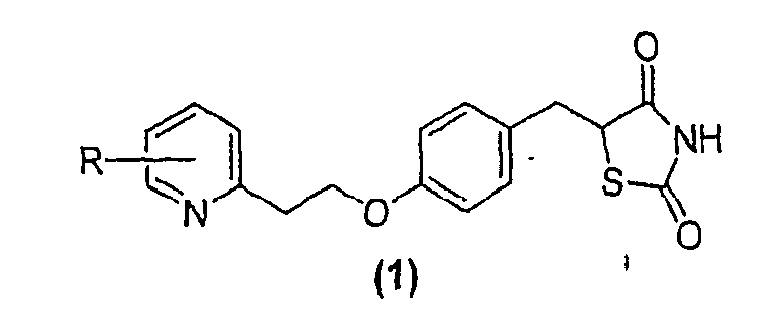
- the present invention relates to a novel process for the production of various pyridine substituted 5-[4-[2-(alkyl substituted pyridyl)ethoxy]benzyl-2,4-thiazolidinedione derivatives of general formula 1 , and their pharmaceutically acceptable salts.
- the present invention also discloses novel compounds which are suitable as intermediates for the preparation of such thiazolidinediones.
- Compounds of formula 1 are known to exhibit hypoglycemic and hypolipidemic activities.
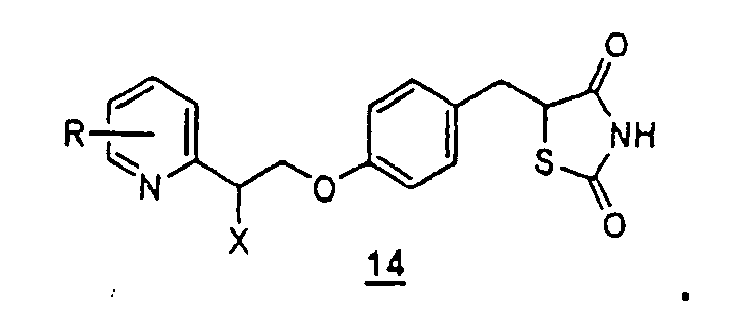
- the present invention also relates to the novel intermediates of formula 3 , 5 , 6 , 9 , 10(b ), 11 , 13 , 14 (Scheme I, II, III) and their corresponding salts, used either as a racemate or in optically pure form to prepare compounds of general formula 1 .
- Such novel compounds of the present invention can also be suitably formulated for treatment of diabetes, hyperlipidemia and obesity or diseases caused by insulin resistance as a pathophysiological mechanism.
- This invention in particular, relates to a novel process for the production of 5-[4-[2-(5-ethylpyridyl)ethoxy]benzyl-2,4-thiazolidinedione (Pioglitazone hydrochloride, R in 1 is 5-ethyl).
- the present invention provides a process to prepare various pyridine substituted 5-[4-[2-(alkyl substituted pyridyl)ethoxy]benzyl-2,4-thiazolidinedione derivatives of general formula 1 , and their pharmaceutically acceptable salts.
- These compounds have been found to be advantageous for their therapeutic applications eg. antidiabetic and hypolipidemic, especially as insulin sensitizing agents.
- Such compounds have been described in patents US 4687777 and EP 193256 .
- EP 0508740 discloses Pyridine N-oxide analogues of thiazolidinedione derivatives, including the N-oxide of Pioglitazone ( 1 ), having antidiabetic and hypolipidemic activity.
- thiazolidinedione compounds including ciglitazone and their pharmaceutically acceptable salts thereof, which have similar antidiabetic properties.
- Diabetes affects a large population and this condition is associated with a number of other complications. Usually, the disease is associated with other disease conditions such as obesity, hyperlipidemia, hypertension and angina. It is a well-recognized fact that improper treatment can aggravate impaired glucose tolerance and insulin resistance, leading to frank diabetes.
- Thiazolidinediones of formula 1 as well as the novel intermediates 14 & 13 of the present invention are useful in the treatment of diabetes, and affect lipid metabolism.
- Pioglitazone belongs to the thiazolidinedione group of antidiabetics. Later it has been found that its antidiabetic effect consists in reducing insulin resistance, thereby improving glucose homeostases without increasing insulin secretion, unlike most other antidiabetics. For these extraordinary characteristics this product is of great importance for the treatment of non-insulin dependent diabetes mellitus. Combination with insulin or other antidiabetics can further increase its effect.
- the present inventors have examined possibilities to find out processes to overcome the above drawbacks.
- Another objective of the present invention is to report several new and novel intermediates for the manufacture of Pioglitazone hydrochloride.
- the present invention provides a new, novel and general process to prepare various pyridine substituted 5-[4-[2-(alkyl substituted pyridyl)ethoxy]benzyl-2,4-thiazolidinedione derivatives of general formula 1 , and their pharmaceutically acceptable salts.
- the present invention especially provides a novel process to prepare Pioglitazone hydrochloride, via novel intermediates. This process involves lesser number of steps with high yield and uses key solid intermediates, which are operationally simple, and therefore offers opportunities for better commercial viability.
- Some of the novel intermediates described in this invention are 3 , 5 , 6 , 9 , 10b , 11 , 13 and 14 .
- the preferred method to prepare 1 involves the synthetic sequence 2 to 9 to 13 to 14 to 1 and/or 2 to 9 to 13 to 1 .
- the present invention provides a novel process to prepare substituted 5-[4-[2-(alkyl substituted pyridyl)ethoxy]benzyl-2,4-thiazolidinedione derivatives of general formula 1 , and their pharmaceutically acceptable salts.
- R is denoted by straight chain or branched alkyl group of one to six carbon atoms, such as methyl, ethyl, propyl, iso -propyl, butyl, iso -butyl, sec -butyl, tert -butyl, pentyl, iso -pentyl, neo-pentyl, hexyl etc, more preferably the lower alkyl groups of one to three carbon atoms.
- Such an alkyl group may be substituted in any position of the pyridine ring.
- the most preferred substituent and position for R in pyridine is 5-ethyl for Pioglitazone 1 .
- novel intermediates eg. 9 , 13 and 14 are inter convertible.
- the most preferred synthetic strategy to prepare 1 involves the synthetic sequence 2 to 9 to 13 to 14 to 1 (Scheme I/II) and/or 2 to 9 to 13 to 1 .
- Suitable inorganic bases include but are not limited to sodium carbonate, potassium carbonate, cesium carbonate, sodium hydroxide, potassium hydroxide, sodium hydride, and the like.
- Suitable polar and neutral solvents for the above transformation include but are not limited to dimethyl sulfoxide, dimethyl formamide, tetrahydrofuran, dimethoxyethane, acetonitrile, toluene, methanol, ethanol, tert- butanol, isopropyl alcohol and the like, in a ratio 3 to 50 volume with respect to the starting material.
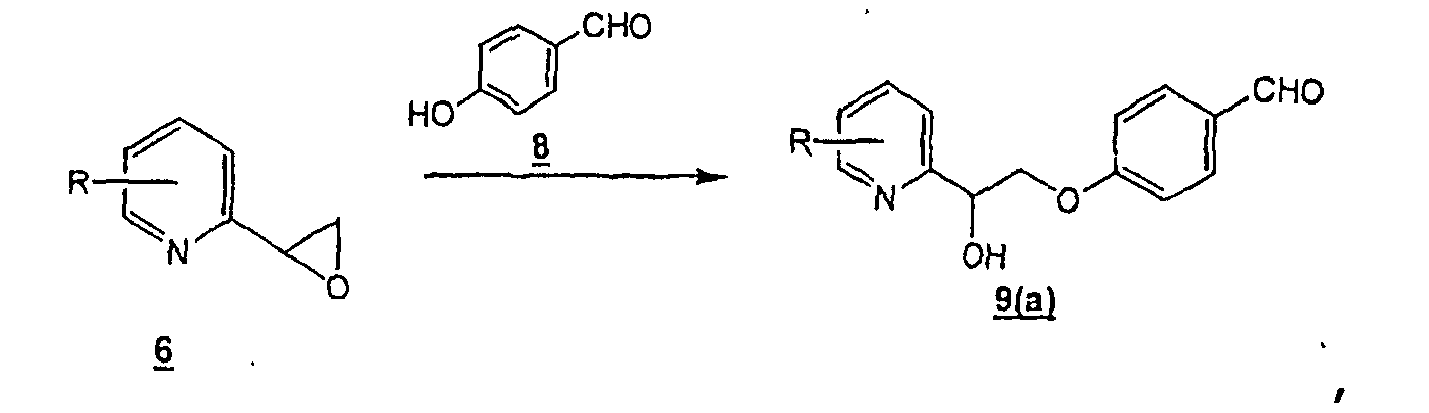
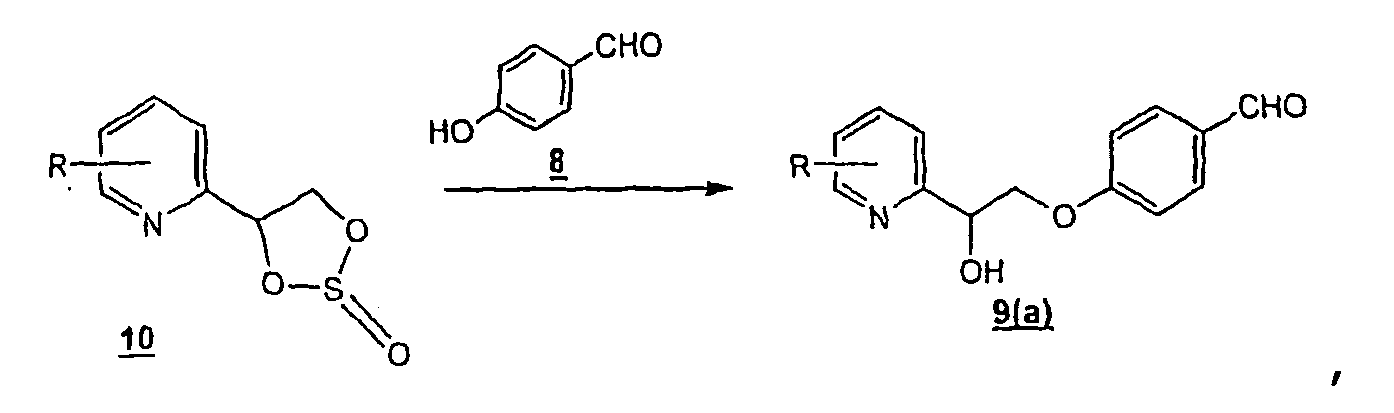
- potassium salt of p-hydroxybenzaldehyde ( 8 ) is used to couple with epoxide ( 6 ) or cyclic sulfite ( 10b ) , under above conditions to prepare 9a .
- Phase transfer catalysis e.g.
- PEG-2000, PEG-4000 and 18-C-6 may also be employed for better yield and quality.
- the usual impurities formed in these reactions are isomeric primary hydroxyaldehyde (see Example 17) and 2-acetyl-5-ethyl pyridine.
- bromohydrin 3 from vinyl pyridine 2 .
- Suitable methods involve use of N-bromosuccinimide (1 to 3 eq) in a suitable solvent in the presence of atleast one equivalent of water.
- Suitable solvents for bromohydrin 3 formation are dimethyl sulfoxide, acetone, tetrahydrofuran, tert -butanol, dimethoxyethane along with varied proportion of water in a ratio of 3 to 50 volume.
- Treatment of base e.g. K 2 CO 3 , Na 2 CO 3 , NaOH, KOH with bromohydrin 3 can give the corresponding epoxide 6 .
- the usual impurities formed in this reaction are isomeric bromohydrin and 2-acetyl-5-ethyl pyridine
- epoxide 6 directly from olefin 2 via oxidation.
- olefin 2 Bromination of olefin 2 with bromine in a neutral solvent e.g. dichloromethane, carbon tetrachloride, can give 5 .
- cyclic sulfate 10a may be prepared via oxidation of cyclic sulfite 10b , which in turn may be obtained form diol 11 by reacting with thionyl chloride, in the presence of bases e.g. pyridine, triethylamine.
- bases e.g. pyridine, triethylamine.
- the formation of diol 11 can be achieved from diacetate 17 , by treatment with base in water or methanol or ethanol..
- diol 11 from the diacetate 17 which in turn can be obtained from N- oxide of 5-ethyl-2-pyridyl-2-ethanol as shown in scheme I.
- Scheme I N- oxide of 5-ethyl-2-pyridyl-2-ethanol
- condensation of variously substituted aromatic aldehyde 9a-e with 5-20% excess molar ratio of 2,4-thiazolidinedione 12 is accomplished by azeotropic removal of water in a suitable solvent and in the presence of an organic base and catalytic amount of organic acid.
- Suitable organic bases include, but are not limited to ammonia, methyl amine, ethyl amine, n -butyl amine, pyrrolidine, piperidine, pyridine, morpholine, piperazine, diethylamine, di-isopropyl amine, triethyl amine and the like; whereas suitable catalytic acids include, but are not limited to acetic acid, benzoic acid, p -tolune sulfonic acid, hydrochloric acid, hydrobromic acid and the like.
- Suitable organic solvents for such condensation include, but are not limited to methanol, ethanol, propanol, 2-propanol, butanol, iso -butanol, 2-methoxyethanol, dimethyl formamide, dimethyl sulfoxide, sulfolane, acetonitrile, dioxalane, dimethoxyethane, toluene, acetic acid and the like.
- Suitable solvents include but are not limited to methanol, ethanol, iso -propanol, acetone, dimethyl formamide (DMF) and tetrahydrofuran.
- Suitable cobalt catalyst include CoCl 2 (Cobaltous chloride), Co(OAc) 2 (Cobaltous acetate) or CoCl 3 (Cobaltic chloride).
- Sodium borohydride is the preferred reducing agent, but other borohydrides such as lithium borohydride, potassium borohydride, tetraalkylammonium borohydride or Zinc borohydride can also be used.
- the approximate molar ratio of sodium borohydride, dimethyl glyoxime and cobaltous chloride with respect to the starting material was 3 to 4:0.4 to 0.6:0.05 to 0.2.
- chemoselective reduction of 13 to 14 is accomplished under catalytic reduction conditions in a suitable solvent in the presence of a suitable catalyst.
- suitable solvents include but are not limited to alkanols such as methanol, ethanol, propanol etc; ethers such as dioxane, dimethoxyethane, tetrahydrofuran, and other miscellaneous solvents eg.
- Suitable catalysts employed in this transformation include, but are not limited to palladium black, palladium charcoal, palladium on barium sulfate, palladium on barium carbonate, platinum oxide, platinum on carbon, Raney Nickel and the like.
- X Cl, Br, OTs, OMs.
- 3 to 10 molecular equivalents of metal borohydrides mentioned above, and high reflux temperature are required to accomplish both transformations in one step.
- triethyl silane induced reduction in the presence of a suitable protic acids are advantageous.
- Some of the protic acids used include, but are not limited to conc. sulfuric acid, acetic acid, triflic acid, Nafion-H, trifluoroacetic acid and the like.
- deoxygenation with AlCl 3 in the presence of 10% Pd-C and cyclohexene as hydrogen donor is also possible.
- There are several other useful methods described in Larrock's book p 44-45, to accomplish similar transformations and any one of them may be advantageously used, so long as they achieve our objectives.
- the usual impurities formed in the reaction are ether cleavage products e.g. 5-ethyl-2-vinyl pyridine 2 and 15 .
- the suitable salt of 1 preferably HCl salt can be prepared in methanol, ethanol, isopropanol and the like
- the useful intermediates 13a-f or 14a-g may also be obtained by reacting the key intermediates 3, 5, 6 , 10a and 10b with another advanced intermediate unsaturated benzylidene type 15 or saturated para- hydroxybenzyl substituted thiazolidinedione 15 , known in prior art, in the presence of a base (Scheme III), similar to as described above for nucleophilic attack of p -hydroxy benzaldehyde 8 to the above key intermediates 3 , 5 , 6 , 10a and 10b (Scheme I).
- the reagents, solvents and reaction condition can be advantageously utilized, as described earlier for similar transformation.
- the various novel intermediates 3 , 5 , 6 , 9 , 10b , 11 , 13 and 14 described in the present invention may be converted to corresponding salts by procedures known in prior art.
- these intermediates can be converted to acid addition salts with acids such as tartaric acid, mandelic acid, fumaric acid, malic acid, lactic acid, maleic acid, salicylic acid, citric acid, ascorbic acid, benzene sulfonic acid, p-toluene sulfonic acid, hydroxynaphthoic acid, methane sulfonic acid, acetic acid, benzoic acid, succinic acid, palmitic acid, hydrochloric acid, hydrobromic acid, sulfuric acid, nitric acid and the like in solvents such as water, alcohols, ethers, ethyl acetate, dioxane, THF, acetonitrile, DMF or a lower alkyl ket
- thiazolidinediones in 13 and 14 can be converted to their corresponding cationic salts such as sodium ion, potassium ion, calcium ion or an ammonium ion and the like.
- the regioisomer 4-[1-(5-ethyl-pyridin-2-yl)-2-hydroxy-ehoxy]-benzaldehyde of the titled product separated was a low melting solid and was characterized by IR, Mass, 13 C NMR and 1 H NMR, which are as given below.
- the product obtained was characterized by IR, Mass, 13 C NMR and 1 H NMR, which was found to be identical with the product obtained in example 17.
- the impurity profile in this reaction was similar to the impurity profile of example 17.
- the product obtained was characterized by IR, Mass, 13 C NMR and 1 H NMR, which was found to be identical with the product obtained in example 17.
- the impurity profile in this reaction was similar to the impurity profile of example 17.
- the product obtained was characterized by IR, Mass, 13 C NMR and 1 H NMR, which was found to be identical with the product obtained in example 17.
- the impurity profile in this reaction was similar to the impurity profile of example 17.
- Reaction mixture was stirred at 60-65 °C for 3 hrs. Reaction mixture was poured into excess of water and was extracted with ethyl acetate. Upon concentrating ethyl acetate, white product obtained. Yield of the product was 6.47 g (92 %).
- reaction mixture was stirred at 65-70 °C for 4 hr. To reaction mixture excess water was added and product was extracted with chloroform. Organic layer was separated, dried (calcium chloride) and concentrated under reduced pressure to afford 28.35 g (94 %) white product. m.p. 119 °C
- reaction mixture was stirred at 65-70 °C for 4 hr. and poured into excess of water. Subsequent work-up by extraction with methyl tert -butyl ether and concentrating organic solvent under reduced pressure afforded 95.51 g (95 %) white product. m.p. 121 °C
- the product obtained was characterized by IR, Mass, 13 C NMR, and 1 H NMR, which was found to be identical with the product obtained in example 55.
- the impurity profile was also similar to the product obtained in example 55.
- the product obtained was converted into its hydrochloride salt as described in example 67 to obtain 7.72 Kg (84 %) of the salt, which was found to be identical in all respect with the salt obtained in example 55.
- the impurity profile in this reaction was similar to the impurity profile described in example 55. m.p. 192 °C
- the product obtained was characterized by comparison with a reference sample prepared by a known method (see prior art).
- the product obtained was characterized by IR, Mass, 13 C NMR and 1 H NMR, which was found to be identical with the product obtained in example 17.
- the impurity of regio isomer 4-[1-(5-ethyl-pyridin-2-yl)-2-hydroxy-ehoxy]-benzaldehyde as described in example 17 was also obtained 0.2 g (31 %).
- the product obtained was identical to the product obtained in example 74.
Landscapes
- Organic Chemistry (AREA)
- Chemical & Material Sciences (AREA)
- Health & Medical Sciences (AREA)
- Diabetes (AREA)
- Nuclear Medicine, Radiotherapy & Molecular Imaging (AREA)
- Animal Behavior & Ethology (AREA)
- Engineering & Computer Science (AREA)
- Hematology (AREA)
- Obesity (AREA)
- Chemical Kinetics & Catalysis (AREA)
- General Chemical & Material Sciences (AREA)
- Medicinal Chemistry (AREA)
- Veterinary Medicine (AREA)
- Pharmacology & Pharmacy (AREA)
- Life Sciences & Earth Sciences (AREA)
- Bioinformatics & Cheminformatics (AREA)
- General Health & Medical Sciences (AREA)
- Public Health (AREA)
- Child & Adolescent Psychology (AREA)
- Emergency Medicine (AREA)
- Endocrinology (AREA)
- Plural Heterocyclic Compounds (AREA)
- Pyridine Compounds (AREA)
- Pharmaceuticals Containing Other Organic And Inorganic Compounds (AREA)
- Thiazole And Isothizaole Compounds (AREA)
- Epoxy Compounds (AREA)
Claims (18)
- Verfahren zur Herstellung von Thiazolidindionen der Formel 1, in der R für geradkettige oder verzweigte Alkylgruppen mit ein bis sechs Kohlenstoffatomen steht, wie beispielsweise Methyl, Ethyl, Propyl, Isopropyl, Butyl, Isobutyl, sec-Butyl, tert-Butyl, Pentyl, Iso-pentyl, Neopentyl, Hexyl, vorzugsweise niedere Alkylgruppen mit ein bis drei Kohlenstoffatomen, besonders bevorzugt steht R für 5-Ethyl, falls die Verbindung mit der Formel 1 für Pioglitazon steht,

- Verfahren nach Anspruch 1, wobei die Reduktion durch Verwendung von Zink und Essigsäure in alkoholischen Lösungsmitteln durchgeführt wird, welche ausgewählt werden aus Methanol, Ethanol, Isopropanol, Wasser oder deren entsprechenden Mischungen oder durch katalytische Hydrierung mit Raney Nickel, 10% Pd/C in Lösungsmitteln, wie Methanol, EthOH, Isopropanol, THF.
- Verfahren zur Herstellung der Verbindung der Formel 1 nach Anspruch 1, in der X für OH, Cl, Br, OMs, und OTs steht, umfassend(i) chemoselektive Reduktion der Verbindung der Formel 13, in der X wie zuvor festgelegt ist, um 14 zu erhalten
 (ii) Reduktion der Verbindung der Formel 14 nach Anspruch 1 um die Verbindung der Formel 1 zu erhalten.
- Verfahren nach Anspruch 3, wobei die Reduktion der Verbindung der Formel 13 zur Herstellung der Verbindung der Formel 14 durchgeführt wird durch die Reduktion von 13 mit Metallborhydriden, ausgewählt aus Natriumborhydrid, Lithiumborhydrid, Kaliumborhydrid, Tetraalkylborhydrid, Zinkborhydrid, in Anwesenheit eines geeigneten Kobaltkatalysators, ausgewählt aus Kobaltchlorid, Kobaltacetat und Kobaltchlorid in einem geeigneten Lösungsmittel, ausgewählt aus Methanol, Ethanol, Isopropanol, Aceton, DMF und THF, entweder alleine oder in Kombinationen davon, wahlweise in Anwesenheit eines geeigneten Liganden, ausgewählt aus 2,2'-Bipyridyl, 1,10-Phenanthrolin und Dimethylglyoxim bei 50 bis 100°C oder durch Verwendung von Raney Nickel, Palladiumkohle, Palladiumblack, Palladiumsulfat, Palladiumcarbonat, Bariumsulfat, Bariumcarbonat, Platinoxid oder Platin auf Kohlenstoff in Lösungsmitteln, ausgewählt aus Methanol, Ethanol, Propanol, Dioxan, Dimethoxyethan, Tetrahydrofuran, Ethylacetat, Essigsäure, Dimethylformamid, N-Methylpryrrolidin, entweder alleine oder in Kombination davon bei 50 bis 100°C.
- Verfahren zur Herstellung der Verbindung der Formel 1 durch katalytische Reduktion der Verbindung der Formel 13, wobei X für OH, Cl, Br, OMs, und OTs steht, und R für geradkettige oder verzweigte Alkylgruppen mit 1 bis 6 Kohlenstoffatomen steht, wie beispielsweise Methyl, Ethyl, Propyl, Isopropyl, Butyl, Isobutyl, sec-Butyl, tert-Butyl, Pentyl, iso-Pentyl, neo-Pentyl, Hexyl, vorzugsweise niedere Alkylgruppen mit ein bis drei Kohlenstoffatomen, besonders bevorzugt steht R für 5-Ethyl, unter Verwendung von Raney Nickel oder 10% Pd-C in alkoholischen Lösungsmitteln zur direkten Herstellung der Verbindung der Formel 1

- Verfahren zur Herstellung der Verbindung der Formel 1 nach Anspruch 1 umfassendi) Kondensation einer Verbindung der Formel 9, mit 2,4-Thiazolidindion der Formel 12, in geeigneten Lösungsmitteln, ausgewählt aus Methanol, Ethanol, Propanol, 2-Propanol, Butanol, Isobutanol, 2-Methoxyethanol, Dimethylformamid, Dimethylsulfoxid, Sulfolan, Acetonitril, Dioxalan, Dimethoxyethan, Toluol, Essigsäure oder Mischungen davon, in Anwesenheit einer organischen Base, ausgewählt aus Ammoniak, Methylamin, Ethylamin, n-Butylamin, Pyrrolidin, Piperidin, Pyridin, Morpholin, Piperazin, Diethylamin, Di-Isopropylamin oder Triethylamin und einer katalytischen Menge einer organischen Säure, ausgewählt aus Essigsäure, para-Toluolsulfonsäure, Salzsäure, oder Bromwasserstoffsäure, um die Verbindung mit der Formel 13 zu erhalten
 ii) chemoselektive Reduktion der Verbindung der Formel 13, nach einem der vorstehenden Ansprüche, um 14 zu erhalten
 iii) Reduktion der Verbindung der Formel 14 nach Anspruch 1, um die Verbindung der Formel 1 zu erhalten.
- Verbindung der Formel 14 oder deren Salze, wobei X für Cl, Br, OMs, und OTs steht, und in der R für geradkettige oder verzweigte Alkylgruppen mit ein bis sechs Kohlenstoffatomen steht, wie beispielsweise Methyl, Ethyl, Propyl, Iso-Propyl, Butyl, Iso-Butyl, sec-Butyl, Tert-Butyl, Pentyl, Iso-Pentyl, Neo-Pentyl, Hexyl, vorzugsweise niedere Alkylgruppen mit einem bis zwei Kohlenstoffatomen
- Verbindung nach Anspruch 7, in der R für 5-Ethyl steht.
- Verfahren zur Herstellung der Verbindung der Formel 14, wobei X für OH, Cl, Br, OMs, und OTs steht und R für geradkettige oder verzweigte Alkylgruppen mit ein bis sechs Kohlenstoffatomen steht, wie beispielsweise Methyl, Ethyl, Propyl, Iso-Propyl, Butyl, Iso-Butyl, sec-Butyl, tert-Butyl, Pentyl, Isopentyl, Neopentyl, Hexyl, vorzugsweise niedere Alkylgruppen mit ein bis drei Kohlenstoffatomen, besonders bevorzugt steht R für 5-Ethyl, das die chemoselektive Reduktion der Verbindung mit der Formel 13 umfasst

- Verfahren zur Herstellung der Verbindung der Formel 14 nach Anspruch 9, das umfassti) Kondensation einer Verbindung der Formel 9, mit 2,4-Thiazolidinon der Formel 12, in geeigneten Lösungsmitteln, ausgewählt aus Methanol, Ethanol, Propanol, 2-Propanol, Butanol, Iso-Butanol, 2-Methoxyethanol, Dimethylformamid, Dimethylsulfoxid, Sulfolan, Acetonitril, Dioxalan, Dimethoxyethan, Toluol, Essigsäure oder Mischungen davon, in Anwesenheit einer organischen Base, ausgewählt aus Ammoniak, Methylamin, Ethylamin, n-Butylamin, Pyrrolidin, Piperidin, Pyridin, Morpholin, Piperazin, Diethylamin, Diisopropylamin oder Triethylamin und einer katalytischen Menge einer organischen Säure, ausgewählt aus Essigsäure, Para-Toluolsulfonsäure, Salzsäure oder Bromwasserstoffsäure, um die Verbindung der Formel 13 zu erhalten
 iii) chemoselektive Reduktion der Verbindung der Formel 13, um 14 zu erhalten

- Verfahren zur Herstellung der Verbindung der Formel 14, das umfassta) Umwandlung der Verbindung mit der Formel 2 in eine Verbindung der Formel 3, in der R wie zuvor definiert ist, unter Verwendung von N-Bromsuccinimid in geeigneten Lösungsmitteln, ausgewählt aus Dimethylsulfoxid, Aceton, Tetrahydrofuran, tert-Butanol, Dimethoxyethan oder Mischungen davon in Anwesenheit von zumindest einem Äquivalent von Wasser
 b) Umwandlung des Bromhydrins der Formel 3 in das Epoxid 6 unter Verwendung von Basen, ausgewählt aus Na2CO3, K2CO3, NaHCO3 in den oben genannten Lösungsmitteln
 c) Reaktion des Bromhydrins der Formel 3 oder des Epoxids der Formel 6 mit Para-Hydroxybenzaldehyd mit geeigneten anorganischen Basen, ausgewählt aus Natriumcarbonat, Kaliumcarbonat, Cäsiumcarbonat, Natriumhydroxid, Kaliumhydroxid, Natriumhydrid in geeigneten Lösungsmitteln, ausgewählt aus Dimethylsulfoxid, Dimethylformamid, Tetrahydrofuran, Dimethoxyethan, Acetonitril, Toluol, tert-Butanol, Methanol, Isopropanol oder Mischungen davon, in einem Volumenverhältnis von 3 zu 50 bezogen auf das Ausgangsmaterial bei einer Temperatur von 50 bis 100°C

 e) Kondensation einer Verbindung der Formel 9 oder 9(a) mit 2,4-Thiazolidinon der Formel 12, um die Verbindung mit der Formel 13 zu erhalten,f) chemoselektive Reduktion der Verbindung mit der Formel 13, um 14 zu erhalten

- Verfahren zur Herstellung der Verbindung mit der Formel 14, wobei X für OH, Cl, Br, OMs, und OTs steht und R wie vorstehend definiert ist, welches den folgenden Ablauf von Schritten umfassti) Umwandlung der Verbindung der Formel 15 in die Verbindung der Formel 16 unter Verwendung von 30% H2O2 in Essigsäure bei 0-20°C
 ii) Umwandlung der Verbindung der Formel 16 in Verbindungen der Formel 17 unter Verwendung von Essigsäureanhydrid unter Rückfluss
 iii) Umwandlung der Verbindung der Formel 17 in die Verbindung der Formel 11 durch Hydrolyse mit NaOH, KOH in Wasser oder alkoholischen Lösungsmitteln
 iv) Umwandlung der Verbindung der Formel 11 in die Verbindung mit der Formel 10 durch Reaktion mit Thionylchlorid in Anwesenheit von organischen Basen, ausgewählt aus Ammoniak, Methylamin, Ethylamin, n-Butylamin, Pyrrolidin, Piperidin, Pyridin, Morpholin, Piperazin, Diethylamin, Di-Isopropylamin, Triethylamin, oder Mischungen davon
 v) Umwandlung der Verbindung mit der Formel 10 in die Verbindung der Formel 9(a) durch Reaktion mit p-Hydroxybenzaldehyd in Anwesenheit einer geeigneten anorganischen Base, ausgewählt aus Natriumcarbonat, Kaliumcarbonat, Cäsiumcarbonat, Natriumhydroxid, Kaliumhydroxid, Natriumhydrid, in geeigneten Lösungsmitteln, ausgewählt aus Dimethylsulfoxid, Dimethylformamid, Tetrahydrofuran, Dimethoxyethan, Acetonitril, Toluol, Tert-Butanol oder Mischungen davon bei einer Temperatur von 50-100°C
 vi) wahlweise, Umwandlung der Verbindung der Formel 9(a) in deren Mesylat, Tosylat, Chlor- oder Bromderivat (Verbindung der Formel 9, in der X für OH, Cl, Br, OMs, OTs steht),vii) Kondensation der Verbindung mit der Formel 9 mit 2,4-Thiazolidindion der Formel 12, um die Verbindung der Formel 13 zu erhalten
 viii) chemoselektive Reduktion der Verbindung der Formel 13, um 14 zu erhalten

- Verbindung der Formel 13 oder deren Salze, in der X für OH, Cl, Br, OMs, und OTs steht und R für geradkettige oder verzweigte Alkylgruppen mit ein bis sechs Kohlenstoffatomen steht, wie Methyl, Ethyl, Propyl, Iso-Propyl, Butyl, iso-Butyl, sec-Butyl, tert-Butyl, Pentyl, Isopentyl, Neopentyl, Hexyl, vorzugsweise die niederen Alkylgruppen mit ein bis drei Kohlenstoffatomen, besonders bevorzugt steht R für 5-Ethyl
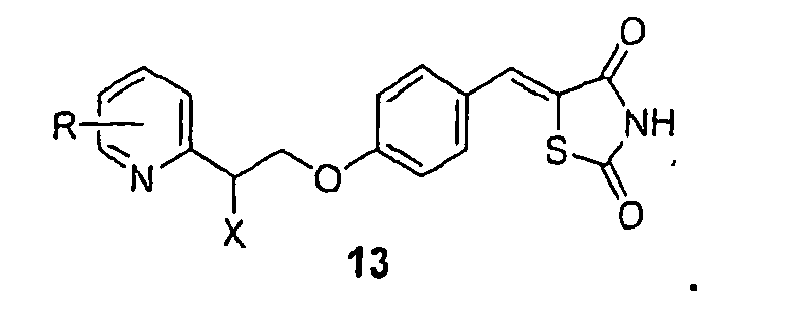
- Verfahren zur Herstellung von Verbindungen der Formel 13 oder deren Salze, in dem X für OH, Cl, Br, OMs, und OTs steht und R wie vorstehend definiert ist, umfassend Kondensation einer Verbindung der Formel 9 oder 9(a) mit 2,4-Thiazolidindion der Formel 12, um die Verbindung mit der Formel 13 zu erhalten

- Verfahren zur Herstellung der Verbindung der Formel 13, das umfassti)a) Umwandlung einer Verbindung der Formel 2 in eine Verbindung der Formel 3
 b) Umwandlung des Bromhydrins der Formel 3 in das Epoxid 6,
 c) Reaktion des Bromhydrins der Formel 3 oder des Epoxids der Formel 6,
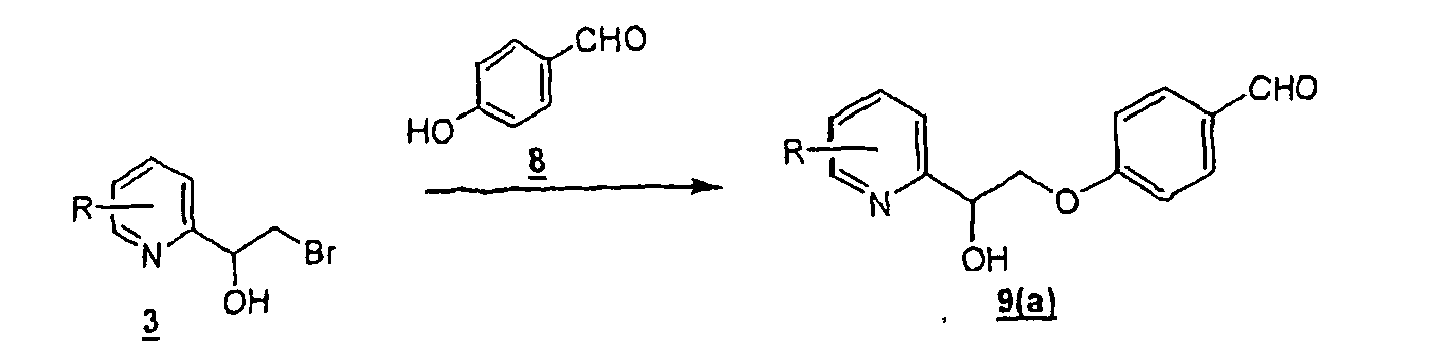
 d) wahlweise, Umwandlung der Verbindung der Formel 9(a) in dessen Mesylat, Tosylat, Chlor- oder Bromderivat (Verbindung mit der Formel 9, in der X für OH, Cl, Br, OMs, OTs steht),e) Kondensation einer Verbindung der Formel 9, mit 2,4-Thiazolidindion der Formel 12, um die Verbindung der Formel 13 zu erhalten.
 ii)a) Umwandlung der Verbindung mit der Formel 15 in eine Verbindung der Formel 16
 b) Umwandlung der Verbindung mit der Formel 16 in Verbindungen der Formel 17
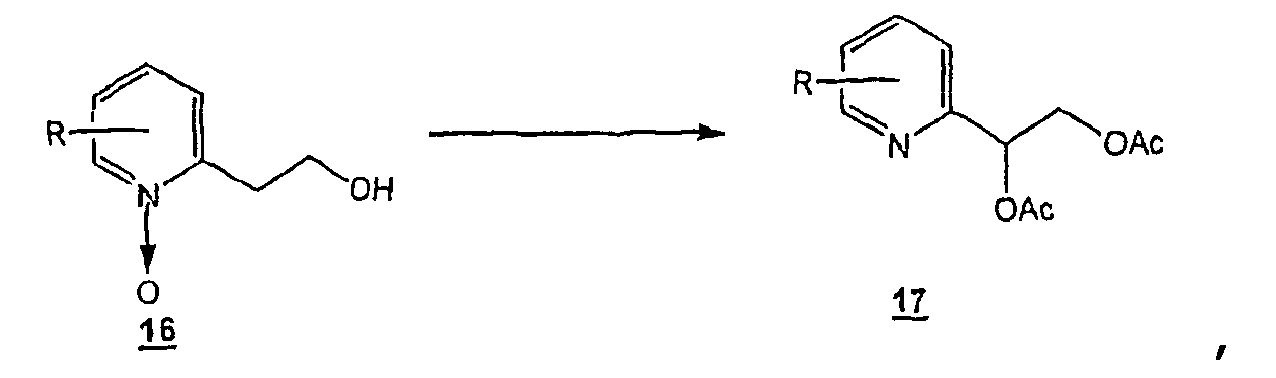 c) Umwandlung der Verbindung mit der Formel 17 in die Verbindung der Formel 11
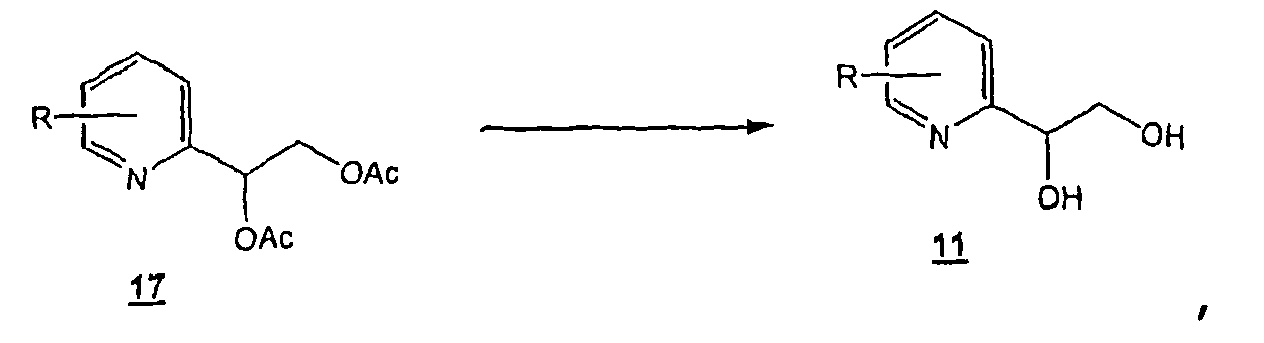 d) Umwandlung der Verbindung der Formel 11 in die Verbindung der Formel 10
 e) Umwandlung der Verbindung der Formel 10 in die Verbindung der Formel 9(a)
 f) wahlweise, Umwandlung der Verbindung mit der Formel 9(a) in deren Mesylat, Tosylat, Chlor- oder Bromderivat (Verbindung mit der Formel 9, in der X für OH, Br, Cl, OMs, OTs steht),g) Kondensation einer Verbindung der Formel 9, mit 2,4-Thiazolidindion der Formel 12, um die Verbindung der Formel 13 zu erhalten

- Verbindung mit der Formel 9 oder deren Salze, in der X für OH, Cl, Br, OMs, und OTs steht und R für geradkettige oder verzweigte Alkylgruppen mit ein bis sechs Kohlenstoffatomen steht, wie Methyl, Ethyl, Propyl, Iso-Propyl, Butyl, Isobutyl, sec-Butyl, tert-Butyl, Pentyl, Isopentyl, Neo-Pentyl, Hexyl und dergleichen, vorzugsweise die niederen Alkylgruppen mit ein bis drei Kohlenstoffatomen, besonders bevorzugt steht R für 5-ethyl
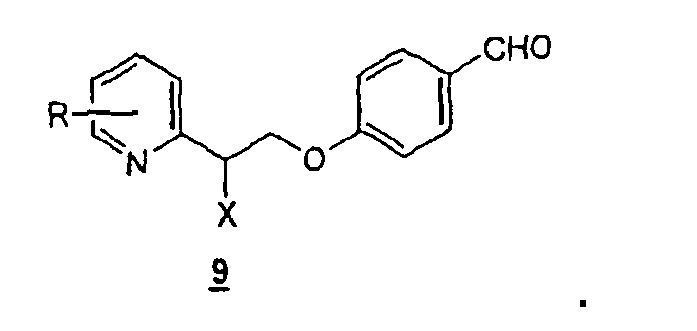
- Verfahren zur Herstellung der Verbindung der Formel 9, in der X für OH, Cl, Br, OMs, und OTs steht und R wie zuvor definiert ist, das die folgenden Schritte umfasst:i)a) die Umwandlung einer Verbindung der Formel 2 in eine Verbindung der Formel 3
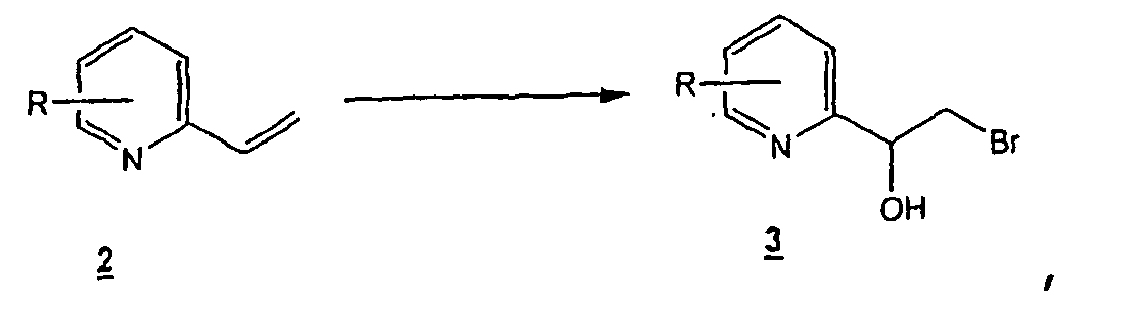 b) Umwandlung des Bromhydrins der Formel 3 in das Epoxid 6,
 c) Reaktion des Bromhydrins der Formel 3 oder des Epoxids der Formel 6 mit p-Hydroxybenzaldehyd

 c) wahlweise, die Umwandlung der Verbindung der Formel 9(a) in deren Mesyat, Tosylat, Chlor- oder Bromderivat (Verbindung mit der Formel 9, in der X für OH, Cl, Br, OMs, OTs steht),ii)a) Umwandlung einer Verbindung der Formel 15 in eine Verbindung der Formel 16 unter Verwendung von 30% H2O2 in Essigsäure
 b) die Umwandlung der Verbindung mit der Formel 16 in Verbindungen der Formel 17
 c) Umwandlung der Verbindung der Formel 17 in die Verbindung mit der Formel 11
 d) die Umwandlung der Verbindung der Formel 11 in Verbindung der Formel 10
 iii)
 e) Umwandlung der Verbindung der Formel 10 in die Verbindung der Formel 9(a)d) wahlweise, Umwandlung der Verbindung mit der Formel 9(a) in deren Mesylat, Tosylat, Chlor- oder Bromderivat (Verbindung mit der Formel 9, in der X für OH, Br, Cl, Br, OMs, OTs steht).
- Verfahren zur Umwandlung des Thiozolidindions der Formel 1, hergestellt gemäß dem vorliegenden Verfahren, in deren pharmazeutisch akzeptables Salz, vorzugsweise dessen HCI-Salz, durch Reaktion mit geeigneten Säuren, vorzugsweise HCl, in einem geeigneten Lösungsmittel, vorzugsweise Methanol, Ethanol, Isopropanol.
Applications Claiming Priority (3)
| Application Number | Priority Date | Filing Date | Title |
|---|---|---|---|
| INMU06482002 | 2002-07-16 | ||
| IN648MU2002 | 2002-07-16 | ||
| PCT/IN2003/000241 WO2004007490A2 (en) | 2002-07-16 | 2003-07-15 | A process to prepare pioglitazone via several intermediates. |
Publications (2)
| Publication Number | Publication Date |
|---|---|
| EP1521753A2 EP1521753A2 (de) | 2005-04-13 |
| EP1521753B1 true EP1521753B1 (de) | 2007-09-05 |
Family
ID=30012270
Family Applications (1)
| Application Number | Title | Priority Date | Filing Date |
|---|---|---|---|
| EP03753913A Expired - Lifetime EP1521753B1 (de) | 2002-07-16 | 2003-07-15 | Prozess zur herstellung von pioglitazon via verschiedene zwischenstufen |
Country Status (6)
| Country | Link |
|---|---|
| US (5) | US7465801B2 (de) |
| EP (1) | EP1521753B1 (de) |
| AT (1) | ATE372336T1 (de) |
| AU (1) | AU2003272072A1 (de) |
| DE (1) | DE60316152D1 (de) |
| WO (1) | WO2004007490A2 (de) |
Families Citing this family (18)
| Publication number | Priority date | Publication date | Assignee | Title |
|---|---|---|---|---|
| WO2004007490A2 (en) | 2002-07-16 | 2004-01-22 | Cadila Healthcare Limited | A process to prepare pioglitazone via several intermediates. |
| US8993773B2 (en) | 2002-07-16 | 2015-03-31 | Cadila Healthcare Limited | Process to prepare pioglitazone via several novel intermediates |
| CZ297266B6 (cs) * | 2004-09-10 | 2006-10-11 | Zentiva, A. S. | Zpusob prípravy rosiglitazonu |
| WO2008075380A2 (en) * | 2006-12-21 | 2008-06-26 | Ind-Swift Laboratories Limited | Process for the preparation of thiazolidine derivatives |
| JOP20180077A1 (ar) | 2007-06-19 | 2019-01-30 | Kythera Biopharmaceuticals Inc | تركيبات وطرق لحمض صفراوي تخليقي |
| US8242294B2 (en) | 2007-06-19 | 2012-08-14 | Kythera Biopharmaceuticals, Inc. | Synthetic bile acid compositions and methods |
| US20080318870A1 (en) | 2007-06-19 | 2008-12-25 | Kythera Biopharmaceuticals, Inc. | Synthetic bile acid compositions and methods |
| CN101848901B (zh) | 2007-09-14 | 2012-11-21 | 新陈代谢解决方案开发公司 | 用于治疗高血压的噻唑烷二酮类似物 |
| US8304441B2 (en) | 2007-09-14 | 2012-11-06 | Metabolic Solutions Development Company, Llc | Thiazolidinedione analogues for the treatment of metabolic diseases |
| US8024889B2 (en) * | 2008-06-25 | 2011-09-27 | Brett Bunker | Pest control method and apparatus |
| WO2010105048A1 (en) * | 2009-03-12 | 2010-09-16 | Metabolic Solutions Development Company | Thiazolidinedione analogues |
| US8912335B2 (en) * | 2009-12-15 | 2014-12-16 | Metabolic Solutions Development Company, Llc | PPAR-sparing thiazolidinedione salts for the treatment of metabolic diseases |
| CN102917705A (zh) * | 2009-12-15 | 2013-02-06 | 新陈代谢解决方案开发公司 | 用于治疗肥胖症和其它代谢性疾病的ppar节制性噻唑烷二酮和组合 |
| KR101164429B1 (ko) | 2010-05-25 | 2012-07-12 | (주)부흥산업사 | 환상 아민 중간체를 이용한 피오글리타존 염산염의 제조 방법 |
| US8596663B2 (en) * | 2011-03-29 | 2013-12-03 | Shimano Inc. | Fluid flow control structure |
| WO2012153312A1 (en) | 2011-05-11 | 2012-11-15 | Ranbaxy Laboratories Limited | Process for the purification of pioglitazone |
| ES2831326T3 (es) | 2014-01-15 | 2021-06-08 | Poxel Sa | Métodos para tratar trastornos neurológicos, metabólicos y otros mediante el uso de pioglitazona enantiopura enriquecida con deuterio |
| CN109020790B (zh) * | 2018-08-16 | 2021-07-27 | 苏州大学 | 一种4-环烷基苯乙酮衍生物的制备方法 |
Family Cites Families (9)
| Publication number | Priority date | Publication date | Assignee | Title |
|---|---|---|---|---|
| JPS5522636A (en) | 1978-08-04 | 1980-02-18 | Takeda Chem Ind Ltd | Thiazoliding derivative |
| US4444179A (en) * | 1981-03-02 | 1984-04-24 | Trippi Anthony C | Orthopedic tongs |
| NL8402765A (nl) * | 1984-09-11 | 1986-04-01 | Philips Nv | Manipulator met zes vrijheidsgraden. |
| AR240698A1 (es) * | 1985-01-19 | 1990-09-28 | Takeda Chemical Industries Ltd | Procedimiento para preparar compuestos de 5-(4-(2-(5-etil-2-piridil)-etoxi)benzil)-2,4-tiazolidindiona y sus sales |
| US4812570A (en) | 1986-07-24 | 1989-03-14 | Takeda Chemical Industries, Ltd. | Method for producing thiazolidinedione derivatives |
| WO1993022445A1 (en) | 1992-05-05 | 1993-11-11 | The Upjohn Company | A process for producing pioglitazone metabolite |
| KR100366617B1 (ko) * | 2000-03-13 | 2003-01-09 | 삼성전자 주식회사 | 자기 정렬 콘택홀 제조 방법 |
| HUP0400091A2 (hu) * | 2001-04-26 | 2004-06-28 | Léciva, a.s. | Eljárás antidiabetikus hatású pioglitazon előállítására |
| WO2004007490A2 (en) | 2002-07-16 | 2004-01-22 | Cadila Healthcare Limited | A process to prepare pioglitazone via several intermediates. |
-
2003
- 2003-07-15 WO PCT/IN2003/000241 patent/WO2004007490A2/en not_active Ceased
- 2003-07-15 DE DE60316152T patent/DE60316152D1/de not_active Expired - Lifetime
- 2003-07-15 US US10/520,166 patent/US7465801B2/en not_active Expired - Fee Related
- 2003-07-15 AU AU2003272072A patent/AU2003272072A1/en not_active Abandoned
- 2003-07-15 EP EP03753913A patent/EP1521753B1/de not_active Expired - Lifetime
- 2003-07-15 AT AT03753913T patent/ATE372336T1/de not_active IP Right Cessation
-
2007
- 2007-09-06 US US11/896,911 patent/US7671207B2/en not_active Expired - Fee Related
-
2008
- 2008-01-25 US US12/010,473 patent/US7863300B2/en not_active Expired - Fee Related
-
2010
- 2010-10-02 US US12/896,844 patent/US8173816B2/en not_active Expired - Fee Related
-
2011
- 2011-11-28 US US13/305,295 patent/US8445685B2/en not_active Expired - Fee Related
Also Published As
| Publication number | Publication date |
|---|---|
| US20080300282A1 (en) | 2008-12-04 |
| US20060167061A1 (en) | 2006-07-27 |
| US7465801B2 (en) | 2008-12-16 |
| EP1521753A2 (de) | 2005-04-13 |
| AU2003272072A1 (en) | 2004-02-02 |
| US8445685B2 (en) | 2013-05-21 |
| US8173816B2 (en) | 2012-05-08 |
| ATE372336T1 (de) | 2007-09-15 |
| US20080004446A1 (en) | 2008-01-03 |
| AU2003272072A8 (en) | 2004-02-02 |
| US7671207B2 (en) | 2010-03-02 |
| DE60316152D1 (de) | 2007-10-18 |
| WO2004007490A2 (en) | 2004-01-22 |
| US20120077848A1 (en) | 2012-03-29 |
| WO2004007490A3 (en) | 2004-03-25 |
| US20110021576A1 (en) | 2011-01-27 |
| US7863300B2 (en) | 2011-01-04 |
Similar Documents
| Publication | Publication Date | Title |
|---|---|---|
| US7671207B2 (en) | Process to prepare pioglitazone via several novel intermediates | |
| CA2272460C (fr) | Derives de la pyridin-2-yl-methylamine, leur procede de preparation et leur application comme medicaments | |
| EP2186807B1 (de) | Verfahren zur Herstellung von Esomeprazol-Magnesium-Dihydrat | |
| EP1756099B1 (de) | Synthese von antidiabetischen rosiglitazonderivaten | |
| US8993773B2 (en) | Process to prepare pioglitazone via several novel intermediates | |
| JPS6045621B2 (ja) | ブタノン誘導体の製造方法 | |
| WO2001036387A1 (en) | Novel bipyridyl derivatives | |
| CN115710213A (zh) | 一种顺式手性3-氟-4-羟基哌啶及其衍生物的制备方法 | |
| JP2001081087A (ja) | 新規な2−(2−ピリジル)ピリミジン誘導体 | |
| WO2004000810A1 (en) | A process for the production of substituted phenyl ethers | |
| EP1841739B1 (de) | Verfahren zur herstellung von 1-benzyl-4-[(5,6-dimethoxy-1-indanon-2-yl)methyl]piperidin oder einem salz davon über ein neues zwischenprodukt | |
| CZ137898A3 (cs) | Způsob a meziprodukty pro výrobu 3-(1-piperazinyl)-1,2-benzisothiazolu | |
| JP3272326B2 (ja) | 2−ピリジルピリジン誘導体の製造方法 | |
| WO2008142706A2 (en) | Novel process for the synthesis of pioglitazone and its salts thereof | |
| JP5586231B2 (ja) | ジオールの位置選択的モノ−トシル化法 | |
| TWI920788B (zh) | 經取代苯基乙腈及經取代苯基醋酸之製備方法 | |
| CN103987705B (zh) | 制备他汀含硫前体的方法 | |
| JP5441913B2 (ja) | カルボニルオキシ化合物の製造方法 | |
| KR100697983B1 (ko) | 신규 중간체 및 이를 이용한 피오글리타존의 제조방법 | |
| HUP0600517A2 (en) | Process for the production of benzylidene-rosiglitazone base | |
| KR101164429B1 (ko) | 환상 아민 중간체를 이용한 피오글리타존 염산염의 제조 방법 | |
| CN117946039A (zh) | 一种恩格列净中间体的手性合成工艺 | |
| KR20260048654A (ko) | 라니피브라노르 중간체의 합성 | |
| CN115537433A (zh) | 替卡格雷中间体及其制备方法 | |
| KR100697982B1 (ko) | 로시글리타존의 제조방법 |
Legal Events
| Date | Code | Title | Description |
|---|---|---|---|
| PUAI | Public reference made under article 153(3) epc to a published international application that has entered the european phase |
Free format text: ORIGINAL CODE: 0009012 |
|
| 17P | Request for examination filed |
Effective date: 20050207 |
|
| AK | Designated contracting states |
Kind code of ref document: A2 Designated state(s): AT BE BG CH CY CZ DE DK EE ES FI FR GB GR HU IE IT LI LU MC NL PT RO SE SI SK TR |
|
| AX | Request for extension of the european patent |
Extension state: AL LT LV MK |
|
| 17Q | First examination report despatched |
Effective date: 20060404 |
|
| GRAP | Despatch of communication of intention to grant a patent |
Free format text: ORIGINAL CODE: EPIDOSNIGR1 |
|
| GRAS | Grant fee paid |
Free format text: ORIGINAL CODE: EPIDOSNIGR3 |
|
| GRAA | (expected) grant |
Free format text: ORIGINAL CODE: 0009210 |
|
| AK | Designated contracting states |
Kind code of ref document: B1 Designated state(s): AT BE BG CH CY CZ DE DK EE ES FI FR GB GR HU IE IT LI LU MC NL PT RO SE SI SK TR |
|
| AX | Request for extension of the european patent |
Extension state: AL LT LV MK |
|
| REG | Reference to a national code |
Ref country code: GB Ref legal event code: FG4D |
|
| REG | Reference to a national code |
Ref country code: CH Ref legal event code: EP |
|
| REF | Corresponds to: |
Ref document number: 60316152 Country of ref document: DE Date of ref document: 20071018 Kind code of ref document: P |
|
| REG | Reference to a national code |
Ref country code: IE Ref legal event code: FG4D |
|
| PG25 | Lapsed in a contracting state [announced via postgrant information from national office to epo] |
Ref country code: ES Free format text: LAPSE BECAUSE OF FAILURE TO SUBMIT A TRANSLATION OF THE DESCRIPTION OR TO PAY THE FEE WITHIN THE PRESCRIBED TIME-LIMIT Effective date: 20071216 Ref country code: FI Free format text: LAPSE BECAUSE OF FAILURE TO SUBMIT A TRANSLATION OF THE DESCRIPTION OR TO PAY THE FEE WITHIN THE PRESCRIBED TIME-LIMIT Effective date: 20070905 |
|
| LTIE | Lt: invalidation of european patent or patent extension |
Effective date: 20070905 |
|
| PG25 | Lapsed in a contracting state [announced via postgrant information from national office to epo] |
Ref country code: LI Free format text: LAPSE BECAUSE OF FAILURE TO SUBMIT A TRANSLATION OF THE DESCRIPTION OR TO PAY THE FEE WITHIN THE PRESCRIBED TIME-LIMIT Effective date: 20070905 Ref country code: CH Free format text: LAPSE BECAUSE OF FAILURE TO SUBMIT A TRANSLATION OF THE DESCRIPTION OR TO PAY THE FEE WITHIN THE PRESCRIBED TIME-LIMIT Effective date: 20070905 Ref country code: AT Free format text: LAPSE BECAUSE OF FAILURE TO SUBMIT A TRANSLATION OF THE DESCRIPTION OR TO PAY THE FEE WITHIN THE PRESCRIBED TIME-LIMIT Effective date: 20070905 |
|
| NLV1 | Nl: lapsed or annulled due to failure to fulfill the requirements of art. 29p and 29m of the patents act | ||
| REG | Reference to a national code |
Ref country code: RO Ref legal event code: EPE |
|
| REG | Reference to a national code |
Ref country code: CH Ref legal event code: AEN Free format text: DAS PATENT IST AUF GRUND DES WEITERBEHANDLUNGSANTRAGS VOM 15.02.2008 REAKTIVIERT WORDEN. Ref country code: CH Ref legal event code: PL |
|
| PG25 | Lapsed in a contracting state [announced via postgrant information from national office to epo] |
Ref country code: BE Free format text: LAPSE BECAUSE OF FAILURE TO SUBMIT A TRANSLATION OF THE DESCRIPTION OR TO PAY THE FEE WITHIN THE PRESCRIBED TIME-LIMIT Effective date: 20070905 |
|
| PG25 | Lapsed in a contracting state [announced via postgrant information from national office to epo] |
Ref country code: GR Free format text: LAPSE BECAUSE OF FAILURE TO SUBMIT A TRANSLATION OF THE DESCRIPTION OR TO PAY THE FEE WITHIN THE PRESCRIBED TIME-LIMIT Effective date: 20071206 Ref country code: NL Free format text: LAPSE BECAUSE OF FAILURE TO SUBMIT A TRANSLATION OF THE DESCRIPTION OR TO PAY THE FEE WITHIN THE PRESCRIBED TIME-LIMIT Effective date: 20070905 |
|
| PGRI | Patent reinstated in contracting state [announced from national office to epo] |
Ref country code: CH Effective date: 20080215 |
|
| NLXE | Nl: other communications concerning ep-patents (part 3 heading xe) |
Free format text: A REQUEST FOR RESTORATION TO THE PRIOR STATE (ARTICLE 23 OF THE PATENTS ACT 1995) HAS BEEN FILED ON 20080313 |
|
| EN | Fr: translation not filed | ||
| PG25 | Lapsed in a contracting state [announced via postgrant information from national office to epo] |
Ref country code: PT Free format text: LAPSE BECAUSE OF FAILURE TO SUBMIT A TRANSLATION OF THE DESCRIPTION OR TO PAY THE FEE WITHIN THE PRESCRIBED TIME-LIMIT Effective date: 20080206 |
|
| PGRI | Patent reinstated in contracting state [announced from national office to epo] |
Ref country code: CH Effective date: 20080215 |
|
| NLXE | Nl: other communications concerning ep-patents (part 3 heading xe) |
Free format text: THE REQUEST FOR RESTORATION TO THE PRIOR STATE, AS PROVIDED FOR IN ARTICLE 23 OF THE PATENTS ACT OF 1995, HAS BEEN WITHDRAWN. |
|
| REG | Reference to a national code |
Ref country code: CH Ref legal event code: NV Representative=s name: DR. R.C. SALGO + PARTNER PATENTANWAELTE AG |
|
| PG25 | Lapsed in a contracting state [announced via postgrant information from national office to epo] |
Ref country code: SE Free format text: LAPSE BECAUSE OF FAILURE TO SUBMIT A TRANSLATION OF THE DESCRIPTION OR TO PAY THE FEE WITHIN THE PRESCRIBED TIME-LIMIT Effective date: 20071205 |
|
| PLBE | No opposition filed within time limit |
Free format text: ORIGINAL CODE: 0009261 |
|
| STAA | Information on the status of an ep patent application or granted ep patent |
Free format text: STATUS: NO OPPOSITION FILED WITHIN TIME LIMIT |
|
| PG25 | Lapsed in a contracting state [announced via postgrant information from national office to epo] |
Ref country code: DE Free format text: LAPSE BECAUSE OF FAILURE TO SUBMIT A TRANSLATION OF THE DESCRIPTION OR TO PAY THE FEE WITHIN THE PRESCRIBED TIME-LIMIT Effective date: 20071206 Ref country code: DK Free format text: LAPSE BECAUSE OF FAILURE TO SUBMIT A TRANSLATION OF THE DESCRIPTION OR TO PAY THE FEE WITHIN THE PRESCRIBED TIME-LIMIT Effective date: 20070905 |
|
| 26N | No opposition filed |
Effective date: 20080606 |
|
| REG | Reference to a national code |
Ref country code: HU Ref legal event code: AG4A Ref document number: E003250 Country of ref document: HU |
|
| PG25 | Lapsed in a contracting state [announced via postgrant information from national office to epo] |
Ref country code: FR Free format text: LAPSE BECAUSE OF FAILURE TO SUBMIT A TRANSLATION OF THE DESCRIPTION OR TO PAY THE FEE WITHIN THE PRESCRIBED TIME-LIMIT Effective date: 20080502 |
|
| PG25 | Lapsed in a contracting state [announced via postgrant information from national office to epo] |
Ref country code: EE Free format text: LAPSE BECAUSE OF FAILURE TO SUBMIT A TRANSLATION OF THE DESCRIPTION OR TO PAY THE FEE WITHIN THE PRESCRIBED TIME-LIMIT Effective date: 20070905 |
|
| PG25 | Lapsed in a contracting state [announced via postgrant information from national office to epo] |
Ref country code: SI Free format text: LAPSE BECAUSE OF FAILURE TO SUBMIT A TRANSLATION OF THE DESCRIPTION OR TO PAY THE FEE WITHIN THE PRESCRIBED TIME-LIMIT Effective date: 20070905 |
|
| PG25 | Lapsed in a contracting state [announced via postgrant information from national office to epo] |
Ref country code: CY Free format text: LAPSE BECAUSE OF FAILURE TO SUBMIT A TRANSLATION OF THE DESCRIPTION OR TO PAY THE FEE WITHIN THE PRESCRIBED TIME-LIMIT Effective date: 20070905 |
|
| PG25 | Lapsed in a contracting state [announced via postgrant information from national office to epo] |
Ref country code: BG Free format text: LAPSE BECAUSE OF FAILURE TO SUBMIT A TRANSLATION OF THE DESCRIPTION OR TO PAY THE FEE WITHIN THE PRESCRIBED TIME-LIMIT Effective date: 20071205 |
|
| PGRI | Patent reinstated in contracting state [announced from national office to epo] |
Ref country code: FI Effective date: 20080617 |
|
| PG25 | Lapsed in a contracting state [announced via postgrant information from national office to epo] |
Ref country code: TR Free format text: LAPSE BECAUSE OF FAILURE TO SUBMIT A TRANSLATION OF THE DESCRIPTION OR TO PAY THE FEE WITHIN THE PRESCRIBED TIME-LIMIT Effective date: 20070905 |
|
| PG25 | Lapsed in a contracting state [announced via postgrant information from national office to epo] |
Ref country code: IT Free format text: LAPSE BECAUSE OF NON-PAYMENT OF DUE FEES Effective date: 20080731 |
|
| REG | Reference to a national code |
Ref country code: CH Ref legal event code: PFUS Owner name: CADILA HEALTHCARE LIMITED, IN Free format text: FORMER OWNER: CADILA HEALTHCARE LIMITED, IN |
|
| REG | Reference to a national code |
Ref country code: CH Ref legal event code: PCAR Free format text: NEW ADDRESS: ZIMMERGASSE 16, 8008 ZUERICH (CH) |
|
| PGFP | Annual fee paid to national office [announced via postgrant information from national office to epo] |
Ref country code: LU Payment date: 20170725 Year of fee payment: 15 |
|
| PGFP | Annual fee paid to national office [announced via postgrant information from national office to epo] |
Ref country code: SK Payment date: 20170711 Year of fee payment: 15 Ref country code: RO Payment date: 20170713 Year of fee payment: 15 Ref country code: MC Payment date: 20170724 Year of fee payment: 15 Ref country code: CZ Payment date: 20170712 Year of fee payment: 15 Ref country code: CH Payment date: 20170725 Year of fee payment: 15 Ref country code: GB Payment date: 20170728 Year of fee payment: 15 Ref country code: FI Payment date: 20170721 Year of fee payment: 15 |
|
| PGFP | Annual fee paid to national office [announced via postgrant information from national office to epo] |
Ref country code: IE Payment date: 20170721 Year of fee payment: 15 Ref country code: HU Payment date: 20170920 Year of fee payment: 15 |
|
| REG | Reference to a national code |
Ref country code: CH Ref legal event code: PL |
|
| GBPC | Gb: european patent ceased through non-payment of renewal fee |
Effective date: 20180715 |
|
| PG25 | Lapsed in a contracting state [announced via postgrant information from national office to epo] |
Ref country code: LU Free format text: LAPSE BECAUSE OF NON-PAYMENT OF DUE FEES Effective date: 20180715 Ref country code: MC Free format text: LAPSE BECAUSE OF NON-PAYMENT OF DUE FEES Effective date: 20180731 |
|
| REG | Reference to a national code |
Ref country code: SK Ref legal event code: MM4A Ref document number: E 3441 Country of ref document: SK Effective date: 20180715 |
|
| REG | Reference to a national code |
Ref country code: IE Ref legal event code: MM4A |
|
| PG25 | Lapsed in a contracting state [announced via postgrant information from national office to epo] |
Ref country code: RO Free format text: LAPSE BECAUSE OF NON-PAYMENT OF DUE FEES Effective date: 20180715 Ref country code: CZ Free format text: LAPSE BECAUSE OF NON-PAYMENT OF DUE FEES Effective date: 20180715 Ref country code: GB Free format text: LAPSE BECAUSE OF NON-PAYMENT OF DUE FEES Effective date: 20180715 Ref country code: IE Free format text: LAPSE BECAUSE OF NON-PAYMENT OF DUE FEES Effective date: 20180715 Ref country code: CH Free format text: LAPSE BECAUSE OF FAILURE TO SUBMIT A TRANSLATION OF THE DESCRIPTION OR TO PAY THE FEE WITHIN THE PRESCRIBED TIME-LIMIT Effective date: 20180731 Ref country code: LI Free format text: LAPSE BECAUSE OF FAILURE TO SUBMIT A TRANSLATION OF THE DESCRIPTION OR TO PAY THE FEE WITHIN THE PRESCRIBED TIME-LIMIT Effective date: 20180731 Ref country code: HU Free format text: LAPSE BECAUSE OF NON-PAYMENT OF DUE FEES Effective date: 20180716 Ref country code: FI Free format text: LAPSE BECAUSE OF FAILURE TO SUBMIT A TRANSLATION OF THE DESCRIPTION OR TO PAY THE FEE WITHIN THE PRESCRIBED TIME-LIMIT Effective date: 20180715 |
|
| PG25 | Lapsed in a contracting state [announced via postgrant information from national office to epo] |
Ref country code: SK Free format text: LAPSE BECAUSE OF NON-PAYMENT OF DUE FEES Effective date: 20180715 |