EP1523028A2 - Dispositif et procédé d'écriture par faisceau d'électrons - Google Patents
Dispositif et procédé d'écriture par faisceau d'électrons Download PDFInfo
- Publication number
- EP1523028A2 EP1523028A2 EP04023853A EP04023853A EP1523028A2 EP 1523028 A2 EP1523028 A2 EP 1523028A2 EP 04023853 A EP04023853 A EP 04023853A EP 04023853 A EP04023853 A EP 04023853A EP 1523028 A2 EP1523028 A2 EP 1523028A2
- Authority
- EP
- European Patent Office
- Prior art keywords
- electron
- electron beam
- light
- mark
- mark substrate
- Prior art date
- Legal status (The legal status is an assumption and is not a legal conclusion. Google has not performed a legal analysis and makes no representation as to the accuracy of the status listed.)
- Withdrawn
Links
Images


Classifications
-
- H—ELECTRICITY
- H01—ELECTRIC ELEMENTS
- H01J—ELECTRIC DISCHARGE TUBES OR DISCHARGE LAMPS
- H01J37/00—Discharge tubes with provision for introducing objects or material to be exposed to the discharge, e.g. for the purpose of examination or processing thereof
- H01J37/30—Electron-beam or ion-beam tubes for localised treatment of objects
- H01J37/317—Electron-beam or ion-beam tubes for localised treatment of objects for changing properties of the objects or for applying thin layers thereon, e.g. for ion implantation
- H01J37/3174—Particle-beam lithography, e.g. electron beam lithography
-
- B—PERFORMING OPERATIONS; TRANSPORTING
- B82—NANOTECHNOLOGY
- B82Y—SPECIFIC USES OR APPLICATIONS OF NANOSTRUCTURES; MEASUREMENT OR ANALYSIS OF NANOSTRUCTURES; MANUFACTURE OR TREATMENT OF NANOSTRUCTURES
- B82Y10/00—Nanotechnology for information processing, storage or transmission, e.g. quantum computing or single electron logic
-
- B—PERFORMING OPERATIONS; TRANSPORTING
- B82—NANOTECHNOLOGY
- B82Y—SPECIFIC USES OR APPLICATIONS OF NANOSTRUCTURES; MEASUREMENT OR ANALYSIS OF NANOSTRUCTURES; MANUFACTURE OR TREATMENT OF NANOSTRUCTURES
- B82Y40/00—Manufacture or treatment of nanostructures
-
- H—ELECTRICITY
- H01—ELECTRIC ELEMENTS
- H01J—ELECTRIC DISCHARGE TUBES OR DISCHARGE LAMPS
- H01J37/00—Discharge tubes with provision for introducing objects or material to be exposed to the discharge, e.g. for the purpose of examination or processing thereof
- H01J37/30—Electron-beam or ion-beam tubes for localised treatment of objects
- H01J37/304—Controlling tubes by information coming from the objects or from the beam, e.g. correction signals
- H01J37/3045—Object or beam position registration
-
- H—ELECTRICITY
- H01—ELECTRIC ELEMENTS
- H01J—ELECTRIC DISCHARGE TUBES OR DISCHARGE LAMPS
- H01J2237/00—Discharge tubes exposing object to beam, e.g. for analysis treatment, etching, imaging
- H01J2237/248—Components associated with the control of the tube
- H01J2237/2482—Optical means
Definitions
- the present invention relates to a lithography technique. More specifically, the present invention relates to an electron beam writing technique used in a semiconductor process.
- Electron beam measuring equipment which detects a wafer position by light to measure it by electron beam is proposed.
- mark positions are detected by light and electron beam to identify the distance between both, thereby feeding back a mark detected value by the light to position control of the electron beam.
- Patent Document 1 In the above-described prior art (Patent Document 1) method, both light and electron beam use reflected signals from marks are used, resulting in limited accuracy.
- Patent Document 2 detection is performed by a backscattered electron. In both of the prior art methods, it is hard to say that the accuracy of mark detection is sufficiently considered.
- Patent Document 2 being effective for high-accuracy alignment of an electron beam, no consideration of alignment with a base wafer pattern at writing is given.
- An object of the present invention is to provide an electron beam wiring technique which can perform high-accuracy overlay writing in mark detection using light.
- electron beam writing equipment has on a stage a mark substrate illuminated by light beam for position detection and electron beam for writing from the same side and having a support and apertures; an electron detecting surface (here, the term of an electron beam receiving surface used in light is called a detecting surface) provided in the direction opposite the illumination side; and a light detecting surface provided in the same direction as the illumination side, thereby making measurement by the electron beam which is a transmitted beam excellent in efficiency and contrast and the light beam which is reflected light capable of being compatible with wafer mark detection.
- an electron detecting surface here, the term of an electron beam receiving surface used in light is called a detecting surface
- Patent Document 1 since the pattern on a sample by electron beam is measured by a backscattered electron or secondary electron, it is desirable that mark detection by electron beam be performed by a backscattered electron or secondary electron.
- mark detection by electron beam is performed by a transmitted electron, which cannot adversely affect the accuracy of the equipment.
- the mark detection by electron beam is performed in positions other than a sample position.
- a detector can be provided on the stage to use a transmitted electron. The detection method according to the present invention has been found by utilizing the characteristic of the writing equipment.
- a substrate or its surface must be conductive.
- the reflection from the background is increased in detection by light to lower the contrast between the signals of reflected lights.
- Using a mark substrate having apertures can zero the reflectivity in the apertures. An effect for increasing the contrast between the signals of the reflected lights at the same time can be expected.
- the mark substrate is manufactured by coating a metal onto a light element support so as to achieve both high-accuracy aperture formation important for measurement by electron beam and mark reflection important for measurement by light.
- a metal having a principal atom with an atomic number higher than that of a principal atom constituting the support This can increase the contrast in electron beam measurement while maintaining high-accuracy aperture formation.
- a principal atom constituting the support is silicon excellent in processability and an element with a higher atomic number is a heavy metal or noble metal.
- the technique for fabricating a stencil substrate having high-accuracy microfabrication pattern apertures withstanding position measurement has been advanced. This utilization is an aim of the present invention.
- a member absorbing light for position detection is provided between the mark substrate and the electron detecting surface to prevent reflection of light from the underside of the mark substrate.
- the reflectivity of light which has transmitted through the aperture is significantly lowered to increase the contrast between reflected lights. This is a great advantage as compared with the case of using a thick substrate.
- a mark for electron beam is isolated from a mark for light beam, which is significant.
- An optimum structure for the respective measurement can be provided. In this case, it is important to stabilize the relative distance between the two marks by arranging them to be close to each other.
- a method of arranging the mark for electron beam in the mark for light beam relatively increased is also advantageous for stabilizing the relative distance between the marks.
- a light absorber is provided in the direction opposite the illumination side of the mark for light beam. It is effective to prevent light reflection from other than the mark substrate.
- a mark detection substrate formed with a mark for detection by light having a pitch being substantially an integral multiple of the pitch of multiple beams can use both marks together. High-accuracy correction can be expected.
- high-accuracy overlay writing of the electron beam writing equipment can be performed to form a high-resolution device pattern.
- the present invention is considered to be effective for electron beam writing equipment of a multiple beam system.
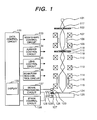
- FIG. 1 shows the configuration of equipment according to this embodiment.
- electron beam writing equipment which can use together a variable shaping method and a cell projection method together is targeted.
- An electron beam accelerated to 50kV by an electron source 101 illuminates a first mask 102 formed with a rectangular aperture 117.
- the image of the rectangular aperture is formed on a second mask 111 by two projection lenses 107 and 108.
- a rectangular aperture 118 for variable shaping and a plurality of cell apertures 119 for cell projection are formed on the second mask 111.
- the position of the first mask image on the second mask is controlled by a shaping deflector 106 and a beam shape control circuit 133 between the two masks.
- the transmitted electron beam formed by the two masks is demagnified by two demagnification lenses 112 and 113 to be finally projected onto a sample 124 placed on a stage 125 by objective lenses 114 and 115. These lenses are driven by a lens control circuit 135.
- the electron beam is axis aligned by an aligner control circuit 134.
- the position of the electron beam on the sample 124 is controlled by an objective deflector 116.
- a mark substrate 126 for position detection is provided on the stage 125.
- a laser interferometer not shown, measuring the positions of the mark substrate 126 and the stage 125, a transmitted electron detector 127, a signal processing circuit 137 and a stage control circuit 138 are used to measure the position of the electron beam.
- the equipment has a reflected light detector 123 and a light source 128 in addition to the mark substrate 126 for position detection provided on the stage 125 and can measure the position of light. The entire control of these is performed by a data control circuit 131. The controlled result and the measured result are displayed by a display 132.
- FIG. 2 shows an enlarged view around the mark substrate.
- An electron beam 201 used here is an electron beam for writing.
- a light beam 202 is light for wafer mark detection. Actually, the light and the electron are incident in different positions. For convenience of the description, they are shown in the same position. To simply show the drawing, the light source and the optical fiber are not shown in FIG. 2.
- the transmitted electron detector 127 and an electron detecting surface 211 are provided on the side opposite the plane in which the electron beam 201 is illuminated onto the mark substrate 206, enabling high sensitivity and high contrast.
- the reflected light detector 123 and a light detecting surface 210 are provided on the same side as the plane in which the light beam 202 is illuminated onto the mark substrate 126. This can detect reflected light from the wafer mark.
- a silicon stencil 204 is selected as a support. Its thickness is 2 ⁇ m. The reason why a light element is selected as the support is that it is excellent in processability of an aperture to make the accuracy of the aperture shape higher. As candidates of other materials, silicon carbide and diamond are considered.
- the silicon stencil 204 is a thin film having a thickness of 2 ⁇ m. This is 1/2 or below of the range of an electron beam used for writing. The silicon having a thickness of 2 ⁇ m cannot shut off the electron beam of 50kV. It is 10 times or more larger than the mean free path and can scatter the electron beam.
- an aperture for scattered electron 207 is provided such that no scattered electrons are incident upon the transmitted electron detector 127, high contrast can be obtained.
- the electron beam 201 which has transmitted through the aperture is directly incident upon the transmitted electron detector 127. High sensitivity can be obtained.
- the aperture for scattered electron 207 is a light absorber. Specifically, it is a blackbody of carbon. This absorbs the light which has transmitted through the silicon so that no irregular reflected light around the detection part is incident upon the reflected light detector 123. There is also a method of manufacturing the aperture for scattered electron 207 using a material having good processability, such as aluminum, to coat its surface with the carbon. A light absorber 212 is arranged on the electron detecting surface, which is effective from the same reason.
- gold (Au) 203 as a noble metal is deposited on the silicon. This can increase the reflectivity of light from the support.
- the substrate of a mark for electron beam and a mark for light beam can be shared. This is a great merit in ensuring the accuracy of baseline correction.
- Deposition of the gold having an atom with an atomic number higher than that of a principal atom constituting the support is effective for improving the scattering power to the electron beam. The double merit can be obtained.
- deposition of the gold is performed only from the upper surface. Since the function of reflecting light is important, the deposition may be performed from both surfaces or only from the lower surface. In other words, the gold may be coated at least on the surface on the side of means reflecting the light beam or on the opposite side.
- the thickness of the gold of this embodiment is 40nm. This is twice or more the depth of penetration of the light used for detection. This can obtain a sufficient reflectivity. When the film thickness is larger than the size of the aperture pattern, it adversely affects the aperture pattern shape.
- examples of other candidates of noble metal or heavy metal coated can include platinum, palladium, tungsten and tantalum. An alloy of these may be used.
- To form a two-layer film there are a method of depositing a noble metal film after fabricating an aperture in a silicon substrate and a method of forming an aperture after fabricating a heavy metal film in a silicon substrate by the CVD method.
- the aperture shape has a 1- ⁇ m line with a 2- ⁇ m pitch.
- the wavelength of the light for mark detection is 590nm. It is incident almost vertically upon the mark substrate 126 through an optical fiber 129 shown in FIG. 1.
- the reflectivity of the light in a certain portion of the support is 90% or above, which is significantly contrasted with 0% of the aperture.
- the detection probability of the electron beam scattered in a certain portion of the support is 1% or below. It is found that signals in almost ideal contrast in both beams can be obtained.
- the above equipment is used to perform overlay writing to a silicon wafer according to the process of FIG. 3.
- the mark positions shown in FIG. 2 are detected by light and electron beam (steps 301 and 302) to obtain relative position information of both (step 303).
- the light source 128, the reflected light detector 123, the signal processing circuit 137 and the stage control circuit 138 are utilized.
- Mark detection of the wafer is performed by light (step 304) to detect the pattern position of the base layer.
- the obtained relative position information is processed by the data control circuit 131 to be finally fed back to the objective deflector 116 for performing writing by electron beam (step 305).
- an alignment accuracy of 30nm can be realized by 3 ⁇ .
- the transmitted electron is larger in the aperture and the reflected light is larger other than the aperture.
- Using the reverse phase can perform high-speed baseline correction. Both signals of the transmitted electron and the reflected light are synthesized with each other. The relative distance between the light and the electron in which the contrast is lowest is obtained, making it possible to perform correction.
- This method is one application method of the present invention.
- FIG. 4 equipment equivalent to that of FIG. 1 is used and the mark detection part shown in FIG. 4 is used.
- a mark for electron beam 407 is isolated from a mark for light beam 408. This is done to increase the accuracy by using a mark pattern suitable for the respective marks. Since the relative distance between the marks must be stable to heat and stress, both must be positioned as close as possible to each other.
- aluminum (A1) 403 as a metal having a thickness of 100nm is deposited on a silicon stencil 404 having a thickness of 5 ⁇ m.
- the electron beam scattering power of the aluminum is not very different from that of the silicon. An effect for increasing the reflectivity of the light can be expected.
- an electron beam 401 is hard to be deflected largely so that a small mark is preferable.
- a light beam 402 for mark detection has poor resolution so that a large mark is preferable.
- the mark for light beam 408 is larger than the mark for electron beam 407.
- the mark for light beam 408 having a 4- ⁇ m line with a 20- ⁇ m pitch is formed following the aperture shape having 1- ⁇ m line with a 2- ⁇ m pitch of the mark for electron beam 407.
- a light absorber 409 is provided under the mark for light beam 408 to prevent irregular reflection of light.
- the light absorber 409 is desirably a conductor to prevent electrification due to the electron beam transmitting through therenear. Carbon is used as the light absorber.
- the numeral 405 denotes a light detector; 406, a mark substrate; 410, an aperture for scattered electron; 411, an electron detector; 420, a light detecting surface; and 421, an electron detecting surface.
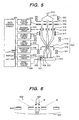
- FIG. 5 shows the configuration of equipment according to this embodiment.
- electron beam writing equipment of a multiple beam system is targeted.
- An electron beam 511 accelerated to 50kV by an electron source 510 is a parallel beam through a condenser lens 512 to be isolated into a plurality of point beams by an aperture array 513 having a plurality of apertures.
- the point beams are imaged onto an intermediate image 516 of the point beams by a lens array 514 at the later stage.
- a blanker array 515 and a blanking aperture 519 are provided.
- the thus-produced multiple point beams are demagnified by a doublet lens 522 having a first projection lens 518 and a second projection lens 521 to be imaged onto a sample 524.
- a deflector 520 between the two lenses of the doublet lens, which defines the writing position on the sample 524.
- a mark substrate 526 for position detection on a stage 525 mounting the sample 524 There is a mark substrate 526 for position detection on a stage 525 mounting the sample 524.
- a laser interferometer not shown, measuring the position of the stage 525 and a transmitted electron detector 527 are used to measure the position of the electron beam.
- the equipment has a reflected light detector 523 and a light source 528 in addition to the mark substrate 526 for position detection provided on the stage 525 and can measure the position of the light.
- Aligners 517 having two stages are provided above the first projection lens 518 as the first lens of the doublet lens 522. They are engaged with each other to align the incident angle and the incident position of the electron beam onto the lens.
- the aligners 517 are driven by an aligner control circuit 504.
- the doublet lens 522 is driven by a lens control circuit 505.
- electric currents are supplied.
- the set values of the electric currents are determined by information provided from a data control circuit 501.
- a focus control circuit 502 and a pattern generator circuit 503 operate the corresponding optical elements by supplying voltages. The set values of these are determined by information provided from the data control circuit 501.
- the data control circuit 501 has a display 509 and performs calculation for determining the amount of operation of the lenses and aligners using information obtained from a signal processing circuit 507 and a stage control circuit 508.
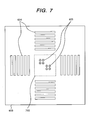
- a substrate having a cross-sectional structure as shown in FIG. 6 is employed as another example in which the mark for electron beam is isolated from the mark for light beam.
- the shape seen from the top is shown in FIG. 7.
- the light detecting surface, the light detector, the electron detecting surface and the electron detector are not shown.
- the basic structure is the same as those shown in FIGS. 2 and 4.
- a mark for electron beam 605 is positioned in a mark for light beam 604.
- Detection of light 602 may use reflected light from a large two-dimensional area for processing a reflected image by a CCD.
- An electron beam 601 is hard to use a backscattered electron from the large two-dimensional area since a usable electric current is significantly limited by the Coulomb effect and aberration. It is suitable to use a mark smaller than the mark for light beam.
- the mark for electron beam 605 is included in the mark for light beam 604. While securing the respective detection accuracies, the stability of the relative distance between both marks can be ensured. In this case, when the signal of the reflected light is processed by avoiding a central mark area for electron beam 700 (area which has not been used for light measurement), interference of both can be prevented.
- This equipment is used to detect the pattern position of the base layer to perform writing by the electron beam according to the obtained relative position information. As a result, an alignment accuracy of 23nm can be realized by 3 ⁇ .
- light is used as an energy beam for position detection and an electron beam in probe form is used as an energy beam for pattern forming. It is apparent that it can be applied to lithography equipment using other energy beams (e.g., projection type electron beam and ion beam, and short-wavelength light).
- energy beams e.g., projection type electron beam and ion beam, and short-wavelength light.
Landscapes
- Engineering & Computer Science (AREA)
- Chemical & Material Sciences (AREA)
- Nanotechnology (AREA)
- Crystallography & Structural Chemistry (AREA)
- Physics & Mathematics (AREA)
- Analytical Chemistry (AREA)
- Mathematical Physics (AREA)
- Theoretical Computer Science (AREA)
- Condensed Matter Physics & Semiconductors (AREA)
- General Physics & Mathematics (AREA)
- Manufacturing & Machinery (AREA)
- Electron Beam Exposure (AREA)
- Exposure And Positioning Against Photoresist Photosensitive Materials (AREA)
- Container, Conveyance, Adherence, Positioning, Of Wafer (AREA)
- Length Measuring Devices By Optical Means (AREA)
Applications Claiming Priority (2)
| Application Number | Priority Date | Filing Date | Title |
|---|---|---|---|
| JP2003348019 | 2003-10-07 | ||
| JP2003348019A JP2005116731A (ja) | 2003-10-07 | 2003-10-07 | 電子ビーム描画装置及び電子ビーム描画方法 |
Publications (2)
| Publication Number | Publication Date |
|---|---|
| EP1523028A2 true EP1523028A2 (fr) | 2005-04-13 |
| EP1523028A3 EP1523028A3 (fr) | 2011-06-01 |
Family
ID=34309199
Family Applications (1)
| Application Number | Title | Priority Date | Filing Date |
|---|---|---|---|
| EP04023853A Withdrawn EP1523028A3 (fr) | 2003-10-07 | 2004-10-06 | Dispositif et procédé d'écriture par faisceau d'électrons |
Country Status (4)
| Country | Link |
|---|---|
| US (1) | US7098464B2 (fr) |
| EP (1) | EP1523028A3 (fr) |
| JP (1) | JP2005116731A (fr) |
| CN (1) | CN100442435C (fr) |
Cited By (1)
| Publication number | Priority date | Publication date | Assignee | Title |
|---|---|---|---|---|
| WO2017050546A1 (fr) * | 2015-09-24 | 2017-03-30 | Arcam Ab | Objet standard d'étalonnage aux rayons x |
Families Citing this family (6)
| Publication number | Priority date | Publication date | Assignee | Title |
|---|---|---|---|---|
| JP4825450B2 (ja) * | 2005-05-16 | 2011-11-30 | 株式会社東芝 | パターン描画システム、荷電ビーム描画方法、及びフォトマスク製造方法 |
| JP5744601B2 (ja) * | 2010-04-20 | 2015-07-08 | キヤノン株式会社 | 電子線描画装置及びデバイス製造方法 |
| WO2013132064A2 (fr) * | 2012-03-08 | 2013-09-12 | Mapper Lithography Ip B.V. | Système de lithographie à particules chargées pourvu d'un capteur d'alignement et d'un capteur de mesure de faisceau |
| DE112014002043T5 (de) * | 2013-05-30 | 2016-01-14 | Hitachi High-Technologies Corporation | Mit einem Strahl geladener Teilchen arbeitende Vorrichtung und Probenbeobachtungsverfahren |
| JP2022035663A (ja) * | 2020-08-21 | 2022-03-04 | 浜松ホトニクス株式会社 | 光電面電子源 |
| CN112461138B (zh) * | 2020-11-18 | 2022-06-28 | 苏州迈之升电子科技有限公司 | 一种交叉扫描测量方法及其测量光栅和应用 |
Family Cites Families (17)
| Publication number | Priority date | Publication date | Assignee | Title |
|---|---|---|---|---|
| JPS54128288A (en) * | 1978-03-29 | 1979-10-04 | Hitachi Ltd | Electron beam exposure device |
| JPH0782987B2 (ja) * | 1988-01-13 | 1995-09-06 | 株式会社日立製作所 | 電子線描画装置 |
| JP2831643B2 (ja) | 1988-02-23 | 1998-12-02 | 株式会社東芝 | パターン露光方法 |
| US4885472A (en) * | 1988-03-14 | 1989-12-05 | The Perkin-Elmer Corporation | Silicon grid as a reference and calibration standard in a particle beam lithography system |
| ATE171812T1 (de) * | 1988-06-01 | 1998-10-15 | Ims Ionen Mikrofab Syst | Ionenstrahllithographie |
| JP2578519B2 (ja) * | 1990-06-01 | 1997-02-05 | 株式会社日立製作所 | 光線による位置検出機能付き荷電粒子線露光装置 |
| JP3274212B2 (ja) | 1993-03-18 | 2002-04-15 | 株式会社日立製作所 | 電子線検出器及びそれを用いた電子線描画装置 |
| JP3141732B2 (ja) | 1995-07-05 | 2001-03-05 | 株式会社日立製作所 | 荷電粒子線装置 |
| JP3278375B2 (ja) * | 1996-03-28 | 2002-04-30 | キヤノン株式会社 | 電子線発生装置、それを備える画像表示装置、およびそれらの駆動方法 |
| JP3335845B2 (ja) * | 1996-08-26 | 2002-10-21 | 株式会社東芝 | 荷電ビーム描画装置及び描画方法 |
| JP2865164B2 (ja) * | 1996-11-18 | 1999-03-08 | 株式会社日立製作所 | 粒子線描画装置 |
| US6207962B1 (en) * | 1998-06-05 | 2001-03-27 | Nikon Corporation | Charged-particle-beam microlithography apparatus and methods exhibiting reduced thermal deformation of mark-defining member |
| JP2000349000A (ja) * | 1999-06-02 | 2000-12-15 | Nikon Corp | 荷電粒子線用標準マーク、それを有する荷電粒子線露光装置及び半導体デバイス製造方法 |
| JP2002043207A (ja) * | 2000-07-24 | 2002-02-08 | Riipuru:Kk | 電子ビーム近接露光装置及び露光方法 |
| US6831282B2 (en) * | 2001-02-09 | 2004-12-14 | Nikon Corporation | Methods and devices for evaluating beam blur in a charged-particle-beam microlithography apparatus |
| US6762421B2 (en) * | 2001-03-09 | 2004-07-13 | Kabushiki Kaisha Toshiba | Charged particle beam exposure apparatus and exposure method |
| JP4023262B2 (ja) * | 2002-09-02 | 2007-12-19 | ソニー株式会社 | アライメント方法、露光方法、露光装置およびマスクの製造方法 |
-
2003
- 2003-10-07 JP JP2003348019A patent/JP2005116731A/ja active Pending
-
2004
- 2004-09-29 CN CNB2004100832273A patent/CN100442435C/zh not_active Expired - Fee Related
- 2004-10-05 US US10/957,695 patent/US7098464B2/en not_active Expired - Fee Related
- 2004-10-06 EP EP04023853A patent/EP1523028A3/fr not_active Withdrawn
Cited By (4)
| Publication number | Priority date | Publication date | Assignee | Title |
|---|---|---|---|---|
| WO2017050546A1 (fr) * | 2015-09-24 | 2017-03-30 | Arcam Ab | Objet standard d'étalonnage aux rayons x |
| US10807187B2 (en) | 2015-09-24 | 2020-10-20 | Arcam Ab | X-ray calibration standard object |
| EP3726561A1 (fr) * | 2015-09-24 | 2020-10-21 | Arcam Ab | Objet standard d'étalonnage aux rayons x |
| US11806800B2 (en) | 2015-09-24 | 2023-11-07 | Arcam Ab | X-ray calibration standard object |
Also Published As
| Publication number | Publication date |
|---|---|
| CN1606129A (zh) | 2005-04-13 |
| CN100442435C (zh) | 2008-12-10 |
| US20050072939A1 (en) | 2005-04-07 |
| JP2005116731A (ja) | 2005-04-28 |
| EP1523028A3 (fr) | 2011-06-01 |
| US7098464B2 (en) | 2006-08-29 |
Similar Documents
| Publication | Publication Date | Title |
|---|---|---|
| KR102447784B1 (ko) | 포토리소그라픽 마스크 상의 요소의 위치를 결정하기 위한 장치 및 방법 | |
| US7834997B2 (en) | Standard component for calibration and calibration method using it and electro beam system | |
| US6521900B1 (en) | Alignment marks for charged-particle-beam microlithography, and alignment methods using same | |
| KR20230113319A (ko) | 하전 입자 도구, 캘리브레이션 방법, 검사 방법 | |
| WO2004113833A1 (fr) | Unite de mesure de forme 3-d, unite de traitement et procede de production d'un dispositif a semi-conducteur | |
| JP4679978B2 (ja) | 荷電粒子ビーム応用装置 | |
| CN117716464A (zh) | 带电粒子评估系统和在带电粒子评估系统中对准样品的方法 | |
| US4578587A (en) | Error-corrected corpuscular beam lithography | |
| US7098464B2 (en) | Electron beam writing equipment and electron beam writing method | |
| JPH09320931A (ja) | 結像特性計測方法及び該方法を使用する転写装置 | |
| JP2016189335A (ja) | 試料観察方法及び試料観察装置 | |
| US8766215B2 (en) | Charged particle beam drawing apparatus and method of manufacturing article | |
| EP0073235A1 (fr) | Systeme de rereperage pour un systeme d'exposition a rayon a particule chargee | |
| US20010028037A1 (en) | Hollow-beam aperture for charged-particle-beam optical systems and microlithography apparatus, andbeam-adjustment methods employing same | |
| US5952133A (en) | Methods for evaluating image-forming characteristics of a projection-optical system used in a charged-particle-beam microlithography apparatus | |
| JP2000208079A (ja) | 電子線の強度分布を測定するピンホ―ル検出器 | |
| JP5372445B2 (ja) | 走査型電子顕微鏡装置およびその焦点あわせ方法 | |
| US20040126673A1 (en) | Microlithography reticles including high-contrast reticle-identification codes, and apparatus and methods for identifying reticles based on such codes | |
| JPH10214765A (ja) | アライメント方法及び装置 | |
| US6664551B2 (en) | Methods for detecting incidence orthogonality of a patterned beam in charged-particle-beam (CPB) microlithography, and CPB microlithography systems that perform same | |
| JPH08227840A (ja) | 荷電粒子線描画装置における調整方法および描画方法 | |
| CN120266249A (zh) | 电子光学元件和评估电子光学元件的方法 | |
| JP2001085302A (ja) | 荷電ビーム露光用マスク、荷電ビーム露光装置及び荷電ビーム露光方法 | |
| JP2004241652A (ja) | 基準マーク体及びそれを有する露光装置 |
Legal Events
| Date | Code | Title | Description |
|---|---|---|---|
| PUAI | Public reference made under article 153(3) epc to a published international application that has entered the european phase |
Free format text: ORIGINAL CODE: 0009012 |
|
| AK | Designated contracting states |
Kind code of ref document: A2 Designated state(s): AT BE BG CH CY CZ DE DK EE ES FI FR GB GR HU IE IT LI LU MC NL PL PT RO SE SI SK TR |
|
| AX | Request for extension of the european patent |
Extension state: AL HR LT LV MK |
|
| PUAL | Search report despatched |
Free format text: ORIGINAL CODE: 0009013 |
|
| AK | Designated contracting states |
Kind code of ref document: A3 Designated state(s): AT BE BG CH CY CZ DE DK EE ES FI FR GB GR HU IE IT LI LU MC NL PL PT RO SE SI SK TR |
|
| AX | Request for extension of the european patent |
Extension state: AL HR LT LV MK |
|
| RIC1 | Information provided on ipc code assigned before grant |
Ipc: H01J 37/20 20060101ALI20110426BHEP Ipc: H01J 37/317 20060101ALI20110426BHEP Ipc: H01J 37/304 20060101AFI20050113BHEP |
|
| 17P | Request for examination filed |
Effective date: 20111124 |
|
| AKX | Designation fees paid |
Designated state(s): DE GB NL |
|
| 17Q | First examination report despatched |
Effective date: 20120403 |
|
| STAA | Information on the status of an ep patent application or granted ep patent |
Free format text: STATUS: THE APPLICATION IS DEEMED TO BE WITHDRAWN |
|
| 18D | Application deemed to be withdrawn |
Effective date: 20160330 |