EP1542465A1 - Systeme et procede d'interpretation du langage gestuel - Google Patents
Systeme et procede d'interpretation du langage gestuel Download PDFInfo
- Publication number
- EP1542465A1 EP1542465A1 EP03797602A EP03797602A EP1542465A1 EP 1542465 A1 EP1542465 A1 EP 1542465A1 EP 03797602 A EP03797602 A EP 03797602A EP 03797602 A EP03797602 A EP 03797602A EP 1542465 A1 EP1542465 A1 EP 1542465A1
- Authority
- EP
- European Patent Office
- Prior art keywords
- sign language
- terminal
- deaf
- mute
- videophone
- Prior art date
- Legal status (The legal status is an assumption and is not a legal conclusion. Google has not performed a legal analysis and makes no representation as to the accuracy of the status listed.)
- Withdrawn
Links
Images





Classifications
-
- H—ELECTRICITY
- H04—ELECTRIC COMMUNICATION TECHNIQUE
- H04M—TELEPHONIC COMMUNICATION
- H04M3/00—Automatic or semi-automatic exchanges
- H04M3/42—Systems providing special services or facilities to subscribers
- H04M3/56—Arrangements for connecting several subscribers to a common circuit, i.e. affording conference facilities
- H04M3/567—Multimedia conference systems
-
- H—ELECTRICITY
- H04—ELECTRIC COMMUNICATION TECHNIQUE
- H04N—PICTORIAL COMMUNICATION, e.g. TELEVISION
- H04N7/00—Television systems
- H04N7/14—Systems for two-way working
-
- H—ELECTRICITY
- H04—ELECTRIC COMMUNICATION TECHNIQUE
- H04N—PICTORIAL COMMUNICATION, e.g. TELEVISION
- H04N7/00—Television systems
- H04N7/14—Systems for two-way working
- H04N7/141—Systems for two-way working between two video terminals, e.g. videophone
- H04N7/147—Communication arrangements, e.g. identifying the communication as a video-communication, intermediate storage of the signals
-
- H—ELECTRICITY
- H04—ELECTRIC COMMUNICATION TECHNIQUE
- H04N—PICTORIAL COMMUNICATION, e.g. TELEVISION
- H04N7/00—Television systems
- H04N7/14—Systems for two-way working
- H04N7/15—Conference systems
-
- H—ELECTRICITY
- H04—ELECTRIC COMMUNICATION TECHNIQUE
- H04M—TELEPHONIC COMMUNICATION
- H04M2201/00—Electronic components, circuits, software, systems or apparatus used in telephone systems
- H04M2201/38—Displays
-
- H—ELECTRICITY
- H04—ELECTRIC COMMUNICATION TECHNIQUE
- H04M—TELEPHONIC COMMUNICATION
- H04M2201/00—Electronic components, circuits, software, systems or apparatus used in telephone systems
- H04M2201/50—Telephonic communication in combination with video communication
-
- H—ELECTRICITY
- H04—ELECTRIC COMMUNICATION TECHNIQUE
- H04M—TELEPHONIC COMMUNICATION
- H04M2203/00—Aspects of automatic or semi-automatic exchanges
- H04M2203/20—Aspects of automatic or semi-automatic exchanges related to features of supplementary services
- H04M2203/2061—Language aspects
-
- H—ELECTRICITY
- H04—ELECTRIC COMMUNICATION TECHNIQUE
- H04M—TELEPHONIC COMMUNICATION
- H04M3/00—Automatic or semi-automatic exchanges
- H04M3/42—Systems providing special services or facilities to subscribers
- H04M3/42025—Calling or Called party identification service
- H04M3/42085—Called party identification service
- H04M3/42102—Making use of the called party identifier
- H04M3/4211—Making use of the called party identifier where the identifier is used to access a profile
-
- H—ELECTRICITY
- H04—ELECTRIC COMMUNICATION TECHNIQUE
- H04M—TELEPHONIC COMMUNICATION
- H04M3/00—Automatic or semi-automatic exchanges
- H04M3/42—Systems providing special services or facilities to subscribers
- H04M3/56—Arrangements for connecting several subscribers to a common circuit, i.e. affording conference facilities
- H04M3/563—User guidance or feature selection
Definitions
- the present invention relates to a sign language interpretation system and a sign language interpretation method which allow, by using a videophone, a deaf-mute person capable of using sign language to have a conversation with a non-deaf-mute person incapable of using sign language, and more particularly, the present invention relates to a sign language interpretation system and a sign language interpretation method which provide a deaf-mute person with administration services over a videophone even when a person capable of using sign language is not present in an administrative body, such as a public office, a hospital and a police station.
- an administrative body such as a public office, a hospital and a police station.
- a deaf-mute person who is hearing and speaking impaired communicates with a non-deaf-mute person by means of writing or sign language. Fluent conversation is difficult by way of communications in writing. Moreover, a very small number of non-deaf-mute persons can use sign language. These problems present a substantial barrier in the social life of a deaf-mute person.
- a deaf-mute person can have a conversation over videophone with a non-deaf-mute person who cannot use sign language only when a sign language interpreter joins the conversation.
- a deaf-mute person, a non-deaf-mute person and a sign language interpreter must hold prior consultations with one another and reserve the MCU. It is difficult for a deaf-mute person and a non-deaf-mute person to hold prior consultation.
- a main object of the invention is to provide a sign language interpretation system and a sign language interpretation method which are available even in an emergency without prior consultation between a deaf-mute person, a non-deaf-mute person and a sign language interpreter and reservation of the MCU.
- the invention described in claim 1 is a sign language interpretation system which interconnects a videophone terminal for deaf-mute persons used by a deaf-mute person capable of using sign language, a videophone terminal for non-deaf-mute persons used by a non-deaf-mute person incapable of using sign language, and a videophone terminal for the sign language interpreter used by the sign language interpreter in order to provide sign language interpretation in a conversation between a deaf-mute person and a non-deaf-mute person over a videophone, characterized in that the system comprises connection means equipped with a sign language interpreter registration table where the terminal number of the videophone terminal for sign language interpreters is registered, the connection means including a function to accept a call from the videophone terminal for deaf-mute persons or the videophone terminal for non-deaf-mute persons, a function to prompt a calling videophone terminal for which the call is accepted to enter the terminal number of the called terminal, a function to extract the terminal number of a
- the target terminal and the terminal for sign language interpreters are automatically connected and a video and a voice required for sign language interpretation are transmitted, thereby a conversation over a videophone via sign language interpretation can be provided without the deaf-mute person, non-deaf-mute person and sign language interpreter holding prior consultation.
- a sign language interpreter can present a sign language interpretation anywhere he/she may be, as long as he/she can be called, thereby a flexible and efficient sign language interpretation system can be provided.
- the invention described in claim 2 is the sign language interpretation system according to claim 1, characterized in that selection information for selecting a sign language interpreter is registered in the sign language interpreter registration table and that the connection means includes a function to acquire the conditions for selecting a sign language interpreter from the calling videophone terminal and a function to extract the terminal number of a sign language interpreter who satisfies the extracted selection conditions from the sign language interpreter registration table.
- a sign language interpreter who satisfies the object of the conversation over a videophone between a deaf-mute person and a non-deaf-mute person from among the sign language interpreters registered in the sign language interpreter registration table can be selected.
- the invention described in claim 3 is the sign language interpretation system according to claim 1 or 2, characterized in that an availability flag to indicate whether a sign language interpreter is available is registered in the sign language interpreter registration table and that the connection means includes a function to extract the terminal number of an available sign language interpreter by referencing the availability flags in the sign language interpreter registration table.
- connection means includes a function to generate a text message to be transmitted to each of the terminals and that the communications means includes a function to transmit the generated text message to each of the terminals.
- connection means includes a function to generate a voice message to be transmitted to the terminal for non-deaf-mute persons and that the communications means includes a function to transmit the generated voice message to the videophone terminal for non-deaf-mute persons.
- a voice message which prompts a terminal for non-deaf-mute persons to enter necessary information when connecting a terminal for deaf-mute persons, a terminal for non-deaf-mute persons and a terminal for sign language interpreters can be transmitted, thereby enabling visually impaired persons to have a videophone conversation with deaf-mute persons via the sign language interpreter with the use of the terminal for non-deaf-mute persons.
- connection means includes a function to register a term used during a conversation as instructed from each of the terminals and a function to extract the registered term and generate a telop as instructed from each of the terminals and that the communications means includes a function to transmit the generated telop to each of the terminals.
- the invention described in claim 7 is the sign language interpretation system according to any one of claims 1 through 6, characterized in that the communications means includes a function to transmit a video obtained by synthesizing a video from the videophone terminal for non-deaf-mute persons or the videophone terminal for sign language interpreters as a main window and the other video as a sub window to the videophone terminal for deaf-mute persons.
- a video of a non-deaf-mute person and a video of a sign language interpreter are displayed simultaneously on the screen of the videophone terminal for deaf-mute persons in a Picture-in-Picture representation, thereby the deaf-mute person can understand the sign language of the sign language interpreter while watching the face of the non-deaf-mute person.
- the invention described in claim 8 is the sign language interpretation system according to any one of claims 1 through 7, characterized in that the communications means includes a function to transmit a video obtained by synthesizing a video from the videophone terminal for non-deaf-mute persons as a main window and a video from the videophone terminal for sign language interpreters as a main window to the videophone terminal for non-deaf-mute persons.
- a video of a deaf-mute person and a video of a sign language interpreter are displayed simultaneously on the screen of the videophone terminal for non-deaf-mute persons in a Picture-in-Picture fashion, thereby the non-deaf-mute person can check the facial expression of the sign language interpreter while watching the face expression of the deaf-mute person, which facilitates understanding of a voice interpreted by the sign language interpreter.
- the invention described in claim 9 is the sign language interpretation system according to any one of claims 1 through 8, characterized in that the communications means includes a function to transmit a video obtained by synthesizing a video from the videophone terminal for deaf-mute persons and a video from the videophone terminal for non-deaf-mute persons to the videophone terminal for sign language interpreters.
- a video of a deaf-mute person and a video of a non-deaf-mute person are displayed simultaneously on the screen of the videophone terminal for sign language interpreters in a Picture-in-Picture representation, thereby the sign language interpreter can check the facial expression of the non-deaf-mute person while understanding the sign language of the deaf-mute person, which facilitates understanding of the voice of the non-deaf-mute person.
- the invention described in claim 10 is a method for providing sign language interpretation in a conversation between a deaf-mute person and a non-deaf-mute person over a videophone, the method interconnecting a videophone terminal for deaf-mute persons used by a deaf-mute person capable of using sign language, a videophone terminal for non-deaf-mute persons used by a non-deaf-mute person incapable of using sign language, and a videophone terminal for the sign language interpreter used by the sign language interpreter, characterized in that a sign language interpreter registration table where the terminal number of the videophone terminal for sign language interpreters is registered, the method comprising step of: accepting a call from the videophone terminal for deaf-mute persons or the videophone terminal for non-deaf-mute persons; acquiring the terminal number of a called terminal from calling videophone terminal for which the call is accepted; extracting the terminal number of a sign language interpreter from the sign language interpreter registration table; calling the videophone terminal for
- the target terminal and the terminal for sign language interpreters are automatically connected and a video and a voice required for sign language interpretation are transmitted, thereby a conversation over a videophone via sign language interpretation can be provided without the deaf-mute person, non-deaf-mute person and sign language interpreter holding prior consultation.
- a sign language interpreter can present sign language interpretation anywhere he/she may be, as long as he/she can be called, thereby a flexible and efficient sign language interpretation system can be provided.
- Fig. 1 is a system block diagram of a sign language interpretation system according to an embodiment of the present invention.
- This embodiment shows a system configuration example in which a terminal used by a deaf-mute person, a non-deaf-mute person or a sign language interpreter is a telephone-type videophone terminal connected to a public telephone line.
- numeral 100 represents a sign language interpretation system installed in a sign language interpretation center which provides a sign language interpretation service.
- the sign language interpretation system 100 interconnects a videophone terminal for deaf-mute persons used by a deaf-mute person (hereinafter referred to as a deaf-mute person terminal) 300, a videophone terminal for non-deaf-mute persons used by a non-deaf-mute person (hereinafter referred to as a non-deaf-mute person terminal) 310 through a public telephone line 200, and a videophone terminal for sign language interpreters used by a sign language interpreter (hereinafter referred to as a sign language interpreter terminal) 320 to provide a videophone conversation service between a deaf-mute person and a non-deaf-mute person via sign language interpretation.
- a deaf-mute person terminal a videophone terminal for deaf-mute persons used by a deaf-mute person
- the deaf-mute person terminal 300, non-deaf-mute person terminal 310 and sign language interpreter terminal 320 respectively include television cameras 300a, 310a, 320a for imaging each user, display screens 300b, 310b, 320b for displaying the received video, and dial pads 300c, 310c, 320c for inputting a telephone number or information.
- the non-deaf-mute person terminal 310 and sign language interpreter terminal 320 include headsets 310d, 320d which provides the user with input/output of voice. While input/output of voice is made using a handset on a typical telephone-type terminal, a headset is used instead in order to keep free both hands of the user whose major concern is sign language.
- a terminal uses a headset that is worn on the head of the user including a non-deaf-mute person. While a headset is not shown on the deaf-mute person terminal 300, a headset may be used and voice communications may be used as well, in case a helper is there.
- Such a videophone terminal connected to a public line may be an ISDN videophone terminal based on ITU-T recommendation H.320.
- the invention is not limited thereto and may use a videophone terminal which uses a unique protocol.
- the public telephone line may be of a wireless type.
- the videophone terminal may be a cellular phone or a portable terminal equipped with a videophone function.
- the sign language interpretation system 100 includes a line interface for the deaf-mute person terminal to connect to a deaf-mute person terminal (hereinafter referred to as an I/F) 120, a line I/F for the non-deaf-mute person terminal 140 to connect to a non-deaf-mute person terminal, and a line I/F for the sign language interpreter terminal 160 to connect to a sign language interpreter terminal.
- a line interface for the deaf-mute person terminal to connect to a deaf-mute person terminal (hereinafter referred to as an I/F) 120
- a line I/F for the non-deaf-mute person terminal 140 to connect to a non-deaf-mute person terminal
- a line I/F for the sign language interpreter terminal 160 to connect to a sign language interpreter terminal.
- each I/F To each I/F are connected a multiplexer/demultiplexer 122, 142, 162 for multiplexing/demultiplexing a video signal, an audio signal or a data signal, a video CODEC (coder/decoder) 124, 144, 164 for compressing/expanding a video signal, and an audio CODEC 126, 146, 166 for compressing/expanding an audio signal.
- Each line I/F, each multiplexer/demultiplexer, and each video CODEC or each audio CODEC perform call control, streaming control compression/expansion of a video/audio signal in accordance with a protocol used by each terminal.
- a video synthesizer 128 for synthesizing the video output of the video CODEC for the non-deaf-mute person terminal 144, the video output of the video CODEC for the sign language interpreter terminal 164 and the output of the telop memory for the deaf-mute person terminal 132.
- an audio synthesizer 130 for synthesizing the audio output of the audio CODEC for the non-deaf-mute person terminal 146 and the audio output of the audio CODEC for the sign language interpreter terminal 166.
- a voice communications function is preferably provided for a situation where the environment sound of a deaf-mute person terminal is to be transmitted to a non-deaf-mute person terminal or a situation where a helper assists the deaf-mute person.
- a video synthesizer 148 for synthesizing the video output of the video CODEC for the deaf-mute person terminal 124, the video output of the video CODEC for the sign language interpreter terminal 164 and the output of the telop memory for the non-deaf-mute person terminal 152.
- an audio synthesizer 150 for synthesizing the audio output of the audio CODEC for the deaf-mute person terminal 126 and the audio output of the audio CODEC for the sign language interpreter terminal 166.
- While video display of a sign language interpreter may be omitted on a non-deaf-mute person terminal, understanding of the voice interpreted by the sign language interpreter is made easy by displaying the video of the sign language interpreter, so that a function is preferably provided to synthesize the video of a sign language interpreter.
- a video synthesizer 168 for synthesizing the video output of the video CODEC for the deaf-mute person terminal 124, the video output of the video CODEC for the non-deaf-mute person terminal 144 and the output of the telop memory for the sign language interpreter terminal 172.
- an audio synthesizer 170 for synthesizing the audio output of the audio CODEC for the deaf-mute person terminal 126 and the audio output of the audio CODEC for the non-deaf-mute person terminal 146.
- video display of a non-deaf-mute person may be omitted on a sign language interpreter terminal
- understanding of the voice in interpreting the voice of a non-deaf-mute person is facilitated by displaying the video of the non-deaf-mute person, such that a function is preferably provided to synthesize the video of a non-deaf-mute person.
- the sign language interpretation system 100 is equipped with a sign language interpreter registration table 182 where the terminal number of a terminal for sign language interpreters used by a sign language interpreter is registered and includes a controller 180 connected to each of the line I/Fs 120, 140, 160, multiplexers/demultiplexers 122, 144, 162, video synthesizers 128, 148, 168, audio synthesizers 130, 150, 170, and telop memories 132, 152, 172.
- the controller 180 provides a function to connect a calling terminal, a sign language interpreter terminal and a called terminal by way of a function to accept a call from a deaf-mute person terminal or a non-deaf-mute person terminal, a function to prompt a calling terminal to enter the called terminal number, a function to extract the terminal number of a sign language interpreter from the sign language interpreter registration table 182, a function to call the extracted terminal number, and a function to call the terminal number of the called terminal, and also provides a function to switch a video/audio synthesis method used by video/audio synthesizers and a function to generate a telop and transmit the telop to a telop memory.
- Fig. 2 shows an example of a video displayed on the screen of each terminal during a videophone conversation by way of the sign language interpretation system according to the invention.
- Fig. 2(a) shows the screen of a deaf-mute person terminal.
- a video synthesizer 128 displays on the screen a video obtained by synthesizing a video of a non-deaf-mute person terminal and a video of a sign language interpreter terminal.
- a Picture-in-Picture display is also possible assuming the video of the sign language interpreter as a main window and the video of the non-deaf-mute person as a sub window. Or, these videos may be displayed in equal size. When the video of a sign language interpreter is displayed in a larger size, the sign language interpreted by the sign language interpreter is easier to understand.
- a command from a terminal is preferably used to change the position of a sub window in the Picture-in-Picture display so that the sub window will not mask important information in the main window.
- Fig. 2(b) shows the screen of a non-deaf-mute person terminal.
- the video synthesizer 148 displays on the screen a video obtained by synthesizing a video of a deaf-mute person terminal and a video of a sign language interpreter terminal. While the video of the deaf-mute person is displayed as a main window and the video of the sign language interpreter is displayed as a sub window in a Picture-in-Picture fashion, only the video of the deaf-mute person may be displayed and the video of the sign language interpreter may be omitted. By displaying the video of the sign language interpreter in a sub window, the voice interpreted by the sign language interpreter becomes easier to understand.
- Fig. 2(c) shows the screen of a sign language interpreter terminal.
- the video synthesizer 168 displays on the screen a video obtained by synthesizing a video of a deaf-mute person terminal and a video of a non-deaf-mute person terminal. While the video of the deaf-mute person is displayed as a main window and the video of the non-deaf-mute person is displayed as a sub window in a Picture-in-Picture fashion, only the video of the deaf-mute person may be displayed and the video of the non-deaf-mute person may be omitted. By displaying the video of the non-deaf-mute person in a sub window, the voice of the non-deaf-mute person interpreted by the sign language interpreter is easier to understand.
- a voice obtained by synthesizing the voice from the non-deaf-mute person terminal and the voice from the sign language interpreter terminal by using the audio synthesizer 130 is output to the deaf-mute person terminal
- a voice obtained by synthesizing the voice from the deaf-mute person terminal and the voice from the sign language interpreter terminal by using the audio synthesizer 150 is output to the non-deaf-mute person terminal
- a voice obtained by synthesizing the voice from the non-deaf-mute person terminal and the voice from the deaf-mute person terminal by using the audio synthesizer 170 is output to the sign language interpreter terminal.
- the audio synthesizers 130, 150 and 170 may be omitted, and the output of the audio CODEC for the non-deaf-mute person terminal 146 may be connected to the input of the audio CODEC for the sign language interpreter terminal 166 and the output of the audio CODEC for the sign language interpreter terminal 166 may be connected to the input of the audio CODEC for the non-deaf-mute person terminal 146.
- Operation of the video synthesizers 128, 148, 168 and audio synthesizers 130, 150, 170 is controlled by the controller 180.
- the user may change the video output method or audio output method by pressing a predetermined number button of a dial pad of each terminal. This is done when a press of the number button on the dial pad of each terminal is detected as a data signal or a tone signal by the multiplexer/demultiplexer 122, 144, 162 and detection of the press of the button is signaled to the controller.
- each telop memory 132, 152, 172 is set from the controller 180.
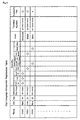
- Fig. 4 shows an example of a registration item to be registered in the sign language interpreter registration table 182.
- the information to select a sign language interpreter refers to information used by the user to select a desired sign language interpreter, which includes sex, age, habitation, specialty, and the level of sign language interpretation.
- the habitation assumes a situation in which the user desires a person who has geographic knowledge on a specific area and, in this example, a ZIP code is used to specify an area.
- the specialty assumes a situation in which, in case the conversation pertains to a specific field, the user desires a person who has expert knowledge of the field or is familiar with the topics in the field.
- the fields a sign language interpreter is familiar with are classified into several categories to be registered, such as politics, law, business, education, science and technology, medical care, language, sports, and hobby.
- the specialties are diverse, such that they may be registered hierarchically and searched through at a level desired by the user when selected.
- each sign language interpreter may be registered in advance for the user to select a qualified person as a sign language interpreter.
- the terminal number to be registered is the telephone number of the terminal, because in this example a videophone terminal connected to a public telephone line is provided.
- an availability flag is provided to indicate whether sign language interpretation can be accepted.
- a registered sign language interpreter can call the sign language interpretation center from his/her terminal and enter a command by using a dial pad to set/reset the availability flag.
- a sign language interpreter registered in the sign language interpreter registration table can set the availability flag only when he/she is available for sign language interpretation, thereby eliminating useless calling and allowing the user to select an available sign language interpreter without delay.
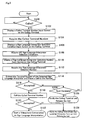
- Fig. 3 shows a processing flowchart of the controller 180.
- the sign language interpretation system 100 allows a deaf-mute person terminal or non-deaf-mute person terminal to propose a sign language interpretation service. From the deaf-mute person terminal, the user places a call to a telephone number on the line I/F for the deaf-mute person terminal. From the non-deaf-mute person terminal, the user places a call to a telephone number on the line I/F for the non-deaf-mute person terminal. This calls the sign language interpreter terminal and the opponent terminal and establishes a videophone connection via sign language interpretation.
- the calling terminal displays a screen to prompt input of the terminal number of the called party shown in Fig. 5 (S102).
- the terminal number of the called party input by the caller is acquired (S104).
- the calling terminal displays a screen to prompt input of the selection conditions for a sign language interpreter shown in Fig. 6 (S106).
- the sign language interpreter selection conditions input by the caller are acquired (S108).
- the sign language interpreter selection conditions input by the caller are sex, age bracket, area, specialty and sign language level.
- a corresponding sign language interpreter is selected based on the sex, age, habitation, specialty, and sign language level registered in the sign language interpreter registration table 182.
- the area is specified by using a ZIP code and a sign language interpreter is selected starting with the habitation closest to the specified area. For any selections, in case it is not necessary to specify a condition, N/A may be selected.
- a sign language interpreter with an availability flag set is selected from among the sign language interpreters satisfying the selection conditions acquired referring to the sign language interpreter registration table 182.
- the calling terminal displays a list of sign language interpreter candidates shown in Fig. 7 to prompt input of the selection number of a desired sign language interpreter (S110).
- the selection number of the sign language interpreter input by the caller is acquired (S112) and the terminal number of the selected sign language interpreter is extracted from the sign language interpreter registration table 182 and the terminal is called (S114).
- the sign language interpreter terminal has accepted the call (S116)
- the called terminal number is extracted and called (S118).
- S120 When the called terminal has accepted the call (S120), a videophone conversation via sign language interpretation starts (S122).
- a sign language interpretation reservation table to register a calling terminal number and a called terminal number may be provided, and the caller and the called party may be notified on a later response from the selected sign language interpreter to set a videophone conversation.
- the sign language interpretation system 100 preferably includes a line I/F, a multiplexer/demultiplexer, a video CODEC, an audio CODEC, a video synthesizer, an audio synthesizer and a controller in the above embodiment, these components need not be provided by individual hardware (H/W). Instead, the function of each component may be provided based on software running on a computer.
- the sign language interpreter terminal 320 similar to the deaf-mute person terminal 300 and the non-deaf-mute person terminal 310, is located outside the sign language interpretation center and called from the sign language interpretation center over a public telephone line to provide a sign language interpretation service in the above embodiment, the invention is not limited thereto. Part or all of the sign language interpreters may be provided in the sign language interpretation center to provide a sign language interpretation service from the sign language interpretation center.
- a sign language interpreter can join a sign language interpretation service anywhere he/she may be, as long as he/she has a terminal which can be connected to a public telephone line.
- the sign language interpreter can provide a sign language interpretation service by using the availability flag to make efficient use of free time. By doing so, it is possible to stably operate a sign language interpretation service even with the problem of difficult reservation of a sign language interpreter.
- the number of volunteer sign language interpreters is increasing presently. A volunteer who is available only irregularly can provide a sign language interpretation service by taking advantage of limited free time.
- a function may be provided to input the video signal of the home terminal for later synthesis and display to check the video on the terminal.
- video synthesizers 128, 148, 168 and the audio synthesizers 130, 150 170 are used to synthesize videos and audios for each terminal in the above embodiment, videos and audios from all terminals may be synthesized at the same time, and the resulting video or audio may be transmitted to each terminal.
- a function is provided whereby the telop memories 132, 152, 172 are provided and telops are added to the video synthesizers 128, 148, 168 in order to display a text telop on each terminal in the above embodiment
- a function may be provided whereby a telop memory to store audio information and telops are added to the audio synthesizers 130, 150, 170 in order to output an audio message on each terminal.
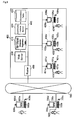
- Fig. 8 is a system block diagram of a sign language interpretation system according to another embodiment of the invention.
- This embodiment shows a system configuration example in which each terminal used by a deaf-mute person, a non-deaf-mute person and a sign language interpreter is an IP (Internet Protocol) type videophone terminal to connect to the internet equipped with a web browser.
- IP Internet Protocol
- a numeral 400 represents a sign language interpretation system installed in a sign language interpretation center to provide a sign language interpretation service.
- the sign language interpretation system 400 connects a deaf-mute person terminal 600 used by a deaf-mute person, a non-deaf-mute person terminal 700 used by a non-deaf-mute person, and any of the sign language interpreter terminals used by a sign language interpreter 431, 432, ... via the Internet 500 in order to provide a videophone conversation service via sign language interpretation between the deaf-mute person and the non-deaf-mute person.
- the deaf-mute person terminal 600, the non-deaf-mute person terminal 700 and the sign language interpreter terminals 431, 432,... each includes a general-purpose processing device (a) such as a personal computer having a video input I/F function, an audio input/output I/F function and a network connection function, the processing device equipped with a keyboard (b) and a mouse (C) for input of information as well as a display (d) for displaying a web page screen presented by a web server 410 and a videophone screen supplied by a communications server 420, a television camera (e) for imaging the sign language of a sign language interpreter, and a headset (f) for performing audio input/output for the sign language interpreter, the processing device has IP videophone software and a web browser installed in this example, a dedicated videophone terminal may be used instead.
- a general-purpose processing device such as a personal computer having a video input I/F function, an audio input/output I/F function and a network connection
- the videophone terminal connected to the Internet may be an IP videophone terminal based on ITU-T recommendation H.323.
- the present invention is not limited thereto, and may use a videophone terminal which has a unique protocol.
- the Internet may be of a wireless LAN type.
- the videophone terminal may be a cellular phone or a portable terminal equipped with a videophone function and including a web access function.
- the sign language interpretation system 400 includes a communications server 420 including a connection table 422 for setting the terminal addresses of a deaf-mute person terminal, a non-deaf-mute person terminal and a sign language interpreter terminal, and a function to interconnect the terminals registered in the connection table 422 and synthesize a video and an audio received from each terminal, and transmit the synthesized video and audio to each terminal, a web server 410 including a sign language interpreter registration table 412 for registering the selection information, terminal address and availability flag of a sign language interpreter as described above, and a function to select a desired sign language interpreter based on an access from a calling terminal using a web browser and set the terminal address of each of the calling terminal, called terminal and sign language interpreter terminal in the connection table 422 of the communication server 420, a router 450 for connecting the web server 410 and the communications server 420 to the Internet, and a plurality of sign language interpreter terminals 431, 432,..., 43N connected to the communications server 420
- Fig. 9 shows an example of a connection table 422.
- the terminal address of a deaf-mute person terminal, the terminal address of a non-deaf-mute person terminal and the terminal address of a sign language interpreter terminal are registered as a set in the connection table 422. This provides a single sign language interpretation service.
- the connection table 422 is designed to register a plurality of such terminal address set depending on the throughput of the communications server 420, thereby simultaneously providing a plurality of sign language interpretation services.
- connection table 422 is an address on the Internet and is generally an IP address
- the present invention is not limited thereto.
- a name given by a directory server may be used.
- the communications server 420 performs packet communications using a predetermined protocol with the deaf-mute person terminal, non-deaf-mute person terminal and sign language interpreter terminal set to the connection table 422 and provides, by way of software processing, functions similar to those provided by a multiplexer/demultiplexer 122, 142, 162, a video CODEC 124, 144, 164, an audio CODEC 126, 146, 166, a video synthesizer 128, 148, 168, an audio synthesizer 130, 150, 170 in the above-described sign language interpretation system 100.
- predetermined videos and audios are communicated between a deaf-mute person terminal, a non-deaf-mute person terminal and a sign language interpreter terminal, and a videophone conversation via sign language interpretation is established between the deaf-mute person and the non-deaf-mute person.
- the sign language interpretation system 100 preferably uses the controller 180 and the telop memories 132, 152, 172 to extract a term registered in the term registration table 184 during a videophone conversation based on instructions from a terminal and displays the term as a telop on the terminal
- the same function may be provided via software processing by the communications server 420 in this embodiment.
- a term specified by each terminal may be displayed as a popup message on the other terminal via the web server 410.
- a telop memory may be provided in the communications server 420 such that a term specified by each terminal will be written into the telop memory via the web server 410 and displayed as a text telop on each terminal.
- the sign language interpretation system 100 uses the controller 180 to interconnect a deaf-mute person terminal, a non-deaf-mute person terminal and a sign language interpreter terminal, the connection procedure is made by the web server 410 in this embodiment because each terminal has a web access function.
- Fig. 10 is a processing flowchart of a connection procedure by the web server 410.
- the sign language interpretation system 400 also permits a deaf-mute person terminal or non-deaf-mute person terminal to request a sign language interpretation service.
- a deaf-mute person or a non-deaf-mute person wishing to request a sign language interpretation service accesses the web server 410 in the sign language interpretation center using a web browser to log in from each terminal, which starts the acceptance of the sign language interpretation service.
- the web server 410 first acquires the terminal address of a caller (S200) and sets the terminal address to the connection table 422 (S202). Next, the web server delivers a screen to prompt input of the called terminal address, similar to that shown in Fig. 5, to the calling terminal (S204). The called terminal address input by the caller is acquired (S206). The web server delivers a screen to prompt input of the selection conditions for a sign language interpreter, similar to that shown in Fig. 6, to the calling terminal (S208). The sign language interpreter selection conditions input by the caller are acquired (S210).
- a sign language interpreter with availability flag set is selected from among the sign language interpreters satisfying the selection conditions acquired from the sign language interpreter registration table 412.
- the web server 410 delivers a list of sign language interpreter candidates similar to that shown in Fig. 7 to the calling terminal to prompt input of the selection number of a desired sign language interpreter (S212).
- the selection number of the sign language interpreter input by the caller is acquired and the terminal address of the selected sign language interpreter is acquired from the sign language interpreter registration table 412 (S214).
- the web server 410 delivers a calling screen to the sign language interpreter terminal (S216).
- the terminal address of the sign language interpreter is set to the connection table 422 (S220).
- the web server 410 delvers a calling screen to the called terminal based on the acquired called terminal address (S222). If the call is accepted by the called terminal (S224), the called terminal address is set to the connection table 422 (S226). Then, a videophone conversation via sign language interpretation starts (S228).
- the calling terminal and the selected sign language interpreter terminal are notified (S236) and the call is released.
- a sign language interpretation reservation table to register a calling terminal address and a called terminal address may be provided and the caller and the called party may be notified on a later response from the selected sign language interpreter to set a videophone conversation.
- sign language interpreter terminal is located in the sign language interpretation system 400 of the sign language interpretation center in the above embodiment, the present invention is not limited thereto. Some or all of the sign language interpreter terminals may be provided outside the sign language interpretation center and connected via the Internet.
- a videophone terminal used by a deaf-mute person, a non-deaf-mute person or a sign language interpreter is a telephone-type videophone terminal connected to a public telephone line
- the videophone terminal is an IP-type videophone terminal connected to the Internet
- the telephone-type videophone terminal and the IP-type videophone terminal can communicate with each other by arranging a gateway to perform protocol conversion therebetween.
- a sign language interpretation system conforming to one protocol may be provided via the gateway to support a videophone terminal conforming to the other protocol.
- the sign language interpretation system enables the user to enjoy or provide a sign language interpretation service anywhere he/she may be, as long as he/she has a terminal which can be connected to a public telephone line or the Internet.
- a sign language interpreter does not always have to visit a sign language interpretation center but can present a sign language interpretation from his/her home or a facility or site where a videophone terminal is located, or provide a sign language interpretation service by using a cellular phone or a portable terminal equipped with a videophone function.
- a person having sign language interpretation abilities may want to register in the sign language interpreter registration table in the sign language interpretation center in order to provide a sign language interpretation service anytime it is convenient to him/her. From the viewpoint of the operation of the sign language interpretation center, it is not necessary for the sign language interpreters to go to the center. This enables efficient operation of the sign language interpretation center both in terms of time and costs. In particular, the number of volunteer sign language interpreters is increasing presently.
- the sign language interpretation service can be provided from a sign language interpreter's home, which facilitates reservation of a sign language interpreter.
Landscapes
- Engineering & Computer Science (AREA)
- Multimedia (AREA)
- Signal Processing (AREA)
- Two-Way Televisions, Distribution Of Moving Picture Or The Like (AREA)
- Telephonic Communication Services (AREA)
Applications Claiming Priority (3)
| Application Number | Priority Date | Filing Date | Title |
|---|---|---|---|
| JP2002269850 | 2002-09-17 | ||
| JP2002269850 | 2002-09-17 | ||
| PCT/JP2003/011757 WO2004028161A1 (fr) | 2002-09-17 | 2003-09-16 | Systeme et procede d'interpretation du langage gestuel |
Publications (2)
| Publication Number | Publication Date |
|---|---|
| EP1542465A1 true EP1542465A1 (fr) | 2005-06-15 |
| EP1542465A4 EP1542465A4 (fr) | 2007-01-03 |
Family
ID=32024821
Family Applications (1)
| Application Number | Title | Priority Date | Filing Date |
|---|---|---|---|
| EP03797602A Withdrawn EP1542465A4 (fr) | 2002-09-17 | 2003-09-16 | Systeme et procede d'interpretation du langage gestuel |
Country Status (10)
| Country | Link |
|---|---|
| US (1) | US20060234193A1 (fr) |
| EP (1) | EP1542465A4 (fr) |
| JP (1) | JPWO2004028161A1 (fr) |
| KR (1) | KR100679871B1 (fr) |
| CN (1) | CN1682535A (fr) |
| AU (1) | AU2003264434B2 (fr) |
| CA (1) | CA2499097A1 (fr) |
| HK (1) | HK1077689A1 (fr) |
| TW (1) | TW200405988A (fr) |
| WO (1) | WO2004028161A1 (fr) |
Cited By (3)
| Publication number | Priority date | Publication date | Assignee | Title |
|---|---|---|---|---|
| CN101539994B (zh) * | 2009-04-16 | 2012-07-04 | 西安交通大学 | 一种手语语音互译系统及手语语音互译方法 |
| CN103810922A (zh) * | 2014-01-29 | 2014-05-21 | 上海寅动信息科技有限公司 | 手语翻译系统 |
| TWI484450B (zh) * | 2011-08-23 | 2015-05-11 | Hon Hai Prec Ind Co Ltd | 手語翻譯系統、手語翻譯裝置及手語翻譯方法 |
Families Citing this family (28)
| Publication number | Priority date | Publication date | Assignee | Title |
|---|---|---|---|---|
| EP1545109A4 (fr) * | 2002-09-27 | 2006-05-03 | Ginganet Corp | Systeme et procede d'interpretation telephonique video |
| CN100592749C (zh) * | 2004-05-12 | 2010-02-24 | 吉峰贵司 | 会话支持系统与会话支持方法 |
| US20070239625A1 (en) * | 2006-04-05 | 2007-10-11 | Language Line Services, Inc. | System and method for providing access to language interpretation |
| CN1937664B (zh) * | 2006-09-30 | 2010-11-10 | 华为技术有限公司 | 一种实现多语言会议的系统及方法 |
| CA2565693C (fr) * | 2006-10-25 | 2016-01-05 | Universite De Sherbrooke | Une methode de representation de renseignements |
| CN102044128A (zh) * | 2009-10-23 | 2011-05-04 | 鸿富锦精密工业(深圳)有限公司 | 紧急事件报警系统及方法 |
| TWI469101B (zh) * | 2009-12-23 | 2015-01-11 | Chi Mei Comm Systems Inc | 手語識別系統及方法 |
| DE102010009738A1 (de) * | 2010-03-01 | 2011-09-01 | Institut für Rundfunktechnik GmbH | Anordnung zum Übersetzen von Lautsprache in eine Gebärdensprache für Gehörlose |
| US8817966B2 (en) * | 2010-07-08 | 2014-08-26 | Lisa Marie Bennett Wrench | Method of collecting and employing information about parties to a televideo conference |
| JP5424359B2 (ja) * | 2011-07-01 | 2014-02-26 | Necシステムテクノロジー株式会社 | 理解支援システム、支援端末、理解支援方法およびプログラム |
| WO2014002391A1 (fr) * | 2012-06-29 | 2014-01-03 | テルモ株式会社 | Dispositif et procédé de traitement d'informations |
| JPWO2014087571A1 (ja) * | 2012-12-07 | 2017-01-05 | テルモ株式会社 | 情報処理装置および情報処理方法 |
| US20150019201A1 (en) * | 2013-07-09 | 2015-01-15 | Stanley F. Schoenbach | Real-time interpreting systems and methods |
| US10274908B2 (en) | 2014-01-13 | 2019-04-30 | Barbara Ander | System and method for alerting a user |
| US10600291B2 (en) | 2014-01-13 | 2020-03-24 | Alexis Ander Kashar | System and method for alerting a user |
| US9852656B2 (en) * | 2014-01-13 | 2017-12-26 | Barbara Ander | Alarm monitoring system |
| US9276971B1 (en) * | 2014-11-13 | 2016-03-01 | Sorenson Communications, Inc. | Methods and apparatuses for video and text in communication greetings for the audibly-impaired |
| CN104463250B (zh) * | 2014-12-12 | 2017-10-27 | 广东工业大学 | 一种基于达芬奇技术的手语识别翻译方法 |
| CN104540035B (zh) * | 2015-01-19 | 2018-02-23 | 安徽易辰无障碍科技有限公司 | 一种无障碍视频手语呼叫系统及方法 |
| CN106375307A (zh) * | 2016-08-30 | 2017-02-01 | 安徽易辰无障碍科技有限公司 | 一种抢单式视频云服务无障碍交流方法及系统 |
| CN107231374A (zh) * | 2017-07-08 | 2017-10-03 | 长沙手之声信息科技有限公司 | 基于在线手语翻译的聋人远程聊天方法 |
| US10909333B2 (en) * | 2017-11-07 | 2021-02-02 | Carrier Corporation | Machine interpretation of distress situations using body language |
| CN107819962A (zh) * | 2017-11-09 | 2018-03-20 | 上海市共进通信技术有限公司 | 基于家庭网关实现智能通话功能的系统及方法 |
| US10127833B1 (en) | 2017-11-10 | 2018-11-13 | Sorenson Ip Holdings Llc | Video relay service, communication system, and related methods for providing remote assistance to a sign language interpreter during a communication session |
| CN108766434B (zh) * | 2018-05-11 | 2022-01-04 | 东北大学 | 一种手语识别翻译系统及方法 |
| CN110083250A (zh) * | 2019-05-14 | 2019-08-02 | 长沙手之声信息科技有限公司 | 一种支持手语在线翻译的无障碍会议系统 |
| JP7489106B2 (ja) * | 2021-02-01 | 2024-05-23 | 一般財団法人日本財団電話リレーサービス | 電話リレーシステム、及びコミュニケーションプラットフォーム |
| CN113361505B (zh) * | 2021-08-10 | 2021-12-07 | 杭州一知智能科技有限公司 | 基于对比解耦元学习的非特定人的手语翻译方法和系统 |
Family Cites Families (18)
| Publication number | Priority date | Publication date | Assignee | Title |
|---|---|---|---|---|
| US5047952A (en) * | 1988-10-14 | 1991-09-10 | The Board Of Trustee Of The Leland Stanford Junior University | Communication system for deaf, deaf-blind, or non-vocal individuals using instrumented glove |
| JP2779448B2 (ja) * | 1988-11-25 | 1998-07-23 | 株式会社エイ・ティ・アール通信システム研究所 | 手話言語変換装置 |
| JP3289304B2 (ja) * | 1992-03-10 | 2002-06-04 | 株式会社日立製作所 | 手話変換装置および方法 |
| US5659764A (en) * | 1993-02-25 | 1997-08-19 | Hitachi, Ltd. | Sign language generation apparatus and sign language translation apparatus |
| JPH06337631A (ja) * | 1993-05-27 | 1994-12-06 | Hitachi Ltd | 手話対話における対話制御装置 |
| US5982853A (en) * | 1995-03-01 | 1999-11-09 | Liebermann; Raanan | Telephone for the deaf and method of using same |
| US6477239B1 (en) * | 1995-08-30 | 2002-11-05 | Hitachi, Ltd. | Sign language telephone device |
| EP0848552B1 (fr) * | 1995-08-30 | 2002-05-29 | Hitachi, Ltd. | Systeme telephonique de language gestuel pour la communication entre malentendants et non-malentendants |
| US5917888A (en) * | 1996-06-28 | 1999-06-29 | Mci Communications Corporation | System and method for enhanced telecommunications relay service with easy extension feature |
| US6240392B1 (en) * | 1996-08-29 | 2001-05-29 | Hanan Butnaru | Communication device and method for deaf and mute persons |
| JPH10262228A (ja) * | 1997-03-18 | 1998-09-29 | Toshiba Corp | 通信システム、多地点制御装置、映像情報表示方法 |
| JP2000152203A (ja) * | 1998-11-12 | 2000-05-30 | Mitsubishi Electric Corp | ビデオ対応コンピュータ・テレフォニー装置 |
| JP2002064634A (ja) * | 2000-08-22 | 2002-02-28 | Nippon Telegr & Teleph Corp <Ntt> | 通訳サービス方法及び通訳サービスシステム |
| US6570963B1 (en) * | 2000-10-30 | 2003-05-27 | Sprint Communications Company L.P. | Call center for handling video calls from the hearing impaired |
| JP2002169988A (ja) * | 2000-12-04 | 2002-06-14 | Nippon Telegr & Teleph Corp <Ntt> | 手話通訳提供方法及びシステム |
| JP2002262249A (ja) * | 2001-02-27 | 2002-09-13 | Up Coming:Kk | 対話支援システム及び方法、並びにコンピュータプログラム |
| US7333507B2 (en) * | 2001-08-31 | 2008-02-19 | Philip Bravin | Multi modal communications system |
| US7774194B2 (en) * | 2002-08-14 | 2010-08-10 | Raanan Liebermann | Method and apparatus for seamless transition of voice and/or text into sign language |
-
2003
- 2003-09-15 TW TW092125372A patent/TW200405988A/zh unknown
- 2003-09-16 AU AU2003264434A patent/AU2003264434B2/en not_active Ceased
- 2003-09-16 CA CA002499097A patent/CA2499097A1/fr not_active Abandoned
- 2003-09-16 CN CNA038219395A patent/CN1682535A/zh active Pending
- 2003-09-16 US US10/527,916 patent/US20060234193A1/en not_active Abandoned
- 2003-09-16 HK HK05112171.1A patent/HK1077689A1/zh unknown
- 2003-09-16 KR KR1020057002914A patent/KR100679871B1/ko not_active Expired - Fee Related
- 2003-09-16 JP JP2004537564A patent/JPWO2004028161A1/ja active Pending
- 2003-09-16 EP EP03797602A patent/EP1542465A4/fr not_active Withdrawn
- 2003-09-16 WO PCT/JP2003/011757 patent/WO2004028161A1/fr not_active Ceased
Cited By (4)
| Publication number | Priority date | Publication date | Assignee | Title |
|---|---|---|---|---|
| CN101539994B (zh) * | 2009-04-16 | 2012-07-04 | 西安交通大学 | 一种手语语音互译系统及手语语音互译方法 |
| TWI484450B (zh) * | 2011-08-23 | 2015-05-11 | Hon Hai Prec Ind Co Ltd | 手語翻譯系統、手語翻譯裝置及手語翻譯方法 |
| CN103810922A (zh) * | 2014-01-29 | 2014-05-21 | 上海寅动信息科技有限公司 | 手语翻译系统 |
| CN103810922B (zh) * | 2014-01-29 | 2016-03-23 | 上海天昊信息技术有限公司 | 手语翻译系统 |
Also Published As
| Publication number | Publication date |
|---|---|
| US20060234193A1 (en) | 2006-10-19 |
| KR20050083647A (ko) | 2005-08-26 |
| AU2003264434A1 (en) | 2004-04-08 |
| AU2003264434B2 (en) | 2007-09-20 |
| TW200405988A (en) | 2004-04-16 |
| CN1682535A (zh) | 2005-10-12 |
| HK1077689A1 (zh) | 2006-02-17 |
| JPWO2004028161A1 (ja) | 2006-01-19 |
| WO2004028161A1 (fr) | 2004-04-01 |
| EP1542465A4 (fr) | 2007-01-03 |
| CA2499097A1 (fr) | 2004-04-01 |
| KR100679871B1 (ko) | 2007-02-07 |
Similar Documents
| Publication | Publication Date | Title |
|---|---|---|
| AU2003264434B2 (en) | Sign language interpretation system and sign language interpretation method | |
| AU2003266592B2 (en) | Video telephone interpretation system and video telephone interpretation method | |
| AU2003264435B2 (en) | A videophone sign language interpretation assistance device and a sign language interpretation system using the same. | |
| AU2003264436B2 (en) | A videophone sign language conversation assistance device and a sign language interpretation system using the same | |
| US7225224B2 (en) | Teleconferencing server and teleconferencing system | |
| AU2003266594B2 (en) | Telephone interpretation aid device and telephone interpretation system using the same | |
| AU2003266593A1 (en) | Telephone interpretation system | |
| WO2006028181A1 (fr) | Terminal de communication et méthode de communication de celui-ci | |
| JP2004007482A (ja) | 電話会議サーバおよび電話会議システム | |
| JPH04294667A (ja) | マルチメディア端末 | |
| JPH11341459A (ja) | 書籍型テレビ電話装置および書籍型テレビ電話通信方法およびコンピュータが読み取り可能なプログラムを記録した記録媒体 |
Legal Events
| Date | Code | Title | Description |
|---|---|---|---|
| PUAI | Public reference made under article 153(3) epc to a published international application that has entered the european phase |
Free format text: ORIGINAL CODE: 0009012 |
|
| 17P | Request for examination filed |
Effective date: 20050322 |
|
| AK | Designated contracting states |
Kind code of ref document: A1 Designated state(s): AT BE BG CH CY CZ DE DK EE ES FI FR GB GR HU IE IT LI LU MC NL PT RO SE SI SK TR |
|
| AX | Request for extension of the european patent |
Extension state: AL LT LV MK |
|
| DAX | Request for extension of the european patent (deleted) | ||
| RBV | Designated contracting states (corrected) |
Designated state(s): DE FR GB IT |
|
| A4 | Supplementary search report drawn up and despatched |
Effective date: 20061204 |
|
| RIC1 | Information provided on ipc code assigned before grant |
Ipc: H04N 7/15 20060101ALI20061128BHEP Ipc: H04N 7/14 20060101AFI20040408BHEP |
|
| STAA | Information on the status of an ep patent application or granted ep patent |
Free format text: STATUS: THE APPLICATION IS DEEMED TO BE WITHDRAWN |
|
| 18D | Application deemed to be withdrawn |
Effective date: 20090401 |