EP1551218B1 - Plants de ble presentant une resistance accrue a un herbicide a base d'imidazolinone - Google Patents
Plants de ble presentant une resistance accrue a un herbicide a base d'imidazolinone Download PDFInfo
- Publication number
- EP1551218B1 EP1551218B1 EP03773883.8A EP03773883A EP1551218B1 EP 1551218 B1 EP1551218 B1 EP 1551218B1 EP 03773883 A EP03773883 A EP 03773883A EP 1551218 B1 EP1551218 B1 EP 1551218B1
- Authority
- EP
- European Patent Office
- Prior art keywords
- plant
- methyl
- wheat
- nucleic acid
- imidazolin
- Prior art date
- Legal status (The legal status is an assumption and is not a legal conclusion. Google has not performed a legal analysis and makes no representation as to the accuracy of the status listed.)
- Expired - Lifetime
Links
Images

Classifications
-
- A—HUMAN NECESSITIES
- A01—AGRICULTURE; FORESTRY; ANIMAL HUSBANDRY; HUNTING; TRAPPING; FISHING
- A01H—NEW PLANTS OR NON-TRANSGENIC PROCESSES FOR OBTAINING THEM; PLANT REPRODUCTION BY TISSUE CULTURE TECHNIQUES
- A01H5/00—Angiosperms, i.e. flowering plants, characterised by their plant parts; Angiosperms characterised otherwise than by their botanic taxonomy
- A01H5/10—Seeds
-
- A—HUMAN NECESSITIES
- A01—AGRICULTURE; FORESTRY; ANIMAL HUSBANDRY; HUNTING; TRAPPING; FISHING
- A01H—NEW PLANTS OR NON-TRANSGENIC PROCESSES FOR OBTAINING THEM; PLANT REPRODUCTION BY TISSUE CULTURE TECHNIQUES
- A01H6/00—Angiosperms, i.e. flowering plants, characterised by their botanic taxonomy
- A01H6/46—Gramineae or Poaceae, e.g. ryegrass, rice, wheat or maize
- A01H6/4678—Triticum sp. [wheat]
-
- C—CHEMISTRY; METALLURGY
- C12—BIOCHEMISTRY; BEER; SPIRITS; WINE; VINEGAR; MICROBIOLOGY; ENZYMOLOGY; MUTATION OR GENETIC ENGINEERING
- C12N—MICROORGANISMS OR ENZYMES; COMPOSITIONS THEREOF; PROPAGATING, PRESERVING, OR MAINTAINING MICROORGANISMS; MUTATION OR GENETIC ENGINEERING; CULTURE MEDIA
- C12N15/00—Mutation or genetic engineering; DNA or RNA concerning genetic engineering, vectors, e.g. plasmids, or their isolation, preparation or purification; Use of hosts therefor
- C12N15/09—Recombinant DNA-technology
- C12N15/63—Introduction of foreign genetic material using vectors; Vectors; Use of hosts therefor; Regulation of expression
- C12N15/79—Vectors or expression systems specially adapted for eukaryotic hosts
- C12N15/82—Vectors or expression systems specially adapted for eukaryotic hosts for plant cells, e.g. plant artificial chromosomes (PACs)
- C12N15/8241—Phenotypically and genetically modified plants via recombinant DNA technology
- C12N15/8261—Phenotypically and genetically modified plants via recombinant DNA technology with agronomic (input) traits, e.g. crop yield
- C12N15/8271—Phenotypically and genetically modified plants via recombinant DNA technology with agronomic (input) traits, e.g. crop yield for stress resistance, e.g. heavy metal resistance
- C12N15/8274—Phenotypically and genetically modified plants via recombinant DNA technology with agronomic (input) traits, e.g. crop yield for stress resistance, e.g. heavy metal resistance for herbicide resistance
-
- C—CHEMISTRY; METALLURGY
- C12—BIOCHEMISTRY; BEER; SPIRITS; WINE; VINEGAR; MICROBIOLOGY; ENZYMOLOGY; MUTATION OR GENETIC ENGINEERING
- C12N—MICROORGANISMS OR ENZYMES; COMPOSITIONS THEREOF; PROPAGATING, PRESERVING, OR MAINTAINING MICROORGANISMS; MUTATION OR GENETIC ENGINEERING; CULTURE MEDIA
- C12N9/00—Enzymes; Proenzymes; Compositions thereof; Processes for preparing, activating, inhibiting, separating or purifying enzymes
- C12N9/10—Transferases (2.)
- C12N9/1022—Transferases (2.) transferring aldehyde or ketonic groups (2.2)
Definitions
- the present invention relates in general to plants having an increased resistance to imidazolinone herbicides. More specifically, the present invention relates to wheat plants obtained by mutagenesis and cross-breeding and transformation that have an increased resistance to imidazolinone herbicides.
- Acetohydroxyacid synthase (AHAS; EC 4.1.3.18, acetolactate synthase (ALS)), encoded by the Als nucleic acid, is the first enzyme that catalyzes the biochemical synthesis of the branched chain amino acids valine, leucine, and isoleucine ( Singh B. K., 1999, Biosynthesis of valine, leucine and isoleucine in: Singh B. K. (Ed) Plant amino acids. Marcel Dekker Inc. New York, New York. Pg 227-247 ).
- AHAS is the site of action of four structurally diverse herbicide families including the sulfonylureas ( LaRossa RA and Falco SC, 1984, Trends Biotechnol.
- Imidazolinone and sulfonylurea herbicides are widely used in modem agriculture due to their effectiveness at very low application rates and relative non-toxicity in animals. By inhibiting AHAS activity, these families of herbicides prevent further growth and development of susceptible plants including many weed species.
- imidazolinone herbicides are PURSUIT® (imazethapyr), SCEPTER® (imazaquin) and ARSENAL® (imazapyr).
- sulfonylurea herbicides are chlorsulfuron, metsulfuron methyl, sulfometuron methyl, chlorimuron ethyl, thifensulfuron methyl, tribenuron methyl, bensulfuron methyl, nicosulfuron, ethametsulfuron methyl, rimsulfuron, triflusulfuron methyl, triasulfuron, primisulfuron methyl, cinosulfuron, amidosulfuron, fluzasulfuron, imazosulfuron, pyrazosulfuron ethyl, and halosulfuron.
- imidazolinones herbicides are favored for application by spraying over the top of a wide area of vegetation.
- the ability to spray an herbicide over the top of a wide range of vegetation decreases the costs associated with plantation establishment and maintenance, and decreases the need for site preparation prior to use of such chemicals.
- Spraying over the top of a desired tolerant species also results in the ability to achieve maximum yield potential of the desired species due to the absence of competitive species.
- the ability to use such spray-over techniques is dependent upon the presence of imidazolinone resistant species of the desired vegetation in the spray over area.
- leguminous species such as soybean are naturally resistant to imidazolinone herbicides due to their ability to rapidly metabolize the herbicide compounds ( Shaner and Robson, 1985, Weed Sci. 33:469-471 ).
- Other crops such as corn ( Newhouse et al., 1992, Plant Physiol. 100:882-886 ) and rice ( Barrett et al., 1989, Crop Safeners for Herbicides, Academic Press New York, pp. 195-220 ) are susceptible to imidazolinone herbicides.
- the differential sensitivity to the imidazolinone herbicides is dependent on the chemical nature of the particular herbicide and differential metabolism of the compound from a toxic to a non-toxic form in each plant ( Shaner et al., 1984, Plant Physiol. 76:545-546 ; Brown et al., 1987, Pestic. Biochem. Physiol. 27:24-29 ).
- Other plant physiological differences such as absorption and translocation also play an important role in sensitivity ( Shaner and Robson, 1985, Weed Sci. 33:469-471 ).
- Crop cultivars resistant to imidazolinones, sulfonylureas and triazolopyrimidines have been successfully produced using seed, microspore, pollen, and callus mutagenesis in Zea mays, Brassica napus, Glycine max, and Nicotiana tabacum ( Sebastian et al., 1989, Crop Sci. 29:1403-1408 ; Swanson et al., 1989, Theor. Appl. Genet. 78:525-530 ; Newhouse et al., 1991, Theor. Appl. Genet. 83:65-70 ; Sathasivan et al., 1991, Plant Physiol.
- U.S. Patent Nos. 4,761,373 , 5,331,107 , 5,304,732 , 6,211,438 , 6,211,439 , and 6,222,100 generally describe the use of an altered Als nucleic acid to elicit herbicide resistance in plants, and specifically disclose certain imidazolinone resistant corn lines.
- U.S. Patent No. 5,013,659 discloses plants exhibiting herbicide resistance possessing mutations in at least one amino acid in one or more conserved regions.
- the present invention provides wheat plants comprising a Triticum aestivum A-genome imidazolinone tolerance Als allele (Imi3) nucleic acid encoding an IMI polypeptide which comprises a mutation in Domain E that results in a serine to asparagine substitution in the IMI protein as compared to a wild-type AHAS protein, wherein the Triticum aestivum Imi3 nucleic acid comprises a polynucleotide sequence set forth in SEQ ID NO:3 and confers upon the wheat plant increased resistance to an imidazolinone herbicide as compared to a wild-type variety of the plant.
- the wheat plants can contain one, two, three, or more IMI alleles.
- the wheat plant may comprise at least one IMI nucleic acid selected from the group consisting of an Imi1 nucleic acid, an Imi2 nucleic acid, and an Imi3 nucleic acid.
- the at least one IMI nucleic acid comprises a Krichauff cultivar IMI nucleic acid.
- the wheat plant comprises multiple IMI nucleic acids located on different genomes.
- the multiple IMI nucleic acids comprise a Triticum aestivum Imi1 nucleic acid and a Triticum aestivum Imi3 nucleic acid.
- the multiple IMI nucleic acids comprise a Brookton cultivar Imi1 nucleic acid and a Krichauff cultivar Imi3 nucleic acid.
- the IMI nucleic acids encode proteins comprising a mutation in a conserved amino acid sequence selected from the group consisting of a Domain A, a Domain B, a Domain C, a Domain D, and a Domain E. More preferably, the mutation is in a conserved Domain.
- the present invention also provides triticale plants comprising a Triticum aestivum A-genome imidazolinone tolerance Als allele (Imi3) nucleic acid encoding an IMI polypeptide which comprises a mutation in Domain E that results in a serine to asparagine substitution in the IMI protein as compared to a wild-type AHAS protein, wherein the Triticum aestivum Imi3 nucleic acid comprises a polynucleotide sequence set forth in SEQ ID NO:3 and confers upon the triticale plant has increased tolerance to an imidazolinone herbicide as compared to a wild-type variety of the triticale plant.
- Imi3 Triticum aestivum A-genome imidazolinone tolerance Als allele
- Described herein are triticale plants which comprise at least one IMI nucleic acid selected from the group consisting of an Imi1 nucleic acid, an Imi2 nucleic acid, and an Imi3 nucleic acid.
- the at least one IMI nucleic acid comprises a Triticum aestivacm Krichauff cultivar IMI nucleic acid.
- the wheat plant comprises multiple IMI nucleic acids located on different genomes.
- the multiple IMI nucleic acids comprise a Brookton cultivar Imi1 nucleic acid and a Krichauff cultivar Imi3 nucleic acid.
- the IMI nucleic acids described herein encode proteins comprising a mutation in a conserved amino acid sequence selected from the group consisting of a Domain A, a Domain B, a Domain C, a Domain D, and a Domain E. Also provided are plant parts and plant seeds derived from the triticale plants described herein and comprising the Triticum aestivum Imi3 nucleic acid that comprises a polynucleotide sequence set forth in SEQ ID NO:3.
- the IMI nucleic acids described herein comprise a polynucleotide sequence selected from the group consisting of: a polynucleotide as defined in SEQ ID N0:1; a polynucleotide as defined in SEQ ID NO:3; a polynucleotide sequence encoding a polypeptide as defined in SEQ ID NO:2; a polynucleotide sequence encoding a polypeptide as defined in SEQ ID NO:4; a polynucleotide comprising at least 60 consecutive nucleotides of any of the aforementioned polynucleotides; and a polynucleotide complementary to any of the aforementioned polynucleotides.
- the plants of the present invention can be transgenic or non-transgenic.
- non-transgenic wheat plants having increased resistance to imidazolinone herbicides include a wheat plant having an ATCC Patent Deposit Designation Number PTA-4256 or PTA-4257; or a mutant, recombinant, or genetically engineered derivative of the plant with ATCC Patent Deposit Designation Number PTA-4256 or PTA-4257; or of any progeny of the plant with ATCC Patent Deposit Designation Number PTA-4256 or PTA-4257; or a plant that is a progeny of any of these plants.
- compositions of the present invention are provided. Described herein are methods of modifying a plant's tolerance to an imidazolinone herbicide comprising modifying the expression of an IMI nucleic acid in the plant. Also described are methods of producing a transgenic plant having increased tolerance to an imidazolinone herbicide comprising, transforming a plant cell with an expression vector comprising one or more IMI nucleic acids and generating the plant from the plant cell.
- the invention further includes a method of protecting a wheat or triticale plant from weeds within the vicinity of the plant, comprising applying an imidazolinone herbicide to the weeds and to the plant, wherein the plant has increased resistance to the imidazolinone herbicide as compared to a wild type variety of the plant and wherein the plant comprises a Triticum aestivum A-genome imidazolinone tolerance Als allele (Imi3) nucleic acid encoding an IMI polypeptide which comprises a mutation in Domain E that results in a serine to asparagine substitution in the IMI protein as compared to a wild-type AHAS protein, wherein the Triticum aestivum Imi3 nucleic acid comprises a polynucleotide sequence set forth in SEQ ID NO:3.
- the plants comprise multiple IMI nucleic acids that are located on different wheat genomes.
- the present invention is directed to wheat plants, wheat plant parts and wheat plant cells having increased resistance to imidazolinone herbicides.
- the present invention also includes seeds produced by the wheat plants described herein and methods for protecting wheat plants described herein from weeds in the vicinity of the plants. It is to be understood that as used in the specification and in the claims, “a” or “an” can mean one or more, depending upon the context in which it is used. Thus, for example, reference to "a cell” can mean that at least one cell can be utilized.
- the term "wheat plant” refers to a plant that is a member of the Triticum genus.
- the wheat plants of the present invention can be members of a Triticum genus including, but not limited to, T. aestivum, T. turgidum , T. timopheevii, T. monococcum, T. zhukovskyi and T. urartu and hybrids thereof.
- T. aestivum subspecies included within the present invention are aestivum (common wheat), compactum (club wheat), macha (macha wheat), vavilovi (vavilovi wheat), spelta and sphaecrococcum (shot wheat). Examples of T.
- turgidum subspecies included within. the present invention are turgidum , carthlicum, dicoccom, durum, paleocolchicum, polonicum, turanicum, and dicoccoides.
- T. monococcum subspecies included within the present invention are monococcum (einkorn) and aegilopoides.
- the wheat plant is a member of the Tritium aestivum L. species, and more particularly, a Brookton or Krichauff cultivar.
- wheat plant is intended to encompass wheat plants at any stage of maturity or development, as well as any tissues or organs (plant parts) taken or derived from any such plant unless otherwise clearly indicated by context.
- Plant parts include, but are not limited to, stems, roots, flowers, ovules, stamens, leaves, embryos, meristematic regions, callus tissue, anther cultures, gametophytes, sporophytes, pollen, microspores, protoplasts, and the like.
- the present invention also includes seeds produced by the wheat plants of the present invention. In one embodiment, the seeds are true breeding for an increased resistance to an imidazolinones herbicide as compared to a wild type variety of the wheat plant seed.
- the present invention also encompasses triticale plants, triticale plant parts, and triticale plant cells having increased tolerance to imidazolinone herbicides.
- a "triticale plant” refers to a plant that is created by crossing a rye plant ( Secale cereale ) with either a tetraploid wheat plant (e.g. Triticum turgidum ) or a hexaploid wheat plant (e.g. Tritium aestivum ) .
- the present invention also includes seeds produced by the triticale plants described herein and methods for protecting triticale plants described herein from weeds in the vicinity of the plants.
- the present invention describes a wheat plant comprising at least one IMI nucleic acid, wherein the wheat plant has increased tolerance to an imidazolinone herbicide as compared to a wild-type variety of the plant. It is possible for the wheat plants of the present invention to have multiple IMI nucleic acids from different genomes since these plants can contain more than one genome. For example, a Triticum aestivum wheat plant contains three genomes sometimes referred to as the A, B, and D genomes. Because AHAS is a required metabolic enzyme, it is assumed that each genome has at least one gene coding for the AHAS enzyme (i.e. at least one Als gene), commonly seen with other metabolic enzymes in hexaploid wheat that have been mapped.
- Als gene locus refers to the position of an Als gene on a genome
- Als gene and Als nucleic acid refer to a nucleic acid encoding the AHAS enzyme.
- the Als nucleic acid on each genome differs in its nucleotide sequence from an Als nucleic acid on another genome.
- One of skill in the art can determine the genome of origin of each Als nucleic acid through genetic crossing and/or either sequencing methods or exonuclease digestion methods known to those of skill in the art.
- Als1 nucleic acid As used herein, the terms "Als1 nucleic acid,” “Als2 nucleic acid,” and “Als3 nucleic acid” refer to Als nucleic acids located on three different genomes.
- the Als3 gene locus is located on the A genome
- the Als2 gene locus is located on the B genome
- the Als1 gene locus is located on the D genome.
- IMI nucleic acids derived from the A, B, or D genomes are distinguished and designated as Imi1, Imi2, or Imi3 nucleic acids, respectively.
- IMI nucleic acid refers to an Als nucleic acid having a sequence that is mutated from a wild type Als nucleic acid and that confers increased imidazolinone tolerance to a plant in which it is expressed.
- Imi1 nucleic acid refers to the imidazolinone tolerance alleles of the Als1, Als2, and Als3 genes, respectively. Because wheat plants have two copies of each genome, a wheat plant contains two copies of each particular Als nucleic acid.
- a Triticum aestivum wheat plant comprises two copies each of the A, B, and D genomes, and therefore, two copies each of the Als3, Als2, and Als1 genes.
- the term "IMI allele” refers to a single copy of a particular IMI nucleic acid. Accordingly, for the purposes of the present invention, a wheat plant may have two Imi2 alleles, one on each of two copies of the B genome.
- the wheat plant comprises multiple IMI nucleic acids.
- multiple IMI nucleic acids refers to the presence of different IMI nucleic acids in the plant and not to whether the plant is homozygous or heterozygous at a particular Als locus.
- a plant comprising multiple IMI nucleic acids may comprise an Imi2 and an Imi3 nucleic acid, as opposed to having two copies of an Imi2 nucleic acid.
- the Imi1 class of nucleic acids includes the FS-4 gene as described by Newhouse et al. (1992 Plant Physiol. 100:882-886 ) and the Brookton IMI1 BR-8 gene described in more detail below.
- the Imi3 class of nucleic acids includes the Krichauff IMI3 K-42 gene described below.
- Each Imi class can include members from different wheat species. Therefore, each Imi class includes IMI nucleic acids that differ in their nucleotide sequence but that are nevertheless designated as originating from, or being located on, the same wheat genome using inheritance studies as known to those of ordinary skill in the art.
- wheat plants are described herein which comprise at least one IMI nucleic acid, wherein the wheat plant has increased resistance to an imidazolinone herbicide as compared to a wild-type variety of the plant and wherein the at least one IMI nucleic acid is selected from the group consisting of an Imi1 nucleic acid, an Imi2 nucleic acid, and Imi3 nucleic acid.
- the plant comprises an Imi1 nucleic and an Imi3 nucleic acid, preferably the Imi1 nucleic acid comprises the polynucleotide sequence shown in SEQ ID NO:1, and the Imi3 nucleic acid comprises the polynucleotide sequence shown in SEQ ID NO:3, or the plant comprises an Imi2 nucleic acid.
- the present invention also encompasses an imidazolinone tolerant triticale plant.
- a "triticale plant” refers to a plant that is created by crossing a rye plant ( Secale cereale ) with either a tetraploid wheat plant (e.g. Triticum turgidum ) or a hexaploid wheat plant (e.g. Triticum aestivum ) .
- Imidazolinone tolerant triticale plants are described herein which comprise at least one IMI nucleic acid, wherein the triticale plant has increased tolerance to an imidazolinone herbicide as compared to a wild-type variety of the plant and wherein the at least one IMI nucleic acid is selected from a group consisting of an Imi1 nucleic acid, an Imi2 nucleic acid, and an Imi3 nucleic acid.
- the plant comprises both an Imi1 nucleic acid and an Imi3 nucleic acid, preferably the Imi1 nucleic acid comprises the polynucleotide sequence of SEQ ID NO:1, and the Imi3 nucleic acid comprises the polynucleotide sequence of SEQ ID NO:3.
- nucleic acids refers to a nucleic acid “located on” or “derived from” a particular genome.
- located on refers to a nucleic acid contained within that particular genome.
- derived from refers to a nucleic acid that has been removed or isolated from that genome.
- isolated is defined in more detail below.
- the present invention includes wheat plants comprising one, two, three, or more IMI alleles, wherein the wheat plant has increased resistance to an imidazolinone herbicide as compared to a wild-type variety of the plant.
- the IMI alleles described herein can comprise a nucleotide sequence selected from the group consisting of a polynucleotide as defined in SEQ ID NO: 1; a polynucleotide as defined in SEQ ID NO:3; a polynucleotide encoding a polypeptide as defined in SEQ ID NO: 2; a polynucleotide encoding a polypeptide as defined in SEQ ID NO:4; a polynucleotide comprising at least 60 consecutive nucleotides of any of the aforementioned polynucleotides; and a polynucleotide complementary to any of the aforementioned polynucleotides.
- the present invention also includes triticale plants comprising one, two, three, or more IMI alleles, wherein the triticale plant has increased tolerance to an imidazolinone herbicide as compared to a wild-type variety of the plant.
- the IMI alleles described herein can comprise a polynucleotide sequence selected from the group consisting of a polynucleotide as defined in SEQ ID NO:1 or SEQ ID NO:3; a polynucleotide encoding a polypeptide as defined in SEQ ID NO:2 or SEQ ID NO:4; a polynucleotide comprising at least 60 consecutive nucleotides of any of the aforementioned polynucleotides; and a polynucleotide complementary to any of the aforementioned polynucleotides.
- the wheat plant or triticale plant comprises two different IMI nucleic acids, wherein the nucleic acids are derived from or located on different wheat genomes.
- the two nucleic acids are an Imi1 nucleic acid and an Imi3 nucleic acid.
- the Imi1 nucleic acid comprises the polynucleotide sequence of SEQ ID NO:1
- the Imi3 nucleic acid comprises the polynucleotide sequence of SEQ ID NO:3.
- the wheat plant or triticale plant comprises one IMI nucleic acid, wherein the nucleic acid comprises the polynucleotide sequence of SEQ ID NO:3.
- the wheat plant comprises greater than two IMI nucleic acids wherein each IMI nucleic acid is from a different genome. At least one of the IMI nucleic acids comprises a polynucleotide sequence set forth in SEQ ID NO:3.
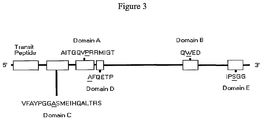
- the isolated IMI nucleic acids described herein encode amino acid sequences comprising a mutation in a domain that is conserved among several AHAS proteins. These conserved domains are referred to herein as Domain A, Domain B, Domain C, Domain D, and Domain E.
- Figure 3 shows the general location of each domain in an AHAS protein.
- Domain A contains the amino acid sequence AITGQVPRRMIGT (SEQ ID NO:5).
- Domain B contains the amino acid sequence QWED (SEQ ID NO:6).
- Domain C contains the amino acid sequence VFAYPGGASMEIHQALTRS (SEQ ID NO:7).
- Domain D contains the amino acid sequence AFQETP (SEQ ID NO:8).
- Domain E contains the amino acid sequence IPSGG (SEQ ID NO:9). There may be slight variations in the conserved domains, for example, in cockleber plants, the serine residue in Domain E is replaced by an alanine residue.
- wheat plants or triticale plants are described herein which comprise an IMI nucleic acid that encodes an amino acid sequence having a mutation in a conserved domain selected from the group consisting of a Domain A, a Domain B, a Domain C, a Domain D, and a Domain E.
- the wheat plant or triticale plant comprises an IMI nucleic acid that encodes an amino acid sequence having a mutation in a Domain E.
- the mutations in the conserved domains occur at the locations indicated by the following underlining: AITGQV P RRMIGT (SEQ ID NO:5); Q W ED (SEQ ID NO:6); VFAYPGG A SMEIHQALTRS (SEQ ID NO:7); A FQETP (SEQ ID NO:8), and IPSGG (SEQ ID NO:9).
- AITGQV P RRMIGT SEQ ID NO:5
- Q W ED SEQ ID NO:6
- VFAYPGG A SMEIHQALTRS
- FQETP SEQ ID NO:8
- IPSGG SEQ ID NO:9
- the imidazolinone herbicide can be selected from, but is not limited to, PURSUIT® (imazethapyr), CADRE® (imazapic), RAPTOR® (imazamox), SCEPTER® (imazaquin), ASSERT® (imazethabenz), ARSENAL® (imazapyr), a derivative of any of the aforementioned herbicides, or a mixture of two or more of the aforementioned herbicides, for example, imazapyr/imazamox (ODYSSEY®).
- the imidazolinone herbicide can be selected from, but is not limited to, 2-(4-isopropyl-4-methyl-5-oxo-2-imidiazolin-2-yl)-nicotinic acid, 2-(4-isopropyl)-4-methyl-5-oxo-2-imidazolin-2-yl)-3-quinolinecarboxylic acid, 5-ethyl-2-(4-isopropyl-4-methyl-5-oxo-2-imidazolin-2-yl)-nicotinic acid, 2-(4-isopropyl-4-methyl-5-oxo-2-imidazolin-2-yl)-5-(methoxymethyl)-nicotinic acid, 2-(4-isopropyl-4-methyl-5-oxo-2-imidazolin-2-yl)-5-methylnicotinic acid, and a mixture of methyl 6-(4-isopropyl-4-methyl-5-oxo-2-imidazol
- the wheat plants described herein can be either transgenic wheat plants or non-transgenic wheat plants.
- the triticale plants described herein can be either transgenic triticale plants or non-transgenic triticale plants.
- transgenic refers to any plant, plant cell, callus, plant tissue, or plant part, that contains all or part of at least one recombinant polynucleotide. In many cases, all or part of the recombinant polynucleotide is stably integrated into a chromosome or stable extra-chromosomal element, so that it is passed on to successive generations.
- the term "recombinant polynucleotide” refers to a polynucleotide that has been altered, rearranged or modified by genetic engineering. Examples include any cloned polynucleotide, or polynucleotides, that are linked or joined to heterologous sequences.
- the term “recombinant” does not refer to alterations of polynucleotides that result from naturally occurring events, such as spontaneous mutations, or from non-spontaneous mutagenesis followed by selective breeding. Plants containing mutations arising due to non-spontaneous mutagenesis and selective breeding are referred to herein as non-transgenic plants and are included in the present invention.
- the nucleic acids can be derived from different genomes or from the same genome.
- the nucleic acids are located on different genomes or on the same genome.
- Non-transgenic wheat plant cultivar comprising one IMI nucleic acid is the plant cultivar deposited with the ATCC under Patent Deposit Designation Number PTA-4256 and designated herein as the Brookton IMI BR-8 wheat cultivar.
- the Brookton IMI BR-8 wheat cultivar contains an Imi1 nucleic acid.
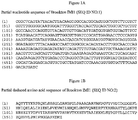
- the partial nucleotide sequence corresponding to the Brookton IMI1 BR-8 gene is shown in SEQ ID NO:1.
- non-transgenic wheat plant cultivar comprising one IMI nucleic acid is the plant cultivar deposited with the ATCC under Patent Deposit Designation Number PTA-4257 and designated herein as the Krichauff IMI K-42 wheat cultivar.
- the Krichauff IMI K-42 wheat cultivar contains an Imi3 nucleic acid.
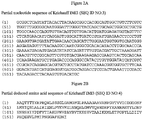
- the partial nucleotide sequence corresponding to the Krichauff IMI K-42 gene is shown in SEQ ID NO:3.
- the plants described herein includes the wheat plant having a Patent Deposit Designation Number PTA-4256 or PTA-4257; a mutant, recombinant, or genetically engineered derivative of the plant with Patent Deposit Designation Number PTA-4256 or PTA-4257; any progeny of the plant with Patent Deposit Designation Number PTA-4256 or PTA-4257; and a plant that is the progeny of any of these plants.
- the wheat plant additionally has the herbicide resistance characteristics of the plant with Patent Deposit Designation Number PTA-4256 or PTA-4257.
- Also included in the present invention are hybrids of the Brookton IMI BR-8 and Krichauff IMI K-42 wheat plants described herein and hybrids of the Krichauff IMI K-42 with another wheat plant.
- the other wheat plant includes, but is not limited to, T. aestivum L. cv Fidel and any wheat plant harboring a mutant gene FS-1, FS-2, FS-3 or FS-4. (See U.S. Patent No. 6,339,184 and U.S. Patent Application No. 08/474,832 ).
- Preferred Brookton IMI BR-8/Krichauff IMI K-42 hybrids comprise an Imi1 nucleic acid and an Imi3 nucleic acid.
- cultivar and “variety” refer to a group of plants within a species defined by the sharing of a common set of characteristics or traits accepted by those skilled in the art as sufficient to distinguish one cultivar or variety from another cultivar or variety. There is no implication in either term that all plants of any given cultivar or variety will be genetically identical at either the whole gene or molecular level or that any given plant will be homozygous at all loci. A cultivar or variety is considered “true breeding" for a particular trait if, when the true-breeding cultivar or variety is self-pollinated, all of the progeny contain the trait.
- breeding line or “line” refer to a group of plants within a cultivar defined by the sharing of a common set of characteristics or traits accepted by those skilled in the art as sufficient to distinguish one breeding line or line from another breeding line or line. There is no implication in either term that all plants of any given breeding line or line will be genetically identical at either the whole gene or molecular level or that any given plant will be homozygous at all loci.
- a breeding line or line is considered “true breeding” for a particular trait if, when the true-breeding line or breeding line is self-pollinated, all of the progeny contain the trait. In the present invention, the trait arises from a mutation in an Als gene of the wheat or triticale plant or seed.
- the wheat or triticale plant of the present invention can comprise a wild type Als nucleic acid in addition to an IMI nucleic acid.
- the Brookton IMI BR-8 and Krichauff IMI K-42 wheat cultivars contain a mutation in only one of multiple AHAS isoenzymes. Therefore, the present invention includes a wheat plant or triticale plant comprising at least one IMI nucleic acid in addition to one or more wild type Als nucleic acids.
- the present invention encompasses isolated IMI nucleic acids.
- the nucleic acids comprise a polynucleotide selected from the group consisting of a polynucleotide as defined in SEQ ID NO:3); and a polynucleotide complementary to the aforementioned polynucleotide.
- the IMI nucleic acid comprises a polynucleotide sequence of SEQ ID NO:3.
- AHAS protein or "AHAS polypeptide” refers to an acetohydroxyacid synthase protein
- IMI protein or “IMI polypeptide” refers to any AHAS protein that is mutated from a wild type AHAS protein and that confers increased imidazolinone resistance to a plant, plant cell, plant part, plant seed, or plant tissue when it is expressed therein.
- the IMI proteins described herein may comprise a polypeptide encoded by a polynucleotide sequence comprising SEQ ID NO:1 or SEQ ID NO:3, or a polypeptide comprising SEQ ID NO:2 or SEQ ID NO:4.
- nucleic acid and “polynucleotide” refer to RNA or DNA that is linear or branched, single or double stranded, or a hybrid thereof.
- the term also encompasses RNA/DNA hybrids.
- untranslated sequence located at both the 3' and 5' ends of the coding region of the gene: at least about 1000 nucleotides of sequence upstream from the 5' end of the coding region and at least about 200 nucleotides of sequence downstream from the 3' end of the coding region of the gene.
- Less common bases such as inosine, 5-methylcytosine, 6-methyladenine, hypoxanthine and others can also be used for antisense, dsRNA and ribozyme pairing.
- polynucleotides that contain C-5 propyne analogues of uridine and cytidine have been shown to bind RNA with high affinity and to be potent antisense inhibitors of gene expression.
- Other modifications such as modification to the phosphodiester backbone, or the 2'-hydroxy in the ribose sugar group of the RNA can also be made.
- the antisense polynucleotides and ribozymes can consist entirely of ribonucleotides, or can contain mixed ribonucleotides and deoxyribonucleotides.
- the polynucleotides of the invention may be produced by any means, including genomic preparations, cDNA preparations, in vitro synthesis, RT-PCR and in vitro or in vivo transcription.
- an “isolated” nucleic acid molecule is one that is substantially separated from other nucleic acid molecules, which are present in the natural source of the nucleic acid (i.e., sequences encoding other polypeptides).
- an “isolated” nucleic acid is free of some of the sequences that naturally flank the nucleic acid (i.e., sequences located at the 5' and 3' ends of the nucleic acid) in its naturally occurring replicon. For example, a cloned nucleic acid is considered isolated.
- the isolated IMI nucleic acid molecule can contain less than about 5 kb, 4 kb, 3 kb, 2 kb, 1 kb, 0.5 kb or 0.1 kb of nucleotide sequences which naturally flank the nucleic acid molecule in genomic DNA of the cell from which the nucleic acid is derived (e.g., a Triticum aestivum cell).
- a nucleic acid is also considered isolated if it has been altered by human intervention, or placed in a locus or location that is not its natural site, or if it is introduced into a cell by agroinfection, biolistics, or any other method of plant transformation.
- an "isolated" nucleic acid molecule such as a cDNA molecule, can be free from some of the other cellular material with which it is naturally associated, or culture medium when produced by recombinant techniques, or chemical precursors or other chemicals when chemically synthesized.
- isolated nucleic acids are: naturally-occurring chromosomes (such as chromosome spreads), artificial chromosome libraries, genomic libraries, and cDNA libraries that exist either as an in vitro nucleic acid preparation or as a transfected/transformed host cell preparation, wherein the host cells are either an in vitro heterogeneous preparation or plated as a heterogeneous population of single colonies. Also specifically excluded are the above libraries wherein a specified nucleic acid makes up less than 5% of the number of nucleic acid inserts in the vector molecules. Further specifically excluded are whole cell genomic DNA or whole cell RNA preparations (including whole cell preparations that are mechanically sheared or enzymatically digested).
- nucleic acid molecules described herein e.g., a nucleic acid molecule containing a nucleotide sequence of SEQ ID NO:1, SEQ ID NO:3 or a portion thereof, can be isolated using standard molecular biology techniques and the sequence information provided herein.
- a T . aestivum IMI cDNA can be isolated from a T. aestivum library using all or a portion of the sequence of SEQ ID NO:1 or SEQ ID NO:3.
- a nucleic acid molecule encompassing all or a portion of SEQ ID NO:1 or SEQ ID NO:3 can be isolated by the polymerase chain reaction using oligonucleotide primers designed based upon this sequence.
- mRNA can be isolated from plant cells (e.g., by the guanidinium-thiocyanate extraction procedure of Chirgwin et al., 1979, Biochemistry 18:5294-5299 ), and cDNA can be prepared using reverse transcriptase (e.g., Moloney MLV reverse transcriptase, available from Gibco/BRL, Bethesda, MD; or AMV reverse transcriptase, available from Seikagaku America, Inc., St. Russia, FL).
- reverse transcriptase e.g., Moloney MLV reverse transcriptase, available from Gibco/BRL, Bethesda, MD; or AMV reverse transcriptase, available from Seikagaku America, Inc., St. Russia, FL.
- Synthetic oligonucleotide primers for polymerase chain reaction amplification can be designed based upon the nucleotide sequence shown in SEQ ID NO: 1 or SEQ ID NO:3.
- a nucleic acid molecule of the invention can be amplified using cDNA or, alternatively, genomic DNA, as a template and appropriate oligonucleotide primers according to standard PCR amplification techniques.
- the nucleic acid molecule so amplified can be cloned into an appropriate vector and characterized by DNA sequence analysis.
- oligonucleotides corresponding to an IMI nucleotide sequence can be prepared by standard synthetic techniques, e.g., using an automated DNA synthesizer.
- the IMI nucleic acids of the present invention can comprise sequences encoding an IMI protein (i.e., "coding regions"), as well as 5' untranslated sequences and 3' untranslated sequences.
- the nucleic acid molecules of the present invention can comprise only the coding regions of an IMI gene, or can contain whole genomic fragments isolated from genomic DNA. A coding region of these sequences is indicated as an "ORF position.”
- the nucleic acid molecule of the invention can comprise a portion of a coding region of an IMI gene, for example, a fragment that can be used as a probe or primer.
- aestivum allow for the generation of probes and primers designed for use in identifying and/or cloning IMI homologs in other cell types and organisms, as well as IMI homologs from other wheat plants and related species.
- the portion of the coding region can also encode a biologically active fragment of an IMI protein.
- biologically active portion of an IMI protein is intended to include a portion, e.g., a domain/motif, of an IMI protein that, when produced in a plant increases the plant's resistance to an imidazolinone herbicide as compared to a wild-type variety of the plant. Methods for quantitating increased resistance to imidazolinone herbicides are provided in the Examples below.
- Biologically active portions of an IMI protein include peptides derived from SEQ ID NO:2 or SEQ ID NO:4 which include fewer amino acids than a full length IMI protein and impart increased resistance to an imidazolinone herbicide upon expression in a plant.
- biologically active portions comprise a domain or motif with at least one activity of an IMI protein.
- other biologically active portions in which other regions of the polypeptide are deleted can be prepared by recombinant techniques and evaluated for one or more of the activities described herein.
- the biologically active portions of an IMI protein include one or more conserved domains selected from the group consisting of a Domain A, a Domain B, a Domain C, a Domain D and a Domain E, wherein the conserved domain contains a mutation.
- IMI chimeric or fusion polypeptides As used herein, an IMI “chimeric polypeptide” or “fusion polypeptide” comprises an IMI polypeptide operatively linked to a non-IMI polypeptide.
- a "non-IMI polypeptide” refers to a polypeptide having an amino acid sequence that is not substantially identical to an IMI polypeptide, e.g., a polypeptide that is not an IMI isoenzyme, which peptide performs a different function than an IMI polypeptide.
- the term "operatively linked" is intended to indicate that the IMI polypeptide and the non-IMI polypeptide are fused to each other so that both sequences fulfill the proposed function attributed to the sequence used.
- the non-IMI polypeptide can be fused to the N-terminus or C-terminus of the IMI polypeptide.
- the fusion polypeptide is a GST-IMI fusion polypeptide in which the IMI sequence is fused to the C-terminus of the GST sequence.
- Such fusion polypeptides can facilitate the purification of recombinant IMI polypeptides.
- the fusion polypeptide is an IMI polypeptide containing a heterologous signal sequence at its N-terminus.
- expression and/or secretion of an IMI polypeptide can be increased through use of a heterologous signal sequence.
- An isolated nucleic acid molecule encoding an IMI polypeptide having a certain percent sequence identity to a polypeptide of SEQ ID NO:2 or SEQ ID NO:4 can be created by introducing one or more nucleotide substitutions, additions, or deletions into a nucleotide sequence of SEQ ID NO:1 or SEQ ID NO:3 such that one or more amino acid substitutions, additions, or deletions are introduced into the encoded polypeptide. Mutations can be introduced into a sequence of SEQ ID NO:1 or SEQ ID NO:3 by standard techniques, such as site-directed mutagenesis and PCR-mediated mutagenesis. Preferably, conservative amino acid substitutions are made at one or more predicted non-essential amino acid residues.
- a “conservative amino acid substitution” is one in which the amino acid residue is replaced with an amino acid residue having a similar side chain.
- Families of amino acid residues having similar side chains have been defined in the art. These families include amino acids with basic side chains (e.g., lysine, arginine, histidine), acidic side chains (e.g., aspartic acid, glutamic acid), uncharged polar side chains (e.g., glycine, asparagine, glutamine, serine, threonine, tyrosine, cysteine), nonpolar side chains (e.g., alanine, valine, leucine, isoleucine, proline, phenylalanine, methionine, tryptophan), beta-branched side chains (e.g., threonine, valine, isoleucine) and aromatic side chains (e.g., tyrosine, phenylalanine, tryptophan, histidine).
- a predicted nonessential amino acid residue in an IMI polypeptide is preferably replaced with another amino acid residue from the same side chain family.
- mutations can be introduced randomly along all or part of an IMI coding sequence, such as by saturation mutagenesis, and the resultant mutants can be screened for an IMI activity described herein to identify mutants that retain IMI activity.
- the encoded polypeptide can be expressed recombinantly and the activity of the polypeptide can be determined by analyzing the imidazolinone resistance of a plant expressing the polypeptide as described in the Examples below.
- the sequences are aligned for optimal comparison purposes (e.g., gaps can be introduced in the sequence of one polypeptide for optimal alignment with the other polypeptide).
- the amino acid residues at corresponding amino acid positions are then compared. When a position in one sequence is occupied by the same amino acid residue as the corresponding position in the other sequence, then the molecules are identical at that position.
- the same type of comparison can be made between two nucleic acid sequences.
- the percent sequence identity between two nucleic acid or polypeptide sequences is determined using the Vector NTI 6.0 (PC) software package (InforMax, 7600 Wisconsin Ave., Bethesda, MD 20814).
- a gap opening penalty of 15 and a gap extension penalty of 6.66 are used for determining the percent identity of two nucleic acids.
- a gap opening penalty of 10 and a gap extension penalty of 0.1 are used for determining the percent identity of two polypeptides. All other parameters are set at the default settings.
- the isolated IMI polypeptides included in the present invention are at least about 50-60%, preferably at least about 60-70%, and more preferably at least about 70-75%, 75-80%, 80-85%, 85-90%, or 90-95%, and most preferably at least about 96%, 97%, 98%, 99%, or more identical to an entire amino acid sequence shown in SEQ ID NO:2 or SEQ ID NO:4.
- the isolated IMI polypeptides included in the present invention are at least about 50-60%, preferably at least about 60-70%, and more preferably at least about 70-75%, 75-80%, 80-85%, 85-90%, or 90-95%, and most preferably at least about 96%, 97%, 98%, 99%, or more identical to an entire amino acid sequence shown in SEQ ID NO:2 or SEQ ID NO:4.
- optimized IMI nucleic acids can be created.
- an optimized IMI nucleic acid encodes an IMI polypeptide that modulates a plant's tolerance to imidazolinone herbicides, and more preferably increases a plant's tolerance to an imidazolinone herbicide upon its overexpression in the plant.
- “optimized” refers to a nucleic acid that is genetically engineered to increase its expression in a given plant or animal.
- the DNA sequence of the gene can be modified to 1) comprise codons preferred by highly expressed plant genes; 2) comprise an A+T content in nucleotide base composition to that substantially found in plants; 3) form a plant initiation sequence, 4) eliminate sequences that cause destabilization, inappropriate polyadenylation, degradation and termination of RNA, or that form secondary structure hairpins or RNA splice sites.
- Increased expression of IMI nucleic acids in plants can be achieved by utilizing the distribution frequency of codon usage in plants in general or a particular plant. Methods for optimizing nucleic acid expression in plants can be found in EPA 0359472 ; EPA 0385962 ; PCT Application No. WO 91/16432 ; U.S.
- Patent No. 5,380,831 U.S. Patent No. 5,436,391 ; Perlack et al., 1991, Proc. Natl. Acad. Sci. USA 88:3324-3328 ; and Murray et al., 1989, Nucleic Acids Res. 17:477-498 .
- frequency of preferred codon usage refers to the preference exhibited by a specific host cell in usage of nucleotide codons to specify a given amino acid. To determine the frequency of usage of a particular codon in a gene, the number of occurrences of that codon in the gene is divided by the total number of occurrences of all codons specifying the same amino acid in the gene. Similarly, the frequency of preferred codon usage exhibited by a host cell can be calculated by averaging frequency of preferred codon usage in a large number of genes expressed by the host cell. It is preferable that this analysis be limited to genes that are highly expressed by the host cell.
- the percent deviation of the frequency of preferred codon usage for a synthetic gene from that employed by a host cell is calculated first by determining the percent deviation of the frequency of usage of a single codon from that of the host cell followed by obtaining the average deviation over all codons. As defined herein, this calculation includes unique codons (i.e., ATG and TGG).
- the overall deviation of the frequency of codon usage, A, for all amino acids should preferably be less than about 25%, and more preferably less than about 10%.
- an IMI nucleic acid can be optimized such that its distribution frequency of codon usage deviates, preferably, no more than 25% from that of highly expressed plant genes and, more preferably, no more than about 10%.
- the XCG (where X is A, T, C, or G) nucleotide is the least preferred codon in dicots whereas the XTA codon is avoided in both monocots and dicots.
- Optimized IMI nucleic acids of this invention also preferably have CG and TA doublet avoidance indices closely approximating those of the chosen host plant (i.e., Triticum aestivum ) . More preferably these indices deviate from that of the host by no more than about 10-15%.
- nucleic acid molecules encoding the IMI polypeptides described above another aspect of the invention pertains to isolated nucleic acid molecules that are antisense thereto.
- Antisense polynucleotides are thought to inhibit gene expression of a target polynucleotide by specifically binding the target polynucleotide and interfering with transcription, splicing, transport, translation and/or stability of the target polynucleotide. Methods are described in the prior art for targeting the antisense polynucleotide to the chromosomal DNA, to a primary RNA transcript or to a processed mRNA.
- the target regions include splice sites, translation initiation codons, translation termination codons, and other sequences within the open reading frame.
- antisense refers to a nucleic acid comprising a polynucleotide that is sufficiently complementary to all or a portion of a gene, primary transcript, or processed mRNA, so as to interfere with expression of the endogenous gene.
- “Complementary" polynucleotides are those that are capable of base pairing according to the standard Watson-Crick complementarity rules. Specifically, purines will base pair with pyrimidines to form a combination of guanine paired with cytosine (G:C) and adenine paired with either thymine (A:T) in the case of DNA, or adenine paired with uracil (A:U) in the case of RNA.
- antisense nucleic acid includes single stranded RNA as well as double-stranded DNA expression cassettes that can be transcribed to produce an antisense RNA.
- Active antisense nucleic acids are antisense RNA molecules that are capable of selectively hybridizing with a primary transcript or mRNA encoding a polypeptide having at least 80% sequence identity with the polypeptide sequence of SEQ ID NO:2 or SEQ ID NO:4.
- these nucleic acids and polypeptides attached to a moiety are described herein. These moieties include, but are not limited to, detection moieties, hybridization moieties, purification moieties, delivery moieties, reaction moieties, binding moieties, and the like.
- a typical group of nucleic acids having moieties attached are probes and primers. Probes and primers typically comprise a substantially isolated oligonucleotide.
- the oligonucleotide typically comprises a region of nucleotide sequence that hybridizes under stringent conditions to at least about 12, preferably about 25, more preferably about 40, 50, or 75 consecutive nucleotides of a sense strand of the sequence set forth in SEQ ID NO:1 or SEQ ID NO:3, an anti-sense sequence of the sequence set forth in SEQ ID NO:1 or SEQ ID NO:3, or naturally occurring mutants thereof.
- Primers based on a nucleotide sequence of SEQ ID NO:1 or SEQ ID NO:3 can be used in PCR reactions to clone IMI homologs.
- Probes based on the IMI nucleotide sequences can be used to detect transcripts or genomic sequences encoding the same or homologous polypeptides.
- the probe further comprises a label group attached thereto, e.g. the label group can be a radioisotope, a fluorescent compound, an enzyme, or an enzyme co-factor.
- Such probes can be used as a part of a genomic marker test kit for identifying cells which express an IMI polypeptide, such as by measuring a level of an IMI-encoding nucleic acid, in a sample of cells, e.g., detecting IMI mRNA levels or determining whether a genomic IMI gene has been mutated or deleted.
- the invention further provides an isolated recombinant expression vector comprising an IMI nucleic acid as described above, wherein expression of the vector in a host cell results in increased resistance to an imidazolinone herbicide as compared to a wild type variety of the host cell.
- vector refers to a nucleic acid molecule capable of transporting another nucleic acid to which it has been linked.
- plasmid refers to a circular double stranded DNA loop into which additional DNA segments can be ligated.
- viral vector is another type of vector, wherein additional DNA segments can be ligated into the viral genome.
- vectors are capable of autonomous replication in a host cell into which they are introduced (e.g., bacterial vectors having a bacterial origin of replication and episomal mammalian vectors). Other vectors (e.g., non-episomal mammalian vectors) are integrated into the genome of a host cell upon introduction into the host cell, and thereby are replicated along with the host genome. Moreover, certain vectors are capable of directing the expression of genes to which they are operatively linked. Such vectors are referred to herein as "expression vectors.” In general, expression vectors of utility in recombinant DNA techniques are often in the form of plasmids.
- plasmid and "vector” can be used interchangeably as the plasmid is the most commonly used form of vector.
- the invention is intended to include such other forms of expression vectors, such as viral vectors (e.g., replication defective retroviruses, adenoviruses, and adeno-associated viruses), which serve equivalent functions.
- viral vectors e.g., replication defective retroviruses, adenoviruses, and adeno-associated viruses
- the recombinant expression vectors of the invention comprise a nucleic acid of the invention in a form suitable for expression of the nucleic acid in a host cell, which means that the recombinant expression vectors include one or more regulatory sequences, selected on the basis of the host cells to be used for expression, which is operatively linked to the nucleic acid sequence to be expressed.
- "operatively linked" is intended to mean that the nucleotide sequence of interest is linked to the regulatory sequence(s) in a manner which allows for expression of the nucleotide sequence (e.g., in an in vitro transcription/ translation system or in a host cell when the vector is introduced into the host cell).
- regulatory sequence is intended to include promoters, enhancers, and other expression control elements (e.g., polyadenylation signals). Such regulatory sequences are described, for example, in Goeddel, Gene Expression Technology: Methods in Enzymology 185, Academic Press, San Diego, CA (1990 ) and Gruber and Crosby, in: Methods in Plant Molecular Biology and Biotechnology, eds. Glick and Thompson, Chapter 7, 89-108, CRC Press: Boca Raton, Florida , including the references therein. Regulatory sequences include those that direct constitutive expression of a nucleotide sequence in many types of host cells and those that direct expression of the nucleotide sequence only in certain host cells or under certain conditions.
- the design of the expression vector can depend on such factors as the choice of the host cell to be transformed, the level of expression of polypeptide desired, etc.
- the expression vectors of the invention can be introduced into host cells to thereby produce polypeptides or peptides, including fusion polypeptides or peptides, encoded by nucleic acids as described herein (e.g., IMI polypeptides, fusion polypeptides, etc.).
- the introduced IMI polynucleotide may be maintained in the plant cell stably if it is incorporated into a non-chromosomal autonomous replicon or integrated into the plant chromosomes.
- the introduced IMI polynucleotide may be present on an extra-chromosomal non-replicating vector and be transiently expressed or transiently active.
- the promoter may be constitutive, inducible, developmental stage-preferred, cell type-preferred, tissue-preferred or organ-preferred. Constitutive promoters are active under most conditions. Examples of constitutive promoters include the CaMV 19S and 35S promoters ( Odell et al., 1985, Nature 313:810-812 ), the sX CaMV 35S promoter ( Kay et al., 1987, Science 236:1299-1302 ) the Sep1 promoter, the rice actin promoter ( McElroy et al., 1990, Plant Cell 2:163-171 ), the Arabidopsis actin promoter, the ubiquitan promoter ( Christensen et al., 1989, Plant Molec. Biol.
- Chemically inducible promoters are especially suitable if time-specific gene expression is desired.
- Examples of such promoters are a salicylic acid inducible promoter ( PCT Application No. WO 95/19443 ), a tetracycline inducible promoter ( Gatz et al., 1992, Plant J. 2:397-404 ) and an ethanol inducible promoter ( PCT Application No. WO 93/21334 ).
- WO 99/16890 promoters from the barley hordein-gene, rice glutelin gene, rice oryzin gene, rice prolamin gene, wheat gliadin gene, wheat glutelin gene, oat glutelin gene, Sorghum kasirin-gene, and rye secalin gene).
- Additional flexibility in controlling heterologous gene expression in plants may be obtained by using DNA binding domains and response elements from heterologous sources (i.e., DNA binding domains from non-plant sources).
- heterologous DNA binding domain is the LexA DNA binding domain ( Brent and Ptashne, 1985, Cell 43:729-736 ).
- the language "substantially free of chemical precursors or other chemicals” includes preparations of an IMI polypeptide having less than about 30% (by dry weight) of chemical precursors or non-IMI chemicals, more preferably less than about 20% chemical precursors or non-IMI chemicals, still more preferably less than about 10% chemical precursors or non-IMI chemicals, and most preferably less than about 5% chemical precursors or non-IMI chemicals.
- isolated polypeptides, or biologically active portions thereof lack contaminating polypeptides from the same organism from which the IMI polypeptide is derived.
- Also described herein are methods of producing a transgenic plant having increased tolerance to an imidazolinone herbicide comprising, (a) transforming a plant cell with an expression vector comprising an IMI nucleic acid, wherein the nucleic acid is a non-Imi1 nucleic acid and (b) generating from the plant cell a transgenic plant with an increased resistance to an imidazolinone herbicide as compared to a wild type variety of the plant.
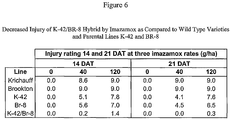
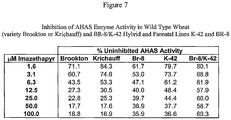
- Example 2 the in vitro AHAS enzyme activity can be compared among lines with and without a mutation conferring resistance to inhibition by imidazolinone herbicides.
- the same lines described above in the greenhouse tolerance experiment were evaluated with respect to percent uninhibited AHAS enzyme activity using the imidazolinone herbicide imazethapyr.
- the data are presented in Figure 7 .
- the increased tolerance seen in the Br-8/K-42 combination in greenhouse studies is mirrored by the increase in percent uninhibited AHAS activity seen in this combination at the four highest herbicide concentrations.
Landscapes
- Life Sciences & Earth Sciences (AREA)
- Health & Medical Sciences (AREA)
- Genetics & Genomics (AREA)
- Engineering & Computer Science (AREA)
- Chemical & Material Sciences (AREA)
- Wood Science & Technology (AREA)
- Zoology (AREA)
- Bioinformatics & Cheminformatics (AREA)
- Organic Chemistry (AREA)
- Biotechnology (AREA)
- General Engineering & Computer Science (AREA)
- Biomedical Technology (AREA)
- Molecular Biology (AREA)
- General Health & Medical Sciences (AREA)
- Biochemistry (AREA)
- Microbiology (AREA)
- Environmental Sciences (AREA)
- Developmental Biology & Embryology (AREA)
- Physiology (AREA)
- Botany (AREA)
- Plant Pathology (AREA)
- Cell Biology (AREA)
- Biophysics (AREA)
- Medicinal Chemistry (AREA)
- Physics & Mathematics (AREA)
- Natural Medicines & Medicinal Plants (AREA)
- Breeding Of Plants And Reproduction By Means Of Culturing (AREA)
- Agronomy & Crop Science (AREA)
- Pest Control & Pesticides (AREA)
- Dentistry (AREA)
- Agricultural Chemicals And Associated Chemicals (AREA)
- Measuring Or Testing Involving Enzymes Or Micro-Organisms (AREA)
Claims (44)
- Plante de blé ou de triticale comprenant un acide nucléique de l'allèle Als de tolérance à l'imidazolinone du génome A (Imi3) de Triticum aestivum codant pour un polypeptide IMI qui comprend une mutation dans le Domaine E qui entraîne une substitution de sérine en asparagine dans la protéine IMI par rapport à une protéine AHAS de type sauvage, où l'acide nucléique Imi3 de Triticum aestivum comprend une séquence polynucléotidique exposée dans SEQ ID n° 3 et confère à la plante une résistance accrue à un herbicide de type imidazolinone par rapport à une variété de type sauvage de la plante.
- Plante de blé ou de triticale selon la revendication 1, où la plante comprend en outre un acide nucléique IMI de Triticum aestivum choisi dans le groupe constitué par l'un quelconque parmi un acide nucléique Imi1 et un acide nucléique Imi2.
- Plante de blé ou de triticale selon la revendication 2, où l'acide nucléique IMI de Triticum aestivum code pour un polypeptide IMI comprenant une mutation dans une séquence d'acides aminés conservée choisie parmi : Domaine A, Domaine B, Domaine C, Domaine D et Domaine E.
- Plante de blé ou de triticale selon la revendication 3, où la séquence d'acides aminés conservée est le Domaine E.
- Plante de blé ou de triticale selon la revendication 4, où la mutation entraîne une substitution de sérine en asparagine par rapport à une protéine AHAS de type sauvage.
- Plante de blé ou de triticale selon la revendication 1, où l'acide nucléique Imi3 comprend une séquence polynucléotidique complémentaire de la séquence polynucléotidique définie dans SEQ ID n° 3.
- Plante de blé ou de triticale selon l'une quelconque des revendications 1 à 5, ladite plante comprenant deux acides nucléiques IMI de Triticum aestivum.
- Plante de blé ou de triticale selon la revendication 7, comprenant un acide nucléique Imi1 et un acide nucléique Imi3.
- Plante de blé ou de triticale selon l'une quelconque des revendications 1 à 5, ladite plante comprenant trois acides nucléiques IMI de Triticum aestivum.
- Plante de blé ou de triticale selon la revendication 1, où l'herbicide de type imidazolinone est choisi dans le groupe constitué par l'acide 2-(4-isopropyl-4-méthyl-5-oxo-2-imidiazolin-2-yl)-nicotinique, l'acide 2-(4-isopropyl-4-méthyl-5-oxo-2-imidazolin-2-yl)-3-quinoléinecarboxylique, l'acide 5-éthyl-2-(4-isopropyl-4-méthyl-5-oxo-2-imidazolin-2-yl)nicotinique, l'acide 2-(4-isopropyl-4-méthyl-5-oxo-2-imidazolin-2-yl)-5-(méthoxyméthyl)nicotinique, l'acide 2-(4-isopropyl-4-méthyl-5-oxo-2-imidazolin-2-yl)-5-méthylnicotinique, et un mélange de 6-(4-isopropyl-4-méthyl-5-oxo-2-imidazolin-2-yl)-m-toluate de méthyle et de 2-(4-isopropyl-4-méthyl-5-oxo-2-imidazolin-2-yl)-p-toluate de méthyle.
- Plante de blé ou de triticale selon la revendication 1, où l'herbicide de type imidazolinone est l'acide 5-éthyl-2-(4-isopropyl-4-méthyl-5-oxo-2-imidazolin-2-yl)nicotinique.
- Plante de blé ou de triticale selon la revendication 1, où l'herbicide de type imidazolinone est l'acide 2-(4-isopropyl-4-méthyl-5-oxo-2-imidazolin-2-yl)-5-(méthoxyméthyl)nicotinique.
- Partie de plante de la plante de blé ou de triticale selon la revendication 1, où la partie de plante comprend ledit acide nucléique Imi3.
- Cellule végétale de la plante de blé ou de triticale selon la revendication 1, où la cellule végétale comprend ledit acide nucléique Imi3.
- Graine pouvant être produite par la plante de blé ou de triticale selon la revendication 1, où la graine comprend ledit acide nucléique Imi3 défini selon la revendication 1.
- Graine selon la revendication 15, où la graine est homozygote pour l'acide nucléique Imi3.
- Plante de blé ou de triticale comprenant les caractéristiques de résistance aux herbicides d'une plante de la lignée Krichauff-42, un échantillon représentatif de graine de la lignée ayant été déposé auprès de l'American Type Culture Collection (ATCC) sous le Numéro de Désignation de Dépôt de Brevet PTA-4257 et comprenant un acide nucléique Imi3 de Triticum aestivum, où :(a) la plante est un dérivé recombiné ou modifié génétiquement d'une plante de la lignée Krichauff-42, où un échantillon représentatif de graine de la lignée est déposé auprès de l'ATCC sous le Numéro de Désignation de Dépôt de Brevet PTA-4257 ;(b) la plante est une descendance quelconque sélectionnée à partir d'une plante de la lignée Krichauff-42, où un échantillon représentatif de graine de la lignée est déposé auprès de l'ATCC sous le Numéro de Désignation de Dépôt de Brevet PTA-4257 ; ou(c) la plante est une descendance sélectionnée à partir de l'une quelconque parmi les plantes de blé ou de triticale de (a) à (b) ;où le dérivé recombiné ou modifié génétiquement et la descendance comprennent un acide nucléique Imi3 de Triticum aestivum comprenant une séquence polynucléotidique exposée dans SEQ ID n° 3.
- Plante de blé ou de triticale selon la revendication 17, où l'herbicide de type imidazolinone est choisi dans le groupe constitué par l'acide 2-(4-isopropyl-4-méthyl-5-oxo-2-imidiazolin-2-yl)-nicotinique, l'acide 2-(4-isopropyl-4-méthyl-5-oxo-2-imidazolin-2-yl)-3-quinoléinecarboxylique, l'acide 5-éthyl-2-(4-isopropyl-4-méthyl-5-oxo-2-imidazolin-2-yl)nicotinique, l'acide 2-(4-isopropyl-4-méthyl-5-oxo-2-imidazolin-2-yl)-5-(méthoxyméthyl)nicotinique, l'acide 2-(4-isopropyl-4-méthyl-5-oxo-2-imidazolin-2-yl)-5-méthylnicotinique, et un mélange de 6-(4-isopropyl-4-méthyl-5-oxo-2-imidazolin-2-yl)-m-toluate de méthyle et de 2-(4-isopropyl-4-méthyl-5-oxo-2-imidazolin-2-yl)-p-toluate de méthyle.
- Plante de blé ou de triticale selon la revendication 17, où l'herbicide de type imidazolinone est l'acide 5-éthyl-2-(4-isopropyl-4-méthyl-5-oxo-2-imidazolin-2-yl)nicotinique.
- Plante de blé ou de triticale selon la revendication 17, où l'herbicide de type imidazolinone est l'acide 2-(4-isopropyl-4-méthyl-5-oxo-2-imidazolin-2-yl)-5-(méthoxyméthyl)nicotinique.
- Partie de plante de la plante de blé ou de triticale selon la revendication 17, où la partie de plante comprend ledit acide nucléique Imi3.
- Cellule végétale de la plante de blé ou de triticale selon la revendication 17, où la cellule végétale comprend ledit acide nucléique Imi3.
- Acide nucléique IMI isolé, où l'acide nucléique comprend une séquence polynucléotidique choisie parmi :(a) une séquence polynucléotidique telle que définie selon SEQ ID n° 3 ; et(b) une séquence polynucléotidique complémentaire de la séquence polynucléotidique de (a).
- Méthode de protection d'une plante de blé ou de triticale contre des adventices à proximité de la plante, comprenant :l'application d'un herbicide de type imidazolinone aux adventices et à la plante,où la plante possède une résistance accrue à l'herbicide de type imidazolinone par rapport à une variété de type sauvage de la plante, et où la plante comprend un acide nucléique d'allèle Als de tolérance à l'imidazolinone du génome A (Imi3) de Triticum aestivum codant pour un polypeptide IMI qui comprend une mutation dans le Domaine E qui entraîne une substitution de sérine en asparagine dans la protéine IMI par rapport à une protéine AHAS de type sauvage ; où l'acide nucléique Imi3 de Triticum aestivum comprend une séquence polynucléotidique exposée dans SEQ ID n° 3.
- Méthode selon la revendication 24, où la plante comprend en outre un acide nucléique Imi1.
- Méthode de modification de la tolérance d'une plante à un herbicide de type imidazolinone, comprenant :(a) la mutagenèse de graines de plantes par un mutagène chimique,(b) le trempage des graines mutées dans une solution contenant un herbicide de type imidazolinone,(c) la plantation des graines trempées dans un sol, et(d) la pulvérisation du sol contenant lesdites graines par un herbicide de type imidazolinone, de sorte que les plantes qui lèvent et sont d'aspect normal aient une tolérance accrue à l'herbicide de type imidazolinone par rapport à la plante à partir de laquelle les graines de l'étape (a) sont obtenues ;où les plantes qui lèvent comprennent des acides nucléiques Imi3 de Triticum aestivum codant pour un polypeptide IMI qui comprend une mutation dans le Domaine E qui entraîne une substitution de sérine en asparagine dans la protéine IMI par rapport à une protéine AHAS de type sauvage, où l'acide nucléique Imi3 de Triticum aestivum comprend une séquence polynucléotidique exposée dans SEQ ID n° 3.
- Méthode selon la revendication 26, où la plante comprend en outre un acide nucléique Imi1.
- Graine produite par la plante de blé ou de triticale selon la revendication 17, où la graine comprend l'acide nucléique Imi3.
- Graine selon la revendication 28, où la graine est homozygote pour l'acide nucléique Imi3.
- Méthode de production d'une plante de blé ou de triticale comprenant un acide nucléique Imi3 de Triticum aestivum codant pour un polypeptide IMI, comprenant :(a) la mutagenèse de graines de blé par un mutagène chimique,(b) le trempage des graines mutées dans une solution contenant un herbicide de type imidazolinone,(c) la plantation des graines trempées dans un sol, et(d) la pulvérisation du sol contenant lesdites graines par un herbicide de type imidazolinone, de sorte que les plantes de blé qui lèvent et sont d'aspect normal soient résistantes à l'herbicide de type imidazolinone ;où l'acide nucléique Imi3 de Triticum aestivum comprend une séquence polynucléotidique exposée dans SEQ ID n° 3.
- Méthode selon la revendication 30, où le mutagène est l'azoture de sodium.
- Méthode selon la revendication 30, où l'herbicide de type imidazolinone est choisi dans le groupe constitué par l'acide 2-(4-isopropyl-4-méthyl-5-oxo-2-imidiazolin-2-yl)-nicotinique, l'acide 2-(4-isopropyl-4-méthyl-5-oxo-2-imidazolin-2-yl)-3-quinoléinecarboxylique, l'acide 5-éthyl-2-(4-isopropyl-4-méthyl-5-oxo-2-imidazolin-2-yl)nicotinique, l'acide 2-(4-isopropyl-4-méthyl-5-oxo-2-imidazolin-2-yl)-5-(méthoxyméthyl)nicotinique, l'acide 2-(4-isopropyl-4-méthyl-5-oxo-2-imidazolin-2-yl)-5-méthylnicotinique, et un mélange de 6-(4-isopropyl-4-méthyl-5-oxo-2-imidazolin-2-yl)-m-toluate de méthyle et de 2-(4-isopropyl-4-méthyl-5-oxo-2-imidazolin-2-yl)-p-toluate de méthyle.
- Plante ou graine de celle-ci produite par la méthode selon l'une quelconque des revendications 30 à 32, où la graine comprend l'acide nucléique Imi3.
- Graine selon la revendication 33, où la graine est homozygote pour l'acide nucléique Imi3.
- Plante de blé ou de triticale qui est une descendance sélectionnée à partir de la plante ou de la graine de celle-ci produite par la méthode selon l'une quelconque des revendications 30 à 32, où la plante ou la graine comprend un acide nucléique Imi3 de Triticum aestivum codant pour un polypeptide IMI qui comprend une mutation dans le Domaine E qui entraîne une substitution de sérine en asparagine dans la protéine IMI par rapport à une protéine AHAS de type sauvage, et où l'acide nucléique Imi3 comprend une séquence polynucléotidique exposée dans SEQ ID n° 3.
- Méthode de protection d'une plante de blé ou de triticale contre des adventices à proximité d'une plante, comprenant l'application d'un herbicide de type imidazolinone aux adventices et à la plante, où la plante possède une résistance accrue à un herbicide de type imidazolinone par rapport à une variété de type sauvage de la plante, où(i) la plante de blé est une plante de la lignée Krichauff-42, un échantillon représentatif de graine de la lignée ayant été déposé auprès de l'ATCC sous le Numéro de Désignation de Dépôt de Brevet PTA-4257 ;(ii) la plante de blé est un dérivé recombiné ou modifié génétiquement d'une plante de la lignée Krichauff-42 ;(iii) la plante de blé est une descendance quelconque d'une plante de la lignée Krichauff-42 ; ou(iv) la plante de blé est une descendance de l'une quelconque parmi les plantes de (i) à (iii) ;où le dérivé recombiné ou modifié génétiquement et la descendance comprennent un acide nucléique de l'allèle Als de tolérance à l'imidazolinone du génome A (Imi3) de Triticum aestivum comprenant une séquence polynucléotidique exposée dans SEQ ID n° 3.
- Méthode selon l'une quelconque des revendications 24 et 36, où l'herbicide d'inhibition d'AHAS est choisi dans le groupe constitué par l'acide 2-(4-isopropyl-4-méthyl-5-oxo-2-imidiazolin-2-yl)-nicotinique, l'acide 2-(4-isopropyl-4-méthyl-5-oxo-2-imidazolin-2-yl)-3-quinoléinecarboxylique, l'acide 5-éthyl-2-(4-isopropyl-4-méthyl-5-oxo-2-imidazolin-2-yl)nicotinique, l'acide 2-(4-isopropyl-4-méthyl-5-oxo-2-imidazolin-2-yl)-5-(méthoxyméthyl)nicotinique, l'acide 2-(4-isopropyl-4-méthyl-5-oxo-2-imidazolin-2-yl)-5-méthylnicotinique, et un mélange de 6-(4-isopropyl-4-méthyl-5-oxo-2-imidazolin-2-yl)-m-toluate de méthyle et de 2-(4-isopropyl-4-méthyl-5-oxo-2-imidazolin-2-yl)-p-toluate de méthyle.
- Méthode selon l'une quelconque des revendications 24 et 36, où l'herbicide d'inhibition d'AHAS est l'acide 5-éthyl-2-(4-isopropyl-4-méthyl-5-oxo-2-imidazolin-2-yl)nicotinique.
- Méthode selon l'une quelconque des revendications 24 et 36, où l'herbicide d'inhibition d'AHAS est l'acide 2-(4-isopropyl-4-méthyl-5-oxo-2-imidazolin-2-yl)-5-(méthoxyméthyl)nicotinique.
- Méthode de contrôle d'adventices à proximité d'une plante, comprenant l'application d'un herbicide de type imidazolinone aux adventices et à la plante, où la plante possède une tolérance accrue à un herbicide de type imidazolinone par rapport à une variété de type sauvage de la plante, où la plante comprend un acide nucléique d'allèle Als de tolérance à l'imidazolinone du génome A (Imi3) de Triticum aestivum qui comprend une séquence polynucléotidique exposée dans SEQ ID n° 3.
- Méthode selon la revendication 40, où(i) la plante de blé est une plante de la lignée Krichauff-42, un échantillon représentatif de graine de la lignée ayant été déposé auprès de l'ATCC sous le Numéro de Désignation de Dépôt de Brevet PTA-4257 ;(ii) la plante de blé est un dérivé recombiné ou modifié génétiquement d'une plante de la lignée Krichauff-42 ;(iii) la plante de blé est une descendance quelconque d'une plante de la lignée Krichauff-42 ; ou(iv) la plante de blé est une descendance de l'une quelconque parmi les plantes de (i) à (iii) ;où le dérivé recombiné ou modifié génétiquement et la descendance comprennent un acide nucléique de l'allèle Als de tolérance à l'imidazolinone du génome A (Imi3) de Triticum aestivum comprenant une séquence polynucléotidique exposée dans SEQ ID n° 3.
- Méthode selon l'une quelconque des revendications 40 et 41, où l'herbicide d'inhibition d'AHAS est choisi dans le groupe constitué par l'acide 2-(4-isopropyl-4-méthyl-5-oxo-2-imidiazolin-2-yl)-nicotinique, l'acide 2-(4-isopropyl-4-méthyl-5-oxo-2-imidazolin-2-yl)-3-quinoléinecarboxylique, l'acide 5-éthyl-2-(4-isopropyl-4-méthyl-5-oxo-2-imidazolin-2-yl)nicotinique, l'acide 2-(4-isopropyl-4-méthyl-5-oxo-2-imidazolin-2-yl)-5-(méthoxyméthyl)nicotinique, l'acide 2-(4-isopropyl-4-méthyl-5-oxo-2-imidazolin-2-yl)-5-méthylnicotinique, et un mélange de 6-(4-isopropyl-4-méthyl-5-oxo-2-imidazolin-2-yl)-m-toluate de méthyle et de 2-(4-isopropyl-4-méthyl-5-oxo-2-imidazolin-2-yl)-p-toluate de méthyle.
- Méthode selon l'une quelconque des revendications 40 et 41, où l'herbicide d'inhibition d'AHAS est l'acide 5-éthyl-2-(4-isopropyl-4-méthyl-5-oxo-2-imidazolin-2-yl)nicotinique.
- Méthode selon l'une quelconque des revendications 40 et 41, où l'herbicide d'inhibition d'AHAS est l'acide 2-(4-isopropyl-4-méthyl-5-oxo-2-imidazolin-2-yl)-5-(méthoxyméthyl)nicotinique.
Priority Applications (1)
| Application Number | Priority Date | Filing Date | Title |
|---|---|---|---|
| EP10012407.2A EP2329708B1 (fr) | 2002-07-10 | 2003-07-09 | Plantes de blé présentant une tolérance accrue aux herbicides d'imidazolinone |
Applications Claiming Priority (3)
| Application Number | Priority Date | Filing Date | Title |
|---|---|---|---|
| US39499102P | 2002-07-10 | 2002-07-10 | |
| US394991P | 2002-07-10 | ||
| PCT/IB2003/004645 WO2004016073A2 (fr) | 2002-07-10 | 2003-07-09 | Plants de ble presentant une resistance accrue a un herbicide a base d'imidazolinone |
Related Child Applications (2)
| Application Number | Title | Priority Date | Filing Date |
|---|---|---|---|
| EP10012407.2A Division-Into EP2329708B1 (fr) | 2002-07-10 | 2003-07-09 | Plantes de blé présentant une tolérance accrue aux herbicides d'imidazolinone |
| EP10012407.2A Division EP2329708B1 (fr) | 2002-07-10 | 2003-07-09 | Plantes de blé présentant une tolérance accrue aux herbicides d'imidazolinone |
Publications (3)
| Publication Number | Publication Date |
|---|---|
| EP1551218A2 EP1551218A2 (fr) | 2005-07-13 |
| EP1551218A4 EP1551218A4 (fr) | 2005-11-02 |
| EP1551218B1 true EP1551218B1 (fr) | 2017-05-17 |
Family
ID=31888180
Family Applications (2)
| Application Number | Title | Priority Date | Filing Date |
|---|---|---|---|
| EP03773883.8A Expired - Lifetime EP1551218B1 (fr) | 2002-07-10 | 2003-07-09 | Plants de ble presentant une resistance accrue a un herbicide a base d'imidazolinone |
| EP10012407.2A Expired - Lifetime EP2329708B1 (fr) | 2002-07-10 | 2003-07-09 | Plantes de blé présentant une tolérance accrue aux herbicides d'imidazolinone |
Family Applications After (1)
| Application Number | Title | Priority Date | Filing Date |
|---|---|---|---|
| EP10012407.2A Expired - Lifetime EP2329708B1 (fr) | 2002-07-10 | 2003-07-09 | Plantes de blé présentant une tolérance accrue aux herbicides d'imidazolinone |
Country Status (6)
| Country | Link |
|---|---|
| US (3) | US7829762B2 (fr) |
| EP (2) | EP1551218B1 (fr) |
| AU (2) | AU2003282264B2 (fr) |
| CA (1) | CA2492167C (fr) |
| PL (1) | PL375524A1 (fr) |
| WO (1) | WO2004016073A2 (fr) |
Families Citing this family (239)
| Publication number | Priority date | Publication date | Assignee | Title |
|---|---|---|---|---|
| EP1551218B1 (fr) * | 2002-07-10 | 2017-05-17 | The Department of Agriculture, Western Australia | Plants de ble presentant une resistance accrue a un herbicide a base d'imidazolinone |
| ES2389767T3 (es) | 2003-05-28 | 2012-10-31 | Basf Se | Plantas de trigo que tienen mayor tolerancia a herbicidas de imidazolinona |
| BRPI0413917B1 (pt) * | 2003-08-29 | 2018-09-25 | Instituto Nacional De Tech Agropecuaria | ácido nucleico ahas de arroz mutagenizado não transgênico, polipeptídeo ahas isolado, e, método de controle de ervas daninhas dentro da vizinhança de uma planta de arroz |
| US7432082B2 (en) | 2004-03-22 | 2008-10-07 | Basf Ag | Methods and compositions for analyzing AHASL genes |
| US7355098B2 (en) | 2004-06-22 | 2008-04-08 | Saskatchewan Wheat Poo1 | Brassica AHAS genes and gene alleles that provide resistance to imidazolinone herbicides |
| CA2576813A1 (fr) * | 2004-07-30 | 2006-03-09 | Basf Agrochemical Products B.V. | Plants de tournesol resistant aux herbicides, polynucleotides codant pour des proteines a large sous-unite d'acetohydroxy acide synthase resistant aux herbicides, et methodes d'utilisation |
| AR051690A1 (es) | 2004-12-01 | 2007-01-31 | Basf Agrochemical Products Bv | Mutacion implicada en el aumento de la tolerancia a los herbicidas imidazolinona en las plantas |
| US12570965B2 (en) | 2005-03-02 | 2026-03-10 | Instituto Nacional De Technologia Agropecuaria | Herbicide-resistant rice plants, polynucleotides encoding herbicide-resistant acetohydroxyacid synthase large subunit proteins, and methods of use |
| EP2532750B1 (fr) * | 2005-07-01 | 2016-04-27 | Basf Se | Plantes de tournesol résistantes aux herbicides, polynucléotides codant pour la résistance aux herbicides, protéines à grandes sous-unités d'acétohydroxyacide synthase et procédés d'utilisation |
| CL2007001552A1 (es) * | 2006-05-31 | 2008-01-18 | Basf Agrochemical Products Bv | Metodo para producir planta de trigo con alto contenido de proteinas que comprende introducir el gen ahasl1a s653n, metodo de generacion de harina de trigo con alto contenido de proteinas, y producto alimenticio que la comprende. |
| HRP20110641T4 (hr) | 2006-11-10 | 2015-05-22 | Basf Se | Kristalna modifikacija fipronila |
| EP2083628A1 (fr) | 2006-11-10 | 2009-08-05 | Basf Se | Modification cristalline de fipronil |
| AU2007316639B2 (en) | 2006-11-10 | 2012-12-20 | Basf Se | Crystalline modification of fipronil |
| UA110598C2 (uk) | 2006-11-10 | 2016-01-25 | Басф Се | Спосіб одержання кристалічної модифікації фіпронілу |
| UA108733C2 (uk) | 2006-12-12 | 2015-06-10 | Толерантна до гербіциду рослина соняшника | |
| CL2008000357A1 (es) | 2007-02-06 | 2009-09-11 | Basf Se | Agente que contiene al menos un antagonista de gaba, tal como fipronilo, al menos un fungicida de azol, tal como triconazol y al menos una giberelina; y su uso para mejorar la germinacion y/o la emergencia y/o vitalidad de las plantas. |
| US10017827B2 (en) | 2007-04-04 | 2018-07-10 | Nidera S.A. | Herbicide-resistant sunflower plants with multiple herbicide resistant alleles of AHASL1 and methods of use |
| EP2114163B1 (fr) | 2007-04-12 | 2017-05-10 | Basf Se | Mélanges pesticides contenant un composé de cyanosulfoximine |
| HUE048086T2 (hu) | 2007-09-20 | 2020-05-28 | Bayer Cropscience Lp | Fungicid törzset és legalább egy további fungicidet tartalmazó kombinációk |
| PT2205082E (pt) | 2007-09-26 | 2012-05-02 | Basf Se | Composições fungicidas ternárias compreendendo boscalide e clorotalonil |
| KR20100116675A (ko) * | 2008-02-22 | 2010-11-01 | 바스프 에스이 | 3'-브로민-2,3,4,6'-테트라메톡시-2',6-디메틸벤조페논을 포함하는 살진균성 조성물 |
| EP2315760B1 (fr) | 2008-07-29 | 2013-03-06 | Basf Se | Composés pipérazines ayant une activité herbicide |
| EP2183969A3 (fr) | 2008-10-29 | 2011-01-05 | Basf Se | Procédé d'augmentation du nombre de semis par nombre de grains semés |
| BRPI0919576A2 (pt) | 2008-10-02 | 2015-08-18 | Basf Se | Composto de piperazina, e, método para controlar vegetação indesejada |
| CA2749223C (fr) | 2009-01-27 | 2017-07-04 | Basf Se | Procede de desinfection des semences |
| WO2010089244A1 (fr) | 2009-02-03 | 2010-08-12 | Basf Se | Procédé d'engraissement de semences |
| CN102307478A (zh) | 2009-02-11 | 2012-01-04 | 巴斯夫欧洲公司 | 农药混合物 |
| AR075573A1 (es) | 2009-02-11 | 2011-04-20 | Basf Se | Dimethomorph como protector de plaguicidas con efectos fitotoxicos |
| WO2010092031A2 (fr) | 2009-02-11 | 2010-08-19 | Basf Se | Mélanges pesticides |
| AU2010212955A1 (en) | 2009-02-11 | 2011-09-01 | Basf Se | Pesticidal mixtures |
| WO2010092014A2 (fr) | 2009-02-11 | 2010-08-19 | Basf Se | Mélanges pesticides |
| JP2012519662A (ja) | 2009-03-04 | 2012-08-30 | ビーエーエスエフ ソシエタス・ヨーロピア | 無脊椎有害生物を駆除するための3−アリールキナゾリン−4−オン化合物 |
| WO2010103065A1 (fr) | 2009-03-11 | 2010-09-16 | Basf Se | Compositions fongicides et leur utilisation |
| EP2408301B1 (fr) | 2009-03-16 | 2013-05-15 | Basf Se | Compositions fongicides comprenant du fluopyram et du metrafenone |
| AU2010225016A1 (en) | 2009-03-20 | 2011-10-13 | Basf Se | Method for treatment of crop with an encapsulated pesticide |
| PE20120536A1 (es) | 2009-03-26 | 2012-05-05 | Basf Se | Combinacion de un agente fungicida sintetico y bacillus subtilis qst 173 para el control de hongos fitopatogenos |
| EP2414353A1 (fr) | 2009-04-01 | 2012-02-08 | Basf Se | Composés d'isoxazoline pour lutter contre les ravageurs invertébrés |
| AU2010233985B2 (en) | 2009-04-02 | 2015-11-19 | Basf Se | Method for reducing sunburn damage in plants |
| JP2012529472A (ja) | 2009-06-12 | 2012-11-22 | ビーエーエスエフ ソシエタス・ヨーロピア | 5−硫黄置換基を有する抗菌性1,2,4−トリアゾリル誘導体 |
| AU2010261822A1 (en) | 2009-06-18 | 2012-01-19 | Basf Se | Triazole compounds carrying a sulfur substituent |
| JP2012530110A (ja) | 2009-06-18 | 2012-11-29 | ビーエーエスエフ ソシエタス・ヨーロピア | 抗菌性1,2,4−トリアゾリル誘導体 |
| US20120108422A1 (en) | 2009-06-18 | 2012-05-03 | Basf Se | Antifungal 1,2,4-triazolyl Derivatives |
| WO2010146116A1 (fr) | 2009-06-18 | 2010-12-23 | Basf Se | Composés de triazole portant un substituant soufré |
| WO2010146115A1 (fr) | 2009-06-18 | 2010-12-23 | Basf Se | Composés de triazole portant un substituant de soufre |
| CN102802416A (zh) | 2009-06-18 | 2012-11-28 | 巴斯夫欧洲公司 | 杀真菌混合物 |
| WO2010146113A1 (fr) | 2009-06-18 | 2010-12-23 | Basf Se | Derives triazolyle antifongiques 1, 2, 4 ayant un substituant 5-soufre |
| SI2443102T1 (sl) | 2009-06-19 | 2013-08-30 | Basf Se | Herbicidni benzoksazinoni |
| WO2010149758A1 (fr) | 2009-06-25 | 2010-12-29 | Basf Se | Dérivés de 1,2,4-triazole antifongiques |
| ES2472918T3 (es) | 2009-07-06 | 2014-07-03 | Basf Se | Compuestos de piridazina para controlar plagas de invertebrados |
| WO2011003776A2 (fr) | 2009-07-09 | 2011-01-13 | Basf Se | Cyanobutyrates substitués à effet herbicide |
| WO2011003775A2 (fr) | 2009-07-09 | 2011-01-13 | Basf Se | Cyanobutyrates substitués à effet herbicide |
| BR112012001001A2 (pt) | 2009-07-14 | 2016-11-16 | Basf Se | compositos azol das formulas i e ii, compostos das formulas i e i, compostos de formula ix, composição agricola, uso de um composto farmaceutica, metodo para tratar infecções de câncer ou virus para combater fungos zoopatigênicos ou humanopatogenicos |
| JP2013500246A (ja) | 2009-07-24 | 2013-01-07 | ビーエーエスエフ ソシエタス・ヨーロピア | 無脊椎動物系害虫防除用ピリジン誘導体化合物 |
| EP2458994A1 (fr) | 2009-07-28 | 2012-06-06 | Basf Se | Procédé pour l'augmentation du niveau d'acides aminés libres dans des tissus de stockage de plantes vivaces |
| WO2011012493A2 (fr) | 2009-07-28 | 2011-02-03 | Basf Se | Compositions de suspo-émulsions pesticides |
| AU2010278948B2 (en) | 2009-07-30 | 2015-04-23 | Boehringer Ingelheim Animal Health USA Inc. | Insecticidal 4-Amino-thieno(2,3-d)-pyrimidine compounds and methods of their use |
| WO2011018486A2 (fr) | 2009-08-14 | 2011-02-17 | Basf Se | Composition herbicide active comprenant des benzoxazinones |
| EP2480537A1 (fr) | 2009-09-24 | 2012-08-01 | Basf Se | Composés d'aminoquinazoline destinés à lutter contre des invertébrés nuisibles |
| WO2011036111A2 (fr) | 2009-09-25 | 2011-03-31 | Basf Se | Méthode permettant de réduire l'avortement des fleurs pistillées chez les plantes |
| AU2010303120A1 (en) | 2009-09-29 | 2012-04-19 | Basf Se | Pesticidal mixtures |
| WO2011042378A1 (fr) | 2009-10-09 | 2011-04-14 | Basf Se | Cyanobyturates substitués à action herbicide |
| WO2011051212A1 (fr) | 2009-10-28 | 2011-05-05 | Basf Se | Utilisation de composés hétéroaromatiques en tant qu'herbicides |
| DE102010042867A1 (de) | 2009-10-28 | 2011-06-01 | Basf Se | Verwendung heterozyklischer Verbindungen als Herbizide |
| DE102010042864A1 (de) | 2009-10-30 | 2011-06-01 | Basf Se | Substituierte Thioamide mit herbizider Wirkung |
| US8445407B2 (en) | 2009-11-02 | 2013-05-21 | Basf Se | Herbicidal tetrahydrophthalimides |
| US8329619B2 (en) | 2009-11-03 | 2012-12-11 | Basf Se | Substituted quinolinones having herbicidal action |
| WO2011054741A2 (fr) | 2009-11-06 | 2011-05-12 | Basf Se | Complexes cristallins d'acide 4-hydroxybenzoïque et de pesticides sélectionnés |
| WO2011057989A1 (fr) | 2009-11-11 | 2011-05-19 | Basf Se | Composés hétérocycliques ayant un effet herbicide |
| WO2011057942A1 (fr) | 2009-11-12 | 2011-05-19 | Basf Se | Procédés insecticides utilisant des composés à base de pyridine |
| WO2011057935A1 (fr) | 2009-11-13 | 2011-05-19 | Basf Se | Composés de 3-(3,4-dihydro-2h-benzo[1,4]oxazin-6-yl)-1h-pyrimidin-2,4-dione en tant qu'herbicides |
| WO2011058036A1 (fr) | 2009-11-13 | 2011-05-19 | Basf Se | Composés tricycliques ayant un effet herbicide |
| AU2010321038C1 (en) | 2009-11-17 | 2015-04-30 | Boehringer Ingelheim Animal Health USA Inc. | Fluorinated oxa or thia heteroarylalkylsulfide derivatives for combating invertebrate pests |
| WO2011064188A1 (fr) | 2009-11-27 | 2011-06-03 | Basf Se | Procédés insecticides utilisant des composés hétéroaromatiques contenant de l'azote |
| WO2011067184A1 (fr) | 2009-12-01 | 2011-06-09 | Basf Se | Composés 3-(4,5-dihydroisoxazol-5-yl)benzoylpyrazole et leurs mélanges avec des phytoprotecteurs |
| ES2546100T3 (es) | 2009-12-04 | 2015-09-18 | Merial, Inc. | Compuestos pesticidas bis-organosulfurados |
| WO2011069912A1 (fr) | 2009-12-07 | 2011-06-16 | Basf Se | Composés triazole, leur utilisation et produits les contenant |
| WO2011069955A1 (fr) | 2009-12-07 | 2011-06-16 | Basf Se | Composés de sulfonimidamide pour lutter contre les animaux nuisibles |
| NZ600883A (en) | 2009-12-08 | 2013-06-28 | Basf Se | An agrochemical pesticidal mixture for increasing the yield and health of a plant |
| WO2011069916A1 (fr) | 2009-12-08 | 2011-06-16 | Basf Se | Composés triazoles, leur utilisation comme fongicides et agents les contenant |
| EP2528445A1 (fr) | 2009-12-08 | 2012-12-05 | Basf Se | Mélanges pesticides |
| WO2011069894A1 (fr) | 2009-12-08 | 2011-06-16 | Basf Se | Composés triazoles, leur utilisation et agents les contenant |
| BR112012014944A2 (pt) | 2009-12-18 | 2015-09-15 | Basf Se | compostos de azolina substituída , composição , uso de um composto , e, métodos para controlar pragas invertebradas e para tratar , controlar , prevenir ou proteger animais contra infestação ou infecção por parasitas. |
| WO2011073143A1 (fr) | 2009-12-18 | 2011-06-23 | Basf Se | Cyanobutyrates substitués ayant une action herbicide |
| PH12012501449B1 (en) | 2010-01-18 | 2017-12-13 | Basf Se | Compound comprising a pesticide and an alkoxylate of 2-propylheptyl amine |
| KR20120125332A (ko) | 2010-02-01 | 2012-11-14 | 바스프 에스이 | 동물 해충을 퇴치하기 위한 치환된 케톤계 이속사졸린 화합물 및 유도체 |
| WO2011098417A1 (fr) | 2010-02-10 | 2011-08-18 | Basf Se | Cyanobutyrates substitués ayant une action herbicide |
| WO2011101303A2 (fr) | 2010-02-16 | 2011-08-25 | Basf Se | Composition contenant un pesticide et un alcoxylat de iso-heptadecylamine |
| WO2011110583A2 (fr) | 2010-03-10 | 2011-09-15 | Basf Se | Mélanges fongicides |
| KR20130051927A (ko) | 2010-03-17 | 2013-05-21 | 바스프 에스이 | 살충제 및 분지형 노닐 아민의 알콕실레이트를 포함하는 조성물 |
| CN102858780A (zh) | 2010-03-23 | 2013-01-02 | 巴斯夫欧洲公司 | 具有除草作用的取代哒嗪 |
| EA201201322A1 (ru) | 2010-03-23 | 2013-05-30 | Басф Се | Пиридотиазины, обладающие гербицидным действием |
| EP2550279A1 (fr) | 2010-03-23 | 2013-01-30 | Basf Se | Pyrazinothiazines à action herbicide |
| BR112012023938A2 (pt) | 2010-03-23 | 2015-09-15 | Basf Se | piridina substituída da fórmula i, composto da fórmula i, composição e método para controlar vegetação indesejada |
| AR081526A1 (es) | 2010-03-23 | 2012-10-03 | Basf Se | Piridazinas sustituidas que tienen accion herbicida |
| US8809535B2 (en) | 2010-03-23 | 2014-08-19 | Basf Se | Substituted pyridines having herbicidal action |
| US8937177B2 (en) | 2010-03-23 | 2015-01-20 | Basf Se | Pyridazine compounds for controlling invertebrate pests |
| WO2011117804A1 (fr) | 2010-03-23 | 2011-09-29 | Basf Se | Composés de pyridazine destinés à lutter contre les organismes nuisibles invertébrés |
| WO2011117286A1 (fr) | 2010-03-23 | 2011-09-29 | Basf Se | Composés de pyridazine pour lutter contre les ravageurs invertébrés |
| WO2011148886A1 (fr) | 2010-05-24 | 2011-12-01 | Meiji Seikaファルマ株式会社 | Agent de lutte contre les organismes nuisibles |
| MX339218B (es) | 2010-05-28 | 2016-05-17 | Basf Se | Mezclas de plaguicidas. |
| ES2567266T3 (es) | 2010-05-28 | 2016-04-21 | Basf Se | Mezclas de pesticidas |
| CN102939010B (zh) | 2010-06-16 | 2014-06-11 | 巴斯夫欧洲公司 | 含水活性成分组合物 |
| WO2012007426A1 (fr) | 2010-07-13 | 2012-01-19 | Basf Se | Composés d'isoxazoline benzamide à substitution azoline pour lutter contre les organismes nuisibles |
| DE102011080568A1 (de) | 2010-08-16 | 2012-02-16 | Basf Se | Substituierte Cyanobutyrate mit herbizider Wirkung |
| JP2013537178A (ja) | 2010-09-13 | 2013-09-30 | ビーエーエスエフ ソシエタス・ヨーロピア | 無脊椎有害生物iiiを防除するためのピリジン化合物 |
| CN103097376A (zh) | 2010-09-13 | 2013-05-08 | 巴斯夫欧洲公司 | 用于防治无脊椎动物害虫的吡啶化合物ii |
| JP2013542918A (ja) | 2010-09-13 | 2013-11-28 | ビーエーエスエフ ソシエタス・ヨーロピア | 無脊椎有害生物を防除するためのピリジン化合物i |
| MX355432B (es) | 2010-09-14 | 2018-04-18 | Basf Se | Composiciones que contienen un insecticida de piripiropeno y una base. |
| KR101898920B1 (ko) | 2010-09-14 | 2018-09-14 | 바스프 에스이 | 피리피로펜 살곤충제 및 애주번트를 함유하는 조성물 |
| EP2621897A1 (fr) | 2010-10-01 | 2013-08-07 | Basf Se | Imines |
| KR20130143047A (ko) | 2010-10-01 | 2013-12-30 | 바스프 에스이 | 살충제로서의 이민 치환된 2,4-디아릴-피롤린 유도체 |
| CN103221409B (zh) | 2010-10-01 | 2016-03-09 | 巴斯夫欧洲公司 | 除草的苯并*嗪酮类 |
| WO2012076704A2 (fr) | 2010-12-10 | 2012-06-14 | Basf Se | Composés de pyrazole pour la lutte contre des animaux nuisibles invertébrés |
| BR112013014913A2 (pt) | 2010-12-20 | 2016-07-19 | Basf Se | misturas pesticidas, composição pesticida ou parasiticida, método para proteger os vegetais do ataque ou da infestação por insetos, para o controle dos insetos, para o controle dos fungos fitopatogênicos prejudiciais, para a proteção dos vegetais dos fungos fitopatogênicos prejudiciais, para a proteção do material de propagação dos vegetais, para a proteção dos animais contra a infestação ou infecção por parasitas, para o tratamento dos aminais infectados ou infectados por parasitas e utilização |
| WO2012085081A1 (fr) | 2010-12-22 | 2012-06-28 | Basf Se | Composés sulfoximinamides servant à lutter contre des animaux nuisibles invertébrés ii |
| EP2481284A3 (fr) | 2011-01-27 | 2012-10-17 | Basf Se | Mélanges de pesticides |
| CN103391715B (zh) | 2011-02-28 | 2016-08-10 | 巴斯夫欧洲公司 | 包含农药、表面活性剂和2-丙基庚胺的烷氧基化物的组合物 |
| WO2012127009A1 (fr) | 2011-03-23 | 2012-09-27 | Basf Se | Compositions contenant des composés ioniques polymères comprenant des groupes imidazolium |
| CN103582639A (zh) | 2011-04-06 | 2014-02-12 | 巴斯夫欧洲公司 | 用于防治动物害虫的取代嘧啶鎓化合物 |
| AR085872A1 (es) | 2011-04-08 | 2013-10-30 | Basf Se | Derivados heterobiciclicos n-sustituidos utiles para combatir parasitos en plantas y/o animales, composiciones que los contienen y metodos para combatir dichas plagas |
| IN2014CN00712A (fr) | 2011-07-15 | 2015-04-03 | Basf Se | |
| IN2014CN01136A (fr) | 2011-08-12 | 2015-04-10 | Basf Se | |
| CN103842342A (zh) | 2011-08-12 | 2014-06-04 | 巴斯夫欧洲公司 | 邻氨基苯甲酰胺化合物及其作为农药的用途 |
| BR112014003221A2 (pt) | 2011-08-12 | 2017-04-18 | Basf Se | composto da fórmula geral (i), método para preparação de um comporto da fórmula (i), composição agrícola ou veterinária, métodos para combater ou controlar pragas invertebradas, para a proteção de plantas em crecimento contra o ataque ou infestação por pragas invertebradas, para a proteção de sementes contra insetos terrestres e das raízes e galhos de mudas contra insetos terrestres e foliares, semente, uso de um composto e método para tratamento de um animal infestado ou infectado por parasitas ou para evitar que animais fiquem infestados ou infectados por parasitas ou para proteção de um animal contra infestação ou infecção por parasitas |
| KR20140051402A (ko) | 2011-08-12 | 2014-04-30 | 바스프 에스이 | N-티오-안트라닐아미드 화합물 및 살충제로서의 그의 용도 |
| US20140171316A1 (en) | 2011-08-12 | 2014-06-19 | Basf Se | Anthranilamide compounds and their use as pesticides |
| EP2742036A1 (fr) | 2011-08-12 | 2014-06-18 | Basf Se | Composés n-thio-anthranilamides et leur utilisation comme pesticides |
| BR112014003112A2 (pt) | 2011-08-12 | 2017-02-21 | Basf Se | composto da fórmula geral (i), métodos para preparar um composto da fórmula (i), composição agrícola ou veterinária, método para combater ou controlar pragas invertebradas, método para proteger o cultivo de plantas, método para a proteção de sementes, semente, usos de um composto e método para tratar um animal |
| EP2744785A1 (fr) | 2011-08-18 | 2014-06-25 | Basf Se | Carbamoylméthoxy- et carbamoylméthylthio- et carbamoylméthylamino benzamides pour lutter contre des organismes nuisibles invertébrés |
| BR112014003646A2 (pt) | 2011-08-18 | 2017-03-07 | Basf Se | composto de fórmula (i), método para preparar um composto de fórmula (i), composição agrícola ou veterinária, método para combater ou controlar pragas invertebradas do grupo de insetos, aracnídeos ou nematoides, método para proteger plantas, método para a proteção de semente, semente e método para tratar um animal infestado ou infectado por parasitas |
| BR112014003595A2 (pt) | 2011-08-18 | 2017-03-01 | Basf Se | compostos, método de preparação de um composto, composição agrícola, método de combate ou controle de pestes invertebradas, métodos de proteção do crescimento de plantas e de proteção de sementes, semente, uso de um composto e método de tratamento de animal infestado |
| AR089556A1 (es) | 2011-09-02 | 2014-09-03 | Basf Se | Uso de derivados plaguicidas activos de 3-arilquinazolin-4-ona en metodos de aplicacion en el suelo |
| AU2012300903A1 (en) | 2011-09-02 | 2014-03-20 | Basf Se | Insecticidal active mixtures comprising arylquinazolinone compounds |
| US20140200136A1 (en) | 2011-09-02 | 2014-07-17 | Basf Se | Agricultural mixtures comprising arylquinazolinone compounds |
| MX370976B (es) | 2011-11-11 | 2020-01-10 | Gilead Apollo Llc | Inhibidores de acetil coa carboxilasa (acc) y usos de los mismos. |
| JP2014533254A (ja) | 2011-11-14 | 2014-12-11 | ビーエーエスエフ ソシエタス・ヨーロピアBasf Se | 置換型1,2,5−オキサジアゾール化合物及びその除草剤としての使用 |
| KR20140098140A (ko) | 2011-11-16 | 2014-08-07 | 바스프 에스이 | 치환 1,2,5-옥사디아졸 화합물 및 이들의 제초제 ii 로서의 용도 |
| AU2012338748A1 (en) | 2011-11-18 | 2014-06-05 | Basf Se | Substituted 1,2,5-oxadiazole compounds and their use as herbicides III |
| WO2013092868A1 (fr) | 2011-12-21 | 2013-06-27 | Basf Se | Composés de n-thio-anthranilamide et leurs utilisations comme pesticides |
| WO2013113789A1 (fr) | 2012-02-02 | 2013-08-08 | Basf Se | Composés de n-thio-anthranilamide et leur utilisation en tant que pesticides |
| BR112014021199A2 (pt) | 2012-03-01 | 2018-05-08 | Basf Se | composição, método para preparação da composição, polímero, método para preparação do polímero, método para controlar fungos e semente |
| WO2013135604A1 (fr) | 2012-03-12 | 2013-09-19 | Basf Se | Formulation concentrée liquide contenant un insecticide pyripyropène i |
| WO2013135606A1 (fr) | 2012-03-12 | 2013-09-19 | Basf Se | Procédé de production d'une formulation de concentré de suspension aqueuse d'un insecticide à base de pyripyropène |
| WO2013135605A1 (fr) | 2012-03-12 | 2013-09-19 | Basf Se | Formulation concentrée liquide contenant un insecticide à base de pyripyropène de formule ii |
| KR102056607B1 (ko) | 2012-03-13 | 2019-12-17 | 바스프 에스이 | 피리피로펜 살충제 iii 함유 액체 농축 제형 |
| WO2013143927A1 (fr) | 2012-03-29 | 2013-10-03 | Basf Se | Co-cristaux de dicamba et formeur de co-cristal b |
| WO2013144228A1 (fr) | 2012-03-29 | 2013-10-03 | Basf Se | Procédés pesticides utilisant des composés hétérocycliques et des dérivés de ceux-ci pour la lutte contre les animaux nuisibles |
| CN104202981B (zh) | 2012-03-30 | 2018-01-30 | 巴斯夫欧洲公司 | 防治动物害虫的n‑取代的吡啶亚基化合物和衍生物 |
| WO2013144223A1 (fr) | 2012-03-30 | 2013-10-03 | Basf Se | Composés de pyrimidinylidène n-substitués et dérivés destinés à lutter contre les animaux nuisibles |
| WO2013149903A1 (fr) | 2012-04-03 | 2013-10-10 | Basf Se | Dérivés furanones hétéro-bicycliques n-substituées pour combattre un animal |
| WO2013150115A1 (fr) | 2012-04-05 | 2013-10-10 | Basf Se | Composés hétéro-bicycliques et dérivés pour combattre les animaux nuisibles |
| EP2855447A2 (fr) | 2012-04-27 | 2015-04-08 | Basf Se | Composés substitués de n-(tétrazol-5-yl)- et n-(triazol-5-yl) hétarylcarboxamides et leur utilisation comme herbicides |
| CN104507925A (zh) | 2012-04-27 | 2015-04-08 | 巴斯夫欧洲公司 | 取代的n-(四唑-5-基)-和n-(三唑-5-基)吡啶-3-基羧酰胺化合物及其作为除草剂的用途 |
| HUE040316T2 (hu) | 2012-04-27 | 2019-02-28 | Basf Se | Helyettesített N-(tetrazol-5-il)- és N-(triazol-5-il)-aril-karboxamid vegyületek és ezek herbicidként történõ alkalmazása |
| BR112014026823A2 (pt) | 2012-04-27 | 2017-06-27 | Basf Se | compostos de n-(tetrazol-5-il) e n-(triazol-5-il)arilcarboxamida substituída e seu uso como herbicidas. |
| KR20150050527A (ko) | 2012-05-04 | 2015-05-08 | 바스프 에스이 | 치환된 피라졸-함유 화합물 및 이의 살충제로서의 용도 |
| CN104487439B (zh) | 2012-05-24 | 2017-06-09 | 巴斯夫欧洲公司 | N‑硫代邻氨基苯甲酰胺化合物及其作为杀害虫剂的用途 |
| BR112014030412A2 (pt) | 2012-06-14 | 2017-06-27 | Basf Se | método para combater ou controlar pragas, método para proteger culturas, compostos, processo para a preparação de compostos, uso de um composto, composição agrícola ou veterinária e semente. |
| BR122019015109B1 (pt) | 2012-06-20 | 2020-04-07 | Basf Se | mistura pesticida, composição, composição agrícola, métodos para o combate ou controle das pragas de invertebrados, para a proteção dos vegetais em crescimento ou dos materias de propagação vegetal, para a proteção de material de propagação vegetal e uso de uma mistura pesticida |
| US20150181865A1 (en) | 2012-06-21 | 2015-07-02 | Basf Se | Adjuvant comprising a 2-propylheptylamine alkoxylate, sugar-based surfactant, and drift-control agent and/or humectant |
| EP2684879A1 (fr) | 2012-07-09 | 2014-01-15 | Basf Se | Composés mésoioniques substitués permettant de lutter contre les parasites d'animaux |
| US20150230470A1 (en) | 2012-09-21 | 2015-08-20 | Basf Se | Pyrethroid Insecticide For Protecting Plants And Seed |
| WO2014053403A1 (fr) | 2012-10-01 | 2014-04-10 | Basf Se | Procédé de lutte contre les insectes résistants aux insecticides |
| EP2903438A1 (fr) | 2012-10-01 | 2015-08-12 | Basf Se | Mélanges à activité pesticide comprenant des composés anthranilamides |
| WO2014053407A1 (fr) | 2012-10-01 | 2014-04-10 | Basf Se | Composés n-thio-anthranilamides et leur utilisation en tant que pesticides |
| WO2014053406A1 (fr) | 2012-10-01 | 2014-04-10 | Basf Se | Procédé de lutte contre les insectes résistants aux insecticides modulateurs de la ryanodine |
| WO2014053401A2 (fr) | 2012-10-01 | 2014-04-10 | Basf Se | Procédé d'amélioration de la santé des plantes |
| AR093828A1 (es) | 2012-10-01 | 2015-06-24 | Basf Se | Mezclas activas como plaguicidas, que comprenden compuestos de antranilamida |
| JP2016501264A (ja) | 2012-12-14 | 2016-01-18 | ビーエーエスエフ ソシエタス・ヨーロピアBasf Se | 動物有害生物を防除するためのマロノニトリル化合物 |
| KR20150100808A (ko) | 2012-12-21 | 2015-09-02 | 바스프 에스이 | 무척추동물 해충의 방제를 위한 시클로클라빈 및 이의 유도체 |
| WO2014128136A1 (fr) | 2013-02-20 | 2014-08-28 | Basf Se | Composés d'anthranilamide et leur utilisation comme pesticides |
| WO2014135392A1 (fr) | 2013-03-07 | 2014-09-12 | Basf Se | Cocristaux de pyriméthanyl et de dithiine-tetracarboximide sélectionné |
| ES2630373T3 (es) | 2013-04-19 | 2017-08-21 | Basf Se | Compuestos y derivados de acil-imino-piridina N-sustituidos para combatir plagas animales |
| EP2994128B1 (fr) | 2013-05-10 | 2019-01-30 | Gilead Apollo, LLC | Inhibiteurs de l'acc et utilisations associées |
| AU2014262638A1 (en) | 2013-05-10 | 2015-11-26 | Gilead Apollo, Llc | ACC inhibitors and uses thereof |
| WO2014184014A1 (fr) | 2013-05-15 | 2014-11-20 | Basf Se | Composés de n-(1,2,5-oxadiazol-3-yl)carboxamide et leur utilisation en tant qu'herbicides |
| WO2014184058A1 (fr) | 2013-05-15 | 2014-11-20 | Basf Se | Composés de 1,2,5-oxadiazole substitués et leur utilisation en tant qu'herbicides |
| WO2014184019A1 (fr) | 2013-05-15 | 2014-11-20 | Basf Se | Composés de n-(1,2,5-oxadiazol-3-yl)carboxamide et leur utilisation en tant qu'herbicides |
| EA032323B1 (ru) | 2013-05-15 | 2019-05-31 | Басф Се | Замещенные n-(тетразол-5-ил)- и n-(триазол-5-ил)арилкарбоксамидные соединения и их применение в качестве гербицидов |
| EP2815649A1 (fr) | 2013-06-18 | 2014-12-24 | Basf Se | Mélanges fongicides II comprenant des fongicides de type strobilurine |
| US9926284B2 (en) | 2013-07-18 | 2018-03-27 | Basf Se | Substituted N-(1,2,4-triazol-3-yl)Arylcarboxamide compounds and their use as herbicides |
| EP2835052A1 (fr) | 2013-08-07 | 2015-02-11 | Basf Se | Mélanges fongicides comprenant des pyrimidines fongicides |
| AR097362A1 (es) | 2013-08-16 | 2016-03-09 | Cheminova As | Combinación de 2-metilbifenil-3-ilmetil (z)-(1r)-cis-3-(2-cloro-3,3,3-trifluorprop-1-enil)-2, 2-dimetilciclopropanocarboxilato con por lo menos un insecticida, acaricida, nematicida y/o fungicida |
| US10206397B2 (en) | 2013-09-19 | 2019-02-19 | Basf Se | N-acylimino heterocyclic compounds |
| EP3055297A1 (fr) | 2013-10-10 | 2016-08-17 | Basf Se | Composés substitués de n-(tétrazol-5-yl)arylcarboxamide et de n-(triazol-5-yl)arylcarboxamide, et leur utilisation comme herbicides |
| WO2015052173A1 (fr) | 2013-10-10 | 2015-04-16 | Basf Se | Composés tétrazole et triazole et leur utilisation en tant qu'herbicides |
| WO2015052178A1 (fr) | 2013-10-10 | 2015-04-16 | Basf Se | Composés de 1,2,5-oxadiazole et leur utilisation en tant qu'herbicides |
| UA121106C2 (uk) | 2013-10-18 | 2020-04-10 | Басф Агрокемікал Продактс Б.В. | Застосування пестицидної активної похідної карбоксаміду у способах застосування і обробки насіння та ґрунту |
| EP2868196A1 (fr) | 2013-11-05 | 2015-05-06 | Basf Se | Compositions herbicides |
| EP2868197A1 (fr) | 2013-11-05 | 2015-05-06 | Basf Se | Compositions herbicides |
| WO2015091649A1 (fr) | 2013-12-18 | 2015-06-25 | Basf Se | Composés hétérocycliques de type imino n-substitués |
| AR100304A1 (es) | 2014-02-05 | 2016-09-28 | Basf Corp | Formulación de recubrimiento de semillas |
| EP2907807A1 (fr) | 2014-02-18 | 2015-08-19 | Basf Se | Composés de benzamide et leur utilisation comme herbicides |
| JP6708557B2 (ja) | 2014-05-06 | 2020-06-10 | ビーエーエスエフ ソシエタス・ヨーロピアBasf Se | 殺有害生物剤及びヒドロキシアルキルポリオキシレングリコールエーテルを含む組成物 |
| EP3269245B1 (fr) | 2014-06-25 | 2023-08-16 | BASF Agro B.V. | Compositions pesticides |
| EP2962567A1 (fr) | 2014-07-01 | 2016-01-06 | Basf Se | Mélanges ternaires comprenant des biopesticides et au moins deux insecticides chimiques |
| US10206403B2 (en) | 2014-07-14 | 2019-02-19 | Basf Se | Pesticidal compositions |
| WO2016034615A1 (fr) | 2014-09-02 | 2016-03-10 | BASF Agro B.V. | Formulation insecticide aqueuse contenant un polymère hyper-ramifie |
| EP3028573A1 (fr) | 2014-12-05 | 2016-06-08 | Basf Se | Utilisation d'un triazole fongicide sur des plantes transgéniques |
| CA2975025A1 (fr) | 2015-02-10 | 2016-08-18 | Basf Se | Composition comprenant un pesticide et un ester alcoxyle |
| EP3061346A1 (fr) | 2015-02-26 | 2016-08-31 | Bayer CropScience AG | Utilisation du fluopyram et d'agents de contrôle biologique pour le contrôle de champignons nocifs |
| WO2016156075A1 (fr) | 2015-03-31 | 2016-10-06 | Basf Se | Composition comprenant un pesticide et du n,n-diméthyl amide d'acide isononanoïque |
| WO2016174042A1 (fr) | 2015-04-27 | 2016-11-03 | BASF Agro B.V. | Compositions pesticides |
| US20170166582A1 (en) | 2015-11-25 | 2017-06-15 | Gilead Apollo, Llc | Pyrazole acc inhibitors and uses thereof |
| PL3380479T3 (pl) | 2015-11-25 | 2023-05-08 | Gilead Apollo, Llc | Triazolowe inhibitory acc i ich zastosowania |
| EP3380478B1 (fr) | 2015-11-25 | 2020-12-23 | Gilead Apollo, LLC | Inhibiteurs de l'acc à base d'esters et utilisations associées |
| AU2016369900B2 (en) | 2015-12-17 | 2020-06-11 | Basf Se | Benzamide compounds and their use as herbicides |
| UY37137A (es) | 2016-02-24 | 2017-09-29 | Merial Inc | Compuestos antiparasitarios de isoxazolina, formulaciones inyectables de acción prolongada que los comprenden, métodos y usos de los mismos |
| BR112018017034A2 (pt) | 2016-03-10 | 2018-12-26 | Basf Se | misturas e seu uso, composição agroquímica, método de controle de fungos daninhos fitopatogênicos e material de propagação vegetal |
| EP3245872A1 (fr) | 2016-05-20 | 2017-11-22 | BASF Agro B.V. | Compositions pesticides |
| WO2017207368A1 (fr) | 2016-06-02 | 2017-12-07 | BASF Agro B.V. | Compositions fongicides |
| EP3338552A1 (fr) | 2016-12-21 | 2018-06-27 | Basf Se | Utilisation d'un fongicide tetrazolinone sur des plantes transgéniques |
| BR112019014953A2 (pt) | 2017-02-01 | 2020-04-28 | Basf Se | concentrado emulsionável, processo para a preparação do concentrado, emulsão, e, método para controlar fungos fitopatogênicos e/ou o crescimento indesejado de plantas e/ou a infestação indesejada de insetos ou acarídeos e/ou para regular o crescimento de plantas. |
| AU2018276360A1 (en) | 2017-05-30 | 2019-12-19 | Basf Se | Benzamide compounds and their use as herbicides II |
| CA3063304A1 (fr) | 2017-05-30 | 2018-12-06 | Basf Se | Composes de benzamide et leur utilisation en tant qu'herbicides |
| AR112112A1 (es) | 2017-06-20 | 2019-09-18 | Basf Se | Compuestos de benzamida y su uso como herbicidas |
| KR102643189B1 (ko) | 2017-06-23 | 2024-03-04 | 바스프 에스이 | 피라졸 화합물을 포함하는 살충 혼합물 |
| US11659837B2 (en) | 2017-07-10 | 2023-05-30 | Basf Se | Mixtures comprising an urease inhibitor (UI) and a nitrification inhibitor such as 2-(3,4-dimethyl-1H-pyrazol-1-yl)succinic acid (DMPSA) or 3,4-dimethyl pyrazolium glycolate (DMPG) |
| AR112342A1 (es) | 2017-07-21 | 2019-10-16 | Basf Se | Compuestos de benzamida y su uso como herbicidas |
| BR112020006468A2 (pt) | 2017-11-15 | 2020-10-06 | Basf Se | misturas em tanque e de pulverização, processo, e, método não terapêutico para controlar fungos fitopatogênicos e/ou crescimento de planta indesejável e/ou infestação de inseto ou ácaro indesejável e/ou para regular o crescimento de plantas. |
| CA3080432A1 (fr) | 2017-11-29 | 2019-06-06 | Basf Se | Composes de benzamide et leur utilisation en tant qu'herbicides |
| EP3707641A2 (fr) | 2017-12-03 | 2020-09-16 | Seedx Technologies Inc. | Systèmes et procédés de tri de graines |
| WO2019106639A1 (fr) | 2017-12-03 | 2019-06-06 | Seedx Technologies Inc. | Systèmes et procédés de tri de graines |
| WO2019106638A1 (fr) | 2017-12-03 | 2019-06-06 | Seedx Technologies Inc. | Systèmes et procédés de tri de graines |
| WO2019122347A1 (fr) | 2017-12-22 | 2019-06-27 | Basf Se | Composés n-(1,2,5-oxadiazol-3-yl)-benzamide et leur utilisation en tant qu'herbicides |
| AR114040A1 (es) | 2017-12-22 | 2020-07-15 | Basf Se | Compuestos de benzamida y su uso como herbicidas |
| EP3508480A1 (fr) | 2018-01-08 | 2019-07-10 | Basf Se | Composés de benzadine et leur utilisation comme herbicides |
| WO2019162309A1 (fr) | 2018-02-21 | 2019-08-29 | Basf Se | Composés benzamide et leur utilisation en tant qu'herbicides |
| WO2019162308A1 (fr) | 2018-02-21 | 2019-08-29 | Basf Se | Composés benzamide et leur utilisation en tant qu'herbicides |
| US12144349B2 (en) | 2018-09-19 | 2024-11-19 | Basf Se | Pesticidal mixtures comprising a mesoionic compound |
| CA3112042A1 (fr) | 2018-09-28 | 2020-04-02 | Basf Se | Procede de regulation des nuisibles par application de traitement de semences d'un compose mesoionique ou d'un melange de ceux-ci |
| EP3680223A1 (fr) | 2019-01-10 | 2020-07-15 | Basf Se | Mélanges comprenant un inhibiteur d'uréase (ui) et un inhibiteur de nitrification (ni) tel qu'un mélange de ni comprenant de l'acide 2-(3,4-diméthyl-1h-pyrazol-1-yl)succinique (dmpsa) et du dicyandiamide (dcd) |
| BR112022004586A2 (pt) * | 2019-09-12 | 2022-06-14 | Inst Genetics & Developmental Biology Cas | Plantas resistentes a herbicidas |
| CA3162521A1 (fr) | 2019-12-23 | 2021-07-01 | Basf Se | Absorption racinaire amelioree par des enzymes d'un compose actif agrochimique |
| ES3073195T3 (en) | 2020-01-16 | 2026-07-09 | Basf Se | Mixtures comprising a solid carrier comprising an urease inhibitor and a further solid carrier comprising a nitrification inhibitor |
| US20230063109A1 (en) | 2020-01-16 | 2023-03-02 | Basf Se | Mixtures comprising nitrification inhibitors and carriers |
| AU2021305962B2 (en) | 2020-07-06 | 2026-08-06 | Pi Industries Ltd. | A pesticidally active mixture comprising thietanyloxy compound, oxides or salts thereof |
| TW202220557A (zh) | 2020-07-27 | 2022-06-01 | 印度商皮埃企業有限公司 | 包含吡唑並吡啶鄰氨基苯甲酰胺化合物、其氧化物或鹽的農藥活性混合物 |
| CN119613426B (zh) | 2023-09-14 | 2025-12-09 | 青岛清原化合物有限公司 | 啶南平衍生物及其组合物、用途 |
Family Cites Families (41)
| Publication number | Priority date | Publication date | Assignee | Title |
|---|---|---|---|---|
| US5504200A (en) | 1983-04-15 | 1996-04-02 | Mycogen Plant Science, Inc. | Plant gene expression |
| US5380831A (en) | 1986-04-04 | 1995-01-10 | Mycogen Plant Science, Inc. | Synthetic insecticidal crystal protein gene |
| US4761373A (en) * | 1984-03-06 | 1988-08-02 | Molecular Genetics, Inc. | Herbicide resistance in plants |
| US5304732A (en) * | 1984-03-06 | 1994-04-19 | Mgi Pharma, Inc. | Herbicide resistance in plants |
| US5331107A (en) * | 1984-03-06 | 1994-07-19 | Mgi Pharma, Inc. | Herbicide resistance in plants |
| US6211439B1 (en) * | 1984-08-10 | 2001-04-03 | Mgi Pharma, Inc | Herbicide resistance in plants |
| US5420034A (en) | 1986-07-31 | 1995-05-30 | Calgene, Inc. | Seed-specific transcriptional regulation |
| US5013659A (en) | 1987-07-27 | 1991-05-07 | E. I. Du Pont De Nemours And Company | Nucleic acid fragment encoding herbicide resistant plant acetolactate synthase |
| JPH04501201A (ja) | 1987-12-21 | 1992-03-05 | ジ・アップジョン・カンパニー | 発芽植物種子類のアグロバクテリウム媒介形質転換 |
| US5614395A (en) | 1988-03-08 | 1997-03-25 | Ciba-Geigy Corporation | Chemically regulatable and anti-pathogenic DNA sequences and uses thereof |
| US5990387A (en) | 1988-06-10 | 1999-11-23 | Pioneer Hi-Bred International, Inc. | Stable transformation of plant cells |
| EP0360750A3 (fr) | 1988-09-22 | 1991-01-02 | Ciba-Geigy Ag | Plantes tolérantes aux herbicides |
| EP0375875A3 (fr) | 1988-12-30 | 1991-01-09 | American Cyanamid Company | Procédé pour protéger des plantes cultivés contre des dommages causés par des herbicides |
| US5086169A (en) | 1989-04-20 | 1992-02-04 | The Research Foundation Of State University Of New York | Isolated pollen-specific promoter of corn |
| HU214435B (hu) | 1989-05-17 | 1998-03-30 | Zeneca Ltd. | Eljárás gyomirtó szernek ellenálló kukorica előállítására |
| US5322783A (en) | 1989-10-17 | 1994-06-21 | Pioneer Hi-Bred International, Inc. | Soybean transformation by microparticle bombardment |
| EP0472712B1 (fr) | 1990-03-16 | 2001-09-12 | Calgene LLC | Nouvelles sequences exprimmees de maniere preferentielle dans le developpement de semences precoces et procedes afferants |
| WO1991016432A1 (fr) | 1990-04-18 | 1991-10-31 | Plant Genetic Systems N.V. | Genes modifies du bacillus thuringiensis codant une proteine cristalline insecticide et leur expression dans des cellules de plantes |
| GB9024728D0 (en) * | 1990-11-14 | 1991-01-02 | Ici Plc | Herbicide resistant plants |
| US5767366A (en) * | 1991-02-19 | 1998-06-16 | Louisiana State University Board Of Supervisors, A Governing Body Of Louisiana State University Agricultural And Mechanical College | Mutant acetolactate synthase gene from Ararbidopsis thaliana for conferring imidazolinone resistance to crop plants |
| EP0508161B1 (fr) | 1991-04-08 | 2000-05-10 | American Cyanamid Company | Utilisation du blé résistant aux herbicides du type AHAS-inhibition et méthode de sa sélection |
| US5731180A (en) | 1991-07-31 | 1998-03-24 | American Cyanamid Company | Imidazolinone resistant AHAS mutants |
| AU2781892A (en) | 1991-10-07 | 1993-05-03 | Ciba-Geigy Ag | Particle gun for introducing dna into intact cells |
| TW261517B (fr) | 1991-11-29 | 1995-11-01 | Mitsubishi Shozi Kk | |
| ATE207962T1 (de) | 1992-04-13 | 2001-11-15 | Syngenta Ltd | Dna-konstruktionen und diese enthaltende pflanzen |
| DE69307320T2 (de) | 1992-07-09 | 1997-08-07 | Pioneer Hi Bred Int | Pollen spezifische polygalacturonase gen aus mais |
| US5470353A (en) | 1993-10-20 | 1995-11-28 | Hollister Incorporated | Post-operative thermal blanket |
| GB9324707D0 (en) | 1993-12-02 | 1994-01-19 | Olsen Odd Arne | Promoter |
| GB9403512D0 (en) | 1994-02-24 | 1994-04-13 | Olsen Odd Arne | Promoter |
| US5470359A (en) | 1994-04-21 | 1995-11-28 | Pioneer Hi-Bred Internation, Inc. | Regulatory element conferring tapetum specificity |
| US5853973A (en) * | 1995-04-20 | 1998-12-29 | American Cyanamid Company | Structure based designed herbicide resistant products |
| US5977436A (en) | 1997-04-09 | 1999-11-02 | Rhone Poulenc Agrochimie | Oleosin 5' regulatory region for the modification of plant seed lipid composition |
| DE69836552T3 (de) | 1997-09-30 | 2014-10-09 | The Regents Of The University Of California | Herstellung von proteinen in pflanzensamen |
| AU3514700A (en) | 1999-03-08 | 2000-09-28 | Pioneer Hi-Bred International, Inc. | Maize metallothionein gene and promoter |
| US6936467B2 (en) | 2000-03-27 | 2005-08-30 | University Of Delaware | Targeted chromosomal genomic alterations with modified single stranded oligonucleotides |
| AU2002302232B2 (en) | 2001-05-14 | 2007-02-01 | University Of Saskatchewan | Lentil plants having increased resistance to imidazolinone herbicides |
| WO2003013225A2 (fr) * | 2001-08-09 | 2003-02-20 | Northwest Plant Breeding Company | Plants de ble presentant une resistance accrue aux herbicides a l'imidazolinone |
| RU2337532C2 (ru) * | 2001-08-09 | 2008-11-10 | Юниверсити Оф Саскачеван | Растения пшеницы с повышенной устойчивостью к имидазолиноновым гербицидам |
| CA2456314C (fr) * | 2001-08-09 | 2012-11-13 | University Of Saskatchewan | Plants de ble presentant une resistance accrue aux herbicides a base d'imidazolinone |
| EP1551218B1 (fr) * | 2002-07-10 | 2017-05-17 | The Department of Agriculture, Western Australia | Plants de ble presentant une resistance accrue a un herbicide a base d'imidazolinone |
| AR051690A1 (es) * | 2004-12-01 | 2007-01-31 | Basf Agrochemical Products Bv | Mutacion implicada en el aumento de la tolerancia a los herbicidas imidazolinona en las plantas |
-
2003
- 2003-07-09 EP EP03773883.8A patent/EP1551218B1/fr not_active Expired - Lifetime
- 2003-07-09 WO PCT/IB2003/004645 patent/WO2004016073A2/fr not_active Ceased
- 2003-07-09 EP EP10012407.2A patent/EP2329708B1/fr not_active Expired - Lifetime
- 2003-07-09 AU AU2003282264A patent/AU2003282264B2/en not_active Expired
- 2003-07-09 US US10/520,738 patent/US7829762B2/en not_active Expired - Lifetime
- 2003-07-09 PL PL03375524A patent/PL375524A1/xx not_active Application Discontinuation
- 2003-07-09 CA CA2492167A patent/CA2492167C/fr not_active Expired - Lifetime
-
2008
- 2008-09-05 US US12/205,411 patent/US9295210B2/en active Active
-
2009
- 2009-01-06 AU AU2009200052A patent/AU2009200052B2/en not_active Expired
-
2015
- 2015-06-25 US US14/750,376 patent/US10575485B2/en not_active Expired - Lifetime
Non-Patent Citations (1)
| Title |
|---|
| None * |
Also Published As
| Publication number | Publication date |
|---|---|
| US20090029859A1 (en) | 2009-01-29 |
| US7829762B2 (en) | 2010-11-09 |
| US20060095992A1 (en) | 2006-05-04 |
| WO2004016073A3 (fr) | 2004-07-22 |
| PL375524A1 (en) | 2005-11-28 |
| EP1551218A2 (fr) | 2005-07-13 |
| CA2492167A1 (fr) | 2004-02-26 |
| AU2009200052A1 (en) | 2009-02-05 |
| US20150289468A1 (en) | 2015-10-15 |
| AU2003282264B2 (en) | 2008-10-09 |
| EP2329708B1 (fr) | 2016-10-19 |
| EP1551218A4 (fr) | 2005-11-02 |
| AU2009200052B2 (en) | 2012-03-01 |
| WO2004016073A2 (fr) | 2004-02-26 |
| US9295210B2 (en) | 2016-03-29 |
| CA2492167C (fr) | 2015-06-16 |
| US10575485B2 (en) | 2020-03-03 |
| AU2003282264A1 (en) | 2004-03-03 |
| EP2329708A1 (fr) | 2011-06-08 |
Similar Documents
| Publication | Publication Date | Title |
|---|---|---|
| US11746343B2 (en) | Wheat plants having increased resistance to imidazolinone herbicides | |
| US10575485B2 (en) | Wheat plants having increased resistance to imidazolinone herbicides | |
| EP1414976B1 (fr) | Plantes de ble presentant une resistance accrue aux herbicides a base d'imidazolinone | |
| EP1633875B1 (fr) | Plantes de ble presentant une tolerance accrue aux herbicides d'imidazolinone | |
| AU2002320377A1 (en) | Wheat plants having increased resistance to imidazolinone herbicides | |
| AU2012203652B2 (en) | Wheat plants having increased resistance to imidazolinone herbicides |
Legal Events
| Date | Code | Title | Description |
|---|---|---|---|
| PUAI | Public reference made under article 153(3) epc to a published international application that has entered the european phase |
Free format text: ORIGINAL CODE: 0009012 |
|
| 17P | Request for examination filed |
Effective date: 20050112 |
|
| AK | Designated contracting states |
Kind code of ref document: A2 Designated state(s): AT BE BG CH CY CZ DE DK EE ES FI FR GB GR HU IE IT LI LU MC NL PT RO SE SI SK TR |
|
| AX | Request for extension of the european patent |
Extension state: AL LT LV MK |
|
| A4 | Supplementary search report drawn up and despatched |
Effective date: 20050919 |
|
| DAX | Request for extension of the european patent (deleted) | ||
| 17Q | First examination report despatched |
Effective date: 20061128 |
|
| GRAP | Despatch of communication of intention to grant a patent |
Free format text: ORIGINAL CODE: EPIDOSNIGR1 |
|
| INTG | Intention to grant announced |
Effective date: 20160503 |
|
| GRAJ | Information related to disapproval of communication of intention to grant by the applicant or resumption of examination proceedings by the epo deleted |
Free format text: ORIGINAL CODE: EPIDOSDIGR1 |
|
| INTC | Intention to grant announced (deleted) | ||
| GRAP | Despatch of communication of intention to grant a patent |
Free format text: ORIGINAL CODE: EPIDOSNIGR1 |
|
| STAA | Information on the status of an ep patent application or granted ep patent |
Free format text: STATUS: GRANT OF PATENT IS INTENDED |
|
| INTG | Intention to grant announced |
Effective date: 20161107 |
|
| GRAJ | Information related to disapproval of communication of intention to grant by the applicant or resumption of examination proceedings by the epo deleted |
Free format text: ORIGINAL CODE: EPIDOSDIGR1 |
|
| STAA | Information on the status of an ep patent application or granted ep patent |
Free format text: STATUS: EXAMINATION IS IN PROGRESS |
|
| GRAR | Information related to intention to grant a patent recorded |
Free format text: ORIGINAL CODE: EPIDOSNIGR71 |
|
| GRAS | Grant fee paid |
Free format text: ORIGINAL CODE: EPIDOSNIGR3 |
|
| STAA | Information on the status of an ep patent application or granted ep patent |
Free format text: STATUS: GRANT OF PATENT IS INTENDED |
|
| GRAA | (expected) grant |
Free format text: ORIGINAL CODE: 0009210 |
|
| STAA | Information on the status of an ep patent application or granted ep patent |
Free format text: STATUS: THE PATENT HAS BEEN GRANTED |
|
| INTC | Intention to grant announced (deleted) | ||
| AK | Designated contracting states |
Kind code of ref document: B1 Designated state(s): AT BE BG CH CY CZ DE DK EE ES FI FR GB GR HU IE IT LI LU MC NL PT RO SE SI SK TR |
|
| INTG | Intention to grant announced |
Effective date: 20170407 |
|
| REG | Reference to a national code |
Ref country code: GB Ref legal event code: FG4D |
|
| REG | Reference to a national code |
Ref country code: DE Ref legal event code: R081 Ref document number: 60350249 Country of ref document: DE Owner name: WESTERN AUSTRALIAN AGRICULTURE AUTHORITY, SOUT, AU Free format text: FORMER OWNER: THE DEPARTMENT OD AGRICULTURE, WESTERN AUSTRALIA, SOUTH PERTH, AU |
|
| REG | Reference to a national code |
Ref country code: CH Ref legal event code: EP |
|
| REG | Reference to a national code |
Ref country code: IE Ref legal event code: FG4D |
|
| REG | Reference to a national code |
Ref country code: AT Ref legal event code: REF Ref document number: 893591 Country of ref document: AT Kind code of ref document: T Effective date: 20170615 |
|
| REG | Reference to a national code |
Ref country code: FR Ref legal event code: PLFP Year of fee payment: 15 |
|
| REG | Reference to a national code |
Ref country code: DE Ref legal event code: R096 Ref document number: 60350249 Country of ref document: DE |
|
| RAP2 | Party data changed (patent owner data changed or rights of a patent transferred) |
Owner name: WESTERN AUSTRALIAN AGRICULTURE AUTHORITY |
|
| REG | Reference to a national code |
Ref country code: DE Ref legal event code: R082 Ref document number: 60350249 Country of ref document: DE Representative=s name: REITSTOETTER KINZEBACH, DE Ref country code: DE Ref legal event code: R081 Ref document number: 60350249 Country of ref document: DE Owner name: WESTERN AUSTRALIAN AGRICULTURE AUTHORITY, SOUT, AU Free format text: FORMER OWNER: THE DEPARTMENT OF AGRICULTURE, WESTERN AUSTRALIA, SOUTH PERTH, WESTERN AUSTRALIA, AU |
|
| PGFP | Annual fee paid to national office [announced via postgrant information from national office to epo] |
Ref country code: LU Payment date: 20170725 Year of fee payment: 15 |
|
| REG | Reference to a national code |
Ref country code: NL Ref legal event code: MP Effective date: 20170517 |
|
| PGFP | Annual fee paid to national office [announced via postgrant information from national office to epo] |
Ref country code: NL Payment date: 20170725 Year of fee payment: 15 |
|
| REG | Reference to a national code |
Ref country code: AT Ref legal event code: MK05 Ref document number: 893591 Country of ref document: AT Kind code of ref document: T Effective date: 20170517 |
|
| REG | Reference to a national code |
Ref country code: GB Ref legal event code: 732E Free format text: REGISTERED BETWEEN 20170928 AND 20171004 |
|
| PG25 | Lapsed in a contracting state [announced via postgrant information from national office to epo] |
Ref country code: GR Free format text: LAPSE BECAUSE OF FAILURE TO SUBMIT A TRANSLATION OF THE DESCRIPTION OR TO PAY THE FEE WITHIN THE PRESCRIBED TIME-LIMIT Effective date: 20170818 Ref country code: FI Free format text: LAPSE BECAUSE OF FAILURE TO SUBMIT A TRANSLATION OF THE DESCRIPTION OR TO PAY THE FEE WITHIN THE PRESCRIBED TIME-LIMIT Effective date: 20170517 Ref country code: ES Free format text: LAPSE BECAUSE OF FAILURE TO SUBMIT A TRANSLATION OF THE DESCRIPTION OR TO PAY THE FEE WITHIN THE PRESCRIBED TIME-LIMIT Effective date: 20170517 Ref country code: AT Free format text: LAPSE BECAUSE OF FAILURE TO SUBMIT A TRANSLATION OF THE DESCRIPTION OR TO PAY THE FEE WITHIN THE PRESCRIBED TIME-LIMIT Effective date: 20170517 |
|
| PGFP | Annual fee paid to national office [announced via postgrant information from national office to epo] |
Ref country code: MC Payment date: 20170724 Year of fee payment: 15 Ref country code: ES Payment date: 20170830 Year of fee payment: 15 |
|
| PG25 | Lapsed in a contracting state [announced via postgrant information from national office to epo] |
Ref country code: SE Free format text: LAPSE BECAUSE OF FAILURE TO SUBMIT A TRANSLATION OF THE DESCRIPTION OR TO PAY THE FEE WITHIN THE PRESCRIBED TIME-LIMIT Effective date: 20170517 Ref country code: NL Free format text: LAPSE BECAUSE OF FAILURE TO SUBMIT A TRANSLATION OF THE DESCRIPTION OR TO PAY THE FEE WITHIN THE PRESCRIBED TIME-LIMIT Effective date: 20170517 Ref country code: BG Free format text: LAPSE BECAUSE OF FAILURE TO SUBMIT A TRANSLATION OF THE DESCRIPTION OR TO PAY THE FEE WITHIN THE PRESCRIBED TIME-LIMIT Effective date: 20170817 |
|
| PGFP | Annual fee paid to national office [announced via postgrant information from national office to epo] |
Ref country code: IE Payment date: 20170726 Year of fee payment: 15 Ref country code: AT Payment date: 20170727 Year of fee payment: 15 Ref country code: BE Payment date: 20170725 Year of fee payment: 15 |
|
| PG25 | Lapsed in a contracting state [announced via postgrant information from national office to epo] |
Ref country code: RO Free format text: LAPSE BECAUSE OF FAILURE TO SUBMIT A TRANSLATION OF THE DESCRIPTION OR TO PAY THE FEE WITHIN THE PRESCRIBED TIME-LIMIT Effective date: 20170517 Ref country code: EE Free format text: LAPSE BECAUSE OF FAILURE TO SUBMIT A TRANSLATION OF THE DESCRIPTION OR TO PAY THE FEE WITHIN THE PRESCRIBED TIME-LIMIT Effective date: 20170517 Ref country code: CZ Free format text: LAPSE BECAUSE OF FAILURE TO SUBMIT A TRANSLATION OF THE DESCRIPTION OR TO PAY THE FEE WITHIN THE PRESCRIBED TIME-LIMIT Effective date: 20170517 Ref country code: DK Free format text: LAPSE BECAUSE OF FAILURE TO SUBMIT A TRANSLATION OF THE DESCRIPTION OR TO PAY THE FEE WITHIN THE PRESCRIBED TIME-LIMIT Effective date: 20170517 Ref country code: SK Free format text: LAPSE BECAUSE OF FAILURE TO SUBMIT A TRANSLATION OF THE DESCRIPTION OR TO PAY THE FEE WITHIN THE PRESCRIBED TIME-LIMIT Effective date: 20170517 |
|
| REG | Reference to a national code |
Ref country code: DE Ref legal event code: R097 Ref document number: 60350249 Country of ref document: DE |
|
| PG25 | Lapsed in a contracting state [announced via postgrant information from national office to epo] |
Ref country code: IT Free format text: LAPSE BECAUSE OF FAILURE TO SUBMIT A TRANSLATION OF THE DESCRIPTION OR TO PAY THE FEE WITHIN THE PRESCRIBED TIME-LIMIT Effective date: 20170517 |
|
| PLBE | No opposition filed within time limit |
Free format text: ORIGINAL CODE: 0009261 |
|
| STAA | Information on the status of an ep patent application or granted ep patent |
Free format text: STATUS: NO OPPOSITION FILED WITHIN TIME LIMIT |
|
| 26N | No opposition filed |
Effective date: 20180220 |
|
| PG25 | Lapsed in a contracting state [announced via postgrant information from national office to epo] |
Ref country code: SI Free format text: LAPSE BECAUSE OF FAILURE TO SUBMIT A TRANSLATION OF THE DESCRIPTION OR TO PAY THE FEE WITHIN THE PRESCRIBED TIME-LIMIT Effective date: 20170517 |
|
| REG | Reference to a national code |
Ref country code: FR Ref legal event code: PLFP Year of fee payment: 16 |
|
| PG25 | Lapsed in a contracting state [announced via postgrant information from national office to epo] |
Ref country code: LU Free format text: LAPSE BECAUSE OF NON-PAYMENT OF DUE FEES Effective date: 20180709 Ref country code: MC Free format text: LAPSE BECAUSE OF NON-PAYMENT OF DUE FEES Effective date: 20180731 |
|
| REG | Reference to a national code |
Ref country code: BE Ref legal event code: MM Effective date: 20180731 |
|
| REG | Reference to a national code |
Ref country code: IE Ref legal event code: MM4A |
|
| PG25 | Lapsed in a contracting state [announced via postgrant information from national office to epo] |
Ref country code: IE Free format text: LAPSE BECAUSE OF NON-PAYMENT OF DUE FEES Effective date: 20180709 |
|
| PG25 | Lapsed in a contracting state [announced via postgrant information from national office to epo] |
Ref country code: BE Free format text: LAPSE BECAUSE OF NON-PAYMENT OF DUE FEES Effective date: 20180731 |
|
| PG25 | Lapsed in a contracting state [announced via postgrant information from national office to epo] |
Ref country code: HU Free format text: LAPSE BECAUSE OF FAILURE TO SUBMIT A TRANSLATION OF THE DESCRIPTION OR TO PAY THE FEE WITHIN THE PRESCRIBED TIME-LIMIT; INVALID AB INITIO Effective date: 20030709 |
|
| PG25 | Lapsed in a contracting state [announced via postgrant information from national office to epo] |
Ref country code: CY Free format text: LAPSE BECAUSE OF NON-PAYMENT OF DUE FEES Effective date: 20170517 |
|
| PG25 | Lapsed in a contracting state [announced via postgrant information from national office to epo] |
Ref country code: PT Free format text: LAPSE BECAUSE OF FAILURE TO SUBMIT A TRANSLATION OF THE DESCRIPTION OR TO PAY THE FEE WITHIN THE PRESCRIBED TIME-LIMIT Effective date: 20170517 |
|
| PGFP | Annual fee paid to national office [announced via postgrant information from national office to epo] |
Ref country code: TR Payment date: 20220621 Year of fee payment: 20 |
|
| PGFP | Annual fee paid to national office [announced via postgrant information from national office to epo] |
Ref country code: GB Payment date: 20220719 Year of fee payment: 20 Ref country code: ES Payment date: 20221001 Year of fee payment: 15 Ref country code: DE Payment date: 20220527 Year of fee payment: 20 |
|
| PGFP | Annual fee paid to national office [announced via postgrant information from national office to epo] |
Ref country code: FR Payment date: 20220725 Year of fee payment: 20 |
|
| PGFP | Annual fee paid to national office [announced via postgrant information from national office to epo] |
Ref country code: CH Payment date: 20220726 Year of fee payment: 20 |
|
| PGFP | Annual fee paid to national office [announced via postgrant information from national office to epo] |
Ref country code: ES Payment date: 20221001 Year of fee payment: 15 |
|
| REG | Reference to a national code |
Ref country code: DE Ref legal event code: R071 Ref document number: 60350249 Country of ref document: DE |
|
| REG | Reference to a national code |
Ref country code: CH Ref legal event code: PL |
|
| REG | Reference to a national code |
Ref country code: GB Ref legal event code: PE20 Expiry date: 20230708 |
|
| PG25 | Lapsed in a contracting state [announced via postgrant information from national office to epo] |
Ref country code: GB Free format text: LAPSE BECAUSE OF EXPIRATION OF PROTECTION Effective date: 20230708 |