EP1551803B1 - Derives azabicyclo utilises comme antagonistes des recepteur muscariniques - Google Patents
Derives azabicyclo utilises comme antagonistes des recepteur muscariniques Download PDFInfo
- Publication number
- EP1551803B1 EP1551803B1 EP03762827A EP03762827A EP1551803B1 EP 1551803 B1 EP1551803 B1 EP 1551803B1 EP 03762827 A EP03762827 A EP 03762827A EP 03762827 A EP03762827 A EP 03762827A EP 1551803 B1 EP1551803 B1 EP 1551803B1
- Authority
- EP
- European Patent Office
- Prior art keywords
- compound
- hydroxy
- azabicyclo
- hexyl
- aminomethyl
- Prior art date
- Legal status (The legal status is an assumption and is not a legal conclusion. Google has not performed a legal analysis and makes no representation as to the accuracy of the status listed.)
- Expired - Lifetime
Links
- 0 *C1[C@@](C2C3C(***C(*C(*)(*)N)=O)C3)[C@]2C(*)C(*)C1 Chemical compound *C1[C@@](C2C3C(***C(*C(*)(*)N)=O)C3)[C@]2C(*)C(*)C1 0.000 description 2
Classifications
-
- C—CHEMISTRY; METALLURGY
- C07—ORGANIC CHEMISTRY
- C07D—HETEROCYCLIC COMPOUNDS
- C07D401/00—Heterocyclic compounds containing two or more hetero rings, having nitrogen atoms as the only ring hetero atoms, at least one ring being a six-membered ring with only one nitrogen atom
- C07D401/02—Heterocyclic compounds containing two or more hetero rings, having nitrogen atoms as the only ring hetero atoms, at least one ring being a six-membered ring with only one nitrogen atom containing two hetero rings
- C07D401/12—Heterocyclic compounds containing two or more hetero rings, having nitrogen atoms as the only ring hetero atoms, at least one ring being a six-membered ring with only one nitrogen atom containing two hetero rings linked by a chain containing hetero atoms as chain links
-
- A—HUMAN NECESSITIES
- A61—MEDICAL OR VETERINARY SCIENCE; HYGIENE
- A61P—SPECIFIC THERAPEUTIC ACTIVITY OF CHEMICAL COMPOUNDS OR MEDICINAL PREPARATIONS
- A61P1/00—Drugs for disorders of the alimentary tract or the digestive system
-
- A—HUMAN NECESSITIES
- A61—MEDICAL OR VETERINARY SCIENCE; HYGIENE
- A61P—SPECIFIC THERAPEUTIC ACTIVITY OF CHEMICAL COMPOUNDS OR MEDICINAL PREPARATIONS
- A61P1/00—Drugs for disorders of the alimentary tract or the digestive system
- A61P1/04—Drugs for disorders of the alimentary tract or the digestive system for ulcers, gastritis or reflux esophagitis, e.g. antacids, inhibitors of acid secretion, mucosal protectants
-
- A—HUMAN NECESSITIES
- A61—MEDICAL OR VETERINARY SCIENCE; HYGIENE
- A61P—SPECIFIC THERAPEUTIC ACTIVITY OF CHEMICAL COMPOUNDS OR MEDICINAL PREPARATIONS
- A61P1/00—Drugs for disorders of the alimentary tract or the digestive system
- A61P1/12—Antidiarrhoeals
-
- A—HUMAN NECESSITIES
- A61—MEDICAL OR VETERINARY SCIENCE; HYGIENE
- A61P—SPECIFIC THERAPEUTIC ACTIVITY OF CHEMICAL COMPOUNDS OR MEDICINAL PREPARATIONS
- A61P1/00—Drugs for disorders of the alimentary tract or the digestive system
- A61P1/14—Prodigestives, e.g. acids, enzymes, appetite stimulants, antidyspeptics, tonics, antiflatulents
-
- A—HUMAN NECESSITIES
- A61—MEDICAL OR VETERINARY SCIENCE; HYGIENE
- A61P—SPECIFIC THERAPEUTIC ACTIVITY OF CHEMICAL COMPOUNDS OR MEDICINAL PREPARATIONS
- A61P11/00—Drugs for disorders of the respiratory system
-
- A—HUMAN NECESSITIES
- A61—MEDICAL OR VETERINARY SCIENCE; HYGIENE
- A61P—SPECIFIC THERAPEUTIC ACTIVITY OF CHEMICAL COMPOUNDS OR MEDICINAL PREPARATIONS
- A61P11/00—Drugs for disorders of the respiratory system
- A61P11/06—Antiasthmatics
-
- A—HUMAN NECESSITIES
- A61—MEDICAL OR VETERINARY SCIENCE; HYGIENE
- A61P—SPECIFIC THERAPEUTIC ACTIVITY OF CHEMICAL COMPOUNDS OR MEDICINAL PREPARATIONS
- A61P13/00—Drugs for disorders of the urinary system
-
- A—HUMAN NECESSITIES
- A61—MEDICAL OR VETERINARY SCIENCE; HYGIENE
- A61P—SPECIFIC THERAPEUTIC ACTIVITY OF CHEMICAL COMPOUNDS OR MEDICINAL PREPARATIONS
- A61P13/00—Drugs for disorders of the urinary system
- A61P13/02—Drugs for disorders of the urinary system of urine or of the urinary tract, e.g. urine acidifiers
-
- A—HUMAN NECESSITIES
- A61—MEDICAL OR VETERINARY SCIENCE; HYGIENE
- A61P—SPECIFIC THERAPEUTIC ACTIVITY OF CHEMICAL COMPOUNDS OR MEDICINAL PREPARATIONS
- A61P13/00—Drugs for disorders of the urinary system
- A61P13/10—Drugs for disorders of the urinary system of the bladder
-
- A—HUMAN NECESSITIES
- A61—MEDICAL OR VETERINARY SCIENCE; HYGIENE
- A61P—SPECIFIC THERAPEUTIC ACTIVITY OF CHEMICAL COMPOUNDS OR MEDICINAL PREPARATIONS
- A61P3/00—Drugs for disorders of the metabolism
- A61P3/04—Anorexiants; Antiobesity agents
-
- A—HUMAN NECESSITIES
- A61—MEDICAL OR VETERINARY SCIENCE; HYGIENE
- A61P—SPECIFIC THERAPEUTIC ACTIVITY OF CHEMICAL COMPOUNDS OR MEDICINAL PREPARATIONS
- A61P3/00—Drugs for disorders of the metabolism
- A61P3/08—Drugs for disorders of the metabolism for glucose homeostasis
- A61P3/10—Drugs for disorders of the metabolism for glucose homeostasis for hyperglycaemia, e.g. antidiabetics
-
- A—HUMAN NECESSITIES
- A61—MEDICAL OR VETERINARY SCIENCE; HYGIENE
- A61P—SPECIFIC THERAPEUTIC ACTIVITY OF CHEMICAL COMPOUNDS OR MEDICINAL PREPARATIONS
- A61P43/00—Drugs for specific purposes, not provided for in groups A61P1/00-A61P41/00
-
- C—CHEMISTRY; METALLURGY
- C07—ORGANIC CHEMISTRY
- C07D—HETEROCYCLIC COMPOUNDS
- C07D209/00—Heterocyclic compounds containing five-membered rings, condensed with other rings, with one nitrogen atom as the only ring hetero atom
- C07D209/02—Heterocyclic compounds containing five-membered rings, condensed with other rings, with one nitrogen atom as the only ring hetero atom condensed with one carbocyclic ring
- C07D209/52—Heterocyclic compounds containing five-membered rings, condensed with other rings, with one nitrogen atom as the only ring hetero atom condensed with one carbocyclic ring condensed with a ring other than six-membered
-
- C—CHEMISTRY; METALLURGY
- C07—ORGANIC CHEMISTRY
- C07D—HETEROCYCLIC COMPOUNDS
- C07D403/00—Heterocyclic compounds containing two or more hetero rings, having nitrogen atoms as the only ring hetero atoms, not provided for by group C07D401/00
- C07D403/02—Heterocyclic compounds containing two or more hetero rings, having nitrogen atoms as the only ring hetero atoms, not provided for by group C07D401/00 containing two hetero rings
- C07D403/12—Heterocyclic compounds containing two or more hetero rings, having nitrogen atoms as the only ring hetero atoms, not provided for by group C07D401/00 containing two hetero rings linked by a chain containing hetero atoms as chain links
-
- C—CHEMISTRY; METALLURGY
- C07—ORGANIC CHEMISTRY
- C07D—HETEROCYCLIC COMPOUNDS
- C07D413/00—Heterocyclic compounds containing two or more hetero rings, at least one ring having nitrogen and oxygen atoms as the only ring hetero atoms
- C07D413/02—Heterocyclic compounds containing two or more hetero rings, at least one ring having nitrogen and oxygen atoms as the only ring hetero atoms containing two hetero rings
- C07D413/12—Heterocyclic compounds containing two or more hetero rings, at least one ring having nitrogen and oxygen atoms as the only ring hetero atoms containing two hetero rings linked by a chain containing hetero atoms as chain links
-
- C—CHEMISTRY; METALLURGY
- C07—ORGANIC CHEMISTRY
- C07D—HETEROCYCLIC COMPOUNDS
- C07D417/00—Heterocyclic compounds containing two or more hetero rings, at least one ring having nitrogen and sulfur atoms as the only ring hetero atoms, not provided for by group C07D415/00
- C07D417/02—Heterocyclic compounds containing two or more hetero rings, at least one ring having nitrogen and sulfur atoms as the only ring hetero atoms, not provided for by group C07D415/00 containing two hetero rings
- C07D417/12—Heterocyclic compounds containing two or more hetero rings, at least one ring having nitrogen and sulfur atoms as the only ring hetero atoms, not provided for by group C07D415/00 containing two hetero rings linked by a chain containing hetero atoms as chain links
Definitions
- This invention generally relates to muscarinic receptor antagonists which are useful, among other uses, for the treatment of various diseases of the respiratory, urinary and gastrointestinal systems mediated through muscarinic receptors.
- the invention relates to derivatives of azabicyclo compounds, including, for example, 6-substituted azabicyclo[3.1.0] hexanes, 2,6- and 4,6-disubstituted derivatives, and 2,4,6-trisubstituted derivatives, as well as pharmaceutical compositions containing such compounds and methods of treating diseases mediated through muscarinic receptors.
- Muscarinic receptors as members of the G Protein Coupled Receptors are composed of a family of 5 receptor sub-types (M 1 , M 2 , M 3 , M 4 and M 5 ) and are activated by the neurotransmitter acetylcholine. These receptors are widely distributed on multiple organs and tissues and are critical to the maintenance of central and peripheral cholinergic neurotransmission. The regional distribution of these receptor sub-types in the brain and other organs has been documented.
- the M 1 subtype is located primarily in neuronal tissues such as cereberal cortex and autonomic ganglia
- the M 2 subtype is present mainly in the heart where it mediates cholinergically induced bradycardia
- the M 3 subtype is located predominantly on smooth muscle and salivary glands (Nature, 323, p.411 (1986); Science, 237, p.527 (1987)).
- Muscarinic agonists such as muscarine and pilocarpine and antagonists such as atropine have been known for over a century, but little progress has been made in the discovery of receptor subtype-selective compounds, making it difficult to assign specific functions to the individual receptors.
- classical muscarinic antagonists such as atropine are potent bronchodilators, their clinical utility is limited due to high incidence of both peripheral and central adverse effects such as tachycardia, blurred vision, dryness of mouth, constipation, dementia, etc.
- azabicyclo derivatives including, for example, 6-substituted azabicyclo[3.1.0]hexanes, 2,6- and 4,6-disubstituted derivatives, and 2,4,6-trisubstituted derivatives, are provided as muscarinic receptor antagonists which can be useful as safe and effective therapeutic or prophylactic agents for the treatment of various diseases of the respiratory, urinary and gastrointestinal systems. Also provided are processes for synthesizing such compounds.
- compositions containing such compounds are provided together with acceptable carriers, excipients or diluents which can be useful for the treatment of various diseases of the respiratory, urinary and gastrointestinal systems.
- the enantiomers, diastereomers, N-oxides, polymorphs, pharmaceutically acceptable salts and pharmaceutically acceptable solvates of these compounds are also provided, as well as pharmaceutical compositions comprising the compounds, enantiomers, diastereomers, N-oxides, polymorphs, solvates or pharmaceutically acceptable salts thereof, in combination with a pharmaceutically acceptable carrier and optionally included excipients.
- compounds having the structure of Formula I and their pharmaceutically acceptable salts, pharmaceutically acceptable solvates, esters, enantiomers, diastereomers, N-oxides, polymorphs, wherein Ar represents an aryl or a heteroaryl ring having 1-2 hetero atoms selected from the group consisting of oxygen, sulphur and nitrogen atoms, the aryl or heteroaryl rings may be unsubstituted or substituted by one to three substituents independently selected from lower alkyl (C 1 -C 4 ), lower perhalo alkyl (C 1 -C 4 ), cyano, hydroxy, nitro, lower alkoxy (C 1 -C 4 ), lower perhalo alkoxy (C 1 -C 4 ), unsubstituted amino, N-lower alkyl (C 1- C 4 ) or -aryl amino, amino carbonyl, or N-lower alkyl (C 1 -C 4 ) or -aryl amino
- R 2 represents alkyl, C 3 -C 7 cycloalkyl ring, a C 3 -C 7 cyclo alkenyl ring, an aryl, heterocyclic or a heteroaryl ring having 1 to 2 hetero atoms selected from a group consisting of oxygen, sulphur and nitrogen atoms; the aryl, heteroaryl, heterocyclic or a cycloalkyl ring may be unsubstituted or substituted by one to three substituents independently selected from lower alkyl (C 1 -C 4 ), lower perhalo alkyl (C 1 -C 4 ), cyano, hydroxy, nitro, lower alkoxycarbonyl, halogen, lower alkoxy (C 1 -C 4 ), lower perhalo alkoxy (C 1 -C 4 ), unsubstituted amino, N-lower alkyl (C 1 -C 4 ) or -aryl amino, amino, N-lower alkyl (C 1 -C
- a use for preparing a medicament for treatment or prophylaxis of an animal or a human suffering from a disease or disorder of the respiratory, urinary and gastrointestinal systems, wherein the disease or disorder is mediated through muscarinic receptors includes administration of at least one compound having the structure of Formula I.
- a use for preparing a medicament for treatment or prophylaxis of an animal or a human suffering from a disease or disorder associated with muscarinic receptors comprising administering to a patient in need thereof, an effective amount of a muscarinic receptor antagonist compound as described above.
- a use for preparing a medicament for treatment or prophylaxis of an animal or a human suffering from a disease or disorder of the respiratory system such as bronchial asthma, chronic obstructive pulmonary disorders (COPD), pulmonary fibrosis, and the like; urinary system which induce such urinary disorders as urinary incontinence, lower urinary tract symptoms (LUTS), etc.; and gastrointestinal system such as irritable bowel syndrome, obesity, diabetes and gastrointestinal hyperkinesis with compounds as described above, wherein the disease or disorder is associated with muscarinic receptors.
- a disease or disorder of the respiratory system such as bronchial asthma, chronic obstructive pulmonary disorders (COPD), pulmonary fibrosis, and the like
- urinary system which induce such urinary disorders as urinary incontinence, lower urinary tract symptoms (LUTS), etc.
- gastrointestinal system such as irritable bowel syndrome, obesity, diabetes and gastrointestinal hyperkinesis with compounds as described above, wherein the disease or disorder is associated with
- the compounds described herein exhibit significant potency in terms of their activity, as determined by in vitro receptor binding and functional assays and in vivo experiments using anaesthetized rabbits.
- the compounds that were found active in vitro were tested in vivo.
- Some of the compounds are potent muscarinic receptor antagonists with high affinity towards M 3 receptors. Therefore, pharmaceutical compositions for the possible treatment for the disease or disorders associated with muscarinic receptors are provided.
- the compounds can be administered orally or parenterally.
- the compounds of Formula I may be prepared, for example, by the reaction sequence as shown in Scheme I.
- the preparation comprises reacting a compound of Formula VII with a compound of Formula VI, wherein Ar represents an aryl or a heteroaryl ring having 1-2 hetero atoms (such as oxygen, sulphur or nitrogen atoms), where the aryl or heteroaryl rings may be unsubstituted or substituted by one to three substituents independently selected from lower alkyl (C 1 -C 4 ), lower perhalo alkyl (C 1 -C 4 ), cyano, hydroxy, nitro, lower alkoxy (C 1- C 4 ), lower perhalo alkoxy (C 1 -C 4 ), unsubstituted amino, N-lower alkyl (C 1 -C 4 ) or -aryl amino, amino carbonyl, or N-lower alkyl (C 1 -C 4 ) or -aryl amino carbonyl; R 1 represents a hydrogen, hydroxy, hydroxy
- R 2 represents alkyl, C 3 -C 7 cycloalkyl ring, a C 3 -C 7 cyclo alkenyl ring, an aryl, heterocyclic or a heteroaryl ring having 1 to 2 hetero atoms; the aryl, heteroaryl, heterocyclic or a cycloalkyl ring may be unsubstituted or substituted by one to three substituents independently selected from lower alkyl (C 1 -C 4 ), lower perhalo alkyl (C 1 -C 4 ), cyano, hydroxy, nitro, lower alkoxycarbonyl, halogen, lower alkoxy (C 1 -C 4 ), lower perhalo alkoxy (C 1 -C 4 ), unsubstituted amino, N-lower alkyl (C 1 -C 4 ) or -aryl amino, amino carbonyl, or N-lower alkyl (C 1 -C 4 )
- the reaction between a compound of Formula VII and a compound of Formula VI can take place in the presence of a condensing agent (for example, 1-(3-dimethylaminopropyl)-3-ethyl carbodiimide hydrochloride (EDC) or 1,8-diazabicyclo [5.4.0]undec-7-ene (DBU)), in a solvent (such as N,N-dimethylformamide, dimethylsulfoxide, toluene, or xylene, at temperatures ranging from about 0 to about 140°C), to give a protected compound of Formula VIII which on deprotection in the presence of a deprotecting agent (for example, palladium on carbon, trifluoroacetic acid (TFA) or hydrochloric acid) in an organic solvent (for example, methanol, ethanol, tetrahydrofuran or acetonitrile, at temperatures ranging from about 10 to about 50°C) gives an unprotected compound of Formula I.
- Suitable salts of the compounds represented by the Formula I were prepared so as to solubilize the compound in aqueous medium for biological evaluations, as well as to be compatible with various dosage formulations and also to aid in the bioavailability of the compounds.
- examples of such salts include pharmacologically acceptable salts such as inorganic acid salts (for example, hydrochloride, hydrobromide, sulphate, nitrate and phosphate), organic acid salts (for example, acetate, tartarate, citrate, fumarate, maleate, tolounesulphonate and methanesulphonate).
- carboxyl groups When carboxyl groups are included in the Formula I as substituents, they may be present in the form of an alkaline or alkali metal salt (for example, sodium, potassium, calcium, magnesium, and the like). These salts may be prepared by various techniques, such as treating the compound with an equivalent amount of inorganic or organic, acid or base in a suitable solvent.
- alkaline or alkali metal salt for example, sodium, potassium, calcium, magnesium, and the like.
- the compounds described herein may be administered to an animal for treatment orally, or by a parenteral route.
- the pharmaceutical compositions described herein can be produced and administered in dosage units, each unit containing a certain amount of at least one compound described herein and/or at least one physiologically acceptable addition salt thereof.
- the dosage may be varied over extremely wide limits as the compounds are effective at low dosage levels and relatively free of toxicity.
- the compounds may be administered in the low micromolar concentration, which is therapeutically effective, and the dosage may be increased as desired up to the maximum dosage tolerated by the patient.
- the compounds described herein can be produced and formulated as their enantiomers, diastereomers, N-Oxides, polymorphs, solvates and pharmaceutically acceptable salts, as well as metabolites having the same type of activity.
- Pharmaceutical compositions comprising the molecules of Formulae I, II, III, IV and V or metabolites, enantiomers, diastereomers, N-oxides, polymorphs, solvates or pharmaceutically acceptable salts thereof, in combination with pharmaceutically acceptable carrier and optionally included excipient can also be produced.
- Step a Synthesis of (2R,2S) (1 ⁇ ,5 ⁇ ,6 ⁇ )-N-[3-benzyl 3-azabicyclo[3.1.0] hexyl-6-(aminomethyl)-yl]-2-hydroxy-2-cyclopentyl-2-phenyl acetamide
- reaction mixture was treated with hydroxy benzotriazole (29.9 mmol, 4.04 gm) followed by N-methyl morpholine (54.4 mmol, 5.2 gm) was stirred at 0°C for 0.5 hours.
- EDC 1-[3-(dimethylamino)propyl]-3-ethyl carbodiimide hydrochloride (29.9mmol, 5.7 gms) was added and the reaction mixture was stirred at 0° C for 1 hour and further at room temperature (RT) overnight.
- the reaction mixture was poured into saturated sodium bicarbonate and extracted with ethyl acetate. The organic layers were washed with water and dried over sodium sulphate and concentrated under reduced pressure. The residue was purified by column chromatography (silica gel 100-200 mesh) eluting compound in 93-95% purity. To obtain higher purity (about 99%) of the compound, it was triturated with toluene and filtered.
- Step b Preparation of (2R,2S) (1 ⁇ ,5 ⁇ ,6 ⁇ )-N-[3-azabicyclo[3.1.0]hexyl-6-(aminomethyl)-yl]-2-hydroxy-2-cyclopentyl-2-phenyl acetamide
- the mixture was cooled to room temperature and the reaction mixture was filtered through a bed of hyflo.
- the hyflo bed was washed with methanol (75.0 ml), ethyl acetate (25. 0ml) and water (25.0 ml).
- the filtrate was concentrated under vaccum.
- the residue was diluted with water and pH of the resulting solution was adjusted to pH ⁇ 14 with 1N NaOH.
- the solution was extracted with ethyl acetate (2x50 ml) and the ethyl acetate layer was washed with water and brine solution.
- the layer was dried over anhydrous Na 2 SO 4 and concentrated to give the title compound as solid in 96.2% (0.75g, 2.39 mmol) yield with >98 % purity by HPLC.
- Step a Synthesis of (2R)-(1 ⁇ ,5 ⁇ ,6 ⁇ )-N-[3-benzyl-3-azabicyclo[3.1.0]hexyl-6-(aminomethyl)-yl]-2-hydroxy-2-cyclopentyl-2-phenyl acetamide
- This compound was synthesised following the procedure of Example 1, Step a, using (2R)-2-hydroxy-2-cyclopentyl-2-phenyl acetic acid (synthesised as in Grover et. al. , J. Org. Chem., 2000; 65:6283-6287), instead of 2-hydroxy-2-cyclopentyl-2-phenyl acetic acid.
- Step b Synthesis of (2R)-(1 ⁇ ,5 ⁇ ,6 ⁇ )-N-[3-azabicyclo[3.1.0]hexyl-6-(aminomethyl)-yl]-2-hydroxy-2-cyclopentyl-2-phenyl acetamide
- This compound was synthesised following the procedure of Example 1, Step b, using (2R)- (1 ⁇ ,5 ⁇ ,6 ⁇ )-N-[3-benzyl-3-azabicyclo[3.1.0]hexyl-6(aminomethyl)-yl]-2-hydroxy-2-cyclopentyl-2-phenyl acetamide instead of (2R,2S) (1 ⁇ ,5 ⁇ ,6 ⁇ )-N-[3-benzyl-3-azabicyclo[3.1.0]hexyl-6-(aminomethyl)-yl]-2-hydroxy-2-cyclopentyl-2-phenyl acetamide.
- the enantiomeric excess (ee) was determined by HPLC (Chinacel OD, mobile phase 90% hexane/10% EtOH/0.1% TFA) by observing the (S) and (R) isomers.
- the (S) isomer elutef at approximately 11.11 min.
- the (R) isomer eluted at approximately 11.81 min.
- the optical purity was > 99%.
- hydrochloride salt was synthesised following the same procedure as in Example 2, using (2R)-(1 ⁇ , 5 ⁇ , 6 ⁇ )-N-[3-azabicylo[3.1.0]hexyl-6-(aminomethyl)-yl]-2-hydroxy-2-cyclopentyl-2-phenyl acetamide instead of (2R,2S) (1 ⁇ , 5 ⁇ , 6 ⁇ )-N-3-azabicyclo[3.1.0]hexyl-6-(aminomethyl)-yl]-2-hydroxy-2-cyclopentyl-2-phenyl acetamide.
- Step a Synthesis of (2S)-(1 ⁇ ,5 ⁇ ,6 ⁇ )-N-[3-benzyl-3-azabicyclo[3.1.0]hexyl-6-(aminomethyl)-yl]-2-hydroxy-2-cyclopentyl-2-phenyl acetamide
- This compound was synthesized following the procedure of Example 1, Step a, using (2S)-2-hydroxy-2-cyclopentyl-2-phenyl acetic acid (synthesised as in Grover et. al. , J. Org. Chem., 2000; 65:6283-6287), instead of 2-hydroxy-2-cyclopentyl-2-phenyl acetic acid.
- Step b Synthesis of (2S)-(1 ⁇ ,5 ⁇ ,6 ⁇ )-N-[3-azabicyclo[3.1.0]hexyl-6-(aminomethyl)-yl]-2-hydroxy-2-cyclopentyl-2-phenyl acetamide
- This compound was synthesized following the procedure of Example 1, Step b, using (25)-(1 ⁇ ,5 ⁇ ,6 ⁇ )-N-[3-benzyl-3-azabicyclo[3.1.0]hexyl-6(aminomethyl)-yl]-2-hydroxy-2-cyclopentyl-2-phenyl acetamide instead of (2R,2S) (1 ⁇ ,5 ⁇ ,6 ⁇ )-N-[3-benzyl-3-azabicyclo[3.1.0]hexyl-6-(aminomethyl)-yl]-2-hydroxy-2-cyclopentyl-2-phenyl acetamide.
- the ee was determined by HPLC (Chinacel OD, mobile phase 90% hexane/10% EtOH/0.1% TFA) by observing the (S) and (R) isomers.
- the (S) isomer eluted at approximately 11.11 min.
- the (R) isomer eluted at approximately 11.81 min.
- the optical purity was > 99%.
- hydrochloride salt was synthesized in 90 % yield following the procedure of Example 2, using (2S)-(1 ⁇ , 5 ⁇ , 6 ⁇ )-N-[3-azabicylo[3.1.0]hexyl-6-(aminomethyl)-yl]-2-hydroxy-2-cyclopentyl-2-phenyl acetamide instead of (2R,2S) (1 ⁇ , 5 ⁇ , 6 ⁇ )-N-3-azabicyclo[3.1.0]hexyl-6-(aminomethyl)-yl]-2-hydroxy-2-cyclopentyl-2-phenyl acetamide.
- Step a Preparation of (2R, 2S) 2-methoxy-2-cyclopentyl-2-phenyl acetic acid ethyl ester
- Step b Synthesis of (2R, 2S) 2-methoxy-2-cyclopentyl-2-phenyl acetic acid
- Step c Preparation of (2R, 2S) (1 ⁇ , 5 ⁇ , 6 ⁇ )-N-[3-benzyl-3-azabicyclo[3.1.0] hexyl-6-(aminomethyl)-yl]-2-methoxy-2-cyclopentyl-2-phenyl acetamide
- Step d Preparation of (2R, 2S) (1 ⁇ ,5 ⁇ ,6 ⁇ )-N-[3-azabicyclo[3.1.0]hexyl-6-(aminomethyl)-yl]-2-methoxy-2-cyclopentyl-2-phenyl acetamide
- Step a Synthesis of (2R, 2S)-(1 ⁇ ,5 ⁇ ,6 ⁇ )-N-[3-benzyl-3-azabicyclo[3.1.0]hexyl-6-(aminomethyl)-yl]-2-hydroxy-2-cycloheptyl-2-phenyl acetamide
- This compound was synthesized following the procedure of Example 1, step a, using (2R, 2S)-2-hydroxy-2-cycloheptyl-2-phenyl acetic acid (synthesized as in Grover et. al., J. Org. Chem, 2000; 65:6283-6287), instead of 2-hydroxy-2-cyclopentyl-2-phenyl acetic acid.
- Step b Synthesis of (2R, 2S) (1 ⁇ ,5 ⁇ ,6 ⁇ )-N-[3-azabicyclo[3.1.0]hexyl-6-(aminomethyl)-yl]-2-hydroxy-2-cycloheptyl-2-phenyl acetamide
- This compound was synthesized following the procedure of Example 1, step b, using (2R, 2S)-(1 ⁇ -5 ⁇ , 6 ⁇ )-N-[3-benzyl-3-azabicyclo[3.1.0]hexyl-6-(aminomethyl)-yl]-2-hydroxy-2-cycloheptyl-2-phenyl acetamide instead of (2R, 2S) (1 ⁇ , 5 ⁇ , 6 ⁇ )-N-[3-benzyl-3-azabicyclo[.1.0]hexyl-6-(aminomethyl)-yl]-2-hydroxy-2-cyclopentyl-2-phenyl acetamide in 90% yield.
- Step a synthesis of (2R, 2S) (1 ⁇ ,5 ⁇ ,6 ⁇ )-N-[3-benzyl-3-azabicyclo[3.1.0]hexyl-6-(aminomethyl)-yl]-2-hydroxy-2-cyclobutyl-2-phenyl acetamide
- This compound was synthesized following the procedure of Example 1, step a, using (2R, 2S) 2-hydroxy-2-cyclobutyl-2-phenyl acetic acid (synthesized as per reported procedure of Saul B. Kadin and Joseph G.Cannon., J . Org. Chem., 1962; 27:240-245), instead of 2-hydroxy-2-cyclopentyl-2-phenyl acetic acid.
- Step b Synthesis of (2R, 2S) (1 ⁇ ,5 ⁇ ,6 ⁇ )-N-[3-azabicyclo[3.1.0]hexyl-6-(aminomethyl)-yl]-2-hydroxy-2-cyclobutyl-2-phenyl acetamide
- This compound was synthesized following the procedure of Example 1, step b, using (2R, 2S) (1 ⁇ , 5 ⁇ , 6 ⁇ )-N-[3-benzyl-3-azabicyclo[3.1.0]hexyl-6-(aminomethyl)-yl]-2-hydroxy-2-cyclobutyl-2-phenyl acetamide instead of (2R, 2S) (1 ⁇ , 5 ⁇ , 6 ⁇ )-N-[3-benzyl-3-azabicyclo[3.1.0]hexyl-6-(aminomethyl)-yl]-2-hydroxy-2-cyclopentyl-2-phenyl acetamide to give the title compound with 90.6% purity by HPLC.
- Step b Preparation of (2R,5R)-2-tert-butyl-5-[(1Ror1S)-3-oxocyclopentyl]-5-phenyl-1,3-dioxalan-4-one
- Step c Preparation of (2R, 5R)-2-tert-butyl-5-[(1Ror1S)-3,3-difluorocyclopentyl]-5-phenyl-1,3-dioxalan-4-one
- Step d Preparation of (2R)- [(1Sor1R)-3,3-difluorocyclopentyl]-2-hydroxy-2-phenylaceticacid
- Step e Preparation of (1 ⁇ ,5 ⁇ ,6 ⁇ )-6-aminomethyl-3-benzyl-3-azabicyclo[3.1.0]hexane.
- Step f Preparation of (2R)- (1 ⁇ ,5 ⁇ ,6 ⁇ )-N-[3-benzyl-3-azabicyclo[3.1.0]hexyl-6-(aminomethyl)-yl]-2-[(1Ror 1S)-3,3-difluorocyclopentyl]-2-hydroxy-2-phenylacetamide.
- step a It was prepared following the procedure of Example 1, step a, using the acid synthesized in step d instead of 2-hydroxy-2-cyclopentyl-2-phenyl acetic acid.
- Step g Synthesis of (2R) (1 ⁇ ,5 ⁇ ,6 ⁇ )-N-[3-azabicyclo[3.1.0]hexyl-6-(aminomethyl)-yl]-2-hydroxy-2-(3,3-difluorocyclopentyl)-2-phenyl acetamide
- Step-a Preparation of (2R,2S)-2-tert-butyl-5-[(1R or 1S, 3R or 3S)-3-hydroxy cyclopentyl]-5-phenyl-1,3-dioxalan-4-one.
- Step-b Preparation of (2R, 2S)-2-tert-butyl-5-[1R or 1S, 3R or 3S]-3-fluorocyclopentyl]-5-phenyl-1,3-dioxolan-4-one.
- Step-c Preparation of (2R, 2S)-[(1R or 1S, 3R or 3S]-3-fluorocyclopentyl]-2-hydroxy-2-phenylacetic acid.
- the compound was synthesised following the procedure of Example 11, step-d using (2R, 2S, 5R)-2-tert-butyl-5-[(1R or 1S, 3R or 3S)-3-fluorocyclopentyl]-5-phenyl-1,3-dioxolan-4-one instead of (2R, SR)-2-tert-butyl-S-[(1R or 1S)-3,3-difluorocyclopentyl]-5-phenyl-1,3-dioxolan-4-one.
- Step-d Preparation of (2R, 2S)-(1 ⁇ ,5 ⁇ ,6 ⁇ )-N-(3-benzyl-3-azabicyclo[3.1.0]hexyl-6-(aminomethyl)-yl]-2-[1R or 1S, 3R or 3S]-3-fluorocyclopentyl]-2-hydroxy-2-phenylacetamide.
- This compound was synthesized following the procedure of Example 1, step a, using the acid synthesized in the above step-c, instead of 2-hydroxy-2-cyclopentyl-2-phenyl acetic acid.
- Step-e Preparation of (2R, 2S) (1 ⁇ ,5 ⁇ ,6 ⁇ )-N-[3-azabicyclo[3.1.0]hexyl-6-(aminomethyl)-yl]-2-hydroxy-2-(3-fluorocyclopentyl)-2-phenyl acetamide
- This compound was synthesized following the procedure of Example 1, step b, using (2R, 2S)-(1 ⁇ ,5 ⁇ ,6 ⁇ )-N-[3-benzyl-3-azabicyclo[3.1.0]hexyl-6-(aminomethyl)-yl]-2-[1R or 1S, 3R or 3S]-3-fluorocyclopentyl]-2-hydroxy-2-phenylacetamide instead of (2R, 2S) (1 ⁇ , 5 ⁇ , 6 ⁇ )-N-[3-benzyl-3-azabicyclo[3.1.0]hexyl-6-(aminomethyl)-yl]-2-hydroxy-2-cyclopentyl-2-phenyl acetamide.
- the optical purity was 87.27% (HPLC).
- This compound was prepared following the procedure of Example 11, by using (2R, 2S) [(1 ⁇ , 5 ⁇ , 6 ⁇ )-N-[3-benzyl-3-azabicyclo[3.1.0]hexyl-6-(aminomethyl)-yl]-2-hydroxy-2-(3,3-difluorocyclo-pentyl)-2-phenyl acetamide]instead of (2R) [(1 ⁇ , 5 ⁇ , 6 ⁇ )-N-[3-benzyl-3-azabicyclo[3.1.0]hexyl-6-(aminomethyl)-yl]-2-hydroxy-2-(3,3-difluorocyclo-pentyl)-2-phenyl acetamide] in step g, Example 11.
- Step a Synthesis of (2R, 2S) (1 ⁇ , 5 ⁇ , 6 ⁇ )-N-[3-benzyl-3-azabicyclo[3.1.0]hexyl-6-(methyl)-yl]-2-hydroxy-2,2-diphenyl acetate.
- Step b Synthesis of (2R, 2S) (1 ⁇ ,5 ⁇ ,6 ⁇ )-N-[3-azabicyclo[3.1.0]hexyl-6-(methyl)-yl]-2-hydroxy-2,2-diphenyl acetate
- Step a Preparation of (2R, 2S) (1 ⁇ ,5 ⁇ ,6 ⁇ )-N-[3-benzyl-3-azabicyclo[3.1.0]hexyl-6-(aminomethyl)-yl]-2-hydroxy-2,2-diphenyl acetamide.
- Step b Preparation of (2R, 2S) (1 ⁇ ,5 ⁇ ,6 ⁇ )-N-[3-azabicyclo[3.1.0]hexyl-6-(aminomethyl)-yl]-2-hydroxy-2-(3,3-difluorocyclopentyl)-2-phenyl acetamide
- This compound was prepared following the procedure of Example 1, step b, using (1 ⁇ ,5 ⁇ ,6 ⁇ )-N-[3-benzyl-3-azabicyclo[3.1.0]hexyl-6-(aminomethyl)-yl]-2-hydroxy-2,2-diphenylacetamide instead of (2R, 2S) (1 ⁇ ,5 ⁇ ,6 ⁇ )-N-[3-benzyl-3-azabicyclo[3.1.0]hexyl-6-(aminomethyl)-yl]-2-hydroxy-2-cyclopentyl-2-phenyl acetamide to give the title compound in 70% yield.
- Step a Synthesis of (1 ⁇ ,5 ⁇ ,6 ⁇ )-N-[3-benzyl-3-azabicyclo[3.1.0]hexyl-6-(aminomethyl)-yl]-2-hydroxy-2-cyclohexyl-2-phenyl acetamide
- Step b Preparation of (2R, 2S) (1 ⁇ ,5 ⁇ ,6 ⁇ )-N-[3-azabicyclo[3.1.0]hexyl-6-(aminomethyl)-yl]-2-cyclohexyl-2-phenyl acetamide
- This compound was prepared following the procedure of Example 1, step b using (2R, 2S) (1 ⁇ ,5 ⁇ ,6 ⁇ )-N-[3-benzyl-3-azabicyclo[3.1.0]hexyl-6-(aminomethyl)-yl]-2-hydroxy-2- cyclohexyl-2-phenyl acetamide instead of (2R, 2S) (1 ⁇ ,5 ⁇ ,6 ⁇ )-N-[3-benzyl-3-azabicyclo[3.1.0]hexyl-6-(aminomethyl)-yl]-2-hydroxy-2-cyclopentyl-2-phenyl acetamide to give the title compound in 80% yield.
- Step a Preparation of (2R, 2S) (1 ⁇ ,5 ⁇ ,6 ⁇ )-N-[3-tert-butyloxycarbonyl-3-azabicyclo[3.1.0]-hexyl-6-yl methyl]-2-hydroxy-2-cyclopentyl-2-phenyl acetamide
- Step b Preparation of (2R, 2S) (1 ⁇ ,5 ⁇ ,6 ⁇ )-N-[3-tert-butyloxycarbonyl-3-azabicyclo[3.1.0]hexyl-6-yl methyl)-2-(3-silyltrimethyloxy)-2-cyclopentyl-2-phenyl acetamide
- Step c Preparation of (2R, 2S) (1 ⁇ ,5 ⁇ ,6 ⁇ )-N-[3-tert-butyloxycarbonyl-3-azabicyclo[3.1.0]hex-6-yl methyl)-2-cyclopentyl-2-hydroxy-N-methyl-2-phenyl acetamide
- Step d Preparation of (2R, 2S) (1 ⁇ ,5 ⁇ ,6 ⁇ )-N-[3-azabicyclo[3.1.0]hex-6-ylmethyl)-2-cyclopentyl-2-hydroxy-N-methyl-2-phenyl acetamide
- Radioligand Binding Assays The affinity of test compounds for M 2 and M 3 muscarinic receptor subtypes was determined by [ 3 H]-N-methylscopolamine binding studies, using rat heart and submandibular gland, respectively, as described by Moriya et al., ( Life Sci., 1999; 64(25):2351-2358) with minor modifications as follows.
- the membrane preparation was done with the following modifications: a low spin step of 500g for 10 minutes at 4°C was used; the buffer was 20 mM HEPES, 10 mM EDTA, at pH 7.4; the high speed spin was done at 40,000g and the homogenate was passed through a filter gauge before any spinning.
- the assay conditions were modified as follows: the assay volume was 250 ⁇ L; the incubation time was 3 hours; the PE concentration was 0.1%; the filtermat used was GF/B from Wallac; the scintillant used was Supermix from Wallac; the amount of scintillant was 500 ⁇ L/well; and the counter used was a 1450 microbeta PLUS, from Wallac.
- Membrane preparation Submandibular glands and heart were isolated and placed in ice cold homogenising buffer (HEPES 20mM, 10mM EDTA, pH 7.4) immediately after sacrifice. The tissues were homogenised in 10 volumes of homogenising buffer and the homogenate was filtered through two layers of wet gauze and filtrate was centrifuged at 500g for 10min. The supernatant was subsequently centrifuged at 40,000g for 20 min. The pellet thus obtained was resuspended in same volume of assay buffer (HEPES 20 mM, EDTA 5mM, pH 7.4) and were stored at -70°C until the time of assay.
- HEPES 20mM, 10mM EDTA, pH 7.4 ice cold homogenising buffer
- Ligand binding assay The compounds were dissolved and diluted in DMSO. The membrane homogenates (150-250 ⁇ g protein) were incubated in 250 ⁇ l of assay buffer (HEPES 20 mM, pH 7.4) at 24-25°C for 3h. Non-specific binding was determined in the presence of 1 ⁇ M atropine. The incubation was terminated by vacuum filtration over GF/B fiber filters (Wallac). The filters were then washed with ice cold 50mM Tris HCl buffer (pH 7.4). The filter mats were dried and bound radioactivity retained on filters was counted. The IC 50 and K d were estimated by using the non-linear curve fitting program using G Pad Prism software.
- K i IC 50 /(1+L/K d ), where L is the concentration of [ 3 H]NMS used in the particular experiment.
- pK i -[log K i ]
- the bladder was cut into longitudinal strips (3mm wide and 5-6 mm long) and mounted in 10 ml organ baths at 30° C, with one end connected to the base of the tissue holder and the other end connected to a polygraph through a force displacement transducer. Each tissue was maintained at a constant basal tension of 2 g and allowed to equilibrate for 1 hour during which the PSS was changed every 15 min. At the end of equilibration period the stabilization of the tissue contractile response was assessed with 1 ⁇ mol/L of Carbachol consecutively for 2-3 times. Subsequently a cumulative concentration response curve to carbachol (10 -9 mol/L to 3 X 10 -5 mol/L) was obtained. After several washes, once the baseline was achieved, cumulative concentration response curve was obtained in presence of NCE (NCE added 20 min. prior to the second CRC).
- the contractile results were expressed as % of control E max.
- ED50 values were calculated by fitting a non-linear regression curve (Graph Pad Prism).
- the bladder was exposed through a midline laparotomy and both the ureters were identified, carefully separated and ligated.
- the ureters were incised proximally to allow free flow of urine from the kidney to the exterior.
- Bladder neck was gently held and the urethra was traced and separated from the adjoining tissues.
- PE canula was introduced into the bladder and ligated.
- the bladder was drained and subsequently filled with 15ml of warm saline (37°C).
- the other end of the intravesical catheter was connected to the Grass model 7D polygraph through a Statham P10 EZ pressure transducer to monitor the bladder pressure. Care was taken to keep the exposed area moist and warm. A period of 30-60 min was allowed for stabilization of parameters subsequent to surgery. Salivation response was assessed by placing preweighed absorbent cotton gauze in the buccal cavity for 2 minutes after carbachol administration.
Landscapes
- Chemical & Material Sciences (AREA)
- Organic Chemistry (AREA)
- Health & Medical Sciences (AREA)
- Veterinary Medicine (AREA)
- Chemical Kinetics & Catalysis (AREA)
- General Chemical & Material Sciences (AREA)
- Medicinal Chemistry (AREA)
- Nuclear Medicine, Radiotherapy & Molecular Imaging (AREA)
- Bioinformatics & Cheminformatics (AREA)
- Pharmacology & Pharmacy (AREA)
- Life Sciences & Earth Sciences (AREA)
- Animal Behavior & Ethology (AREA)
- General Health & Medical Sciences (AREA)
- Public Health (AREA)
- Engineering & Computer Science (AREA)
- Diabetes (AREA)
- Urology & Nephrology (AREA)
- Pulmonology (AREA)
- Hematology (AREA)
- Obesity (AREA)
- Nutrition Science (AREA)
- Endocrinology (AREA)
- Child & Adolescent Psychology (AREA)
- Emergency Medicine (AREA)
- Pharmaceuticals Containing Other Organic And Inorganic Compounds (AREA)
- Nitrogen Condensed Heterocyclic Rings (AREA)
- Indole Compounds (AREA)
- Plural Heterocyclic Compounds (AREA)
- Organic Low-Molecular-Weight Compounds And Preparation Thereof (AREA)
- Low-Molecular Organic Synthesis Reactions Using Catalysts (AREA)
- Medicines Containing Plant Substances (AREA)
Claims (26)
- Composés ayant la structure de la formule I :

Ar représente un cycle aryle ou hétéroaryle ayant 1 à 2 hétéroatomes, les cycles aryle ou hétéroaryle pouvant être non substitués ou substitués par un à trois substituants choisis indépendamment parmi un alkyle inférieur (C1-C4), un perhaloalkyle inférieur (C1-C4), un cyano, un hydroxy, un nitro, un alkoxy inférieur (C1-C4), un perhaloalkoxy inférieur (C1-C4), un amino non substitué, un N-alkyle inférieur (C1-C4) ou - arylamino, un aminocarbonyle, ou un N-alkyle inférieur (C1-C4) ou - arylaminocarbonyle ;
R1 représente un hydrogène, un hydroxy, un hydroxyméthyle, un amino substitué ou non substitué, un alkoxy, un carbamoyle ou un halogène ;
R2 représente un cycle alkyle, un cycle cycloalkyle en C3-C7, un cycle cycloalkényle en C3-C7, un cycle aryle, hétérocyclique ou un cycle hétéroaryle ayant 1 à 2 hétéroatomes ; le cycle aryle, hétéroaryle, hétérocyclique ou un cycle cycloalkyle pouvant être non substitué ou substitué par un à trois substituants choisis indépendamment parmi un alkyle inférieur (C1-C4), un perhaloalkyle inférieur (C1-C4), un cyano, un hydroxy, un nitro, un alkoxycarbonyle inférieur, un halogène, un alkoxy inférieur (C1-C4), un perhaloalkoxy inférieur (C1-C4), un amino non substitué, un N-alkyle inférieur (C1-C4) ou -arylamino, un aminocarbonyle, ou un N-alkyle inférieur (C1-C4) ou -arylaminocarbonyle ;
W représente (CH2)p, où p représente 0 à 1 ;
X représente un oxygène, un soufre, -NR ou aucun atome, où R représente un hydrogène ou un (C1-6)alkyle ;
Y représente CHR5CO ou (CH2)q où R5 représente un hydrogène ou un méthyle et q représente 0 à 4 ;
Z représente un oxygène, un soufre ou NR10, où R10 représente un hydrogène ou un C1-6 alkyle ;
Q représente -(CH2)n-, où n représente 0 à 4, CHR8, où R8 représente H, OH, un C1-6 alkyle, un C1-6 alkényle ou un C1-6 alkoxy, ou Q représente CH2CHR9, où R9 représente H, OH, un alkyle inférieur (C1-C4) ou un alkoxy inférieur (C1-C4) ; et
R6 et R7 sont choisis indépendamment parmi H, CH3, COOH, CONH2, NH2 et CH2NH2. - Composés selon la revendication 1 ayant la structure de la formule II, ainsi que leurs sels pharmaceutiquement acceptables, solvates pharmaceutiquement acceptables, esters, énantiomères, diastéréomères, N-oxydes ou polymorphes.

- Composés selon la revendication 1 ayant la structure de la formule III, ainsi que leurs sels pharmaceutiquement acceptables, solvates pharmaceutiquement acceptables, esters, énantiomères, diastéréomères, N-oxydes ou polymorphes.
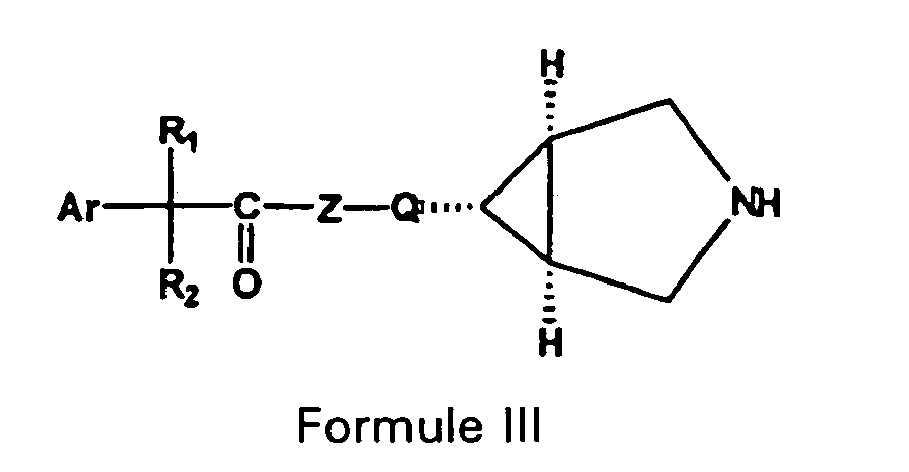
- Composés selon la revendication 1 ayant la structure de la formule IV, ainsi que leurs sels pharmaceutiquement acceptables, solvates pharmaceutiquement acceptables, esters, énantiomères, diastéréomères, N-oxydes ou polymorphes, dans laquelle r est 1 à 4.

- Composés selon la revendication 1 ayant la structure de la formule V, ainsi que leurs sels pharmaceutiquement acceptables, esters, énantiomères ou N-oxydes ; dans laquelle s représente 1 à 2.

- Composé choisi parmi le groupe constitué de
Acétamide de (2R,2S)(1α,5α,6α)-N-[3-azabicyclo[3.1.0]hexyl-6-(aminométhyl)-yl]-2-hydroxy-2-cyclopentyl-2-phényle (composé 1);
Sel chlorhydrate d'acétamide de (2R,2S)(1α,5α,6α)-N-[3-azabicyclo[3.1.0]hexyl-6-(aminométhyl)-yl]-2-hydroxy-2-cyclopentyl-2-phényle (composé 2) ;
Acétamide de (2R)-(1α,5α,6α)-N-[3-azabicyclo[3.1.0]hexyl-6-(aminométhyl)-yl]-2-hydroxy-2-cyclopentyl-2-phényle (composé 3) ;
Sel chlorhydrate d'acétamide de (2R)-(1α,5α,6α)-N-[3-azabicyclo[3.1.0]hexyl-6-(aminométhyl)-yl]-2-hydroxy-2-cyclopentyl-2-phényle (composé 4) ;
Acétamide de (2S)-(1α,5α,6α)-N-[3-azabicyclo[3.1.0]hexyl-6-(aminométhyl)-yl]-2-hydroxy-2-cyclopentyl-2-phényle (composé 5) ;
Sel chlorhydrate d'acétamide de (2S)-(1α,5α,6α)-N-[3-azabicyclo[3.1 .0]hexyl-6-(aminométhyl)-yl]-2-hydroxy-2-cyclopentyl-2-phényle (composé 6) ;
Acétamide de (2R,2S)(1α,5α,6α)-N-[3-azabicyclo[3.1.0]hexyl-6-(aminométhyl)-yl]-2-méthoxy-2-cyclopentyl-2-phényle (composé 7) ;
Acétamide de (2R,2S)(1α,5α,6α)-N-[3-azabicyclo[3.1.0]hexyl-6-(aminométhyl)-yl]-2-hydroxy-2-cycloheptyl-2-phényle (composé 8) ;
Acétamide de (2R,25)(1α,5α,6α)-N-[3-azabicyclo[3.1.0]hexyl-6-(aminométhyl)-yl]-2-hydroxy-2-cyclobutyl-2-phényle (composé 9) ;
Sel tartrate d'acétamide de (2R,2S)(1α,5α,6α)-N-[3-azabicyclo[3.1.0]hexyl-6-(aminométhyl)-yl]-2-hydroxy-2-cyclobutyl-2-phényle (composé 10) ;
Acétamide de (2R)(1α,5α,6α)-N-[3-azabicyclo[3.1.0]hexyl-6-(aminométhyl)-yl]-2-hydroxy-2-(3,3-difluorocyclopentyl)-2-phényle (composé 11);
Acétamide de (2R,25)(1α,5α,6α)-N-[3-azabicyclo[3.1.0]hexyl-6-(aminométhyl)-yl]-2-hydroxy-2-(3-fluorocyclopentyl)-2-phényle (composé 12) ;
Acétamide de (2R,2S)(1α,5α,6α)-N-[3-azabicyclo[3.1.0]hexyl-6-(aminométhyl)-yl]-2-hydroxy-2-(3,3-difluorocyclopentyl)-2-phényle (composé 13) ;
Sel tartrate d'acétamide de (2R,2S)(1 α,5α,6α)-N-[3-azabicyclo[3.1.0]hexyl-6-(aminométhyl)-yl]-2-hydroxy-2-(3,3-difluorocyclopentyl)-2-phényle (composé 14) ;
Acétate de (2R,2S)(1α,5α,6α)-N-[3-azabicyclo[3.1.0]hexyl-6-(aminométhyl)-yl]-2-hydroxy-2,2-diphényle (composé 15) ;
Acétamide de (2R,2S)(1α,5α,6α)-N-[3-azabicyclo[3.1.0]hexyl-6-(aminométhyl)-yl]-2-hydroxy-2,2-diphényle (composé 16) ;
Acétamide de (2R,2S) (1 α,5α,6α)-N-[3-azabicyclo[3.1.0]hexyl-6-(aminométhyl)-yl]-2-hydroxy-2-cyclohexyl-2-phényle (composé 17) et Acétamide de (2R,25)(1α,5α,6α)-N-[3-azabicyclo[3.1.0]hex-6-ylméthyl)-2-cyclopentyl-2-hydroxy-N-méthyl-2-phényle (composé 18). - Composition pharmaceutique comprenant une quantité thérapeutiquement efficace d'un composé tel que défini dans la revendication 1, 2, 3, 4, 5 ou 6, en même temps que des supports, excipients ou diluants pharmaceutiquement acceptables.
- Utilisation d'un composé ayant la structure de la formule 1,

Ar représente un cycle aryle ou hétéroaryle ayant 1 à 2 hétéroatomes, les cycles aryle ou hétéroaryle pouvant être non substitués ou substitués par un à trois substituants choisis indépendamment parmi un alkyle inférieur (C1-C4), un perhaloalkyle inférieur (C1-C4), un cyano, un hydroxy, un nitro, un alkoxy inférieur (C1-C4), un perhaloalkoxy inférieur (C1-C4), un amino non substitué, un N-alkyle inférieur (C1-C4) ou - arylamino, un aminocarbonyle, ou un N-alkyle inférieur (C1-C4) ou - arylaminocarbonyle ;
Ri représente un hydrogène, un hydroxy, un hydroxyméthyle, un amino, un alkoxy, un carbamoyle ou un halogène ;
R2 représente un cycle alkyle, un cycle cycloalkyle en C3-C7, un cycle cycloalkényle en C3-C7, un cycle aryle, hétérocyclique ou un cycle hétéroaryle ayant 1 à 2 hétéroatomes ; le cycle aryle, hétéroaryle, hétérocyclique ou un cycle cycloalkyle pouvant être non substitué ou substitué par un à trois substituants choisis indépendamment parmi un alkyle inférieur (C1-C4), un perhaloalkyle inférieur (C1-C4), un cyano, un hydroxy, un nitro, un alkoxycarbonyle inférieur, un halogène, un alkoxy inférieur (C1-C4), un perhaloalkoxy inférieur (C1-C4), un amino non substitué, un N-alkyle inférieur (C1-C4) ou -arylamino, un aminocarbonyle, ou un N-alkyle inférieur (C1-C4) ou -arylaminocarbonyle ;
W représente (CH2)p, où p représente 0 à 1 ;
X représente un oxygène, un soufre, -NR ou aucun atome, où R représente un hydrogène ou un (C1-6)alkyle ;
Y représente CHR5CO ou (CH2)q où R5 représente un hydrogène ou un méthyle et q représente 0 à 4 ;
Z représente un oxygène, un soufre ou NR10, où R10 représente un hydrogène ou un C1-6 alkyle ;
Q représente -(CH2)n-, où n représente 0 à 4, CHR8, où R8 représente H, OH, un C1-6 alkyle, un C1-6 alkényle, un C1-6 alkoxy, ou Q représente CH2CHR9, où R9 représente H, OH, un alkyle inférieur (C1-C4) ou un alkoxy inférieur (C1-C4) ; et
R6 et R7 sont choisis indépendamment parmi H, CH3, COOH, CONH2, NH2 et CH2NH2;
dans la fabrication d'un médicament destiné au traitement ou à la prophylaxie d'un animal ou d'un être humain souffrant d'une maladie ou d'un trouble de l'appareil respiratoire, urinaire ou gastrointestinal, la maladie ou le trouble étant médié par des récepteurs muscariniques. - Utilisation selon la revendication 8, dans laquelle le composé a la structure de la formule II, ainsi que ses sels pharmaceutiquement acceptables, solvates pharmaceutiquement acceptables, esters, énantiomères, diastéréomères, N-oxydes ou polymorphes.

- Utilisation selon la revendication 8, dans laquelle le composé a la structure de la formule III, ainsi que ses sels pharmaceutiquement acceptables, solvates pharmaceutiquement acceptables, esters, énantiomères, diastéréomères, N-oxydes ou polymorphes.

- Utilisation selon la revendication 8, dans laquelle le composé a la structure de la formule IV, ainsi que ses sels pharmaceutiquement acceptables, solvates pharmaceutiquement acceptables, esters, énantiomères, diastéréomères, N-oxydes ou polymorphes, dans laquelle r est 1 à 4.

- Utilisation selon la revendication 8, dans laquelle le composé a la structure de la formule V, ainsi que ses sels pharmaceutiquement acceptables, solvates pharmaceutiquement acceptables, esters, énantiomères, diastéréomères, N-oxydes ou polymorphes, dans laquelle s représente 1 à 2.

- Utilisation selon la revendication 8, dans laquelle la maladie ou le trouble de l'appareil respiratoire, urinaire ou gastrointestinal, ladite maladie étant médiée par des récepteurs muscariniques, est choisi parmi l'incontinence urinaire, les symptômes du bas appareil urinaire (SBAU), l'asthme bronchique, les troubles pulmonaires obstructifs chroniques (COPD), la fibrose pulmonaire, le syndrome de l'intestin irritable, l'obésité, le diabète ou l'hyperkinésie gastrointestinale.
- Utilisation selon la revendication 9, dans laquelle la maladie ou le trouble de l'appareil respiratoire, urinaire ou gastrointestinal, ladite maladie étant médiée par des récepteurs muscariniques, est choisi parmi l'incontinence urinaire, les symptômes du bas appareil urinaire (SBAU), l'asthme bronchique, les troubles pulmonaires obstructifs chroniques (COPD), la fibrose pulmonaire, le syndrome de l'intestin irritable, l'obésité, le diabète ou l'hyperkinésie gastrointestinale.
- Utilisation selon la revendication 10, dans laquelle la maladie ou le trouble de l'appareil respiratoire, urinaire ou gastrointestinal, ladite maladie étant médiée par des récepteurs muscariniques, est choisi parmi l'incontinence urinaire, les symptômes du bas appareil urinaire (SBAU), l'asthme bronchique, les troubles pulmonaires obstructifs chroniques (COPD), la fibrose pulmonaire, le syndrome de l'intestin irritable, l'obésité, le diabète ou l'hyperkinésie gastrointestinale.
- Utilisation selon la revendication 11, dans laquelle la maladie ou le trouble de l'appareil respiratoire, urinaire ou gastrointestinal, ladite maladie étant médiée par des récepteurs muscariniques, est choisi parmi l'incontinence urinaire, les symptômes du bas appareil urinaire (SBAU), l'asthme bronchique, les troubles pulmonaires obstructifs chroniques (COPD), la fibrose pulmonaire, le syndrome de l'intestin irritable, l'obésité, le diabète ou l'hyperkinésie gastrointestinale.
- Utilisation selon la revendication 12, dans laquelle la maladie ou le trouble de l'appareil respiratoire, urinaire ou gastrointestinal, ladite maladie étant médiée par des récepteurs muscariniques, est choisi parmi l'incontinence urinaire, les symptômes du bas appareil urinaire (SBAU), l'asthme bronchique, les troubles pulmonaires obstructifs chroniques (COPD), la fibrose pulmonaire, le syndrome de l'intestin irritable, l'obésité, le diabète ou l'hyperkinésie gastrointestinale.
- Utilisation de composition pharmaceutique selon la revendication 7 dans la fabrication d'un médicament destiné au traitement ou à la prophylaxie d'un animal ou d'un être humain souffrant d'une maladie ou d'un trouble de l'appareil respiratoire, urinaire ou gastrointestinal, la maladie ou le trouble étant médié par des récepteurs muscariniques.
- Utilisation selon la revendication 18, dans laquelle la maladie ou le trouble de l'appareil respiratoire, urinaire ou gastrointestinal, ladite maladie ou ledit trouble étant médié par des récepteurs muscariniques, est choisi parmi l'incontinence urinaire, les symptômes du bas appareil urinaire (SBAU), l'asthme bronchique, les troubles pulmonaires obstructifs chroniques (COPD), la fibrose pulmonaire, le syndrome de l'intestin irritable, l'obésité, le diabète ou l'hyperkinésie gastrointestinale.
- Procédé de préparation d'un composé de formule I,

Ar représente un cycle aryle ou hétéroaryle ayant 1 à 2 hétéroatomes, les cycles aryle ou hétéroaryle pouvant être non substitués ou substitués par un à trois substituants choisis indépendamment parmi un alkyle inférieur (C1-C4), un perhaloalkyle inférieur (C1-C4), un cyano, un hydroxy, un nitro, un alkoxy inférieur (C1-C4), un perhaloalkoxy inférieur (C1-C4), un amino non substitué, un N-alkyle inférieur (C1-C4) ou - arylamino, un aminocarbonyle, ou un N-alkyle inférieur (C1-C4) ou - arylaminocarbonyle ;
R1 représente un hydrogène, un hydroxy, un hydroxyméthyle, un amino, un alkoxy, un carbamoyle ou un halogène ;
R2 représente un cycle alkyle, un cycle cycloalkyle en C3-C7, un cycle cycloalkényle en C3-C7, un cycle aryle, hétérocyclique ou un cycle hétéroaryle ayant 1 à 2 hétéroatomes choisis parmi un groupe constitué d'atomes d'oxygène, de soufre et d'azote ; le cycle aryle, hétéroaryle, hétérocyclique ou un cycle cycloalkyle pouvant être non substitué ou substitué par un à trois substituants choisis indépendamment parmi un alkyle inférieur (C1-C4), un perhaloalkyle inférieur (C1-C4), un cyano, un hydroxy, un nitro, un alkoxycarbonyle inférieur, un halogène, un alkoxy inférieur (C1-C4), un perhaloalkoxy inférieur (C1-C4), un amino non substitué, un N-alkyle inférieur (C1-C4) ou -arylamino, un aminocarbonyle, ou un N-alkyle inférieur (C1-C4) ou -arylaminocarbonyle ;
W représente (CH2)p, où p représente 0 à 1 ;
X représente un oxygène, un soufre, -NR ou aucun atome, où R représente un hydrogène ou un (C1-6)alkyle ;
Y représente CHR5CO ou (CH2)q où R5 représente un hydrogène ou un méthyle et q représente 0 à 4 ;
Z représente un oxygène, un soufre, NR10, où R10 représente un hydrogène, un C1-6 alkyle ;
Q représente (CH2)n (où n représente 0 à 4), CHR8 (où R8 représente H, OH, un C1-6 alkyle, un C1-6 alkényle, un C1-6 alkoxy) ou CH2CHR9 (où R9 représente H, OH, un alkyle inférieur (C1-C4) ou un alkoxy inférieur (C1-C4)) ; et
R6 et R7 sont choisis indépendamment parmi H, CH3, COOH, CONH2, NH2 et CH2NH2;
ledit procédé consistant à :(a) faire réagir un composé de formule VII avec un composé de formule VI
 (b) déprotéger le composé de formule VIII en présence d'un agent de déprotection pour donner un composé de formule I où Ar, R1, R2, W, X, Y, Z et Q sont tels que définis,
- Procédé de la revendication 20, dans lequel P est n'importe quel groupe de protection pour un groupe amino et est choisi parmi le groupe constitué de groupes benzyle et t-butyloxycarbonyle.
- Procédé de la revendication 20, dans lequel la réaction d'un composé de formule VI avec un composé de formule VII pour donner un composé de formule VIII est réalisée en présence d'un agent de condensation qui est choisi parmi le groupe constitué de chlorhydrate de 1-(3-diméthylaminopropyl)-3-éthylcarbodiimide (EDC) et 1,8-diazabicyclo[5.4.0]undéc-7-ène (DBU).
- Procédé de la revendication 20, dans lequel la réaction d'un composé de formule VI avec un composé de formule VII est réalisée dans un solvant aprotique polaire approprié choisi parmi le groupe constitué de N,N-diméthylformamide, diméthylsulfoxide, toluène et xylène.
- Procédé de la revendication 20, dans lequel la réaction d'un composé de formule VI avec un composé de formule VII est réalisée à 0-140 °C.
- Procédé de la revendication 20, dans lequel la déprotection d'un composé de formule VIII est réalisée avec un agent de déprotection qui est choisi parmi le groupe constitué de palladium sur charbon, acide trifluoroacétique (TFA) et acide chlorhydrique.
- Procédé de la revendication 20, dans lequel la déprotection d'un composé de formule VIII pour donner un composé de formule I est réalisée dans un solvant organique approprié choisi parmi le groupe constitué de méthanol, éthanol, tétrahydrofurane et acétonitrile.
Applications Claiming Priority (3)
| Application Number | Priority Date | Filing Date | Title |
|---|---|---|---|
| PCT/IB2002/002663 WO2004004629A2 (fr) | 2002-07-08 | 2002-07-08 | Derives d'azabicyclo[3.1.0]hexanes 3,6-disubstitues utiles comme antagonistes des recepteurs muscariniques |
| WOPCT/IB02/02663 | 2002-07-08 | ||
| PCT/IB2003/001367 WO2004005252A1 (fr) | 2002-07-08 | 2003-04-11 | Derives azabicyclo utilises comme antagonistes des recepteur muscariniques |
Publications (3)
| Publication Number | Publication Date |
|---|---|
| EP1551803A1 EP1551803A1 (fr) | 2005-07-13 |
| EP1551803B1 true EP1551803B1 (fr) | 2006-10-11 |
| EP1551803B8 EP1551803B8 (fr) | 2006-12-13 |
Family
ID=30011691
Family Applications (2)
| Application Number | Title | Priority Date | Filing Date |
|---|---|---|---|
| EP02743489A Expired - Lifetime EP1546099B1 (fr) | 2002-07-08 | 2002-07-08 | Derives d'azabicyclo 3.1.0 hexanes 3,6-disubstitues utiles comme antagonistes des recepteurs muscariniques |
| EP03762827A Expired - Lifetime EP1551803B8 (fr) | 2002-07-08 | 2003-04-11 | Derives azabicyclo utilises comme antagonistes des recepteur muscariniques |
Family Applications Before (1)
| Application Number | Title | Priority Date | Filing Date |
|---|---|---|---|
| EP02743489A Expired - Lifetime EP1546099B1 (fr) | 2002-07-08 | 2002-07-08 | Derives d'azabicyclo 3.1.0 hexanes 3,6-disubstitues utiles comme antagonistes des recepteurs muscariniques |
Country Status (19)
| Country | Link |
|---|---|
| US (2) | US7399779B2 (fr) |
| EP (2) | EP1546099B1 (fr) |
| JP (2) | JP2006502985A (fr) |
| CN (2) | CN1668585A (fr) |
| AT (2) | ATE419236T1 (fr) |
| AU (2) | AU2002345266B2 (fr) |
| BR (2) | BR0215801A (fr) |
| CA (2) | CA2492121A1 (fr) |
| CY (1) | CY1105879T1 (fr) |
| DE (2) | DE60230683D1 (fr) |
| DK (1) | DK1551803T3 (fr) |
| EA (3) | EA200500173A1 (fr) |
| ES (1) | ES2274275T3 (fr) |
| MX (2) | MXPA05000434A (fr) |
| NZ (2) | NZ537584A (fr) |
| PT (1) | PT1551803E (fr) |
| SI (1) | SI1551803T1 (fr) |
| WO (2) | WO2004004629A2 (fr) |
| ZA (1) | ZA200500951B (fr) |
Families Citing this family (24)
| Publication number | Priority date | Publication date | Assignee | Title |
|---|---|---|---|---|
| NZ537584A (en) * | 2002-07-08 | 2006-07-28 | Ranbaxy Lab Ltd | 3,6-disubstituted azabicyclo [3.1.0]hexane derivatives useful as muscarinic receptor antagonists |
| US7232835B2 (en) | 2002-12-10 | 2007-06-19 | Ranbaxy Laboratories Limited | 3,6-Disubstituted azabicyclo derivatives as muscarinic receptor antagonists |
| WO2004089898A1 (fr) | 2003-04-09 | 2004-10-21 | Ranbaxy Laboratories Limited | Derives d'azabicyclo hexane substitues en tant qu'antagonistes de recepteurs muscariniques |
| BRPI0409302A (pt) * | 2003-04-11 | 2006-04-11 | Ranbaxy Lab Ltd | derivados azabiciclo como antagonistas de recetores muscarìnicos, método para sua preparação e composição farmacêutica contendo os mesmos |
| ES2634841T3 (es) * | 2003-10-14 | 2017-09-29 | Pfizer Products Inc. | Derivados bicíclicos [3.1.0] como inhibidores del transportador de glicina |
| EP1746998A1 (fr) * | 2004-03-22 | 2007-01-31 | Ranbaxy Laboratories, Ltd. | Therapie combinee destinee a reduire les symptomes des voies urinaires |
| ES2257152B1 (es) * | 2004-05-31 | 2007-07-01 | Laboratorios Almirall S.A. | Combinaciones que comprenden agentes antimuscarinicos y agonistas beta-adrenergicos. |
| WO2006003587A2 (fr) * | 2004-07-01 | 2006-01-12 | Ranbaxy Laboratories Limited | Formes posologiques solides pour administration orale a base de derives azabicyclo |
| WO2006016245A1 (fr) * | 2004-08-05 | 2006-02-16 | Ranbaxy Laboratories Limited | Antagonistes des récepteurs muscariniques |
| WO2006032994A2 (fr) * | 2004-09-24 | 2006-03-30 | Ranbaxy Laboratories Limited | Antagonistes des recepteurs muscariniques |
| EP1796667A2 (fr) * | 2004-09-27 | 2007-06-20 | Ranbaxy Laboratories Limited | Antagonistes des recepteurs muscariniques |
| WO2006054162A1 (fr) * | 2004-11-19 | 2006-05-26 | Ranbaxy Laboratories Limited | Antagonistes azabicycliques des recepteurs muscariniques |
| WO2006064304A1 (fr) * | 2004-12-15 | 2006-06-22 | Ranbaxy Laboratories Limited | Sels d'addition d'acide d'antagonistes du recepteur muscarinique |
| EP1888525A1 (fr) * | 2005-05-03 | 2008-02-20 | Ranbaxy Laboratories Limited | Derives d'azabicyclo [3.1.0]hexane 3,6-disubstitues utilises comme antagonistes du recepteur muscarinique |
| WO2007039884A1 (fr) | 2005-10-05 | 2007-04-12 | Ranbaxy Laboratories Limited | Dérivés de 3 -azabicyclooctane en tant qu’antagonistes de récepteurs muscariniques |
| WO2007045979A1 (fr) * | 2005-10-19 | 2007-04-26 | Ranbaxy Laboratories Limited | Compositions pharmaceutiques d'antagonistes du recepteur muscarinique |
| WO2007110782A1 (fr) | 2005-12-30 | 2007-10-04 | Ranbaxy Laboratories Limited | Antagonistes des récepteurs muscariniques |
| US20100222393A1 (en) | 2005-12-30 | 2010-09-02 | Naresh Kumar | Muscarinic receptor antagonists |
| WO2008075321A2 (fr) * | 2006-12-21 | 2008-06-26 | Ranbaxy Laboratories Limited | Formulations à libération modifiée de dérivés azabicyclo |
| US20090326004A1 (en) | 2008-06-03 | 2009-12-31 | Ranbaxy Laboratories Limited | Muscarinic receptor antagonists |
| BR112013007566A2 (pt) | 2010-09-28 | 2016-08-02 | Panacea Biotec Ltd | novos compostos bicíclicos |
| JP2020506895A (ja) * | 2017-01-17 | 2020-03-05 | ボード オブ レジェンツ, ザ ユニバーシティ オブ テキサス システムBoard Of Regents, The University Of Texas System | インドールアミン2,3−ジオキシゲナーゼおよび/またはトリプトファンジオキシゲナーゼの阻害剤として有用な化合物 |
| WO2020018670A1 (fr) | 2018-07-17 | 2020-01-23 | Board Of Regents, The University Of Texas System | Composés utiles en tant qu'inhibiteurs de l'indoléamine 2,3-dioxygénase et/ou de la tryptophane dioxygénase |
| CN111317754B (zh) * | 2018-12-13 | 2022-02-18 | 泰州医药城国科化物生物医药科技有限公司 | 一种北豆根总碱的制备方法及应用 |
Family Cites Families (65)
| Publication number | Priority date | Publication date | Assignee | Title |
|---|---|---|---|---|
| US2490714A (en) | 1947-05-13 | 1949-12-06 | Du Pont | Preparation of diazoacetic esters |
| NL267508A (fr) | 1960-07-26 | |||
| SE8800207D0 (sv) | 1988-01-22 | 1988-01-22 | Kabivitrum Ab | Nya aminer, deras anvendning och framstellning |
| US5001160A (en) | 1988-04-28 | 1991-03-19 | Marion Laboratories, Inc. | 1-aryl-1-hydroxy-1-substituted-3-(4-substituted-1-piperazinyl)-2-propanones and their use in treatment of neurogenic bladder disorders |
| GB8906166D0 (en) | 1989-03-17 | 1989-05-04 | Pfizer Ltd | Therapeutic agents |
| RU2049777C1 (ru) | 1989-08-16 | 1995-12-10 | Пфайзер Инк. | Азабицикло-хинолон-карбоновые кислоты или их фармацевтически приемлемые кислотно-аддитивные соли и промежуточные продукты для их получения |
| US5164402A (en) | 1989-08-16 | 1992-11-17 | Pfizer Inc | Azabicyclo quinolone and naphthyridinone carboxylic acids |
| US5281601A (en) | 1989-12-12 | 1994-01-25 | Pfizer Inc. | Muscarinic receptor antagonists |
| GB8928042D0 (en) | 1989-12-12 | 1990-02-14 | Pfizer Ltd | Muscarinic receptor antagonists |
| FR2659323B1 (fr) * | 1990-03-07 | 1992-06-12 | Synthelabo | Derives de 4-(aminomethyl) piperidine, leur preparation et leur application en therapeutique. |
| JPH0492921A (ja) | 1990-08-03 | 1992-03-25 | Fujitsu Ltd | 指数関数演算器 |
| GB9020051D0 (en) | 1990-09-13 | 1990-10-24 | Pfizer Ltd | Muscarinic receptor antagonists |
| GB9202443D0 (en) | 1992-02-05 | 1992-03-18 | Fujisawa Pharmaceutical Co | A novel substituted-acetamide compound and a process for the preparation thereof |
| FI100051B (fi) | 1992-02-18 | 1997-09-15 | Favorit Oy | Kompostori |
| JPH0635958A (ja) | 1992-07-14 | 1994-02-10 | Hitachi Ltd | 語句検索方法 |
| JP3429338B2 (ja) | 1992-07-27 | 2003-07-22 | 杏林製薬株式会社 | 新規なアリールグリシンアミド誘導体及びその製造法 |
| JPH06135958A (ja) | 1992-10-28 | 1994-05-17 | Tanabe Seiyaku Co Ltd | ベンゾシクロヘプテン誘導体及びその製法 |
| SE9203318D0 (sv) * | 1992-11-06 | 1992-11-06 | Kabi Pharmacia Ab | Novel 3,3-diphenylpropylamines, their use and preparation |
| DE59306269D1 (de) | 1993-02-24 | 1997-05-28 | Siemens Ag | Sperrwandler-Schaltnetzteil mit einem Halbleiterschaltelement geringer Spannungsfestigkeit |
| NO2005012I1 (no) | 1994-12-28 | 2005-06-06 | Debio Rech Pharma Sa | Triptorelin og farmasoytisk akseptable salter derav |
| EP0823423B1 (fr) * | 1995-04-28 | 2004-06-16 | Banyu Pharmaceutical Co., Ltd. | Derives disubstitues en position 1,4 de piperidine |
| CA2179574A1 (fr) | 1995-06-26 | 1996-12-27 | Tomomi Okada | Derive de substitution de la piperidine et medicament a base de ce derive |
| DE69615214T2 (de) | 1995-10-13 | 2002-06-27 | Banyu Pharmaceutical Co., Ltd. | Substituierte heteroaromatische derivate |
| WO1997045414A1 (fr) | 1996-05-31 | 1997-12-04 | Banyu Pharmaceutical Co., Ltd. | Derives de piperidine a disubstitution en positions 1,4 |
| EP0920313A1 (fr) | 1996-07-01 | 1999-06-09 | Sepracor, Inc. | Procedes et compositions de traitement de l'incontinence urinaire par (s,s)-glycopyrrolate enrichi par enantiomorphisme |
| WO1998000132A1 (fr) | 1996-07-01 | 1998-01-08 | Sepracor, Inc. | PROCEDES ET COMPOSITIONS POUR TRAITER L'INCONTINENCE URINAIRE AVEC DU (R,s)-GLYCOPYRROLATE ENRICHI EN ENANTIOMERES |
| EP0909163A4 (fr) | 1996-07-01 | 1999-06-09 | Sepracor Inc | Procedes et compositions de traitement de l'incontinence urinaire a l'aide de (s,r)-glycopyrrolate enrichi en enantiomeres |
| EP0932401A1 (fr) | 1996-07-01 | 1999-08-04 | Sepracor, Inc. | Procedes et compositions de traitement de l'incontinence urinaire par (r, r)-glycopyrrolate enrichi par enantiomere |
| PE92198A1 (es) | 1996-08-01 | 1999-01-09 | Banyu Pharma Co Ltd | Derivados de 1,4-piperidina disustituida que contienen fluor |
| KR20000057548A (ko) | 1996-12-13 | 2000-09-25 | 알프레드 엘. 미첼슨 | 광학적 전송물질 및 결합재 |
| EP1001764A4 (fr) | 1997-05-29 | 2005-08-24 | Merck & Co Inc | Composes d'amide heterocycliques utilises en tant qu'inhibiteurs de l'adhesion cellulaire |
| US6319920B1 (en) | 1998-02-27 | 2001-11-20 | Syntex (U.S.A.) Llc | 2-arylethyl-(piperidin-4-ylmethyl)amine derivatives |
| TWI244481B (en) | 1998-12-23 | 2005-12-01 | Pfizer | 3-azabicyclo[3.1.0]hexane derivatives useful in therapy |
| UA73543C2 (uk) | 1999-12-07 | 2005-08-15 | Тераванс, Інк. | Похідні сечовини, фармацевтична композиція та застосування похідного при приготуванні лікарського засобу для лікування захворювання, яке опосередковується мускариновим рецептором |
| MXPA02005596A (es) | 1999-12-07 | 2004-09-10 | Theravance Inc | Derivados de carbamato con actividad antagonista para el rerceptor muscarinico. |
| SE9904765D0 (sv) | 1999-12-23 | 1999-12-23 | Astra Ab | Pharmaceutically-useful compounds |
| EP1289965B1 (fr) | 2000-05-25 | 2005-10-26 | F. Hoffmann-La Roche Ag | 1-aminoalkyle-lactames substitues et leur utilisation en tant qu'antagonistes de recepteur muscarinique |
| HUP0302015A2 (hu) | 2000-05-25 | 2003-10-28 | F. Hoffmann-La Roche Ag. | Helyettesített 1-aminoalkil-laktámok és felhasználásuk muszkarin receptor antagonistaként |
| WO2002006241A1 (fr) | 2000-06-14 | 2002-01-24 | Muscagen Limited | Derives de 1, 2, 3, 5 -tetrahydrobenzo`c!azepine-4-one presentant une activite antagoniste muscarinique |
| AU6610001A (en) | 2000-06-27 | 2002-01-08 | S A L V A T Lab Sa | Carbamates derived from arylalkylamines |
| CA2415468A1 (fr) | 2000-07-11 | 2003-01-10 | Yoshio Ogino | Derives d'ester |
| HUP0303529A3 (en) | 2000-12-22 | 2008-03-28 | Almirall Ag | New quinuclidine carbamate derivatives, process for their preparation and pharmaceutical compositions containing them and their use |
| CN1250545C (zh) | 2000-12-28 | 2006-04-12 | 阿尔米雷尔普罗迪斯制药有限公司 | 新的奎宁环衍生物类及含有这类衍生物的药物组合物 |
| WO2002083863A2 (fr) * | 2001-04-17 | 2002-10-24 | Sepracor, Inc. | Thiazole et autres ligands heterocycliques pour recepteurs et transporteurs mammaliens de serotonine, de dopamine et de la muscarine, et methodes d'utilisation correspondantes |
| RU2004110717A (ru) | 2001-10-17 | 2005-10-20 | Юсиби, С.А. (Be) | Производные хинуклидина, способы их получения и их применение в качестве и нгибиторов м2- и/или м3- мускариновых рецепторов |
| PL370765A1 (en) * | 2001-12-03 | 2005-05-30 | F.Hoffmann-La Roche Ag | 4-piperidinyl alkylamine derivatives as muscarinic receptor antagonists |
| EP1453806B1 (fr) * | 2001-12-03 | 2007-12-19 | F. Hoffmann-La Roche Ag | Derives d'aminotetraline utilises comme antagonistes des recepteurs muscariniques |
| NZ537584A (en) | 2002-07-08 | 2006-07-28 | Ranbaxy Lab Ltd | 3,6-disubstituted azabicyclo [3.1.0]hexane derivatives useful as muscarinic receptor antagonists |
| WO2004014853A1 (fr) | 2002-07-31 | 2004-02-19 | Ranbaxy Laboratories Limited | Derives 3,6-disubstitues d'azabicyclo [3.1.0]hexane utilises comme antagonistes des recepteurs muscariniques |
| AU2002321711A1 (en) | 2002-08-09 | 2004-02-25 | Ranbaxy Laboratories Limited | 3,6-disubstituted azabicyclo (3.1.0) hexane derivatives useful as muscarinic receptor antagonist |
| JP2006501236A (ja) | 2002-08-23 | 2006-01-12 | ランバクシー ラボラトリーズ リミテッド | ムスカリン性レセプター拮抗薬としてのフルオロおよびスルホニルアミノ含有3,6−二置換アザビシクロ(3.1.0)ヘキサン誘導体 |
| US7232835B2 (en) * | 2002-12-10 | 2007-06-19 | Ranbaxy Laboratories Limited | 3,6-Disubstituted azabicyclo derivatives as muscarinic receptor antagonists |
| AU2002356369A1 (en) | 2002-12-23 | 2004-07-14 | Ranbaxy Laboratories Limited | Xanthine derivatives as muscarinic receptor antagonists |
| AU2002347553A1 (en) | 2002-12-23 | 2004-07-14 | Ranbaxy Laboratories Limited | Flavaxate derivatives as muscarinic receptor antagonists |
| AU2002347552A1 (en) | 2002-12-23 | 2004-07-14 | Ranbaxy Laboratories Limited | 1-substituted-3-pyrrolidine derivatives as muscarinic receptor antagonists |
| US7488748B2 (en) | 2003-01-28 | 2009-02-10 | Ranbaxy Laboratories Limited | 3,6-Disubstituted azabicyclo hexane derivatives as muscarinic receptor antagonists |
| WO2004069835A1 (fr) | 2003-02-07 | 2004-08-19 | Ranbaxy Laboratories Limited | Derives d'azabicyclo hexane substitues en tant qu'antagonistes de recepteurs muscariniques |
| WO2004089898A1 (fr) | 2003-04-09 | 2004-10-21 | Ranbaxy Laboratories Limited | Derives d'azabicyclo hexane substitues en tant qu'antagonistes de recepteurs muscariniques |
| CA2521788A1 (fr) | 2003-04-10 | 2004-10-21 | Ranbaxy Laboratories Limited | Derives d'azabicyclo hexanes substitues en tant qu'antagonistes des recepteurs muscariniques |
| AU2003223010A1 (en) | 2003-04-10 | 2004-11-01 | Ranbaxy Laboratories Limited | Substituted azabicyclo hexane derivatives as muscarinic receptor antagonists |
| BRPI0409302A (pt) | 2003-04-11 | 2006-04-11 | Ranbaxy Lab Ltd | derivados azabiciclo como antagonistas de recetores muscarìnicos, método para sua preparação e composição farmacêutica contendo os mesmos |
| FR2855805B1 (fr) | 2003-06-06 | 2005-08-05 | Vallourec Vitry | Element de structure pour vehicule, capable d'un meilleur comportement aux chocs |
| EP1746998A1 (fr) | 2004-03-22 | 2007-01-31 | Ranbaxy Laboratories, Ltd. | Therapie combinee destinee a reduire les symptomes des voies urinaires |
| EP1796667A2 (fr) | 2004-09-27 | 2007-06-20 | Ranbaxy Laboratories Limited | Antagonistes des recepteurs muscariniques |
| WO2006064304A1 (fr) | 2004-12-15 | 2006-06-22 | Ranbaxy Laboratories Limited | Sels d'addition d'acide d'antagonistes du recepteur muscarinique |
-
2002
- 2002-07-08 NZ NZ537584A patent/NZ537584A/en unknown
- 2002-07-08 DE DE60230683T patent/DE60230683D1/de not_active Expired - Fee Related
- 2002-07-08 AU AU2002345266A patent/AU2002345266B2/en not_active Expired - Fee Related
- 2002-07-08 MX MXPA05000434A patent/MXPA05000434A/es unknown
- 2002-07-08 EA EA200500173A patent/EA200500173A1/ru unknown
- 2002-07-08 US US10/520,573 patent/US7399779B2/en not_active Expired - Fee Related
- 2002-07-08 JP JP2004519029A patent/JP2006502985A/ja active Pending
- 2002-07-08 CA CA002492121A patent/CA2492121A1/fr not_active Abandoned
- 2002-07-08 WO PCT/IB2002/002663 patent/WO2004004629A2/fr not_active Ceased
- 2002-07-08 EP EP02743489A patent/EP1546099B1/fr not_active Expired - Lifetime
- 2002-07-08 CN CNA028295528A patent/CN1668585A/zh active Pending
- 2002-07-08 BR BR0215801-9A patent/BR0215801A/pt not_active IP Right Cessation
- 2002-07-08 AT AT02743489T patent/ATE419236T1/de not_active IP Right Cessation
-
2003
- 2003-04-11 DE DE60309057T patent/DE60309057T2/de not_active Expired - Fee Related
- 2003-04-11 AT AT03762827T patent/ATE342253T1/de not_active IP Right Cessation
- 2003-04-11 SI SI200330515T patent/SI1551803T1/sl unknown
- 2003-04-11 BR BR0312572-6A patent/BR0312572A/pt not_active IP Right Cessation
- 2003-04-11 EA EA200500172A patent/EA007932B1/ru not_active IP Right Cessation
- 2003-04-11 JP JP2004519035A patent/JP2005535655A/ja active Pending
- 2003-04-11 CA CA002491998A patent/CA2491998A1/fr not_active Abandoned
- 2003-04-11 MX MXPA05000435A patent/MXPA05000435A/es active IP Right Grant
- 2003-04-11 EP EP03762827A patent/EP1551803B8/fr not_active Expired - Lifetime
- 2003-04-11 CN CNB038211300A patent/CN100519526C/zh not_active Expired - Fee Related
- 2003-04-11 AU AU2003226579A patent/AU2003226579B2/en not_active Ceased
- 2003-04-11 PT PT03762827T patent/PT1551803E/pt unknown
- 2003-04-11 DK DK03762827T patent/DK1551803T3/da active
- 2003-04-11 US US10/520,572 patent/US7544708B2/en not_active Expired - Fee Related
- 2003-04-11 NZ NZ537585A patent/NZ537585A/en unknown
- 2003-04-11 ES ES03762827T patent/ES2274275T3/es not_active Expired - Lifetime
- 2003-04-11 WO PCT/IB2003/001367 patent/WO2004005252A1/fr not_active Ceased
-
2004
- 2004-01-07 EA EA200501595A patent/EA009942B1/ru not_active IP Right Cessation
-
2005
- 2005-02-02 ZA ZA200500951A patent/ZA200500951B/xx unknown
-
2006
- 2006-12-21 CY CY20061101846T patent/CY1105879T1/el unknown
Also Published As
Similar Documents
| Publication | Publication Date | Title |
|---|---|---|
| US7544708B2 (en) | Azabicyclo derivatives as muscarinic receptor antagonists | |
| EP1534675B1 (fr) | Derives d'azabicyclo(3.1.0)hexanes 3,6-disubstitues contenant fluoro et sulfonylamino, utilises comme antagonistes des recepteurs de muscarine | |
| EP1546098B1 (fr) | Derivés 3,6-disubstitués d'azabicyclo[3.1.0]hexane utilisés comme antagonistes des récepteurs muscariniques | |
| US7446123B2 (en) | Azabicyclo derivatives as muscarinic receptor antagonists | |
| EP1615634B1 (fr) | Derives d'azabicyclo hexane en tant qu'antagonistes des recepteurs muscariniques | |
| US7560479B2 (en) | 3,6-Disubstituted azabicyclo hexane derivatives as muscarinic receptor antagonists | |
| HK1082728B (en) | Azabicyclo derivatives as muscarinic receptor antagonists | |
| HK1079783B (en) | 3,6-disubstituted azabicyclo 3.1.0 hexane derivatives useful as muscarinic receptor antagonists | |
| KR20050023400A (ko) | 무스카린 수용체 길항제로서의 아자비시클로 유도체 | |
| KR20050023401A (ko) | 무스카린 수용체 길항제로서 사용가능한 3,6-이치환된아자비시클로 [3.1.0]헥산 유도체 | |
| KR20060014373A (ko) | 무스카린 수용체 길항제로서의 치환된 아자비시클로 헥산유도체 |
Legal Events
| Date | Code | Title | Description |
|---|---|---|---|
| PUAI | Public reference made under article 153(3) epc to a published international application that has entered the european phase |
Free format text: ORIGINAL CODE: 0009012 |
|
| 17P | Request for examination filed |
Effective date: 20050208 |
|
| AK | Designated contracting states |
Kind code of ref document: A1 Designated state(s): AT BE BG CH CY CZ DE DK EE ES FI FR GB GR HU IE IT LI LU MC NL PT RO SE SI SK TR |
|
| AX | Request for extension of the european patent |
Extension state: AL LT LV MK |
|
| GRAP | Despatch of communication of intention to grant a patent |
Free format text: ORIGINAL CODE: EPIDOSNIGR1 |
|
| REG | Reference to a national code |
Ref country code: HK Ref legal event code: DE Ref document number: 1082728 Country of ref document: HK |
|
| GRAS | Grant fee paid |
Free format text: ORIGINAL CODE: EPIDOSNIGR3 |
|
| GRAA | (expected) grant |
Free format text: ORIGINAL CODE: 0009210 |
|
| AK | Designated contracting states |
Kind code of ref document: B1 Designated state(s): AT BE BG CH CY CZ DE DK EE ES FI FR GB GR HU IE IT LI LU MC NL PT RO SE SI SK TR |
|
| AX | Request for extension of the european patent |
Extension state: AL LT LV MK |
|
| REG | Reference to a national code |
Ref country code: GB Ref legal event code: FG4D |
|
| REG | Reference to a national code |
Ref country code: CH Ref legal event code: EP |
|
| RAP2 | Party data changed (patent owner data changed or rights of a patent transferred) |
Owner name: RANBAXY LABORATORIES LIMITED |
|
| RAP2 | Party data changed (patent owner data changed or rights of a patent transferred) |
Owner name: RANBAXY LABORATORIES LIMITED |
|
| REG | Reference to a national code |
Ref country code: IE Ref legal event code: FG4D |
|
| REF | Corresponds to: |
Ref document number: 60309057 Country of ref document: DE Date of ref document: 20061123 Kind code of ref document: P |
|
| REG | Reference to a national code |
Ref country code: RO Ref legal event code: EPE |
|
| NLT2 | Nl: modifications (of names), taken from the european patent patent bulletin |
Owner name: RANBAXY LABORATORIES LIMITED Effective date: 20061102 |
|
| REG | Reference to a national code |
Ref country code: CH Ref legal event code: NV Representative=s name: CRONIN INTELLECTUAL PROPERTY |
|
| REG | Reference to a national code |
Ref country code: GR Ref legal event code: EP Ref document number: 20060404356 Country of ref document: GR |
|
| REG | Reference to a national code |
Ref country code: PT Ref legal event code: SC4A Free format text: AVAILABILITY OF NATIONAL TRANSLATION Effective date: 20061205 |
|
| REG | Reference to a national code |
Ref country code: SE Ref legal event code: TRGR |
|
| REG | Reference to a national code |
Ref country code: EE Ref legal event code: FG4A Ref document number: E000789 Country of ref document: EE Effective date: 20061229 |
|
| REG | Reference to a national code |
Ref country code: CH Ref legal event code: PCAR Free format text: CRONIN INTELLECTUAL PROPERTY;CHEMIN DE PRECOSSY 31;1260 NYON (CH) |
|
| ET | Fr: translation filed | ||
| REG | Reference to a national code |
Ref country code: ES Ref legal event code: FG2A Ref document number: 2274275 Country of ref document: ES Kind code of ref document: T3 |
|
| REG | Reference to a national code |
Ref country code: HU Ref legal event code: AG4A Ref document number: E001707 Country of ref document: HU |
|
| PLBE | No opposition filed within time limit |
Free format text: ORIGINAL CODE: 0009261 |
|
| STAA | Information on the status of an ep patent application or granted ep patent |
Free format text: STATUS: NO OPPOSITION FILED WITHIN TIME LIMIT |
|
| REG | Reference to a national code |
Ref country code: HK Ref legal event code: GR Ref document number: 1082728 Country of ref document: HK |
|
| 26N | No opposition filed |
Effective date: 20070712 |
|
| PGFP | Annual fee paid to national office [announced via postgrant information from national office to epo] |
Ref country code: ES Payment date: 20080429 Year of fee payment: 6 Ref country code: HU Payment date: 20080402 Year of fee payment: 6 Ref country code: CH Payment date: 20080415 Year of fee payment: 6 Ref country code: CZ Payment date: 20080407 Year of fee payment: 6 Ref country code: DK Payment date: 20080411 Year of fee payment: 6 Ref country code: LU Payment date: 20080414 Year of fee payment: 6 |
|
| PGFP | Annual fee paid to national office [announced via postgrant information from national office to epo] |
Ref country code: AT Payment date: 20080415 Year of fee payment: 6 Ref country code: SK Payment date: 20080410 Year of fee payment: 6 |
|
| PGFP | Annual fee paid to national office [announced via postgrant information from national office to epo] |
Ref country code: PT Payment date: 20080404 Year of fee payment: 6 Ref country code: SI Payment date: 20080401 Year of fee payment: 6 Ref country code: MC Payment date: 20080414 Year of fee payment: 6 Ref country code: EE Payment date: 20080414 Year of fee payment: 6 Ref country code: FI Payment date: 20080415 Year of fee payment: 6 Ref country code: BG Payment date: 20080416 Year of fee payment: 6 Ref country code: BE Payment date: 20080522 Year of fee payment: 6 Ref country code: CY Payment date: 20080331 Year of fee payment: 6 |
|
| PGFP | Annual fee paid to national office [announced via postgrant information from national office to epo] |
Ref country code: IE Payment date: 20080424 Year of fee payment: 6 Ref country code: NL Payment date: 20080415 Year of fee payment: 6 Ref country code: SE Payment date: 20080414 Year of fee payment: 6 |
|
| PGFP | Annual fee paid to national office [announced via postgrant information from national office to epo] |
Ref country code: GR Payment date: 20080417 Year of fee payment: 6 |
|
| PGFP | Annual fee paid to national office [announced via postgrant information from national office to epo] |
Ref country code: RO Payment date: 20090406 Year of fee payment: 7 |
|
| PGFP | Annual fee paid to national office [announced via postgrant information from national office to epo] |
Ref country code: DE Payment date: 20090422 Year of fee payment: 7 Ref country code: FR Payment date: 20090414 Year of fee payment: 7 Ref country code: IT Payment date: 20090423 Year of fee payment: 7 |
|
| REG | Reference to a national code |
Ref country code: PT Ref legal event code: MM4A Free format text: LAPSE DUE TO NON-PAYMENT OF FEES Effective date: 20091012 |
|
| BERE | Be: lapsed |
Owner name: RANBAXY LABORATORIES, LTD. Effective date: 20090430 |
|
| LTLA | Lt: lapse of european patent or patent extension |
Effective date: 20090411 |
|
| PGFP | Annual fee paid to national office [announced via postgrant information from national office to epo] |
Ref country code: GB Payment date: 20090421 Year of fee payment: 7 |
|
| REG | Reference to a national code |
Ref country code: CH Ref legal event code: PL |
|
| REG | Reference to a national code |
Ref country code: DK Ref legal event code: EBP |
|
| EUG | Se: european patent has lapsed | ||
| REG | Reference to a national code |
Ref country code: EE Ref legal event code: MM4A Ref document number: E000789 Country of ref document: EE Effective date: 20090430 |
|
| NLV4 | Nl: lapsed or anulled due to non-payment of the annual fee |
Effective date: 20091101 |
|
| REG | Reference to a national code |
Ref country code: SK Ref legal event code: MM4A Ref document number: E 1400 Country of ref document: SK Effective date: 20090411 |
|
| PG25 | Lapsed in a contracting state [announced via postgrant information from national office to epo] |
Ref country code: AT Free format text: LAPSE BECAUSE OF NON-PAYMENT OF DUE FEES Effective date: 20090411 Ref country code: HU Free format text: LAPSE BECAUSE OF NON-PAYMENT OF DUE FEES Effective date: 20090412 Ref country code: EE Free format text: LAPSE BECAUSE OF NON-PAYMENT OF DUE FEES Effective date: 20090430 Ref country code: CZ Free format text: LAPSE BECAUSE OF NON-PAYMENT OF DUE FEES Effective date: 20090411 Ref country code: FI Free format text: LAPSE BECAUSE OF NON-PAYMENT OF DUE FEES Effective date: 20090411 Ref country code: LI Free format text: LAPSE BECAUSE OF NON-PAYMENT OF DUE FEES Effective date: 20090430 Ref country code: CH Free format text: LAPSE BECAUSE OF NON-PAYMENT OF DUE FEES Effective date: 20090430 |
|
| PG25 | Lapsed in a contracting state [announced via postgrant information from national office to epo] |
Ref country code: NL Free format text: LAPSE BECAUSE OF NON-PAYMENT OF DUE FEES Effective date: 20091101 Ref country code: SI Free format text: LAPSE BECAUSE OF NON-PAYMENT OF DUE FEES Effective date: 20090412 Ref country code: SK Free format text: LAPSE BECAUSE OF NON-PAYMENT OF DUE FEES Effective date: 20090411 |
|
| REG | Reference to a national code |
Ref country code: SI Ref legal event code: KO00 Effective date: 20100105 |
|
| PG25 | Lapsed in a contracting state [announced via postgrant information from national office to epo] |
Ref country code: PT Free format text: LAPSE BECAUSE OF NON-PAYMENT OF DUE FEES Effective date: 20091012 Ref country code: CY Free format text: LAPSE BECAUSE OF NON-PAYMENT OF DUE FEES Effective date: 20090411 |
|
| PG25 | Lapsed in a contracting state [announced via postgrant information from national office to epo] |
Ref country code: DK Free format text: LAPSE BECAUSE OF NON-PAYMENT OF DUE FEES Effective date: 20090430 Ref country code: IE Free format text: LAPSE BECAUSE OF NON-PAYMENT OF DUE FEES Effective date: 20090413 Ref country code: MC Free format text: LAPSE BECAUSE OF NON-PAYMENT OF DUE FEES Effective date: 20090430 |
|
| PG25 | Lapsed in a contracting state [announced via postgrant information from national office to epo] |
Ref country code: BE Free format text: LAPSE BECAUSE OF NON-PAYMENT OF DUE FEES Effective date: 20090430 |
|
| REG | Reference to a national code |
Ref country code: ES Ref legal event code: FD2A Effective date: 20090413 |
|
| PG25 | Lapsed in a contracting state [announced via postgrant information from national office to epo] |
Ref country code: GR Free format text: LAPSE BECAUSE OF NON-PAYMENT OF DUE FEES Effective date: 20091104 |
|
| PG25 | Lapsed in a contracting state [announced via postgrant information from national office to epo] |
Ref country code: ES Free format text: LAPSE BECAUSE OF NON-PAYMENT OF DUE FEES Effective date: 20090413 |
|
| GBPC | Gb: european patent ceased through non-payment of renewal fee |
Effective date: 20100411 |
|
| REG | Reference to a national code |
Ref country code: FR Ref legal event code: ST Effective date: 20101230 |
|
| PG25 | Lapsed in a contracting state [announced via postgrant information from national office to epo] |
Ref country code: DE Free format text: LAPSE BECAUSE OF NON-PAYMENT OF DUE FEES Effective date: 20101103 |
|
| PG25 | Lapsed in a contracting state [announced via postgrant information from national office to epo] |
Ref country code: BG Free format text: LAPSE BECAUSE OF FAILURE TO SUBMIT A TRANSLATION OF THE DESCRIPTION OR TO PAY THE FEE WITHIN THE PRESCRIBED TIME-LIMIT Effective date: 20090430 Ref country code: GB Free format text: LAPSE BECAUSE OF NON-PAYMENT OF DUE FEES Effective date: 20100411 Ref country code: IT Free format text: LAPSE BECAUSE OF NON-PAYMENT OF DUE FEES Effective date: 20100411 |
|
| PG25 | Lapsed in a contracting state [announced via postgrant information from national office to epo] |
Ref country code: LU Free format text: LAPSE BECAUSE OF NON-PAYMENT OF DUE FEES Effective date: 20090411 |
|
| PG25 | Lapsed in a contracting state [announced via postgrant information from national office to epo] |
Ref country code: RO Free format text: LAPSE BECAUSE OF NON-PAYMENT OF DUE FEES Effective date: 20100411 Ref country code: SE Free format text: LAPSE BECAUSE OF NON-PAYMENT OF DUE FEES Effective date: 20090412 |
|
| PG25 | Lapsed in a contracting state [announced via postgrant information from national office to epo] |
Ref country code: TR Free format text: LAPSE BECAUSE OF NON-PAYMENT OF DUE FEES Effective date: 20110726 |
|
| PGFP | Annual fee paid to national office [announced via postgrant information from national office to epo] |
Ref country code: TR Payment date: 20080324 Year of fee payment: 6 |
|
| PG25 | Lapsed in a contracting state [announced via postgrant information from national office to epo] |
Ref country code: FR Free format text: LAPSE BECAUSE OF NON-PAYMENT OF DUE FEES Effective date: 20100430 |
|
| PG25 | Lapsed in a contracting state [announced via postgrant information from national office to epo] |
Ref country code: TR Free format text: LAPSE BECAUSE OF NON-PAYMENT OF DUE FEES Effective date: 20090411 |