EP1556485B1 - Reversible, parallele und zur vielfältigen aufgabenbewältigung verwendbare (multitask) klonierungsmethode und entprechende reagentien - Google Patents
Reversible, parallele und zur vielfältigen aufgabenbewältigung verwendbare (multitask) klonierungsmethode und entprechende reagentien Download PDFInfo
- Publication number
- EP1556485B1 EP1556485B1 EP03793509A EP03793509A EP1556485B1 EP 1556485 B1 EP1556485 B1 EP 1556485B1 EP 03793509 A EP03793509 A EP 03793509A EP 03793509 A EP03793509 A EP 03793509A EP 1556485 B1 EP1556485 B1 EP 1556485B1
- Authority
- EP
- European Patent Office
- Prior art keywords
- poison
- nucleotide sequence
- nucleic acid
- target
- sequence
- Prior art date
- Legal status (The legal status is an assumption and is not a legal conclusion. Google has not performed a legal analysis and makes no representation as to the accuracy of the status listed.)
- Expired - Lifetime
Links
Images


Classifications
-
- C—CHEMISTRY; METALLURGY
- C12—BIOCHEMISTRY; BEER; SPIRITS; WINE; VINEGAR; MICROBIOLOGY; ENZYMOLOGY; MUTATION OR GENETIC ENGINEERING
- C12N—MICROORGANISMS OR ENZYMES; COMPOSITIONS THEREOF; PROPAGATING, PRESERVING, OR MAINTAINING MICROORGANISMS; MUTATION OR GENETIC ENGINEERING; CULTURE MEDIA
- C12N15/00—Mutation or genetic engineering; DNA or RNA concerning genetic engineering, vectors, e.g. plasmids, or their isolation, preparation or purification; Use of hosts therefor
- C12N15/09—Recombinant DNA-technology
- C12N15/63—Introduction of foreign genetic material using vectors; Vectors; Use of hosts therefor; Regulation of expression
-
- C—CHEMISTRY; METALLURGY
- C12—BIOCHEMISTRY; BEER; SPIRITS; WINE; VINEGAR; MICROBIOLOGY; ENZYMOLOGY; MUTATION OR GENETIC ENGINEERING
- C12N—MICROORGANISMS OR ENZYMES; COMPOSITIONS THEREOF; PROPAGATING, PRESERVING, OR MAINTAINING MICROORGANISMS; MUTATION OR GENETIC ENGINEERING; CULTURE MEDIA
- C12N15/00—Mutation or genetic engineering; DNA or RNA concerning genetic engineering, vectors, e.g. plasmids, or their isolation, preparation or purification; Use of hosts therefor
- C12N15/09—Recombinant DNA-technology
- C12N15/10—Processes for the isolation, preparation or purification of DNA or RNA
-
- C—CHEMISTRY; METALLURGY
- C12—BIOCHEMISTRY; BEER; SPIRITS; WINE; VINEGAR; MICROBIOLOGY; ENZYMOLOGY; MUTATION OR GENETIC ENGINEERING
- C12N—MICROORGANISMS OR ENZYMES; COMPOSITIONS THEREOF; PROPAGATING, PRESERVING, OR MAINTAINING MICROORGANISMS; MUTATION OR GENETIC ENGINEERING; CULTURE MEDIA
- C12N15/00—Mutation or genetic engineering; DNA or RNA concerning genetic engineering, vectors, e.g. plasmids, or their isolation, preparation or purification; Use of hosts therefor
- C12N15/09—Recombinant DNA-technology
- C12N15/63—Introduction of foreign genetic material using vectors; Vectors; Use of hosts therefor; Regulation of expression
- C12N15/65—Introduction of foreign genetic material using vectors; Vectors; Use of hosts therefor; Regulation of expression using markers
-
- C—CHEMISTRY; METALLURGY
- C12—BIOCHEMISTRY; BEER; SPIRITS; WINE; VINEGAR; MICROBIOLOGY; ENZYMOLOGY; MUTATION OR GENETIC ENGINEERING
- C12N—MICROORGANISMS OR ENZYMES; COMPOSITIONS THEREOF; PROPAGATING, PRESERVING, OR MAINTAINING MICROORGANISMS; MUTATION OR GENETIC ENGINEERING; CULTURE MEDIA
- C12N15/00—Mutation or genetic engineering; DNA or RNA concerning genetic engineering, vectors, e.g. plasmids, or their isolation, preparation or purification; Use of hosts therefor
- C12N15/09—Recombinant DNA-technology
- C12N15/63—Introduction of foreign genetic material using vectors; Vectors; Use of hosts therefor; Regulation of expression
- C12N15/66—General methods for inserting a gene into a vector to form a recombinant vector using cleavage and ligation; Use of non-functional linkers or adaptors, e.g. linkers containing the sequence for a restriction endonuclease
-
- C—CHEMISTRY; METALLURGY
- C12—BIOCHEMISTRY; BEER; SPIRITS; WINE; VINEGAR; MICROBIOLOGY; ENZYMOLOGY; MUTATION OR GENETIC ENGINEERING
- C12N—MICROORGANISMS OR ENZYMES; COMPOSITIONS THEREOF; PROPAGATING, PRESERVING, OR MAINTAINING MICROORGANISMS; MUTATION OR GENETIC ENGINEERING; CULTURE MEDIA
- C12N15/00—Mutation or genetic engineering; DNA or RNA concerning genetic engineering, vectors, e.g. plasmids, or their isolation, preparation or purification; Use of hosts therefor
- C12N15/09—Recombinant DNA-technology
- C12N15/63—Introduction of foreign genetic material using vectors; Vectors; Use of hosts therefor; Regulation of expression
- C12N15/70—Vectors or expression systems specially adapted for E. coli
Definitions
- the present invention is related to a reversible, parallel and/or multitask cloning method and kit, which improves the cloning of (preferably multiple) genetic element(s) in a nucleic acid construct such as a vector or the chromosome of a cell and the rapid and efficient selection of constructs with a correct integration of said genetic element (s), either in vitro or in vivo.
- the selection of the genetic events (insertion(s) and/or deletion(s) and/or inversion(s) of DNR fragments) that will cause the assemblage of the target construct comprised of the said genetic elements at the right position and with the right orientation is usually a time consuming procedure.
- a molecular biologist should usually obtain a genetic event (insertion, deletion, inversion of a genetic sequence in a nucleic acid construct) separately and not simultaneously in the same reaction tube and should avoid any mistake (incorrect integration of a genetic sequence in the wrong direction, etc,) during said genetic manipulation.
- genetic constructs which are the tools for performing the cloning and selection method according to the invention.
- Said tools are genetic constructs that could be integrated in vector(s) (plasmid (s) or virus(es), including bacteriophage(s)) or in the chromosomal genome of a cell suitable for obtaining the cloning and selection of the correct assemblage of various genetic elements.
- vector(s) plasmid (s) or virus(es), including bacteriophage(s)
- chromosomal genome of a cell suitable for obtaining the cloning and selection of the correct assemblage of various genetic elements.
- these methods and systems allow the assemblage of one or more foreign genetic element(s) (target sequences of interest) in said nucleic acid construct vector or chromosome of a cell at specific sites.
- the integration of a foreign (preferably autologous) genetic element the nucleic acid construct of the invention could be done by techniques known to the person skilled in the art such as, but not limited to classical restriction/ligation, site specific recombination, TOPO cloning and homologous recombination.
- the assemblage of genetic elements can involve insertion(s), deletion(s) and/or inversion (s) of nucleotide sequences.
- the selection of correctly inserted sequences is obtained by using specific markers, which are nucleotide sequences encoding molecules that are toxic for a cell or molecules which are inhibitors of such toxic molecules and/or block to toxic activity of such molecules expressed in the cell.
- said molecules are either poison (s), and/or inhibitor (s) to poison(s), preferably selected from (but not restricted to) the group consisting of the following poison/antidote systems: Ccdb/Ccda, Kid/Kis, Hok/Sok, Doc/Phd, RelE/RelB, PasA/PasB/PasC, MazE/MazF, ParE/ParD.
- poison/antidote systems Ccdb/Ccda, Kid/Kis, Hok/Sok, Doc/Phd, RelE/RelB, PasA/PasB/PasC, MazE/MazF, ParE/ParD.
- said foreign nucleotide elements are advantageously linked (at its 3' or 5' or both ends) to one or more promoter/operator nucleotide sequences, such as, but not limited to, constitutive promoters allowing the expression of a target nucleotide sequence incorporated in the nucleic acid construct according to the invention, when they are disposed according to the suitable and requested lecture orientation.
- promoter/operator nucleotide sequences such as, but not limited to, constitutive promoters allowing the expression of a target nucleotide sequence incorporated in the nucleic acid construct according to the invention, when they are disposed according to the suitable and requested lecture orientation.
- cell strain(s) prokaryotic and/or eukaryotic
- suitable cell strains which are either resistant or sensitive to one or more of said toxic molecules in order to obtain and select recombinant (s).
- the properties of cell strains can for example be due to the existence of gene(s) coding for poison and/or antidotes and integrated in the chromosome (9) of a cell or presented in episomal sequences such as plasmids.
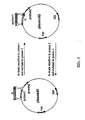
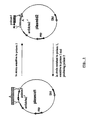
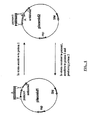
- a first aspect of the present invention is related to a reversible cloning method and kit for which several specific preferred examples are described in details hereafter, in reference to the figures 2 to 5.
- the elements used in the method of the invention are specific cells and a genetic preferably integrated in a vector or a chromosome of a cell comprised of either :
- the inserted foreign genetic element(s) may be a regulatory sequence or gene(s) of interest (possibly linked to one or more promoter/operator sequences).
- the selection of the genetic event (insertion) can be obtained in a cell strain sensitive to the first toxic molecule 1 (Figs. 2&3&4) and possibly resistant to the second toxic molecule 2 (Fig. 2).
- the said genetic event (insertion or replacement) is reversible through the replacement of the inserted element (target sequence) by the element that had been deleted following the recombination and insertion made in the first step.
- This reverse reaction deletion of a target sequence is selected in a strain both resistant to the toxic molecule 1 and sensitive to the toxic molecule 2 (Figs 2, 3, 4) plus, producing the toxic molecule 2 (Figs. 3&4).
- This reversible cloning and selection method is also suitable for obtaining an inversion of an integrated genetic element.
- a specific example is described in details hereafter, in reference to the figure 5. Indeed, the orientation of a sequence of interest can be reversed through the method of the invention (preferably following the insertion step of figure 4) or through a direct insertion of the target sequence between two different antidote sequences (1', 2').
- Said genetic element (target sequence) associated to a promoter/operator is initially integrated between two nucleotide sequences (1',2') encoding respectively two different antidotes to two different toxic molecules 1 and 2.
- Said two nucleotide sequences (1',2') encoding the two different antidotes are disposed in opposite lecture orientations (disposed upstream and downstream the target nucleotide sequence in opposite divergent lecture orientation).
- This construct allows to select for the recombination event(s) which will cause the target nucleotide sequence of interest and its associated promoter to have either the same orientation as the nucleotide sequence 1' encoding the first antidote to the first toxic molecule (selection done in a strain both sensitive to and producing poison 1) or the same orientation as the nucleotide sequence 2' encoding the second antidote to the second toxic molecule (selection done in a strain both sensitive to and producing poison 2). (see WO 02/066657 ).
- EP1111061 describes a double selection vector (1) able to transform a cell of a specific organism which contains two different genes (2 and 3) comprising several cloning sites and encoding two different poison molecules (4 and 5) to a prokaryote cell, said genes being disposed in opposite lecture orientation to each other, upstream and downstream a cassette sequence (6) and is also related to a method for the genetic medication of a cell or an organism comprising the use of said double selection vector.
- the assemblage of multiple foreign genetic elements (different target sequences) in the vector or in the chromosome of a cell (either in vitro or in vivo) and the selection of the correct assemblage is obtained by the use of multiple nucleic acid construct comprising sequences encoding one or more (different or identical) toxic molecules and/or their antidotes.
- the person skilled in the art can select the suitable events of insertion(s), deletion(s) and/or inversion(s) applied with said multiple genetic element(s).
- Said cloning and selection method may require multiple steps possibly performed (sequentially) in the same reaction tube or inside a single cell.
- Said method can be combined with the steps and means for performing in vitro protein synthesis (using in vitro transcription and translation kits).
- Another aspect of the present invention is related to the algorithms, computer programs, and data bases (comprised of codes and means possibly stored in a computer readable medium) that can assist performing one or more step(s) of the method according to the invention.
- Said algorithms, data bases, and program codes means are used to define the correct combination of (but not limited to) :
- the algorithms, computer programs, and data bases are also able to control one or more step (s) of the method according to the invention, possibly performed by automate (s) .
- kits of parts comprising the suitable elements for performing the method according to the invention, in particular computer programs mentioned above, nucleic acid construct(s), cell strain(s) and/or usual products and media used in the cloning and selection techniques.
- kits for performing the method according to the invention and using the above-mentioned kit(s) of parts.
- Said kit(s) of parts (cloning and selection kits, combined with adequate media, cells and media present in vitro transcription and translation kits) and automates could also comprise other elements, such as a buffer solutions, pipeting element(s), primers for genetic amplification, cell culture media and means for recording results and for the storage of data.
- the figure 1 is an example of complex genetic construct obtained by parallel and multiple genetic events performed by the method of the present invention.
- the figures 2 to 5 are examples of reversible cloning and selecting method and kit according to the invention.
- This invention allows the making of complex genetic constructions through the use of (i) simultaneous and (ii) parallel events (the various recombinations and selection events present almost the same frequency).
- the "multitask" nature of the invention is defined as follows: for example, the invention allows to perform the insertion of genetic elements A and C , the deletion of genetic element G , the replacement of the genetic element F by E, and the inversion of genetic elements B and D , some or all events (Fig.1) being performed simultaneously in vitro (i.e., in the same tube) or in vivo ( i.e. , in the same organism).
- the final product of the above-mentioned events is a complex construct comprised of the genetic elements A, B, C , and D , all with the same orientation.
- Plasmid 1 is amplified in a strain resistant to poison 1.
- Plasmid 2 is amplified in a strain resistant to poisons 6 and 9.
- Plasmid 3 is selected in a strain :
- Realization of each "recombination" event can be done through techniques such as, but not limited to, classical restriction/ligation, site-specific recombination, or homologous recombination. Specificity of each genetic event (insertion, deletion, inversion, etc.) is insured by the specificity of the recombination event. For example, specificity of an insertion (both the location of the insertion and the orientation of the insert (target nucleotide sequence)) can be achieved by the use of different DNA sequences bordering both the insertion site and the fragment to be inserted (these DNA sequences can be selected by the man skilled in the art for performing said recombination event).
- flanking sequences form either different site-specific recombination elements (in the case of site-specific recombination) or different elements of homology (in the case of homologous recombination).
- the simultaneous selection of several genetic events e.g ., an insertion, a deletion, and an inversion
- a different selective marker for each of the events.
- the selection for the simultaneous presence of all events requires the use of very efficient selective markers (e.g. , but not limited to, antidote/poison genes).
- N different genetic constructs that are produced in the same reaction mix (i.e. , in the same tube) through the multitask process described above can be pre-designed such that their assemblage (here, the assemblage of the construct made from plasmid 1 with the construct made from plasmid 2) can be generated through recombination events as well.
- N-1 genetic constructs can be viewed as donors and 1 construct as a receptor.
- N constructs can be combined through the use of n-1 selective markers for the selection of n-1 recombination events (Fig. 1).
- a construct produced through the invention is a unique combination of building blocks that can be re-used for new (and different) constructs; i.e., the process is reversible and extendable, as shown in the Figures. 2 to 4.
- the DNA fragment to be inserted encodes for a target sequence of interest plus a promoter sequence located at its 3' end.
- the nucleic acid construct comprising the adequate insertion is selected by the deletion of the nucleotide sequence 1 encoding poison 1 in a strain sensitive to it but resistant to poison 2.
- the deletion of the target sequence (DNA fragment A) for re-use of the building block is achieved through the insertion of the DNA fragment initially removed (i.e., nucleotide sequence 1 encoding poison 1 with a promoter at its 5' end). This reverse event is selected in a strain sensitive to poison 2 and resistant to poison 1.
- Plasmid 1 is amplified in a strain resistant to poison 1.
- Plasmid 2 is amplified in a strain resistant to poison 2.
- the insertion of the target sequence is selected by the deletion of the nucleotide sequence 1 encoding poison 1 in a strain sensitive to it.
- the deletion of the DNA fragment A for re-use of the building block is achieved through the insertion of the DNA fragment initially removed (i.e., poison 1 with, at its 5' end, two promoters in opposite directions).
- This reverse event is selected in a strain allowing the conditional expression of poison 2, sensitive to poison 2, and resistant to poison 1.
- Plasmid 1 is amplified in a strain resistant to poison 1.
- Plasmid 2 is amplified in any strain whose viability is independent from the presence or absence of plasmid 2.
- Plasmid 1 encodes both poison 1 and antidote 2 that are organized as an operon.
- the insertion of the target sequence (DNA fragment A) is selected by the deletion of the nucleotide sequence encoding poison 1 in a strain sensitive to it.
- the deletion of the target sequence (DNA fragment A) for re-use of the building block is achieved through the insertion of the DNA fragment initially removed (i.e., nucleotide sequence encoding poison 1 with a promoter at its 5' end) .
- This reverse event is selected through the activation of the nucleotide sequence encoding antidote 2 in a strain allowing the conditional expression of poison 2, sensitive to poison 2, and resistant to poison 1.
- Plasmid 1 is amplified in a strain resistant to poison 1.
- Plasmid 2 is amplified in any strain whose viability is independent from the presence or absence of plasmid 2.
- the target sequence contains a promoter allowing the production of an antidote.
- the inversion of the DNA fragment A is selected using a strain allowing the conditional expression of poison 2 and sensitive to it.
- the reverse event is selected in a strain allowing the conditional expression of poison 1 and sensitive to it.
- constructs produced through the invention are not dead-end products (i.e., useful for the only use they have been produced for); they can be recycled.
- the software tracks the features of each building block and product it also identifies those elements that are (i) necessary and (ii) inter-compatible for future and new multitask/parallel/reversible processes.
Landscapes
- Genetics & Genomics (AREA)
- Health & Medical Sciences (AREA)
- Life Sciences & Earth Sciences (AREA)
- Engineering & Computer Science (AREA)
- Chemical & Material Sciences (AREA)
- Biomedical Technology (AREA)
- Bioinformatics & Cheminformatics (AREA)
- Wood Science & Technology (AREA)
- Biotechnology (AREA)
- General Engineering & Computer Science (AREA)
- Zoology (AREA)
- Organic Chemistry (AREA)
- Molecular Biology (AREA)
- Microbiology (AREA)
- Plant Pathology (AREA)
- Biophysics (AREA)
- Physics & Mathematics (AREA)
- Biochemistry (AREA)
- General Health & Medical Sciences (AREA)
- Crystallography & Structural Chemistry (AREA)
- Micro-Organisms Or Cultivation Processes Thereof (AREA)
- Preparation Of Compounds By Using Micro-Organisms (AREA)
- Electrotherapy Devices (AREA)
- Investigating Or Analysing Materials By The Use Of Chemical Reactions (AREA)
- Apparatus Associated With Microorganisms And Enzymes (AREA)
- Measuring Or Testing Involving Enzymes Or Micro-Organisms (AREA)
- Saccharide Compounds (AREA)
- Plural Heterocyclic Compounds (AREA)
Claims (18)
- Genetisches Konstrukt (10), das für die Insertion/Deletion und Inversion für mindestens eine Zielnukleotidsequenz (A) geeignet ist und zusammengesetzt ist aus:- einer ersten Promotor-Aktivatorsequenz, die stromaufwärts (upstream) von einer ersten Nukleotidsequenz (1) angelegt ist, die ein erstes Giftmolekül kodiert und in der entgegen gesetzten Richtung angelegt ist, eine zweite Promotor-/Aktivatorsequenz, die stromaufwärts (upstream) von einer zweiten Nukleotidsequenz angelegt ist, die ein Antidot (2') für ein zweites Giftmolekül kodiert, das sich von dem ersten Giftmolekül unterscheidet.
- Nukleinsäurekonstrukt nach Anspruch 1, wobei jede Nukleotidsequenz (1, 2'), die ein Giftmolekül oder ein Antidot für ein Giftmolekül kodiert, eine Nukleinsequenz ist, die ein Fusionsprotein kodiert, welches als ein Giftmolekül oder als ein Antidot für das Giftmolekül aktiv ist, wobei das Fusionsprotein aus einer kodierenden Nukleotidsequenz besteht, welche mehrere, einmal vorhandene Klonierungsstellen und eine Nukleotidsequenz aufweist, die ein Giftmolekül für eine Zelle oder ein Antidot für ein Giftmolekül kodiert.
- Genetisches Konstrukt (10) nach Anspruch 1 oder 2, welches des Weiteren Rekombinationsstellen aufweist, die stromaufwärts (upstream) und stromabwärts (downstream) von der Nukleotidsequenz/den Nukleotidsequenzen (1) angelegt sind, welche ein Giftmolekül kodiert bzw. kodieren, und/oder der Nukleotidsequenz/den Nukleotidsequenzen (2'), die ein Antidot für das Giftmolekül kodiert bzw. kodieren.
- Genetisches Konstrukt (10) nach irgendeinem der Ansprüche 1 bis 3, wobei die Gift/Antidot-Sequenzen aus der Gruppe ausgewählt sind, die aus den folgenden Gift/Antidot-Systemen besteht: CcdB/CcdA, Kid/Kis, Hok/Sok, Doc/Phd, RelE/RelB, PasA/PasB/PasC, MazE/MazF, ParE/ParD.
- Klonierungsvektor, umfassend mindestens eines des genetischen Konstruktes (10) nach einem der vorherigen Ansprüche 1 bis 4.
- Vektor nach Anspruch 5, des Weiteren umfassend einen Replikationsursprung (Origin of Replication) und einen selektierbaren Marker.
- Vektor nach Anspruch 6, wobei der selektierbare Marker ein auf Antibiotikaresistenz selektierbarer Marker ist.
- Zelle, die mit dem genetischen Konstrukt nach irgendeinem der vorherigen Ansprüche 1 bis 4 oder dem Vektor nach irgendeinem der vorherigen Ansprüche 5 bis 7 transformiert ist oder in ihr chromosomales Genom integriert mindestens ein genetisches Konstrukt nah einem der vorherigen Ansprüche 1 bis 4 aufweist.
- Zelle nach Anspruch 8, welche aus der Gruppe ausgewählt ist, die aus Prokaryotenzellen, Pflanzenzellen, Tierzellen (einschließlich menschlichen Zellen) und Pilzzellen (einschließlich Hefezellen) besteht.
- Klonierungs- und Selektionskit, umfassend ein oder mehrere Nukleinsäurekonstrukt(e) nach einem der vorherigen Ansprüche 1 bis 4, einen oder mehreren Vektor(en) nach Anspruch 5 bis 7 und Zellen, die von dem Konstrukt oder Vektor zu transformieren sind und die gegenüber einem oder mehreren Giftmolekül(e) entweder resistent oder empfindlich sind und die ein oder mehrere Giftmolekül(e) oder Antidot(e) für das Giftmolekül bzw. die Giftmoleküle exprimieren.
- Verfahren für eine Insertion oder für eine Deletion und/oder eine Inversion einer Zielnukleotidsequenz (A) in ein Nukleinsäurekonstrukt und umfassend die folgenden Schritte:- Bereitstellen eines Nukleinsäurekonstruktes nach einem der vorherigen Ansprüche 1 bis 4, den Vektor des Anspruchs 7 oder die Zelle nach Anspruch 8 oder 9 und Erhalten der Insertion der Zielnukleotidsequenz in das Nukleinsäurekonstrukt durch Inaktivierung einer Nukleotidsequenz, die ein Giftmolekül kodiert, und- Auswählen des Nukleinsäurekonstruktes, welches die Zielnukleotidsequenz integriert aufweist, in einer Zelle, die gegenüber dem Giftmolekül empfindlich ist.
- Verfahren nach Anspruch 11, welches des Weiteren folgende Schritte umfasst:- Auswahl der Zielnukleotidsequenz aus Genomdatenbanken durch Analyse der genomischen Sequenz durch die Identifizierung der Exon-Intron-Struktur und Vergleich mit genetischen Expressionsdatenbanken,- Bereitstellen von Primersequenzen, die für eine genetische Vervielfältigung und Klonierung der genetischen Zielsequenz geeignet sind,- Auswählen von Elementen des in Datenbanken präsentierten Nukleinsäurekonstruktes sowie Zellen, die von dem Nukleinsäurekonstrukt zu transformieren sind, und- Bereitstellen des Designs des Nukleinsäurekonstruktes, das für die Integration der Zielnukleotidsequenz geeignet ist, und möglicherweise Wiedereinbringen des Designs des erhaltenden virtuellen Nukleinsäurekonstruktes in eine Zielspeicherdatenbank.
- Verfahren nach Anspruch 11 oder 12, welches des Weiteren den Schritt des Ersetzens der Zielsequenz durch die Elemente aufweist, die nach der Insertion der Zielsequenz oder durch die Integration einer Zielsequenz mit einer umgekehrten Leserichtung entfernt worden sind.
- Verfahren nach irgendeinem der vorherigen Ansprüche 11 bis 13, wobei eine Integration der Zielsequenz, Ersetzen oder Inversion der Zielsequenz durch ein Verfahren erhalten wird, das aus der Gruppe ausgewählt ist, die aus klassischer Restriktion/Ligation, positionsspezifischer Rekombination, TOPO-Klonierung und homologer Rekombination besteht.
- Verfahren nach irgendeinem der vorherigen Ansprüche 11 bis 14, welches den Schritt der Insertion/Deletion und/oder Reversion mehrerer Zielnukleotidsequenzen (A, B, C, D, E, F) in mehrere Nukleinsäurekonstrukte und den Schritt des gleichzeitigen Auswählens des Konstruktes, das die Zielsequenzen korrekt integriert, deletiert oder invertiert hat, umfasst.
- Verfahren nach Anspruch 15, wobei der Schritt des gleichzeitigen Auswählens des Konstruktes, das die Zielsequenzen korrekt integriert, deletiert oder invertiert hat, in einer einzelnen Zelle oder in einem einzelnen Reaktionsröhrchen erfolgt.
- Verfahren nach Anspruch 15 oder 16, das von einem Automaten durchgeführt wird.
- Mit einer Datenbank eines Rechners verbundener Automat, der das Nukleinsäurekonstrukt nach Anspruch 1 bis 4, den Vektor nach Anspruch 5 bis 7 oder die Zellen nach Anspruch 8 oder 9 und/oder die Elemente des Kits nach Anspruch 10 umfasst.
Applications Claiming Priority (3)
| Application Number | Priority Date | Filing Date | Title |
|---|---|---|---|
| US40848202P | 2002-09-03 | 2002-09-03 | |
| US408482P | 2002-09-03 | ||
| PCT/BE2003/000147 WO2004022745A2 (en) | 2002-09-03 | 2003-09-03 | Reversible, parallel and multitask cloning method and kit |
Publications (2)
| Publication Number | Publication Date |
|---|---|
| EP1556485A2 EP1556485A2 (de) | 2005-07-27 |
| EP1556485B1 true EP1556485B1 (de) | 2008-01-09 |
Family
ID=31978622
Family Applications (1)
| Application Number | Title | Priority Date | Filing Date |
|---|---|---|---|
| EP03793509A Expired - Lifetime EP1556485B1 (de) | 2002-09-03 | 2003-09-03 | Reversible, parallele und zur vielfältigen aufgabenbewältigung verwendbare (multitask) klonierungsmethode und entprechende reagentien |
Country Status (9)
| Country | Link |
|---|---|
| US (1) | US8318497B2 (de) |
| EP (1) | EP1556485B1 (de) |
| JP (1) | JP4546828B2 (de) |
| CN (1) | CN1703509B (de) |
| AT (1) | ATE383421T1 (de) |
| AU (1) | AU2003260200A1 (de) |
| CA (1) | CA2496514C (de) |
| DE (1) | DE60318603T2 (de) |
| WO (1) | WO2004022745A2 (de) |
Families Citing this family (9)
| Publication number | Priority date | Publication date | Assignee | Title |
|---|---|---|---|---|
| AT395483B (de) * | 1989-01-13 | 1993-01-25 | Vaillant Gmbh | Rein elektrisch beheizter durchlauferhitzer mit vorrichtung zum ermitteln des wasserdurchsatzes |
| DE69942249D1 (de) | 1998-05-07 | 2010-05-27 | Univ Bruxelles | Auf cytotoxinen basierendes biologisches einschlusssystem |
| EP1362110B1 (de) | 2001-02-23 | 2012-09-12 | Université Libre de Bruxelles | Verfahren zur selektion von rekombinanten klonen, die eine für ein antidot- protein kodierende sequenz enthalten, das gegen ein toxin gerichtet ist |
| EP2119789A1 (de) | 2008-05-16 | 2009-11-18 | Université Libre de Bruxelles | Hyperproliferative rekombinante Zelle |
| EP2612918A1 (de) | 2012-01-06 | 2013-07-10 | BASF Plant Science Company GmbH | In planta-Rekombination |
| CN110564663B (zh) | 2013-08-19 | 2023-03-10 | 辛格隆股份公司 | 微生物的受控生长 |
| WO2016001447A1 (en) * | 2014-07-04 | 2016-01-07 | Universite Libre De Bruxelles | Method and system for the production of recombinant proteins by cells |
| AU2015293825B2 (en) * | 2014-07-25 | 2019-06-13 | R.P. Scherer Technologies, Llc | Improved host cell for producing proteins |
| JP2021506328A (ja) | 2017-12-19 | 2021-02-22 | シンギュロン・ソシエテ・アノニム | 発酵プロセス |
Family Cites Families (21)
| Publication number | Priority date | Publication date | Assignee | Title |
|---|---|---|---|---|
| AU7232087A (en) | 1986-03-26 | 1987-10-20 | Genexpress Aps | Biological containment |
| US5464764A (en) | 1989-08-22 | 1995-11-07 | University Of Utah Research Foundation | Positive-negative selection methods and vectors |
| US5300431A (en) | 1991-02-26 | 1994-04-05 | E. I. Du Pont De Nemours And Company | Positive selection vector for the bacteriophage P1 cloning system |
| US7176029B2 (en) | 1992-07-31 | 2007-02-13 | Universite Libre De Bruxelles | Cloning and/or sequencing vector |
| BE1006085A3 (fr) * | 1992-07-31 | 1994-05-10 | Univ Bruxelles | Vecteur de clonage. |
| JP2590761B2 (ja) | 1994-11-22 | 1997-03-12 | 日本電気株式会社 | Tab式半導体装置およびtab式半導体装置を回路基板に接続する方法 |
| US6143557A (en) | 1995-06-07 | 2000-11-07 | Life Technologies, Inc. | Recombination cloning using engineered recombination sites |
| EP0937098B1 (de) | 1995-06-07 | 2002-08-14 | Invitrogen Corporation | Rekombinatorische klonierung in vitro unter verwendung genmanipulierter rekombinationsorte |
| AU716781B2 (en) | 1995-10-13 | 2000-03-09 | Purdue Research Foundation | Method for the production of hybrid plants |
| US5922583A (en) | 1995-10-17 | 1999-07-13 | Biostar Inc. | Methods for production of recombinant plasmids |
| DE69836092T2 (de) | 1997-10-24 | 2007-05-10 | Invitrogen Corp., Carlsbad | Rekombinatorisches klonieren unter verwendung von nukleinsaüren mit rekombinationsstellen |
| DE69942249D1 (de) | 1998-05-07 | 2010-05-27 | Univ Bruxelles | Auf cytotoxinen basierendes biologisches einschlusssystem |
| US6134557A (en) * | 1998-11-20 | 2000-10-17 | Matlink, Inc. | Materials and supplies ordering system |
| US6271359B1 (en) | 1999-04-14 | 2001-08-07 | Musc Foundation For Research Development | Tissue-specific and pathogen-specific toxic agents and ribozymes |
| AU784522B2 (en) | 1999-10-25 | 2006-04-27 | Invitrogen Corporation | Methods of manipulating and sequencing nucleic acid molecules using transposition and recombination |
| ATE391789T1 (de) | 1999-12-10 | 2008-04-15 | Invitrogen Corp | Verwendung einer vielzahl von rekombinationsstellen mit einzigartiger spezifität beim rekombinatorischen klonen |
| EP1111061A1 (de) * | 1999-12-20 | 2001-06-27 | Universite Libre De Bruxelles | Vektor mit doppelter Selektion |
| DE10038573A1 (de) | 2000-08-03 | 2002-02-21 | Mpb Cologne Gmbh Molecular Pla | Verfahren zur Selektion auf Wirtszellen mit eliminierten DNA-Sequenzen |
| EP1362110B1 (de) | 2001-02-23 | 2012-09-12 | Université Libre de Bruxelles | Verfahren zur selektion von rekombinanten klonen, die eine für ein antidot- protein kodierende sequenz enthalten, das gegen ein toxin gerichtet ist |
| US6531153B2 (en) * | 2001-05-29 | 2003-03-11 | Drugtech Corporation | Composition with sustained release of levodopa and carbidopa |
| JP4564754B2 (ja) | 2002-03-19 | 2010-10-20 | ユニヴェルシテ リブル ドゥ ブリュッセル | 遺伝的に改変された真核細胞又は生物の選択のための毒物/解毒剤遺伝子系 |
-
2003
- 2003-09-03 EP EP03793509A patent/EP1556485B1/de not_active Expired - Lifetime
- 2003-09-03 CN CN038233053A patent/CN1703509B/zh not_active Expired - Fee Related
- 2003-09-03 DE DE60318603T patent/DE60318603T2/de not_active Expired - Lifetime
- 2003-09-03 JP JP2004533086A patent/JP4546828B2/ja not_active Expired - Fee Related
- 2003-09-03 AU AU2003260200A patent/AU2003260200A1/en not_active Abandoned
- 2003-09-03 US US10/526,525 patent/US8318497B2/en not_active Expired - Fee Related
- 2003-09-03 WO PCT/BE2003/000147 patent/WO2004022745A2/en not_active Ceased
- 2003-09-03 AT AT03793509T patent/ATE383421T1/de not_active IP Right Cessation
- 2003-09-03 CA CA2496514A patent/CA2496514C/en not_active Expired - Fee Related
Also Published As
| Publication number | Publication date |
|---|---|
| US20060088841A1 (en) | 2006-04-27 |
| AU2003260200A1 (en) | 2004-03-29 |
| WO2004022745A3 (en) | 2005-06-02 |
| EP1556485A2 (de) | 2005-07-27 |
| DE60318603T2 (de) | 2008-07-03 |
| CN1703509A (zh) | 2005-11-30 |
| ATE383421T1 (de) | 2008-01-15 |
| CA2496514C (en) | 2012-11-06 |
| WO2004022745A2 (en) | 2004-03-18 |
| CA2496514A1 (en) | 2004-03-18 |
| JP2005537016A (ja) | 2005-12-08 |
| JP4546828B2 (ja) | 2010-09-22 |
| DE60318603D1 (de) | 2008-02-21 |
| CN1703509B (zh) | 2010-09-01 |
| AU2003260200A8 (en) | 2004-03-29 |
| US8318497B2 (en) | 2012-11-27 |
Similar Documents
| Publication | Publication Date | Title |
|---|---|---|
| Van der Oost et al. | The genome editing revolution | |
| Haldimann et al. | Conditional-replication, integration, excision, and retrieval plasmid-host systems for gene structure-function studies of bacteria | |
| Kodumal et al. | Total synthesis of long DNA sequences: synthesis of a contiguous 32-kb polyketide synthase gene cluster | |
| US8877504B2 (en) | Method for the selection of recombinant clones comprising a sequence encoding an antidote protein to toxic molecule | |
| Garcillán-Barcia et al. | The facts and family secrets of plasmids that replicate via the rolling-circle mechanism | |
| Cengic et al. | Inducible CRISPR/Cas9 allows for multiplexed and rapidly segregated single-target genome editing in Synechocystis sp. PCC 6803 | |
| CA2496514C (en) | Reversible, parallel and multitask cloning method and kit | |
| Sands et al. | Overview of post Cohen‐Boyer methods for single segment cloning and for multisegment DNA assembly | |
| AU2002235676A1 (en) | Method for the selection of recombinant clones comprising a sequence encoding an antidote protein to a toxic molecule | |
| Struhl | Subcloning of DNA fragments | |
| Wang et al. | Unleashing the potential: type I CRISPR-Cas systems in actinomycetes for genome editing | |
| Schroeder et al. | Development of a functional genomics platform for Sinorhizobium meliloti: construction of an ORFeome | |
| US9309518B2 (en) | Reversible, parallel and multitask cloning method and kit | |
| Rohilla et al. | Systematic microsatellite repeat expansion cloning and validation | |
| Jayaram et al. | Site‐specific recombination by the Flp protein of Saccharomyces cerevisiae | |
| EP1240339A1 (de) | Vektor mit doppelter selektion | |
| JP2005537016A5 (de) | ||
| Rostamian et al. | Rapid CRISPR–Cas9 Genome Editing in S. cerevisiae | |
| WO2001000819A1 (en) | Targeted gene replacements in enteric bacteria using linear dna | |
| Feinbaum | Introduction to plasmid biology | |
| Wong et al. | OPT: Codon optimize gene sequences for E. coli protein overexpression | |
| Swartjes et al. | Base editing both DNA strands in distinct editing windows with small CRISPR-associated effector Cas12f1 | |
| Mehmood | Recombinant DNA Technology | |
| US6955882B2 (en) | Method for easy cloning and selection of chimeric DNA molecules | |
| Badri | A REVIEW ON INVESTIGATION OF BIOGENETIC STUDIES |
Legal Events
| Date | Code | Title | Description |
|---|---|---|---|
| PUAI | Public reference made under article 153(3) epc to a published international application that has entered the european phase |
Free format text: ORIGINAL CODE: 0009012 |
|
| 17P | Request for examination filed |
Effective date: 20050401 |
|
| AK | Designated contracting states |
Kind code of ref document: A2 Designated state(s): AT BE BG CH CY CZ DE DK EE ES FI FR GB GR HU IE IT LI LU MC NL PT RO SE SI SK TR |
|
| AX | Request for extension of the european patent |
Extension state: AL LT LV MK |
|
| DAX | Request for extension of the european patent (deleted) | ||
| 17Q | First examination report despatched |
Effective date: 20060327 |
|
| 17Q | First examination report despatched |
Effective date: 20060327 |
|
| GRAP | Despatch of communication of intention to grant a patent |
Free format text: ORIGINAL CODE: EPIDOSNIGR1 |
|
| GRAS | Grant fee paid |
Free format text: ORIGINAL CODE: EPIDOSNIGR3 |
|
| GRAA | (expected) grant |
Free format text: ORIGINAL CODE: 0009210 |
|
| AK | Designated contracting states |
Kind code of ref document: B1 Designated state(s): AT BE BG CH CY CZ DE DK EE ES FI FR GB GR HU IE IT LI LU MC NL PT RO SE SI SK TR |
|
| REG | Reference to a national code |
Ref country code: GB Ref legal event code: FG4D |
|
| REG | Reference to a national code |
Ref country code: CH Ref legal event code: EP |
|
| REG | Reference to a national code |
Ref country code: IE Ref legal event code: FG4D |
|
| REF | Corresponds to: |
Ref document number: 60318603 Country of ref document: DE Date of ref document: 20080221 Kind code of ref document: P |
|
| REG | Reference to a national code |
Ref country code: CH Ref legal event code: NV Representative=s name: ABREMA AGENCE BREVET ET MARQUES, GANGUILLET |
|
| PG25 | Lapsed in a contracting state [announced via postgrant information from national office to epo] |
Ref country code: SI Free format text: LAPSE BECAUSE OF FAILURE TO SUBMIT A TRANSLATION OF THE DESCRIPTION OR TO PAY THE FEE WITHIN THE PRESCRIBED TIME-LIMIT Effective date: 20080109 Ref country code: NL Free format text: LAPSE BECAUSE OF FAILURE TO SUBMIT A TRANSLATION OF THE DESCRIPTION OR TO PAY THE FEE WITHIN THE PRESCRIBED TIME-LIMIT Effective date: 20080109 |
|
| NLV1 | Nl: lapsed or annulled due to failure to fulfill the requirements of art. 29p and 29m of the patents act | ||
| PG25 | Lapsed in a contracting state [announced via postgrant information from national office to epo] |
Ref country code: ES Free format text: LAPSE BECAUSE OF FAILURE TO SUBMIT A TRANSLATION OF THE DESCRIPTION OR TO PAY THE FEE WITHIN THE PRESCRIBED TIME-LIMIT Effective date: 20080420 Ref country code: FI Free format text: LAPSE BECAUSE OF FAILURE TO SUBMIT A TRANSLATION OF THE DESCRIPTION OR TO PAY THE FEE WITHIN THE PRESCRIBED TIME-LIMIT Effective date: 20080109 |
|
| PG25 | Lapsed in a contracting state [announced via postgrant information from national office to epo] |
Ref country code: BG Free format text: LAPSE BECAUSE OF FAILURE TO SUBMIT A TRANSLATION OF THE DESCRIPTION OR TO PAY THE FEE WITHIN THE PRESCRIBED TIME-LIMIT Effective date: 20080409 Ref country code: AT Free format text: LAPSE BECAUSE OF FAILURE TO SUBMIT A TRANSLATION OF THE DESCRIPTION OR TO PAY THE FEE WITHIN THE PRESCRIBED TIME-LIMIT Effective date: 20080109 |
|
| ET | Fr: translation filed | ||
| PG25 | Lapsed in a contracting state [announced via postgrant information from national office to epo] |
Ref country code: PT Free format text: LAPSE BECAUSE OF FAILURE TO SUBMIT A TRANSLATION OF THE DESCRIPTION OR TO PAY THE FEE WITHIN THE PRESCRIBED TIME-LIMIT Effective date: 20080609 |
|
| PG25 | Lapsed in a contracting state [announced via postgrant information from national office to epo] |
Ref country code: CZ Free format text: LAPSE BECAUSE OF FAILURE TO SUBMIT A TRANSLATION OF THE DESCRIPTION OR TO PAY THE FEE WITHIN THE PRESCRIBED TIME-LIMIT Effective date: 20080109 Ref country code: SK Free format text: LAPSE BECAUSE OF FAILURE TO SUBMIT A TRANSLATION OF THE DESCRIPTION OR TO PAY THE FEE WITHIN THE PRESCRIBED TIME-LIMIT Effective date: 20080109 Ref country code: SE Free format text: LAPSE BECAUSE OF FAILURE TO SUBMIT A TRANSLATION OF THE DESCRIPTION OR TO PAY THE FEE WITHIN THE PRESCRIBED TIME-LIMIT Effective date: 20080409 Ref country code: DK Free format text: LAPSE BECAUSE OF FAILURE TO SUBMIT A TRANSLATION OF THE DESCRIPTION OR TO PAY THE FEE WITHIN THE PRESCRIBED TIME-LIMIT Effective date: 20080109 |
|
| PLBE | No opposition filed within time limit |
Free format text: ORIGINAL CODE: 0009261 |
|
| STAA | Information on the status of an ep patent application or granted ep patent |
Free format text: STATUS: NO OPPOSITION FILED WITHIN TIME LIMIT |
|
| PG25 | Lapsed in a contracting state [announced via postgrant information from national office to epo] |
Ref country code: RO Free format text: LAPSE BECAUSE OF FAILURE TO SUBMIT A TRANSLATION OF THE DESCRIPTION OR TO PAY THE FEE WITHIN THE PRESCRIBED TIME-LIMIT Effective date: 20080109 |
|
| 26N | No opposition filed |
Effective date: 20081010 |
|
| PG25 | Lapsed in a contracting state [announced via postgrant information from national office to epo] |
Ref country code: EE Free format text: LAPSE BECAUSE OF FAILURE TO SUBMIT A TRANSLATION OF THE DESCRIPTION OR TO PAY THE FEE WITHIN THE PRESCRIBED TIME-LIMIT Effective date: 20080109 Ref country code: MC Free format text: LAPSE BECAUSE OF NON-PAYMENT OF DUE FEES Effective date: 20080930 |
|
| PG25 | Lapsed in a contracting state [announced via postgrant information from national office to epo] |
Ref country code: CY Free format text: LAPSE BECAUSE OF FAILURE TO SUBMIT A TRANSLATION OF THE DESCRIPTION OR TO PAY THE FEE WITHIN THE PRESCRIBED TIME-LIMIT Effective date: 20080109 Ref country code: IE Free format text: LAPSE BECAUSE OF NON-PAYMENT OF DUE FEES Effective date: 20080903 |
|
| PG25 | Lapsed in a contracting state [announced via postgrant information from national office to epo] |
Ref country code: IT Free format text: LAPSE BECAUSE OF FAILURE TO SUBMIT A TRANSLATION OF THE DESCRIPTION OR TO PAY THE FEE WITHIN THE PRESCRIBED TIME-LIMIT Effective date: 20080109 |
|
| PG25 | Lapsed in a contracting state [announced via postgrant information from national office to epo] |
Ref country code: HU Free format text: LAPSE BECAUSE OF FAILURE TO SUBMIT A TRANSLATION OF THE DESCRIPTION OR TO PAY THE FEE WITHIN THE PRESCRIBED TIME-LIMIT Effective date: 20080710 Ref country code: LU Free format text: LAPSE BECAUSE OF NON-PAYMENT OF DUE FEES Effective date: 20080903 |
|
| PG25 | Lapsed in a contracting state [announced via postgrant information from national office to epo] |
Ref country code: TR Free format text: LAPSE BECAUSE OF FAILURE TO SUBMIT A TRANSLATION OF THE DESCRIPTION OR TO PAY THE FEE WITHIN THE PRESCRIBED TIME-LIMIT Effective date: 20080109 |
|
| PG25 | Lapsed in a contracting state [announced via postgrant information from national office to epo] |
Ref country code: GR Free format text: LAPSE BECAUSE OF FAILURE TO SUBMIT A TRANSLATION OF THE DESCRIPTION OR TO PAY THE FEE WITHIN THE PRESCRIBED TIME-LIMIT Effective date: 20080410 |
|
| REG | Reference to a national code |
Ref country code: FR Ref legal event code: PLFP Year of fee payment: 14 |
|
| REG | Reference to a national code |
Ref country code: FR Ref legal event code: PLFP Year of fee payment: 15 |
|
| PGFP | Annual fee paid to national office [announced via postgrant information from national office to epo] |
Ref country code: CH Payment date: 20170825 Year of fee payment: 15 Ref country code: GB Payment date: 20170821 Year of fee payment: 15 Ref country code: FR Payment date: 20170822 Year of fee payment: 15 Ref country code: DE Payment date: 20170821 Year of fee payment: 15 |
|
| PGFP | Annual fee paid to national office [announced via postgrant information from national office to epo] |
Ref country code: BE Payment date: 20170823 Year of fee payment: 15 |
|
| REG | Reference to a national code |
Ref country code: DE Ref legal event code: R119 Ref document number: 60318603 Country of ref document: DE |
|
| REG | Reference to a national code |
Ref country code: CH Ref legal event code: PL |
|
| GBPC | Gb: european patent ceased through non-payment of renewal fee |
Effective date: 20180903 |
|
| REG | Reference to a national code |
Ref country code: BE Ref legal event code: MM Effective date: 20180930 |
|
| PG25 | Lapsed in a contracting state [announced via postgrant information from national office to epo] |
Ref country code: DE Free format text: LAPSE BECAUSE OF NON-PAYMENT OF DUE FEES Effective date: 20190402 |
|
| PG25 | Lapsed in a contracting state [announced via postgrant information from national office to epo] |
Ref country code: CH Free format text: LAPSE BECAUSE OF NON-PAYMENT OF DUE FEES Effective date: 20180930 Ref country code: FR Free format text: LAPSE BECAUSE OF NON-PAYMENT OF DUE FEES Effective date: 20180930 Ref country code: BE Free format text: LAPSE BECAUSE OF NON-PAYMENT OF DUE FEES Effective date: 20180930 Ref country code: LI Free format text: LAPSE BECAUSE OF NON-PAYMENT OF DUE FEES Effective date: 20180930 |
|
| PG25 | Lapsed in a contracting state [announced via postgrant information from national office to epo] |
Ref country code: GB Free format text: LAPSE BECAUSE OF NON-PAYMENT OF DUE FEES Effective date: 20180903 |