EP1566565A1 - VERBUNDSCHWINGUNGSDûMPFER - Google Patents
VERBUNDSCHWINGUNGSDûMPFER Download PDFInfo
- Publication number
- EP1566565A1 EP1566565A1 EP03811945A EP03811945A EP1566565A1 EP 1566565 A1 EP1566565 A1 EP 1566565A1 EP 03811945 A EP03811945 A EP 03811945A EP 03811945 A EP03811945 A EP 03811945A EP 1566565 A1 EP1566565 A1 EP 1566565A1
- Authority
- EP
- European Patent Office
- Prior art keywords
- layer
- vibration damper
- composite vibration
- viscoelastic material
- thickness
- Prior art date
- Legal status (The legal status is an assumption and is not a legal conclusion. Google has not performed a legal analysis and makes no representation as to the accuracy of the status listed.)
- Withdrawn
Links
Images


Classifications
-
- E—FIXED CONSTRUCTIONS
- E01—CONSTRUCTION OF ROADS, RAILWAYS, OR BRIDGES
- E01B—PERMANENT WAY; PERMANENT-WAY TOOLS; MACHINES FOR MAKING RAILWAYS OF ALL KINDS
- E01B19/00—Protection of permanent way against development of dust or against the effect of wind, sun, frost, or corrosion; Means to reduce development of noise
- E01B19/003—Means for reducing the development or propagation of noise
-
- F—MECHANICAL ENGINEERING; LIGHTING; HEATING; WEAPONS; BLASTING
- F16—ENGINEERING ELEMENTS AND UNITS; GENERAL MEASURES FOR PRODUCING AND MAINTAINING EFFECTIVE FUNCTIONING OF MACHINES OR INSTALLATIONS; THERMAL INSULATION IN GENERAL
- F16F—SPRINGS; SHOCK-ABSORBERS; MEANS FOR DAMPING VIBRATION
- F16F15/00—Suppression of vibrations in systems; Means or arrangements for avoiding or reducing out-of-balance forces, e.g. due to motion
- F16F15/02—Suppression of vibrations of non-rotating, e.g. reciprocating systems; Suppression of vibrations of rotating systems by use of members not moving with the rotating systems
- F16F15/04—Suppression of vibrations of non-rotating, e.g. reciprocating systems; Suppression of vibrations of rotating systems by use of members not moving with the rotating systems using elastic means
- F16F15/08—Suppression of vibrations of non-rotating, e.g. reciprocating systems; Suppression of vibrations of rotating systems by use of members not moving with the rotating systems using elastic means with rubber springs ; with springs made of rubber and metal
-
- F—MECHANICAL ENGINEERING; LIGHTING; HEATING; WEAPONS; BLASTING
- F16—ENGINEERING ELEMENTS AND UNITS; GENERAL MEASURES FOR PRODUCING AND MAINTAINING EFFECTIVE FUNCTIONING OF MACHINES OR INSTALLATIONS; THERMAL INSULATION IN GENERAL
- F16F—SPRINGS; SHOCK-ABSORBERS; MEANS FOR DAMPING VIBRATION
- F16F9/00—Springs, vibration-dampers, shock-absorbers, or similarly-constructed movement-dampers using a fluid or the equivalent as damping medium
- F16F9/30—Springs, vibration-dampers, shock-absorbers, or similarly-constructed movement-dampers using a fluid or the equivalent as damping medium with solid or semi-solid material, e.g. pasty masses, as damping medium
- F16F9/306—Springs, vibration-dampers, shock-absorbers, or similarly-constructed movement-dampers using a fluid or the equivalent as damping medium with solid or semi-solid material, e.g. pasty masses, as damping medium of the constrained layer type, i.e. comprising one or more constrained viscoelastic layers
Definitions
- the present invention relates to a composite vibration damper which is advantageously used to cope with noise and vibration in a vehicle-related structure such as a rail for railway, a railway bridge or a highway bridge.
- a composite vibration damper has been proposed in which a magnetic material layer made of a rubber magnet or the like, a viscoelastic material layer made of a rubbery adhesive with low viscosity and a constraining layer made of a metal or the like are laminated (for example, JP-A-63-97998).
- a vibration damping effect was quite low in a position with very strong vibration, for example, a vehicle-related structure such as a rail for railway, a railway bridge or a highway bridge.
- a vehicle-related structure such as a rail for railway, a railway bridge or a highway bridge.
- an effective temperature range for exhibiting a vibration damping effect was limited to quite a narrow range of from -10 to 40°C. Consequently, no satisfactory vibration damping effect was obtained as a composite vibration damper of a vehicle-related structure used also at a high temperature of from 40 to 80°C, such as a rail for railway, a railway bridge or a highway bridge.
- the invention aims to provide a composite vibration damper which can exhibit a vibration damping effect in a range of from room temperature to a high temperature.
- the composite vibration damper of the invention according to claim 1 is a composite vibration damper which comprises a magnetic attractive layer, a viscoelastic material layer and a constraining layer laminated in this order and which is used by being fixed on a surface to be fixed by magnetic force of the magnetic attractive layer, characterized in that the thickness of the viscoelastic material layer is 1 mm or more and is greater than the thickness of the constraining layer.
- the composite vibration damper according to claim 2 is the composite vibration damper according to claim 1, characterized in that the magnetic attractive layer is a flexible magnetic attractive layer which is multipole magnetized and has adherent force (magnetic attractive force) of 50 g/cm 2 or more to the surface to be fixed.
- the magnetic attractive layer is a flexible magnetic attractive layer which is multipole magnetized and has adherent force (magnetic attractive force) of 50 g/cm 2 or more to the surface to be fixed.
- the composite vibration damper according to claim 3 is the composite vibration damper according to claim 1, characterized in that the thickness of the viscoelastic material layer is from 2 to 10 times that of the constraining layer.
- the composite vibration damper according to claim 4 is the composite vibration damper according to claim 1, characterized in that the constraining layer is made of any of a metallic sheet such as a steel sheet, a coated steel sheet, a plated steel sheet, a stainless steel sheet or an aluminum sheet and the like, a ceramic sheet having Young's modulus of 300 Pa or more, a synthetic resin sheet having Young's modulus of 300 Pa or more, and other composite materials such as a laminate steel sheet having Young's modulus of 300 Pa or more , and the thickness thereof is from 50 ⁇ m to 18,000 ⁇ m.
- a metallic sheet such as a steel sheet, a coated steel sheet, a plated steel sheet, a stainless steel sheet or an aluminum sheet and the like
- a ceramic sheet having Young's modulus of 300 Pa or more a synthetic resin sheet having Young's modulus of 300 Pa or more
- other composite materials such as a laminate steel sheet having Young's modulus of 300 Pa or more
- the thickness thereof is from 50 ⁇ m to 18,000 ⁇ m
- the composite vibration damper according to claim 5 is the composite vibration damper according to claim 1, characterized in that the maximum energy product (BHmax) of the magnetic attractive layer is 0.7 MGOe or more.
- the composite vibration damper according to claim 6 is the composite vibration damper according to claim 1, characterized in that the viscoelastic material layer is made of a butyl rubber having viscosity, and its thickness is from 1.5 mm to 25 mm.
- the composite vibration damper according to claim 7 is the composite vibration damper according to claim 6, characterized in that an acicular filler is incorporated into the butyl rubber.
- the composite vibration damper according to claim 8 is the composite vibration damper according to claim 6, characterized in that the magnetic attractive layer, the viscoelastic material layer and the constraining layer are bonded to one another by self-adhesion of the viscoelastic material layer.
- the composite vibration damper according to claim 9 is the composite vibration damper according to claim 1, characterized in that a heat-shielding film is adhered to, or a heat-shielding paint is coated on, the outer surface side of the constraining layer of the composite vibration damper.
- the composite vibration damper according to claim 10 is the composite vibration damper according to claim 1, characterized in that the composite vibration damper is used in a vehicle-related structure.
- the composite vibration damper according to claim 11 is the composite vibration damper according to claim 1, characterized in that the composite vibration damper is used in a rail for railway.
- the composite vibration damper of the invention is, as stated above, adopted such that the thickness of the viscoelastic material layer is 1 mm or more which is greater than the thickness of the constraining layer, and the composite vibration damper is used by being fixed on a member to be fixed by the magnetic force of the magnetic attractive layer.
- the thickness of the viscoelastic material layer is not particularly limited so long as it is 1 mm or more and greater than the thickness of the constraining layer. In view of the vibration damping effect and the weight reduction, it is preferably from 1.5 to 25 mm, especially preferably from 2 to 20 mm.
- the thickness of the viscoelastic material layer is from 2 to 10 times that of the constraining layer.
- the reason is as follows.
- the viscoelastic material layer having the thickness in this range can follow deformation of the magnetic attractive layer when the magnetic attractive layer to a member to be fixed, even if the constraining layer is relatively thick and is hard of deformation. Further, an excellent vibration damping effect can be obtained.
- the viscoelasticity of the viscoelastic material is not particularly limited.
- a penetration rate is preferably from 3 to 90. The reason is as follows. When the penetration rate is less than 3, the material is too hard, and the self-adhesion is reduced. When the penetration rate exceeds 90, it is difficult to retain the shape. When the penetration rate is set at from 10 to 60 in the foregoing range, a higher vibration damping effect is obtained at room temperature. Thus, it is preferable.
- a peak loss factor of the viscoelastic material layer is preferably 0.5 or more.
- unvulcanized or partially vulcanized rubber materials containing, as required, a softening agent or the like can be used.
- a butyl rubber (IIR) and an ethylene propylene rubber (EPM, EPDM) which are less costly and have weatherability are preferably used.
- EPM, EPDM ethylene propylene rubber
- a partially crosslinked butyl rubber can be obtained by adding a small amount of a crosslinking agent to an unvulcanized butyl rubber. Commercial products are also available.
- a non-crosslinked butyl rubber may be used as a partially crosslinked butyl rubber by blending a partially crosslinked rubber therewith.
- the viscoelastic material layer can be produced by kneading 100 parts by weight of a butyl rubber, 30 parts by weight of carbon, 30 parts by weight of a tackifier, from 200 to 400 parts by weight of calcium carbonate, 40 parts by weight of mica and from 70 to 120 parts by weight of a softening agent with a (pressure) kneader.
- an acicular filler When the butyl rubber is used, it is preferable to incorporate an acicular filler. This is because the acicular filler is rubbed each other to be able to increase the vibration damping effect of the vibration damper.
- the acicular filler include wollastonite, potassium titanate, basic magnesium sulfate, sepiolite, zonotonite, aluminum borate and the like. The use of wollastonite or zonotonite among these fillers can increase the vibration damping effect without greatly decreasing the penetration rate of a butyl rubber because the oil absorption amount is small.
- the magnetic attractive layer can be formed, for example, by incorporating a binder material into a magnetic powder to form a sheet and then magnetizing it.
- the magnetic attractive layer is multipole magnetized and has adherent force of 50 g/cm 2 or more to the member to be fixed and flexibility.
- Adherent force of the magnetic attractive layer in the invention is defined as follows. A sheet-like magnetic attractive layer is fixed on a flat surface, and an iron member (a surface on which to fix the magnetic attractive layer is 5 cm 2 ) is adhered thereon. The iron member is vertically raised with a load cell at a rate of 100 mm/min. A maximum load per unit area which is exerted at this time is defined as adherent force.
- the adherent force of the magnetic attractive layer is, as noted above, 50 g/cm 2 or more, preferably 80 g/cm 2 or more, whereby the magnetic attractive layer is partially fixed on a member to be fixed having a curved surface and follows the surface of the member to be fixed along with the viscoelastic material layer by the magnetic force without being pushed.
- the maximum energy product (BHmax) of the magnetic attractive layer is 0.7 MGOe or more.
- the thickness of the magnetic attractive layer is not particularly limited. It is preferably from 0.4 to 4.0 mm, especially preferably from 1.0 to 4.0 mm.
- thermoplastic resin material a thermoplastic resin material, a rubber (vulcanized rubber) material or a thermoplastic elastomer material can be used.
- thermoplastic resin material for example, chlorinated polyethylene, polystyrene, polypropylene, polyamide, polyphenylenesulfone, polybutylene terephthalate, vinyl chloride, an EVA resin (ethylene-vinyl acetate copolymer resin), an epoxy resin and the like are available.
- the rubber (vulcanized rubber) material for example, a nitrile rubber, a butyl rubber, a natural rubber, an isoprene rubber, an acrylic rubber, a chloride rubber, EPDM and the like are available.
- thermoplastic elastomer material for example, styrenic TPE (TPS), olefinic TPE (TPO), vinyl chloride-type TPE, urethane-type TPE (TPU), ester-type TPE (TPEE), polyamide-type TPE, 1,2-polybutadiene-type TPE and the like are available.
- TPS styrenic TPE
- TPO olefinic TPE
- vinyl chloride-type TPE vinyl chloride-type TPE
- TPU urethane-type TPE
- TPEE ester-type TPE
- polyamide-type TPE 1,2-polybutadiene-type TPE and the like
- thermoplastic resin-type chlorinated polyethylene is preferably used.
- the magnetic powder barium ferrite, strontium ferrite, a neodymium iron-type magnetic powder, a samarium cobalt-type magnetic powder and a samarium iron nitrogen-type magnetic powder are available.
- the constraining layer laminated on the viscoelastic material layer is preferably made of any of a metallic sheet such as a steel sheet, a coated steel sheet, a plated steel sheet, a stainless steel sheet or an aluminum sheet and the like, a ceramic sheet having Young's modulus of 300 Pa or more, a synthetic resin sheet having Young's modulus of 300 Pa or more and other composite materials such as a laminate steel sheet having Young' s modulus of 300 Pa or more.
- a metallic sheet such as a steel sheet, a coated steel sheet, a plated steel sheet, a stainless steel sheet or an aluminum sheet and the like
- a ceramic sheet having Young's modulus of 300 Pa or more a synthetic resin sheet having Young's modulus of 300 Pa or more and other composite materials such as a laminate steel sheet having Young' s modulus of 300 Pa or more.
- Zn-Al-Mg alloy plating for increasing lust-proofing property and adhesion of a viscous layer.
- the thickness of the constraining layer is from 50 ⁇ m to 18,000 ⁇ m.
- the reason is as follows. When it is less than 50 ⁇ m, no satisfactory vibration damping effect is obtained. When it exceeds 18,000 ⁇ m, it might be brought into contact with a wheel when stuck to a rail for railway. When a metallic sheet having great weight per unit area is used as the constraining layer, the viscoelastic material layer might not hold the constraining layer. For this reason, its thickness is preferably from 50 ⁇ m to 3,000 ⁇ m, especially preferably from 100 ⁇ m to 2,300 ⁇ m. When the thickness of the constraining layer exceeds 3,000 ⁇ m, it is preferable to use a synthetic resin sheet as the constraining layer.
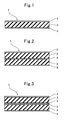
- one magnetic attractive layer, one viscoelastic material layer and one constraining layer are laminated in this order.
- the lamination of one magnetic attractive layer, one viscoelastic material layer and one constraining layer is not critical.
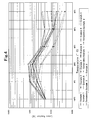
- a magnetic attractive layer 2, a viscoelastic material layer 3, a constraining layer 4, a viscoelastic material layer 3 and a constraining layer 4 are laminated in this order.
- a magnetic attractive layer 2, a viscoelastic material layer 3, a constraining layer 4, a magnetic attractive layer 2, a viscoelastic material layer 3 and a constraining layer 4 are laminated in this order.
- a combination of the layers is optional.
- the magnetic attractive layer 4 and the constraining layer 2 shown in the center of the composite laminate are contacted by magnetic force.
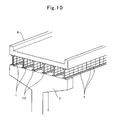
- the above-obtained composite vibration damper 1 of the invention is used by being installed, for example, on a web portion 5w of a rail 5 for railway which is a member to be fixed, or on a flange 5f in a lower portion of the rail 5 as shown in Fig. 8.
- the viscoelastic material layer 3 of the composite vibration damper 1 in the invention is adapted to be thicker than the magnetic attractive layer 2
- the magnetic attractive layer 4 is pulled to the rail side along with the viscoelastic material layer 3 by only fixing the magnetic attractive layer 4 on the web portion 5w of the rail as shown in Fig. 8(a), and the composite vibration damper is finally fixed along the web surface of the rail 5 as shown in Fig. 8(b).
- the composite vibration damper 1 of the invention may be installed on a bottom of a rail for railway between cross ties.
- the composite vibration damper of the invention can be used not only by being installed on the rail for railway shown in Fig. 8 but also by being fixed on a side wall 8 on the side of the rail 5 in a railway bridge as shown in Fig. 9 or by being installed on a side surface of a main girder 10 between a road 6 and a bridge pier 7 supporting the road in a highway bridge as shown in Fig. 10. Thus, it can be used in positions with great vibration.
- a flexible sheet (VYNON MAGNET Sheet manufactured by C. I. Kasei, magnetization pitch 5 mm, adherent force 145 g/cm 2 , BHmax 1.0 MGOe) with a thickness of 3.3 mm formed by mixing 88 parts by weight of anisotropic strontium ferrite as a magnetic powder with 12 parts by weight of chlorinated polyethylene as a binder material was used as a magnetic attractive layer.
- a softening agent Polybis 015MN
- a composite vibration damper was produced as in Example 1 except that a steel sheet (SPCC-SD) with a thickness of 0.6 mm degreased with a solvent was used as the constraining layer and the thickness of the viscoelastic material layer was 4.0 mm.
- SPCC-SD steel sheet with a thickness of 0.6 mm degreased with a solvent
- a composite vibration damper was produced as in Example 1 except that a steel sheet (SPCC-SD) with a thickness of 1.0 mm degreased with a solvent was used as the constraining layer and the thickness of the viscoelastic material layer was 2.0 mm.
- SPCC-SD steel sheet with a thickness of 1.0 mm degreased with a solvent
- a composite vibration damper was produced as in Example 1 except that a steel sheet (SPCC-SD) with a thickness of 1.0 mm degreased with a solvent was used as the constraining layer, the thickness of the viscoelastic material layer was 2.0 mm and the thickness of the magnetic attractive layer was 2.0 mm (magnetization pitch 5 mm, adherent force 125 g/cm 2 ).
- a composite vibration damper was produced as in Example 1 except that a steel sheet (SPCC-SD) with a thickness of 1.0 mm degreased with a solvent was used as the constraining layer and the thickness of the viscoelastic material layer was 6.0 mm.
- SPCC-SD steel sheet with a thickness of 1.0 mm degreased with a solvent
- a composite vibration damper was produced as in Example 1 except that a zinc-plated steel sheet with a thickness of 1.6 mm was used as the constraining layer, the thickness of the viscoelastic material layer was 6.0 mm and the thickness of the magnetic attractive layer was 2.0 mm (magnetization pitch 5 mm, adherent force 125 g/cm 2 ).
- a composite vibration damper was produced as in Example 1 except that a zinc-plated steel sheet with a thickness of 2.0 mm was used as the constraining layer, the thickness of the viscoelastic material layer was 6.0 mm and the thickness of the magnetic attractive layer was 2.0 mm (magnetization pitch 5 mm, adherent force 125 g/cm 2 ).
- a composite vibration damper was produced as in Example 1 except that a zinc-plated steel sheet with a thickness of 2.0 mm was used as the constraining layer, the thickness of the viscoelastic material layer was 6.0 mm and the thickness of the magnetic attractive layer was 3.0 mm (magnetization pitch 5 mm, adherent force 140 g/cm 2 ).
- a composite vibration damper was produced as in Example 1 except that an acrylic resin sheet with a thickness of 18 mm was used as the constraining layer, the thickness of the viscoelastic material layer was 20.0 mm and the thickness of the magnetic attractive layer was 2.0 mm (magnetization pitch 5 mm, adherent force 125 g/cm 2 ).
- a zinc-plated steel sheet having a thickness of 2.3 mm was used as a constraining layer.
- An unvulcanized polymeric viscoelastic sheet in which a butyl rubber containing a magnetic powder and a vulcanizing agent with a thickness of 3.0 mm was used as a main component was laminated thereon using a synthetic rubber-type solvent adhesive. The unvulcanized sheet and the adhesive are bonded through a press mold simultaneously with vulcanization. Magnetization was then conducted to form a vibration damper having a performance of BHmax 0.4 MGOe.
- a vibration damper was produced as in Example 1 except that a zinc-plated steel sheet with a thickness of 0.6 mm was used as the constraining layer, the thickness of the viscoelastic material layer was 0.6 mm and the thickness of the magnetic attractive layer was 2.0 mm (magnetization pitch 5 mm, adherent force 125 g/cm 2 ).
- a vibration damper was produced as in Example 1 except that a zinc-plated steel sheet with a thickness of 1.0 mm was used as the constraining layer, the thickness of the viscoelastic material layer was 0.6 mm and the thickness of the magnetic attractive layer was 2.0 mm (magnetization pitch 5 mm, adherent force 125 g/cm 2 ).
- the composite vibration dampers in Examples 1 to 9 and the vibration dampers in Comparative Examples 1 to 3 were measured for a loss factor at a resonance point frequency under temperature conditions of -20°C, 0°C, 20°C, 40°C, 60°C and 80°C.
- Example 1 100 ⁇ m 6.0 mm 3.3 mm 0.180 0.340 0.580 0.205 0.072 0.058
- Example 2 0.6 mm 4.0 mm 3.3 mm 0.178 0.450 0.800 0.220 0.075 0.057
- Example 3 1.0 mm 2.0 mm 3.3 mm 0.180 0.460 0.760 0.250 0.084 0.048
- Example 4 1.0 mm 6.0 mm 2.0 mm 0.225 0.610 0.750 0.173 0.085 0.104
- Example 5 1.0 mm 6.0 mm 3.3 mm 0.182 0.690 0.960 0.220 0.092 0.098
- Example 6 1.6 mm 6.0 mm 2.0 mm 0.207 0.912 0.790 0.268 0.122 0.155
- Example 7 2.0 mm 6.0 mm
- the loss factor at each temperature was measured as follows. On a rectangular substrate made of a steel sheet having a thickness of 2.3 mm, each of the samples in Examples 1 to 9 and Comparative Examples 1 to 3 which were formed with the same size as that of the substrate was fixed or bonded by magnetic force alone. Random noise was applied to the center of the substrate from an electrodynamic shaker via an impedance head. From a resonance curve (V/F frequency response function) of mobility (V/F) on the center of the substrate, the loss factor was obtained. The method for measuring the loss factor is also applied to the following Examples.
- Example 9 the constraining layer is made of a lightweight acrylic resin sheet and its thickness is approximately 1.1 times that of the constraining layer, whereby the excellent vibration damping effect is exhibited in the temperature range of from 20 to 80°C in comparison to Comparative Examples 1 to 3.
- each of the composite vibration dampers in Examples 1 to 9 and the dampers in Comparative Examples 1 to 3 was formed into a sample having a size of 70 mm x 225 mm, and the sample was installed on a web portion of a rail for railway. Then, the samples were compared with respect to the following property.
- a flexible sheet (VYNON MAGNET Sheet manufactured by C. I. Kasei, magnetization pitch 5 mm, adherent force 125 g/cm 2 , BHmax 1.0 MGOe) with a thickness of 2.0 mm formed by mixing 88 parts by weight of anisotropic strontium ferrite as a magnetic powder with 12 parts by weight of chlorinated polyethylene as a binder material was used as a magnetic attractive layer.
- a zinc-plated steel sheet having a thickness of 2 mm was used as a constraining layer. These layers were laminated in the order of the constraining layer, the viscoelastic material layer and the magnetic attractive layer to produce a composite vibration damper having a size of 10 mm x 210 mm. The constraining layer, the viscoelastic material layer and the magnetic attractive layer were press-bonded at room temperature.
- a composite vibration damper was produced as in Example 10 except that 20 parts by weight of a softening agent (Polybutene HV-100) was added in forming the viscoelastic material layer to give an unvulcanized sheet (penetration rate 10.0).
- a softening agent Polybutene HV-100
- a composite vibration damper was produced as in Example 10 except that 40 parts by weight of a softening agent (Polybutene HV-100) was added in forming the viscoelastic material layer to give an unvulcanized sheet (penetration rate 15.4).
- a softening agent Polybutene HV-100
- a composite vibration damper was produced as in Example 10 except that 110 parts by weight of a softening agent (Polybutene HV-100) was added in forming the viscoelastic material layer to give an unvulcanized sheet (penetration rate 32.8).
- a softening agent Polybutene HV-100
- a composite vibration damper was produced as in Example 10 except that 60 parts by weight of a softening agent (Polybis 015MN) was added in forming the viscoelastic material layer to give an unvulcanized sheet (penetration rate 60.0).
- a softening agent Polybis 015MN
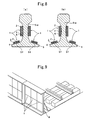
- Example 10 The composite vibration dampers in Examples 10 to 14 were measured for a loss factor at a resonance point frequency under temperature conditions of 0°C, 20°C, 40°C, 60°C and 80°C, and the results are shown in Table 2 and Fig. 5.
- 0°C 20°C 40°C 60°C 80°C Example 10 3.2 - 0.108 0.409 0.621 0.367
- Example 11 10.0 - 0.432 0.751 0.479 0.211
- Example 12 15.4 - 0.652 0.714 0.283 0.127
- Example 13 32.8 0.511 0.965 0.280 0.093 0.057
- Example 14 60.0 0.776 0.619 0.155 0.067 0.057
- This Example is, for comparison, a composite vibration damper in which a viscoelastic material layer does not contain an acicular filler.
- a flexible sheet (VYNON MAGNET Sheet manufactured by C. I. Kasei, magnetization pitch 3 mm, adherent force 100 g/cm 2 , BHmax 1.0 MGOe) with a thickness of 1.5 mm formed by mixing 88 parts by weight of anisotropic strontium ferrite as a magnetic powder with 12 parts by weight of chlorinated polyethylene as a binder material was used as a magnetic attractive layer.
- a zinc-plated steel sheet having a thickness of 1.6 mm was used as a constraining layer.
- a composite vibration damper was produced as in Example 15 except that 60 parts by weight of calcium carbonate (ground type) and 240 parts by weight of calcium silicate were used instead of 300 parts by weight of calcium carbonate (ground type) added to the viscoelastic material layer.
- Example 15 The composite vibration dampers in Examples 15 and 16 were measured for a loss factor at a resonance point frequency under temperature conditions of 20°C, 40°C, 60°C and 80°C, and the results are shown in Table 3 and Fig. 6. No. Additive of a viscoelastic material layer Loss factor in 500 Hz vibration at each temperature 20°C 40°C 60°C 80°C
- Example 15 Calcium carbonate 300 parts by weight 0.814 0.482 0.081 0.064
- Example 16 Calcium carbonate 60 parts by weight + calcium silicate 240 parts by weight 0.849 0.421 0.149 0.075
- Example 16 in which calcium silicate was added to the viscoelastic material layer, the vibration damping effect is high in the temperature range of from 20 to 80°C in comparison to Example 15.
- a flexible sheet (VYNON MAGNET Sheet manufactured by C. I. Kasei, magnetization pitch 5 mm, adherent force 125 g/cm 2 , BHmax 1.0 MGOe) with a thickness of 2.0 mm formed by mixing 88 parts by weight of anisotropic strontium ferrite as a magnetic powder with 12 parts by weight of chlorinated polyethylene as a binder material was used as a magnetic attractive layer.
- a softening agent Polybis 015MN
- a stainless steel sheet (SUS 304) having a thickness of 2 mm was used as a constraining layer. These layers were laminated in the order of the constraining layer, the viscoelastic material layer and the magnetic attractive layer to produce a composite vibration damper having a size of 20 mm x 300 mm. The constraining layer, the viscoelastic material layer and the magnetic attractive layer were press-bonded at room temperature.
- a composite vibration damper was produced as in Example 17 except that the thickness of the viscoelastic material layer was 20 mm.
- a composite vibration damper was produced as in Example 17 except that the thickness of the viscoelastic material layer was 25 mm.
- Example 17 The composite vibration dampers in Examples 17 to 19 were measured for a loss factor at a resonance point frequency under temperature conditions of 0°C, 20°C, 40°C, 60°C and 80°C, and the results are shown in Table 4 and Fig. 7. No. Structure of a sample Loss factor in 500 Hz vibration at each temperature Con-straining layer Viscoelastic material layer Magnetic attractive layer 0°C 20°C 40°C 60°C 80°C Example 17 2.0 mm 15.0 mm 2.0 mm 0.483 0.232 0.094 0.205 0.308 Example 18 2.0 mm 20.0 mm 2.0 mm 0.520 0.258 0.127 0.513 0.206 Example 19 2.0 mm 25.0 mm 2.0 mm 0.566 0.273 0.188 0.332 0.140
- This Example is, for comparison, an example of a composite vibration damper obtained by not coating a constraining layer.
- a flexible sheet (VYNON MAGNET Sheet manufactured by C. I. Kasei, magnetization pitch 3 mm, adherent force 100 g/cm 2 , BHmax 1.0 MGOe) with a thickness of 1.5 mm formed by mixing 88 parts by weight of anisotropic strontium ferrite as a magnetic powder with 12 parts by weight of chlorinated polyethylene as a binder material was used as a magnetic attractive layer.
- a zinc-plated steel sheet having a thickness of 2.0 mm was used as a constraining layer.
- a composite vibration damper was produced as in Example 20 except that only the outside (opposite to the viscoelastic material layer side) of the zinc-plated steel sheet was coated.
- a composite vibration damper was produced as in Example 20 except that the constraining layer was made of ZAM (Zn-Al-Mg alloy-plated steel sheet).
- a composite vibration damper was produced as in Example 20 except that the constraining layer was made of a stainless steel sheet (SUS 304).
- a composite vibration damper was produced as in Example 20 except that the constraining layer was made of an ED sheet (electrodeposition coating steel sheet).
- the composite vibration dampers in Examples 20 to 24 were subjected to a test by spraying an NaCl solution having a concentration of 5% for 1000 hours in an atmosphere of 35°C. The results are shown in Table 5.
- This Example is an example of not coating a heat-shielding paint on the constraining layer.
- a flexible sheet (VYNON MAGNET Sheet manufactured by C. I. Kasei, magnetization pitch 3 mm, adherent force 100 g/cm 2 , BHmax 1.0 MGOe) with a thickness of 1.5 mm formed by mixing 88 parts by weight of anisotropic strontium ferrite as a magnetic powder with 12 parts by weight of chlorinated polyethylene as a binder material was used as a magnetic attractive layer.
- a softening agent Polybis 015MN
- a zinc-plated steel sheet with a thickness of 2.0 mm to which coating or the like was not applied at all was used as a constraining layer. These layers were laminated in the order of the constraining layer, the viscoelastic material layer and the magnetic attractive layer to produce a composite vibration damper having a size of 10 mm x 210 mm. The constraining layer, the viscoelastic material layer and the magnetic attractive layer were press-bonded at room temperature.
- a composite vibration damper was produced as in Example 25 except that the zinc-plated steel sheet as the constraining layer was subjected to white coating using a nitrocellulose-based paint.
- a composite vibration damper was produced as in Example 25 except that the zinc-plated steel sheet as the constraining layer was subjected to silver coating using an acrylic resin-based paint.
- a composite vibration damper was produced as in Example 25 except that a heat-shielding sheet was adhered to the zinc-plated steel sheet as the constraining layer.
- Each of the composite vibration dampers in Examples 25 to 28 was adhered to a site to be fixed under the following conditions to measure a temperature.
- a rail having a length of 500 mm and a weight of 60 kg/m was prepared as a rail sample for railway.
- a composite vibration damper having a width of 70 mm and a length of 615 mm was used for a body, and a composite vibration damper having a width of 50 mm and a length of 470 mm was used for a bottom.
- a measuring method was as follows. A position exposed to the direct rays of the sun was selected, and the rail was installed in a vertical direction to the due south. The temperatures of the head, the body, the bottom and the atmosphere of the rail were measured with a temperature sensor. On the body and the bottom, the sensor was mounted between the surface of the rail and the composite vibration damper. The temperature was measured five times a day for a total of 5 days using a measuring device (PC-linked recorder GR-3500 manufactured by KEYENCE).
- Examples 26 to 28 can control the increase in temperature and are effective for preventing the decrease in vibration damping effect. Further, in Examples 26 to 28, the temperature of the rail is kept low, making it possible to cut down the cost involved in maintenance and control accompanied by the increase in temperature of the rail in the railway track.
- a flexible sheet (VYNON MAGNET Sheet manufactured by C. I. Kasei, magnetization pitch 5 mm, adherent force 125 g/cm 2 , BHmax 1.0 MGOe) with a thickness of 2.0 mm formed by mixing 88 parts by weight of anisotropic strontium ferrite as a magnetic powder with 12 parts by weight of chlorinated polyethylene as a binder material was used as a magnetic attractive layer.
- a coated steel sheet having a thickness of 1.6 mm was used as a constraining layer.
- the composite vibration dampers were fixed on the body and the bottom of the rail in the section at a speed of 110 km/h on a slab track between Ueno and Oomiya of the Tohoku Shinkansen.
- Comparative Example 4 is an example in which the vibration damper is not installed.
- Example 29 exhibits the excellent vibration damping effect in the railway track. It has been also found that the effect of reducing the rolling noise is obtained by approximately 3 dB.
- the composite vibration damper of the invention can exhibit the excellent vibration damping effect over the wide temperature range by fixing it on a member to be fixed such that the thickness of the viscoelastic material layer is set at 1 mm or more and the viscoelastic material layer is thicker than the constraining layer.
- the thickness of the viscoelastic material layer is 1 mm or more, and it is thicker than the constraining layer. Consequently, after the magnetic attractive layer of the composite vibration damper is partially fixed on a member to be fixed having a curved surface, the viscoelastic material layer laminated on the magnetic attractive layer is subjected to elastic deformation to follow the surface shape of the member to be fixed, whereby even an unfixed portion of the magnetic attractive layer is fixed on the surface of the member to be fixed by magnetic force. Accordingly, quite excellent workability is obtained without the need of bonding the composite vibration damper from the side of the constraining layer toward the direction of the member to be fixed by a strong pressure.
Landscapes
- Engineering & Computer Science (AREA)
- General Engineering & Computer Science (AREA)
- Mechanical Engineering (AREA)
- Chemical & Material Sciences (AREA)
- Civil Engineering (AREA)
- Structural Engineering (AREA)
- Architecture (AREA)
- Combustion & Propulsion (AREA)
- Physics & Mathematics (AREA)
- Acoustics & Sound (AREA)
- Aviation & Aerospace Engineering (AREA)
- Vibration Prevention Devices (AREA)
- Railway Tracks (AREA)
- Laminated Bodies (AREA)
Applications Claiming Priority (3)
| Application Number | Priority Date | Filing Date | Title |
|---|---|---|---|
| JP2002344700 | 2002-11-27 | ||
| JP2002334700 | 2002-11-27 | ||
| PCT/JP2003/015163 WO2004048803A1 (ja) | 2002-11-27 | 2003-11-27 | 複合型制振材 |
Publications (2)
| Publication Number | Publication Date |
|---|---|
| EP1566565A1 true EP1566565A1 (de) | 2005-08-24 |
| EP1566565A4 EP1566565A4 (de) | 2006-03-08 |
Family
ID=32375963
Family Applications (1)
| Application Number | Title | Priority Date | Filing Date |
|---|---|---|---|
| EP03811945A Withdrawn EP1566565A4 (de) | 2002-11-27 | 2003-11-27 | VERBUNDSCHWINGUNGSDûMPFER |
Country Status (4)
| Country | Link |
|---|---|
| EP (1) | EP1566565A4 (de) |
| JP (1) | JP4233526B2 (de) |
| AU (1) | AU2003302456A1 (de) |
| WO (1) | WO2004048803A1 (de) |
Cited By (3)
| Publication number | Priority date | Publication date | Assignee | Title |
|---|---|---|---|---|
| ITRM20130481A1 (it) * | 2013-08-23 | 2015-02-24 | Andrea Dipanati | Supporto magnetico antivibrante per unità esterne di climatizzatori. |
| US11131360B2 (en) | 2015-12-03 | 2021-09-28 | Viasat, Inc. | Vibration isolation apparatuses for crystal oscillators |
| EP4102097A1 (de) * | 2021-06-11 | 2022-12-14 | 4Silence B.V. | Dämpfelement mit eingespannter schicht |
Families Citing this family (12)
| Publication number | Priority date | Publication date | Assignee | Title |
|---|---|---|---|---|
| GB2421265A (en) * | 2004-12-16 | 2006-06-21 | Tiflex Ltd | Railway rail with vibration damper |
| JP4695487B2 (ja) * | 2005-10-25 | 2011-06-08 | 財団法人鉄道総合技術研究所 | レールの防音構造 |
| JP4810263B2 (ja) * | 2006-03-18 | 2011-11-09 | 株式会社シード | 消音器具 |
| JP4964531B2 (ja) * | 2006-08-01 | 2012-07-04 | 東海旅客鉄道株式会社 | 制振構造体 |
| JP4972689B2 (ja) * | 2006-08-03 | 2012-07-11 | ヘンケル・アクチェンゲゼルシャフト・ウント・コムパニー・コマンディットゲゼルシャフト・アウフ・アクチェン | 振動移動の減少 |
| JP5767491B2 (ja) * | 2011-03-25 | 2015-08-19 | 公益財団法人鉄道総合技術研究所 | まくらぎの制振構造 |
| JP5570073B2 (ja) * | 2011-07-25 | 2014-08-13 | 公益財団法人鉄道総合技術研究所 | 制振材 |
| JP6231754B2 (ja) * | 2013-02-18 | 2017-11-15 | アズビル株式会社 | 超音波流量計および超音波流量計用の超音波吸収体 |
| PL2926941T3 (pl) * | 2014-04-03 | 2017-08-31 | Bystronic Laser Ag | Urządzenie do obróbki strumieniowej |
| JP6847579B2 (ja) * | 2016-01-13 | 2021-03-24 | タキロンシーアイ株式会社 | 複合型磁性制振材 |
| JP7233206B2 (ja) * | 2018-11-30 | 2023-03-06 | 株式会社安藤・間 | 磁気吸着防音シートを用いた遮音方法 |
| CN119373665B (zh) * | 2024-09-29 | 2025-12-19 | 同济大学 | 一种设置有高强钢约束阻尼增效段的风电塔架结构及其设计方法 |
Family Cites Families (8)
| Publication number | Priority date | Publication date | Assignee | Title |
|---|---|---|---|---|
| FR2561582B3 (fr) * | 1984-03-24 | 1986-10-17 | Ruetgerswerke Ag | Feuille d'amortissement a adherence magnetique |
| JP2714655B2 (ja) | 1986-10-15 | 1998-02-16 | 株式会社 ブリヂストン | 磁性複合型制振材 |
| JPH0617540Y2 (ja) * | 1987-02-12 | 1994-05-11 | バンドー化学株式会社 | 拘束型制振材 |
| FR2643431B1 (fr) * | 1989-02-20 | 1994-04-01 | Rossignol Sa Skis | Dispositif amortisseur comprenant des materiaux visco-elastiques |
| JP2880797B2 (ja) * | 1990-11-30 | 1999-04-12 | 財団法人鉄道総合技術研究所 | 断熱制振レール |
| US5300355A (en) * | 1991-05-31 | 1994-04-05 | Nichias Corporation | Vibration damping material |
| JPH08312717A (ja) * | 1995-05-23 | 1996-11-26 | Nitto Denko Corp | 再剥離型制振材 |
| JP3488860B2 (ja) * | 2000-09-05 | 2004-01-19 | 北川工業株式会社 | 制振材料 |
-
2003
- 2003-11-27 JP JP2004555061A patent/JP4233526B2/ja not_active Expired - Lifetime
- 2003-11-27 AU AU2003302456A patent/AU2003302456A1/en not_active Abandoned
- 2003-11-27 EP EP03811945A patent/EP1566565A4/de not_active Withdrawn
- 2003-11-27 WO PCT/JP2003/015163 patent/WO2004048803A1/ja not_active Ceased
Cited By (5)
| Publication number | Priority date | Publication date | Assignee | Title |
|---|---|---|---|---|
| ITRM20130481A1 (it) * | 2013-08-23 | 2015-02-24 | Andrea Dipanati | Supporto magnetico antivibrante per unità esterne di climatizzatori. |
| US11131360B2 (en) | 2015-12-03 | 2021-09-28 | Viasat, Inc. | Vibration isolation apparatuses for crystal oscillators |
| US12018733B2 (en) | 2015-12-03 | 2024-06-25 | Viasat, Inc. | Vibration isolation apparatuses for crystal oscillators |
| EP4102097A1 (de) * | 2021-06-11 | 2022-12-14 | 4Silence B.V. | Dämpfelement mit eingespannter schicht |
| NL2028432B1 (nl) * | 2021-06-11 | 2022-12-20 | 4Silence B V | Constrained-layer dempingelement |
Also Published As
| Publication number | Publication date |
|---|---|
| AU2003302456A1 (en) | 2004-06-18 |
| AU2003302456A8 (en) | 2004-06-18 |
| JP4233526B2 (ja) | 2009-03-04 |
| EP1566565A4 (de) | 2006-03-08 |
| JPWO2004048803A1 (ja) | 2006-03-23 |
| WO2004048803A1 (ja) | 2004-06-10 |
Similar Documents
| Publication | Publication Date | Title |
|---|---|---|
| EP1566565A1 (de) | VERBUNDSCHWINGUNGSDûMPFER | |
| US5549245A (en) | Composite pad useful between railroad rail and railroad tie | |
| US4061805A (en) | Pressure sensitive adhesive strips and sheets | |
| JP6847579B2 (ja) | 複合型磁性制振材 | |
| WO1996022324A1 (en) | Heat-expandable filling reinforcement and closed-section structural-member structure reinforced with said reinforcement | |
| JP2010500494A (ja) | 接着式屋根構造体 | |
| JP2004513801A5 (de) | ||
| EP0925577A1 (de) | Leichtgewicht, hochleistungssystem zur schwingungsdämpfung | |
| AU2001289585B2 (en) | Plate-shaped cover material | |
| TW202325812A (zh) | 一種彈性防腐膠、彈性防腐膠帶及其製備方法 | |
| KR910015676A (ko) | 경화성 고무계 구조용 접착제 | |
| ES2089861T3 (es) | Empaquetadura compuesta para amortiguador sonoro. | |
| JP3679232B2 (ja) | 磁性複合型制振材、及びレール制振装置 | |
| JPH0347750A (ja) | 複合型制振材および振動体の制振施工法 | |
| JP3525020B2 (ja) | 鉄道レール用磁性複合型制振材、鉄道レール制振装置、及び鉄道レールの制振工法 | |
| JPH03175022A (ja) | 磁性複合型制振材 | |
| WO2005042857A2 (en) | Magnetic sound deadening wall treatment | |
| JPH11286063A (ja) | アルミハニカム抑音パネル | |
| JPS5874773A (ja) | 溶接継手の耐食層形成方法 | |
| JP3181429B2 (ja) | 非拘束型複合制振材料 | |
| US20210388241A1 (en) | Multilayered patches for sealing applications and related methods | |
| JPS5934496B2 (ja) | 防音・防振用基礎板の製造方法 | |
| JP3754517B2 (ja) | 部分非拘束型積層ゴム支承 | |
| JPS6113698A (ja) | 電波吸収体の施工方法 | |
| RU2021119204A (ru) | Шина с устройством мониторинга |
Legal Events
| Date | Code | Title | Description |
|---|---|---|---|
| PUAI | Public reference made under article 153(3) epc to a published international application that has entered the european phase |
Free format text: ORIGINAL CODE: 0009012 |
|
| 17P | Request for examination filed |
Effective date: 20050523 |
|
| AK | Designated contracting states |
Kind code of ref document: A1 Designated state(s): AT BE BG CH CY CZ DE DK EE ES FI FR GB GR HU IE IT LI LU MC NL PT RO SE SI SK TR |
|
| AX | Request for extension of the european patent |
Extension state: AL LT LV MK |
|
| A4 | Supplementary search report drawn up and despatched |
Effective date: 20060120 |
|
| DAX | Request for extension of the european patent (deleted) | ||
| 17Q | First examination report despatched |
Effective date: 20070731 |
|
| STAA | Information on the status of an ep patent application or granted ep patent |
Free format text: STATUS: THE APPLICATION IS DEEMED TO BE WITHDRAWN |
|
| 18D | Application deemed to be withdrawn |
Effective date: 20100601 |