EP1577416B1 - Dekorativer Artikel und Uhr - Google Patents
Dekorativer Artikel und Uhr Download PDFInfo
- Publication number
- EP1577416B1 EP1577416B1 EP05005632A EP05005632A EP1577416B1 EP 1577416 B1 EP1577416 B1 EP 1577416B1 EP 05005632 A EP05005632 A EP 05005632A EP 05005632 A EP05005632 A EP 05005632A EP 1577416 B1 EP1577416 B1 EP 1577416B1
- Authority
- EP
- European Patent Office
- Prior art keywords
- film coating
- decorative article
- base
- film
- article
- Prior art date
- Legal status (The legal status is an assumption and is not a legal conclusion. Google has not performed a legal analysis and makes no representation as to the accuracy of the status listed.)
- Expired - Lifetime
Links
Images



Classifications
-
- C—CHEMISTRY; METALLURGY
- C23—COATING METALLIC MATERIAL; COATING MATERIAL WITH METALLIC MATERIAL; CHEMICAL SURFACE TREATMENT; DIFFUSION TREATMENT OF METALLIC MATERIAL; COATING BY VACUUM EVAPORATION, BY SPUTTERING, BY ION IMPLANTATION OR BY CHEMICAL VAPOUR DEPOSITION, IN GENERAL; INHIBITING CORROSION OF METALLIC MATERIAL OR INCRUSTATION IN GENERAL
- C23C—COATING METALLIC MATERIAL; COATING MATERIAL WITH METALLIC MATERIAL; SURFACE TREATMENT OF METALLIC MATERIAL BY DIFFUSION INTO THE SURFACE, BY CHEMICAL CONVERSION OR SUBSTITUTION; COATING BY VACUUM EVAPORATION, BY SPUTTERING, BY ION IMPLANTATION OR BY CHEMICAL VAPOUR DEPOSITION, IN GENERAL
- C23C14/00—Coating by vacuum evaporation, by sputtering or by ion implantation of the coating forming material
- C23C14/06—Coating by vacuum evaporation, by sputtering or by ion implantation of the coating forming material characterised by the coating material
- C23C14/0664—Carbonitrides
-
- A—HUMAN NECESSITIES
- A44—HABERDASHERY; JEWELLERY
- A44C—PERSONAL ADORNMENTS, e.g. JEWELLERY; COINS
- A44C27/00—Making jewellery or other personal adornments
- A44C27/001—Materials for manufacturing jewellery
- A44C27/005—Coating layers for jewellery
- A44C27/006—Metallic coatings
-
- C—CHEMISTRY; METALLURGY
- C23—COATING METALLIC MATERIAL; COATING MATERIAL WITH METALLIC MATERIAL; CHEMICAL SURFACE TREATMENT; DIFFUSION TREATMENT OF METALLIC MATERIAL; COATING BY VACUUM EVAPORATION, BY SPUTTERING, BY ION IMPLANTATION OR BY CHEMICAL VAPOUR DEPOSITION, IN GENERAL; INHIBITING CORROSION OF METALLIC MATERIAL OR INCRUSTATION IN GENERAL
- C23C—COATING METALLIC MATERIAL; COATING MATERIAL WITH METALLIC MATERIAL; SURFACE TREATMENT OF METALLIC MATERIAL BY DIFFUSION INTO THE SURFACE, BY CHEMICAL CONVERSION OR SUBSTITUTION; COATING BY VACUUM EVAPORATION, BY SPUTTERING, BY ION IMPLANTATION OR BY CHEMICAL VAPOUR DEPOSITION, IN GENERAL
- C23C14/00—Coating by vacuum evaporation, by sputtering or by ion implantation of the coating forming material
- C23C14/0015—Coating by vacuum evaporation, by sputtering or by ion implantation of the coating forming material characterized by the colour of the layer
-
- C—CHEMISTRY; METALLURGY
- C23—COATING METALLIC MATERIAL; COATING MATERIAL WITH METALLIC MATERIAL; CHEMICAL SURFACE TREATMENT; DIFFUSION TREATMENT OF METALLIC MATERIAL; COATING BY VACUUM EVAPORATION, BY SPUTTERING, BY ION IMPLANTATION OR BY CHEMICAL VAPOUR DEPOSITION, IN GENERAL; INHIBITING CORROSION OF METALLIC MATERIAL OR INCRUSTATION IN GENERAL
- C23C—COATING METALLIC MATERIAL; COATING MATERIAL WITH METALLIC MATERIAL; SURFACE TREATMENT OF METALLIC MATERIAL BY DIFFUSION INTO THE SURFACE, BY CHEMICAL CONVERSION OR SUBSTITUTION; COATING BY VACUUM EVAPORATION, BY SPUTTERING, BY ION IMPLANTATION OR BY CHEMICAL VAPOUR DEPOSITION, IN GENERAL
- C23C14/00—Coating by vacuum evaporation, by sputtering or by ion implantation of the coating forming material
- C23C14/02—Pretreatment of the material to be coated
- C23C14/024—Deposition of sublayers, e.g. to promote adhesion of the coating
- C23C14/025—Metallic sublayers
-
- C—CHEMISTRY; METALLURGY
- C23—COATING METALLIC MATERIAL; COATING MATERIAL WITH METALLIC MATERIAL; CHEMICAL SURFACE TREATMENT; DIFFUSION TREATMENT OF METALLIC MATERIAL; COATING BY VACUUM EVAPORATION, BY SPUTTERING, BY ION IMPLANTATION OR BY CHEMICAL VAPOUR DEPOSITION, IN GENERAL; INHIBITING CORROSION OF METALLIC MATERIAL OR INCRUSTATION IN GENERAL
- C23C—COATING METALLIC MATERIAL; COATING MATERIAL WITH METALLIC MATERIAL; SURFACE TREATMENT OF METALLIC MATERIAL BY DIFFUSION INTO THE SURFACE, BY CHEMICAL CONVERSION OR SUBSTITUTION; COATING BY VACUUM EVAPORATION, BY SPUTTERING, BY ION IMPLANTATION OR BY CHEMICAL VAPOUR DEPOSITION, IN GENERAL
- C23C28/00—Coating for obtaining at least two superposed coatings either by methods not provided for in a single one of groups C23C2/00 - C23C26/00 or by combinations of methods provided for in subclasses C23C and C25C or C25D
- C23C28/04—Coating for obtaining at least two superposed coatings either by methods not provided for in a single one of groups C23C2/00 - C23C26/00 or by combinations of methods provided for in subclasses C23C and C25C or C25D only coatings of inorganic non-metallic material
- C23C28/048—Coating for obtaining at least two superposed coatings either by methods not provided for in a single one of groups C23C2/00 - C23C26/00 or by combinations of methods provided for in subclasses C23C and C25C or C25D only coatings of inorganic non-metallic material with layers graded in composition or physical properties
-
- C—CHEMISTRY; METALLURGY
- C23—COATING METALLIC MATERIAL; COATING MATERIAL WITH METALLIC MATERIAL; CHEMICAL SURFACE TREATMENT; DIFFUSION TREATMENT OF METALLIC MATERIAL; COATING BY VACUUM EVAPORATION, BY SPUTTERING, BY ION IMPLANTATION OR BY CHEMICAL VAPOUR DEPOSITION, IN GENERAL; INHIBITING CORROSION OF METALLIC MATERIAL OR INCRUSTATION IN GENERAL
- C23C—COATING METALLIC MATERIAL; COATING MATERIAL WITH METALLIC MATERIAL; SURFACE TREATMENT OF METALLIC MATERIAL BY DIFFUSION INTO THE SURFACE, BY CHEMICAL CONVERSION OR SUBSTITUTION; COATING BY VACUUM EVAPORATION, BY SPUTTERING, BY ION IMPLANTATION OR BY CHEMICAL VAPOUR DEPOSITION, IN GENERAL
- C23C28/00—Coating for obtaining at least two superposed coatings either by methods not provided for in a single one of groups C23C2/00 - C23C26/00 or by combinations of methods provided for in subclasses C23C and C25C or C25D
- C23C28/30—Coatings combining at least one metallic layer and at least one inorganic non-metallic layer
- C23C28/32—Coatings combining at least one metallic layer and at least one inorganic non-metallic layer including at least one pure metallic layer
- C23C28/321—Coatings combining at least one metallic layer and at least one inorganic non-metallic layer including at least one pure metallic layer with at least one metal alloy layer
-
- C—CHEMISTRY; METALLURGY
- C23—COATING METALLIC MATERIAL; COATING MATERIAL WITH METALLIC MATERIAL; CHEMICAL SURFACE TREATMENT; DIFFUSION TREATMENT OF METALLIC MATERIAL; COATING BY VACUUM EVAPORATION, BY SPUTTERING, BY ION IMPLANTATION OR BY CHEMICAL VAPOUR DEPOSITION, IN GENERAL; INHIBITING CORROSION OF METALLIC MATERIAL OR INCRUSTATION IN GENERAL
- C23C—COATING METALLIC MATERIAL; COATING MATERIAL WITH METALLIC MATERIAL; SURFACE TREATMENT OF METALLIC MATERIAL BY DIFFUSION INTO THE SURFACE, BY CHEMICAL CONVERSION OR SUBSTITUTION; COATING BY VACUUM EVAPORATION, BY SPUTTERING, BY ION IMPLANTATION OR BY CHEMICAL VAPOUR DEPOSITION, IN GENERAL
- C23C28/00—Coating for obtaining at least two superposed coatings either by methods not provided for in a single one of groups C23C2/00 - C23C26/00 or by combinations of methods provided for in subclasses C23C and C25C or C25D
- C23C28/30—Coatings combining at least one metallic layer and at least one inorganic non-metallic layer
- C23C28/32—Coatings combining at least one metallic layer and at least one inorganic non-metallic layer including at least one pure metallic layer
- C23C28/322—Coatings combining at least one metallic layer and at least one inorganic non-metallic layer including at least one pure metallic layer only coatings of metal elements only
-
- C—CHEMISTRY; METALLURGY
- C23—COATING METALLIC MATERIAL; COATING MATERIAL WITH METALLIC MATERIAL; CHEMICAL SURFACE TREATMENT; DIFFUSION TREATMENT OF METALLIC MATERIAL; COATING BY VACUUM EVAPORATION, BY SPUTTERING, BY ION IMPLANTATION OR BY CHEMICAL VAPOUR DEPOSITION, IN GENERAL; INHIBITING CORROSION OF METALLIC MATERIAL OR INCRUSTATION IN GENERAL
- C23C—COATING METALLIC MATERIAL; COATING MATERIAL WITH METALLIC MATERIAL; SURFACE TREATMENT OF METALLIC MATERIAL BY DIFFUSION INTO THE SURFACE, BY CHEMICAL CONVERSION OR SUBSTITUTION; COATING BY VACUUM EVAPORATION, BY SPUTTERING, BY ION IMPLANTATION OR BY CHEMICAL VAPOUR DEPOSITION, IN GENERAL
- C23C28/00—Coating for obtaining at least two superposed coatings either by methods not provided for in a single one of groups C23C2/00 - C23C26/00 or by combinations of methods provided for in subclasses C23C and C25C or C25D
- C23C28/30—Coatings combining at least one metallic layer and at least one inorganic non-metallic layer
- C23C28/34—Coatings combining at least one metallic layer and at least one inorganic non-metallic layer including at least one inorganic non-metallic material layer, e.g. metal carbide, nitride, boride, silicide layer and their mixtures, enamels, phosphates and sulphates
-
- C—CHEMISTRY; METALLURGY
- C23—COATING METALLIC MATERIAL; COATING MATERIAL WITH METALLIC MATERIAL; CHEMICAL SURFACE TREATMENT; DIFFUSION TREATMENT OF METALLIC MATERIAL; COATING BY VACUUM EVAPORATION, BY SPUTTERING, BY ION IMPLANTATION OR BY CHEMICAL VAPOUR DEPOSITION, IN GENERAL; INHIBITING CORROSION OF METALLIC MATERIAL OR INCRUSTATION IN GENERAL
- C23C—COATING METALLIC MATERIAL; COATING MATERIAL WITH METALLIC MATERIAL; SURFACE TREATMENT OF METALLIC MATERIAL BY DIFFUSION INTO THE SURFACE, BY CHEMICAL CONVERSION OR SUBSTITUTION; COATING BY VACUUM EVAPORATION, BY SPUTTERING, BY ION IMPLANTATION OR BY CHEMICAL VAPOUR DEPOSITION, IN GENERAL
- C23C28/00—Coating for obtaining at least two superposed coatings either by methods not provided for in a single one of groups C23C2/00 - C23C26/00 or by combinations of methods provided for in subclasses C23C and C25C or C25D
- C23C28/30—Coatings combining at least one metallic layer and at least one inorganic non-metallic layer
- C23C28/36—Coatings combining at least one metallic layer and at least one inorganic non-metallic layer including layers graded in composition or physical properties
-
- G—PHYSICS
- G04—HOROLOGY
- G04B—MECHANICALLY-DRIVEN CLOCKS OR WATCHES; MECHANICAL PARTS OF CLOCKS OR WATCHES IN GENERAL; TIME PIECES USING THE POSITION OF THE SUN, MOON OR STARS
- G04B37/00—Cases
- G04B37/22—Materials or processes of manufacturing pocket watch or wrist watch cases
-
- Y—GENERAL TAGGING OF NEW TECHNOLOGICAL DEVELOPMENTS; GENERAL TAGGING OF CROSS-SECTIONAL TECHNOLOGIES SPANNING OVER SEVERAL SECTIONS OF THE IPC; TECHNICAL SUBJECTS COVERED BY FORMER USPC CROSS-REFERENCE ART COLLECTIONS [XRACs] AND DIGESTS
- Y10—TECHNICAL SUBJECTS COVERED BY FORMER USPC
- Y10T—TECHNICAL SUBJECTS COVERED BY FORMER US CLASSIFICATION
- Y10T428/00—Stock material or miscellaneous articles
- Y10T428/12—All metal or with adjacent metals
- Y10T428/12493—Composite; i.e., plural, adjacent, spatially distinct metal components [e.g., layers, joint, etc.]
- Y10T428/12771—Transition metal-base component
- Y10T428/12806—Refractory [Group IVB, VB, or VIB] metal-base component
-
- Y—GENERAL TAGGING OF NEW TECHNOLOGICAL DEVELOPMENTS; GENERAL TAGGING OF CROSS-SECTIONAL TECHNOLOGIES SPANNING OVER SEVERAL SECTIONS OF THE IPC; TECHNICAL SUBJECTS COVERED BY FORMER USPC CROSS-REFERENCE ART COLLECTIONS [XRACs] AND DIGESTS
- Y10—TECHNICAL SUBJECTS COVERED BY FORMER USPC
- Y10T—TECHNICAL SUBJECTS COVERED BY FORMER US CLASSIFICATION
- Y10T428/00—Stock material or miscellaneous articles
- Y10T428/24—Structurally defined web or sheet [e.g., overall dimension, etc.]
- Y10T428/24942—Structurally defined web or sheet [e.g., overall dimension, etc.] including components having same physical characteristic in differing degree
- Y10T428/2495—Thickness [relative or absolute]
- Y10T428/24967—Absolute thicknesses specified
- Y10T428/24975—No layer or component greater than 5 mils thick
-
- Y—GENERAL TAGGING OF NEW TECHNOLOGICAL DEVELOPMENTS; GENERAL TAGGING OF CROSS-SECTIONAL TECHNOLOGIES SPANNING OVER SEVERAL SECTIONS OF THE IPC; TECHNICAL SUBJECTS COVERED BY FORMER USPC CROSS-REFERENCE ART COLLECTIONS [XRACs] AND DIGESTS
- Y10—TECHNICAL SUBJECTS COVERED BY FORMER USPC
- Y10T—TECHNICAL SUBJECTS COVERED BY FORMER US CLASSIFICATION
- Y10T428/00—Stock material or miscellaneous articles
- Y10T428/26—Web or sheet containing structurally defined element or component, the element or component having a specified physical dimension
- Y10T428/263—Coating layer not in excess of 5 mils thick or equivalent
- Y10T428/264—Up to 3 mils
- Y10T428/265—1 mil or less
Definitions
- nitriding treatment causes surface roughness, which changes the polished design.
- Mirror finished articles in particular are roughened and clouded over, and then cannot be used as decorative articles.
- a base that has been subjected to nitriding treatment as described above has a low-quality color tone, and is therefore difficult to apply to decorative articles wherein a superior design is required (particularly white and silver articles).
- US-A-4 791 017 discloses a watch case having a gold-colored under layer for a gold-containing surface layer.
- EP-A-1 286 234 discloses a radiowave wristwatch case that is matched to a colour using a thin film.
- An object of the present invention is to provide a decorative article wherein a superior aesthetic appearance can be maintained over a long period of time, and to provide a timepiece including this decorative article.
- the C content in the first film coating is 3 to 12 wt%.
- the N content in the first film coating is 2 to 18 wt%.
- the C content in the first film coating is preferably less than the N content in the first film coating.
- the average thickness of the first film coating is preferably 1.6 to 5 ⁇ m.
- the average thickness of the second film coating is 0.15 to 0.5 ⁇ m.
- the first film coating is preferably formed by a vapor phase film forming method.
- first film coating that has a uniform film thickness (little variation in film thickness) and that has particularly excellent adhesiveness with the base (including adhesiveness with the base through an underlayer).
- first film coating that has a uniform film thickness (little variation in film thickness) and that has particularly excellent adhesiveness with the base (including adhesiveness with the base through an underlayer).
- the decorative article with a particularly superior aesthetic appearance and durability. This is also advantageous in terms of improving the reliability of the decorative article because variations in the film thickness can be sufficiently reduced even when the first film coating to be formed is relatively thin.
- the vapor phase film forming method is preferably ion plating.
- first film coating that has a uniform film thickness (little variation in film thickness) and that has particularly excellent adhesiveness with the base (including adhesiveness with the base through an underlayer).
- first film coating that has a uniform film thickness (little variation in film thickness) and that has particularly excellent adhesiveness with the base (including adhesiveness with the base through an underlayer).
- the decorative article with a particularly superior aesthetic appearance and durability. This is also advantageous in terms of improving the reliability of the decorative article because variations in the film thickness can be sufficiently reduced even when the first film coating to be formed is relatively thin.
- the second film coating is preferably formed by ion plating.
- the second film coating with particularly superior adhesiveness. It is also possible to easily form a homogeneous second film coating with a thickness that has little variation (particularly when the film thickness of the second film coating is relatively low). Therefore, it is possible to provide the decorative article with a particularly superior aesthetic appearance and to maintain the superior aesthetic appearance over a longer period of time.
- the decorative article of the present invention preferably has at least one underlayer between the base and the first film coating.
- the decorative article of the present invention preferably has a layer configured primarily from Ti as the underlayer.
- the average thickness of the underlayer is preferably 0.1 to 2.0 ⁇ m.
- the Vickers hardness Hv measured at a load of 10 gf is preferably 600 to 1000 on the surface of the side to which the second film coating is provided.
- the decorative article of the present invention is preferably an exterior component for a timepiece.
- Exterior components for timepieces are commonly decorative articles that are susceptible to impact from external sources, and these components must have an aesthetic appearance as decorative articles, and durability as practical articles. With the present invention, these requirements can be simultaneously satisfied.
- the timepiece of the present invention includes the decorative article of the present invention.
- FIG. 1 is a cross-sectional view showing the first embodiment of the decorative article of the present invention
- FIG. 2 is a cross-sectional view showing a preferred embodiment of the method for manufacturing the decorative article shown in FIG. 1.
- the decorative article 1A of the present embodiment has a base 2, a first film coating 3, and a second film coating 4, as shown in FIG. 1.
- At least part of the surface vicinity is primarily configured from Ti and/or stainless steel.
- materials configured primarily from Ti include Ti (Ti as an elementary substance), a Ti alloy, and the like.
- stainless steel include a Fe-Cr based alloy, a Fe-Cr-Ni based alloy, or the like, or, more specifically, SUS 405, SUS 430, SUS 434, SUS 444, SUS 429, SUS 430F and the like, as well as SUS 304, SUS 303, SUS 316, SUS 316 L, SUS 316 J1, SUS 316 J1L, and the like.
- Possible examples of materials that can be subjected to nitriding treatment or carburizing treatment include materials other than the materials configured by Ti and/or stainless steel as described above, but when such a material is used (a material configured primarily from Ti and/or stainless steel), it is difficult to sufficiently increase the hardness of the finally resulting decorative article. Also, when a material configured primarily from Ti and/or stainless steel is not used, it is difficult to sufficiently maintain a superior aesthetic appearance (particularly an aesthetic appearance required in an exterior component for a timepiece or another such decorative article) over a long period of time in the finally resulting decorative article.
- the base 2 may have a substantially uniform composition in every section, and may also have a composition that differs from section to section.
- the base 2 may have a base, and a surface layer formed on top of the base.
- the degree of freedom in molding the base 2 can be increased depending, for example, on the selection of the constituent material for the base, and a decorative article 1A with a more complicated shape can be relatively easily manufactured.
- the thickness of the surface layer is not particularly limited, but is preferably 0.1 to 50 ⁇ m, and is more preferably 1.0 to 10 ⁇ m. If the thickness of the surface layer is within this range, the base 2 can be provided with particularly superior strength after undergoing a hardening treatment can, and the surface layer can be more reliably prevented from accidentally peeling off of the base.
- the materials previously described can be suitably used as the constituent materials of the surface layer.
- Metal materials, nonmetal materials, and the like, for example, can be used as the constituent materials of the base.
- the base is configured from a metal material, it is possible to provide a decorative article 1A having particularly superior strength characteristics.
- the surface roughness of the resulting decorative article 1A can be reduced due to the leveling effects when the first film coating 3 and the second film coating 4 described later are formed, even when the surface roughness of the base is relatively high.
- a decorative article with excellent luster can be provided.
- a decorative article 1A can be provided that is relatively lightweight and easily portable and that has a substantive appearance.
- the base when configured, for example, from a nonmetal material, it can be formed into the desired shape relatively easily.
- the base is configured from a metal material, the effects of blocking electromagnetic noise are achieved.
- the metal material constituting the base include Fe, Cu, Zn, Ni, Ti, Mg, Cr, Mn, Mo, Nb, Al, V, Zr, Sn, Au, Pd, Pt, Ag, and other such various metals, as well as alloys and other materials containing at least one of these metals.
- Fe, Cu, Zn, Ni, Ti, Al, or an alloy containing at least one of these metals are preferred. Configuring the base with such materials makes it possible to ensure particularly superior adhesiveness between the base and the surface layer, improves the workability of the base, and further increases the degree of freedom in molding the entire base 2.
- nonmetal material constituting the base include ceramics, plastic (particularly heat-resistant plastic), stone, wood, and the like.
- the ceramics include Al 2 O 3 , SiO 2 , TiO 2 , Ti 2 O 3 , ZrO 2 , Y 2 O 3 , barium titanate, strontium titanate, and other such oxide-based ceramics; AlN, Si 3 N 4 , SiN, TiN, BN, ZrN, HfN, VN, TaN, NbN, CrN, Cr 2 N, and other such nitride-based ceramics; graphite, SiC, ZrC, Al 4 C 3 , CaC 2 , WC, TiC, HfC, VC, TaC, NbC, and other such carbide-based ceramics; ZrB 2 , MoB, and other such boride-based ceramics; and compound ceramics consisting of a combination of two or more of these examples.
- plastic material constituting the base include various thermoplastic resins and various thermosetting resins; for example, polyethylene, polypropylene, ethylenepropylene copolymers, ethylene-vinyl acetate copolymers (EVA), other polyolefins, cyclic polyolefins, modified polyolefins, polyvinyl chloride, polyvinylidene chloride, polystyrene, polyamide (examples: nylon 6, nylon 46, nylon 66, nylon 610, nylon 612, nylon 11, nylon 12, nylon 6-12, nylon 6-66), polyimide, polyamide imide, polycarbonate (PC), poly(4-methylbentene-1), ionomers, acrylic resins, polymethyl methacrylate, acrylonitrile-butadiene-styrene copolymers (ABS resins), acrylonitrile-styrene copolymers (AS resins), butadiene-styrene copolymers, polyoxymethylene
- the shape and size of the base 2 are not particularly limited, and are normally determined based on the shape and size of the decorative article 1A.
- the first film coating 3 is formed on the surface of the base 2.
- the first film coating 3 is configured primarily from TiCN according to claim 1.
- the presence of the first film coating 3 makes it possible to provide the entire decorative article 1A with superior hardness (hardness on the surface to which the first film coating 3 and second film coating 4 are provided; similar hereinbelow), and to ensure that the decorative article 1A is not susceptible to cuts, scratches, and other such indentations or the like. Also, the presence of the first film coating 3 makes it possible to provide the entire decorative article 1A with a superior aesthetic appearance, even when the film thickness of the second film coating 4 described later is relatively low.
- the color tone of the first film coating 3 has a strong effect on the aesthetic appearance of the decorative article 1A when the film thickness of the second film coating 4 described later is relatively low, but since the color tone (chromaticity) of the TiCN (first film coating 3) described above is relatively similar to the color tone (chromaticity) of the second film coating 4 (the difference is small), the entire decorative article 1A can be provided with a superior aesthetic appearance even in such a case. Also, the adverse effects on the aesthetic appearance of the decorative article 1A can be minimized even when the second film coating 4 is rubbed or stripped off due to extensive use of the decorative article 1A, for example. Accordingly, the hardness of the entire decorative article cannot be sufficiently increased when the decorative article does not have a first film coating configured from TiCN.
- the decorative article is susceptible to cuts, scratches, and other such indentations or the like.
- the effect of the color tone of the base and the like on the design of the decorative article increases when the decorative article does not have a first film coating configured from TiCN. Therefore, sometimes the aesthetic appearance of the decorative article is significantly compromised, depending on the combination of the constituent material of the base, the constituent material of the second film coating, and the like.
- the hardness of the entire decorative article cannot be sufficiently increased when the C and N contents in the first film coating are less than the aforementioned lower limits of claim 1.
- the decorative article is susceptible to cuts, scratches, and other such indentations or the like.
- the C and N contents in the first film coating exceed the aforementioned upper limits, the internal stress of the coating film becomes too great and cracks and the like are likely to occur, depending on the thickness and the like of the first film coating. Therefore, the reliability of the decorative article is significantly reduced. Also, when the C and N contents in the first film coating exceed the aforementioned upper limits, the difference in color tone (chromaticity) with the second film coating becomes too great and the aesthetic appearance of the entire decorative article is reduced.
- the sum (X 1 ) of the C content (X 1C ) and the N content (X 1N ) in the first film coating 3 is 5 to 30 wt%, but 10 to 28 wt% is preferable, and 15 to 25 wt% is even more preferable.
- the combined C content and N content in the first film coating is preferably relatively low. The effects previously described are thereby more pronounced as a result.
- the C content (X 1C ) in the first film coating 3 is 3 to 12 wt%, and is preferably 5 to 9 wt%. If the C content in the first film coating 3 is a value within this range, the decorative article 1A is ensured to have good hardness, and the color tone (chromaticity) of the first film coating 3 can be optimized. As a result, the above-described effects of the present invention are more significantly exhibited.
- the N content (X 1N ) in the first film coating 3 is 2 to 18 wt%, and is preferably 8 to 16 wt%. If the N content in the first film coating 3 is a value within this range, the decorative article 1A is ensured to have sufficient hardness, and the color tone (chromaticity) of the first film coating 3 can be optimized. As a result, the above-described effects of the present invention are more significantly exhibited.
- the C content X 1C [wt%] in the first film coating 3 is preferably less than the N content X 1N [wt%] in the first film coating 3.
- the color tone of the first film coating 3 can thereby be prevented from becoming too black, and as a result, the decorative article 1A can be provided with a particularly superior aesthetic appearance (particularly when the thickness of the second film coating 4 is relatively low).
- the C content X 1C [wt%] in the first film coating 3 and the N content X 1N [wt%] in the first film coating 3 preferably satisfy the relationship 1 ⁇ X 1N -X 1C ⁇ 10, and more preferably satisfy the relationship 2 ⁇ X 1N -X 1C ⁇ 9, and even more preferably satisfy the relationship 3 ⁇ X 1N -X 1C ⁇ 8. If such a relationship is satisfied, a superior aesthetic appearance can be maintained in the decorative article 1A over a long period of time.
- the first film coating is configured primarily from TiCN.
- TiC and TiN are both materials whose hardness is similar to that of TiCN.
- the effects of the present invention cannot be achieved when the first film coating is composed of TiC or TiN, only.
- the first film coating is composed of pure TiC, the color tone of the first film coating becomes too black, and the aesthetic appearance of the entire decorative article is significantly compromised.
- the C content in the first film coating is reduced to prevent this, the entire decorative article cannot be ensured to have a sufficient hardness, and the decorative article is susceptible to cuts, scratches, and other such indentations and the like.
- the first film coating is composed of pure TiN
- the color tone of the first film coating becomes too gold, and the aesthetic appearance of the entire decorative article is compromised.
- the N content in the first film coating is reduced to prevent this adverse event from occurring, the entire decorative article cannot be ensured to have a sufficient hardness, and the decorative article is susceptible to cuts, scratches, and other such indentations and the like.
- the decorative article 1A is sufficiently stable under normal usage conditions (for example, a temperature of -50 to 120°C and a humidity of 0 to 100% RH), the base 2 does not suffer substantial scratches, and the first film coating 3 can be easily and reliably removed using special reagents. Therefore, when stains occur in the first film coating 3 of the decorative article 1A, the first film coating 3 can be removed and another first film coating 3 can be suitably formed.
- the film coating (first film coating) can be easily and reliably stripped and re-formed by using special reagents, and the characteristics thereof can therefore continue to be exhibited over an extremely long period of time.
- a possible example of a stripping agent that can be used to strip the first film coating 3 is a solution or the like containing nitric acid (HNO 3 ) and sulfuric acid (H 2 SO 4 ).
- the stripping agent is such a solution
- the concentration of nitric acid (HNO 3 ) in the solution is preferably about 10 to 30 vol%
- sulfuric acid (H 2 SO 4 ) is preferably about 10 to 30 vol%.
- the first film coating 3 can be easily and reliably removed in a relatively short period of time without inflicting substantial damage to the base 2 or the like. Accordingly, it is difficult or practically impossible to strip the film coating with a film coating configured from TiN or TiC or a TiCN film coating in which the C and N contents are outside of the aforementioned ranges, even with the use of such reagents as described above.
- the average thickness of the first film coating 3 is not particularly limited, but is preferably 1.6 to 5 ⁇ m, and is more preferably 2.0 to 4.0 ⁇ m. If the average thickness of the first film coating 3 is a value within this range, the first film coating 3 can be ensured to have a preferable hardness and the internal stress of the first film coating 3 can be more effectively prevented from increasing. As a result, the decorative article 1A can be ensured to have particularly superior reliability and durability. Accordingly, if the average thickness of the first film coating 3 is less than the aforementioned lower limit, the functions of the first film coating 3 as described above may possibly not be sufficiently exhibited, depending on the C content (X 1C ), N content (X 1N ), and the like in the first film coating 3.
- the internal stress of the first film coating 3 exhibits a tendency to increase, depending on the C content (X 1C ), the N content (X 1N ), and the like in the first film coating 3.
- the first film coating 3 may have a plurality of sections where the values for the combined C content and N content (or the values for the C content and the values for the N content) differ.
- the first film coating 3 may have a first section in which the combined C content and N content is a specific value X, and a second section in which the combined C content and N content is a specific value X' that is greater than X.
- providing the first section nearer to the base 2 than the second section makes it possible to further increase the hardness of the first film coating 3 while more effectively preventing the internal stress of the first film coating 3 from increasing, and to ensure particularly superior adhesiveness between the base 2 and the first film coating 3.
- the decorative article 1A it is possible for the decorative article 1A to maintain a superior aesthetic appearance in a stable manner over a longer period of time. Also, the following effects are achieved when the second section is provided nearer to the base 2 than the first section. As a result of having a second section in which the combined C content and N content is relatively large, the entire first film coating 3 can be ensured to have particularly superior hardness (hardness of the entire decorative article 1A), and it is possible to reduce the effects of the second section having a relatively strong color tone on the aesthetic appearance of the decorative article 1A.
- the entire first film coating 3 can be ensured to have a particularly superior hardness (hardness of the entire decorative article 1A), and the entire decorative article 1A can be ensured to have a particularly superior aesthetic appearance. Accordingly, it is possible for the decorative article 1A to maintain a superior aesthetic appearance in a stable manner over a longer period of time.
- the first film coating 3 when it has a plurality of sections with different compositions (for example, when it has a first section and second section as described above), the first film coating 3 may, for example, be configured with a layered structure including a plurality of layers with different compositions, or the composition may have a gradient along the thickness direction.
- the second film coating 4 is formed on the surface of the first film coating 3 (the surface opposite of the surface facing the base 2).
- the second film coating 4 is configured primarily from , one or more elements selected from Ti, Pt, Pd, and In.
- the term "primarily" herein denotes that the content is the greatest of all the constituent materials (constituent components) of the second film coating 4, and it is preferable that the content be 50 wt% or more of all the constituent materials (constituent components), more preferable 90 wt% or more, and even more preferable 99 wt% or more.
- the entire decorative article 1A has a superior aesthetic appearance, and particularly has a sophisticated white or silver color tone.
- the color tone of the above-described first film coating 3 is relatively similar to the color tone of the second film coating 4, but without the second film coating 4, the aesthetic appearance of the entire decorative article 1A is insufficient. More specifically, the decorative article 1A lacks sophistication without the second film coating 4.
- the average thickness of the second film coating 4 is 0.15 to 0.5 ⁇ m, and is preferably 0.15 to 0.3 ⁇ m. If the average thickness of the second film coating 4 is a value within this range, the entire decorative article 1A can be provided with a particularly superior aesthetic appearance, and the entire decorative article 1A can be ensured to have a particularly high hardness. As a result, it is possible for the decorative article 1A to maintain a superior aesthetic appearance in a stable manner over a longer period of time. Accordingly, if the average thickness of the second film coating 4 is less than the aforementioned lower limit, it may possibly be difficult to ensure a sufficient superior design for the decorative article 1A, depending on the composition and the like of the first film coating 3 (for example, the C content and N content). Also, if the average thickness of the second film coating 4 exceeds the aforementioned upper limit, it is difficult for the effects of having the first film coating previously described to be sufficiently manifest, and the hardness of the decorative article 1A exhibits a tendency to decrease.
- the second film coating 4 may also be configured from a material containing both one or more of Ti, Pt, Pd, In and TiCN (wherein the combined C content and N content is less than that of the TiCN constituting the above-described first film coating 3).
- the second film coating 4 may also have a plurality of sections with different compositions.
- the second film coating 4 may have a first section configured primarily from M, and a second section configured from TiCN (wherein the combined C content and N content is less than that of the TiCN constituting the above-described first film coating 3).
- the second film coating may also, for example, be configured from a layered structure including a plurality of layers with different compositions, or the composition may have a gradient along the thickness direction.
- the second film coating is configured from TiCN.
- the entire decorative article 1A can be ensured to have a more superior hardness. Therefore, it is possible for the decorative article 1A to maintain a superior aesthetic appearance in a stable manner over a longer period of time.
- the second film coating 4 is configured from TiCN, the following conditions are preferably satisfied.
- the sum (X 2 ) of the C content and the N content in the second film coating 4 is less than the sum (X 1 ) of the C content and the N content in the first film coating 3.
- the sum (X 2 ) of the C content (X 2C ) and the N content (X 2N ) in the second film coating 4 is preferably 2 to 10 wt%, more preferably 2 to 8 wt%, and even more preferably 2 to 6 wt%. If the sum (X 2 ) of the C content (X 2C ) and the N content (X 2N ) in the second film coating 4 is a value within this range, the decorative article 1A has a more sophisticated white or silver color tone as a result.
- the C content (X 2C ) in the second film coating 4 is preferably 0.5 to 4 wt%, and is more preferably 1 to 4 wt%. If the C content in the second film coating 4 is a value within this range, the decorative article 1A can be ensured to have a particularly high hardness, and the color tone (chromaticity) of the second film coating 4 can be optimized.
- the N content (X 2N ) in the second film coating 4 is preferably 0.5 to 6 wt%, and is more preferably 1 to 5 wt%. If the N content in the second film coating 4 is within this range, the decorative article 1A can be ensured to have a sufficiently high hardness, and the color tone (chromaticity) of the second film coating 4 can be optimized.
- X 1 [wt%] denotes the combined C content (X 1C ) and the N content (X 1N ) in the first film coating 3
- X 2 [wt%] denotes the combined C content (X 2C ) and the N content (X 2N ) in the second film coating 4
- the decorative article 1A described above may be any product that has decorative properties, and possible examples of items to which it can be applied include interior and exterior accessories for ornaments and the like, jewelry, timepiece cases (main bodies, back covers, and one-piece cases with the main body and back cover integrated), timepiece bands (including band buckles, band/bangle detachable mechanisms, and the like), dial plates, timepiece pointers, bezels (for example, rotating bezels and the like), winders (for example, screw-lock winders and the like), buttons, cover glass, glass rims, dial rings, see-through plates, gaskets, and other such external timepiece components; base plates for movements, gears, train wheel bridges, oscillating weights, and other such internal timepiece components; and eyeglasses (for example, eyeglass frames), necktie pins, cuff links, rings, necklaces, bracelets, anklets, brooches, pendants, earrings, pierced earrings, and other such personal accessories, as well as lighters and cases thereof, wheels for automobiles
- external timepiece components are the most preferred. External timepiece components require aestheticism in design as decorative articles, and also require durability, corrosion resistance, scratching resistance, abrasion resistance, and a superior design as practical articles, but all these requirements can be met according to the present invention.
- the term "external timepiece components" in the present specification may denote any components that are visible from the outside, but is not limited to those exposed on the exterior of the timepiece and includes those installed in the interior of the timepiece.
- the Vickers hardness Hv measured at a load of 10 gf is preferably 600 to 1000 on the surface of the side to which the second film coating is provided. It is thereby possible to maintain a superior aesthetic appearance in the decorative article over a longer period of time.
- FIG. 2 is a cross-sectional view showing a preferred embodiment of the method for manufacturing the decorative article shown in FIG. 1.
- the method for manufacturing the decorative article of the present embodiment has a first step (2b) of forming the first film coating 3 on at least part of the surface of the base 2 (2a), and a second step (2c) of forming the second film coating 4 on at least part of the surface of the first film coating 3.
- the base 2 may be molded by any method, and possible examples of methods for molding the base 2 include pressing, cutting, forging, casting, metal powder sintering, metal powder injection molding (MIM), lost-wax processing, and the like.
- methods for molding the base 2 include pressing, cutting, forging, casting, metal powder sintering, metal powder injection molding (MIM), lost-wax processing, and the like.
- the base 2 can be manufactured as follows. Specifically, the base 2 can be obtained by forming a surface layer on the base portion manufactured by a method such as one previously described. Possible examples of the method for forming the surface layer include dipping, paint coating, spray coating, electrostatic coating, electrodeposition coating, and other such coating methods; electrolytic plating, immersion plating, electroless plating, and other such wet plating methods; heat CVD, plasma CVD, laser CVD, and other such chemical vapor deposition methods (CVD); vacuum deposition, sputtering, ion plating, and other such dry plating methods; thermal spraying; and the like.
- a method for forming the surface layer include dipping, paint coating, spray coating, electrostatic coating, electrodeposition coating, and other such coating methods; electrolytic plating, immersion plating, electroless plating, and other such wet plating methods; heat CVD, plasma CVD, laser CVD, and other such chemical vapor deposition methods (CVD); vacuum deposition, sputtering, ion plating,
- the surface of the base 2 may be mirror finished, creased, satinized, or otherwise surface treated. It is thereby possible to have variation in the glossy appearance in the surface of the resulting decorative article 1A, and the decorative properties of the resulting decorative article 1A can be further improved.
- Mirror finishing for example, can be performed using conventional polishing methods, for which buffer (cloth) polishing, barrel polishing, and other mechanical polishing methods can be employed.
- a decorative article 1A manufactured with the use of a base 2 subjected to such surface treatment is less flashy and has a particularly superior aesthetic appearance compared to one obtained by directly subjecting the first film coating 3 and second film coating 4 to the aforementioned surface processing.
- the first film coating 3 is configured from the hard material of TiCN as previously described, when the first film coating 3 is directly subjected to surface processing, the first film coating 3 is susceptible to cracks and other such blemishes when undergoing the surface processing, and the yield rate of manufacturing the decorative article 1A may significantly decrease, but subjecting the base 2 to surface treatment makes it possible to effectively prevent such problems.
- the surface treatment for the base 2 can be more easily performed under mild conditions than the surface processing for the first film coating 3.
- the second film coating 4 normally has a relatively low thickness, when the surface processing described above is performed after the second film coating 4 is formed, the film thickness of the second film coating in the subjected areas is markedly reduced, and the first film coating may possibly be exposed. In such a case, the aesthetic appearance of the decorative article 1A is severely compromised as a result.
- a first film coating 3 configured from TiCN is formed on the surface of the base 2 (2b).
- the method for forming the first film coating 3 is not particularly limited, and possible examples include spin coating, dipping, paint coating, spray coating, electrostatic coating, electrodeposition coating, and other such coating methods; electrolytic plating, immersion plating, electroless plating, and other such wet plating methods; heat CVD, plasma CVD, laser CVD, and other such chemical vapor deposition methods (CVD); vacuum deposition, sputtering, ion plating, and other such dry plating methods (vapor phase film forming methods); and thermal spraying, and the like, but a dry plating method (vapor phase film forming method) is preferred.
- Applying a dry plating method (vapor phase film forming method) as the method for forming the first film coating 3 makes it possible to reliably form a first film coating 3 that has uniform thickness, is homogeneous, and has particularly superior adhesiveness with the base 2. As a result, the finally resulting decorative article 1A can be ensured to have a particularly superior aesthetic appearance and durability.
- Applying a dry plating method (vapor phase film forming method) as the method for forming the first film coating 3 also makes it possible to ensure that variation in the film thickness will be sufficiently low even if the first film coating 3 to be formed is relatively thin. This is advantageous in terms of improving the reliability of the decorative article 1A.
- Applying a dry plating method (vapor phase film forming method) as the method for forming the first film coating 3 also makes it possible to more reliably control the C content and N content in the first film coating 3.
- ion plating is particularly preferred. If ion plating is applied as the method for forming the first film coating 3, the effects described above are more pronounced as a result. Specifically, applying ion plating as the method for forming the first film coating 3 makes it possible to more reliably form a first film coating 3 that has uniform thickness, is homogeneous, and has particularly superior adhesiveness with the base 2. As a result, the finally resulting decorative article 1A can be ensured to have a more superior aesthetic appearance and durability. Applying ion plating as the method for forming the first film coating 3 also makes it possible to ensure that variation in the film thickness will be sufficiently low even if the first film coating 3 to be formed is relatively thin. Applying ion plating as the method for forming the first film coating 3 also makes it possible to more reliably control the C content and N content in the first film coating 3.
- the first film coating 3 can be easily and reliably formed by using Ti as a target and treating the film in an atmosphere containing C (carbon) and N (nitrogen).
- the composition (C and N content) and the like of the first film coating 3 to be formed can be adjusted by suitably adjusting the blend ratio and the like of these gases.
- the atmospheric gas may contain argon gas or another such inert gas, for example.
- the atmospheric gas may also contain oxygen gas (O 2 ) or the like, for example.
- O 2 oxygen gas
- a first film coating 3 whose composition contains oxygen (TiCNO) can be easily and reliably formed.
- the second film coating 4 is formed on the surface of the first film coating 3 formed as described above (2c).
- the method for forming the second film coating 4 is not particularly limited, and possible examples include spin coating, dipping, paint coating, spray coating, electrostatic coating, electrodeposition coating, and other such coating methods; electrolytic plating, immersion plating, electroless plating, and other such wet plating methods; heat CVD, plasma CVD, laser CVD, and other such chemical vapor deposition methods (CVD); vacuum deposition, sputtering, ion plating, and other such dry plating methods (vapor phase film forming methods); and thermal spraying, and the like, but a dry plating method (vapor phase film forming method) is preferred.
- Applying a dry plating method (vapor phase film forming method) as the method for forming the second film coating 4 makes it possible to reliably form a second film coating 4 that has uniform thickness, is homogeneous, and has particularly superior adhesiveness with the first film coating 3. As a result, the finally resulting decorative article 1A can be ensured to have a particularly superior aesthetic appearance and durability.
- Applying a dry plating method (vapor phase film forming method) as the method for forming the second film coating 4 also makes it possible to ensure that variation in the film thickness will be sufficiently low even if the second film coating 4 to be formed is relatively thin. This is advantageous in terms of improving the reliability of the decorative article 1A.
- Applying a dry plating method (vapor phase film forming method) as the method for forming the second film coating 4 also makes it possible to more reliably control the C content and N content in the second film coating 4.
- ion plating is particularly preferred. If ion plating is applied as the method for forming the second film coating 4, the effects described above are more pronounced as a result. Specifically, applying ion plating as the method for forming the second film coating 4 makes it possible to more reliably form a second film coating 4 that has uniform thickness, is homogeneous, and has particularly superior adhesiveness with the first film coating 3. As a result, the finally resulting decorative article 1A can be ensured to have a more superior aesthetic appearance and durability.
- Applying ion plating as the method for forming the second film coating 4 also makes it possible to ensure that variation in the film thickness will be sufficiently low even if the second film coating 4 to be formed is relatively thin, which is advantageous in terms of improving the reliability of the decorative article 1A.
- Applying a dry plating method (vapor phase film forming method) as the method for forming the FIG. 4 also makes it possible to more reliably control the C content and N content in the second film coating 4 when the second film coating 4 is configured from TiCN.
- the first step and the second step can be performed successively (without removing the base 2 from the apparatus) in the same apparatus by varying the type of the target and the composition of the atmospheric gas (for example, the blend ratio between Ar gas or another such inert gas as well as nitrogen gas and a hydrocarbon gas) in the vapor phase film forming apparatus (in the chamber).
- the type of the target and the composition of the atmospheric gas for example, the blend ratio between Ar gas or another such inert gas as well as nitrogen gas and a hydrocarbon gas
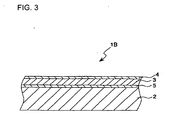
- FIG. 3 is a cross-sectional view showing the second embodiment of the decorative article of the present invention
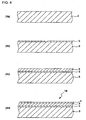
- FIG. 4 is a cross-sectional view showing a preferred embodiment of the method for manufacturing the decorative article shown in FIG. 3.
- the decorative article 1B of the present embodiment has a base 2, an underlayer 5 provided to the surface of the base 2, a first film coating 3 provided to the surface of the underlayer 5, and a second film coating 4 provided to the surface of the first film coating 3.
- the decorative article 1B is identical to the decorative article 1A previously described. Therefore, the underlayer 5 is described below.
- the underlayer 5 may have, for example, any of the following functions: the function of improving adhesiveness between the base 2 and the first film coating 3 (a function as an adhesiveness improving layer), the function of repairing scratches in the base 2 by leveling (smoothing) (a function as a leveling layer), the function of dampening impact from external forces on the resulting decorative article (a function as a cushion layer), and the like.
- the constituent material of the underlayer 5 include Ti, Zr, Hf, V, Nb, Ta, Cr, Al, alloys containing at least one of these elements, and other such metal materials or the like, but among these elements, Ti is preferred. If the underlayer 5 is configured primarily from Ti, for example, adhesiveness between the base 2 and the first film coating 3 can be further improved, and the decorative article 1B can be ensured to have particularly superior reliability and durability. Also, if the underlayer 5 is configured primarily from Ti, its function as a leveling layer for alleviating irregularities in the surface of the base 2 is more profoundly exhibited. Also, if the underlayer 5 is configured primarily from Ti, the underlayer 5 functions more effectively as a cushion layer for dampening impact from external sources. As a result, the decorative article 1B is less susceptible to cuts and other such indentations.
- the average thickness of the underlayer 5 is not particularly limited, but is preferably 0.1 to 2.0 ⁇ m, and is more preferably 0.5 to 1.0 ⁇ m. If the average thickness of the underlayer 5 is a value within this range, the internal stress in the underlayer 5 can be sufficiently prevented from increasing, and the functions of the underlayer 5 described above can be more effectively exhibited.
- FIG. 4 is a cross-sectional view showing a preferred embodiment of the method for manufacturing the decorative article shown in FIG. 3.
- the method for manufacturing the decorative article of the present embodiment has a step (4b) for forming the underlayer 5 on at least part of the surface of the base 2 (4a), a first step (4c) for forming the first film coating 3 on at least part of the surface of the underlayer 5, and a second step (4d) for forming the second film coating 4 on at least part of the surface of the first film coating 3.
- this process is identical to that of the embodiment previously described, except that the underlayer 5 is formed prior to the formation of the first film coating 3.
- the underlayer 5 is formed on the surface of the base 2 (4b).
- the method for forming the underlayer 5 is not particularly limited, and possible examples include spin coating, dipping, paint coating, spray coating, electrostatic coating, electrodeposition coating, and other such coating methods; electrolytic plating, immersion plating, electroless plating, and other such wet plating methods; heat CVD, plasma CVD, laser CVD, and other such chemical vapor deposition methods (CVD); vacuum deposition, sputtering, ion plating, and other such dry plating methods (vapor phase film forming methods); and thermal spraying, and the like, but a dry plating method (vapor phase film forming method) is preferred.
- Applying a dry plating method (vapor phase film forming method) as the method for forming the underlayer 5 makes it possible to reliably form an underlayer 5 that has uniform thickness, is homogeneous, and has particularly superior adhesiveness with the base 2. As a result, the finally resulting decorative article 1A can be ensured to have a particularly superior aesthetic appearance and durability. Applying a dry plating method (vapor phase film forming method) as the method for forming the underlayer 5 also makes it possible to ensure that variation in the film thickness will be sufficiently low even if the underlayer 5 to be formed is relatively thin. This is advantageous in terms of improving the reliability of the decorative article 1B.
- the underlayer formation step and the first step (and the second step) can be performed successively (without removing the base 2 from the apparatus) in the same apparatus by varying the type of the target and the composition of the atmospheric gas (for example, the blend ratio between Ar gas or another such inert gas as well as nitrogen gas and a hydrocarbon gas) in the vapor phase film forming apparatus (in the chamber).
- the productivity of the decorative article 1B is improved.
- the underlayer 5 and the first film coating 3 (and the second film coating 4) can be formed successively (continuously) by varying the composition of the atmospheric gas in the vapor phase film forming apparatus (in the chamber) using the same target.
- timepiece of the present invention that includes the decorative article of the present invention described above.
- FIG. 5 is a partial cross-sectional view showing a preferred embodiment of the timepiece (portable timepiece) of the present invention.
- the wristwatch (portable timepiece) of the present embodiment includes a case body (case) 22, a back cover 23, a bezel (edge) 24, and a glass plate 25.
- a movement for example, a dial plate to which pointers are attached is housed in the case 22.
- a stem pipe 26 is fitted and fixed in place in the case body 22, and the axle 271 of a crown 27 is rotatably inserted into the stem pipe 26.
- the case body 22 and the bezel 24 are fixed to each other with a plastic gasket 28, and the bezel 24 and glass plate 25 are fixed to each other with a plastic gasket 29.
- the back cover 23 is fitted (or screwed) onto the case body 22, and a ring-shaped rubber gasket (back cover gasket) 40 is inserted through their connecting part (seal part) 50 in a compressed state.
- the seal part 50 is sealed in a watertight manner due to this configuration, achieving a waterproof function.
- a groove 272 is formed in the outer circumference in the middle of the axle 271 of the crown 27, and a ring-shaped rubber gasket (crown gasket) 30 is fitted into the groove 272.
- the rubber gasket 30 is bonded to the inner peripheral surface of the stem pipe 26, and the space between the inner peripheral surface thereof and the inner peripheral surface of the groove 272 is compressed.
- the space between the crown 27 and the stem pipe 26 is sealed in a watertight manner due to this configuration, achieving a waterproof function.
- the rubber gasket 30 rotates with the axle 271 and oscillates in the circumferential direction while remaining bonded to the inner peripheral surface of the stem pipe 26.
- At least one decorative article (particularly an external component for a timepiece) from among the bezel 24, the case body 22, the crown 27, the back cover 23, and a timepiece band is configured from by the decorative article of the present invention as previously described.
- a step that can have any purpose can be added as necessary to the method for manufacturing the decorative article of the present invention.
- cleaning or another such intermediate process may be performed between the first step and the second step.
- the base may be subjected to cutting, grinding, polishing, honing, or another such pretreatment.
- a coating layer for providing corrosion resistance, weather resistance, water resistance, oil resistance, scratching resistance, abrasion resistance, discoloration resistance, and the like and improving rust prevention, stain prevention, clouding prevention, scratching prevention, and other such effects may be formed on at least part of the surface of the decorative article.
- a coating layer may be designed to be removed when the decorative article is used.
- first film coating and the second film coating were described as being provided adjacent to each other, but at least one middle layer may also be provided between the first film coating and the second film coating. Adhesiveness between the first film coating and the second film coating can thereby be further improved, for example.
- a decorative article (a wristwatch case (case back)) was manufactured by a method such as the one described below.
- a base having the shape of the wristwatch case (case back) was fabricated by casting using stainless steel (SUS 444), and the required location was then cut and polished.
- the base was then cleaned by first performing alkali electrolytic degreasing for 30 seconds, and then performing alkali immersion degreasing for 30 seconds. Neutralization for 10 seconds, water rinsing for 10 seconds, and rinsing with purified water for 10 seconds were then performed.
- a first film coating primarily composed of TiCN was formed according to the method below using an ion plating apparatus on the base cleaned as described above.
- the inside of the treatment chamber of the ion plating apparatus was pre-heated, the inside of the treatment chamber was depressurized (the pressure thereof was reduced) to 2 ⁇ 10 -3 Pa. Nitrogen gas and acetylene gas were then introduced at flow rates of 30 mL/min and 20 mL/min, respectively, and the atmospheric pressure (total pressure) inside the treatment chamber was brought to 3.0 ⁇ 10 -3 Pa. In such a state (as nitrogen gas and acetylene gas continued to be introduced), using Ti as a target, the ionization voltage was set to 50 V, the ionization current was set to 40 A, and vapor-phase film forming (ion plating) was performed for 60 minutes in this state (first step).
- a first film coating composed of TiCN having an average thickness of 1.6 ⁇ m was formed.
- the C content in the first film coating thus formed was 10.0 wt%, and the N content thereof was 15.0 wt%.
- the thickness of the first film coating was measured by the microscopical examination of cross sections according to JIS H 5821.
- a second film coating composed of TiCN was then formed on the surface of the first film coating using the abovementioned ion plating apparatus (second step).
- the second film coating was formed according to the method described below.
- the thicknesses of the first and second film coatings were measured by the microscopical examination of cross sections according to JIS H 5821.
- Decorative articles were manufactured by the same method as in Working Example 1, except that the average thickness of the first film coating, and the C content and N content in the first film coating were set as shown in Table 1 by varying the flow rates of the nitrogen gas and acetylene gas in the first step, and by varying the treatment time in the first step, and that the average thickness of the second film coating, and the C content and N content in the second film coating were set as shown in Table 1 by varying the flow rates of the nitrogen gas and acetylene gas in the second step, and by varying the treatment time in the second step.
- a first film coating was formed on the surface of the base by the same method as in Working Example 1.
- a second film coating primarily composed of Pt was then formed on the surface of the first film coating using the abovementioned ion plating apparatus.
- the second film coating was formed according to the method described below.
- a decorative article was manufactured by the same method as in Working Example 5, except that the average thickness of the first film coating, the C content and N content in the first film coating, and the average thickness of the second film coating were set as shown in Table 1 by varying the flow rates of the nitrogen gas and acetylene gas in the first step, varying the treatment time in the first step, and varying the treatment time in the second step.
- Decorative articles were manufactured by the same method as in Working Example 5, except that the average thickness of the first film coating, the C content and N content in the first film coating, the constituent material of the second film coating, and the average thickness of the second film coating were set as shown in Table 1 by varying the flow rates of the nitrogen gas and acetylene gas in the first step, the treatment time in the first step, the composition of the target used in the second step, and the treatment time in the second step.
- Decorative articles were manufactured by the same method as in Working Examples 3 through 10, except that a base composed of Ti was used.
- a base fabricated using the type of metal powder injection molding (MIM) described below was used.
- Ti powder having an average particle size of 52 ⁇ m manufactured by gas atomization was prepared.
- a mixture of raw materials composed of 75 vol% of this Ti powder, 8 vol% of polyethylene, 7 vol% of polypropylene, and 10 vol% of paraffin wax was kneaded.
- a kneader was used to knead the raw materials.
- the temperature of the raw materials during kneading was 60°C.
- the kneaded mixture thus obtained was pulverized and fractionated, and pellets with an average particle size of 3 mm were obtained.
- Metal powder injection molding (MIM) was performed by an injection molding machine using these pellets, and a molded article having the shape of a wristwatch case was manufactured.
- the molded article at this time was molded with consideration for shrinkage during binder removal and sintering.
- the molding conditions at the time of injection molding were as follows. Die temperature: 40°C; injection pressure: 80 kgf/cm 2 ; injection time: 20 s; cooling time: 40 s.
- the binder was then removed from the molded article in a degreasing oven, and a degreased article was obtained.
- the binder was removed for one hour in an argon gas atmosphere at 1.0 ⁇ 10 -1 Pa and 80°C, and the temperature was then increased to 400°C at a temperature increase rate of 10°C/hour.
- the weight of the sample during heat treatment was measured, and binder removal was considered to be complete at the time at which there was no more weight decrease in the sample.
- Sintering was then performed using a sintering oven for the degreased article thus obtained, and a base was obtained. Sintering was performed by heat-treating the sample for six hours at 900 to 1,100°C in an argon gas atmosphere at a pressure of 1.3 ⁇ 10 -3 Pa to 1.3 ⁇ 10 -4 Pa.
- the base thus obtained was cleaned after being cut and polished in the necessary locations.
- the base was cleaned by first performing alkali electrolytic degreasing for 30 seconds, and then performing alkali immersion degreasing for 30 seconds. Neutralization for 10 seconds, water rinsing for 10 seconds, and rinsing with purified water for 10 seconds were then performed.
- Decorative articles were manufactured by the same method as in Working Examples 3 through 10, except that an underlayer was formed on the surface of the base prior to formation of the first film coating.
- the underlayer was formed as described below.
- the treatment chamber of the ion plating apparatus was then preheated, the treatment chamber was depressurized (the pressure thereof was reduced) to 3 ⁇ 10 -3 Pa.
- Argon gas used for cleaning was then introduced into the treatment chamber, and cleaning treatment was performed for five minutes.
- the treatment was performed by applying a direct-current voltage of 350 V.
- Argon gas was then introduced into the treatment chamber, and a direct-current voltage of 400 V was applied and maintained for 30 to 60 minutes.
- a direct-current voltage of 400 V was applied and maintained for 30 to 60 minutes.
- an underlayer composed of Ti was formed by setting the ionization voltage to 30 V, the ionization current to 20 A, and the treatment time to 20 minutes (underlayer formation step).
- the underlayer thus formed had an average thickness of 0.5 ⁇ m.
- example 33 being a comparative example
- Decorative articles were manufactured by the same method as in Working Examples 19 through 26, except that a base composed of Ti was used.
- a decorative article (wristwatch case (case back)) was manufactured using the type of method described below.
- a base made of Ti was fabricated by the same method as in Working Example 11.
- the base was then cleaned.
- the base was cleaned by first performing alkali electrolytic degreasing for 30 seconds, and then performing alkali immersion degreasing for 30 seconds. Neutralization for 10 seconds, water rinsing for 10 seconds, and rinsing with purified water for 10 seconds were then performed.
- a carburized layer (TiC layer) composed of TiC was formed using carburizing treatment on the base cleaned as described above.
- Carburizing treatment was performed using the type of plasma carburizing treatment described below.
- a carburizing treatment apparatus having a treatment chamber lined with graphite fibers or another thermal insulator inside a furnace and configured such that the inside of the treatment chamber was heated by heating elements composed of graphite rods, a positive electrode for a direct-current glow discharge was connected at the top inside the treatment chamber, a negative electrode was connected to the mounting platform for the treated article, and a gas manifold was disposed in a strategic location inside the treatment chamber for introducing hydrocarbon, nitrogen, argon, hydrogen, and other process gases (carburizing gases and attenuating gases) as needed.
- the base was first placed inside the treatment chamber of the carburizing treatment apparatus, and the pressure inside the treatment chamber was reduced to 1.3x10 -3 Pa. With the treatment chamber in this depressurized state, the base was heated to approximately 300°C using a heater.
- Argon gas used for cleaning was then introduced into the treatment chamber, and cleaning treatment was performed for five minutes.
- the treatment was performed by applying a direct-current voltage of 350 V.
- Propane gas was then introduced into the treatment chamber to bring the gas composition inside the treatment chamber to virtually 100% propane gas, and plasma carburizing treatment was performed by setting the gas pressure to 53 Pa, applying a direct-current voltage of 400 V, and maintaining this voltage for 90 to 180 minutes.
- Argon gas and nitrogen gas were then injected into the treatment chamber, and the base was cooled to normal temperature.
- a carburized layer having a thickness of approximately15 ⁇ m was formed by this type of carburizing treatment.
- a second film coating was then formed on the surface of the carburized layer by the same method as in Working Example 6, and a decorative article (wristwatch case (case back)) was obtained.
- a decorative article (wristwatch case (case back)) was manufactured using the type of method described below.
- a base made of Ti was fabricated by the same method as in Working Example 11.
- the base was then cleaned.
- the base was cleaned by first performing alkali electrolytic degreasing for 30 seconds, and then performing alkali immersion degreasing for 30 seconds. Neutralization for 10 seconds, water rinsing for 10 seconds, and rinsing with purified water for 10 seconds were then performed.
- TiN layer A nitrided layer (TiN layer) composed of TiN was formed using nitriding treatment on the base cleaned as described above.
- Nitriding treatment was performed using the type of ion nitriding treatment described below.
- the base was first placed inside the treatment chamber of the ion nitriding treatment apparatus, and the pressure inside the treatment chamber was reduced to 1.3 ⁇ 10 -3 Pa. With the treatment chamber in this depressurized state, the base was heated to 300°C using a heater.
- Hydrogen gas and ammonia gas were then introduced into the treatment chamber.
- the partial pressure of hydrogen gas inside the treatment chamber was 1.3 ⁇ 10 -4 Pa, and the partial pressure of ammonia gas therein was 1.2 ⁇ 10 -4 Pa.
- a direct-current voltage of 400 V was then applied, and the temperature was raised to 300°C, and while this state was maintained for 8 hours, glow discharge and nitriding treatment were performed, and a nitrided layer having a thickness of approximately 15 ⁇ m was formed.
- a second film coating was then formed on the surface of the nitrided layer by the same method as in Working Example 6, and a decorative article (wristwatch case (case back)) was obtained.
- a base made of stainless steel was fabricated by the same method as in Working Example 1.
- a decorative article (wristwatch case (case back)) was obtained by forming a Ti layer composed of Ti on this base by the type of method described below.
- the abovementioned base was first cleaned by the same method as in Working Example 1, and was then placed in the treatment chamber of an ion plating apparatus.
- the treatment chamber of the ion plating apparatus was then preheated, the treatment chamber was depressurized (the pressure thereof was reduced) to 3 ⁇ 10 -3 Pa.
- Argon gas used for cleaning was then introduced into the treatment chamber, and cleaning treatment was performed for five minutes.
- the treatment was performed by applying a direct-current voltage of 350 V.
- Argon gas was then introduced into the treatment chamber, and a direct-current voltage of 400 V was applied and maintained for 30 to 60 minutes.
- a Ti layer composed of Ti was formed by setting the ionization voltage to 30 V, the ionization current to 20 A, and the treatment time to 80 minutes.
- the Ti layer thus formed had an average thickness of 2.5 ⁇ m.
- a decorative article (wristwatch case (case back)) was obtained by the same method as in Comparative Example 3, except that a second film coating was formed on the surface of the Ti layer by the same method as in Working Example 6.
- a base made of stainless steel was fabricated by the same method as in Working Example 1.
- a decorative article was obtained by forming a TiCN layer (first film coating) composed of TiCN on this base by the type of method described below.
- the abovementioned base was first cleaned by the same method as in Working Example 1, and was then placed in the treatment chamber of an ion plating apparatus.
- the treatment chamber of the ion plating apparatus was then preheated, the treatment chamber was depressurized (the pressure thereof was reduced) to 3 ⁇ 10 -3 Pa.
- Argon gas used for cleaning was then introduced into the treatment chamber, and cleaning treatment was performed for five minutes.
- the treatment was performed by applying a direct-current voltage of 350 V.
- the C content in the TiCN layer (first film coating) thus formed was 25.0 wt%, and the N content thereof was 6.0 wt%.
- the thickness of the TiCN layer (first film coating) was measured by the microscopical examination of cross sections according to JIS H 5821.
- a decorative article (wristwatch case (case back)) was obtained by the same method as in Comparative Example 5, except that a second film coating was formed on the surface of the TiCN layer by the same method as in Working Example 6.
- a decorative article was obtained by the same method as in Working Example 4, except that a second film coating was not formed on the surface of the first film coating.
- a decorative article (wristwatch case (case back)) was obtained by the same method as in Working Example 6, except that the first step was performed without using nitrogen gas.
- a decorative article (wristwatch case (case back)) was obtained by the same method as in Working Example 6, except that the first step was performed without using acetylene gas.
- the configurations of the decorative articles in the working examples and comparative examples are shown together in Tables 1, 2, and 3.
- stainless steel is indicated by the symbol "SUS.”
- Table 3 the values relating to the carburized layer and nitrided layer formed by carburizing treatment and nitriding treatment in Comparative Examples 1 and 2, respectively, are shown in the column labeled "First Film Coating.”
- Table 3 the values relating to the Ti layer in Comparative Examples 3 and 4 are shown in the column labeled "First Film Coating.”
- the second film coating in the working examples and comparative examples had a purity of 99.9 wt% or above, and was composed of the materials shown in Tables 1 through 3.
- a stainless steel ball (1 cm in diameter) was dropped from a height of 50 cm onto the surfaces of the decorative articles on the side on which the film coating was formed, and the size of the indentations (diameter of the indentations) in the decorative article surfaces were measured and evaluated according to the following four standards, which are listed in order of preference.
- the film coatings were removed with reagents, the film coatings were re-formed under conditions similar to those in the corresponding Working Examples and Comparative Examples, and the ease of removing the film coatings (first film coating and second film coating) and re-forming the film coatings were evaluated according to the following four standards, which are listed in order of preference.
- the film coatings could be easily and reliably removed with reagents and re-formed, and the appearance of the decorative article on which the film coatings were re-formed was similar to before the film coatings were removed with reagents.
- an aqueous solution containing 15 vol% of nitric acid (HNO 3 ) and 15 vol% of sulfuric acid (H 2 SO 4 ) was used as the chemical, and the decorative articles were immersed in this aqueous solution.
- the Vickers hardness Hv denotes a value measured under a load of 10 gf in the surfaces of the decorative articles (the surfaces of the side to which the second film coatings were provided).
- the decorative articles of the present invention all had superior aesthetic appearances. Also, the decorative articles of the present invention had high hardness and superior abrasion resistance and scratching resistance. Also, those wherein the C and N content in the first film coating and the thickness of the film coatings (first film coating, second film coating, underlayer) were values within the preferred ranges had particularly superior results.
- the decorative articles of the present invention were free of flashiness and had a superior feel.
- film coatings (first film coating, second film coating, underlayer) with the desired compositions and characteristics could be easily formed by appropriately selecting the atmospheric components during ion plating.
- the decorative articles of the present invention had superior durability, the film coatings could be easily and reliably removed by using special reagents, and the film coatings could be suitably re-formed.
- the decorative articles of Comparative Examples 1 and 2 had significant surface roughness during the formation of the carburizing layer and nitriding layer, and the decorative articles covered by the second film coatings (Pt layers) were significantly inferior in appearance.
- the decorative articles of Comparative Examples 3 through 7 also were inferior in appearance, and lacked a sense of sophistication. From among these, the decorative articles of Comparative Examples 5, 6, and 8, wherein the C content in the first film coating was high, had a strong black appearance, and particularly in the decorative articles of Comparative Examples 6 and 8, the color of the first film coating had an adverse effect on the appearance of the decorative article regardless of whether the second film coating covered the surface of the first film coating.
- the evaluations of abrasion resistance and scratching resistance were particularly low for the decorative articles of Comparative Examples 3 through 6, 8, and 9.
- the reason for this is believed to be that the first film coatings (the Ti layers for the first film coatings in Comparative Examples 3 and 4) had a low Vickers hardness. From among these, the reason that the decorative articles of Comparative Examples 5 and 6 had a low Vickers hardness, measured as described above, regardless of the large combined C content and N content in the first film coating is believed to be because the thickness of the first film coating was low.
- Wristwatches such as the one shown in FIG. 5 were assembled using the decorative articles manufactured in the Working Examples and Comparative Examples. Results similar to those described above were obtained when these wristwatches were subjected to evaluations similar to the foregoing.
Landscapes
- Chemical & Material Sciences (AREA)
- Engineering & Computer Science (AREA)
- Materials Engineering (AREA)
- Chemical Kinetics & Catalysis (AREA)
- Mechanical Engineering (AREA)
- Metallurgy (AREA)
- Organic Chemistry (AREA)
- Inorganic Chemistry (AREA)
- Manufacturing & Machinery (AREA)
- Physics & Mathematics (AREA)
- General Physics & Mathematics (AREA)
- Physical Vapour Deposition (AREA)
- Other Surface Treatments For Metallic Materials (AREA)
- Adornments (AREA)
- Laminated Bodies (AREA)
- Powder Metallurgy (AREA)
Claims (13)
- Artikel (1A), der ein Substrat aufweist, das in dieser Reihenfolge folgendes umfasst:(i) eine Basis (2), wobei mindestens ein Teil der Oberflächenumgebung hauptsächlich aus Ti und/oder rostfreiem Stahl aufgebaut ist;(ii) eine erste Filmbeschichtung (3), die hauptsächlich aus TiCN aufgebaut ist und(a) einen Gesamtgehalt an C von 3 bis 12 Gew.% und(b) einen Gesamtgehalt an N von 2 bis 18 Gew.%,jeweils auf Basis des Gewichts der Beschichtung, aufweist; und(iii) eine zweite Filmbeschichtung (4), die hauptsächlich aus einem oder mehreren Element(en), ausgewählt aus Ti, Pt, Pd und In aufgebaut ist und eine mittlere Dicke von 0,15 bis 0,5 µm hat.
- Artikel gemäss Anspruch 1, worin in der ersten Filmbeschichtung (3) der C-Gehalt niedriger als der N-Gehalt ist.
- Artikel gemäss Anspruch 1 oder 2, worin die mittlere Dicke der ersten Filmbeschichtung 1,6 bis 5 µm ist.
- Artikel gemäss mindestens einem der Ansprüche 1 bis 3, worin die erste Filmbeschichtung (3) durch ein Gasphasen-Filmbildungsverfahren gebildet werden kann.
- Artikel gemäss Anspruch 4, worin das Gasphasen-Filmbildungsverfahren eine Ionenplattierung ist.
- Artikel gemäss mindestens einem der Ansprüche 1 bis 5, worin die zweite Filmbeschichtung (4) durch Ionenplattierung gebildet wird.
- Artikel gemäss mindestens einem der Ansprüche 1 bis 6, der weiterhin mindestens eine Unterschicht (5) zwischen der Basis (2) und der ersten Filmbeschichtung (3) umfasst.
- Artikel gemäss Anspruch 7, der eine Unterschicht (5) umfasst, die hauptsächlich aus Ti aufgebaut ist.
- Artikel gemäss Anspruch 7 oder 8, worin die durchschnittliche Dicke der Unterschicht (5) 0,1 bis 2 µm ist.
- Artikel gemäss mindestens einem der Ansprüche 1 bis 9, worin die Vickers-Härte (Hv) auf der Oberfläche der Seite, auf der die zweite Filmbeschichtung (4) vorgesehen ist, gemessen bei einer Last von 10 gf, 600 bis 1.000 ist.
- Uhr, die den Artikel gemäss mindestens einem der Ansprüche 1 bis 10 umfasst.
- Verwendung des Artikels gemäss mindestens einem der Ansprüche 1 bis 10 in dekorativen Artikeln.
- Verwendung nach Anspruch 12, wobei der Artikel die äussere Komponente einer Uhr bildet.
Applications Claiming Priority (2)
| Application Number | Priority Date | Filing Date | Title |
|---|---|---|---|
| JP2004075184 | 2004-03-16 | ||
| JP2004075184A JP3642427B1 (ja) | 2004-03-16 | 2004-03-16 | 装飾品および時計 |
Publications (2)
| Publication Number | Publication Date |
|---|---|
| EP1577416A1 EP1577416A1 (de) | 2005-09-21 |
| EP1577416B1 true EP1577416B1 (de) | 2007-11-28 |
Family
ID=34545154
Family Applications (1)
| Application Number | Title | Priority Date | Filing Date |
|---|---|---|---|
| EP05005632A Expired - Lifetime EP1577416B1 (de) | 2004-03-16 | 2005-03-15 | Dekorativer Artikel und Uhr |
Country Status (5)
| Country | Link |
|---|---|
| US (1) | US7261956B2 (de) |
| EP (1) | EP1577416B1 (de) |
| JP (1) | JP3642427B1 (de) |
| CN (1) | CN100589971C (de) |
| DE (1) | DE602005003493T2 (de) |
Cited By (2)
| Publication number | Priority date | Publication date | Assignee | Title |
|---|---|---|---|---|
| CN102958310A (zh) * | 2011-08-31 | 2013-03-06 | 光宝移动有限公司 | 制造电子装置的盖部件的方法 |
| EP2856903A1 (de) * | 2013-10-01 | 2015-04-08 | Montres Rado S.A. | Keramikelement mit mindestens einem Keramikdekoreinsatz |
Families Citing this family (35)
| Publication number | Priority date | Publication date | Assignee | Title |
|---|---|---|---|---|
| WO2008041562A1 (fr) * | 2006-09-25 | 2008-04-10 | Citizen Holdings Co., Ltd. | Pièce décorative et procédé de fabrication de celle-ci |
| JP5327018B2 (ja) * | 2009-11-25 | 2013-10-30 | セイコーエプソン株式会社 | 装飾品の製造方法、装飾品および時計 |
| US9949539B2 (en) * | 2010-06-03 | 2018-04-24 | Frederick Goldman, Inc. | Method of making multi-coated metallic article |
| CN102294856A (zh) * | 2010-06-28 | 2011-12-28 | 比亚迪股份有限公司 | 一种装饰材料及其制备方法 |
| CN102333426A (zh) * | 2010-07-12 | 2012-01-25 | 鸿富锦精密工业(深圳)有限公司 | 壳体及其制作方法 |
| CN102560365B (zh) * | 2010-12-29 | 2015-03-25 | 深圳富泰宏精密工业有限公司 | 镁合金表面电磁屏蔽处理方法及镁合金制品 |
| US8956510B2 (en) | 2011-06-03 | 2015-02-17 | Frederick Goldman, Inc. | Coated metallic products and methods for making the same |
| US8932437B2 (en) | 2011-06-03 | 2015-01-13 | Frederick Goldman, Inc. | Multi-coated metallic products and methods of making the same |
| EP2802946B1 (de) | 2012-01-09 | 2017-12-20 | H.T.C. Energy Pictures Records Foundation Representation Germany | Uhrengehäuse mit dekorativer ausgestaltung |
| JP5910999B2 (ja) * | 2012-02-17 | 2016-04-27 | カシオ計算機株式会社 | 緩衝構造および電子機器 |
| EP2667265A1 (de) * | 2012-05-22 | 2013-11-27 | The Swatch Group Research and Development Ltd. | Hartgelötete Bimetall-Ausstattungselement |
| JP6015225B2 (ja) | 2012-08-09 | 2016-10-26 | セイコーエプソン株式会社 | 装飾品および時計 |
| EP2757423B1 (de) * | 2013-01-17 | 2018-07-11 | Omega SA | Bauteil für Uhrwerk |
| CN104407509A (zh) * | 2014-01-24 | 2015-03-11 | 珠海罗西尼表业有限公司 | 手表及其制造方法 |
| CN105274519B (zh) * | 2015-01-13 | 2018-05-04 | 珠海罗西尼表业有限公司 | 不锈钢的表面处理方法及不锈钢手表外壳 |
| EP3220208A1 (de) * | 2016-03-14 | 2017-09-20 | Nivarox-FAR S.A. | Preisgünstige komponente für uhrenanzeige |
| CN107236924B (zh) | 2016-03-28 | 2021-08-17 | 精工爱普生株式会社 | 钟表用外装部件以及钟表 |
| EP3226084B1 (de) * | 2016-03-29 | 2021-01-13 | The Swatch Group Research and Development Ltd. | Farbige uhrenkomponente |
| CH713250B1 (fr) * | 2016-12-16 | 2021-01-29 | Rubattel Et Weyermann S A | Procédé de fabrication d'un élément d'habillage, notamment d'un cadran, d'horlogerie ou de bijouterie, en matériau non conducteur et comportant des décors gravés métallisés et/ou colorés. |
| CN108375892B (zh) * | 2017-01-30 | 2022-02-01 | 精工爱普生株式会社 | 钟表用部件以及钟表 |
| JP6950474B2 (ja) * | 2017-01-30 | 2021-10-13 | セイコーエプソン株式会社 | 時計用部品および時計 |
| CN108375893A (zh) * | 2017-01-30 | 2018-08-07 | 精工爱普生株式会社 | 钟表用部件以及钟表 |
| JP6958263B2 (ja) * | 2017-01-30 | 2021-11-02 | セイコーエプソン株式会社 | 時計用部品および時計 |
| JP6950473B2 (ja) * | 2017-01-30 | 2021-10-13 | セイコーエプソン株式会社 | 時計用部品および時計 |
| JP6834632B2 (ja) * | 2017-03-14 | 2021-02-24 | セイコーエプソン株式会社 | 時計用部品および時計 |
| JP2018151299A (ja) * | 2017-03-14 | 2018-09-27 | セイコーエプソン株式会社 | 時計用部品および時計 |
| CN107313013A (zh) * | 2017-06-22 | 2017-11-03 | 维达力实业(深圳)有限公司 | 复合镀金薄膜及其制备方法 |
| EP3428737B1 (de) * | 2017-07-11 | 2021-04-07 | ETA SA Manufacture Horlogère Suisse | Schwungmasse für uhr mit automatikwerk, und uhr, die mit einer solchen schwungmasse ausgestattet ist |
| DE102018214778A1 (de) * | 2018-08-30 | 2020-03-05 | Siemens Aktiengesellschaft | Verfahren zur Fertigung von Leiterbahnen und Elektronikmodul |
| EP3674817A1 (de) * | 2018-12-24 | 2020-07-01 | Meco S.A. | Herstellungsverfahren eines schmuckartikels |
| JP7238468B2 (ja) * | 2019-02-28 | 2023-03-14 | セイコーエプソン株式会社 | 時計用外装部品および時計 |
| US20210092856A1 (en) * | 2019-09-23 | 2021-03-25 | Apple Inc. | Surface nanograin for improved durability of metal bands |
| EP3839659B1 (de) * | 2019-12-16 | 2024-04-03 | Rubattel et Weyermann S.A. | Verfahren zur dekoration eines mechanischen bauteils |
| US12050436B2 (en) * | 2020-09-01 | 2024-07-30 | Apple Inc. | Bright color coatings for electronic devices |
| CN116165865B (zh) * | 2021-11-25 | 2025-07-08 | 卡西欧计算机株式会社 | 壳体以及时钟 |
Family Cites Families (15)
| Publication number | Priority date | Publication date | Assignee | Title |
|---|---|---|---|---|
| JPS5935676A (ja) * | 1982-08-18 | 1984-02-27 | Seiko Instr & Electronics Ltd | 携帯時計用外装部品 |
| JPS6056064A (ja) * | 1983-09-06 | 1985-04-01 | Seiko Instr & Electronics Ltd | 時計用外装部品 |
| DE3428951A1 (de) * | 1984-08-06 | 1986-02-13 | Leybold-Heraeus GmbH, 5000 Köln | Mit einer deckschicht aus gold oder einem goldhaltigen material ueberzogener dekorativer gebrauchsgegenstand und verfahren zu seiner herstellung |
| JPS644841Y2 (de) * | 1985-03-19 | 1989-02-07 | ||
| JPS62146255A (ja) * | 1985-12-20 | 1987-06-30 | Citizen Watch Co Ltd | 黒色イオンプレ−テイング被膜 |
| JPH0759744B2 (ja) * | 1988-12-20 | 1995-06-28 | 松下電工株式会社 | 刃の表面処理方法 |
| JPH0413860A (ja) | 1990-05-08 | 1992-01-17 | Daido Steel Co Ltd | 被膜付アルミニウム等外装品 |
| JPH0791635B2 (ja) * | 1992-02-28 | 1995-10-04 | 住友金属鉱山株式会社 | 耐摩耗性硬質被膜の製造方法 |
| JPH06101018A (ja) * | 1992-09-18 | 1994-04-12 | Sumitomo Metal Mining Co Ltd | 耐摩耗性硬質被膜およびその製造方法 |
| CA2120680C (en) * | 1993-04-23 | 2005-06-14 | Michael P. Lauro | Metallic article possessing a brightly colored surface of low reflectivity and process for producing such surface |
| JPH06346239A (ja) | 1993-06-10 | 1994-12-20 | Sekisui Chem Co Ltd | セラミックス被覆金属材料の製造方法 |
| CN1109126C (zh) * | 1993-12-28 | 2003-05-21 | 西铁城钟表有限公司 | 白色覆饰件及其生产方法 |
| JP2001305244A (ja) * | 2000-04-20 | 2001-10-31 | Maruman Corporation:Kk | 電波腕時計のケース、同ケースの製造方法、並びに、同ケースを使用した電波腕時計 |
| JP2002206161A (ja) * | 2001-01-09 | 2002-07-26 | Citizen Watch Co Ltd | 装飾成形部材およびその製造方法 |
| US20040237587A1 (en) * | 2003-05-28 | 2004-12-02 | William Dubnicka | Interchangeable precious stone mounting arrangement |
-
2004
- 2004-03-16 JP JP2004075184A patent/JP3642427B1/ja not_active Expired - Lifetime
-
2005
- 2005-03-15 CN CN200510055308.7A patent/CN100589971C/zh not_active Expired - Lifetime
- 2005-03-15 DE DE602005003493T patent/DE602005003493T2/de not_active Expired - Lifetime
- 2005-03-15 EP EP05005632A patent/EP1577416B1/de not_active Expired - Lifetime
- 2005-03-16 US US11/080,420 patent/US7261956B2/en not_active Expired - Lifetime
Cited By (2)
| Publication number | Priority date | Publication date | Assignee | Title |
|---|---|---|---|---|
| CN102958310A (zh) * | 2011-08-31 | 2013-03-06 | 光宝移动有限公司 | 制造电子装置的盖部件的方法 |
| EP2856903A1 (de) * | 2013-10-01 | 2015-04-08 | Montres Rado S.A. | Keramikelement mit mindestens einem Keramikdekoreinsatz |
Also Published As
| Publication number | Publication date |
|---|---|
| CN100589971C (zh) | 2010-02-17 |
| JP3642427B1 (ja) | 2005-04-27 |
| US20050208325A1 (en) | 2005-09-22 |
| CN1669828A (zh) | 2005-09-21 |
| DE602005003493D1 (de) | 2008-01-10 |
| DE602005003493T2 (de) | 2008-11-06 |
| EP1577416A1 (de) | 2005-09-21 |
| US7261956B2 (en) | 2007-08-28 |
| JP2005264191A (ja) | 2005-09-29 |
Similar Documents
| Publication | Publication Date | Title |
|---|---|---|
| EP1577416B1 (de) | Dekorativer Artikel und Uhr | |
| US9066564B2 (en) | Decorative article and timepiece | |
| JP4479812B2 (ja) | 装飾品の製造方法、装飾品および時計 | |
| JP5327018B2 (ja) | 装飾品の製造方法、装飾品および時計 | |
| JP4964892B2 (ja) | 装飾部品およびその製造方法 | |
| US11126143B2 (en) | Decorative article and timepiece | |
| JP2005097651A (ja) | 装飾品の表面処理方法および装飾品 | |
| JP2008133542A (ja) | 装飾品の表面処理方法および装飾品 | |
| JP6786904B2 (ja) | 時計用外装部品および時計 | |
| JP2006212341A (ja) | 装飾品および時計 | |
| JP2006212340A (ja) | 装飾品および時計 | |
| JP2009222603A (ja) | 装飾品の製造方法、装飾品および時計 | |
| JP2013224965A (ja) | 装飾品および時計 | |
| JP2005253893A (ja) | 装飾品、装飾品の製造方法および時計 | |
| JP2005253894A (ja) | 装飾品、装飾品の製造方法および時計 | |
| JP2006249510A (ja) | 装飾品の製造方法、装飾品および時計 | |
| JP2004143577A (ja) | 装飾品の表面処理方法、装飾品および時計 | |
| JP2007275144A (ja) | 装飾品および時計 | |
| JP2009222605A (ja) | 装飾品の製造方法、装飾品および時計 | |
| JP6693295B2 (ja) | 時計用外装部品および時計 | |
| JP2004084037A (ja) | 表面処理方法、金属部品および時計 | |
| JP2004107795A (ja) | 装飾品の表面処理方法、装飾品および時計 |
Legal Events
| Date | Code | Title | Description |
|---|---|---|---|
| PUAI | Public reference made under article 153(3) epc to a published international application that has entered the european phase |
Free format text: ORIGINAL CODE: 0009012 |
|
| AK | Designated contracting states |
Kind code of ref document: A1 Designated state(s): AT BE BG CH CY CZ DE DK EE ES FI FR GB GR HU IE IS IT LI LT LU MC NL PL PT RO SE SI SK TR |
|
| AX | Request for extension of the european patent |
Extension state: AL BA HR LV MK YU |
|
| 17P | Request for examination filed |
Effective date: 20051017 |
|
| AKX | Designation fees paid |
Designated state(s): DE FR GB |
|
| 17Q | First examination report despatched |
Effective date: 20051214 |
|
| GRAC | Information related to communication of intention to grant a patent modified |
Free format text: ORIGINAL CODE: EPIDOSCIGR1 |
|
| GRAP | Despatch of communication of intention to grant a patent |
Free format text: ORIGINAL CODE: EPIDOSNIGR1 |
|
| GRAS | Grant fee paid |
Free format text: ORIGINAL CODE: EPIDOSNIGR3 |
|
| GRAA | (expected) grant |
Free format text: ORIGINAL CODE: 0009210 |
|
| AK | Designated contracting states |
Kind code of ref document: B1 Designated state(s): DE FR GB |
|
| REG | Reference to a national code |
Ref country code: GB Ref legal event code: FG4D |
|
| REF | Corresponds to: |
Ref document number: 602005003493 Country of ref document: DE Date of ref document: 20080110 Kind code of ref document: P |
|
| ET | Fr: translation filed | ||
| PLBE | No opposition filed within time limit |
Free format text: ORIGINAL CODE: 0009261 |
|
| STAA | Information on the status of an ep patent application or granted ep patent |
Free format text: STATUS: NO OPPOSITION FILED WITHIN TIME LIMIT |
|
| 26N | No opposition filed |
Effective date: 20080829 |
|
| REG | Reference to a national code |
Ref country code: FR Ref legal event code: PLFP Year of fee payment: 11 |
|
| REG | Reference to a national code |
Ref country code: FR Ref legal event code: PLFP Year of fee payment: 12 |
|
| REG | Reference to a national code |
Ref country code: FR Ref legal event code: PLFP Year of fee payment: 13 |
|
| REG | Reference to a national code |
Ref country code: FR Ref legal event code: PLFP Year of fee payment: 14 |
|
| PGFP | Annual fee paid to national office [announced via postgrant information from national office to epo] |
Ref country code: DE Payment date: 20240130 Year of fee payment: 20 Ref country code: GB Payment date: 20240201 Year of fee payment: 20 |
|
| PGFP | Annual fee paid to national office [announced via postgrant information from national office to epo] |
Ref country code: FR Payment date: 20240213 Year of fee payment: 20 |
|
| REG | Reference to a national code |
Ref country code: DE Ref legal event code: R071 Ref document number: 602005003493 Country of ref document: DE |
|
| REG | Reference to a national code |
Ref country code: GB Ref legal event code: PE20 Expiry date: 20250314 |
|
| PG25 | Lapsed in a contracting state [announced via postgrant information from national office to epo] |
Ref country code: GB Free format text: LAPSE BECAUSE OF EXPIRATION OF PROTECTION Effective date: 20250314 |