EP1581559B1 - FUSION DE VL DAb AVEC FC - Google Patents
FUSION DE VL DAb AVEC FC Download PDFInfo
- Publication number
- EP1581559B1 EP1581559B1 EP03786140A EP03786140A EP1581559B1 EP 1581559 B1 EP1581559 B1 EP 1581559B1 EP 03786140 A EP03786140 A EP 03786140A EP 03786140 A EP03786140 A EP 03786140A EP 1581559 B1 EP1581559 B1 EP 1581559B1
- Authority
- EP
- European Patent Office
- Prior art keywords
- dab
- antibody
- effector group
- effector
- variable domain
- Prior art date
- Legal status (The legal status is an assumption and is not a legal conclusion. Google has not performed a legal analysis and makes no representation as to the accuracy of the status listed.)
- Revoked
Links
Images





Classifications
-
- C—CHEMISTRY; METALLURGY
- C07—ORGANIC CHEMISTRY
- C07K—PEPTIDES
- C07K16/00—Immunoglobulins [IG], e.g. monoclonal or polyclonal antibodies
-
- A—HUMAN NECESSITIES
- A61—MEDICAL OR VETERINARY SCIENCE; HYGIENE
- A61P—SPECIFIC THERAPEUTIC ACTIVITY OF CHEMICAL COMPOUNDS OR MEDICINAL PREPARATIONS
- A61P1/00—Drugs for disorders of the alimentary tract or the digestive system
-
- A—HUMAN NECESSITIES
- A61—MEDICAL OR VETERINARY SCIENCE; HYGIENE
- A61P—SPECIFIC THERAPEUTIC ACTIVITY OF CHEMICAL COMPOUNDS OR MEDICINAL PREPARATIONS
- A61P1/00—Drugs for disorders of the alimentary tract or the digestive system
- A61P1/04—Drugs for disorders of the alimentary tract or the digestive system for ulcers, gastritis or reflux esophagitis, e.g. antacids, inhibitors of acid secretion, mucosal protectants
-
- A—HUMAN NECESSITIES
- A61—MEDICAL OR VETERINARY SCIENCE; HYGIENE
- A61P—SPECIFIC THERAPEUTIC ACTIVITY OF CHEMICAL COMPOUNDS OR MEDICINAL PREPARATIONS
- A61P11/00—Drugs for disorders of the respiratory system
-
- A—HUMAN NECESSITIES
- A61—MEDICAL OR VETERINARY SCIENCE; HYGIENE
- A61P—SPECIFIC THERAPEUTIC ACTIVITY OF CHEMICAL COMPOUNDS OR MEDICINAL PREPARATIONS
- A61P13/00—Drugs for disorders of the urinary system
- A61P13/12—Drugs for disorders of the urinary system of the kidneys
-
- A—HUMAN NECESSITIES
- A61—MEDICAL OR VETERINARY SCIENCE; HYGIENE
- A61P—SPECIFIC THERAPEUTIC ACTIVITY OF CHEMICAL COMPOUNDS OR MEDICINAL PREPARATIONS
- A61P17/00—Drugs for dermatological disorders
- A61P17/06—Antipsoriatics
-
- A—HUMAN NECESSITIES
- A61—MEDICAL OR VETERINARY SCIENCE; HYGIENE
- A61P—SPECIFIC THERAPEUTIC ACTIVITY OF CHEMICAL COMPOUNDS OR MEDICINAL PREPARATIONS
- A61P19/00—Drugs for skeletal disorders
- A61P19/02—Drugs for skeletal disorders for joint disorders, e.g. arthritis, arthrosis
-
- A—HUMAN NECESSITIES
- A61—MEDICAL OR VETERINARY SCIENCE; HYGIENE
- A61P—SPECIFIC THERAPEUTIC ACTIVITY OF CHEMICAL COMPOUNDS OR MEDICINAL PREPARATIONS
- A61P25/00—Drugs for disorders of the nervous system
-
- A—HUMAN NECESSITIES
- A61—MEDICAL OR VETERINARY SCIENCE; HYGIENE
- A61P—SPECIFIC THERAPEUTIC ACTIVITY OF CHEMICAL COMPOUNDS OR MEDICINAL PREPARATIONS
- A61P25/00—Drugs for disorders of the nervous system
- A61P25/28—Drugs for disorders of the nervous system for treating neurodegenerative disorders of the central nervous system, e.g. nootropic agents, cognition enhancers, drugs for treating Alzheimer's disease or other forms of dementia
-
- A—HUMAN NECESSITIES
- A61—MEDICAL OR VETERINARY SCIENCE; HYGIENE
- A61P—SPECIFIC THERAPEUTIC ACTIVITY OF CHEMICAL COMPOUNDS OR MEDICINAL PREPARATIONS
- A61P29/00—Non-central analgesic, antipyretic or antiinflammatory agents, e.g. antirheumatic agents; Non-steroidal antiinflammatory drugs [NSAID]
-
- A—HUMAN NECESSITIES
- A61—MEDICAL OR VETERINARY SCIENCE; HYGIENE
- A61P—SPECIFIC THERAPEUTIC ACTIVITY OF CHEMICAL COMPOUNDS OR MEDICINAL PREPARATIONS
- A61P31/00—Antiinfectives, i.e. antibiotics, antiseptics, chemotherapeutics
- A61P31/04—Antibacterial agents
-
- A—HUMAN NECESSITIES
- A61—MEDICAL OR VETERINARY SCIENCE; HYGIENE
- A61P—SPECIFIC THERAPEUTIC ACTIVITY OF CHEMICAL COMPOUNDS OR MEDICINAL PREPARATIONS
- A61P35/00—Antineoplastic agents
-
- A—HUMAN NECESSITIES
- A61—MEDICAL OR VETERINARY SCIENCE; HYGIENE
- A61P—SPECIFIC THERAPEUTIC ACTIVITY OF CHEMICAL COMPOUNDS OR MEDICINAL PREPARATIONS
- A61P7/00—Drugs for disorders of the blood or the extracellular fluid
- A61P7/02—Antithrombotic agents; Anticoagulants; Platelet aggregation inhibitors
-
- A—HUMAN NECESSITIES
- A61—MEDICAL OR VETERINARY SCIENCE; HYGIENE
- A61P—SPECIFIC THERAPEUTIC ACTIVITY OF CHEMICAL COMPOUNDS OR MEDICINAL PREPARATIONS
- A61P9/00—Drugs for disorders of the cardiovascular system
-
- C—CHEMISTRY; METALLURGY
- C07—ORGANIC CHEMISTRY
- C07K—PEPTIDES
- C07K16/00—Immunoglobulins [IG], e.g. monoclonal or polyclonal antibodies
- C07K16/18—Immunoglobulins [IG], e.g. monoclonal or polyclonal antibodies against material from animals or humans
- C07K16/24—Immunoglobulins [IG], e.g. monoclonal or polyclonal antibodies against material from animals or humans against cytokines, lymphokines or interferons
- C07K16/241—Tumor Necrosis Factors
-
- C—CHEMISTRY; METALLURGY
- C07—ORGANIC CHEMISTRY
- C07K—PEPTIDES
- C07K16/00—Immunoglobulins [IG], e.g. monoclonal or polyclonal antibodies
- C07K16/40—Immunoglobulins [IG], e.g. monoclonal or polyclonal antibodies against enzymes
-
- A—HUMAN NECESSITIES
- A61—MEDICAL OR VETERINARY SCIENCE; HYGIENE
- A61K—PREPARATIONS FOR MEDICAL, DENTAL OR TOILETRY PURPOSES
- A61K39/00—Medicinal preparations containing antigens or antibodies
- A61K2039/505—Medicinal preparations containing antigens or antibodies comprising antibodies
-
- C—CHEMISTRY; METALLURGY
- C07—ORGANIC CHEMISTRY
- C07K—PEPTIDES
- C07K2317/00—Immunoglobulins specific features
- C07K2317/50—Immunoglobulins specific features characterized by immunoglobulin fragments
- C07K2317/52—Constant or Fc region; Isotype
-
- C—CHEMISTRY; METALLURGY
- C07—ORGANIC CHEMISTRY
- C07K—PEPTIDES
- C07K2317/00—Immunoglobulins specific features
- C07K2317/50—Immunoglobulins specific features characterized by immunoglobulin fragments
- C07K2317/56—Immunoglobulins specific features characterized by immunoglobulin fragments variable (Fv) region, i.e. VH and/or VL
- C07K2317/569—Single domain, e.g. dAb, sdAb, VHH, VNAR or nanobody®
-
- C—CHEMISTRY; METALLURGY
- C07—ORGANIC CHEMISTRY
- C07K—PEPTIDES
- C07K2317/00—Immunoglobulins specific features
- C07K2317/90—Immunoglobulins specific features characterized by (pharmaco)kinetic aspects or by stability of the immunoglobulin
- C07K2317/94—Stability, e.g. half-life, pH, temperature or enzyme-resistance
-
- C—CHEMISTRY; METALLURGY
- C07—ORGANIC CHEMISTRY
- C07K—PEPTIDES
- C07K2319/00—Fusion polypeptide
Definitions
- the present invention relates to a simple method for generating antibody molecules suitable for in vivo use.
- the invention relates to a method for the generation of antibody molecules suitable for in vivo use which are based on antibody single variable domains.
- the antigen binding domain of an antibody comprises two separate regions: a heavy chain variable domain (V H ) and a light chain variable domain (V L : which can be either V ⁇ V k or V ⁇ ).
- the antigen binding site itself is formed by six polypeptide loops: three from V H domain (H1, H2 and H3) and three from V L domain (L1, L2 and L3).
- V H heavy chain variable domain
- V L light chain variable domain
- a diverse primary repertoire of V genes that encode the V H and V L domains is produced by the combinatorial rearrangement of gene segments.
- the V H gene is produced by the recombination of three gene segments, V H , D and J H .
- V H segments In humans, there are approximately 51 functional V H segments ( Cook and Tomlinson (1995) Immunol Today, 16: 237 ), 25 functional D segments ( Corbett et al. (1997) J. Mol. Biol., 268: 69 ) and 6 functional J H segments ( Ravetch et al. (1981) Cell, 27: 583 ), depending on the haplotype.
- the V H segment encodes the region of the polypeptide chain which forms the first and second antigen binding loops of the V H domain (H1 and H2), whilst the V H , D and J H segments combine to form the third antigen binding loop of the V H domain (H3).
- the V L gene is produced by the recombination of only two gene segments, V L and J L .
- V L segment encodes the region of the polypeptide chain which forms the first and second antigen binding loops of the V L domain (L1 and L2), whilst the V L and J L segments combine to form the third antigen binding loop of the V L domain (L3).
- Antibodies selected from this primary repertoire are believed to be sufficiently diverse to bind almost all antigens with at least moderate affinity.
- High affinity antibodies are produced by "affinity maturation" of the rearranged genes, in which point mutations are generated and selected by the immune system on the basis of improved binding.
- H3 region is much more diverse in terms of sequence, length and structure (due to the use of D segments), it also forms a limited number of main-chain conformations for short loop lengths which depend on the length and the presence of particular residues, or types of residue, at key positions in the loop and the antibody framework ( Martin et al. (1996) J. Mol. Biol., 263: 800 ; Shirai et al. (1996) FEBS Letters, 399: 1 .
- antibodies have been obtained from natural sources such as by the immunisation of rabbits and other such animals.
- molecular biology techniques may be employed and antibodies may be generated using techniques such as those involving the use of hybrid hybridomas.
- antibodies of a selected or desired antigen binding specificity can be generated.
- Such antibodies are of great therapeutic value as they can be designed against disease antigens, for instance.
- the method of production of these antibodies is laborious and prone to error, as well as being limited to diversity resulting from the immunisation history of the donor. It would be an advantage to generate increased diversity, e.g. using synthetic libraries. Therefore, there remains in the art a need for a simple method of generating functionally active antibody molecules of a desired or predetermined antigen binding specificity.
- Single heavy chain variable domains have been described, derived from natural antibodies which normally comprise light chains, from monoclonal antibodies or from repertoires of domains ( EP-A-0368684 ). These heavy chain variable domains have been shown to interact specifically with one or more antigens (Ward et al ,). However, these single domains have been shown to have a very short in vivo half-life. Therefore such domains are of limited therapeutic value.
- EP 0 656 946A1 describes dual-chain immunoglobulin molecules which bind antigen specifically, and in which the heavy polypeptide chains are devoid of CH1 heavy chain domains, the immunoglobulin also being devoid of light polypeptide chains.
- Such antibodies are naturally occurring in Camelids, and therefore, as such the antigen specificity of the antibody is limited to those generated by the Camelid.
- Heavy Chain Disease In this disease immunoglobulin molecules are generated which comprise a heavy chain variable domain, CH2 and CH3 domains, but lack a CH1 domain and light chains. Such molecules are found to accumulate in Heavy Chain Disease ( Block et al, Am J. Med, 55,61-70 (1973 ), Ellman et al, New Engl. J. Med, 278: 95-1201 (1968 ) ). Thus, the Heavy Chain Disease prior art teaches that antibodies comprising a single antigen interaction domain type only (in this case heavy chain variable domains) are associated with disease. That is, the prior art teaches away from the use of antibodies based solely on human heavy chain variable domains for prophylactic and/or therapeutic use.
- EP-A-0368684 describes a single domain ligand consisting of at least part of the variable domain of one chain of a molecule from the immunoglobulin superfamily.
- US 6,248,516 relates to a library for expression of immunoglobulin heavy chain variable domains (VH domains) which library comprises a repertoire of nucleic acid sequences encoding a third CDR of an immunoglobulin heavy chain variable domain.
- VH domains immunoglobulin heavy chain variable domains
- WO 02/085945 describes a method for the production of a VHH single heavy chain antibody in a mammal comprising the step of expressing a heterologous VHH heavy chain locus in that mammal.
- WO 94/04678 describes an immunoglobulin comprising two heavy polypeptide chains sufficient for the formulation of a complete antigen binding site or several antigen binding sites, the immunoglobulin being further devoid of light polypeptide chains.
- WO 02/44215 describes a binding molecule comprising (i) one or more polypeptides which form a binding site capable of binding a target molecule and (ii) Fc effector peptide displaying one or more effector functions associated with the constant region (Fc) of an immunoglobulin heavy chain.
- US 3,907,502 describes a method for the detection, typing and quantitative evaluation of Bence Jones proteins in biological fluids.
- WO 98/20140 relates to a composition
- a composition comprising a substantially purified protein having tumour necrosis factor receptor (TNF-R) releasing enzymatic activity, the protein having a native form which exhibits an apparent molecular weight of about 120kD.
- TNF-R tumour necrosis factor receptor
- the present inventors have devised a simple and non-laborious method for the synthesis of antibody based molecules of a selected epitope binding specificity, which are suitable for in vivo prophylactic and/or therapeutic use.
- the method of the invention permits the synthesis of single chain antibody based molecules of a desired or predetermined epitope binding specificity.
- the use of this simple method is surprising in light of the Heavy Chain disease prior art which teaches away from the therapeutic use of heavy chain-only antibodies.
- the molecules of the present invention comprise an antibody single variable domain having a defined or predetermined epitope binding specificity and one or more antibody constant regions and/or hinge region (collectively termed (“an effector group”).
- an effector group Such a molecule is referred to as a single domain-effector group immunoglobulin (dAb-effector group) and the present inventors consider that such a molecule will be of considerable therapeutic value.
- the present invention provides a method for synthesising a single-domain-effector group immunoglobulin (dAb-effector group) suitable for in vivo use comprising the steps of:
- the antibody single domain is a non-camelid antibody single domain.
- it is single variable of human origin.
- the single variable domain comprises non-Camelid (eg, human) framework regions (eg, 1, 2, 3 or 4 human framework regions).
- human framework regions eg, 1, 2, 3 or 4 human framework regions.
- one or more of the human framework regions are identical on the amino acid level to those encoded by human germline antibody genes.
- Variable region sequences in, for example, the Kabat database of sequences of immunological interest, or other antibody sequences known or identifiable by those of skill in the art can be used to generate a dAb-effector group as described herein.
- the Kabat database or other such databases include antibody sequences from numerous species.
- CDRs and framework regions are those regions of an immunoglobulin variable domain as defined in the Kabat database of Sequences of Proteins of Immunological Interest.
- Preferred human framework regions are those encoded by germline gene segment DPK9.
- FW1, FW2 and FW3 of a V L domain have the sequence of FW1, FW2 or FW3 from DPK9.
- the human frameworks may optionally contain mutations, for example up to about 5 amino acid changes or up to about 10 amino acid changes collectively in the human frameworks used in the ligands of the invention.
- the antibody single variable domains used according to the methods of the present invention are isolated, at least in part by human immunisation.
- they are not isolated by animal immunisation.
- the single variable domain comprises a binding site for a generic ligand as defined in WO 99/20749 .
- the generic ligand is Protein L.
- the term 'single-domain-effector group immunoglobulin molecule' describes an engineered immunoglobulin molecule comprising a single variable domain capable of specifically binding one or more epitopes, attached to one or more constant region domains and/or hinge (collectively termed "an effector group").
- the variable domain is a light chain domain (V L ).
- Each light chain domain may be either of the kappa or lambda subgroup.
- an effector group as herein described comprises an Fc region of an antibody.
- dAb-effector groups may be combined to form multivalent structures, including any of those selected from the group consisting of the following: homodimers, heterodimers and multimers.
- multimeric structures have improved avidity of antigen interaction by virtue of the multimeric structures having more than one epitope binding site where the epitopes are on the same antigen. Where the epitopes are on different antigens, eg those close together on the same cell surface, these epitopes may be bridged by dAb-effector groups.
- dAb-effector groups according to the invention do not include the dual-chain antibodies as described in EP-A-0656946 as well as single chain fragments disclosed therein, such as V HH -hinge fragments, based on camelid immunoglobulins.
- the term 'dAb-effector group' does not include within its scope the naturally occurring dual chain antibodies generated within Camelids.
- the term 'dAb-effector group' include within its scope the four-chain structure of IgG antibody molecules comprising two light and two heavy chains or single heavy or light chains derived therefrom.
- the term 'suitable for in vivo use' means that the 'dAb-effector group' according to the present invention has sufficient half-life such that the molecule is present within the body for sufficient time to produce one or more desired biological effects.
- the present inventors have found that the size and nature of the effector group influences the half-life of the dAb-effector groups according to the invention.
- a preferred effector group according to the present invention is or comprises the Fc region of an antibody molecule.
- Such an effector group permits Fc receptor binding (e.g. to one or both of Fc receptors CD64 and CD32) and complement activation via the interaction with C1q, whilst at the same time providing the molecule with a longer half-life than a single variable heavy chain domain in isolation.
- the term 'epitope' is a unit of structure conventionally bound by an antigen binding site as provided by one or more variable domains, e.g. an immunoglobulin V H /V L pair.
- Epitopes define the minimum binding site for an antibody, and thus represent the target of specificity of an antibody.
- an epitope represents the unit of structure bound by a variable domain in isolation of any other variable domain.
- the term 'select' includes within its scope the selection of (an antibody variable domain) from a number of different alternatives. Techniques for the 'selection' of antibody variable domains will be familiar to those skilled in the art.
- the term 'selection' (of an antibody variable domain) includes within its scope the 'selection' of one or more variable domains by library screening.
- the selection involves the screening of a repertoire of antibody variable domains displayed on the surfaces of bacteriophage within a phage display library ( McCafferty et al, (1990) Nature 340, 662-654 ) or emulsion-based in vitro systems ( Tawfik & Griffiths (1998) Nature Biotechnol 16(7), 652-6 ).
- the term 'attaching' (the single domain as herein described to an effector group) includes within its scope the direct attachment of a single domain as described herein to one or more constant regions as herein described. It also includes the indirect attachment of a single domain to an effector group via for example a further group and/or a linker region. Furthermore, the term 'attaching' includes within its scope an association of the respective groups such that the association is maintained in vivo such that the dAb-effector group is capable of producing biological effects, such as increasing half life (i.e., serum residence time of the variable domain) and allowing the functional attributes of, for example, constant regions, such as Fc regions, to be exploited in vivo .
- variable domain and the effector group are directly attached, without the use of a linker.
- the linker is advantageously a polypeptide linker.
- the length and composition of the linker may affect the physical characteristics of the dAb-effector group.
- a short linker may minimise the degree of freedom of movement exhibited by each group relative to one another, whereas a longer linker may allow more freedom of movement.
- bulky or charged amino acids may also restrict the movement of one domain relative to the other. Discussion of suitable linkers is provided in Bird et al. Science 242, 423-426 .
- the attachment of a single variable domain to an effector group, as herein defined may be achieved at the polypeptide level, that is after expression of the nucleic acid encoding the respective domains and groups. Alternatively, the attachment step may be performed at the nucleic acid level.
- Methods of attachment an include the use of protein chemistry and/or molecular biology techniques which will be familiar to those skilled in the art and are described herein.
- non-camelid antibody single variable domain refers to an antibody single variable domain of non-camelid origin.
- the non-camelid antibody single variable domain may be selected from a repertoire of single domains, for example from those represented in a phage display library. Alternatively, they may be derived from native antibody molecules. Those skilled in the art will be aware of further sources of antibody single variable domains of non-camelid origin.
- Antibody single variable domains are light chain variable domains (V L ). Each V L chain variable domain is of the Vkappa (V ⁇ ) or Vlambda (V ⁇ ) sub-group.
- an antibody variable domain (V L ) is attached to one or more antibody constant region heavy domains.
- Such one or more constant heavy chain domains constitute an 'effector group' according to the present invention.
- each V L domain is attached to an Fc region (an effector group) of an antibody.
- a dAb-effector group according to the invention is V L - Fc.
- the effector group is an Fc region of an antibody
- the CH3 domain facilitates the interaction of a dAb-effector group with Fc receptors whilst the CH2 domain permits the interaction of a dAb-effector group with Clq, thus facilitating the activation of the complement system.
- the Fc portion of the antibody stabilises the dAb-effector group and provides the molecule with a suitable half-life for in vivo therapeutic and/or prophylactic use.
- an effector group comprising at least an antibody light chain constant region (CL), an antibody CH1 heavy chain domain, an antibody CH2 heavy chain domain, an antibody CH3 heavy chain domain, or any combination thereof.
- an effector group may also comprise a hinge region of an antibody (such a region normally being found between the CH1 and CH2 domains of an IgG molecule).
- the effector group is a hinge region alone such that the dAb-effector group comprises a single variable domain attached to the hinge region of an antibody molecule.
- an effector group as herein described is or comprises the constant region domains CH2 and/or CH3.
- the present invention provides a 'dAb-effector group' obtainable using the methods of the present invention.
- 'dAb-effector groups' according to the present invention do not include within their scope the four chain structure of IgG molecules nor the dual-chain structure of naturally occurring Camelid antibodies or those described in EP 0 656 946 A1 .
- Antibody single variable domains are light chain variable domains (V L ).
- V L chain variable domain is of the Vkappa (V ⁇ ) or Vlambda (V ⁇ ) sub-group.
- V H variable heavy chain domains
- V H variable heavy chain domains
- single domain effector group immunoglobulin molecules according to the present invention comprise V L domains as described above.
- the dAb-effector group obtained by the methods of the invention is an V H -Fc or a V L -Fc. More advantageously, the dAb-effector group is V L -Fc. In an alternative embodiment of this aspect of the invention the dAb-effector group is V H -hinge. In an alternative embodiment still, the dAb-effector group is a Vk-Fc.
- the present inventors have found that the Fc portion of the antibody stabilises the dAb-effector group providing the molecule with a suitable half-life.
- the effector group is based on a Fab antibody fragment. That is, it comprises an antibody fragment comprising a V H domain or a V L domain attached to one or more constant region domains making up a Fab fragment.
- a fragment comprises only one variable domain.
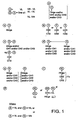
- Such Fab effector-groups are illustrated in Fig 1 .
- Fig 1 Various preferred 'dAb-effector groups' prepared according to the methods of the present invention are illustrated in Fig 1 .
- the dAb-effector groups of the present invention may be combined onto non-immunoglobulin multi-ligand structures so that they form multivalent structures comprising more than one antigen binding site. Such structures have an increased avidity of antigen binding.
- the V regions bind different epitopes on the same antigen providing superior avidity.
- multivalent complexes may be constructed on scaffold proteins, as described in WO0069907 (Medical Research Council), which are based for example on the ring structure of bacterial GroEL or on other chaperone polypeptides.
- dAb-effector groups according to the present invention may be combined in the absence of a non-immunoglobulin protein scaffold to form multivalent structures which are solely based on immunoglobulin domains.
- Such multivalent structures may have increased avidity towards target molecules, by virtue of them comprising multiple epitope binding sites.
- Such multivalent structures may be homodimers, heterodimers or multimers.
- dAb-effector groups of the invention as well as such multivalent structures, will be of particular use for use in prophylactic and/or therapeutic uses.
- Antigens may be, or be part of, polypeptides, proteins or nucleic acids, which may be naturally occurring or synthetic.
- polypeptides proteins or nucleic acids
- They may be for instance human or animal proteins, cytokines, cytokine receptors, enzymes co-factors for enzymes or DNA binding proteins.
- Suitable cytokines and growth factors include but are not limited to: ApoE, Apo-SAA, BDNF, Cardiotrophin-1, EGF, EGF receptor, ENA-78, Eotaxin, Eotaxin-2, Exodus-2, EpoR, FGF-acidic, FGF-basic, fibroblast growth factor-10, FLT3 ligand, Fractalkine (CX3C), GDNF, G-CSF, GM-CSF, GF- ⁇ 1, insulin, IL1R1, IFN- ⁇ , IGF-I, IGF-II, IL-1 ⁇ , IL-1 ⁇ , IL-2, IL-3, IL-4, IL-5, IL-6, IL-7, IL-8 (72 a.a.), IL-8 (77 a.a.), IL-9, IL-10, IL-11, IL-12, IL-13, IL-15, IL-16, IL-17, IL-18 (IGIF), Inhibin ⁇ , Inhibin ⁇ , IP
- variable domains are derived from an antibody directed against one or more antigen/s or epitope/s.
- the dAb-effector group of the invention may bind the epiotpe/s or antigen/s and act as an antagonist or agonist (eg, EPO receptor agonist).
- variable domains are derived from a repertoire of single variable antibody domains.
- the repertoire is a repertoire that is not created in an animal or a synthetic repertoire.
- the single variable domains are not isolated (at least in part) by animal immunisation.
- the single domains can be isolated from a na ⁇ ve library.
- a library (eg, phage or phagemid library or using emulsion technology as described in WO 99/02671 ) is made wherein a population of library members each comprises a common construct encoding an effector group (eg, an Fc region). A diversity of sequences encoding single variable domains is then spliced in to form a library of members displaying a diversity of single variable domains in the context of the same effector group. dAb-effector group selection against antigen or epitope is then effected in the context of the common effector group, which may have been selected in the basis of its desirable effects on half life, for example.
- an effector group eg, an Fc region
- the present invention provides one or more nucleic acid molecules encoding at least a dAb-effector group as herein defined.
- the dAb-effector group may be encoded on a single nucleic acid molecule; alternatively, different parts of the molecule may be encoded by separate nucleic acid molecules. Where the 'dAb-effector group' is encoded by a single nucleic acid molecule, the domains may be expressed as a fusion polypeptide, or may be separately expressed and subsequently linked together, for example using chemical linking agents. dAb-effector groups expressed from separate nucleic acids will be linked together by appropriate means.
- the nucleic acid may further encode a signal sequence for export of the polypeptides from a host cell upon expression and may be fused with a surface component (eg, at least part of the pIII coat protein) of a filamentous bacteriophage particle (or other component of a selection display system) upon expression.
- a surface component eg, at least part of the pIII coat protein
- a filamentous bacteriophage particle or other component of a selection display system
- the present invention provides a vector comprising nucleic acid according to the present invention.
- the present invention provides a host cell transfected with a vector according to the present invention.
- Expression from such a vector may be configured to produce, for example on the surface of a bacteriophage particle, dAb-effector groups for selection.
- the dAb-effector group according to the present invention may be provided in the form of a kit suitable for the prophylaxis and/or treatment of disease.
- the present invention provides a composition comprising a dAb-effector group, according to the first aspect of the present invention, and a pharmaceutically acceptable carrier, diluent or excipient.
- Half lives (t1 ⁇ 2 alpha and t1 ⁇ 2 beta) and AUC can be determined from a curve of serum concentration of dAb-Effector Group against time (see, eg figure 6 ).
- the WinNonlin analysis package (available from Pharsight Corp., Mountain View, CA94040, USA) can be used, for example, to model the curve.
- a first phase the alpha phase
- a second phase (beta phase) is the terminal phase when the dAb-Effector Group has been distributed and the serum concentration is decreasing as the dAb-Effector Group is cleared from the patient.
- the t alpha half life is the half life of the first phase and the t beta half life is the half life of the second phase.
- the present invention provides a dAb-effector group or a composition comprising a dAb-effector group according to the invention having a t ⁇ half-life in the range of 15 minutes or more.
- the lower end of the range is 30 minutes, 45 minutes, 1 hour, 2 hours, 3 hours, 4 hours, 5 hours, 6 hours, 7 hours, 10 hours, 11 hours or 12 hours.
- a dAb-effector group or composition according to the invention will have a t ⁇ half-life in the range of up to and including 12 hours.
- the upper end of the range is 11, 10, 9, 8, 7, 6 or 5 hours.
- An example of a suitable range is 1 to 6 hours, 2 to 5 hours or 3 to 4 hours.
- the present invention provides a dAb-effector group or a composition comprising a dAb-effector group according to the invention having a t ⁇ half-life in the range of 2.5 hours or more.
- the lower end of the range is 3 hours, 4 hours, 5 hours, 6 hours, 7 hours, 10 hours, 11 hours, or 12 hours.
- a dAb-effector group or composition according to the invention has a t ⁇ half-life in the range of up to and including 21 days.
- a dAb-effector group according to the invention has a t ⁇ half-life of any of those t ⁇ half-lifes selected from the group consisting of the following: 12 hours or more, 24 hours or more, 2 days or more, 3 days or more, 4 days or more, 5 days or more, 6 days or more, 7 days or more, 8 days or more, 9 days or more, 10 days or more, 11 days or more, 12 days or more, 13 days or more, 14 days or more, 15 days or more or 20 days or more.
- a dAb-effector group or composition according to the invention will have a t ⁇ half-life in the range 12 to 60 hours. In a further embodiment, it will have a t ⁇ half-life or a day or more. In a further embodiment still, it will be in the range 12 to 26 hours.
- a dAb-effector group according to the present invention comprises or consists or a V L -Fc having a t ⁇ half-life of a day or more, two days or more, 3 days or more, 4 days or more, 5 days or more, 6 days or more, 7 days or more.
- a dAb-effector group according to the present invention comprises or consists of an V L -Fc having a t ⁇ half-life of a day or more.
- a dAb-effector group according to the present invention comprises an effector group consisting of the constant region domains CH2 and/or CH3, preferably CH2 and CH3, either with or without a hinge region as described herein, wherein the dAb-effector group has a t ⁇ half-life of a day or more, two days or more, 3 days or more, 4 days or more, 5 days or more, 6 days or more, 7 days or more.
- a dAb-effector group according to the present invention comprises an effector group consisting of the constant region domains CH2 and/or CH3 wherein the dAb-effector group has a t ⁇ half-life of a day or more.
- the present invention provides a dAb-effector group or a composition comprising a dAb-effector group according to the invention having an AUC value(area under the curve) in the range of 1 mg.min/ml or more.
- the lower end of the range is 5, 10, 15, 20, 30, 100, 200 or 300mg.min/ml.
- a dAb-effector group or composition according to the invention has an AUC in the range of up to 600 mg.min/ml.
- the upper end of the range is 500, 400, 300, 200, 150, 100, 75 or 50 mg.min/ml.
- a dAb-effector group according to the invention will have a AUC in the range selected from the group consisting of the following: 15 to 150mg.min/ml, 15 to 100 mg.min/ml, 15 to 75 mg.min/ml, and 15 to 50mg.min/ml.
- the present invention provides the use of a dAb-effector group or a composition according to the present invention in the preparation of a medicament for the prophylaxis and/or treatment of disease.
- the present invention provides a dAb-effector group according to the present invention or a composition thereof in the treatment of disease.
- a dAb-Fc specific for target human TNF alpha and designated TARI-5-19-Fc was shown to be a highly effective therapy in a model of arthritis.
- a TAR1-5-19-effector group may be of particular use in the prophylaxis and/or treatment of one or more inflammatory diseases.
- the present invention provides the use of a dAb-effector group according to the invention in the preparation of a medicament for the prophylaxis and/or treatment of one or more inflammatory diseases.
- the dAb-effector group specifically binds to TNF alpha. More advantageously, the dAb-effector group specifically binds to human TNF alpha. More advantageously still, the dAb-effector group is a dAb-Fc and specifically binds to TNF alpha, preferably human TNFalpha. -More advantageously still, the dAb-effector group comprises TAR1-5-19 as effector group. Most advantageously, the dAb-effector group for use according to the above aspects of the invention is TAR1-5-19-Fc.
- the one or more inflammatory diseases are mediated by TNF-alpha.
- the one or more inflammatory diseases are mediated by TNFalpha and are selected from the group consisting of the following: rheumatoid arthritis, psoriasis, Crohns disease, inflammatory bowel disease (IBD), multiple sclerosis, septic shock, alzheimers, coronary thrombosis, chronic obstructive pulmonary disease (COPD) and glomerular nephritis.
- the invention provides the use of a dAb-effector group according to the invention in the preparation of a medicament for reducing and/or preventing and/or suppressing cachexia in patient.
- the cachexia is associated with an inflammatory disease.
- the inflammatory disease is selected from the group consisting of the following: rheumatoid arthritis, psoriasis, Crohns disease, inflammatory bowel disease (IBD), multiple sclerosis, septic shock, alzheimers, coronary thrombosis, chronic obstructive pulmonary disease (COPD) and glomerular nephritis.
- the use may be used for the treatment of human or non-human patients.
- the patient is a human and the TNFalpha is human TNFalpha.
- Suitable dosages for the administration to a subject of dAb-effector group according to the invention will be familiar to those skilled in the art.
- the dose is in the range of between 0.5 to 20mg/Kg of dAb-effector group. More advantageously, the dosage of dAb-effector group is in the range of between 1 to 10mg/Kg. Preferred dosage ranges are between 1 and 5 mg/Kg. Most advantageously, dosages of 1mg/Kg or 5mg/Kg dAb-effector group are administered.
- Suitable dosage regimes may be dependent upon certain subject characteristics including age, severity of disease and so on. dAb-effector group may for example be administered, particularly when the subject is a human, daily, once a week, twice a week or monthly. Those skilled in the art will appreciate that this list is not intended to be exhaustive.
- Immunoglobulin This refers to a family of polypeptides which retain the immunoglobulin fold characteristic of antibody molecules, which contains two ⁇ sheets and, usually, a conserved disulphide bond.
- Members of the immunoglobulin superfamily are involved in many aspects of cellular and non-cellular interactions in vivo, including widespread roles in the immune system (for example, antibodies, T-cell receptor molecules and the like), involvement in cell adhesion (for example the ICAM molecules) and intracellular signalling (for example, receptor molecules, such as the PDGF receptor).
- Domain A domain is a folded protein structure which retains its tertiary structure independently of the rest of the protein. Generally, domains are responsible for discrete functional properties of proteins, and in many cases may be added, removed or transferred to other proteins without loss of function.
- single antibody variable domain we mean a folded polypeptide domain comprising sequences characteristic of antibody variable domains. It therefore includes antibody variable domains, for example in which one or more loops have been replaced by sequences which are not characteristic of antibody variable domains, or antibody variable domains which have been truncated or comprise N- or C-terminal extensions.
- Repertoire A collection of diverse variants, for example polypeptide variants which differ in their primary sequence.
- a library used in the present invention will encompass a repertoire of polypeptides comprising at least 1000 members.
- the term library refers to a mixture of heterogeneous polypeptides or nucleic acids.
- the library is composed of members, which have a single polypeptide or nucleic acid sequence. To this extent, library is synonymous with repertoire . Sequence differences between library members are responsible for the diversity present in the library.
- the library may take the form of a simple mixture of polypeptides or nucleic acids, or may be in the form organisms or cells, for example bacteria, viruses, animal or plant cells and the like, transformed with a library of nucleic acids.
- each individual organism or cell contains only one or a limited number of library members.
- the nucleic acids are incorporated into expression vectors, in order to allow expression of the polypeptides encoded by the nucleic acids.
- a library may take the form of a population of host organisms, each organism containing one or more copies of an expression vector containing a single member of the library in nucleic acid form which can be expressed to produce its corresponding polypeptide member.
- the population of host organisms has the potential to encode a large repertoire of genetically diverse polypeptide variants.
- a single-domain-effector group as herein defined describes an engineered synthetic structure comprising a single variable domain capable of specifically binding one or more epitopes, attached to one or more constant region domains and/or hinge (collectively termed an "effector group").
- the variable domain is a light chain domain (V L ).
- an effector group as herein described comprises an Fc region of an antibody.
- dAb-effector groups may be combined to form multivalent structures, thus improving the avidity of antigen interaction.
- dAb-effector group immunoglobulin molecules according to the invention are single chain molecules, they are not dual-chain antibodies (for example those described in EP 0 656 946A1 ).
- 'dAb-effector group does not include within its scope the naturally occurring dual chain antibodies generated within Camelids nor the four chain structure of IgG molecules.
- 'dAb-effector groups' according to the present have a half-life which is of sufficient length such that it can produce an in vivo biological effect. The present inventors have found that it is the size and nature of the effector group which determines the effector functions of the dAb-effector group as herein defined as well as the in vivo half-life of the molecule.
- Antibody An antibody (for example IgG1, 2, 3 and 4; IgM; IgA; IgD; or IgE) or fragment (such as a Fab, Dab , F(ab') 2 , Fv, disulphide linked Fv, scFv, diabody) whether derived from any species naturally producing an antibody, or created by recombinant DNA technology; whether isolated from serum, B-cells, hybridomas, transfectomas, yeast or bacteria).
- IgG1, 2, 3 and 4 IgM; IgA; IgD; or IgE
- fragment such as a Fab, Dab , F(ab') 2 , Fv, disulphide linked Fv, scFv, diabody
- TAR1-5-19 is a Dab which specifically binds to the target human TNF alpha (TAR1).
- Antigen A ligand that is bound by a dAb-effector group according to the present invention.
- single domains may be selected according to their antigen-binding specificity for use in the present invention.
- the antigen may be a polypeptide, protein, nucleic acid or other molecule.
- the antibody binding site defined by the variable loops (L1, L2, L3 and H1, H2, H3) is capable of binding to the antigen.
- An epitope as referred to herein is a unit of structure conventionally bound by one or more immunoglobulin variable domains, for example an immunoglobulin V H /V L pair.
- Epitopes define the minimum binding site for an antibody, and thus represent the target of specificity of an antibody.
- an epitope represents the unit of structure bound by a variable domain in isolation of another variable domain.
- selecting means choosing from a number of different alternatives. Those skilled in that art will be aware of methods of selecting one or more antibody single variable domains.
- the method involves selecting from a library.
- the library is a phage display library.
- Universal framework A single antibody framework sequence corresponding to the regions of an antibody conserved in sequence as defined by Kabat ("Sequences of Proteins of Immunological Interest", US Department of Health and Human Services) or structure as defined by Chothia and Lesk, (1987) J. Mol. Biol. 196:910-917 .
- the invention provides for the use of a single framework, or a set of such frameworks, which has been found to permit the derivation of virtually any binding specificity though variation in the hypervariable regions alone.
- human origin means that at some point in the derivation of a sequence in question, a human sequence was used as a source of nucleic acid sequence. An analogous meaning applies to the term “Camelid origin.”
- increased half-life means that a given dAb-effector group has at least a 25% longer serum half-life relative to the same dAb without the effector. Increased half-lives are preferably at least 30% longer, 40% longer, 50% longer, 75% longer, 100% longer, 3X longer, 5X longer, 10X longer, 20X longer, 50X longer or more.
- selecting is to be understood to require the application of a technique or selective pressure, thus permitting the isolation of one or more items from among a population based on one or more characteristics possessed by the selected item(s) that is/are not possessed by the other members of the population.
- dAb-effector groups may be prepared according to previously established techniques, used in the field of antibody engineering, for the preparation of scFv, "phage” antibodies and other engineered antibody molecules. Techniques for the preparation of antibodies, and in particular bispecific antibodies, are for example described in the following reviews and the references cited therein: Winter & Milstein, (1991) Nature 349:293-299 ; Plueckthun (1992) Immunological Reviews 130:151-188 ; Wright et al., (1992) Crti. Rev. Immunol.12:125-165 ; Holliger, P. & Winter, G. (1993) Curr. Op. Biotechn. 4, 446-449 ; Carter, et al. (1995) J. Hematother.
- V H and/or V L libraries may be selected against target antigens or epitopes separately, in which case single domain binding is directly selected for, or together.
- a preferred method for synthesising a 'dAb-effector group' comprises using a selection system in which a repertoire of variable domains is selected for binding to an antigen or epitope. The single domains selected are then attached to an effector group.
- Suitable effector groups include any of those selected from the group consisting of the following: an effector group comprising at least an antibody light chain constant region (CL), an antibody CH1 heavy chain domain, an antibody CH2 heavy chain domain, an antibody CH3 heavy chain domain, or any combination thereof.
- an effector group may also comprise a hinge region of an antibody (such a region normally being found between the CH1 and CH2 domains of an IgG molecule).
- the 'dAb-effector group' is a single variable domain attached to the hinge region derived from an antibody molecule.
- the effector group is based on a Fab antibody fragment. That is, it comprises an antibody fragment comprising a V L domain and optionally a V H domain attached to one or more constant region domains making up a Fab fragment.
- a fragment comprises only one variable domain.
- Such Fab effector groups are illustrated in Fig lg.
- the single variable domains each forms a respective epitope or antigen binding site.
- the single variable domains do not together form a single binding site.
- the epitope or antigen specificity of the variable domains is different.
- an effector group according to the present invention is an Fc region of an IgG molecule.
- Bacteriophage lambda expression systems may be screened directly as bacteriophage plaques or as colonies of lysogens, both as previously described ( Huse et al. (1989) Science, 246: 1275 ; Caton and Koprowski- (1990) Proc. Natl. Acad. Sci. U. S. A., 87 ; Mullinax et al. (1990) Proc. Natl. Acad. Sci. U. S. A., 87: 8095 ; Persson et al. (1991) Proc. Natl. Acad Sci. U.S.A., 88: 2432 ) and are of use in the invention. Whilst such expression systems can be used to screening up to 10 6 different members of a library, they are not really suited to screening of larger numbers (greater than 10 6 members).
- selection display systems which enable a nucleic acid to be linked to the polypeptide it expresses.
- a selection display system is a system that permits the selection, by suitable display means, of the individual members of the library by binding the generic and/or target ligands.
- Selection protocols for isolating desired members of large libraries are known in the art, as typified by phage display techniques.
- Such systems in which diverse peptide sequences are displayed on the surface of filamentous bacteriophage ( Scott and Smith (1990) Science, 249: 386 ), have proven useful for creating libraries of antibody fragments (and the nucleotide sequences encoding them) for the in vitro selection and amplification of specific antibody fragments that bind a target antigen ( McCafferty et al., WO 92/01047 ).
- the nucleotide sequences encoding the V H and V L regions are linked to gene fragments which encode leader signals that direct them to the periplasmic space of E .
- phage-based display systems An advantage of phage-based display systems is that, because they are biological systems, selected library members can be amplified simply by growing the phage containing the selected library member in bacterial cells. Furthermore, since the nucleotide sequence that encode the polypeptide library member is contained on a phage or phagemid vector, sequencing, expression and subsequent genetic manipulation is relatively straightforward.
- RNA molecules are selected by alternate rounds of selection against a target ligand and PCR amplification ( Tuerk and Gold (1990) Science, 249: 505 ; Ellington and Szostak (1990) Nature, 346: 818 ).
- a similar technique may be used to identify DNA sequences which bind a predetermined human transcription factor ( Thiesen and Bach (1990) Nucleic Acids Res., 18: 3203 ; Beaudry and Joyce (1992) Science, 257: 635 ; WO92/05258 and WO92/14843 ).
- in vitro translation can be used to synthesise polypeptides as a method for generating large libraries.
- These methods which generally comprise stabilised polysome complexes, are described further in WO88/08453 , WO90/05785 , WO90/07003 , WO91/02076 , WO91/05058 , and WO92/02536 .
- Alternative display systems which are not phage-based, such as those disclosed in WO95/22625 and WO95/11922 (Affymax) use the polysomes to display polypeptides for selection.
- a still further category of techniques involves the selection of repertoires in artificial compartments, which allow the linkage of a gene with its gene product.
- a selection system in which nucleic acids encoding desirable gene products may be selected in microcapsules formed by water-in-oil emulsions is described in WO99/02671 , WO00/40712 and Tawfik & Griffiths (1998) Nature Biotechnol 16(7), 652-6 .
- Genetic elements encoding a gene product having a desired activity are compartmentalised into microcapsules and then transcribed and/or translated to produce their respective gene products (RNA or protein) within the microcapsules. Genetic elements which produce gene product having desired activity are subsequently sorted. This approach selects gene products of interest by detecting the desired activity by a variety of means.
- Libraries intended for use in selection may be constructed using techniques known in the art, for example as set forth above, or may be purchased from commercial sources. Libraries which are useful in the present invention are described, for example, in WO99/20749 .
- a vector system is chosen and one or more nucleic acid sequences encoding polypeptides of interest are cloned into the library vector, one may generate diversity within the cloned molecules by undertaking mutagenesis prior to expression; alternatively, the encoded proteins may be expressed and selected, as described above, before mutagenesis and additional rounds of selection are performed. Mutagenesis of nucleic acid sequences encoding structurally optimised polypeptides is carried out by standard molecular methods.
- PCR polymerase chain reaction
- PCR is performed using template DNA (at least 1fg; more usefully, 1-1000 ng) and at least 25 pmol of oligonucleotide primers; it may be advantageous to use a larger amount of primer when the primer pool is heavily heterogeneous, as each sequence is represented by only a small fraction of the molecules of the pool, and amounts become limiting in the later amplification cycles.
- a typical reaction mixture includes: 2 ⁇ l of DNA, 25 pmol of oligonucleotide primer, 2.5 ⁇ l of 10X PCR buffer 1 (Perkin-Elmer, Foster City, CA), 0.4 ⁇ l of 1.25 ⁇ M dNTP, 0.15 ⁇ l (or 2.5 units) of Taq DNA polymerase (Perkin Elmer, Foster City, CA) and deionized water to a total volume of 25 ⁇ l.
- Mineral oil is overlaid and the PCR is performed using a programmable thermal cycler. The length and temperature of each step of a PCR cycle, as well as the number of cycles, is adjusted in accordance to the stringency requirements in effect.
- Annealing temperature and timing are determined both by the efficiency with which a primer is expected to anneal to a template and the degree of mismatch that is to be tolerated; obviously, when nucleic acid molecules are simultaneously amplified and mutagenized, mismatch is required, at least in the first round of synthesis.
- the ability to optimise the stringency of primer annealing conditions is well within the knowledge of one of moderate skill in the art.
- An annealing temperature of between 30 °C and 72 °C is used.
- Initial denaturation of the template molecules normally occurs at between 92°C and 99°C for 4 minutes, followed by 20-40 cycles consisting of denaturation (94-99°C for 15 seconds to 1 minute), annealing (temperature determined as discussed above; 1-2 minutes), and extension (72°C for 1-5 minutes, depending on the length of the amplified product).
- Final extension is generally for 4 minutes at 72°C, and may be followed by an indefinite (0-24 hour) step at 4°C.
- Domains according to the invention may be attached to effector groups as herein described by a variety of methods known in the art, including covalent and noncovalent methods.
- Preferred methods include the use of polypeptide linkers, as described, for example, in connection with scFv molecules ( Bird et al., (1988) Science 242:423-426 ).
- Linkers may be flexible, allowing the two single domains to interact.
- the linkers used in diabodies, which are less flexible, may also be employed ( Holliger et al., (1993) PNAS (USA) 90:6444-6448 ).
- Variable domains may be attached to effector groups using methods other than linkers. For example, the use of disulphide bridges, provided through naturally-occurring or engineered cysteine residues, may be exploited.
- variable domains of immunoglobulins may be employed as appropriate.
- linker may affect the physical characteristics of the dAb effector molecule.
- the linkers may facilitate the association of the domains, such as by incorporation of small amino acid residues in opportune locations.
- a suitable rigid structure may be designed which will keep the effector group and the variable domain in close physical proximity to one another.
- single V L variable domains are attached to an effector group via means herein described.
- a dAb-effector group according to the present invention may be derived from any species naturally producing an antibody, or created by recombinant DNA technology; whether isolated from serum, B-cells, hybridomas, transfectomas, yeast or bacteria.
- the single variable domain and the effector group according to the present invention may be on the same polypeptide chain. Alternatively, they may be on separate polypeptide chains. In the case that they are on the same polypeptide chain they may be linked by a linker.
- the linker is a peptide sequence, as described above.
- the single variable domain and the effector group may be covalently or non-covalently associated.
- the covalent bonds may be disulphide bonds.
- variable domains are selected from V-gene repertoires selected for instance using phage display technology as herein described, then these variable domains comprise a universal framework region, such that is they may be recognised by a specific generic ligand as herein defined.
- the use of universal frameworks, generic ligands and the like is described in WO99/20749 .
- preferred germ-line gene segments for preparation of dAB-effector groups according to the invention include any of those selected from the group consisting of the following: DP38, DP45, DP47 and DPK9.
- variable domain sequence is preferably located within the structural loops of the variable domains.
- the polypeptide sequences of either variable domain may be altered by DNA shuffling or by mutation in order to enhance the interaction of each variable domain with its complementary epitope.
- the present invention provides nucleic acid encoding at least a single domain-effector group antibody as herein defined.
- variable regions may be derived from antibodies directed against target antigens or epitopes. Alternatively they may be derived from a repertoire of single antibody domains such as those expressed on the surface of filamentous bacteriophage. Selection may be performed as described below.
- nucleic acid molecules and vector constructs required for the performance of the present invention may be constructed and manipulated as set forth in standard laboratory manuals, such as Sambrook et al. (1989) Molecular Cloning: A Laboratory Manual, Cold Spring Harbor, USA .
- nucleic acids in the present invention is typically carried out in recombinant vectors.
- the present invention provides a vector comprising nucleic acid encoding at least a single domain-effector group as herein defined.
- vector refers to a discrete element that is used to introduce heterologous DNA into cells for the expression and/or replication thereof.
- Methods by which to select or construct and, subsequently, use such vectors are well known to one of ordinary skill in the art. Numerous vectors are publicly available, including bacterial plasmids, bacteriophage, artificial chromosomes and episomal vectors. Such vectors may be used for simple cloning and mutagenesis; alternatively gene expression vector is employed.
- a vector of use according to the invention may be selected to accommodate a polypeptide coding sequence of a desired size, typically from 0.25 kilobase (kb) to 40 kb or more in length.
- a suitable host cell is transformed with the vector after in vitro cloning manipulations.
- Each vector contains various functional components, which generally include a cloning (or "polylinker") site, an origin of replication and at least one selectable marker gene.
- cloning or "polylinker”
- origin of replication or "polylinker”
- Both cloning and expression vectors generally contain nucleic acid sequences that enable the vector to replicate in one or more selected host cells.
- this sequence is one that enables the vector to replicate independently of the host chromosomal DNA and includes origins of replication or autonomously replicating sequences.
- origins of replication or autonomously replicating sequences are well known for a variety of bacteria, yeast and viruses.
- the origin of replication from the plasmid pBR322 is suitable for most Gram-negative bacteria, the 2 micron plasmid origin is suitable for yeast, and various viral origins (e.g. SV 40, adenovirus) are useful for cloning vectors in mammalian cells.
- the origin of replication is not needed for mammalian expression vectors unless these are used in mammalian cells able to replicate high levels of DNA, such as COS cells.
- a cloning or expression vector may contain a selection gene also referred to as selectable marker.
- This gene encodes a protein necessary for the survival or growth of transformed host cells grown in a selective culture medium. Host cells not transformed with the vector containing the selection gene will therefore not survive in the culture medium.
- Typical selection genes encode proteins that confer resistance to antibiotics and other toxins, e.g. ampicillin, neomycin, methotrexate or tetracycline, complement auxotrophic deficiencies, or supply critical nutrients not available in the growth media.
- an E. coli-selectable marker for example, the ⁇ -lactamase gene that confers resistance to the antibiotic ampicillin, is of use.
- E. coli plasmids such as pBR322 or a pUC plasmid such as pUC18 or puck19 or pUC119.
- Expression vectors usually contain a promoter that is recognised by the host organism and is operably linked to the coding sequence of interest. Such a promoter may be inducible or constitutive.
- operably linked refers to a juxtaposition wherein the components described are in a relationship permitting them to function in their intended manner.
- a control sequence "operably linked" to a coding sequence is ligated in such a way that expression of the coding sequence is achieved under conditions compatible with the control sequences.
- Promoters suitable for use with prokaryotic hosts include, for example, the ⁇ -lactamase and lactose promoter systems, alkaline phosphatase, the tryptophan (trp) promoter system and hybrid promoters such as the tac promoter. Promoters for use in bacterial systems will also generally contain a Shine-Delgarno sequence operably linked to the coding sequence.
- the preferred vectors are expression vectors that enable the expression of a nucleotide sequence corresponding to a polypeptide library member.
- selection with the first and/or second antigen or epitope can be performed by separate propagation and expression of a single clone expressing the polypeptide library member or by use of any selection display system.
- the preferred selection display system is bacteriophage display.
- phage or phagemid vectors may be used.
- the preferred vectors are phagemid vectors which have an E. coli. origin of replication (for double stranded replication) and also a phage origin of replication (for production of single-stranded DNA).
- the vector contains a ⁇ -lactamase gene to confer selectivity on the phagemid and a 1ac promoter upstream of a expression cassette that consists (N to C terminal) of a pelB leader sequence (which directs the expressed polypeptide to the periplasmic space), a multiple cloning site (for cloning the nucleotide version of the library member), optionally, one or more peptide tag (for detection), optionally, one or more TAG stop codon and the phage protein pIII.
- the vector is able to replicate as a plasmid with no expression, produce large quantities of the polypeptide library member only or produce phage, some of which contain at least one copy of the polypeptide-pIII fusion on their surface.
- vectors employs conventional ligation techniques. Isolated vectors or DNA fragments are cleaved, tailored, and religated in the form desired to generate the required vector. If desired, analysis to confirm that the correct sequences are present in the constructed vector can be performed in a known fashion. Suitable methods for constructing expression vectors, preparing in vitro transcripts, introducing DNA into host cells, and performing analyses for assessing expression and function are known to those skilled in the art. The presence of a gene sequence in a sample is detected, or its amplification and/or expression quantified by conventional methods, such as Southern or Northern analysis, Western blotting, dot blotting of DNA, RNA or protein, in situ hybridisation, immunocytochemistry or sequence analysis of nucleic acid or protein molecules. Those skilled in the art will readily envisage how these methods may be modified, if desired.
- a single-domain antibody-effector group as herein defined describes an engineered antibody molecule comprising a single variable domain capable of specifically binding one or more epitopes, attached to one or more constant region domains (effector groups).
- the variable domain is a light chain domain (V L ).
- Suitable effector groups include any of those selected from the group consisting of the following: an effector group comprising at least an antibody light chain constant region (CL), an antibody CH1 heavy chain domain, an antibody CH2 heavy chain domain, an antibody CH3 heavy chain domain, or any combination thereof.
- an effector group may also comprise a hinge region of an antibody (such a region normally being found between the CH1 and CH2 domains of an IgG molecule).
- an effector group as herein described comprises an Fc region of an antibody. More advantageously a dAb-effector group according to the present invention is a V L -Fc.
- the effector group is based on a Fab antibody fragment. That is, it comprises an antibody fragment comprising a V L domain attached to the constant region domains making up a Fab fragment.
- a fragment comprises only one variable domain.
- a dAb-effector group according to the invention has a t ⁇ half-life of any of those t ⁇ half-lifes selected from the group consisting of the following: 12 hours or more, 24 hours or more, 2 days or more, 3 days or more, 4 days or more, 5 days or more, 6 days or more, 7 days or more, 8 days or more, 9 days or more, 10 days or more, 11 days or more, 12 days or more, 13 days or more, 14 days or more, 15 days or more or 20 days or more.
- a dAb-effector group or composition according to the invention will have a t ⁇ half life in the range 12 to 60 hours. In a further embodiment, it will have a t half-life of a day or more. In a further embodiment still, it will be in the range 12 to 26 hours.
- a dAb-effector group according to the present invention comprises or consists of an V L -Fc having a t ⁇ half-life of a day or more, two days or more, 3 days or more, 4 days or more, 5 days or more, 6 days or more or 7 days or more.
- a dAb-effector group according to the present invention comprises or consists of an V L -Fc having a t ⁇ half-life of a day or more.
- a dAb-effector group comprises an effector group consisting of the constant region domains CH2 and/or CH3, preferably CH2 and CH3, either with or without a hinge region as described herein, wherein the dAb-effector group has a t ⁇ half-life of a day or more, two days or more, 3 days or more, 4 days or more, 5 days or more, 6 days or more or 7 days or more. More advantageously, a dAb-effector group according to the present invention comprises an effector group consisting of the constant region domains CH2 and/or CH3 wherein the dAb-effector group has a t ⁇ half-life of a day or more.
- Each single variable domain comprises an immunoglobulin scaffold and one or more CDRs which are involved in the specific interaction of the domain with one or more epitopes.
- the members of the immunoglobulin superfamily all share a similar fold for their polypeptide chain.
- antibodies are highly diverse in terms of their primary sequence
- comparison of sequences and crystallographic structures has revealed that, contrary to expectation, five of the six antigen binding loops of antibodies (H1, H2, L1, L2, L3) adopt a limited number of main-chain conformations, or canonical structures ( Chothia and Lesk (1987) J. Mol. Biol., 196: 901 ; Chothia et al. (1989) Nature, 342: 877 ).
- Analysis of loop lengths and key residues has therefore enabled prediction of the main-chain conformations of H1, H2, L1, L2 and L3 found in the majority of human antibodies ( Chothia et al. (1992) J.
- H3 region is much more diverse in terms of sequence, length and structure (due to the use of D segments), it also forms a limited number of main-chain conformations for short loop lengths which depend on the length and the presence of particular residues, or types of residue, at key positions in the loop and the antibody framework ( Martin et al. (1996) J. Mol. Biol., 263: 800 ; Shirai et al. (1996) FEBS Letters, 399: 1 ).
- the dAb-effector groups of the present invention are advantageously assembled from libraries of domains, such as libraries of V L domains.
- libraries of antibody polypeptides are designed in which certain loop lengths and key residues have been chosen to ensure that the main-chain conformation of the members is known.
- these are real conformations of immunoglobulin superfamily molecules found in nature, to minimise the chances that they are non-functional.
- Germline V gene segments serve as one suitable basic framework for constructing antibody or T-cell receptor libraries; other sequences are also of use. Variations may occur at a low frequency, such that a small number of functional members may possess an altered main-chain conformation, which does not affect its function.
- Canonical structure theory is also of use in the invention to assess the number of different main-chain conformations encoded by antibodies, to predict the main-chain conformation based on antibody sequences and to chose residues for diversification which do not affect the canonical structure. It is known that, in the human V ⁇ domain, the L1 loop can adopt one of four canonical structures, the L2 loop has a single canonical structure and that 90% of human V ⁇ domains adopt one of four or five canonical structures for the L3 loop (Tomlinson et al. (1995) supra); thus, in the V ⁇ domain alone, different canonical structures can combine to create a range of different main-chain conformations.
- V ⁇ domain encodes a different range of canonical structures for the L1, L2 and L3 loops and that V ⁇ and V . ⁇ domains can pair with any V H domain which can encode several canonical structures for the H1 and H2 loops
- the number of canonical structure combinations observed for these five loops is very large. This implies that the generation of diversity in the main-chain conformation may be essential for the production of a wide range of binding specificities.
- by constructing an antibody library based on a single known main-chain conformation it has been found, contrary to expectation, that diversity in the main-chain conformation is not required to generate sufficient diversity to target substantially all antigens.
- the single main-chain conformation need not be a consensus structure - a single naturally occurring conformation can be used as the basis for an entire library.
- the dAb-effector groups of the invention possess a single known main-chain conformation.
- the single main-chain conformation that is chosen is preferably commonplace among molecules of the immunoglobulin superfamily type in question.
- a conformation is commonplace when a significant number of naturally occurring molecules are observed to adopt it.
- the natural occurrence of the different main-chain conformations for each binding loop of an immunoglobulin superfamily molecule are considered separately and then a naturally occurring immunoglobulin superfamily molecule is chosen which possesses the desired combination of main-chain conformations for the different loops. If none is available, the nearest equivalent may be chosen.
- the desired combination of main-chain conformations for the different loops is created by selecting germline gene segments which encode the desired main-chain conformations. It is more preferable, that the selected germline gene segments are frequently expressed in nature, and most preferable that they are the most frequently expressed of all natural germline gene segments.
- the incidence of the different main-chain conformations for each of the six antigen binding loops may be considered separately.
- H1, H2, L1, L2 and L3 a given conformation that is adopted by between 20% and 100% of the antigen binding loops of naturally occurring molecules is chosen.
- its observed incidence is above 35% (i.e. between 35% and 100%) and, ideally, above 50% or even above 65%.
- H1 - CS 1 (79% of the expressed repertoire), H2 - CS 3 (46%), L1 - CS 2 of V H (39%), L2 - CS 1 (100%), L3 - CS 1 of V H (36%) (calculation assumes a ⁇ : ⁇ ratio of 70:30, Hood et al. (1967) Cold Spring Harbor Symp. Quant. Biol., 48: 133 ).
- H3 loops that have canonical structures a CDR3 length (Kabat et al. (1991) Sequences of proteins of immunological interest , U.S.
- the natural occurrence of combinations of main-chain conformations is used as the basis for choosing the single main-chain conformation.
- the natural occurrence of canonical structure combinations for any two, three, four, five or for all six of the antigen binding loops can be determined.
- the chosen conformation is commonplace in naturally occurring antibodies and most preferable that it is observed most frequently in the natural repertoire.
- the desired diversity is typically generated by varying the selected molecule at one or more positions.
- the positions to be changed can be chosen at random or are preferably selected.
- the variation can then be achieved either by randomisation, during which the resident amino acid is replaced by any amino acid or analogue thereof, natural or synthetic, producing a very large number of variants or by replacing the resident amino acid with one or more of a defined subset of amino acids, producing a more limited number of variants.
- H3 region of a human tetanus toxoid-binding Fab has been randomised to create a range of new binding specificities ( Barbas et al. (1992) Proc. Natl. Acad. Sci. USA, 89: 4457 ). Random or semi-random H3 and L3 regions have been appended to germline V gene segments to produce large libraries with unmutated framework regions ( Hoogenboom & Winter (1992) J. Mol. Biol., 227: 381 ; Barbas et al. (1992) Proc. Natl. Acad. Sci. USA, 89: 4457 ; Nissim et al.
- loop randomisation has the potential to create approximately more than 10 15 structures for H3 alone and a similarly large number of variants for the other five loops, it is not feasible using current transformation technology or even by using cell free systems to produce a library representing all possible combinations.
- 6 x 10 10 different antibodies which is only a fraction of the potential diversity for a library of this design, were generated (Griffiths et al. (1994) supra).
- binding of single domain antibody-effector groups (dAb-effector group) according to the invention to its specific antigens or epitopes can be tested by methods which will be familiar to those skilled in the art and include ELISA. In a preferred embodiment binding is tested using monoclonal phage ELISA.
- Phage ELISA may be performed according to any suitable procedure: an exemplary protocol is set forth below.
- phage produced at each round of selection can be screened for binding by ELISA to the selected antigen or epitope, to identify "polyclonal" phage antibodies. Phage from single infected bacterial colonies from these populations can then be screened by ELISA to identify "monoclonal” phage antibodies. It is also desirable to screen soluble antibody fragments for binding to antigen or epitope, and this can also be undertaken by ELISA using reagents, for example, against a C- or N-terminal tag (see for example Winter et al. (1994) Ann. Rev. Immunology 12, 433-55 and references cited therein).
- the diversity of the selected phage monoclonal antibodies may also be assessed by gel electrophoresis of PCR products (Marks et al. 1991, supra ; Nissim et al. 1994 supra ), probing ( Tomlinson et al., 1992) J. Mol. Biol. 227, 776 ) or by sequencing of the vector DNA.
- nucleic acid molecules and vector constructs required for the performance of the present invention may be constructed and manipulated as set forth in standard laboratory manuals, such as Sambrook et al. (1989) Molecular Cloning: A Laboratory Manual, Cold Spring Harbor, USA .
- nucleic acids in the present invention is typically carried out in recombinant vectors.
- vector refers to a discrete element that is used to introduce heterologous DNA into cells for the expression and/or replication thereof.
- Methods by which to select or construct and, subsequently, use such vectors are well known to one of moderate skill in the art.
- Numerous vectors are publicly available, including bacterial plasmids, bacteriophage, artificial chromosomes and episomal vectors. Such vectors may be used for simple cloning and mutagenesis; alternatively gene expression vector is employed.
- a vector of use according to the invention may be selected to accommodate a polypeptide coding sequence of a desired size, typically from 0.25 kilobase (kb) to 40 kb or more in length.
- a suitable host cell is transformed with the vector after in vitro cloning manipulations.
- Each vector contains various functional components, which generally include a cloning (or "polylinker") site, an origin of replication and at least one selectable marker gene. If a given vector is an expression vector, it additionally possesses one or more of the following: enhancer element, promoter, transcription termination and signal sequences, each positioned in the vicinity of the cloning site, such that they are operatively linked to the gene encoding a polypeptide.
- Both cloning and expression vectors generally contain nucleic acid sequences that enable the vector to replicate in one or more selected host cells.
- this sequence is one that enables the vector to replicate independently of the host chromosomal DNA and includes origins of replication or autonomously replicating sequences.
- origins of replication or autonomously replicating sequences are well known for a variety of bacteria, yeast and viruses.
- the origin of replication from the plasmid pBR322 is suitable for most Gram-negative bacteria, the 2 micron plasmid origin is suitable for yeast, and various viral origins (e.g. SV 40, adenovirus) are useful for cloning vectors in mammalian cells.
- the origin of replication is not needed for mammalian expression vectors unless these are used in mammalian cells able to replicate high levels of DNA, such as COS cells.
- a cloning or expression vector may contain a selection gene also referred to as selectable marker.
- This gene encodes a protein necessary for the survival or growth of transformed host cells grown in a selective culture medium. Host cells not transformed with the vector containing the selection gene will therefore not survive in the culture medium.
- Typical selection genes encode proteins that confer resistance to antibiotics and other toxins, e.g. ampicillin, neomycin, methotrexate or tetracycline, complement auxotrophic deficiencies, or supply critical nutrients not available in the growth media.
- an E. coli- selectable marker for example, the ⁇ -lactamase gene that confers resistance to the antibiotic ampicillin, is of use.
- E. coli plasmids such as pBR322 or a pUC plasmid such as pUC 18 or pUC 19 or pUC119.
- Expression vectors usually contain a promoter that is recognised by the host organism and is operably linked to the coding sequence of interest. Such a promoter may be inducible or constitutive.
- operably linked refers to a juxtaposition wherein the components described are in a relationship permitting them to function in their intended manner.
- a control sequence "operably linked" to a coding sequence is ligated in such a way that expression of the coding sequence is achieved under conditions compatible with the control sequences.
- Promoters suitable for use with prokaryotic hosts include, for example, the ⁇ -lactamase and lactose promoter systems, alkaline phosphatase, the tryptophan (trp) promoter system and hybrid promoters such as the tac promoter. Promoters for use in bacterial systems will also generally contain a Shine-Delgamo sequence operably linked to the coding sequence.
- the preferred vectors are expression vectors that enables the expression of a nucleotide sequence corresponding to a polypeptide.
- selection with antigen can be performed by separate propagation and expression of a single clone expressing the polypeptide or by use of any selection display system.
- the preferred selection display system is bacteriophage display.
- phage or phagemid vectors may be used.
- the preferred vectors are phagemid vectors which have an E. coli origin of replication (for double stranded replication) and also a phage origin of replication (for production of single-stranded DNA). The manipulation and expression of such vectors is well known in the art (Hoogenboom and Winter (1992) supra; Nissim et al.
- the vector contains a ⁇ -lactamase gene to confer selectivity on the phagemid and a lac promoter upstream of a expression cassette that consists (N to C terminal) of a pelB leader sequence (which directs the expressed polypeptide to the periplasmic space), a multiple cloning site (for cloning the nucleotide version of the polypeptide), optionally, one or more peptide tag (for detection), optionally, one or more TAG stop codon and the phage protein pIII.
- a pelB leader sequence which directs the expressed polypeptide to the periplasmic space
- a multiple cloning site for cloning the nucleotide version of the polypeptide
- optionally, one or more peptide tag for detection
- TAG stop codon optionally, one or more TAG stop codon and the phage protein pIII.
- the vector is able to replicate as a plasmid with no expression, produce large quantities of the polypeptide only or produce phage, some of which contain at least one copy of the polypeptide-pIII fusion on their surface.
- vectors employs conventional ligation techniques. Isolated vectors or DNA fragments are cleaved, tailored, and religated in the form desired to generate the required vector. If desired, analysis to confirm that the correct sequences are present in the constructed vector can be performed in a known fashion. Suitable methods for constructing expression vectors, preparing in vitro transcripts, introducing DNA into host cells, and performing analyses for assessing expression and function are known to those skilled in the art. The presence of a gene sequence in a sample is detected, or its amplification and/or expression quantified by conventional methods, such as Southern or Northern analysis, Western blotting, dot blotting of DNA, RNA or protein, in situ hybridisation, immunocytochemistry or sequence analysis of nucleic acid or protein molecules. Those skilled in the art will readily envisage how these methods may be modified, if desired.
- dAb-effector groups selected according to the method of the present invention may be employed in in vivo therapeutic and prophylactic applications, in vitro and in vivo diagnostic applications, in vitro assay and reagent applications, and the like.
- the dAb-effector groups may be used in antibody based assay techniques, such as ELISA techniques, according to methods known to those skilled in the art.
- the dAb-effector groups of the invention can be prepared according to a desired or predetermined antigen binding specificity.
- the method of the invention permits the synthesis of dAb-effector groups with a desired effector group. In this way the effector functions can be designed into the dAb-effector group.
- the present inventors have found that the presence of the effector group increases the in vivo half life of the molecule.
- the dAb-effector groups according to the invention are of use in diagnostic, prophylactic and therapeutic procedures.
- Single domain-effector group antibodies (dAb-effector groups) selected according to the invention are of use diagnostically in Western analysis and in situ protein detection by standard immunohistochemical procedures; for use in these applications, the antibodies of a selected repertoire may be labelled in accordance with techniques known to the art.
- antibody polypeptides may be used preparatively in affinity chromatography procedures, when complexed to a chromatographic support, such as a resin. All such techniques are well known to one of skill in the art.
- Substantially dAb-effector groups according to the present invention of at least 90 to 95% homogeneity are preferred for administration to a mammal, and 98 to 99% or more homogeneity is most preferred for pharmaceutical uses, especially when the mammal is a human.
- the selected dAb-effector groups may be used diagnostically and/or therapeutically (including extracorporeally) or in developing and performing assay procedures, immunofluorescent stainings and the like ( Lefkovite and Pernis, (1979 and 1981) Immunological Methods, Volumes I and II, Academic Press, NY ).
- the dAb-effector groups of the present invention will typically find use in preventing, suppressing or treating inflammatory states, allergic hypersensitivity, cancer, bacterial or viral infection, and autoimmune disorders (which include, but are not limited to, Type I diabetes, multiple sclerosis, rheumatoid arthritis, systemic lupus erythematosus, Crohn's disease and myasthenia gravis).
- inflammatory states allergic hypersensitivity, cancer, bacterial or viral infection
- autoimmune disorders which include, but are not limited to, Type I diabetes, multiple sclerosis, rheumatoid arthritis, systemic lupus erythematosus, Crohn's disease and myasthenia gravis.
- prevention involves administration of the protective composition prior to the induction of the disease.
- suppression refers to administration of the composition after an inductive event, but prior to the clinical appearance of the disease.
- Treatment involves administration of the protective composition after disease symptoms become manifest.
- EAE in mouse and rat serves as a model for MS in human.
- the demyelinating disease is induced by administration of myelin basic protein (see Paterson (1986) Textbook of Immunopathology, Mischer et al., eds., Grune and Stratton, New York, pp. 179-213 ; McFarlin et al. (1973) Science, 179: 478 : and Satoh et al. (1987) J. Immunol., 138: 179 ).
- the dAb-effector groups will be utilised in purified form together with pharmacologically appropriate carriers.
- these carriers include aqueous or alcoholic/aqueous solutions, emulsions or suspensions, any including saline and/or buffered media.
- Parenteral vehicles include sodium chloride solution, Ringer's dextrose, dextrose and sodium chloride and lactated Ringer's.
- Suitable physiologically-acceptable adjuvants, if necessary to keep a polypeptide complex in suspension may be chosen from thickeners such as carboxymethylcellulose, polyvinylpyrrolidone, gelatin and alginates.
- Intravenous vehicles include fluid and nutrient replenishers and electrolyte replenishers, such as those based on Ringer's dextrose. Preservatives and other additives, such as antimicrobials, antioxidants, chelating agents and inert gases, may also be present ( Mack (1982) Remington's Pharmaceutical Sciences, 16th Editi on).
- the dAb-effector groups of the present invention may be used as separately administered compositions or in conjunction with other agents. These can include various immunotherapeutic drugs, such as cylcosporine, methotrexate, adriamycin or cisplatinum, and immunotoxins. Pharmaceutical compositions can include "cocktails" of various cytotoxic or other agents in conjunction with the dAb-effector groups of the present invention, or even combinations of dAb-effector groups according to the present invention having different specificities, such as dAb-effector groups having variable domains selected using different target ligands, whether or not they are pooled prior to administration.
- the route of administration of pharmaceutical compositions according to the invention may be any of those commonly known to those of ordinary skill in the art.
- the dAb-effector groups and compositions of the invention can be administered to any patient in accordance with standard techniques.
- the administration can be by any appropriate mode, including parenterally, intravenously, intramuscularly, intraperitoneally, transdermally, via the pulmonary route, or also, appropriately, by direct infusion with a catheter.
- the dosage and frequency of administration will depend on the age, sex and condition of the patient, concurrent administration of other drugs, counterindications and other parameters to be taken into account by the clinician.
- the dAb-effector groups of this invention can be lyophilised for storage and reconstituted in a suitable carrier prior to use. This technique has been shown to be effective with conventional immunoglobulins and art-known lyophilisation and reconstitution techniques can be employed. It will be appreciated by those skilled in the art that lyophilisation and reconstitution can lead to varying degrees of antibody activity loss (e.g. with conventional immunoglobulins, IgM antibodies tend to have greater activity loss than IgG antibodies) and that use levels may have to be adjusted upward to compensate.
- compositions containing the dAb-effector groups or a cocktail thereof can be administered for prophylactic and/or therapeutic treatments.
- an adequate amount to accomplish at least partial inhibition, suppression, modulation, killing, or some other measurable parameter, of a population of selected cells is defined as a "therapeutically-effective dose”. Amounts needed to achieve this dosage will depend upon the severity of the disease and the general state of the patient's own immune system, but generally range from 0.005 to 5.0 mg of selected antibody, receptor (e.g. a T-cell receptor) or binding protein thereof per kilogram of body weight, with doses of 0.05 to 2.0 mg/kg/dose being more commonly used.
- compositions containing the dAb-effector groups or cocktails thereof may also be administered in similar or slightly lower dosages.
- a composition containing a dAb-effector group or cocktail thereof according to the present invention may be utilised in prophylactic and therapeutic settings to aid in the alteration, inactivation, killing or removal of a select target cell population in a mammal.
- the dAb-effector groups described herein may be used extracorporeally or in vitro selectively to kill, deplete or otherwise effectively remove a target cell population from a heterogeneous collection of cells.
- Blood from a mammal may be combined extracorporeally with the selected antibodies, cell-surface receptors or binding proteins thereof whereby the undesired cells are killed or otherwise removed from the blood for return to the mammal in accordance with standard techniques.
- a ⁇ -galactosidase binding V ⁇ dAb E5 was used to create V ⁇ -Fc fusion and an alkaline phosphatase (APS) binding V H dAb VH2 was used to create V H -Fc fusion (sequences of V ⁇ dAb E5 and V H dAb VH2 are shown in Table 1a).
- Hind III and Not I restriction sites were introduced onto the 5'and 3'ends, respectively, of the E5 and VH2 dAbs using oligonucleotides VK5Hind, VH5Hind and VH3Not (Table 1a, note that there was no need to introduce Not I site onto the 3' end of the E5 dAb, as it already exists).
- Hind III /Not I digested fragments containing E5 V ⁇ dAb and VH2 V H dAb were then ligated into Hind III /Not I digested Signal pIgplus vector (R&D Systems Europe Ltd, Figure 2 ). Ligation mixtures were transformed into competent E.coli TG1 cells and recombinant clones were verified by colony PCR screening and sequencing using PIG5SEQ and PIG3SEQ oligonucleotides (Table 1b).
- E5-Fc and VH2-Fc fusions (Example 1) could be expressed in mammalian cells and that the produced proteins retain antigen specificity of the parental dAbs.
- Three mammalian cell lines (COS 1, COS7 and CHO) were transfected with E5 dAb in pIgplus and VH2 dAb in pIgplus plasmid DNA (Example 1) using FuGENE 6 Transfection Reagent (Roche).
- Stably transformed cell lines were generated using selection medium containing G418 (1mg/ml for COS1 and COS7 cells and 0.5mg/ml for CHO cells).
- dAb-Fc fusion proteins 25ml of the spent tissue culture medium from transfected cells were collected, filtered using 0.45 ⁇ filter and then passed through Protein A Sepharose column. dAb-Fc fusions were eluted using 1.6ml 0.1M Glycine pH 2.0 into 0.4ml 1M Tris, pH 9.0. 50 ⁇ l of the resulting 2ml sample was tested in ELISA (standard ELISA protocol was followed) 96-well plates were coated with 100 ⁇ l of APS and ⁇ -galactosidase at 10 ⁇ g/ml concentration in PBS overnight at 4C. Detection was performed using anti human IgG (Fc specific) -HRP conjugate (Sigma).
- the yield of E5-Fc fusion protein from COS1 cells is 20mg/l.
- the expression level of VH2-Fc fusion is lower.
- E5-Fc fusion protein is able to bind to the cell line expressing human Fc receptors.
- Purified E5-Fc protein was labelled with fluorescein at 3.3 / 1 ratio of Fluo/Protein. The labelled protein (491 ⁇ g/ml concentration) was then used for FACS analysis.
- Human monocyte-like U937 cells which express two types of human FcRs (CD 64 and CD32) were used to assess the ability of E5-Fc fusion protein to bind these receptors.
- HEL-4 an anti-hen egg lysozyme dAb named HEL-4 which has a C-terminal HA epitope tag, see below for the amino acid sequence.
- HEL-4 was expressed in the E.coli strain HB2151 and purified from the periplasmic fraction by standard chromatography using protein A and anion exchange. The protein was dialysed twice for >2h against 500 volumes of phosphate buffered saline.
- E5-Fc the antigen was ⁇ -galactosidase coated overnight on a Maxisorp plate (Nunc) at 10 ⁇ g/ml in phosphate buffered saline at 4°C. Binding of the HEL-4 and E5-Fc to their respective antigens was detected using an HRP (horse raddish peroxidase) labelled rat monoclonal anti-HA epitope antibody (Roche) or an HRP labelled goat polyclonal anti-human Fc antibody (Sigma), respectively. Known concentrations of HEL-4 and E5-Fc were used to calibrate these readings.
- HRP horseraddish peroxidase
- Example 5 Efficacy study of TAR1-5-19 in a human TNF transgenic model of arthritis.
- TAR1-5-19 is a Dab which specifically binds to the target human TNF alpha (TAR1).
- Tg197 mice are transgenic for the human TNF-globin hybrid gene and heterozygotes at 4-7 weeks of age develop a chronic, progressive polyarthritis with histological features in common with rheumatoid arthritis.
- Transgenic mice expressing human tumor necrosis factor a predictive genetic model of arthritis. EMBO J., Vol. 10, pp. 4025-4031 .
- V ⁇ dAb Fc fusion dAb fused to IgG1 CH2-CH3 regions, the dAb being TAR1-5-19
- heterozygous transgenic mice were divided into 5 groups of 10 animals with equal numbers of male and females. Treatment commenced at 3 weeks of age with twice weekly intraperitoneal injections of test items. The treatment groups are listed in Table 1.
- the control dAb-Fc was a fusion between the Fc region of human IgG1 and an anti-bgalactosidase dAb (termed E5) and was expressed in the supernatant of a stably transfected COS-7 cell line.
- the TAR1-5-19-Fc fusion was expressed by transient transfection of COS-7. Both Fc fusion proteins were purified by protein A chromatography. TAR1-5-19 monomer was expressed in E.coli and purified by protein L chromatography and IEX. All protein preparations were in phosphate buffered saline and were tested for acceptable levels of endotoxins. Table 3. Treatment groups and dosing. Group Treatment Twice Weekly Dose 1 Control dAb-Fc Fusion 10mg/Kg 2 TAR1-5-19-Fc Fusion 10mg/Kg 3 TAR1-5-19-Fc Fusion 1mg/Kg 4 TAR1-5-19 monomer 20mg/Kg 5 Saline Control N/A
- TAR1-5-19-Fc was shown to be a highly effective therapy in the Tg197 model of arthritis.
- Example 6 Expression of a dAb-Fc fusion protein in Pichia pastoris.
- the vector for the methanol inducible, secreted, expression of dAb Fc fusion proteins in Pichia was constructed based on the expression vector pPICZalpha (Invitrogen).
- the vector was modified to remove the XhoI site at nucleotide 1247 by digestion with XbaI and Kpnl, blunt ending with Pfu polymerase and relegation.
- the SalI site at nucleotide 1315 was removed by digestion with SalI, blunt ending with Pfu polymerase and relegation.
- a VK dAb-Fc fusion was then PCR amplified from a mammalian expression construct described above using the primers below and PfuTurbo DNA polymerase (Stratagene):
- the PCR product was digested with XhoI and EcoRI, then cloned into EcoRI/XhoI digested expression vector. This gave the construct pPICZalpha-TAR1-5-19Fc which would produce an anti-TNF Fc fusion protein.
- the XhoI-NotI dAb fragment was excised from pPICZalpha-TAR1-5-19Fc, and replaced with a XhoI-NotI linker which contained an in frame Sail site (sequence of the fragment, including restriction sites: 5'-CTCGAGAAAAGAGCGTCGACATCTAGATCAGCGGCCGC-3').
- VH dAbs could then be cloned into this vector digested with XhoI and NotI after PCR amplification using the following primer pairs and cloned as XhoI NotI fragments.
- This vector when integrated into the P. pastoris genome will express the anti-TNF recombinant dAb-Fc fusion protein TAR1-5-19Fc on induction with methanol.
- the protein will be produced with an amino terminal yeast alpha mating factor secretion signal, which will direct secretion to the culture medium, during which it will be cleaved off by the Kex2 protease, to leave a homogenous dAb-Fc fusion protein which can be purified from the culture supernatant.
- the protein produced here has a Factor Xa protease cleavage site between the dAb and the Fc region. This aids in functional analysis of the protein, but could be replaced by either: a flexible polypeptide linker, a rigid polypeptide linker, or other specific protease cleavable sequence.
- protease cleavage site would give advantages in reducing the amount of protein binding non-specifically to an antigen in a non-target tissue which also expressed the chosen protease, where the target tissue did not express. This could be useful in targeted immunotoxins, drug conjugates or prodrug activating enzymes.
- the amino acid sequence of the alpha factor dAb Fc fusion protein is shown below and also in fig 11 : underlined is sequence of the yeast alpha mating factor leader. In italics is the sequence of the dAb. The Fc portion is in bold. The dAb and the Fc region are separated by a polypeptide spacer, in this case containing a Factor Xa protease cleavage site.
- Pichia were made competent for electroporation by growing P. pastoris KM71H in 0.51 YPD (1% (w/v) yeast extract, 2% (w/v) peptone, 2% (w/v) glucose) medium at 30°C to an OD 600nm of 1.0. The cells were then washed twice with ice cold water, once with 20ml ice cold 1M sorbitol, and resuspended in 1ml 1M sorbitol.
- Cells were recovered in 1ml 1M sorbitol, then plated onto YPDS plates (1% (w/v) yeast extract, 2% (w/v) peptone, 2% (w/v) glucose, 1M sorbitol in 1.5% (w/v) agar) supplemented with 100, 500, 1000, or 2000microgram/ml zeocin. Plates were grown for 2-3 days at 30°C, and then colonies were re-streaked to isolate clonal populations. Clones were then characterised for expression levels as described below.
- Pichia pastoris strains such as X33, or the protease deficient strains smd1163, smd1165 or smd1168 which will be advantageous in reducing proteolytic cleavage of the dAb-Fc fusion protein dusing expression.
- Pichia species such as Pichia methanolica , or other yeast and fungal species such as Hansenula polymorpha, Saccharomyces cerevisiae, Candida boidinii, or Aspergillus awamorii , would be suitable for the expression of dAb Fc fusion proteins.
- Expression was carried out in baffled shake flasks in complex BMGY medium containing glycerol as a carbon source (1% (w/v) yeast extract, 2% (w/v) peptone, 1% (v/v) glycerol, 1.34% (w/v) yeast nitrogen base, 4x10 -5 % (w/v) biotin, 100mM KPO 4 buffer pH6.0).
- Growth and expression could also be performed in other media including minimal or chemically defined medium, as well as in complex media, with equivalent results. Growth to higher cell densities under conditions of controlled carbon source feeding, controlled methanol induction levels and controlled oxygen levels in a fermenter using fed batch or continuous processes, would lead to higher expression levels.
- glycosylation pattern is required that is closer to that seen in humans, mammalian like glycosylation could be obtained using modifications of the glycosylation enzymes in Pichia, such as that described in: Hamilton SR, Bobrowicz P, Bobrowicz B, Davidson RC, Li H, Mitchell T, Nett JH, Rausch S, Stadheim TA, Wischnewski H, Wildt S, Gemgross TU (2003). Production of complex human glycoproteins in yeast. Science. 29;301(5637):1171 . This would yield a homogenously glycosylated product.
- Pure dAb-Fc fusion was further purified from this material by ion exchange chromatography on a 5ml Resource Q column (Amersham Biotech) 20mM Tris-HCl buffer at pH8.5 using a 0 to 0.5M NaCl gradient over 30 column volumes.
- Amino terminal sequencing showed that the protein had been processed as predicted by the P. pastoris Kex2 protease to give the amino-terminal sequence of NH 2 -EDQIM after 5 cycles of Edman degradation.
- Non-reduced and reduced SDS-PAGE analysis showed that the protein was the same size as that produced in mammalian cells using the same TAR1-5-19-Fc fusion protein construct in a mammalian expression vector.
- Results are shown in figure 12 .
- Antigen binding activity was determined using a TNF receptor binding assay ( fig 12 ).
- a 96 well Nunc Maxisorp plate is coated with a mouse anti-human Fc antibody, blocked with 1% BSA, then TNF receptor 1-Fc fusion is added.
- the dAb-Fc fusion protein at various concentrations is mixed with 10ng/ml TNF protein and incubated at room temperature for >1hour. This mixture is added to the TNF receptor 1-Fc fusion protein coated plates, and incubated for 1hour at room temperature. The plates are then washed to remove unbound free dAb-Fc fusion, TNF and dAb-Fc/TNF complexes.
- the plate was then incubated sequentially with a biotinylated anti-TNF antibody and streptavidin-horse radish peroxidase.
- the plate was then incubated with the chromogenic horse radish peroxidase substrate TMB.
- the colour development was stopped with the addition of 1M hydrochloric acid, and absorbance read at 450nm.
- the absorbance read is proportional to the amount of TNF bound, hence, the TAR1-5-19Fc fusion protein will compete with the TNF receptor for binding of the TNF, and reduce the signal in the assay.
- the P. pastoris produced protein had an equivalent activity to the mammalian protein in the vitro TNF receptor assay described above.
- the protein produced was effective at activation of human complement after antigen binding, as measured by the following assay:
- 96-well Maxisop plates (Nunc) were coated with human TNF at 1microgram/ml.
- the dAb-Fc fusion or control antibody was bound to the TNF coated plates, which were washed with phosphate buffered saline to remove unbound antibody, then pre-incubated with human complement C1 at 1microgram/ml (Merck Biosciences, consisting of a complex of the stoichiomety: (C1r) 2 (C1s) 2 C1q) in complement fixation diluent buffer (Oxoid, 0.575g/l barbitone, 8.5g/l NaCl, 0.168g/l MgCl 2 , 0.028g/l CaCl 2 , 0.185g/l barbitone soluble, pH 7.2), for 30minutes, after which the substrate Methoxycarbonyl-Lys (z) -Gly-Arg-pNA (Bachem) was added to a final concentration of 2. 5mM
- complement activation is important for dAb-Fc fusion functionality, such as complement lysis of target tumour cells, this activity is advantageous. If the Fc fusion is for other reasons, where complement activation is not required or is deleterious to function, removal of the glycosylated Asparagine residue would remove the glycosylation site, and a homogenous aglycosyl protein could be produced.
Landscapes
- Health & Medical Sciences (AREA)
- Chemical & Material Sciences (AREA)
- Organic Chemistry (AREA)
- Life Sciences & Earth Sciences (AREA)
- Medicinal Chemistry (AREA)
- General Health & Medical Sciences (AREA)
- Chemical Kinetics & Catalysis (AREA)
- General Chemical & Material Sciences (AREA)
- Nuclear Medicine, Radiotherapy & Molecular Imaging (AREA)
- Pharmacology & Pharmacy (AREA)
- Veterinary Medicine (AREA)
- Animal Behavior & Ethology (AREA)
- Public Health (AREA)
- Bioinformatics & Cheminformatics (AREA)
- Engineering & Computer Science (AREA)
- Immunology (AREA)
- Biophysics (AREA)
- Proteomics, Peptides & Aminoacids (AREA)
- Molecular Biology (AREA)
- Genetics & Genomics (AREA)
- Biochemistry (AREA)
- Neurosurgery (AREA)
- Biomedical Technology (AREA)
- Neurology (AREA)
- Rheumatology (AREA)
- Urology & Nephrology (AREA)
- Hematology (AREA)
- Psychiatry (AREA)
- Heart & Thoracic Surgery (AREA)
- Orthopedic Medicine & Surgery (AREA)
- Physical Education & Sports Medicine (AREA)
- Communicable Diseases (AREA)
- Pain & Pain Management (AREA)
- Cardiology (AREA)
- Hospice & Palliative Care (AREA)
- Diabetes (AREA)
- Oncology (AREA)
- Dermatology (AREA)
- Pulmonology (AREA)
- Peptides Or Proteins (AREA)
Claims (59)
- Procédé de synthèse d'un groupe effecteur à domaine simple (groupe effecteur - dAb) approprié pour une utilisation in vivo comprenant les étapes consistant à :(a) choisir un domaine variable simple d'anticorps ayant une spécificité de liaison à un épitope ; et(b) lier le domaine simple de l'étape (a) à une ou plusieurs régions constantes et/ou régions charnières de l'anticorps (un groupe effecteur),dans lequel le domaine variable simple d'anticorps est un domaine variable de la chaîne légère.
- Procédé selon la revendication 1, dans lequel le domaine variable de la chaîne légère est un élément du sous-groupe de domaines Vκ.
- Procédé selon la revendication 1, dans lequel le domaine variable de la chaîne légère est un élément du sous-groupe de domaines Vλ.
- Procédé selon l'une quelconque des revendications précédentes, dans lequel le groupe effecteur comprend l'un quelconque ou plusieurs des éléments de ces groupes choisis dans le groupe comprenant : une région constante (CL) de la chaîne légère d'anticorps, un domaine CH1 de la chaîne lourde d'anticorps, un domaine CH2 de la chaîne lourde d'anticorps, un domaine CH2 de la chaîne lourde d'anticorps, un domaine CH3 de la chaîne lourde d'anticorps, une région Fc d'un anticorps et une région charnière d'une molécule d'anticorps.
- Procédé selon l'une quelconque des revendications précédentes, dans lequel le groupe effecteur constitue une région Fc d'un anticorps.
- Procédé selon la revendication 5, dans lequel le groupe effecteur consiste en un domaine CH2 et CH3.
- Procédé selon la revendication 5, dans lequel le groupe effecteur consiste en un domaine CH2, un domaine CH3 et la région charnière d'une molécule d'anticorps.
- Procédé selon l'une quelconque des revendications précédentes, dans lequel le domaine variable simple d'anticorps est un domaine variable n'appartenant pas à un camélidé.
- Procédé selon l'une quelconque des revendications précédentes, dans lequel le domaine variable simple d'anticorps comprend une ou plusieurs régions charpentes humaines.
- Procédé selon l'une quelconque des revendications précédentes, dans lequel le domaine variable simple d'anticorps comprend quatre régions charpentes telles que définies par Kabat, qui sont dérivées d'un humain.
- Procédé selon la revendication 9 ou la revendication 10, dans lequel la ou les régions charpentes humaines telles que définies par Kabat sont identiques en ce qui concerne les acides aminés à celles codées par des gènes d'anticorps de la lignée germinale humaine.
- Procédé selon l'une quelconque des revendications précédentes, dans lequel le domaine variable simple d'anticorps est un domaine variable humain.
- Procédé selon l'une quelconque des revendications précédentes, dans lequel le domaine variable simple d'anticorps n'est pas créé dans un animal.
- Procédé selon l'une quelconque des revendications précédentes, dans lequel le domaine variable simple d'anticorps se lie au super-antigène qu'est la protéine L.
- Procédé selon l'une quelconque des revendications précédentes, dans lequel le groupe effecteur est d'origine humaine ou provient d'un camélidé.
- Procédé selon l'une quelconque des revendications précédentes, dans lequel le domaine variable simple comprend une ou plusieurs régions charpentes humaines et le groupe effecteur de type immunoglobuline est d'origine humaine.
- Procédé selon la revendication 16, dans lequel le domaine variable simple comprend quatre régions charpentes humaines et le groupe effecteur de type immunoglobuline est d'origine humaine.
- Procédé selon l'une quelconque des revendications précédentes, dans lequel l'étape consistant à lier le domaine variable simple au groupe effecteur (étape (b)) est effectuée en exprimant le groupe effecteur à domaine simple sous la forme d'un polypeptide de fusion.
- Groupe effecteur - dAb approprié pour une utilisation in vivo qui comprend un domaine variable simple d'anticorps ayant une spécificité de liaison à un épitope lié à une ou plusieurs régions constantes et/ou régions charnières d'anticorps (un groupe effecteur), dans lequel le domaine variable simple d'anticorps est un domaine variable à chaîne légère.
- Groupe effecteur - dAb destiné à être utilisé comme médicament, dans lequel le dAb représente un domaine variable simple à chaîne légère et le groupe effecteur représente une ou plusieurs régions constantes et/ou régions charnières d'anticorps.
- Groupe effecteur - dAb selon la revendication 20, dans lequel le domaine variable à chaîne légère est un élément du sous-groupe de domaines Vκ.
- Groupe effecteur - dAb selon la revendication 20, dans lequel le domaine variable à chaîne légère est un élément du sous-groupe de domaines Vλ.
- Groupe effecteur - dAb selon l'une quelconque des revendications 19 à 22, dans lequel le groupe effecteur comprend l'un quelconque ou plusieurs des éléments de ces groupes choisis dans le groupe comprenant : une région constante (CL) de la chaîne légère d'anticorps et un domaine CH1 de la chaîne lourde d'anticorps, un domaine CH2 de la chaîne lourde d'anticorps, un domaine CH3 de la chaîne lourde d'anticorps, une région Fc d'un anticorps et une région charnière d'une molécule d'anticorps.
- Groupe effecteur - dAb selon la revendication 23, dans lequel le groupe effecteur consiste en un domaine CH2 et CH3.
- Groupe effecteur - dAb selon la revendication 23, dans lequel le groupe effecteur consiste en un domaine CH2, un domaine CH3 et la région charnière d'une molécule d'anticorps.
- Groupe effecteur - dAb selon l'une quelconque des revendications 20 à 23, dans lequel le groupe effecteur se compose d'une région Fc d'un anticorps.
- Groupe effecteur - dAb selon l'une quelconque des revendications 19 à 26, dans lequel le domaine variable simple d'anticorps comprend des régions charpentes humaines.
- Groupe effecteur - dAb selon l'une quelconque des revendications 19 à 27, dans lequel le domaine variable simple d'anticorps est d'origine humaine.
- Groupe effecteur - dAb selon l'une quelconque des revendications 19 à 28, dans lequel le groupe effecteur est d'origine humaine ou provient d'un camélidé.
- Groupe effecteur - dAb selon l'une quelconque des revendications 19 à 29, dans lequel le domaine variable simple comprend une ou plusieurs régions charpentes humaines et le groupe effecteur d'immunoglobuline est d'origine humaine.
- Deux ou plusieurs groupes effecteurs - dAb comprenant au moins un groupe effecteur - dAb selon l'une quelconque des revendications 20 à 31 fournis sous la forme d'une structure d'ordre supérieur choisie dans le groupe comprenant ce qui suit : des dimères, des trimères et des multimères.
- Deux groupes effecteurs - dAb selon la revendication 31 fournis sous la forme d'un hétérodimère ou d'un homodimère.
- Deux groupes effecteurs - dAb selon la revendication 32 fournis sous la forme d'un homodimère.
- Composition comprenant un groupe effecteur - dAb, destinée à être utilisée comme médicament, dans laquelle le groupe effecteur - dAb est décrit par l'une quelconque des structures montrées sur la figure 1(b) et (g), dans lesquelles 1 = VL et VL représente un dAb à VL.
- Composition comprenant un dimère de groupes effecteurs - dAb tels que décrits dans la revendication 34.
- Molécule d'acide nucléique codant pour au moins un groupe effecteur - dAb selon l'une quelconque des revendications 19 à 35.
- Molécule d'acide nucléique selon la revendication 36 codant en outre pour une séquence signal destinée à exporter le dAb et le groupe effecteur hors du cytoplasme d'une cellule hôte après expression.
- Vecteur comprenant un acide nucléique selon la revendication 36 ou la revendication 37.
- Cellule hôte transfectée avec un vecteur selon la revendication 38.
- Composition comprenant un(des) groupe(s) effecteur(s)-dAb selon l'une quelconque des revendications 19 à 35 et un transporteur, un diluant ou un excipient pharmaceutiquement acceptables.
- Composition selon la revendication 40 ayant un t½ alpha supérieur ou égal à 15 minutes.
- Composition selon la revendication 40 ayant un t½ alpha allant de 1 à 6 heures.
- Composition selon la revendication 40, 41 ou 42 ayant un t½ bêta supérieur ou égal à 2,5 heures.
- Composition selon la revendication 43 ayant un t½ bêta supérieur ou égal à 1 jour.
- Composition selon la revendication 43 ayant un t½ bêta supérieur ou égal à 2 jours.
- Composition selon la revendication 43 ayant un t% bêta supérieur ou égal à 3 jours.
- Composition selon l'une quelconque des revendications 40 à 46 ayant une ASC supérieure ou égale à 1 mg.min/ml.
- Composition selon la revendication 47 ayant une ASC allant de 15 à 150 mg.min/ml.
- Utilisation d'un groupe effecteur - dAb selon l'une quelconque des revendications 19 à 33, ou d'une composition selon l'une quelconque des revendications 35 à 36, dans la préparation d'un médicament destiné au traitement et/ou à la prévention de maladies, dans lequel le domaine variable simple d'anticorps (dAb) est un domaine variable de la chaîne légère.
- Utilisation d'un groupe effecteur - dAb selon l'une quelconque des revendications 19 à 33, ou d'une composition selon l'une quelconque des revendications 34 à 35, dans la préparation d'un médicament destiné à la prophylaxie et/ou au traitement d'une maladie inflammatoire chez un patient, dans lequel le domaine variable simple d'anticorps (dAb) est un domaine variable de la chaîne légère.
- Utilisation selon la revendication 50 dans laquelle la maladie inflammatoire est induite par le TNF alpha et est choisie dans le groupe comprenant ce qui suit : l'arthrite rhumatoïde, le psoriasis, la maladie de Crohn, une maladie intestinale inflammatoire (IBD), la sclérose en plaques, le choc septique, la maladie d'Alzheimer, la thrombose coronaire, une maladie pulmonaire obstructive chronique (BPCO) et une glomérulonéphrite.
- Utilisation selon la revendication 51, dans laquelle la maladie inflammatoire est l'arthrite rhumatoïde.
- Utilisation selon la revendication 52, dans laquelle le domaine variable simple de chaîne légère d'anticorps (dAb) se lie spécifiquement au TNF alpha.
- Utilisation d'un groupe effecteur - dAb selon l'une quelconque des revendications 19 à 33 ou d'une composition selon la revendication 34 ou 35 dans la préparation d'un médicament destiné à réduire et/ou à prévenir et/ou à supprimer la cachexie chez un patient.
- Utilisation selon la revendication 54, dans laquelle la cachexie est induite par le TNF alpha humain et le patient est un humain.
- Utilisation selon les revendications 54 et 55 dans laquelle le groupe effecteur est un Fc.
- Utilisation selon l'une quelconque des revendications 54 à 56 dans laquelle le groupe effecteur - dAb est administré dans une plage de dosages allant de 0,5 à 20 mg/kg.
- Utilisation selon la revendication 57, dans laquelle le groupe effecteur - dAb est administré dans une plage de dosages allant de 1 à 10 mg/kg.
- Composition selon la revendication 34 ayant la structure décrite sur la figure 1(g)(ii), dans laquelle les domaines variables simples VH et VL forment chacun un site respectif de liaison à l'épitope ou à l'antigène et la spécificité à l'épitope ou à l'antigène des domaines variables simples est différente.
Priority Applications (2)
| Application Number | Priority Date | Filing Date | Title |
|---|---|---|---|
| EP07001933A EP1878751A2 (fr) | 2002-12-27 | 2003-12-24 | Constructions par fusion d'un Fc simple domaine |
| EP07001932.8A EP1878750A3 (fr) | 2002-12-27 | 2003-12-24 | Constructions par fusion d'un Fc simple domaine |
Applications Claiming Priority (3)
| Application Number | Priority Date | Filing Date | Title |
|---|---|---|---|
| GBGB0230203.2A GB0230203D0 (en) | 2002-12-27 | 2002-12-27 | Fc fusion |
| GB0230203 | 2002-12-27 | ||
| PCT/GB2003/005597 WO2004058820A2 (fr) | 2002-12-27 | 2003-12-24 | Fusion de fc |
Related Child Applications (4)
| Application Number | Title | Priority Date | Filing Date |
|---|---|---|---|
| EP07001933A Division EP1878751A2 (fr) | 2002-12-27 | 2003-12-24 | Constructions par fusion d'un Fc simple domaine |
| EP07001932.8A Division EP1878750A3 (fr) | 2002-12-27 | 2003-12-24 | Constructions par fusion d'un Fc simple domaine |
| EP07001933.6 Division-Into | 2007-01-30 | ||
| EP07001932.8 Division-Into | 2007-01-30 |
Publications (2)
| Publication Number | Publication Date |
|---|---|
| EP1581559A2 EP1581559A2 (fr) | 2005-10-05 |
| EP1581559B1 true EP1581559B1 (fr) | 2010-06-30 |
Family
ID=9950455
Family Applications (3)
| Application Number | Title | Priority Date | Filing Date |
|---|---|---|---|
| EP07001933A Withdrawn EP1878751A2 (fr) | 2002-12-27 | 2003-12-24 | Constructions par fusion d'un Fc simple domaine |
| EP07001932.8A Withdrawn EP1878750A3 (fr) | 2002-12-27 | 2003-12-24 | Constructions par fusion d'un Fc simple domaine |
| EP03786140A Revoked EP1581559B1 (fr) | 2002-12-27 | 2003-12-24 | FUSION DE VL DAb AVEC FC |
Family Applications Before (2)
| Application Number | Title | Priority Date | Filing Date |
|---|---|---|---|
| EP07001933A Withdrawn EP1878751A2 (fr) | 2002-12-27 | 2003-12-24 | Constructions par fusion d'un Fc simple domaine |
| EP07001932.8A Withdrawn EP1878750A3 (fr) | 2002-12-27 | 2003-12-24 | Constructions par fusion d'un Fc simple domaine |
Country Status (10)
| Country | Link |
|---|---|
| US (1) | US20060083747A1 (fr) |
| EP (3) | EP1878751A2 (fr) |
| JP (3) | JP2006524986A (fr) |
| AT (1) | ATE472557T1 (fr) |
| AU (1) | AU2003295139B2 (fr) |
| CA (1) | CA2511959C (fr) |
| DE (1) | DE60333229D1 (fr) |
| ES (1) | ES2346431T3 (fr) |
| GB (1) | GB0230203D0 (fr) |
| WO (1) | WO2004058820A2 (fr) |
Families Citing this family (190)
| Publication number | Priority date | Publication date | Assignee | Title |
|---|---|---|---|---|
| US6765087B1 (en) * | 1992-08-21 | 2004-07-20 | Vrije Universiteit Brussel | Immunoglobulins devoid of light chains |
| US20060002935A1 (en) * | 2002-06-28 | 2006-01-05 | Domantis Limited | Tumor Necrosis Factor Receptor 1 antagonists and methods of use therefor |
| US20130216538A1 (en) * | 2002-12-27 | 2013-08-22 | Domantis Limited | Compositions and Methods for Treating Inflammatory Disorders |
| DE10303974A1 (de) | 2003-01-31 | 2004-08-05 | Abbott Gmbh & Co. Kg | Amyloid-β(1-42)-Oligomere, Verfahren zu deren Herstellung und deren Verwendung |
| PT1718677E (pt) * | 2003-12-19 | 2012-07-18 | Genentech Inc | Fragmentos de anticorpo monovalentes úteis como agentes terapêuticos |
| KR101151957B1 (ko) | 2004-07-22 | 2012-06-01 | 로저 킹돈 크레이그 | 결합 분자 |
| PT1791423E (pt) * | 2004-08-02 | 2013-08-02 | Sami Labs Ltd | Composições e métodos para o tratamento de condições dermatológicas hiperproliferativas |
| CA2575402A1 (fr) | 2004-08-05 | 2006-02-09 | Genentech, Inc. | Antagonistes anti-cmet humanises |
| US9249464B2 (en) | 2004-11-29 | 2016-02-02 | Sequenom, Inc. | Kits and methods for detecting methylated DNA |
| JP5149013B2 (ja) | 2004-11-29 | 2013-02-20 | セクエノム,インコーポレイティド | メチル化dnaを検出する手段、及び方法 |
| FR2879605B1 (fr) | 2004-12-16 | 2008-10-17 | Centre Nat Rech Scient Cnrse | Production de formats d'anticorps et applications immunologiques de ces formats |
| US8188223B2 (en) | 2005-05-18 | 2012-05-29 | Ablynx N.V. | Serum albumin binding proteins |
| EP1917977B1 (fr) * | 2005-08-23 | 2011-12-28 | Akira Matsumori | Medicament therapeutique pour maladie cardiaque et virus |
| TW200732350A (en) * | 2005-10-21 | 2007-09-01 | Amgen Inc | Methods for generating monovalent IgG |
| US8691224B2 (en) | 2005-11-30 | 2014-04-08 | Abbvie Inc. | Anti-Aβ globulomer 5F7 antibodies |
| HRP20140240T4 (hr) | 2005-11-30 | 2017-02-24 | Abbvie Inc. | Monoklonalna antitijela protiv amiloidnih beta proteina i njihova upotreba |
| AU2006323415A1 (en) * | 2005-12-06 | 2007-06-14 | Domantis Limited | Bispecific ligands with binding specificity to cell surface targets and methods of use therefor |
| AU2006326867A1 (en) * | 2005-12-20 | 2007-06-28 | Cephalon Australia Pty Ltd | Chimeric antibodies with part New World primate binding regions |
| US7846439B2 (en) * | 2006-02-01 | 2010-12-07 | Cephalon Australia Pty Ltd | Domain antibody construct |
| WO2007146163A2 (fr) * | 2006-06-09 | 2007-12-21 | Welson Pharmaceuticals, Inc. | Protéines de fusion-fc présentant des activités effectrices médiées par fc réduites |
| US8455626B2 (en) | 2006-11-30 | 2013-06-04 | Abbott Laboratories | Aβ conformer selective anti-aβ globulomer monoclonal antibodies |
| EP2102244A2 (fr) | 2006-12-19 | 2009-09-23 | Ablynx N.V. | Séquences d'acides aminés dirigées contre une métalloprotéinase de la famille adam et polypeptides les comprenant à des fins de traitement de maladies et troubles liés à adam |
| CA2673331A1 (fr) | 2006-12-19 | 2008-06-26 | Ablynx N.V. | Sequences d'acides amines dirigees contre les gpcr et polypeptides les contenant pour le traitement de maladies et de troubles lies au gpcr |
| US8895004B2 (en) | 2007-02-27 | 2014-11-25 | AbbVie Deutschland GmbH & Co. KG | Method for the treatment of amyloidoses |
| CA2688433A1 (fr) * | 2007-06-06 | 2008-12-11 | Domantis Limited | Procede de selection de polypeptides resistant aux proteases |
| GB0724331D0 (en) | 2007-12-13 | 2008-01-23 | Domantis Ltd | Compositions for pulmonary delivery |
| CA2696263C (fr) * | 2007-08-15 | 2017-06-13 | Bing Liu | Anticorps monospecifiques et multispecifiques, et procedes d'utilisation |
| EP2535349A1 (fr) | 2007-09-26 | 2012-12-19 | UCB Pharma S.A. | Fusions d'anticorps à double spécificité |
| EP2650311A3 (fr) | 2007-11-27 | 2014-06-04 | Ablynx N.V. | Séquences d'acides aminés dirigées contre des cytokines hétérodimériques et/ou leurs récepteurs et polypeptides les comprenant |
| JP2011516520A (ja) | 2008-04-07 | 2011-05-26 | アブリンクス エン.ヴェー. | Notch経路に指向性を有するアミノ酸配列及びその使用 |
| EP2669298A3 (fr) | 2008-05-23 | 2014-02-26 | Ablexis, LLC | Domaine variable unique immunoglobulinique comprenant VL-DH-JL |
| CA2737241C (fr) | 2008-09-26 | 2017-08-29 | Ucb Pharma S.A. | Proteines de fusion d'anticorps multivalentes |
| EP2210902A1 (fr) | 2009-01-14 | 2010-07-28 | TcL Pharma | Anticorps monovalents recombinants |
| AU2010215479B2 (en) | 2009-02-19 | 2015-01-22 | Glaxo Group Limited | Improved anti-TNFR1 polypeptides, antibody variable domains & antagonists |
| NZ595461A (en) | 2009-04-10 | 2013-01-25 | Ablynx Nv | Improved amino acid sequences directed against il-6r and polypeptides comprising the same for the treatment of il-6r related diseases and disorders |
| WO2010136480A1 (fr) * | 2009-05-28 | 2010-12-02 | Glaxo Group Limited | Protéines se liant à un antigène |
| PT2438087T (pt) | 2009-06-05 | 2017-08-04 | Ablynx Nv | Construções de nanobody trivalentes de vírus sincicial respiratório humano (hrsv) para a prevenção e/ou tratamento de infeções do trato respiratório |
| JP2012532619A (ja) | 2009-07-16 | 2012-12-20 | グラクソ グループ リミテッド | Tnfr1を部分的に阻害するためのアンタゴニスト、用途および方法 |
| GB201005063D0 (en) | 2010-03-25 | 2010-05-12 | Ucb Pharma Sa | Biological products |
| JP2013507978A (ja) | 2009-10-27 | 2013-03-07 | グラクソ グループ リミテッド | 安定な抗tnfr1ポリペプチド、抗体可変ドメイン及びアンタゴニスト |
| WO2011064382A1 (fr) | 2009-11-30 | 2011-06-03 | Ablynx N.V. | Séquences d'acides aminés améliorées dirigées contre le virus syncytial respiratoire humain (hrsv) et polypeptides comprenant celles-ci pour la prévention et/ou le traitement d'infections du tractus respiratoire |
| ES2724975T3 (es) | 2009-12-10 | 2019-09-18 | Regeneron Pharma | Ratones que producen anticuerpos de cadena pesada |
| EP3309176B1 (fr) | 2009-12-14 | 2025-10-01 | Ablynx N.V. | Anticorps à domaine variable unique contre ox40l, constructions et leur utilisation thérapeutique |
| WO2011083140A1 (fr) | 2010-01-08 | 2011-07-14 | Ablynx Nv | Domaines variables simples d'immunoglobuline dirigés contre le cxcr4 doués d'une meilleure activité thérapeutique et produits de recombinaison les comprenant |
| SMT202600080T1 (it) | 2010-02-08 | 2026-03-09 | Regeneron Pharma | Topo con catena leggera comune |
| US20130045492A1 (en) | 2010-02-08 | 2013-02-21 | Regeneron Pharmaceuticals, Inc. | Methods For Making Fully Human Bispecific Antibodies Using A Common Light Chain |
| US9796788B2 (en) | 2010-02-08 | 2017-10-24 | Regeneron Pharmaceuticals, Inc. | Mice expressing a limited immunoglobulin light chain repertoire |
| US9120855B2 (en) | 2010-02-10 | 2015-09-01 | Novartis Ag | Biologic compounds directed against death receptor 5 |
| LT2536764T (lt) * | 2010-02-18 | 2018-10-25 | Ose Immunotherapeutics | Anti-cd28 humanizuoti antikūnai |
| WO2011118739A1 (fr) | 2010-03-26 | 2011-09-29 | 協和発酵キリン株式会社 | Nouvel anticorps ayant un site de modification introduit dans celui-ci, et fragment d'anticorps |
| US8987419B2 (en) | 2010-04-15 | 2015-03-24 | AbbVie Deutschland GmbH & Co. KG | Amyloid-beta binding proteins |
| EP2571901B1 (fr) | 2010-05-20 | 2019-01-02 | Ablynx N.V. | Matériaux biologiques associés à her3 |
| EP3957651A1 (fr) | 2010-05-21 | 2022-02-23 | The United States of America, as Represented By the Secretary, Department of Health and Human Services | Cd4 humain à domaine unique, soluble, complètement fonctionnel, à haute affinité, anticorps et protéines hybrides associées |
| SMT201700023T1 (it) | 2010-08-02 | 2017-03-08 | Regeneron Pharma | Topi che producono proteine leganti vl |
| EP3533803B1 (fr) | 2010-08-14 | 2021-10-27 | AbbVie Inc. | Anticorps anti-bêta-amyloïde |
| AU2011328246B2 (en) | 2010-11-08 | 2016-06-30 | Ablynx N.V. | CXCR2 binding polypeptides |
| EP2673297A2 (fr) | 2011-02-11 | 2013-12-18 | Zyngenia, Inc. | Complexes plurispécifiques monovalents et multivalents et leurs utilisations |
| JP6038121B2 (ja) | 2011-04-21 | 2016-12-07 | ガーバン インスティテュート オブ メディカル リサーチ | 修飾された可変ドメイン分子及びその製造及び使用の方法b |
| UA117218C2 (uk) | 2011-05-05 | 2018-07-10 | Мерк Патент Гмбх | Поліпептид, спрямований проти il-17a, il-17f та/або il17-a/f |
| AR086823A1 (es) | 2011-06-30 | 2014-01-22 | Genentech Inc | Formulaciones de anticuerpo anti-c-met, metodos |
| HUE047278T2 (hu) | 2011-08-05 | 2020-04-28 | Regeneron Pharma | Humanizált univerzális könnyûláncú egerek |
| SG10201605675WA (en) | 2011-12-20 | 2016-09-29 | Regeneron Pharma | Humanized light chain mice |
| WO2013106572A1 (fr) * | 2012-01-11 | 2013-07-18 | Arizona Board Of Regents, A Body Corporate Of The State Of Arizona Acting For And On Behalf Of Arizona State University | Fragments d'anticorps bispécifiques pour protéines associées à une maladie neurologique, et procédés d'utilisation |
| US9328174B2 (en) | 2012-05-09 | 2016-05-03 | Novartis Ag | Chemokine receptor binding polypeptides |
| US9714291B2 (en) | 2012-10-05 | 2017-07-25 | Kyowa Hakko Kirin Co., Ltd | Heterodimer protein composition |
| WO2014141192A1 (fr) | 2013-03-15 | 2014-09-18 | Erasmus University Medical Center | Génération d'anticorps à chaînes lourdes uniquement |
| PE20170255A1 (es) | 2014-01-24 | 2017-03-22 | Dana Farber Cancer Inst Inc | Moleculas de anticuerpo que se unen a pd-1 y usos de las mismas |
| HUE045065T2 (hu) | 2014-01-31 | 2019-12-30 | Novartis Ag | TIM-3 antitest molekulák és felhasználásaik |
| KR102442436B1 (ko) | 2014-03-14 | 2022-09-15 | 노파르티스 아게 | Lag-3에 대한 항체 분자 및 그의 용도 |
| US20170335281A1 (en) | 2014-03-15 | 2017-11-23 | Novartis Ag | Treatment of cancer using chimeric antigen receptor |
| AU2015231025A1 (en) | 2014-03-21 | 2016-09-15 | Regeneron Pharmaceuticals, Inc. | Vl antigen binding proteins exhibiting distinct binding characteristics |
| CA3124228C (fr) | 2014-03-21 | 2024-05-14 | Regeneron Pharmaceuticals, Inc. | Animaux non humains qui produisent des proteines de liaison monodomaine |
| RU2016141385A (ru) | 2014-03-24 | 2018-04-28 | Дженентек, Инк. | Лечение рака антагонистами с-мет и их корреляция с экспрессией hgf |
| EP4707303A2 (fr) | 2014-05-16 | 2026-03-11 | Ablynx NV | Domaines variables d'immunoglobuline améliorés |
| IL318433A (en) | 2014-05-16 | 2025-03-01 | Ablynx Nv | Improved immunoglobulin variable complexes |
| NL2013661B1 (en) | 2014-10-21 | 2016-10-05 | Ablynx Nv | KV1.3 Binding immunoglobulins. |
| TWI719942B (zh) | 2014-07-21 | 2021-03-01 | 瑞士商諾華公司 | 使用cd33嵌合抗原受體治療癌症 |
| BR112017001183A2 (pt) | 2014-07-21 | 2017-11-28 | Novartis Ag | tratamento de câncer usando receptor de antígeno quimérico anti-bcma humanizado |
| US11542488B2 (en) | 2014-07-21 | 2023-01-03 | Novartis Ag | Sortase synthesized chimeric antigen receptors |
| JP2017528433A (ja) | 2014-07-21 | 2017-09-28 | ノバルティス アーゲー | 低い免疫増強用量のmTOR阻害剤とCARの組み合わせ |
| EP4205749A1 (fr) | 2014-07-31 | 2023-07-05 | Novartis AG | Cellules contenant un récepteur d'antigène chimérique optimisé en sous-ensemble |
| AU2015301460B2 (en) | 2014-08-14 | 2021-04-08 | Novartis Ag | Treatment of cancer using GFR alpha-4 chimeric antigen receptor |
| MX2017002205A (es) | 2014-08-19 | 2017-08-21 | Novartis Ag | Receptor quimerico de antigeno (car) anti-cd123 para uso en el tratamiento de cancer. |
| JP6839074B2 (ja) | 2014-09-17 | 2021-03-03 | ノバルティス アーゲー | 養子免疫療法のためのキメラ受容体での細胞毒性細胞のターゲティング |
| EP4245376A3 (fr) | 2014-10-14 | 2023-12-13 | Novartis AG | Molécules d'anticorps de pd-l1 et leurs utilisations |
| AU2015336946A1 (en) | 2014-10-23 | 2017-04-13 | La Trobe University | Fn14-binding proteins and uses thereof |
| US20180334490A1 (en) | 2014-12-03 | 2018-11-22 | Qilong H. Wu | Methods for b cell preconditioning in car therapy |
| CA2979702A1 (fr) | 2015-03-19 | 2016-09-22 | Regeneron Pharmaceuticals, Inc. | Animaux non humains qui selectionnent des regions variables de chaines legeres qui se lient a l'antigene |
| RS61907B1 (sr) | 2015-04-06 | 2021-06-30 | Subdomain Llc | Polipeptidi koji sadrže de novo vezujući domen i njihova primena |
| JP6961490B2 (ja) | 2015-04-08 | 2021-11-05 | ノバルティス アーゲー | Cd20療法、cd22療法、およびcd19キメラ抗原受容体(car)発現細胞との併用療法 |
| EP3286211A1 (fr) | 2015-04-23 | 2018-02-28 | Novartis AG | Traitement du cancer à l'aide de protéine récepteur antigénique chimérique et un inhibiteur de protéine kinase |
| EP3328418A1 (fr) | 2015-07-29 | 2018-06-06 | Novartis AG | Traitements combinés comprenant des molécules d'anticorps qui se lient à pd-1 |
| EP3878465A1 (fr) | 2015-07-29 | 2021-09-15 | Novartis AG | Polythérapies comprenant des molécules d'anticorps tim-3 |
| CA2992660A1 (fr) * | 2015-07-29 | 2017-02-02 | Allergan, Inc. | Anticorps contenant seulement une chaine lourde contre ang-2 |
| HRP20211058T8 (hr) | 2015-07-29 | 2021-11-26 | Novartis Ag | Kombinirane terapije koje sadrže molekule antitijela protiv lag-3 |
| EP3334762A1 (fr) | 2015-08-14 | 2018-06-20 | Allergan, Inc. | Anticorps à chaîne lourde uniquement contre le pgdf |
| US20200261573A1 (en) | 2015-12-17 | 2020-08-20 | Novartis Ag | Combination of c-met inhibitor with antibody molecule to pd-1 and uses thereof |
| ES2986067T3 (es) | 2015-12-17 | 2024-11-08 | Novartis Ag | Moléculas de anticuerpos frente a PD-1 y usos de las mismas |
| EP4643874A3 (fr) | 2015-12-22 | 2026-02-11 | Novartis AG | Récepteur antigénique chimérique (car) de mésothéline et anticorps contre un inhibiteur de pd-l1 pour une utilisation combinée dans une thérapie anticancéreuse |
| MA55746A (fr) | 2016-01-21 | 2022-03-02 | Novartis Ag | Molécules multispécifiques ciblant cll-1 |
| KR20180118175A (ko) | 2016-03-04 | 2018-10-30 | 노파르티스 아게 | 다중 키메라 항원 수용체 (car) 분자를 발현하는 세포 및 그에 따른 용도 |
| EP3432924A1 (fr) | 2016-03-23 | 2019-01-30 | Novartis AG | Mini-corps sécrétés par des cellules et leurs usages |
| CN109715808A (zh) | 2016-04-15 | 2019-05-03 | 诺华股份有限公司 | 用于选择性蛋白质表达的组合物和方法 |
| JP6871948B2 (ja) | 2016-04-27 | 2021-05-19 | アッヴィ・インコーポレイテッド | 抗il−13抗体を使用する、il−13活性が有害である疾患の治療方法 |
| WO2017210617A2 (fr) | 2016-06-02 | 2017-12-07 | Porter, David, L. | Régimes thérapeutiques pour cellules exprimant un récepteur antigénique chimérique (car) |
| SG11201900344YA (en) | 2016-07-15 | 2019-02-27 | Novartis Ag | Treatment and prevention of cytokine release syndrome using a chimeric antigen receptor in combination with a kinase inhibitor |
| AU2017302668B9 (en) | 2016-07-28 | 2023-06-22 | Novartis Ag | Combination therapies of chimeric antigen receptors and PD-1 inhibitors |
| BR112019002035A2 (pt) | 2016-08-01 | 2019-05-14 | Novartis Ag | tratamento de câncer usando um receptor de antígeno quimérico em combinação com um inibidor de uma molécula pró-macrófago m2 |
| BR112019006781A2 (pt) | 2016-10-07 | 2019-07-30 | Novartis Ag | receptores de antígeno quiméricos para o tratamento de câncer |
| BR112019010061A2 (pt) | 2016-11-16 | 2019-08-13 | Ablynx Nv | polipeptídeos de recrutamento de células t capazes de se ligarem ao cd123 e tcr alfa/beta |
| ES2912408T3 (es) | 2017-01-26 | 2022-05-25 | Novartis Ag | Composiciones de CD28 y métodos para terapia con receptores quiméricos para antígenos |
| WO2018160731A1 (fr) | 2017-02-28 | 2018-09-07 | Novartis Ag | Compositions d'inhibiteur shp et utilisations pour une thérapie de récepteur d'antigène chimère |
| US20200179511A1 (en) | 2017-04-28 | 2020-06-11 | Novartis Ag | Bcma-targeting agent, and combination therapy with a gamma secretase inhibitor |
| EP3615055A1 (fr) | 2017-04-28 | 2020-03-04 | Novartis AG | Cellules exprimant un récepteur antigénique chimérique ciblant le bcma, et polythérapie comprenant un inhibiteur de gamma sécrétase |
| MY204117A (en) | 2017-06-22 | 2024-08-08 | Novartis Ag | Antibody molecules to cd73 and uses thereof |
| CA3066747A1 (fr) | 2017-06-27 | 2019-01-03 | Novartis Ag | Regimes posologiques pour anticorps anti-tim3 et leurs utilisations |
| AU2018301393B2 (en) | 2017-07-11 | 2025-02-27 | Compass Therapeutics Llc | Agonist antibodies that bind human CD137 and uses thereof |
| JP2020527572A (ja) | 2017-07-20 | 2020-09-10 | ノバルティス アーゲー | 抗lag−3抗体の投薬量レジメンおよびその使用 |
| EP4512469A3 (fr) | 2017-09-11 | 2025-05-21 | Monash University | Proteines de liaison au recepteur de la thrombine humaine, par4 |
| US20210179709A1 (en) | 2017-10-31 | 2021-06-17 | Novartis Ag | Anti-car compositions and methods |
| WO2019089753A2 (fr) | 2017-10-31 | 2019-05-09 | Compass Therapeutics Llc | Anticorps cd137 et antagonistes pd-1 et leurs utilisations |
| RS67119B1 (sr) | 2017-11-14 | 2025-09-30 | Arcellx Inc | Polipeptidi koji obuhvataju d domen i njihove upotrebe |
| CN111655288A (zh) | 2017-11-16 | 2020-09-11 | 诺华股份有限公司 | 组合疗法 |
| EP3713961A2 (fr) | 2017-11-20 | 2020-09-30 | Compass Therapeutics LLC | Anticorps cd137 et anticorps ciblant un antigène tumoral et leurs utilisations |
| US12247060B2 (en) | 2018-01-09 | 2025-03-11 | Marengo Therapeutics, Inc. | Calreticulin binding constructs and engineered T cells for the treatment of diseases |
| AU2019215031C1 (en) | 2018-01-31 | 2026-02-26 | Novartis Ag | Combination therapy using a chimeric antigen receptor |
| EP3765517A1 (fr) | 2018-03-14 | 2021-01-20 | Elstar Therapeutics, Inc. | Molécules multifonctionnelles se liant à calréticuline et utilisations associees |
| US20210147547A1 (en) | 2018-04-13 | 2021-05-20 | Novartis Ag | Dosage Regimens For Anti-Pd-L1 Antibodies And Uses Thereof |
| WO2019210153A1 (fr) | 2018-04-27 | 2019-10-31 | Novartis Ag | Thérapies reposant sur des cellules car-t présentant une efficacité améliorée |
| WO2019226658A1 (fr) | 2018-05-21 | 2019-11-28 | Compass Therapeutics Llc | Compositions multispécifiques de liaison à l'antigène et procédés d'utilisation |
| CA3099308A1 (fr) | 2018-05-21 | 2019-11-28 | Compass Therapeutics Llc | Compositions et procedes pour ameliorer la destruction de cellules cibles par des lymphocytes nk |
| EP3801769A1 (fr) | 2018-05-25 | 2021-04-14 | Novartis AG | Polythérapie comprenant des thérapies par récepteur antigénique chimérique (car) |
| WO2019232244A2 (fr) | 2018-05-31 | 2019-12-05 | Novartis Ag | Molécules d'anticorps anti-cd73 et leurs utilisations |
| TWI890660B (zh) | 2018-06-13 | 2025-07-21 | 瑞士商諾華公司 | Bcma 嵌合抗原受體及其用途 |
| CN112654394B (zh) | 2018-06-19 | 2025-07-11 | 阿塔盖有限责任公司 | 针对补体成分5的抗体分子和其用途 |
| CA3105448A1 (fr) | 2018-07-03 | 2020-01-09 | Elstar Therapeutics, Inc. | Molecules d'anticorps anti-tcr et leurs utilisations |
| AR116109A1 (es) | 2018-07-10 | 2021-03-31 | Novartis Ag | Derivados de 3-(5-amino-1-oxoisoindolin-2-il)piperidina-2,6-diona y usos de los mismos |
| JP2021531306A (ja) | 2018-07-25 | 2021-11-18 | アドバンスド アクセラレーター アプリケーションズ エスエー | 神経内分泌腫瘍の処置の方法 |
| US11046769B2 (en) | 2018-11-13 | 2021-06-29 | Compass Therapeutics Llc | Multispecific binding constructs against checkpoint molecules and uses thereof |
| KR20210106437A (ko) | 2018-12-20 | 2021-08-30 | 노파르티스 아게 | 3-(1-옥소이소인돌린-2-일)피페리딘-2,6-디온 유도체를 포함하는 투약 요법 및 약학적 조합물 |
| EP3897648B1 (fr) | 2018-12-20 | 2023-08-23 | Novartis AG | Régimes à faible dose étendue pour inhibiteurs de mdm2 |
| US10871640B2 (en) | 2019-02-15 | 2020-12-22 | Perkinelmer Cellular Technologies Germany Gmbh | Methods and systems for automated imaging of three-dimensional objects |
| CA3123519A1 (fr) | 2019-02-15 | 2020-08-20 | Novartis Ag | Derives de 3-(1-oxoisoindoline-2-yl)piperidine-2,6-dione substitues et leurs utilisations |
| CN113490528B (zh) | 2019-02-15 | 2024-12-03 | 诺华股份有限公司 | 3-(1-氧代-5-(哌啶-4-基)异吲哚啉-2-基)哌啶-2,6-二酮衍生物及其用途 |
| GB2599228B (en) | 2019-02-21 | 2024-02-07 | Marengo Therapeutics Inc | Multifunctional molecules that bind to T cell related cancer cells and uses thereof |
| CN119039441A (zh) | 2019-02-21 | 2024-11-29 | 马伦戈治疗公司 | 与nkp30结合的抗体分子及其用途 |
| EP3927828A4 (fr) | 2019-02-21 | 2023-02-01 | Enosi Life Sciences Corp. | Anticorps et énomomères |
| WO2020172553A1 (fr) | 2019-02-22 | 2020-08-27 | Novartis Ag | Polythérapies à base de récepteurs d'antigènes chimériques egfrviii et d'inhibiteurs de pd -1 |
| BR112021019337A2 (pt) | 2019-03-29 | 2021-12-07 | Atarga Llc | Anticorpo anti-fgf23 |
| CN114786679A (zh) | 2019-10-21 | 2022-07-22 | 诺华股份有限公司 | 具有维奈托克和tim-3抑制剂的组合疗法 |
| BR112022007179A2 (pt) | 2019-10-21 | 2022-08-23 | Novartis Ag | Inibidores de tim-3 e usos dos mesmos |
| IL293215A (en) | 2019-11-26 | 2022-07-01 | Novartis Ag | Chimeric antigen receptors that bind bcma and cd19 and their uses |
| BR112022011902A2 (pt) | 2019-12-20 | 2022-09-06 | Novartis Ag | Terapias de combinação |
| AU2020416273A1 (en) | 2020-01-03 | 2022-07-28 | Marengo Therapeutics, Inc. | Anti-TCR antibody molecules and uses thereof |
| WO2021146636A1 (fr) | 2020-01-17 | 2021-07-22 | Becton, Dickinson And Company | Procédés et compositions pour sécrétomique unicellulaire |
| BR112022012310A2 (pt) | 2020-01-17 | 2022-09-06 | Novartis Ag | Combinação compreendendo um inibidor de tim-3 e um agente hipometilante para uso no tratamento de síndrome mielodisplásica ou leucemia mielomonocítica crônica |
| CN115397460A (zh) | 2020-02-27 | 2022-11-25 | 诺华股份有限公司 | 制备表达嵌合抗原受体的细胞的方法 |
| KR20230027056A (ko) | 2020-06-23 | 2023-02-27 | 노파르티스 아게 | 3-(1-옥소이소인돌린-2-일)피페리딘-2,6-디온 유도체를 포함하는 투약 요법 |
| TW202216761A (zh) | 2020-07-16 | 2022-05-01 | 瑞士商諾華公司 | 抗β細胞素抗體、其片段及多特異性結合分子 |
| WO2022026592A2 (fr) | 2020-07-28 | 2022-02-03 | Celltas Bio, Inc. | Molécules d'anticorps contre le coronavirus et leurs utilisations |
| JP7819176B2 (ja) | 2020-08-03 | 2026-02-24 | ノバルティス アーゲー | ヘテロアリール置換3-(1-オキソイソインドリン-2-イル)ピペリジン-2,6-ジオン誘導体及びその使用 |
| CA3193273A1 (fr) | 2020-08-27 | 2022-03-03 | Enosi Therapeutics Corporation | Methodes et compositions pour traiter des maladies auto-immunes et un cancer |
| EP4204021A1 (fr) | 2020-08-31 | 2023-07-05 | Advanced Accelerator Applications International S.A. | Méthode de traitement de cancers exprimant le psma |
| EP4204020A1 (fr) | 2020-08-31 | 2023-07-05 | Advanced Accelerator Applications International S.A. | Méthode de traitement de cancers exprimant le psma |
| US20240002509A1 (en) | 2020-11-06 | 2024-01-04 | Novartis Ag | ANTIBODY Fc VARIANTS |
| CA3198447A1 (fr) | 2020-11-13 | 2022-05-19 | Novartis Ag | Polytherapies avec des cellules exprimant un recepteur antigenique chimerique (car) |
| US20240141060A1 (en) | 2021-01-29 | 2024-05-02 | Novartis Ag | Dosage regimes for anti-cd73 and anti-entpd2 antibodies and uses thereof |
| CN117321076A (zh) | 2021-02-19 | 2023-12-29 | 美国卫生及公众服务部代表 | 中和SARS-CoV-2的单结构域抗体 |
| TW202304979A (zh) | 2021-04-07 | 2023-02-01 | 瑞士商諾華公司 | 抗TGFβ抗體及其他治療劑用於治療增殖性疾病之用途 |
| AR125874A1 (es) | 2021-05-18 | 2023-08-23 | Novartis Ag | Terapias de combinación |
| WO2023044483A2 (fr) | 2021-09-20 | 2023-03-23 | Voyager Therapeutics, Inc. | Compositions et procédés pour le traitement du cancer positif her2 |
| US20250034559A1 (en) | 2021-11-17 | 2025-01-30 | Voyager Therapeutics, Inc. | Compositions and methods for the treatment of tau-related disorders |
| TW202342548A (zh) | 2022-02-07 | 2023-11-01 | 美商威特拉公司 | 抗獨特型(anti-idiotype)抗體分子及其用途 |
| WO2023220695A2 (fr) | 2022-05-13 | 2023-11-16 | Voyager Therapeutics, Inc. | Compositions et procédés pour le traitement du cancer her2 positif |
| JP2025528068A (ja) | 2022-08-03 | 2025-08-26 | ボイジャー セラピューティクス インコーポレイテッド | 血液脳関門を通過させるための組成物及び方法 |
| EP4605077A1 (fr) | 2022-10-18 | 2025-08-27 | Confo Therapeutics N.V. | Séquences d'acides aminés dirigées contre le récepteur de la mélanocortine 4 et polypeptides les comprenant pour le traitement de maladies et de troubles liés à mc4r |
| WO2024168061A2 (fr) | 2023-02-07 | 2024-08-15 | Ayan Therapeutics Inc. | Molécules d'anticorps se liant au sars-cov-2 |
| WO2025049818A1 (fr) | 2023-08-29 | 2025-03-06 | Enosi Therapeutics Corporation | Antagonistes tnfr1 dépourvus d'activité agoniste et leurs utilisations |
| TW202540169A (zh) | 2023-11-08 | 2025-10-16 | 法商賽諾菲公司 | 基於cd25的溶酶體降解物及其用途 |
| WO2025122634A1 (fr) | 2023-12-05 | 2025-06-12 | Voyager Therapeutics, Inc. | Compositions et méthodes pour le traitement de troubles liés à la protéine tau |
| US12357539B1 (en) | 2024-05-16 | 2025-07-15 | Genzyme Corporation | Vial adapter and injection kit for withdrawing a liquid medicament from an injection vial |
| WO2026036047A1 (fr) | 2024-08-08 | 2026-02-12 | Altus Enterprises, Inc. | Molécules d'anticorps se liant à fixa et fx et leurs utilisations |
| WO2026052756A1 (fr) | 2024-09-05 | 2026-03-12 | Ablynx Nv | Domaines variables uniques d'immunoglobuline de liaison à her2, constructions les comprenant et leurs utilisations |
| WO2026058155A1 (fr) | 2024-09-11 | 2026-03-19 | Novartis Ag | Anticorps ciblant il-31 |
| US12357538B1 (en) | 2024-11-25 | 2025-07-15 | Genzyme Corporation | Vial adapter and injection kit for withdrawing a liquid medicament from an injection vial |
| US12377023B1 (en) | 2024-12-02 | 2025-08-05 | Genzyme Corporation | Fluid transfer device |
| US12465697B1 (en) | 2025-02-26 | 2025-11-11 | Genzyme Corporation | Medicament delivery device |
| US12434008B1 (en) | 2025-02-26 | 2025-10-07 | Genzyme Corporation | Lock ring for a medicament delivery device |
| US12420017B1 (en) | 2025-02-26 | 2025-09-23 | Genzyme Corporation | Damping device for a medicament delivery device |
| US12539367B1 (en) | 2025-02-26 | 2026-02-03 | Genzyme Corporation | Medicament delivery device |
Citations (4)
| Publication number | Priority date | Publication date | Assignee | Title |
|---|---|---|---|---|
| US3907502A (en) * | 1973-12-11 | 1975-09-23 | Miless L Brink | Method for identifying Bence Jones proteins |
| EP0318554A1 (fr) * | 1987-05-21 | 1989-06-07 | Creative Biomolecules Inc | Proteines mutifonctionnelles a cible predeterminee. |
| US5659013A (en) * | 1991-10-18 | 1997-08-19 | Beth Israel Hospital Association | Vascular permeability factor targeted compounds |
| WO1998020140A1 (fr) * | 1996-11-06 | 1998-05-14 | The Regents Of The University Of California | Enzyme isolee, liberant le recepteur du facteur necrosant des tumeurs, compositions contenant cette enzyme et procede d'utilisation de celles-ci |
Family Cites Families (11)
| Publication number | Priority date | Publication date | Assignee | Title |
|---|---|---|---|---|
| EP0368684B2 (fr) * | 1988-11-11 | 2004-09-29 | Medical Research Council | Clonage de séquences d'immunoglobulines de domaines variables. |
| US5116964A (en) * | 1989-02-23 | 1992-05-26 | Genentech, Inc. | Hybrid immunoglobulins |
| DK1621554T4 (da) * | 1992-08-21 | 2012-12-17 | Univ Bruxelles | Immunoglobuliner blottet for lette kæder |
| US5869046A (en) * | 1995-04-14 | 1999-02-09 | Genentech, Inc. | Altered polypeptides with increased half-life |
| US6277375B1 (en) * | 1997-03-03 | 2001-08-21 | Board Of Regents, The University Of Texas System | Immunoglobulin-like domains with increased half-lives |
| ES2230701T3 (es) | 1997-07-07 | 2005-05-01 | Medical Research Council | Procedimiento de seleccion in vitro. |
| GB0029407D0 (en) * | 2000-12-01 | 2001-01-17 | Affitech As | Product |
| WO2002061071A2 (fr) * | 2000-12-18 | 2002-08-08 | Dyax Corp. | Banques ciblees de capsides genetiques |
| US8372954B2 (en) * | 2000-12-22 | 2013-02-12 | National Research Council Of Canada | Phage display libraries of human VH fragments |
| GB0110029D0 (en) * | 2001-04-24 | 2001-06-13 | Grosveld Frank | Transgenic animal |
| KR101317045B1 (ko) * | 2002-09-06 | 2013-10-16 | 암젠 인코포레이티드 | 치료학적 인체 항-il-1r1 모노클로날 항체 |
-
2002
- 2002-12-27 GB GBGB0230203.2A patent/GB0230203D0/en not_active Ceased
-
2003
- 2003-12-24 EP EP07001933A patent/EP1878751A2/fr not_active Withdrawn
- 2003-12-24 WO PCT/GB2003/005597 patent/WO2004058820A2/fr not_active Ceased
- 2003-12-24 EP EP07001932.8A patent/EP1878750A3/fr not_active Withdrawn
- 2003-12-24 AT AT03786140T patent/ATE472557T1/de not_active IP Right Cessation
- 2003-12-24 DE DE60333229T patent/DE60333229D1/de not_active Expired - Lifetime
- 2003-12-24 EP EP03786140A patent/EP1581559B1/fr not_active Revoked
- 2003-12-24 ES ES03786140T patent/ES2346431T3/es not_active Expired - Lifetime
- 2003-12-24 AU AU2003295139A patent/AU2003295139B2/en not_active Ceased
- 2003-12-24 JP JP2004563348A patent/JP2006524986A/ja active Pending
- 2003-12-24 CA CA2511959A patent/CA2511959C/fr not_active Expired - Lifetime
-
2005
- 2005-06-24 US US11/166,496 patent/US20060083747A1/en not_active Abandoned
-
2010
- 2010-07-23 JP JP2010165687A patent/JP2011004748A/ja active Pending
-
2013
- 2013-07-08 JP JP2013142295A patent/JP2014011996A/ja active Pending
Patent Citations (4)
| Publication number | Priority date | Publication date | Assignee | Title |
|---|---|---|---|---|
| US3907502A (en) * | 1973-12-11 | 1975-09-23 | Miless L Brink | Method for identifying Bence Jones proteins |
| EP0318554A1 (fr) * | 1987-05-21 | 1989-06-07 | Creative Biomolecules Inc | Proteines mutifonctionnelles a cible predeterminee. |
| US5659013A (en) * | 1991-10-18 | 1997-08-19 | Beth Israel Hospital Association | Vascular permeability factor targeted compounds |
| WO1998020140A1 (fr) * | 1996-11-06 | 1998-05-14 | The Regents Of The University Of California | Enzyme isolee, liberant le recepteur du facteur necrosant des tumeurs, compositions contenant cette enzyme et procede d'utilisation de celles-ci |
Non-Patent Citations (1)
| Title |
|---|
| SOLOMON A. ET AL: "Light chain-associated amyloid deposits comprised of a novel kappa constant domain.", PROCEEDINGS OF THE NATIONAL ACADEMY OF SCIENCES OF THE UNITED STATES OF AMERICA 4 AUG 1998, vol. 95, no. 16, 4 August 1998 (1998-08-04), pages 9547 - 9551, ISSN: 0027-8424 * |
Also Published As
| Publication number | Publication date |
|---|---|
| JP2014011996A (ja) | 2014-01-23 |
| EP1581559A2 (fr) | 2005-10-05 |
| ES2346431T3 (es) | 2010-10-15 |
| WO2004058820A2 (fr) | 2004-07-15 |
| EP1878750A2 (fr) | 2008-01-16 |
| CA2511959A1 (fr) | 2004-07-15 |
| AU2003295139B2 (en) | 2012-02-02 |
| DE60333229D1 (de) | 2010-08-12 |
| WO2004058820A3 (fr) | 2005-09-29 |
| JP2011004748A (ja) | 2011-01-13 |
| AU2003295139A1 (en) | 2004-07-22 |
| EP1878750A3 (fr) | 2013-07-31 |
| CA2511959C (fr) | 2014-12-16 |
| ATE472557T1 (de) | 2010-07-15 |
| GB0230203D0 (en) | 2003-02-05 |
| JP2006524986A (ja) | 2006-11-09 |
| US20060083747A1 (en) | 2006-04-20 |
| EP1878751A2 (fr) | 2008-01-16 |
Similar Documents
| Publication | Publication Date | Title |
|---|---|---|
| EP1581559B1 (fr) | FUSION DE VL DAb AVEC FC | |
| DE60305919T2 (de) | Dual-specifische liganden mit erhöhter halbwertszeit | |
| AU2005250216B2 (en) | Bispecific fusion antibodies with enhanced serum half-life | |
| EP1399484B1 (fr) | Ligand a double specificite et son utilisation | |
| US20060257406A1 (en) | Ligand | |
| US20060002935A1 (en) | Tumor Necrosis Factor Receptor 1 antagonists and methods of use therefor | |
| US20120076787A1 (en) | Combination of a tnf-alpha antagonist and a vegf antagonist for use in the treatment or prevention of diseases of the eye | |
| JP4602090B2 (ja) | 再標的化 | |
| US20080233130A1 (en) | Ligand that has binding specificity for IL-4 and/or IL-13 | |
| US9028822B2 (en) | Antagonists against TNFR1 and methods of use therefor | |
| US20080008713A1 (en) | Single domain antibodies against tnfr1 and methods of use therefor | |
| HK1110339A (en) | Single domain - fc fusion constructs | |
| HK1110340A (en) | Single domain - fc fusion constructs | |
| EP2364999B1 (fr) | Ligand à double spécificité et son utilisation | |
| EP1841452A2 (fr) | Anticorps a domaine unique contre le tnfr1 et procedes et leur utilisations | |
| US20110223168A1 (en) | Ligand that has binding specificity for il-4 and/or il-13 | |
| HK1138017A (en) | Ligand | |
| HK1070081B (en) | Dual specific ligands with increased serum half-life | |
| HK1156053A (en) | Ligand |
Legal Events
| Date | Code | Title | Description |
|---|---|---|---|
| PUAI | Public reference made under article 153(3) epc to a published international application that has entered the european phase |
Free format text: ORIGINAL CODE: 0009012 |
|
| PUAK | Availability of information related to the publication of the international search report |
Free format text: ORIGINAL CODE: 0009015 |
|
| 17P | Request for examination filed |
Effective date: 20050713 |
|
| AK | Designated contracting states |
Kind code of ref document: A2 Designated state(s): AT BE BG CH CY CZ DE DK EE ES FI FR GB GR HU IE IT LI LU MC NL PT RO SE SI SK TR |
|
| AX | Request for extension of the european patent |
Extension state: AL LT LV MK |
|
| AK | Designated contracting states |
Kind code of ref document: A3 Designated state(s): AT BE BG CH CY CZ DE DK EE ES FI FR GB GR HU IE IT LI LU MC NL PT RO SE SI SK TR |
|
| AX | Request for extension of the european patent |
Extension state: AL LT LV MK |
|
| DAX | Request for extension of the european patent (deleted) | ||
| RAP1 | Party data changed (applicant data changed or rights of an application transferred) |
Owner name: DOMANTIS LIMITED |
|
| RIC1 | Information provided on ipc code assigned before grant |
Ipc: C07K 16/40 20060101ALI20091123BHEP Ipc: C07K 16/24 20060101ALI20091123BHEP Ipc: C07K 16/00 20060101AFI20091123BHEP |
|
| RTI1 | Title (correction) |
Free format text: VL DAB FC FUSION |
|
| GRAP | Despatch of communication of intention to grant a patent |
Free format text: ORIGINAL CODE: EPIDOSNIGR1 |
|
| GRAS | Grant fee paid |
Free format text: ORIGINAL CODE: EPIDOSNIGR3 |
|
| GRAA | (expected) grant |
Free format text: ORIGINAL CODE: 0009210 |
|
| AK | Designated contracting states |
Kind code of ref document: B1 Designated state(s): AT BE BG CH CY CZ DE DK EE ES FI FR GB GR HU IE IT LI LU MC NL PT RO SE SI SK TR |
|
| REG | Reference to a national code |
Ref country code: CH Ref legal event code: EP Ref country code: GB Ref legal event code: FG4D |
|
| REG | Reference to a national code |
Ref country code: IE Ref legal event code: FG4D |
|
| REF | Corresponds to: |
Ref document number: 60333229 Country of ref document: DE Date of ref document: 20100812 Kind code of ref document: P |
|
| RAP2 | Party data changed (patent owner data changed or rights of a patent transferred) |
Owner name: DOMANTIS LIMITED |
|
| RAP2 | Party data changed (patent owner data changed or rights of a patent transferred) |
Owner name: DOMANTIS LIMITED |
|
| REG | Reference to a national code |
Ref country code: ES Ref legal event code: FG2A Ref document number: 2346431 Country of ref document: ES Kind code of ref document: T3 |
|
| REG | Reference to a national code |
Ref country code: NL Ref legal event code: VDEP Effective date: 20100630 |
|
| PG25 | Lapsed in a contracting state [announced via postgrant information from national office to epo] |
Ref country code: SE Free format text: LAPSE BECAUSE OF FAILURE TO SUBMIT A TRANSLATION OF THE DESCRIPTION OR TO PAY THE FEE WITHIN THE PRESCRIBED TIME-LIMIT Effective date: 20100630 |
|
| PG25 | Lapsed in a contracting state [announced via postgrant information from national office to epo] |
Ref country code: AT Free format text: LAPSE BECAUSE OF FAILURE TO SUBMIT A TRANSLATION OF THE DESCRIPTION OR TO PAY THE FEE WITHIN THE PRESCRIBED TIME-LIMIT Effective date: 20100630 Ref country code: FI Free format text: LAPSE BECAUSE OF FAILURE TO SUBMIT A TRANSLATION OF THE DESCRIPTION OR TO PAY THE FEE WITHIN THE PRESCRIBED TIME-LIMIT Effective date: 20100630 Ref country code: SI Free format text: LAPSE BECAUSE OF FAILURE TO SUBMIT A TRANSLATION OF THE DESCRIPTION OR TO PAY THE FEE WITHIN THE PRESCRIBED TIME-LIMIT Effective date: 20100630 |
|
| PG25 | Lapsed in a contracting state [announced via postgrant information from national office to epo] |
Ref country code: GR Free format text: LAPSE BECAUSE OF FAILURE TO SUBMIT A TRANSLATION OF THE DESCRIPTION OR TO PAY THE FEE WITHIN THE PRESCRIBED TIME-LIMIT Effective date: 20101001 |
|
| PG25 | Lapsed in a contracting state [announced via postgrant information from national office to epo] |
Ref country code: EE Free format text: LAPSE BECAUSE OF FAILURE TO SUBMIT A TRANSLATION OF THE DESCRIPTION OR TO PAY THE FEE WITHIN THE PRESCRIBED TIME-LIMIT Effective date: 20100630 Ref country code: NL Free format text: LAPSE BECAUSE OF FAILURE TO SUBMIT A TRANSLATION OF THE DESCRIPTION OR TO PAY THE FEE WITHIN THE PRESCRIBED TIME-LIMIT Effective date: 20100630 |
|
| PG25 | Lapsed in a contracting state [announced via postgrant information from national office to epo] |
Ref country code: CZ Free format text: LAPSE BECAUSE OF FAILURE TO SUBMIT A TRANSLATION OF THE DESCRIPTION OR TO PAY THE FEE WITHIN THE PRESCRIBED TIME-LIMIT Effective date: 20100630 Ref country code: PT Free format text: LAPSE BECAUSE OF FAILURE TO SUBMIT A TRANSLATION OF THE DESCRIPTION OR TO PAY THE FEE WITHIN THE PRESCRIBED TIME-LIMIT Effective date: 20101102 Ref country code: RO Free format text: LAPSE BECAUSE OF FAILURE TO SUBMIT A TRANSLATION OF THE DESCRIPTION OR TO PAY THE FEE WITHIN THE PRESCRIBED TIME-LIMIT Effective date: 20100630 Ref country code: SK Free format text: LAPSE BECAUSE OF FAILURE TO SUBMIT A TRANSLATION OF THE DESCRIPTION OR TO PAY THE FEE WITHIN THE PRESCRIBED TIME-LIMIT Effective date: 20100630 Ref country code: CY Free format text: LAPSE BECAUSE OF FAILURE TO SUBMIT A TRANSLATION OF THE DESCRIPTION OR TO PAY THE FEE WITHIN THE PRESCRIBED TIME-LIMIT Effective date: 20100630 |
|
| PLBI | Opposition filed |
Free format text: ORIGINAL CODE: 0009260 |
|
| PG25 | Lapsed in a contracting state [announced via postgrant information from national office to epo] |
Ref country code: DK Free format text: LAPSE BECAUSE OF FAILURE TO SUBMIT A TRANSLATION OF THE DESCRIPTION OR TO PAY THE FEE WITHIN THE PRESCRIBED TIME-LIMIT Effective date: 20100630 |
|
| PLAX | Notice of opposition and request to file observation + time limit sent |
Free format text: ORIGINAL CODE: EPIDOSNOBS2 |
|
| 26 | Opposition filed |
Opponent name: FISHER, ADRIAN J. Effective date: 20110324 |
|
| REG | Reference to a national code |
Ref country code: DE Ref legal event code: R026 Ref document number: 60333229 Country of ref document: DE Effective date: 20110324 |
|
| PLAF | Information modified related to communication of a notice of opposition and request to file observations + time limit |
Free format text: ORIGINAL CODE: EPIDOSCOBS2 |
|
| PG25 | Lapsed in a contracting state [announced via postgrant information from national office to epo] |
Ref country code: MC Free format text: LAPSE BECAUSE OF NON-PAYMENT OF DUE FEES Effective date: 20101231 |
|
| REG | Reference to a national code |
Ref country code: CH Ref legal event code: PL |
|
| PG25 | Lapsed in a contracting state [announced via postgrant information from national office to epo] |
Ref country code: LI Free format text: LAPSE BECAUSE OF NON-PAYMENT OF DUE FEES Effective date: 20101231 Ref country code: IE Free format text: LAPSE BECAUSE OF NON-PAYMENT OF DUE FEES Effective date: 20101224 Ref country code: CH Free format text: LAPSE BECAUSE OF NON-PAYMENT OF DUE FEES Effective date: 20101231 |
|
| PLBB | Reply of patent proprietor to notice(s) of opposition received |
Free format text: ORIGINAL CODE: EPIDOSNOBS3 |
|
| PG25 | Lapsed in a contracting state [announced via postgrant information from national office to epo] |
Ref country code: HU Free format text: LAPSE BECAUSE OF FAILURE TO SUBMIT A TRANSLATION OF THE DESCRIPTION OR TO PAY THE FEE WITHIN THE PRESCRIBED TIME-LIMIT Effective date: 20110101 Ref country code: LU Free format text: LAPSE BECAUSE OF NON-PAYMENT OF DUE FEES Effective date: 20101224 Ref country code: BG Free format text: LAPSE BECAUSE OF FAILURE TO SUBMIT A TRANSLATION OF THE DESCRIPTION OR TO PAY THE FEE WITHIN THE PRESCRIBED TIME-LIMIT Effective date: 20100630 |
|
| PG25 | Lapsed in a contracting state [announced via postgrant information from national office to epo] |
Ref country code: TR Free format text: LAPSE BECAUSE OF FAILURE TO SUBMIT A TRANSLATION OF THE DESCRIPTION OR TO PAY THE FEE WITHIN THE PRESCRIBED TIME-LIMIT Effective date: 20100630 |
|
| APBM | Appeal reference recorded |
Free format text: ORIGINAL CODE: EPIDOSNREFNO |
|
| APBP | Date of receipt of notice of appeal recorded |
Free format text: ORIGINAL CODE: EPIDOSNNOA2O |
|
| APAH | Appeal reference modified |
Free format text: ORIGINAL CODE: EPIDOSCREFNO |
|
| APAJ | Date of receipt of notice of appeal modified |
Free format text: ORIGINAL CODE: EPIDOSCNOA2O |
|
| PG25 | Lapsed in a contracting state [announced via postgrant information from national office to epo] |
Ref country code: BG Free format text: LAPSE BECAUSE OF FAILURE TO SUBMIT A TRANSLATION OF THE DESCRIPTION OR TO PAY THE FEE WITHIN THE PRESCRIBED TIME-LIMIT Effective date: 20100930 |
|
| REG | Reference to a national code |
Ref country code: FR Ref legal event code: PLFP Year of fee payment: 13 |
|
| APBQ | Date of receipt of statement of grounds of appeal recorded |
Free format text: ORIGINAL CODE: EPIDOSNNOA3O |
|
| REG | Reference to a national code |
Ref country code: FR Ref legal event code: PLFP Year of fee payment: 14 |
|
| REG | Reference to a national code |
Ref country code: FR Ref legal event code: PLFP Year of fee payment: 15 |
|
| REG | Reference to a national code |
Ref country code: DE Ref legal event code: R064 Ref document number: 60333229 Country of ref document: DE Ref country code: DE Ref legal event code: R103 Ref document number: 60333229 Country of ref document: DE |
|
| APBU | Appeal procedure closed |
Free format text: ORIGINAL CODE: EPIDOSNNOA9O |
|
| PGFP | Annual fee paid to national office [announced via postgrant information from national office to epo] |
Ref country code: FR Payment date: 20171120 Year of fee payment: 15 |
|
| PGFP | Annual fee paid to national office [announced via postgrant information from national office to epo] |
Ref country code: IT Payment date: 20171219 Year of fee payment: 15 Ref country code: GB Payment date: 20171128 Year of fee payment: 15 Ref country code: BE Payment date: 20171213 Year of fee payment: 15 |
|
| PGFP | Annual fee paid to national office [announced via postgrant information from national office to epo] |
Ref country code: ES Payment date: 20180105 Year of fee payment: 15 Ref country code: DE Payment date: 20171221 Year of fee payment: 15 |
|
| RDAF | Communication despatched that patent is revoked |
Free format text: ORIGINAL CODE: EPIDOSNREV1 |
|
| STAA | Information on the status of an ep patent application or granted ep patent |
Free format text: STATUS: PATENT REVOKED |
|
| RDAG | Patent revoked |
Free format text: ORIGINAL CODE: 0009271 |
|
| 27W | Patent revoked |
Effective date: 20171212 |
|
| GBPR | Gb: patent revoked under art. 102 of the ep convention designating the uk as contracting state |
Effective date: 20171212 |