EP1582955A2 - Dispositif d'apprentissage pour robot - Google Patents
Dispositif d'apprentissage pour robot Download PDFInfo
- Publication number
- EP1582955A2 EP1582955A2 EP05006910A EP05006910A EP1582955A2 EP 1582955 A2 EP1582955 A2 EP 1582955A2 EP 05006910 A EP05006910 A EP 05006910A EP 05006910 A EP05006910 A EP 05006910A EP 1582955 A2 EP1582955 A2 EP 1582955A2
- Authority
- EP
- European Patent Office
- Prior art keywords
- robot
- teaching
- copying control
- external force
- copying
- Prior art date
- Legal status (The legal status is an assumption and is not a legal conclusion. Google has not performed a legal analysis and makes no representation as to the accuracy of the status listed.)
- Withdrawn
Links
Images

Classifications
-
- G—PHYSICS
- G05—CONTROLLING; REGULATING
- G05B—CONTROL OR REGULATING SYSTEMS IN GENERAL; FUNCTIONAL ELEMENTS OF SUCH SYSTEMS; MONITORING OR TESTING ARRANGEMENTS FOR SUCH SYSTEMS OR ELEMENTS
- G05B19/00—Program-control systems
- G05B19/02—Program-control systems electric
- G05B19/42—Recording and playback systems, i.e. in which the program is recorded from a cycle of operations, e.g. the cycle of operations being manually controlled, after which this record is played back on the same machine
- G05B19/423—Teaching successive positions by walk-through, i.e. the tool head or end effector being grasped and guided directly, with or without servo-assistance, to follow a path
-
- G—PHYSICS
- G05—CONTROLLING; REGULATING
- G05B—CONTROL OR REGULATING SYSTEMS IN GENERAL; FUNCTIONAL ELEMENTS OF SUCH SYSTEMS; MONITORING OR TESTING ARRANGEMENTS FOR SUCH SYSTEMS OR ELEMENTS
- G05B19/00—Program-control systems
- G05B19/02—Program-control systems electric
- G05B19/18—Numerical control [NC], i.e. automatically operating machines, in particular machine tools, e.g. in a manufacturing environment, so as to execute positioning, movement or co-ordinated operations by means of program data in numerical form
- G05B19/19—Numerical control [NC], i.e. automatically operating machines, in particular machine tools, e.g. in a manufacturing environment, so as to execute positioning, movement or co-ordinated operations by means of program data in numerical form characterised by positioning or contouring control systems, e.g. to control position from one programmed point to another or to control movement along a programmed continuous path
-
- G—PHYSICS
- G05—CONTROLLING; REGULATING
- G05B—CONTROL OR REGULATING SYSTEMS IN GENERAL; FUNCTIONAL ELEMENTS OF SUCH SYSTEMS; MONITORING OR TESTING ARRANGEMENTS FOR SUCH SYSTEMS OR ELEMENTS
- G05B2219/00—Program-control systems
- G05B2219/30—Nc systems
- G05B2219/39—Robotics, robotics to robotics hand
- G05B2219/39298—Trajectory learning
Definitions
- the present invention relates to a robot teaching apparatus for teaching an operation to an industrial robot, and, more particularly, to for example a robot teaching apparatus suitable for teaching an operation to a robot used in an application for taking a shaped article out of a mold.
- One of the typical techniques for teaching a position and an orientation to a robot is the method of operating the robot by manual operation to make the robot take a desired position and orientation and thereby teaching the position and orientation at that time to the robot (teaching playback method).
- the conventionally most generally used method for manually operating a robot in this way is to operate operation keys (jog movement keys) provided in a teaching operation panel connected to a robot control unit.
- an object of the present invention is to solve the above-mentioned defects of the related art and provide a robot teaching apparatus provided with a simple means enabling an operator to manually operate a robot to teach a position and orientation to the robot which enables the operator to teach the robot by making it move by manual operation by an easily understandable manner and which reliably prevents the robot from colliding with a nearby object or the operator at the time of movement of the robot by the manual operation.
- the present invention introduces to movement of a robot by manual operation a robot control technique enabling an operator to easily obtain an intuitive grasp of the direction of movement of the robot by "movement by copying control", that is, by “moving the robot in accordance with external force applied to the robot", and thereby enables learning of the precise robot operation in a short time and, at the same time, limits the region in which the robot can be moved by such copying control to thereby make it possible to easily avoid interference with a nearby object or the operator. Furthermore, it enables movement by copying control to be allowed in only a predetermined direction so as to more reliably prevent mistaken operation. Note that the reason for the usage of copying control is that movement of a robot by just the small external force given by an operator is difficult.
- the present invention is applied to a robot teaching apparatus for making a robot move according to an external force so as to obtain a desired position and orientation and teaching the position and orientation of the robot after the movement.
- copying control in the present application means control of the operation of a robot by using external force given by an operator etc. as input in place of operation along contours of a master workpiece in general copying control.
- position and orientation of the robot means the position and orientation of a point representing the position and orientation of the robot and typically can be made the position and orientation of the front end point of a tool (tool coordinate system), but may be the position and orientation of a mechanical interface (mechanical interface coordinate system) affixed to the front end of an arm as well.
- a robot teaching apparatus for moving a robot so as to obtain desired position and orientation and teaching the position and orientation of the robot after the movement, which includes a copying control means for detecting or estimating an external force applied to the robot and moving the robot based on the detected or estimated external force; an enabling region setting means for setting an enabling region in which movement of the robot by the copying control means is enabled; and a means for enabling the copying control by the copying control means when the robot is located in the set enabling region.
- the robot teaching apparatus further includes a copying control setting means for setting a restriction that the copying control be carried out in the enabling region for only one or both of movement in a predetermined direction and a change in orientation around a predetermined axis, and the copying control means executes the copying control according to the set restriction.
- a copying control setting means for setting a restriction that the copying control be carried out in the enabling region for only one or both of movement in a predetermined direction and a change in orientation around a predetermined axis, and the copying control means executes the copying control according to the set restriction.
- the enabling region setting means sets the enabling region based on positions of teaching points defined in a previously prepared model teaching program or positions of previously designated teaching points and an index representing the size of the region.
- the copying control means executes the copying control only in a direction of a line segment connecting adjoining teaching points defined in the model teaching program when a control point of the robot is located at any teaching point defined in the model teaching program or on the line segment connecting adjoining teaching points, so that the copying control means guides the movement of the robot between adjoining teaching points along the line segment.
- the robot teaching apparatus further includes a means for making the operator recognize that the robot has approached one of the teaching points by once stopping the copying control when the robot approaches within a predetermined distance of one of the teaching points while executing the copying control in only the direction of the line segment connecting adjoining teaching points, and by then automatically restarting the copying control.
- the robot teaching apparatus may further include a means for displaying a block in the model teaching program corresponding to one of the teaching points which the robot is heading toward or one of the teaching points approached within the predetermined distance, while executing the copying control in only the direction of the line segment connecting adjoining teaching points.
- the corrected teaching program can be used as a new model teaching program.
- the copying control by the copying control means may be performed by estimating an external force based on torques and/or speeds of motors for driving axes of the robot and automatically moving the robot in a direction where the estimated external force becomes smaller or may be performed by detecting an external force by a force sensor attached to the robot and automatically moving the robot move in a direction where the detected external force becomes smaller.
- the copying control by the copying control means may be performed by measuring an acceleration by an acceleration sensor attached to the robot, estimating an external force applied to the robot based on the measured acceleration and dynamic parameters including a mass and inertia moment, and automatically moving the robot in a direction where the estimated external force becomes smaller.
- a teaching handle having a deadman's switch and a position teaching key may be attached to the robot, and the operator may apply an external force to the teaching handle.
- the present invention by introducing the technique of copying control for making a robot operate in accordance with external force in the manual operation for teaching the position and orientation, easily intuitively understandable robot operation consisting of applying external force to move the robot becomes possible. Further, by restricting the region in which robot movement by copying control is enabled or allowing copying movement in only a predetermined direction, mistaken operation can be reliably prevented. As a result, the load of the teaching work of the robot is reduced, and protection of the molds and other nearby objects and simplification of program adjustment, etc. become possible.
- FIG. 1 is a schematic diagram for explaining a teaching apparatus according to an embodiment of the present invention.
- a robot manually operated utilizing copying control is indicated by reference numeral 1
- an operator manually operating and teaching the robot 1 is indicated by reference numeral 4.
- the robot 1 is controlled by a robot control unit 2 connected to the robot 1.
- a tool (here, a hand) 3 is mounted on the front end of an arm of the robot 1, and the front end point 31 of the tool is set as the point representing the robot position.
- the front end point 31 of the tool represents the position and orientation of the tool 3.
- a manual operation handle 5 for the operator 4 to apply external force (translational force and/or rotational moment) to the robot 1 is detachably attached to the robot 1.
- the handle 5 has a deadman's switch 6 and a position teaching key 7. These are connected to the robot control unit 2 via a circuit (not shown) built in the operation handle 5.
- the handle may be provided with keys having other functions, which may also be connected to the robot control unit.
- the handle may be provided with a jogging movement key, jogging movement lever, enable switch, alarm release key, DO output key, and/or coordinate system switching key, which may be connected to the robot control unit.
- the function of the deadman's switch 6 per se is known. Namely, the operator 4 depresses the deadman's switch 6 to first set the robot 1 in the operation enable state. If the operator 4 releases the deadman's switch 6, the robot 1 immediately stops and the robot 1 will no longer move even if force is applied to the handle 5 and the arm of the robot 1. Note that, as will be described later, even when the deadman's switch 6 is depressed, movement of the robot 1 in response to external force is inhibited except when the position of the robot (the position of the front end point 31 of the tool in the present example, but also any other point representing the robot's position and orientation) is within a region defined so as to enable copying control.
- the position teaching key 7 is used when teaching the present position and orientation of the robot 1 to the robot control unit 2. Namely, by making the robot 1 move by the copying control in a manner described later and depressing the position teaching key 7 when the robot 1 assumes the desired position and orientation, the position and orientation are taught to the robot control unit 2.
- a force sensor 30 or an acceleration sensor 40 may be attached near the front end of the arm of the robot 1 and connected to the robot control unit 2. Further, the robot control unit 2 may have connected to it a teaching interface 11 provided with a display means 12 (for example an LCD) and an input means 13 (for example a group of n input keys).
- a display means 12 for example an LCD
- an input means 13 for example a group of n input keys.
- the robot control unit 2 is provided with a copying control means 8 and has blocks of copying control settings 9, a model program 19, and enabling region settings 10 which are associated with the copying controlling means 8.
- the block of the copying control settings 9 functions for storing conditions of the copying control described below, displaying information of such conditions on the display means 12 of the teaching interface 11, correcting these conditions according to instructions manually input from the teaching interface 11, etc.
- the conditions of the copying control preset in the block of the copying control settings 9 include a "direction of the copying movement" and a "copying orientation" which are set for every enabling region described later.
- the conditions of the copying control may also include a setting that the direction of the copying control be limited to a direction in a preset plane and the robot be moved by a jogging movement key in a direction vertical to that preset plane. Further, the conditions of the copying control may include a setting that the direction in which the copying control is enabled not be predetermined and that components of the external force acting upon the front end of the robot arm be compared in directions of predetermined coordinate axes to thereby enable the copying control in the direction of the coordinate axis in which the component of the external force is largest or to enable the copying control in the direction of the coordinate axis in which the component of the speed of the front end of the robot arm is largest.
- the block of the model program 19 functions for example for storing various data (particularly the positional data) of a model program prepared by off-line programming, displaying information of such data on the display means 12 of the teaching interface 11, and correcting these data according to instructions manually input from the teaching interface 11, etc.
- the block of the enabling region settings 10 functions for storing the content of the settings of the enabling region corresponding to each teaching position in the model program and the related data thereof, correcting these data according to instructions manually input from the teaching interface 11, etc.
- FIG. 1 as an example, two adjoining teaching points 14 and 17 (the positional data are given in the model program) are shown. Further, in relation to these teaching points 14 and 17, a spherical region 15 having a radius d1 centered about the teaching point 14 and a cubic region 18 having sides d2 centered about the teaching point 17 (geometric center of gravity) are set as the copying control enabling regions.
- the enabling regions can be defined by descriptions using positions of the teaching points and the geometric parameters (d1 and d2 are examples thereof).
- a line segment 16 heading from the teaching point 14 to the adjoining teaching point 17 is set.
- a region treated in a manner similar to the copying control enabling region is defined.
- this will be referred to as a "enabling line segment" for convenience.
- the copying control enabling region settings and the enabling line segment settings may be determined by acquiring positional information of the nearby apparatus such as the closed position and opened position of a mold of the molding machine by communication with the nearby apparatus and by automatically computation using the positional information.
- the copying control means 8 performs the copying control of the robot 1 by any method of for example the following (1) to (4). Note that as these methods of copying control performed by the copying control means 8 are known, a detailed description thereof will be omitted.
- the operator 4 can operate the teaching handle 5 having the deadman's switch 6 and the position teaching key 7 and the teaching interface 11 having the display means 12 and the input means 13.
- the teaching interface 11 may also be given a usual jog feed operation function for operating the robot when the copying control is not carried out.
- the operator 4 can display the contents of the blocks of the copying control settings 9, the enabling region settings 10, and the model program 19 or change the data such as the set contents of the blocks. Further, the operator 4 can grasp and move the teaching handle 5 to impart force and moment to the robot 1.
- the information of the external force is transferred to the robot control unit 2 by any method among the above (1) to (4), and the data of the external force (data of the 6-axis force (force and/or moment) expressed in the tool coordinate system) applied upon the front end of the robot arm represented by the front end point 31 of the tool is acquired.
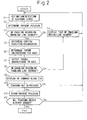
- FIG. 2 is a schematic flow chart of the processing steps carried out after the above estimation/detection of the external force performed inside the robot control unit 2. In the steps, the following processing steps are carried out.
- Step S1 The external force acting upon the front end of the arm of the robot 1 is estimated or detected.
- Step S2 The position of the front end of the robot (front end point 31 of tool) is determined from the positional information of the axes of the robot.
- Step S3 The determined position of the front end of the robot is compared with the copying control enabling regions and enabling line segments set in the block 10 of the enabling region settings, and it is decided whether or not the present robot position belongs to any enabling region or enabling line segment. If NO (the present robot position does not belong to any enabling region or enabling segment), the processing proceeds to step S4, while if YES, the processing proceeds to step S5. In the example shown in FIG. 1, when the front end of the robot belongs to any of the spherical region 15 around the teaching point 14, the cubic region 18 around the teaching point 17, or the region on the line segment 16 (error ⁇ within the previously set range is permitted), the processing proceeds to step S5.
- Step S4 The copying control is not carried out, and "out of enabling region/line segment" is displayed on the displaying means 12 and the processing routine returns to step S1. Further, according to need, the robot is jogged to near the desired teaching point (a position at which YES may be output at step S3) by using the teaching interface 11. Alternatively, the teaching interface 11 is used to move the robot to the desired teaching point (that is, partial execution of the model program). If moving to a position at which YES will be output at step S3, YES is output at step S3 immediately after that, then the processing proceeds to step S5. Note that, while copying control is not carried out, it is also possible not to detect or estimate the external force.
- Step S5 In order to perform the copying control, first, the content of the copying control settings in the region where the robot is currently located is referred to from the content defined in the block 9 of the copying control settings, and the copying direction and orientation (that is, the direction of movement and the direction of change of orientation for following the external force) are determined.
- the content of the copying control settings includes for example "the copying movement is limited to only translation in a direction parallel to the line segment 16 (also the orientation is designated: for example, the orientation from the teaching point 14 toward the teaching point 17), and the rotational movement around the line segment 16", "the copying movement is limited to only translation in a direction parallel to the X-axis of the robot coordinate system (also the orientation is designated: for example +-direction along X-axis) and rotational movement around the X-axis”, etc.
- Step S6 The torque instructions required for performing copying control for only the movement and change of orientation in that direction are determined for the motors of the robot 1.
- the method for following only movement and change of orientation in a specific direction includes a rigidity control of the robot in which a processing using a control loop for controlling the drive of the motors is performed for example for the orthogonal coordinate position of the front end of the robot (front end point 31 of tool) so as to reduce the gain of the result of the processing for only the directions of the movement and the change of orientation to be followed.
- Step S7 The motors of the robot 1 are operated according to the torque instructions to the motors of the robot 1 determined by the copying control means 8. Due to this, the front end of the robot (the front end point 31 of the tool here) operates so as to minimize the external force given by the operator 4 under a condition where the degrees of freedom of motion are limited only to a movement in a specific direction and a change in orientation around a specific axis (change in orientation of the front end point of the tool).
- Step S8 A check similar to that at step S3 is carried out. Namely, it is decided whether or not the robot position after the movement performed by step S7 belongs to any of the copying control enabling regions and enabling line segments defined in the block 10 of the enabling region settings. If NO (it belongs to none of the enabling regions or enabling line segments), the processing returns to step S4, while if YES, the processing proceeds to step S9. Note that when the copying control is normally carried out, usually the output of NO is not issued.
- Step S9 The block (block of command sentences) corresponding to a enabling region in which the robot is currently located or a region or line segment which the robot is approaching among the contents of the model program 19 is displayed on the display means 12 by the block display means 20 (for example, the cursor display). Due to this, the operator 4 can learn which block in the program is being taught at present.
- Step S10 It is checked whether or not the position teaching key 7 was depressed. When it was not depressed, the processing returns to step S1. When it was depressed, the processing proceeds to step S11.
- Step S11 The present position of the robot 1 is taught. Namely, the content of the positional data of the teaching point to which the robot is now heading in the model program is rewritten by the content of the present positional data of the robot.
- Step S12 When the rewriting of the content of the positional data of all teaching points has not been completed, the processing returns to step S1.
- the processing is completed when the rewriting of the content of the positional data of all teaching points has been completed. Note that when re-teaching is necessary, for example the input means 13 is operated, and the processing is started again from step S1.
- the content of the positional data of the teaching points in the model program is sequentially amended whereby the teaching of the robot proceeds. If the deadman's switch 6 is released, the robot 1 is stopped any time by interruption processing and the processing is once ended. However, if the deadman's switch 6 is depressed again, the state immediately before the end of the processing is desirably reproduced by a resume function.
- the display means 12 uses the block display means 20 (for example the cursor display) to display the block (block of command sentences) corresponding to the enabling region in which the robot is currently located or the enabling region or line segment which the robot is approaching among the content of the model program 19 (the newest display content is displayed whenever step S9 comes), therefore the operator 4 can learn which block in the program is being taught at present by viewing that.
- the block display means 20 for example the cursor display
- the robot control unit 2 may be provided with a function by which the copying control is once stopped and then automatically restarted when the present position of the robot approaches within a predetermined distance of a teaching point defined in the model program 19 while performing copying control along a line segment. In this case, it is possible to make the operator 4 sense the resistance and inform him of the approach to the teaching point.
- copying control direction and the block being taught can be freely changed by operation from the input means 13.
- a traditional method of teaching by instructing the direction of operation to the robot by a direction key can be carried out by operation from the input means 13 of the teaching interface 11.
Landscapes
- Engineering & Computer Science (AREA)
- Physics & Mathematics (AREA)
- General Physics & Mathematics (AREA)
- Automation & Control Theory (AREA)
- Robotics (AREA)
- Human Computer Interaction (AREA)
- Manufacturing & Machinery (AREA)
- Numerical Control (AREA)
- Manipulator (AREA)
Applications Claiming Priority (2)
| Application Number | Priority Date | Filing Date | Title |
|---|---|---|---|
| JP2004105791 | 2004-03-31 | ||
| JP2004105791A JP3923053B2 (ja) | 2004-03-31 | 2004-03-31 | ロボット教示装置 |
Publications (1)
| Publication Number | Publication Date |
|---|---|
| EP1582955A2 true EP1582955A2 (fr) | 2005-10-05 |
Family
ID=34880078
Family Applications (1)
| Application Number | Title | Priority Date | Filing Date |
|---|---|---|---|
| EP05006910A Withdrawn EP1582955A2 (fr) | 2004-03-31 | 2005-03-30 | Dispositif d'apprentissage pour robot |
Country Status (6)
| Country | Link |
|---|---|
| US (1) | US20050222714A1 (fr) |
| EP (1) | EP1582955A2 (fr) |
| JP (1) | JP3923053B2 (fr) |
| KR (1) | KR100741618B1 (fr) |
| CN (1) | CN100336637C (fr) |
| TW (1) | TWI276933B (fr) |
Cited By (4)
| Publication number | Priority date | Publication date | Assignee | Title |
|---|---|---|---|---|
| EP2131257A1 (fr) * | 2008-06-06 | 2009-12-09 | KUKA Roboter GmbH | Procédé et dispositif destinés à la commande d'un manipulateur |
| EP2431138A4 (fr) * | 2009-01-09 | 2014-06-04 | Panasonic Corp | Appareil de commande et procédé de commande pour bras robotique, robot, programme de commande pour bras robotique et circuit électronique intégré |
| WO2017036520A1 (fr) * | 2015-09-02 | 2017-03-09 | Abb Schweiz Ag | Système et procédé pour la génération d'un programme de robot avec un dispositif d'apprentissage tenu à la main |
| US10478965B2 (en) | 2017-03-31 | 2019-11-19 | Fanuc Corporation | Robot system |
Families Citing this family (86)
| Publication number | Priority date | Publication date | Assignee | Title |
|---|---|---|---|---|
| JP4553203B2 (ja) * | 2005-08-01 | 2010-09-29 | 国立大学法人 名古屋工業大学 | 作業補助装置 |
| JP2007038059A (ja) * | 2005-08-01 | 2007-02-15 | Nagoya Institute Of Technology | 作業補助装置 |
| JP4171488B2 (ja) * | 2005-12-16 | 2008-10-22 | ファナック株式会社 | オフラインプログラミング装置 |
| JP4873253B2 (ja) * | 2007-09-18 | 2012-02-08 | 株式会社安川電機 | ロボットの直接教示装置 |
| CN101425149B (zh) * | 2007-11-02 | 2010-10-13 | 阿丹电子企业股份有限公司 | 利用电子标带监控人身行动安全的装置及其方法 |
| CN101909829B (zh) | 2008-02-28 | 2012-08-29 | 松下电器产业株式会社 | 机器人手臂的控制装置及控制方法、机器人、机器人手臂的控制程序、及机器人手臂控制用集成电子电路 |
| JP5163299B2 (ja) * | 2008-06-04 | 2013-03-13 | 株式会社Ihi | ロボット制御装置 |
| WO2009157733A1 (fr) * | 2008-06-27 | 2009-12-30 | Yujin Robot Co., Ltd. | Système d’apprentissage interactif utilisant un robot et son procédé de fonctionnement pour l’éducation des enfants |
| JP5293039B2 (ja) * | 2008-09-19 | 2013-09-18 | 株式会社安川電機 | ロボットシステムおよびロボットの制御方法 |
| EP2194434B1 (fr) * | 2008-12-05 | 2012-05-30 | COMAU SpA | système robotique |
| JP5509673B2 (ja) * | 2009-05-22 | 2014-06-04 | 株式会社Ihi | ロボット制御装置およびその制御方法 |
| KR101100108B1 (ko) | 2010-02-26 | 2011-12-29 | 주식회사 엔티리서치 | 교시기구 및 이를 구비한 직접교시장치 |
| US20120078415A1 (en) * | 2010-03-17 | 2012-03-29 | Hiroyasu Kubo | Parallel link robot, and method of teaching parallel link robot |
| CN101833892A (zh) * | 2010-04-30 | 2010-09-15 | 东南大学 | 用于焊接机器人的嵌入式示教编程装置及方法 |
| AT509927B1 (de) * | 2010-06-08 | 2015-05-15 | Keba Ag | Verfahren zum programmieren oder vorgeben von bewegungen oder abläufen eines industrieroboters |
| CN102725109B (zh) * | 2010-07-27 | 2015-03-18 | 松下电器产业株式会社 | 移动路径搜索装置及移动路径搜索方法 |
| CN102568269A (zh) * | 2010-12-30 | 2012-07-11 | 沈阳新松机器人自动化股份有限公司 | 一种具有示教盒功能的控制系统 |
| CN102950596B (zh) * | 2011-08-23 | 2015-11-11 | 松下电器产业株式会社 | 并联连杆机器人及其动作示教方法 |
| KR101305819B1 (ko) * | 2012-01-04 | 2013-09-06 | 현대자동차주식회사 | 착용식 로봇의 사용자 조작 의도 토크 추출방법 |
| CN102622937A (zh) * | 2012-03-08 | 2012-08-01 | 南京埃斯顿机器人工程有限公司 | 一种机器人示教器 |
| CN102658549A (zh) * | 2012-05-10 | 2012-09-12 | 上海理工大学 | 具有plc功能的六轴工业机器人控制系统 |
| WO2014110682A1 (fr) | 2013-01-18 | 2014-07-24 | Robotiq Inc. | Capteur de force/couple, appareil et procédé pour apprentissage et fonctionnement de robot |
| CN103085071A (zh) * | 2013-02-04 | 2013-05-08 | 惠州市东扬科技有限公司 | 一种可视化机器人程序编译方法 |
| CN118717295A (zh) | 2013-03-15 | 2024-10-01 | 史赛克公司 | 手术机器人臂的端部执行器 |
| JP5673717B2 (ja) * | 2013-03-19 | 2015-02-18 | 株式会社安川電機 | ロボットシステム及び被加工物の製造方法 |
| US9980785B2 (en) | 2013-10-24 | 2018-05-29 | Auris Health, Inc. | Instrument device manipulator with surgical tool de-articulation |
| CN105939647B (zh) | 2013-10-24 | 2020-01-21 | 奥瑞斯健康公司 | 机器人辅助腔内外科手术系统及相关方法 |
| JP5893665B2 (ja) * | 2014-04-14 | 2016-03-23 | ファナック株式会社 | 作用された力に応じて移動されるロボットを制御するロボット制御装置 |
| JP5893666B2 (ja) | 2014-04-14 | 2016-03-23 | ファナック株式会社 | 力に応じて動かすロボットのロボット制御装置およびロボットシステム |
| JP5893664B2 (ja) | 2014-04-14 | 2016-03-23 | ファナック株式会社 | 作用された力に応じて移動されるロボットを制御するロボット制御装置 |
| JP6193816B2 (ja) | 2014-06-20 | 2017-09-06 | ファナック株式会社 | アームの退避機能を有する多関節ロボット |
| US9788910B2 (en) | 2014-07-01 | 2017-10-17 | Auris Surgical Robotics, Inc. | Instrument-mounted tension sensing mechanism for robotically-driven medical instruments |
| US10792464B2 (en) | 2014-07-01 | 2020-10-06 | Auris Health, Inc. | Tool and method for using surgical endoscope with spiral lumens |
| EP3182951A1 (fr) * | 2014-08-18 | 2017-06-28 | Ondal Medical Systems GmbH | Ensemble pied réagissant à la force ou au mouvement, dispositif de commande et procédé de positionnement dudit ensemble pied |
| TWI502296B (zh) * | 2014-08-27 | 2015-10-01 | Hiwin Tech Corp | 機器人的教導裝置 |
| JP6660102B2 (ja) * | 2014-08-27 | 2020-03-04 | キヤノン株式会社 | ロボット教示装置およびその制御方法、ロボットシステム、プログラム |
| JP6416560B2 (ja) | 2014-09-11 | 2018-10-31 | 株式会社デンソー | 位置決め制御装置 |
| US9737371B2 (en) | 2014-09-30 | 2017-08-22 | Auris Surgical Robotics, Inc. | Configurable robotic surgical system with virtual rail and flexible endoscope |
| CN104308850B (zh) * | 2014-10-09 | 2015-12-23 | 南京工业职业技术学院 | 一种机械手示教3d传感手柄 |
| US9804593B1 (en) * | 2014-12-12 | 2017-10-31 | X Development Llc | Methods and systems for teaching positions to components of devices |
| US9592608B1 (en) * | 2014-12-15 | 2017-03-14 | X Development Llc | Methods and systems for providing feedback during teach mode |
| JP6081981B2 (ja) * | 2014-12-19 | 2017-02-15 | ファナック株式会社 | 教示プログラムの自動表示手段を備える数値制御装置 |
| DK3277467T3 (da) * | 2015-03-31 | 2020-07-27 | Abb Schweiz Ag | Fremgangsmåde til at styre en industrirobot ved berøring |
| WO2016161444A1 (fr) * | 2015-04-03 | 2016-10-06 | Think Surgical, Inc. | Système robotique avec commande de mouvement intuitive |
| JP6088583B2 (ja) | 2015-06-08 | 2017-03-01 | ファナック株式会社 | ロボットと力の表示機能を備えたロボット制御装置 |
| DE102015009151A1 (de) * | 2015-07-14 | 2017-01-19 | Kuka Roboter Gmbh | Ermitteln eines Eingabebefehls für einen Roboter, der durch manuelles Ausüben einer Kraft auf den Roboter eingegeben wird |
| AU2016321332B2 (en) | 2015-09-09 | 2020-10-08 | Auris Health, Inc. | Instrument device manipulator for a surgical robotics system |
| JP6489991B2 (ja) | 2015-10-02 | 2019-03-27 | ファナック株式会社 | ロボットを操作するハンドルを備えたロボット用操作装置 |
| DE102015012959B4 (de) * | 2015-10-08 | 2019-01-17 | Franka Emika Gmbh | Robotersystem und Verfahren zur Steuerung eines Robotersystems |
| CN108025439B (zh) * | 2015-10-14 | 2021-04-27 | 川崎重工业株式会社 | 机器人示教方法及机器臂控制装置 |
| FR3043004B1 (fr) * | 2015-10-29 | 2017-12-22 | Airbus Group Sas | Procede d'orientation d'un effecteur portant un outil d'assemblage par rapport a une surface |
| JP6706489B2 (ja) * | 2015-11-24 | 2020-06-10 | 川崎重工業株式会社 | ロボットのダイレクト教示方法 |
| US9919422B1 (en) | 2016-01-06 | 2018-03-20 | X Development Llc | Methods and systems to provide mechanical feedback during movement of a robotic system |
| AT518481B1 (de) * | 2016-03-07 | 2018-09-15 | Keba Ag | System und Verfahren zur räumlichen Bewegung eines Objekts |
| JP6733239B2 (ja) * | 2016-03-18 | 2020-07-29 | セイコーエプソン株式会社 | 制御装置及びロボットシステム |
| JP6746990B2 (ja) * | 2016-03-18 | 2020-08-26 | セイコーエプソン株式会社 | ロボット制御装置及びロボットシステム |
| TWI805545B (zh) * | 2016-04-12 | 2023-06-21 | 丹麥商環球機器人公司 | 用於藉由示範來程式化機器人之方法和電腦程式產品 |
| CN105690421A (zh) * | 2016-04-21 | 2016-06-22 | 奇弩(北京)科技有限公司 | 自动记忆轨迹的通用机械臂 |
| KR102048820B1 (ko) * | 2016-11-28 | 2019-11-26 | 한국기계연구원 | 수동 강성 그리퍼를 이용한 조립 교시 방법 |
| CN108115711A (zh) * | 2016-11-29 | 2018-06-05 | 沈阳新松机器人自动化股份有限公司 | 一种机器人的示教系统 |
| CN106737691A (zh) * | 2017-02-07 | 2017-05-31 | 珠海金萝卜智动科技有限公司 | 手动示教机器人的方法和装置 |
| CN110612181B (zh) * | 2017-02-17 | 2023-05-23 | Abb瑞士股份有限公司 | 机器人引导通过编程期间控制工业机器人的方法和工业机器人 |
| CN108621155B (zh) * | 2017-03-21 | 2023-04-07 | 精工爱普生株式会社 | 控制装置、示教装置以及机器人系统 |
| JP7106874B2 (ja) * | 2017-03-21 | 2022-07-27 | セイコーエプソン株式会社 | 制御装置、教示装置、及びロボットシステム |
| JP2018176288A (ja) * | 2017-04-03 | 2018-11-15 | ファナック株式会社 | ロボットの教示装置 |
| WO2019102562A1 (fr) * | 2017-11-22 | 2019-05-31 | 三菱電機株式会社 | Actionneur d'affichage et robot |
| CN109986238B (zh) * | 2017-12-29 | 2021-02-26 | 深圳中集智能科技有限公司 | 机器人类线形柔性作业视觉模糊仿形控制方法 |
| JP7091777B2 (ja) * | 2018-03-30 | 2022-06-28 | 株式会社安川電機 | ロボットシステム及び制御方法 |
| JP7048176B2 (ja) * | 2018-05-23 | 2022-04-05 | アズビル株式会社 | ロボットの直接教示装置及び直接教示方法 |
| JP7263724B2 (ja) * | 2018-09-27 | 2023-04-25 | 株式会社デンソーウェーブ | ロボットの制御方法 |
| EP3646839A1 (fr) | 2018-11-05 | 2020-05-06 | Ondal Medical Systems GmbH | Système de bras de support pour un appareil médical, procédé de fonctionnement d'un système de bras de support ainsi que procédé de construction d'un système de bras de support |
| JP7053443B2 (ja) * | 2018-12-07 | 2022-04-12 | ファナック株式会社 | 操作装置にて手動操作を行うロボットの制御装置 |
| CN111300433A (zh) * | 2018-12-11 | 2020-06-19 | 沈阳新松机器人自动化股份有限公司 | 基于六维力传感器的机器人拖拽示教装置 |
| EP3747604B1 (fr) * | 2019-06-07 | 2022-01-26 | Robert Bosch GmbH | Organe de commande de dispositif robotisé, agencement de dispositif robotisé et procédé de commande d'un dispositif robotisé |
| CN110653801B (zh) * | 2019-09-30 | 2022-06-17 | 哈尔滨工业大学 | 机器人操作臂的导引操纵系统及其柔顺操纵控制与示教学习方法 |
| JP7388870B2 (ja) * | 2019-10-18 | 2023-11-29 | ファナック株式会社 | ロボットシステムおよび制御装置 |
| TWI725630B (zh) | 2019-11-21 | 2021-04-21 | 財團法人工業技術研究院 | 加工路徑生成裝置及其方法 |
| TWI805978B (zh) * | 2020-12-22 | 2023-06-21 | 達明機器人股份有限公司 | 雙迴路力矩感知系統及其感知方法 |
| CN112846737A (zh) * | 2021-01-07 | 2021-05-28 | 深圳市驰速自动化设备有限公司 | 一种拖动示教自动锁螺丝机软件控制系统 |
| EP4295200A4 (fr) * | 2021-02-17 | 2024-12-25 | Avridh Technologies, Inc. | Système et procédé de commande de navigation d'un robot dans un environnement dynamique fondé sur un apprentissage heuristique |
| DE112022000541B4 (de) | 2021-03-17 | 2026-04-30 | Fanuc Corporation | Roboter-Betätigungsvorrichtung und Roboter |
| KR102513381B1 (ko) * | 2021-04-15 | 2023-03-22 | 충남대학교산학협력단 | 멀티모달 센싱을 이용한 토크와 자세기반 로봇 교시법 |
| JP7108761B1 (ja) * | 2021-07-26 | 2022-07-28 | 日鉄エンジニアリング株式会社 | 制御システム、制御方法及びプログラム |
| KR102682481B1 (ko) * | 2022-08-30 | 2024-07-04 | 한국로봇융합연구원 | 진공 챔버 내 매니퓰레이터를 위한 원격 마스터 암 장치 |
| CN116810772A (zh) * | 2023-03-13 | 2023-09-29 | 常州精控电机电器有限公司 | 一种实现机械臂末端直线运动的伺服电机控制方法 |
| WO2025163746A1 (fr) * | 2024-01-30 | 2025-08-07 | ファナック株式会社 | Dispositif de commande de robot |
Family Cites Families (14)
| Publication number | Priority date | Publication date | Assignee | Title |
|---|---|---|---|---|
| DE3240251A1 (de) * | 1982-10-30 | 1984-05-03 | Deutsche Forschungs- und Versuchsanstalt für Luft- und Raumfahrt e.V., 5000 Köln | Verfahren zum programmieren von bewegungen und erforderlichenfalls von bearbeitungskraeften bzw. -momenten eines roboters oder manipulators und einrichtung zu dessen durchfuehrung |
| US4462812A (en) * | 1982-12-08 | 1984-07-31 | General Motors Corporation | Ceramic monolith particulate trap including filter support |
| JPS59115149A (ja) * | 1982-12-22 | 1984-07-03 | Fanuc Ltd | ならい制御方法 |
| GB2229296B (en) * | 1989-03-03 | 1993-08-11 | Mitsubishi Heavy Ind Ltd | Teaching playback type robot |
| JP2895672B2 (ja) * | 1992-01-28 | 1999-05-24 | ファナック株式会社 | 複数ロボット制御方法 |
| US5495410A (en) * | 1994-08-12 | 1996-02-27 | Minnesota Mining And Manufacturing Company | Lead-through robot programming system |
| KR0151017B1 (ko) * | 1994-12-28 | 1999-01-15 | 김광호 | 로보트 교시 장치 및 방법 |
| US5980082A (en) * | 1995-07-05 | 1999-11-09 | Fanuc Limited | Robot movement control device and movement control method |
| KR100449429B1 (ko) * | 1995-09-14 | 2004-12-13 | 가부시키가이샤 야스가와덴끼 | 로봇의교시장치 |
| JPH09141580A (ja) * | 1995-11-22 | 1997-06-03 | Yaskawa Electric Corp | 直接教示ロボットの動作範囲制限装置 |
| IL120889A (en) * | 1997-05-22 | 1998-10-30 | Eshed Robotec 1982 Ltd | Method and facility for direct learning of vending machines |
| DE19814630B4 (de) * | 1998-03-26 | 2011-09-29 | Carl Zeiss | Verfahren und Vorrichtung zum handgesteuerten Führen eines Werkzeuges in einem vorgegebenen Bewegungsbereich |
| US6385508B1 (en) * | 2000-10-31 | 2002-05-07 | Fanuc Robotics North America, Inc. | Lead-through teach handle assembly and method of teaching a robot assembly |
| CA2633137C (fr) * | 2002-08-13 | 2012-10-23 | The Governors Of The University Of Calgary | Systeme robotique utilise en microchirurgie |
-
2004
- 2004-03-31 JP JP2004105791A patent/JP3923053B2/ja not_active Expired - Fee Related
-
2005
- 2005-03-28 CN CNB2005100588071A patent/CN100336637C/zh not_active Expired - Fee Related
- 2005-03-30 KR KR1020050026250A patent/KR100741618B1/ko not_active Expired - Fee Related
- 2005-03-30 TW TW094109963A patent/TWI276933B/zh not_active IP Right Cessation
- 2005-03-30 EP EP05006910A patent/EP1582955A2/fr not_active Withdrawn
- 2005-03-31 US US11/094,688 patent/US20050222714A1/en not_active Abandoned
Cited By (5)
| Publication number | Priority date | Publication date | Assignee | Title |
|---|---|---|---|---|
| EP2131257A1 (fr) * | 2008-06-06 | 2009-12-09 | KUKA Roboter GmbH | Procédé et dispositif destinés à la commande d'un manipulateur |
| EP2431138A4 (fr) * | 2009-01-09 | 2014-06-04 | Panasonic Corp | Appareil de commande et procédé de commande pour bras robotique, robot, programme de commande pour bras robotique et circuit électronique intégré |
| WO2017036520A1 (fr) * | 2015-09-02 | 2017-03-09 | Abb Schweiz Ag | Système et procédé pour la génération d'un programme de robot avec un dispositif d'apprentissage tenu à la main |
| US10478965B2 (en) | 2017-03-31 | 2019-11-19 | Fanuc Corporation | Robot system |
| DE102018107069B4 (de) | 2017-03-31 | 2020-08-06 | Fanuc Corporation | Robotersystem |
Also Published As
| Publication number | Publication date |
|---|---|
| TWI276933B (en) | 2007-03-21 |
| TW200602829A (en) | 2006-01-16 |
| US20050222714A1 (en) | 2005-10-06 |
| CN100336637C (zh) | 2007-09-12 |
| CN1676287A (zh) | 2005-10-05 |
| KR100741618B1 (ko) | 2007-07-23 |
| KR20060044963A (ko) | 2006-05-16 |
| JP3923053B2 (ja) | 2007-05-30 |
| JP2005293098A (ja) | 2005-10-20 |
Similar Documents
| Publication | Publication Date | Title |
|---|---|---|
| US20050222714A1 (en) | Robot teaching apparatus | |
| US6124693A (en) | Robot controller | |
| US10259118B2 (en) | Robot system having function of simplifying teaching operation and improving operating performance by learning | |
| JP4122652B2 (ja) | ロボットの制御装置 | |
| US10118295B2 (en) | Manual feed apparatus of robot for calculating operable range of robot | |
| JP3708083B2 (ja) | ロボット教示装置 | |
| CN107336244B (zh) | 用于机器人的直觉式力量导引方法及其装置 | |
| US10773349B2 (en) | Machine tool and control method for machine tool | |
| JP2013136123A (ja) | ロボット動作教示支援装置及び方法 | |
| CN118269089A (zh) | 用于机械手的运动模拟的方法 | |
| JPH10207519A (ja) | ロボットの制御方式 | |
| CN108687758B (zh) | 机器人的移动速度控制装置及方法 | |
| JPH0337701A (ja) | ロボットの制御方法及び装置 | |
| JP2739354B2 (ja) | 三次元レーザ加工機におけるティーチング方法 | |
| US20250135638A1 (en) | Work robot system | |
| JP2003015713A (ja) | 数値制御装置 | |
| JPH1177572A (ja) | ロボット制御装置 | |
| JP2635106B2 (ja) | ロボットの作業領域制限装置 | |
| JPH08161025A (ja) | 教示装置 | |
| JP2507957B2 (ja) | 工業用ロボットの移動制御装置 | |
| JP2025008168A (ja) | ロボット制御装置及びロボット制御方法 | |
| JPH03113512A (ja) | 産業用ロボットの教示方法 | |
| JP5547601B2 (ja) | 数値制御装置 | |
| JPH1177574A (ja) | ロボット制御装置 | |
| JPH0887329A (ja) | 位置決め制御器 |
Legal Events
| Date | Code | Title | Description |
|---|---|---|---|
| PUAI | Public reference made under article 153(3) epc to a published international application that has entered the european phase |
Free format text: ORIGINAL CODE: 0009012 |
|
| AK | Designated contracting states |
Kind code of ref document: A2 Designated state(s): AT BE BG CH CY CZ DE DK EE ES FI FR GB GR HU IE IS IT LI LT LU MC NL PL PT RO SE SI SK TR |
|
| AX | Request for extension of the european patent |
Extension state: AL BA HR LV MK YU |
|
| STAA | Information on the status of an ep patent application or granted ep patent |
Free format text: STATUS: THE APPLICATION HAS BEEN WITHDRAWN |
|
| 18W | Application withdrawn |
Effective date: 20090821 |