EP1584374B1 - Mordenitkatalysator für die Alkylierung von aromatischen Kohlenwasserstoffen - Google Patents
Mordenitkatalysator für die Alkylierung von aromatischen Kohlenwasserstoffen Download PDFInfo
- Publication number
- EP1584374B1 EP1584374B1 EP05250656A EP05250656A EP1584374B1 EP 1584374 B1 EP1584374 B1 EP 1584374B1 EP 05250656 A EP05250656 A EP 05250656A EP 05250656 A EP05250656 A EP 05250656A EP 1584374 B1 EP1584374 B1 EP 1584374B1
- Authority
- EP
- European Patent Office
- Prior art keywords
- catalyst
- olefin
- carbon atoms
- angstroms
- shaped catalyst
- Prior art date
- Legal status (The legal status is an assumption and is not a legal conclusion. Google has not performed a legal analysis and makes no representation as to the accuracy of the status listed.)
- Ceased
Links
- 239000003054 catalyst Substances 0.000 title claims description 215
- HNPSIPDUKPIQMN-UHFFFAOYSA-N dioxosilane;oxo(oxoalumanyloxy)alumane Chemical compound O=[Si]=O.O=[Al]O[Al]=O HNPSIPDUKPIQMN-UHFFFAOYSA-N 0.000 title claims description 102
- 239000010457 zeolite Substances 0.000 title claims description 101
- 229910021536 Zeolite Inorganic materials 0.000 title claims description 95
- 238000005804 alkylation reaction Methods 0.000 title claims description 93
- 229910052680 mordenite Inorganic materials 0.000 title claims description 73
- 230000029936 alkylation Effects 0.000 title claims description 60
- UHOVQNZJYSORNB-UHFFFAOYSA-N Benzene Chemical compound C1=CC=CC=C1 UHOVQNZJYSORNB-UHFFFAOYSA-N 0.000 claims description 114
- 150000001336 alkenes Chemical class 0.000 claims description 100
- 238000000034 method Methods 0.000 claims description 81
- JRZJOMJEPLMPRA-UHFFFAOYSA-N olefin Natural products CCCCCCCC=C JRZJOMJEPLMPRA-UHFFFAOYSA-N 0.000 claims description 74
- 230000008569 process Effects 0.000 claims description 66
- 239000000203 mixture Substances 0.000 claims description 60
- 239000011148 porous material Substances 0.000 claims description 58
- 239000002131 composite material Substances 0.000 claims description 53
- VYPSYNLAJGMNEJ-UHFFFAOYSA-N Silicium dioxide Chemical compound O=[Si]=O VYPSYNLAJGMNEJ-UHFFFAOYSA-N 0.000 claims description 46
- 150000004945 aromatic hydrocarbons Chemical class 0.000 claims description 46
- PNEYBMLMFCGWSK-UHFFFAOYSA-N aluminium oxide Inorganic materials [O-2].[O-2].[O-2].[Al+3].[Al+3] PNEYBMLMFCGWSK-UHFFFAOYSA-N 0.000 claims description 45
- 125000004432 carbon atom Chemical group C* 0.000 claims description 45
- 239000004711 α-olefin Substances 0.000 claims description 30
- 239000011230 binding agent Substances 0.000 claims description 24
- 239000000377 silicon dioxide Substances 0.000 claims description 22
- 125000003118 aryl group Chemical group 0.000 claims description 19
- 230000001186 cumulative effect Effects 0.000 claims description 19
- YXFVVABEGXRONW-UHFFFAOYSA-N Toluene Chemical compound CC1=CC=CC=C1 YXFVVABEGXRONW-UHFFFAOYSA-N 0.000 claims description 12
- 238000012360 testing method Methods 0.000 claims description 10
- 229910010272 inorganic material Inorganic materials 0.000 claims description 5
- 239000011147 inorganic material Substances 0.000 claims description 4
- 239000000843 powder Substances 0.000 description 37
- 239000003039 volatile agent Substances 0.000 description 26
- XLYOFNOQVPJJNP-UHFFFAOYSA-N water Substances O XLYOFNOQVPJJNP-UHFFFAOYSA-N 0.000 description 24
- 230000009849 deactivation Effects 0.000 description 22
- 238000002360 preparation method Methods 0.000 description 22
- 238000002156 mixing Methods 0.000 description 19
- 238000006243 chemical reaction Methods 0.000 description 17
- QSHDDOUJBYECFT-UHFFFAOYSA-N mercury Chemical compound [Hg] QSHDDOUJBYECFT-UHFFFAOYSA-N 0.000 description 17
- 229910052753 mercury Inorganic materials 0.000 description 17
- 238000002459 porosimetry Methods 0.000 description 16
- 230000002378 acidificating effect Effects 0.000 description 14
- 239000002253 acid Substances 0.000 description 13
- 230000000052 comparative effect Effects 0.000 description 13
- -1 aluminum halides Chemical class 0.000 description 12
- 239000002245 particle Substances 0.000 description 12
- GRYLNZFGIOXLOG-UHFFFAOYSA-N Nitric acid Chemical compound O[N+]([O-])=O GRYLNZFGIOXLOG-UHFFFAOYSA-N 0.000 description 11
- 238000009826 distribution Methods 0.000 description 11
- 229910017604 nitric acid Inorganic materials 0.000 description 11
- 239000000047 product Substances 0.000 description 10
- 230000007420 reactivation Effects 0.000 description 10
- 239000000463 material Substances 0.000 description 9
- IJGRMHOSHXDMSA-UHFFFAOYSA-N Atomic nitrogen Chemical compound N#N IJGRMHOSHXDMSA-UHFFFAOYSA-N 0.000 description 8
- 125000000217 alkyl group Chemical group 0.000 description 8
- 238000006317 isomerization reaction Methods 0.000 description 8
- 239000008367 deionised water Substances 0.000 description 7
- 229910021641 deionized water Inorganic materials 0.000 description 7
- 238000002474 experimental method Methods 0.000 description 6
- 239000007791 liquid phase Substances 0.000 description 6
- 229910052799 carbon Inorganic materials 0.000 description 5
- KRHYYFGTRYWZRS-UHFFFAOYSA-N Fluorane Chemical compound F KRHYYFGTRYWZRS-UHFFFAOYSA-N 0.000 description 4
- 239000002168 alkylating agent Substances 0.000 description 4
- 229940100198 alkylating agent Drugs 0.000 description 4
- 150000001555 benzenes Chemical class 0.000 description 4
- 238000001354 calcination Methods 0.000 description 4
- 229910000040 hydrogen fluoride Inorganic materials 0.000 description 4
- 239000007788 liquid Substances 0.000 description 4
- 239000002808 molecular sieve Substances 0.000 description 4
- 229910052757 nitrogen Inorganic materials 0.000 description 4
- 238000006116 polymerization reaction Methods 0.000 description 4
- 239000002994 raw material Substances 0.000 description 4
- 238000007493 shaping process Methods 0.000 description 4
- URGAHOPLAPQHLN-UHFFFAOYSA-N sodium aluminosilicate Chemical compound [Na+].[Al+3].[O-][Si]([O-])=O.[O-][Si]([O-])=O URGAHOPLAPQHLN-UHFFFAOYSA-N 0.000 description 4
- 239000007787 solid Substances 0.000 description 4
- 239000002904 solvent Substances 0.000 description 4
- 125000001273 sulfonato group Chemical class [O-]S(*)(=O)=O 0.000 description 4
- OKTJSMMVPCPJKN-UHFFFAOYSA-N Carbon Chemical compound [C] OKTJSMMVPCPJKN-UHFFFAOYSA-N 0.000 description 3
- VGGSQFUCUMXWEO-UHFFFAOYSA-N Ethene Chemical compound C=C VGGSQFUCUMXWEO-UHFFFAOYSA-N 0.000 description 3
- 239000005977 Ethylene Substances 0.000 description 3
- DGAQECJNVWCQMB-PUAWFVPOSA-M Ilexoside XXIX Chemical compound C[C@@H]1CC[C@@]2(CC[C@@]3(C(=CC[C@H]4[C@]3(CC[C@@H]5[C@@]4(CC[C@@H](C5(C)C)OS(=O)(=O)[O-])C)C)[C@@H]2[C@]1(C)O)C)C(=O)O[C@H]6[C@@H]([C@H]([C@@H]([C@H](O6)CO)O)O)O.[Na+] DGAQECJNVWCQMB-PUAWFVPOSA-M 0.000 description 3
- 150000007513 acids Chemical class 0.000 description 3
- 150000004996 alkyl benzenes Chemical class 0.000 description 3
- 230000002152 alkylating effect Effects 0.000 description 3
- 229910052782 aluminium Inorganic materials 0.000 description 3
- 229910000323 aluminium silicate Inorganic materials 0.000 description 3
- 150000001491 aromatic compounds Chemical class 0.000 description 3
- 230000003197 catalytic effect Effects 0.000 description 3
- 239000004927 clay Substances 0.000 description 3
- 238000001035 drying Methods 0.000 description 3
- 230000000694 effects Effects 0.000 description 3
- 238000010438 heat treatment Methods 0.000 description 3
- 238000011065 in-situ storage Methods 0.000 description 3
- 238000004519 manufacturing process Methods 0.000 description 3
- 239000011159 matrix material Substances 0.000 description 3
- 229910052708 sodium Inorganic materials 0.000 description 3
- 239000011734 sodium Substances 0.000 description 3
- 239000000126 substance Substances 0.000 description 3
- XEEYBQQBJWHFJM-UHFFFAOYSA-N Iron Chemical compound [Fe] XEEYBQQBJWHFJM-UHFFFAOYSA-N 0.000 description 2
- NBIIXXVUZAFLBC-UHFFFAOYSA-N Phosphoric acid Chemical compound OP(O)(O)=O NBIIXXVUZAFLBC-UHFFFAOYSA-N 0.000 description 2
- 238000002441 X-ray diffraction Methods 0.000 description 2
- 230000004913 activation Effects 0.000 description 2
- 229910001413 alkali metal ion Inorganic materials 0.000 description 2
- 229910052784 alkaline earth metal Inorganic materials 0.000 description 2
- 150000001342 alkaline earth metals Chemical class 0.000 description 2
- 150000008055 alkyl aryl sulfonates Chemical class 0.000 description 2
- 238000004458 analytical method Methods 0.000 description 2
- 239000002585 base Substances 0.000 description 2
- 230000015572 biosynthetic process Effects 0.000 description 2
- WTEOIRVLGSZEPR-UHFFFAOYSA-N boron trifluoride Chemical compound FB(F)F WTEOIRVLGSZEPR-UHFFFAOYSA-N 0.000 description 2
- 150000001721 carbon Chemical group 0.000 description 2
- 239000007795 chemical reaction product Substances 0.000 description 2
- 238000010924 continuous production Methods 0.000 description 2
- 229910052593 corundum Inorganic materials 0.000 description 2
- 239000002178 crystalline material Substances 0.000 description 2
- RWGFKTVRMDUZSP-UHFFFAOYSA-N cumene Chemical compound CC(C)C1=CC=CC=C1 RWGFKTVRMDUZSP-UHFFFAOYSA-N 0.000 description 2
- 238000004821 distillation Methods 0.000 description 2
- 238000001125 extrusion Methods 0.000 description 2
- 239000007789 gas Substances 0.000 description 2
- 239000011521 glass Substances 0.000 description 2
- 229910044991 metal oxide Inorganic materials 0.000 description 2
- 150000004706 metal oxides Chemical class 0.000 description 2
- 230000004048 modification Effects 0.000 description 2
- 238000012986 modification Methods 0.000 description 2
- 230000007935 neutral effect Effects 0.000 description 2
- 235000011837 pasties Nutrition 0.000 description 2
- 230000002572 peristaltic effect Effects 0.000 description 2
- 239000004033 plastic Substances 0.000 description 2
- 230000009467 reduction Effects 0.000 description 2
- 229910052710 silicon Chemical group 0.000 description 2
- 239000011973 solid acid Substances 0.000 description 2
- 239000011949 solid catalyst Substances 0.000 description 2
- 239000002594 sorbent Substances 0.000 description 2
- BDHFUVZGWQCTTF-UHFFFAOYSA-M sulfonate Chemical compound [O-]S(=O)=O BDHFUVZGWQCTTF-UHFFFAOYSA-M 0.000 description 2
- 238000010555 transalkylation reaction Methods 0.000 description 2
- 229910001845 yogo sapphire Inorganic materials 0.000 description 2
- JIAARYAFYJHUJI-UHFFFAOYSA-L zinc dichloride Chemical compound [Cl-].[Cl-].[Zn+2] JIAARYAFYJHUJI-UHFFFAOYSA-L 0.000 description 2
- GGQQNYXPYWCUHG-RMTFUQJTSA-N (3e,6e)-deca-3,6-diene Chemical compound CCC\C=C\C\C=C\CC GGQQNYXPYWCUHG-RMTFUQJTSA-N 0.000 description 1
- 229910015900 BF3 Inorganic materials 0.000 description 1
- ZOXJGFHDIHLPTG-UHFFFAOYSA-N Boron Chemical compound [B] ZOXJGFHDIHLPTG-UHFFFAOYSA-N 0.000 description 1
- 239000007848 Bronsted acid Substances 0.000 description 1
- 239000004215 Carbon black (E152) Substances 0.000 description 1
- GYHNNYVSQQEPJS-UHFFFAOYSA-N Gallium Chemical compound [Ga] GYHNNYVSQQEPJS-UHFFFAOYSA-N 0.000 description 1
- UFHFLCQGNIYNRP-UHFFFAOYSA-N Hydrogen Chemical compound [H][H] UFHFLCQGNIYNRP-UHFFFAOYSA-N 0.000 description 1
- 238000004566 IR spectroscopy Methods 0.000 description 1
- 239000002841 Lewis acid Substances 0.000 description 1
- 238000005481 NMR spectroscopy Methods 0.000 description 1
- KKCBUQHMOMHUOY-UHFFFAOYSA-N Na2O Inorganic materials [O-2].[Na+].[Na+] KKCBUQHMOMHUOY-UHFFFAOYSA-N 0.000 description 1
- CTQNGGLPUBDAKN-UHFFFAOYSA-N O-Xylene Chemical compound CC1=CC=CC=C1C CTQNGGLPUBDAKN-UHFFFAOYSA-N 0.000 description 1
- MXRIRQGCELJRSN-UHFFFAOYSA-N O.O.O.[Al] Chemical compound O.O.O.[Al] MXRIRQGCELJRSN-UHFFFAOYSA-N 0.000 description 1
- 229910021627 Tin(IV) chloride Inorganic materials 0.000 description 1
- 239000000654 additive Substances 0.000 description 1
- 230000000274 adsorptive effect Effects 0.000 description 1
- XAGFODPZIPBFFR-UHFFFAOYSA-N aluminium Chemical group [Al] XAGFODPZIPBFFR-UHFFFAOYSA-N 0.000 description 1
- 229910000147 aluminium phosphate Inorganic materials 0.000 description 1
- FAPDDOBMIUGHIN-UHFFFAOYSA-K antimony trichloride Chemical compound Cl[Sb](Cl)Cl FAPDDOBMIUGHIN-UHFFFAOYSA-K 0.000 description 1
- 238000009835 boiling Methods 0.000 description 1
- 229910052796 boron Inorganic materials 0.000 description 1
- 238000004364 calculation method Methods 0.000 description 1
- 238000003442 catalytic alkylation reaction Methods 0.000 description 1
- 238000006555 catalytic reaction Methods 0.000 description 1
- 150000001768 cations Chemical class 0.000 description 1
- 239000013626 chemical specie Substances 0.000 description 1
- 229910052681 coesite Inorganic materials 0.000 description 1
- 239000000571 coke Substances 0.000 description 1
- 239000000084 colloidal system Substances 0.000 description 1
- 150000001875 compounds Chemical class 0.000 description 1
- 229910052906 cristobalite Inorganic materials 0.000 description 1
- 238000002425 crystallisation Methods 0.000 description 1
- 230000008025 crystallization Effects 0.000 description 1
- 230000003247 decreasing effect Effects 0.000 description 1
- 238000001514 detection method Methods 0.000 description 1
- 239000003599 detergent Substances 0.000 description 1
- 239000002270 dispersing agent Substances 0.000 description 1
- 239000006185 dispersion Substances 0.000 description 1
- 238000007580 dry-mixing Methods 0.000 description 1
- 230000007613 environmental effect Effects 0.000 description 1
- 238000001704 evaporation Methods 0.000 description 1
- 230000008020 evaporation Effects 0.000 description 1
- 238000005187 foaming Methods 0.000 description 1
- 229910052733 gallium Inorganic materials 0.000 description 1
- 229910052732 germanium Inorganic materials 0.000 description 1
- GNPVGFCGXDBREM-UHFFFAOYSA-N germanium atom Chemical compound [Ge] GNPVGFCGXDBREM-UHFFFAOYSA-N 0.000 description 1
- 150000004676 glycans Chemical class 0.000 description 1
- 230000036571 hydration Effects 0.000 description 1
- 238000006703 hydration reaction Methods 0.000 description 1
- 229930195733 hydrocarbon Natural products 0.000 description 1
- 150000002430 hydrocarbons Chemical class 0.000 description 1
- FAHBNUUHRFUEAI-UHFFFAOYSA-M hydroxidooxidoaluminium Chemical compound O[Al]=O FAHBNUUHRFUEAI-UHFFFAOYSA-M 0.000 description 1
- 238000002329 infrared spectrum Methods 0.000 description 1
- 150000002484 inorganic compounds Chemical class 0.000 description 1
- 229910052742 iron Inorganic materials 0.000 description 1
- JEIPFZHSYJVQDO-UHFFFAOYSA-N iron(III) oxide Inorganic materials O=[Fe]O[Fe]=O JEIPFZHSYJVQDO-UHFFFAOYSA-N 0.000 description 1
- 239000010687 lubricating oil Substances 0.000 description 1
- 230000007246 mechanism Effects 0.000 description 1
- 239000000178 monomer Substances 0.000 description 1
- SYSQUGFVNFXIIT-UHFFFAOYSA-N n-[4-(1,3-benzoxazol-2-yl)phenyl]-4-nitrobenzenesulfonamide Chemical class C1=CC([N+](=O)[O-])=CC=C1S(=O)(=O)NC1=CC=C(C=2OC3=CC=CC=C3N=2)C=C1 SYSQUGFVNFXIIT-UHFFFAOYSA-N 0.000 description 1
- 150000002790 naphthalenes Chemical class 0.000 description 1
- 150000002894 organic compounds Chemical class 0.000 description 1
- TWNQGVIAIRXVLR-UHFFFAOYSA-N oxo(oxoalumanyloxy)alumane Chemical compound O=[Al]O[Al]=O TWNQGVIAIRXVLR-UHFFFAOYSA-N 0.000 description 1
- 238000012856 packing Methods 0.000 description 1
- 229920001282 polysaccharide Polymers 0.000 description 1
- 239000005017 polysaccharide Substances 0.000 description 1
- 238000000634 powder X-ray diffraction Methods 0.000 description 1
- 239000011164 primary particle Substances 0.000 description 1
- QQONPFPTGQHPMA-UHFFFAOYSA-N propylene Natural products CC=C QQONPFPTGQHPMA-UHFFFAOYSA-N 0.000 description 1
- 125000004805 propylene group Chemical group [H]C([H])([H])C([H])([*:1])C([H])([H])[*:2] 0.000 description 1
- 239000011541 reaction mixture Substances 0.000 description 1
- 230000001172 regenerating effect Effects 0.000 description 1
- 230000000717 retained effect Effects 0.000 description 1
- 238000007790 scraping Methods 0.000 description 1
- 239000010703 silicon Chemical group 0.000 description 1
- 229910052814 silicon oxide Inorganic materials 0.000 description 1
- 238000004513 sizing Methods 0.000 description 1
- 238000001179 sorption measurement Methods 0.000 description 1
- 229910001220 stainless steel Inorganic materials 0.000 description 1
- 239000010935 stainless steel Substances 0.000 description 1
- 229910052682 stishovite Inorganic materials 0.000 description 1
- 238000003786 synthesis reaction Methods 0.000 description 1
- HPGGPRDJHPYFRM-UHFFFAOYSA-J tin(iv) chloride Chemical compound Cl[Sn](Cl)(Cl)Cl HPGGPRDJHPYFRM-UHFFFAOYSA-J 0.000 description 1
- 229910052723 transition metal Inorganic materials 0.000 description 1
- 150000003624 transition metals Chemical class 0.000 description 1
- 229910052905 tridymite Inorganic materials 0.000 description 1
- 239000012808 vapor phase Substances 0.000 description 1
- 239000011800 void material Substances 0.000 description 1
- 230000004580 weight loss Effects 0.000 description 1
- 239000008096 xylene Substances 0.000 description 1
- 239000012690 zeolite precursor Substances 0.000 description 1
- 235000005074 zinc chloride Nutrition 0.000 description 1
- 239000011592 zinc chloride Substances 0.000 description 1
Images
Classifications
-
- B—PERFORMING OPERATIONS; TRANSPORTING
- B01—PHYSICAL OR CHEMICAL PROCESSES OR APPARATUS IN GENERAL
- B01J—CHEMICAL OR PHYSICAL PROCESSES, e.g. CATALYSIS OR COLLOID CHEMISTRY; THEIR RELEVANT APPARATUS
- B01J29/00—Catalysts comprising molecular sieves
- B01J29/04—Catalysts comprising molecular sieves having base-exchange properties, e.g. crystalline zeolites
- B01J29/06—Crystalline aluminosilicate zeolites; Isomorphous compounds thereof
- B01J29/18—Crystalline aluminosilicate zeolites; Isomorphous compounds thereof of the mordenite type
-
- B—PERFORMING OPERATIONS; TRANSPORTING
- B01—PHYSICAL OR CHEMICAL PROCESSES OR APPARATUS IN GENERAL
- B01J—CHEMICAL OR PHYSICAL PROCESSES, e.g. CATALYSIS OR COLLOID CHEMISTRY; THEIR RELEVANT APPARATUS
- B01J37/00—Processes, in general, for preparing catalysts; Processes, in general, for activation of catalysts
- B01J37/0009—Use of binding agents; Moulding; Pressing; Powdering; Granulating; Addition of materials ameliorating the mechanical properties of the product catalyst
-
- C—CHEMISTRY; METALLURGY
- C07—ORGANIC CHEMISTRY
- C07C—ACYCLIC OR CARBOCYCLIC COMPOUNDS
- C07C2/00—Preparation of hydrocarbons from hydrocarbons containing a smaller number of carbon atoms
- C07C2/54—Preparation of hydrocarbons from hydrocarbons containing a smaller number of carbon atoms by addition of unsaturated hydrocarbons to saturated hydrocarbons or to hydrocarbons containing a six-membered aromatic ring with no unsaturation outside the aromatic ring
- C07C2/64—Addition to a carbon atom of a six-membered aromatic ring
- C07C2/66—Catalytic processes
-
- B—PERFORMING OPERATIONS; TRANSPORTING
- B01—PHYSICAL OR CHEMICAL PROCESSES OR APPARATUS IN GENERAL
- B01J—CHEMICAL OR PHYSICAL PROCESSES, e.g. CATALYSIS OR COLLOID CHEMISTRY; THEIR RELEVANT APPARATUS
- B01J2229/00—Aspects of molecular sieve catalysts not covered by B01J29/00
- B01J2229/30—After treatment, characterised by the means used
- B01J2229/37—Acid treatment
-
- B—PERFORMING OPERATIONS; TRANSPORTING
- B01—PHYSICAL OR CHEMICAL PROCESSES OR APPARATUS IN GENERAL
- B01J—CHEMICAL OR PHYSICAL PROCESSES, e.g. CATALYSIS OR COLLOID CHEMISTRY; THEIR RELEVANT APPARATUS
- B01J2229/00—Aspects of molecular sieve catalysts not covered by B01J29/00
- B01J2229/30—After treatment, characterised by the means used
- B01J2229/42—Addition of matrix or binder particles
-
- Y—GENERAL TAGGING OF NEW TECHNOLOGICAL DEVELOPMENTS; GENERAL TAGGING OF CROSS-SECTIONAL TECHNOLOGIES SPANNING OVER SEVERAL SECTIONS OF THE IPC; TECHNICAL SUBJECTS COVERED BY FORMER USPC CROSS-REFERENCE ART COLLECTIONS [XRACs] AND DIGESTS
- Y02—TECHNOLOGIES OR APPLICATIONS FOR MITIGATION OR ADAPTATION AGAINST CLIMATE CHANGE
- Y02P—CLIMATE CHANGE MITIGATION TECHNOLOGIES IN THE PRODUCTION OR PROCESSING OF GOODS
- Y02P20/00—Technologies relating to chemical industry
- Y02P20/50—Improvements relating to the production of bulk chemicals
- Y02P20/52—Improvements relating to the production of bulk chemicals using catalysts, e.g. selective catalysts
Definitions
- the present invention is directed to a shaped catalyst comprising mordenite zeolite and a binder having a controlled macropore structure.
- the present invention is also directed to alkylation of aromatic hydrocarbons using the shaped catalysts of this invention.
- the shaped catalysts exhibit reduced deactivation rates during the alkylation process, thereby increasing the life of the catalysts as evidenced by the longer alkylation run length times.
- the shaped catalysts of this invention are also capable of being reactivated with a aromatic hydrocarbon flush.
- Solid crystalline aluminosilicate zeolite catalysts have been known to be effective for the alkylation of aromatics with olefins.
- Zeolitic materials which are useful as catalysts are usually inorganic crystalline materials that possess uniform pores with diameters in micropore range that is less than 20 angstroms. Zeolites occur naturally and may also be prepared synthetically. Synthetic zeolites include, for example, zeolites A, X, Y, L and mordenite. It is also possible to generate metaloaluminophosphates and metalosilicophosphates. Other materials, such as boron, gallium, iron or germanium, may also be used to replace the aluminum or silicon in the framework structure.
- zeolite catalyst materials are commercially available as fine crystalline powders for further modification to enhance their catalytic properties for particular applications.
- Processes for the further modification to enhance catalytic properties of the crystalline zeolite catalysts are well known in the art, such as forming the zeolite catalysts into shaped particles, exchanging the cations in the catalyst matrix, etc.
- Forming the zeolite powders into shaped particles may be accomplished by forming a gel or paste of the catalyst powder with the addition of a suitable binder material such as a clay, an inorganic compound, or an organic compound and then extruding the gel or paste into the desired form.
- Zeolite powders may also be formed into particles without the use of a binder.
- Typical catalyst particles include extrudates whose cross sections are circular or embrace a plurality of arcuate lobes extending outwardly from the central portion of the catalyst particles.
- catalyst deactivation In most hydrocarbon conversion processes, including alkylation, the primary catalyst deactivation is caused by coke formation. This catalyst deactivation is a serious problem in the use of zeolite catalysts for alkylation reactions. This deactivation problem is well known in the art and it is well understood that the deactivation mechanism can involve polymerization of the olefin into large molecular species that cannot diffuse out of the pores containing the active sites in the zeolitic material.
- zeolite catalysts for preparation of alkylated aromatic hydrocarbons is typically conducted by the catalytic alkylation of aromatic hydrocarbons with normal alpha olefins or branched-chain olefins, and optionally a promotor.
- U.S. Pat. No. 3,094,383 discloses the preparation of synthetic zeolite materials which upon hydration yield a sorbent of controlled effective pore diameter and in which the sorbent and its zeolite precursor are provided directly in the form of an aggregate.
- U.S. Pat. No. 3,119,660 discloses a process for making massive bodies or shapes of crystalline zeolites.
- the patent also discloses methods for the identification of the catalyst materials using X-ray powder diffraction patterns in conjunction with chemical analyses.
- U.S. Pat. No. 3,288,716 discloses that the high "heavy content" of the alkylated aromatic product can be controlled during the alkylation step and has advantages over distilling the alkylated aromatic product to obtain the desired molecular weight.
- U.S. Pat. Nos. 3,641,177 and 3,929,672 disclose the technique to remove sodium or other alkali metal ions from zeolite catalysts.
- the '177 patent also discloses that such removal of the sodium or other alkali metal ions activates the zeolite catalysts for the alkylation of aromatic hydrocarbons with olefins by liquid phase reaction.
- U.S. Pat. Nos. 3,764,533 , 4,259,193 and 5,112,506 disclose the "heavy alkylate" content influences neutral sulfonates and overbased sulfonates.
- U.S. Pat. No. 5,112,506 the effect of molecular weight distribution or "heavy alkylate” is shown to influence the performance of both Neutral and HOB sulfonates and the di-alkylate content is shown to influence the rust performance of the corresponding sulfonate in U.S. Pat. No. 3,764,533 .
- a mono-alkylate sulfonate is preferred.
- U.S. Pat. Nos. 3,288,716 ; 3,764,533 ; 4,259,193 ; and 5,112,506 are hereby incorporated by reference for all purposes.
- U.S. Pat. No. 3,777,006 discloses the use of nucleating centers for the crystallization of crystalline aluminosilicate zeolites having a size in excess of 200 microns and characterized by high strength and excellent adsorptive properties.
- U.S. Pat. No. 4,185,040 discloses the preparation of highly stable and active catalysts for the alkylation of aromatic hydrocarbons with C 2 -C 4 olefins.
- the catalysts are acidic crystalline aluminosilicate zeolites which exhibit much improved deactivation rates.
- U.S. Pat. No. 4,764,295 discloses a process for making non-foaming detergent-dispersant lubricating oil additives. The process further involves carbonation for making the products more basic.
- U.S. Pat. No. 4,891,448 discloses a process for alkylation of polycyclic aromatic compounds in the presence of an acidic mordenite zeolite catalyst having a silica to alumina molar ratio of at least 15:1 to produce a mixture of substituted polycyclic aromatic compounds enriched in the para alkylated isomers.
- U.S. Pat. No. 5,004,841 discloses a process for alkylation of polycyclic aromatic compounds in the presence of an acidic mordenite zeolite catalyst having a silica to alumina molar ratio of at least 15:1 to produce substituted polycyclic aromatic compounds enriched in the linear alkylated isomers.
- U.S. Pat. No. 5,118,896 discloses an aromatic alkylation process comprising the steps of contacting a aromatic hydrocarbon feed with an alkylating agent under liquid phase alkylation conditions in the presence of a silica-containing large macropore, small particle size zeolite catalyst, the catalyst having a pore volume of about 0.25 to 0.50 cc/g in pores having a radius of 450 angstroms and a catalyst particle diameter of not more than 1/32 of an inch.
- U.S. Pat. No. 5,175,135 discloses the use of an acidic mordenite zeolite catalyst for alkylation of aromatic compounds with an alkylating agent having from one carbon atom to eight carbon atoms to produce substituted aromatic compounds enriched in the linear alkylated isomers.
- the acidic mordenite catalyst is characterized by its silica to alumina molar ratio, its porosity and a Symmetry Index.
- U.S. Pat. No. 5,191,135 discloses the process for making long-chain alkylsubstituted aromatic compounds from naphthalenes, the process comprising a zeolite alkylation catalyst in the presence of 0.5 to 3.0 weight percent water. The presence of water increases the selectivity for making mono-alkylated products.
- U.S. Pat. No. 5,198,595 discloses a process for alkylation of benzene or substituted benzene in the presence of an acidic mordenite zeolite catalyst having a silica to alumina ratio of at least 160:1 and a Symmetry Index above about 1.0. A process for the preparation of the catalyst is also disclosed.
- U.S. Pat. No. 5,243,116 discloses the production of alkylated benzenes by alkylation and/or transalkylation in the presence of an acidic mordenite zeolite catalyst having a silica to alumina molar ration of at least 30:1 and a specific crystalline structure determined by X-ray diffraction.
- U.S. Pat. Nos. 5,240,889 and 5,324,877 disclose processes for the preparation of a catalyst composition having alkylation and/or transalkylation activity and wherein the catalyst composition contains greater than 3.5 weight percent water based on the total weight of the catalyst composition and the aromatic alkylation process using said catalyst composition and olefins containing 2 carbon atoms to 25 carbon atoms.
- U.S. Pat. No. 5,453,553 discloses a process for the production of linear alkyl benzenes which process comprises co-feeding a mixture of benzene, linear olefins and molecular hydrogen in the presence of a zeolite catalyst containing a transition metal under alkylation condition such that the catalyst is not deactivated.
- U.S. Pat. No. 5,922,922 discloses a process for isomerizing a normal alpha olefin in the presence of an acidic catalyst having a one-dimensional pore system, and then use of the isomerized olefin to alkylate aromatic hydrocarbons in the presence of a second acidic catalyst, which can be mordenite zeolite having a silica to alumina ratio of at least 40 to 1.
- U.S. Pat. No. 5,939,594 discloses the preparation of a superalkalinized alkylaryl sulfonate of alkaline earth metal.
- the alkyl group of the alkylaryl sulfonate contains between 14 to 40 carbon atoms and the aryl sulfonate radical of alkaline earth metal is fixed in a molar proportion comprised between 0 and 13% in positions 1 or 2 of the linear alkyl chain.
- U.S. Pat. No. 6,031,144 discloses a process for reducing the residual olefin content of an alkylation reaction product by removing at least a portion of the non-alkylated single-ring aromatic hydrocarbon and then reacting the remaining alkylation reaction product in the presence of an acidic catalyst such as a molecular sieve or clay.
- U.S. Pat. No. 6,337,310 discloses the preparation of alkylbenzene from subsequentlyomerized normal alpha olefins for making low overbased and high overbased sulfonates having a total base number between 3 and 500.
- the process uses HF as catalyst or a solid acidic alkylation catalyst, such as a zeolite having an average pore size of at least 6 angstroms.
- U.S. Pat. No. 6,525,234 discloses a process for alkylating aromatic using a porous crystalline material, e.g., MCM-22 and in situ regenerating the catalyst by use of a polar compound having a dipole moment of at least 0.05 Debyes.
- EP0466558 describes a process for the production of a mixture of 2-phenylalkanes and 3-phenylalkanes in which benzene is reacted with a feedstock containing at least one linear olefin containing from 9 to 16 carbon atoms in its molecule in contact with a catalyst based on a dealuminised mordenite which has an overall Si/Al atomic ratio of between 15 and 85, a sodium weight content lower than 1000 ppm, a proportion of alumina species outside the network which is very low or zero, an elementary lattice volume smaller than 2.760 nm 3 .
- WO93/00317 describes a process of alkylating benzene or substituted benzene with an alkylating agent having from two to eighteen carbon atoms in the presence of a catalyst comprising an acidic mordenite zeolite having a silica/alumina molar ratio of higher that 160:1 and a crystalline structure which is determined by X-ray diffraction to have a Symmetry Index of at least 1, under temperature and pressure conditions sufficient to keep the reaction mixture in the liquid phase, and the molar ratio of benzene or substituted benzene to alkylating agent is less than 3:1 and greater than 1:1.
- the present invention is directed to a shaped catalyst comprising mordenite zeolite and a binder having a controlled macropore structure.
- the present invention is also directed to processes for preparation of alkylated aromatic hydrocarbons, which processes comprise the alkylation in the presence of the shaped catalysts of this invention.
- the shaped catalysts exhibit reduced deactivation rates during the alkylation process, thereby increasing the life of the catalysts, as evidenced by the longer alkylation run length times.
- the present invention is directed to a shaped catalyst having a macropore structure comprising mordenite zeolite having a silica to alumina molar ratio in the range of about 50:1 to about 105:1 and a binder, wherein the peak macropore diameter of the catalyst, measured by ASTM Test No. D 4284-03, is less than or equal to 900 angstroms and greater than 500 angstroms, and the cumulative pore volume at pore diameters less than or equal to about 500 angstroms, measured by ASTM Test No.
- D 4284-03 is less than or equal to 0.30 milliliters per gram, preferably, the cumulative pore volume of the catalyst at pore diameters less than or equal to 400 angstroms in the range of 0.05 milliliters per gram to 0.18 milliliters per gram.
- the cumulative pore volume of the shaped catalysts preferably at pore diameters less than or equal to 300 angstroms is less than 0.25 milliliters per gram, more preferably at pore diameters less than or equal to 300 angstroms less than 0.20 milliliters per gram, and most preferably at pore diameters less than or equal to 300 angstroms in the range of 0.08 milliliters per gram to 0.16 milliliters per gram.
- the peak macropore diameter of the above catalysts is in the range of 500 angstroms to 800 angstroms, more preferably the peak macropore diameter is in the range of 500 angstroms to 700 angstroms, and most preferably the peak macropore diameter of the catalyst is in the range of 500 angstroms to 600 angstroms.
- the mordenite zeolite of the shaped catalyst of the present invention has a silica to alumina molar ratio of about 50:1 to about 105:1.
- the mordenite zeolite has a silica to alumina molar ratio of about 65:1 to about 95:1.
- the shaped catalyst of the present embodiment may be in the form of a tablet.
- the binder in the shaped catalyst may be an inorganic material, preferably the binder is alumina.
- the mordenite zeolite may be present in the above shaped catalyst in the range of 50 weight percent to 99 weight percent based on the total dry weight of the shaped catalyst.
- the mordenite zeolite is present in the range of 60 weight percent to 90 weight percent based on the total dry weight of the shaped catalyst.
- the shaped catalyst may be made by a process comprising the steps of:
- the temperature is typically at least 15°C, preferably the temperature is at least 20°C, and more preferably the temperature is at least 27°C.
- the above process further comprises addition of an shaping aid in step (a).
- the shaping in step (b) in the above process preferably comprises extruding.
- step (c) in the above process is typically carried out at temperatures in the range of about 100°C to about 200°C.
- Calcining in step (d) in the above process is typically carried out at temperatures in the range of about 400°C to about 1,000°C in a substantially dry environment.
- the binder in step (a) of the above process for making the mordenite zeolite composite is an inorganic material, preferably the binder is alumina.
- the volatiles in step (a) in the process for making the mordenite zeolite composite comprise water and an acid, and preferably the acid is nitric acid.
- the volatiles in step (a) in the above process for making the mordenite zeolite composite further comprise a polysaccharide.
- the volatiles in the mixture in step (a) in the process for making the mordenite zeolite composite are preferably in the range of about 40 weight percent to about 60 weight percent of the mixture.
- the weight percent of the mordenite zeolite is preferably in the range of about 60 weight percent to about 90 weight percent of the mixture.
- Another aspect of the present invention is directed to a process for making an alkylated aromatic composition
- a process for making an alkylated aromatic composition comprising contacting at least one aromatic hydrocarbon with at least one olefin under alkylation conditions in the presence of a shaped catalyst having a macropore structure comprising mordenite zeolite having a silica to alumina molar ratio in the range of about 50:1 to about 105:1 and a binder wherein the peak macropore diameter of the catalyst, measured by ASTM Test No. D 4284-03, is less than 900 angstroms and greater than 500 angstroms, and cumulative pore volume at pore diameters less than or equal to 500 angstroms, measured by ASTM Test No. D 4284-03, is equal to or less than about 0.30 milliliters per gram.
- the above process may further comprise in step (b) the reactivation of the deactivated zeolite catalyst with a suitable solvent flush, preferably the solvent is an aromatic hydrocarbon. More preferably, the aromatic hydrocarbon is benzene.
- the above process further comprises sulfonating the alkylated aromatic composition.
- the aromatic hydrocarbon of the above process is benzene, toluene, xylene, cumene, or mixtures thereof.
- the aromatic is benzene or toluene.
- the olefin in the above process may have from about 4 carbon atoms to about 80 carbon atoms.
- the olefin may be an alpha olefin, an isomerized olefin, a branched-chain olefin, or mixtures thereof.
- the alpha olefin or the isomerized olefin may have from about 6 carbon atoms to about 40 carbon atoms, preferably from about 18 carbon atoms to about 28 carbon atoms, and more preferably from about 20 carbon atoms to about 24 carbon atoms.
- the branched-chain olefin may have from about 6 carbon atoms to about 70 carbon atoms, preferably from about 8 carbon atoms to about 50 carbon atoms, and more preferably from about 12 carbon atoms to about 18 carbon atoms.
- the olefin of the present embodiment may be a partially-branched-chain isomerized olefin having about 6 carbon atoms to about 40 carbon atoms.
- the partially-branched-chain olefin has from about 20 carbon atoms to about 40 carbon atoms.
- the process of the above embodiment of the present invention for making an alkylated aromatic composition further comprises the step of isomerizing the normal alpha olefin with an isomerizing acidic catalyst before contacting the aromatic with the olefin to prepare an alkyl aromatic product where less than 40 weight percent of the alkylated aromatic hydrocarbon is 2-aryl, and at least 20 weight percent, preferably at least 75 weight percent of the alkylated aromatic hydrocarbon is a mono-alkylate.
- the isomerizing acidic catalyst of the above process of the present invention for making an alkylated aromatic composition is preferably the a solid catalyst having at least one metal oxide, which has an average pore size of less than 5.5 angstroms. More preferably, that solid catalyst is a molecular sieve with a one-dimensional pore system.
- the average pore size of a catalyst refers only to the pores within the active portion thereof, and does not include pores of any inactive binder or support used therewith.
- the alkylation process as described above is carried out without the addition of water and using dried aromatic hydrocarbon and olefin feed. It is believed that the presence of water during the alkylation process contributes to an increase in the deactivation of the alkylation catalysts of this invention.
- the alkylation processes of the above embodiments are further characterized by an increase of at least 50 hours in the alkylation run length time compared to the mordenite zeolite catalysts having a peak macropore diameter greater than 900 angstroms and a cumulative pore volume at pore diameters less than or equal to 300 angstroms greater than 0.30 milliliters per gram, preferably the increase in the alkylation run length time is at least 75 hours, and more preferably the in the alkylation run length time is at least 100 hours.
- the catalysts and catalyst composites of this invention may be reactivated in situ by use of a suitable flush, such as an aromatic hydrocarbon flush, preferably the flush is with benzene.
- a suitable flush such as an aromatic hydrocarbon flush, preferably the flush is with benzene.
- alkylate means an alkylated aromatic hydrocarbon.
- 2-aryl content is defined as the percentage of total alkylate (the alkylate species in which the alkyl chain derived from the olefin employed in the present alkylation process is attached to the aromatic ring) that is comprised of those chemical species in which the attachment of the alkyl chain to the aromatic ring is at the 2-position along the alkyl chain.
- binder means any suitable inorganic material which can serve as matrix or porous matrix to bind the zeolite particles into a more useful shape.
- branched-chain olefins means olefins derived from the polymerization of olefin monomers higher than ethylene and containing a substantial number of branches wherein the branches are alkyl groups having from about one carbon atom to about 30 carbon atoms. Mixtures of ethylene and higher olefins are also contemplated.
- heating means heating the catalyst in a substantially dry environment to about 400°C to about 1,000°C.
- the term "cumulative pore volume” obtained by Mercury Intrusion Porosimetry as used herein refers to that part of the total volume in milliliters per gram derived from the graphical, cumulative pore volume distribution, measured by Section 14.1.6 of ASTM D 4284-03, or the corresponding tabular presentation of the same data between defined upper and lower pore diameters. When no lower diameter limit is defined, the lower limit is the lowest detection limit or lowest radius measured by Section 14.1.6 of ASTM D 4284-03.
- dry basis shall refer to the dry weight of catalyst composite or raw materials expressed on a metal oxides basis such as Na 2 O • Al 2 O3 • xSiO 2 .
- flush means contacting the deactivated catalysts and catalyst composites of this invention in the reactor with a suitable solvent, such as an aromatic hydrocarbon for reactivation of the catalysts and catalyst composites.
- LAI loss-on-ignition
- micropore as used herein follow the definitions set forth by the International Union of Pure and Applied Chemistry (IUPAC), Division of Physical Chemistry, in Manual of Symbols and Terminology for Physicochemical Quantities and Units, Appendix II Definitions, Terminology and Symbols in Colloid and Surface Chemistry Part 1, Adopted by the IUPAC Council at Washington, D.C., USA, on 23 July, 1971.
- IUPAC International Union of Pure and Applied Chemistry
- Pores with widths or diameters exceeding ⁇ 50 nanometers (500 angstroms) are called “macropores”.
- micropores Pores with widths or diameters not exceeding ⁇ 2.0 nanometers (20 angstroms) are called “micropores”.
- Pores of intermediate size 2.0 nanometers ⁇ width or diameter ⁇ 50 nanometers are called "mesopores”.
- the term "Mercury Intrusion Porosimetry” refers to the ASTM Test No. D 4284-03 used to determine pore volume distribution of catalysts by Mercury Intrusion Porosimetry. Mercury pore distribution was measured using a Quantachrome Scanning Mercury Porosimeter Model SP-100. The software version used by the instrument is V2.11 (dated 10/27/93). Surface tension used in the calculation is 473 dynes per centimeter and the contact angle is 140 degrees.
- normal alpha olefin and “linear alpha olefin” mean those straight-chain olefins without a significant degree of alkyl branching in which the carbon to carbon double bond resides primarily at the end or "alpha" position of the carbon chain, i.e., between C 1 and C 2 .
- Normal alpha olefins are derived from polymerization of ethylene.
- normal alpha olefin isomerization means the conversion of normal alpha olefins into isomerized olefins having a lower alpha olefin content (the double bond is between C 1 and C 2 ), higher internal olefin content (the double bond is in positions other than between C 1 and C 2 ), and optionally a higher degree of branching.
- partially-branched chain olefin is defined as the olefin product of isomerization of normal alpha olefins wherein the degree of branching is higher than in the starting normal alpha olefins.
- peak macropore diameter means the peak diameter (i.e., the diameter within the macropore region at which the differential plot of pore size distribution, as defined by section 14.2, reaches a maximum) in the macropore range determined by ASTM Test No. 4284-03 for the macropore peak in the catalysts of the present invention.
- peptizing means the dispersion of large aggregates of binder particles, including hydrated aluminas, into much smaller primary particles by the addition of acid.
- percent volatiles means the difference between the actual weight of the catalyst composite or the raw materials and the weight of the material on a substantially dry, anhydrous, or volatiles-free basis, expressed as a percentage of the actual sample weight.
- SAR silicon to alumina ratio
- sufficient water to shape the catalyst material means quantity of water required to make an acid peptized mixture of zeolite and alumina powders into an extrudable mass.
- tablette refers to the process of forming a catalyst aggregate from zeolite powder or a mixture of zeolite and binder powders by compressing the powder in a die.
- total pore volume obtained by Mercury Intrusion Porosimetry as used herein refers to the total pore volume in milliliters per gram derived from the graphical, cumulative pore volume distribution (Section 14.1.6 of ASTM D 4284-03) or the corresponding tabular presentation of the same data.
- the present invention is directed to shaped catalysts having a controlled macropore structure comprising mordenite zeolite and a binder.
- the catalysts of the present invention were characterized by pore volume distribution obtained by Mercury Intrusion Porosimetry, ASTM Test No. D 4284-03.
- Mercury Intrusion Porosimetry provides a graph of cumulative pore volume (pv) versus pore diameter (pd).
- Mercury Intrusion Porosimetry also is used to determine the macropore peak diameter from the derivative, delta pv ( ⁇ pv) divided by delta pd ( ⁇ pd). The graphs are used to characterize the catalysts of the present invention.
- the mordenite zeolite shaped catalyst of the present invention exhibit reduction in deactivation rates evidenced by substantially longer run length times compared to mordenite zeolite shaped catalysts that do not have the macropore structure and the pore volume distribution of the mordenite zeolite shaped catalyst of the present invention.
- the mordenite zeolite shaped catalysts of the present invention also exhibited unexpected results in their ability to be reactivated with a flush using a suitable solvent, such as an aromatic hydrocarbon, preferably benzene. This was surprising since generally prior art zeolite alkylation catalysts cannot be easily reactivated in situ once they are deactivated. Once the prior art zeolite alkylation catalysts are completely deactivated, the reactor bed must be changed to remove the deactivated zeolite catalysts. In the case of the mordenite zeolite shaped catalysts of the present invention, all that is required is that at the end of an alkylation run the olefin feed stream is stopped while the aromatic hydrocarbon continues to be flushed through the reactor for a sufficient number of hours. Economically, the use of the mordenite zeolite shaped catalysts of the present invention for alkylation of aromatic hydrocarbons with olefins is highly desirable.
- the mordenite zeolitic shaped catalysts may be prepared using mordenite zeolite CBV 90A® available from Zeolyst International having a nominal silica to alumina ratio of 90:1. Any available similar mordenite zeolite may be used for preparing the mordenite zeolite shaped catalyst of the present invention. It is believed that mordenite zeolite having a silica to alumina ratio between about 50:1 and about 105:1 may be used for the preparation of the mordenite shaped catalyst of the present invention.
- the shaped catalysts of the present invention may be shaped or formed into tablets, extrudates or any other shape.
- the preparation of extrudates requires the presence of a binder, such as alumina.
- the crystalline mordenite zeolite powder and binder may be compressed to form a tablet.
- the alkylation reaction may be carried out by any conventionally known process.
- the alkylation process using the mordenite zeolite shaped catalysts of the present invention is conducted in the absence of water.
- the aromatic hydrocarbon is reacted with one or more olefins in the presence of a catalyst of the present invention under alkylation reaction conditions.
- the aromatic hydrocarbon may be single-ring or double-ring, preferably the aromatic hydrocarbon is a single-ring.
- the aromatic hydrocarbon may be an alkylated aromatic, such as a mono-alkylated aromatic, wherein the alkyl group has from about 4 carbon atoms to about 80 carbon atoms.
- the product of the alkylation reaction is a di-alkylated aromatic.
- the olefins useful for alkylation of the aromatic hydrocarbons may be linear-chain or branched-chain having from about 4 carbon atoms to about 80 carbon atoms.
- normal alpha olefins may be isomerized to obtain partially-branched-chain olefins for use in alkylation reaction of the present invention.
- These resulting partially-branched-chain olefins may be alpha-olefins, beta-olefins, internal-olefins, tri-substituted olefins, and vinylidene olefins.
- the isomerization process may be carried out in batch or continuous mode.
- the process temperatures can range from 50°C to 250°C.
- a typical method is to use a stirred autoclave or glass flask, which may be heated to the desired reaction temperature.
- a continuous process is most efficiently carried out in a fixed bed process. Space rates in a fixed bed process can range from 0.1 to 10 or more weight hourly space velocity.
- the isomerization catalyst In a fixed bed process, the isomerization catalyst is charged to the reactor and activated or dried at a temperature of at least 150°C under vacuum or flowing inert, dry gas. After activation, the temperature of the isomerization catalyst is adjusted to the desired reaction temperature and a flow of the olefin is introduced. The reactor effluent containing the partially-branched, isomerized olefin is collected.
- the resulting partially-branched, isomerized olefin contains a different olefin distribution (alpha olefin, beta olefin; internal olefin, tri-substituted olefin, and vinylidene olefin) and branching content than the unisomerized olefin.
- Alkylation of aromatic hydrocarbons with normal alpha olefins, partially-branched-chain isomerized olefins, and branched-chain olefins may be carried out by any method known by a person skilled in the art.
- the alkylation reaction is typically carried out with an aromatic and an olefin in molar ratios from 1:2 to 25:1.
- Process temperatures can range from about 100°C to about 250°C.
- the process is preferably carried out in the liquid phase.
- the alkylation process may be carried out in batch or continuous mode. In the batch mode, a typical method is to use a stirred autoclave or glass flask, which may be heated to the desired reaction temperature.
- a continuous process is most efficiently carried out in a fixed bed process. Space rates in a fixed bed process can range from 0.01 to 10 or more weight hourly space velocity.
- the alkylation catalyst is charged to the reactor and activated or dried at a temperature of at least 150°C under vacuum or flowing inert, dry gas. After activation, the alkylation catalyst is cooled to ambient temperature and a flow of the aromatic hydrocarbon compound is introduced, optionally toluene. Pressure is increased by means of a back pressure valve so that the pressure is above the bubble point pressure of the aromatic hydrocarbon feed composition at the desired reaction temperature. After pressurizing the system to the desired pressure, the temperature is increased to the desired reaction temperature. A flow of the olefin is then mixed with the aromatic hydrocarbon and allowed to flow over the catalyst. The reactor effluent comprising alkylated aromatic hydrocarbon, unreacted olefin and excess aromatic hydrocarbon compound is collected. The excess aromatic hydrocarbon compound is then removed by distillation, stripping, evaporation under vacuum, or any other means known to those skilled in the art.
- the alkylation reaction slows down or stops because access to the active sites is restricted by large molecular species formed by olefin polymerization that cannot diffuse out of pores containing the active sites in the zeolitic material.
- reactor bed need not be changed to remove the deactivated mordenite zeolite shaped catalysts.
- the deactivated mordenite zeolite shaped catalysts are reactivated at the end of an alkylation run by stopping the olefin feed stream to the reactor and permitting the aromatic hydrocarbon stream to continue to be flushed through the reactor for a sufficient time, typically from about 16 hours to about 60 hours.
- Mordenite zeolite catalyst composites were prepared by the following method:
- Loss-on-ignition was determined for a sample of a commercially available mordenite zeolite CBV 90A®, available from Zeolyst International, with a silica to alumina molar ratio of 90:1, by heating the sample to 538°C for 1 hour.
- the LOI obtained was 11.56 weight % and provided the percent volatiles in the mordenite zeolite powder being used.
- the LOI of a commercial sample of Catapal B®hydrated aluminum oxide available from Vista Chemical Company was determined by heating the sample to 538°C for 1 hour and was 26.01 weight %.
- the two dry powders were manually mixed in a plastic bag and then added to a Baker Perkins mixer and dry mixed for 3 minutes.
- the amount of concentrated (70.7%) nitric acid to give 0.7 weight % (based on 100% nitric acid) of the dry weight of the zeolite and the alumina powders was calculated to be 12.9 grams. This amount of 70.7% nitric acid was weighed out and dissolved in 294.3 grams of deionized water.
- the total amount of water and 70.7% nitric acid needed to obtain a final concentration of approximately 42% total volatiles was calculated as follows. Volatiles in the mordenite zeolite powder are 68 grams (588 gram total weight - 520 grams dry weight). Volatiles in the alumina powder are 45.7 grams (175.7 grams total weight - 130 grams dry weight). Nitric acid solution is considered to be 100% volatiles. Thus, if all the above raw materials were combined, the volatiles would be 420.9 grams. To give a mixture of 650 grams (520 grams zeolite and 130 grams alumina dry basis) dry powder with 42% volatiles, the total weight of the mixture must be 1120.7 grams. Thus, an additional 49.8 of deionized water must be added.
- the wet mixture was extruded through 1.27 millimeter, asymmetric quadrilobe die inserts, in a Ram extruder.
- the wet long cylindrical strands were dried at 121°C for 8 hours.
- the long cylindrical strands were then broken to give extrudates with length to diameter ratio of 2:3.
- the extrudates were sieved and the portion larger than 1.7 millimeters was retained.
- extrudates are heated to 593°C over two hours, then held at 593°C for 1.8 hours and next cooled to 204°C. A total of 1681 grams of extrudates were obtained.
- Mordenite zeolite catalyst composite was prepared following the procedure used in Example 1 above, with the following exceptions:
- Volatiles of the mordenite zeolite powder and alumina powder were 11.63 weight % and 27.54 weight %, respectively. Corresponding mordenite zeolite and alumina powders were 1176.9 grams and 358.8 grams, respectively.
- Concentrated nitric acid 25.8 grams, was dissolved in 600 grams deionized water. The powders were dry mixed for 10 minutes and 80.3 grams of water was added over 15 minutes. The acid solution was added over 10 minutes at which point the temperature of the mixture was 23°C. The steam/water mixer was adjusted to give a jacket temperature of 48°C. Mixing was continued for 30 minutes. At this point, the mixture was too pasty, so mixing was continued for 20 minutes with the mixer cover off. Volatiles were 40.41 weight % at extrusion time. The mixture was then extruded, dried, sized and calcined in a substantially dry environment.
- Mercury Intrusion Porosimetry showed the peak macropore diameter to be 574 angstroms and the cumulative pore volume at diameters less than 300 angstroms to be 0.1661 ml/gram.
- This catalyst composite was made by the procedure described in Examples 1 and 2 above with the following exceptions:
- Volatiles of the zeolite powder and alumina powder were 11.63 weight % and 27.54 weight %, respectively. Corresponding amounts of zeolite and alumina powders were 1176.9 grams and 358.8 grams, respectively.
- the acid solution was made from 25.8 grams of 70.7% nitric acid and 600 grams of deionized water. Added water was 80.3 grams. After 10 minutes of dry mixing the powders, water was added over 15 minutes. Next, the acid solution was added over 10 minutes, which point the temperature of the mixture was 48°C. Mixing was continued for 30 minutes. At this time, the mixture was too pasty, so mixing was continued for 20 minutes with the mixer cover off. Volatiles were 40.41 weight % at extrusion time.
- Mercury Intrusion Porosimetry After extruding, drying, sizing, and calcining in a substantially dry environment, Mercury Intrusion Porosimetry showed the peak macropore diameter to be 768 angstroms and the cumulative pore volume at diameters less than 300 angstroms to be 0.1617 ml/gram.
- Mordenite zeolite catalyst composite was prepared following the procedure used in Example 1 above, with the following exceptions:
- Volatiles of the mordenite zeolite powder and alumina powder were 10.79 weight % and 25.72 weight %, respectively.
- Corresponding mordenite zeolite and alumina powders were 582.91 grams and 175.03 grams, respectively.
- Concentrated nitric acid 12.9 grams, was dissolved in 300 grams deionized water. The powders were dry mixed for 10 minutes and 179.12 grams of water was added over 11 minutes. The acid solution was added over 9 minutes. At this point, the mixture had a thick liquid consistency and the temperature of the mixture was 23°C. Heat was applied to the mixer to raise the temperature to 46°C. A stream of air was injected into the mixing chamber to dry the mixture.
- Mercury Intrusion Porosimetry showed the peak macropore diameter to be 645 angstroms and the cumulative pore volume at diameters less than 300 angstroms to be 0.1617 ml/gram.
- Mordenite zeolite catalyst composite was prepared following the procedure used in Example 1 above, with the following exceptions:
- Volatiles of the mordenite zeolite powder and alumina powder were 12.04 weight % and 26.98 weight %, respectively.
- Corresponding mordenite zeolite and alumina powders were 1182.2 grams and 356.1 grams, respectively.
- Concentrated nitric acid 25.8 grams, was dissolved in 600 grams deionized water. The powders were dry mixed in a plastic bag for 2 minutes and then dry mixed in the Baker-Perkins mixer for 10 minutes before 288.7 grams of water was added over 15 minutes. The acid solution was added over 10 minutes. At this point, the mixture had a consistency of a thick liquid and the temperature of the mixture was 21 °C. Heat was applied to the mixer to raise the jacket temperature to 46°C.
- a stream of air was injected into the mixing chamber to dry the mixture. After mixing for 40 minutes under these conditions, the volatiles were 44.73% and the temperature was 36°C. Mixing was continued for 10 minutes at which point the temperature of the mixture was 39°C and the mixture looked rubbery. After an additional mixing for 25 minutes, the mixture formed large clumps and mixed well. Mixing was continued for an additional 2 minutes without a stream of air. At this point, the temperature of the mixture was 41 °C and the volatiles were 38.99% at this time. The wet mixture had a clay-like consistency. The mixture was then extruded through a 1.27 millimeters, asymmetric quadrilobe die inserts, in a Ram extruder, dried, sized and calcined in a substantially dry environment.
- Mercury Intrusion Porosimetry showed the peak macropore diameter to be 570 angstroms and the cumulative pore volume at diameters less than 300 angstroms to be 0.1711 ml/gram.
- the temperature during binding and mixing of the mordenite zeolite and the binder was not adjusted between 45°C and 50°C for the preparation of the Comparative Catalyst Composite A.
- the temperature during binding and mixing of the mordenite zeolite and the binder was adjusted between 45°C and 50°C for the preparation of the Catalyst Composites 1-4.
- isomerization of normal alpha olefins is carried out as described below:
- the normal alpha olefin was pumped up-flow through a fixed-bed reactor (570 millimeters high and with an inside diameter of 22.3 millimeters) containing 65 grams of solid olefin isomerization.
- the reactor was operated isothermally at 160°C at a liquid to hourly space velocity of 0.5 per hour and at atmospheric pressure.
- the reactor effluent containing the partially branched, isomerized olefin is collected.
- the resulting partially-branched, isomerized olefin contains a different olefin distribution (alpha-olefin, beta-olefin; internal-olefin, tri-substituted-olefin and vinylidene-olefin) and branching content than the un-isomerized olefin.
- alkylation of aromatic hydrocarbons with normal alpha olefins, partially-branched-chain isomerized olefins and branched-chain olefins was carried out as described below:
- a fixed bed reactor was constructed from 15.54 millimeters Schedule 160 stainless steel pipe. Pressure in the reactor was maintained by an appropriate back pressure valve. The reactor and heaters were constructed so that adiabatic temperature control could be maintained during the course of alkylation runs. A bed of 170 grams of 850 micrometer to 2 millimeters Alundum particles was packed in the bottom of the reactor to provide a preheat zone. Next, 100 grams of Catalyst Composite 3 was charged to the fixed bed reactor. Finally, void spaces in the catalyst bed were filled with 309 grams of 150 micrometers Alundum particles interstitial packing. The reactor was gently vibrated while charging catalyst and alundum to ensure a high packed bulk density. After charging, the reactor was closed, sealed, and the pressure was tested.
- the alkylation catalyst was then heated to 200°C under a 20 liters per hour flow of nitrogen measured at ambient temperature and pressure and dehydrated for 23 hours at 200°C.
- the catalyst bed was then cooled to 100°C under nitrogen.
- Benzene was then introduced into the catalytic bed in an up-flow manner at a flow rate of 200 grams per hour.
- Temperature under adiabatic temperature control
- a feed mixture consisting of benzene and C 20-24 NAO at a molar ratio of 15:1 and dried over activated alumina, was introduced in an up-flow manner at 200 grams per hour.
- reaction began to occur and internal catalyst bed temperatures increased above the inlet temperature.
- the reactor exotherm was 20°C.
- the olefin conversion decreased from 100% to 98.8% (Run Period 1).
- the catalyst bed was flushed with benzene at 200 grams per hour during 18 hours.
- the alkylation reaction was carried out as described above. As the alkylation reaction was exothermic, a temperature exotherm was measured by means of appropriately located thermocouples in the catalyst bed. Using temperature profile data from a catalyst run, the position of the temperature exotherm in the bed was plotted as a function of time, in hours. The deactivation rate of the catalyst is the slope of this line in centimeters per hour. Relative deactivation rates are determined from the relative alkylation run lengths. All catalysts were evaluated at standard conditions of temperature, pressure, and space velocity and the alkylation run lengths were measured in hours.
- Comparative Catalyst Composite A was prepared as described above in Example 1 and shown in Table I.
- the deactivation test was conducted during alkylation of benzene with an isomerized C 20 to C 24 , low alpha content olefin at a temperature of 170°C.
- the molar ratio of benzene to olefin was in the range of 10:1 to 15:1.
- Catalyst Composites 3 and 4 prepared as described in Examples 4 and 5 and in Table I are shown relative to the alkylation run length of Comparative Catalyst Composite A and are given in Table II below.
- Table II Catalyst Composite Temperature (°C) Silica: Alumina Molar Ratio Zeolite (%) Mercury Intrusion Porosimetry Alkylation Run Length (hours) Total PV* (ml/gram) PV ⁇ 300 ⁇ (ml/gram) Peak Macropore Diameter, ⁇ 3 162 90 80 0.329 0.1617 645 293 4 166 90 80 0.318 0.1711 570 200 A 170 90 80 0.361 0.159 1000 30
- Catalyst Composite 3 prepared in Example 4 was used for conducting the reactivation experiments. Comparative Catalyst Composite A prepared in Example 1 was used for comparison in the reactivation experiments. Characteristics obtained by Mercury Intrusion Porosimetry for all three catalysts are shown above in Table II.
- the inlet temperature was recorded at the start of the alkylation reaction.
- the inlet temperature is the temperature of the feed entering the reactor before the reaction exotherm has developed.
- Deactivation of Catalyst Composite 3 and Comparative Catalyst Composite A was observed when the position of the exotherm moved away from the inlet zone, of the reactor. Once the Catalyst Composites were completely deactivated, the alkylation reaction was stopped by stopping the flow of the olefin feed to the reactor and the reactor was flushed with benzene by continuing the flow of the benzene feed for about 16 hours to about 60.
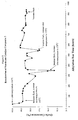
- Table III below and Figure 1 show the reactivation data collected during the alkylation reactions conducted as in Example 9.
- Table III Experiment Catalyst Composite Run Number Inlet Temperature (°C) Alkylation Run Time (hours) Benzene Flush After Run (hours) 1 3 1 154 57* 18 1 3 2 162 294 17 1 3 3 170 198 Weekend end **** 1 3 4 172 363 16 1 3 5 172 30 ** -- 2 3 1 154 184 25 2 3 2 174 96 *** 43 2 3 3 190 217 -- 3 Comparative A 1 176 44 43 3 Comparative A 2 159 24 -- * The concentration of the unreacted olefin was observed to increase rapidly which was presumed to indicate deactivation of Catalyst Composite 3.
- a benzene flush was conducted to reactivate Catalyst Composite 3. ** The experiment was conducted to determine whether a shorter period of benzene flush, 16 hours, would be sufficient to reactivate Catalyst Composite 3. The alkylation run was stopped after 30 hours, but it is believed that the alkylation run could have been allowed to run for a longer period of time. *** Comparative Catalyst A was observed to deactivate very rapidly. A benzene flush of 43 hours did not reactivate Comparative Catalyst A. **** The benzene flush was started on Friday evening by stopping the flow of the olefin feed to the reactor and allowed to continue until the following Monday morning, at which time the flow of the olefin feed was again started.
Landscapes
- Chemical & Material Sciences (AREA)
- Organic Chemistry (AREA)
- Chemical Kinetics & Catalysis (AREA)
- Engineering & Computer Science (AREA)
- Materials Engineering (AREA)
- Crystallography & Structural Chemistry (AREA)
- Organic Low-Molecular-Weight Compounds And Preparation Thereof (AREA)
- Low-Molecular Organic Synthesis Reactions Using Catalysts (AREA)
- Catalysts (AREA)
Claims (28)
- Formkatalysator mit makroporöser Struktur, umfassend Mordenit-Zeolith mit einem Molverhältnis von Siliciumdioxid zu Aluminiumoxid im Bereich von 50:1 bis 105:1 und ein Bindemittel, worin der höchste Makroporen-Durchmesser des Katalysators, gemessen nach ASTM Test No. 4284-03, weniger als 900 Ångström und mehr als 500 Ångström beträgt und das gesamte Porenvolumen des Katalysators von Porendurchmessern weniger oder gleich 500 Ångström, gemessen nach ASTM Test No. 4284-03, weniger oder gleich 0,30 Milliliter pro Gramm beträgt.
- Formkatalysator gemäß Anspruch 1, worin das gesamte Porenvolumen des Katalysators von Porendurchmessern weniger oder gleich 300 Ångström weniger oder gleich 0,25 Milliliter pro Gramm beträgt.
- Formkatalysator gemäß Anspruch 2, worin das gesamte Porenvolumen des Katalysators von Porendurchmessern weniger oder gleich 300 Ångström weniger oder gleich 0,20 Milliliter pro Gramm beträgt.
- Formkatalysator gemäß Anspruch 3, worin das gesamte Porenvolumen des Katalysators von Porendurchmessern weniger oder gleich 400 Ångström im Bereich von 0,05 Milliliter pro Gramm bis 0,18 Milliliter pro Gramm liegt.
- Formkatalysator gemäß Anspruch 4, worin das gesamte Porenvolumen des Katalysators von Porendurchmessern weniger oder gleich 300 Ångström im Bereich von 0,08 Milliliter pro Gramm bis 0,16 Milliliter pro Gramm liegt.
- Formkatalysator gemäß Anspruch 1, worin der höchste Makroporen-Durchmesser des Katalysators bis zu 800 Ångström beträgt.
- Formkatalysator gemäß Anspruch 6, worin der höchste Makroporen-Durchmesser des Katalysators bis zu 700 Ångström beträgt.
- Formkatalysator gemäß Anspruch 7, worin der höchste Makroporen-Durchmesser des Katalysators bis zu 600 Ångström beträgt.
- Formkatalysator gemäß Anspruch 1, worin das Mordenit-Zeolith ein Molverhältnis von Siliciumdioxid zu Aluminiumoxid im Bereich von 65:1 bis 95:1 hat.
- Formkatalysator gemäß Anspruch 9, worin das Mordenit-Zeolith ein Molverhältnis von Siliciumdioxid zu Aluminiumoxid im Bereich von 75:1 bis 90:1 hat.
- Formkatalysator gemäß Anspruch 1 in Form einer Tablette.
- Formkatalysator gemäß Anspruch 1, worin das Bindemittel ein geeignetes mineralisches Material ist.
- Formkatalysator gemäß Anspruch 12, worin das Bindemittel Aluminiumoxid ist.
- Formkatalysator gemäß Anspruch 1, worin das Mordenit-Zeolith im Bereich von 50 Gew.-% bis 99 Gew.-% auf Basis des gesamten Trockengewichts des Katalysatorverbundstoffs vorhanden ist.
- Formkatalysator gemäß Anspruch 14, worin das Mordenit-Zeolith im Bereich von 60 Gew.-% bis 90 Gew.-% auf Basis des gesamten Trockengewichts des Katalysatorverbundstoffs vorhanden ist.
- Herstellungsverfahren für eine alkylierte aromatische Zusammensetzung, umfassend Zusammenbringen von mindestens einem aromatischen Kohlenwasserstoff mit mindestens einem Olefin unter Alkylierungsbedingungen in Anwesenheit des Formkatalysators aus Anspruch 1.
- Herstellungsverfahren gemäß Anspruch 16, zudem umfassend einen Schritt, bei dem der Formkatalysator mit einer Spülung mit aromatischem Kohlenwasserstoff reaktiviert wird.
- Herstellungsverfahren gemäß Anspruch 17, worin der Formkatalysator mit einer Benzolspülung reaktiviert wird.
- Herstellungsverfahren gemäß Anspruch 16, worin der aromatische Kohlenwasserstoff Benzol oder Toluol ist.
- Herstellungsverfahren gemäß Anspruch 19, worin das Olefin ein alpha-Olefin, ein isomerisiertes Olefin, ein verzweigtes Olefin oder eine von deren Mischungen ist.
- Herstellungsverfahren gemäß Anspruch 20, worin das Olefin zwischen 4 Kohlenstoffatome und 80 Kohlenstoffatome aufweist.
- Herstellungsverfahren gemäß Anspruch 20, worin das alpha-Olefin oder das isomerisierte Olefin zwischen 6 Kohlenstoffatome und 60 Kohlenstoffatome aufweist.
- Herstellungsverfahren gemäß Anspruch 22, worin das alpha-Olefin oder das isomerisierte Olefin zwischen 20 Kohlenstoffatome und 40 Kohlenstoffatome aufweist.
- Herstellungsverfahren gemäß Anspruch 20, worin das verzweigte Olefin zwischen 6 Kohlenstoffatome und 70 Kohlenstoffatome aufweist.
- Herstellungsverfahren gemäß Anspruch 24, worin das verzweigte Olefin zwischen 8 Kohlenstoffatome und 50 Kohlenstoffatome aufweist.
- Herstellungsverfahren gemäß Anspruch 25, worin das verzweigte Olefin zwischen 12 Kohlenstoffatome und 18 Kohlenstoffatome aufweist.
- Herstellungsverfahren gemäß Anspruch 20, worin das Olefin ein teilweise verzweigtes isomerisiertes Olefin ist, worin das Olefin zwischen 6 Kohlenstoffatome und 40 Kohlenstoffatome aufweist.
- Herstellungsverfahren gemäß Anspruch 27, worin das teilweise verzweigte isomerisierte Olefin zwischen 20 Kohlenstoffatome und 40 Kohlenstoffatome aufweist.
Priority Applications (1)
| Application Number | Priority Date | Filing Date | Title |
|---|---|---|---|
| EP10161808A EP2223744A1 (de) | 2004-03-12 | 2005-02-04 | Verfahren zur Herstellung von Mordenitkatalysatorzusammensetzungen für die Alkylierung von aromatischen Kohlenwasserstoffen |
Applications Claiming Priority (2)
| Application Number | Priority Date | Filing Date | Title |
|---|---|---|---|
| US800099 | 2004-03-12 | ||
| US10/800,099 US6964935B2 (en) | 2004-03-12 | 2004-03-12 | Mordenite zeolite alkylation catalysts |
Publications (3)
| Publication Number | Publication Date |
|---|---|
| EP1584374A2 EP1584374A2 (de) | 2005-10-12 |
| EP1584374A3 EP1584374A3 (de) | 2006-07-05 |
| EP1584374B1 true EP1584374B1 (de) | 2010-06-02 |
Family
ID=34912622
Family Applications (2)
| Application Number | Title | Priority Date | Filing Date |
|---|---|---|---|
| EP05250656A Ceased EP1584374B1 (de) | 2004-03-12 | 2005-02-04 | Mordenitkatalysator für die Alkylierung von aromatischen Kohlenwasserstoffen |
| EP10161808A Withdrawn EP2223744A1 (de) | 2004-03-12 | 2005-02-04 | Verfahren zur Herstellung von Mordenitkatalysatorzusammensetzungen für die Alkylierung von aromatischen Kohlenwasserstoffen |
Family Applications After (1)
| Application Number | Title | Priority Date | Filing Date |
|---|---|---|---|
| EP10161808A Withdrawn EP2223744A1 (de) | 2004-03-12 | 2005-02-04 | Verfahren zur Herstellung von Mordenitkatalysatorzusammensetzungen für die Alkylierung von aromatischen Kohlenwasserstoffen |
Country Status (6)
| Country | Link |
|---|---|
| US (2) | US6964935B2 (de) |
| EP (2) | EP1584374B1 (de) |
| JP (1) | JP4132058B2 (de) |
| CA (1) | CA2496347C (de) |
| DE (1) | DE602005021575D1 (de) |
| SG (1) | SG115752A1 (de) |
Families Citing this family (16)
| Publication number | Priority date | Publication date | Assignee | Title |
|---|---|---|---|---|
| US6977319B2 (en) * | 2004-03-12 | 2005-12-20 | Chevron Oronite Company Llc | Alkylated aromatic compositions, zeolite catalyst compositions and processes for making the same |
| US7479568B2 (en) * | 2005-11-30 | 2009-01-20 | Chevron Oronite Company Llc | Process for making alkaline earth metal borated sulfonates |
| EP2024467A2 (de) * | 2006-05-19 | 2009-02-18 | The Procter and Gamble Company | Verfahren zur decarboxylierung von fettsäuren und ölen zur herstellung von paraffinen oder olefinen |
| US8349754B2 (en) | 2008-03-26 | 2013-01-08 | Council Of Scientific & Industrial Research | Modified zeolite catalyst useful for the conversion of paraffins, olefins and aromatics in a mixed feedstock into isoparaffins and a process thereof |
| US8105969B2 (en) * | 2008-12-29 | 2012-01-31 | Fina Technology Inc. | Catalyst with an ion-modified binder |
| US20110136711A1 (en) * | 2009-12-03 | 2011-06-09 | Chevron Oronite Company Llc | Highly overbased magnesium alkytoluene sulfonates |
| CN102527429B (zh) * | 2010-12-30 | 2014-02-19 | 中国石油化工股份有限公司 | 用于将正丁烯异构化制备异丁烯的催化剂、其制备方法及其应用 |
| JP6091006B2 (ja) * | 2013-09-30 | 2017-03-08 | 東洋ゴム工業株式会社 | 空気入りタイヤの製造方法及び空気入りタイヤ |
| CN106257984B (zh) | 2014-05-08 | 2019-08-30 | 陶氏环球技术有限责任公司 | 可用于粘结玻璃的可湿致固化聚氨酯粘合剂组合物的加速固化 |
| JP6228246B2 (ja) * | 2015-03-03 | 2017-11-08 | エボニック デグサ ゲーエムベーハーEvonik Degussa GmbH | エテンのオリゴマー化に使用される不均一系触媒の再生 |
| US10099979B2 (en) | 2015-11-13 | 2018-10-16 | Massachusetts Institute Of Technology | Catalytic methods for the production of an alcohol from an alkane |
| CN108786903B (zh) * | 2017-05-02 | 2020-09-11 | 中国石油化工股份有限公司 | 一种烯烃歧化催化剂及其制备方法 |
| WO2020022868A1 (ko) | 2018-07-27 | 2020-01-30 | 에스케이이노베이션 주식회사 | 입자 균일도가 우수한 모데나이트 제올라이트 및 그 제조방법 |
| KR102020445B1 (ko) | 2018-09-21 | 2019-09-10 | 에스케이이노베이션 주식회사 | 입자 크기의 제어가 가능한 모데나이트 제올라이트의 제조방법 |
| US12048919B2 (en) | 2020-03-31 | 2024-07-30 | Massachusetts Institute Of Technology | Catalytic compositions for the oxidation of substrates |
| US12590044B2 (en) | 2023-06-13 | 2026-03-31 | Saudi Arabian Oil Company | Methods of preparing cracking catalyst with alumina binder and phosphoric acid |
Family Cites Families (46)
| Publication number | Priority date | Publication date | Assignee | Title |
|---|---|---|---|---|
| US500841A (en) * | 1893-07-04 | Incandescent-lamp globe | ||
| US3119660A (en) | 1960-09-26 | 1964-01-28 | Union Carbide Corp | Process for producing molecular sieve bodies |
| US3094383A (en) | 1960-12-16 | 1963-06-18 | Minerals & Chem Philipp Corp | Method for making synthetic zeolitic material |
| US3130007A (en) * | 1961-05-12 | 1964-04-21 | Union Carbide Corp | Crystalline zeolite y |
| US3288718A (en) * | 1963-11-26 | 1966-11-29 | Us Envelope Co | Sterilization indicator coating |
| US3288716A (en) | 1964-09-10 | 1966-11-29 | Continental Oil Co | Method of lubrication employing synthetic hydrocarbon lubricants |
| US3641177A (en) | 1969-11-26 | 1972-02-08 | Exxon Research Engineering Co | Alkylation of aromatic hydrocarbons |
| US3764533A (en) | 1970-08-07 | 1973-10-09 | Continental Oil Co | Oil soluble dialkaryl sulfonate compositions |
| US3929672A (en) | 1971-10-20 | 1975-12-30 | Union Oil Co | Ammonia-stable Y zeolite compositions |
| US3777006A (en) | 1972-01-21 | 1973-12-04 | Grace W R & Co | Process for preparing zeolitic bodies having high strength characteristics |
| US4107086A (en) * | 1976-03-29 | 1978-08-15 | Uop Inc. | Catalytic composite and method of manufacture |
| US4123390A (en) * | 1976-11-15 | 1978-10-31 | Union Carbide Corporation | Zeolite agglomerates having controlled pore structure |
| DE2861399D1 (en) | 1977-08-04 | 1982-01-28 | Exxon Research Engineering Co | Overbased monoalkyl orthoxylene and monoalkyl toluene sulfonates and use as lubricant additives |
| US4185040A (en) | 1977-12-16 | 1980-01-22 | Union Oil Company Of California | Alkylation of aromatic hydrocarbons |
| US4301317A (en) * | 1979-11-20 | 1981-11-17 | Mobil Oil Corporation | Preparation of 2-phenylalkanes |
| US4395372A (en) * | 1982-08-09 | 1983-07-26 | Shell Oil Company | Alkylation process |
| FR2564830B1 (fr) | 1984-05-25 | 1986-09-19 | Orogil | Procede de preparation d'alkylaryl sulfonates de metaux alcalino-terreux a partir d'acides alkylaryl sulfoniques lineaires et additifs detergents-dispersants pour huiles lubrifiantes ainsi obtenus |
| GB8613132D0 (en) * | 1986-05-30 | 1986-07-02 | Shell Int Research | Hydrocarbon conversion catalysts |
| US4876408A (en) * | 1986-12-19 | 1989-10-24 | Union Oil Company Of California | Alkylation process using a catalyst having an increased selectivity for monoalkylation |
| FR2622474B2 (fr) * | 1987-04-03 | 1990-01-26 | Azote & Prod Chim | Composition catalytique de reduction selective des oxydes d'azote contenus dans des effluents gazeux oxygenes et procede d'epuration desdits effluents |
| GB8723907D0 (en) | 1987-10-12 | 1987-11-18 | Exxon Chemical Patents Inc | Overbased metal sulphonate composition |
| US4891448A (en) | 1987-11-23 | 1990-01-02 | The Dow Chemical Company | Alkylation of polycyclic aromatic compounds to alkylates enriched in the para-substituted isomers |
| US5243116A (en) | 1987-11-23 | 1993-09-07 | The Dow Chemical Company | Alkylation of aromatic compounds |
| US5004841A (en) | 1987-11-23 | 1991-04-02 | The Dow Chemical Company | Alkylation of aromatic compounds to alkylates enriched in the linear-substituted isomers |
| US5175135A (en) | 1987-11-23 | 1992-12-29 | The Dow Chemical Company | Alkylation of aromatic compounds to alkylates enriched in the linear substituted isomers |
| US5198595A (en) | 1987-11-23 | 1993-03-30 | The Dow Chemical Company | Alkylation of aromatic compounds |
| EP0432132B1 (de) * | 1988-03-28 | 1993-12-08 | Tosoh Corporation | Verfahren für die Herstellung von mono- und diisopropylnaphthalen |
| EP0424393B1 (de) | 1988-05-09 | 1995-08-09 | Abb Lummus Global Inc. | Herstellung von alkylbenzolen |
| FR2638157B1 (fr) * | 1988-10-26 | 1991-04-19 | Inst Francais Du Petrole | Procede de production d'alkylbenzenes utilisant un catalyseur a base de mordenite modifiee |
| US5069890A (en) * | 1989-06-19 | 1991-12-03 | Texaco Inc. | Zeolite treating process |
| JPH06239771A (ja) | 1989-12-22 | 1994-08-30 | Dow Chem Co:The | ベンゼンもしくは置換ベンゼンのアルキル化またはアルキル化ベンゼンのトランスアルキル化の方法および触媒組成物 |
| US5112508A (en) * | 1990-04-30 | 1992-05-12 | Texaco, Inc. | VI improver, dispersant, and antioxidant additive and lubricating oil composition |
| FR2664264B1 (fr) * | 1990-07-09 | 1992-09-18 | Inst Francais Du Petrole | Procede de production de 2- et 3-phenylalcanes utilisant un catalyseur a base de mordenite modifiee. |
| US5118896A (en) | 1990-10-31 | 1992-06-02 | Amoco Corporation | Aromatic alkylation process using large macropore, small particle size, zeolite catalyst |
| DE69129843T2 (de) * | 1991-03-21 | 1999-03-11 | Solutia Europe N.V./S.A., Bruessel/Bruxelles | Verbessertes katalytisches Verfahren zur selektiven Alkylierung von aromatischen Kohlenwasserstoffen |
| US5191135A (en) | 1991-03-25 | 1993-03-02 | Mobil Oil Corporation | Aromatics alkylation process |
| CA2111101A1 (en) * | 1991-06-21 | 1993-01-07 | Guo S. J. Lee | Alkylation of aromatic compounds |
| ES2098445T3 (es) | 1992-04-06 | 1997-05-01 | Council Scient Ind Res | Procedimiento para la fabricacion de alquilbencenos lineales. |
| DE69511575T2 (de) * | 1994-11-23 | 2000-04-27 | Exxon Chemical Patents, Inc. | Verfahren zur umwandlung von kohlenwasserstoffen unter verwendung eines durch zeolith gebundenen zeolithkatalysators |
| FR2731427B1 (fr) | 1995-03-08 | 1997-05-30 | Chevron Chem Sa | Alkylaryl-sulfonates lineaires isomerises, utiles comme additifs pour huiles lubrifiantes et hydocarbures alkylaryliques correspondants |
| CA2204461C (en) | 1996-05-14 | 2006-07-04 | Thomas V. Harris | Process for producing an alkylated, non-oxygen-containing aromatic hydrocarbon |
| US6031144A (en) | 1997-08-06 | 2000-02-29 | Chevron Chemical Company Llc | Process for reducing the residual olefin content of an alkylation reaction product |
| US6337310B1 (en) | 2000-06-02 | 2002-01-08 | Chevron Oronite Company Llc | Alkylbenzene from preisomerized NAO usable in LOB and HOB sulfonate |
| US6579821B1 (en) * | 2000-06-14 | 2003-06-17 | Bechtel Bwxt Idaho, Llc | Method for reactivating solid catalysts used in alkylation reactions |
| US6525234B1 (en) | 2000-11-21 | 2003-02-25 | Exxonmobil Oil Corporation | Process for liquid phase aromatics alkylation comprising in-situ catalyst reactivation with polar compounds |
| KR100557558B1 (ko) * | 2000-11-30 | 2006-03-03 | 에스케이 주식회사 | 탄화수소 혼합물로부터 방향족 탄화수소 및 액화석유가스를 제조하는 방법 |
-
2004
- 2004-03-12 US US10/800,099 patent/US6964935B2/en not_active Expired - Lifetime
-
2005
- 2005-02-04 EP EP05250656A patent/EP1584374B1/de not_active Ceased
- 2005-02-04 EP EP10161808A patent/EP2223744A1/de not_active Withdrawn
- 2005-02-04 DE DE602005021575T patent/DE602005021575D1/de not_active Expired - Lifetime
- 2005-02-09 CA CA002496347A patent/CA2496347C/en not_active Expired - Fee Related
- 2005-03-09 SG SG200501486A patent/SG115752A1/en unknown
- 2005-03-14 JP JP2005071795A patent/JP4132058B2/ja not_active Expired - Fee Related
- 2005-07-20 US US11/186,155 patent/US7071370B2/en not_active Expired - Lifetime
Also Published As
| Publication number | Publication date |
|---|---|
| JP2005254236A (ja) | 2005-09-22 |
| DE602005021575D1 (de) | 2010-07-15 |
| EP1584374A3 (de) | 2006-07-05 |
| EP1584374A2 (de) | 2005-10-12 |
| CA2496347A1 (en) | 2005-09-12 |
| US7071370B2 (en) | 2006-07-04 |
| EP2223744A1 (de) | 2010-09-01 |
| SG115752A1 (en) | 2005-10-28 |
| JP4132058B2 (ja) | 2008-08-13 |
| CA2496347C (en) | 2010-01-05 |
| US20050203323A1 (en) | 2005-09-15 |
| US20060009669A1 (en) | 2006-01-12 |
| US6964935B2 (en) | 2005-11-15 |
Similar Documents
| Publication | Publication Date | Title |
|---|---|---|
| EP1574251B1 (de) | Verfahren zur Herstellung alkylierter aromatischer Zusammensetzungen | |
| US6964935B2 (en) | Mordenite zeolite alkylation catalysts | |
| CA2497958C (en) | Zeolite y alkylation catalysts | |
| US3849340A (en) | Hydrocarbon conversion catalyst | |
| EP1328475B1 (de) | Zeolithe und deren verwendung | |
| US8609921B1 (en) | Aromatic transalkylation using UZM-44 aluminosilicate zeolite | |
| JP2744511B2 (ja) | 長鎖アルキル芳香族化合物の製法 | |
| KR0178507B1 (ko) | 나프탈렌 알킬화 방법 | |
| US8921634B2 (en) | Conversion of methane to aromatic compounds using UZM-44 aluminosilicate zeolite | |
| Butruille et al. | Propene alkylation of biphenyl catalyzed by alumina pillared clays and related acidic oxides | |
| EP4090459B1 (de) | Uzm-54 und transalkylierungsverfahren unter verwendung desselben | |
| JPH0557193A (ja) | 有機化合物転化に使用するリン酸触媒成型物並びにその触媒を用いた有機化合物の転化方法 |
Legal Events
| Date | Code | Title | Description |
|---|---|---|---|
| PUAI | Public reference made under article 153(3) epc to a published international application that has entered the european phase |
Free format text: ORIGINAL CODE: 0009012 |
|
| AK | Designated contracting states |
Kind code of ref document: A2 Designated state(s): AT BE BG CH CY CZ DE DK EE ES FI FR GB GR HU IE IS IT LI LT LU MC NL PL PT RO SE SI SK TR |
|
| AX | Request for extension of the european patent |
Extension state: AL BA HR LV MK YU |
|
| PUAL | Search report despatched |
Free format text: ORIGINAL CODE: 0009013 |
|
| AK | Designated contracting states |
Kind code of ref document: A3 Designated state(s): AT BE BG CH CY CZ DE DK EE ES FI FR GB GR HU IE IS IT LI LT LU MC NL PL PT RO SE SI SK TR |
|
| AX | Request for extension of the european patent |
Extension state: AL BA HR LV MK YU |
|
| 17P | Request for examination filed |
Effective date: 20061009 |
|
| 17Q | First examination report despatched |
Effective date: 20061128 |
|
| 17Q | First examination report despatched |
Effective date: 20061128 |
|
| AKX | Designation fees paid |
Designated state(s): DE FR GB NL |
|
| GRAP | Despatch of communication of intention to grant a patent |
Free format text: ORIGINAL CODE: EPIDOSNIGR1 |
|
| GRAS | Grant fee paid |
Free format text: ORIGINAL CODE: EPIDOSNIGR3 |
|
| GRAA | (expected) grant |
Free format text: ORIGINAL CODE: 0009210 |
|
| AK | Designated contracting states |
Kind code of ref document: B1 Designated state(s): DE FR GB NL |
|
| REG | Reference to a national code |
Ref country code: GB Ref legal event code: FG4D |
|
| REF | Corresponds to: |
Ref document number: 602005021575 Country of ref document: DE Date of ref document: 20100715 Kind code of ref document: P |
|
| REG | Reference to a national code |
Ref country code: NL Ref legal event code: T3 |
|
| PLBE | No opposition filed within time limit |
Free format text: ORIGINAL CODE: 0009261 |
|
| STAA | Information on the status of an ep patent application or granted ep patent |
Free format text: STATUS: NO OPPOSITION FILED WITHIN TIME LIMIT |
|
| 26N | No opposition filed |
Effective date: 20110303 |
|
| REG | Reference to a national code |
Ref country code: DE Ref legal event code: R097 Ref document number: 602005021575 Country of ref document: DE Effective date: 20110302 |
|
| REG | Reference to a national code |
Ref country code: FR Ref legal event code: PLFP Year of fee payment: 12 |
|
| REG | Reference to a national code |
Ref country code: FR Ref legal event code: PLFP Year of fee payment: 13 |
|
| PGFP | Annual fee paid to national office [announced via postgrant information from national office to epo] |
Ref country code: NL Payment date: 20170210 Year of fee payment: 13 |
|
| REG | Reference to a national code |
Ref country code: FR Ref legal event code: PLFP Year of fee payment: 14 |
|
| REG | Reference to a national code |
Ref country code: NL Ref legal event code: MM Effective date: 20180301 |
|
| PG25 | Lapsed in a contracting state [announced via postgrant information from national office to epo] |
Ref country code: NL Free format text: LAPSE BECAUSE OF NON-PAYMENT OF DUE FEES Effective date: 20180301 |
|
| REG | Reference to a national code |
Ref country code: DE Ref legal event code: R082 Ref document number: 602005021575 Country of ref document: DE Representative=s name: HL KEMPNER PATENTANWALT, RECHTSANWALT, SOLICIT, DE |
|
| PGFP | Annual fee paid to national office [announced via postgrant information from national office to epo] |
Ref country code: FR Payment date: 20210113 Year of fee payment: 17 |
|
| PGFP | Annual fee paid to national office [announced via postgrant information from national office to epo] |
Ref country code: DE Payment date: 20210119 Year of fee payment: 17 Ref country code: GB Payment date: 20210127 Year of fee payment: 17 |
|
| REG | Reference to a national code |
Ref country code: DE Ref legal event code: R119 Ref document number: 602005021575 Country of ref document: DE |
|
| GBPC | Gb: european patent ceased through non-payment of renewal fee |
Effective date: 20220204 |
|
| PG25 | Lapsed in a contracting state [announced via postgrant information from national office to epo] |
Ref country code: FR Free format text: LAPSE BECAUSE OF NON-PAYMENT OF DUE FEES Effective date: 20220228 |
|
| PG25 | Lapsed in a contracting state [announced via postgrant information from national office to epo] |
Ref country code: GB Free format text: LAPSE BECAUSE OF NON-PAYMENT OF DUE FEES Effective date: 20220204 Ref country code: DE Free format text: LAPSE BECAUSE OF NON-PAYMENT OF DUE FEES Effective date: 20220901 |
|
| P01 | Opt-out of the competence of the unified patent court (upc) registered |
Effective date: 20230530 |