EP1596502A2 - Apparat zur Schätzung der Rauschleistung, Verfahren zur Schätzung der Rauschleistung and Signaldetektor - Google Patents
Apparat zur Schätzung der Rauschleistung, Verfahren zur Schätzung der Rauschleistung and Signaldetektor Download PDFInfo
- Publication number
- EP1596502A2 EP1596502A2 EP05252919A EP05252919A EP1596502A2 EP 1596502 A2 EP1596502 A2 EP 1596502A2 EP 05252919 A EP05252919 A EP 05252919A EP 05252919 A EP05252919 A EP 05252919A EP 1596502 A2 EP1596502 A2 EP 1596502A2
- Authority
- EP
- European Patent Office
- Prior art keywords
- power
- received
- signal
- pilot signal
- noise power
- Prior art date
- Legal status (The legal status is an assumption and is not a legal conclusion. Google has not performed a legal analysis and makes no representation as to the accuracy of the status listed.)
- Granted
Links
Images



Classifications
-
- H—ELECTRICITY
- H04—ELECTRIC COMMUNICATION TECHNIQUE
- H04B—TRANSMISSION
- H04B1/00—Details of transmission systems, not covered by a single one of groups H04B3/00 - H04B13/00; Details of transmission systems not characterised by the medium used for transmission
- H04B1/06—Receivers
- H04B1/10—Means associated with receiver for limiting or suppressing noise or interference
-
- H—ELECTRICITY
- H04—ELECTRIC COMMUNICATION TECHNIQUE
- H04B—TRANSMISSION
- H04B17/00—Monitoring; Testing
- H04B17/30—Monitoring; Testing of propagation channels
- H04B17/309—Measuring or estimating channel quality parameters
- H04B17/345—Interference values
-
- H—ELECTRICITY
- H04—ELECTRIC COMMUNICATION TECHNIQUE
- H04B—TRANSMISSION
- H04B7/00—Radio transmission systems, i.e. using radiation field
- H04B7/02—Diversity systems; Multi-antenna system, i.e. transmission or reception using multiple antennas
- H04B7/04—Diversity systems; Multi-antenna system, i.e. transmission or reception using multiple antennas using two or more spaced independent antennas
- H04B7/08—Diversity systems; Multi-antenna system, i.e. transmission or reception using multiple antennas using two or more spaced independent antennas at the receiving station
- H04B7/0837—Diversity systems; Multi-antenna system, i.e. transmission or reception using multiple antennas using two or more spaced independent antennas at the receiving station using pre-detection combining
- H04B7/0842—Weighted combining
- H04B7/0848—Joint weighting
- H04B7/0854—Joint weighting using error minimizing algorithms, e.g. minimum mean squared error [MMSE], "cross-correlation" or matrix inversion
-
- H—ELECTRICITY
- H04—ELECTRIC COMMUNICATION TECHNIQUE
- H04W—WIRELESS COMMUNICATION NETWORKS
- H04W52/00—Power management, e.g. Transmission Power Control [TPC] or power classes
- H04W52/04—Transmission power control [TPC]
- H04W52/30—Transmission power control [TPC] using constraints in the total amount of available transmission power
- H04W52/32—TPC of broadcast or control channels
- H04W52/325—Power control of control or pilot channels
-
- H—ELECTRICITY
- H04—ELECTRIC COMMUNICATION TECHNIQUE
- H04B—TRANSMISSION
- H04B2201/00—Indexing scheme relating to details of transmission systems not covered by a single group of H04B3/00 - H04B13/00
- H04B2201/69—Orthogonal indexing scheme relating to spread spectrum techniques in general
- H04B2201/707—Orthogonal indexing scheme relating to spread spectrum techniques in general relating to direct sequence modulation
- H04B2201/70701—Orthogonal indexing scheme relating to spread spectrum techniques in general relating to direct sequence modulation featuring pilot assisted reception
-
- H—ELECTRICITY
- H04—ELECTRIC COMMUNICATION TECHNIQUE
- H04W—WIRELESS COMMUNICATION NETWORKS
- H04W52/00—Power management, e.g. Transmission Power Control [TPC] or power classes
- H04W52/04—Transmission power control [TPC]
- H04W52/06—TPC algorithms
- H04W52/16—Deriving transmission power values from another channel
Definitions
- the present invention relates to a field of radio communications. More particularly, the present invention relates to a signal detection apparatus used in a radio receiver, and an apparatus and a method for estimating a noise power used for signal detection.
- MIMO Multi Input Multi Output
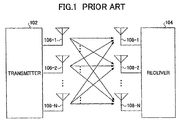
- Fig.1 is a schematic diagram of a communication system of the MIMO scheme including a transmitter 102 and a receiver 104.
- different signals are transmitted from plural transmission antennas 106-1 ⁇ N at the same time with the same frequency.
- These transmission signals are received by plural receiving antennas 108-1 ⁇ N.
- each number of the transmission antennas and the receiving antennas is N, but the numbers may be different between the transmitter and the receiver.
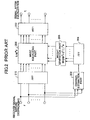
- Fig.2 shows a part relating to signal separation in the receiver 104.
- the receiver receives signals transmitted from the plural transmission antennas with the plural receiving antennas, a signal detection part detects the transmission signals, and the transmission signals are separated to signals for each transmission antenna.
- the signal separation is performed by signal processing in the two-dimensional frequency domain by using the Minimum Mean Square Error (MMSE) method.
- Received signals (r) received by each receiving antenna are supplied to a channel estimation part 202.
- the channel estimation part 202 obtains channel impulse responses or channel estimation values between the transmission antennas and the receiving antennas.
- the channel estimation result is supplied to a fast Fourier transform part (FFT) 204 to be converted to information in the frequency domain and supplied to a weight generation part 206.
- FFT fast Fourier transform part
- the superscript "H” indicates transposed conjugate.
- the received signals (r) are also supplied to a fast Fourier transform part 210, and are converted to signals in the frequency domain so that the signals are supplied to a MMSE equalizing part 208.
- the MMSE equalizing part 208 substantially performs signal separation by multiplying the received signals in the frequency domain by a weight W H .
- the separated signals are supplied to an inverse fast Fourier transform part 212 so that the signals are converted to signals in the time domain, and the signals are output as estimated signals t that are separated for each transmission antenna.
- Japanese Laid-Open Patent Application No. 2003-124907 discloses using a signal-to-noise ratio in the MIMO scheme.
- An object of the present invention is to provide a noise power estimation apparatus, a noise power estimation method and a signal detection apparatus for estimating a chip noise power used for weight calculation in the MMSE equalizer with high precision.
- noise power estimation apparatus including:
- the noise power used for weight calculation in the MMSE equalizer and the like can be estimated with high precision.
- the noise power is estimated such that the effect of the multipath interference is removed.
- the noise power can be estimated more correctly compared with the conventional technology. Therefore, the weight used for signal separation can be obtained correctly, so that the accuracy of the signal separation can be improved.
- the noise power can be recursively updated by using a recurrence formula including an oblivion coefficient.
- the noise power can be adaptively updated according to a communication environment, so that the calculation accuracy of the weights and the signal separation accuracy can be further improved.
- the multipath interference component can be obtained by accumulating, for plural paths and for plural transmission antennas, a product of the received power of the pilot signal and a constant including the predetermined power ratio.
- the multipath interference component can be obtained easily and with reliability.
- Fig.3 shows a part relating to a signal detection apparatus in the receiver 104.
- the receiver receives signals transmitted from N transmission antennas with N receiving antennas, detects transmission signals, and separates signals for each transmission antenna.
- the signal separation is performed by signal processing in the two-dimensional frequency domain by using the MMSE (Minimum Mean Square Error) method. Instead of using the frequency domain, equalization by MMSE can be also performed in the time domain. But, in view of simplicity of calculation, it is desirable to perform signal processing in the frequency domain like the present embodiment.
- both of the numbers of the transmission antennas and the receiving antennas are N in this embodiment, the numbers may be different.
- the receiver includes a channel estimation part 302, a noise estimation part 304, fast Fourier transform parts (FFT) 306 and 308, a weight generation part 310, a MMSE equalizing part 312 and an inverse fast Fourier transform part (IFFT) 314.
- FFT fast Fourier transform parts
- IFFT inverse fast Fourier transform part
- the channel estimation part 302 calculates channel impulse responses (CIR) or channel estimated values between the transmission antennas and the receiving antennas based on the received signals and pilot signals.
- CIR channel impulse responses
- the noise estimation part 304 estimates a noise power or a chip noise power ⁇ 2 based on the received signals. More detailed configurations and operations of the noise estimation part 304 are described later.
- Each of the fast Fourier transform parts 306 and 308 performs fast Fourier transform on input signals so as to transform the signals to signals in the frequency domain.
- the inverse fast Fourier transform part 314 performs inverse fast Fourier transform on input signals so as to transform the input signals to the signals in the time domain.
- the weight generation part 310 obtains the weight W used in the MMSE equalizing part 312 based on the channel estimation result and the noise power.
- the noise power ideally includes only a noise arisen in the receiver and does not include a noise applied in the outside of the receiver (for example, signal interference applied in a propagation route). However, the noise power includes the noise in the outside of the receiver in actuality. Therefore, the noise power needs to be precisely estimated in the following way.
- each of the channel matrix H and the weight matrix becomes a N x N square matrix.
- the channel matrix is a M x N matrix
- HH H becomes a M x M square matrix
- the weight matrix W becomes a M x N matrix.
- N represents the number of the transmission antennas
- M indicates the number of receiving antennas.
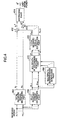
- Fig.4 is a block diagram of the noise estimation part 304 according to an embodiment of the present invention.
- the noise estimation part 304 includes a total received signal power measuring part 402, a pilot received power estimation part 404, a multipath interference generation part 406, a multipath interference removing part 408, a total received signal power estimation part 410, a subtraction part 412 and an averaging part 414.
- the number M of the receiving antennas is the same as the number N of the transmission antennas.
- the total received signal power measuring part 402 obtains a total received power for each receiving antenna.
- the pilot received power estimation part 404 calculates a received power P nml of a pilot signal for each path by the following equation: wherein n is a parameter indicating a transmission antenna, 1 is a parameter that specifies a path in assumed L paths, ⁇ 1 indicates a delay amount of a 1-th path, * indicates complex conjugate, Nc indicates the number of chips in one frame and specifies the number of chips or a size of a window of a range in which correlation calculation is performed, c n (t) is a code series indicating a pilot signal relating to a n-th transmission antenna.
- the multipath interference generation part 406 calculates multipath interference components included in pilot signals for each path.
- Fig.5 is a conceptual diagram for explaining relationships among transmission signal, received signal and the multipath interference component.
- two transmission antennas Tx1 and Tx2 transmit pilot signals c 1 and c 2 respectively, and the signals are transmitted under a multipath propagation environment and received by a receiving antenna Rx1.
- Rx1 receives pilot signals c 1 and c 2 respectively.
- the number of antennas and the number of paths are assumed as mentioned above, greater numbers can be assumed.
- a power obtained based on a correlation between signals received by the receiving antenna Rx1 and the pilot signal c 1 includes a multipath interference component of Tx1 from the path 2 and a multipath interference component of Tx2 from the path 2 in addition to a power of Tx1 from the path 1.
- multipath interference components appear according to the number of paths.
- the number of transmission antennas increase, multipath interference components appear according to the increased number of transmission antennas.
- the multipath interference component generation part 406 in Fig.4 obtains the multipath interference components for each path.
- the multipath interference removing part 408 calculates a corrected received power P' nml of the pilot signal for each path by subtracting multipath interference component from the received power of the pilot signal for each path obtained in the pilot received power estimation part 404 based on the following equation: wherein (1+ ⁇ )P n'ml' indicates a total power (of the pilot signal and the data signal) of a l' -th path in signals from a n' -th transmission antenna.
- summation relating to 1' is performed for all paths excluding the own (l-th) path
- summation relating to n' is performed for all transmission antennas
- Nc indicates the number of chips in one frame
- 1/Nc is introduced in a term indicating the multipath interference component for obtaining multipath interference per chip.
- the total received signal power estimation part 410 estimates the total received power of the pilot signals received by a m-th receiving antenna by further correcting the corrected received power of the pilot signal for each path.
- the total received power of the pilot signals received by a m-th receiving antenna can be mostly calculated by adding, for all paths and for all transmission antennas, the corrected received power P' nml of the pilot signal for each path.
- the signal received by each receiving antenna includes a side lobe component in addition to a main lobe since the signal passes through a roll-off filter (band limitation filter).
- the received power of the pilot signal includes the side lobe component, so that the amount of the received signal power is evaluated to be larger than an actual amount to some extent.
- the side lobe component can be compensated based on the known response characteristics.
- ⁇ Tc) of the one chip period can be associated with the main lobe (actual signal component of the path), and a range (
- Correction on the side lobe component mainly relates to summation for the parameters t and c. By performing summation for all paths (parameter 1) and all antennas (parameter n), the total received power P all,m of the pilot signals received by the m-th receiving antenna can be estimated.
- the updating method of the noise power is not limited to the above mentioned method using the oblivion coefficient.
- the update can be performed by using other recurrence formulas. Further, weighting coefficient can be appropriately adjusted when averaging the noise powers in the receiving antennas.
- the noise power ⁇ 2 is estimated based on received signals on which despreading has not been performed.
- the noise power ⁇ 2 is estimated based on despread received signals.
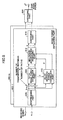
- Fig.8 is a block diagram of the noise estimation part according to the present embodiment.
- the noise estimation part includes M noise power estimation parts 802-1 ⁇ M each being provided for a corresponding receiving antenna, and an averaging part 804 among antennas.
- Fig.8 shows only two noise power estimation parts 802-1 and 802-m. Since each of the noise power estimation parts has the same configuration and operates in the same way, the noise power estimation part 802-1 is described as an example.
- the noise power estimation part 802-1 includes a despreading part 806, a total noise power estimation part 808, a pilot received power estimation part 810, a multipath interference removing part 812 and an averaging part 814.
- the total noise power estimation part 808 calculates total noise powers I nml each being proportional to dispersion of the despread pilot signal for each path according to the following equation: wherein Z nml is an amount calculated by the following equation: wherein this equation means calculating an average value of the despread pilot signals Z nml (s) for S symbols.
- Z nml is an amount calculated by the following equation: wherein this equation means calculating an average value of the despread pilot signals Z nml (s) for S symbols.
- the term inside the parentheses indicates an amount of dispersion of the despread pilot signal Z nml . Therefore, the total noise power I nml indicates power including noise arising in the receiver, interference included in the propagation route and other noise.
- 2 that has been averaged for the S symbols is decreased to 1/S of the interference component of the before-averaged received power
- the multipath interference removing part 812 removes multipath interference component from the total noise power I nml so as to estimate the noise power (chip noise power) ⁇ nml 2 according to the following equation: wherein ⁇ indicates a predetermined power ratio between the pilot signal and the data signal (refer to Fig.6), (1+ ⁇ )P n'ml' inside the parentheses in the right side indicates a total power (of the pilot signal and the data signal) of a l' -th path in signals from a n' -th transmission antenna, summation for 1' is performed for all paths excluding the own 1-th path, summation for n' is performed for all transmission antennas, N SF indicates a spreading ratio or a chip rate of the pilot signal, and N SF is 256, for example.
- 1/N SF is introduced in the second term (indicating multipath interference) inside the parentheses in the right side.
- the right side is multiplied by N SF to estimate the chip noise power.
- the averaging part 814 averages the noise powers ⁇ nml 2 for plural transmission antennas (n) and the paths (1). Further, the averaging part 804 averages the noise powers for the plural receiving antennas (m) to finally estimate a desired noise power ⁇ 2 . Since the effect of the multipath interference is removed in the obtained noise power, the noise power is estimated more correctly compared with the conventional technology. Therefore, the weight generation part 310 of Fig.3 can calculate the weight properly. In addition, from the viewpoint of further improving the precision, the averaging part 814 or 804 may update the noise power recursively by using an oblivion coefficient a.
- the updating method of the noise power is not limited to the above mentioned method using the oblivion coefficient.
- the update can be performed by using other recurrence formulas. Further, weighting coefficient can be appropriately adjusted when averaging the noise powers among antennas.
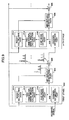
- Fig.9 shows a conceptual diagram of a multistage signal detection apparatus according to an embodiment of the present invention.
- the signal detection apparatus includes serially connected plural blocks each including a two-dimensional MMSE equalizing part 902, a multipath interference (MPI) replica generation part 904, and a subtracting part 906.
- the two-dimensional MMSE equalizing part 902 includes a channel estimation part 908, a chip noise estimation part 910, a two-dimensional MMSE weight calculation part 912 and a weight multiplication part 914. These components in the two-dimensional MMSE equalizing part 902 correspond to the channel estimation part 302, the noise estimation part 304, the weight generation part 310 and MMSE equalizing part 312 respectively. Either of noise estimation methods in the first embodiment and the second embodiment can be adopted as a noise estimation method used in the chip noise estimation part 910.
- the MPI replica generation part 904 regenerates multipath components based on the channel estimation result and the transmission signals that have been separated. For example, signal components (corresponding to path 2 in the example of Fig.5) of all paths other than a target path are regenerated. The regenerated signal components are called MPI replicas.
- the subtraction part 906 subtracts the MPI replicas from the received signals. In the signals in which the MPI replicas have been subtracted, the ratio of the target path is increased. Therefore, by performing channel estimation and signal separation based on the signal in which the MPI replicas have been subtracted, estimation accuracy and separation accuracy can be improved.
- channel estimation and signal separation are performed so as to generate MPI replicas, and the MPI replicas are subtracted from the received signals, and the signals are supplied to the channel estimation part of a next stage. Accordingly, the channel estimation accuracy and the signal separation accuracy can be largely improved.
Landscapes
- Engineering & Computer Science (AREA)
- Computer Networks & Wireless Communication (AREA)
- Signal Processing (AREA)
- Physics & Mathematics (AREA)
- Quality & Reliability (AREA)
- Electromagnetism (AREA)
- Mathematical Physics (AREA)
- Noise Elimination (AREA)
- Radio Transmission System (AREA)
- Monitoring And Testing Of Transmission In General (AREA)
- Radar Systems Or Details Thereof (AREA)
Applications Claiming Priority (2)
| Application Number | Priority Date | Filing Date | Title |
|---|---|---|---|
| JP2004144181 | 2004-05-13 | ||
| JP2004144181A JP4369294B2 (ja) | 2004-05-13 | 2004-05-13 | 雑音電力推定装置、雑音電力推定方法及び信号検出装置 |
Publications (3)
| Publication Number | Publication Date |
|---|---|
| EP1596502A2 true EP1596502A2 (de) | 2005-11-16 |
| EP1596502A3 EP1596502A3 (de) | 2006-02-01 |
| EP1596502B1 EP1596502B1 (de) | 2008-01-02 |
Family
ID=34941266
Family Applications (1)
| Application Number | Title | Priority Date | Filing Date |
|---|---|---|---|
| EP20050252919 Expired - Lifetime EP1596502B1 (de) | 2004-05-13 | 2005-05-12 | Apparat zur Schätzung der Rauschleistung, Verfahren zur Schätzung der Rauschleistung und Signaldetektor |
Country Status (8)
| Country | Link |
|---|---|
| US (2) | US7421009B2 (de) |
| EP (1) | EP1596502B1 (de) |
| JP (1) | JP4369294B2 (de) |
| KR (1) | KR100686969B1 (de) |
| CN (1) | CN100488180C (de) |
| AT (1) | ATE382988T1 (de) |
| DE (1) | DE602005004063T2 (de) |
| ES (1) | ES2296097T3 (de) |
Cited By (3)
| Publication number | Priority date | Publication date | Assignee | Title |
|---|---|---|---|---|
| WO2008015389A1 (en) | 2006-08-01 | 2008-02-07 | Ttpcom Limited | Signal evaluation and adjustment |
| WO2009105442A1 (en) * | 2008-02-20 | 2009-08-27 | Qualcomm Incorporated | Fft-based estimation of thermal noise and rise-over-thermal in a wireless communication system |
| CN101277127B (zh) * | 2008-03-21 | 2011-10-26 | 华为技术有限公司 | 信号接收方法及接收机、信号合并方法及模块 |
Families Citing this family (34)
| Publication number | Priority date | Publication date | Assignee | Title |
|---|---|---|---|---|
| US7428260B2 (en) * | 2003-10-30 | 2008-09-23 | Marvell World Trade Ltd. | Unified MMSE equalization and multi-user detection approach for use in a CDMA system |
| US8265209B2 (en) * | 2005-10-28 | 2012-09-11 | Qualcomm Incorporated | Method and apparatus for channel and noise estimation |
| KR20070061215A (ko) * | 2005-12-08 | 2007-06-13 | 한국전자통신연구원 | 다중 반송파를 이용한 광대역 무선 채널 측정 장치의송수신 장치 |
| JP4780419B2 (ja) | 2006-01-24 | 2011-09-28 | 日本電気株式会社 | 伝送路推定装置および等化装置並びに無線システム |
| EP1988645A4 (de) * | 2006-02-01 | 2014-01-15 | Nec Corp | Entzerrungseinrichtung und entzerrungsverfahren |
| US8351553B2 (en) | 2006-04-13 | 2013-01-08 | Nec Corporation | MIMO receiving apparatus and receiving method |
| CA2647643C (en) * | 2006-04-17 | 2013-07-09 | Qualcomm Incorporated | Noise estimation for wireless communication |
| JP4854094B2 (ja) * | 2006-05-30 | 2012-01-11 | シャープ株式会社 | 無線受信機、無線通信システムおよび無線受信方法 |
| KR20080026896A (ko) * | 2006-09-22 | 2008-03-26 | 삼성전자주식회사 | 이동통신 시스템에서 은닉 학습 신호를 이용하여 채널을 추정하기 위한 장치 및 방법 |
| JP2008124942A (ja) * | 2006-11-15 | 2008-05-29 | Nec Corp | 無線通信システム、無線通信装置及びそれらに用いる有効パス検出方法 |
| JP5147730B2 (ja) | 2007-01-12 | 2013-02-20 | パナソニック株式会社 | 受信装置及び受信方法 |
| US8054914B2 (en) * | 2007-01-30 | 2011-11-08 | Texas Instruments Incorporated | Noise variance estimation |
| EP2141828A4 (de) * | 2007-03-30 | 2014-04-16 | Fujitsu Ltd | Entzerrersteuervorrichtung, entzerrersteuerverfahren und drahtloses endgerät mit dieser steuervorrichtung |
| JP2009065403A (ja) | 2007-09-06 | 2009-03-26 | Nec Corp | 無線通信における受信品質推定方法および装置 |
| JP4875642B2 (ja) | 2008-02-27 | 2012-02-15 | 株式会社日立製作所 | 雑音電力推定装置及び方法 |
| JP5241437B2 (ja) * | 2008-11-13 | 2013-07-17 | 三星電子株式会社 | 受信装置、及び信号処理方法 |
| US8699640B2 (en) * | 2008-12-03 | 2014-04-15 | Nec Laboratories America, Inc. | Transmitter compensation in decoding of intensity modulated optical OFDM with direct detection |
| JP5216617B2 (ja) * | 2009-02-03 | 2013-06-19 | Kddi株式会社 | 無線受信機、無線受信方法および無線受信プログラム |
| US8095077B2 (en) * | 2009-02-05 | 2012-01-10 | Cambridge Silicon Radio Limited | Signal power estimation |
| JP5175253B2 (ja) * | 2009-08-31 | 2013-04-03 | 日本放送協会 | シングルキャリア受信装置 |
| JP5130276B2 (ja) * | 2009-11-18 | 2013-01-30 | 株式会社エヌ・ティ・ティ・ドコモ | 無線基地局 |
| GB201001469D0 (en) * | 2010-01-29 | 2010-03-17 | Icera Inc | Signal processing in wireless communication receivers |
| CN102148787A (zh) * | 2010-02-10 | 2011-08-10 | 思亚诺移动芯片有限公司 | 用于降低或消除接收信号噪声的方法、电路和系统 |
| JP2011188206A (ja) * | 2010-03-08 | 2011-09-22 | Sharp Corp | 受信装置、受信方法、受信プログラム、及びプロセッサ |
| US8767799B2 (en) * | 2011-04-12 | 2014-07-01 | Alcatel Lucent | Method and apparatus for determining signal-to-noise ratio |
| US9564980B2 (en) * | 2011-09-09 | 2017-02-07 | Samsung Electronics Co., Ltd. | Mobile telecommunication system with noise ratio estimation mechanism and method of operation thereof |
| JP5382094B2 (ja) * | 2011-11-21 | 2014-01-08 | 日本電気株式会社 | 無線通信システム、無線通信装置及びそれらに用いる有効パス検出方法 |
| US8831530B2 (en) | 2012-04-30 | 2014-09-09 | Samsung Electronics Co., Ltd. | Communication system with transmission power estimation mechanism and method of operation thereof |
| ES2457840B1 (es) | 2012-09-28 | 2015-02-16 | Universidad De Murcia | Lente intraocular acomodativa de potencia variable y conjunto de lente intraocular acomodativa de potencia variable y anillo capsular |
| KR102093266B1 (ko) * | 2013-02-28 | 2020-03-25 | 삼성전자주식회사 | 신호 감지 방법 및 장치 |
| CN103391140B (zh) * | 2013-07-19 | 2015-10-14 | 京信通信系统(中国)有限公司 | Cdma2000和evdo混合信号的功率检测方法和系统 |
| JP6219193B2 (ja) * | 2014-02-21 | 2017-10-25 | パナソニック株式会社 | 等化方法及び等化器 |
| CN105282059A (zh) * | 2014-06-30 | 2016-01-27 | 深圳市中兴微电子技术有限公司 | 一种多径选择方法和设备 |
| CN106375251B (zh) * | 2016-08-31 | 2019-04-09 | 北京松果电子有限公司 | 噪声功率估计方法、装置及用户设备 |
Family Cites Families (9)
| Publication number | Priority date | Publication date | Assignee | Title |
|---|---|---|---|---|
| CN1111986C (zh) * | 1996-04-12 | 2003-06-18 | Ntt移动通信网株式会社 | 测量接收的信噪比的方法、设备及传输功率控制系统 |
| US6377607B1 (en) * | 1999-05-13 | 2002-04-23 | Qualcomm Incorporated | System and method for performing accurate demodulation of turbo-encoded signals via pilot assisted coherent demodulation |
| EP1176730A1 (de) * | 2000-07-26 | 2002-01-30 | Motorola, Inc. | Störungsschätzung in einem Kommunikationssystem |
| JP3676281B2 (ja) * | 2001-10-17 | 2005-07-27 | 日本電信電話株式会社 | Ofdm信号伝送装置、ofdm信号受信装置、ofdm信号受信方法 |
| KR100510434B1 (ko) * | 2001-04-09 | 2005-08-26 | 니폰덴신뎅와 가부시키가이샤 | Ofdm신호전달 시스템, ofdm신호 송신장치 및ofdm신호 수신장치 |
| KR100750102B1 (ko) * | 2001-06-14 | 2007-08-17 | 삼성전자주식회사 | 디스크 카트리지 |
| JP3973017B2 (ja) * | 2002-02-14 | 2007-09-05 | 富士通株式会社 | 干渉電力を推定する無線受信機 |
| US7961774B2 (en) * | 2002-10-15 | 2011-06-14 | Texas Instruments Incorporated | Multipath interference-resistant receivers for closed-loop transmit diversity (CLTD) in code-division multiple access (CDMA) systems |
| US7027496B2 (en) * | 2003-04-04 | 2006-04-11 | Nokia Corporation | Method and apparatus providing unbiased signal-to-noise ratio estimation and its application to discontinuous transmission detection |
-
2004
- 2004-05-13 JP JP2004144181A patent/JP4369294B2/ja not_active Expired - Fee Related
-
2005
- 2005-05-12 AT AT05252919T patent/ATE382988T1/de not_active IP Right Cessation
- 2005-05-12 ES ES05252919T patent/ES2296097T3/es not_active Expired - Lifetime
- 2005-05-12 EP EP20050252919 patent/EP1596502B1/de not_active Expired - Lifetime
- 2005-05-12 DE DE200560004063 patent/DE602005004063T2/de not_active Expired - Lifetime
- 2005-05-13 US US11/128,188 patent/US7421009B2/en not_active Expired - Fee Related
- 2005-05-13 KR KR20050040338A patent/KR100686969B1/ko not_active Expired - Fee Related
- 2005-05-13 CN CNB2005100693487A patent/CN100488180C/zh not_active Expired - Fee Related
-
2008
- 2008-05-08 US US12/117,384 patent/US8144822B2/en not_active Expired - Fee Related
Cited By (5)
| Publication number | Priority date | Publication date | Assignee | Title |
|---|---|---|---|---|
| WO2008015389A1 (en) | 2006-08-01 | 2008-02-07 | Ttpcom Limited | Signal evaluation and adjustment |
| TWI463843B (zh) * | 2006-08-01 | 2014-12-01 | Mstar Semiconductor Inc | 一種估算接收訊號的裝置及方法 |
| WO2009105442A1 (en) * | 2008-02-20 | 2009-08-27 | Qualcomm Incorporated | Fft-based estimation of thermal noise and rise-over-thermal in a wireless communication system |
| US8264975B2 (en) | 2008-02-20 | 2012-09-11 | Qualcomm Incorporated | FFT-based estimation of thermal noise and rise over thermal in a wireless communication system |
| CN101277127B (zh) * | 2008-03-21 | 2011-10-26 | 华为技术有限公司 | 信号接收方法及接收机、信号合并方法及模块 |
Also Published As
| Publication number | Publication date |
|---|---|
| DE602005004063T2 (de) | 2008-12-18 |
| DE602005004063D1 (de) | 2008-02-14 |
| EP1596502A3 (de) | 2006-02-01 |
| JP4369294B2 (ja) | 2009-11-18 |
| US20080253432A1 (en) | 2008-10-16 |
| JP2005328311A (ja) | 2005-11-24 |
| KR20060047917A (ko) | 2006-05-18 |
| ES2296097T3 (es) | 2008-04-16 |
| EP1596502B1 (de) | 2008-01-02 |
| ATE382988T1 (de) | 2008-01-15 |
| CN1697428A (zh) | 2005-11-16 |
| US8144822B2 (en) | 2012-03-27 |
| KR100686969B1 (ko) | 2007-02-26 |
| CN100488180C (zh) | 2009-05-13 |
| US7421009B2 (en) | 2008-09-02 |
| US20050259721A1 (en) | 2005-11-24 |
Similar Documents
| Publication | Publication Date | Title |
|---|---|---|
| US7421009B2 (en) | Noise power estimation apparatus, noise power estimation method and signal detection apparatus | |
| CN101385248B (zh) | 用于无线通信的降低复杂性的干扰抑制 | |
| EP1941644B1 (de) | Verfahren und vorrichtung zur kanal- und rauschschätzung | |
| KR100997310B1 (ko) | 등화 장치 및 등화 방법 | |
| EP2254270B1 (de) | Empfangsvorrichtung und -verfahren | |
| EP1903729A2 (de) | Frequenzbereichsentzerrer mit einer Bereichsinterferenzannullierung für Doppelantennenfunk | |
| JP3619729B2 (ja) | 無線受信装置および無線受信方法 | |
| EP2510635A1 (de) | Verfahren und anordnung für verbesserte interferenzabweisungskombination | |
| KR20100127231A (ko) | Mimo수신장치 및 방법 | |
| JP2000083011A (ja) | 干渉キャンセラにおける伝搬路推定方法及び干渉除去装置 | |
| US7466969B2 (en) | MIMO receiver, MIMO reception method and wireless communication system | |
| US8446972B2 (en) | Communication system, reception device, and communication method | |
| EP1926219B1 (de) | Interferenzreduzierende Vorrichtung und Verfahren | |
| US8229044B2 (en) | Efficient covariance computation by table lookup | |
| US20100135366A1 (en) | Data equalisation in a communication receiver with receive diversity | |
| JP4555332B2 (ja) | 伝送路推定装置、cdma受信装置、および伝送路推定方法 | |
| KR101828835B1 (ko) | 무선통신 시스템에서 다중 경로 신호 수신 장치 및 방법 | |
| WO2011092256A1 (en) | An equaliser for wireless receivers with normalised coefficients | |
| JP2007104502A (ja) | 伝送路等化装置、伝送路等化方法 | |
| KR20060036893A (ko) | 다중-경로 간섭 수용을 구비한 레이크 수신기 |
Legal Events
| Date | Code | Title | Description |
|---|---|---|---|
| REG | Reference to a national code |
Ref country code: SE Ref legal event code: TRGR |
|
| PUAI | Public reference made under article 153(3) epc to a published international application that has entered the european phase |
Free format text: ORIGINAL CODE: 0009012 |
|
| 17P | Request for examination filed |
Effective date: 20050526 |
|
| AK | Designated contracting states |
Kind code of ref document: A2 Designated state(s): AT BE BG CH CY CZ DE DK EE ES FI FR GB GR HU IE IS IT LI LT LU MC NL PL PT RO SE SI SK TR |
|
| AX | Request for extension of the european patent |
Extension state: AL BA HR LV MK YU |
|
| PUAL | Search report despatched |
Free format text: ORIGINAL CODE: 0009013 |
|
| AK | Designated contracting states |
Kind code of ref document: A3 Designated state(s): AT BE BG CH CY CZ DE DK EE ES FI FR GB GR HU IE IS IT LI LT LU MC NL PL PT RO SE SI SK TR |
|
| AX | Request for extension of the european patent |
Extension state: AL BA HR LV MK YU |
|
| 17Q | First examination report despatched |
Effective date: 20060710 |
|
| AKX | Designation fees paid |
Designated state(s): AT BE BG CH CY CZ DE DK EE ES FI FR GB GR HU IE IS IT LI LT LU MC NL PL PT RO SE SI SK TR |
|
| GRAP | Despatch of communication of intention to grant a patent |
Free format text: ORIGINAL CODE: EPIDOSNIGR1 |
|
| GRAS | Grant fee paid |
Free format text: ORIGINAL CODE: EPIDOSNIGR3 |
|
| GRAA | (expected) grant |
Free format text: ORIGINAL CODE: 0009210 |
|
| AK | Designated contracting states |
Kind code of ref document: B1 Designated state(s): AT BE BG CH CY CZ DE DK EE ES FI FR GB GR HU IE IS IT LI LT LU MC NL PL PT RO SE SI SK TR |
|
| REG | Reference to a national code |
Ref country code: GB Ref legal event code: FG4D |
|
| REG | Reference to a national code |
Ref country code: IE Ref legal event code: FG4D |
|
| REG | Reference to a national code |
Ref country code: CH Ref legal event code: EP |
|
| REF | Corresponds to: |
Ref document number: 602005004063 Country of ref document: DE Date of ref document: 20080214 Kind code of ref document: P |
|
| REG | Reference to a national code |
Ref country code: ES Ref legal event code: FG2A Ref document number: 2296097 Country of ref document: ES Kind code of ref document: T3 |
|
| PG25 | Lapsed in a contracting state [announced via postgrant information from national office to epo] |
Ref country code: SI Free format text: LAPSE BECAUSE OF FAILURE TO SUBMIT A TRANSLATION OF THE DESCRIPTION OR TO PAY THE FEE WITHIN THE PRESCRIBED TIME-LIMIT Effective date: 20080102 Ref country code: NL Free format text: LAPSE BECAUSE OF FAILURE TO SUBMIT A TRANSLATION OF THE DESCRIPTION OR TO PAY THE FEE WITHIN THE PRESCRIBED TIME-LIMIT Effective date: 20080102 |
|
| NLV1 | Nl: lapsed or annulled due to failure to fulfill the requirements of art. 29p and 29m of the patents act | ||
| PG25 | Lapsed in a contracting state [announced via postgrant information from national office to epo] |
Ref country code: LT Free format text: LAPSE BECAUSE OF FAILURE TO SUBMIT A TRANSLATION OF THE DESCRIPTION OR TO PAY THE FEE WITHIN THE PRESCRIBED TIME-LIMIT Effective date: 20080102 Ref country code: IS Free format text: LAPSE BECAUSE OF FAILURE TO SUBMIT A TRANSLATION OF THE DESCRIPTION OR TO PAY THE FEE WITHIN THE PRESCRIBED TIME-LIMIT Effective date: 20080502 Ref country code: LI Free format text: LAPSE BECAUSE OF FAILURE TO SUBMIT A TRANSLATION OF THE DESCRIPTION OR TO PAY THE FEE WITHIN THE PRESCRIBED TIME-LIMIT Effective date: 20080102 Ref country code: CH Free format text: LAPSE BECAUSE OF FAILURE TO SUBMIT A TRANSLATION OF THE DESCRIPTION OR TO PAY THE FEE WITHIN THE PRESCRIBED TIME-LIMIT Effective date: 20080102 |
|
| REG | Reference to a national code |
Ref country code: CH Ref legal event code: PL |
|
| ET | Fr: translation filed | ||
| PG25 | Lapsed in a contracting state [announced via postgrant information from national office to epo] |
Ref country code: BG Free format text: LAPSE BECAUSE OF FAILURE TO SUBMIT A TRANSLATION OF THE DESCRIPTION OR TO PAY THE FEE WITHIN THE PRESCRIBED TIME-LIMIT Effective date: 20080402 Ref country code: AT Free format text: LAPSE BECAUSE OF FAILURE TO SUBMIT A TRANSLATION OF THE DESCRIPTION OR TO PAY THE FEE WITHIN THE PRESCRIBED TIME-LIMIT Effective date: 20080102 |
|
| PG25 | Lapsed in a contracting state [announced via postgrant information from national office to epo] |
Ref country code: BE Free format text: LAPSE BECAUSE OF FAILURE TO SUBMIT A TRANSLATION OF THE DESCRIPTION OR TO PAY THE FEE WITHIN THE PRESCRIBED TIME-LIMIT Effective date: 20080102 Ref country code: PT Free format text: LAPSE BECAUSE OF FAILURE TO SUBMIT A TRANSLATION OF THE DESCRIPTION OR TO PAY THE FEE WITHIN THE PRESCRIBED TIME-LIMIT Effective date: 20080602 Ref country code: PL Free format text: LAPSE BECAUSE OF FAILURE TO SUBMIT A TRANSLATION OF THE DESCRIPTION OR TO PAY THE FEE WITHIN THE PRESCRIBED TIME-LIMIT Effective date: 20080102 |
|
| PG25 | Lapsed in a contracting state [announced via postgrant information from national office to epo] |
Ref country code: SK Free format text: LAPSE BECAUSE OF FAILURE TO SUBMIT A TRANSLATION OF THE DESCRIPTION OR TO PAY THE FEE WITHIN THE PRESCRIBED TIME-LIMIT Effective date: 20080102 Ref country code: DK Free format text: LAPSE BECAUSE OF FAILURE TO SUBMIT A TRANSLATION OF THE DESCRIPTION OR TO PAY THE FEE WITHIN THE PRESCRIBED TIME-LIMIT Effective date: 20080102 Ref country code: CZ Free format text: LAPSE BECAUSE OF FAILURE TO SUBMIT A TRANSLATION OF THE DESCRIPTION OR TO PAY THE FEE WITHIN THE PRESCRIBED TIME-LIMIT Effective date: 20080102 |
|
| PLBE | No opposition filed within time limit |
Free format text: ORIGINAL CODE: 0009261 |
|
| STAA | Information on the status of an ep patent application or granted ep patent |
Free format text: STATUS: NO OPPOSITION FILED WITHIN TIME LIMIT |
|
| PG25 | Lapsed in a contracting state [announced via postgrant information from national office to epo] |
Ref country code: RO Free format text: LAPSE BECAUSE OF FAILURE TO SUBMIT A TRANSLATION OF THE DESCRIPTION OR TO PAY THE FEE WITHIN THE PRESCRIBED TIME-LIMIT Effective date: 20080102 |
|
| 26N | No opposition filed |
Effective date: 20081003 |
|
| PG25 | Lapsed in a contracting state [announced via postgrant information from national office to epo] |
Ref country code: MC Free format text: LAPSE BECAUSE OF NON-PAYMENT OF DUE FEES Effective date: 20080531 |
|
| PG25 | Lapsed in a contracting state [announced via postgrant information from national office to epo] |
Ref country code: EE Free format text: LAPSE BECAUSE OF FAILURE TO SUBMIT A TRANSLATION OF THE DESCRIPTION OR TO PAY THE FEE WITHIN THE PRESCRIBED TIME-LIMIT Effective date: 20080102 |
|
| PG25 | Lapsed in a contracting state [announced via postgrant information from national office to epo] |
Ref country code: IE Free format text: LAPSE BECAUSE OF NON-PAYMENT OF DUE FEES Effective date: 20080512 |
|
| PG25 | Lapsed in a contracting state [announced via postgrant information from national office to epo] |
Ref country code: CY Free format text: LAPSE BECAUSE OF FAILURE TO SUBMIT A TRANSLATION OF THE DESCRIPTION OR TO PAY THE FEE WITHIN THE PRESCRIBED TIME-LIMIT Effective date: 20080102 |
|
| PG25 | Lapsed in a contracting state [announced via postgrant information from national office to epo] |
Ref country code: LU Free format text: LAPSE BECAUSE OF NON-PAYMENT OF DUE FEES Effective date: 20080512 Ref country code: HU Free format text: LAPSE BECAUSE OF FAILURE TO SUBMIT A TRANSLATION OF THE DESCRIPTION OR TO PAY THE FEE WITHIN THE PRESCRIBED TIME-LIMIT Effective date: 20080703 |
|
| PG25 | Lapsed in a contracting state [announced via postgrant information from national office to epo] |
Ref country code: TR Free format text: LAPSE BECAUSE OF FAILURE TO SUBMIT A TRANSLATION OF THE DESCRIPTION OR TO PAY THE FEE WITHIN THE PRESCRIBED TIME-LIMIT Effective date: 20080102 |
|
| PG25 | Lapsed in a contracting state [announced via postgrant information from national office to epo] |
Ref country code: GR Free format text: LAPSE BECAUSE OF FAILURE TO SUBMIT A TRANSLATION OF THE DESCRIPTION OR TO PAY THE FEE WITHIN THE PRESCRIBED TIME-LIMIT Effective date: 20080403 |
|
| PGFP | Annual fee paid to national office [announced via postgrant information from national office to epo] |
Ref country code: SE Payment date: 20140513 Year of fee payment: 10 Ref country code: FR Payment date: 20140509 Year of fee payment: 10 Ref country code: FI Payment date: 20140512 Year of fee payment: 10 Ref country code: IT Payment date: 20140520 Year of fee payment: 10 Ref country code: ES Payment date: 20140411 Year of fee payment: 10 |
|
| PGFP | Annual fee paid to national office [announced via postgrant information from national office to epo] |
Ref country code: GB Payment date: 20150506 Year of fee payment: 11 Ref country code: DE Payment date: 20150506 Year of fee payment: 11 |
|
| PG25 | Lapsed in a contracting state [announced via postgrant information from national office to epo] |
Ref country code: IT Free format text: LAPSE BECAUSE OF NON-PAYMENT OF DUE FEES Effective date: 20150512 Ref country code: FI Free format text: LAPSE BECAUSE OF NON-PAYMENT OF DUE FEES Effective date: 20150512 |
|
| REG | Reference to a national code |
Ref country code: FR Ref legal event code: ST Effective date: 20160129 |
|
| PG25 | Lapsed in a contracting state [announced via postgrant information from national office to epo] |
Ref country code: SE Free format text: LAPSE BECAUSE OF NON-PAYMENT OF DUE FEES Effective date: 20150513 |
|
| PG25 | Lapsed in a contracting state [announced via postgrant information from national office to epo] |
Ref country code: FR Free format text: LAPSE BECAUSE OF NON-PAYMENT OF DUE FEES Effective date: 20150601 |
|
| REG | Reference to a national code |
Ref country code: ES Ref legal event code: FD2A Effective date: 20160628 |
|
| PG25 | Lapsed in a contracting state [announced via postgrant information from national office to epo] |
Ref country code: ES Free format text: LAPSE BECAUSE OF NON-PAYMENT OF DUE FEES Effective date: 20150513 |
|
| REG | Reference to a national code |
Ref country code: DE Ref legal event code: R119 Ref document number: 602005004063 Country of ref document: DE |
|
| GBPC | Gb: european patent ceased through non-payment of renewal fee |
Effective date: 20160512 |
|
| PG25 | Lapsed in a contracting state [announced via postgrant information from national office to epo] |
Ref country code: DE Free format text: LAPSE BECAUSE OF NON-PAYMENT OF DUE FEES Effective date: 20161201 |
|
| PG25 | Lapsed in a contracting state [announced via postgrant information from national office to epo] |
Ref country code: GB Free format text: LAPSE BECAUSE OF NON-PAYMENT OF DUE FEES Effective date: 20160512 |