EP1599433B1 - Procede pour realiser les formes enantiomeres de derives de cis 1,3-cyclohexandiol - Google Patents
Procede pour realiser les formes enantiomeres de derives de cis 1,3-cyclohexandiol Download PDFInfo
- Publication number
- EP1599433B1 EP1599433B1 EP04712518A EP04712518A EP1599433B1 EP 1599433 B1 EP1599433 B1 EP 1599433B1 EP 04712518 A EP04712518 A EP 04712518A EP 04712518 A EP04712518 A EP 04712518A EP 1599433 B1 EP1599433 B1 EP 1599433B1
- Authority
- EP
- European Patent Office
- Prior art keywords
- alkyl
- formula
- alk
- phenyl
- ocf
- Prior art date
- Legal status (The legal status is an assumption and is not a legal conclusion. Google has not performed a legal analysis and makes no representation as to the accuracy of the status listed.)
- Expired - Lifetime
Links
- 0 *O[C@](CCC1)C[C@]1O* Chemical compound *O[C@](CCC1)C[C@]1O* 0.000 description 5
- XWACKBMPGJMLFJ-UHFFFAOYSA-N Cc1c(CI)nc(-c2cc(C)ccc2)[o]1 Chemical compound Cc1c(CI)nc(-c2cc(C)ccc2)[o]1 XWACKBMPGJMLFJ-UHFFFAOYSA-N 0.000 description 1
- WIONSNLWNWJORQ-UONOGXRCSA-N Cc1cccc(CO[C@H](CCC2)C[C@H]2O)c1C(OC)=O Chemical compound Cc1cccc(CO[C@H](CCC2)C[C@H]2O)c1C(OC)=O WIONSNLWNWJORQ-UONOGXRCSA-N 0.000 description 1
- RFCYVWGCOXVSBD-QWHCGFSZSA-N O[C@@H](CCC1)C[C@@H]1OCc1ccccc1 Chemical compound O[C@@H](CCC1)C[C@@H]1OCc1ccccc1 RFCYVWGCOXVSBD-QWHCGFSZSA-N 0.000 description 1
- HEIITDNRRCFOFX-CABCVRRESA-N O[C@H](CCC1)C[C@H]1OCc1c[o]c(-c(cc2)ccc2F)n1 Chemical compound O[C@H](CCC1)C[C@H]1OCc1c[o]c(-c(cc2)ccc2F)n1 HEIITDNRRCFOFX-CABCVRRESA-N 0.000 description 1
Classifications
-
- C—CHEMISTRY; METALLURGY
- C07—ORGANIC CHEMISTRY
- C07D—HETEROCYCLIC COMPOUNDS
- C07D263/00—Heterocyclic compounds containing 1,3-oxazole or hydrogenated 1,3-oxazole rings
- C07D263/02—Heterocyclic compounds containing 1,3-oxazole or hydrogenated 1,3-oxazole rings not condensed with other rings
- C07D263/30—Heterocyclic compounds containing 1,3-oxazole or hydrogenated 1,3-oxazole rings not condensed with other rings having two or three double bonds between ring members or between ring members and non-ring members
- C07D263/32—Heterocyclic compounds containing 1,3-oxazole or hydrogenated 1,3-oxazole rings not condensed with other rings having two or three double bonds between ring members or between ring members and non-ring members with only hydrogen atoms, hydrocarbon or substituted hydrocarbon radicals, directly attached to ring carbon atoms
-
- C—CHEMISTRY; METALLURGY
- C12—BIOCHEMISTRY; BEER; SPIRITS; WINE; VINEGAR; MICROBIOLOGY; ENZYMOLOGY; MUTATION OR GENETIC ENGINEERING
- C12P—FERMENTATION OR ENZYME-USING PROCESSES TO SYNTHESISE A DESIRED CHEMICAL COMPOUND OR COMPOSITION OR TO SEPARATE OPTICAL ISOMERS FROM A RACEMIC MIXTURE
- C12P41/00—Processes using enzymes or microorganisms to separate optical isomers from a racemic mixture
- C12P41/003—Processes using enzymes or microorganisms to separate optical isomers from a racemic mixture by ester formation, lactone formation or the inverse reactions
- C12P41/004—Processes using enzymes or microorganisms to separate optical isomers from a racemic mixture by ester formation, lactone formation or the inverse reactions by esterification of alcohol- or thiol groups in the enantiomers or the inverse reaction
-
- C—CHEMISTRY; METALLURGY
- C07—ORGANIC CHEMISTRY
- C07C—ACYCLIC OR CARBOCYCLIC COMPOUNDS
- C07C2601/00—Systems containing only non-condensed rings
- C07C2601/12—Systems containing only non-condensed rings with a six-membered ring
- C07C2601/14—The ring being saturated
Definitions
- the invention relates to a process for preparing chiral, nonracemic, cicconfigured 1,3-disubstituted cyclohexanols of the formula (I)
- the reaction described leads to a mixture of 9 isomeric forms or derivatives of cyclohexanediol, namely the unreacted Isomeric (S, S) -diol, (R, R) -diol and (R, S) -diol, furthermore the monoacylated products (S, S) -monooctanoate, (R, R) -monooctanoate and (R, S) Monooctanoate, and third, the group of diacylated products (S, S) -dioctanoate, (R, R) -dioctanoate, and (R, S) -dioctanoate.
- optically active, monoacylated, cis-configured (R, S) -monooctanoate occupies only a fraction of about 12% in the fraction of the monoacylated cyclohexanediols.
- R, S monoacylated, cis-configured
- the aim of the present invention was therefore to develop a method that does not have the disadvantages mentioned.
- the process of the invention is economical, simple and fast.
- the process completely avoids the risk of acyl group migration, it does not require equimolar amounts of optically pure starting materials or auxiliaries, no expensive reagents, no resolution by chromatography on chiral phases, no disproportionately large amounts of solvent and no costly operations.
- alkyl radicals in the substituents R 2 , R 3 , R 4 and R 5 may be both straight-chain and branched.
- a heteroaromatic ring is understood as meaning both mono- and bicyclic rings having a maximum of 4 heteroatoms, in particular those containing up to 4 nitrogen atoms and / or 1 oxygen or 1 sulfur atom, for example: furan, thiophene, thiazole, oxazole, thiadiazole, triazole , Pyridine, triazine, quinoline, isoquinoline, indole, benzothiophene, benzofuran, benzotriazole.
- Aromatic rings may be mono- or bicyclic and also fused, e.g. Naphthyl, benzo [1,3] dioxole, dihydrobenzo [1,4] dioxin.
- racemic, cis-configured 1,3-cyclohexane derivatives of the formula (IV) and of the formula (VII) are prepared by monoalkylation of cis-cyclohexanediol (compound of the formula II) but can also be prepared by reductive opening of corresponding acetals ( Chem. 1993 , 85, 6756), further by so-called reductive ether formation, starting from silyl ethers and aldehydes or ketones (JS Bajwa, X. Jiang, J. Slade, K. Prasad, O. Repic, TJ Blacklock, Tetrahedron Lett., 2002 , 43, 6709-6713).
- the alkylating reagents of the formula III are commercially available or can be prepared by literature methods, for. B by radical side chain halogenation (see literature review RC Larock, Comprehensive Organic Transformations, p 313, 1989 VCH Publishers, Inc.) or from the alcohols or derivatives thereof can be prepared (see literature review RC Larock, Comprehensive Organic Transformations, Pp. 353-363., 1989 VCH Publishers, Inc.).
- alkylating reagents of the formula III and VI are reacted in the presence of bases with 1,3-cyclohexanediol or 1,3-cyclohexanediol derivatives.
- bases are hydroxides such as KOH, carbonates such as Cs 2 CO 3 , alkoxides such as KOtBu and also compounds such as LDA, BuLi, LiHMDS, KH, NaH and NaHMDS.
- Suitable solvents are, for example, THF, MTBE, DME, NMP, DMF and chlorobenzene.
- ester derivatives for. Acetyl, propionyl, butyryl or glutaryl, these are incorporated in homogeneous or heterogeneous, aqueous, aqueous-organic or organic media in the presence of a suitable enzyme of stereoselective hydrolysis or alcoholysis (eg with n-butanol) a temperature of 10 - 80 ° C optionally in the presence of cosolvents (see above) and subjected to a buffer, wherein the reaction mixture preferably contains 2 - 50 wt .-% ester.
- a suitable enzyme of stereoselective hydrolysis or alcoholysis eg with n-butanol
- cosolvents see above
- ester derivatives can be carried out by literature methods, for example by reaction of the alcohol with acid chlorides such as acetyl chloride or anhydrides such as acetic anhydride, in the presence of an amine, such as. Triethylamine or pyridine (see Literature Review R.C. Larock, Comprehensive Organic Transformations, p.978, 1989 VCH Publishers, Inc.)
- a particularly interesting possibility for separating the enantiomers is to select the acyl donor in the case of enzymatic acylation so that the acylated enantiomer is significantly more water-soluble than the unreacted alcohol.
- Suitable acyl donors are, for example, cyclic anhydrides such as succinic anhydride.
- the acylation product carries a free carboxyl group, which allows rapid removal of the product by aqueous extraction in the basic, for example, with sat. aqueous NaHCO 3 solution enabled.
- the addition can z. B. 0.01-1.0 molar.
- a favorable buffer range is pH 5-10.
- enzymes are preferably hydrolases from mammalian livers such.
- lipase B Glutaric acid mono- (3-benzyloxy-cyclohexyl) ester, it may be advantageous to use the glutaryl-7-ACA acylase (Roche Diagnostics) instead of the above-mentioned lipases.
- glutaryl-7-ACA acylase (Roche Diagnostics)
- lipase B from Candida antarctica (Roche Diagnostics), where it may be advantageous to use the free enzyme or an immobilized form of the enzyme, eg. B. one of the three currently commercially available products to use.
- Each of the enzymes mentioned can be used in free or immobilized form (Immobilized Biocatalysts, W. Hartmeier, Springer Verlag Berlin, 1988).
- the amount of enzyme is chosen freely depending on the reaction rate or on the desired reaction time and on the type of enzyme (eg free or immobilized) and can be easily determined by simple preliminary experiments.
- the recovery of the enzyme can be carried out by freeze-drying.
- the separation (and possibly subsequent reuse) of the enzyme can be facilitated by immobilization.
- Ethanol was distilled off in vacuo, the residue dissolved in about 2 L of water and washed four times with 500 mL MTB ether. The aqueous phase was cooled with conc. Hydrochloric acid acidified to pH 1 and extracted the oily precipitating product with 1.5 L of ethyl acetate. The ethyl acetate solution was dried and concentrated in vacuo. The residue was dissolved in 1.2 L DIPE at about 40 ° C.
- Ethanol was distilled off in vacuo, the residue was dissolved in 500 ml of water and the solution washed four times with 100 ml of MTB ether. The aqueous phase was cooled with conc. Acidified hydrochloric acid (pH 1) and the oily precipitating product extracted with ethyl acetate. The ethyl acetate solution was dried and concentrated in vacuo. The residue was dissolved in 250 mL DIPE while warm. Upon cooling, crystallization started.
- Ethanol was distilled off in vacuo, the residue was dissolved in 500 ml of water and the solution was washed three times with 150 ml of MTB ether. The aqueous phase was cooled with conc. Hydrochloric acid acidified (pH 1) and the oily product extracted with ethyl acetate. The ethyl acetate solution was dried and concentrated in vacuo. The residue was dissolved in 250 mL DIPE while warm. Upon cooling, crystallization started.
- the aqueous solution was extracted four times with 500 ml of MTBE.
- the combined MTBE phases were washed twice with 1 l of water each time, dried (Na 2 SO 4 ) and then evaporated under reduced pressure.
- the mixture was cooled to 0-5 ° C, 189 mg (about 94%, about 0.78 mmol) of 2-bromomethyl-6-methyl-benzoic acid added dropwise and stirred for 30 minutes at 0-5 ° C. Without further cooling, the reaction mixture had a temperature of about 20 ° C after 1.5 hours. After standing overnight and adding about 20 mg KOtBu, the reaction was complete after stirring for an additional hour at 22 ° C.
- the optical purity of the alcohol (1S, 3R) -3-benzyloxycyclohexan-1-ol was> 98% ee (HPLC to Chiralpak AD-H 250 x 4.6, 1 mL / min, heptane / EtOH / CH 3 CN 25: 1: 0.5 + 0.1% TFA), the ee of the (1R, 3S) acetate was 82% (HPLC to Chiralcel OD 250 x 4.6, 1 mL / min, heptane / EtOH / CH 3 CN 100: 1: 0.5).
- the optical purity of the alcohol (1S, 3R) -3-benzyloxy-cyclohexanol was 68% ee (HPLC to Chiralpak AD-H 250 x 4.6, 1 mL / min, heptane / EtOH / CH 3 CN 25: 1: 0.5 + 0.1 % TFA), the ee of the enantiomeric acetate was 95% (HPLC to Chiralcel OD 250 x 4.6, 1 mL / min, heptane / EtOH / CH 3 CN 100: 1: 0.5).
- the optical purity of (1S, 3R) -3-benzyloxy-cyclohexan-1-ol was 70% ee (HPLC to Chiralpak AD-H 250 x 4.6, 1 mM, heptane / EtOH / CH 3 CN 25: 1: 0.5 + 0.1% TFA), the ee of the (1R, 3S) acetate was 95% (HPLC to Chiralcel OD 250 x 4.6, 1 mL / min, heptane / EtOH / CH 3 CN 100: 1: 0.5).
- the optical purity of (1S, 3R) -3-benzyloxy-cyclohexan-1-ol was 95% ee (HPLC to Chiralpak AD-H 250 x 4.6, 1 mL / min, heptane / EtOH / CH 3 CN 25: 1: 0.5 + 0.1% TFA), the ee of the (1R, 3S) acetate was 90% (HPLC to Chiralcel OD 250 x 4.6, 1 mL / min, heptane / EtOH / CH 3 CN 100: 1: 0.5).
- the optical purity of (1S, 3R) -3-benzyloxy-cyclohexan-1-ol was 90% ee (HPLC to Chiralpak AD-H 250 x 4.6, 1 mL / min, heptane / EtOH / CH 3 CN 25: 1: 0.5 + 0.1% TFA), the ee of the (1R, 3S) acetate was 90% (HPLC to Chiralcel OD 250 x 4.6, 1 mL / min, heptane / EtOH / CH 3 CN 100: 1: 0.5).
- the optical purity of (1S, 3R) -3-benzyloxycyclohexan-1-ol was> 98% ee (HPLC on Chiralpak AD-H 250 x 4.6, 1 mL / min, heptane / EtOH / CH 3 CN 25: 1: 0.5 + 0.1% TFA), the optical purity of the succinic acid derivative was 94% ee (HPLC to Chiralcel OD 250 x 4.6, 1 mL / min, heptane / EtOH / CH 3 CN 25: 1: 0.5 + 0.1% TFA).
- the optical purity of (1S, 3R) -3-benzyloxy-cyclohexan-1-ol was> 95 % ee (HPLC to Chiralpak AD-H 250 x 4.6, 1 mL / min, heptane / EtOH / CH 3 CN 25: 1: 0.5 + 0.1% TFA), the optical purity of the succinic acid derivative was> 97% ee (HPLC to Chiralcel OD 250 x 4.6, 1 mL / min, heptane / EtOH / CH 3 CN 25: 1: 0.5 + 0.1% TFA).
- the optical purity of (1S, 3R) -3-benzyloxy-cyclohexan-1-ol was 84% ee (HPLC to Chiralpak AD-H 250 x 4.6, 1 mL / min, heptane / EtOH / CH 3 CN 25: 1: 0.5 + 0.1% TFA), the optical purity of the succinic acid derivative was> 95% ee (HPLC to Chiralcel OD 250 x 4.6, 1 mL / min, heptane / EtOH / CH 3 CN 25: 1: 0.5 + 0.1% TFA).
- the optical purity of (1S, 3R) -3-benzyloxycyclohexan-1-ol was> 98% ee (HPLC on Chiralpak AD-H 250 x 4.6, 1 mL / min, heptane / EtOH / CH 3 CN 25: 1: 0.5 + 0.1% TFA), the optical purity of the succinic acid derivative was 88% ee (HPLC to Chiralcel OD 250 x 4.6, 1 mL / min, heptane / EtOH / CH 3 CN 25: 1: 0.5 + 0.1% TFA).
- the optical purity of (1S, 3R) -3-benzyloxy-cyclohexan-1-ol was> 99% ee (HPLC to Chiralpak AD-H 250 x 4.6, 1 mL / min, heptane / EtOH / CH 3 CN 25: 1 : 0.5 + 0.1% TFA), the optical purity of the succinic acid derivative was 78% ee (HPLC to Chiralcel OD 250 x 4.6, 1 mL / min, heptane / EtOH / CH 3 CN 25: 1: 0.5 + 0.1% TFA).
Landscapes
- Chemical & Material Sciences (AREA)
- Organic Chemistry (AREA)
- Wood Science & Technology (AREA)
- Zoology (AREA)
- Life Sciences & Earth Sciences (AREA)
- Engineering & Computer Science (AREA)
- Biotechnology (AREA)
- Bioinformatics & Cheminformatics (AREA)
- Microbiology (AREA)
- Chemical Kinetics & Catalysis (AREA)
- Analytical Chemistry (AREA)
- Health & Medical Sciences (AREA)
- Biochemistry (AREA)
- General Chemical & Material Sciences (AREA)
- General Engineering & Computer Science (AREA)
- General Health & Medical Sciences (AREA)
- Genetics & Genomics (AREA)
- Organic Low-Molecular-Weight Compounds And Preparation Thereof (AREA)
- Preparation Of Compounds By Using Micro-Organisms (AREA)
- Pharmaceuticals Containing Other Organic And Inorganic Compounds (AREA)
- Heterocyclic Carbon Compounds Containing A Hetero Ring Having Nitrogen And Oxygen As The Only Ring Hetero Atoms (AREA)
- Plural Heterocyclic Compounds (AREA)
Abstract
Claims (6)
- Procédé de préparation d'un composé chiral, non racémique de formule I

R1
le cycle A signifie phényle, un cycle hétéroaromatique de 5 à 12 chaînons, qui peut contenir un à quatre hétéroatomes du groupe N, O ou S, un cycle aromatique de 8 à 14 chaînons, (C3-C8)-cycloalkyle ;
R3 signifie H, F, Cl, Br, OH, NO2, CF3, OCF3, (C1-C6)-alkyle, (C3-C8)-cycloalkyle, phényle ;
R4, R5 signifient H, F, Cl, Br, OH, NO2, CF3, OCF3, OCF2H, OCF2-CF3, OCF2-CHF2, SCF3, O-phényle, (C1-C6)-alkyle, O- (C1-C6)-alkyle, O- (C1-C6) -alkyl-O- (C1-C3)-alkyle ;
n signifie 1 à 3 ;
et
R2 signifie (C1-C8)-alkyle, un ou plusieurs groupes CH2 dans les groupes alkyle pouvant être remplacés par 0, CO, S, SO ou SO2, et alkyle pouvant être monosubstitué à trisubstitué par F, Cl, Br, CF3, CN, NO2, NHAc, NHBoc, NH-CO-C(CH3)3, hydroxyle, OCF3, O- (C1-C6)-alkyle, COOH, CO-benzoxy, CO-O(C1-C6)-alkyle, tétrazole, thiazolidine-2,4-dione, indole et (C6-C10)-aryle, où thiazolidine-2,4-dione et aryle peuvent à nouveau être substitués par F, Cl, Br, CF3, CN, NO2, NHAc, NHTs, NHBoc, NHCbz, NH-CO-C(CH3)3, hydroxyle, OCF3, O-(C1-C6)-alkyle, COOH, CO-benzoxy, CO-O (C1-C6) -alkyle, (C1-C6) -alkyle, 0- (C1-C6)-alkyle ou tétrazole ; ou
R2 représente un groupe de protection de la fonction OH (GP), tel que par exemple un groupe benzyloxyméthyle, benzyle, para-méthoxybenzyle ou tert-butyldiméthylsilyle ;
caractérisé en ce que
A)a) alkylation (alk-R2 / alk-GP)
on transforme du cis-1,3-cyclohexanediol de formule (II)
X1-R2 (III)
dans laquelle R2 est défini comme ci-dessus et
X1 représente Cl, Br, I, OMs, OTs, OTf ;
en présence de bases dans un solvant approprié en un composé racémique de formule (IV), b1) formation enzymatique d'un ester (FE) et séparation (S)
on soumet le composé obtenu de formule (IV) à une formation d'ester (FE) enzymatique stéréosélective, les alcools étant mélangés dans un solvant organique avec un donneur d'acyle et l'enzyme et le mélange obtenu étant agité à -20 à 80°C et, après la réaction, un stéréo-isomère se trouve sous forme d'ester de formule (V)
R6 signifie C (=O)-(C1-C16)-alkyle, C (=O)-(C2-C16)-alcényle, C (=O)-(C3-C16)-alcynyle, C (=O)-(C3-C16)-cycloalkyle, où un ou plusieurs atomes de carbone peuvent être replacés par des atomes d'oxygène et peuvent être substitués par 1 à 3 substituants du groupe F, Cl, Br, CF3, CN, NO2, hydroxy, méthoxy, éthoxy, phényle et CO-O (C1-C4)-alkyle, CO-O(C2-C4)-alcényle, qui peuvent à leur tour être substitués par 1 à 3 substituants du groupe F, Cl, Br, CF3, et
R2 est défini comme ci-dessus,
et l'autre stéréo-isomère se trouve sous forme inchangée sous forme de l'alcool de formule (IV) et ils sont dès lors séparés l'un de l'autre en exploitant leurs propriétés chimiques ou physico-chimiques différentes (séparation S)
oub2) dissociation enzymatique de l'ester [= estérification chimique (EC) + dissociation enzymatique (DE)] + séparation (S)
on soumet le composé obtenu de formule (IV) à une dissociation d'ester enzymatique stéréosélective, l'alcool racémique étant d'abord transformé par estérification chimique (EC), par exemple au moyen du chlorure d'acide R6-C1 ou de l'anhydride d'acide R6-OR6 en présence de bases en ester racémique de formule (V)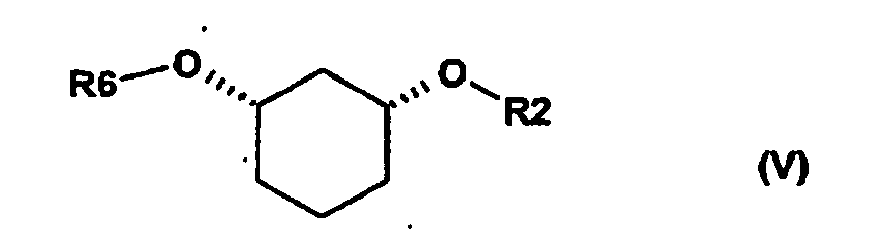
l'énantiomère produit sous forme d'alcool de formule (IV) étant transformé davantage comme décrit ci-dessous au point d), ouc) hydrolyse chimique (HC)
on saponifie l'énantiomère produit sous forme d'ester de formule (V) en alcool chimiquement énantiomère selon des procédés connus etd) alkylation (a1k-R1)
on transforme ensuite avec un composé de formule (VI)
le cycle A, R3, R4, R5 et n sont définis comme ci-dessus et
X2 signifie Cl, Br, I, OTs, OMs, OTf ;
en présence de bases dans un solvant approprié en composé de formule (I), ete) dissociation du groupe de protection GP (diGP)
lorsque R2 représente un groupe de protection de la fonction OH (GP) tel que défini ci-dessus pour R2, on transforme le composé de formule (Ia)
par dissociation du groupe de protection selon des procédés connus en un composé de formule (VII)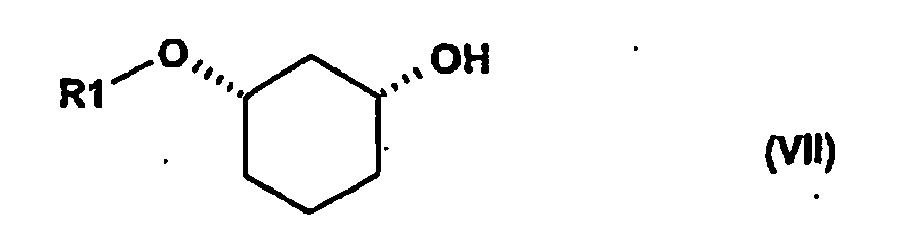 f) alkylation (alk-R2)dans laquelle X1 et R2 sont tels que définis ci-dessus en présence de bases dans un solvant approprié en un composé de formule (I), le produit ou la forme énantiomère,
qui est ensuite transformé avec un composé de formule (III),
X1-R2 (III)
où il est également possible de modifier l'ordre des différentes étapes de réaction tel que décrit ci-dessus au point A) :A) alk-R2 → FE+S / EC+SE+S [→ CH] → alk-R1 [→ DiGP → alk-R2] → produit/forme énantiomère enB) alk-R1 → FE+S / EC+SE+S [→ CH] → alk-R2 [→ DiGP → alk-R2] → produit/forme énantiomère
ouC) alk-GP → FE+S / EC+SE+S → CH → alk-R2 → DiGP → alk-R1 → produit/forme énantiomère
ouD) alk-SG → FE+S / EC+SE+S → alk-R1 → DiGP → alk-R2 → produit/forme énantiomère. - Procédé selon la revendication 1, caractérisé en ce qu'on utilise les procédés C) et D).
- Procédé selon les revendications 1 ou 2, caractérisé en ce qu'on utilise des composés de formule (III)
X1-R2 (III)
dans laquelle
X1 signifie Cl, Br, I, OMs ou OTf. - Procédé selon les revendications 1 à 3, caractérisé en ce qu'on utilise des composés de formule (III)
X1- R2 (III)
dans laquelle
X1 signifie Cl, Br ou I. - Procédé selon les revendications 1 à 4, caractérisé en ce qu'on prépare un composé de formule (I)

R1 représente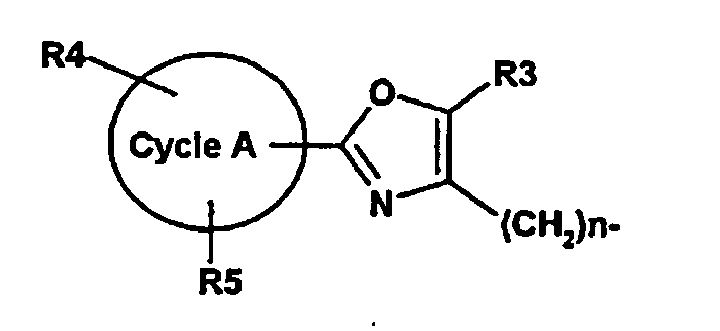
le cycle A représentant phényle, un cycle hétéroaromatique de 5 à 12 chaînons, qui peut contenir un ou plusieurs hétéroatomes du groupe N, O ou S, un cycle aromatique annelé/bicyclique de 8 à 14 chaînons, (C3-C8) -cycloalkyle ;
R3 représentant H, CF3, (C1-C6)-alkyle, (C3-C8)-cycloalkyle, phényle ;
R4, R5 signifiant H, F, Br, CF3, OCF3, (C1-C6)-alkyle, 0-(C1-C6)-alkyle ;
n signifiant 1 à 2 et
R2 signifiant (C1-C8)-alkyle, un ou plusieurs groupes CH2 dans les groupes alkyle pouvant être remplacés par O, CO, S, SO ou SO2, et alkyle pouvant être monosubstitué à trisubstitué par F, Cl, Br, CF3, CN, NO2, NHAc, NHBoc, NH-CO-C(CH3)3, hydroxyle, OCF3, O-(C1-C6) -alkyle, COOH, CO-benzoxy, CO-O(C1-C6) -alkyle, tétrazole, thiazolidine-2,4-dione, indole et (C6-C10)-aryle, où thiazolidine-2,4-dione et aryle peuvent à nouveau être substitués par F, Cl, Br, CF3, CN, NO2, NHAc, NHTs, NHBoc, NHCbz, NH-CO-C(CH3)3, hydroxyle, OCF3, O-(C1-C6)-alkyle, COOH, CO-benzoxy, CO-O(C1-C6)-alkyle, (C1-C6)-alkyle, O-(C1-C6)-alkyle ou tétrazole. - Procédé selon les revendications 1 à 5, caractérisé en ce qu'on prépare un composé de formule (I)

R1 représente
le cycle A signifiant phényle ;
R3 signifiant (C1-C4)-alkyle ;
R4, R5 signifiant H, (C1-C4)-alkyle, O-(C1-C4)-alkyle; n signifiant 1 et
R2 signifiant (C1-C8)-alkyle, un ou plusieurs groupes CH2 dans les groupes alkyle pouvant être remplacés par O, CO, S, SO ou SO2, et alkyle pouvant monosubstitué à trisubstitué par F, Cl, Br, CF3, CN, NO2, NHAc, NHBoc, NH-CO-C(CH3)3, hydroxyle, OCF3, O-(C1-C6) -alkyle, COOH, CO-benzoxy, CO-O(C1-C6)-alkyle, tétrazole, thiazolidine-2,4-dione, indole et (C6-C10)-aryle, où thiazolidine-2,4-dione et aryle peuvent à nouveau être substitués par F, Cl, Br, CF3, CN, NO2, NHAc, NHTs, NHBoc, NHCbz, NH-CO-C (CH3)3, hydroxyle, OCF3, 0- (C1-C6) -alkyle, COOH, CO-benzoxy, CO-O(C1-C6) -alkyle, (C1_C6) -alkyle, O-(C1-C6)-alkyle ou tétrazole.
Priority Applications (1)
| Application Number | Priority Date | Filing Date | Title |
|---|---|---|---|
| SI200430180T SI1599433T1 (sl) | 2003-02-27 | 2004-02-19 | Postopek za pripravo enantiomernih oblik cis-konfiguriranih 1,3-cikloheksandiolnih derivatov |
Applications Claiming Priority (3)
| Application Number | Priority Date | Filing Date | Title |
|---|---|---|---|
| DE10308350 | 2003-02-27 | ||
| DE10308350A DE10308350B4 (de) | 2003-02-27 | 2003-02-27 | Verfahren zur Herstellung der enantiomeren Formen von cis-konfigurierten 1,3-Cyclohexandiol-Derivaten |
| PCT/EP2004/001580 WO2004076390A1 (fr) | 2003-02-27 | 2004-02-19 | Procede pour realiser les formes enantiomeres de derives de cis 1,3-cyclohexandiol |
Publications (2)
| Publication Number | Publication Date |
|---|---|
| EP1599433A1 EP1599433A1 (fr) | 2005-11-30 |
| EP1599433B1 true EP1599433B1 (fr) | 2006-12-06 |
Family
ID=32863920
Family Applications (1)
| Application Number | Title | Priority Date | Filing Date |
|---|---|---|---|
| EP04712518A Expired - Lifetime EP1599433B1 (fr) | 2003-02-27 | 2004-02-19 | Procede pour realiser les formes enantiomeres de derives de cis 1,3-cyclohexandiol |
Country Status (24)
| Country | Link |
|---|---|
| EP (1) | EP1599433B1 (fr) |
| JP (1) | JP2006519001A (fr) |
| KR (1) | KR20050107469A (fr) |
| CN (1) | CN100572348C (fr) |
| AR (1) | AR044501A1 (fr) |
| AT (1) | ATE347543T1 (fr) |
| AU (1) | AU2004215674B2 (fr) |
| BR (1) | BRPI0407844A (fr) |
| CA (1) | CA2516623A1 (fr) |
| CO (1) | CO5690547A2 (fr) |
| CY (1) | CY1106454T1 (fr) |
| DE (2) | DE10308350B4 (fr) |
| DK (1) | DK1599433T3 (fr) |
| ES (1) | ES2278305T3 (fr) |
| IL (1) | IL170310A (fr) |
| MX (1) | MXPA05009053A (fr) |
| NO (1) | NO20054456L (fr) |
| NZ (1) | NZ542025A (fr) |
| PL (1) | PL377812A1 (fr) |
| PT (1) | PT1599433E (fr) |
| RU (1) | RU2372319C2 (fr) |
| TW (1) | TWI331138B (fr) |
| WO (1) | WO2004076390A1 (fr) |
| ZA (1) | ZA200505760B (fr) |
Families Citing this family (7)
| Publication number | Priority date | Publication date | Assignee | Title |
|---|---|---|---|---|
| DE102004038403B4 (de) * | 2004-08-07 | 2006-08-31 | Sanofi-Aventis Deutschland Gmbh | Verfahren zur Herstellung der enantiomeren Formen von cis-konfigurierten 3-Hydroxycyclohexancarbonsäure-Derivaten |
| DE102004040736B4 (de) * | 2004-08-23 | 2007-01-11 | Sanofi-Aventis Deutschland Gmbh | Verfahren zur Herstellung von Diarylcycloalkylderivaten |
| CN101381302B (zh) * | 2007-09-07 | 2013-04-03 | 上海睿智化学研究有限公司 | 2-溴甲基-6-甲基苯甲酰氯/溴的制备方法 |
| EP2298755A4 (fr) | 2008-05-21 | 2012-12-05 | Taisho Pharmaceutical Co Ltd | Procédé de production de dérivé de bicyclo[3.1.0]hexane à l aide d une enzyme |
| JP7185633B2 (ja) | 2017-02-17 | 2022-12-07 | トレベナ・インコーポレイテッド | 7員アザ複素環を含有するデルタ-オピオイド受容体調節化合物、その使用方法及び製造方法 |
| WO2023070605A1 (fr) * | 2021-10-29 | 2023-05-04 | Trevena, Inc. | Procédés de préparation de composés modulateurs du récepteur delta-opioïde contenant un aza-hétérocycle à 6 chaînons |
| CN114891838B (zh) * | 2022-04-29 | 2023-09-08 | 株洲壹诺生物技术有限公司 | 盐酸多佐胺中间体(s)-3-(2-噻吩硫基)-丁酸的合成方法 |
Family Cites Families (3)
| Publication number | Priority date | Publication date | Assignee | Title |
|---|---|---|---|---|
| PT1177176E (pt) * | 1999-04-28 | 2006-08-31 | Aventis Pharma Gmbh | Derivados de acidos triarilicos como ligandos de receptores ppar. |
| DE10004926A1 (de) * | 2000-02-04 | 2001-08-09 | Gruenenthal Gmbh | Verfahren zur enzymatischen Racematspaltung von Aminomethyl-Aryl-Cyclohexanol-Derivaten |
| JP4436129B2 (ja) * | 2001-08-31 | 2010-03-24 | サノフィ−アベンティス・ドイチュラント・ゲゼルシャフト・ミット・ベシュレンクテル・ハフツング | ジアリールシクロアルキル誘導体、その製造法及びppar−活性剤としてのその使用 |
-
2003
- 2003-02-27 DE DE10308350A patent/DE10308350B4/de not_active Expired - Fee Related
-
2004
- 2004-02-19 WO PCT/EP2004/001580 patent/WO2004076390A1/fr not_active Ceased
- 2004-02-19 PL PL377812A patent/PL377812A1/pl not_active IP Right Cessation
- 2004-02-19 DK DK04712518T patent/DK1599433T3/da active
- 2004-02-19 RU RU2005129993/04A patent/RU2372319C2/ru not_active IP Right Cessation
- 2004-02-19 AU AU2004215674A patent/AU2004215674B2/en not_active Ceased
- 2004-02-19 PT PT04712518T patent/PT1599433E/pt unknown
- 2004-02-19 KR KR1020057016034A patent/KR20050107469A/ko not_active Ceased
- 2004-02-19 CA CA002516623A patent/CA2516623A1/fr not_active Abandoned
- 2004-02-19 DE DE502004002234T patent/DE502004002234D1/de not_active Expired - Lifetime
- 2004-02-19 ES ES04712518T patent/ES2278305T3/es not_active Expired - Lifetime
- 2004-02-19 NZ NZ542025A patent/NZ542025A/en unknown
- 2004-02-19 JP JP2006501887A patent/JP2006519001A/ja active Pending
- 2004-02-19 BR BRPI0407844-6A patent/BRPI0407844A/pt not_active IP Right Cessation
- 2004-02-19 EP EP04712518A patent/EP1599433B1/fr not_active Expired - Lifetime
- 2004-02-19 CN CNB2004800054415A patent/CN100572348C/zh not_active Expired - Fee Related
- 2004-02-19 AT AT04712518T patent/ATE347543T1/de not_active IP Right Cessation
- 2004-02-19 MX MXPA05009053A patent/MXPA05009053A/es active IP Right Grant
- 2004-02-25 TW TW093104706A patent/TWI331138B/zh not_active IP Right Cessation
- 2004-02-27 AR ARP040100630A patent/AR044501A1/es unknown
-
2005
- 2005-07-19 ZA ZA200505760A patent/ZA200505760B/en unknown
- 2005-08-16 IL IL170310A patent/IL170310A/en not_active IP Right Cessation
- 2005-08-26 CO CO05085518A patent/CO5690547A2/es not_active Application Discontinuation
- 2005-09-26 NO NO20054456A patent/NO20054456L/no not_active Application Discontinuation
-
2007
- 2007-03-05 CY CY20071100303T patent/CY1106454T1/el unknown
Also Published As
| Publication number | Publication date |
|---|---|
| CO5690547A2 (es) | 2006-10-31 |
| BRPI0407844A (pt) | 2006-02-14 |
| AU2004215674B2 (en) | 2010-02-04 |
| DK1599433T3 (da) | 2007-04-16 |
| AU2004215674A1 (en) | 2004-09-10 |
| ATE347543T1 (de) | 2006-12-15 |
| CN100572348C (zh) | 2009-12-23 |
| RU2005129993A (ru) | 2006-01-27 |
| CY1106454T1 (el) | 2011-10-12 |
| PL377812A1 (pl) | 2006-02-20 |
| ZA200505760B (en) | 2006-05-31 |
| TW200508392A (en) | 2005-03-01 |
| RU2372319C2 (ru) | 2009-11-10 |
| ES2278305T3 (es) | 2007-08-01 |
| MXPA05009053A (es) | 2005-10-19 |
| TWI331138B (en) | 2010-10-01 |
| NZ542025A (en) | 2009-03-31 |
| NO20054456L (no) | 2005-09-26 |
| DE502004002234D1 (de) | 2007-01-18 |
| AR044501A1 (es) | 2005-09-14 |
| CN1753855A (zh) | 2006-03-29 |
| DE10308350A1 (de) | 2004-09-16 |
| EP1599433A1 (fr) | 2005-11-30 |
| KR20050107469A (ko) | 2005-11-11 |
| JP2006519001A (ja) | 2006-08-24 |
| DE10308350B4 (de) | 2006-06-01 |
| PT1599433E (pt) | 2007-02-28 |
| WO2004076390A1 (fr) | 2004-09-10 |
| CA2516623A1 (fr) | 2004-09-10 |
| HK1088889A1 (zh) | 2006-11-17 |
| IL170310A (en) | 2010-06-16 |
Similar Documents
| Publication | Publication Date | Title |
|---|---|---|
| DE10308350B4 (de) | Verfahren zur Herstellung der enantiomeren Formen von cis-konfigurierten 1,3-Cyclohexandiol-Derivaten | |
| EP1805316B1 (fr) | Procédé de préparation des formes énantiomères de dérivés de l'acide cis-3-hydroxycyclohexane carboxylique en utilisant des hydrolases | |
| DE3886445T2 (de) | Optisch-aktive Verbindungen und Verfahren zu deren Herstellung. | |
| EP0402771B1 (fr) | Procédé de dédoublement enzymatique d'esters vinyliques d'acides 2-aryl propioniques | |
| US7094795B2 (en) | Process for preparing the enantiomeric forms of cis-configured 1,3-cyclohexanediol derivatives | |
| US7803950B2 (en) | Method for the production of diarylcycloalkyl derivatives | |
| EP0727494B1 (fr) | Méthode pour l'acylation enzymatique d'alcools avec des acétates d'alkoxyvinyl par transestérification | |
| DE4329293A1 (de) | Lipase katalysierte Acylierung von Alkoholen mit Diketenen | |
| DE69103361T2 (de) | Verfahren zur alkohol/ester-trennung unter verwendung von geschützten hydroxylgruppen. | |
| JP2612671B2 (ja) | 光学活性なプロピオン酸エステルの製造法 | |
| JP3010382B2 (ja) | (r)−2−プロポキシベンゼン誘導体の製造法 | |
| EP0254243A2 (fr) | Intermédiaires de synthèse chiraux à partir de glycérine prochirale | |
| HK1088889B (en) | Method for producing the enantiomeric forms of cis 1,3-cyclohexanediol derivatives | |
| EP0556909A1 (fr) | Procédé de préparation de (R) et (S)-1,2-isopropylidène-glycérine | |
| WO2001018231A2 (fr) | PROCEDE DE FABRICATION DE (R)- OU (S)-HYDROXY-η-BUTYROLACTONE | |
| KR20060007294A (ko) | 광학활성 카복실산의 제조방법 | |
| JPH0755157B2 (ja) | 生化学的手法による光学活性なアルコ−ルとエステルの製造法 | |
| EP0893508A2 (fr) | Procédé nouveau de préparation d'oxodicyclopentadiéne | |
| DE19503977A1 (de) | Verfahren zur Herstellung von Penemen |
Legal Events
| Date | Code | Title | Description |
|---|---|---|---|
| PUAI | Public reference made under article 153(3) epc to a published international application that has entered the european phase |
Free format text: ORIGINAL CODE: 0009012 |
|
| 17P | Request for examination filed |
Effective date: 20050927 |
|
| AK | Designated contracting states |
Kind code of ref document: A1 Designated state(s): AT BE BG CH CY CZ DE DK EE ES FI FR GB GR HU IE IT LI LU MC NL PT RO SE SI SK TR |
|
| AX | Request for extension of the european patent |
Extension state: AL LT LV MK |
|
| GRAP | Despatch of communication of intention to grant a patent |
Free format text: ORIGINAL CODE: EPIDOSNIGR1 |
|
| RAX | Requested extension states of the european patent have changed |
Extension state: MK Payment date: 20050927 Extension state: AL Payment date: 20050927 Extension state: LT Payment date: 20050927 |
|
| GRAS | Grant fee paid |
Free format text: ORIGINAL CODE: EPIDOSNIGR3 |
|
| GRAA | (expected) grant |
Free format text: ORIGINAL CODE: 0009210 |
|
| RAX | Requested extension states of the european patent have changed |
Extension state: LT Payment date: 20050927 Extension state: LV Payment date: 20050927 Extension state: MK Payment date: 20050927 |
|
| AK | Designated contracting states |
Kind code of ref document: B1 Designated state(s): AT BE BG CH CY CZ DE DK EE ES FI FR GB GR HU IE IT LI LU MC NL PT RO SE SI SK TR |
|
| AX | Request for extension of the european patent |
Extension state: LT LV MK |
|
| REG | Reference to a national code |
Ref country code: GB Ref legal event code: FG4D Free format text: NOT ENGLISH |
|
| REG | Reference to a national code |
Ref country code: CH Ref legal event code: EP |
|
| REG | Reference to a national code |
Ref country code: IE Ref legal event code: FG4D Free format text: LANGUAGE OF EP DOCUMENT: GERMAN |
|
| REF | Corresponds to: |
Ref document number: 502004002234 Country of ref document: DE Date of ref document: 20070118 Kind code of ref document: P |
|
| REG | Reference to a national code |
Ref country code: PT Ref legal event code: SC4A Free format text: AVAILABILITY OF NATIONAL TRANSLATION Effective date: 20070206 |
|
| REG | Reference to a national code |
Ref country code: RO Ref legal event code: EPE |
|
| REG | Reference to a national code |
Ref country code: SE Ref legal event code: TRGR |
|
| GBT | Gb: translation of ep patent filed (gb section 77(6)(a)/1977) |
Effective date: 20070308 |
|
| REG | Reference to a national code |
Ref country code: DK Ref legal event code: T3 Ref country code: EE Ref legal event code: FG4A Ref document number: E000911 Country of ref document: EE Effective date: 20070209 |
|
| REG | Reference to a national code |
Ref country code: GR Ref legal event code: EP Ref document number: 20070400681 Country of ref document: GR |
|
| REG | Reference to a national code |
Ref country code: HU Ref legal event code: AG4A Ref document number: E001292 Country of ref document: HU |
|
| ET | Fr: translation filed | ||
| REG | Reference to a national code |
Ref country code: ES Ref legal event code: FG2A Ref document number: 2278305 Country of ref document: ES Kind code of ref document: T3 |
|
| PLBE | No opposition filed within time limit |
Free format text: ORIGINAL CODE: 0009261 |
|
| STAA | Information on the status of an ep patent application or granted ep patent |
Free format text: STATUS: NO OPPOSITION FILED WITHIN TIME LIMIT |
|
| 26N | No opposition filed |
Effective date: 20070907 |
|
| PGFP | Annual fee paid to national office [announced via postgrant information from national office to epo] |
Ref country code: SE Payment date: 20091218 Year of fee payment: 7 |
|
| PGFP | Annual fee paid to national office [announced via postgrant information from national office to epo] |
Ref country code: CH Payment date: 20100215 Year of fee payment: 7 Ref country code: CZ Payment date: 20100128 Year of fee payment: 7 Ref country code: DK Payment date: 20100211 Year of fee payment: 7 Ref country code: EE Payment date: 20100107 Year of fee payment: 7 Ref country code: ES Payment date: 20100312 Year of fee payment: 7 Ref country code: HU Payment date: 20100216 Year of fee payment: 7 Ref country code: IE Payment date: 20100217 Year of fee payment: 7 Ref country code: LU Payment date: 20100212 Year of fee payment: 7 Ref country code: MC Payment date: 20100127 Year of fee payment: 7 Ref country code: PT Payment date: 20100202 Year of fee payment: 7 Ref country code: RO Payment date: 20100112 Year of fee payment: 7 |
|
| PGFP | Annual fee paid to national office [announced via postgrant information from national office to epo] |
Ref country code: FI Payment date: 20100215 Year of fee payment: 7 Ref country code: FR Payment date: 20100223 Year of fee payment: 7 Ref country code: IT Payment date: 20100217 Year of fee payment: 7 Ref country code: SI Payment date: 20100104 Year of fee payment: 7 Ref country code: SK Payment date: 20100126 Year of fee payment: 7 |
|
| PGFP | Annual fee paid to national office [announced via postgrant information from national office to epo] |
Ref country code: AT Payment date: 20100212 Year of fee payment: 7 Ref country code: BE Payment date: 20100215 Year of fee payment: 7 Ref country code: DE Payment date: 20100228 Year of fee payment: 7 Ref country code: GB Payment date: 20100202 Year of fee payment: 7 Ref country code: TR Payment date: 20100127 Year of fee payment: 7 |
|
| PGFP | Annual fee paid to national office [announced via postgrant information from national office to epo] |
Ref country code: BG Payment date: 20100216 Year of fee payment: 7 |
|
| PGFP | Annual fee paid to national office [announced via postgrant information from national office to epo] |
Ref country code: NL Payment date: 20100209 Year of fee payment: 7 |
|
| PGFP | Annual fee paid to national office [announced via postgrant information from national office to epo] |
Ref country code: CY Payment date: 20100122 Year of fee payment: 7 |
|
| PGFP | Annual fee paid to national office [announced via postgrant information from national office to epo] |
Ref country code: GR Payment date: 20100115 Year of fee payment: 7 |
|
| REG | Reference to a national code |
Ref country code: PT Ref legal event code: MM4A Free format text: LAPSE DUE TO NON-PAYMENT OF FEES Effective date: 20110819 |
|
| BERE | Be: lapsed |
Owner name: SANOFI-AVENTIS DEUTSCHLAND G.M.B.H. Effective date: 20110228 |
|
| REG | Reference to a national code |
Ref country code: NL Ref legal event code: V1 Effective date: 20110901 |
|
| LTLA | Lt: lapse of european patent or patent extension |
Effective date: 20110219 |
|
| PG25 | Lapsed in a contracting state [announced via postgrant information from national office to epo] |
Ref country code: MC Free format text: LAPSE BECAUSE OF NON-PAYMENT OF DUE FEES Effective date: 20110228 |
|
| REG | Reference to a national code |
Ref country code: CH Ref legal event code: PL |
|
| REG | Reference to a national code |
Ref country code: DK Ref legal event code: EBP |
|
| REG | Reference to a national code |
Ref country code: SE Ref legal event code: EUG |
|
| REG | Reference to a national code |
Ref country code: EE Ref legal event code: MM4A Ref document number: E000911 Country of ref document: EE Effective date: 20110228 |
|
| GBPC | Gb: european patent ceased through non-payment of renewal fee |
Effective date: 20110219 |
|
| REG | Reference to a national code |
Ref country code: SI Ref legal event code: KO00 Effective date: 20110921 |
|
| PG25 | Lapsed in a contracting state [announced via postgrant information from national office to epo] |
Ref country code: LI Free format text: LAPSE BECAUSE OF NON-PAYMENT OF DUE FEES Effective date: 20110228 Ref country code: CH Free format text: LAPSE BECAUSE OF NON-PAYMENT OF DUE FEES Effective date: 20110228 Ref country code: PT Free format text: LAPSE BECAUSE OF NON-PAYMENT OF DUE FEES Effective date: 20110819 Ref country code: EE Free format text: LAPSE BECAUSE OF NON-PAYMENT OF DUE FEES Effective date: 20110228 |
|
| REG | Reference to a national code |
Ref country code: SK Ref legal event code: MM4A Ref document number: E 1651 Country of ref document: SK Effective date: 20110219 |
|
| REG | Reference to a national code |
Ref country code: FR Ref legal event code: ST Effective date: 20111102 |
|
| REG | Reference to a national code |
Ref country code: IE Ref legal event code: MM4A |
|
| PG25 | Lapsed in a contracting state [announced via postgrant information from national office to epo] |
Ref country code: AT Free format text: LAPSE BECAUSE OF NON-PAYMENT OF DUE FEES Effective date: 20110219 Ref country code: GR Free format text: LAPSE BECAUSE OF NON-PAYMENT OF DUE FEES Effective date: 20110902 Ref country code: SK Free format text: LAPSE BECAUSE OF NON-PAYMENT OF DUE FEES Effective date: 20110219 Ref country code: CY Free format text: LAPSE BECAUSE OF NON-PAYMENT OF DUE FEES Effective date: 20110219 Ref country code: CZ Free format text: LAPSE BECAUSE OF NON-PAYMENT OF DUE FEES Effective date: 20110219 Ref country code: SI Free format text: LAPSE BECAUSE OF NON-PAYMENT OF DUE FEES Effective date: 20110220 Ref country code: FI Free format text: LAPSE BECAUSE OF NON-PAYMENT OF DUE FEES Effective date: 20110219 Ref country code: BE Free format text: LAPSE BECAUSE OF NON-PAYMENT OF DUE FEES Effective date: 20110228 |
|
| PG25 | Lapsed in a contracting state [announced via postgrant information from national office to epo] |
Ref country code: NL Free format text: LAPSE BECAUSE OF NON-PAYMENT OF DUE FEES Effective date: 20110901 Ref country code: IT Free format text: LAPSE BECAUSE OF NON-PAYMENT OF DUE FEES Effective date: 20110219 |
|
| REG | Reference to a national code |
Ref country code: DE Ref legal event code: R119 Ref document number: 502004002234 Country of ref document: DE Effective date: 20110901 |
|
| PG25 | Lapsed in a contracting state [announced via postgrant information from national office to epo] |
Ref country code: FR Free format text: LAPSE BECAUSE OF NON-PAYMENT OF DUE FEES Effective date: 20110228 Ref country code: IE Free format text: LAPSE BECAUSE OF NON-PAYMENT OF DUE FEES Effective date: 20110221 |
|
| PG25 | Lapsed in a contracting state [announced via postgrant information from national office to epo] |
Ref country code: GB Free format text: LAPSE BECAUSE OF NON-PAYMENT OF DUE FEES Effective date: 20110219 |
|
| REG | Reference to a national code |
Ref country code: ES Ref legal event code: FD2A Effective date: 20120411 |
|
| PG25 | Lapsed in a contracting state [announced via postgrant information from national office to epo] |
Ref country code: ES Free format text: LAPSE BECAUSE OF NON-PAYMENT OF DUE FEES Effective date: 20110220 |
|
| PG25 | Lapsed in a contracting state [announced via postgrant information from national office to epo] |
Ref country code: SE Free format text: LAPSE BECAUSE OF NON-PAYMENT OF DUE FEES Effective date: 20110220 |
|
| PG25 | Lapsed in a contracting state [announced via postgrant information from national office to epo] |
Ref country code: LU Free format text: LAPSE BECAUSE OF NON-PAYMENT OF DUE FEES Effective date: 20110219 |
|
| PG25 | Lapsed in a contracting state [announced via postgrant information from national office to epo] |
Ref country code: DE Free format text: LAPSE BECAUSE OF NON-PAYMENT OF DUE FEES Effective date: 20110901 |
|
| PG25 | Lapsed in a contracting state [announced via postgrant information from national office to epo] |
Ref country code: BG Free format text: LAPSE BECAUSE OF NON-PAYMENT OF DUE FEES Effective date: 20111231 |
|
| PG25 | Lapsed in a contracting state [announced via postgrant information from national office to epo] |
Ref country code: TR Free format text: LAPSE BECAUSE OF NON-PAYMENT OF DUE FEES Effective date: 20110219 |
|
| PG25 | Lapsed in a contracting state [announced via postgrant information from national office to epo] |
Ref country code: HU Free format text: LAPSE BECAUSE OF NON-PAYMENT OF DUE FEES Effective date: 20110220 |