EP1599433B1 - Verfahren zur herstellung der enantiomeren formen von cis-konfigurierten 1,3-cyclohexandiol-derivaten - Google Patents
Verfahren zur herstellung der enantiomeren formen von cis-konfigurierten 1,3-cyclohexandiol-derivaten Download PDFInfo
- Publication number
- EP1599433B1 EP1599433B1 EP04712518A EP04712518A EP1599433B1 EP 1599433 B1 EP1599433 B1 EP 1599433B1 EP 04712518 A EP04712518 A EP 04712518A EP 04712518 A EP04712518 A EP 04712518A EP 1599433 B1 EP1599433 B1 EP 1599433B1
- Authority
- EP
- European Patent Office
- Prior art keywords
- alkyl
- formula
- alk
- phenyl
- ocf
- Prior art date
- Legal status (The legal status is an assumption and is not a legal conclusion. Google has not performed a legal analysis and makes no representation as to the accuracy of the status listed.)
- Expired - Lifetime
Links
- 0 *O[C@](CCC1)C[C@]1O* Chemical compound *O[C@](CCC1)C[C@]1O* 0.000 description 5
- XWACKBMPGJMLFJ-UHFFFAOYSA-N Cc1c(CI)nc(-c2cc(C)ccc2)[o]1 Chemical compound Cc1c(CI)nc(-c2cc(C)ccc2)[o]1 XWACKBMPGJMLFJ-UHFFFAOYSA-N 0.000 description 1
- WIONSNLWNWJORQ-UONOGXRCSA-N Cc1cccc(CO[C@H](CCC2)C[C@H]2O)c1C(OC)=O Chemical compound Cc1cccc(CO[C@H](CCC2)C[C@H]2O)c1C(OC)=O WIONSNLWNWJORQ-UONOGXRCSA-N 0.000 description 1
- RFCYVWGCOXVSBD-QWHCGFSZSA-N O[C@@H](CCC1)C[C@@H]1OCc1ccccc1 Chemical compound O[C@@H](CCC1)C[C@@H]1OCc1ccccc1 RFCYVWGCOXVSBD-QWHCGFSZSA-N 0.000 description 1
- HEIITDNRRCFOFX-CABCVRRESA-N O[C@H](CCC1)C[C@H]1OCc1c[o]c(-c(cc2)ccc2F)n1 Chemical compound O[C@H](CCC1)C[C@H]1OCc1c[o]c(-c(cc2)ccc2F)n1 HEIITDNRRCFOFX-CABCVRRESA-N 0.000 description 1
Classifications
-
- C—CHEMISTRY; METALLURGY
- C07—ORGANIC CHEMISTRY
- C07D—HETEROCYCLIC COMPOUNDS
- C07D263/00—Heterocyclic compounds containing 1,3-oxazole or hydrogenated 1,3-oxazole rings
- C07D263/02—Heterocyclic compounds containing 1,3-oxazole or hydrogenated 1,3-oxazole rings not condensed with other rings
- C07D263/30—Heterocyclic compounds containing 1,3-oxazole or hydrogenated 1,3-oxazole rings not condensed with other rings having two or three double bonds between ring members or between ring members and non-ring members
- C07D263/32—Heterocyclic compounds containing 1,3-oxazole or hydrogenated 1,3-oxazole rings not condensed with other rings having two or three double bonds between ring members or between ring members and non-ring members with only hydrogen atoms, hydrocarbon or substituted hydrocarbon radicals, directly attached to ring carbon atoms
-
- C—CHEMISTRY; METALLURGY
- C12—BIOCHEMISTRY; BEER; SPIRITS; WINE; VINEGAR; MICROBIOLOGY; ENZYMOLOGY; MUTATION OR GENETIC ENGINEERING
- C12P—FERMENTATION OR ENZYME-USING PROCESSES TO SYNTHESISE A DESIRED CHEMICAL COMPOUND OR COMPOSITION OR TO SEPARATE OPTICAL ISOMERS FROM A RACEMIC MIXTURE
- C12P41/00—Processes using enzymes or microorganisms to separate optical isomers from a racemic mixture
- C12P41/003—Processes using enzymes or microorganisms to separate optical isomers from a racemic mixture by ester formation, lactone formation or the inverse reactions
- C12P41/004—Processes using enzymes or microorganisms to separate optical isomers from a racemic mixture by ester formation, lactone formation or the inverse reactions by esterification of alcohol- or thiol groups in the enantiomers or the inverse reaction
-
- C—CHEMISTRY; METALLURGY
- C07—ORGANIC CHEMISTRY
- C07C—ACYCLIC OR CARBOCYCLIC COMPOUNDS
- C07C2601/00—Systems containing only non-condensed rings
- C07C2601/12—Systems containing only non-condensed rings with a six-membered ring
- C07C2601/14—The ring being saturated
Definitions
- the invention relates to a process for preparing chiral, nonracemic, cicconfigured 1,3-disubstituted cyclohexanols of the formula (I)
- the reaction described leads to a mixture of 9 isomeric forms or derivatives of cyclohexanediol, namely the unreacted Isomeric (S, S) -diol, (R, R) -diol and (R, S) -diol, furthermore the monoacylated products (S, S) -monooctanoate, (R, R) -monooctanoate and (R, S) Monooctanoate, and third, the group of diacylated products (S, S) -dioctanoate, (R, R) -dioctanoate, and (R, S) -dioctanoate.
- optically active, monoacylated, cis-configured (R, S) -monooctanoate occupies only a fraction of about 12% in the fraction of the monoacylated cyclohexanediols.
- R, S monoacylated, cis-configured
- the aim of the present invention was therefore to develop a method that does not have the disadvantages mentioned.
- the process of the invention is economical, simple and fast.
- the process completely avoids the risk of acyl group migration, it does not require equimolar amounts of optically pure starting materials or auxiliaries, no expensive reagents, no resolution by chromatography on chiral phases, no disproportionately large amounts of solvent and no costly operations.
- alkyl radicals in the substituents R 2 , R 3 , R 4 and R 5 may be both straight-chain and branched.
- a heteroaromatic ring is understood as meaning both mono- and bicyclic rings having a maximum of 4 heteroatoms, in particular those containing up to 4 nitrogen atoms and / or 1 oxygen or 1 sulfur atom, for example: furan, thiophene, thiazole, oxazole, thiadiazole, triazole , Pyridine, triazine, quinoline, isoquinoline, indole, benzothiophene, benzofuran, benzotriazole.
- Aromatic rings may be mono- or bicyclic and also fused, e.g. Naphthyl, benzo [1,3] dioxole, dihydrobenzo [1,4] dioxin.
- racemic, cis-configured 1,3-cyclohexane derivatives of the formula (IV) and of the formula (VII) are prepared by monoalkylation of cis-cyclohexanediol (compound of the formula II) but can also be prepared by reductive opening of corresponding acetals ( Chem. 1993 , 85, 6756), further by so-called reductive ether formation, starting from silyl ethers and aldehydes or ketones (JS Bajwa, X. Jiang, J. Slade, K. Prasad, O. Repic, TJ Blacklock, Tetrahedron Lett., 2002 , 43, 6709-6713).
- the alkylating reagents of the formula III are commercially available or can be prepared by literature methods, for. B by radical side chain halogenation (see literature review RC Larock, Comprehensive Organic Transformations, p 313, 1989 VCH Publishers, Inc.) or from the alcohols or derivatives thereof can be prepared (see literature review RC Larock, Comprehensive Organic Transformations, Pp. 353-363., 1989 VCH Publishers, Inc.).
- alkylating reagents of the formula III and VI are reacted in the presence of bases with 1,3-cyclohexanediol or 1,3-cyclohexanediol derivatives.
- bases are hydroxides such as KOH, carbonates such as Cs 2 CO 3 , alkoxides such as KOtBu and also compounds such as LDA, BuLi, LiHMDS, KH, NaH and NaHMDS.
- Suitable solvents are, for example, THF, MTBE, DME, NMP, DMF and chlorobenzene.
- ester derivatives for. Acetyl, propionyl, butyryl or glutaryl, these are incorporated in homogeneous or heterogeneous, aqueous, aqueous-organic or organic media in the presence of a suitable enzyme of stereoselective hydrolysis or alcoholysis (eg with n-butanol) a temperature of 10 - 80 ° C optionally in the presence of cosolvents (see above) and subjected to a buffer, wherein the reaction mixture preferably contains 2 - 50 wt .-% ester.
- a suitable enzyme of stereoselective hydrolysis or alcoholysis eg with n-butanol
- cosolvents see above
- ester derivatives can be carried out by literature methods, for example by reaction of the alcohol with acid chlorides such as acetyl chloride or anhydrides such as acetic anhydride, in the presence of an amine, such as. Triethylamine or pyridine (see Literature Review R.C. Larock, Comprehensive Organic Transformations, p.978, 1989 VCH Publishers, Inc.)
- a particularly interesting possibility for separating the enantiomers is to select the acyl donor in the case of enzymatic acylation so that the acylated enantiomer is significantly more water-soluble than the unreacted alcohol.
- Suitable acyl donors are, for example, cyclic anhydrides such as succinic anhydride.
- the acylation product carries a free carboxyl group, which allows rapid removal of the product by aqueous extraction in the basic, for example, with sat. aqueous NaHCO 3 solution enabled.
- the addition can z. B. 0.01-1.0 molar.
- a favorable buffer range is pH 5-10.
- enzymes are preferably hydrolases from mammalian livers such.
- lipase B Glutaric acid mono- (3-benzyloxy-cyclohexyl) ester, it may be advantageous to use the glutaryl-7-ACA acylase (Roche Diagnostics) instead of the above-mentioned lipases.
- glutaryl-7-ACA acylase (Roche Diagnostics)
- lipase B from Candida antarctica (Roche Diagnostics), where it may be advantageous to use the free enzyme or an immobilized form of the enzyme, eg. B. one of the three currently commercially available products to use.
- Each of the enzymes mentioned can be used in free or immobilized form (Immobilized Biocatalysts, W. Hartmeier, Springer Verlag Berlin, 1988).
- the amount of enzyme is chosen freely depending on the reaction rate or on the desired reaction time and on the type of enzyme (eg free or immobilized) and can be easily determined by simple preliminary experiments.
- the recovery of the enzyme can be carried out by freeze-drying.
- the separation (and possibly subsequent reuse) of the enzyme can be facilitated by immobilization.
- Ethanol was distilled off in vacuo, the residue dissolved in about 2 L of water and washed four times with 500 mL MTB ether. The aqueous phase was cooled with conc. Hydrochloric acid acidified to pH 1 and extracted the oily precipitating product with 1.5 L of ethyl acetate. The ethyl acetate solution was dried and concentrated in vacuo. The residue was dissolved in 1.2 L DIPE at about 40 ° C.
- Ethanol was distilled off in vacuo, the residue was dissolved in 500 ml of water and the solution washed four times with 100 ml of MTB ether. The aqueous phase was cooled with conc. Acidified hydrochloric acid (pH 1) and the oily precipitating product extracted with ethyl acetate. The ethyl acetate solution was dried and concentrated in vacuo. The residue was dissolved in 250 mL DIPE while warm. Upon cooling, crystallization started.
- Ethanol was distilled off in vacuo, the residue was dissolved in 500 ml of water and the solution was washed three times with 150 ml of MTB ether. The aqueous phase was cooled with conc. Hydrochloric acid acidified (pH 1) and the oily product extracted with ethyl acetate. The ethyl acetate solution was dried and concentrated in vacuo. The residue was dissolved in 250 mL DIPE while warm. Upon cooling, crystallization started.
- the aqueous solution was extracted four times with 500 ml of MTBE.
- the combined MTBE phases were washed twice with 1 l of water each time, dried (Na 2 SO 4 ) and then evaporated under reduced pressure.
- the mixture was cooled to 0-5 ° C, 189 mg (about 94%, about 0.78 mmol) of 2-bromomethyl-6-methyl-benzoic acid added dropwise and stirred for 30 minutes at 0-5 ° C. Without further cooling, the reaction mixture had a temperature of about 20 ° C after 1.5 hours. After standing overnight and adding about 20 mg KOtBu, the reaction was complete after stirring for an additional hour at 22 ° C.
- the optical purity of the alcohol (1S, 3R) -3-benzyloxycyclohexan-1-ol was> 98% ee (HPLC to Chiralpak AD-H 250 x 4.6, 1 mL / min, heptane / EtOH / CH 3 CN 25: 1: 0.5 + 0.1% TFA), the ee of the (1R, 3S) acetate was 82% (HPLC to Chiralcel OD 250 x 4.6, 1 mL / min, heptane / EtOH / CH 3 CN 100: 1: 0.5).
- the optical purity of the alcohol (1S, 3R) -3-benzyloxy-cyclohexanol was 68% ee (HPLC to Chiralpak AD-H 250 x 4.6, 1 mL / min, heptane / EtOH / CH 3 CN 25: 1: 0.5 + 0.1 % TFA), the ee of the enantiomeric acetate was 95% (HPLC to Chiralcel OD 250 x 4.6, 1 mL / min, heptane / EtOH / CH 3 CN 100: 1: 0.5).
- the optical purity of (1S, 3R) -3-benzyloxy-cyclohexan-1-ol was 70% ee (HPLC to Chiralpak AD-H 250 x 4.6, 1 mM, heptane / EtOH / CH 3 CN 25: 1: 0.5 + 0.1% TFA), the ee of the (1R, 3S) acetate was 95% (HPLC to Chiralcel OD 250 x 4.6, 1 mL / min, heptane / EtOH / CH 3 CN 100: 1: 0.5).
- the optical purity of (1S, 3R) -3-benzyloxy-cyclohexan-1-ol was 95% ee (HPLC to Chiralpak AD-H 250 x 4.6, 1 mL / min, heptane / EtOH / CH 3 CN 25: 1: 0.5 + 0.1% TFA), the ee of the (1R, 3S) acetate was 90% (HPLC to Chiralcel OD 250 x 4.6, 1 mL / min, heptane / EtOH / CH 3 CN 100: 1: 0.5).
- the optical purity of (1S, 3R) -3-benzyloxy-cyclohexan-1-ol was 90% ee (HPLC to Chiralpak AD-H 250 x 4.6, 1 mL / min, heptane / EtOH / CH 3 CN 25: 1: 0.5 + 0.1% TFA), the ee of the (1R, 3S) acetate was 90% (HPLC to Chiralcel OD 250 x 4.6, 1 mL / min, heptane / EtOH / CH 3 CN 100: 1: 0.5).
- the optical purity of (1S, 3R) -3-benzyloxycyclohexan-1-ol was> 98% ee (HPLC on Chiralpak AD-H 250 x 4.6, 1 mL / min, heptane / EtOH / CH 3 CN 25: 1: 0.5 + 0.1% TFA), the optical purity of the succinic acid derivative was 94% ee (HPLC to Chiralcel OD 250 x 4.6, 1 mL / min, heptane / EtOH / CH 3 CN 25: 1: 0.5 + 0.1% TFA).
- the optical purity of (1S, 3R) -3-benzyloxy-cyclohexan-1-ol was> 95 % ee (HPLC to Chiralpak AD-H 250 x 4.6, 1 mL / min, heptane / EtOH / CH 3 CN 25: 1: 0.5 + 0.1% TFA), the optical purity of the succinic acid derivative was> 97% ee (HPLC to Chiralcel OD 250 x 4.6, 1 mL / min, heptane / EtOH / CH 3 CN 25: 1: 0.5 + 0.1% TFA).
- the optical purity of (1S, 3R) -3-benzyloxy-cyclohexan-1-ol was 84% ee (HPLC to Chiralpak AD-H 250 x 4.6, 1 mL / min, heptane / EtOH / CH 3 CN 25: 1: 0.5 + 0.1% TFA), the optical purity of the succinic acid derivative was> 95% ee (HPLC to Chiralcel OD 250 x 4.6, 1 mL / min, heptane / EtOH / CH 3 CN 25: 1: 0.5 + 0.1% TFA).
- the optical purity of (1S, 3R) -3-benzyloxycyclohexan-1-ol was> 98% ee (HPLC on Chiralpak AD-H 250 x 4.6, 1 mL / min, heptane / EtOH / CH 3 CN 25: 1: 0.5 + 0.1% TFA), the optical purity of the succinic acid derivative was 88% ee (HPLC to Chiralcel OD 250 x 4.6, 1 mL / min, heptane / EtOH / CH 3 CN 25: 1: 0.5 + 0.1% TFA).
- the optical purity of (1S, 3R) -3-benzyloxy-cyclohexan-1-ol was> 99% ee (HPLC to Chiralpak AD-H 250 x 4.6, 1 mL / min, heptane / EtOH / CH 3 CN 25: 1 : 0.5 + 0.1% TFA), the optical purity of the succinic acid derivative was 78% ee (HPLC to Chiralcel OD 250 x 4.6, 1 mL / min, heptane / EtOH / CH 3 CN 25: 1: 0.5 + 0.1% TFA).
Landscapes
- Chemical & Material Sciences (AREA)
- Organic Chemistry (AREA)
- Wood Science & Technology (AREA)
- Zoology (AREA)
- Life Sciences & Earth Sciences (AREA)
- Engineering & Computer Science (AREA)
- Biotechnology (AREA)
- Bioinformatics & Cheminformatics (AREA)
- Microbiology (AREA)
- Chemical Kinetics & Catalysis (AREA)
- Analytical Chemistry (AREA)
- Health & Medical Sciences (AREA)
- Biochemistry (AREA)
- General Chemical & Material Sciences (AREA)
- General Engineering & Computer Science (AREA)
- General Health & Medical Sciences (AREA)
- Genetics & Genomics (AREA)
- Organic Low-Molecular-Weight Compounds And Preparation Thereof (AREA)
- Preparation Of Compounds By Using Micro-Organisms (AREA)
- Pharmaceuticals Containing Other Organic And Inorganic Compounds (AREA)
- Heterocyclic Carbon Compounds Containing A Hetero Ring Having Nitrogen And Oxygen As The Only Ring Hetero Atoms (AREA)
- Plural Heterocyclic Compounds (AREA)
Abstract
Description
- Die Erfindung betrifft ein Verfahren zur Herstellung chiraler, nicht-racemischer, ciskonfigurierter 1,3-disubstituierter Cyclohexanole der Formel (I)

- Unterschiedlich substituierte cis-konfigurierte 1,3-disubstituierte Cyclohexan-Derivate (Verbindungen der Formel (I) mit R1 ≠ R2,) sind zentrale Bausteine bzw. Vorstufen der in der WO 03/020269 beschriebenen Arzneimittelwirkstoffe, die sich generell zur Therapie von Lipidstoffwechselstörungen, von Typ II Diabetes und von Syndrom X u.a. eignen.
- Die in der Patentanmeldung 03/020269 beschriebenen Synthesen der nichtracemischen, cis-konfigurierten 1,3-Cyclohexan-Derivate kommen als technische Verfahren nicht in Betracht: So sind beispielsweise Alkylierungen mit NaH/DMF im multi-kg-Maßstab nicht sicher durchführbar (C&EN, September 13, 1982,5). Weiterhin erfordert die Alkylierung nach der Bu2SnO-Methode im Technikums-Maßstab einen unakzeptabel hohen Aufwand; die Abtrennung der Zinn-Verbindungen aus dem gewünschten Produkt ist auch bei Anwendung chromatographischer Trennmethoden sehr schwierig und meist nicht vollständig. Die Entsorgung der Zinn-Verbindungen ist ein weiteres Problem bzw. ein Kostenfaktor. Die Trennung der Enantiomeren (Racematspaltung) per Chromatographie an chiraler Phase ist ebenfalls aufwendig und zu teuer. Darüber hinaus ist es für die chromatographische Enantiomerentrennung erforderlich, dass die racemische Verbindung in guter chemischer Reinheit vorliegt, was sich vielfach nur durch eine zusätzliche, vorgeschaltete Chromatographie erreichen lässt.
- Andere, in der Literatur beschriebene, Methoden der Synthese von cis-1,3-Cyclohexandiolbausteinen bzw. Derivaten, wie z.B. die Öffnung von Epoxycyclohexanen (P. Crotti, V. Di Bussolo, L. Favero, M. Pineschi, F. Marianucci, G. Renzi, G. Amici, G. Roselli, Tetrahedron 2000, 56, 7513-7524 und zit. Lit.) oder die Metall-katalysierte Hydroborierung von Cyclohexen-Derivaten (J. A. Brinkmann, T. T. Nguyen, J. R. Sowa, Jr., Org. Lett. 2000, 2, 981-983; C. E. Garrett, G. C. Fu, J. Org. Chem. 1998, 63, 1370-1371) sind bezüglich der Regio- und der Stereoselektivität überwiegend unbefriedigend. Die Gesamtstufenzahl ist darüberhinaus deutlich höher. Als technische Prozesse kommen sie daher nicht in Frage.
Die Synthese von cis-1,3-Cyclohexandiolderivaten ausgehend von cis, cis-1,3,5-Cyclohexantriol bzw. cis, cis-1,3,5-Cyclohexantriol-Derivaten (L. Dumortier. M. Carda, J. Van der Eycken, G. Snatzke, M. Vandewalle, Tetrahedron: Asymmetry 1991, 2, 789-792; H. Suemune, K. Matsuno, M. Uchida, K. Sakai, Tetrahedron: Asymmetry 1992, 3, 297-306) sind ebenfalls aufgrund der hohen Stufenzahl sehr aufwendig und unökonomisch und daher für eine techniche Anwendung ungeeignet.
Auch die enzymatische Umsetzung des cis/trans-Gemisches von 1,3-Cyclohexandiol mit S-Ethyl-thiooctanoat kommt als technischer Prozess nicht in Betracht. Abgesehen von der kaum vermeidbaren Geruchsbelästigung beim Umgang mit den Schwefelverbindungen und der Tatsache, dass zur Erzielung des erforderlichen Umsatzes das freiwerdende Ethanthiol kontinuierlich entfernt werden muss, führt die beschriebene Reaktion zu einer Mischung von 9 isomeren Formen bzw. Derivaten von Cyclohexandiol, nämlich den nicht umgesetzten Isomeren (S,S)-Diol, (R,R)-Diol und (R,S)-Diol, weiterhin den monoacylierten Produkten (S,S)-Monooctanoat, (R,R)-Monooctanoat und (R,S)-Monooctanoat, und drittens der Gruppe der diacylierten Produkte (S,S)-Dioctanoat, (R,R)- Dioctanoat und (R,S)- Dioctanoat. Das optisch aktive, monoacylierte, cis-konfigurierte (R,S)-Monooctanoat nimmt in der Fraktion der monoacylierten Cyclohexandiole nur einen Anteil von etwa 12 % ein. Eine im präparativen Maßstab durchführbare Herstellung und Isolierung dieses Produktes ist nicht beschrieben, kann aber angesichts der Mengenverhältnisse und des geschilderten Trennproblems nicht ökonomisch sein. Darüber hinaus ist bekannt, dass partiell acylierte Di- bzw. Polyhydroxyverbindungen zu Acylgruppen-Wanderungen neigen. Tritt dieser Fall z. B. im Verlauf der Reinigung des (R,S)-Monooctanoats (z. B. bei der Chromatographie an Kieselgel oder bei wäßrigen Extraktionen) oder im Verlauf einer sich anschließenden Reaktion (z. B. während der Alkylierung der freien Hydroxygruppe) ein, so führt dies zu einer deutlichen Verminderung der optischen Reinheit bzw. zur Racemisierung.
Die cis-konfigurierten (R,S)-Diole bzw. die diacylierten (R,S)-Verbindungen sind optisch nicht aktiv und daher nicht von Interesse. - Ziel der vorliegenden Erfindung war es daher, ein Verfahren zu entwickeln, dass die genannten Nachteile nicht aufweist.
- Gegenstand der vorliegenden Erfindung ist ein Verfahren zur Herstellung chiraler, nicht racemischer Verbindungen der Formel I

R1
- Ring A
- Phenyl, 5-12 gliedriger heteroaromatischer Ring, der ein bis vier Heteroatome aus der Gruppe N, O oder S enthalten kann, 8 bis 14 gliedriger aromatischer Ring, (C3-C8)-Cycloalkyl;
- R3
- H, F, Cl, Br, OH, NO2, CF3, OCF3, (C1-C6)-Alkyl, (C3-C8)-Cycloalkyl, Phenyl;
- R4, R5
- H, F, Cl, Br, OH, NO2, CF3, OCF3, OCF2H, OCF2-CF3, OCF2-CHF2, SCF3, O-Phenyl, (C1-C6)-Alkyl, O-(C1-C6)-Alkyl, O-(C1-C6)-Alkyl-O-(C1-C3)-Alkyl;
- n
- 1 bis 3;
- R2
- (C1-C8)-Alkyl, wobei in den Alkylgruppen ein oder mehrere CH2-Gruppen durch O, CO, S, SO oder SO2 ersetzt sein können, und Alkyl ein bis dreifach substituiert sein kann durch F, Cl, Br, CF3, CN, NO2, NHAc, NHBoc, NH-CO-C(CH3)3, Hydroxyl, OCF3, O-(C1-C6)-Alkyl, COOH, CO-Benzoxy, CO-O(C1-C6)-Alkyl, Tetrazol, Thiazolidin-2,4-dion, Indol und (C6-C10)-Aryl, wobei Thiazolidin-2,4-dion und Aryl wiederum durch F, Cl, Br, CF3, CN, NO2, NHAc, NHTs, NHBoc, NHCbz, NH-CO-C(CH3)3, Hydroxyl, OCF3, O-(C1-C6)-Alkyl, COOH, CO-Benzoxy, CO-O(C1-C6)-Alkyl, (C1-C6)-Alkyl, O-(C1-C6)-Alkyl oder Tetrazol substituiert sein können, oder;
- R2
- eine OH-Schutzgruppe (SG), wie z.B. Benzyloxymethyl, Benzyl, para-Methoxybenzyl oder tert.-Butyl-dimethylsilyl;
- a) Alkylierung (Alk-R2 / Alk-SG)
cis-1,3-Cyclohexandiol der Formel (II)
X1-R2 (III)
worin R2 wie oben definiert ist und- X1
- für Cl, Br, I, OMs (O-Mesyl), OTs (O-Tosyl), OTf (O-Triflat) steht;

- b1) Enzymatische Esterbildung (EB) + Trennung (T)
die erhaltenen Verbindungen der Formel (IV) einer stereoselektiven enzymatischen Esterbildung (EB) unterwirft, wobei die Alkohole in einem organischen Lösungsmitteln wie z. B. Dichlormethan mit einem Acyldonor, wie z.B. einem Vinylester R6-O-CH=CH2 oder einem Säureanhydrid R6-O-R6, worin R6 wie oben definiert ist, und dem Enzym versetzt und die resultierende Mischung bei -20 bis
80 °C gerührt werden und nach Ablauf der Reaktion das eine Stereoisomere als Ester der Formel (V)
- R6
- C(=O)-(C1-C16)-Alkyl, C(=O)-(C2-C16)-Alkenyl, C(=O)-(C3-C16)-Alkinyl, C(=O)-(C3-C16)-Cycloalkyl, wobei ein oder mehrere Kohlenstoffatome durch Sauerstoffatome ersetzt sein und substituiert sein können mit 1-3 Substituenten aus der Gruppe F, Cl, Br, CF3, CN, NO2, Hydroxy, Methoxy, Ethoxy, Phenyl und CO-O(C1-C4)-Alkyl, CO-O(C2-C4)-Alkenyl, die wiederum substituiert sein können mit 1-3 Substituenten aus der Gruppe F, Cl, Br, CF3 bedeutet, und
- R2
- wie oben definiert ist,
oder - b2) Enzymatische Esterspaltung [= Chemische Veresterung (CV) + Enzymatische Spaltung (ES)] + Trennung (T)
die erhaltenen Verbindungen der Formel (IV) einer stereoselektiven enzymatischen Esterspaltung unterwirft, wobei die racemischen Alkohole zunächst durch chemische Veresterung (CV), z. B. mittels Säurechloriden R6-Cl oder Säureanhydriden R6-O-R6 in Gegenwart von Basen wie z. B. Triethylamin in die racemischen Ester der Formel (V)
überführt werden, die dann zur Durchführung der stereoselektiven enzymatischen Esterspaltung (ES) in homogenen oder heterogenen, wässrigen, wässrig-organischen oder organischen Medien aufgenommen und in Gegenwart eines Enzyms im Falle der Hydrolyse mit Wasser und im Falle der Alkoholyse mit einem Alkohol wie z. B. n-Butanol bei einer Temperatur von 10 - 80 °C zur Reaktion gebracht werden, nach deren Ablauf das eine Stereoisomere als Alkohol der Formel (IV) und das andere unverändert als Ester der Formel (V) vorliegt und somit wie unter b1) beschreiben voneinander getrennt werden können, wobei
die als Alkohol anfallenden Enantiomere der Formel (IV) wie unter d) beschrieben weiter verarbeitet werden, oder - c) Chemische Hydrolyse (CH)
die als Ester anfallenden Enantiomere der Formel (V) zu chemisch enantiomeren Alkoholen nach bekannten Verfahren verseift und - d) Alkylierung (Alk-R1)
weiter mit Verbindungen der Formel (VI)
Ring A, R3, R4, R5 und n wie oben definiert sind und- x2
- Cl, Br, I, OTs, OMs, OTf bedeutet;
- e) Abspaltung der Schutzgruppe SG (AbSG)
falls R2 für eine OH-Schutzgruppe (SG) steht wie oben und R2 definiert, die Verbindungen der Formel (Ia)
durch Abspaltung der Schutzgruppe nach bekannten Verfahren, wie z. B. Abspalten von SG = Benzyloxymethyl oder SG = Benzyl durch Hydrierung an Pd/C, oder Abspalten von SG = para-Methoxybenzyl mit beispielsweise DDQ (2,3-Dichloro-5,6-dicyanobenzoquinon), oder Abspalten von SG = tert.-Butyl-dimethylsilyl z. B. mit Bu4NF,
in Verbindungen der Formel (VII)
- f) Alkylierung (Alk-R2)
die anschließend mit Verbindungen der Formel (III),
X1-R2 (III)
- A) Alk-R2 → EB+T / CV + ES + T [→ CH] → Alk-R1 [→ AbSG → Alk-R2] → Produkt/enantiomere Form
zu ändern in: - B) Alk-R1 → EB+T / CV+ES+T [→ CH] → Alk-R2 [→ AbSG → Alk-R2] → Produkt/enantiomere Form
oder - C) Alk-SG → EB+T / CV+ES+T → CH → Alk-R2 → AbSG → Alk-R1 → Produkt/enantiomere Form
oder - D) Alk-SG → EB+T / CV+ES+T → Alk-R1 → AbSG → Alk-R2 → Produkt/enantiomere Form.
- Nachfolgend sind mögliche Verfahrensvarianten in den Schemata I bis IV dargestellt:


- Das erfindungsgemäße Verfahren ist ökonomisch, einfach und schnell. Das Verfahren vermeidet das Risiko der Acylgruppenwanderung vollständig, es erfordert keine äquimolaren Mengen optisch reiner Ausgangs- oder Hilfsstoffe, keine teuren Reagenzien, keine Racematspaltung durch Chromatographie an chiralen Phasen, keine unverhältnismäßig großen Lösungsmittelmengen und keine kostenintensiven Arbeitsschritte.
- Der für Racematspaltüngen typische Verlust von 50 % kann durch Verwendung beider Enantiomerer und Änderung der Reihenfolge der Alkylierungen vermieden werden. Bevorzugt ist das sogenannte enantiokonvergente Verfahren (siehe Schema IV oder Verfahren C) und D)), bei dem man z. B. wie folgt vorgeht: Alkylierung von cis-1,3-Cyclohexandiol der Formel (II) mit einer Verbindung der Formel (III), wobei R2 als SG so gewählt wird, dass SG im Verlauf der späteren Synthese wieder leicht und selektiv abgespalten werden kann, SG ist also z. B. Benzyl, oder para-Methoxybenzyl oder tert.-Butyl-dimethylsilyl, die erhaltenen Verbindung der Formel (IV) einer stereoselektiven enzymatischen Esterbildung oder Esterspaltung (s. o.) unterwirft und nach der erfolgten Trennung von nicht umgesetztem Alkohol und Ester beide getrennt und auf verschiedenen Wegen in das gleiche optische reine Produkt überführt, indem man den Alkohol (wie im ersten Teil beschrieben) z. B. mit einer Verbindung der Formel (VI) zu einer Verbindung der Formel (Ia) umsetzt, diese dann durch Abspaltung der Gruppe SG zu einer Verbindung der Formel (VII) umsetzt, und diese dann mit einer Verbindung der Formel (III), mit R2 wie im Produkt gewünscht, zu einer Verbindung der Formel (I) umsetzt, dagegen den isomeren Ester durch einfache Esterspaltung in eine Verbindung der Formel (IV) überführt, und diese dann erst mit einer Verbindung der Formel (III), mit R2 wie im Produkt gewünscht, zu einer Verbindung der Formel (VIII) umsetzt,


- Bevorzugt werden Verbindungen der Formel (III)
X1-R2 (III)
verwendet, worin - X1
- Cl, Br, I, OMs oder OTs bedeutet,
- x1
- Cl, Br oder I.
- Bevorzugt ist ein Verfahren zur Herstellung der Verbindungen der Formel (I),

- R1
- für

- Ring A
- Phenyl, 5-12 gliedriger heteroaromatischer Ring, der ein oder mehrere Heteroatome aus der Gruppe N, O oder S enthalten kann, annellierter/bicyclischer 8 bis 14 gliedriger aromatischer Ring, (C3-C8)-Cycloalkyl;
- R3
- H, CF3, (C1-C6)-Alkyl, (C3-C8)-Cycloalkyl, Phenyl;
- R4, R5
- H, F, Br, CF3, OCF3, (C1-C6)-Alkyl, O-(C1-C6)-Alkyl;
- n
- 1 bis 2;
- R2
- (C1-C8)-Alkyl, wobei in den Alkylgruppen ein oder mehrere CH2-Gruppen durch O, CO, S, SO oder SO2 ersetzt sein können, und Alkyl ein bis dreifach substituiert sein kann durch F, Cl, Br, CF3, CN, NO2, NHAc, NHBoc, NH-CO-C(CH3)3, Hydroxyl, OCF3, O-(C1-C6)-Alkyl, COOH, CO-Benzoxy, CO-O(C1-C6)-Alkyl, Tetrazol, Thiazolidin-2,4-dion, Indol und (C6-C10)-Aryl, wobei Thiazolidin-2,4-dion und Aryl wiederum durch F, Cl, Br, CF3, CN, NO2, NHAc, NHTs, NHBoc, NHCbz, NH-CO-C(CH3)3, Hydroxyl, OCF3, O-(C1-C6)-Alkyl, COOH, CO-Benzoxy, CO-O(C1-C6)-Alkyl, (C1-C6)-Alkyl, O-(C1-C6)-Alkyl oder Tetrazol substituiert sein können.
- Besonders bevorzugt ist ein Verfahren zur Herstellung der Verbindungen der Formel (I),

R1 für
- Ring A
- Phenyl;
- R3
- (C1-C4)-Alkyl;
- R4, R5
- H, (C1-C4)-Alkyl, O-(C1-C4)-Alkyl;
- n
- 1;
- R2
- (C1-C8)-Alkyl, wobei in den Alkylgruppen ein oder mehrere CH2-Gruppen durch O, CO, S, SO oder SO2 ersetzt sein können, und Alkyl ein bis dreifach substituiert sein kann durch F, Cl, Br, CF3, CN, NO2, NHAc, NHBoc, NH-CO-C(CH3)3, Hydroxyl, OCF3, O-(C1-C6)-Alkyl, COOH, CO-Benzoxy, CO-O(C1-C6)-Alkyl, Tetrazol, Thiazolidin-2,4-dion, Indol und (C6-C10)-Aryl, wobei Thiazolidin-2,4-dion und Aryl wiederum durch F, Cl, Br, CF3, CN, NO2, NHAc, NHTs, NHBoc, NHCbz, NH-CO-C(CH3)3, Hydroxyl, OCF3, O-(C1-C6)-Alkyl, COOH, CO-Benzoxy, CO-O(C1-C6)-Alkyl, (C1-C6)-Alkyl, O-(C1-C6)-Alkyl oder Tetrazol substituiert sein können.
- Die Alkylreste in den Substituenten R2, R3, R4 und R5 können sowohl geradkettig wie verzweigt sein.
- Unter einem heteroaromatischen Ring werden sowohl mono- als auch bicyclische Ringe verstanden mitmaximal 4 Heteroatome, insbesondere solche, die bis zu 4 Stickstoffatome und/oder 1 Sauerstoff bzw. 1 Schwefelatom enthalten, wie z.B.: Furan, Thiophen, Thiazol, Oxazol, Thiadiazol, Triazol, Pyridin, Triazin, Chinolin, Isochinolin, Indol, Benzothiophen, Benzofuran, Benzotriazol. Aromatische Ringe können mono- oder bicyclisch und auch anneliert sein, wie z.B. Naphthyl, Benzo[1,3]dioxol, Dihydro-benzo[1,4]-dioxin.
- Die racemischen, cis-konfigurierten 1,3-Cyclohexan-Derivate der Formel (IV) und der Formel (VII) werden durch Mono-Alkylierung von cis-Cyclohexandiol (Verbindung der Formel II) hergestellt, können aber auch durch reduktive Öffnung entsprechender Acetale (R. Hunter et al., J. Org. Chem. 1993, 85, 6756), weiterhin durch sogenannte reduktive Etherbildung, ausgehend von Silylethern und Aldehyden bzw. Ketonen (J. S. Bajwa, X. Jiang, J. Slade, K. Prasad, O. Repic, T. J. Blacklock, Tetrahedron Lett. 2002, 43, 6709-6713) hergestellt werden.
- Die Alkylierungsreagenzien der Formel III sind kommerziell erhältlich oder können nach literaturbekannten Methoden, z. B durch radikalische Seitenkettenhalogenierung (s. Literatur-Übersicht R. C. Larock, Comprehensive Organic Transformations, S. 313, 1989 VCH Publishers, Inc.) oder aus den Alkoholen bzw. daraus herstellbaren Derivaten (s. Literatur-Übersicht R. C. Larock, Comprehensive Organic Transformations, S. 353-363., 1989 VCH Publishers, Inc.) hergestellt werden.
- Bekannt ist weiterhin (s. J. Chem. Soc. 1925, 127, 2275-2297; J. Chem. Soc. 1922, 121, 2202-2215) die Herstellung verschiedener 2-Bromomethyl-benzoesäurebromide durch radikalische Bromierung, die dann durch weitere Umsetzung mit Alkoholen in die zur Gruppe der Alkylierungsreagenzien der Formel III gehörenden Bromomethylbenzoesäureester überführt werden können.
- Die Alkylierungsreagenzien der Formel (VI) bzw. die Alkohole X2 = OH, die als Vorstufen dienen können, sind kommerziell erhältlich oder können nach literaturbekannten Methoden hergestellt werden [a). The Chemistry of Heterocyclic Compounds (Ed.: A. Weissberger, E. C. Taylor): Oxazoles (Ed.: I. J. Turchi); b). Methoden der Organischen Chemie, Houben-Weyl 4. Auflage, Hetarene III, Teilband 1; c) I. Simit, E. Chindris, Arch. Pharm. 1971, 304, 425; d). Y. Goto, M. Yamazaki, M. Hamana, Chem. Pharm. Bull. 1971, 19 (10), 2050-2057].
- Die Alkylierungsreagenzien der Formel III und VI werden in Gegenwart von Basen mit 1,3-Cyclohexandiol bzw. 1,3-Cyclohexandiolderivaten umgesetzt. Geeignete Basen sind beispielsweise Hydroxide wie KOH, Carbonate wie Cs2CO3, Alkoholate wie KOtBu sowie Verbindungen wie LDA, BuLi, LiHMDS, KH, NaH und NaHMDS. Geeignete Lösungsmittel sind beispielsweise THF, MTBE, DME, NMP, DMF und Chlorbenzol.
- Zur Racematspaltung der Alkohole werden diese in organischen Lösungsmitteln wie z. B. Dimethoxyethan (DME), Methyl-tert.-Butylether (MTBE), Diisopropylether (DIPE), THF, n-Hexan, Cyclohexan, Toluol, Chlorbenzol, Aceton, Dimethylformamid (DMF), Dichlormethan, 1,2-Dichlorethan und tert.-Butanol aufgenommen, Acyldonoren wie Vinylacetat, Vinylpropionat, Vinylbutyrat, 2,2,2-Trifluorethyl-2H,2H-perfluordecanoat, Ethoxyvinylacetat, p-Nitro- oder p-Chlorphenylacetat, Oximester, Acetanhydrid, Propionsäureanhydrid, Bernsteinsäureanhydrid, Glutarsäureanhydrid, iso-Valeriansäureanhydrid, 2,2,2-Trichlorethylbutyrat, 2,2,2-Trifluorethyl-2H,2H-perfluordecanoat werden zugesetzt und die Reaktionsmischung wird anschließend mit einem geeigneten Enzym versetzt und bei -20 bis 80 °C gerührt. Der Anteil an Cosolvens in der Lösung liegt vorzugsweise bei 10-90 %, ggf. ist es aber auch vorteilhaft die enzymatische Reaktion in reinem Acyldonor, z. B. Vinylacetat, ohne Cosolvens durchzuführen.
- Zur Racematspaltung der Esterderivate, z. B. Acetyl-, Propionyl-,Butyryl- oder Glutaryl-, werden diese in homogenen oder heterogenen, wässrigen, wässrig-organischen oder organischen Medien in Gegenwart eines geeigneten Enzyms einer stereoselektiven Hydrolyse oder Alkoholyse (z. B. mit n-Butanol) bei einer Temperatur von 10 - 80 °C gegebenenfalls in Gegenwart von Cosolventien (s. o.) und eines Puffers unterworfen, wobei die Reaktionsmischung vorzugsweise 2 - 50 Gew.-% Ester enthält.
- Die Herstellung der oben genannten Esterderivate kann nach literaturbekannten Methoden erfolgen, beispielsweise durch Umsetzung des Alkohols mit Säurechloriden wie Acetylchlorid oder Anhydriden wie Acetanhydrid, in Gegenwart eines Amins, wie z. B. Triethylamin oder Pyridin (s. Literatur-Übersicht R. C. Larock, Comprehensive Organic Transformations, S. 978, 1989 VCH Publishers, Inc.)
- Nach Beendigung der Reaktion lassen sich die Produkte bzw. die Enantiomeren auf einfache Weise trennen, z. B. durch Extraktion nach literaturbekannten Methoden [a).T. Yamano, F. Kikumoto, S. Yamamoto, K. Miwa, M. Kawada,T. Ito, T. lkemoto, K. Tomimatsu, Y. Mizuno, Chem. Lett. 2000, 448; b). B. Hungerhoff, H. Sonnenschein, F. Theil, J. Org. Chem. 2002, 67, 1781] oder durch Anwendung chromatographische Methoden.
Eine weitere Methode besteht darin, nach Ablauf der enzymatischen Reaktion die Wasserlöslichkeit des verbleibenden Alkohols durch Derivatisierung, z. B. durch Acylierung mit cyclischen Anhydriden, wie z. B. mit Glutarsäureanhydrid, oder durch Überführung in einen Cholinester [a). H. Kunz, M. Buchholz, Chem. Ber. 1979, 112, 2145; b.) M. Schelhaas, S. Glomsda, M. Hänsler, H.-D. Jakubke, H. Waldmann, Angew. Chem. 1996, 108, 82] deutlich zu erhöhen und so eine Trennung von den wasserun- bzw. schlechtlöslichen Estern durch Extraktion zu erreichen. Nach der Trennung lässt sich die Derivatisierung der Alkohole durch chemische oder enzymatische Verseifung wieder rückgängig machen.
Eine besonders interessante Möglichkeit zur Trennung der Enantiomeren besteht darin, im Falle der enzymatischen Acylierung den Acyldonor so zu wählen, dass das acylierte Enantiomere deutlich besser wasserlöslich ist als der nicht umgesetzte Alkohol. Geeignete Acyldonoren sind beispielsweise cyclische Anhydride wie Bernsteinsäureanhydrid. Nach Ablauf der enzymatischen Acylierung trägt das Acylierungsprodukt eine freie Carboxylgruppe, die eine schnelle Abtrennung des Produktes durch wässrige Extraktion im Basischen, zum Beispiel mit ges. wäßriger NaHCO3-Lösung, ermöglicht. - Bei der enzymatischen Racematspaltung durch Esterspaltung geht man vorzugsweise so vor, dass man einen Ester der Formel (I), beispielsweise mit R1 = COCH3, COCH2CH3 oder COCH2CH2CH2COOH in einer wasser- oder alkoholhaltigen Lösung mit einer Esterase oder Lipase versetzt und rührt.
Es kann vorteilhaft sein, die genannte Lösung zu puffern, z. B. mit Phosphat- oder TRIS [= Tris-(hydroxymethyl)-methylamin]-Puffer. Der Zusatz kann z. B. 0.01-1.0 molar sein. Ein günstiger Pufferbereich ist pH 5-10. - Als Enzyme werden bevorzugt Hydrolasen aus Säugetierlebern, wie z. B. Lipase aus Schweinepankreas (Fluka) oder aus Mikroorganismen, wie beispielsweise Lipase B aus Candida antarctica (Roche Diagnostics), Lipase OF aus Candida rugosa (Meito Sangyo), Lipase SL aus Pseudomonas cepacia (Meito Sangyo), Lipase L-10 aus Alcaligenes spec. (Roche Diagnostics), und Lipase QL aus Alcaligenes spec. (Meito Sangyo), eingesetzt. Handelt es sich bei den eingesetzten Estern um Glutarsäurederivate, wie z. B Glutarsäure-mono-(3-benzyloxy-cyclohexyl)-ester kann es vorteilhaft sein anstelle der oben genannten Lipasen die Glutaryl-7-ACA-Acylase (Roche Diagnostics) zu verwenden.
Besonders bevorzugt ist Lipase B aus Candida antarctica (Roche Diagnostics), wobei es vorteilhaft sein kann, das freie Enzym oder eine immobilisierte Form des Enzyms, z. B. eines der drei zur Zeit kommerziell erhältlichen Produkte, zu verwenden. - Jedes der genannten Enzyme kann in freier oder in immobilisierter Form (Immobilized Biocatalysts, W. Hartmeier, Springer Verlag Berlin, 1988) eingesetzt werden. Die Enzymmenge wird in Abhängigkeit von der Reaktionsgeschwindigkeit bzw. von der angestrebten Reaktionszeit und von der Art des Enzyms (z. B. frei oder immobilisiert) frei gewählt und ist durch einfache Vorversuche leicht zu bestimmen.
Die Wiedergewinnung des Enzyms kann durch Gefriertrocknung erfolgen. Die Abtrennung (und ggf. spätere Wiederverwendung) des Enzyms kann durch Immobilisierung erleichtert werden. - Durch geeignete Reaktionsführung gelingt es immer, zumindest ein Enantiomeres optisch rein zu erhalten. Strebt man optisch reinen Ester an, sollte der Umsatz im Falle einer enzymatischen Esterbildung unter (oder gleich) 50 % sein, im Falle einer enzymatischen Hydrolyse oder Alkoholyse über (oder gleich) 50 % sein. Strebt man optisch reinen Alkohol an, sollte der Umsatz im Falle einer enzym-katalysierten Esterbildung über (oder gleich) 50 % sein, im Falle einer Hydrolyse oder Alkoholyse unter (oder gleich) 50 % sein.
Die Umsatzbestimmung der enzymatischen Reaktion erfolgte entweder per HPLC direkt aus der Reaktionsmischung oder durch Berechnung aus den optischen Reinheiten der Reaktionsprodukte (Ester und Säure), die ebenfalls direkt aus der Reaktionsmischung per HPLC an chiraler Phase bestimmt wurden. - Durch die nachfolgenden Beispiele soll die vorliegende Erfindung näher erläutert werden.
- Alle isolierten Produkte bzw. Rohproduktgemische wurden durch 1H-NMR- und Massen-Spektren bzw. per HPLC identifiziert.
Die optische Reinheit der Ester und Alkohole wurde durch HPLC, z. B an Chiralpak AD 250 X 4.6 (Daicel) bzw. Chiracel OD 250 x 4,6 bestimmt. - Synthese von racemischem cis-2-(3-Hydroxy-cyclohexyloxymethyl)-6-methyl-benzoesäuremethylester

- Racematspaltung von cis-2-(3-Hydroxy-cyclohexyloxymethyl)-6-methyl-benzoesäuremethylester

184 g (1R,3S)-2-(3-Hydroxy-cyclohexyloxymethyl)-6-methyl-benzoesäure-methylester; > 98 % ee (HPLC an Chiralpak AD-H 250 x 4.6; 1 mL/min, Heptan/EtOH/CH3CN 25:1:0.5 + 0.1 % TFA); 1H-NMR (CDCl3), δ = 1.27 (m, 1 H), 1.45 (m, 1 H), 1.55 (m, 1 H), 1.74 (m, 1 H), 1.83 (m, 1 H), 2.05 (m, 1 H), 2.34 (s, 3 H), 3.47 (m, 1 H), 3.72 (m, 1 H), 3.91 (s, 3 H), 4.58 (dd, 2 H), 7.15 (d, 1 H), 7.20 (d, 2 H), 7.27 (m, 1 H), und 239 g des (1S,3R)-Acetats (93 % ee, HPLC an Chiralcel OD/20 250 x 4.6, 1 mL/min, Heptan/EtOH/CH3CN 100:1:0.5). - Synthese von 4-lodomethyl-2-(3-methoxy-phenyl)-5-methyl-oxazol

- Synthese von (1R,3S)-2-{3-[2-(3-Methoxy-phenyl)-5-methyl-oxazol-4-ylmethoxy]-cyclohexyl-1-oxymethyl}-6-methyl-benzoesäuremethylester

- Synthese von (1 R,3S)-2-{3-[2-(3-Methoxy-phenyl)-5-methyl-oxazol-4-ylmethoxy]-cyclohexyl-1-oxymethyl}-6-methyl-benzoesäure

- Synthese von 4-lodomethyl-2-(4-methyl-phenyl)-5-methyl-oxazol

- Synthese von (1 R,3S)-2-{3-[2-(4-Methyl-phenyl)-5-methyl-oxazol-4-ylmethoxy]-cyclohexyl-1-oxymethyl}-6-methyl-benzoesäuremethylester

- Synthese von (1 R,3S)-2-{3-[2-(4-Methyl-phenyl)-5-methyl-oxazol-4-ylmethoxy]-cyclohexyl-1-oxymethyl}-6-methyl-benzoesäure

- Synthese von 4-lodomethyl-2-(3-methyl-phenyl)-5-methyl-oxazol

- Synthese von (1 R,3S)-2-{3-[2-(3-Methyl-phenyl)-5-methyl-oxazol-4-ylmethoxy]-cyclohexyl-1-oxymethyl}-6-methyl-benzoesäuremethylester

- Synthese von (1R,3S)-2-{3-[2-(3-Methyl-phenyl)-5-methyl-oxazol-4-ylmethoxy]-cyclohexyl-1-oxymethyl}-6-methyl-benzoesäure

29.9 g der gewünschten Carbonsäure; mp 109-111 °C; ; > 98 % ee (HPLC an Chiralpak AD-H 250 x 4.6; 1 mL/min, Heptan/EtOH/CH3CN 90:7:1 + 0.1 % TFA); 1H-NMR (CDCl3), δ = 1.14-1.36 (m, 4 H), 1.80 (m, 1 H), 1.93 (m, 2 H), 2.40 (s, 2 x 3 H), 2.45 (s, 3 H), 2.64 (m, 1 H), 3.40 (m, 2 H), 4.53 (s, 2 H), 4.68 (dd, 2 H), 7.17-7.34 (m, 5 H), 7.81 (d, 1 H), 7.85 (s, 1 H). - Racematspaltung von cis-3-[2-(3-Methoxy-phenyl)-5-methyl-oxazol-4-ylmethoxy]-cyclohexan-1-ol

- Herstellung von (1R,3S)-3-[2-(3-Methoxy-phenyl)-5-methyl-oxazol-4-ylmethoxy]-cyclohexan-1-ol

- Synthese von (1 R,3S)-2-{3-[2-(3-Methoxy-phenyl)-5-methyl-oxazol-4-ylmethoxy]-cyclohexyl-1-oxymethyl}-6-methyl-benzoesäuremethylester

- Synthese von (1S,3R)-2-{3-[2-(3-Methoxy-phenyl)-5-methyl-oxazol-4-ylmethoxy]-cyclohexyl-1-oxymethyl}-6-methyl-benzoesäuremethylester

- Racematspaltung von cis-3-[2-(4-Fluor-phenyl)-oxazol-4-ylmethoxy]-cyclohexan-1-ol, Herstellung von (1S,3R)- 3-[2-(4-Fluor-phenyl)-oxazol-4-ylmethoxiy]-cydohexan-1-ol

- Synthese von (1S,3R)-2-{3-[2-(4-Fluor-phenyl)-oxazol-4-ylmethoxy]-cyclohexyl-1-oxymethyl}-6-methyl-benzoesäuremethylester

- Racematspaltung von 3-[2-(4-Methyl-phenyl)-5-methyl-oxazol-4-ylmethoxy]-cyclohexan-1-ol

- 16.3 g des racemischen 3-[2-(4-Methyl-phenyl)-5-methyl-oxazol-4-ylmethoxy]-cyclohexan-1-ols wurden in 100 mL Vinylacetat gelöst, mit 1.9 g Chirazyme L-2, lyo., versetzt und bei 20-23 °C gerührt. Nach etwa 30 Minuten wurde das Enzym abfiltriert und die Lösung im Vakuum eingeengt, Rohprodukt: 16.6 g. Nach Chromatographie an Kieselgel (n-Heptan/Essigester 10: 1 - 0:1) erhält man 8.6 g (1S,3R)-3-[2-(4-Methylphenyl)-5-methyl-oxazol-4-ylmethoxy]-cyclohexan-1-01 und 6.8 g des (1R,3S)-Acetats.
- Herstellung von (1R,3S)-3-[2-(4-Methyl-phenyl)-5-methyl-oxazol-4-ylmethoxy]-cyclohexan-1-ol

- Racematspaltung von cis-3-[2-phenyl-5-methyl-oxazol-4-ylmethoxy]-cyclohexan-1-ol

- Herstellung von (1R,3S)-3-[2-phenyl-5-methyl-oxazol-4-ylmethoxy]-cyclohexan-1-ol

- Racematspaltung von cis-3-[2-(4-Methoxy-phenyl)-5-methyl-oxazol-4-ylmethoxy]-cyclohexan-1-ol

- Herstellung von (1R,3S)-3-[2-(4-Methoxy-phenyl)-5-methyl-oxazol-4-ylmethoxy]-cyclohexan-1-ol

- Racematspaltung von cis-3-[2-(4-Fluor-phenyl)-5-methyl-oxazol-4-ylmethoxy]-cyclohexan-1-ol

- Herstellung von (1R,3S)-3-[2-(4-Fluor-phenyl)-5-methyl-oxazol-4-ylmethoxy]-cyclohexan-1-ol

- Stereoselektive Hydrolyse von Essigsäure-3-[2-(4-fluor-phenyl)-oxazol-4-ylmethoxyl]-cyclohexylester, Herstellung von (1R,3S)-3-[2-(4-Fluor-phenyl)-oxazol-4-ylmethoxy]-cyclohexan-1-ol

- Synthese von racemischem cis-3-Benzyloxy-cyclohexan-1-ol

- Nach dreimaligem Waschen mit 700 mL n-Heptan und Verwerfen der n-Heptan-Lösungen extrahierte man die wässrige Lösung viermal mit 500 mL MTBE. Die vereinigten MTBE-Phasen wurden zweimal mit jeweils 1 L Wasser gewaschen, getrocknet (Na2SO4) und anschließend unter reduziertem Druck eingedampft. Man erhielt 48.0 g der gewünschten Verbindung als klares, gelbes Öl; 1H-NMR (CDCl3), δ = 1.29 (m, 1 H), 1.43-1.93 (m, 6 H), 2.06 (m, 1 H), 2.55 (s (br.), 1 H), 3.56 (m, 1 H), 3.74 (br, 1 H), 4.55 (dd, 2 H), 7.25-7.36 (m, 5 H).
- Racematspaltung von 3-Benzyloxy-cyclohexan-1-ol

- Racematspaltung von 3-Benzyloxy-cydohexan-1-ol

- 1.9 g des Acetafi/Alkohol-Rohgemisches aus der stereoselektiven enzymatischen Acetylierung von 3-Benzyloxy-cyclohexan-1-ol (aus Beispiel 29) wurden in 10 mL Pyridin und 2 mL DMF mit 2 g Pyridin-SO3 bei 20-22°C gerührt. Nach 4 h war die Umsetzung des Benzylcyclohexanols zum Pyridinsalzes des Schwefelsäureesters nahezu quantitativ. Die Reaktionsmischung wurde mit 40 mL Wasser verdünnt und zweimal mit ca. 20 mL MTBE extrahiert. Die MTBE-Phasen enthalten quantitativ das unveränderte (1 R,3S)-Acetat. Die verbleibende, Acetat-freie Wasserphase wurde im Vakuum eingedampft. Der Rückstand wurde mit MTBE versetzt, das Sulfatierungsprodukt wurde fest; Ausbeute: 2.7 g
- 2.7 g des Pyridinsalzes des Schwefelsäureesters von (1S,3R)-Benzylcyclohexan-1-ol wurden bei 55 °C 2 h in 45 mL THF, 4 mL Wasser und 1 mL konz. Schwefelsäure gerührt. Man verdünnte mit 40 mL Wasser, gab ca. 10 mL MTBE zu, trennte die Phasen und extrahierte die wässrige Phase einmal mit MTBE. Die vereinigten organischen Phasen wurden getrocknet (Na2SO4) und eingedampft; Ausbeute: 640 mg eines hellgelben Öls. Die NMR-Daten sind in Übereinstimmung mit den in Beispiel 16 genannten Daten; die Überprüfung der optischen Reinheit ergab > 99 % ee.
- 10 g des Acetat/Alkohol-Rohgemisches aus Beispiel 29 wurden in ca. 90 mL Methanol und ca. 70 mL Wasser aufgenommen und dreimal mit jeweils ca. 50 mL n-Heptan gewaschen. Die vereinigten Heptan-Phasen (enthalten überwiegend das Acetat) werden mit 50 mL Methanol/Wasser 1:1 extrahiert. Die vereinigten Wasserphasen wurden nochmals mit n-Heptan gewaschen. Nach Einengen der wässrigen Phase erhielt man 3.6 g des gewünschten (1S,3R)-3-Benzyloxy-cyclohexan-1-ols, das Einengen der vereinigten Heptan-Phasen ergab 5.5 g des (1R,3S)-Acetats.
- Synthese von 4-lodomethyl-2-(4-Fluor-phenyl)-oxazol

- Synthese von (1S,3R)-4-(3-Benzyloxy-cyclohexyl-1-oxymethy)-2-(4-fluor-phenyl)-oxazol

- Synthese von (1 R,3S)-3-[2-(4-Fluor-phenyl)-oxazol-4-ylmethoxy]-cyclohexanol durch Hydrierung

- Synthese von (1R,3S)-2-{3-[2-(4-Fluor-phenyl)-oxazol-4-ylmethoxy]-cyclohexyl-1-oxymethyl}-6-methyl-benzoesäuremethylester

- Synthese von (1S,3R)-4-(3-Benzyloxy-cyclohexyl-1-oxymethy)-2-(3-methoxy-phenyl)-5-methyl-oxazol

- Synthese von (1 R,3S)-3-[2-(3-Methoxy-phenyl)-oxazol-4-ylmethoxy]-cyclohexanol durch Hydrierung

- Synthese von (1 R,3S)-2-{3-[2-(3-Methoxy-phenyl)-5-methyl-oxazol-4-ylmethoxy]-cyclohexyl-1-oxymethyl}-6-methyl-benzoesäuremethylester

- Synthese von Glutarsäure-mono-(3-benzyloxy-cyclohexyl)-ester

- Stereoselektive Hydrolyse von Glutarsäure-mono-(3-benzyloxy-cyclohexyl)-ester, Herstellung von (1 R,3S)-3-Benzyloxy-cyclohexan-1-ol

- Synthese von (1 R,3S)-4-(3-Benzyloxy-cyclohexyl-1-oxymethy)-2-(4-fluor-phenyl)-oxazol

- Synthese von racemischem cis-2-(3-Hydroxy-cyclohexyloxymethyl)-6-methyl-benzoesäuremethylester

- Synthese von racemischem cis-2-(3-Hydroxy-cyclohexyloxymethyl)-6-methyl-benzoesäuremethylester

- Synthese von racemischem cis-2-(3-Hydroxy-cyclohexyloxymethyl)-6-methyl-benzoesäuremethylester

- Racematspaltung von cis-2-(3-Hydroxy-cyclohexyloxymethyl)-6-methyl-benzoesäuremethylester

Nach ca. 5 h wurde die Reaktion durch Abfiltrieren des Enzyms beendet und die optische Reinheit des gebildeten Acetats und des nicht umgesetzten Alkohols per HPLC (HPLCAcetat: Chiralcel OD 250 x 4.6, 1 mL/min, Heptan/EtOH/CH3CN 100:1:0.5; HPLCAlkohol: Chiralpak AD 250 x 4.6; 1 mL/min, Heptan/EtOH/CH3CN 25:1:0.5 + 0.1 % TFA) bestimmt. Die Bestimmung der optischen Reinheit ergab für (3S,1R)-2-(3-Hydroxy-cyclohexyl-1-oxymethyl)-6-methyl-benzoesäuremethylester 98 % ee und für das (3R,1S)-Acetat 86 % ee. - Racematspaltung von cis-2-(3-Hydroxy-cyclohexyl-1-oxymethyl)-6-methyl-benzoesäuremethylester

- Racematspaltung von cis-2-(3-Hydroxy-cyclohexyl-1-oxymethyl)-6-methyl-benzoesäuremethylester

- Racematspaltung von cis-2-(3-Hydroxy-cyclohexyl-1-oxymethyl)-6-methyl-benzoesäuremethylester

- Racematspaltung von cis-2-(3-Hydroxy-cyclohexyloxymethyl)-6-methyl-benzoesäuremethylester

- Nach ca. 45 % Umsatz wurde die Reaktion durch Abfiltrieren des Enzyms beendet und die Reaktionsmischung eingeengt. Chromatographie des Rückstandes an Kieselgel (Essigsäureethylester/n-Heptan 1:1) ergab 1.9 g des (3R,1S)-Acetats (> 95 % ee, HPLC an Chiralcel OD 250 x 4.6, 1 mL/min, Heptan/EtOH/CH3CN 100:1:0.5). und 1.9 g des nicht umgesetzten (3S,1R)-2-(3-Hydroxy-cyclohexyl-1-oxymethyl)-6-methyl-benzoesäuremethylesters (82 % ee, HPLC an Chiralpak AD 250 x 4.6; 1 mL/min, Heptan/EtOH/CH3CN 25:1:0.5 + 0.1 % TFA).
- Racematspaltung von cis-2-(3-Hydroxy-cyclohexyloxymethyl)-6-methyl-benzoesäuremethylester

- Racematspaltung von cis-2-(3-Hydroxy-cyclohexyloxymethyl)-6-methyl-benzoesäuremethylester

- Racematspaltung von cis-2-(3-Hydroxy-cyclohexyloxymethyl)-6-methyl-benzoesäuremethylester

- Racematspaltung von cis-2-(3-Hydroxy-cyclohexyloxymethyl)-6-methyl-benzoesäuremethylester

- Racematspaltung von cis-2-(3-Hydroxy-cyclohexyloxymethyl)-6-methyl-benzoesäuremethylester

- Racematspaltung von cis-2-(3-Hydroxy-cyclohexyloxymethyl)-6-methyl-benzoesäuremethylester

- Racematspaltung von cis-2-(3-Hydroxy-cyclohexyloxymethyl)-6-methyl-benzoesäuremethylester

- Racematspaltung von cis-3-Benzyloxy-cyclohexan-1-ol

- Racematspaltung von cis-3-Benzyloxy-cyclohexan-1-ol

- Racematspaltung von cis-3-Benzyloxy-cyclohexan-1-ol

- Racematspaltung von cis-3-Benzyloxy-cyclohexan-1-ol

- Racematspaltung von cis-3-Benzyloxy-cyclohexan-1-ol

- Racematspaltung von cis-3-Benzyloxy-cyclohexan-1-ol

- Racematspaltung von cis-3-Benzyloxy-cyclohexan-1-ol

> 95 % ee (HPLC an Chiralpak AD-H 250 x 4.6; 1 mL/min, Heptan/EtOH/CH3CN 25:1:0.5 + 0.1 % TFA). - Racematspaltung von cis-3-Benzyloxy-cyclohexan-1-ol

- Racematspaltung von cis-3-Benzyloxy-cyclohexan-1-ol

- Racematspaltung von cis-3-Benzyloxy-cyclohexan-1-ol

- Racematspaltung von cis-3-Benzyloxy-cydohexan-1-ol

- Racematspaltung von cis-3-Benzyloxy-cyclohexan-1-ol

- Racematspaltung von cis-3-Benzyloxy cyclohexan-1-ol

- Racematspaltung von cis-3-Benzyloxy-cyclohexan-1-ol

- Racematspaltung von cis-3-Benzyloxy-cyclohexan-1-ol

- Racematspaltung von cis-3-Benzyloxy-cyclohexan-1-ol

- Racematspaltung von cis-3-Benzyloxy-cyclohexan-1-ol

- Racematspaltung von cis-3-Benzyloxy-cyclohexan-1-ol

- Racematspaltung von cis-3-Benzyloxy-cyclohexan-1-ol

- Racematspaltung von cis-3-Benzyloxy-cyclohexan-1-ol

- Racematspaltung von cis-3-Benzyloxy-cyclohexan-1-ol, Trennung von Alkohol und Bernsteinsäurederivat

- Durch Behandeln mit konz. Natronlauge wurde die wässrige Lösung des Bernsteinsäurederivats chemisch hydrolysiert. Das gebildete (1R,3S)-3-Benzyloxycyclohexan-1-ol wurde mit tBuOMe extrahiert;Ausbeute: 2.9 g.
- Racematspaltung von cis-3-Benzyloxy-cyclohexan-1-ol, Trennung von Alkohol und Bernsteinsäurederivat


20 mL Methylenchlorid extrahiert. Die organische Phase wurde getrocknet (MgSO4) und eingeengt; Ausbeute: 3.55 g (47 %) des Bernsteinsäurederivates; die optische Reinheit betrug > 99 % ee (HPLC an Chiralcel OD 250 x 4.6; 1 mL/min, Heptan/EtOH/CH3CN 25:1:0.5 + 0.1 % TFA); 1H NMR (CDCl3) δ: 1.2-1.43 (m, 4H), 1.82 (m, 1 H), 1.93 (m, 1 H), 2.04 (m, 1 H), 2.40 (m, 1 H), 2.58-2.70 (m, 4H), 3.39 (m, 1 H), 4.54 (m, 2H), 4.71 (m, 1 H); 7.23-7.36 (m, 5H). - Herstellung von racemischem cis-3-(tert-Butyl-dimethyl-silanyloxy)-cyclohexanol

- Herstellung von cis-(1S, 3R)-3-(tert-Butyl-dimethyl-silanyloxy)-cyclohexanol


A)
in Gegenwart von Basen in einem geeigneten Lösungsmittel zu Verbindungen der Formel (I), dem Produkt bzw. der enantiomeren Form, umgesetzt werden,
wobei es auch möglich ist die Reihenfolge der einzelnen Reaktionsschritte wie vorstehend unter A) beschrieben:
Claims (6)
- Verfahren zur Herstellung einer chiralen, nicht racemischen Verbindung der Formel I
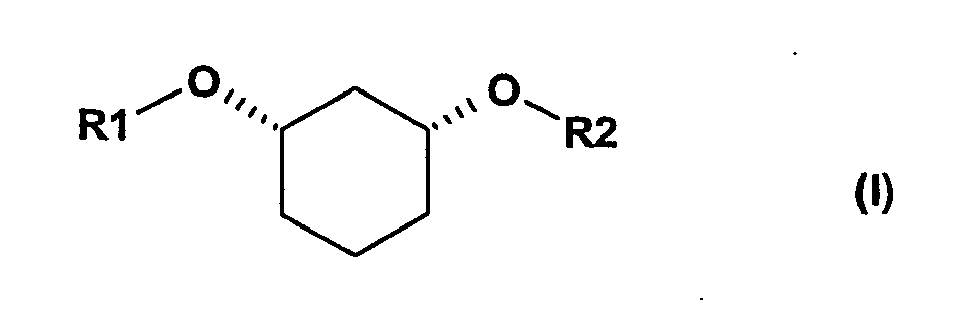
R1 Ring A Phenyl, 5 - 12 gliedriger heteroaromatischer Ring, der ein bis vier Heteroatome aus der Gruppe N, O oder S enthalten kann, 8 bis 14 gliedriger aromatischer Ring, (C3-C8)-Cycloalkyl;R3 H, F, Cl, Br, OH, NO2 CF3, OCF3, (C1-C6)-Alkyl, (C3-C8)-Cycloalkyl, Phenyl;R4, R5 H, F, Cl, Br, OH, NO2, CF3, OCF3, OCF2H, OCF2-CF3, OCF2-CHF2, SCF3, O-Phenyl, (C1-C6)-Alkyl, O-(C1-C6)-Alkyl, O-(C1-C6)-Alkyl-O-(C1-C3)-Alkyl;n 1 bis 3;undR2 (C1-C8)-Alkyl, wobei in den Alkylgruppen ein oder mehrere CH2-Gruppen durch O, CO, S, SO oder SO2 ersetzt sein können, und Alkyl ein bis dreifach substituiert sein kann durch F, Cl, Br, CF3, CN, NO2 NHAc, NHBoc, NH-CO-C(CH3)3, Hydroxyl, OCF3, O-(C1-C6)-Alkyl, COOH, CO-Benzoxy, CO-O(C1-C6)-Alkyl, Tetrazol, Thiazolidin-2,4-dion, Indol und (C6-C10)-Aryl, wobei Thiazolidin-2,4-dion und Aryl wiederum durch F, Cl, Br, CF3, CN, NO2, NHAc, NHTs, NHBoc, NHCbz, NH-CO-C(CH3)3, Hydroxyl, OCF3, O-(C1-C6)-Alkyl, COOH, CO-Benzoxy, CO-O(C1-C6)-Alkyl, (C1-C6)-Alkyl, O-(C1-C6)-Alkyl oder Tetrazol substituiert sein können, oder;R2 eine OH-Schutzgruppe (SG), wie z.B. Benzyloxymethyl, Benzyl, para-Methoxybenzyl oder tert.-Butyl-dimethylsilyl;dadurch gekennzeichnet, dass man
A)a) Alkylierung (Alk-R2 / Alk-SG)
cis-1,3-Cyclohexandiol der Formel (II)
X1-R2 (III)
worin R2 wie oben definiert ist undX1 für Cl, Br, I, OMs, OTs, OTf steht;in Gegenwart von Basen in einem geeigneten Lösungsmittel umsetzt zu einer racemischen Verbindung der Formel (IV), b1) Enzymatische Esterbildung (EB) + Trennung (T)
die erhaltene Verbindung der Formel (IV) einer stereoselektiven enzymatischen Esterbildung (EB) unterwirft, wobei die Alkohole in einem organischen Lösungsmittel mit einem Acyldonor und dem Enzym versetzt und die resultierende Mischung bei -20 bis 80 °C gerührt wird und nach Ablauf der Reaktion das eine Stereoisomere als Ester der Formel (V) R6 C(=O)-(C1-C16)-Alkyl, C(=O)-(C2-C16)-Alkenyl, C(=O)-(C3-C16)-Alkinyl, C(=O)-(C3-C16)-Cycloalkyl, wobei ein oder mehrere Kohlenstoffatome durch Sauerstoffatome ersetzt sein und substituiert sein können mit 1-3 Substituenten aus der Gruppe F, Cl, Br, CF3, CN, NO2, Hydroxy, Methoxy, Ethoxy, Phenyl und CO-O(C1-C4)-Alkyl, CO-O(C2-C4)-Alkenyl, die wiederum substituiert sein können mit 1-3 Substituenten aus der Gruppe F, CI, Br, CF3 bedeutet, undR2 wie oben definiert sind,und das andere Stereoisomere unverändert als Alkohol der Formel (IV) vorliegt, und daher durch Ausnutzung ihrer unterschiedlichen chemischen bzw. physikochemischen Eigenschaften voneinander getrennt wird (Trennung T)
oderb2) Enzymatische Esterspaltung [= Chemische Veresterung (CV) + Enzymatische Spaltung (ES)] + Trennung (T)
die erhalte Verbindung der Formel (IV) einer stereoselektiven enzymatischen Esterspaltung unterwirft, wobei der racemische Alkohol zunächst durch chemische Veresterung (CV), z. B. mittels Säurechlorid R6-Cl oder Säureanhydrid R6-O-R6 in Gegenwart von Basen in den racemischen Ester der Formel (V)
überführt wird, der dann zur Durchführung der stereoselektiven enzymatischen Esterspaltung (ES) in homogenem oder heterogenem, wässrigem, wässrigorganischem oder organischem Medium aufgenommen und in Gegenwart eines Enzyms im Falle der Hydrolyse mit Wasser und im Falle der Alkoholyse mit einem Alkohol bei einer Temperatur von 10 - 80 °C zur Reaktion gebracht wird, nach deren Ablauf das eine Stereoisomere als Alkohol der Formel (IV) und das andere unverändert als Ester der Formel (V) vorliegt und somit wie unter b1) beschreiben voneinander getrennt werden kann, wobei
das als Alkohol anfallende Enantiomere der Formel (IV) wie unter d) beschrieben weiter verarbeitet wird, oderc) Chemische Hydrolyse (CH)
das als Ester anfallende Enantiomere der Formel (V) zum chemisch enantiomeren Alkohol nach bekannten Verfahren verseift undd) Alkylierung (Alk-R1)
weiter mit einer Verbindung der Formel (VI)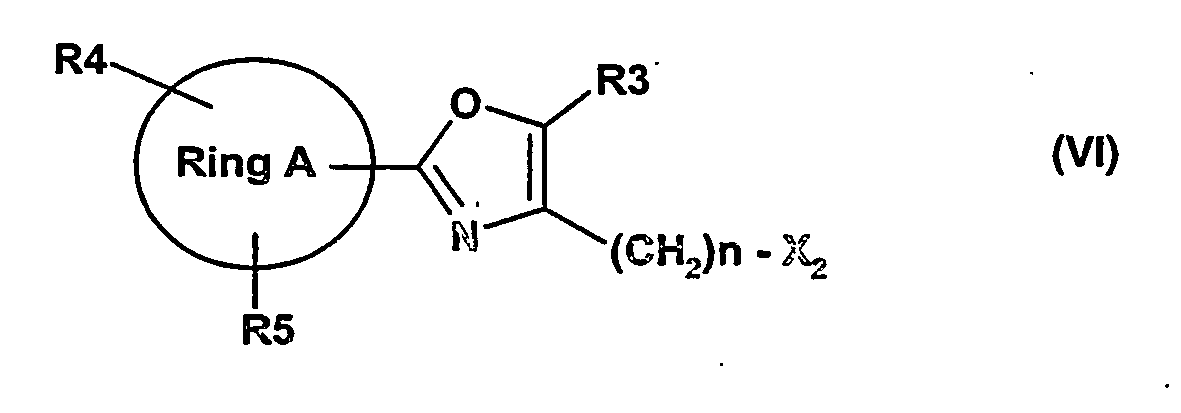
Ring A, R3, R4, R5 und n wie oben definiert sind undx2 Cl, Br, I, OTs, OMs, OTf bedeutet;in Gegenwart von Basen in einem geeigneten Lösungsmittel zu der Verbindung der Formel (I) umgesetzt wird, unde) Abspaltung der Schutzgruppe SG (AbSG)
falls R2 für eine OH-Schutzgruppe (SG) steht wie oben unter R2 definiert, die Verbindung der Formel (la)
durch Abspaltung der Schutzgruppe nach bekannten Verfahren in eine Verbindung der Formel (VII) f) Alkylierung (Alk-R2)worin X1 und R2 wie oben definiert sind,
die anschließend mit einer Verbindung der Formel (III),
X1-R2 (III)
in Gegenwart von Basen in einem geeigneten Lösungsmittel zu einer Verbindung der Formel (I), dem Produkt bzw. der enantiomeren Form, umgesetzt wird,
wobei es auch möglich ist, die Reihenfolge der einzelnen Reaktionsschritte wie vorstehend unter A) beschrieben:A) Alk-R2 → EB+T / CV + ES + T [→ CH] → Alk-R1 [→ AbSG → Alk-R2] → Produkt/enantiomere Form
zu ändern in:B) Alk-R1 → EB+T / CV+ES+T [→ CH] → Alk-R2 [→ AbSG → Alk-R2] → Produkt/enantiomere Form
oderC) Alk-SG → EB+T / CV+ES+T → CH → Alk-R2 → AbSG → Alk-R1 → Produkt/enantiomere Form
oderD) Alk-SG → EB+T / CV+ES+T → Alk-R1 → AbSG → Alk-R2 → Produkt/enantiomere Form. - Verfahren gemäß Anspruch 1, dadurch gekennzeichnet, dass die Verfahren C) und D) angewendet werden.
- Verfahren gemäß den Ansprüchen 1 oder 2, dadurch gekennzeichnet, dass Verbindungen der Formel (III)
X1 - R2 (III)
verwendet werden, worinX1 Cl, Br, I, OMs oder OTs bedeutet. - Verfahren gemäß den Ansprüchen 1 bis 3, dadurch gekennzeichnet, dass Verbindungen der Formel (III)
X1 - R2 (III)
verwendet werden, worinX1 Cl, Br oder 1 bedeutet. - Verfahren gemäß den Ansprüchen 1 bis 4, dadurch gekennzeichnet, dass eine Verbindung der Formel (I)
 R1 für
 Ring A Phenyl, 5 -12 gliedriger heteroaromatischer Ring, der ein oder mehrere Heteroatome aus der Gruppe N, O oder S enthalten kann, annellierter/bicyclischer 8 bis 14 gliedriger aromatischer Ring, (C3-C8)-Cycloalkyl;R3 H, CF3, (C1-C6)-Alkyl, (C3-C8)-Cycloalkyl, Phenyl;R4, R5 H, F, Br, CF3, OCF3, (C1-C6)-Alkyl, O-(C1-C6)-Alkyl;n 1 bis 2 undR2 (C1-C8)-Alkyl, wobei in den Alkylgruppen ein oder mehrere CH2-Gruppen durch O, CO, S, SO oder SO2 ersetzt sein können, und Alkyl ein bis dreifach substituiert sein kann durch F, Cl, Br, CF3, CN, NO2, NHAc, NHBoc, NH-CO-C(CH3)3, Hydroxyl, OCF3, O-(C1-C6)-Alkyl, COOH, CO-Benzoxy, CO-O(C1-C6)-Alkyl, Tetrazol, Thiazolidin-2,4-dion, Indol und (C6-C10)-Aryl, wobei Thiazolidin-2,4-dion und Aryl wiederum durch F, Cl, Br, CF3, CN, NO2, NHAc, NHTs, NHBoc, NHCbz, NH-CO-C(CH3)3, Hydroxyl, OCF3, O-(C1-C6)-Alkyl, COOH, CO-Benzoxy, CO-O(C1-C6)-Alkyl, (C1-C6)-Alkyl, O-(C1-C6)-Alkyl oder Tetrazol substituiert sein können.
 - Verfahren gemäß den Ansprüchen 1 bis 5, dadurch gekennzeichnet, dass eine Verbindung der Formel (I)
 R1 fürmit
 Ring A Phenyl;R3 (C1-C4)-Alkyl;R4, R5 H, (C1-C4)-Alkyl, O-(C1-C4)-Alkyl;n 1 undR2 (C1-C8)-Alkyl, wobei in den Alkylgruppen ein oder mehrere CH2-Gruppen durch O, CO, S, SO oder SO2 ersetzt sein können, und Alkyl ein bis dreifach substituiert sein kann durch F, Cl, Br, CF3, CN, NO2, NHAc, NHBoc, NH-CO-C(CH3)3, Hydroxyl, OCF3, O-(C1-C6)-Alkyl, COOH, CO-Benzoxy, CO-O(C1-C6)-Alkyl, Tetrazol, Thiazolidin-2,4-dion, Indol und (C6-C10)-Aryl, wobei Thiazolidin-2,4-dion und Aryl wiederum durch F, Cl, Br, CF3, CN, NO2, NHAc, NHTs, NHBoc, NHCbz, NH-CO-C(CH3)3, Hydroxyl, OCF3, O-(C1-C6)-Alkyl, COOH, CO-Benzoxy, CO-O(C1-C6)-Alkyl, (C1-C6)-Alkyl, O-(C1-C6)-Alkyl oder Tetrazol substituiert sein können.
Priority Applications (1)
| Application Number | Priority Date | Filing Date | Title |
|---|---|---|---|
| SI200430180T SI1599433T1 (sl) | 2003-02-27 | 2004-02-19 | Postopek za pripravo enantiomernih oblik cis-konfiguriranih 1,3-cikloheksandiolnih derivatov |
Applications Claiming Priority (3)
| Application Number | Priority Date | Filing Date | Title |
|---|---|---|---|
| DE10308350 | 2003-02-27 | ||
| DE10308350A DE10308350B4 (de) | 2003-02-27 | 2003-02-27 | Verfahren zur Herstellung der enantiomeren Formen von cis-konfigurierten 1,3-Cyclohexandiol-Derivaten |
| PCT/EP2004/001580 WO2004076390A1 (de) | 2003-02-27 | 2004-02-19 | Verfahren zur herstellung der enantiomeren formen von cis-konfigurierten 1,3-cyclohexandiol-derivaten |
Publications (2)
| Publication Number | Publication Date |
|---|---|
| EP1599433A1 EP1599433A1 (de) | 2005-11-30 |
| EP1599433B1 true EP1599433B1 (de) | 2006-12-06 |
Family
ID=32863920
Family Applications (1)
| Application Number | Title | Priority Date | Filing Date |
|---|---|---|---|
| EP04712518A Expired - Lifetime EP1599433B1 (de) | 2003-02-27 | 2004-02-19 | Verfahren zur herstellung der enantiomeren formen von cis-konfigurierten 1,3-cyclohexandiol-derivaten |
Country Status (24)
| Country | Link |
|---|---|
| EP (1) | EP1599433B1 (de) |
| JP (1) | JP2006519001A (de) |
| KR (1) | KR20050107469A (de) |
| CN (1) | CN100572348C (de) |
| AR (1) | AR044501A1 (de) |
| AT (1) | ATE347543T1 (de) |
| AU (1) | AU2004215674B2 (de) |
| BR (1) | BRPI0407844A (de) |
| CA (1) | CA2516623A1 (de) |
| CO (1) | CO5690547A2 (de) |
| CY (1) | CY1106454T1 (de) |
| DE (2) | DE10308350B4 (de) |
| DK (1) | DK1599433T3 (de) |
| ES (1) | ES2278305T3 (de) |
| IL (1) | IL170310A (de) |
| MX (1) | MXPA05009053A (de) |
| NO (1) | NO20054456L (de) |
| NZ (1) | NZ542025A (de) |
| PL (1) | PL377812A1 (de) |
| PT (1) | PT1599433E (de) |
| RU (1) | RU2372319C2 (de) |
| TW (1) | TWI331138B (de) |
| WO (1) | WO2004076390A1 (de) |
| ZA (1) | ZA200505760B (de) |
Families Citing this family (7)
| Publication number | Priority date | Publication date | Assignee | Title |
|---|---|---|---|---|
| DE102004038403B4 (de) * | 2004-08-07 | 2006-08-31 | Sanofi-Aventis Deutschland Gmbh | Verfahren zur Herstellung der enantiomeren Formen von cis-konfigurierten 3-Hydroxycyclohexancarbonsäure-Derivaten |
| DE102004040736B4 (de) * | 2004-08-23 | 2007-01-11 | Sanofi-Aventis Deutschland Gmbh | Verfahren zur Herstellung von Diarylcycloalkylderivaten |
| CN101381302B (zh) * | 2007-09-07 | 2013-04-03 | 上海睿智化学研究有限公司 | 2-溴甲基-6-甲基苯甲酰氯/溴的制备方法 |
| EP2298755A4 (de) | 2008-05-21 | 2012-12-05 | Taisho Pharmaceutical Co Ltd | Verfahren zur herstellung von bicyclo[3.1.0]hexanderivaten unter verwendung eines enzyms |
| JP7185633B2 (ja) | 2017-02-17 | 2022-12-07 | トレベナ・インコーポレイテッド | 7員アザ複素環を含有するデルタ-オピオイド受容体調節化合物、その使用方法及び製造方法 |
| WO2023070605A1 (en) * | 2021-10-29 | 2023-05-04 | Trevena, Inc. | Methods of preparing 6-membered aza-heterocyclic containing delta-opioid receptor modulating compounds |
| CN114891838B (zh) * | 2022-04-29 | 2023-09-08 | 株洲壹诺生物技术有限公司 | 盐酸多佐胺中间体(s)-3-(2-噻吩硫基)-丁酸的合成方法 |
Family Cites Families (3)
| Publication number | Priority date | Publication date | Assignee | Title |
|---|---|---|---|---|
| PT1177176E (pt) * | 1999-04-28 | 2006-08-31 | Aventis Pharma Gmbh | Derivados de acidos triarilicos como ligandos de receptores ppar. |
| DE10004926A1 (de) * | 2000-02-04 | 2001-08-09 | Gruenenthal Gmbh | Verfahren zur enzymatischen Racematspaltung von Aminomethyl-Aryl-Cyclohexanol-Derivaten |
| JP4436129B2 (ja) * | 2001-08-31 | 2010-03-24 | サノフィ−アベンティス・ドイチュラント・ゲゼルシャフト・ミット・ベシュレンクテル・ハフツング | ジアリールシクロアルキル誘導体、その製造法及びppar−活性剤としてのその使用 |
-
2003
- 2003-02-27 DE DE10308350A patent/DE10308350B4/de not_active Expired - Fee Related
-
2004
- 2004-02-19 WO PCT/EP2004/001580 patent/WO2004076390A1/de not_active Ceased
- 2004-02-19 PL PL377812A patent/PL377812A1/pl not_active IP Right Cessation
- 2004-02-19 DK DK04712518T patent/DK1599433T3/da active
- 2004-02-19 RU RU2005129993/04A patent/RU2372319C2/ru not_active IP Right Cessation
- 2004-02-19 AU AU2004215674A patent/AU2004215674B2/en not_active Ceased
- 2004-02-19 PT PT04712518T patent/PT1599433E/pt unknown
- 2004-02-19 KR KR1020057016034A patent/KR20050107469A/ko not_active Ceased
- 2004-02-19 CA CA002516623A patent/CA2516623A1/en not_active Abandoned
- 2004-02-19 DE DE502004002234T patent/DE502004002234D1/de not_active Expired - Lifetime
- 2004-02-19 ES ES04712518T patent/ES2278305T3/es not_active Expired - Lifetime
- 2004-02-19 NZ NZ542025A patent/NZ542025A/en unknown
- 2004-02-19 JP JP2006501887A patent/JP2006519001A/ja active Pending
- 2004-02-19 BR BRPI0407844-6A patent/BRPI0407844A/pt not_active IP Right Cessation
- 2004-02-19 EP EP04712518A patent/EP1599433B1/de not_active Expired - Lifetime
- 2004-02-19 CN CNB2004800054415A patent/CN100572348C/zh not_active Expired - Fee Related
- 2004-02-19 AT AT04712518T patent/ATE347543T1/de not_active IP Right Cessation
- 2004-02-19 MX MXPA05009053A patent/MXPA05009053A/es active IP Right Grant
- 2004-02-25 TW TW093104706A patent/TWI331138B/zh not_active IP Right Cessation
- 2004-02-27 AR ARP040100630A patent/AR044501A1/es unknown
-
2005
- 2005-07-19 ZA ZA200505760A patent/ZA200505760B/en unknown
- 2005-08-16 IL IL170310A patent/IL170310A/en not_active IP Right Cessation
- 2005-08-26 CO CO05085518A patent/CO5690547A2/es not_active Application Discontinuation
- 2005-09-26 NO NO20054456A patent/NO20054456L/no not_active Application Discontinuation
-
2007
- 2007-03-05 CY CY20071100303T patent/CY1106454T1/el unknown
Also Published As
| Publication number | Publication date |
|---|---|
| CO5690547A2 (es) | 2006-10-31 |
| BRPI0407844A (pt) | 2006-02-14 |
| AU2004215674B2 (en) | 2010-02-04 |
| DK1599433T3 (da) | 2007-04-16 |
| AU2004215674A1 (en) | 2004-09-10 |
| ATE347543T1 (de) | 2006-12-15 |
| CN100572348C (zh) | 2009-12-23 |
| RU2005129993A (ru) | 2006-01-27 |
| CY1106454T1 (el) | 2011-10-12 |
| PL377812A1 (pl) | 2006-02-20 |
| ZA200505760B (en) | 2006-05-31 |
| TW200508392A (en) | 2005-03-01 |
| RU2372319C2 (ru) | 2009-11-10 |
| ES2278305T3 (es) | 2007-08-01 |
| MXPA05009053A (es) | 2005-10-19 |
| TWI331138B (en) | 2010-10-01 |
| NZ542025A (en) | 2009-03-31 |
| NO20054456L (no) | 2005-09-26 |
| DE502004002234D1 (de) | 2007-01-18 |
| AR044501A1 (es) | 2005-09-14 |
| CN1753855A (zh) | 2006-03-29 |
| DE10308350A1 (de) | 2004-09-16 |
| EP1599433A1 (de) | 2005-11-30 |
| KR20050107469A (ko) | 2005-11-11 |
| JP2006519001A (ja) | 2006-08-24 |
| DE10308350B4 (de) | 2006-06-01 |
| PT1599433E (pt) | 2007-02-28 |
| WO2004076390A1 (de) | 2004-09-10 |
| CA2516623A1 (en) | 2004-09-10 |
| HK1088889A1 (zh) | 2006-11-17 |
| IL170310A (en) | 2010-06-16 |
Similar Documents
| Publication | Publication Date | Title |
|---|---|---|
| DE10308350B4 (de) | Verfahren zur Herstellung der enantiomeren Formen von cis-konfigurierten 1,3-Cyclohexandiol-Derivaten | |
| EP1805316B1 (de) | Verfahren zur herstellung der enantiomeren formen von cis-3-hydroxycyclohexancarbonsäure-derivaten unter verwendung von hydrolasen | |
| DE3886445T2 (de) | Optisch-aktive Verbindungen und Verfahren zu deren Herstellung. | |
| EP0402771B1 (de) | Verfahren zur enzymatischen Spaltung von 2-Arylpropionsäurevinylestern | |
| US7094795B2 (en) | Process for preparing the enantiomeric forms of cis-configured 1,3-cyclohexanediol derivatives | |
| US7803950B2 (en) | Method for the production of diarylcycloalkyl derivatives | |
| EP0727494B1 (de) | Verfahren zu enzymatischen Acylierung von Alkoholen mit Alkoxyvinylacetaten durch Umesterung | |
| DE4329293A1 (de) | Lipase katalysierte Acylierung von Alkoholen mit Diketenen | |
| DE69103361T2 (de) | Verfahren zur alkohol/ester-trennung unter verwendung von geschützten hydroxylgruppen. | |
| JP2612671B2 (ja) | 光学活性なプロピオン酸エステルの製造法 | |
| JP3010382B2 (ja) | (r)−2−プロポキシベンゼン誘導体の製造法 | |
| EP0254243A2 (de) | Chirale Synthesebausteine aus prochiralem Glycerin | |
| HK1088889B (en) | Method for producing the enantiomeric forms of cis 1,3-cyclohexanediol derivatives | |
| EP0556909A1 (de) | Verfahren zur Herstellung von (R) und (S)-1,2-Isopropylidenglycerin | |
| WO2001018231A2 (de) | VERFAHREN ZUR HERSTELLUNG VON (R)- ODER (S)-HYDROXY-η-BUTYROLACTON | |
| KR20060007294A (ko) | 광학활성 카복실산의 제조방법 | |
| JPH0755157B2 (ja) | 生化学的手法による光学活性なアルコ−ルとエステルの製造法 | |
| EP0893508A2 (de) | Neues Verfahren zur Herstellung von Oxodicyclopentadien | |
| DE19503977A1 (de) | Verfahren zur Herstellung von Penemen |
Legal Events
| Date | Code | Title | Description |
|---|---|---|---|
| PUAI | Public reference made under article 153(3) epc to a published international application that has entered the european phase |
Free format text: ORIGINAL CODE: 0009012 |
|
| 17P | Request for examination filed |
Effective date: 20050927 |
|
| AK | Designated contracting states |
Kind code of ref document: A1 Designated state(s): AT BE BG CH CY CZ DE DK EE ES FI FR GB GR HU IE IT LI LU MC NL PT RO SE SI SK TR |
|
| AX | Request for extension of the european patent |
Extension state: AL LT LV MK |
|
| GRAP | Despatch of communication of intention to grant a patent |
Free format text: ORIGINAL CODE: EPIDOSNIGR1 |
|
| RAX | Requested extension states of the european patent have changed |
Extension state: MK Payment date: 20050927 Extension state: AL Payment date: 20050927 Extension state: LT Payment date: 20050927 |
|
| GRAS | Grant fee paid |
Free format text: ORIGINAL CODE: EPIDOSNIGR3 |
|
| GRAA | (expected) grant |
Free format text: ORIGINAL CODE: 0009210 |
|
| RAX | Requested extension states of the european patent have changed |
Extension state: LT Payment date: 20050927 Extension state: LV Payment date: 20050927 Extension state: MK Payment date: 20050927 |
|
| AK | Designated contracting states |
Kind code of ref document: B1 Designated state(s): AT BE BG CH CY CZ DE DK EE ES FI FR GB GR HU IE IT LI LU MC NL PT RO SE SI SK TR |
|
| AX | Request for extension of the european patent |
Extension state: LT LV MK |
|
| REG | Reference to a national code |
Ref country code: GB Ref legal event code: FG4D Free format text: NOT ENGLISH |
|
| REG | Reference to a national code |
Ref country code: CH Ref legal event code: EP |
|
| REG | Reference to a national code |
Ref country code: IE Ref legal event code: FG4D Free format text: LANGUAGE OF EP DOCUMENT: GERMAN |
|
| REF | Corresponds to: |
Ref document number: 502004002234 Country of ref document: DE Date of ref document: 20070118 Kind code of ref document: P |
|
| REG | Reference to a national code |
Ref country code: PT Ref legal event code: SC4A Free format text: AVAILABILITY OF NATIONAL TRANSLATION Effective date: 20070206 |
|
| REG | Reference to a national code |
Ref country code: RO Ref legal event code: EPE |
|
| REG | Reference to a national code |
Ref country code: SE Ref legal event code: TRGR |
|
| GBT | Gb: translation of ep patent filed (gb section 77(6)(a)/1977) |
Effective date: 20070308 |
|
| REG | Reference to a national code |
Ref country code: DK Ref legal event code: T3 Ref country code: EE Ref legal event code: FG4A Ref document number: E000911 Country of ref document: EE Effective date: 20070209 |
|
| REG | Reference to a national code |
Ref country code: GR Ref legal event code: EP Ref document number: 20070400681 Country of ref document: GR |
|
| REG | Reference to a national code |
Ref country code: HU Ref legal event code: AG4A Ref document number: E001292 Country of ref document: HU |
|
| ET | Fr: translation filed | ||
| REG | Reference to a national code |
Ref country code: ES Ref legal event code: FG2A Ref document number: 2278305 Country of ref document: ES Kind code of ref document: T3 |
|
| PLBE | No opposition filed within time limit |
Free format text: ORIGINAL CODE: 0009261 |
|
| STAA | Information on the status of an ep patent application or granted ep patent |
Free format text: STATUS: NO OPPOSITION FILED WITHIN TIME LIMIT |
|
| 26N | No opposition filed |
Effective date: 20070907 |
|
| PGFP | Annual fee paid to national office [announced via postgrant information from national office to epo] |
Ref country code: SE Payment date: 20091218 Year of fee payment: 7 |
|
| PGFP | Annual fee paid to national office [announced via postgrant information from national office to epo] |
Ref country code: CH Payment date: 20100215 Year of fee payment: 7 Ref country code: CZ Payment date: 20100128 Year of fee payment: 7 Ref country code: DK Payment date: 20100211 Year of fee payment: 7 Ref country code: EE Payment date: 20100107 Year of fee payment: 7 Ref country code: ES Payment date: 20100312 Year of fee payment: 7 Ref country code: HU Payment date: 20100216 Year of fee payment: 7 Ref country code: IE Payment date: 20100217 Year of fee payment: 7 Ref country code: LU Payment date: 20100212 Year of fee payment: 7 Ref country code: MC Payment date: 20100127 Year of fee payment: 7 Ref country code: PT Payment date: 20100202 Year of fee payment: 7 Ref country code: RO Payment date: 20100112 Year of fee payment: 7 |
|
| PGFP | Annual fee paid to national office [announced via postgrant information from national office to epo] |
Ref country code: FI Payment date: 20100215 Year of fee payment: 7 Ref country code: FR Payment date: 20100223 Year of fee payment: 7 Ref country code: IT Payment date: 20100217 Year of fee payment: 7 Ref country code: SI Payment date: 20100104 Year of fee payment: 7 Ref country code: SK Payment date: 20100126 Year of fee payment: 7 |
|
| PGFP | Annual fee paid to national office [announced via postgrant information from national office to epo] |
Ref country code: AT Payment date: 20100212 Year of fee payment: 7 Ref country code: BE Payment date: 20100215 Year of fee payment: 7 Ref country code: DE Payment date: 20100228 Year of fee payment: 7 Ref country code: GB Payment date: 20100202 Year of fee payment: 7 Ref country code: TR Payment date: 20100127 Year of fee payment: 7 |
|
| PGFP | Annual fee paid to national office [announced via postgrant information from national office to epo] |
Ref country code: BG Payment date: 20100216 Year of fee payment: 7 |
|
| PGFP | Annual fee paid to national office [announced via postgrant information from national office to epo] |
Ref country code: NL Payment date: 20100209 Year of fee payment: 7 |
|
| PGFP | Annual fee paid to national office [announced via postgrant information from national office to epo] |
Ref country code: CY Payment date: 20100122 Year of fee payment: 7 |
|
| PGFP | Annual fee paid to national office [announced via postgrant information from national office to epo] |
Ref country code: GR Payment date: 20100115 Year of fee payment: 7 |
|
| REG | Reference to a national code |
Ref country code: PT Ref legal event code: MM4A Free format text: LAPSE DUE TO NON-PAYMENT OF FEES Effective date: 20110819 |
|
| BERE | Be: lapsed |
Owner name: SANOFI-AVENTIS DEUTSCHLAND G.M.B.H. Effective date: 20110228 |
|
| REG | Reference to a national code |
Ref country code: NL Ref legal event code: V1 Effective date: 20110901 |
|
| LTLA | Lt: lapse of european patent or patent extension |
Effective date: 20110219 |
|
| PG25 | Lapsed in a contracting state [announced via postgrant information from national office to epo] |
Ref country code: MC Free format text: LAPSE BECAUSE OF NON-PAYMENT OF DUE FEES Effective date: 20110228 |
|
| REG | Reference to a national code |
Ref country code: CH Ref legal event code: PL |
|
| REG | Reference to a national code |
Ref country code: DK Ref legal event code: EBP |
|
| REG | Reference to a national code |
Ref country code: SE Ref legal event code: EUG |
|
| REG | Reference to a national code |
Ref country code: EE Ref legal event code: MM4A Ref document number: E000911 Country of ref document: EE Effective date: 20110228 |
|
| GBPC | Gb: european patent ceased through non-payment of renewal fee |
Effective date: 20110219 |
|
| REG | Reference to a national code |
Ref country code: SI Ref legal event code: KO00 Effective date: 20110921 |
|
| PG25 | Lapsed in a contracting state [announced via postgrant information from national office to epo] |
Ref country code: LI Free format text: LAPSE BECAUSE OF NON-PAYMENT OF DUE FEES Effective date: 20110228 Ref country code: CH Free format text: LAPSE BECAUSE OF NON-PAYMENT OF DUE FEES Effective date: 20110228 Ref country code: PT Free format text: LAPSE BECAUSE OF NON-PAYMENT OF DUE FEES Effective date: 20110819 Ref country code: EE Free format text: LAPSE BECAUSE OF NON-PAYMENT OF DUE FEES Effective date: 20110228 |
|
| REG | Reference to a national code |
Ref country code: SK Ref legal event code: MM4A Ref document number: E 1651 Country of ref document: SK Effective date: 20110219 |
|
| REG | Reference to a national code |
Ref country code: FR Ref legal event code: ST Effective date: 20111102 |
|
| REG | Reference to a national code |
Ref country code: IE Ref legal event code: MM4A |
|
| PG25 | Lapsed in a contracting state [announced via postgrant information from national office to epo] |
Ref country code: AT Free format text: LAPSE BECAUSE OF NON-PAYMENT OF DUE FEES Effective date: 20110219 Ref country code: GR Free format text: LAPSE BECAUSE OF NON-PAYMENT OF DUE FEES Effective date: 20110902 Ref country code: SK Free format text: LAPSE BECAUSE OF NON-PAYMENT OF DUE FEES Effective date: 20110219 Ref country code: CY Free format text: LAPSE BECAUSE OF NON-PAYMENT OF DUE FEES Effective date: 20110219 Ref country code: CZ Free format text: LAPSE BECAUSE OF NON-PAYMENT OF DUE FEES Effective date: 20110219 Ref country code: SI Free format text: LAPSE BECAUSE OF NON-PAYMENT OF DUE FEES Effective date: 20110220 Ref country code: FI Free format text: LAPSE BECAUSE OF NON-PAYMENT OF DUE FEES Effective date: 20110219 Ref country code: BE Free format text: LAPSE BECAUSE OF NON-PAYMENT OF DUE FEES Effective date: 20110228 |
|
| PG25 | Lapsed in a contracting state [announced via postgrant information from national office to epo] |
Ref country code: NL Free format text: LAPSE BECAUSE OF NON-PAYMENT OF DUE FEES Effective date: 20110901 Ref country code: IT Free format text: LAPSE BECAUSE OF NON-PAYMENT OF DUE FEES Effective date: 20110219 |
|
| REG | Reference to a national code |
Ref country code: DE Ref legal event code: R119 Ref document number: 502004002234 Country of ref document: DE Effective date: 20110901 |
|
| PG25 | Lapsed in a contracting state [announced via postgrant information from national office to epo] |
Ref country code: FR Free format text: LAPSE BECAUSE OF NON-PAYMENT OF DUE FEES Effective date: 20110228 Ref country code: IE Free format text: LAPSE BECAUSE OF NON-PAYMENT OF DUE FEES Effective date: 20110221 |
|
| PG25 | Lapsed in a contracting state [announced via postgrant information from national office to epo] |
Ref country code: GB Free format text: LAPSE BECAUSE OF NON-PAYMENT OF DUE FEES Effective date: 20110219 |
|
| REG | Reference to a national code |
Ref country code: ES Ref legal event code: FD2A Effective date: 20120411 |
|
| PG25 | Lapsed in a contracting state [announced via postgrant information from national office to epo] |
Ref country code: ES Free format text: LAPSE BECAUSE OF NON-PAYMENT OF DUE FEES Effective date: 20110220 |
|
| PG25 | Lapsed in a contracting state [announced via postgrant information from national office to epo] |
Ref country code: SE Free format text: LAPSE BECAUSE OF NON-PAYMENT OF DUE FEES Effective date: 20110220 |
|
| PG25 | Lapsed in a contracting state [announced via postgrant information from national office to epo] |
Ref country code: LU Free format text: LAPSE BECAUSE OF NON-PAYMENT OF DUE FEES Effective date: 20110219 |
|
| PG25 | Lapsed in a contracting state [announced via postgrant information from national office to epo] |
Ref country code: DE Free format text: LAPSE BECAUSE OF NON-PAYMENT OF DUE FEES Effective date: 20110901 |
|
| PG25 | Lapsed in a contracting state [announced via postgrant information from national office to epo] |
Ref country code: BG Free format text: LAPSE BECAUSE OF NON-PAYMENT OF DUE FEES Effective date: 20111231 |
|
| PG25 | Lapsed in a contracting state [announced via postgrant information from national office to epo] |
Ref country code: TR Free format text: LAPSE BECAUSE OF NON-PAYMENT OF DUE FEES Effective date: 20110219 |
|
| PG25 | Lapsed in a contracting state [announced via postgrant information from national office to epo] |
Ref country code: HU Free format text: LAPSE BECAUSE OF NON-PAYMENT OF DUE FEES Effective date: 20110220 |