EP1599450B1 - Procede de preparation des sels de 5-[(r)-2-(5,6-diethyl-indan-2-ylamino)-1-hydroxy-ethyl]-8-hydroxy-(1h)-quinolin-2-one, utilises en tant qu'agonistes d'un adreno-recepteur - Google Patents
Procede de preparation des sels de 5-[(r)-2-(5,6-diethyl-indan-2-ylamino)-1-hydroxy-ethyl]-8-hydroxy-(1h)-quinolin-2-one, utilises en tant qu'agonistes d'un adreno-recepteur Download PDFInfo
- Publication number
- EP1599450B1 EP1599450B1 EP04715306A EP04715306A EP1599450B1 EP 1599450 B1 EP1599450 B1 EP 1599450B1 EP 04715306 A EP04715306 A EP 04715306A EP 04715306 A EP04715306 A EP 04715306A EP 1599450 B1 EP1599450 B1 EP 1599450B1
- Authority
- EP
- European Patent Office
- Prior art keywords
- quinolin
- hydroxy
- formula
- salt
- ethyl
- Prior art date
- Legal status (The legal status is an assumption and is not a legal conclusion. Google has not performed a legal analysis and makes no representation as to the accuracy of the status listed.)
- Expired - Lifetime
Links
- 0 CCc1c(CC)cc(CC(C2)NC[C@@](c(c(C=C3)c4NC3=[O+])ccc4O*)O)c2c1 Chemical compound CCc1c(CC)cc(CC(C2)NC[C@@](c(c(C=C3)c4NC3=[O+])ccc4O*)O)c2c1 0.000 description 7
- IVKRNEMRNRFPFJ-VIFPVBQESA-N NC[C@@H](c(c(C=C1)c2NC1=O)ccc2O)O Chemical compound NC[C@@H](c(c(C=C1)c2NC1=O)ccc2O)O IVKRNEMRNRFPFJ-VIFPVBQESA-N 0.000 description 2
- WPYMKLBDIGXBTP-UHFFFAOYSA-N OC(c1ccccc1)=O Chemical compound OC(c1ccccc1)=O WPYMKLBDIGXBTP-UHFFFAOYSA-N 0.000 description 1
Classifications
-
- C—CHEMISTRY; METALLURGY
- C07—ORGANIC CHEMISTRY
- C07D—HETEROCYCLIC COMPOUNDS
- C07D401/00—Heterocyclic compounds containing two or more hetero rings, having nitrogen atoms as the only ring hetero atoms, at least one ring being a six-membered ring with only one nitrogen atom
- C07D401/02—Heterocyclic compounds containing two or more hetero rings, having nitrogen atoms as the only ring hetero atoms, at least one ring being a six-membered ring with only one nitrogen atom containing two hetero rings
- C07D401/12—Heterocyclic compounds containing two or more hetero rings, having nitrogen atoms as the only ring hetero atoms, at least one ring being a six-membered ring with only one nitrogen atom containing two hetero rings linked by a chain containing hetero atoms as chain links
-
- A—HUMAN NECESSITIES
- A61—MEDICAL OR VETERINARY SCIENCE; HYGIENE
- A61P—SPECIFIC THERAPEUTIC ACTIVITY OF CHEMICAL COMPOUNDS OR MEDICINAL PREPARATIONS
- A61P11/00—Drugs for disorders of the respiratory system
-
- A—HUMAN NECESSITIES
- A61—MEDICAL OR VETERINARY SCIENCE; HYGIENE
- A61P—SPECIFIC THERAPEUTIC ACTIVITY OF CHEMICAL COMPOUNDS OR MEDICINAL PREPARATIONS
- A61P11/00—Drugs for disorders of the respiratory system
- A61P11/06—Antiasthmatics
-
- A—HUMAN NECESSITIES
- A61—MEDICAL OR VETERINARY SCIENCE; HYGIENE
- A61P—SPECIFIC THERAPEUTIC ACTIVITY OF CHEMICAL COMPOUNDS OR MEDICINAL PREPARATIONS
- A61P11/00—Drugs for disorders of the respiratory system
- A61P11/08—Bronchodilators
-
- B—PERFORMING OPERATIONS; TRANSPORTING
- B01—PHYSICAL OR CHEMICAL PROCESSES OR APPARATUS IN GENERAL
- B01J—CHEMICAL OR PHYSICAL PROCESSES, e.g. CATALYSIS OR COLLOID CHEMISTRY; THEIR RELEVANT APPARATUS
- B01J23/00—Catalysts comprising metals or metal oxides or hydroxides, not provided for in group B01J21/00
- B01J23/38—Catalysts comprising metals or metal oxides or hydroxides, not provided for in group B01J21/00 of noble metals
- B01J23/40—Catalysts comprising metals or metal oxides or hydroxides, not provided for in group B01J21/00 of noble metals of the platinum group metals
- B01J23/44—Palladium
-
- C—CHEMISTRY; METALLURGY
- C07—ORGANIC CHEMISTRY
- C07D—HETEROCYCLIC COMPOUNDS
- C07D215/00—Heterocyclic compounds containing quinoline or hydrogenated quinoline ring systems
- C07D215/02—Heterocyclic compounds containing quinoline or hydrogenated quinoline ring systems having no bond between the ring nitrogen atom and a non-ring member or having only hydrogen atoms or carbon atoms directly attached to the ring nitrogen atom
- C07D215/16—Heterocyclic compounds containing quinoline or hydrogenated quinoline ring systems having no bond between the ring nitrogen atom and a non-ring member or having only hydrogen atoms or carbon atoms directly attached to the ring nitrogen atom with hetero atoms or with carbon atoms having three bonds to hetero atoms with at the most one bond to halogen, e.g. ester or nitrile radicals, directly attached to ring carbon atoms
- C07D215/20—Oxygen atoms
- C07D215/24—Oxygen atoms attached in position 8
- C07D215/26—Alcohols; Ethers thereof
-
- C—CHEMISTRY; METALLURGY
- C07—ORGANIC CHEMISTRY
- C07D—HETEROCYCLIC COMPOUNDS
- C07D405/00—Heterocyclic compounds containing both one or more hetero rings having oxygen atoms as the only ring hetero atoms, and one or more rings having nitrogen as the only ring hetero atom
- C07D405/02—Heterocyclic compounds containing both one or more hetero rings having oxygen atoms as the only ring hetero atoms, and one or more rings having nitrogen as the only ring hetero atom containing two hetero rings
- C07D405/04—Heterocyclic compounds containing both one or more hetero rings having oxygen atoms as the only ring hetero atoms, and one or more rings having nitrogen as the only ring hetero atom containing two hetero rings directly linked by a ring-member-to-ring-member bond
-
- C—CHEMISTRY; METALLURGY
- C07—ORGANIC CHEMISTRY
- C07B—GENERAL METHODS OF ORGANIC CHEMISTRY; APPARATUS THEREFOR
- C07B2200/00—Indexing scheme relating to specific properties of organic compounds
- C07B2200/13—Crystalline forms, e.g. polymorphs
-
- Y—GENERAL TAGGING OF NEW TECHNOLOGICAL DEVELOPMENTS; GENERAL TAGGING OF CROSS-SECTIONAL TECHNOLOGIES SPANNING OVER SEVERAL SECTIONS OF THE IPC; TECHNICAL SUBJECTS COVERED BY FORMER USPC CROSS-REFERENCE ART COLLECTIONS [XRACs] AND DIGESTS
- Y02—TECHNOLOGIES OR APPLICATIONS FOR MITIGATION OR ADAPTATION AGAINST CLIMATE CHANGE
- Y02P—CLIMATE CHANGE MITIGATION TECHNOLOGIES IN THE PRODUCTION OR PROCESSING OF GOODS
- Y02P20/00—Technologies relating to chemical industry
- Y02P20/50—Improvements relating to the production of bulk chemicals
- Y02P20/55—Design of synthesis routes, e.g. reducing the use of auxiliary or protecting groups
Definitions
- the present invention provides a process for preparing 5-[(R)-2-(5,6-diethyl-indan-2-ylamino)-1-hydroxy-ethyl]-8-hydroxy-( 1H )-quinolin-2-one salt without isolating the free base thereof which is unstable in organic solvents.
- 5-[(R)-2-(5,6-diethyl-indan-2-ylamino)-1-hydroxy-ethyl]-8-hydroxy-( 1H )-quinolinone-2-one salts are ⁇ -selective adrenoceptor agonists with potent bronchodilator activity.
- 5-[(R)-2-(5,6-diethyl-indan-2-ylamino)-1-hydroxy-ethyl]-8-hydroxy-( 1H )-quinolinone-2-one maleate is especially useful for treating asthma and COPD.
- the maleate salt has been shown to have a very long duration of action in vitro and in vivo .
- the reaction mixture above contains only about 60% to 80% of the desired intermediate having Formula (II).
- silica gel chromatography has been used for such a purification, however, scale-up of silica gel chromatography is tedious and requires large volumes of solvents.
- the invention provides a process for preparing 5-[(R)-2-(5,6-diethyl-indan-2-ylamino)-1-hydroxy-ethyl]-8-hydroxy-( 1H )-quinolin-2-one salt or an acceptable solvate thereof comprising:
- alkyl means straight chain or branched alkyl, which may be, e.g., C 1 -C 10 alkyl, such as methyl, ethyl, n -propyl, isopropyl, n -butyl, isobutyl, sec -butyl, tert -butyl, straight- or branched-pentyl, straight- or branched-hexyl, straight- or branched-heptyl, straight- or branched-nonyl or straight- or branched-decyl.
- alkyl is C 1 -C 4 alkyl.
- Aryl means C 6 -C 14 aryl, preferably C 6 -C 10 aryl, and may be, e.g., substituted by at least one group selected from mercapto, dialkylamino, nitro, alkoxy, halogen, keto, cyano or a combination.
- aryl is phenyl.
- Alkoxy means straight chain or branched alkoxy and may be, e.g., C 1 -C 10 alkoxy, such as methoxy, ethoxy, n -propoxy, isopropoxy, n -butoxy, isobutoxy, sec -butoxy, tert -butoxy or straight- or branched-pentoxy, -hexyloxy, -heptyloxy, -octyloxy, -nonyloxy or -decyloxy.
- alkoxy is C 1 -C 4 alkoxy.
- Alkenyl means straight chain or branched-alkenyl, which may be, e.g., C 2 -C 10 alkenyl, such as vinyl, 1-propenyl, 2-propenyl, 1-butenyl, isobutenyl, or straight- or branched-pentenyl, -hexenyl, -heptenyl, -octenyl, -nonenyl or -decenyl.
- Preferred alkenyl is C 2 -C 4 alkenyl.
- Cycloalkyl means C 3 -C 10 cycloalkyl having 3- to 8-ring carbon atoms and may be, e.g., cyclopropyl, cyclobutyl, cyclopentyl, cyclohexyl, cycloheptyl or cycloheptyl, any of which can be substituted by one, two or more C 1 -C 4 alkyl groups, particularly methyl groups.
- cycloalkyl is C 3 -C 6 cycloalkyl.
- Benzocycloalkyl means cycloalkyl, e.g., one of the C 3 -C 10 cycloalkyl groups mentioned hereinbefore, attached at two adjacent carbon atoms to a benzene ring.
- benzocycloalkyl is benzo-C 5 -C 6 cycloalkyl, especially, benzocyclohexyl (tetrahydronaphthyl).
- Cycloalkylalkyl means C 3 -C 10 cycloalkylC 1 -C 10 alkyl, where the C 3 -C 10 cycloalkyl group has 3- to 8-ring carbon atoms and may be, e.g., one of the C 1 -C 10 alkyl groups mentioned hereinbefore, particularly one of the C 1 -C 4 alkyl groups, substituted by one of the C 3 -C 10 cycloalkyl groups mentioned hereinbefore.
- cycloalkylalkyl is C 3 -C 6 cycloalkylC 1 -C 4 alkyl.
- Alkyl means straight-chain or branched-C 6 -C 10 arylC 1 -C 10 alkyl and may be, e.g., one of the C 1 -C 10 alkyl groups mentioned hereinbefore, particularly one of the C 1 -C 4 alkyl groups, substituted by phenyl, tolyl, xylyl or naphthyl.
- aralkyl is phenylC 1 -C 4 alkyl, particularly benzyl or 2-phenylethyl.
- Heterocyclic means a monovalent heterocyclic group having up to 20 carbon atoms and one, two, three or four heteroatoms selected from nitrogen, oxygen and sulfur, the group optionally having an alkyl, alkylcarbonyl, hydroxyalkyl, alkoxyalkyl or aralkyl group attached to a ring carbon or nitrogen atom and being linked to the remainder of the molecule through a ring carbon atom, and may be, e.g., a group, preferably a monocyclic group, with one nitrogen, oxygen or sulfur atom, such as pyrryl, pyridyl, piperidyl, furyl, tetrahydrofuryl or thienyl, or a group, preferably a monocyclic group, with two hetero atoms selected from nitrogen, oxygen and sulfur, such as imidazolyl, pyrimidinyl, piperazinyl, oxazolyl, isoxazolyl, thiazolyl, morpholinyl or thi
- heterocyclic is a monocyclic group having 5- or 6-ring atoms and one or two nitrogen atoms, or one nitrogen atom and one oxygen atom, in the ring and optionally substituted on a ring nitrogen atom by C 1 -C 4 alkyl, hydroxyC 1 -C 4 alkyl, C 1 -C 4 alkylcarbonyl or phenylC 1 -C 4 alkyl.
- Heteroaralkyl means straight-chain or branched-aralkyl, e.g., one of the C 6 -C 10 arylC 1 -C 10 alkyl groups mentioned hereinbefore, substituted by one or more heterocyclic groups.
- Haloalkyl means straight-chain or branched-alkyl, e.g., C 1 -C 10 alkyl, such as one of the C 1 -C 10 alkyl groups mentioned hereinbefore, substituted by one or more, e.g., one, two or three, halogen atoms, preferably fluorine or chlorine atoms.
- haloalkyl is C 1 -C 4 alkyl substituted by one, two or three fluorine or chlorine atoms.
- Substituted silyl group is preferably a silyl group substituted with at least one alkyl group as herein defined.
- the invention provides a process for preparing 5-[(R)-2-(5,6-diethyl-indan-2-ylamino)-1-hydroxy-ethyl]-8-hydroxy-( 1H )-quinolin-2-one salt or an acceptable solvate thereof comprising:
- the present invention provides a process for preparing 5-[(R)-2-(5,6-diethyl-indan-2-ylamino)-1-hydroxy-ethyl]-8-hydroxy-( 1H )-quinolin-2-one salt or an acceptable solvate thereof.
- Step (i) 8-substituted oxy-5-(R)-oxiranyl-( 1H )-quinolin-2-one having Formula (I)
- Preferred protecting groups are phenol protecting groups which are known to those skilled in the art. More preferably, the protecting group is selected from the group consisting of an alkyl, aryl, alkoxy, alkenyl, cycloalkyl, benzocycloalkyl, cycloalkylalkyl, aralkyl, heterocyclic, heteroaralkyl, haloalkyl, and a substituted silyl group. Most preferably, the protecting group is benzyl or t -butyldimethylsilyl.
- Step (i) is conducted in the presence of a solvent.
- solvents include: alcohols, e.g., C 1-6 alkyl alcohols, such as methanol, ethanol, propanol, butanol, and pentanol; aliphatic C 6-12 hydrocarbons, e.g., isooctane, heptane;dimethylformamide; aromatic hydrocarbons, such as toluene and benzene; acetonitrile; heterocycles, such as tetrahydrofuran; dialkyl ethers, e.g., diisopropyl ether, 2-methoxyethyl ether and diethylene ether; dimethyl sulfoxide; tetrahydrothiophene 1,1-dioxide, also known as tetramethylene sulfone or as tetramethylene sulfolane; dialkyl carbonate, e.g., dimethyl carbonate and
- the temperature used in Step (i) is preferably from about 10°C to about 160°C. More preferably, the temperature is from about 30°C to about 120°C; and most preferably from about 90°C to about 120°C.
- Step (i) is conducted with a molar excess of the 2-amino-(5-6-diethyl)-indan with respect to the 8-substituted oxy-5-(R)-oxiranyl-( 1H )-quinolin-2-one.
- a molar excess of the 2-amino-(5-6-diethyl)-indan with respect to the 8-substituted oxy-5-(R)-oxiranyl-( 1H )-quinolin-2-one.
- 1.05 mole equivalent to 3 mole equivalents of 2-amino-(5-6-diethyl)-indan is used with respect to 8-substituted oxy-5-(R)-oxiranyl-( 1H )-quinolin-2-one.
- 1.1 mole equivalents to 1.5 mole equivalents of 2-amino-(5-6-diethyl)-indan is used with respect to 8-substituted oxy-5-(R)-oxiranyl-( 1H )-quinolin-2-one.
- the 8-substituted oxy-5-(R)-oxiranyl-( 1H )-quinolin-2-one is preferably 8-phenylmethoxy-5-(R)-oxiranyl-( 1H )-quinolin-2-one.
- the 5-[(R)-2-(5,6-diethyl-indan-2-ylamino)-1-hydroxyethyl]-8-substituted oxy-( 1H )-quinolin-2-one is preferably 5-[(R)-2-(5,6-diethyl-indan-2-ylamino)-1-hydroxy-ethyl]-8-phenylmethoxy-( 1H )-quinolin-2-one.
- the 8-substituted oxy-5-(R)-oxiranyl-( 1H )-quinolin-2-one may be prepared by reacting an 8-(substituted oxy)-5-haloacetyl-( 1H )-quinolin-2-one with a reducing agent in the presence of a chiral catalyst to form 8-(substituted oxy)-5-(( R )-2-halo-1-hydroxy-ethyl)-( 1H )-quinolin-2-one; and treating the 8-(substituted oxy)-5-(( R )-2-halo-1-hydroxy-ethyl)-( 1H )-quinolin-2-one with a base in the presence of a solvent to form 8-(substituted oxy)-5-( R )-oxiranyl-( 1H )-quinolin-2-one. This is described in greater detail below.
- Step (ii) the reaction mixture prepared in Step (i) is treated with benzoic acid in the presence of a solvent to form a corresponding salt having Formula (V) wherein R is a protecting group.
- the salt having Formula (V) is preferably a benzoate salt having Formula (IX)
- Preferred solvents for use in Step (ii) include: alcohols, e.g., C 1-6 alkyl alcohols, such as methanol, ethanol, propanol, butanol, and pentanol; aliphatic C 6-12 hydrocarbons, e.g., isooctane, heptane;dimethylformamide; aromatic hydrocarbons, such as toluene and benzene; acetonitrile; heterocycles, such as tetrahydrofuran; dialkyl ethers, e.g., diisopropyl ether, 2-methoxyethyl ether and diethylene ether; dimethyl sulfoxide; tetrahydrothiophene 1,1-dioxide, also known as tetramethylene sulfone or as tetramethylene sulfolane; dialkyl carbonate, e.g., dimethyl carbonate and diethyl carbonate; a
- the temperature used in Step (ii) is preferably from about -10 °C to about 160 °C. More preferably, the temperature is from about 0 °C to about 120 °C; and most preferably from about 0 °C to about 75 °C.
- Step (iii) the salt having Formula (V) is filtered and crystallized.
- Step (iv) the protecting group on the salt having Formula (V) is removed in the presence of a solvent to form a salt having Formula (VI)
- a preferred method of removing the benzyl group on the salt having Formula (V) is by treating the salt with hydrogen in the presence of a catalyst.
- Preferred catalysts include palladium, palladium hydroxide, palladium on activated carbon, palladium on alumina, palladium on carbon powder, platinum, platinum on activated carbon and RaneyTM nickel. A combination of catalysts may also be used. Most preferably, the catalyst is palladium on activated carbon.
- a preferred method of removing the t -butyldimethylsilyl group on the salt having Formula (V) is by treating the salt with t -butylammonium fluoride or potassium fluoride.
- the solvent used in Step (iv) is preferably selected from an alkyl acetate, e.g., C 1-6 alkyl acetates, such as ethyl acetate, isopropyl acetate and butyl acetate; lower alkylamine, e.g., C 1-6 alkylamines; alcohols, e.g., C 1-6 alkyl alcohols, such as methanol, ethanol, propanol, butanol and pentanol; aliphatic C 6-12 hydrocarbons, e.g., isooctane, heptane, dimethylform-amide; aromatic hydrocarbons, such as toluene and benzene; acetonitrile; heterocycles, such as tetrahydrofuran; dialkyl ethers, e.g., diisopropyl ether, 2-methoxyethyl ether, and diethylene ether; an acid, e.g.
- the temperature used in Step (iv) is preferably from about 0 °C to about 70 °C. More preferably, the temperature is from about 10 °C to about 50 °C; and most preferably from about 10 °C to about 30 °C.
- the salt having Formula (VI) is 5-[(R)-2-(5,6-diethyl-indan-2-ylamino)-1-hydroxy-ethyl]-8-hydroxy-( 1H )-quinolin-2-one benzoate.
- Step (v) the salt having Formula (VI) is treated with a carboxylic acid in the presence of a solvent to form a salt having Formula (VII) wherein X - is an anion.
- the anion corresponds to the acid used in Step (v).
- the carboxylic acid used in Step (v) is preferably benzoic acid, maleic acid, succinic acid, fumaric acid, or tartaric acid. Most preferably, the acid used in Step (v) is maleic acid.
- the salt having Formula (VII) is isolated, preferably by filtration.
- the salt having Formula (VII) is preferably 5-[(R)-2-(5,6-diethyl-indan-2-ylamino)-1-hydroxy-ethyl]-8-hydroxy-( 1H )-quinolin-2-one maleate having Formula (XI):
- the solvent used in Step (v) is preferably selected from an alkyl acetate, e.g., C 1-6 alkyl acetates, such as ethyl acetate, isopropyl acetate and butyl acetate; alcohols, e.g., C 1-6 alkyl alcohols, such as methanol, ethanol, propanol, isopropanol, butanol and pentanol; dimethylformamide; aromatic hydrocarbons, such as toluene and benzene; dialkyl ketones, e.g., acetone and methyl isobutyl ketone; acetonitrile; heterocycles, such as tetrahydrofuran; dialkyl ethers, e.g., diisopropyl ether, 2-methoxyethyl ether and diethylene ether; an acid such as acetic acid and propionic acid; aqueous solvents, such as water; ionic liquid
- the temperature used in Step (v) is preferably from about 0 °C to about 70 °C. More preferably, the temperature is from about 10 °C to about 60 °C; and most preferably from about 20 °C to about 50 °C.
- the 8-substituted oxy-5-(R)-oxiranyl-( 1H )-quinolin-2-one may be prepared by (a) reacting an 8-(substituted oxy)-5-haloacetyl-( 1H )-quinolin-2-one with a reducing agent in the presence of a chiral catalyst to form 8-(substituted oxy)-5-(( R )-2-halo-1-hydroxy-ethyl)-( 1H )-quinolin-2-one; and then (b) treating the 8-(substituted oxy)-5-(( R )-2-halo-1-hydroxy-ethyl)-( 1H )-quinolin-2-one with a base in the presence of a solvent to form 8-(substituted oxy)-5-( R )-oxiranyl-( 1H )-quinolin-2-one.
- Step (a) the 8-substituted oxy-5-haloacetyl-( 1H )-quinolin-2-one is reacted with a reducing agent in the presence of a chiral catalyst to form a 8-substituted oxy-5-(( R )-2-halo-1-hydroxy-ethyl)-( 1H )-quinolin-2-one of Formula (XII): wherein R is a protecting group; and X is a halogen.
- the halogen is selected from bromine, chlorine, fluorine and iodine.
- the halogen is chlorine.
- the 8-substituted oxy-5-haloacetyl-( 1H )-quinolin-2-one is commercially available or may be prepared by halogenating the corresponding methylketone, for example using the procedure described in international patent application WO 95/25104 .
- the methylketone is commercially available or may be prepared using the procedure described in European Journal of Medicinal Chemistry, 1984, 19, 341-346 .
- the chiral catalyst is an oxazaborolidine compound of Formula (XIII): wherein R a and R b are, independently, selected from an aliphatic, cycloaliphatic, cycloaliphatic-aliphatic, aryl or aryl-aliphatic residue.
- R a and R b are, independently, selected from phenyl, 4-methylphenyl, and 3,5-dimethylphenyl. More preferably, R a and R b are phenyl, and R c is selected from aliphatic, cycloaliphatic, cycloaliphatic-aliphatic, aryl or aryl-aliphatic residue, which, in each case, may be linked to a polymer. More preferably, R c is methyl.
- R a , R b and R c are preferably unsubstituted but may be substituted, example, by one or more, e.g., two or three, residues, e.g., those selected from C 1 -C 7 alkyl, hydroxy, -O-CH 2 -O-, -CHO, C 1 -C 7 substituted oxy, C 2 -C 8 alkanoyl-oxy, halogen, e.g., chlorine or fluorine, nitro, cyano and CF 3 .
- residues e.g., those selected from C 1 -C 7 alkyl, hydroxy, -O-CH 2 -O-, -CHO, C 1 -C 7 substituted oxy, C 2 -C 8 alkanoyl-oxy, halogen, e.g., chlorine or fluorine, nitro, cyano and CF 3 .
- Aliphatic hydrocarbon residues include C 1 -C 7 alkyl, C 2 -C 7 alkenyl or secondarily C 2 -C 7 alkynyl.
- C 2 -C 7 Alkenyl is, in particular, C 3 -C 7 alkenyl and is, e.g., 2-propenyl or 1-, 2- or 3-butenyl.
- C 3 -C 5 Alkenyl is preferred.
- C 2 -C 7 Alkynyl is, in particular, C 3 -C 7 alkynyl and is preferably propylnyl.
- Cycloaliphatic residues include C 3 -C 8 cycloalkyl or, secondarily, C 3 -C 8 cycloalkenyl.
- C 3 -C 8 cycloalkyl is preferably cyclopentyl or cyclohexyl.
- C 3 -C 8 Cycloalkenyl is C 3 -C 7 cycloalkenyl is preferably cyclopent-2-en-yl and cyclopent-3-enyl, or cyclohex-2-en-yl and cyclohex-3-en-yl.
- Cycloaliphatic-aliphatic residues include C 3 -C 8 cycloalkyl-C 1 -C 7 alkyl, preferably C 3 -C 6 cycloalkyl-C 1 -C 4 alkyl, but especially cyclopropylmethyl.
- the aryl residue may be, for example, a carbocyclic or heterocyclic aromatic residue, in particular, phenyl or, in particular, an appropriate 5- or 6-membered and mono or multicyclic residue which has up to four identical or different hetero atoms, such as nitrogen, oxygen or sulfur atoms, preferably one, two, three or four nitrogen atoms, an oxygen atom or a sulfur atom.
- Suitable 5-membered heteroaryl residues include monoaza-, diaza-, triaza-, tetraaza-, monooxa- or monothia-cyclic aryl radicals, such as pyrrolyl, pyrazolyl, imidazolyl, triazolyl, tetrazolyl, furyl and thienyl, while suitable appropriate 6-membered residues are, in particular, pyridyl.
- Appropriate multicyclic residues are anthracenyl, phenanthryl, benzo[1,3]-dioxole or pyrenyl.
- An aryl residue may be mono-substituted by, e.g., NH 2 , OH, SO 3 H, CHO or di-substituted by OH or CHO and SO 3 H.
- Aryl-aliphatic residues include phenyl-C 1 -C 7 alkyl, phenyl-C 2 -C 7 alkenyl and phenyl-C 2 -C 7 alkynyl.
- Suitable polymers include polystyrene (PS), cross-linked PS (J), polyethylene glycol (PEG) or a silica gel residue (Si).
- PS polystyrene
- J polyethylene glycol
- PEG polyethylene glycol
- Si silica gel residue
- Examples are NH-R d , wherein R d is C(O)(CH 2 ) n -PS or C(O)NH(CH 2 ) n -PS; and -O-Si(R e ) 2 (CH 2 ) n R f , wherein n is 1-7, R e is C 1 -C 6 alkyl, e.g., ethyl, and R f is a polystyrene, cross-linked polystryrene, polyethylene glycol or a silica gel residue.
- the reducing agent that is used to reduce the 8-(substituted oxy)-5-haloacetyl-( 1H )-quinolin-2-one is preferably a borane reagent such as borane-tetrahydrofuran complex, a borane- N,N- diethylaniline complex or a borane-methyl sulfide complex.
- a borane-tetrahydrofuran complex is especially preferred.
- the oxazaborolidine chiral catalyst is preferably (R)-tetrahydro-1-methyl-3,3-diphenyl-( 1H,3H )-pyrrolo[1,2-c][1,3,2]-oxazaborole, also known as ( R )-2-methyl-CBS-oxazaborolidine (Me-CBS).
- a solvent is used in Step (a).
- Preferred solvents include: an alkyl acetate, e.g., C 1-6 alkyl acetates, such as ethyl acetate, isopropyl acetate and butyl acetate; alkylamines, e.g., C 1-6 alkylamines; lower alkyl alcohols, e.g., C 1-6 alkyl alcohols, such as methanol, ethanol, propanol, isopropanol, butanol, and pentanol; aliphatic C 6-12 hydrocarbons, e.g., isooctane, heptane; dimethylformamide; aromatic hydrocarbons, such as toluene and benzene; acetonitrile; heterocycles, such as tetrahydrofuran; dialkyl ethers, e.g., diisopropyl ether, 2-methoxyethyl ether
- the temperature used in Step (a) is preferably from about -10 °C to about 80 °C. More preferably, the temperature is from about 0 °C to about 50 °C.
- the 8-substituted oxy-5-(( R )-2-halo-1-hydroxy-ethyl)-( 1H )-quinolin-2-one is preferably 8-phenylmethoxy-5-(( R )-2-chloro-1-hydroxy-ethyl)-( 1H )-quinolin-2-one.
- the 8-substituted oxy-5-(( R )-2-halo-1-hydroxy-ethyl)-( 1H )-quinolin-2-one product may be purified by any of the various techniques known to the art, such as by crystallization, and may, optionally, be conducted in the presence of charcoal.
- the 8-substituted oxy-5-(( R )-2-halo-1-hydroxy-ethyl)-( 1H )-quinolin-2-one is treated with a base in the presence of a solvent to form 8-substituted oxy-5-( R )-oxiranyl-( 1H )-quinolin-2-one.
- the 8-substituted oxy-5-( R )-oxiranyl-( 1H )-quinolin-2-one has Formula (I): wherein R is a protecting group.
- Preferred bases include sodium ethoxide, sodium hydroxide, potassium phosphate, potassium carbonate, potassium hydrogencarbonate and caesium carbonate.
- a combination of bases may also be used.
- the base is most preferably potassium carbonate.
- the solvent used in Step (b) is preferably selected from an alkyl acetate, e.g., C 1-6 alkyl acetates, such as ethyl acetate, isopropyl acetate and butyl acetate; alcohols, e.g., C 1-6 alkyl alcohols, such as methanol, ethanol, propanol, butanol, and pentanol; aliphatic C 6-12 hydrocarbons, e.g., isooctane, heptane; dimethylformamide; aromatic hydrocarbons, such as toluene and benzene; dialkyl ketones, e.g., acetone, methyl isobutyl ketone; acetonitrile; heterocycles, such as tetrahydrofuran; dialkyl ethers, e.g., diisopropyl ether, 2-methoxyethyl ether, and diethylene ether; aque
- the temperature used in Step (b) is preferably from about 10 °C to about 160 °C. More preferably, the temperature is from about 30 °C to about 80 °C; and most preferably from about 50 °C to about 60 °C.
- the 8-substituted oxy-5-( R )-oxiranyl-( 1H )-quinolin-2-one is preferably 8-phenlymethoxy-5-( R )-oxiranyl-( 1H )-quinolin-2-one.
- the 8-substituted oxy-5-( R )-oxiranyl-( 1H )-quinolin-2-one product may be purified by any of the various techniques known to the art, such as by crystallization.
- Crystallization from toluene or acetone is especially preferred, and may, optionally, be conducted in the presence of charcoal.
- a 1 L hydrogenation vessel was charged with 40 grams of 8-phenylmethloxy-5-[(R)-2-(5,6-diethyl-indan-2-ylamino)-1-hydroxy-ethyl]- 1H -quinolin-2-one benzoate and 400 mL of acetic acid. Palladium on charcoal 5% (5.44 g) was added and the reaction mass was hydrogenated for 2-8 hours until complete conversion to 5-[(R)-2-(5,6-diethyl-indan-2-ylamino)-1-hydroxyethyl]-8-hydroxy- 1H -quinolin-2-one. The mixture was filtered over a pad of filter-aid.
- the filtrate was concentrated at 50-60 °C under vacuum (100 mbar) to a volume of 70-90 mL. This residue was dissolved in 400 mL of ethanol and heated to 50-60 °C. A solution of 11.6 g maleic acid in 24 mL ethanol was added and the resulting clear solution was seeded at an internal temperature of 50 °C with a suspension of 350 mg micronised 5-[(R)-2-(5,6-diethyl-indan-2-ylamino)-1-hydroxy-ethyl]-8-hydroxy- 1H -quinolin-2-one in 20 mL isopropanol. The product was crystallized by slow cooling to 0-5 °C.
- the reaction mixture contained 68.7% of a compound having Formula (II), 7.8% of a compound having Formula (III), and 12.4% of a compound having Formula (IV).
- the reaction mixture was split in equal portions and each portion was individually treated with an acid selected from benzoic acid, maleic acid, succinic acid, fumaric acid, tartaric acid and hydrochloric acid.
- the results are summarized in Table 1 as follows: TABLE 1 Salt Purity [%(Area)] Yield [%] Benzoate 96 60 Maleate 98 28 Fumarate 97 48 Succinate 98 30 Tartrate 98 25 Hydrochloride 87 25
- the percent yield was based on the amount of 8-substituted oxy-5-( R )-oxiranyl-( 1H )-quinolin-2-one, and the purity was based on the salt having Formula (II) and was determined by HPLC.
- the mixture was cooled to an internal temperature of 0-2 °C and while maintaining an internal temperature of 0-2 °C, 153 mL of a 1 molar solution of BH 3 in THF was added over 1-2 hours.
- the reaction was stirred for another hour at an internal temperature of 0-2 °C and then quenched by addition of 65 mL methanol.
- the resulting solution was warmed to 25 °C and concentrated to a volume of 250 mL (50 °C / 200 mbar). To this concentrate was added a mixture of 713 mL water and 37 g HCl 37%.
- Refluxing was maintained for 5-10 hours until an in process control showed complete conversion of 8-phenylmethoxy-5-(( R )-2-chloro-1-hydroxy-ethyl)-( 1H )-quinolin-2-one to 8-phenylmethoxy-5-( R )-oxiranyl-( 1H )-quinolin-2-one.
- the hot (45-50 C) reaction mixture was filtered to remove the inorganic salts. The residue was washed with several portions of acetone, and the combined mother liquor and acetone washings were concentrated to a volume of 450 mL.
Landscapes
- Chemical & Material Sciences (AREA)
- Organic Chemistry (AREA)
- Health & Medical Sciences (AREA)
- Pulmonology (AREA)
- Engineering & Computer Science (AREA)
- Chemical Kinetics & Catalysis (AREA)
- Pharmacology & Pharmacy (AREA)
- Veterinary Medicine (AREA)
- Nuclear Medicine, Radiotherapy & Molecular Imaging (AREA)
- General Chemical & Material Sciences (AREA)
- Bioinformatics & Cheminformatics (AREA)
- Life Sciences & Earth Sciences (AREA)
- Animal Behavior & Ethology (AREA)
- General Health & Medical Sciences (AREA)
- Public Health (AREA)
- Medicinal Chemistry (AREA)
- Materials Engineering (AREA)
- Pharmaceuticals Containing Other Organic And Inorganic Compounds (AREA)
- Quinoline Compounds (AREA)
- Organic Low-Molecular-Weight Compounds And Preparation Thereof (AREA)
- Nitrogen Condensed Heterocyclic Rings (AREA)
- Catalysts (AREA)
- Low-Molecular Organic Synthesis Reactions Using Catalysts (AREA)
Abstract
Claims (18)
- Procédé de préparation d'un sel de 5-[(R)-2-(5,6-diéthyl-indan-2-ylamino)-1-hydroxyéthyl]-8-hydroxy-(1H)-quinoléin-2-one ou d'un produit de solvatation acceptable de ce dernier, comprenant :(i) la réaction d'une 8-(oxy substitué)-5-(R)-oxiranyl-(1H)-quinoléin-2-one de formule (I) suivante :

 (ii) le traitement du mélange réactionnel préparé dans l'étape (i) avec de l'acide benzoïque en présence d'un solvant, pour former un sel correspondant de formule (V) suivante :
 (iii) la filtration et la cristallisation du sel benzoate de formule (V) ;(iv) l'élimination du groupe protecteur du sel de formule (V) en présence d'un solvant, pour former un sel de formule (VI) suivante :
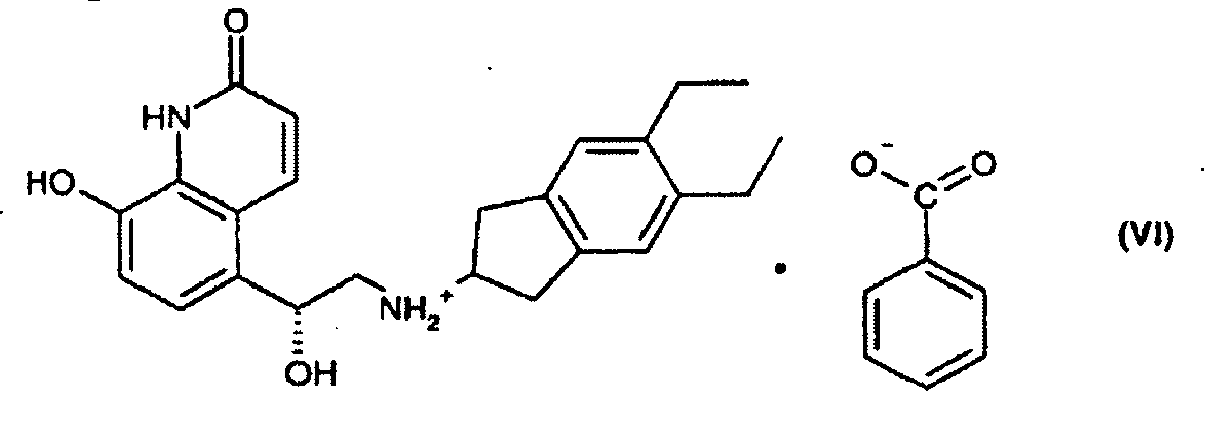 (v) le traitement du sel de formule (VI) avec un acide carboxylique en présence d'un solvant, pour former le sel de 5-[(R)-2-(5,6-diéthyl-indan-2-ylamino)-1-hydroxyéthyl]-8-hydroxy-(1H)-quinoléin-2-one de formule (VII) suivante :où X- est un anion.
- Procédé selon la revendication 1, dans lequel l'acide carboxylique de l'étape (v) est l'acide maléique.
- Procédé selon la revendication 2, dans lequel le sel de 5-[(R)-2-(5,6-diéthyl-indan-2-ylamino)-1-hydroxyéthyl]-8-hydroxy-(1H)-quinoléin-2-one répond à la formule (XI) suivante :

- Procédé selon l'une quelconque des revendications précédentes, dans lequel le groupe protecteur est choisi dans le groupe constitué par un groupe alkyle, aryle, alcoxy, alcényle, cycloalkyle, benzocycloalkyle, cycloalkylalkyle, aralkyle, hétérocyclique, hétéroaralkyle, halogénoalkyle, et silyle substitué.
- Procédé selon l'une quelconque des revendications précédentes, dans lequel le groupe protecteur est le groupe benzyle ou tert-butyldiméthylsilyle.
- Procédé selon la revendication 5, dans lequel le groupe protecteur du sel de formule (V) est le groupe benzyle et est éliminé par traitement du sel avec de l'hydrogène en présence d'un catalyseur.
- Procédé selon la revendication 6, dans lequel le catalyseur est choisi dans le groupe constitué par le palladium, l'hydroxyde de palladium, le palladium sur charbon activé, le palladium sur alumine, le palladium sur poudre de carbone, le platine, le platine sur charbon activé, le nickel Raney™, et les combinaisons de ceux-ci.
- Procédé selon la revendication 5, dans lequel le groupe protecteur du sel de formule (V) est le groupe tert-butyldiméthylsilyle et est éliminé par traitement du sel avec du fluorure de tert-butylammonium ou du fluorure de potassium.
- Procédé selon l'une quelconque des revendications précédentes, dans lequel la température de l'étape (i) est comprise entre environ 10°C et environ 160°C, la température de l'étape (ii) est comprise entre environ -10°C et environ 160°C, la température de l'étape (iii) est comprise entre environ 0°C et environ 70°C, la température de l'étape (iv) est comprise entre environ 0°C et environ 70°C, et la température de l'étape (v) est comprise entre environ 0°C et environ 70°C.
- Procédé selon l'une quelconque des revendications précédentes, dans lequel, dans l'étape (i), on utilise un excès molaire de 2-amino-(5,6-diéthyl)-indane par rapport à la quantité de 8-(oxy substitué)-5-(R)-oxiranyl-(1H)-quinoléin-2-one.
- Procédé selon l'une quelconque des revendications précédentes, dans lequel la 8-(oxy substitué)-5-(R)-oxiranyl-(1H)-quinoléin-2-one de formule (I) est préparée selon les étapes comprenant :(a) la réaction d'une 8-(oxy substitué)-5-halogénoacétyl-(1H)-quinoléin-2-one avec un agent réducteur en présence d'un catalyseur chiral, pour former une 8-(oxy substitué)-5-((R)-2-halogéno-1-hydroxyéthyl)-(1H)-quinoléin-2-one ; et(b) le traitement de la 8-(oxy substitué)-5-((R)-2-halogéno-1-hydroxyéthyl)-(1H)-quinoléin-2-one avec une base en présence d'un solvant, pour former la 8-(oxy substitué)-5-(R)-oxiranyl-(1H)-quinoléin-2-one.
- Procédé selon la revendication 11, dans lequel, dans l'étape (a), la 8-(oxy substitué)-5-halogénoacétyl-(1H)-quinoléin-2-one est mise à réagir avec un réactif borane en présence d'un catalyseur chiral oxazaborolidine.
- Procédé selon la revendication 12, dans lequel le réactif borane est choisi dans le groupe constitué par le borane-tétrahydrofurane, la borane-N,N-diéthylaniline et le borane-sulfure de méthyle, et le catalyseur chiral est le (R)-tétrahydro-1-méthyl-3,3-diphényl-(1H,3H)-pyrrolo[1,2-c][1,3,2]-oxazaborole.
- Procédé selon l'une quelconque des revendications 11 à 13, dans lequel la température de l'étape (a) est comprise entre environ -10°C et environ 80°C, et la température de l'étape (b) est comprise entre environ 30°C et environ 80°C.
- Procédé selon la revendication 1 pour la préparation d'un sel de 5-[(R)-2-(5,6-diéthyl-indan-2-ylamino)-1-hydroxyéthyl]-8-hydroxy-(1H)-quinoléin-2-one ou d'un produit de solvatation acceptable de ce dernier, comprenant :(a) la réaction d'une 8-(oxy substitué)-5-halogénoacétyl-(1H)-quinoléin-2-one avec un agent réducteur en présence d'un catalyseur chiral, pour former une 8-(oxy substitué)-5-((R)-2-halogéno-1-hydroxyéthyl)-(1H)-quinoléin-2-one ;(b) le traitement de la 8-(oxy substitué)-5-((R)-2-halogéno-1-hydroxyéthyl)-(1H)-quinoléin-2-one avec une base en présence d'un solvant, pour former la 8-(oxy substitué)-5-(R)-oxiranyl-(1H)-quinoléin-2-one ;(c) la réaction de la 8-(oxy substitué)-5-(R)-oxiranyl-(1H)-quinoléin-2-one de formule (I) suivante :

 (d) le traitement du mélange réactionnel préparé dans l'étape (c) avec de l'acide benzoïque en présence d'un solvant, pour former un sel correspondant de formule (V) suivante :
 (e) la filtration et la cristallisation du sel benzoate de formule (V) ;(f) l'élimination du groupe protecteur du sel de formule (V) en présence d'un solvant, pour former un sel de formule (VI) suivante :
 (g) le traitement du sel de formule (VI) avec un acide carboxylique en présence d'un solvant, pour former le sel de 5-[(R)-2-(5,6-diéthyl-indan-2-ylamino)-1-hydroxyéthyl]-8-hydroxy-(1H)-quinoléin-2-one de formule (VII) suivante :où X- est un anion.
- Composé de formule (V) suivante :

- Composé de formule (IX) suivante :

- Composé de formule (VI) suivante :

Priority Applications (2)
| Application Number | Priority Date | Filing Date | Title |
|---|---|---|---|
| SI200431222T SI1599450T1 (sl) | 2003-02-28 | 2004-02-27 | Postopek za pripravo 5-((R)-2-(5,6-dietil-indan-2-ilamino)-1-hidroksi-etil)-8-hidroksi-(1H)- kinolin-2-onskih soli, koristnih kot adrenoceptorski agonisti |
| CY20091100993T CY1109442T1 (el) | 2003-02-28 | 2009-09-24 | Μεθοδος για την παρασκευη αλατων 5-[(r)-2-(5,6-διαιθυλ-ινδαν-2-υλαμινο)-1-υδροξυ-αιθυλο]-8-υδροξυ-(1h)-κινολιν-2-ονης, τα οποια ειναι χρησιμα ως αγωνιστες αδρενεργικων υποδοχεων |
Applications Claiming Priority (3)
| Application Number | Priority Date | Filing Date | Title |
|---|---|---|---|
| US45094503P | 2003-02-28 | 2003-02-28 | |
| US450945P | 2003-02-28 | ||
| PCT/EP2004/001981 WO2004076422A1 (fr) | 2003-02-28 | 2004-02-27 | Procede de preparation d'un sel de 5-[(r)-2-(5,6-diethyl-indian-2-ylamino)-1-hydroxy-ethyl]-8-hydroxy-(1h)-quinolin-2-one, utilise en tant qu'agoniste d'un adreno-recepteur |
Publications (2)
| Publication Number | Publication Date |
|---|---|
| EP1599450A1 EP1599450A1 (fr) | 2005-11-30 |
| EP1599450B1 true EP1599450B1 (fr) | 2009-06-24 |
Family
ID=32927689
Family Applications (1)
| Application Number | Title | Priority Date | Filing Date |
|---|---|---|---|
| EP04715306A Expired - Lifetime EP1599450B1 (fr) | 2003-02-28 | 2004-02-27 | Procede de preparation des sels de 5-[(r)-2-(5,6-diethyl-indan-2-ylamino)-1-hydroxy-ethyl]-8-hydroxy-(1h)-quinolin-2-one, utilises en tant qu'agonistes d'un adreno-recepteur |
Country Status (29)
| Country | Link |
|---|---|
| US (1) | US7534890B2 (fr) |
| EP (1) | EP1599450B1 (fr) |
| JP (1) | JP4802089B2 (fr) |
| KR (1) | KR101076929B1 (fr) |
| CN (1) | CN100363349C (fr) |
| AR (1) | AR043406A1 (fr) |
| AT (1) | ATE434609T1 (fr) |
| AU (1) | AU2004215647B2 (fr) |
| BR (1) | BRPI0407904B1 (fr) |
| CA (1) | CA2517033C (fr) |
| CL (1) | CL2004000381A1 (fr) |
| CY (1) | CY1109442T1 (fr) |
| DE (1) | DE602004021675D1 (fr) |
| DK (1) | DK1599450T3 (fr) |
| EC (1) | ECSP055977A (fr) |
| ES (1) | ES2326974T3 (fr) |
| IL (1) | IL170138A (fr) |
| MX (1) | MXPA05009156A (fr) |
| MY (1) | MY142491A (fr) |
| NO (1) | NO331985B1 (fr) |
| NZ (1) | NZ541727A (fr) |
| PE (1) | PE20040956A1 (fr) |
| PL (1) | PL213932B1 (fr) |
| PT (1) | PT1599450E (fr) |
| RU (1) | RU2332405C2 (fr) |
| SI (1) | SI1599450T1 (fr) |
| TW (1) | TWI324150B (fr) |
| WO (1) | WO2004076422A1 (fr) |
| ZA (1) | ZA200506060B (fr) |
Families Citing this family (31)
| Publication number | Priority date | Publication date | Assignee | Title |
|---|---|---|---|---|
| TWI324151B (en) * | 2003-04-02 | 2010-05-01 | Novartis Ag | Process for the preparation of 5-(haloacetyl)-8-substituted oxy-(1h)-quinolin-2-ones |
| AU2004226824B2 (en) * | 2003-04-04 | 2008-05-01 | Novartis Ag | Quinoline-2-one-derivatives for the treatment of airways diseases |
| GB0411056D0 (en) | 2004-05-18 | 2004-06-23 | Novartis Ag | Organic compounds |
| GB0413960D0 (en) * | 2004-06-22 | 2004-07-28 | Novartis Ag | Organic compounds |
| DK2044025T3 (da) | 2006-06-30 | 2013-01-14 | Novartis Ag | Quinolinonderivater samt farmaceutiske sammensætninger deraf |
| US8236959B2 (en) | 2007-02-28 | 2012-08-07 | Cipla Limited | Process for preparing isomers of carmoterol |
| WO2011056929A1 (fr) * | 2009-11-04 | 2011-05-12 | Massachusetts Institute Of Technology | Synthèse en flux continu d'alcools aminés à l'aide de microréacteurs |
| US8680303B2 (en) | 2010-03-01 | 2014-03-25 | Massachusetts Institute Of Technology | Epoxidation catalysts |
| WO2013132514A2 (fr) * | 2012-03-09 | 2013-09-12 | Rao Davuluri Ramamohan | Nouveau procédé de préparation de (r)-5-[2-[(5, 6-diéthyl-2, 3-dihydro-1h-indèn-2-yl) amino]-1-hydroxyéthyl]-8-hydroxy quinoléin-2(1h)-one |
| WO2014008639A1 (fr) * | 2012-07-11 | 2014-01-16 | 上海威智医药科技有限公司 | Procédé de préparation d'indacatérol |
| WO2014008640A1 (fr) * | 2012-07-11 | 2014-01-16 | 上海威智医药科技有限公司 | Intermédiaire d'indacatérol et procédé de synthèse d'indacatérol |
| EP2897937B1 (fr) | 2012-09-21 | 2017-12-06 | Crystal Pharma S.A.U | Procédé de préparation d'indacatérol et intermédiaires de celle-ci |
| WO2014044288A1 (fr) * | 2012-09-21 | 2014-03-27 | Crystal Pharma Sa | Procédés de préparation d'indacatérol et de ses sels pharmaceutiquement acceptables |
| CZ306252B6 (cs) * | 2013-03-15 | 2016-10-26 | Zentiva, K.S. | Způsob přípravy 5-[(R)-2-(5,6-diethylindan-2-ylamino)-1-hydroxyethyl]-8-hydroxy-(1H)-chinolin-2-onu (indacaterolu) |
| EP2978745B1 (fr) | 2013-03-27 | 2017-03-15 | Laboratorios Lesvi, S.L. | Procédé de préparation de (r)-5-[2-(5,6-diéthylindan-2-ylamino)-1-hydroxyéthyl]-8-hydroxy-(1h)-quinolin-2-one |
| ES2815123T3 (es) | 2014-01-09 | 2021-03-29 | Davuluri Ramamohan Rao | Proceso novedoso para la preparación de indacaterol o sus sales aceptables farmacéuticamente |
| US10227305B2 (en) | 2014-08-22 | 2019-03-12 | G. Pratap REDDY | Process for preparing indacaterol and salts thereof |
| CN105693603B (zh) * | 2014-11-24 | 2019-11-29 | 上海医药工业研究院 | 改良的马来酸茚达特罗制备工艺 |
| WO2016161956A1 (fr) * | 2015-04-09 | 2016-10-13 | 正大天晴药业集团股份有限公司 | Procédé de préparation d'indacatérol ou du sel de celui-ci |
| CN107074833B (zh) * | 2015-07-21 | 2021-05-25 | 四川海思科制药有限公司 | 具有β2受体激动及M3受体拮抗活性的苯并环衍生物及其在医药上的用途 |
| ES2747905T3 (es) | 2015-09-29 | 2020-03-12 | Inke Sa | Solvato mixto de L-tartrato de (R)-5-[2-(5,6-dietilindan-2-ilamino)-1-hidroxietil]-8-hidroxi-1H-quinolin-2-ona |
| CN107021921A (zh) * | 2016-02-02 | 2017-08-08 | 常州爱诺新睿医药技术有限公司 | 一种茚达特罗中间体的盐及其制备方法 |
| CN107868045A (zh) * | 2016-09-28 | 2018-04-03 | 四川海思科制药有限公司 | 一种茚达特罗中间体的制备方法 |
| CN108101841B (zh) * | 2016-11-24 | 2021-04-06 | 江苏恒瑞医药股份有限公司 | 一种制备茚达特罗或其盐的方法 |
| CN108264483A (zh) * | 2016-12-31 | 2018-07-10 | 天津金耀集团有限公司 | 一种马来酸茚达特罗的制备方法 |
| CN109516974B (zh) * | 2017-09-19 | 2022-05-27 | 南京圣和药业股份有限公司 | 取代嘧啶类pi3k抑制剂的制备方法 |
| EP3735406B1 (fr) | 2018-01-02 | 2022-05-11 | Deva Holding Anonim Sirketi | Procédé de préparation de 5-(1-hydroxyéthyle à substitution amino en position 2)-quinoléine-2(1h)-one à substitution oxy en position 8 |
| CN109721534B (zh) * | 2018-09-25 | 2022-05-20 | 四川海思科制药有限公司 | 一种马来酸茚达特罗中间体及其制备方法和用途 |
| CN109988111A (zh) * | 2019-05-06 | 2019-07-09 | 淮北师范大学 | 一种马来酸茚达特罗的杂质及其合成方法 |
| CN110128339B (zh) * | 2019-05-31 | 2022-03-08 | 苏州芝宇生物科技有限公司 | 一种茚达特罗及其盐衍生物的合成方法和合成用中间体 |
| CN113731406B (zh) * | 2021-10-12 | 2023-07-28 | 南京工业大学 | 一种提高钯碳活性加氢脱除保护基的方法 |
Family Cites Families (5)
| Publication number | Priority date | Publication date | Assignee | Title |
|---|---|---|---|---|
| US4894219A (en) * | 1988-03-29 | 1990-01-16 | University Of Florida | Beta-agonist carbostyril derivatives, assay method and pharmacological composition |
| GB9405019D0 (en) | 1994-03-15 | 1994-04-27 | Smithkline Beecham Plc | Novel compounds |
| NZ332341A (en) * | 1996-05-20 | 2000-05-26 | Darwin Discovery Ltd | Quinoline carboxamides as TNF inhibitors and as PDE-IV inhibitors |
| US6541669B1 (en) * | 1998-06-08 | 2003-04-01 | Theravance, Inc. | β2-adrenergic receptor agonists |
| GB9913083D0 (en) * | 1999-06-04 | 1999-08-04 | Novartis Ag | Organic compounds |
-
2004
- 2004-02-25 TW TW093104788A patent/TWI324150B/zh not_active IP Right Cessation
- 2004-02-26 AR ARP040100606A patent/AR043406A1/es not_active Application Discontinuation
- 2004-02-26 PE PE2004000198A patent/PE20040956A1/es not_active Application Discontinuation
- 2004-02-27 DE DE602004021675T patent/DE602004021675D1/de not_active Expired - Lifetime
- 2004-02-27 RU RU2005129547/04A patent/RU2332405C2/ru active
- 2004-02-27 AT AT04715306T patent/ATE434609T1/de active
- 2004-02-27 AU AU2004215647A patent/AU2004215647B2/en not_active Expired
- 2004-02-27 US US10/546,941 patent/US7534890B2/en not_active Expired - Lifetime
- 2004-02-27 CA CA2517033A patent/CA2517033C/fr not_active Expired - Lifetime
- 2004-02-27 MX MXPA05009156A patent/MXPA05009156A/es active IP Right Grant
- 2004-02-27 PT PT04715306T patent/PT1599450E/pt unknown
- 2004-02-27 ES ES04715306T patent/ES2326974T3/es not_active Expired - Lifetime
- 2004-02-27 JP JP2006501972A patent/JP4802089B2/ja not_active Expired - Lifetime
- 2004-02-27 BR BRPI0407904A patent/BRPI0407904B1/pt not_active IP Right Cessation
- 2004-02-27 EP EP04715306A patent/EP1599450B1/fr not_active Expired - Lifetime
- 2004-02-27 SI SI200431222T patent/SI1599450T1/sl unknown
- 2004-02-27 CL CL200400381A patent/CL2004000381A1/es unknown
- 2004-02-27 NZ NZ541727A patent/NZ541727A/en not_active IP Right Cessation
- 2004-02-27 DK DK04715306T patent/DK1599450T3/da active
- 2004-02-27 CN CNB2004800054167A patent/CN100363349C/zh not_active Expired - Lifetime
- 2004-02-27 MY MYPI20040645A patent/MY142491A/en unknown
- 2004-02-27 PL PL378358A patent/PL213932B1/pl unknown
- 2004-02-27 WO PCT/EP2004/001981 patent/WO2004076422A1/fr not_active Ceased
-
2005
- 2005-07-28 ZA ZA200506060A patent/ZA200506060B/en unknown
- 2005-08-07 IL IL170138A patent/IL170138A/en active IP Right Grant
- 2005-08-24 EC EC2005005977A patent/ECSP055977A/es unknown
- 2005-08-26 KR KR1020057015981A patent/KR101076929B1/ko not_active Expired - Lifetime
- 2005-09-26 NO NO20054452A patent/NO331985B1/no unknown
-
2009
- 2009-09-24 CY CY20091100993T patent/CY1109442T1/el unknown
Also Published As
Similar Documents
| Publication | Publication Date | Title |
|---|---|---|
| US7534890B2 (en) | Process for preparing 5-[(R)-2-(5,6-diethyl-indan-2-ylamino)-1-hydroxy-ethyl]-8-hydroxy-(1H)-quinolin-2-one salt, useful as an andrenoceptor agonist | |
| EP1791820B1 (fr) | Composés organiques | |
| EP2089388B1 (fr) | Procédé pour la synthèse de chlorhydrate de moxifloxacine | |
| EP1613599B1 (fr) | Procede de preparation de 5-(haloacetyl)-8-(substitue oxy)-(1 i h /i )-quinolin-2-ones | |
| CA2706565C (fr) | Sel cristallin stable de l'acide (r)-3-fluorophenyl-3,4,5-trifluorobenzylcarbamique de l'ester de 1-azabicyclo [2.2.2]oct-3-yle | |
| HK1086255B (en) | Process for preparing 5-[(r)-2-(5,6-diethyl-indan-2-ylamino)-1-hydroxy-ethyl]-8-hydroxy-(1h)-quinolin-2-one salts, useful as adrenoceptor agonists | |
| HK1086833B (en) | A process for the preparation of 5-(haloacetyl)-8-(substituted oxy)-(1h)-quinolin-2-ones | |
| HK1105121B (en) | Enantioselective preparation of quinoline derivatives | |
| WO2004101527A1 (fr) | Procede de preparation de gatifloxacine anhydre omega | |
| WO2004101547A1 (fr) | Procedes de purification de gatifloxacine et nouvelle forme de gatifloxacine | |
| IL165446A (en) | Processes for the preparation of levocetirizine or salts thereof |
Legal Events
| Date | Code | Title | Description |
|---|---|---|---|
| PUAI | Public reference made under article 153(3) epc to a published international application that has entered the european phase |
Free format text: ORIGINAL CODE: 0009012 |
|
| 17P | Request for examination filed |
Effective date: 20050928 |
|
| AK | Designated contracting states |
Kind code of ref document: A1 Designated state(s): AT BE BG CH CY CZ DE DK EE ES FI FR GB GR HU IE IT LI LU MC NL PT RO SE SI SK TR |
|
| AX | Request for extension of the european patent |
Extension state: AL LT LV MK |
|
| DAX | Request for extension of the european patent (deleted) | ||
| RAP1 | Party data changed (applicant data changed or rights of an application transferred) |
Owner name: NOVARTIS AG Owner name: NOVARTIS PHARMA GMBH |
|
| REG | Reference to a national code |
Ref country code: HK Ref legal event code: DE Ref document number: 1086255 Country of ref document: HK |
|
| 17Q | First examination report despatched |
Effective date: 20061113 |
|
| GRAP | Despatch of communication of intention to grant a patent |
Free format text: ORIGINAL CODE: EPIDOSNIGR1 |
|
| RTI1 | Title (correction) |
Free format text: PROCESS FOR PREPARING 5-((R)-2-(5,6-DIETHYL-INDAN-2-YLAMINO)-1-HYDROXY-ETHYL)-8-HYDROXY-(1H)-QUINOLIN-2-ONE SALTS, USEFUL AS ADRENOCEPTOR AGONISTS |
|
| GRAS | Grant fee paid |
Free format text: ORIGINAL CODE: EPIDOSNIGR3 |
|
| GRAA | (expected) grant |
Free format text: ORIGINAL CODE: 0009210 |
|
| AK | Designated contracting states |
Kind code of ref document: B1 Designated state(s): AT BE BG CH CY CZ DE DK EE ES FI FR GB GR HU IE IT LI LU MC NL PT RO SE SI SK TR |
|
| REG | Reference to a national code |
Ref country code: GB Ref legal event code: FG4D |
|
| REG | Reference to a national code |
Ref country code: CH Ref legal event code: EP |
|
| REG | Reference to a national code |
Ref country code: IE Ref legal event code: FG4D |
|
| REF | Corresponds to: |
Ref document number: 602004021675 Country of ref document: DE Date of ref document: 20090806 Kind code of ref document: P |
|
| REG | Reference to a national code |
Ref country code: PT Ref legal event code: SC4A Free format text: AVAILABILITY OF NATIONAL TRANSLATION Effective date: 20090824 |
|
| REG | Reference to a national code |
Ref country code: SE Ref legal event code: TRGR |
|
| REG | Reference to a national code |
Ref country code: RO Ref legal event code: EPE |
|
| REG | Reference to a national code |
Ref country code: DK Ref legal event code: T3 |
|
| REG | Reference to a national code |
Ref country code: GR Ref legal event code: EP Ref document number: 20090402373 Country of ref document: GR |
|
| REG | Reference to a national code |
Ref country code: ES Ref legal event code: FG2A Ref document number: 2326974 Country of ref document: ES Kind code of ref document: T3 |
|
| REG | Reference to a national code |
Ref country code: EE Ref legal event code: FG4A Ref document number: E003635 Country of ref document: EE Effective date: 20090911 |
|
| REG | Reference to a national code |
Ref country code: HU Ref legal event code: AG4A Ref document number: E006432 Country of ref document: HU |
|
| REG | Reference to a national code |
Ref country code: SK Ref legal event code: T3 Ref document number: E 6287 Country of ref document: SK |
|
| REG | Reference to a national code |
Ref country code: HK Ref legal event code: GR Ref document number: 1086255 Country of ref document: HK |
|
| PLBE | No opposition filed within time limit |
Free format text: ORIGINAL CODE: 0009261 |
|
| STAA | Information on the status of an ep patent application or granted ep patent |
Free format text: STATUS: NO OPPOSITION FILED WITHIN TIME LIMIT |
|
| 26N | No opposition filed |
Effective date: 20100325 |
|
| PG25 | Lapsed in a contracting state [announced via postgrant information from national office to epo] |
Ref country code: MC Free format text: LAPSE BECAUSE OF NON-PAYMENT OF DUE FEES Effective date: 20100301 |
|
| REG | Reference to a national code |
Ref country code: DE Ref legal event code: R082 Ref document number: 602004021675 Country of ref document: DE |
|
| REG | Reference to a national code |
Ref country code: FR Ref legal event code: PLFP Year of fee payment: 13 |
|
| REG | Reference to a national code |
Ref country code: FR Ref legal event code: PLFP Year of fee payment: 14 |
|
| REG | Reference to a national code |
Ref country code: FR Ref legal event code: PLFP Year of fee payment: 15 |
|
| PGFP | Annual fee paid to national office [announced via postgrant information from national office to epo] |
Ref country code: LU Payment date: 20180208 Year of fee payment: 15 |
|
| PGFP | Annual fee paid to national office [announced via postgrant information from national office to epo] |
Ref country code: EE Payment date: 20180329 Year of fee payment: 15 |
|
| PGFP | Annual fee paid to national office [announced via postgrant information from national office to epo] |
Ref country code: CY Payment date: 20180130 Year of fee payment: 15 |
|
| REG | Reference to a national code |
Ref country code: EE Ref legal event code: MM4A Ref document number: E003635 Country of ref document: EE Effective date: 20190228 |
|
| PG25 | Lapsed in a contracting state [announced via postgrant information from national office to epo] |
Ref country code: EE Free format text: LAPSE BECAUSE OF NON-PAYMENT OF DUE FEES Effective date: 20190228 Ref country code: LU Free format text: LAPSE BECAUSE OF NON-PAYMENT OF DUE FEES Effective date: 20190227 Ref country code: CY Free format text: LAPSE BECAUSE OF NON-PAYMENT OF DUE FEES Effective date: 20190227 |
|
| PGFP | Annual fee paid to national office [announced via postgrant information from national office to epo] |
Ref country code: RO Payment date: 20230215 Year of fee payment: 20 Ref country code: IE Payment date: 20230124 Year of fee payment: 20 Ref country code: FR Payment date: 20230123 Year of fee payment: 20 Ref country code: FI Payment date: 20230220 Year of fee payment: 20 Ref country code: ES Payment date: 20230310 Year of fee payment: 20 Ref country code: DK Payment date: 20230213 Year of fee payment: 20 Ref country code: CZ Payment date: 20230215 Year of fee payment: 20 Ref country code: CH Payment date: 20230307 Year of fee payment: 20 Ref country code: BG Payment date: 20230202 Year of fee payment: 20 Ref country code: AT Payment date: 20230125 Year of fee payment: 20 |
|
| REG | Reference to a national code |
Ref country code: AT Ref legal event code: PC Ref document number: 434609 Country of ref document: AT Kind code of ref document: T Owner name: NOVARTIS AG, CH Effective date: 20230320 |
|
| PGFP | Annual fee paid to national office [announced via postgrant information from national office to epo] |
Ref country code: TR Payment date: 20230224 Year of fee payment: 20 Ref country code: SK Payment date: 20230125 Year of fee payment: 20 Ref country code: SI Payment date: 20230127 Year of fee payment: 20 Ref country code: SE Payment date: 20230126 Year of fee payment: 20 Ref country code: PT Payment date: 20230227 Year of fee payment: 20 Ref country code: IT Payment date: 20230126 Year of fee payment: 20 Ref country code: HU Payment date: 20230203 Year of fee payment: 20 Ref country code: GR Payment date: 20230126 Year of fee payment: 20 Ref country code: GB Payment date: 20230119 Year of fee payment: 20 Ref country code: DE Payment date: 20230117 Year of fee payment: 20 Ref country code: BE Payment date: 20230125 Year of fee payment: 20 |
|
| PGFP | Annual fee paid to national office [announced via postgrant information from national office to epo] |
Ref country code: NL Payment date: 20230125 Year of fee payment: 20 |
|
| REG | Reference to a national code |
Ref country code: DE Ref legal event code: R071 Ref document number: 602004021675 Country of ref document: DE |
|
| REG | Reference to a national code |
Ref country code: NL Ref legal event code: MK Effective date: 20240226 |
|
| REG | Reference to a national code |
Ref country code: CH Ref legal event code: PL |
|
| REG | Reference to a national code |
Ref country code: BE Ref legal event code: MK Effective date: 20240227 Ref country code: DK Ref legal event code: EUP Expiry date: 20240227 |
|
| REG | Reference to a national code |
Ref country code: ES Ref legal event code: FD2A Effective date: 20240305 |
|
| REG | Reference to a national code |
Ref country code: SK Ref legal event code: MK4A Ref document number: E 6287 Country of ref document: SK Expiry date: 20240227 |
|
| REG | Reference to a national code |
Ref country code: GB Ref legal event code: PE20 Expiry date: 20240226 |
|
| REG | Reference to a national code |
Ref country code: IE Ref legal event code: MK9A |
|
| REG | Reference to a national code |
Ref country code: AT Ref legal event code: MK07 Ref document number: 434609 Country of ref document: AT Kind code of ref document: T Effective date: 20240227 |
|
| PG25 | Lapsed in a contracting state [announced via postgrant information from national office to epo] |
Ref country code: IE Free format text: LAPSE BECAUSE OF EXPIRATION OF PROTECTION Effective date: 20240227 Ref country code: ES Free format text: LAPSE BECAUSE OF EXPIRATION OF PROTECTION Effective date: 20240228 |
|
| PG25 | Lapsed in a contracting state [announced via postgrant information from national office to epo] |
Ref country code: IE Free format text: LAPSE BECAUSE OF EXPIRATION OF PROTECTION Effective date: 20240227 Ref country code: ES Free format text: LAPSE BECAUSE OF EXPIRATION OF PROTECTION Effective date: 20240228 Ref country code: CZ Free format text: LAPSE BECAUSE OF EXPIRATION OF PROTECTION Effective date: 20240227 Ref country code: PT Free format text: LAPSE BECAUSE OF EXPIRATION OF PROTECTION Effective date: 20240307 Ref country code: GB Free format text: LAPSE BECAUSE OF EXPIRATION OF PROTECTION Effective date: 20240226 Ref country code: SK Free format text: LAPSE BECAUSE OF EXPIRATION OF PROTECTION Effective date: 20240227 |
|
| PG25 | Lapsed in a contracting state [announced via postgrant information from national office to epo] |
Ref country code: SI Free format text: LAPSE BECAUSE OF EXPIRATION OF PROTECTION Effective date: 20240228 |
|
| PG25 | Lapsed in a contracting state [announced via postgrant information from national office to epo] |
Ref country code: SI Free format text: LAPSE BECAUSE OF EXPIRATION OF PROTECTION Effective date: 20240228 |