EP1609491B1 - Abdeckmembran - Google Patents
Abdeckmembran Download PDFInfo
- Publication number
- EP1609491B1 EP1609491B1 EP04014072A EP04014072A EP1609491B1 EP 1609491 B1 EP1609491 B1 EP 1609491B1 EP 04014072 A EP04014072 A EP 04014072A EP 04014072 A EP04014072 A EP 04014072A EP 1609491 B1 EP1609491 B1 EP 1609491B1
- Authority
- EP
- European Patent Office
- Prior art keywords
- precursor
- poly
- membrane according
- chains
- crosslinking
- Prior art date
- Legal status (The legal status is an assumption and is not a legal conclusion. Google has not performed a legal analysis and makes no representation as to the accuracy of the status listed.)
- Revoked
Links
- 0 CC(C)(*)CC(C)(C)*N Chemical compound CC(C)(*)CC(C)(C)*N 0.000 description 5
- SGRPKLFDQXXSEF-UHFFFAOYSA-N CC(C)(C)COCCOCNCCS Chemical compound CC(C)(C)COCCOCNCCS SGRPKLFDQXXSEF-UHFFFAOYSA-N 0.000 description 1
- FZIDTFPCWSAQIC-UHFFFAOYSA-N CC(CCOC(C=C)=O)OC(C)CC(COC(C)(C)C(C)(C)CCOC(C=C)=O)OC(C)(C)CCON(C)C(C=C)O Chemical compound CC(CCOC(C=C)=O)OC(C)CC(COC(C)(C)C(C)(C)CCOC(C=C)=O)OC(C)(C)CCON(C)C(C=C)O FZIDTFPCWSAQIC-UHFFFAOYSA-N 0.000 description 1
- PUQKRSVETWDQEH-UHFFFAOYSA-O CCCCC(NCCC(C)(C)OCCC(C)(C)NC(CCCS)=[OH+])=O Chemical compound CCCCC(NCCC(C)(C)OCCC(C)(C)NC(CCCS)=[OH+])=O PUQKRSVETWDQEH-UHFFFAOYSA-O 0.000 description 1
Images


Classifications
-
- A—HUMAN NECESSITIES
- A61—MEDICAL OR VETERINARY SCIENCE; HYGIENE
- A61L—METHODS OR APPARATUS FOR STERILISING MATERIALS OR OBJECTS IN GENERAL; DISINFECTION, STERILISATION OR DEODORISATION OF AIR; CHEMICAL ASPECTS OF BANDAGES, DRESSINGS, ABSORBENT PADS OR SURGICAL ARTICLES; MATERIALS FOR BANDAGES, DRESSINGS, ABSORBENT PADS OR SURGICAL ARTICLES
- A61L31/00—Materials for other surgical articles, e.g. stents, stent-grafts, shunts, surgical drapes, guide wires, materials for adhesion prevention, occluding devices, surgical gloves, tissue fixation devices
- A61L31/14—Materials characterised by their function or physical properties, e.g. injectable or lubricating compositions, shape-memory materials, surface modified materials
- A61L31/148—Materials at least partially resorbable by the body
-
- C—CHEMISTRY; METALLURGY
- C08—ORGANIC MACROMOLECULAR COMPOUNDS; THEIR PREPARATION OR CHEMICAL WORKING-UP; COMPOSITIONS BASED THEREON
- C08G—MACROMOLECULAR COMPOUNDS OBTAINED OTHERWISE THAN BY REACTIONS ONLY INVOLVING UNSATURATED CARBON-TO-CARBON BONDS
- C08G65/00—Macromolecular compounds obtained by reactions forming an ether link in the main chain of the macromolecule
- C08G65/02—Macromolecular compounds obtained by reactions forming an ether link in the main chain of the macromolecule from cyclic ethers by opening of the heterocyclic ring
- C08G65/30—Post-polymerisation treatment, e.g. recovery, purification, drying
-
- C—CHEMISTRY; METALLURGY
- C08—ORGANIC MACROMOLECULAR COMPOUNDS; THEIR PREPARATION OR CHEMICAL WORKING-UP; COMPOSITIONS BASED THEREON
- C08G—MACROMOLECULAR COMPOUNDS OBTAINED OTHERWISE THAN BY REACTIONS ONLY INVOLVING UNSATURATED CARBON-TO-CARBON BONDS
- C08G65/00—Macromolecular compounds obtained by reactions forming an ether link in the main chain of the macromolecule
- C08G65/02—Macromolecular compounds obtained by reactions forming an ether link in the main chain of the macromolecule from cyclic ethers by opening of the heterocyclic ring
- C08G65/32—Polymers modified by chemical after-treatment
- C08G65/329—Polymers modified by chemical after-treatment with organic compounds
-
- C—CHEMISTRY; METALLURGY
- C08—ORGANIC MACROMOLECULAR COMPOUNDS; THEIR PREPARATION OR CHEMICAL WORKING-UP; COMPOSITIONS BASED THEREON
- C08G—MACROMOLECULAR COMPOUNDS OBTAINED OTHERWISE THAN BY REACTIONS ONLY INVOLVING UNSATURATED CARBON-TO-CARBON BONDS
- C08G75/00—Macromolecular compounds obtained by reactions forming a linkage containing sulfur with or without nitrogen, oxygen, or carbon in the main chain of the macromolecule
- C08G75/02—Polythioethers
- C08G75/04—Polythioethers from mercapto compounds or metallic derivatives thereof
- C08G75/045—Polythioethers from mercapto compounds or metallic derivatives thereof from mercapto compounds and unsaturated compounds
-
- C—CHEMISTRY; METALLURGY
- C08—ORGANIC MACROMOLECULAR COMPOUNDS; THEIR PREPARATION OR CHEMICAL WORKING-UP; COMPOSITIONS BASED THEREON
- C08G—MACROMOLECULAR COMPOUNDS OBTAINED OTHERWISE THAN BY REACTIONS ONLY INVOLVING UNSATURATED CARBON-TO-CARBON BONDS
- C08G75/00—Macromolecular compounds obtained by reactions forming a linkage containing sulfur with or without nitrogen, oxygen, or carbon in the main chain of the macromolecule
- C08G75/12—Polythioether-ethers
Definitions
- the present invention relates to a cell-occlusive membrane, which is obtainable by reaction of at least two precursors in the presence of water and a method for preparing the membrane.
- Implants that are used for insertion into bone for example titanium screws to be placed into the jaw for attachment of artificial teeth are known per se.
- the function of such an implant can be hampered by an insufficient bone volume or the presence of bone defects at the site of implantation.
- An often applied measure to promote bone formation at the implantation site is Guided Bone Regeneration (GBR).
- GBR Guided Bone Regeneration
- the site where bone formation is desired is separated from the surrounding soft tissue by a barrier membrane that inhibits non-osteogenic soft tissue cells from entering the site, thus allowing cells from the bone marrow to fill it with bone.
- an osteoconductive bone filling material can be used to support the membrane.
- cell-occlusive membranes There are several types of cell-occlusive membranes that are used in the field of guided bone regeneration or tissue regeneration in general. Commercially available cell-occlusive membranes can be grouped according to their origin into xenogenic membrane material derived from individuals of different species and synthetically manufactured membrane material.
- Xenogenic material always bears the risk of infection. Most membrane materials are sold in sheets and need to be cut to size by the surgeon, which is time consuming. Further this procedure results in difficulties due to shape matching.
- An example for a xenogenic material is collagen, which is biodegradable and hydrophilic.
- PTFE Teflon
- the PTFE membrane is hydrophobic and therefore does not attach well to biological tissue and often has to be attached using pins or screws. Furthermore the material is not biodegradable and thus has to be removed after the healing process in a second invasive procedure.
- Biodegradable materials are known in the art.
- WO 01/92584 a matrix material is disclosed which is formed by nucleophilic addition reaction to conjugated unsaturated groups.
- a pharmaceutically active component is covalently attached to the biomaterial, which will be subsequently released into the body.
- the biodegradable material degrades under physiological conditions within one month.
- WO 00/44808 also discloses a polymeric biomaterial formed by nucleophilic addition reactions to conjugated unsaturated groups.
- the obtained hydrogels may be used for example as glues or sealants and as scaffolds for tissue engineering and wound healing applications. Also said hydrogels degrade fast under physiological conditions.
- US 5,874,500 discloses a crosslinked polymeric composition
- a crosslinked polymeric composition comprising a first synthetic polymer containing two or more amino groups covalently bound to a second synthetic polymer containing multiple electrophilic groups and a biologically active component.
- Said composition may be used to effect adhesion between a first surface and a second surface, to effect tissue augmentation, to prevent the formation of surgical adhesion and to coat a surface of a synthetic implant.
- polymerization and “cross-linking” are used to indicate the linking of different precursors to each other to result in a substantial increase in molecular weight.
- Cross-linking further indicates branching, typically to yield a polymer network.
- first precursor A of the reaction reacts much faster with a second precursor B than with other compounds present in the mixture at the site of the reaction, and the second precursor B reacts much faster with the first precursor A than with other compounds present in the mixture at the site of the reaction.
- the mixture may contain other biological materials, for example, drugs, peptides, proteins, DNA, cells, cell aggregates and tissues.
- conjugated unsaturated bond By “conjugated unsaturated bond” the alternation of carbon-carbon, carbon-heteroatom or heteroatom-heteroatom multiple bonds with single bonds. Such bonds can undergo addition reactions.
- conjugated unsaturated group a molecule or a region of a molecule, containing an alternation of carbon-carbon, carbon-heteroatom or heteroatom-heteroatom multiple bonds with single bonds, which has a multiple bond which can undergo addition reactions is meant.
- conjugated unsaturated groups include, but are not limited to acrylates, acrylamides, quinines, and vinylpyridiniums, for example 2- or 4-vinylpyridinium.
- the problem of the present invention is to provide a biodegradable membrane which prevents surrounding soft tissue from interaction with the region to be protected, which does not bear the risk of infection.
- the membrane according to the present invention is obtainable by reaction of two or more precursors. Due to the combination of the characteristics of the precursors, that means the number of chains of the precursors as well as fact that the adjacent crosslinking-points are connected by a chain having less than 600 atoms, the resulting membrane is cell-occlusive.
- the membrane according to the present invention prevents the surrounding soft tissue from interaction with the region to be protected. This allows a fast bone regeneration in a bone defect.
- the membrane Due to the fact that the membrane is of non-animal origin, the risk of inflammation and transmission of animal pathogens is reduced. Further, the membrane is biodegradable, which avoids a second surgery. However it is stable enough to ensure a maintenance of the barrier function during complete healing time for an effective bone regeneration in implant bed defects, which means that there is a predictable treatment outcome which is important to the surgeon.
- the membrane is degradable within about 6 months. The degradation products are easily excreted and non-toxic.
- the membrane according to the present invention may be applied in situ which means that a fast application is possible, which is required by the surgeon and the patient. Due to the mode of application the membrane will take the shape of the underlying surface, thus ensuring optimum fit and hold. No fixation of such a membrane is necessary. That means it is easy to handle since an extra-oral tailoring is avoided. Because of the perfect fit there is a significantly lower risk of undesired granule migration.
- the first precursor A comprises a core which carries n chains with a conjugated unsaturated group or a conjugated unsaturated bond attached to any of the last 20 atoms of the chain.
- said conjugated unsaturated group or conjugated unsaturated bond is terminal.
- the core can be a single atom such as a carbon or a nitrogen atom or small molecules such as an ethylene oxide unit, a sugar, a multifunctional alcohol, such as pentaerythritol, glycerine or oligoglycerine, such as hexaglycerol.
- the chains are linear polymers or linear or branched alkyl chains optionally comprising heteroatoms, amide groups or ester groups.
- the core may be additionally substituted with linear or branched alkyl residues or polymers which have no conjugated unsaturated groups or bonds.
- the first precursor A has 2 to 10 chains, most preferably 4 to 8 chains.
- the conjugated unsaturated bonds are preferably acrylates, acrylamides, quinines, 2- or 4-vinylpyridiniums, and itaconate esters of formula Ia or Ib wherein R 1 and R 2 are independently hydrogen, methyl, ethyl, propyl or butyl, and R 3 is a linear or branched C1 to C10 hydrocarbon chain, preferably methyl, ethyl, propyl or butyl.
- the second precursor B comprising a core carrying m chains each having a thiol group attached to any of the last 20 atoms at the end of the chain.
- a cysteine residue may be incorporated into the chain.
- the thiol group is terminal.
- the core can be a single atom such as a carbon or a nitrogen atom or small molecules such as an ethylene oxide unit, a sugar, a multifunctional alcohol, such as pentaerythritol, glycerine or oligoglycerine, such as hexaglycerol.
- the chains are linear polymers or linear or branched alkyl chains optionally comprising heteroatoms, esters groups or amide groups.
- the second precursor B has 2 to 10 chains, most preferably 4 to 8 chains.
- the first precursor A compound has n chains, whereby n is greater than or equal to 2, and the second precursor B compound has m chains, whereby m is greater than or equal to 2.
- the first and/or the second precursor B may comprise further chains which are not functionalized.
- the sum of the chains of the first and the second precursor Bs, that means m+n, is greater than or equal 5.
- the sum of m+n is equal or greater than 8 to obtain a dense three-dimensional network.
- Each core of the precursors forms a crosslinking-point if m and n are both greater than 2. If m is equal 2, that means if the second precursor B is linear, the corresponding crosslinking-point corresponds to the core of the adjacent first precursor A. If n is equal 2, that means if the first precursor A is linear, the crosslinking-point corresponds to the core of the adjacent second precursor B.
- the adjacent crosslinking-points are connected by a chain having less than 600 atoms. Said 600 atoms are only the atoms which are in the backbone of the chain, that means not counting substituents or H atoms.
- the number of atoms between the two adjacent crosslinking-points is smaller than about 330 atoms, most preferably between 30 and 120 atoms. Therefore the meshes of the resulting three-dimensional network are several orders of magnitude smaller than the dimensions of a cell (the dimension of a cell is 1 to 100 ⁇ m), which results in a cell-occlusive membrane. Since the number of chains of the first and the second precursor B (n+m) is at least 5 and the distances between the core of the first precursor A and the core of the second precursor B is small, the water content in the network is reduced which results in a longer in vivo stability. But the presence of water ensures the transport of small molecules, that means that waste material can be transported away from the cells and nutrient can enter into the cells.
- the reaction of the first and the second precursor B is preferably based on the base catalyzed Michael type addition between the conjugated unsaturated group or the conjugated unsaturated bond of the first precursor A and the thiol group of the second precursor B:
- the resulting linkage is hydrolyzed in contact with water.
- the rate of the hydrolysis reaction depends on the temperature and the value of the pH, which is 7.4 in most tissues. After hydrolysis of several bonds the crosslinked network degrades or breaks down because of hyrolysis of the unstable linkages.
- the chains of the first precursor A and or the chains of the second precursor Bs are linear polymers.
- Said polymers are preferably selected from the group consisting of poly(ethylene glycol), poly(ethylene oxide), poly(vinyl alcohol), poly(ethylene-co-vinyl alcohol), poly(acrylic acid), poly(ethylene-co-vinyl-pyrrolidone), poly(ethyloxazoline), poly(vinyl pyrrolidone), poly(ethylene-co-vinyl pyrrolidone), poly(maleic acid), poly(ethylene-co-maleic acid), poly(acrylamide) or poly(ethylene oxide)-co-poly(propylene oxide) block copolymers.
- Said polymers can also be copolymers, block copolymers, graft copolymers, or random copolymers.
- Blocks, which are polymerized on the ends of the hydrophilic polymers can be composed of, for example, lactic acid, glycolic acid, ⁇ -caprolactone, lactic-co-glycolic acid oligomers, trimethylene carbonate, anhydrides, and amino acids.
- the chains of the precursor molecules are poly (ethylene glycole) molecules (PEG).
- PEG poly (ethylene glycole) molecules
- PEG is highly water soluble, available in high quality and many different structures. Further it is non-toxic and FDA approved for oral and topical administration and injections to humans.
- the molecular weight may vary by ca. ⁇ 20% and thus the values for v are only approximate values.
- a viscosity modifying agent may be added to the precursors in order to prevent the liquid from running away before it has gelled.
- Possible viscosity modifying agents are for example CMC or xanthan.
- a possible stabilizer is methylene blue which ensures a good stabilization.
- the precursors are mixed together in the presence of water, preferably water buffered at physiologic or nearly physiological pH. It is not necessary that the monomers are entirely soluble in water. In general the cross-linking is completed within a relatively short period of time (i.e. 10 seconds to 15 minutes). Therefore the surgical site may be closed relatively soon upon completion of the surgical procedure.
- first precursor A is mixed with a first buffer and the second precursor B is mixed with a second buffer.
- the two mixtures are mixed further by means of a static mixer attached to two syringes and the resulting mixture is applied in situ.
- the mixing can also occur between fine droplets of each of the two precursor solutions in an air spray.
- One solution could be prepared from both precursors, but at a pH, for example, such that the reaction can not proceed or proceeds only slowly.
- pH could be adjusted, for example by mixing with an acid or a base, or by a chemical reaction to create an acid or base, or diffusion of an acid or base, to result in a final condition in the final precursor solution that is appropriate for the chemical reaction to proceed.
- Another approach can be to prepare the final precursor solution at a temperature such that the reaction can not proceed or proceeds only very slowly, either related to the activation energy of the reaction or to a buffer with temperature-sensitive characteristics or both. Upon warming or cooling (most usefully warming) to the final application temperature (e.g., to body temperature after injection), the conditions in the final precursor solution would be appropriate for the chemical reaction to proceed.
- the first and the second precursor B may be sold independently from each other.
- they are sold together in form of a kit comprising the first precursor A and the second precursor B, wherein said precursors are separated from each other.
- Said kit may comprise additionally a buffered aqueous solution. It is also possible that the buffered solution is separated from the first precursor A and the second precursor B.
- a standard fibrin glue kit was diluted such that the final concentration of the fibrinogen component was four fold lower and the final concentration of the thrombin component was 125 fold lower than that for a standard kit. Equal volumes of the fibrinogen and thrombin solutions were mixed and adsorbed into the PVA sponge, creating a fibrin network amongst the pores of the PVA.
- fibrin-PVA sponges were stored in sterile Petri dishes until implantation in the animal (+ control) or entrapment in a membrane material.
- Membrane PEG gels were cast at room temperature under sterile conditions in cylindrical stainless steel molds ( ⁇ 7 mm, height 7 mm), using membrane kits containing equimolar amounts of 4-arm PEG-thiol 2k and 8-arm PEG-acrylate 2k as well as a triethanolamine/HCl buffer with CMC as viscosity modifier. Before gelation set in, a fibrin sponge was placed in the center of each membrane gel. The molds were covered and gels were allowed to cure for ca. 1 hour, after which they were transferred to sterile 10 mM PBS and stored in an incubator at 37°C overnight.
- Every sample was then embedded in a gelatin capsule (EMS, size 13) with freshly catalyzed Histocryl solution.
- the embedded explants were sectioned on a Rotary Microtom (MICROM) with a knife (d shaped, MICROM). Sections were stained with Meyer's hematoxylin (Merck) and an aqueous eosin solution (1%, Sigma), mounted in Mowiol.
- the degree of cell invasion into fibrin filled PVA sponges was quantified by counting DAPI stained cell nuclei in 36 to 45 histological sections (4 ⁇ m thick) of tissue explants by automated image analysis.
- Figure 2 shows the number of cells found in each PEG shielded sponge as a percentage of the average number in the control samples (open circles). The average percentages for each time point ( ⁇ SD) are indicated with crosses. Between 1 and 4 months the number of cells found in the samples increased only slightly. Although a clear increase in cell infiltration was observed after 6 months, in most of the sponges the number of cells was still below 1% of that in the positive control. After 7 months, the PEG membranes were mostly disintegrated and the number of cells had increased to (2.8 ⁇ 4.7)% of that in the positive control. The strong variation between individual samples at this time point may be explained by slight variations in the time to full degradation between the individual PEG membranes. When "cell occlusive" is defined as allowing less than 1% cells to infiltrate, it can be concluded that the membrane is cell occlusive for ca.6 months.
Landscapes
- Chemical & Material Sciences (AREA)
- Health & Medical Sciences (AREA)
- Organic Chemistry (AREA)
- Chemical Kinetics & Catalysis (AREA)
- Medicinal Chemistry (AREA)
- Polymers & Plastics (AREA)
- Epidemiology (AREA)
- General Health & Medical Sciences (AREA)
- Surgery (AREA)
- Vascular Medicine (AREA)
- General Chemical & Material Sciences (AREA)
- Life Sciences & Earth Sciences (AREA)
- Animal Behavior & Ethology (AREA)
- Heart & Thoracic Surgery (AREA)
- Public Health (AREA)
- Veterinary Medicine (AREA)
- Medicinal Preparation (AREA)
- Materials For Medical Uses (AREA)
- Other Resins Obtained By Reactions Not Involving Carbon-To-Carbon Unsaturated Bonds (AREA)
- Addition Polymer Or Copolymer, Post-Treatments, Or Chemical Modifications (AREA)
- Laminated Bodies (AREA)
Claims (20)
- Zellokklusive Membran, erhältlich durch Reaktion von mindestens zwei Vorläufern in der Gegenwart von Wasser, wobei
ein erster Vorläufer A enthaltend einen Kernbereich, der n Ketten trägt, wovon jede eine konjugierte ungesättigte Gruppe oder eine konjugierte ungesättigte Bindung aufweist, die an einem der letzten 20 Atome der Kette befestigt ist, und
ein zweiter Vorläufer B enthaltend einen Kernbereich, der m Ketten trägt, wovon jede eine Thiogruppe aufweist, die an einem der letzten 20 Atome der Kette befestigt ist, wobei
m grösser oder gleich 2 ist,
n grösser oder gleich 2 ist,
m + n grösser oder gleich 5 ist,
die Reaktion ein dreidimensionales Netzwerk mit Vernetzungspunkten bildet, dadurch gekennzeichnet, dass
jeder Kernbereich der Vorläufer einen Vernetzungspunkt bildet, falls m und n grösser sind als 2, und,
falls m gleich 2, der entsprechende Vernetzungspunkt dem Kernbereich des benachbarten ersten Vorläufers A entspricht, und,
falls n gleich 2, der Vernetzungspunkt dem Kernbereich des benachbarten zweiten Vorläufers B entspricht, und
dass die benachbarten Vernetzungspunkte durch eine Kette verbunden sind, die weniger als 600 Atome aufweist. - Membran gemäss Anspruch 1, dadurch gekennzeichnet, dass die konjugierte ungesättigte Gruppe oder eine konjugierte ungesättigte Bindung endständig ist.
- Membran gemäss einem der vorangehenden Ansprüche, dadurch gekennzeichnet, dass die Thiogruppe endständig ist.
- Membran gemäss einem der vorangehenden Ansprüche, dadurch gekennzeichnet, dass der erste Vorläufer A 2 bis 10 Ketten aufweist.
- Membran gemäss Anspruch 4, dadurch gekennzeichnet, dass der erste Vorläufer A 2 bis 8, vorzugsweise 4 bis 8 Ketten aufweist.
- Membran gemäss einem der vorangehenden Ansprüche, dadurch gekennzeichnet, dass der zweite Vorläufer B 2 bis 10 Ketten aufweist.
- Membran gemäss Anspruch 6, dadurch gekennzeichnet, dass der zweite Vorläufer B 2 bis 8, vorzugsweise 4 bis 8 Ketten aufweist.
- Membran gemäss einem der vorangehenden Ansprüche, wobei benachbarte Vernetzungspunkte durch eine Kette verbunden sind, die weniger als 330 Atome aufweist.
- Membran gemäss einem der vorangehenden Ansprüche, wobei benachbarte Vernetzungspunkte durch eine Kette verbunden sind, die 30 bis 120 Atome aufweist.
- Membran gemäss einem der vorangehenden Ansprüche, wobei die Ketten des ersten oder zweiten Vorläufers B lineare Polymere sind.
- Membran gemäss Anspruch 10, dadurch gekennzeichnet, dass Polymere des ersten und/oder zweiten Vorläufers B aus der Gruppe, bestehend aus Polyethylenglykol, Polyethylenoxid, Polyvinylalkohol, Polyethylen-Co-Vinylalkohol, Polyacrylsäure, Polyethylen-Co-Acrylsäure, Polyethyloxazolin, Polyvinylpyrrolidon, Polyethylene-Co-Vinylpyrrolidon, Polymaleinsäure, Polyethylen-Co-Maleinsäure, Polyacrylamid, und Polyethylenoxid-Co-Polypropylenoxid Block-Copolymeren, ausgewählt sind.
- Membran gemäss einem der vorangehenden Ansprüche, dadurch gekennzeichnet, dass die Kette des ersten und/oder zweiten Vorläufers B ein Polyethylenglykol-Rest ist.
- Membran gemäss einem der vorangehenden Ansprüche, dadurch gekennzeichnet, dass die konjugierte ungesättigte Gruppe oder die konjugierte ungesättigte Bindung des ersten Vorläufers A ein Acrylat, ein Acrylamid, ein Chinin, ein 2- oder 4-Vinylpyridinium oder ein Itaconatester ist.
- Membran gemäss einem der vorangehenden Ansprüche, dadurch gekennzeichnet, dass der erste Vorläufer A aus der Gruppe, bestehend aus


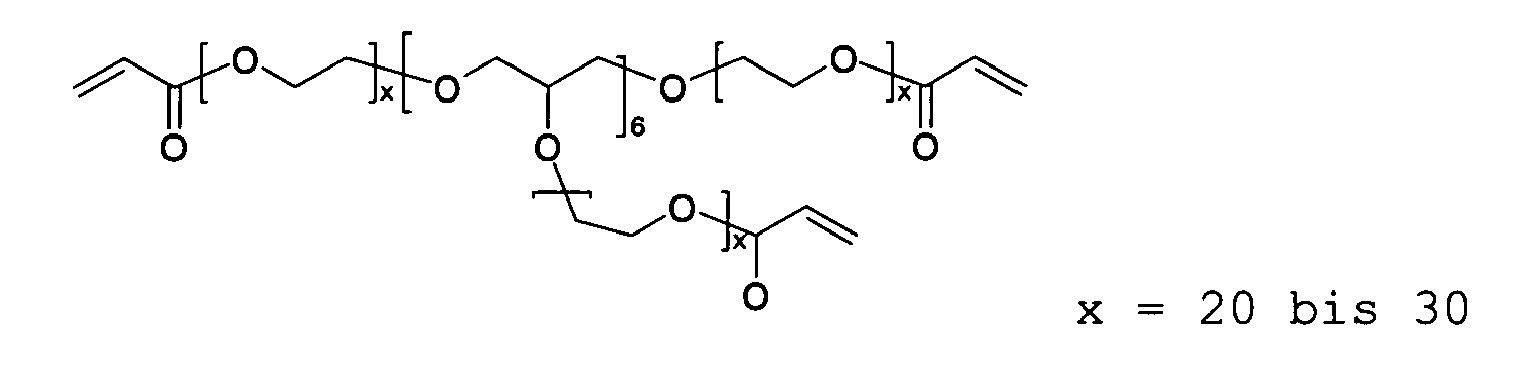


- Membran gemäss einem der vorangehenden Ansprüche, dadurch gekennzeichnet, dass der zweite Vorläufer B aus der Gruppe, bestehend aus




- Verfahren zur Herstellung einer zellokklusiven Membran gemäss Anspruch 1 durch Mischen des in Anspruch 1 definierten ersten Vorläufers A mit dem in Anspruch 1 definierten zweiten Vorläufer B in Gegenwart von Wasser, um eine zellokklusive Membran zu bilden.
- Verfahren gemäss Anspruch 16, dadurch gekennzeichnet, dass das Wasser eine gepufferte wässrige Lösung ist.
- Kombinationseinheit für die Herstellung einer zellokklusiven Membran gemäss Anspruch 1, bestehend aus
einem ersten Vorläufer A mit einem Kernbereich, der n Ketten trägt, wovon jede eine konjugierte ungesättigte Gruppe oder eine konjugierte ungesättigte Bindung aufweist, die an einem der letzten 20 Atome der Kette befestigt ist, und
einem zweiten Vorläufer B mit einem Kernbereich, der m Ketten trägt, wovon jede eine Thiogruppe aufweist, die an einem der letzten 20 Atome der Kette befestigt ist, wobei
m grösser oder gleich 2 ist, und
n grösser oder gleich 2 ist, und
m + n grösser oder gleich 5 ist, und
jeder Kernbereich der Vorläufer einen Vernetzungspunkt bildet, falls m und n grösser sind als 2, und,
falls m gleich 2, der entsprechende Vernetzungspunkt dem Kernbereich des benachbarten ersten Vorläufers A entspricht, und,
falls n gleich 2, der Vernetzungspunkt dem Kernbereich des benachbarten zweiten Vorläufers B entspricht, und
die benachbarten Vernetzungspunkte durch eine Kette verbunden sind, die weniger als 600 Atome aufweist,
und der erste Vorläufer A und der zweite Vorläufer B voneinander getrennt sind,
dadurch gekennzeichnet, dass diese Einheit eine gepufferte wässrige Lösung und/oder einen Viskositäts-Modifikatoren enthält. -

-

Priority Applications (17)
| Application Number | Priority Date | Filing Date | Title |
|---|---|---|---|
| DE602004011660T DE602004011660T2 (de) | 2004-06-16 | 2004-06-16 | Abdeckmembran |
| AT04014072T ATE385423T1 (de) | 2004-06-16 | 2004-06-16 | Abdeckmembran |
| ES04014072T ES2299776T3 (es) | 2004-06-16 | 2004-06-16 | Membrana de barrera. |
| EP04014072A EP1609491B1 (de) | 2004-06-16 | 2004-06-16 | Abdeckmembran |
| PCT/EP2005/004977 WO2005123156A1 (en) | 2004-06-16 | 2005-05-09 | Barrier membrane |
| JP2007515801A JP4834892B2 (ja) | 2004-06-16 | 2005-05-09 | 隔膜 |
| AU2005253694A AU2005253694B2 (en) | 2004-06-16 | 2005-05-09 | Barrier membrane |
| CA2563034A CA2563034C (en) | 2004-06-16 | 2005-05-09 | Barrier membrane |
| US11/629,567 US7741427B2 (en) | 2004-06-16 | 2005-05-09 | Barrier membrane |
| KR1020067026570A KR100899725B1 (ko) | 2004-06-16 | 2005-05-09 | 보호벽 막 |
| KR1020087021062A KR100988391B1 (ko) | 2004-06-16 | 2005-05-09 | 보호벽 막 |
| US11/521,971 US7282584B2 (en) | 2004-06-16 | 2006-09-15 | Methylene blue |
| US11/872,234 US20080090979A1 (en) | 2004-06-16 | 2007-10-15 | Methylene blue |
| AU2008203062A AU2008203062B2 (en) | 2004-06-16 | 2008-07-10 | Barrier membrane |
| AU2008203066A AU2008203066B2 (en) | 2004-06-16 | 2008-07-10 | Barrier membrane |
| US12/579,657 US8044172B2 (en) | 2004-06-16 | 2009-10-15 | Barrier membrane |
| US12/773,387 US8227460B2 (en) | 2004-06-16 | 2010-05-04 | Methylene blue |
Applications Claiming Priority (1)
| Application Number | Priority Date | Filing Date | Title |
|---|---|---|---|
| EP04014072A EP1609491B1 (de) | 2004-06-16 | 2004-06-16 | Abdeckmembran |
Publications (2)
| Publication Number | Publication Date |
|---|---|
| EP1609491A1 EP1609491A1 (de) | 2005-12-28 |
| EP1609491B1 true EP1609491B1 (de) | 2008-02-06 |
Family
ID=34925369
Family Applications (1)
| Application Number | Title | Priority Date | Filing Date |
|---|---|---|---|
| EP04014072A Revoked EP1609491B1 (de) | 2004-06-16 | 2004-06-16 | Abdeckmembran |
Country Status (10)
| Country | Link |
|---|---|
| US (2) | US7741427B2 (de) |
| EP (1) | EP1609491B1 (de) |
| JP (1) | JP4834892B2 (de) |
| KR (2) | KR100899725B1 (de) |
| AT (1) | ATE385423T1 (de) |
| AU (3) | AU2005253694B2 (de) |
| CA (1) | CA2563034C (de) |
| DE (1) | DE602004011660T2 (de) |
| ES (1) | ES2299776T3 (de) |
| WO (1) | WO2005123156A1 (de) |
Cited By (2)
| Publication number | Priority date | Publication date | Assignee | Title |
|---|---|---|---|---|
| US8574611B2 (en) | 2007-07-12 | 2013-11-05 | Straumann Holding Ag | Composite bone repair material |
| EP4616875A1 (de) | 2024-03-12 | 2025-09-17 | Novonexile AG | Halb-interpenetrierende polymernetzwerke |
Families Citing this family (8)
| Publication number | Priority date | Publication date | Assignee | Title |
|---|---|---|---|---|
| ATE494012T1 (de) | 2004-12-21 | 2011-01-15 | Nektar Therapeutics | Stabilisierte polymer-thiol-reagenzien |
| EP1820522B1 (de) * | 2006-02-20 | 2012-05-16 | Straumann Holding AG | Granulatematrix |
| US20090081275A1 (en) * | 2007-09-25 | 2009-03-26 | Rolfes Emily R | Durable swellable hydrogel matrix and methods |
| EP2814520B1 (de) | 2012-02-14 | 2016-11-02 | Straumann Holding AG | Knochenreparaturmaterial |
| EP2814519B1 (de) | 2012-02-14 | 2016-11-16 | Straumann Holding AG | Knochenreparaturmaterial |
| US9861455B2 (en) | 2013-07-30 | 2018-01-09 | TI Intellectual Property Inc. | Dental implant system |
| JP6325821B2 (ja) * | 2014-01-08 | 2018-05-16 | 株式会社日本触媒 | 硫黄原子含有多分岐ポリアルキレングリコール系ブロック共重合体 |
| WO2016202480A1 (en) | 2015-06-08 | 2016-12-22 | Essilor International (Compagnie Generale D'optique) | A method for modifying a non-dioptric parameter of an optical system |
Family Cites Families (37)
| Publication number | Priority date | Publication date | Assignee | Title |
|---|---|---|---|---|
| NL266444A (de) | 1960-06-29 | |||
| US4021310A (en) | 1972-12-22 | 1977-05-03 | Nippon Shokubai Kagaku Kogyo Co., Ltd. | Method for inhibiting the polymerization of acrylic acid or its esters |
| US3989740A (en) * | 1974-04-22 | 1976-11-02 | Celanese Corporation | Method of preparing polyalkylene glycol acrylates |
| NZ193222A (en) | 1979-03-21 | 1984-08-24 | M P Embrey | Controlled release composition |
| JPS5918378B2 (ja) | 1979-12-13 | 1984-04-26 | 三菱瓦斯化学株式会社 | アクリル酸若しくはメタクリル酸又はそれらのエステル類の重合禁止方法 |
| RO81794A2 (ro) | 1981-10-29 | 1983-06-01 | Institutul De Cercetari Produse Auxiliare Organice,Ro | Procedeu de obtinere a dimetacrilatului de trietilenglicol |
| DD215699A1 (de) | 1983-05-27 | 1984-11-21 | Univ Schiller Jena | Durch licht haertbare dentalmasse |
| US4804891A (en) | 1987-10-16 | 1989-02-14 | Gte Government Systems Corporation | Photomultiplier tube with gain control |
| US4915873A (en) | 1988-01-22 | 1990-04-10 | Uniroyal Chemical Company, Inc. | Polymerization inhibitor composition for vinyl aromatic compounds |
| US4940737A (en) | 1988-11-02 | 1990-07-10 | W. R. Grace & Co.-Conn | Chemically modified hydrophilic prepolymers and polymers |
| US6291158B1 (en) * | 1989-05-16 | 2001-09-18 | Scripps Research Institute | Method for tapping the immunological repertoire |
| US5077049A (en) * | 1989-07-24 | 1991-12-31 | Vipont Pharmaceutical, Inc. | Biodegradable system for regenerating the periodontium |
| US5410016A (en) | 1990-10-15 | 1995-04-25 | Board Of Regents, The University Of Texas System | Photopolymerizable biodegradable hydrogels as tissue contacting materials and controlled-release carriers |
| JPH06506366A (ja) * | 1990-12-06 | 1994-07-21 | ダブリュ.エル.ゴア アンド アソシエーツ,インコーポレイティド | 植設可能な生体吸収性部材 |
| US5514379A (en) | 1992-08-07 | 1996-05-07 | The General Hospital Corporation | Hydrogel compositions and methods of use |
| ES2172573T3 (es) | 1993-12-01 | 2002-10-01 | Bioartificial Gel Technologies Inc | Hidrogel basado en albumina. |
| JPH08155024A (ja) | 1994-12-02 | 1996-06-18 | Nippon Electric Glass Co Ltd | 生体活性セメント |
| US6458889B1 (en) | 1995-12-18 | 2002-10-01 | Cohesion Technologies, Inc. | Compositions and systems for forming crosslinked biomaterials and associated methods of preparation and use |
| ATE330644T1 (de) | 1995-12-18 | 2006-07-15 | Angiotech Biomaterials Corp | Vernetzten polymerisatmassen und verfahren für ihre verwendung |
| US20020064546A1 (en) | 1996-09-13 | 2002-05-30 | J. Milton Harris | Degradable poly(ethylene glycol) hydrogels with controlled half-life and precursors therefor |
| AU4648697A (en) | 1996-09-23 | 1998-04-14 | Chandrashekar Pathak | Methods and devices for preparing protein concentrates |
| US7009034B2 (en) | 1996-09-23 | 2006-03-07 | Incept, Llc | Biocompatible crosslinked polymers |
| US6258351B1 (en) | 1996-11-06 | 2001-07-10 | Shearwater Corporation | Delivery of poly(ethylene glycol)-modified molecules from degradable hydrogels |
| DE19739685A1 (de) * | 1997-09-10 | 1999-03-11 | Eichel Streiber Christoph Von | Monoklonale Antikörper zur Therapie und Prophylaxe von Erkrankungen durch Clostridium difficile |
| JP3786832B2 (ja) | 1998-01-07 | 2006-06-14 | デビオ ルシェルシュ ファルマシュティーク ソシエテ アノニム | 分解性のヘテロ二官能性ポリ(エチレングリコール)アクリレート及びそれから誘導されるゲル及び複合体 |
| DK1411075T3 (da) | 1998-03-12 | 2008-10-27 | Nektar Therapeutics Al Corp | Fremgangsmåde til fremstilling af polymerkonjugater |
| JP2002531217A (ja) | 1998-12-04 | 2002-09-24 | チャンドラシェカー ピー. パサック, | 生体適合性架橋ポリマー |
| ES2368988T3 (es) * | 1999-02-01 | 2011-11-24 | Eidgenössische Technische Hochschule Zürich | Bio-materiales formados por reacción de adición nucleófila a grupos insaturados conjugados. |
| US20030206928A1 (en) | 1999-04-07 | 2003-11-06 | Pertti Tormala | Bioactive, bioabsorbable surgical polyethylene glycol and polybutylene terephtalate copolymer composites and devices |
| US6312725B1 (en) | 1999-04-16 | 2001-11-06 | Cohesion Technologies, Inc. | Rapid gelling biocompatible polymer composition |
| AU7084300A (en) | 1999-08-27 | 2001-03-26 | Cohesion Technologies, Inc. | Compositions that form interpenetrating polymer networks for use as high strength medical sealants |
| DE19940977A1 (de) * | 1999-08-28 | 2001-03-01 | Lutz Claes | Folie aus resorbierbarem Polymermaterial und Verfahren zur Herstellung einer solchen Folie |
| US7291673B2 (en) * | 2000-06-02 | 2007-11-06 | Eidgenossiche Technische Hochschule Zurich | Conjugate addition reactions for the controlled delivery of pharmaceutically active compounds |
| ATE541587T1 (de) | 2000-06-02 | 2012-02-15 | Eidgenoess Tech Hochschule | Konjugat-additionsreaktionen zur kontrollierten abgabe von pharmazeutisch wirksamen substanzen |
| CA2466116C (en) | 2001-11-07 | 2012-04-24 | Eidgenossisch Technische Hochschule Zurich | Synthetic matrix for controlled cell ingrowth and tissue regeneration |
| WO2003080144A1 (en) * | 2002-03-22 | 2003-10-02 | Kuros Biosurgery Ag | Composition for hard tissue augmentation |
| US7217294B2 (en) | 2003-08-20 | 2007-05-15 | Histogenics Corp. | Acellular matrix implants for treatment of articular cartilage, bone or osteochondral defects and injuries and method for use thereof |
-
2004
- 2004-06-16 AT AT04014072T patent/ATE385423T1/de not_active IP Right Cessation
- 2004-06-16 DE DE602004011660T patent/DE602004011660T2/de not_active Expired - Lifetime
- 2004-06-16 ES ES04014072T patent/ES2299776T3/es not_active Expired - Lifetime
- 2004-06-16 EP EP04014072A patent/EP1609491B1/de not_active Revoked
-
2005
- 2005-05-09 CA CA2563034A patent/CA2563034C/en not_active Expired - Lifetime
- 2005-05-09 KR KR1020067026570A patent/KR100899725B1/ko not_active Expired - Fee Related
- 2005-05-09 US US11/629,567 patent/US7741427B2/en active Active
- 2005-05-09 JP JP2007515801A patent/JP4834892B2/ja not_active Expired - Fee Related
- 2005-05-09 AU AU2005253694A patent/AU2005253694B2/en not_active Ceased
- 2005-05-09 WO PCT/EP2005/004977 patent/WO2005123156A1/en not_active Ceased
- 2005-05-09 KR KR1020087021062A patent/KR100988391B1/ko not_active Expired - Fee Related
-
2008
- 2008-07-10 AU AU2008203062A patent/AU2008203062B2/en not_active Ceased
- 2008-07-10 AU AU2008203066A patent/AU2008203066B2/en not_active Ceased
-
2009
- 2009-10-15 US US12/579,657 patent/US8044172B2/en not_active Expired - Lifetime
Cited By (3)
| Publication number | Priority date | Publication date | Assignee | Title |
|---|---|---|---|---|
| US8574611B2 (en) | 2007-07-12 | 2013-11-05 | Straumann Holding Ag | Composite bone repair material |
| EP4616875A1 (de) | 2024-03-12 | 2025-09-17 | Novonexile AG | Halb-interpenetrierende polymernetzwerke |
| WO2025190960A1 (en) | 2024-03-12 | 2025-09-18 | Novonexile Ag | Semi-interpenetrating polymer networks |
Also Published As
| Publication number | Publication date |
|---|---|
| AU2005253694A1 (en) | 2005-12-29 |
| KR20080081210A (ko) | 2008-09-08 |
| JP4834892B2 (ja) | 2011-12-14 |
| US20100105800A1 (en) | 2010-04-29 |
| US8044172B2 (en) | 2011-10-25 |
| KR100899725B1 (ko) | 2009-05-27 |
| AU2008203062A1 (en) | 2008-07-31 |
| ATE385423T1 (de) | 2008-02-15 |
| AU2008203062B2 (en) | 2010-04-08 |
| JP2008502388A (ja) | 2008-01-31 |
| AU2005253694B2 (en) | 2008-07-10 |
| US20080039577A1 (en) | 2008-02-14 |
| WO2005123156A1 (en) | 2005-12-29 |
| CA2563034C (en) | 2011-03-08 |
| KR100988391B1 (ko) | 2010-10-18 |
| AU2008203066B2 (en) | 2010-04-08 |
| CA2563034A1 (en) | 2005-12-29 |
| US7741427B2 (en) | 2010-06-22 |
| ES2299776T3 (es) | 2008-06-01 |
| AU2008203066A1 (en) | 2008-07-31 |
| KR20070027592A (ko) | 2007-03-09 |
| DE602004011660D1 (de) | 2008-03-20 |
| DE602004011660T2 (de) | 2009-01-29 |
| EP1609491A1 (de) | 2005-12-28 |
Similar Documents
| Publication | Publication Date | Title |
|---|---|---|
| US8044172B2 (en) | Barrier membrane | |
| Yan et al. | Injectable in situ forming poly (l-glutamic acid) hydrogels for cartilage tissue engineering | |
| AU653498B2 (en) | Biodegradable system for regenerating the periodontium | |
| US12171865B2 (en) | Bioactive polymer for bone regeneration | |
| EP2370115A1 (de) | Hydrogel-schwämme, verfahren zu ihrer herstellung und ihre anwendungen | |
| CN113301927B (zh) | 生物相容性材料 | |
| JP2025513507A (ja) | 組織伝導性足場材料 | |
| US20080008758A1 (en) | Granulate-matrix | |
| WO2004105825A1 (ja) | 骨形成用生体材料、該材料を含む注入用製剤、及び該材料を調製するためのキット、並びにこれらを用いる骨形成方法 | |
| HK1005426B (en) | Biodegradable system for regenerating the periodontium |
Legal Events
| Date | Code | Title | Description |
|---|---|---|---|
| PUAI | Public reference made under article 153(3) epc to a published international application that has entered the european phase |
Free format text: ORIGINAL CODE: 0009012 |
|
| AK | Designated contracting states |
Kind code of ref document: A1 Designated state(s): AT BE BG CH CY CZ DE DK EE ES FI FR GB GR HU IE IT LI LU MC NL PL PT RO SE SI SK TR |
|
| AX | Request for extension of the european patent |
Extension state: AL HR LT LV MK |
|
| 17P | Request for examination filed |
Effective date: 20060623 |
|
| 17Q | First examination report despatched |
Effective date: 20060725 |
|
| AKX | Designation fees paid |
Designated state(s): AT BE BG CH CY CZ DE DK EE ES FI FR GB GR HU IE IT LI LU MC NL PL PT RO SE SI SK TR |
|
| 17Q | First examination report despatched |
Effective date: 20060725 |
|
| GRAP | Despatch of communication of intention to grant a patent |
Free format text: ORIGINAL CODE: EPIDOSNIGR1 |
|
| GRAS | Grant fee paid |
Free format text: ORIGINAL CODE: EPIDOSNIGR3 |
|
| GRAA | (expected) grant |
Free format text: ORIGINAL CODE: 0009210 |
|
| RAP1 | Party data changed (applicant data changed or rights of an application transferred) |
Owner name: STRAUMANN HOLDING AG |
|
| AK | Designated contracting states |
Kind code of ref document: B1 Designated state(s): AT BE BG CH CY CZ DE DK EE ES FI FR GB GR HU IE IT LI LU MC NL PL PT RO SE SI SK TR |
|
| REG | Reference to a national code |
Ref country code: GB Ref legal event code: FG4D |
|
| REG | Reference to a national code |
Ref country code: CH Ref legal event code: EP |
|
| REG | Reference to a national code |
Ref country code: CH Ref legal event code: NV Representative=s name: PATENTANWAELTE SCHAAD, BALASS, MENZL & PARTNER AG |
|
| REG | Reference to a national code |
Ref country code: IE Ref legal event code: FG4D |
|
| REF | Corresponds to: |
Ref document number: 602004011660 Country of ref document: DE Date of ref document: 20080320 Kind code of ref document: P |
|
| REG | Reference to a national code |
Ref country code: SE Ref legal event code: TRGR |
|
| REG | Reference to a national code |
Ref country code: ES Ref legal event code: FG2A Ref document number: 2299776 Country of ref document: ES Kind code of ref document: T3 |
|
| PG25 | Lapsed in a contracting state [announced via postgrant information from national office to epo] |
Ref country code: FI Free format text: LAPSE BECAUSE OF FAILURE TO SUBMIT A TRANSLATION OF THE DESCRIPTION OR TO PAY THE FEE WITHIN THE PRESCRIBED TIME-LIMIT Effective date: 20080206 |
|
| PG25 | Lapsed in a contracting state [announced via postgrant information from national office to epo] |
Ref country code: AT Free format text: LAPSE BECAUSE OF FAILURE TO SUBMIT A TRANSLATION OF THE DESCRIPTION OR TO PAY THE FEE WITHIN THE PRESCRIBED TIME-LIMIT Effective date: 20080206 |
|
| ET | Fr: translation filed | ||
| PG25 | Lapsed in a contracting state [announced via postgrant information from national office to epo] |
Ref country code: PL Free format text: LAPSE BECAUSE OF FAILURE TO SUBMIT A TRANSLATION OF THE DESCRIPTION OR TO PAY THE FEE WITHIN THE PRESCRIBED TIME-LIMIT Effective date: 20080206 Ref country code: SI Free format text: LAPSE BECAUSE OF FAILURE TO SUBMIT A TRANSLATION OF THE DESCRIPTION OR TO PAY THE FEE WITHIN THE PRESCRIBED TIME-LIMIT Effective date: 20080206 Ref country code: BE Free format text: LAPSE BECAUSE OF FAILURE TO SUBMIT A TRANSLATION OF THE DESCRIPTION OR TO PAY THE FEE WITHIN THE PRESCRIBED TIME-LIMIT Effective date: 20080206 |
|
| PG25 | Lapsed in a contracting state [announced via postgrant information from national office to epo] |
Ref country code: CZ Free format text: LAPSE BECAUSE OF FAILURE TO SUBMIT A TRANSLATION OF THE DESCRIPTION OR TO PAY THE FEE WITHIN THE PRESCRIBED TIME-LIMIT Effective date: 20080206 Ref country code: SK Free format text: LAPSE BECAUSE OF FAILURE TO SUBMIT A TRANSLATION OF THE DESCRIPTION OR TO PAY THE FEE WITHIN THE PRESCRIBED TIME-LIMIT Effective date: 20080206 Ref country code: DK Free format text: LAPSE BECAUSE OF FAILURE TO SUBMIT A TRANSLATION OF THE DESCRIPTION OR TO PAY THE FEE WITHIN THE PRESCRIBED TIME-LIMIT Effective date: 20080206 Ref country code: PT Free format text: LAPSE BECAUSE OF FAILURE TO SUBMIT A TRANSLATION OF THE DESCRIPTION OR TO PAY THE FEE WITHIN THE PRESCRIBED TIME-LIMIT Effective date: 20080707 |
|
| PLBI | Opposition filed |
Free format text: ORIGINAL CODE: 0009260 |
|
| PG25 | Lapsed in a contracting state [announced via postgrant information from national office to epo] |
Ref country code: RO Free format text: LAPSE BECAUSE OF FAILURE TO SUBMIT A TRANSLATION OF THE DESCRIPTION OR TO PAY THE FEE WITHIN THE PRESCRIBED TIME-LIMIT Effective date: 20080206 |
|
| PLAX | Notice of opposition and request to file observation + time limit sent |
Free format text: ORIGINAL CODE: EPIDOSNOBS2 |
|
| 26 | Opposition filed |
Opponent name: KUROS BIOSURGERY AG Effective date: 20081106 |
|
| PG25 | Lapsed in a contracting state [announced via postgrant information from national office to epo] |
Ref country code: MC Free format text: LAPSE BECAUSE OF NON-PAYMENT OF DUE FEES Effective date: 20080630 |
|
| PLAF | Information modified related to communication of a notice of opposition and request to file observations + time limit |
Free format text: ORIGINAL CODE: EPIDOSCOBS2 |
|
| PG25 | Lapsed in a contracting state [announced via postgrant information from national office to epo] |
Ref country code: BG Free format text: LAPSE BECAUSE OF FAILURE TO SUBMIT A TRANSLATION OF THE DESCRIPTION OR TO PAY THE FEE WITHIN THE PRESCRIBED TIME-LIMIT Effective date: 20080506 Ref country code: IE Free format text: LAPSE BECAUSE OF NON-PAYMENT OF DUE FEES Effective date: 20080616 Ref country code: EE Free format text: LAPSE BECAUSE OF FAILURE TO SUBMIT A TRANSLATION OF THE DESCRIPTION OR TO PAY THE FEE WITHIN THE PRESCRIBED TIME-LIMIT Effective date: 20080206 |
|
| PLBB | Reply of patent proprietor to notice(s) of opposition received |
Free format text: ORIGINAL CODE: EPIDOSNOBS3 |
|
| PG25 | Lapsed in a contracting state [announced via postgrant information from national office to epo] |
Ref country code: CY Free format text: LAPSE BECAUSE OF FAILURE TO SUBMIT A TRANSLATION OF THE DESCRIPTION OR TO PAY THE FEE WITHIN THE PRESCRIBED TIME-LIMIT Effective date: 20080206 |
|
| PG25 | Lapsed in a contracting state [announced via postgrant information from national office to epo] |
Ref country code: HU Free format text: LAPSE BECAUSE OF FAILURE TO SUBMIT A TRANSLATION OF THE DESCRIPTION OR TO PAY THE FEE WITHIN THE PRESCRIBED TIME-LIMIT Effective date: 20080807 Ref country code: LU Free format text: LAPSE BECAUSE OF NON-PAYMENT OF DUE FEES Effective date: 20080616 |
|
| PG25 | Lapsed in a contracting state [announced via postgrant information from national office to epo] |
Ref country code: TR Free format text: LAPSE BECAUSE OF FAILURE TO SUBMIT A TRANSLATION OF THE DESCRIPTION OR TO PAY THE FEE WITHIN THE PRESCRIBED TIME-LIMIT Effective date: 20080206 |
|
| PG25 | Lapsed in a contracting state [announced via postgrant information from national office to epo] |
Ref country code: GR Free format text: LAPSE BECAUSE OF FAILURE TO SUBMIT A TRANSLATION OF THE DESCRIPTION OR TO PAY THE FEE WITHIN THE PRESCRIBED TIME-LIMIT Effective date: 20080507 |
|
| APAH | Appeal reference modified |
Free format text: ORIGINAL CODE: EPIDOSCREFNO |
|
| APBM | Appeal reference recorded |
Free format text: ORIGINAL CODE: EPIDOSNREFNO |
|
| APBP | Date of receipt of notice of appeal recorded |
Free format text: ORIGINAL CODE: EPIDOSNNOA2O |
|
| APBQ | Date of receipt of statement of grounds of appeal recorded |
Free format text: ORIGINAL CODE: EPIDOSNNOA3O |
|
| REG | Reference to a national code |
Ref country code: FR Ref legal event code: PLFP Year of fee payment: 13 |
|
| PGFP | Annual fee paid to national office [announced via postgrant information from national office to epo] |
Ref country code: CH Payment date: 20160620 Year of fee payment: 13 Ref country code: DE Payment date: 20160621 Year of fee payment: 13 Ref country code: GB Payment date: 20160621 Year of fee payment: 13 Ref country code: ES Payment date: 20160614 Year of fee payment: 13 |
|
| PGFP | Annual fee paid to national office [announced via postgrant information from national office to epo] |
Ref country code: FR Payment date: 20160627 Year of fee payment: 13 Ref country code: SE Payment date: 20160620 Year of fee payment: 13 Ref country code: NL Payment date: 20160620 Year of fee payment: 13 |
|
| PGFP | Annual fee paid to national office [announced via postgrant information from national office to epo] |
Ref country code: IT Payment date: 20160628 Year of fee payment: 13 |
|
| APBU | Appeal procedure closed |
Free format text: ORIGINAL CODE: EPIDOSNNOA9O |
|
| RDAE | Information deleted related to despatch of communication that patent is revoked |
Free format text: ORIGINAL CODE: EPIDOSDREV1 |
|
| RDAF | Communication despatched that patent is revoked |
Free format text: ORIGINAL CODE: EPIDOSNREV1 |
|
| STAA | Information on the status of an ep patent application or granted ep patent |
Free format text: STATUS: THE PATENT HAS BEEN GRANTED |
|
| REG | Reference to a national code |
Ref country code: DE Ref legal event code: R064 Ref document number: 602004011660 Country of ref document: DE Ref country code: DE Ref legal event code: R103 Ref document number: 602004011660 Country of ref document: DE |
|
| RDAG | Patent revoked |
Free format text: ORIGINAL CODE: 0009271 |
|
| REG | Reference to a national code |
Ref country code: CH Ref legal event code: PLX |
|
| 27W | Patent revoked |
Effective date: 20170331 |
|
| GBPR | Gb: patent revoked under art. 102 of the ep convention designating the uk as contracting state |
Effective date: 20170331 |
|
| PG25 | Lapsed in a contracting state [announced via postgrant information from national office to epo] |
Ref country code: LI Free format text: LAPSE BECAUSE OF THE APPLICANT RENOUNCES Effective date: 20080206 Ref country code: CH Free format text: LAPSE BECAUSE OF THE APPLICANT RENOUNCES Effective date: 20080206 |
|
| REG | Reference to a national code |
Ref country code: SE Ref legal event code: ECNC |
|
| STAA | Information on the status of an ep patent application or granted ep patent |
Free format text: STATUS: PATENT REVOKED |