EP1609819B1 - Polymilchsäure-harzzusammensetzung, herstellungsverfahren dafür, biaxial gedehnter polymilchsäurefilm und daraus geformte artikel - Google Patents
Polymilchsäure-harzzusammensetzung, herstellungsverfahren dafür, biaxial gedehnter polymilchsäurefilm und daraus geformte artikel Download PDFInfo
- Publication number
- EP1609819B1 EP1609819B1 EP04709702A EP04709702A EP1609819B1 EP 1609819 B1 EP1609819 B1 EP 1609819B1 EP 04709702 A EP04709702 A EP 04709702A EP 04709702 A EP04709702 A EP 04709702A EP 1609819 B1 EP1609819 B1 EP 1609819B1
- Authority
- EP
- European Patent Office
- Prior art keywords
- poly
- lactic acid
- polymer
- component
- biaxially drawn
- Prior art date
- Legal status (The legal status is an assumption and is not a legal conclusion. Google has not performed a legal analysis and makes no representation as to the accuracy of the status listed.)
- Expired - Lifetime
Links
- 229920000747 poly(lactic acid) Polymers 0.000 title claims abstract description 162
- 239000011342 resin composition Substances 0.000 title abstract description 31
- 238000000034 method Methods 0.000 title description 46
- 239000004626 polylactic acid Substances 0.000 title description 3
- 230000008569 process Effects 0.000 title description 2
- 229920006381 polylactic acid film Polymers 0.000 title 1
- -1 poly(lactic acid) Polymers 0.000 claims abstract description 238
- 150000002148 esters Chemical class 0.000 claims abstract description 62
- 150000001875 compounds Chemical class 0.000 claims abstract description 45
- 230000009477 glass transition Effects 0.000 claims abstract description 39
- 238000004898 kneading Methods 0.000 claims abstract description 31
- 238000002834 transmittance Methods 0.000 claims abstract description 16
- 229920002554 vinyl polymer Chemical class 0.000 claims abstract description 16
- 229920000193 polymethacrylate Chemical class 0.000 claims abstract description 14
- 238000004519 manufacturing process Methods 0.000 claims abstract description 10
- 239000000203 mixture Substances 0.000 claims description 69
- 229920003229 poly(methyl methacrylate) Polymers 0.000 claims description 51
- 239000004926 polymethyl methacrylate Substances 0.000 claims description 50
- 229920000642 polymer Polymers 0.000 claims description 48
- 238000007614 solvation Methods 0.000 claims description 22
- 229920002678 cellulose Polymers 0.000 claims description 21
- 239000006185 dispersion Substances 0.000 claims description 19
- 239000002245 particle Substances 0.000 claims description 17
- 238000007334 copolymerization reaction Methods 0.000 claims description 16
- 239000003795 chemical substances by application Substances 0.000 claims description 14
- 239000001913 cellulose Substances 0.000 claims description 12
- 150000002605 large molecules Chemical class 0.000 claims description 12
- 229920008347 Cellulose acetate propionate Polymers 0.000 claims description 10
- 239000012374 esterification agent Substances 0.000 claims description 10
- 229920002284 Cellulose triacetate Polymers 0.000 claims description 9
- NNLVGZFZQQXQNW-ADJNRHBOSA-N [(2r,3r,4s,5r,6s)-4,5-diacetyloxy-3-[(2s,3r,4s,5r,6r)-3,4,5-triacetyloxy-6-(acetyloxymethyl)oxan-2-yl]oxy-6-[(2r,3r,4s,5r,6s)-4,5,6-triacetyloxy-2-(acetyloxymethyl)oxan-3-yl]oxyoxan-2-yl]methyl acetate Chemical compound O([C@@H]1O[C@@H]([C@H]([C@H](OC(C)=O)[C@H]1OC(C)=O)O[C@H]1[C@@H]([C@@H](OC(C)=O)[C@H](OC(C)=O)[C@@H](COC(C)=O)O1)OC(C)=O)COC(=O)C)[C@@H]1[C@@H](COC(C)=O)O[C@@H](OC(C)=O)[C@H](OC(C)=O)[C@H]1OC(C)=O NNLVGZFZQQXQNW-ADJNRHBOSA-N 0.000 claims description 9
- 125000002887 hydroxy group Chemical group [H]O* 0.000 claims description 8
- 229920001747 Cellulose diacetate Polymers 0.000 claims description 7
- 229920002301 cellulose acetate Polymers 0.000 claims description 7
- 229920000623 Cellulose acetate phthalate Polymers 0.000 claims description 5
- 229920006217 cellulose acetate butyrate Polymers 0.000 claims description 5
- 229940081734 cellulose acetate phthalate Drugs 0.000 claims description 5
- 229920000058 polyacrylate Polymers 0.000 claims description 4
- 125000004432 carbon atom Chemical group C* 0.000 claims description 2
- 239000000463 material Substances 0.000 abstract description 14
- 239000002028 Biomass Substances 0.000 abstract description 3
- 239000000178 monomer Substances 0.000 description 35
- 239000000843 powder Substances 0.000 description 30
- 238000005259 measurement Methods 0.000 description 29
- 229920005989 resin Polymers 0.000 description 29
- 239000011347 resin Substances 0.000 description 29
- PPBRXRYQALVLMV-UHFFFAOYSA-N Styrene Chemical compound C=CC1=CC=CC=C1 PPBRXRYQALVLMV-UHFFFAOYSA-N 0.000 description 26
- 230000000052 comparative effect Effects 0.000 description 24
- 239000000835 fiber Substances 0.000 description 20
- 238000000465 moulding Methods 0.000 description 20
- XAGFODPZIPBFFR-UHFFFAOYSA-N aluminium Chemical compound [Al] XAGFODPZIPBFFR-UHFFFAOYSA-N 0.000 description 19
- 229910052782 aluminium Inorganic materials 0.000 description 19
- 229920001577 copolymer Polymers 0.000 description 19
- 239000000123 paper Substances 0.000 description 19
- BAPJBEWLBFYGME-UHFFFAOYSA-N Methyl acrylate Chemical compound COC(=O)C=C BAPJBEWLBFYGME-UHFFFAOYSA-N 0.000 description 18
- 235000010980 cellulose Nutrition 0.000 description 18
- 238000002156 mixing Methods 0.000 description 18
- 230000001070 adhesive effect Effects 0.000 description 17
- 125000005395 methacrylic acid group Chemical group 0.000 description 16
- 239000000853 adhesive Substances 0.000 description 15
- 238000002844 melting Methods 0.000 description 15
- 230000008018 melting Effects 0.000 description 15
- 239000002253 acid Substances 0.000 description 14
- VVQNEPGJFQJSBK-UHFFFAOYSA-N Methyl methacrylate Chemical compound COC(=O)C(C)=C VVQNEPGJFQJSBK-UHFFFAOYSA-N 0.000 description 13
- 230000015572 biosynthetic process Effects 0.000 description 13
- 150000003949 imides Chemical class 0.000 description 12
- 238000006467 substitution reaction Methods 0.000 description 12
- JIGUQPWFLRLWPJ-UHFFFAOYSA-N Ethyl acrylate Chemical compound CCOC(=O)C=C JIGUQPWFLRLWPJ-UHFFFAOYSA-N 0.000 description 11
- 238000005275 alloying Methods 0.000 description 11
- 238000000149 argon plasma sintering Methods 0.000 description 11
- FPYJFEHAWHCUMM-UHFFFAOYSA-N maleic anhydride Chemical compound O=C1OC(=O)C=C1 FPYJFEHAWHCUMM-UHFFFAOYSA-N 0.000 description 11
- 239000008188 pellet Substances 0.000 description 11
- PNJWIWWMYCMZRO-UHFFFAOYSA-N pent‐4‐en‐2‐one Natural products CC(=O)CC=C PNJWIWWMYCMZRO-UHFFFAOYSA-N 0.000 description 11
- JVTAAEKCZFNVCJ-UHFFFAOYSA-N lactic acid Chemical compound CC(O)C(O)=O JVTAAEKCZFNVCJ-UHFFFAOYSA-N 0.000 description 10
- 239000002904 solvent Substances 0.000 description 10
- VGGSQFUCUMXWEO-UHFFFAOYSA-N Ethene Chemical compound C=C VGGSQFUCUMXWEO-UHFFFAOYSA-N 0.000 description 9
- 239000005977 Ethylene Substances 0.000 description 9
- NIXOWILDQLNWCW-UHFFFAOYSA-N acrylic acid group Chemical group C(C=C)(=O)O NIXOWILDQLNWCW-UHFFFAOYSA-N 0.000 description 9
- 238000001125 extrusion Methods 0.000 description 9
- 239000010419 fine particle Substances 0.000 description 9
- 239000000155 melt Substances 0.000 description 9
- 239000012766 organic filler Substances 0.000 description 9
- 125000000391 vinyl group Chemical group [H]C([*])=C([H])[H] 0.000 description 9
- 239000004925 Acrylic resin Substances 0.000 description 8
- 229920000178 Acrylic resin Polymers 0.000 description 8
- OFOBLEOULBTSOW-UHFFFAOYSA-N Malonic acid Chemical compound OC(=O)CC(O)=O OFOBLEOULBTSOW-UHFFFAOYSA-N 0.000 description 8
- 239000004594 Masterbatch (MB) Substances 0.000 description 8
- XUIMIQQOPSSXEZ-UHFFFAOYSA-N Silicon Chemical compound [Si] XUIMIQQOPSSXEZ-UHFFFAOYSA-N 0.000 description 8
- XTXRWKRVRITETP-UHFFFAOYSA-N Vinyl acetate Chemical compound CC(=O)OC=C XTXRWKRVRITETP-UHFFFAOYSA-N 0.000 description 8
- 239000010703 silicon Substances 0.000 description 8
- 229910052710 silicon Inorganic materials 0.000 description 8
- 239000002023 wood Substances 0.000 description 8
- OYPRJOBELJOOCE-UHFFFAOYSA-N Calcium Chemical compound [Ca] OYPRJOBELJOOCE-UHFFFAOYSA-N 0.000 description 7
- 239000011575 calcium Substances 0.000 description 7
- 229910052791 calcium Inorganic materials 0.000 description 7
- 238000005266 casting Methods 0.000 description 7
- 239000010410 layer Substances 0.000 description 7
- UKRDPEFKFJNXQM-UHFFFAOYSA-N vinylsilane Chemical class [SiH3]C=C UKRDPEFKFJNXQM-UHFFFAOYSA-N 0.000 description 7
- HECLRDQVFMWTQS-RGOKHQFPSA-N 1755-01-7 Chemical compound C1[C@H]2[C@@H]3CC=C[C@@H]3[C@@H]1C=C2 HECLRDQVFMWTQS-RGOKHQFPSA-N 0.000 description 6
- SMZOUWXMTYCWNB-UHFFFAOYSA-N 2-(2-methoxy-5-methylphenyl)ethanamine Chemical compound COC1=CC=C(C)C=C1CCN SMZOUWXMTYCWNB-UHFFFAOYSA-N 0.000 description 6
- JAHNSTQSQJOJLO-UHFFFAOYSA-N 2-(3-fluorophenyl)-1h-imidazole Chemical compound FC1=CC=CC(C=2NC=CN=2)=C1 JAHNSTQSQJOJLO-UHFFFAOYSA-N 0.000 description 6
- HAUVRGZOEXGUJS-UHFFFAOYSA-N 2-methyl-4-(oxiran-2-yl)but-2-enoic acid Chemical compound OC(=O)C(C)=CCC1CO1 HAUVRGZOEXGUJS-UHFFFAOYSA-N 0.000 description 6
- JLBJTVDPSNHSKJ-UHFFFAOYSA-N 4-Methylstyrene Chemical compound CC1=CC=C(C=C)C=C1 JLBJTVDPSNHSKJ-UHFFFAOYSA-N 0.000 description 6
- QTBSBXVTEAMEQO-UHFFFAOYSA-N Acetic acid Chemical compound CC(O)=O QTBSBXVTEAMEQO-UHFFFAOYSA-N 0.000 description 6
- WFDIJRYMOXRFFG-UHFFFAOYSA-N Acetic anhydride Chemical compound CC(=O)OC(C)=O WFDIJRYMOXRFFG-UHFFFAOYSA-N 0.000 description 6
- 102100027241 Adenylyl cyclase-associated protein 1 Human genes 0.000 description 6
- 101710137115 Adenylyl cyclase-associated protein 1 Proteins 0.000 description 6
- FYYHWMGAXLPEAU-UHFFFAOYSA-N Magnesium Chemical compound [Mg] FYYHWMGAXLPEAU-UHFFFAOYSA-N 0.000 description 6
- CERQOIWHTDAKMF-UHFFFAOYSA-N Methacrylic acid Chemical compound CC(=C)C(O)=O CERQOIWHTDAKMF-UHFFFAOYSA-N 0.000 description 6
- VYPSYNLAJGMNEJ-UHFFFAOYSA-N Silicium dioxide Chemical compound O=[Si]=O VYPSYNLAJGMNEJ-UHFFFAOYSA-N 0.000 description 6
- NINIDFKCEFEMDL-UHFFFAOYSA-N Sulfur Chemical compound [S] NINIDFKCEFEMDL-UHFFFAOYSA-N 0.000 description 6
- 229940081735 acetylcellulose Drugs 0.000 description 6
- 239000002956 ash Substances 0.000 description 6
- 229920001400 block copolymer Polymers 0.000 description 6
- 230000006866 deterioration Effects 0.000 description 6
- 150000001993 dienes Chemical class 0.000 description 6
- VOZRXNHHFUQHIL-UHFFFAOYSA-N glycidyl methacrylate Chemical compound CC(=C)C(=O)OCC1CO1 VOZRXNHHFUQHIL-UHFFFAOYSA-N 0.000 description 6
- 229920001519 homopolymer Polymers 0.000 description 6
- 239000011777 magnesium Substances 0.000 description 6
- 229910052749 magnesium Inorganic materials 0.000 description 6
- VZCYOOQTPOCHFL-UPHRSURJSA-N maleic acid Chemical compound OC(=O)\C=C/C(O)=O VZCYOOQTPOCHFL-UPHRSURJSA-N 0.000 description 6
- 239000011976 maleic acid Substances 0.000 description 6
- LVHBHZANLOWSRM-UHFFFAOYSA-N methylenebutanedioic acid Natural products OC(=O)CC(=C)C(O)=O LVHBHZANLOWSRM-UHFFFAOYSA-N 0.000 description 6
- 239000005445 natural material Substances 0.000 description 6
- 150000007524 organic acids Chemical class 0.000 description 6
- 235000005985 organic acids Nutrition 0.000 description 6
- 239000004014 plasticizer Substances 0.000 description 6
- 238000012545 processing Methods 0.000 description 6
- 229920005604 random copolymer Polymers 0.000 description 6
- 239000002994 raw material Substances 0.000 description 6
- 239000011593 sulfur Substances 0.000 description 6
- 229910052717 sulfur Inorganic materials 0.000 description 6
- 238000009864 tensile test Methods 0.000 description 6
- 238000007669 thermal treatment Methods 0.000 description 6
- 239000010936 titanium Substances 0.000 description 6
- VXUYXOFXAQZZMF-UHFFFAOYSA-N titanium(IV) isopropoxide Chemical compound CC(C)O[Ti](OC(C)C)(OC(C)C)OC(C)C VXUYXOFXAQZZMF-UHFFFAOYSA-N 0.000 description 6
- VZCYOOQTPOCHFL-UHFFFAOYSA-N trans-butenedioic acid Natural products OC(=O)C=CC(O)=O VZCYOOQTPOCHFL-UHFFFAOYSA-N 0.000 description 6
- 239000004711 α-olefin Substances 0.000 description 6
- LYCAIKOWRPUZTN-UHFFFAOYSA-N Ethylene glycol Chemical compound OCCO LYCAIKOWRPUZTN-UHFFFAOYSA-N 0.000 description 5
- 239000004952 Polyamide Substances 0.000 description 5
- 239000004793 Polystyrene Substances 0.000 description 5
- 239000000654 additive Substances 0.000 description 5
- 239000002131 composite material Substances 0.000 description 5
- 239000000839 emulsion Substances 0.000 description 5
- CGPRUXZTHGTMKW-UHFFFAOYSA-N ethene;ethyl prop-2-enoate Chemical compound C=C.CCOC(=O)C=C CGPRUXZTHGTMKW-UHFFFAOYSA-N 0.000 description 5
- 239000004310 lactic acid Substances 0.000 description 5
- 235000014655 lactic acid Nutrition 0.000 description 5
- 229920002647 polyamide Polymers 0.000 description 5
- 229920002223 polystyrene Polymers 0.000 description 5
- ZGEGCLOFRBLKSE-UHFFFAOYSA-N 1-Heptene Chemical compound CCCCCC=C ZGEGCLOFRBLKSE-UHFFFAOYSA-N 0.000 description 4
- LIKMAJRDDDTEIG-UHFFFAOYSA-N 1-hexene Chemical compound CCCCC=C LIKMAJRDDDTEIG-UHFFFAOYSA-N 0.000 description 4
- KWKAKUADMBZCLK-UHFFFAOYSA-N 1-octene Chemical compound CCCCCCC=C KWKAKUADMBZCLK-UHFFFAOYSA-N 0.000 description 4
- XDLMVUHYZWKMMD-UHFFFAOYSA-N 3-trimethoxysilylpropyl 2-methylprop-2-enoate Chemical compound CO[Si](OC)(OC)CCCOC(=O)C(C)=C XDLMVUHYZWKMMD-UHFFFAOYSA-N 0.000 description 4
- WSSSPWUEQFSQQG-UHFFFAOYSA-N 4-methyl-1-pentene Chemical compound CC(C)CC=C WSSSPWUEQFSQQG-UHFFFAOYSA-N 0.000 description 4
- 235000017166 Bambusa arundinacea Nutrition 0.000 description 4
- 235000017491 Bambusa tulda Nutrition 0.000 description 4
- FERIUCNNQQJTOY-UHFFFAOYSA-N Butyric acid Chemical compound CCCC(O)=O FERIUCNNQQJTOY-UHFFFAOYSA-N 0.000 description 4
- VTYYLEPIZMXCLO-UHFFFAOYSA-L Calcium carbonate Chemical compound [Ca+2].[O-]C([O-])=O VTYYLEPIZMXCLO-UHFFFAOYSA-L 0.000 description 4
- 240000000797 Hibiscus cannabinus Species 0.000 description 4
- UFHFLCQGNIYNRP-UHFFFAOYSA-N Hydrogen Chemical compound [H][H] UFHFLCQGNIYNRP-UHFFFAOYSA-N 0.000 description 4
- 244000082204 Phyllostachys viridis Species 0.000 description 4
- 235000015334 Phyllostachys viridis Nutrition 0.000 description 4
- 229920002472 Starch Polymers 0.000 description 4
- 125000000217 alkyl group Chemical group 0.000 description 4
- 239000011425 bamboo Substances 0.000 description 4
- TZCXTZWJZNENPQ-UHFFFAOYSA-L barium sulfate Chemical compound [Ba+2].[O-]S([O-])(=O)=O TZCXTZWJZNENPQ-UHFFFAOYSA-L 0.000 description 4
- YHWCPXVTRSHPNY-UHFFFAOYSA-N butan-1-olate;titanium(4+) Chemical compound [Ti+4].CCCC[O-].CCCC[O-].CCCC[O-].CCCC[O-] YHWCPXVTRSHPNY-UHFFFAOYSA-N 0.000 description 4
- 239000011111 cardboard Substances 0.000 description 4
- 239000004927 clay Substances 0.000 description 4
- XBDQKXXYIPTUBI-UHFFFAOYSA-N dimethylselenoniopropionate Natural products CCC(O)=O XBDQKXXYIPTUBI-UHFFFAOYSA-N 0.000 description 4
- 229920001971 elastomer Polymers 0.000 description 4
- 239000000806 elastomer Substances 0.000 description 4
- MEGHWIAOTJPCHQ-UHFFFAOYSA-N ethenyl butanoate Chemical compound CCCC(=O)OC=C MEGHWIAOTJPCHQ-UHFFFAOYSA-N 0.000 description 4
- UNDNWWXFDBUETQ-UHFFFAOYSA-N ethenyl-[(2-methylpropan-2-yl)oxy]silane Chemical compound CC(C)(C)O[SiH2]C=C UNDNWWXFDBUETQ-UHFFFAOYSA-N 0.000 description 4
- 125000002573 ethenylidene group Chemical group [*]=C=C([H])[H] 0.000 description 4
- 239000005457 ice water Substances 0.000 description 4
- 239000011159 matrix material Substances 0.000 description 4
- YWAKXRMUMFPDSH-UHFFFAOYSA-N pentene Chemical compound CCCC=C YWAKXRMUMFPDSH-UHFFFAOYSA-N 0.000 description 4
- 229920000728 polyester Polymers 0.000 description 4
- 238000006116 polymerization reaction Methods 0.000 description 4
- 229920000098 polyolefin Polymers 0.000 description 4
- 229920002689 polyvinyl acetate Polymers 0.000 description 4
- 239000000243 solution Substances 0.000 description 4
- 239000008107 starch Substances 0.000 description 4
- 235000019698 starch Nutrition 0.000 description 4
- 238000012360 testing method Methods 0.000 description 4
- 229920005992 thermoplastic resin Polymers 0.000 description 4
- 229910052719 titanium Inorganic materials 0.000 description 4
- 229920001567 vinyl ester resin Polymers 0.000 description 4
- WEYNBWVKOYCCQT-UHFFFAOYSA-N 1-(3-chloro-4-methylphenyl)-3-{2-[({5-[(dimethylamino)methyl]-2-furyl}methyl)thio]ethyl}urea Chemical compound O1C(CN(C)C)=CC=C1CSCCNC(=O)NC1=CC=C(C)C(Cl)=C1 WEYNBWVKOYCCQT-UHFFFAOYSA-N 0.000 description 3
- MZZYGYNZAOVRTG-UHFFFAOYSA-N 2-hydroxy-n-(1h-1,2,4-triazol-5-yl)benzamide Chemical compound OC1=CC=CC=C1C(=O)NC1=NC=NN1 MZZYGYNZAOVRTG-UHFFFAOYSA-N 0.000 description 3
- 239000005995 Aluminium silicate Substances 0.000 description 3
- 101100290380 Caenorhabditis elegans cel-1 gene Proteins 0.000 description 3
- 229920002101 Chitin Polymers 0.000 description 3
- 229920001661 Chitosan Polymers 0.000 description 3
- 241000196324 Embryophyta Species 0.000 description 3
- 235000002918 Fraxinus excelsior Nutrition 0.000 description 3
- 240000007594 Oryza sativa Species 0.000 description 3
- 235000007164 Oryza sativa Nutrition 0.000 description 3
- MUBZPKHOEPUJKR-UHFFFAOYSA-N Oxalic acid Chemical compound OC(=O)C(O)=O MUBZPKHOEPUJKR-UHFFFAOYSA-N 0.000 description 3
- 239000002202 Polyethylene glycol Substances 0.000 description 3
- DNIAPMSPPWPWGF-UHFFFAOYSA-N Propylene glycol Chemical compound CC(O)CO DNIAPMSPPWPWGF-UHFFFAOYSA-N 0.000 description 3
- HEMHJVSKTPXQMS-UHFFFAOYSA-M Sodium hydroxide Chemical compound [OH-].[Na+] HEMHJVSKTPXQMS-UHFFFAOYSA-M 0.000 description 3
- SMEGJBVQLJJKKX-HOTMZDKISA-N [(2R,3S,4S,5R,6R)-5-acetyloxy-3,4,6-trihydroxyoxan-2-yl]methyl acetate Chemical compound CC(=O)OC[C@@H]1[C@H]([C@@H]([C@H]([C@@H](O1)O)OC(=O)C)O)O SMEGJBVQLJJKKX-HOTMZDKISA-N 0.000 description 3
- 150000001252 acrylic acid derivatives Chemical class 0.000 description 3
- 229920003232 aliphatic polyester Polymers 0.000 description 3
- 239000000956 alloy Substances 0.000 description 3
- 229910045601 alloy Inorganic materials 0.000 description 3
- 235000012211 aluminium silicate Nutrition 0.000 description 3
- 239000000440 bentonite Substances 0.000 description 3
- 229910000278 bentonite Inorganic materials 0.000 description 3
- SVPXDRXYRYOSEX-UHFFFAOYSA-N bentoquatam Chemical compound O.O=[Si]=O.O=[Al]O[Al]=O SVPXDRXYRYOSEX-UHFFFAOYSA-N 0.000 description 3
- 229920002988 biodegradable polymer Polymers 0.000 description 3
- 239000004621 biodegradable polymer Substances 0.000 description 3
- 238000009529 body temperature measurement Methods 0.000 description 3
- CQEYYJKEWSMYFG-UHFFFAOYSA-N butyl acrylate Chemical compound CCCCOC(=O)C=C CQEYYJKEWSMYFG-UHFFFAOYSA-N 0.000 description 3
- 238000004364 calculation method Methods 0.000 description 3
- 238000006243 chemical reaction Methods 0.000 description 3
- 229910052570 clay Inorganic materials 0.000 description 3
- 238000000576 coating method Methods 0.000 description 3
- 238000002425 crystallisation Methods 0.000 description 3
- 230000008025 crystallization Effects 0.000 description 3
- 230000003247 decreasing effect Effects 0.000 description 3
- 238000000151 deposition Methods 0.000 description 3
- 125000002791 glucosyl group Chemical group C1([C@H](O)[C@@H](O)[C@H](O)[C@H](O1)CO)* 0.000 description 3
- 238000010438 heat treatment Methods 0.000 description 3
- 239000010903 husk Substances 0.000 description 3
- 230000006872 improvement Effects 0.000 description 3
- 239000012770 industrial material Substances 0.000 description 3
- NLYAJNPCOHFWQQ-UHFFFAOYSA-N kaolin Chemical compound O.O.O=[Al]O[Si](=O)O[Si](=O)O[Al]=O NLYAJNPCOHFWQQ-UHFFFAOYSA-N 0.000 description 3
- 150000002734 metacrylic acid derivatives Chemical class 0.000 description 3
- 230000003287 optical effect Effects 0.000 description 3
- 239000010893 paper waste Substances 0.000 description 3
- 229920001223 polyethylene glycol Polymers 0.000 description 3
- 230000000379 polymerizing effect Effects 0.000 description 3
- 229920002451 polyvinyl alcohol Polymers 0.000 description 3
- 238000007639 printing Methods 0.000 description 3
- 235000009566 rice Nutrition 0.000 description 3
- 239000000126 substance Substances 0.000 description 3
- 239000000454 talc Substances 0.000 description 3
- 229910052623 talc Inorganic materials 0.000 description 3
- PAPBSGBWRJIAAV-UHFFFAOYSA-N ε-Caprolactone Chemical compound O=C1CCCCCO1 PAPBSGBWRJIAAV-UHFFFAOYSA-N 0.000 description 3
- GOXQRTZXKQZDDN-UHFFFAOYSA-N 2-Ethylhexyl acrylate Chemical compound CCCCC(CC)COC(=O)C=C GOXQRTZXKQZDDN-UHFFFAOYSA-N 0.000 description 2
- YHQXBTXEYZIYOV-UHFFFAOYSA-N 3-methylbut-1-ene Chemical compound CC(C)C=C YHQXBTXEYZIYOV-UHFFFAOYSA-N 0.000 description 2
- OZJPLYNZGCXSJM-UHFFFAOYSA-N 5-valerolactone Chemical compound O=C1CCCCO1 OZJPLYNZGCXSJM-UHFFFAOYSA-N 0.000 description 2
- NLHHRLWOUZZQLW-UHFFFAOYSA-N Acrylonitrile Chemical compound C=CC#N NLHHRLWOUZZQLW-UHFFFAOYSA-N 0.000 description 2
- DEVXQDKRGJCZMV-UHFFFAOYSA-K Aluminum acetoacetate Chemical compound [Al+3].CC(=O)CC([O-])=O.CC(=O)CC([O-])=O.CC(=O)CC([O-])=O DEVXQDKRGJCZMV-UHFFFAOYSA-K 0.000 description 2
- 244000025254 Cannabis sativa Species 0.000 description 2
- 235000012766 Cannabis sativa ssp. sativa var. sativa Nutrition 0.000 description 2
- 235000012765 Cannabis sativa ssp. sativa var. spontanea Nutrition 0.000 description 2
- HEDRZPFGACZZDS-UHFFFAOYSA-N Chloroform Chemical compound ClC(Cl)Cl HEDRZPFGACZZDS-UHFFFAOYSA-N 0.000 description 2
- 240000000491 Corchorus aestuans Species 0.000 description 2
- 235000011777 Corchorus aestuans Nutrition 0.000 description 2
- 235000010862 Corchorus capsularis Nutrition 0.000 description 2
- PEDCQBHIVMGVHV-UHFFFAOYSA-N Glycerine Chemical compound OCC(O)CO PEDCQBHIVMGVHV-UHFFFAOYSA-N 0.000 description 2
- AEMRFAOFKBGASW-UHFFFAOYSA-N Glycolic acid Chemical compound OCC(O)=O AEMRFAOFKBGASW-UHFFFAOYSA-N 0.000 description 2
- 239000004831 Hot glue Substances 0.000 description 2
- JVTAAEKCZFNVCJ-REOHCLBHSA-N L-lactic acid Chemical compound C[C@H](O)C(O)=O JVTAAEKCZFNVCJ-REOHCLBHSA-N 0.000 description 2
- 229920000877 Melamine resin Polymers 0.000 description 2
- 239000004696 Poly ether ether ketone Substances 0.000 description 2
- 229920001665 Poly-4-vinylphenol Polymers 0.000 description 2
- 239000004642 Polyimide Substances 0.000 description 2
- 239000004721 Polyphenylene oxide Substances 0.000 description 2
- 239000004734 Polyphenylene sulfide Substances 0.000 description 2
- 239000004743 Polypropylene Substances 0.000 description 2
- KKEYFWRCBNTPAC-UHFFFAOYSA-N Terephthalic acid Chemical compound OC(=O)C1=CC=C(C(O)=O)C=C1 KKEYFWRCBNTPAC-UHFFFAOYSA-N 0.000 description 2
- GWEVSGVZZGPLCZ-UHFFFAOYSA-N Titan oxide Chemical compound O=[Ti]=O GWEVSGVZZGPLCZ-UHFFFAOYSA-N 0.000 description 2
- 101000585299 Tropidechis carinatus Acidic phospholipase A2 2 Proteins 0.000 description 2
- 238000002441 X-ray diffraction Methods 0.000 description 2
- 229910021536 Zeolite Inorganic materials 0.000 description 2
- RJDOZRNNYVAULJ-UHFFFAOYSA-L [O--].[O--].[O--].[O--].[O--].[O--].[O--].[O--].[O--].[O--].[F-].[F-].[Mg++].[Mg++].[Mg++].[Al+3].[Si+4].[Si+4].[Si+4].[K+] Chemical compound [O--].[O--].[O--].[O--].[O--].[O--].[O--].[O--].[O--].[O--].[F-].[F-].[Mg++].[Mg++].[Mg++].[Al+3].[Si+4].[Si+4].[Si+4].[K+] RJDOZRNNYVAULJ-UHFFFAOYSA-L 0.000 description 2
- WETWJCDKMRHUPV-UHFFFAOYSA-N acetyl chloride Chemical compound CC(Cl)=O WETWJCDKMRHUPV-UHFFFAOYSA-N 0.000 description 2
- 239000012346 acetyl chloride Substances 0.000 description 2
- 150000008065 acid anhydrides Chemical class 0.000 description 2
- 125000005396 acrylic acid ester group Chemical group 0.000 description 2
- WNLRTRBMVRJNCN-UHFFFAOYSA-N adipic acid Chemical compound OC(=O)CCCCC(O)=O WNLRTRBMVRJNCN-UHFFFAOYSA-N 0.000 description 2
- 239000003513 alkali Substances 0.000 description 2
- SMZOGRDCAXLAAR-UHFFFAOYSA-N aluminium isopropoxide Chemical compound [Al+3].CC(C)[O-].CC(C)[O-].CC(C)[O-] SMZOGRDCAXLAAR-UHFFFAOYSA-N 0.000 description 2
- MQPPCKJJFDNPHJ-UHFFFAOYSA-K aluminum;3-oxohexanoate Chemical compound [Al+3].CCCC(=O)CC([O-])=O.CCCC(=O)CC([O-])=O.CCCC(=O)CC([O-])=O MQPPCKJJFDNPHJ-UHFFFAOYSA-K 0.000 description 2
- 238000004458 analytical method Methods 0.000 description 2
- 239000003963 antioxidant agent Substances 0.000 description 2
- 230000005540 biological transmission Effects 0.000 description 2
- IISBACLAFKSPIT-UHFFFAOYSA-N bisphenol A Chemical compound C=1C=C(O)C=CC=1C(C)(C)C1=CC=C(O)C=C1 IISBACLAFKSPIT-UHFFFAOYSA-N 0.000 description 2
- 238000012661 block copolymerization Methods 0.000 description 2
- RDASHQZXQNLNMG-UHFFFAOYSA-N butan-2-olate;di(propan-2-yloxy)alumanylium Chemical compound CCC(C)O[Al](OC(C)C)OC(C)C RDASHQZXQNLNMG-UHFFFAOYSA-N 0.000 description 2
- YHASWHZGWUONAO-UHFFFAOYSA-N butanoyl butanoate Chemical compound CCCC(=O)OC(=O)CCC YHASWHZGWUONAO-UHFFFAOYSA-N 0.000 description 2
- 125000000484 butyl group Chemical group [H]C([*])([H])C([H])([H])C([H])([H])C([H])([H])[H] 0.000 description 2
- 229910000019 calcium carbonate Inorganic materials 0.000 description 2
- BRPQOXSCLDDYGP-UHFFFAOYSA-N calcium oxide Chemical compound [O-2].[Ca+2] BRPQOXSCLDDYGP-UHFFFAOYSA-N 0.000 description 2
- 239000000292 calcium oxide Substances 0.000 description 2
- ODINCKMPIJJUCX-UHFFFAOYSA-N calcium oxide Inorganic materials [Ca]=O ODINCKMPIJJUCX-UHFFFAOYSA-N 0.000 description 2
- 235000009120 camo Nutrition 0.000 description 2
- 239000000919 ceramic Substances 0.000 description 2
- 235000005607 chanvre indien Nutrition 0.000 description 2
- 239000003153 chemical reaction reagent Substances 0.000 description 2
- 150000001805 chlorine compounds Chemical class 0.000 description 2
- 239000003086 colorant Substances 0.000 description 2
- 238000001816 cooling Methods 0.000 description 2
- 239000013078 crystal Substances 0.000 description 2
- 125000004122 cyclic group Chemical group 0.000 description 2
- GUJOJGAPFQRJSV-UHFFFAOYSA-N dialuminum;dioxosilane;oxygen(2-);hydrate Chemical compound O.[O-2].[O-2].[O-2].[Al+3].[Al+3].O=[Si]=O.O=[Si]=O.O=[Si]=O.O=[Si]=O GUJOJGAPFQRJSV-UHFFFAOYSA-N 0.000 description 2
- 239000000539 dimer Substances 0.000 description 2
- HNPSIPDUKPIQMN-UHFFFAOYSA-N dioxosilane;oxo(oxoalumanyloxy)alumane Chemical compound O=[Si]=O.O=[Al]O[Al]=O HNPSIPDUKPIQMN-UHFFFAOYSA-N 0.000 description 2
- 238000004090 dissolution Methods 0.000 description 2
- 239000000975 dye Substances 0.000 description 2
- 235000013399 edible fruits Nutrition 0.000 description 2
- 230000000694 effects Effects 0.000 description 2
- 239000003822 epoxy resin Substances 0.000 description 2
- HQQADJVZYDDRJT-UHFFFAOYSA-N ethene;prop-1-ene Chemical group C=C.CC=C HQQADJVZYDDRJT-UHFFFAOYSA-N 0.000 description 2
- XYIBRDXRRQCHLP-UHFFFAOYSA-N ethyl acetoacetate Chemical compound CCOC(=O)CC(C)=O XYIBRDXRRQCHLP-UHFFFAOYSA-N 0.000 description 2
- 229940093858 ethyl acetoacetate Drugs 0.000 description 2
- VXNZUUAINFGPBY-UHFFFAOYSA-N ethyl ethylene Natural products CCC=C VXNZUUAINFGPBY-UHFFFAOYSA-N 0.000 description 2
- 125000001495 ethyl group Chemical group [H]C([H])([H])C([H])([H])* 0.000 description 2
- 238000010304 firing Methods 0.000 description 2
- LNEPOXFFQSENCJ-UHFFFAOYSA-N haloperidol Chemical compound C1CC(O)(C=2C=CC(Cl)=CC=2)CCN1CCCC(=O)C1=CC=C(F)C=C1 LNEPOXFFQSENCJ-UHFFFAOYSA-N 0.000 description 2
- 239000011487 hemp Substances 0.000 description 2
- 238000004128 high performance liquid chromatography Methods 0.000 description 2
- 230000007062 hydrolysis Effects 0.000 description 2
- 238000006460 hydrolysis reaction Methods 0.000 description 2
- 239000011256 inorganic filler Substances 0.000 description 2
- 229910003475 inorganic filler Inorganic materials 0.000 description 2
- QQVIHTHCMHWDBS-UHFFFAOYSA-N isophthalic acid Chemical compound OC(=O)C1=CC=CC(C(O)=O)=C1 QQVIHTHCMHWDBS-UHFFFAOYSA-N 0.000 description 2
- 125000001449 isopropyl group Chemical group [H]C([H])([H])C([H])(*)C([H])([H])[H] 0.000 description 2
- 238000011068 loading method Methods 0.000 description 2
- 239000000314 lubricant Substances 0.000 description 2
- ZLNQQNXFFQJAID-UHFFFAOYSA-L magnesium carbonate Chemical compound [Mg+2].[O-]C([O-])=O ZLNQQNXFFQJAID-UHFFFAOYSA-L 0.000 description 2
- 239000001095 magnesium carbonate Substances 0.000 description 2
- 229910000021 magnesium carbonate Inorganic materials 0.000 description 2
- 238000000691 measurement method Methods 0.000 description 2
- 239000000113 methacrylic resin Substances 0.000 description 2
- 125000002496 methyl group Chemical group [H]C([H])([H])* 0.000 description 2
- MHNNAWXXUZQSNM-UHFFFAOYSA-N methylethylethylene Natural products CCC(C)=C MHNNAWXXUZQSNM-UHFFFAOYSA-N 0.000 description 2
- 239000010445 mica Substances 0.000 description 2
- 229910052618 mica group Inorganic materials 0.000 description 2
- 230000004048 modification Effects 0.000 description 2
- 238000012986 modification Methods 0.000 description 2
- 229910052901 montmorillonite Inorganic materials 0.000 description 2
- 229920005615 natural polymer Polymers 0.000 description 2
- PLDDOISOJJCEMH-UHFFFAOYSA-N neodymium(3+);oxygen(2-) Chemical compound [O-2].[O-2].[O-2].[Nd+3].[Nd+3] PLDDOISOJJCEMH-UHFFFAOYSA-N 0.000 description 2
- BDJRBEYXGGNYIS-UHFFFAOYSA-N nonanedioic acid Chemical compound OC(=O)CCCCCCCC(O)=O BDJRBEYXGGNYIS-UHFFFAOYSA-N 0.000 description 2
- TWNQGVIAIRXVLR-UHFFFAOYSA-N oxo(oxoalumanyloxy)alumane Chemical compound O=[Al]O[Al]=O TWNQGVIAIRXVLR-UHFFFAOYSA-N 0.000 description 2
- 238000005191 phase separation Methods 0.000 description 2
- XNGIFLGASWRNHJ-UHFFFAOYSA-N phthalic acid Chemical compound OC(=O)C1=CC=CC=C1C(O)=O XNGIFLGASWRNHJ-UHFFFAOYSA-N 0.000 description 2
- 239000000049 pigment Substances 0.000 description 2
- 229920002492 poly(sulfone) Polymers 0.000 description 2
- 229920000647 polyepoxide Polymers 0.000 description 2
- 229920001225 polyester resin Polymers 0.000 description 2
- 239000004645 polyester resin Substances 0.000 description 2
- 229920002530 polyetherether ketone Polymers 0.000 description 2
- 229920001601 polyetherimide Polymers 0.000 description 2
- 229920001721 polyimide Polymers 0.000 description 2
- 229920002959 polymer blend Polymers 0.000 description 2
- 229920006324 polyoxymethylene Polymers 0.000 description 2
- 229920006380 polyphenylene oxide Polymers 0.000 description 2
- 229920000069 polyphenylene sulfide Polymers 0.000 description 2
- 229920001155 polypropylene Polymers 0.000 description 2
- 239000011118 polyvinyl acetate Substances 0.000 description 2
- RZWZRACFZGVKFM-UHFFFAOYSA-N propanoyl chloride Chemical compound CCC(Cl)=O RZWZRACFZGVKFM-UHFFFAOYSA-N 0.000 description 2
- 235000019260 propionic acid Nutrition 0.000 description 2
- WYVAMUWZEOHJOQ-UHFFFAOYSA-N propionic anhydride Chemical compound CCC(=O)OC(=O)CC WYVAMUWZEOHJOQ-UHFFFAOYSA-N 0.000 description 2
- 125000001436 propyl group Chemical group [H]C([*])([H])C([H])([H])C([H])([H])[H] 0.000 description 2
- 102000004169 proteins and genes Human genes 0.000 description 2
- 108090000623 proteins and genes Proteins 0.000 description 2
- 238000010791 quenching Methods 0.000 description 2
- 230000000171 quenching effect Effects 0.000 description 2
- IUVKMZGDUIUOCP-BTNSXGMBSA-N quinbolone Chemical compound O([C@H]1CC[C@H]2[C@H]3[C@@H]([C@]4(C=CC(=O)C=C4CC3)C)CC[C@@]21C)C1=CCCC1 IUVKMZGDUIUOCP-BTNSXGMBSA-N 0.000 description 2
- 230000000717 retained effect Effects 0.000 description 2
- 238000007665 sagging Methods 0.000 description 2
- CXMXRPHRNRROMY-UHFFFAOYSA-N sebacic acid Chemical compound OC(=O)CCCCCCCCC(O)=O CXMXRPHRNRROMY-UHFFFAOYSA-N 0.000 description 2
- 238000000926 separation method Methods 0.000 description 2
- 239000000377 silicon dioxide Substances 0.000 description 2
- 229920002050 silicone resin Polymers 0.000 description 2
- 238000000235 small-angle X-ray scattering Methods 0.000 description 2
- 229920001897 terpolymer Polymers 0.000 description 2
- OGIDPMRJRNCKJF-UHFFFAOYSA-N titanium oxide Inorganic materials [Ti]=O OGIDPMRJRNCKJF-UHFFFAOYSA-N 0.000 description 2
- WOZZOSDBXABUFO-UHFFFAOYSA-N tri(butan-2-yloxy)alumane Chemical compound [Al+3].CCC(C)[O-].CCC(C)[O-].CCC(C)[O-] WOZZOSDBXABUFO-UHFFFAOYSA-N 0.000 description 2
- 239000013638 trimer Substances 0.000 description 2
- 239000002699 waste material Substances 0.000 description 2
- 239000010457 zeolite Substances 0.000 description 2
- CVBWTNHDKVVFMI-LBPRGKRZSA-N (2s)-1-[4-[2-[6-amino-8-[(6-bromo-1,3-benzodioxol-5-yl)sulfanyl]purin-9-yl]ethyl]piperidin-1-yl]-2-hydroxypropan-1-one Chemical compound C1CN(C(=O)[C@@H](O)C)CCC1CCN1C2=NC=NC(N)=C2N=C1SC(C(=C1)Br)=CC2=C1OCO2 CVBWTNHDKVVFMI-LBPRGKRZSA-N 0.000 description 1
- RTBFRGCFXZNCOE-UHFFFAOYSA-N 1-methylsulfonylpiperidin-4-one Chemical compound CS(=O)(=O)N1CCC(=O)CC1 RTBFRGCFXZNCOE-UHFFFAOYSA-N 0.000 description 1
- MVOSYKNQRRHGKX-UHFFFAOYSA-N 11-Undecanolactone Chemical compound O=C1CCCCCCCCCCO1 MVOSYKNQRRHGKX-UHFFFAOYSA-N 0.000 description 1
- QFGCFKJIPBRJGM-UHFFFAOYSA-N 12-[(2-methylpropan-2-yl)oxy]-12-oxododecanoic acid Chemical compound CC(C)(C)OC(=O)CCCCCCCCCCC(O)=O QFGCFKJIPBRJGM-UHFFFAOYSA-N 0.000 description 1
- 238000001644 13C nuclear magnetic resonance spectroscopy Methods 0.000 description 1
- 238000005160 1H NMR spectroscopy Methods 0.000 description 1
- AEPWOCLBLLCOGZ-UHFFFAOYSA-N 2-cyanoethyl prop-2-enoate Chemical compound C=CC(=O)OCCC#N AEPWOCLBLLCOGZ-UHFFFAOYSA-N 0.000 description 1
- NYHNVHGFPZAZGA-UHFFFAOYSA-N 2-hydroxyhexanoic acid Chemical compound CCCCC(O)C(O)=O NYHNVHGFPZAZGA-UHFFFAOYSA-N 0.000 description 1
- JRHWHSJDIILJAT-UHFFFAOYSA-N 2-hydroxypentanoic acid Chemical compound CCCC(O)C(O)=O JRHWHSJDIILJAT-UHFFFAOYSA-N 0.000 description 1
- ALRHLSYJTWAHJZ-UHFFFAOYSA-N 3-hydroxypropionic acid Chemical compound OCCC(O)=O ALRHLSYJTWAHJZ-UHFFFAOYSA-N 0.000 description 1
- WVDRSXGPQWNUBN-UHFFFAOYSA-N 4-(4-carboxyphenoxy)benzoic acid Chemical compound C1=CC(C(=O)O)=CC=C1OC1=CC=C(C(O)=O)C=C1 WVDRSXGPQWNUBN-UHFFFAOYSA-N 0.000 description 1
- VTDMBRAUHKUOON-UHFFFAOYSA-N 4-[(4-carboxyphenyl)methyl]benzoic acid Chemical compound C1=CC(C(=O)O)=CC=C1CC1=CC=C(C(O)=O)C=C1 VTDMBRAUHKUOON-UHFFFAOYSA-N 0.000 description 1
- MPWJQUQJUOCDIR-UHFFFAOYSA-N 4-cyanobutyl prop-2-enoate Chemical compound C=CC(=O)OCCCCC#N MPWJQUQJUOCDIR-UHFFFAOYSA-N 0.000 description 1
- FJKROLUGYXJWQN-UHFFFAOYSA-M 4-hydroxybenzoate Chemical compound OC1=CC=C(C([O-])=O)C=C1 FJKROLUGYXJWQN-UHFFFAOYSA-M 0.000 description 1
- SJZRECIVHVDYJC-UHFFFAOYSA-N 4-hydroxybutyric acid Chemical compound OCCCC(O)=O SJZRECIVHVDYJC-UHFFFAOYSA-N 0.000 description 1
- 241000282836 Camelus dromedarius Species 0.000 description 1
- OKTJSMMVPCPJKN-UHFFFAOYSA-N Carbon Chemical compound [C] OKTJSMMVPCPJKN-UHFFFAOYSA-N 0.000 description 1
- 229920000049 Carbon (fiber) Polymers 0.000 description 1
- 244000025797 Castanea pumila Species 0.000 description 1
- 235000007763 Castanea pumila Nutrition 0.000 description 1
- 229920003043 Cellulose fiber Polymers 0.000 description 1
- 244000060011 Cocos nucifera Species 0.000 description 1
- 235000013162 Cocos nucifera Nutrition 0.000 description 1
- 229920000742 Cotton Polymers 0.000 description 1
- 240000005109 Cryptomeria japonica Species 0.000 description 1
- 244000301850 Cupressus sempervirens Species 0.000 description 1
- 229930182843 D-Lactic acid Natural products 0.000 description 1
- JVTAAEKCZFNVCJ-UWTATZPHSA-N D-lactic acid Chemical compound C[C@@H](O)C(O)=O JVTAAEKCZFNVCJ-UWTATZPHSA-N 0.000 description 1
- IMROMDMJAWUWLK-UHFFFAOYSA-N Ethenol Chemical compound OC=C IMROMDMJAWUWLK-UHFFFAOYSA-N 0.000 description 1
- 244000004281 Eucalyptus maculata Species 0.000 description 1
- 241000893932 Fagus japonica Species 0.000 description 1
- 244000043261 Hevea brasiliensis Species 0.000 description 1
- WOBHKFSMXKNTIM-UHFFFAOYSA-N Hydroxyethyl methacrylate Chemical compound CC(=C)C(=O)OCCO WOBHKFSMXKNTIM-UHFFFAOYSA-N 0.000 description 1
- 244000017020 Ipomoea batatas Species 0.000 description 1
- 235000002678 Ipomoea batatas Nutrition 0.000 description 1
- 240000003183 Manihot esculenta Species 0.000 description 1
- 235000016735 Manihot esculenta subsp esculenta Nutrition 0.000 description 1
- 241001465754 Metazoa Species 0.000 description 1
- 240000008790 Musa x paradisiaca Species 0.000 description 1
- 235000018290 Musa x paradisiaca Nutrition 0.000 description 1
- 238000005481 NMR spectroscopy Methods 0.000 description 1
- 235000008331 Pinus X rigitaeda Nutrition 0.000 description 1
- 235000011613 Pinus brutia Nutrition 0.000 description 1
- 241000018646 Pinus brutia Species 0.000 description 1
- 229930182556 Polyacetal Natural products 0.000 description 1
- 239000004698 Polyethylene Substances 0.000 description 1
- 239000004820 Pressure-sensitive adhesive Substances 0.000 description 1
- XBDQKXXYIPTUBI-UHFFFAOYSA-M Propionate Chemical group CCC([O-])=O XBDQKXXYIPTUBI-UHFFFAOYSA-M 0.000 description 1
- 244000061456 Solanum tuberosum Species 0.000 description 1
- 235000002595 Solanum tuberosum Nutrition 0.000 description 1
- 229920002522 Wood fibre Polymers 0.000 description 1
- 240000008042 Zea mays Species 0.000 description 1
- 235000005824 Zea mays ssp. parviglumis Nutrition 0.000 description 1
- 235000002017 Zea mays subsp mays Nutrition 0.000 description 1
- YIMQCDZDWXUDCA-UHFFFAOYSA-N [4-(hydroxymethyl)cyclohexyl]methanol Chemical compound OCC1CCC(CO)CC1 YIMQCDZDWXUDCA-UHFFFAOYSA-N 0.000 description 1
- YKTSYUJCYHOUJP-UHFFFAOYSA-N [O--].[Al+3].[Al+3].[O-][Si]([O-])([O-])[O-] Chemical compound [O--].[Al+3].[Al+3].[O-][Si]([O-])([O-])[O-] YKTSYUJCYHOUJP-UHFFFAOYSA-N 0.000 description 1
- 239000002250 absorbent Substances 0.000 description 1
- 230000002745 absorbent Effects 0.000 description 1
- 239000001361 adipic acid Substances 0.000 description 1
- 235000011037 adipic acid Nutrition 0.000 description 1
- 238000005054 agglomeration Methods 0.000 description 1
- 230000002776 aggregation Effects 0.000 description 1
- VCNTUJWBXWAWEJ-UHFFFAOYSA-J aluminum;sodium;dicarbonate Chemical compound [Na+].[Al+3].[O-]C([O-])=O.[O-]C([O-])=O VCNTUJWBXWAWEJ-UHFFFAOYSA-J 0.000 description 1
- 210000000077 angora Anatomy 0.000 description 1
- JFCQEDHGNNZCLN-UHFFFAOYSA-N anhydrous glutaric acid Natural products OC(=O)CCCC(O)=O JFCQEDHGNNZCLN-UHFFFAOYSA-N 0.000 description 1
- FNGGVJIEWDRLFV-UHFFFAOYSA-N anthracene-1,2-dicarboxylic acid Chemical compound C1=CC=CC2=CC3=C(C(O)=O)C(C(=O)O)=CC=C3C=C21 FNGGVJIEWDRLFV-UHFFFAOYSA-N 0.000 description 1
- 239000002518 antifoaming agent Substances 0.000 description 1
- 230000003078 antioxidant effect Effects 0.000 description 1
- 239000002216 antistatic agent Substances 0.000 description 1
- 239000010425 asbestos Substances 0.000 description 1
- AYJRCSIUFZENHW-DEQYMQKBSA-L barium(2+);oxomethanediolate Chemical compound [Ba+2].[O-][14C]([O-])=O AYJRCSIUFZENHW-DEQYMQKBSA-L 0.000 description 1
- 239000011324 bead Substances 0.000 description 1
- 235000013527 bean curd Nutrition 0.000 description 1
- VEZXCJBBBCKRPI-UHFFFAOYSA-N beta-propiolactone Chemical compound O=C1CCO1 VEZXCJBBBCKRPI-UHFFFAOYSA-N 0.000 description 1
- 239000011230 binding agent Substances 0.000 description 1
- 238000012662 bulk polymerization Methods 0.000 description 1
- CDQSJQSWAWPGKG-UHFFFAOYSA-N butane-1,1-diol Chemical compound CCCC(O)O CDQSJQSWAWPGKG-UHFFFAOYSA-N 0.000 description 1
- JGIATAMCQXIDNZ-UHFFFAOYSA-N calcium sulfide Chemical compound [Ca]=S JGIATAMCQXIDNZ-UHFFFAOYSA-N 0.000 description 1
- 239000006229 carbon black Substances 0.000 description 1
- 239000004917 carbon fiber Substances 0.000 description 1
- BVKZGUZCCUSVTD-UHFFFAOYSA-N carbonic acid Chemical class OC(O)=O BVKZGUZCCUSVTD-UHFFFAOYSA-N 0.000 description 1
- 150000001728 carbonyl compounds Chemical class 0.000 description 1
- 210000000085 cashmere Anatomy 0.000 description 1
- 229920003086 cellulose ether Polymers 0.000 description 1
- 238000004587 chromatography analysis Methods 0.000 description 1
- 239000011248 coating agent Substances 0.000 description 1
- 229940125898 compound 5 Drugs 0.000 description 1
- 238000010276 construction Methods 0.000 description 1
- 235000005822 corn Nutrition 0.000 description 1
- 238000003851 corona treatment Methods 0.000 description 1
- 238000005520 cutting process Methods 0.000 description 1
- QYQADNCHXSEGJT-UHFFFAOYSA-N cyclohexane-1,1-dicarboxylate;hydron Chemical compound OC(=O)C1(C(O)=O)CCCCC1 QYQADNCHXSEGJT-UHFFFAOYSA-N 0.000 description 1
- OIWOHHBRDFKZNC-UHFFFAOYSA-N cyclohexyl 2-methylprop-2-enoate Chemical compound CC(=C)C(=O)OC1CCCCC1 OIWOHHBRDFKZNC-UHFFFAOYSA-N 0.000 description 1
- 229940022769 d- lactic acid Drugs 0.000 description 1
- 229910001647 dawsonite Inorganic materials 0.000 description 1
- INSRQEMEVAMETL-UHFFFAOYSA-N decane-1,1-diol Chemical compound CCCCCCCCCC(O)O INSRQEMEVAMETL-UHFFFAOYSA-N 0.000 description 1
- 230000007547 defect Effects 0.000 description 1
- 230000008021 deposition Effects 0.000 description 1
- 150000001991 dicarboxylic acids Chemical class 0.000 description 1
- 235000014113 dietary fatty acids Nutrition 0.000 description 1
- 238000000113 differential scanning calorimetry Methods 0.000 description 1
- NJLLQSBAHIKGKF-UHFFFAOYSA-N dipotassium dioxido(oxo)titanium Chemical compound [K+].[K+].[O-][Ti]([O-])=O NJLLQSBAHIKGKF-UHFFFAOYSA-N 0.000 description 1
- 238000007599 discharging Methods 0.000 description 1
- 239000010459 dolomite Substances 0.000 description 1
- 229910000514 dolomite Inorganic materials 0.000 description 1
- BXKDSDJJOVIHMX-UHFFFAOYSA-N edrophonium chloride Chemical compound [Cl-].CC[N+](C)(C)C1=CC=CC(O)=C1 BXKDSDJJOVIHMX-UHFFFAOYSA-N 0.000 description 1
- 238000004049 embossing Methods 0.000 description 1
- SUPCQIBBMFXVTL-UHFFFAOYSA-N ethyl 2-methylprop-2-enoate Chemical compound CCOC(=O)C(C)=C SUPCQIBBMFXVTL-UHFFFAOYSA-N 0.000 description 1
- 239000005038 ethylene vinyl acetate Substances 0.000 description 1
- 238000011156 evaluation Methods 0.000 description 1
- 229930195729 fatty acid Natural products 0.000 description 1
- 239000000194 fatty acid Substances 0.000 description 1
- 239000010433 feldspar Substances 0.000 description 1
- 239000002657 fibrous material Substances 0.000 description 1
- 239000000945 filler Substances 0.000 description 1
- 239000003063 flame retardant Substances 0.000 description 1
- 235000013305 food Nutrition 0.000 description 1
- 238000010528 free radical solution polymerization reaction Methods 0.000 description 1
- 238000005227 gel permeation chromatography Methods 0.000 description 1
- 238000007429 general method Methods 0.000 description 1
- 239000003365 glass fiber Substances 0.000 description 1
- 239000003292 glue Substances 0.000 description 1
- 235000011187 glycerol Nutrition 0.000 description 1
- 150000002334 glycols Chemical class 0.000 description 1
- 239000010439 graphite Substances 0.000 description 1
- 229910002804 graphite Inorganic materials 0.000 description 1
- 239000010440 gypsum Substances 0.000 description 1
- 229910052602 gypsum Inorganic materials 0.000 description 1
- 239000012760 heat stabilizer Substances 0.000 description 1
- MHIBEGOZTWERHF-UHFFFAOYSA-N heptane-1,1-diol Chemical compound CCCCCCC(O)O MHIBEGOZTWERHF-UHFFFAOYSA-N 0.000 description 1
- ACCCMOQWYVYDOT-UHFFFAOYSA-N hexane-1,1-diol Chemical compound CCCCCC(O)O ACCCMOQWYVYDOT-UHFFFAOYSA-N 0.000 description 1
- WGCNASOHLSPBMP-UHFFFAOYSA-N hydroxyacetaldehyde Natural products OCC=O WGCNASOHLSPBMP-UHFFFAOYSA-N 0.000 description 1
- 238000001746 injection moulding Methods 0.000 description 1
- 150000002484 inorganic compounds Chemical class 0.000 description 1
- 229910010272 inorganic material Inorganic materials 0.000 description 1
- 239000010954 inorganic particle Substances 0.000 description 1
- QQVIHTHCMHWDBS-UHFFFAOYSA-L isophthalate(2-) Chemical compound [O-]C(=O)C1=CC=CC(C([O-])=O)=C1 QQVIHTHCMHWDBS-UHFFFAOYSA-L 0.000 description 1
- JJTUDXZGHPGLLC-UHFFFAOYSA-N lactide Chemical compound CC1OC(=O)C(C)OC1=O JJTUDXZGHPGLLC-UHFFFAOYSA-N 0.000 description 1
- 150000002596 lactones Chemical class 0.000 description 1
- 239000002932 luster Substances 0.000 description 1
- 239000000395 magnesium oxide Substances 0.000 description 1
- CPLXHLVBOLITMK-UHFFFAOYSA-N magnesium oxide Inorganic materials [Mg]=O CPLXHLVBOLITMK-UHFFFAOYSA-N 0.000 description 1
- AXZKOIWUVFPNLO-UHFFFAOYSA-N magnesium;oxygen(2-) Chemical compound [O-2].[Mg+2] AXZKOIWUVFPNLO-UHFFFAOYSA-N 0.000 description 1
- 238000002074 melt spinning Methods 0.000 description 1
- VNWKTOKETHGBQD-UHFFFAOYSA-N methane Chemical compound C VNWKTOKETHGBQD-UHFFFAOYSA-N 0.000 description 1
- 125000001434 methanylylidene group Chemical group [H]C#[*] 0.000 description 1
- 125000000956 methoxy group Chemical group [H]C([H])([H])O* 0.000 description 1
- KYTZHLUVELPASH-UHFFFAOYSA-N naphthalene-1,2-dicarboxylic acid Chemical compound C1=CC=CC2=C(C(O)=O)C(C(=O)O)=CC=C21 KYTZHLUVELPASH-UHFFFAOYSA-N 0.000 description 1
- 229920003052 natural elastomer Polymers 0.000 description 1
- 239000000025 natural resin Substances 0.000 description 1
- 229920001194 natural rubber Polymers 0.000 description 1
- SLCVBVWXLSEKPL-UHFFFAOYSA-N neopentyl glycol Chemical compound OCC(C)(C)CO SLCVBVWXLSEKPL-UHFFFAOYSA-N 0.000 description 1
- 230000003472 neutralizing effect Effects 0.000 description 1
- 239000012299 nitrogen atmosphere Substances 0.000 description 1
- 238000007793 non-solvation Methods 0.000 description 1
- FVXBCDWMKCEPCL-UHFFFAOYSA-N nonane-1,1-diol Chemical compound CCCCCCCCC(O)O FVXBCDWMKCEPCL-UHFFFAOYSA-N 0.000 description 1
- 239000010449 novaculite Substances 0.000 description 1
- 239000002667 nucleating agent Substances 0.000 description 1
- OEIJHBUUFURJLI-UHFFFAOYSA-N octane-1,8-diol Chemical compound OCCCCCCCCO OEIJHBUUFURJLI-UHFFFAOYSA-N 0.000 description 1
- 239000003921 oil Substances 0.000 description 1
- 239000011146 organic particle Substances 0.000 description 1
- 235000006408 oxalic acid Nutrition 0.000 description 1
- WXZMFSXDPGVJKK-UHFFFAOYSA-N pentaerythritol Chemical compound OCC(CO)(CO)CO WXZMFSXDPGVJKK-UHFFFAOYSA-N 0.000 description 1
- 239000005011 phenolic resin Substances 0.000 description 1
- 125000001997 phenyl group Chemical group [H]C1=C([H])C([H])=C(*)C([H])=C1[H] 0.000 description 1
- 229920000314 poly p-methyl styrene Polymers 0.000 description 1
- 229920001618 poly(2-methyl styrene) Polymers 0.000 description 1
- 229920001620 poly(3-methyl styrene) Polymers 0.000 description 1
- 229920001200 poly(ethylene-vinyl acetate) Polymers 0.000 description 1
- 229920000573 polyethylene Polymers 0.000 description 1
- 229920001451 polypropylene glycol Polymers 0.000 description 1
- 229920001296 polysiloxane Polymers 0.000 description 1
- 238000004321 preservation Methods 0.000 description 1
- 229960000380 propiolactone Drugs 0.000 description 1
- PNXMTCDJUBJHQJ-UHFFFAOYSA-N propyl prop-2-enoate Chemical compound CCCOC(=O)C=C PNXMTCDJUBJHQJ-UHFFFAOYSA-N 0.000 description 1
- 239000003340 retarding agent Substances 0.000 description 1
- 229910052895 riebeckite Inorganic materials 0.000 description 1
- 238000007151 ring opening polymerisation reaction Methods 0.000 description 1
- RMAQACBXLXPBSY-UHFFFAOYSA-N silicic acid Chemical compound O[Si](O)(O)O RMAQACBXLXPBSY-UHFFFAOYSA-N 0.000 description 1
- 235000012239 silicon dioxide Nutrition 0.000 description 1
- 229910052814 silicon oxide Inorganic materials 0.000 description 1
- 239000002356 single layer Substances 0.000 description 1
- YXTFRJVQOWZDPP-UHFFFAOYSA-M sodium;3,5-dicarboxybenzenesulfonate Chemical compound [Na+].OC(=O)C1=CC(C(O)=O)=CC(S([O-])(=O)=O)=C1 YXTFRJVQOWZDPP-UHFFFAOYSA-M 0.000 description 1
- 238000001330 spinodal decomposition reaction Methods 0.000 description 1
- 239000003381 stabilizer Substances 0.000 description 1
- 238000003860 storage Methods 0.000 description 1
- 239000000758 substrate Substances 0.000 description 1
- 230000001629 suppression Effects 0.000 description 1
- 238000004381 surface treatment Methods 0.000 description 1
- 238000010557 suspension polymerization reaction Methods 0.000 description 1
- 229920001169 thermoplastic Polymers 0.000 description 1
- 229920001187 thermosetting polymer Polymers 0.000 description 1
- 239000004416 thermosoftening plastic Substances 0.000 description 1
- 239000012801 ultraviolet ray absorbent Substances 0.000 description 1
- XLYOFNOQVPJJNP-UHFFFAOYSA-N water Substances O XLYOFNOQVPJJNP-UHFFFAOYSA-N 0.000 description 1
- 239000001993 wax Substances 0.000 description 1
- 238000005303 weighing Methods 0.000 description 1
- 239000010456 wollastonite Substances 0.000 description 1
- 229910052882 wollastonite Inorganic materials 0.000 description 1
- 239000002025 wood fiber Substances 0.000 description 1
- 210000002268 wool Anatomy 0.000 description 1
- 230000037303 wrinkles Effects 0.000 description 1
Images


Classifications
-
- C—CHEMISTRY; METALLURGY
- C08—ORGANIC MACROMOLECULAR COMPOUNDS; THEIR PREPARATION OR CHEMICAL WORKING-UP; COMPOSITIONS BASED THEREON
- C08L—COMPOSITIONS OF MACROMOLECULAR COMPOUNDS
- C08L67/00—Compositions of polyesters obtained by reactions forming a carboxylic ester link in the main chain; Compositions of derivatives of such polymers
- C08L67/04—Polyesters derived from hydroxycarboxylic acids, e.g. lactones
-
- C—CHEMISTRY; METALLURGY
- C08—ORGANIC MACROMOLECULAR COMPOUNDS; THEIR PREPARATION OR CHEMICAL WORKING-UP; COMPOSITIONS BASED THEREON
- C08J—WORKING-UP; GENERAL PROCESSES OF COMPOUNDING; AFTER-TREATMENT NOT COVERED BY SUBCLASSES C08B, C08C, C08F, C08G or C08H
- C08J5/00—Manufacture of articles or shaped materials containing macromolecular substances
- C08J5/18—Manufacture of films or sheets
-
- C—CHEMISTRY; METALLURGY
- C08—ORGANIC MACROMOLECULAR COMPOUNDS; THEIR PREPARATION OR CHEMICAL WORKING-UP; COMPOSITIONS BASED THEREON
- C08L—COMPOSITIONS OF MACROMOLECULAR COMPOUNDS
- C08L33/00—Compositions of homopolymers or copolymers of compounds having one or more unsaturated aliphatic radicals, each having only one carbon-to-carbon double bond, and only one being terminated by only one carboxyl radical, or of salts, anhydrides, esters, amides, imides or nitriles thereof; Compositions of derivatives of such polymers
-
- C—CHEMISTRY; METALLURGY
- C08—ORGANIC MACROMOLECULAR COMPOUNDS; THEIR PREPARATION OR CHEMICAL WORKING-UP; COMPOSITIONS BASED THEREON
- C08J—WORKING-UP; GENERAL PROCESSES OF COMPOUNDING; AFTER-TREATMENT NOT COVERED BY SUBCLASSES C08B, C08C, C08F, C08G or C08H
- C08J2367/00—Characterised by the use of polyesters obtained by reactions forming a carboxylic ester link in the main chain; Derivatives of such polymers
- C08J2367/04—Polyesters derived from hydroxy carboxylic acids, e.g. lactones
-
- C—CHEMISTRY; METALLURGY
- C08—ORGANIC MACROMOLECULAR COMPOUNDS; THEIR PREPARATION OR CHEMICAL WORKING-UP; COMPOSITIONS BASED THEREON
- C08L—COMPOSITIONS OF MACROMOLECULAR COMPOUNDS
- C08L1/00—Compositions of cellulose, modified cellulose or cellulose derivatives
- C08L1/08—Cellulose derivatives
- C08L1/10—Esters of organic acids, i.e. acylates
-
- C—CHEMISTRY; METALLURGY
- C08—ORGANIC MACROMOLECULAR COMPOUNDS; THEIR PREPARATION OR CHEMICAL WORKING-UP; COMPOSITIONS BASED THEREON
- C08L—COMPOSITIONS OF MACROMOLECULAR COMPOUNDS
- C08L25/00—Compositions of, homopolymers or copolymers of compounds having one or more unsaturated aliphatic radicals, each having only one carbon-to-carbon double bond, and at least one being terminated by an aromatic carbocyclic ring; Compositions of derivatives of such polymers
- C08L25/18—Homopolymers or copolymers of aromatic monomers containing elements other than carbon and hydrogen
-
- C—CHEMISTRY; METALLURGY
- C08—ORGANIC MACROMOLECULAR COMPOUNDS; THEIR PREPARATION OR CHEMICAL WORKING-UP; COMPOSITIONS BASED THEREON
- C08L—COMPOSITIONS OF MACROMOLECULAR COMPOUNDS
- C08L2666/00—Composition of polymers characterized by a further compound in the blend, being organic macromolecular compounds, natural resins, waxes or and bituminous materials, non-macromolecular organic substances, inorganic substances or characterized by their function in the composition
- C08L2666/02—Organic macromolecular compounds, natural resins, waxes or and bituminous materials
- C08L2666/04—Macromolecular compounds according to groups C08L7/00 - C08L49/00, or C08L55/00 - C08L57/00; Derivatives thereof
-
- C—CHEMISTRY; METALLURGY
- C08—ORGANIC MACROMOLECULAR COMPOUNDS; THEIR PREPARATION OR CHEMICAL WORKING-UP; COMPOSITIONS BASED THEREON
- C08L—COMPOSITIONS OF MACROMOLECULAR COMPOUNDS
- C08L2666/00—Composition of polymers characterized by a further compound in the blend, being organic macromolecular compounds, natural resins, waxes or and bituminous materials, non-macromolecular organic substances, inorganic substances or characterized by their function in the composition
- C08L2666/02—Organic macromolecular compounds, natural resins, waxes or and bituminous materials
- C08L2666/04—Macromolecular compounds according to groups C08L7/00 - C08L49/00, or C08L55/00 - C08L57/00; Derivatives thereof
- C08L2666/06—Homopolymers or copolymers of unsaturated hydrocarbons; Derivatives thereof
-
- C—CHEMISTRY; METALLURGY
- C08—ORGANIC MACROMOLECULAR COMPOUNDS; THEIR PREPARATION OR CHEMICAL WORKING-UP; COMPOSITIONS BASED THEREON
- C08L—COMPOSITIONS OF MACROMOLECULAR COMPOUNDS
- C08L2666/00—Composition of polymers characterized by a further compound in the blend, being organic macromolecular compounds, natural resins, waxes or and bituminous materials, non-macromolecular organic substances, inorganic substances or characterized by their function in the composition
- C08L2666/02—Organic macromolecular compounds, natural resins, waxes or and bituminous materials
- C08L2666/26—Natural polymers, natural resins or derivatives thereof according to C08L1/00 - C08L5/00, C08L89/00, C08L93/00, C08L97/00 or C08L99/00
-
- C—CHEMISTRY; METALLURGY
- C08—ORGANIC MACROMOLECULAR COMPOUNDS; THEIR PREPARATION OR CHEMICAL WORKING-UP; COMPOSITIONS BASED THEREON
- C08L—COMPOSITIONS OF MACROMOLECULAR COMPOUNDS
- C08L33/00—Compositions of homopolymers or copolymers of compounds having one or more unsaturated aliphatic radicals, each having only one carbon-to-carbon double bond, and only one being terminated by only one carboxyl radical, or of salts, anhydrides, esters, amides, imides or nitriles thereof; Compositions of derivatives of such polymers
- C08L33/04—Homopolymers or copolymers of esters
- C08L33/06—Homopolymers or copolymers of esters of esters containing only carbon, hydrogen and oxygen, which oxygen atoms are present only as part of the carboxyl radical
- C08L33/08—Homopolymers or copolymers of acrylic acid esters
-
- C—CHEMISTRY; METALLURGY
- C08—ORGANIC MACROMOLECULAR COMPOUNDS; THEIR PREPARATION OR CHEMICAL WORKING-UP; COMPOSITIONS BASED THEREON
- C08L—COMPOSITIONS OF MACROMOLECULAR COMPOUNDS
- C08L33/00—Compositions of homopolymers or copolymers of compounds having one or more unsaturated aliphatic radicals, each having only one carbon-to-carbon double bond, and only one being terminated by only one carboxyl radical, or of salts, anhydrides, esters, amides, imides or nitriles thereof; Compositions of derivatives of such polymers
- C08L33/04—Homopolymers or copolymers of esters
- C08L33/06—Homopolymers or copolymers of esters of esters containing only carbon, hydrogen and oxygen, which oxygen atoms are present only as part of the carboxyl radical
- C08L33/10—Homopolymers or copolymers of methacrylic acid esters
Definitions
- the invention relates to a poly(lactic acid) polymer composition
- a poly(lactic acid) polymer composition comprising poly (lactic acid) and a cellulosic ester as main components, its production method, a molded article, a film, and a sheet of the composition.
- Poly (lactic acid) has a high melting point and has highly been expected to be a biodegradable polymer melt-moldable and excellent in practical use.
- the poly (lactic acid) has a slow crystallization speed and is limited in crystallization and use for molded articles.
- a method for making molding possible within a practically applicable molding cycle and improving the thermostability has been desired.
- the poly(lactic acid) film has the highest tensile strength and modulus of elasticity and is regarded to be excellent in luster and transparency among various type of biodegradable films, however the glass transition temperature of the polymer is relatively low, so that it has been limited in the uses requiring thermostability. Accordingly, the thermostability (thermal deformation temperature) is required to be high.
- cellulose and cellulose derivatives such as cellulosic esters and cellulose ether are biomass materials produced in the largest quantity all over the globe and are biodegradable polymers and therefore, they have drawn close attention.
- a method of melt molding these cellulose derivatives a method described in Japanese Patent Application Laid-Open No. 53-11564 and comprising mixing a water soluble plasticizer such as polyethylene glycol with cellulose acetate and melt-spinning the resulting mixture has been known.
- a plasticizer with a high hygroscopic property such as polyethylene glycol is limited in the application and therefore it is undesirable and a widely applicable method is desired.
- Japanese Patent Application Laid-Open No. 11-241008 discloses methods of obtaining biodegradable polymer compositions having both flexibility and thermostability by adding natural polymers to resin compositions comprising polymer components of poly(lactic acid) and aliphatic polyesters and plasticizer.
- natural polymer starch (obtained from potato, corn, sweet potato, tapioca, and the like), chitin, chitosan, and celluloses are exemplified and as the celluloses, only acetyl cellulose, which is included in the cellulosic ester category, is exemplified and no practical example of adding the celluloses is given.
- poly(lactic acid) and acetyl cellulose are melting and kneaded to obtain excellent affinity or compatibility and excellent thermostability.
- Japanese Patent Application Laid-Open No. 2003-82160 and International application under PCT No. 92/09654 disclose methods of improving the moldability of cellulosic esters by blending aliphatic polyesters such as poly(lactic acid) with the cellulosic esters.
- aliphatic polyesters such as poly(lactic acid) as plasticizers for improving the moldability of cellulosic esters with high melt molding temperature
- poly(lactic acid) and acetyl cellulose are mixed to improve thermostability of the poly(lactic acid).
- Example 25 a composition containing poly(lactic acid) with a weight average molecular weight of about 200,000 and a cellulosic ester.
- the JP 2003082160 A relates to a thermoplastic cellulose ester composition
- a thermoplastic cellulose ester composition comprising polylactic acid having a weight average molecular weight of 1,000-20,000 as a plasticizer, and a cellulose ester.
- a polylactic acid of M w of 80,000 is indicated.
- molded articles made of poly(lactic acid) polymer composition containing poly(lactic acid) polymer with poly(meth)acrylates are described by J.L. Eguiburu et al. in Polymer, Vol. 39 No. 26, pp. 6891-6897 (1998 ) and JP-A-08 059959 , and with cycloolefin copolymers having a glass transition temperature in the range of 20 to 270 °C are described in WO-A-02/088230 .
- the invention aims to provide a poly(lactic acid) polymer composition excellent in the transparency, mechanical properties, and thermostability, a biaxially drawn film, and a molded article.
- Inventors of the invention have found that a resin composition containing a poly(lactic acid) polymer and a cellulosic ester has excellent compatibility or affinity and excellent thermostability and thus have completed the invention.
- the present invention provides a poly(lactic acid) polymer composition according to claim 1, a poly(lactic acid) biaxially drawn film according to claim 7 and a molded article according to claim 17.
- Preferred embodiments are set forth in the sub-claims to the aforementioned claims.
- the invention provides a poly(lactic acid) polymer composition containing (A) a poly (lactic acid) polymer with a weight average molecular weight of 50, 000 or higher and (B) a cellulosic ester.
- a biaxially drawn film containing poly(lactic acid) polymer and at least one compound selected from cellulosic esters, poly(meth)acrylates, and polyvinyl compounds having a glass transition temperature of 60°C or higher has excellent transparency and thermostability and capable of retaining rigidity at the glass transition temperature of the poly (lactic acid) and thus have completed the invention.
- the invention provides a biaxially drawn film containing (A) poly(lactic acid) polymer with a weight average molecular weight of 50,000 or higher and (B) at least one compound selected from cellulosic esters, poly(meth)acrylates, and polyvinyl compounds having a glass transition temperature of 60°C or higher.
- the poly(lactic acid)-containing biaxially drawn film is preferable to have a content of the (B) component in a range of 1% by weight or more and less than 50% by weight in the total content of the (A) component and (B) component.
- Fig. 1 showing the dispersion state of the respective components of the composition of Example 1
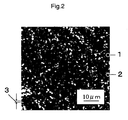
- Fig. 2 showing the dispersion state of the respective components of the composition of Example 3
- a regular both continuous phase structure is observed.
- a poly(lactic acid) polymer to be used in the invention is required to have a weight average molecular weight of 50,000 or higher, preferably 80,000 or higher, and 100,000 or higher, so as to satisfy practically usable mechanical properties.
- the weight average molecular weight here means the molecular weight calculated by conversion into poly (methyl methacrylate) (PMMA) measured by gel permeation chromatography.
- the poly(lactic acid) polymer of the invention is a polymer comprising L-lactic acid and/or D-lactic acid as main components and may contain copolymerizable components other than lactic acid.
- examples of other monomer units are glycol compounds such as ethylene glycol, propylene glycol, butanediol, heptandiol, hexanediol, octanediol, nonanediol, decanediol, 1,4-cyclohexanedimethanol, neopentyl glycol, glycerin, pentaerythritol, bisphenol A, polyethylene glycol, polypropylene glycol, and polytetramethylene glycol; dicarboxylic acids such as oxalic acid, adipic acid, sebacic acid, azelaic acid, dodecanedioic acid, malonic acid, glutaric acid, cyclohexanedicarboxy
- lactic acid components with high optical purity as poly(lactic acid) polymer. It is preferable to contain L-isomer or D-isomer in an amount of 80% or more in the total lactic acid components of the poly(lactic acid) polymer: it is more preferable to contain L-isomer or D-isomer in an amount of 90% or more: and it is even more preferable to contain L-isomer or D-isomer in an amount of 95% or more.
- the known polymerization methods can be employed and a direct polymerization method from lactic acid and a ring-opening polymerization via a lactide can be exemplified.
- the melting point of the poly (lactic acid) polymer is not particularly limited, however it is preferably 120°C or higher and more preferably 150°C or higher.
- the melting point of the poly (lactic acid) polymer is generally increased by heightening the optical purity of the lactic acid component and the poly(lactic acid) polymer with a melting point of 120°C or higher can be obtained by adjusting the content of L-isomer 90% or higher or D-isomer 90% or higher.
- the poly(lactic acid) polymer with a melting point of 150°C or higher can be obtained by adjusting the content of L-isomer 95% or higher or D-isomer 95% or higher.
- the cellulosic ester in the invention means celluloses whose hydroxyl groups are terminated by an esterification agent.
- the esterification agent are acid chlorides (e.g. acetyl chloride, propionyl chloride, and the like), acid anhydrides (e.g. acetic anhydride, propionic anhydride, butyric anhydride, and the like), carboxylic acid compounds (e. g. acetic acid, propionic acid, butyric acid, and the like), carboxylic acid compound derivatives (e.g. amide compounds, esterified compounds, and the like), and cyclic esters (e.g. ⁇ -caprolactone).
- acid chlorides e.g. acetyl chloride, propionyl chloride, and the like
- acid anhydrides e.g. acetic anhydride, propionic anhydride, butyric anhydride, and the like
- carboxylic acid compounds e. g. acetic acid
- cellulosic esters are cellulose acetate, cellulose diacetate, cellulose triacetate, cellulose acetate propionate, cellulose acetate butyrate, and cellulose acetate phthalate and in terms of compatibility or affinity, cellulose diacetate, cellulose triacetate, cellulose acetate propionate, cellulose acetate butyrate, and cellulose acetate phthalate are preferable among them and cellulose triacetate and cellulose acetate propionate are more preferable.
- the substitution degree of the hydroxyl groups in the celluloses is preferably 0.5 to 2.9 per a glucose unit. In order to provide better compatibility or affinity with the poly (lactic acid), the substitution degree is more preferably 1.8 to 2.9 and even preferably 2.0 to 2.8.
- the above-mentioned substitution degree can be calculated by subjecting the esterification agent produced by alkali hydrolysis to quantitative determination by high performance liquid chromatography.
- solvation agents for improving the compatibility of the poly(lactic acid) polymer and cellulosic esters.
- solvation agents are high molecular weight compounds containing organometal compounds and/or methacrylic polymer units by grafting or copolymerization.
- an organotitanium compound and an organoaluminum compound are preferable examples.
- Titanium alkoxides are practical preferable example of the organotitanium compound and the titanium alkoxides can be defined by the general formula Ti(OR) m .
- the reference character m denotes an integer and represents the number of the coordination of alkolates and is generally 1 to 4.
- the reference character R denotes a group selected from any desirable alkyl groups. R may represent methyl, ethyl, propyl, isopropyl, and butyl and their continuing dimers, trimers, and tetramers.
- titanium tetraisopropoxide, titanium tetrabutoxide, and titanium tetrabutoxide tetramer can be exemplified as preferable examples.
- Practical examples of the organoaluminum compounds are aluminum alkolates (trialkoxyaluminum), aluminum chelates.
- Examples of the aluminum alkolates are aluminum isopropylate, mono-sec-butoxyaluminum diisopropylate, and aluminum sec-butylate and examples of the aluminum chelates are ethylacetoacetate aluminum diisopropylate, acetoalkoxyaluminum diisopropylate, aluminum tris(ethylacetoacetate), aluminum tris(acetylacetate), aluminum monoacetylacetonate bis (ethylacetoacetate).
- ethylacetoacetate aluminum diisopropylate and acetoalkoxyaluminum diisopropylate are preferable and as acetoalkoxyaluminum diisopropylate, Plenact AL-M manufactured by Kawaken Fine Chemicals Co., Ltd. or Ajinomoto Fine Techno Co., Inc. can be exemplified as a preferable example.
- the high molecular weight compounds containing methacrylic polymer units by grafting or copolymerization may include those which contain at least one or more methacrylic polymer units as branched chains by graft-copolymerization and those which contain at least one or more methacrylic polymer units in the main chains by block-copolymerization.
- the high molecular weight compounds containing at least one or more methacrylic polymer units as branched chains by graft-copolymerization are preferable and in this case, polyolefins, polystyrenes, and acrylic resins can be exemplified as the polymers to be the main chains.
- the polyolefins may include homopolymers, random or block copolymers of ⁇ -olefins such as ethylene, propylene, but-1-ene, pent-1-ene, hex-1-ene, 3-methylbut-1-ene, 4-methylpent-1-ene, hept-1-ene, and oct-1-ene; and random, block or grafted copolymers of at least a half by weight of ⁇ -olefins and other unsaturated monomers.
- ⁇ -olefins such as ethylene, propylene, but-1-ene, pent-1-ene, hex-1-ene, 3-methylbut-1-ene, 4-methylpent-1-ene, hept-1-ene, and oct-1-ene
- Examples to be used as the above-mentioned other unsaturated monomers are unsaturated organic acids and their derivatives such as acrylic acid, methacrylic acid, maleic acid, itaconic acid, methyl acrylate, ethyl acrylate, methyl methacrylate, maleic anhydride, glycidylmethacrylic acid, arylmaleic acid imide, and alkylmaleic acid imide; vinyl esters such as vinyl acetate and vinyl butyrate; aromatic vinyl compounds such as styrene and methylstyrene; vinylsilanes such as vinyltrimethylmethoxylsilane and ⁇ -methacryloyloxypropyltrimethoxysilane; and non-conjugated dienes such as dicyclopentadiene and 4-ethylidene-2-norbornene.
- the copolymers may comprise a plurality of kinds of ⁇ -olefins and other monomers without a restriction
- the polystyrenes include homopolymers and random and block copolymers of styrene type monomers such as styrene, methylstyrene, glycidyl-substituted styrene; and random, block, and graft copolymerized polymers of at least a half by weight of the these compounds and other unsaturated monomers.
- styrene type monomers such as styrene, methylstyrene, glycidyl-substituted styrene
- random, block, and graft copolymerized polymers of at least a half by weight of the these compounds and other unsaturated monomers.
- Examples to be used as the unsaturated monomers here are unsaturated organic acids and their derivatives such as acrylic acid, methacrylic acid, maleic acid, itaconic acid, methyl acrylate, ethyl acrylate, methyl methacrylate, maleic anhydride, glycidylmethacrylic acid, arylmaleic acid imide, and alkylmaleic acid imide; vinyl esters such as vinyl acetate and vinyl butyrate; vinylsilanes such as vinyltrimethylmethoxylsilane and ⁇ -methacryloyloxypropyltrimethoxysilane; and non-conjugated dienes such as dicyclopentadiene and 4-ethylidene-2-norbornene.
- the copolymers may comprise a plurality of kinds of styrene type monomers and other monomers without a restriction of only two kinds.
- the acrylic resins include homopolymers and random and block copolymers of acrylic resin monomers such as acrylic acid, methacrylic acid, methyl acrylate, ethyl acrylate, methyl methacrylate, and glycidyl methacrylic acid; and random, block, and graft copolymerized polymers of at least a half by weight of the these compounds and other unsaturated monomers.
- acrylic resin monomers such as acrylic acid, methacrylic acid, methyl acrylate, ethyl acrylate, methyl methacrylate, and glycidyl methacrylic acid
- random, block, and graft copolymerized polymers of at least a half by weight of the these compounds and other unsaturated monomers.
- Examples to be used as the unsaturated monomers here are unsaturated organic acids and their derivatives such as maleic acid, itaconic acid, maleic anhydride, arylmaleic acid imide, alkylmaleic acid imide, styrene, methylstyrene; glycidyl-substituted styrene; vinylsilanes such as vinyl acetate; and non-conjugated dienes such as dicyclopentadiene and 4-ethylidene-2-norbornene.
- the copolymers may comprise a plurality of kinds of monomers of acrylic type polymers and other monomers without a restriction of only two kinds.
- the methacrylic resins to be introduced by grafting or copolymerization are those obtained by polymerizing methyl methacrylate alone or mixtures of methyl methacrylate and other copolymerizable vinyl or vinylidene type monomers and preferably contain 80% by weight or more methyl methacrylate.
- Examples of the above-mentioned other copolymerizable vinyl or vinylidene type monomers are acrylic acid esters with alkyl having 1 to 8 carbons such as methyl acrylate, ethyl acrylate, butyl acrylate, and 2-ethylhexyl acrylate; styrene, and acrylonitrile. Not only one kind methacrylic resin but also two or more methacrylic resins may be introduced.
- the poly(lactic acid) polymer composition of the invention can be produced by producing a composition by evenly mixing solutions obtained by dissolving the respective components in solvents and then removing the solvents, however a melt kneading method, which is a practical production method, requiring no dissolution of raw materials in solvents and removal of the solvents is preferable to be employed.
- the melt kneading method is a production method involving melting and kneading the respective components.
- the melt kneading method is not particularly limited and conventionally known mixing apparatuses which are used commonly, such as a kneader, a roll mill, a Bumbury's mixer, and an uniaxial or biaxial extruder may be used.
- the uniaxial or biaxial extruder is preferable to be used among them.
- the mixing order is not particularly limited and for example, a method involving dry blending the poly(lactic acid) and the cellulosic ester and then supplying the blended mixture to the melt kneader; and a method of previously producing a master batch by melting and kneading the poly(lactic acid) and the cellulosic ester and then melt-kneading the poly(lactic acid) with the master batch can be exemplified.
- melt-kneading other additives simultaneously and a method of previously producing a master batch by melting and kneading the poly(lactic acid) and the cellulosic ester and then melt-kneading the poly(lactic acid) and the cellulosic ester with the master batch may be employed.
- the temperature at the time of melt-kneading is preferably in a range from 190°C to 240°C and to prevent deterioration of the poly (lactic acid), it is more preferably in a range from 200°C to 220°C.
- the poly (lactic acid) polymer composition produced through the melt-kneading in the invention is excellent in compatibility or affinity, the composition is excellent in the transparency and in the case the poly(lactic acid) polymer composition is formed into a 0.2 mm-thick sheet, it is made possible to obtain a sheet with a luminous transmittance 40% or higher for visible light rays generally with wavelength 400 nm. Further, in a preferable embodiment, it is made possible to obtain a sheet having a luminous transmittance 50% or higher for visible light rays generally with wavelength 400 nm. In a more preferable embodiment, it is made possible to obtain a sheet having a luminous transmittance 60% or higher for visible light rays generally with wavelength 400 nm.
- the poly(lactic acid) polymer composition of the invention is excellent in compatibility or affinity and possibly has a solvation structure of the poly(lactic acid) polymer composition and the cellulosic ester and/or a phase structure with 0. 01 ⁇ m or smaller depending on the type and the addition amount of the cellulosic ester added and in this case, the composition is particularly excellent in transparency and is therefore preferably suitable for various transparent uses.
- solvation means that both components are evenly mixed in molecular level. Concretely, it means that neither one of the phases of different main components of a two-component polymer forms phase structure of 0.001 ⁇ m or larger.
- Non-solvation means the case of no solvation state, in other word, it means that the phases of different main components of a two-component polymer form phase structure of 0.001 ⁇ m or larger. Whether solvation is caused or not can be judged by an electron microscope, a differential scanning calorimetry(DSC), and other various methods as described in " Polymer Alloy and Polymer Blend" (L. A. Utracki, translated by Toshio Nishi, Tokyo Kagaku Dojin, p. 111, 1991 ) .
- As the most general method for solvation determination is a method for the judgment by the glass transition temperature. In the case solvation is caused, the glass transition temperature changes more than that of each component alone and in many cases, a single glass transition temperature appears.
- a measurement method of the glass transition temperature both of a method of measurement by DSC and a method of measurement by a dynamic viscoelasticity test may be employed.
- the poly(lactic acid) polymer composition of the invention depending on the types and the mixing amount of the cellulosic ester, the poly(lactic acid) polymer composition and the cellulosic ester possibly have either a continuous phase structure with structure of 0.01 to 3 ⁇ m or a dispersion structure of 0.01 to 3 ⁇ m inter-particle distance and in these cases are also preferable since the mechanical property and the thermostability are both satisfied. It is supposed that these both continuous phase structure and dispersion structure are formed by phase separation by Spinodal decomposition after solvation once occurs at the time of melt-kneading, however it is not limited to that.
- the both continuous phase structure can be confirmed by optical microscopic observation and transmittance electron microscopic observation and it can be confirmed based on the appearance of scattering maximum peak in the scattering measurement carried out by a light scattering apparatus or a small angle x-ray scattering apparatus.
- the light scattering apparatus and the small angle x-ray scattering apparatus may be used properly based on the structural period.
- the polymer composition has a regular phase separation structure with a certain period and the period ⁇ m corresponds to the structural period in the case of the both continuous phase structure and to the inter-particle distance in the case of the dispersion structure.
- the poly(lactic acid) polymer composition and the composition mixing amount in the poly(lactic acid) biaxially drawn film are not particularly limited, however it is effective to improve the characteristics of the poly(lactic acid) and particularly effective to improve the transparency and mechanical properties and thermostability of the poly(lactic acid) in the case the poly(lactic acid) polymer is contained in an amount of 99 part by weight or less and exceeding 50 part by weight and the (B) component in an amount of 1 part by weight or more and less than 50 part by weight when the total of the poly(lactic acid) and the (B) component is set to be 100 part by weight.
- the poly (lactic acid) polymer is in an amount of 90 part by weight or less and exceeding 60 part by weight and the (B) component in an amount of 10 part by weight or more and less than 40 part by weight and it is even more preferable that the poly(lactic acid) polymer is in an amount of 85 part by weight or less and exceeding 65 part by weight and the (B) component in an amount of 15 part by weight or more and less than 35 part by weight.
- the amounts can be measured by carrying out 1H-NMR measurement in a chloroform deuteride solvent at 55°C and carrying out calculation from the intensity ratio of the peak derived from the poly(lactic acid) (e.g. the peak derived from methine group) and the peak derived from poly(methyl methacrylate) (e.g. the derived from the methoxy group).
- the 1H-nuclei peaks are overlaid to make the calculation impossible, further 13C-NMR measurement is carried out to specify the amounts.
- the poly(lactic acid) polymer composition of the invention may contain organic fillers derived from natural substances.
- the organic fillers derived from natural substances are not particularly limited and may be natural substances and preferably those which contain cellulose.
- organic fillers derived from natural substances are chip-like materials such as rice husk, wood chips, tofu refuse, crushed wastepaper materials and torn clothes; fibrous materials including plants fibers such as cotton fibers, hemp fibers, bamboo fibers, wood fibers, kenaf fibers, jute fibers, banana fibers, coconut fibers; pulp and cellulose fibers obtained by processing the plant fibers and animal fibers such as silk, wool, angora, cashmere, and camel; and powder-like materials such as paper powder, wood powder, bamboo powder, cellulose powder, rice husk powder, fruit shell powder, chitin powder, chitosan powder, proteins, and starch powder and in terms of moldability, powder-like materials such as paper powder, wood powder, bamboo powder, cellulose powder, rice husk powder, fruit shell powder, chitin powder, chitosan powder, proteins, and starch powder and hemp fibers, kenaf fibers, and jute fibers are preferable; paper powder, wood powder, wood powder
- the wastepaper means newspaper, magazines, and other regenerated pulp or board paper such as corrugated cardboards, cardboards, and paper tubes and those which are obtained by processing plant fibers as raw materials and any of the exemplified materials may be used, however in terms of moldability, crushes products of newspaper and board paper such as corrugated cardboards, cardboards, and paper tubes are preferable.
- wood materials to be used for wood paper are needle-leaf trees such as pine tree, Japanese cedar, Japanese cypress, and fir tree and broadleaf trees such as Japanese beech, chinquapin, and eucalyptus and are not limited to the types.
- the paper powder are not particularly limited and in terms of the moldability, it is preferable to contain an adhesive.
- the adhesive is not particularly limited if it is used commonly at the time of processing paper and examples are emulsion type adhesives such as vinyl acetate resin type emulsions and acrylic resin type emulsions; poly(vinyl alcohol) type adhesives, cellulose type adhesives, natural rubber type adhesives, starch glue; and hot melt adhesives such as ethylene-vinyl acetate copolymer resin type adhesives and polyamide type adhesives.
- emulsion type adhesives, poly(vinyl alcohol) type adhesives, and hot melt adhesives are preferable and emulsion type adhesives and poly(vinyl alcohol) type adhesives are more preferable.
- These adhesives are also usable as binders for paper processing agents.
- the adhesives are preferable to contain inorganic fillers such as clay, bentonite, talc, kaolin, montmorillonite, mica, synthetic mica, zeolite, silica, graphite, carbon black, magnesium oxide, calcium oxide, titanium oxide, calcium sulfide, magnesium carbonate, calcium carbonate, barium carbonate, barium sulfate, aluminum oxide, and neodymium oxide and they are more preferable to contain clay, bentonite, talc, kaolin, montmorillonite, synthetic mica, and silica.
- inorganic fillers such as clay, bentonite, talc, kaolin, montmorillonite, mica, synthetic mica, zeolite, silica, graphite, carbon black, magnesium oxide, calcium oxide, titanium oxide, calcium sulfide, magnesium carbonate, calcium carbonate, barium carbonate, barium sulfate, aluminum oxide, and neodymium oxide and they are more preferable to contain clay, bentonit
- paper powder is preferable to have ash component 5% by weight or higher, more preferably 5.5% by weight or higher, and even more preferably 8% by weight or higher.
- the upper limit is not particularly limited, it is preferably 60% by weight and more preferably 30% by weight.
- the ash component means the ratio of the weight of ashes remaining after firing an organic filler 10 g at a high temperature, e.g. 450°C or higher, for 8 hours to the weight of the paper powder before firing.
- those which contain an inorganic compound 5 to 20% by weight in paper powder are preferable and those which contain aluminum, silicon, and calcium as an inorganic element are more preferable and those which contain aluminum, silicon, calcium, and sulfur as an inorganic element are more preferable and those which contain aluminum, silicon, calcium, sulfur and magnesium as an inorganic element are furthermore preferable and those which contain aluminum in a content as high as two times to that of magnesium are even more preferable.
- the weight ratios of aluminum, silicon, calcium, sulfur and magnesium are not particularly limited, however it is preferable that aluminum 1 to 60% by mole, silicon 20 to 90% by mole, calcium 1 to 30% by mole, sulfur 1 to 20% by mole, and magnesium 0 to 20% by mole in the case the total of the elements is set to be 100; it is more preferable that aluminum 10 to 55% by mole, silicon 20 to 85% by mole, calcium 1 to 25% by mole, sulfur 1 to 15% by mole, and magnesium 0 to 10% by mole; and it is even more preferable that aluminum 20 to 50% by mole, silicon 25 to 80% by mole, calcium 3 to 20% by mole, sulfur 2 to 10% by mole, and magnesium 0 to 8% by mole.
- Elementary analysis of them may be carried out for single substance of the natural material-derived organic filler and ashes of the natural material-derived organic filler and in this invention ashes are employed.
- the elementary analysis can be carried out by using apparatuses for fluorescent x-ray analysis, atomic absorptiometry, and scanning electron microscope (SEM) or transmission electron microscope (TEM) in combination with energy dispersion type x-ray microanalyzer (XMA) and in this example, fluorescent x-ray analysis is employed.
- the paper powder in terms of moldability, it is preferable to contain cellulose bearing fine particles on the surface.
- the fine particles are not particularly limited and may be inorganic filler contained in the above-mentioned adhesives or organic matters or other inorganic matters, however the particles are preferable to contain silicon and aluminum.
- the shape of the fine particles may be a needle-like, plate-like or spherical shape.
- the size of the fine particles is not particularly limited, however it is preferable to be distributed in a range of 0.1 to 5000 nm, more preferably 0.3 to 1000 nm, furthermore preferably 0.5 to 500 nm, even more preferably 1 to 100 nm, and most preferably 1 to 80 nm.
- That to be distributed in specified range means that 80% or more of the total number of the fine particles are within the specified range.
- the adhesion state of the fine particles may be in state of agglomeration or dispersion, however they are more preferable to be deposited in the dispersion state.
- the size of the fine particles can be observed by observing a molded article obtained from a resin composition containing a natural resin and a natural organic filler with a transmission electron microscope at 80,000 magnification and the total number of fine particles to be observed is set to be randomly 100 pieces.
- fillers e.g. glass fiber, carbon fiber, other organic fibers, ceramic fiber, ceramic bead, asbestos, wollastonite, talc, clay, mica, sericite, zeolite, bentonite, dolomite, kaolin, finely powdered silicic acid, feldspar powder, potassium titanate, shirasu balloon, calcium carbonate, magnesium carbonate, barium sulfate, calcium oxide, aluminum oxide, titanium oxide, aluminum silicate, silicon oxide, gypsum, novaculite, dawsonite, and white clay) ; stabilizers (e.g. an antioxidant and an ultraviolet ray absorbent), lubricants, release agents, fire-retarding agents, coloring agents including dyes and pigments, and nucleating agents can be added without departing from the spirits and scopes of the invention.
- stabilizers e.g. an antioxidant and an ultraviolet ray absorbent
- lubricants e.g. an antioxidant and an ultraviolet ray absorbent
- thermoplastic resins e.g. polyacetal, ployethylenes, polypropylenes, polyamides, polyphenylene sulfide resins, polyether ether ketone resins, polyesters, polysulfones, polyphenylene oxides, polyimides, and polyether imides
- thermosetting resins e.g. phenyl resins, melamine resins, polyester resins, silicone resins, and epoxy resins
- soft thermoplastic resins e.g. polyester elastomers, polyamide elastomers, ethylene/propylene terpolymers, ethylene/but-1-ene copolymers
- the resin composition of the invention is excellent in compatibility or affinity and can be melt-kneaded, it can be used by being processed into various molded articles by injection molding or extrusion molding.
- the molded articles are injection-molded articles, extrusion-molded articles, blow-molded articles, films, fibers and sheets.
- films various films such as un-drawn, uniaxially drawn, and biaxially drawn films and inflation films can be used and as fibers, various kinds of fibers such as unstretched yarns, stretched yarns, and ultra stretched yarns can be used.
- These articles may be used in a wide range of uses such as electric and electronic parts, construction member, automotive parts, and daily goods.
- a biaxially drawn film containing poly (lactic acid) polymer and at least one compounds selected from cellulosic esters, poly(meth)acrylates, and polyvinyl compounds having a glass transition temperature of 60°C or higher has excellent thermostability and capability of retaining the rigidity at the glass transition temperature of the poly(lactic acid) and thus disclose it herein.
- the cellulosic ester to be used use for the biaxially drawn film of the invention means celluloses whose hydroxyl groups are terminated by an esterification agent.
- the termination means forming ester bonds by chemical bonding of the hydroxyl groups and an esterification agent.
- an esterification agent having 1 to 10 carbon atoms.
- Practical examples of the esterification agent are acid chlorides (e.g. acetyl chloride, propionyl chloride, and the like), acid anhydrides (e.g. acetic anhydride, propionic anhydride, butyric anhydride, and the like), carboxylic acid compounds (e.g. acetic acid, propionic acid, butyric acid, and the like), carboxylic acid compound derivatives (e.g. amide compounds, esterified compounds, and the like), and cyclic esters (e.g. ⁇ -caprolactone).
- acid chlorides e.g. acetyl chloride, propionyl chloride
- cellulosic ester to be used in the invention are cellulose acetate, cellulose diacetate, cellulose triacetate, cellulose acetate propionate, cellulose acetate butyrate, and cellulose acetate phthalate and in terms of compatibility or affinity, cellulose diacetate, cellulose triacetate, cellulose acetate propionate, cellulose acetate butyrate, and cellulose acetate phthalate are preferable among them and cellulose triacetate and cellulose acetate propionate are more preferable.
- the substitution degree of the hydroxyl groups in the celluloses is preferably 0.5 to 2.9 per a glucose unit. In order to provide better compatibility or affinity with the poly (lactic acid), the substitution degree is more preferably 1.8 to 2.9 and even preferably 2.0 to 2.8.
- the above-mentioned substitution degree can be calculated by subjecting the esterification agent produced by alkali hydrolysis to quantitative determination by high performance liquid chromatography.
- the poly (meth) acrylate in the invention means those which comprise at least one monomer selected from acrylates and methacrylates and may include copolymers of two or more kinds of monomers.
- the acrylates and methacrylates to compose the poly(meth)acrylate are, for example, acrylates such as methyl acrylate, ethyl acrylate, n-propyl acrylate, n-butyl acrylate, cyanoethyl acrylate, and cyanobutyl acrylate, and methacrylates such as methyl methacrylate, ethyl methacrylate, cyclohexyl methacrylate, and 2-hydroxyethyl methacrylate and poly(methyl methacrylate) is preferable to be used for providing higher high temperature rigidity.
- the poly(meth)acrylate to be used in the invention is preferable to have a weight average molecular weight of 20000 to 500000 and more preferable to have the weight average molecular weight of 100000 to 200000. If the weight average molecular weight is less than 20000, the strength of the molded article is sometimes deteriorated and if the weight average molecular weight exceeds 500000, the fluidity at the time of molding is sometimes decreased.
- a method of polymerizing or copolymerizing these monomers is not particularly - limited and a conventionally known polymerization method such as bulk polymerization, solution polymerization, and suspension polymerization can be employed.
- the polyvinyl compound in this invention include polymers of vinyl compounds and among them, it is required to use compounds having a glass transition temperature of 60°C or higher. If the glass transition temperature is lower than 60°C, the effect to improve the thermostability of the poly(lactic acid) is lowered even if the solvation with the poly(lactic acid) is caused and therefore, it is not preferable.
- polystyrene polymers such as polystyrene, poly(4-acetylstyrene), poly(2-methylstyrene), poly(3-methylstyrene), poly(4-methylstyrene), poly(4-methoxystyrene), poly(4-hydroxystyrene) (polyvinyl phenol), poly(2-hydroxymethylstyrene), poly(3-hydroxymethylstyrene), and poly(4-hydroxymethylstyrene); and poly(benzoyloxyethylene), poly(cyclohexanoyloxyethylene), poly(4-ethoxybenzoyloxyethylene), poly(2-methoxybenzoyloxyethylene), poly(4-methoxybenzoyloxyethylene), and poly(4-phenylbenzoyloxyethylene) and in terms of the affinity with the poly(lactic acid) polymer, poly(
- the poly(lactic acid) film of the invention is required to be a biaxially drawn film drawn in both directions, the longitudinal direction and the width direction, in terms of the thermostability.
- a film other than the biaxially drawn film is used at a glass transition temperature of the poly(lactic acid), thermal deformation or thermal crystallization takes place and it is not desirable in terms of the quality stability.
- one or more kinds of solvation agents is/are added for improving the affinity of the poly(lactic acid) polymer composition with the cellulosic ester and/or poly (meth) acrylate and/or the polyvinyl compound (hereinafter, referred to as an alloying component).
- the solvation agent are high molecular weight compounds containing organometal compounds and/or (meth)acrylic polymer units by grafting or copolymerization.
- an organotitanium compound and an organoaluminum compound are preferable examples.
- Titanium alkoxides are practical preferable example of the organotitanium compound and the titanium alkoxides can be defined by the general formula Ti(OR) m .
- the reference character m denotes an integer and represents the number of the coordination of alkolates and is generally 1 to 4.
- the reference character R denotes a group selected from any desirable alkyl groups. R may represent methyl, ethyl, propyl, isopropyl, and butyl and their continuing dimers, trimers, and tetramers.
- titanium tetraisopropoxide, titanium tetrabutoxide, and titanium tetrabutoxide tetramer can be exemplified as preferable examples.
- Practical examples of the organoaluminum compounds are aluminum alkolates (trialkoxyaluminum), aluminum chelates.
- Examples of the aluminum alkolates are aluminum isopropylate, mono-sec-butoxyaluminum diisopropylate, and aluminum sec-butylate and examples of the aluminum chelates are ethylacetoacetate aluminum diisopropylate, acetoalkoxyaluminum diisopropylate, aluminum tris(ethylacetoacetate), aluminum tris(acetylacetate), aluminum monoacetylaceonate bis(ethylacetoacetate).
- ethylacetoacetate aluminum diisopropylate and acetoalkoxyaluminum diisopropylate are preferable and as acetoalkoxyaluminum diisopropylate, Plenact AL-M manufactured by Kawaken Fine Chemicals Co., Ltd. or Ajinomoto Fine Techno Co., Inc. can be exemplified as a preferable example.
- the high molecular weight compounds containing methacrylic polymer units by grafting or copolymerization may include those which contain at least one or more methacrylic polymer units as branched chains by graft-copolymerization and those which contain at least one or more methacrylic polymer units in the main chains by block-copolymerization.
- the high molecular weight compounds containing at least one or more methacrylic polymer units as branched chains by graft-copolymerization are preferable and in this case, polyolefins, polystyrenes, and acrylic resins can be exemplified as the polymers to be the main chains.
- the polyolefins may include homopolymers, random or block copolymers of ⁇ -olefins such as ethylene, propylene, but-1-ene, pent-1-ene, hex-1-ene, 3-methylbut-1-ene, 4-methylpent-1-ene, hept-1-ene, and oct-1-ene; and random, block or grafted copolymers of at least a half by weight of ⁇ -olefins and other unsaturated monomers.
- ⁇ -olefins such as ethylene, propylene, but-1-ene, pent-1-ene, hex-1-ene, 3-methylbut-1-ene, 4-methylpent-1-ene, hept-1-ene, and oct-1-ene
- Examples to be used as the above-mentioned other unsaturated monomers are unsaturated organic acids and their derivatives such as acrylic acid, methacrylic acid, maleic acid, itaconic acid, methyl acrylate, ethyl acrylate, methyl methacrylate, maleic anhydride, glycidylmethacrylic acid, arylmaleic acid imide, and alkylmaleic acid imide; vinyl esters such as vinyl acetate and vinyl butyrate; aromatic vinyl compounds such as styrene and methylstyrene; vinylsilanes such as vinyltrimethylmethoxylsilane and ⁇ -methacryloyloxypropyltrimethoxysilane; and non-conjugated dienes such as dicyclopentadiene and 4-ethylidene-2-norbornene.
- the copolymers may comprise a plurality of kinds of ⁇ -olefins and other monomers without a restriction
- the polystyrenes include homopolymers and random and block copolymers of styrene type monomers such as styrene, methylstyrene, glycidyl-substituted styrene; and random, block, and graft copolymerized polymers of at least a half by weight of the these compounds and other unsaturated monomers.
- styrene type monomers such as styrene, methylstyrene, glycidyl-substituted styrene
- random, block, and graft copolymerized polymers of at least a half by weight of the these compounds and other unsaturated monomers.
- Examples to be used as the unsaturated monomers here are unsaturated organic acids and their derivatives such as acrylic acid, methacrylic acid, maleic acid, itaconic acid, methyl acrylate, ethyl acrylate, methyl methacrylate, maleic anhydride, glycidylmethacrylic acid, arylmaleic acid imide, and alkylmaleic acid imide; vinyl esters such as vinyl acetate and vinyl butyrate; vinylsilanes such as vinyltrimethylmethoxylsilane and ⁇ -methacryloyloxypropyltrimethoxysilane; and non-conjugated dienes such as dicyclopentadiene and 4-ethylidene-2-norbornene.
- the copolymers may comprise a plurality of kinds of styrene type monomers and other monomers without a restriction of only two kinds.
- the acrylic resins include homopolymers and random and block copolymers of acrylic resin monomers such as acrylic acid, methacrylic acid, methyl acrylate, ethyl acrylate, methyl methacrylate and glycidyl methacrylic acid; and random, block, and graft copolymerized polymers of at least a half by weight of the these compounds and other unsaturated monomers.
- acrylic resin monomers such as acrylic acid, methacrylic acid, methyl acrylate, ethyl acrylate, methyl methacrylate and glycidyl methacrylic acid
- random, block, and graft copolymerized polymers of at least a half by weight of the these compounds and other unsaturated monomers.
- Examples to be used as the unsaturated monomers here are unsaturated organic acids and their derivatives such as maleic acid, itaconic acid, maleic anhydride, arylmaleic acid imide, alkylmaleic acid imide, styrene, methylstyrene; glycidyl-substituted styrene; vinylsilanes such as vinylsilane; and non-conjugated dienes such as dicyclopentadiene and 4-ethylidene-2-norbornene.
- the copolymers may comprise a plurality of kinds of monomers of acrylic type polymers and other monomers without a restriction of only two kinds.
- the methacrylic resins to be introduced by grafting or copolymerization are those obtained by polymerizing methyl methacrylate alone or mixtures of methyl methacrylate and other copolymerizable vinyl or vinylidene type monomers and preferably contain 80% by weight or more methyl methacrylate.
- Examples of the above-mentioned other copolymerizable vinyl or vinylidene type monomers are acrylic acid esters with alkyl having 1 to 8 carbons such as methyl acrylate, ethyl acrylate, butyl acrylate, and 2-ethylhexyl acrylate; styrene, and acrylonitrile. Not only one kind methacrylic resin but also two or more methacrylic resins may be introduced.
- PE-g-PMMA polyethylene-g-poly(methyl methacrylate)
- g means graft, hereinafter the same
- polypropylene-g-poly(methyl methacrylate) PP-g-PMMA
- poly(ethylene/propylene)-g-poly(methyl methacrylate) EPM-g-PMMA
- poly(ethylene/ethyl acrylate)-g-poly(methyl methacrylate) EA-g-PMMA
- EVA-g-PMMA poly(ethylene/vinyl acetate)-g-poly(methyl methacrylate)
- EVA-g-PMMA poly(ethylene/ethyl acrylate/maleic anhydride) -g-poly (methyl methacrylate)
- E/EA/MAH-g-PMMA poly(ethylene/glycidyl methacrylate)-g-poly(methyl methacrylate)
- the poly(lactic acid) biaxially drawn film of the invention can be produced by evenly mixing solutions obtained by dissolving the respective components in solvents and removing the solvents, and then carrying out film formation, however a melt kneading method, which is a practical production method, requiring no dissolution of raw materials in solvents and removal of the solvents is preferable to be employed.
- the melt kneading method is a production method involving melting and kneading the respective components.
- the melt film formation method is not particularly limited and methods involving obtaining a resin composition using a conventionally known mixing apparatuses which are used commonly, such as a kneader, a roll mill, a Bumbury's mixer, and an uniaxial or biaxial extruder, and then leading the melted and mixed resin composition to a slit-like mouth cap, extruding the resin composition in a sheet-like form on a cooling casting drum, and obtaining a sheet by a T-die method or a touch roll casting method.
- a conventionally known mixing apparatuses which are used commonly, such as a kneader, a roll mill, a Bumbury's mixer, and an uniaxial or biaxial extruder
- a slit-like mouth cap extruding the resin composition in a sheet-like form on a cooling casting drum
- obtaining a sheet by a T-die method or a touch roll casting method it is preferable to form a sheet by using a uniaxial
- the mixing order of the polymer is not particularly limited and for example, a method involving dry blending the poly(lactic acid) and the alloying component and then supplying the blended mixture to the melt kneader; and a method of previously producing a master batch by melting and kneading the poly(lactic acid) and the alloying component and then melt-kneading the poly (lactic acid) with the master batch can be exemplified.
- melt-kneading other additives may be employed.
- the temperature at the time of melt-kneading is preferably in a range from 190°C to 240°C and to prevent deterioration of the poly (lactic acid), it is more preferably in a range from 200°C to 220°C.
- the degree of the crystallinity of the poly (lactic acid) biaxially drawn film of the invention is preferably 50% or higher and more preferably 60%.
- the upper limit of the degree of the crystallinity is not particularly limited, however it is preferably 90% or lower.
- the measurement of the degree of the crystallinity may be carried out by any conventionally known measurement method such as a density method, a DSC method, and an x-ray deflection method and in the case of analyzing with x-rays, the measurement is carried out by separating crystal regions and non-crystal regions different from each other in the scattering of x-rays, measuring the integrated intensity of the respective regions, and carrying out calculation from the measurement results.
- a method of achieving the degree of the crystallinity is not particularly limited, however as a method to be employed preferably, thermal treatment to be carried out after film formation can be exemplified.
- Such thermal treatment may be carried out at an optional temperature not higher than the melting point of the poly (lactic acid) polymer composition and preferably 80 to 150°C and even more preferably 100 to 150°C.
- the thermal treatment may be carried out while the film being loosened in the longitudinal direction and/or the width direction.
- the poly(lactic acid) biaxially drawn film of the invention is excellent in transparency and film haze is preferably 10% or lower, more preferably 7% or lower, and even more preferably 5% or lower.
- the film haze is a value calculated by conversion into a 10 ⁇ m-thick film to the basis of the haze value of a film sample whose thickness is previously measured. It is preferable that the value is 10% or lower even in the actually measured value before the conversion.
- the glass transition temperature of the poly (lactic acid) is about 60°C and if it exceeds 60°C, the modulus of elasticity tends to be decreased, however the biaxially drawn film of the invention has a modulus of elasticity increasing at the glass transition temperature or higher and the thermal deformation in the case of use at the glass transition temperature or higher is hard to occur and in such a manner that the thermostability and rigidity at a high temperature are remarkably improved.
- the poly (lactic acid) biaxially drawn film of the invention preferably has a modulus of elasticity of 300 MPa or higher, more preferably 500 MPa or higher, and even more preferably 700 MPa at 80°C.
- the poly(lactic acid) biaxially drawn film of the invention may contain various kinds of particles in accordance with purposes and uses.
- the particles to be added are not particularly limited without departing from the spirits and scopes of the invention and inorganic particles, organic particles, crosslinked high molecular weight particles, and inner particles to be produced in the polymerization system. Two or more types of these particles may be added in combination.
- the addition amount of the particles is preferably 0.01 to 10% by weight and even more preferably 0.02 to 1% by weight.
- the average particle diameter of particles to be added is preferably 0.001 to 10 ⁇ m and more preferably 0.01 to 2 ⁇ m. If the average particle diameter is within the preferable range, the film defects are hardly caused and deterioration of transparency and deterioration of moldability never occur.
- the poly(lactic acid) biaxially drawn film of the invention may contain a proper amount of additives such as flame retardants, heat stabilizers, antioxidants, ultraviolet absorbents, antistatic agents, plasticizers, tackifiers, fatty acid esters, organic lubricants such as waxes, defoaming agents such as polysiloxanes, and coloring agents such as pigments and dyes in accordance with necessity without departing from the spirits and scopes of the invention.
- additives such as flame retardants, heat stabilizers, antioxidants, ultraviolet absorbents, antistatic agents, plasticizers, tackifiers, fatty acid esters, organic lubricants such as waxes, defoaming agents such as polysiloxanes, and coloring agents such as pigments and dyes in accordance with necessity without departing from the spirits and scopes of the invention.
- the film may further contain at least one kind of resins, for example, thermoplastic resins such as polyacetals, polyethylenes, polypropylenes, acrylic resins, polyamides, polyphenylene sulfide resins, polyether ether ketone resins, polyesters, polysulfones, polyphenylene oxides, polyimides, and polyether imides; themosetting resins such as phenol resins, melamine resins, polyester resins, silicone resins, and epoxy resins; and soft thermoplastic resins such as ethylene/glycidyl methacrylate copolymers, polyester elastomers, polyamide elastomers, ethylene/propylene terpolymers, ethylene/but-1-ene copolymers.
- thermoplastic resins such as polyacetals, polyethylenes, polypropylenes, acrylic resins, polyamides, polyphenylene sulfide resins, polyether ether ketone resins, polyesters, polysulfones, poly
- the film structure may be a monolayer and a layered structure for providing a new function of easy slipping property, adhesive property, pressure-sensitive adhesive property, thermostability, and weathering resistance to the surface.
- a layer containing poly(lactic acid) polymer and the alloying component A/B two-layer structure, B/A/B, B/A/C, or A/B/C three-layer structures can be exemplified.
- multilayered structure of more than three layers may be possible and the ratio of the thickness of the respective layers of the layered structure can be set as desired.
- the poly (lactic acid) biaxially drawn film is preferable to have a thermal shrinkage ratio in a range of -10 to 10% in at least one direction at the molding temperature in terms of the adhesion property and processibility, particularly suppression of film wrinkles at the time of processing.
- the thermal shrinkage ratio is further preferably in a range of -5 to +5%. If the thermal shrinkage ratio is within the range, good processibility can be obtained without problems such as deterioration of the appearance owing to expansion of film surface, separation from a substrate, or distortion of printings.
- the poly(lactic acid) biaxially drawn film of the invention may be used while being molded.
- the molded article is considerably suppressed from thermal deformation under heating condition and can be used as a heat resistant container.
- the molding method is not particularly limited and conventionally known various molding methods such as straight molding, free drawing molding, plug and ring molding, skeleton molding, plug-assist molding and the like can be employed.
- the poly (lactic acid) polymer and the alloying component at a prescribed ratio in accordance with the properties by a weighing apparatus are supplied to a biaxially extruding apparatus.
- a bent type biaxially extruding apparatus is used preferably since the poly (lactic acid) polymer and the alloying component can be supplied in un-dried state.
- the supplied poly (lactic acid) polymer and alloying component are melted and mixed at an extrusion temperature of 190 to 220°C in accordance with the melt viscosity of the resin composition, the melted and mixed resin is led to a slit-like mouth cap and extruded like a sheet on a cooling casting die and an un-drawn film is molded.
- an electrostatic close deposition method or a touch roll casting method can be employed as quenching and particularly the electrostatic close deposition method can give an un-drawn film with an even thickness can be obtained.
- the un-drawn film is sent to a drawing apparatus and drawn by simultaneous or continuous biaxially drawing method.
- the order may be reverse.
- the drawing may be carried out in the longitudinal direction or the width direction two or more times.
- the drawing method is not particularly limited and methods of roll drawing and tenter drawing can be employed.
- the film shape at the time of drawing may be flat, tubular, and any other shapes.
- the drawing magnification of the film in the longitudinal direction and the width direction can be set optionally depending on the aimed thermostabiliy, processibility, and deposition suitability, however in terms of the improvement of the thickness unevenness, it is preferably 1.5 to 6.0 times and the drawing temperature may be set to be any optional temperature if it is within a range of the glass transition temperature or higher of the poly(lactic acid) polymer composition, however it is preferably 60 to 150°C.
- the thickness of the biaxially drawn film of the invention can be set optionally in accordance with the purposes of the use of the film and the thickness is generally in a range of 0.5 to 300 ⁇ m and in terms of the film formation stability, the thickness is preferably 1 to 200 ⁇ m and more preferably 5 to 180 ⁇ m.
- the poly(lactic acid) biaxially drawn film of the invention can be improved in the adhesion property and the printing property based on the necessity by carrying out surface treatment such as corona discharge treatment. Further, various coatings may be formed and the types of the coating compounds, coating methods, and thickness are not particularly limited without departing the spirits and scopes of the invention. If necessary, molding processing such as embossing process and printing may be carried out for use of the film.
- the poly (lactic acid) biaxially drawn film of the invention obtained in such a manner can be used in form of a single film or a composite film for various industrial materials and wrapping materials required to have transparency and thermostability.
- the molded article made of the poly(lactic acid) biaxially drawn film of the invention can also be used for various materials required to have transparency and thermostability. Practically, it can be used for various containers and wrapping materials in food industries, sanitary and daily life goods, agricultural and horticultural fields.
- the resin composition of the invention is a mixture of the poly(lactic acid) and the cellulosic ester, which are a biomass type materials, and is a resin composition excellent in transparency, mechanical properties, and thermostability.
- the biaxially drawn film of the invention which is excellent in transparency, mechanical properties, and thermostability is obtained by biaxially drawing a resin composition obtained by mixing poly(lactic acid) and at least one kind compound selected from cellulosic esters, poly(meth)acrylates, and polyvinyl compounds having a glass transition temperature of 60°C or higher.
- the measurement was carried out using PMMA as standards and chloroform solvent at a column temperature of 40°C by Warters 2690 manufactured Japan Warters Inc.
- the measurement was carried out by adding 2N NaOH 40 ml to a sample 0.3 g, carrying out alkali-hydrolyzation at 70°C ⁇ 2 hours, neutralizing the solution by adding 1N HCl 80 ml, quantitatively determining esterification agent amount by high performance chromatography, and calculating the substitution degree per glucose unit.
- the glass transition temperature of the resin composition was calculated by measurement for a sample 5 mg at 20°C/min temperature increasing speed after keeping the sample at -30°C for 5 minutes in nitrogen atmosphere using a differential scanning calorimeter RDC 220 model manufactured by Seiko Instruments Inc.
- the dispersion state of a resin composition was observed in the manner that 100 ⁇ m-thick specimen was cut out of a sample and melted again on a hot stage set at 210°C and the state of the specimen after 10 minutes was observed by a phase-contrast microscope (Opti Shot manufactured by Nikon Co., Ltd.; magnification ⁇ 10 (Ph1), relay ⁇ 10).
- ⁇ m ( ⁇ /2) /sin ( ⁇ m/2)
- the transmittance of visible light with 400 nm wavelength was measured using a sheet made of a sample by spectrophotometer MPC 3100 manufactured by Shimadzu Corp.
- a specimen with a size of length ⁇ width ⁇ thickness 40 mm ⁇ 8 mm ⁇ 0. 2 mm was cut out of a sheet produce from a sample and thermally treated in a hot air oven adjusted at 140°C for 1 hour and subjected to the dynamic viscoelasticity measurement with sinusoidal wave at 1 Hz by increasing the temperature from 0°C at 2°C/min temperature increasing speed by EXSTAR 6000 viscoelasticity measurement apparatus manufactured by Seiko Instruments Inc. and the temperature at which the storage modulus was decreased to 1 GPa was defined to be the thermostability temperature.
- a specimen with a size of length ⁇ width ⁇ thickness 50 mm ⁇ 10 mm ⁇ 0.2 mm was cut out of a sheet produce from a sample and the tensile strength and the tensile elongation were measured at chuck distance 20 mm and pulling speed 10 mm/min under conditions of 23°C and 50% RH environments by Tensilon UTA-4 manufactured by Orientec Co., Ltd.
- the x-ray deflection of a film was measured by cutting out a specimen of a size of 2 cm ⁇ 2 cm from a 50 ⁇ m-thick film in standard measurement mode using a wide angle x-ray diffractometer (RINT 2000/PC) manufactured by Rigaku Denki Co. , Ltd.
- the degree of crystallinity was calculated from the obtained data by multiple peak separation method (SHADOW program).
- the haze value of a film sample whose thickness was previously measured was measured by a haze meter HGM-2DP type (manufactured by Suga Test Instruments Co., Ltd.). The measurement was carried out 5 times for one level and the film haze value [%] was calculated assuming the film had 10 ⁇ m thickness from the average of the 5 time measurement results.
- a film specimen with a size of width 10 mm ⁇ length 150 mm was cut out and the specimen was subjected to the tensile test under conditions of 80°C, an initial length of 50 mm, and a tensile speed of 300 mm/min by a tensile tester manufactured by Orientec Co., Ltd. according to JIS Z 1702 to measure the modulus of elasticity (MPa), the rupture stress (MPa), and the rupture elongation (%).
- MPa modulus of elasticity
- MPa rupture stress
- elongation %.
- the resins used were as follows.
- compositions shown in Table 1 were supplied to a biaxial extruder (PCM-30, manufactured by Ikegai Kogyo Co., Ltd.) set at an extrusion temperature of 210°C and guts discharged out of dies were immediately quenched in ice water to fix the structures and then pelletized. The obtained pellets were all transparent.
- PCM-30 manufactured by Ikegai Kogyo Co., Ltd.
- the pellets obtained in the above-mentioned manner were melted by a uniaxial extruder set at an extrusion temperature of 210°C and then extruded into sheet-like form from a slit-like die and closely attached to a casting drum by electrostatic application method to obtain 200 ⁇ m-thick sheets.
- the transmittance of visible light with 400 nm wavelength of the sheets were measured (Table 1).
- Fig. 3 shows a photograph of a sheet. According to the photograph, letters in the background can be seen through the sheet and therefore, the sheet investigated for the invention was found excellent in the transparency.
- thermostability temperature a dynamic viscoelasticity test of the sheets were carried out to calculate the thermostability temperature. The results are shown in Table 1. The results of the tensile strength and tensile elongation measurement of the sheets are also shown in Table 1.
- the sheets were drawn at a preheating temperature of 90°C in the longitudinal direction at magnifications shown in Table 2 and drawn at a preheating temperature of 78°C in the transverse direction at magnifications shown in Table 2 to adjust the thickness to be 80 ⁇ m and then the sheets were thermally treated at 140°C for 10 seconds to obtain biaxially drawn films.
- the film characteristics of the obtained films were shown in Table 2.
- Each biaxially drawn film was cut into 50 mm ⁇ 10 mm (length ⁇ width) and drawn to be 2 times as long in longitudinal direction at 80°C preheating to obtain a molded article. After that, without applying force such as the tensile force or load from the outside, the film was put in a hot air oven set at a temperature of 80°C for 2 minutes to observe the thermal deformation (thermal shrinkage) before and after loading.
- the results are shown in Table 2.
- the occurrence of thermal deformation of each molded article was determined by the following standards:
- each biaxially drawn film was vacuum-molded (straight molded) and then, without applying force such as tensile force or load from the outside, the film was put in a hot air oven set at a temperature of 80°C for 2 minutes in the state that only self-weight was applied to observe the thermal deformation before and after loading owing to the self-weight.
- the results are shown in Table 2.
- the occurrence of thermal deformation of each molded article was determined by the following standards:
- compositions shown in Table 3 were supplied to a biaxial screw extruder (PCM-30, manufactured by Ikegai Kogyo Co., Ltd.) set at an extrusion temperature of 225°C and guts discharged out of dies were immediately quenched in ice water to fix the structures and then pelletized.
- the obtained pallets were all transparent.
- the pellets obtained in the above-mentioned manner were melted by a uniaxial extruder set at an extrusion temperature of 210°C and then extruded into sheet-like form from a slit-like die and closely attached to a casting drum by electrostatic application method to obtain 200 ⁇ m-thick sheets.
- the transmittance of visible light with 400 nm wavelength of the sheets were measures (Table 3).
- thermostability temperature a dynamic viscoelasticity test of the sheets were carried out to calculate the thermostability temperature. The results are shown in Table 3.
- the sheets were drawn at a preheating temperature of 90°C in the longitudinal direction at magnifications shown in Table 4 and drawn at a preheating temperature of 78°C in the transverse direction at magnifications shown in Table 4 to adjust the thickness to be 80 ⁇ m and then the sheets were thermally treated at 140°C for 10 seconds to obtain biaxially drawn films.
- the film characteristics of the obtained films were shown in Table 4.
- compositions shown in Table 6 were supplied to a biaxial screw extruder (PCM-30, manufactured by Ikegai Kogyo Co. , Ltd.) set at an extrusion temperature of 225°C and guts discharged out of dies were immediately quenched in ice water to fix the structures and then pelletized. The obtained pellets were all transparent.
- PCM-30 manufactured by Ikegai Kogyo Co. , Ltd.
- the pellets obtained in the above-mentioned manner were melted by a uniaxial extruder set at an extrusion temperature of 210°C and then extruded into sheet-like form from a slit-like die and closely attached to a casting drum by electrostatic application method and then the obtained sheets were drawn at a preheating temperature of 90°C in the longitudinal direction at magnifications shown in Table 6 and drawn at a preheating temperature of 85°C in the transverse direction at magnifications shown in Table 6 to adjust the thickness to be 80 ⁇ m and then the sheets were thermally treated at 140°C for 10 seconds to obtain biaxially drawn films.
- the film characteristics of the obtained films were shown in Table 6.
- Table 7 shows Comparative Examples 1 to 3.
- Table 8 shows Comparative Examples 4 to 7.
- the invention provides a film usable for various kinds of wrapping materials, various kinds of industrial materials, and films for various industrial materials, and its application range should not be limited to these exemplified fields.
- Table 1 (resin characteristics 1) Reference Example 1 Reference Example 2 Reference Example 3 Reference Example 4 Reference Example 5 Reference Example 6 Reference Example 7 Composition Poly(lactic acid) resin PLA-1 PLA-1 PLA-1 PLA-1 PLA-1 PLA-2 (wt.%) 95 90 80 80 80 40 80 Cellulosic ester CAP-1 CAP-1 CTA-1 CDA-1 CAP-1 CAP-1 (wt.%) 5 10 20 20 20 60 20 Resin characteristics Glass transition temperature (°C) 73 68 67 70 67 78 62 Phase-contrast microscopic observation No structure Both phase-continuing structure Both phase-continuing structure No structure Both phase-continuing structure Both phase-continuing structure Both phase-continuing structure Both phase-continuing structure Light scattering measurement ( ⁇ m) ( ⁇ m) - 0.7 1.1 - 2.1 3.2 0.9 Luminous transmittance (400 nm
Landscapes
- Chemical & Material Sciences (AREA)
- Organic Chemistry (AREA)
- Health & Medical Sciences (AREA)
- Chemical Kinetics & Catalysis (AREA)
- Medicinal Chemistry (AREA)
- Polymers & Plastics (AREA)
- Manufacturing & Machinery (AREA)
- Engineering & Computer Science (AREA)
- Materials Engineering (AREA)
- Compositions Of Macromolecular Compounds (AREA)
- Manufacture Of Macromolecular Shaped Articles (AREA)
- Biological Depolymerization Polymers (AREA)
- Shaping By String And By Release Of Stress In Plastics And The Like (AREA)
Claims (18)
- Polymilchsäure-Polymerzusammensetzung, die (A) ein Polymilchsäure-Polymer mit einem gewichtsgemittelten Molekulargewicht von 50000 oder größer und (B) einen Cellulose-Ester, sowie eine oder mehrere Art(en) von (C) Solvatisierungsmittel(n) zur Verbesserung der Kompatibilität des Polymilchsäure-Polymers und des Cellulose-Esters enthält, wobei das(die) Solvatisierungsmittel des Bestandteils (C) ausgewählt ist(sind) aus metallorganischen Verbindungen und/oder Verbindungen hohen Molekulargewichts, die (Meth)Acrylpolymereinheiten durch Pfropfung oder Copolymerisation enthalten.
- Polymilchsäure-Polymerzusammensetzung gemäß Anspruch 1, die einen Lichttransmissionsgrad gegenüber sichtbarem Licht bei 400 nm von 40 % oder größer aufweist, wenn die Polymilchsäure-Polymerzusammensetzung zu einer Lage von 0,2 mm Dicke geformt ist.
- Polymilchsäure-Polymerzusammensetzung gemäß Anspruch 1, wobei das (A) Polymilchsäure-Polymer und der (B) Cellulose-Ester eine Solvatisierungsstruktur aufweisen, in der beide Bestandteile (A) und (B) gleichmäßig vermischt sind, sodass in der Polymilchsäure-Polymerzusammensetzung keine der Phasen von unterschiedlichen Hauptbestandteilen eines Zweikomponentenpolymers eine Phasenstruktur von 0,001 µm oder größer ausbildet, und/oder eine Phasenstruktur von 0,01 µm oder kleiner aufweist.
- Polymilchsäure-Polymerzusammensetzung gemäß Anspruch 1, wobei die Polymilchsäure-Polymerzusammensetzung entweder eine kontinuierliche Phasenstruktur mit einer Strukturperiode von 0,01 bis 3 µm oder eine Dispersionsstruktur mit 0,01 bis 3 µm Partikelabstand aufweist.
- Polymilchsäure-Polymerzusammensetzung gemäß Anspruch 1, wobei der Bestandteil (B) mindestens ein Cellulose-Ester ist, der aus der Gruppe bestehend aus Celluloseacetat, Cellulosediacetat, Cellulosetriacetat, Celluloseacetatpropionat, Celluloseacetatbutyrat und Celluloseacetatphthalat ausgewählt ist.
- Verfahren zur Herstellung der Polymilchsäure-Polymerzusammensetzung gemäß Anspruch 1, die Schmelz-Kneten (A) eines Polymilchsäure-Polymers mit einem gewichtsgemittelten Molekulargewicht von 50000 oder größer, (B) eines Cellulose-Esters, und einer oder mehrerer Art(en) von (C) Solvatisierungsmittel(n) umfasst.
- Biaxial gezogener Polymilchsäure-Film, der (A) ein Polymilchsäure-Polymer mit einem gewichtsgemittelten Molekulargewicht von 50000 oder größer und (B) mindestens eine Verbindung, ausgewählt aus Cellulose-Estern, Poly(meth)acrylaten und eine Glasübergangstemperatur von 60 °C oder höher aufweisende Polyvinylverbindungen, sowie eine oder mehrere Art(en) von (C) Solvatisierungsmittel(n) zur Verbesserung der Kompatibilität des Polymilchsäure-Polymers und des Bestandteils (B) enthält, wobei das(die) Solvatisierungsmittel des Bestandteils (C) ausgewählt ist(sind) aus metallorganischen Verbindungen und/oder Verbindungen hohen Molekulargewichts, die (Meth)Acrylpolymereinheiten durch Pfropfung oder Copolymerisation enthalten.
- Biaxial gezogener Polymilchsäure-Film gemäß Anspruch 7, wobei der Bestandteil (B) ein Cellulose-Ester ist und wobei der Bestandteil (A) und der Bestandteil (B) eine Solvatisierungsstruktur aufweisen, in der beide Bestandteile (A) und (B) gleichmäßig vermischt sind, sodass in der Polymilchsäure-Polymerzusammensetzung keine der Phasen von unterschiedlichen Hauptbestandteilen eines Zweikomponentenpolymers eine Phasenstruktur von 0,001 µm oder größer ausbildet, und/oder eine Phasenstruktur von 0,01 µm oder kleiner aufweist.
- Biaxial gezogener Polymilchsäure-Film gemäß Anspruch 7, der aus einer Polymilchsäure-Polymerzusammensetzung gefertigt ist, die eine kontinuierliche Phasenstruktur mit einer Strukturperiode von 0,01 bis 3 µm oder eine Dispersionsstruktur mit 0,01 bis 3 µm Partikelabstand aufweist.
- Biaxial gezogener Polymilchsäure-Film gemäß Anspruch 7, der einen Kristallisationsgrad von 50 % oder größer aufweist.
- Biaxial gezogener Polymilchsäure-Film gemäß Anspruch 7, der einen Filmtrübungswert von 10 % oder weniger bezogen auf 10 µm Dicke aufweist.
- Biaxial gezogener Polymilchsäure-Film gemäß Anspruch 7, wobei der Gehalt des Bestandteils (B) im Bereich von 1 Gewichts-% oder mehr und weniger als 50 Gewichts-% des Gesamtgehalts von Bestandteil (A) und Bestandteil (B) liegt.
- Biaxial gezogener Polymilchsäure-Film gemäß Anspruch 7, wobei der Cellulose-Ester des Bestandteils (B) ein Cellulose-Ester ist, der durch Terminieren der Hydroxidgruppen der Cellulose mit einem Veresterungsmittel, das 1 bis 10 Kohlenstoffatome aufweist, erhalten wurde.
- Biaxial gezogener Polymilchsäure-Film gemäß Anspruch 7, wobei der Cellulose-Ester des Bestandteils (B) mindestens von einer Art Cellulose-Ester ist, die aus der Gruppe bestehend aus Cellulosediacetat, Cellulosetriacetat und Celluloseacetatpropionat ausgewählt ist.
- Biaxial gezogener Polymilchsäure-Film gemäß Anspruch 7, wobei das Poly(meth)acrylat des Bestandteils (B) Polymethylmethacrylat ist.
- Biaxial gezogener Polymilchsäure-Film gemäß Anspruch 7, wobei die Polyvinylverbindung des Bestandteils (B) Polyvinylphenol ist.
- Geschmolzener Gegenstand, der gefertigt ist aus einer Polymilchsäure-Polymerzusammensetzung, die (A) ein Polymilchsäure-Polymer mit einem gewichtsgemittelten Molekulargewicht von 50000 oder größer und (B) mindestens eine Verbindung, ausgewählt aus Cellulose-Estern, Poly(meth)acrylaten und eine Glasübergangstemperatur von 60 °C oder höher aufweisende Polyvinylverbindungen, sowie eine oder mehrere Art(en) von (C) Solvatisierungsmittel(n) zur Verbesserung der Kompatibilität des Polymilchsäure-Polymers und des Bestandteils (B) enthält, wobei das(die) Solvatisierungsmittel des Bestandteils (C) ausgewählt ist(sind) aus metallorganischen Verbindungen und/oder Verbindungen hohen Molekulargewichts, die (Meth)Acrylpolymereinheiten durch Pfropfung oder Copolymerisation enthalten.
- Geschmolzene Gegenstand gemäß Anspruch 17, der aus der Polymilchsäure-Polymerzusammensetzung gemäß der Ansprüche 2 bis 5 hergestellt ist.
Applications Claiming Priority (3)
| Application Number | Priority Date | Filing Date | Title |
|---|---|---|---|
| JP2003090085 | 2003-03-28 | ||
| JP2003090085 | 2003-03-28 | ||
| PCT/JP2004/001390 WO2004087812A1 (ja) | 2003-03-28 | 2004-02-10 | ポリ乳酸樹脂組成物、およびその製造方法、並びにポリ乳酸二軸延伸フィルム、およびそれからなる成形品 |
Publications (3)
| Publication Number | Publication Date |
|---|---|
| EP1609819A1 EP1609819A1 (de) | 2005-12-28 |
| EP1609819A4 EP1609819A4 (de) | 2006-04-12 |
| EP1609819B1 true EP1609819B1 (de) | 2010-09-29 |
Family
ID=33127256
Family Applications (1)
| Application Number | Title | Priority Date | Filing Date |
|---|---|---|---|
| EP04709702A Expired - Lifetime EP1609819B1 (de) | 2003-03-28 | 2004-02-10 | Polymilchsäure-harzzusammensetzung, herstellungsverfahren dafür, biaxial gedehnter polymilchsäurefilm und daraus geformte artikel |
Country Status (8)
| Country | Link |
|---|---|
| US (1) | US7718718B2 (de) |
| EP (1) | EP1609819B1 (de) |
| JP (1) | JP4600278B2 (de) |
| KR (1) | KR101045446B1 (de) |
| CN (1) | CN1768115B (de) |
| AT (1) | ATE482999T1 (de) |
| DE (1) | DE602004029339D1 (de) |
| WO (1) | WO2004087812A1 (de) |
Cited By (1)
| Publication number | Priority date | Publication date | Assignee | Title |
|---|---|---|---|---|
| EP4375327A1 (de) * | 2022-11-25 | 2024-05-29 | FUJIFILM Business Innovation Corp. | Harzzusammensetzung, harzformprodukt und laminat |
Families Citing this family (83)
| Publication number | Priority date | Publication date | Assignee | Title |
|---|---|---|---|---|
| US20040266532A1 (en) * | 2003-03-27 | 2004-12-30 | Blackburn Christopher W. | Event management service in a service-oriented gaming network environment |
| KR101309567B1 (ko) | 2003-07-31 | 2013-09-25 | 미쓰비시 가가꾸 가부시키가이샤 | 섬유 강화 복합 재료, 그 제조 방법 및 그 이용 |
| US20060225950A1 (en) * | 2003-12-08 | 2006-10-12 | Hiroyuki Ishida | Speaker cabinet |
| JP4605084B2 (ja) * | 2005-04-26 | 2011-01-05 | 東レ株式会社 | ポリ乳酸系成形品 |
| PL1887029T3 (pl) * | 2005-05-11 | 2011-09-30 | Mitsubishi Chem Corp | Folia termokurczliwa, wypraski i termokurczliwe etykiety wykonane przy zastosowaniu tej folii oraz pojemniki wykonane przy zastosowaniu tych wyprasek lub wyposażone w te etykiety |
| TWI464210B (zh) | 2005-07-08 | 2014-12-11 | Toray Industries | 樹脂組成物及其成形品 |
| US8022139B2 (en) | 2005-11-25 | 2011-09-20 | Kuraray Co., Ltd. | Polylactic acid composition |
| DE602006009542D1 (de) * | 2005-11-30 | 2009-11-12 | Toray Industries | Mehrlagiges flächengebilde aus polymilchsäureharz und daraus hergestellter formkörper |
| JP2007186562A (ja) * | 2006-01-12 | 2007-07-26 | Three M Innovative Properties Co | ポリ乳酸含有樹脂組成物、ポリ乳酸含有樹脂フィルム及び樹脂繊維 |
| US7666946B2 (en) | 2006-01-27 | 2010-02-23 | Arkema Inc. | Blends of biopolymers with acrylic copolymers |
| JP2007269995A (ja) * | 2006-03-31 | 2007-10-18 | Three M Innovative Properties Co | ポリ乳酸含有樹脂組成物、ポリ乳酸含有樹脂フィルム及びポリ乳酸含有樹脂繊維 |
| DE102006024568A1 (de) * | 2006-05-23 | 2007-12-06 | Huhtamaki Forchheim Zweigniederlassung Der Huhtamaki Deutschland Gmbh & Co. Kg | Verfahren zur Herstellung einer biologisch abbaubaren Kunststofffolie und Folie |
| US20090061126A1 (en) * | 2007-08-31 | 2009-03-05 | Anthony Robert Knoerzer | Package and Multi-Layer Flexible Film Having Paper Containing Post Consumer Recycled Fiber |
| US7951436B2 (en) * | 2006-08-14 | 2011-05-31 | Frito-Lay North America, Inc. | Environmentally-friendly multi-layer flexible film having barrier properties |
| US7943218B2 (en) * | 2006-08-14 | 2011-05-17 | Frito-Lay North America, Inc. | Environmentally-friendly multi-layer flexible film having barrier properties |
| US20100221560A1 (en) * | 2006-08-14 | 2010-09-02 | Frito-Lay North America, Inc. | Bio-Based In-Line High Barrier Metalized Film and Process for its Production |
| JP5298496B2 (ja) * | 2006-10-31 | 2013-09-25 | 東レ株式会社 | 樹脂組成物およびそれからなる成形品 |
| US8877338B2 (en) * | 2006-11-22 | 2014-11-04 | Polynew, Inc. | Sustainable polymeric nanocomposites |
| NZ552936A (en) * | 2007-01-30 | 2009-09-25 | Biopolymer Network Ltd | Methods of manufacture of polylactic acid foams |
| US20090148715A1 (en) * | 2007-12-11 | 2009-06-11 | Toray Plastics (America), Inc. | Process to produce biaxially oriented polylactic acid film at high transverse orientation rates |
| KR101306142B1 (ko) * | 2008-07-22 | 2013-09-09 | 가오 가부시키가이샤 | 생분해성 수지 조성물 |
| CN102105311B (zh) * | 2008-07-25 | 2012-10-03 | 株式会社种子 | 加入有研磨材料的橡皮擦 |
| KR101270561B1 (ko) * | 2008-08-08 | 2013-06-03 | 가오 가부시키가이샤 | 생분해성 수지 조성물 |
| MX2011001623A (es) * | 2008-08-15 | 2011-05-24 | Toray Plastics America Inc | Pelicula de acido polilactico biaxialmente orientada con alta barrera. |
| US9650540B2 (en) * | 2008-09-02 | 2017-05-16 | Ppg Industries Ohio, Inc. | Radiation curable coating compositions comprising a lactide reaction product |
| TWI377226B (en) * | 2008-12-31 | 2012-11-21 | Far Eastern New Century Corp | Poly (lactic acid) resin composition for preparing transparent and impact-resistant article, article prepared therefrom and preparation process thereof |
| US9150004B2 (en) * | 2009-06-19 | 2015-10-06 | Toray Plastics (America), Inc. | Biaxially oriented polylactic acid film with improved heat seal properties |
| US20100330382A1 (en) * | 2009-06-26 | 2010-12-30 | Toray Plastics (America), Inc. | Biaxially oriented polylactic acid film with improved moisture barrier |
| JP5412191B2 (ja) * | 2009-06-29 | 2014-02-12 | 富士フイルム株式会社 | セルロース樹脂組成物、成形体および電気電子機器用筐体 |
| KR200455349Y1 (ko) * | 2009-09-11 | 2011-08-31 | 우진프라콤(주) | 쌀겨를 함유한 시트 및 이를 이용한 선물세트용 트레이 |
| US9023443B2 (en) * | 2009-09-25 | 2015-05-05 | Toray Plastics (America), Inc. | Multi-layer high moisture barrier polylactic acid film |
| US8586821B2 (en) * | 2009-12-23 | 2013-11-19 | Kimberly-Clark Worldwide, Inc. | Melt-processed films of thermoplastic cellulose and microbial aliphatic polyester |
| RU2012138704A (ru) * | 2010-02-11 | 2014-03-20 | ЭфПиИННОВЕЙШНЗ | Нанокомпозитные биоматериалы из нанокристаллической целлюлозы (нкц) и полимолочной кислоты (пмк) |
| WO2011103452A1 (en) * | 2010-02-19 | 2011-08-25 | Toray Plastics (America) , Inc. | Multi-layer high moisture barrier polylactic acid film |
| US9492962B2 (en) | 2010-03-31 | 2016-11-15 | Toray Plastics (America), Inc. | Biaxially oriented polylactic acid film with reduced noise level and improved moisture barrier |
| WO2011123165A1 (en) | 2010-03-31 | 2011-10-06 | Toray Plastics (America), Inc. | Biaxially oriented polyactic acid film with reduced noise level |
| US9637624B2 (en) * | 2010-10-06 | 2017-05-02 | Invista North America S.A.R.L. | Polymer compositions including cellulose ester |
| CN102453319B (zh) * | 2010-10-25 | 2014-01-08 | 中国石油化工股份有限公司 | 一种聚乳酸树脂组合物薄膜及其制备方法 |
| GB201105455D0 (en) | 2011-03-31 | 2011-05-18 | British American Tobacco Co | Blends of a polylactic acid and a water soluble polymer |
| GB201112402D0 (en) | 2011-07-19 | 2011-08-31 | British American Tobacco Co | Cellulose acetate compositions |
| JP5796393B2 (ja) * | 2011-07-29 | 2015-10-21 | 富士ゼロックス株式会社 | 樹脂組成物および樹脂成形体 |
| US9040120B2 (en) | 2011-08-05 | 2015-05-26 | Frito-Lay North America, Inc. | Inorganic nanocoating primed organic film |
| JP5935697B2 (ja) * | 2011-11-30 | 2016-06-15 | 東レ株式会社 | ポリ乳酸系樹脂シート及び成形品 |
| US9267011B2 (en) | 2012-03-20 | 2016-02-23 | Frito-Lay North America, Inc. | Composition and method for making a cavitated bio-based film |
| US9162421B2 (en) | 2012-04-25 | 2015-10-20 | Frito-Lay North America, Inc. | Film with compostable heat seal layer |
| US9284104B2 (en) | 2012-06-23 | 2016-03-15 | Frito-Lay North America, Inc. | Deposition of ultra-thin inorganic oxide coatings on packaging |
| US9149980B2 (en) | 2012-08-02 | 2015-10-06 | Frito-Lay North America, Inc. | Ultrasonic sealing of packages |
| US9090021B2 (en) | 2012-08-02 | 2015-07-28 | Frito-Lay North America, Inc. | Ultrasonic sealing of packages |
| KR101340696B1 (ko) * | 2012-09-05 | 2013-12-12 | 삼성토탈 주식회사 | 폴리유산 수지 함유 폴리프로필렌계 수지 조성물 |
| US9828532B2 (en) | 2012-11-19 | 2017-11-28 | 3M Innovation Properties Company | Crosslinkable and crosslinked compositions |
| GB2509177A (en) * | 2012-12-24 | 2014-06-25 | Innovia Films Ltd | Packaging and labelling films |
| JP6120590B2 (ja) * | 2013-02-01 | 2017-04-26 | 国立大学法人京都大学 | 変性ナノセルロース及び変性ナノセルロースを含む樹脂組成物 |
| KR101743379B1 (ko) * | 2013-04-10 | 2017-06-02 | 미쯔이가가꾸가부시끼가이샤 | 적층체 |
| CN105307852B (zh) | 2013-06-27 | 2018-06-19 | 东丽株式会社 | 片材、无机物层合片材及使用其形成的电子设备 |
| WO2015076250A1 (ja) * | 2013-11-19 | 2015-05-28 | コニカミノルタ株式会社 | 光学フィルム、偏光板および液晶表示装置 |
| JP6264960B2 (ja) * | 2014-03-11 | 2018-01-24 | 東洋製罐グループホールディングス株式会社 | ポリ乳酸組成物 |
| WO2016094277A1 (en) | 2014-12-08 | 2016-06-16 | 3M Innovative Properties Company | Acrylic polyvinyl acetal films & composition |
| US9260550B1 (en) | 2015-01-27 | 2016-02-16 | International Business Machines Corporation | Lactide-based acrylate polymers |
| JP6643660B2 (ja) * | 2015-09-15 | 2020-02-12 | パナソニックIpマネジメント株式会社 | 建築部材、並びにそれを用いた人造大理石及び建材一体型照明器具 |
| JP7036507B2 (ja) * | 2015-12-22 | 2022-03-15 | スリーエム イノベイティブ プロパティズ カンパニー | アクリルポリビニルアセタールグラフィックフィルム |
| NL2016774B1 (nl) | 2016-05-13 | 2017-11-16 | Synbra Tech B V | Een op polymelkzuur gebaseerde samenstelling. |
| JP6759828B2 (ja) * | 2016-08-04 | 2020-09-23 | 三菱ケミカル株式会社 | ポリ乳酸系フィルム、該フィルムを用いた熱収縮性フィルム、該熱収縮性フィルムを用いた成形品または熱収縮性ラベル、及び、該成形品を用いたまたは該ラベルを装着した容器 |
| CN106633709B (zh) * | 2016-09-22 | 2018-08-07 | 无锡海特新材料研究院有限公司 | 一种纺丝用高耐温聚乳酸复合材料及其制备方法 |
| WO2018106523A1 (en) | 2016-12-05 | 2018-06-14 | 3M Innovative Properties Company | Adhesive articles comprising polylactic acid polymer film and method of making |
| EP3548559B1 (de) | 2016-12-05 | 2024-11-13 | 3M Innovative Properties Company | Zusammensetzung und folien mit polymilchsäurepolymer und -copolymer mit langkettigem alkylteil |
| JP2018127579A (ja) * | 2017-02-10 | 2018-08-16 | 富士ゼロックス株式会社 | 樹脂組成物および樹脂成形体 |
| JP6323605B1 (ja) * | 2017-09-26 | 2018-05-16 | 富士ゼロックス株式会社 | 樹脂組成物および樹脂成形体 |
| JP6399180B1 (ja) * | 2017-09-26 | 2018-10-03 | 富士ゼロックス株式会社 | 樹脂組成物およびその樹脂成形体 |
| JP2019059831A (ja) * | 2017-09-26 | 2019-04-18 | 富士ゼロックス株式会社 | 樹脂組成物および樹脂成形体 |
| JP2019151796A (ja) * | 2018-03-06 | 2019-09-12 | 富士ゼロックス株式会社 | 樹脂組成物及びその樹脂成形体 |
| JP7271112B2 (ja) * | 2018-08-31 | 2023-05-11 | イーストマン ケミカル カンパニー | 樹脂組成物、及び樹脂成形体 |
| CN109796211A (zh) * | 2019-03-29 | 2019-05-24 | 深圳市宏通新材料有限公司 | 用于制作薄型产品的粘结剂及陶瓷材料 |
| JP6704151B1 (ja) * | 2019-04-15 | 2020-06-03 | 株式会社Tbm | 無機物質粉末充填樹脂組成物、及び成形体 |
| US11827772B2 (en) | 2019-12-10 | 2023-11-28 | Ticona Llc | Cellulose ester composition containing bloom resistant or bio-based plasticizer |
| KR20220114577A (ko) | 2019-12-10 | 2022-08-17 | 티코나 엘엘씨 | 충격-개질된 생분해성 중합체 조성물 |
| EP4172396B1 (de) * | 2020-06-26 | 2024-04-10 | Jabil Inc. | Polyester/poly(methylmethacrylat)-gegenstände und verfahren zu ihrer herstellung |
| FI131323B1 (en) * | 2020-10-02 | 2025-02-20 | Woodly Oy | Co-extruded multilayer cellulose-based film and method for its preparation |
| KR102239309B1 (ko) * | 2021-01-25 | 2021-04-12 | 주식회사 그린시스템 | 생분해 농업용 멀칭필름의 제조방법 |
| GB2607074A (en) * | 2021-05-27 | 2022-11-30 | Kemira Oyj | Moisture and oil barrier |
| US12240167B2 (en) * | 2021-06-08 | 2025-03-04 | Lumas Polymers Llc | Amorphous thermoplastic additive manufactured articles and method to make them |
| CN114395232B (zh) * | 2022-01-25 | 2023-08-15 | 广东盈尔实业有限公司 | 一种降解型包装薄膜的加工方法及降解型包装薄膜 |
| CN114603872A (zh) * | 2022-03-10 | 2022-06-10 | 郑员锋 | 一种耐磨抗菌型可降解塑料及薄膜制备方法 |
| KR102692095B1 (ko) * | 2023-09-03 | 2024-08-06 | 유한회사 한포 | 방호복 직물지 |
Family Cites Families (15)
| Publication number | Priority date | Publication date | Assignee | Title |
|---|---|---|---|---|
| US5216050A (en) * | 1988-08-08 | 1993-06-01 | Biopak Technology, Ltd. | Blends of polyactic acid |
| BR9106821A (pt) * | 1990-09-06 | 1993-07-13 | Battelle Memorial Institute | Termoplasticos para embalagem provenientes de acido latico |
| US6005068A (en) | 1992-10-02 | 1999-12-21 | Cargill Incorporated | Melt-stable amorphous lactide polymer film and process for manufacture thereof |
| JPH0859949A (ja) | 1994-08-19 | 1996-03-05 | Mitsubishi Rayon Co Ltd | 加水分解性に優れた樹脂組成物 |
| JPH09235455A (ja) | 1996-03-01 | 1997-09-09 | Shin Etsu Chem Co Ltd | 生分解性フィルム |
| JPH09302207A (ja) | 1996-05-15 | 1997-11-25 | Shin Etsu Chem Co Ltd | 液体噴射記録用透明フィルム |
| WO1998029506A1 (en) | 1996-12-31 | 1998-07-09 | Kimberly-Clark Worldwide, Inc. | Water-responsive polymer compositions and method of making the same |
| JP3196895B2 (ja) * | 1998-07-27 | 2001-08-06 | 東洋紡績株式会社 | 脂肪族ポリエステル二軸延伸フィルム |
| JP2001004078A (ja) | 1999-06-18 | 2001-01-09 | Daicel Chem Ind Ltd | ダクタイル管用スペーサ及びダクタイル管の施工方法 |
| JP2001049098A (ja) * | 1999-08-10 | 2001-02-20 | Mitsui Chemicals Inc | 乳酸系樹脂組成物及び成形体 |
| JP2002173553A (ja) | 2000-12-07 | 2002-06-21 | Djk Kenkyusho:Kk | 生分解可能な樹脂組成物 |
| DE10121150A1 (de) | 2001-04-30 | 2002-11-07 | Trespaphan Gmbh | Opake Folie aus PLA |
| KR20030011358A (ko) * | 2001-05-22 | 2003-02-07 | 다이셀 가가꾸 고교 가부시끼가이샤 | 생분해속도가 제어된 생분해성 수지 조성물, 필름 및농업용 멀티필름 |
| DE10127314A1 (de) | 2001-06-06 | 2002-12-19 | Trespaphan Gmbh | Biologisch abbaubare biaxial verstreckte Folie mit kontrolliertem Weiterreißverhalten |
| JP2003082160A (ja) | 2001-09-10 | 2003-03-19 | Toray Ind Inc | 熱可塑化セルロースエステル組成物およびそれからなる繊維 |
-
2004
- 2004-02-10 AT AT04709702T patent/ATE482999T1/de not_active IP Right Cessation
- 2004-02-10 WO PCT/JP2004/001390 patent/WO2004087812A1/ja not_active Ceased
- 2004-02-10 CN CN200480008517XA patent/CN1768115B/zh not_active Expired - Fee Related
- 2004-02-10 JP JP2005504137A patent/JP4600278B2/ja not_active Expired - Fee Related
- 2004-02-10 US US10/550,666 patent/US7718718B2/en not_active Expired - Fee Related
- 2004-02-10 DE DE602004029339T patent/DE602004029339D1/de not_active Expired - Lifetime
- 2004-02-10 EP EP04709702A patent/EP1609819B1/de not_active Expired - Lifetime
- 2004-02-10 KR KR1020057018208A patent/KR101045446B1/ko not_active Expired - Fee Related
Cited By (1)
| Publication number | Priority date | Publication date | Assignee | Title |
|---|---|---|---|---|
| EP4375327A1 (de) * | 2022-11-25 | 2024-05-29 | FUJIFILM Business Innovation Corp. | Harzzusammensetzung, harzformprodukt und laminat |
Also Published As
| Publication number | Publication date |
|---|---|
| JP4600278B2 (ja) | 2010-12-15 |
| WO2004087812A1 (ja) | 2004-10-14 |
| DE602004029339D1 (de) | 2010-11-11 |
| EP1609819A1 (de) | 2005-12-28 |
| KR101045446B1 (ko) | 2011-06-30 |
| CN1768115B (zh) | 2010-06-23 |
| CN1768115A (zh) | 2006-05-03 |
| JPWO2004087812A1 (ja) | 2006-06-29 |
| KR20050120675A (ko) | 2005-12-22 |
| ATE482999T1 (de) | 2010-10-15 |
| EP1609819A4 (de) | 2006-04-12 |
| US7718718B2 (en) | 2010-05-18 |
| US20070032577A1 (en) | 2007-02-08 |
Similar Documents
| Publication | Publication Date | Title |
|---|---|---|
| US7718718B2 (en) | Polylactic acid resin composition, process for producing the same, biaxially stretched polylactic acid film, and molded articles thereof | |
| EP2001956B1 (de) | Polymilchsäurehaltige harzzusammensetzungen | |
| US20090018268A1 (en) | Polylactide Acid-Containing Resin Composition, Resin Film and Resin Fiber | |
| JP4979111B2 (ja) | ポリ乳酸樹脂組成物、その製造方法、成形品、フィルム、及びシート | |
| JPWO2009004769A1 (ja) | 結晶性ポリ乳酸樹脂組成物およびそれからなる成形体 | |
| JP5105692B2 (ja) | ポリ乳酸系延伸フィルム | |
| US8445595B2 (en) | Polypropylene prepared with a single-site catalyst and poly(hydroxyl carboxylic acid) blends | |
| CN102295825A (zh) | 一种生物降解组合物及其制备方法 | |
| Khouaja et al. | Mechanical and morphological properties of cellulose biocomposites | |
| JP2003286400A (ja) | 樹脂組成物ならびにそれからなる成形品 | |
| JP4325287B2 (ja) | 樹脂組成物、その成形品および分散助剤 | |
| US20110118414A1 (en) | Blends of polar low density ethylene copolymers and poly(hydroxy carboxylic acid)s | |
| JP4605084B2 (ja) | ポリ乳酸系成形品 | |
| JP2009269991A (ja) | 結晶性ポリ乳酸樹脂組成物およびそれからなる成形体 | |
| JP3650459B2 (ja) | 液晶ポリエステル樹脂組成物フィルムおよびその製造方法 | |
| JP7218650B2 (ja) | ポリエステル系樹脂組成物及び成形品 | |
| JP2011042802A (ja) | ポリ乳酸系延伸フィルム | |
| JP2014065794A (ja) | ポリ乳酸系樹脂組成物及び成形体 | |
| JP3735951B2 (ja) | 液晶ポリエステル樹脂組成物およびフィルム | |
| CN120005360A (zh) | 一种聚(丁二酸丁二醇-对苯二甲酸丁二醇)酯/聚乳酸复合组合物、制品及其制备方法和应用 | |
| JP2002088232A (ja) | フィルム成形用液晶ポリエステル樹脂組成物 | |
| JP2007063456A (ja) | ポリ乳酸含有樹脂組成物ならびに樹脂フィルム及びその製造方法 |
Legal Events
| Date | Code | Title | Description |
|---|---|---|---|
| PUAI | Public reference made under article 153(3) epc to a published international application that has entered the european phase |
Free format text: ORIGINAL CODE: 0009012 |
|
| 17P | Request for examination filed |
Effective date: 20051012 |
|
| AK | Designated contracting states |
Kind code of ref document: A1 Designated state(s): AT BE BG CH CY CZ DE DK EE ES FI FR GB GR HU IE IT LI LU MC NL PT RO SE SI SK TR |
|
| AX | Request for extension of the european patent |
Extension state: AL LT LV MK |
|
| A4 | Supplementary search report drawn up and despatched |
Effective date: 20060223 |
|
| DAX | Request for extension of the european patent (deleted) | ||
| 17Q | First examination report despatched |
Effective date: 20060512 |
|
| GRAP | Despatch of communication of intention to grant a patent |
Free format text: ORIGINAL CODE: EPIDOSNIGR1 |
|
| GRAS | Grant fee paid |
Free format text: ORIGINAL CODE: EPIDOSNIGR3 |
|
| GRAA | (expected) grant |
Free format text: ORIGINAL CODE: 0009210 |
|
| AK | Designated contracting states |
Kind code of ref document: B1 Designated state(s): AT BE BG CH CY CZ DE DK EE ES FI FR GB GR HU IE IT LI LU MC NL PT RO SE SI SK TR |
|
| REG | Reference to a national code |
Ref country code: GB Ref legal event code: FG4D |
|
| REG | Reference to a national code |
Ref country code: CH Ref legal event code: EP |
|
| REG | Reference to a national code |
Ref country code: IE Ref legal event code: FG4D |
|
| REF | Corresponds to: |
Ref document number: 602004029339 Country of ref document: DE Date of ref document: 20101111 Kind code of ref document: P |
|
| PG25 | Lapsed in a contracting state [announced via postgrant information from national office to epo] |
Ref country code: FI Free format text: LAPSE BECAUSE OF FAILURE TO SUBMIT A TRANSLATION OF THE DESCRIPTION OR TO PAY THE FEE WITHIN THE PRESCRIBED TIME-LIMIT Effective date: 20100929 Ref country code: AT Free format text: LAPSE BECAUSE OF FAILURE TO SUBMIT A TRANSLATION OF THE DESCRIPTION OR TO PAY THE FEE WITHIN THE PRESCRIBED TIME-LIMIT Effective date: 20100929 |
|
| REG | Reference to a national code |
Ref country code: NL Ref legal event code: VDEP Effective date: 20100929 |
|
| PG25 | Lapsed in a contracting state [announced via postgrant information from national office to epo] |
Ref country code: SI Free format text: LAPSE BECAUSE OF FAILURE TO SUBMIT A TRANSLATION OF THE DESCRIPTION OR TO PAY THE FEE WITHIN THE PRESCRIBED TIME-LIMIT Effective date: 20100929 |
|
| PG25 | Lapsed in a contracting state [announced via postgrant information from national office to epo] |
Ref country code: GR Free format text: LAPSE BECAUSE OF FAILURE TO SUBMIT A TRANSLATION OF THE DESCRIPTION OR TO PAY THE FEE WITHIN THE PRESCRIBED TIME-LIMIT Effective date: 20101230 Ref country code: SE Free format text: LAPSE BECAUSE OF FAILURE TO SUBMIT A TRANSLATION OF THE DESCRIPTION OR TO PAY THE FEE WITHIN THE PRESCRIBED TIME-LIMIT Effective date: 20100929 |
|
| PG25 | Lapsed in a contracting state [announced via postgrant information from national office to epo] |
Ref country code: EE Free format text: LAPSE BECAUSE OF FAILURE TO SUBMIT A TRANSLATION OF THE DESCRIPTION OR TO PAY THE FEE WITHIN THE PRESCRIBED TIME-LIMIT Effective date: 20100929 Ref country code: SK Free format text: LAPSE BECAUSE OF FAILURE TO SUBMIT A TRANSLATION OF THE DESCRIPTION OR TO PAY THE FEE WITHIN THE PRESCRIBED TIME-LIMIT Effective date: 20100929 Ref country code: NL Free format text: LAPSE BECAUSE OF FAILURE TO SUBMIT A TRANSLATION OF THE DESCRIPTION OR TO PAY THE FEE WITHIN THE PRESCRIBED TIME-LIMIT Effective date: 20100929 Ref country code: IT Free format text: LAPSE BECAUSE OF FAILURE TO SUBMIT A TRANSLATION OF THE DESCRIPTION OR TO PAY THE FEE WITHIN THE PRESCRIBED TIME-LIMIT Effective date: 20100929 Ref country code: CZ Free format text: LAPSE BECAUSE OF FAILURE TO SUBMIT A TRANSLATION OF THE DESCRIPTION OR TO PAY THE FEE WITHIN THE PRESCRIBED TIME-LIMIT Effective date: 20100929 Ref country code: RO Free format text: LAPSE BECAUSE OF FAILURE TO SUBMIT A TRANSLATION OF THE DESCRIPTION OR TO PAY THE FEE WITHIN THE PRESCRIBED TIME-LIMIT Effective date: 20100929 Ref country code: PT Free format text: LAPSE BECAUSE OF FAILURE TO SUBMIT A TRANSLATION OF THE DESCRIPTION OR TO PAY THE FEE WITHIN THE PRESCRIBED TIME-LIMIT Effective date: 20110131 |
|
| PG25 | Lapsed in a contracting state [announced via postgrant information from national office to epo] |
Ref country code: BE Free format text: LAPSE BECAUSE OF FAILURE TO SUBMIT A TRANSLATION OF THE DESCRIPTION OR TO PAY THE FEE WITHIN THE PRESCRIBED TIME-LIMIT Effective date: 20100929 |
|
| PG25 | Lapsed in a contracting state [announced via postgrant information from national office to epo] |
Ref country code: ES Free format text: LAPSE BECAUSE OF FAILURE TO SUBMIT A TRANSLATION OF THE DESCRIPTION OR TO PAY THE FEE WITHIN THE PRESCRIBED TIME-LIMIT Effective date: 20110109 |
|
| PLBE | No opposition filed within time limit |
Free format text: ORIGINAL CODE: 0009261 |
|
| STAA | Information on the status of an ep patent application or granted ep patent |
Free format text: STATUS: NO OPPOSITION FILED WITHIN TIME LIMIT |
|
| PG25 | Lapsed in a contracting state [announced via postgrant information from national office to epo] |
Ref country code: DK Free format text: LAPSE BECAUSE OF FAILURE TO SUBMIT A TRANSLATION OF THE DESCRIPTION OR TO PAY THE FEE WITHIN THE PRESCRIBED TIME-LIMIT Effective date: 20100929 |
|
| 26N | No opposition filed |
Effective date: 20110630 |
|
| PG25 | Lapsed in a contracting state [announced via postgrant information from national office to epo] |
Ref country code: MC Free format text: LAPSE BECAUSE OF NON-PAYMENT OF DUE FEES Effective date: 20110228 |
|
| REG | Reference to a national code |
Ref country code: CH Ref legal event code: PL |
|
| GBPC | Gb: european patent ceased through non-payment of renewal fee |
Effective date: 20110210 |
|
| REG | Reference to a national code |
Ref country code: DE Ref legal event code: R097 Ref document number: 602004029339 Country of ref document: DE Effective date: 20110630 |
|
| PG25 | Lapsed in a contracting state [announced via postgrant information from national office to epo] |
Ref country code: CH Free format text: LAPSE BECAUSE OF NON-PAYMENT OF DUE FEES Effective date: 20110228 Ref country code: LI Free format text: LAPSE BECAUSE OF NON-PAYMENT OF DUE FEES Effective date: 20110228 |
|
| REG | Reference to a national code |
Ref country code: IE Ref legal event code: MM4A |
|
| PG25 | Lapsed in a contracting state [announced via postgrant information from national office to epo] |
Ref country code: IE Free format text: LAPSE BECAUSE OF NON-PAYMENT OF DUE FEES Effective date: 20110210 |
|
| PG25 | Lapsed in a contracting state [announced via postgrant information from national office to epo] |
Ref country code: GB Free format text: LAPSE BECAUSE OF NON-PAYMENT OF DUE FEES Effective date: 20110210 |
|
| PG25 | Lapsed in a contracting state [announced via postgrant information from national office to epo] |
Ref country code: LU Free format text: LAPSE BECAUSE OF NON-PAYMENT OF DUE FEES Effective date: 20110210 Ref country code: CY Free format text: LAPSE BECAUSE OF FAILURE TO SUBMIT A TRANSLATION OF THE DESCRIPTION OR TO PAY THE FEE WITHIN THE PRESCRIBED TIME-LIMIT Effective date: 20100929 |
|
| PG25 | Lapsed in a contracting state [announced via postgrant information from national office to epo] |
Ref country code: BG Free format text: LAPSE BECAUSE OF FAILURE TO SUBMIT A TRANSLATION OF THE DESCRIPTION OR TO PAY THE FEE WITHIN THE PRESCRIBED TIME-LIMIT Effective date: 20101229 Ref country code: TR Free format text: LAPSE BECAUSE OF FAILURE TO SUBMIT A TRANSLATION OF THE DESCRIPTION OR TO PAY THE FEE WITHIN THE PRESCRIBED TIME-LIMIT Effective date: 20100929 |
|
| PG25 | Lapsed in a contracting state [announced via postgrant information from national office to epo] |
Ref country code: HU Free format text: LAPSE BECAUSE OF FAILURE TO SUBMIT A TRANSLATION OF THE DESCRIPTION OR TO PAY THE FEE WITHIN THE PRESCRIBED TIME-LIMIT Effective date: 20100929 |
|
| REG | Reference to a national code |
Ref country code: FR Ref legal event code: PLFP Year of fee payment: 13 |
|
| REG | Reference to a national code |
Ref country code: FR Ref legal event code: PLFP Year of fee payment: 14 |
|
| PGFP | Annual fee paid to national office [announced via postgrant information from national office to epo] |
Ref country code: DE Payment date: 20170207 Year of fee payment: 14 Ref country code: FR Payment date: 20170112 Year of fee payment: 14 |
|
| REG | Reference to a national code |
Ref country code: DE Ref legal event code: R119 Ref document number: 602004029339 Country of ref document: DE |
|
| REG | Reference to a national code |
Ref country code: FR Ref legal event code: ST Effective date: 20181031 |
|
| PG25 | Lapsed in a contracting state [announced via postgrant information from national office to epo] |
Ref country code: DE Free format text: LAPSE BECAUSE OF NON-PAYMENT OF DUE FEES Effective date: 20180901 |
|
| PG25 | Lapsed in a contracting state [announced via postgrant information from national office to epo] |
Ref country code: FR Free format text: LAPSE BECAUSE OF NON-PAYMENT OF DUE FEES Effective date: 20180228 |