EP1632519A2 - Polymere in festem Aggregatzustand - Google Patents
Polymere in festem Aggregatzustand Download PDFInfo
- Publication number
- EP1632519A2 EP1632519A2 EP05110623A EP05110623A EP1632519A2 EP 1632519 A2 EP1632519 A2 EP 1632519A2 EP 05110623 A EP05110623 A EP 05110623A EP 05110623 A EP05110623 A EP 05110623A EP 1632519 A2 EP1632519 A2 EP 1632519A2
- Authority
- EP
- European Patent Office
- Prior art keywords
- polymer
- solid state
- matter according
- monomer
- acid
- Prior art date
- Legal status (The legal status is an assumption and is not a legal conclusion. Google has not performed a legal analysis and makes no representation as to the accuracy of the status listed.)
- Granted
Links
- 229920000642 polymer Polymers 0.000 title claims abstract description 146
- 239000007787 solid Substances 0.000 title claims abstract description 50
- 239000000178 monomer Substances 0.000 claims abstract description 39
- XLYOFNOQVPJJNP-UHFFFAOYSA-N water Substances O XLYOFNOQVPJJNP-UHFFFAOYSA-N 0.000 claims abstract description 25
- 150000002148 esters Chemical class 0.000 claims abstract description 15
- 238000000034 method Methods 0.000 claims abstract description 13
- 150000001408 amides Chemical class 0.000 claims abstract description 11
- -1 ethylene, propylene Chemical group 0.000 claims abstract description 10
- 238000006243 chemical reaction Methods 0.000 claims description 28
- 238000002360 preparation method Methods 0.000 claims description 21
- GOOHAUXETOMSMM-UHFFFAOYSA-N Propylene oxide Chemical compound CC1CO1 GOOHAUXETOMSMM-UHFFFAOYSA-N 0.000 claims description 10
- WYURNTSHIVDZCO-UHFFFAOYSA-N Tetrahydrofuran Chemical compound C1CCOC1 WYURNTSHIVDZCO-UHFFFAOYSA-N 0.000 claims description 10
- 150000002763 monocarboxylic acids Chemical class 0.000 claims description 10
- 150000001991 dicarboxylic acids Chemical class 0.000 claims description 9
- 239000006185 dispersion Substances 0.000 claims description 9
- 238000007711 solidification Methods 0.000 claims description 9
- 230000008023 solidification Effects 0.000 claims description 9
- 239000002904 solvent Substances 0.000 claims description 9
- 239000002253 acid Substances 0.000 claims description 8
- 239000007864 aqueous solution Substances 0.000 claims description 8
- 125000004432 carbon atom Chemical group C* 0.000 claims description 8
- 239000002270 dispersing agent Substances 0.000 claims description 8
- 239000000843 powder Substances 0.000 claims description 8
- CERQOIWHTDAKMF-UHFFFAOYSA-N Methacrylic acid Chemical compound CC(=C)C(O)=O CERQOIWHTDAKMF-UHFFFAOYSA-N 0.000 claims description 7
- 150000003839 salts Chemical class 0.000 claims description 7
- IAYPIBMASNFSPL-UHFFFAOYSA-N Ethylene oxide Chemical group C1CO1 IAYPIBMASNFSPL-UHFFFAOYSA-N 0.000 claims description 6
- OFOBLEOULBTSOW-UHFFFAOYSA-N Malonic acid Chemical compound OC(=O)CC(O)=O OFOBLEOULBTSOW-UHFFFAOYSA-N 0.000 claims description 6
- 239000011230 binding agent Substances 0.000 claims description 6
- 230000008569 process Effects 0.000 claims description 6
- 239000000654 additive Substances 0.000 claims description 5
- 125000000217 alkyl group Chemical group 0.000 claims description 5
- 238000001816 cooling Methods 0.000 claims description 5
- NIXOWILDQLNWCW-UHFFFAOYSA-N 2-Propenoic acid Natural products OC(=O)C=C NIXOWILDQLNWCW-UHFFFAOYSA-N 0.000 claims description 4
- 125000002877 alkyl aryl group Chemical group 0.000 claims description 4
- 238000007334 copolymerization reaction Methods 0.000 claims description 4
- SMZOUWXMTYCWNB-UHFFFAOYSA-N 2-(2-methoxy-5-methylphenyl)ethanamine Chemical compound COC1=CC=C(C)C=C1CCN SMZOUWXMTYCWNB-UHFFFAOYSA-N 0.000 claims description 3
- JAHNSTQSQJOJLO-UHFFFAOYSA-N 2-(3-fluorophenyl)-1h-imidazole Chemical compound FC1=CC=CC(C=2NC=CN=2)=C1 JAHNSTQSQJOJLO-UHFFFAOYSA-N 0.000 claims description 2
- XSQUKJJJFZCRTK-UHFFFAOYSA-N Urea Chemical compound NC(N)=O XSQUKJJJFZCRTK-UHFFFAOYSA-N 0.000 claims description 2
- 150000008065 acid anhydrides Chemical class 0.000 claims description 2
- 150000001298 alcohols Chemical class 0.000 claims description 2
- 239000004202 carbamide Substances 0.000 claims description 2
- LDHQCZJRKDOVOX-NSCUHMNNSA-N crotonic acid Chemical compound C\C=C\C(O)=O LDHQCZJRKDOVOX-NSCUHMNNSA-N 0.000 claims description 2
- 150000004820 halides Chemical class 0.000 claims description 2
- 239000012535 impurity Substances 0.000 claims description 2
- VZCYOOQTPOCHFL-UPHRSURJSA-N maleic acid Chemical compound OC(=O)\C=C/C(O)=O VZCYOOQTPOCHFL-UPHRSURJSA-N 0.000 claims description 2
- 239000011976 maleic acid Substances 0.000 claims description 2
- LVHBHZANLOWSRM-UHFFFAOYSA-N methylenebutanedioic acid Natural products OC(=O)CC(=C)C(O)=O LVHBHZANLOWSRM-UHFFFAOYSA-N 0.000 claims description 2
- 239000004570 mortar (masonry) Substances 0.000 claims description 2
- VZCYOOQTPOCHFL-UHFFFAOYSA-N trans-butenedioic acid Natural products OC(=O)C=CC(O)=O VZCYOOQTPOCHFL-UHFFFAOYSA-N 0.000 claims description 2
- LDHQCZJRKDOVOX-UHFFFAOYSA-N trans-crotonic acid Natural products CC=CC(O)=O LDHQCZJRKDOVOX-UHFFFAOYSA-N 0.000 claims description 2
- 239000004034 viscosity adjusting agent Substances 0.000 claims description 2
- 230000000996 additive effect Effects 0.000 claims 1
- 125000003178 carboxy group Chemical group [H]OC(*)=O 0.000 claims 1
- 239000008032 concrete plasticizer Substances 0.000 claims 1
- 125000002887 hydroxy group Chemical group [H]O* 0.000 abstract description 5
- 238000004220 aggregation Methods 0.000 abstract description 3
- 230000002776 aggregation Effects 0.000 abstract description 3
- 125000003277 amino group Chemical group 0.000 abstract description 3
- 125000004356 hydroxy functional group Chemical group O* 0.000 abstract description 3
- UFHFLCQGNIYNRP-UHFFFAOYSA-N Hydrogen Chemical compound [H][H] UFHFLCQGNIYNRP-UHFFFAOYSA-N 0.000 abstract 1
- 229910052739 hydrogen Inorganic materials 0.000 abstract 1
- 239000001257 hydrogen Substances 0.000 abstract 1
- 150000001412 amines Chemical class 0.000 description 12
- 239000000243 solution Substances 0.000 description 11
- 239000000203 mixture Substances 0.000 description 9
- AXCZMVOFGPJBDE-UHFFFAOYSA-L calcium dihydroxide Chemical compound [OH-].[OH-].[Ca+2] AXCZMVOFGPJBDE-UHFFFAOYSA-L 0.000 description 6
- 239000000920 calcium hydroxide Substances 0.000 description 6
- 229910001861 calcium hydroxide Inorganic materials 0.000 description 6
- CHQMHPLRPQMAMX-UHFFFAOYSA-L sodium persulfate Chemical compound [Na+].[Na+].[O-]S(=O)(=O)OOS([O-])(=O)=O CHQMHPLRPQMAMX-UHFFFAOYSA-L 0.000 description 6
- 230000000052 comparative effect Effects 0.000 description 5
- QGZKDVFQNNGYKY-UHFFFAOYSA-N Ammonia Chemical compound N QGZKDVFQNNGYKY-UHFFFAOYSA-N 0.000 description 4
- 150000007942 carboxylates Chemical class 0.000 description 4
- 230000032050 esterification Effects 0.000 description 4
- 238000005886 esterification reaction Methods 0.000 description 4
- FJKIXWOMBXYWOQ-UHFFFAOYSA-N ethenoxyethane Chemical compound CCOC=C FJKIXWOMBXYWOQ-UHFFFAOYSA-N 0.000 description 4
- 238000010992 reflux Methods 0.000 description 4
- UHOVQNZJYSORNB-UHFFFAOYSA-N Benzene Chemical compound C1=CC=CC=C1 UHOVQNZJYSORNB-UHFFFAOYSA-N 0.000 description 3
- HEMHJVSKTPXQMS-UHFFFAOYSA-M Sodium hydroxide Chemical compound [OH-].[Na+] HEMHJVSKTPXQMS-UHFFFAOYSA-M 0.000 description 3
- PPBRXRYQALVLMV-UHFFFAOYSA-N Styrene Chemical compound C=CC1=CC=CC=C1 PPBRXRYQALVLMV-UHFFFAOYSA-N 0.000 description 3
- YXFVVABEGXRONW-UHFFFAOYSA-N Toluene Chemical compound CC1=CC=CC=C1 YXFVVABEGXRONW-UHFFFAOYSA-N 0.000 description 3
- XAGFODPZIPBFFR-UHFFFAOYSA-N aluminium Chemical compound [Al] XAGFODPZIPBFFR-UHFFFAOYSA-N 0.000 description 3
- 229910052782 aluminium Inorganic materials 0.000 description 3
- 230000009435 amidation Effects 0.000 description 3
- 238000007112 amidation reaction Methods 0.000 description 3
- 239000000919 ceramic Substances 0.000 description 3
- 238000004821 distillation Methods 0.000 description 3
- 239000003999 initiator Substances 0.000 description 3
- 150000002762 monocarboxylic acid derivatives Chemical class 0.000 description 3
- 150000002978 peroxides Chemical class 0.000 description 3
- 229920001515 polyalkylene glycol Polymers 0.000 description 3
- 229920005646 polycarboxylate Polymers 0.000 description 3
- 238000006116 polymerization reaction Methods 0.000 description 3
- 238000003860 storage Methods 0.000 description 3
- 239000000126 substance Substances 0.000 description 3
- STMDPCBYJCIZOD-UHFFFAOYSA-N 2-(2,4-dinitroanilino)-4-methylpentanoic acid Chemical compound CC(C)CC(C(O)=O)NC1=CC=C([N+]([O-])=O)C=C1[N+]([O-])=O STMDPCBYJCIZOD-UHFFFAOYSA-N 0.000 description 2
- PMNLUUOXGOOLSP-UHFFFAOYSA-N 2-mercaptopropanoic acid Chemical compound CC(S)C(O)=O PMNLUUOXGOOLSP-UHFFFAOYSA-N 0.000 description 2
- 125000003903 2-propenyl group Chemical group [H]C([*])([H])C([H])=C([H])[H] 0.000 description 2
- MXRGSJAOLKBZLU-UHFFFAOYSA-N 3-ethenylazepan-2-one Chemical compound C=CC1CCCCNC1=O MXRGSJAOLKBZLU-UHFFFAOYSA-N 0.000 description 2
- HRPVXLWXLXDGHG-UHFFFAOYSA-N Acrylamide Chemical compound NC(=O)C=C HRPVXLWXLXDGHG-UHFFFAOYSA-N 0.000 description 2
- NLHHRLWOUZZQLW-UHFFFAOYSA-N Acrylonitrile Chemical compound C=CC#N NLHHRLWOUZZQLW-UHFFFAOYSA-N 0.000 description 2
- IJGRMHOSHXDMSA-UHFFFAOYSA-N Atomic nitrogen Chemical compound N#N IJGRMHOSHXDMSA-UHFFFAOYSA-N 0.000 description 2
- VTYYLEPIZMXCLO-UHFFFAOYSA-L Calcium carbonate Chemical compound [Ca+2].[O-]C([O-])=O VTYYLEPIZMXCLO-UHFFFAOYSA-L 0.000 description 2
- RTZKZFJDLAIYFH-UHFFFAOYSA-N Diethyl ether Chemical compound CCOCC RTZKZFJDLAIYFH-UHFFFAOYSA-N 0.000 description 2
- LCGLNKUTAGEVQW-UHFFFAOYSA-N Dimethyl ether Chemical compound COC LCGLNKUTAGEVQW-UHFFFAOYSA-N 0.000 description 2
- WHNWPMSKXPGLAX-UHFFFAOYSA-N N-Vinyl-2-pyrrolidone Chemical compound C=CN1CCCC1=O WHNWPMSKXPGLAX-UHFFFAOYSA-N 0.000 description 2
- NBIIXXVUZAFLBC-UHFFFAOYSA-N Phosphoric acid Chemical class OP(O)(O)=O NBIIXXVUZAFLBC-UHFFFAOYSA-N 0.000 description 2
- 239000002202 Polyethylene glycol Substances 0.000 description 2
- QAOWNCQODCNURD-UHFFFAOYSA-N Sulfuric acid Chemical compound OS(O)(=O)=O QAOWNCQODCNURD-UHFFFAOYSA-N 0.000 description 2
- XTXRWKRVRITETP-UHFFFAOYSA-N Vinyl acetate Chemical compound CC(=O)OC=C XTXRWKRVRITETP-UHFFFAOYSA-N 0.000 description 2
- 239000003513 alkali Substances 0.000 description 2
- XYLMUPLGERFSHI-UHFFFAOYSA-N alpha-Methylstyrene Chemical compound CC(=C)C1=CC=CC=C1 XYLMUPLGERFSHI-UHFFFAOYSA-N 0.000 description 2
- 229910021529 ammonia Inorganic materials 0.000 description 2
- 239000011575 calcium Substances 0.000 description 2
- 239000012876 carrier material Substances 0.000 description 2
- 239000003638 chemical reducing agent Substances 0.000 description 2
- 229920001577 copolymer Polymers 0.000 description 2
- 239000008367 deionised water Substances 0.000 description 2
- 229910021641 deionized water Inorganic materials 0.000 description 2
- 150000002009 diols Chemical class 0.000 description 2
- 238000001035 drying Methods 0.000 description 2
- 238000000227 grinding Methods 0.000 description 2
- 229910052602 gypsum Inorganic materials 0.000 description 2
- 239000010440 gypsum Substances 0.000 description 2
- 229910052500 inorganic mineral Inorganic materials 0.000 description 2
- 239000007788 liquid Substances 0.000 description 2
- 239000000155 melt Substances 0.000 description 2
- BDAGIHXWWSANSR-UHFFFAOYSA-N methanoic acid Natural products OC=O BDAGIHXWWSANSR-UHFFFAOYSA-N 0.000 description 2
- 239000011707 mineral Substances 0.000 description 2
- 150000002825 nitriles Chemical class 0.000 description 2
- 239000008188 pellet Substances 0.000 description 2
- XNGIFLGASWRNHJ-UHFFFAOYSA-N phthalic acid Chemical class OC(=O)C1=CC=CC=C1C(O)=O XNGIFLGASWRNHJ-UHFFFAOYSA-N 0.000 description 2
- 229920001281 polyalkylene Polymers 0.000 description 2
- 229920001223 polyethylene glycol Polymers 0.000 description 2
- 238000001556 precipitation Methods 0.000 description 2
- 230000035484 reaction time Effects 0.000 description 2
- 239000007858 starting material Substances 0.000 description 2
- 239000004094 surface-active agent Substances 0.000 description 2
- NLVXSWCKKBEXTG-UHFFFAOYSA-N vinylsulfonic acid Chemical compound OS(=O)(=O)C=C NLVXSWCKKBEXTG-UHFFFAOYSA-N 0.000 description 2
- XNWFRZJHXBZDAG-UHFFFAOYSA-N 2-METHOXYETHANOL Chemical compound COCCO XNWFRZJHXBZDAG-UHFFFAOYSA-N 0.000 description 1
- OSWFIVFLDKOXQC-UHFFFAOYSA-N 4-(3-methoxyphenyl)aniline Chemical compound COC1=CC=CC(C=2C=CC(N)=CC=2)=C1 OSWFIVFLDKOXQC-UHFFFAOYSA-N 0.000 description 1
- 208000035143 Bacterial infection Diseases 0.000 description 1
- 206010061217 Infestation Diseases 0.000 description 1
- 239000002841 Lewis acid Substances 0.000 description 1
- 229920001732 Lignosulfonate Polymers 0.000 description 1
- GRYLNZFGIOXLOG-UHFFFAOYSA-N Nitric acid Chemical class O[N+]([O-])=O GRYLNZFGIOXLOG-UHFFFAOYSA-N 0.000 description 1
- SCKXCAADGDQQCS-UHFFFAOYSA-N Performic acid Chemical group OOC=O SCKXCAADGDQQCS-UHFFFAOYSA-N 0.000 description 1
- 239000004721 Polyphenylene oxide Substances 0.000 description 1
- 229920002125 Sokalan® Polymers 0.000 description 1
- 150000001299 aldehydes Chemical class 0.000 description 1
- 150000003973 alkyl amines Chemical class 0.000 description 1
- 229910000147 aluminium phosphate Inorganic materials 0.000 description 1
- 150000003863 ammonium salts Chemical class 0.000 description 1
- 229910052925 anhydrite Inorganic materials 0.000 description 1
- 208000022362 bacterial infectious disease Diseases 0.000 description 1
- 230000008901 benefit Effects 0.000 description 1
- 239000006227 byproduct Substances 0.000 description 1
- 229910000019 calcium carbonate Inorganic materials 0.000 description 1
- OSGAYBCDTDRGGQ-UHFFFAOYSA-L calcium sulfate Chemical compound [Ca+2].[O-]S([O-])(=O)=O OSGAYBCDTDRGGQ-UHFFFAOYSA-L 0.000 description 1
- 229910052799 carbon Inorganic materials 0.000 description 1
- 125000002843 carboxylic acid group Chemical group 0.000 description 1
- 239000003054 catalyst Substances 0.000 description 1
- 239000004568 cement Substances 0.000 description 1
- 238000003776 cleavage reaction Methods 0.000 description 1
- 239000003250 coal slurry Substances 0.000 description 1
- 150000001875 compounds Chemical class 0.000 description 1
- 239000004567 concrete Substances 0.000 description 1
- 238000002425 crystallisation Methods 0.000 description 1
- 230000008025 crystallization Effects 0.000 description 1
- DTPCFIHYWYONMD-UHFFFAOYSA-N decaethylene glycol Polymers OCCOCCOCCOCCOCCOCCOCCOCCOCCOCCO DTPCFIHYWYONMD-UHFFFAOYSA-N 0.000 description 1
- 235000014113 dietary fatty acids Nutrition 0.000 description 1
- 125000004185 ester group Chemical group 0.000 description 1
- LYCAIKOWRPUZTN-UHFFFAOYSA-N ethylene glycol Natural products OCCO LYCAIKOWRPUZTN-UHFFFAOYSA-N 0.000 description 1
- 239000000194 fatty acid Chemical class 0.000 description 1
- 229930195729 fatty acid Chemical class 0.000 description 1
- 150000004665 fatty acids Chemical class 0.000 description 1
- 150000002191 fatty alcohols Chemical class 0.000 description 1
- 239000010881 fly ash Substances 0.000 description 1
- 235000019253 formic acid Nutrition 0.000 description 1
- 238000009472 formulation Methods 0.000 description 1
- 125000000524 functional group Chemical group 0.000 description 1
- 239000007789 gas Substances 0.000 description 1
- 125000003827 glycol group Chemical group 0.000 description 1
- 230000007062 hydrolysis Effects 0.000 description 1
- 238000006460 hydrolysis reaction Methods 0.000 description 1
- 150000002432 hydroperoxides Chemical class 0.000 description 1
- 150000004679 hydroxides Chemical class 0.000 description 1
- WGCNASOHLSPBMP-UHFFFAOYSA-N hydroxyacetaldehyde Natural products OCC=O WGCNASOHLSPBMP-UHFFFAOYSA-N 0.000 description 1
- 238000010348 incorporation Methods 0.000 description 1
- 150000002484 inorganic compounds Chemical class 0.000 description 1
- 150000007517 lewis acids Chemical class 0.000 description 1
- 238000004519 manufacturing process Methods 0.000 description 1
- 239000000463 material Substances 0.000 description 1
- 150000007974 melamines Chemical class 0.000 description 1
- 150000002790 naphthalenes Chemical class 0.000 description 1
- SLCVBVWXLSEKPL-UHFFFAOYSA-N neopentyl glycol Chemical compound OCC(C)(C)CO SLCVBVWXLSEKPL-UHFFFAOYSA-N 0.000 description 1
- 229910017604 nitric acid Inorganic materials 0.000 description 1
- 229910052757 nitrogen Inorganic materials 0.000 description 1
- 150000002894 organic compounds Chemical class 0.000 description 1
- 150000002898 organic sulfur compounds Chemical class 0.000 description 1
- 238000005453 pelletization Methods 0.000 description 1
- JRKICGRDRMAZLK-UHFFFAOYSA-L persulfate group Chemical group S(=O)(=O)([O-])OOS(=O)(=O)[O-] JRKICGRDRMAZLK-UHFFFAOYSA-L 0.000 description 1
- 150000003018 phosphorus compounds Chemical class 0.000 description 1
- 239000004014 plasticizer Substances 0.000 description 1
- 229920000233 poly(alkylene oxides) Polymers 0.000 description 1
- 229920000058 polyacrylate Polymers 0.000 description 1
- 239000004584 polyacrylic acid Substances 0.000 description 1
- 229920000570 polyether Polymers 0.000 description 1
- 229920000151 polyglycol Polymers 0.000 description 1
- 239000010695 polyglycol Substances 0.000 description 1
- UIIIBRHUICCMAI-UHFFFAOYSA-N prop-2-ene-1-sulfonic acid Chemical compound OS(=O)(=O)CC=C UIIIBRHUICCMAI-UHFFFAOYSA-N 0.000 description 1
- 239000011541 reaction mixture Substances 0.000 description 1
- 239000012966 redox initiator Substances 0.000 description 1
- 230000009467 reduction Effects 0.000 description 1
- 230000007017 scission Effects 0.000 description 1
- 230000035945 sensitivity Effects 0.000 description 1
- 239000002893 slag Substances 0.000 description 1
- 239000002002 slurry Substances 0.000 description 1
- HRZFUMHJMZEROT-UHFFFAOYSA-L sodium disulfite Chemical compound [Na+].[Na+].[O-]S(=O)S([O-])(=O)=O HRZFUMHJMZEROT-UHFFFAOYSA-L 0.000 description 1
- 235000010262 sodium metabisulphite Nutrition 0.000 description 1
- 238000001694 spray drying Methods 0.000 description 1
- 239000003381 stabilizer Substances 0.000 description 1
- 150000003460 sulfonic acids Chemical class 0.000 description 1
- ISIJQEHRDSCQIU-UHFFFAOYSA-N tert-butyl 2,7-diazaspiro[4.5]decane-7-carboxylate Chemical class C1N(C(=O)OC(C)(C)C)CCCC11CNCC1 ISIJQEHRDSCQIU-UHFFFAOYSA-N 0.000 description 1
- 230000001960 triggered effect Effects 0.000 description 1
- 125000000391 vinyl group Chemical group [H]C([*])=C([H])[H] 0.000 description 1
- 229920003169 water-soluble polymer Polymers 0.000 description 1
- 150000007934 α,β-unsaturated carboxylic acids Chemical class 0.000 description 1
Classifications
-
- C—CHEMISTRY; METALLURGY
- C08—ORGANIC MACROMOLECULAR COMPOUNDS; THEIR PREPARATION OR CHEMICAL WORKING-UP; COMPOSITIONS BASED THEREON
- C08G—MACROMOLECULAR COMPOUNDS OBTAINED OTHERWISE THAN BY REACTIONS ONLY INVOLVING UNSATURATED CARBON-TO-CARBON BONDS
- C08G81/00—Macromolecular compounds obtained by interreacting polymers in the absence of monomers, e.g. block polymers
- C08G81/02—Macromolecular compounds obtained by interreacting polymers in the absence of monomers, e.g. block polymers at least one of the polymers being obtained by reactions involving only carbon-to-carbon unsaturated bonds
-
- C—CHEMISTRY; METALLURGY
- C08—ORGANIC MACROMOLECULAR COMPOUNDS; THEIR PREPARATION OR CHEMICAL WORKING-UP; COMPOSITIONS BASED THEREON
- C08G—MACROMOLECULAR COMPOUNDS OBTAINED OTHERWISE THAN BY REACTIONS ONLY INVOLVING UNSATURATED CARBON-TO-CARBON BONDS
- C08G81/00—Macromolecular compounds obtained by interreacting polymers in the absence of monomers, e.g. block polymers
- C08G81/02—Macromolecular compounds obtained by interreacting polymers in the absence of monomers, e.g. block polymers at least one of the polymers being obtained by reactions involving only carbon-to-carbon unsaturated bonds
- C08G81/024—Block or graft polymers containing sequences of polymers of C08C or C08F and of polymers of C08G
- C08G81/025—Block or graft polymers containing sequences of polymers of C08C or C08F and of polymers of C08G containing polyether sequences
-
- C—CHEMISTRY; METALLURGY
- C04—CEMENTS; CONCRETE; ARTIFICIAL STONE; CERAMICS; REFRACTORIES
- C04B—LIME, MAGNESIA; SLAG; CEMENTS; COMPOSITIONS THEREOF, e.g. MORTARS, CONCRETE OR LIKE BUILDING MATERIALS; ARTIFICIAL STONE; CERAMICS; REFRACTORIES; TREATMENT OF NATURAL STONE
- C04B24/00—Use of organic materials as active ingredients for mortars, concrete or artificial stone, e.g. plasticisers
- C04B24/24—Macromolecular compounds
- C04B24/26—Macromolecular compounds obtained by reactions only involving carbon-to-carbon unsaturated bonds
-
- C—CHEMISTRY; METALLURGY
- C04—CEMENTS; CONCRETE; ARTIFICIAL STONE; CERAMICS; REFRACTORIES
- C04B—LIME, MAGNESIA; SLAG; CEMENTS; COMPOSITIONS THEREOF, e.g. MORTARS, CONCRETE OR LIKE BUILDING MATERIALS; ARTIFICIAL STONE; CERAMICS; REFRACTORIES; TREATMENT OF NATURAL STONE
- C04B24/00—Use of organic materials as active ingredients for mortars, concrete or artificial stone, e.g. plasticisers
- C04B24/24—Macromolecular compounds
- C04B24/26—Macromolecular compounds obtained by reactions only involving carbon-to-carbon unsaturated bonds
- C04B24/2641—Polyacrylates; Polymethacrylates
- C04B24/2647—Polyacrylates; Polymethacrylates containing polyether side chains
-
- C—CHEMISTRY; METALLURGY
- C04—CEMENTS; CONCRETE; ARTIFICIAL STONE; CERAMICS; REFRACTORIES
- C04B—LIME, MAGNESIA; SLAG; CEMENTS; COMPOSITIONS THEREOF, e.g. MORTARS, CONCRETE OR LIKE BUILDING MATERIALS; ARTIFICIAL STONE; CERAMICS; REFRACTORIES; TREATMENT OF NATURAL STONE
- C04B24/00—Use of organic materials as active ingredients for mortars, concrete or artificial stone, e.g. plasticisers
- C04B24/24—Macromolecular compounds
- C04B24/26—Macromolecular compounds obtained by reactions only involving carbon-to-carbon unsaturated bonds
- C04B24/2652—Nitrogen containing polymers, e.g. polyacrylamides, polyacrylonitriles
- C04B24/2658—Nitrogen containing polymers, e.g. polyacrylamides, polyacrylonitriles containing polyether side chains
-
- C—CHEMISTRY; METALLURGY
- C04—CEMENTS; CONCRETE; ARTIFICIAL STONE; CERAMICS; REFRACTORIES
- C04B—LIME, MAGNESIA; SLAG; CEMENTS; COMPOSITIONS THEREOF, e.g. MORTARS, CONCRETE OR LIKE BUILDING MATERIALS; ARTIFICIAL STONE; CERAMICS; REFRACTORIES; TREATMENT OF NATURAL STONE
- C04B24/00—Use of organic materials as active ingredients for mortars, concrete or artificial stone, e.g. plasticisers
- C04B24/24—Macromolecular compounds
- C04B24/26—Macromolecular compounds obtained by reactions only involving carbon-to-carbon unsaturated bonds
- C04B24/2688—Copolymers containing at least three different monomers
- C04B24/2694—Copolymers containing at least three different monomers containing polyether side chains
-
- C—CHEMISTRY; METALLURGY
- C04—CEMENTS; CONCRETE; ARTIFICIAL STONE; CERAMICS; REFRACTORIES
- C04B—LIME, MAGNESIA; SLAG; CEMENTS; COMPOSITIONS THEREOF, e.g. MORTARS, CONCRETE OR LIKE BUILDING MATERIALS; ARTIFICIAL STONE; CERAMICS; REFRACTORIES; TREATMENT OF NATURAL STONE
- C04B40/00—Processes, in general, for influencing or modifying the properties of mortars, concrete or artificial stone compositions, e.g. their setting or hardening ability
- C04B40/0028—Aspects relating to the mixing step of the mortar preparation
- C04B40/0039—Premixtures of ingredients
-
- C—CHEMISTRY; METALLURGY
- C08—ORGANIC MACROMOLECULAR COMPOUNDS; THEIR PREPARATION OR CHEMICAL WORKING-UP; COMPOSITIONS BASED THEREON
- C08F—MACROMOLECULAR COMPOUNDS OBTAINED BY REACTIONS ONLY INVOLVING CARBON-TO-CARBON UNSATURATED BONDS
- C08F283/00—Macromolecular compounds obtained by polymerising monomers on to polymers provided for in subclass C08G
- C08F283/06—Macromolecular compounds obtained by polymerising monomers on to polymers provided for in subclass C08G on to polyethers, polyoxymethylenes or polyacetals
-
- C—CHEMISTRY; METALLURGY
- C08—ORGANIC MACROMOLECULAR COMPOUNDS; THEIR PREPARATION OR CHEMICAL WORKING-UP; COMPOSITIONS BASED THEREON
- C08F—MACROMOLECULAR COMPOUNDS OBTAINED BY REACTIONS ONLY INVOLVING CARBON-TO-CARBON UNSATURATED BONDS
- C08F287/00—Macromolecular compounds obtained by polymerising monomers on to block polymers
-
- C—CHEMISTRY; METALLURGY
- C08—ORGANIC MACROMOLECULAR COMPOUNDS; THEIR PREPARATION OR CHEMICAL WORKING-UP; COMPOSITIONS BASED THEREON
- C08G—MACROMOLECULAR COMPOUNDS OBTAINED OTHERWISE THAN BY REACTIONS ONLY INVOLVING UNSATURATED CARBON-TO-CARBON BONDS
- C08G81/00—Macromolecular compounds obtained by interreacting polymers in the absence of monomers, e.g. block polymers
- C08G81/02—Macromolecular compounds obtained by interreacting polymers in the absence of monomers, e.g. block polymers at least one of the polymers being obtained by reactions involving only carbon-to-carbon unsaturated bonds
- C08G81/021—Block or graft polymers containing only sequences of polymers of C08C or C08F
-
- C—CHEMISTRY; METALLURGY
- C08—ORGANIC MACROMOLECULAR COMPOUNDS; THEIR PREPARATION OR CHEMICAL WORKING-UP; COMPOSITIONS BASED THEREON
- C08L—COMPOSITIONS OF MACROMOLECULAR COMPOUNDS
- C08L51/00—Compositions of graft polymers in which the grafted component is obtained by reactions only involving carbon-to-carbon unsaturated bonds; Compositions of derivatives of such polymers
- C08L51/006—Compositions of graft polymers in which the grafted component is obtained by reactions only involving carbon-to-carbon unsaturated bonds; Compositions of derivatives of such polymers grafted on to block copolymers containing at least one sequence of polymer obtained by reactions only involving carbon-to-carbon unsaturated bonds
-
- C—CHEMISTRY; METALLURGY
- C08—ORGANIC MACROMOLECULAR COMPOUNDS; THEIR PREPARATION OR CHEMICAL WORKING-UP; COMPOSITIONS BASED THEREON
- C08L—COMPOSITIONS OF MACROMOLECULAR COMPOUNDS
- C08L51/00—Compositions of graft polymers in which the grafted component is obtained by reactions only involving carbon-to-carbon unsaturated bonds; Compositions of derivatives of such polymers
- C08L51/08—Compositions of graft polymers in which the grafted component is obtained by reactions only involving carbon-to-carbon unsaturated bonds; Compositions of derivatives of such polymers grafted on to macromolecular compounds obtained otherwise than by reactions only involving unsaturated carbon-to-carbon bonds
-
- C—CHEMISTRY; METALLURGY
- C04—CEMENTS; CONCRETE; ARTIFICIAL STONE; CERAMICS; REFRACTORIES
- C04B—LIME, MAGNESIA; SLAG; CEMENTS; COMPOSITIONS THEREOF, e.g. MORTARS, CONCRETE OR LIKE BUILDING MATERIALS; ARTIFICIAL STONE; CERAMICS; REFRACTORIES; TREATMENT OF NATURAL STONE
- C04B2103/00—Function or property of ingredients for mortars, concrete or artificial stone
- C04B2103/0045—Polymers chosen for their physico-chemical characteristics
-
- C—CHEMISTRY; METALLURGY
- C04—CEMENTS; CONCRETE; ARTIFICIAL STONE; CERAMICS; REFRACTORIES
- C04B—LIME, MAGNESIA; SLAG; CEMENTS; COMPOSITIONS THEREOF, e.g. MORTARS, CONCRETE OR LIKE BUILDING MATERIALS; ARTIFICIAL STONE; CERAMICS; REFRACTORIES; TREATMENT OF NATURAL STONE
- C04B2103/00—Function or property of ingredients for mortars, concrete or artificial stone
- C04B2103/30—Water reducers, plasticisers, air-entrainers, flow improvers
-
- C—CHEMISTRY; METALLURGY
- C04—CEMENTS; CONCRETE; ARTIFICIAL STONE; CERAMICS; REFRACTORIES
- C04B—LIME, MAGNESIA; SLAG; CEMENTS; COMPOSITIONS THEREOF, e.g. MORTARS, CONCRETE OR LIKE BUILDING MATERIALS; ARTIFICIAL STONE; CERAMICS; REFRACTORIES; TREATMENT OF NATURAL STONE
- C04B2103/00—Function or property of ingredients for mortars, concrete or artificial stone
- C04B2103/40—Surface-active agents, dispersants
- C04B2103/408—Dispersants
Definitions
- the invention relates to the preparation of polymers in a solid state, which are to be dissolved without residue in water if necessary and / or are dispersible in water, and to processes for their preparation and uses.
- Polyalkylene glycol carboxylates have been used for some years as dispersants for aqueous dispersions. They drastically enable the reduction of the water content of these dispersions. These polymers are prepared in aqueous solution or are obtained as aqueous polymer solutions. The disadvantage of these solutions is high transport costs, since a high proportion of solvent must be transported. Furthermore, bacterial infection can occur, especially in aqueous solutions. Aqueous solutions are sensitive to frost, meaning that they can freeze on the one hand, on the other hand, it can come under cool storage conditions to the crystallization of solid. This requires special storage conditions. Aqueous solutions of polyalkylene glycol carboxylates have, when they have ester groups, such as those formed by copolymerization of acrylic esters, only limited shelf life, since these esters tend to hydrolysis, especially at higher temperatures.
- Powders, or solids have the technical advantage over aqueous solutions that significantly lower costs are incurred during transport, storage stability due to lower biological infestation or lower cleavage of possible ester bonds in the modified ones Polycarboxylates is significantly higher and the frost sensitivity is significantly reduced.
- WO 0017263 describes the preparation of water-soluble polymer powders based on polyoxyalkylene glycol carboxylates by drying aqueous polymer solutions with the addition of stabilizers.
- EP 1052232 describes the preparation of a pulverulent dispersant wherein a reducing agent is added to the liquid containing a polycarboxylate polymer and the liquid containing a reducing agent is subsequently dried and pulverized.
- WO 0047533 describes the preparation of pulverulent polymer compositions with the incorporation of mineral carrier material into a polyether carboxylate.
- Solid polymers prepared by drying from solutions require an additional process step, consume a lot of energy, and are expensive.
- Polymer powders mixed with mineral carrier material are not suitable for the preparation of stable aqueous polymer solutions after reconstitution.
- the present invention describes polymers in solid state which are obtainable by the reaction of at least one polymer A which is prepared from at least one unsaturated mono- or dicarboxylic acid or an analog thereof (a) and optionally at least one ethylenically unsaturated monomer (b), with at least one polymer B which is unilaterally terminated with end groups which are not reactive under customary reaction conditions and is hydroxy- or amine-functionalized at the other end, and optionally with at least one amine C.
- such polymers in solid state are also obtainable by the reaction of at least one unsaturated mono- or dicarboxylic acid or an analog thereof (a) in the presence of a free-radical generator with at least one unsaturated ester or amide (c) of a polymer B which is less than usual Reaction conditions unreactive end groups is unilaterally completed and at the other end hydroxy or amine-functionalized, and optionally with at least one ethylenically unsaturated monomer ( b ). Also described are the preparation and use of the solid polymer as a dispersant and condenser in cementitious systems.
- the present invention relates to polymers in solid state, which are obtainable by the reaction of at least one polymer A, which is prepared from at least one monomer a, which is selected from unsaturated mono- or dicarboxylic acids, or analogs of unsaturated mono- or dicarboxylic acids, and optionally at least one ethylenically unsaturated monomer b, with at least one polymer B, which is terminated on one side with unreactive under customary reaction conditions end groups and at the other end hydroxy or amine functionalized, and optionally with at least one amine C.
- solid polymers or “polymers in solid state of matter” are understood to mean polymers which are in the solid state at room temperature and are, for example, powders, flakes, pellets or plates and can be easily transported and stored in this form.
- substitute-functional groups which are not reactive under customary reaction conditions are understood to mean that, instead of functional groups which are reactive for the esterification or amidation, those groups are present which are no longer capable of reaction.
- the usual reaction conditions are those which the person skilled in the art knows for esterifications and amidations. When 'one-sided completed' connections, only one side is no longer capable of responding.
- Polymer A can be obtained by polymerization of at least one monomer a and optionally at least one monomer b .
- Monomer a is selected from the group consisting of unsaturated monocarboxylic acids, unsaturated dicarboxylic acids, analogs thereof and mixtures thereof.
- Unsaturated mono- or dicarboxylic acids preferably include maleic acid, itaconic acid, or crotonic acid, especially acrylic acid or methacrylic acid.
- analog of a mono- or dicarboxylic acid is meant for the purposes of the present invention, acid salts, acid halides, acid anhydrides and acid esters, in particular alkyl acid esters.
- the polymer A can be neutralized as a salt, or.
- any initiators, co-initiators and polymerization regulators used should be selected such that no reactive hydroxyl or amine functions are present in polymer A.
- the molar ratio of the monomer units a and b in polymer A is usually in the range from 100: 0 to 20:80, preferably 100: 0 to 30:70, in particular 98: 2 to 70:30.
- molecular weight or “molecular weight” is meant, for the purposes of the invention, the molecular weight average M w .
- the molecular weight of the polymer A is, for example, 1,000-1,000,000 g / mol, preferably 1,000-50,000 g / mol, more preferably 2,000-30,000 g / mol, in particular 2,000-15 '. 000 g / mol.
- Polymer B is closed on one side with unreactive under normal reaction conditions end groups.
- This is preferably a polymer having a polyalkylene glycol skeleton.
- EO ethyleneoxy
- PO propyleneoxy
- BuO butyleneoxy or isobutyleneoxy: and
- R alkyl of 1-20 carbon atoms or alkylaryl of 7-20 carbon atoms mean.
- the order of the ethylene oxide (EO), propylene oxide (PO) and butylene oxide (BuO) units in polymer B may be block-wise and / or randomly distributed.
- the molar ratio of polymers B containing hydroxyl end groups to polymers B containing amine end groups is 100: 0 to 0: 100, preferably 100: 0 to 5:95, especially 100: 0 to 20:80, especially 100: 0 to 91: 9.
- the amines C are selected from ammonia, ammonium salts, primary, secondary linear and branched C1-C20 alkylamines and secondary C1-C20 hydroxyamines.
- the ratio of the sum of the carboxylic acid groups or their analogues in polymer A to the sum of the hydroxy and amino groups in the polymers B is 50: 1 to 1.1: 1, preferably 30: 1 to 1.1: 1.
- Per carboxylic acid group or its analogues in polymer A are used for the preparation of the solid polymer 0-0.5 units, preferably 0.01-0.3 units, amine C.
- the reaction of polymers A with polymers B and optionally amines C is carried out under conditions which lead to at least partial esterification or amidation of the carboxylate groups in polymer A.
- the reaction is preferably carried out at a higher temperature, more preferably between 140 and 250 ° C, in particular between 150 and 200 ° C.
- Esterification catalysts such as Lewis acids can be added. Resulting by-products can be removed from the polymer melt during the reaction, for example by air or nitrogen flow, vacuum or salt precipitation.
- the invention describes polymers in solid state which are obtainable by the reaction of at least one monomer a, which is selected from unsaturated mono- or dicarboxylic acids, or analogs of unsaturated monocarboxylic or dicarboxylic acids, in the presence of a free-radical former with at least one monomer c , selected from the group of unsaturated esters or amides of polymers B, which is terminated unilaterally with end groups which are not reactive under customary reaction conditions and is hydroxy- or amine-functionalized at the other end, with or without at least one ethylenically unsaturated monomer b.
- monomer a which is selected from unsaturated mono- or dicarboxylic acids, or analogs of unsaturated monocarboxylic or dicarboxylic acids
- Monomers a, b and polymer B have been previously described.
- Monomers c are selected from the group of the unsaturated esters or amides of a polymer B.
- Monomer c is preferably an ester or amide of an ⁇ , ⁇ -unsaturated carboxylic acid, in particular an ester or amide of acrylic acid or methacrylic acid.
- the copolymerization of the monomers a, b and c can be carried out by the usual free-radical copolymerization technique.
- Suitable initiators are, for example, organic or inorganic peroxides, hydroperoxides, persulfates or organic azo compounds. Regulators may be used to control the molecular weights, such as inorganic or organic sulfur compounds, aldehydes, formic acid, or inorganic phosphorus compounds.
- the polymerization can also be triggered by redox initiators.
- the reaction can be carried out without solvent or in a solvent. Examples of suitable solvents are toluene, benzene, water and mixtures thereof, preferably water.
- the polymer When using a solvent, the polymer must be separated from the solvent before processing, this can be done by precipitation of the polymer and subsequent removal of the solvent or by distilling off the solvent with or without vacuum. Optionally, the polymer must still be melted by applying heat. The resulting polymer melt can be further processed as described.
- the proportion by weight of the sum of propylene oxide (PO) and butylene oxide (BuO) units does not exceed 29% by weight of polymer B , in particular less than 20% by weight.
- the molecular weight of the polymer B is about 120-20,000 g / mol, in particular about 250-10,000 g / mol.
- the proportion of all polymers B having molecular weights below 500 g / mol is not more than 70 mol% of all polymers B , preferably less than 50 mol%, in particular less than 30 mol%.
- polyalkylene diols which have unilaterally terminated polyalkylene diols under conventional reaction conditions, always have a certain proportion of impurities which are not terminated by end groups. In particular, these are those which are considered by the skilled person with the term 'difunctionality'.
- the proportion by weight of difunctional polymers in polymer B is advantageously less than 3% by weight, preferably less than 2% by weight, in particular less than 1% by weight, based on the weight of polymer B.
- water-soluble or water-dispersible materials can accelerate the hardening reaction of the polymer melt.
- examples of such substances are organic or inorganic salts such as alkali or alkaline earth salts of nitric acid, phosphoric acid, phosphorous acid, fatty acids, sulfonic acids, phthalic acid or organic compounds such as urea, higher alcohols such as fatty alcohols or neopentyl glycol. These additives may be added at any time prior to processing the polymer melt.
- additives are added to the polymer, preferably the melt, in 0 to 5% by weight based on the polymer in solid state.
- prior to processing the polymer melt is meant any work step in polymer production that occurs prior to solidification of the polymer melt.
- the polymer melt present in the reactor at the end of the reaction can be filled into containers to solidify there. These solid polymers can be remelted for further processing and then processed further.
- the polymer melt present in the reactor at the end of the reaction can also be processed continuously or in portions by means known to those skilled in the art and suitable for the formulation of handlable solids.
- it can be poured into plates and, solidified in this form, then be comminuted, for example by chopping, grinding or pelletizing.
- the solidification process can be accelerated, for example by cooling.
- the polymer melt can also be granulated directly, for example by means of a cooling bath and a chopper.
- the solid polymers can be used as dispersants for inorganic or organic dispersions.
- dispersions are calcium carbonate dispersions, Dye dispersions, gypsum slurries, dispersions of hydraulic binders or coal slurries.
- the solid polymers may be used as dispersants for dispersions containing hydraulically setting binders or mixtures of hydraulically setting with latent hydraulic binders.
- Such dispersants are referred to in concrete technology as a plasticizer.
- Hydraulically setting binders are, for example, cement, slags, gypsum or anhydrite.
- latently hydraulically setting masses is meant, for example, pozzolans or fly ash.
- a special use here is the use as a condenser in ready-mixed mortars.
- the polymers according to the invention in the solid state of aggregation can be used directly by admixing them, for example as powders or pellets, with the substances to be dispersed or if the substances to be dispersed have to be ground, if appropriate, they can be added before the grinding process.
- the solid polymers can also be used dissolved in water as aqueous solutions.
- additives may include, for example, alkalis such as alkali or alkaline earth hydroxides, ammonia, C1-C2 alkylamines, other dispersants such as sulfonated naphthalene condensates, sulfonated melamine condensates, lignosulfonates, polyacrylates, other polycarboxylates or setting retarders and / or setting accelerators for hydraulically setting binders, viscosity modifiers , surfactants such as surfactants or defoamers, or Schwlashduzierer.
- alkalis such as alkali or alkaline earth hydroxides, ammonia, C1-C2 alkylamines
- other dispersants such as sulfonated naphthalene condensates, sulfonated melamine condensates, lignosulfonates, polyacrylates, other polycarboxylates or setting retarders and / or setting accelerators for hydraulically setting bind
- Polymers PA-2 to PA-5 were prepared in the same manner as Polymer PA-1 with the starting materials and reaction times given in Table a.
- Comparative polymers VA-1 and VA-2 were prepared in the same way as polymer PA-1 with the starting materials and reaction times given in Table b
- the polymers PA1-PA5 could be easily removed as plates from the shells and comminuted into small, non-sticky pieces.
- the comparative polymers VA-1 and VA-2 remained viscous and sticky even after 24 hours at room temperature and also after 24 hours at 6 ° C.
- thermometer and reflux condenser 70 g of deionized water are introduced and heated to 75-80 ° C.
- the monomer mixture consisting of 121.2 g of an ester of methacrylic acid with polyethylene glycol 5000 monomethyl ether, 12.1 g of methacrylic acid and 140 g of water
- a solution of 3.1 g of sodium peroxodisulfate in 40 g of water within 4 are simultaneously introduced via different metering pumps Hours are metered.
- a total of 1.4 g of thiolactic acid are added immediately and every 15 minutes in 8 portions.
- thermometer and reflux condenser 92.0 g of deionized water are introduced and heated to 85-90 ° C.
- the monomer mixture (consisting of different dosing pumps) is simultaneously used 103.0 g of an ester of methacrylic acid with polyethylene glycol 500 monomethyl ether, 44.7 g of methacrylic acid and 110 g of water), a solution of 4.6 g of sodium pyrosulfite in 39.0 g of water and a solution of 5.7 g of sodium peroxodisulfate in 40.0 g of water added within 2 hours.
- the reflux condenser is now exchanged for a distillation bridge and the water distilled off.
- the polymer melt is poured into aluminum shells of about 100 mm in diameter and about 7 mm in height, which are on non-heated ceramic plates of a laboratory table, poured and allowed to solidify.
- the polymer PC-1 After cooling and solidification, the polymer PC-1 could easily be detached as a plate from the shells and comminuted into small, non-sticky pieces.
- the comparative polymer VC-1 also did not solidify after 24 hours but remained soft.
- the preparation of polymer PA-1 is repeated in the same batch size.
- the polymer melt is cooled to 100 ° C and 2 weight percent calcium hydroxide powder are added and mixed well for 5 minutes. Subsequently, the polymer melt is poured onto a sheet and allowed to solidify.
- the hardness of the solid polymers was tested using the hardness tester to Shore A, DIN 53505.
- the solidification with addition of calcium hydroxide Puver was much faster than without, as shown in Table c.
Landscapes
- Chemical & Material Sciences (AREA)
- Organic Chemistry (AREA)
- Chemical Kinetics & Catalysis (AREA)
- Engineering & Computer Science (AREA)
- Ceramic Engineering (AREA)
- Medicinal Chemistry (AREA)
- Polymers & Plastics (AREA)
- Health & Medical Sciences (AREA)
- Structural Engineering (AREA)
- Materials Engineering (AREA)
- Addition Polymer Or Copolymer, Post-Treatments, Or Chemical Modifications (AREA)
- Macromonomer-Based Addition Polymer (AREA)
- Curing Cements, Concrete, And Artificial Stone (AREA)
- Compositions Of Macromolecular Compounds (AREA)
- Other Resins Obtained By Reactions Not Involving Carbon-To-Carbon Unsaturated Bonds (AREA)
- Emulsifying, Dispersing, Foam-Producing Or Wetting Agents (AREA)
- Macromolecular Compounds Obtained By Forming Nitrogen-Containing Linkages In General (AREA)
- Processes Of Treating Macromolecular Substances (AREA)
Abstract
Description
- Die Erfindung betrifft die Herstellung von Polymeren in festem Aggregatzustand, welche bei Bedarf rückstandslos in Wasser zu lösen sind und/oder in Wasser dispergierbar sind, sowie Verfahren zu deren Herstellung und Verwendungen.
- Polyalkylenglycol-Carboxylate sind seit einigen Jahren als Dispergiermittel für wässrige Dispersionen im Einsatz. Sie ermöglichen drastisch die Reduktion des Wassergehaltes dieser Dispersionen. Diese Polymere werden in wässriger Lösung hergestellt oder fallen als wässrige Polymerlösungen an. Der Nachteil dieser Lösungen sind hohe Transportkosten, da ein hoher Anteil Lösungsmittel mittransportiert werden muss. Weiters kann es, speziell in wässrigen Lösungen, zu Bakterienbefall kommen. Wässrige Lösungen sind frostempfindlich, das heisst, sie können einerseits gefrieren, andererseits kann es unter kühlen Lagerbedingungen zur Auskristallisation von Feststoff kommen. Dies erfordert spezielle Lagerbedingungen. Wässrige Lösungen von Polyalkylenglykol-Carboxylaten haben, wenn sie Estergruppen aufweisen, wie sie beispielsweise durch Copolymerisation von Acrylestern entstanden sind, nur beschränkte Lagerfähigkeit, da diese Ester zur Hydrolyse, speziell bei höheren Temperaturen, neigen.
- Pulver, beziehungsweise Feststoffe, haben gegenüber wässrigen Lösungen den technischen Vorteil, dass beim Transport wesentlich geringere Kosten anfallen, die Lagerstabilität wegen geringerem biologischen Befall oder geringerer Spaltung möglicher Esterbindungen in den modifizierten Polycarboxylaten deutlich höher ist und die Frostempfindlichkeit deutlich reduziert wird.
- WO 0017263 beschreibt die Herstellung von wasserlöslichen Polymerpulvern auf Basis von Polyoxyalkylenglykol-Carboxylaten durch Trocknung von wässrigen Polymerlösungen unter Zusatz von Stabilisatoren.
- EP 1052232 beschreibt die Herstellung eines pulverförmigen Dispergiermittels, wobei der Flüssigkeit, die ein Polycarboxylatpolymer enthält, ein Reduktionsmittel zugesetzt wird und die ein Reduktionsmittel enthaltende Flüssigkeit anschliessend getrocknet und pulverisiert wird.
- WO 0047533 beschreibt die Herstellung von pulverförmigen Polymerzusammensetzungen unter Einarbeitung von mineralischem Trägermaterial in ein Polyethercarboxylat.
- Feste Polymere, die durch Trocknung aus Lösungen hergestellt werden, benötigen einen zusätzlichen Verfahrensschritt, verbrauchen viel Energie und sind teuer. Polymerpulver die mit mineralischem Trägermaterial vermischt sind, eigenen sich nicht für die Herstellung von stabilen wässrigen Polymerlösungen nach dem Wiederauflösen.
- Es ist daher die Aufgabe dieser Erfindung, die beschriebenen Nachteile des Standes der Technik zu überwinden, und ein Polymer herzustellen, welches in festem Aggregatzustand anfällt und bei Bedarf rückstandslos in Wasser wieder zu lösen und/oder in Wasser dispergierbar ist, ohne einen Sprühtrocknungsschritt oder wasserunlösliche Zusätze zu benötigen. Unerwartet wurde gefunden, dass die Nachteile des Standes der Technik durch erfindungsgemässe Polymere in festem Zustand gemäss Anspruch 1 behoben werden können.
- Die vorliegende Erfindung beschreibt Polymere in festem Aggregatzustand, welche erhältlich sind durch die Reaktion von mindestens einem Polymer A, welches hergestellt wird aus mindestens einer ungesättigten Mono- oder Dicarbonsäure oder einem Analogon derselben (a) und gegebenenfalls mindestens einem ethylenisch ungesättigten Monomer (b), mit mindestens einem Polymer B, welches mit unter üblichen Reaktionsbedingungen nicht reaktiven Endgruppen einseitig abgeschlossen ist und am anderen Ende Hydroxy- oder Amin-funktionalisiert ist, und gegebenenfalls mit mindestens einem Amin C.
- Des weiteren sind solche Polymere in festem Aggregatzustand auch erhältlich durch die Reaktion von mindestens einer ungesättigten Mono- oder Dicarbonsäure oder einem Analogon derselben (a) in Gegenwart eines Radikalbildners mit mindestens einem ungesättigten Ester oder Amids (c) eines Polymers B, welches mit unter üblichen Reaktionsbedingungen nicht reaktiven Endgruppen einseitig abgeschlossen ist und am anderen Ende Hydroxy- oder Amin-funktionalisiert ist, und gegebenenfalls mit mindestens einem ethylenisch ungesättigten Monomer (b). Weiterhin sind beschrieben die Herstellung sowie die Verwendung des festen Polymers als Dispergiermittel und Verflüssiger in zementösen Systemen.
- Die vorliegende Erfindung betrifft Polymere in festem Aggregatzustand, welche erhältlich sind durch die Reaktion von mindestens einem Polymer A, welches hergestellt ist aus mindestens einem Monomer a, welches ausgewählt ist aus ungesättigten Mono- oder Dicarbonsäuren, oder Analoga von ungesättigten Mono- oder Dicarbonsäuren, und gegebenenfalls mindestens einem ethylenisch ungesättigten Monomer b, mit mindestens einem Polymer B, welches mit unter üblichen Reaktionsbedingungen nicht reaktiven Endgruppen einseitig abgeschlossen ist und am anderen Ende Hydroxy- oder Amin-funktionalisiert ist, und gegebenenfalls mit mindestens einem Amin C.
- Unter ,festen Polymeren' oder ,Polymeren in festem Aggregatzustand' versteht man im Sinne der Erfindung Polymere, die bei Raumtemperatur im festen Aggregatzustand vorliegen und beispielsweise Pulver, Schuppen, Pellets oder Platten sind und sich in dieser Form problemlos transportieren und lagern lassen.
- Unter ,mit unter üblichen Reaktionsbedingungen nicht reaktiven Endgruppen abgeschlossen' versteht man im Sinne der Erfindung, dass anstelle von für die Veresterung oder Amidierung reaktiven funktionellen Gruppen solche Gruppen vorhanden sind, welche nicht mehr zur Reaktion befähigt sind. Die üblichen Reaktionsbedingungen sind diejenigen, welche der Fachmann für Veresterungen und Amidierungen kennt. Bei ,einseitig abgeschlossen' Verbindungen ist nur eine Seite nicht mehr zur Reaktion fähig.
- Polymer A kann durch Polymerisation von mindestens einem Monomer a und gegebenenfalls mindestens einem Monomer b erhalten werden.
- Monomer a ist ausgewählt aus der Gruppe umfassend ungesättigte Monocarbonsäuren, ungesättigte Dicarbonsäuren, Analoga derselben und Mischungen derselben. Ungesättigte Mono- oder Dicarbonsäuren umfassen vorzugsweise Maleinsäure, Itaconsäure, oder Crotonsäure, insbesondere Acrylsäure oder Methacrylsäure. Unter Analogon einer Mono- oder Dicarbonsäure versteht man im Sinne der vorliegenden Erfindung Säuresalze, Säurehalogenide, Säureanhydride und Säureester, im besonderen Alkyl-Säureester.
- Monomer b ist ausgewählt aus der Gruppe von ethylenisch ungesättigten Monomeren. Solche ethylenisch ungesättigten Monomeren umfassen insbesondere
- ethylenisch ungesättigte Aromaten wie beispielsweise Styrol, alpha-methylStyrol,
- Vinylverbindungen wie beispielsweise N-Vinylpyrrolidon, Vinylacetat, Vinylethylether, Vinylsulfonsäure, Vinylcaprolactam,
- (Meth)allylverbindungen wie beispielsweise (Meth) allylsulfonsäure, Allylglycidylether, Allylpolyglykolether,
- ungesättigte Amide oder Nitrile wie beispielsweise Acrylnitril oder Acrylamid,
- ethylenisch ungesättigte Verbindungen wie beispielsweise Ethylen, Propylen, Butylen, Isobutylen.
- Das Polymer A kann auch als Salz, oder teilneutralisiert vorliegen.
- Bei der Herstellung des Polymers A sind allenfalls verwendete Initiatoren, Co-Initiatoren und Polymerisationsregler so zu wählen, dass in Polymer A keine reaktionsfähigen Hydroxyl- oder Aminfunktionen vorhanden sind.
- Das molare Verhältnis der Monomerbausteine a und b in Polymer A ist üblicherweise im Bereich von 100:0 - 20:80, vorzugsweise 100:0 - 30:70, insbesondere 98:2 - 70:30.
- Unter ,Molekulargewicht' oder ,Molgewicht' versteht man im Sinne der Erfindung das Molekulargewichtsmittel Mw.
- Das Molgewicht des Polymers A ist beispielsweise 1'000-100'000 g/mol, vorzugsweise 1'000-50'000 g/mol, besonders bevorzugt 2'000-30'000 g/mol, insbesondere 2'000-15'000 g/mol.
- Polymer B, ist mit unter üblichen Reaktionsbedingungen nicht reaktiven Endgruppen einseitig abgeschlossen. Bevorzugt handelt es sich hierbei um ein Polymer mit einem Polyalkylenglykol-Grundgerüst. Bevorzugt entspricht dieses Polymer B der Formel
X-(EO)x-(PO)y-(BuO)z-R
wobei x, y, z unabhängig voneinander je die Werte 0 - 250 aufweisen und x+y+z = 3 oder grösser ist;
X=OH oder NHR', mit R'=Alkyl mit 1-20 Kohlenstoffatomen, Alkylaryl mit 7-20 Kohlenstoffatomen oder H, vorzugsweise R'=H;
EO=Ethylenoxy, PO=Propylenoxy, BuO=Butylenoxy oder Isobutylenoxy:
und R= Alkyl mit 1-20 Kohlenstoffatomen oder Alkylaryl mit 7-20 Kohlenstoffatomen
bedeuten. - Die Reihenfolge der Ethylenoxid(EO)-, Propyleneoxid(PO)- und Butylenoxid(BuO)-Einheiten in Polymer B kann blockweise und/oder statistisch verteilt sein.
- Das molare Verhältnis von Polymeren B die Hydroxyl-Endgruppen enthalten zu Polymeren B die Amin-Endgruppen enthalten, ist 100:0 bis 0:100, vorzugsweise 100:0 bis 5:95 , insbesondere 100:0 bis 20:80, besonders 100:0 bis 91:9.
- In der Herstellung des festen Polymers sind die Amine C ausgewählt aus Ammoniak, Ammoniumsalzen, primären, sekundären linearen und verzweigten C1-C20 Alkylaminen sowie sekundären C1-C20 Hydroxyaminen.
- Das Verhältnis der Summe der Carbonsäuregruppen oder deren Analoga in Polymer A zu der Summe der Hydroxy- und Amino-Gruppen in den Polymeren B ist 50:1 bis 1.1:1, bevorzugt 30:1 bis 1.1:1.
- Pro Carbonsäuregruppe oder deren Analoga in Polymer A werden für die Herstellung des festen Polymers 0-0.5 Einheiten, vorzugsweise 0.01-0.3 Einheiten, Amin C eingesetzt.
- Die Reaktion von Polymeren A mit Polymeren B und gegebenenfalls Aminen C wird unter Bedingungen durchgeführt, die zumindest zu teilweiser Veresterung beziehungsweise Amidierung der Carboxylat-Gruppen in Polymer A führen. Die Reaktion wird vorzugsweise bei höherer Temperatur durchgeführt, besonders bevorzugt zwischen 140 und 250°C, insbesondere zwischen 150 und 200°C. Veresterungskatalysatoren wie beispielsweise Lewis Säuren können zugegeben werden. Entstehende Nebenprodukte können während der Reaktion aus der Polymerschmelze entfernt werden, zum Beispiel durch Luft- oder Stickstoffstrom, Vakuum oder Salzausfällung.
- Weiterhin beschreibt die Erfindung Polymere in festem Aggregatzustand, welche erhältlich sind durch die Reaktion von mindestens einem Monomer a, welches ausgewählt ist aus ungesättigten Mono- oder Dicarbonsäuren, oder Analoga von ungesättigten Mono- oder Dicarbonsäuren, in Gegenwart eines Radikalbildners mit mindestens einem Monomer c, ausgewählt aus der Gruppe der ungesättigten Ester oder Amide von Polymeren B, welche mit unter üblichen Reaktionsbedingungen nicht reaktiven Endgruppen einseitig abgeschlossen ist und am anderen Ende Hydroxy- oder Amin-funktionalisiert ist, mit gegebenenfalls mindestens einem ethylenisch ungesättigten Monomer b.
- Die Monomere a, b und Polymer B sind bereits vorher beschrieben worden. Monomere c sind ausgewählt aus der Gruppe der ungesättigten Estern oder Amiden eines Polymeren B. Bevorzugt handelt es sich bei Monomer c um einen Ester oder Amid einer α,β-ungesättigten Carbonsäure, insbesondere um einen Ester oder Amid der Acrylsäure oder Methacrylsäure.
- Die molaren Verhältnisse der Monomeren a, b und c im obigen Copolymer folgen der Bedingung (a+c):b = 100:0 bis 30:70, vorzugsweise 100:0 bis 50:50, insbesondere 98:2 bis 70:30. Das molare Verhältnis der Monomeren a und c im Copolymer folgen der Bedingung a:c = 200:1 bis 0.1:1, vorzugsweise 100:1 1 bis 0.1:1, insbesondere 29:1 bis 0.1:1.
- Die Copolymerisation der Monomeren a, b und c kann nach der üblichen radikalischen Copolymerisations-Technik durchgeführt werden. Als Initiatoren eignen sich beispielsweise organische oder anorganische Peroxide, Hydroperoxide, Persulfate oder organische Azoverbindungen. Zur Regelung der Molekulargewichte können Regler eingesetzt werden, wie beispielsweise anorganische oder organische Schwefelverbindungen, Aldehyde, Ameisensäure, oder anorganische Phosphorverbindungen. Die Polymerisation kann auch durch Redox-Initiatoren ausgelöst werden. Die Reaktion kann ohne Lösungsmittel oder in einem Lösungsmittel durchgeführt werden. Beispiele für geeignete Lösungsmittel sind Toluol, Benzol, Wasser sowie Mischungen davon, bevorzugt Wasser. Das Polymer muss, bei Verwendung eines Lösungsmittels, vor dem Verarbeiten vom Lösungsmittel abgetrennt werden, dies kann durch Ausfällen des Polymers und anschliessendes Abtrennen des Lösungsmittels oder durch Abdestillieren des Lösungsmittel mit oder ohne Vakuum erfolgen. Gegebenenfalls muss das Polymer durch Zuführen von Wärme noch geschmolzen werden. Die entstandene Polymerschmelze kann wie beschrieben weiterverarbeitet werden.
- In beiden Möglichkeiten der Herstellung der festen Polymeren gilt weiterhin das Folgende als bevorzugt.
- Vorteilhaft ist, wenn der Gewichtsanteil der Summe von Propyleneoxid (PO)- und Butylenoxid(BuO)- Einheiten 29 Gewichts-% des Polymeren B nicht überschreitet, insbesondere kleiner als 20 Gewichts-% ist.
- Vorteilhaft ist, wenn das Molekulargewicht des Polymers B etwa 120-20'000 g/mol, insbesondere etwa 250-10'000 g/mol ist.
- Weiterhin vorteilhaft ist, wenn der Anteil von allen Polymeren B mit Molekulargewichten unter 500g/mol nicht mehr als 70 Mol-% aller Polymere B beträgt, vorzugsweise kleiner als 50 Mol-%, insbesondere kleiner als 30 Mol-% beträgt.
- Es ist dem Fachmann bekannt, dass technisch hergestellte monofunktionelle Polyalkyleneoxide, d.h. mit unter üblichen Reaktionsbedingungen nicht reaktiven Endgruppen einseitig abgeschlossene Polyalkylendiole, immer einen gewissen Anteil an Verunreinigungen aufweisen, welche nicht mit Endgruppen abgeschlossen sind. Insbesondere sind dies solche die vom Fachmann mit dem Term ,Difunktionalität' berücksichtigt werden. Der Gewichtsanteil von difunktionellen Polymeren in Polymer B beträgt vorteilhaft weniger als 3 Gewichts-%, vorzugsweise weniger als 2 Gewichts-%, insbesondere weniger als 1 Gewichts-%, bezogen auf das Gewicht des Polymeren B.
- Es hat sich gezeigt, dass die Zugabe gewisser wasserlöslicher oder wasserdispergierbarer Stoffe die Erhärtungsreaktion der Polymerschmelze beschleunigen kann. Beispiele für solche Stoffe sind organische oder anorganische Salze wie beispielsweise Alkali- oder Erdalkalisalze von Salpetersäure, Phosphorsäure, Phosphoriger Säure, Fettsäuren, Sulfonsäuren, Phthalsäure oder organische Verbindungen wie beispielsweise Harnstoff, höhere Alkohole wie beispielsweise Fettalkohole oder Neopentylglykol. Diese Zusätze können zu jedem Zeitpunkt vor dem Verarbeiten der Polymerschmelze zugegeben werden.
- Diese Zusätze werden dem Polymer, vorzugsweise der Schmelze, in 0 bis 5 Gewichts-% bezogen auf das Polymer in festem Aggregatzustand zugegeben.
- Unter ,vor dem Verarbeiten der Polymerschmelze' ist jeder Arbeitsschritt bei der Polymerherstellung gemeint, der vor dem Erstarren der Polymerschmelze erfolgt.
- Die am Ende der Reaktion im Reaktor vorliegende Polymerschmelze kann in Gefässe abgefüllt werden um dort zu erstarren. Diese festen Polymere können zur Weiterverarbeitung wieder aufgeschmolzen werden und dann weiterverarbeitet werden.
- Die am Ende der Reaktion im Reaktor vorliegende Polymerschmelze kann aber auch kontinuierlich oder portionsweise mit dem Fachmann bekannten und geeigneten Mitteln zur Konfektionierung von handhabbaren Feststoffen weiterverarbeitet werden. Beispielsweise kann sie in Platten gegossen werden und, in dieser Form erstarrt, anschliessend zerkleinert werden, beispielsweise durch Zerhacken, Mahlen oder Pellettieren. Der Erstarrungsvorgang kann beispielsweise durch Kühlen beschleunigt werden. Als weiteres Beispiel für eine Weiterverarbitung der Polymerschmelze kann die Polymerschmelze auch direkt granuliert werden, zum Beispiel mittels eines Kühlbades und eines Zerhackers.
- In einer bevorzugten Ausführungsform der Erfindung können die festen Polymere als Dispergiermittel für anorganische oder organische Dispersionen verwendet werden. Beispiele für solche Dispersionen sind Calcium-Carbonatdispersionen, Farbstoffdispersionen, Gipsaufschlämmungen, Dispersionen hydraulischer Bindemittel oder Kohleschlämme.
- In einer weiter bevorzugten Ausführungsform können die festen Polymere als Dispergiermittel für Dispersionen, die hydraulisch abbindende Bindemittel oder Mischungen von hydraulisch abbindenen mit latent hydraulischen Bindemitteln enthalten, verwendet werden. Solche Dispergiermittel werden in der Betontechnologie als Verflüssiger bezeichnet. Hydraulisch abbindenden Bindemittel sind beispielsweise Zement, Schlacken, Gips oder Anhydrit. Unter latent hydraulisch abbindenen Massen versteht man beispielsweise Puzzolane oder Flugasche. Eine spezielle Verwendung stellt hierbei die Verwendung als Verflüssiger in Fertigmörteln dar.
- Die erfindungsgemässen Polymeren in festem Aggregatzustand können direkt eingesetzt werden, indem man sie beispielsweise als Pulver oder Pellets den zu dispergierenden Stoffen beimischt oder falls die zu dispergierenden Stoffe gemahlen werden müssen, können diesen gegebenenfalls vor dem Mahlvorgang zugesetzt werden. Die festen Polymeren können aber auch in Wasser gelöst als wässrige Lösungen eingesetzt werden.
- Dem festen Polymer, vorzugsweise vor dem Verarbeiten der Polymerschmelze, können noch andere Zusatzstoffe beigegeben werden. Solche Zusatzstoffe können beispielsweise Alkalien, wie beispielsweise Alkali- oder Erdalkalihydroxide, Ammoniak, C1-C2 Alkylamine sein, andere Dispergiermittel, wie beispielsweise sulfonierte Naphthalinkondensate, sulfonierte Melaminkondensate, Lignosulfonate, Polyacrylate, andere Polycarboxylate oder Abbinderverzögerer und/oder Abbindebeschleuniger für hydraulisch abbindende Bindemittel, Viskositätsmodifizierer, oberflächenaktive Substanzen wie Tenside oder Entschäumer, oder Schwindreduzierer sein.
- In einen Rundkolben mit mechanischem Rührer, Thermometer, Gaseinleitrohr und Destillationsbrücke werden 160 g einer 50-prozentigen wässrigen Lösung von Polyacrylsäure (Molekulargewicht 4500) und 5,0 g einer 50-prozentigen Schwefelsäure vorgelegt. Die Mischung wird auf 50°C erwärmt und 400 g Polyethyleneglykol-Monomethylether (Molekulargewicht 2000) zugegeben. Die Reaktionsmischung wird unter N2-Strom auf 160°C erwärmt. Das in der Mischung enthaltene Wasser sowie das Reaktionswasser werden kontinuierlich unter N2-Strom abdestilliert. Nach vier Stunden ist eine Säurezahl von 1.5 mmol H+/g erreicht und die Polymerschmelze wird in Aluschalen von ca. 100 mm Durchmesser und ca. 7 mm Höhe, die auf nicht beheizten Keramikplatten eines Labortisches stehen, gegossen und erstarren gelassen.
- Polymere PA-2 bis PA-5 wurden in gleicher Weise wie Polymer PA-1 hergestellt mit den in Tabelle a angegebenen Ausgangsstoffen und Reaktionszeiten.
- Die Vergleichspolymeren VA-1 und VA-2 wurden in gleicher Weise wie Polymer PA-1 hergestellt mit den in Tabelle b angegebenen Ausgangsstoffen und Reaktionszeiten
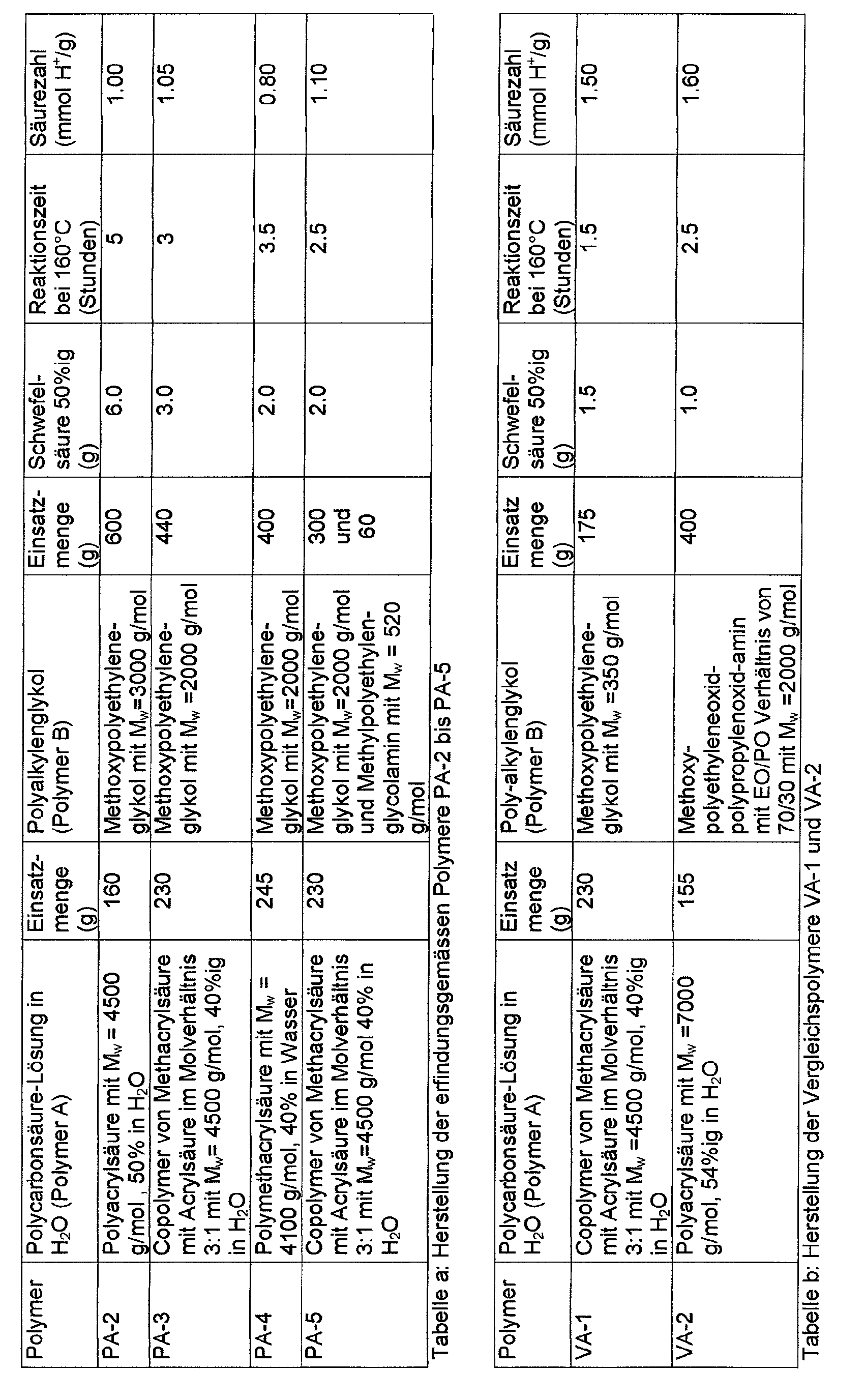
- Die Polymeren PA1-PA5 konnten nach dem Auskühlen und Erstarren problemlos als Platten von den Schalen abgelöst und in kleine, nicht verklebende Stücke zerkleinert werden.
- Die Vergleichspolymere VA-1 und VA-2 blieben auch nach 24 Stunden bei Raumtemperatur sowie auch nach 24 Stunden bei 6°C zähviskos und klebrig.
- In einen 500 ml Rundkolben mit mechanischem Rührer, Thermometer und Rückflusskühler werden 70 g deionisiertes Wasser vorgelegt und auf 75-80°C erwärmt. Sobald die Temperatur erreicht ist, werden gleichzeitig über unterschiedliche Dosierpumpen die Monomermischung (bestehend aus 121.2 g eines Esters von Methacrylsäure mit Polyethyleneglykol-5000 Monomethylether, 12.1 g Methacrylsäure und 140 g Wasser) und eine Lösung aus 3.1 g Natriumperoxodisulfat in 40 g Wasser innerhalb von 4 Stunden zudosiert. Dabei werden sofort und alle 15 Minuten in 8 Portionen insgesamt 1.4 g Thiomilchsäure zugegeben. Anschliessend werden 0.8 g Natriumperoxodisulfat in 5.0 g Wasser zugegeben und bei 75-80°C nachpolymerisiert bis der Peroxidtest negativ ist. Durch Zugabe von 6.4 g NaOH (50%ig) wird ein pH von 4.7 eingestellt. Der Rückflusskühler wird nun gegen eine Destillationsbrücke ausgetauscht und das Wasser abdestilliert. Die viskose Polymerschmelze wird in Aluschalen von ca. 100 mm Durchmesser und ca. 7 mm Höhe, die auf nicht beheizten Keramikplatten eines Labortisches stehen, gegossen und erstarren gelassen.
- In einen 500 ml Rundkolben mit mechanischem Rührer, Thermometer und Rückflusskühler werden 92.0 g deionisiertes Wasser vorgelegt und auf 85-90°C erwärmt. Sobald die Temperatur erreicht ist, werden gleichzeitig über unterschiedliche Dosierpumpen die Monomermischung (bestehend aus 103.0 g eines Esters von Methacrylsäure mit Polyethyleneglykol-500 Monomethylether, 44.7 g Methacrylsäure und 110 g Wasser), eine Lösung aus 4.6 g Natriumpyrosulfit in 39.0 g Wasser und eine Lösung aus 5.7 g Natriumperoxodisulfat in 40.0 g Wasser innerhalb von 2 Stunden zudosiert. Anschliessend wird bei 85-90°C nachreagieren gelassen bis der Peroxidtest negativ ist. Der Rückflusskühler wird nun gegen eine Destillationsbrücke ausgetauscht und das Wasser abdestilliert. Die Polymerschmelze wird in Aluschalen von ca. 100 mm Durchmesser und ca. 7 mm Höhe, die auf nicht beheizten Keramikplatten eines Labortisches stehen, gegossen und erstarren gelassen.
- Das Polymer PC-1 konnte nach dem Auskühlen und Erstarren problemlos als Platte von den Schalen abgelöst und in kleine, nicht verklebende Stücke zerkleinert werden. Das Vergleichspolymer VC-1 wurde auch nach 24 Stunden nicht fest, sondern blieb weich.
- Die Herstellung von Polymer PA-1 wird in gleicher Ansatzgrösse wiederholt. Die Polymerschmelze wird auf 100°C gekühlt und es werden 2 Gewichtsprozent Calciumhydroxid-Pulver zugegeben und 5 Minuten gut eingemischt. Anschliessend wird die Polymerschmelze auf ein Blech ausgegossen und erstarren gelassen. Die Härte der festen Polymeren wurde mit Hilfe des Härteprüfgerätes nach Shore A, DIN 53505 geprüft. Das Erstarren mit Zusatz von Calciumhydroxid-Puver erfolgte deutlich schneller als ohne, wie in Tabelle c gezeigt.
Tabelle c: Erstarrungsgeschwindigkeit der Polymerschmelzen PA-1 mit und ohne Calciumhydroxid-Zugabe (Labortemperatur = 23°C). Härte Shore A nach: 5 min. 10 min. 15 min. 30 min. 60 min. 90 min. 120 min. ohne Ca(OH)2 weich, n.m.‡ weich, n.m.‡ weich, n.m.‡ weich, n.m.‡ 55 59 60 mit Ca(OH)2 noch weich, n.m.‡ Oberfläche hart aber n.m.‡ 56 59 62 62 64 ‡n.m. = "nicht messbar" - Wie aus Tabelle c ersichtlich ist, wird durch Zugabe von Calciumhydroxid bereits nach 15 Minuten eine Festigkeit des Polymeren erreicht, die ohne Zugabe erst nach 60 Minuten erreicht ist.
- 30 g festes Polymer PA-1 werden in 70 g Wasser gelöst. Es wird eine klare, gelbliche Polymerlösung erhalten.
- 30 g festes Polymer PA-1, das unter Zusatz von 2 Gewichtsprozent Calciumhydroxid-Pulver erstarren gelassen wurde, werden in 70 g Wasser gelöst. Es wird eine trübe, gelbliche Polymerlösung erhalten.
Claims (17)
- Polymer in festem Aggregatzustand erhältlich durch die Reaktion von mindestens einem Monomer a ausgewählt aus ungesättigten Mono- oder Dicarbonsäuren oder Analoga von ungesättigten Mono- oder Dicarbonsäuren,
in Gegenwart eines Radikalbildners
mit mindestens einem Monomer c ausgewählt aus der Gruppe der ungesättigten Ester und Amide eines Polymeren B, welches mit unter üblichen Reaktionsbedingungen nicht reaktiven Endgruppen einseitig abgeschlossen ist und am anderen Ende Hydroxy- oder Amin-funktionalisiert ist,
und gegebenenfalls mindestens einem ethylenisch ungesättigten Monomer b;
wobei das Polymer B die folgende Formel besitzt:
X-(EO)x-(PO)y-(BuO)z-R
wobei x, y, z unabhängig voneinander je die Werte 0 - 250 aufweisen und x+y+z = 3 oder grösser ist;
X=OH oder NHR', mit R'=Alkyl mit 1-20 Kohlenstoffatomen, Alkylaryl mit 7-20 Kohlenstoffatomen oder H, vorzugsweise R'=H;
EO=Ethylenoxy, PO=Propylenoxy, BuO=Butylenoxy oder Isobutylenoxy;
und R= Alkyl mit 1-20 Kohlenstoffatomen oder Alkylaryl mit 7-20 Kohlenstoffatomen
bedeuten;
wobei der Gewichtsanteil der Summe von Propyleneoxid (PO)- und Butylenoxid(BuO)- Einheiten kleiner als 20 Gewichts-% des Polymeren B ist;
wobei das Molekulargewicht des Polymers B etwa 120-20'000 g/mol, insbesondere etwa 250-10'000 g/mol, ist;
und wobei der Anteil von allen Polymeren B mit Molekulargewichten unter 500g/mol kleiner als 50 Mol-% aller Polymere B beträgt, insbesondere kleiner als 30 Mol-% beträgt. - Polymer in festem Aggregatzustand gemäss Anspruch 1, dadurch gekennzeichnet, dass das Analogon der ungesättigten Mono- oder Dicarbonsäure ausgewählt ist aus der Gruppe Säuresalze, Säurehalogenide, Säureanhydride und Säureester.
- Polymer in festem Aggregatzustand gemäss einem der vorhergehenden Ansprüche, dadurch gekennzeichnet, dass das Polymer B Verunreinigungen von difunktionellen Polymeren im Gewichtsanteil von weniger als 3 Gewichts-% enthält, vorzugsweise weniger als 2 Gewichts-%, insbesondere weniger als 1 Gewichts-%, bezogen auf das Gewicht des Polymeren B.
- Polymer in festem Aggregatzustand gemäss einem der vorhergehenden Ansprüche, dadurch gekennzeichnet, dass Monomer a Maleinsäure, Itaconsäure, oder Crotonsäure ist, vorzugsweise Acrylsäure oder Methacrylsäure.
- Polymer in festem Aggregatzustand gemäss einem der vorhergehenden Ansprüche, dadurch gekennzeichnet, dass das molare Verhältnis der Monomerbausteine (a+c):b im Bereich von 100:0 - 30:70 ist, vorzugsweise 100:0 - 50:50, insbesondere 98:2 - 70:30.
- Polymer in festem Aggregatzustand gemäss einem der vorhergehenden Ansprüche, dadurch gekennzeichnet, dass das molare Verhältnis der Monomerbausteine a und c im Bereich von 200:1 - 0.1:1 ist, vorzugsweise 100:1 - 0.1:1, insbesondere 29:1 - 0.1:1.
- Polymer in festem Aggregatzustand gemäss einem der vorhergehenden Ansprüche, dadurch gekennzeichnet, dass das Polymer in festem Aggregatzustand als Pulver, Schuppen oder in Platten vorliegt.
- Polymer in festem Aggregatzustand gemäss einem der vorhergehenden Ansprüche, dadurch gekennzeichnet, dass dem Polymer vor dem Erstarren mindestens ein Betonverflüssiger zugesetzt wird.
- Polymer in festem Aggregatzustand gemäss einem der vorhergehenden Ansprüche, dadurch gekennzeichnet, dass dem Polymer vor dem Erstarren mindestens ein Zusatz für hydraulisch oder latent hydraulisch abbindende Bindemittel aus der Gruppe der Abbindeverzögerer, Abbindebeschleuniger, Viskositätsmodifizierer und Schwindreduzierer zugesetzt wird.
- Verfahren zur Herstellung eines Polymers in festem Aggregatzustand gemäss einem der Ansprüche 1-9 durch Copolymerisation von mindestens einem ethylenisch ungesättigten, Carboxylgruppen- oder deren Analogon enthaltenden Monomer mit mindestens einem Ester oder Amid von ethylenisch ungesättigten mono- oder Dicarbonsäuren mit einem Polymer B und gegebenenfalls noch weiteren, copolymerisierbaren Monomeren und gegebenenfalls in einem Lösungsmittel, welches anschliessend entfernt wird.
- Verfahren zur Herstellung eines Polymers in festem Aggregatzustand gemäss Anspruch 10, dadurch gekennzeichnet, dass der Polymerschmelze vor dem Erkalten wasserlösliche oder wasserdispergierbare Beschleuniger für die Erhärtungsreaktion der Polymerschmelze zugesetzt werden.
- Verfahren zur Herstellung eines Polymers in festem Aggregatzustand gemäss Anspruch 11, dadurch gekennzeichnet, dass als wasserlösliche oder wasserdisperigierbare Beschleuniger für die Erhärtungsreaktion der Polymerschmelze Beschleuniger eingesetzt werden ausgewählt aus der Gruppe umfassend anorganische, organische Salze, Harnstoff und höhere Alkohole.
- Verwendung des Polymers in festem Aggregatzustand gemäss einem der Ansprüche 1-9 als Dispergiermittel für wässrige Dispersionen.
- Verwendung des Polymers in festem Aggregatzustand gemäss einem der Ansprüche 1-9 als Verflüssiger für hydraulisch abbindende Systeme.
- Verwendung des Polymers in festem Aggregatzustand gemäss einem der Ansprüche 1-9 als Verflüssiger in Fertigmörtel Systeme.
- Verwendung des Polymers in festem Aggregatzustand gemäss einem der Ansprüche 1-9 in Wasser gelöst als Verflüssiger für zementhaltige Systeme.
- Wässrige Lösung, erhalten durch Auflösen des Polymers in festem Aggregatzustand gemäss einem der Ansprüche 1-9 in Wasser.
Applications Claiming Priority (3)
| Application Number | Priority Date | Filing Date | Title |
|---|---|---|---|
| EP02006760A EP1348729A1 (de) | 2002-03-25 | 2002-03-25 | Polymere in festem Aggregatzustand |
| PCT/EP2003/002892 WO2003080714A1 (de) | 2002-03-25 | 2003-03-19 | Polymere in festem aggregatzustand |
| EP03724922A EP1490424B1 (de) | 2002-03-25 | 2003-03-19 | Polymere in festem aggregatzustand |
Related Parent Applications (1)
| Application Number | Title | Priority Date | Filing Date |
|---|---|---|---|
| EP03724922A Division EP1490424B1 (de) | 2002-03-25 | 2003-03-19 | Polymere in festem aggregatzustand |
Publications (3)
| Publication Number | Publication Date |
|---|---|
| EP1632519A2 true EP1632519A2 (de) | 2006-03-08 |
| EP1632519A3 EP1632519A3 (de) | 2008-10-15 |
| EP1632519B1 EP1632519B1 (de) | 2018-12-05 |
Family
ID=27798797
Family Applications (3)
| Application Number | Title | Priority Date | Filing Date |
|---|---|---|---|
| EP02006760A Withdrawn EP1348729A1 (de) | 2002-03-25 | 2002-03-25 | Polymere in festem Aggregatzustand |
| EP03724922A Expired - Lifetime EP1490424B1 (de) | 2002-03-25 | 2003-03-19 | Polymere in festem aggregatzustand |
| EP05110623.5A Expired - Lifetime EP1632519B1 (de) | 2002-03-25 | 2003-03-19 | Polymere in festem Aggregatzustand |
Family Applications Before (2)
| Application Number | Title | Priority Date | Filing Date |
|---|---|---|---|
| EP02006760A Withdrawn EP1348729A1 (de) | 2002-03-25 | 2002-03-25 | Polymere in festem Aggregatzustand |
| EP03724922A Expired - Lifetime EP1490424B1 (de) | 2002-03-25 | 2003-03-19 | Polymere in festem aggregatzustand |
Country Status (20)
| Country | Link |
|---|---|
| US (2) | US20060004148A1 (de) |
| EP (3) | EP1348729A1 (de) |
| JP (2) | JP2005520900A (de) |
| KR (1) | KR20040105807A (de) |
| CN (2) | CN1916053B (de) |
| AT (1) | ATE341577T1 (de) |
| AU (1) | AU2003227536B2 (de) |
| BR (2) | BR0308679B1 (de) |
| CA (1) | CA2480061C (de) |
| DE (1) | DE50305264D1 (de) |
| DK (1) | DK1490424T3 (de) |
| ES (2) | ES2711791T3 (de) |
| NO (1) | NO335214B1 (de) |
| NZ (1) | NZ536106A (de) |
| PT (1) | PT1490424E (de) |
| RU (1) | RU2004131541A (de) |
| SI (1) | SI1490424T1 (de) |
| TR (1) | TR201902319T4 (de) |
| WO (1) | WO2003080714A1 (de) |
| ZA (1) | ZA200408401B (de) |
Cited By (2)
| Publication number | Priority date | Publication date | Assignee | Title |
|---|---|---|---|---|
| EP1916265A1 (de) * | 2006-10-26 | 2008-04-30 | Sika Technology AG | Verfahren zur Herstellung von Amid- und Estergruppen aufweisenden Polymeren im festen Aggregatszustand |
| CN111777721A (zh) * | 2020-07-30 | 2020-10-16 | 南京茂汇盈科技有限公司 | 一种增强型聚羧酸减水剂及其制备方法 |
Families Citing this family (84)
| Publication number | Priority date | Publication date | Assignee | Title |
|---|---|---|---|---|
| EP1348729A1 (de) * | 2002-03-25 | 2003-10-01 | Sika Schweiz AG | Polymere in festem Aggregatzustand |
| EP1577372A1 (de) * | 2004-03-19 | 2005-09-21 | Sika Technology AG | Stabile wässrige Dispersion von Partikeln sowie Verwendung und Herstellungsverfahren solcher Dispersionen |
| EP1577327A1 (de) | 2004-03-19 | 2005-09-21 | Sika Technology AG | Amid-und Estergruppen aufweisendes Polymer, dessen Herstellung und Verwendung |
| AU2005254265B2 (en) | 2004-06-21 | 2010-07-29 | Sika Technology Ag | Cement grinding aid |
| EP1790625A1 (de) | 2005-11-23 | 2007-05-30 | Sika Technology AG | Zusammensetzung und deren Verwendung zur Verminderung von Korrosion |
| FR2900930B1 (fr) * | 2006-05-12 | 2008-08-08 | Coatex Sas | Procede de fabrication de polymeres peigne par sechage puis fonctionnalisation de la chaine principale (meth)acrylique, polymeres obtenus et leurs utilisations |
| CN100432116C (zh) * | 2007-04-24 | 2008-11-12 | 陕西科技大学 | 环保型乙烯基类聚合物型泵送剂的制备方法 |
| EP2006258B1 (de) * | 2007-06-11 | 2012-08-15 | Sika Technology AG | Dispergiermittel für Gipszusammensetzungen |
| EP2020422A1 (de) | 2007-07-31 | 2009-02-04 | Sika Technology AG | Emulgierende Polymere und deren Verwendung |
| EP2065350B1 (de) | 2007-10-29 | 2011-02-23 | Sika Technology AG | Dispergiermittel für hydraulisch abbindende Systeme |
| ATE496875T1 (de) | 2007-10-29 | 2011-02-15 | Sika Technology Ag | Dispergiermittel für hydraulisch abbindende systeme |
| EP2072479A1 (de) | 2007-12-20 | 2009-06-24 | Sika Technology AG | Reaktivierung von verzögerten zementösen Systemen |
| ES2402670T3 (es) | 2007-12-20 | 2013-05-07 | Sika Technology Ag | Acelerador para la reactivación de sistemas cementosos retardados |
| EP2072531A1 (de) | 2007-12-21 | 2009-06-24 | Sika Technology AG | Polymere mit Saccharidseitenketten und deren Verwendung als Dispergiermittel |
| EP2090596A1 (de) * | 2008-02-13 | 2009-08-19 | Construction Research and Technology GmbH | Copolymer mit Polyetherseitenketten und Hydroxyalkyl- und Säurebausteinen |
| EP2128110B1 (de) | 2008-05-29 | 2016-08-17 | Sika Technology AG | Zusatzmittel für hydraulische Bindemittel mit langer Verarbeitungszeit und hoher Frühfestigkeit |
| US7973110B2 (en) * | 2008-06-16 | 2011-07-05 | Construction Research & Technology Gmbh | Copolymer synthesis process |
| EP2154118A1 (de) | 2008-07-30 | 2010-02-17 | Sika Technology AG | Dispergiermittel für Gipszusammensetzungen |
| EP2159203A1 (de) | 2008-08-26 | 2010-03-03 | Sika Technology AG | Zusatzmittel für hydraulisch abbindende Systeme mit verbesserter Verarbeitbarkeit und geringer Wasserreduktionsrate |
| ES2395988T3 (es) | 2008-09-05 | 2013-02-18 | Sika Technology Ag | Procedimiento para la estabilización de policarboxilatos |
| EP2251376A1 (de) | 2009-05-15 | 2010-11-17 | Sika Technology AG | Wässrige Polymerdispersionen |
| EP2298710A1 (de) | 2009-09-21 | 2011-03-23 | Sika Technology AG | Zusatzmittel für mineralische Bindemittel |
| EP2298833A1 (de) | 2009-09-22 | 2011-03-23 | Sika Technology AG | Eisen(III)-Komplexbildner zur Stabilisierung von Kammpolymeren in mineralischen Bindemitteln |
| EP2298711B1 (de) | 2009-09-21 | 2017-03-15 | Sika Technology AG | Zusammensetzung und Verfahren zur Herstellung von Kalksandstein |
| EP2336100A1 (de) | 2009-12-08 | 2011-06-22 | Sika Technology AG | Zusatzmittel für mineralische Bindemittel mit verringertem Braunverfärbungspotential |
| EP2368863A1 (de) | 2010-03-22 | 2011-09-28 | Sika Technology AG | Zusatzmittel für hydraulisch abbindende Systeme mit verbesserter Verarbeitbarkeit |
| EP2426095A1 (de) | 2010-09-03 | 2012-03-07 | Sika Technology AG | Dispergiermittel für Gipszusammensetzungen |
| EP2468697A1 (de) | 2010-12-24 | 2012-06-27 | Sika Technology AG | Magnesiumestrich |
| EP2468698A1 (de) | 2010-12-24 | 2012-06-27 | Sika Technology AG | Magnesiumzement |
| EP2502891A1 (de) | 2011-03-23 | 2012-09-26 | Sika Technology AG | Aktivatorzusammensetzung für latent hydraulische und/oder puzzolanische Bindemittel |
| EP2707435A1 (de) | 2011-05-11 | 2014-03-19 | Sika Technology AG | Polymermodifizierte bitumenhaltige zusammensetzungen |
| EP2527307A1 (de) | 2011-05-26 | 2012-11-28 | Sika Technology AG | Dialkanolamine als Additive zum Mahlen von Feststoffen |
| EP2527310A1 (de) | 2011-05-26 | 2012-11-28 | Sika Technology AG | Erhärtungsbeschleuniger für mineralische Bindemittelzusammensetzungen |
| EP2527308A1 (de) | 2011-05-26 | 2012-11-28 | Sika Technology AG | Erhärtungsbeschleuniger für mineralische Bindemittel |
| EP2535362A1 (de) | 2011-06-17 | 2012-12-19 | Sika Technology AG | Kammpolymere als Dispergiermittel für alkalisch aktivierte Bindemittel |
| US9309152B2 (en) | 2011-08-10 | 2016-04-12 | Sika Technology Ag | Process for drying concrete dispersants |
| EP2559675A1 (de) | 2011-08-16 | 2013-02-20 | Sika Technology AG | Enzymatisch invertierte Saccharose als Dispergiermittel |
| KR101898466B1 (ko) | 2011-11-11 | 2018-09-13 | 롬 앤드 하스 캄파니 | 폴리메타크릴산 무수물 텔로머 |
| US9499642B2 (en) | 2011-11-11 | 2016-11-22 | Rohm And Haas Company | Small particle size hypophosphite telomers of unsaturated carboxylic acids |
| KR101335033B1 (ko) * | 2011-11-24 | 2013-12-02 | 윤성원 | 광물 미분쇄를 위한 고기능성 분쇄조제 및 이를 포함하는 시멘트 조성물 |
| CN103906720B (zh) | 2011-12-05 | 2016-12-14 | Sika技术股份公司 | 制备用于矿物粘结剂组合物的固化促进剂的方法 |
| WO2013083692A1 (de) | 2011-12-06 | 2013-06-13 | Sika Technology Ag | Stabilisierung von rohpolyolen aus biomasse |
| EP2607332A1 (de) * | 2011-12-19 | 2013-06-26 | Sika Technology AG | Abbindebeschleuniger für Bindemittel auf Basis von Calciumsulfat |
| EP2607331A1 (de) | 2011-12-20 | 2013-06-26 | Sika Technology AG | Zusatzmischung für Füllstoffe |
| JP6166274B2 (ja) | 2011-12-22 | 2017-07-19 | シーカ テクノロジー アクチェンゲゼルシャフト | 粒径に応じて固体粒子を分離する装置の効率向上 |
| WO2013160158A1 (de) | 2012-04-23 | 2013-10-31 | Sika Technology Ag | Enzymatisch invertierte saccharose als mahlhilfsmittel |
| WO2014067991A1 (de) | 2012-11-05 | 2014-05-08 | Sika Technology Ag | Mahlhilfsmittel für zementklinker auf basis von polycarboxylatethern und/oder ligninsulfonaten |
| ES2617431T3 (es) | 2012-11-09 | 2017-06-19 | Sika Technology Ag | Poli(carboxilato-éteres) como agentes dispersivos para resinas epoxídicas |
| CN103214209A (zh) * | 2013-01-07 | 2013-07-24 | 辽宁工业大学 | 硅酸盐水泥流化剂制备方法 |
| WO2014118051A1 (de) | 2013-01-30 | 2014-08-07 | Sika Technology Ag | Erhärtungsbeschleuniger für mineralische bindemittel |
| WO2014118052A1 (de) | 2013-01-30 | 2014-08-07 | Sika Technology Ag | Beschleuniger für mineralische bindemittel |
| EP2778183B1 (de) | 2013-03-15 | 2015-04-29 | Rohm and Haas Company | Polymethacrylsäure-Anhydridtelomere |
| US20160194430A1 (en) * | 2013-09-06 | 2016-07-07 | Sika Technology Ag | Bio-based polycarboxylate ether and methods for the production thereof |
| WO2015059100A1 (de) | 2013-10-25 | 2015-04-30 | Sika Technology Ag | Karamellisierter zucker als verflüssiger für mineralische bindemittelzusammensetzungen |
| WO2015177232A1 (de) | 2014-05-21 | 2015-11-26 | Sika Technology Ag | Beschleuniger für hydraulische bindemittel mit langer verarbeitungszeit und sehr hoher frühfestigkeit |
| FR3029524B1 (fr) | 2014-12-08 | 2018-03-02 | Coatex | Procede continu d'esterification et ou d'amidification, sans solvant organique, d'un homopolymere ou copolymere acide |
| EP3053901A1 (de) | 2015-02-09 | 2016-08-10 | Sika Technology AG | Nichtinvasive Reparatur und Nachrüstung von gehärteten verstärkten Betonkonstruktionen |
| CN108349825B (zh) | 2015-09-24 | 2021-10-26 | Sika技术股份公司 | 包含流动改进剂和共聚物的添加剂 |
| CN108349809A (zh) | 2015-10-21 | 2018-07-31 | Sika技术股份公司 | 对矿物粘结剂组合物进行内部后处理的掺加剂 |
| US11021398B2 (en) | 2015-10-26 | 2021-06-01 | Sika Technology Ag | Inerting clay minerals and improving the effect of liquefiers in clay-containing mineral binder compositions |
| EP3383817B1 (de) | 2015-11-30 | 2025-08-20 | Rohm and Haas Company | Synthese von festkörperreichem polycarboxylat für zementsuperweichmacher |
| EP3222599A1 (de) | 2016-03-22 | 2017-09-27 | Sika Technology AG | Beschleuniger |
| WO2017162698A1 (de) | 2016-03-22 | 2017-09-28 | Sika Technology Ag | Zusatzmittel |
| CN108883989B (zh) | 2016-03-22 | 2022-08-09 | Sika技术股份公司 | 基于氧化钙的组合物 |
| EP3266755A1 (de) | 2016-07-07 | 2018-01-10 | Sika Technology AG | Reduzierung von blasenbildung in einem hybriden polyurethanzementsystem |
| EP3279230A1 (de) | 2016-08-03 | 2018-02-07 | Sika Technology AG | Polymermischungen für epoxidharzzusammensetzungen |
| WO2018087099A1 (de) | 2016-11-09 | 2018-05-17 | Sika Technology Ag | Erhärtungsbeschleuniger |
| US11827784B2 (en) | 2016-12-01 | 2023-11-28 | Huntsman International Llc | Functionalized polyacrylate polymer compositions |
| EP3865280B1 (de) | 2016-12-21 | 2024-08-14 | Sika Technology AG | Generative herstellung von formkörpern aus aushärtbaren materialen |
| EP3549961A1 (de) | 2018-04-03 | 2019-10-09 | Evonik Röhm GmbH | Beton-fliessverbesserer und wasserreduktionsmittel |
| DE102017213607A1 (de) | 2017-08-04 | 2019-02-07 | Evonik Röhm Gmbh | Fließverbesserer und Wasserreduktionsmittel |
| CN110997739B (zh) | 2017-08-04 | 2022-12-16 | 罗姆化学有限责任公司 | 混凝土流动改进剂和减水剂 |
| DE102017213600A1 (de) | 2017-08-04 | 2019-02-07 | Evonik Röhm Gmbh | Beton-Fließverbesserer |
| CN111868001B (zh) | 2018-03-21 | 2024-02-13 | Sika技术股份公司 | 用于水下灌浆的环氧树脂组合物 |
| EP3860962A1 (de) | 2018-10-05 | 2021-08-11 | Sika Technology AG | Kammpolymere als blockadditive für quelltone |
| EP3677560A1 (de) | 2019-01-03 | 2020-07-08 | Sika Technology Ag | Modifizierte oxyalkilamine als schrumpfungsreduzierende mittel in zementartigen zusammensetzungen |
| EP3744699A1 (de) | 2019-05-28 | 2020-12-02 | Sika Technology Ag | Festigkeitsverstärker für beton auf basis funktionalisierter nanomaterialien |
| EP3789359A1 (de) | 2019-09-03 | 2021-03-10 | Sika Technology AG | Verwendung von kammpolymeren als inertisierungsmittel für quellfeste schichtsilikate |
| EP3854763A1 (de) | 2020-01-23 | 2021-07-28 | Sika Technology Ag | Verfahren zur herstellung von dispergiermitteln in fester form und deren verwendung in mineralischen bindemittelzusammensetzungen |
| EP3939947A1 (de) | 2020-07-15 | 2022-01-19 | Sika Technology Ag | Tonblockende additive für gipszusammensetzungen |
| CN116323515A (zh) | 2020-12-02 | 2023-06-23 | Sika技术股份公司 | 生产用于地下作业的回填膏体的方法和控制回填膏体流动的方法 |
| US20240209137A1 (en) | 2021-06-24 | 2024-06-27 | Sika Technology Ag | Reducing the concentration of monomeric polyisocyanates in polyurethane compositions |
| CN115806403A (zh) | 2021-09-13 | 2023-03-17 | Sika技术股份公司 | 水泥外加剂 |
| EP4299547A1 (de) | 2022-06-28 | 2024-01-03 | Sika Technology AG | Umweltfreundliche mörtelzusammensetzungen |
Citations (3)
| Publication number | Priority date | Publication date | Assignee | Title |
|---|---|---|---|---|
| WO2000017263A1 (de) | 1998-09-24 | 2000-03-30 | Skw Bauchemie Gmbh | Stabilisierte, wasserlösliche polymerpulver auf basis von polyoxyalkylenglykol-carboxylaten und verfahren zu deren herstellung |
| WO2000047533A1 (de) | 1999-02-10 | 2000-08-17 | Degussa Construction Chemicals Gmbh | Pulverförmige polymerzusammensetzungen auf der basis von polyethercarboxylaten |
| EP1052232A1 (de) | 1998-11-30 | 2000-11-15 | Taiheiyo Cement Corporation | Verfahren zur herstellung eines dispergiermittels für pulverförmige hydraulische zusammenetzung |
Family Cites Families (18)
| Publication number | Priority date | Publication date | Assignee | Title |
|---|---|---|---|---|
| US4870120A (en) * | 1987-05-19 | 1989-09-26 | Nippon Shokubai Kagaku Co., Ltd. | Cement dispersant |
| US5739212A (en) * | 1992-12-08 | 1998-04-14 | Skw Trostberg Aktiengesellschaft | Water-soluble graft polymers |
| IT1279390B1 (it) * | 1993-12-21 | 1997-12-10 | Sandoz Ag | Copolimeri di addizione utili come additivi fluidificanti per miscele cementizie |
| DE4439689C1 (de) * | 1994-11-07 | 1996-08-08 | Hoechst Ag | Verwendung einer Betonmischung zur Herstellung von Drainbeton |
| DE69610650T2 (de) * | 1995-01-31 | 2001-05-03 | Mbt Holding Ag, Zuerich | Zementdispergiermittel |
| WO1997000898A1 (en) * | 1995-06-21 | 1997-01-09 | W.R. Grace & Co.-Conn. | Air controlling superplasticizers |
| US5556460A (en) * | 1995-09-18 | 1996-09-17 | W.R. Grace & Co.-Conn. | Drying shrinkage cement admixture |
| US5641352A (en) * | 1995-10-25 | 1997-06-24 | W.R. Grace & Co.-Conn. | Nitrogenous strength enhancers for portland cement |
| US5824347A (en) * | 1996-09-27 | 1998-10-20 | E. I. Du Pont De Nemours And Company | Concrete form liner |
| US5985989A (en) * | 1997-07-09 | 1999-11-16 | Arco Chemical Technology, Lp | Method of making a water reducing additive for cement |
| JP3029827B2 (ja) * | 1998-01-22 | 2000-04-10 | 株式会社日本触媒 | セメント混和剤およびセメント組成物 |
| JP3330095B2 (ja) * | 1998-11-27 | 2002-09-30 | 株式会社日本触媒 | セメント添加剤の製造方法 |
| US6657316B1 (en) * | 1998-12-23 | 2003-12-02 | Johnson Contols Interiors Technology Corporation | Window control apparatus |
| EP1138696A1 (de) * | 2000-03-29 | 2001-10-04 | Sika AG, vorm. Kaspar Winkler & Co. | Polymere für Zementdipergierende Zusammensetzungen |
| DE10015135A1 (de) * | 2000-03-29 | 2001-10-04 | Basf Ag | Verfahren zur Modifizierung von Säuregruppen enthaltenden Polymerisaten |
| WO2002033765A2 (en) * | 2000-10-18 | 2002-04-25 | Du Pont-Mitsui Polychemicals Co., Ltd | Gel-type polymer electrolyte and use thereof |
| US6946505B2 (en) * | 2001-10-17 | 2005-09-20 | Nippon Shokubai Co., Ltd. | Cement dispersant, its production process, and cement composition using the cement dispersant |
| EP1348729A1 (de) * | 2002-03-25 | 2003-10-01 | Sika Schweiz AG | Polymere in festem Aggregatzustand |
-
2002
- 2002-03-25 EP EP02006760A patent/EP1348729A1/de not_active Withdrawn
-
2003
- 2003-03-19 TR TR2019/02319T patent/TR201902319T4/tr unknown
- 2003-03-19 PT PT03724922T patent/PT1490424E/pt unknown
- 2003-03-19 US US10/506,773 patent/US20060004148A1/en not_active Abandoned
- 2003-03-19 EP EP03724922A patent/EP1490424B1/de not_active Expired - Lifetime
- 2003-03-19 BR BRPI0308679-8B1A patent/BR0308679B1/pt active IP Right Grant
- 2003-03-19 CN CN200610153644XA patent/CN1916053B/zh not_active Expired - Fee Related
- 2003-03-19 DK DK03724922T patent/DK1490424T3/da active
- 2003-03-19 CA CA2480061A patent/CA2480061C/en not_active Expired - Lifetime
- 2003-03-19 RU RU2004131541/04A patent/RU2004131541A/ru not_active Application Discontinuation
- 2003-03-19 BR BRBR122013002075-6A patent/BR122013002075B1/pt not_active IP Right Cessation
- 2003-03-19 NZ NZ536106A patent/NZ536106A/xx not_active IP Right Cessation
- 2003-03-19 EP EP05110623.5A patent/EP1632519B1/de not_active Expired - Lifetime
- 2003-03-19 AU AU2003227536A patent/AU2003227536B2/en not_active Expired
- 2003-03-19 SI SI200330571T patent/SI1490424T1/sl unknown
- 2003-03-19 ES ES05110623T patent/ES2711791T3/es not_active Expired - Lifetime
- 2003-03-19 ES ES03724922T patent/ES2274228T3/es not_active Expired - Lifetime
- 2003-03-19 CN CNB038069652A patent/CN100413912C/zh not_active Expired - Fee Related
- 2003-03-19 WO PCT/EP2003/002892 patent/WO2003080714A1/de not_active Ceased
- 2003-03-19 DE DE50305264T patent/DE50305264D1/de not_active Expired - Lifetime
- 2003-03-19 JP JP2003578455A patent/JP2005520900A/ja active Pending
- 2003-03-19 AT AT03724922T patent/ATE341577T1/de active
- 2003-03-19 KR KR10-2004-7015332A patent/KR20040105807A/ko not_active Ceased
-
2004
- 2004-10-18 ZA ZA2004/08401A patent/ZA200408401B/en unknown
- 2004-10-22 NO NO20044544A patent/NO335214B1/no not_active IP Right Cessation
-
2007
- 2007-11-02 US US11/979,438 patent/US20080119602A1/en not_active Abandoned
-
2010
- 2010-08-06 JP JP2010178023A patent/JP2010255003A/ja active Pending
Patent Citations (3)
| Publication number | Priority date | Publication date | Assignee | Title |
|---|---|---|---|---|
| WO2000017263A1 (de) | 1998-09-24 | 2000-03-30 | Skw Bauchemie Gmbh | Stabilisierte, wasserlösliche polymerpulver auf basis von polyoxyalkylenglykol-carboxylaten und verfahren zu deren herstellung |
| EP1052232A1 (de) | 1998-11-30 | 2000-11-15 | Taiheiyo Cement Corporation | Verfahren zur herstellung eines dispergiermittels für pulverförmige hydraulische zusammenetzung |
| WO2000047533A1 (de) | 1999-02-10 | 2000-08-17 | Degussa Construction Chemicals Gmbh | Pulverförmige polymerzusammensetzungen auf der basis von polyethercarboxylaten |
Cited By (4)
| Publication number | Priority date | Publication date | Assignee | Title |
|---|---|---|---|---|
| EP1916265A1 (de) * | 2006-10-26 | 2008-04-30 | Sika Technology AG | Verfahren zur Herstellung von Amid- und Estergruppen aufweisenden Polymeren im festen Aggregatszustand |
| WO2008049924A1 (de) * | 2006-10-26 | 2008-05-02 | Sika Technology Ag | Verahren zur herstellung von amid- und estergruppen aufweisenden polymeren im festen aggregatzustand |
| US8008374B2 (en) | 2006-10-26 | 2011-08-30 | Sika Technology Ag | Process for producing polymers having amide and ester groups in the solid state |
| CN111777721A (zh) * | 2020-07-30 | 2020-10-16 | 南京茂汇盈科技有限公司 | 一种增强型聚羧酸减水剂及其制备方法 |
Also Published As
Similar Documents
| Publication | Publication Date | Title |
|---|---|---|
| EP1632519B1 (de) | Polymere in festem Aggregatzustand | |
| EP1711544B1 (de) | Copolymere auf basis von ungesättigten mono- oder dicarbonsäure-derivaten und oxyalkylenglykol-alkenylethern, verfahren zu deren herstellung und ihre verwendung | |
| EP1966258B1 (de) | Copolymere auf basis von ungesättigten mono- oder dicarbonsäure-derivaten und oxyalkylenglykol-alkenylethern, verfahren zu deren herstellung und ihre verwendung | |
| EP2463314A1 (de) | Herstellung von Kammpolymeren durch Veresterung | |
| EP2194078B1 (de) | Verfahren zur Herstellung von Copolymeren | |
| EP0736553A2 (de) | Copolymere auf Basis von Oxyalkylenglykol-Alkenyl-ethern und ungesättigten Dicarbonsäure-Derivaten | |
| US20160332914A1 (en) | Additive for hydraulically setting compositions | |
| EP2159203A1 (de) | Zusatzmittel für hydraulisch abbindende Systeme mit verbesserter Verarbeitbarkeit und geringer Wasserreduktionsrate | |
| EP1963020B1 (de) | Verwendung von kammpolymeren als mahlhilfsmittel für zementhaltige zubereitungen | |
| DE102005053019A1 (de) | Kammpolymere und deren Verwendung als Additive für Zubereitungen mineralischer Bindemittel | |
| JP4167005B2 (ja) | アクリル酸とアルキルポリアルキレングリコールからなるエステルの水溶性ポリマーの使用法 | |
| EP1244722B8 (de) | Verfahren zur herstellung von wasserlöslichen polymerisaten von estern aus ethylenisch ungesättigten carbonsäuren und polyalkylenglykolen | |
| EP2550240A1 (de) | Zusatzmittel für hydraulisch abbindende systeme mit verbesserter verarbeitbarkeit | |
| EP2194076A1 (de) | Semikontinuierlich betriebenes Verfahren zur Herstellung von Copolymeren |
Legal Events
| Date | Code | Title | Description |
|---|---|---|---|
| PUAI | Public reference made under article 153(3) epc to a published international application that has entered the european phase |
Free format text: ORIGINAL CODE: 0009012 |
|
| AC | Divisional application: reference to earlier application |
Ref document number: 1490424 Country of ref document: EP Kind code of ref document: P |
|
| AK | Designated contracting states |
Kind code of ref document: A2 Designated state(s): AT BE BG CH CY CZ DE DK EE ES FI FR GB GR HU IE IT LI LU MC NL PT RO SE SI SK TR |
|
| AX | Request for extension of the european patent |
Extension state: AL BA HR MK YU |
|
| RAP1 | Party data changed (applicant data changed or rights of an application transferred) |
Owner name: SIKA TECHNOLOGY AG |
|
| PUAL | Search report despatched |
Free format text: ORIGINAL CODE: 0009013 |
|
| AK | Designated contracting states |
Kind code of ref document: A3 Designated state(s): AT BE BG CH CY CZ DE DK EE ES FI FR GB GR HU IE IT LI LU MC NL PT RO SE SI SK TR |
|
| AX | Request for extension of the european patent |
Extension state: AL BA HR MK YU |
|
| RIC1 | Information provided on ipc code assigned before grant |
Ipc: C04B 24/26 20060101ALI20080911BHEP Ipc: C08G 81/02 20060101AFI20060116BHEP |
|
| 17P | Request for examination filed |
Effective date: 20090415 |
|
| 17Q | First examination report despatched |
Effective date: 20090529 |
|
| AKX | Designation fees paid |
Designated state(s): AT BE BG CH CY CZ DE DK EE ES FI FR GB GR HU IE IT LI LU MC NL PT RO SE SI SK TR |
|
| STAA | Information on the status of an ep patent application or granted ep patent |
Free format text: STATUS: EXAMINATION IS IN PROGRESS |
|
| GRAP | Despatch of communication of intention to grant a patent |
Free format text: ORIGINAL CODE: EPIDOSNIGR1 |
|
| STAA | Information on the status of an ep patent application or granted ep patent |
Free format text: STATUS: GRANT OF PATENT IS INTENDED |
|
| INTG | Intention to grant announced |
Effective date: 20180622 |
|
| RIN1 | Information on inventor provided before grant (corrected) |
Inventor name: SULSER, UELI Inventor name: VELTEN, ULF Inventor name: SCHOBER, IRENE Inventor name: MAEDER, URS |
|
| GRAS | Grant fee paid |
Free format text: ORIGINAL CODE: EPIDOSNIGR3 |
|
| GRAA | (expected) grant |
Free format text: ORIGINAL CODE: 0009210 |
|
| GRAA | (expected) grant |
Free format text: ORIGINAL CODE: 0009210 |
|
| STAA | Information on the status of an ep patent application or granted ep patent |
Free format text: STATUS: THE PATENT HAS BEEN GRANTED |
|
| AC | Divisional application: reference to earlier application |
Ref document number: 1490424 Country of ref document: EP Kind code of ref document: P |
|
| AK | Designated contracting states |
Kind code of ref document: B1 Designated state(s): AT BE BG CH CY CZ DE DK EE ES FI FR GB GR HU IE IT LI LU MC NL PT RO SE SI SK TR |
|
| REG | Reference to a national code |
Ref country code: GB Ref legal event code: FG4D Free format text: NOT ENGLISH |
|
| REG | Reference to a national code |
Ref country code: CH Ref legal event code: EP |
|
| REG | Reference to a national code |
Ref country code: AT Ref legal event code: REF Ref document number: 1072968 Country of ref document: AT Kind code of ref document: T Effective date: 20181215 |
|
| REG | Reference to a national code |
Ref country code: IE Ref legal event code: FG4D Free format text: LANGUAGE OF EP DOCUMENT: GERMAN |
|
| REG | Reference to a national code |
Ref country code: DE Ref legal event code: R096 Ref document number: 50315810 Country of ref document: DE |
|
| REG | Reference to a national code |
Ref country code: SE Ref legal event code: TRGR |
|
| REG | Reference to a national code |
Ref country code: NL Ref legal event code: MP Effective date: 20181205 |
|
| PG25 | Lapsed in a contracting state [announced via postgrant information from national office to epo] |
Ref country code: BG Free format text: LAPSE BECAUSE OF FAILURE TO SUBMIT A TRANSLATION OF THE DESCRIPTION OR TO PAY THE FEE WITHIN THE PRESCRIBED TIME-LIMIT Effective date: 20190305 Ref country code: FI Free format text: LAPSE BECAUSE OF FAILURE TO SUBMIT A TRANSLATION OF THE DESCRIPTION OR TO PAY THE FEE WITHIN THE PRESCRIBED TIME-LIMIT Effective date: 20181205 |
|
| REG | Reference to a national code |
Ref country code: ES Ref legal event code: FG2A Ref document number: 2711791 Country of ref document: ES Kind code of ref document: T3 Effective date: 20190507 |
|
| PG25 | Lapsed in a contracting state [announced via postgrant information from national office to epo] |
Ref country code: GR Free format text: LAPSE BECAUSE OF FAILURE TO SUBMIT A TRANSLATION OF THE DESCRIPTION OR TO PAY THE FEE WITHIN THE PRESCRIBED TIME-LIMIT Effective date: 20190306 |
|
| PG25 | Lapsed in a contracting state [announced via postgrant information from national office to epo] |
Ref country code: NL Free format text: LAPSE BECAUSE OF FAILURE TO SUBMIT A TRANSLATION OF THE DESCRIPTION OR TO PAY THE FEE WITHIN THE PRESCRIBED TIME-LIMIT Effective date: 20181205 |
|
| PG25 | Lapsed in a contracting state [announced via postgrant information from national office to epo] |
Ref country code: PT Free format text: LAPSE BECAUSE OF FAILURE TO SUBMIT A TRANSLATION OF THE DESCRIPTION OR TO PAY THE FEE WITHIN THE PRESCRIBED TIME-LIMIT Effective date: 20190405 Ref country code: CZ Free format text: LAPSE BECAUSE OF FAILURE TO SUBMIT A TRANSLATION OF THE DESCRIPTION OR TO PAY THE FEE WITHIN THE PRESCRIBED TIME-LIMIT Effective date: 20181205 |
|
| PG25 | Lapsed in a contracting state [announced via postgrant information from national office to epo] |
Ref country code: RO Free format text: LAPSE BECAUSE OF FAILURE TO SUBMIT A TRANSLATION OF THE DESCRIPTION OR TO PAY THE FEE WITHIN THE PRESCRIBED TIME-LIMIT Effective date: 20181205 Ref country code: SK Free format text: LAPSE BECAUSE OF FAILURE TO SUBMIT A TRANSLATION OF THE DESCRIPTION OR TO PAY THE FEE WITHIN THE PRESCRIBED TIME-LIMIT Effective date: 20181205 Ref country code: EE Free format text: LAPSE BECAUSE OF FAILURE TO SUBMIT A TRANSLATION OF THE DESCRIPTION OR TO PAY THE FEE WITHIN THE PRESCRIBED TIME-LIMIT Effective date: 20181205 |
|
| REG | Reference to a national code |
Ref country code: DE Ref legal event code: R097 Ref document number: 50315810 Country of ref document: DE |
|
| PLBE | No opposition filed within time limit |
Free format text: ORIGINAL CODE: 0009261 |
|
| STAA | Information on the status of an ep patent application or granted ep patent |
Free format text: STATUS: NO OPPOSITION FILED WITHIN TIME LIMIT |
|
| PG25 | Lapsed in a contracting state [announced via postgrant information from national office to epo] |
Ref country code: SI Free format text: LAPSE BECAUSE OF FAILURE TO SUBMIT A TRANSLATION OF THE DESCRIPTION OR TO PAY THE FEE WITHIN THE PRESCRIBED TIME-LIMIT Effective date: 20181205 Ref country code: DK Free format text: LAPSE BECAUSE OF FAILURE TO SUBMIT A TRANSLATION OF THE DESCRIPTION OR TO PAY THE FEE WITHIN THE PRESCRIBED TIME-LIMIT Effective date: 20181205 Ref country code: MC Free format text: LAPSE BECAUSE OF FAILURE TO SUBMIT A TRANSLATION OF THE DESCRIPTION OR TO PAY THE FEE WITHIN THE PRESCRIBED TIME-LIMIT Effective date: 20181205 |
|
| REG | Reference to a national code |
Ref country code: CH Ref legal event code: PL |
|
| 26N | No opposition filed |
Effective date: 20190906 |
|
| PG25 | Lapsed in a contracting state [announced via postgrant information from national office to epo] |
Ref country code: LU Free format text: LAPSE BECAUSE OF NON-PAYMENT OF DUE FEES Effective date: 20190319 |
|
| PG25 | Lapsed in a contracting state [announced via postgrant information from national office to epo] |
Ref country code: IE Free format text: LAPSE BECAUSE OF NON-PAYMENT OF DUE FEES Effective date: 20190319 Ref country code: CH Free format text: LAPSE BECAUSE OF NON-PAYMENT OF DUE FEES Effective date: 20190331 Ref country code: LI Free format text: LAPSE BECAUSE OF NON-PAYMENT OF DUE FEES Effective date: 20190331 |
|
| REG | Reference to a national code |
Ref country code: AT Ref legal event code: MM01 Ref document number: 1072968 Country of ref document: AT Kind code of ref document: T Effective date: 20190319 |
|
| PG25 | Lapsed in a contracting state [announced via postgrant information from national office to epo] |
Ref country code: AT Free format text: LAPSE BECAUSE OF NON-PAYMENT OF DUE FEES Effective date: 20190319 |
|
| PG25 | Lapsed in a contracting state [announced via postgrant information from national office to epo] |
Ref country code: CY Free format text: LAPSE BECAUSE OF FAILURE TO SUBMIT A TRANSLATION OF THE DESCRIPTION OR TO PAY THE FEE WITHIN THE PRESCRIBED TIME-LIMIT Effective date: 20181205 |
|
| PGFP | Annual fee paid to national office [announced via postgrant information from national office to epo] |
Ref country code: SE Payment date: 20210223 Year of fee payment: 19 Ref country code: BE Payment date: 20210224 Year of fee payment: 19 |
|
| PG25 | Lapsed in a contracting state [announced via postgrant information from national office to epo] |
Ref country code: HU Free format text: LAPSE BECAUSE OF FAILURE TO SUBMIT A TRANSLATION OF THE DESCRIPTION OR TO PAY THE FEE WITHIN THE PRESCRIBED TIME-LIMIT; INVALID AB INITIO Effective date: 20030319 |
|
| PGFP | Annual fee paid to national office [announced via postgrant information from national office to epo] |
Ref country code: GB Payment date: 20220225 Year of fee payment: 20 Ref country code: DE Payment date: 20220217 Year of fee payment: 20 |
|
| PGFP | Annual fee paid to national office [announced via postgrant information from national office to epo] |
Ref country code: TR Payment date: 20220224 Year of fee payment: 20 Ref country code: IT Payment date: 20220217 Year of fee payment: 20 Ref country code: FR Payment date: 20220218 Year of fee payment: 20 |
|
| PGFP | Annual fee paid to national office [announced via postgrant information from national office to epo] |
Ref country code: ES Payment date: 20220401 Year of fee payment: 20 |
|
| REG | Reference to a national code |
Ref country code: BE Ref legal event code: MM Effective date: 20220331 |
|
| PG25 | Lapsed in a contracting state [announced via postgrant information from national office to epo] |
Ref country code: SE Free format text: LAPSE BECAUSE OF NON-PAYMENT OF DUE FEES Effective date: 20220320 |
|
| PG25 | Lapsed in a contracting state [announced via postgrant information from national office to epo] |
Ref country code: BE Free format text: LAPSE BECAUSE OF NON-PAYMENT OF DUE FEES Effective date: 20220331 |
|
| REG | Reference to a national code |
Ref country code: DE Ref legal event code: R071 Ref document number: 50315810 Country of ref document: DE |
|
| REG | Reference to a national code |
Ref country code: GB Ref legal event code: PE20 Expiry date: 20230318 |
|
| REG | Reference to a national code |
Ref country code: ES Ref legal event code: FD2A Effective date: 20230504 |
|
| PG25 | Lapsed in a contracting state [announced via postgrant information from national office to epo] |
Ref country code: GB Free format text: LAPSE BECAUSE OF EXPIRATION OF PROTECTION Effective date: 20230318 |
|
| PG25 | Lapsed in a contracting state [announced via postgrant information from national office to epo] |
Ref country code: ES Free format text: LAPSE BECAUSE OF EXPIRATION OF PROTECTION Effective date: 20230320 |