EP1633760B1 - MOFs avec une surface haute et methode pour leur preparation - Google Patents
MOFs avec une surface haute et methode pour leur preparation Download PDFInfo
- Publication number
- EP1633760B1 EP1633760B1 EP04751727A EP04751727A EP1633760B1 EP 1633760 B1 EP1633760 B1 EP 1633760B1 EP 04751727 A EP04751727 A EP 04751727A EP 04751727 A EP04751727 A EP 04751727A EP 1633760 B1 EP1633760 B1 EP 1633760B1
- Authority
- EP
- European Patent Office
- Prior art keywords
- metal
- organic framework
- organic
- group
- hydrogen
- Prior art date
- Legal status (The legal status is an assumption and is not a legal conclusion. Google has not performed a legal analysis and makes no representation as to the accuracy of the status listed.)
- Expired - Lifetime
Links
Images




Classifications
-
- F—MECHANICAL ENGINEERING; LIGHTING; HEATING; WEAPONS; BLASTING
- F17—STORING OR DISTRIBUTING GASES OR LIQUIDS
- F17C—VESSELS FOR CONTAINING OR STORING COMPRESSED, LIQUEFIED OR SOLIDIFIED GASES; FIXED-CAPACITY GAS-HOLDERS; FILLING VESSELS WITH, OR DISCHARGING FROM VESSELS, COMPRESSED, LIQUEFIED, OR SOLIDIFIED GASES
- F17C11/00—Use of gas-solvents or gas-sorbents in vessels
- F17C11/005—Use of gas-solvents or gas-sorbents in vessels for hydrogen
-
- C—CHEMISTRY; METALLURGY
- C07—ORGANIC CHEMISTRY
- C07F—ACYCLIC, CARBOCYCLIC OR HETEROCYCLIC COMPOUNDS CONTAINING ELEMENTS OTHER THAN CARBON, HYDROGEN, HALOGEN, OXYGEN, NITROGEN, SULFUR, SELENIUM OR TELLURIUM
- C07F3/00—Compounds containing elements of Groups 2 or 12 of the Periodic Table
- C07F3/06—Zinc compounds
-
- B—PERFORMING OPERATIONS; TRANSPORTING
- B01—PHYSICAL OR CHEMICAL PROCESSES OR APPARATUS IN GENERAL
- B01J—CHEMICAL OR PHYSICAL PROCESSES, e.g. CATALYSIS OR COLLOID CHEMISTRY; THEIR RELEVANT APPARATUS
- B01J20/00—Solid sorbent compositions or filter aid compositions; Sorbents for chromatography; Processes for preparing, regenerating or reactivating thereof
- B01J20/22—Solid sorbent compositions or filter aid compositions; Sorbents for chromatography; Processes for preparing, regenerating or reactivating thereof comprising organic material
-
- B—PERFORMING OPERATIONS; TRANSPORTING
- B01—PHYSICAL OR CHEMICAL PROCESSES OR APPARATUS IN GENERAL
- B01J—CHEMICAL OR PHYSICAL PROCESSES, e.g. CATALYSIS OR COLLOID CHEMISTRY; THEIR RELEVANT APPARATUS
- B01J20/00—Solid sorbent compositions or filter aid compositions; Sorbents for chromatography; Processes for preparing, regenerating or reactivating thereof
- B01J20/22—Solid sorbent compositions or filter aid compositions; Sorbents for chromatography; Processes for preparing, regenerating or reactivating thereof comprising organic material
- B01J20/223—Solid sorbent compositions or filter aid compositions; Sorbents for chromatography; Processes for preparing, regenerating or reactivating thereof comprising organic material containing metals, e.g. organo-metallic compounds, coordination complexes
- B01J20/226—Coordination polymers, e.g. metal-organic frameworks [MOF], zeolitic imidazolate frameworks [ZIF]
-
- C—CHEMISTRY; METALLURGY
- C07—ORGANIC CHEMISTRY
- C07F—ACYCLIC, CARBOCYCLIC OR HETEROCYCLIC COMPOUNDS CONTAINING ELEMENTS OTHER THAN CARBON, HYDROGEN, HALOGEN, OXYGEN, NITROGEN, SULFUR, SELENIUM OR TELLURIUM
- C07F1/00—Compounds containing elements of Groups 1 or 11 of the Periodic Table
-
- C—CHEMISTRY; METALLURGY
- C07—ORGANIC CHEMISTRY
- C07F—ACYCLIC, CARBOCYCLIC OR HETEROCYCLIC COMPOUNDS CONTAINING ELEMENTS OTHER THAN CARBON, HYDROGEN, HALOGEN, OXYGEN, NITROGEN, SULFUR, SELENIUM OR TELLURIUM
- C07F3/00—Compounds containing elements of Groups 2 or 12 of the Periodic Table
-
- C—CHEMISTRY; METALLURGY
- C07—ORGANIC CHEMISTRY
- C07F—ACYCLIC, CARBOCYCLIC OR HETEROCYCLIC COMPOUNDS CONTAINING ELEMENTS OTHER THAN CARBON, HYDROGEN, HALOGEN, OXYGEN, NITROGEN, SULFUR, SELENIUM OR TELLURIUM
- C07F3/00—Compounds containing elements of Groups 2 or 12 of the Periodic Table
- C07F3/003—Compounds containing elements of Groups 2 or 12 of the Periodic Table without C-Metal linkages
-
- Y—GENERAL TAGGING OF NEW TECHNOLOGICAL DEVELOPMENTS; GENERAL TAGGING OF CROSS-SECTIONAL TECHNOLOGIES SPANNING OVER SEVERAL SECTIONS OF THE IPC; TECHNICAL SUBJECTS COVERED BY FORMER USPC CROSS-REFERENCE ART COLLECTIONS [XRACs] AND DIGESTS
- Y02—TECHNOLOGIES OR APPLICATIONS FOR MITIGATION OR ADAPTATION AGAINST CLIMATE CHANGE
- Y02E—REDUCTION OF GREENHOUSE GAS [GHG] EMISSIONS, RELATED TO ENERGY GENERATION, TRANSMISSION OR DISTRIBUTION
- Y02E60/00—Enabling technologies; Technologies with a potential or indirect contribution to GHG emissions mitigation
- Y02E60/30—Hydrogen technology
- Y02E60/32—Hydrogen storage
Definitions
- the present invention relates metal-organic frameworks with high levels of surface area and porosity.
- Porous materials have become important in a number of chemical and physical processes which include, for example, gas/liquid separation, catalysis, luminescence-based sensors, gas storage, and the like. Typically, each specific application requires a tailoring of the pore size and the atomic and molecular adsorption properties to achieve a desired result.
- One of the outstanding challenges in the field of porous materials is the design and synthesis of chemical structures with exceptionally high surface areas. Until recently the highest surface area for a disordered structure was that of carbon (2,030 m 2 /g), and for an ordered structures was that of zeolite Y (904 m 2 /g). More recently crystals of metal-organic frameworks ("MOFs”) with similar or somewhat higher surface areas have been reported. Despite this progress and the critical importance of high surface area to many applications involving catalysis, separation and gas storage, no strategy has yet been outlined to answer the question of what the upper limit in surface area for a material is, and how it might be achieved.
- MOFs metal-organ
- a MOF includes metal clusters linked together in a periodic fashion by linking ligands that increase the distance between the clusters to give a net-like structure. MOPs based on the same net topology (i.e. underlying symmetry and connectivity) are described as "isoreticular”.
- Li et al. disclosed a metal-organic framework (referred to a MOF-5) formed by diffusing triethylamine into a solution of zinc(II) nitrate and benzene-1,4-dicarboxylic acid (H.
- MOF-5 framework was found to comprise an extended, porous network having a three-dimensional intersecting channel system with 12. 9 ⁇ spacing between centers of adjacent clusters. Although the MOF-5 crystalline structure possesses a number of desirable characteristics, the MOF-5 framework is formed in relatively low yield.
- the MOF-5 structure appears to be limited to a single benzene ring as a linkage between adjacent Zn 4 (O)O 12 C 6 clusters.
- U. S. Pat. Appl. 20030004364 (the '364 application) expands and enhances the work disclosed in Li et al by providing the preparation for a number of isorecticular metal-organic frameworks.
- the '364 application recognizes an improvement by requiring that the linking ligand include a phenyl with an attached functional group.
- the linking ligands in both Li et al and the '364 application are polydentate charged ligands.
- the '364 application provides insight into the tailoring of metal organic frameworks, further improvement is still needed for identifying those molecular components which most effectively increase surface area.
- the present invention provides a general strategy that allows the realization of a structure having, by far, the highest surface area reported to date.
- a metal-organic framework comprising a plurality of metal clusters and a plurality of multidentate linking ligands.
- the methodology of the present invention represents an enhancement of U. S. Pat. Appl. 20030004364 .
- Each metal of the plurality of metal clusters comprises one or more metal ions.
- Each ligand of the plurality of multidentate linking ligands connects adjacent metal clusters.
- the plurality of multidentate linking ligands have a sufficient number of accessible sites for atomic or molecular adsorption that the surface area greater than 3,500 m 2 /g. At least one of the ligands is 1, 3, 5 benzenetribenzoate (BTB) or substituted variants thereof.
- BTB benzenetribenzoate
- MOF-177 combines this exceptional level of surface area with an ordered structure that has extra-large pores capable of binding polycyclic organic guest molecules-attributes heretofore unrealized in one material.
- a method of adsorbing guest species is provided.
- a MOF is contacted with a guest species such that at least a portion of the guest species is adsorbed.
- linking ligand means a chemical species (including neutral molecules and ions) that coordinates to two or more metals resulting in an increase in their separation and the definition of void regions or channels in the framework that is produced. Examples include 4,4'-bipyridine (a neutral, multiple N-donor molecule) and benzene-1, 4-dicarboxylate (a polycarboxylate anion) and BTB.
- non-linking ligand means a chemical species that is coordinated to a metal but does not act as a linker.
- the non-linking ligand may still bridge metals, but this is typically through a single coordinating functionality and therefore does not lead to a large separation. Examples include: water, hydroxide, halides, and coordinating solvents such as alcohols, formamides, ethers, nitriles, dimethylsulfoxide, and amines.
- guest means any chemical species that resides within the void regions of an open framework solid that is not considered integral to the framework. Examples include: molecules of the solvent that fill the void regions during the synthetic process, other molecules that are exchanged for the solvent such as during immersion (via diffusion) or after evacuation of the solvent molecules, such as gases in a sorption experiment.
- charge-balancing species means a charged guest species that balances the charge of the framework. Quite often this species is strongly bound to the framework, i.e. via hydrogen bonds. It may decompose upon evacuation to leave a smaller charged species (see below), or be exchanged for an equivalently charged species, but typically it cannot be removed from the pore of a metal-organic framework without collapse.
- space-filling agent means a guest species that fills the void regions of an open framework during synthesis. Materials that exhibit permanent porosity remain intact after removal of the space-filling agent via heating and/or evacuation. Examples include: solvent molecules or molecular charge-balancing species. The latter may decompose upon heating, such that their gaseous products are easily evacuated and a smaller charge-balancing species remains in the pore (i.e. protons). Sometimes space filling agents are referred to as templating agents.
- zeolite structure such as faujasit
- guest molecules can only access sorption sites on the walls of the pores leaving the space within each of the sodalite cages, and edges of six-membered M-O-M (M is a metal atom) rings completely inaccessible, which leads to relatively low surface areas.
- M-O-M is a metal atom
- the present invention provides a metal-organic framework comprising a plurality of metal clusters and a plurality of multidentate linking ligands.
- Each metal of the plurality of metal clusters comprises one or more metal ions.
- the metal cluster may further include one or more non- linking ligands.
- Each ligand of the plurality of multidentate linking ligands connects adjacent metal clusters.
- the plurality of multidentate linking ligands have a sufficient number of accessible sites for atomic or molecular adsorption that the surface area per gram of material is greater than 3,500 m 2 /g.
- the multidentate ligand has a sufficient number of edges available for atomic or molecular adsorption that the surface area per gram of material is greater than 3,500 m 2 /g.
- "Edges” as used herein means a region within the pore volume in proximity to a chemical bond (single-, double-, triple-, aromatic-, or coordination-) where sorption of a guest species may occur.
- edges include regions near exposed atom-to-atom bonds in an aromatic or non- aromatic group. Exposed meaning that it is not such a bond that occurs at the position where rings are fused together.
- the plurality of multidentate linking ligands has a sufficient number of accessible sites (i. e. edges) for atomic or molecular adsorption that the surface area per gram of material is greater than 3,000 m 2 /g. In still other variations, the plurality of multidentate linking ligands has a sufficient number of accessible sites (i. e., edges) for atomic or molecular adsorption that the surface area per gram of material is greater than about 4,000 m 2 /g.
- the upper limit to the surface area will typically be about 10,000 m 2 /g. More typically, upper limit to the surface area will be about 8, 000 m 2 /g.
- the metal ions used in the MOFs of the present invention comprise one or more ions selected from the group consisting ions of Group 1 through 16 metals of the IUPAC Periodic Table of the Elements (including actinides and lanthanides).
- Specific examples of metal ions used in the MOFs of the present invention comprise one or more ions selected from the group consisting Li + , Na + , K + , Rb + , Be 2+ , Mg 2+ , Ca 2+ , Sr 2+ , Ba 2+ , SC 3+ , Y 3+ , Ti 4+ , Zr 4+ , Hf 4+ , V 4+ , V 3+ , V 2+ , Nb 3+ , Ta 3+ , Cr 3+ , Mo 3+ , W 3+ , Mn 3+ , Mn 2+ , Re 3+ , Re 2+ , Fe 3+ , Fe 2+ , Ru 3+ , Ru 2+ , Os 3+ , Os 2+
- a particularly useful metal, cluster is described by the formula M m X n , where M is metal ion, X is selected from the group consisting of anions of an non- mental atom of Group 14 through Group 17, m is an integer from 1 to 10, and n is a number selected to charge balance the metal cluster so that the metal cluster has a predetermined electric charge.
- Examples for the metal ion, M include Mg 2+ , Ca 2+ , Sr 2+ , Ba 2+ , V 2+ , V 3+ , V 4+ , V 5+ , Mn 2+ , Re 2+ , Fe 2+ , Fe 3+ , Ru 3+ , Ru 2+ , Os 2+ , Co 2+ , Rh 2+ , Ir 2+ , Ni 2+ , Pd 2+ , Pt 2+ , Cu 2+ , Zn 2+ , Cd 2+ , Hg 2+ , Si 2+ , Ge 2+ , Sn 2+ , and Pb 2+.
- More specific examples of X are anions of O, N, and S. Accordingly, a representative metal cluster has X as O with n equal to 4 (e. g. Zn 4 O.)
- the MOFs of the present invention may further include a metal cluster that includes one or more non-linking ligands.
- Useful non-linking ligands include, for example, a ligand selected from the group consisting of O 2- , sulfate, nitrate, nitrite, sulfite, bisulfite, phosphate, hydrogen phosphate, dihydrogen phosphate, diphosphate, triphosphate, phosphite, chloride, chlorate, bromide, bromate, iodide, iodate, carbonate, bicarbonate, sulfide, hydrogen sulphate, selenide, selenate, hydrogen selenate, telluride, tellurate, hydrogen tellurate, nitride, phosphide, arsenide, arsenate, hydrogen arsenate, dihydrogen arsenate, antimonide, antimonate, hydrogen antimonate, dihydrogen antimonate, fluoride, boride
- the MOFs of the present invention also include at least one multidentate linking ligand in the form of BTB.
- the multidentate linking ligand will be a charged linking ligand.
- Such charged linking ligands will include anionic functional groups such as carboxylate (CO 2 - ), sulfate (SO 3 - ), and the like.
- each of the multidentate linking ligands will include two or more of such charged functional groups.
- the multidentate ligand may be a bidentate ligand or a tridentate ligand (high numbers of functional groups than three are also within the scope of the invention.) Accordingly, an example of an useful multidentate ligand may contain 2,3, or more carboxylate groups.
- the multidentate linking ligand will typically have more than 16 atoms that are incorporated in aromatic rings or non-aromatic rings. In other variations, the multidentate linking ligand has more than 20 atoms that are incorporated in aromatic rings or non-aromatic rings. In each of these variations, the upper limit to the number of atoms incorporated in aromatic or non-aromatic rings is typically about 60 atoms. Alternatively, the multidentate ligand may be described by the number of edge contained in the aromatic or non-aromatic rings. For example, the multidentate ligands typically have at least 16 edges in the aromatic or non-aromatic rings. In other variations, the multidentate ligands typically have at least 18 edges in the aromatic or non-aromatic rings.
- the multidentate ligands typically have at least 24 edges in the aromatic or non-aromatic rings.
- the upper limit to the number of edges in aromatic or non-aromatic rings is typically about 60.
- At least one of the multidentate linking ligands is described by formula I : and substituted variations of formula I. Substituted variations will includes components with the hydrogen atoms on the rings replaced by a groups such as an alkyl, an alkoxy, a halogen, nitro, cyano, aryl, aralkyl, and the like.
- An example of a metal-organic framework of this embodiment has the formula ZnO 4 (BTB) 3 * (DEF) x where x represents the number of coordinated N, N-diethylformamide (“DEF”) molecules. This number is typically from 0 to about 25.
- the metal-organic frameworks set forth above further include a guest species.
- a guest species include, for example, organic molecules with a molecular weight less than 100 g/mol, organic molecules with a molecular weight less than 300 g/mol, organic molecules with a molecular weight less than 600 g/mol, organic molecules with a molecular weight greater than 600 g/mol, organic molecules containing at least one aromatic ring, polycyclic aromatic hydrocarbons, and metal complexes having formula M m X n where M is metal ion, X is selected from the group consisting of a Group 14 through Group 17 anion, m is an integer from 1 to 10, and n is a number selected to charge balance the metal cluster so that the metal cluster has a predetermined electric charge; and combinations thereof.
- the guest species is introduced into the metal-organic framework by contacting the framework with the guest species.
- the guest species is an adsorbed chemical species.
- examples of such species include ammonia, carbon dioxide, carbon monoxide, hydrogen, amines, methane, oxygen, argon, nitrogen, argon, organic dyes, polycyclic organic molecules, and combinations thereof.
- these chemical species are introduced into the metal-organic framework by contacting the framework with the chemical species.
- the metal-organic frameworks set forth above may include an interpenetrating metal-organic framework that increases the surface area of the metal-organic framework.
- the frameworks of the invention may advantageously exclude such interpenetration, there are circumstances when the inclusion of an interpenetrating framework may be used to increase the surface area.
- a method of forming a metal-organic framework comprises combining a solution comprising a solvent and one or more ions selected from the group consisting ions of Group 1 through 16 metals of the IUPAC Periodic Table of the Elements (including actinides, and lanthanides) with a multidentate linking ligand.
- the multidentate ligand is selected such that the surface area of the metal-organic framework has the surface area and adsorption properties set forth above.
- metal ions that may be use are selected from the group consisting Li + , Na + , K + , Rb + , Be 2+ , Mg 2+ , Ca 2+ , Sr 2+ , Ba 2+ , Sc 3+ , Y 3+ , Ti 4+ , Zr 4+ , Hf 4+ , V 4+ , V 3+ , V 2+ , Nb 3+ , Ta 3+ , Cr 3+ , Mo 3+ , W 3+ , Mn 3+ , Mn 2+ , Re 3+ , Re 2+ , Fe 3+ , Fe 2+ , Ru 3+ , Ru 2+ , Os 3+ , Os 2+ , Co 3+ , Co 2+ , Rh 2+ , Rh + , Ir 2+ , IR + , Ni 2+ , Ni + , Pd 2+ , Pd+, Pt 2+ , Pt + , Cu 2+ , CU + , Ag +
- Suitable solvents include, for example, ammonia, hexane, benzene, toluene, xylene, chlorobenzene, nitrobenzene, naphthalene, thiophene, pyridine, acetone, 1,2-dichloroethane, methylenechloride, tetrahydrofuran, ethanolamine, triethylamine, N, N-dimethylformamide, N, N-diethylformamide, and mixtures thereof.
- the metal organic framework may be formed by combining a solution comprising a solvent and one or more ions selected from the group consisting ions of Group 1 through 16 metals of the IUPAC Periodic Table of the Elements (including actinides, and lanthanides) with one or more ligands, at least one of the ligands is represented by formula I as set forth above.
- the solution utilized in the method of the invention may also include a space-filling agent.
- Suitable space-filling agents include, for example, a component selected from the group consisting of:
- the crystals were formulated by elemental analysis as Zn 4 O(BTB) 2 •(DEF) 15 (H 2 O) 3 (Anal. Calcd. C, 56.96; H, 7.46; N, 7.73. Found: C, 56.90; H, 7.54; N, 7.67).
- An X-ray diffraction study (see Methods and Supporting Information) on a crystal isolated from the reaction mixture confirmed this formulation. It also revealed a remarkably open 3-D structure of Zn 4 O(BTB) 2 composition, in which each basic zinc acetate cluster is linked to six BTB units ( Fig. 2b ).
- MOF-177 is entirely constructed of six-membered C 6 H 4 , C 6 H 3 and OZn 2 CO 2 rings.
- N 2 ( g ) sorption isotherm was measured on samples of MOF-177 where the pores were fully evacuated.
- the isotherm revealed a reversible type I behavior and showed no hysteresis upon desorption of gas from the pores ( Fig. 4 ).
- the accessible void space is fully saturated with N 2 molecules at relatively low pressures (P/P 0 ⁇ 0.2) with a total weight uptake of 1,288 mg N 2 per gram of the fully evacuated framework which correlate to an estimated total number of N 2 molecules of 52.7 per formula unit, and 422 per unit cell.
- MOF-177 the pore volume and surface area of MOF-177 are well beyond those observed for the most porous crystalline zeolites and porous carbon and significantly exceed the previous record for a crystalline MOF material (2,900 m 2 /g and 0.59 cm 3 /cm 3 for MOF-5).
- the underlying topology of MOF-177 is a (6,3)-coordinated net with the center of the octahedral OZn 4 (CO) 6 cluster as the site of six coordination and the center of the BTB unit the site of 3-coordination.
- the structure of this net plays an important role in determining pore size by obviating the formation of interpenetrating frameworks as set forth below.
- the most regular (“default") (6,3)-coordinated net is that named after the pyrite (pyr) structure.
- the present invention provides an effective strategy for avoiding interpenetration (if desired) to utilize nets for which the structure of the dual is very different.
- the net underlying MOF-177 ( Fig. 2b ) which is termed qom, is related to the pyr net: in the latter the 6-coordinated sites are arranged as the centers of the spheres in cubic closest packing (i.e. on a face-centered cubic lattice), in qom the corresponding arrangement is that of hexagonal closest packing.
- the dual net although also (6,3)-coordinated, is very different, and as some of the edges link sites of the same coordination ( Fig. 3b ) it is not a viable candidate for a MOF.
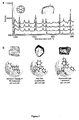
- MOF-177 crystals were placed in a C 60 -toluene solution. After several days the crystals' shape and integrity remained intact and a change in color to deep red provided optical evidence of C 60 inclusion in the framework ( Fig. 5a ).
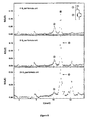
- a MOF-177-C 60 complex was analyzed by Raman spectroscopy. This vibrational spectrum was compared to spectra of bulk C 60 and to that of evacuated MOF-177.
- the encapsulated fullerene complex exhibited bands at the same positions as the desolvated MOF-177. However, the fullerene bands were broadened and observed at positions slightly shifted from bulk C 60 signaling interaction with the framework ( Fig. 5a ). Uniformity of inclusion was assessed by slicing a single crystal in three parts, thus exposing the inner core, and verifying that the middle portion was evenly colored throughout and that the Raman spectrum exhibited bands for both framework and guest ( Fig. 5a ).
- the present invention provides in one embodiment a general strategy based on exposing edges for achieving ultra-porous crystals having the highest capacity for storage of gases.
- the importance of utilizing non-self-dual nets in achieving non-interpenetrating structures and thus fully accessible large pores has also been demonstrated.
- MOF-177 is unique because it combines high surface area with ordered pore structure of extra-large diameter, which, as illustrated for dye inclusion, allows binding of large organic molecules such as petroleum fragments and drug molecules.
- MOF-5 the formation reaction for MOF-5 is 4Zn 2+ + 3H 2 BDC + 8OH - + 3 Zn 4 O(BDC) 3 ⁇ 7H 2 O.
- the MOF family also has high thermal stability (300° to 400° C).
- MOF-5 and isoreticular metal-organic framework-6 (IRMOF-6 ) ( Figure 6B ) outperform other materials in methane adsorption at ambient temperature. Accordingly, the capacity for hydrogen storage was determined.
- Hydrogen gas uptake was measured by MOF-5 at 78 K by introducing small amounts of H 2 into a chamber containing the guest free form of the material and monitoring the weight change as a function of increasing doses of H 2 .
- the measured sorption isotherm shows a type I behavior, in which the saturation is reached at low pressures followed by a pseudoplateau at higher pressure of H 2 with a maximum uptake of 13.2 mg of H 2 per gram of MOF-5.
- the observed sharp uptake of H 2 at lower pressure indicates favorable sorption interactions between the MOF-5 framework and H 2 molecules.
- H 2 sorption was evaluated in conditions that mimic a typical application environment, namely, room temperature and pressures considered safe for mobile fueling.
- a different sorption apparatus was constructed, in which a 10-g sample of guest-free MOF-5 was charged with H 2 up to 20 bar and the weight change monitored as a function of H 2 uptake and release.
- MOF-5 showed substantial H 2 uptake that increased linearly with pressure, giving 1.0 weight % at 20 bar ( Figure 7 ).
- the INS spectra for MOF-5 are shown in Figure 8 for three levels of H 2 loadings corresponding to 4, 8, and 24 H 2 per formula unit.
- the adsorption sites for H 2 in MOF-5 are well defined compared with those in zeolites, in which the molecule has a variety of binding sites available that are close in energy.
- the energy eigenvalues for the rotations of H 2 with two angular degrees of freedom in a double-minimum potential is used.
- the peaks at 10.3 and 12.1 meV can be assigned to the 0-1 transitions for the two sites. These are subsequently referred to as I and II, with the remaining peaks assigned to the 0-2 and 1-2 transitions.
- Inferences about the nature of the binding sites may also be made from the dependence of the INS spectra on H 2 loading.
- the intensity of the 12.1-meV band (site II) roughly doubles, whereas that of the 10.3-meV band (siteI) remains constant.
- Site I may be associated with Zn and site II with the BDC linkers.
- Further increases in loading (24 H 2 per formula unit) show that the line at 12.1 meV splits into four lines, which are associated with four slightly different sites with the BDC linker. This result suggests that further increases in the sorption capacity for these types of materials could be achieved by the use of larger linkers. Indeed, a small peak near 14.5 meV is observed at this high loading corresponding to a small amount of solid H 2 (for which the 0-1 transition occurs essentially at the free rotor value of 14.7 meV), indicative of saturation coverage in MOF-5.
- the barrier to rotation for the binding site near Zn is somewhat greater than those on the BDC, as one might expect, but also slightly lower than that for the extra-framework Zn 2+ cation in ZnNaA zeolite, for which the rotational transition was observed at 8 meV.
- Various factors could contribute to this difference, including different degrees of accessibility of the Zn and the strong electrostatic field in the zeolite supercage.
- the barriers found for MOF-5 are noticeably higher (0.40 and 0.24 kcal mol 1) than those found in carbons, including single-walled nanotubes, in which it is 0.025 kcal mol 1.
- the rotational band in that case has a width of nearly 2.5 meV compared with 0.5 meV in our case. This value corroborates the much lower mobility (and hence stronger in-teraction) for H 2 in MOF-5 than in carbons.
- the INS results for hydrogen in MOF-5 point to the importance of the organic linkers in determining H 2 uptake levels. Accordingly, using the same experimental setup and details outlined above for the room-temperature measurements on MOF-5, H 2 sorption in IRMOF-6 and IRMOF-8 was determined ( Figure 6 , B and C). Here, the specific H 2 uptake is found to approximately doubled and quadrupled, respectively, for IRMOF-6 and -8 relative to that found for MOF-5 at the same (room) temperature and pressure (10 bar).
- the H 2 uptake under those conditions is 20 mg of H 2 per gram (2.0 weight %)-a capacity well above those found for "active" carbon (0.1 weight %) (CECA, France) and "graphitic” carbon (0.3 weight %).
- the percent uptake found for MOF-5, IRMOF-6, and IRMOF-8 at room temperature and 10 bar is equivalent to 1.9, 4.2, and 9.1 H 2 per formula unit, respectively.
- the capacity of these structures for hydrogen at room temperature is comparable to the highest capacity achieved for carbon nanotubes at cryogenic temperatures, although the capacity of those materials is very sensitive to preparation conditions and appears to saturate at lower pressures.
- a N,N-diethylformamide (DEF) solution containing 4,4',4"-benzene-1,3,5-triyl-tri benzoic acid (H 3 BTB; 0.005 g, 1.14x10 -5 mol) and zinc nitrate hexahydrate Zn(NO 3 ) 2 ⁇ 6H 2 O (0.020 g, 6.72x10 -5 mol) was placed in a Pyrex tube (10 mm x 8 mm o.d. x i.d., 150 mm length). The sealed tube was heated at a rate of 2.0 °C/min to 100°C, held at 100°C for 23 hr, and cooled at a rate of 0.2°C/min to room temperature.
- Block-shaped yellow crystals of MOF-177 were formed and isolated by washing with DEF (4x2 ml) and drying briefly in the air (ca. 1 min) (0.005 g, 32% based on ligand).
- Anal. Calcd. for C 129 H 201 N 15 O 31 Zn 4 Zn 4 O(BTB) 2 ⁇ (15DEF)(3H 2 O): C, 56.96; H, 7.46; N, 7.73. Found: C, 56.90; H, 7.54; N, 7.67.
- FT-IR (KBr, 4000 ⁇ 400 cm -1 ): 1643(s), 1607(s), 1591(s), 1546(m), 1406(vs), 1300(w), 1263(w), 1213(w), 1180(w), 1105(w), 1017(w), 857(w), 809(w), 980(s), 708(w), 669(w).
- Zinc nitrate hexahydrate Zn(NO 3 ) 2 ⁇ 6H 2 O (3 mg, 0.01001 mmol) was dissolved in 1.2 mL of DMF.
- 5,15-bis(4-carboxyphenyl) zinc(II) porphyrin (H 2 BCPP) (1 mg, 0.00164 mmol) was dissolved in 0.2 mL DMF. Both solutions were placed in a tube which was subsequently evacuated/sealed and heated to 105°C at a rate of 5°C/min and held for 24 hr. The reaction tube was then cooled at a rate of 0.2°C/min. Cubic dark purple crystals of MOF-180 were formed.
- the crystals were transferred from their mother liquor (DMF) to heptane. After 30 minutes, the heptane was removed and fresh heptane was once again added. This process was repeated three times in order to ensure complete displacement of DMF molecules from the porous framework. The excess heptane was then removed and 1 mL of a heptane solution containing 0.007 M of each of the four bromoarenes was added. The crystals remained immersed in this solution for 90 minutes. The concentration of each bromoarene in the supernatant liquid was monitored via gas chromatography. Disappearance of material indicates adsorption of bromoarenes by MOF-177 crystals.
- MOF-177 crystals (3 - 5 mg) were placed in 0.15 mL of a saturated solution of dye in CH 2 Cl 2 . During a period of six days, the supernatant solution was removed and replaced with fresh dye solution twenty times. After the sixth day of inclusion, the crystals were removed from solution and rinsed three times with CH 2 Cl 2 . Individual crystals were precisely weighed with a microgram balance and digested in 40 to 60 ⁇ L of 0.1 N NaOH in methanol. This solution was quantitatively transferred to a 2 mL volumetric flask and methanol was added to obtain precise dilution. UV-vis absorbance analysis of the resulting solutions allowed for determination of the concentrations of the dyes and thus for the amount of dye included in the MOF-177 framework. While embodiments of the invention have been illustrated and described, it is not intended that these embodiments illustrate and describe all possible forms of the invention. Rather, the words used in the specification are words of description rather than limitation.
Landscapes
- Chemical & Material Sciences (AREA)
- Organic Chemistry (AREA)
- Engineering & Computer Science (AREA)
- Analytical Chemistry (AREA)
- Chemical Kinetics & Catalysis (AREA)
- Mechanical Engineering (AREA)
- Inorganic Chemistry (AREA)
- General Engineering & Computer Science (AREA)
- Solid-Sorbent Or Filter-Aiding Compositions (AREA)
- Organic Low-Molecular-Weight Compounds And Preparation Thereof (AREA)
- Nitrogen Condensed Heterocyclic Rings (AREA)
- Superconductors And Manufacturing Methods Therefor (AREA)
- Manufacturing Cores, Coils, And Magnets (AREA)
- Transition And Organic Metals Composition Catalysts For Addition Polymerization (AREA)
Claims (29)
- Structure métal-organique (MOF) comprenant :une pluralité d'agrégats métalliques, chaque agrégat métallique comprenant un ou plusieurs ions métalliques ; etune pluralité de ligands de liaison à plusieurs dents chargés reliant les agrégats métalliques adjacents, la pluralité de ligands de liaison à plusieurs dents comprenant au moins un ligand comportant la Formule I :ou des variantes de remplacement de la Formule I,

et comportant un nombre suffisant de sites accessibles pour l'adsorption atomique ou moléculaire, de telle manière que l'aire de la structure métal-organique soit supérieure à environ 3500 m2/g. - Structure métal-organique selon la revendication 1, comprenant également au moins un ligand qui n'est pas de liaison.
- Structure métal-organique selon la revendication 1, dans laquelle chaque agrégat métallique comprend 3 ions métalliques ou plus.
- Structure métal-organique selon la revendication 1, dans laquelle la pluralité de ligands de liaison à plusieurs dents comprend un nombre suffisant de sites accessibles pour l'adsorption atomique ou moléculaire de telle sorte que l'aire soit supérieure à environ 4000 m2/g.
- Structure métal-organique selon la revendication 1, dans laquelle chaque ligand de la pluralité de ligands à plusieurs dents comprend deux carboxylates ou plus.
- Structure métal-organique selon la revendication 1, dans laquelle l'ion métallique est sélectionné parmi le groupe composé des métaux des Groupes 1 à 16 de la Table des Eléments Périodiques IUPAC comprenant les actinides, les lanthanides, et des combinaisons de ceux-ci.
- Structure métal-organique selon la revendication 1, dans laquelle l'ion métallique est sélectionné parmi le groupe composé de Li+, Na+, K+, Rb+, Be2+, Mg2+, Ca2+, Sr2+, Ba2+ , Sc3+, Y3+ Ti4+, Zr4+, Hf4+, V4+, V3+, V2+, Nb3+, Ta3+, Cr3+, Mo3+, W3+, Mn3+, Mn2+, Re3+, Re2+, Fe3+, Fe2+, Ru3+, Ru2+, Os3+, Os2+, Co3+, Co2+, Rh2+, Rh+, Ir2+, Ir+, Ni2+, Ni+, Pd2+, Pd+, Pt2+, Pt+, Cu2+, Cu+, Ag+, Au+, Zn2+, Cd2+, Hg2+, Al3+, Ga3+, In3+, T13+, Si4+, Si2+, Ge4+, Ge2+, Sn4+, Sn2+, Pb4+, Pb2+, As5+, As3+, As+, Sb5+, Sb3+, Sb+, Bi5+, Bi3+, Bi+, et des combinaisons de ceux-ci.
- Structure métal-organique selon la revendication 1, dans laquelle l'agrégat métallique comporte la formule MmXn dans laquelle M est l'ion métallique, X est sélectionné parmi le groupe composé d'un anion des Groupes 14 à 17, m est un nombre entier de 1 à 10, et n est un nombre sélectionné pour charger à l'équilibre l'agrégat métallique de telle sorte que l'agrégat métallique ait une charge électrique prédéterminée.
- Structure métal-organique selon la revendication 8, dans laquelle X est sélectionné parmi le groupe composé de O, N, et S.
- Structure métal-organique selon la revendication 8, dans laquelle X est O et m est 4.
- Structure métal-organique selon la revendication 8, dans laquelle M est sélectionné parmi le groupe composé de Mg2+, Ca2+, Sr2+, Ba2+, V2+, V3+, V4+, V5+, Mn2+, Re2+, Fe2+, Fe3+, Ru3+, Ru2+, Os2+, Co2+, Rh2+, Ir2+, Ni2+, Pd2+, Pt2+, Cu2+, Zn2+, Cd2+, Hg2+, Si2+, G2+, Sn2+, et Pb2+.
- Structure métal-organique selon la revendication 8, dans laquelle l'agrégat métallique comporte la formule Zn4O.
- Structure métal-organique selon la revendication 1, dans laquelle le ligand qui n'est pas de liaison est sélectionné parmi le groupe composé de O2- sulfate, nitrate, nitrite, sulfite, bisulfite, phosphate, phosphate d'hydrogène, phosphate de dihydrogène, diphosphate, triphosphate, phosphite, chlore, chlorate, bromure, bromate, iodure, iodate, carbonate, bicarbonate, sulfide, sulfate d'hydrogène, séléniure, sélénate, sélénate d'hydrogène, tellurure, tellurate, tellurate d'hydrogène, nitrure, phosphure, arséniure, arsénate, arsénate d'hydrogène, arsénate de dihydrogène, antimonide, antimonate, antimonate d'hydrogène, antimonate de dihydrogène, fluorure, borure, borate, borate d'hydrogène, perchlorate, chlorite, hypochlorite, perbromate, bromite, hypobromite, periodate, iodite, hypoiodite ; et mélanges de ceux-ci.
- Structure métal-organique selon la revendication 1, comprenant également une espèce incluse.
- Structure métal-organique selon la revendication 14, dans laquelle l'espèce incluse augmente l'aire de la structure métal-organique.
- Structure métal-organique selon la revendication 14, dans laquelle l'espèce incluse est sélectionnée parmi le groupe composé de molécules organiques avec un poids moléculaire inférieur à 100 g/mol, de molécules organiques avec un poids moléculaire inférieur à 300 g/mol, de molécules organiques avec un poids moléculaire inférieur à 600 g/mol, de molécules organiques avec un poids moléculaire supérieur à 600 g/mol, de molécules organiques contenant au moins un noyau aromatique, des hydrocarbures aromatiques polycycliques, et des complexes métalliques comportant la formule MmXn dans laquelle M est l'ion métallique, X est sélectionné parmi le groupe composé d'un anion des groupes 14 à 17, m est un nombre entier de 1 à 10, et n est un nombre sélectionné pour charger à l'équilibre l'agrégat métallique de telle sorte que l'agrégat métallique ait une charge électrique prédéterminée, et des combinaisons de ceux-ci.
- Structure métal-organique selon la revendication 1, comprenant également une structure métal-organique interpénétrante qui augmente l'aire de la structure métal-organique.
- Structure métal-organique selon la revendication 1, dans laquelle chacun des ligands de liaison à plusieurs dents comprend plus de 16 atomes qui sont incorporés dans des noyaux aromatiques ou des noyaux non aromatiques.
- Structure métal-organique selon la revendication 1, dans laquelle chacun des ligands de liaison à plusieurs dents comprend plus de 20 atomes qui sont incorporés dans des noyaux aromatiques ou des noyaux non aromatiques.
- Structure métal-organique selon la revendication 1, comprenant également une espèce chimique adsorbée.
- Structure métal-organique selon la revendication 20, dans laquelle l'espèce chimique adsorbée est sélectionnée parmi le groupe composé d'ammoniac, dioxyde de carbone, monoxyde de carbone, hydrogène, amines, méthane, oxygène, argon, azote, argon, colorants organiques, molécules organiques polycycliques, et de combinaisons de ceux-ci.
- Procédé de formation d'une structure métal-organique (MOF), ledit procédé comprenant : la combinaison d'une solution comprenant un solvant et des ions métalliques sélectionnés parmi le groupe composé de métaux des Groupes 1 à 16 comprenant les actinides et les lanthanides, et de combinaisons de ceux-ci avec une pluralité de ligands de liaison à plusieurs dents, les ligands à plusieurs dents étant sélectionnés de telle manière que l'aire de la structure métal-organique soit supérieure à 3500 m2/g, les ligands à plusieurs dents comprenant au moins un ligand de la formule I :

- Procédé selon la revendication 22, dans lequel chaque ligand de la pluralité de ligands à plusieurs dents comprend 2 carboxylates ou plus.
- Procédé selon la revendication 22, dans lequel chaque ligand de liaison à plusieurs dents comprend plus de 16 atomes qui sont incorporés dans des noyaux aromatiques ou des noyaux non aromatiques.
- Procédé selon la revendication 22, dans lequel le solvant comprend un composant sélectionné parmi l'ammoniac, l'hexane, le benzène, le toluène, le xylène, le chlorobenzène, le nitrobenzène, le naphtalène, le thiophène, la pyridine, l'acétone, 1,2-dichloroéthane, chlorure de méthylène, tétrahydrofuran, éthanolamine, triéthylamine, N, N-diméthyle formamide, N, N-diéthyle formamide, méthanol, éthanol, propanol, alcools, diméthylsulfoxide, chloroforme, bromoforme, dibromométhane, iodoforme, diiodométhane, solvants organiques halogénés, N, N-diméthylacétamide, N, N-diéthylacétamide, 1-méthyl-2-pyrrolidinone, solvants d'amide, méthylpyridine, diméthylpyridine, diéthyléther, et mélanges de ceux-ci.
- Procédé selon la revendication 22, dans lequel la solution comprend également un agent de remplissage.
- Procédé selon la revendication 22, dans lequel l'agent de remplissage est sélectionné parmi le groupe composé dea. amines d'alkyle et leurs sels d'alkyl ammonium correspondants, contenant des groupes aliphatiques linéaires, ramifiés, ou cycliques, comportant de 1 à 20 atomes de carbone ;b. amines d'aryle et leurs sels d'aryl ammonium correspondants comportant de 1 à 5 anneaux phényle ;c. sels d'alkyl-phosphonium, contenant des groupes aliphatiques linéaires, ramifiés, ou cycliques, comportant de 1 à 20 atomes de carbone ;d. sels d'aryl-phosphonium, comportant de 1 à 5 anneaux phényle,e. acides organiques alkyles et leurs sels correspondants, contenant des groupes aliphatiques linéaires, ramifiés, ou cycliques, comportant de 1 à 20 atomes de carbone ;f. acides organiques d'aryle et leurs sels correspondants, comportant de 1 à 5 anneaux phényle ;g. alcools aliphatiques, contenant des groupes aliphatiques linéaires, ramifiés, ou cycliques, comportant de 1 à 20 atomes de carbone ;h. alcools d'aryle comportant de 1 à 5 anneaux phényle ;i. anions inorganiques parmi le groupe composé de sulfate, nitrate, nitrite, sulfite, bisulfite, phosphate, phosphate d'hydrogène, phosphate de dihydrogène, diphosphate, triphosphate, phosphite, chlore, chlorate, bromure, bromate, iodure, iodate, carbonate, bicarbonate, O2-, diphosphate, sulfide, sulfate d'hydrogène, séléniure, sélénate, sélénate d'hydrogène, tellurure, tellurate, hydrogène tellurate, nitrure, phosphure, arséniure, arsénate, arsénate d'hydrogène, arsénate de dihydrogène, antimonide, antimonate, antimonate d'hydrogène, antimonate de dihydrogène, fluorure, borure, borate, borate d'hydrogène, perchlorate, chlorite, hypochlorite, perbromate, bromite, hypobromite, periodate, iodite, hypoiodite, et les acides et sels correspondants desdits anions inorganiques ;j. ammoniac, dioxyde de carbone, méthane, oxygène, argon, azote, éthylène, hexane, benzène, toluène, xylène, chlorobenzène, nitrobenzène, naphtalène, thiophène, pyridine, acétone, 1,2-dichloroéthane, chlorure de méthylène, tétrahydrofuran, ethanolamine, triéthylamine, acide trifluorométhylsulfonique, N, N-diméthyle formamide, N, N-diéthyle formamide, diméthylsulfoxide, chloroforme, bromoforme, dibromométhane, iodoforme, diiodométhane, solvants organiques halogénés, N, N-diméthylacétamide, N, N-diéthylacétamide, 1-méthyl-2- pyrrolidinone, solvants amide, méthylpyridine, diméthylpyridine, diéthyléther, et mélanges de ceux-ci.
- Procédé selon la revendication 22, comprenant également la mise en contact de la structure métal-organique avec une espèce incluse, de telle manière que l'espèce incluse devienne au moins partiellement incorporée à l'intérieur de la structure métal-organique.
- Procédé d'adsorption d'une espèce incluse avec une structure métal-organique, le procédé comprenant:la mise en contact d'une structure métal-organique avec une espèce incluse, la structure métal-organique comportant des groupes inorganiques [OZn4]6+ joints aux ligands à plusieurs dents qui comprennent 1 ou 2 groupes de noyau aromatique substitués ou non substitués, dans laquelle la structure métal-organique comprend:une pluralité d'agrégats métalliques, chaque agrégat métallique comprenant un ou plusieurs ions métalliques ; etune pluralité de ligands de liaison à plusieurs dents chargés qui raccordent les agrégats métalliques adjacents, la pluralité de ligands de liaison à plusieurs dents comportant un nombre suffisant de sites accessibles pour l'adsorption atomique ou moléculaire, de telle manière que l'aire de la structure métal-organique soit supérieure à environ 3500 m2/g et comprenant au moins un ligand comportant la Formule I :ou des variantes de remplacement de la Formule I.

Applications Claiming Priority (3)
| Application Number | Priority Date | Filing Date | Title |
|---|---|---|---|
| US46948303P | 2003-05-09 | 2003-05-09 | |
| US52751103P | 2003-12-05 | 2003-12-05 | |
| PCT/US2004/014465 WO2004101575A2 (fr) | 2003-05-09 | 2004-05-07 | Mise en oeuvre d'une strategie visant a obtenir des niveaux extraordinaires de superficie et de porosite dans des cristaux |
Publications (2)
| Publication Number | Publication Date |
|---|---|
| EP1633760A2 EP1633760A2 (fr) | 2006-03-15 |
| EP1633760B1 true EP1633760B1 (fr) | 2010-05-05 |
Family
ID=33457144
Family Applications (1)
| Application Number | Title | Priority Date | Filing Date |
|---|---|---|---|
| EP04751727A Expired - Lifetime EP1633760B1 (fr) | 2003-05-09 | 2004-05-07 | MOFs avec une surface haute et methode pour leur preparation |
Country Status (9)
| Country | Link |
|---|---|
| US (1) | US7652132B2 (fr) |
| EP (1) | EP1633760B1 (fr) |
| JP (1) | JP4937749B2 (fr) |
| KR (2) | KR101278432B1 (fr) |
| AT (1) | ATE466865T1 (fr) |
| CA (1) | CA2524903A1 (fr) |
| DE (1) | DE602004027036D1 (fr) |
| ES (1) | ES2345716T3 (fr) |
| WO (1) | WO2004101575A2 (fr) |
Families Citing this family (119)
| Publication number | Priority date | Publication date | Assignee | Title |
|---|---|---|---|---|
| US6929679B2 (en) * | 2002-02-01 | 2005-08-16 | Basf Aktiengesellschaft | Method of storing, uptaking, releasing of gases by novel framework materials |
| CA2524903A1 (fr) | 2003-05-09 | 2004-11-25 | The Regents Of The University Of Michigan | Mise en oeuvre d'une strategie visant a obtenir des niveaux extraordinaires de superficie et de porosite dans des cristaux |
| JP2007518707A (ja) * | 2003-12-05 | 2007-07-12 | ザ リージェンツ オブ ザ ユニバーシティ オブ ミシガン | 金属有機多面体 |
| ES2391404T3 (es) | 2004-10-22 | 2012-11-26 | The Regents Of The University Of Michigan | Estructuras y poliedros orgánicos enlazados covalentemente |
| JP5113321B2 (ja) * | 2005-02-08 | 2013-01-09 | 本田技研工業株式会社 | 有被膜錯体凝集体の製造方法 |
| US7343747B2 (en) * | 2005-02-23 | 2008-03-18 | Basf Aktiengesellschaft | Metal-organic framework materials for gaseous hydrocarbon storage |
| DE102005012087A1 (de) | 2005-03-16 | 2006-09-21 | Basf Ag | Flüssigkeitsabsorption durch metallorganische Gerüstmaterialien |
| US7662746B2 (en) * | 2005-04-07 | 2010-02-16 | The Regents Of The University Of Michigan | High gas adsorption metal-organic framework |
| DE602006002943D1 (de) * | 2005-09-21 | 2008-11-13 | Goodyear Tire & Rubber | Luftreifen umfassend eine Kautschukkomponente enthaltend ein zinkorganisches Gerüstmaterial |
| US7799120B2 (en) * | 2005-09-26 | 2010-09-21 | The Regents Of The University Of Michigan | Metal-organic frameworks with exceptionally high capacity for storage of carbon dioxide at room-temperature |
| US8123834B2 (en) * | 2005-10-06 | 2012-02-28 | The Board Of Trustees Of The University Of Illinois | High gain selective metal organic framework preconcentrators |
| JP2009528251A (ja) | 2006-02-28 | 2009-08-06 | ザ リージェンツ オブ ザ ユニバーシティ オブ ミシガン | 機能性ゼオライト骨格の作製 |
| AU2007222441A1 (en) * | 2006-03-09 | 2007-09-13 | Basf Se | Closed reversible breathing apparatus having a metal organic framework |
| KR100806586B1 (ko) * | 2006-03-10 | 2008-02-28 | 한국화학연구원 | 수분의 흡착 및 탈착을 위한 흡착제 |
| GB2437063A (en) * | 2006-04-10 | 2007-10-17 | Uni I Oslo | A process for oxide gas capture |
| US7880026B2 (en) | 2006-04-14 | 2011-02-01 | The Board Of Trustees Of The University Of Illinois | MOF synthesis method |
| GB0616350D0 (en) * | 2006-08-17 | 2006-09-27 | Univ St Andrews | Adsorption and release of nitric oxide in metal organic frameworks |
| US7441574B2 (en) | 2006-08-17 | 2008-10-28 | The Goodyear Tire & Rubber Company | Pneumatic tire |
| US8110026B2 (en) * | 2006-10-06 | 2012-02-07 | The Trustees Of Princeton University | Functional graphene-polymer nanocomposites for gas barrier applications |
| EP1914289B1 (fr) * | 2006-10-20 | 2009-12-16 | Consejo Superior De Investigaciones Cientificas | Matériau organique poreux hautement hydrophobe ayant des propriétés fluorescentes et magnetiques |
| FR2910457B1 (fr) * | 2006-12-22 | 2009-03-06 | Inst Francais Du Petrole | Procede de purification par adsorption d'hydrogene avec cogeneration d'un flux de co2 en pression |
| KR101002571B1 (ko) | 2007-01-03 | 2010-12-17 | 주식회사 인실리코텍 | 다공성 금속-유기 골격 구조를 갖는 배위중합체 결정 및이의 제조방법 |
| EP2114560A4 (fr) * | 2007-01-24 | 2012-02-15 | Univ California | Structures organiques covalentes bidimensionnelles et tridimensionnelles cristallines |
| US7687432B2 (en) * | 2007-02-02 | 2010-03-30 | Miami University | Mesh-adjustable molecular sieve |
| WO2008140788A1 (fr) | 2007-05-11 | 2008-11-20 | The Regents Of The University Of California | Séparation de gaz d'adsorption de gaz multi-composants |
| US8480792B2 (en) | 2007-07-17 | 2013-07-09 | The Regents Of The University Of California | Preparation of functionalized zeolitic frameworks |
| US9132411B2 (en) | 2007-08-30 | 2015-09-15 | The Regents Of The University Of Michigan | Strategies, linkers and coordination polymers for high-performance sorbents |
| US8222179B2 (en) * | 2007-08-30 | 2012-07-17 | The Regents Of The University Of Michigan | Porous coordination copolymers and methods for their production |
| US8383545B2 (en) * | 2007-08-30 | 2013-02-26 | The Regents Of The University Of Michigan | Strategies, linkers and coordination polymers for high-performance sorbents |
| JP5730574B2 (ja) * | 2007-09-25 | 2015-06-10 | ザ リージェンツ オブ ザ ユニバーシティ オブ カリフォルニア | 食用に適した生体適合性金属有機構造体 |
| KR100832309B1 (ko) * | 2007-11-21 | 2008-05-26 | 한국과학기술원 | 금속 양이온이 도핑된 수소저장용 유기물질 골격구조 물질유도체 및 그의 사용방법 |
| US8123841B2 (en) * | 2008-01-16 | 2012-02-28 | The Board Of Trustees Of The University Of Illinois | Column design for micro gas chromatograph |
| KR100906391B1 (ko) * | 2008-02-20 | 2009-07-07 | 한양대학교 산학협력단 | 금속-유기 구조체 및 그 제조방법 |
| US8142745B2 (en) | 2008-02-21 | 2012-03-27 | Exxonmobil Research And Engineering Company | Separation of carbon dioxide from nitrogen utilizing zeolitic imidazolate framework materials |
| US8192709B2 (en) * | 2008-02-21 | 2012-06-05 | Exxonmobil Research And Engineering Company | Separation of methane from higher carbon number hydrocarbons utilizing zeolitic imidazolate framework materials |
| US8142746B2 (en) | 2008-02-21 | 2012-03-27 | Exxonmobil Research And Engineering Company | Separation of carbon dioxide from methane utilizing zeolitic imidazolate framework materials |
| US8269029B2 (en) | 2008-04-08 | 2012-09-18 | The Board Of Trustees Of The University Of Illinois | Water repellent metal-organic frameworks, process for making and uses regarding same |
| GB0807862D0 (en) | 2008-04-29 | 2008-06-04 | Uni I Oslo | Compounds |
| DE102009021479A1 (de) * | 2008-06-04 | 2010-09-16 | RUHR-UNIVERSITäT BOCHUM | Verfahren zur Herstellung von oxidbasierten metall-organischen Gerüstmaterialien mittels inverser Synthese |
| US8946454B2 (en) * | 2008-06-05 | 2015-02-03 | The Regents Of The University Of California | Chemical framework compositions and methods of use |
| US8227375B2 (en) | 2008-09-12 | 2012-07-24 | Uop Llc | Gas adsorption on metal-organic frameworks |
| CN101722056B (zh) * | 2008-10-24 | 2011-11-30 | 中国科学院大连化学物理研究所 | 一种非负载型硼化物催化剂的制备方法 |
| US9512145B2 (en) | 2008-12-18 | 2016-12-06 | The Regents Of The University Of California | Porous reactive framework |
| US8480955B2 (en) | 2008-12-29 | 2013-07-09 | The Regents Of The University Of California | Gas sensor incorporating a porous framework |
| US8500889B2 (en) * | 2009-01-05 | 2013-08-06 | Commonwealth Scientific And Industrial Research Organisation | Gas adsorption material |
| WO2010083418A1 (fr) | 2009-01-15 | 2010-07-22 | The Regents Of The University Of California | Structure organométallique conductrice |
| WO2010088629A1 (fr) | 2009-02-02 | 2010-08-05 | The Regents Of The University Of California | Capture d'oxyde d'éthylène réversible dans des structures poreuses |
| KR101337509B1 (ko) | 2009-05-22 | 2013-12-05 | 고려대학교 산학협력단 | 3d 형태의 다공성 구리계 아마이드 배위 고분자 화합물의 제조방법 및 이를 포함하는 기체 흡착제 |
| KR20120099204A (ko) | 2009-06-19 | 2012-09-07 | 더 리전트 오브 더 유니버시티 오브 캘리포니아 | 복잡한 혼합된 리간드 개방 골격체 물질 |
| EP2437867A4 (fr) | 2009-06-19 | 2012-12-05 | Univ California | Capture du dioxyde de carbone, et son stockage par utilisation de cadres ouverts |
| EP2403815A1 (fr) | 2009-07-27 | 2012-01-11 | The Regents of The University of California | Réactions d'homocouplage d'oxydation d'acides boroniques d'aryle utilisant une structure poreuse organique à base de cuivre comme catalyseur hétérogène extrêmement efficace |
| EP2292741A1 (fr) | 2009-08-26 | 2011-03-09 | OrganoBalance GmbH | Organismes modifiés génétiquement pour la production de lipides |
| EP2467388A4 (fr) * | 2009-09-25 | 2014-12-17 | Univ California | Structures organiques ouvertes en métal avec aire de surface exceptionnelle et grande capacité de stockage de gaz |
| WO2011069541A1 (fr) * | 2009-12-09 | 2011-06-16 | Technische Universität Bergakademie Freiberg | Procédé de production de matériaux structuraux organométalliques à base d'oxyde par intégration d'oxyde avec contrôle de la teneur en eau |
| AU2011256793A1 (en) * | 2010-02-12 | 2012-08-09 | Basf Se | Organo-metallic frameworks derived from carbenophilic metals and method of making same |
| WO2011123795A1 (fr) | 2010-04-02 | 2011-10-06 | Battelle Memorial Institute | Procédés permettant d'associer des matériaux hôtes à un structurant organique métallique ou de les en dissocier, systèmes permettant d'associer des matériaux hôtes à une série de structurants organiques métalliques ou de les en dissocier, et ensembles séparation de gaz |
| US9147920B2 (en) * | 2010-07-01 | 2015-09-29 | Ford Global Technologies, Llc | Metal oxygen battery containing oxygen storage materials |
| US20110143226A1 (en) * | 2010-07-01 | 2011-06-16 | Ford Global Technologies, Llc | Metal Oxygen Battery Containing Oxygen Storage Materials |
| US8658319B2 (en) * | 2010-07-01 | 2014-02-25 | Ford Global Technologies, Llc | Metal oxygen battery containing oxygen storage materials |
| US8968942B2 (en) * | 2010-07-01 | 2015-03-03 | Ford Global Technologies, Llc | Metal oxygen battery containing oxygen storage materials |
| US9209503B2 (en) * | 2010-07-01 | 2015-12-08 | Ford Global Technologies, Llc | Metal oxygen battery containing oxygen storage materials |
| CN103347885A (zh) | 2010-07-20 | 2013-10-09 | 加利福尼亚大学董事会 | 使用金属有机骨架(mof)作为催化剂对有机分子的官能化 |
| CA2812294A1 (fr) | 2010-09-27 | 2012-06-21 | The Regents Of The University Of California | Cadres ouverts conducteurs |
| BR112013018614A2 (pt) | 2011-01-21 | 2016-10-18 | Univ California | esqueleto met, método para separar ou armazenar um ou mais gases, dispositivo, condutor elétrico, catalisador, e, sensor químico |
| CN103459404B (zh) | 2011-02-04 | 2016-08-31 | 加利福尼亚大学董事会 | 金属儿茶酚化物骨架的制备 |
| DE102011012734B4 (de) * | 2011-02-24 | 2013-11-21 | Mainrad Martus | Verfahren zur reversiblen Speicherung von Wasserstoff und anderer Gase sowie elektrischer Energie in Kohlenstoff-, Hetero- oder Metallatom-basierten Kondensatoren und Doppelschichtkondensatoren unter Standardbedingungen (300 K, 1atm) |
| EP2721032A4 (fr) * | 2011-06-16 | 2014-11-05 | Univ South Florida | Structures métalloporphyrines contenant une cage polyédrique, procédés de fabrication et d'utilisation |
| WO2013009701A2 (fr) | 2011-07-08 | 2013-01-17 | The University Of North Carolina At Chapel Hill | Nanoparticules de métal-bisphosphonate pour thérapie anticancéreuse et imagerie, ainsi que pour traiter des troubles des os |
| EP2766046B1 (fr) | 2011-10-13 | 2017-08-02 | The Regents of The University of California | Réseaux métal-organiques présentant des ouvertures à pores exceptionnellement grands |
| US10139169B2 (en) | 2011-10-21 | 2018-11-27 | Massachusetts Institute Of Technology | Adsorption system |
| US9322510B2 (en) | 2012-10-09 | 2016-04-26 | Basf Se | Method of charging a sorption store with a gas |
| US9273829B2 (en) | 2012-10-09 | 2016-03-01 | Basf Se | Sorption store for storing gaseous substances |
| US9243754B2 (en) | 2012-10-09 | 2016-01-26 | Basf Se | Method of charging a sorption store with a gas |
| WO2014057382A1 (fr) * | 2012-10-09 | 2014-04-17 | Basf Se | Procédé de chargement d'un accumulateur de sorption avec un gaz |
| JP2014193814A (ja) * | 2013-03-28 | 2014-10-09 | Jx Nippon Oil & Energy Corp | 多孔性金属錯体 |
| US9597658B2 (en) | 2013-04-01 | 2017-03-21 | Savannah River Nuclear Solutions, Llc | Metal-organic framework templated synthesis of porous inorganic materials as novel sorbents |
| MY209466A (en) | 2013-08-05 | 2025-07-10 | Numat Tech Inc | Metal organic frameworks for electronic gas storage |
| US9266907B2 (en) * | 2013-09-05 | 2016-02-23 | King Abdullah University Of Science And Technology | Tunable rare-earth fcu-metal-organic frameworks |
| WO2015066693A1 (fr) | 2013-11-04 | 2015-05-07 | The Regents Of Thd University Of California | Réseaux métallo-organiques à densité élevée de sites de cations métalliques exposés fortement chargés |
| ES2768680T3 (es) | 2014-02-19 | 2020-06-23 | Univ California | Armazones organometálicos que tienen resistencia a los ácidos, a los disolventes, y térmica |
| WO2015129685A1 (fr) * | 2014-02-26 | 2015-09-03 | 国立大学法人京都大学 | Polymère de coordination poreux et son application |
| WO2015142944A2 (fr) | 2014-03-18 | 2015-09-24 | The Regents Of The University Of California | Matériaux mésoscopiques constitués de super-réseaux ordonnés de réseaux métal-organiques microporeux |
| US10087205B2 (en) | 2014-03-28 | 2018-10-02 | The Regents Of The University Of California | Metal organic frameworks comprising a plurality of SBUS with different metal ions and/or a plurality of organic linking ligands with different functional groups |
| US9541032B2 (en) * | 2014-05-16 | 2017-01-10 | Adsorbed Natural Gas Products, Inc. | Sorbent-based low pressure gaseous fuel delivery system |
| US10273209B2 (en) | 2014-05-26 | 2019-04-30 | King Abdullah University Of Science And Technology | Design, synthesis and characterization of metal organic frameworks |
| WO2016061256A1 (fr) * | 2014-10-14 | 2016-04-21 | The University Of Chicago | Nanoparticules pour thérapie photodynamique, thérapie photodynamique induite par rayons x, radiothérapie, chimiothérapie, immunothérapie, et toute combinaison de celles-ci |
| US10806694B2 (en) | 2014-10-14 | 2020-10-20 | The University Of Chicago | Nanoparticles for photodynamic therapy, X-ray induced photodynamic therapy, radiotherapy, radiodynamic therapy, chemotherapy, immunotherapy, and any combination thereof |
| US10118877B2 (en) | 2014-12-03 | 2018-11-06 | The Regents Of The University Of California | Metal-organic frameworks for aromatic hydrocarbon separations |
| US10058855B2 (en) | 2015-05-14 | 2018-08-28 | The Regents Of The University Of California | Redox-active metal-organic frameworks for the catalytic oxidation of hydrocarbons |
| US10597408B2 (en) | 2015-11-27 | 2020-03-24 | The Regents Of The University Of California | Covalent organic frameworks with a woven structure |
| KR20180087369A (ko) | 2015-11-27 | 2018-08-01 | 더 리젠츠 오브 더 유니버시티 오브 캘리포니아 | 제올라이트 이미다졸레이트 프레임워크 |
| CN105642346A (zh) * | 2015-12-25 | 2016-06-08 | 中国科学院福建物质结构研究所 | 银纳米晶负载型催化剂及其制备方法和用途 |
| US11246877B2 (en) | 2016-05-20 | 2022-02-15 | The University Of Chicago | Nanoparticles for chemotherapy, targeted therapy, photodynamic therapy, immunotherapy, and any combination thereof |
| DE102017100361A1 (de) * | 2017-01-10 | 2018-07-12 | Audi Ag | Wasserstoffspeichertank und Brennstoffzellensystem sowie Kraftfahrzeug mit einem solchen |
| CN106748994A (zh) * | 2017-02-06 | 2017-05-31 | 辽宁大学 | 基于YbIII的五核分子结构单元的金属有机框架材料及其制备方法和应用 |
| US10113696B1 (en) | 2017-06-30 | 2018-10-30 | Adsorbed Natural Gas Products, Inc. | Integrated on-board low-pressure adsorbed natural gas storage system for an adsorbed natural gas vehicle |
| WO2019028250A1 (fr) * | 2017-08-02 | 2019-02-07 | The University Of Chicago | Couches organométalliques nanométriques et nanoplaques organométalliques pour thérapie photodynamique induite par rayons x, radiothérapie, thérapie rodiodynamique, chimiothérapie, immunothérapie, et toute combinaison de celles-ci |
| CN107556484B (zh) * | 2017-08-14 | 2020-11-10 | 常州大学 | 具有催化乙交酯开环聚合性能的锌配位聚合物及制备方法 |
| CN109847451A (zh) * | 2017-11-30 | 2019-06-07 | 江苏宇之源新能源科技有限公司 | 一种新型滤网材料 |
| WO2019158932A1 (fr) | 2018-02-15 | 2019-08-22 | The Chancellor, Masters And Scholars Of The University Of Cambridge | Dispositif de réacteur continu à cisaillement constant |
| CN108579686B (zh) * | 2018-05-30 | 2020-04-24 | 天津工业大学 | 超微孔金属-有机骨架材料在氢的同位素分离中的应用 |
| CN108911009B (zh) * | 2018-07-24 | 2020-08-21 | 湖南大学 | 利用镍掺杂金属有机骨架材料去除水体中抗生素的方法 |
| GB201813439D0 (en) | 2018-08-17 | 2018-10-03 | Univ Tartu | Novel catalytic materials |
| CN109485865A (zh) * | 2018-11-14 | 2019-03-19 | 江苏师范大学 | 一种用于吸附苯酚的金属-有机骨架材料 |
| JP7370016B2 (ja) * | 2019-02-04 | 2023-10-27 | パナソニックIpマネジメント株式会社 | 光応答性酸素貯蔵材料 |
| CN110655342A (zh) * | 2019-09-03 | 2020-01-07 | 浙江大学 | 一种能够吸收和固化封存二氧化碳的改性赤泥及其制备方法 |
| CN110690054B (zh) * | 2019-09-05 | 2021-12-10 | 山东科技大学 | 一种用于超级电容器的原子级分散锌碳氮材料的制备方法 |
| CN111138680B (zh) * | 2020-01-19 | 2021-08-03 | 福建医科大学 | 具有抑菌活性的稀土金属有机框架材料及其制备方法 |
| KR20250156832A (ko) | 2020-03-31 | 2025-11-03 | 누맷 테크놀로지스, 인코포레이티드 | 변형된 금속 유기 프레임워크(mof) 조성물, 이의 제조 방법 및 사용 방법 |
| WO2021202574A1 (fr) | 2020-03-31 | 2021-10-07 | Numat Technologies Inc. | Compositions à structure organométallique (mof) contenant des acides amines activés, procédé de fabrication et procédé d'utilisation de celles-ci |
| CN114479094B (zh) * | 2020-10-26 | 2023-03-03 | 中国石油化工股份有限公司 | 金属-有机骨架储氢材料及其制备方法和应用 |
| CN114534518B (zh) * | 2022-01-27 | 2023-01-24 | 清华大学 | 一种富勒烯修饰的MOFs膜及其在氦气分离方面的应用 |
| CN114370603B (zh) * | 2022-01-30 | 2024-05-10 | 北京东方红升新能源应用技术研究院有限公司 | 一种高压储氢方法、装置及系统 |
| CN114427657B (zh) * | 2022-01-30 | 2024-06-07 | 北京东方红升新能源应用技术研究院有限公司 | 一种高压储氢方法及气瓶 |
| CN114740169B (zh) * | 2022-04-13 | 2023-08-15 | 河北地质大学 | 一种水环境治理监测装置 |
| CN115433365A (zh) * | 2022-09-05 | 2022-12-06 | 陕西科技大学 | 一种mof-5材料及其制备方法 |
| US20240261720A1 (en) * | 2023-02-07 | 2024-08-08 | The Regents Of The University Of California | Methods using ligand insertion mechanism for ammonia capture and storage in metal-organic frameworks |
| CN119514418B (zh) * | 2024-11-12 | 2025-08-08 | 自然资源部油气资源战略研究中心 | 一种孔隙中的水桥识别方法 |
| CN119751902B (zh) * | 2024-12-16 | 2026-01-13 | 生态环境部南京环境科学研究所 | 抗干扰型银钒金属-有机框架衍生材料及制备方法和应用 |
Family Cites Families (43)
| Publication number | Priority date | Publication date | Assignee | Title |
|---|---|---|---|---|
| US3144418A (en) * | 1959-08-17 | 1964-08-11 | Union Carbide Corp | Polymerization of epoxides |
| FR2457709A1 (fr) * | 1979-05-29 | 1980-12-26 | Anvar | Nouveaux agents d'adsorption de gaz utiles en particulier pour separer de l'hydrogene d'une phase le renfermant |
| US5321269A (en) * | 1990-04-24 | 1994-06-14 | Hitachi, Ltd. | Neutron individual dose meter, neutron dose rate meter, neutron detector and its method of manufacture |
| DE69306607D1 (de) | 1992-02-20 | 1997-01-30 | Arco Chem Tech | Reinigung von niedrigem Alkylenoxyd |
| DE4408772B4 (de) | 1993-03-16 | 2006-09-07 | Mitsubishi Chemical Corp. | Verfahren zur Herstellung eines Polyoxyalkylenglykols und neues Metallaluminosilikat |
| GB9415584D0 (en) * | 1994-08-02 | 1994-09-21 | Imperial College | Photo detector |
| NZ280962A (en) | 1995-02-13 | 1997-03-24 | Osaka Gas Co Ltd | Biphenyl dicarboxylic acid copper complex, use as methane absorbing-retaining agent, and use in gas storage apparatus |
| FR2731832B1 (fr) * | 1995-03-14 | 1997-04-18 | Commissariat Energie Atomique | Dispositif de microcollimation de particules, detecteur et procede de detection de particules, procede de fabrication et utilisation dudit dispositif de microcollimation |
| DE19532415C2 (de) * | 1995-09-01 | 1998-10-15 | Forschungszentrum Juelich Gmbh | Verfahren zum Betreiben eines Neutronendetektors sowie Neutronendetektor |
| US5648508A (en) * | 1995-11-22 | 1997-07-15 | Nalco Chemical Company | Crystalline metal-organic microporous materials |
| US5780233A (en) | 1996-06-06 | 1998-07-14 | Wisconsin Alumni Research Foundation | Artificial mismatch hybridization |
| DE19723950A1 (de) | 1997-06-06 | 1998-12-10 | Basf Ag | Verfahren zur Oxidation einer mindestens eine C-C-Doppelbindung aufweisenden organischen Verbindung |
| WO1999005151A1 (fr) | 1997-07-25 | 1999-02-04 | Isis Innovation Limited | Produits solides poreux a base de 1,3,5-benzenetricarboxylate et d'ions metalliques |
| US5940460A (en) * | 1997-09-15 | 1999-08-17 | The United States Of America As Represented By The United States Department Of Energy | Solid state neutron detector array |
| US6312902B1 (en) * | 1998-03-13 | 2001-11-06 | Promega Corporation | Nucleic acid detection |
| DE19835907A1 (de) * | 1998-08-07 | 2000-02-17 | Basf Ag | Verfahren zur Umsetzung einer organischen Verbindung mit einem Hydroperoxid |
| DE19847629A1 (de) | 1998-10-15 | 2000-04-20 | Basf Ag | Verfahren zur Oxidation einer mindestens eine C-C-Doppelbindung aufweisenden organischen Verbindung |
| DE19928156A1 (de) | 1999-06-19 | 2000-12-28 | Bayer Ag | Aus Polyetherpolyolen hergestellte Polyurethan-Weichschäume |
| DE19936547A1 (de) | 1999-08-04 | 2001-02-15 | Basf Ag | Verfahren zur Umsetzung einer organischen Verbindung mit einem Hydroperoxid |
| DE19941242A1 (de) | 1999-08-31 | 2001-03-08 | Basf Ag | Polyetheralkohole |
| DE19949092A1 (de) | 1999-10-12 | 2001-04-19 | Basf Ag | Verfahren zur Herstellung von Polyetheralkoholen |
| DE10015246A1 (de) * | 2000-03-28 | 2001-10-04 | Basf Ag | Verfahren zur Umsetzung einer organischen Verbindung mit einem Hydroperoxid |
| JP4737845B2 (ja) * | 2000-04-04 | 2011-08-03 | 大阪瓦斯株式会社 | 新規三次元型有機金属錯体及びガス吸着材 |
| DE10032884A1 (de) | 2000-07-06 | 2002-01-24 | Basf Ag | Verfahren zur Herstellung von Propylenoxid |
| DE10032885A1 (de) | 2000-07-06 | 2002-01-17 | Basf Ag | Verfahren zur Herstellung von Propylenoxid |
| US6479826B1 (en) * | 2000-11-22 | 2002-11-12 | The United States Of America As Represented By The United States Department Of Energy | Coated semiconductor devices for neutron detection |
| US6965026B2 (en) * | 2001-02-23 | 2005-11-15 | University Of South Florida | Nanoscale faceted polyhedra |
| DE10111230A1 (de) * | 2001-03-08 | 2002-09-19 | Basf Ag | Metallorganische Gerüstmaterialien und Verfahren zu deren Herstellung |
| EP1383775B1 (fr) | 2001-04-30 | 2006-08-02 | The Regents of The University of Michigan | Structures organometalliques isoreticulaires, procede d'obtention, et conception systematique du calibre des pores et fonctionnalites integrees, avec application pour le stockage des gaz |
| US6545281B1 (en) * | 2001-07-06 | 2003-04-08 | The United States Of America As Represented By The United States Department Of Energy | Pocked surface neutron detector |
| EP1280090A1 (fr) | 2001-07-27 | 2003-01-29 | iSenseIt AG | Méthode pour la configuration des analyses de séquences d'acides nucléiques parallèles |
| DE10143195A1 (de) | 2001-09-04 | 2003-03-20 | Basf Ag | Integriertes Verfahren zur Herstellung von Polyurethan-Schäumen |
| US20030078311A1 (en) * | 2001-10-19 | 2003-04-24 | Ulrich Muller | Process for the alkoxylation of organic compounds in the presence of novel framework materials |
| KR20030042581A (ko) | 2001-11-23 | 2003-06-02 | 삼성전자주식회사 | 대립유전자-특이적 프라이머 연장반응에서 프라이머간의 식별을 증가시키는 방법 |
| US6929679B2 (en) * | 2002-02-01 | 2005-08-16 | Basf Aktiengesellschaft | Method of storing, uptaking, releasing of gases by novel framework materials |
| JP2004024247A (ja) | 2002-04-30 | 2004-01-29 | Internatl Reagents Corp | 遺伝子変異検出用プローブ及び遺伝子変異検出方法 |
| US6624318B1 (en) * | 2002-05-30 | 2003-09-23 | Basf Aktiengesellschaft | Process for the epoxidation of an organic compound with oxygen or an oxygen-delivering compounds using catalysts containing metal-organic frame-work materials |
| US6893564B2 (en) * | 2002-05-30 | 2005-05-17 | Basf Aktiengesellschaft | Shaped bodies containing metal-organic frameworks |
| US6617467B1 (en) * | 2002-10-25 | 2003-09-09 | Basf Aktiengesellschaft | Process for producing polyalkylene carbonates |
| US7008607B2 (en) * | 2002-10-25 | 2006-03-07 | Basf Aktiengesellschaft | Process for preparing hydrogen peroxide from the elements |
| AU2003295754A1 (en) * | 2002-11-20 | 2004-06-15 | Rutgers, The State University | Porous polymeric coordination compounds |
| CA2524903A1 (fr) | 2003-05-09 | 2004-11-25 | The Regents Of The University Of Michigan | Mise en oeuvre d'une strategie visant a obtenir des niveaux extraordinaires de superficie et de porosite dans des cristaux |
| US7309380B2 (en) * | 2003-06-30 | 2007-12-18 | Basf Aktiengesellschaft | Gas storage system |
-
2004
- 2004-05-07 CA CA002524903A patent/CA2524903A1/fr not_active Abandoned
- 2004-05-07 AT AT04751727T patent/ATE466865T1/de not_active IP Right Cessation
- 2004-05-07 DE DE602004027036T patent/DE602004027036D1/de not_active Expired - Lifetime
- 2004-05-07 EP EP04751727A patent/EP1633760B1/fr not_active Expired - Lifetime
- 2004-05-07 JP JP2006532890A patent/JP4937749B2/ja not_active Expired - Fee Related
- 2004-05-07 KR KR1020117030959A patent/KR101278432B1/ko not_active Expired - Fee Related
- 2004-05-07 US US10/841,983 patent/US7652132B2/en not_active Expired - Fee Related
- 2004-05-07 ES ES04751727T patent/ES2345716T3/es not_active Expired - Lifetime
- 2004-05-07 KR KR1020057021056A patent/KR101186764B1/ko not_active Expired - Fee Related
- 2004-05-07 WO PCT/US2004/014465 patent/WO2004101575A2/fr not_active Ceased
Also Published As
| Publication number | Publication date |
|---|---|
| ES2345716T3 (es) | 2010-09-30 |
| KR20120006083A (ko) | 2012-01-17 |
| US7652132B2 (en) | 2010-01-26 |
| WO2004101575A3 (fr) | 2005-06-16 |
| DE602004027036D1 (de) | 2010-06-17 |
| US20040225134A1 (en) | 2004-11-11 |
| ATE466865T1 (de) | 2010-05-15 |
| JP4937749B2 (ja) | 2012-05-23 |
| KR101278432B1 (ko) | 2013-07-04 |
| EP1633760A2 (fr) | 2006-03-15 |
| JP2007516221A (ja) | 2007-06-21 |
| KR101186764B1 (ko) | 2012-09-28 |
| KR20060036051A (ko) | 2006-04-27 |
| CA2524903A1 (fr) | 2004-11-25 |
| WO2004101575A2 (fr) | 2004-11-25 |
Similar Documents
| Publication | Publication Date | Title |
|---|---|---|
| US7652132B2 (en) | Implementation of a strategy for achieving extraordinary levels of surface area and porosity in crystals | |
| Snyder et al. | A ligand insertion mechanism for cooperative NH3 capture in metal–organic frameworks | |
| Chen et al. | Synthesis of nitrogen-containing covalent organic framework with reversible iodine capture capability | |
| US20050124819A1 (en) | Metal-organic polyhedra | |
| Barnett et al. | Observation of an Intermediate to H2 Binding in a Metal–organic Framework | |
| Moon et al. | Porous metal− organic framework with coordinatively unsaturated MnII sites: sorption properties for various gases | |
| Park et al. | Mixed‐Ligand Metal–Organic Frameworks with Large Pores: Gas Sorption Properties and Single‐Crystal‐to‐Single‐Crystal Transformation on Guest Exchange | |
| Xiao et al. | Selective, tunable O2 binding in cobalt (II)–triazolate/pyrazolate metal–organic frameworks | |
| Park et al. | A Highly Porous Metal–Organic Framework: Structural Transformations of a Guest‐Free MOF Depending on Activation Method and Temperature | |
| US20100186588A1 (en) | Preparation of functionalized zeolitic frameworks | |
| US8841471B2 (en) | Open metal organic frameworks with exceptional surface area and high gas storage capacity | |
| Yang et al. | Pore with Gate: Enhancement of the Isosteric Heat of Adsorption of Dihydrogen via Postsynthetic Cation Exchange in Metal− Organic Frameworks | |
| Xiao et al. | Nanoporous metal organic framework materials for hydrogen storage | |
| Bratsos et al. | Heterometallic in (iii)–pd (ii) porous metal–organic framework with square-octahedron topology displaying high co2 uptake and selectivity toward ch4 and n2 | |
| Endo et al. | Crystalline porous frameworks based on double extension of metal–organic and covalent organic linkages | |
| Zhao et al. | Ln-MOFs with window-shaped channels based on triazine tricarboxylic acid as a linker for the highly efficient capture of cationic dyes and iodine | |
| Lama et al. | Microporous La (III) metal− organic framework using a semirigid tricarboxylic ligand: synthesis, single-crystal to single-crystal sorption properties, and gas adsorption studies | |
| KR101176875B1 (ko) | 큰 기공을 갖는 혼합-리간드 금속-유기 골격체 | |
| Fernandez et al. | Insights into the Temperature‐Dependent “Breathing” of a Flexible Fluorinated Metal–Organic Framework | |
| Du et al. | A supramolecular metal-organic framework derived from bismuth iodide and 4, 4′-bipyridinium derivative: Synthesis, structure and efficient adsorption of dyes | |
| Wong-Ng et al. | Crystal structure, sorption properties, and electronic structure of flexible MOF,(Ni-4, 4′ azopyridine)[Ni (CN) 4] | |
| Casas et al. | Series of Microporous Redox‐Active Pillared Metal–Organic Frameworks Based On Alloxazine Ligands | |
| Borfecchia et al. | Probing structure and reactivity of metal centers in metal–organic frameworks by XAS techniques | |
| MXPA05012008A (en) | Implementation of a strategy for achieving extraordinary levels of surface and porosity in crystals | |
| Wang | The synthesis and investigation of zeolitic imidazolate frameworks for gas separation and the preliminary study of metal organic frameworks for catalysis |
Legal Events
| Date | Code | Title | Description |
|---|---|---|---|
| PUAI | Public reference made under article 153(3) epc to a published international application that has entered the european phase |
Free format text: ORIGINAL CODE: 0009012 |
|
| 17P | Request for examination filed |
Effective date: 20051129 |
|
| AK | Designated contracting states |
Kind code of ref document: A2 Designated state(s): AT BE BG CH CY CZ DE DK EE ES FI FR GB GR HU IE IT LI LU MC NL PL PT RO SE SI SK TR |
|
| DAX | Request for extension of the european patent (deleted) | ||
| RIN1 | Information on inventor provided before grant (corrected) |
Inventor name: ROWSELL, JESSE Inventor name: MATZGER, ADAM, J. Inventor name: YAGHI, OMAR, M. |
|
| 17Q | First examination report despatched |
Effective date: 20080626 |
|
| GRAP | Despatch of communication of intention to grant a patent |
Free format text: ORIGINAL CODE: EPIDOSNIGR1 |
|
| RTI1 | Title (correction) |
Free format text: MOFS WITH A HIGH SURFACE AREA AND METHODS FOR PRODUCING THEM |
|
| GRAS | Grant fee paid |
Free format text: ORIGINAL CODE: EPIDOSNIGR3 |
|
| GRAA | (expected) grant |
Free format text: ORIGINAL CODE: 0009210 |
|
| AK | Designated contracting states |
Kind code of ref document: B1 Designated state(s): AT BE BG CH CY CZ DE DK EE ES FI FR GB GR HU IE IT LI LU MC NL PL PT RO SE SI SK TR |
|
| REG | Reference to a national code |
Ref country code: GB Ref legal event code: FG4D |
|
| REG | Reference to a national code |
Ref country code: CH Ref legal event code: EP |
|
| REG | Reference to a national code |
Ref country code: IE Ref legal event code: FG4D |
|
| REF | Corresponds to: |
Ref document number: 602004027036 Country of ref document: DE Date of ref document: 20100617 Kind code of ref document: P |
|
| REG | Reference to a national code |
Ref country code: NL Ref legal event code: T3 |
|
| REG | Reference to a national code |
Ref country code: ES Ref legal event code: FG2A Ref document number: 2345716 Country of ref document: ES Kind code of ref document: T3 |
|
| PG25 | Lapsed in a contracting state [announced via postgrant information from national office to epo] |
Ref country code: SE Free format text: LAPSE BECAUSE OF FAILURE TO SUBMIT A TRANSLATION OF THE DESCRIPTION OR TO PAY THE FEE WITHIN THE PRESCRIBED TIME-LIMIT Effective date: 20100505 |
|
| PG25 | Lapsed in a contracting state [announced via postgrant information from national office to epo] |
Ref country code: SI Free format text: LAPSE BECAUSE OF FAILURE TO SUBMIT A TRANSLATION OF THE DESCRIPTION OR TO PAY THE FEE WITHIN THE PRESCRIBED TIME-LIMIT Effective date: 20100505 Ref country code: FI Free format text: LAPSE BECAUSE OF FAILURE TO SUBMIT A TRANSLATION OF THE DESCRIPTION OR TO PAY THE FEE WITHIN THE PRESCRIBED TIME-LIMIT Effective date: 20100505 Ref country code: AT Free format text: LAPSE BECAUSE OF FAILURE TO SUBMIT A TRANSLATION OF THE DESCRIPTION OR TO PAY THE FEE WITHIN THE PRESCRIBED TIME-LIMIT Effective date: 20100505 |
|
| PG25 | Lapsed in a contracting state [announced via postgrant information from national office to epo] |
Ref country code: PL Free format text: LAPSE BECAUSE OF FAILURE TO SUBMIT A TRANSLATION OF THE DESCRIPTION OR TO PAY THE FEE WITHIN THE PRESCRIBED TIME-LIMIT Effective date: 20100505 Ref country code: MC Free format text: LAPSE BECAUSE OF NON-PAYMENT OF DUE FEES Effective date: 20100531 Ref country code: GR Free format text: LAPSE BECAUSE OF FAILURE TO SUBMIT A TRANSLATION OF THE DESCRIPTION OR TO PAY THE FEE WITHIN THE PRESCRIBED TIME-LIMIT Effective date: 20100806 Ref country code: CY Free format text: LAPSE BECAUSE OF FAILURE TO SUBMIT A TRANSLATION OF THE DESCRIPTION OR TO PAY THE FEE WITHIN THE PRESCRIBED TIME-LIMIT Effective date: 20100505 |
|
| REG | Reference to a national code |
Ref country code: CH Ref legal event code: PL |
|
| PG25 | Lapsed in a contracting state [announced via postgrant information from national office to epo] |
Ref country code: PT Free format text: LAPSE BECAUSE OF FAILURE TO SUBMIT A TRANSLATION OF THE DESCRIPTION OR TO PAY THE FEE WITHIN THE PRESCRIBED TIME-LIMIT Effective date: 20100906 Ref country code: EE Free format text: LAPSE BECAUSE OF FAILURE TO SUBMIT A TRANSLATION OF THE DESCRIPTION OR TO PAY THE FEE WITHIN THE PRESCRIBED TIME-LIMIT Effective date: 20100505 Ref country code: DK Free format text: LAPSE BECAUSE OF FAILURE TO SUBMIT A TRANSLATION OF THE DESCRIPTION OR TO PAY THE FEE WITHIN THE PRESCRIBED TIME-LIMIT Effective date: 20100505 |
|
| PG25 | Lapsed in a contracting state [announced via postgrant information from national office to epo] |
Ref country code: SK Free format text: LAPSE BECAUSE OF FAILURE TO SUBMIT A TRANSLATION OF THE DESCRIPTION OR TO PAY THE FEE WITHIN THE PRESCRIBED TIME-LIMIT Effective date: 20100505 Ref country code: RO Free format text: LAPSE BECAUSE OF FAILURE TO SUBMIT A TRANSLATION OF THE DESCRIPTION OR TO PAY THE FEE WITHIN THE PRESCRIBED TIME-LIMIT Effective date: 20100505 Ref country code: LI Free format text: LAPSE BECAUSE OF NON-PAYMENT OF DUE FEES Effective date: 20100531 Ref country code: CZ Free format text: LAPSE BECAUSE OF FAILURE TO SUBMIT A TRANSLATION OF THE DESCRIPTION OR TO PAY THE FEE WITHIN THE PRESCRIBED TIME-LIMIT Effective date: 20100505 Ref country code: CH Free format text: LAPSE BECAUSE OF NON-PAYMENT OF DUE FEES Effective date: 20100531 |
|
| PLBE | No opposition filed within time limit |
Free format text: ORIGINAL CODE: 0009261 |
|
| STAA | Information on the status of an ep patent application or granted ep patent |
Free format text: STATUS: NO OPPOSITION FILED WITHIN TIME LIMIT |
|
| 26N | No opposition filed |
Effective date: 20110208 |
|
| PG25 | Lapsed in a contracting state [announced via postgrant information from national office to epo] |
Ref country code: IE Free format text: LAPSE BECAUSE OF NON-PAYMENT OF DUE FEES Effective date: 20100507 |
|
| REG | Reference to a national code |
Ref country code: DE Ref legal event code: R097 Ref document number: 602004027036 Country of ref document: DE Effective date: 20110207 |
|
| PG25 | Lapsed in a contracting state [announced via postgrant information from national office to epo] |
Ref country code: HU Free format text: LAPSE BECAUSE OF FAILURE TO SUBMIT A TRANSLATION OF THE DESCRIPTION OR TO PAY THE FEE WITHIN THE PRESCRIBED TIME-LIMIT Effective date: 20101106 Ref country code: BG Free format text: LAPSE BECAUSE OF FAILURE TO SUBMIT A TRANSLATION OF THE DESCRIPTION OR TO PAY THE FEE WITHIN THE PRESCRIBED TIME-LIMIT Effective date: 20100505 Ref country code: LU Free format text: LAPSE BECAUSE OF NON-PAYMENT OF DUE FEES Effective date: 20100507 |
|
| PG25 | Lapsed in a contracting state [announced via postgrant information from national office to epo] |
Ref country code: TR Free format text: LAPSE BECAUSE OF FAILURE TO SUBMIT A TRANSLATION OF THE DESCRIPTION OR TO PAY THE FEE WITHIN THE PRESCRIBED TIME-LIMIT Effective date: 20100505 |
|
| PG25 | Lapsed in a contracting state [announced via postgrant information from national office to epo] |
Ref country code: BG Free format text: LAPSE BECAUSE OF FAILURE TO SUBMIT A TRANSLATION OF THE DESCRIPTION OR TO PAY THE FEE WITHIN THE PRESCRIBED TIME-LIMIT Effective date: 20100805 |
|
| PGFP | Annual fee paid to national office [announced via postgrant information from national office to epo] |
Ref country code: GB Payment date: 20140527 Year of fee payment: 11 |
|
| GBPC | Gb: european patent ceased through non-payment of renewal fee |
Effective date: 20150507 |
|
| PG25 | Lapsed in a contracting state [announced via postgrant information from national office to epo] |
Ref country code: GB Free format text: LAPSE BECAUSE OF NON-PAYMENT OF DUE FEES Effective date: 20150507 |
|
| REG | Reference to a national code |
Ref country code: FR Ref legal event code: PLFP Year of fee payment: 13 |
|
| REG | Reference to a national code |
Ref country code: FR Ref legal event code: PLFP Year of fee payment: 14 |
|
| REG | Reference to a national code |
Ref country code: FR Ref legal event code: PLFP Year of fee payment: 15 |
|
| PGFP | Annual fee paid to national office [announced via postgrant information from national office to epo] |
Ref country code: NL Payment date: 20190521 Year of fee payment: 16 |
|
| PGFP | Annual fee paid to national office [announced via postgrant information from national office to epo] |
Ref country code: IT Payment date: 20190521 Year of fee payment: 16 Ref country code: DE Payment date: 20190527 Year of fee payment: 16 Ref country code: ES Payment date: 20190619 Year of fee payment: 16 |
|
| PGFP | Annual fee paid to national office [announced via postgrant information from national office to epo] |
Ref country code: FR Payment date: 20190521 Year of fee payment: 16 Ref country code: BE Payment date: 20190521 Year of fee payment: 16 |
|
| REG | Reference to a national code |
Ref country code: DE Ref legal event code: R119 Ref document number: 602004027036 Country of ref document: DE |
|
| REG | Reference to a national code |
Ref country code: NL Ref legal event code: MM Effective date: 20200601 |
|
| PG25 | Lapsed in a contracting state [announced via postgrant information from national office to epo] |
Ref country code: NL Free format text: LAPSE BECAUSE OF NON-PAYMENT OF DUE FEES Effective date: 20200601 |
|
| REG | Reference to a national code |
Ref country code: BE Ref legal event code: MM Effective date: 20200531 |
|
| PG25 | Lapsed in a contracting state [announced via postgrant information from national office to epo] |
Ref country code: FR Free format text: LAPSE BECAUSE OF NON-PAYMENT OF DUE FEES Effective date: 20200531 |
|
| PG25 | Lapsed in a contracting state [announced via postgrant information from national office to epo] |
Ref country code: BE Free format text: LAPSE BECAUSE OF NON-PAYMENT OF DUE FEES Effective date: 20200531 Ref country code: DE Free format text: LAPSE BECAUSE OF NON-PAYMENT OF DUE FEES Effective date: 20201201 |
|
| REG | Reference to a national code |
Ref country code: ES Ref legal event code: FD2A Effective date: 20210928 |
|
| PG25 | Lapsed in a contracting state [announced via postgrant information from national office to epo] |
Ref country code: ES Free format text: LAPSE BECAUSE OF NON-PAYMENT OF DUE FEES Effective date: 20200508 |
|
| PG25 | Lapsed in a contracting state [announced via postgrant information from national office to epo] |
Ref country code: IT Free format text: LAPSE BECAUSE OF NON-PAYMENT OF DUE FEES Effective date: 20200507 |