EP1643801A2 - Utilisation d'un système de prothèse auditive avec au moins deux prothèses auditives - Google Patents
Utilisation d'un système de prothèse auditive avec au moins deux prothèses auditives Download PDFInfo
- Publication number
- EP1643801A2 EP1643801A2 EP05108059A EP05108059A EP1643801A2 EP 1643801 A2 EP1643801 A2 EP 1643801A2 EP 05108059 A EP05108059 A EP 05108059A EP 05108059 A EP05108059 A EP 05108059A EP 1643801 A2 EP1643801 A2 EP 1643801A2
- Authority
- EP
- European Patent Office
- Prior art keywords
- hearing aid
- signal
- aid device
- hearing
- wearer
- Prior art date
- Legal status (The legal status is an assumption and is not a legal conclusion. Google has not performed a legal analysis and makes no representation as to the accuracy of the status listed.)
- Withdrawn
Links
Images
Classifications
-
- H—ELECTRICITY
- H04—ELECTRIC COMMUNICATION TECHNIQUE
- H04R—LOUDSPEAKERS, MICROPHONES, GRAMOPHONE PICK-UPS OR LIKE ACOUSTIC ELECTROMECHANICAL TRANSDUCERS; ELECTRIC HEARING AIDS; PUBLIC ADDRESS SYSTEMS
- H04R25/00—Electric hearing aids
- H04R25/55—Electric hearing aids using an external connection, either wireless or wired
- H04R25/558—Remote control, e.g. of amplification, frequency
-
- H—ELECTRICITY
- H04—ELECTRIC COMMUNICATION TECHNIQUE
- H04R—LOUDSPEAKERS, MICROPHONES, GRAMOPHONE PICK-UPS OR LIKE ACOUSTIC ELECTROMECHANICAL TRANSDUCERS; ELECTRIC HEARING AIDS; PUBLIC ADDRESS SYSTEMS
- H04R25/00—Electric hearing aids
- H04R25/55—Electric hearing aids using an external connection, either wireless or wired
- H04R25/554—Electric hearing aids using an external connection, either wireless or wired using a wireless connection, e.g. between microphone and amplifier or using Tcoils
-
- H—ELECTRICITY
- H04—ELECTRIC COMMUNICATION TECHNIQUE
- H04R—LOUDSPEAKERS, MICROPHONES, GRAMOPHONE PICK-UPS OR LIKE ACOUSTIC ELECTROMECHANICAL TRANSDUCERS; ELECTRIC HEARING AIDS; PUBLIC ADDRESS SYSTEMS
- H04R2225/00—Details of deaf aids covered by H04R25/00, not provided for in any of its subgroups
- H04R2225/55—Communication between hearing aids and external devices via a network for data exchange
Definitions
- the invention relates to the use of a hearing aid device system having at least one first hearing aid device that can be worn on the head or body of a hearing aid wearer and a second hearing aid device that can be worn on the head or body of a hearing aid wearer, comprising at least one input transducer for receiving an input signal and conversion into an electrical input signal, a signal processing unit for Processing and amplification of the electrical input signal and an output transducer for delivering an audible by the hearing aid wearer as an audible output signal, wherein control parameters are transmitted from the first hearing aid to the second hearing aid for controlling the signal processing in the second hearing aid.
- an input signal is recorded by means of an input transducer and converted into an electrical input signal.
- an input transducer usually serves as an input transducer at least one microphone which receives an acoustic input signal.
- Modern hearing aids often comprise a microphone system with a plurality of microphones in order to achieve a direction dependent on the direction of arrival of acoustic signals reception, a directional characteristic.
- the input transducers may also include a telecoil or antenna for receiving electromagnetic input signals.
- the input signals converted by the input transducer into electrical input signals are fed to a signal processing unit for further processing and amplification. The further processing and amplification takes place to compensate for the individual hearing loss of a hearing aid wearer, as a rule, as a function of the signal frequency.
- the signal processing unit outputs an electrical output signal, which is supplied via an output transducer to the hearing of the hearing aid wearer so that it perceives the output signal as an acoustic signal.
- output transducers usually listeners are used, which generate an acoustic output signal.
- output transducers for generating mechanical vibrations are also known, which directly excite certain parts of the ear, such as the ossicles, to vibrate.
- output transducers are known which directly stimulate neurons of the ear.
- hearing aids are becoming more and more reduced in order to increase the acceptance of patients for wearing hearing aids.
- BTE behind-the-ear devices
- IDO in-the-ear devices
- CIC devices Consumer In Canal
- the human ear must be able to handle many fundamentally different listening situations. Examples of such listening situations are: Quiet environment, conversation, television, driving in the car, telephoning, party and so on. Accordingly, the transmission characteristics of the hearing aids are adapted to the different situations. For this purpose, several different hearing programs can be selected in the hearing aid devices. Usually, these hearing programs can be selected by switches or buttons on the hearing aid itself or by means of a remote control. Increasingly, hearing aids are used which automatically adjust to different listening environments. The reason for this is on the one hand, that the wearing comfort and ease of use is increased.
- the hearing aid device can automatically switch to a telephone hearing program or the parameters influencing the signal processing in the hearing aid device can be set automatically on the basis of an analysis of an acoustic input signal.
- Another reason for the need for automatic adaptation to different listening environments lies in the small size, especially of the CIC hearing aids. Such small devices are virtually no longer manually operated without a remote control.
- a hearing aid system with at least two hearing aid devices is known, between which a signal path for wireless signal transmission is provided.
- the hearing aid devices each comprise a signal processing unit which can be adapted to different hearing situations, wherein sound field characteristics are generated in the first hearing aid by analysis of the acoustic signals recorded by a microphone of the hearing aid and wherein the sound field characteristics of the first hearing aid to the second hearing aid of Hearing aid system are transmitted to adapt the signal processing in the second hearing aid to the sound field based on the generated in both hearing aids sound field characteristics.
- a transmitted and amplified acoustic signal by means of a hearing aid speech intelligibility of the hearing aid wearer suffers greatly when the hearing aid wearer is in difficult acoustic situations, such as reverberant environments or in conversational environments, the so-called cocktail party situation.
- a directional microphone or various noise reduction methods known.
- FM systems so-called FM systems is known in particular for use in training rooms for the hearing impaired.
- the acoustic signal is picked up by an external microphone and transmitted as an electromagnetic signal to the hearing aid.
- Object of the present invention is to improve the transmission and amplification of a useful signal by means of a hearing aid, especially in difficult environment.
- the basic idea of the invention is to provide a transmission of data between hearing aids of different hearing aid wearers.
- a wireless signal transmission is preferred, so that the various hearing aid device carriers can move freely in space independently of each other.
- the hearing aids are equipped for this purpose with appropriate transmitting and receiving devices that can be integrated directly into the hearing aid or designed as, for example, on the body portable external transceiver units.
- a hearing aid device system used according to the invention thus comprises at least two hearing aid devices, which are carried by different hearing aid wearers.
- control parameters influencing the signal processing are set in a hearing aid worn by a first hearing aid wearer.
- the control parameters can be set manually, eg by manually selecting a particular hearing program.
- the control parameters are automatically adjusted by analysis of the input signal.
- control parameters from the first hearing aid device to a second hearing aid device carried by a second hearing aid wearer for controlling the signal processing be transmitted in the second hearing aid.
- the transmitted control parameters can relate, for example, to the hearing program set in the first hearing aid. However, this may also be algorithmic estimates, ie internal signal values which have to be estimated with knowledge of the input signals, eg classifier values, parameters of a scene analysis, etc.
- sound field characteristics are transmitted from the first hearing aid device to the second hearing aid device.
- the sound field characteristics are obtained by analyzing the incoming input to the first hearing aid. These include in particular characteristic values with regard to the signal level, the frequency spectrum, the modulation frequency, the modulation depth, the noise components as well as spatial characteristics of acoustic signals of the sound field.
- the spatial characteristic values of the sound field can in turn be subdivided into coherence, directions of incidence of interference signals, direction of arrival of the useful signal, etc.
- the sound field characteristics form the data base, on the basis of which the classifier in the hearing aid determines the instantaneous hearing situation.
- the sound field characteristics generated in the first hearing aid device are transmitted to the second hearing aid device and preferably with sound field characteristics obtained in a similar manner in the second hearing aid device together for determining the hearing situation and for generating parameters for controlling the signal processing in the second hearing aid device used.
- This is especially interesting when in an acoustic environment a Nutzschalllude is active and a hearing aid wearer is closer to the Nutzschallttle than another.
- the classifier of the hearing aid device located closer to the useful sound source can then produce better and reliable estimates of the instantaneous hearing situation by the better signal-to-noise ratio in its environment and transmit it to at least one hearing aid device of another hearing aid wearer, which makes the current hearing situation less reliable can classify. Subsequent methods that require these classifier values can then work better and thus produce a better quality signal for the hearing aid wearer.
- a further use according to the invention provides for the direct transmission of audio signals between the hearing aid devices of different hearing aid device carriers.
- this method requires very high data transfer rates even when using data compression algorithms; However, it brings advantages if a hearing aid wearer is closer to a useful sound source than another and his hearing aid devices the recorded audio signal - optionally after further processing - sends to one or more other hearing aid wearer.
- the first hearing aid wearer himself can also be the useful sound source and thus send his voice, recorded with good signal-to-noise ratio, to the microphones of his own first hearing aid as an audio signal to further hearing aid wearer.
- the signal transmission between the individual hearing aids is preferably wireless.
- the hearing aids have corresponding transmitting and receiving units for this purpose.
- the signal transmission is preferably bidirectional, so that each hearing aid device of the hearing aid device system can act as transmitter or receiver. Furthermore, in the transmission of control parameters using a bidirectional connection, an acknowledgment can also be made in the event of a correctly received signal.
- the hearing aid device system comprises more than two hearing aid devices, which are carried by more than two hearing aid device carriers.
- two different constellations are possible.
- On the one hand can be located between a first hearing aid and a relatively distant second hearing aid Hearing aids are used to overcome the distance between the first two hearing aids.
- the intervening hearing aids then perform similar functions as relay stations in radio communications.
- This means that the signals are not transmitted directly from the first hearing aid device to the second, but first to a third hearing aid located at a lower distance, which then passes the received signals - possibly via other hearing aids - to the distant second hearing aid.
- larger distances eg in lecture halls, can be easily overcome.
- One such standard is, for example, the Bluetooth standard.
- Another way to use a hearing aid device system with more than two participants is to improve the analysis options for the relevant sound field with the number of participants and in particular with the distribution of hearing aids in the room.
- the sound field parameters obtained from the signal analyzes in the individual hearing aids can be exchanged between the hearing aids, so that a comprehensive database for characterizing the relevant sound field is present in each hearing aid , From these data, control parameters for controlling the signal processing in the respective hearing aid devices can then be generated.
- a master-slave arrangement is also conceivable in which signals generated in the hearing aid devices of a plurality of hearing aid device carriers (sound field characteristics, audio signals) are forwarded to a specific hearing aid device (master) for further evaluation.
- the master hearing aid generates and transmits from the forwarded Signals and possibly from in the master hearing aid itself obtained data such as a control signal, which is preferably forwarded wirelessly and determines the signal processing or the hearing program in the slave hearing aids.
- the manner in which a hearing aid device of a hearing aid device system used according to the invention is integrated into the hearing aid system can preferably be determined by programming the respective hearing aid device with a programming device or by operating the hearing aid device, e.g. be determined by means of a remote control. In this case, it can be determined, for example, whether the respective device is a master device or a slave device, whether it merely transmits data to the hearing aid devices of further hearing aid device carriers or even receives data itself and, if appropriate, how the signal processing is influenced by control signals from at least one hearing aid device at least one other hearing aid wearer, is allowed or not.
- the communication possibilities of two respective hearing aid devices for the binaural supply of a hearing aid wearer can advantageously be determined.
- a data transmission with at least one hearing aid device of a further hearing aid wearer may be provided in both hearing aid devices.
- the data transmission between the first and the second hearing aid preferably takes place wirelessly.
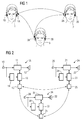
- FIG. 1 shows three hearing aid device carriers 1, 2 and 3, each with two hearing aid devices 1A, 1B; 2A, 2B; 3A, 3B are supplied. They are not too far away from each other, eg together in one room.
- the hearing aids of each hearing aid wearer each have a transmitting and receiving unit for wireless signal transmission between the hearing aids of the respective hearing aid wearer. This ensures that the hearing aid devices of the respective hearing aid wearer each have a coordinated signal processing. For example, in each case the hearing aids of a hearing aid wearer are operated in the same hearing program.
- the data transmission between hearing aids is extended to the effect that this not only takes place between the hearing aids of a hearing aid wearer, but is extended to a plurality of hearing aid wearers (participants).
- a signal transmission between the hearing aid devices 1A and 2A and between the hearing aid devices 1A and 3A is provided in the exemplary embodiment.
- the hearing aid wearer 1 is in the immediate vicinity of a useful sound source, for example a speaker, the hearing aid 1A can receive a signal with a better signal-to-noise ratio than from the hearing aid devices 2A and 3A.
- the hearing aid wearer carriers 2 and 3 also benefit from an output signal with a high signal-to-noise ratio. Noise sources in the immediate vicinity of the hearing aid wearer 2 or 3 are no longer perceived as a disturber.
- the hearing aid device 3A thus also assumes the function of a relay station in the signal transmission from the hearing aid device 1A to the hearing aid device 2A. If appropriate, different carrier frequencies of the carrier signals for the signals transmitted by the hearing aid device 1A and the hearing aid device 3A are to be used, as is generally known in the use of radio relay stations.
- the hearing aid device system used according to the invention offers a large number of possible variations.
- all three hearing aid wearers are binaural, ie each supplied with two hearing aids.
- only one hearing aid device 1A, 2A or 3A is designed for communication with a hearing aid device of another hearing aid wearer.
- the transmitted signals are forwarded from the hearing aid device 2A to the hearing aid device 2B or from the hearing aid device 3A to the hearing aid device 3B.
- the hearing aid device 1B receives an acoustic input signal, which then forwarded to the hearing aid 1A and from there, as well as the recorded signal from the hearing aid 1A, is forwarded to the hearing aids 2A and 3A. Then, after reception, the signal picked up by the hearing aid device 1B at the right ear of the hearing aid wearer 1 can be supplied respectively to the right ear of the hearing aid wearer 2 or 3. The same applies to the signal received by the hearing aid 1A on the left ear of the hearing aid wearer 1. Although this procedure requires a very high data transmission rate between the individual hearing aids, but the spatial hearing is retained.
- the hearing aid wearer carriers 2 and 3 can preferably switch between the audio signal emitted by the hearing aid device 1A and the signals resulting from the microphone signals of the hearing aid devices 2A, 2B or 3A, 3B.
- the signals originating from the different sources are weighted and added.
- an audio signal originating from the hearing aid device 1A or 1B can be mixed in an adjustable weighting with the signals emanating from the microphones of the hearing aid devices 2A and 2B.
- signal transmission between hearing aids of a plurality of hearing aid wearers is used to more accurately analyze the listening environment (the sound field) in which the hearing aid wearers are located than is possible with a single hearing aid wearer.
- sound field characteristics are generated by a respective hearing aid 1A, 2A or 3A from the input signals to the hearing aid. which are then used for the classification of the sound field.
- an exchange takes place between the hearing aid devices 1A, 2A and 3A with respect to the sound field characteristics generated in the respective hearing aid devices.
- each hearing aid wearer 1, 2 or 3 with two hearing aid devices 1A, 1B; 2A, 2B; 3A, 3B are supplied binaurally, with only one hearing aid device in each case communicating with the two hearing aid devices of the other hearing aid wearer, and a separate data exchange between the respective two hearing aid devices being provided for tuning the two hearing aid devices of a respective hearing aid wearer.
- a constellation would be possible in which all (in the embodiment 6) hearing aids communicate directly with each other.
- FIG. 2 shows the three hearing aid devices 1A, 2A and 3A of the hearing aid device system according to FIG. 1 in a simplified block diagram.
- Each of the hearing aids has to receive an acoustic input signal and conversion into an electrical signal, a microphone 10, 20 and 30.
- the microphones each have a signal processing 11, 21 and 31 connected downstream processing and frequency-dependent amplification of the respective input signal and to compensate for the individual Hearing loss of the hearing aid wearer 1, 2 or 3.
- the processed signal is finally converted back in each case by means of a handset 12, 22 and 32 into an acoustic signal and delivered into an ear canal of the hearing aid wearer 1, 2 or 3.
- Each of the hearing aids 1A, 2A and 3A further comprises a signal analysis unit 14, 24 and 34 for analyzing the electrical input signal.
- sound field characteristic values are generated which relate, for example, to the respective signal level, the frequency spectrum, the modulation frequencies, the modulation depths, noise components or spatial characteristics of the sound field, such as coherence, incident direction of interference or useful signals, etc.
- parameters for adapting the signal processing in the signal processing units 11, 21 and 31 are generated in the control units 13, 23 and 33, respectively.
- an exchange of the sound field characteristic values obtained in the hearing aid devices 1A, 2A and 3A between the individual hearing aid devices takes place by means of the transmitting and receiving units 15, 25 and 35, respectively.
- the transmitted sound field characteristics are used in the signal processing units 13, 23 and 33 to optimize the setting of parameters for controlling the signal processing in the signal processing units 11, 21 and 31.
- control parameters can also be transmitted between the individual hearing aids, in particular in order to harmonize the signal processing in the individual hearing aids.
- all hearing aids 1A, 2A and 3A can be operated in the same hearing program coordinated with each other.
- a further alternative of the invention consists in transmitting audio signals between individual hearing aids via the transmitting and receiving units 15, 25 or 35 directly from the microphone signals of the respective hearing aids 1A, 2A and 3A, respectively. If, for example, an audio signal is transmitted from the hearing aid device 1A to the hearing aid device 2A via the transmitting and receiving unit 15 and received by means of the transmitting and receiving unit 25, this can be adjusted to the weighting of the signal processing unit via the control unit 23 21 are supplied and thus mixed with the resulting from the microphone 20 signal.
- a hearing aid e.g., 3A
- all three hearing aids can thus generate sound field characteristics from the respective acoustic input signals, the sound field characteristics generated by the hearing aids 1A and 2A being transmitted to the hearing aid 3A for further analysis.
- the hearing aid device 3A then generates control parameters for the adaptation of the signal processing in the hearing aid devices 1A, 2A, 3A from the sound field characteristics generated in all three hearing aid devices 1A, 2A, 3A.
- Corresponding control signals are then transmitted from the hearing aid device 3A to the hearing aids 1A and 2A.
Landscapes
- Engineering & Computer Science (AREA)
- Computer Networks & Wireless Communication (AREA)
- Health & Medical Sciences (AREA)
- General Health & Medical Sciences (AREA)
- Neurosurgery (AREA)
- Otolaryngology (AREA)
- Physics & Mathematics (AREA)
- Acoustics & Sound (AREA)
- Signal Processing (AREA)
- Circuit For Audible Band Transducer (AREA)
- Transmitters (AREA)
- Near-Field Transmission Systems (AREA)
Applications Claiming Priority (1)
| Application Number | Priority Date | Filing Date | Title |
|---|---|---|---|
| DE102004047759A DE102004047759B3 (de) | 2004-09-30 | 2004-09-30 | Verwendung eines Hörhilfegerätesystems mit wenigstens zwei Hörhilfegeräten |
Publications (2)
| Publication Number | Publication Date |
|---|---|
| EP1643801A2 true EP1643801A2 (fr) | 2006-04-05 |
| EP1643801A3 EP1643801A3 (fr) | 2009-10-21 |
Family
ID=35207899
Family Applications (2)
| Application Number | Title | Priority Date | Filing Date |
|---|---|---|---|
| EP05108060A Withdrawn EP1643802A3 (fr) | 2004-09-30 | 2005-09-02 | Transmission de signaux entre prothèses auditives |
| EP05108059A Withdrawn EP1643801A3 (fr) | 2004-09-30 | 2005-09-02 | Utilisation d'un système de prothèse auditive avec au moins deux prothèses auditives |
Family Applications Before (1)
| Application Number | Title | Priority Date | Filing Date |
|---|---|---|---|
| EP05108060A Withdrawn EP1643802A3 (fr) | 2004-09-30 | 2005-09-02 | Transmission de signaux entre prothèses auditives |
Country Status (3)
| Country | Link |
|---|---|
| US (2) | US20060067550A1 (fr) |
| EP (2) | EP1643802A3 (fr) |
| DE (1) | DE102004047759B3 (fr) |
Cited By (14)
| Publication number | Priority date | Publication date | Assignee | Title |
|---|---|---|---|---|
| WO2008074350A1 (fr) * | 2006-12-20 | 2008-06-26 | Phonak Ag | Système de communication sans fil |
| WO2008107359A1 (fr) * | 2007-03-05 | 2008-09-12 | Siemens Audiologische Technik Gmbh | Système d'aide auditive présentant une répartition du traitement des signaux, et procédé correspondant |
| WO2008151623A1 (fr) * | 2007-06-13 | 2008-12-18 | Widex A/S | Système et procédé permettant d'établir un groupe de conversation entre plusieurs appareils auditifs |
| US8155359B2 (en) | 2006-10-18 | 2012-04-10 | Siemens Audiologische Technik Gmbh | Hearing system with remote control as a base station and corresponding communication method |
| US8718303B2 (en) | 2007-06-13 | 2014-05-06 | Widex A/S | Hearing aid system for establishing a conversation group |
| WO2016130593A1 (fr) * | 2015-02-09 | 2016-08-18 | Jeffrey Paul Solum | Communication d'oreille à oreille à l'aide d'un dispositif intermédiaire |
| US9774961B2 (en) | 2005-06-05 | 2017-09-26 | Starkey Laboratories, Inc. | Hearing assistance device ear-to-ear communication using an intermediate device |
| US9854369B2 (en) | 2007-01-03 | 2017-12-26 | Starkey Laboratories, Inc. | Wireless system for hearing communication devices providing wireless stereo reception modes |
| US10051385B2 (en) | 2006-07-10 | 2018-08-14 | Starkey Laboratories, Inc. | Method and apparatus for a binaural hearing assistance system using monaural audio signals |
| US10212682B2 (en) | 2009-12-21 | 2019-02-19 | Starkey Laboratories, Inc. | Low power intermittent messaging for hearing assistance devices |
| EP3820166A1 (fr) | 2019-11-11 | 2021-05-12 | Sivantos Pte. Ltd. | Procédés de fonctionnement d'un réseau ainsi qu'appareil auditif |
| EP3820167A1 (fr) | 2019-11-11 | 2021-05-12 | Sivantos Pte. Ltd. | Procédés de fonctionnement d'un réseau ainsi qu'appareil auditif |
| EP3820165A1 (fr) | 2019-11-11 | 2021-05-12 | Sivantos Pte. Ltd. | Procédé de fonctionnement d'un appareil auditif ainsi qu'appareil auditif |
| EP3836139A1 (fr) | 2019-12-12 | 2021-06-16 | Sivantos Pte. Ltd. | Procédé d'accouplement de deux appareils auditifs ainsi qu'appareil auditif |
Families Citing this family (32)
| Publication number | Priority date | Publication date | Assignee | Title |
|---|---|---|---|---|
| US7257372B2 (en) * | 2003-09-30 | 2007-08-14 | Sony Ericsson Mobile Communications Ab | Bluetooth enabled hearing aid |
| EP2039218B1 (fr) | 2006-07-12 | 2020-12-02 | Sonova AG | Procede de fonctionnement d'un systeme d'ecoute binauriculaire ainsi qu'un systeme d'ecoute binauriculaire |
| US20100080398A1 (en) * | 2006-12-13 | 2010-04-01 | Phonak Ag | Method and system for hearing device fitting |
| DE102006061176A1 (de) * | 2006-12-22 | 2008-07-03 | Siemens Audiologische Technik Gmbh | Verfahren zum Einstellen eines Hörgeräts mit Ergänzungsparametern |
| DK2119310T3 (en) * | 2007-01-22 | 2017-02-13 | Sonova Ag | SYSTEM AND METHOD INTENDED TO PROVIDE HEARING AID TO A USER |
| DE102007030745A1 (de) * | 2007-07-02 | 2009-01-08 | Siemens Medical Instruments Pte. Ltd. | Mehrkomponentiges Hörgerätesystem und ein Verfahren zu seinem Betrieb |
| US8213652B2 (en) | 2007-07-02 | 2012-07-03 | Siemens Medical Instruments Pte. Ltd. | Multi-component hearing aid system and a method for its operation |
| DE102007039185A1 (de) * | 2007-08-20 | 2009-02-26 | Siemens Medical Instruments Pte. Ltd. | Verfahren und Vorrichtung zur Einstellung eines Hörgerätes |
| DE102009019842B3 (de) * | 2009-05-04 | 2010-10-07 | Siemens Medical Instruments Pte. Ltd. | Anordnung und Verfahren zur drahtlosen Datenübertragung zwischen Hörgeräten |
| US8995688B1 (en) | 2009-07-23 | 2015-03-31 | Helen Jeanne Chemtob | Portable hearing-assistive sound unit system |
| US20110188668A1 (en) * | 2009-09-23 | 2011-08-04 | Mark Donaldson | Media delivery system |
| US9247355B2 (en) | 2010-02-12 | 2016-01-26 | Sonova Ag | Wireless sound transmission system and method |
| WO2011098142A1 (fr) | 2010-02-12 | 2011-08-18 | Phonak Ag | Système et procédé d'assistance auditive sans fil |
| EP2534887A1 (fr) | 2010-02-12 | 2012-12-19 | Phonak AG | Système et procédé de transmission du son par ondes radioélectriques utilisant un mode de saut de fréquence et d'économie d'énergie amélioré |
| CA2788389C (fr) | 2010-02-12 | 2020-03-24 | Sonova Ag | Systeme et procede de transmission du son par ondes radioelectriques |
| EP2947899B1 (fr) * | 2010-10-08 | 2017-12-13 | Oticon A/s | Appareil d'écoute binaural sans fil |
| DK3125578T3 (da) * | 2010-11-17 | 2020-03-23 | Oticon As | Trådløst binauralt høresystem |
| US20120189140A1 (en) * | 2011-01-21 | 2012-07-26 | Apple Inc. | Audio-sharing network |
| EP2544462B1 (fr) * | 2011-07-04 | 2018-11-14 | GN Hearing A/S | Compresseur binaural sans fil |
| DK3396980T3 (da) | 2011-07-04 | 2021-04-26 | Gn Hearing As | Binaural kompressor til opnåelse af retningsanvisninger |
| US9131322B2 (en) * | 2013-07-08 | 2015-09-08 | Starkey Laboratories, Inc. | Method and apparatus for communication between hearing assistance devices in a bluetooth network |
| US9424843B2 (en) * | 2013-09-24 | 2016-08-23 | Starkey Laboratories, Inc. | Methods and apparatus for signal sharing to improve speech understanding |
| US10656906B2 (en) | 2014-09-23 | 2020-05-19 | Levaughn Denton | Multi-frequency sensing method and apparatus using mobile-based clusters |
| EP4054211A1 (fr) * | 2014-09-23 | 2022-09-07 | Denton, Levaughn | Procédé et appareil d'ajustement audio à base de grappe mobile |
| US11150868B2 (en) | 2014-09-23 | 2021-10-19 | Zophonos Inc. | Multi-frequency sensing method and apparatus using mobile-clusters |
| US11544036B2 (en) | 2014-09-23 | 2023-01-03 | Zophonos Inc. | Multi-frequency sensing system with improved smart glasses and devices |
| US11068234B2 (en) | 2014-09-23 | 2021-07-20 | Zophonos Inc. | Methods for collecting and managing public music performance royalties and royalty payouts |
| DK3101919T3 (da) | 2015-06-02 | 2020-04-06 | Oticon As | Peer-to-peer høresystem |
| WO2017167368A1 (fr) | 2016-03-31 | 2017-10-05 | Sonova Ag | Procédé destiné à l'adaptation et/ou au fonctionnement d'un dispositif auditif, système destiné à l'adaptation d'un dispositif auditif, ensemble de dispositifs auditifs associés, et utilisation d'un ensemble de dispositifs auditifs associés |
| WO2018005140A1 (fr) * | 2016-07-01 | 2018-01-04 | Nar Special Global, Llc. | Systèmes et procédés d'amélioration de la capacité auditive |
| US12273684B2 (en) | 2017-09-26 | 2025-04-08 | Cochlear Limited | Acoustic spot identification |
| US10512028B1 (en) | 2019-02-26 | 2019-12-17 | Kenneth Capalbo | Wireless short range communication system |
Family Cites Families (10)
| Publication number | Priority date | Publication date | Assignee | Title |
|---|---|---|---|---|
| US5557932A (en) * | 1986-06-06 | 1996-09-24 | The United States Of America As Represented By The Secretary Of The Air Force | Low thermal stress impingement cooling apparatus |
| US5757932A (en) * | 1993-09-17 | 1998-05-26 | Audiologic, Inc. | Digital hearing aid system |
| US6366863B1 (en) * | 1998-01-09 | 2002-04-02 | Micro Ear Technology Inc. | Portable hearing-related analysis system |
| DE59913005D1 (de) * | 1998-03-03 | 2006-03-30 | Siemens Audiologische Technik | Hörgerätesystem mit zwei Hörhilfegeräten |
| DE10048354A1 (de) * | 2000-09-29 | 2002-05-08 | Siemens Audiologische Technik | Verfahren zum Betrieb eines Hörgerätesystems sowie Hörgerätesystem |
| FI110560B (fi) * | 2000-12-27 | 2003-02-14 | Nokia Corp | Ryhmän muodostaminen langattomille kommunikaatiopäätelaitteille |
| US7113745B2 (en) * | 2001-02-21 | 2006-09-26 | Ericsson Inc. | Method to achieve diversity in a communication network |
| US7602928B2 (en) * | 2002-07-01 | 2009-10-13 | Avaya Inc. | Telephone with integrated hearing aid |
| JP2004274677A (ja) * | 2003-03-12 | 2004-09-30 | Osaka Industrial Promotion Organization | 補聴システム |
| US7515945B2 (en) * | 2003-06-30 | 2009-04-07 | Nokia Corporation | Connected mode for low-end radio |
-
2004
- 2004-09-30 DE DE102004047759A patent/DE102004047759B3/de not_active Expired - Fee Related
-
2005
- 2005-09-02 EP EP05108060A patent/EP1643802A3/fr not_active Withdrawn
- 2005-09-02 EP EP05108059A patent/EP1643801A3/fr not_active Withdrawn
- 2005-09-28 US US11/237,471 patent/US20060067550A1/en not_active Abandoned
- 2005-09-28 US US11/237,469 patent/US20060067549A1/en not_active Abandoned
Cited By (31)
| Publication number | Priority date | Publication date | Assignee | Title |
|---|---|---|---|---|
| US9774961B2 (en) | 2005-06-05 | 2017-09-26 | Starkey Laboratories, Inc. | Hearing assistance device ear-to-ear communication using an intermediate device |
| US11678128B2 (en) | 2006-07-10 | 2023-06-13 | Starkey Laboratories, Inc. | Method and apparatus for a binaural hearing assistance system using monaural audio signals |
| US11064302B2 (en) | 2006-07-10 | 2021-07-13 | Starkey Laboratories, Inc. | Method and apparatus for a binaural hearing assistance system using monaural audio signals |
| US10469960B2 (en) | 2006-07-10 | 2019-11-05 | Starkey Laboratories, Inc. | Method and apparatus for a binaural hearing assistance system using monaural audio signals |
| US10728678B2 (en) | 2006-07-10 | 2020-07-28 | Starkey Laboratories, Inc. | Method and apparatus for a binaural hearing assistance system using monaural audio signals |
| US10051385B2 (en) | 2006-07-10 | 2018-08-14 | Starkey Laboratories, Inc. | Method and apparatus for a binaural hearing assistance system using monaural audio signals |
| US8155359B2 (en) | 2006-10-18 | 2012-04-10 | Siemens Audiologische Technik Gmbh | Hearing system with remote control as a base station and corresponding communication method |
| WO2008074350A1 (fr) * | 2006-12-20 | 2008-06-26 | Phonak Ag | Système de communication sans fil |
| US8144903B2 (en) | 2006-12-20 | 2012-03-27 | Phonak Ag | Wireless communication system |
| US11218815B2 (en) | 2007-01-03 | 2022-01-04 | Starkey Laboratories, Inc. | Wireless system for hearing communication devices providing wireless stereo reception modes |
| US9854369B2 (en) | 2007-01-03 | 2017-12-26 | Starkey Laboratories, Inc. | Wireless system for hearing communication devices providing wireless stereo reception modes |
| US10511918B2 (en) | 2007-01-03 | 2019-12-17 | Starkey Laboratories, Inc. | Wireless system for hearing communication devices providing wireless stereo reception modes |
| US12212930B2 (en) | 2007-01-03 | 2025-01-28 | Starkey Laboratories, Inc. | Wireless system for hearing communication devices providing wireless stereo reception modes |
| US11765526B2 (en) | 2007-01-03 | 2023-09-19 | Starkey Laboratories, Inc. | Wireless system for hearing communication devices providing wireless stereo reception modes |
| WO2008107359A1 (fr) * | 2007-03-05 | 2008-09-12 | Siemens Audiologische Technik Gmbh | Système d'aide auditive présentant une répartition du traitement des signaux, et procédé correspondant |
| US8885857B2 (en) | 2007-06-13 | 2014-11-11 | Widex A/S | System for establishing a conversation group among a number of hearing aids |
| WO2008151623A1 (fr) * | 2007-06-13 | 2008-12-18 | Widex A/S | Système et procédé permettant d'établir un groupe de conversation entre plusieurs appareils auditifs |
| AU2007354781B2 (en) * | 2007-06-13 | 2010-10-14 | Widex A/S | A system and a method for establishing a conversation group among a number of hearing aids |
| US8718303B2 (en) | 2007-06-13 | 2014-05-06 | Widex A/S | Hearing aid system for establishing a conversation group |
| US10212682B2 (en) | 2009-12-21 | 2019-02-19 | Starkey Laboratories, Inc. | Low power intermittent messaging for hearing assistance devices |
| US11019589B2 (en) | 2009-12-21 | 2021-05-25 | Starkey Laboratories, Inc. | Low power intermittent messaging for hearing assistance devices |
| WO2016130593A1 (fr) * | 2015-02-09 | 2016-08-18 | Jeffrey Paul Solum | Communication d'oreille à oreille à l'aide d'un dispositif intermédiaire |
| US10484804B2 (en) | 2015-02-09 | 2019-11-19 | Starkey Laboratories, Inc. | Hearing assistance device ear-to-ear communication using an intermediate device |
| CN107534819A (zh) * | 2015-02-09 | 2018-01-02 | 斯达克实验室公司 | 使用中间设备的耳朵间通信 |
| EP3820167A1 (fr) | 2019-11-11 | 2021-05-12 | Sivantos Pte. Ltd. | Procédés de fonctionnement d'un réseau ainsi qu'appareil auditif |
| DE102019217399B4 (de) | 2019-11-11 | 2021-09-02 | Sivantos Pte. Ltd. | Verfahren zum Betrieb eines Netzwerks sowie Hörgerät |
| US11445014B2 (en) | 2019-11-11 | 2022-09-13 | Sivantos Pte. Ltd. | Method for operating a hearing device, and hearing device |
| EP3820165A1 (fr) | 2019-11-11 | 2021-05-12 | Sivantos Pte. Ltd. | Procédé de fonctionnement d'un appareil auditif ainsi qu'appareil auditif |
| EP3820166A1 (fr) | 2019-11-11 | 2021-05-12 | Sivantos Pte. Ltd. | Procédés de fonctionnement d'un réseau ainsi qu'appareil auditif |
| US11425510B2 (en) | 2019-12-12 | 2022-08-23 | Sivantos Pte. Ltd. | Method of coupling hearing devices to one another, and hearing device |
| EP3836139A1 (fr) | 2019-12-12 | 2021-06-16 | Sivantos Pte. Ltd. | Procédé d'accouplement de deux appareils auditifs ainsi qu'appareil auditif |
Also Published As
| Publication number | Publication date |
|---|---|
| EP1643801A3 (fr) | 2009-10-21 |
| US20060067549A1 (en) | 2006-03-30 |
| US20060067550A1 (en) | 2006-03-30 |
| DE102004047759B3 (de) | 2006-06-01 |
| EP1643802A3 (fr) | 2009-10-21 |
| EP1643802A2 (fr) | 2006-04-05 |
Similar Documents
| Publication | Publication Date | Title |
|---|---|---|
| DE102004047759B3 (de) | Verwendung eines Hörhilfegerätesystems mit wenigstens zwei Hörhilfegeräten | |
| EP1619929B2 (fr) | Prothèse auditive ainsi que procédure pour opérer une prothèse auditive pendant la réception de signaux audio | |
| EP3222057B1 (fr) | Procédé et dispositif de détection rapide de la voix naturelle | |
| US9456286B2 (en) | Method for operating a binaural hearing system and binaural hearing system | |
| DE102008015263B4 (de) | Hörsystem mit Teilbandsignalaustausch und entsprechendes Verfahren | |
| EP2164283B1 (fr) | Appareil auditif et fonctionnement d'un appareil auditif doté d'une transposition de fréquence | |
| EP1296537A2 (fr) | Prothèse auditive avec commutation automatique vers le mode bobine | |
| EP1915031A2 (fr) | Système auditif doté d'une commande à distance servant de station de base et procédé de communication correspondant | |
| US9473859B2 (en) | Systems and methods of telecommunication for bilateral hearing instruments | |
| EP1771038B2 (fr) | Procédé d'utilisation d'un système de prothèse auditive pour le traitement binaural d'un utilisateur | |
| WO2009016012A1 (fr) | Appareil de correction auditive commandé par un modèle perceptif et procédé correspondant | |
| EP2254354A1 (fr) | Procédé d'acclimatation d'un dispositif auditif programmable et dispositif auditif correspondant | |
| EP2200345A1 (fr) | Procédé de sélection d'une direction préférentiel d'un microphone directionnel et dispositif auditif correspondant | |
| EP2822300B1 (fr) | Reconnaissance de situations d'écoute à l'aide de différentes sources de signal | |
| EP4149121B1 (fr) | Procédé de fonctionnement d'un appareil auditif | |
| DE102007035173A1 (de) | Verfahren zum Einstellen eines Hörsystems mit einem perzeptiven Modell für binaurales Hören und entsprechendes Hörsystem | |
| EP4311269B1 (fr) | Procédé de fonctionnement d'un appareil auditif binaural, appareil auditif binaural et logiciel | |
| EP2619997A1 (fr) | Système de communication comportant un téléphone et un appareil d'écoute, et procédé de transmission | |
| DE102010021609A1 (de) | Hörinstrument mit kabelloser Datenübertragung | |
| DE102010026378A1 (de) | Kommunikationsmodul für ein Hörinstrument | |
| DE102023211025A1 (de) | Verfahren zum Betreiben einer Antennenanordnung | |
| DE102009018425A1 (de) | Hörvorrichtung mit Entstörung am Signaleingang | |
| CH708609A2 (de) | Verfahren zur gleichzeitigen Nutzung eines CROS- oder BiCROS-Hörsystems und eines Telefons, sowie Hörsystem zum Ausführen des Verfahrens. |
Legal Events
| Date | Code | Title | Description |
|---|---|---|---|
| PUAI | Public reference made under article 153(3) epc to a published international application that has entered the european phase |
Free format text: ORIGINAL CODE: 0009012 |
|
| AK | Designated contracting states |
Kind code of ref document: A2 Designated state(s): AT BE BG CH CY CZ DE DK EE ES FI FR GB GR HU IE IS IT LI LT LU LV MC NL PL PT RO SE SI SK TR |
|
| AX | Request for extension of the european patent |
Extension state: AL BA HR MK YU |
|
| PUAL | Search report despatched |
Free format text: ORIGINAL CODE: 0009013 |
|
| AK | Designated contracting states |
Kind code of ref document: A3 Designated state(s): AT BE BG CH CY CZ DE DK EE ES FI FR GB GR HU IE IS IT LI LT LU LV MC NL PL PT RO SE SI SK TR |
|
| AX | Request for extension of the european patent |
Extension state: AL BA HR MK YU |
|
| AKX | Designation fees paid | ||
| STAA | Information on the status of an ep patent application or granted ep patent |
Free format text: STATUS: THE APPLICATION IS DEEMED TO BE WITHDRAWN |
|
| 18D | Application deemed to be withdrawn |
Effective date: 20100401 |
|
| REG | Reference to a national code |
Ref country code: DE Ref legal event code: 8566 |