EP1646661B1 - Initiator für die lebende radikalische polymerisation mit einer zur reaktion mit polypeptiden oder dergleichen befähigten funktionellen gruppe, damit erhaltenes kammpolymer, polypetidkonjugate und daraus erhaltener arzneistoff - Google Patents
Initiator für die lebende radikalische polymerisation mit einer zur reaktion mit polypeptiden oder dergleichen befähigten funktionellen gruppe, damit erhaltenes kammpolymer, polypetidkonjugate und daraus erhaltener arzneistoff Download PDFInfo
- Publication number
- EP1646661B1 EP1646661B1 EP04742963A EP04742963A EP1646661B1 EP 1646661 B1 EP1646661 B1 EP 1646661B1 EP 04742963 A EP04742963 A EP 04742963A EP 04742963 A EP04742963 A EP 04742963A EP 1646661 B1 EP1646661 B1 EP 1646661B1
- Authority
- EP
- European Patent Office
- Prior art keywords
- initiator
- comb polymer
- compound
- polymerisation
- monomers
- Prior art date
- Legal status (The legal status is an assumption and is not a legal conclusion. Google has not performed a legal analysis and makes no representation as to the accuracy of the status listed.)
- Expired - Lifetime
Links
- 229920000642 polymer Polymers 0.000 title claims abstract description 100
- 102000004196 processed proteins & peptides Human genes 0.000 title claims description 36
- 108090000765 processed proteins & peptides Proteins 0.000 title claims description 36
- 229920001184 polypeptide Polymers 0.000 title claims description 35
- 125000000524 functional group Chemical group 0.000 title description 3
- 239000007870 radical polymerization initiator Substances 0.000 title 1
- 238000010526 radical polymerization reaction Methods 0.000 title 1
- 239000003999 initiator Substances 0.000 claims abstract description 112
- 239000000178 monomer Substances 0.000 claims abstract description 64
- 150000001875 compounds Chemical class 0.000 claims abstract description 62
- 238000000034 method Methods 0.000 claims abstract description 60
- 239000003054 catalyst Substances 0.000 claims abstract description 39
- 229920000909 polytetrahydrofuran Polymers 0.000 claims abstract description 10
- 229920000570 polyether Polymers 0.000 claims abstract description 8
- 125000003545 alkoxy group Chemical group 0.000 claims abstract description 7
- YXFVVABEGXRONW-UHFFFAOYSA-N Toluene Chemical compound CC1=CC=CC=C1 YXFVVABEGXRONW-UHFFFAOYSA-N 0.000 claims description 123
- RTZKZFJDLAIYFH-UHFFFAOYSA-N Diethyl ether Chemical compound CCOCC RTZKZFJDLAIYFH-UHFFFAOYSA-N 0.000 claims description 51
- 229920001223 polyethylene glycol Polymers 0.000 claims description 47
- 102000004169 proteins and genes Human genes 0.000 claims description 47
- 108090000623 proteins and genes Proteins 0.000 claims description 47
- -1 poly (alkylene glycol Chemical compound 0.000 claims description 33
- CERQOIWHTDAKMF-UHFFFAOYSA-M Methacrylate Chemical compound CC(=C)C([O-])=O CERQOIWHTDAKMF-UHFFFAOYSA-M 0.000 claims description 31
- NQTADLQHYWFPDB-UHFFFAOYSA-N N-Hydroxysuccinimide Chemical compound ON1C(=O)CCC1=O NQTADLQHYWFPDB-UHFFFAOYSA-N 0.000 claims description 25
- WYURNTSHIVDZCO-UHFFFAOYSA-N Tetrahydrofuran Chemical compound C1CCOC1 WYURNTSHIVDZCO-UHFFFAOYSA-N 0.000 claims description 22
- 150000003254 radicals Chemical class 0.000 claims description 18
- 125000003118 aryl group Chemical group 0.000 claims description 16
- 238000006116 polymerization reaction Methods 0.000 claims description 16
- 229910052801 chlorine Inorganic materials 0.000 claims description 14
- 229960004132 diethyl ether Drugs 0.000 claims description 14
- VVQNEPGJFQJSBK-UHFFFAOYSA-N Methyl methacrylate Chemical compound COC(=O)C(C)=C VVQNEPGJFQJSBK-UHFFFAOYSA-N 0.000 claims description 13
- 229910052723 transition metal Inorganic materials 0.000 claims description 13
- 150000003624 transition metals Chemical class 0.000 claims description 13
- PPBRXRYQALVLMV-UHFFFAOYSA-N Styrene Chemical compound C=CC1=CC=CC=C1 PPBRXRYQALVLMV-UHFFFAOYSA-N 0.000 claims description 12
- WGQKYBSKWIADBV-UHFFFAOYSA-N benzylamine Chemical compound NCC1=CC=CC=C1 WGQKYBSKWIADBV-UHFFFAOYSA-N 0.000 claims description 11
- XLYOFNOQVPJJNP-UHFFFAOYSA-N water Substances O XLYOFNOQVPJJNP-UHFFFAOYSA-N 0.000 claims description 11
- 229910052794 bromium Inorganic materials 0.000 claims description 9
- 150000004820 halides Chemical class 0.000 claims description 9
- 239000003446 ligand Substances 0.000 claims description 9
- AAFZZRHUEAQWKE-UHFFFAOYSA-N n-ethyl-1-pyridin-2-ylmethanimine Chemical compound CCN=CC1=CC=CC=N1 AAFZZRHUEAQWKE-UHFFFAOYSA-N 0.000 claims description 9
- 239000002904 solvent Substances 0.000 claims description 9
- NBBJYMSMWIIQGU-UHFFFAOYSA-N Propionic aldehyde Chemical compound CCC=O NBBJYMSMWIIQGU-UHFFFAOYSA-N 0.000 claims description 8
- 150000001720 carbohydrates Chemical class 0.000 claims description 8
- 229910052799 carbon Inorganic materials 0.000 claims description 8
- ZYGHJZDHTFUPRJ-UHFFFAOYSA-N coumarin Chemical compound C1=CC=C2OC(=O)C=CC2=C1 ZYGHJZDHTFUPRJ-UHFFFAOYSA-N 0.000 claims description 8
- 125000004122 cyclic group Chemical group 0.000 claims description 8
- LYCAIKOWRPUZTN-UHFFFAOYSA-N ethylene glycol Natural products OCCO LYCAIKOWRPUZTN-UHFFFAOYSA-N 0.000 claims description 8
- 125000000623 heterocyclic group Chemical group 0.000 claims description 8
- 125000005647 linker group Chemical group 0.000 claims description 8
- 125000002496 methyl group Chemical group [H]C([H])([H])* 0.000 claims description 8
- 239000000126 substance Substances 0.000 claims description 8
- 125000000217 alkyl group Chemical group 0.000 claims description 7
- WGCNASOHLSPBMP-UHFFFAOYSA-N hydroxyacetaldehyde Natural products OCC=O WGCNASOHLSPBMP-UHFFFAOYSA-N 0.000 claims description 7
- 102000039446 nucleic acids Human genes 0.000 claims description 7
- 108020004707 nucleic acids Proteins 0.000 claims description 7
- 150000007523 nucleic acids Chemical class 0.000 claims description 7
- WEVYAHXRMPXWCK-UHFFFAOYSA-N Acetonitrile Chemical compound CC#N WEVYAHXRMPXWCK-UHFFFAOYSA-N 0.000 claims description 6
- SOGAXMICEFXMKE-UHFFFAOYSA-N Butylmethacrylate Chemical compound CCCCOC(=O)C(C)=C SOGAXMICEFXMKE-UHFFFAOYSA-N 0.000 claims description 6
- XEKOWRVHYACXOJ-UHFFFAOYSA-N Ethyl acetate Chemical compound CCOC(C)=O XEKOWRVHYACXOJ-UHFFFAOYSA-N 0.000 claims description 6
- ZMXDDKWLCZADIW-UHFFFAOYSA-N N,N-Dimethylformamide Chemical compound CN(C)C=O ZMXDDKWLCZADIW-UHFFFAOYSA-N 0.000 claims description 6
- 229910052736 halogen Inorganic materials 0.000 claims description 6
- VLKZOEOYAKHREP-UHFFFAOYSA-N n-Hexane Chemical compound CCCCCC VLKZOEOYAKHREP-UHFFFAOYSA-N 0.000 claims description 6
- CWKYKJQWSSZVDF-UHFFFAOYSA-N n-propyl-1-pyridin-2-ylmethanimine Chemical group CCCN=CC1=CC=CC=N1 CWKYKJQWSSZVDF-UHFFFAOYSA-N 0.000 claims description 6
- 230000003647 oxidation Effects 0.000 claims description 6
- 238000007254 oxidation reaction Methods 0.000 claims description 6
- 125000001436 propyl group Chemical group [H]C([*])([H])C([H])([H])C([H])([H])[H] 0.000 claims description 6
- 239000003814 drug Substances 0.000 claims description 5
- 229940079593 drug Drugs 0.000 claims description 5
- 125000001495 ethyl group Chemical group [H]C([H])([H])C([H])([H])* 0.000 claims description 5
- 150000002367 halogens Chemical class 0.000 claims description 5
- 229910052739 hydrogen Inorganic materials 0.000 claims description 5
- 230000002209 hydrophobic effect Effects 0.000 claims description 5
- QJGQUHMNIGDVPM-UHFFFAOYSA-N nitrogen group Chemical group [N] QJGQUHMNIGDVPM-UHFFFAOYSA-N 0.000 claims description 5
- ZJIFDEVVTPEXDL-UHFFFAOYSA-N (2,5-dioxopyrrolidin-1-yl) hydrogen carbonate Chemical compound OC(=O)ON1C(=O)CCC1=O ZJIFDEVVTPEXDL-UHFFFAOYSA-N 0.000 claims description 4
- DHKHKXVYLBGOIT-UHFFFAOYSA-N 1,1-Diethoxyethane Chemical compound CCOC(C)OCC DHKHKXVYLBGOIT-UHFFFAOYSA-N 0.000 claims description 4
- ZWEHNKRNPOVVGH-UHFFFAOYSA-N 2-Butanone Chemical compound CCC(C)=O ZWEHNKRNPOVVGH-UHFFFAOYSA-N 0.000 claims description 4
- BTBWSRPRAGXJJV-UHFFFAOYSA-N 2h-benzotriazole;carbonic acid Chemical compound OC(O)=O.C1=CC=C2NN=NC2=C1 BTBWSRPRAGXJJV-UHFFFAOYSA-N 0.000 claims description 4
- QXZGLTYKKZKGLN-UHFFFAOYSA-N 4-(2,5-dioxopyrrolidin-1-yl)oxy-4-oxobutanoic acid Chemical compound OC(=O)CCC(=O)ON1C(=O)CCC1=O QXZGLTYKKZKGLN-UHFFFAOYSA-N 0.000 claims description 4
- JPVYNHNXODAKFH-UHFFFAOYSA-N Cu2+ Chemical compound [Cu+2] JPVYNHNXODAKFH-UHFFFAOYSA-N 0.000 claims description 4
- IMNFDUFMRHMDMM-UHFFFAOYSA-N N-Heptane Chemical compound CCCCCCC IMNFDUFMRHMDMM-UHFFFAOYSA-N 0.000 claims description 4
- CTQNGGLPUBDAKN-UHFFFAOYSA-N O-Xylene Chemical compound CC1=CC=CC=C1C CTQNGGLPUBDAKN-UHFFFAOYSA-N 0.000 claims description 4
- 239000004721 Polyphenylene oxide Substances 0.000 claims description 4
- IKHGUXGNUITLKF-XPULMUKRSA-N acetaldehyde Chemical compound [14CH]([14CH3])=O IKHGUXGNUITLKF-XPULMUKRSA-N 0.000 claims description 4
- RDOXTESZEPMUJZ-UHFFFAOYSA-N anisole Chemical compound COC1=CC=CC=C1 RDOXTESZEPMUJZ-UHFFFAOYSA-N 0.000 claims description 4
- 125000000484 butyl group Chemical group [H]C([*])([H])C([H])([H])C([H])([H])C([H])([H])[H] 0.000 claims description 4
- ZTQSAGDEMFDKMZ-UHFFFAOYSA-N butyric aldehyde Natural products CCCC=O ZTQSAGDEMFDKMZ-UHFFFAOYSA-N 0.000 claims description 4
- 125000004181 carboxyalkyl group Chemical group 0.000 claims description 4
- 229960000956 coumarin Drugs 0.000 claims description 4
- 235000001671 coumarin Nutrition 0.000 claims description 4
- USIUVYZYUHIAEV-UHFFFAOYSA-N diphenyl ether Chemical compound C=1C=CC=CC=1OC1=CC=CC=C1 USIUVYZYUHIAEV-UHFFFAOYSA-N 0.000 claims description 4
- AFOSIXZFDONLBT-UHFFFAOYSA-N divinyl sulfone Chemical compound C=CS(=O)(=O)C=C AFOSIXZFDONLBT-UHFFFAOYSA-N 0.000 claims description 4
- 125000002768 hydroxyalkyl group Chemical group 0.000 claims description 4
- PGLTVOMIXTUURA-UHFFFAOYSA-N iodoacetamide Chemical compound NC(=O)CI PGLTVOMIXTUURA-UHFFFAOYSA-N 0.000 claims description 4
- BHIWKHZACMWKOJ-UHFFFAOYSA-N methyl isobutyrate Chemical compound COC(=O)C(C)C BHIWKHZACMWKOJ-UHFFFAOYSA-N 0.000 claims description 4
- 229910052760 oxygen Inorganic materials 0.000 claims description 4
- 150000003573 thiols Chemical class 0.000 claims description 4
- 239000008096 xylene Substances 0.000 claims description 4
- DYMYLBQTHCJHOQ-UHFFFAOYSA-N (2,5-dioxopyrrolidin-1-yl) butanoate Chemical compound CCCC(=O)ON1C(=O)CCC1=O DYMYLBQTHCJHOQ-UHFFFAOYSA-N 0.000 claims description 3
- AASBXERNXVFUEJ-UHFFFAOYSA-N (2,5-dioxopyrrolidin-1-yl) propanoate Chemical compound CCC(=O)ON1C(=O)CCC1=O AASBXERNXVFUEJ-UHFFFAOYSA-N 0.000 claims description 3
- JYEUMXHLPRZUAT-UHFFFAOYSA-N 1,2,3-triazine Chemical compound C1=CN=NN=C1 JYEUMXHLPRZUAT-UHFFFAOYSA-N 0.000 claims description 3
- IZXIZTKNFFYFOF-UHFFFAOYSA-N 2-Oxazolidone Chemical compound O=C1NCCO1 IZXIZTKNFFYFOF-UHFFFAOYSA-N 0.000 claims description 3
- WRXZCLBKDXISQA-UHFFFAOYSA-N 2-chloro-7-methoxyquinoline-3-carbaldehyde Chemical compound C1=C(C=O)C(Cl)=NC2=CC(OC)=CC=C21 WRXZCLBKDXISQA-UHFFFAOYSA-N 0.000 claims description 3
- AQYNZOSCOWGGTP-UHFFFAOYSA-N 2-pyridin-2-ylsulfanylpyridine Chemical compound C=1C=CC=NC=1SC1=CC=CC=N1 AQYNZOSCOWGGTP-UHFFFAOYSA-N 0.000 claims description 3
- BLDQUHPMDSICNF-UHFFFAOYSA-N 4-nonan-5-yl-2-(4-nonan-5-ylpyridin-2-yl)pyridine Chemical group CCCCC(CCCC)C1=CC=NC(C=2N=CC=C(C=2)C(CCCC)CCCC)=C1 BLDQUHPMDSICNF-UHFFFAOYSA-N 0.000 claims description 3
- VHJFWJXYEWHCGD-UHFFFAOYSA-N 4-nonyl-2-(4-nonylpyridin-2-yl)pyridine Chemical compound CCCCCCCCCC1=CC=NC(C=2N=CC=C(CCCCCCCCC)C=2)=C1 VHJFWJXYEWHCGD-UHFFFAOYSA-N 0.000 claims description 3
- CWYNVVGOOAEACU-UHFFFAOYSA-N Fe2+ Chemical compound [Fe+2] CWYNVVGOOAEACU-UHFFFAOYSA-N 0.000 claims description 3
- VTLYFUHAOXGGBS-UHFFFAOYSA-N Fe3+ Chemical compound [Fe+3] VTLYFUHAOXGGBS-UHFFFAOYSA-N 0.000 claims description 3
- PEEHTFAAVSWFBL-UHFFFAOYSA-N Maleimide Chemical compound O=C1NC(=O)C=C1 PEEHTFAAVSWFBL-UHFFFAOYSA-N 0.000 claims description 3
- 125000001931 aliphatic group Chemical group 0.000 claims description 3
- KYMVBVBRCRFHIE-UHFFFAOYSA-N ethane-1,2-diimine Chemical compound N=CC=N KYMVBVBRCRFHIE-UHFFFAOYSA-N 0.000 claims description 3
- 239000007850 fluorescent dye Substances 0.000 claims description 3
- 125000005843 halogen group Chemical group 0.000 claims description 3
- 125000003107 substituted aryl group Chemical group 0.000 claims description 3
- 229910052717 sulfur Inorganic materials 0.000 claims description 3
- NIXOWILDQLNWCW-UHFFFAOYSA-M Acrylate Chemical compound [O-]C(=O)C=C NIXOWILDQLNWCW-UHFFFAOYSA-M 0.000 claims description 2
- ROFVEXUMMXZLPA-UHFFFAOYSA-N Bipyridyl Chemical group N1=CC=CC=C1C1=CC=CC=N1 ROFVEXUMMXZLPA-UHFFFAOYSA-N 0.000 claims description 2
- OKTJSMMVPCPJKN-UHFFFAOYSA-N Carbon Chemical compound [C] OKTJSMMVPCPJKN-UHFFFAOYSA-N 0.000 claims description 2
- XTHFKEDIFFGKHM-UHFFFAOYSA-N Dimethoxyethane Chemical compound COCCOC XTHFKEDIFFGKHM-UHFFFAOYSA-N 0.000 claims description 2
- 150000001412 amines Chemical class 0.000 claims description 2
- 150000001450 anions Chemical class 0.000 claims description 2
- 239000003242 anti bacterial agent Substances 0.000 claims description 2
- 239000002246 antineoplastic agent Substances 0.000 claims description 2
- 229920001400 block copolymer Polymers 0.000 claims description 2
- 239000003937 drug carrier Substances 0.000 claims description 2
- 229940093499 ethyl acetate Drugs 0.000 claims description 2
- 235000019439 ethyl acetate Nutrition 0.000 claims description 2
- 239000001257 hydrogen Substances 0.000 claims description 2
- WDAXFOBOLVPGLV-UHFFFAOYSA-N isobutyric acid ethyl ester Natural products CCOC(=O)C(C)C WDAXFOBOLVPGLV-UHFFFAOYSA-N 0.000 claims description 2
- UZKWTJUDCOPSNM-UHFFFAOYSA-N methoxybenzene Substances CCCCOC=C UZKWTJUDCOPSNM-UHFFFAOYSA-N 0.000 claims description 2
- 229920001451 polypropylene glycol Polymers 0.000 claims description 2
- FVSKHRXBFJPNKK-UHFFFAOYSA-N propionitrile Chemical compound CCC#N FVSKHRXBFJPNKK-UHFFFAOYSA-N 0.000 claims description 2
- YLQBMQCUIZJEEH-UHFFFAOYSA-N tetrahydrofuran Natural products C=1C=COC=1 YLQBMQCUIZJEEH-UHFFFAOYSA-N 0.000 claims description 2
- 229940121375 antifungal agent Drugs 0.000 claims 1
- 239000003429 antifungal agent Substances 0.000 claims 1
- 125000001797 benzyl group Chemical group [H]C1=C([H])C([H])=C(C([H])=C1[H])C([H])([H])* 0.000 claims 1
- 230000003115 biocidal effect Effects 0.000 claims 1
- 229940127089 cytotoxic agent Drugs 0.000 claims 1
- 150000004985 diamines Chemical class 0.000 claims 1
- 150000002431 hydrogen Chemical group 0.000 claims 1
- 229920001484 poly(alkylene) Polymers 0.000 claims 1
- 239000000376 reactant Substances 0.000 claims 1
- 230000008569 process Effects 0.000 abstract description 7
- 102000014914 Carrier Proteins Human genes 0.000 abstract 1
- 108091008324 binding proteins Proteins 0.000 abstract 1
- 238000006243 chemical reaction Methods 0.000 description 74
- 239000000243 solution Substances 0.000 description 47
- 235000018102 proteins Nutrition 0.000 description 37
- IJGRMHOSHXDMSA-UHFFFAOYSA-N Atomic nitrogen Chemical compound N#N IJGRMHOSHXDMSA-UHFFFAOYSA-N 0.000 description 33
- 238000005160 1H NMR spectroscopy Methods 0.000 description 24
- 229910021589 Copper(I) bromide Inorganic materials 0.000 description 22
- 229910052757 nitrogen Inorganic materials 0.000 description 22
- 238000001542 size-exclusion chromatography Methods 0.000 description 22
- 238000013365 molecular weight analysis method Methods 0.000 description 19
- 102000016943 Muramidase Human genes 0.000 description 15
- 108010014251 Muramidase Proteins 0.000 description 15
- 108010062010 N-Acetylmuramoyl-L-alanine Amidase Proteins 0.000 description 15
- 0 OC(*1)C=CC1=O Chemical compound OC(*1)C=CC1=O 0.000 description 15
- 239000004325 lysozyme Substances 0.000 description 15
- 229960000274 lysozyme Drugs 0.000 description 15
- 235000010335 lysozyme Nutrition 0.000 description 15
- KZNICNPSHKQLFF-UHFFFAOYSA-N succinimide Chemical compound O=C1CCC(=O)N1 KZNICNPSHKQLFF-UHFFFAOYSA-N 0.000 description 13
- VMQMZMRVKUZKQL-UHFFFAOYSA-N Cu+ Chemical compound [Cu+] VMQMZMRVKUZKQL-UHFFFAOYSA-N 0.000 description 12
- 239000000203 mixture Substances 0.000 description 11
- 229920003229 poly(methyl methacrylate) Polymers 0.000 description 10
- 239000004926 polymethyl methacrylate Substances 0.000 description 10
- 239000000523 sample Substances 0.000 description 10
- IAZDPXIOMUYVGZ-UHFFFAOYSA-N DMSO Substances CS(C)=O IAZDPXIOMUYVGZ-UHFFFAOYSA-N 0.000 description 9
- 239000010949 copper Substances 0.000 description 9
- 125000000956 methoxy group Chemical group [H]C([H])([H])O* 0.000 description 9
- HEDRZPFGACZZDS-MICDWDOJSA-N Trichloro(2H)methane Chemical compound [2H]C(Cl)(Cl)Cl HEDRZPFGACZZDS-MICDWDOJSA-N 0.000 description 8
- 230000015572 biosynthetic process Effects 0.000 description 8
- 210000004027 cell Anatomy 0.000 description 8
- VYPSYNLAJGMNEJ-UHFFFAOYSA-N Silicium dioxide Chemical compound O=[Si]=O VYPSYNLAJGMNEJ-UHFFFAOYSA-N 0.000 description 7
- 239000007864 aqueous solution Substances 0.000 description 7
- 239000007787 solid Substances 0.000 description 7
- CSCPPACGZOOCGX-UHFFFAOYSA-N Acetone Chemical compound CC(C)=O CSCPPACGZOOCGX-UHFFFAOYSA-N 0.000 description 6
- YMWUJEATGCHHMB-UHFFFAOYSA-N Dichloromethane Chemical compound ClCCl YMWUJEATGCHHMB-UHFFFAOYSA-N 0.000 description 6
- CDBYLPFSWZWCQE-UHFFFAOYSA-L Sodium Carbonate Chemical compound [Na+].[Na+].[O-]C([O-])=O CDBYLPFSWZWCQE-UHFFFAOYSA-L 0.000 description 6
- ZMANZCXQSJIPKH-UHFFFAOYSA-N Triethylamine Chemical compound CCN(CC)CC ZMANZCXQSJIPKH-UHFFFAOYSA-N 0.000 description 6
- 150000001252 acrylic acid derivatives Chemical class 0.000 description 6
- 230000008901 benefit Effects 0.000 description 6
- 150000002148 esters Chemical class 0.000 description 6
- 238000004128 high performance liquid chromatography Methods 0.000 description 6
- 229960002317 succinimide Drugs 0.000 description 6
- PNEYBMLMFCGWSK-UHFFFAOYSA-N aluminium oxide Inorganic materials [O-2].[O-2].[O-2].[Al+3].[Al+3] PNEYBMLMFCGWSK-UHFFFAOYSA-N 0.000 description 5
- 229920001427 mPEG Polymers 0.000 description 5
- 239000000047 product Substances 0.000 description 5
- 238000000746 purification Methods 0.000 description 5
- 238000004009 13C{1H}-NMR spectroscopy Methods 0.000 description 4
- FKENTYLJLANAOS-UHFFFAOYSA-N 4-[(4-chloro-6-methoxy-1,3,5-triazin-2-yl)amino]phenol Chemical compound COC1=NC(Cl)=NC(NC=2C=CC(O)=CC=2)=N1 FKENTYLJLANAOS-UHFFFAOYSA-N 0.000 description 4
- KAKZBPTYRLMSJV-UHFFFAOYSA-N Butadiene Chemical compound C=CC=C KAKZBPTYRLMSJV-UHFFFAOYSA-N 0.000 description 4
- VZCYOOQTPOCHFL-OWOJBTEDSA-N Fumaric acid Chemical compound OC(=O)\C=C\C(O)=O VZCYOOQTPOCHFL-OWOJBTEDSA-N 0.000 description 4
- 238000005481 NMR spectroscopy Methods 0.000 description 4
- 241001415846 Procellariidae Species 0.000 description 4
- 150000001299 aldehydes Chemical class 0.000 description 4
- 125000003277 amino group Chemical group 0.000 description 4
- 235000014633 carbohydrates Nutrition 0.000 description 4
- 238000009826 distribution Methods 0.000 description 4
- 229910052731 fluorine Inorganic materials 0.000 description 4
- 125000002887 hydroxy group Chemical group [H]O* 0.000 description 4
- 239000007788 liquid Substances 0.000 description 4
- 229910052744 lithium Inorganic materials 0.000 description 4
- 230000006320 pegylation Effects 0.000 description 4
- 229910052700 potassium Inorganic materials 0.000 description 4
- 238000012552 review Methods 0.000 description 4
- 229910052708 sodium Inorganic materials 0.000 description 4
- 238000003786 synthesis reaction Methods 0.000 description 4
- 125000000008 (C1-C10) alkyl group Chemical group 0.000 description 3
- UHOVQNZJYSORNB-UHFFFAOYSA-N Benzene Chemical compound C1=CC=CC=C1 UHOVQNZJYSORNB-UHFFFAOYSA-N 0.000 description 3
- LFQSCWFLJHTTHZ-UHFFFAOYSA-N Ethanol Chemical compound CCO LFQSCWFLJHTTHZ-UHFFFAOYSA-N 0.000 description 3
- PEDCQBHIVMGVHV-UHFFFAOYSA-N Glycerine Chemical compound OCC(O)CO PEDCQBHIVMGVHV-UHFFFAOYSA-N 0.000 description 3
- WOBHKFSMXKNTIM-UHFFFAOYSA-N Hydroxyethyl methacrylate Chemical compound CC(=C)C(=O)OCCO WOBHKFSMXKNTIM-UHFFFAOYSA-N 0.000 description 3
- KDXKERNSBIXSRK-UHFFFAOYSA-N Lysine Natural products NCCCCC(N)C(O)=O KDXKERNSBIXSRK-UHFFFAOYSA-N 0.000 description 3
- 239000004472 Lysine Substances 0.000 description 3
- GYCMBHHDWRMZGG-UHFFFAOYSA-N Methylacrylonitrile Chemical compound CC(=C)C#N GYCMBHHDWRMZGG-UHFFFAOYSA-N 0.000 description 3
- 206010028980 Neoplasm Diseases 0.000 description 3
- IYRKRICZZVOYKG-UHFFFAOYSA-N [4-[(4-chloro-6-methoxy-1,3,5-triazin-2-yl)amino]phenyl] 2-bromo-2-methylpropanoate Chemical compound COC1=NC(Cl)=NC(NC=2C=CC(OC(=O)C(C)(C)Br)=CC=2)=N1 IYRKRICZZVOYKG-UHFFFAOYSA-N 0.000 description 3
- 238000012382 advanced drug delivery Methods 0.000 description 3
- 235000001014 amino acid Nutrition 0.000 description 3
- 238000004458 analytical method Methods 0.000 description 3
- 125000004429 atom Chemical group 0.000 description 3
- 230000021615 conjugation Effects 0.000 description 3
- 229920001577 copolymer Polymers 0.000 description 3
- RAABOESOVLLHRU-UHFFFAOYSA-N diazene Chemical compound N=N RAABOESOVLLHRU-UHFFFAOYSA-N 0.000 description 3
- 229910000071 diazene Inorganic materials 0.000 description 3
- 125000001891 dimethoxy group Chemical group [H]C([H])([H])O* 0.000 description 3
- 239000003925 fat Substances 0.000 description 3
- 239000012535 impurity Substances 0.000 description 3
- 238000004519 manufacturing process Methods 0.000 description 3
- 230000000269 nucleophilic effect Effects 0.000 description 3
- 239000003208 petroleum Substances 0.000 description 3
- 229920001515 polyalkylene glycol Polymers 0.000 description 3
- 239000000843 powder Substances 0.000 description 3
- 102220206201 rs1057524801 Human genes 0.000 description 3
- 229920006395 saturated elastomer Polymers 0.000 description 3
- 239000000377 silicon dioxide Substances 0.000 description 3
- 229910000029 sodium carbonate Inorganic materials 0.000 description 3
- 238000002415 sodium dodecyl sulfate polyacrylamide gel electrophoresis Methods 0.000 description 3
- 239000000725 suspension Substances 0.000 description 3
- 229920002818 (Hydroxyethyl)methacrylate Polymers 0.000 description 2
- 238000001644 13C nuclear magnetic resonance spectroscopy Methods 0.000 description 2
- JKAPWXKZLYJQJJ-UHFFFAOYSA-N 2,4-dichloro-6-methoxy-1,3,5-triazine Chemical compound COC1=NC(Cl)=NC(Cl)=N1 JKAPWXKZLYJQJJ-UHFFFAOYSA-N 0.000 description 2
- SMZOUWXMTYCWNB-UHFFFAOYSA-N 2-(2-methoxy-5-methylphenyl)ethanamine Chemical compound COC1=CC=C(C)C=C1CCN SMZOUWXMTYCWNB-UHFFFAOYSA-N 0.000 description 2
- JAHNSTQSQJOJLO-UHFFFAOYSA-N 2-(3-fluorophenyl)-1h-imidazole Chemical compound FC1=CC=CC(C=2NC=CN=2)=C1 JAHNSTQSQJOJLO-UHFFFAOYSA-N 0.000 description 2
- NIXOWILDQLNWCW-UHFFFAOYSA-N 2-Propenoic acid Natural products OC(=O)C=C NIXOWILDQLNWCW-UHFFFAOYSA-N 0.000 description 2
- YOCIJWAHRAJQFT-UHFFFAOYSA-N 2-bromo-2-methylpropanoyl bromide Chemical compound CC(C)(Br)C(Br)=O YOCIJWAHRAJQFT-UHFFFAOYSA-N 0.000 description 2
- GYNXTHOOAGYMOK-UHFFFAOYSA-N 2-hydroxybutanediamide Chemical class NC(=O)CC(O)C(N)=O GYNXTHOOAGYMOK-UHFFFAOYSA-N 0.000 description 2
- GOLORTLGFDVFDW-UHFFFAOYSA-N 3-(1h-benzimidazol-2-yl)-7-(diethylamino)chromen-2-one Chemical compound C1=CC=C2NC(C3=CC4=CC=C(C=C4OC3=O)N(CC)CC)=NC2=C1 GOLORTLGFDVFDW-UHFFFAOYSA-N 0.000 description 2
- MCSXGCZMEPXKIW-UHFFFAOYSA-N 3-hydroxy-4-[(4-methyl-2-nitrophenyl)diazenyl]-N-(3-nitrophenyl)naphthalene-2-carboxamide Chemical compound Cc1ccc(N=Nc2c(O)c(cc3ccccc23)C(=O)Nc2cccc(c2)[N+]([O-])=O)c(c1)[N+]([O-])=O MCSXGCZMEPXKIW-UHFFFAOYSA-N 0.000 description 2
- GNSFRPWPOGYVLO-UHFFFAOYSA-N 3-hydroxypropyl 2-methylprop-2-enoate Chemical compound CC(=C)C(=O)OCCCO GNSFRPWPOGYVLO-UHFFFAOYSA-N 0.000 description 2
- XDLMVUHYZWKMMD-UHFFFAOYSA-N 3-trimethoxysilylpropyl 2-methylprop-2-enoate Chemical compound CO[Si](OC)(OC)CCCOC(=O)C(C)=C XDLMVUHYZWKMMD-UHFFFAOYSA-N 0.000 description 2
- PLIKAWJENQZMHA-UHFFFAOYSA-N 4-aminophenol Chemical compound NC1=CC=C(O)C=C1 PLIKAWJENQZMHA-UHFFFAOYSA-N 0.000 description 2
- HRPVXLWXLXDGHG-UHFFFAOYSA-N Acrylamide Chemical compound NC(=O)C=C HRPVXLWXLXDGHG-UHFFFAOYSA-N 0.000 description 2
- NLHHRLWOUZZQLW-UHFFFAOYSA-N Acrylonitrile Chemical compound C=CC#N NLHHRLWOUZZQLW-UHFFFAOYSA-N 0.000 description 2
- XKRFYHLGVUSROY-UHFFFAOYSA-N Argon Chemical compound [Ar] XKRFYHLGVUSROY-UHFFFAOYSA-N 0.000 description 2
- 229910021591 Copper(I) chloride Inorganic materials 0.000 description 2
- 102000004190 Enzymes Human genes 0.000 description 2
- 108090000790 Enzymes Proteins 0.000 description 2
- IAYPIBMASNFSPL-UHFFFAOYSA-N Ethylene oxide Chemical compound C1CO1 IAYPIBMASNFSPL-UHFFFAOYSA-N 0.000 description 2
- WSFSSNUMVMOOMR-UHFFFAOYSA-N Formaldehyde Chemical compound O=C WSFSSNUMVMOOMR-UHFFFAOYSA-N 0.000 description 2
- CSNNHWWHGAXBCP-UHFFFAOYSA-L Magnesium sulfate Chemical compound [Mg+2].[O-][S+2]([O-])([O-])[O-] CSNNHWWHGAXBCP-UHFFFAOYSA-L 0.000 description 2
- CERQOIWHTDAKMF-UHFFFAOYSA-N Methacrylic acid Chemical compound CC(=C)C(O)=O CERQOIWHTDAKMF-UHFFFAOYSA-N 0.000 description 2
- MWUXSHHQAYIFBG-UHFFFAOYSA-N Nitric oxide Chemical compound O=[N] MWUXSHHQAYIFBG-UHFFFAOYSA-N 0.000 description 2
- OFBQJSOFQDEBGM-UHFFFAOYSA-N Pentane Chemical compound CCCCC OFBQJSOFQDEBGM-UHFFFAOYSA-N 0.000 description 2
- BZHJMEDXRYGGRV-UHFFFAOYSA-N Vinyl chloride Chemical compound ClC=C BZHJMEDXRYGGRV-UHFFFAOYSA-N 0.000 description 2
- 241000700605 Viruses Species 0.000 description 2
- 239000002253 acid Substances 0.000 description 2
- 150000007513 acids Chemical class 0.000 description 2
- XYLMUPLGERFSHI-UHFFFAOYSA-N alpha-Methylstyrene Chemical compound CC(=C)C1=CC=CC=C1 XYLMUPLGERFSHI-UHFFFAOYSA-N 0.000 description 2
- 150000001413 amino acids Chemical class 0.000 description 2
- 230000001580 bacterial effect Effects 0.000 description 2
- 239000000872 buffer Substances 0.000 description 2
- 125000004432 carbon atom Chemical group C* 0.000 description 2
- 239000003153 chemical reaction reagent Substances 0.000 description 2
- 229910052681 coesite Inorganic materials 0.000 description 2
- OXBLHERUFWYNTN-UHFFFAOYSA-M copper(I) chloride Chemical compound [Cu]Cl OXBLHERUFWYNTN-UHFFFAOYSA-M 0.000 description 2
- NKNDPYCGAZPOFS-UHFFFAOYSA-M copper(i) bromide Chemical compound Br[Cu] NKNDPYCGAZPOFS-UHFFFAOYSA-M 0.000 description 2
- 229910052906 cristobalite Inorganic materials 0.000 description 2
- 238000004132 cross linking Methods 0.000 description 2
- 238000007865 diluting Methods 0.000 description 2
- 229920001971 elastomer Polymers 0.000 description 2
- 239000000839 emulsion Substances 0.000 description 2
- 229940088598 enzyme Drugs 0.000 description 2
- DUDCYUDPBRJVLG-UHFFFAOYSA-N ethoxyethane methyl 2-methylprop-2-enoate Chemical compound CCOCC.COC(=O)C(C)=C DUDCYUDPBRJVLG-UHFFFAOYSA-N 0.000 description 2
- SUPCQIBBMFXVTL-UHFFFAOYSA-N ethyl 2-methylprop-2-enoate Chemical compound CCOC(=O)C(C)=C SUPCQIBBMFXVTL-UHFFFAOYSA-N 0.000 description 2
- 125000003709 fluoroalkyl group Chemical group 0.000 description 2
- XUCNUKMRBVNAPB-UHFFFAOYSA-N fluoroethene Chemical compound FC=C XUCNUKMRBVNAPB-UHFFFAOYSA-N 0.000 description 2
- 125000004005 formimidoyl group Chemical group [H]\N=C(/[H])* 0.000 description 2
- 239000001530 fumaric acid Substances 0.000 description 2
- VOZRXNHHFUQHIL-UHFFFAOYSA-N glycidyl methacrylate Chemical compound CC(=C)C(=O)OCC1CO1 VOZRXNHHFUQHIL-UHFFFAOYSA-N 0.000 description 2
- HNDVDQJCIGZPNO-UHFFFAOYSA-N histidine Natural products OC(=O)C(N)CC1=CN=CN1 HNDVDQJCIGZPNO-UHFFFAOYSA-N 0.000 description 2
- 230000007062 hydrolysis Effects 0.000 description 2
- 238000006460 hydrolysis reaction Methods 0.000 description 2
- 239000003112 inhibitor Substances 0.000 description 2
- 230000003993 interaction Effects 0.000 description 2
- 229910052740 iodine Inorganic materials 0.000 description 2
- 238000002372 labelling Methods 0.000 description 2
- 210000004185 liver Anatomy 0.000 description 2
- FPYJFEHAWHCUMM-UHFFFAOYSA-N maleic anhydride Chemical compound O=C1OC(=O)C=C1 FPYJFEHAWHCUMM-UHFFFAOYSA-N 0.000 description 2
- 230000001404 mediated effect Effects 0.000 description 2
- 150000002734 metacrylic acid derivatives Chemical class 0.000 description 2
- FQPSGWSUVKBHSU-UHFFFAOYSA-N methacrylamide Chemical compound CC(=C)C(N)=O FQPSGWSUVKBHSU-UHFFFAOYSA-N 0.000 description 2
- LVHBHZANLOWSRM-UHFFFAOYSA-N methylenebutanedioic acid Natural products OC(=O)CC(=C)C(O)=O LVHBHZANLOWSRM-UHFFFAOYSA-N 0.000 description 2
- 244000005700 microbiome Species 0.000 description 2
- 239000012044 organic layer Substances 0.000 description 2
- 229920000620 organic polymer Polymers 0.000 description 2
- 150000002924 oxiranes Chemical group 0.000 description 2
- 125000001997 phenyl group Chemical group [H]C1=C([H])C([H])=C(*)C([H])=C1[H] 0.000 description 2
- FBCQUCJYYPMKRO-UHFFFAOYSA-N prop-2-enyl 2-methylprop-2-enoate Chemical compound CC(=C)C(=O)OCC=C FBCQUCJYYPMKRO-UHFFFAOYSA-N 0.000 description 2
- NHARPDSAXCBDDR-UHFFFAOYSA-N propyl 2-methylprop-2-enoate Chemical compound CCCOC(=O)C(C)=C NHARPDSAXCBDDR-UHFFFAOYSA-N 0.000 description 2
- 238000000425 proton nuclear magnetic resonance spectrum Methods 0.000 description 2
- 239000011541 reaction mixture Substances 0.000 description 2
- 238000007151 ring opening polymerisation reaction Methods 0.000 description 2
- 229910052682 stishovite Inorganic materials 0.000 description 2
- 231100000419 toxicity Toxicity 0.000 description 2
- 230000001988 toxicity Effects 0.000 description 2
- VZCYOOQTPOCHFL-UHFFFAOYSA-N trans-butenedioic acid Natural products OC(=O)C=CC(O)=O VZCYOOQTPOCHFL-UHFFFAOYSA-N 0.000 description 2
- 229910052905 tridymite Inorganic materials 0.000 description 2
- 229920002554 vinyl polymer Polymers 0.000 description 2
- PUPZLCDOIYMWBV-UHFFFAOYSA-N (+/-)-1,3-Butanediol Chemical compound CC(O)CCO PUPZLCDOIYMWBV-UHFFFAOYSA-N 0.000 description 1
- QBJWGGWPQPRVKW-UHFFFAOYSA-N (2,5-dioxopyrrolidin-1-yl) 2-bromo-2-methylpropanoate Chemical compound CC(C)(Br)C(=O)ON1C(=O)CCC1=O QBJWGGWPQPRVKW-UHFFFAOYSA-N 0.000 description 1
- MTCFGRXMJLQNBG-REOHCLBHSA-N (2S)-2-Amino-3-hydroxypropansäure Chemical compound OC[C@H](N)C(O)=O MTCFGRXMJLQNBG-REOHCLBHSA-N 0.000 description 1
- SWDFXFNBEUPMKE-UHFFFAOYSA-N (tert-butylamino) 2-methylprop-2-enoate Chemical compound CC(=C)C(=O)ONC(C)(C)C SWDFXFNBEUPMKE-UHFFFAOYSA-N 0.000 description 1
- 150000005208 1,4-dihydroxybenzenes Chemical class 0.000 description 1
- 150000003923 2,5-pyrrolediones Chemical class 0.000 description 1
- MWFLUYFYHANMCM-UHFFFAOYSA-N 2-(2-hydroxyethyl)isoindole-1,3-dione Chemical compound C1=CC=C2C(=O)N(CCO)C(=O)C2=C1 MWFLUYFYHANMCM-UHFFFAOYSA-N 0.000 description 1
- 239000004475 Arginine Substances 0.000 description 1
- 229910015898 BF4 Inorganic materials 0.000 description 1
- NLZUEZXRPGMBCV-UHFFFAOYSA-N Butylhydroxytoluene Chemical compound CC1=CC(C(C)(C)C)=C(O)C(C(C)(C)C)=C1 NLZUEZXRPGMBCV-UHFFFAOYSA-N 0.000 description 1
- LDUUCKZUGBTDEA-DTIDVZRVSA-N CC(C)(C(OCCN(C([C@H]([C@@H]12)[C@H]3O[C@@H]1C=C3)=O)C2=O)=O)[Br]=C Chemical compound CC(C)(C(OCCN(C([C@H]([C@@H]12)[C@H]3O[C@@H]1C=C3)=O)C2=O)=O)[Br]=C LDUUCKZUGBTDEA-DTIDVZRVSA-N 0.000 description 1
- NAYSBVGBBMEZJB-UHFFFAOYSA-N CC(C)(C(Oc1ccc(C=O)cc1)=O)Br Chemical compound CC(C)(C(Oc1ccc(C=O)cc1)=O)Br NAYSBVGBBMEZJB-UHFFFAOYSA-N 0.000 description 1
- IPTWUADNKYYFRC-UHFFFAOYSA-N CC(C)(C)OCCC(C)(C)OC(C(C)(CC(C)(C)C(C)(C)C(ON(C(CC1)=O)C1=O)=O)C(C)(C)[Br]=C)=O Chemical compound CC(C)(C)OCCC(C)(C)OC(C(C)(CC(C)(C)C(C)(C)C(ON(C(CC1)=O)C1=O)=O)C(C)(C)[Br]=C)=O IPTWUADNKYYFRC-UHFFFAOYSA-N 0.000 description 1
- KLWPJMFMVPTNCC-UHFFFAOYSA-N Camptothecin Natural products CCC1(O)C(=O)OCC2=C1C=C3C4Nc5ccccc5C=C4CN3C2=O KLWPJMFMVPTNCC-UHFFFAOYSA-N 0.000 description 1
- 102100026735 Coagulation factor VIII Human genes 0.000 description 1
- 229940123780 DNA topoisomerase I inhibitor Drugs 0.000 description 1
- LCGLNKUTAGEVQW-UHFFFAOYSA-N Dimethyl ether Chemical compound COC LCGLNKUTAGEVQW-UHFFFAOYSA-N 0.000 description 1
- IAZDPXIOMUYVGZ-WFGJKAKNSA-N Dimethyl sulfoxide Chemical compound [2H]C([2H])([2H])S(=O)C([2H])([2H])[2H] IAZDPXIOMUYVGZ-WFGJKAKNSA-N 0.000 description 1
- 241000588724 Escherichia coli Species 0.000 description 1
- PIICEJLVQHRZGT-UHFFFAOYSA-N Ethylenediamine Chemical compound NCCN PIICEJLVQHRZGT-UHFFFAOYSA-N 0.000 description 1
- WHUUTDBJXJRKMK-UHFFFAOYSA-N Glutamic acid Natural products OC(=O)C(N)CCC(O)=O WHUUTDBJXJRKMK-UHFFFAOYSA-N 0.000 description 1
- 102000003886 Glycoproteins Human genes 0.000 description 1
- 108090000288 Glycoproteins Proteins 0.000 description 1
- 208000005176 Hepatitis C Diseases 0.000 description 1
- 101000911390 Homo sapiens Coagulation factor VIII Proteins 0.000 description 1
- 102000006992 Interferon-alpha Human genes 0.000 description 1
- 108010047761 Interferon-alpha Proteins 0.000 description 1
- XUJNEKJLAYXESH-REOHCLBHSA-N L-Cysteine Chemical compound SC[C@H](N)C(O)=O XUJNEKJLAYXESH-REOHCLBHSA-N 0.000 description 1
- QNAYBMKLOCPYGJ-REOHCLBHSA-N L-alanine Chemical compound C[C@H](N)C(O)=O QNAYBMKLOCPYGJ-REOHCLBHSA-N 0.000 description 1
- ODKSFYDXXFIFQN-BYPYZUCNSA-P L-argininium(2+) Chemical compound NC(=[NH2+])NCCC[C@H]([NH3+])C(O)=O ODKSFYDXXFIFQN-BYPYZUCNSA-P 0.000 description 1
- CKLJMWTZIZZHCS-REOHCLBHSA-N L-aspartic acid Chemical compound OC(=O)[C@@H](N)CC(O)=O CKLJMWTZIZZHCS-REOHCLBHSA-N 0.000 description 1
- WHUUTDBJXJRKMK-VKHMYHEASA-N L-glutamic acid Chemical compound OC(=O)[C@@H](N)CCC(O)=O WHUUTDBJXJRKMK-VKHMYHEASA-N 0.000 description 1
- HNDVDQJCIGZPNO-YFKPBYRVSA-N L-histidine Chemical compound OC(=O)[C@@H](N)CC1=CN=CN1 HNDVDQJCIGZPNO-YFKPBYRVSA-N 0.000 description 1
- KDXKERNSBIXSRK-YFKPBYRVSA-N L-lysine Chemical compound NCCCC[C@H](N)C(O)=O KDXKERNSBIXSRK-YFKPBYRVSA-N 0.000 description 1
- AYFVYJQAPQTCCC-GBXIJSLDSA-N L-threonine Chemical compound C[C@@H](O)[C@H](N)C(O)=O AYFVYJQAPQTCCC-GBXIJSLDSA-N 0.000 description 1
- OUYCCCASQSFEME-QMMMGPOBSA-N L-tyrosine Chemical compound OC(=O)[C@@H](N)CC1=CC=C(O)C=C1 OUYCCCASQSFEME-QMMMGPOBSA-N 0.000 description 1
- 229910002651 NO3 Inorganic materials 0.000 description 1
- 229910021188 PF6 Inorganic materials 0.000 description 1
- 229930012538 Paclitaxel Natural products 0.000 description 1
- 235000008673 Persea americana Nutrition 0.000 description 1
- 240000002426 Persea americana var. drymifolia Species 0.000 description 1
- 239000002202 Polyethylene glycol Substances 0.000 description 1
- XBDQKXXYIPTUBI-UHFFFAOYSA-M Propionate Chemical compound CCC([O-])=O XBDQKXXYIPTUBI-UHFFFAOYSA-M 0.000 description 1
- 238000006742 Retro-Diels-Alder reaction Methods 0.000 description 1
- 229910006130 SO4 Inorganic materials 0.000 description 1
- MTCFGRXMJLQNBG-UHFFFAOYSA-N Serine Natural products OCC(N)C(O)=O MTCFGRXMJLQNBG-UHFFFAOYSA-N 0.000 description 1
- 241000187747 Streptomyces Species 0.000 description 1
- AYFVYJQAPQTCCC-UHFFFAOYSA-N Threonine Natural products CC(O)C(N)C(O)=O AYFVYJQAPQTCCC-UHFFFAOYSA-N 0.000 description 1
- 239000004473 Threonine Substances 0.000 description 1
- 239000000365 Topoisomerase I Inhibitor Substances 0.000 description 1
- 235000004279 alanine Nutrition 0.000 description 1
- 125000003368 amide group Chemical group 0.000 description 1
- 150000003863 ammonium salts Chemical class 0.000 description 1
- 239000000538 analytical sample Substances 0.000 description 1
- 125000000129 anionic group Chemical group 0.000 description 1
- 230000000843 anti-fungal effect Effects 0.000 description 1
- 229940088710 antibiotic agent Drugs 0.000 description 1
- 239000000427 antigen Substances 0.000 description 1
- 102000036639 antigens Human genes 0.000 description 1
- 108091007433 antigens Proteins 0.000 description 1
- ODKSFYDXXFIFQN-UHFFFAOYSA-N arginine Natural products OC(=O)C(N)CCCNC(N)=N ODKSFYDXXFIFQN-UHFFFAOYSA-N 0.000 description 1
- 229910052786 argon Inorganic materials 0.000 description 1
- 235000003704 aspartic acid Nutrition 0.000 description 1
- 239000011324 bead Substances 0.000 description 1
- 150000003939 benzylamines Chemical class 0.000 description 1
- 125000000051 benzyloxy group Chemical group [H]C1=C([H])C([H])=C(C([H])=C1[H])C([H])([H])O* 0.000 description 1
- OQFSQFPPLPISGP-UHFFFAOYSA-N beta-carboxyaspartic acid Natural products OC(=O)C(N)C(C(O)=O)C(O)=O OQFSQFPPLPISGP-UHFFFAOYSA-N 0.000 description 1
- DSEORJACOQDMQX-UHFFFAOYSA-N bis(2,3,4-trichlorophenyl) carbonate Chemical compound ClC1=C(Cl)C(Cl)=CC=C1OC(=O)OC1=CC=C(Cl)C(Cl)=C1Cl DSEORJACOQDMQX-UHFFFAOYSA-N 0.000 description 1
- 230000005587 bubbling Effects 0.000 description 1
- 150000004648 butanoic acid derivatives Chemical class 0.000 description 1
- 210000004899 c-terminal region Anatomy 0.000 description 1
- 229940127093 camptothecin Drugs 0.000 description 1
- VSJKWCGYPAHWDS-FQEVSTJZSA-N camptothecin Chemical compound C1=CC=C2C=C(CN3C4=CC5=C(C3=O)COC(=O)[C@]5(O)CC)C4=NC2=C1 VSJKWCGYPAHWDS-FQEVSTJZSA-N 0.000 description 1
- 201000011510 cancer Diseases 0.000 description 1
- 239000011203 carbon fibre reinforced carbon Substances 0.000 description 1
- 125000002843 carboxylic acid group Chemical group 0.000 description 1
- 230000001413 cellular effect Effects 0.000 description 1
- 238000012512 characterization method Methods 0.000 description 1
- 238000004587 chromatography analysis Methods 0.000 description 1
- 230000010405 clearance mechanism Effects 0.000 description 1
- 230000002153 concerted effect Effects 0.000 description 1
- 150000001879 copper Chemical class 0.000 description 1
- YNYHGRUPNQLZHB-UHFFFAOYSA-M copper(1+);trifluoromethanesulfonate Chemical compound [Cu+].[O-]S(=O)(=O)C(F)(F)F YNYHGRUPNQLZHB-UHFFFAOYSA-M 0.000 description 1
- KCDCNGXPPGQERR-UHFFFAOYSA-N coumarin 343 Chemical compound C1CCC2=C(OC(C(C(=O)O)=C3)=O)C3=CC3=C2N1CCC3 KCDCNGXPPGQERR-UHFFFAOYSA-N 0.000 description 1
- 230000001351 cycling effect Effects 0.000 description 1
- 125000000113 cyclohexyl group Chemical group [H]C1([H])C([H])([H])C([H])([H])C([H])(*)C([H])([H])C1([H])[H] 0.000 description 1
- 235000018417 cysteine Nutrition 0.000 description 1
- XUJNEKJLAYXESH-UHFFFAOYSA-N cysteine Natural products SCC(N)C(O)=O XUJNEKJLAYXESH-UHFFFAOYSA-N 0.000 description 1
- 125000000151 cysteine group Chemical group N[C@@H](CS)C(=O)* 0.000 description 1
- 125000002704 decyl group Chemical group [H]C([H])([H])C([H])([H])C([H])([H])C([H])([H])C([H])([H])C([H])([H])C([H])([H])C([H])([H])C([H])([H])C([H])([H])* 0.000 description 1
- 238000007872 degassing Methods 0.000 description 1
- 238000001514 detection method Methods 0.000 description 1
- 125000004386 diacrylate group Chemical group 0.000 description 1
- 150000001993 dienes Chemical class 0.000 description 1
- 239000006185 dispersion Substances 0.000 description 1
- VSJKWCGYPAHWDS-UHFFFAOYSA-N dl-camptothecin Natural products C1=CC=C2C=C(CN3C4=CC5=C(C3=O)COC(=O)C5(O)CC)C4=NC2=C1 VSJKWCGYPAHWDS-UHFFFAOYSA-N 0.000 description 1
- 125000003438 dodecyl group Chemical group [H]C([H])([H])C([H])([H])C([H])([H])C([H])([H])C([H])([H])C([H])([H])C([H])([H])C([H])([H])C([H])([H])C([H])([H])C([H])([H])C([H])([H])* 0.000 description 1
- 238000001035 drying Methods 0.000 description 1
- 230000000694 effects Effects 0.000 description 1
- ZOOODBUHSVUZEM-UHFFFAOYSA-N ethoxymethanedithioic acid Chemical compound CCOC(S)=S ZOOODBUHSVUZEM-UHFFFAOYSA-N 0.000 description 1
- 230000029142 excretion Effects 0.000 description 1
- 238000002474 experimental method Methods 0.000 description 1
- 238000001914 filtration Methods 0.000 description 1
- 239000012467 final product Substances 0.000 description 1
- 238000003818 flash chromatography Methods 0.000 description 1
- GNBHRKFJIUUOQI-UHFFFAOYSA-N fluorescein Chemical compound O1C(=O)C2=CC=CC=C2C21C1=CC=C(O)C=C1OC1=CC(O)=CC=C21 GNBHRKFJIUUOQI-UHFFFAOYSA-N 0.000 description 1
- 238000009472 formulation Methods 0.000 description 1
- 125000002485 formyl group Chemical group [H]C(*)=O 0.000 description 1
- 238000013467 fragmentation Methods 0.000 description 1
- 238000006062 fragmentation reaction Methods 0.000 description 1
- 239000011521 glass Substances 0.000 description 1
- 230000024924 glomerular filtration Effects 0.000 description 1
- 235000013922 glutamic acid Nutrition 0.000 description 1
- 239000004220 glutamic acid Substances 0.000 description 1
- 238000000892 gravimetry Methods 0.000 description 1
- 238000010505 homolytic fission reaction Methods 0.000 description 1
- 125000004435 hydrogen atom Chemical group [H]* 0.000 description 1
- 238000005984 hydrogenation reaction Methods 0.000 description 1
- XLYOFNOQVPJJNP-UHFFFAOYSA-M hydroxide Chemical compound [OH-] XLYOFNOQVPJJNP-UHFFFAOYSA-M 0.000 description 1
- LFKYBJLFJOOKAE-UHFFFAOYSA-N imidazol-2-ylidenemethanone Chemical compound O=C=C1N=CC=N1 LFKYBJLFJOOKAE-UHFFFAOYSA-N 0.000 description 1
- 150000002466 imines Chemical class 0.000 description 1
- 230000005847 immunogenicity Effects 0.000 description 1
- 229960003444 immunosuppressant agent Drugs 0.000 description 1
- 239000003018 immunosuppressive agent Substances 0.000 description 1
- 238000001727 in vivo Methods 0.000 description 1
- 230000000977 initiatory effect Effects 0.000 description 1
- 229920002521 macromolecule Polymers 0.000 description 1
- 229910052943 magnesium sulfate Inorganic materials 0.000 description 1
- 230000014759 maintenance of location Effects 0.000 description 1
- 239000003550 marker Substances 0.000 description 1
- 239000000463 material Substances 0.000 description 1
- 229910052751 metal Inorganic materials 0.000 description 1
- 239000002184 metal Substances 0.000 description 1
- 229910021645 metal ion Inorganic materials 0.000 description 1
- 125000004108 n-butyl group Chemical group [H]C([H])([H])C([H])([H])C([H])([H])C([H])([H])* 0.000 description 1
- XTOAVCKZNAHVEP-UHFFFAOYSA-N n-octyl-1-pyridin-2-ylmethanimine Chemical compound CCCCCCCCN=CC1=CC=CC=N1 XTOAVCKZNAHVEP-UHFFFAOYSA-N 0.000 description 1
- 125000004433 nitrogen atom Chemical group N* 0.000 description 1
- 239000003960 organic solvent Substances 0.000 description 1
- 229960001592 paclitaxel Drugs 0.000 description 1
- 238000005192 partition Methods 0.000 description 1
- 125000001147 pentyl group Chemical group C(CCCC)* 0.000 description 1
- KHIWWQKSHDUIBK-UHFFFAOYSA-N periodic acid Chemical compound OI(=O)(=O)=O KHIWWQKSHDUIBK-UHFFFAOYSA-N 0.000 description 1
- XKJCHHZQLQNZHY-UHFFFAOYSA-N phthalimide Chemical compound C1=CC=C2C(=O)NC(=O)C2=C1 XKJCHHZQLQNZHY-UHFFFAOYSA-N 0.000 description 1
- 239000002244 precipitate Substances 0.000 description 1
- 238000001556 precipitation Methods 0.000 description 1
- 230000001902 propagating effect Effects 0.000 description 1
- 230000009145 protein modification Effects 0.000 description 1
- 230000002797 proteolythic effect Effects 0.000 description 1
- 230000035484 reaction time Effects 0.000 description 1
- 230000002441 reversible effect Effects 0.000 description 1
- 238000007142 ring opening reaction Methods 0.000 description 1
- 125000002914 sec-butyl group Chemical group [H]C([H])([H])C([H])([H])C([H])(*)C([H])([H])[H] 0.000 description 1
- 210000002966 serum Anatomy 0.000 description 1
- 239000000741 silica gel Substances 0.000 description 1
- 229910002027 silica gel Inorganic materials 0.000 description 1
- 238000003998 size exclusion chromatography high performance liquid chromatography Methods 0.000 description 1
- 238000001228 spectrum Methods 0.000 description 1
- 239000007858 starting material Substances 0.000 description 1
- 229920006301 statistical copolymer Polymers 0.000 description 1
- 238000003756 stirring Methods 0.000 description 1
- 238000010254 subcutaneous injection Methods 0.000 description 1
- 239000007929 subcutaneous injection Substances 0.000 description 1
- 238000006467 substitution reaction Methods 0.000 description 1
- 235000000346 sugar Nutrition 0.000 description 1
- 150000008163 sugars Chemical class 0.000 description 1
- RCINICONZNJXQF-MZXODVADSA-N taxol Chemical compound O([C@@H]1[C@@]2(C[C@@H](C(C)=C(C2(C)C)[C@H](C([C@]2(C)[C@@H](O)C[C@H]3OC[C@]3([C@H]21)OC(C)=O)=O)OC(=O)C)OC(=O)[C@H](O)[C@@H](NC(=O)C=1C=CC=CC=1)C=1C=CC=CC=1)O)C(=O)C1=CC=CC=C1 RCINICONZNJXQF-MZXODVADSA-N 0.000 description 1
- 125000000999 tert-butyl group Chemical group [H]C([H])([H])C(*)(C([H])([H])[H])C([H])([H])[H] 0.000 description 1
- 150000007970 thio esters Chemical class 0.000 description 1
- 238000012546 transfer Methods 0.000 description 1
- 229910001428 transition metal ion Inorganic materials 0.000 description 1
- NRTLTGGGUQIRRT-UHFFFAOYSA-N triethylazanium;bromide Chemical compound [Br-].CC[NH+](CC)CC NRTLTGGGUQIRRT-UHFFFAOYSA-N 0.000 description 1
- ITMCEJHCFYSIIV-UHFFFAOYSA-M triflate Chemical compound [O-]S(=O)(=O)C(F)(F)F ITMCEJHCFYSIIV-UHFFFAOYSA-M 0.000 description 1
- OUYCCCASQSFEME-UHFFFAOYSA-N tyrosine Natural products OC(=O)C(N)CC1=CC=C(O)C=C1 OUYCCCASQSFEME-UHFFFAOYSA-N 0.000 description 1
- 125000002348 vinylic group Chemical group 0.000 description 1
- 238000012800 visualization Methods 0.000 description 1
- 239000012991 xanthate Substances 0.000 description 1
Images






Classifications
-
- C—CHEMISTRY; METALLURGY
- C08—ORGANIC MACROMOLECULAR COMPOUNDS; THEIR PREPARATION OR CHEMICAL WORKING-UP; COMPOSITIONS BASED THEREON
- C08F—MACROMOLECULAR COMPOUNDS OBTAINED BY REACTIONS ONLY INVOLVING CARBON-TO-CARBON UNSATURATED BONDS
- C08F299/00—Macromolecular compounds obtained by interreacting polymers involving only carbon-to-carbon unsaturated bond reactions, in the absence of non-macromolecular monomers
- C08F299/02—Macromolecular compounds obtained by interreacting polymers involving only carbon-to-carbon unsaturated bond reactions, in the absence of non-macromolecular monomers from unsaturated polycondensates
- C08F299/022—Macromolecular compounds obtained by interreacting polymers involving only carbon-to-carbon unsaturated bond reactions, in the absence of non-macromolecular monomers from unsaturated polycondensates from polycondensates with side or terminal unsaturations
- C08F299/024—Macromolecular compounds obtained by interreacting polymers involving only carbon-to-carbon unsaturated bond reactions, in the absence of non-macromolecular monomers from unsaturated polycondensates from polycondensates with side or terminal unsaturations the unsaturation being in acrylic or methacrylic groups
-
- A—HUMAN NECESSITIES
- A61—MEDICAL OR VETERINARY SCIENCE; HYGIENE
- A61K—PREPARATIONS FOR MEDICAL, DENTAL OR TOILETRY PURPOSES
- A61K47/00—Medicinal preparations characterised by the non-active ingredients used, e.g. carriers or inert additives; Targeting or modifying agents chemically bound to the active ingredient
- A61K47/50—Medicinal preparations characterised by the non-active ingredients used, e.g. carriers or inert additives; Targeting or modifying agents chemically bound to the active ingredient the non-active ingredient being chemically bound to the active ingredient, e.g. polymer-drug conjugates
- A61K47/51—Medicinal preparations characterised by the non-active ingredients used, e.g. carriers or inert additives; Targeting or modifying agents chemically bound to the active ingredient the non-active ingredient being chemically bound to the active ingredient, e.g. polymer-drug conjugates the non-active ingredient being a modifying agent
- A61K47/56—Medicinal preparations characterised by the non-active ingredients used, e.g. carriers or inert additives; Targeting or modifying agents chemically bound to the active ingredient the non-active ingredient being chemically bound to the active ingredient, e.g. polymer-drug conjugates the non-active ingredient being a modifying agent the modifying agent being an organic macromolecular compound, e.g. an oligomeric, polymeric or dendrimeric molecule
- A61K47/58—Medicinal preparations characterised by the non-active ingredients used, e.g. carriers or inert additives; Targeting or modifying agents chemically bound to the active ingredient the non-active ingredient being chemically bound to the active ingredient, e.g. polymer-drug conjugates the non-active ingredient being a modifying agent the modifying agent being an organic macromolecular compound, e.g. an oligomeric, polymeric or dendrimeric molecule obtained by reactions only involving carbon-to-carbon unsaturated bonds, e.g. poly[meth]acrylate, polyacrylamide, polystyrene, polyvinylpyrrolidone, polyvinylalcohol or polystyrene sulfonic acid resin
-
- A—HUMAN NECESSITIES
- A61—MEDICAL OR VETERINARY SCIENCE; HYGIENE
- A61K—PREPARATIONS FOR MEDICAL, DENTAL OR TOILETRY PURPOSES
- A61K47/00—Medicinal preparations characterised by the non-active ingredients used, e.g. carriers or inert additives; Targeting or modifying agents chemically bound to the active ingredient
- A61K47/50—Medicinal preparations characterised by the non-active ingredients used, e.g. carriers or inert additives; Targeting or modifying agents chemically bound to the active ingredient the non-active ingredient being chemically bound to the active ingredient, e.g. polymer-drug conjugates
- A61K47/51—Medicinal preparations characterised by the non-active ingredients used, e.g. carriers or inert additives; Targeting or modifying agents chemically bound to the active ingredient the non-active ingredient being chemically bound to the active ingredient, e.g. polymer-drug conjugates the non-active ingredient being a modifying agent
- A61K47/56—Medicinal preparations characterised by the non-active ingredients used, e.g. carriers or inert additives; Targeting or modifying agents chemically bound to the active ingredient the non-active ingredient being chemically bound to the active ingredient, e.g. polymer-drug conjugates the non-active ingredient being a modifying agent the modifying agent being an organic macromolecular compound, e.g. an oligomeric, polymeric or dendrimeric molecule
- A61K47/59—Medicinal preparations characterised by the non-active ingredients used, e.g. carriers or inert additives; Targeting or modifying agents chemically bound to the active ingredient the non-active ingredient being chemically bound to the active ingredient, e.g. polymer-drug conjugates the non-active ingredient being a modifying agent the modifying agent being an organic macromolecular compound, e.g. an oligomeric, polymeric or dendrimeric molecule obtained otherwise than by reactions only involving carbon-to-carbon unsaturated bonds, e.g. polyureas or polyurethanes
- A61K47/60—Medicinal preparations characterised by the non-active ingredients used, e.g. carriers or inert additives; Targeting or modifying agents chemically bound to the active ingredient the non-active ingredient being chemically bound to the active ingredient, e.g. polymer-drug conjugates the non-active ingredient being a modifying agent the modifying agent being an organic macromolecular compound, e.g. an oligomeric, polymeric or dendrimeric molecule obtained otherwise than by reactions only involving carbon-to-carbon unsaturated bonds, e.g. polyureas or polyurethanes the organic macromolecular compound being a polyoxyalkylene oligomer, polymer or dendrimer, e.g. PEG, PPG, PEO or polyglycerol
-
- A—HUMAN NECESSITIES
- A61—MEDICAL OR VETERINARY SCIENCE; HYGIENE
- A61P—SPECIFIC THERAPEUTIC ACTIVITY OF CHEMICAL COMPOUNDS OR MEDICINAL PREPARATIONS
- A61P31/00—Antiinfectives, i.e. antibiotics, antiseptics, chemotherapeutics
- A61P31/04—Antibacterial agents
-
- A—HUMAN NECESSITIES
- A61—MEDICAL OR VETERINARY SCIENCE; HYGIENE
- A61P—SPECIFIC THERAPEUTIC ACTIVITY OF CHEMICAL COMPOUNDS OR MEDICINAL PREPARATIONS
- A61P31/00—Antiinfectives, i.e. antibiotics, antiseptics, chemotherapeutics
- A61P31/10—Antimycotics
-
- A—HUMAN NECESSITIES
- A61—MEDICAL OR VETERINARY SCIENCE; HYGIENE
- A61P—SPECIFIC THERAPEUTIC ACTIVITY OF CHEMICAL COMPOUNDS OR MEDICINAL PREPARATIONS
- A61P35/00—Antineoplastic agents
-
- A—HUMAN NECESSITIES
- A61—MEDICAL OR VETERINARY SCIENCE; HYGIENE
- A61P—SPECIFIC THERAPEUTIC ACTIVITY OF CHEMICAL COMPOUNDS OR MEDICINAL PREPARATIONS
- A61P37/00—Drugs for immunological or allergic disorders
- A61P37/02—Immunomodulators
- A61P37/06—Immunosuppressants, e.g. drugs for graft rejection
-
- C—CHEMISTRY; METALLURGY
- C07—ORGANIC CHEMISTRY
- C07D—HETEROCYCLIC COMPOUNDS
- C07D207/00—Heterocyclic compounds containing five-membered rings not condensed with other rings, with one nitrogen atom as the only ring hetero atom
- C07D207/02—Heterocyclic compounds containing five-membered rings not condensed with other rings, with one nitrogen atom as the only ring hetero atom with only hydrogen or carbon atoms directly attached to the ring nitrogen atom
- C07D207/30—Heterocyclic compounds containing five-membered rings not condensed with other rings, with one nitrogen atom as the only ring hetero atom with only hydrogen or carbon atoms directly attached to the ring nitrogen atom having two double bonds between ring members or between ring members and non-ring members
- C07D207/34—Heterocyclic compounds containing five-membered rings not condensed with other rings, with one nitrogen atom as the only ring hetero atom with only hydrogen or carbon atoms directly attached to the ring nitrogen atom having two double bonds between ring members or between ring members and non-ring members with hetero atoms or with carbon atoms having three bonds to hetero atoms with at the most one bond to halogen, e.g. ester or nitrile radicals, directly attached to ring carbon atoms
- C07D207/36—Oxygen or sulfur atoms
- C07D207/40—2,5-Pyrrolidine-diones
- C07D207/404—2,5-Pyrrolidine-diones with only hydrogen atoms or radicals containing only hydrogen and carbon atoms directly attached to other ring carbon atoms, e.g. succinimide
-
- C—CHEMISTRY; METALLURGY
- C07—ORGANIC CHEMISTRY
- C07D—HETEROCYCLIC COMPOUNDS
- C07D207/00—Heterocyclic compounds containing five-membered rings not condensed with other rings, with one nitrogen atom as the only ring hetero atom
- C07D207/02—Heterocyclic compounds containing five-membered rings not condensed with other rings, with one nitrogen atom as the only ring hetero atom with only hydrogen or carbon atoms directly attached to the ring nitrogen atom
- C07D207/44—Heterocyclic compounds containing five-membered rings not condensed with other rings, with one nitrogen atom as the only ring hetero atom with only hydrogen or carbon atoms directly attached to the ring nitrogen atom having three double bonds between ring members or between ring members and non-ring members
- C07D207/444—Heterocyclic compounds containing five-membered rings not condensed with other rings, with one nitrogen atom as the only ring hetero atom with only hydrogen or carbon atoms directly attached to the ring nitrogen atom having three double bonds between ring members or between ring members and non-ring members having two doubly-bound oxygen atoms directly attached in positions 2 and 5
- C07D207/448—Heterocyclic compounds containing five-membered rings not condensed with other rings, with one nitrogen atom as the only ring hetero atom with only hydrogen or carbon atoms directly attached to the ring nitrogen atom having three double bonds between ring members or between ring members and non-ring members having two doubly-bound oxygen atoms directly attached in positions 2 and 5 with only hydrogen atoms or radicals containing only hydrogen and carbon atoms directly attached to other ring carbon atoms, e.g. maleimide
- C07D207/452—Heterocyclic compounds containing five-membered rings not condensed with other rings, with one nitrogen atom as the only ring hetero atom with only hydrogen or carbon atoms directly attached to the ring nitrogen atom having three double bonds between ring members or between ring members and non-ring members having two doubly-bound oxygen atoms directly attached in positions 2 and 5 with only hydrogen atoms or radicals containing only hydrogen and carbon atoms directly attached to other ring carbon atoms, e.g. maleimide with hydrocarbon radicals, substituted by hetero atoms, directly attached to the ring nitrogen atom
-
- C—CHEMISTRY; METALLURGY
- C07—ORGANIC CHEMISTRY
- C07D—HETEROCYCLIC COMPOUNDS
- C07D209/00—Heterocyclic compounds containing five-membered rings, condensed with other rings, with one nitrogen atom as the only ring hetero atom
- C07D209/02—Heterocyclic compounds containing five-membered rings, condensed with other rings, with one nitrogen atom as the only ring hetero atom condensed with one carbocyclic ring
- C07D209/44—Iso-indoles; Hydrogenated iso-indoles
- C07D209/48—Iso-indoles; Hydrogenated iso-indoles with oxygen atoms in positions 1 and 3, e.g. phthalimide
-
- C—CHEMISTRY; METALLURGY
- C07—ORGANIC CHEMISTRY
- C07D—HETEROCYCLIC COMPOUNDS
- C07D213/00—Heterocyclic compounds containing six-membered rings, not condensed with other rings, with one nitrogen atom as the only ring hetero atom and three or more double bonds between ring members or between ring members and non-ring members
- C07D213/02—Heterocyclic compounds containing six-membered rings, not condensed with other rings, with one nitrogen atom as the only ring hetero atom and three or more double bonds between ring members or between ring members and non-ring members having three double bonds between ring members or between ring members and non-ring members
- C07D213/04—Heterocyclic compounds containing six-membered rings, not condensed with other rings, with one nitrogen atom as the only ring hetero atom and three or more double bonds between ring members or between ring members and non-ring members having three double bonds between ring members or between ring members and non-ring members having no bond between the ring nitrogen atom and a non-ring member or having only hydrogen or carbon atoms directly attached to the ring nitrogen atom
- C07D213/60—Heterocyclic compounds containing six-membered rings, not condensed with other rings, with one nitrogen atom as the only ring hetero atom and three or more double bonds between ring members or between ring members and non-ring members having three double bonds between ring members or between ring members and non-ring members having no bond between the ring nitrogen atom and a non-ring member or having only hydrogen or carbon atoms directly attached to the ring nitrogen atom with hetero atoms or with carbon atoms having three bonds to hetero atoms with at the most one bond to halogen, e.g. ester or nitrile radicals, directly attached to ring carbon atoms
- C07D213/62—Oxygen or sulfur atoms
- C07D213/70—Sulfur atoms
-
- C—CHEMISTRY; METALLURGY
- C07—ORGANIC CHEMISTRY
- C07D—HETEROCYCLIC COMPOUNDS
- C07D233/00—Heterocyclic compounds containing 1,3-diazole or hydrogenated 1,3-diazole rings, not condensed with other rings
- C07D233/54—Heterocyclic compounds containing 1,3-diazole or hydrogenated 1,3-diazole rings, not condensed with other rings having two double bonds between ring members or between ring members and non-ring members
-
- C—CHEMISTRY; METALLURGY
- C07—ORGANIC CHEMISTRY
- C07D—HETEROCYCLIC COMPOUNDS
- C07D249/00—Heterocyclic compounds containing five-membered rings having three nitrogen atoms as the only ring hetero atoms
- C07D249/16—Heterocyclic compounds containing five-membered rings having three nitrogen atoms as the only ring hetero atoms condensed with carbocyclic rings or ring systems
- C07D249/18—Benzotriazoles
-
- C—CHEMISTRY; METALLURGY
- C07—ORGANIC CHEMISTRY
- C07D—HETEROCYCLIC COMPOUNDS
- C07D251/00—Heterocyclic compounds containing 1,3,5-triazine rings
- C07D251/02—Heterocyclic compounds containing 1,3,5-triazine rings not condensed with other rings
- C07D251/12—Heterocyclic compounds containing 1,3,5-triazine rings not condensed with other rings having three double bonds between ring members or between ring members and non-ring members
- C07D251/26—Heterocyclic compounds containing 1,3,5-triazine rings not condensed with other rings having three double bonds between ring members or between ring members and non-ring members with only hetero atoms directly attached to ring carbon atoms
-
- C—CHEMISTRY; METALLURGY
- C07—ORGANIC CHEMISTRY
- C07D—HETEROCYCLIC COMPOUNDS
- C07D251/00—Heterocyclic compounds containing 1,3,5-triazine rings
- C07D251/02—Heterocyclic compounds containing 1,3,5-triazine rings not condensed with other rings
- C07D251/12—Heterocyclic compounds containing 1,3,5-triazine rings not condensed with other rings having three double bonds between ring members or between ring members and non-ring members
- C07D251/26—Heterocyclic compounds containing 1,3,5-triazine rings not condensed with other rings having three double bonds between ring members or between ring members and non-ring members with only hetero atoms directly attached to ring carbon atoms
- C07D251/40—Nitrogen atoms
- C07D251/42—One nitrogen atom
-
- C—CHEMISTRY; METALLURGY
- C08—ORGANIC MACROMOLECULAR COMPOUNDS; THEIR PREPARATION OR CHEMICAL WORKING-UP; COMPOSITIONS BASED THEREON
- C08F—MACROMOLECULAR COMPOUNDS OBTAINED BY REACTIONS ONLY INVOLVING CARBON-TO-CARBON UNSATURATED BONDS
- C08F290/00—Macromolecular compounds obtained by polymerising monomers on to polymers modified by introduction of aliphatic unsaturated end or side groups
- C08F290/02—Macromolecular compounds obtained by polymerising monomers on to polymers modified by introduction of aliphatic unsaturated end or side groups on to polymers modified by introduction of unsaturated end groups
- C08F290/06—Polymers provided for in subclass C08G
- C08F290/062—Polyethers
-
- C—CHEMISTRY; METALLURGY
- C08—ORGANIC MACROMOLECULAR COMPOUNDS; THEIR PREPARATION OR CHEMICAL WORKING-UP; COMPOSITIONS BASED THEREON
- C08F—MACROMOLECULAR COMPOUNDS OBTAINED BY REACTIONS ONLY INVOLVING CARBON-TO-CARBON UNSATURATED BONDS
- C08F293/00—Macromolecular compounds obtained by polymerisation on to a macromolecule having groups capable of inducing the formation of new polymer chains bound exclusively at one or both ends of the starting macromolecule
- C08F293/005—Macromolecular compounds obtained by polymerisation on to a macromolecule having groups capable of inducing the formation of new polymer chains bound exclusively at one or both ends of the starting macromolecule using free radical "living" or "controlled" polymerisation, e.g. using a complexing agent
-
- C—CHEMISTRY; METALLURGY
- C08—ORGANIC MACROMOLECULAR COMPOUNDS; THEIR PREPARATION OR CHEMICAL WORKING-UP; COMPOSITIONS BASED THEREON
- C08F—MACROMOLECULAR COMPOUNDS OBTAINED BY REACTIONS ONLY INVOLVING CARBON-TO-CARBON UNSATURATED BONDS
- C08F299/00—Macromolecular compounds obtained by interreacting polymers involving only carbon-to-carbon unsaturated bond reactions, in the absence of non-macromolecular monomers
- C08F299/02—Macromolecular compounds obtained by interreacting polymers involving only carbon-to-carbon unsaturated bond reactions, in the absence of non-macromolecular monomers from unsaturated polycondensates
- C08F299/022—Macromolecular compounds obtained by interreacting polymers involving only carbon-to-carbon unsaturated bond reactions, in the absence of non-macromolecular monomers from unsaturated polycondensates from polycondensates with side or terminal unsaturations
-
- C—CHEMISTRY; METALLURGY
- C08—ORGANIC MACROMOLECULAR COMPOUNDS; THEIR PREPARATION OR CHEMICAL WORKING-UP; COMPOSITIONS BASED THEREON
- C08F—MACROMOLECULAR COMPOUNDS OBTAINED BY REACTIONS ONLY INVOLVING CARBON-TO-CARBON UNSATURATED BONDS
- C08F4/00—Polymerisation catalysts
-
- C—CHEMISTRY; METALLURGY
- C08—ORGANIC MACROMOLECULAR COMPOUNDS; THEIR PREPARATION OR CHEMICAL WORKING-UP; COMPOSITIONS BASED THEREON
- C08F—MACROMOLECULAR COMPOUNDS OBTAINED BY REACTIONS ONLY INVOLVING CARBON-TO-CARBON UNSATURATED BONDS
- C08F2438/00—Living radical polymerisation
- C08F2438/01—Atom Transfer Radical Polymerization [ATRP] or reverse ATRP
Definitions
- the invention relates to processes of making comb polymers from monomers comprising alkoxy polyethers, such as polyalkylene glycol such as poly (ethylene glycol), or polytetrahydrofuran (PTHF).
- alkoxy polyethers such as polyalkylene glycol such as poly (ethylene glycol), or polytetrahydrofuran (PTHF).
- Such methods may include the use of an initiator compound which comprises a moiety which, when attached to the comb polymer, is capable of binding to a protein or polypeptide.
- the initiator compounds and finished comb polymers, and their uses, are also included within the invention.
- PEG poly (ethylene glycol), which is known by the abbreviation PEG
- PEG-derivatives are manufactured, for example, by Shearwater Corporation, Huntsville, AL., USA, and Enzon, Inc., Bridgewater, NJ., USA. Uses of PEG are reviewed in catalogues from both of those companies, and indeed in the 2002 Enzon, Inc. Annual Report.
- PEGylation The attachment of PEG to proteins or polypeptides, known as PEGylation has been found to have a number of benefits. Firstly, this reduces the antigenicity and immunogenicity of a molecule to which PEG is attached. PEG also produces markably improved circulating half-lives in vivo due to either evasion of renal clearance as a result of the polymer increasing the apparent size of the molecule to above the glomerular filtration limit, and/or through evasion of cellular clearance mechanisms. PEG can markably improve the solubility of proteins and polypeptides to which it is attached, for example PEG has been found to be soluble in many different solvents, ranging from water to many organic solvents such as toluene, methylene chloride, ethanol and acetone.
- PEG-modified antibodies for example to phase partition target molecules or cells.
- PEGylation has also been found to enhance proteolytic resistance of the conjugated protein, and improve bioavailability via reduced losses at subcutaneous injection sites.
- PEGylation also has been observed to reduce the toxicity of the proteins or polypeptides to which it is attached, improve thermal and mechanical stability of the molecules and allow the improved formulation into materials used for some slow release administration strategies.
- PEG-IN-XRONTM is an ⁇ -interferon product produced by Schering-Plough and Enzon, Inc. which is used to treat hepatitis C and cancer.
- Prothecan TM is a PEG-enhanced version of camptothecin, a topoisomerase I inhibitor that is effective against some cancers.
- PEGylated taxol and several enzyme-based products have also been produced which show, for example, better uptake in tumours and reduced side-effects compared to non-PEGylated compounds.
- polymers such as PEG may be attached via a number of reactive amino acids on protein or polypeptide molecules, including lysine, cysteine, histidine, arginine, aspartic acid, glutamic acid, serine, threonine, tyrosine, N-terminal amino groups and C-terminal carboxylic acid groups.
- reactive amino acids on protein or polypeptide molecules including lysine, cysteine, histidine, arginine, aspartic acid, glutamic acid, serine, threonine, tyrosine, N-terminal amino groups and C-terminal carboxylic acid groups.
- vicinal hydroxyl groups can be oxidised with periodate to form two reactive formyl moieties.
- a wide range of functional groups may be attached to compounds such as PEG to allow them to attach to lysine amine groups and N-terminal amine groups.
- succinimidyl succinate hydroxysuccinamide and hydroxysuccinamide esters
- aldehyde derivatives such as propionaldehyde and acetaldehyde, propionate and butanoate derivatives of succinimidyl
- benzotriazole carbonate ⁇ -nitrophenyl carbonate
- trichlorophenyl carbonate trichlorophenyl carbonate
- carbonylimidazole Compounds such as tresylate are known to bind to proteins via nucleophilic attack.
- cysteine residues on proteins or polypeptides include maleimides, vinylsulphones, pyridyl sulphides and iodoacetamides.
- succinimidyl carbonate can also be used as a functionalised group to attach PEG or other polymers to alanine or histidine amino acids within a protein or polypeptide.
- the reaction of such functionalised groups is already well-characterised as indicated in the articles by Roberts, Kinsler and Chapman, and indeed as shown in, for example, the Shearwater Catalogue (2001).
- the PEG currently on the market is usually in the form of long poly (ethylene glycol) polymers or branched or star-shaped poly (ethylene glycols).
- Applicants have now identified that it is possible to produce comb polymers which allow the size of the polymer attached to biological substances, for example, proteins and polypeptides, nucleic acids (DNA and RNA), carbohydrates and fats, to be varied and to be controlled.
- biological substances for example, proteins and polypeptides, nucleic acids (DNA and RNA), carbohydrates and fats
- This allows the possibility of producing a wide variety of different polymers for attaching to proteins and polypeptides, which may be varied in their size and hydrodynamic volume to vary the properties of the compound to which the polymer i s attached. For example, this may be used to vary the stability, solubility, toxicity and/or drug retention time of a drug which has been covalently attached to such co-polymers.
- co-polymers are capable of being produced in a controlled manner by so-called living radical polymerisation.
- Living radical polymerisation is subject of International Patent Application No. WO 97/47661 .
- Supported polymerisation catalysts and specific polymerisation initiators are also shown in WO 99/28352 and WO 01/94424 .
- the system uses a compound complexed with a transition metal.
- This compound is preferably an organodiimine, although one of the nitrogens of the diimine is preferably not part of an aromatic ring (e.g. a 1,4-diaza-1,3-butadiene, a 2-pyridinecarbaldchyde imine, an oxazolidone or a quinoline carbaldehyde).
- a combination of the catalyst and the initiators has in the past been used to polymerise olefinically un-saturated monomers, such as vinylic monomers.
- the inventors have now realised that these systems may be used to produce comb polymers in a controlled manner. These comb polymers may have a functional group attached to them via conventional chemistry.
- the initiators used in living radical polymerisation are attached to the comb polymer as a result of the reaction of the initiator with the monomers. This means that it is possible to functionalise the comb polymer at the same time as producing the co-polymer, by using a functionalised initiator.
- the first aspect of the invention provides a method of producing a comb polymer comprising the steps of:
- the comb polymer may have a moiety which, when attached to the comb polymer, is capable of binding e.g. a protein or polypeptide, attached to it using conventional chemistry.
- the initiator compound comprises a moiety which, when attached to a comb polymer, is capable of binding to a biological substance, such as a protein or polypeptide, nucleic acid (DNA or RNA), carbohydrates or fats.
- the poly (alkylene glycol) is a polymer of an alkylene glycol containing from 2-10, especially at least 3, carbon atoms, most preferably poly (ethylene glycol), poly (propylene glycol) or poly (butylene glycol).
- poly (ethylene glycol) may be used.
- this is a linear or branched polyether terminated with hydroxyl groups.
- This is synthesised by anionic ring opening polymerisation of ethylene oxide initiated by nucleophilic attack of a hydroxide ion on the epoxide ring. It is also possible to modify polyethylene glycol, for example by placing a monomethoxy group on one end to produce monomethoxy PEG (mPEG).
- mPEG monomethoxy PEG
- This is synthesised by an ionic ring opening polymerisation initiated with methoxide ions and is commercially available.
- trace amounts of water present in the reaction mixture causes the production of significant quantities of PEG which is terminated at both ends by hydroxy groups. This is undesirable, as the moiety capable of binding to proteins or peptides will then attach to both ends of the polymer chain, which will cause unwanted cross-linking of proteins in the body.
- a method intended to minimise the production of this .impurity is to initiate the ring opening of ethylene oxide by nucleophilic attack of a benzoxy ion on the epoxide ring.
- monobenzoxy PEG is produced, as well as the PEG chain terminated at both ends by hydroxy.
- This mixture is methylated, producing one chain terminated with BzO and OMe, and dimethoxy PEG. Hydrogenation of this mixture eliminates the benzoxy group to yield mPEG and dimethoxy PEG. Dimethoxy PEG remains present as an inert impurity.
- the product obtained still contains 5-10% of the unwanted dihydroxy PEG according to its certificate of analysis.
- the process of the present invention yields a product which is substantially 100% pure, eliminating substantially all of the dihydroxy PEG impurity, thus avoiding the disadvantages of the known processes, and removing the possibility of the cross-linking of proteins.
- Branched and star-shaped polymers such as PEG are available from a number of commercial sources, such as Enzon and Shearwater. Polytetrahydrofurans may also be obtained from commercial sources, such as Aldrich (Gillingham, Dorset, UK.).
- the molecular weight of the PEGmethacrylate is 475, 1100, 2080, 5000 or 20,000.
- the polyalkylene glycol and polytetrahydrofuran comprises an olefinically unsaturated moiety, for example at the end of the polymer chain. This olefinically unsaturated moiety is capable of undergoing additional polymerisation.
- the olefinically unsaturated monomer may be a methacrylate, an acrylate, a styrene, methacrylonitrile or a diene such as butadiene.
- olefinically unsaturated moieties examples include methyl methacrylate, ethyl methacrylate, propyl methacrylate (all isomers), butyl methacrylate (all isomers), and other alkyl methacrylates; corresponding acrylates; also functionalised methacrylates and acrylates including glycidyl methacrylate, trimethoxysilyl propyl methacrylate, allyl methacrylate, hydroxyethyl methacrylate, hydroxypropyl methacrylate, dialkylaminoalkyl methacrylates such as dimethylethylamino methacrylate; fluoroalkyl (meth)acrylates; methacrylic acid, acrylic acid; fumaric acid (and esters), itaconic acid (and esters), maleic anhydride: styrene, ⁇ -methyl styrene; vinyl halides such as vinyl chloride and vinyl fluoride; acrylon
- Such unsaturated moieties may be attached, for example, at an end of the polymer, by conventional chemistry.
- such monomers may be obtained commercially.
- PEGacrylate, diacrylate, methacrylate and dimethacrylate are commercially available from Aldrich (Gillingham, Dorset, UK.).
- the unsaturated moiety may be attached to the polyalkylene glycol or polytetrahydrofuran by means of any suitable linkage groups, for example via a methyl ether linkage.
- any suitable linkage groups for example via a methyl ether linkage.
- poly (ethylene glycol) methyl ether methacrylate available from Aldrich Chemicals.
- One advantage of using the living radical polymerisation technique is that commercially available compounds such as this, which have free-radical inhibitors, such as hydroquinones, may be used without further purification. With conventional free-radical-based systems the presence of a free-radical inhibitor will inhibit the addition polymerisation reaction. This is not the case with living radical polymerisation.
- the initiator compound may comprise a homolytically cleavable bond with a halogen atom. This may contain a bond that breaks without integral charge formation on either atom by homolytic fission. As described in WO 97/01589 , WO 99/28352 and WO 01/94424 , it is believed that true free-radicals do not appear to be formed using some catalysts. It is believed that this occurs in a concerted fashion whereby the monomer is inserted into the bond without formation of a discrete free-radical species in the system. That is, during propagation this results in the formation of a new carbon-carbon bond and a new carbon-halgen bond without free-radical formation.
- a free-radical which is an atom or group of atoms having an unpaired valance electron and which is a separate entity without interactions, is not produced by the interaction of the initiator compound with the monomer with which it interacts.
- Suitable initiator compounds are described in, for example, WO 97/47661 . However, it is preferable that the initiator compound also comprises a moiety which, when attached to the comb polymer, is capable of binding to a protein or polypeptide. These moieties are known in the art, as indeed described in Roberts, et al. (Supra), Chapman (Supra) and, for example, in the catalogues of Enzon and Shearwater.
- the initiator may be a thioester or xanthate. These are used in so-called RAFT (Reversible Addition Fragmentation chain transfer and nitric oxide mediated polymerisation) and MADIX catalysation. The initiators and their reactions are described in WO 99/31144 , WO 98/01478 and US 6,153,705 .
- the initiator compound (ii) is selected from:
- A is preferably selected from succinimidyl succinate, N-hydroxy succimimide, succinimidyl propionate, succinimidyl butanoate, propionaldehyde, acetaldehyde, tresylate, triazine, vinylsulfone, benzotriazole carbonate, maleimide, pyridyl sulfide, iodoacetamide and succinimidyl carbonate.
- the initiator (ii) has a formula: where n is an integer of 0 to 10, and X is a halide, especially Cl or Br.
- the initiator has a compound selected from:
- the catalyst may be capable of catalysing the polymerisation reaction by living radical polymerisation (see e.g. WO 97/47661 ) or living free radical polymerisation (see e.g. WO 96/30421 , WO 97/18247 and Kamagaito M., et al., Chem. Rev. (2001), Vol. 101 (12), pages 3689-3 745 ).
- the catalyst comprises a ligand which is any N-, O-, P- or S- containing compound which can coordinate in a ⁇ -bond to a transition metal or any carbon-containing compound which can coordinate in a ⁇ -bond to the transition metal, such that direct bonds between the transition metal and growing polymer radicals are not formed.
- a ligand which is any N-, O-, P- or S- containing compound which can coordinate in a ⁇ -bond to a transition metal or any carbon-containing compound which can coordinate in a ⁇ -bond to the transition metal, such that direct bonds between the transition metal and growing polymer radicals are not formed.
- the catalyst may comprise a first compound MY where:
- the catalyst may also be defined by the formula: [ML m ] n+ A n- where :
- the metal ion may be attached to a coordinating ligand, such as (CH 3 CN) 4 .
- Y may be chosen from Cl, Br, F, I, NO 3 , PF 6 , BF 4 , SO 4 , CN, SPh, SCN, SePh or triflate (CF 3 SO 3 ). Copper (I) triflate may be used. This is available in the form of a commercially available benzene complex (CF 3 SO 3 Cu) 2 C 6 H 6 .
- the especially preferred compound used is CuBr.
- A may be F, Cl, Br, I, N, O 3 , SO 4 or CuX 2 (where X is a halogen).
- the transition metal may be selected from Cu + , Cu 2+ , Fe 2+ , Fe 3+ , Ru 2+ , Ru 3+ , Cr 2+ , Cr 3+ , Mo 2+ , Mo 3+ , W 2+ , W 3+ , Mn 3+ Mn 4+ , Rh 3+ , Rh 4+ , Re 2+ , Re 3+ , Co + , Co 2+ , V 2+ , V 3+ , Zn + , Zn 2+ , Au + , Au 2+ , Ag + and Ag 2+ .
- the organodiimine has a formula selected from:
- Preferred ligands include: and
- the catalyst is with Cu Br
- the organodiimine is N-(n-propyl)-2-pyridylmethanimine (NMPI), N-ethyl-2-pyridyl methanimine or N-(n-ethyl)-2-pyridylmethanimine.
- NMPI N-(n-propyl)-2-pyridylmethanimine
- NMPI N-ethyl-2-pyridyl methanimine
- N-(n-ethyl)-2-pyridylmethanimine N-(n-ethyl)-2-pyridylmethanimine.
- the catalyst comprises a bipyridine group, such as 4,4'-di(5-nonyl)-2.2'-bipyridyl (dNbpy).
- a bipyridine group such as 4,4'-di(5-nonyl)-2.2'-bipyridyl (dNbpy).
- a plurality of different monomers as defined in part (i) of the invention may be used. This allows the production of statistical co-polymers.
- a block co-polymer may be produced by additionally polymerising one or more different olefinically unsaturated monomers.
- the olefinically unsaturated monomers may be selected from methyl methacrylate, ethyl methacrylate, propyl methacrylate (all isomers), butyl methacrylate (all isomers), and other alkyl methacrylates; corresponding acrylates; also functionalised methacrylates and acrylates including glycidyl methacrylate, trimethoxysilyl propyl methacrylate, allyl methacrylate, hydroxyethyl methacrylate, hydroxypropyl methacrylate, dialkylaminoalkyl methacrylates; fluoroalkyl (meth)acrylates; methacrylic acid, acrylic acid; fumaric acid (and esters), itaconic acid (and esters), maleic anhydride: styrene, ⁇ -methyl methacrylate, ⁇
- the monomers may be polymerised prior to or after the polymerisation of the monomers as defined in part (I) of the invention.
- the polymerisation reaction may be reactive in a number of different solvents, such as hydrophobic or hydrophilic solvents. These include water, propionitrile, hexane, heptane, dimethoxyethane, diethoxyethane, tetrahydrofuran, ethylacetate, diethylether, N,N-dimethylformamide, anisole, acetonitrile, diphenylether, methylisobutyrate, butan-2-one, toluene and xylene.
- solvents such as hydrophobic or hydrophilic solvents. These include water, propionitrile, hexane, heptane, dimethoxyethane, diethoxyethane, tetrahydrofuran, ethylacetate, diethylether, N,N-dimethylformamide, anisole, acetonitrile, diphenylether, methylisobutyrate, butan-2-one, tol
- the reaction temperature may be carried out from -20 to greater than 200°C, especially +5 to 130°C.
- WO 97/47661 shows examples of living radical polymerisation and the typical conditions that may be used.
- the ratio of organodiimine : transition metal is 0.01 to 1000, preferably 0.1 to 10, and transition metal ion (as MY) : initiator is 0.0001 to 1000, preferably 0.1 to 10, where the degree of polymerisation is controlled by the ratio of monomer to initiator. All ratios are given as weight : weight.
- the components are the catalyst of formula: [ML m ] n+ A n- (defined above) are at a ratio of catalyst: initiator of 3 : 1 to 1 : 1 00.
- the amount of diimine : metal used in the system is between 100 : 1 and 1 : 1, preferably 5 : 1 to 1 : 1, more preferably 3 : 1 to 1 : 1, by weight.
- the concentration of monomer in a solvent used is 100% - 1%, preferably 100% - 5%, vol. : vol.
- Preferred ratios of initiator to catalyst or 1:100 - 100:1" typically 1:1.
- Preferred ratios of monomer : initiator are 1:1 to 10,000:1, especially 5:1 to 1 00:1.
- the reaction may be undertaken under an inert atmosphere such as nitrogen or argon, and may be carried out in suspension, emulsion, mini-emulsion or in a dispersion.
- an inert atmosphere such as nitrogen or argon
- the catalyst is a supported catalyst, that is, at least a part of the catalyst is attached to a support.
- Such supported catalysts are shown in, for example, WO 99/25352 .
- the support may be inorganic, such as silica, especially silica gel.
- the support may be organic, especially an organic polymer, such as a cross-linked organic polymer, including poly (styrene-w-divinylbenzone).
- the support may be in the form of beads.
- the comb polymer may incorporate a fluorescently-labelled monomer.
- the method may additionally comprise a step of copolymerising or block polymerising with at least one fluorescently-labelled monomer capable of undergoing addition polymerisation. This can be carried out simply by using a monomer which has a fluorescent moiety, such as fluorescein, or coumarin, attached to an olefinically unsaturated moiety.
- the olefinically unsaturated moiety may be selected from those unsaturated moieties defined above.
- the fluorescent label is coumarin, especially coumarin 343.
- Coumarin is particularly advantageous because it allows the comb polymer to be used to attach to proteins and the attachment of the proteins to be visualised using a confocal microscope. This allows, for example, :the detection of individual proteins or indeed the visualisation of whole bacterial or other cells. Indeed, initial results have indicated that bacterial cells can be readily visualised, using a comb polymer according to the invention, to attach to E.coli and Streptomyces cells.
- a further aspect of the invention provides initiator compounds capable of being used in a living radical polymerisation reaction comprising a moiety which, when attached to a polymer, is capable of binding to a protein or polypeptide.
- Initiators for use in a living radical polymerisation reaction having the following formulae are also provided:
- A is selected from succinimidyl succinate, N-hydroxy succimimide, succinimidyl propionate, succinimidyl butanoate, propionaldehyde, acetaldehyde, tresylate, triazine, vinyl sulfone, benzotriazole carbonate, maleimide, pyridyl sulfide, iodoacetamide and succinimidyl carbonate.
- the initiator has a formula of: where n is an integer of 0 to 10, and X is a halide, especially Cl or Br.
- the initiator especially has the formula:
- the aldehyde-based initiators will tend to react non-selectively with proteins, i.e. they will react substantially equally with both terminal nitrogen atoms and, for example, a lysine NH 2 group, if the reaction conditions are not controlled.
- the aldehyde can be controlled to specifically target the terminal nitrogen.
- a further aspect of the invention provides comb polymers capable of binding a protein or polypeptide obtainable by a method of the invention.
- a further aspect provides a comb polymer having a general formula: A-(D) d -(E) e -(F) f where:
- Preferred monomers used to obtain E are poly (alkylene glycol) or polytetrahydrofuran.
- the comb polymer has an average total molecular weight of 2,000-80,000, especially 20,000-40,000.
- These polymers can be used either directly to react with useful biomolecules or converted simply into new macromolecules that will react with useful biomolecules.
- the comb polymer may be fluorescently labelled, especially with a coumarin.
- a still further aspect of the invention provides a method of attaching a polymer to a compound comprising reacting a comb polymer according to the invention with said compound.
- the compound may be a protein or polypeptide or may indeed be any compound having a suitable free thiol or free amine group, depending on the initiator used.
- Such compounds include amines, such as benzylamines and ethylenediamine, amino acids and carbohydrates such as sugars.
- Such compounds are biologically-active compounds, such as drugs.
- the combination of such compounds in combination with a pharmaceutically acceptable carrier are also provided.
- the compounds may include cancer chemotherapeutic agents, antibiotics, anti-fungal and/or immunosuppressants.
- Figures 23 and 24 show HPLC traces and SDS-PAGE for the reaction of lysozyme with a polymer prepared according to the invention. These figures clearly illustrate the progress of the reaction as the polymer selectively conjugate s to only one of lysozyme's seven amino groups.
- a still further aspect of the invention provides a method of fluorescently labelling a compound, virus, microorganism or cell comprising the step of reacting the compound, virus, microorganism or cell with a fluorescently labelled comb polymer according to the invention.
- a comb polymer as a fluorescent label is also provided.
- the fluorescently labelled comb polymer may be used to attach antibodies which in turn may be used to selectively bind to pre-defined antigens. This allows the selective labelling of the compounds to take place.
- N -(2-hydroxyethyl)phthalimide (Aldrich, 99%) (19.12 g, 0.1mol) was dissolved in anhydrous THF (250 mL) with triethylamine (28.1 mL, 0.2 mol) under nitrogen in a 5°00 mL round-bottomed flask equipped with a magnetic stirrer. The flask was cooled to 0°C with an ice bath before the dropwise addition of 2-bromoisobutyryl bromide (13.9 mL, 0.11 mol). The mixture was stirred for 45 minutes and allowed to reach room temperature. Subsequently the reaction mixture was poured into an excess of cold water and extracted with diethyl ether (3 ⁇ 50 mL).
- CuBr (0.055 g, 0.38 mmol) was placed in an oven dried Schlenk tube. The tube was fitted with a rubber septum, evacuated and flushed three times with dry N 2 . Styrene (10 mL, 96 mmol) was transferred to the tube via degassed syringe. The mixture was stirred rapidly under nitrogen and 4,4'-di(5-nonyl)-2.2'-bipyridyl (dNbpy) (0.314 g, 0.768 mmol) was added, imparting a deep red/brown colour to the solution.
- dNbpy 4,4'-di(5-nonyl)-2.2'-bipyridyl
- Initiator 1 (0.035 g, 0.048 mmol, 0.192 mmol of initiating sites) was added and the resulting solution was degassed by three freeze-pump-thaw cycles. The resulting mixture was placed in a thermostatically controlled oil bath at 110 °C for 4.5 hours. The catalyst was removed from the samples by passing through a column of activated basic alumina prior to SEC.
- N-benzylamide functional groups may be added and can be used to reach with free amide groups of the sort found in proteins.
- Polymerizations were carried out at 30°C mediated by copper(I) bromide / N-( n -propyl)-2-pyridylmethanimine.
- a typical polymerization recipe is based on 33% v/v monomer in toluene.
- the ratio of initiator/Cu(I)Br/ligand is 1/1/2.1 on a molar basis.
- a dry Schlenk tube was charged with Cu(I)Br (0.3099 g, 2.16x10 -3 mol), NHS-Br (1) (0.5704 g, 2.16x10 -3 mol) and a magnetic bar prior to being deoxygenated by cycling between nitrogen and vacuum three times.
- M n Number average molecular weights (M n ) were determined by Size Exclusion Chromatography (SEC) in a system fitted with a 5 mm guard column, two Polymer Labs mixed E columns, a differential refractive index detector, and an auto sampler. The system was eluted with THF at a rate of 1 mL/min. Toluene was used as the flow marker.
- SEC Size Exclusion Chromatography
- N-hydroxysuccinimide functionalised poly(PEGMA) were purified by two consecutive purifications from a Toluene solution in diethyl ether.
- the Schlenk tube was evacuated and flushed with dry nitrogen three times.
- Deoxygenated toluene 28 mL was added to the Schlenk tube.
- the resulting solution was deoxygenated via three freeze pump thaw cycles and then degassed N -ethyl-2-pyridylmethanimine (0.05 g, 0.38 mmol) was added.
- Bisomer S20W (50% aqueous solution of methoxypolyethyleneglycol methacrylate) was freeze dried prior to use to remove all water.
- the Schlenk tube was evacuated and flushed with dry nitrogen three times.
- Deoxygenated toluene 28 mL was added to the Schlenk tube.
- the resulting solution was deoxygenated via three freeze pump thaw cycles and then degassed N -ethyl-2-pyridylmethanimine (0.05 g, 0.38 mmol) was added.
- Bisomer S20W (50% aqueous solution of methoxypolyethyleneglycol methacrylate) was freeze dried prior to use to remove all water.
- the Schlenk tube was evacuated and flushed with dry nitrogen three times.
- Deoxygenated toluene 28 mL was added to the Schlenk tube.
- the resulting solution was deoxygenated via three freeze pump thaw cycles and then degassed N -ethyl-2-pyridylmethanimine (0.05 g, 0.38 mmol) was added.
- Bisomer S20W (50% aqueous solution of methoxypolyethyleneglycol methacrylate) was freeze dried prior to use to remove all water.
- the Schlenk tube was evacuated and flushed with dry nitrogen three times. Deoxygenated toluene (261 mL) was added to the Schlenk tube.
- the resulting solution was deoxygenated via three freeze pump thaw cycles and then degassed N -propyl-2-pyridylmethansmine (2.80 g, 0.019 mol) was added.
- the polymer was purified by the dropwise addition of the reaction solution to a. vigorously stirred solution of diethyl ether (1000 mL). The resulting oil was washed with diethyl ether (3 x 1000 mL) and then dried in vacuo .
- Table 4 Data for the polymerization of methoxypolyethyleneglycol methacrylate (628) with an initiator derived from N-hydroxy succinimide at 90 °C in 66% toluene solution.
- Bisomer MPEG550MA was used as provided.
- the Schlenk tube was evacuated and flushed with dry nitrogen three times.
- Deoxygenated toluene 60 mL was added to the Schlenk tube.
- the resulting solution was deoxygenated via three freeze pump thaw cycles and then degassed N -ethyl-2-pyridylmethanimine (0.51 g, 3.96 mol) was added.
- the Schlenk tube was evacuated and flushed with dry nitrogen three times.
- Deoxygenated toluene 35 mL was added to the Schlenk tube.
- Bisomer S10W (50% aqueous solution of methoxypolyethyleneglycol methacrylate) was freeze dried prior to use to remove all water.
- the Schlenk tube was evacuated and flushed with dry nitrogen three times.
- Deoxygenated toluene 14 mL was added to the Schlenk tube.
- Bisomer MPEG550MA was used as provided.
- the Schlenk tube was evacuated and flushed with dry nitrogen three times.
- Deoxygenated toluene 14 mL was added to the Schlenk tube.
- Bisomer MPEG550MA was used as provided.
Landscapes
- Chemical & Material Sciences (AREA)
- Organic Chemistry (AREA)
- Health & Medical Sciences (AREA)
- Medicinal Chemistry (AREA)
- Chemical Kinetics & Catalysis (AREA)
- Polymers & Plastics (AREA)
- Engineering & Computer Science (AREA)
- Public Health (AREA)
- Pharmacology & Pharmacy (AREA)
- Veterinary Medicine (AREA)
- Life Sciences & Earth Sciences (AREA)
- Animal Behavior & Ethology (AREA)
- General Health & Medical Sciences (AREA)
- Bioinformatics & Cheminformatics (AREA)
- Epidemiology (AREA)
- General Chemical & Material Sciences (AREA)
- Nuclear Medicine, Radiotherapy & Molecular Imaging (AREA)
- Immunology (AREA)
- Materials Engineering (AREA)
- Communicable Diseases (AREA)
- Oncology (AREA)
- Transplantation (AREA)
- Polyethers (AREA)
- Peptides Or Proteins (AREA)
- Pyrrole Compounds (AREA)
- Medicinal Preparation (AREA)
- Indole Compounds (AREA)
- Polymerization Catalysts (AREA)
- Addition Polymer Or Copolymer, Post-Treatments, Or Chemical Modifications (AREA)
Claims (46)
- Verfahren zur Herstellung eines Kammpolymers, umfassend die Schritte:(a) Bereitstellen von:(i) einer Vielzahl von Monomeren, die geradkettig, verzweigt oder sternförmig, substituiert oder unsubstituiert sind und einen olefinisch ungesättigten Rest aufweisen, wobei der olefinisch ungesättigte Rest eine Additionspolymerisation eingehen kann;(ii) einer Initiatorverbindung; wobei die Initiatorverbindung eine homolytisch spaltbare Bindung umfasst;(iii) einem Katalysator, der die Polymerisation des Monomers katalysieren kann; und(b) den Katalysator in Kombination mit dem Initiator die Polymerisation einer Vielzahl der Monomeren katalysieren lassen, um das Kammpolymer herzustellen;wobei die Initiatorverbindung (ii) einen Rest umfasst, der, wenn er an das Kammpolymer gebunden ist, kovalent an eine biologische Substanz binden kann, die ausgewählt ist aus einem Protein, einem Polypeptid, einer Nukleinsäure, einem Kohlenhydrat oder einem Fett, und wobei die Monomeren in (i) Alkoxypolyether umfassen.
- Verfahren nach Anspruch 1, wobei der Alkoxypolyether Polyalkylenglykol oder Polytetrahydrofuran ist.
- Verfahren nach Anspruch 1 bis 2, wobei die biologische Substanz ein Protein oder ein Polypeptid ist.
- Verfahren nach Anspruch 1 oder Anspruch 2, wobei die biologische Substanz eine Nukleinsäure oder ein Kohlenhydrat ist.
- Verfahren nach einem der Ansprüche 1 bis 4, wobei der Katalysator die Polymerisation des Monomers durch lebende radikalische oder lebende freie radikalische Polymerisation katalysieren kann.
- Verfahren nach irgendeinem vorhergehenden Anspruch, wobei der Katalysator einen Liganden umfasst, der eine N-, O-, P- oder S-haltige Verbindung ist, die in einer δ-Bindung an ein Übergangsmetall koordinieren kann, oder eine kohlenstoffhaltige Verbindung, die in einer π-Bindung an das Übergangsmetall koordinieren kann, so dass keine direkten Bindungen zwischen dem Übergangsmetall und den wachsenden Polymerradikalen gebildet werden.
- Verfahren nach einem der Ansprüche 1 bis 6, wobei der Katalysator umfasst:eine erste Verbindung MY, wobei M ein Übergangsmetall ist, das um eine formale Oxidationsstufe oxidiert werden kann, insbesondere Cu+, Cu2+, Fe2+, Fe3+, Ru2+, Ru3+, Cr2+, Cr3+, Mo2+, Mo3+, W2+, W3+, Mn3+, Mn4+, Rh3+, Rh4+, Re2+, Re3+, Co+, Co2+, V2+, V3+, Zn+, Zn2+, Au+, Au2+, Ag+ und Ag2+, und Y ein einwertiges oder zweiwertiges Gegenion ist; undein Organodiimin, wobei wenigstens einer der Stickstoffe nicht Teil eines aromatischen Rings ist.
- Verfahren nach einem der Ansprüche 1 bis 6, wobei der Katalysator eine Verbindung der Formel:
[MLm]n+An-
umfasst, wobeiM = ein Übergangsmetall, das um eine formale Oxidationsstufe oxidiert werden kann, insbesondere Cu+, Cu2+, Fe2+, Fe3+, Ru2+, Ru3+, Cr2+ Cr3+, Mo2+, Mo3+, W2+, W3+, Mn3+, Mn4+, Rh3+, Rh4+, Re2+, Re3+, Co+, Co2+, V2+, V3+, Zn+, Zn2+, Au+, Au2+, Ag+ und Ag2+,A = ein Anion,n = eine ganze Zahl von 1 bis 3,m = eine ganze Zahl von 1 bis 2,L = ein Organodiimin, wobei wenigstens einer der Stickstoffe nicht Teil eines aromatischen Rings ist. - Verfahren nach irgendeinem vorhergehenden Anspruch, wobei das Polyalkylenglykol Polyethylenglykol (PEG) oder Polypropylenglykol ist.
- Verfahren nach Anspruch 9, wobei das Molekulargewicht des PEG-Teils des Monomers zwischen 450 und 20.000 liegt.
- Verfahren nach einem der Ansprüche 1 bis 10, wobei der Initiator eine homolytisch spaltbare Bindung mit einem Halogenatom umfasst.
- Verfahren nach einem der Ansprüche 1 bis 10, wobei die Initiatorverbindung (ii) ausgewählt ist aus:
A-B-X;


 X = ein Halogenid, insbesondere Cl oder Br,A = ein Rest, der, wenn er an das Kammpolymer gebunden ist, an ein Protein oder ein Polypeptid binden kann,B ein Linker ist und vorliegen kann oder nicht.
 - Verfahren nach Anspruch 12, wobei A ausgewählt ist aus Succinimidylsuccinat, N-Hydroxysuccinimid, Succinimidylpropionat, Succinimidylbutanoat, Triazin, Vinylsulfon, Propionaldehyd, Acetaldehyd, Tresylat, Benzotriazolcarbonat, Maleimid, Pyridylsulfid, lodacetamid und Succinimidylcarbonat.
- Verfahren nach Anspruch 12 bis 13, wobei der Linker, wenn vorhanden, ausgewählt ist aus einer substituierten oder unsubstituierten, geradkettigen, verzweigtkettigen, cyclischen, heterocyclischen oder aromatischen C1- bis C20-Alkylgruppe; -(CH2Z)aCH2-, -CH2ZCH2-, -(CH2CH2Z)n-R, -(CH2CH(CH3)Z)n-R, -(CH2)b-C(O)-NH-(CH2)c-, -(CH2)a-NH-C(O)-(CH2)y-, -N(R)2-; -S-; -N-R; oder -O-R; wobei R = substituiertes oder unsubstituiertes, geradkettiges, verzweigtkettiges, cyclisches, heterocyclisches oder aromatisches C1- bis C20-Alkyl, Z ist O oder S, und n, a, b und c sind unabhängig voneinander wählbare ganze Zahlen zwischen 1 und 10.
- Verfahren nach einem der Ansprüche 12 bis 15, wobei der Rest, der mit einem Protein oder Polypeptid reagieren kann, die Formel hat:
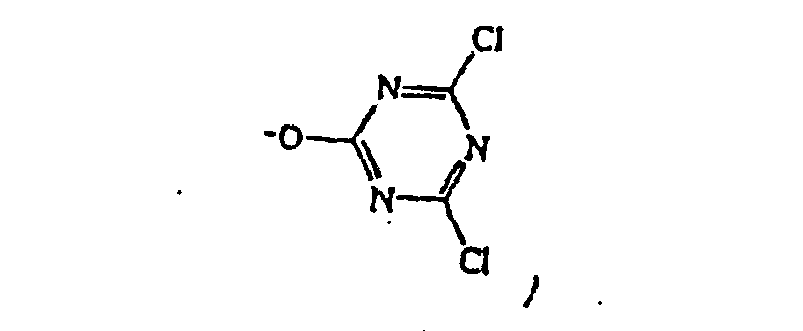
-O-SO2-CH2CF3,


- Verfahren nach einem der Ansprüche 12 bis 15, wobei der Initiator (ii) die Formel hat:


- Verfahren nach Anspruch 12 bis 16, wobei der Initiator die Formel hat:
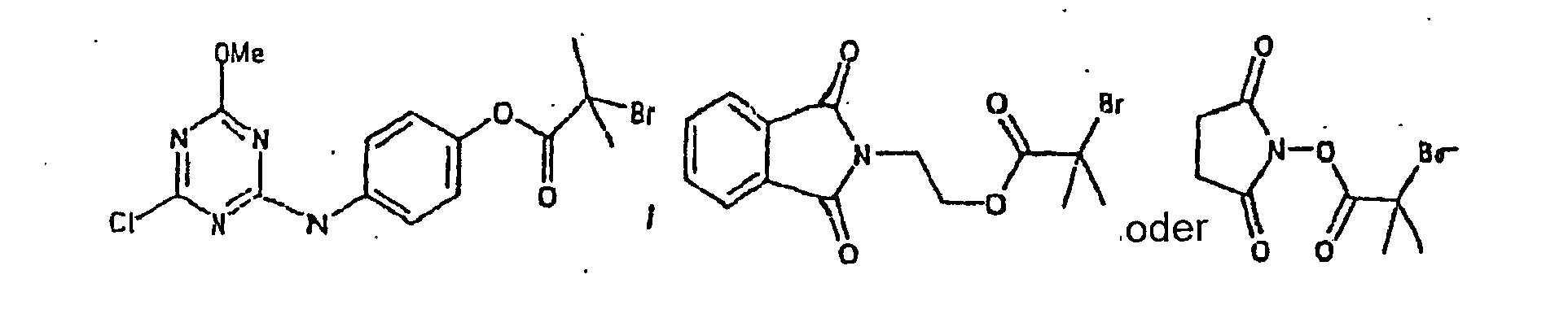


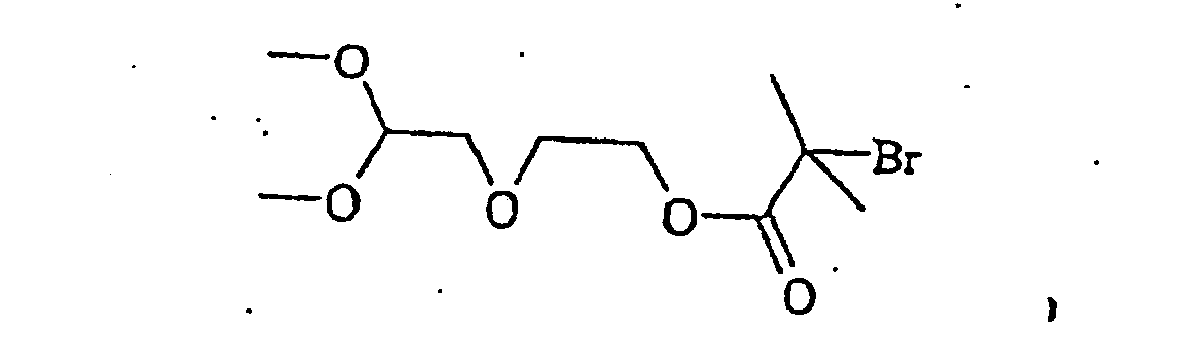


- Verfahren nach einem der Ansprüche 7 bis 17, wobei das Organodiimin ausgewählt ist aus:einem 1,4-Diaza-1,3-butadien
 einem 2-Pyridincarbaldehydimin
 einem Oxazolidon
 oder einem Chinolincarbaldehydwobei:
 R1, R2, R10, R11, R12 und R13 unabhängig voneinander wählbar sind und ausgewählt sein können aus H, geradkettigem, verzweigtkettigem oder cyclischem gesättigten Alkyl, Hydroxyalkyl, Carboxyalkyl, Aryl, CH2Ar (wobei Ar Aryl oder substituiertes Aryl ist) oder einem Halogen;R3 bis R9 unabhängig voneinander wählbar sind und ausgewählt sein können aus H, geradkettigem, verzweigtkettigem oder cyclischem Alkyl, Hydroxyalkyl, Carboxyalkyl, Aryl, CH2Ar, einem Halogen, OCH2n+1 (wobei n eine ganze Zahl von 1 bis 20 ist), NO2, CN, O = CR (wobei R = Alkyl, Aryl, substituiertes Aryl, Benzyl PhCH2 oder ein substituiertes Benzyl).
 - Verfahren nach Anspruch 18, wobei das Organodiimin
N-(n-Propyl)-2-pyridylmethanimin (NMPI), N-(n-Ethyl)-2-pyridylmethanimin, N-Ethyl-2-pyridylmethanimin ist oder ausgewählt ist aus:


 * ein chirales Zentrum anzeigt; undR14 = Wasserstoff, verzweigtkettiges C1- bis C10-Alkyl, Carboxy- oder Hydroxy-C1- bis C10-Alkyl.
 - Verfahren nach irgendeinem vorhergehenden Anspruch, wobei der Katalysator eine Bipyridingruppe umfasst.
- Verfahren nach Anspruch 20, wobei der Katalysator 4,4'-Di(5-nonyl)-2,2'-bipyridyl (dNbpy) ist.
- Verfahren nach irgendeinem vorhergehenden Anspruch, umfassend die Verwendung einer Vielzahl verschiedener Monomere gemäß Teil (i) von Anspruch 1.
- Verfahren nach irgendeinem vorhergehenden Anspruch, ferner umfassend den Schritt des Herstellens eines Blockcopolymers aus den Monomeren gemäß Teil (i) von Anspruch 1 mit ein oder mehr verschiedenen olefinisch ungesättigten Monomeren.
- Verfahren nach Anspruch 23, wobei das Kammpolymer, das die Monomeren gemäß Teil (i) von Anspruch 1 umfasst, vor der Zugabe der ein oder mehr verschiedenen olefinisch ungesättigten Monomeren mit dem Initiator (ii) und dem Katalysator (iii) polymerisiert wird.
- Verfahren nach Anspruch 23, wobei die ein oder mehr verschiedenen olefinisch ungesättigten Monomere vor der Polymerisation der Monomeren gemäß Teil (i) von Anspruch 1 mit dem Initiator (ii) und dem Katalysator (iii) polymerisiert werden.
- Verfahren nach einem der Ansprüche 23 bis 25, wobei die ein oder mehr verschiedenen olefinisch ungesättigten Monomere ausgewählt sind aus Methylmethacrylat, Butylmethacrylat, Acrylat, Methacrylat und Styrol.
- Verfahren nach irgendeinem vorhergehenden Anspruch, wobei die Reaktanten in einem hydrophoben oder hydrophilen Lösungsmittel umgesetzt werden.
- Verfahren nach Anspruch 27, wobei das Lösungsmittel ausgewählt ist aus Wasser, Propionitril, Hexan, Heptan, Dimethoxyethan, Diethoxyethan, Tetrahydrofuran, Ethylacetat, Diethylether, N,N-Dimethylformamid, Anisol, Acetonitril, Diphenylether, Methylisobutyrat, Butan-2-on, Toluol und Xylol.
- Verfahren nach irgendeinem vorhergehenden Anspruch, wobei die Polymerisationsreaktion bei -20 bis 200 °C durchgeführt wird.
- Verfahren nach irgendeinem vorhergehenden Anspruch, wobei der Katalysator ein geträgerter Katalysator ist.
- Verfahren nach irgendeinem vorhergehenden Anspruch, ferner umfassend den Schritt der Copolymerisation oder Blockpolymerisation mit wenigstens einem fluoreszenzmarkierten Monomer, das eine Additionspolymerisation eingehen kann.
- Verfahren nach Anspruch 31, wobei der Fluoreszenzmarker Cumarin ist.
- Kammpolymer, welches eine biologische Substanz binden kann, die ausgewählt ist aus einem Protein, einem Polypeptid, einer Nukleinsäure, einem Kohlenhydrat oder einem Fett, erhältlich nach einem Verfahren nach einem der Ansprüche 1 bis 32.
- Kammpolymer nach Anspruch 33, das ein Protein oder ein Polypeptid binden kann.
- Kammpolymer der allgemeinen Formel:
A-(D)d-(E)e-(F)f
wobei:A ein Rest ist, der kovalent an ein Protein oder ein Polypeptid binden kann,D durch Additionspolymerisation von ein oder mehr olefinisch ungesättigten Monomeren erhältlich ist, die nicht wie in E definiert sind,E durch Additionspolymerisation einer Vielzahl von Monomeren erhältlich ist, die geradkettig, verzweigt oder sternförmig, substituiert oder unsubstituiert sind und einen olefinisch ungesättigten Rest aufweisen,F, sofern vorhanden, durch Additionspolymerisation von ein oder mehr olefinisch ungesättigten Monomeren erhältlich ist, die nicht wie in E definiert sind;d und f ganze Zahlen zwischen 0 und 500 sind,e eine ganze Zahl von 0 bis 1.000 ist;wobei E einen Alkoxypolyether umfasst. - Kammpolymer nach Anspruch 35, wobei E ein Polyalkylenglykol oder ein Polytetrahydrofuran ist.
- Kammpolymer nach Anspruch 33 bis 36 mit einem mittleren Molekulargewicht von 2.000 bis 80.000.
- Kammpolymer nach einem der Ansprüche 33 bis 37, welches fluoreszenzmarkiert ist.
- Kammpolymer nach Anspruch 38, welches mit einem Cumarin fluoreszenzmarkiert ist.
- Verfahren zum Binden eines Polymers an eine Verbindung, umfassend die Umsetzung eines Kammpolymers nach einem der Ansprüche 33 bis 39 mit der Verbindung.
- Verbindung, erhältlich durch Umsetzen eines Proteins, eines Polypeptids, einer Nukleinsäure, eines Thiols, eines Kohlenhydrats, eines Diamins und/oder einer benzylaminhaltigen Verbindung mit einem Kammpolymer nach einem der Ansprüche 33 bis 39 zur Bildung eines Proteins, eines Polypeptids, eines Thiols, einer amin- und/oder einer benzylaminhaltigen Verbindung, die kovalent an das Kammpolymer gebunden sind.
- Verbindung nach Anspruch 41, welche eine protein- oder polypeptid-, eine thiol- und/oder eine benzylaminhaltige Verbindung ist.
- Verbindung nach einem der Ansprüche 41 bis 42, welche biologisch aktiv ist.
- Verbindung nach Anspruch 43, welche ein Arzneistoff ist.
- Verbindung nach einem der Ansprüche 41 bis 44 in Kombination mit einem pharmazeutisch verträglichen Träger.
- Verbindung nach einem der Ansprüche 41 bis 45 zur Verwendung als Chemotherapeutikum, Antibiotikum, Antimykotikum und/oder Immunsuppressivum.
Priority Applications (1)
| Application Number | Priority Date | Filing Date | Title |
|---|---|---|---|
| EP09002932A EP2161291A2 (de) | 2003-06-20 | 2004-06-18 | Polymer |
Applications Claiming Priority (2)
| Application Number | Priority Date | Filing Date | Title |
|---|---|---|---|
| GBGB0314472.2A GB0314472D0 (en) | 2003-06-20 | 2003-06-20 | Polymer |
| PCT/GB2004/002608 WO2004113394A2 (en) | 2003-06-20 | 2004-06-18 | Living radical polymerization initiator comprising a functional group capable of reacting with polypeptides or the like, comb polymer obtained therewith, polypeptide conjugates and drugs obtained therefrom |
Publications (2)
| Publication Number | Publication Date |
|---|---|
| EP1646661A2 EP1646661A2 (de) | 2006-04-19 |
| EP1646661B1 true EP1646661B1 (de) | 2009-04-01 |
Family
ID=27637062
Family Applications (2)
| Application Number | Title | Priority Date | Filing Date |
|---|---|---|---|
| EP09002932A Withdrawn EP2161291A2 (de) | 2003-06-20 | 2004-06-18 | Polymer |
| EP04742963A Expired - Lifetime EP1646661B1 (de) | 2003-06-20 | 2004-06-18 | Initiator für die lebende radikalische polymerisation mit einer zur reaktion mit polypeptiden oder dergleichen befähigten funktionellen gruppe, damit erhaltenes kammpolymer, polypetidkonjugate und daraus erhaltener arzneistoff |
Family Applications Before (1)
| Application Number | Title | Priority Date | Filing Date |
|---|---|---|---|
| EP09002932A Withdrawn EP2161291A2 (de) | 2003-06-20 | 2004-06-18 | Polymer |
Country Status (12)
| Country | Link |
|---|---|
| US (2) | US8436104B2 (de) |
| EP (2) | EP2161291A2 (de) |
| JP (1) | JP5264073B2 (de) |
| AT (1) | ATE427322T1 (de) |
| AU (1) | AU2004249489A1 (de) |
| CA (1) | CA2530001C (de) |
| DE (1) | DE602004020347D1 (de) |
| DK (1) | DK1646661T3 (de) |
| ES (1) | ES2324994T3 (de) |
| GB (1) | GB0314472D0 (de) |
| WO (1) | WO2004113394A2 (de) |
| ZA (1) | ZA200600590B (de) |
Cited By (4)
| Publication number | Priority date | Publication date | Assignee | Title |
|---|---|---|---|---|
| US8216582B2 (en) | 2006-06-23 | 2012-07-10 | Alethia Biotherapeutics Inc. | Polynucleotides and polypeptide sequences involved in cancer |
| US8580257B2 (en) | 2008-11-03 | 2013-11-12 | Alethia Biotherapeutics Inc. | Antibodies that specifically block the biological activity of kidney associated antigen 1 (KAAG1) |
| US9828426B2 (en) | 2011-03-31 | 2017-11-28 | Adc Therapeutics Sa | Antibodies against kidney associated antigen 1 and antigen binding fragments thereof |
| US11084872B2 (en) | 2012-01-09 | 2021-08-10 | Adc Therapeutics Sa | Method for treating breast cancer |
Families Citing this family (44)
| Publication number | Priority date | Publication date | Assignee | Title |
|---|---|---|---|---|
| GB0301014D0 (en) * | 2003-01-16 | 2003-02-19 | Biocompatibles Ltd | Conjugation reactions |
| GB0314472D0 (en) | 2003-06-20 | 2003-07-23 | Warwick Effect Polymers Ltd | Polymer |
| WO2006003352A1 (en) * | 2004-07-06 | 2006-01-12 | Warwick Effect Polymers Limited | Living radical polymerization initiator comprising a functional group capable of reacting with polyeptides or the like, comb polymer obtained therewith, polypeptide conjugates and drugs obtained therefrom |
| ES2382879T3 (es) * | 2005-09-14 | 2012-06-14 | Ucb Pharma, S.A. | Conjugado de anticuerpo - polímero de peine. |
| EP3222142A1 (de) | 2006-02-28 | 2017-09-27 | Kodiak Sciences Inc. | Acryloyloxyethylphosphorylcholin-haltige polymerkonjugate und deren herstellung |
| CN100406479C (zh) * | 2006-05-25 | 2008-07-30 | 中国科学院长春应用化学研究所 | 含有三氟甲基的β-二酮单亚胺钒烯烃聚合催化剂及制备方法和应用 |
| ITRM20060682A1 (it) * | 2006-12-19 | 2008-06-20 | Sicit Chemitech S P A | Nuovi derivati polimerici biodegradabili |
| JP5340956B2 (ja) * | 2006-12-20 | 2013-11-13 | アーケマ・インコーポレイテッド | ポリマーの封入および/または結合 |
| US8575397B2 (en) | 2007-02-14 | 2013-11-05 | Biocompatibles Uk Limited | Derivatisation of biological molecules |
| EP2562256A3 (de) | 2007-09-24 | 2013-06-19 | Noxxon Pharma AG | An C5a bindende Nukleinsäuren |
| WO2009053700A1 (en) * | 2007-10-23 | 2009-04-30 | Cancer Research Technology Limited | Modification of nucleic acid-containing biological entities |
| WO2009112301A2 (de) * | 2008-03-10 | 2009-09-17 | Basf Se | Polypeptidwirkstoffe in der form von konjugaten aus keratinbindenden polypeptiden, polymeren und effektormolekülen, verfahren zu ihrer herstellung und ihre verwendung |
| WO2010108657A2 (en) | 2009-03-23 | 2010-09-30 | Noxxon Pharma Ag | C5a binding nucleic acids and the use thereof |
| US8067201B2 (en) | 2009-04-17 | 2011-11-29 | Bristol-Myers Squibb Company | Methods for protein refolding |
| GB0912160D0 (en) | 2009-07-13 | 2009-08-26 | Warwick Effect Polymers Ltd | Polymer modified macromolecules |
| WO2011064185A1 (de) * | 2009-11-27 | 2011-06-03 | Basf Se | Dendritischer polyharnstoff zur solubilisierung schwerlöslicher wirkstoffe |
| WO2011075185A1 (en) * | 2009-12-18 | 2011-06-23 | Oligasis | Targeted drug phosphorylcholine polymer conjugates |
| EP2561079A1 (de) | 2010-04-21 | 2013-02-27 | Noxxon Pharma AG | Lipidbindende nukleinsäuren |
| WO2012025251A1 (en) | 2010-08-27 | 2012-03-01 | Noxxon Pharma Ag | Nucleic acids for treatment of chronic complications of diabetes |
| AU2011300818B2 (en) | 2010-09-09 | 2015-11-12 | TME Pharma AG | SDF-1 binding nucleic acids and the use thereof in cancer treatment |
| JP2014503187A (ja) | 2010-10-29 | 2014-02-13 | ノクソン ファーマ エージー | 身体からヘプシジンを除去するためのヘプシジン結合核酸の使用 |
| US9976145B2 (en) | 2011-01-10 | 2018-05-22 | Noxxon Pharma Ag | Nucleic acid molecule having binding affinity to a target molecule and a method for generating the same |
| JP2014533098A (ja) | 2011-10-21 | 2014-12-11 | ノクソン・ファルマ・アクチエンゲゼルシャフト | グルカゴン結合核酸 |
| KR102034203B1 (ko) | 2012-01-10 | 2019-10-18 | 아프타리온 바이오테크 아게 | 새로운 C5a 결합 핵산 |
| BR112014016939A2 (pt) | 2012-01-10 | 2019-09-24 | Noxxon Pharma Ag | ácidos nucleicos que se ligam especificamente a cgrp |
| WO2015035342A2 (en) | 2013-09-08 | 2015-03-12 | Oligasis Llc | Factor viii zwitterionic polymer conjugates |
| EP3065744B1 (de) | 2013-11-04 | 2021-04-21 | Noxxon Pharma AG | Ein ccl2-antagonist zur behandlung der proteinurie |
| US9840553B2 (en) | 2014-06-28 | 2017-12-12 | Kodiak Sciences Inc. | Dual PDGF/VEGF antagonists |
| KR20210013299A (ko) | 2014-10-17 | 2021-02-03 | 코디악 사이언시스 인코포레이티드 | 부티릴콜린에스테라제 양성이온성 중합체 컨쥬게이트 |
| US10098960B2 (en) | 2015-04-03 | 2018-10-16 | Ucl Business Plc | Polymer conjugate |
| KR20250057128A (ko) | 2015-12-30 | 2025-04-28 | 코디악 사이언시스 인코포레이티드 | 항체 및 이의 접합체 |
| EP3443095A1 (de) | 2016-04-15 | 2019-02-20 | Noxxon Pharma AG | Verfahren zur modulation der anzahl und der verteilung von tumorinfiltrierenden leukozyten bei tumoren |
| EP3464379B1 (de) | 2016-06-06 | 2023-09-27 | Abzena (UK) Limited | Antikörper, verwendungen davon und konjugate davon |
| GB201614162D0 (en) | 2016-08-18 | 2016-10-05 | Polytherics Ltd | Antibodies, uses thereof and conjugates thereof |
| EP3758737A4 (de) | 2018-03-02 | 2022-10-12 | Kodiak Sciences Inc. | Il-6-antikörper und fusionskonstrukte und konjugate davon |
| CA3157509A1 (en) | 2019-10-10 | 2021-04-15 | Kodiak Sciences Inc. | Methods of treating an eye disorder |
| CN114520325B (zh) * | 2022-01-07 | 2023-07-04 | 惠州锂威新能源科技有限公司 | 一种氮掺杂碳材料的制备方法及制品、负极片和二次电池 |
| KR20250025627A (ko) | 2022-06-21 | 2025-02-24 | 티엠이 파마 아게 | 대상체의 종양을 치료하는 방법 |
| EP4306640A1 (de) | 2022-06-21 | 2024-01-17 | TME Pharma AG | Verfahren zur behandlung eines tumors in einem patienten |
| EP4563585A1 (de) * | 2022-07-25 | 2025-06-04 | Nanjing GenScript Biotech Co., Ltd. | Verfahren zur ortsspezifischen synthese eines proteinaktiven molekularen konjugats |
| WO2024026148A1 (en) * | 2022-07-29 | 2024-02-01 | University Of Virginia Patent Foundation | Compositions comprising linear, star-shaped, and comb-like stapled p9-peg conjugates and methods of use thereof |
| EP4620474A1 (de) | 2024-03-20 | 2025-09-24 | APTARION biotech AG | Verfahren zur behandlung einer erkrankung mit einem c5a-hemmer |
| WO2025196240A1 (en) | 2024-03-20 | 2025-09-25 | Aptarion Biotech Ag | Method of treating a disorder with a c5a inhibitor |
| CN119661602B (zh) * | 2024-12-13 | 2025-10-10 | 湖南省中医药研究院 | 一种含有偶氮苯基和二茂铁基的小分子单体及其合成方法和用途 |
Family Cites Families (30)
| Publication number | Priority date | Publication date | Assignee | Title |
|---|---|---|---|---|
| ES2136595T5 (es) * | 1989-04-19 | 2004-04-01 | Enzon, Inc. | Carbonatos activos de oxidos de polialquileno para la modificacion de polipeptidos. |
| US5763548A (en) | 1995-03-31 | 1998-06-09 | Carnegie-Mellon University | (Co)polymers and a novel polymerization process based on atom (or group) transfer radical polymerization |
| WO1997001589A1 (de) | 1995-06-26 | 1997-01-16 | Basf Aktiengesellschaft | Neue polymerzusammensetzung für pfropfcopolymerisate sowie deren mischungen und diese enthaltende thermoplastische massen ii |
| US5807937A (en) | 1995-11-15 | 1998-09-15 | Carnegie Mellon University | Processes based on atom (or group) transfer radical polymerization and novel (co) polymers having useful structures and properties |
| DE69707452T3 (de) * | 1996-06-12 | 2015-07-23 | Warwick Effect Polymers Ltd. | Polymerisation-katalysator und -verfahren |
| CA2259559C (en) | 1996-07-10 | 2004-11-09 | E.I. Du Pont De Nemours And Company | Polymerization with living characteristics |
| US6214966B1 (en) | 1996-09-26 | 2001-04-10 | Shearwater Corporation | Soluble, degradable poly(ethylene glycol) derivatives for controllable release of bound molecules into solution |
| TW593347B (en) * | 1997-03-11 | 2004-06-21 | Univ Carnegie Mellon | Improvements in atom or group transfer radical polymerization |
| FR2764892B1 (fr) | 1997-06-23 | 2000-03-03 | Rhodia Chimie Sa | Procede de synthese de polymeres a blocs |
| US20050158273A1 (en) | 1997-09-25 | 2005-07-21 | Harris J. M. | Soluble, degradable polyethylene glycol) derivatives for controllable release of bound molecules into solution |
| GB9725455D0 (en) * | 1997-12-02 | 1998-01-28 | Univ Warwick | Supported polymerisation catalyst |
| BR9815179A (pt) | 1997-12-18 | 2000-10-10 | Du Pont | Processo para produzir um polìmero, polìmero, composição de revestimento e agente de transferência de cadeia. |
| AR019322A1 (es) * | 1998-06-18 | 2002-02-13 | Smithkline Beecham Corp | Derivados de sulfonilo sustituido por heterociclo-etanodionanilina sustituida por heterociclo, composicion farmaceutica que los contiene y su uso para lamanufactura de un medicamento |
| JP4231548B2 (ja) * | 1998-12-28 | 2009-03-04 | 日東電工株式会社 | 感圧性接着剤組成物とその製造方法 |
| WO2000056795A1 (en) * | 1999-03-23 | 2000-09-28 | Carnegie Mellon University | Catalytic processes for the controlled polymerization of free radically (co)polymerizable monomers and functional polymeric systems prepared thereby |
| GB0014225D0 (en) * | 2000-06-09 | 2000-08-02 | Univ Warwick | Polymerisation initiator and use |
| KR100396983B1 (ko) | 2000-07-29 | 2003-09-02 | 이강춘 | 고반응성의 가지 달린 고분자 유도체 및 고분자와 단백질또는 펩타이드의 접합체 |
| TW593427B (en) | 2000-12-18 | 2004-06-21 | Nektar Therapeutics Al Corp | Synthesis of high molecular weight non-peptidic polymer derivatives |
| ES2654819T3 (es) | 2001-10-18 | 2018-02-15 | Nektar Therapeutics | Conjugados poliméricos de antagonistas de opioides |
| EP1446438A2 (de) | 2001-11-07 | 2004-08-18 | Nektar Therapeutics Al, Corporation | Verzweigte polymere und ihre konjugate |
| US20030171285A1 (en) | 2001-11-20 | 2003-09-11 | Finn Rory F. | Chemically-modified human growth hormone conjugates |
| US7144978B2 (en) | 2002-01-15 | 2006-12-05 | Pan Asia Bio Co., Ltd. | Multidrop tree branching functional polyethylene glycol, methods of preparing and using same |
| WO2003062290A1 (en) * | 2002-01-16 | 2003-07-31 | Biocompatibles Uk Limited | Polymer conjugates |
| DE10228103A1 (de) | 2002-06-24 | 2004-01-15 | Bayer Cropscience Ag | Fungizide Wirkstoffkombinationen |
| KR20050093856A (ko) | 2002-09-09 | 2005-09-23 | 넥타르 테라퓨틱스 에이엘, 코포레이션 | 수용성 중합체 알카날 |
| US6992217B2 (en) * | 2002-12-11 | 2006-01-31 | 3M Innovative Properties Company | Ring-opened azlactone initiators for atom transfer radical polymerization |
| GB0301014D0 (en) * | 2003-01-16 | 2003-02-19 | Biocompatibles Ltd | Conjugation reactions |
| GB0314472D0 (en) | 2003-06-20 | 2003-07-23 | Warwick Effect Polymers Ltd | Polymer |
| US7563748B2 (en) | 2003-06-23 | 2009-07-21 | Cognis Ip Management Gmbh | Alcohol alkoxylate carriers for pesticide active ingredients |
| ATE460451T1 (de) | 2003-07-22 | 2010-03-15 | Nektar Therapeutics | Verfahren zur herstellung von funktionalisierten polymeren aus polymeralkoholen |
-
2003
- 2003-06-20 GB GBGB0314472.2A patent/GB0314472D0/en not_active Ceased
-
2004
- 2004-06-18 DK DK04742963T patent/DK1646661T3/da active
- 2004-06-18 CA CA2530001A patent/CA2530001C/en not_active Expired - Fee Related
- 2004-06-18 JP JP2006516436A patent/JP5264073B2/ja not_active Expired - Fee Related
- 2004-06-18 DE DE602004020347T patent/DE602004020347D1/de not_active Expired - Lifetime
- 2004-06-18 ZA ZA200600590A patent/ZA200600590B/xx unknown
- 2004-06-18 AT AT04742963T patent/ATE427322T1/de not_active IP Right Cessation
- 2004-06-18 EP EP09002932A patent/EP2161291A2/de not_active Withdrawn
- 2004-06-18 AU AU2004249489A patent/AU2004249489A1/en not_active Abandoned
- 2004-06-18 EP EP04742963A patent/EP1646661B1/de not_active Expired - Lifetime
- 2004-06-18 WO PCT/GB2004/002608 patent/WO2004113394A2/en not_active Ceased
- 2004-06-18 ES ES04742963T patent/ES2324994T3/es not_active Expired - Lifetime
-
2006
- 2006-08-03 US US11/498,525 patent/US8436104B2/en not_active Expired - Fee Related
-
2013
- 2013-04-05 US US13/857,513 patent/US9200104B2/en not_active Expired - Fee Related
Cited By (5)
| Publication number | Priority date | Publication date | Assignee | Title |
|---|---|---|---|---|
| US8216582B2 (en) | 2006-06-23 | 2012-07-10 | Alethia Biotherapeutics Inc. | Polynucleotides and polypeptide sequences involved in cancer |
| US8580257B2 (en) | 2008-11-03 | 2013-11-12 | Alethia Biotherapeutics Inc. | Antibodies that specifically block the biological activity of kidney associated antigen 1 (KAAG1) |
| US9828426B2 (en) | 2011-03-31 | 2017-11-28 | Adc Therapeutics Sa | Antibodies against kidney associated antigen 1 and antigen binding fragments thereof |
| US10597450B2 (en) | 2011-03-31 | 2020-03-24 | Adc Therapeutics Sa | Antibodies against kidney associated antigen 1 and antigen binding fragments thereof |
| US11084872B2 (en) | 2012-01-09 | 2021-08-10 | Adc Therapeutics Sa | Method for treating breast cancer |
Also Published As
| Publication number | Publication date |
|---|---|
| JP5264073B2 (ja) | 2013-08-14 |
| GB0314472D0 (en) | 2003-07-23 |
| WO2004113394A2 (en) | 2004-12-29 |
| ATE427322T1 (de) | 2009-04-15 |
| AU2004249489A2 (en) | 2004-12-29 |
| CA2530001C (en) | 2011-03-01 |
| EP2161291A2 (de) | 2010-03-10 |
| DE602004020347D1 (de) | 2009-05-14 |
| US20130295040A1 (en) | 2013-11-07 |
| ZA200600590B (en) | 2007-07-25 |
| WO2004113394A3 (en) | 2005-05-06 |
| DK1646661T3 (da) | 2009-07-20 |
| ES2324994T3 (es) | 2009-08-21 |
| US9200104B2 (en) | 2015-12-01 |
| US8436104B2 (en) | 2013-05-07 |
| AU2004249489A1 (en) | 2004-12-29 |
| JP2007516302A (ja) | 2007-06-21 |
| US20080300348A1 (en) | 2008-12-04 |
| CA2530001A1 (en) | 2004-12-29 |
| EP1646661A2 (de) | 2006-04-19 |
Similar Documents
| Publication | Publication Date | Title |
|---|---|---|
| EP1646661B1 (de) | Initiator für die lebende radikalische polymerisation mit einer zur reaktion mit polypeptiden oder dergleichen befähigten funktionellen gruppe, damit erhaltenes kammpolymer, polypetidkonjugate und daraus erhaltener arzneistoff | |
| CA2642819C (en) | Sugar polymers | |
| JP5017107B2 (ja) | ポリペプチド等と反応し得る官能基を含むリビングラジカル重合開始剤、それを用いて得られる櫛形ポリマー、それから得られるポリペプチド複合体及び薬剤 | |
| EP1564236B1 (de) | Polyalkylenglykol derivat | |
| Vanparijs et al. | Polymer-protein conjugation via a ‘grafting to’approach–a comparative study of the performance of protein-reactive RAFT chain transfer agents | |
| CN102317332B (zh) | 两性离子聚合物 | |
| KR101152500B1 (ko) | 접합된 생물학적 분자 및 그의 제조방법 | |
| EP2118150B1 (de) | Derivatisierung biologischer moleküle | |
| Le Droumaguet et al. | Formation of giant amphiphiles by post-functionalization of hydrophilic protein–polymer conjugates | |
| US20220118100A1 (en) | Monofunctional branched polyethylene glycol and modified bio-related substance thereof | |
| Ladmiral et al. | α-functional glycopolymers: New materials for (poly) peptide conjugation | |
| Alvaradejo et al. | Maleimide end-functionalized poly (2-oxazoline) s by the functional initiator route: synthesis and (bio) conjugation | |
| EP1461369A2 (de) | Blockcopolymere | |
| Le Bohec et al. | Structure-pDNA complexation and structure–cytotoxicity relationships of PEGylated, cationic aminoethyl-based polyacrylates with tunable topologies | |
| CENGİZ | Preparation and Dual-Functionalization of Pendant Aldehyde and Azide-Bearing Hydrophilic Polymer | |
| Page | Functional Phosphorylcholine Polymers: Prodrugs and Biomaterials | |
| Vanparijs et al. | Journal Name RSCPublishing |
Legal Events
| Date | Code | Title | Description |
|---|---|---|---|
| PUAI | Public reference made under article 153(3) epc to a published international application that has entered the european phase |
Free format text: ORIGINAL CODE: 0009012 |
|
| 17P | Request for examination filed |
Effective date: 20060118 |
|
| AK | Designated contracting states |
Kind code of ref document: A2 Designated state(s): AT BE BG CH CY CZ DE DK EE ES FI FR GB GR HU IE IT LI LU MC NL PL PT RO SE SI SK TR |
|
| DAX | Request for extension of the european patent (deleted) | ||
| 17Q | First examination report despatched |
Effective date: 20061128 |
|
| RIN1 | Information on inventor provided before grant (corrected) |
Inventor name: LECOLLEY, FRANCOIS Inventor name: HADDLETON, DAVID Inventor name: CARMICHAEL, ADRIAN C/O WARWICK EFFECT POLYMERS LTD Inventor name: MANTOVANI, GIUSEPPE Inventor name: TAO, LEI Inventor name: JARVIS, ADAM,C/O WARWICK EFFECT POLYMERS LTD. Inventor name: STEWARD, ANDREW, C/O WARWICK EFFECT POLYMERS LTD. |
|
| RIN1 | Information on inventor provided before grant (corrected) |
Inventor name: LECOLLEY, FRANCOIS Inventor name: STEWARD, ANDREW, C/O WARWICK EFFECT POLYMERS LTD. Inventor name: TAO, LEIC/O PROF HEATHER MAYNARD Inventor name: CARMICHAEL, ADRIAN C/O WARWICK EFFECT POLYMERS LTD Inventor name: HADDLETON, DAVID Inventor name: MANTOVANI, GIUSEPPE Inventor name: JARVIS, ADAM,C/O WARWICK EFFECT POLYMERS LTD. |
|
| GRAP | Despatch of communication of intention to grant a patent |
Free format text: ORIGINAL CODE: EPIDOSNIGR1 |
|
| GRAS | Grant fee paid |
Free format text: ORIGINAL CODE: EPIDOSNIGR3 |
|
| GRAA | (expected) grant |
Free format text: ORIGINAL CODE: 0009210 |
|
| AK | Designated contracting states |
Kind code of ref document: B1 Designated state(s): AT BE BG CH CY CZ DE DK EE ES FI FR GB GR HU IE IT LI LU MC NL PL PT RO SE SI SK TR |
|
| REG | Reference to a national code |
Ref country code: GB Ref legal event code: FG4D |
|
| REG | Reference to a national code |
Ref country code: CH Ref legal event code: EP |
|
| REG | Reference to a national code |
Ref country code: IE Ref legal event code: FG4D |
|
| REF | Corresponds to: |
Ref document number: 602004020347 Country of ref document: DE Date of ref document: 20090514 Kind code of ref document: P |
|
| REG | Reference to a national code |
Ref country code: CH Ref legal event code: NV Representative=s name: HEPP WENGER RYFFEL AG |
|
| REG | Reference to a national code |
Ref country code: SE Ref legal event code: TRGR |
|
| REG | Reference to a national code |
Ref country code: DK Ref legal event code: T3 |
|
| PG25 | Lapsed in a contracting state [announced via postgrant information from national office to epo] |
Ref country code: SI Free format text: LAPSE BECAUSE OF FAILURE TO SUBMIT A TRANSLATION OF THE DESCRIPTION OR TO PAY THE FEE WITHIN THE PRESCRIBED TIME-LIMIT Effective date: 20090401 |
|
| PGFP | Annual fee paid to national office [announced via postgrant information from national office to epo] |
Ref country code: DK Payment date: 20090611 Year of fee payment: 6 Ref country code: IE Payment date: 20090619 Year of fee payment: 6 Ref country code: NL Payment date: 20090616 Year of fee payment: 6 |
|
| REG | Reference to a national code |
Ref country code: ES Ref legal event code: FG2A Ref document number: 2324994 Country of ref document: ES Kind code of ref document: T3 |
|
| PGFP | Annual fee paid to national office [announced via postgrant information from national office to epo] |
Ref country code: SE Payment date: 20090612 Year of fee payment: 6 |
|
| PGFP | Annual fee paid to national office [announced via postgrant information from national office to epo] |
Ref country code: BE Payment date: 20090615 Year of fee payment: 6 |
|
| PG25 | Lapsed in a contracting state [announced via postgrant information from national office to epo] |
Ref country code: EE Free format text: LAPSE BECAUSE OF FAILURE TO SUBMIT A TRANSLATION OF THE DESCRIPTION OR TO PAY THE FEE WITHIN THE PRESCRIBED TIME-LIMIT Effective date: 20090401 Ref country code: AT Free format text: LAPSE BECAUSE OF FAILURE TO SUBMIT A TRANSLATION OF THE DESCRIPTION OR TO PAY THE FEE WITHIN THE PRESCRIBED TIME-LIMIT Effective date: 20090401 Ref country code: PT Free format text: LAPSE BECAUSE OF FAILURE TO SUBMIT A TRANSLATION OF THE DESCRIPTION OR TO PAY THE FEE WITHIN THE PRESCRIBED TIME-LIMIT Effective date: 20090902 Ref country code: FI Free format text: LAPSE BECAUSE OF FAILURE TO SUBMIT A TRANSLATION OF THE DESCRIPTION OR TO PAY THE FEE WITHIN THE PRESCRIBED TIME-LIMIT Effective date: 20090401 |
|
| PG25 | Lapsed in a contracting state [announced via postgrant information from national office to epo] |
Ref country code: PL Free format text: LAPSE BECAUSE OF FAILURE TO SUBMIT A TRANSLATION OF THE DESCRIPTION OR TO PAY THE FEE WITHIN THE PRESCRIBED TIME-LIMIT Effective date: 20090401 |
|
| PG25 | Lapsed in a contracting state [announced via postgrant information from national office to epo] |
Ref country code: RO Free format text: LAPSE BECAUSE OF FAILURE TO SUBMIT A TRANSLATION OF THE DESCRIPTION OR TO PAY THE FEE WITHIN THE PRESCRIBED TIME-LIMIT Effective date: 20090401 Ref country code: MC Free format text: LAPSE BECAUSE OF NON-PAYMENT OF DUE FEES Effective date: 20090630 Ref country code: CZ Free format text: LAPSE BECAUSE OF FAILURE TO SUBMIT A TRANSLATION OF THE DESCRIPTION OR TO PAY THE FEE WITHIN THE PRESCRIBED TIME-LIMIT Effective date: 20090401 |
|
| PLBE | No opposition filed within time limit |
Free format text: ORIGINAL CODE: 0009261 |
|
| STAA | Information on the status of an ep patent application or granted ep patent |
Free format text: STATUS: NO OPPOSITION FILED WITHIN TIME LIMIT |
|
| PG25 | Lapsed in a contracting state [announced via postgrant information from national office to epo] |
Ref country code: SK Free format text: LAPSE BECAUSE OF FAILURE TO SUBMIT A TRANSLATION OF THE DESCRIPTION OR TO PAY THE FEE WITHIN THE PRESCRIBED TIME-LIMIT Effective date: 20090401 |
|
| 26N | No opposition filed |
Effective date: 20100105 |
|
| PG25 | Lapsed in a contracting state [announced via postgrant information from national office to epo] |
Ref country code: BG Free format text: LAPSE BECAUSE OF FAILURE TO SUBMIT A TRANSLATION OF THE DESCRIPTION OR TO PAY THE FEE WITHIN THE PRESCRIBED TIME-LIMIT Effective date: 20090701 |
|
| PG25 | Lapsed in a contracting state [announced via postgrant information from national office to epo] |
Ref country code: GR Free format text: LAPSE BECAUSE OF FAILURE TO SUBMIT A TRANSLATION OF THE DESCRIPTION OR TO PAY THE FEE WITHIN THE PRESCRIBED TIME-LIMIT Effective date: 20090702 |
|
| BERE | Be: lapsed |
Owner name: WARWICK EFFECT POLYMERS LTD Effective date: 20100630 |
|
| REG | Reference to a national code |
Ref country code: NL Ref legal event code: V1 Effective date: 20110101 |
|
| REG | Reference to a national code |
Ref country code: DK Ref legal event code: EBP |
|
| EUG | Se: european patent has lapsed | ||
| REG | Reference to a national code |
Ref country code: IE Ref legal event code: MM4A |
|
| PG25 | Lapsed in a contracting state [announced via postgrant information from national office to epo] |
Ref country code: IE Free format text: LAPSE BECAUSE OF NON-PAYMENT OF DUE FEES Effective date: 20100618 Ref country code: LU Free format text: LAPSE BECAUSE OF NON-PAYMENT OF DUE FEES Effective date: 20090618 |
|
| PG25 | Lapsed in a contracting state [announced via postgrant information from national office to epo] |
Ref country code: NL Free format text: LAPSE BECAUSE OF NON-PAYMENT OF DUE FEES Effective date: 20110101 |
|
| PG25 | Lapsed in a contracting state [announced via postgrant information from national office to epo] |
Ref country code: BE Free format text: LAPSE BECAUSE OF NON-PAYMENT OF DUE FEES Effective date: 20100630 Ref country code: HU Free format text: LAPSE BECAUSE OF FAILURE TO SUBMIT A TRANSLATION OF THE DESCRIPTION OR TO PAY THE FEE WITHIN THE PRESCRIBED TIME-LIMIT Effective date: 20091002 |
|
| PG25 | Lapsed in a contracting state [announced via postgrant information from national office to epo] |
Ref country code: TR Free format text: LAPSE BECAUSE OF FAILURE TO SUBMIT A TRANSLATION OF THE DESCRIPTION OR TO PAY THE FEE WITHIN THE PRESCRIBED TIME-LIMIT Effective date: 20090401 Ref country code: DK Free format text: LAPSE BECAUSE OF NON-PAYMENT OF DUE FEES Effective date: 20100630 |
|
| PG25 | Lapsed in a contracting state [announced via postgrant information from national office to epo] |
Ref country code: CY Free format text: LAPSE BECAUSE OF FAILURE TO SUBMIT A TRANSLATION OF THE DESCRIPTION OR TO PAY THE FEE WITHIN THE PRESCRIBED TIME-LIMIT Effective date: 20090401 |
|
| PG25 | Lapsed in a contracting state [announced via postgrant information from national office to epo] |
Ref country code: SE Free format text: LAPSE BECAUSE OF NON-PAYMENT OF DUE FEES Effective date: 20100619 |
|
| REG | Reference to a national code |
Ref country code: FR Ref legal event code: PLFP Year of fee payment: 12 |
|
| PGFP | Annual fee paid to national office [announced via postgrant information from national office to epo] |
Ref country code: CH Payment date: 20150618 Year of fee payment: 12 Ref country code: ES Payment date: 20150619 Year of fee payment: 12 Ref country code: GB Payment date: 20150402 Year of fee payment: 12 Ref country code: DE Payment date: 20150619 Year of fee payment: 12 |
|
| PGFP | Annual fee paid to national office [announced via postgrant information from national office to epo] |
Ref country code: IT Payment date: 20150623 Year of fee payment: 12 Ref country code: FR Payment date: 20150619 Year of fee payment: 12 |
|
| REG | Reference to a national code |
Ref country code: DE Ref legal event code: R119 Ref document number: 602004020347 Country of ref document: DE |
|
| REG | Reference to a national code |
Ref country code: CH Ref legal event code: PL |
|
| GBPC | Gb: european patent ceased through non-payment of renewal fee |
Effective date: 20160618 |
|
| REG | Reference to a national code |
Ref country code: FR Ref legal event code: ST Effective date: 20170228 |
|
| PG25 | Lapsed in a contracting state [announced via postgrant information from national office to epo] |
Ref country code: DE Free format text: LAPSE BECAUSE OF NON-PAYMENT OF DUE FEES Effective date: 20170103 Ref country code: LI Free format text: LAPSE BECAUSE OF NON-PAYMENT OF DUE FEES Effective date: 20160630 Ref country code: FR Free format text: LAPSE BECAUSE OF NON-PAYMENT OF DUE FEES Effective date: 20160630 Ref country code: CH Free format text: LAPSE BECAUSE OF NON-PAYMENT OF DUE FEES Effective date: 20160630 |
|
| PG25 | Lapsed in a contracting state [announced via postgrant information from national office to epo] |
Ref country code: GB Free format text: LAPSE BECAUSE OF NON-PAYMENT OF DUE FEES Effective date: 20160618 |
|
| PG25 | Lapsed in a contracting state [announced via postgrant information from national office to epo] |
Ref country code: IT Free format text: LAPSE BECAUSE OF NON-PAYMENT OF DUE FEES Effective date: 20160618 |
|
| PG25 | Lapsed in a contracting state [announced via postgrant information from national office to epo] |
Ref country code: ES Free format text: LAPSE BECAUSE OF NON-PAYMENT OF DUE FEES Effective date: 20160619 |
|
| REG | Reference to a national code |
Ref country code: ES Ref legal event code: FD2A Effective date: 20181203 |