EP1652477A1 - Ultrasonographe, dispositif de traitement d'image ultrason et méthode de traitement d'image ultrason - Google Patents
Ultrasonographe, dispositif de traitement d'image ultrason et méthode de traitement d'image ultrason Download PDFInfo
- Publication number
- EP1652477A1 EP1652477A1 EP05745493A EP05745493A EP1652477A1 EP 1652477 A1 EP1652477 A1 EP 1652477A1 EP 05745493 A EP05745493 A EP 05745493A EP 05745493 A EP05745493 A EP 05745493A EP 1652477 A1 EP1652477 A1 EP 1652477A1
- Authority
- EP
- European Patent Office
- Prior art keywords
- phase
- time
- moving region
- velocity
- ultrasonic
- Prior art date
- Legal status (The legal status is an assumption and is not a legal conclusion. Google has not performed a legal analysis and makes no representation as to the accuracy of the status listed.)
- Granted
Links
Images



Classifications
-
- G—PHYSICS
- G01—MEASURING; TESTING
- G01S—RADIO DIRECTION-FINDING; RADIO NAVIGATION; DETERMINING DISTANCE OR VELOCITY BY USE OF RADIO WAVES; LOCATING OR PRESENCE-DETECTING BY USE OF THE REFLECTION OR RERADIATION OF RADIO WAVES; ANALOGOUS ARRANGEMENTS USING OTHER WAVES
- G01S7/00—Details of systems according to groups G01S13/00, G01S15/00, G01S17/00
- G01S7/52—Details of systems according to groups G01S13/00, G01S15/00, G01S17/00 of systems according to group G01S15/00
- G01S7/52017—Details of systems according to groups G01S13/00, G01S15/00, G01S17/00 of systems according to group G01S15/00 particularly adapted to short-range imaging
- G01S7/52053—Display arrangements
- G01S7/52057—Cathode ray tube displays
- G01S7/52071—Multicolour displays; using colour coding; Optimising colour or information content in displays, e.g. parametric imaging
-
- A—HUMAN NECESSITIES
- A61—MEDICAL OR VETERINARY SCIENCE; HYGIENE
- A61B—DIAGNOSIS; SURGERY; IDENTIFICATION
- A61B8/00—Diagnosis using ultrasonic, sonic or infrasonic waves
- A61B8/08—Clinical applications
- A61B8/0883—Clinical applications for diagnosis of the heart
-
- A—HUMAN NECESSITIES
- A61—MEDICAL OR VETERINARY SCIENCE; HYGIENE
- A61B—DIAGNOSIS; SURGERY; IDENTIFICATION
- A61B8/00—Diagnosis using ultrasonic, sonic or infrasonic waves
- A61B8/48—Diagnostic techniques
- A61B8/488—Diagnostic techniques involving Doppler signals
-
- G—PHYSICS
- G06—COMPUTING OR CALCULATING; COUNTING
- G06T—IMAGE DATA PROCESSING OR GENERATION, IN GENERAL
- G06T7/00—Image analysis
- G06T7/20—Analysis of motion
-
- A—HUMAN NECESSITIES
- A61—MEDICAL OR VETERINARY SCIENCE; HYGIENE
- A61B—DIAGNOSIS; SURGERY; IDENTIFICATION
- A61B8/00—Diagnosis using ultrasonic, sonic or infrasonic waves
- A61B8/02—Measuring pulse or heart rate
-
- A—HUMAN NECESSITIES
- A61—MEDICAL OR VETERINARY SCIENCE; HYGIENE
- A61B—DIAGNOSIS; SURGERY; IDENTIFICATION
- A61B8/00—Diagnosis using ultrasonic, sonic or infrasonic waves
- A61B8/48—Diagnostic techniques
- A61B8/485—Diagnostic techniques involving measuring strain or elastic properties
-
- G—PHYSICS
- G01—MEASURING; TESTING
- G01S—RADIO DIRECTION-FINDING; RADIO NAVIGATION; DETERMINING DISTANCE OR VELOCITY BY USE OF RADIO WAVES; LOCATING OR PRESENCE-DETECTING BY USE OF THE REFLECTION OR RERADIATION OF RADIO WAVES; ANALOGOUS ARRANGEMENTS USING OTHER WAVES
- G01S15/00—Systems using the reflection or reradiation of acoustic waves, e.g. sonar systems
- G01S15/88—Sonar systems specially adapted for specific applications
- G01S15/89—Sonar systems specially adapted for specific applications for mapping or imaging
- G01S15/8906—Short-range imaging systems; Acoustic microscope systems using pulse-echo techniques
- G01S15/8979—Combined Doppler and pulse-echo imaging systems
-
- G—PHYSICS
- G06—COMPUTING OR CALCULATING; COUNTING
- G06T—IMAGE DATA PROCESSING OR GENERATION, IN GENERAL
- G06T2207/00—Indexing scheme for image analysis or image enhancement
- G06T2207/30—Subject of image; Context of image processing
- G06T2207/30004—Biomedical image processing
- G06T2207/30048—Heart; Cardiac
Definitions
- the present invention relates to an ultrasonic diagnostic system and a system and a method for ultrasonic imaging wherein the velocity of biological tissue such as cardiac muscle is estimated, and the estimated velocity information is processed to output local motion information of the tissue, thereby providing information useful in medical diagnosis, and in particular, it relates to a method for reducing the time and labor for operation by automatically detecting an end systole phase.
- TTI tissue tracking imaging
- time quadrature is required, as described in Patent Document 1. Since the result of time quadrature depends on an integration interval (time), the importance of the setting of the interval will easily be understood.
- a start phase When integration start phase is, for example, in an end diastole phase, systolic distortion and displacement can be analyzed. Paying attention to distortion, normal cardiac muscle is thickened in the wall thickness direction (the minor axis), and shortened along the major axis during systole. In contrast, when the integration start phase is in end systole phase, diastolic distortion and displacement can be analyzed. Also paying attention to distortion, normal cardiac muscle is thinned in the wall thickness direction (the minor axis), and stretched along the major axis during systole.
- integration end time is important second to the start time phase as a time phase that reflects the final state of distortion and displacement in specified intervals such as systole and diastole.
- the most common way will be that the state of the whole motion by time quadrature for systole is analyzed in an end systole phase, and the state of the whole motion by time quadrature for diastole is analyzed in an end diastole phase.
- the end diastole phase and the end systole phase must be provided as accurately as possible.
- a technique of monopolar display of distortion is disclosed in JP-A-2003-175041, for example, as another unique application setting other than the setting of an integration interval in each phase interval of systole and diastole. To realize accurate and simple time phase setting is also very useful for the distortion monopolar display.
- the end diastole phase and the end systole phase can be detected automatically as an R-wave phase in an electrocardiogram.
- the end systole phase cannot easily be detected from an electrocardiogram; however, the following automatic setting technique is known.
- DT delay time
- HR heart rates
- DTs decrease generally as HRs increase. Accordingly, DTs can often be set by users as a table for each HR.
- the technique by the ACT method discloses "finding an end systole phase as a time phase in which the area or volume of a cardiac cavity is minimized" by estimating the area or volume of a cardiac cavity from positional information on endocardium that is automatically detected.
- the ACT method cannot be applied to cross sections such as a longitudinal image of a left ventricle in which a cardiac cavity is not clearly drawn.
- cross sections such as a longitudinal image of a left ventricle in which a cardiac cavity is not clearly drawn.
- To increase the accuracy of time for finding an end systole phase it is preferable to obtain a cardiac-cavity volume with high accuracy.
- only one cross section allows definition of only an area, so that it is difficult to ensure an accurate volume.
- Multiple reference cross sections are generally required to obtain a high-accuracy volume. This is complicated technically, thus decreasing simplicity. Consequently, the ACT method cannot increase the accuracy and lacks in operability in setting cross sections because of its limitation to available cross sections.
- the invention has been made in view of the above-described circumstances. Accordingly, it is an object of the invention to provide an ultrasonic diagnostic system and a system and a method for ultrasonic imaging capable of simple and high-accuracy automatic detection of end systole phases for all cross section images used in general cardiac ultrasonography.
- an ultrasonic diagnostic system or an ultrasonic imaging system which includes: a storage unit that stores time-series velocity information on a moving region that repeats contraction and relaxation cyclically; and an estimation unit that estimates any desired time phase for one cycle including the contraction and relaxation of the moving region based on the time-series velocity information.
- a method for ultrasonic imaging includes: obtaining time-series velocity information on a moving region that repeats contraction and relaxation cyclically; and estimating any desired time phase for one cycle including the contraction and relaxation of the moving region based on the time-series velocity information.
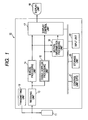
- FIG. 1 is a block diagram of an ultrasonic diagnostic system 10 according to a first embodiment.
- the ultrasonic diagnostic system 10 includes an ultrasonic probe 11, a transmitting unit 12, a receiving unit 13, a B-mode processing unit 14, a tissue Doppler processing unit 15, a motion-information processing unit 16, a display control unit 17, a display unit 18, an input unit 19, a storage unit 20, a control unit 21, and an input unit 22.
- the ultrasonic probe 11 includes a plurality of piezoelectric vibrators that generates ultrasonic waves in response to a drive signal from the transmitting unit 12, and converts reflected waves from a subject to electric signals; a matching layer provided to the piezoelectric vibrators; and a backing material for preventing propagation of the ultrasonic waves from the piezoelectric vibrators to the back.
- various harmonic components are generated with the propagation of the ultrasonic waves owing to the nonlinearity of biological tissue.
- the fundamental waves and harmonic components that constitute transmission ultrasonic waves are scattered backward by the boundary of acoustic impedance of in vivo tissue, microscattering etc., and are received by the ultrasonic probe 11 as reflected waves (echo). Since this embodiment and the following-described embodiments explain a case of a heart being an imaged object as an example, a sector probe is used as the ultrasonic probe 1.
- the transmitting unit 12 includes a delay circuit and a pulser circuit (not shown).
- the pulser circuit repeatedly generates a rate pulse for forming transmission ultrasonic waves at a predetermined rate frequency fr Hz (cycle: 1/fr sec).
- the delay circuit provides each rate pulse with a delay time necessary for converging ultrasonic waves into a beam for each channel and determining transmission directivity.
- the transmitting unit 12 applies driving pulses to each vibrator at timing based on the rate pulses so that the ultrasonic beams are formed in the direction of a specified scan line.
- the receiving unit 13 includes an amplifier circuit, an A/D converter, an adder and the like (not shown).
- the amplifier circuit amplifies the echo signal taken via the probe 11 channel by channel.
- the A/D converter provides a delay time necessary for determining reception directivity to the amplified echo signal, and thereafter, the adder performs adding process.
- the addition generates an ultrasonic echo signal corresponding to a specified scan line.
- the B-mode processing unit 14 applies an envelope detection process to the ultrasonic echo signal received from the receiving unit 13 to thereby generate a B-mode signal corresponding to the amplitude intensity of the ultrasonic echo signal.
- the tissue Doppler processing unit 15 applies an orthogonal detection process, an autocorrelation process, and so on to the echo signal received from the receiving unit 13 to obtain a tissue Doppler signal corresponding to the velocity, dispersion, and power of the tissue moving in the subject on the basis of the Doppler displacement component of the ultrasonic echo signal subjected to the delay and addition process.
- the motion-information processing unit 16 executes various processes for obtaining a motion-information image on the basis of the B-mode signal output from the B-mode processing unit 14 and the Doppler signal output from the tissue Doppler processing unit 16.
- the motion-information processing unit 16 also executes the process of estimating a desired time phase and the process of automatically setting an integration interval by TTI method, which will be described later, using velocity-distribution images stored in the storage unit 20.
- the display control unit 17 generates a B-mode ultrasonic image indicative of the dimensional distribution of a B-mode signal on a specified cross section.
- the display control unit 17 also generates a tissue Doppler ultrasonic image indicative of a two-dimensional distribution of the velocity, dispersion, and power values on a specified cross section on the basis on the tissue Doppler signal.
- the display control unit 17 also generates a superimposed image of a B-mode ultrasonic image and a tissue Doppler ultrasonic image, a superimposed image of a B-mode ultrasonic image and a two-dimensional distribution image of displacement or distortion, and so on as needed.
- the display unit 18 displays in-vivo morphological information and blood-flow information according to a video signal from the display control unit 17 as an image.
- the motion-information processing unit 16 displays a luminance image or a color image according to quantitative information on the spatial distribution of the contrast medium, that is, the area of blood flow or blood.
- the input unit 19 is connected to the system main body, and includes a mouse, a track ball, a mode switch, a keyboard, and so on for bringing various instructions from the operator, such as an instruction to set a region of interest (ROI) and an instruction to set various image-quality conditions to the system main body.
- various instructions from the operator such as an instruction to set a region of interest (ROI) and an instruction to set various image-quality conditions to the system main body.
- ROI region of interest
- the storage unit 20 stores ultrasonic image data (ultrasonic reception data) corresponding to each phase, a velocity-distribution image corresponding to time phases generated by the motion-information processing unit 16, and so on.
- the ultrasonic image data assumes tissue-image data taken in a tissue Doppler mode and tissue-image data taken in other than the tissue Doppler mode.
- the tissue image data may be so-called raw image data before scan conversion.
- the control unit 21 has the function of an information processor (computer), and controls the operation of the ultrasonic diagnostic system body statically or dynamically.
- the input unit 22 is connected to the system 10, and includes various switch buttons, a track ball, a mouse, a keyboard, and so on for bringing in various instructions from the operator, such as an instruction to set and change various parameters and conditions and an instruction to set a region of interest (ROI) to the system main body.
- various switch buttons such as an instruction to set and change various parameters and conditions and an instruction to set a region of interest (ROI) to the system main body.
- ROI region of interest
- Tissue tracking imaging method that is the prerequisite technique of the embodiment will be briefly described.
- the tissue tracking imaging images the parameters of local displacement and distortion obtained by integrating a signal based on velocity information, as tissue-motion information, while tracking the position of tissue which changes with motion.
- the technique allows the image of the distortion and displacement of local cardiac muscle to be produced and displayed using, e.g., a minor-axis image, thus supporting the analysis of temporal changes in image output values for a local region.
- the minor-axis image the main object function of cardiac analysis is thickening (change in thickness).
- the tissue tracking imaging method adopts the concept of a contraction motion field directed to a contraction center and setting therefor to detect a component relating to the thickening by angular compensation and to image it.
- the tissue tracking imaging method is also applicable to a temporally variable motion field by temporally shifting the contraction center position in consideration of the effects of the translational motion (also referred to as "translation") of the entire heart. This consequently allows tracking to the variations of the contract center position due to translational motion. Further details of the tissue tracking imaging method is described in JP-A-2003-175041, for example. The contents of the reference will be added to the description of the embodiment.
- the tissue tracking imaging method requires a space-time distribution image of tissue velocities for multiple phases (an image indicative of the velocities of the positions of tissue to be diagnosed.
- the space-time distribution image of the tissue velocities (hereinafter, simply referred to as "a velocity-distribution image”) can be generated from two-dimensional or three-dimensional ultrasonic image data on multiple time phases collected by tissue Doppler imaging, or alternatively, can be obtained by giving pattern-matching to multiple two-dimensional or three-dimensional tissue images on multiple time phases collected by the B-mode processing unit or the like.
- the embodiment uses a two-dimensional velocity distribution image produced by the tissue Doppler imaging (TDI) to provide a concrete description.
- tissue Doppler imaging TDI
- the invention is not limited to that, but may use a three-dimensional velocity distribution image produced by tissue Doppler imaging, for example, or a two-dimensional or three-dimensional velocity distribution image produced by pattern matching.
- the embodiment uses a heart as an diagnostic object by way of example. Accordingly, most of tissue velocities obtained by tissue tracking imaging can be regarded as myocardial velocity.
- the time-phase estimating function of the ultrasonic diagnostic system 10 will be described.
- the time-phase estimation is for analytically estimating, for example, various time phases, which are clinically important, using phase-to-phase velocity distribution images stored in the storage unit 20.
- estimation of an end systole phase will be described below to simplify the description as an example, in addition to that, the ultrasonic diagnostic system 10 can estimate an S-wave generation phase, an E-wave generation phase, a time phase in which the velocity reaches a specified velocity on the rising edge from E-wave, an A-wave generation phase, and any other phases specified by clinical characteristics.
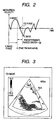
- FIG. 2 is an explanatory diagram of the function of estimating end systole phase ES, showing a graph indicating the temporal changes of a myocardial velocity.
- the end systole phase ES be estimated by specifying a time phase in which
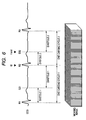
- the myocardial velocity for example the sum of the velocities at the positions of the cardiac muscle in the ROI set in the ultrasonic image (TDI image), as shown in FIG. 3, or the sum of the absolute values of the velocities at the positions of the cardiac muscle in the ROI (that is,
- the myocardial velocity is defined as the sum of the velocities at the positions of the cardiac muscle in the ROI
- the tissue velocity of the components toward beams can be found by the tissue Doppler imaging, so that the motion of tissue may be not always small if the sum is small.
- the velocity in this estimation is high, a time phase in which the motion of cardiac tissue stands still can be detected approximately.
- the myocardial velocity is defined as the sum of the
- the component of motion is added as the absolute value in all cases, so that, although complicated, a time phase in which the motion of cardiac tissue stands still can be detected more accurately.
- the estimation object period be controlled depending on the heart rate HR because the time per one heartbeat varies among individuals.
- an estimation-object-period start phase (start phase) and the width of the estimation object period from the start phase be stored in the storage unit 20 in advance as a table for heart rates, as shown in FIG. 4, and the motion-information processing unit 16 automatically determine the estimation object period on the basis of the heart rate obtained from an electrocardiogram (ECG) or input from the input unit 19 and the table.
- ECG electrocardiogram
- an integration-interval start phase by the TTI and the width of the estimation object period may be set by a predetermined function using a heart rate as a variable.
- the end systole phase ES thus estimated is displayed in a specified form.
- FIG. 5 is a graph of an example of the relationship between the end systole phase ES, indicated by ES-phase line L, and an electrocardiographic complex. This allows the user to easily grasp the position of the end systole phase ES throughout the heartbeat.
- the automatic setting is for automatically setting a cardiac phase interval, which can be an integration interval when a systole, a diastole, a cardiac cycle, and other motion information are calculated by the TTI method, based on the estimated end systole phase ES and an R-wave phase found by an ECG. This allows the motion information defined by time quadrature in TTI method to be analyzed and acquired easily.
- FIG. 6 is a diagram of an example in which the latest systole 2 is automatically set as an integration interval by TTI method.
- the motion-information processing unit 16 first regards the R-wave phase in each heartbeat detected by an ECG as an end diastole, and estimates the R-ES phase interval as a systole using the end diastole and the end systole phase ES obtained by the estimation, estimates the ES-R phase interval as a diastole, and estimates the R-R phase interval as one heart cycle.
- the motion-information processing unit 16 automatically sets the R2-wave phase that is the start phase of the latest systole 2 among the estimated phase intervals as the lower limit t0 of the integration interval, and sets the end systole phase ES2 that is the end time of the latest systole 2 as the upper limit tend of the integration interval.
- FIG. 7 is a diagram of an example in which the latest diastole 2 is automatically set as an integration interval by TTI method.
- the motion-information processing unit 16 automatically sets the end systole phase ES2 that is the start phase of the latest diastole 2 among the estimated phase intervals as the lower limit t0 of the integration interval, and sets the R3-wave phase that is the end time of the latest diastole 2 as the upper limit tend of the integration interval.
- FIG. 8 is a diagram of an example in which the latest cardiac cycle is automatically set as an integration interval by TTI method.
- the motion-information processing unit 16 automatically sets the R2-wave phase that is the start phase of the latest cardiac cycle 2 among the estimated phase intervals as the lower limit t0 of the integration interval, and sets the R3-wave phase that is the end time of the latest cardiac cycle 2 as the upper limit tend of the integration interval.
- the one cardiac cycle may not necessarily use the R-wave generating phase as the reference, and may use the end systole phase ES or the like, for example.
- the selection of the integration interval among the systole, the diastole, and the one cardiac cycle described above is executed in such a manner that the user checks one of the items "one cardiac cycle (R-R)", “systole”, and "diastole”, as shown in FIG. 5.
- Another unique application setting other than the setting of an integration interval in each selected phase interval is then automatic switching of distortion monopolar display, for example. This allows automatic optimization of not only the setting of the object interval but also other accompanying settings, depending on the object cardiac phase interval, saving the user from controlling various settings manually to increase the simplicity of the operation.
- the various object cardiac phase intervals estimated by the object cardiac-phase-interval estimation process agree with actual end systole phases with high accuracy. However, if the estimated end systole phase ES has an error, the integration interval may be fine-tuned manually, e.g., with reference to the ES-phase line L on the graph shown in FIG. 5, or may be set manually to applications.
- FIG. 9 is a flowchart for the procedure of a series of processes of the TTI including automatic time-phase estimation. As shown in FIG. 9, imaging by tissue Doppler echo cardiography is executed to generate a velocity distribution image for each time phase according to obtained echo signals (step S1).
- the motion-information processing unit 16 next sets an estimation object period on the basis of a heart rate HR obtained from, e.g., an electrocardiogram. Also, a region of interest for finding a myocardial velocity is set on an TDI image by the manual operation of an operator. (step S2).
- the motion-information processing unit 16 calculates the absolute value of the myocardial velocity (
- the motion-information processing unit 16 estimates a systole, a diastole, and one cardiac cycle from an R-wave generation phase obtained from an electrocardiogram and the estimated end systole phase (step S5), and automatically sets an integration interval on the basis of the obtained estimation result (step S6).
- the motion-information processing unit 16 then executes time quadrature in the automatically set integration interval to thereby calculate cardiac motion information including a distortion, a distortion factor, and a displacement (step S7), and for example generates a distortion image in each time phase based on the result and displays it on the display unit 18 (step S8).
- the ultrasonic diagnostic system allows automatic estimation of, e.g., a desired time phase, which is important clinically, using phase-to-phase velocity-distribution images.
- the automatic estimation can be executed in an appropriate manner using velocity information.
- the operator can therefore set a desired time phase necessary for examination with high accuracy and easily.
- This system can also achieve highly objective phase setting without variation in information due to the difference of the operator as compared with the conventional manual phase setting, thus improving the quality of diagnostic information.
- the ultrasonic diagnostic system determines the integration interval of motion information defined by time quadrature in TTI method using an automatically set desired time phase. This can provide highly objective motion information in TTI method, and reduce the work of the operator in setting integration intervals. Particularly, the ultrasonic diagnostic system can automatically separate a systole and a diastole from each other using an automatically detected end systole phase and an end diastole phase that is automatically detected from an electrocardiogram. Accordingly, highly objective quantitative evaluation method by local-wall-motion indices such as distortion and displacement using a tissue velocity can be quickly achieved by a simpler operation.
- the invention is not limited to the foregoing embodiment and can be embodied in an actual step by modification of the components without deviating from the gist.
- an ultrasonic diagnostic system and a system and a method for ultrasonic imaging capable of simple and high-accuracy automatic detection of end systole phases for all cross-section images used in general cardiac ultrasonic examinations as described above.
Landscapes
- Engineering & Computer Science (AREA)
- Health & Medical Sciences (AREA)
- Life Sciences & Earth Sciences (AREA)
- Physics & Mathematics (AREA)
- Molecular Biology (AREA)
- General Health & Medical Sciences (AREA)
- Pathology (AREA)
- Radiology & Medical Imaging (AREA)
- Biophysics (AREA)
- Biomedical Technology (AREA)
- Heart & Thoracic Surgery (AREA)
- Medical Informatics (AREA)
- General Physics & Mathematics (AREA)
- Surgery (AREA)
- Animal Behavior & Ethology (AREA)
- Nuclear Medicine, Radiotherapy & Molecular Imaging (AREA)
- Public Health (AREA)
- Veterinary Medicine (AREA)
- Multimedia (AREA)
- Computer Vision & Pattern Recognition (AREA)
- Cardiology (AREA)
- Theoretical Computer Science (AREA)
- Computer Networks & Wireless Communication (AREA)
- Radar, Positioning & Navigation (AREA)
- Remote Sensing (AREA)
- Ultra Sonic Daignosis Equipment (AREA)
Applications Claiming Priority (2)
| Application Number | Priority Date | Filing Date | Title |
|---|---|---|---|
| JP2004161794A JP2005342006A (ja) | 2004-05-31 | 2004-05-31 | 超音波診断装置、超音波画像処理装置、及び超音波信号処理プログラム |
| PCT/JP2005/009966 WO2005115249A1 (fr) | 2004-05-31 | 2005-05-31 | Ultrasonographe, dispositif de traitement d’image ultrason et méthode de traitement d’image ultrason |
Publications (3)
| Publication Number | Publication Date |
|---|---|
| EP1652477A1 true EP1652477A1 (fr) | 2006-05-03 |
| EP1652477A4 EP1652477A4 (fr) | 2007-08-08 |
| EP1652477B1 EP1652477B1 (fr) | 2013-03-27 |
Family
ID=35450620
Family Applications (1)
| Application Number | Title | Priority Date | Filing Date |
|---|---|---|---|
| EP05745493A Expired - Lifetime EP1652477B1 (fr) | 2004-05-31 | 2005-05-31 | Ultrasonographe, dispositif de traitement d'image ultrason et méthode de traitement d'image ultrason |
Country Status (5)
| Country | Link |
|---|---|
| US (1) | US9797997B2 (fr) |
| EP (1) | EP1652477B1 (fr) |
| JP (1) | JP2005342006A (fr) |
| CN (2) | CN102488533A (fr) |
| WO (1) | WO2005115249A1 (fr) |
Cited By (4)
| Publication number | Priority date | Publication date | Assignee | Title |
|---|---|---|---|---|
| WO2009013686A3 (fr) * | 2007-07-26 | 2009-04-02 | Koninkl Philips Electronics Nv | Systèmes et méthodes pour la sélection automatisée d'images dans les systèmes d'imagerie doppler à ultrasons |
| EP2266464A1 (fr) * | 2009-06-26 | 2010-12-29 | Kabushiki Kaisha Toshiba | Appareil de diagnostic à ultrasons et procédé fournissant des informations sur le support de diagnostic à ultrasons |
| EP2138103A4 (fr) * | 2008-02-25 | 2012-02-22 | Toshiba Kk | Dispositif de diagnostic ultrasonique, dispositif d'imagerie ultrasonique, et support d'enregistrement pour l'enregistrement de programme d'imagerie ultrasonique |
| EP3571999A1 (fr) * | 2018-05-14 | 2019-11-27 | Canon Medical Systems Corporation | Appareil de diagnostic à ultrasons et support de stockage |
Families Citing this family (30)
| Publication number | Priority date | Publication date | Assignee | Title |
|---|---|---|---|---|
| US7695439B2 (en) * | 2005-08-22 | 2010-04-13 | Siemens Medical Solutions Usa, Inc. | Automated identification of cardiac events with medical ultrasound |
| JP4805669B2 (ja) * | 2005-12-27 | 2011-11-02 | 株式会社東芝 | 超音波画像処理装置及び超音波画像処理装置の制御プログラム |
| KR20090013199A (ko) * | 2006-05-25 | 2009-02-04 | 코닌클리케 필립스 일렉트로닉스 엔.브이. | 3차원 심장 초음파 검사의 형상 분석 |
| JP4690361B2 (ja) * | 2007-05-28 | 2011-06-01 | 富士フイルム株式会社 | 心臓機能解析装置、方法およびそのプログラム |
| ATE507777T1 (de) * | 2007-08-30 | 2011-05-15 | Univ Oslo Hf | Automatisierte überwachung der herzmuskelfunktion mit auf dem herz positionierten ultraschallwandlern |
| US8167807B2 (en) * | 2007-12-20 | 2012-05-01 | Toshiba Medical Systems Corporation | Ultrasonic diagnosis device, ultrasonic image analysis device, and ultrasonic image analysis method |
| JP5619347B2 (ja) * | 2007-12-20 | 2014-11-05 | 東芝メディカルシステムズ株式会社 | 超音波診断装置、超音波画像解析装置及び超音波画像解析プログラム |
| JP5430861B2 (ja) * | 2008-02-18 | 2014-03-05 | 株式会社東芝 | 超音波診断装置及び画像表示装置 |
| JP5240994B2 (ja) * | 2008-04-25 | 2013-07-17 | 東芝メディカルシステムズ株式会社 | 超音波診断装置、超音波画像処理装置、及び超音波画像処理プログラム |
| CN101601593B (zh) * | 2008-06-10 | 2013-01-16 | 株式会社东芝 | 超声波诊断装置 |
| JP5259267B2 (ja) * | 2008-06-19 | 2013-08-07 | 株式会社東芝 | 超音波診断装置、超音波画像処理装置及び超音波画像処理プログラム |
| JP5299961B2 (ja) * | 2009-01-14 | 2013-09-25 | 東芝メディカルシステムズ株式会社 | 超音波診断装置、画像処理装置及び超音波診断装置の制御プログラム |
| US8478012B2 (en) * | 2009-09-14 | 2013-07-02 | General Electric Company | Methods, apparatus and articles of manufacture to process cardiac images to detect heart motion abnormalities |
| WO2012023399A1 (fr) * | 2010-08-19 | 2012-02-23 | 株式会社 日立メディコ | Dispositif de diagnostic d'image médical et procédé d'affichage de valeurs de cardiométrie |
| WO2013147262A1 (fr) * | 2012-03-30 | 2013-10-03 | 東芝メディカルシステムズ株式会社 | Dispositif de diagnostic ultrasonore, dispositif et procédé de traitement d'image |
| GB2507987A (en) * | 2012-11-15 | 2014-05-21 | Imp Innovations Ltd | Method of automatically processing an ultrasound image |
| CN103908279B (zh) * | 2013-01-07 | 2017-07-28 | 上海联影医疗科技有限公司 | 一种心脏状态时间相位的识别方法 |
| CN104968279B (zh) * | 2013-01-17 | 2018-08-10 | 皇家飞利浦有限公司 | 消除医学图像中由生理功能引起的运动影响 |
| JP5851549B2 (ja) * | 2014-04-21 | 2016-02-03 | 日立アロカメディカル株式会社 | 超音波診断装置 |
| JP6614910B2 (ja) * | 2014-11-28 | 2019-12-04 | キヤノン株式会社 | 光音響装置 |
| JP6687336B2 (ja) * | 2015-06-17 | 2020-04-22 | キヤノンメディカルシステムズ株式会社 | 超音波診断装置及び制御プログラム |
| CN107708570B (zh) * | 2015-07-10 | 2020-10-16 | 深圳迈瑞生物医疗电子股份有限公司 | 一种监护系统、方法及装置 |
| WO2018194093A1 (fr) * | 2017-04-19 | 2018-10-25 | 学校法人関西大学 | Dispositif d'estimation d'informations biologiques |
| CN108961319B (zh) * | 2018-07-10 | 2021-11-19 | 中国科学院长春光学精密机械与物理研究所 | 双线阵tdi空间相机对动态飞机运动特性的分析方法 |
| JP6988001B2 (ja) * | 2018-08-30 | 2022-01-05 | オリンパス株式会社 | 記録装置、画像観察装置、観察システム、観察システムの制御方法、及び観察システムの作動プログラム |
| US11786222B2 (en) * | 2019-04-18 | 2023-10-17 | Koninklijke Philips N.V. | System and method for acquisition triggering for cardiac elastography |
| CN110742653B (zh) * | 2019-10-31 | 2020-10-30 | 无锡祥生医疗科技股份有限公司 | 心动周期的确定方法及超声设备 |
| CN116033874A (zh) * | 2020-09-07 | 2023-04-28 | 皇家飞利浦有限公司 | 用于测量心脏硬度的系统和方法 |
| CN114515169B (zh) * | 2021-12-31 | 2023-06-30 | 西安交通大学 | 一种超声心肌组织多参数成像方法及系统 |
| JP7656564B2 (ja) * | 2022-03-16 | 2025-04-03 | 富士フイルム株式会社 | 超音波診断装置及び心電波形処理方法 |
Family Cites Families (17)
| Publication number | Priority date | Publication date | Assignee | Title |
|---|---|---|---|---|
| JPS5752446A (en) * | 1980-09-16 | 1982-03-27 | Aloka Co Ltd | Ultrasonic diagnostic apparatus |
| US5622174A (en) * | 1992-10-02 | 1997-04-22 | Kabushiki Kaisha Toshiba | Ultrasonic diagnosis apparatus and image displaying system |
| JP2791255B2 (ja) | 1992-10-02 | 1998-08-27 | 株式会社東芝 | 超音波カラードプラ断層装置 |
| JP3625305B2 (ja) | 1994-12-28 | 2005-03-02 | 株式会社東芝 | 超音波診断装置 |
| JPH09140711A (ja) | 1995-11-21 | 1997-06-03 | Ge Yokogawa Medical Syst Ltd | 時相自動判定方法及び超音波診断装置 |
| JP3707882B2 (ja) * | 1995-11-21 | 2005-10-19 | 株式会社東芝 | 超音波診断装置 |
| US6859548B2 (en) * | 1996-09-25 | 2005-02-22 | Kabushiki Kaisha Toshiba | Ultrasonic picture processing method and ultrasonic picture processing apparatus |
| JPH1099328A (ja) * | 1996-09-26 | 1998-04-21 | Toshiba Corp | 画像処理装置及び画像処理方法 |
| CN1106825C (zh) * | 1997-02-13 | 2003-04-30 | 通用电器横河医疗系统株式会社 | 识别被观察器官状态时间相位的超声波诊断装置 |
| JP3187008B2 (ja) * | 1998-03-16 | 2001-07-11 | 株式会社東芝 | 超音波カラードプラ断層装置 |
| US6352507B1 (en) * | 1999-08-23 | 2002-03-05 | G.E. Vingmed Ultrasound As | Method and apparatus for providing real-time calculation and display of tissue deformation in ultrasound imaging |
| JP4223775B2 (ja) * | 2001-09-21 | 2009-02-12 | 株式会社東芝 | 超音波診断装置 |
| US6638221B2 (en) * | 2001-09-21 | 2003-10-28 | Kabushiki Kaisha Toshiba | Ultrasound diagnostic apparatus, and image processing method |
| JP4060615B2 (ja) * | 2002-03-05 | 2008-03-12 | 株式会社東芝 | 画像処理装置及び超音波診断装置 |
| JP4443863B2 (ja) | 2002-06-18 | 2010-03-31 | 東芝医用システムエンジニアリング株式会社 | 医用画像装置、超音波診断装置、医用画像データ処理方法、及びソフトウェア記録媒体 |
| US20040116810A1 (en) * | 2002-12-17 | 2004-06-17 | Bjorn Olstad | Ultrasound location of anatomical landmarks |
| JP4594610B2 (ja) | 2003-10-21 | 2010-12-08 | 株式会社東芝 | 超音波画像処理装置及び超音波診断装置 |
-
2004
- 2004-05-31 JP JP2004161794A patent/JP2005342006A/ja not_active Withdrawn
-
2005
- 2005-05-31 CN CN2011103058208A patent/CN102488533A/zh active Pending
- 2005-05-31 WO PCT/JP2005/009966 patent/WO2005115249A1/fr not_active Ceased
- 2005-05-31 EP EP05745493A patent/EP1652477B1/fr not_active Expired - Lifetime
- 2005-05-31 CN CNA2005800006153A patent/CN1819798A/zh active Pending
-
2006
- 2006-01-23 US US11/336,958 patent/US9797997B2/en active Active
Cited By (5)
| Publication number | Priority date | Publication date | Assignee | Title |
|---|---|---|---|---|
| WO2009013686A3 (fr) * | 2007-07-26 | 2009-04-02 | Koninkl Philips Electronics Nv | Systèmes et méthodes pour la sélection automatisée d'images dans les systèmes d'imagerie doppler à ultrasons |
| EP2138103A4 (fr) * | 2008-02-25 | 2012-02-22 | Toshiba Kk | Dispositif de diagnostic ultrasonique, dispositif d'imagerie ultrasonique, et support d'enregistrement pour l'enregistrement de programme d'imagerie ultrasonique |
| US9451930B2 (en) | 2008-02-25 | 2016-09-27 | Kabushiki Kaisha Toshiba | Ultrasonic diagnosis apparatus, ultrasonic image processing apparatus, and recording medium on which ultrasonic image processing program is recorded |
| EP2266464A1 (fr) * | 2009-06-26 | 2010-12-29 | Kabushiki Kaisha Toshiba | Appareil de diagnostic à ultrasons et procédé fournissant des informations sur le support de diagnostic à ultrasons |
| EP3571999A1 (fr) * | 2018-05-14 | 2019-11-27 | Canon Medical Systems Corporation | Appareil de diagnostic à ultrasons et support de stockage |
Also Published As
| Publication number | Publication date |
|---|---|
| CN1819798A (zh) | 2006-08-16 |
| EP1652477B1 (fr) | 2013-03-27 |
| JP2005342006A (ja) | 2005-12-15 |
| WO2005115249A1 (fr) | 2005-12-08 |
| US9797997B2 (en) | 2017-10-24 |
| US20060122512A1 (en) | 2006-06-08 |
| CN102488533A (zh) | 2012-06-13 |
| EP1652477A4 (fr) | 2007-08-08 |
Similar Documents
| Publication | Publication Date | Title |
|---|---|---|
| EP1652477B1 (fr) | Ultrasonographe, dispositif de traitement d'image ultrason et méthode de traitement d'image ultrason | |
| JP3707882B2 (ja) | 超音波診断装置 | |
| Beulen et al. | Toward noninvasive blood pressure assessment in arteries by using ultrasound | |
| JP5566673B2 (ja) | 超音波診断装置、ドプラ計測装置及びドプラ計測方法 | |
| US20130245441A1 (en) | Pressure-Volume with Medical Diagnostic Ultrasound Imaging | |
| WO2004103185A1 (fr) | Ultrasonographe | |
| CN113316420B (zh) | 用于监测心脏的功能的方法和系统 | |
| EP1021129B1 (fr) | Procede et appareil de calcul et d'affichage en temps reel de la deformation en imagerie echographique | |
| JP3355140B2 (ja) | 超音波撮像装置 | |
| US20050288589A1 (en) | Surface model parametric ultrasound imaging | |
| US11304681B2 (en) | Ultrasonic diagnostic apparatus and image processing method | |
| CN100581482C (zh) | 无需在非3d成像应用中采用心电图而得出心率的方法和系统 | |
| JP2009039277A (ja) | 超音波診断装置 | |
| CN100383554C (zh) | 心壁应变成像 | |
| CN115802949B (zh) | 超声成像设备和弹性参数的显示方法 | |
| JP4745455B2 (ja) | 超音波診断装置、超音波画像処理装置、及び超音波信号処理プログラム | |
| JP4870449B2 (ja) | 超音波診断装置及び超音波画像処理方法 | |
| JP2017189192A (ja) | 超音波診断装置 | |
| JP7449773B2 (ja) | 超音波診断装置及び送信方法 | |
| JP4679141B2 (ja) | 超音波診断装置および超音波診断画像の表示方法 | |
| JP7483519B2 (ja) | 超音波診断装置、医用画像処理装置、及び医用画像処理プログラム | |
| JP2005095675A (ja) | 超音波診断装置 | |
| JP2008183118A (ja) | 超音波診断装置 |
Legal Events
| Date | Code | Title | Description |
|---|---|---|---|
| PUAI | Public reference made under article 153(3) epc to a published international application that has entered the european phase |
Free format text: ORIGINAL CODE: 0009012 |
|
| 17P | Request for examination filed |
Effective date: 20060120 |
|
| AK | Designated contracting states |
Kind code of ref document: A1 Designated state(s): AT BE BG CH CY CZ DE DK EE ES FI FR GB GR HU IE IS IT LI LT LU MC NL PL PT RO SE SI SK TR |
|
| AX | Request for extension of the european patent |
Extension state: AL BA HR LV MK YU |
|
| A4 | Supplementary search report drawn up and despatched |
Effective date: 20070710 |
|
| RIC1 | Information provided on ipc code assigned before grant |
Ipc: A61B 8/02 20060101ALN20070704BHEP Ipc: G06T 7/20 20060101ALI20070704BHEP Ipc: A61B 8/08 20060101AFI20051216BHEP |
|
| DAX | Request for extension of the european patent (deleted) | ||
| RBV | Designated contracting states (corrected) |
Designated state(s): DE |
|
| RBV | Designated contracting states (corrected) |
Designated state(s): DE |
|
| 17Q | First examination report despatched |
Effective date: 20080922 |
|
| GRAP | Despatch of communication of intention to grant a patent |
Free format text: ORIGINAL CODE: EPIDOSNIGR1 |
|
| GRAS | Grant fee paid |
Free format text: ORIGINAL CODE: EPIDOSNIGR3 |
|
| GRAA | (expected) grant |
Free format text: ORIGINAL CODE: 0009210 |
|
| AK | Designated contracting states |
Kind code of ref document: B1 Designated state(s): DE |
|
| REG | Reference to a national code |
Ref country code: DE Ref legal event code: R081 Ref document number: 602005038766 Country of ref document: DE Owner name: TOSHIBA MEDICAL SYSTEMS CORPORATION, OTAWARA-S, JP Free format text: FORMER OWNERS: KABUSHIKI KAISHA TOSHIBA, TOKYO, JP; TOSHIBA MEDICAL SYSTEMS CORPORATION, OTAWARA-SHI, TOCHIGI-KEN, JP |
|
| REG | Reference to a national code |
Ref country code: DE Ref legal event code: R082 Ref document number: 602005038766 Country of ref document: DE Representative=s name: KRAMER - BARSKE - SCHMIDTCHEN, DE Ref country code: DE Ref legal event code: R081 Ref document number: 602005038766 Country of ref document: DE Owner name: TOSHIBA MEDICAL SYSTEMS CORPORATION, OTAWARA-S, JP Free format text: FORMER OWNER: TOSHIBA MEDICAL SYSTEMS CORPORATION, OTAWARA-SHI, TOCHIGI-KEN, JP Ref country code: DE Ref legal event code: R082 Ref document number: 602005038766 Country of ref document: DE Representative=s name: KRAMER BARSKE SCHMIDTCHEN PATENTANWAELTE PARTG, DE |
|
| REG | Reference to a national code |
Ref country code: DE Ref legal event code: R096 Ref document number: 602005038766 Country of ref document: DE Effective date: 20130529 |
|
| PLBE | No opposition filed within time limit |
Free format text: ORIGINAL CODE: 0009261 |
|
| STAA | Information on the status of an ep patent application or granted ep patent |
Free format text: STATUS: NO OPPOSITION FILED WITHIN TIME LIMIT |
|
| 26N | No opposition filed |
Effective date: 20140103 |
|
| REG | Reference to a national code |
Ref country code: DE Ref legal event code: R097 Ref document number: 602005038766 Country of ref document: DE Effective date: 20140103 |
|
| REG | Reference to a national code |
Ref country code: DE Ref legal event code: R081 Ref document number: 602005038766 Country of ref document: DE Owner name: TOSHIBA MEDICAL SYSTEMS CORPORATION, OTAWARA-S, JP Free format text: FORMER OWNERS: KABUSHIKI KAISHA TOSHIBA, TOKIO/TOKYO, JP; TOSHIBA MEDICAL SYSTEMS CORPORATION, OTAWARA-SHI, TOCHIGI-KEN, JP Ref country code: DE Ref legal event code: R082 Ref document number: 602005038766 Country of ref document: DE Representative=s name: KRAMER BARSKE SCHMIDTCHEN PATENTANWAELTE PARTG, DE |
|
| PGFP | Annual fee paid to national office [announced via postgrant information from national office to epo] |
Ref country code: DE Payment date: 20240328 Year of fee payment: 20 |
|
| REG | Reference to a national code |
Ref country code: DE Ref legal event code: R071 Ref document number: 602005038766 Country of ref document: DE |