EP1657247B1 - Steroidale Verbindungen zur Hemmung von steroid Sulfotase - Google Patents
Steroidale Verbindungen zur Hemmung von steroid Sulfotase Download PDFInfo
- Publication number
- EP1657247B1 EP1657247B1 EP06000817A EP06000817A EP1657247B1 EP 1657247 B1 EP1657247 B1 EP 1657247B1 EP 06000817 A EP06000817 A EP 06000817A EP 06000817 A EP06000817 A EP 06000817A EP 1657247 B1 EP1657247 B1 EP 1657247B1
- Authority
- EP
- European Patent Office
- Prior art keywords
- group
- compound according
- diseases
- disease
- activity
- Prior art date
- Legal status (The legal status is an assumption and is not a legal conclusion. Google has not performed a legal analysis and makes no representation as to the accuracy of the status listed.)
- Expired - Lifetime
Links
- 0 *c1c(*)c(*)c(CCC(C2CC(N3*)=O)C4CCC2C3=O)c4c1 Chemical compound *c1c(*)c(*)c(CCC(C2CC(N3*)=O)C4CCC2C3=O)c4c1 0.000 description 2
Images


Classifications
-
- C—CHEMISTRY; METALLURGY
- C07—ORGANIC CHEMISTRY
- C07J—STEROIDS
- C07J1/00—Normal steroids containing carbon, hydrogen, halogen or oxygen, not substituted in position 17 beta by a carbon atom, e.g. estrane, androstane
- C07J1/0051—Estrane derivatives
-
- A—HUMAN NECESSITIES
- A61—MEDICAL OR VETERINARY SCIENCE; HYGIENE
- A61P—SPECIFIC THERAPEUTIC ACTIVITY OF CHEMICAL COMPOUNDS OR MEDICINAL PREPARATIONS
- A61P15/00—Drugs for genital or sexual disorders; Contraceptives
-
- A—HUMAN NECESSITIES
- A61—MEDICAL OR VETERINARY SCIENCE; HYGIENE
- A61P—SPECIFIC THERAPEUTIC ACTIVITY OF CHEMICAL COMPOUNDS OR MEDICINAL PREPARATIONS
- A61P25/00—Drugs for disorders of the nervous system
- A61P25/28—Drugs for disorders of the nervous system for treating neurodegenerative disorders of the central nervous system, e.g. nootropic agents, cognition enhancers, drugs for treating Alzheimer's disease or other forms of dementia
-
- A—HUMAN NECESSITIES
- A61—MEDICAL OR VETERINARY SCIENCE; HYGIENE
- A61P—SPECIFIC THERAPEUTIC ACTIVITY OF CHEMICAL COMPOUNDS OR MEDICINAL PREPARATIONS
- A61P29/00—Non-central analgesic, antipyretic or antiinflammatory agents, e.g. antirheumatic agents; Non-steroidal antiinflammatory drugs [NSAID]
-
- A—HUMAN NECESSITIES
- A61—MEDICAL OR VETERINARY SCIENCE; HYGIENE
- A61P—SPECIFIC THERAPEUTIC ACTIVITY OF CHEMICAL COMPOUNDS OR MEDICINAL PREPARATIONS
- A61P35/00—Antineoplastic agents
-
- A—HUMAN NECESSITIES
- A61—MEDICAL OR VETERINARY SCIENCE; HYGIENE
- A61P—SPECIFIC THERAPEUTIC ACTIVITY OF CHEMICAL COMPOUNDS OR MEDICINAL PREPARATIONS
- A61P37/00—Drugs for immunological or allergic disorders
- A61P37/02—Immunomodulators
-
- A—HUMAN NECESSITIES
- A61—MEDICAL OR VETERINARY SCIENCE; HYGIENE
- A61P—SPECIFIC THERAPEUTIC ACTIVITY OF CHEMICAL COMPOUNDS OR MEDICINAL PREPARATIONS
- A61P43/00—Drugs for specific purposes, not provided for in groups A61P1/00-A61P41/00
-
- C—CHEMISTRY; METALLURGY
- C07—ORGANIC CHEMISTRY
- C07J—STEROIDS
- C07J63/00—Steroids in which the cyclopenta(a)hydrophenanthrene skeleton has been modified by expansion of only one ring by one or two atoms
-
- C—CHEMISTRY; METALLURGY
- C07—ORGANIC CHEMISTRY
- C07J—STEROIDS
- C07J63/00—Steroids in which the cyclopenta(a)hydrophenanthrene skeleton has been modified by expansion of only one ring by one or two atoms
- C07J63/008—Expansion of ring D by one atom, e.g. D homo steroids
Definitions
- the present invention relates to a compound.
- the present invention provides compounds capable of inhibiting steroid sulphatase.
- the aim in the treatment is no longer to cure but to reach a palliative control. This is the case when metastases of the tumour have reached locations such as bones, skin, lymph, node or brain.
- the treatment varies depending on the hormonal status of the patient (whether it is a pre- or post-menopausal woman to be treated) and depending on the type of tumour. Certain tumours have indeed been proven to rely on estrogens for their growth and development, leading to what is called a Hormone Dependent Breast Cancer (HDBC, see I-1). While non HDBC are treated with chemotherapy, where the aim is to kill differentially tumour cells using a combination of cytotoxic agents, 5 HDBC are expected to respond to endocrine therapy.
- HDBC Hormone Dependent Breast Cancer
- hER human Oestrogen Receptor
- ER+ oestrogen-receptor-positive
- ER- oestrogen-receptor-negative
- Anti-oestrogens as antagonists of the oestrogen receptor, have been one of the first treatment considered for HDBC. Their action rely on their ability to bind competitively to the specific receptor protein hER, thus preventing access of endogenous estrogens to their specific binding site. Consequently, the natural hormone is unable to maintain tumour growth.
- tamoxifen (below) is the most widely used because of the very low toxicity profile of the molecule. Despite its non-steroidal skeleton, tamoxifen possesses a mixed agonist-antagonist activity that limits its therapeutic potential. 9 In addition, some form of drug resistance has been reported in patients after long-term tamoxifen treatment. 10
- Novel pur e anti-oestrogenic drugs such as ICI 164384 (below), have since been discovered but the loss of potency compared with that of tamoxifen suggested the need to design more highly potent targets. 11
- the use of therapeutic agents that inhibit one or several enzyme of the steroid biosynthesis pathway represents another important strategy to control of the development of oestrogen-dependent tumours.
- the enzyme aromatase which converts androgenic C19 steroids to estrogenic C18 steroids, has been the prime target for reducing oestrogen levels.
- This enzyme complex which contains a cytochrome P450 haemoprotein, catalyses the aromatisation of the androgen A-ring with the subsequent loss of the C19 methyl group to yield estrogens.
- Aminoglutethimide (below) was the first aromatase inhibitor used for the treatment of breast cancer. It however showed a number of undesirable side effects given its wide spectrum of inhibitory effects on other P450-depandant enzymes, and attempts to improve on the original structure have led to a number of non-steroidal compounds entering clinical trials. 15 The last generation developed compounds such as letrozole, which combine high potency and high selectivity for the enzyme, and are also better tolerated.
- Generation I aminoglutethimide, AG; generation III, letrozole.
- aromatase inhibitors are reserved as second line treatment for advanced HDBC patients whose diseases are no longer controlled by tamoxifen.
- tamoxifen because of the extreme good toxicity profile of some of the latest aromatase inhibitors, recent clinical trials have been conducted to assess their suitability as first line treatment for HDBC.
- estrogens are synthesised from the highly available precursor oestrone-sulchate, via two enzymes (scheme below): oestrone sulphatase (STS) which hydrolyses oestrone-sulphate into oestrone, and 17 ⁇ -hydroxysteroid dehydrogenase (17 ⁇ -HSD) which reduces oestrone into oestradiol.
- STS oestrone sulphatase
- 17 ⁇ -HSD 17 ⁇ -hydroxysteroid dehydrogenase
- AR aromatase
- ST steroid sulfotransferase
- STS steroid sulphatase
- 17 ⁇ -HSD 17 ⁇ -hydroxysteroid dehydrogenase
- 3 ⁇ -IS 3 ⁇ -hydroxysteroid dehydrogenase ⁇ 5 , ⁇ 4 -isomerase
- ER oestrogen receptor
- EMATE was shown to inhibit steroid sulphatase activity in a time- and concentration-dependent manner 17 and was active in vivo on oral administration. 18 It was however revealed to be highly estrogenic which raised the need to design STS inhibitors devoid of agonist activity on hER.
- PCT/GB92/01587 teaches novel steroid sulphatase inhibitors and pharmaceutical compositions containing them for use in the treatment of oestrone dependent tumours, especially breast cancer.
- These steroid sulphatase inhibitors are sulphamate esters, such as N,N-dimethyl oestrone-3-sulphamate and, preferably, oestrone-3-sulphamate (EMATE). It is know that EMATE is a potent E1-STS inhibitor as it displays more than 99% inhibition of E1-STS activity in intact MCF-7 cells at 0.1 mM.
- EMATE also inhibits the E1-STS enzyme in a time- and concentration-dependent manner, indicating that it acts as an active site-directed inactivator.
- EMATE was originally designed for the inhibition of E1-STS, it also inhibits dehydroepiandrosterone sulphatase (DHA-STS), which is an enzyme that is believed to have a pivotal role in regulating the biosynthesis of the oestrogenic steroid androstenediol.
- DHA-STS dehydroepiandrosterone sulphatase
- androstenediol may be of even greater importance as a promoter of breast tumour growth.
- EMATE is also active in vivo as almost complete inhibition of rat liver E1-STS (99%) and DHA-STS (99%) activities resulted when it is administered either orally or subcutaneously.
- EMATE has been shown to have a memory enhancing effect in rats.
- Studies in mice have suggested an association between DHA-STS activity and the regulation of part of the immune response. It is thought that this may also occur in humans.
- the bridging O-atom of the sulphamate moiety in EMATE is important for inhibitory activity.
- these analogues are weaker non-time-dependent inactivators.
- 17 ⁇ -HSD which catalyses the final step in estrogens and androgens biosynthesis, also appeared as a target for oestrogen deprivation strategies.
- This enzyme is responsible for the interconversion of the oxidised form (less active) and the reduced form (more active) of steroids. Its activity directly supports the growth and development of oestrogen dependent tumours since it preferably reduces oestrone into estradiol 25 and in a minor extend, via the conversion of the androgen DHEA into androstenediol (Adiol), which has recently been proven to have estrogenic properties and to be able to bind to the oestrogen receptor. 26
- 17 ⁇ -HSD belongs to a family of isoenzymes, 11 of which have been so far identified and cloned. 27 Each type has a selective substrate affinity and directional activity which means that selectivity of drug action has to be achieved. 17 ⁇ -HSD type 1 is the isotype that catalyses the interconversion of oestrone and oestradiol.
- 17 ⁇ -HSD inhibitors Unlike STS inhibitors, only few 17 ⁇ -HSD inhibitors have been reported. Most of the steroidal inhibitors for 17 ⁇ -HSD type 1 have in common a D-ring modified structure. Oestradiol derivatives which contain a side-chain with a good leaving group at the 16 ⁇ -position have been shown to be a potent class of inhibitors. In particular, 16 ⁇ -(bromoalkyl)-estradiol 28 where the side-chains exhibit high reactivity towards nucleophilic amino-acids residues in the active site of the enzyme were found to be promising irreversible inhibitors.
- Analogues containing short bromoalkyl moieties at position 16 exhibited the highest activity with 16 ⁇ -(Bromopropyl)-oestradiol, followed by 16 ⁇ -(Bromobutyl)-oestradiol, the most potent of the series ( 3 and 4 ). They, however, turned out to be pure agonists of the oestrogen receptor.
- 17 ⁇ -HSD type 1 inhibitors 16 ⁇ -(bromopropyl)-oestradiol, 3 ; 16 ⁇ -(bromopropyl)-oestradiol, 4 and a flavone derivative, apigenin.
- Flavonoids which are structurally similar to estrogens, are able to bind to the oestrogen receptor with estrogenic or anti-estrogenic activities. 30 Their action on aromatase activity is well documented and in recent studies, they were found to reduce the conversion of oestrone into oestradiol catalysed by 17 ⁇ -HSD type 1. 31 Flavone derivatives, such as apigenin ( Figure 6) emerged from a SAR study as a promising compounds with some inhibitory activity on 17 ⁇ -HSD type 1 without being estrogenic at the inhibitory concentration. 32
- DH Steroid dehydrogenases
- E2HSD oestradiol 17 ⁇ -hydroxysteroid dehydrogenases
- E2HSD Type I reduces oestrone (E1) to the biologically active oestrogen, oestradiol (E2), while E2HSD Type II inactivates E2 by catalysing its oxidation to E1.
- E1 oestrone
- E2HSD Type II inactivates E2 by catalysing its oxidation to E1.
- the present invention provides novel compounds which are capable of acting as effective steroid sulphatase inhibitors.
- the present invention identifies that the compounds of the present application are effective steroid sulphatase inhibitors.
- Figures 1 shows some of the enzymes involved in the in situ synthesis of oestrone from oestrone sulphate, and oestradiol.
- STS denotes Oestrone Sulphatase
- E2DH Type I denotes Oestradiol 17 ⁇ -hydroxysteroid dehydrogenase Type I or Oestradiol 17 ⁇ -hydroxysteroid dehydrogenase Type 1, 3, 5 and/or 7
- E2DH Type II denotes Oestradiol 17 ⁇ -hydroxysteroid dehydrogenase Type II or Oestradiol 17 ⁇ -hydroxysteroid dehydrogenase Type 2 and/or 8.
- the present invention therefore seeks to overcome one or more of the problems associated with the prior art methods of treating breast and endometrial cancers.
- the present invention provides a use of a compound for the preparation of a medicament that can affect, such as substantially inhibit, the oestrone sulphatase pathway - which pathway converts oestrone to and from oestradiol - and/or affect, such as substantially inhibit, the steroid dehydrogenase pathway - which pathway converts oestrone to and from oestradiol.
- This aspect of the present invention is advantageous because by the administration of one type of compound it is possible to block the synthesis of oestradiol from oestrone or E1S.
- the present invention provides compounds that have considerable therapeutic advantages, particularly for treating breast and endometrial cancers.
- the compounds of the present invention may comprise other substituents. These other substituents may, for example, further increase the activity of the compounds of the present invention and/or increase stability ( ex vivo and/or in vivo ).
- a compound having Formula XIX wherein G is H or a substituent, R 1 is any one of a sulphamate group, a phosphonate group, a thiophosphonate group, a sulphonate group or a sulphonamide group; and wherein R 2 and R 3 are independently selected from H and hydrocarbyl groups, wherein at least one of R 2 and R 3 is a hydrocarbyl group; wherein the ring system is optionally substituted by one or more substituents selected from hydroxy, alkyl, alkoxy, alkynyl, or halogen.
- a pharmaceutical composition comprising a compound having Formula XIX wherein G is H or a substituent, R 1 is any one of a sulphamate group, a phosphonate group, a thiophosphonate group, a sulphonate group or a sulphonamide group; and wherein R 2 and R 3 are independently selected from H and hydrocarbyl groups, wherein at least one of R 2 and R 3 is a hydrocarbyl group; wherein the ring system is optionally substituted by one or more substituents selected from hydroxy, alkyl, alkoxy, alkynyl, or halogen , admixed with a pharmaceutically acceptable carrier, diluent, excipient or adjuvant.
- a compound having Formula XIX wherein G is H or a substituent, R 1 is any one of a sulphamate group, a phosphonate group, a thiophosphonate group, a sulphonate group or a sulphonamide group; and wherein R 2 and R 3 are independently selected from H and hydrocarbyl groups, wherein at least one of R 2 and R 3 is a hydrocarbyl group; wherein the ring system is optionally substituted by one or more substituents selected from hydroxy, alkyl, alkoxy, alkynyl, or halogen , for use in medicine.
- a compound a compound having Formula XIX wherein G is H or a substituent, R 1 is any one of a sulphamate group, a phosphonate group, a thiophosphonate group, a sulphonate group or a sulphonamide group; and wherein R 2 and R 3 are independently selected from H and hydrocarbyl groups, wherein at least one of R 2 and R 3 is a hydrocarbyl group; wherein the ring system is optionally substituted by one or more substituents selected from hydroxy, alkyl, alkoxy, alkynyl, or halogen , in the manufacture of a medicament for use in the therapy of a condition or disease associated with steroid sulphatase (STS).
- STS steroid sulphatase
- a compound having Formula XIX wherein G is H or a substituent, R 1 is any one of a sulphamate group, a phosphonate group, a thiophosphonate group, a sulphonate group or a sulphonamide group; and wherein R 2 and R 3 are independently selected from H and hydrocarbyl groups, wherein at least one of R 2 and R 3 is a hydrocarbyl group; wherein the ring system is optionally substituted by one or more substituents selected from hydroxy, alkyl, alkoxy, alkynyl, or halogen , in the manufacture of a medicament for use in the therapy of a condition or disease associated with adverse STS levels.
- a compound having Formula XIX wherein G is H or a substituent, R 1 is any one of a sulphamate group, a phosphonate group, a thiophosphonate group, a sulphonate group or a sulphonamide group; and wherein R 2 and R 3 are independently selected from H and hydrocarbyl groups, wherein at least one of R 2 and R 3 is a hydrocarbyl group; wherein the ring system is optionally substituted by one or more substituents selected from hydroxy, alkyl, alkoxy, alkynyl, or halogen , in the manufacture of a pharmaceutical for inhibiting steroid sulphatase (STS) activity.
- R 1 is any one of a sulphamate group, a phosphonate group, a thiophosphonate group, a sulphonate group or a sulphonamide group
- R 2 and R 3 are independently selected from H and hydrocarbyl groups, wherein at
- a compound having Formula XIX wherein G is H or a substituent, R 1 is any one of a sulphamate group, a phosphonate group, a thiophosphonate group, a sulphonate group or a sulphonamide group; and wherein R 2 and R 3 are independently selected from H and hydrocarbyl groups, wherein at least one of R 2 and R 3 is a hydrocarbyl group; wherein the ring system is optionally substituted by one or more substituents selected from hydroxy, alkyl, alkoxy, alkynyl, or halogen , in the manufacture of a pharmaceutical for the treatment of a cell cycling disorder.
- bio-isostere is when any one or more of rings A, B, C and D is a heterocyclic ring and/or when any one or more of rings A, B, C and D has been substituted and/or when any one or more of rings A, B, C and D has been modified; but wherein the bio-isostere has steroidal properties.
- the ring system of the present invention is analogous to a steroidal ring structure and may be a bio-isostere of a steroidal ring structure.
- each ring A', B', and C' independently represents a heterocyclic ring or a non-heterocyclic ring, and wherein each ring may be independently substituted or unsubstituted, saturated or unsaturated.
- any one or more of rings A', B', C' and D' may be independently substituted with suitable groups - such as an alkyl group, an aryl group, a hydroxy group, a halo group, a hydrocarbyl group, an oxyhydrocarbyl group etc.
- At least one of A', B', and C' may be a heterocyclic group (a heterocycle) or a non-heterocyclic group.
- At least one of A', B', C' and D' may be a saturated ring structure or an unsaturated ring structure (such as an aryl group).
- At least one of A', B', C' and D' is an aryl ring.
- the compound will contain, inclusive of all substituents, no more than 50 about carbon atoms, more usually no more than about 30 to 40 carbon atoms.
- G is selected from H, OH and a hydrocarbyl group.
- G or the hydrocarbyl group is an optionally substituted hydrocarbon group.
- G is an optionally substituted hydrocarbon group or is selected from H, OH and an optionally substituted hydrocarbon group.
- G or the hydrocarbyl group is selected from optionally substituted alkyl group, optionally substituted haloalkyl group, aryl group, alkylaryl group, alkylarylakyl group, and an alkene group.
- G or the hydrocarbyl group is an optionally substituted alkyl group.
- G or the hydrocarbyl group is selected from C 1 -C 10 alkyl group, such as C 1 -C 6 alkyl group, and C 1 -C 3 alkyl group.
- Typical alkyl groups include C 1 alkyl, C 2 alkyl, C 3 alkyl, C 4 alkyl, C 5 alkyl, C 7 alkyl, and C 8 alkyl.
- G or the hydrocarbyl group is selected from C 1 -C 10 haloalkyl group, C 1 -C 8 haloalkyl group, C 1 -C 3 haloalkyl group, C 1 -C 10 bromoalkyl group, C 1 -C 6 bromoalkyl group, and C 1 -C 2 bromoalkyl group.
- Typical haloalkyl groups include C 1 haloalkyl, C 2 haloalkyl, C 2 haloalkyl, C 4 haloalkyl, C 5 haloalkyl, C 7 haloalkyl, C 8 haloalkyl, C 1 bromoalkyl, C 2 bromoalkyl, C 3 bromoalkyl, C 4 bromoalkyl, C 5 bromoalkyl, C 7 bromoalkyl, and C 8 bromoalkyl.
- G or the hydrocarbyl group is selected from aryl groups, alkylaryl groups, alkylarylakyl groups, -(CH 2 ) 1-10 -aryl, -(CH 2 ) 1-10 -Ph, (CH 2 ) 1-10 -Ph-C 1-10 alkyl, -(CH 2 ) 1-5 -Ph, (CH 2 ) 1-5 -Ph-C 1-5 alkyl, -(CH 2 ) 1-3 -Ph, (CH 2 ) 1-3 -Ph-C 1-3 alkyl, -CH 2 -Ph, and -CH 2 -Ph-C(CH 3 ) 3.
- the aryl group or one or more of the aryl groups may contain a hetero atom.
- the aryl group or one or more of the aryl groups may be carbocyclic or more may heterocyclic.
- Typical hetero atoms include O, N and S, in particular N.
- G or the hydrocarbyl group is selected from -(CH 2 ) 1-10 -cycloalkyl, -(CH 2 ) 1-10 -C 2-10 cycloalkyl, -(CH 2 ) 1-7 -C 3-7 cycloalkyl, - (CH 2 ) 1-5 -C 3-8 cycloalkyl, -(CH 2 ) 1-3 -C 3-5 cycloalkyl, and -CH 2 -C 8 cycloalkyl.
- G or the hydrocarbyl group is an alkene group.
- Typical alkene groups include C 1 -C 10 alkene group, C 1 -C 6 alkene group, C 1 -C 3 alkene group, such as C 1 , C 2 , C 3 , C 4 , C 5 , C 6 , or C 7 alkene group.
- G is H.
- Group R 1 of the compounds of the present invention is any one of a sulphamate group, a phosphonate group, a thiophosphonate group, a sulphonate group or a sulphonamide group.
- R 1 is preferably a sulphamate group.
- R 1 or the sulphamate group may be a sulphamate group of the formula wherein R 4 and R 5 are independently selected from H, alkyl, cycloalkyl, alkenyl and aryl, or combinations thereof, or together represent alkylene, wherein the or each alkyl or cycloalkyl or alkenyl or optionally contain one or more hetero atoms or groups.
- At least one of R 4 and R 5 is H.
- R 4 and R 5 are H.
- the compound of the present invention may have substituents other than those of the ring systems show herein.
- the ring systems herein are given as general formulae and should be interpreted as such.
- the absence of any specifically shown substituents on a given ring member indicates that the ring member may substituted with any moiety of which H is only one example.
- the ring system may contain one or more degrees of unsaturation, for example is some aspects one or more rings of the ring system is aromatic.
- the ring system may be carbocyclic or may contain one or more hetero atoms.
- the compound of the invention in particular the ring system compound of the invention of the present invention may contain substituents other than those show herein.
- substituents may be one or more of: one or more sulphamate group(s), one or more phosphonate group(s), one or more thiophosphonate group(s), one or more sulphonate group(s), one or more sulphonamide group(s), one or more halo groups, one or more O groups, one or more hydroxy groups, one.or more amino-graups, one or more sulphur containing group(s), one or more hydrocarbyl group(s) - such as an oxyhydrocarbyl group.
- the ring system A'B'C'D' of the present compounds may contain a variety of non-interfering substituents.
- the ring system A'B'C'D' may contain one or more hydroxy, alkyl especially lower (C 1 -C 8 ) alkyl, e.g. methyl, ethyl, n-propyl, isopropyl, n-butyl, sec-butyl, tert-butyl, n-pentyl and other pentyl isomers, and n-hexyl and other hexyl isomers, alkoxy especially lower (C 1 -C 8 ) alkoxy, e.g. methoxy, ethoxy, propoxy etc., alkinyl, e.g. ethinyl, or halogen, e.g. fluoro substituents.
- the ring system is substituted with a hydrocarbylsulphanyl group. More preferably the A' ring of the ring system is substituted with a hydrocarbylsulphanyl group.
- hydrocarbylsulphanyl means a group that comprises at least hydrocarbyl group (as herein defined) and sulphur, preferably -S-hydrocarbyl, more preferably -S-hydrocarbon. That sulphur group may be optionally oxidised.
- At least the 2 position of the A' ring of the ring system is substituted with a hydrocarbylsulphanyl group.
- the hydrocarbylsulphanyl group is -S-C 1-10 alkyl, more preferably -S-C 1-5 alkyl, more preferably -S-C 1-5 alkyl, more preferably -S-CH 2 CH 2 CH 3 , -S-CH 2 CH 3 or - SCH 3
- the A' ring of the ring system is substituted with an alkoxy group.
- At least the 2 position of the A' ring of the ring system is substituted with an alkoxy group
- the alkoxy group is methoxy
- At least the A' ring of the ring system is substituted with an hydrocarbyl group.
- At least the 2 position of the A' ring of the ring system is substituted with an alkyl group.
- the alkyl group is ethyl.
- the compound comprises at least two or more of sulphamate group, a phosphonate group, a thiophosphonate group, a sulphonate group or a sulphonamide group.
- the compound comprises at least two sulphamate groups.
- the compound comprises at least two sulphamate groups, wherein said sulphamate groups are not on the same ring.
- the A' ring of the ring system comprises at least one sulphamate group and wherein the D' ring of the ring system comprises at least one sulphamate group.
- the A' ring preferably contain one or more of an alkoxy substituent and an alkyl substituent.
- R 2 and R 3 is an alkyl group.
- at least one of R 2 and R 3 is C 1 -C 10 alkyl group, preferably C 1 -C 8 alkyl group, preferably C 1 -C 8 alkyl group.
- at least one of R 2 and R 3 is -CH 3 or -CH 2 CH 3 .
- R 2 is a hydrocarbyl group and R 3 is H.
- At least one of R 2 and R 3 is an alkoxy group. Preferably at least one of R 2 and R 3 is methoxy.
- a compound according to the present invention for use in medicine.
- a pharmaceutical composition comprising the compound according to the present invention optionally admixed with a pharmaceutically acceptable carrier, diluent, excipient or adjuvant.
- a compound according to the present invention in the manufacture of a medicament for use in the therapy of a condition or disease associated with STS
- a compound according to the present invention in the manufacture of a medicament for use in the therapy of a condition or disease associated with adverse STS levels.
- the compounds have no, or a minimal, oestrogenic effect.
- the compounds have an oestrogenic effect.
- the compounds have a reversible action.
- the compounds have an irreversible action.
- the compounds of the present invention are useful for the treatment of breast cancer.
- the compounds of the present invention may be in the form of a salt.
- the present invention also covers novel intermediates that are useful to prepare the compounds of the present invention.
- the present invention covers novel alcohol precursors for the compounds.
- the present invention covers bis protected precursors for the compounds. Examples of each of these precursors are presented herein.
- the present invention also encompasses a process comprising each or both of those precursors for the synthesis of the compounds of the present invention.
- One key advantage of the present invention is that the compounds of the present invention can act as STS inhibitors.
- Another advantage of the compounds of the present invention is that they may be potent in vivo .
- non-oestrogenic compounds means exhibiting no or substantially no oestrogenic activity.
- Another advantage is that some of the compounds may not be capable of being metabolised to compounds which display or induce hormonal activity.
- Some of the compounds of the present invention are also advantageous in that they may be orally active.
- Some of the compounds of the present invention may useful for the treatment of cancer, such as breast cancer, as well as (or in the alternative) non-malignant conditions, such as the prevention of auto-immune diseases, particularly when pharmaceuticals may need to be administered from an early age.
- cancer such as breast cancer
- non-malignant conditions such as the prevention of auto-immune diseases, particularly when pharmaceuticals may need to be administered from an early age.
- some of the compounds of the present invention are also believed to have therapeutic uses other than for the treatment of endocrine-dependent cancers, such as the treatment of autoimmune diseases.
- Steroid sulphatase which is sometimes referred to as steroid sulphatase or steryl sulphatase or "STS" for short - hydrolyses several sulphated steroids, such as oestrone sulphate, dehydroepiandrosterone sulphate and cholesterol sulphate.
- STS has been allocated the enzyme number EC 3.1.6.2.
- STS is an enzyme that has been implicated in a number of disease conditions.
- STS has also been implicated in other disease conditions.
- Le Roy et al (Behav Genet 1999 Mar;29(2):131-6 ) have determined that there may be a genetic correlation between steroid sulphatase concentration and initiation of attack behaviour in mice. The authors conclude that sulphatation of steroids may be the prime mover of a complex network, including genes shown to be implicated in aggression by mutagenesis.
- inhibit includes reduce and/or eliminate and/or mask and/or prevent the detrimental action of STS.
- the compound of the present invention is capable of acting as an STS inhibitor.
- inhibitor as used herein with respect to the compound of the present invention means a compound that can inhibit STS activity - such as reduce and/or eliminate and/or mask and/or prevent the detrimental action of STS.
- the STS inhibitor may act as an antagonist.
- the compound is further characterised by the feature that if the sulphamate group were to be substituted by a sulphate group to form a sulphate derivative, then the sulphate derivative would be hydrolysable by an enzyme having steroid sulphatase (E.C. 3.1.6.2) activity - i.e. when incubated with steroid sulphatase EC 3.1.6.2 at pH 7.4 and 37°C.
- E.C. 3.1.6.2 an enzyme having steroid sulphatase
- sulphamate group of the compound were to be replaced with a sulphate group to form a sulphate compound then that sulphate compound would be hydrolysable by an enzyme having steroid sulphatase (E.C. 3.1.6.2) activity and would yield a Km value of less than 200 mmolar, preferably less than 150 mmolar, preferably less than 100 mmolar, preferably less than 75 mmolar, preferably less than 50 mmolar, when incubated with steroid sulphatase EC 3.1.6.2 at pH 7.4 and 37°C.
- E.C. 3.1.6.2 an enzyme having steroid sulphatase
- sulphamate group of the compound were to be replaced with a sulphate group to form a sulphate compound then that sulphate compound would be hydrolysable by an enzyme having steroid sulphatase (E.C. 3.1.6.2) activity and would yield a Km value of less than 200 ⁇ molar, preferably less than 150 ⁇ molar, preferably less than 100 ⁇ molar, preferably less than 75 ⁇ molar, preferably less than 50 ⁇ molar, when incubated with steroid sulphatase EC 3.1.6.2 at pH 7.4 and 37°C .
- E.C. 3.1.6.2 an enzyme having steroid sulphatase
- the compound of the present invention is not hydrolysable by an enzyme having steroid sulphatase (E.C. 3.1.6.2) activity.
- the compound of the present invention has at least about a 100 fold selectivity to a desired target (e.g. STS), preferably at least about a 150 fold selectivity to the desired target, preferably at least about a 200 fold selectivity to the desired target, preferably at least about a 250 fold selectivity to the desired target, preferably at least about a'300 fold selectivity to the desired target, preferably at least about a 350 fold selectivity to the desired target.
- a desired target e.g. STS
- a desired target e.g. STS
- the compound of the present invention may have other beneficial properties in addition to or in the alternative to its ability to inhibit STS activity.
- the ring X has a sulphamate group as a substituent.
- sulphamate as used herein includes an ester of sulphamic acid, or an ester of an N-substituted derivative of sulphamic acid, or a salt thereof.
- R 1 is a sulphamate group then the compound of the present invention is referred to as a sulphamate compound.
- the sulphamate group has the formula: (R 4 )(R 5 )N-S(O)(O)-O- wherein preferably R 4 and R 5 are independently selected from H, alkyl, cycloalkyl, alkenyl and aryl, or combinations thereof, or together represent alkylene, wherein the or each alkyl or cycloalkyl or alkenyl or optionally contain one or more hetero atoms or groups.
- the N-substituted compounds of this invention may contain one or two N-alkyl, N-alkenyl, N-cycloalkyl or N-aryl substituents, preferably containing or each containing a maximum of 10 carbon atoms.
- R 4 and/or R 5 is alkyl
- the preferred values are those where R 4 and R 5 are each independently selected from lower alkyl groups containing from 1 to 6 carbon atoms, that is to say methyl, ethyl, propyl etc.
- R 4 and R 5 may both be methyl.
- R 4 and/or R 5 is aryl
- typical values are phenyl and tolyl (PhCH 3 ; o).
- R 4 and R 5 represent cycloalkyl
- typical values are cyclopropyl, cyclopentyl, cyclohexyl etc.
- R 4 and R 5 typically represent an alkylene group providing a chain of 4 to 6 carbon atoms, optionally interrupted by one or more hetero atoms or groups, e.g. to provide a 5 membered heterocycle, e.g. morpholino, pyrrolidino or piperidino.
- alkyl, cycloalkyl, alkenyl and aryl substituted groups are included containing as substituents therein one or more groups which do not interfere with the sulphatase inhibitory activity of the compound in question.
- substituents include hydroxy, amino, halo, alkoxy, alkyl and aryl.
- the sulphamate group may form a ring structure by being fused to (or associated with) one or more atoms in or on group X.
- there may be two sulphamates i.e. bis-sulphamate compounds. If these compounds are based on a steroidal nucleus, preferably the second (or at least one of the additional) sulphamate group is located at position 17 of the steroidal nucleus. These groups need not be the same.
- At least one of R 4 and R 5 is H.
- each of R 4 and R 5 is H.
- R 1 is a phosphonate group then the compound of the present invention is referred to as a phosphonate compound.
- the phosphonate group has the formula: (R 6 )-P(O)(OH)-O- wherein preferably R 6 is H, alkyl, cycloalkyl, alkenyl or aryl, or combinations thereof, wherein the or each alkyl or cycloalkyl or alkenyl or optionally contain one or more hetero atoms or groups.
- the N-substituted compounds of this invention may contain one or two N-alkyl, N-alkenyl, N-cycloalkyl or N-aryl substituents, preferably containing or each containing a maximum of 10 carbon atoms.
- R 7 is alkyl
- R 6 may be a lower alkyl groups containing from 1 to 6 carbon atoms, that is to say methyl, ethyl, propyl etc. By way of example, R 6 may be methyl.
- R 6 is aryl
- typical values are phenyl and tolyl (PhCH 3 ;o).
- R 6 represents cycloalkyl
- typical values are cyclopropyl, cyclopentyl, cyclohexyl etc.
- R 6 may even comprise an alkylene group providing a chain of 4 to 6 carbon atoms, optionally interrupted by one or more hetero atoms or groups, e.g. to provide a 5 membered heterocycle, e.g. morpholino, pyrrolidino or piperidino.
- alkyl, cycloalkyl, alkenyl and aryl substituted groups are included containing as substituents therein one or more groups which do not interfere with the sulphatase inhibitory activity of the compound in question.
- substituents include hydroxy, amino, halo, alkoxy, alkyl and aryl.
- the phosphonate group may form a ring structure by being fused to (or associated with) one or more atoms in or on group X.
- there may be two phosphonates i.e. bis-phosphonate compounds. If these compounds are based on a steroidal nucleus, preferably the second (or at least one of the additional) phosphonate group is located at position 17 of the steroidal nucleus. These groups need not be the same.
- R 1 is a thiophosphonate group then the compound of the present invention is referred to as a thiophosphonate compound.
- the thiophosphonate group has the formula: (R 7 )-P(S)(OH)-O- wherein preferably R 7 is H, alkyl, cycloalkyl, alkenyl or aryl, or combinations thereof, wherein the or each alkyl or cycloalkyl or alkenyl or optionally contain one or more hetero atoms or groups.
- the N-substituted compounds of this invention may contain one or two N-alkyl, N-alkenyl, N-cycloalkyl or N-aryl substituents, preferably containing or each containing a maximum of 10 carbon atoms.
- R 7 When R 7 is alkyl, R 7 may be a lower alkyl groups containing from 1 to 6 carbon atoms, that is to say methyl, ethyl, propyl etc. By way of example, R 7 may be methyl.
- R 7 is aryl, typical values are phenyl and tolyl (PhCH 3 ;o).
- R 7 represents cycloalkyl
- typical values are cyclopropyl, cyclopentyl, cyclohexyl etc
- R 7 may even comprise an alkylene group providing a chain of 4 to 6 carbon atoms, optionally interrupted by one or more hetero atoms or groups, e.g. to provide a 5 membered heterocycle, e.g. morpholino, pyrrolidino or piperidino.
- alkyl, cycloalkyl, alkenyl and aryl substituted groups are included containing as substituents therein one or more groups which do not interfere with the sulphatase inhibitory activity of the compound in question.
- substituents include hydroxy, amino, halo, alkoxy, alkyl and aryl.
- the thiophosphonate group may form a ring structure by being fused to (or associated with) one or more atoms in or on group X.
- there may be two thiophosphonates i.e. bis-thiophosphonate compounds. If these compounds are based on a steroidal nucleus, preferably the second (or at least one of the additional) thiophosphonate group is located at position 17 of the steroidal nucleus. These groups need not be the same.
- R 1 is a sulphonate group then the compound of the present invention is referred to as a sulphonate compound.
- the sulphonate group has the formula: (R 8 )S(O)(O)-O- wherein preferably R 8 is H, alkyl, cycloalkyl, alkenyl or aryl, or combinations thereof, wherein the or each alkyl or cycloalkyl or alkenyl or optionally contain one or more hetero atoms or groups.
- the N-substituted compounds of this invention may contain one or two N-alkyl, N-alkenyl, N-cycloalkyl or N-aryl substituents, preferably containing or each containing a maximum of 10 carbon atoms.
- R 5 is alkyl
- R 6 may be a lower alkyl groups containing from 1 to 6 carbon atoms, that is to say methyl, ethyl, propyl etc.
- R 8 may be methyl.
- R 8 is aryl, typical values are phenyl and tolyl (PhCH 8 ;o).
- R 6 represents cycloalkyl
- typical values are cyclopropyl, cyclopentyl, cyclohexyl etc.
- R 6 may even comprise an alkylene group providing a chain of 4 to 6 carbon atoms, optionally interrupted by one or more hetero atoms or groups, e.g. to provide a 5 membered heterocycle, e.g. morpholino, pyrrolidino or piperidino,
- alkyl, cycloalkyl, alkenyl and aryl substituted groups are included containing as substituents therein one or more groups which do not interfere with the sulphatase inhibitory activity of the compound in question.
- substituents include hydroxy, amino, halo, alkoxy, alkyl and aryl.
- the sulphonate group may form a ring structure by being fused to (or associated with) one or more atoms in or on group X.
- there may be two sulphonates i.e. bis- sulphonate compounds. If these compounds are based on a steroidal nucleus, preferably the second (or at least one of the additional) sulphonate group is located at position 17 of the steroidal nucleus. These groups need not be the same.
- the compound of the present invention may comprises one sulphamate group and one phosphonate group. If these compounds of the present invention are based on a steroidal nucleus, preferably the other of said groups is located at position 17 of the steroidal nucleus.
- hydrocarbyl group means a group comprising at least C and H and may optionally comprise one or more other suitable substituents. Examples of such substituents may include halo, alkoxy, nitro, an alkyl group, a cyclic group etc. In addition to the possibility of the substituents being a cyclic group, a combination of substituents may form a cyclic group. If the hydrocarbyl group comprises more than one C then those carbons need not necessarily be linked to each other. For example, at least two of the carbons may be linked via a suitable element or group. Thus, the hydrocarbyl group may contain hetero atoms. Suitable hetero atoms will be apparent to those skilled in the art and include, for instance, sulphur, nitrogen and oxygen. A nonlimiting example of a hydrocarbyl group is an acyl group.
- a typical hydrocarbyl group is a hydrocarbon group.
- hydrocarbon means any one of an alkyl group, an alkenyl group, an alkynyl group, which groups may be linear, branched or cyclic, or an aryl group.
- hydrocarbon also includes those groups but wherein they have been optionally substituted. If the hydrocarbon is a branched structure having substitent(s) thereon, then the substitution may be on either the hydrocarbon backbone or on the branch; alternatively the substitutions may be on the hydrocarbon backbone and on the branch.
- oxyhydrocarbyl group as used herein means a group comprising at least C, H and O and may optionally comprise one or more other suitable substituents. Examples of such substituents may include halo-, alkoxy-, nitro-, an alkyl group, a cyclic group etc. In addition to the possibility of the substituents being a cyclic group, a combination of substituents may form a cyclic group. If the oxyhydrocarbyl group comprises more than one C then those carbons need riot necessarily be linked to each other. For example, at least two of the carbons may be linked via a suitable element or group. Thus, the oxyhydrocarbyl group may contain hetero atoms. Suitable hetero atoms will be apparent to those skilled in the art and include, for instance, sulphur and nitrogen.
- the oxyhydrocarbyl group is a oxyhydrocarbon group.
- oxyhydrocarbon means any one of an alkoxy group, an oxyalkenyl group, an oxyalkynyl group, which groups may be linear, branched or cyclic, or an oxyaryl group.
- the term oxyhydrocarbon also includes those groups but wherein they have been optionally substituted. If the oxyhydrocarbon is a branched structure having substituent(s) thereon, then the substitution may be on either the hydrocarbon backbone or on the branch; alternatively the substitutions may be on the hydrocarbon backbone and on the branch.
- the oxyhydrocarbyl group is of the formula C 1-8 O (such as a C 1-8 O).
- Steroid sulphatase activity is measured in vitro using intact MCF-7 human breast cancer cells. This hormone dependent cell line is widely used to study the control of human breast cancer cell growth. It possesses significant steroid sulphatase activity ( Macindoe et aL Endocrinology, 123, 1281-1287 (1988 ); Purohit & Reed, Int. J. Cancer, 50, 901-905 (1992 )) and is available in the U.S.A. from the American Type Culture Collection (ATCC) and in the U.K (e.g. from The Imperial Cancer Research Fund).
- ATCC American Type Culture Collection
- U.K e.g. from The Imperial Cancer Research Fund
- Intact monolayers of MCF-7 cells in triplicate 25 cm 2 tissue culture flasks are washed with Earle's Balanced Salt Solution (EBSS from ICN Flow, High Wycombe, U.K) and incubated for 3-4 hours at 37°C with 5 pmol (7 x 10 6 dpm) [6,7-3H]oestrone-3-sulphate (specific activity 60 Ci/mmol from New England Nuclear, Boston; Mass., U.S.A.) in serum-free MEM (2.5 ml) together with oestrone-3-sulphamate (11 concentration: 0; 1fM; 0.01pM; 0,1pM; 1pM; 0.01nM; 0.1nM; 1nM; 0.01mM; 0.1mM; 1mM).
- EBSS Earle's Balanced Salt Solution
- the mass of oestrone-3-sulphate hydrolysed was calculated from the 3H counts obtained (corrected for the volumes of the medium and organic phase used, and for recovery of [14C] oestrone added) and the specific activity of the substrate.
- Each batch of experiments includes incubations of microsomes prepared from a sulphatase-positive human placenta (positive control) and flasks without cells (to assess apparent non-enzymatic hydrolysis of the substrate). The number of cell nuclei per flask is determined using a Coulter Counter after treating the cell monolayers with Zaponin. One flask in each batch is used to assess cell membrane status and viability using the Trypan Blue exclusion method ( Phillips, H.J. (1973) In: Tissue culture and applications, [eds: Kruse, D.F. & Patterson, M.K.]; pp. 406-408; Academic Press, New York ).
- Results for steroid sulphatase activity are expressed as the mean ⁇ 1 S.D. of the total product (oestrone + oestradiol) formed during the incubation period (20 hours) calculated for 106 cells and, for values showing statistical significance, as a percentage reduction (inhibition) over incubations containing no oestrone-3-sulphamate. Unpaired Student's t-test was used to test the statistical significance of results.
- Sulphatase-positive human placenta from normal term pregnancies are thoroughly minced with scissors and washed once with cold phosphate buffer (pH 7.4, 50 mM) then re-suspended in cold phosphate buffer (5 ml/g tissue). Homogenisation is accomplished with an Ultra-Turrax homogeniser, using three 10 second bursts separated by 2 minute cooling periods in ice. Nuclei and cell debris are removed by centrifuging (4°C) at 2000g for 30 minutes and portions (2 ml) of the supernatant are stored at 20°C. The protein concentration of the supernatants is determined by the method of Bradford (Anal. Biochem., 72, 248-254 (1976 )).
- Incubations (1 ml) are carried out using a protein concentration of 100 mg/ml, substrate concentration of 20 mM [6,7-3H]oestrone-3-sulphate (specific activity 60 Ci/mmol from New England Nuclear, Boston, Mass., U.S.A.) and an incubation time of 20 minutes at 37°C. If necessary eight concentrations of compounds are employed: 0 (i.e. control); 0.05mM; 0.1mM; 0.2mM: 0.4mM; 0.6mM; 0.8mM; 1.0mM.
- the compounds of the present invention may be studied using an animal model, in particular in ovariectomised rats.
- an animal model in particular in ovariectomised rats.
- compounds which are oestrogenic stimulate uterine growth in this model compounds which are oestrogenic stimulate uterine growth.
- the compound (10 mg/Kg/day for five days) was administered orally to rats with another group of animals receiving vehicle only (propylene glycol).
- a further group received the compound ⁇ EMATE subcutaneously in an amount of 10 ⁇ g/day for five days.
- samples of liver tissue were obtained and oestrone sulphatase activity assayed using 3H oestrone sulphate as the substrate as previously described (see PCT/GB95/02638 ).
- the compounds of the present invention may be studied using an animal model, in particular in ovariectomised rats.
- an animal model in particular in ovariectomised rats.
- compounds which are oestrogenic stimulate uterine growth.
- the compound (10 mg/Kg/day for five days) was administered orally to rats with another group of animals receiving vehicle only (propylene glycol).
- a further group received the estrogenic compound EMATE subcutaneously in an amount of 10 ⁇ g/day for five days.
- uteri were obtained and weighed with the results being expressed as uterine weight/whole body weight x 100.
- BIOTECHNOLOGICAL ASSAYS FOR DETERMINING STS ACTIVITY PROTOCOL 5
- the ability of compounds to inhibit oestrone sulphatase activity can also be assessed using amino acid sequences or nucleotide sequences encoding STS, or active fragments, derivatives, homologues or variants thereof in, for example, high-through put screens.
- any one or more of appropriate targets - such as an amino acid sequence and/or nucleotide sequence - may be used for identifying an agent capable of modulating STS in any of a variety of drug screening techniques.
- the target employed in such a test may be free in solution, affixed to a solid support, borne on a cell surface, or located intracellularly. The abolition of target activity or the formation of binding complexes between the target and the agent being tested may be measured.
- the assay of the present invention may be a screen, whereby a number of agents are tested.
- the assay method of the present invention is a high through put screen.
- Techniques for drug screening may be based on the method described in Gaysen, European Patent Application 84/03564. published on September 13, 1984 .
- large numbers of different small peptide test compounds are synthesised on a solid substrate, such as plastic pins or some other surface.
- the peptide test compounds are reacted with a suitable target or fragment thereof and washed. Bound entities are then detected - such as by appropriately adopting methods well known in the art.
- a purified target can also be coated directly onto plates for use in a drug screening techniques.
- non-neutralising antibodies can be used to capture the peptide and immobilise it on a solid support.
- This invention also contemplates the use of competitive drug screening assays in which neutralising antibodies capable of binding a target specifically compete with a test compound for binding to a target.
- HTS high throughput screening
- the present invention relates to a method of identifying agents that selectively modulate STS, which compounds have the formula (Ia).
- reporter gene may encode an enzyme which catalyses a reaction which alters light absorption properties.
- ELISA enzyme-linked immunosorbent assay
- RIA radioimmunoassay
- FACS fluorescent activated cell sorting
- reporter molecules include but are not limited to ( ⁇ -galactosidase, invertase, green fluorescent protein, luciferase, chloramphenicol, acetyltransferase, (-glucuronidase, exo-glucanase and glucoamylase.
- radiolabelled or fluorescent tag-labelled nucleotides can be incorporated into nascent transcripts which are then identified when bound to oligonucleotide probes.
- reporter molecules or labels include those radionuclides, enzymes, fluorescent, chemiluminescent, or chromogenic agents as well as substrates, cofactors, inhibitors, magnetic particles and the like.
- Patents teaching the use of such labels include US-A-3817837 ; US-A-3850752 ; US-A-3939350 ; US-A-3996345 ; US-A-4277437 ; US-A-4275149 and US-A-4366241 .
- the compounds of the present invention may be used as therapeutic agents - i.e. in therapy applications.
- the term "therapy” includes curative effects, alleviation effects, and prophylactic effects.
- the therapy may be on humans or animals, preferably female animals.
- the present invention provides a pharmaceutical composition, which comprises a compound according to the present invention and optionally a pharmaceutically acceptable carrier, diluent or excipient (including combinations thereof).
- the pharmaceutical compositions may be for human or animal usage in human and veterinary medicine and will typically comprise any one or more of a pharmaceutically acceptable diluent; carrier, or excipient.
- Acceptable carriers or diluents for therapeutic use are well known in the pharmaceutical art, and are described, for example, in Remington's Pharmaceutical Sciences, Mack Publishing Co. (A. R. Gennaro edit. 1985 ).
- the choice of pharmaceutical carrier, excipient or diluent can be selected with regard to the intended route of administration and standard pharmaceutical practice.
- the pharmaceutical compositions may comprise as - or in addition to - the carrier, excipient or diluent any suitable binder(s), lubricant(s), suspending agent(s); coating agent(s), solubilising agent(s).
- Preservatives may be provided in the pharmaceutical composition.
- preservatives include sodium benzoate, sorbic acid and esters of p-hydroxybenzoic acid.
- Antioxidants and suspending agents may be also used.
- the pharmaceutical composition of the present invention may be formulated to be delivered using a mini-pump or by a mucosal route, for example, as a nasal spray or aerosol for inhalation or ingestable solution, or parenterally in which the composition is formulated by an injectable form, for delivery, by, for example, an intravenous, intramuscular or subcutaneous route.
- the formulation may be designed to be delivered by both routes.
- the agent is to be delivered mucosally through the gastrointestinal mucosa, it should be able to remain stable during transit though the gastrointestinal tract; for example, it should be resistant to proteolytic degradation, stable at acid pH and resistant to the detergent effects of bile.
- compositions can be administered by inhalation, in the form of a suppository or pessary, topically in the form of a lotion, solution, cream, ointment or dusting powder, by use of a skin patch, orally in the form of tablets containing excipients such as starch or lactose, or in capsules or ovules either alone or in admixture with excipients, or in the form of elixirs, solutions or suspensions containing flavouring or colouring agents, or they can be injected parenterally, for example intravenously, intramuscularly or subcutaneously.
- compositions may be best used in the form of a sterile aqueous solution which may contain other substances, for example enough salts or monosaccharides to make the solution isotonic with blood.
- compositions may be administered in the form of tablets or lozenges which can be formulated in a conventional manner.
- the compound of the present invention may be used in combination with one or more other active agents, such as one or more other pharmaceutically active agents.
- the compounds of the present invention may be used in combination with other STS inhibitors and/or other inhibitors such as an aromatase inhibitor (such as for example, 4hydroxyandrostenedione (4-OHA)) and/or steroids - such as the naturally occurring sterneursteroids dehydroepiandrosterone sulfate (DHEAS) and pregnenolone sulfate (PS) and/or other structurally similar organic compounds.
- an aromatase inhibitor such as for example, 4hydroxyandrostenedione (4-OHA)
- steroids - such as the naturally occurring sterneurosteroids dehydroepiandrosterone sulfate (DHEAS) and pregnenolone sulfate (PS) and/or other structurally similar organic compounds.
- DHEAS dehydroepiandrosterone sulfate
- PS pregnenolone sulfate
- STS inhibitors for use in the present invention include EMATE, and either or both of the
- the compound of the present invention may be used in combination with a biological response modifier.
- biological response modifier includes cytokines, immune modulators, growth factors, haematopoiesis regulating factors, colony stimulating factors, chemotactic, haemolytic and thrombolytic factors, cell surface receptors, ligands, leukocyte adhesion molecules, monoclonal antibodies, preventative and therapeutic vaccines, hormones, extracellular matrix components, fibronectin, etc.
- the biological response modifier is a cytokine.
- cytokines examples include; interleukins (IL) - such as IL-1, IL-2, IL-3, IL-4, IL-5, IL-6, IL-7, IL-8, IL-9, IL-10, IL-11, IL-12, IL-19; Tumour Necrosis Factor (TNF) - such as TNF- ⁇ Interferon alpha, beta and gamma; TGF- ⁇ .
- TNF Tumour Necrosis Factor
- TNF Tumour Necrosis Factor
- TNF Tumour Necrosis Factor
- TNF Tumour Necrosis Factor
- TNF Tumour Necrosis Factor
- TNF Tumour Necrosis Factor
- TNF Tumour Necrosis Factor
- TNF Tumour Necrosis Factor
- TNF Tumour Necrosis Factor
- the cytokine is tumour necrosis factor (TNF).
- the TNF may be any type of T
- a physician will determine the actual dosage which will be most suitable for an individual subject and it will vary with the age, weight and response of the particular patient.
- the dosages below are examplary of the average case. There can, of course, be individual instances where higher or lower dosage ranges are merited.
- compositions of the present invention may be administered by direct injection.
- the composition may be formulated for parenteral, mucosal, intramuscular, intravenous, subcutaneous, intraocular or transdermal administration.
- the agent may be administered at a dose of from 0.01 to 30 mg/kg body weight, such as from 0.1 to 10 mg/kg, more preferably from 0.1 to 1 mg/kg body weight.
- the agents of the present invention may be administered in accordance with a regimen of 1 to 4 times per day, preferably once or twice per day.
- the specific dose level and frequency of dosage for any particular patient may be varied and will depend upon a variety of factors including the activity of the specific compound employed, the metabolic stability and length of action of that compound, the age, body weight, general health, sex, diet, mode and time of administration, rate of excretion, drug combination, the severity of the particular condition, and the host undergoing therapy.
- administered also includes delivery by techniques such as lipid mediated transfection, liposomes, immunoliposomes, lipofectin, cationic facial amphiphiles (CFAs) and combinations thereof.
- routes for such delivery mechanisms include but are not limited to mucosal, nasal, oral, parenteral, gastrointestinal, topical, or sublingual routes.
- administered includes but is not limited to delivery by a mucosal route, for example, as a nasal spray or aerosol for inhalation or as an ingestable solution; a parenteral route where delivery is by an injectable form, such as, for example, an intravenous, intramuscular or subcutaneous route.
- the STS inhibitors of the present invention can be formulated in any suitable manner utilising conventional pharmaceutical formulating techniques and pharmaceutical carriers, adjuvants, excipients, diluents etc. and usually for parenteral administration.
- Approximate effective dose rates may be in the range from 1 to 1000 mg/day, such as from 10 to 900 mg/day or even from 100 to 800 mg/day depending on the individual activities of the compounds in question and for a patient of average (70Kg) bodyweight. More usual dosage rates for the preferred and more active compounds will be in the range 200 to 800 mg/day, more preferably, 200 to 500 mg/day, most preferably from 200 to 250 mg/day.
- the compounds may be given in single dose regimes, split dose regimes and/or in multiple dose regimes lasting over several days.
- oral administration they may be formulated in tablets, capsules, solution or suspension containing from 100 to 500 mg of compound per unit dose.
- the compounds will be formulated for parenteral administration in a suitable parenterally administrable carrier and providing single daily dosage rates in the range 200 to 800 mg, preferably 200 to 500, more preferably 200 to 250 mg.
- Such effective daily doses will, however, vary depending on inherent activity of the active ingredient and on the bodyweight of the patient, such variations being within the skill and judgement of the physician.
- the compounds of the present invention may be useful in the method of treatment of a cell cycling disorder.
- Yeast cells can divide every 120 min., and the first divisions of fertilised eggs in the embryonic cells of sea urchins and insects take only 1530 min. because one large pre-existing cell is subdivided. However, most growing plant and animal cells take 10-20 hours to double in number, and some duplicate at a much slower rate. Many cells in adults, such as nerve cells and striated muscle cells, do not divide at all; others, like the fibroblasts that assist in healing wounds, grow on demand but are otherwise quiescent.
- FACS fluorescence-activated cell sorter
- the stages of mitosis and cytokinesis in an animal cell are as follows
- cell cycling is an extremely important cell process. Deviations from normal cell cycling can result in a number of medical disorders, Increased and/or unrestricted cell cycling may result in cancer. Reduced cell cycling may result in degenerative conditions. Use of the compound of the present invention may provide a means to treat such disorders and conditions.
- the compound of the present invention may be suitable for use in the treatment of cell cycling disorders such as cancers, including hormone dependent and hormone independent cancers.
- the compound of the present invention may be suitable for the treatment of cancers such as breast cancer, ovarian cancer, endometrial cancer, sarcomas, melanomas, prostate cancer, pancreatic cancer etc. and other solid tumours.
- cancers such as breast cancer, ovarian cancer, endometrial cancer, sarcomas, melanomas, prostate cancer, pancreatic cancer etc. and other solid tumours.
- call cycling is inhibited and/or prevented and/or arrested, preferably wherein cell cycling is prevented and/or arrested.
- cell cycling may be inhibited and/or prevented and/or arrested in the G 2 /M phase.
- cell cycling may be irreversibly prevented and/or inhibited and/or arrested, preferably wherein cell cycling is irreversibly prevented and/or arrested.
- the term “irreversibly prevented and/or inhibited and/or arrested” it is meant after application of a compound of the present invention, on removal of the compound the effects of the compound, namely prevention and/or inhibition and/or arrest of cell cycling, are still observable. More particularly by the term “irreversibly prevented and/or inhibited and/or arrested” it is meant that when assayed in accordance with the cell cycling assay protocol presented herein, cells treated with a compound of interest show less growth after. Stage 2 of the protocol I than control cells. Details on this protocol are presented below.
- the present invention provides compounds which: cause inhibition of growth of oestrogen preceptor positive (ER+) and ER negative (ER-) breast cancer cells in vitro by preventing and/or inhibiting and/or arresting cell cycling; and/or cause regression of nitroso-methyl urea (NMU)-induced mammary tumours in intact animals (i.e. not ovariectomised), and/or prevent and/or inhibit and/or arrest cell cycling in cancer cells: and/or act in vivo by preventing and/or inhibiting and/or arresting cell cycling and/or act as - a cell cycling agonist.
- NMU nitroso-methyl urea
- MCF-7 breast cancer cells are seeded into multi-well culture plates at a density of 105 cells/well. Cells were allowed to attach and grown until about 30% confluent when they are treated as follows:
- Cells are grown for 6 days in growth medium containing the COI with changes of medium/COI every 3 days. At the end of this period cell numbers were counted using a Coulter cell counter.
- Steroids were extracted from the aqueous medium with diethyl ether (4ml).
- the ether phase was decanted into separate tubes after freezing the aqueous phase in solid carbon dioxide-methanol mixture.
- the ether was evaporated to dryness under a stream of air at 40°C. The residue was dissolved in a small volume of diethyl ether and applied to TLC plates containing a fluorescent indicator.
- E1 and E2 were separated by TLC using DCM-Ethyl acetate (4:1 v/v). The position of the product from each incubation flask was marked on the TLC plate after visualisation under UV light. The marked regions were cut out and placed in scintillation vials containing methanol (0.5ml) to elute the product The amount of 3 H-product formed and 14 C-E1 or 14 C-E2 recovered were calculated after scintillation spectrometry. The amount of product formed was corrected for procedural losses and for the number of cells in each flask.
- the compounds of the present invention may be useful in the treatment of a cell cycling disorder.
- a particular cell cycling disorder is cancer.
- Cancer remains a major cause of mortality in most Western countries. Cancer therapies developed so far have included blocking the action or synthesis of hormones to inhibit the growth of hormone-dependent tumours. However, more aggressive chemotherapy is currently employed for the treatment of hormone-independent tumour.
- oestrogens undergo a number of hydroxylation and conjugation reactions after their synthesis. Until recently it was thought that such reactions were part of a metabolic process that ultimately rendered oestrogens water soluble and enhanced their elimination from the body. It is now evident that some hydroxy metabolites (e.g. 2-hydroxy and 16alpha-hydroxy) and conjugates (e.g. oestrone sulphate, E1S) are important in determining some of the complex actions that oestrogens have in the body.
- hydroxy metabolites e.g. 2-hydroxy and 16alpha-hydroxy
- conjugates e.g. oestrone sulphate, E1S
- 2- and 18-hydroxylated oestrogens in relation to conditions that alter the risk of breast cancer. There is now evidence that factors which increase 2-hydroxylase activity are associated with a reduced cancer risk, while those increasing 16alpha-hydroxylation may enhance the risk of breast cancer. Further interest in the biological role of oestrogen metabolites has been stimulated by the growing body of evidence that 2-methoxyoestradiol is an endogenous metabolite with anti-mitotic properties.
- 2-MeOE2 is formed from 2-hydroxy oestradiol (2-OHE2) by catechol oestrogen methyl transferase, an enzyme that is widely distributed throughout the body.
- 2-MeOE2 inhibits the growth of tumours arising from the subcutaneous injection of Meth A sarcoma. B16 melanoma or MDA-MB-435 oestrogen receptor negative (ER-) breast cancer cells. It also inhibits endothelial cell proliferation and migration, and in vitro angiogenesis. It was suggested that the ability of 2-MeOE2 to inhibit tumour growth in vivo may be due to its ability to inhibit tumour-induced angiogenesis rather than direct inhibition of the proliferation of tumour cells.
- 2-MeOE2 exerts its potent anti-mitogenic and anti-angiogenic effects. There is evidence that at high concentrations it can inhibit microtubule polymerisation and act as a weak inhibitor of colchicine binding to tubulin. Recently, however, at concentrations that block mitosis, tubulin filaments in cells were not found to be depolymerised but to have an identical morphology to that seen after taxol treatment. It is possible, therefore, that like taxol, a drug that is used for breast and ovarian breast cancer therapy, 2-MeOE2 acts by stabilising microtubule dynamics.
- 2-MeOE2 While the identification of 2-MeOE2 as a new therapy for cancer represents an important advance, the bioavailability of orally administered oestrogens is poor. Furthermore, they can undergo extensive metabolism during their first pass through the liver. As part of a research programme to develop a steroid sulphatase inhibitory for breast cancer therapy, oestrone-3-O-sulphamate (EMATE) was identified as a potent active site-directed inhibitor. Unexpectedly, EMATE proved to possess potent oestrogenic properties with its oral uterotrophic activity in rats being a 100-times higher than that of oestradiol.
- EMATE oestrone-3-O-sulphamate
- rbcs red blood cells
- the compound of the present invention provides a means for the treatment of cancers and, especially, breast cancer.
- the compound of the present invention may be useful in the blocking the growth of cancers including leukaemias and solid tumours such as breast, endometrium, prostate, ovary and pancreatic tumours.
- the compound of the present invention may be useful in the control of oestrogen levels in the body - in particular in females.
- some of the compounds may be useful as providing a means of fertility control - such as an oral contraceptive tablet, pill, solution or lozenge.
- the compound could be in the form of an implant or as a patch.
- the compounds of the present invention may be useful in treating hormonal conditions associated with oestrogen.
- the compound of the present invention may be useful in treating hormonal conditions in addition to those associated with oestrogen, Hence, the compound of the present invention may also be capable of affecting hormonal activity and may also be capable of affecting an immune response.
- STS inhibitors may be useful in the enhancing the memory function of patients suffering from illnesses such as amnesia, head injuries; Alzheimer's disease, epileptic dementia, presenile dementia, post traumatic dementia, senile dementia, vascular dementia and post-stroke dementia or individuals otherwise seeking memory enhancement.
- inflammatory conditions such as conditions associated with any one or more of: autoimmunity, including for example, rheumatoid arthritis, type I and II diabetes, systemic lupus erythematosus, multiple sclerosis, myasthenia gravis, thyroiditis, vasculitis, ulcerative colitis and Crohn's disease, skin disorders e.g. psoriasis and contact dermatitis; graft versus host disease; eczema; asthma and organ rejection following transplantation.
- autoimmunity including for example, rheumatoid arthritis, type I and II diabetes, systemic lupus erythematosus, multiple sclerosis, myasthenia gravis, thyroiditis, vasculitis, ulcerative colitis and Crohn's disease, skin disorders e.g. psoriasis and contact dermatitis; graft versus host disease; eczema; asthma and organ rejection following transplantation.
- STS inhibitors may present the normal physiological effect of DHEA or related steroids on immune and/or inflammatory
- the compounds of the present invention may be useful in the manufacture of a medicament for revealing an endogenous glucocorticoid-like effect.
- the compound or composition of the present invention may be useful in the treatment of the disorders listed in WO-A-99/52890 - viz :
- the compound or composition of the present invention may be useful in the treatment of the disorders listed in WO-A-98/05635 .
- cancer inflammation or inflammatory, disease, dermatological disorders, fever, cardiovascular effects, haemorrhage, coagulation and acute phase response, cachexia, anorexia, acute infection, HIV infection, shock states, graft-versus-host reactions, autoimmune disease, reperfusion injury, meningitis, migraine and aspirin-dependent anti-thrombosis; tumour growth, invasion and spread, angiogenesis, metastases, malignant, ascites and malignant pleural effusion; cerebral ischaemia, ischaemic heart disease, osteoarthritis, rheumatoid - arthritis, osteoporosis, asthma, multiple sclerosis, neurodegeneration, Alzheimer's disease, atherosclerosis, stroke, vasculitis, Crohn's disease and ulcerative colitis; periodontitis, gingivitis; p
- the compound or composition of the present invention may be useful in the treatment of disorders listed in WO-A-98/07859 .
- cytokine and cell proliferation/differentiation activity e.g. for treating immune deficiency, including infection with human immune deficiency virus; regulation of lymphocyte growth; treating cancer and many autoimmune diseases, and to prevent transplant rejection or induce tumour immunity
- regulation of haematopoiesis e.g. treatment of myeloid or lymphoid diseases
- promoting growth of bone, cartilage, tendon, ligament and nerve tissue e.g.
- follicle-stimulating hormone for healing wounds, treatment of bums, ulcers and periodontal disease and neurodegeneration; inhibition or activation of follicle-stimulating hormone (modulation of fertility); chemotactic/chemokinetic activity (e.g. for mobilising specific cell types to sites of injury or infection); haemostatic and thrombolytic activity (e.g. for treating haemophilia and stroke); antiinflammatory activity (for treating e.g. septic shock or Crohn's disease); as antimicrobials; modulators of e.g. metabolism or behaviour; as analgesics; treating specific deficiency disorders: in treatment of e.g. psoriasis, in human or veterinary medicine.
- chemotactic/chemokinetic activity e.g. for mobilising specific cell types to sites of injury or infection
- haemostatic and thrombolytic activity e.g. for treating haemophilia and stroke
- antiinflammatory activity for treating e.g. s
- composition of the present invention may be useful in the treatment of disorders listed in WO-A-98/09985 .
- macrophage inhibitory and/or T cell inhibitory activity and thus, anti-inflammatory activity i.e.
- inhibitory effects against a cellular and/or humoral immune response including a response not associated with inflammation; inhibit the ability of macrophages and T cells to adhere to extracellular matrix components and fibronectin, as well as up-regulated fas receptor expression in T cells; inhibit unwanted immune reaction and inflammation including arthritis, including rheumatoid arthritis, inflammation associated with hypersensitivity, allergic reactions, asthma, systemic lupus erythematosus, collagen diseases and other autoimmune diseases, inflammation associated with atherosclerosis, arteriosclerosis, atherosclerotic heart disease, reperfusion injury, cardiac arrest, myocardial infarction, vascular inflammatory disorders, respiratory distress syndrome or other cardiopulmonary diseases, inflammation associated with peptic ulcer, ulcerative colitis and other diseases of the gastrointestinal tract, hepatic fibrosis, liver cirrhosis or other hepatic diseases, thyroiditis or other glandular diseases, glomerulonephritis or other renal and urologic diseases, otitis or other oto-rhino-
- retinitis or cystoid macular oedema retinitis or cystoid macular oedema, sympathetic ophthalmia, scleritis, retinitis pigmentosa, immune and inflammatory components of degenerative fondus disease, inflammatory components of ocular trauma, ocular inflammation caused by infection, proliferative vitreo-retinopathies, acute ischaemic optic neuropathy, excessive scarring, e.g.
- monocyte or leukocyte proliferative diseases e.g. leukaemia
- monocytes or lymphocytes for the prevention and/or treatment of graft rejection in cases of transplantation of natural or artificial cells, tissue and organs such as comea, bone marrow, organs, lenses, pacemakers, natural or artificial skin tissue.
- the sulphamate compounds of the present invention may be prepared by reacting an appropriate alcohol with a suitable chloride.
- the sulphamate compounds of the present invention may be prepared by reacting an appropriate alcohol with a suitable sulfamoyl chloride, of the formula R 4 R 5 NSO 2 Cl.
- the alcohol is derivatised, as appropriate, prior to reaction with the sulfamoyl chloride.
- functional groups in the alcohol may be protected in known manner and the protecting group or groups removed at the end of the reaction.
- the sulphamate compounds are prepared according to the teachings of Page et al (1990 Tetrahedron 46; 2059-2068 ).
- the phosphonate compounds may be prepared by suitably combining the teachings of Page et al (1990 Tetrahedron 46; 2059-2068 ) and PCT/GB92/01586 .
- the sulphonate compounds may be prepared by suitably adapting the teachings of Page et al (1990 Tetrahedron 46; 2059-2068 ) and PCT/GB92/01586 .
- the thiophosphonate compounds may be prepared by suitably adapting the teachings of Page et al (1990 Tetrahedron 46; 2059-2068 ) and PCT/GB91/00270 .
- the present invention provides compounds for use as steroid sulphatase inhibitors and/or steroid dehydrogenase inhibitors, and pharmaceutical compositions for the same.
- 16 ⁇ -(bromopropyl)-oestradiol is the most potent inhibitor of 17 ⁇ -HSD type 1 which suggests that the D-ring of the steroidal skeleton may play a major role in recognition of the substrate by the enzyme.
- 16 ⁇ -(bromopropyl)-oestradiol is estrogenic and most of the attempts to reduce its estrogenicity have either failed or resulted in a decrease in its activity.
- a potent 17 ⁇ -HSD type 1 inhibitor free from agonist activity but possessing anti-estrogenic activity, would be a novel type of agent for the treatment of HDBC since it would act as dual suppresser of oestrogen synthesis and action. It is therefore proposed that attempts to develop such an agent could be focused around the structural features of 3 (or 4 ) with the addition of some specific modifications aiming at inducing non or anti-oestrogenic properties.
- the D-ring modified structure of 7 was fully established and confirmed using spectroscopic methods. Characteristic vibrational bands for the imide system were shown at 1725 and 1690 cm -1 on the IR spectrum of the compound and the NH exchangeable proton appeared at 10.64 ppm as a singlet on the 1 H NMR spectrum. The quaternary carbons C17 and C18 had a characteristic downfield chemical shifts at 171.9 and 178.7 ppm on the 13 C NMR spectrum.
- N-alkylated compounds can also be directly accesses from benzyl manolic acid when this latter is heated in the presence of an alkylamine.
- Benzyl ether of compounds 11-21 was then cleaved by catalytic hydrogenation using Pd/C to afford the series of hydroxylated targets 22-32 with high yields.
- hydroxylated derivatives 5, 22-32 and 35 were sulfamoylated in the presence of 2.2 equivalents of sulfamoyl chloride in DMA.
- Compounds 36-48 were mostly obtained in high yields after short reaction time.
- sulfamoylation of 28 had to be performed according to the initial NaH/DMF method since a side-reaction occurred between the bromobutyl side-chain and sulfamoyl chloride when DMA was the solvent.
- the dide-product was found to be a sulfamate of 5 bearing a chlorobutyl side-chain.
- 2-iodo-estrone 49 was prepared by treating oestrone with mercuric acetate and iodine in acetic acid. 40 The selective halogenation at position 2 was complete within 2 hours at room temperature with an overall yield of 55% after successive recrystallizations. 2-lodo-estrone then reacted with a large excess of a freshly prepared solution of sodium methoxyde, in presence of copper chloride in refluxing pyridine 41 and gave 2-methoxy-estrone 50 with a yield of 75%. This method has the advantage of not involving any protecting group and gives good overall yield (42%) for the synthesis of 2-methoxy-estrone in two steps from oestrone.
- Breast cancer is a disease of major importance in Europe and Northern America. In England, it kills more people than any other type of cancer, Hormone dependant breast cancer represents about two third of those cases in postmenopausal women; it corresponds to a type of breast cancer in which tumours rely on estrogens for their growth and development.
- Endocrine therapy where oestrogen circulating levels are controlled via the use of drugs that inhibit one or several enzymatic pathway in oestrogen biosynthesis, is the response for HDBC.
- Different targets can be considered and most of the work has been done around antiestrogens and aromatase inhibitors.
- the enzymes steroid sulphatase and 17 ⁇ -HSD type 1 have later emerged as potent targets.
- Thin layer chromatography was performed on precoated plates (Merck TLC aluminium sheets silica gel 60 F 254 , Art. No. 5554). Product(s) and starting material (SM) were detected by either viewing under UV light or treating with a methanolic solution of phosphomolybdic acid followed by heating. Flash column chromatography was performed on silica gel (Sorbsil C60). IR spectra were determined as KBr discs using a Perkin-Elmer Spectrum RXI FT-IR and peak positions are expressed in cm -1 .
- ⁇ A and ⁇ B were calculated following the formula shown in appendix 2 for compound 21.
- HPLC analysis were performed on a Waters Millenium 32 instrument equipped with a Waters 996 PDA detector. The traces were recorded on a Waters Radialpack C18, 8x100 mm column eluted with a methanol/water gradient at 2 mL/min. Mass spectra were recorded at the Mass Spectrometry Service Center, University of Bath.
- FAB-MS were carried out using m -nitrobenzyl alcohol (NBA) as the matrix, and elemental analyses were performed by the Microanalysis Service, University of Bath. Melting points were determined using a Reichert-Jung Thermo Galen Kofler block and are uncorrected.
- the X-ray crystallographic study of 39 was carried out by Dr. M. Mahon in the Department of Chemistry, University of Bath.
- Placental microsomes (100000 g fraction) were prepared from a positive-positive human placenta from a normal-term pregnance. 49 To determine the IC 50 s for the inhibition of oestrone sulphatase, activity was measured in the presence of the inhibitor (0.05-1.0 ⁇ M) using [ 3 H]E1S (4x10 5 dpm) adjusted to 20 ⁇ M with unlabeled substrate.
- 2-Iodoestrone 49 (4 g, 10.09 mmol) and copper chloride (452 mg, 3.365 mmol) were stirred at room temperature under an atmosphere of N 2 in anhydrous pyridine (35 mL) for 30 minutes.
- a freshly prepared 5.1 M solution of sodium methoxide (0.101 mol, 19.7 mL) was then added to the mixture and the blue solution was refluxed for 45 minutes under N 2 . After cooling, the resulting orange solution was poured into ice and acidified with 5M HCl.
Landscapes
- Health & Medical Sciences (AREA)
- Organic Chemistry (AREA)
- Chemical & Material Sciences (AREA)
- General Health & Medical Sciences (AREA)
- Veterinary Medicine (AREA)
- Nuclear Medicine, Radiotherapy & Molecular Imaging (AREA)
- Medicinal Chemistry (AREA)
- Pharmacology & Pharmacy (AREA)
- Life Sciences & Earth Sciences (AREA)
- Animal Behavior & Ethology (AREA)
- General Chemical & Material Sciences (AREA)
- Public Health (AREA)
- Chemical Kinetics & Catalysis (AREA)
- Bioinformatics & Cheminformatics (AREA)
- Engineering & Computer Science (AREA)
- Neurology (AREA)
- Immunology (AREA)
- Neurosurgery (AREA)
- Biomedical Technology (AREA)
- Rheumatology (AREA)
- Hospice & Palliative Care (AREA)
- Pain & Pain Management (AREA)
- Psychiatry (AREA)
- Endocrinology (AREA)
- Reproductive Health (AREA)
- Pharmaceuticals Containing Other Organic And Inorganic Compounds (AREA)
- Steroid Compounds (AREA)
Claims (34)
- Verbindung der Formel XIX
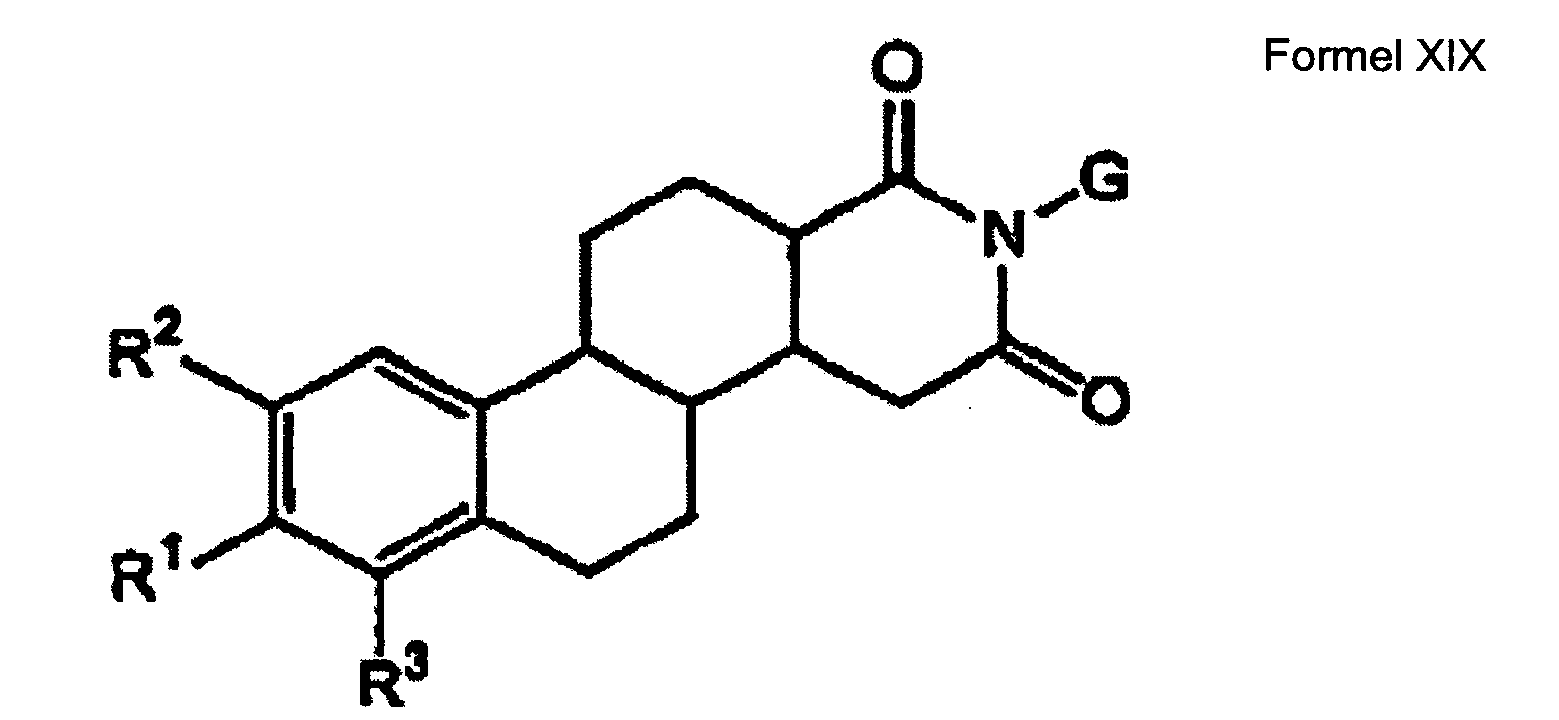
wobei das Ringsystem optional mit einem oder mehreren Substituenten, ausgewählt unter Hydroxy, Alkyl, Alkoxy, Alkinyl oder Halogen, substituiert ist. - Verbindung nach Anspruch 1, wobei wenigstens einer von R2 und R3 eine Alkylgruppe ist.
- Verbindung nach Anspruch 1, wobei R2 eine Hydrocarbylgruppe ist und R3 H ist.
- Verbindung nach Anspruch 1, wobei wenigstens einer von R2 und R3 eine Alkoxygruppe ist.
- Verbindung nach einem der vorangegangenen Ansprüche, wobei G H, OH oder eine Hydrocarbylgruppe ist.
- Verbindung nach Anspruch 5, wobei G oder die Hydrocarbylgruppe eine optional substituierte Kohlenwasserstoffgruppe ist.
- Verbindung nach Anspruch 5, wobei G oder die Hydrocarbylgruppe eine optional substituierte Alkylgruppe ist.
- Verbindung nach Anspruch 7, wobei G oder die Hydrocarbylgruppe unter C1-C10-Alkylgruppen, wie einer C1-C6-Alkylgruppe und einer C1-C3-Alkylgruppe, ausgewählt ist.
- Verbindung nach Anspruch 5, wobei G oder die Hydrocarbylgruppe unter einer C1-C10-Halogenalkylgruppe, einer C1-C6-Halogenalkylgruppe, einer C1-C3-Halogenalkylgruppe, einer C1-C10-Bromalkylgruppe, einer C1-C6-Bromalkylgruppe und einer C1-C3-Bromalkylgruppe ausgewählt ist.
- Verbindung nach Anspruch 5, wobei G oder die Hydrocarbylgruppe unter -(CH2)1-10-Aryl, -(CH2)1-10-Ph, (CH2)1-10-Ph-C1-10-Alkyl, -(CH2)1-5-Ph, (CH2)1-5-Ph-C1-5-Alkyl, -(CH2)1-3-Ph, (CH2)1-3-Ph-C1-3-Alkyl, -CH2-Ph und -CH2-Ph-C(CH3)3 ausgewählt ist.
- Verbindung nach Anspruch 5, wobei G oder die Hydrocarbylgruppe unter -(CH2)1-10-Cycloalkyl, -(CH2)1-10-C3-10-Cycloalkyl, -(CH2)1-7-C3-7-Cycloalkyl, -(CH2)1-5-O3-5-Cycloalkyl, -(CH2)1-3-C3-5-Cycloalkyl und -CH2-C3-Cycloalkyl ausgewählt ist.
- Verbindung nach Anspruch 5, wobei G oder die Hydrocarbylgruppe eine Alkengruppe ist.
- Verbindung nach Anspruch 12, wobei G oder die Hydrocarbylgruppe unter einer C1-C10-Alkengruppe, einer C1-C6-Alkengruppe und einer C1-C3-Alkengruppe ausgewählt ist.
- Verbindung nach Anspruch 5, wobei G H ist.
- Verbindung nach einem der vorangegangenen Ansprüche, wobei R1 eine Sulfamatgruppe ist.
- Verbindung nach Anspruch 15, wobei R1 oder die Sulfamatgruppe die Formel

- Verbindung nach Anspruch 16, wobei wenigstens einer von R4 und R5 H ist.
- Verbindung nach Anspruch 17, worin R4 und R5 H sind.
- Verbindung, die folgendes ist:

- Pharmazeutische Zusammensetzung, welche eine Verbindung nach einem der Ansprüche 1 bis 19, optional im Gemisch mit einem pharmazeutisch verträglichen Träger, Verdünnungsmittel, Hilfsstoff oder Adjuvans, umfaßt.
- Pharmazeutische Zusammensetzung, welche eine Verbindung nach einem der Ansprüche 1 bis 19 zusammen mit einem oder mehreren weiteren pharmazeutisch aktiven Mitteln umfaßt.
- Pharmazeutische Zusammensetzung nach Anspruch 21, wobei die weiteren pharmazeutisch aktiven Mittel unter STS-Inhibitoren, weiteren Inhibitoren, Aromataseinhibitoren, Steroiden und Mitteln zur Modifizierung der biologischen Reaktion ausgewählt sind.
- Verbindung nach einem der Ansprüche 1 bis 19 zur Verwendung in der Medizin.
- Verwendung einer Verbindung nach einem der Ansprüche 1 bis 19 bei der Herstellung eines Medikaments zur Verwendung in der Therapie eines Zustands oder einer Erkrankung, der bzw. die mit Steroidsulfatase (STS) assoziiert ist.
- Verwendung einer Verbindung nach einem der Ansprüche 1 bis 19 bei der Herstellung eines Medikaments zur Verwendung in der Therapie eines Zustands oder einer Erkrankung, der bzw. die mit nachteiligen STS-Mengen assoziiert ist.
- Verwendung einer Verbindung nach einem der Ansprüche 1 bis 19 bei der Herstellung eines Arzneimittels zur Inhibition von Steroidsulfatase- (STS-) Aktivität.
- Verwendung einer Verbindung nach einem der Ansprüche 1 bis 19 bei der Herstellung eines Arzneimittels zur Behandlung einer Zellzyklusstörung.
- Verwendung einer Verbindung nach einem der Ansprüche 1 bis 19 bei der Herstellung eines Arzneimittels zum Steuern der Östrogenmengen im Körper.
- Verwendung einer Verbindung nach einem der Ansprüche 1 bis 19 bei der Herstellung eines Arzneimittels zur Behandlung von neurodegenerativen Erkrankungen und ähnlichen Zuständen.
- Verwendung einer Verbindung nach einem der Ansprüche 1 bis 19 bei der Herstellung eines Arzneimittels für TH1-Implikationen.
- Verwendung einer Verbindung nach einem der Ansprüche 1 bis 19 bei der Herstellung eines Arzneimittels zur Behandlung von entzündlichen Zuständen.
- Verwendung einer Verbindung nach einem der Ansprüche 1 bis 19 bei der Herstellung eines Arzneimittels zur Behandlung eines Zustands, ausgewählt unter dermatologischen Störungen, Fieber, Kreislaufeffekten, Hämorrhagie, Koagulation und Akute-Phase-Reaktion, Kachexie, Anorexie, akuter Infektion, HIV-Infektion, Schockzuständen, Abstoßungsreaktionen, Autoimmunerkrankung, Reperfusionsschaden, Meningitis, Migräne und Aspirin-abhängiger Anti-Thrombose; Tumorwachstum, -invasion und -ausbreitung, Angiogenese, Metastasen, Malignität, Aszites und malignem Pleuraerguß; zerebraler Ischämie, ischämischer Herzerkrankung, Osteoarthritis, rheumatoider Arthritis, Osteoporose, Asthma, Multipler Sklerose, Neurodegeneration, Alzheimer'scher Krankheit, Atherosklerose, Schlaganfall, Vaskulitis, Crohn-Krankheit und ulzerativer Kolitis; Periodontitis, Gingivitis; Psoriasis, atopischer Dermatitis, chronischen Geschwüren, Epidermolysis bullosa; Hornhautulzeration, Retinopathie und chirurgischer Wundheilung; Rhinitis, allergischer Konjunktivitis, Ekzem, Anaphylaxe, Restenose, kongestiver Herzinsuffizienz, Endometriose, Atherosklerose und Endosklerose.
- Verwendung einer Verbindung nach einem der Ansprüche 1 bis 19 bei der Herstellung eines Arzneimittels für immunsuppressive oder immunstimulatorische Aktivität (z.B. zur Behandlung von Immuninsuffizienz, einschließlich Infektion mit menschlichem Immunschwächevirus; zur Regulation von Lymphozytenwachstum; zur Behandlung von Krebs und vielen Autoimmunerkrankungen und zur Verhinderung von Transplantatabstoßung oder zur Induzierung von Tumorimmunität); zur Regulation von Hämatopoese, z.B. Behandlung von Knochenmarks- oder Lymphoiderkrankungen; Förderung des Wachstums von Knochen-, Knorpel-, Sehnen-, Bänder-und Nervengewebe, z.B. zur Heilung von Wunden, zur Behandlung von Verbrennungen, Geschwüren und periodontaler Erkrankung und Neurodegeneration; zur Inhibition oder Aktivierung von Follikel-stimulierendem Hormon (Modulierung der Fruchtbarkeit); für chemotaktische/chemokinetische Aktivität (z.B. zur Mobilisierung spezifischer Zelltypen an Stellen von Verletzung oder Infektion); für hämostatische und thrombolytische Aktivität (z.B. zur Behandlung von Hämophilie und Schlaganfall); für antiinflammatorische Aktivität (zur Behandlung z.B. von septischem Schock oder Crohn-Krankheit); als antimikrobielle Mittel; Modulatoren von z.B. Metabolismus oder Verhalten; als Analgetika; zur Behandlung spezifischer Mangelstörungen; bei der Behandlung von z.B. Psoriasis; für Makrophagen-inhibierende und/oder T-Zell-inhibierende Aktivität und somit antiinflammatorische Aktivität; Anti-Immunaktivität, d.h. inhibitorische Wirkungen gegen eine zelluläre und/oder humorale Immunantwort, einschließlich einer Antwort, die nicht mit Entzündung assoziiert ist; zur Hemmung der Fähigkeit von Makrophagen und T-Zellen zur Anhaftung an extrazellulären Matrixkomponenten und Fibronectin, sowie hochregulierter fas-Rezeptor-Expression in T-Zellen; zur Hemmung einer unerwünschten Immunreaktion und Entzündung einschließlich Arthritis, einschließlich rheumatoider Arthritis, Entzündung im Zusammenhang mit Überempfindlichkeit, allergischen Reaktionen, Asthma, systemischem Lupus erythematodes, Kollagenerkrankungen und anderen Autoimmunerkrankungen, Entzündung im Zusammenhang mit Atherosklerose, Arteriosklerose, atherosklerotischer Herzerkrankung, Reperfusionsschaden, Herzstillstand, Myokardinfarkt, vaskulären inflammatorischen Störungen, Atemnotsyndrom oder anderen kardiopulmonären Erkrankungen, Entzündung im Zusammenhang mit peptischem Geschwür, ulzerativer Kolitis und anderen Erkrankungen des Gastrointestinaltrakts, hepatischer Fibrose, Leberzirrhose oder anderen hepatischen Erkrankungen, Thyreoiditis oder anderen Drüsenerkrankungen, Glomerulonephritis oder anderen Nieren- und urologischen Erkrankungen, Otitis oder anderen otorhinolaryngologischen Erkrankungen, Dermatitis oder anderen Hauterkrankungen, periodontalen Erkrankungen oder anderen Zahnerkrankungen, Orchitis oder Epididymoorchitis, Unfruchtbarkeit, Hodentrauma oder anderen das Immunsystem betreffenden Hodenerkrankungen, Plazentadysfunktion, Plazentainsuffizienz, habitueller Fehlgeburt, Eklampsie, Präeklampsie und anderen mit dem Immunsystem und/oder Entzündung zusammenhängenden gynäkologischen Erkrankungen, Uveitis posterior, intermediärer Uveitis, Uveitis anterior, Konjunktivitis, Chorioretinitis, Uveoretinitis, Neuritis optica, intraokulärer Entzündung, z.B. Retinitis oder zystoidem Makulaödem, sympathischer Ophthalmie, Skleritis, Retinitis pigmentosa, Immun- und inflammatorisehen Komponenten von degenerativer Funduserkrankung, inflammatorischen Komponenten von Augenverletzung, Augenentzündung, verursacht durch Infektion, proliferative Vitreo-Retinopathien, akute ischämische Optikusneuropathie, übermäßige Narbenbildung, z.B. nach Glaukom-Filtrationsoperation, Immun- und/oder entzündlicher Reaktion auf okuläre Implantate und anderen mit dem Immunsystem und Entzündung verbundenen ophthalmischen Erkrankungen, Entzündung im Zusammenhang mit Autoimmunerkrankungen oder Zuständen oder Störungen, wobei sowohl im zentralen Nervensystem (ZNS) oder in irgendeinem anderen Organ eine Immun-und/oder Entzündungssuppression vorteilhaft wäre, Parkinson'scher Krankheit, Komplikationen und/oder Nebenwirkungen bei der Behandlung von Parkinson'scher Krankheit, AIDS-bedingter Demenz, komplexer HIV-bedingter Enzephalopathie, Devic-Krankheit, Sydenham-Chorea, Alzheimer'scher Krankheit und anderen degenerativen Erkrankungen, Zuständen oder Störungen des ZNS, inflammatorischen Komponenten von Schlaganfällen, Post-Polio-Syndrom, Immun- und inflammatorischen Komponenten von psychiatrischen Störungen, Myelitis, Enzephalitis, subakuter sklerosierender Panenzephalitis, Enzephalomyelitis, akuter Neuropathie, subakuter Neuropathie, chronischer Neuropathie, Guillain-Barré-Syndrom, Sydenham-Chorea, Myasthenia gravis, Pseudotumor cerebri, Down-Syndrom, Huntington'scher Krankheit, amyotropher Lateralsklerose, inflammatorischen Komponenten von ZNS-Kompression oder ZNS-Verletzung oder Infektionen des ZNS, inflammatorischen Komponenten von Muskelatrophien und -dystrophien und mit dem Immunsystem und Entzündung zusammenhängenden Erkrankungen, Zuständen oder Störungen des zentralen und peripheren Nervensystems, posttraumatische Entzündung, septischer Schock, Infektionskrankheiten, inflammatorischen Komplikationen oder Nebenwirkungen von Chirurgie, Knochenmarktransplantation oder anderen Transplantationskomplikationen und/oder -nebenwirkungen, inflammatorischen und/oder Immunkomplikationen und Nebenwirkungen von Gentherapie, z.B. aufgrund von Infektion mit einem Virusträger, oder Entzündung im Zusammenhang mit AIDS, um eine humorale und/oder zelluläre Immunantwort zu unterdrücken oder zu hemmen, um Monozyten- oder Leukozyten-proliferative Erkrankungen, z.B. Leukämie, zu behandeln oder zu lindern, indem die Menge an Monozyten oder Lymphozyten reduziert wird, für die Prävention und/oder Behandlung von Transplantatabstoßung in Fällen einer Transplantation von natürlichen oder künstlichen Zellen, Gewebe und Organen, wie Hornhaut, Knochenmark, Organen, Linsen, Schrittmachern, natürlichem oder künstlichem Hautgewebe.
- Verfahren zur Herstellung einer Verbindung der Formel I, wie in Anspruch 1 definiert, welches das Umsetzen eines geeigneten Alkohols mit einem geeigneten Chlorid umfaßt.
Applications Claiming Priority (4)
| Application Number | Priority Date | Filing Date | Title |
|---|---|---|---|
| GB0125073A GB0125073D0 (en) | 2001-10-18 | 2001-10-18 | Compound |
| PCT/GB2001/004645 WO2002032409A2 (en) | 2000-10-20 | 2001-10-18 | Use of compound in the manufacture of a pharmaceutical for inhibiting steroid sulphatase and steroid dehydrogenase activity |
| GB0209274A GB0209274D0 (en) | 2002-04-23 | 2002-04-23 | Compound |
| EP02801418A EP1448592B1 (de) | 2001-10-18 | 2002-10-17 | Steroidale verbindungen zur inhibierung von steroidsulfatasen |
Related Parent Applications (1)
| Application Number | Title | Priority Date | Filing Date |
|---|---|---|---|
| EP02801418A Division EP1448592B1 (de) | 2001-10-18 | 2002-10-17 | Steroidale verbindungen zur inhibierung von steroidsulfatasen |
Publications (2)
| Publication Number | Publication Date |
|---|---|
| EP1657247A1 EP1657247A1 (de) | 2006-05-17 |
| EP1657247B1 true EP1657247B1 (de) | 2008-09-17 |
Family
ID=34066588
Family Applications (1)
| Application Number | Title | Priority Date | Filing Date |
|---|---|---|---|
| EP06000817A Expired - Lifetime EP1657247B1 (de) | 2001-10-18 | 2002-10-17 | Steroidale Verbindungen zur Hemmung von steroid Sulfotase |
Country Status (7)
| Country | Link |
|---|---|
| US (3) | US7098218B2 (de) |
| EP (1) | EP1657247B1 (de) |
| AT (1) | ATE408615T1 (de) |
| CA (1) | CA2463227C (de) |
| DE (1) | DE60229009D1 (de) |
| DK (1) | DK1448592T3 (de) |
| ES (2) | ES2258174T3 (de) |
Families Citing this family (3)
| Publication number | Priority date | Publication date | Assignee | Title |
|---|---|---|---|---|
| ES2258174T3 (es) * | 2001-10-18 | 2006-08-16 | Sterix Limited | Compuestos esteroideos para la inhibicion de la sulfatasa esteroidea. |
| GB0604142D0 (en) * | 2006-03-01 | 2006-04-12 | Sterix Ltd | Compound |
| WO2009055366A1 (en) * | 2007-10-22 | 2009-04-30 | Translational Genomics Research Institute (Tgen) | Method and kit used in performing high resolution genomic profiling of clonal cell populations in heterogeneous tissues |
Family Cites Families (9)
| Publication number | Priority date | Publication date | Assignee | Title |
|---|---|---|---|---|
| US1972884A (en) * | 1932-03-31 | 1934-09-11 | Guggenhelm Brothers | Recovery of sulphur |
| AT314746B (de) | 1970-06-18 | 1974-04-25 | Richter Gedeon Vegyeszet | Verfahren zur Herstellung von neuen D-Homo-imid-Derivaten mit Sterangerüst |
| US3972884A (en) | 1974-09-06 | 1976-08-03 | Eli Lilly And Company | D-homo-aza-steroids |
| US4039547A (en) * | 1974-09-06 | 1977-08-02 | Eli Lilly And Company | 24-Methyl-14a-aza-D-homo-cholest-8(9)-enes |
| HU175287B (hu) | 1977-08-18 | 1980-06-28 | Richter Gedeon Vegyeszet | Sposob poluchenija novykh proizvodnykh 3-amino-17al'fa-aza-d-gomo-androstana,dalee ikh kislotoaddicionnykh i chetvjortichnykh solej |
| US5140022A (en) | 1990-10-01 | 1992-08-18 | Anaquest, Inc. | 3-acyclic or cyclicaminomethyl-17a-lower-alkyl-17a-aza-d-homo-5-alpha-androstanes |
| GB9118478D0 (en) * | 1991-08-29 | 1991-10-16 | Imperial College | Steroid sulphatase inhibitors |
| GB0025788D0 (en) * | 2000-10-20 | 2000-12-06 | Sterix Ltd | Use |
| ES2258174T3 (es) * | 2001-10-18 | 2006-08-16 | Sterix Limited | Compuestos esteroideos para la inhibicion de la sulfatasa esteroidea. |
-
2002
- 2002-10-17 ES ES02801418T patent/ES2258174T3/es not_active Expired - Lifetime
- 2002-10-17 DE DE60229009T patent/DE60229009D1/de not_active Expired - Lifetime
- 2002-10-17 EP EP06000817A patent/EP1657247B1/de not_active Expired - Lifetime
- 2002-10-17 AT AT06000817T patent/ATE408615T1/de not_active IP Right Cessation
- 2002-10-17 ES ES06000817T patent/ES2314760T3/es not_active Expired - Lifetime
- 2002-10-17 CA CA2463227A patent/CA2463227C/en not_active Expired - Fee Related
- 2002-10-17 DK DK02801418T patent/DK1448592T3/da active
-
2004
- 2004-04-16 US US10/825,758 patent/US7098218B2/en not_active Expired - Fee Related
-
2006
- 2006-01-11 US US11/329,982 patent/US7276513B2/en not_active Expired - Fee Related
-
2007
- 2007-09-14 US US11/855,603 patent/US8124614B2/en not_active Expired - Fee Related
Also Published As
| Publication number | Publication date |
|---|---|
| DE60229009D1 (de) | 2008-10-30 |
| EP1657247A1 (de) | 2006-05-17 |
| US20080312266A1 (en) | 2008-12-18 |
| CA2463227C (en) | 2010-08-10 |
| US20070105886A1 (en) | 2007-05-10 |
| US8124614B2 (en) | 2012-02-28 |
| CA2463227A1 (en) | 2003-04-24 |
| ATE408615T1 (de) | 2008-10-15 |
| ES2314760T3 (es) | 2009-03-16 |
| ES2258174T3 (es) | 2006-08-16 |
| US7276513B2 (en) | 2007-10-02 |
| DK1448592T3 (da) | 2006-07-17 |
| US7098218B2 (en) | 2006-08-29 |
| US20050014776A1 (en) | 2005-01-20 |
| HK1084955A1 (en) | 2006-08-11 |
Similar Documents
| Publication | Publication Date | Title |
|---|---|---|
| JP3581820B2 (ja) | ステロイドスルファターゼインヒビター | |
| US20090186900A1 (en) | Compound | |
| US8003783B2 (en) | 17B-hydroxysteroid dehydrogenase inhibitors | |
| WO2002032409A2 (en) | Use of compound in the manufacture of a pharmaceutical for inhibiting steroid sulphatase and steroid dehydrogenase activity | |
| US20040009959A1 (en) | Thioether sulphamate steroids as steroid inhibtors and anti-cancer compounds | |
| EP2202240A1 (de) | Verbindung | |
| EP1051178B1 (de) | 3-o-sulfamatsteroidderivate als hemmer von estronsulfatase | |
| US7968561B2 (en) | Steroidal compounds as steroid sulphatase inhibitors | |
| EP1448592B1 (de) | Steroidale verbindungen zur inhibierung von steroidsulfatasen | |
| US8124614B2 (en) | Steroidal compounds for inhibiting steroid sulphatase | |
| EP1237902B1 (de) | Halogenierte sulphamat-, phosphonat-, thiophosphonat-, sulphonat- und sulphonamid- verbindungen als inhibitoren von steroidsulfatase | |
| WO2006032885A2 (en) | 2-substituted estrogen sulphamates for inhibition of steroid sulphatase | |
| HK1084955B (en) | Steroidal compounds for inhibiting steroid sulphotase | |
| HK1126225B (en) | Steroidal compounds as steroid sulphatase inhibitors |
Legal Events
| Date | Code | Title | Description |
|---|---|---|---|
| PUAI | Public reference made under article 153(3) epc to a published international application that has entered the european phase |
Free format text: ORIGINAL CODE: 0009012 |
|
| 17P | Request for examination filed |
Effective date: 20060116 |
|
| AC | Divisional application: reference to earlier application |
Ref document number: 1448592 Country of ref document: EP Kind code of ref document: P |
|
| AK | Designated contracting states |
Kind code of ref document: A1 Designated state(s): AT BE BG CH CY CZ DE DK EE ES FI FR GB GR IE IT LI LU MC NL PT SE SK TR |
|
| 17Q | First examination report despatched |
Effective date: 20060629 |
|
| REG | Reference to a national code |
Ref country code: HK Ref legal event code: DE Ref document number: 1084955 Country of ref document: HK |
|
| AKX | Designation fees paid |
Designated state(s): AT BE BG CH CY CZ DE DK EE ES FI FR GB GR IE IT LI LU MC NL PT SE SK TR |
|
| 17Q | First examination report despatched |
Effective date: 20060629 |
|
| GRAP | Despatch of communication of intention to grant a patent |
Free format text: ORIGINAL CODE: EPIDOSNIGR1 |
|
| GRAS | Grant fee paid |
Free format text: ORIGINAL CODE: EPIDOSNIGR3 |
|
| GRAA | (expected) grant |
Free format text: ORIGINAL CODE: 0009210 |
|
| AC | Divisional application: reference to earlier application |
Ref document number: 1448592 Country of ref document: EP Kind code of ref document: P |
|
| AK | Designated contracting states |
Kind code of ref document: B1 Designated state(s): AT BE BG CH CY CZ DE DK EE ES FI FR GB GR IE IT LI LU MC NL PT SE SK TR |
|
| REG | Reference to a national code |
Ref country code: GB Ref legal event code: FG4D |
|
| REG | Reference to a national code |
Ref country code: CH Ref legal event code: EP |
|
| REG | Reference to a national code |
Ref country code: IE Ref legal event code: FG4D |
|
| REF | Corresponds to: |
Ref document number: 60229009 Country of ref document: DE Date of ref document: 20081030 Kind code of ref document: P |
|
| PG25 | Lapsed in a contracting state [announced via postgrant information from national office to epo] |
Ref country code: FI Free format text: LAPSE BECAUSE OF FAILURE TO SUBMIT A TRANSLATION OF THE DESCRIPTION OR TO PAY THE FEE WITHIN THE PRESCRIBED TIME-LIMIT Effective date: 20080917 Ref country code: AT Free format text: LAPSE BECAUSE OF FAILURE TO SUBMIT A TRANSLATION OF THE DESCRIPTION OR TO PAY THE FEE WITHIN THE PRESCRIBED TIME-LIMIT Effective date: 20080917 |
|
| NLV1 | Nl: lapsed or annulled due to failure to fulfill the requirements of art. 29p and 29m of the patents act | ||
| REG | Reference to a national code |
Ref country code: ES Ref legal event code: FG2A Ref document number: 2314760 Country of ref document: ES Kind code of ref document: T3 |
|
| PG25 | Lapsed in a contracting state [announced via postgrant information from national office to epo] |
Ref country code: BE Free format text: LAPSE BECAUSE OF FAILURE TO SUBMIT A TRANSLATION OF THE DESCRIPTION OR TO PAY THE FEE WITHIN THE PRESCRIBED TIME-LIMIT Effective date: 20080917 |
|
| REG | Reference to a national code |
Ref country code: HK Ref legal event code: GR Ref document number: 1084955 Country of ref document: HK |
|
| PG25 | Lapsed in a contracting state [announced via postgrant information from national office to epo] |
Ref country code: BG Free format text: LAPSE BECAUSE OF FAILURE TO SUBMIT A TRANSLATION OF THE DESCRIPTION OR TO PAY THE FEE WITHIN THE PRESCRIBED TIME-LIMIT Effective date: 20081217 |
|
| PG25 | Lapsed in a contracting state [announced via postgrant information from national office to epo] |
Ref country code: CZ Free format text: LAPSE BECAUSE OF FAILURE TO SUBMIT A TRANSLATION OF THE DESCRIPTION OR TO PAY THE FEE WITHIN THE PRESCRIBED TIME-LIMIT Effective date: 20080917 Ref country code: MC Free format text: LAPSE BECAUSE OF NON-PAYMENT OF DUE FEES Effective date: 20081031 Ref country code: SK Free format text: LAPSE BECAUSE OF FAILURE TO SUBMIT A TRANSLATION OF THE DESCRIPTION OR TO PAY THE FEE WITHIN THE PRESCRIBED TIME-LIMIT Effective date: 20080917 Ref country code: PT Free format text: LAPSE BECAUSE OF FAILURE TO SUBMIT A TRANSLATION OF THE DESCRIPTION OR TO PAY THE FEE WITHIN THE PRESCRIBED TIME-LIMIT Effective date: 20090217 Ref country code: NL Free format text: LAPSE BECAUSE OF FAILURE TO SUBMIT A TRANSLATION OF THE DESCRIPTION OR TO PAY THE FEE WITHIN THE PRESCRIBED TIME-LIMIT Effective date: 20080917 |
|
| REG | Reference to a national code |
Ref country code: CH Ref legal event code: PL |
|
| PLBE | No opposition filed within time limit |
Free format text: ORIGINAL CODE: 0009261 |
|
| STAA | Information on the status of an ep patent application or granted ep patent |
Free format text: STATUS: NO OPPOSITION FILED WITHIN TIME LIMIT |
|
| PG25 | Lapsed in a contracting state [announced via postgrant information from national office to epo] |
Ref country code: DK Free format text: LAPSE BECAUSE OF FAILURE TO SUBMIT A TRANSLATION OF THE DESCRIPTION OR TO PAY THE FEE WITHIN THE PRESCRIBED TIME-LIMIT Effective date: 20080917 Ref country code: EE Free format text: LAPSE BECAUSE OF FAILURE TO SUBMIT A TRANSLATION OF THE DESCRIPTION OR TO PAY THE FEE WITHIN THE PRESCRIBED TIME-LIMIT Effective date: 20080917 |
|
| 26N | No opposition filed |
Effective date: 20090618 |
|
| PG25 | Lapsed in a contracting state [announced via postgrant information from national office to epo] |
Ref country code: IE Free format text: LAPSE BECAUSE OF NON-PAYMENT OF DUE FEES Effective date: 20081017 Ref country code: LI Free format text: LAPSE BECAUSE OF NON-PAYMENT OF DUE FEES Effective date: 20081031 Ref country code: CH Free format text: LAPSE BECAUSE OF NON-PAYMENT OF DUE FEES Effective date: 20081031 |
|
| PG25 | Lapsed in a contracting state [announced via postgrant information from national office to epo] |
Ref country code: SE Free format text: LAPSE BECAUSE OF FAILURE TO SUBMIT A TRANSLATION OF THE DESCRIPTION OR TO PAY THE FEE WITHIN THE PRESCRIBED TIME-LIMIT Effective date: 20081217 |
|
| PG25 | Lapsed in a contracting state [announced via postgrant information from national office to epo] |
Ref country code: CY Free format text: LAPSE BECAUSE OF FAILURE TO SUBMIT A TRANSLATION OF THE DESCRIPTION OR TO PAY THE FEE WITHIN THE PRESCRIBED TIME-LIMIT Effective date: 20080917 Ref country code: LU Free format text: LAPSE BECAUSE OF NON-PAYMENT OF DUE FEES Effective date: 20081017 |
|
| PG25 | Lapsed in a contracting state [announced via postgrant information from national office to epo] |
Ref country code: TR Free format text: LAPSE BECAUSE OF FAILURE TO SUBMIT A TRANSLATION OF THE DESCRIPTION OR TO PAY THE FEE WITHIN THE PRESCRIBED TIME-LIMIT Effective date: 20080917 |
|
| PG25 | Lapsed in a contracting state [announced via postgrant information from national office to epo] |
Ref country code: GR Free format text: LAPSE BECAUSE OF FAILURE TO SUBMIT A TRANSLATION OF THE DESCRIPTION OR TO PAY THE FEE WITHIN THE PRESCRIBED TIME-LIMIT Effective date: 20081218 |
|
| REG | Reference to a national code |
Ref country code: ES Ref legal event code: PC2A Owner name: RICHTER GEDEON NYRT Effective date: 20140424 |
|
| REG | Reference to a national code |
Ref country code: FR Ref legal event code: TP Owner name: RICHTER GEDEON NYRT., HU Effective date: 20140401 |
|
| PGFP | Annual fee paid to national office [announced via postgrant information from national office to epo] |
Ref country code: ES Payment date: 20140911 Year of fee payment: 13 |
|
| PGFP | Annual fee paid to national office [announced via postgrant information from national office to epo] |
Ref country code: GB Payment date: 20141021 Year of fee payment: 13 Ref country code: FR Payment date: 20141022 Year of fee payment: 13 Ref country code: DE Payment date: 20141022 Year of fee payment: 13 |
|
| REG | Reference to a national code |
Ref country code: DE Ref legal event code: R082 Ref document number: 60229009 Country of ref document: DE Representative=s name: WSL PATENTANWAELTE PARTNERSCHAFT MBB, DE |
|
| REG | Reference to a national code |
Ref country code: GB Ref legal event code: 732E Free format text: REGISTERED BETWEEN 20150226 AND 20150304 |
|
| PGFP | Annual fee paid to national office [announced via postgrant information from national office to epo] |
Ref country code: IT Payment date: 20141030 Year of fee payment: 13 |
|
| REG | Reference to a national code |
Ref country code: DE Ref legal event code: R082 Ref document number: 60229009 Country of ref document: DE Representative=s name: WSL PATENTANWAELTE PARTNERSCHAFT MBB, DE Effective date: 20150224 Ref country code: DE Ref legal event code: R081 Ref document number: 60229009 Country of ref document: DE Owner name: RICHTER GEDEON NYRT., HU Free format text: FORMER OWNER: STERIX LTD., SLOUGH, BERKSHIRE, GB Effective date: 20150224 |
|
| REG | Reference to a national code |
Ref country code: DE Ref legal event code: R119 Ref document number: 60229009 Country of ref document: DE |
|
| GBPC | Gb: european patent ceased through non-payment of renewal fee |
Effective date: 20151017 |
|
| PG25 | Lapsed in a contracting state [announced via postgrant information from national office to epo] |
Ref country code: GB Free format text: LAPSE BECAUSE OF NON-PAYMENT OF DUE FEES Effective date: 20151017 Ref country code: DE Free format text: LAPSE BECAUSE OF NON-PAYMENT OF DUE FEES Effective date: 20160503 Ref country code: IT Free format text: LAPSE BECAUSE OF NON-PAYMENT OF DUE FEES Effective date: 20151017 |
|
| REG | Reference to a national code |
Ref country code: FR Ref legal event code: ST Effective date: 20160630 |
|
| PG25 | Lapsed in a contracting state [announced via postgrant information from national office to epo] |
Ref country code: FR Free format text: LAPSE BECAUSE OF NON-PAYMENT OF DUE FEES Effective date: 20151102 |
|
| REG | Reference to a national code |
Ref country code: ES Ref legal event code: FD2A Effective date: 20161125 |
|
| PG25 | Lapsed in a contracting state [announced via postgrant information from national office to epo] |
Ref country code: ES Free format text: LAPSE BECAUSE OF NON-PAYMENT OF DUE FEES Effective date: 20151018 |