EP1668714B1 - Procédé de fabrication d'un dispositif céramique à multicouches - Google Patents
Procédé de fabrication d'un dispositif céramique à multicouches Download PDFInfo
- Publication number
- EP1668714B1 EP1668714B1 EP04786879A EP04786879A EP1668714B1 EP 1668714 B1 EP1668714 B1 EP 1668714B1 EP 04786879 A EP04786879 A EP 04786879A EP 04786879 A EP04786879 A EP 04786879A EP 1668714 B1 EP1668714 B1 EP 1668714B1
- Authority
- EP
- European Patent Office
- Prior art keywords
- ceramic
- copper
- metal paste
- chemically active
- external contacts
- Prior art date
- Legal status (The legal status is an assumption and is not a legal conclusion. Google has not performed a legal analysis and makes no representation as to the accuracy of the status listed.)
- Expired - Lifetime
Links
- 239000000919 ceramic Substances 0.000 title claims abstract description 75
- 238000000034 method Methods 0.000 title claims abstract description 34
- 239000010949 copper Substances 0.000 claims abstract description 59
- 229910052802 copper Inorganic materials 0.000 claims abstract description 49
- RYGMFSIKBFXOCR-UHFFFAOYSA-N Copper Chemical compound [Cu] RYGMFSIKBFXOCR-UHFFFAOYSA-N 0.000 claims abstract description 43
- 230000002829 reductive effect Effects 0.000 claims abstract description 9
- 229910052751 metal Inorganic materials 0.000 claims description 43
- 239000002184 metal Substances 0.000 claims description 43
- 229910052760 oxygen Inorganic materials 0.000 claims description 33
- QVGXLLKOCUKJST-UHFFFAOYSA-N atomic oxygen Chemical compound [O] QVGXLLKOCUKJST-UHFFFAOYSA-N 0.000 claims description 30
- 239000001301 oxygen Substances 0.000 claims description 30
- 239000011230 binding agent Substances 0.000 claims description 22
- 239000000843 powder Substances 0.000 claims description 15
- 239000000654 additive Substances 0.000 claims description 13
- 239000011521 glass Substances 0.000 claims description 13
- 230000000996 additive effect Effects 0.000 claims description 12
- XLYOFNOQVPJJNP-UHFFFAOYSA-N water Substances O XLYOFNOQVPJJNP-UHFFFAOYSA-N 0.000 claims description 9
- IJGRMHOSHXDMSA-UHFFFAOYSA-N Atomic nitrogen Chemical compound N#N IJGRMHOSHXDMSA-UHFFFAOYSA-N 0.000 claims description 6
- 238000007254 oxidation reaction Methods 0.000 claims description 4
- 239000004925 Acrylic resin Substances 0.000 claims description 3
- 229920000178 Acrylic resin Polymers 0.000 claims description 3
- VYPSYNLAJGMNEJ-UHFFFAOYSA-N Silicium dioxide Chemical compound O=[Si]=O VYPSYNLAJGMNEJ-UHFFFAOYSA-N 0.000 claims description 3
- 229910052757 nitrogen Inorganic materials 0.000 claims description 3
- 238000007650 screen-printing Methods 0.000 claims description 3
- 239000002904 solvent Substances 0.000 claims description 3
- 229910003781 PbTiO3 Inorganic materials 0.000 claims description 2
- BERDEBHAJNAUOM-UHFFFAOYSA-N copper(I) oxide Inorganic materials [Cu]O[Cu] BERDEBHAJNAUOM-UHFFFAOYSA-N 0.000 claims description 2
- KRFJLUBVMFXRPN-UHFFFAOYSA-N cuprous oxide Chemical compound [O-2].[Cu+].[Cu+] KRFJLUBVMFXRPN-UHFFFAOYSA-N 0.000 claims description 2
- 229910052726 zirconium Inorganic materials 0.000 claims description 2
- 230000015556 catabolic process Effects 0.000 claims 1
- 238000006243 chemical reaction Methods 0.000 claims 1
- 229910052681 coesite Inorganic materials 0.000 claims 1
- 239000000470 constituent Substances 0.000 claims 1
- 229910052906 cristobalite Inorganic materials 0.000 claims 1
- 238000006731 degradation reaction Methods 0.000 claims 1
- 239000000377 silicon dioxide Substances 0.000 claims 1
- 229910052682 stishovite Inorganic materials 0.000 claims 1
- 229910052905 tridymite Inorganic materials 0.000 claims 1
- 238000004519 manufacturing process Methods 0.000 abstract description 8
- 239000012298 atmosphere Substances 0.000 abstract description 7
- 239000000853 adhesive Substances 0.000 abstract description 3
- 230000001070 adhesive effect Effects 0.000 abstract description 3
- 239000000463 material Substances 0.000 abstract description 3
- QJGQUHMNIGDVPM-UHFFFAOYSA-N nitrogen group Chemical group [N] QJGQUHMNIGDVPM-UHFFFAOYSA-N 0.000 abstract 1
- 229910052451 lead zirconate titanate Inorganic materials 0.000 description 8
- 238000005245 sintering Methods 0.000 description 8
- 229910010293 ceramic material Inorganic materials 0.000 description 7
- 229910004298 SiO 2 Inorganic materials 0.000 description 3
- 238000010586 diagram Methods 0.000 description 3
- 238000010304 firing Methods 0.000 description 3
- 230000004907 flux Effects 0.000 description 3
- HTUMBQDCCIXGCV-UHFFFAOYSA-N lead oxide Chemical compound [O-2].[Pb+2] HTUMBQDCCIXGCV-UHFFFAOYSA-N 0.000 description 3
- 238000001465 metallisation Methods 0.000 description 3
- 239000000203 mixture Substances 0.000 description 3
- 229910000510 noble metal Inorganic materials 0.000 description 3
- 230000003647 oxidation Effects 0.000 description 3
- 239000002245 particle Substances 0.000 description 3
- 238000003776 cleavage reaction Methods 0.000 description 2
- 239000006185 dispersion Substances 0.000 description 2
- 229910052745 lead Inorganic materials 0.000 description 2
- 229910044991 metal oxide Inorganic materials 0.000 description 2
- 150000004706 metal oxides Chemical class 0.000 description 2
- 210000003739 neck Anatomy 0.000 description 2
- 230000007017 scission Effects 0.000 description 2
- 239000000126 substance Substances 0.000 description 2
- 229910018072 Al 2 O 3 Inorganic materials 0.000 description 1
- OKTJSMMVPCPJKN-UHFFFAOYSA-N Carbon Chemical compound [C] OKTJSMMVPCPJKN-UHFFFAOYSA-N 0.000 description 1
- BQCADISMDOOEFD-UHFFFAOYSA-N Silver Chemical compound [Ag] BQCADISMDOOEFD-UHFFFAOYSA-N 0.000 description 1
- 229910045601 alloy Inorganic materials 0.000 description 1
- 239000000956 alloy Substances 0.000 description 1
- 150000001491 aromatic compounds Chemical class 0.000 description 1
- QVQLCTNNEUAWMS-UHFFFAOYSA-N barium oxide Inorganic materials [Ba]=O QVQLCTNNEUAWMS-UHFFFAOYSA-N 0.000 description 1
- 229910052799 carbon Inorganic materials 0.000 description 1
- 239000007795 chemical reaction product Substances 0.000 description 1
- 238000002485 combustion reaction Methods 0.000 description 1
- 238000010276 construction Methods 0.000 description 1
- 238000005336 cracking Methods 0.000 description 1
- 238000009792 diffusion process Methods 0.000 description 1
- NKZSPGSOXYXWQA-UHFFFAOYSA-N dioxido(oxo)titanium;lead(2+) Chemical compound [Pb+2].[O-][Ti]([O-])=O NKZSPGSOXYXWQA-UHFFFAOYSA-N 0.000 description 1
- 238000009826 distribution Methods 0.000 description 1
- 230000000694 effects Effects 0.000 description 1
- 230000005684 electric field Effects 0.000 description 1
- 239000007772 electrode material Substances 0.000 description 1
- 239000013538 functional additive Substances 0.000 description 1
- 230000003301 hydrolyzing effect Effects 0.000 description 1
- 230000001771 impaired effect Effects 0.000 description 1
- 239000004615 ingredient Substances 0.000 description 1
- 238000011835 investigation Methods 0.000 description 1
- 229910000464 lead oxide Inorganic materials 0.000 description 1
- HFGPZNIAWCZYJU-UHFFFAOYSA-N lead zirconate titanate Chemical group [O-2].[O-2].[O-2].[O-2].[O-2].[Ti+4].[Zr+4].[Pb+2] HFGPZNIAWCZYJU-UHFFFAOYSA-N 0.000 description 1
- 150000002736 metal compounds Chemical class 0.000 description 1
- 239000002923 metal particle Substances 0.000 description 1
- 239000012299 nitrogen atmosphere Substances 0.000 description 1
- YEXPOXQUZXUXJW-UHFFFAOYSA-N oxolead Chemical compound [Pb]=O YEXPOXQUZXUXJW-UHFFFAOYSA-N 0.000 description 1
- 230000035515 penetration Effects 0.000 description 1
- 229910000923 precious metal alloy Inorganic materials 0.000 description 1
- 238000002360 preparation method Methods 0.000 description 1
- 238000011946 reduction process Methods 0.000 description 1
- 229910052814 silicon oxide Inorganic materials 0.000 description 1
- 229910052709 silver Inorganic materials 0.000 description 1
- 239000004332 silver Substances 0.000 description 1
- 239000007787 solid Substances 0.000 description 1
Images
Classifications
-
- B—PERFORMING OPERATIONS; TRANSPORTING
- B32—LAYERED PRODUCTS
- B32B—LAYERED PRODUCTS, i.e. PRODUCTS BUILT-UP OF STRATA OF FLAT OR NON-FLAT, e.g. CELLULAR OR HONEYCOMB, FORM
- B32B18/00—Layered products essentially comprising ceramics, e.g. refractory products
-
- C—CHEMISTRY; METALLURGY
- C04—CEMENTS; CONCRETE; ARTIFICIAL STONE; CERAMICS; REFRACTORIES
- C04B—LIME, MAGNESIA; SLAG; CEMENTS; COMPOSITIONS THEREOF, e.g. MORTARS, CONCRETE OR LIKE BUILDING MATERIALS; ARTIFICIAL STONE; CERAMICS; REFRACTORIES; TREATMENT OF NATURAL STONE
- C04B35/00—Shaped ceramic products characterised by their composition; Ceramics compositions; Processing powders of inorganic compounds preparatory to the manufacturing of ceramic products
- C04B35/01—Shaped ceramic products characterised by their composition; Ceramics compositions; Processing powders of inorganic compounds preparatory to the manufacturing of ceramic products based on oxide ceramics
- C04B35/46—Shaped ceramic products characterised by their composition; Ceramics compositions; Processing powders of inorganic compounds preparatory to the manufacturing of ceramic products based on oxide ceramics based on titanium oxides or titanates
- C04B35/462—Shaped ceramic products characterised by their composition; Ceramics compositions; Processing powders of inorganic compounds preparatory to the manufacturing of ceramic products based on oxide ceramics based on titanium oxides or titanates based on titanates
- C04B35/465—Shaped ceramic products characterised by their composition; Ceramics compositions; Processing powders of inorganic compounds preparatory to the manufacturing of ceramic products based on oxide ceramics based on titanium oxides or titanates based on titanates based on alkaline earth metal titanates
- C04B35/468—Shaped ceramic products characterised by their composition; Ceramics compositions; Processing powders of inorganic compounds preparatory to the manufacturing of ceramic products based on oxide ceramics based on titanium oxides or titanates based on titanates based on alkaline earth metal titanates based on barium titanates
- C04B35/4682—Shaped ceramic products characterised by their composition; Ceramics compositions; Processing powders of inorganic compounds preparatory to the manufacturing of ceramic products based on oxide ceramics based on titanium oxides or titanates based on titanates based on alkaline earth metal titanates based on barium titanates based on BaTiO3 perovskite phase
-
- C—CHEMISTRY; METALLURGY
- C04—CEMENTS; CONCRETE; ARTIFICIAL STONE; CERAMICS; REFRACTORIES
- C04B—LIME, MAGNESIA; SLAG; CEMENTS; COMPOSITIONS THEREOF, e.g. MORTARS, CONCRETE OR LIKE BUILDING MATERIALS; ARTIFICIAL STONE; CERAMICS; REFRACTORIES; TREATMENT OF NATURAL STONE
- C04B35/00—Shaped ceramic products characterised by their composition; Ceramics compositions; Processing powders of inorganic compounds preparatory to the manufacturing of ceramic products
- C04B35/622—Forming processes; Processing powders of inorganic compounds preparatory to the manufacturing of ceramic products
- C04B35/626—Preparing or treating the powders individually or as batches ; preparing or treating macroscopic reinforcing agents for ceramic products, e.g. fibres; mechanical aspects section B
- C04B35/63—Preparing or treating the powders individually or as batches ; preparing or treating macroscopic reinforcing agents for ceramic products, e.g. fibres; mechanical aspects section B using additives specially adapted for forming the products, e.g.. binder binders
- C04B35/638—Removal thereof
-
- H—ELECTRICITY
- H10—SEMICONDUCTOR DEVICES; ELECTRIC SOLID-STATE DEVICES NOT OTHERWISE PROVIDED FOR
- H10N—ELECTRIC SOLID-STATE DEVICES NOT OTHERWISE PROVIDED FOR
- H10N30/00—Piezoelectric or electrostrictive devices
- H10N30/01—Manufacture or treatment
- H10N30/05—Manufacture of multilayered piezoelectric or electrostrictive devices, or parts thereof, e.g. by stacking piezoelectric bodies and electrodes
- H10N30/053—Manufacture of multilayered piezoelectric or electrostrictive devices, or parts thereof, e.g. by stacking piezoelectric bodies and electrodes by integrally sintering piezoelectric or electrostrictive bodies and electrodes
-
- H—ELECTRICITY
- H10—SEMICONDUCTOR DEVICES; ELECTRIC SOLID-STATE DEVICES NOT OTHERWISE PROVIDED FOR
- H10N—ELECTRIC SOLID-STATE DEVICES NOT OTHERWISE PROVIDED FOR
- H10N30/00—Piezoelectric or electrostrictive devices
- H10N30/01—Manufacture or treatment
- H10N30/06—Forming electrodes or interconnections, e.g. leads or terminals
- H10N30/063—Forming interconnections, e.g. connection electrodes of multilayered piezoelectric or electrostrictive parts
-
- H—ELECTRICITY
- H10—SEMICONDUCTOR DEVICES; ELECTRIC SOLID-STATE DEVICES NOT OTHERWISE PROVIDED FOR
- H10N—ELECTRIC SOLID-STATE DEVICES NOT OTHERWISE PROVIDED FOR
- H10N30/00—Piezoelectric or electrostrictive devices
- H10N30/80—Constructional details
- H10N30/87—Electrodes or interconnections, e.g. leads or terminals
- H10N30/872—Interconnections, e.g. connection electrodes of multilayer piezoelectric or electrostrictive devices
-
- H—ELECTRICITY
- H10—SEMICONDUCTOR DEVICES; ELECTRIC SOLID-STATE DEVICES NOT OTHERWISE PROVIDED FOR
- H10N—ELECTRIC SOLID-STATE DEVICES NOT OTHERWISE PROVIDED FOR
- H10N30/00—Piezoelectric or electrostrictive devices
- H10N30/80—Constructional details
- H10N30/87—Electrodes or interconnections, e.g. leads or terminals
- H10N30/877—Conductive materials
-
- B—PERFORMING OPERATIONS; TRANSPORTING
- B32—LAYERED PRODUCTS
- B32B—LAYERED PRODUCTS, i.e. PRODUCTS BUILT-UP OF STRATA OF FLAT OR NON-FLAT, e.g. CELLULAR OR HONEYCOMB, FORM
- B32B2311/00—Metals, their alloys or their compounds
- B32B2311/12—Copper
-
- C—CHEMISTRY; METALLURGY
- C04—CEMENTS; CONCRETE; ARTIFICIAL STONE; CERAMICS; REFRACTORIES
- C04B—LIME, MAGNESIA; SLAG; CEMENTS; COMPOSITIONS THEREOF, e.g. MORTARS, CONCRETE OR LIKE BUILDING MATERIALS; ARTIFICIAL STONE; CERAMICS; REFRACTORIES; TREATMENT OF NATURAL STONE
- C04B2235/00—Aspects relating to ceramic starting mixtures or sintered ceramic products
- C04B2235/65—Aspects relating to heat treatments of ceramic bodies such as green ceramics or pre-sintered ceramics, e.g. burning, sintering or melting processes
- C04B2235/656—Aspects relating to heat treatments of ceramic bodies such as green ceramics or pre-sintered ceramics, e.g. burning, sintering or melting processes characterised by specific heating conditions during heat treatment
-
- C—CHEMISTRY; METALLURGY
- C04—CEMENTS; CONCRETE; ARTIFICIAL STONE; CERAMICS; REFRACTORIES
- C04B—LIME, MAGNESIA; SLAG; CEMENTS; COMPOSITIONS THEREOF, e.g. MORTARS, CONCRETE OR LIKE BUILDING MATERIALS; ARTIFICIAL STONE; CERAMICS; REFRACTORIES; TREATMENT OF NATURAL STONE
- C04B2235/00—Aspects relating to ceramic starting mixtures or sintered ceramic products
- C04B2235/65—Aspects relating to heat treatments of ceramic bodies such as green ceramics or pre-sintered ceramics, e.g. burning, sintering or melting processes
- C04B2235/658—Atmosphere during thermal treatment
-
- C—CHEMISTRY; METALLURGY
- C04—CEMENTS; CONCRETE; ARTIFICIAL STONE; CERAMICS; REFRACTORIES
- C04B—LIME, MAGNESIA; SLAG; CEMENTS; COMPOSITIONS THEREOF, e.g. MORTARS, CONCRETE OR LIKE BUILDING MATERIALS; ARTIFICIAL STONE; CERAMICS; REFRACTORIES; TREATMENT OF NATURAL STONE
- C04B2235/00—Aspects relating to ceramic starting mixtures or sintered ceramic products
- C04B2235/65—Aspects relating to heat treatments of ceramic bodies such as green ceramics or pre-sintered ceramics, e.g. burning, sintering or melting processes
- C04B2235/658—Atmosphere during thermal treatment
- C04B2235/6583—Oxygen containing atmosphere, e.g. with changing oxygen pressures
- C04B2235/6584—Oxygen containing atmosphere, e.g. with changing oxygen pressures at an oxygen percentage below that of air
-
- C—CHEMISTRY; METALLURGY
- C04—CEMENTS; CONCRETE; ARTIFICIAL STONE; CERAMICS; REFRACTORIES
- C04B—LIME, MAGNESIA; SLAG; CEMENTS; COMPOSITIONS THEREOF, e.g. MORTARS, CONCRETE OR LIKE BUILDING MATERIALS; ARTIFICIAL STONE; CERAMICS; REFRACTORIES; TREATMENT OF NATURAL STONE
- C04B2235/00—Aspects relating to ceramic starting mixtures or sintered ceramic products
- C04B2235/65—Aspects relating to heat treatments of ceramic bodies such as green ceramics or pre-sintered ceramics, e.g. burning, sintering or melting processes
- C04B2235/658—Atmosphere during thermal treatment
- C04B2235/6588—Water vapor containing atmospheres
-
- C—CHEMISTRY; METALLURGY
- C04—CEMENTS; CONCRETE; ARTIFICIAL STONE; CERAMICS; REFRACTORIES
- C04B—LIME, MAGNESIA; SLAG; CEMENTS; COMPOSITIONS THEREOF, e.g. MORTARS, CONCRETE OR LIKE BUILDING MATERIALS; ARTIFICIAL STONE; CERAMICS; REFRACTORIES; TREATMENT OF NATURAL STONE
- C04B2237/00—Aspects relating to ceramic laminates or to joining of ceramic articles with other articles by heating
- C04B2237/30—Composition of layers of ceramic laminates or of ceramic or metallic articles to be joined by heating, e.g. Si substrates
- C04B2237/32—Ceramic
-
- C—CHEMISTRY; METALLURGY
- C04—CEMENTS; CONCRETE; ARTIFICIAL STONE; CERAMICS; REFRACTORIES
- C04B—LIME, MAGNESIA; SLAG; CEMENTS; COMPOSITIONS THEREOF, e.g. MORTARS, CONCRETE OR LIKE BUILDING MATERIALS; ARTIFICIAL STONE; CERAMICS; REFRACTORIES; TREATMENT OF NATURAL STONE
- C04B2237/00—Aspects relating to ceramic laminates or to joining of ceramic articles with other articles by heating
- C04B2237/30—Composition of layers of ceramic laminates or of ceramic or metallic articles to be joined by heating, e.g. Si substrates
- C04B2237/32—Ceramic
- C04B2237/34—Oxidic
- C04B2237/345—Refractory metal oxides
- C04B2237/346—Titania or titanates
-
- C—CHEMISTRY; METALLURGY
- C04—CEMENTS; CONCRETE; ARTIFICIAL STONE; CERAMICS; REFRACTORIES
- C04B—LIME, MAGNESIA; SLAG; CEMENTS; COMPOSITIONS THEREOF, e.g. MORTARS, CONCRETE OR LIKE BUILDING MATERIALS; ARTIFICIAL STONE; CERAMICS; REFRACTORIES; TREATMENT OF NATURAL STONE
- C04B2237/00—Aspects relating to ceramic laminates or to joining of ceramic articles with other articles by heating
- C04B2237/30—Composition of layers of ceramic laminates or of ceramic or metallic articles to be joined by heating, e.g. Si substrates
- C04B2237/32—Ceramic
- C04B2237/34—Oxidic
- C04B2237/345—Refractory metal oxides
- C04B2237/348—Zirconia, hafnia, zirconates or hafnates
-
- C—CHEMISTRY; METALLURGY
- C04—CEMENTS; CONCRETE; ARTIFICIAL STONE; CERAMICS; REFRACTORIES
- C04B—LIME, MAGNESIA; SLAG; CEMENTS; COMPOSITIONS THEREOF, e.g. MORTARS, CONCRETE OR LIKE BUILDING MATERIALS; ARTIFICIAL STONE; CERAMICS; REFRACTORIES; TREATMENT OF NATURAL STONE
- C04B2237/00—Aspects relating to ceramic laminates or to joining of ceramic articles with other articles by heating
- C04B2237/50—Processing aspects relating to ceramic laminates or to the joining of ceramic articles with other articles by heating
- C04B2237/68—Forming laminates or joining articles wherein at least one substrate contains at least two different parts of macro-size, e.g. one ceramic substrate layer containing an embedded conductor or electrode
-
- Y—GENERAL TAGGING OF NEW TECHNOLOGICAL DEVELOPMENTS; GENERAL TAGGING OF CROSS-SECTIONAL TECHNOLOGIES SPANNING OVER SEVERAL SECTIONS OF THE IPC; TECHNICAL SUBJECTS COVERED BY FORMER USPC CROSS-REFERENCE ART COLLECTIONS [XRACs] AND DIGESTS
- Y10—TECHNICAL SUBJECTS COVERED BY FORMER USPC
- Y10T—TECHNICAL SUBJECTS COVERED BY FORMER US CLASSIFICATION
- Y10T29/00—Metal working
- Y10T29/42—Piezoelectric device making
-
- Y—GENERAL TAGGING OF NEW TECHNOLOGICAL DEVELOPMENTS; GENERAL TAGGING OF CROSS-SECTIONAL TECHNOLOGIES SPANNING OVER SEVERAL SECTIONS OF THE IPC; TECHNICAL SUBJECTS COVERED BY FORMER USPC CROSS-REFERENCE ART COLLECTIONS [XRACs] AND DIGESTS
- Y10—TECHNICAL SUBJECTS COVERED BY FORMER USPC
- Y10T—TECHNICAL SUBJECTS COVERED BY FORMER US CLASSIFICATION
- Y10T29/00—Metal working
- Y10T29/49—Method of mechanical manufacture
- Y10T29/49002—Electrical device making
- Y10T29/49117—Conductor or circuit manufacturing
- Y10T29/49124—On flat or curved insulated base, e.g., printed circuit, etc.
-
- Y—GENERAL TAGGING OF NEW TECHNOLOGICAL DEVELOPMENTS; GENERAL TAGGING OF CROSS-SECTIONAL TECHNOLOGIES SPANNING OVER SEVERAL SECTIONS OF THE IPC; TECHNICAL SUBJECTS COVERED BY FORMER USPC CROSS-REFERENCE ART COLLECTIONS [XRACs] AND DIGESTS
- Y10—TECHNICAL SUBJECTS COVERED BY FORMER USPC
- Y10T—TECHNICAL SUBJECTS COVERED BY FORMER US CLASSIFICATION
- Y10T29/00—Metal working
- Y10T29/49—Method of mechanical manufacture
- Y10T29/49002—Electrical device making
- Y10T29/49117—Conductor or circuit manufacturing
- Y10T29/49124—On flat or curved insulated base, e.g., printed circuit, etc.
- Y10T29/49126—Assembling bases
-
- Y—GENERAL TAGGING OF NEW TECHNOLOGICAL DEVELOPMENTS; GENERAL TAGGING OF CROSS-SECTIONAL TECHNOLOGIES SPANNING OVER SEVERAL SECTIONS OF THE IPC; TECHNICAL SUBJECTS COVERED BY FORMER USPC CROSS-REFERENCE ART COLLECTIONS [XRACs] AND DIGESTS
- Y10—TECHNICAL SUBJECTS COVERED BY FORMER USPC
- Y10T—TECHNICAL SUBJECTS COVERED BY FORMER US CLASSIFICATION
- Y10T29/00—Metal working
- Y10T29/49—Method of mechanical manufacture
- Y10T29/49002—Electrical device making
- Y10T29/49117—Conductor or circuit manufacturing
- Y10T29/49124—On flat or curved insulated base, e.g., printed circuit, etc.
- Y10T29/49147—Assembling terminal to base
-
- Y—GENERAL TAGGING OF NEW TECHNOLOGICAL DEVELOPMENTS; GENERAL TAGGING OF CROSS-SECTIONAL TECHNOLOGIES SPANNING OVER SEVERAL SECTIONS OF THE IPC; TECHNICAL SUBJECTS COVERED BY FORMER USPC CROSS-REFERENCE ART COLLECTIONS [XRACs] AND DIGESTS
- Y10—TECHNICAL SUBJECTS COVERED BY FORMER USPC
- Y10T—TECHNICAL SUBJECTS COVERED BY FORMER US CLASSIFICATION
- Y10T29/00—Metal working
- Y10T29/49—Method of mechanical manufacture
- Y10T29/49002—Electrical device making
- Y10T29/49117—Conductor or circuit manufacturing
- Y10T29/49124—On flat or curved insulated base, e.g., printed circuit, etc.
- Y10T29/49155—Manufacturing circuit on or in base
Definitions
- the material or the method for baking the external electrodes contacted to the internal electrodes should, in principle, be chosen such that, on the one hand, the electrode metal is not oxidized and, on the other hand, the ceramic is not reduced. Therefore, a noble metal or a noble metal alloy is usually used as the electrode material.
- Example a method for producing external electrodes in piezoceramic devices based on the PZT ceramic and the Ag / Pd internal electrodes described.
- the contacting of the Ag / Pd internal electrodes is carried out with a metal paste with a silver content of> 65% and an organic binder, which is baked at about 700 ° C.
- the burn-in of the metal paste is carried out in the air atmosphere, since in the organic paste binder contained aromatic compounds under reducing Conditions can not be completely decomposed.
- this method is not suitable for a multilayer component with PZT ceramic and copper-containing internal electrodes, since at the usual debindering or firing temperatures only under a certain very low oxygen partial pressure of ⁇ 10 -2 Pa, on the one hand, the PZT ceramic is not reduced and, on the other hand Metallic copper is not oxidized at the same time. Therefore, the Ag / Pd outer electrodes can not be used in a multilayer ceramic device having copper-containing internal electrodes.
- An object to be solved is to provide a method for producing a ceramic multilayer component in which the ceramic is not reduced and in which neither internal nor external electrodes oxidize.
- the invention relates to a method for producing a multilayer component with copper-containing electrodes, in which the debindering is carried out or completely completed at a temperature of ⁇ 300 ° C.
- Debinding is carried out in a stream of nitrogen with the addition of water vapor.
- the level of the oxygen partial pressure is maintained so that, on the one hand, a pressure value p min is not undershot in which the ceramic begins to reductively degrade, and on the other hand, a pressure value p max is not exceeded at which, at the given temperature, the metallic copper begins to oxidize.
- the water vapor partial pressure is preferably adjusted so that its corresponding oxygen partial pressure at the given temperature is between the equilibrium points of Cu / Cu 2 O and PbTiO 3 / Pb.
- the equilibrium point corresponds to such an oxygen partial pressure at which both a reduced metal and a metal compound corresponding to this metal are thermodynamically stable and can coexist without merging.
- the specified method produces a ceramic multilayer component with a stack of alternating ceramic layers and copper-containing electrode layers serving as internal electrodes, wherein the internal electrodes are connected to external contacts.
- the external contacts are arranged on opposite outer sides of the stack perpendicular to the layer arrangement, wherein the internal electrodes connected to different external contacts intermesh.
- the multilayer component is characterized in that the external contacts contain metallic copper, wherein the adhesion of the external contacts to the stack is at least 50 N.
- the ceramic layers are preferably made of ceramic green sheets containing a thermohydrolytically degradable binder and may comprise a perovskite ferroelectric ceramic having the general composition ABO 3 , in particular PZT type Pb (Zr x Ti 1-X ) O 3 .
- the paste binder is in a reduced atmosphere of z. B. ⁇ 10 -2 Pa at a relatively low temperature ⁇ 300 ° C completely split, since at higher debindering the insufficient for the combustion of carbon contained in the organic binder inferior oxygen is pulled out of the lattice structure of the ceramic, which the properties of the ceramic layers impaired.
- a complete cleavage of organic components is made possible by the fact that the debindering in the nitrogen stream is carried out with the addition of water vapor, wherein a hydrolytic cleavage occurs.
- the addition of the water vapor causes the oxygen partial pressure to drop thermodynamically, but the oxygen partial pressure does not fall below a certain value at which the ceramic begins to reductively degrade.
- the oxygen partial pressure does not exceed a certain value at which the metallic copper begins to oxidize at the given temperature.
- the oxygen partial pressure is chosen so low that the reduction processes in the ceramic are still sufficiently inhibited and at the same time no longer oxidize the copper contained in the metal paste.
- the oxygen partial pressure is maintained at each time in accordance with the temperature not only in the debinding process, but also during the firing of the metal paste so that it in the p (T) diagram at each process temperature between the equilibrium points of Cu / Cu 2 O and Pb / PbO is located.
- the copper content in the metal paste is preferably> 70%.
- acrylic resin binder is preferably used as the organic paste binder.
- the specified method allows the use of a (copper-containing) metal paste with an organic paste binder for the production of external contacts in a piezoceramic device with copper-containing internal electrodes.
- a copper-containing metal paste with copper content of> 70 m% (m% mass percent), z. B. 78 m%, a glass flux and an organic binder, for.
- acrylic resin binder used.
- the glass flow preferably consists essentially of PbO and SiO 2 , but may also contain other ingredients, for. B. Na 2 O, Al 2 O 3 and BaO have.
- the proportion of the glass flux in the metal paste is preferably less than 5 m%. The composition and the proportion of the glass flux are chosen so that the glass frit contained in the metal paste of the external contacts partially diffuses into the ceramic and thereby increases the adhesive strength of the external contacts on the stack sides.
- a stack of superimposed electrode layers which correspond to the internal electrodes in a finished component, and layers of a ceramic material are produced.
- the electrode layers consist of a copper-containing metal paste and can, for. B. be applied in a screen printing process on the layers of a ceramic material.
- the copper-containing metal paste is further z. B. applied in a screen printing process on opposite sides of the stack of superimposed internal electrodes and ceramic layers.
- the metal paste is debinded in a humid nitrogen atmosphere in a gas-tight oven at a temperature ⁇ 300 ° C and then sintered at a higher temperature.
- the firing of the copper-containing metal paste is preferably carried out between 700 and 860 ° C.
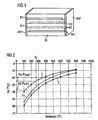
- FIG. 1 is a ceramic component with copper-containing external contacts AK1 and AK2 shown schematically.
- First copper-containing internal electrodes IE1 are connected to the first external contact AK1.
- second copper-containing internal electrodes IE2 are connected.
- the internal electrodes are separated from each other by ceramic layers KS.
- the ceramic layers KS preferably have piezoelectric properties and are z. For example, based on the PZT-type ceramic.
- the illustrated component realizes in particular a piezoelectric actuator.
- the stacked electrode layers and ceramic layers are referred to as piezo stack.
- the burned external contacts AK1, AK2 are preferably between 10 and 20 microns, z. B. 15 microns thick. But it can also be a different thickness of the external contacts are selected.
- the ceramic component has ceramic particles with a certain grain size, z. B. with an average particle size between 0.2 and 0.6 microns.
- the ceramic component in the metal paste prevents in particular cracking and lifting of the external contact of the piezo stack, which result from different expansion properties of the ceramic material and the metallic copper.
- the thermal expansion coefficient of the PZT-type ceramic is approximately 1.5-2.0 ppm / K in the temperature range between the room temperature and the Curie temperature, while in the corresponding temperature range metallic copper has a significantly higher thermal expansion coefficient of approximately 19 ppm. K has.
- thermal expansion coefficients is preferably a glass frit with a high SiO 2 content of z. B. 39 m%, since SiO 2 has a high affinity for the PZT-type ceramic.
- the ceramic powder having a mean grain size of z. B. 0.4 microns completed in a dispersion with a solvent. Subsequently, the ceramic powder dispersion is stirred into the copper-containing metal paste of the above-mentioned composition and homogenized using a three-roll mill.
- the viscosity of the metal paste is preferably between 10 and 20 Pas.
- the paste is dried at about 80 to 140 ° C in the air atmosphere.
- binder removal and sintering under specified process conditions on the one hand, the oxidation of the metallic copper and On the other hand, the reduction of PbO or PbTiO 3 can be prevented. Care is taken here, in particular with regard to the selection of the binder removal temperature and the duration of the debindering, that not only the binder components but also the solvent residues are completely burned out during the binder removal process from the metal paste.
- the sintering temperature is chosen so low (eg 765 ° C.) that the penetration of the glass additive only in the region of the internal electrodes takes place.
- Microscopic investigations prove that at a sintering temperature selected in this way, glass components, in particular silicon oxide, can only be detected in a narrow region of the ceramic layers adjacent to the external contacts.
- the external contacts are firmly attached and can only be detached from the piezo stack by applying a large force of more than 50 N. In the violent detachment of the external contacts parts of the ceramic material are broken, which speaks for a high adhesive strength of the external contacts on the piezo stack.
- the ceramic content is preferably 40 m%, based on the solids content of the metal paste.
- This metal paste can in principle also be used for internal electrode layers.
- a preferably chemically active ceramic powder (or else another chemically active additive), hereinafter also referred to as ceramic additive, which under certain conditions chemically with the electrode metal, the organic binder, the ceramic and / or a reaction product can react or chemically bind certain components.
- the ceramic additive may react with the process atmosphere, e.g. B. deliver the oxygen to the process atmosphere or vice versa, whereby at least locally or temporarily the oxygen partial pressure is stabilized. With a stable oxygen partial pressure, it is possible in particular to protect the inner electrode layers or the outer contacts from oxidation and the ceramic layers from reduction.
- the ceramic powder additive ensures that a metal oxide formed by process instabilities in the electrode metallization is bonded, thereby avoiding unwanted in-diffusion of this metal oxide into the ceramic layers.
- the ceramic powder is used as a functional additive which is chemically active and can react chemically with its environment.
- the chemical activity may, for. B. on the binding of Pb, which is released during the sintering of the lead-containing ceramic material to be directed.
- the chemically active ceramic powder binds another component of the ceramic material in particular in the sintering or release of certain components such.
- oxygen from the ceramic mass or from the binder contained in the ceramic mass or in the metal paste serves.
- the prerequisite is that the ceramic powder does not react chemically with the metal portion of the metal paste.
- suitable metal paste preferably no glass additives used.
- a chemically active ceramic powder in particular (Zr, Ti) O 2 is suitable.
- the metal paste may instead of a chemically active ceramic powder also contain another chemically active additive or in addition to the chemically active ceramic powder shares of other substances, eg. B. BaO 2 and / or MgO.
- the addition of a ceramic powder in the inner electrodes also ensures better adhesion between the inner electrode and the surrounding ceramic layers, which is prevented by a fine distribution of the ceramic particles between the metal particles in particular the sintering neck.
- the sintering necks represent a local interruption of the inner electrode, wherein the metallization dissolves from the ceramic layer and / or - especially in the edge region - is retracted so that the inner electrode assumes a reticulated structure whose structure is not reproducible from component to component. It is known that a homogeneous inner electrode structure can also be achieved by the addition of a noble metal or a precious metal alloy.
- the addition of the ceramic powder according to the invention has a large cost advantage.
- FIG. 2 is in semi-logarithmic representation of a depending on the temperature -undation of the water vapor - to be set oxygen partial pressure p o2 , for example given by the curve 3, the numerically calculated equilibrium curve 1 of Cu and Cu 2 O and the numerically calculated equilibrium curve 2 of Pb and PbTiO 3 shown.
- the equilibrium curve 1 indicates, at the selected temperature, the partial pressure of O 2 at which metallic Cu and Cu 2 O can exist simultaneously.
- Metallic copper exists only at an oxygen partial pressure p o2 which does not exceed the equilibrium value, ie below the equilibrium curve 1. Since above Cu 1 only Cu 2 O is stable, an undesirable oxygen partial pressure exceeding the equilibrium value at the selected temperature occurs Oxidation of metallic copper.
- the equilibrium curve 2 indicates the partial pressure of O 2 at the selected temperature, at which metallic Pb and PbTiO 3 may exist simultaneously.
- PbTO 3 exists only above the curve 2.
- the PbTiO 3 contained in the ceramic is reduced to Pb.
- the oxygen partial pressure p o2 is adjusted with the addition of steam so that it does not exceed the maximum value p max defined by the curve 1, at which metallic copper is still stable , and on the other hand, does not fall below the minimum value p min given by the curve 2 at which lead titanate is not yet reduced, ie p min ⁇ p o 2 ⁇ p max at the given debindering temperature T E.
- the permissible range for adjusting the oxygen partial pressure is thus between curves 1 and 2.
- Curve 3 describes an optimum partial pressure of oxygen to be set according to the invention in accordance with the temperature and in a humid atmosphere.
- the amount of water vapor to be added can be calculated in principle from curve 3. It is also possible to manually or automatically control the drop in the oxygen partial pressure with the addition of steam so that the prescribed limits are not violated.
Landscapes
- Engineering & Computer Science (AREA)
- Chemical & Material Sciences (AREA)
- Manufacturing & Machinery (AREA)
- Ceramic Engineering (AREA)
- Materials Engineering (AREA)
- Structural Engineering (AREA)
- Organic Chemistry (AREA)
- Inorganic Chemistry (AREA)
- Ceramic Capacitors (AREA)
- Fixed Capacitors And Capacitor Manufacturing Machines (AREA)
- Compositions Of Oxide Ceramics (AREA)
Abstract
Claims (13)
- Procédé de production d'un composant à couches multiples ayant des couches en céramique et entre elles des électrodes intérieures contenant du cuivre, qui sont reliées à des contacts extérieurs contenant du cuivre,
dans lequel on effectue l'élimination du liant à une température ≤ 300°C dans le courant d'azote avec addition dosée de vapeur d'eau et on achève ainsi complètement le processus d'élimination du liant,
dans lequel, pendant l'élimination du liant, on maintient le niveau de la pression partielle de l'oxygène de manière à ne pas venir en dessous d'une valeur Pmin, à laquelle la céramique commence à se dégrader par réduction et à ne pas dépasser une valeur Pmax, à laquelle à la température donnée le cuivre métallique commence à s'oxyder. - Procédé suivant la revendication 1
dans lequel Pmin correspond au point d'équilibre de Cu/Cu2O dans lequel Pmax correspond au point d'équilibre de Pb/PbO ou de Pb/PbTiO3. - Procédé suivant la revendication 1 ou 2,
dans lequel, pour la production de contacts extérieurs, on utilise une pâte métallique contenant du cuivre ayant une teneur en cuivre de >70% en poids, une frite de verre et un lien organique. - Procédé suivant la revendication 3,
dans lequel on utilise un liant en résine acrylique comme liant organique. - Procédé suivant la revendication 3 ou 4,
dans lequel la frite de verre contient essentiellement du PbO et du SiO2. - Procédé suivant l'une des revendications 3 à 5,
dans lequel la pâte métallique contenant du cuivre est cuite entre 700 et 860°C. - Procédé suivant la revendication 6,
dans lequel on effectue l'élimination du liant et la cuisson de la pâte métallique contenant du cuivre sur un support en cuivre. - Procédé suivant l'une des revendications 3 à 7,
dans lequel on dépose la pâte métallique contenant du cuivre par un procédé de sérigraphie. - Procédé suivant l'une des revendications 1 à 8,
dans lequel, pour la production de couches d'électrodes intérieures, on utilise une pâte métallique ayant une proportion d'un additif actif chimiquement,.
dans lequel l'additif actif chimiquement réagit chimiquement au moins sur un constituant de son environnement à l'exception de la partie métallique de la pâte métallique. - Procédé suivant la revendication 9,
dans lequel on utilise comme additif actif chimiquement une poudre de céramique active chimiquement. - Procédé suivant la revendication 9 ou 10,
dans lequel on choisit le constituant de l'environnement parmi l'oxygène au moins un constituant de la composition céramique et un liant ou un solvant contenu dans la pâte métallique ou dans la composition de céramique. - Procédé suivant l'une des revendications 9 à 11,
dans lequel on utilise une composition céramique contenant du plomb, dans lequel, en raison d'une réaction chimique entre l'additif actif chimiquement et son environnement, il se dégage de l'oxygène et/ ou du Pb et/ou du Cu est fixé. - Procédé suivant l'une des revendications 9 à 12,
dans lequel on utilise comme additif actif chimiquement au moins un additif choisi parmi (Zr, Ti)O2, MgO et BaO2.
Priority Applications (2)
| Application Number | Priority Date | Filing Date | Title |
|---|---|---|---|
| EP07017605A EP1863104B1 (fr) | 2003-09-30 | 2004-09-29 | Procédé de fabrication d'un composant multicouche en céramique |
| EP10184225.0A EP2264800B1 (fr) | 2003-09-30 | 2004-09-29 | Composant multicouche en céramique |
Applications Claiming Priority (2)
| Application Number | Priority Date | Filing Date | Title |
|---|---|---|---|
| DE10345500.0A DE10345500B4 (de) | 2003-09-30 | 2003-09-30 | Keramisches Vielschicht-Bauelement |
| PCT/DE2004/002167 WO2005034255A2 (fr) | 2003-09-30 | 2004-09-29 | Composant ceramique multicouche et procede de fabrication |
Related Child Applications (2)
| Application Number | Title | Priority Date | Filing Date |
|---|---|---|---|
| EP07017605A Division EP1863104B1 (fr) | 2003-09-30 | 2004-09-29 | Procédé de fabrication d'un composant multicouche en céramique |
| EP10184225.0A Division EP2264800B1 (fr) | 2003-09-30 | 2004-09-29 | Composant multicouche en céramique |
Publications (2)
| Publication Number | Publication Date |
|---|---|
| EP1668714A2 EP1668714A2 (fr) | 2006-06-14 |
| EP1668714B1 true EP1668714B1 (fr) | 2008-02-13 |
Family
ID=34399107
Family Applications (3)
| Application Number | Title | Priority Date | Filing Date |
|---|---|---|---|
| EP04786879A Expired - Lifetime EP1668714B1 (fr) | 2003-09-30 | 2004-09-29 | Procédé de fabrication d'un dispositif céramique à multicouches |
| EP10184225.0A Expired - Lifetime EP2264800B1 (fr) | 2003-09-30 | 2004-09-29 | Composant multicouche en céramique |
| EP07017605A Expired - Lifetime EP1863104B1 (fr) | 2003-09-30 | 2004-09-29 | Procédé de fabrication d'un composant multicouche en céramique |
Family Applications After (2)
| Application Number | Title | Priority Date | Filing Date |
|---|---|---|---|
| EP10184225.0A Expired - Lifetime EP2264800B1 (fr) | 2003-09-30 | 2004-09-29 | Composant multicouche en céramique |
| EP07017605A Expired - Lifetime EP1863104B1 (fr) | 2003-09-30 | 2004-09-29 | Procédé de fabrication d'un composant multicouche en céramique |
Country Status (5)
| Country | Link |
|---|---|
| US (3) | US7525241B2 (fr) |
| EP (3) | EP1668714B1 (fr) |
| JP (3) | JP2007507865A (fr) |
| DE (2) | DE10345500B4 (fr) |
| WO (1) | WO2005034255A2 (fr) |
Families Citing this family (15)
| Publication number | Priority date | Publication date | Assignee | Title |
|---|---|---|---|---|
| EP2365553A1 (fr) * | 2003-07-28 | 2011-09-14 | Kyocera Corporation | Élément piézoélectrique à multicouches |
| DE10345500B4 (de) * | 2003-09-30 | 2015-02-12 | Epcos Ag | Keramisches Vielschicht-Bauelement |
| JP4028508B2 (ja) * | 2004-03-26 | 2007-12-26 | Tdk株式会社 | 積層セラミック素子の製造方法 |
| DE102005017108A1 (de) * | 2005-01-26 | 2006-07-27 | Epcos Ag | Piezoelektrisches Bauelement |
| DE102005034701A1 (de) * | 2005-07-26 | 2007-02-01 | Robert Bosch Gmbh | Piezokeramischer Aktor |
| DE102006031085A1 (de) | 2006-03-16 | 2007-09-20 | Epcos Ag | Elektrisches Vielschichtbauelement |
| DE102006060432A1 (de) * | 2006-12-20 | 2008-06-26 | Epcos Ag | Elektrisches Bauelement sowie Außenkontakt eines elektrischen Bauelements |
| CN101946405A (zh) * | 2008-02-18 | 2011-01-12 | 精工电子有限公司 | 压电振动器的制造方法、压电振动器、振荡器、电子设备及电波钟 |
| DE102008002504A1 (de) * | 2008-06-18 | 2009-12-24 | Robert Bosch Gmbh | Verfahren zum Herstellen eines gestapelten Piezoaktors sowie Piezoaktor |
| US8991723B2 (en) * | 2009-05-26 | 2015-03-31 | Kyocera Corporation | Multi-layer piezoelectric element, and injection device and fuel injection system incorporating the multi-layer piezoelectric element |
| DE102012101351A1 (de) | 2012-02-20 | 2013-08-22 | Epcos Ag | Vielschichtbauelement und Verfahren zum Herstellen eines Vielschichtbauelements |
| DE102012104033B9 (de) | 2012-05-08 | 2025-02-06 | Tdk Electronics Ag | Keramischer Vielschichtkondensator |
| DE102012105059A1 (de) * | 2012-06-12 | 2013-12-12 | Epcos Ag | Verfahren zur Herstellung eines Vielschichtbauelements und Vielschichtbauelement |
| DE102012105517B4 (de) * | 2012-06-25 | 2020-06-18 | Tdk Electronics Ag | Vielschichtbauelement mit einer Außenkontaktierung und Verfahren zur Herstellung eines Vielschichtbauelements mit einer Außenkontaktierung |
| US11661379B2 (en) | 2017-07-21 | 2023-05-30 | Corning Incorporated | Methods of extracting volatiles from ceramic green bodies |
Family Cites Families (48)
| Publication number | Priority date | Publication date | Assignee | Title |
|---|---|---|---|---|
| DE970463C (de) | 1953-02-22 | 1958-09-25 | Bayer Ag | Verfahren zur Herstellung von Kondensationsprodukten |
| NL6616433A (fr) | 1965-11-29 | 1967-05-30 | ||
| DE3015356A1 (de) * | 1980-04-22 | 1981-10-29 | Robert Bosch Gmbh, 7000 Stuttgart | Freitragende schichten sowie verfahren zur herstellung freitragender schichten, insbesondere fuer sensoren fuer brennkraftmaschinen |
| DE3128738A1 (de) * | 1981-07-21 | 1983-02-10 | Bbc Brown Boveri & Cie | "elektrochemische messzelle" |
| JPS59184511A (ja) * | 1983-04-04 | 1984-10-19 | 株式会社村田製作所 | セラミツク積層コンデンサ |
| JPS6452672A (en) | 1987-08-25 | 1989-02-28 | Ube Industries | Baking of piezoelectric ceramic |
| JP2707586B2 (ja) | 1988-04-15 | 1998-01-28 | 株式会社日本自動車部品総合研究所 | 一体型ピエゾスタック |
| JPH02205372A (ja) | 1989-02-03 | 1990-08-15 | Toyota Motor Corp | 電歪効果素子 |
| US5163209A (en) * | 1989-04-26 | 1992-11-17 | Hitachi, Ltd. | Method of manufacturing a stack-type piezoelectric element |
| JPH04299588A (ja) * | 1991-03-28 | 1992-10-22 | Nec Corp | 電歪効果素子 |
| JPH05190375A (ja) * | 1992-01-09 | 1993-07-30 | Murata Mfg Co Ltd | 銅多層セラミック基板の製造方法及びそれに用いる銅ペースト |
| JPH06232466A (ja) * | 1993-02-03 | 1994-08-19 | Toyota Motor Corp | 圧電積層体 |
| JP3018866B2 (ja) * | 1993-10-07 | 2000-03-13 | 株式会社村田製作所 | 積層電子部品の外部電極用卑金属組成物 |
| JPH07230714A (ja) | 1994-02-16 | 1995-08-29 | Murata Mfg Co Ltd | 銅導電性ペースト |
| JP3230394B2 (ja) * | 1994-06-01 | 2001-11-19 | 株式会社村田製作所 | 磁器コンデンサ |
| JPH07336053A (ja) * | 1994-06-14 | 1995-12-22 | Sumitomo Kinzoku Ceramics:Kk | セラミック多層配線基板 |
| JPH0982134A (ja) * | 1995-09-11 | 1997-03-28 | Murata Mfg Co Ltd | 導電ペースト及びそれを用いた圧電セラミック素子 |
| DE19615695C1 (de) * | 1996-04-19 | 1997-07-03 | Siemens Ag | Verfahren zur Herstellung eines Piezoaktors monolithischer Vielschichtbauweise |
| JP3209089B2 (ja) * | 1996-05-09 | 2001-09-17 | 昭栄化学工業株式会社 | 導電性ペースト |
| JPH10133597A (ja) * | 1996-07-26 | 1998-05-22 | Canon Inc | 配線基板、該配線基板の製造方法、該配線基板を備えた液晶素子及び該液晶素子の製造方法 |
| JP3472087B2 (ja) | 1997-06-30 | 2003-12-02 | Tdk株式会社 | 膜構造体、電子デバイス、記録媒体および酸化物導電性薄膜の製造方法 |
| JPH11135357A (ja) | 1997-10-30 | 1999-05-21 | Kyocera Corp | 積層セラミックコンデンサ |
| JP2000277370A (ja) * | 1999-03-29 | 2000-10-06 | Taiyo Yuden Co Ltd | 積層セラミック電子部品 |
| JP2000299243A (ja) * | 1999-04-16 | 2000-10-24 | Tdk Corp | 積層チップ型電子部品 |
| JP2001069771A (ja) * | 1999-08-31 | 2001-03-16 | Kyocera Corp | 積層型圧電アクチュエータ |
| US6414417B1 (en) * | 1999-08-31 | 2002-07-02 | Kyocera Corporation | Laminated piezoelectric actuator |
| DE19945934C1 (de) * | 1999-09-24 | 2001-03-22 | Epcos Ag | Verfahren zur Herstellung einer Außenkontaktierung eines elektrokeramischen Bauelementes, insbesondere eines Piezoaktors |
| DE19945933C1 (de) | 1999-09-24 | 2001-05-17 | Epcos Ag | Piezoaktor mit isolationszonenfreier elektrischer Kontaktierung und Verfahren zu dessen Herstellung |
| JP2001126946A (ja) * | 1999-10-28 | 2001-05-11 | Murata Mfg Co Ltd | 積層セラミック電子部品及びその製造方法 |
| AU2830701A (en) * | 1999-12-16 | 2001-06-25 | Epcos Ag | Piezoelectric component |
| JP3734662B2 (ja) | 2000-02-16 | 2006-01-11 | 太陽誘電株式会社 | 積層セラミックコンデンサとその製造方法 |
| JP4356268B2 (ja) * | 2000-06-26 | 2009-11-04 | 株式会社デンソー | 燃料噴射装置 |
| DE10035172B4 (de) * | 2000-07-19 | 2004-09-16 | Epcos Ag | Keramikmasse und Kondensator mit der Keramikmasse |
| JP2002203999A (ja) * | 2000-11-06 | 2002-07-19 | Denso Corp | 積層型圧電体素子とその製造方法 |
| JP2002261343A (ja) * | 2000-12-28 | 2002-09-13 | Denso Corp | 積層一体焼成型の電気機械変換素子 |
| JP2002261346A (ja) * | 2000-12-28 | 2002-09-13 | Denso Corp | 積層一体焼成型の電気機械変換素子 |
| JP2002260951A (ja) | 2000-12-28 | 2002-09-13 | Denso Corp | 積層型誘電素子及びその製造方法,並びに電極用ペースト材料 |
| JP3802353B2 (ja) * | 2001-01-29 | 2006-07-26 | Tdk株式会社 | 電圧非直線性抵抗体素子及びその製造方法 |
| JP3864114B2 (ja) * | 2001-08-02 | 2006-12-27 | 株式会社日本自動車部品総合研究所 | 積層型誘電体の製造方法 |
| JP2003059758A (ja) * | 2001-08-10 | 2003-02-28 | Nec Tokin Corp | 積層セラミックコンデンサの製造方法 |
| JP3743406B2 (ja) * | 2001-10-05 | 2006-02-08 | 株式会社村田製作所 | 導電性ペースト、積層セラミック電子部品の製造方法および積層セラミック電子部品 |
| JP4300786B2 (ja) * | 2001-12-21 | 2009-07-22 | 昭栄化学工業株式会社 | ガラスおよびこれを用いた導体ペースト |
| JP3860746B2 (ja) | 2001-12-26 | 2006-12-20 | 京セラ株式会社 | 積層型圧電素子及び噴射装置 |
| DE10205877A1 (de) * | 2002-02-13 | 2003-09-04 | Epcos Ag | Keramisches Vielschichtbauelement, Verfahren zu dessen Herstellung und Haltevorrichtung |
| DE10207530A1 (de) * | 2002-02-22 | 2003-09-11 | Epcos Ag | Piezoaktor mit strukturierter Außenelektrode |
| JP4434016B2 (ja) | 2002-08-02 | 2010-03-17 | 日本碍子株式会社 | 圧電/電歪膜型素子の製造方法 |
| DE10345500B4 (de) | 2003-09-30 | 2015-02-12 | Epcos Ag | Keramisches Vielschicht-Bauelement |
| US8691867B2 (en) | 2005-12-19 | 2014-04-08 | Janssen Pharmaceutica Nv | Use of benzo-fused heterocycle sulfamide derivatives for the treatment of substance abuse and addiction |
-
2003
- 2003-09-30 DE DE10345500.0A patent/DE10345500B4/de not_active Expired - Lifetime
-
2004
- 2004-09-29 WO PCT/DE2004/002167 patent/WO2005034255A2/fr not_active Ceased
- 2004-09-29 JP JP2006529619A patent/JP2007507865A/ja active Pending
- 2004-09-29 EP EP04786879A patent/EP1668714B1/fr not_active Expired - Lifetime
- 2004-09-29 EP EP10184225.0A patent/EP2264800B1/fr not_active Expired - Lifetime
- 2004-09-29 DE DE502004006205T patent/DE502004006205D1/de not_active Expired - Lifetime
- 2004-09-29 EP EP07017605A patent/EP1863104B1/fr not_active Expired - Lifetime
- 2004-09-29 US US10/574,192 patent/US7525241B2/en not_active Expired - Lifetime
-
2009
- 2009-03-31 US US12/415,371 patent/US8776364B2/en active Active
-
2011
- 2011-10-25 JP JP2011234127A patent/JP5709724B2/ja not_active Expired - Lifetime
-
2012
- 2012-03-27 US US13/430,932 patent/US9186870B2/en not_active Expired - Lifetime
-
2013
- 2013-06-21 JP JP2013130594A patent/JP5726237B2/ja not_active Expired - Lifetime
Also Published As
| Publication number | Publication date |
|---|---|
| DE10345500A1 (de) | 2005-04-28 |
| JP2007507865A (ja) | 2007-03-29 |
| EP1863104A3 (fr) | 2007-12-12 |
| US7525241B2 (en) | 2009-04-28 |
| EP2264800B1 (fr) | 2014-05-07 |
| US20070206341A1 (en) | 2007-09-06 |
| EP1863104B1 (fr) | 2012-01-25 |
| JP2012019245A (ja) | 2012-01-26 |
| JP5709724B2 (ja) | 2015-04-30 |
| EP1863104A2 (fr) | 2007-12-05 |
| US8776364B2 (en) | 2014-07-15 |
| JP5726237B2 (ja) | 2015-05-27 |
| EP1668714A2 (fr) | 2006-06-14 |
| EP2264800A3 (fr) | 2011-01-12 |
| US9186870B2 (en) | 2015-11-17 |
| EP2264800A2 (fr) | 2010-12-22 |
| DE10345500B4 (de) | 2015-02-12 |
| WO2005034255A3 (fr) | 2006-05-04 |
| WO2005034255A2 (fr) | 2005-04-14 |
| US20120180310A1 (en) | 2012-07-19 |
| US20090193636A1 (en) | 2009-08-06 |
| JP2013214764A (ja) | 2013-10-17 |
| DE502004006205D1 (de) | 2008-03-27 |
Similar Documents
| Publication | Publication Date | Title |
|---|---|---|
| EP1863104B1 (fr) | Procédé de fabrication d'un composant multicouche en céramique | |
| EP1597780B1 (fr) | Composant electrique multicouche et empilement de couches | |
| EP3238218B1 (fr) | Composant multicouche céramique et procédé de fabrication d'un composant céramique multicouche | |
| DE20023051U1 (de) | Piezoelektrisches Bauelement | |
| EP1386335B1 (fr) | Composant electrique multicouche et son procede de production | |
| EP1124265A2 (fr) | Corps céramique piézoélectrique avec des électrodes internes contenant de l'argent | |
| EP2207758B1 (fr) | Élément multicouche piézocéramique | |
| EP2232599B1 (fr) | Composant multicouche piézoélectrique | |
| EP1497838B1 (fr) | Procédé pour la fabrication d'un composant ptc | |
| EP2568246B1 (fr) | Dispositif de retenue pour composant céramique multicouche | |
| EP2847805B1 (fr) | Procédé de production d'un élément mulcicouche et élément multicouche produit selon ce procédé | |
| EP3959752B1 (fr) | Actionneur électromécanique à isolation céramique et son procédé de fabrication | |
| DE102015101311B4 (de) | Verfahren zur Herstellung von piezoelektrischen Vielschichtbauelementen | |
| DE102011109008A1 (de) | Verfahren zur Herstellung eines piezoelektrischen Vielschichtbauelements | |
| DE10326040A1 (de) | Verfahren zur Herstellung von keramischen Grünfolien für keramische Bauteile | |
| WO2002004379A2 (fr) | Materiau electroconducteur fritte, element ceramique multicouche comprenant ledit materiau et procede permettant de le produire |
Legal Events
| Date | Code | Title | Description |
|---|---|---|---|
| PUAI | Public reference made under article 153(3) epc to a published international application that has entered the european phase |
Free format text: ORIGINAL CODE: 0009012 |
|
| 17P | Request for examination filed |
Effective date: 20060210 |
|
| AK | Designated contracting states |
Kind code of ref document: A2 Designated state(s): AT BE BG CH CY CZ DE DK EE ES FI FR GB GR HU IE IT LI LU MC NL PL PT RO SE SI SK TR |
|
| AX | Request for extension of the european patent |
Extension state: AL HR LT LV MK |
|
| 17Q | First examination report despatched |
Effective date: 20060925 |
|
| DAX | Request for extension of the european patent (deleted) | ||
| RBV | Designated contracting states (corrected) |
Designated state(s): DE FR GB |
|
| GRAJ | Information related to disapproval of communication of intention to grant by the applicant or resumption of examination proceedings by the epo deleted |
Free format text: ORIGINAL CODE: EPIDOSDIGR1 |
|
| GRAP | Despatch of communication of intention to grant a patent |
Free format text: ORIGINAL CODE: EPIDOSNIGR1 |
|
| GRAP | Despatch of communication of intention to grant a patent |
Free format text: ORIGINAL CODE: EPIDOSNIGR1 |
|
| RIC1 | Information provided on ipc code assigned before grant |
Ipc: H01L 41/24 20060101AFI20070801BHEP |
|
| RTI1 | Title (correction) |
Free format text: METHOD OF PRODUCING A CERAMIC MULTI-LAYER DEVICE |
|
| GRAS | Grant fee paid |
Free format text: ORIGINAL CODE: EPIDOSNIGR3 |
|
| GRAA | (expected) grant |
Free format text: ORIGINAL CODE: 0009210 |
|
| AK | Designated contracting states |
Kind code of ref document: B1 Designated state(s): DE FR GB |
|
| REG | Reference to a national code |
Ref country code: GB Ref legal event code: FG4D Free format text: NOT ENGLISH |
|
| REF | Corresponds to: |
Ref document number: 502004006205 Country of ref document: DE Date of ref document: 20080327 Kind code of ref document: P |
|
| ET | Fr: translation filed | ||
| PLBE | No opposition filed within time limit |
Free format text: ORIGINAL CODE: 0009261 |
|
| STAA | Information on the status of an ep patent application or granted ep patent |
Free format text: STATUS: NO OPPOSITION FILED WITHIN TIME LIMIT |
|
| 26N | No opposition filed |
Effective date: 20081114 |
|
| REG | Reference to a national code |
Ref country code: FR Ref legal event code: PLFP Year of fee payment: 13 |
|
| REG | Reference to a national code |
Ref country code: FR Ref legal event code: PLFP Year of fee payment: 14 |
|
| REG | Reference to a national code |
Ref country code: FR Ref legal event code: PLFP Year of fee payment: 15 |
|
| REG | Reference to a national code |
Ref country code: DE Ref legal event code: R082 Ref document number: 502004006205 Country of ref document: DE Representative=s name: EPPING HERMANN FISCHER PATENTANWALTSGESELLSCHA, DE Ref country code: DE Ref legal event code: R081 Ref document number: 502004006205 Country of ref document: DE Owner name: TDK ELECTRONICS AG, DE Free format text: FORMER OWNER: EPCOS AG, 81669 MUENCHEN, DE |
|
| REG | Reference to a national code |
Ref country code: DE Ref legal event code: R079 Ref document number: 502004006205 Country of ref document: DE Free format text: PREVIOUS MAIN CLASS: H01L0041000000 Ipc: H10N0030000000 |
|
| P01 | Opt-out of the competence of the unified patent court (upc) registered |
Effective date: 20230521 |
|
| PGFP | Annual fee paid to national office [announced via postgrant information from national office to epo] |
Ref country code: GB Payment date: 20230921 Year of fee payment: 20 |
|
| PGFP | Annual fee paid to national office [announced via postgrant information from national office to epo] |
Ref country code: FR Payment date: 20230919 Year of fee payment: 20 Ref country code: DE Payment date: 20230920 Year of fee payment: 20 |
|
| REG | Reference to a national code |
Ref country code: DE Ref legal event code: R071 Ref document number: 502004006205 Country of ref document: DE |
|
| PG25 | Lapsed in a contracting state [announced via postgrant information from national office to epo] |
Ref country code: GB Free format text: LAPSE BECAUSE OF EXPIRATION OF PROTECTION Effective date: 20240928 |
|
| REG | Reference to a national code |
Ref country code: GB Ref legal event code: PE20 Expiry date: 20240928 |
|
| PG25 | Lapsed in a contracting state [announced via postgrant information from national office to epo] |
Ref country code: GB Free format text: LAPSE BECAUSE OF EXPIRATION OF PROTECTION Effective date: 20240928 |