EP1682167B1 - Verwendung hyperpolymerer hämoglobine zur behandlung eines lungenödems - Google Patents
Verwendung hyperpolymerer hämoglobine zur behandlung eines lungenödems Download PDFInfo
- Publication number
- EP1682167B1 EP1682167B1 EP04797509A EP04797509A EP1682167B1 EP 1682167 B1 EP1682167 B1 EP 1682167B1 EP 04797509 A EP04797509 A EP 04797509A EP 04797509 A EP04797509 A EP 04797509A EP 1682167 B1 EP1682167 B1 EP 1682167B1
- Authority
- EP
- European Patent Office
- Prior art keywords
- hemoglobin
- blood
- mol
- oncotic
- solution
- Prior art date
- Legal status (The legal status is an assumption and is not a legal conclusion. Google has not performed a legal analysis and makes no representation as to the accuracy of the status listed.)
- Expired - Lifetime
Links
- 206010037423 Pulmonary oedema Diseases 0.000 title abstract description 11
- 108010054147 Hemoglobins Proteins 0.000 claims abstract description 87
- 102000001554 Hemoglobins Human genes 0.000 claims abstract description 87
- INGWEZCOABYORO-UHFFFAOYSA-N 2-(furan-2-yl)-7-methyl-1h-1,8-naphthyridin-4-one Chemical compound N=1C2=NC(C)=CC=C2C(O)=CC=1C1=CC=CO1 INGWEZCOABYORO-UHFFFAOYSA-N 0.000 claims abstract description 24
- 206010001029 Acute pulmonary oedema Diseases 0.000 claims abstract description 13
- 239000007864 aqueous solution Substances 0.000 claims abstract description 12
- 239000003795 chemical substances by application Substances 0.000 claims abstract description 10
- 239000007924 injection Substances 0.000 claims abstract description 8
- 238000002347 injection Methods 0.000 claims abstract description 8
- 239000000243 solution Substances 0.000 claims description 74
- FAPWRFPIFSIZLT-UHFFFAOYSA-M Sodium chloride Chemical compound [Na+].[Cl-] FAPWRFPIFSIZLT-UHFFFAOYSA-M 0.000 claims description 30
- 239000011780 sodium chloride Substances 0.000 claims description 14
- 239000003792 electrolyte Substances 0.000 claims description 10
- 239000008151 electrolyte solution Substances 0.000 claims description 7
- 229940021013 electrolyte solution Drugs 0.000 claims description 7
- 229920000233 poly(alkylene oxides) Polymers 0.000 claims description 4
- 241000283690 Bos taurus Species 0.000 claims description 2
- 241000282412 Homo Species 0.000 claims description 2
- 241000282887 Suidae Species 0.000 claims description 2
- 210000004369 blood Anatomy 0.000 abstract description 34
- 239000008280 blood Substances 0.000 abstract description 34
- 239000000654 additive Substances 0.000 abstract description 11
- 238000011282 treatment Methods 0.000 abstract description 11
- 230000000996 additive effect Effects 0.000 abstract description 10
- 208000005333 pulmonary edema Diseases 0.000 abstract description 10
- XLYOFNOQVPJJNP-UHFFFAOYSA-N water Substances O XLYOFNOQVPJJNP-UHFFFAOYSA-N 0.000 description 34
- 239000001301 oxygen Substances 0.000 description 32
- 229910052760 oxygen Inorganic materials 0.000 description 32
- QVGXLLKOCUKJST-UHFFFAOYSA-N atomic oxygen Chemical compound [O] QVGXLLKOCUKJST-UHFFFAOYSA-N 0.000 description 29
- IJGRMHOSHXDMSA-UHFFFAOYSA-N Atomic nitrogen Chemical compound N#N IJGRMHOSHXDMSA-UHFFFAOYSA-N 0.000 description 24
- 210000002381 plasma Anatomy 0.000 description 20
- 239000000969 carrier Substances 0.000 description 19
- HEMHJVSKTPXQMS-UHFFFAOYSA-M Sodium hydroxide Chemical compound [OH-].[Na+] HEMHJVSKTPXQMS-UHFFFAOYSA-M 0.000 description 18
- 235000002639 sodium chloride Nutrition 0.000 description 15
- JVTAAEKCZFNVCJ-UHFFFAOYSA-N lactic acid Chemical compound CC(O)C(O)=O JVTAAEKCZFNVCJ-UHFFFAOYSA-N 0.000 description 12
- 229910052757 nitrogen Inorganic materials 0.000 description 12
- 238000002560 therapeutic procedure Methods 0.000 description 11
- 241001465754 Metazoa Species 0.000 description 9
- 230000001225 therapeutic effect Effects 0.000 description 9
- MYMOFIZGZYHOMD-UHFFFAOYSA-N Dioxygen Chemical compound O=O MYMOFIZGZYHOMD-UHFFFAOYSA-N 0.000 description 7
- 241000700159 Rattus Species 0.000 description 7
- 239000003814 drug Substances 0.000 description 7
- 229920001223 polyethylene glycol Polymers 0.000 description 7
- 229920000642 polymer Polymers 0.000 description 7
- 239000002202 Polyethylene glycol Substances 0.000 description 6
- UIIMBOGNXHQVGW-UHFFFAOYSA-M Sodium bicarbonate Chemical compound [Na+].OC([O-])=O UIIMBOGNXHQVGW-UHFFFAOYSA-M 0.000 description 6
- 230000037396 body weight Effects 0.000 description 6
- 235000014655 lactic acid Nutrition 0.000 description 6
- 239000004310 lactic acid Substances 0.000 description 6
- 238000002360 preparation method Methods 0.000 description 6
- 239000000047 product Substances 0.000 description 6
- 230000004083 survival effect Effects 0.000 description 6
- 231100000331 toxic Toxicity 0.000 description 6
- 230000002588 toxic effect Effects 0.000 description 6
- WRIDQFICGBMAFQ-UHFFFAOYSA-N (E)-8-Octadecenoic acid Natural products CCCCCCCCCC=CCCCCCCC(O)=O WRIDQFICGBMAFQ-UHFFFAOYSA-N 0.000 description 5
- LQJBNNIYVWPHFW-UHFFFAOYSA-N 20:1omega9c fatty acid Natural products CCCCCCCCCCC=CCCCCCCCC(O)=O LQJBNNIYVWPHFW-UHFFFAOYSA-N 0.000 description 5
- QSBYPNXLFMSGKH-UHFFFAOYSA-N 9-Heptadecensaeure Natural products CCCCCCCC=CCCCCCCCC(O)=O QSBYPNXLFMSGKH-UHFFFAOYSA-N 0.000 description 5
- SXRSQZLOMIGNAQ-UHFFFAOYSA-N Glutaraldehyde Chemical compound O=CCCCC=O SXRSQZLOMIGNAQ-UHFFFAOYSA-N 0.000 description 5
- 239000005642 Oleic acid Substances 0.000 description 5
- ZQPPMHVWECSIRJ-UHFFFAOYSA-N Oleic acid Natural products CCCCCCCCC=CCCCCCCCC(O)=O ZQPPMHVWECSIRJ-UHFFFAOYSA-N 0.000 description 5
- 238000004132 cross linking Methods 0.000 description 5
- 229940079593 drug Drugs 0.000 description 5
- 238000002474 experimental method Methods 0.000 description 5
- -1 for example Polymers 0.000 description 5
- 229960000587 glutaral Drugs 0.000 description 5
- QXJSBBXBKPUZAA-UHFFFAOYSA-N isooleic acid Natural products CCCCCCCC=CCCCCCCCCC(O)=O QXJSBBXBKPUZAA-UHFFFAOYSA-N 0.000 description 5
- 229920002521 macromolecule Polymers 0.000 description 5
- 239000000203 mixture Substances 0.000 description 5
- ZQPPMHVWECSIRJ-KTKRTIGZSA-N oleic acid Chemical compound CCCCCCCC\C=C/CCCCCCCC(O)=O ZQPPMHVWECSIRJ-KTKRTIGZSA-N 0.000 description 5
- IMQLKJBTEOYOSI-GPIVLXJGSA-N Inositol-hexakisphosphate Chemical compound OP(O)(=O)O[C@H]1[C@H](OP(O)(O)=O)[C@@H](OP(O)(O)=O)[C@H](OP(O)(O)=O)[C@H](OP(O)(O)=O)[C@@H]1OP(O)(O)=O IMQLKJBTEOYOSI-GPIVLXJGSA-N 0.000 description 4
- IMQLKJBTEOYOSI-UHFFFAOYSA-N Phytic acid Natural products OP(O)(=O)OC1C(OP(O)(O)=O)C(OP(O)(O)=O)C(OP(O)(O)=O)C(OP(O)(O)=O)C1OP(O)(O)=O IMQLKJBTEOYOSI-UHFFFAOYSA-N 0.000 description 4
- 239000003633 blood substitute Substances 0.000 description 4
- 238000006243 chemical reaction Methods 0.000 description 4
- 239000012528 membrane Substances 0.000 description 4
- WEXRUCMBJFQVBZ-UHFFFAOYSA-N pentobarbital Chemical compound CCCC(C)C1(CC)C(=O)NC(=O)NC1=O WEXRUCMBJFQVBZ-UHFFFAOYSA-N 0.000 description 4
- 229940068041 phytic acid Drugs 0.000 description 4
- 238000006116 polymerization reaction Methods 0.000 description 4
- 239000000592 Artificial Cell Substances 0.000 description 3
- 239000004971 Cross linker Substances 0.000 description 3
- 230000001588 bifunctional effect Effects 0.000 description 3
- 238000005119 centrifugation Methods 0.000 description 3
- 238000005352 clarification Methods 0.000 description 3
- 239000000084 colloidal system Substances 0.000 description 3
- 230000002016 colloidosmotic effect Effects 0.000 description 3
- 239000000470 constituent Substances 0.000 description 3
- 230000003247 decreasing effect Effects 0.000 description 3
- 238000009826 distribution Methods 0.000 description 3
- 239000012636 effector Substances 0.000 description 3
- 210000003743 erythrocyte Anatomy 0.000 description 3
- 150000002148 esters Chemical class 0.000 description 3
- 239000012530 fluid Substances 0.000 description 3
- 239000007789 gas Substances 0.000 description 3
- 230000006872 improvement Effects 0.000 description 3
- 208000021267 infertility disease Diseases 0.000 description 3
- 238000001990 intravenous administration Methods 0.000 description 3
- 238000000034 method Methods 0.000 description 3
- 239000012299 nitrogen atmosphere Substances 0.000 description 3
- 239000003058 plasma substitute Substances 0.000 description 3
- 239000011148 porous material Substances 0.000 description 3
- 102000004169 proteins and genes Human genes 0.000 description 3
- 108090000623 proteins and genes Proteins 0.000 description 3
- 235000010378 sodium ascorbate Nutrition 0.000 description 3
- PPASLZSBLFJQEF-RKJRWTFHSA-M sodium ascorbate Substances [Na+].OC[C@@H](O)[C@H]1OC(=O)C(O)=C1[O-] PPASLZSBLFJQEF-RKJRWTFHSA-M 0.000 description 3
- 229960005055 sodium ascorbate Drugs 0.000 description 3
- 229910000030 sodium bicarbonate Inorganic materials 0.000 description 3
- 229910000033 sodium borohydride Inorganic materials 0.000 description 3
- 239000012279 sodium borohydride Substances 0.000 description 3
- PPASLZSBLFJQEF-RXSVEWSESA-M sodium-L-ascorbate Chemical compound [Na+].OC[C@H](O)[C@H]1OC(=O)C(O)=C1[O-] PPASLZSBLFJQEF-RXSVEWSESA-M 0.000 description 3
- 238000003756 stirring Methods 0.000 description 3
- 239000010414 supernatant solution Substances 0.000 description 3
- 238000000108 ultra-filtration Methods 0.000 description 3
- 102100028162 ATP-binding cassette sub-family C member 3 Human genes 0.000 description 2
- 206010002091 Anaesthesia Diseases 0.000 description 2
- 108010078791 Carrier Proteins Proteins 0.000 description 2
- RTZKZFJDLAIYFH-UHFFFAOYSA-N Diethyl ether Chemical compound CCOCC RTZKZFJDLAIYFH-UHFFFAOYSA-N 0.000 description 2
- WGCNASOHLSPBMP-UHFFFAOYSA-N Glycolaldehyde Chemical compound OCC=O WGCNASOHLSPBMP-UHFFFAOYSA-N 0.000 description 2
- 101000986633 Homo sapiens ATP-binding cassette sub-family C member 3 Proteins 0.000 description 2
- 101001122350 Neurospora crassa (strain ATCC 24698 / 74-OR23-1A / CBS 708.71 / DSM 1257 / FGSC 987) Dihydrolipoyllysine-residue acetyltransferase component of pyruvate dehydrogenase complex, mitochondrial Proteins 0.000 description 2
- 206010030113 Oedema Diseases 0.000 description 2
- 229920003171 Poly (ethylene oxide) Polymers 0.000 description 2
- 239000012506 Sephacryl® Substances 0.000 description 2
- PXIPVTKHYLBLMZ-UHFFFAOYSA-N Sodium azide Chemical compound [Na+].[N-]=[N+]=[N-] PXIPVTKHYLBLMZ-UHFFFAOYSA-N 0.000 description 2
- 239000004480 active ingredient Substances 0.000 description 2
- 230000001154 acute effect Effects 0.000 description 2
- 230000037005 anaesthesia Effects 0.000 description 2
- 238000010171 animal model Methods 0.000 description 2
- 239000008346 aqueous phase Substances 0.000 description 2
- 210000000601 blood cell Anatomy 0.000 description 2
- 229920002301 cellulose acetate Polymers 0.000 description 2
- 238000007385 chemical modification Methods 0.000 description 2
- 230000006735 deficit Effects 0.000 description 2
- LEQAOMBKQFMDFZ-UHFFFAOYSA-N glyoxal Chemical compound O=CC=O LEQAOMBKQFMDFZ-UHFFFAOYSA-N 0.000 description 2
- 238000001802 infusion Methods 0.000 description 2
- 230000001788 irregular Effects 0.000 description 2
- 231100000518 lethal Toxicity 0.000 description 2
- 230000001665 lethal effect Effects 0.000 description 2
- 231100000225 lethality Toxicity 0.000 description 2
- 239000002502 liposome Substances 0.000 description 2
- 150000002926 oxygen Chemical class 0.000 description 2
- 229960001412 pentobarbital Drugs 0.000 description 2
- 230000000737 periodic effect Effects 0.000 description 2
- 239000000825 pharmaceutical preparation Substances 0.000 description 2
- 230000009467 reduction Effects 0.000 description 2
- 238000012552 review Methods 0.000 description 2
- 150000003839 salts Chemical class 0.000 description 2
- 238000001542 size-exclusion chromatography Methods 0.000 description 2
- 239000002904 solvent Substances 0.000 description 2
- 239000000126 substance Substances 0.000 description 2
- NBTMNFYXJYCQHQ-UHFFFAOYSA-N (2,3,4,5,6-pentasulfooxycyclohexyl) hydrogen sulfate Chemical compound OS(=O)(=O)OC1C(OS(O)(=O)=O)C(OS(O)(=O)=O)C(OS(O)(=O)=O)C(OS(O)(=O)=O)C1OS(O)(=O)=O NBTMNFYXJYCQHQ-UHFFFAOYSA-N 0.000 description 1
- CRZDHHVBLGDCIO-UHFFFAOYSA-N (4,6-diformyl-5-hydroxypyridin-3-yl)methyl dihydrogen phosphate Chemical compound OC1=C(C=O)N=CC(COP(O)(O)=O)=C1C=O CRZDHHVBLGDCIO-UHFFFAOYSA-N 0.000 description 1
- XOHUEYCVLUUEJJ-UHFFFAOYSA-I 2,3-Diphosphoglycerate Chemical compound [O-]P(=O)([O-])OC(C(=O)[O-])COP([O-])([O-])=O XOHUEYCVLUUEJJ-UHFFFAOYSA-I 0.000 description 1
- ZDCDTNQPPGWCGV-UHFFFAOYSA-N 2,5-diisocyanatobenzenesulfonic acid Chemical compound OS(=O)(=O)C1=CC(N=C=O)=CC=C1N=C=O ZDCDTNQPPGWCGV-UHFFFAOYSA-N 0.000 description 1
- 208000037157 Azotemia Diseases 0.000 description 1
- 229920002307 Dextran Polymers 0.000 description 1
- ZNZYKNKBJPZETN-WELNAUFTSA-N Dialdehyde 11678 Chemical compound N1C2=CC=CC=C2C2=C1[C@H](C[C@H](/C(=C/O)C(=O)OC)[C@@H](C=C)C=O)NCC2 ZNZYKNKBJPZETN-WELNAUFTSA-N 0.000 description 1
- ZFIVKAOQEXOYFY-UHFFFAOYSA-N Diepoxybutane Chemical compound C1OC1C1OC1 ZFIVKAOQEXOYFY-UHFFFAOYSA-N 0.000 description 1
- IAYPIBMASNFSPL-UHFFFAOYSA-N Ethylene oxide Chemical compound C1CO1 IAYPIBMASNFSPL-UHFFFAOYSA-N 0.000 description 1
- 206010019280 Heart failures Diseases 0.000 description 1
- 208000032843 Hemorrhage Diseases 0.000 description 1
- 239000005057 Hexamethylene diisocyanate Substances 0.000 description 1
- 229920001612 Hydroxyethyl starch Polymers 0.000 description 1
- 206010020751 Hypersensitivity Diseases 0.000 description 1
- 206010021143 Hypoxia Diseases 0.000 description 1
- 206010035664 Pneumonia Diseases 0.000 description 1
- 239000004698 Polyethylene Substances 0.000 description 1
- GOOHAUXETOMSMM-UHFFFAOYSA-N Propylene oxide Chemical compound CC1CO1 GOOHAUXETOMSMM-UHFFFAOYSA-N 0.000 description 1
- 230000002159 abnormal effect Effects 0.000 description 1
- 238000009825 accumulation Methods 0.000 description 1
- 238000012382 advanced drug delivery Methods 0.000 description 1
- 230000003444 anaesthetic effect Effects 0.000 description 1
- 238000013459 approach Methods 0.000 description 1
- TZCXTZWJZNENPQ-UHFFFAOYSA-L barium sulfate Chemical compound [Ba+2].[O-]S([O-])(=O)=O TZCXTZWJZNENPQ-UHFFFAOYSA-L 0.000 description 1
- 239000003012 bilayer membrane Substances 0.000 description 1
- 239000011230 binding agent Substances 0.000 description 1
- 230000015572 biosynthetic process Effects 0.000 description 1
- 208000034158 bleeding Diseases 0.000 description 1
- 230000000740 bleeding effect Effects 0.000 description 1
- 238000010241 blood sampling Methods 0.000 description 1
- 210000004204 blood vessel Anatomy 0.000 description 1
- 230000004856 capillary permeability Effects 0.000 description 1
- 230000000747 cardiac effect Effects 0.000 description 1
- 230000021615 conjugation Effects 0.000 description 1
- 238000011035 continuous diafiltration Methods 0.000 description 1
- 229920001577 copolymer Polymers 0.000 description 1
- 239000003246 corticosteroid Substances 0.000 description 1
- 229960001334 corticosteroids Drugs 0.000 description 1
- 108010071981 cyanhemoglobin Proteins 0.000 description 1
- 230000001419 dependent effect Effects 0.000 description 1
- 238000013461 design Methods 0.000 description 1
- 238000011161 development Methods 0.000 description 1
- 239000012471 diafiltration solution Substances 0.000 description 1
- 125000005442 diisocyanate group Chemical group 0.000 description 1
- 229910001882 dioxygen Inorganic materials 0.000 description 1
- 201000010099 disease Diseases 0.000 description 1
- 208000037265 diseases, disorders, signs and symptoms Diseases 0.000 description 1
- AFOSIXZFDONLBT-UHFFFAOYSA-N divinyl sulfone Chemical compound C=CS(=O)(=O)C=C AFOSIXZFDONLBT-UHFFFAOYSA-N 0.000 description 1
- 230000000694 effects Effects 0.000 description 1
- 239000003995 emulsifying agent Substances 0.000 description 1
- 230000007613 environmental effect Effects 0.000 description 1
- 238000002270 exclusion chromatography Methods 0.000 description 1
- 230000001747 exhibiting effect Effects 0.000 description 1
- 210000001723 extracellular space Anatomy 0.000 description 1
- 239000000706 filtrate Substances 0.000 description 1
- 235000013305 food Nutrition 0.000 description 1
- 238000002695 general anesthesia Methods 0.000 description 1
- 239000011521 glass Substances 0.000 description 1
- 229940015043 glyoxal Drugs 0.000 description 1
- 150000003278 haem Chemical class 0.000 description 1
- 230000036541 health Effects 0.000 description 1
- 238000005534 hematocrit Methods 0.000 description 1
- RRAMGCGOFNQTLD-UHFFFAOYSA-N hexamethylene diisocyanate Chemical compound O=C=NCCCCCCN=C=O RRAMGCGOFNQTLD-UHFFFAOYSA-N 0.000 description 1
- 230000005847 immunogenicity Effects 0.000 description 1
- 230000004054 inflammatory process Effects 0.000 description 1
- 239000003978 infusion fluid Substances 0.000 description 1
- 239000007928 intraperitoneal injection Substances 0.000 description 1
- 210000004731 jugular vein Anatomy 0.000 description 1
- 210000003734 kidney Anatomy 0.000 description 1
- 208000017169 kidney disease Diseases 0.000 description 1
- 210000005240 left ventricle Anatomy 0.000 description 1
- 239000003446 ligand Substances 0.000 description 1
- 230000004199 lung function Effects 0.000 description 1
- 238000012423 maintenance Methods 0.000 description 1
- 238000004519 manufacturing process Methods 0.000 description 1
- 239000000463 material Substances 0.000 description 1
- 230000003278 mimic effect Effects 0.000 description 1
- 238000012986 modification Methods 0.000 description 1
- 230000004048 modification Effects 0.000 description 1
- 239000000178 monomer Substances 0.000 description 1
- 239000002547 new drug Substances 0.000 description 1
- 210000000056 organ Anatomy 0.000 description 1
- 230000003204 osmotic effect Effects 0.000 description 1
- 230000036407 pain Effects 0.000 description 1
- 230000007170 pathology Effects 0.000 description 1
- 230000006320 pegylation Effects 0.000 description 1
- 230000010412 perfusion Effects 0.000 description 1
- 230000002093 peripheral effect Effects 0.000 description 1
- 239000012071 phase Substances 0.000 description 1
- 150000003904 phospholipids Chemical class 0.000 description 1
- 230000035479 physiological effects, processes and functions Effects 0.000 description 1
- 239000000049 pigment Substances 0.000 description 1
- 229920001451 polypropylene glycol Polymers 0.000 description 1
- 238000011321 prophylaxis Methods 0.000 description 1
- NGVDGCNFYWLIFO-UHFFFAOYSA-N pyridoxal 5'-phosphate Chemical compound CC1=NC=C(COP(O)(O)=O)C(C=O)=C1O NGVDGCNFYWLIFO-UHFFFAOYSA-N 0.000 description 1
- 235000007682 pyridoxal 5'-phosphate Nutrition 0.000 description 1
- 239000011589 pyridoxal 5'-phosphate Substances 0.000 description 1
- 230000029058 respiratory gaseous exchange Effects 0.000 description 1
- 239000012465 retentate Substances 0.000 description 1
- 238000005204 segregation Methods 0.000 description 1
- 239000007784 solid electrolyte Substances 0.000 description 1
- 230000002269 spontaneous effect Effects 0.000 description 1
- 239000012899 standard injection Substances 0.000 description 1
- 230000001629 suppression Effects 0.000 description 1
- 238000003786 synthesis reaction Methods 0.000 description 1
- 230000009885 systemic effect Effects 0.000 description 1
- 238000012360 testing method Methods 0.000 description 1
- 210000001519 tissue Anatomy 0.000 description 1
- 208000009852 uremia Diseases 0.000 description 1
- 230000002792 vascular Effects 0.000 description 1
- 238000009423 ventilation Methods 0.000 description 1
- 239000008215 water for injection Substances 0.000 description 1
Images

Classifications
-
- A—HUMAN NECESSITIES
- A61—MEDICAL OR VETERINARY SCIENCE; HYGIENE
- A61K—PREPARATIONS FOR MEDICAL, DENTAL OR TOILETRY PURPOSES
- A61K38/00—Medicinal preparations containing peptides
- A61K38/16—Peptides having more than 20 amino acids; Gastrins; Somatostatins; Melanotropins; Derivatives thereof
- A61K38/41—Porphyrin- or corrin-ring-containing peptides
- A61K38/42—Haemoglobins; Myoglobins
-
- A—HUMAN NECESSITIES
- A61—MEDICAL OR VETERINARY SCIENCE; HYGIENE
- A61P—SPECIFIC THERAPEUTIC ACTIVITY OF CHEMICAL COMPOUNDS OR MEDICINAL PREPARATIONS
- A61P11/00—Drugs for disorders of the respiratory system
-
- A—HUMAN NECESSITIES
- A61—MEDICAL OR VETERINARY SCIENCE; HYGIENE
- A61P—SPECIFIC THERAPEUTIC ACTIVITY OF CHEMICAL COMPOUNDS OR MEDICINAL PREPARATIONS
- A61P7/00—Drugs for disorders of the blood or the extracellular fluid
- A61P7/10—Antioedematous agents; Diuretics
Definitions
- the present invention relates to the use of hypo-oncotic, aqueous solutions of molecularly disperse chemically modified, highly molecularly crosslinked hemoglobins, so-called hemoglobin hyperpolymers, for the preparation of agents, for the symptomatic, primarily life-saving treatment of acute pulmonary edema.
- the administration takes place in particular intravasal.
- the application or administration according to the invention is thus (almost) volume-neutral with respect to the blood into which the injection is made.
- a hyperpolymeric hemoglobin derivative is used therapeutically as a blood additive for the treatment of pulmonary edema.
- Artificial oxygen carriers / transporters are an extremely heterogeneous group of substances. Their eponymous characteristics are their ability to reversibly bind or dissolve oxygen in the form of the molecular dioxygen (O 2 ) - thus they have a principal property with the natural oxygen carrier / transporter in the blood, the hemoglobin (red blood pigment) in the erythrocytes (red blood cells), common - and their potential use as intravascular (usually intravenous) to be applied pharmaceuticals or in other biomedical applications.
- O 2 molecular dioxygen
- perfluorocarbons with and in aqueous solutions, such as.
- the blood plasma immiscible or not soluble therein.
- they can be emulsified in the form of finely disperse droplets (stabilized by means of emulsifiers).
- liposomes filled with natural or artificial oxygen carriers are vesicles surrounded by a phospholipid bilayer membrane (artificial cells or artificial erythrocytes).
- Hemoglobins their derivatives obtainable by chemical modification, and isolated and necessarily chemically modified heme groups can be freely dissolved in the aqueous phase (for example in plasma).
- the molecular structure of artificial oxygen carriers dictates their mode of administration, in particular whether they can substitute for missing blood as a replacement , or whether they can be added to existing blood as an adjunct .
- the products described so far have an oxygen-transporting plasma substitute to the goal, ie a plasma replacement fluid for filling the partially deflated by an acute bleeding or blood sampling blood vessel system, in addition to the known (not oxygen-transporting) plasma substitutes beyond a further essential function of the blood, namely that of oxygen transport, restituiert.
- Perfluorocarbons and liposomes do not dissolve in the aqueous blood plasma, they possess and fulfill as clearly separate, own, emulsified or suspended phase a certain volume, and therefore appear for the stated purpose as an oxygen-transporting plasma replacement agent in principle suitable, but not as an additive in the blood, as they inevitably increase its volume.
- isotonicity such artificial oxygen carriers are i. d. R. dissolved in an electrolyte solution that resembles the blood plasma electrolyte.
- Their molecular design corresponds to the clinical requirement for an isoncosis, which is realized by a sufficient number of oncotically active drug molecules.
- artificial oxygen carriers are to be used as additives for the treatment of an oxygen deficiency, they should have a sufficiently low colloid osmotic pressure (cf. Barnikol WKR, et al. (1996): “Hyperpolymeric Hemoglobins as Artificial Oxygen Carriers - An Alternative Approach to Medical Development," Therapeutic Week 46: 811-815 ). They are designed to increase the oxygen transport capacity of existing blood as artificial oxygen carriers, if no blood loss is to be replaced. So that hemoglobin hyperpolymers do not permanently increase the volume of the circulating blood after injection or infusion (but rather the water and the salts of their preparation are excreted as far as possible via the kidneys), the oncotic effective number of drug molecules must be reduced as much as possible.
- the hemoglobins are cross-linked chemically (by means of polyfunctional or bifunctional crosslinkers) and polymerized. This creates artificial, oxygen-binding giant molecules.
- molecularly linked hemoglobins are multimers of the monomer hemoglobin. However, no statement is made as to which multimers - which are a broad molecular weight distribution with oligomers and higher polymers - have an effect on the properties of the overall product.
- Edema is an abnormal fluid accumulation in the intercellular space (interstitium). Pulmonary edema is a common clinical condition. They lead to a life-threatening impairment of health, which is fatal in severe cases. A distinction is mainly the caused by insufficiency of the left ventricle cardiac (congestion) edema and toxic pulmonary edema with increasing capillary permeability in pneumonia, inhalation of damaging gases, for example, even at high oxygen concentrations, uremia, or in hypersensitivity reactions, etc.
- the therapy is always symptomatic with regard to the life-threatening impairment of lung function (intensive medical care, corticosteroids for suppression of inflammatory processes, oxygen-enriched breathing air and positive-pressure ventilation, etc.) and, if possible, causally with regard to the causes (exposure prophylaxis, treatment of cardiac insufficiency or the underlying kidney disease , Etc.)
- hypo-oncotic solution of chemically modified, highly molecular crosslinked hyperpolymeric hemoglobins.
- such solutions can effectively treat acute pulmonary edema and reduce mortality.
- acute pulmonary edema can be effectively treated by administering an aqueous solution into the blood of addable hyperpolymeric hemoglobin derivatives whose oncotic pressure in aqueous solution is much lower than that of the blood present, thus exhibiting a hypo-oncotic pressure as an additive ,
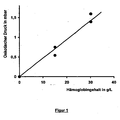
- FIG. 1 shows by way of example the dependence of the oncotic pressure ( ⁇ onk ) of a solution of a chemically modified, highly molecularly cross-linked hemoglobin used according to the invention for the improved treatment of an acute pulmonary edema.
- FIG. 2 shows the efficacy of chemically modified, highly molecularly cross-linked hemoglobin for the improved treatment of acute pulmonary edema, here as survival of ten anesthetized rats after delivery of lethal toxic pulmonary edema (by injection of oleic acid), of which five animals were added to therapy for the drug in their blood.
- agents are provided and used, namely aqueous solutions containing said hyperpolymeric hemoglobins.
- the aqueous solutions are electrolyte-containing solutions. Above all, these correspond to the physiological milieu.
- the chemically modified oxygen carriers (hyperpolymeric hemoglobins) used according to the invention are derived from humans, pigs or cattle. Preferably they are from the pig.
- the hyperpolymeric hemoglobins used according to the invention are high molecular weight, intermolecularly crosslinked hemoglobins.
- the intermolecular crosslinking of hemoglobins is well known and z. B. described in DE 197 01 037 . EP 97 100790 . DE 44 18 973 . DE 38 41 105 . DE 37 14 351 . DE 35 76 651 , These known methods are therefore incorporated herein.
- the hemoglobin hyperpolymers may be further chemically modified in addition to intermolecular crosslinking (polymerization).
- chemically reactive effectors may be covalently linked to modify the affinity and cooperativity of ligand binding.
- desired functional improvements of the hemoglobin hyperpolymers such as, for example, a reduction in their immunogenicity or an extension of the residence time in the vascular system ( Katren, V .: "The Conjugation of Proteins with Polyethylene Glycol and Other Polymers - Altering Properties of Proteins to Enhance Their Therapeutic Potential", Advanced Drug Delivery Reviews 10 (1993): 91-144 ), or an improvement in the compatibility with proteins of the 'recipient' blood plasma ( DE 100 31 744 A1 ), further macromolecules (such as, for example, polyethylene oxides, polyethylene glycols, dextranes, hydroxyethyl starches, etc.) of different chain lengths (molar masses) may be covalently linked.
- a macromolecule in particular a polyalkylene oxide, is covalently bonded to the modified hyperpolymeric hemoglobins.
- a particularly preferred embodiment of the invention uses hemoglobin hyperpolymers, which according to the German patent applications DE (OS) 100 31 740 .
- DE (OS) 100 31 742 and DE (OS) 100 31 744 A1 are produced, the contents of which are incorporated herein. These are polymerized products (intermolecular crosslinking), while still pegylation (covalent linkage with polyalkylene oxides) is made.
- a reaction with chemically reactive effectors such as pyridoxal-5'-phosphate or 2-nor-2-formyl-pyridoxal-5'-phosphate (intramolecular crosslinking), or the reaction can also in presence of chemically non-reactive effectors of oxygen binding such.
- chemically reactive effectors such as pyridoxal-5'-phosphate or 2-nor-2-formyl-pyridoxal-5'-phosphate (intramolecular crosslinking)
- the reaction can also in presence of chemically non-reactive effectors of oxygen binding such.
- 2,3-bisphosphoglycerate, inositol hexaphosphate, inositol hexasulfate or mellitic take place or it may be made a combination of this implementation or environmental condition.
- Such products are known and described as explained above.
- oxygen carriers which are polymerized, for example, with bifunctional crosslinkers known for intermolecular conversion, such as butadiene diepoxide, divinyl sulfone, diisocyanate, in particular hexamethylene diisocyanate, cyclohexyl diisocyanate and 2,5-bisisocyanatobenzenesulfonic acid, di-N-hydroxysuccinimidyl ester, diimido ester, or dialdehyde, in particular glyoxal. the analogous reacting glycolaldehyde, or glutaric dialdehyde. These products are then linked in particular with a polyethylene glycol or other suitable macromolecules.
- bifunctional crosslinkers known for intermolecular conversion such as butadiene diepoxide, divinyl sulfone, diisocyanate, in particular hexamethylene diisocyanate, cyclohexyl diisocyanate and 2,5-bisisocyanatobenzen
- polyethylene oxide polypropylene oxide
- a copolymer of ethylene oxide and propylene oxide or an ester, ether or ester amide thereof it is further preferred if the covalently attached polyalkylene oxide has a molar mass of 200 to 5000 g / mol.
- hyperpolymers which are prepared from deoxygenated porcine hemoglobin, with glutaric dialdehyde as bifunctional crosslinker and polyethylene glycol as covalently bound macromolecule for surface modification, see DE 100 31 740 A1 or DE 100 31 744 A1 ,
- hemoglobin hyperpolymers having a (mean) degree of polymerization which is sufficiently large that they enter the blood as artificial oxygen carriers as a therapeutic blood additive (ie without increasing the blood volume more than small). are capable of producing only a certain, low oncotic pressure in an aqueous electrolyte solution. This is related to the appropriate average of the degree of polymerization (or proportional molecular weight) of the modified polymeric hemoglobin. This is the number average because the number of active molecules is responsible for the oncotic pressure.
- the said hyperpolymers are suitable if a degree of polymerization is present which is sufficiently high that the oncotic pressure of solutions with the therapeutic concentrations of the chemically modified, high molecular cross-linked hemoglobins in an aqueous electrolyte-containing medium, without other
- Macromolecules is less than 5 mbar. This is about 1/7 (and thus less than 15%) of the oncotic pressure of human blood plasma of about 35 mbar (applications of the amounts of hemoglobin hyperpolymers, which result in blood plasma said therapeutic concentrations, thus leading to increases in blood plasma volume of about a maximum 15%).
- ⁇ onk oncotic pressure
- c m desired therapeutic concentration
- the real oncotic pressure has to be determined experimentally, since it depends in an unpredictable way on the structural structure of the polymers. For example, one calculates (the following values are the experimentally determined curve of the oncotic pressure over the mass segregation, shown as FIG. 1 taken from the charge used in the examples MR AA from a concentration of 20 g / L and an oncotic pressure of about 1 mbar an associated (ideal) molecular weight of 491,000 g / mol, while the experimentally determined real molecular weight only 320,000 g / mol is.
- modified hemoglobins of the type described whose aqueous electrolyte solutions show an oncotic pressure of less than 2 mbar.
- Suitable aqueous electrolyte solutions for the use according to the invention of the hemoglobin hyperpolymers are all solutions with compositions of salts which mimic the human extracellular environment (including the physiological pH mostly by 7.4 (between 7.1 and 7.6)) or This is similar to all solid electrolyte infusion solutions for electrolyte supply and circulatory support (overview in: Red List Service GmbH (ed.): Red List 2002 - drug list for Germany (including EU approvals and certain medical devices), ECV, Aulendorf 2002 (Chapter 52, "52nd Infusion and Standard Injection Solutions, Organ Perfusion Solutions.") These are well known. Particular preference is given to aqueous electrolyte solutions containing water and common salt in a concentration of between 50 and 150 g / l, especially 70 to 100 g / l.
- the administration of the oxygen carrier is such that the therapeutic concentrations in the blood plasma, for reasons of increasing viscosity of the blood plasma are not substantially greater than 50 g / L, z. B. 50 to 60 g / L, and in particular between 10 and 40 g / L are. On the other hand, even very low concentrations (eg from 1 g / L) may be sufficient for one therapy.
- the oxygen carrier can be present in concentrations of 20 to 200 g / L, in particular 50 to 100 g / L in the aqueous solution.
- the agent may be administered as needed as a single dose or as a periodic or irregular repeated dose, the nature and amount of which may vary according to the condition, age, sex and overall condition of the patient.
- Treatment of acute pulmonary edema is symptomatic and effector-oriented.
- the frequency of administration of the chemically modified, highly molecularly cross-linked hemoglobins is, as explained, between once and any success-dependent maximum value.
- a multiple input can be scheduled or demand-controlled, regular or irregular.
- the single dose depends on the desired therapeutic concentration in the blood plasma and already takes into account (or still) existing hemoglobin hyperpolymers in this body compartment, such that for other reasons, in particular the increase in the viscosity of the blood plasma, again undesirable maximum concentration of hemoglobin Hyperpolymers in the blood plasma of about 50 to 60 g / L is only exceeded taking into account the result of a particularly careful and critical benefit-risk consideration for the patient.
- the agent used is prepared by simply introducing the appropriate hemoglobin hyperpolymers into aqueous, in particular aqueous (sterile) electrolyte solutions which contain the electrolyte (s) in the said amount.
- the hyperpolymers are molecularly disperse and can be administered immediately, in particular as injections as described.
- the animals received a venous catheter of PE tubing implanted in a jugular vein, and later in the experiments, administered approximately 0.5 mL of isotonic saline (90 g NaCl per L solution) intravenously over this catheter to maintain a balanced fluid balance ,
- the animals were given a uniformly intravenous administration of 48 ⁇ L oleic acid per kg body weight over three minutes to produce acute toxic pulmonary edema.
- Figure 2 shows in the left part of the survival time of the five animals, all of which died in less than four hours, four of them even in less than three hours (calculated from the injection of oleic acid)
- Example 2 Five other rats were otherwise treated in a completely analogous manner as described in Example 1, with the only difference that they were 2.5 and 15 minutes after intravenous administration of oleic acid each 2.5 mL of the preparation of chemically modified, highly molecularly cross-linked hemoglobin (a HP 3 Hb, a pegylated porcine hemoglobin hyperpolymers batch MR AA) was administered intravenously.
- the mean hemoglobin content in the blood plasma after the second dose was about 23 g / L, which was subsequently reduced slowly (with a plasma half-life of about 18 hours).
- Figure 2 in the right part shows the survival times of these five animals, which invariably survived for more than seven hours and finally were killed under anesthesia to end the experiments.
Landscapes
- Health & Medical Sciences (AREA)
- Life Sciences & Earth Sciences (AREA)
- Pharmacology & Pharmacy (AREA)
- Engineering & Computer Science (AREA)
- Bioinformatics & Cheminformatics (AREA)
- Veterinary Medicine (AREA)
- Public Health (AREA)
- Chemical & Material Sciences (AREA)
- General Health & Medical Sciences (AREA)
- Medicinal Chemistry (AREA)
- Animal Behavior & Ethology (AREA)
- Chemical Kinetics & Catalysis (AREA)
- Proteomics, Peptides & Aminoacids (AREA)
- Nuclear Medicine, Radiotherapy & Molecular Imaging (AREA)
- General Chemical & Material Sciences (AREA)
- Organic Chemistry (AREA)
- Epidemiology (AREA)
- Gastroenterology & Hepatology (AREA)
- Immunology (AREA)
- Hematology (AREA)
- Diabetes (AREA)
- Pulmonology (AREA)
- Medicines That Contain Protein Lipid Enzymes And Other Medicines (AREA)
- Medicines Containing Material From Animals Or Micro-Organisms (AREA)
- External Artificial Organs (AREA)
Description
- Die vorliegende Erfindung betrifft die Verwendung hypo-onkotischer, wässriger Lösungen molekular-disperser chemisch modifizierter, hoch-molekular vernetzter Hämoglobine, sogenannter Hämoglobin-Hyperpolymere, zur Herstellung von Mitteln, zur symptomatischen, primär lebensrettenden Behandlung akuter Lungenödeme. Die Verabreichung erfolgt insbesondere intravasal. Überraschender Weise kann eine additve Verabreichung vorgenommen werden, da erfindungsgemäß der kolloid-osmotische (= onkotische) Druck des Blutes nur wenig erhöht und das Blutvolumen deshalb kaum vergrößert wird. Die erfindungsgemäße Anwendung bzw. Verabreichung ist somit (fast) Volumenneutral bezogen auf das Blut, in das die Injizierung vorgenommen wird. Somit wird erstmals ein hyperpolymeres Hämoglobin-Derivat therapeutisch als Blut-Additiv zur Behandlung eines Lungenödems eingesetzt.
- Künstliche Sauerstoffträger / -transporter sind eine äußerst heterogene Gruppe von Stoffen. Ihre namensgebenden Charakteristika sind ihre Fähigkeit, Sauerstoff in Form des molekularen Disauerstoffes (O2) reversibel zu binden oder in sich zu lösen - damit haben sie eine prinzipielle Eigenschaft mit dem natürlichen Sauerstoffträger / -transporter im Blut, dem Hämoglobin (Roter Blutfarbstoff), das in den Erythrozyten (Roten Blutzellen) vorkommt, gemein - sowie ihr potentielle Verwendbarkeit als intravasal (i. d. R. also intravenös) zu applizierende Pharmazeutika oder in sonstigen biomedizinischen Anwendungen.
- (Eine umfassende Übersicht (Stand der Technik) in: RIESS J. G.: "Oxygen Carriers ("Blood Substitutes") - Raison d'Etre, Chemistry, and Some Physiology", Chemical Reviews 101 (2001): 2797 - 2919; eine Übersicht zu vielen Hämoglobin-Derivaten in: VANDEGRIFF K. D.: "Haemoglobin-based Oxygen Carriers", Expert Opinions on Investigational Drugs 9 (2000): 1967 - 1984) Die bekannten Sauerstoffträger unterscheiden sich sowohl hinsichtlich ihrer Beschaffenheit als auch der dadurch bedingten physikochemischen Eigenschaften und ihrer Verwendbarkeit.
- So sind Perfluorocarbone mit und in wässrigen Lösungen, wie bspw. dem Blutplasma, nicht mischbar bzw. darin nicht lösbar. Sie können aber in Form fein disperser (mittels Emulgatoren stabilisierter) Tröpfchen darin emulgiert werden. Ebenfalls emulgiert oder suspendiert werden mit natürlichen oder künstlichen Sauerstoffträgern gefüllte Liposomen. Hierbei handelt es sich um mit einer Phospholipid-Doppelschicht-Membran umgebene Vesikel (künstliche Zellen oder auch künstliche Erythrozyten).
- Frei in der wässrigen Phase (bspw. im Plasma) gelöst werden können Hämoglobine, ihre durch chemische Modifikation erhältlichen Derivate, sowie isolierte und notwendigerweise chemisch modifizierte Häm-Gruppen.
- Der molekulare strukturelle Aufbau künstlicher Sauerstoffträger bedingt deren Art der Verabreichung, insbesondere, ob sie als ein Ersatz fehlendes Blut substituieren können, oder ob sie in vorhandenes Blut als Zusatz addiert werden können. Bisher beschriebene Produkte haben einen Sauerstofftransportierenden Plasma ersatz zum Ziel, also eine Plasmaersatz-Flüssigkeit zum Auffüllen des durch eine akute Blutung oder Blutentnahme teil-entleerten Blutgefäßsystems, die gegenüber den bekannten (nicht Sauerstoff transportierenden) Plasmaersatzmitteln darüber hinaus auch eine weitere wesentliche Funktion des Blutes, nämlich die des Sauerstofftransports, restituiert.
- Perfluorocarbone und Liposomen lösen sich nicht im wässrigen Blutplasma, sie besitzen und erfüllen als deutlich getrennte, eigene, emulgierte oder suspendierte Phase ein gewisses Volumen, und erscheinen deshalb zum genannten Zweck als Sauerstoff-transportierender Plasmaersatzmittel prinzipiell geeignet, nicht dagegen als ein Zusatz in das Blut, da sie dessen Volumen zwangsläufig vergrößern.
- Um als Ersatz fehlenden Blutes geeignet zu sein, müssen Sauerstoff-transportierende Plasmaersatzmittel aus frei in einer wässrigen Phase gelösten Hämoglobinen, oder ihren durch chemische Modifikationen erhaltenen Derivaten, sowohl in etwa isoton (die Tonizität ist ein relatives Maß für den osmotischen Druck) als auch isonkotisch (= iso-onkotisch, die Onkosie ist ein Maß für den onkotischen (= kolloid-osmotischen) Druck) mit dem Blutplasma sein. Zur Erzielung einer Isotonie befinden sich solche künstlichen Sauerstoffträger i. d. R. gelöst in einer Elektrolytlösung, die dem Blutplasma-Elektrolyten ähnelt.
- Iso-Onkosie in pharmazeutischen Zubereitungen bisher entwickelter (und publizierter) Hämoglobin-Derivate als künstliche Sauerstoffträger bedingen diese selbst. Ihr molekulares Design entspricht der klinischen Anforderung nach einer Isonkosie, die durch eine hinreichende Anzahl onkotisch wirksamer Wirkstoffmoleküle realisiert wird.
- Daher werden derartige, frei gelöste Hämoglobinderivate auch ganz besonders zur Anwendung bei (stärkeren) Blutverlusten vorgeschlagen. Für medizinische Indikationen ohne einen Blutverlust sind sie nur sehr bedingt (nämlich von der Menge/Dosis her äußerst begrenzt) einsetzbar, da sie aufgrund ihrer genannten Eigenschaften das Blutvolumen zwingend um das Volumen ihrer injizierten oder infundierten pharmazeutischen Zubereitung vergrößern.
- Sollen künstliche Sauerstoffträger zur Behandlung eines Sauerstoffmangels als Additive eingesetzt werden, so sollten diese einen ausreichend geringen kolloid osmotischen Druck aufweisen (vgl. Barnikol W. K. R., et al. (1996): "Hyperpolymere Hämoglobine als künstliche Sauerstoffträger - Ein innovativer Ansatz der medizinischen Entwicklung", Therapiewoche 46: 811 - 815). Sie sind konzipiert, um als künstliche Sauerstoffträger die Sauerstoff-Transportkapazität vorhandenen Blutes zu erhöhten, wenn kein Blutverlust zu ersetzen ist. Damit Hämoglobin-Hyperpolymere nach Injektion oder Infusion das Volumen des zirkulierenden Blutes nicht bleibend vergrößern (sondern vielmehr das Wasser und die Salze ihrer Zubereitung möglichst umfänglich über die Nieren wieder ausgeschieden werden), muss die onkotisch wirksame Anzahl an Wirkstoffmolekülen so weit wie möglich verringert werden. Dazu werden die Hämoglobine chemisch (mittels poly- oder bifunktioneller Vernetzer) quer-vernetzt und polymerisiert. So entstehen künstliche, Sauerstoff bindende Riesenmoleküle. Chemisch betrachtet sind molekular vernetzte Hämoglobine Multimere des Monomeren Hämoglobin. Dabei wird jedoch keinerlei Aussage darüber getroffen, welche Multimere - es handelt sich hierbei um eine breite Molekulargewichtsverteilung mit Oligomeren und höheren Polymeren - welche Auswirkungen auf die Eigenschaften des Gesamtproduktes haben.
- Ein Ödem ist eine abnorme Flüssigkeitsansammlung im Interzellularraum (Interstitium). Lungenödeme sind ein häufiges klinisches Krankheitsbild. Sie führen zu einer lebensbedrohlichen Beeinträchtigung der Gesundheit, die in schweren Fällen tödlich verläuft. Man unterscheidet hauptsächlich das durch Insuffizienz des linken Ventrikels bedingte kardiale (Stauungs-) Ödem und die toxisch bedingten Lungenödeme mit Erhöhung der Kapillarpermeabilität bei Lungenentzündungen, Inhalation schädigender Gase, bspw. auch bei hohen Sauerstoff Konzentrationen, Urämie, oder bei Überempfindlichkeitsreaktionen etc.
- Die Therapie ist immer symptomatisch bezüglich der lebensbedrohlichen Beeinträchtigung der Lungenfunktion (Intensivmedizinische Versorgung, Kortikoide zur Unterdrückung entzündlicher Vorgänge, Sauerstoff-angereicherte Atemluft und Überdruckbeatmung, etc.) und wenn möglich kausal bezüglich der Ursachen (Expositionsprophylaxe, Therapie der kardialen Insuffizienz oder der zugrunde liegenden Nierenkrankheit, etc.)
- (Zum Stand der Technik siehe bspw.: Böcker, W, Denk, H. Heitz Ph. U (Hrsg): Pathologie, Urban & Schwarzenberg, München u. a. 1997; Gerock W. Huber CH, Meinertz T, Zeidler H (Hrsg.): Gross = Schölmerich = Gerock - Die Innere Medizin, 10. völlig neu bearb. und erw. Auflage, Schattauer, Stuttgart und New York 2000; Weikrauch T.R.. (Hrsg.): Wolff = Weikrauch - Internistische Therapie 2000/2001, 13. neubearb. Auflage, Urban & Fischer, München und Jena 2000; Arch. Cardiol. Mex., Vol. 72, Seite 280-285).
- Der vorliegenden Erfindung liegt die Aufgabe zugrunde, eine verbesserte symptomatische Therapie des akuten Lungenödems, insbesondere der hohen Letalität dieser Erkrankungen (klinisch werden Sterblichkeiten zwischen 30 und 90 % angegeben), bereit zu stellen.
- Diese Aufgabe wird erfindungsgemäß gelöst durch die Herstellung und Anwendung einer hypo-onkotischen Lösung chemisch modifizierter, hochmolekular vernetzter hyperpolymerer Hämoglobine. Überraschender Weise kann mit solchen Lösungen wirksam ein akutes Lungenödem therapiert und die Sterblichkeit verringert werden.
- Nach vorliegender Erfindung kann ein akutes Lungenödem wirksam behandelt werden durch die Verabreichung einer wässrigen Lösung in das Blut addierbarer hyperpolymerer Hämoglobin-Derivate, deren onkotischer Druck in wässriger Lösung viel geringer ist als der des vorhandenen Blutes, und somit als Additiv einen hypo-onkotischen Druck zeigt.
-
Figur 1 zeigt beispielhaft die Abhängigkeit des onkotischen Druckes (πonk) einer Lösung eines erfindungsgemäß zur verbesserten Therapie eines akuten Lungenödem verwendeten chemisch modifizierten, hoch-molekular vernetzten Hämoglobins. -
Figur 2 zeigt die Wirksamkeit chemisch modifizierten, hoch-molekular vernetzten Hämoglobins zur verbesserten Therapie eines akuten Lungenödem, hier als die Überlebenszeit von zehn narkotisierten Ratten nach Beibringung eines letalen toxischen Lungenödems (durch Injektion von Ölsäure), von denen fünf Tiere zur Therapie den Wirkstoff in ihr Blut addiert bekamen. - Gemäß der Erfindung werden Mittel bereitgestellt und verwendet, nämlich wässrige Lösungen, enthaltend die genannten hyperpolymeren Hämoglobine. Insbesondere sind die wässrigen Lösungen Elektrolyt-haltige Lösungen. Vor allem entsprechen diese dem physiologischen Milieu. Die erfindungsgemäß eingesetzten chemisch modifizierten Sauerstoffträger (hyperpolymere Hämoglobine) stammen vom Menschen, vom Schwein oder vom Rind. Bevorzugt stammen sie vom Schwein.
- Die erfindungsgemäß verwendeten hyperpolymeren Hämoglobine sind hoch molekulare, intermolekular vernetzte Hämoglobine. Die intermolekulare Vernetzung von Hämoglobinen ist allgemein bekannt und z. B. beschrieben in
DE 197 01 037 ,EP 97 100790 DE 44 18 973 ,DE 38 41 105 ,DE 37 14 351 ,DE 35 76 651 . Diese bekannten Verfahren sind daher hier inkorporiert. - Die Hämoglobin-Hyperpolymeren können, außer einer intermolekularen Vernetzung (Polymerisation), vielfältig weiter chemisch modifiziert sein. Beispielsweise können zur Modifikation der Affinität und Kooperativität der Ligandenbindung chemisch reaktive Effektoren kovalent angeknüpft sein. Für verschiedene gewünschte funktionelle Verbesserungen der Hämoglobin-Hyperpolymere, wie bspw. eine Verminderung ihrer Immunogenität oder eine Verlängerung der Verweildauer im Gefäßsystem (Katren, V.: "The Conjugation of Proteins With Polyethylene Glycol and Other Polymers - Altering Properties of Proteins to Enhance Their Therapeutic Potential", Advanced Drug Delivery Reviews 10 (1993): 91 - 114), oder eine Verbesserung der Verträglichkeit mit Proteinen des 'Empfänger'-Blutplasmas (
DE 100 31 744 A1 ) können weitere Makromoleküle (wie bspw. Polyethylenoxide, Polyethylenglykole, Dextrane, Hydroxyethylstärken, etc.) unterschiedlicher Kettenlängen (Molmassen) kovalent angeknüpft sein. - In einer bevorzugten Ausführungsform ist an die modifizierten hyperpolymeren Hämoglobine ein Makromolekül, insbesondere ein Polyalkylenoxid, kovalent gebunden.
- Eine besonders bevorzugte Ausgestaltung der Erfindung verwendet Hämoglobin-Hyperpolymere, die gemäß den deutschen Patentanmeldungen
DE (OS) 100 31 740 DE (OS) 100 31 742 DE (OS) 100 31 744 A1 - In einer weiteren bevorzugten Ausführungsform kann gewünschtenfalls zusätzlich hierzu noch eine Umsetzung mit chemisch reaktiven Effektoren wie Pyridoxal-5'-Phosphat oder 2-Nor-2-Formyl-Pyridoxal-5'-Phosphat (intramolekulare Vernetzung), oder die Reaktion kann auch in Anwesenheit von chemisch nicht reaktiven Effektoren der Sauerstoffbindung wie z. B. 2,3-Bisphosphoglycerat, Inositolhexaphosphat, Inositolhexasulfat oder Mellitsäure stattfinden oder es kann eine Kombination dieser Umsetzung bzw. Milieubedingung vorgenommen sein. Derartige Produkte sind bekannt und wie oben erläutert beschrieben.
- Bevorzugt sind solche Sauerstoffträger, die polymerisiert sind zum Beispiel mit für die intermolekulare Umsetzung bekannten bifunktionellen Vernetzer wie Butadiendiepoxid, Divinylsulfon, Diisocyanat, insbesondere Hexamethylendiisocyanat, Zyklohexyldiisocyanat und 2,5-Bisisocyanatobenzolsulfonsäure, Di-N-Hydroxysuccinimidylester, Diimidoester, oder Dialdehyd, insbesondere Glyoxal, der analog reagierende Glykolaldehyd, oder Glutardialdehyd. Diese Produkte werden dann insbesondere mit einem Polyethylenglykol oder anderen geeigneten Makromolekülen verknüpft. Hierzu gehören beispielsweise Polyethylenoxid, Polypropylenoxid, oder ein Copolymer aus Ethylenoxid und Propylenoxid oder ein Ester, Ether oder Esteramid hiervon. Es ist ferner bevorzugt, wenn das kovalent angeknüpfte Polyalkylenoxid eine Molare Masse von 200 bis 5000 g/mol aufweist.
- Die Herstellung solchermaßen modifizierter Sauerstoffbinder ist in den oben genannten deutschen Patentanmeldungen beschrieben und hierin inkorporiert.
- Ganz besonders bevorzugt sind Hyperpolymere, die aus desoxygeniertem Schweinehämoglobin, mit Glutardialdehyd als bifunktionellem Vernetzer und Polyethylenglykol als kovalent gebundenem Makromolekül zur Oberflächenmodifikation hergestellt sind, siehe
DE 100 31 740 A1 oderDE 100 31 744 A1 . - Erfindungsgemäß hat sich gezeigt, dass Hämoglobin-Hyperpolymere mit einem (mittleren) Polymerisationsgrad, der hinreichend groß ist, dass sie als künstliche Sauerstoffträger als ein therapeutisches Blut-Additiv (also ohne das Blutvolumen mehr als gering zu vergrößern, s. o.) in das Blut hinein-gebracht werden können, geeignet sind, wenn sie in einer wässrigen Elektrolytlösung nur einen gewissen, niedrigen onkotischen Druck erzeugen. Dieser steht in Beziehung mit dem geeigneten Mittelwert des Polymerisationsgrades (oder der proportionalen Molmasse) des modifizierten polymeren Hämoglobins. Hierbei handelt es sich um das Zahlenmittel, weil die Anzahl der wirksamen Moleküle für den onkotischen Druck verantwortlich ist.
- Insbesondere hat sich gezeigt, dass die genannten Hyperpolymeren dann geeignet sind, wenn ein Polymerisationsgrad vorhanden ist, der hinreichend groß ist, dass der onkotische Druck von Lösungen mit den therapeutischen Konzentrationen der chemisch modifizierten, hochmolekular vernetzten Hämoglobine in einem wässrigen Elektrolyt-haltigen Milieu, (ohne sonstige
- Makromoleküle) weniger als 5 mbar beträgt. Dies sind etwa 1/7 (und somit weniger als 15 %) des onkotischen Druckes menschlichen Blutplasmas von etwa 35 mbar (Applikationen der Mengen der Hämoglobin-Hyperpolymere, die im Blutplasma die genannten therapeutischen Konzentrationen ergeben, führen also zu Zunahmen des Blutplasmavolumens von maximal etwa 15 %).
- Für ideale Lösungen kann der onkotische Druck (πonk) aus der Molaren Masse (M) und dem Gehalt (als Massenkonzentration cm) des gelösten Kolloids, sowie der allgemeinen Gaskonstanten (R) und der absoluten Temperatur (T) errechnet werden gemäß

- Für einen wie beschrieben festgelegten oberen Grenzwert des onkotischen Druckes (πonk) von 5 mbar für ein Blut Additiv errechnet sich aus einer gewünschten therapeutischen Konzentration (cm) im Blutplasma nach dieser Formel eine minimale Molmasse (als Zahlenmittel) der Hämoglobin-Hyperpolymere von M = (4.910 L/mol) - cm, für 2 mbar von M = (12.300 L/mol) - cm.
- Reale Lösungen zeigen aber eine mit der Konzentration des Kolloids zunehmende Abweichung der onkotischen Drücke zu größeren Werten. Die genannte Formel für ideale Lösungen kann also bestenfalls zur Abschätzung der minimalen Molmassen dienen, für real existierende Polymere muss der reale onkotische Druck experimentell ermittelt werden, zumal er in nicht vorhersagbarer Weise vom strukturellen Aufbau der Polymeren abhängt. Beispielsweise errechnet man (die folgenden Werte sind der experimentell ermittelten Kurve des onkotischen Druckes über der Massenkonzenztration, gezeigt als
Figur 1 , entnommen) für die in den Beispielen verwendete Charge MR A-A aus einer Konzentration von 20 g/L und einem onkotischen Druck von etwa 1 mbar eine zugehörige (ideale) Molmasse von 491.000 g/mol, während die experimentell ermittelte reale Molmasse nur 320.000 g/mol beträgt. - Ganz besonders bevorzugt sind modifizierte Hämoglobine der beschriebenen Art, deren wässrige Elektrolyt -Lösungen einen onkotischen Druck von weniger als 2 mbar, zeigen.
- Als wässrige Elektrolytlösungen für die erfindungsgemäße Anwendung der Hämoglobin-Hyperpolymeren sind sämtliche Lösungen mit Zusammensetzungen an Salzen geeignet, die das Extrazellularmilieu des Menschen (einschließlich des physiologischen pH-Wertes meist um 7,4 (zwischen 7,1 und 7,6)) imitieren oder diesem ähneln, somit insbesondere auch alle Vollelektrolyt-Infusionslösungen zur Elektrolytzufuhr und Kreislaufunterstützung (Übersicht in: Rote Liste Service GmbH (Hrsg.): Rote Liste 2002 - Arzneimittelverzeichnis für Deutschland (einschließlich EU-Zulassungen und bestimmter Medizinprodukte), ECV, Aulendorf 2002 (Kapitel 52, "52. Infusions- und Standard-Injektionslösungen, Organperfusionslösungen"). Diese sind bekannt. Insbesondere bevorzugt sind wässrige Elektrolytlösungen, enthaltend Wasser und Kochsalz in einer Konzentration zwischen 50 und 150 g/L, vor allem 70 bis 100 g/L.
- Somit ist es überraschender Weise möglich, die Schwere eines akuten Lungenödems klinisch zu bessem, und zwar vor allem durch intravasal verabreichte chemisch modifizierte, hoch-molekular vernetzte hyperpolymere Hämoglobine als ein Blut-Additiv, fast ohne das Blutvolumen des Patienten zu vergrößern. Dabei war nicht zu erwarten, dass derartige Sauerstoffträger, wenn sie die beschriebenen Eigenschaften aufweisen, als Additiv so eingesetzt werden können, da diese chemisch modifizierten, hoch-molekular vernetzten Hämoglobine eigentlich als künstliche Sauerstoffträger entwickelt wurden und werden mit der Zielsetzung, periphere Gewebe mit Sauerstoff zu versorgen. Völlig überraschend war daher ihre Wirksamkeit zur Verbesserung der Therapie akuter Lungenödeme. Die (prä-)klinische Verbesserung zeigte sich in einem verbesserten Überleben, also einer verringerten Mortalität, in einem Tiermodell (der narkotisierten Ratte) experimenteller toxischer Lungenödeme, von denen nachfolgend Beispiele angeführt werden.
- Die Verabreichung des Sauerstoffträgers erfolgt derart, dass die therapeutischen Konzentrationen im Blutplasma aus Gründen der zunehmenden Viskosität des Blutplasmas nicht wesentlich größer sind als 50 g/L, z. B. 50 bis 60 g/L, und insbesondere zwischen 10 und 40 g/L liegen. Andererseits können auch schon sehr geringe Konzentrationen (Bspw. ab 1 g/L) für eine Therapie ausreichend sein.
- Der Sauerstoffträger kann in Konzentrationen von 20 bis 200 g /L, insbesondere 50 bis 100 g /L in der wässrigen Lösung vorliegen.
- Das Mittel kann je nach Bedarf als einmalige Gabe oder auch als periodische oder unregelmäßige wiederholte Gabe verabreicht werden, wobei sich die Art und Menge nach dem Zustand, dem Alter, dem Geschlecht und der Gesamtverfassung des Patienten ergeben kann.
- Die Therapie eines akuten Lungenödems gemäß der Erfindung erfolgt insofern symptomatisch und effektorientiert. Die Häufigkeit der Gabe der chemisch modifizierten, hoch-molekular vernetzten Hämoglobine beträgt wie erläutert zwischen einmal und einem beliebigen erfolgsabhängigen Höchstwert. Eine Mehrfachgabe kann dabei planmäßig oder bedarfsgesteuert, regelmäßig oder unregelmäßig erfolgen. Die Einzeldosis richtet sich nach der gewünschten therapeutischen Konzentration im Blutplasma und beachtet bereits (oder noch) vorhandene Hämoglobin-Hyperpolymere in diesem Körperkompartiment, dergestalt, dass ein aus anderen Gründen, insbesondere der Erhöhung der Viskosität des Blutplasmas, bereits wieder unerwünschter Höchstwert der Konzentration der Hämoglobin-Hyperpolymeren im Blutplasma von etwa 50 bis 60 g/L nur unter Beachtung des Ergebnisses einer besonders sorgfältigen und kritischen Nutzen-Risiko-Abwägung für den Patienten überschritten wird. Die nach Applikation erreichbare initiale therapeutische Konzentration im Blutplasma (cmHb(PL)) kann aus der verabreichten Dosis der Hämoglobin-Hyperpolymere (mHb) und dem Volumenanteil der Erythrozyten im Blut (dem Hämatokrit: Hkt) und dem Körpergewicht des Patienten (KG) abgeschätzt werden gemäß

wobei als mittlerer Wert für das Blutvolumen (BV) für Frauen 60,5 mL / kg (KG) (57 ... 64 mL / kg (KG)) und für Männer 69,5 mL / kg (KG) (69 ... 70 mL / kg (KG) einzusetzen sind. - Das verwendete Mittel wird hergestellt durch einfaches Einbringen des oder der geeigneten Hämoglobin-Hyperpolymeren in wässrige, insbesondere wässrige (sterile) Elektrolytlösungen, welche den oder die Elektrolyten in der genannten Menge enthalten. Die Hyperpolymeren liegen molekular-dispers vor und können sofort, insbesondere als Injektionen wie beschrieben verabreicht werden.
- Die Erfindung wird anhand der folgenden Beispiele näher erläutert. Dabei zeigen die
Figuren 1-2 folgendes: -
Figur 1 zeigt beispielhaft die Abhängigkeit des onkotischen Druckes (πonk) einer Lösung eines erfindungsgemäß zur verbesserten Therapie eines akuten Lungenödem verwendeten chemisch modifizierten, hoch-molekular vernetzten Hämoglobins (ein HP3Hb (pegylierte Schweinehämoglobin-Hyperpolymere), Charge MR A-A) über dessen Massenkonzentration (cmHb) in einer wässrigen Kochsalzlösung der Konzentration 80 g/L. -
Figur 2 zeigt die Wirksamkeit chemisch modifizierten, hoch-molekular vernetzten Hämoglobins (beispielhaft gezeigt für ein HP3Hb, Charge MR A-A) zur verbesserten Therapie eines akuten Lungenödem, hier als die Überlebenszeit von zehn narkotisierten Ratten nach Beibringung eines letalen toxischen Lungenödems (durch Injektion von Ölsäure), von denen fünf Tiere zur Therapie den Wirkstoff in ihr Blut addiert bekamen. - Folgende Materialien kamen zum Einsatz:
- 1. Das chemisch modifizierte, hoch-molekular vernetzte Hämoglobin war ein pegyliertes Schweinehämoglobin-Hyperpolymere (ein HP3Hb, Charge MR A-A), das prinzipiell entsprechend der
DE (OS) 100 31 740 A1
MR 14: Steriles, hochreines Schweinehämoglobin, in einer Konzentration von 289 g/L gelöst in einem wässrigen Elektrolyten der Zusammensetzung 20 mM NaHCO3 und 150 mM NaCl, wurde bei 4 °C durch Rühren der Lösung unter ständig erneuertem, reinen Stickstoff desoxygeniert, 4 mol Natrium-Ascorbat (als 1-molare Lösung in Wasser) je Mol Hämoglobin zugegeben und etwa 15 Stunden reagieren lassen, die Lösung mit 2-molarer Milchsäure auf einen pH-Wert von 5,7 titriert, 2 Mol Inositolhexaphosphat (als 0,25-molare Lösung in Wasser) pro mol Hämoglobin zugegeben, nach etwa 1 Stunde mit 2-molarer Milchsäure auf einen pH-Wert von 6,5 titriert, 9,9 Mol Glutardialdehyd (als etwa 1,9-%-ige Lösung in deoxygeniertem Wasser) je Mol Hämoglobin zur Vernetzung des Hämoglobins innerhalb 1,5 Stunden zugegeben, 1,8 L Wasser, das mit Stickstoff äquilibriert war, je Liter initiale Hämoglobinlösung zugegeben, nach 20 Stunden mit 0,5-molarer Natronlauge auf einen pH-Wert von 6,9 titriert, 20 Mol Natriumborhydrid (als 1-molare Lösung in 0,01-molarer Natronlauge) je Mol Hämoglobin zugegeben und für 15 Minuten reagieren lassen, 4 Mol Methoxy-Succinimidylpropionat-Polyethylenglykol des Molekulargewichts 1000 g/mol (als etwa 25-%-ige Lösung in Wasser) zugegeben und für 1 Stunde reagieren lassen, und schließlich die Stickstoffatmosphäre durch reinen Sauerstoff ersetzt und eine Stunde lang äquilibrieren lassen. Ungelöste Bestandteile wurden durch Zentrifugation (10 min mit 20.000 g) abgetrennt und die überstehende Lösung zur weiteren Klärung durch Filter abnehmender Porenweite, zuletzt von 0,2 µm, filtriert.
MR 15: Steriles, hochreines Schweinehämoglobin, in einer Konzentration von 281 g/L gelöst in einem wässrigen Elektrolyten der Zusammensetzung 20 mM NaHCO3 und 150 mM NaCl, wurde bei 4 °C durch Rühren der Lösung unter ständig erneuertem, reinen Stickstoff desoxygeniert, 4 mol Natrium-Ascorbat (als 1-molare Lösung in Wasser) je Mol Hämoglobin zugegeben und etwa 3 Stunden reagieren lassen, die Lösung mit 2-molarer Milchsäure auf einen pH-Wert von 5,7 titriert, 2 Mol Inositolhexaphosphat (als 0,25-molare Lösung in Wasser) pro mol Hämoglobin zugegeben, nach etwa 1 Stunde mit 2-molarer Milchsäure auf einen pH-Wert von 6,3 titriert, 9,9 Mol Glutardialdehyd (als etwa 1,9-%-ige Lösung in deoxygeniertem Wasser) je Mol Hämoglobin zur Vernetzung des Hämoglobins innerhalb 1,5 Stunden zugegeben, 1,8 Liter Wasser, das mit Stickstoff äquilibriert war, je Liter initiale Hämoglobinlösung zugegeben, nach 17 Stunden mit 0,5-molarer Natronlauge auf einen pH-Wert von 6,9 titriert, 20 Mol Natriumborhydrid (als 1-molare Lösung in 0,01-molarer Natronlauge) je Mol Hämoglobin zugegeben und für 15 Minuten reagieren lassen, 4 Mol Methoxy-Succinimidylpropionat-Polyethylenglykol des Molekulargewichts 1000 g/mol (als etwa 25-%-ige Lösung in Wasser) zugegeben und für 1 Stunde reagieren lassen, und schließlich die Stickstoffatmosphäre durch reinen Sauerstoff ersetzt und eine Stunde lang äquilibrieren lassen. Ungelöste Bestandteile wurden durch Zentrifugation (10 min mit 20.000 g) abgetrennt und die überstehende Lösung zur weiteren Klärung durch Filter abnehmender Porenweite, zuletzt von 0,2 µm, filtriert.
MR 16: Steriles, hochreines Schweinehämoglobin, in einer Konzentration von 262 g/L gelöst in einem wässrigen Elektrolyten der Zusammensetzung 20 mM NaHCO3 und 150 mM NaCl, wurde bei 4 °C durch Rühren der Lösung unter ständig erneuertem, reinen Stickstoff desoxygeniert, 4 mol Natrium-Ascorbat (als 1-molare Lösung in Wasser) je Mol Hämoglobin zugegeben und etwa 27 Stunden reagieren lassen, die Lösung mit 2-molarer Milchsäure auf einen pH-Wert von 5,8 titriert, 2 Mol Inositolhexaphosphat (als 0,25-molare Lösung in Wasser) pro mol Hämoglobin zugegeben, nach etwa 1,5 Stunde mit 2-molarer Milchsäure auf einen pH-Wert von 6,5 titriert, 9,9 Mol Glutardialdehyd (als etwa 1,9-%-ige Lösung in deoxygeniertem Wasser) je Mol Hämoglobin zur Vernetzung des Hämoglobins innerhalb 1,5 Stunden zugegeben, 1,8 Liter Wasser, das mit Stickstoff äquilibriert war, je Liter initiale Hämoglobinlösung zugegeben, nach 17 Stunden mit 0,5-molarer Natronlauge auf einen pH-Wert von 6,9 titriert, 20 Mol Natriumborhydrid (als 1-molare Lösung in 0,01-molarer Natronlauge) je Mol Hämoglobin zugegeben und für 1,5 Stunden reagieren lassen, 4 Mol Methoxy-Succinimidylpropionat-Polyethylenglykol des Molekulargewichts 1000 g/mol (als etwa 25-%-ige Lösung in Wasser) zugegeben und für 1 Stunde reagieren lassen, und schließlich die Stickstoffatmosphäre durch reinen Sauerstoff ersetzt und eine Stunde lang äquilibrieren lassen. Ungelöste Bestandteile wurden durch Zentrifugation (10 min mit 20.000 g) abgetrennt und die überstehende Lösung zur weiteren Klärung durch Filter abnehmender Porenweite, zuletzt von 0,2 µm, filtriert.
MR A-A: 3720 mL MR 14 mit 107 g Hämoglobin-Polymeren, 3600 mL MR 15 mit 115 g Hämoglobin-Polymeren und 3900 mL MR 16 mit 127 g Hämoglobin-Polymeren wurden gemischt und in mehreren Anteilen in einer Ultrafiltrationsanlage (Centramate von Pall-Filtron) bei einer mittleren Konzentration von 40 g/L über und durch Celluloseacetatmembranen der Nominellen Molmassen-Trenngrenze 1 MDa fraktioniert, wobei der Filtratfluss durch ein Ventil auf Werte unter 50 % des Maximums (der so genannter Wasserfluss) eingestellt war und jeweils mindestens das zehnfache Volumen der Vorlage an Diafiltrationslösung (diese enthielt Kochsalz in einer Konzentration von 80 g/L) in einem kontinuierlichen Diafiltrationsmodus zum gleichzeitigen Lösungsmitteltausch verwendet wurden. Zum Abschluss wurden die Retentate konzentriert und später vereinigt.
Diese präparativ abgetrennte Fraktion des Wirkstoffes besaß eine Molmassenverteilung mit einem Zahlenmittel der Molmassen von 230.000 g/mol und einem Massenmittel von 993.000 g/mol. Der so erhaltene Wirkstoff kam in einer sterilen und gemäß Ph. Eur. hinreichend endotoxinarmen wässrigen Lösung von 80 g/L NaCl in WFI (Wasser für Injektionszwecke) zum Einsatz. Sein Massengehalt betrug 58 g/L, der pH-Wert der Zubereitung 7,3. - 2. Die Versuchstiere waren weiße Laborratten mit einem mittleren Körpergewicht von etwa 350 g (die Spannweite der Körpergewichte aller verwendeten zehn Tiere betrug zwischen 315 und 390 g), die gemäß gültiger Tierschutzregeln gezüchtet und gehalten waren. Sie hatten bis zum Vortag des jeweiligen Experiments freien Zugang zu hinreichender Nahrung, trinken konnten sie bis unmittelbar vor Versuchsbeginn.
- Folgende speziellen Bestimmungsmethoden wurden angewendet:
- 1. Hämoglobingehalte wurden fotometrisch mit der modifizierten Cyanhämoglobin-Methode nach Drabkin (,Hämoglobin-Farbtest MRP3', Boehringer Mannheim, D), pH-Werte potentiometrisch (pH-Glaselektrode) mit einem Blutgasanalysator (,ABL 5', Radiometer, Willich, D) gemessen.
- 2. Bestimmungen der Molekulargewichts-Verteilungen der vernetzten Hämoglobine, sowie charakteristischer Kennwerte dieser erfolgten durch Volumenausschluss-Chromatografie (gemäß Pötzschke H. et al. (1997): "Molar Masses and Structure in Solution of Haemoglobin Hyperpolymers - A Common Calibration of Size Exclusion Chromatography of These Artificial Oxygen Carriers", Artificial Cells, Blood Substitutes, and Immobilization Biotechnology 25, 527 - 540) am Gel Sephacryl S-400 HR (Pharmacia Biotech, Freiburg, D).
- 3. Bestimmungen der onkotischen Drücke wässriger Lösungen der vernetzten Hämoglobine erfolgten mit Membranosmometem (Membrane-Osmometer oder Colloid-Osmometer, Knauer, Berlin, D), einer wässrigen Kochsalz-Lösung (80 g/L NaCl und 0,2 g/L NaN3) als Lösungsmittel und CelluloseacetatMembranen der Nominellen Molmassen-Trenngrenze 20.000 Da.
- Fünf Laborratten bekamen eine systemische Vollnarkose durch intraperitoneale Injektion von 50 mg Pentobarbital je kg Körpergewicht. Die Narkosetiefe wurde über die Zeit konstant im (chirurgischen) Toleranzstadium (dem 3. klassischen Narkosestadium nach A. Guedel) gehalten, indem jeweils nach Auftreten einer aktiven Schmerzreaktion (Zurückziehen) auf ein periodisches Kneifen einer Pfote erneut 17 mg Pentobarbital je kg Körpergewicht als Erhaltungsdosis verabreicht wurden (in etwa alle 90 min). Die Tiere erhielten einen venösen Katheter aus PE-Schlauch in eine Vena jugularis implantiert, und im weiteren Verlauf der Versuche je Stunde etwa 0,5 mL einer isotonen Kochsalzlösung (90 g NaCl je L Lösung) zur Aufrechterhaltung einer ausgeglichenen Flüssigkeitsbilanz über diesen Katheter intravenös verabreicht.
- Den Tieren wurde, zur Erzeugung eines akuten toxischen Lungenödems, genau 48 µL Ölsäure je kg Körpergewicht über drei Minuten gleichmäßig intravenös verabreicht.
-
Abbildung 2 zeigt im linkem Teil die Überlebenszeiten der fünf Tiere, die alle in weniger als vier Stunden verstarben, vier von ihnen sogar in weniger als drei Stunden (gerechnet ab der Injektion der Ölsäure) - Fünf weitere Ratten wurden ansonsten ganz analog wie im Ausführungsbeispiel 1 beschrieben behandelt, mit dem einzigen Unterschied, dass ihnen 15 und 45 min nach der intravenösen Gabe der Ölsäure jeweils 2,5 mL der Zubereitung des chemisch modifizierten, hoch-molekular vernetzten Hämoglobins (ein HP3Hb, ein pegyliertes Schweinehämoglobin-Hyperpolymere - Charge MR A-A) intravenös verabreicht wurde. Der mittlere Hämoglobingehalt im Blutplasma nach der zweiten Gabe betrug etwa 23 g/L, der anschließend langsam (mit einer Plasmahalbwertszeit von etwa 18 Stunden) reduziert wurde.
-
Abbildung 2 zeigt im rechten Teil die Überlebenszeiten dieser fünf Tiere, die ausnahmslos länger als sieben Stunden überlebten und schließlich, um die Versuche zu beenden, in Narkose getötet wurden. - Der Vergleich der Überlebenszeiten der Tiere in beiden Experimentalgruppen zeigt die enorme Wirksamkeit der Hämoglobin-Hyperpolymeren zur Verminderung der spontanen Letalität hier experimentell induzierter toxischer Lungenödeme.
Claims (8)
- Verwendung wässriger hypo-onkotischer Lösungen, enthaltend Elektrolyte und chemisch modifizierte, hoch-molekular vernetzte hyperpolymere Hämoglobine, zur Herstellung eines Mittels zur Behandlung akuter Lungenödeme.
- Verwendung gemäß Anspruch 1, dadurch gekennzeichnet, dass die chemisch modifizierten hyperpolymeren Hämoglobine vom Menschen, vom Schwein oder vom Rind stammen.
- Verwendung gemäß einem der Ansprüche 1 oder 2, dadurch gekennzeichnet, dass der onkotische Druck in den wässrigen Elektrolytlösungen weniger als 5 mbar beträgt.
- Verwendung gemäß einem der Ansprüche 1 bis 3, dadurch gekennzeichnet, dass Kochsalz in einer Konzentration zwischen 50 und 150 g/L enthalten ist.
- Verwendung gemäß einem der Ansprüche 1 bis 4, dadurch gekennzeichnet, dass Elektrolyte, entsprechend den physiologischem Milieu enthalten sind.
- Verwendung gemäß einem der Ansprüche 1 bis 5, dadurch gekennzeichnet, dass an die modifizierten hyperpolymeren Hämoglobine ein Polyalkylenoxid, kovalent gebunden ist.
- Verwendung gemäß einem der Ansprüche 1 bis 6, dadurch gekennzeichnet, dass das Mittel in Form der wässrigen Lösung als Injektion intravasal verabreicht wird.
- Verwendung gemäß einem der Ansprüche 1 bis 7, dadurch gekennzeichnet, dass das Mittel in Form der wässrigen Lösung ein oder mehrmals verabreicht wird.
Applications Claiming Priority (2)
| Application Number | Priority Date | Filing Date | Title |
|---|---|---|---|
| DE10352692A DE10352692A1 (de) | 2003-11-12 | 2003-11-12 | Verwendung hypo-onkotischer Lösungen in das Blut addierbarer, hyperpolymerer Hämoglobine zur Behandlung eines Lungenödems |
| PCT/EP2004/012363 WO2005046717A1 (de) | 2003-11-12 | 2004-11-02 | Verwendung hyperpolymerer hämoglobine zur behandlung eines lungenödems |
Publications (2)
| Publication Number | Publication Date |
|---|---|
| EP1682167A1 EP1682167A1 (de) | 2006-07-26 |
| EP1682167B1 true EP1682167B1 (de) | 2009-02-18 |
Family
ID=34584990
Family Applications (1)
| Application Number | Title | Priority Date | Filing Date |
|---|---|---|---|
| EP04797509A Expired - Lifetime EP1682167B1 (de) | 2003-11-12 | 2004-11-02 | Verwendung hyperpolymerer hämoglobine zur behandlung eines lungenödems |
Country Status (5)
| Country | Link |
|---|---|
| US (1) | US7598220B2 (de) |
| EP (1) | EP1682167B1 (de) |
| AT (1) | ATE422898T1 (de) |
| DE (2) | DE10352692A1 (de) |
| WO (1) | WO2005046717A1 (de) |
Families Citing this family (3)
| Publication number | Priority date | Publication date | Assignee | Title |
|---|---|---|---|---|
| US8058376B2 (en) | 2008-12-23 | 2011-11-15 | E. I. Du Pont De Nemours And Company | Fluoropolymer produced by aqueous polymerization using dispersed particulate of fluorinated lonomer produced in situ |
| CN105188761B (zh) | 2013-03-15 | 2020-05-15 | 桑加特公司 | 聚环氧烷戊酸酯血红蛋白缀合物 |
| US11504417B2 (en) | 2017-07-18 | 2022-11-22 | VirTech Bio, Inc. | Blood substitutes comprising hemoglobin and methods of making |
Family Cites Families (18)
| Publication number | Priority date | Publication date | Assignee | Title |
|---|---|---|---|---|
| DE1970137U (de) | 1967-04-01 | 1967-10-12 | Guenter Friebe | Satz kombinierbarer moebel-bauelemente. |
| DE3320752A1 (de) | 1983-06-09 | 1984-12-13 | Wolfgang Prof. Dr.Dr. 6500 Mainz Barnikol | Lumineszierende schichten zur verwendung in vorrichtungen zur bestimmung der sauerstoffkonzentration in gasen und dergleichen durch messung der lumineszensverringerung |
| DE3714351A1 (de) | 1987-04-29 | 1988-11-17 | Barnikol Wolfgang | Verfahren zur modifikation, insbesondere zur polymerisation von haemoglobin in vitro |
| DE3841105C2 (de) | 1988-12-07 | 1994-09-01 | Wolfgang Karl Richard Barnikol | Verfahren zur Aufreinigung und Modifikation von polymerisiertem Hämoglobin |
| US5234903A (en) * | 1989-11-22 | 1993-08-10 | Enzon, Inc. | Chemically modified hemoglobin as an effective, stable non-immunogenic red blood cell substitute |
| US5665383A (en) * | 1993-02-22 | 1997-09-09 | Vivorx Pharmaceuticals, Inc. | Methods for the preparation of immunostimulating agents for in vivo delivery |
| DE4418937C2 (de) | 1994-02-28 | 2003-07-17 | Roesler Draht Ag | Klappgelenkmatte |
| US20040242846A1 (en) | 1994-05-31 | 2004-12-02 | Sangubio Tech Ag | Method for the preparation of molecularly uniform hyperpolymeric hemoglobins |
| DE4418973A1 (de) | 1994-05-31 | 1995-12-14 | Barnikol Wolfgang | Verfahren zur Herstellung molekular-einheitlicher hyperpolymerer Hämoglobine |
| DE19701037A1 (de) | 1997-01-15 | 1998-07-16 | Sanguibiotech Ag | Mit Schutzliganden der Sauerstoffbindungsstellen versehene Hämoglobine als künstliche Sauerstoffträger zur direkten biologisch-medizinischen Anwendung und Verfahren zu ihrer Herstellung |
| EP0854151A1 (de) | 1997-01-20 | 1998-07-22 | SanguiBioTech AG | Verfahren zur Gewinnung einheitlicher Fraktionen hyperpolymerer Hämoglobine |
| AU735799C (en) * | 1997-02-28 | 2005-04-28 | Regents Of The University Of California, The | Methods and compositions for optimisation of oxygen transport by cell-free systems |
| DE10031742A1 (de) | 2000-06-29 | 2002-01-17 | Sanguibio Tech Ag | Verfahren zur Herstellung künstlicher Sauerstoffträger aus kovalent vernetzten Hämoglobinen mit verbesserten funktionellen Eigenschaften durch Vernetzung in Anwesenheit chemisch nicht reagierender Effektoren der Sauerstoffaffinität der Hämoglobine |
| DE10031740A1 (de) * | 2000-06-29 | 2002-02-14 | Sanguibio Tech Ag | Künstliche Sauerstoffträger aus vernetztem modifizierten Human- oder Schweinehämoglobin mit verbesserten Eigenschaften, Verfahren zu ihrer technisch einfachen Herstellung aus gereinigtem Material in hohen Ausbeuten, sowie deren Verwendung |
| DE10031744A1 (de) * | 2000-06-29 | 2002-01-17 | Sanguibio Tech Ag | Mit Blutplasma verträgliche, vernetzte und mit Polyalkylenoxiden konjugierte Säugetierhämoglobine als künstliche medizinische Sauerstoffträger, ihre Herstellung und ihre Verwendung |
| DE10034970B4 (de) | 2000-07-19 | 2004-11-18 | Sanguibiotech Gmbh | Einen Sauerstoffträger, ausgewählt aus Hämoglobin oder Hämoglobin- und Myoglobin-enthaltende Zubereitung in Form einer Emulsion sowie deren Verwendung als kosmetisches Externum und zur natürlichen Regeneration der Haut bei Sauerstoff-Mangel |
| DE10220992A1 (de) * | 2002-05-11 | 2003-12-04 | Sanguibiotech Ag | Verwendung eines oder mehrerer Sauerstoffträger, ausgewählt aus Hämoglobin, Myoglobin und Derivaten hiervon zur Behandlung einer Organfunktionsstörung infolge eines akuten Versorgungsmangels und zur Behandlung/Vermeidung einer Gewebeschädigung infolge einer solchen Störung |
| US7455591B2 (en) * | 2002-06-28 | 2008-11-25 | Igt | Redundant gaming network mediation |
-
2003
- 2003-11-12 DE DE10352692A patent/DE10352692A1/de not_active Withdrawn
-
2004
- 2004-11-02 US US10/578,428 patent/US7598220B2/en not_active Expired - Fee Related
- 2004-11-02 WO PCT/EP2004/012363 patent/WO2005046717A1/de not_active Ceased
- 2004-11-02 EP EP04797509A patent/EP1682167B1/de not_active Expired - Lifetime
- 2004-11-02 AT AT04797509T patent/ATE422898T1/de not_active IP Right Cessation
- 2004-11-02 DE DE502004009023T patent/DE502004009023D1/de not_active Expired - Fee Related
Also Published As
| Publication number | Publication date |
|---|---|
| DE10352692A1 (de) | 2005-06-23 |
| US20070049517A1 (en) | 2007-03-01 |
| EP1682167A1 (de) | 2006-07-26 |
| US7598220B2 (en) | 2009-10-06 |
| WO2005046717A1 (de) | 2005-05-26 |
| ATE422898T1 (de) | 2009-03-15 |
| DE502004009023D1 (de) | 2009-04-02 |
Similar Documents
| Publication | Publication Date | Title |
|---|---|---|
| DE60318388T2 (de) | Verfahren und zusammensetzungen zum sauerstofftransport mit hoher sauerstoffaffinität | |
| DE3790322C2 (de) | Nichtzellulares Präparat als Ersatz für rote Blutkörperchen | |
| DE69318139T2 (de) | Erleichterte sauerstoffabgabe im zusammenhang mit blutverdünnung | |
| DE69029388T2 (de) | Histidin gepufferte peritonealdialyselösung | |
| DE69426879T2 (de) | Plasma-artige lösung | |
| EP1294386B1 (de) | Künstliche sauerstoffträger aus vernetztem modifizierten human- oder schweinehämoglobin, verfahren zu ihrer herstellung aus gereinigtem material, sowie deren verwendung | |
| DE69226184T2 (de) | Hypertone isochlorämische formulierung zur behandlung des kreislaufschocks | |
| DE2607706A1 (de) | Wasserloesliches, polymerisiertes haemoglobin | |
| WO2002000229A1 (de) | Verfahren zur herstellung künstlicher sauerstoffträger aus kovalent vernetzten hämoglobinen mit verbesserten funktionellen eigenschaften durch vernetzung in anwesenheit chemisch nicht reagierender effektoren der sauerstoffaffinität der hämoglobine | |
| EP0996462B1 (de) | Pharmazeutische kombinationspräparate enthaltend erythropoietin und modifizierte hämoglobine | |
| EP3041495B1 (de) | Zubereitungen zur verbesserten gewebe-oxygenierung durch peritoneale beatmung | |
| DE69934312T2 (de) | Verfahren zur reinigung von hämoglobin | |
| DE69332106T2 (de) | Lösung für die Peritonealdialyse | |
| DE10212321A1 (de) | Verwendung eines oder mehrerer von Plasma und Zellwandbestandteilen befreiten natürlichen oder modifizierten Sauerstoffbinder zur externen Behandlung offener, insbesondere chronischer Wunden | |
| EP1682167B1 (de) | Verwendung hyperpolymerer hämoglobine zur behandlung eines lungenödems | |
| DE60022759T2 (de) | Erythropoietin formulierungen des mehrfachdosis-typs | |
| DE69120925T2 (de) | Hämoglobin-oligomer basierte komposition und seine herstellung | |
| WO2000048637A1 (de) | Schmerzfreie und gewebeschonende injektion von arzneimitteln | |
| DE69426295T2 (de) | Organkonservierungsmittel | |
| DE60219770T2 (de) | Krebsmittel | |
| DE69130483T2 (de) | Verbesserter blutersatz | |
| WO2003094953A1 (de) | Sauerstoffträger, ausgewählt aus hämoglobin, myoglobin und derivaten hiervon, zur behandlung einer organfunktionsstörung /gewebeschädigung durch akuten versorgungsmangel | |
| EP1480614B1 (de) | Hydrophobe nanotropfen mit gebundenen hämoglobinmolekülen in hydrophiler phase enthaltende emulsion als blutersatzstoff | |
| EP0123142B1 (de) | Verfahren zur Stabilisierung von Hämatin | |
| DE10220990A1 (de) | Verwendung von Sauerstoffträgern Hämoglobin, Myoglobin oder deren Derivaten zur kontrollierten Sauerstoffversorgung von Mikroorganismen, Zellen, Gewebe-Zellkulturen oder Organen und Verfahren zur verbesserten Substratproduktion bzw. Züchtung solcher Kulturen |
Legal Events
| Date | Code | Title | Description |
|---|---|---|---|
| PUAI | Public reference made under article 153(3) epc to a published international application that has entered the european phase |
Free format text: ORIGINAL CODE: 0009012 |
|
| 17P | Request for examination filed |
Effective date: 20060427 |
|
| AK | Designated contracting states |
Kind code of ref document: A1 Designated state(s): AT BE BG CH CY CZ DE DK EE ES FI FR GB GR HU IE IS IT LI LU MC NL PL PT RO SE SI SK TR |
|
| DAX | Request for extension of the european patent (deleted) | ||
| GRAP | Despatch of communication of intention to grant a patent |
Free format text: ORIGINAL CODE: EPIDOSNIGR1 |
|
| GRAS | Grant fee paid |
Free format text: ORIGINAL CODE: EPIDOSNIGR3 |
|
| GRAA | (expected) grant |
Free format text: ORIGINAL CODE: 0009210 |
|
| AK | Designated contracting states |
Kind code of ref document: B1 Designated state(s): AT BE BG CH CY CZ DE DK EE ES FI FR GB GR HU IE IS IT LI LU MC NL PL PT RO SE SI SK TR |
|
| REG | Reference to a national code |
Ref country code: GB Ref legal event code: FG4D Free format text: NOT ENGLISH |
|
| REG | Reference to a national code |
Ref country code: CH Ref legal event code: EP |
|
| REG | Reference to a national code |
Ref country code: IE Ref legal event code: FG4D Free format text: LANGUAGE OF EP DOCUMENT: GERMAN |
|
| REF | Corresponds to: |
Ref document number: 502004009023 Country of ref document: DE Date of ref document: 20090402 Kind code of ref document: P |
|
| PG25 | Lapsed in a contracting state [announced via postgrant information from national office to epo] |
Ref country code: ES Free format text: LAPSE BECAUSE OF FAILURE TO SUBMIT A TRANSLATION OF THE DESCRIPTION OR TO PAY THE FEE WITHIN THE PRESCRIBED TIME-LIMIT Effective date: 20090529 Ref country code: NL Free format text: LAPSE BECAUSE OF FAILURE TO SUBMIT A TRANSLATION OF THE DESCRIPTION OR TO PAY THE FEE WITHIN THE PRESCRIBED TIME-LIMIT Effective date: 20090218 Ref country code: SI Free format text: LAPSE BECAUSE OF FAILURE TO SUBMIT A TRANSLATION OF THE DESCRIPTION OR TO PAY THE FEE WITHIN THE PRESCRIBED TIME-LIMIT Effective date: 20090218 Ref country code: FI Free format text: LAPSE BECAUSE OF FAILURE TO SUBMIT A TRANSLATION OF THE DESCRIPTION OR TO PAY THE FEE WITHIN THE PRESCRIBED TIME-LIMIT Effective date: 20090218 |
|
| NLV1 | Nl: lapsed or annulled due to failure to fulfill the requirements of art. 29p and 29m of the patents act | ||
| PG25 | Lapsed in a contracting state [announced via postgrant information from national office to epo] |
Ref country code: IS Free format text: LAPSE BECAUSE OF FAILURE TO SUBMIT A TRANSLATION OF THE DESCRIPTION OR TO PAY THE FEE WITHIN THE PRESCRIBED TIME-LIMIT Effective date: 20090618 Ref country code: PL Free format text: LAPSE BECAUSE OF FAILURE TO SUBMIT A TRANSLATION OF THE DESCRIPTION OR TO PAY THE FEE WITHIN THE PRESCRIBED TIME-LIMIT Effective date: 20090218 Ref country code: SE Free format text: LAPSE BECAUSE OF FAILURE TO SUBMIT A TRANSLATION OF THE DESCRIPTION OR TO PAY THE FEE WITHIN THE PRESCRIBED TIME-LIMIT Effective date: 20090518 |
|
| REG | Reference to a national code |
Ref country code: IE Ref legal event code: FD4D |
|
| PG25 | Lapsed in a contracting state [announced via postgrant information from national office to epo] |
Ref country code: PT Free format text: LAPSE BECAUSE OF FAILURE TO SUBMIT A TRANSLATION OF THE DESCRIPTION OR TO PAY THE FEE WITHIN THE PRESCRIBED TIME-LIMIT Effective date: 20090727 Ref country code: CZ Free format text: LAPSE BECAUSE OF FAILURE TO SUBMIT A TRANSLATION OF THE DESCRIPTION OR TO PAY THE FEE WITHIN THE PRESCRIBED TIME-LIMIT Effective date: 20090218 Ref country code: DK Free format text: LAPSE BECAUSE OF FAILURE TO SUBMIT A TRANSLATION OF THE DESCRIPTION OR TO PAY THE FEE WITHIN THE PRESCRIBED TIME-LIMIT Effective date: 20090218 Ref country code: IE Free format text: LAPSE BECAUSE OF FAILURE TO SUBMIT A TRANSLATION OF THE DESCRIPTION OR TO PAY THE FEE WITHIN THE PRESCRIBED TIME-LIMIT Effective date: 20090218 Ref country code: EE Free format text: LAPSE BECAUSE OF FAILURE TO SUBMIT A TRANSLATION OF THE DESCRIPTION OR TO PAY THE FEE WITHIN THE PRESCRIBED TIME-LIMIT Effective date: 20090218 |
|
| PG25 | Lapsed in a contracting state [announced via postgrant information from national office to epo] |
Ref country code: SK Free format text: LAPSE BECAUSE OF FAILURE TO SUBMIT A TRANSLATION OF THE DESCRIPTION OR TO PAY THE FEE WITHIN THE PRESCRIBED TIME-LIMIT Effective date: 20090218 Ref country code: RO Free format text: LAPSE BECAUSE OF FAILURE TO SUBMIT A TRANSLATION OF THE DESCRIPTION OR TO PAY THE FEE WITHIN THE PRESCRIBED TIME-LIMIT Effective date: 20090218 |
|
| PLBE | No opposition filed within time limit |
Free format text: ORIGINAL CODE: 0009261 |
|
| STAA | Information on the status of an ep patent application or granted ep patent |
Free format text: STATUS: NO OPPOSITION FILED WITHIN TIME LIMIT |
|
| 26N | No opposition filed |
Effective date: 20091119 |
|
| PG25 | Lapsed in a contracting state [announced via postgrant information from national office to epo] |
Ref country code: BG Free format text: LAPSE BECAUSE OF FAILURE TO SUBMIT A TRANSLATION OF THE DESCRIPTION OR TO PAY THE FEE WITHIN THE PRESCRIBED TIME-LIMIT Effective date: 20090518 |
|
| BERE | Be: lapsed |
Owner name: SANGUIBIOTECH G.M.B.H. Effective date: 20091130 |
|
| PG25 | Lapsed in a contracting state [announced via postgrant information from national office to epo] |
Ref country code: MC Free format text: LAPSE BECAUSE OF NON-PAYMENT OF DUE FEES Effective date: 20091130 |
|
| REG | Reference to a national code |
Ref country code: CH Ref legal event code: PL |
|
| GBPC | Gb: european patent ceased through non-payment of renewal fee |
Effective date: 20091102 |
|
| REG | Reference to a national code |
Ref country code: FR Ref legal event code: ST Effective date: 20100730 |
|
| PG25 | Lapsed in a contracting state [announced via postgrant information from national office to epo] |
Ref country code: FR Free format text: LAPSE BECAUSE OF NON-PAYMENT OF DUE FEES Effective date: 20091130 Ref country code: LI Free format text: LAPSE BECAUSE OF NON-PAYMENT OF DUE FEES Effective date: 20091130 Ref country code: BE Free format text: LAPSE BECAUSE OF NON-PAYMENT OF DUE FEES Effective date: 20091130 Ref country code: CH Free format text: LAPSE BECAUSE OF NON-PAYMENT OF DUE FEES Effective date: 20091130 Ref country code: GR Free format text: LAPSE BECAUSE OF FAILURE TO SUBMIT A TRANSLATION OF THE DESCRIPTION OR TO PAY THE FEE WITHIN THE PRESCRIBED TIME-LIMIT Effective date: 20090519 |
|
| PG25 | Lapsed in a contracting state [announced via postgrant information from national office to epo] |
Ref country code: DE Free format text: LAPSE BECAUSE OF NON-PAYMENT OF DUE FEES Effective date: 20100601 |
|
| PG25 | Lapsed in a contracting state [announced via postgrant information from national office to epo] |
Ref country code: GB Free format text: LAPSE BECAUSE OF NON-PAYMENT OF DUE FEES Effective date: 20091102 |
|
| PG25 | Lapsed in a contracting state [announced via postgrant information from national office to epo] |
Ref country code: AT Free format text: LAPSE BECAUSE OF NON-PAYMENT OF DUE FEES Effective date: 20091102 |
|
| PG25 | Lapsed in a contracting state [announced via postgrant information from national office to epo] |
Ref country code: IT Free format text: LAPSE BECAUSE OF FAILURE TO SUBMIT A TRANSLATION OF THE DESCRIPTION OR TO PAY THE FEE WITHIN THE PRESCRIBED TIME-LIMIT Effective date: 20090218 |
|
| PG25 | Lapsed in a contracting state [announced via postgrant information from national office to epo] |
Ref country code: LU Free format text: LAPSE BECAUSE OF NON-PAYMENT OF DUE FEES Effective date: 20091102 |
|
| PG25 | Lapsed in a contracting state [announced via postgrant information from national office to epo] |
Ref country code: HU Free format text: LAPSE BECAUSE OF FAILURE TO SUBMIT A TRANSLATION OF THE DESCRIPTION OR TO PAY THE FEE WITHIN THE PRESCRIBED TIME-LIMIT Effective date: 20090819 |
|
| PG25 | Lapsed in a contracting state [announced via postgrant information from national office to epo] |
Ref country code: TR Free format text: LAPSE BECAUSE OF FAILURE TO SUBMIT A TRANSLATION OF THE DESCRIPTION OR TO PAY THE FEE WITHIN THE PRESCRIBED TIME-LIMIT Effective date: 20090218 |
|
| PG25 | Lapsed in a contracting state [announced via postgrant information from national office to epo] |
Ref country code: CY Free format text: LAPSE BECAUSE OF FAILURE TO SUBMIT A TRANSLATION OF THE DESCRIPTION OR TO PAY THE FEE WITHIN THE PRESCRIBED TIME-LIMIT Effective date: 20090218 |