EP1700667A1 - Lernvorrichtung und -Verfahren für das Laserschweißen - Google Patents
Lernvorrichtung und -Verfahren für das Laserschweißen Download PDFInfo
- Publication number
- EP1700667A1 EP1700667A1 EP06003795A EP06003795A EP1700667A1 EP 1700667 A1 EP1700667 A1 EP 1700667A1 EP 06003795 A EP06003795 A EP 06003795A EP 06003795 A EP06003795 A EP 06003795A EP 1700667 A1 EP1700667 A1 EP 1700667A1
- Authority
- EP
- European Patent Office
- Prior art keywords
- robot
- welding
- laser
- laser scanner
- scanner
- Prior art date
- Legal status (The legal status is an assumption and is not a legal conclusion. Google has not performed a legal analysis and makes no representation as to the accuracy of the status listed.)
- Withdrawn
Links
Images




Classifications
-
- B—PERFORMING OPERATIONS; TRANSPORTING
- B23—MACHINE TOOLS; METAL-WORKING NOT OTHERWISE PROVIDED FOR
- B23K—SOLDERING OR UNSOLDERING; WELDING; CLADDING OR PLATING BY SOLDERING OR WELDING; CUTTING BY APPLYING HEAT LOCALLY, e.g. FLAME CUTTING; WORKING BY LASER BEAM
- B23K26/00—Working by laser beam, e.g. welding, cutting or boring
- B23K26/08—Devices involving relative movement between laser beam and workpiece
- B23K26/0869—Devices involving movement of the laser head in at least one axial direction
- B23K26/0876—Devices involving movement of the laser head in at least one axial direction in at least two axial directions
- B23K26/0884—Devices involving movement of the laser head in at least one axial direction in at least two axial directions in at least three axial directions, e.g. manipulators, robots
-
- B—PERFORMING OPERATIONS; TRANSPORTING
- B25—HAND TOOLS; PORTABLE POWER-DRIVEN TOOLS; MANIPULATORS
- B25J—MANIPULATORS; CHAMBERS PROVIDED WITH MANIPULATION DEVICES
- B25J9/00—Program-controlled manipulators
- B25J9/16—Program controls
- B25J9/1656—Program controls characterised by programming, planning systems for manipulators
- B25J9/1671—Program controls characterised by programming, planning systems for manipulators characterised by simulation, either to verify existing program or to create and verify new program, CAD/CAM oriented, graphic oriented programming systems
-
- G—PHYSICS
- G05—CONTROLLING; REGULATING
- G05B—CONTROL OR REGULATING SYSTEMS IN GENERAL; FUNCTIONAL ELEMENTS OF SUCH SYSTEMS; MONITORING OR TESTING ARRANGEMENTS FOR SUCH SYSTEMS OR ELEMENTS
- G05B19/00—Program-control systems
- G05B19/02—Program-control systems electric
- G05B19/42—Recording and playback systems, i.e. in which the program is recorded from a cycle of operations, e.g. the cycle of operations being manually controlled, after which this record is played back on the same machine
- G05B19/4202—Recording and playback systems, i.e. in which the program is recorded from a cycle of operations, e.g. the cycle of operations being manually controlled, after which this record is played back on the same machine preparation of the program medium using a drawing, a model
- G05B19/4207—Recording and playback systems, i.e. in which the program is recorded from a cycle of operations, e.g. the cycle of operations being manually controlled, after which this record is played back on the same machine preparation of the program medium using a drawing, a model in which a model is traced or scanned and corresponding data recorded
-
- G—PHYSICS
- G05—CONTROLLING; REGULATING
- G05B—CONTROL OR REGULATING SYSTEMS IN GENERAL; FUNCTIONAL ELEMENTS OF SUCH SYSTEMS; MONITORING OR TESTING ARRANGEMENTS FOR SUCH SYSTEMS OR ELEMENTS
- G05B2219/00—Program-control systems
- G05B2219/30—Nc systems
- G05B2219/35—Nc in input of data, input till input file format
- G05B2219/35216—Program, generate nc program, code from cad data
-
- G—PHYSICS
- G05—CONTROLLING; REGULATING
- G05B—CONTROL OR REGULATING SYSTEMS IN GENERAL; FUNCTIONAL ELEMENTS OF SUCH SYSTEMS; MONITORING OR TESTING ARRANGEMENTS FOR SUCH SYSTEMS OR ELEMENTS
- G05B2219/00—Program-control systems
- G05B2219/30—Nc systems
- G05B2219/36—Nc in input of data, input key till input tape
- G05B2219/36407—Follow path with probe, store deviations for correction during normal operation
-
- G—PHYSICS
- G05—CONTROLLING; REGULATING
- G05B—CONTROL OR REGULATING SYSTEMS IN GENERAL; FUNCTIONAL ELEMENTS OF SUCH SYSTEMS; MONITORING OR TESTING ARRANGEMENTS FOR SUCH SYSTEMS OR ELEMENTS
- G05B2219/00—Program-control systems
- G05B2219/30—Nc systems
- G05B2219/40—Robotics, robotics mapping to robotics vision
- G05B2219/40613—Camera, laser scanner on end effector, hand eye manipulator, local
-
- G—PHYSICS
- G05—CONTROLLING; REGULATING
- G05B—CONTROL OR REGULATING SYSTEMS IN GENERAL; FUNCTIONAL ELEMENTS OF SUCH SYSTEMS; MONITORING OR TESTING ARRANGEMENTS FOR SUCH SYSTEMS OR ELEMENTS
- G05B2219/00—Program-control systems
- G05B2219/30—Nc systems
- G05B2219/45—Nc applications
- G05B2219/45104—Lasrobot, welding robot
Definitions
- the present invention relates to a laser-welding teaching device, and a teaching method, for teaching a welding operation to a robot.
- Japanese Unexamined Patent Publication No. 2001-222309 discloses a robot control device, of a regenerative teaching type, provided with a means for identifying a work section and a means for automatically stopping the operation in the work section, whereby the movement of the robot may be made efficient.
- a laser welding teaching device for making a motion program for the laser scanner and a robot in a laser welding system, the laser scanner being capable of controlling an irradiating direction of a laser beam and the robot being capable of changing the position and the orientation of the laser scanner mounted on the robot, the teaching device comprising: a displaying part for indicating models of a workpiece to be welded and the laser scanner; a welding line specifying part for specifying a plurality of welding lines on the model of the workpiece; a grouping part for classifying the plurality of welding lines into a plurality of groups based on a scannable area of the laser scanner; and a programming part for making a motion program for the robot and the laser scanner such that the laser scanner may scan all welding lines included in each of the plurality of groups while the robot is positioned within an area corresponding to the same group.
- the programming part may make the motion program for the robot and the laser scanner such that the robot is temporarily stopped until the laser scanner scans all welding lines included in each of the plurality of groups.
- the programming part may make the motion program for the robot and the laser scanner such that the robot is moved at a constant speed while the laser scanner scans the welding lines.
- the programming part may make the motion program for the robot and the laser scanner, using a function in relation to the position or the moving speed of the robot and an evaluation function therefor, for each of the plurality of groups, while the laser scanner scans the welding lines.
- the grouping part classifies the plurality of welding lines based on the distance between each welding line.
- the laser welding teaching device may further comprise a simulating part for executing an offline simulation based on the motion program for the robot and the laser scanner prior to the actual welding operation.
- a laser welding teaching method for making a motion program for a laser scanner and a robot in a laser welding system, the laser scanner being capable of controlling a irradiating direction of a laser beam and the robot being capable of changing the position and the orientation of the laser scanner mounted on the robot, the teaching method comprising steps of: indicating models of a workpiece to be welded and the laser scanner; specifying a plurality of welding lines on the model of the workpiece; classifying the plurality of welding lines into a plurality of groups based on a scannable area of the laser scanner; and making a motion program for the robot and the laser scanner such that the laser scanner may scan all welding lines included in each of the plurality of groups while the robot is positioned within an area corresponding to the same group.
- the laser welding teaching method may further comprise a step of executing an offline simulation based on the motion program for the robot and the laser scanner, prior to the actual welding operation.
- Fig. 1 is a diagram showing a schematic configuration of a laser processing machine 30 including a laser welding teaching device 10 according to the invention.
- the laser welding teaching device 10 is preferably a remote teaching device connected to a robot control device 14 for controlling a welding robot 12 for welding a workpiece W such as a vehicle body.
- the teaching device 10 may send various commands to the robot control device 14.
- a laser oscillator 18 is connected to a work tool 16 of the welding robot 12.
- a laser scanner 20 is arranged on the work tool 16 for controlling the irradiating direction of the laser beam. The position and the orientation of the laser scanner 20 may be changed by the robot 12.
- the teaching device 10 may be a processing device such as a notebook computer provided with software having a feature as described below.
- Fig. 2 is a flowchart showing a general procedure of a teaching operation or a teaching method executed by the laser welding teaching device 10 prior to the actual welding operation by the above laser processing machine 30. The details of the teaching operation are described below.
- Fig. 3 is a flowchart detailing modeling process (S1) in the flowchart of Fig. 2.
- the teaching device 10 reads CAD data and IGES data of the workpiece W from a database (not shown) (step S101).
- the workpiece W is described as a vehicle body, as shown in Fig. 4a.
- an operator specifies a plurality of sites or welding lines to be welded (ten welding lines in this case) (step S102).
- the teaching device 10 may indicate the workpiece W and the welding lines on a display 10a of the device 10 or another suitable display. In this case, it is assumed that all welding lines are positioned on or near a rear door of the vehicle body.
- a scannable area by means of the laser scanner 20 i.e., an area capable of being welded in the actual welding
- This area means a scannable area by scanner 20 when a TCP of the robot 12 is within the area.
- the size of the scannable area is approximately 200mm x 200mm.
- Step S103 may be omitted when data of the area capable of being welded is previously stored in a memory.
- a three-dimensional model is generally formed, in view of the depth of the workpiece or the welding depth. However, a planar or two-dimensional model is also possible.
- step S104 it is decided whether the order is to be manually or automatically determined. This decision is based on a value or the like which is previously and interactively inputted by the operator.
- step S105 each position of each welding line and each distance between each welding line (in particular, between the closest welding lines) are calculated (step S105).
- step S106 the order of the welding lines (L1 to L10) is determined such that the summation of the above distances between the welding lines is minimized when all of the welding lines are sequentially welded.
- step S107 the operator inputs the order of the welding lines by operating a mouse or the like (step S107), preferably based on the same concept as that in case of automatic determination.
- the welding lines are classified into some groups.
- the classification is to be manually or automatically carried out (step S108). This decision is also based on a value or the like which is previously and interactively inputted by the operator.
- the classification is automatically carried out, as shown in Fig. 4c, for example, based on the distances between the welding lines calculated in step S105 or newly calculated and the weldable area or the scannable area of the scanner 20 (e.g., a square of 200mm x 200mm) determined in step S103 or previously determined in another step, the welding lines L1 to L10 are classified into scannable areas such that the number of scannable areas each including one or more welding line is minimized (step S109). In this case, the welding lines are classified into four areas A1
- step S104 - S107 the determination of the order for welding the welding lines (step S104 - S107) may be carried out after the classification of the welding lines (step S108 - S110).
- a welding speed is appointed in consideration of a total cycle time of the welding (step S111).
- the teaching device 10 After the modeling process (S1) is completed, the teaching device 10 starts a layout process (S2) on the display.
- a layout process S2 on the display.
- images of the robot 12, the work tool 16 and other external equipment are read out from a library 24 and located at suitable places or around the workpiece W on the display.
- the teaching device 10 then makes a motion program (S3).
- the motion program for the robot 12 and the scanner 20 is made, based on the welding lines (L1 to L10), the welding order thereof and the welding speed calculated or inputted in the modeling process (S1).
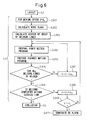
- the details of the programming process (S3) are described below with reference to Fig. 6.
- the moving speed V of a reference point or a TCP of the robot 12 is set to an initial value V 0 (step S301).
- the TCP in this case is, as shown in Fig. 7, a point at the intersection of a line extending from a certain point (e.g., the center point) on a mirror 22 of the scanner 20 with each of work planes F1 to F4 representing the above weldable areas A1 to A4, respectively, when the mirror 22 is positioned opposed to each work plane.
- a suitable point may be used as the TCP.
- Each work plane may be defined by approximating a surface (i.e., a curved surface, in general) near the welding line included in the corresponding weldable area by a flat surface (step S302).
- the work plane F1 is defined by approximating a portion or a door frame of the vehicle body near the welding lines L1 to L3 included in the weldable area A1 by one flat surface.
- center positions C1 to C4 in the respective weldable areas A1 to A4 are determined (step S303).
- the center position C1 in the area A1 is determined such that the summation of each distance between the center position C1 and one end of each welding line L1 to L3 is minimized.
- the motion program for defining the position and the orientation of the robot is prepared (step S304). Due to this program, as shown in Fig. 8, the TCP of the robot 12 may be moved along a trajectory T and, in particular, the TCP may sequentially pass through the center positions C1 to C4 determined in step S303 at a constant speed and thus may sequentially pass through the weldable areas A1 to A4. Succeedingly, based on the motion program for the robot, a motion program for defining the position and the orientation of the scanner such that a scanning line of the scanner 20 may pass through all welding lines at the above welding speed according to the welding order determined in the modeling process (S1) (step S305).
- the position and the orientation of the laser scanner 20 are defined such that the scanner 20 may scan all of the welding lines A1 to A3 during the robot 12 is positioned corresponding to the weldable area A1 (or the TCP is within the area A1).
- the movement of the scanner 20 may be represented by a composition vector V S as shown in Fig. 9.
- the vector V S may be obtained by a vector -V v opposed to a vector V v representing the movement of the TCP and a vector V W extending from a welding start point L S to a welding end point L E .
- step S306 it is judged whether all welding lines included in each work plane may be welded (in other words, whether the moving speed of the TCP is too fast to weld all welding lines), when the motion program for the robot and the scanner prepared in steps S304 and S305 is executed (step S306). If one or more welding line cannot be welded, the process progresses to step S307 to reduce the moving speed V of the TCP by a suitable step value V ⁇ 1 . Then, the motion program is prepared again based on the reduced moving speed in step S304. On the other hand, when all welding lines can be welded in each work plane, the process progresses to step S308.
- step S308 it is judged whether the welding of all welding lines may be completed in a predetermined cycle time (in other words, whether the moving speed of the TCP is too low).
- the programming process (S3) is terminated. Otherwise, the process progresses to step S309 to increase the moving speed V of the TCP by a step value V ⁇ 2 .
- This step value is preferably lower than the above step value V ⁇ 1 so as to stabilize the convergence of the programming process.
- a programming method may be used, in which the motion of the robot is evaluated by an evaluation function and the moving speed of the robot may be changed, if required, so as to fill the condition of the evaluation program.
- the evaluation function it may be judged that the movement of the robot, according to a specific function in relation to the position on the welding line or the moving speed, is carried out within a certain cycle time.
- the teaching device 10 executes an off-line simulation based on the motion program (S4). In the simulation, the operation of the robot is checked.
- the motion program is downloaded (S5).
- the motion program for the robot and the scanner is outputted to the robot control device 14 from the teaching device 10.
- the robot welding is ready to be started.
- the robot control device 14 executes the motion program for the robot and the scanner downloaded from the teaching device 10 to achieve remote welding (S6).
- each welding line may be scanned by the high-speed movement of the scanner during the constant-speed movement of the TCP of the robot. Therefore, the air cut motion between the sites to be welded, as in prior art, may be substantially eliminated, whereby a total cycle time of the welding may be considerably reduced in comparison to the conventional welding operation.
- control considering the combined motion of the robot and the scanner is necessary. This control may be very difficult indeed and, therefore, the teaching operation during the actual welding may take a long time through a trial and error process.
- the motion program for the robot and the scanner is previously prepared off-line and the operability of the program is checked by a simulation. Therefore, a trial and error process is not necessary in the actual welding operation. Also in view of this, the cycle time may be reduced and the reliability of the operation may be improved.
- each welding line may be scanned during the TCP is moved at the constant speed V over the whole welding operation.
- the air cut motion may be quickly carried out by combining the motion of the robot with the high-speed motion of the scanner obtained by the rotation of a mirror, whereby the cycle time may be reduced.
- this case is more suitable for an operation requiring high accuracy than the above case.
- Fig. 10a shows a preferred software constitution of the laser welding teaching device 10 (or the personal computer in the above embodiment) according to the invention.
- the personal computer 10 includes, as a remote welding function, a reading part 10b for reading CAD data (s101), a grouping part 10d for classifying the welding lines specified by a welding line specifying part 10c (S109), a welding order calculating part 10e for calculating the welding order (S105, S106), a programming part 10g for making a motion program for the robot and the laser scanner specified by a robot and scanner specifying part 10f (step S304, S305), and a simulating part 10h for executing an off-line simulation (S4).
- a prepared motion program P for the robot and the scanner is sent to the robot control device 14, along with synchronous position data D of the robot and the scanner simultaneously prepared by the programming part 10g.
- the robot control device 14 includes a program reading module 14a for reading the motion program P and a synchronous position monitoring module 14b for reading the synchronous data D and for monitoring the synchronous position. Further, the robot control device 14 sends speed data and position data of the scanner (or start and end positions of each welding line) to a scanner controller 21 having a scanner motion module 21a, whereby a suitable motion of the scanner may be achieved.
- the motion of the robot during the air cut motion may be greatly reduced by moving the scanner capable of moving at high speed, instead of by moving the TCP. Therefore, the cycle time of the whole system may be considerably reduced. Further, the teaching operation in relation to the motion program for the robot and the scanner may be simplified by preparing the program in off-line.
Landscapes
- Engineering & Computer Science (AREA)
- Physics & Mathematics (AREA)
- Optics & Photonics (AREA)
- Robotics (AREA)
- Mechanical Engineering (AREA)
- Plasma & Fusion (AREA)
- General Physics & Mathematics (AREA)
- Automation & Control Theory (AREA)
- Numerical Control (AREA)
- Manipulator (AREA)
- Laser Beam Processing (AREA)
Applications Claiming Priority (1)
| Application Number | Priority Date | Filing Date | Title |
|---|---|---|---|
| JP2005065177A JP2006247677A (ja) | 2005-03-09 | 2005-03-09 | レーザ溶接教示装置及び方法 |
Publications (1)
| Publication Number | Publication Date |
|---|---|
| EP1700667A1 true EP1700667A1 (de) | 2006-09-13 |
Family
ID=36593052
Family Applications (1)
| Application Number | Title | Priority Date | Filing Date |
|---|---|---|---|
| EP06003795A Withdrawn EP1700667A1 (de) | 2005-03-09 | 2006-02-24 | Lernvorrichtung und -Verfahren für das Laserschweißen |
Country Status (4)
| Country | Link |
|---|---|
| US (1) | US20060212170A1 (de) |
| EP (1) | EP1700667A1 (de) |
| JP (1) | JP2006247677A (de) |
| CN (1) | CN100484683C (de) |
Cited By (11)
| Publication number | Priority date | Publication date | Assignee | Title |
|---|---|---|---|---|
| DE102011082800A1 (de) * | 2011-09-15 | 2013-03-21 | Convergent Information Technologies Gmbh | System und Verfahren zur automatisierten Erstellung von Roboterprogrammen |
| ITNA20120066A1 (it) * | 2012-11-21 | 2014-05-22 | Cesare Rossi | Robot per la scansione e la replica di superfici |
| WO2014140749A1 (en) * | 2013-03-14 | 2014-09-18 | Lincoln Global, Inc. | Systems and method for creating or modifying a welding sequence |
| EP3003650A4 (de) * | 2013-05-28 | 2017-01-25 | ABB Technology Ltd. | Verfahren und vorrichtung zur verwaltung von laserprozessparametern in einer robotischen laserzelle |
| US9701019B2 (en) | 2011-09-15 | 2017-07-11 | Convergent Information Technologies Gmbh | System and method for the automatic generation of robot programs |
| US9937577B2 (en) | 2006-12-20 | 2018-04-10 | Lincoln Global, Inc. | System for a welding sequencer |
| US10496080B2 (en) | 2006-12-20 | 2019-12-03 | Lincoln Global, Inc. | Welding job sequencer |
| US10994357B2 (en) | 2006-12-20 | 2021-05-04 | Lincoln Global, Inc. | System and method for creating or modifying a welding sequence |
| US10994358B2 (en) | 2006-12-20 | 2021-05-04 | Lincoln Global, Inc. | System and method for creating or modifying a welding sequence based on non-real world weld data |
| US11072034B2 (en) | 2006-12-20 | 2021-07-27 | Lincoln Global, Inc. | System and method of exporting or using welding sequencer data for external systems |
| EP4446046A4 (de) * | 2021-12-08 | 2025-06-11 | Panasonic Intellectual Property Management Co., Ltd. | Offline-lehrvorrichtung und offline-lehrverfahren |
Families Citing this family (36)
| Publication number | Priority date | Publication date | Assignee | Title |
|---|---|---|---|---|
| US8253062B2 (en) * | 2005-06-10 | 2012-08-28 | Chrysler Group Llc | System and methodology for zero-gap welding |
| JP5169460B2 (ja) * | 2008-05-12 | 2013-03-27 | 日産自動車株式会社 | レーザ溶接方法、この溶接方法によって形成された溶接物、およびレーザ溶接システム |
| JP5715809B2 (ja) * | 2010-03-29 | 2015-05-13 | 株式会社ダイヘン | ロボットの作業プログラム作成方法、ロボットの作業プログラム作成装置、及びロボット制御システム |
| JP2012135821A (ja) * | 2010-12-24 | 2012-07-19 | Seiko Epson Corp | ロボットシミュレーション装置、ロボットシミュレーション方法、及びロボットシミュレーションプログラム |
| CN102896389B (zh) * | 2012-09-26 | 2015-11-18 | 武汉法利莱切割系统工程有限责任公司 | 白车身顶盖激光钎焊工艺控制装置 |
| JP5664629B2 (ja) * | 2012-10-19 | 2015-02-04 | 株式会社安川電機 | ロボットシステムおよび加工品の製造方法 |
| US9417625B2 (en) * | 2012-11-29 | 2016-08-16 | Fanuc America Corporation | Robot system calibration method |
| JP5965859B2 (ja) * | 2013-03-28 | 2016-08-10 | 株式会社神戸製鋼所 | 溶接線情報設定装置、プログラム、自動教示システム、および溶接線情報設定方法 |
| JP2015150655A (ja) * | 2014-02-17 | 2015-08-24 | パナソニックIpマネジメント株式会社 | レーザ加工パターンの教示方法およびロボットの動作方法 |
| JP6311421B2 (ja) | 2014-04-10 | 2018-04-18 | 株式会社安川電機 | ティーチングシステム、ロボットシステムおよびティーチング方法 |
| JP5980867B2 (ja) * | 2014-10-07 | 2016-08-31 | ファナック株式会社 | ロボットをオフラインで教示するロボット教示装置 |
| JP6420683B2 (ja) * | 2015-02-10 | 2018-11-07 | 株式会社アマダホールディングス | オンザフライ経路生成装置及び方法 |
| CN108213776B (zh) * | 2016-12-15 | 2019-07-05 | 中国科学院沈阳自动化研究所 | 一种非接触式机器人激光焊接示教方法 |
| CN106583974B (zh) * | 2016-12-16 | 2018-04-13 | 南京合信智能装备有限公司 | 一种无需编程结构件激光快速寻位焊接系统及焊接方法 |
| JP6457473B2 (ja) * | 2016-12-16 | 2019-01-23 | ファナック株式会社 | ロボットおよびレーザスキャナの動作を学習する機械学習装置,ロボットシステムおよび機械学習方法 |
| JP6514278B2 (ja) | 2017-07-04 | 2019-05-15 | ファナック株式会社 | レーザ加工ロボットシステム |
| CN107803845A (zh) * | 2017-09-29 | 2018-03-16 | 纳博特南京科技有限公司 | 一种工业机器人的示教方法及系统 |
| CN108581206A (zh) * | 2018-05-22 | 2018-09-28 | 北京拓博尔轨道维护技术有限公司 | 三维数字化钢轨激光修复技术 |
| US11167866B2 (en) * | 2018-06-22 | 2021-11-09 | Southwest Research Institute | Localization system and methods |
| JP6836558B2 (ja) | 2018-08-31 | 2021-03-03 | ファナック株式会社 | レーザ加工のための教示装置 |
| JP6838017B2 (ja) * | 2018-08-31 | 2021-03-03 | ファナック株式会社 | レーザ加工のための教示装置、教示方法、及び教示プログラム |
| JP7092629B2 (ja) * | 2018-09-20 | 2022-06-28 | ファナック株式会社 | レーザ加工装置 |
| JP7124880B2 (ja) * | 2018-10-16 | 2022-08-24 | 株式会社安川電機 | ロボットシステム |
| JP6810116B2 (ja) * | 2018-10-24 | 2021-01-06 | ファナック株式会社 | レーザ加工ロボットのキャリブレーション方法および制御装置 |
| KR102738516B1 (ko) * | 2019-05-03 | 2024-12-06 | 현대자동차 주식회사 | 실링 로봇 티칭 시스템 및 그 방법 |
| CN110449789B (zh) * | 2019-08-22 | 2021-10-08 | 深圳市威博特科技有限公司 | 一种自适应焊接装置及方法 |
| CN114746221A (zh) * | 2019-12-04 | 2022-07-12 | Abb瑞士股份有限公司 | 控制工业致动器、控制系统和致动器系统的方法 |
| CN111375940A (zh) * | 2020-04-20 | 2020-07-07 | 唐山英莱科技有限公司 | 一种基于小焊缝应用激光视觉的预扫描方法和系统 |
| CN115776929B (zh) * | 2020-07-10 | 2025-12-16 | 发那科株式会社 | 用于激光加工的示教装置和示教方法 |
| JP7494614B2 (ja) * | 2020-07-22 | 2024-06-04 | セイコーエプソン株式会社 | ロボットの教示制御方法、ロボットシステム、及び、コンピュータープログラム |
| JP7491115B2 (ja) * | 2020-07-22 | 2024-05-28 | セイコーエプソン株式会社 | ロボットの教示制御方法、ロボットシステム、及び、コンピュータープログラム |
| US12076822B2 (en) * | 2020-09-16 | 2024-09-03 | T Bailey, Inc. | Welding tracking and/or motion system, device and/or process |
| IT202100003821A1 (it) * | 2021-02-19 | 2022-08-19 | Univ Pisa | Procedimento di interazione con oggetti |
| EP4360826A4 (de) * | 2021-06-23 | 2024-10-23 | Panasonic Intellectual Property Management Co., Ltd. | Offline-lehrvorrichtung und offline-lehrverfahren |
| CN118369182A (zh) * | 2021-12-08 | 2024-07-19 | 松下知识产权经营株式会社 | 离线示教设备和离线示教方法 |
| EP4550070A3 (de) * | 2021-12-08 | 2025-07-30 | Panasonic Intellectual Property Management Co., Ltd. | Offline-lehrgerät |
Citations (6)
| Publication number | Priority date | Publication date | Assignee | Title |
|---|---|---|---|---|
| JPH06202727A (ja) * | 1992-12-28 | 1994-07-22 | Mitsubishi Electric Corp | 三次元レーザ加工機用シミュレーション装置 |
| JPH10180471A (ja) * | 1996-12-25 | 1998-07-07 | Honda Motor Co Ltd | レーザ溶接装置 |
| JP2001222309A (ja) | 2000-02-10 | 2001-08-17 | Yaskawa Electric Corp | ロボット制御装置 |
| US20040111185A1 (en) * | 2002-11-26 | 2004-06-10 | Peter Gmeiner | Method and device for machining a workpiece |
| WO2005009667A1 (de) * | 2003-07-22 | 2005-02-03 | Kuka Schweissanlagen Gmbh | Verfahren und vorrichtung zum laserbearbeiten von werkstücken |
| EP1661657A1 (de) * | 2004-11-30 | 2006-05-31 | Fanuc Ltd | Laserbearbeitung Robotersystem mit einem Rasterkopf und einer schnell bewegbaren Trägervorrichtung ; Verfahren zum Kontrollieren eines solchen Systems |
Family Cites Families (6)
| Publication number | Priority date | Publication date | Assignee | Title |
|---|---|---|---|---|
| JPS5339183B2 (de) * | 1974-07-22 | 1978-10-19 | ||
| US4118620A (en) * | 1977-05-20 | 1978-10-03 | Lovelace Alan M Acting Adminis | Computerized system for translating a torch head |
| US5471026A (en) * | 1994-03-30 | 1995-11-28 | Lakewood Engineering & Manufacturing Co. | Continuous resistance welding apparatus and method |
| US5552575A (en) * | 1994-07-15 | 1996-09-03 | Tufts University | Scan welding method and apparatus |
| US6226395B1 (en) * | 1996-04-22 | 2001-05-01 | Malcolm T. Gilliland | Method and apparatus for determining the configuration of a workpiece |
| US7034262B2 (en) * | 2004-03-23 | 2006-04-25 | General Electric Company | Apparatus and methods for repairing tenons on turbine buckets |
-
2005
- 2005-03-09 JP JP2005065177A patent/JP2006247677A/ja active Pending
-
2006
- 2006-02-24 EP EP06003795A patent/EP1700667A1/de not_active Withdrawn
- 2006-02-28 US US11/362,870 patent/US20060212170A1/en not_active Abandoned
- 2006-03-07 CN CNB2006100569770A patent/CN100484683C/zh not_active Expired - Fee Related
Patent Citations (6)
| Publication number | Priority date | Publication date | Assignee | Title |
|---|---|---|---|---|
| JPH06202727A (ja) * | 1992-12-28 | 1994-07-22 | Mitsubishi Electric Corp | 三次元レーザ加工機用シミュレーション装置 |
| JPH10180471A (ja) * | 1996-12-25 | 1998-07-07 | Honda Motor Co Ltd | レーザ溶接装置 |
| JP2001222309A (ja) | 2000-02-10 | 2001-08-17 | Yaskawa Electric Corp | ロボット制御装置 |
| US20040111185A1 (en) * | 2002-11-26 | 2004-06-10 | Peter Gmeiner | Method and device for machining a workpiece |
| WO2005009667A1 (de) * | 2003-07-22 | 2005-02-03 | Kuka Schweissanlagen Gmbh | Verfahren und vorrichtung zum laserbearbeiten von werkstücken |
| EP1661657A1 (de) * | 2004-11-30 | 2006-05-31 | Fanuc Ltd | Laserbearbeitung Robotersystem mit einem Rasterkopf und einer schnell bewegbaren Trägervorrichtung ; Verfahren zum Kontrollieren eines solchen Systems |
Non-Patent Citations (2)
| Title |
|---|
| PATENT ABSTRACTS OF JAPAN vol. 018, no. 561 (P - 1818) 26 October 1994 (1994-10-26) * |
| PATENT ABSTRACTS OF JAPAN vol. 1998, no. 12 31 October 1998 (1998-10-31) * |
Cited By (15)
| Publication number | Priority date | Publication date | Assignee | Title |
|---|---|---|---|---|
| US9937577B2 (en) | 2006-12-20 | 2018-04-10 | Lincoln Global, Inc. | System for a welding sequencer |
| US11980976B2 (en) | 2006-12-20 | 2024-05-14 | Lincoln Global, Inc. | Method for a welding sequencer |
| US11072034B2 (en) | 2006-12-20 | 2021-07-27 | Lincoln Global, Inc. | System and method of exporting or using welding sequencer data for external systems |
| US10994358B2 (en) | 2006-12-20 | 2021-05-04 | Lincoln Global, Inc. | System and method for creating or modifying a welding sequence based on non-real world weld data |
| US10994357B2 (en) | 2006-12-20 | 2021-05-04 | Lincoln Global, Inc. | System and method for creating or modifying a welding sequence |
| US10940555B2 (en) | 2006-12-20 | 2021-03-09 | Lincoln Global, Inc. | System for a welding sequencer |
| US10496080B2 (en) | 2006-12-20 | 2019-12-03 | Lincoln Global, Inc. | Welding job sequencer |
| US9701019B2 (en) | 2011-09-15 | 2017-07-11 | Convergent Information Technologies Gmbh | System and method for the automatic generation of robot programs |
| DE102011082800A1 (de) * | 2011-09-15 | 2013-03-21 | Convergent Information Technologies Gmbh | System und Verfahren zur automatisierten Erstellung von Roboterprogrammen |
| DE102011082800B4 (de) * | 2011-09-15 | 2016-04-14 | Convergent Information Technologies Gmbh | System und Verfahren zur automatisierten Erstellung von Roboterprogrammen |
| ITNA20120066A1 (it) * | 2012-11-21 | 2014-05-22 | Cesare Rossi | Robot per la scansione e la replica di superfici |
| WO2014140743A1 (en) * | 2013-03-14 | 2014-09-18 | Lincoln Global, Inc. | Systems and method for creating or modifying a welding sequence |
| WO2014140749A1 (en) * | 2013-03-14 | 2014-09-18 | Lincoln Global, Inc. | Systems and method for creating or modifying a welding sequence |
| EP3003650A4 (de) * | 2013-05-28 | 2017-01-25 | ABB Technology Ltd. | Verfahren und vorrichtung zur verwaltung von laserprozessparametern in einer robotischen laserzelle |
| EP4446046A4 (de) * | 2021-12-08 | 2025-06-11 | Panasonic Intellectual Property Management Co., Ltd. | Offline-lehrvorrichtung und offline-lehrverfahren |
Also Published As
| Publication number | Publication date |
|---|---|
| US20060212170A1 (en) | 2006-09-21 |
| CN100484683C (zh) | 2009-05-06 |
| CN1830613A (zh) | 2006-09-13 |
| JP2006247677A (ja) | 2006-09-21 |
Similar Documents
| Publication | Publication Date | Title |
|---|---|---|
| EP1700667A1 (de) | Lernvorrichtung und -Verfahren für das Laserschweißen | |
| EP1798618B1 (de) | Vorrichtung und Verfahren zum automatischen Setzen von Verriegelungen zwischen Robotern | |
| US7002585B1 (en) | Graphic display apparatus for robot system | |
| EP1510894B1 (de) | Vorrichtung zur Korrektur der Position in einem Roboterprogramm | |
| US6928337B2 (en) | Robot simulation apparatus | |
| EP1527850B1 (de) | Simulationsvorrichtung | |
| US4835450A (en) | Method and system for controlling robot for constructing products | |
| US7376488B2 (en) | Taught position modification device | |
| US4998050A (en) | System and method for teaching robots | |
| JP3904605B2 (ja) | 複合センサーロボットシステム | |
| US5341458A (en) | Method of and system for generating teaching data for robots | |
| US20050055134A1 (en) | Device for determining interference region of robot | |
| JPH09509513A (ja) | ロボットの運動を計画し制御する方法 | |
| US6750425B2 (en) | Three-dimensional laser beam machine | |
| CN115709484A (zh) | 一种移动机器人安全仿真检测方法及系统 | |
| EP1661657A1 (de) | Laserbearbeitung Robotersystem mit einem Rasterkopf und einer schnell bewegbaren Trägervorrichtung ; Verfahren zum Kontrollieren eines solchen Systems | |
| US12377543B2 (en) | Path planning during execution of robot control | |
| JP2787883B2 (ja) | 三次元レーザ加工機用シミュレーション装置 | |
| EP0547244A1 (de) | Verfahren zur bestimmung der position einer ausgerundeten bogenförmigen oberfläche | |
| JP3378738B2 (ja) | 溶接ロボット教示装置 | |
| JPH10260713A (ja) | 生産設備の制御装置 | |
| JPH07210223A (ja) | ロボットの動作時間評価方法および装置 | |
| JPH0628021A (ja) | 対話形数値制御装置 | |
| JPH1034576A (ja) | マルチロボットシステム | |
| Yukhimets et al. | Development of method for generating trajectories of movement of end effectors and control programs for industrial robots in an uncertain working environment |
Legal Events
| Date | Code | Title | Description |
|---|---|---|---|
| PUAI | Public reference made under article 153(3) epc to a published international application that has entered the european phase |
Free format text: ORIGINAL CODE: 0009012 |
|
| AK | Designated contracting states |
Kind code of ref document: A1 Designated state(s): AT BE BG CH CY CZ DE DK EE ES FI FR GB GR HU IE IS IT LI LT LU LV MC NL PL PT RO SE SI SK TR |
|
| AX | Request for extension of the european patent |
Extension state: AL BA HR MK YU |
|
| 17P | Request for examination filed |
Effective date: 20061031 |
|
| 17Q | First examination report despatched |
Effective date: 20061130 |
|
| AKX | Designation fees paid |
Designated state(s): DE |
|
| GRAP | Despatch of communication of intention to grant a patent |
Free format text: ORIGINAL CODE: EPIDOSNIGR1 |
|
| STAA | Information on the status of an ep patent application or granted ep patent |
Free format text: STATUS: THE APPLICATION IS DEEMED TO BE WITHDRAWN |
|
| 18D | Application deemed to be withdrawn |
Effective date: 20090818 |