EP1702592A1 - System zur Behandlung ausgedehnter obliterierender Erkrankungen eines Gefässes - Google Patents
System zur Behandlung ausgedehnter obliterierender Erkrankungen eines Gefässes Download PDFInfo
- Publication number
- EP1702592A1 EP1702592A1 EP06004321A EP06004321A EP1702592A1 EP 1702592 A1 EP1702592 A1 EP 1702592A1 EP 06004321 A EP06004321 A EP 06004321A EP 06004321 A EP06004321 A EP 06004321A EP 1702592 A1 EP1702592 A1 EP 1702592A1
- Authority
- EP
- European Patent Office
- Prior art keywords
- vessel
- release
- sections
- tissue
- drug
- Prior art date
- Legal status (The legal status is an assumption and is not a legal conclusion. Google has not performed a legal analysis and makes no representation as to the accuracy of the status listed.)
- Granted
Links
- 239000013543 active substance Substances 0.000 claims abstract description 40
- 238000000034 method Methods 0.000 claims abstract description 26
- 239000007943 implant Substances 0.000 claims abstract description 19
- 230000017531 blood circulation Effects 0.000 claims abstract description 9
- 229910000861 Mg alloy Inorganic materials 0.000 claims abstract description 8
- 229910052727 yttrium Inorganic materials 0.000 claims abstract description 5
- VWQVUPCCIRVNHF-UHFFFAOYSA-N yttrium atom Chemical compound [Y] VWQVUPCCIRVNHF-UHFFFAOYSA-N 0.000 claims abstract description 5
- 239000003814 drug Substances 0.000 claims description 37
- 229940079593 drug Drugs 0.000 claims description 35
- 201000010099 disease Diseases 0.000 claims description 22
- 208000037265 diseases, disorders, signs and symptoms Diseases 0.000 claims description 22
- 239000004480 active ingredient Substances 0.000 claims description 16
- 238000002399 angioplasty Methods 0.000 claims description 16
- 238000009792 diffusion process Methods 0.000 claims description 14
- 229910045601 alloy Inorganic materials 0.000 claims description 6
- 239000000956 alloy Substances 0.000 claims description 6
- FYYHWMGAXLPEAU-UHFFFAOYSA-N Magnesium Chemical compound [Mg] FYYHWMGAXLPEAU-UHFFFAOYSA-N 0.000 claims description 4
- 229910052749 magnesium Inorganic materials 0.000 claims description 4
- 239000011777 magnesium Substances 0.000 claims description 4
- 239000000203 mixture Substances 0.000 claims description 4
- 229930012538 Paclitaxel Natural products 0.000 claims description 2
- 229910001092 metal group alloy Inorganic materials 0.000 claims description 2
- 229960001592 paclitaxel Drugs 0.000 claims description 2
- KASDHRXLYQOAKZ-ZPSXYTITSA-N pimecrolimus Chemical compound C/C([C@H]1OC(=O)[C@@H]2CCCCN2C(=O)C(=O)[C@]2(O)O[C@@H]([C@H](C[C@H]2C)OC)[C@@H](OC)C[C@@H](C)C/C(C)=C/[C@H](C(C[C@H](O)[C@H]1C)=O)CC)=C\[C@@H]1CC[C@@H](Cl)[C@H](OC)C1 KASDHRXLYQOAKZ-ZPSXYTITSA-N 0.000 claims description 2
- 229960005330 pimecrolimus Drugs 0.000 claims description 2
- ZAHRKKWIAAJSAO-UHFFFAOYSA-N rapamycin Natural products COCC(O)C(=C/C(C)C(=O)CC(OC(=O)C1CCCCN1C(=O)C(=O)C2(O)OC(CC(OC)C(=CC=CC=CC(C)CC(C)C(=O)C)C)CCC2C)C(C)CC3CCC(O)C(C3)OC)C ZAHRKKWIAAJSAO-UHFFFAOYSA-N 0.000 claims description 2
- QFJCIRLUMZQUOT-HPLJOQBZSA-N sirolimus Chemical compound C1C[C@@H](O)[C@H](OC)C[C@@H]1C[C@@H](C)[C@H]1OC(=O)[C@@H]2CCCCN2C(=O)C(=O)[C@](O)(O2)[C@H](C)CC[C@H]2C[C@H](OC)/C(C)=C/C=C/C=C/[C@@H](C)C[C@@H](C)C(=O)[C@H](OC)[C@H](O)/C(C)=C/[C@@H](C)C(=O)C1 QFJCIRLUMZQUOT-HPLJOQBZSA-N 0.000 claims description 2
- 229960002930 sirolimus Drugs 0.000 claims description 2
- RCINICONZNJXQF-MZXODVADSA-N taxol Chemical compound O([C@@H]1[C@@]2(C[C@@H](C(C)=C(C2(C)C)[C@H](C([C@]2(C)[C@@H](O)C[C@H]3OC[C@]3([C@H]21)OC(C)=O)=O)OC(=O)C)OC(=O)[C@H](O)[C@@H](NC(=O)C=1C=CC=CC=1)C=1C=CC=CC=1)O)C(=O)C1=CC=CC=C1 RCINICONZNJXQF-MZXODVADSA-N 0.000 claims description 2
- 230000002792 vascular Effects 0.000 claims description 2
- 229910052761 rare earth metal Inorganic materials 0.000 abstract description 3
- -1 rare earth compound Chemical class 0.000 abstract 1
- 210000001519 tissue Anatomy 0.000 description 21
- 230000008569 process Effects 0.000 description 12
- 239000000126 substance Substances 0.000 description 7
- 210000004204 blood vessel Anatomy 0.000 description 6
- 239000000463 material Substances 0.000 description 6
- 230000015556 catabolic process Effects 0.000 description 5
- 238000006731 degradation reaction Methods 0.000 description 5
- 230000003993 interaction Effects 0.000 description 5
- 238000004519 manufacturing process Methods 0.000 description 5
- 239000008280 blood Substances 0.000 description 4
- 210000004369 blood Anatomy 0.000 description 4
- 239000011248 coating agent Substances 0.000 description 4
- 238000000576 coating method Methods 0.000 description 4
- 210000002808 connective tissue Anatomy 0.000 description 4
- 238000002347 injection Methods 0.000 description 4
- 239000007924 injection Substances 0.000 description 4
- 238000002513 implantation Methods 0.000 description 3
- 239000007788 liquid Substances 0.000 description 3
- 239000011159 matrix material Substances 0.000 description 3
- 230000002906 microbiologic effect Effects 0.000 description 3
- 239000000047 product Substances 0.000 description 3
- 238000000275 quality assurance Methods 0.000 description 3
- 208000037803 restenosis Diseases 0.000 description 3
- 238000010200 validation analysis Methods 0.000 description 3
- 208000019553 vascular disease Diseases 0.000 description 3
- 206010003210 Arteriosclerosis Diseases 0.000 description 2
- 208000031481 Pathologic Constriction Diseases 0.000 description 2
- 208000030831 Peripheral arterial occlusive disease Diseases 0.000 description 2
- 206010038378 Renal artery stenosis Diseases 0.000 description 2
- 208000007536 Thrombosis Diseases 0.000 description 2
- 206010047249 Venous thrombosis Diseases 0.000 description 2
- 206010003230 arteritis Diseases 0.000 description 2
- 238000007887 coronary angioplasty Methods 0.000 description 2
- 208000029078 coronary artery disease Diseases 0.000 description 2
- 210000004351 coronary vessel Anatomy 0.000 description 2
- 238000000354 decomposition reaction Methods 0.000 description 2
- 208000001297 phlebitis Diseases 0.000 description 2
- 150000002910 rare earth metals Chemical class 0.000 description 2
- 238000001356 surgical procedure Methods 0.000 description 2
- 201000005060 thrombophlebitis Diseases 0.000 description 2
- 206010002383 Angina Pectoris Diseases 0.000 description 1
- 206010059245 Angiopathy Diseases 0.000 description 1
- 206010051055 Deep vein thrombosis Diseases 0.000 description 1
- 208000005189 Embolism Diseases 0.000 description 1
- JLVVSXFLKOJNIY-UHFFFAOYSA-N Magnesium ion Chemical compound [Mg+2] JLVVSXFLKOJNIY-UHFFFAOYSA-N 0.000 description 1
- 206010028980 Neoplasm Diseases 0.000 description 1
- 208000004531 Renal Artery Obstruction Diseases 0.000 description 1
- 206010038563 Reocclusion Diseases 0.000 description 1
- 206010053648 Vascular occlusion Diseases 0.000 description 1
- 238000010521 absorption reaction Methods 0.000 description 1
- 230000009471 action Effects 0.000 description 1
- 230000001154 acute effect Effects 0.000 description 1
- 208000011775 arteriosclerosis disease Diseases 0.000 description 1
- 210000001367 artery Anatomy 0.000 description 1
- 210000001124 body fluid Anatomy 0.000 description 1
- 239000010839 body fluid Substances 0.000 description 1
- 230000002308 calcification Effects 0.000 description 1
- 208000035269 cancer or benign tumor Diseases 0.000 description 1
- 239000003795 chemical substances by application Substances 0.000 description 1
- 230000009918 complex formation Effects 0.000 description 1
- 150000001875 compounds Chemical class 0.000 description 1
- 239000007857 degradation product Substances 0.000 description 1
- 230000008021 deposition Effects 0.000 description 1
- 201000009101 diabetic angiopathy Diseases 0.000 description 1
- 201000002249 diabetic peripheral angiopathy Diseases 0.000 description 1
- 230000010339 dilation Effects 0.000 description 1
- 238000009826 distribution Methods 0.000 description 1
- 239000002552 dosage form Substances 0.000 description 1
- 238000012377 drug delivery Methods 0.000 description 1
- 230000000694 effects Effects 0.000 description 1
- 230000008030 elimination Effects 0.000 description 1
- 238000003379 elimination reaction Methods 0.000 description 1
- 238000010828 elution Methods 0.000 description 1
- 230000002349 favourable effect Effects 0.000 description 1
- 230000006872 improvement Effects 0.000 description 1
- 230000002757 inflammatory effect Effects 0.000 description 1
- 230000004054 inflammatory process Effects 0.000 description 1
- 229910001425 magnesium ion Inorganic materials 0.000 description 1
- 230000010534 mechanism of action Effects 0.000 description 1
- 238000005457 optimization Methods 0.000 description 1
- 244000045947 parasite Species 0.000 description 1
- 244000052769 pathogen Species 0.000 description 1
- 231100000915 pathological change Toxicity 0.000 description 1
- 230000036285 pathological change Effects 0.000 description 1
- 208000008494 pericarditis Diseases 0.000 description 1
- 230000000144 pharmacologic effect Effects 0.000 description 1
- 208000008423 pleurisy Diseases 0.000 description 1
- 229920000642 polymer Polymers 0.000 description 1
- 230000002265 prevention Effects 0.000 description 1
- 238000009877 rendering Methods 0.000 description 1
- 238000000926 separation method Methods 0.000 description 1
- 208000037804 stenosis Diseases 0.000 description 1
- 230000036262 stenosis Effects 0.000 description 1
- 230000009885 systemic effect Effects 0.000 description 1
- 238000007631 vascular surgery Methods 0.000 description 1
- 230000009278 visceral effect Effects 0.000 description 1
Images
Classifications
-
- A—HUMAN NECESSITIES
- A61—MEDICAL OR VETERINARY SCIENCE; HYGIENE
- A61F—FILTERS IMPLANTABLE INTO BLOOD VESSELS; PROSTHESES; DEVICES PROVIDING PATENCY TO, OR PREVENTING COLLAPSING OF, TUBULAR STRUCTURES OF THE BODY, e.g. STENTS; ORTHOPAEDIC, NURSING OR CONTRACEPTIVE DEVICES; FOMENTATION; TREATMENT OR PROTECTION OF EYES OR EARS; BANDAGES, DRESSINGS OR ABSORBENT PADS; FIRST-AID KITS
- A61F2/00—Filters implantable into blood vessels; Prostheses, i.e. artificial substitutes or replacements for parts of the body; Appliances for connecting them with the body; Devices providing patency to, or preventing collapsing of, tubular structures of the body, e.g. stents
- A61F2/82—Devices providing patency to, or preventing collapsing of, tubular structures of the body, e.g. stents
-
- A—HUMAN NECESSITIES
- A61—MEDICAL OR VETERINARY SCIENCE; HYGIENE
- A61L—METHODS OR APPARATUS FOR STERILISING MATERIALS OR OBJECTS IN GENERAL; DISINFECTION, STERILISATION OR DEODORISATION OF AIR; CHEMICAL ASPECTS OF BANDAGES, DRESSINGS, ABSORBENT PADS OR SURGICAL ARTICLES; MATERIALS FOR BANDAGES, DRESSINGS, ABSORBENT PADS OR SURGICAL ARTICLES
- A61L31/00—Materials for other surgical articles, e.g. stents, stent-grafts, shunts, surgical drapes, guide wires, materials for adhesion prevention, occluding devices, surgical gloves, tissue fixation devices
- A61L31/02—Inorganic materials
- A61L31/022—Metals or alloys
-
- A—HUMAN NECESSITIES
- A61—MEDICAL OR VETERINARY SCIENCE; HYGIENE
- A61L—METHODS OR APPARATUS FOR STERILISING MATERIALS OR OBJECTS IN GENERAL; DISINFECTION, STERILISATION OR DEODORISATION OF AIR; CHEMICAL ASPECTS OF BANDAGES, DRESSINGS, ABSORBENT PADS OR SURGICAL ARTICLES; MATERIALS FOR BANDAGES, DRESSINGS, ABSORBENT PADS OR SURGICAL ARTICLES
- A61L31/00—Materials for other surgical articles, e.g. stents, stent-grafts, shunts, surgical drapes, guide wires, materials for adhesion prevention, occluding devices, surgical gloves, tissue fixation devices
- A61L31/14—Materials characterised by their function or physical properties, e.g. injectable or lubricating compositions, shape-memory materials, surface modified materials
- A61L31/148—Materials at least partially resorbable by the body
-
- A—HUMAN NECESSITIES
- A61—MEDICAL OR VETERINARY SCIENCE; HYGIENE
- A61L—METHODS OR APPARATUS FOR STERILISING MATERIALS OR OBJECTS IN GENERAL; DISINFECTION, STERILISATION OR DEODORISATION OF AIR; CHEMICAL ASPECTS OF BANDAGES, DRESSINGS, ABSORBENT PADS OR SURGICAL ARTICLES; MATERIALS FOR BANDAGES, DRESSINGS, ABSORBENT PADS OR SURGICAL ARTICLES
- A61L31/00—Materials for other surgical articles, e.g. stents, stent-grafts, shunts, surgical drapes, guide wires, materials for adhesion prevention, occluding devices, surgical gloves, tissue fixation devices
- A61L31/14—Materials characterised by their function or physical properties, e.g. injectable or lubricating compositions, shape-memory materials, surface modified materials
- A61L31/16—Biologically active materials, e.g. therapeutic substances
-
- A—HUMAN NECESSITIES
- A61—MEDICAL OR VETERINARY SCIENCE; HYGIENE
- A61F—FILTERS IMPLANTABLE INTO BLOOD VESSELS; PROSTHESES; DEVICES PROVIDING PATENCY TO, OR PREVENTING COLLAPSING OF, TUBULAR STRUCTURES OF THE BODY, e.g. STENTS; ORTHOPAEDIC, NURSING OR CONTRACEPTIVE DEVICES; FOMENTATION; TREATMENT OR PROTECTION OF EYES OR EARS; BANDAGES, DRESSINGS OR ABSORBENT PADS; FIRST-AID KITS
- A61F2/00—Filters implantable into blood vessels; Prostheses, i.e. artificial substitutes or replacements for parts of the body; Appliances for connecting them with the body; Devices providing patency to, or preventing collapsing of, tubular structures of the body, e.g. stents
- A61F2/82—Devices providing patency to, or preventing collapsing of, tubular structures of the body, e.g. stents
- A61F2002/826—Devices providing patency to, or preventing collapsing of, tubular structures of the body, e.g. stents more than one stent being applied sequentially
-
- A—HUMAN NECESSITIES
- A61—MEDICAL OR VETERINARY SCIENCE; HYGIENE
- A61F—FILTERS IMPLANTABLE INTO BLOOD VESSELS; PROSTHESES; DEVICES PROVIDING PATENCY TO, OR PREVENTING COLLAPSING OF, TUBULAR STRUCTURES OF THE BODY, e.g. STENTS; ORTHOPAEDIC, NURSING OR CONTRACEPTIVE DEVICES; FOMENTATION; TREATMENT OR PROTECTION OF EYES OR EARS; BANDAGES, DRESSINGS OR ABSORBENT PADS; FIRST-AID KITS
- A61F2210/00—Particular material properties of prostheses classified in groups A61F2/00 - A61F2/26 or A61F2/82 or A61F9/00 or A61F11/00 or subgroups thereof
- A61F2210/0004—Particular material properties of prostheses classified in groups A61F2/00 - A61F2/26 or A61F2/82 or A61F9/00 or A61F11/00 or subgroups thereof bioabsorbable
-
- A—HUMAN NECESSITIES
- A61—MEDICAL OR VETERINARY SCIENCE; HYGIENE
- A61F—FILTERS IMPLANTABLE INTO BLOOD VESSELS; PROSTHESES; DEVICES PROVIDING PATENCY TO, OR PREVENTING COLLAPSING OF, TUBULAR STRUCTURES OF THE BODY, e.g. STENTS; ORTHOPAEDIC, NURSING OR CONTRACEPTIVE DEVICES; FOMENTATION; TREATMENT OR PROTECTION OF EYES OR EARS; BANDAGES, DRESSINGS OR ABSORBENT PADS; FIRST-AID KITS
- A61F2250/00—Special features of prostheses classified in groups A61F2/00 - A61F2/26 or A61F2/82 or A61F9/00 or A61F11/00 or subgroups thereof
- A61F2250/0058—Additional features; Implant or prostheses properties not otherwise provided for
- A61F2250/0067—Means for introducing or releasing pharmaceutical products into the body
-
- A—HUMAN NECESSITIES
- A61—MEDICAL OR VETERINARY SCIENCE; HYGIENE
- A61L—METHODS OR APPARATUS FOR STERILISING MATERIALS OR OBJECTS IN GENERAL; DISINFECTION, STERILISATION OR DEODORISATION OF AIR; CHEMICAL ASPECTS OF BANDAGES, DRESSINGS, ABSORBENT PADS OR SURGICAL ARTICLES; MATERIALS FOR BANDAGES, DRESSINGS, ABSORBENT PADS OR SURGICAL ARTICLES
- A61L2300/00—Biologically active materials used in bandages, wound dressings, absorbent pads or medical devices
- A61L2300/40—Biologically active materials used in bandages, wound dressings, absorbent pads or medical devices characterised by a specific therapeutic activity or mode of action
- A61L2300/416—Anti-neoplastic or anti-proliferative or anti-restenosis or anti-angiogenic agents, e.g. paclitaxel, sirolimus
Definitions
- the invention relates to a system for treating extensive obliterating diseases of a vessel.
- PTA percutaneous transluminal angioplasty
- balloon angioplasty in which the vessel is widened in the affected vessel section.
- Stents are usually designed as permanent implants, ie remain permanently in the body of the patient and can often no longer be surgically removed after ingrowth into the vessel wall.
- the permanent presence of such an implant itself can be the starting point for microbiological processes, which leads to a re-occlusion of the vessel (restenosis).
- the stents to coat with drugs that counteract or even prevent the underlying microbiological processes.
- the production of drug-coated implants requires the development and implementation of specific production, validation, quality assurance and approval procedures. In other words, the establishment of such drug-coated systems is time-consuming and, above all, expensive in development and manufacture.
- a modified balloon catheter with which an active substance can be injected into the tissue of a vessel, in particular into the adventitia of the vessel wall.
- the catheter has a microneedle in an expandable region which abuts approximately perpendicularly to the outside and thereby penetrates through the vessel wall when the balloon is inflated.
- the needle is connected to a drug depot and the drug can thus be introduced into deeper tissue layers of the vessel wall. It has been found that the drug spreads further within the vessel wall by diffusion. Thus, drug treatment in the tissue of the vessel is possible beyond an area extending beyond the site of injection.
- the system includes a catheter of in US 6,547,803 B2 described type, with an injection needle through which the liquid substance is introduced into the tissue. Furthermore, the system comprises a stent with a structure absorptive of the injected liquid substance. After the process, the substance is injected adjacent to the scaffold in the tissue of the vessel, absorbed by the absorptive structure of the scaffold and set free again after absorption. The scaffold is implanted before, during or after the injection of the substance.
- Stents can also be made of a biocorrodible material. This approach is based on the finding that the support function of the implant usually only last for a few weeks to a few months must be, in which the treated vessel section has mostly already largely regenerated. It would be conceivable to coat biocorrodible implants with medicaments which counteract any microbiological processes induced by the surgical procedure which could lead to restenosis. Insights into the drug coating of permanent implants, however, can not simply be transferred to biocorrodible implants, as this is where particular difficulties arise. Thus, a drug coating, whether as a pure active substance or embedded in a suitable matrix, has a considerable influence on the corrosive processes that lead to the degradation of the implant.
- the object of the present invention is to provide a system for treating extensive obliterating diseases of a vessel which, on the one hand, uses stents made of biocorrodible materials and, on the other hand, makes possible a medicamentous treatment of the diseased vessel. Both aspects of the treatment should be taken into account to the extent that disturbing interactions are avoided or at least largely suppressed.
- the system according to the invention for treating extensive obliterating diseases of a vessel in which a severity of the disease differs in different vessel sections of the vessel, solves this problem.
- the invention is based on the finding that unbundling of the requirement for the distribution of active substance in the lumen or tissue of the diseased vessel, in particular also in the depth of the vascular tissue, as well as to an exact, possibly adapted to the individual patient needs dosage of the requirement for mechanical properties of the biocorrosive stents (eg degradation behavior, lateral accessibility, geometric optimization to maximum support effect with minimal vessel wall coverage by alloplastic material) overall leads to an improvement of the treatment and thus an increase in treatment success.
- the requirement for mechanical properties of the biocorrosive stents eg degradation behavior, lateral accessibility, geometric optimization to maximum support effect with minimal vessel wall coverage by alloplastic material
- the consistent separation between the corrosive implant and the device for drugs also allows a significant simplification of the production, validation, quality assurance and approval procedures of biocorrosive stents, as a drug coating of the stents Stents, as a drug coating of stents is not necessary. Undesirable interactions between the active substance or a matrix receiving the active substance and the corrosive processes during the degradation of the stent or the decomposition products of the degradation can be avoided or at least significantly reduced.
- the device is a balloon catheter prepared for the release of an active substance or an implant prepared for the release of an active substance.
- the device is arranged so that the release of the active substance into the lumen of the vessel takes place at least about 1 cm, in particular at least about 5 cm, away from the nearest stent. Furthermore, it is preferred that the device is arranged so that the release of the active substance in the tissue of the vessel takes place at least about 0.2 cm, in particular at least about 0.5 cm, to the nearest stent. It is understood that the release of the drugs should be in relative proximity to the diseased vessel sections, but not directly to the stent, to avoid or at least minimize interactions between the released drug and the products of the corrosive process during stent disassembly.
- extensive obliterating diseases of a vessel can be differentiated according to the severity of the disease in individual sections of the vessel. Only areas flared by transluminal angioplasty are supported by a stent to prevent restenosis due to obstruction of the vessel. In the other sections of the vessel, treatment is effected only by release of the active substance.
- the method is particularly suitable for the treatment of strongly calcified vessel sections.
- the process preferably takes place with release of the active substance into the tissue, in particular the adventitia of the vessel.
- the method and the system are particularly suitable for the release of active ingredients in interaction with biocorrosive stents made of a magnesium alloy, in particular the preferred composition indicated above.
- active ingredients which are not stable in the alkaline medium or are deactivated by complex formation with magnesium ions.
- the active ingredients paclitaxel, sirolimus and pimecrolimus are mentioned in this context.
- the device is removed after the release of the active ingredients.
- the invention relates to a system and method for treating extensive obliterating diseases of a vessel in which a severity of the disease differs in different vessel sections of the vessel.
- the system according to the invention has already been outlined above and comprises a specific arrangement of one or more biocorrodible stents in the vessel and a device adapted for releasing an active substance in the lumen or in the tissue of the vessel in a specific way.
- obliteration is understood to mean a closure of the closure of a vessel, in particular by inflammatory processes (pleuritis, pericarditis, endangiitis), neoplasm or thrombus.
- the term "vessel” is understood as meaning the entirety of the arterial and venous blood vessels, including the vessels of the end stream, which form a functional unit together with the heart. Such a vessel has an inner lumen through which the blood flows.
- the vessel is geometrically defined by its vessel wall, which extends from the inside from the intima to the adventitia.
- an extensive obliterating disease of a vessel according to the invention extends over a length of the vessel in the range of 5 to 70 cm, in particular in the range of 10 to 50 cm.
- PTCA percutaneous transluminal coronary angioplasty
- a "device adapted for the release of an active substance in the lumen or in the tissue of the vessel” in the sense of the invention is understood to mean a device with which one or more active substances can be actively or passively released in the lumen or tissue of the vessel.
- Active devices include actuators whose actuation promotes the drug to the site of release.
- Passive devices include structural elements that allow release of the drugs by diffusion or as a result of corrosive processes.
- An active device is preferably a balloon catheter prepared for drug release.
- a balloon catheter may be coated with the drug, or is designed to deliver the drug from a depot to the desired site of release upon inflation of the balloon.
- a balloon catheter with a microneedle as in U.S. Patent 6,547,803 B2 and in the US patent application 2004/0010309 A1 is described. The content of both documents is hereby incorporated by reference in their entirety.
- a passive device may preferably be designed as an implant, which is anchored in the vessel wall.
- the implant contains structural elements that allow release of the active substance by diffusion or as a result of corrosive processes.
- these structural elements comprise flat sections with recesses, chambers or the like, in which the active substance is embedded in a dosage form suitable for application. If the flat sections are arranged in the lumen of the vessel, the drug is dissolved or entrained by the passing blood. If the flat sections on the vessel wall, so diffusion processes are more dominant and the drug can penetrate into the tissue of the vessel wall.
- the passive devices can also be designed to introduce the active ingredient into deeper tissue sections of the vessel wall. For example, by an agent depot connected to a microcannula that penetrates the vessel wall as the device is placed. From the depot then the active ingredient can be released by diffusion.
- the passive devices are made of a biocorrosive material.
- an "active ingredient" in the context of the invention is a plant, animal or synthesized substance, in a suitable dosage as therapeutics for influencing conditions or functions of the body, as a substitute for naturally produced by the human or animal body active substances or body fluids and for the elimination or the Rendering harmless of pathogens, parasites or alien substances.
- the active ingredients used are therefore drugs and are used in particular for the prevention and treatment of obliterating diseases of the vessel.
- the active substances used for the release in the tissue of the vessel are preferably lipophilic, since lipophilic active substances are distributed particularly uniformly by diffusion in the tissue. With the system and the associated method also several active ingredients can be administered simultaneously or at different times.
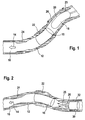
- FIG. 1 shows a highly schematic representation of a section of a blood vessel 10 in a half section through its vessel wall 12. A flow direction of the blood in the vessel 10 is indicated by the arrow 14.
- the system for treating this vessel 10 includes a biocorrodible stent 16 and a drug delivery device in the form of a balloon catheter 18 having a microneedle 20.
- the biocorrodible stent consists of a magnesium alloy of the composition yttrium 3.7-5.5 wt .-%, rare earth: 1.5 - 4.4 wt .-% and balance ⁇ 1 wt .-%, with the magnesium to 100 Wt .-% missing proportion of the alloy occupies.
- the stent 16 is disposed in a vessel portion 22 of the vessel 10, which was initially narrowed as a result of stenosis and expanded by transluminal angioplasty.
- the stent 16 can in a known manner with an application system, for. As a balloon catheter, are brought to the implantation site and there by expansion of its supporting the vessel wall 12 supporting function in the region of the vessel portion 22.
- the balloon catheter 18 injects via its microneedle 20 a drug 26 into the vessel wall 12 when it is inflated.
- the release occurs approximately in a range of 3 to 5 cm in front of the stent 16.
- the in the vessel wall 12, in particular the active substance 26 released by adventitia is distributed by diffusion in the vessel wall 12 in the longitudinal direction (indicated by the two small arrows) as well as in the circumferential direction of the vessel (not shown here). Accordingly, the active substance 26 strikes the vessel section 22 in the region of the stent 16 in the distal direction of the blood flow and in the proximal direction of the blood flow toward the section 25 and can there each develop its pharmacological action.
- an amount of the injected drug depends on the properties of the drug itself (eg, solubility, rate of degradation in the body, rate of diffusion) and its mechanism of action in the organism.
- the amount of active ingredient will be specified so that there is still a sufficient concentration of active compound in the vessel section 24.
- the balloon catheter 18 is deflated and removed again from the blood vessel 10.
- the stent 16 remains in the body, but is gradually degraded by corrosive processes.
- FIG. 2 shows a vessel 10 damaged by an extensive obliterating disease, which in essential features is similar to that of FIG. In that regard, reference is made to the preceding statements and the same reference numerals are used for identical or very similar features.
- the system illustrated in FIG. 2 differs from the system shown in FIG. 1 in that the device for releasing the active substance 26 is an implant 30.
- the implant 30 is tubular contour and is flowed through by the blood.
- the implant 30 has components to which the active substance 26 is bound in pure form or embedded in a suitable matrix, and which are designed such that the passing blood can dissolve or entrain the active substance 26.
- the implant is arranged in a vessel section 32, which is arranged most proximal in the blood flow direction of the diseased part of the vessel 10.
- the implant 30 is preferably formed of a biodegradable material, so that a subsequent surgical removal can be omitted.
Landscapes
- Health & Medical Sciences (AREA)
- Life Sciences & Earth Sciences (AREA)
- Public Health (AREA)
- Vascular Medicine (AREA)
- Heart & Thoracic Surgery (AREA)
- Animal Behavior & Ethology (AREA)
- General Health & Medical Sciences (AREA)
- Veterinary Medicine (AREA)
- Biomedical Technology (AREA)
- Surgery (AREA)
- Epidemiology (AREA)
- Engineering & Computer Science (AREA)
- Chemical & Material Sciences (AREA)
- Inorganic Chemistry (AREA)
- Cardiology (AREA)
- Oral & Maxillofacial Surgery (AREA)
- Transplantation (AREA)
- Medicinal Chemistry (AREA)
- Molecular Biology (AREA)
- Materials For Medical Uses (AREA)
- Media Introduction/Drainage Providing Device (AREA)
Abstract
- ein oder mehrere biokorrodierbare Stents, die voneinander beabstandet in Gefäßabschnitten des erkrankten Gefäßes angeordnet sind, die durch transluminale Angioplastie aufgeweitet wurden, und
- eine zur Freisetzung eines Wirkstoffs im Lumen oder im Gewebe des Gefäßes angepasste Vorrichtung, die ausgebildet ist
(i) zur Freisetzung des Wirkstoffs im Lumen des erkrankten Gefäßes, wobei die Freisetzung des Wirkstoffs in einem Gefäßabschnitt erfolgt, der am weitesten proximal in Blutflussrichtung des Gefäßes angeordnet ist;
oder
(ii) zur Freisetzung des Wirkstoffs im Gewebe des Gefäßes, wobei die Freisetzung des Wirkstoffs in einem oder mehreren Gefäßabschnitten des zu behandelnden Gefäßes erfolgt, so dass sich der Wirkstoff durch Diffusion im Bereich des erkrankten Gefäßes ausbreiten kann.
Description
- Die Erfindung betrifft ein System zur Behandlung ausgedehnter obliterierender Erkrankungen eines Gefäßes.
- Bei einer Vielzahl oblitierender Gefäßerkrankungen ist eine rein systemische Behandlung nicht möglich oder führt nur in einem beschränkten Maße zum Erfolg. So ist es beispielsweise bei akuter Angina pectoris oder gar einem vollständigen Verschluss von Arterien in der Regel notwendig, das Gefäß an der betroffenen Stelle wieder aufzuweiten. Dies kann insbesondere durch perkutane transluminale Angioplastie (PTA, häufig auch als Ballonangioplastie bezeichnet) erfolgen, bei der das Gefäß im betroffenen Gefäßabschnitt aufgeweitet wird.
- Zumeist wird es notwendig sein, den aufgeweiteten Gefäßabschnitt durch Implantation eines Stents zu stabilisieren, um einen erneuten Gefäßverschluss durch Obstruktion des Gefäßes zu verhindern. Stents sind in der Regel als Permanentimplantate ausgelegt, d. h. verbleiben dauerhaft im Körper des Patienten und können nach dem Einwachsen in die Gefäßwand oft auch nicht mehr operativ entfernt werden. Es hat sich allerdings gezeigt, dass die dauerhafte Anwesenheit eines derartigen Implantats selbst Ausgangspunkt für mikrobiologische Prozesse sein kann, die zu einem erneuten Verschluss des Gefäßes führt (Restenose). Um dem abzuhelfen, wurde vorgeschlagen, die Stents mit Medikamenten zu beschichten, die den zugrunde liegenden mikrobiologischen Prozessen entgegenwirken oder diese gar verhindern. Die Herstellung medikamentenbeschichteter Implantate erfordert die Entwicklung und Durchführung spezifischer Produktions-, Validierungs-, Qualitätssicherung- und Zulassungsprozeduren. Mit anderen Worten, die Etablierung derartiger medikamentenbeschichteter Systeme ist in Entwicklung und Herstellung zeitaufwändig und vor allem kostenträchtig.
- Aus
US 6,547,803 B2 ist ein modifizierter Ballonkatheter bekannt, mit dem ein Wirkstoff in das Gewebe eines Gefäßes, insbesondere in die Adventitia der Gefäßwand, injiziert werden kann. Dazu weist der Katheter eine Mikronadel in einem expandierbaren Bereich auf, die in etwa senkrecht nach außen stößt und dabei durch die Gefäßwand dringt, wenn der Ballon inflatiert wird. Die Nadel ist mit einem Wirkstoffdepot verbunden und der Wirkstoff kann so in tiefere Gewebeschichten der Gefäßwand eingebracht werden. Es wurde festgestellt, dass sich der Wirkstoff innerhalb der Gefäßwand durch Diffusion weiter ausbreitet. Somit ist eine medikamentöse Behandlung im Gewebe des Gefäßes über einen sich der Injektionsstelle hinausreichenden Bereich möglich. - Aus der
US-Patentanmeldung 2004/0010309 A1 ist ein Verfahren und ein dazugehöriges System zur Bereitstellung einer flüssigen Substanz im umgebenen Gewebe eines Blutgefäßes, insbesondere einer Koronararterie, bekannt. Das System umfasst einen Katheter der inUS 6,547,803 B2 beschriebenen Art, mit einer Injektionsnadel, über die die flüssige Substanz in das Gewebe eingebracht wird. Weiterhin umfasst das System einen Stent mit einer für die injizierte flüssige Substanz absorptiven Struktur. Nach dem Verfahren wird die Substanz benachbart zum Stützgerüst in das Gewebe des Gefäßes injiziert, von der absorptiven Struktur des Stützgerüstes absorbiert und nach erfolgter Absorption wieder frei gesetzt. Das Stützgerüst wird vor, während oder nach der Injektion der Substanz implantiert. - Stents können auch aus einem biokorrodierbaren Werkstoff hergestellt werden. Diesem Ansatz liegt die Erkenntnis zugrunde, dass die Stützfunktion des Implantates in der Regel nur für einige Wochen bis wenige Monate aufrechterhalten werden muss, in denen sich der behandelte Gefäßabschnitt zumeist schon weitgehend regeneriert hat. Denkbar wäre es, biokorrodierbare Implantate mit Medikamenten zu beschichten, die etwaigen, durch den operativen Eingriff induzierten mikrobiologischen Prozessen entgegenwirken, die zur Restenose führen könnten. Erkenntnisse zur Medikamentenbeschichtung permanenter Implantate lassen sich jedoch nicht einfach auf biokorrodierbare Implantate übertragen, denn hier treten besondere Schwierigkeiten auf. So hat eine Medikamentenbeschichtung, sei es als reiner Wirkstoff oder eingebettet in eine geeignete Matrix, erheblichen Einfluss auf die korrosiven Prozesse, die zum Abbau des Implantates führen. Umgekehrt beeinflussen die korrosiven Prozesse und die dabei entstehenden Abbauprodukte die Elution und Stabilität des Medikaments. Die Wechselwirkungen sind komplex und lassen sich im Allgemeinen nur tendenziell voraussagen. Produktions-, Validierungs-, Qualitätssicherungs- und Zulassungsprozeduren für einen biokorrodierbaren Stent sind entsprechend aufwendig und mit einem erheblichen Kostenaufwand verbunden.
- Aufgabe der vorliegenden Erfindung ist es, ein System zur Behandlung ausgedehnter obliterierender Erkrankungen eines Gefäßes bereitzustellen, das einerseits auf Stents aus biokorrodierbaren Werkstoffen zurückgreift und andererseits eine medikamentöse Behandlung des erkrankten Gefäßes ermöglicht. Dabei soll beiden Aspekten der Behandlung soweit Rechnung getragen werden, dass störende Wechselwirkungen vermieden oder zumindest weitgehend unterdrückt werden.
- Das erfindungsgemäße System zur Behandlung ausgedehnter obliterierender Erkrankungen eines Gefäßes, in dem ein Schweregrad der Erkrankung in verschiedenen Gefäßabschnitten des Gefäßes differiert, löst diese Aufgabe.
- Das System umfasst:
- ein oder mehrere biokorrodierbare Stents, die voneinander beabstandet in Gefäßabschnitten des erkrankten Gefäßes angeordnet sind, die durch transluminale Angioplastie aufgeweitet wurden, und
- zur Freisetzung eines Wirkstoffs im Lumen oder im Gewebe des Gefäßes angepasste Vorrichtung, die ausgebildet ist
- (i) zur Freisetzung des Wirkstoffs im Lumen des erkrankten Gefäßes, wobei die Freisetzung des Wirkstoffs in einem Gefäßabschnitt erfolgt, der am weitesten proximal in Blutflussrichtung des Gefäßes angeordnet ist;
- (ii) zur Freisetzung des Wirkstoffs im Gewebe des Gefäßes, wobei die Freisetzung des Wirkstoffs in einem oder mehreren Gefäßabschnitten des zu behandelnden Gefäßes erfolgt, so dass sich der Wirkstoff durch Diffusion im Bereich des erkrankten Gefäßes ausbreiten kann.
- Der Erfindung liegt die Erkenntnis zugrunde, dass eine Entflechtung der Anforderung an die Wirkstoffverteilung im Lumen oder Gewebe des erkrankten Gefäßes, insbesondere auch in die Tiefe des vaskulären Gewebes, sowie an eine exakte, eventuell an die individuellen Patientenbedürfnisse angepasste Dosierung, von den Anforderung an die mechanischen Eigenschaften der biokorrosiven Stents (z. B. Degradationsverhalten, Seitenzugänglichkeit, geometrische Optimierung auf maximale Stützwirkung bei minimaler Gefäßwandabdeckung durch alloplastisches Material) insgesamt zu einer Verbesserung der Behandlung und damit Steigerung des Behandlungserfolgs führt. Die konsequente Trennung zwischen dem korrodierenden Implantat und der Vorrichtung für Wirkstoffe ermöglicht auch eine deutliche Vereinfachung der Produktions-, Validierungs-, Qualitätssicherungs- und Zulassungsprozeduren der biokorrosiven Stents, da eine medikamentöse Beschichtung der Stents Stents, da eine medikamentöse Beschichtung der Stents nicht notwendig ist. Unerwünschte Wechselwirkungen zwischen dem Wirkstoff bzw. einer den Wirkstoff aufnehmenden Matrix und den korrosiven Prozessen beim Abbau des Stents bzw. den Abbauprodukten der Degradation können vermieden oder zumindest deutlich gemindert werden.
- Nach einer bevorzugten Ausführungsform der Erfindung besteht der Stent aus einer biokorrosiven Metalllegierung, insbesondere einer biokorrosiven Magnesiumlegierung. Die biokorrosive Magnesiumlegierung ist weiterhin vorzugsweise eine Legierung der Zusammensetzung
- Yttrium :
- 3,7 - 5,5 Gew.-%
- Seltene Erden :
- 1,5 - 4,4 Gew.-% und
- Rest :
- < 1 Gew.-%,
wobei Magnesium den auf 100 Gew.-% fehlenden Anteil an der Legierung einnimmt. Stents aus vorgenannten Werkstoffen zeichnen sich durch ihre günstigen mechanischen Eigenschaften gegenüber synthetischen oder aus natürlichen Quellen hergestellten biokorrodierbaren Polymeren aus. Weiterhin lassen sich insbesondere biokorrosive Magnesiumlegierungen leicht verarbeiten und die Abbauprodukte der Legierung sind sehr körperverträglich. - Nach einer weiteren bevorzugten Ausführungsform der Erfindung ist die Vorrichtung ein zur Freisetzung eines Wirkstoffes hergerichteter Ballonkatheter oder ein zur Freisetzung eines Wirkstoffes hergerichtetes Implantat.
- Ferner ist bevorzugt, dass die Vorrichtung so angeordnet ist, dass die Freisetzung des Wirkstoffs in das Lumen des Gefäßes mindestens etwa 1 cm, insbesondere mindestens etwa 5 cm, zum nächstliegenden Stent entfernt erfolgt. Weiterhin ist bevorzugt, dass die Vorrichtung so angeordnet ist, dass die Freisetzung des Wirkstoffs im Gewebe des Gefäßes mindestens etwa 0,2 cm, insbesondere mindestens etwa 0,5 cm, zum nächstliegenden Stent entfernt erfolgt. Hiermit wird berücksichtigt, dass die Freisetzung der Wirkstoffe in relativer Nähe zu den erkrankten Gefäßabschnitten, aber nicht unmittelbar am Stent erfolgen sollte, um Wechselwirkungen zwischen dem freigesetzten Wirkstoff und den Produkten des korrosiven Prozesses beim Abbau des Stents zu vermeiden oder zumindest gering zu halten.
- Ein dazugehöriges erfindungsgemäßes Verfahren zur Behandlung ausgedehnter obliterierender Erkrankungen eines Gefäßes, in dem ein Schweregrad der Erkrankung in verschiedenen Gefäßabschnitten des Gefäßes differiert, umfasst die Schritte:
- (a) Bereitstellen einer zur Freisetzung eines Wirkstoffs im Lumen oder im Gewebe des Gefäßes angepassten Vorrichtung,
- (b) Aufweiten einzelner Gefäßabschnitte des Gefäßes durch transluminale Angioplastie,
- (c) Einsetzen eines oder mehrerer biokorrodierbarer Stents in die durch transluminale Angioplastie aufgeweiteten Gefäßabschnitte, und
- (d) Freisetzen des Wirkstoffes mittels der Vorrichtung vor, während oder nach Schritt (c), wobei
- (I) die Freisetzung des Wirkstoffs in das Lumen des Gefäßes in einem Gefäßabschnitt erfolgt, der am weitesten proximal in Blutflussrichtung des Gefäßes angeordnet ist;
- (II) die Freisetzung des Wirkstoffs im Gewebe des Gefäßes in einem oder mehreren Gefäßabschnitten des zu behandelnden Gefäßes erfolgt, so dass sich der Wirkstoff durch Diffusion im Bereich des erkrankten Gefäßes ausbreiten kann.
- Nach dem Verfahren können demnach ausgedehnte obliterierende Erkrankungen eines Gefäßes differenziert nach dem Schweregrad der Erkrankung in einzelnen Gefäßabschnitten behandelt werden. Nur die durch transluminale Angioplastie aufgeweiteten Bereiche werden mit einem Stent zur Vermeidung einer Restenose durch Obstruktion des Gefäßes abgestützt. In den weiteren Gefäßabschnitten erfolgt eine Behandlung nur durch Freisetzung des Wirkstoffs. Das Verfahren eignet sich insbesondere zur Behandlung stark verkalkter Gefäßabschnitte.
- Das Verfahren erfolgt vorzugsweise unter Freisetzung des Wirkstoffs in das Gewebe, insbesondere die Adventitia des Gefäßes.
- Das Verfahren und das System eignen sich insbesondere zur Freisetzung von Wirkstoffen im Zusammenspiel mit biokorrosiven Stents aus einer Magnesiumlegierung, insbesondere der obig angegebenen bevorzugten Zusammensetzung. Besonders bevorzugt sind dabei Wirkstoffe, die im alkalischen Milieu nicht stabil sind oder durch Komplexbildung mit Magnesiumionen deaktiviert werden. Vorzugsweise sind in diesem Zusammenhang die Wirkstoffe Paclitaxel, Sirolimus und Pimecrolimus genannt.
- Ferner ist bevorzugt, wenn die Vorrichtung nach dem Freisetzen der Wirkstoffe entfernt wird.
-
- Figur 1 zeigt einen Ausschnitt aus einem Blutgefäß, enthaltend das erfindungsgemäße System in einer ersten Variante; und
- Figur 2 zeigt einen Ausschnitt aus einem Blutgefäß, enthaltend das erfindungsgemäße System in einer zweiten Variante.
- Die Erfindung betrifft ein System und ein Verfahren zur Behandlung ausgedehnter obliterierender Erkrankungen eines Gefäßes, in dem ein Schweregrad der Erkrankung in verschiedenen Gefäßabschnitten des Gefäßes differiert. Das erfindungsgemäße System wurde bereits vorangehend skizziert und umfasst eine bestimmte Anordnung ein oder mehrerer biokorrodierbarer Stents im Gefäß und eine zur Freisetzung eines Wirkstoffs im Lumen oder im Gewebe des Gefäßes in bestimmter Weise angepasste Vorrichtung.
- Unter "Obliteration" wird vorliegend ein Lichtungsverschluss eines Gefäßes, insbesondere durch entzündliche Prozesse (Pleuritis, Perikarditis, Endangiitis), Neoplasma oder Thrombus, verstanden.
- "Obliterierende Gefäßkrankheiten" (oder auch Verschlusskrankheiten) betreffen im Sinne der Erfindung:
- (i) arteriell: Arteriosklerose, diabetische Angiopathie, entzündliche Gefäßkrankheiten (Arteriitis, Endangiitis), Thrombosen, Embolien
- a) im Extremitätenbereich: periphere arterielle Verschlusskrankheit
- b) viszeral (z.B. Karotisverschluss, koronare Herzkrankheit, Nierenarterienstenose, Verschlüsse größerer Aortenäste); und
- (ii) venös: tiefe Venenthrombose, Thrombophlebitis, Phlebitis.
- Unter "Gefäß" im Sinne der Erfindung wird die Gesamtheit der arteriellen und venösen Blutgefäße einschließlich der Gefäße der Endstrombahn, die zusammen mit dem Herzen eine funktionelle Einheit bilden, verstanden. Ein solches Gefäß weist ein inneres Lumen auf, durch das das Blut strömt. Das Gefäß wird geometrisch durch seine Gefäßwand definiert, die sich von innen ausgehend von der Intima bis hin zur Adventitia erstreckt.
- Unter "ausgedehnt" wird vorliegend, ein längerer Abschnitt des Gefäßes verstanden, der in mindestens zwei Gefäßabschnitte mit unterschiedlichem Schweregrad der obliterierenden Erkrankung gegliedert ist. Dabei ist wenigstens ein Gefäßabschnitt so stark geschädigt, dass eine transluminale Angioplastie zur Aufweitung indiziert ist, und wenigstens ein Gefäßabschnitt vorhanden, in dem dies nicht notwendig ist. Ein "Schweregrad der Erkrankung" im erfindungsgemäßen Sinne stellt demnach zunächst darauf ab, ob der jeweils erkrankte Gefäßabschnitt durch transluminale Angioplastie zur Wiederherstellung seiner Funktionalität aufgeweitet werden muss, oder eben nicht. Zur Einstellung einer Dosierung des freizusetzenden Wirkstoffs kann weiterhin der Schweregrad der Erkrankung differenzierter einfließen, d. h. der Umfang der durch die Erkrankung erfolgten krankhaften Veränderungen im Gefäß kann bei der Einstellung der Dosierung des Wirkstoffs berücksichtigt werden. Vorzugsweise erstreckt sich eine ausgedehnte obliterierende Erkrankung eines Gefäßes im erfindungsgemäßen Sinne über eine Länge des Gefäßes im Bereich von 5 bis 70 cm, insbesondere im Bereich von 10 bis 50 cm.
- "Transluminale Angioplastie" beinhaltet vorliegend eine geschlossene perkutane (= perkutane transluminale) Aufdehnung von Gefäßen mit Hilfe koaxialer Katheter oder - heute meist - mittels Ballonkatheters, evtl. als Zusatzmaßnahme bei einer Gefäßoperation. Dies umfasst auch eine perkutane transluminale koronare Angioplastie (PTCA) zur Dehnung von Stenosen der Herzkranzgefäße (= Koronarangioplastie). Die Angioplastie ist neuerdings auch mit Laser- und diversen anderen Techniken möglich.
- Unter einer "zur Freisetzung eines Wirkstoffs im Lumen oder im Gewebe des Gefäßes angepassten Vorrichtung" im erfindungsgemäßen Sinne wird eine Vorrichtung verstanden, mit der ein oder mehrere Wirkstoffe aktiv oder passiv im Lumen oder Gewebe des Gefäßes freigesetzt werden können. Aktive Vorrichtungen umfassen Aktuatoren, deren Betätigung den Wirkstoff zum Ort der Freisetzung befördert. Passive Vorrichtungen beinhalten Strukturelemente, die eine Freisetzung der Wirkstoffe durch Diffusion oder in Folge korrosiver Prozesse ermöglichen.
- Eine aktive Vorrichtung ist vorzugsweise ein zur Freisetzung von Wirkstoffen hergerichteter Ballonkatheter. Ein derartiger Ballonkatheter kann beispielsweise mit dem Wirkstoff beschichtet sein, oder ist so ausgebildet, dass er bei Inflation des Ballons den Wirkstoff aus einem Depot an den gewünschten Ort der Freisetzung befördert. Besonders bevorzugt ist ein Ballonkatheter mit einer Mikronadel, wie er im
US-Patent 6,547,803 B2 und in derUS-Patentanmeldung 2004/0010309 A1 beschrieben ist. Der Inhalt der beiden Dokumente wird hiermit vollumfänglich durch Verweis einbezogen. - Eine passive Vorrichtung kann vorzugsweise als Implantat ausgebildet sein, das in der Gefäßwand verankert wird. Das Implantat beinhalte Strukturelemente, die eine Freisetzung des Wirkstoffs durch Diffusion oder in Folge korrosiver Prozesse ermöglichen. Beispielsweise umfassen diese Strukturelemente flächige Abschnitte mit Vertiefungen, Kammern oder dergleichen, in die der Wirkstoff in einer zur Applikation geeigneten Darreichungsform eingebettet ist. Wenn die flächigen Abschnitte im Lumen des Gefäßes angeordnet sind, wird durch das vorbeiströmende Blut der Wirkstoff herausgelöst bzw. mitgerissen. Liegen die flächigen Abschnitte an der Gefäßwand an, so sind Diffusionsprozesse eher dominierend und der Wirkstoff kann in das Gewebe der Gefäßwand eindringen. Auch die passiven Vorrichtungen können dazu ausgelegt sein, den Wirkstoff in tiefer liegende Gewebsabschnitte der Gefäßwand einzubringen. So beispielsweise durch ein Wirkstoffdepot, das mit einer Mikrokanüle verbunden ist, die beim Platzieren der Vorrichtung durch die Gefäßwand dringt. Aus dem Depot kann dann der Wirkstoff durch Diffusion freigesetzt werden. Vorzugsweise bestehen die passiven Vorrichtungen aus einem biokorrosiven Werkstoff.
- Ein "Wirkstoff" im Sinne der Erfindung ist ein pflanzlicher, tierischer oder synthetisierter Stoff, der in geeigneter Dosierung als Therapeutika zur Beeinflussung von Zuständen oder Funktionen des Körpers, als Ersatz für natürlich vom menschlichen oder tierischen Körper erzeugte Wirkstoffe oder Körperflüssigkeiten sowie zur Beseitigung oder zum Unschädlichmachen von Krankheitserregern, Parasiten oder körperfremden Stoffen dient. Die eingesetzten Wirkstoffe sind demnach Arzneimittel und dienen insbesondere der Vorbeugung und Behandlung obliterierender Erkrankungen des Gefäßes. Die zu Zwecken der Freisetzung im Gewebe des Gefäßes verwendeten Wirkstoffe sind vorzugsweise lipophil, da sich lipophile Wirkstoffe besonders gleichmäßig durch Diffusion im Gewebe verteilen. Mit dem System und dem dazugehörigen Verfahren können auch mehrere Wirkstoffe gleichzeitig oder zeitlich versetzt verabreicht werden.
- Figur 1 zeigt - stark schematisiert - einen Ausschnitt aus einem Blutgefäß 10 in einem Halbschnitt durch seine Gefäßwand 12. Eine Strömungsrichtung des Blutes im Gefäß 10 wird durch den Pfeil 14 angedeutet.
- Das System zur Behandlung dieses Gefäßes 10 umfasst einen biokorrodierbaren Stent 16 und eine Vorrichtung zur Wirkstofffreisetzung in Form eines Ballonkatheters 18 mit einer Mikronadel 20.
- Der biokorrodierbare Stent besteht aus einer Magnesiumlegierung der Zusammensetzung Yttrium 3,7 - 5,5 Gew.-%, Seltene Erde: 1,5 - 4,4 Gew.-% und Rest < 1 Gew.-%, wobei Magnesium den auf 100 Gew.-% fehlenden Anteil an der Legierung einnimmt. Der Stent 16 ist in einem Gefäßabschnitt 22 des Gefäßes 10 angeordnet, der zunächst in Folge einer Stenose verengt war und durch transluminale Angioplastie aufgeweitet wurde. Der Stent 16 kann in bekannter Weise mit einem Applikationssystem, z. B. einem Ballonkatheter, an den Implantationsort verbracht werden und dort durch Expansion seiner die Gefäßwand 12 stützenden Funktion im Bereich des Gefäßabschnittes 22 nachkommen.
- Zwei weitere Abschnitte 24, 25 des Gefäßes 10 sind bereits durch Kalzifizierung verengt; jedoch rechtfertigt das bisherige Ausmaß der Ablagerung noch keine transluminale Angioplastie und nachfolgende Implantation eines weiteren Stents in diesen Abschnitten 24, 25. Es können jedoch noch weitere Stents im zu behandelnden Gefäß angeordnet sein.
- Der Ballonkatheter 18 injiziert über seine Mikronadel 20 einen Wirkstoff 26 in die Gefäßwand 12, wenn er inflatiert wird. Die Freisetzung erfolgt etwa in einem Bereich von 3 bis 5 cm vor dem Stent 16. Der in der Gefäßwand 12, insbesondere der Adventitia freigesetzte Wirkstoff 26 verteilt sich durch Diffusion in der Gefäßwand 12 in longitudinaler Richtung (angedeutet durch die beiden kleinen Pfeile) als auch im Umfangsrichtung des Gefäßes (hier nicht dargestellt). Demnach trifft der Wirkstoff 26 in distaler Blutflussrichtung zunächst auf den Gefäßabschnitt 22 im Bereich des Stents 16 und in proximaler Blutflussrichtung auf den Abschnitt 25 und kann dort jeweils seine pharmakologische Wirkung entfalten.
- Eine Menge des injizierten Wirkstoffes hängt selbstverständlich von den Eigenschaften des Wirkstoffes selbst (z. B. Löslichkeit, Abbaugeschwindigkeit im Körper, Diffusionsgeschwindigkeit) und seinem Wirkmechanismus im Organismus ab. Die Wirkstoffmenge wird aber so vorzugeben sein, dass noch eine hinreichende Wirkstoffkonzentration auch im Gefäßabschnitt 24 gegeben ist.
- Nach der Injektion des Wirkstoffs 26 wird der Ballonkatheter 18 deflatiert und wieder dem Blutgefäß 10 entnommen. Der Stent 16 verbleibt im Körper, wird jedoch allmählich durch korrosive Prozesse abgebaut.
- Figur 2 zeigt ein durch eine ausgedehnte obliterierende Erkrankung geschädigtes Gefäß 10, das in wesentlichen Zügen dem aus Figur 1 gleicht. Insoweit wird auf vorangehende Ausführungen verwiesen und es werden gleiche Bezugszeichen für gleiche oder sehr ähnliche Merkmale verwendet.
- Das in Figur 2 dargestellte System unterscheidet sich von dem in Figur 1 dargestellten System dadurch, dass die Vorrichtung zur Freisetzung des Wirkstoffs 26 ein Implantat 30 ist. Das Implantat 30 ist rohrförmiger Kontur und wird vom Blut durchströmt. In seinem Innern weist das Implantat 30 Bauelemente auf, an denen der Wirkstoff 26 in reiner Form oder eingebettet in eine geeignete Matrix gebunden ist, und die so ausgelegt sind, dass das vorbeiströmende Blut den Wirkstoff 26 lösen oder mitreißen kann. Das Implantat ist in einem Gefäßabschnitt 32 angeordnet, der am weitesten proximal in Blutflussrichtung des erkrankten Teils des Gefäßes 10 angeordnet ist. Das Implantat 30 ist vorzugsweise aus einem biodegradierbaren Material geformt, so dass eine nachträgliche operative Entfernung entfallen kann.
Claims (10)
- System zur Behandlung ausgedehnter obliterierender Erkrankungen eines Gefäßes, in dem ein Schweregrad der Erkrankung in verschiedenen Gefäßabschnitten des Gefäßes differiert, umfassend:- ein oder mehrere biokorrodierbare Stents, die voneinander beabstandet in Gefäßabschnitten des erkrankten Gefäßes angeordnet sind, die durch transluminale Angioplastie aufgeweitet wurden, und- eine zur Freisetzung eines Wirkstoffs im Lumen oder im Gewebe des Gefäßes angepasste Vorrichtung, die ausgebildet ist(i) zur Freisetzung des Wirkstoffs im Lumen des erkrankten Gefäßes, wobei die Freisetzung des Wirkstoffs in einem Gefäßabschnitt erfolgt, der am weitesten proximal in Blutflussrichtung des Gefäßes angeordnet ist;oder(ii) zur Freisetzung des Wirkstoffs im Gewebe des Gefäßes, wobei die Freisetzung des Wirkstoffs in einem oder mehreren Gefäßabschnitten des zu behandelnden Gefäßes erfolgt, so dass sich der Wirkstoff durch Diffusion im Bereich des erkrankten Gefäßes ausbreiten kann.
- System nach Anspruch 1, bei dem der Stent aus einer biokorrosiven Metalllegierung besteht.
- System nach Anspruch 2, bei dem der Stent aus einer biokorrosiven Magnesiumlegierung besteht.
- System nach Anspruch 3, bei dem die biokorrosive Magnesiumlegierung eine Legierung der ZusammensetzungYttrium: 3,7 - 5,5 Gew.-%,Seltene Erden: 1,5 - 4,4 Gew.-% undRest: < 1 Gew.-%,ist, wobei Magnesium den auf 100 Gew.-% fehlenden Anteil an der Legierung einnimmt.
- System nach Anspruch 1, bei dem die Vorrichtung ein zur Freisetzung eines Wirkstoffs hergerichteter Ballonkatheter ist.
- System nach Anspruch 1, bei dem die Vorrichtung ein zur Freisetzung eines Wirkstoffs hergerichtetes Implantat ist.
- System nach Anspruch 1, bei dem die Vorrichtung so angeordnet ist, dass die Freisetzung des Wirkstoffs in das Lumen des Gefäßes mindestens etwa 1 cm, insbesondere mindestens etwa 5 cm, zum nächstliegenden Stent entfernt erfolgt.
- System nach Anspruch 1, bei dem die Vorrichtung so angeordnet ist, dass die Freisetzung des Wirkstoffs im Gewebe des Gefäßes mindestens etwa 0,2 cm, insbesondere mindestens etwa 0,5 cm, zum nächstliegenden Stent entfernt erfolgt.
- Verfahren zur Behandlung ausgedehnter obliterierender Erkrankungen eines Gefäßes, in dem ein Schweregrad der Erkrankung in verschiedenen Gefäßabschnitten des Gefäßes differiert, umfassend die Schritte:(a) Bereitstellen einer zur Freisetzung eines Wirkstoffs im Lumen oder im Gewebe des Gefäßes angepassten Vorrichtung,(b) Aufweiten einzelner Gefäßabschnitte des Gefäßes durch transluminale Angioplastie,(c) Einsetzen eines oder mehrerer biokorrodierbarer Stents in die durch transluminale Angioplastie aufgeweiteten Gefäßabschnitte, und(d) Freisetzen des Wirkstoffes mittels der Vorrichtung vor, während oder nach Schritt (c), wobei(I) die Freisetzung des Wirkstoffs in das Lumen des Gefäßes in einem Gefäßabschnitt erfolgt, der am weitesten proximal in Blutflussrichtung des Gefäßes angeordnet ist;oder wobei(II) die Freisetzung des Wirkstoffs im Gewebe des Gefäßes in einem oder mehreren Gefäßabschnitten des zu behandelnden Gefäßes erfolgt, so dass sich der Wirkstoff durch Diffusion im Bereich des erkrankten Gefäßes ausbreiten kann.
- Verfahren nach Anspruch 9, bei dem die Wirkstoffe Paclitaxel, Sirolimus und Pimecrolimus freigesetzt werden.
Applications Claiming Priority (1)
| Application Number | Priority Date | Filing Date | Title |
|---|---|---|---|
| DE102005013221A DE102005013221A1 (de) | 2005-03-17 | 2005-03-17 | System zur Behandlung ausgedehnter obliterierender Erkrankungen eines Gefäßes |
Publications (2)
| Publication Number | Publication Date |
|---|---|
| EP1702592A1 true EP1702592A1 (de) | 2006-09-20 |
| EP1702592B1 EP1702592B1 (de) | 2018-07-11 |
Family
ID=36591263
Family Applications (1)
| Application Number | Title | Priority Date | Filing Date |
|---|---|---|---|
| EP06004321.3A Expired - Lifetime EP1702592B1 (de) | 2005-03-17 | 2006-03-03 | System zur Behandlung ausgedehnter obliterierender Erkrankungen eines Gefässes |
Country Status (3)
| Country | Link |
|---|---|
| US (1) | US20060212108A1 (de) |
| EP (1) | EP1702592B1 (de) |
| DE (1) | DE102005013221A1 (de) |
Cited By (1)
| Publication number | Priority date | Publication date | Assignee | Title |
|---|---|---|---|---|
| CN101085377B (zh) * | 2007-06-11 | 2011-05-04 | 沈阳工业大学 | 一种用于可降解血管支架的镁合金超细薄壁管成形工艺 |
Families Citing this family (24)
| Publication number | Priority date | Publication date | Assignee | Title |
|---|---|---|---|---|
| AU2002345328A1 (en) | 2001-06-27 | 2003-03-03 | Remon Medical Technologies Ltd. | Method and device for electrochemical formation of therapeutic species in vivo |
| US8840660B2 (en) | 2006-01-05 | 2014-09-23 | Boston Scientific Scimed, Inc. | Bioerodible endoprostheses and methods of making the same |
| US8089029B2 (en) | 2006-02-01 | 2012-01-03 | Boston Scientific Scimed, Inc. | Bioabsorbable metal medical device and method of manufacture |
| US8048150B2 (en) | 2006-04-12 | 2011-11-01 | Boston Scientific Scimed, Inc. | Endoprosthesis having a fiber meshwork disposed thereon |
| EP2054537A2 (de) | 2006-08-02 | 2009-05-06 | Boston Scientific Scimed, Inc. | Endoprothese mit dreidimensionaler desintegrationssteuerung |
| US20080086201A1 (en) * | 2006-09-15 | 2008-04-10 | Boston Scientific Scimed, Inc. | Magnetized bioerodible endoprosthesis |
| CA2663250A1 (en) | 2006-09-15 | 2008-03-20 | Boston Scientific Limited | Bioerodible endoprostheses and methods of making the same |
| EP2121068B1 (de) | 2006-09-15 | 2010-12-08 | Boston Scientific Scimed, Inc. | Biologisch erodierbare endoprothese mit biostabilen anorganischen schichten |
| EP2959925B1 (de) | 2006-09-15 | 2018-08-29 | Boston Scientific Limited | Medizinische vorrichtungen und verfahren zu ihrer herstellung |
| JP2010503494A (ja) | 2006-09-15 | 2010-02-04 | ボストン サイエンティフィック リミテッド | 生分解性内部人工器官およびその製造方法 |
| JP2010503490A (ja) | 2006-09-15 | 2010-02-04 | ボストン サイエンティフィック リミテッド | 調整可能な表面特徴を備えた内部人工器官 |
| US8002821B2 (en) | 2006-09-18 | 2011-08-23 | Boston Scientific Scimed, Inc. | Bioerodible metallic ENDOPROSTHESES |
| CA2674195A1 (en) | 2006-12-28 | 2008-07-10 | Boston Scientific Limited | Bioerodible endoprostheses and methods of making same |
| US8052745B2 (en) | 2007-09-13 | 2011-11-08 | Boston Scientific Scimed, Inc. | Endoprosthesis |
| US7998192B2 (en) | 2008-05-09 | 2011-08-16 | Boston Scientific Scimed, Inc. | Endoprostheses |
| US8236046B2 (en) | 2008-06-10 | 2012-08-07 | Boston Scientific Scimed, Inc. | Bioerodible endoprosthesis |
| US7985252B2 (en) | 2008-07-30 | 2011-07-26 | Boston Scientific Scimed, Inc. | Bioerodible endoprosthesis |
| US8382824B2 (en) | 2008-10-03 | 2013-02-26 | Boston Scientific Scimed, Inc. | Medical implant having NANO-crystal grains with barrier layers of metal nitrides or fluorides |
| US8267992B2 (en) | 2009-03-02 | 2012-09-18 | Boston Scientific Scimed, Inc. | Self-buffering medical implants |
| US8435281B2 (en) | 2009-04-10 | 2013-05-07 | Boston Scientific Scimed, Inc. | Bioerodible, implantable medical devices incorporating supersaturated magnesium alloys |
| WO2011119573A1 (en) | 2010-03-23 | 2011-09-29 | Boston Scientific Scimed, Inc. | Surface treated bioerodible metal endoprostheses |
| CA2802753C (en) | 2010-06-21 | 2018-07-31 | Zorion Medical, Inc. | Bioabsorbable implants |
| US8986369B2 (en) | 2010-12-01 | 2015-03-24 | Zorion Medical, Inc. | Magnesium-based absorbable implants |
| CN112336500A (zh) * | 2020-11-13 | 2021-02-09 | 山东瑞安泰医疗技术有限公司 | 一种可溶性多微针的药物支架 |
Citations (6)
| Publication number | Priority date | Publication date | Assignee | Title |
|---|---|---|---|---|
| EP0714640A1 (de) * | 1994-11-28 | 1996-06-05 | Advanced Cardiovascular Systems, Inc. | System und Verfahren zum Einführen mehrerer Stents |
| US20020111603A1 (en) | 1996-12-02 | 2002-08-15 | Societe De Conseils De Recherches Et D'application | Device for local administration of solid or semi-solid formulations and delayed-release formulations for proposal parental administration and preparation process |
| US6547803B2 (en) | 2001-09-20 | 2003-04-15 | The Regents Of The University Of California | Microfabricated surgical device for interventional procedures |
| US20040010309A1 (en) | 2002-06-28 | 2004-01-15 | Endobionics, Inc. | Methods and systems for delivering liquid substances to tissues surrounding body lumens |
| EP1419793A1 (de) * | 2002-11-13 | 2004-05-19 | Biotronik GmbH & Co. KG | Endoprothese mit einer Trägerstruktur aus einer Magnesiumlegierung |
| US20040243224A1 (en) * | 2003-04-03 | 2004-12-02 | Medtronic Vascular, Inc. | Methods and compositions for inhibiting narrowing in mammalian vascular pathways |
Family Cites Families (6)
| Publication number | Priority date | Publication date | Assignee | Title |
|---|---|---|---|---|
| CA1322628C (en) * | 1988-10-04 | 1993-10-05 | Richard A. Schatz | Expandable intraluminal graft |
| US6464660B2 (en) * | 1996-09-05 | 2002-10-15 | Pharmasonics, Inc. | Balloon catheters having ultrasonically driven interface surfaces and methods for their use |
| US20030139803A1 (en) * | 2000-05-30 | 2003-07-24 | Jacques Sequin | Method of stenting a vessel with stent lumenal diameter increasing distally |
| US6254632B1 (en) * | 2000-09-28 | 2001-07-03 | Advanced Cardiovascular Systems, Inc. | Implantable medical device having protruding surface structures for drug delivery and cover attachment |
| DE10237572A1 (de) * | 2002-08-13 | 2004-02-26 | Biotronik Meß- und Therapiegeräte GmbH & Co. Ingenieurbüro Berlin | Stent mit polymerer Beschichtung |
| US20070135908A1 (en) * | 2005-12-08 | 2007-06-14 | Zhao Jonathon Z | Absorbable stent comprising coating for controlling degradation and maintaining pH neutrality |
-
2005
- 2005-03-17 DE DE102005013221A patent/DE102005013221A1/de not_active Withdrawn
-
2006
- 2006-03-03 EP EP06004321.3A patent/EP1702592B1/de not_active Expired - Lifetime
- 2006-03-16 US US11/376,925 patent/US20060212108A1/en not_active Abandoned
Patent Citations (6)
| Publication number | Priority date | Publication date | Assignee | Title |
|---|---|---|---|---|
| EP0714640A1 (de) * | 1994-11-28 | 1996-06-05 | Advanced Cardiovascular Systems, Inc. | System und Verfahren zum Einführen mehrerer Stents |
| US20020111603A1 (en) | 1996-12-02 | 2002-08-15 | Societe De Conseils De Recherches Et D'application | Device for local administration of solid or semi-solid formulations and delayed-release formulations for proposal parental administration and preparation process |
| US6547803B2 (en) | 2001-09-20 | 2003-04-15 | The Regents Of The University Of California | Microfabricated surgical device for interventional procedures |
| US20040010309A1 (en) | 2002-06-28 | 2004-01-15 | Endobionics, Inc. | Methods and systems for delivering liquid substances to tissues surrounding body lumens |
| EP1419793A1 (de) * | 2002-11-13 | 2004-05-19 | Biotronik GmbH & Co. KG | Endoprothese mit einer Trägerstruktur aus einer Magnesiumlegierung |
| US20040243224A1 (en) * | 2003-04-03 | 2004-12-02 | Medtronic Vascular, Inc. | Methods and compositions for inhibiting narrowing in mammalian vascular pathways |
Cited By (1)
| Publication number | Priority date | Publication date | Assignee | Title |
|---|---|---|---|---|
| CN101085377B (zh) * | 2007-06-11 | 2011-05-04 | 沈阳工业大学 | 一种用于可降解血管支架的镁合金超细薄壁管成形工艺 |
Also Published As
| Publication number | Publication date |
|---|---|
| EP1702592B1 (de) | 2018-07-11 |
| DE102005013221A1 (de) | 2006-09-21 |
| US20060212108A1 (en) | 2006-09-21 |
Similar Documents
| Publication | Publication Date | Title |
|---|---|---|
| EP1702592B1 (de) | System zur Behandlung ausgedehnter obliterierender Erkrankungen eines Gefässes | |
| DE60126146T2 (de) | Stent zur behandlung von restenosis in einem stent | |
| DE60303705T2 (de) | Beschichteter Stent für die Freisetzung aktiver Substanzen | |
| EP1562565B1 (de) | Verwendung eines oder mehrerer der elemente aus der gruppe yttrium, neodym und zirconium | |
| DE69920185T2 (de) | Vorrichtung zur Implantation von expandierbaren Stents | |
| EP1539267B1 (de) | Medizinische vorrichtung zur arzneimittelabgabe | |
| DE69624517T2 (de) | Expandierbarer stent mit herausragenden widerhaken | |
| DE602004010344T2 (de) | Katheter ohne Ballon zum Einsetzen eines Stents | |
| DE60217505T2 (de) | Vorrichtungen zur Abgabe von therapeutischen Mitteln mit variablem Freisetzungsprofil | |
| DE602004011418T2 (de) | Vorrichtung zum Einbringen beschichteter medizinischer Implantate | |
| EP3322387B1 (de) | Ballonkatheter | |
| EP3072463B1 (de) | Medizinisches Kit bzw. Set zur Behandlung eines krankhaft veränderten Hohlorgans | |
| DE4222380A1 (de) | In den Körper eines Patienten perkutan implantierbare Endoprothese | |
| WO2004082454A2 (de) | Endovaskuläres implantat mit einer zumindest abschnittsweisen aktiven beschichtung aus ratjadon und/oder einem ratjadon-derivat | |
| DE60004630T2 (de) | Arzneimittel und verfahren zur verabreichung von wasserunlöslichen paclitaxelderivaten | |
| US7056337B2 (en) | Natural tissue stent | |
| EP2329799A1 (de) | Kathetersystem mit Werkzeug zum Aufschneiden der Katheterhülle | |
| WO2007045229A1 (de) | Temporär in einem körperhohlgefäss ablegbarer stent | |
| EP2854887B1 (de) | Beschichtung von ballonkathetern | |
| EP3740256B1 (de) | Polysaccharidbeschichtung | |
| EP3986341A1 (de) | Stent mit sofort ablösbarer beschichtung | |
| EP2515960A2 (de) | Implantat, verfahren zum herstellen eines solchen implantats sowie verwendung | |
| EP3852825B1 (de) | Wirkstoffbeschichtung für ballons von ballonkathetern | |
| WO2023214000A1 (de) | Ballonkatheter-stentstruktur-kombination | |
| DE202010015929U1 (de) | Medikamenten aufweisendes medizinisches Produkt zur Anwendung an den Blutgefäßen |
Legal Events
| Date | Code | Title | Description |
|---|---|---|---|
| PUAI | Public reference made under article 153(3) epc to a published international application that has entered the european phase |
Free format text: ORIGINAL CODE: 0009012 |
|
| AK | Designated contracting states |
Kind code of ref document: A1 Designated state(s): AT BE BG CH CY CZ DE DK EE ES FI FR GB GR HU IE IS IT LI LT LU LV MC NL PL PT RO SE SI SK TR |
|
| AX | Request for extension of the european patent |
Extension state: AL BA HR MK YU |
|
| 17P | Request for examination filed |
Effective date: 20070119 |
|
| 17Q | First examination report despatched |
Effective date: 20070316 |
|
| AKX | Designation fees paid |
Designated state(s): AT BE BG CH CY CZ DE DK EE ES FI FR GB GR HU IE IS IT LI LT LU LV MC NL PL PT RO SE SI SK TR |
|
| GRAP | Despatch of communication of intention to grant a patent |
Free format text: ORIGINAL CODE: EPIDOSNIGR1 |
|
| STAA | Information on the status of an ep patent application or granted ep patent |
Free format text: STATUS: GRANT OF PATENT IS INTENDED |
|
| INTG | Intention to grant announced |
Effective date: 20180201 |
|
| RAP1 | Party data changed (applicant data changed or rights of an application transferred) |
Owner name: BIOTRONIK AG |
|
| GRAS | Grant fee paid |
Free format text: ORIGINAL CODE: EPIDOSNIGR3 |
|
| GRAA | (expected) grant |
Free format text: ORIGINAL CODE: 0009210 |
|
| STAA | Information on the status of an ep patent application or granted ep patent |
Free format text: STATUS: THE PATENT HAS BEEN GRANTED |
|
| AK | Designated contracting states |
Kind code of ref document: B1 Designated state(s): AT BE BG CH CY CZ DE DK EE ES FI FR GB GR HU IE IS IT LI LT LU LV MC NL PL PT RO SE SI SK TR |
|
| REG | Reference to a national code |
Ref country code: GB Ref legal event code: FG4D Free format text: NOT ENGLISH |
|
| REG | Reference to a national code |
Ref country code: CH Ref legal event code: EP |
|
| REG | Reference to a national code |
Ref country code: AT Ref legal event code: REF Ref document number: 1016130 Country of ref document: AT Kind code of ref document: T Effective date: 20180715 |
|
| REG | Reference to a national code |
Ref country code: DE Ref legal event code: R096 Ref document number: 502006015946 Country of ref document: DE |
|
| REG | Reference to a national code |
Ref country code: IE Ref legal event code: FG4D Free format text: LANGUAGE OF EP DOCUMENT: GERMAN |
|
| REG | Reference to a national code |
Ref country code: NL Ref legal event code: FP |
|
| REG | Reference to a national code |
Ref country code: LT Ref legal event code: MG4D |
|
| PG25 | Lapsed in a contracting state [announced via postgrant information from national office to epo] |
Ref country code: SE Free format text: LAPSE BECAUSE OF FAILURE TO SUBMIT A TRANSLATION OF THE DESCRIPTION OR TO PAY THE FEE WITHIN THE PRESCRIBED TIME-LIMIT Effective date: 20180711 Ref country code: GR Free format text: LAPSE BECAUSE OF FAILURE TO SUBMIT A TRANSLATION OF THE DESCRIPTION OR TO PAY THE FEE WITHIN THE PRESCRIBED TIME-LIMIT Effective date: 20181012 Ref country code: BG Free format text: LAPSE BECAUSE OF FAILURE TO SUBMIT A TRANSLATION OF THE DESCRIPTION OR TO PAY THE FEE WITHIN THE PRESCRIBED TIME-LIMIT Effective date: 20181011 Ref country code: IS Free format text: LAPSE BECAUSE OF FAILURE TO SUBMIT A TRANSLATION OF THE DESCRIPTION OR TO PAY THE FEE WITHIN THE PRESCRIBED TIME-LIMIT Effective date: 20181111 Ref country code: FI Free format text: LAPSE BECAUSE OF FAILURE TO SUBMIT A TRANSLATION OF THE DESCRIPTION OR TO PAY THE FEE WITHIN THE PRESCRIBED TIME-LIMIT Effective date: 20180711 Ref country code: LT Free format text: LAPSE BECAUSE OF FAILURE TO SUBMIT A TRANSLATION OF THE DESCRIPTION OR TO PAY THE FEE WITHIN THE PRESCRIBED TIME-LIMIT Effective date: 20180711 Ref country code: PL Free format text: LAPSE BECAUSE OF FAILURE TO SUBMIT A TRANSLATION OF THE DESCRIPTION OR TO PAY THE FEE WITHIN THE PRESCRIBED TIME-LIMIT Effective date: 20180711 |
|
| PG25 | Lapsed in a contracting state [announced via postgrant information from national office to epo] |
Ref country code: LV Free format text: LAPSE BECAUSE OF FAILURE TO SUBMIT A TRANSLATION OF THE DESCRIPTION OR TO PAY THE FEE WITHIN THE PRESCRIBED TIME-LIMIT Effective date: 20180711 Ref country code: ES Free format text: LAPSE BECAUSE OF FAILURE TO SUBMIT A TRANSLATION OF THE DESCRIPTION OR TO PAY THE FEE WITHIN THE PRESCRIBED TIME-LIMIT Effective date: 20180711 |
|
| REG | Reference to a national code |
Ref country code: DE Ref legal event code: R097 Ref document number: 502006015946 Country of ref document: DE |
|
| PG25 | Lapsed in a contracting state [announced via postgrant information from national office to epo] |
Ref country code: RO Free format text: LAPSE BECAUSE OF FAILURE TO SUBMIT A TRANSLATION OF THE DESCRIPTION OR TO PAY THE FEE WITHIN THE PRESCRIBED TIME-LIMIT Effective date: 20180711 Ref country code: CZ Free format text: LAPSE BECAUSE OF FAILURE TO SUBMIT A TRANSLATION OF THE DESCRIPTION OR TO PAY THE FEE WITHIN THE PRESCRIBED TIME-LIMIT Effective date: 20180711 Ref country code: IT Free format text: LAPSE BECAUSE OF FAILURE TO SUBMIT A TRANSLATION OF THE DESCRIPTION OR TO PAY THE FEE WITHIN THE PRESCRIBED TIME-LIMIT Effective date: 20180711 Ref country code: EE Free format text: LAPSE BECAUSE OF FAILURE TO SUBMIT A TRANSLATION OF THE DESCRIPTION OR TO PAY THE FEE WITHIN THE PRESCRIBED TIME-LIMIT Effective date: 20180711 |
|
| PGFP | Annual fee paid to national office [announced via postgrant information from national office to epo] |
Ref country code: IE Payment date: 20190326 Year of fee payment: 14 Ref country code: GB Payment date: 20190325 Year of fee payment: 14 Ref country code: CH Payment date: 20190325 Year of fee payment: 14 Ref country code: DE Payment date: 20190327 Year of fee payment: 14 |
|
| PLBE | No opposition filed within time limit |
Free format text: ORIGINAL CODE: 0009261 |
|
| STAA | Information on the status of an ep patent application or granted ep patent |
Free format text: STATUS: NO OPPOSITION FILED WITHIN TIME LIMIT |
|
| PG25 | Lapsed in a contracting state [announced via postgrant information from national office to epo] |
Ref country code: DK Free format text: LAPSE BECAUSE OF FAILURE TO SUBMIT A TRANSLATION OF THE DESCRIPTION OR TO PAY THE FEE WITHIN THE PRESCRIBED TIME-LIMIT Effective date: 20180711 Ref country code: SK Free format text: LAPSE BECAUSE OF FAILURE TO SUBMIT A TRANSLATION OF THE DESCRIPTION OR TO PAY THE FEE WITHIN THE PRESCRIBED TIME-LIMIT Effective date: 20180711 |
|
| PGFP | Annual fee paid to national office [announced via postgrant information from national office to epo] |
Ref country code: NL Payment date: 20190321 Year of fee payment: 14 |
|
| 26N | No opposition filed |
Effective date: 20190412 |
|
| PG25 | Lapsed in a contracting state [announced via postgrant information from national office to epo] |
Ref country code: SI Free format text: LAPSE BECAUSE OF FAILURE TO SUBMIT A TRANSLATION OF THE DESCRIPTION OR TO PAY THE FEE WITHIN THE PRESCRIBED TIME-LIMIT Effective date: 20180711 |
|
| PG25 | Lapsed in a contracting state [announced via postgrant information from national office to epo] |
Ref country code: MC Free format text: LAPSE BECAUSE OF FAILURE TO SUBMIT A TRANSLATION OF THE DESCRIPTION OR TO PAY THE FEE WITHIN THE PRESCRIBED TIME-LIMIT Effective date: 20180711 |
|
| PG25 | Lapsed in a contracting state [announced via postgrant information from national office to epo] |
Ref country code: LU Free format text: LAPSE BECAUSE OF NON-PAYMENT OF DUE FEES Effective date: 20190303 |
|
| REG | Reference to a national code |
Ref country code: BE Ref legal event code: MM Effective date: 20190331 |
|
| PG25 | Lapsed in a contracting state [announced via postgrant information from national office to epo] |
Ref country code: FR Free format text: LAPSE BECAUSE OF NON-PAYMENT OF DUE FEES Effective date: 20190331 Ref country code: BE Free format text: LAPSE BECAUSE OF NON-PAYMENT OF DUE FEES Effective date: 20190331 |
|
| PG25 | Lapsed in a contracting state [announced via postgrant information from national office to epo] |
Ref country code: TR Free format text: LAPSE BECAUSE OF FAILURE TO SUBMIT A TRANSLATION OF THE DESCRIPTION OR TO PAY THE FEE WITHIN THE PRESCRIBED TIME-LIMIT Effective date: 20180711 |
|
| PG25 | Lapsed in a contracting state [announced via postgrant information from national office to epo] |
Ref country code: PT Free format text: LAPSE BECAUSE OF FAILURE TO SUBMIT A TRANSLATION OF THE DESCRIPTION OR TO PAY THE FEE WITHIN THE PRESCRIBED TIME-LIMIT Effective date: 20181111 |
|
| REG | Reference to a national code |
Ref country code: AT Ref legal event code: MM01 Ref document number: 1016130 Country of ref document: AT Kind code of ref document: T Effective date: 20190303 |
|
| REG | Reference to a national code |
Ref country code: DE Ref legal event code: R119 Ref document number: 502006015946 Country of ref document: DE |
|
| REG | Reference to a national code |
Ref country code: CH Ref legal event code: PL |
|
| REG | Reference to a national code |
Ref country code: NL Ref legal event code: MM Effective date: 20200401 |
|
| PG25 | Lapsed in a contracting state [announced via postgrant information from national office to epo] |
Ref country code: AT Free format text: LAPSE BECAUSE OF NON-PAYMENT OF DUE FEES Effective date: 20190303 |
|
| PG25 | Lapsed in a contracting state [announced via postgrant information from national office to epo] |
Ref country code: NL Free format text: LAPSE BECAUSE OF NON-PAYMENT OF DUE FEES Effective date: 20200401 |
|
| PG25 | Lapsed in a contracting state [announced via postgrant information from national office to epo] |
Ref country code: DE Free format text: LAPSE BECAUSE OF NON-PAYMENT OF DUE FEES Effective date: 20201001 Ref country code: LI Free format text: LAPSE BECAUSE OF NON-PAYMENT OF DUE FEES Effective date: 20200331 Ref country code: CH Free format text: LAPSE BECAUSE OF NON-PAYMENT OF DUE FEES Effective date: 20200331 Ref country code: IE Free format text: LAPSE BECAUSE OF NON-PAYMENT OF DUE FEES Effective date: 20200303 |
|
| GBPC | Gb: european patent ceased through non-payment of renewal fee |
Effective date: 20200303 |
|
| PG25 | Lapsed in a contracting state [announced via postgrant information from national office to epo] |
Ref country code: GB Free format text: LAPSE BECAUSE OF NON-PAYMENT OF DUE FEES Effective date: 20200303 |
|
| PG25 | Lapsed in a contracting state [announced via postgrant information from national office to epo] |
Ref country code: CY Free format text: LAPSE BECAUSE OF FAILURE TO SUBMIT A TRANSLATION OF THE DESCRIPTION OR TO PAY THE FEE WITHIN THE PRESCRIBED TIME-LIMIT Effective date: 20180711 |
|
| PG25 | Lapsed in a contracting state [announced via postgrant information from national office to epo] |
Ref country code: HU Free format text: LAPSE BECAUSE OF FAILURE TO SUBMIT A TRANSLATION OF THE DESCRIPTION OR TO PAY THE FEE WITHIN THE PRESCRIBED TIME-LIMIT; INVALID AB INITIO Effective date: 20060303 |